Creatures 27
-
1
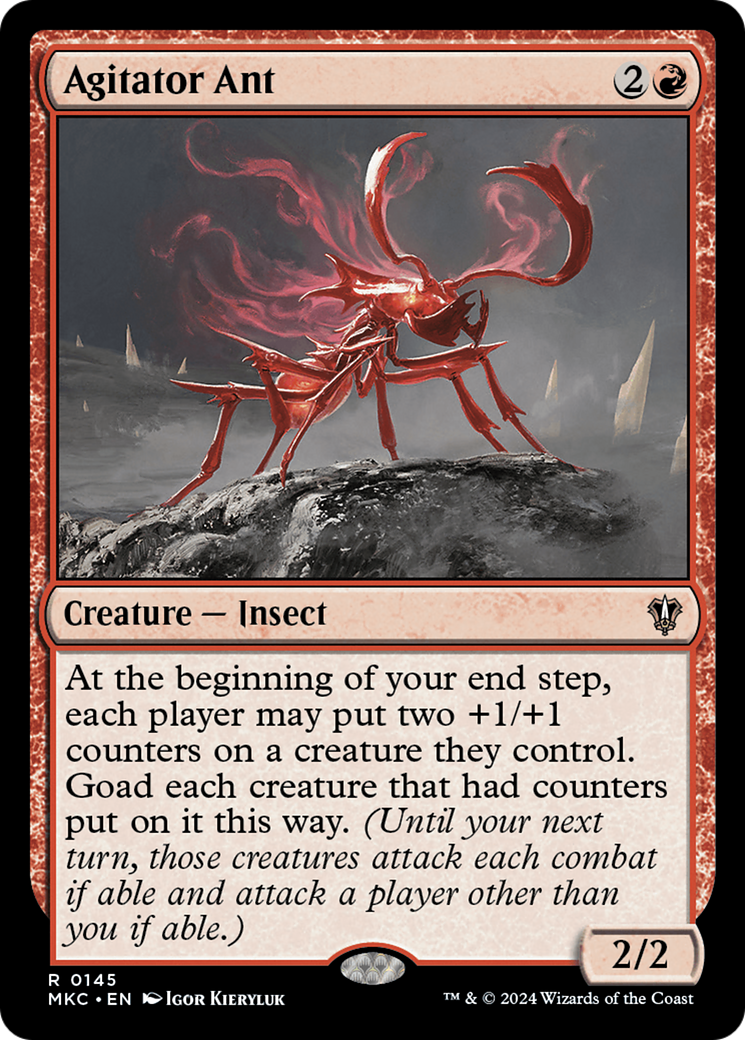
Agitator Ant
Agitator Ant
Creature — Insect
2/2
At the beginning of your end step, each player may put two +1/+1 counters on a creature they control. Goad each creature that had counters put on it this way. (Until your next turn, those creatures attack each combat if able and attack a player other than you if able.)
- If the creature doesn't meet any of the above exceptions and can attack, it must attack a player other than the controller of the spell or ability that goaded it if able. If the creature can't attack any of those players but could otherwise attack, it must attack a planeswalker an opponent controls, a battle an opponent controls, or a player who goaded it.
- Attacking with a goaded creature doesn't cause it to stop being goaded. If there is an additional combat phase that turn, or if another player gains control of it before it stops being goaded, it must attack again if able.
- If a creature you control has been goaded by multiple opponents, it must attack one of your opponents that hasn't goaded it, as that fulfills the maximum number of goad requirements. If a creature you control has been goaded by each of your opponents, the creature must attack an opponent (rather than a planeswalker or battle), but you choose which opponent it attacks.
- If, during a player's declare attackers step, a creature that player controls that's been goaded is tapped, is affected by a spell or ability that says it can't attack, or hasn't been under that player's control continuously since the turn began (and doesn't have haste), then it doesn't attack. If there's a cost associated with having a creature attack a player, its controller isn't forced to pay that cost, so it doesn't have to attack that player.
- Being goaded isn't an ability the creature has. Once it's been goaded, it must attack as detailed above even if it loses all abilities.
- If a creature can't have +1/+1 counters put on it, its controller can't choose it just to have it become goaded. If it can have counters put on it but replacement effects cause it not to receive +1/+1 counters, it doesn't become goaded.
- As Agitator Ant's ability resolves, first you choose which creature you control, if any, to put two +1/+1 counters on, then each other player in turn order does the same, knowing the choices made before them. Then each chosen creature receives its +1/+1 counters and becomes goaded.
-
1
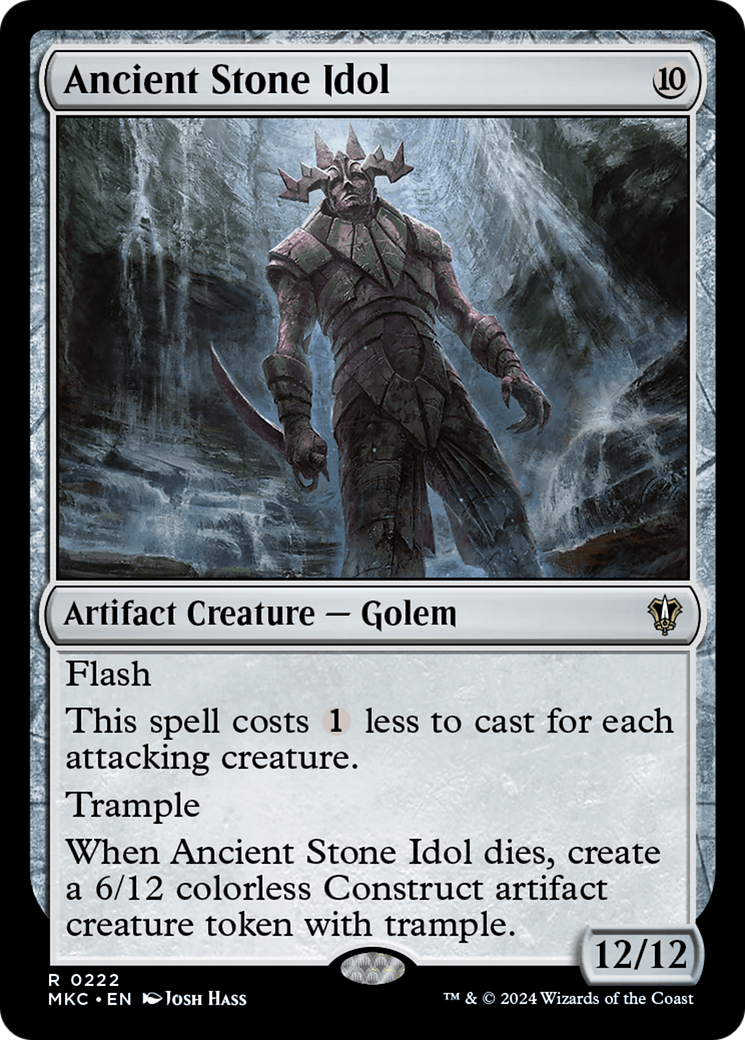
Ancient Stone Idol
Ancient Stone Idol
Artifact Creature — Golem
12/12
Flash
This spell costs less to cast for each attacking creature.
Trample
When this creature dies, create a 6/12 colorless Construct artifact creature token with trample.
- Ancient Stone Idol's cost is reduced for each attacking creature, not just creatures attacking you. It even counts your attacking creatures.
- If there are enough attacking creatures, Ancient Stone Idol's cost can be reduced to .
- The total cost to cast a spell is locked in before you pay that cost. For example, if you control five attacking creatures, including one you can sacrifice to add , Ancient Stone Idol costs to cast. Then you can sacrifice the creature when you activate mana abilities just before paying the cost, and it still costs only to cast.
-
1
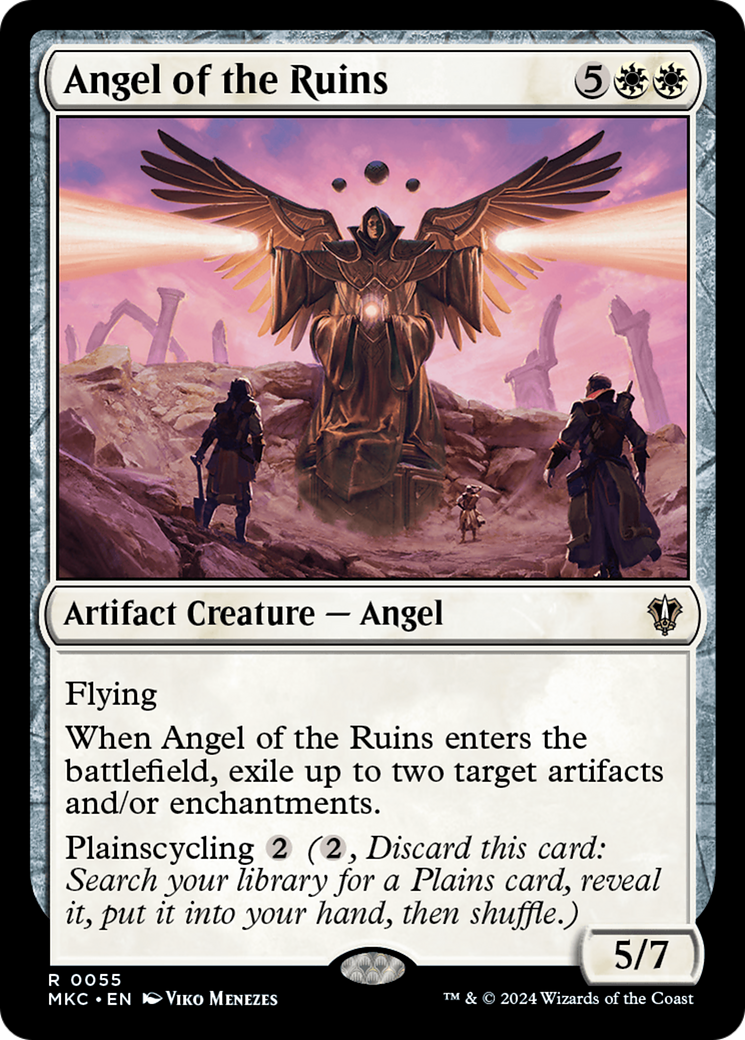
Angel of the Ruins
Angel of the Ruins
Artifact Creature — Angel
5/7
Flying
When this creature enters, exile up to two target artifacts and/or enchantments.
Plainscycling ( , Discard this card: Search your library for a Plains card, reveal it, put it into your hand, then shuffle.)
-
1
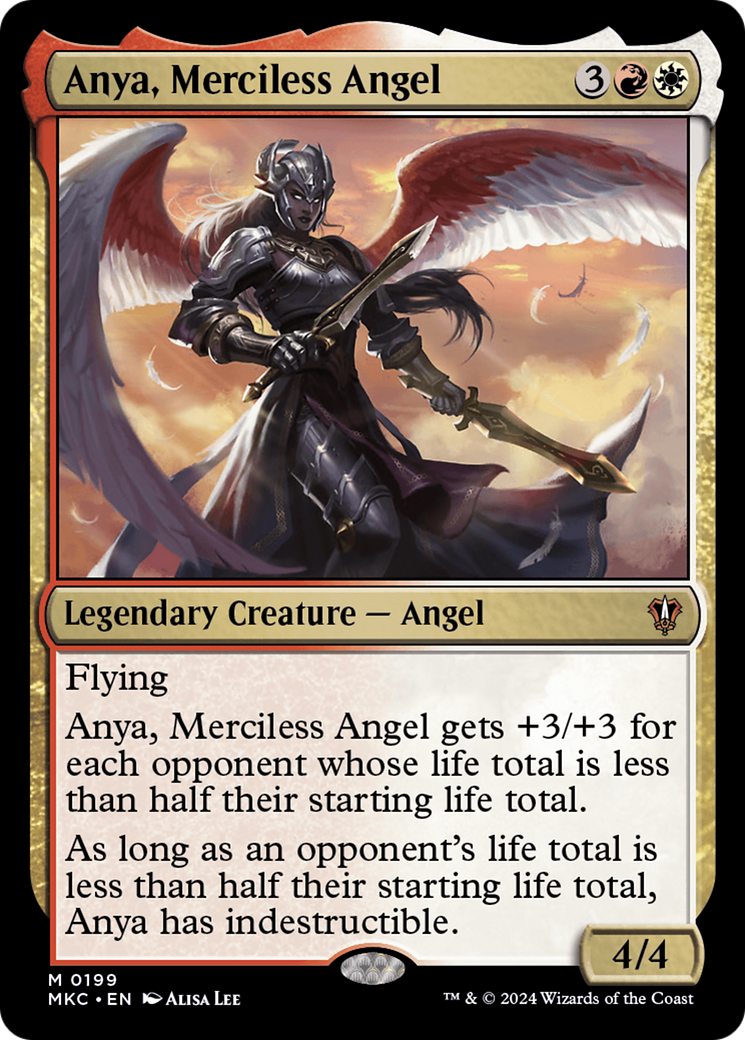
Anya, Merciless Angel
Anya, Merciless Angel
Legendary Creature — Angel
4/4
Flying
Anya gets +3/+3 for each opponent whose life total is less than half their starting life total.
As long as an opponent's life total is less than half their starting life total, Anya has indestructible.
- Damage dealt to Anya is tracked even if Anya has indestructible. For example, if Anya is dealt what would be lethal damage and Anya loses indestructible (perhaps because each opponent's life total is too high), it will be destroyed the next time state-based actions are performed. However, the check for whether a creature dealt damage by a source with deathtouch is destroyed happens only the first time that state-based actions are performed after that damage-dealing event.
- If damage is dealt to Anya and to your opponents at the same time, Anya may gain indestructible and/or extra toughness before state-based actions are checked. Similarly, if damage is dealt to Anya by a source with lifelink controlled by an opponent, Anya may lose indestructible and/or toughness before state-based actions are checked.
- If a player's starting life total is odd (Commander Vanguard? Sweet.), half that player's life total will be a fraction, and that's okay. For example, if an opponent's starting life total is 41, half that number is 20 ½. If that player's life total is 20 or less, Anya will have indestructible.
-
1
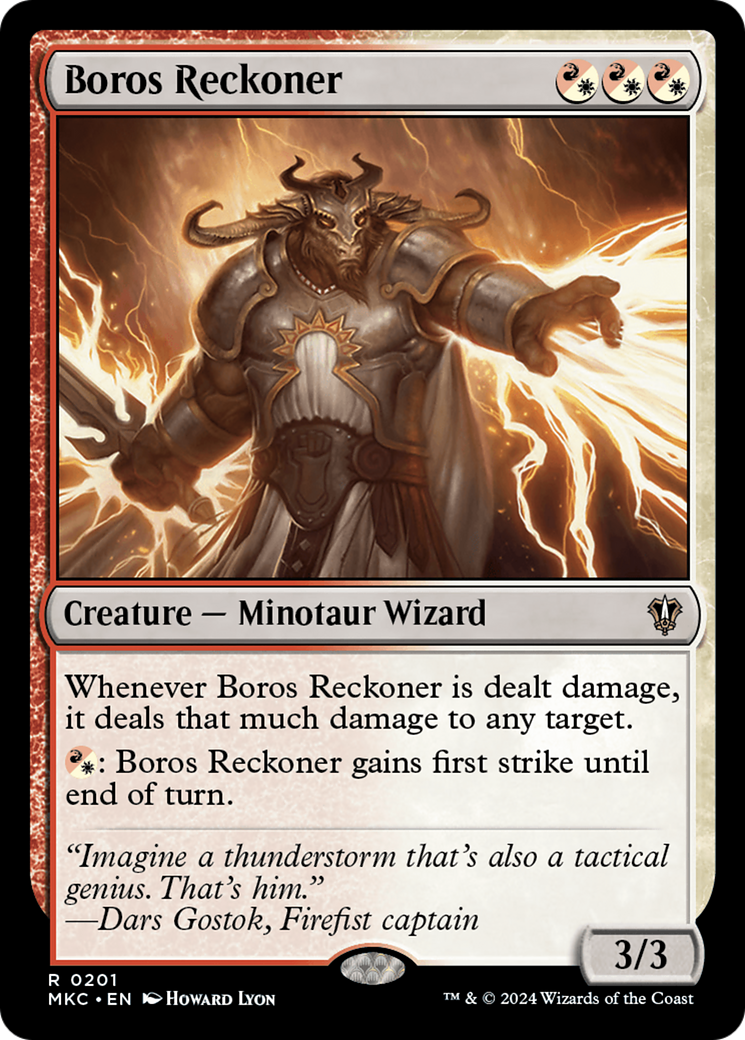
Boros Reckoner
Boros Reckoner
Creature — Minotaur Wizard
3/3
Whenever this creature is dealt damage, it deals that much damage to any target.
: This creature gains first strike until end of turn.
- Boros Reckoner's first ability will trigger even if it is dealt lethal damage. For example, if it blocks a 7/7 creature, its ability will trigger and Boros Reckoner will deal 7 damage to the target.
- Damage dealt by Boros Reckoner due to its first ability isn't combat damage, even if it was combat damage that caused that ability to trigger.
- If Boros Reckoner is dealt damage by multiple sources at once, such as by two creatures blocking it, its ability triggers once and one target is dealt that much damage.
-
1
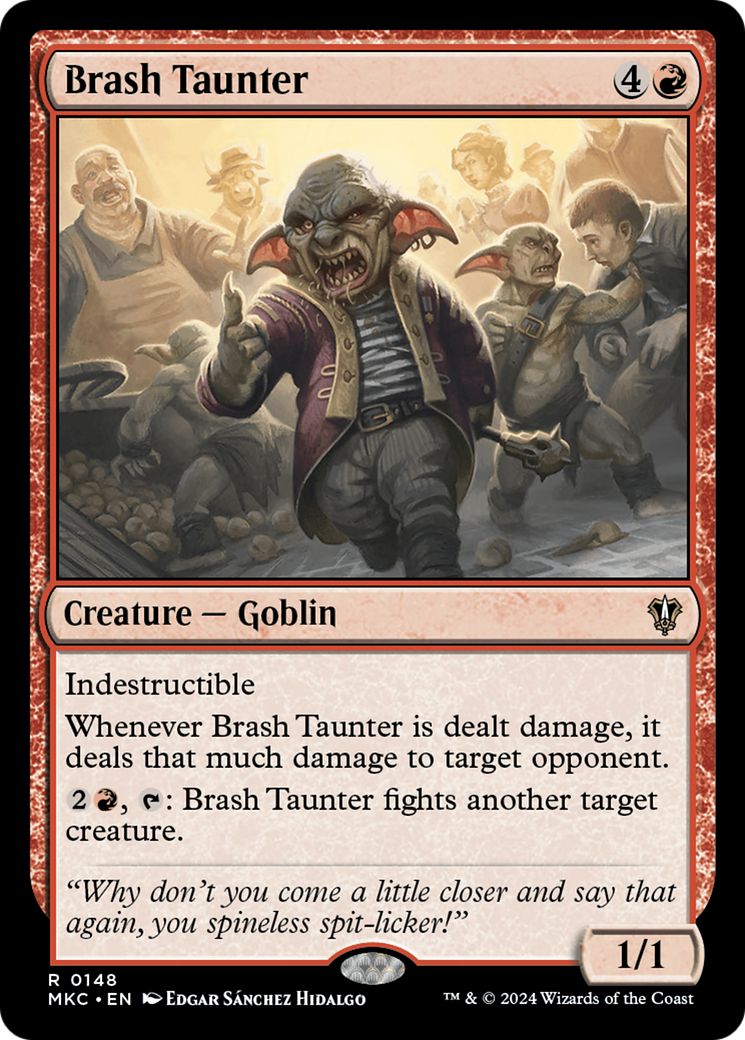
Brash Taunter
Brash Taunter
Creature — Goblin
1/1
Indestructible
Whenever this creature is dealt damage, it deals that much damage to target opponent.
, : This creature fights another target creature.
- A creature can be dealt an amount of damage greater than its toughness. For example, if Brash Taunter is dealt 3 damage, its middle ability deals 3 damage, not 1, to the target opponent.
- If your life total is brought to 0 or less at the same time that Brash Taunter is dealt damage, you lose the game before its middle ability goes on the stack.
- If the target creature is an illegal target when Brash Taunter's last ability tries to resolve, the ability doesn't resolve. If Brash Taunter is no longer on the battlefield, the target creature won't deal or be dealt damage.
-
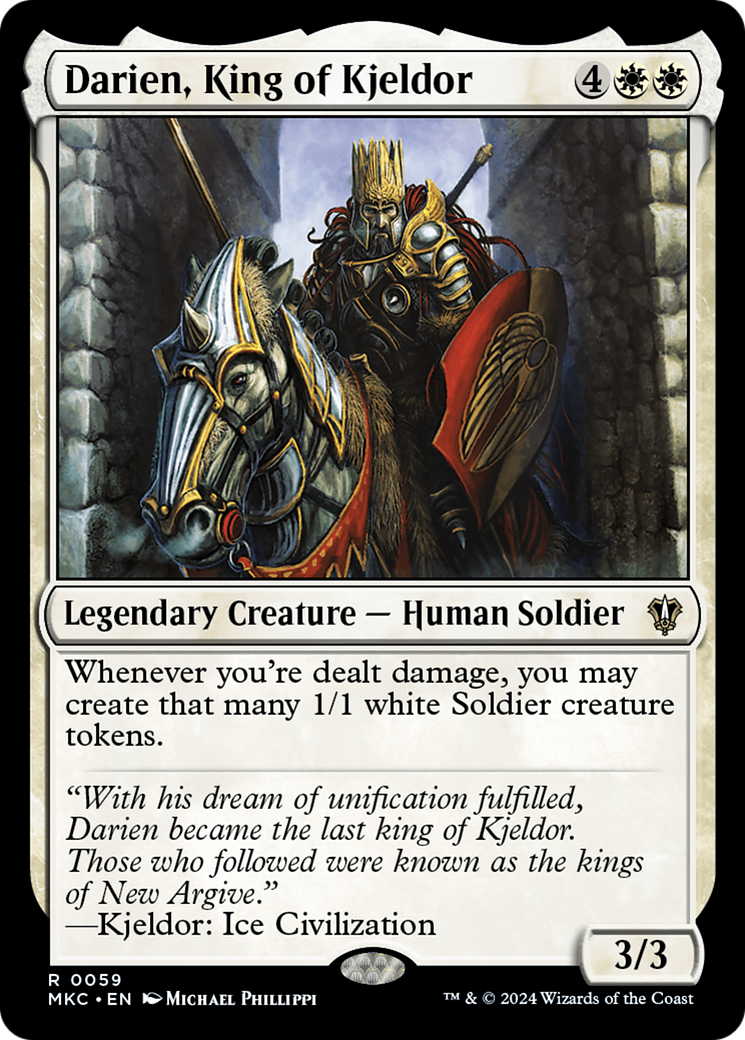
1
Darien, King of Kjeldor
Darien, King of Kjeldor
Legendary Creature — Human Soldier
3/3
Whenever you're dealt damage, you may create that many 1/1 white Soldier creature tokens.
- If you're dealt damage that causes your life total to become 0 or less, you lose the game before the tokens can be created.
-
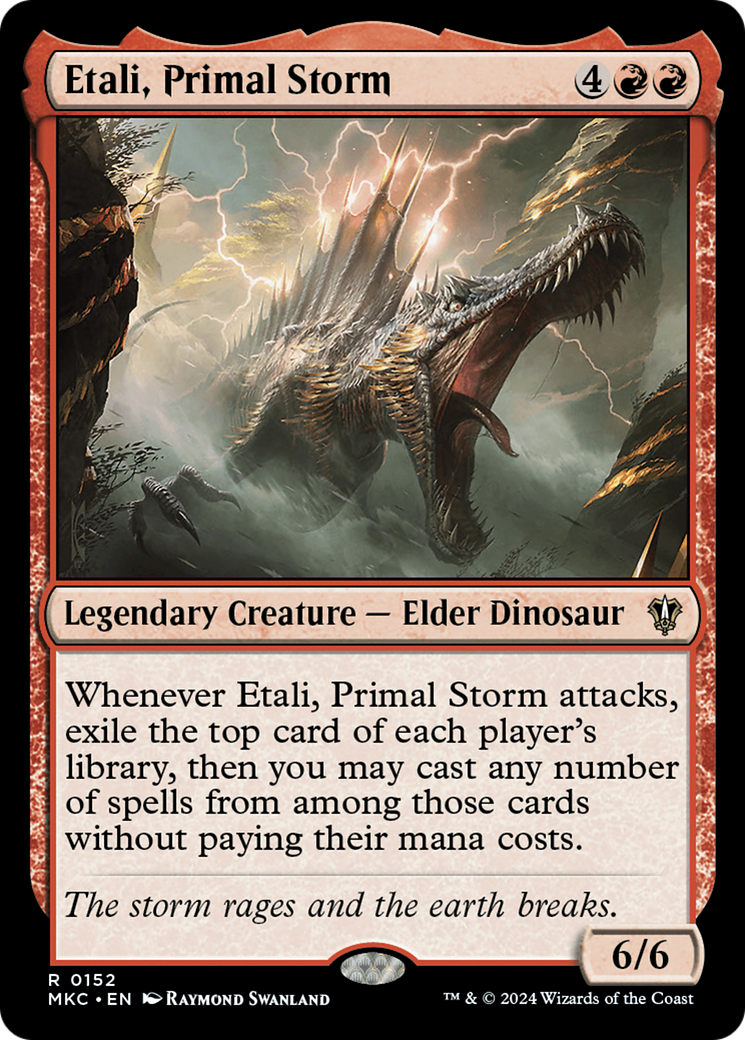
1
Etali, Primal Storm
Etali, Primal Storm
Legendary Creature — Elder Dinosaur
6/6
Whenever Etali attacks, exile the top card of each player's library, then you may cast any number of spells from among those cards without paying their mana costs.
- If an exiled card has in its mana cost, you must choose 0 as the value of X when casting it without paying its mana cost.
- If you cast any of the exiled cards, you do so as part of the resolution of the triggered ability. You can't wait to cast them later in the turn. Timing permissions based on a card's type are ignored, and the spells resolve before blockers are declared.
- If you cast a card "without paying its mana cost," you can't pay any alternative costs. You can, however, pay additional costs. If the card has any mandatory additional costs, those must be paid to cast the card.
- If you cast more than one of the exiled cards, you choose the order in which to cast them. A spell you cast this way can be the target of a later spell you cast this way. However, permanent spells cast this way won't resolve until you're done casting spells, so the permanents they become can't be the target of spells cast this way. For example, if you exile Twincast and Lightning Strike, you can cast Lightning Strike and then cast Twincast targeting it; but if you exile a creature card and an Aura card, you can't cast that Aura targeting that creature.
- Any cards not cast, including land cards, remain in exile. They can't be cast on later turns, even if Etali attacks again.
- Because all attacking creatures are chosen at once, a creature cast this way can't attack during the same combat as Etali, even if it has haste.
- In a multiplayer game, if a player leaves the game, all cards that player owns leave as well. If you leave the game, any spells or permanents you control from Etali's ability are exiled.
-
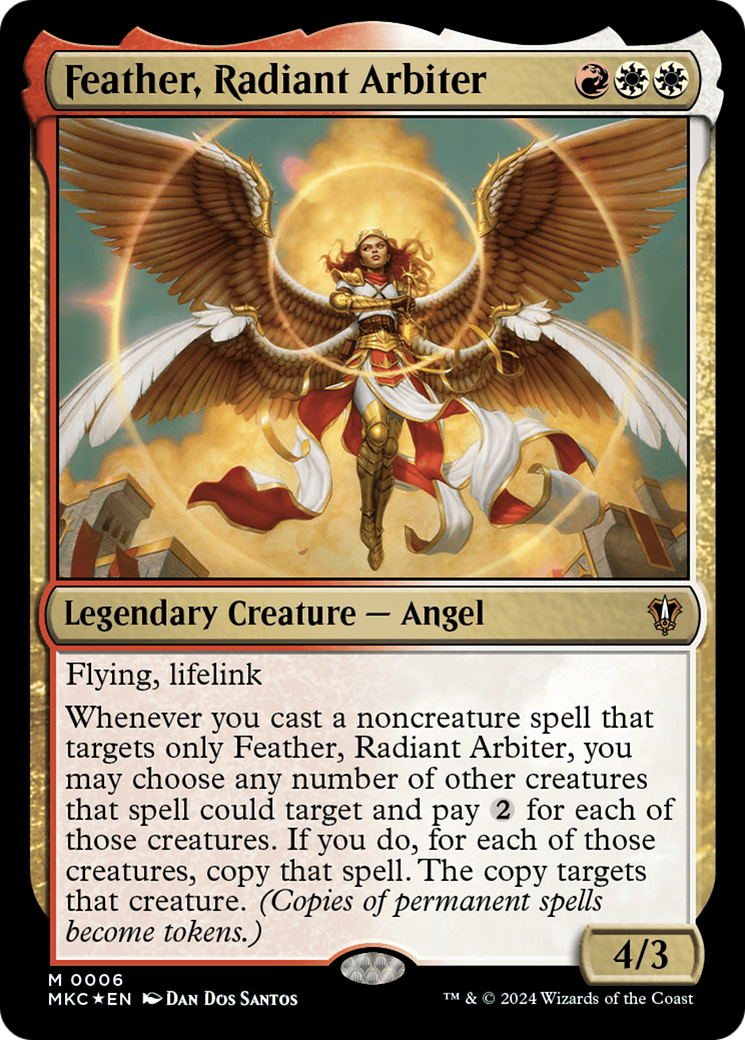
1
Feather, Radiant Arbiter
Feather, Radiant Arbiter
Legendary Creature — Angel
4/3
Flying, lifelink
Whenever you cast a noncreature spell that targets only Feather, you may choose any number of other creatures that spell could target and pay for each of those creatures. If you do, for each of those creatures, copy that spell. The copy targets that creature. (Copies of permanent spells become tokens.)
- Feather, Radiant Arbiter's ability triggers whenever you cast a noncreature spell that targets only Feather and no other object or player.
- If you cast a noncreature spell that has multiple targets, but it's targeting Feather, Radiant Arbiter with all of them, Feather's last ability will trigger. In that case, each of those copies will also only target one of the chosen creatures.
- You control all the copies, and you choose the order the copies are put on the stack. The original spell will be on the stack beneath those copies and will resolve last.
- The copies created by Feather, Radiant Arbiter's last ability are created on the stack, so they're not cast. Abilities that trigger when a player casts a spell (like Feather's own ability) won't trigger.
- If the spell that's copied is modal (that is, it says "Choose one —" or the like), the copies will have the same mode. You can't choose different modes.
- If the spell that's copied has an X whose value was determined as it was cast, the copies have the same value of X.
- You can't choose to pay any alternative or additional costs for the copies. However, effects based on any alternative or additional costs that were paid for the original spell are copied as though those same costs were paid for the copy.
- Any choices made when the spell resolves won't have been made yet when it's copied. Any such choices will be made separately when the copy resolves.
- If a permanent spell is copied, the copies are put onto the battlefield as a token as the spell resolves rather than putting the copy of the spell onto the battlefield. The rules that apply to a permanent spell becoming a permanent apply to a copy of a spell becoming a token.
- The token that a resolving copy of a permanent spell becomes isn't "created" and won't interact with abilities that care about tokens being created, such as that of Case of the Pilfered Proof.
-
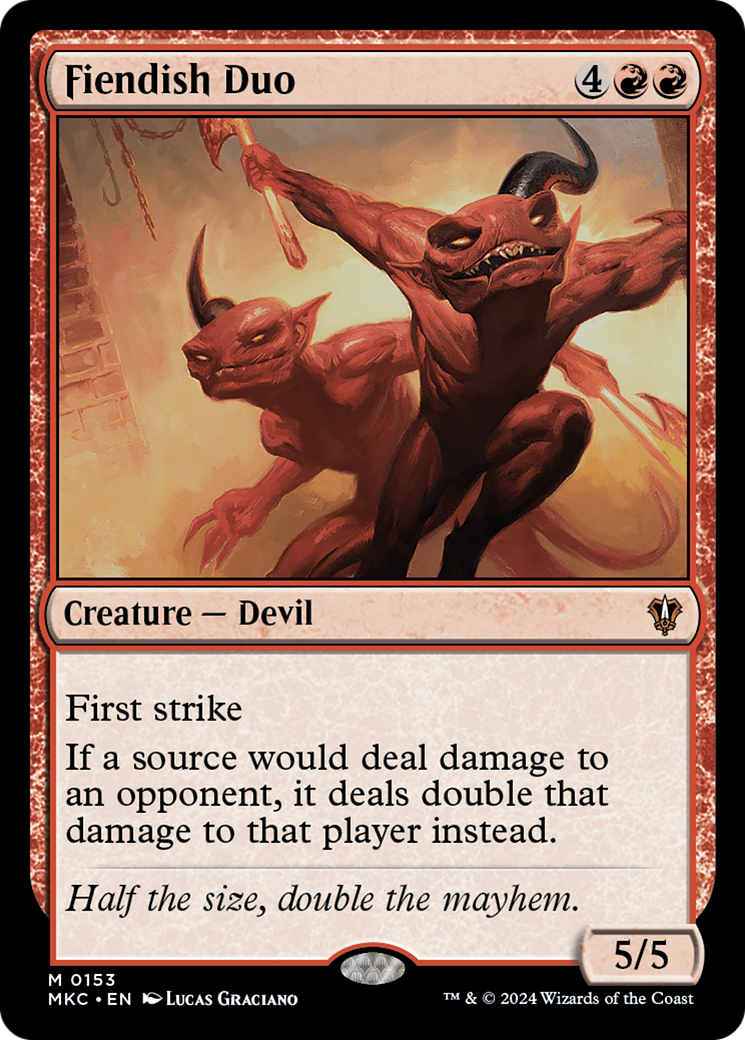
1
Fiendish Duo
Fiendish Duo
Creature — Devil
5/5
First strike (This creature deals combat damage before creatures without first strike.)
If a source would deal damage to an opponent, it deals double that damage to that player instead.
-
1
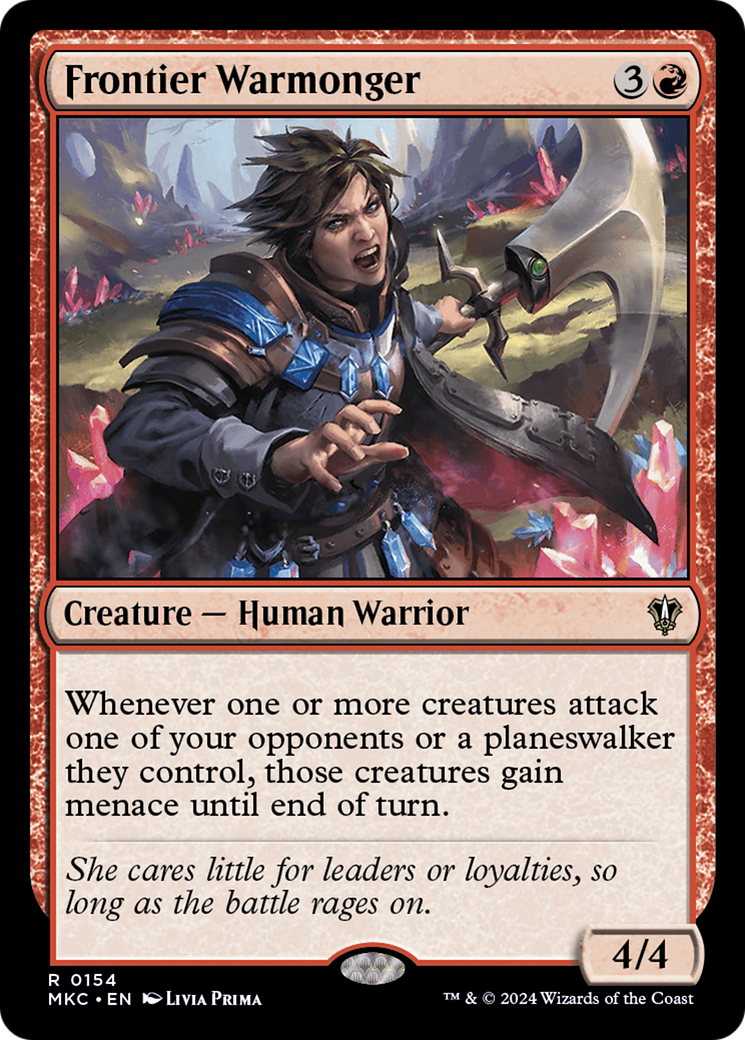
Frontier Warmonger
Frontier Warmonger
Creature — Human Warrior
4/4
Whenever one or more creatures attack one of your opponents or a planeswalker they control, those creatures gain menace until end of turn.
- Creatures your opponents control attacking one of your opponents will cause Frontier Warmonger's ability to trigger.
-
1
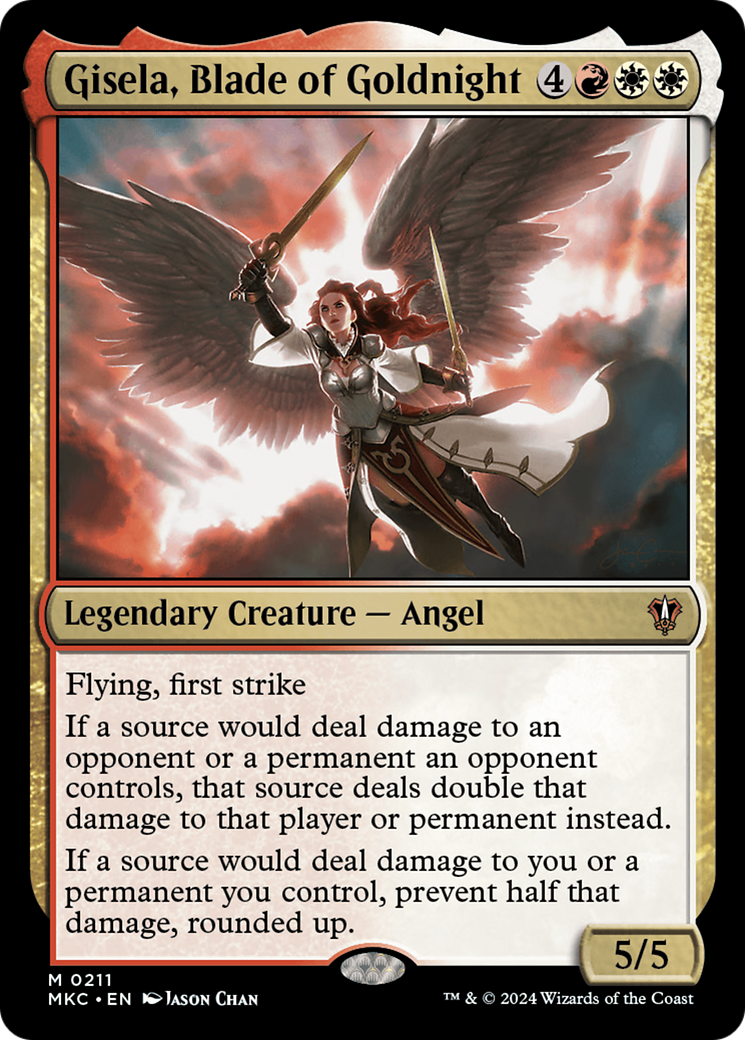
Gisela, Blade of Goldnight
Gisela, Blade of Goldnight
Legendary Creature — Angel
5/5
Flying, first strike
If a source would deal damage to an opponent or a permanent an opponent controls, that source deals double that damage to that player or permanent instead.
If a source would deal damage to you or a permanent you control, prevent half that damage, rounded up.
- Gisela doubles damage dealt to opponents and permanents your opponents control from any source, including sources controlled by those opponents.
- If multiple replacement effects would modify how damage would be dealt, the player being dealt damage (or the controller of the permanent being dealt damage) chooses the order in which to apply those effects.
- If damage dealt by a source you control is being divided or assigned among multiple permanents an opponent controls or among an opponent and one or more permanents they control simultaneously, divide the original amount and double the results. For example, if you attack with a 5/5 creature with trample and your opponent blocks with a 2/2 creature, you can assign 2 damage to the blocker and 3 damage to the defending player. These amounts are then doubled to 4 and 6 damage, respectively. You can't double the damage to 10 first and then assign 2 to the creature and 8 to the player.
-
1
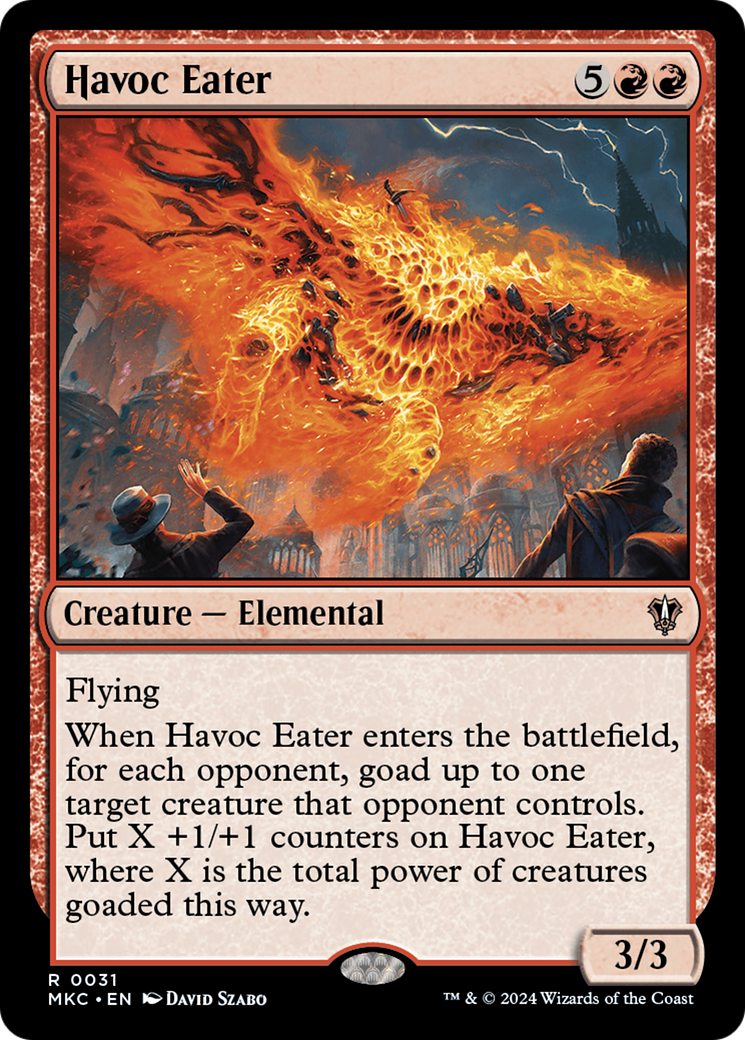
Havoc Eater
Havoc Eater
Creature — Elemental
3/3
Flying
When this creature enters, for each opponent, goad up to one target creature that opponent controls. Put X +1/+1 counters on this creature, where X is the total power of creatures goaded this way.
-
1
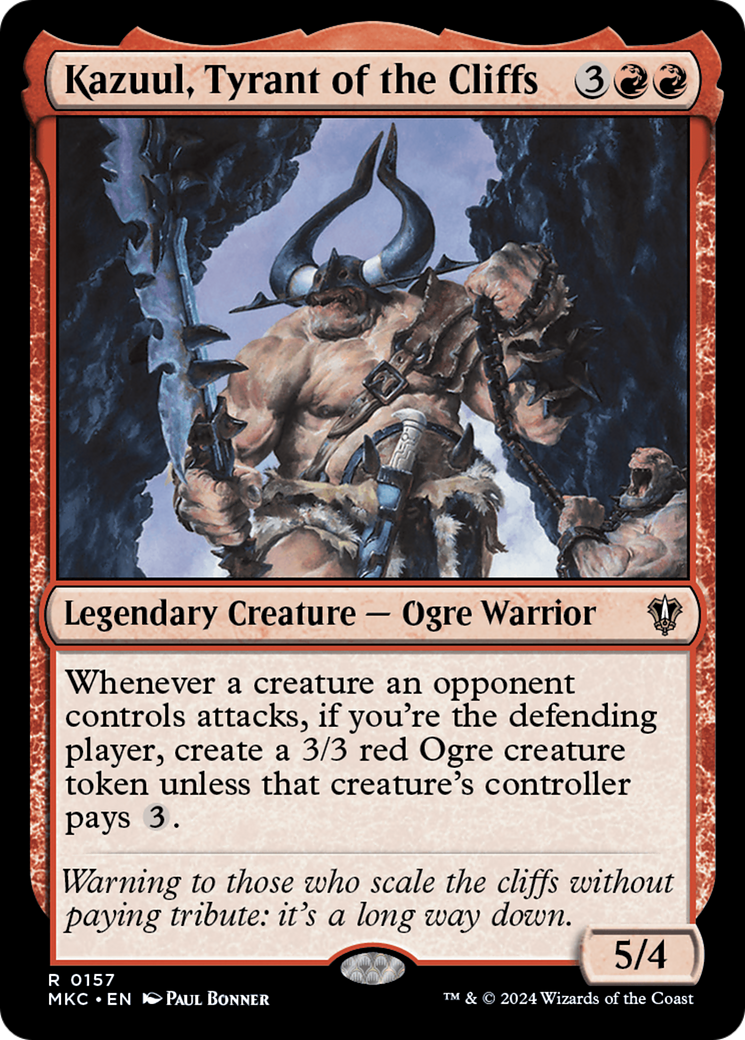
Kazuul, Tyrant of the Cliffs
Kazuul, Tyrant of the Cliffs
Legendary Creature — Ogre Warrior
5/4
Whenever a creature an opponent controls attacks, if you're the defending player, create a 3/3 red Ogre creature token unless that creature's controller pays .
- You're the defending player if a creature is attacking you, a planeswalker you control, or a battle you protect.
- If you're the defending player, Kazuul's ability triggers once for each creature that attacks, not just once per combat. The attacking player chooses whether to pay or let you have an Ogre token each time one of those abilities resolves.
- As the ability resolves, you can't put the Ogre token onto the battlefield without explicitly giving the attacking player the option to pay , even if the attacking player has forgotten about this ability.
- The ability triggers and resolves during the declare attackers step. If you put an Ogre token onto the battlefield as a result, you may block with it during that combat phase.
- If an attacking creature has a "Whenever this creature attacks" ability, that ability is put on the stack first, then Kazuul's ability is put on the stack. Although Kazuul's ability will resolve first, and potentially create an Ogre token, any target of the other ability will already have been chosen at this point, and thus could not have been the new Ogre token.
- In a multiplayer game, the ability checks whether you're the defending player for each individual attacking creature. For example, if one creature attacks you and two creatures attack another player, Kazuul's ability triggers just once.
-
1
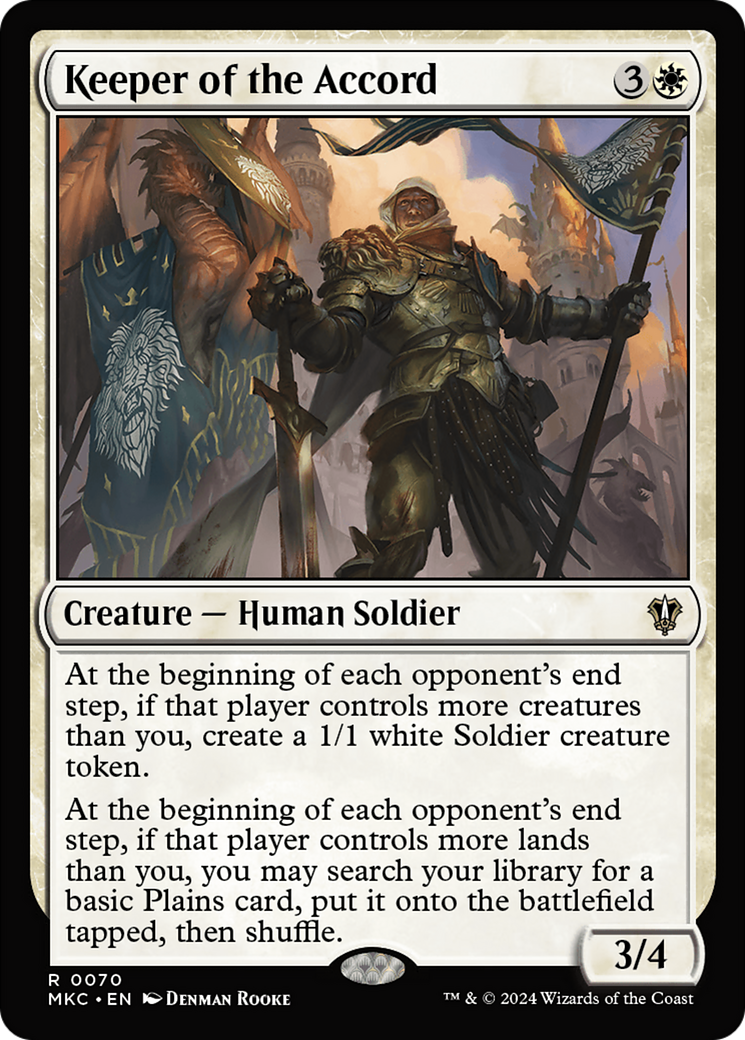
Keeper of the Accord
Keeper of the Accord
Creature — Human Soldier
3/4
At the beginning of each opponent's end step, if that player controls more creatures than you, create a 1/1 white Soldier creature token.
At the beginning of each opponent's end step, if that player controls more lands than you, you may search your library for a basic Plains card, put it onto the battlefield tapped, then shuffle.
- Both triggered abilities trigger at the same time. You may put them on the stack in either order.
- If the opponent doesn't control more creatures than you as their end step begins, the first ability won't trigger. The same is true for lands and the second ability. Each of those abilities will check again when it tries to resolve. If the opponent no longer controls more creatures (or lands) than you, the ability won't resolve and will have no effect.
-
1
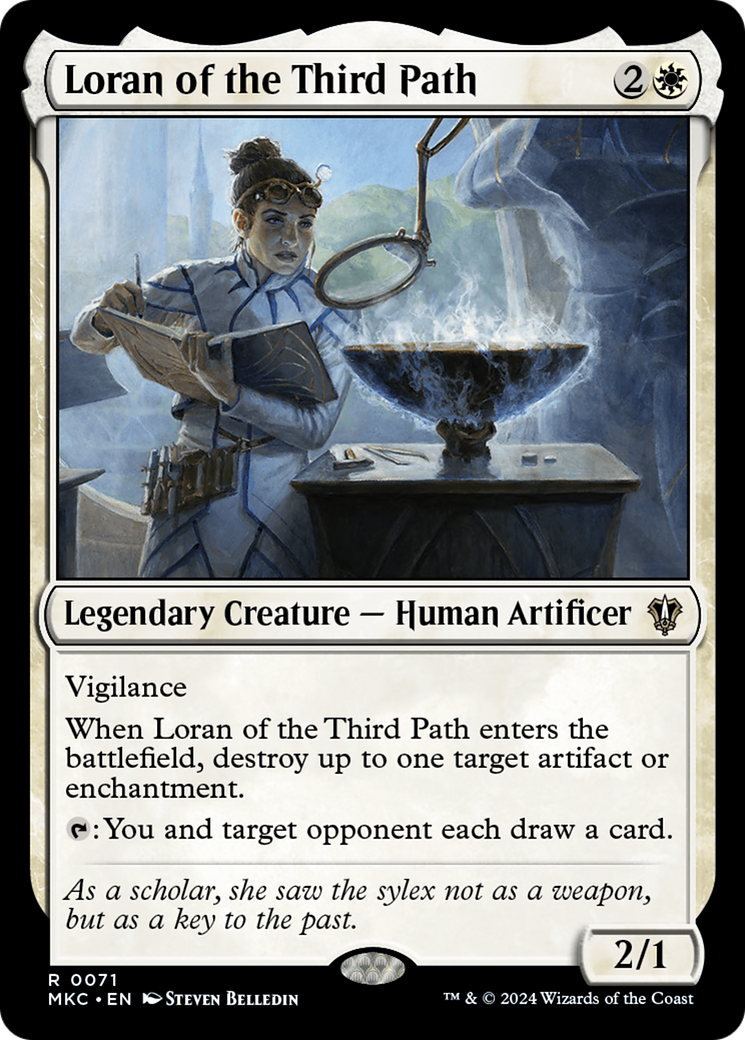
Loran of the Third Path
Loran of the Third Path
Legendary Creature — Human Artificer
2/1
Vigilance
When Loran enters, destroy up to one target artifact or enchantment.
: You and target opponent each draw a card.
-
1
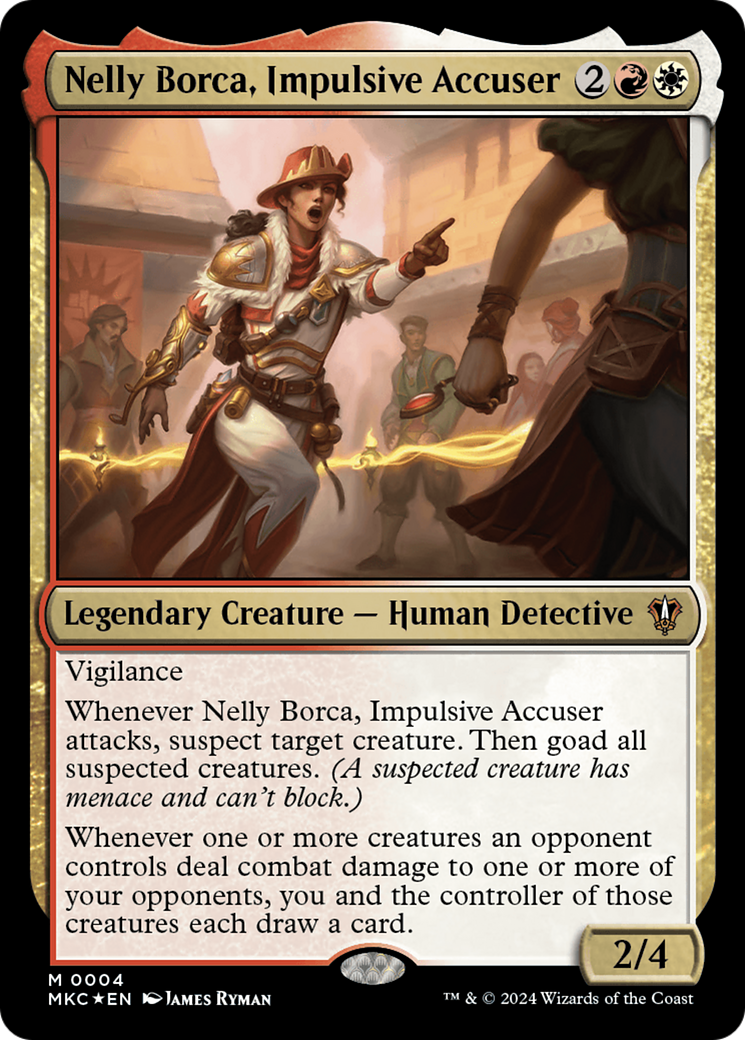
Nelly Borca, Impulsive Accuser
Nelly Borca, Impulsive Accuser
Legendary Creature — Human Detective
2/4
Vigilance
Whenever Nelly Borca attacks, suspect target creature. Then goad all suspected creatures. (A suspected creature has menace and can't block.)
Whenever one or more creatures an opponent controls deal combat damage to one or more of your opponents, you and the controller of those creatures each draw a card.
- You can target a creature that's already suspected with Nelly Borca, Impulsive Accuser's second ability.
- When an effect suspects a creature, it becomes suspected. It gains menace and "This creature can't block" for as long as it's suspected. It stays suspected until it leaves the battlefield or another effect causes it to no longer be suspected.
- If a suspected creature loses all abilities, it will lose menace and "This creature can't block", but it won't stop being suspected.
- Being suspected isn't a copiable value. If a permanent becomes a copy of a suspected creature, it won't be suspected.
- If a creature is already suspected, suspecting it again won't have any effect.
- There's no limit to the number of creatures that can be suspected simultaneously. Suspecting a new creature doesn't cause other creatures to stop being suspected.
-
1
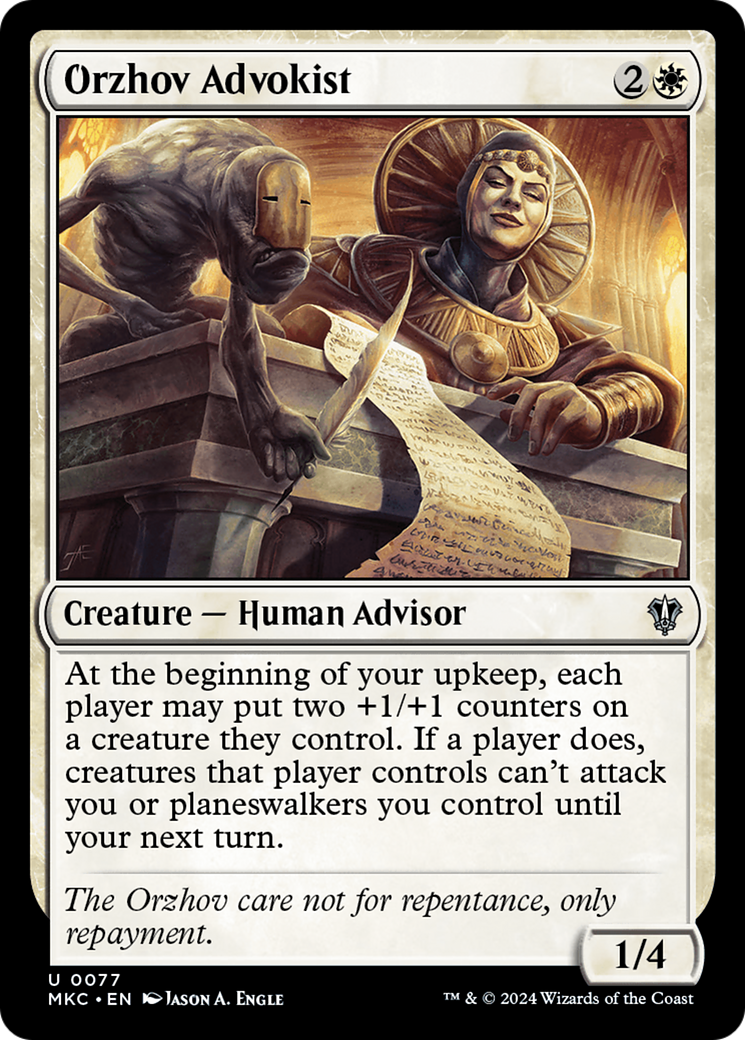
Orzhov Advokist
Orzhov Advokist
Creature — Human Advisor
1/4
At the beginning of your upkeep, each player may put two +1/+1 counters on a creature they control. If a player does, creatures that player controls can't attack you or planeswalkers you control until your next turn.
- While resolving Orzhov Advokist's ability, you choose a creature you control or choose not to put any counters on a creature, then each other player in turn order does the same. Each player will know the choices made by players who chose before them. Then simultaneously each player who chose a creature puts two +1/+1 counters on the creature they chose.
- Orzhov Advokist's ability doesn't target the creatures that receive +1/+1 counters. Their controllers choose them as the ability resolves. Players can't take actions between making their choices and the +1/+1 counters being placed.
- If a player chooses to accept Orzhov Advokist's gift, that player can't attack you or a planeswalker you control with any creatures during their next turn, even creatures that weren't on the battlefield as Orzhov Advokist's ability resolved.
- Orzhov Advokist's effect keeps creatures from attacking you even if Orzhov Advokist leaves the battlefield, if the creature that received counters is no longer on the battlefield, or if an effect has moved those counters off of the creature that received them and put them onto another creature.
-
1
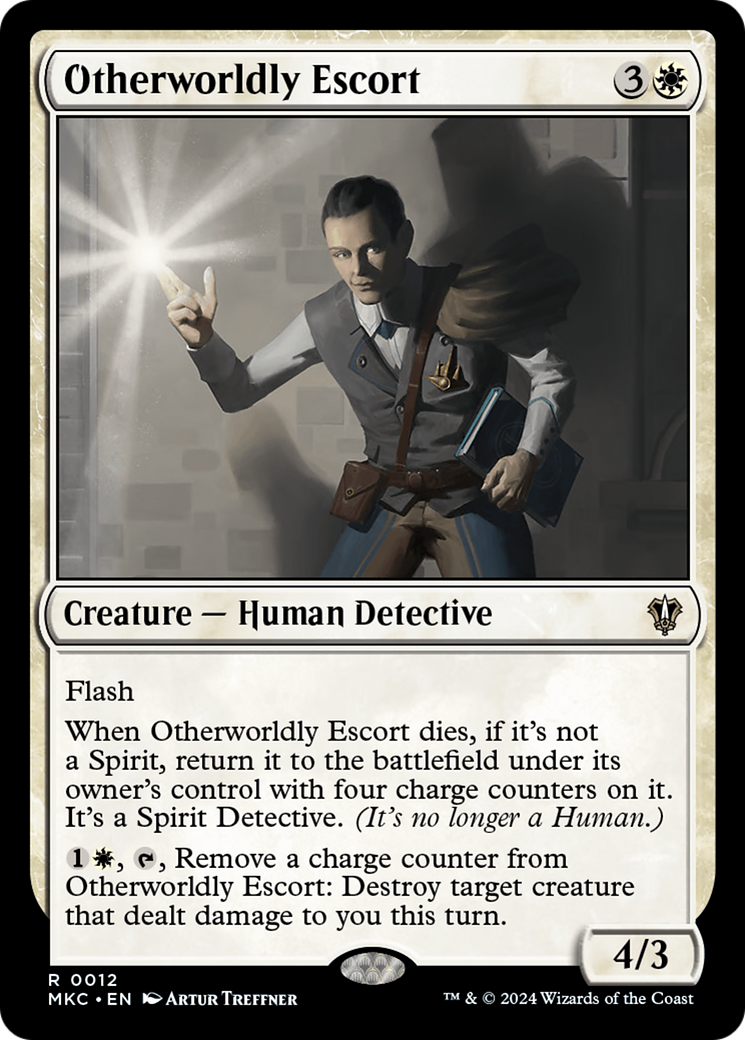
Otherworldly Escort
Otherworldly Escort
Creature — Human Detective
4/3
Flash
When this creature dies, if it's not a Spirit, return it to the battlefield under its owner's control with four charge counters on it. It's a Spirit Detective. (It's no longer a Human.)
, , Remove a charge counter from this creature: Destroy target creature that dealt damage to you this turn.
-
1
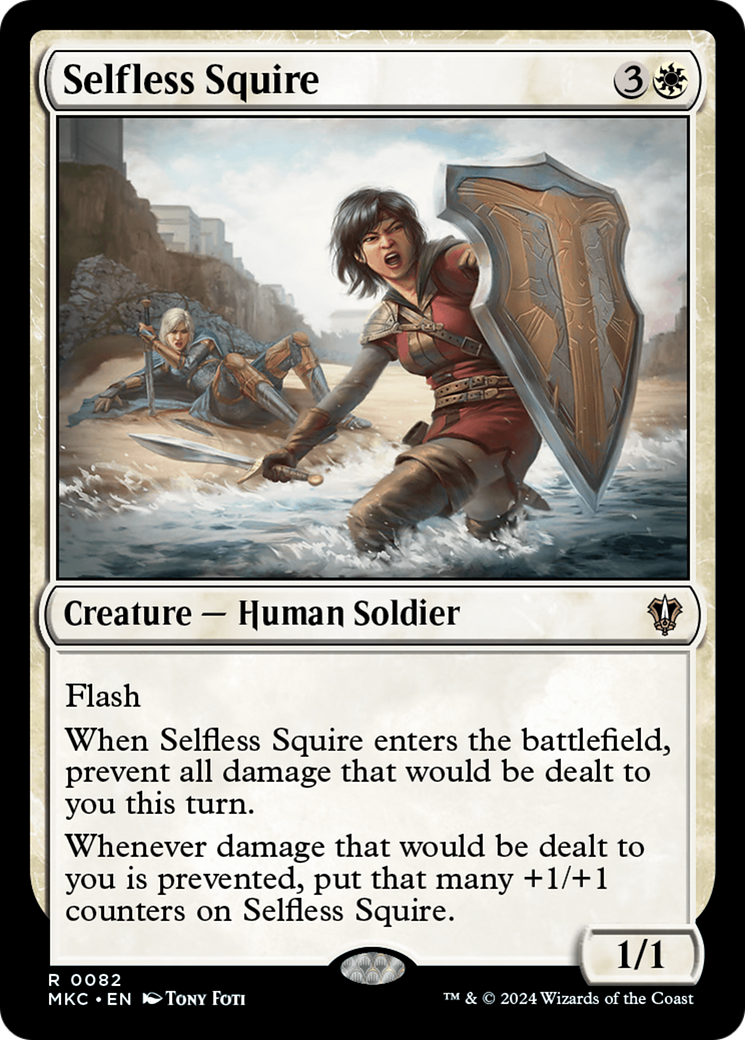
Selfless Squire
Selfless Squire
Creature — Human Soldier
1/1
Flash
When this creature enters, prevent all damage that would be dealt to you this turn.
Whenever damage that would be dealt to you is prevented, put that many +1/+1 counters on this creature.
- Selfless Squire's first triggered ability prevents all damage that would be dealt to you this turn after the triggered ability resolves, even if Selfless Squire leaves the battlefield.
- Selfless Squire's second triggered ability doesn't trigger only when damage is prevented by its first triggered ability's effect. Any effect that uses the word "prevent" will cause it to trigger.
-
1
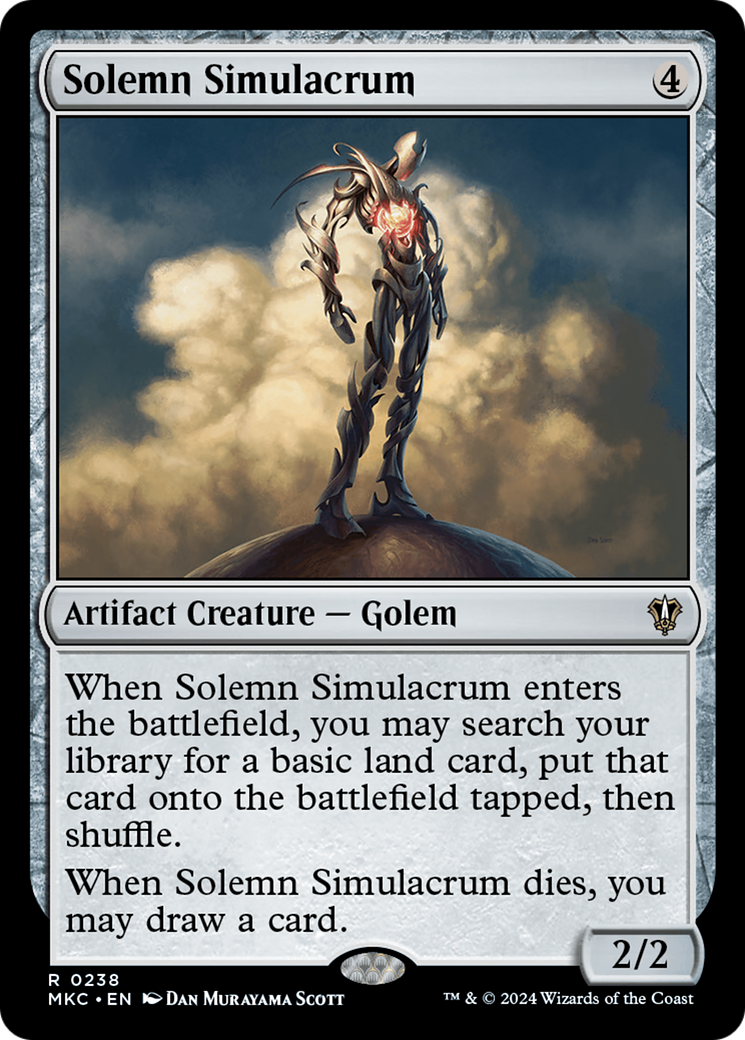
Solemn Simulacrum
Solemn Simulacrum
Artifact Creature — Golem
2/2
When this creature enters, you may search your library for a basic land card, put that card onto the battlefield tapped, then shuffle.
When this creature dies, you may draw a card.
-
1
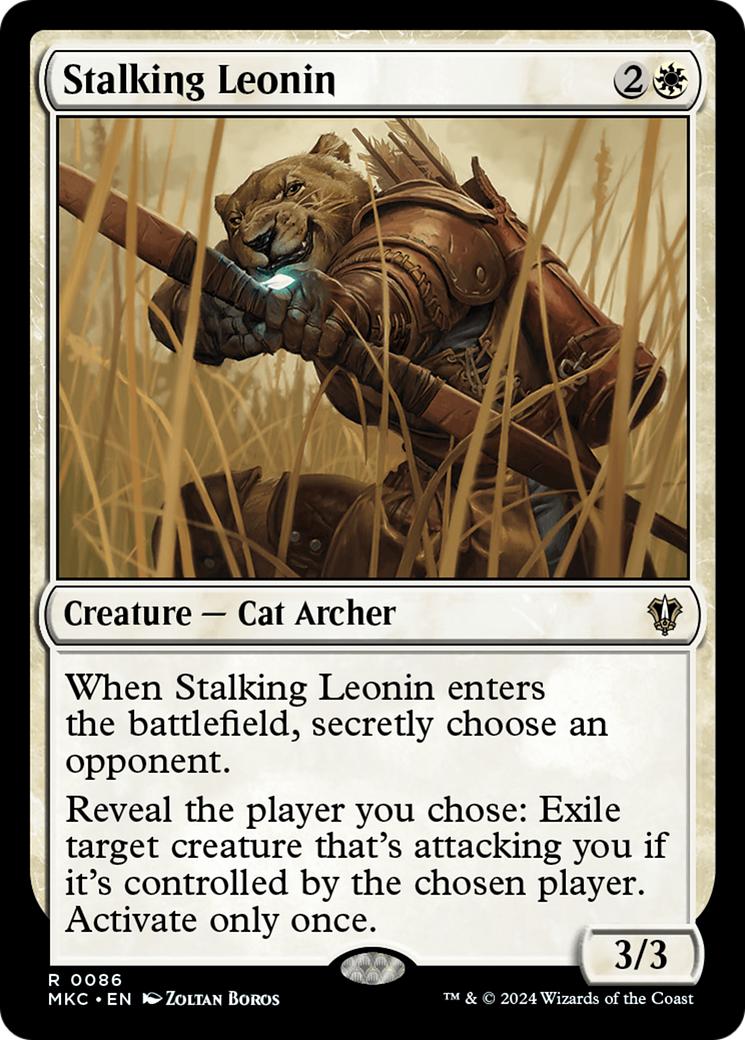
Stalking Leonin
Stalking Leonin
Creature — Cat Archer
3/3
When this creature enters, secretly choose an opponent.
Reveal the player you chose: Exile target creature that's attacking you if it's controlled by the chosen player. Activate only once.
- There are several ways to secretly choose an opponent, including writing that player's name on a piece of paper that's kept with Stalking Leonin.
- If you have multiple Stalking Leonins, you may choose a different opponent for each one. Be careful to keep track of which opponent is chosen for each Stalking Leonin.
- If Stalking Leonin leaves the battlefield and returns, it's considered a new object. You may choose a new opponent and you may activate its last ability again.
- If you didn't choose an opponent when Stalking Leonin entered the battlefield, you can't pay the cost to activate its last ability. This will usually happen because you gained control of another player's Stalking Leonin or because a creature already on the battlefield became a copy of Stalking Leonin.
- If a creature is attacking a planeswalker you control, it's not attacking you. Stalking Leonin's last ability can't target it.
-
1
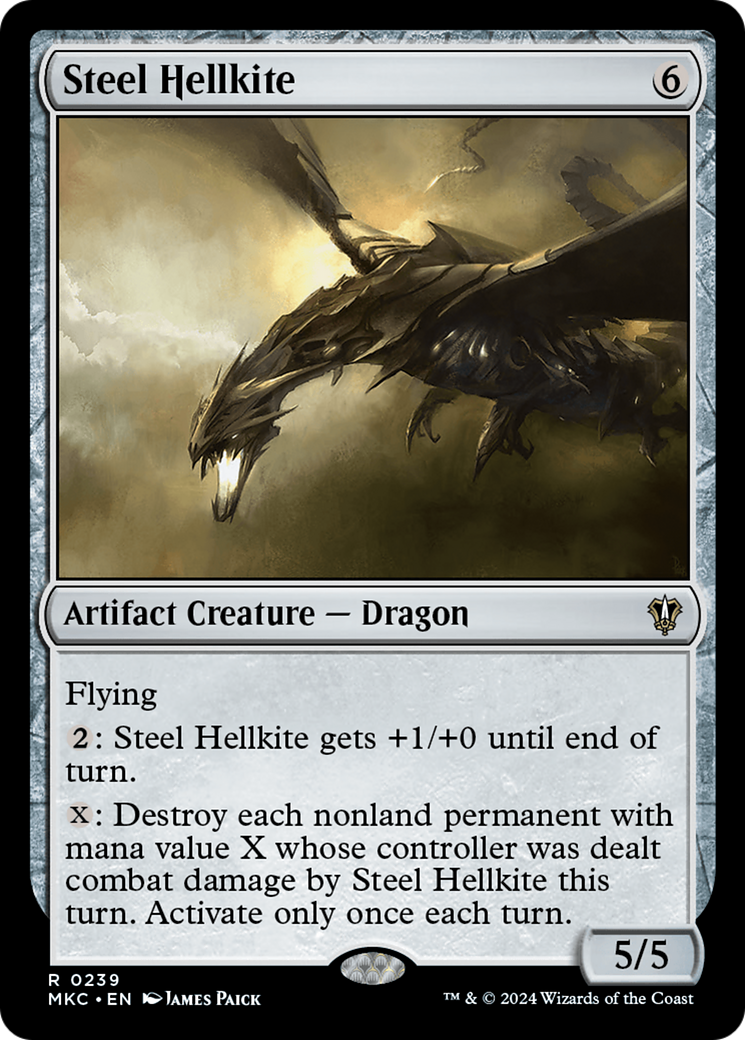
Steel Hellkite
Steel Hellkite
Artifact Creature — Dragon
5/5
Flying
: This creature gets +1/+0 until end of turn.
: Destroy each nonland permanent with mana value X whose controller was dealt combat damage by this creature this turn. Activate only once each turn.
- Steel Hellkite's last ability destroys only nonland permanents whose mana value is exactly equal to X, and only those controlled by players who have been dealt combat damage by Steel Hellkite this turn.
- It doesn't matter who controlled those permanents at the time Steel Hellkite dealt combat damage, or if those permanents were even on the battlefield at that time.
- You may activate the last ability even if Steel Hellkite hasn't dealt combat damage to any players that turn. If you do, the ability won't do anything.
- If Steel Hellkite's third ability is activated with X equal to 0, it will destroy each nonland permanent with mana value 0 the appropriate players control.
- The mana value of a permanent is determined solely by the mana symbols printed in its upper right corner, unless it's copying something else (see below). The mana value is the total amount of mana in that cost, regardless of color. For example, a card with mana cost has mana value 5.
- If a permanent is copying something else, its mana value is the mana value of whatever it's copying.
- In all cases, ignore any alternative costs or additional costs (such as kicker) paid when the permanent was cast.
- If the mana cost of a permanent includes , X is 0 for the purpose of determining its mana value.
- If a nonland permanent has no mana symbols in its upper right corner (because it's a token that's not copying something else, for example), its mana value is 0.
-
1
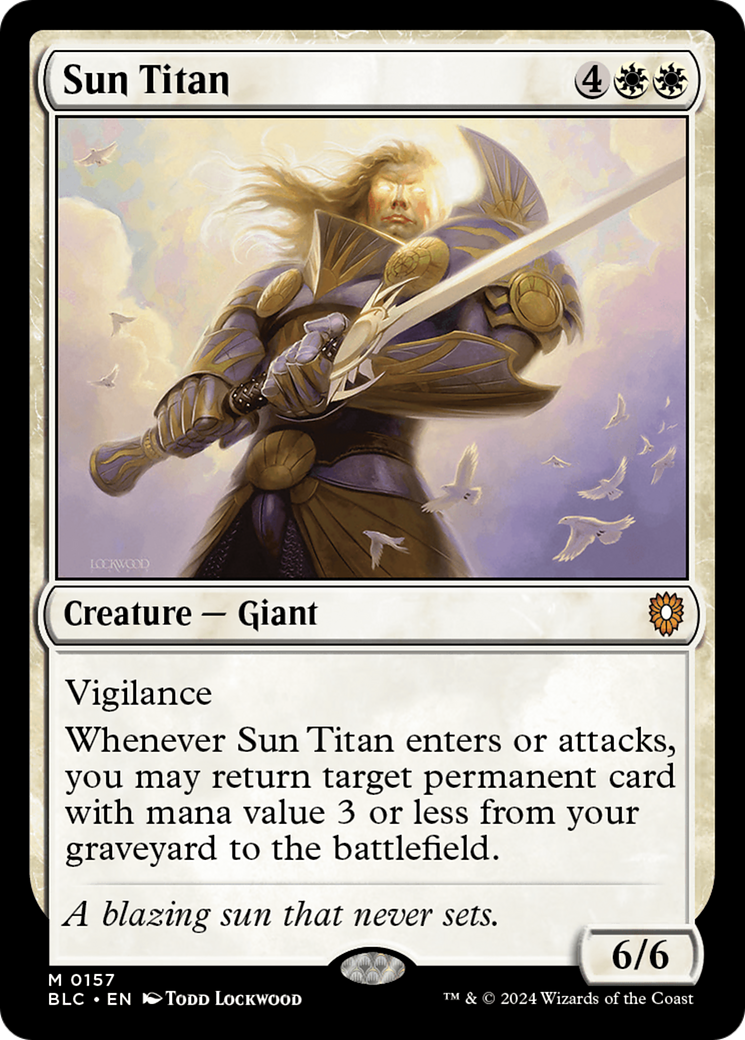
Sun Titan
Sun Titan
Creature — Giant
6/6
Vigilance
Whenever this creature enters or attacks, you may return target permanent card with mana value 3 or less from your graveyard to the battlefield.
- If a card in your graveyard has no mana symbols in its upper right corner (because it's a land card, for example), its mana value is 0.
- If the mana cost of a card in your graveyard includes , X is considered to be 0.
- A permanent card is an artifact, creature, enchantment, land, or planeswalker card.
- The mana value of a card in your graveyard is determined solely by the mana symbols printed in its upper right corner. The mana value is the total amount of mana in that cost, regardless of color. For example, a card with mana cost has mana value 5.
-
1
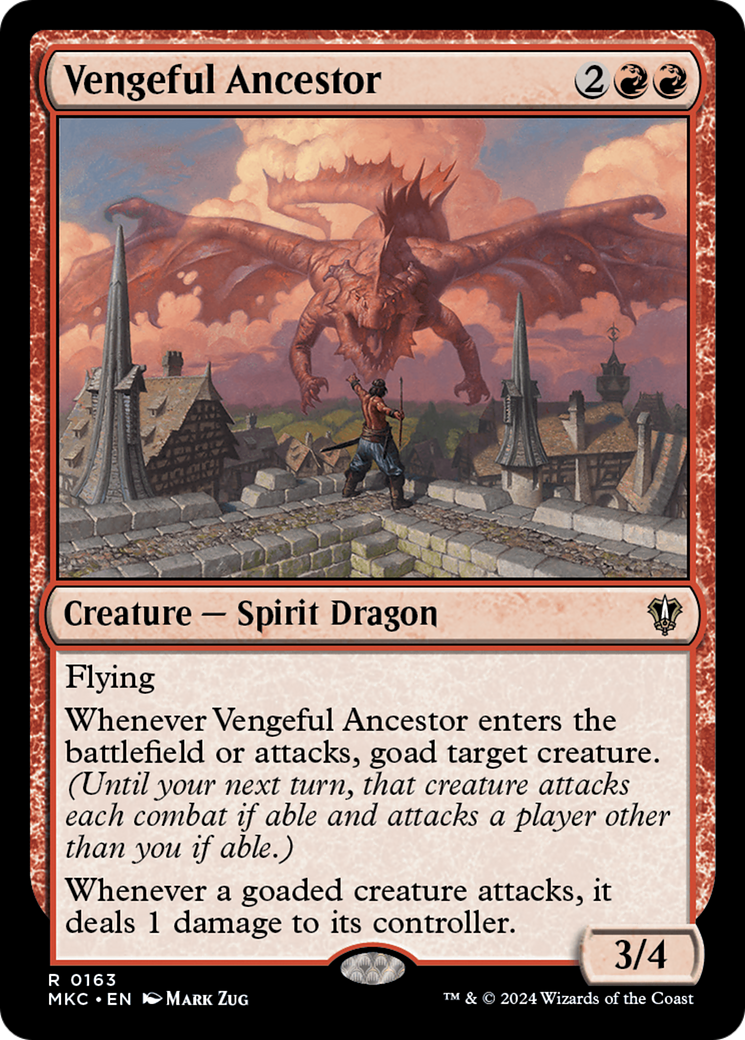
Vengeful Ancestor
Vengeful Ancestor
Creature — Spirit Dragon
3/4
Flying
Whenever this creature enters or attacks, goad target creature. (Until your next turn, that creature attacks each combat if able and attacks a player other than you if able.)
Whenever a goaded creature attacks, it deals 1 damage to its controller.
-
1
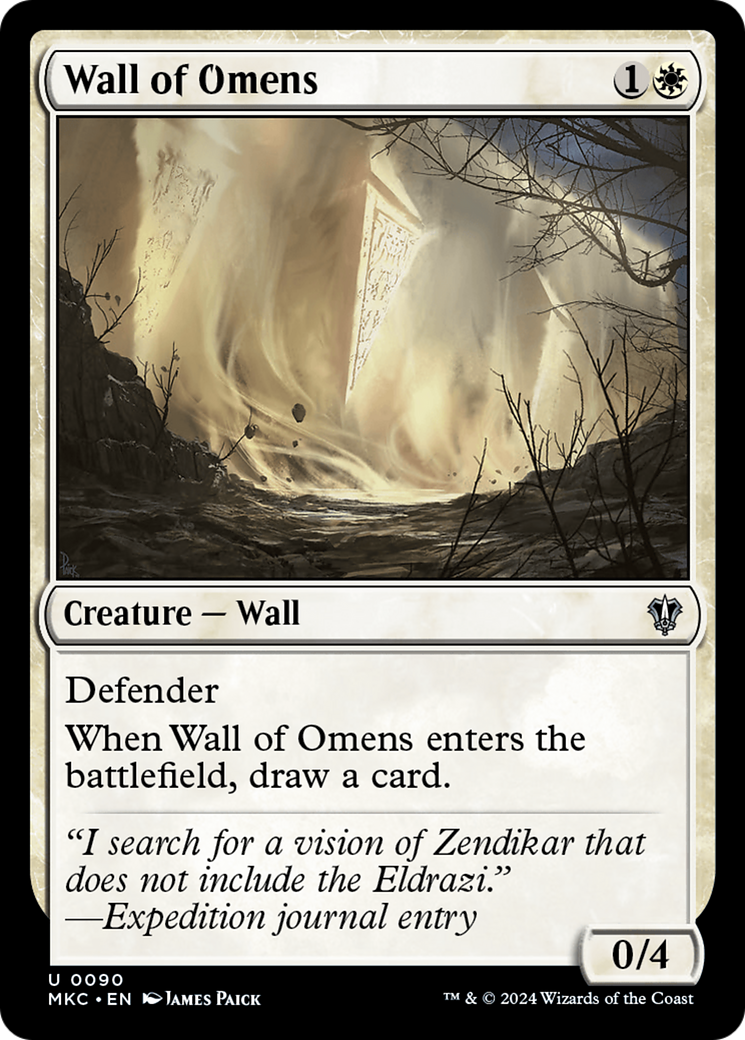
Wall of Omens
Wall of Omens
Creature — Wall
0/4
Defender
When this creature enters, draw a card.
-
1
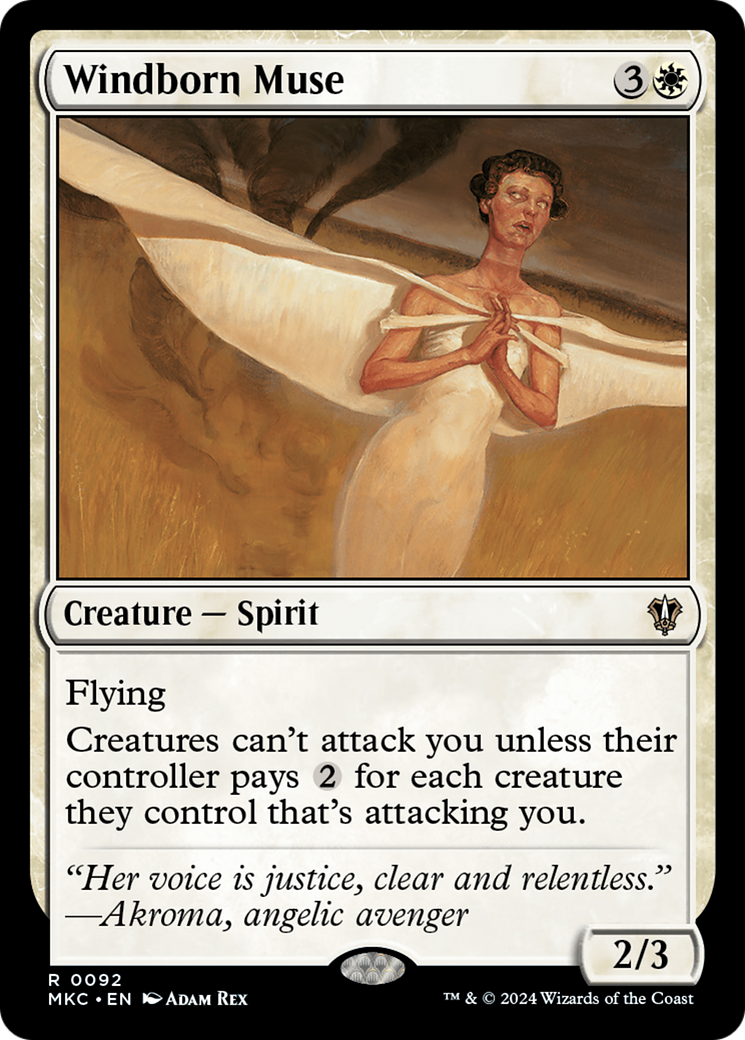
Windborn Muse
Windborn Muse
Creature — Spirit
2/3
Flying
Creatures can't attack you unless their controller pays for each creature they control that's attacking you.
- Creatures may still attack planeswalkers you control without their controller paying a cost.
Instants 5
-
1
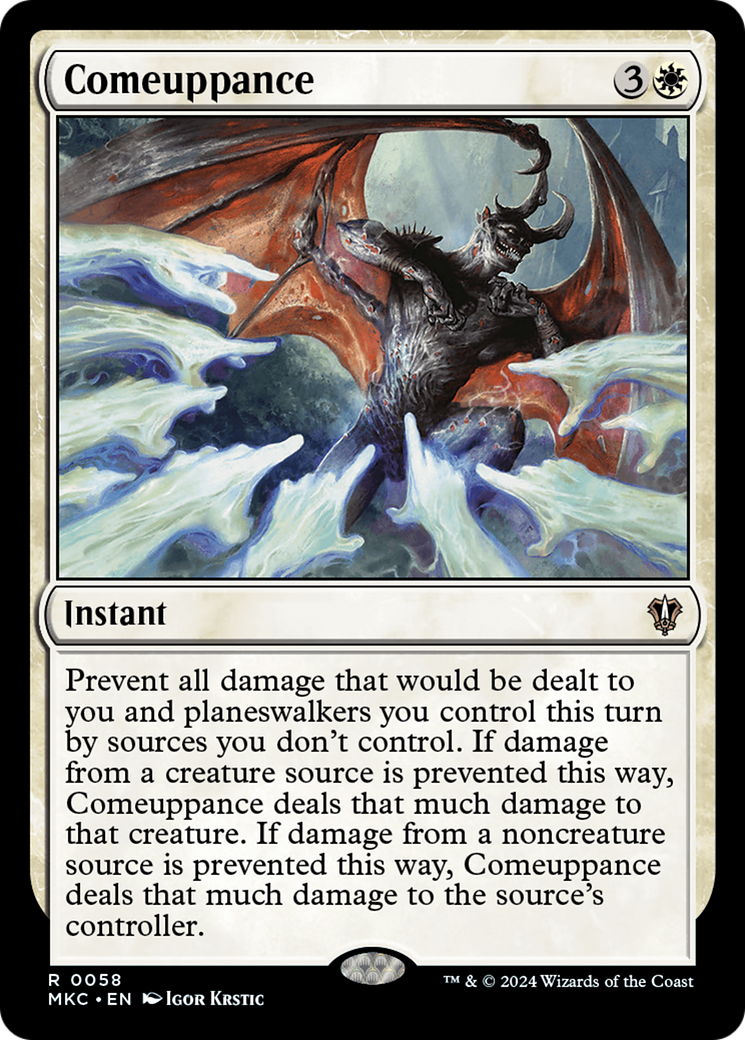
Comeuppance
Comeuppance
Instant
Prevent all damage that would be dealt to you and planeswalkers you control this turn by sources you don't control. If damage from a creature source is prevented this way, Comeuppance deals that much damage to that creature. If damage from a noncreature source is prevented this way, Comeuppance deals that much damage to the source's controller.
- Comeuppance's effect is not a redirection effect. If it prevents damage, Comeuppance (not the original source) deals damage to the permanent or player as part of that prevention effect. Comeuppance is the source of the new damage, so the characteristics of the original source (such as its color, or whether it had lifelink or deathtouch) don't affect the new damage. The new damage is not combat damage, even if the prevented damage was.
-
1
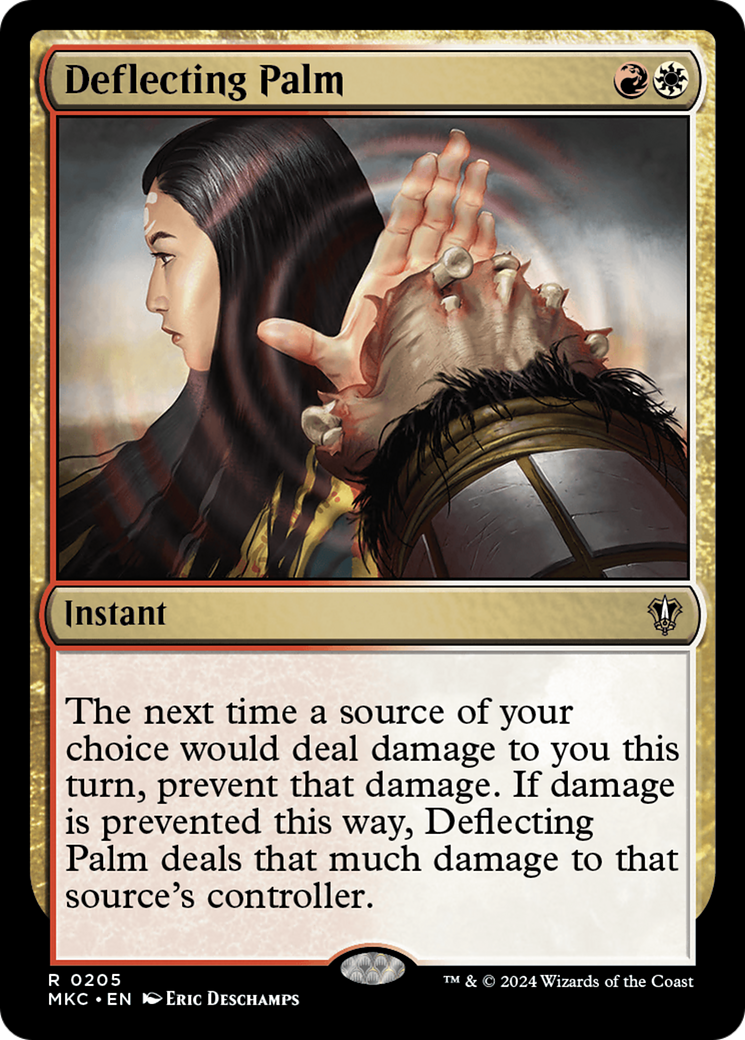
Deflecting Palm
Deflecting Palm
Instant
The next time a source of your choice would deal damage to you this turn, prevent that damage. If damage is prevented this way, Deflecting Palm deals that much damage to that source's controller.
- If multiple prevention and/or replacement effects are trying to apply to the same damage, the player who would be dealt damage chooses the order in which to apply them.
- Deflecting Palm doesn't target any permanent or player. You choose a source of damage as Deflecting Palm resolves.
-
1
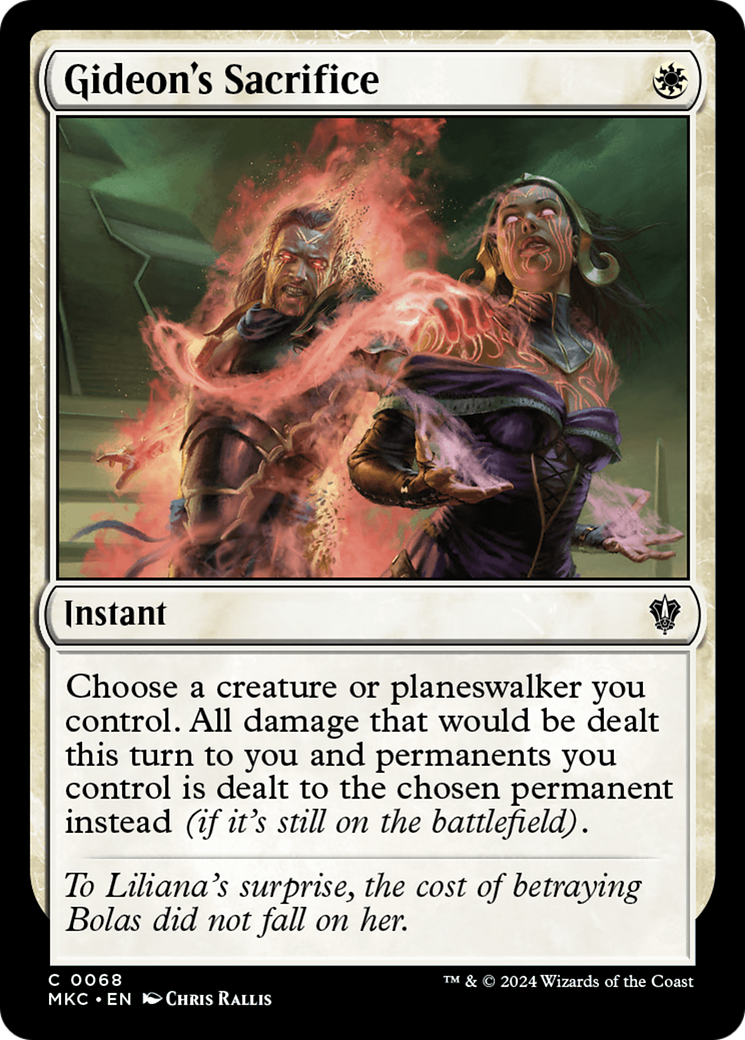
Gideon's Sacrifice
Gideon's Sacrifice
Instant
Choose a creature or planeswalker you control. All damage that would be dealt this turn to you and permanents you control is dealt to the chosen permanent instead (if it's still on the battlefield).
- Gideon's Sacrifice has no effect on damage already dealt earlier in the turn.
- If you control no creatures or planeswalkers as Gideon's Sacrifice resolves, nothing happens. The damage redirection effect won't be able to be applied to any damage events.
- If the chosen creature or planeswalker isn't on the battlefield or isn't a creature or planeswalker at the time damage would be dealt, the damage won't be redirected.
- More damage can be redirected to the chosen creature than it has toughness or to the chosen planeswalker than it has loyalty, as long as that damage is all dealt at once (like combat damage is) or is all dealt while a single spell or ability is resolving.
- Gideon's Sacrifice doesn't change the source of the damage or whether the damage is combat damage.
- If you cast more than one Gideon's Sacrifice in one turn, all damage that would be dealt at once to you and/or permanents you control is dealt to one of the chosen permanents of your choice. It's not dealt to all of them, and you can't split the damage between them. The next time damage would be dealt to you, you may choose a different one of those permanents to be dealt that damage.
-
1
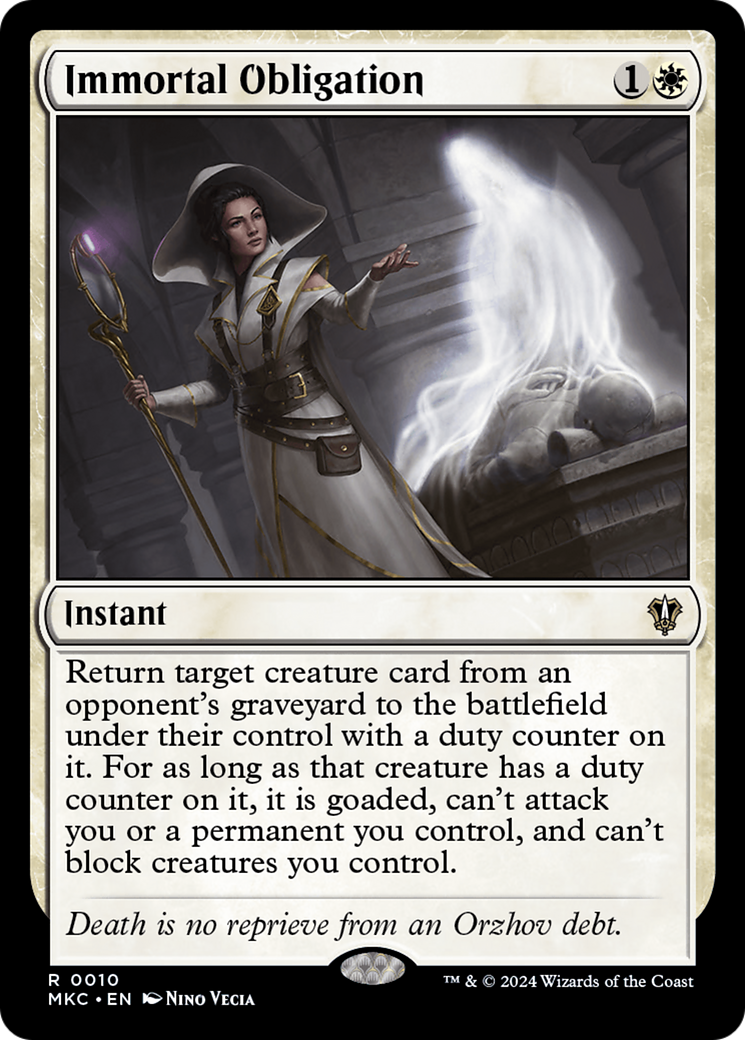
Immortal Obligation
Immortal Obligation
Instant
Return target creature card from an opponent's graveyard to the battlefield under their control with a duty counter on it. For as long as that creature has a duty counter on it, it is goaded, can't attack you or a permanent you control, and can't block creatures you control.
-
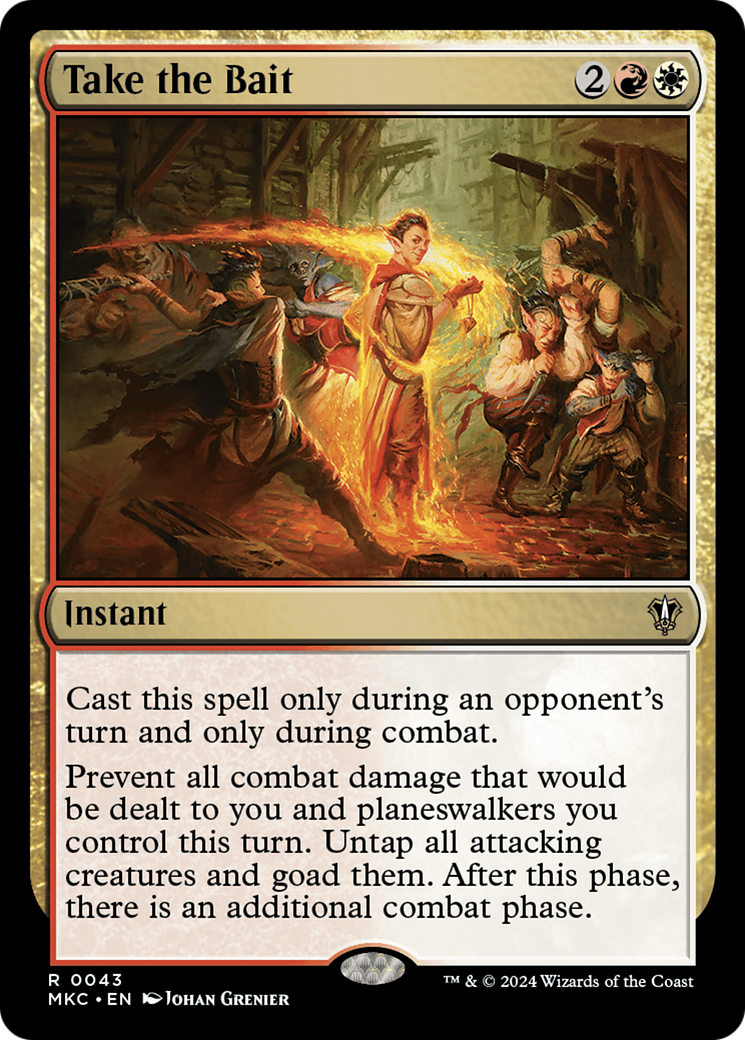
1
Take the Bait
Take the Bait
Instant
Cast this spell only during combat on an opponent's turn.
Prevent all combat damage that would be dealt to you and planeswalkers you control this turn. Untap all attacking creatures and goad them. After this phase, there is an additional combat phase.
- Untapping and goading the attacking creatures won't remove them from combat, even if they're attacking you.
- Take the Bait doesn't give the opponent whose turn it is an additional main phase. They will move directly from the end of combat step of one combat phase to the beginning of combat step of the next one.
Sorceries 7
-
1
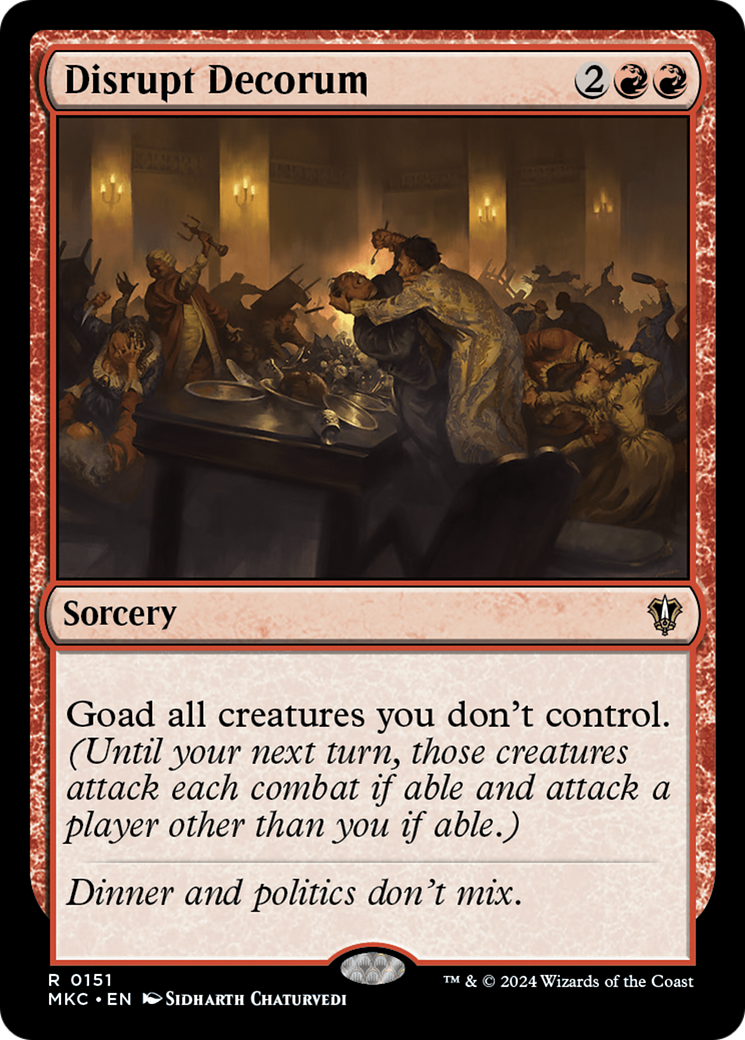
Disrupt Decorum
Disrupt Decorum
Sorcery
Goad all creatures you don't control. (Until your next turn, those creatures attack each combat if able and attack a player other than you if able.)
- If, during a player's declare attackers step, a creature that player controls that's been goaded is tapped, is affected by a spell or ability that says it can't attack, or hasn't been under that player's control continuously since the turn began (and doesn't have haste), then it doesn't attack. If there's a cost associated with having a creature attack a player, its controller isn't forced to pay that cost, so it doesn't have to attack that player.
- If the creature doesn't meet any of the above exceptions and can attack, it must attack a player other than the controller of the spell or ability that goaded it if able. If the creature can't attack any of those players but could otherwise attack, it must attack a planeswalker an opponent controls, a battle an opponent controls, or a player who goaded it.
- Being goaded isn't an ability the creature has. Once it's been goaded, it must attack as detailed above even if it loses all abilities.
- Attacking with a goaded creature doesn't cause it to stop being goaded. If there is an additional combat phase that turn, or if another player gains control of it before it stops being goaded, it must attack again if able.
- If a creature you control has been goaded by multiple opponents, it must attack one of your opponents that hasn't goaded it, as that fulfills the maximum number of goad requirements. If a creature you control has been goaded by each of your opponents, the creature must attack an opponent (rather than a planeswalker or battle), but you choose which opponent it attacks.
- Creatures that enter the battlefield after Disrupt Decorum resolves won't be goaded.
-
1
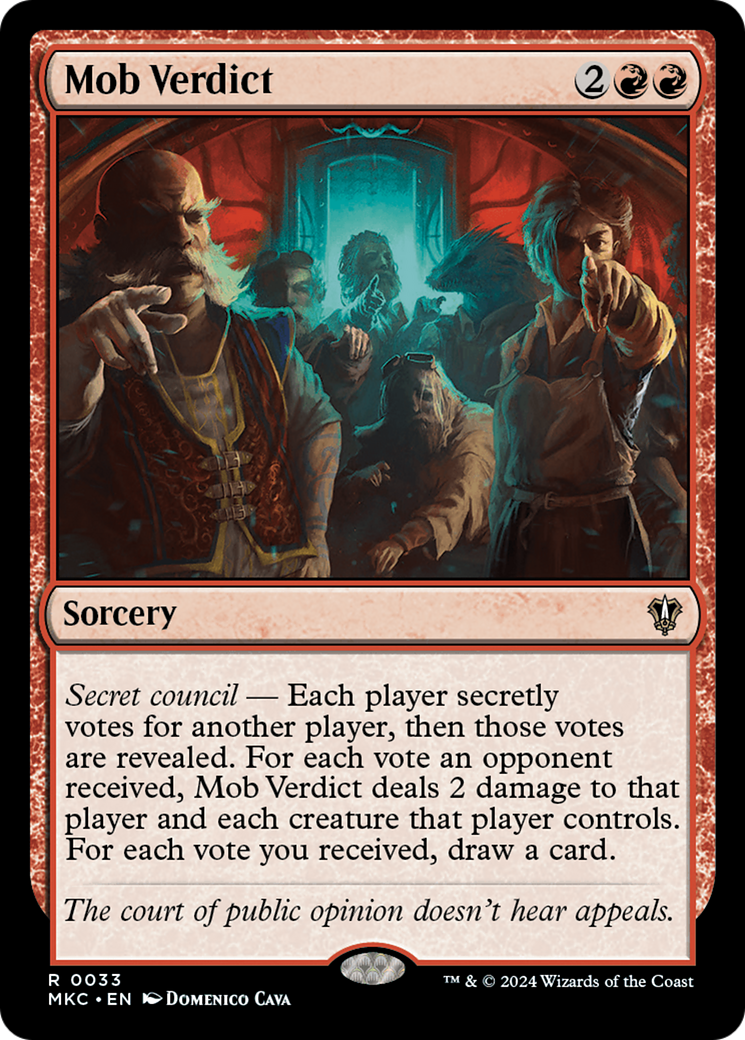
Mob Verdict
Mob Verdict
Sorcery
Secret council — Each player secretly votes for another player, then those votes are revealed. For each vote an opponent received, Mob Verdict deals 2 damage to that player and each creature that player controls. For each vote you received, draw a card.
- To secretly vote, each player writes down their chosen option without showing it to anyone else. Each player then keeps their vote secret until all players simultaneously reveal their votes.
- Before secret votes are revealed, players may announce how they intend to vote, but they can’t reveal what they actually wrote down until all votes are simultaneously revealed. Players can lie about how they intend to vote before the votes are revealed.
- Abilities that trigger “whenever players finish voting” trigger once all players have voted or once all secret votes are revealed, but they won’t go on the stack until the current spell or ability finishes resolving.
- Each player must vote for another player. They can’t abstain.
- Votes are cast during the resolution of Mob Verdict, so any responses to Mob Verdict must be made without knowing the outcome of the vote.
-
1
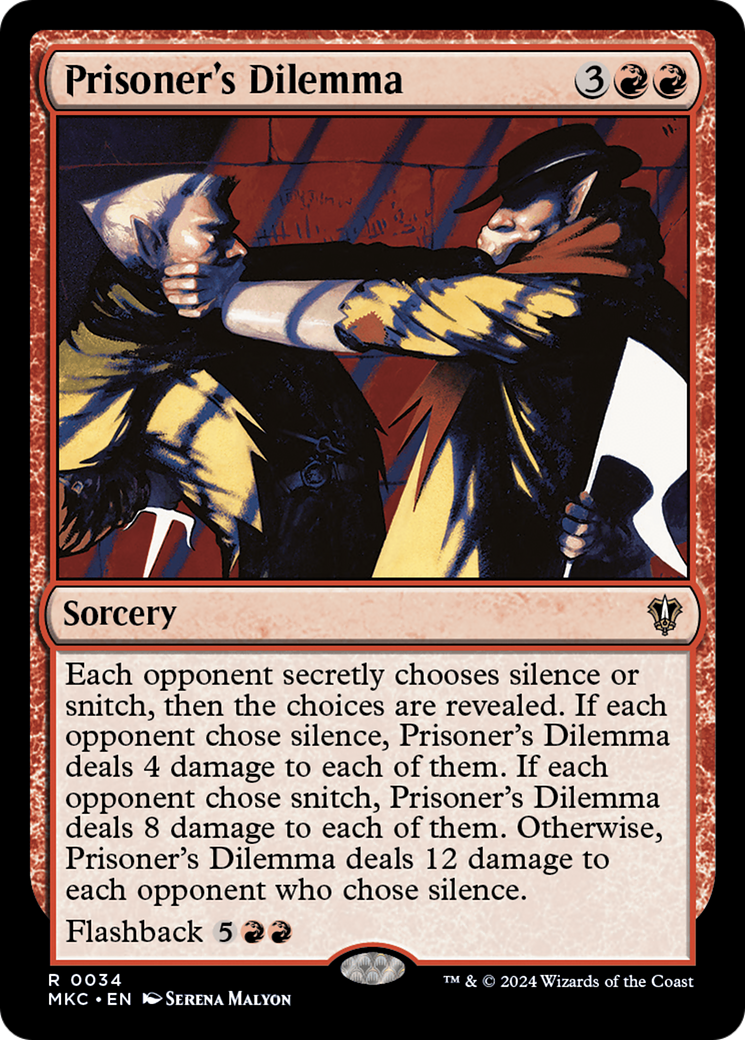
Prisoner's Dilemma
Prisoner's Dilemma
Sorcery
Each opponent secretly chooses silence or snitch, then the choices are revealed. If each opponent chose silence, Prisoner's Dilemma deals 4 damage to each of them. If each opponent chose snitch, Prisoner's Dilemma deals 8 damage to each of them. Otherwise, Prisoner's Dilemma deals 12 damage to each opponent who chose silence.
Flashback
- Choices are made during the resolution of Prisoner's Dilemma, so any responses to Prisoner's Dilemma must be made without knowing the outcome of those choices. Have fun iterating!
-
1
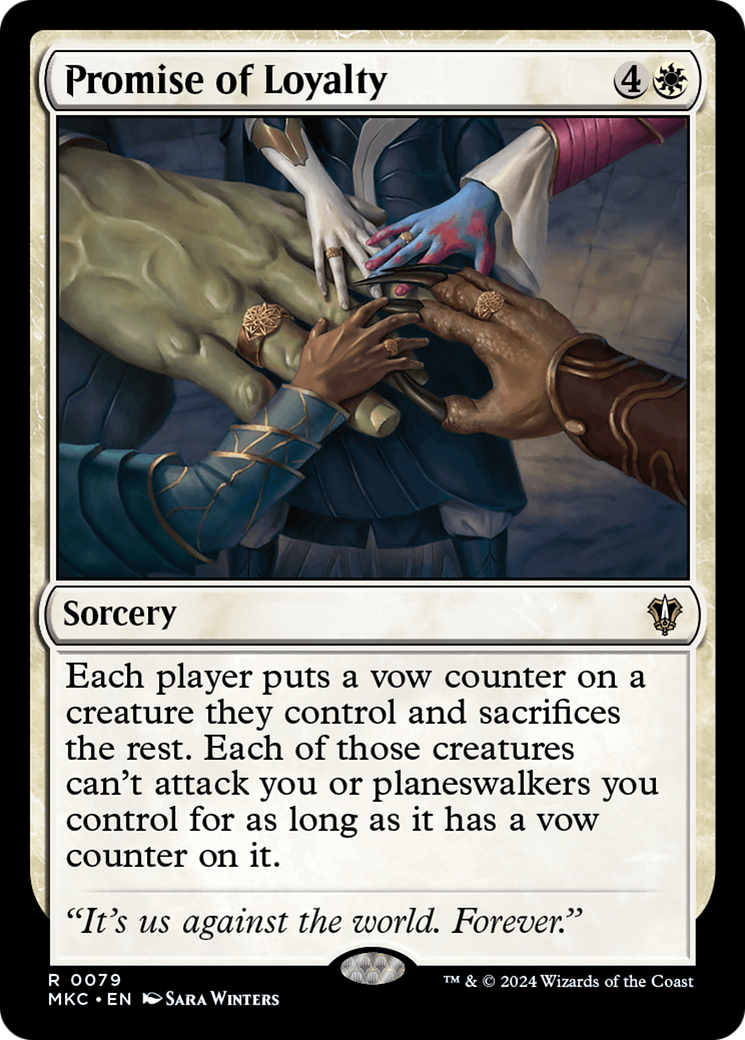
Promise of Loyalty
Promise of Loyalty
Sorcery
Each player puts a vow counter on a creature they control and sacrifices the rest. Each of those creatures can't attack you or planeswalkers you control for as long as it has a vow counter on it.
- If the vow counter is removed from the creature, it can attack as normal.
- Each player, including you, must put a vow counter on a creature they control if able. They can't choose to opt out and sacrifice all of their creatures. The creature you put a vow counter on will remember its promise if another player gains control of it.
- If the vow counter is moved to another creature, it won't prevent the second creature from attacking normally.
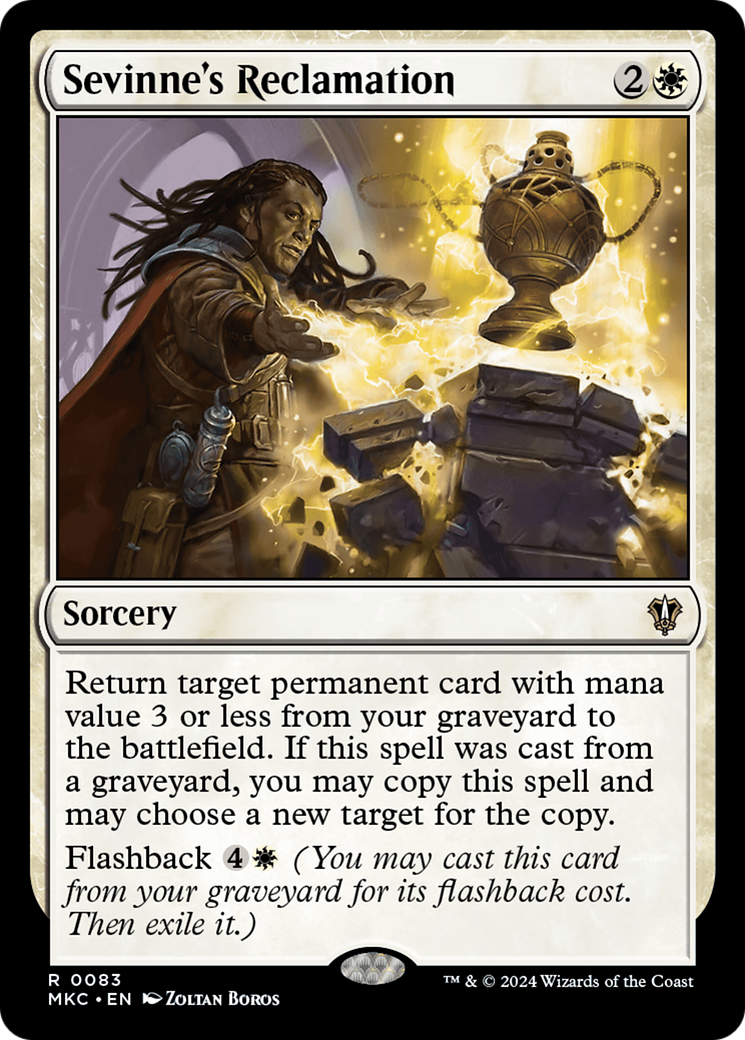
-
1
Sevinne's Reclamation
Sevinne's Reclamation
Sorcery
Return target permanent card with mana value 3 or less from your graveyard to the battlefield. If this spell was cast from a graveyard, you may copy this spell and may choose a new target for the copy.
Flashback (You may cast this card from your graveyard for its flashback cost. Then exile it.)
- A spell cast using flashback will always be exiled afterward, whether it resolves, is countered, or leaves the stack in some other way.
- You can cast a spell using flashback even if it was somehow put into your graveyard without having been cast.
- To determine the total cost of a spell, start with the mana cost or alternative cost (such as a flashback cost) you're paying, add any cost increases, then apply any cost reductions. The mana value of the spell is determined only by its mana cost, no matter what the total cost to cast the spell was.
- You must still follow any timing restrictions and permissions, including those based on the card's type. For instance, you can cast a sorcery using flashback only when you could normally cast a sorcery.
- "Flashback [cost]" means "You may cast this card from your graveyard if the resulting spell is an instant or sorcery spell by paying [cost] rather than paying its mana cost" and "If the flashback cost was paid, exile this card instead of putting it anywhere else any time it would leave the stack."
- If a card with flashback is put into your graveyard during your turn, you can cast it if it's legal to do so before any other player can take any actions.
- A permanent card is an artifact, battle, creature, enchantment, land, or planeswalker card.
- The copy that Sevinne's Reclamation creates is created on the stack, so it's not "cast." Abilities that trigger when a player casts a spell won't trigger. The copy wasn't cast from a graveyard, so it won't make another copy of itself.
- If you cast Sevinne's Reclamation from your graveyard, any abilities that trigger as the permanent card returns to the battlefield will resolve before the copy of Sevinne's Reclamation resolves but after new targets for the copy have been chosen.
- If a card in a graveyard has in its mana cost, X is considered to be 0.
- If the target card is an illegal target by the time Sevinne's Reclamation tries to resolve, the spell doesn't resolve. You won't copy it if you cast it from a graveyard.
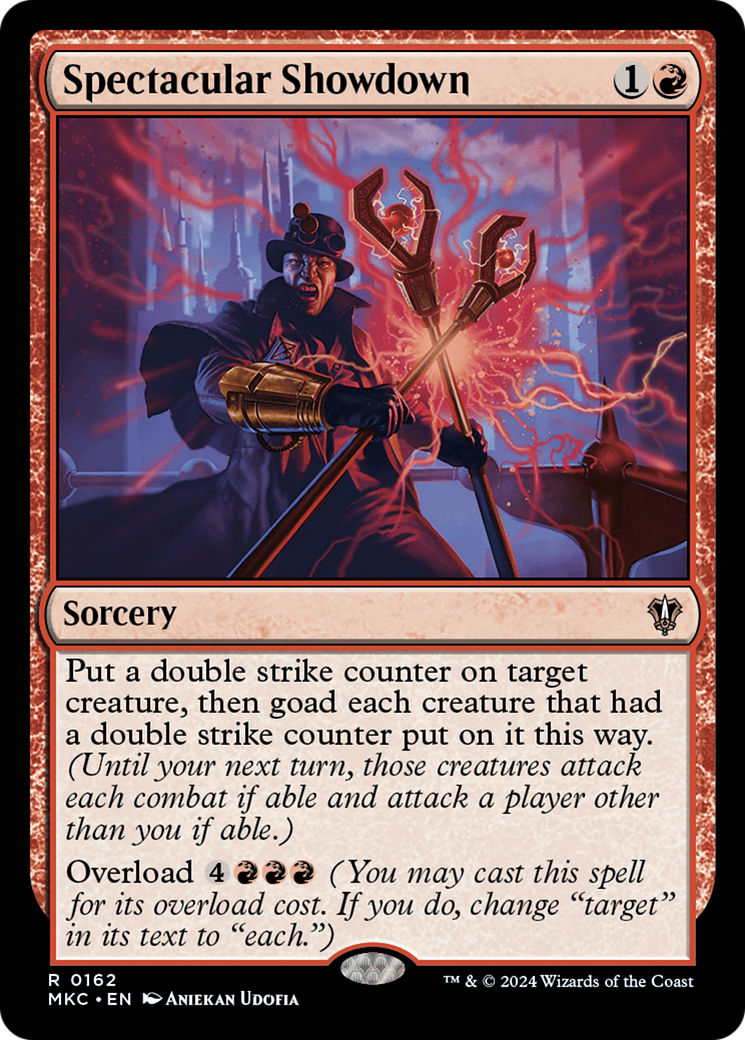
-
1
Spectacular Showdown
Spectacular Showdown
Sorcery
Put a double strike counter on target creature, then goad each creature that had a double strike counter put on it this way. (Until your next turn, those creatures attack each combat if able and attack a player other than you if able.)
Overload (You may cast this spell for its overload cost. If you do, change "target" in its text to "each.")
- If you are instructed to cast a spell with overload "without paying its mana cost," you can't choose to pay its overload cost instead.
- Because a spell with overload doesn't target when its overload cost is paid, it may affect permanents with hexproof or with protection from the appropriate color.
- If you don't pay the overload cost of a spell with overload, that spell will have a single target. If you pay the overload cost, the spell won't have any targets.
- To determine the total cost of a spell, start with the mana cost or alternative cost you're paying (such as an overload cost), add any cost increases, then apply any cost reductions. The mana value of the spell remains unchanged, no matter what the total cost to cast it was.
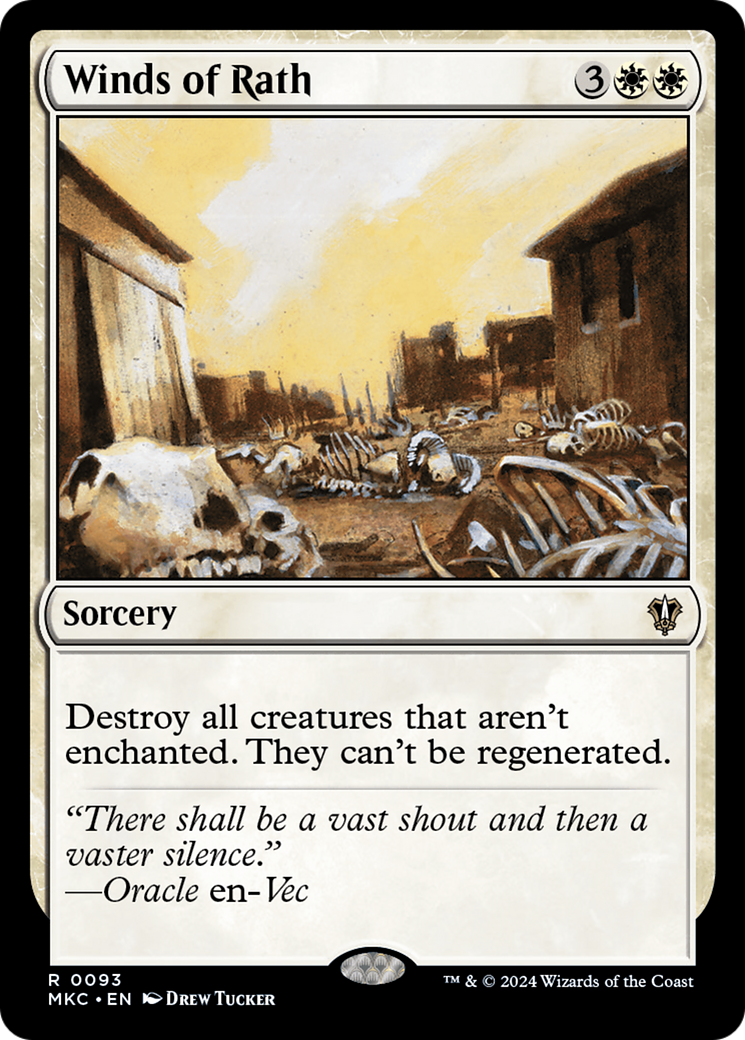
-
1
Winds of Rath
Winds of Rath
Sorcery
Destroy all creatures that aren't enchanted. They can't be regenerated.
- A creature is "enchanted" if it has any Auras attached to it.
Artifacts 9
-
1
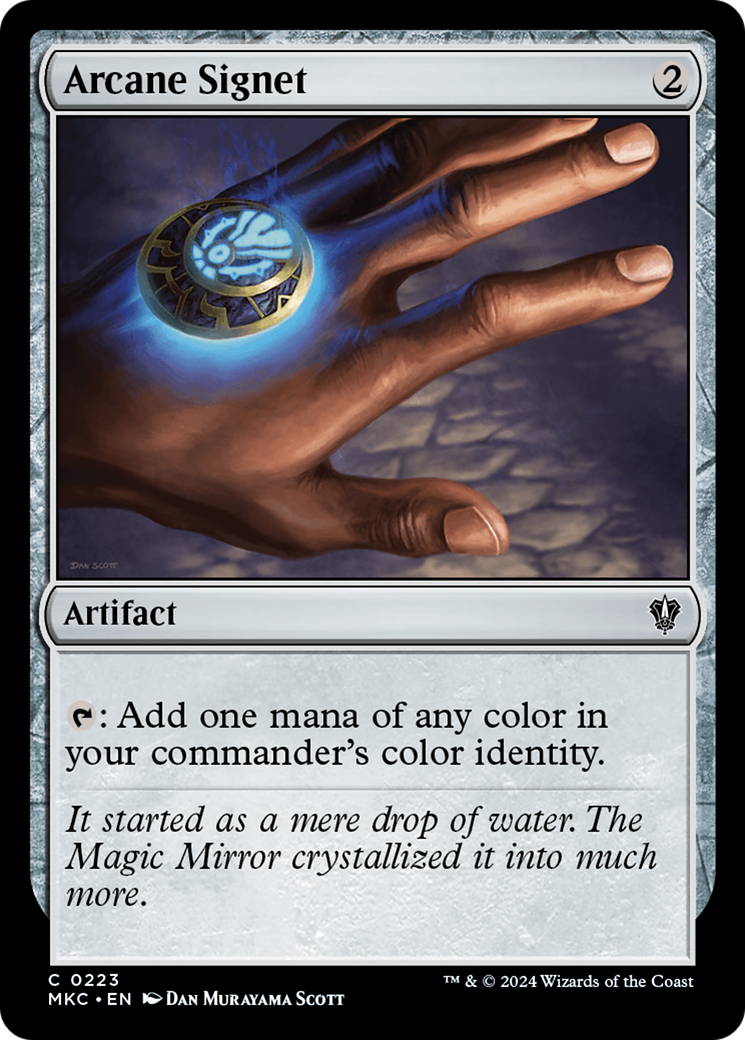
Arcane Signet
Arcane Signet
Artifact
: Add one mana of any color in your commander's color identity.
- If your commander is a card that has no colors in its color identity, Arcane Signet's ability produces no mana. It doesn't produce .
- If you have two commanders, the ability adds one mana of any color in their combined color identities.
- If you don't have a commander, Arcane Signet's ability produces no mana.
-
1
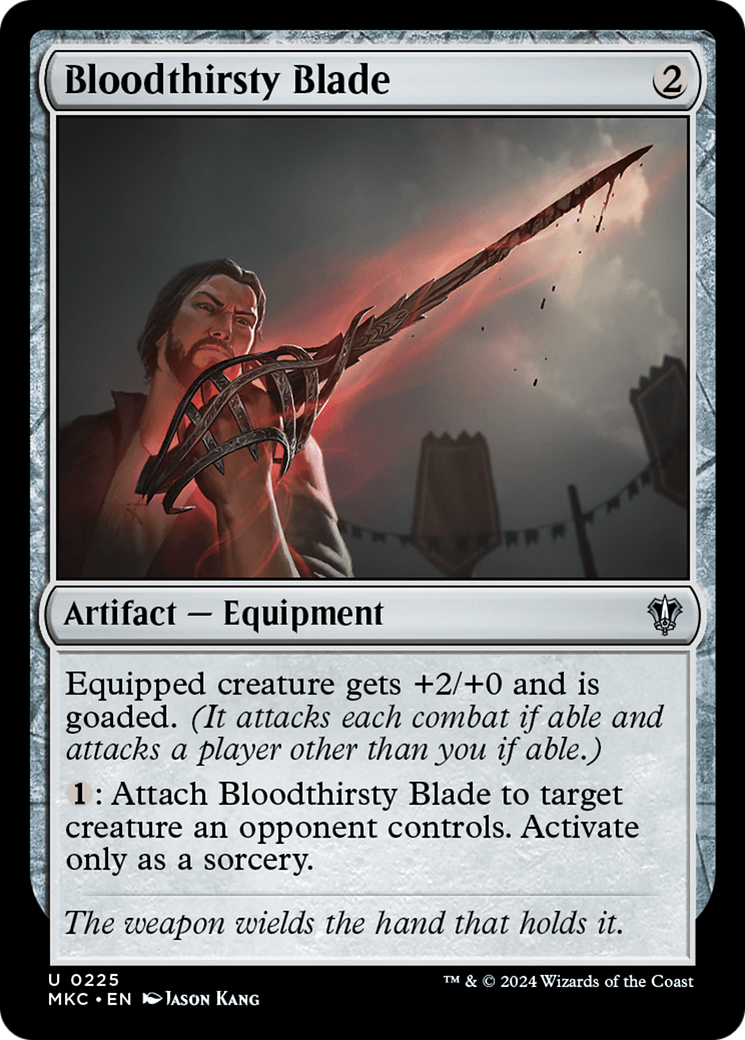
Bloodthirsty Blade
Bloodthirsty Blade
Artifact — Equipment
Equipped creature gets +2/+0 and is goaded. (It attacks each combat if able and attacks a player other than you if able.)
: Attach this Equipment to target creature an opponent controls. Activate only as a sorcery.
- If the creature doesn't meet any of the above exceptions and can attack, it must attack a player other than the controller of the spell or ability that goaded it if able. If the creature can't attack any of those players but could otherwise attack, it must attack a planeswalker an opponent controls, a battle an opponent controls, or a player who goaded it.
- Attacking with a goaded creature doesn't cause it to stop being goaded. If there is an additional combat phase that turn, or if another player gains control of it before it stops being goaded, it must attack again if able.
- If a creature you control has been goaded by multiple opponents, it must attack one of your opponents that hasn't goaded it, as that fulfills the maximum number of goad requirements. If a creature you control has been goaded by each of your opponents, the creature must attack an opponent (rather than a planeswalker or battle), but you choose which opponent it attacks.
- If, during a player's declare attackers step, a creature that player controls that's been goaded is tapped, is affected by a spell or ability that says it can't attack, or hasn't been under that player's control continuously since the turn began (and doesn't have haste), then it doesn't attack. If there's a cost associated with having a creature attack a player, its controller isn't forced to pay that cost, so it doesn't have to attack that player.
- Being goaded isn't an ability the creature has. Once it's been goaded, it must attack as detailed above even if it loses all abilities.
- You still control Bloodthirsty Blade while it's equipped to an opponent's creature. You can move it any time you could cast a sorcery; the equipped creature's controller can't.
- Bloodthirsty Blade has no equip ability. There's normally no way to have it attached to your own creature, although certain combinations of other cards make this possible.
-
1
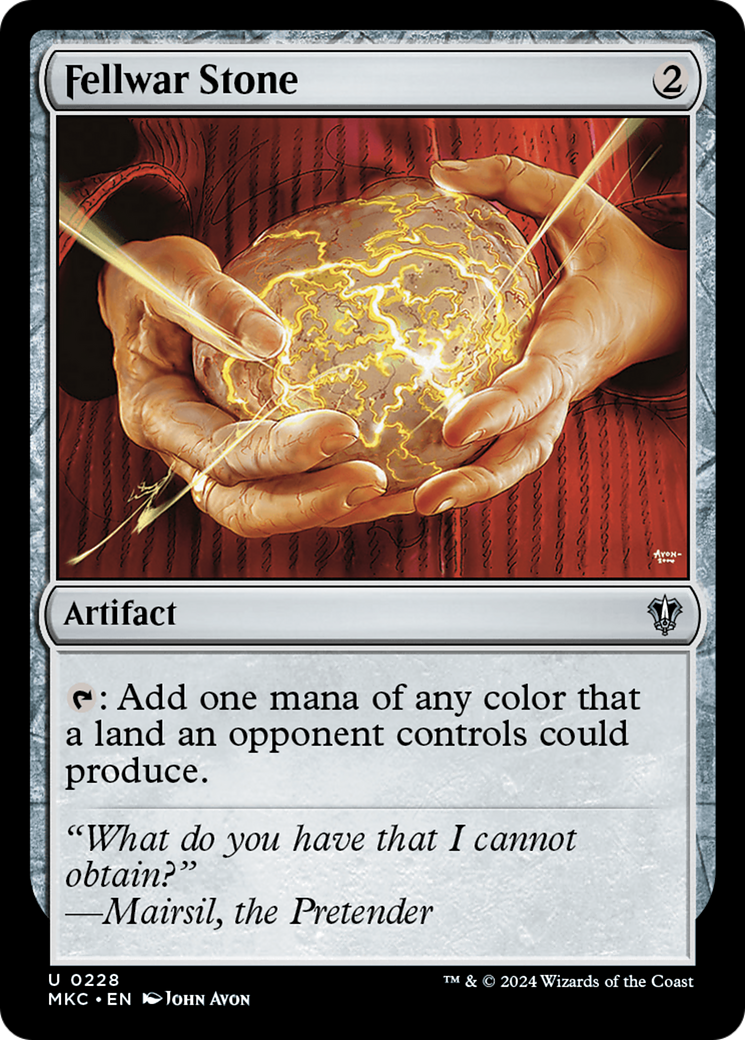
Fellwar Stone
Fellwar Stone
Artifact
: Add one mana of any color that a land an opponent controls could produce.
- When determining what colors of mana your opponents' lands could produce, take into account any applicable replacement effects that would apply to those lands' mana abilities (such as Contamination's effect, for example). If there is more than one, consider them in any possible order.
- Fellwar Stone doesn't care about any restrictions or riders your opponents' lands (such as Ancient Ziggurat or Hall of the Bandit Lord) put on the mana they produce. It just cares about colors of mana.
- The colors of mana are white, blue, black, red, and green. Fellwar Stone can't be tapped for colorless mana, even if a land an opponent controls could produce colorless mana.
- Fellwar Stone checks the effects of all mana-producing abilities of lands your opponents control, but it doesn't check their costs. For example, Vivid Crag has the ability " , Remove a charge counter from Vivid Crag: Add one mana of any color." If an opponent controls Vivid Crag and you control Fellwar Stone, you can tap Fellwar Stone for any color of mana. It doesn't matter whether Vivid Crag has a charge counter on it, and it doesn't matter whether it's untapped.
- This works even if the opponent's lands are tapped. It only checks what kinds of mana can be produced, not if the abilities that produce them are usable right now.
- It only produces one mana even if the land can produce more than one.
- The ability can be activated if the opponent has no lands that produce mana, but the effect will not be able to generate any mana.
-
1
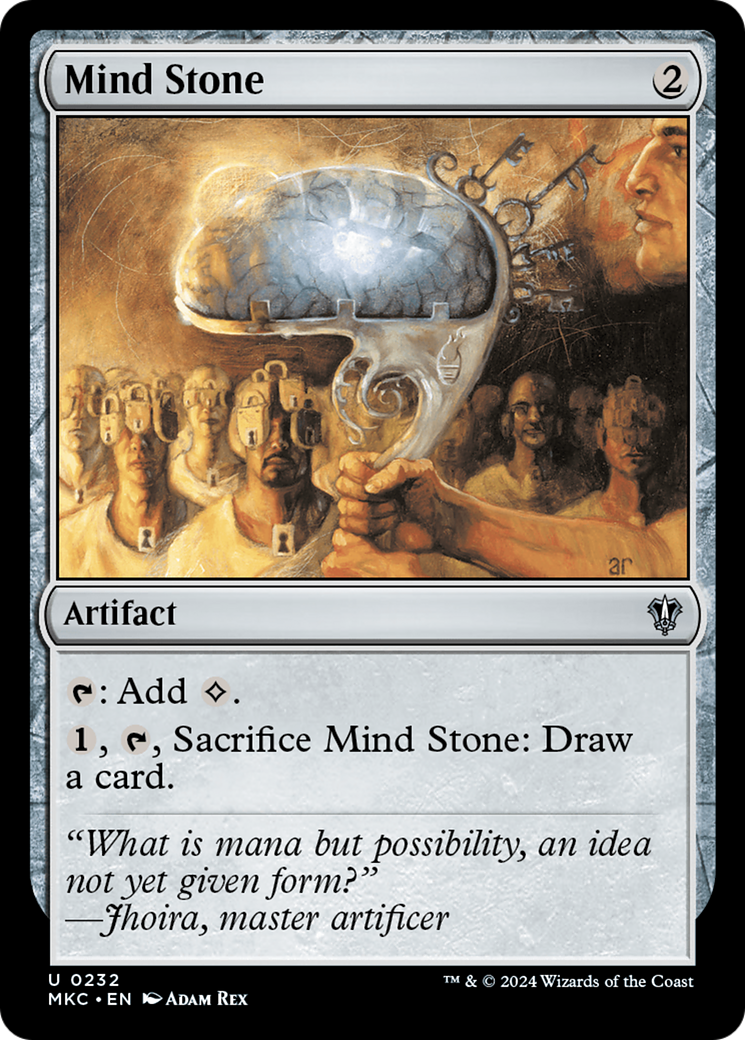
Mind Stone
Mind Stone
Artifact
: Add .
, , Sacrifice this artifact: Draw a card.
-
1
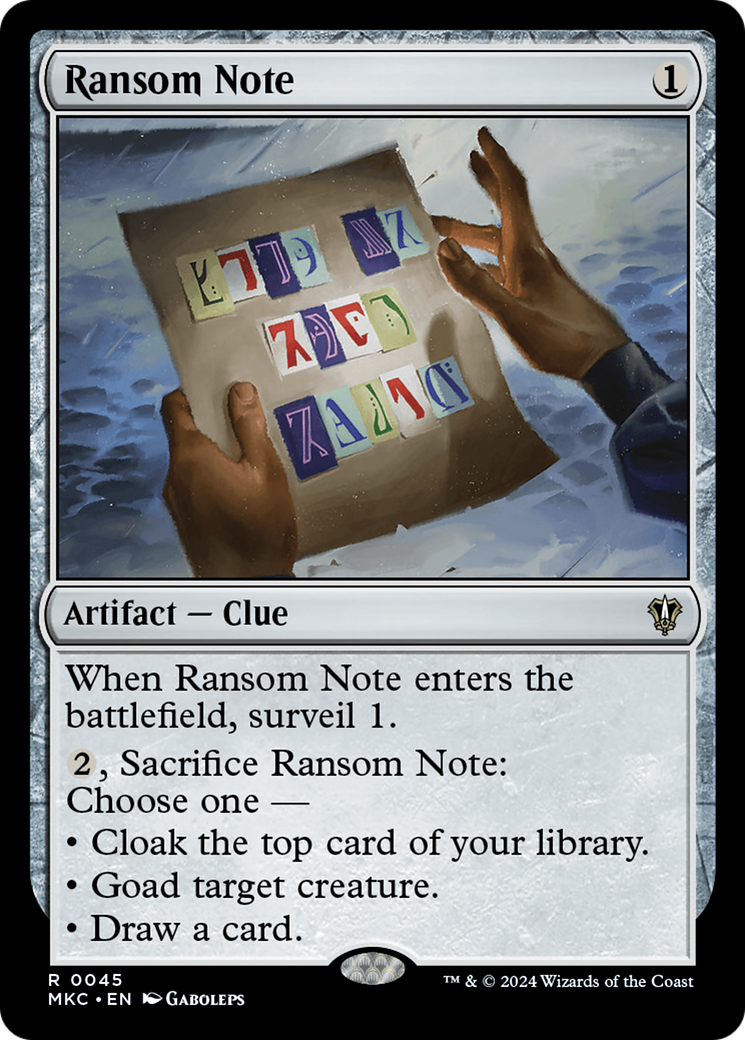
Ransom Note
Ransom Note
Artifact — Clue
When this artifact enters, surveil 1.
, Sacrifice this artifact: Choose one —
- Cloak the top card of your library.
- Goad target creature.
- Draw a card.
- To cloak a card, put it onto the battlefield face down. It becomes a 2/2 face-down creature card with ward and no name, mana cost, or creature types. It’s colorless and has a mana value of 0. Other effects that apply to the permanent can still grant it any characteristics it doesn’t have or change the characteristics it does have.
- Any time you have priority, you can turn a cloaked permanent you control face-up by revealing that it’s a creature card (ignoring any copy effects or type-changing effects that might be applying to it) and paying its mana cost. This is a special action. It doesn’t use the stack and can’t be responded to.
- If a cloaked creature would have disguise (or morph) if it were face up, you may also turn it face up by paying its disguise (or morph) cost.
- Unlike a face-down creature that was cast using a disguise or morph ability, a cloaked creature may still be turned face up after it loses its abilities if it’s a creature card.
- If a double-faced card is cloaked, it will be put onto the battlefield face down. While face down, it can’t transform. If the front face of the card is a creature card, you can turn it face up by paying its mana cost. If you do, its front face will be up.
- At any time, you can look at a face-down spell or permanent you control. You can’t look at face-down permanents or spells you don’t control unless an effect instructs or allows you to do so.
- If a face-down creature loses its abilities, it can’t be turned face up with a disguise ability because it will no longer have a disguise ability (or a disguise cost) once face up.
- Because the permanent is on the battlefield both before and after it’s turned face up, turning a permanent face up doesn’t cause any enters-the-battlefield abilities to trigger.
- Because face-down creatures don’t have a name, they can’t have the same name as any other creature, even another face-down creature.
- A permanent that turns face up or face down changes characteristics but is otherwise the same permanent. Spells and abilities that were targeting that permanent and Auras and Equipment that were attached to that permanent aren’t affected unless the new characteristics of the object change the legality of those targets or attachments.
- Turning a permanent face up or face down doesn’t change whether that permanent is tapped or untapped.
- If a face-down spell leaves the stack and goes to any zone other than the battlefield (if it was countered, for example), you must reveal it. Similarly, if a face-down permanent leaves the battlefield, you must reveal it. You must also reveal all face-down spells and permanents you control if you leave the game or the game ends.
- You must ensure that your face-down spells and permanents can be easily differentiated from each other. You’re not allowed to mix up the cards that represent them on the battlefield to confuse other players. The order in which they entered the battlefield should remain clear, as well as what ability caused them to be face down. (This includes disguise, cloak, and in games involving older cards, morph and manifest, as well as a few other effects that turn cards face down.) Common methods for doing this include using markers or dice, or simply placing them in order on the battlefield.
- If something tries to turn a face-down instant or sorcery card on the battlefield face up, reveal that card to show all players it’s an instant or sorcery card. The permanent remains on the battlefield face down. Abilities that trigger when a permanent turns face up won’t trigger, because even though you revealed the card, it never turned face up.
-
1
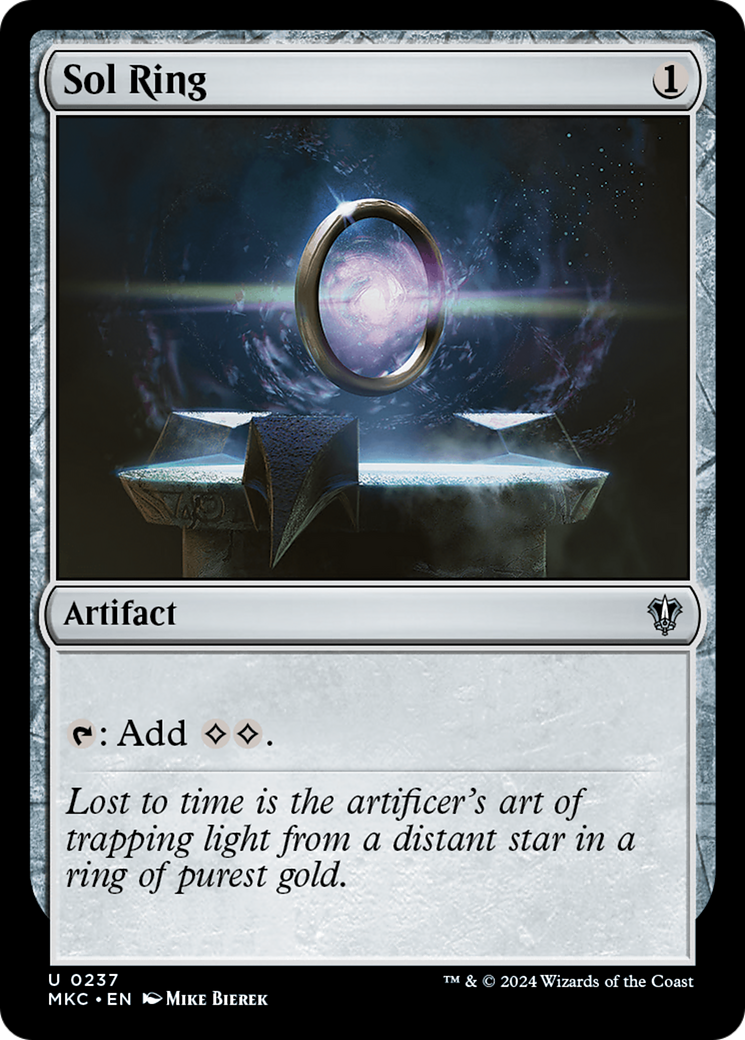
Sol Ring
Sol Ring
Artifact
: Add .
-
1
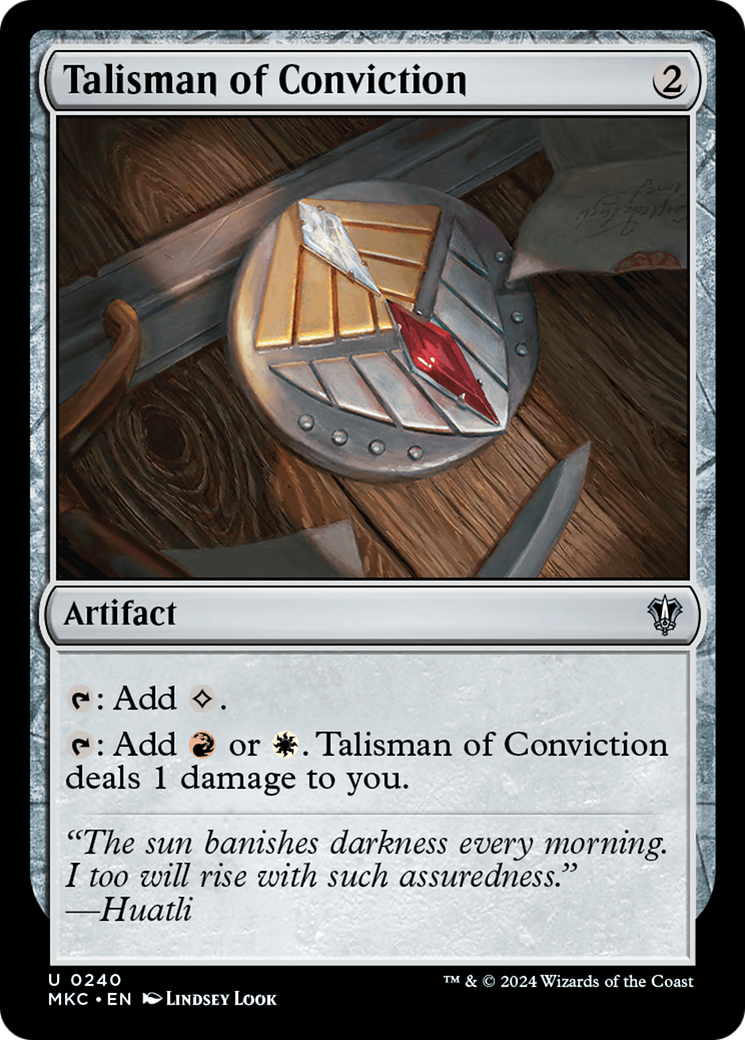
Talisman of Conviction
Talisman of Conviction
Artifact
: Add .
: Add or . This artifact deals 1 damage to you.
-
1
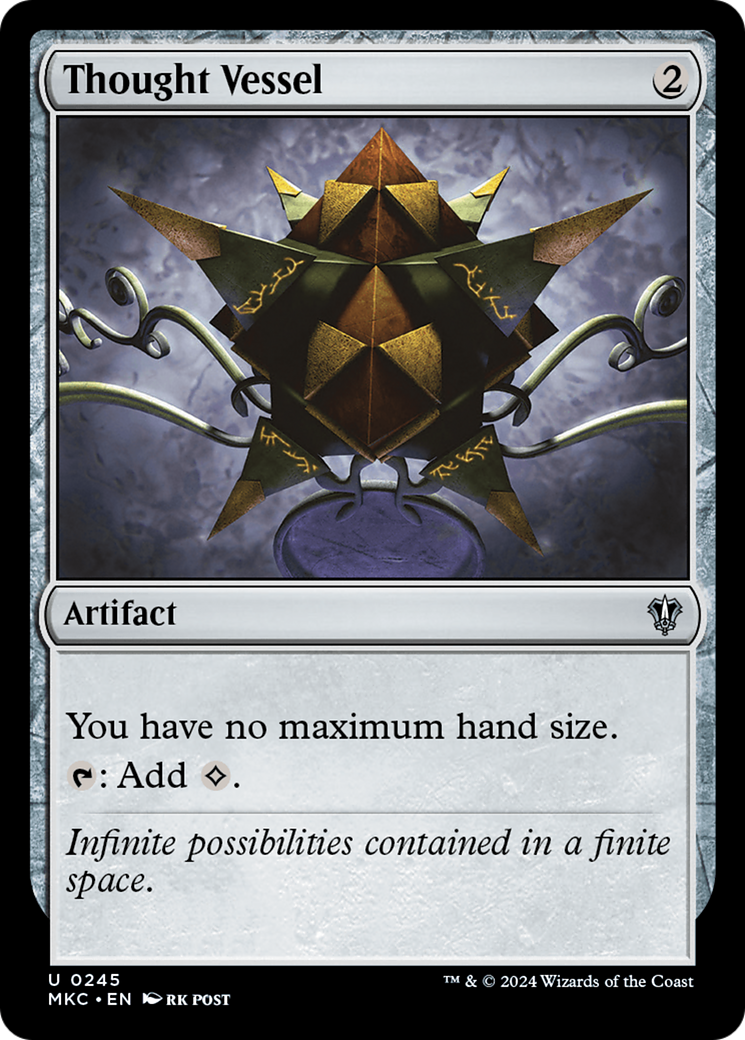
Thought Vessel
Thought Vessel
Artifact
You have no maximum hand size.
: Add .
-
1
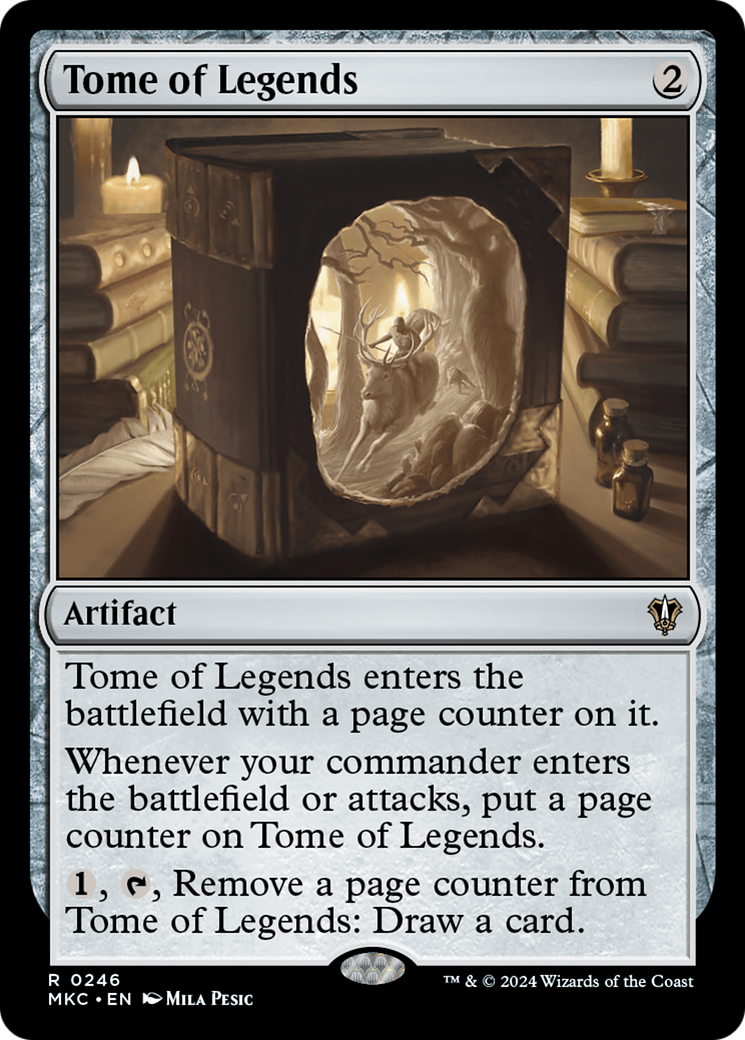
Tome of Legends
Tome of Legends
Artifact
This artifact enters with a page counter on it.
Whenever your commander enters or attacks, put a page counter on this artifact.
, , Remove a page counter from this artifact: Draw a card.
- If you control another player's commander, you won't put a page counter on Tome of Legends when you attack with that creature. Similarly, if another player controls your commander, you'll still put a page counter on Tome of Legends if it attacks. (Perhaps the page is about your commander's shocking betrayal.)
Enchantments 14
-
1
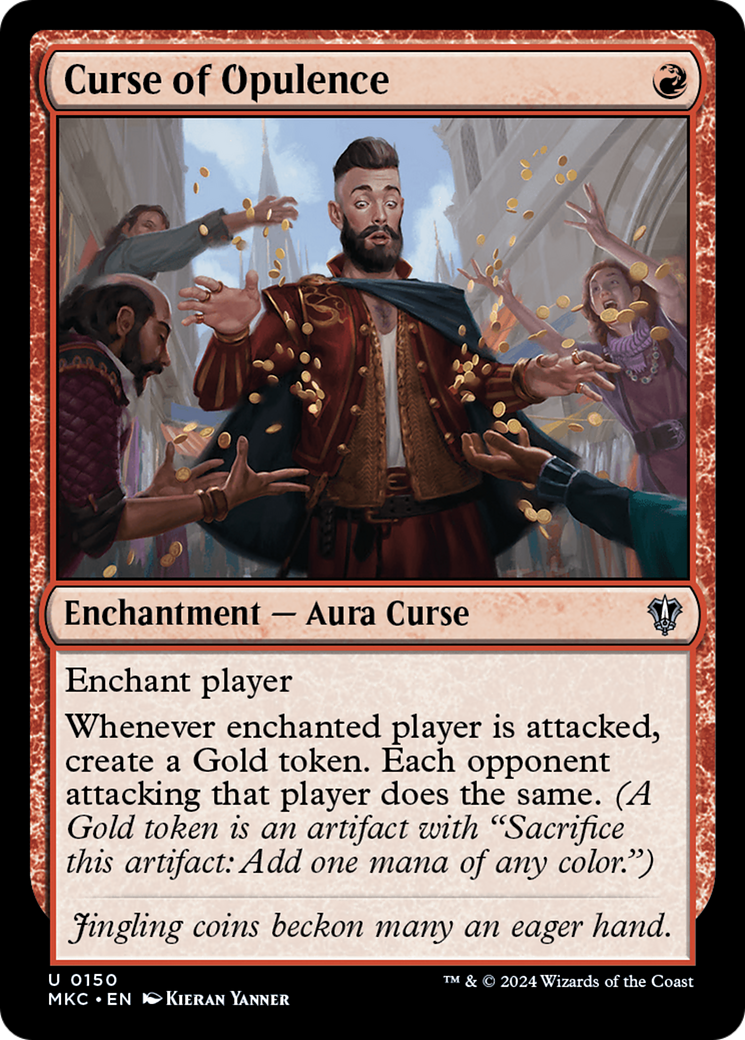
Curse of Opulence
Curse of Opulence
Enchantment — Aura Curse
Enchant player
Whenever enchanted player is attacked, create a Gold token. Each opponent attacking that player does the same. (A Gold token is an artifact with "Sacrifice this token: Add one mana of any color.")
- Curse of Opulence's triggered ability resolves after attackers have been declared. Any costs to attack must have already been paid before the attacking player creates the Gold.
- Each Curse's ability triggers only once, no matter how many creatures are attacking the enchanted player.
- A player is attacking another player if they control a creature that's attacking that player. If no creatures are attacking the enchanted player as a Curse's ability resolves (most likely because they've left the battlefield), only the Curse's controller performs its actions.
- The triggered ability of these Curses won't trigger if only a planeswalker controlled by the enchanted player is attacked.
- If you enchant yourself with one of these Curses, you'll get its effects whenever another player attacks you.
-
1
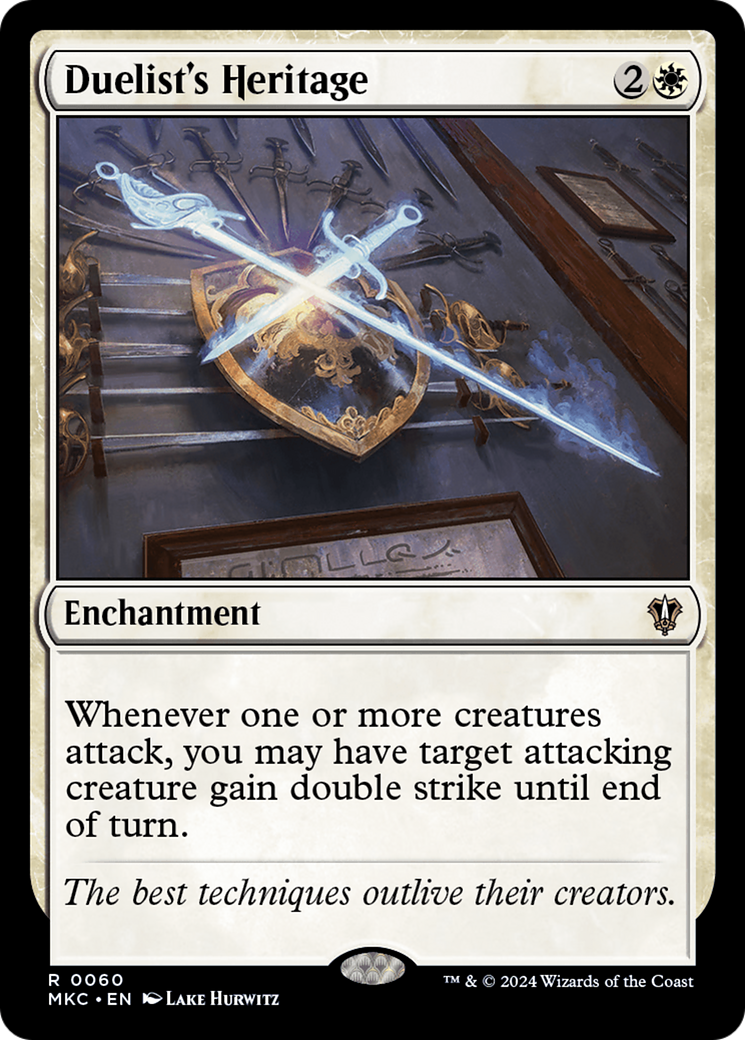
Duelist's Heritage
Duelist's Heritage
Enchantment
Whenever one or more creatures attack, you may have target attacking creature gain double strike until end of turn.
- The ability of Duelist's Heritage triggers whenever any player attacks with one or more creatures, not just when you do. You know which players and planeswalkers the creatures are attacking before you choose the target creature.
-
1
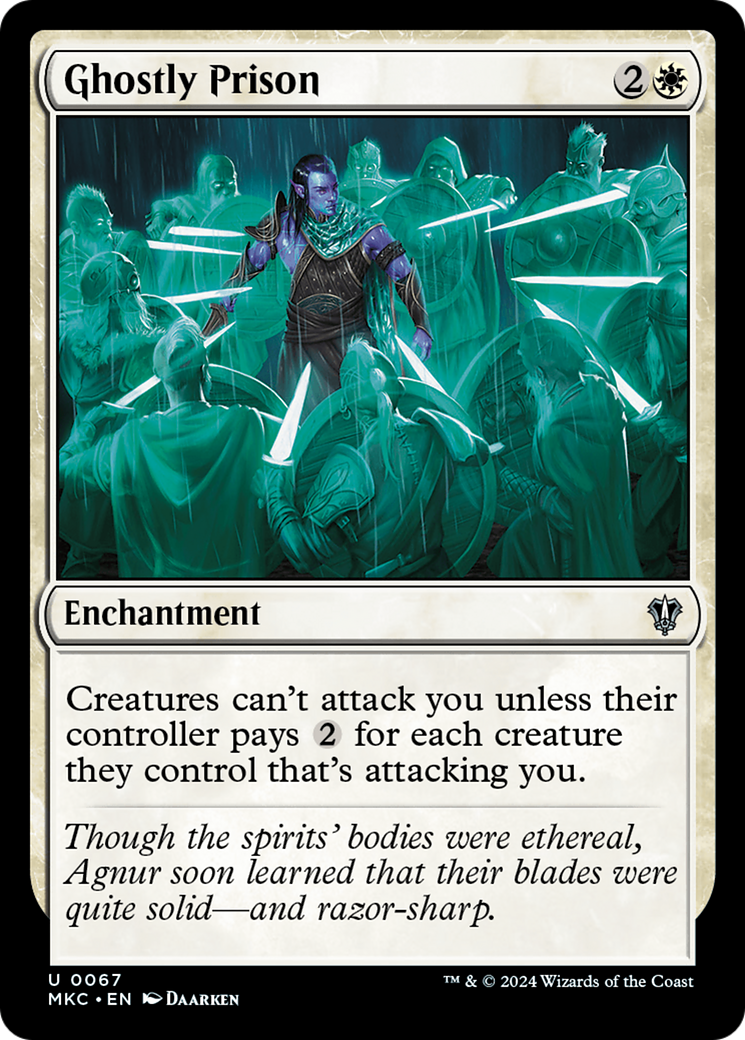
Ghostly Prison
Ghostly Prison
Enchantment
Creatures can't attack you unless their controller pays for each creature they control that's attacking you.
- Unless some effect explicitly says otherwise, a creature that can't attack you can still attack a planeswalker you control.
- In the Two-Headed Giant format, you still only have to pay once per creature.
-
1
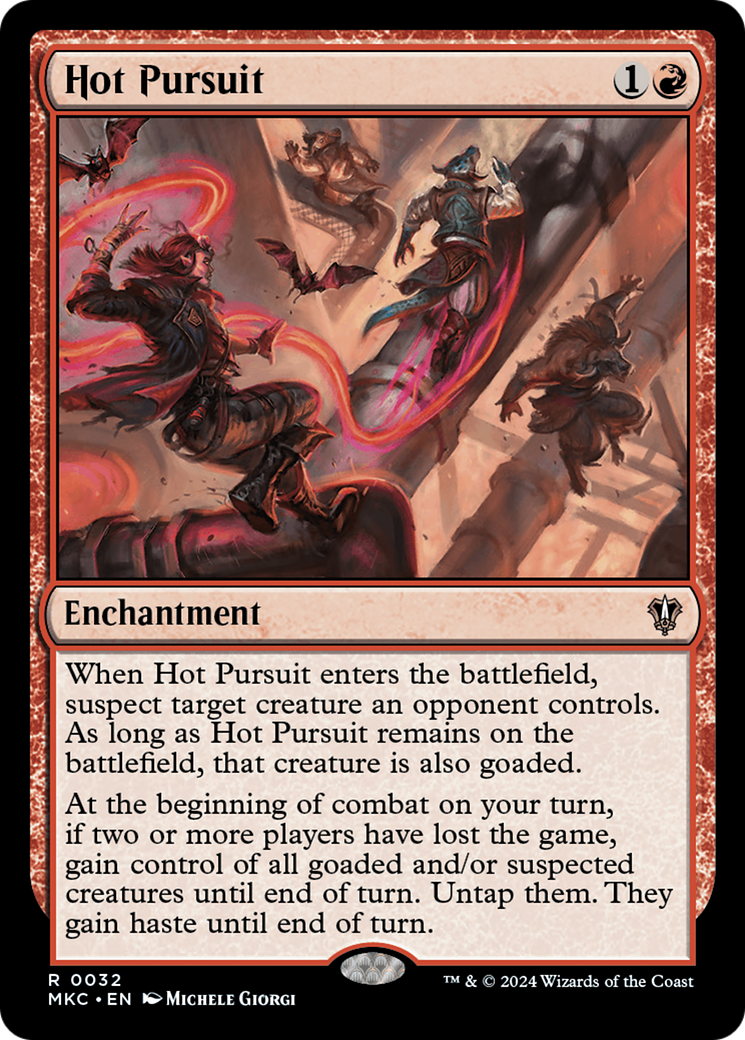
Hot Pursuit
Hot Pursuit
Enchantment
When this enchantment enters, suspect target creature an opponent controls. As long as this enchantment remains on the battlefield, that creature is also goaded.
At the beginning of combat on your turn, if two or more players have lost the game, gain control of all goaded and/or suspected creatures until end of turn. Untap them. They gain haste until end of turn.
- If Hot Pursuit leaves the battlefield before its first triggered ability resolves, the target creature will become suspected, but it won’t become goaded at all.
- Hot Pursuit’s second triggered ability causes you to gain control of all creatures that are goaded, suspected, or both. You don’t have to make any choices.
- When an effect suspects a creature, it becomes suspected. It gains menace and "This creature can't block" for as long as it’s suspected. It stays suspected until it leaves the battlefield or another effect causes it to no longer be suspected.
- If a suspected creature loses all abilities, it will lose menace and "This creature can't block", but it won’t stop being suspected.
- Being suspected isn’t a copiable value. If a permanent becomes a copy of a suspected creature, it won’t be suspected.
- If a creature is already suspected, suspecting it again won’t have any effect.
- There’s no limit to the number of creatures that can be suspected simultaneously. Suspecting a new creature doesn’t cause other creatures to stop being suspected.
-
1
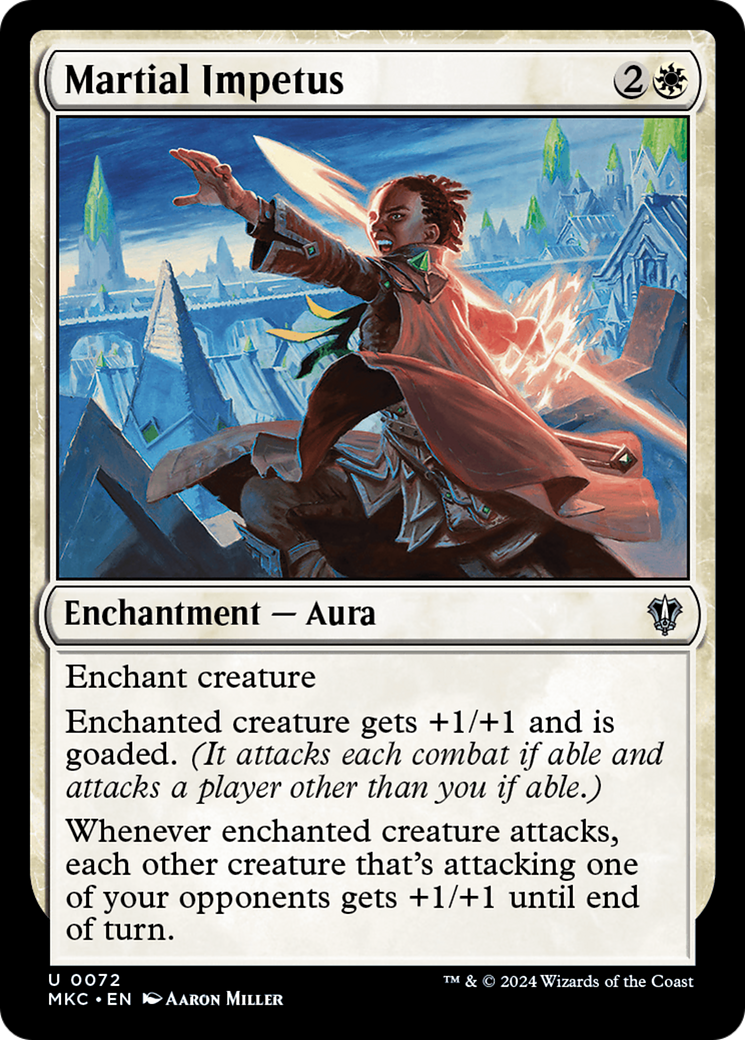
Martial Impetus
Martial Impetus
Enchantment — Aura
Enchant creature
Enchanted creature gets +1/+1 and is goaded. (It attacks each combat if able and attacks a player other than you if able.)
Whenever enchanted creature attacks, each other creature that's attacking one of your opponents gets +1/+1 until end of turn.
- If the creature doesn't meet any of the above exceptions and can attack, it must attack a player other than the controller of the spell or ability that goaded it if able. If the creature can't attack any of those players but could otherwise attack, it must attack a planeswalker an opponent controls, a battle an opponent controls, or a player who goaded it.
- If, during a player's declare attackers step, a creature that player controls that's been goaded is tapped, is affected by a spell or ability that says it can't attack, or hasn't been under that player's control continuously since the turn began (and doesn't have haste), then it doesn't attack. If there's a cost associated with having a creature attack a player, its controller isn't forced to pay that cost, so it doesn't have to attack that player.
- Attacking with a goaded creature doesn't cause it to stop being goaded. If there is an additional combat phase that turn, or if another player gains control of it before it stops being goaded, it must attack again if able.
- If a creature you control has been goaded by multiple opponents, it must attack one of your opponents that hasn't goaded it, as that fulfills the maximum number of goad requirements. If a creature you control has been goaded by each of your opponents, the creature must attack an opponent (rather than a planeswalker or battle), but you choose which opponent it attacks.
- Being goaded isn't an ability the creature has. Once it's been goaded, it must attack as detailed above even if it loses all abilities.
-
1
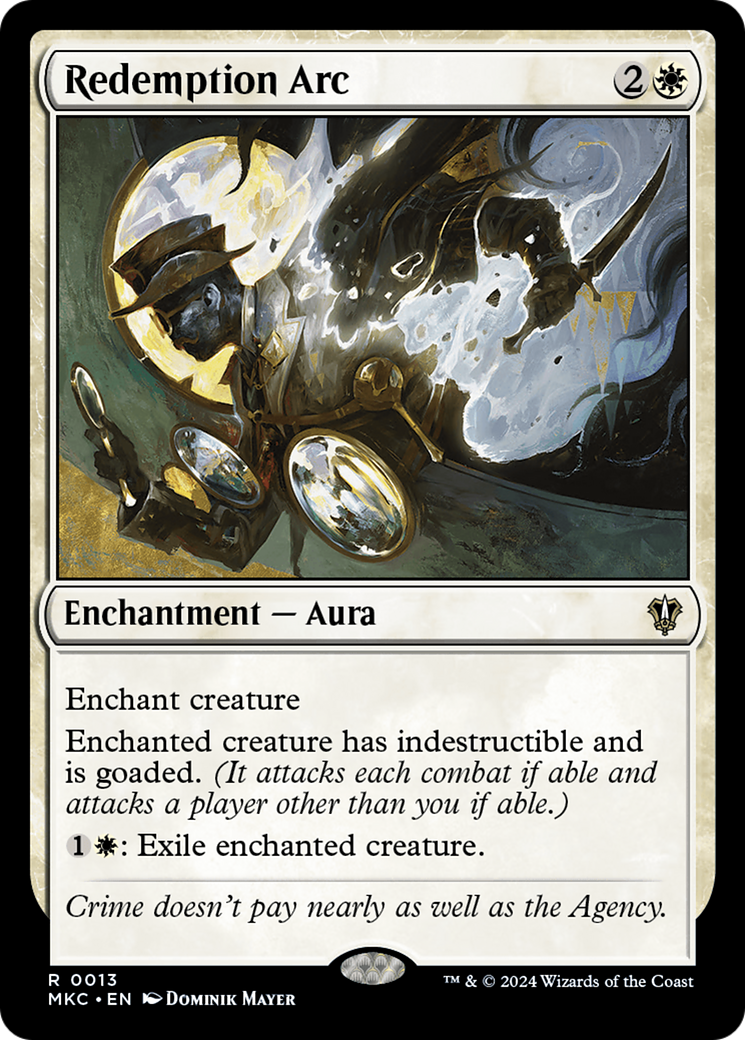
Redemption Arc
Redemption Arc
Enchantment — Aura
Enchant creature
Enchanted creature has indestructible and is goaded. (It attacks each combat if able and attacks a player other than you if able.)
: Exile enchanted creature.
-
1
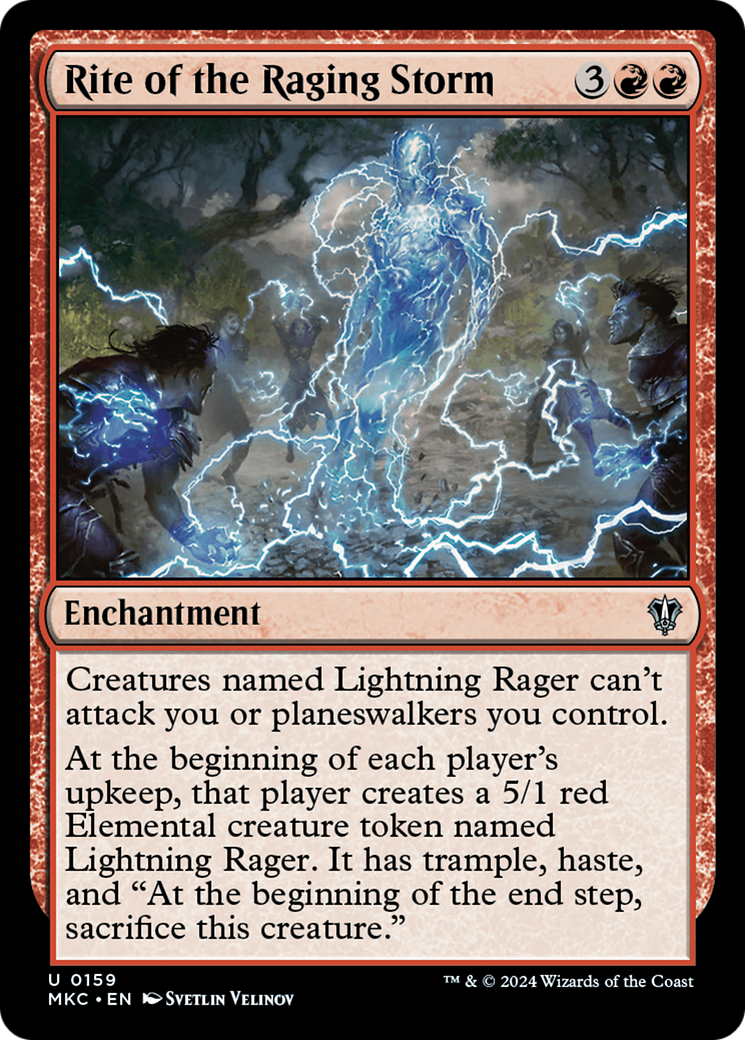
Rite of the Raging Storm
Rite of the Raging Storm
Enchantment
Creatures named Lightning Rager can't attack you or planeswalkers you control.
At the beginning of each player's upkeep, that player creates a 5/1 red Elemental creature token named Lightning Rager. It has trample, haste, and "At the beginning of the end step, sacrifice this token."
- If Rite of the Raging Storm leaves the battlefield before attackers are declared, creatures named Lightning Rager can attack you or planeswalkers you control.
- The tokens aren't named Elemental. They are named only Lightning Rager. The rule that says a token's name is its creature types applies only if the tokens aren't given a name by the effect that creates them.
-
1
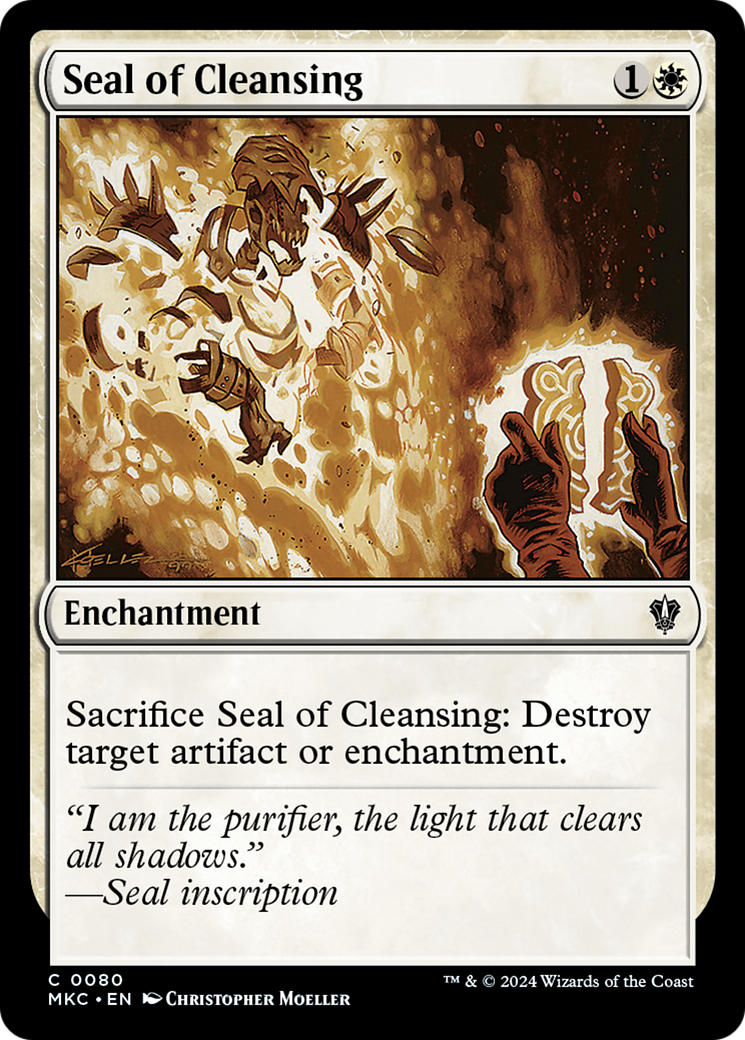
Seal of Cleansing
Seal of Cleansing
Enchantment
Sacrifice this enchantment: Destroy target artifact or enchantment.
- Sacrificing Seal of Cleansing is the cost to activate its ability. Once you activate the ability, no player can do anything to Seal of Cleansing to stop you from activating it. Notably, if you cast Seal of Cleansing during your turn, you'll have priority to activate its ability before anyone can respond to stop you.
-
1
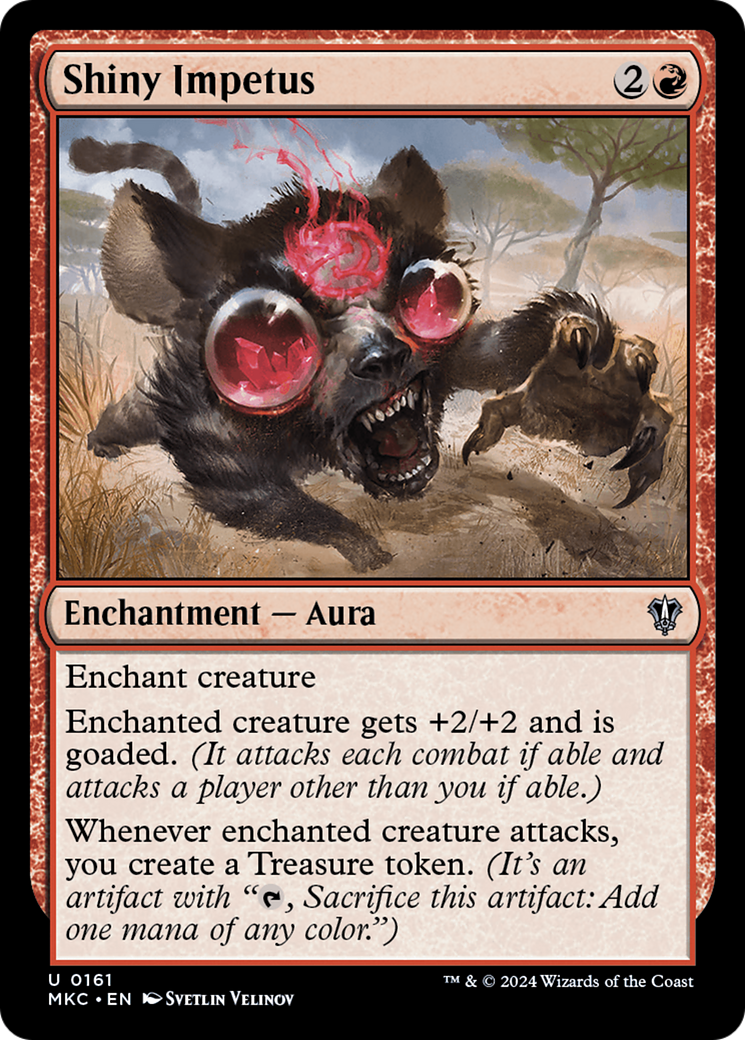
Shiny Impetus
Shiny Impetus
Enchantment — Aura
Enchant creature
Enchanted creature gets +2/+2 and is goaded. (It attacks each combat if able and attacks a player other than you if able.)
Whenever enchanted creature attacks, you create a Treasure token. (It's an artifact with " , Sacrifice this token: Add one mana of any color.")
- If, during a player's declare attackers step, a creature that player controls that's been goaded is tapped, is affected by a spell or ability that says it can't attack, or hasn't been under that player's control continuously since the turn began (and doesn't have haste), then it doesn't attack. If there's a cost associated with having a creature attack a player, its controller isn't forced to pay that cost, so it doesn't have to attack that player.
- If the creature doesn't meet any of the above exceptions and can attack, it must attack a player other than the controller of the spell or ability that goaded it if able. If the creature can't attack any of those players but could otherwise attack, it must attack a planeswalker an opponent controls, a battle an opponent controls, or a player who goaded it.
- Being goaded isn't an ability the creature has. Once it's been goaded, it must attack as detailed above even if it loses all abilities.
- Attacking with a goaded creature doesn't cause it to stop being goaded. If there is an additional combat phase that turn, or if another player gains control of it before it stops being goaded, it must attack again if able.
- If a creature you control has been goaded by multiple opponents, it must attack one of your opponents that hasn't goaded it, as that fulfills the maximum number of goad requirements. If a creature you control has been goaded by each of your opponents, the creature must attack an opponent (rather than a planeswalker or battle), but you choose which opponent it attacks.
- Shiny Impetus causes you to create a Treasure token, not the attacking creature's controller.
-
1
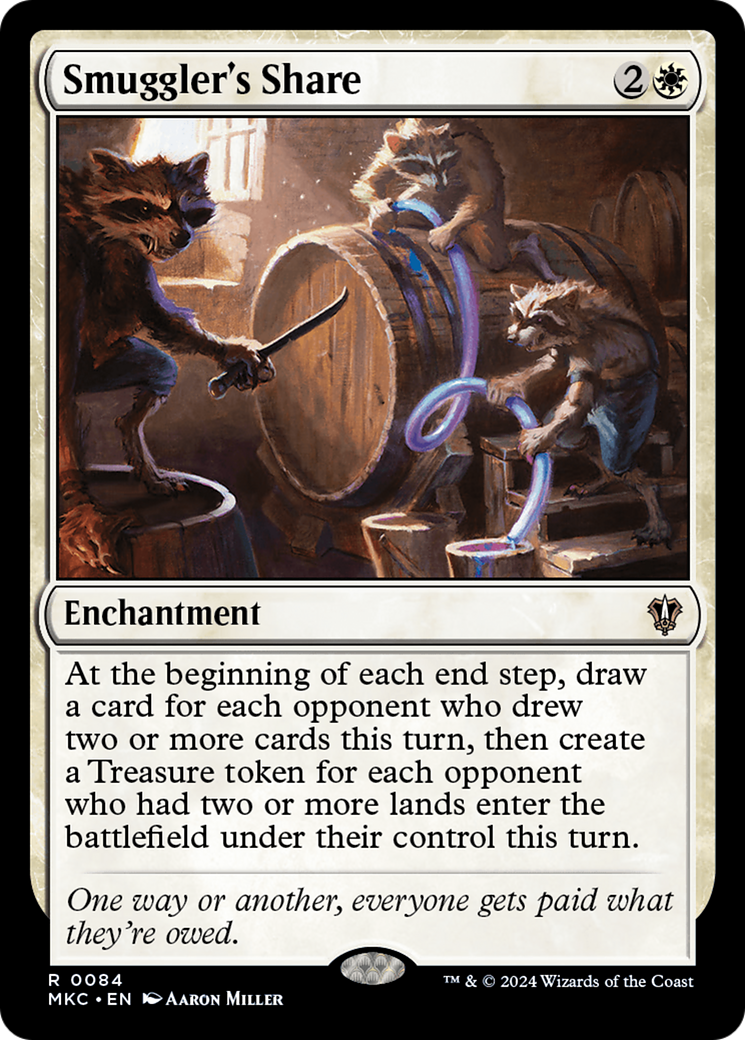
Smuggler's Share
Smuggler's Share
Enchantment
At the beginning of each end step, draw a card for each opponent who drew two or more cards this turn, then create a Treasure token for each opponent who had two or more lands enter the battlefield under their control this turn.
-
1
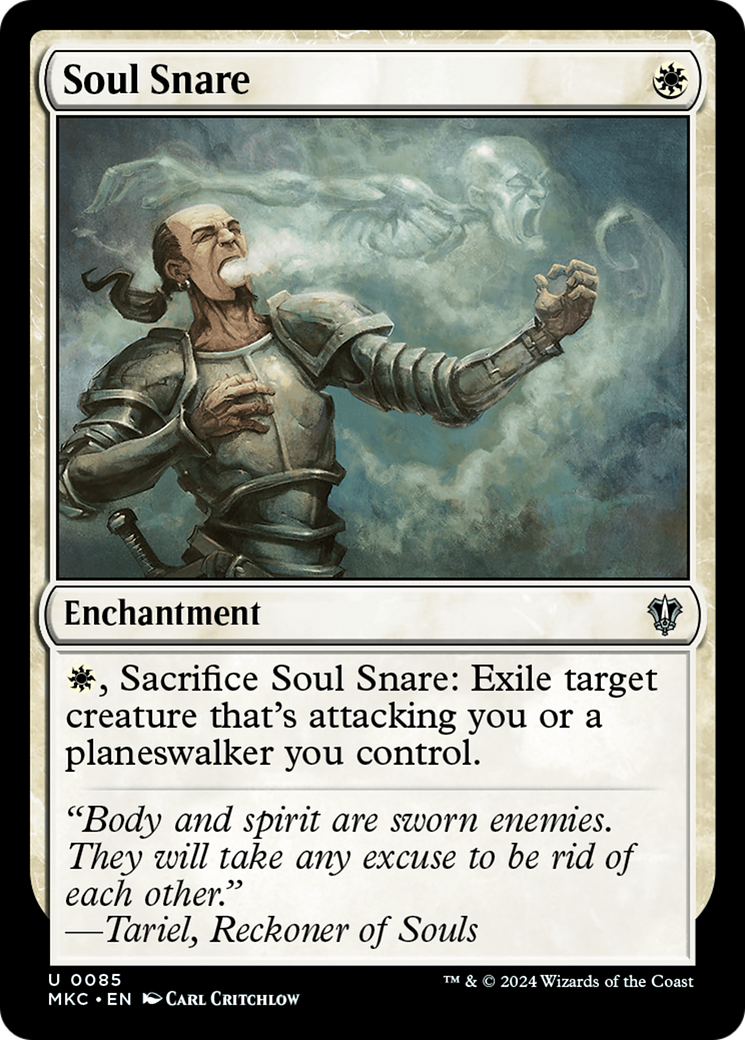
Soul Snare
Soul Snare
Enchantment
, Sacrifice this enchantment: Exile target creature that's attacking you or a planeswalker you control.
- Sacrificing Soul Snare is part of the cost to activate the ability. Once you activate the ability, no player can do anything to Soul Snare to stop you from activating it.
- If Soul Snare's ability targets a creature that's attacking a planeswalker you control, but that planeswalker is no longer on the battlefield as the ability tries to resolve, the attacking creature will be an illegal target and Soul Snare's ability won't exile that creature.
-
1
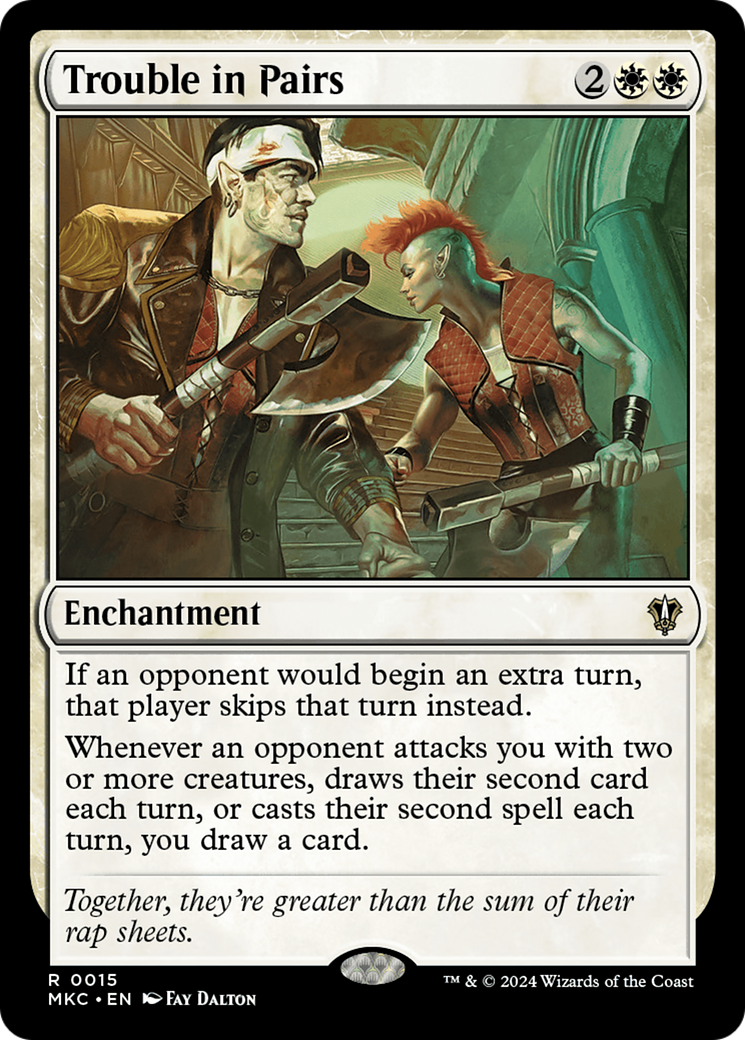
Trouble in Pairs
Trouble in Pairs
Enchantment
If an opponent would begin an extra turn, that player skips that turn instead.
Whenever an opponent attacks you with two or more creatures, draws their second card each turn, or casts their second spell each turn, you draw a card.
- An "extra turn" is any turn created by a spell or ability. Notably, it doesn't include additional turns taken in tournaments after time expires for a round.
- Trouble in Pairs counts spells that were cast even if they didn't resolve. This means it still counts spells that were countered.
- Extra turns can still be created while Trouble in Pairs is on the battlefield. They're not skipped until they would begin, so if Trouble in Pairs leaves the battlefield before that happens, the extra turns will be unaffected.
- Trouble in Pairs doesn't have to be on the battlefield to see the first card an opponent draws in a turn or the first spell they cast in a turn. As long as it's already on the battlefield when they draw their second card or cast their second spell in a turn, its last ability will trigger.
- Trouble in Pairs's last ability can trigger multiple times per opponent per turn. For example, if an opponent draws a second card, casts a second spell, and attacks you with two or more creatures in a single turn, Trouble in Pairs's last ability will trigger once when each of those events occurs, for a total of three times.
- If an opponent attacks you with two or more creatures more than once in a turn (probably because they've generated extra combat phases), Trouble in Pairs's last ability will trigger each time that happens.
-
1
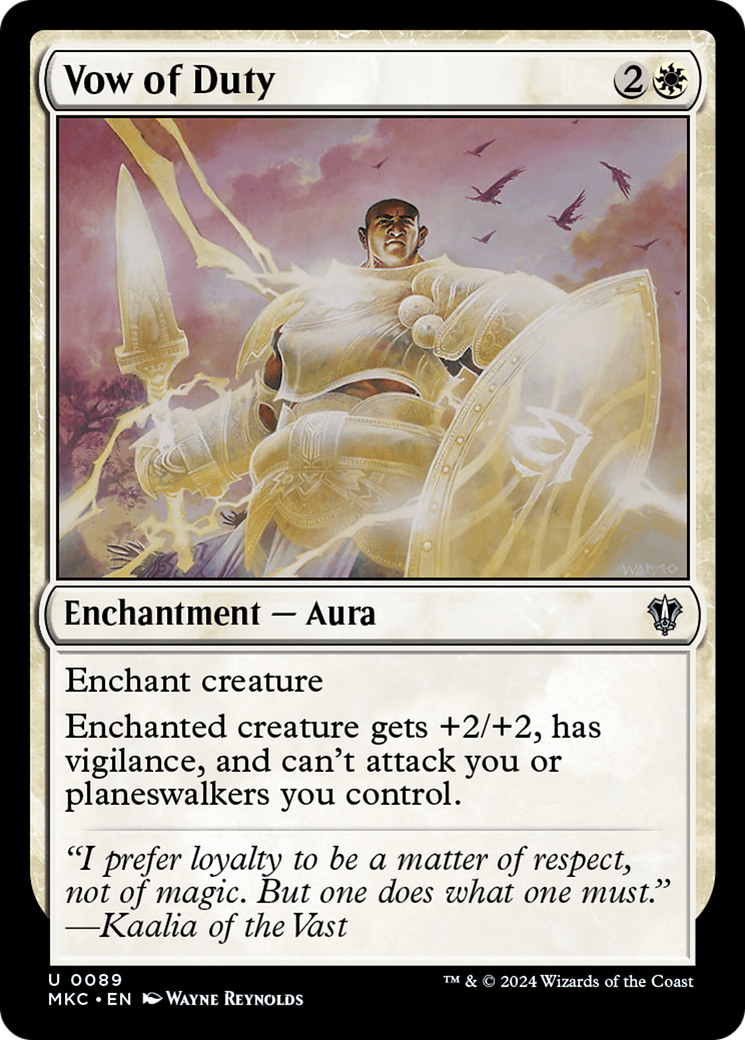
Vow of Duty
Vow of Duty
Enchantment — Aura
Enchant creature
Enchanted creature gets +2/+2, has vigilance, and can't attack you or planeswalkers you control.
-
1
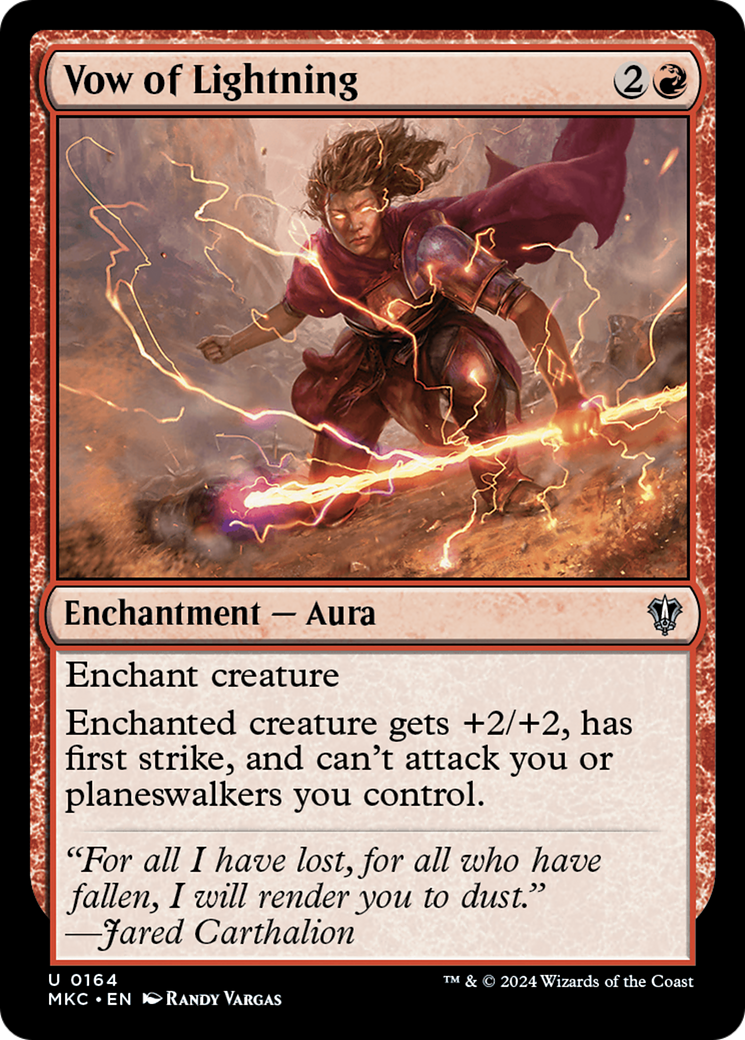
Vow of Lightning
Vow of Lightning
Enchantment — Aura
Enchant creature
Enchanted creature gets +2/+2, has first strike, and can't attack you or planeswalkers you control.
Lands 37
-
1
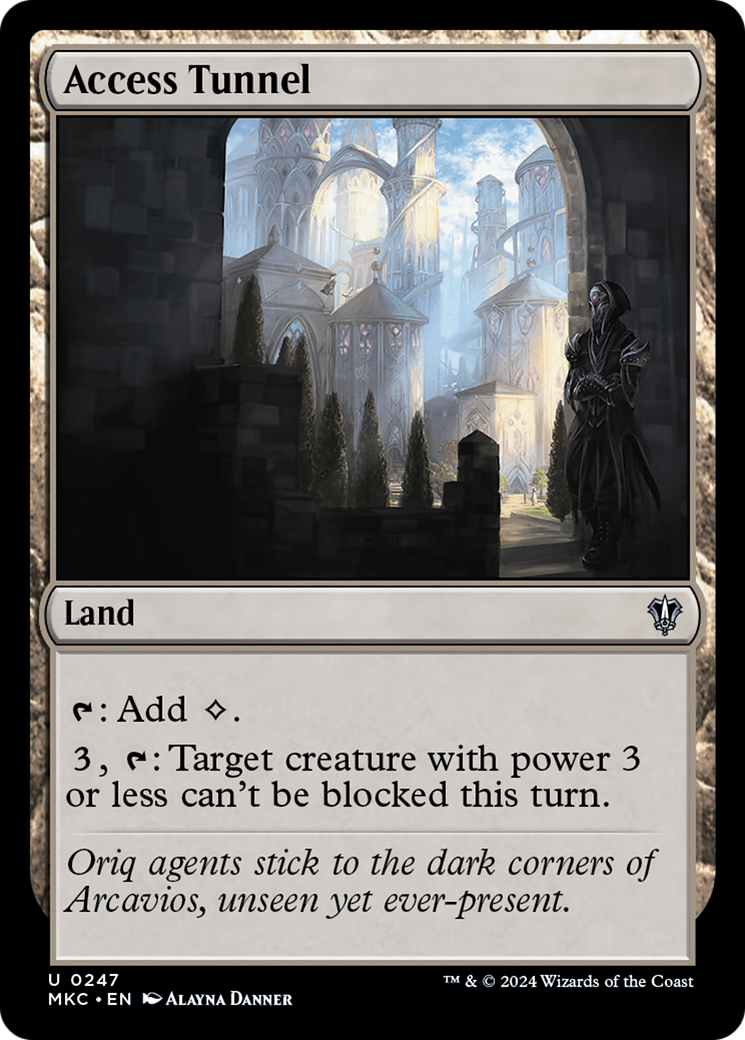
Access Tunnel
Access Tunnel
Land
: Add .
, : Target creature with power 3 or less can't be blocked this turn.
- Once a creature with power 3 or less has been blocked, Access Tunnel's second ability won't cause it to become unblocked.
- If the target creature's power is greater than 3 as Access Tunnel's second ability tries to resolve, the ability doesn't resolve. However, if instead the creature's power is raised above 3 after the ability resolves, it still can't be blocked that turn.
-
1
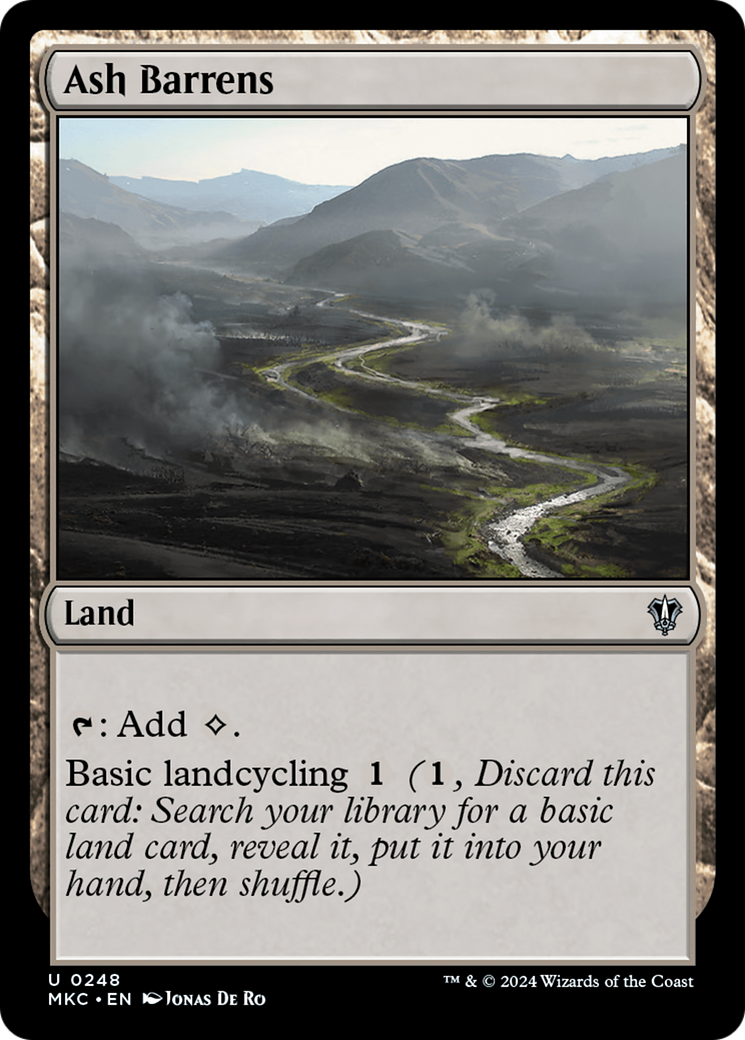
Ash Barrens
Ash Barrens
Land
: Add .
Basic landcycling ( , Discard this card: Search your library for a basic land card, reveal it, put it into your hand, then shuffle.)
-
1
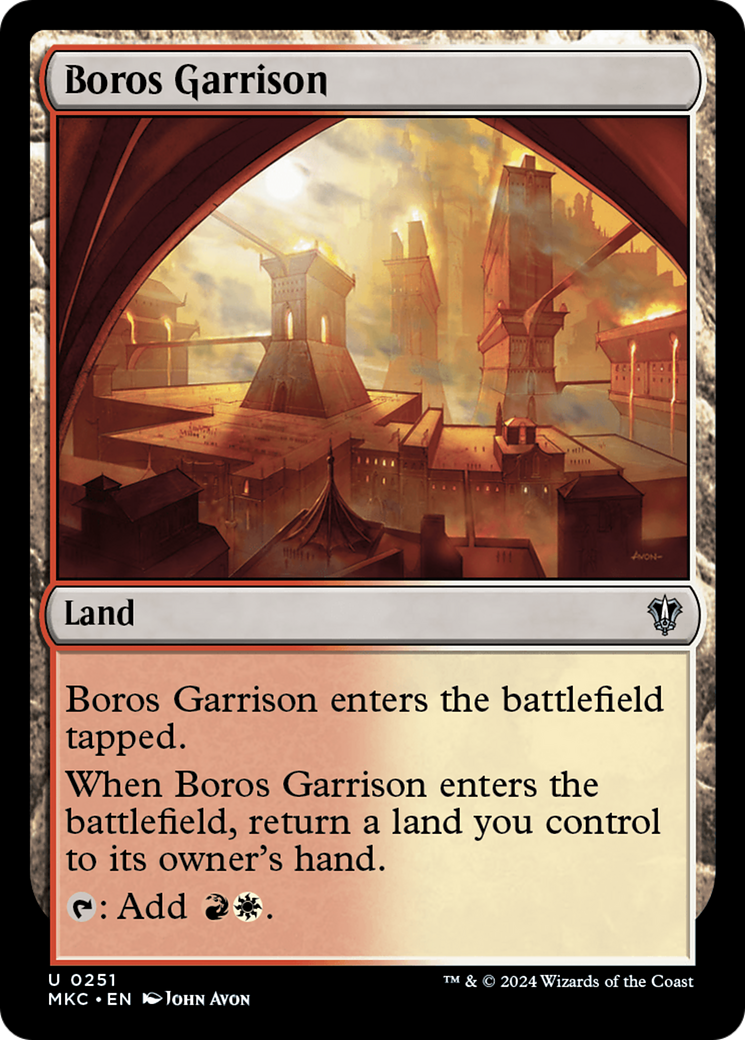
Boros Garrison
Boros Garrison
Land
This land enters tapped.
When this land enters, return a land you control to its owner's hand.
: Add .
- If this land enters the battlefield and you control no other lands, its ability will force you to return it to your hand.
-
1
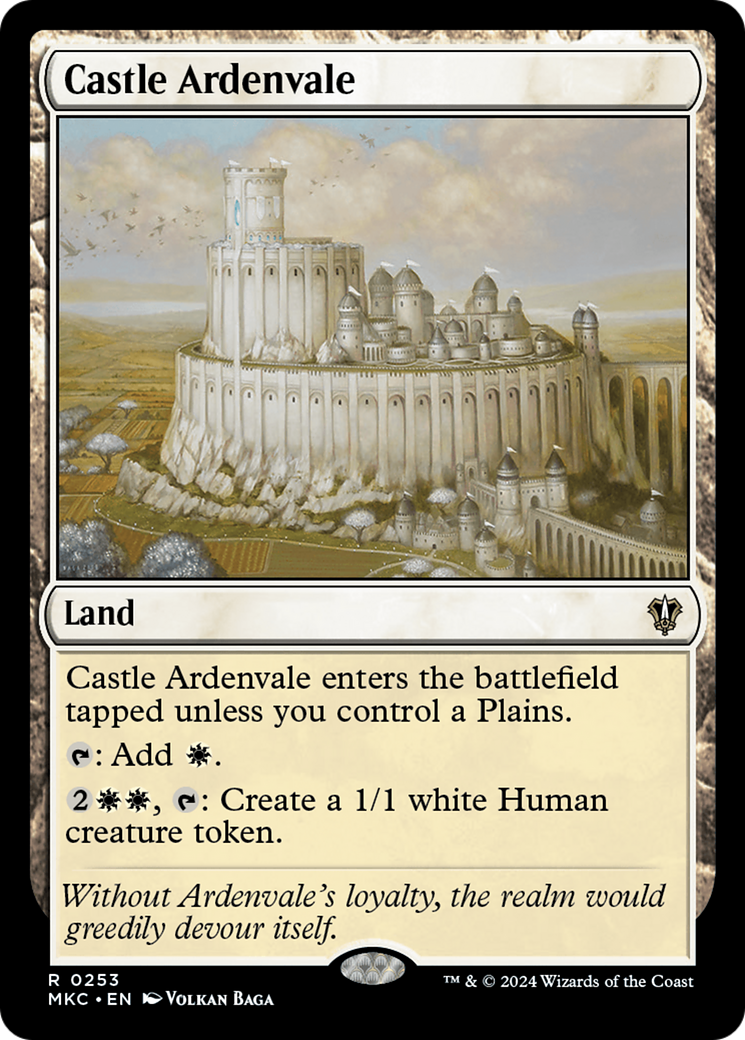
Castle Ardenvale
Castle Ardenvale
Land
This land enters tapped unless you control a Plains.
: Add .
, : Create a 1/1 white Human creature token.
- Once the common lands (such as Mystic Sanctuary) enter the battlefield tapped, there's no way to untap them with a spell or ability to make their last ability trigger.
- Although the common lands have basic land types, they aren't basic lands.
-
1
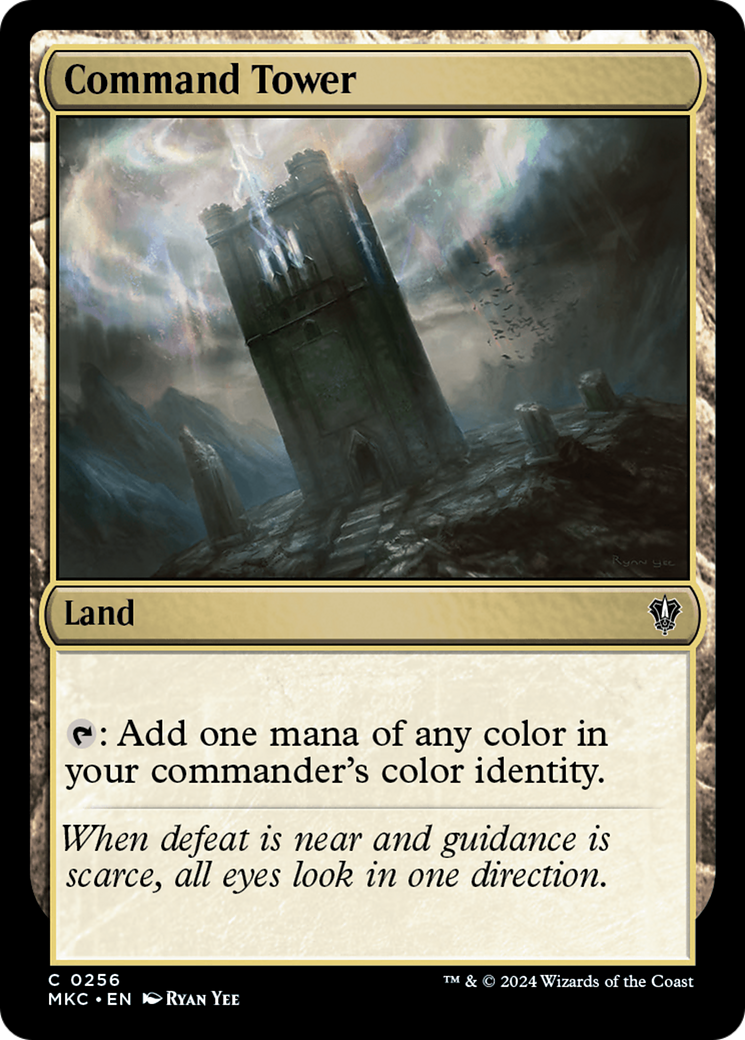
Command Tower
Command Tower
Land
: Add one mana of any color in your commander's color identity.
- If you don't have a commander, Command Tower's ability produces no mana.
- If your commander is a card that has no colors in its color identity, Command Tower's ability produces no mana. It doesn't produce .
- If you have two commanders, the ability adds one mana of any color in their combined color identities.
-
1
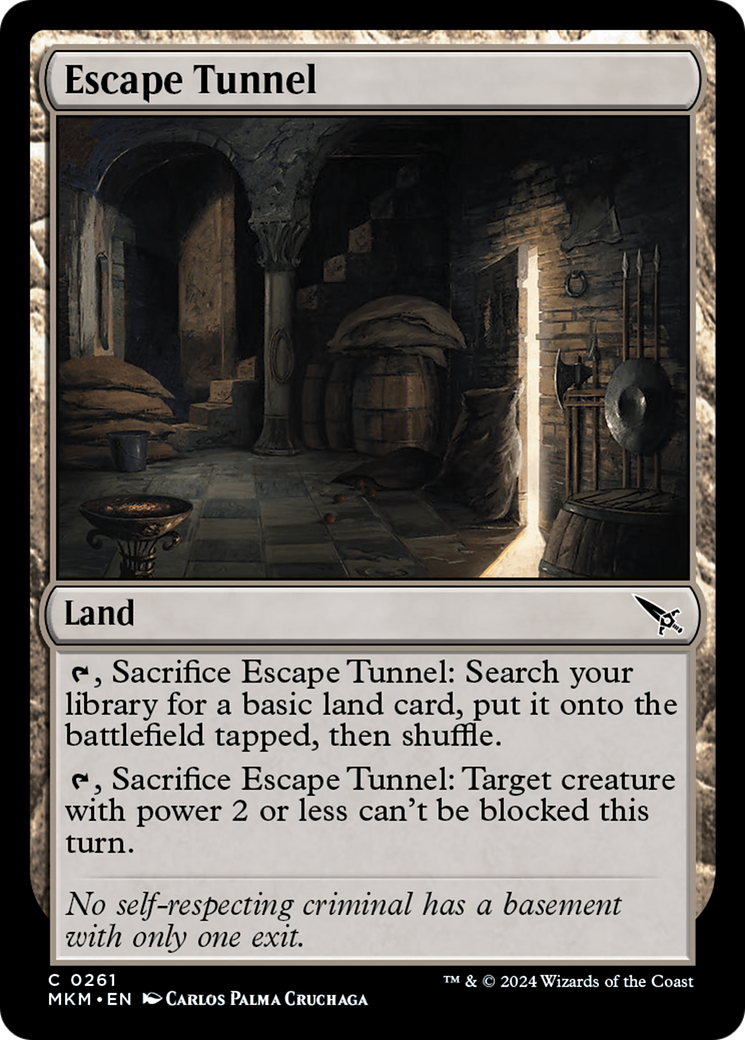
Escape Tunnel
Escape Tunnel
Land
, Sacrifice this land: Search your library for a basic land card, put it onto the battlefield tapped, then shuffle.
, Sacrifice this land: Target creature with power 2 or less can't be blocked this turn.
-
1
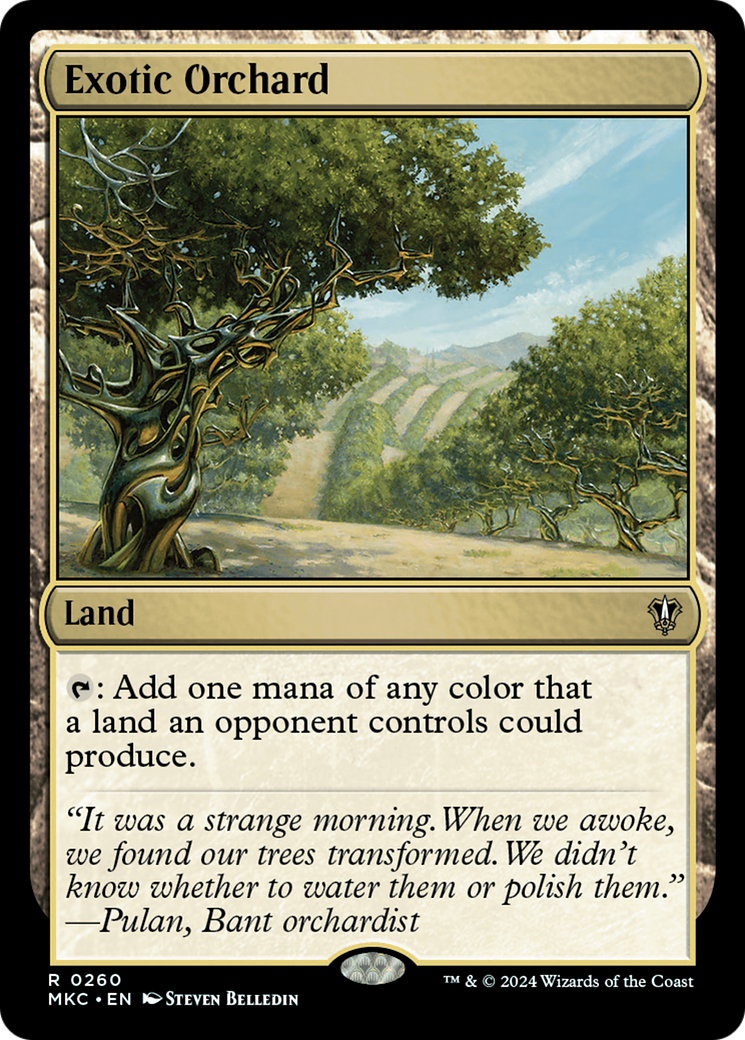
Exotic Orchard
Exotic Orchard
Land
: Add one mana of any color that a land an opponent controls could produce.
- Lands that produce mana based only on what other lands "could produce" won't help each other unless some other land allows one of them to actually produce some type of mana. For example, if you control an Exotic Orchard and your opponent controls an Exotic Orchard and a Reflecting Pool, none of those lands would produce mana if their mana abilities were activated. On the other hand, if you control a Forest and an Exotic Orchard, and your opponent controls an Exotic Orchard and a Reflecting Pool, then each of those lands can be tapped to produce . Your opponent's Exotic Orchard can produce because you control a Forest. Your Exotic Orchard and your opponent's Reflecting Pool can each produce because your opponent's Exotic Orchard can produce .
- When determining what colors of mana your opponents' lands could produce, Exotic Orchard takes into account any applicable replacement effects that would apply to those lands' mana abilities (such as Contamination's effect, for example). If there are more than one, consider them in any possible order.
- The colors of mana are white, blue, black, red, and green. Exotic Orchard can't be tapped for colorless mana, even if a land an opponent controls could produce colorless mana.
- Exotic Orchard doesn't care about any restrictions or riders your opponents' lands (such as Ancient Ziggurat or Hall of the Bandit Lord) put on the mana they produce. It just cares about colors of mana.
- Exotic Orchard checks the effects of all mana-producing abilities of lands your opponents control, but it doesn't check their costs. For example, Vivid Crag has the ability " , Remove a charge counter from Vivid Crag: Add one mana of any color." If an opponent controls Vivid Crag and you control Exotic Orchard, you can tap Exotic Orchard for any color of mana. It doesn't matter whether Vivid Crag has a charge counter on it, and it doesn't matter whether it's untapped.
-
1
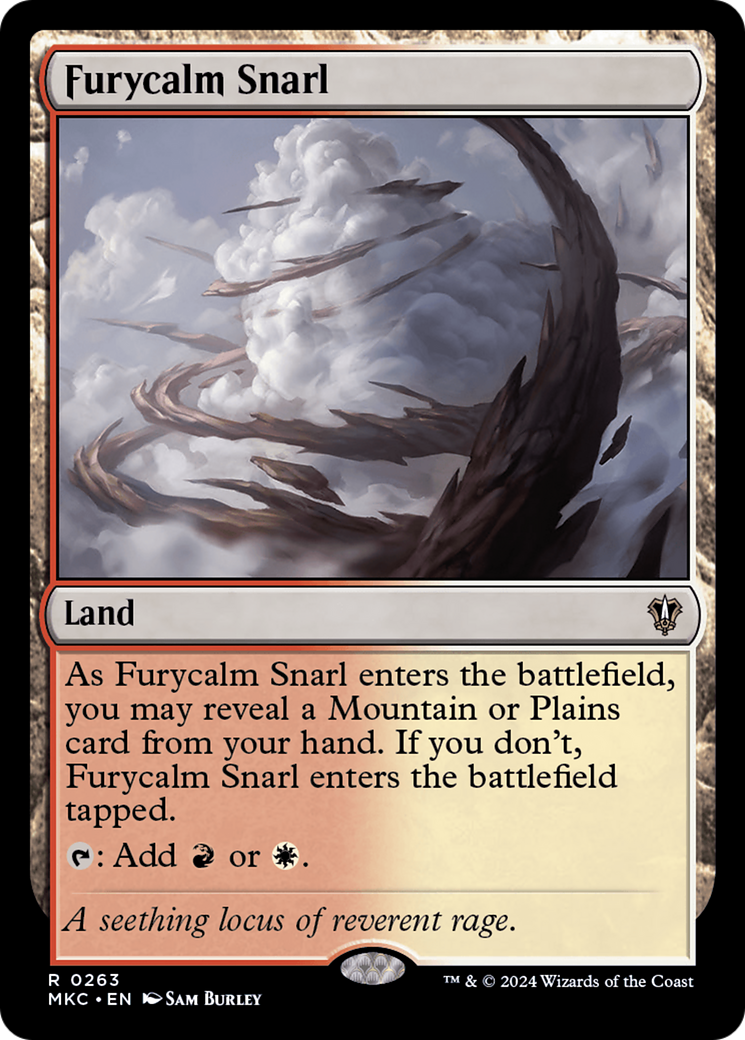
Furycalm Snarl
Furycalm Snarl
Land
As this land enters, you may reveal a Mountain or Plains card from your hand. If you don't, this land enters tapped.
: Add or .
- The "Snarl" itself doesn't have any land subtypes. You can't reveal one to satisfy the ability of another.
- If a land card with an appropriate subtype is entering the battlefield from your hand at the same time as one of these lands, you may reveal the other land to have the "Snarl" enter untapped.
- If an effect instructs you to put one of these lands onto the battlefield tapped, it will still enter the battlefield tapped even if you reveal a land card from your hand.
- You may reveal any land card with either or both of the appropriate subtypes. It doesn't have to be a basic land card.
-
1
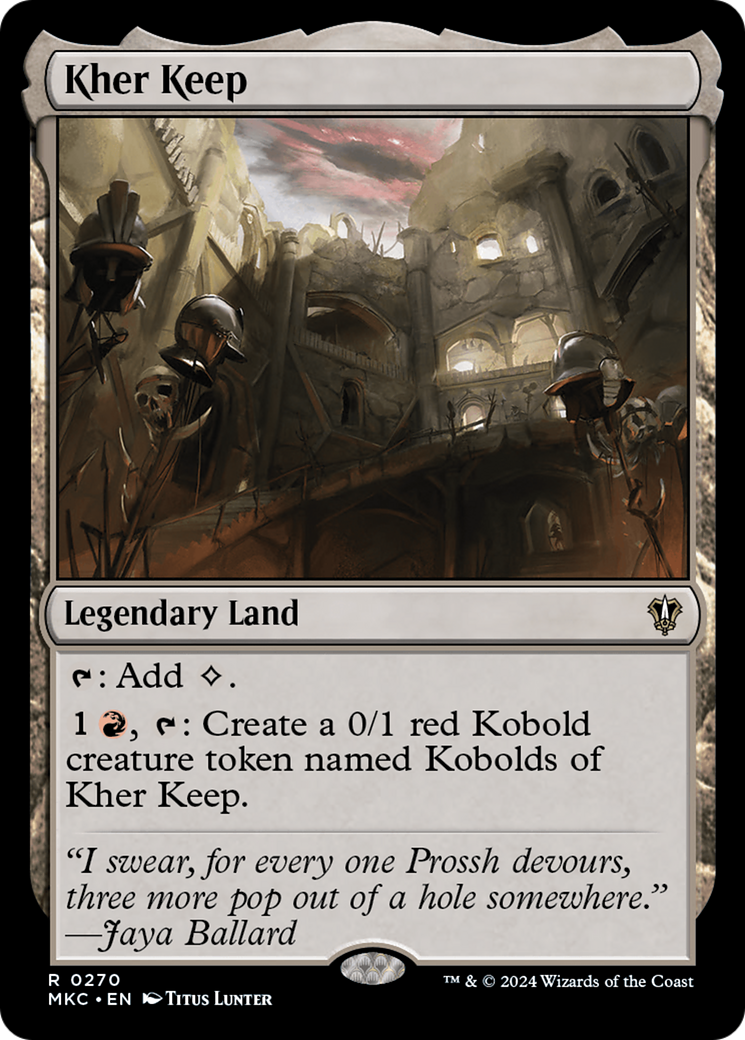
Kher Keep
Kher Keep
Legendary Land
: Add .
, : Create a 0/1 red Kobold creature token named Kobolds of Kher Keep.
-
1
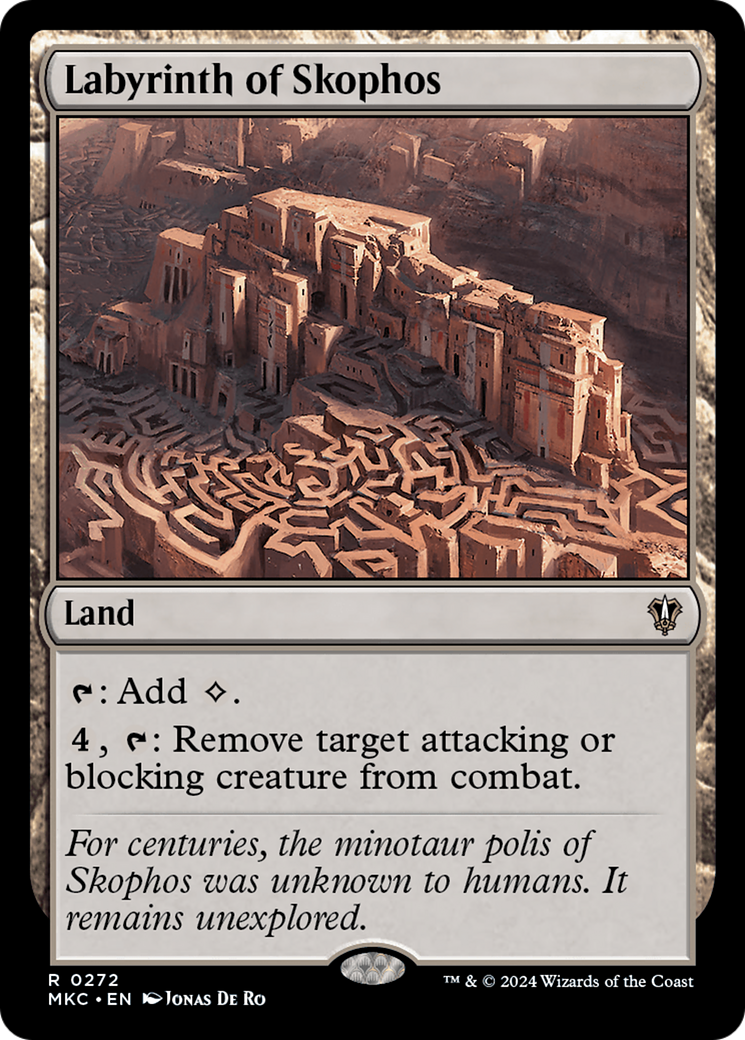
Labyrinth of Skophos
Labyrinth of Skophos
Land
: Add .
, : Remove target attacking or blocking creature from combat.
- A creature removed from combat by Labyrinth of Skophos remains tapped if it was tapped.
- If a blocking creature is removed from combat, the creature it blocked remains blocked. Unless that creature has trample, it won't deal combat damage.
- Once creatures attack or block, they remain attacking or blocking creatures through the end of combat step unless removed from combat (by Labyrinth of Skophos or a similar effect).
-
7
Mountain
Mountain
Basic Land — Mountain
( : Add .)
-
1
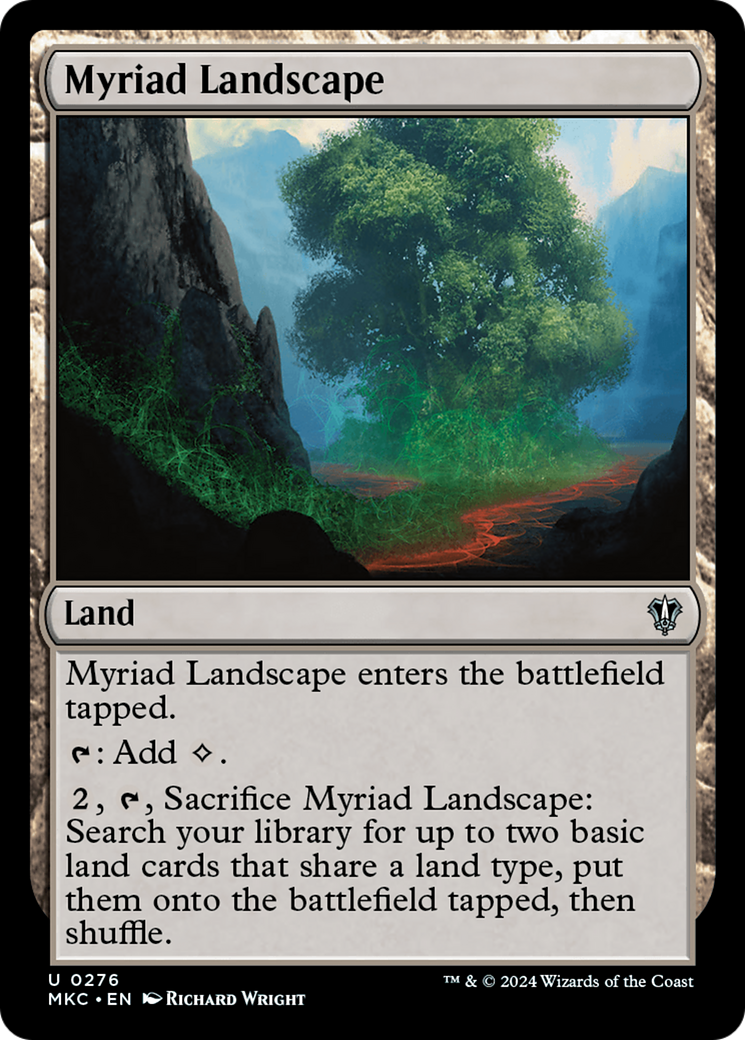
Myriad Landscape
Myriad Landscape
Land
This land enters tapped.
: Add .
, , Sacrifice this land: Search your library for up to two basic land cards that share a land type, put them onto the battlefield tapped, then shuffle.
- You can choose to find one basic land card with Myriad Landscape's last ability.
-
1
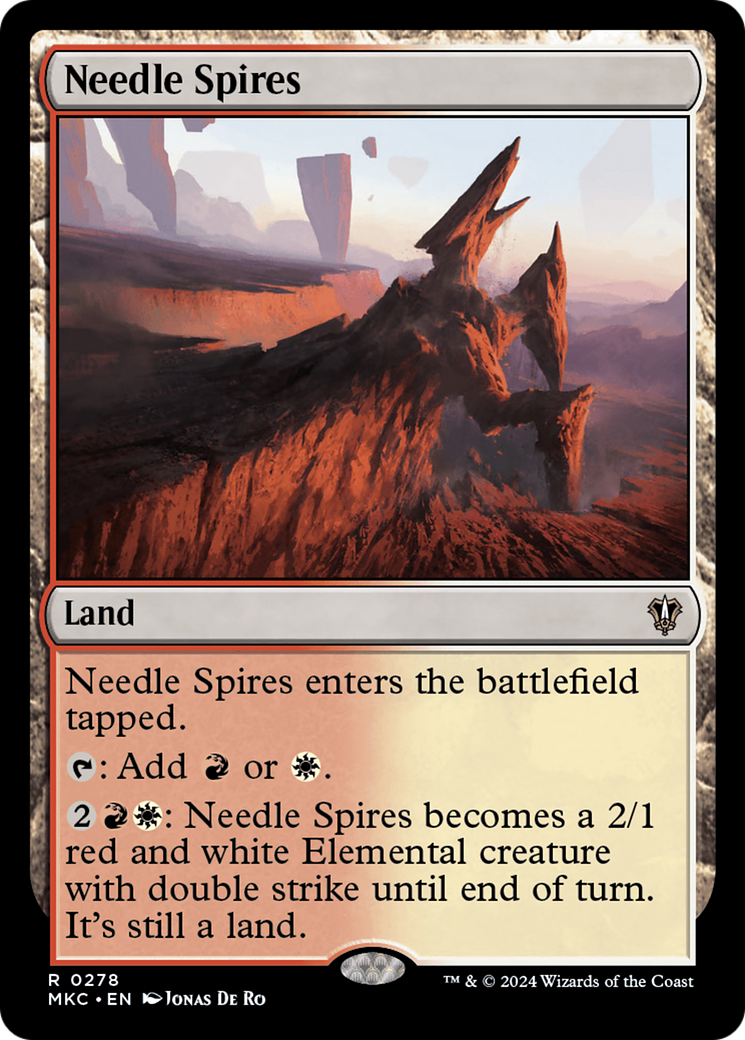
Needle Spires
Needle Spires
Land
This land enters tapped.
: Add or .
: This land becomes a 2/1 red and white Elemental creature with double strike until end of turn. It's still a land.
- A land that becomes a creature may be affected by "summoning sickness." You can't attack with it or use any of its abilities (including its mana abilities) unless it began your most recent turn on the battlefield under your control. Note that summoning sickness cares about when that permanent came under your control, not when it became a creature nor when it entered the battlefield.
- This land is colorless until the last ability gives it colors.
- When a land becomes a creature, that doesn't count as having a creature enter the battlefield. The permanent was already on the battlefield; it only changed its types. Abilities that trigger whenever a creature enters the battlefield won't trigger.
- An ability that turns a land into a creature also sets that creature's power and toughness. If the land was already a creature (for example, if it was the target of a spell with awaken), this will overwrite the previous effect that set its power and toughness. Effects that modify its power or toughness will continue to apply no matter when they started to take effect. The same is true for counters that change its power or toughness (such as +1/+1 counters) and effects that switch its power and toughness. For example, if Needle Spires has been made a 0/0 creature with three +1/+1 counters on it, activating its last ability will turn it into a 5/4 creature that's still a land.
-
9
Plains
Plains
Basic Land — Plains
( : Add .)
-
1
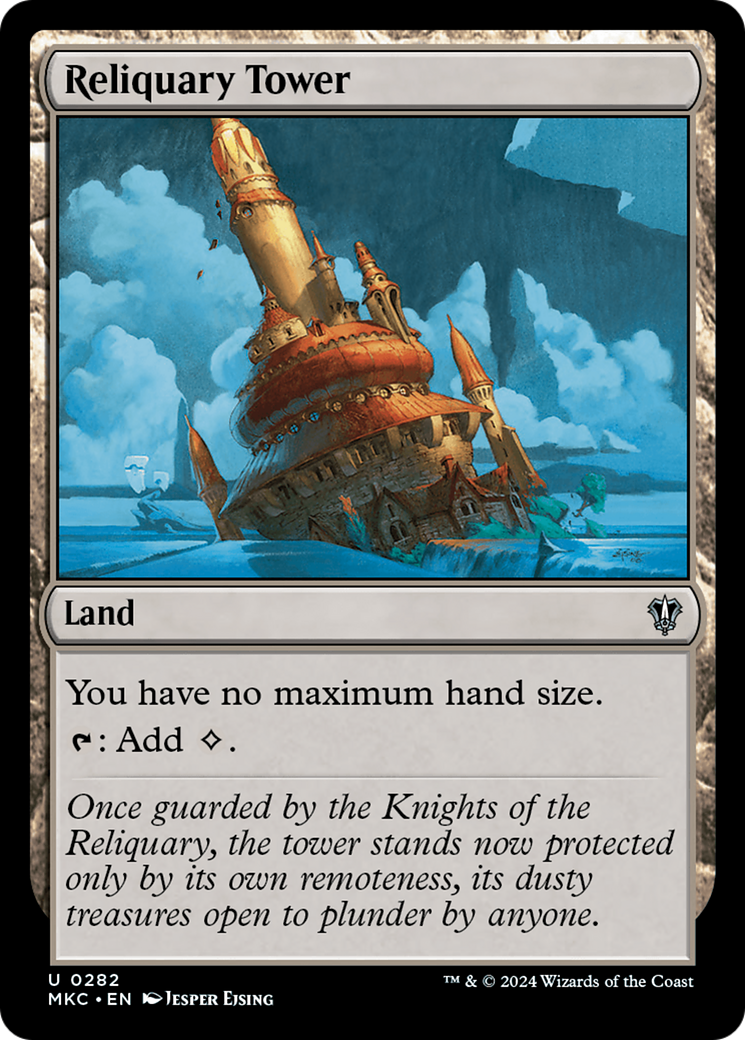
Reliquary Tower
Reliquary Tower
Land
You have no maximum hand size.
: Add .
- If multiple effects modify your hand size, apply them in timestamp order. For example, if you put Null Profusion (an enchantment that says your maximum hand size is two) onto the battlefield and then put Reliquary Tower onto the battlefield, you'll have no maximum hand size. However, if those permanents enter in the opposite order, your maximum hand size would be two.
-
1
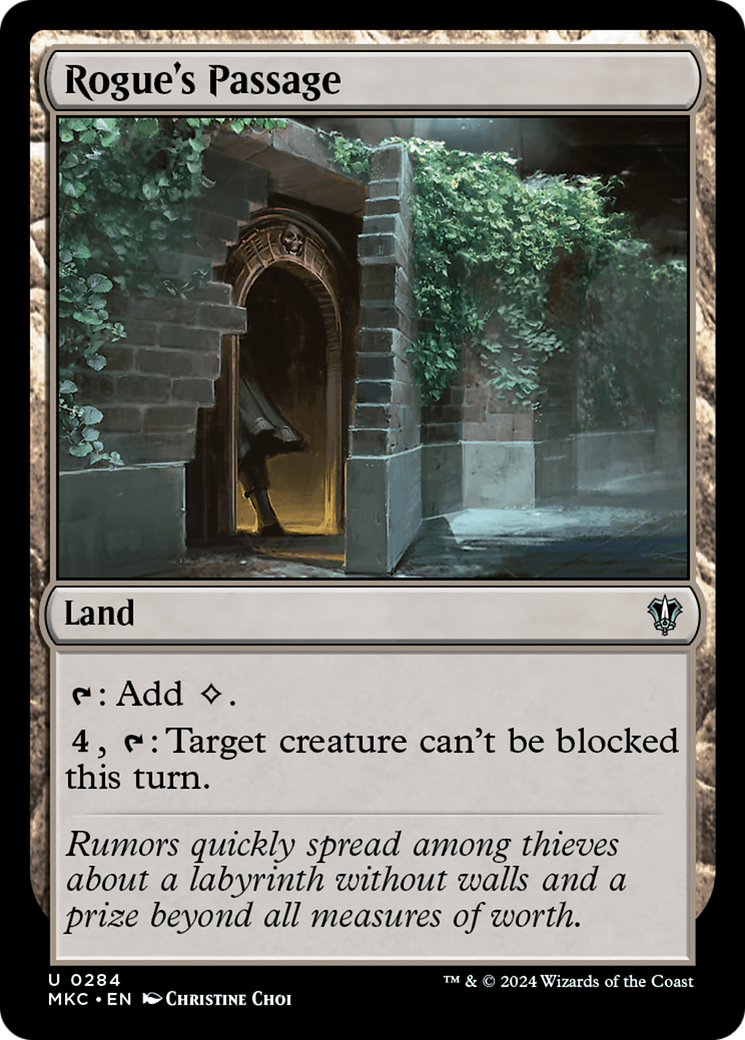
Rogue's Passage
Rogue's Passage
Land
: Add .
, : Target creature can't be blocked this turn.
- Activating the second ability of Rogue's Passage after a creature has become blocked won't cause that creature to become unblocked.
-
1
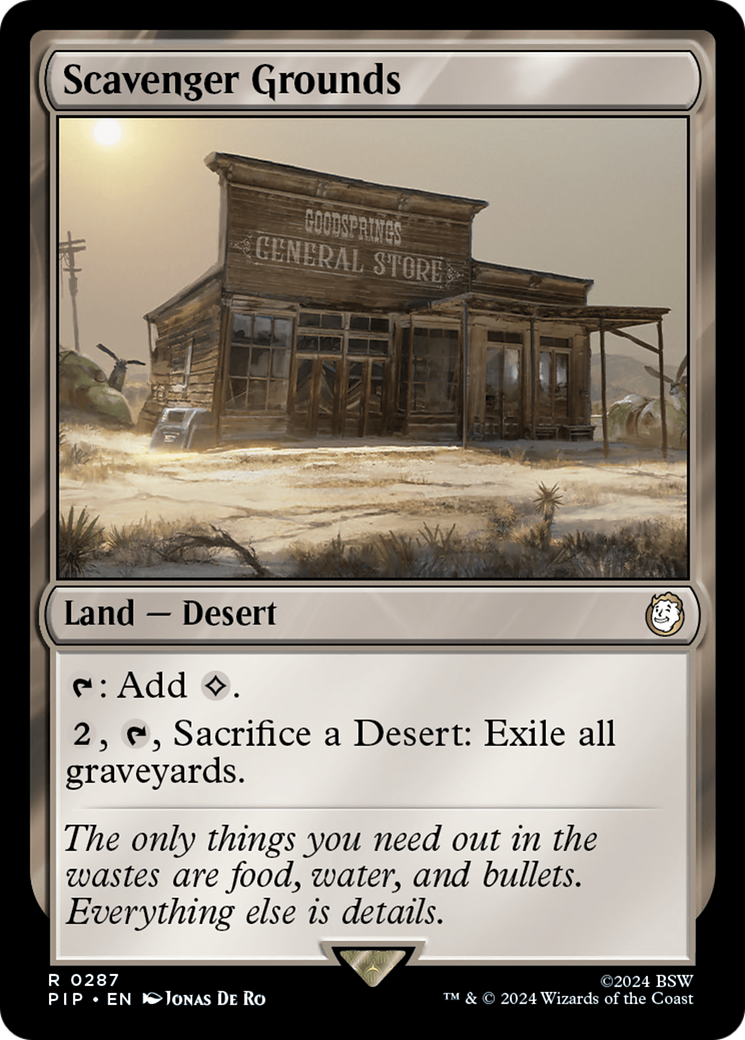
Scavenger Grounds
Scavenger Grounds
Land — Desert
: Add .
, , Sacrifice a Desert: Exile all graveyards.
- The sacrificed Desert will be in your graveyard to be exiled by the last ability of Scavenger Grounds.
-
1
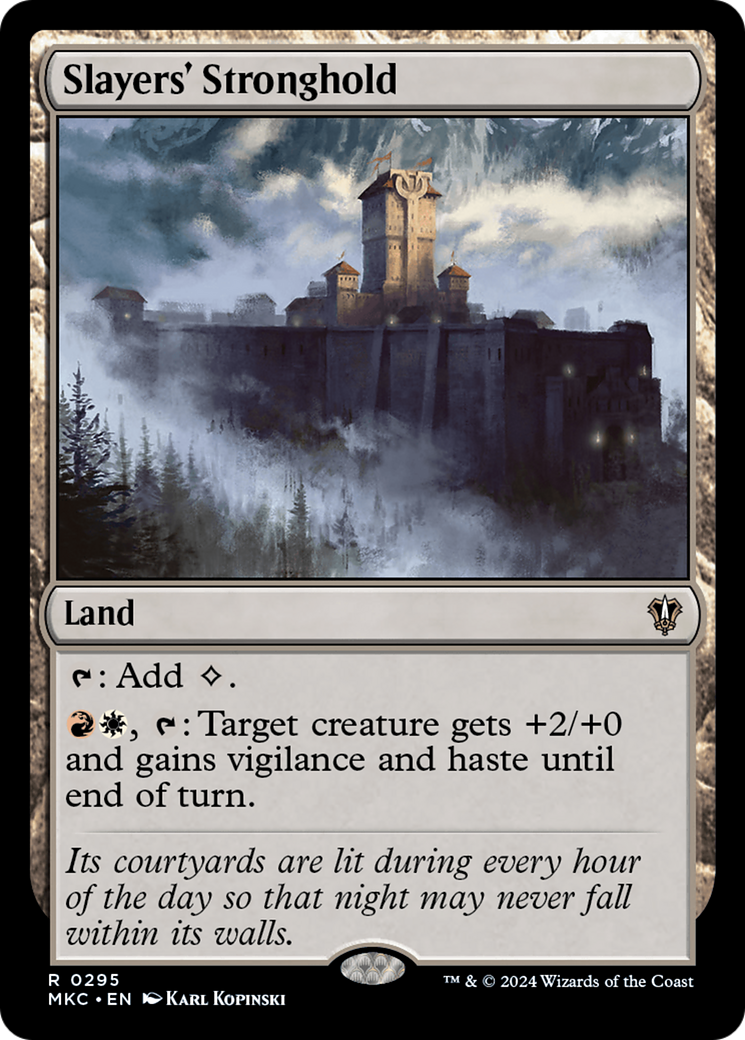
Slayers' Stronghold
Slayers' Stronghold
Land
: Add .
, : Target creature gets +2/+0 and gains vigilance and haste until end of turn.
-
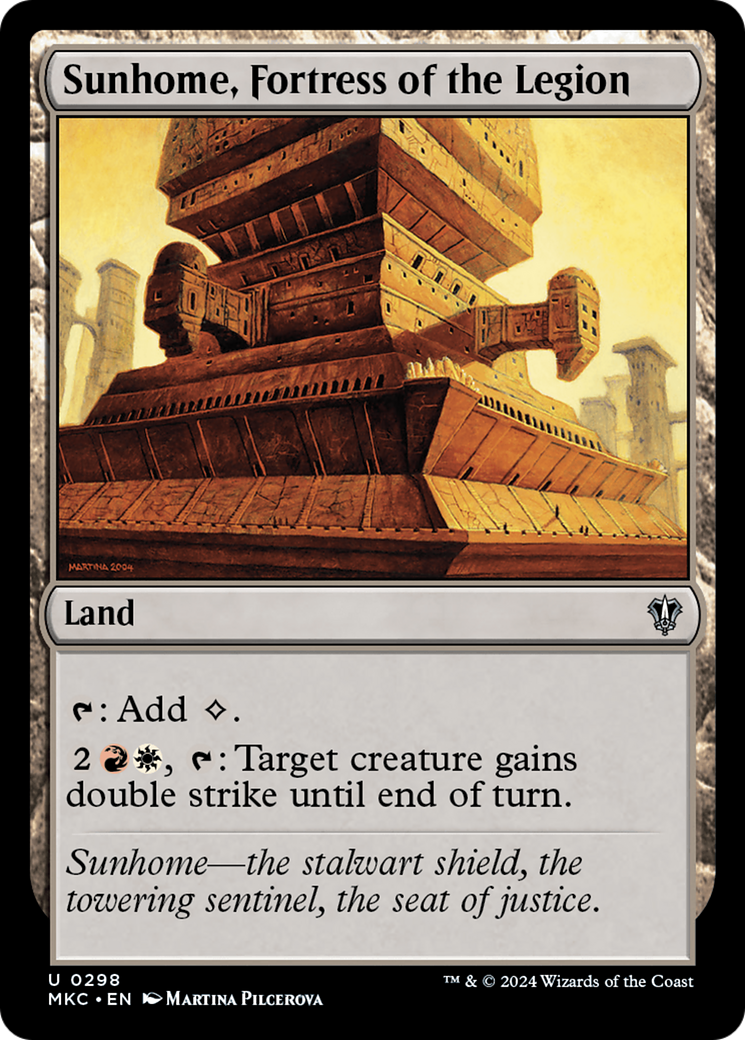
1
Sunhome, Fortress of the Legion
Sunhome, Fortress of the Legion
Land
: Add .
, : Target creature gains double strike until end of turn.
- If you give double strike to a creature with first strike after first-strike combat damage has been dealt, that creature will also deal damage during the normal combat damage step.
- If you give double strike to a creature after either first-strike or normal combat damage has been dealt, it won't help that creature deal any additional combat damage.
-
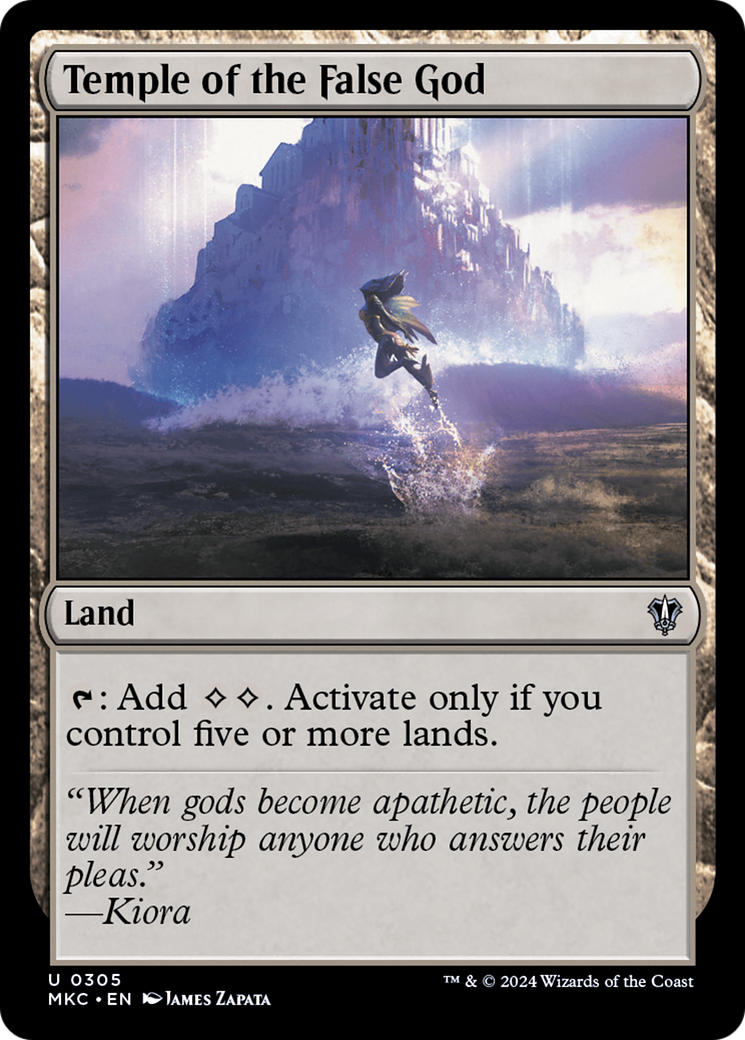
1
Temple of the False God
Temple of the False God
Land
: Add . Activate only if you control five or more lands.
-
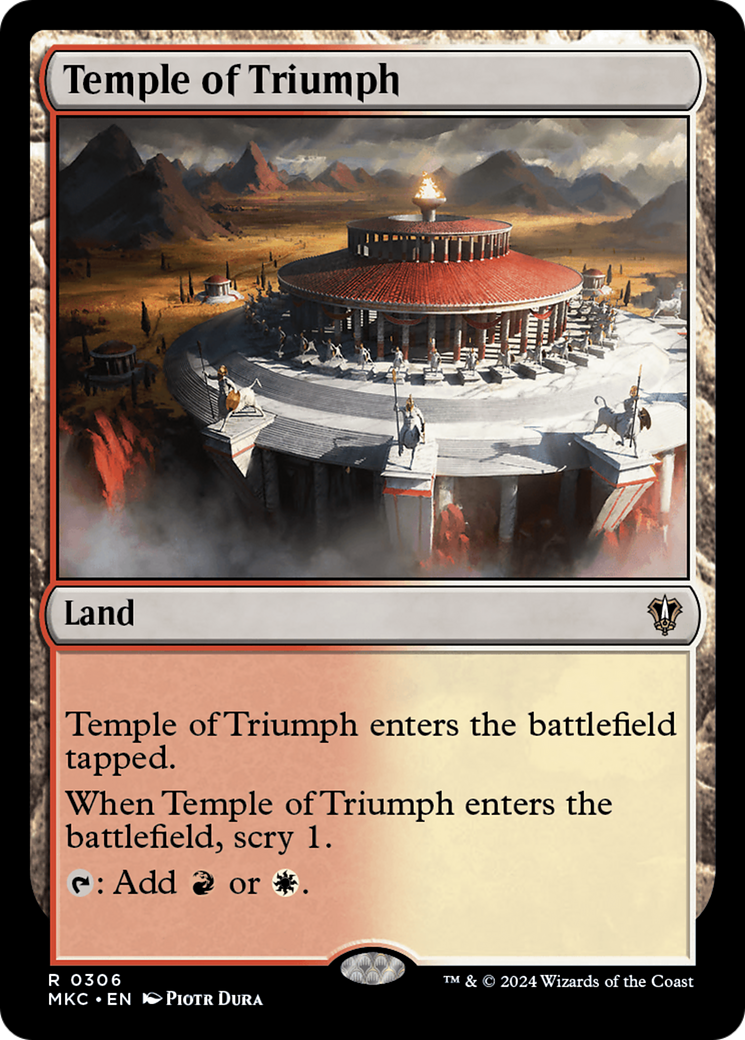
1
Temple of Triumph
Temple of Triumph
Land
This land enters tapped.
When this land enters, scry 1. (Look at the top card of your library. You may put that card on the bottom.)
: Add or .
- When you scry, you may put all the cards you look at back on top of your library, you may put all of those cards on the bottom of your library, or you may put some of those cards on top and the rest of them on the bottom.
- You choose how to order cards returned to your library after scrying no matter where you put them.
- You perform the actions stated on a card in sequence. For some spells and abilities, that means you'll scry last. For others, that means you'll scry and then perform other actions.
- Scry appears on some spells and abilities with one or more targets. If all of the spell or ability's targets are illegal when it tries to resolve, it won't resolve and none of its effects will happen. You won't scry.
-
1
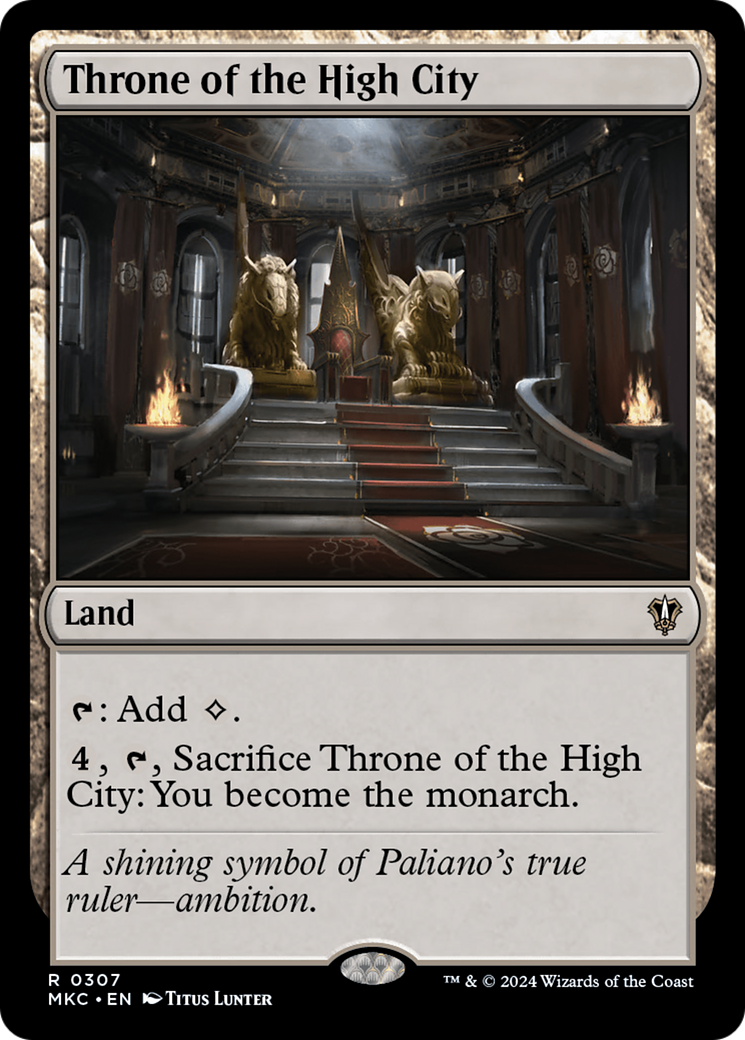
Throne of the High City
Throne of the High City
Land
: Add .
, , Sacrifice this land: You become the monarch.
- If the triggered ability that causes the monarch to draw a card goes on the stack, and a different player becomes the monarch before that ability resolves, the first player will still draw the card.
- Abilities that trigger whenever you "become the monarch" trigger only if you aren't already the monarch. For example, if you are already the monarch as Custodi Lich enters the battlefield, its last ability won't trigger.
- The game starts with no monarch. Once an effect makes one player the monarch, the game will have exactly one monarch from that point forward.
- Being the monarch carries two inherent triggered abilities. "At the beginning of the monarch's end step, that player draws a card" and "Whenever a creature deals combat damage to the monarch, its controller becomes the monarch."
-
1
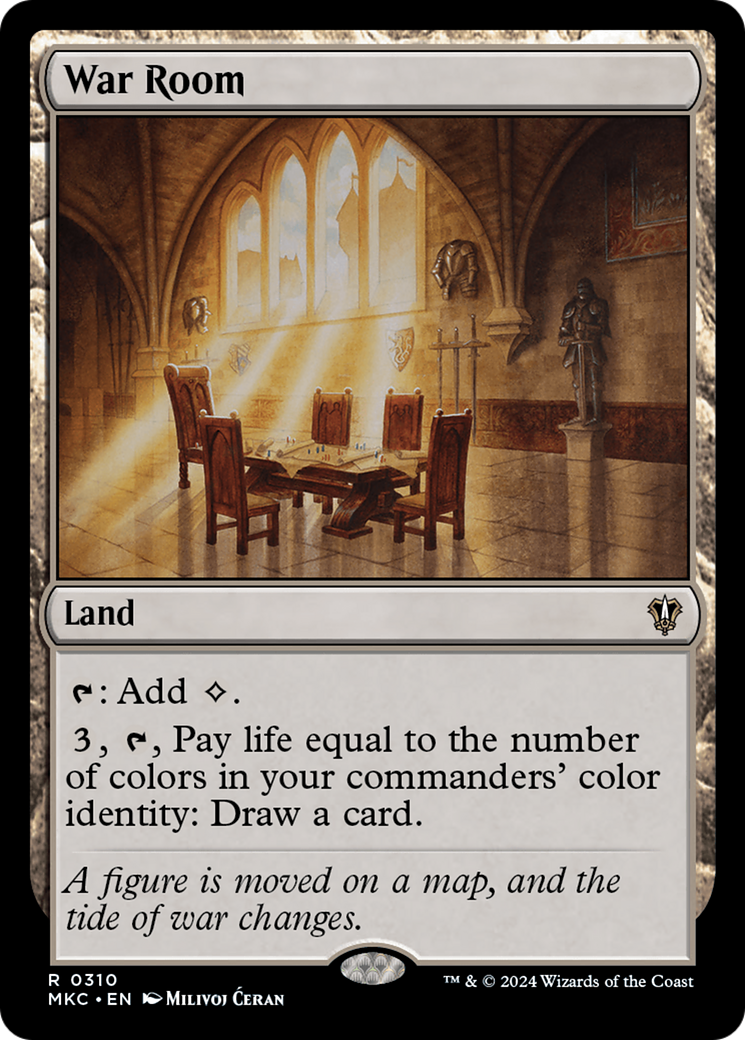
War Room
War Room
Land
: Add .
, , Pay life equal to the number of colors in your commanders' color identity: Draw a card.
- Color identity is set before the game begins and doesn't change during the game, even if your commander is in a hidden zone (like the hand or library) or an effect changes your commander's color.
- If you don't have a commander, you can't activate War Room's last ability at all.
- If your commander has no colors in its color identity, you pay no life to activate War Room's last ability.
White 27
-
1
Angel of the Ruins
Angel of the Ruins
Artifact Creature — Angel
5/7
Flying
When this creature enters, exile up to two target artifacts and/or enchantments.
Plainscycling ( , Discard this card: Search your library for a Plains card, reveal it, put it into your hand, then shuffle.)
-
1
Comeuppance
Comeuppance
Instant
Prevent all damage that would be dealt to you and planeswalkers you control this turn by sources you don't control. If damage from a creature source is prevented this way, Comeuppance deals that much damage to that creature. If damage from a noncreature source is prevented this way, Comeuppance deals that much damage to the source's controller.
- Comeuppance's effect is not a redirection effect. If it prevents damage, Comeuppance (not the original source) deals damage to the permanent or player as part of that prevention effect. Comeuppance is the source of the new damage, so the characteristics of the original source (such as its color, or whether it had lifelink or deathtouch) don't affect the new damage. The new damage is not combat damage, even if the prevented damage was.
-
1
Darien, King of Kjeldor
Darien, King of Kjeldor
Legendary Creature — Human Soldier
3/3
Whenever you're dealt damage, you may create that many 1/1 white Soldier creature tokens.
- If you're dealt damage that causes your life total to become 0 or less, you lose the game before the tokens can be created.
-
1
Duelist's Heritage
Duelist's Heritage
Enchantment
Whenever one or more creatures attack, you may have target attacking creature gain double strike until end of turn.
- The ability of Duelist's Heritage triggers whenever any player attacks with one or more creatures, not just when you do. You know which players and planeswalkers the creatures are attacking before you choose the target creature.
-
1
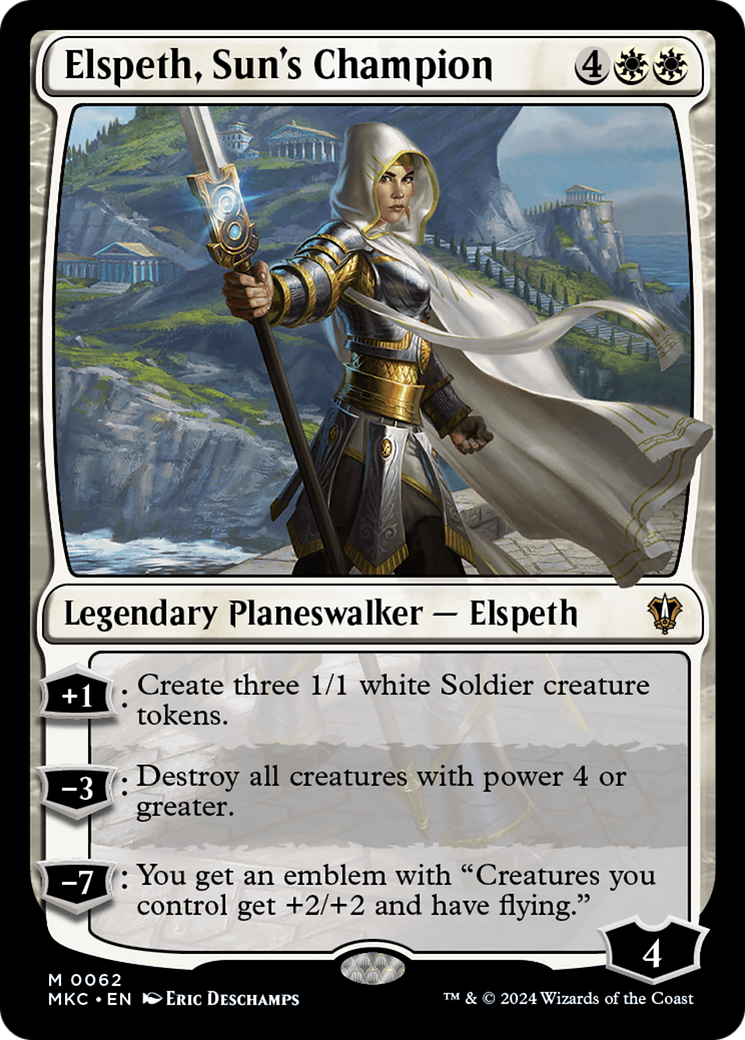
Elspeth, Sun's Champion
Elspeth, Sun's Champion
Legendary Planeswalker — Elspeth
+1: Create three 1/1 white Soldier creature tokens.
−3: Destroy all creatures with power 4 or greater.
−7: You get an emblem with "Creatures you control get +2/+2 and have flying."
-
1
Ghostly Prison
Ghostly Prison
Enchantment
Creatures can't attack you unless their controller pays for each creature they control that's attacking you.
- Unless some effect explicitly says otherwise, a creature that can't attack you can still attack a planeswalker you control.
- In the Two-Headed Giant format, you still only have to pay once per creature.
-
1
Gideon's Sacrifice
Gideon's Sacrifice
Instant
Choose a creature or planeswalker you control. All damage that would be dealt this turn to you and permanents you control is dealt to the chosen permanent instead (if it's still on the battlefield).
- Gideon's Sacrifice has no effect on damage already dealt earlier in the turn.
- If you control no creatures or planeswalkers as Gideon's Sacrifice resolves, nothing happens. The damage redirection effect won't be able to be applied to any damage events.
- If the chosen creature or planeswalker isn't on the battlefield or isn't a creature or planeswalker at the time damage would be dealt, the damage won't be redirected.
- More damage can be redirected to the chosen creature than it has toughness or to the chosen planeswalker than it has loyalty, as long as that damage is all dealt at once (like combat damage is) or is all dealt while a single spell or ability is resolving.
- Gideon's Sacrifice doesn't change the source of the damage or whether the damage is combat damage.
- If you cast more than one Gideon's Sacrifice in one turn, all damage that would be dealt at once to you and/or permanents you control is dealt to one of the chosen permanents of your choice. It's not dealt to all of them, and you can't split the damage between them. The next time damage would be dealt to you, you may choose a different one of those permanents to be dealt that damage.
-
1
Immortal Obligation
Immortal Obligation
Instant
Return target creature card from an opponent's graveyard to the battlefield under their control with a duty counter on it. For as long as that creature has a duty counter on it, it is goaded, can't attack you or a permanent you control, and can't block creatures you control.
-
1
Keeper of the Accord
Keeper of the Accord
Creature — Human Soldier
3/4
At the beginning of each opponent's end step, if that player controls more creatures than you, create a 1/1 white Soldier creature token.
At the beginning of each opponent's end step, if that player controls more lands than you, you may search your library for a basic Plains card, put it onto the battlefield tapped, then shuffle.
- Both triggered abilities trigger at the same time. You may put them on the stack in either order.
- If the opponent doesn't control more creatures than you as their end step begins, the first ability won't trigger. The same is true for lands and the second ability. Each of those abilities will check again when it tries to resolve. If the opponent no longer controls more creatures (or lands) than you, the ability won't resolve and will have no effect.
-
1
Loran of the Third Path
Loran of the Third Path
Legendary Creature — Human Artificer
2/1
Vigilance
When Loran enters, destroy up to one target artifact or enchantment.
: You and target opponent each draw a card.
-
1
Martial Impetus
Martial Impetus
Enchantment — Aura
Enchant creature
Enchanted creature gets +1/+1 and is goaded. (It attacks each combat if able and attacks a player other than you if able.)
Whenever enchanted creature attacks, each other creature that's attacking one of your opponents gets +1/+1 until end of turn.
- If the creature doesn't meet any of the above exceptions and can attack, it must attack a player other than the controller of the spell or ability that goaded it if able. If the creature can't attack any of those players but could otherwise attack, it must attack a planeswalker an opponent controls, a battle an opponent controls, or a player who goaded it.
- If, during a player's declare attackers step, a creature that player controls that's been goaded is tapped, is affected by a spell or ability that says it can't attack, or hasn't been under that player's control continuously since the turn began (and doesn't have haste), then it doesn't attack. If there's a cost associated with having a creature attack a player, its controller isn't forced to pay that cost, so it doesn't have to attack that player.
- Attacking with a goaded creature doesn't cause it to stop being goaded. If there is an additional combat phase that turn, or if another player gains control of it before it stops being goaded, it must attack again if able.
- If a creature you control has been goaded by multiple opponents, it must attack one of your opponents that hasn't goaded it, as that fulfills the maximum number of goad requirements. If a creature you control has been goaded by each of your opponents, the creature must attack an opponent (rather than a planeswalker or battle), but you choose which opponent it attacks.
- Being goaded isn't an ability the creature has. Once it's been goaded, it must attack as detailed above even if it loses all abilities.
-
1
Orzhov Advokist
Orzhov Advokist
Creature — Human Advisor
1/4
At the beginning of your upkeep, each player may put two +1/+1 counters on a creature they control. If a player does, creatures that player controls can't attack you or planeswalkers you control until your next turn.
- While resolving Orzhov Advokist's ability, you choose a creature you control or choose not to put any counters on a creature, then each other player in turn order does the same. Each player will know the choices made by players who chose before them. Then simultaneously each player who chose a creature puts two +1/+1 counters on the creature they chose.
- Orzhov Advokist's ability doesn't target the creatures that receive +1/+1 counters. Their controllers choose them as the ability resolves. Players can't take actions between making their choices and the +1/+1 counters being placed.
- If a player chooses to accept Orzhov Advokist's gift, that player can't attack you or a planeswalker you control with any creatures during their next turn, even creatures that weren't on the battlefield as Orzhov Advokist's ability resolved.
- Orzhov Advokist's effect keeps creatures from attacking you even if Orzhov Advokist leaves the battlefield, if the creature that received counters is no longer on the battlefield, or if an effect has moved those counters off of the creature that received them and put them onto another creature.
-
1
Otherworldly Escort
Otherworldly Escort
Creature — Human Detective
4/3
Flash
When this creature dies, if it's not a Spirit, return it to the battlefield under its owner's control with four charge counters on it. It's a Spirit Detective. (It's no longer a Human.)
, , Remove a charge counter from this creature: Destroy target creature that dealt damage to you this turn.
-
1
Promise of Loyalty
Promise of Loyalty
Sorcery
Each player puts a vow counter on a creature they control and sacrifices the rest. Each of those creatures can't attack you or planeswalkers you control for as long as it has a vow counter on it.
- If the vow counter is removed from the creature, it can attack as normal.
- Each player, including you, must put a vow counter on a creature they control if able. They can't choose to opt out and sacrifice all of their creatures. The creature you put a vow counter on will remember its promise if another player gains control of it.
- If the vow counter is moved to another creature, it won't prevent the second creature from attacking normally.
-
1
Redemption Arc
Redemption Arc
Enchantment — Aura
Enchant creature
Enchanted creature has indestructible and is goaded. (It attacks each combat if able and attacks a player other than you if able.)
: Exile enchanted creature.
-
1
Seal of Cleansing
Seal of Cleansing
Enchantment
Sacrifice this enchantment: Destroy target artifact or enchantment.
- Sacrificing Seal of Cleansing is the cost to activate its ability. Once you activate the ability, no player can do anything to Seal of Cleansing to stop you from activating it. Notably, if you cast Seal of Cleansing during your turn, you'll have priority to activate its ability before anyone can respond to stop you.
-
1
Selfless Squire
Selfless Squire
Creature — Human Soldier
1/1
Flash
When this creature enters, prevent all damage that would be dealt to you this turn.
Whenever damage that would be dealt to you is prevented, put that many +1/+1 counters on this creature.
- Selfless Squire's first triggered ability prevents all damage that would be dealt to you this turn after the triggered ability resolves, even if Selfless Squire leaves the battlefield.
- Selfless Squire's second triggered ability doesn't trigger only when damage is prevented by its first triggered ability's effect. Any effect that uses the word "prevent" will cause it to trigger.
-
1
Sevinne's Reclamation
Sevinne's Reclamation
Sorcery
Return target permanent card with mana value 3 or less from your graveyard to the battlefield. If this spell was cast from a graveyard, you may copy this spell and may choose a new target for the copy.
Flashback (You may cast this card from your graveyard for its flashback cost. Then exile it.)
- A spell cast using flashback will always be exiled afterward, whether it resolves, is countered, or leaves the stack in some other way.
- You can cast a spell using flashback even if it was somehow put into your graveyard without having been cast.
- To determine the total cost of a spell, start with the mana cost or alternative cost (such as a flashback cost) you're paying, add any cost increases, then apply any cost reductions. The mana value of the spell is determined only by its mana cost, no matter what the total cost to cast the spell was.
- You must still follow any timing restrictions and permissions, including those based on the card's type. For instance, you can cast a sorcery using flashback only when you could normally cast a sorcery.
- "Flashback [cost]" means "You may cast this card from your graveyard if the resulting spell is an instant or sorcery spell by paying [cost] rather than paying its mana cost" and "If the flashback cost was paid, exile this card instead of putting it anywhere else any time it would leave the stack."
- If a card with flashback is put into your graveyard during your turn, you can cast it if it's legal to do so before any other player can take any actions.
- A permanent card is an artifact, battle, creature, enchantment, land, or planeswalker card.
- The copy that Sevinne's Reclamation creates is created on the stack, so it's not "cast." Abilities that trigger when a player casts a spell won't trigger. The copy wasn't cast from a graveyard, so it won't make another copy of itself.
- If you cast Sevinne's Reclamation from your graveyard, any abilities that trigger as the permanent card returns to the battlefield will resolve before the copy of Sevinne's Reclamation resolves but after new targets for the copy have been chosen.
- If a card in a graveyard has in its mana cost, X is considered to be 0.
- If the target card is an illegal target by the time Sevinne's Reclamation tries to resolve, the spell doesn't resolve. You won't copy it if you cast it from a graveyard.
-
1
Smuggler's Share
Smuggler's Share
Enchantment
At the beginning of each end step, draw a card for each opponent who drew two or more cards this turn, then create a Treasure token for each opponent who had two or more lands enter the battlefield under their control this turn.
-
1
Soul Snare
Soul Snare
Enchantment
, Sacrifice this enchantment: Exile target creature that's attacking you or a planeswalker you control.
- Sacrificing Soul Snare is part of the cost to activate the ability. Once you activate the ability, no player can do anything to Soul Snare to stop you from activating it.
- If Soul Snare's ability targets a creature that's attacking a planeswalker you control, but that planeswalker is no longer on the battlefield as the ability tries to resolve, the attacking creature will be an illegal target and Soul Snare's ability won't exile that creature.
-
1
Stalking Leonin
Stalking Leonin
Creature — Cat Archer
3/3
When this creature enters, secretly choose an opponent.
Reveal the player you chose: Exile target creature that's attacking you if it's controlled by the chosen player. Activate only once.
- There are several ways to secretly choose an opponent, including writing that player's name on a piece of paper that's kept with Stalking Leonin.
- If you have multiple Stalking Leonins, you may choose a different opponent for each one. Be careful to keep track of which opponent is chosen for each Stalking Leonin.
- If Stalking Leonin leaves the battlefield and returns, it's considered a new object. You may choose a new opponent and you may activate its last ability again.
- If you didn't choose an opponent when Stalking Leonin entered the battlefield, you can't pay the cost to activate its last ability. This will usually happen because you gained control of another player's Stalking Leonin or because a creature already on the battlefield became a copy of Stalking Leonin.
- If a creature is attacking a planeswalker you control, it's not attacking you. Stalking Leonin's last ability can't target it.
-
1
Sun Titan
Sun Titan
Creature — Giant
6/6
Vigilance
Whenever this creature enters or attacks, you may return target permanent card with mana value 3 or less from your graveyard to the battlefield.
- If a card in your graveyard has no mana symbols in its upper right corner (because it's a land card, for example), its mana value is 0.
- If the mana cost of a card in your graveyard includes , X is considered to be 0.
- A permanent card is an artifact, creature, enchantment, land, or planeswalker card.
- The mana value of a card in your graveyard is determined solely by the mana symbols printed in its upper right corner. The mana value is the total amount of mana in that cost, regardless of color. For example, a card with mana cost has mana value 5.
-
1
Trouble in Pairs
Trouble in Pairs
Enchantment
If an opponent would begin an extra turn, that player skips that turn instead.
Whenever an opponent attacks you with two or more creatures, draws their second card each turn, or casts their second spell each turn, you draw a card.
- An "extra turn" is any turn created by a spell or ability. Notably, it doesn't include additional turns taken in tournaments after time expires for a round.
- Trouble in Pairs counts spells that were cast even if they didn't resolve. This means it still counts spells that were countered.
- Extra turns can still be created while Trouble in Pairs is on the battlefield. They're not skipped until they would begin, so if Trouble in Pairs leaves the battlefield before that happens, the extra turns will be unaffected.
- Trouble in Pairs doesn't have to be on the battlefield to see the first card an opponent draws in a turn or the first spell they cast in a turn. As long as it's already on the battlefield when they draw their second card or cast their second spell in a turn, its last ability will trigger.
- Trouble in Pairs's last ability can trigger multiple times per opponent per turn. For example, if an opponent draws a second card, casts a second spell, and attacks you with two or more creatures in a single turn, Trouble in Pairs's last ability will trigger once when each of those events occurs, for a total of three times.
- If an opponent attacks you with two or more creatures more than once in a turn (probably because they've generated extra combat phases), Trouble in Pairs's last ability will trigger each time that happens.
-
1
Vow of Duty
Vow of Duty
Enchantment — Aura
Enchant creature
Enchanted creature gets +2/+2, has vigilance, and can't attack you or planeswalkers you control.
-
1
Wall of Omens
Wall of Omens
Creature — Wall
0/4
Defender
When this creature enters, draw a card.
-
1
Windborn Muse
Windborn Muse
Creature — Spirit
2/3
Flying
Creatures can't attack you unless their controller pays for each creature they control that's attacking you.
- Creatures may still attack planeswalkers you control without their controller paying a cost.
-
1
Winds of Rath
Winds of Rath
Sorcery
Destroy all creatures that aren't enchanted. They can't be regenerated.
- A creature is "enchanted" if it has any Auras attached to it.
Red 17
-
1
Agitator Ant
Agitator Ant
Creature — Insect
2/2
At the beginning of your end step, each player may put two +1/+1 counters on a creature they control. Goad each creature that had counters put on it this way. (Until your next turn, those creatures attack each combat if able and attack a player other than you if able.)
- If the creature doesn't meet any of the above exceptions and can attack, it must attack a player other than the controller of the spell or ability that goaded it if able. If the creature can't attack any of those players but could otherwise attack, it must attack a planeswalker an opponent controls, a battle an opponent controls, or a player who goaded it.
- Attacking with a goaded creature doesn't cause it to stop being goaded. If there is an additional combat phase that turn, or if another player gains control of it before it stops being goaded, it must attack again if able.
- If a creature you control has been goaded by multiple opponents, it must attack one of your opponents that hasn't goaded it, as that fulfills the maximum number of goad requirements. If a creature you control has been goaded by each of your opponents, the creature must attack an opponent (rather than a planeswalker or battle), but you choose which opponent it attacks.
- If, during a player's declare attackers step, a creature that player controls that's been goaded is tapped, is affected by a spell or ability that says it can't attack, or hasn't been under that player's control continuously since the turn began (and doesn't have haste), then it doesn't attack. If there's a cost associated with having a creature attack a player, its controller isn't forced to pay that cost, so it doesn't have to attack that player.
- Being goaded isn't an ability the creature has. Once it's been goaded, it must attack as detailed above even if it loses all abilities.
- If a creature can't have +1/+1 counters put on it, its controller can't choose it just to have it become goaded. If it can have counters put on it but replacement effects cause it not to receive +1/+1 counters, it doesn't become goaded.
- As Agitator Ant's ability resolves, first you choose which creature you control, if any, to put two +1/+1 counters on, then each other player in turn order does the same, knowing the choices made before them. Then each chosen creature receives its +1/+1 counters and becomes goaded.
-
1
Brash Taunter
Brash Taunter
Creature — Goblin
1/1
Indestructible
Whenever this creature is dealt damage, it deals that much damage to target opponent.
, : This creature fights another target creature.
- A creature can be dealt an amount of damage greater than its toughness. For example, if Brash Taunter is dealt 3 damage, its middle ability deals 3 damage, not 1, to the target opponent.
- If your life total is brought to 0 or less at the same time that Brash Taunter is dealt damage, you lose the game before its middle ability goes on the stack.
- If the target creature is an illegal target when Brash Taunter's last ability tries to resolve, the ability doesn't resolve. If Brash Taunter is no longer on the battlefield, the target creature won't deal or be dealt damage.
-
1
Curse of Opulence
Curse of Opulence
Enchantment — Aura Curse
Enchant player
Whenever enchanted player is attacked, create a Gold token. Each opponent attacking that player does the same. (A Gold token is an artifact with "Sacrifice this token: Add one mana of any color.")
- Curse of Opulence's triggered ability resolves after attackers have been declared. Any costs to attack must have already been paid before the attacking player creates the Gold.
- Each Curse's ability triggers only once, no matter how many creatures are attacking the enchanted player.
- A player is attacking another player if they control a creature that's attacking that player. If no creatures are attacking the enchanted player as a Curse's ability resolves (most likely because they've left the battlefield), only the Curse's controller performs its actions.
- The triggered ability of these Curses won't trigger if only a planeswalker controlled by the enchanted player is attacked.
- If you enchant yourself with one of these Curses, you'll get its effects whenever another player attacks you.
-
1
Disrupt Decorum
Disrupt Decorum
Sorcery
Goad all creatures you don't control. (Until your next turn, those creatures attack each combat if able and attack a player other than you if able.)
- If, during a player's declare attackers step, a creature that player controls that's been goaded is tapped, is affected by a spell or ability that says it can't attack, or hasn't been under that player's control continuously since the turn began (and doesn't have haste), then it doesn't attack. If there's a cost associated with having a creature attack a player, its controller isn't forced to pay that cost, so it doesn't have to attack that player.
- If the creature doesn't meet any of the above exceptions and can attack, it must attack a player other than the controller of the spell or ability that goaded it if able. If the creature can't attack any of those players but could otherwise attack, it must attack a planeswalker an opponent controls, a battle an opponent controls, or a player who goaded it.
- Being goaded isn't an ability the creature has. Once it's been goaded, it must attack as detailed above even if it loses all abilities.
- Attacking with a goaded creature doesn't cause it to stop being goaded. If there is an additional combat phase that turn, or if another player gains control of it before it stops being goaded, it must attack again if able.
- If a creature you control has been goaded by multiple opponents, it must attack one of your opponents that hasn't goaded it, as that fulfills the maximum number of goad requirements. If a creature you control has been goaded by each of your opponents, the creature must attack an opponent (rather than a planeswalker or battle), but you choose which opponent it attacks.
- Creatures that enter the battlefield after Disrupt Decorum resolves won't be goaded.
-
1
Etali, Primal Storm
Etali, Primal Storm
Legendary Creature — Elder Dinosaur
6/6
Whenever Etali attacks, exile the top card of each player's library, then you may cast any number of spells from among those cards without paying their mana costs.
- If an exiled card has in its mana cost, you must choose 0 as the value of X when casting it without paying its mana cost.
- If you cast any of the exiled cards, you do so as part of the resolution of the triggered ability. You can't wait to cast them later in the turn. Timing permissions based on a card's type are ignored, and the spells resolve before blockers are declared.
- If you cast a card "without paying its mana cost," you can't pay any alternative costs. You can, however, pay additional costs. If the card has any mandatory additional costs, those must be paid to cast the card.
- If you cast more than one of the exiled cards, you choose the order in which to cast them. A spell you cast this way can be the target of a later spell you cast this way. However, permanent spells cast this way won't resolve until you're done casting spells, so the permanents they become can't be the target of spells cast this way. For example, if you exile Twincast and Lightning Strike, you can cast Lightning Strike and then cast Twincast targeting it; but if you exile a creature card and an Aura card, you can't cast that Aura targeting that creature.
- Any cards not cast, including land cards, remain in exile. They can't be cast on later turns, even if Etali attacks again.
- Because all attacking creatures are chosen at once, a creature cast this way can't attack during the same combat as Etali, even if it has haste.
- In a multiplayer game, if a player leaves the game, all cards that player owns leave as well. If you leave the game, any spells or permanents you control from Etali's ability are exiled.
-
1
Fiendish Duo
Fiendish Duo
Creature — Devil
5/5
First strike (This creature deals combat damage before creatures without first strike.)
If a source would deal damage to an opponent, it deals double that damage to that player instead.
-
1
Frontier Warmonger
Frontier Warmonger
Creature — Human Warrior
4/4
Whenever one or more creatures attack one of your opponents or a planeswalker they control, those creatures gain menace until end of turn.
- Creatures your opponents control attacking one of your opponents will cause Frontier Warmonger's ability to trigger.
-
1
Havoc Eater
Havoc Eater
Creature — Elemental
3/3
Flying
When this creature enters, for each opponent, goad up to one target creature that opponent controls. Put X +1/+1 counters on this creature, where X is the total power of creatures goaded this way.
-
1
Hot Pursuit
Hot Pursuit
Enchantment
When this enchantment enters, suspect target creature an opponent controls. As long as this enchantment remains on the battlefield, that creature is also goaded.
At the beginning of combat on your turn, if two or more players have lost the game, gain control of all goaded and/or suspected creatures until end of turn. Untap them. They gain haste until end of turn.
- If Hot Pursuit leaves the battlefield before its first triggered ability resolves, the target creature will become suspected, but it won’t become goaded at all.
- Hot Pursuit’s second triggered ability causes you to gain control of all creatures that are goaded, suspected, or both. You don’t have to make any choices.
- When an effect suspects a creature, it becomes suspected. It gains menace and "This creature can't block" for as long as it’s suspected. It stays suspected until it leaves the battlefield or another effect causes it to no longer be suspected.
- If a suspected creature loses all abilities, it will lose menace and "This creature can't block", but it won’t stop being suspected.
- Being suspected isn’t a copiable value. If a permanent becomes a copy of a suspected creature, it won’t be suspected.
- If a creature is already suspected, suspecting it again won’t have any effect.
- There’s no limit to the number of creatures that can be suspected simultaneously. Suspecting a new creature doesn’t cause other creatures to stop being suspected.
-
1
Kazuul, Tyrant of the Cliffs
Kazuul, Tyrant of the Cliffs
Legendary Creature — Ogre Warrior
5/4
Whenever a creature an opponent controls attacks, if you're the defending player, create a 3/3 red Ogre creature token unless that creature's controller pays .
- You're the defending player if a creature is attacking you, a planeswalker you control, or a battle you protect.
- If you're the defending player, Kazuul's ability triggers once for each creature that attacks, not just once per combat. The attacking player chooses whether to pay or let you have an Ogre token each time one of those abilities resolves.
- As the ability resolves, you can't put the Ogre token onto the battlefield without explicitly giving the attacking player the option to pay , even if the attacking player has forgotten about this ability.
- The ability triggers and resolves during the declare attackers step. If you put an Ogre token onto the battlefield as a result, you may block with it during that combat phase.
- If an attacking creature has a "Whenever this creature attacks" ability, that ability is put on the stack first, then Kazuul's ability is put on the stack. Although Kazuul's ability will resolve first, and potentially create an Ogre token, any target of the other ability will already have been chosen at this point, and thus could not have been the new Ogre token.
- In a multiplayer game, the ability checks whether you're the defending player for each individual attacking creature. For example, if one creature attacks you and two creatures attack another player, Kazuul's ability triggers just once.
-
1
Mob Verdict
Mob Verdict
Sorcery
Secret council — Each player secretly votes for another player, then those votes are revealed. For each vote an opponent received, Mob Verdict deals 2 damage to that player and each creature that player controls. For each vote you received, draw a card.
- To secretly vote, each player writes down their chosen option without showing it to anyone else. Each player then keeps their vote secret until all players simultaneously reveal their votes.
- Before secret votes are revealed, players may announce how they intend to vote, but they can’t reveal what they actually wrote down until all votes are simultaneously revealed. Players can lie about how they intend to vote before the votes are revealed.
- Abilities that trigger “whenever players finish voting” trigger once all players have voted or once all secret votes are revealed, but they won’t go on the stack until the current spell or ability finishes resolving.
- Each player must vote for another player. They can’t abstain.
- Votes are cast during the resolution of Mob Verdict, so any responses to Mob Verdict must be made without knowing the outcome of the vote.
-
1
Prisoner's Dilemma
Prisoner's Dilemma
Sorcery
Each opponent secretly chooses silence or snitch, then the choices are revealed. If each opponent chose silence, Prisoner's Dilemma deals 4 damage to each of them. If each opponent chose snitch, Prisoner's Dilemma deals 8 damage to each of them. Otherwise, Prisoner's Dilemma deals 12 damage to each opponent who chose silence.
Flashback
- Choices are made during the resolution of Prisoner's Dilemma, so any responses to Prisoner's Dilemma must be made without knowing the outcome of those choices. Have fun iterating!
-
1
Rite of the Raging Storm
Rite of the Raging Storm
Enchantment
Creatures named Lightning Rager can't attack you or planeswalkers you control.
At the beginning of each player's upkeep, that player creates a 5/1 red Elemental creature token named Lightning Rager. It has trample, haste, and "At the beginning of the end step, sacrifice this token."
- If Rite of the Raging Storm leaves the battlefield before attackers are declared, creatures named Lightning Rager can attack you or planeswalkers you control.
- The tokens aren't named Elemental. They are named only Lightning Rager. The rule that says a token's name is its creature types applies only if the tokens aren't given a name by the effect that creates them.
-
1
Shiny Impetus
Shiny Impetus
Enchantment — Aura
Enchant creature
Enchanted creature gets +2/+2 and is goaded. (It attacks each combat if able and attacks a player other than you if able.)
Whenever enchanted creature attacks, you create a Treasure token. (It's an artifact with " , Sacrifice this token: Add one mana of any color.")
- If, during a player's declare attackers step, a creature that player controls that's been goaded is tapped, is affected by a spell or ability that says it can't attack, or hasn't been under that player's control continuously since the turn began (and doesn't have haste), then it doesn't attack. If there's a cost associated with having a creature attack a player, its controller isn't forced to pay that cost, so it doesn't have to attack that player.
- If the creature doesn't meet any of the above exceptions and can attack, it must attack a player other than the controller of the spell or ability that goaded it if able. If the creature can't attack any of those players but could otherwise attack, it must attack a planeswalker an opponent controls, a battle an opponent controls, or a player who goaded it.
- Being goaded isn't an ability the creature has. Once it's been goaded, it must attack as detailed above even if it loses all abilities.
- Attacking with a goaded creature doesn't cause it to stop being goaded. If there is an additional combat phase that turn, or if another player gains control of it before it stops being goaded, it must attack again if able.
- If a creature you control has been goaded by multiple opponents, it must attack one of your opponents that hasn't goaded it, as that fulfills the maximum number of goad requirements. If a creature you control has been goaded by each of your opponents, the creature must attack an opponent (rather than a planeswalker or battle), but you choose which opponent it attacks.
- Shiny Impetus causes you to create a Treasure token, not the attacking creature's controller.
-
1
Spectacular Showdown
Spectacular Showdown
Sorcery
Put a double strike counter on target creature, then goad each creature that had a double strike counter put on it this way. (Until your next turn, those creatures attack each combat if able and attack a player other than you if able.)
Overload (You may cast this spell for its overload cost. If you do, change "target" in its text to "each.")
- If you are instructed to cast a spell with overload "without paying its mana cost," you can't choose to pay its overload cost instead.
- Because a spell with overload doesn't target when its overload cost is paid, it may affect permanents with hexproof or with protection from the appropriate color.
- If you don't pay the overload cost of a spell with overload, that spell will have a single target. If you pay the overload cost, the spell won't have any targets.
- To determine the total cost of a spell, start with the mana cost or alternative cost you're paying (such as an overload cost), add any cost increases, then apply any cost reductions. The mana value of the spell remains unchanged, no matter what the total cost to cast it was.
-
1
Vengeful Ancestor
Vengeful Ancestor
Creature — Spirit Dragon
3/4
Flying
Whenever this creature enters or attacks, goad target creature. (Until your next turn, that creature attacks each combat if able and attacks a player other than you if able.)
Whenever a goaded creature attacks, it deals 1 damage to its controller.
-
1
Vow of Lightning
Vow of Lightning
Enchantment — Aura
Enchant creature
Enchanted creature gets +2/+2, has first strike, and can't attack you or planeswalkers you control.
Multicolor 6
-
1
Anya, Merciless Angel
Anya, Merciless Angel
Legendary Creature — Angel
4/4
Flying
Anya gets +3/+3 for each opponent whose life total is less than half their starting life total.
As long as an opponent's life total is less than half their starting life total, Anya has indestructible.
- Damage dealt to Anya is tracked even if Anya has indestructible. For example, if Anya is dealt what would be lethal damage and Anya loses indestructible (perhaps because each opponent's life total is too high), it will be destroyed the next time state-based actions are performed. However, the check for whether a creature dealt damage by a source with deathtouch is destroyed happens only the first time that state-based actions are performed after that damage-dealing event.
- If damage is dealt to Anya and to your opponents at the same time, Anya may gain indestructible and/or extra toughness before state-based actions are checked. Similarly, if damage is dealt to Anya by a source with lifelink controlled by an opponent, Anya may lose indestructible and/or toughness before state-based actions are checked.
- If a player's starting life total is odd (Commander Vanguard? Sweet.), half that player's life total will be a fraction, and that's okay. For example, if an opponent's starting life total is 41, half that number is 20 ½. If that player's life total is 20 or less, Anya will have indestructible.
-
1
Deflecting Palm
Deflecting Palm
Instant
The next time a source of your choice would deal damage to you this turn, prevent that damage. If damage is prevented this way, Deflecting Palm deals that much damage to that source's controller.
- If multiple prevention and/or replacement effects are trying to apply to the same damage, the player who would be dealt damage chooses the order in which to apply them.
- Deflecting Palm doesn't target any permanent or player. You choose a source of damage as Deflecting Palm resolves.
-
1
Feather, Radiant Arbiter
Feather, Radiant Arbiter
Legendary Creature — Angel
4/3
Flying, lifelink
Whenever you cast a noncreature spell that targets only Feather, you may choose any number of other creatures that spell could target and pay for each of those creatures. If you do, for each of those creatures, copy that spell. The copy targets that creature. (Copies of permanent spells become tokens.)
- Feather, Radiant Arbiter's ability triggers whenever you cast a noncreature spell that targets only Feather and no other object or player.
- If you cast a noncreature spell that has multiple targets, but it's targeting Feather, Radiant Arbiter with all of them, Feather's last ability will trigger. In that case, each of those copies will also only target one of the chosen creatures.
- You control all the copies, and you choose the order the copies are put on the stack. The original spell will be on the stack beneath those copies and will resolve last.
- The copies created by Feather, Radiant Arbiter's last ability are created on the stack, so they're not cast. Abilities that trigger when a player casts a spell (like Feather's own ability) won't trigger.
- If the spell that's copied is modal (that is, it says "Choose one —" or the like), the copies will have the same mode. You can't choose different modes.
- If the spell that's copied has an X whose value was determined as it was cast, the copies have the same value of X.
- You can't choose to pay any alternative or additional costs for the copies. However, effects based on any alternative or additional costs that were paid for the original spell are copied as though those same costs were paid for the copy.
- Any choices made when the spell resolves won't have been made yet when it's copied. Any such choices will be made separately when the copy resolves.
- If a permanent spell is copied, the copies are put onto the battlefield as a token as the spell resolves rather than putting the copy of the spell onto the battlefield. The rules that apply to a permanent spell becoming a permanent apply to a copy of a spell becoming a token.
- The token that a resolving copy of a permanent spell becomes isn't "created" and won't interact with abilities that care about tokens being created, such as that of Case of the Pilfered Proof.
-
1
Gisela, Blade of Goldnight
Gisela, Blade of Goldnight
Legendary Creature — Angel
5/5
Flying, first strike
If a source would deal damage to an opponent or a permanent an opponent controls, that source deals double that damage to that player or permanent instead.
If a source would deal damage to you or a permanent you control, prevent half that damage, rounded up.
- Gisela doubles damage dealt to opponents and permanents your opponents control from any source, including sources controlled by those opponents.
- If multiple replacement effects would modify how damage would be dealt, the player being dealt damage (or the controller of the permanent being dealt damage) chooses the order in which to apply those effects.
- If damage dealt by a source you control is being divided or assigned among multiple permanents an opponent controls or among an opponent and one or more permanents they control simultaneously, divide the original amount and double the results. For example, if you attack with a 5/5 creature with trample and your opponent blocks with a 2/2 creature, you can assign 2 damage to the blocker and 3 damage to the defending player. These amounts are then doubled to 4 and 6 damage, respectively. You can't double the damage to 10 first and then assign 2 to the creature and 8 to the player.
-
1
Nelly Borca, Impulsive Accuser
Nelly Borca, Impulsive Accuser
Legendary Creature — Human Detective
2/4
Vigilance
Whenever Nelly Borca attacks, suspect target creature. Then goad all suspected creatures. (A suspected creature has menace and can't block.)
Whenever one or more creatures an opponent controls deal combat damage to one or more of your opponents, you and the controller of those creatures each draw a card.
- You can target a creature that's already suspected with Nelly Borca, Impulsive Accuser's second ability.
- When an effect suspects a creature, it becomes suspected. It gains menace and "This creature can't block" for as long as it's suspected. It stays suspected until it leaves the battlefield or another effect causes it to no longer be suspected.
- If a suspected creature loses all abilities, it will lose menace and "This creature can't block", but it won't stop being suspected.
- Being suspected isn't a copiable value. If a permanent becomes a copy of a suspected creature, it won't be suspected.
- If a creature is already suspected, suspecting it again won't have any effect.
- There's no limit to the number of creatures that can be suspected simultaneously. Suspecting a new creature doesn't cause other creatures to stop being suspected.
-
1
Take the Bait
Take the Bait
Instant
Cast this spell only during combat on an opponent's turn.
Prevent all combat damage that would be dealt to you and planeswalkers you control this turn. Untap all attacking creatures and goad them. After this phase, there is an additional combat phase.
- Untapping and goading the attacking creatures won't remove them from combat, even if they're attacking you.
- Take the Bait doesn't give the opponent whose turn it is an additional main phase. They will move directly from the end of combat step of one combat phase to the beginning of combat step of the next one.
Colorless 13
-
1
Ancient Stone Idol
Ancient Stone Idol
Artifact Creature — Golem
12/12
Flash
This spell costs less to cast for each attacking creature.
Trample
When this creature dies, create a 6/12 colorless Construct artifact creature token with trample.
- Ancient Stone Idol's cost is reduced for each attacking creature, not just creatures attacking you. It even counts your attacking creatures.
- If there are enough attacking creatures, Ancient Stone Idol's cost can be reduced to .
- The total cost to cast a spell is locked in before you pay that cost. For example, if you control five attacking creatures, including one you can sacrifice to add , Ancient Stone Idol costs to cast. Then you can sacrifice the creature when you activate mana abilities just before paying the cost, and it still costs only to cast.
-
1
Arcane Signet
Arcane Signet
Artifact
: Add one mana of any color in your commander's color identity.
- If your commander is a card that has no colors in its color identity, Arcane Signet's ability produces no mana. It doesn't produce .
- If you have two commanders, the ability adds one mana of any color in their combined color identities.
- If you don't have a commander, Arcane Signet's ability produces no mana.
-
1
Bloodthirsty Blade
Bloodthirsty Blade
Artifact — Equipment
Equipped creature gets +2/+0 and is goaded. (It attacks each combat if able and attacks a player other than you if able.)
: Attach this Equipment to target creature an opponent controls. Activate only as a sorcery.
- If the creature doesn't meet any of the above exceptions and can attack, it must attack a player other than the controller of the spell or ability that goaded it if able. If the creature can't attack any of those players but could otherwise attack, it must attack a planeswalker an opponent controls, a battle an opponent controls, or a player who goaded it.
- Attacking with a goaded creature doesn't cause it to stop being goaded. If there is an additional combat phase that turn, or if another player gains control of it before it stops being goaded, it must attack again if able.
- If a creature you control has been goaded by multiple opponents, it must attack one of your opponents that hasn't goaded it, as that fulfills the maximum number of goad requirements. If a creature you control has been goaded by each of your opponents, the creature must attack an opponent (rather than a planeswalker or battle), but you choose which opponent it attacks.
- If, during a player's declare attackers step, a creature that player controls that's been goaded is tapped, is affected by a spell or ability that says it can't attack, or hasn't been under that player's control continuously since the turn began (and doesn't have haste), then it doesn't attack. If there's a cost associated with having a creature attack a player, its controller isn't forced to pay that cost, so it doesn't have to attack that player.
- Being goaded isn't an ability the creature has. Once it's been goaded, it must attack as detailed above even if it loses all abilities.
- You still control Bloodthirsty Blade while it's equipped to an opponent's creature. You can move it any time you could cast a sorcery; the equipped creature's controller can't.
- Bloodthirsty Blade has no equip ability. There's normally no way to have it attached to your own creature, although certain combinations of other cards make this possible.
-
1
Boros Reckoner
Boros Reckoner
Creature — Minotaur Wizard
3/3
Whenever this creature is dealt damage, it deals that much damage to any target.
: This creature gains first strike until end of turn.
- Boros Reckoner's first ability will trigger even if it is dealt lethal damage. For example, if it blocks a 7/7 creature, its ability will trigger and Boros Reckoner will deal 7 damage to the target.
- Damage dealt by Boros Reckoner due to its first ability isn't combat damage, even if it was combat damage that caused that ability to trigger.
- If Boros Reckoner is dealt damage by multiple sources at once, such as by two creatures blocking it, its ability triggers once and one target is dealt that much damage.
-
1
Fellwar Stone
Fellwar Stone
Artifact
: Add one mana of any color that a land an opponent controls could produce.
- When determining what colors of mana your opponents' lands could produce, take into account any applicable replacement effects that would apply to those lands' mana abilities (such as Contamination's effect, for example). If there is more than one, consider them in any possible order.
- Fellwar Stone doesn't care about any restrictions or riders your opponents' lands (such as Ancient Ziggurat or Hall of the Bandit Lord) put on the mana they produce. It just cares about colors of mana.
- The colors of mana are white, blue, black, red, and green. Fellwar Stone can't be tapped for colorless mana, even if a land an opponent controls could produce colorless mana.
- Fellwar Stone checks the effects of all mana-producing abilities of lands your opponents control, but it doesn't check their costs. For example, Vivid Crag has the ability " , Remove a charge counter from Vivid Crag: Add one mana of any color." If an opponent controls Vivid Crag and you control Fellwar Stone, you can tap Fellwar Stone for any color of mana. It doesn't matter whether Vivid Crag has a charge counter on it, and it doesn't matter whether it's untapped.
- This works even if the opponent's lands are tapped. It only checks what kinds of mana can be produced, not if the abilities that produce them are usable right now.
- It only produces one mana even if the land can produce more than one.
- The ability can be activated if the opponent has no lands that produce mana, but the effect will not be able to generate any mana.
-
1
Mind Stone
Mind Stone
Artifact
: Add .
, , Sacrifice this artifact: Draw a card.
-
1
Ransom Note
Ransom Note
Artifact — Clue
When this artifact enters, surveil 1.
, Sacrifice this artifact: Choose one —
- Cloak the top card of your library.
- Goad target creature.
- Draw a card.
- To cloak a card, put it onto the battlefield face down. It becomes a 2/2 face-down creature card with ward and no name, mana cost, or creature types. It’s colorless and has a mana value of 0. Other effects that apply to the permanent can still grant it any characteristics it doesn’t have or change the characteristics it does have.
- Any time you have priority, you can turn a cloaked permanent you control face-up by revealing that it’s a creature card (ignoring any copy effects or type-changing effects that might be applying to it) and paying its mana cost. This is a special action. It doesn’t use the stack and can’t be responded to.
- If a cloaked creature would have disguise (or morph) if it were face up, you may also turn it face up by paying its disguise (or morph) cost.
- Unlike a face-down creature that was cast using a disguise or morph ability, a cloaked creature may still be turned face up after it loses its abilities if it’s a creature card.
- If a double-faced card is cloaked, it will be put onto the battlefield face down. While face down, it can’t transform. If the front face of the card is a creature card, you can turn it face up by paying its mana cost. If you do, its front face will be up.
- At any time, you can look at a face-down spell or permanent you control. You can’t look at face-down permanents or spells you don’t control unless an effect instructs or allows you to do so.
- If a face-down creature loses its abilities, it can’t be turned face up with a disguise ability because it will no longer have a disguise ability (or a disguise cost) once face up.
- Because the permanent is on the battlefield both before and after it’s turned face up, turning a permanent face up doesn’t cause any enters-the-battlefield abilities to trigger.
- Because face-down creatures don’t have a name, they can’t have the same name as any other creature, even another face-down creature.
- A permanent that turns face up or face down changes characteristics but is otherwise the same permanent. Spells and abilities that were targeting that permanent and Auras and Equipment that were attached to that permanent aren’t affected unless the new characteristics of the object change the legality of those targets or attachments.
- Turning a permanent face up or face down doesn’t change whether that permanent is tapped or untapped.
- If a face-down spell leaves the stack and goes to any zone other than the battlefield (if it was countered, for example), you must reveal it. Similarly, if a face-down permanent leaves the battlefield, you must reveal it. You must also reveal all face-down spells and permanents you control if you leave the game or the game ends.
- You must ensure that your face-down spells and permanents can be easily differentiated from each other. You’re not allowed to mix up the cards that represent them on the battlefield to confuse other players. The order in which they entered the battlefield should remain clear, as well as what ability caused them to be face down. (This includes disguise, cloak, and in games involving older cards, morph and manifest, as well as a few other effects that turn cards face down.) Common methods for doing this include using markers or dice, or simply placing them in order on the battlefield.
- If something tries to turn a face-down instant or sorcery card on the battlefield face up, reveal that card to show all players it’s an instant or sorcery card. The permanent remains on the battlefield face down. Abilities that trigger when a permanent turns face up won’t trigger, because even though you revealed the card, it never turned face up.
-
1
Sol Ring
Sol Ring
Artifact
: Add .
-
1
Solemn Simulacrum
Solemn Simulacrum
Artifact Creature — Golem
2/2
When this creature enters, you may search your library for a basic land card, put that card onto the battlefield tapped, then shuffle.
When this creature dies, you may draw a card.
-
1
Steel Hellkite
Steel Hellkite
Artifact Creature — Dragon
5/5
Flying
: This creature gets +1/+0 until end of turn.
: Destroy each nonland permanent with mana value X whose controller was dealt combat damage by this creature this turn. Activate only once each turn.
- Steel Hellkite's last ability destroys only nonland permanents whose mana value is exactly equal to X, and only those controlled by players who have been dealt combat damage by Steel Hellkite this turn.
- It doesn't matter who controlled those permanents at the time Steel Hellkite dealt combat damage, or if those permanents were even on the battlefield at that time.
- You may activate the last ability even if Steel Hellkite hasn't dealt combat damage to any players that turn. If you do, the ability won't do anything.
- If Steel Hellkite's third ability is activated with X equal to 0, it will destroy each nonland permanent with mana value 0 the appropriate players control.
- The mana value of a permanent is determined solely by the mana symbols printed in its upper right corner, unless it's copying something else (see below). The mana value is the total amount of mana in that cost, regardless of color. For example, a card with mana cost has mana value 5.
- If a permanent is copying something else, its mana value is the mana value of whatever it's copying.
- In all cases, ignore any alternative costs or additional costs (such as kicker) paid when the permanent was cast.
- If the mana cost of a permanent includes , X is 0 for the purpose of determining its mana value.
- If a nonland permanent has no mana symbols in its upper right corner (because it's a token that's not copying something else, for example), its mana value is 0.
-
1
Talisman of Conviction
Talisman of Conviction
Artifact
: Add .
: Add or . This artifact deals 1 damage to you.
-
1
Thought Vessel
Thought Vessel
Artifact
You have no maximum hand size.
: Add .
-
1
Tome of Legends
Tome of Legends
Artifact
This artifact enters with a page counter on it.
Whenever your commander enters or attacks, put a page counter on this artifact.
, , Remove a page counter from this artifact: Draw a card.
- If you control another player's commander, you won't put a page counter on Tome of Legends when you attack with that creature. Similarly, if another player controls your commander, you'll still put a page counter on Tome of Legends if it attacks. (Perhaps the page is about your commander's shocking betrayal.)
Lands 37
-
1
Access Tunnel
Access Tunnel
Land
: Add .
, : Target creature with power 3 or less can't be blocked this turn.
- Once a creature with power 3 or less has been blocked, Access Tunnel's second ability won't cause it to become unblocked.
- If the target creature's power is greater than 3 as Access Tunnel's second ability tries to resolve, the ability doesn't resolve. However, if instead the creature's power is raised above 3 after the ability resolves, it still can't be blocked that turn.
-
1
Ash Barrens
Ash Barrens
Land
: Add .
Basic landcycling ( , Discard this card: Search your library for a basic land card, reveal it, put it into your hand, then shuffle.)
-
1
Boros Garrison
Boros Garrison
Land
This land enters tapped.
When this land enters, return a land you control to its owner's hand.
: Add .
- If this land enters the battlefield and you control no other lands, its ability will force you to return it to your hand.
-
1
Castle Ardenvale
Castle Ardenvale
Land
This land enters tapped unless you control a Plains.
: Add .
, : Create a 1/1 white Human creature token.
- Once the common lands (such as Mystic Sanctuary) enter the battlefield tapped, there's no way to untap them with a spell or ability to make their last ability trigger.
- Although the common lands have basic land types, they aren't basic lands.
-
1
Command Tower
Command Tower
Land
: Add one mana of any color in your commander's color identity.
- If you don't have a commander, Command Tower's ability produces no mana.
- If your commander is a card that has no colors in its color identity, Command Tower's ability produces no mana. It doesn't produce .
- If you have two commanders, the ability adds one mana of any color in their combined color identities.
-
1
Escape Tunnel
Escape Tunnel
Land
, Sacrifice this land: Search your library for a basic land card, put it onto the battlefield tapped, then shuffle.
, Sacrifice this land: Target creature with power 2 or less can't be blocked this turn.
-
1
Exotic Orchard
Exotic Orchard
Land
: Add one mana of any color that a land an opponent controls could produce.
- Lands that produce mana based only on what other lands "could produce" won't help each other unless some other land allows one of them to actually produce some type of mana. For example, if you control an Exotic Orchard and your opponent controls an Exotic Orchard and a Reflecting Pool, none of those lands would produce mana if their mana abilities were activated. On the other hand, if you control a Forest and an Exotic Orchard, and your opponent controls an Exotic Orchard and a Reflecting Pool, then each of those lands can be tapped to produce . Your opponent's Exotic Orchard can produce because you control a Forest. Your Exotic Orchard and your opponent's Reflecting Pool can each produce because your opponent's Exotic Orchard can produce .
- When determining what colors of mana your opponents' lands could produce, Exotic Orchard takes into account any applicable replacement effects that would apply to those lands' mana abilities (such as Contamination's effect, for example). If there are more than one, consider them in any possible order.
- The colors of mana are white, blue, black, red, and green. Exotic Orchard can't be tapped for colorless mana, even if a land an opponent controls could produce colorless mana.
- Exotic Orchard doesn't care about any restrictions or riders your opponents' lands (such as Ancient Ziggurat or Hall of the Bandit Lord) put on the mana they produce. It just cares about colors of mana.
- Exotic Orchard checks the effects of all mana-producing abilities of lands your opponents control, but it doesn't check their costs. For example, Vivid Crag has the ability " , Remove a charge counter from Vivid Crag: Add one mana of any color." If an opponent controls Vivid Crag and you control Exotic Orchard, you can tap Exotic Orchard for any color of mana. It doesn't matter whether Vivid Crag has a charge counter on it, and it doesn't matter whether it's untapped.
-
1
Furycalm Snarl
Furycalm Snarl
Land
As this land enters, you may reveal a Mountain or Plains card from your hand. If you don't, this land enters tapped.
: Add or .
- The "Snarl" itself doesn't have any land subtypes. You can't reveal one to satisfy the ability of another.
- If a land card with an appropriate subtype is entering the battlefield from your hand at the same time as one of these lands, you may reveal the other land to have the "Snarl" enter untapped.
- If an effect instructs you to put one of these lands onto the battlefield tapped, it will still enter the battlefield tapped even if you reveal a land card from your hand.
- You may reveal any land card with either or both of the appropriate subtypes. It doesn't have to be a basic land card.
-
1
Kher Keep
Kher Keep
Legendary Land
: Add .
, : Create a 0/1 red Kobold creature token named Kobolds of Kher Keep.
-
1
Labyrinth of Skophos
Labyrinth of Skophos
Land
: Add .
, : Remove target attacking or blocking creature from combat.
- A creature removed from combat by Labyrinth of Skophos remains tapped if it was tapped.
- If a blocking creature is removed from combat, the creature it blocked remains blocked. Unless that creature has trample, it won't deal combat damage.
- Once creatures attack or block, they remain attacking or blocking creatures through the end of combat step unless removed from combat (by Labyrinth of Skophos or a similar effect).
-
7
Mountain
Mountain
Basic Land — Mountain
( : Add .)
-
1
Myriad Landscape
Myriad Landscape
Land
This land enters tapped.
: Add .
, , Sacrifice this land: Search your library for up to two basic land cards that share a land type, put them onto the battlefield tapped, then shuffle.
- You can choose to find one basic land card with Myriad Landscape's last ability.
-
1
Needle Spires
Needle Spires
Land
This land enters tapped.
: Add or .
: This land becomes a 2/1 red and white Elemental creature with double strike until end of turn. It's still a land.
- A land that becomes a creature may be affected by "summoning sickness." You can't attack with it or use any of its abilities (including its mana abilities) unless it began your most recent turn on the battlefield under your control. Note that summoning sickness cares about when that permanent came under your control, not when it became a creature nor when it entered the battlefield.
- This land is colorless until the last ability gives it colors.
- When a land becomes a creature, that doesn't count as having a creature enter the battlefield. The permanent was already on the battlefield; it only changed its types. Abilities that trigger whenever a creature enters the battlefield won't trigger.
- An ability that turns a land into a creature also sets that creature's power and toughness. If the land was already a creature (for example, if it was the target of a spell with awaken), this will overwrite the previous effect that set its power and toughness. Effects that modify its power or toughness will continue to apply no matter when they started to take effect. The same is true for counters that change its power or toughness (such as +1/+1 counters) and effects that switch its power and toughness. For example, if Needle Spires has been made a 0/0 creature with three +1/+1 counters on it, activating its last ability will turn it into a 5/4 creature that's still a land.
-
9
Plains
Plains
Basic Land — Plains
( : Add .)
-
1
Reliquary Tower
Reliquary Tower
Land
You have no maximum hand size.
: Add .
- If multiple effects modify your hand size, apply them in timestamp order. For example, if you put Null Profusion (an enchantment that says your maximum hand size is two) onto the battlefield and then put Reliquary Tower onto the battlefield, you'll have no maximum hand size. However, if those permanents enter in the opposite order, your maximum hand size would be two.
-
1
Rogue's Passage
Rogue's Passage
Land
: Add .
, : Target creature can't be blocked this turn.
- Activating the second ability of Rogue's Passage after a creature has become blocked won't cause that creature to become unblocked.
-
1
Scavenger Grounds
Scavenger Grounds
Land — Desert
: Add .
, , Sacrifice a Desert: Exile all graveyards.
- The sacrificed Desert will be in your graveyard to be exiled by the last ability of Scavenger Grounds.
-
1
Slayers' Stronghold
Slayers' Stronghold
Land
: Add .
, : Target creature gets +2/+0 and gains vigilance and haste until end of turn.
-
1
Sunhome, Fortress of the Legion
Sunhome, Fortress of the Legion
Land
: Add .
, : Target creature gains double strike until end of turn.
- If you give double strike to a creature with first strike after first-strike combat damage has been dealt, that creature will also deal damage during the normal combat damage step.
- If you give double strike to a creature after either first-strike or normal combat damage has been dealt, it won't help that creature deal any additional combat damage.
-
1
Temple of the False God
Temple of the False God
Land
: Add . Activate only if you control five or more lands.
-
1
Temple of Triumph
Temple of Triumph
Land
This land enters tapped.
When this land enters, scry 1. (Look at the top card of your library. You may put that card on the bottom.)
: Add or .
- When you scry, you may put all the cards you look at back on top of your library, you may put all of those cards on the bottom of your library, or you may put some of those cards on top and the rest of them on the bottom.
- You choose how to order cards returned to your library after scrying no matter where you put them.
- You perform the actions stated on a card in sequence. For some spells and abilities, that means you'll scry last. For others, that means you'll scry and then perform other actions.
- Scry appears on some spells and abilities with one or more targets. If all of the spell or ability's targets are illegal when it tries to resolve, it won't resolve and none of its effects will happen. You won't scry.
-
1
Throne of the High City
Throne of the High City
Land
: Add .
, , Sacrifice this land: You become the monarch.
- If the triggered ability that causes the monarch to draw a card goes on the stack, and a different player becomes the monarch before that ability resolves, the first player will still draw the card.
- Abilities that trigger whenever you "become the monarch" trigger only if you aren't already the monarch. For example, if you are already the monarch as Custodi Lich enters the battlefield, its last ability won't trigger.
- The game starts with no monarch. Once an effect makes one player the monarch, the game will have exactly one monarch from that point forward.
- Being the monarch carries two inherent triggered abilities. "At the beginning of the monarch's end step, that player draws a card" and "Whenever a creature deals combat damage to the monarch, its controller becomes the monarch."
-
1
War Room
War Room
Land
: Add .
, , Pay life equal to the number of colors in your commanders' color identity: Draw a card.
- Color identity is set before the game begins and doesn't change during the game, even if your commander is in a hidden zone (like the hand or library) or an effect changes your commander's color.
- If you don't have a commander, you can't activate War Room's last ability at all.
- If your commander has no colors in its color identity, you pay no life to activate War Room's last ability.
1 5
-
1
Curse of Opulence
Curse of Opulence
Enchantment — Aura Curse
Enchant player
Whenever enchanted player is attacked, create a Gold token. Each opponent attacking that player does the same. (A Gold token is an artifact with "Sacrifice this token: Add one mana of any color.")
- Curse of Opulence's triggered ability resolves after attackers have been declared. Any costs to attack must have already been paid before the attacking player creates the Gold.
- Each Curse's ability triggers only once, no matter how many creatures are attacking the enchanted player.
- A player is attacking another player if they control a creature that's attacking that player. If no creatures are attacking the enchanted player as a Curse's ability resolves (most likely because they've left the battlefield), only the Curse's controller performs its actions.
- The triggered ability of these Curses won't trigger if only a planeswalker controlled by the enchanted player is attacked.
- If you enchant yourself with one of these Curses, you'll get its effects whenever another player attacks you.
-
1
Gideon's Sacrifice
Gideon's Sacrifice
Instant
Choose a creature or planeswalker you control. All damage that would be dealt this turn to you and permanents you control is dealt to the chosen permanent instead (if it's still on the battlefield).
- Gideon's Sacrifice has no effect on damage already dealt earlier in the turn.
- If you control no creatures or planeswalkers as Gideon's Sacrifice resolves, nothing happens. The damage redirection effect won't be able to be applied to any damage events.
- If the chosen creature or planeswalker isn't on the battlefield or isn't a creature or planeswalker at the time damage would be dealt, the damage won't be redirected.
- More damage can be redirected to the chosen creature than it has toughness or to the chosen planeswalker than it has loyalty, as long as that damage is all dealt at once (like combat damage is) or is all dealt while a single spell or ability is resolving.
- Gideon's Sacrifice doesn't change the source of the damage or whether the damage is combat damage.
- If you cast more than one Gideon's Sacrifice in one turn, all damage that would be dealt at once to you and/or permanents you control is dealt to one of the chosen permanents of your choice. It's not dealt to all of them, and you can't split the damage between them. The next time damage would be dealt to you, you may choose a different one of those permanents to be dealt that damage.
-
1
Ransom Note
Ransom Note
Artifact — Clue
When this artifact enters, surveil 1.
, Sacrifice this artifact: Choose one —
- Cloak the top card of your library.
- Goad target creature.
- Draw a card.
- To cloak a card, put it onto the battlefield face down. It becomes a 2/2 face-down creature card with ward and no name, mana cost, or creature types. It’s colorless and has a mana value of 0. Other effects that apply to the permanent can still grant it any characteristics it doesn’t have or change the characteristics it does have.
- Any time you have priority, you can turn a cloaked permanent you control face-up by revealing that it’s a creature card (ignoring any copy effects or type-changing effects that might be applying to it) and paying its mana cost. This is a special action. It doesn’t use the stack and can’t be responded to.
- If a cloaked creature would have disguise (or morph) if it were face up, you may also turn it face up by paying its disguise (or morph) cost.
- Unlike a face-down creature that was cast using a disguise or morph ability, a cloaked creature may still be turned face up after it loses its abilities if it’s a creature card.
- If a double-faced card is cloaked, it will be put onto the battlefield face down. While face down, it can’t transform. If the front face of the card is a creature card, you can turn it face up by paying its mana cost. If you do, its front face will be up.
- At any time, you can look at a face-down spell or permanent you control. You can’t look at face-down permanents or spells you don’t control unless an effect instructs or allows you to do so.
- If a face-down creature loses its abilities, it can’t be turned face up with a disguise ability because it will no longer have a disguise ability (or a disguise cost) once face up.
- Because the permanent is on the battlefield both before and after it’s turned face up, turning a permanent face up doesn’t cause any enters-the-battlefield abilities to trigger.
- Because face-down creatures don’t have a name, they can’t have the same name as any other creature, even another face-down creature.
- A permanent that turns face up or face down changes characteristics but is otherwise the same permanent. Spells and abilities that were targeting that permanent and Auras and Equipment that were attached to that permanent aren’t affected unless the new characteristics of the object change the legality of those targets or attachments.
- Turning a permanent face up or face down doesn’t change whether that permanent is tapped or untapped.
- If a face-down spell leaves the stack and goes to any zone other than the battlefield (if it was countered, for example), you must reveal it. Similarly, if a face-down permanent leaves the battlefield, you must reveal it. You must also reveal all face-down spells and permanents you control if you leave the game or the game ends.
- You must ensure that your face-down spells and permanents can be easily differentiated from each other. You’re not allowed to mix up the cards that represent them on the battlefield to confuse other players. The order in which they entered the battlefield should remain clear, as well as what ability caused them to be face down. (This includes disguise, cloak, and in games involving older cards, morph and manifest, as well as a few other effects that turn cards face down.) Common methods for doing this include using markers or dice, or simply placing them in order on the battlefield.
- If something tries to turn a face-down instant or sorcery card on the battlefield face up, reveal that card to show all players it’s an instant or sorcery card. The permanent remains on the battlefield face down. Abilities that trigger when a permanent turns face up won’t trigger, because even though you revealed the card, it never turned face up.
-
1
Sol Ring
Sol Ring
Artifact
: Add .
-
1
Soul Snare
Soul Snare
Enchantment
, Sacrifice this enchantment: Exile target creature that's attacking you or a planeswalker you control.
- Sacrificing Soul Snare is part of the cost to activate the ability. Once you activate the ability, no player can do anything to Soul Snare to stop you from activating it.
- If Soul Snare's ability targets a creature that's attacking a planeswalker you control, but that planeswalker is no longer on the battlefield as the ability tries to resolve, the attacking creature will be an illegal target and Soul Snare's ability won't exile that creature.
2 13
-
1
Arcane Signet
Arcane Signet
Artifact
: Add one mana of any color in your commander's color identity.
- If your commander is a card that has no colors in its color identity, Arcane Signet's ability produces no mana. It doesn't produce .
- If you have two commanders, the ability adds one mana of any color in their combined color identities.
- If you don't have a commander, Arcane Signet's ability produces no mana.
-
1
Bloodthirsty Blade
Bloodthirsty Blade
Artifact — Equipment
Equipped creature gets +2/+0 and is goaded. (It attacks each combat if able and attacks a player other than you if able.)
: Attach this Equipment to target creature an opponent controls. Activate only as a sorcery.
- If the creature doesn't meet any of the above exceptions and can attack, it must attack a player other than the controller of the spell or ability that goaded it if able. If the creature can't attack any of those players but could otherwise attack, it must attack a planeswalker an opponent controls, a battle an opponent controls, or a player who goaded it.
- Attacking with a goaded creature doesn't cause it to stop being goaded. If there is an additional combat phase that turn, or if another player gains control of it before it stops being goaded, it must attack again if able.
- If a creature you control has been goaded by multiple opponents, it must attack one of your opponents that hasn't goaded it, as that fulfills the maximum number of goad requirements. If a creature you control has been goaded by each of your opponents, the creature must attack an opponent (rather than a planeswalker or battle), but you choose which opponent it attacks.
- If, during a player's declare attackers step, a creature that player controls that's been goaded is tapped, is affected by a spell or ability that says it can't attack, or hasn't been under that player's control continuously since the turn began (and doesn't have haste), then it doesn't attack. If there's a cost associated with having a creature attack a player, its controller isn't forced to pay that cost, so it doesn't have to attack that player.
- Being goaded isn't an ability the creature has. Once it's been goaded, it must attack as detailed above even if it loses all abilities.
- You still control Bloodthirsty Blade while it's equipped to an opponent's creature. You can move it any time you could cast a sorcery; the equipped creature's controller can't.
- Bloodthirsty Blade has no equip ability. There's normally no way to have it attached to your own creature, although certain combinations of other cards make this possible.
-
1
Deflecting Palm
Deflecting Palm
Instant
The next time a source of your choice would deal damage to you this turn, prevent that damage. If damage is prevented this way, Deflecting Palm deals that much damage to that source's controller.
- If multiple prevention and/or replacement effects are trying to apply to the same damage, the player who would be dealt damage chooses the order in which to apply them.
- Deflecting Palm doesn't target any permanent or player. You choose a source of damage as Deflecting Palm resolves.
-
1
Fellwar Stone
Fellwar Stone
Artifact
: Add one mana of any color that a land an opponent controls could produce.
- When determining what colors of mana your opponents' lands could produce, take into account any applicable replacement effects that would apply to those lands' mana abilities (such as Contamination's effect, for example). If there is more than one, consider them in any possible order.
- Fellwar Stone doesn't care about any restrictions or riders your opponents' lands (such as Ancient Ziggurat or Hall of the Bandit Lord) put on the mana they produce. It just cares about colors of mana.
- The colors of mana are white, blue, black, red, and green. Fellwar Stone can't be tapped for colorless mana, even if a land an opponent controls could produce colorless mana.
- Fellwar Stone checks the effects of all mana-producing abilities of lands your opponents control, but it doesn't check their costs. For example, Vivid Crag has the ability " , Remove a charge counter from Vivid Crag: Add one mana of any color." If an opponent controls Vivid Crag and you control Fellwar Stone, you can tap Fellwar Stone for any color of mana. It doesn't matter whether Vivid Crag has a charge counter on it, and it doesn't matter whether it's untapped.
- This works even if the opponent's lands are tapped. It only checks what kinds of mana can be produced, not if the abilities that produce them are usable right now.
- It only produces one mana even if the land can produce more than one.
- The ability can be activated if the opponent has no lands that produce mana, but the effect will not be able to generate any mana.
-
1
Hot Pursuit
Hot Pursuit
Enchantment
When this enchantment enters, suspect target creature an opponent controls. As long as this enchantment remains on the battlefield, that creature is also goaded.
At the beginning of combat on your turn, if two or more players have lost the game, gain control of all goaded and/or suspected creatures until end of turn. Untap them. They gain haste until end of turn.
- If Hot Pursuit leaves the battlefield before its first triggered ability resolves, the target creature will become suspected, but it won’t become goaded at all.
- Hot Pursuit’s second triggered ability causes you to gain control of all creatures that are goaded, suspected, or both. You don’t have to make any choices.
- When an effect suspects a creature, it becomes suspected. It gains menace and "This creature can't block" for as long as it’s suspected. It stays suspected until it leaves the battlefield or another effect causes it to no longer be suspected.
- If a suspected creature loses all abilities, it will lose menace and "This creature can't block", but it won’t stop being suspected.
- Being suspected isn’t a copiable value. If a permanent becomes a copy of a suspected creature, it won’t be suspected.
- If a creature is already suspected, suspecting it again won’t have any effect.
- There’s no limit to the number of creatures that can be suspected simultaneously. Suspecting a new creature doesn’t cause other creatures to stop being suspected.
-
1
Immortal Obligation
Immortal Obligation
Instant
Return target creature card from an opponent's graveyard to the battlefield under their control with a duty counter on it. For as long as that creature has a duty counter on it, it is goaded, can't attack you or a permanent you control, and can't block creatures you control.
-
1
Mind Stone
Mind Stone
Artifact
: Add .
, , Sacrifice this artifact: Draw a card.
-
1
Seal of Cleansing
Seal of Cleansing
Enchantment
Sacrifice this enchantment: Destroy target artifact or enchantment.
- Sacrificing Seal of Cleansing is the cost to activate its ability. Once you activate the ability, no player can do anything to Seal of Cleansing to stop you from activating it. Notably, if you cast Seal of Cleansing during your turn, you'll have priority to activate its ability before anyone can respond to stop you.
-
1
Spectacular Showdown
Spectacular Showdown
Sorcery
Put a double strike counter on target creature, then goad each creature that had a double strike counter put on it this way. (Until your next turn, those creatures attack each combat if able and attack a player other than you if able.)
Overload (You may cast this spell for its overload cost. If you do, change "target" in its text to "each.")
- If you are instructed to cast a spell with overload "without paying its mana cost," you can't choose to pay its overload cost instead.
- Because a spell with overload doesn't target when its overload cost is paid, it may affect permanents with hexproof or with protection from the appropriate color.
- If you don't pay the overload cost of a spell with overload, that spell will have a single target. If you pay the overload cost, the spell won't have any targets.
- To determine the total cost of a spell, start with the mana cost or alternative cost you're paying (such as an overload cost), add any cost increases, then apply any cost reductions. The mana value of the spell remains unchanged, no matter what the total cost to cast it was.
-
1
Talisman of Conviction
Talisman of Conviction
Artifact
: Add .
: Add or . This artifact deals 1 damage to you.
-
1
Thought Vessel
Thought Vessel
Artifact
You have no maximum hand size.
: Add .
-
1
Tome of Legends
Tome of Legends
Artifact
This artifact enters with a page counter on it.
Whenever your commander enters or attacks, put a page counter on this artifact.
, , Remove a page counter from this artifact: Draw a card.
- If you control another player's commander, you won't put a page counter on Tome of Legends when you attack with that creature. Similarly, if another player controls your commander, you'll still put a page counter on Tome of Legends if it attacks. (Perhaps the page is about your commander's shocking betrayal.)
-
1
Wall of Omens
Wall of Omens
Creature — Wall
0/4
Defender
When this creature enters, draw a card.
3 15
-
1
Agitator Ant
Agitator Ant
Creature — Insect
2/2
At the beginning of your end step, each player may put two +1/+1 counters on a creature they control. Goad each creature that had counters put on it this way. (Until your next turn, those creatures attack each combat if able and attack a player other than you if able.)
- If the creature doesn't meet any of the above exceptions and can attack, it must attack a player other than the controller of the spell or ability that goaded it if able. If the creature can't attack any of those players but could otherwise attack, it must attack a planeswalker an opponent controls, a battle an opponent controls, or a player who goaded it.
- Attacking with a goaded creature doesn't cause it to stop being goaded. If there is an additional combat phase that turn, or if another player gains control of it before it stops being goaded, it must attack again if able.
- If a creature you control has been goaded by multiple opponents, it must attack one of your opponents that hasn't goaded it, as that fulfills the maximum number of goad requirements. If a creature you control has been goaded by each of your opponents, the creature must attack an opponent (rather than a planeswalker or battle), but you choose which opponent it attacks.
- If, during a player's declare attackers step, a creature that player controls that's been goaded is tapped, is affected by a spell or ability that says it can't attack, or hasn't been under that player's control continuously since the turn began (and doesn't have haste), then it doesn't attack. If there's a cost associated with having a creature attack a player, its controller isn't forced to pay that cost, so it doesn't have to attack that player.
- Being goaded isn't an ability the creature has. Once it's been goaded, it must attack as detailed above even if it loses all abilities.
- If a creature can't have +1/+1 counters put on it, its controller can't choose it just to have it become goaded. If it can have counters put on it but replacement effects cause it not to receive +1/+1 counters, it doesn't become goaded.
- As Agitator Ant's ability resolves, first you choose which creature you control, if any, to put two +1/+1 counters on, then each other player in turn order does the same, knowing the choices made before them. Then each chosen creature receives its +1/+1 counters and becomes goaded.
-
1
Boros Reckoner
Boros Reckoner
Creature — Minotaur Wizard
3/3
Whenever this creature is dealt damage, it deals that much damage to any target.
: This creature gains first strike until end of turn.
- Boros Reckoner's first ability will trigger even if it is dealt lethal damage. For example, if it blocks a 7/7 creature, its ability will trigger and Boros Reckoner will deal 7 damage to the target.
- Damage dealt by Boros Reckoner due to its first ability isn't combat damage, even if it was combat damage that caused that ability to trigger.
- If Boros Reckoner is dealt damage by multiple sources at once, such as by two creatures blocking it, its ability triggers once and one target is dealt that much damage.
-
1
Duelist's Heritage
Duelist's Heritage
Enchantment
Whenever one or more creatures attack, you may have target attacking creature gain double strike until end of turn.
- The ability of Duelist's Heritage triggers whenever any player attacks with one or more creatures, not just when you do. You know which players and planeswalkers the creatures are attacking before you choose the target creature.
-
1
Feather, Radiant Arbiter
Feather, Radiant Arbiter
Legendary Creature — Angel
4/3
Flying, lifelink
Whenever you cast a noncreature spell that targets only Feather, you may choose any number of other creatures that spell could target and pay for each of those creatures. If you do, for each of those creatures, copy that spell. The copy targets that creature. (Copies of permanent spells become tokens.)
- Feather, Radiant Arbiter's ability triggers whenever you cast a noncreature spell that targets only Feather and no other object or player.
- If you cast a noncreature spell that has multiple targets, but it's targeting Feather, Radiant Arbiter with all of them, Feather's last ability will trigger. In that case, each of those copies will also only target one of the chosen creatures.
- You control all the copies, and you choose the order the copies are put on the stack. The original spell will be on the stack beneath those copies and will resolve last.
- The copies created by Feather, Radiant Arbiter's last ability are created on the stack, so they're not cast. Abilities that trigger when a player casts a spell (like Feather's own ability) won't trigger.
- If the spell that's copied is modal (that is, it says "Choose one —" or the like), the copies will have the same mode. You can't choose different modes.
- If the spell that's copied has an X whose value was determined as it was cast, the copies have the same value of X.
- You can't choose to pay any alternative or additional costs for the copies. However, effects based on any alternative or additional costs that were paid for the original spell are copied as though those same costs were paid for the copy.
- Any choices made when the spell resolves won't have been made yet when it's copied. Any such choices will be made separately when the copy resolves.
- If a permanent spell is copied, the copies are put onto the battlefield as a token as the spell resolves rather than putting the copy of the spell onto the battlefield. The rules that apply to a permanent spell becoming a permanent apply to a copy of a spell becoming a token.
- The token that a resolving copy of a permanent spell becomes isn't "created" and won't interact with abilities that care about tokens being created, such as that of Case of the Pilfered Proof.
-
1
Ghostly Prison
Ghostly Prison
Enchantment
Creatures can't attack you unless their controller pays for each creature they control that's attacking you.
- Unless some effect explicitly says otherwise, a creature that can't attack you can still attack a planeswalker you control.
- In the Two-Headed Giant format, you still only have to pay once per creature.
-
1
Loran of the Third Path
Loran of the Third Path
Legendary Creature — Human Artificer
2/1
Vigilance
When Loran enters, destroy up to one target artifact or enchantment.
: You and target opponent each draw a card.
-
1
Martial Impetus
Martial Impetus
Enchantment — Aura
Enchant creature
Enchanted creature gets +1/+1 and is goaded. (It attacks each combat if able and attacks a player other than you if able.)
Whenever enchanted creature attacks, each other creature that's attacking one of your opponents gets +1/+1 until end of turn.
- If the creature doesn't meet any of the above exceptions and can attack, it must attack a player other than the controller of the spell or ability that goaded it if able. If the creature can't attack any of those players but could otherwise attack, it must attack a planeswalker an opponent controls, a battle an opponent controls, or a player who goaded it.
- If, during a player's declare attackers step, a creature that player controls that's been goaded is tapped, is affected by a spell or ability that says it can't attack, or hasn't been under that player's control continuously since the turn began (and doesn't have haste), then it doesn't attack. If there's a cost associated with having a creature attack a player, its controller isn't forced to pay that cost, so it doesn't have to attack that player.
- Attacking with a goaded creature doesn't cause it to stop being goaded. If there is an additional combat phase that turn, or if another player gains control of it before it stops being goaded, it must attack again if able.
- If a creature you control has been goaded by multiple opponents, it must attack one of your opponents that hasn't goaded it, as that fulfills the maximum number of goad requirements. If a creature you control has been goaded by each of your opponents, the creature must attack an opponent (rather than a planeswalker or battle), but you choose which opponent it attacks.
- Being goaded isn't an ability the creature has. Once it's been goaded, it must attack as detailed above even if it loses all abilities.
-
1
Orzhov Advokist
Orzhov Advokist
Creature — Human Advisor
1/4
At the beginning of your upkeep, each player may put two +1/+1 counters on a creature they control. If a player does, creatures that player controls can't attack you or planeswalkers you control until your next turn.
- While resolving Orzhov Advokist's ability, you choose a creature you control or choose not to put any counters on a creature, then each other player in turn order does the same. Each player will know the choices made by players who chose before them. Then simultaneously each player who chose a creature puts two +1/+1 counters on the creature they chose.
- Orzhov Advokist's ability doesn't target the creatures that receive +1/+1 counters. Their controllers choose them as the ability resolves. Players can't take actions between making their choices and the +1/+1 counters being placed.
- If a player chooses to accept Orzhov Advokist's gift, that player can't attack you or a planeswalker you control with any creatures during their next turn, even creatures that weren't on the battlefield as Orzhov Advokist's ability resolved.
- Orzhov Advokist's effect keeps creatures from attacking you even if Orzhov Advokist leaves the battlefield, if the creature that received counters is no longer on the battlefield, or if an effect has moved those counters off of the creature that received them and put them onto another creature.
-
1
Redemption Arc
Redemption Arc
Enchantment — Aura
Enchant creature
Enchanted creature has indestructible and is goaded. (It attacks each combat if able and attacks a player other than you if able.)
: Exile enchanted creature.
-
1
Sevinne's Reclamation
Sevinne's Reclamation
Sorcery
Return target permanent card with mana value 3 or less from your graveyard to the battlefield. If this spell was cast from a graveyard, you may copy this spell and may choose a new target for the copy.
Flashback (You may cast this card from your graveyard for its flashback cost. Then exile it.)
- A spell cast using flashback will always be exiled afterward, whether it resolves, is countered, or leaves the stack in some other way.
- You can cast a spell using flashback even if it was somehow put into your graveyard without having been cast.
- To determine the total cost of a spell, start with the mana cost or alternative cost (such as a flashback cost) you're paying, add any cost increases, then apply any cost reductions. The mana value of the spell is determined only by its mana cost, no matter what the total cost to cast the spell was.
- You must still follow any timing restrictions and permissions, including those based on the card's type. For instance, you can cast a sorcery using flashback only when you could normally cast a sorcery.
- "Flashback [cost]" means "You may cast this card from your graveyard if the resulting spell is an instant or sorcery spell by paying [cost] rather than paying its mana cost" and "If the flashback cost was paid, exile this card instead of putting it anywhere else any time it would leave the stack."
- If a card with flashback is put into your graveyard during your turn, you can cast it if it's legal to do so before any other player can take any actions.
- A permanent card is an artifact, battle, creature, enchantment, land, or planeswalker card.
- The copy that Sevinne's Reclamation creates is created on the stack, so it's not "cast." Abilities that trigger when a player casts a spell won't trigger. The copy wasn't cast from a graveyard, so it won't make another copy of itself.
- If you cast Sevinne's Reclamation from your graveyard, any abilities that trigger as the permanent card returns to the battlefield will resolve before the copy of Sevinne's Reclamation resolves but after new targets for the copy have been chosen.
- If a card in a graveyard has in its mana cost, X is considered to be 0.
- If the target card is an illegal target by the time Sevinne's Reclamation tries to resolve, the spell doesn't resolve. You won't copy it if you cast it from a graveyard.
-
1
Shiny Impetus
Shiny Impetus
Enchantment — Aura
Enchant creature
Enchanted creature gets +2/+2 and is goaded. (It attacks each combat if able and attacks a player other than you if able.)
Whenever enchanted creature attacks, you create a Treasure token. (It's an artifact with " , Sacrifice this token: Add one mana of any color.")
- If, during a player's declare attackers step, a creature that player controls that's been goaded is tapped, is affected by a spell or ability that says it can't attack, or hasn't been under that player's control continuously since the turn began (and doesn't have haste), then it doesn't attack. If there's a cost associated with having a creature attack a player, its controller isn't forced to pay that cost, so it doesn't have to attack that player.
- If the creature doesn't meet any of the above exceptions and can attack, it must attack a player other than the controller of the spell or ability that goaded it if able. If the creature can't attack any of those players but could otherwise attack, it must attack a planeswalker an opponent controls, a battle an opponent controls, or a player who goaded it.
- Being goaded isn't an ability the creature has. Once it's been goaded, it must attack as detailed above even if it loses all abilities.
- Attacking with a goaded creature doesn't cause it to stop being goaded. If there is an additional combat phase that turn, or if another player gains control of it before it stops being goaded, it must attack again if able.
- If a creature you control has been goaded by multiple opponents, it must attack one of your opponents that hasn't goaded it, as that fulfills the maximum number of goad requirements. If a creature you control has been goaded by each of your opponents, the creature must attack an opponent (rather than a planeswalker or battle), but you choose which opponent it attacks.
- Shiny Impetus causes you to create a Treasure token, not the attacking creature's controller.
-
1
Smuggler's Share
Smuggler's Share
Enchantment
At the beginning of each end step, draw a card for each opponent who drew two or more cards this turn, then create a Treasure token for each opponent who had two or more lands enter the battlefield under their control this turn.
-
1
Stalking Leonin
Stalking Leonin
Creature — Cat Archer
3/3
When this creature enters, secretly choose an opponent.
Reveal the player you chose: Exile target creature that's attacking you if it's controlled by the chosen player. Activate only once.
- There are several ways to secretly choose an opponent, including writing that player's name on a piece of paper that's kept with Stalking Leonin.
- If you have multiple Stalking Leonins, you may choose a different opponent for each one. Be careful to keep track of which opponent is chosen for each Stalking Leonin.
- If Stalking Leonin leaves the battlefield and returns, it's considered a new object. You may choose a new opponent and you may activate its last ability again.
- If you didn't choose an opponent when Stalking Leonin entered the battlefield, you can't pay the cost to activate its last ability. This will usually happen because you gained control of another player's Stalking Leonin or because a creature already on the battlefield became a copy of Stalking Leonin.
- If a creature is attacking a planeswalker you control, it's not attacking you. Stalking Leonin's last ability can't target it.
-
1
Vow of Duty
Vow of Duty
Enchantment — Aura
Enchant creature
Enchanted creature gets +2/+2, has vigilance, and can't attack you or planeswalkers you control.
-
1
Vow of Lightning
Vow of Lightning
Enchantment — Aura
Enchant creature
Enchanted creature gets +2/+2, has first strike, and can't attack you or planeswalkers you control.
4 13
-
1
Comeuppance
Comeuppance
Instant
Prevent all damage that would be dealt to you and planeswalkers you control this turn by sources you don't control. If damage from a creature source is prevented this way, Comeuppance deals that much damage to that creature. If damage from a noncreature source is prevented this way, Comeuppance deals that much damage to the source's controller.
- Comeuppance's effect is not a redirection effect. If it prevents damage, Comeuppance (not the original source) deals damage to the permanent or player as part of that prevention effect. Comeuppance is the source of the new damage, so the characteristics of the original source (such as its color, or whether it had lifelink or deathtouch) don't affect the new damage. The new damage is not combat damage, even if the prevented damage was.
-
1
Disrupt Decorum
Disrupt Decorum
Sorcery
Goad all creatures you don't control. (Until your next turn, those creatures attack each combat if able and attack a player other than you if able.)
- If, during a player's declare attackers step, a creature that player controls that's been goaded is tapped, is affected by a spell or ability that says it can't attack, or hasn't been under that player's control continuously since the turn began (and doesn't have haste), then it doesn't attack. If there's a cost associated with having a creature attack a player, its controller isn't forced to pay that cost, so it doesn't have to attack that player.
- If the creature doesn't meet any of the above exceptions and can attack, it must attack a player other than the controller of the spell or ability that goaded it if able. If the creature can't attack any of those players but could otherwise attack, it must attack a planeswalker an opponent controls, a battle an opponent controls, or a player who goaded it.
- Being goaded isn't an ability the creature has. Once it's been goaded, it must attack as detailed above even if it loses all abilities.
- Attacking with a goaded creature doesn't cause it to stop being goaded. If there is an additional combat phase that turn, or if another player gains control of it before it stops being goaded, it must attack again if able.
- If a creature you control has been goaded by multiple opponents, it must attack one of your opponents that hasn't goaded it, as that fulfills the maximum number of goad requirements. If a creature you control has been goaded by each of your opponents, the creature must attack an opponent (rather than a planeswalker or battle), but you choose which opponent it attacks.
- Creatures that enter the battlefield after Disrupt Decorum resolves won't be goaded.
-
1
Frontier Warmonger
Frontier Warmonger
Creature — Human Warrior
4/4
Whenever one or more creatures attack one of your opponents or a planeswalker they control, those creatures gain menace until end of turn.
- Creatures your opponents control attacking one of your opponents will cause Frontier Warmonger's ability to trigger.
-
1
Keeper of the Accord
Keeper of the Accord
Creature — Human Soldier
3/4
At the beginning of each opponent's end step, if that player controls more creatures than you, create a 1/1 white Soldier creature token.
At the beginning of each opponent's end step, if that player controls more lands than you, you may search your library for a basic Plains card, put it onto the battlefield tapped, then shuffle.
- Both triggered abilities trigger at the same time. You may put them on the stack in either order.
- If the opponent doesn't control more creatures than you as their end step begins, the first ability won't trigger. The same is true for lands and the second ability. Each of those abilities will check again when it tries to resolve. If the opponent no longer controls more creatures (or lands) than you, the ability won't resolve and will have no effect.
-
1
Mob Verdict
Mob Verdict
Sorcery
Secret council — Each player secretly votes for another player, then those votes are revealed. For each vote an opponent received, Mob Verdict deals 2 damage to that player and each creature that player controls. For each vote you received, draw a card.
- To secretly vote, each player writes down their chosen option without showing it to anyone else. Each player then keeps their vote secret until all players simultaneously reveal their votes.
- Before secret votes are revealed, players may announce how they intend to vote, but they can’t reveal what they actually wrote down until all votes are simultaneously revealed. Players can lie about how they intend to vote before the votes are revealed.
- Abilities that trigger “whenever players finish voting” trigger once all players have voted or once all secret votes are revealed, but they won’t go on the stack until the current spell or ability finishes resolving.
- Each player must vote for another player. They can’t abstain.
- Votes are cast during the resolution of Mob Verdict, so any responses to Mob Verdict must be made without knowing the outcome of the vote.
-
1
Nelly Borca, Impulsive Accuser
Nelly Borca, Impulsive Accuser
Legendary Creature — Human Detective
2/4
Vigilance
Whenever Nelly Borca attacks, suspect target creature. Then goad all suspected creatures. (A suspected creature has menace and can't block.)
Whenever one or more creatures an opponent controls deal combat damage to one or more of your opponents, you and the controller of those creatures each draw a card.
- You can target a creature that's already suspected with Nelly Borca, Impulsive Accuser's second ability.
- When an effect suspects a creature, it becomes suspected. It gains menace and "This creature can't block" for as long as it's suspected. It stays suspected until it leaves the battlefield or another effect causes it to no longer be suspected.
- If a suspected creature loses all abilities, it will lose menace and "This creature can't block", but it won't stop being suspected.
- Being suspected isn't a copiable value. If a permanent becomes a copy of a suspected creature, it won't be suspected.
- If a creature is already suspected, suspecting it again won't have any effect.
- There's no limit to the number of creatures that can be suspected simultaneously. Suspecting a new creature doesn't cause other creatures to stop being suspected.
-
1
Otherworldly Escort
Otherworldly Escort
Creature — Human Detective
4/3
Flash
When this creature dies, if it's not a Spirit, return it to the battlefield under its owner's control with four charge counters on it. It's a Spirit Detective. (It's no longer a Human.)
, , Remove a charge counter from this creature: Destroy target creature that dealt damage to you this turn.
-
1
Selfless Squire
Selfless Squire
Creature — Human Soldier
1/1
Flash
When this creature enters, prevent all damage that would be dealt to you this turn.
Whenever damage that would be dealt to you is prevented, put that many +1/+1 counters on this creature.
- Selfless Squire's first triggered ability prevents all damage that would be dealt to you this turn after the triggered ability resolves, even if Selfless Squire leaves the battlefield.
- Selfless Squire's second triggered ability doesn't trigger only when damage is prevented by its first triggered ability's effect. Any effect that uses the word "prevent" will cause it to trigger.
-
1
Solemn Simulacrum
Solemn Simulacrum
Artifact Creature — Golem
2/2
When this creature enters, you may search your library for a basic land card, put that card onto the battlefield tapped, then shuffle.
When this creature dies, you may draw a card.
-
1
Take the Bait
Take the Bait
Instant
Cast this spell only during combat on an opponent's turn.
Prevent all combat damage that would be dealt to you and planeswalkers you control this turn. Untap all attacking creatures and goad them. After this phase, there is an additional combat phase.
- Untapping and goading the attacking creatures won't remove them from combat, even if they're attacking you.
- Take the Bait doesn't give the opponent whose turn it is an additional main phase. They will move directly from the end of combat step of one combat phase to the beginning of combat step of the next one.
-
1
Trouble in Pairs
Trouble in Pairs
Enchantment
If an opponent would begin an extra turn, that player skips that turn instead.
Whenever an opponent attacks you with two or more creatures, draws their second card each turn, or casts their second spell each turn, you draw a card.
- An "extra turn" is any turn created by a spell or ability. Notably, it doesn't include additional turns taken in tournaments after time expires for a round.
- Trouble in Pairs counts spells that were cast even if they didn't resolve. This means it still counts spells that were countered.
- Extra turns can still be created while Trouble in Pairs is on the battlefield. They're not skipped until they would begin, so if Trouble in Pairs leaves the battlefield before that happens, the extra turns will be unaffected.
- Trouble in Pairs doesn't have to be on the battlefield to see the first card an opponent draws in a turn or the first spell they cast in a turn. As long as it's already on the battlefield when they draw their second card or cast their second spell in a turn, its last ability will trigger.
- Trouble in Pairs's last ability can trigger multiple times per opponent per turn. For example, if an opponent draws a second card, casts a second spell, and attacks you with two or more creatures in a single turn, Trouble in Pairs's last ability will trigger once when each of those events occurs, for a total of three times.
- If an opponent attacks you with two or more creatures more than once in a turn (probably because they've generated extra combat phases), Trouble in Pairs's last ability will trigger each time that happens.
-
1
Vengeful Ancestor
Vengeful Ancestor
Creature — Spirit Dragon
3/4
Flying
Whenever this creature enters or attacks, goad target creature. (Until your next turn, that creature attacks each combat if able and attacks a player other than you if able.)
Whenever a goaded creature attacks, it deals 1 damage to its controller.
-
1
Windborn Muse
Windborn Muse
Creature — Spirit
2/3
Flying
Creatures can't attack you unless their controller pays for each creature they control that's attacking you.
- Creatures may still attack planeswalkers you control without their controller paying a cost.
5 7
-
1
Anya, Merciless Angel
Anya, Merciless Angel
Legendary Creature — Angel
4/4
Flying
Anya gets +3/+3 for each opponent whose life total is less than half their starting life total.
As long as an opponent's life total is less than half their starting life total, Anya has indestructible.
- Damage dealt to Anya is tracked even if Anya has indestructible. For example, if Anya is dealt what would be lethal damage and Anya loses indestructible (perhaps because each opponent's life total is too high), it will be destroyed the next time state-based actions are performed. However, the check for whether a creature dealt damage by a source with deathtouch is destroyed happens only the first time that state-based actions are performed after that damage-dealing event.
- If damage is dealt to Anya and to your opponents at the same time, Anya may gain indestructible and/or extra toughness before state-based actions are checked. Similarly, if damage is dealt to Anya by a source with lifelink controlled by an opponent, Anya may lose indestructible and/or toughness before state-based actions are checked.
- If a player's starting life total is odd (Commander Vanguard? Sweet.), half that player's life total will be a fraction, and that's okay. For example, if an opponent's starting life total is 41, half that number is 20 ½. If that player's life total is 20 or less, Anya will have indestructible.
-
1
Brash Taunter
Brash Taunter
Creature — Goblin
1/1
Indestructible
Whenever this creature is dealt damage, it deals that much damage to target opponent.
, : This creature fights another target creature.
- A creature can be dealt an amount of damage greater than its toughness. For example, if Brash Taunter is dealt 3 damage, its middle ability deals 3 damage, not 1, to the target opponent.
- If your life total is brought to 0 or less at the same time that Brash Taunter is dealt damage, you lose the game before its middle ability goes on the stack.
- If the target creature is an illegal target when Brash Taunter's last ability tries to resolve, the ability doesn't resolve. If Brash Taunter is no longer on the battlefield, the target creature won't deal or be dealt damage.
-
1
Kazuul, Tyrant of the Cliffs
Kazuul, Tyrant of the Cliffs
Legendary Creature — Ogre Warrior
5/4
Whenever a creature an opponent controls attacks, if you're the defending player, create a 3/3 red Ogre creature token unless that creature's controller pays .
- You're the defending player if a creature is attacking you, a planeswalker you control, or a battle you protect.
- If you're the defending player, Kazuul's ability triggers once for each creature that attacks, not just once per combat. The attacking player chooses whether to pay or let you have an Ogre token each time one of those abilities resolves.
- As the ability resolves, you can't put the Ogre token onto the battlefield without explicitly giving the attacking player the option to pay , even if the attacking player has forgotten about this ability.
- The ability triggers and resolves during the declare attackers step. If you put an Ogre token onto the battlefield as a result, you may block with it during that combat phase.
- If an attacking creature has a "Whenever this creature attacks" ability, that ability is put on the stack first, then Kazuul's ability is put on the stack. Although Kazuul's ability will resolve first, and potentially create an Ogre token, any target of the other ability will already have been chosen at this point, and thus could not have been the new Ogre token.
- In a multiplayer game, the ability checks whether you're the defending player for each individual attacking creature. For example, if one creature attacks you and two creatures attack another player, Kazuul's ability triggers just once.
-
1
Prisoner's Dilemma
Prisoner's Dilemma
Sorcery
Each opponent secretly chooses silence or snitch, then the choices are revealed. If each opponent chose silence, Prisoner's Dilemma deals 4 damage to each of them. If each opponent chose snitch, Prisoner's Dilemma deals 8 damage to each of them. Otherwise, Prisoner's Dilemma deals 12 damage to each opponent who chose silence.
Flashback
- Choices are made during the resolution of Prisoner's Dilemma, so any responses to Prisoner's Dilemma must be made without knowing the outcome of those choices. Have fun iterating!
-
1
Promise of Loyalty
Promise of Loyalty
Sorcery
Each player puts a vow counter on a creature they control and sacrifices the rest. Each of those creatures can't attack you or planeswalkers you control for as long as it has a vow counter on it.
- If the vow counter is removed from the creature, it can attack as normal.
- Each player, including you, must put a vow counter on a creature they control if able. They can't choose to opt out and sacrifice all of their creatures. The creature you put a vow counter on will remember its promise if another player gains control of it.
- If the vow counter is moved to another creature, it won't prevent the second creature from attacking normally.
-
1
Rite of the Raging Storm
Rite of the Raging Storm
Enchantment
Creatures named Lightning Rager can't attack you or planeswalkers you control.
At the beginning of each player's upkeep, that player creates a 5/1 red Elemental creature token named Lightning Rager. It has trample, haste, and "At the beginning of the end step, sacrifice this token."
- If Rite of the Raging Storm leaves the battlefield before attackers are declared, creatures named Lightning Rager can attack you or planeswalkers you control.
- The tokens aren't named Elemental. They are named only Lightning Rager. The rule that says a token's name is its creature types applies only if the tokens aren't given a name by the effect that creates them.
-
1
Winds of Rath
Winds of Rath
Sorcery
Destroy all creatures that aren't enchanted. They can't be regenerated.
- A creature is "enchanted" if it has any Auras attached to it.
6 6
-
1
Darien, King of Kjeldor
Darien, King of Kjeldor
Legendary Creature — Human Soldier
3/3
Whenever you're dealt damage, you may create that many 1/1 white Soldier creature tokens.
- If you're dealt damage that causes your life total to become 0 or less, you lose the game before the tokens can be created.
-
1
Elspeth, Sun's Champion
Elspeth, Sun's Champion
Legendary Planeswalker — Elspeth
+1: Create three 1/1 white Soldier creature tokens.
−3: Destroy all creatures with power 4 or greater.
−7: You get an emblem with "Creatures you control get +2/+2 and have flying."
-
1
Etali, Primal Storm
Etali, Primal Storm
Legendary Creature — Elder Dinosaur
6/6
Whenever Etali attacks, exile the top card of each player's library, then you may cast any number of spells from among those cards without paying their mana costs.
- If an exiled card has in its mana cost, you must choose 0 as the value of X when casting it without paying its mana cost.
- If you cast any of the exiled cards, you do so as part of the resolution of the triggered ability. You can't wait to cast them later in the turn. Timing permissions based on a card's type are ignored, and the spells resolve before blockers are declared.
- If you cast a card "without paying its mana cost," you can't pay any alternative costs. You can, however, pay additional costs. If the card has any mandatory additional costs, those must be paid to cast the card.
- If you cast more than one of the exiled cards, you choose the order in which to cast them. A spell you cast this way can be the target of a later spell you cast this way. However, permanent spells cast this way won't resolve until you're done casting spells, so the permanents they become can't be the target of spells cast this way. For example, if you exile Twincast and Lightning Strike, you can cast Lightning Strike and then cast Twincast targeting it; but if you exile a creature card and an Aura card, you can't cast that Aura targeting that creature.
- Any cards not cast, including land cards, remain in exile. They can't be cast on later turns, even if Etali attacks again.
- Because all attacking creatures are chosen at once, a creature cast this way can't attack during the same combat as Etali, even if it has haste.
- In a multiplayer game, if a player leaves the game, all cards that player owns leave as well. If you leave the game, any spells or permanents you control from Etali's ability are exiled.
-
1
Fiendish Duo
Fiendish Duo
Creature — Devil
5/5
First strike (This creature deals combat damage before creatures without first strike.)
If a source would deal damage to an opponent, it deals double that damage to that player instead.
-
1
Steel Hellkite
Steel Hellkite
Artifact Creature — Dragon
5/5
Flying
: This creature gets +1/+0 until end of turn.
: Destroy each nonland permanent with mana value X whose controller was dealt combat damage by this creature this turn. Activate only once each turn.
- Steel Hellkite's last ability destroys only nonland permanents whose mana value is exactly equal to X, and only those controlled by players who have been dealt combat damage by Steel Hellkite this turn.
- It doesn't matter who controlled those permanents at the time Steel Hellkite dealt combat damage, or if those permanents were even on the battlefield at that time.
- You may activate the last ability even if Steel Hellkite hasn't dealt combat damage to any players that turn. If you do, the ability won't do anything.
- If Steel Hellkite's third ability is activated with X equal to 0, it will destroy each nonland permanent with mana value 0 the appropriate players control.
- The mana value of a permanent is determined solely by the mana symbols printed in its upper right corner, unless it's copying something else (see below). The mana value is the total amount of mana in that cost, regardless of color. For example, a card with mana cost has mana value 5.
- If a permanent is copying something else, its mana value is the mana value of whatever it's copying.
- In all cases, ignore any alternative costs or additional costs (such as kicker) paid when the permanent was cast.
- If the mana cost of a permanent includes , X is 0 for the purpose of determining its mana value.
- If a nonland permanent has no mana symbols in its upper right corner (because it's a token that's not copying something else, for example), its mana value is 0.
-
1
Sun Titan
Sun Titan
Creature — Giant
6/6
Vigilance
Whenever this creature enters or attacks, you may return target permanent card with mana value 3 or less from your graveyard to the battlefield.
- If a card in your graveyard has no mana symbols in its upper right corner (because it's a land card, for example), its mana value is 0.
- If the mana cost of a card in your graveyard includes , X is considered to be 0.
- A permanent card is an artifact, creature, enchantment, land, or planeswalker card.
- The mana value of a card in your graveyard is determined solely by the mana symbols printed in its upper right corner. The mana value is the total amount of mana in that cost, regardless of color. For example, a card with mana cost has mana value 5.
7+ 4
-
1
Ancient Stone Idol
Ancient Stone Idol
Artifact Creature — Golem
12/12
Flash
This spell costs less to cast for each attacking creature.
Trample
When this creature dies, create a 6/12 colorless Construct artifact creature token with trample.
- Ancient Stone Idol's cost is reduced for each attacking creature, not just creatures attacking you. It even counts your attacking creatures.
- If there are enough attacking creatures, Ancient Stone Idol's cost can be reduced to .
- The total cost to cast a spell is locked in before you pay that cost. For example, if you control five attacking creatures, including one you can sacrifice to add , Ancient Stone Idol costs to cast. Then you can sacrifice the creature when you activate mana abilities just before paying the cost, and it still costs only to cast.
-
1
Angel of the Ruins
Angel of the Ruins
Artifact Creature — Angel
5/7
Flying
When this creature enters, exile up to two target artifacts and/or enchantments.
Plainscycling ( , Discard this card: Search your library for a Plains card, reveal it, put it into your hand, then shuffle.)
-
1
Gisela, Blade of Goldnight
Gisela, Blade of Goldnight
Legendary Creature — Angel
5/5
Flying, first strike
If a source would deal damage to an opponent or a permanent an opponent controls, that source deals double that damage to that player or permanent instead.
If a source would deal damage to you or a permanent you control, prevent half that damage, rounded up.
- Gisela doubles damage dealt to opponents and permanents your opponents control from any source, including sources controlled by those opponents.
- If multiple replacement effects would modify how damage would be dealt, the player being dealt damage (or the controller of the permanent being dealt damage) chooses the order in which to apply those effects.
- If damage dealt by a source you control is being divided or assigned among multiple permanents an opponent controls or among an opponent and one or more permanents they control simultaneously, divide the original amount and double the results. For example, if you attack with a 5/5 creature with trample and your opponent blocks with a 2/2 creature, you can assign 2 damage to the blocker and 3 damage to the defending player. These amounts are then doubled to 4 and 6 damage, respectively. You can't double the damage to 10 first and then assign 2 to the creature and 8 to the player.
-
1
Havoc Eater
Havoc Eater
Creature — Elemental
3/3
Flying
When this creature enters, for each opponent, goad up to one target creature that opponent controls. Put X +1/+1 counters on this creature, where X is the total power of creatures goaded this way.
Lands 37
-
1
Access Tunnel
Access Tunnel
Land
: Add .
, : Target creature with power 3 or less can't be blocked this turn.
- Once a creature with power 3 or less has been blocked, Access Tunnel's second ability won't cause it to become unblocked.
- If the target creature's power is greater than 3 as Access Tunnel's second ability tries to resolve, the ability doesn't resolve. However, if instead the creature's power is raised above 3 after the ability resolves, it still can't be blocked that turn.
-
1
Ash Barrens
Ash Barrens
Land
: Add .
Basic landcycling ( , Discard this card: Search your library for a basic land card, reveal it, put it into your hand, then shuffle.)
-
1
Boros Garrison
Boros Garrison
Land
This land enters tapped.
When this land enters, return a land you control to its owner's hand.
: Add .
- If this land enters the battlefield and you control no other lands, its ability will force you to return it to your hand.
-
1
Castle Ardenvale
Castle Ardenvale
Land
This land enters tapped unless you control a Plains.
: Add .
, : Create a 1/1 white Human creature token.
- Once the common lands (such as Mystic Sanctuary) enter the battlefield tapped, there's no way to untap them with a spell or ability to make their last ability trigger.
- Although the common lands have basic land types, they aren't basic lands.
-
1
Command Tower
Command Tower
Land
: Add one mana of any color in your commander's color identity.
- If you don't have a commander, Command Tower's ability produces no mana.
- If your commander is a card that has no colors in its color identity, Command Tower's ability produces no mana. It doesn't produce .
- If you have two commanders, the ability adds one mana of any color in their combined color identities.
-
1
Escape Tunnel
Escape Tunnel
Land
, Sacrifice this land: Search your library for a basic land card, put it onto the battlefield tapped, then shuffle.
, Sacrifice this land: Target creature with power 2 or less can't be blocked this turn.
-
1
Exotic Orchard
Exotic Orchard
Land
: Add one mana of any color that a land an opponent controls could produce.
- Lands that produce mana based only on what other lands "could produce" won't help each other unless some other land allows one of them to actually produce some type of mana. For example, if you control an Exotic Orchard and your opponent controls an Exotic Orchard and a Reflecting Pool, none of those lands would produce mana if their mana abilities were activated. On the other hand, if you control a Forest and an Exotic Orchard, and your opponent controls an Exotic Orchard and a Reflecting Pool, then each of those lands can be tapped to produce . Your opponent's Exotic Orchard can produce because you control a Forest. Your Exotic Orchard and your opponent's Reflecting Pool can each produce because your opponent's Exotic Orchard can produce .
- When determining what colors of mana your opponents' lands could produce, Exotic Orchard takes into account any applicable replacement effects that would apply to those lands' mana abilities (such as Contamination's effect, for example). If there are more than one, consider them in any possible order.
- The colors of mana are white, blue, black, red, and green. Exotic Orchard can't be tapped for colorless mana, even if a land an opponent controls could produce colorless mana.
- Exotic Orchard doesn't care about any restrictions or riders your opponents' lands (such as Ancient Ziggurat or Hall of the Bandit Lord) put on the mana they produce. It just cares about colors of mana.
- Exotic Orchard checks the effects of all mana-producing abilities of lands your opponents control, but it doesn't check their costs. For example, Vivid Crag has the ability " , Remove a charge counter from Vivid Crag: Add one mana of any color." If an opponent controls Vivid Crag and you control Exotic Orchard, you can tap Exotic Orchard for any color of mana. It doesn't matter whether Vivid Crag has a charge counter on it, and it doesn't matter whether it's untapped.
-
1
Furycalm Snarl
Furycalm Snarl
Land
As this land enters, you may reveal a Mountain or Plains card from your hand. If you don't, this land enters tapped.
: Add or .
- The "Snarl" itself doesn't have any land subtypes. You can't reveal one to satisfy the ability of another.
- If a land card with an appropriate subtype is entering the battlefield from your hand at the same time as one of these lands, you may reveal the other land to have the "Snarl" enter untapped.
- If an effect instructs you to put one of these lands onto the battlefield tapped, it will still enter the battlefield tapped even if you reveal a land card from your hand.
- You may reveal any land card with either or both of the appropriate subtypes. It doesn't have to be a basic land card.
-
1
Kher Keep
Kher Keep
Legendary Land
: Add .
, : Create a 0/1 red Kobold creature token named Kobolds of Kher Keep.
-
1
Labyrinth of Skophos
Labyrinth of Skophos
Land
: Add .
, : Remove target attacking or blocking creature from combat.
- A creature removed from combat by Labyrinth of Skophos remains tapped if it was tapped.
- If a blocking creature is removed from combat, the creature it blocked remains blocked. Unless that creature has trample, it won't deal combat damage.
- Once creatures attack or block, they remain attacking or blocking creatures through the end of combat step unless removed from combat (by Labyrinth of Skophos or a similar effect).
-
7
Mountain
Mountain
Basic Land — Mountain
( : Add .)
-
1
Myriad Landscape
Myriad Landscape
Land
This land enters tapped.
: Add .
, , Sacrifice this land: Search your library for up to two basic land cards that share a land type, put them onto the battlefield tapped, then shuffle.
- You can choose to find one basic land card with Myriad Landscape's last ability.
-
1
Needle Spires
Needle Spires
Land
This land enters tapped.
: Add or .
: This land becomes a 2/1 red and white Elemental creature with double strike until end of turn. It's still a land.
- A land that becomes a creature may be affected by "summoning sickness." You can't attack with it or use any of its abilities (including its mana abilities) unless it began your most recent turn on the battlefield under your control. Note that summoning sickness cares about when that permanent came under your control, not when it became a creature nor when it entered the battlefield.
- This land is colorless until the last ability gives it colors.
- When a land becomes a creature, that doesn't count as having a creature enter the battlefield. The permanent was already on the battlefield; it only changed its types. Abilities that trigger whenever a creature enters the battlefield won't trigger.
- An ability that turns a land into a creature also sets that creature's power and toughness. If the land was already a creature (for example, if it was the target of a spell with awaken), this will overwrite the previous effect that set its power and toughness. Effects that modify its power or toughness will continue to apply no matter when they started to take effect. The same is true for counters that change its power or toughness (such as +1/+1 counters) and effects that switch its power and toughness. For example, if Needle Spires has been made a 0/0 creature with three +1/+1 counters on it, activating its last ability will turn it into a 5/4 creature that's still a land.
-
9
Plains
Plains
Basic Land — Plains
( : Add .)
-
1
Reliquary Tower
Reliquary Tower
Land
You have no maximum hand size.
: Add .
- If multiple effects modify your hand size, apply them in timestamp order. For example, if you put Null Profusion (an enchantment that says your maximum hand size is two) onto the battlefield and then put Reliquary Tower onto the battlefield, you'll have no maximum hand size. However, if those permanents enter in the opposite order, your maximum hand size would be two.
-
1
Rogue's Passage
Rogue's Passage
Land
: Add .
, : Target creature can't be blocked this turn.
- Activating the second ability of Rogue's Passage after a creature has become blocked won't cause that creature to become unblocked.
-
1
Scavenger Grounds
Scavenger Grounds
Land — Desert
: Add .
, , Sacrifice a Desert: Exile all graveyards.
- The sacrificed Desert will be in your graveyard to be exiled by the last ability of Scavenger Grounds.
-
1
Slayers' Stronghold
Slayers' Stronghold
Land
: Add .
, : Target creature gets +2/+0 and gains vigilance and haste until end of turn.
-
1
Sunhome, Fortress of the Legion
Sunhome, Fortress of the Legion
Land
: Add .
, : Target creature gains double strike until end of turn.
- If you give double strike to a creature with first strike after first-strike combat damage has been dealt, that creature will also deal damage during the normal combat damage step.
- If you give double strike to a creature after either first-strike or normal combat damage has been dealt, it won't help that creature deal any additional combat damage.
-
1
Temple of the False God
Temple of the False God
Land
: Add . Activate only if you control five or more lands.
-
1
Temple of Triumph
Temple of Triumph
Land
This land enters tapped.
When this land enters, scry 1. (Look at the top card of your library. You may put that card on the bottom.)
: Add or .
- When you scry, you may put all the cards you look at back on top of your library, you may put all of those cards on the bottom of your library, or you may put some of those cards on top and the rest of them on the bottom.
- You choose how to order cards returned to your library after scrying no matter where you put them.
- You perform the actions stated on a card in sequence. For some spells and abilities, that means you'll scry last. For others, that means you'll scry and then perform other actions.
- Scry appears on some spells and abilities with one or more targets. If all of the spell or ability's targets are illegal when it tries to resolve, it won't resolve and none of its effects will happen. You won't scry.
-
1
Throne of the High City
Throne of the High City
Land
: Add .
, , Sacrifice this land: You become the monarch.
- If the triggered ability that causes the monarch to draw a card goes on the stack, and a different player becomes the monarch before that ability resolves, the first player will still draw the card.
- Abilities that trigger whenever you "become the monarch" trigger only if you aren't already the monarch. For example, if you are already the monarch as Custodi Lich enters the battlefield, its last ability won't trigger.
- The game starts with no monarch. Once an effect makes one player the monarch, the game will have exactly one monarch from that point forward.
- Being the monarch carries two inherent triggered abilities. "At the beginning of the monarch's end step, that player draws a card" and "Whenever a creature deals combat damage to the monarch, its controller becomes the monarch."
-
1
War Room
War Room
Land
: Add .
, , Pay life equal to the number of colors in your commanders' color identity: Draw a card.
- Color identity is set before the game begins and doesn't change during the game, even if your commander is in a hidden zone (like the hand or library) or an effect changes your commander's color.
- If you don't have a commander, you can't activate War Room's last ability at all.
- If your commander has no colors in its color identity, you pay no life to activate War Room's last ability.