Creatures 32
-
1
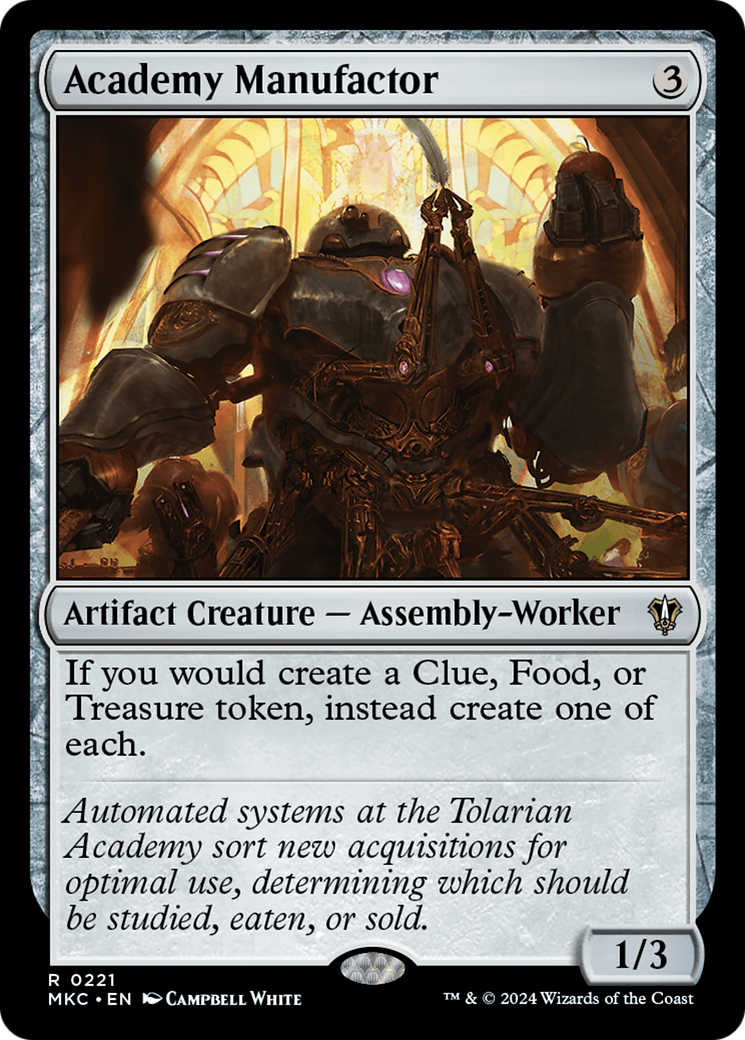
Academy Manufactor
Academy Manufactor
Artifact Creature — Assembly-Worker
1/3
If you would create a Clue, Food, or Treasure token, instead create one of each.
- If you control one Academy Manufactor and would create some number of Clue, Food, or Treasure tokens, you will instead create that many Clue tokens, that many Food tokens, and that many Treasure tokens.
- If you control two Academy Manufactors and would create some number of Clue, Food, or Treasure tokens, you will instead create three times that many Clue tokens, three times that many Food tokens, and three times that many Treasure tokens.
- If you control eighteen Academy Manufactors (I don't know, you figure it out) and would create some number of Clue, Food, or Treasure tokens, you will instead create 129,140,163 times that many Clue tokens, 129,140,163 times that many Food tokens, and 129,140,163 times that many Treasure tokens.
- Creating a Clue token this way isn't the same thing as investigating. Notably, an ability that triggers whenever you investigate won't trigger because you created a Clue token due to this replacement effect. If the original token creation was because you investigated once, those abilities will still each trigger once, no matter how many Clue tokens you end up creating.
-
1
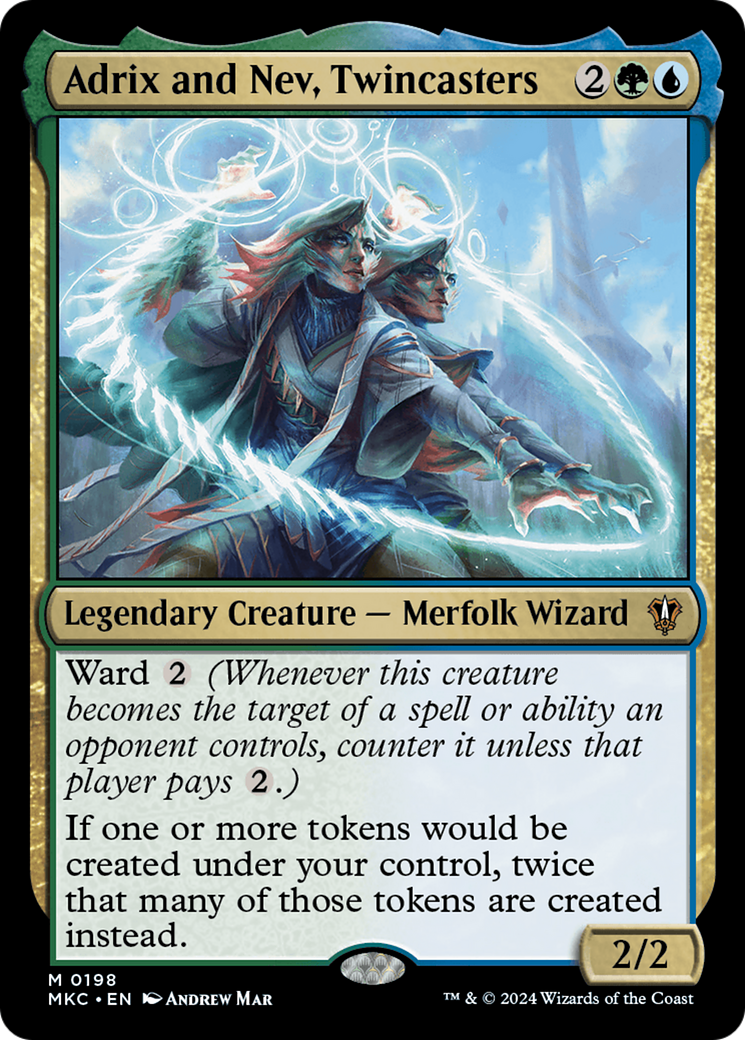
Adrix and Nev, Twincasters
Adrix and Nev, Twincasters
Legendary Creature — Merfolk Wizard
2/2
Ward (Whenever this creature becomes the target of a spell or ability an opponent controls, counter it unless that player pays .)
If one or more tokens would be created under your control, twice that many of those tokens are created instead.
- Everything that is specified by the effect creating the original token or tokens will also be true about the additional token or tokens created by Adrix and Nev's replacement effect. For example, if an effect tells you to create a token "tapped and attacking" the additional tokens will also be tapped and attacking. Similarly, if an effect creates a token and puts counters on it (such as a Fractal token) the additional token will also get those counters.
- If a player casts a spell that targets multiple permanents their opponent controls with ward, each of those ward abilities will trigger. If that player doesn't pay for all of them, the spell will be countered.
-
1
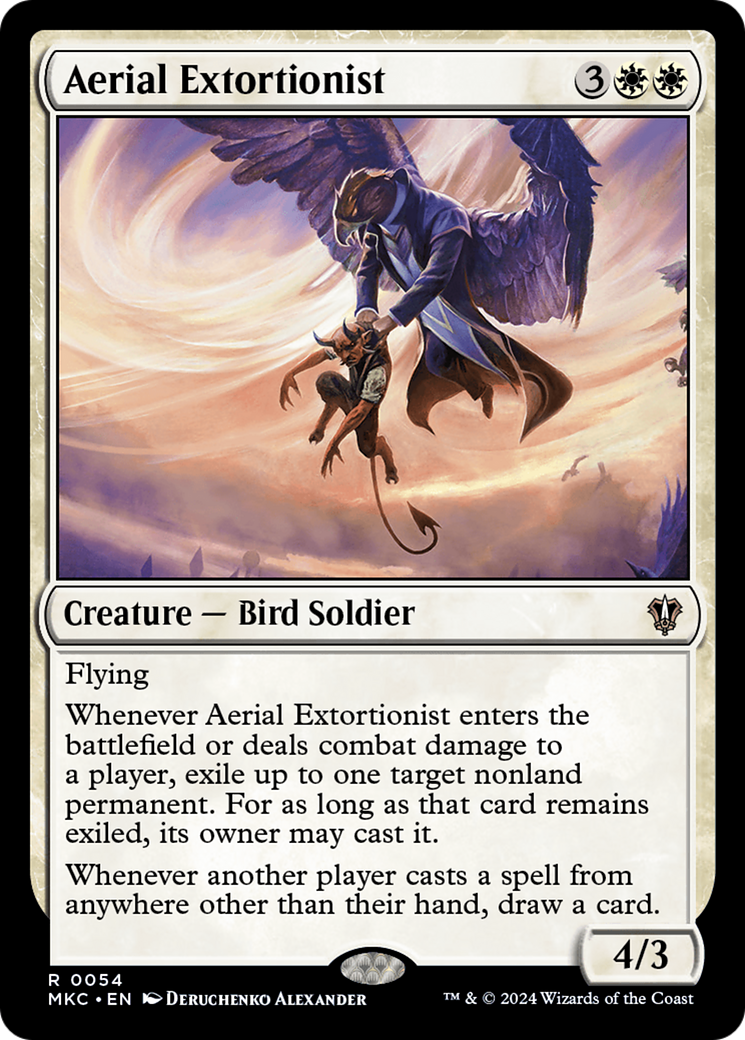
Aerial Extortionist
Aerial Extortionist
Creature — Bird Soldier
4/3
Flying
Whenever this creature enters or deals combat damage to a player, exile up to one target nonland permanent. For as long as that card remains exiled, its owner may cast it.
Whenever another player casts a spell from anywhere other than their hand, draw a card.
-
1
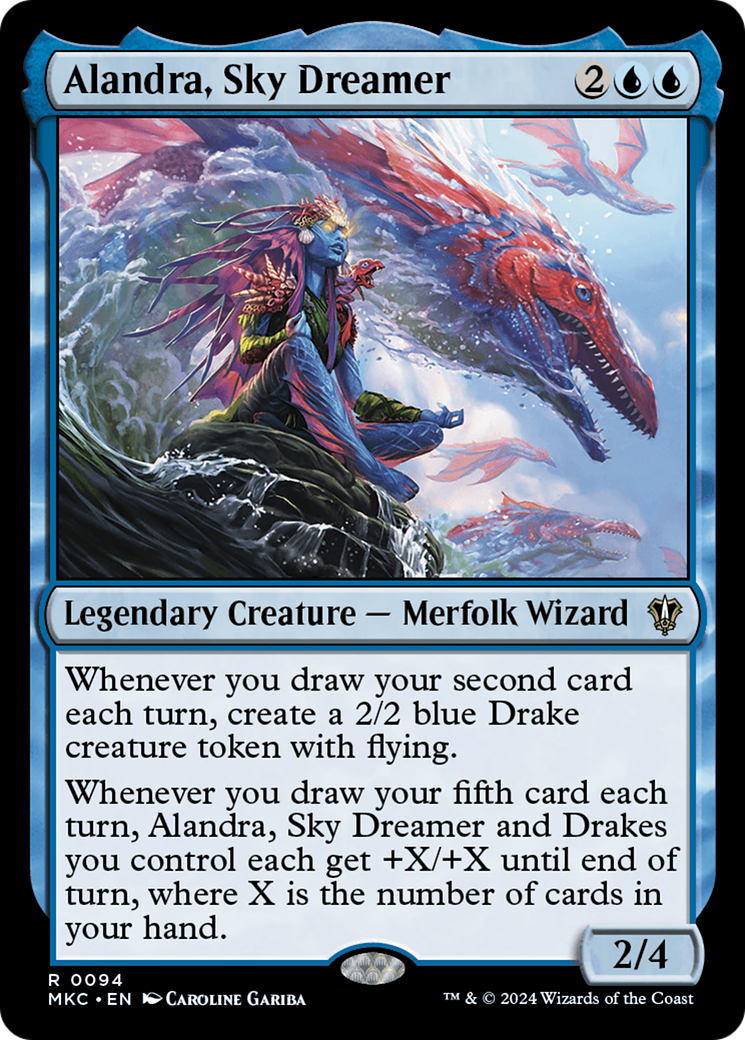
Alandra, Sky Dreamer
Alandra, Sky Dreamer
Legendary Creature — Merfolk Wizard
2/4
Whenever you draw your second card each turn, create a 2/2 blue Drake creature token with flying.
Whenever you draw your fifth card each turn, Alandra and Drakes you control each get +X/+X until end of turn, where X is the number of cards in your hand.
- The first triggered ability can trigger only once each turn. It doesn't matter whether Alandra, Sky Dreamer was on the battlefield when the first card was drawn. If it's not on the battlefield when the second card is drawn, the ability can't trigger at all that turn. It won't trigger when the third or fourth card is drawn.
- The same is true for the last ability and the fifth card drawn.
- The value of X is locked in as the last ability resolves. The bonus it grants won't change after that point, even if the number of cards in your hand does.
-
1
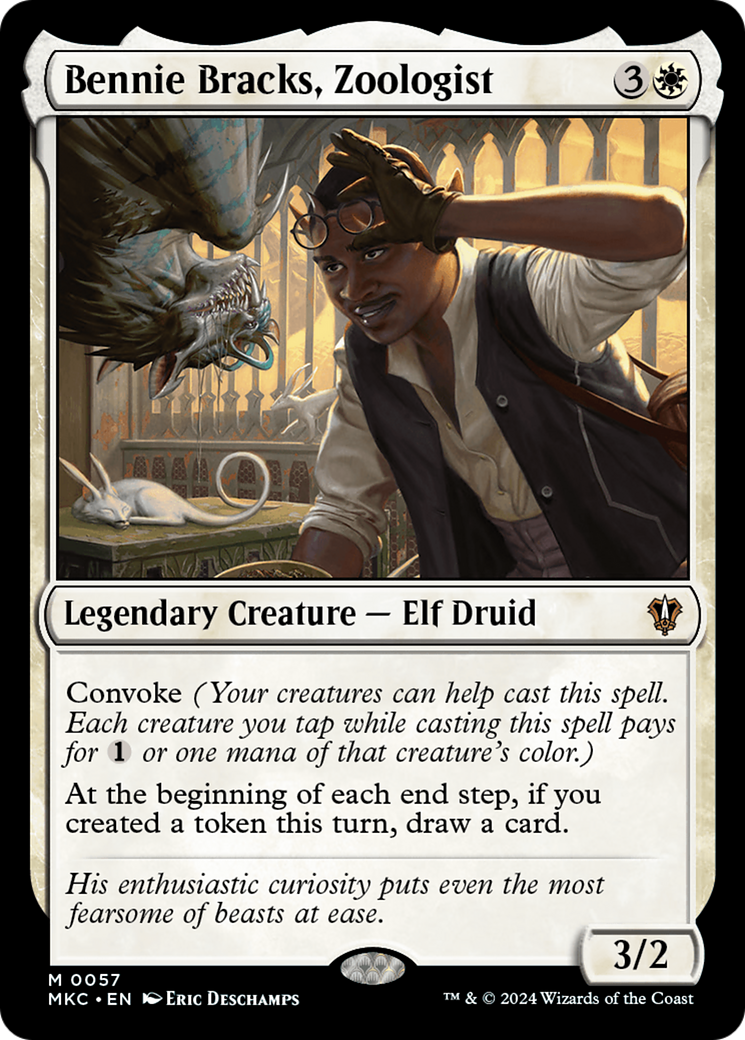
Bennie Bracks, Zoologist
Bennie Bracks, Zoologist
Legendary Creature — Elf Druid
3/2
Convoke (Your creatures can help cast this spell. Each creature you tap while casting this spell pays for or one mana of that creature's color.)
At the beginning of each end step, if you created a token this turn, draw a card.
- You can tap any untapped creature you control to convoke a spell, even one you haven't controlled continuously since the beginning of your most recent turn.
- Tapping an untapped creature that's attacking or blocking to convoke a spell won't cause that creature to stop attacking or blocking.
- When calculating a spell's total cost, include any alternative costs, additional costs, or anything else that increases or reduces the cost to cast the spell. Convoke applies after the total cost is calculated. Convoke doesn't change a spell's mana cost or mana value.
- If a creature you control has a mana ability with in the cost, activating that ability while casting a spell with convoke will result in the creature being tapped before you pay the spell's costs. You won't be able to tap it again for convoke. Similarly, if you sacrifice a creature to activate a mana ability while casting a spell with convoke, that creature won't be on the battlefield when you pay the spell's costs, so you won't be able to tap it for convoke.
- Because convoke isn't an alternative cost, it can be used in conjunction with alternative costs.
- Tapping a multicolored creature using convoke will pay for or one mana of your choice of any of that creature's colors.
-
1
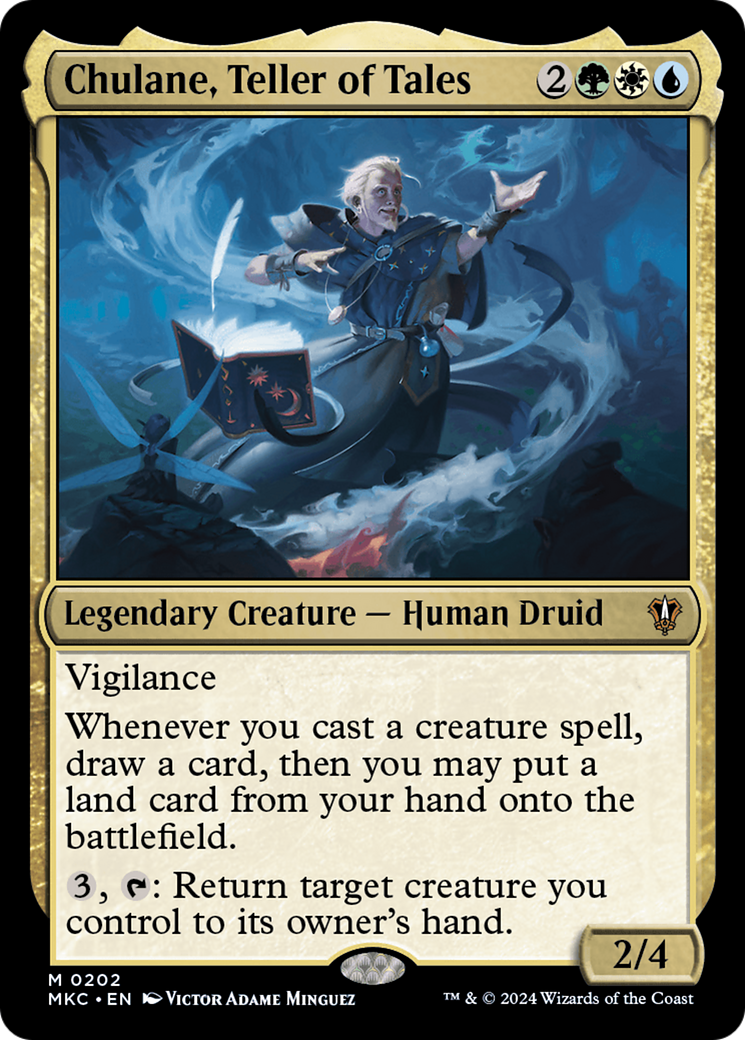
Chulane, Teller of Tales
Chulane, Teller of Tales
Legendary Creature — Human Druid
2/4
Vigilance
Whenever you cast a creature spell, draw a card, then you may put a land card from your hand onto the battlefield.
, : Return target creature you control to its owner's hand.
- Chulane's triggered ability resolves before the spell that caused it to trigger. It resolves even if that spell is countered.
- Chulane's triggered ability doesn't count as playing a land. It can put a land card onto the battlefield even if you've already played your land for the turn, and even if it's not your turn.
-
1
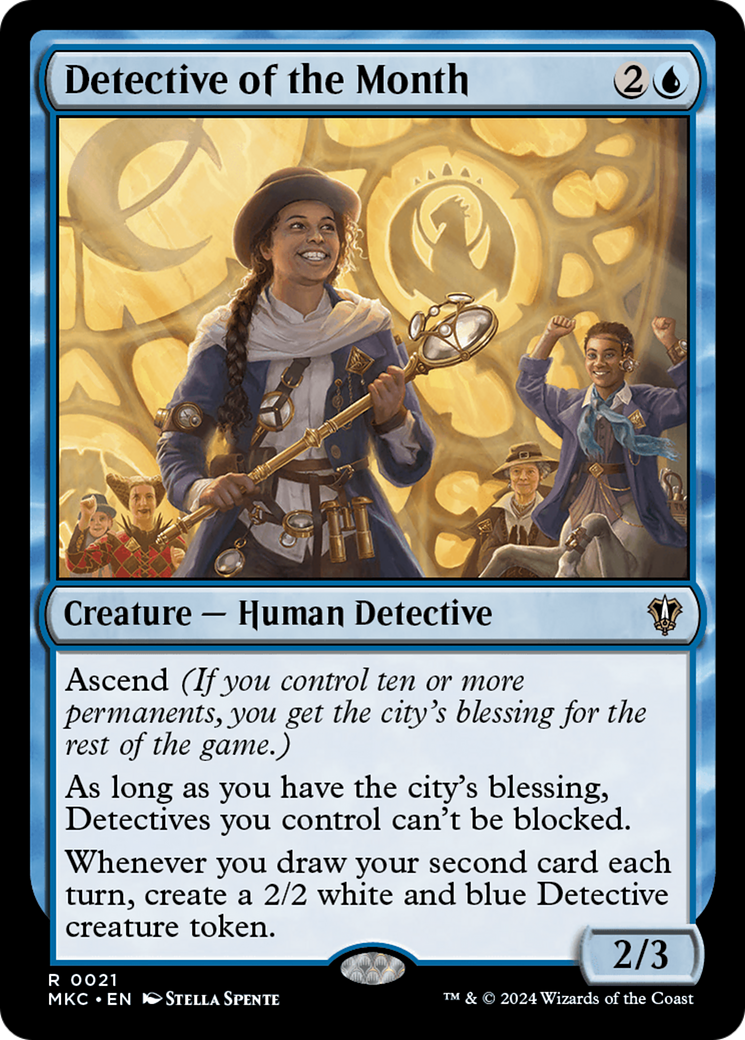
Detective of the Month
Detective of the Month
Creature — Human Detective
2/3
Ascend (If you control ten or more permanents, you get the city's blessing for the rest of the game.)
As long as you have the city's blessing, Detectives you control can't be blocked.
Whenever you draw your second card each turn, create a 2/2 white and blue Detective creature token.
- If you cast a spell with ascend, you don't get the city’s blessing until it resolves. Players may respond to that spell by trying to change whether you get the city’s blessing.
- Once you have the city’s blessing, you have it for the rest of the game, even if you lose control of some or all your permanents. The city’s blessing isn’t a permanent itself and can’t be removed by any effect.
- A permanent is any object on the battlefield, including tokens and lands. Spells and emblems aren’t permanents.
- If you control ten permanents but don’t control a permanent or resolving spell with ascend, you don’t get the city’s blessing. For example, if you control ten permanents, lose control of two, then cast Detective of the Month, you won’t have the city’s blessing.
- If your tenth permanent enters the battlefield and then a permanent leaves the battlefield immediately afterwards (most likely due to the “legend rule” or due to being a creature with 0 toughness), you get the city’s blessing before it leaves the battlefield.
- Ascend on a permanent isn’t a triggered ability and doesn’t use the stack. Players can respond to a spell that will give you your tenth permanent, but they can’t respond to you getting the city’s blessing once you control that tenth permanent. This means that if your tenth permanent is a land you play, players can’t respond before you get the city’s blessing.
- Gaining the city’s blessing after a Detective you control has become blocked won’t cause that Detective to become unblocked.
-
1
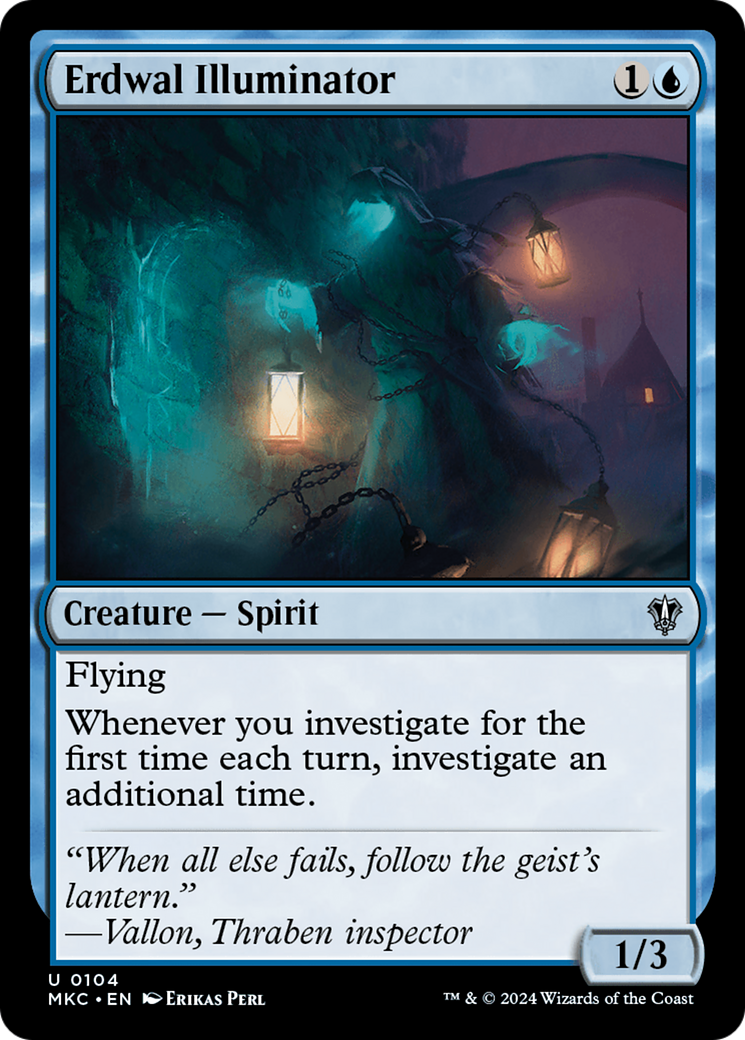
Erdwal Illuminator
Erdwal Illuminator
Creature — Spirit
1/3
Flying
Whenever you investigate for the first time each turn, investigate an additional time.
-
1
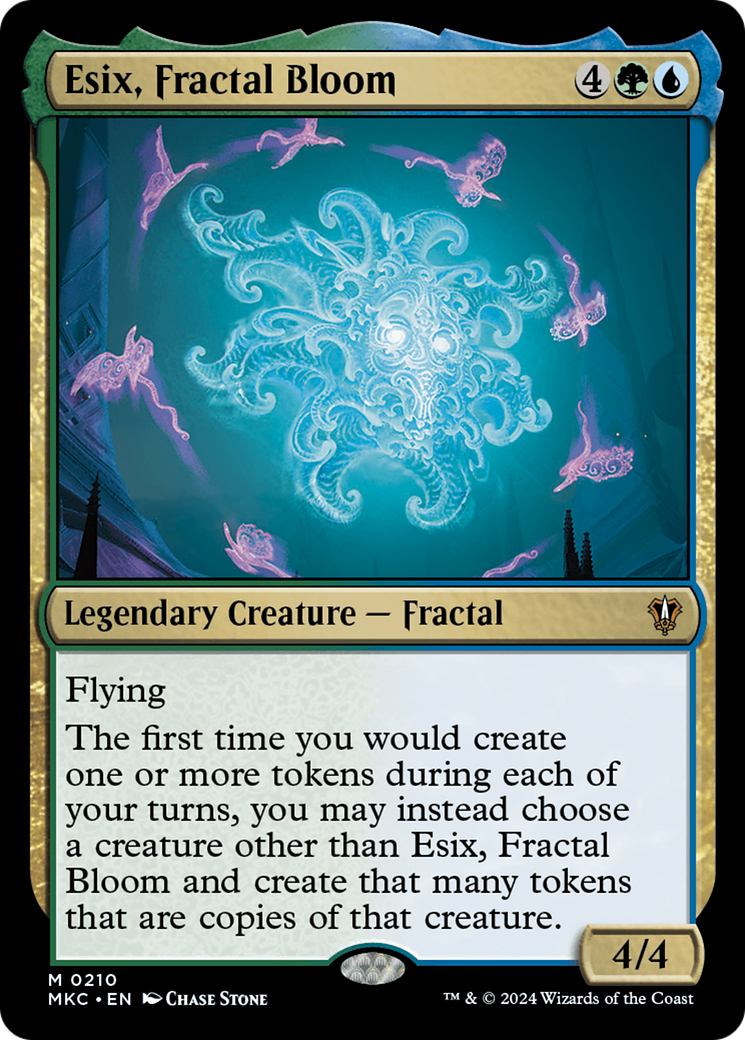
Esix, Fractal Bloom
Esix, Fractal Bloom
Legendary Creature — Fractal
4/4
Flying
The first time you would create one or more tokens during each of your turns, you may instead choose a creature other than Esix and create that many tokens that are copies of that creature.
- This effect applies before anything that modifies how those tokens enter the battlefield.
- This effect can apply to any token, not just creature tokens. For example, you could replace creating a Treasure token with creating a copy of the chosen creature.
- If you choose a legendary creature, the copies will also be legendary. If this results in you controlling more than one legendary permanent with the same name, you'll put all but one of them into their owner's graveyard.
- If you choose not to apply the replacement effect, you will not get the choice to apply it again until your next turn.
- If you create one or more tokens during your turn, and then Esix comes under your control, the replacement effect won't apply to any tokens you create the rest of the turn. You'll have to wait until your next turn.
-
1
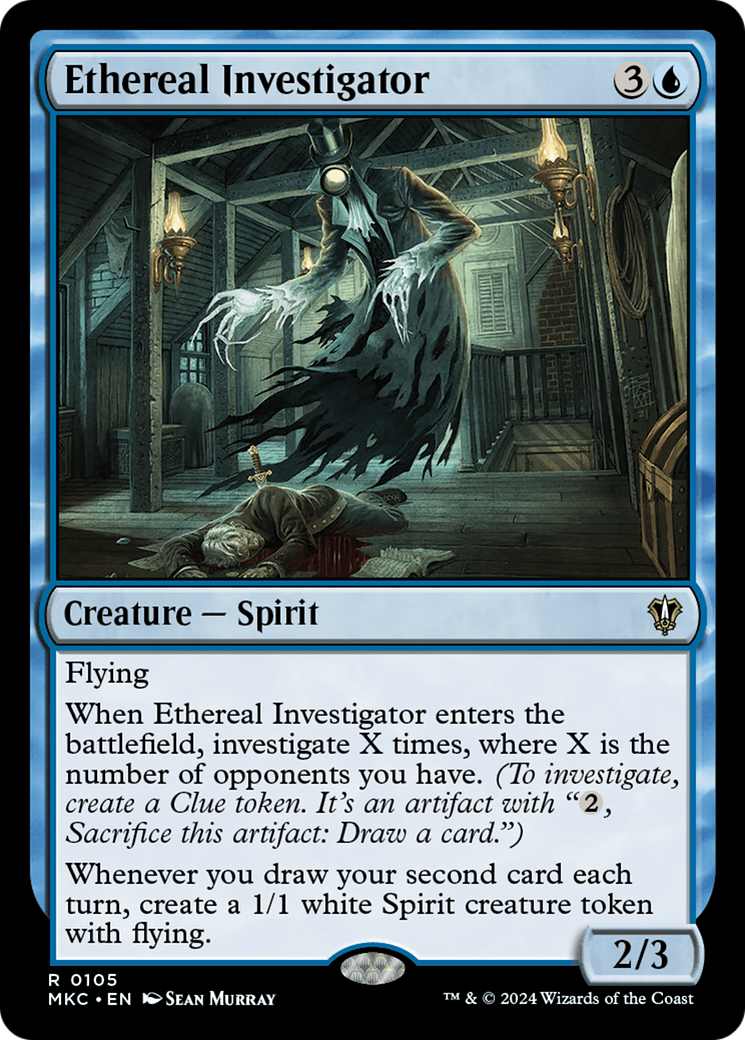
Ethereal Investigator
Ethereal Investigator
Creature — Spirit
2/3
Flying
When this creature enters, investigate X times, where X is the number of opponents you have. (To investigate, create a Clue token. It's an artifact with " , Sacrifice this token: Draw a card.")
Whenever you draw your second card each turn, create a 1/1 white Spirit creature token with flying.
-
1
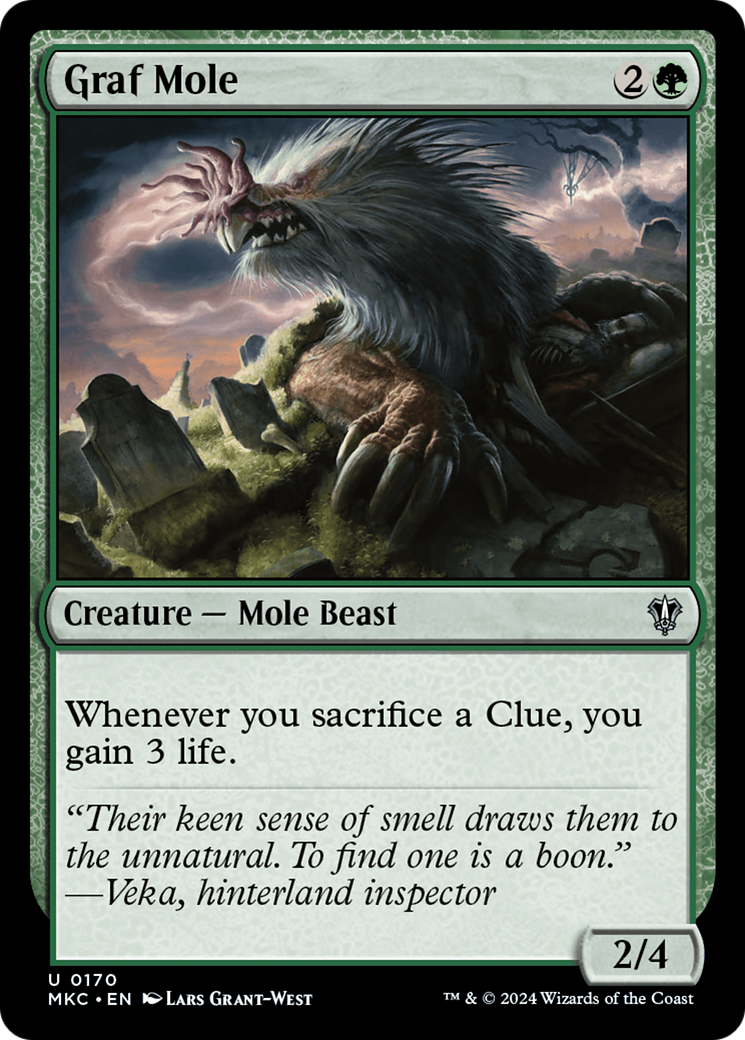
Graf Mole
Graf Mole
Creature — Mole Beast
2/4
Whenever you sacrifice a Clue, you gain 3 life.
-
1
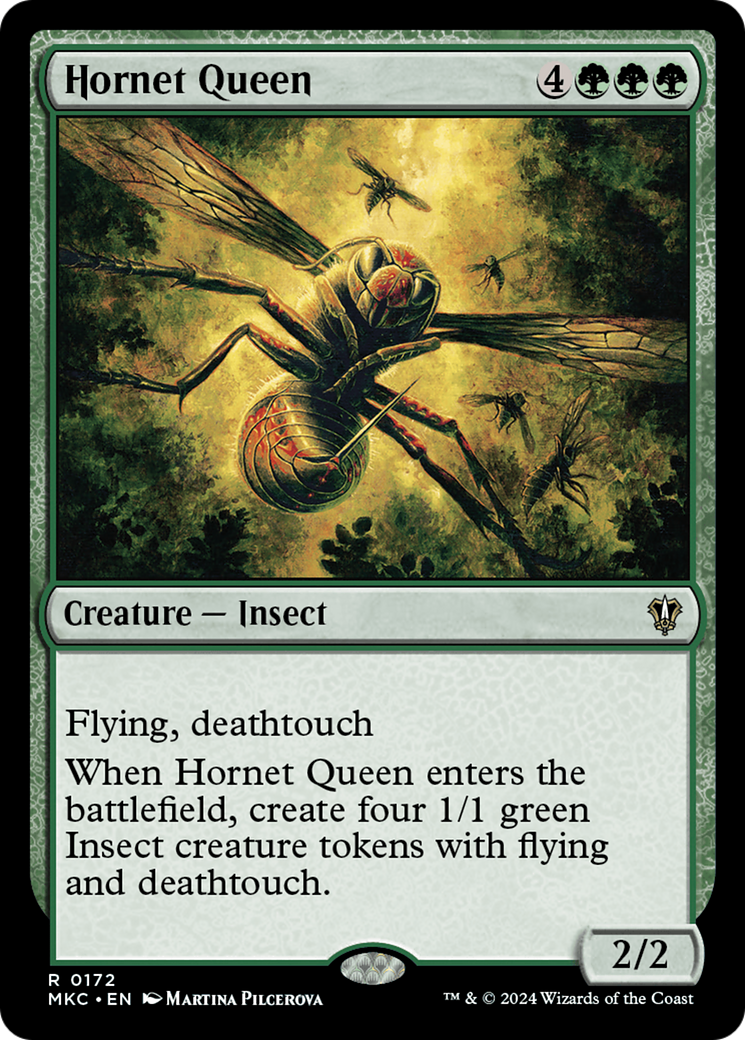
Hornet Queen
Hornet Queen
Creature — Insect
2/2
Flying, deathtouch
When this creature enters, create four 1/1 green Insect creature tokens with flying and deathtouch.
-
1
Hydroid Krasis
Hydroid Krasis
Creature — Jellyfish Hydra Beast
0/0
When you cast this spell, you gain half X life and draw half X cards. Round down each time.
Flying, trample
This creature enters with X +1/+1 counters on it.
- Hydroid Krasis's first ability triggers as you cast it, and that ability resolves before the spell itself. It resolves even if Hydroid Krasis is countered.
-
1
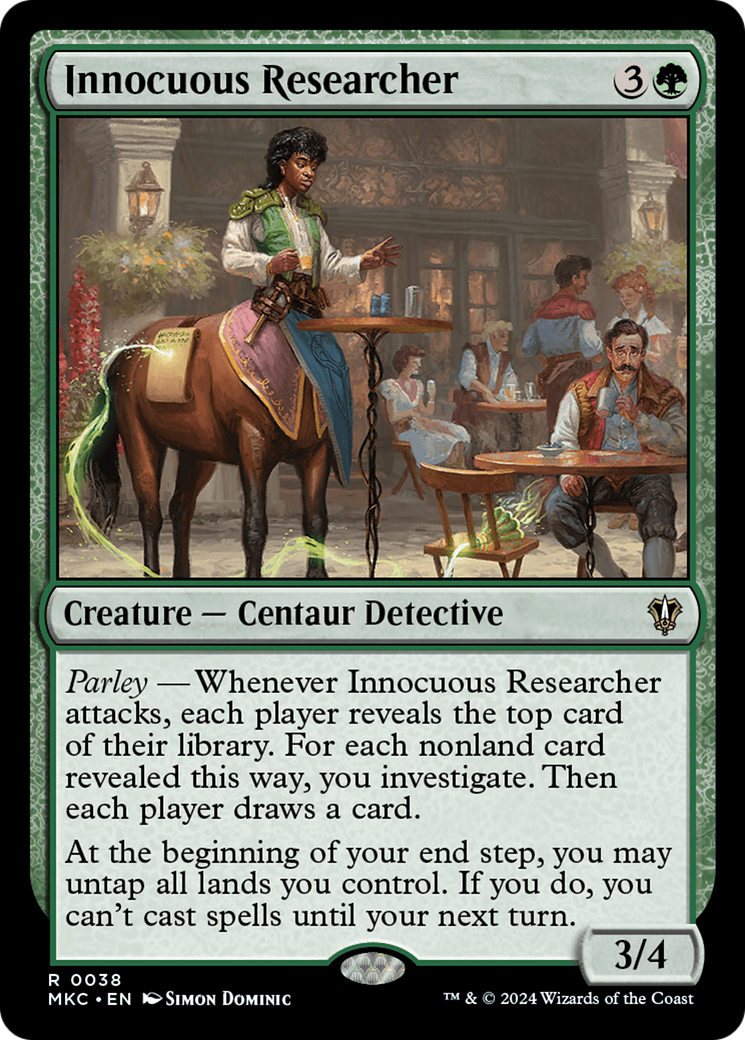
Innocuous Researcher
Innocuous Researcher
Creature — Centaur Detective
3/4
Parley — Whenever this creature attacks, each player reveals the top card of their library. For each nonland card revealed this way, you investigate. Then each player draws a card.
At the beginning of your end step, you may untap all lands you control. If you do, you can't cast spells until your next turn.
- Except in some very unusual cases, the card each player reveals is the one they’ll draw.
- There’s no window for you to cast spells after untapping all lands you control but before the “you can’t cast spells” portion of Innocuous Researcher’s last ability takes effect. Once that ability resolves, it doesn’t matter whether Innocuous Researcher stays on the battlefield; you’ll still be unable to cast spells until your next turn begins.
- Clue is an artifact type. Even though it appears on some cards with other permanent types, it’s never a creature type, a land type, or anything but an artifact type.
- If an effect refers to a Clue, it means any Clue artifact, not just a Clue artifact token. For example, you can sacrifice Wrench to pay for Alquist Proft, Master Sleuth’s activated ability.
- You can’t sacrifice a Clue to pay multiple costs. For example, you can’t sacrifice a Clue token to activate its own ability and also to activate Alquist Proft, Master Sleuth’s ability.
- Some spells and abilities that investigate may require targets. If each target chosen is an illegal target as that spell or ability tries to resolve, it won’t resolve. You won’t create any Clue tokens.
- Some abilities trigger “whenever you sacrifice a Clue”. Those abilities trigger whenever you sacrifice a Clue for any reason, not just to activate a Clue’s activated ability.
-
1
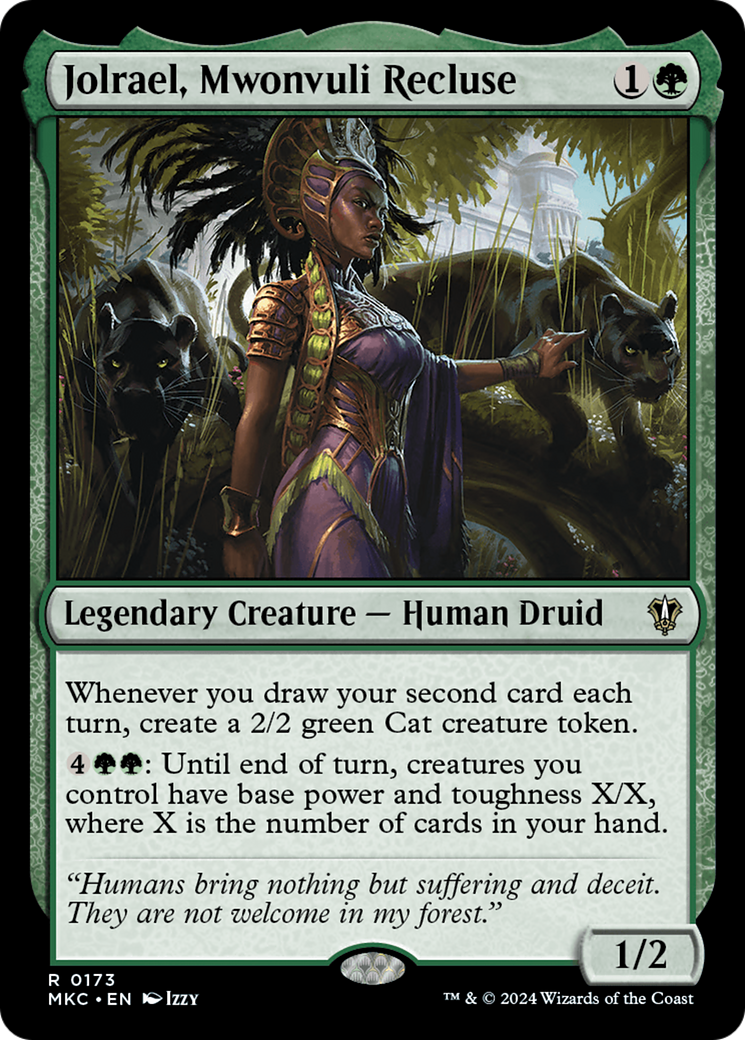
Jolrael, Mwonvuli Recluse
Jolrael, Mwonvuli Recluse
Legendary Creature — Human Druid
1/2
Whenever you draw your second card each turn, create a 2/2 green Cat creature token.
: Until end of turn, creatures you control have base power and toughness X/X, where X is the number of cards in your hand.
- The triggered ability can trigger only once each turn. It doesn't matter if Jolrael was on the battlefield when the first card was drawn: if it's not on the battlefield when the second card is drawn, the ability can't trigger at all that turn.
- Jolrael's last ability overwrites all previous effects that set the affected creatures' power and/or toughness to specific values. If other effects that set these characteristics to specific values start to apply after Jolrael's ability resolves, they will overwrite that part of the effect.
- Effects that modify an affected creature's power and/or toughness without setting them to specific values will apply no matter when those effects began. The same is true for counters that change the creature's power and/or toughness.
- The value of X is determined only as Jolrael's last ability resolves. Once that happens, the value of X won't change later in the turn even if the number of cards in your hand changes.
-
1
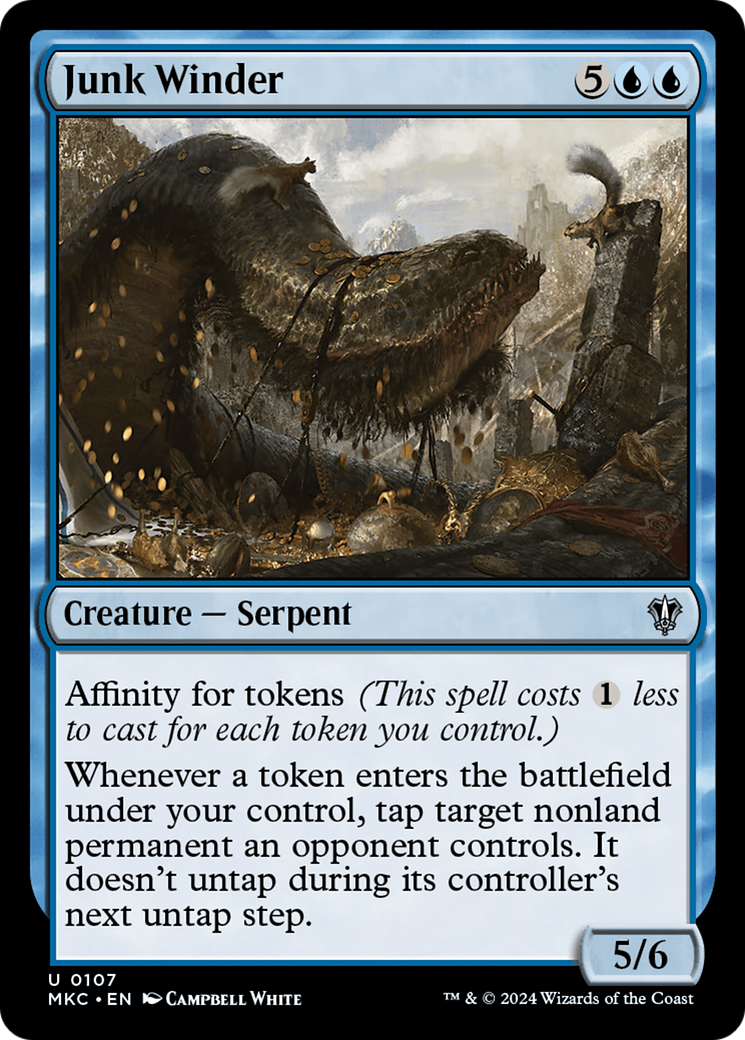
Junk Winder
Junk Winder
Creature — Serpent
5/6
Affinity for tokens (This spell costs less to cast for each token you control.)
Whenever a token you control enters, tap target nonland permanent an opponent controls. It doesn't untap during its controller's next untap step.
-
1
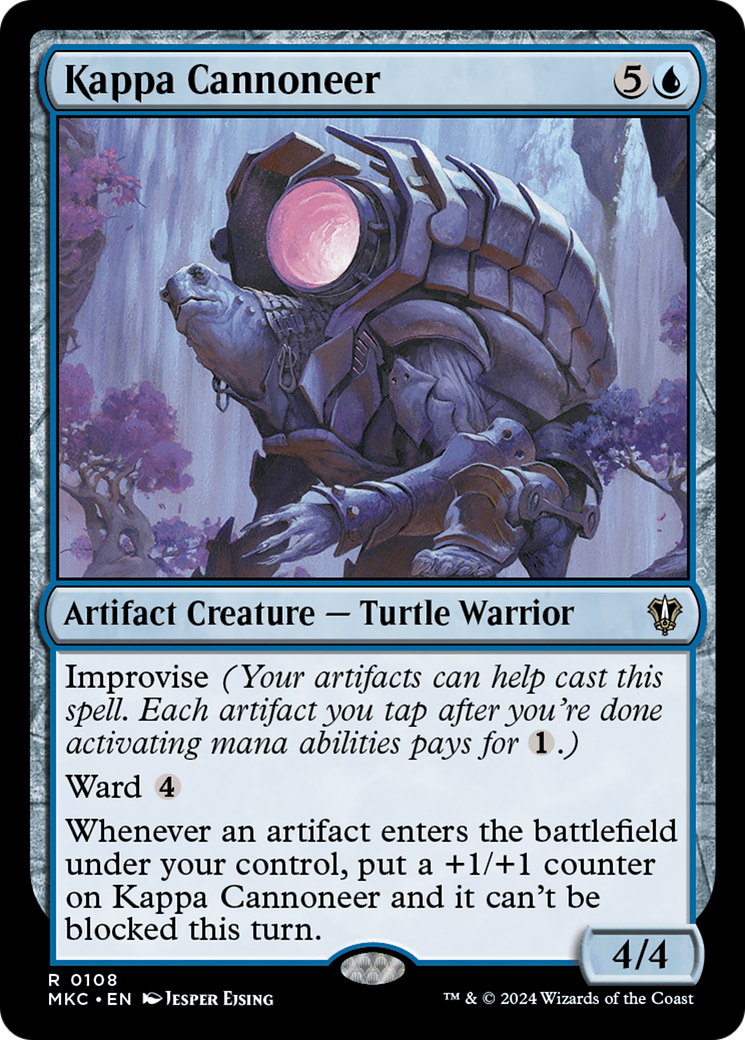
Kappa Cannoneer
Kappa Cannoneer
Artifact Creature — Turtle Warrior
4/4
Improvise (Your artifacts can help cast this spell. Each artifact you tap after you're done activating mana abilities pays for .)
Ward
Whenever this creature or another artifact you control enters, put a +1/+1 counter on this creature and it can't be blocked this turn.
- If a player casts a spell that targets multiple permanents their opponent controls with ward, each of those ward abilities will trigger. If that player doesn't pay for all of them, the spell will be countered.
-
1
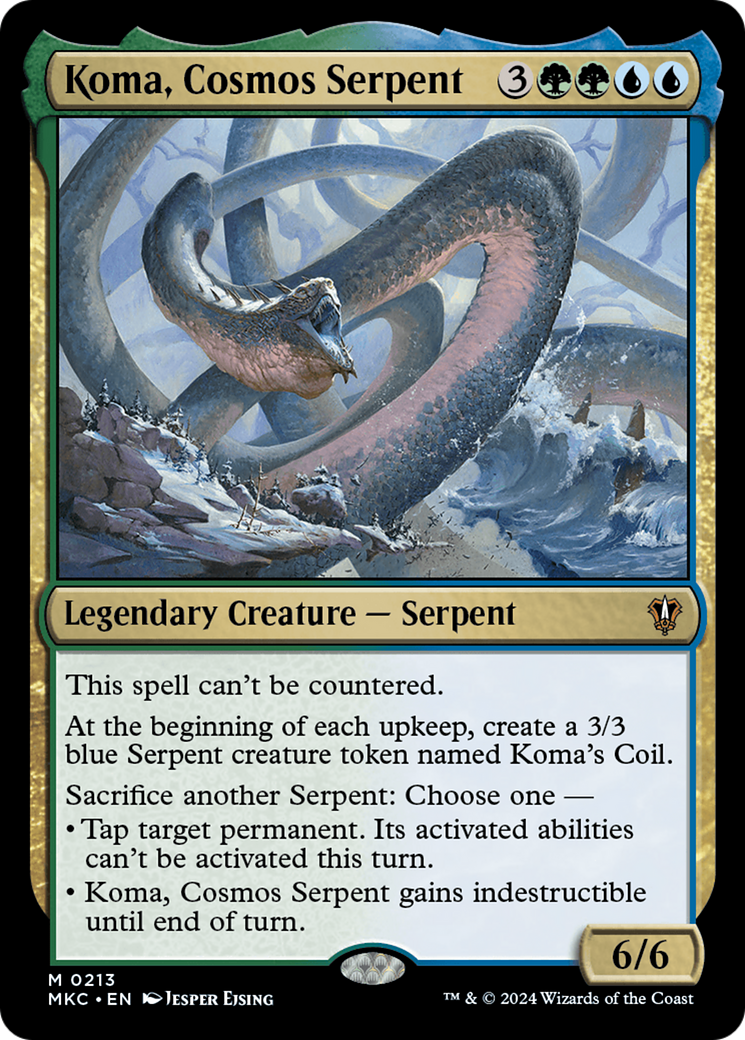
Koma, Cosmos Serpent
Koma, Cosmos Serpent
Legendary Creature — Serpent
6/6
This spell can't be countered.
At the beginning of each upkeep, create a 3/3 blue Serpent creature token named Koma's Coil.
Sacrifice another Serpent: Choose one —
- Tap target permanent. Its activated abilities can't be activated this turn.
- Koma gains indestructible until end of turn.
- If you choose the first mode of Koma's activated ability, you can choose a permanent that's already tapped as the target. The effect stopping its activated abilities will still apply.
- A spell or ability that counters spells can still target Koma, Cosmos Serpent. When that spell or ability resolves, Koma won't be countered, but any additional effects of the countering spell or ability will still happen.
- You can't sacrifice Koma itself to activate its last ability, but you can sacrifice any other Serpent you control, including Koma's Coil.
- Activated abilities contain a colon and appear in the form "[Cost]: [Effect]." Some keywords such as equip are activated abilities and will have colons in their reminder texts. Loyalty abilities of planeswalkers are also activated abilities.
- The first mode of Koma's activated ability doesn't stop static abilities from affecting the game, and it doesn't stop triggered abilities from triggering. Unlike similar effects, it does stop mana abilities from being activated. Most activated abilities that produce mana as they resolve are mana abilities.
-
1
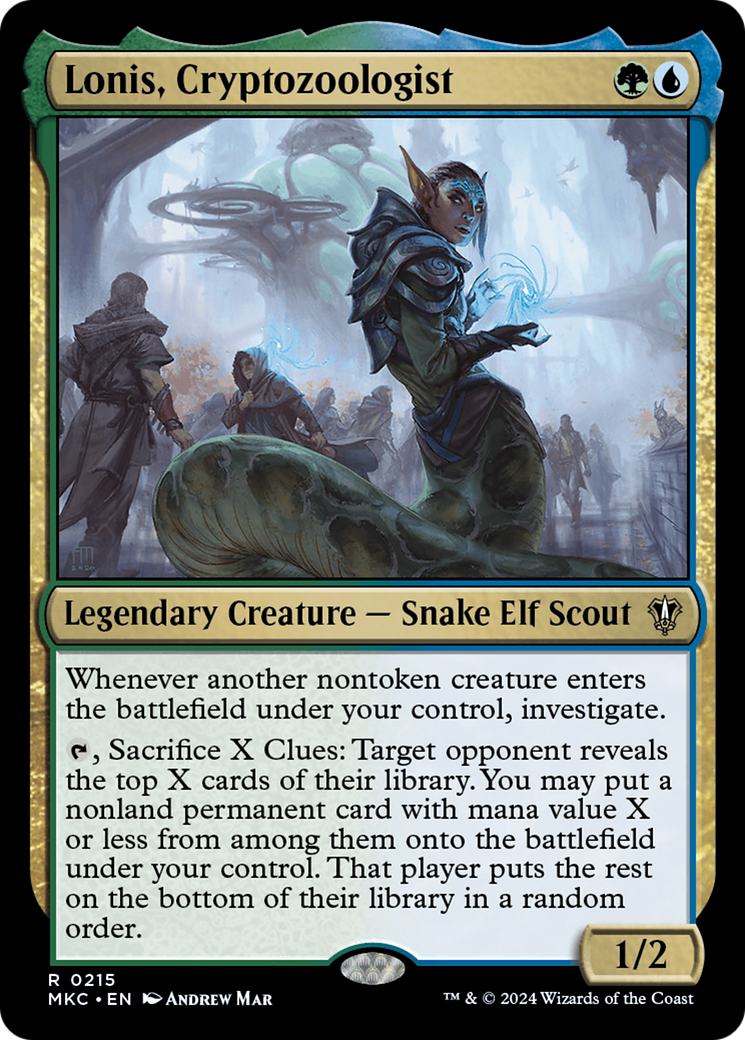
Lonis, Cryptozoologist
Lonis, Cryptozoologist
Legendary Creature — Snake Elf Scout
1/2
Whenever another nontoken creature you control enters, investigate.
, Sacrifice X Clues: Target opponent reveals the top X cards of their library. You may put a nonland permanent card with mana value X or less from among them onto the battlefield under your control. That player puts the rest on the bottom of their library in a random order.
- The token is named Clue Token and has the artifact subtype Clue. Clue isn't a creature type.
- The tokens are normal artifacts. For example, one can be sacrificed to activate the ability of Breya's Apprentice and one can be the target of Break Ties.
- You can't sacrifice a Clue to activate its own ability and also to activate the ability of Lonis, Cryptozoologist.
-
1
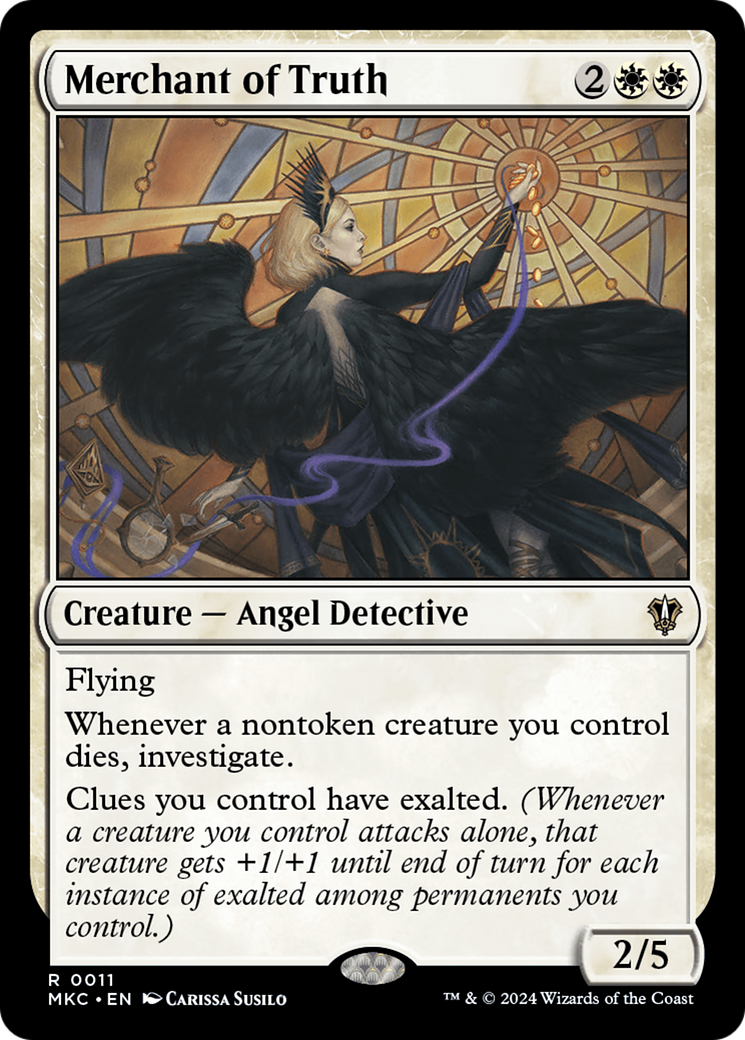
Merchant of Truth
Merchant of Truth
Creature — Angel Detective
2/5
Flying
Whenever a nontoken creature you control dies, investigate.
Clues you control have exalted. (Whenever a creature you control attacks alone, that creature gets +1/+1 until end of turn for each instance of exalted among permanents you control.)
- If Merchant of Truth dies at the same time as one or more other nontoken creatures you control, its second ability will trigger for each of those creatures.
- A creature attacks alone if it’s the only creature declared as an attacker during the declare attackers step (including creatures controlled by your teammates, if applicable). For example, exalted won’t trigger if you attack with multiple creatures and all but one of them are removed from combat. Similarly, creatures that enter the battlefield attacking later in combat won’t affect exalted abilities that have already triggered or resolved.
- If you control multiple Merchants of Truth, Clues you control will have multiple instances of exalted.
- Clue is an artifact type. Even though it appears on some cards with other permanent types, it’s never a creature type, a land type, or anything but an artifact type.
- If an effect refers to a Clue, it means any Clue artifact, not just a Clue artifact token. For example, you can sacrifice Wrench to pay for Alquist Proft, Master Sleuth’s activated ability.
- You can’t sacrifice a Clue to pay multiple costs. For example, you can’t sacrifice a Clue token to activate its own ability and also to activate Alquist Proft, Master Sleuth’s ability.
- Some spells and abilities that investigate may require targets. If each target chosen is an illegal target as that spell or ability tries to resolve, it won’t resolve. You won’t create any Clue tokens.
- Some abilities trigger “whenever you sacrifice a Clue”. Those abilities trigger whenever you sacrifice a Clue for any reason, not just to activate a Clue’s activated ability.
-
1
Morska, Undersea Sleuth
Morska, Undersea Sleuth
Legendary Creature — Vedalken Fish Detective
2/3
You have no maximum hand size.
At the beginning of your upkeep, investigate. (Create a Clue token. It's an artifact with " , Sacrifice this token: Draw a card.")
Whenever you draw your second card each turn, put two +1/+1 counters on Morska.
- Clue is an artifact type. Even though it appears on some cards with other permanent types, it's never a creature type, a land type, or anything but an artifact type.
- If an effect refers to a Clue, it means any Clue artifact, not just a Clue artifact token. For example, you can sacrifice Wrench to pay for Alquist Proft, Master Sleuth's activated ability.
- You can't sacrifice a Clue to pay multiple costs. For example, you can't sacrifice a Clue token to activate its own ability and also to activate Alquist Proft, Master Sleuth's ability.
- Some spells and abilities that investigate may require targets. If each target chosen is an illegal target as that spell or ability tries to resolve, it won't resolve. You won't create any Clue tokens.
- Some abilities trigger "whenever you sacrifice a Clue". Those abilities trigger whenever you sacrifice a Clue for any reason, not just to activate a Clue's activated ability.
-
1
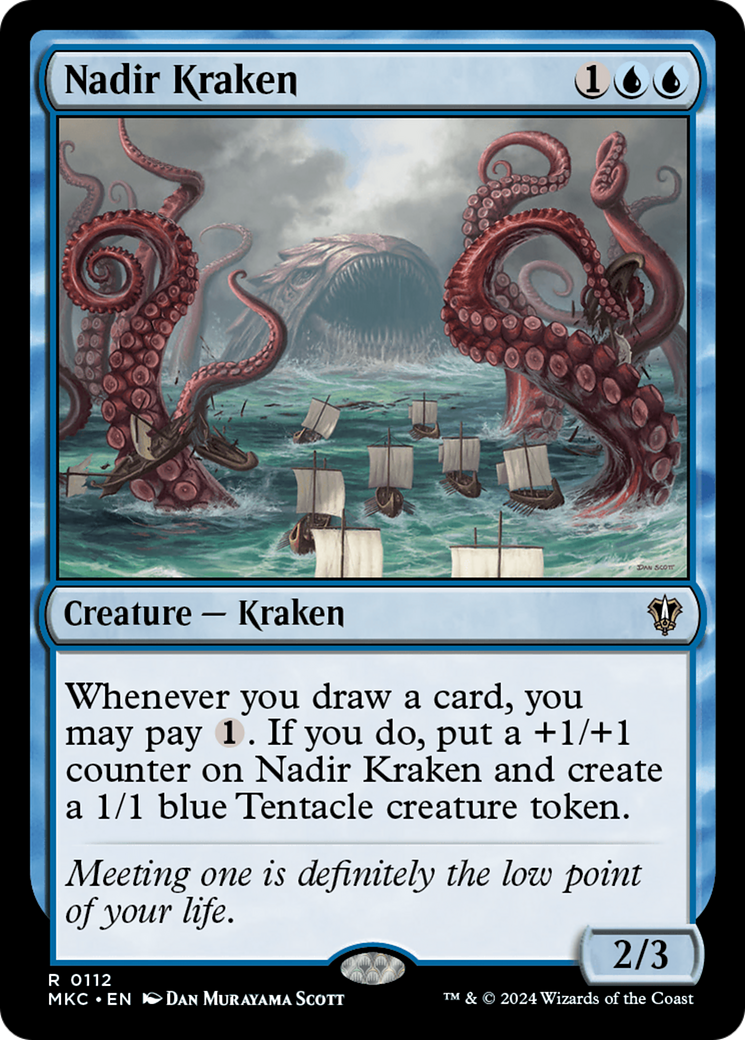
Nadir Kraken
Nadir Kraken
Creature — Kraken
2/3
Whenever you draw a card, you may pay . If you do, put a +1/+1 counter on this creature and create a 1/1 blue Tentacle creature token.
- While resolving Nadir Kraken's ability, you can't pay multiple times to create multiple Tentacles or to give it multiple +1/+1 counters.
- You choose whether to pay after drawing the card and seeing what it is. If you draw multiple cards, you see them all before deciding how many of the resulting triggers you'll pay for.
- If Nadir Kraken leaves the battlefield after its ability has triggered, you can still pay and get a Tentacle, even though you won't put a +1/+1 counter on Nadir Kraken.
-
1
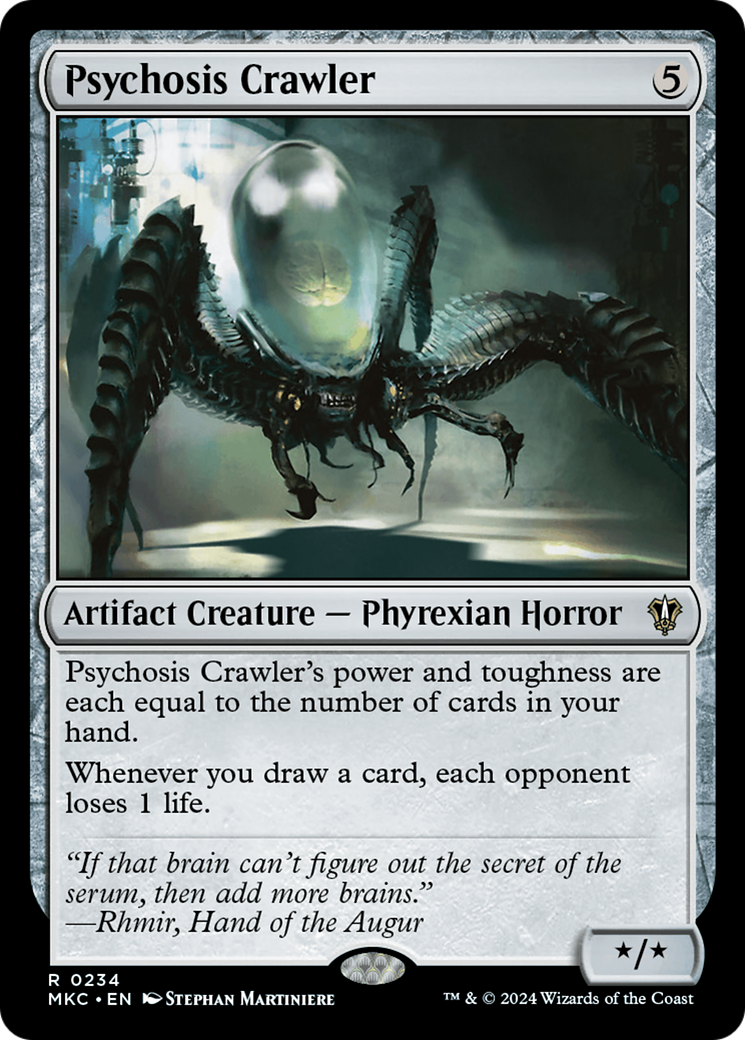
Psychosis Crawler
Psychosis Crawler
Artifact Creature — Phyrexian Horror
*/*
Psychosis Crawler's power and toughness are each equal to the number of cards in your hand.
Whenever you draw a card, each opponent loses 1 life.
- If an effect causes you to draw multiple cards, Psychosis Crawler will trigger that many times.
-
1
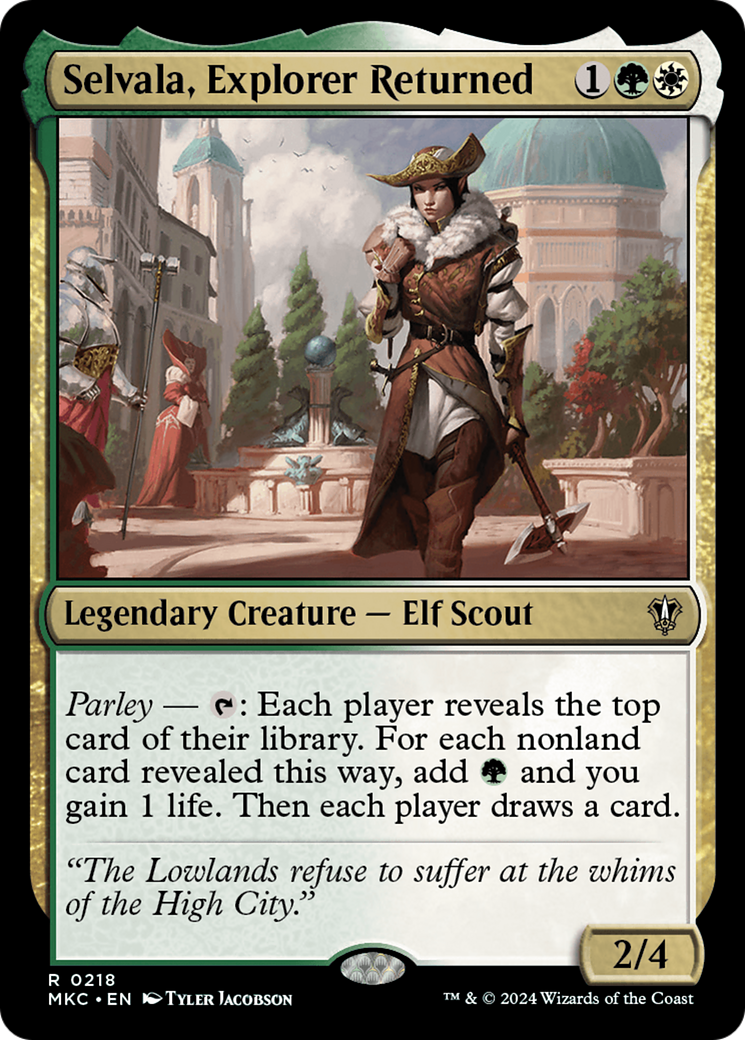
Selvala, Explorer Returned
Selvala, Explorer Returned
Legendary Creature — Elf Scout
2/4
Parley — : Each player reveals the top card of their library. For each nonland card revealed this way, add and you gain 1 life. Then each player draws a card.
- Selvala's parley ability is a mana ability. It doesn't use the stack and can't be responded to.
- If you activate Selvala's ability while casting a spell, and you discover you can't produce enough mana to pay that spell's costs, the spell is reversed. The spell returns to whatever zone you were casting it from. You may reverse other mana abilities you activated while casting the spell, but Selvala's ability can't be reversed. You'll still have whatever mana that ability produced, and each player will have drawn a card.
- Except in some very rare cases, the card each player draws will be the card revealed from the top of their library.
-
1
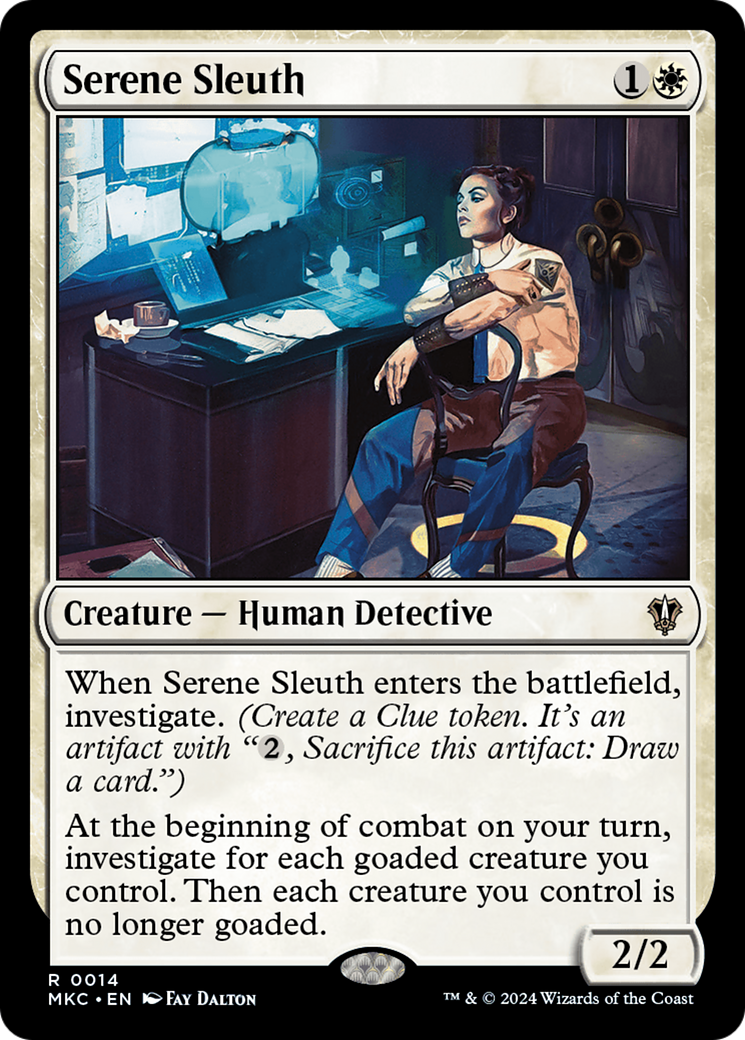
Serene Sleuth
Serene Sleuth
Creature — Human Detective
2/2
When this creature enters, investigate. (Create a Clue token. It's an artifact with " , Sacrifice this token: Draw a card.")
At the beginning of combat on your turn, investigate for each goaded creature you control. Then each creature you control is no longer goaded.
- Clue is an artifact type. Even though it appears on some cards with other permanent types, it's never a creature type, a land type, or anything but an artifact type.
- If an effect refers to a Clue, it means any Clue artifact, not just a Clue artifact token. For example, you can sacrifice Wrench to pay for Alquist Proft, Master Sleuth's activated ability.
- You can't sacrifice a Clue to pay multiple costs. For example, you can't sacrifice a Clue token to activate its own ability and also to activate Alquist Proft, Master Sleuth's ability.
- Some spells and abilities that investigate may require targets. If each target chosen is an illegal target as that spell or ability tries to resolve, it won't resolve. You won't create any Clue tokens.
- Some abilities trigger "whenever you sacrifice a Clue". Those abilities trigger whenever you sacrifice a Clue for any reason, not just to activate a Clue's activated ability.
-
1
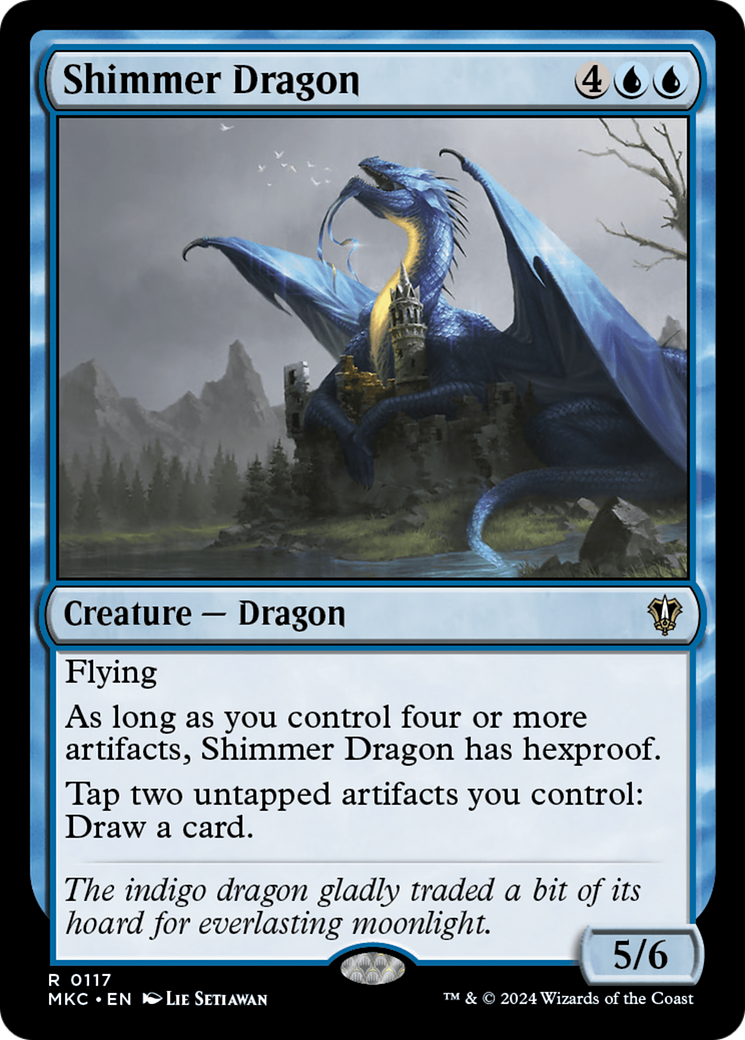
Shimmer Dragon
Shimmer Dragon
Creature — Dragon
5/6
Flying
As long as you control four or more artifacts, this creature has hexproof. (It can't be the target of spells or abilities your opponents control.)
Tap two untapped artifacts you control: Draw a card.
-
1
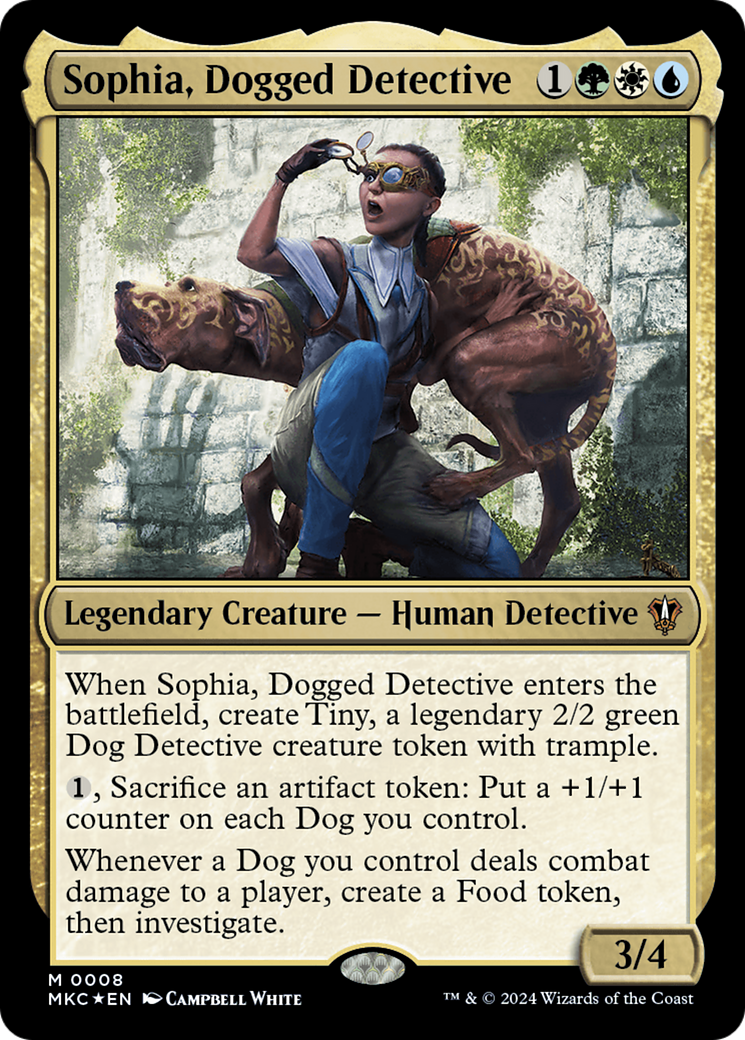
Sophia, Dogged Detective
Sophia, Dogged Detective
Legendary Creature — Human Detective
3/4
When Sophia enters, create Tiny, a legendary 2/2 green Dog Detective creature token with trample.
, Sacrifice an artifact token: Put a +1/+1 counter on each Dog you control.
Whenever a Dog you control deals combat damage to a player, create a Food token, then investigate.
- Food is an artifact type. Even though it appears on some creatures, it's never a creature type.
- You can't sacrifice a Food to pay multiple costs. For example, you can't sacrifice a Food token to activate its own ability and also to activate Maraleaf Rider's ability.
- Whatever you do, don't eat the delicious cards.
- Some spells and abilities that investigate may require targets. If each target chosen is an illegal target as that spell or ability tries to resolve, it won't resolve. You won't create any Clue tokens.
- Clue is an artifact type. Even though it appears on some cards with other permanent types, it's never a creature type, a land type, or anything but an artifact type.
- Some abilities trigger "whenever you sacrifice a Clue". Those abilities trigger whenever you sacrifice a Clue for any reason, not just to activate a Clue's activated ability.
- If an effect refers to a Clue, it means any Clue artifact, not just a Clue artifact token. For example, you can sacrifice Wrench to pay for Alquist Proft, Master Sleuth's activated ability.
- You can't sacrifice a Clue to pay multiple costs. For example, you can't sacrifice a Clue token to activate its own ability and also to activate Alquist Proft, Master Sleuth's ability.
-
1
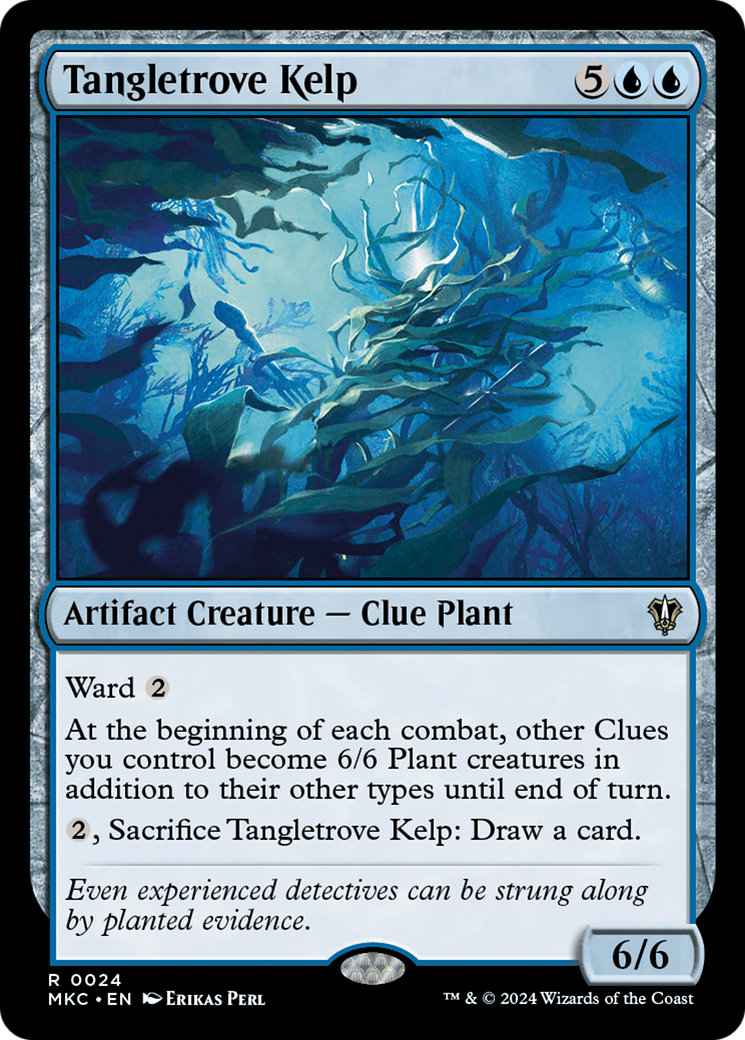
Tangletrove Kelp
Tangletrove Kelp
Artifact Creature — Clue Plant
6/6
Ward
At the beginning of each combat, other Clues you control become 6/6 Plant creatures in addition to their other types until end of turn.
, Sacrifice this creature: Draw a card.
- If a Clue you control is already a creature when Tangletrove Kelp’s second ability resolves, Tangletrove Kelp’s second ability will overwrite any previous effects that set that creature’s power and toughness to specific numbers. Effects that otherwise modify its power and toughness will still apply no matter when they took effect. The same is true for +1/+1 counters.
- Clues you control will keep any abilities they previously had while they’re creatures.
- Clue is an artifact type. Even though it appears on some cards with other permanent types, it’s never a creature type, a land type, or anything but an artifact type.
- If an effect refers to a Clue, it means any Clue artifact, not just a Clue artifact token. For example, you can sacrifice Wrench to pay for Alquist Proft, Master Sleuth’s activated ability.
- You can’t sacrifice a Clue to pay multiple costs. For example, you can’t sacrifice a Clue token to activate its own ability and also to activate Alquist Proft, Master Sleuth’s ability.
- Some spells and abilities that investigate may require targets. If each target chosen is an illegal target as that spell or ability tries to resolve, it won’t resolve. You won’t create any Clue tokens.
- Some abilities trigger “whenever you sacrifice a Clue”. Those abilities trigger whenever you sacrifice a Clue for any reason, not just to activate a Clue’s activated ability.
-
1
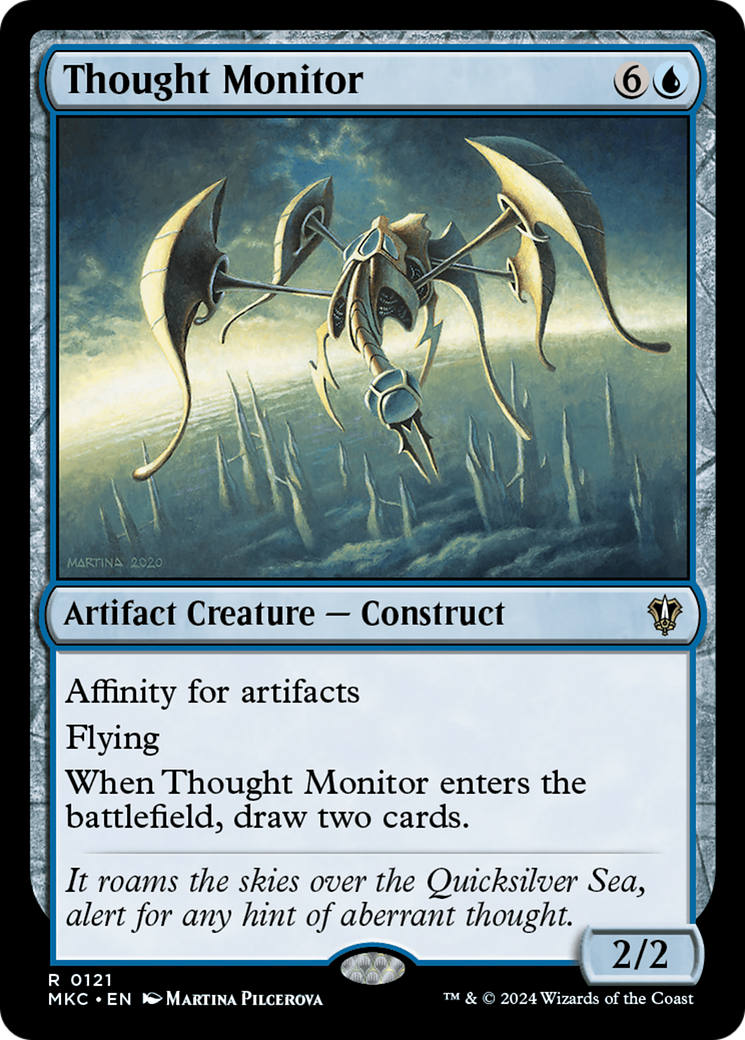
Thought Monitor
Thought Monitor
Artifact Creature — Construct
2/2
Affinity for artifacts (This spell costs less to cast for each artifact you control.)
Flying
When this creature enters, draw two cards.
-
1
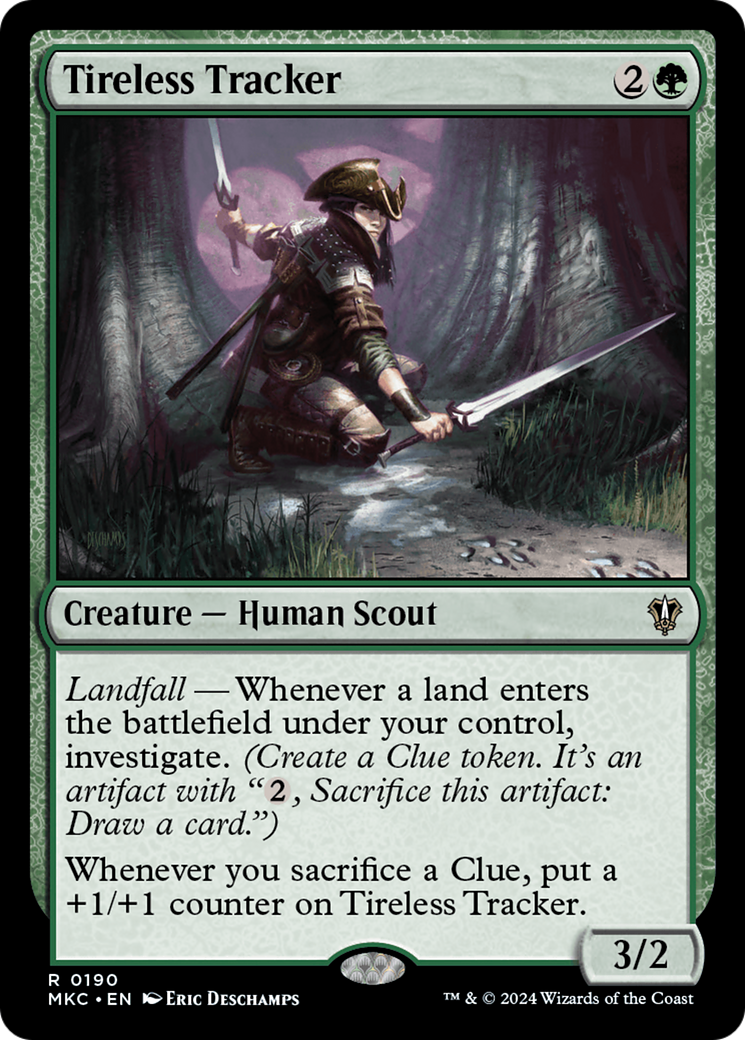
Tireless Tracker
Tireless Tracker
Creature — Human Scout
3/2
Landfall — Whenever a land you control enters, investigate. (Create a Clue token. It's an artifact with " , Sacrifice this token: Draw a card.")
Whenever you sacrifice a Clue, put a +1/+1 counter on this creature.
- A landfall ability triggers whenever a land you control enters for any reason. It triggers whenever you play a land, as well as whenever a spell or ability puts a land onto the battlefield under your control.
- Whenever a land you control enters, each landfall ability of the permanents you control will trigger. You can put them on the stack in any order. The last ability you put on the stack will be the first one to resolve (As a result, you can have those abilities resolve in the order of your choosing.).
- A landfall ability doesn't trigger if a permanent already on the battlefield becomes a land.
- Some spells and abilities that investigate may require targets. If each target chosen is an illegal target as that spell or ability tries to resolve, it won't resolve. You won't create any Clue tokens.
- Some abilities trigger "whenever you sacrifice a Clue". Those abilities trigger whenever you sacrifice a Clue for any reason, not just to activate a Clue's activated ability.
- You can't sacrifice a Clue to pay multiple costs. For example, you can't sacrifice a Clue token to activate its own ability and also to activate Alquist Proft, Master Sleuth's ability.
- Clue is an artifact type. Even though it appears on some cards with other permanent types, it's never a creature type, a land type, or anything but an artifact type.
- If an effect refers to a Clue, it means any Clue artifact, not just a Clue artifact token. For example, you can sacrifice Wrench to pay for Alquist Proft, Master Sleuth's activated ability.
- Clue is an artifact type. Even though it appears on some cards with other permanent types, it's never a creature type, a land type, or anything but an artifact type.
- You can't sacrifice a Clue to pay multiple costs. For example, you can't sacrifice a Clue token to activate its own ability and also to activate Alquist Proft, Master Sleuth's ability.
- If an effect refers to a Clue, it means any Clue artifact, not just a Clue artifact token. For example, you can sacrifice Wrench to pay for Alquist Proft, Master Sleuth's activated ability.
-
1
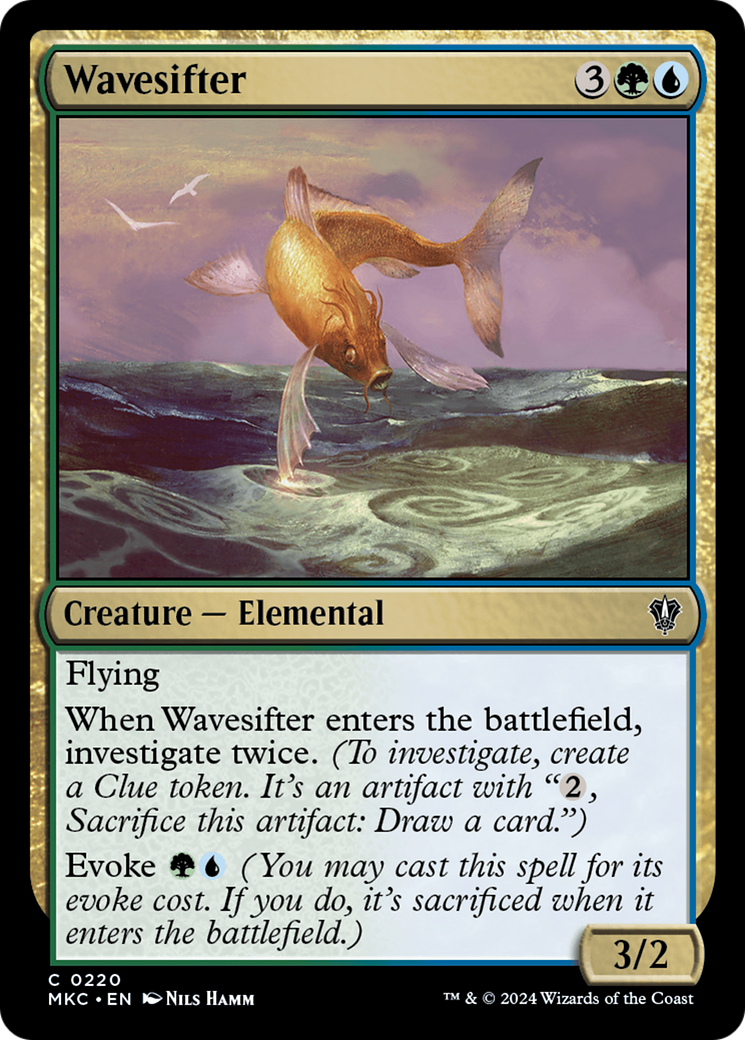
Wavesifter
Wavesifter
Creature — Elemental
3/2
Flying
When this creature enters, investigate twice. (To investigate, create a Clue token. It's an artifact with " , Sacrifice this token: Draw a card.")
Evoke (You may cast this spell for its evoke cost. If you do, it's sacrificed when it enters.)
- The token is named Clue Token and has the artifact subtype Clue. Clue isn't a creature type.
- The tokens are normal artifacts. For example, one can be sacrificed to activate the ability of Breya's Apprentice and one can be the target of Break Ties.
- You can't sacrifice a Clue to activate its own ability and also to activate another ability that requires sacrificing a Clue (or any artifact) as a cost, such as that of Lonis, Cryptozoologist.
-
1
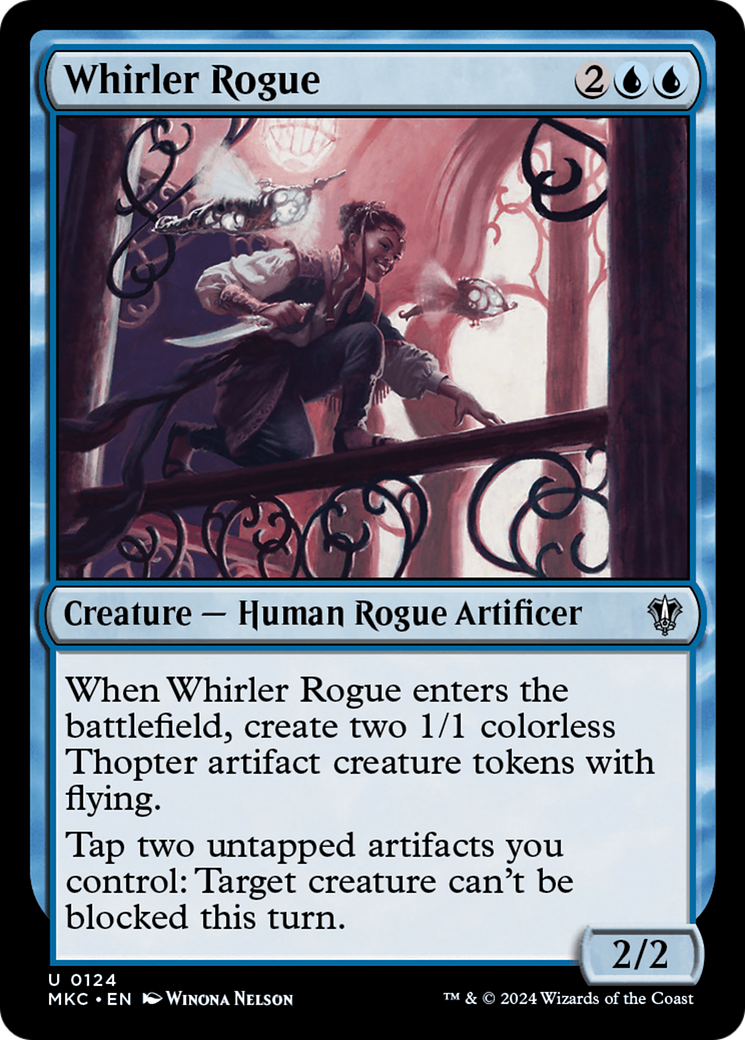
Whirler Rogue
Whirler Rogue
Creature — Human Rogue Artificer
2/2
When this creature enters, create two 1/1 colorless Thopter artifact creature tokens with flying.
Tap two untapped artifacts you control: Target creature can't be blocked this turn.
- You may tap any two untapped artifacts you control, including artifact creatures that haven't been under your control continuously since the beginning of your most recent turn.
- Activating the second ability of Whirler Rogue after a creature has become blocked won't cause it to become unblocked.
Instants 3
-
1
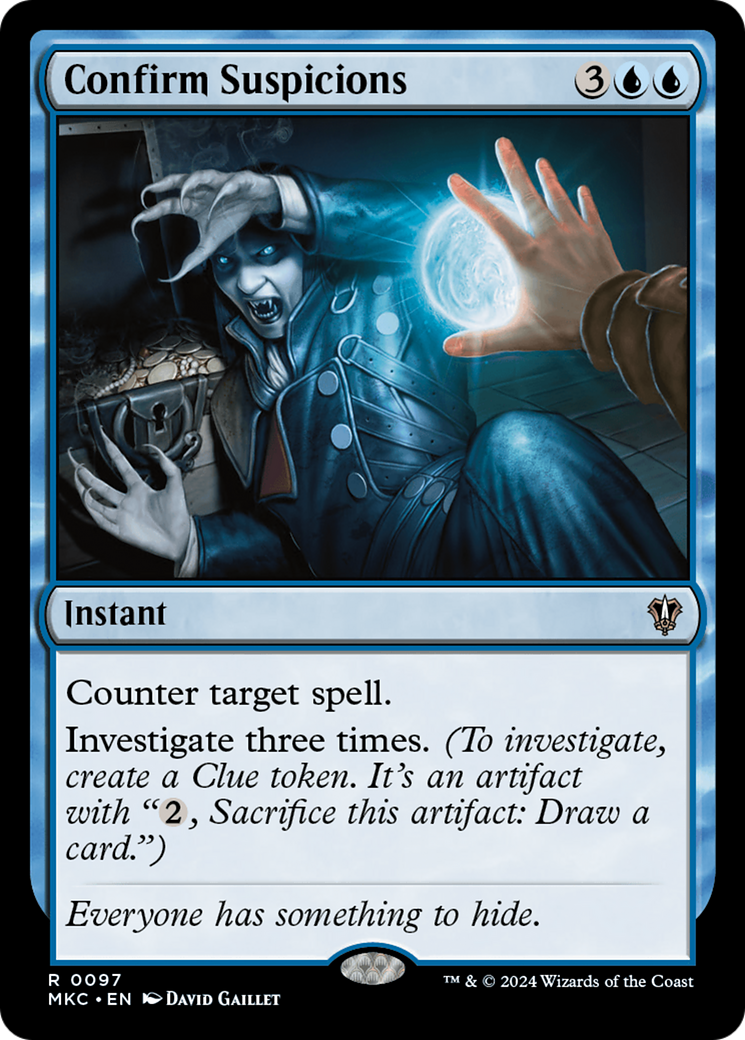
Confirm Suspicions
Confirm Suspicions
Instant
Counter target spell.
Investigate three times. (To investigate, create a Clue token. It's an artifact with " , Sacrifice this token: Draw a card.")
- Clue is an artifact type. Even though it appears on some cards with other permanent types, it's never a creature type, a land type, or anything but an artifact type.
- If an effect refers to a Clue, it means any Clue artifact, not just a Clue artifact token. For example, you can sacrifice Wrench to pay for Alquist Proft, Master Sleuth's activated ability.
- You can't sacrifice a Clue to pay multiple costs. For example, you can't sacrifice a Clue token to activate its own ability and also to activate Alquist Proft, Master Sleuth's ability.
- You can't cast a spell without choosing legal targets. If all of those targets become illegal, the spell doesn't resolve and you won't investigate.
-
1
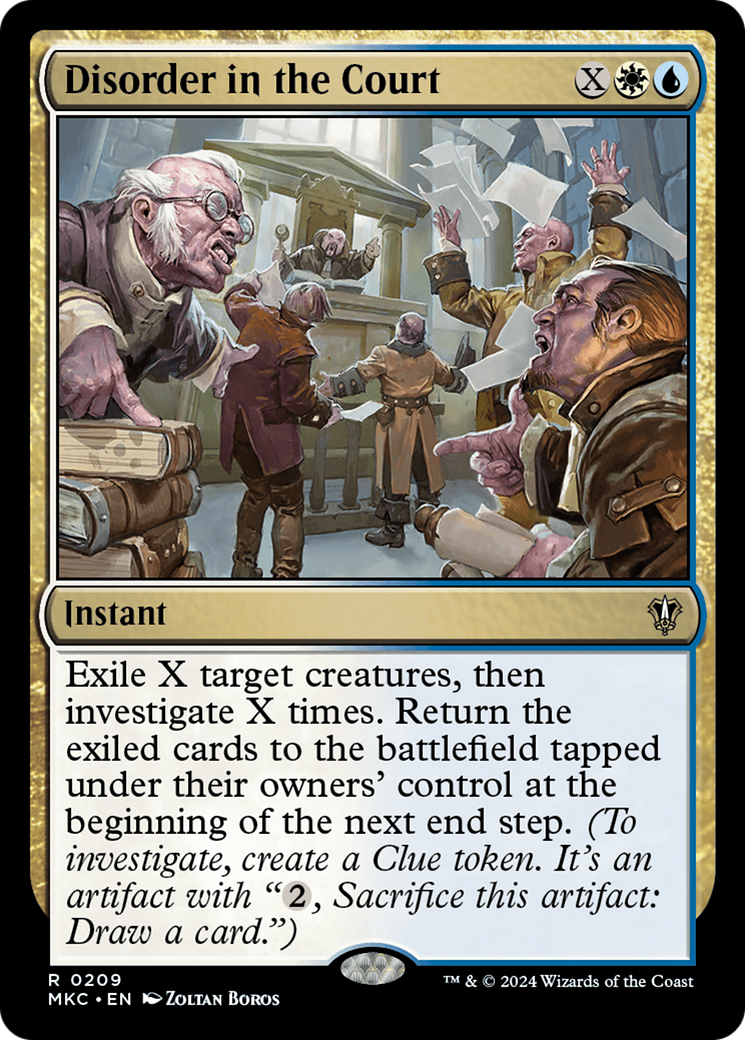
Disorder in the Court
Disorder in the Court
Instant
Exile X target creatures, then investigate X times. Return the exiled cards to the battlefield tapped under their owners' control at the beginning of the next end step. (To investigate, create a Clue token. It's an artifact with " , Sacrifice this token: Draw a card.")
-
1
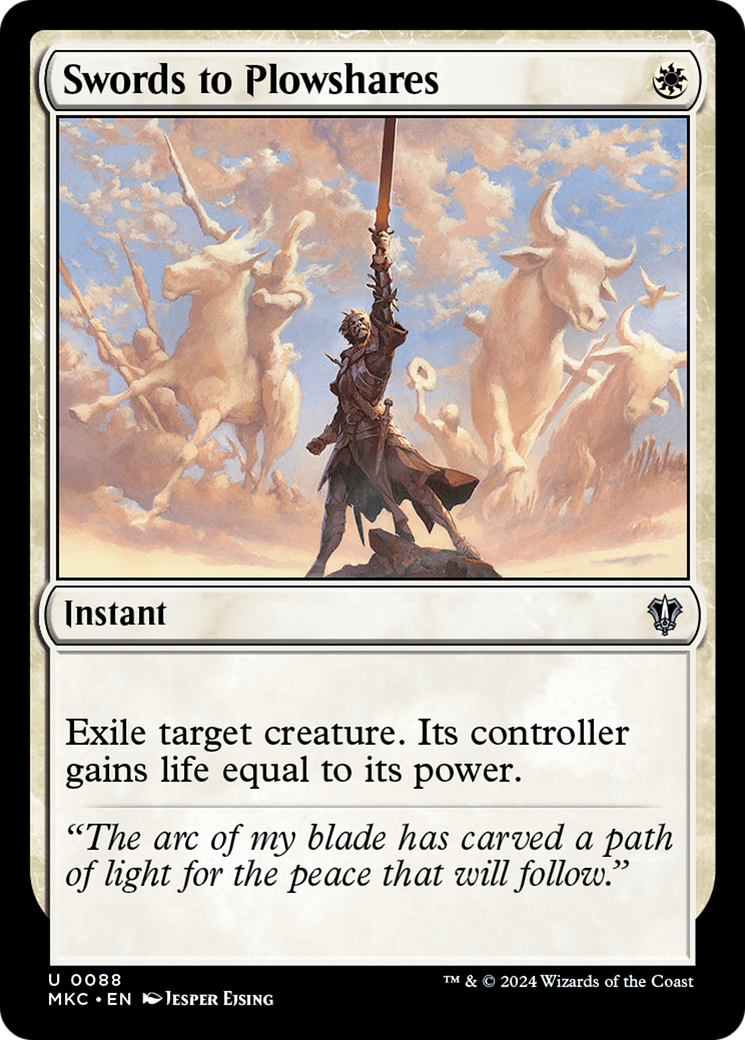
Swords to Plowshares
Swords to Plowshares
Instant
Exile target creature. Its controller gains life equal to its power.
- Use the power of the creature from when it was last on the battlefield to determine how much life is gained.
Sorceries 5
-
1
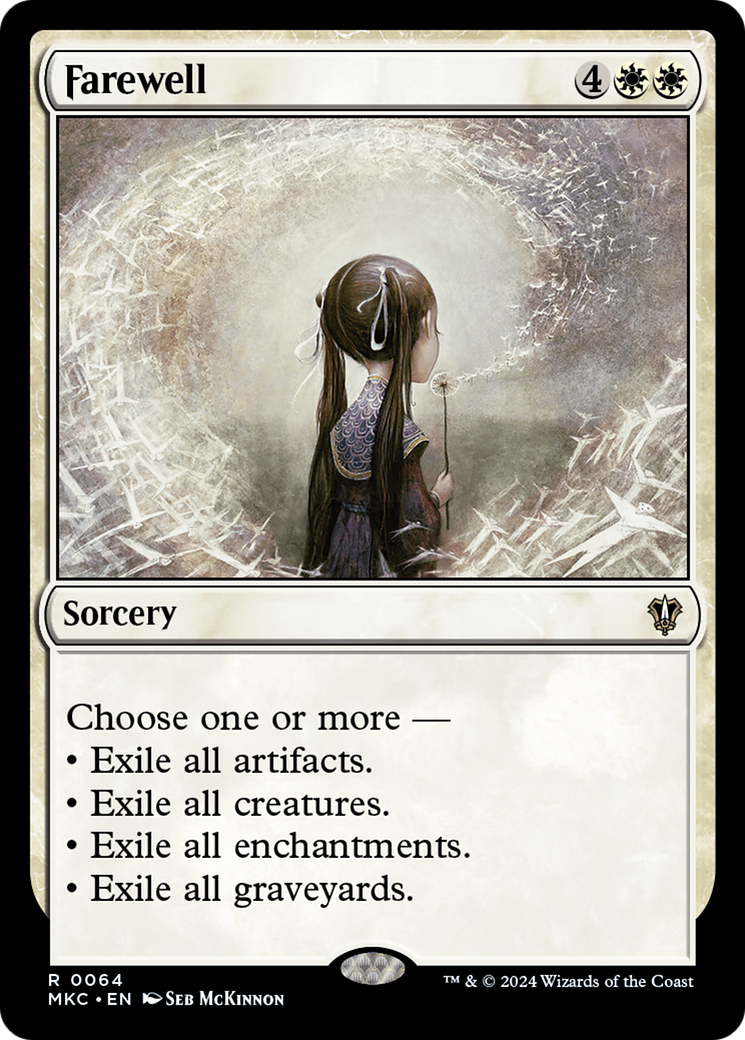
Farewell
Farewell
Sorcery
Choose one or more —
- Exile all artifacts.
- Exile all creatures.
- Exile all enchantments.
- Exile all graveyards.
- If you choose more than one mode for Farewell, you perform the actions in the order written.
-
1
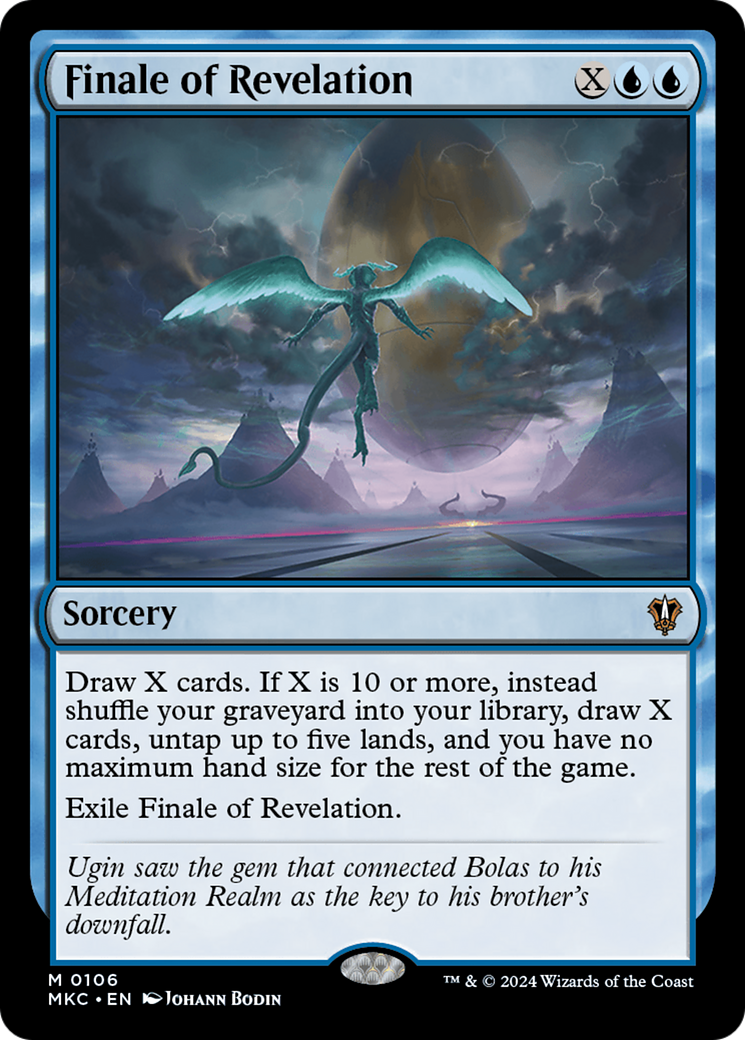
Finale of Revelation
Finale of Revelation
Sorcery
Draw X cards. If X is 10 or more, instead shuffle your graveyard into your library, draw X cards, untap up to five lands, and you have no maximum hand size for the rest of the game.
Exile Finale of Revelation.
-
1
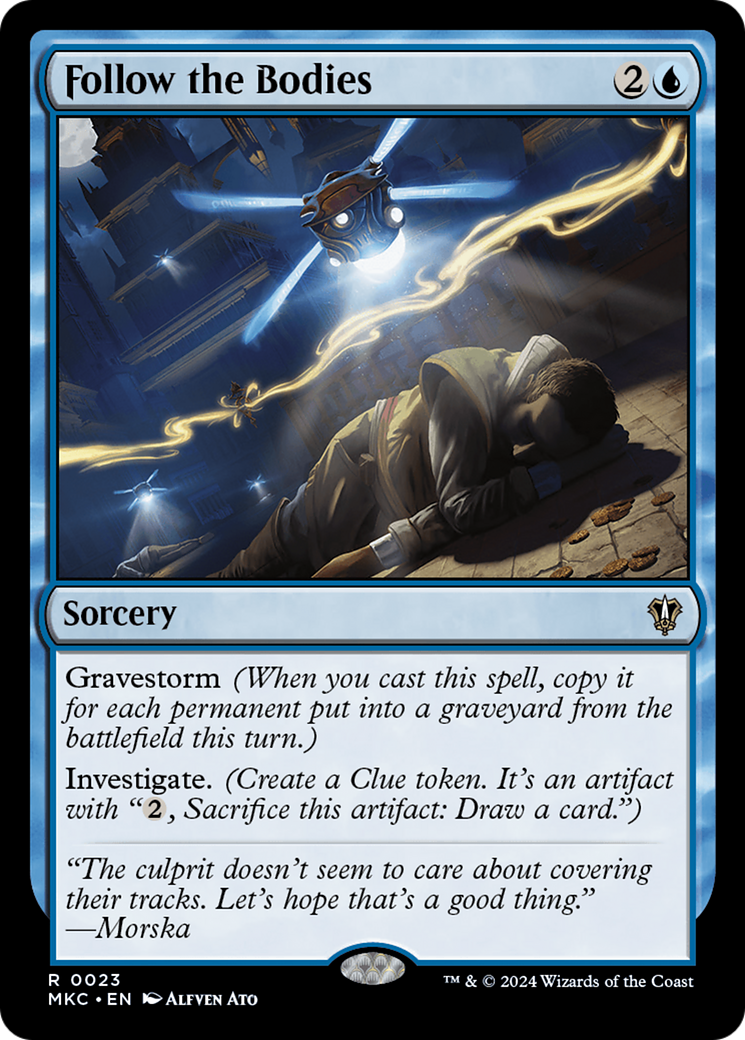
Follow the Bodies
Follow the Bodies
Sorcery
Gravestorm (When you cast this spell, copy it for each permanent put into a graveyard from the battlefield this turn.)
Investigate. (Create a Clue token. It's an artifact with " , Sacrifice this token: Draw a card.")
- Gravestorm counts all permanents put into graveyards from the battlefield this turn. It doesn't matter who controlled those permanents, who owns them, or whether or not they were tokens.
- The copies of Follow the Bodies created by its gravestorm ability are created on the stack, so they're not cast and won't cause abilities that trigger when a player casts a spell to trigger.
- A copy of a spell can be countered like any other spell, but it must be countered individually. Countering a spell with gravestorm won't affect the copies.
- The triggered ability that creates the copies can itself be countered by anything that can counter a triggered ability. If it is countered, no copies will be put onto the stack.
- Clue is an artifact type. Even though it appears on some cards with other permanent types, it's never a creature type, a land type, or anything but an artifact type.
- If an effect refers to a Clue, it means any Clue artifact, not just a Clue artifact token. For example, you can sacrifice Wrench to pay for Alquist Proft, Master Sleuth's activated ability.
- You can't sacrifice a Clue to pay multiple costs. For example, you can't sacrifice a Clue token to activate its own ability and also to activate Alquist Proft, Master Sleuth's ability.
- Some spells and abilities that investigate may require targets. If each target chosen is an illegal target as that spell or ability tries to resolve, it won't resolve. You won't create any Clue tokens.
- Some abilities trigger "whenever you sacrifice a Clue". Those abilities trigger whenever you sacrifice a Clue for any reason, not just to activate a Clue's activated ability.
-
1
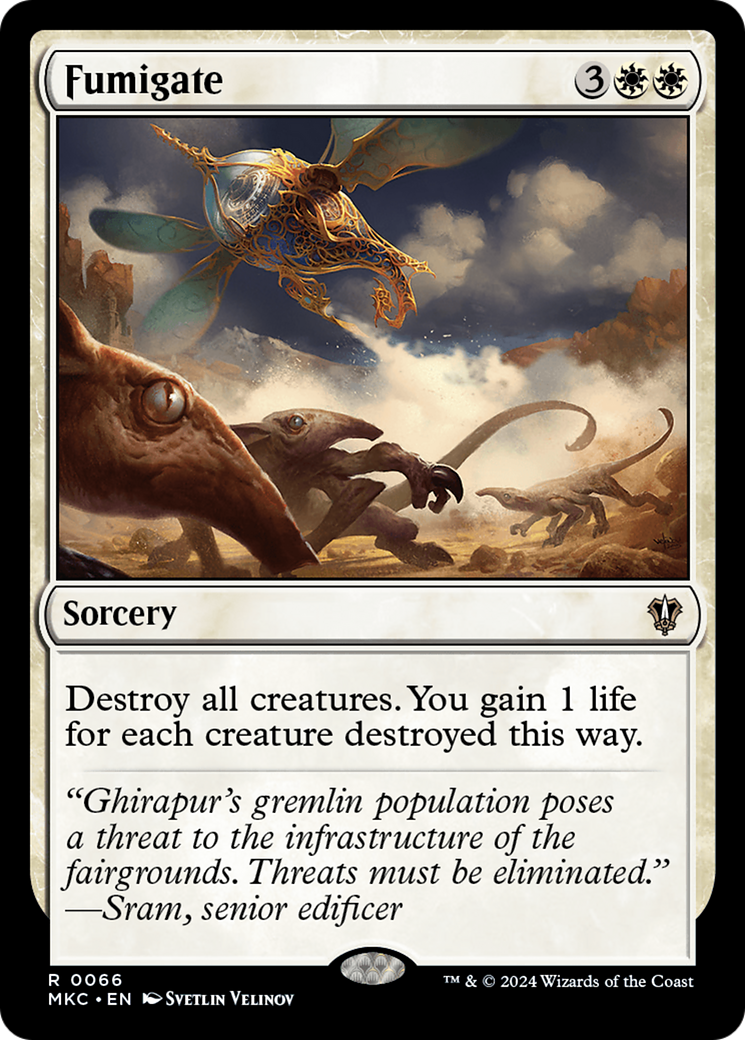
Fumigate
Fumigate
Sorcery
Destroy all creatures. You gain 1 life for each creature destroyed this way.
- Creatures destroyed this way count toward the life gained even if they're put into a zone other than a graveyard.
- You won't gain 1 life for a creature that isn't actually destroyed, such as a creature with indestructible.
-
1
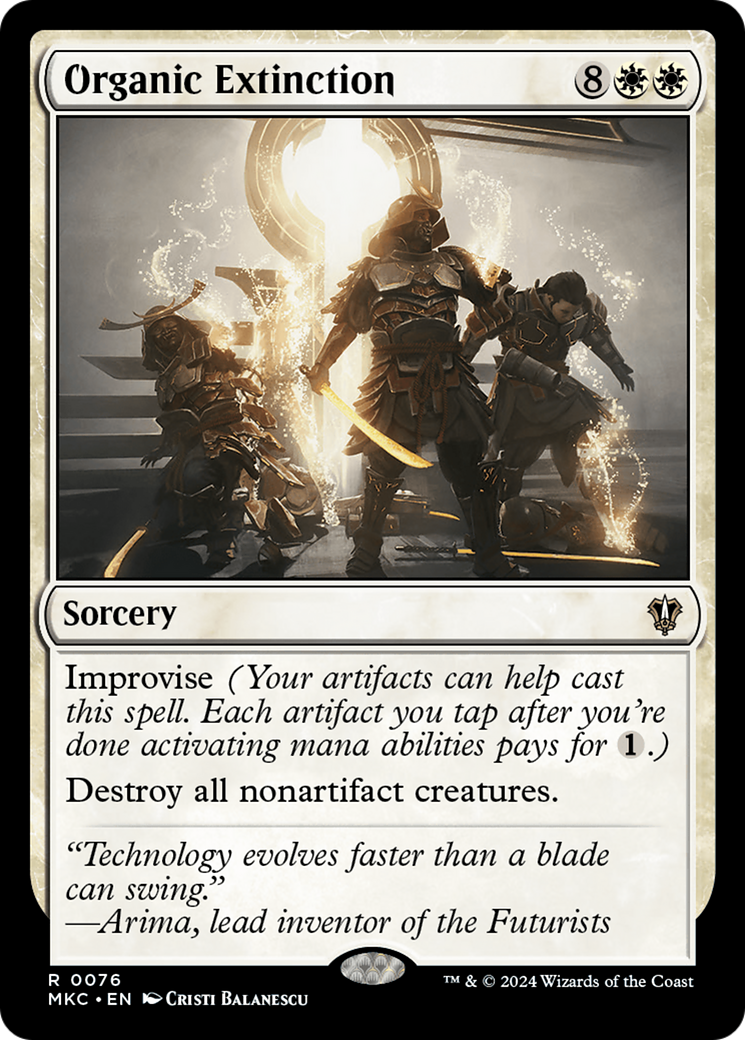
Organic Extinction
Organic Extinction
Sorcery
Improvise (Your artifacts can help cast this spell. Each artifact you tap after you're done activating mana abilities pays for .)
Destroy all nonartifact creatures.
Artifacts 12
-
1
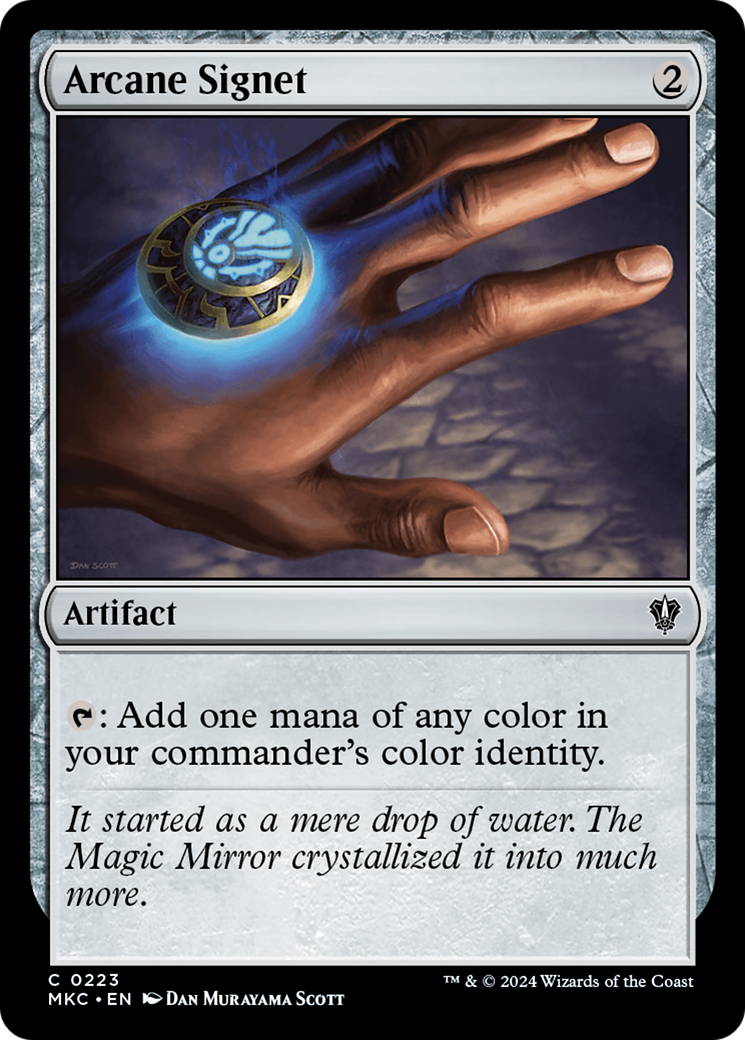
Arcane Signet
Arcane Signet
Artifact
: Add one mana of any color in your commander's color identity.
- If your commander is a card that has no colors in its color identity, Arcane Signet's ability produces no mana. It doesn't produce .
- If you have two commanders, the ability adds one mana of any color in their combined color identities.
- If you don't have a commander, Arcane Signet's ability produces no mana.
-
1
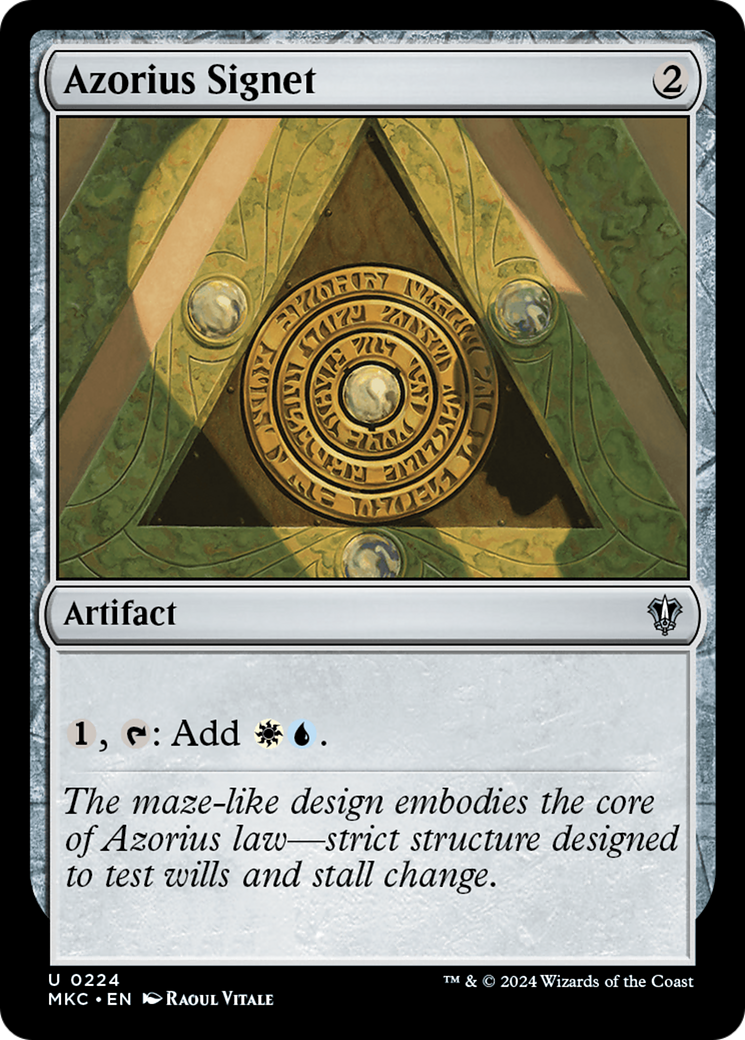
Azorius Signet
Azorius Signet
Artifact
, : Add .
-
1
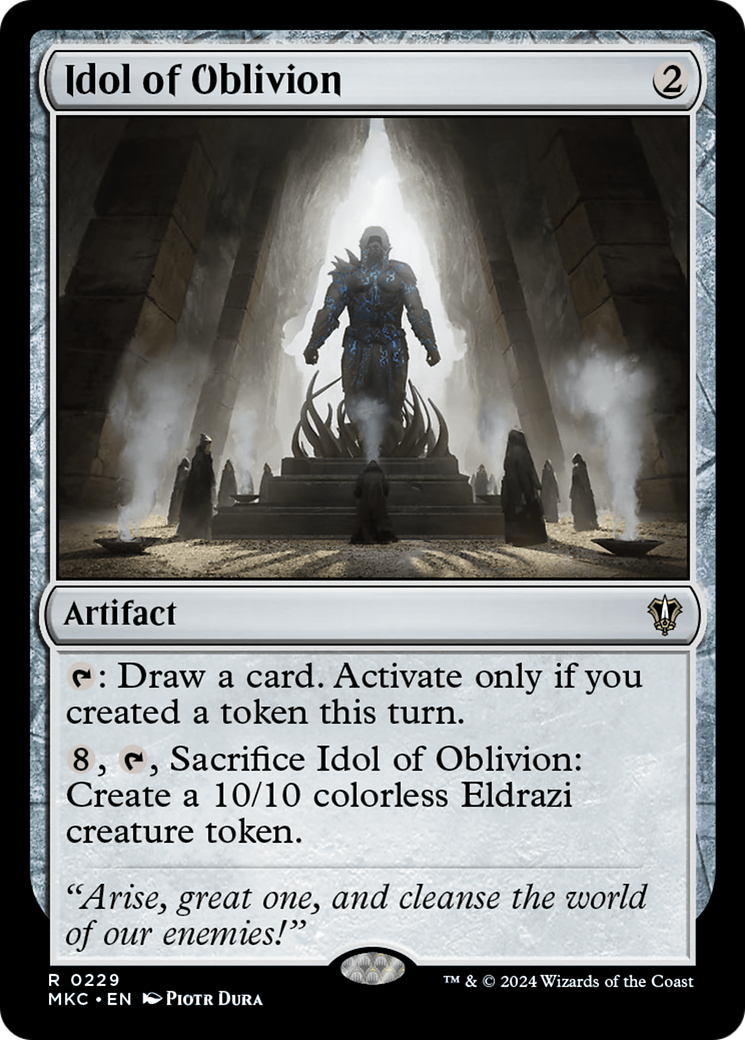
Idol of Oblivion
Idol of Oblivion
Artifact
: Draw a card. Activate only if you created a token this turn.
, , Sacrifice this artifact: Create a 10/10 colorless Eldrazi creature token.
- You can activate Idol of Oblivion's first ability even if the token you've created was created before Idol of Oblivion entered the battlefield or if the token has left the battlefield.
-
1
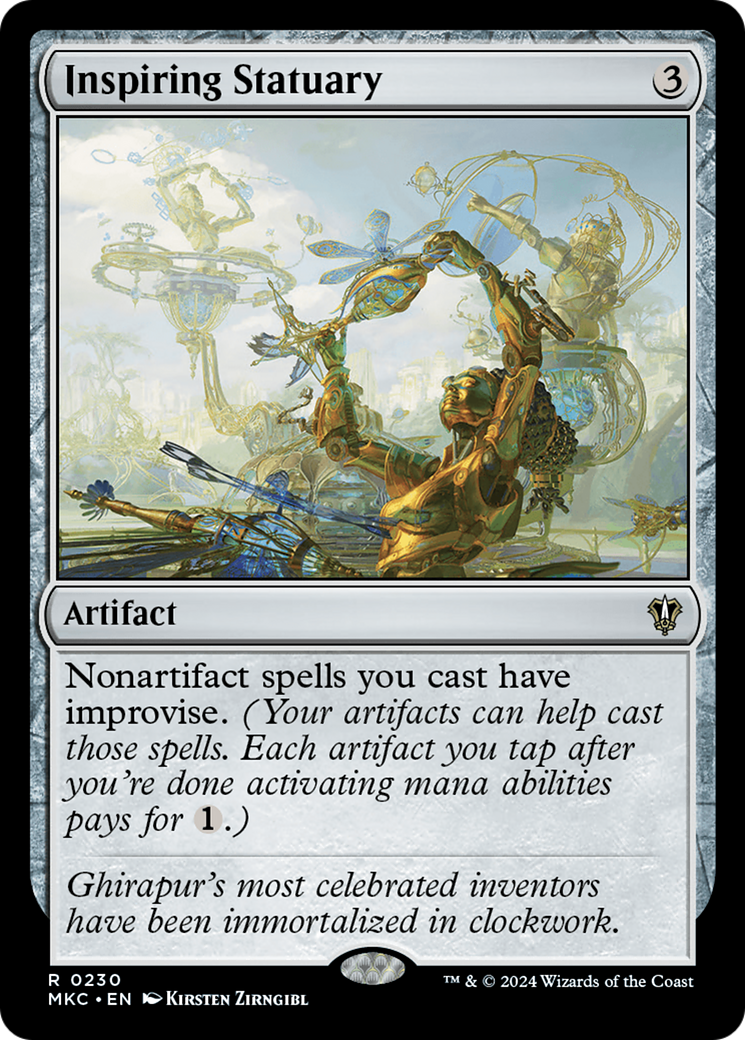
Inspiring Statuary
Inspiring Statuary
Artifact
Nonartifact spells you cast have improvise. (Your artifacts can help cast those spells. Each artifact you tap after you're done activating mana abilities pays for .)
- Multiple instances of improvise are redundant.
- If you cast a nonartifact spell that requires you to sacrifice a permanent as an additional cost, you may tap that permanent (if it's an artifact) for the spell's improvise ability before you sacrifice it to pay that cost.
-
1
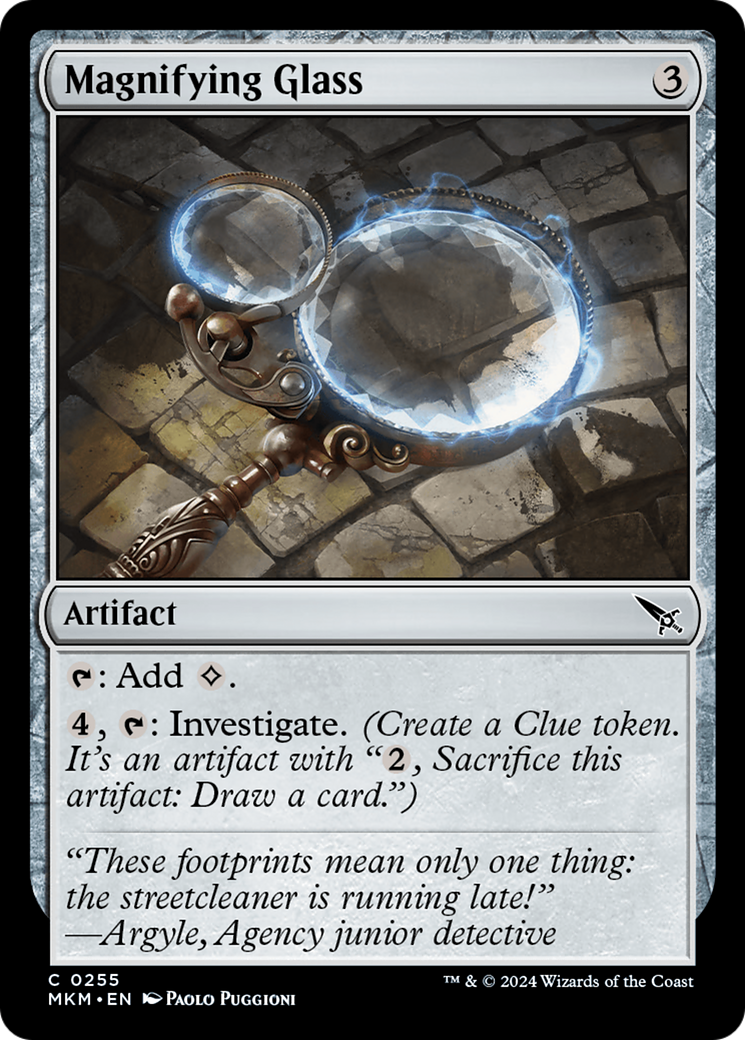
Magnifying Glass
Magnifying Glass
Artifact
: Add .
, : Investigate. (Create a Clue token. It's an artifact with " , Sacrifice this token: Draw a card.")
-
1
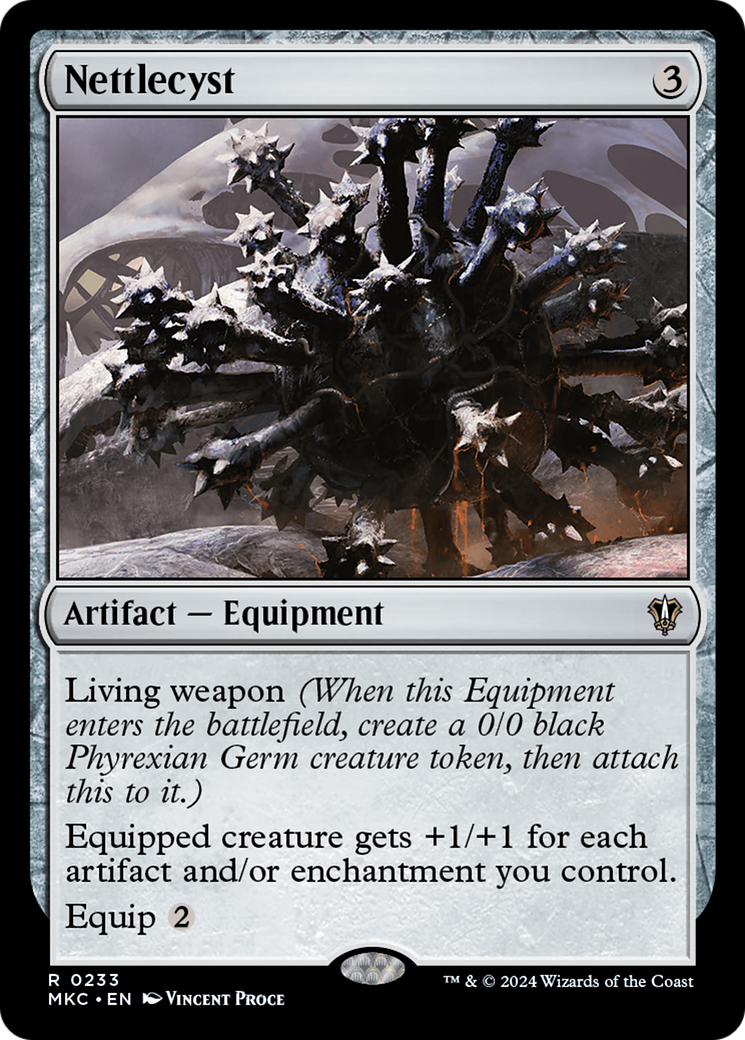
Nettlecyst
Nettlecyst
Artifact — Equipment
Living weapon (When this Equipment enters, create a 0/0 black Phyrexian Germ creature token, then attach this to it.)
Equipped creature gets +1/+1 for each artifact and/or enchantment you control.
Equip
- The living weapon ability has been updated so that the triggered ability creates Phyrexian Germ tokens rather than Germ tokens. This update applies to all cards with living weapon.
- If a permanent you control is both an artifact and an enchantment, count it only once when determining the bonus from an equipped Nettlecyst.
- The Phyrexian Germ token enters the battlefield as a 0/0 creature and the Equipment becomes attached to it before state-based actions would cause the token to die. Abilities that trigger as the token enters the battlefield see that a 0/0 creature entered the battlefield.
- Like other Equipment, each Equipment with living weapon has an equip cost. You can pay this cost to attach an Equipment to another creature you control. Once the Phyrexian Germ token is no longer equipped, it will be put into your graveyard and subsequently cease to exist, unless another effect raises its toughness above 0.
- If the Phyrexian Germ token is destroyed, the Equipment remains on the battlefield as with any other Equipment.
- If the living weapon trigger causes two Phyrexian Germs to be created (due to an effect such as that of Doubling Season), the Equipment becomes attached to one of them. The other will be put into your graveyard and subsequently cease to exist, unless another effect raises its toughness above 0.
-
1
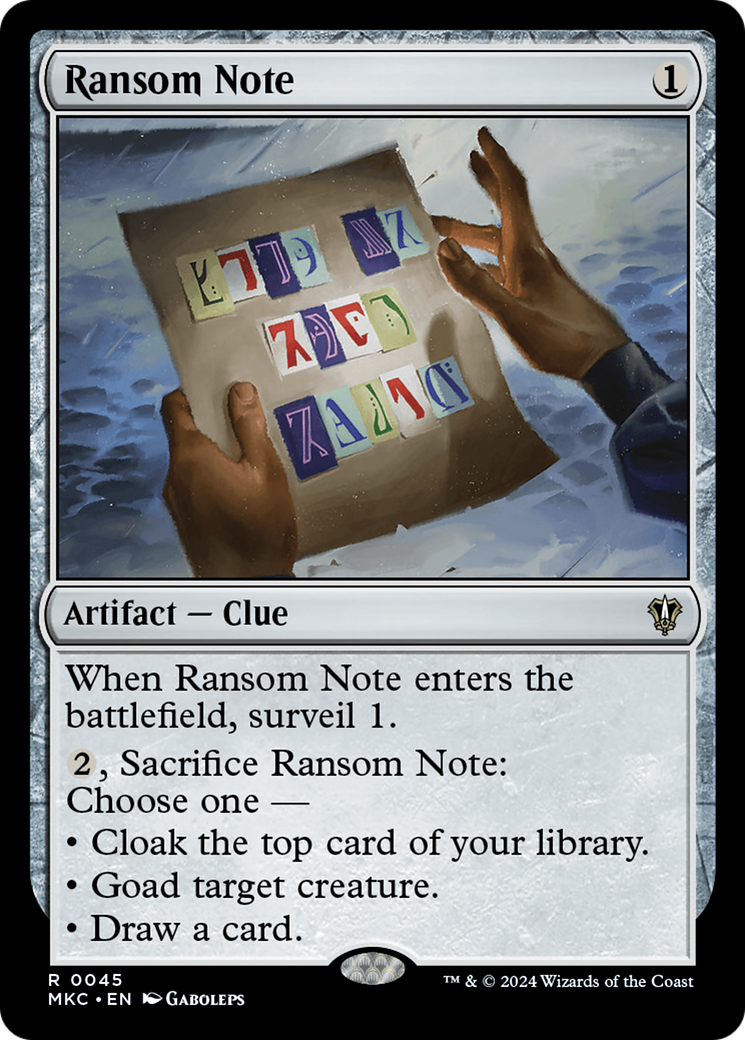
Ransom Note
Ransom Note
Artifact — Clue
When this artifact enters, surveil 1.
, Sacrifice this artifact: Choose one —
- Cloak the top card of your library.
- Goad target creature.
- Draw a card.
- To cloak a card, put it onto the battlefield face down. It becomes a 2/2 face-down creature card with ward and no name, mana cost, or creature types. It’s colorless and has a mana value of 0. Other effects that apply to the permanent can still grant it any characteristics it doesn’t have or change the characteristics it does have.
- Any time you have priority, you can turn a cloaked permanent you control face-up by revealing that it’s a creature card (ignoring any copy effects or type-changing effects that might be applying to it) and paying its mana cost. This is a special action. It doesn’t use the stack and can’t be responded to.
- If a cloaked creature would have disguise (or morph) if it were face up, you may also turn it face up by paying its disguise (or morph) cost.
- Unlike a face-down creature that was cast using a disguise or morph ability, a cloaked creature may still be turned face up after it loses its abilities if it’s a creature card.
- If a double-faced card is cloaked, it will be put onto the battlefield face down. While face down, it can’t transform. If the front face of the card is a creature card, you can turn it face up by paying its mana cost. If you do, its front face will be up.
- At any time, you can look at a face-down spell or permanent you control. You can’t look at face-down permanents or spells you don’t control unless an effect instructs or allows you to do so.
- If a face-down creature loses its abilities, it can’t be turned face up with a disguise ability because it will no longer have a disguise ability (or a disguise cost) once face up.
- Because the permanent is on the battlefield both before and after it’s turned face up, turning a permanent face up doesn’t cause any enters-the-battlefield abilities to trigger.
- Because face-down creatures don’t have a name, they can’t have the same name as any other creature, even another face-down creature.
- A permanent that turns face up or face down changes characteristics but is otherwise the same permanent. Spells and abilities that were targeting that permanent and Auras and Equipment that were attached to that permanent aren’t affected unless the new characteristics of the object change the legality of those targets or attachments.
- Turning a permanent face up or face down doesn’t change whether that permanent is tapped or untapped.
- If a face-down spell leaves the stack and goes to any zone other than the battlefield (if it was countered, for example), you must reveal it. Similarly, if a face-down permanent leaves the battlefield, you must reveal it. You must also reveal all face-down spells and permanents you control if you leave the game or the game ends.
- You must ensure that your face-down spells and permanents can be easily differentiated from each other. You’re not allowed to mix up the cards that represent them on the battlefield to confuse other players. The order in which they entered the battlefield should remain clear, as well as what ability caused them to be face down. (This includes disguise, cloak, and in games involving older cards, morph and manifest, as well as a few other effects that turn cards face down.) Common methods for doing this include using markers or dice, or simply placing them in order on the battlefield.
- If something tries to turn a face-down instant or sorcery card on the battlefield face up, reveal that card to show all players it’s an instant or sorcery card. The permanent remains on the battlefield face down. Abilities that trigger when a permanent turns face up won’t trigger, because even though you revealed the card, it never turned face up.
-
1
Simic Signet
Simic Signet
Artifact
, : Add .
-
1
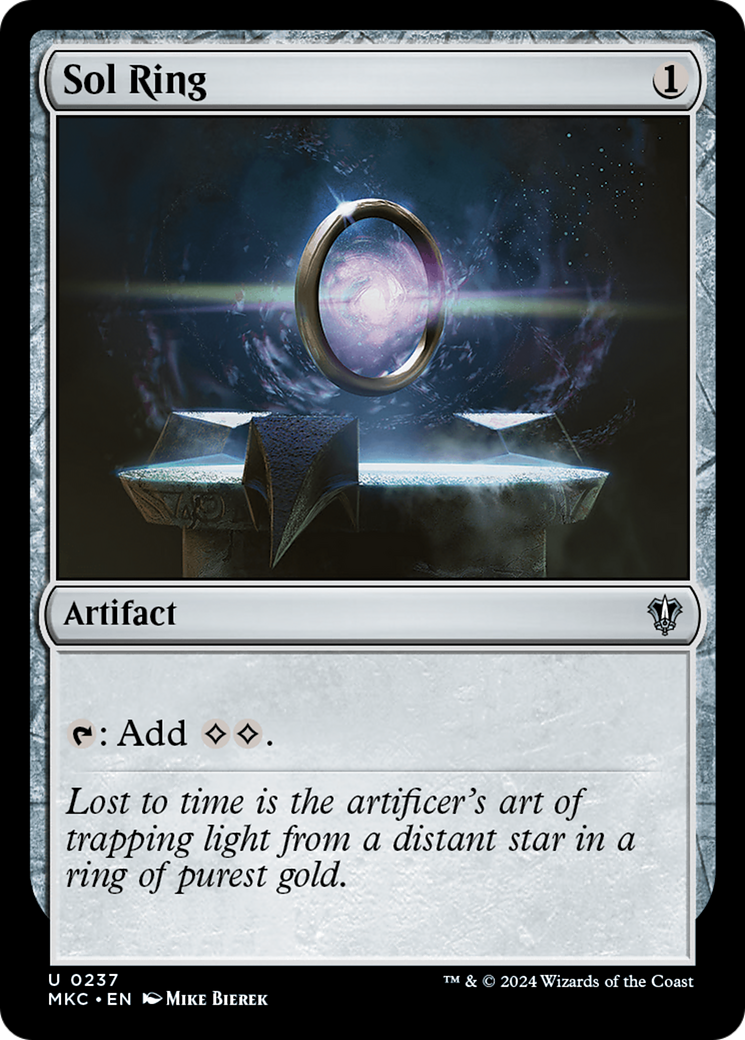
Sol Ring
Sol Ring
Artifact
: Add .
-
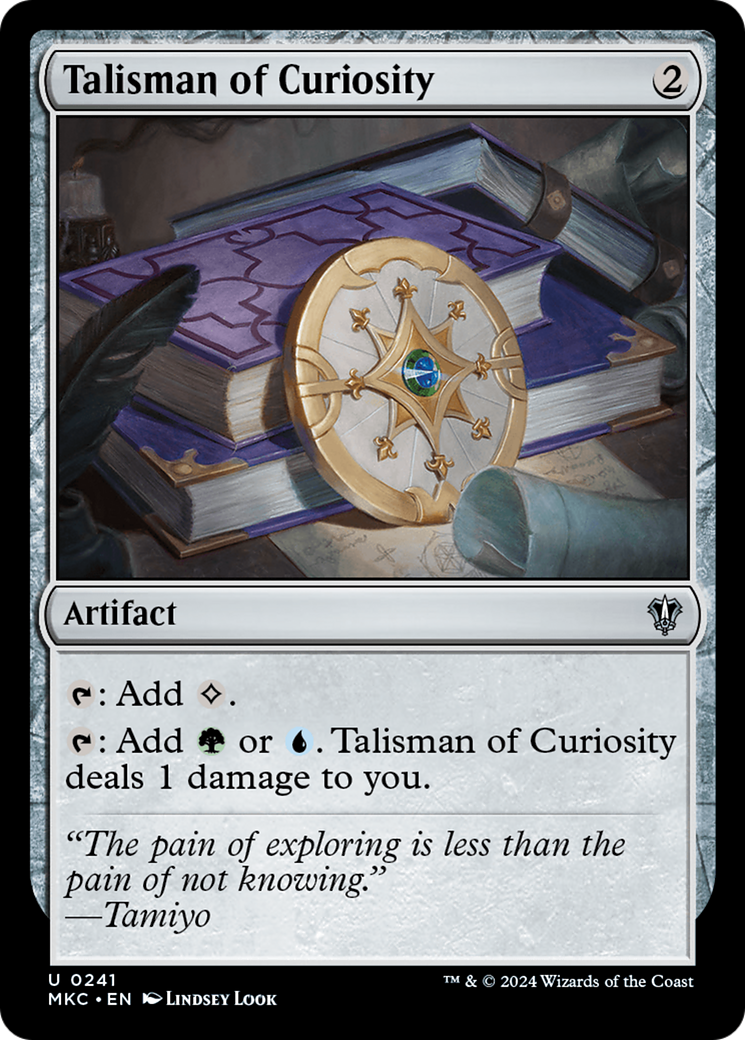
1
Talisman of Curiosity
Talisman of Curiosity
Artifact
: Add .
: Add or . This artifact deals 1 damage to you.
-
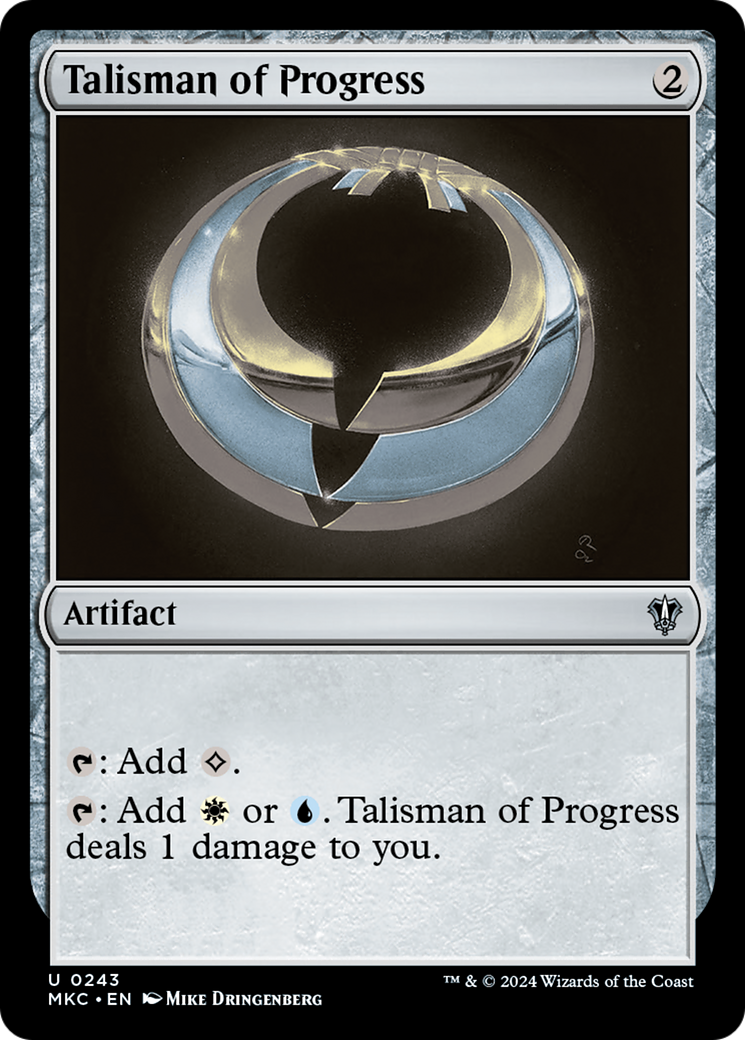
1
Talisman of Progress
Talisman of Progress
Artifact
: Add .
: Add or . This artifact deals 1 damage to you.
-
1
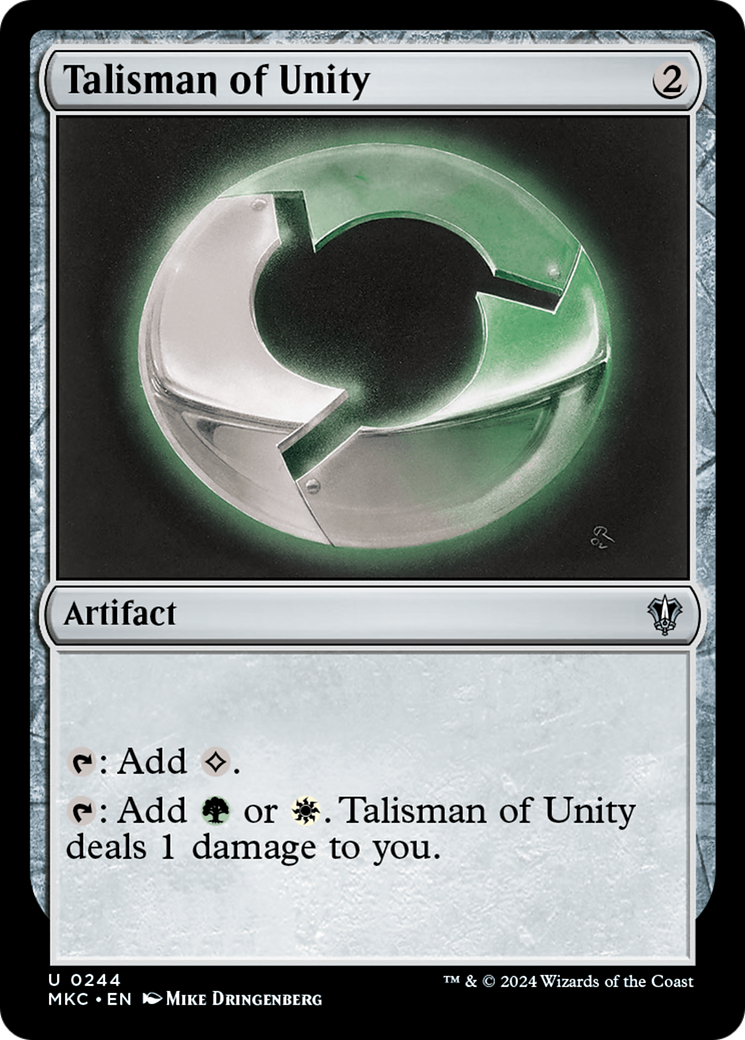
Talisman of Unity
Talisman of Unity
Artifact
: Add .
: Add or . This artifact deals 1 damage to you.
Enchantments 10
-
1
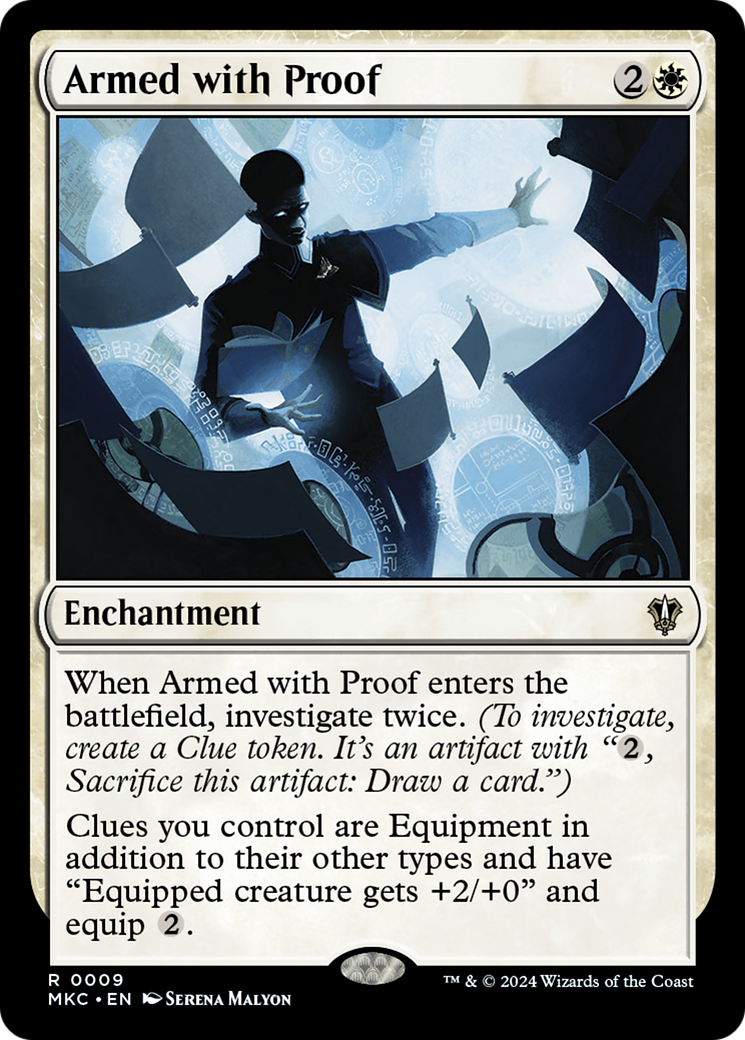
Armed with Proof
Armed with Proof
Enchantment
When this enchantment enters, investigate twice. (To investigate, create a Clue token. It's an artifact with " , Sacrifice this token: Draw a card.")
Clues you control are Equipment in addition to their other types and have "Equipped creature gets +2/+0" and equip .
- Clues stop being Equipment if Armed with Proof leaves the battlefield. If any of them are attached to creatures at that time, they become unattached.
- If you control more than one Armed with Proof, creatures equipped with Clue Equipment will get +2/+0 for each Armed with Proof you control. The equip cost is still .
- An Equipment without reconfigure that's also a creature can't be attached to anything. You can activate its equip ability, but it won't become attached. For example, if you control both Red Herring and Armed with Proof, Red Herring will be an Artifact Creature – Clue Equipment Fish with "Equipped creature gets +2/+0" and equip , but activating its equip ability won't result in it becoming attached to the target creature.
- Clue is an artifact type. Even though it appears on some cards with other permanent types, it's never a creature type, a land type, or anything but an artifact type.
- If an effect refers to a Clue, it means any Clue artifact, not just a Clue artifact token. For example, you can sacrifice Wrench to pay for Alquist Proft, Master Sleuth's activated ability.
- You can't sacrifice a Clue to pay multiple costs. For example, you can't sacrifice a Clue token to activate its own ability and also to activate Alquist Proft, Master Sleuth's ability.
- Some spells and abilities that investigate may require targets. If each target chosen is an illegal target as that spell or ability tries to resolve, it won't resolve. You won't create any Clue tokens.
- Some abilities trigger "whenever you sacrifice a Clue". Those abilities trigger whenever you sacrifice a Clue for any reason, not just to activate a Clue's activated ability.
-
1
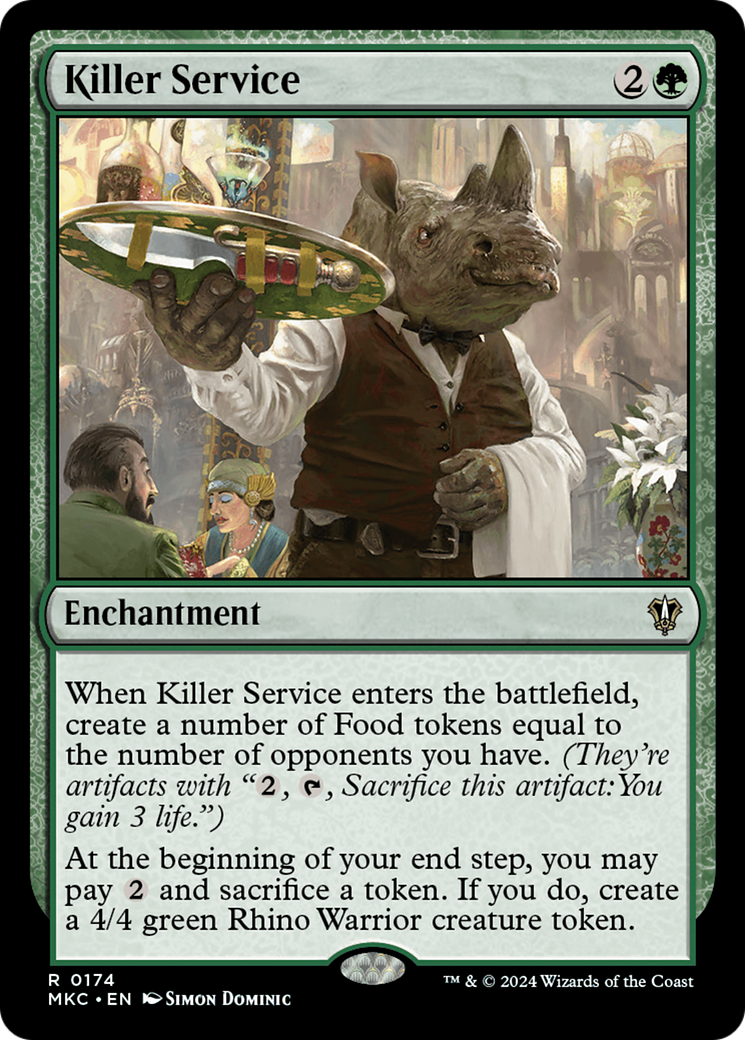
Killer Service
Killer Service
Enchantment
When this enchantment enters, create a number of Food tokens equal to the number of opponents you have. (They're artifacts with " , , Sacrifice this token: You gain 3 life.")
At the beginning of your end step, you may pay and sacrifice a token. If you do, create a 4/4 green Rhino Warrior creature token.
- Food is an artifact type. Even though it appears on some creatures, it's never a creature type.
- You can't sacrifice a Food to pay multiple costs. For example, you can't sacrifice a Food token to activate its own ability and also to activate Maraleaf Rider's ability.
- Whatever you do, don't eat the delicious cards.
- As Killer Service's second ability resolves, you may sacrifice any token, not just a Food token.
-
1
Knowledge Is Power
Knowledge Is Power
Enchantment
Creatures you control get +X/+X, where X is the number of cards you've drawn this turn.
-
1
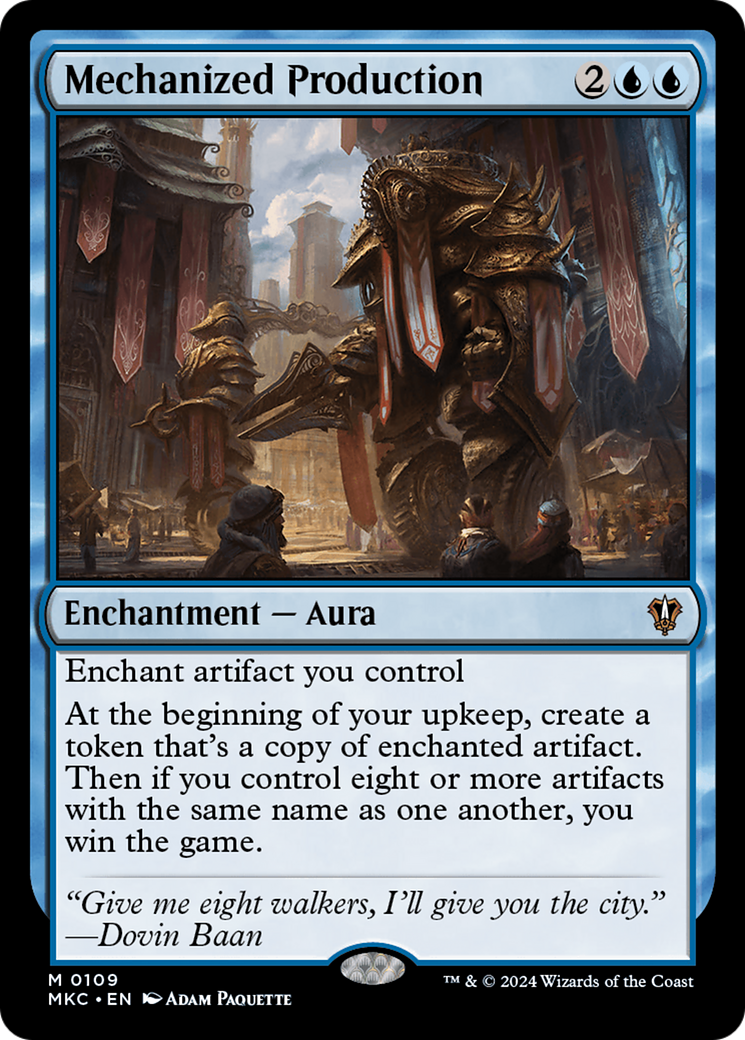
Mechanized Production
Mechanized Production
Enchantment — Aura
Enchant artifact you control
At the beginning of your upkeep, create a token that's a copy of enchanted artifact. Then if you control eight or more artifacts with the same name as one another, you win the game.
- Any abilities that trigger on the token being created won't resolve until after Mechanized Production's triggered ability has finished resolving entirely and performed its check for eight artifacts with the same name.
- The eight artifacts with the same name don't have to have the same name as the enchanted artifact. For example, you win the game if you control eight Thopter artifact creature tokens as Mechanized Production's ability resolves, even if Mechanized Production isn't attached to a Thopter.
- All eight of the permanents sharing a name must be artifacts. If you control only seven artifacts with the same name and a nonartifact permanent with that same name, you won't win the game.
- If you control eight or more artifacts that share a name while you control Mechanized Production, you won't win the game yet. You'll win the game while resolving its triggered ability during your upkeep.
- The token copies exactly what was printed on the original artifact and nothing else (unless that artifact is copying something else or is a token; see below). It doesn't copy whether that artifact is tapped or untapped, whether it has any counters on it or Auras attached to it, or any non-copy effects that have changed its types, color, or so on.
- If the copied artifact has in its mana cost, X is considered to be zero.
- If the copied artifact is copying something else (for example, if the copied artifact is a Sculpting Steel), then the token enters the battlefield as whatever that artifact copied.
- If the copied artifact is a token, the token that's created copies the original characteristics of that token as stated by the effect that created it.
- Any enters-the-battlefield abilities of the copied artifact trigger when the artifact token enters the battlefield. The artifact token also has any "this enters the battlefield with" or "as this enters the battlefield" abilities that the copied artifact has.
- If Mechanized Production and the enchanted artifact leave the battlefield simultaneously in response to the triggered ability, then the effect creates a token that's a copy of the artifact as it last existed on the battlefield.
- If the enchanted artifact leaves the battlefield in response to Mechanized Production's triggered ability but Mechanized Production does not, Mechanized Production is put into its owner's graveyard as a state-based action with no enchanted artifact. The triggered ability creates no token, but you can still win the game if you control enough artifacts with the same name.
-
1
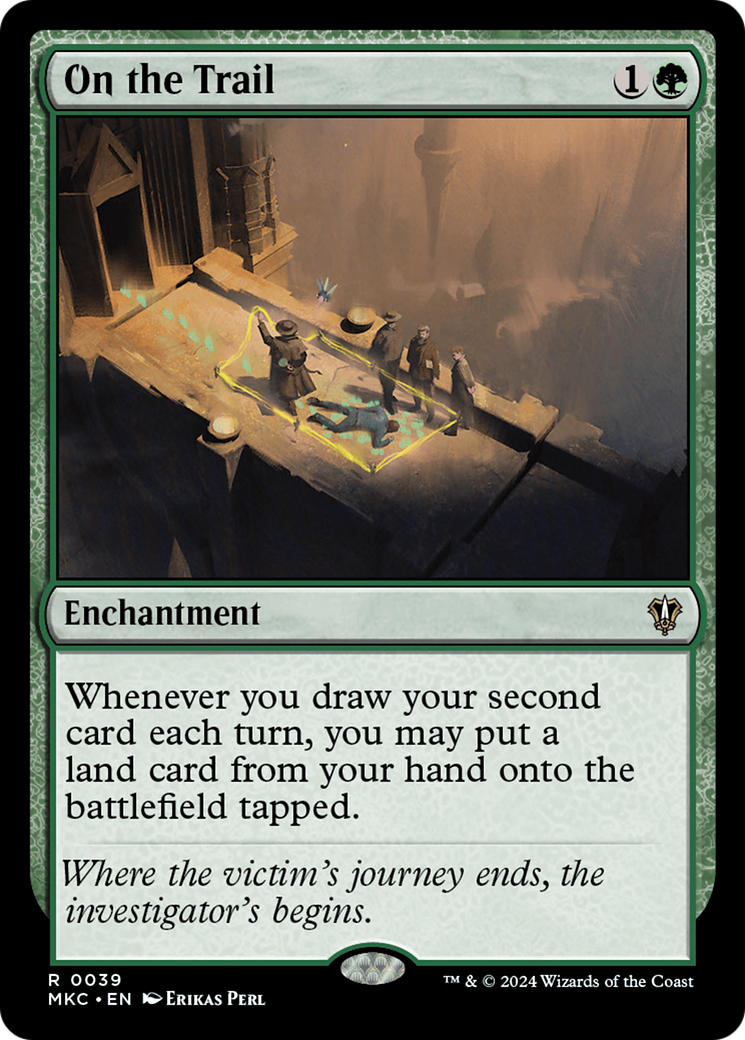
On the Trail
On the Trail
Enchantment
Whenever you draw your second card each turn, you may put a land card from your hand onto the battlefield tapped.
-
1
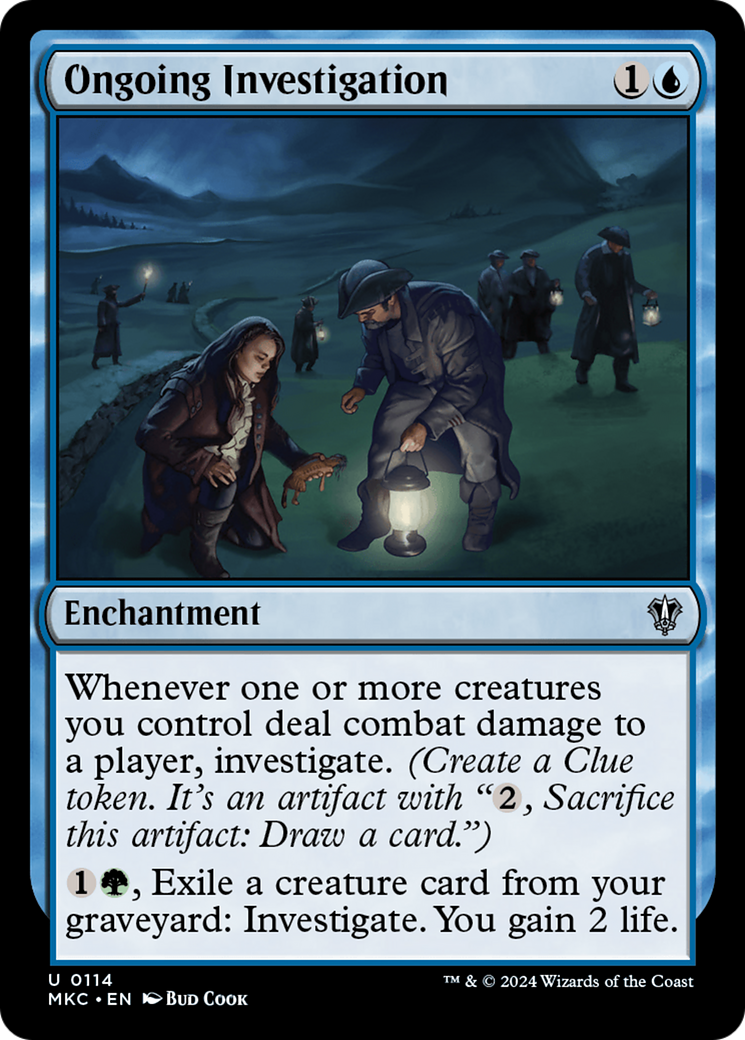
Ongoing Investigation
Ongoing Investigation
Enchantment
Whenever one or more creatures you control deal combat damage to a player, investigate. (Create a Clue token. It's an artifact with " , Sacrifice this token: Draw a card.")
, Exile a creature card from your graveyard: Investigate. You gain 2 life.
- In a Two-Headed Giant game, if you control more than one creature that can attack, you may have them attack different opponents so that Ongoing Investigation's first ability triggers twice.
- Clue is an artifact type. Even though it appears on some cards with other permanent types, it's never a creature type, a land type, or anything but an artifact type.
- If an effect refers to a Clue, it means any Clue artifact, not just a Clue artifact token. For example, you can sacrifice Wrench to pay for Alquist Proft, Master Sleuth's activated ability.
- You can't sacrifice a Clue to pay multiple costs. For example, you can't sacrifice a Clue token to activate its own ability and also to activate Alquist Proft, Master Sleuth's ability.
-
1
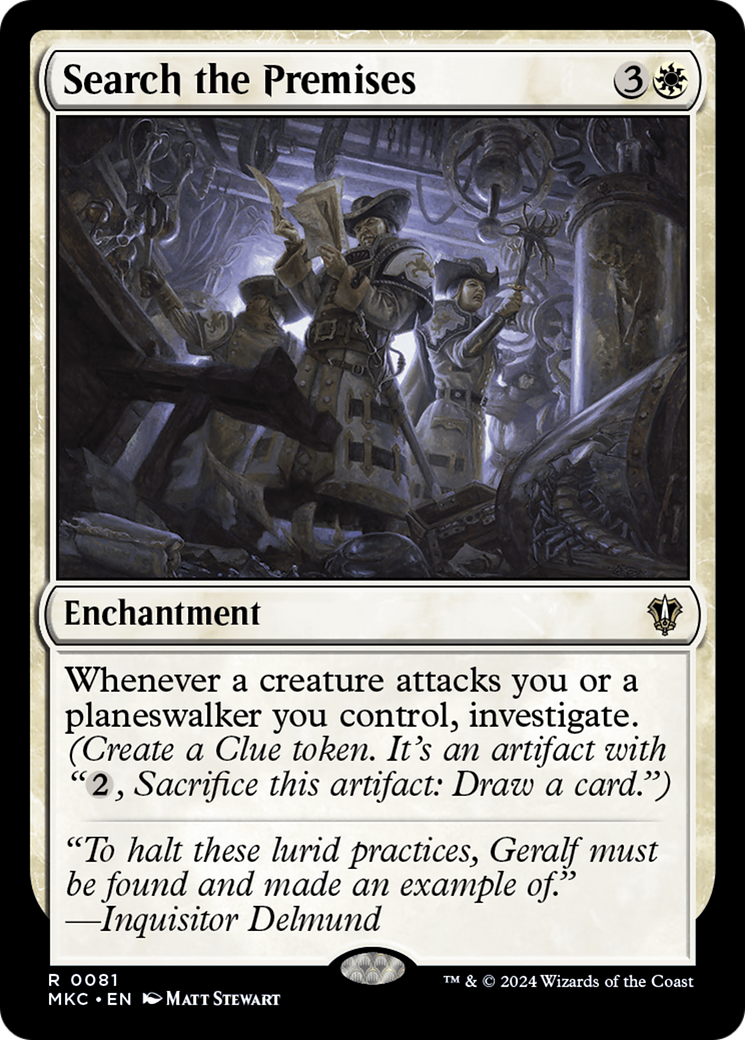
Search the Premises
Search the Premises
Enchantment
Whenever a creature attacks you or a planeswalker you control, investigate. (Create a Clue token. It's an artifact with " , Sacrifice this token: Draw a card.")
-
1
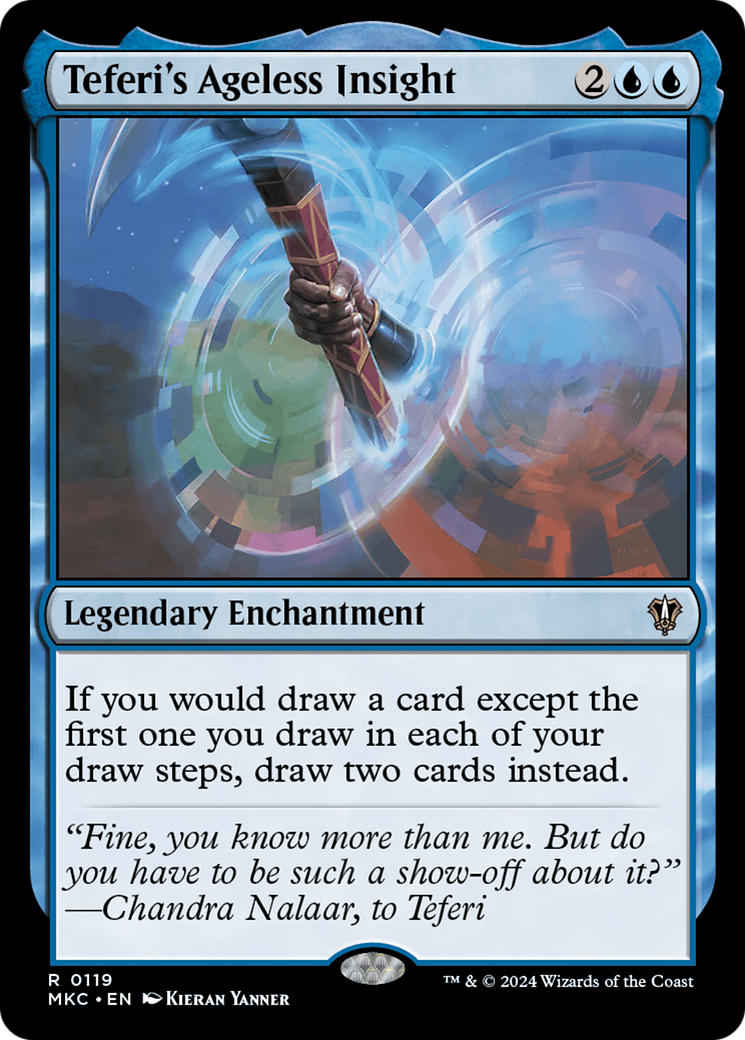
Teferi's Ageless Insight
Teferi's Ageless Insight
Legendary Enchantment
If you would draw a card except the first one you draw in each of your draw steps, draw two cards instead.
- If a spell or ability causes you to put a card into your hand without specifically using the word "draw," it's not a card drawn.
- If two or more replacement effects would apply to a card-drawing event, the player drawing the card chooses the order in which to apply them.
- Because Teferi's Ageless Insight is legendary, it's unlikely that one player will control two. However, if that happens, each card that player would draw after the first will result in four cards being drawn. If they control three, they draw eight cards, and so on.
-
1
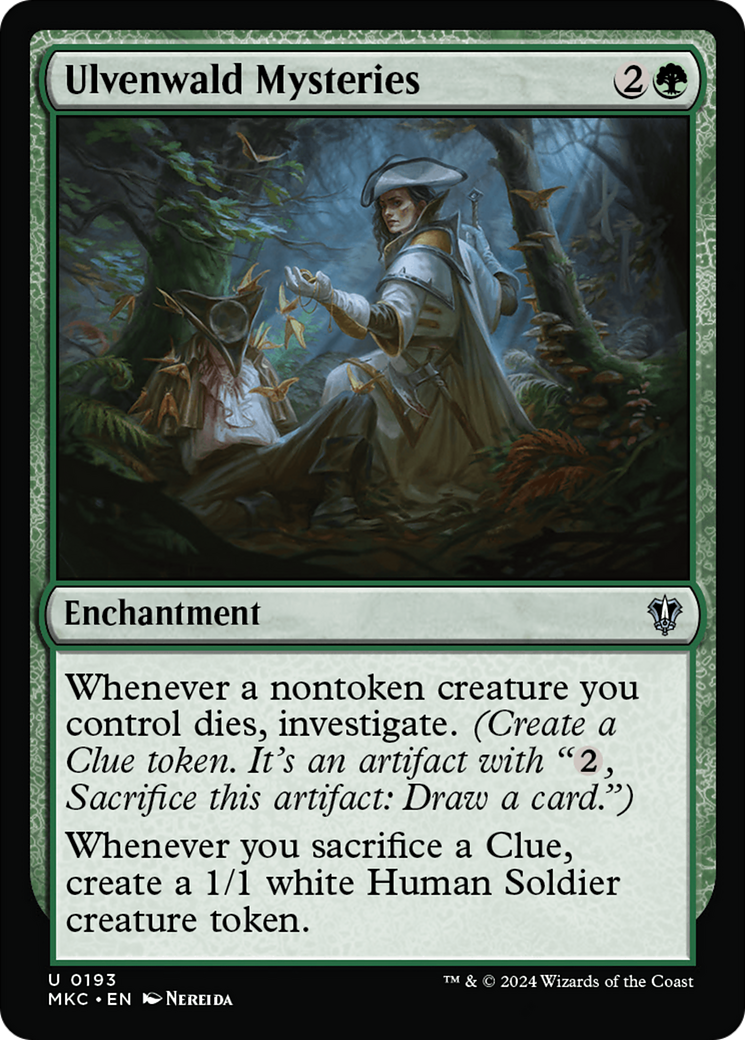
Ulvenwald Mysteries
Ulvenwald Mysteries
Enchantment
Whenever a nontoken creature you control dies, investigate. (Create a Clue token. It's an artifact with " , Sacrifice this token: Draw a card.")
Whenever you sacrifice a Clue, create a 1/1 white Human Soldier creature token.
- If a nontoken creature dies at the same time as Ulvenwald Mysteries leaves the battlefield, the first ability triggers. Similarly, if Ulvenwald Mysteries isn’t a token and has become a creature, it dying will cause its own first ability to trigger.
- The last ability is a triggered ability, not an activated ability. It doesn’t allow you to sacrifice a Clue whenever you want; rather, you need some other way of sacrificing it, such as the activated ability that Clue tokens have.
- If you sacrifice a Clue as part of casting a spell or activating an ability, the last ability will resolve before that spell or ability.
-
1
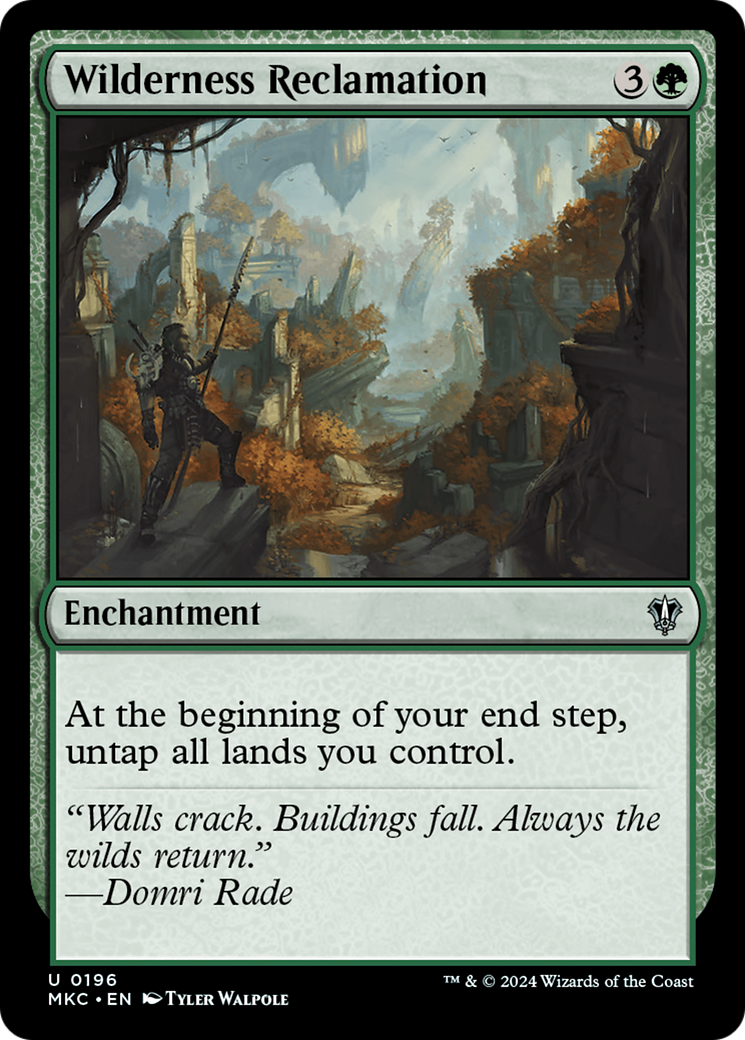
Wilderness Reclamation
Wilderness Reclamation
Enchantment
At the beginning of your end step, untap all lands you control.
Lands 37
-
1
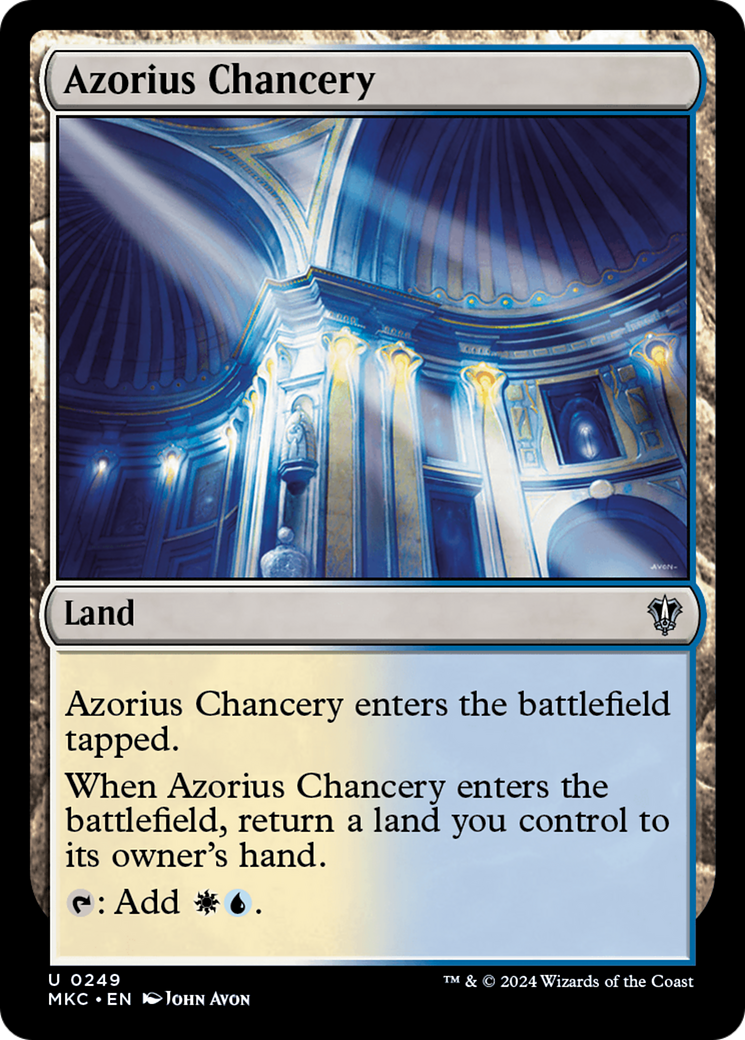
Azorius Chancery
Azorius Chancery
Land
This land enters tapped.
When this land enters, return a land you control to its owner's hand.
: Add .
- If this land enters the battlefield and you control no other lands, its ability will force you to return it to your hand.
-
1
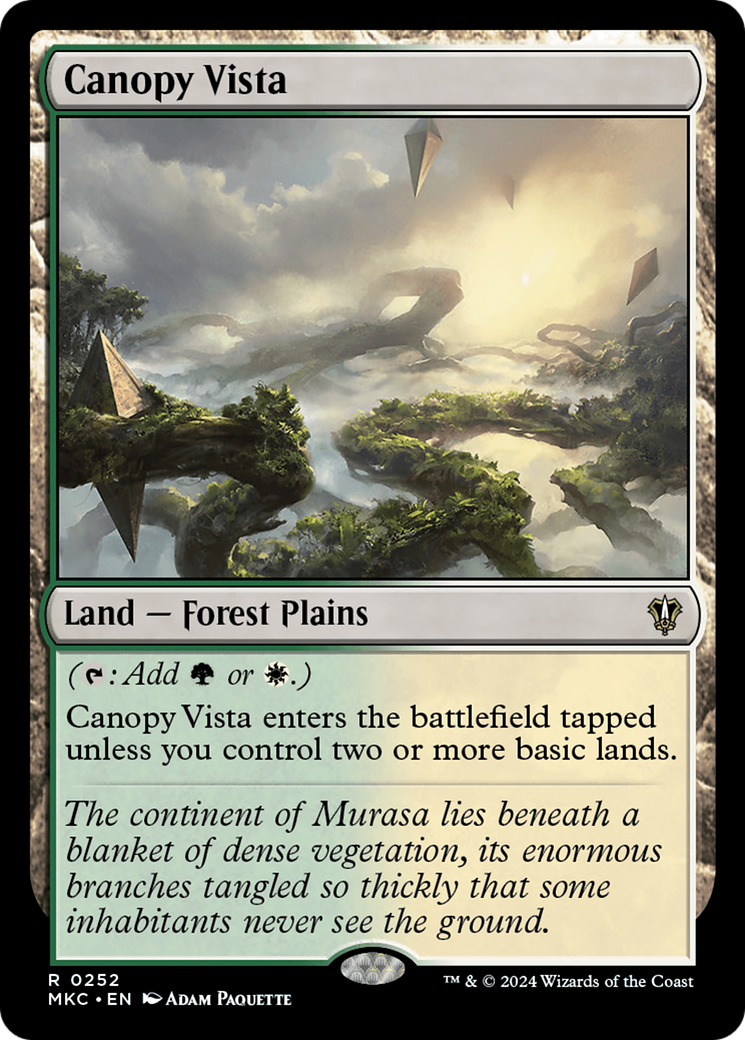
Canopy Vista
Canopy Vista
Land — Forest Plains
( : Add or .)
This land enters tapped unless you control two or more basic lands.
- Even though these lands have basic land types, they are not basic lands because "basic" doesn't appear on their type line. Notably, controlling two or more of them won't allow others to enter the battlefield untapped.
- If one of these lands enters the battlefield at the same time as any number of basic lands, those other lands are not counted when determining if this land enters the battlefield tapped or untapped.
- However, because these cards have basic land types, effects that specify a basic land type without also specifying that the land be basic can affect them. For example, a spell or ability that reads "Destroy target Forest" can target Canopy Vista, while one that reads "Destroy target basic Forest" cannot.
-
1
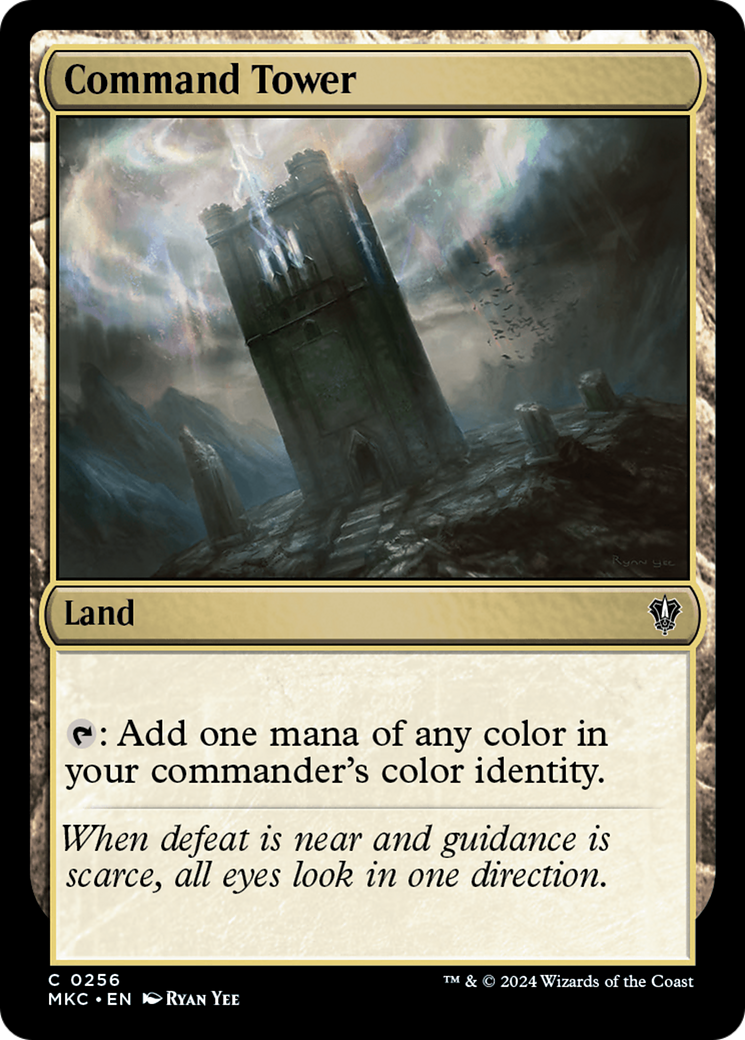
Command Tower
Command Tower
Land
: Add one mana of any color in your commander's color identity.
- If you don't have a commander, Command Tower's ability produces no mana.
- If your commander is a card that has no colors in its color identity, Command Tower's ability produces no mana. It doesn't produce .
- If you have two commanders, the ability adds one mana of any color in their combined color identities.
-
1
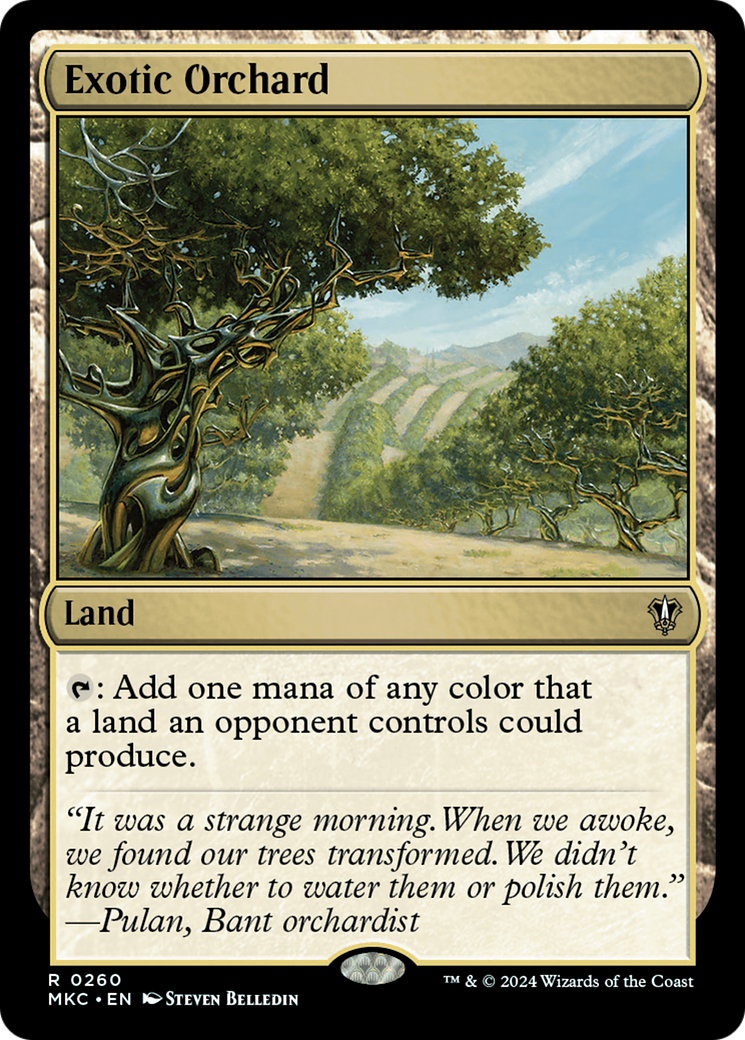
Exotic Orchard
Exotic Orchard
Land
: Add one mana of any color that a land an opponent controls could produce.
- Lands that produce mana based only on what other lands "could produce" won't help each other unless some other land allows one of them to actually produce some type of mana. For example, if you control an Exotic Orchard and your opponent controls an Exotic Orchard and a Reflecting Pool, none of those lands would produce mana if their mana abilities were activated. On the other hand, if you control a Forest and an Exotic Orchard, and your opponent controls an Exotic Orchard and a Reflecting Pool, then each of those lands can be tapped to produce . Your opponent's Exotic Orchard can produce because you control a Forest. Your Exotic Orchard and your opponent's Reflecting Pool can each produce because your opponent's Exotic Orchard can produce .
- When determining what colors of mana your opponents' lands could produce, Exotic Orchard takes into account any applicable replacement effects that would apply to those lands' mana abilities (such as Contamination's effect, for example). If there are more than one, consider them in any possible order.
- The colors of mana are white, blue, black, red, and green. Exotic Orchard can't be tapped for colorless mana, even if a land an opponent controls could produce colorless mana.
- Exotic Orchard doesn't care about any restrictions or riders your opponents' lands (such as Ancient Ziggurat or Hall of the Bandit Lord) put on the mana they produce. It just cares about colors of mana.
- Exotic Orchard checks the effects of all mana-producing abilities of lands your opponents control, but it doesn't check their costs. For example, Vivid Crag has the ability " , Remove a charge counter from Vivid Crag: Add one mana of any color." If an opponent controls Vivid Crag and you control Exotic Orchard, you can tap Exotic Orchard for any color of mana. It doesn't matter whether Vivid Crag has a charge counter on it, and it doesn't matter whether it's untapped.
-
5
Forest
Forest
Basic Land — Forest
( : Add .)
-
1
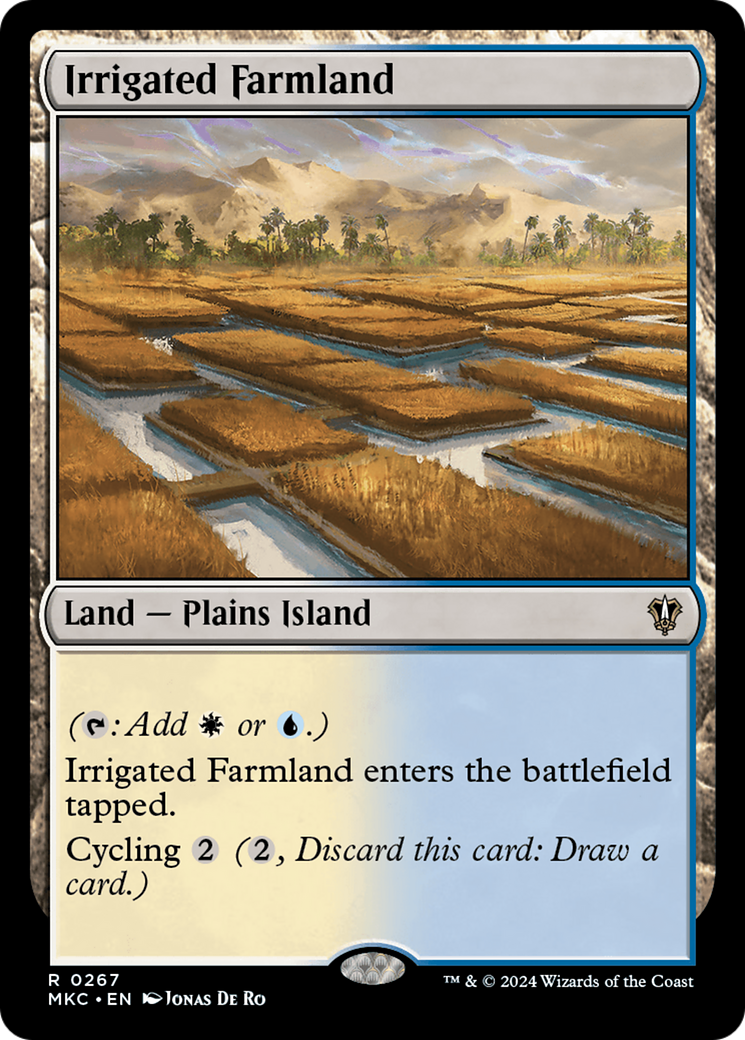
Irrigated Farmland
Irrigated Farmland
Land — Plains Island
( : Add or .)
This land enters tapped.
Cycling ( , Discard this card: Draw a card.)
-
6
Island
Island
Basic Land — Island
( : Add .)
-
1
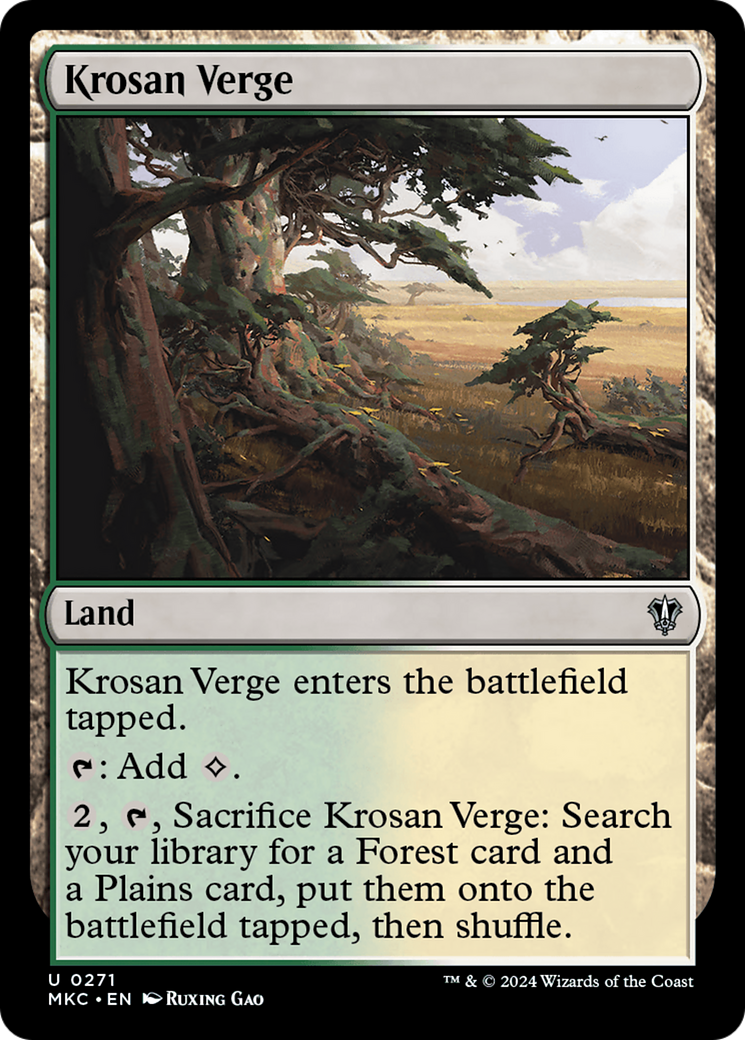
Krosan Verge
Krosan Verge
Land
This land enters tapped.
: Add .
, , Sacrifice this land: Search your library for a Forest card and a Plains card, put them onto the battlefield tapped, then shuffle.
-
1
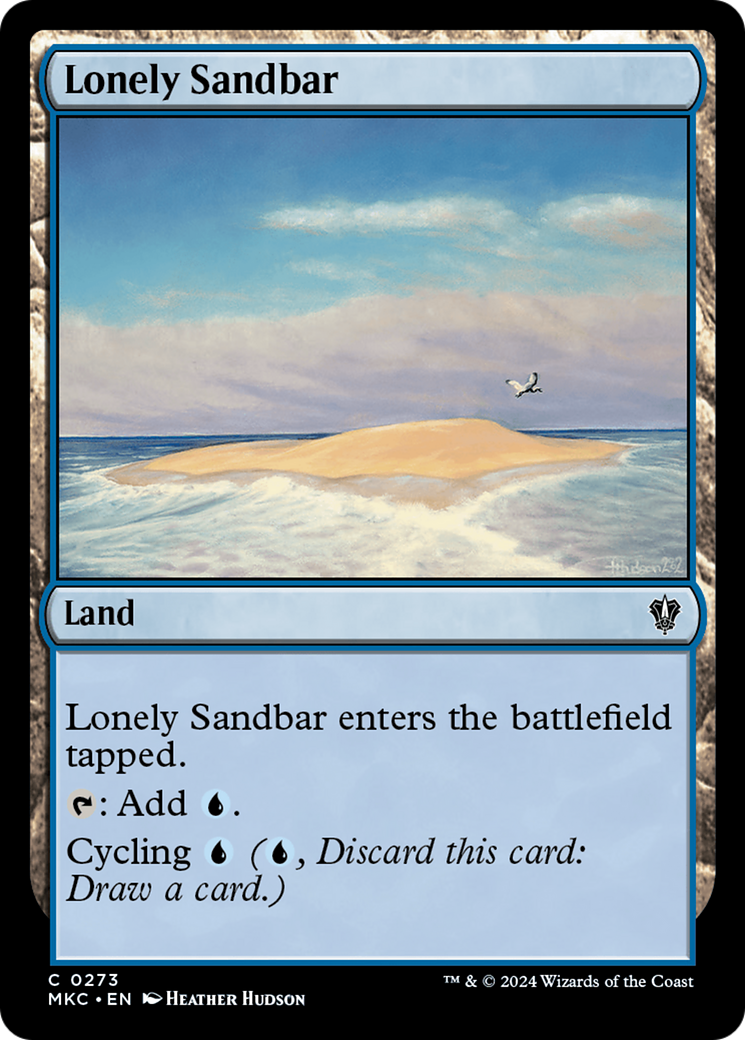
Lonely Sandbar
Lonely Sandbar
Land
This land enters tapped.
: Add .
Cycling ( , Discard this card: Draw a card.)
-
1
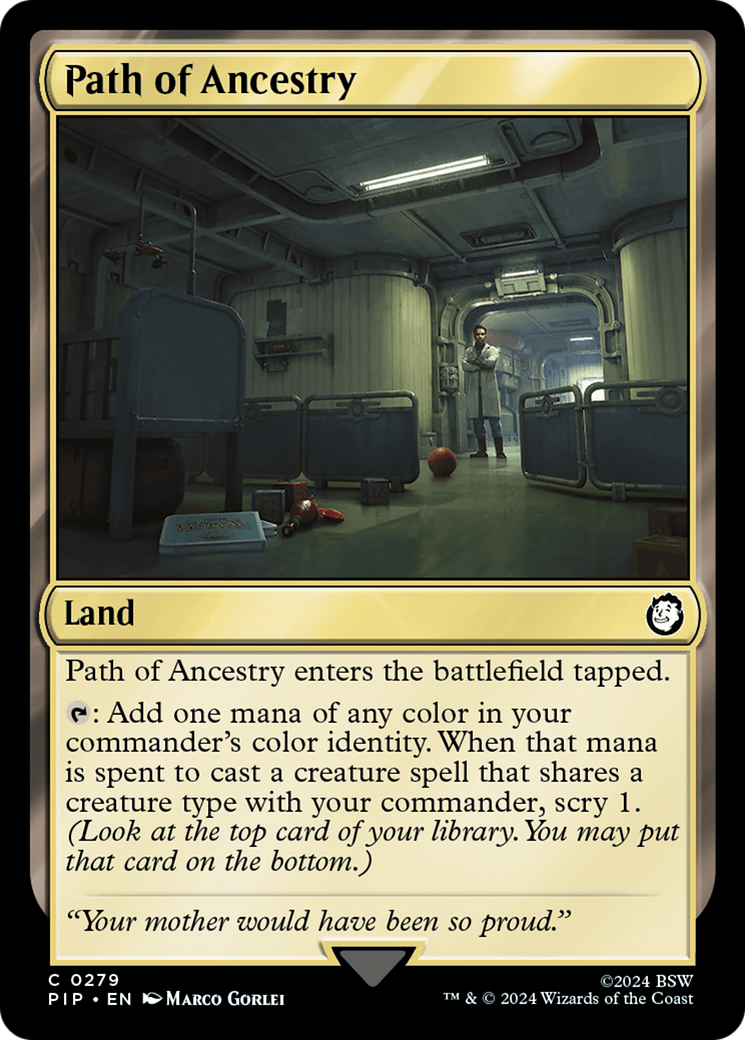
Path of Ancestry
Path of Ancestry
Land
This land enters tapped.
: Add one mana of any color in your commander's color identity. When that mana is spent to cast a creature spell that shares a creature type with your commander, scry 1. (Look at the top card of your library. You may put that card on the bottom.)
- Your commander's creature types are checked immediately after you cast a creature spell spending mana from Path of Ancestry's last ability. They aren't set before the game begins, and they may not be the same types your commander had when you activated that ability.
- If you have two commanders, the last ability adds one mana of any color in their combined color identities. When you spend that mana on a creature spell that shares a creature type with either of your commanders, you'll scry 1.
- If Path of Ancestry's last ability produces two mana (most likely due to Mana Reflection), spending those two mana to cast creature spells that share a creature type with your commander will cause two abilities to trigger. Each of those abilities will cause you to scry 1. You won't scry 2. This is true whether you spend the mana on one creature spell or two.
- If your commander has no creature types, it can't share a creature type with any spell that you cast.
- If you cast your commander with mana from Path of Ancestry, and your commander hasn't somehow lost all of its creature types while on the stack, you'll scry 1.
- If you don't have a commander, Path of Ancestry's ability produces no mana.
- If your commander is a card that has no colors in its color identity, Path of Ancestry's ability produces no mana. It doesn't produce .
-
3
Plains
Plains
Basic Land — Plains
( : Add .)
-
1
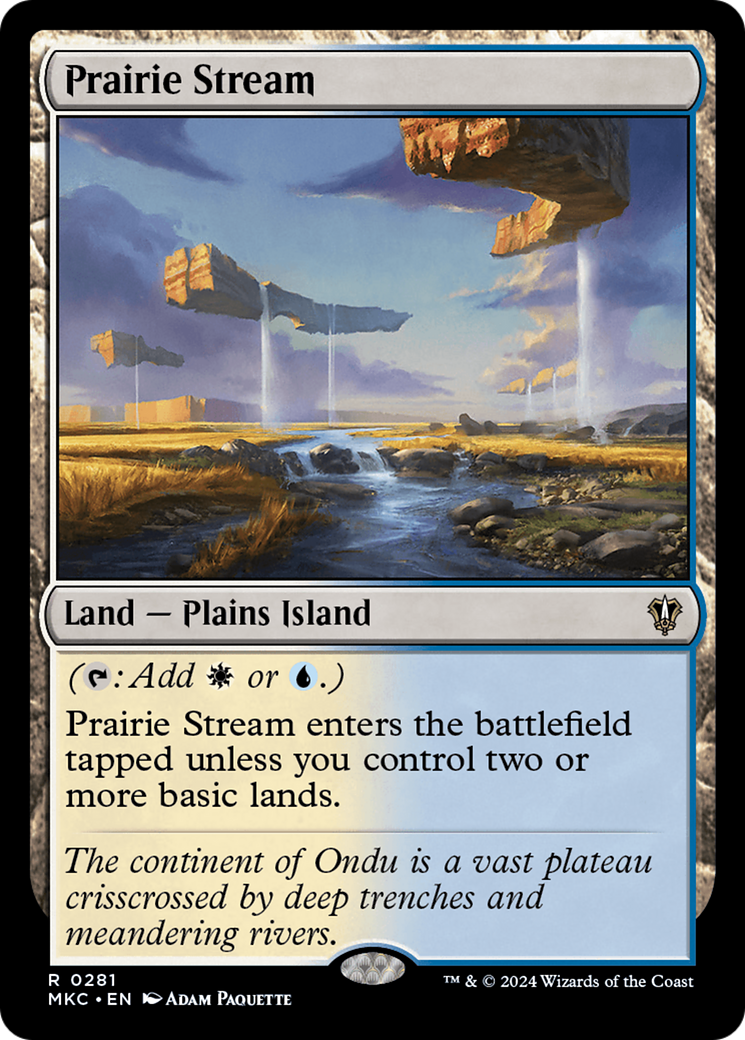
Prairie Stream
Prairie Stream
Land — Plains Island
( : Add or .)
This land enters tapped unless you control two or more basic lands.
- Even though these lands have basic land types, they are not basic lands because "basic" doesn't appear on their type line. Notably, controlling two or more of them won't allow others to enter the battlefield untapped.
- However, because these cards have basic land types, effects that specify a basic land type without also specifying that the land be basic can affect them. For example, a spell or ability that reads "Destroy target Forest" can target Canopy Vista, while one that reads "Destroy target basic Forest" cannot.
- If one of these lands enters the battlefield at the same time as any number of basic lands, those other lands are not counted when determining if this land enters the battlefield tapped or untapped.
-
1
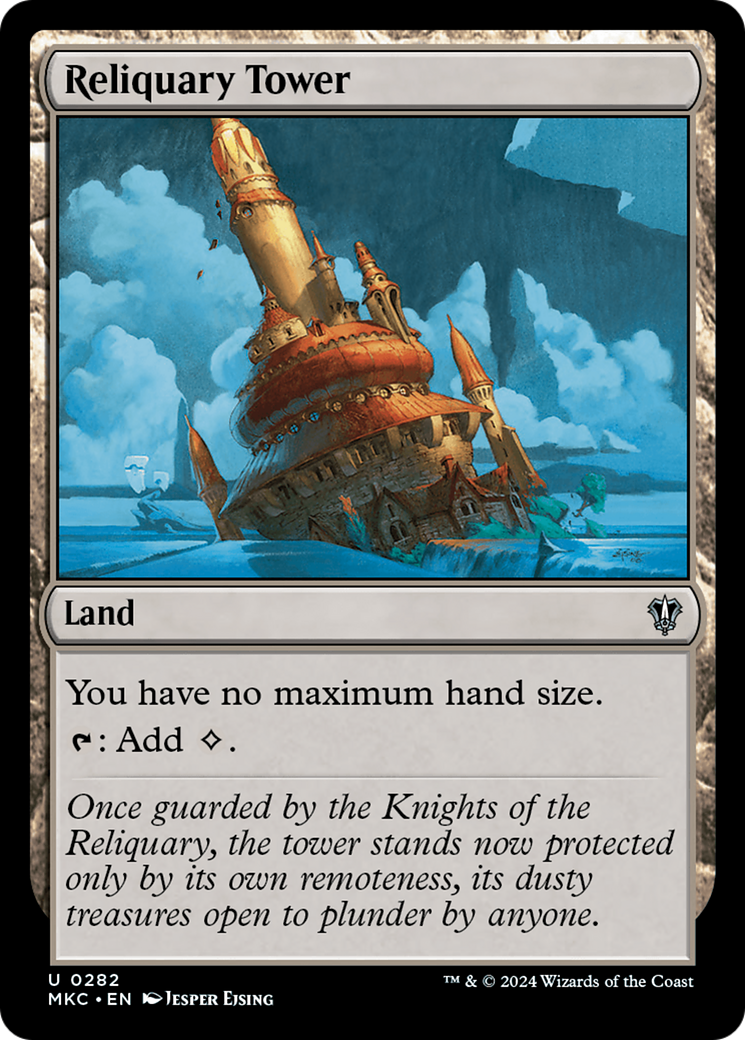
Reliquary Tower
Reliquary Tower
Land
You have no maximum hand size.
: Add .
- If multiple effects modify your hand size, apply them in timestamp order. For example, if you put Null Profusion (an enchantment that says your maximum hand size is two) onto the battlefield and then put Reliquary Tower onto the battlefield, you'll have no maximum hand size. However, if those permanents enter in the opposite order, your maximum hand size would be two.
-
1
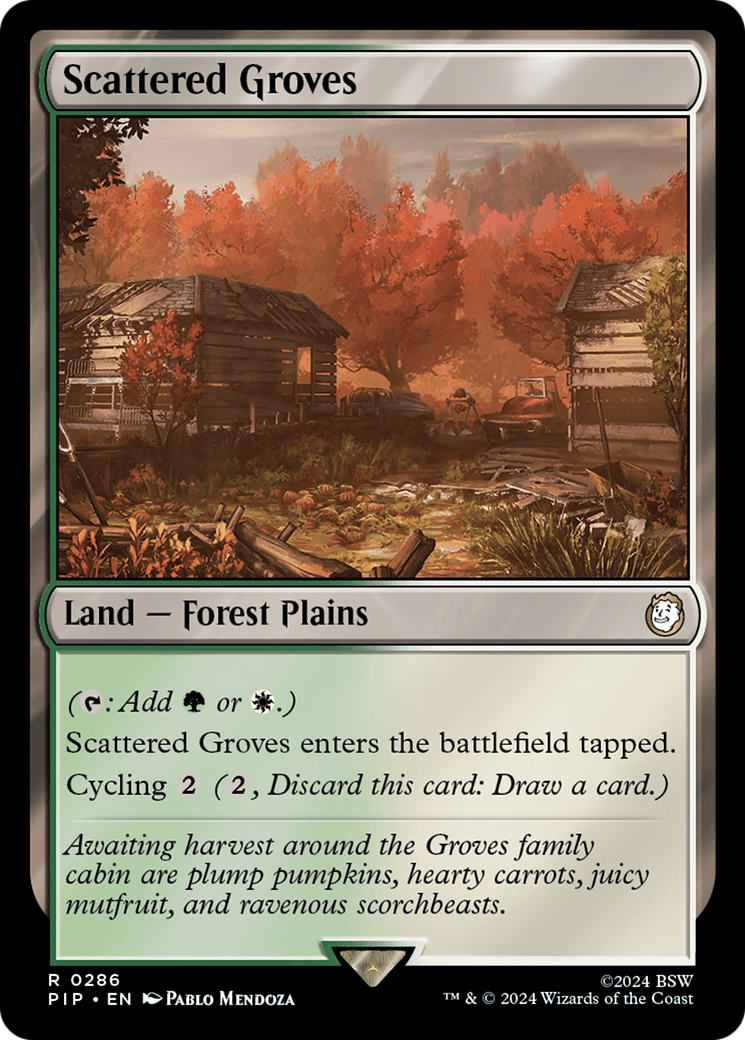
Scattered Groves
Scattered Groves
Land — Forest Plains
( : Add or .)
This land enters tapped.
Cycling ( , Discard this card: Draw a card.)
-
1
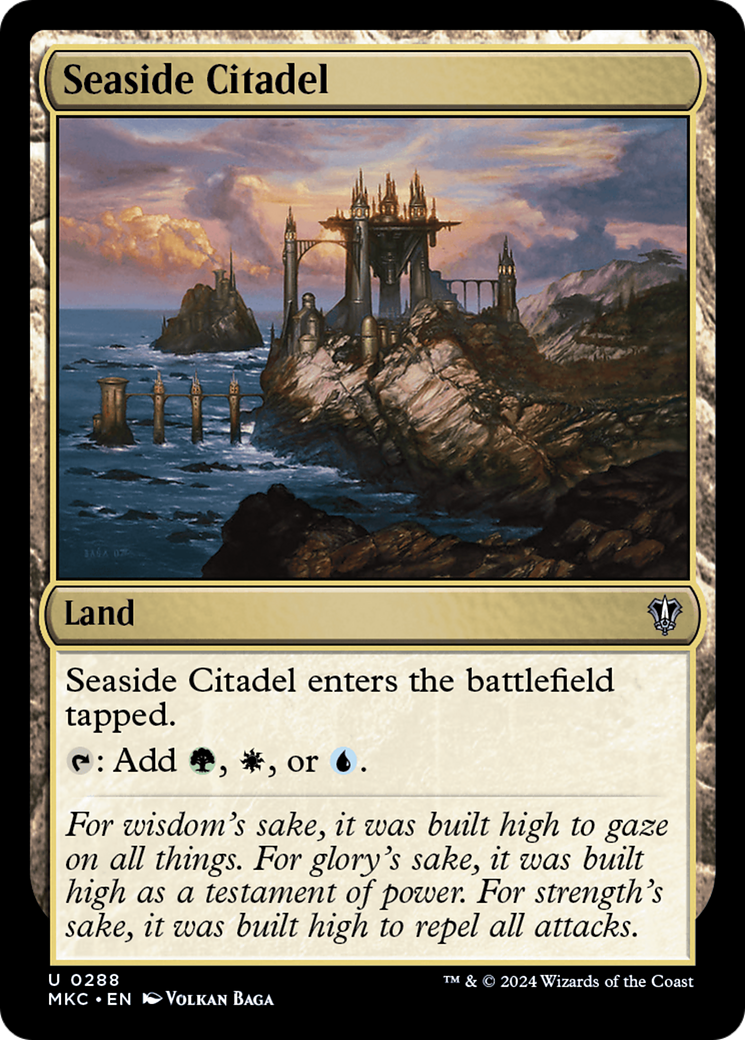
Seaside Citadel
Seaside Citadel
Land
This land enters tapped.
: Add , , or .
-
1
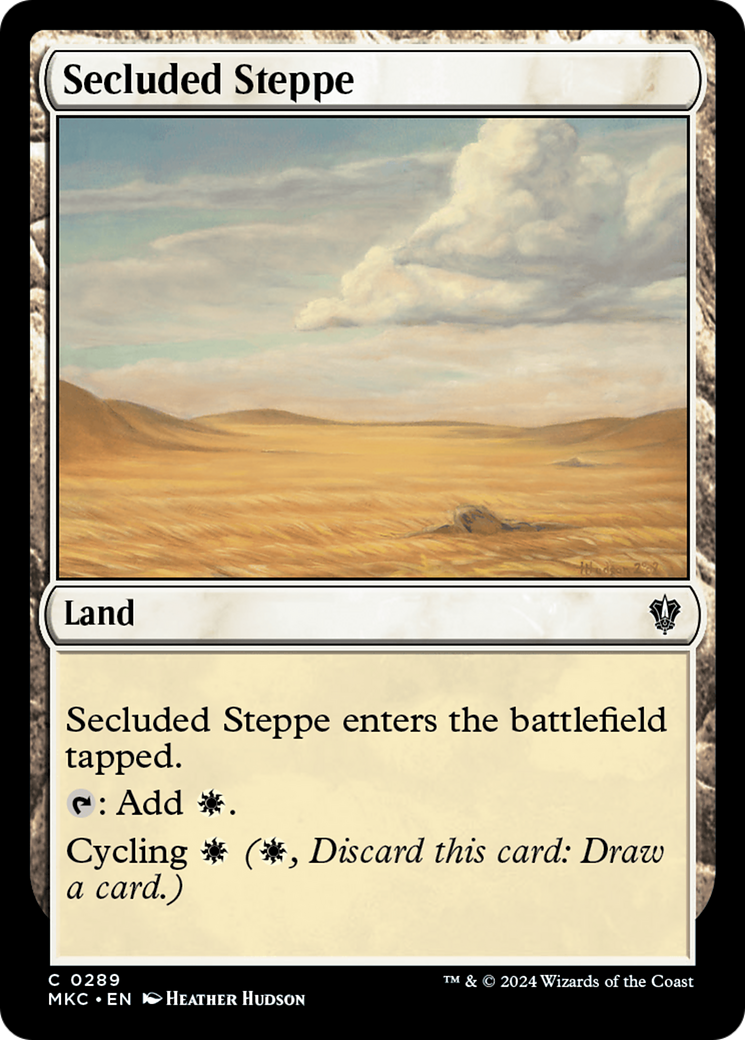
Secluded Steppe
Secluded Steppe
Land
This land enters tapped.
: Add .
Cycling ( , Discard this card: Draw a card.)
-
1
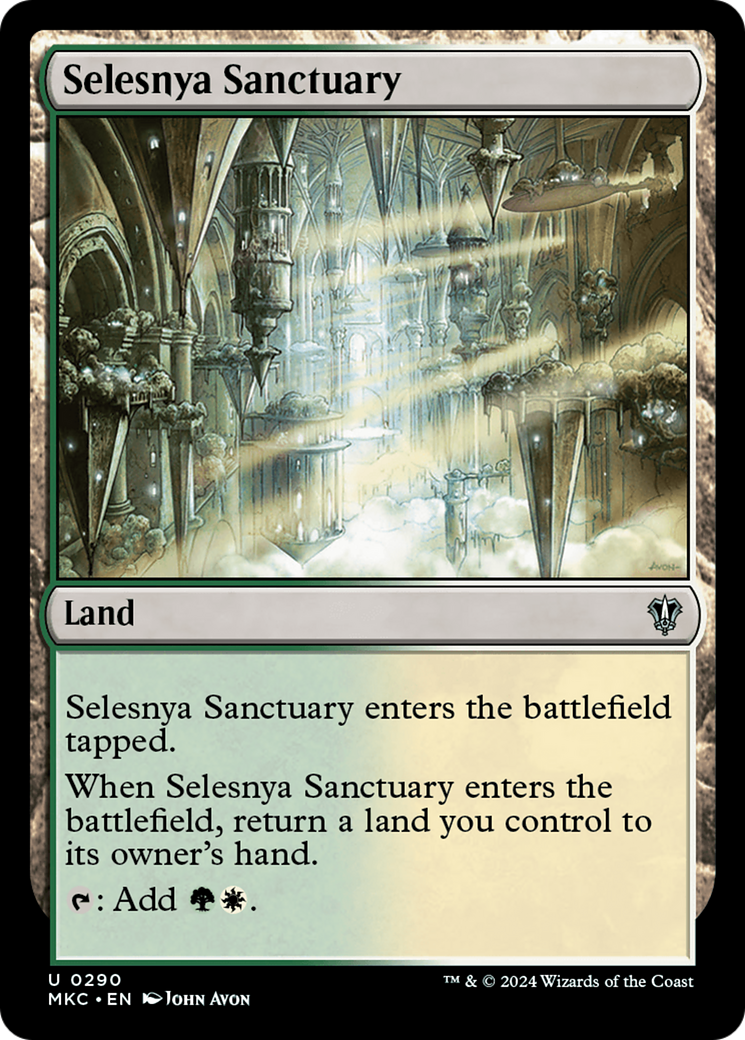
Selesnya Sanctuary
Selesnya Sanctuary
Land
This land enters tapped.
When this land enters, return a land you control to its owner's hand.
: Add .
- If this land enters the battlefield and you control no other lands, its ability will force you to return it to your hand.
-
1
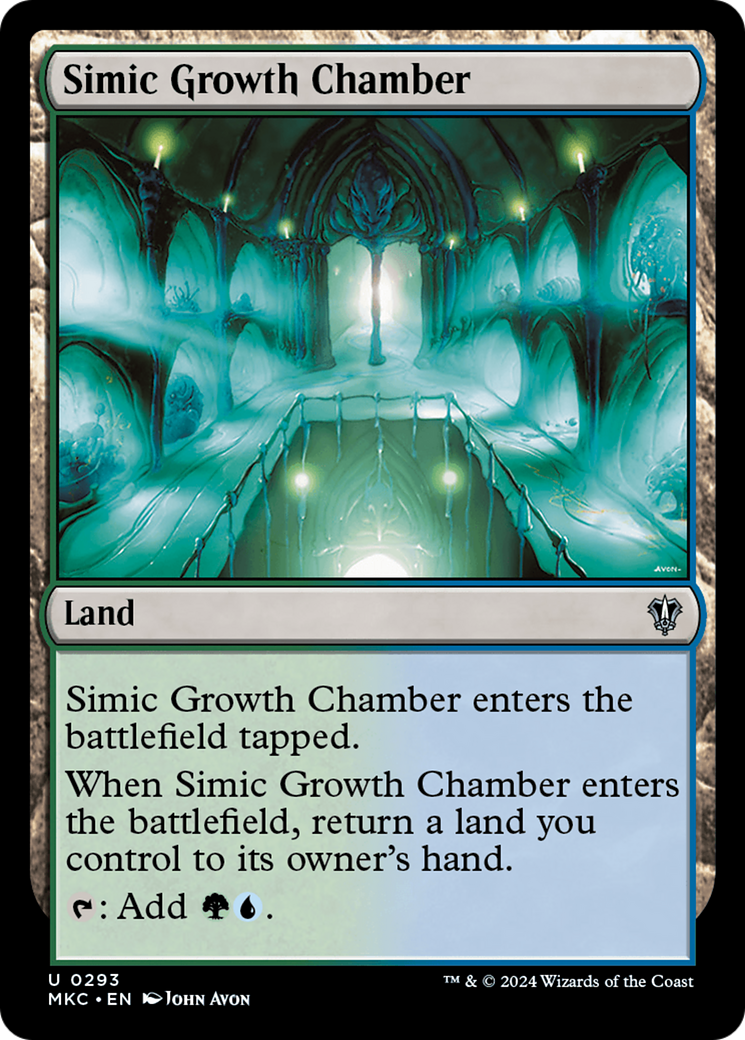
Simic Growth Chamber
Simic Growth Chamber
Land
This land enters tapped.
When this land enters, return a land you control to its owner's hand.
: Add .
- If this land enters the battlefield and you control no other lands, its ability will force you to return it to your hand.
-
1
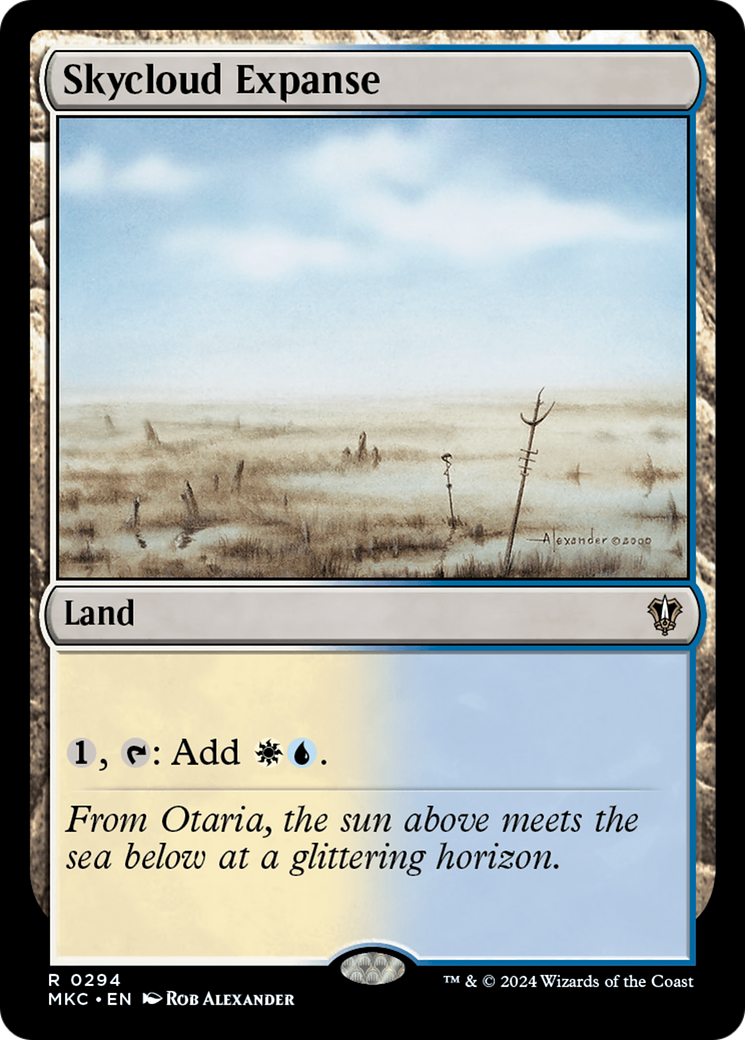
Skycloud Expanse
Skycloud Expanse
Land
, : Add .
-
1
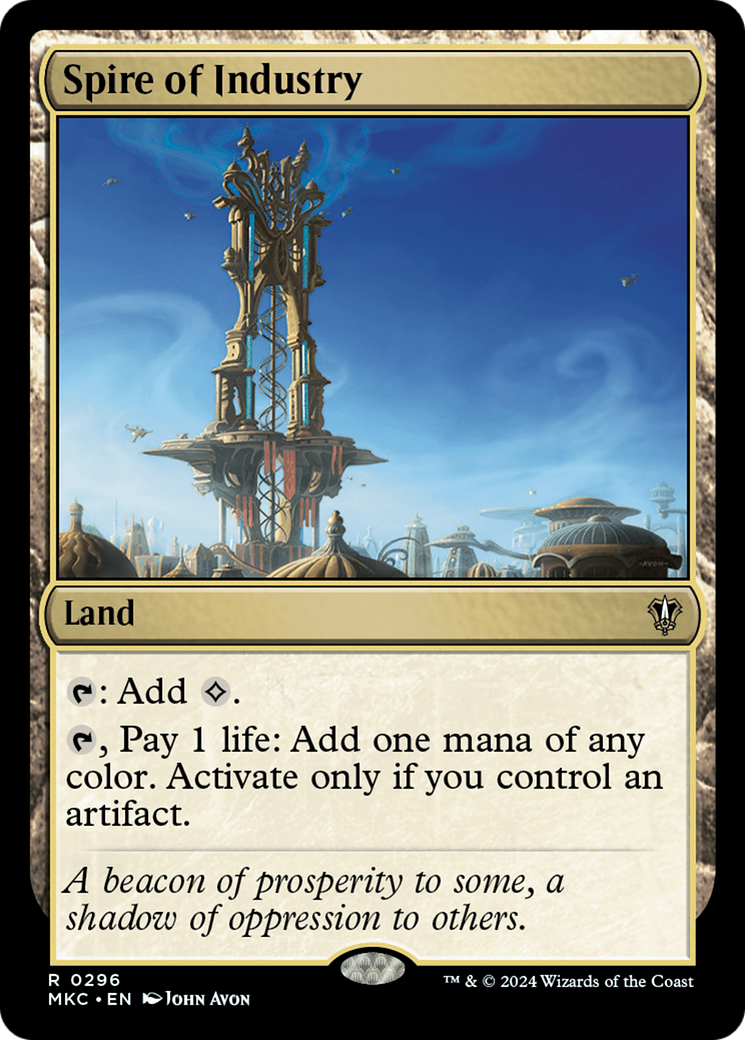
Spire of Industry
Spire of Industry
Land
: Add .
, Pay 1 life: Add one mana of any color. Activate only if you control an artifact.
-
1
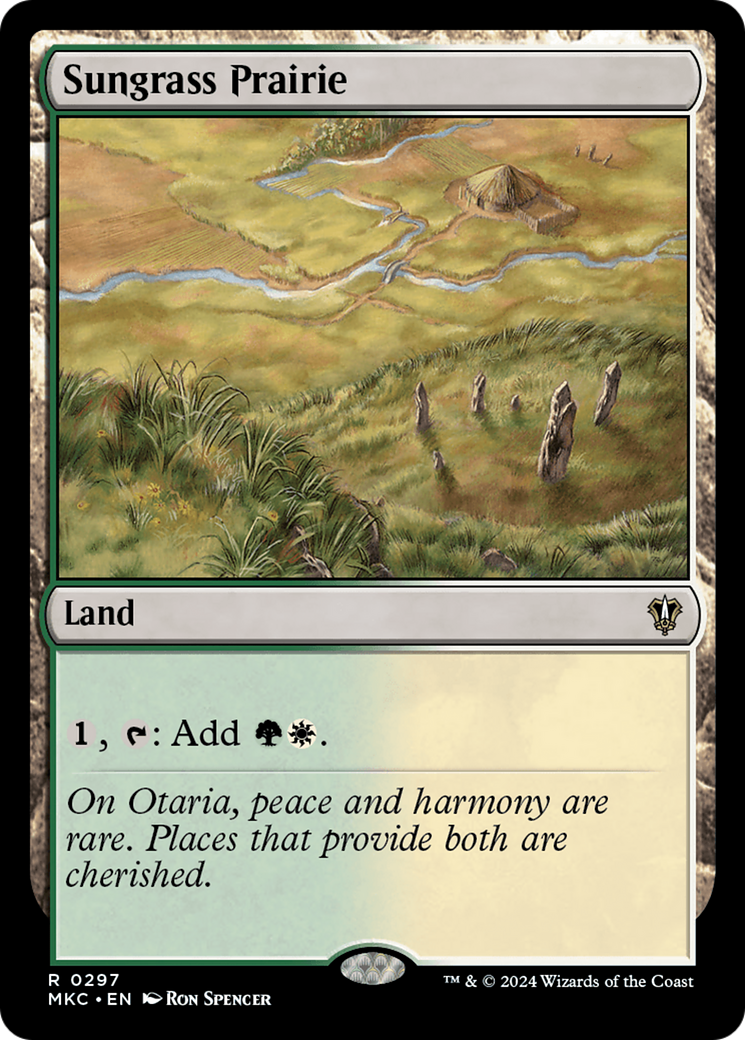
Sungrass Prairie
Sungrass Prairie
Land
, : Add .
-
1
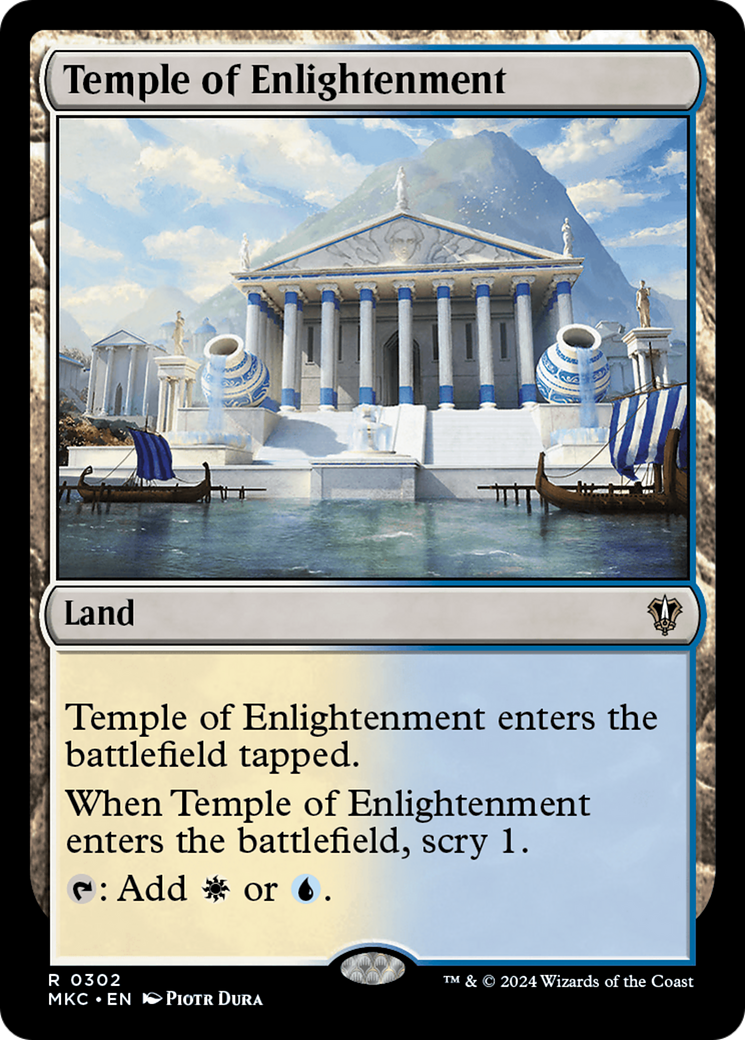
Temple of Enlightenment
Temple of Enlightenment
Land
This land enters tapped.
When this land enters, scry 1. (Look at the top card of your library. You may put that card on the bottom.)
: Add or .
- When you scry, you may put all the cards you look at back on top of your library, you may put all of those cards on the bottom of your library, or you may put some of those cards on top and the rest of them on the bottom.
- You choose how to order cards returned to your library after scrying no matter where you put them.
- You perform the actions stated on a card in sequence. For some spells and abilities, that means you'll scry last. For others, that means you'll scry and then perform other actions.
- Scry appears on some spells and abilities with one or more targets. If all of the spell or ability's targets are illegal when it tries to resolve, it won't resolve and none of its effects will happen. You won't scry.
-
1
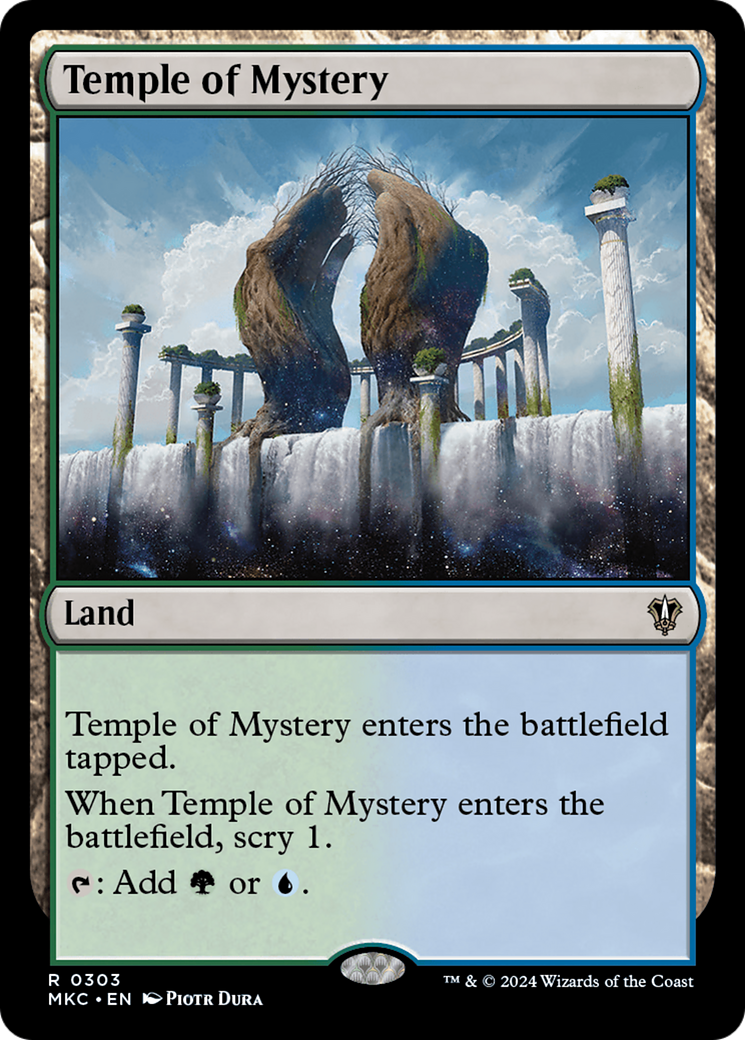
Temple of Mystery
Temple of Mystery
Land
This land enters tapped.
When this land enters, scry 1. (Look at the top card of your library. You may put that card on the bottom.)
: Add or .
- When you scry, you may put all the cards you look at back on top of your library, you may put all of those cards on the bottom of your library, or you may put some of those cards on top and the rest of them on the bottom.
- You choose how to order cards returned to your library after scrying no matter where you put them.
- You perform the actions stated on a card in sequence. For some spells and abilities, that means you'll scry last. For others, that means you'll scry and then perform other actions.
- Scry appears on some spells and abilities with one or more targets. If all of the spell or ability's targets are illegal when it tries to resolve, it won't resolve and none of its effects will happen. You won't scry.
-
1
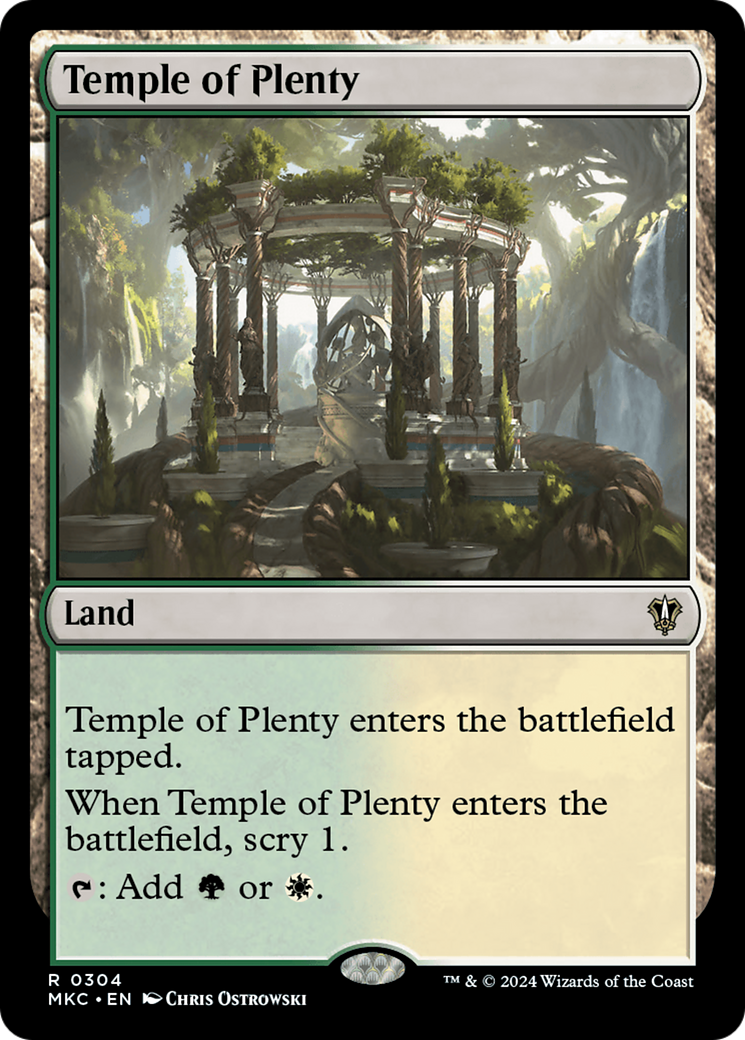
Temple of Plenty
Temple of Plenty
Land
This land enters tapped.
When this land enters, scry 1. (Look at the top card of your library. You may put that card on the bottom.)
: Add or .
- You perform the actions stated on a card in sequence. For some spells and abilities, that means you'll scry last. For others, that means you'll scry and then perform other actions.
- You choose how to order cards returned to your library after scrying no matter where you put them.
- When you scry, you may put all the cards you look at back on top of your library, you may put all of those cards on the bottom of your library, or you may put some of those cards on top and the rest of them on the bottom.
- Scry appears on some spells and abilities with one or more targets. If all of the spell or ability's targets are illegal when it tries to resolve, it won't resolve and none of its effects will happen. You won't scry.
-
1
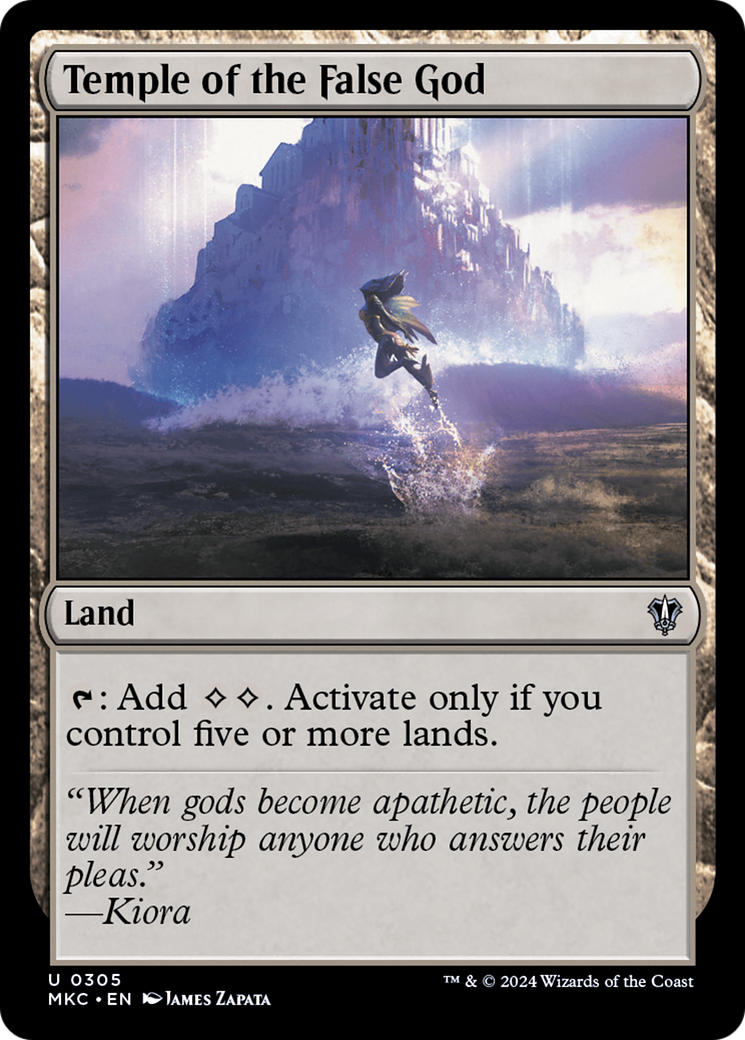
Temple of the False God
Temple of the False God
Land
: Add . Activate only if you control five or more lands.
-
1
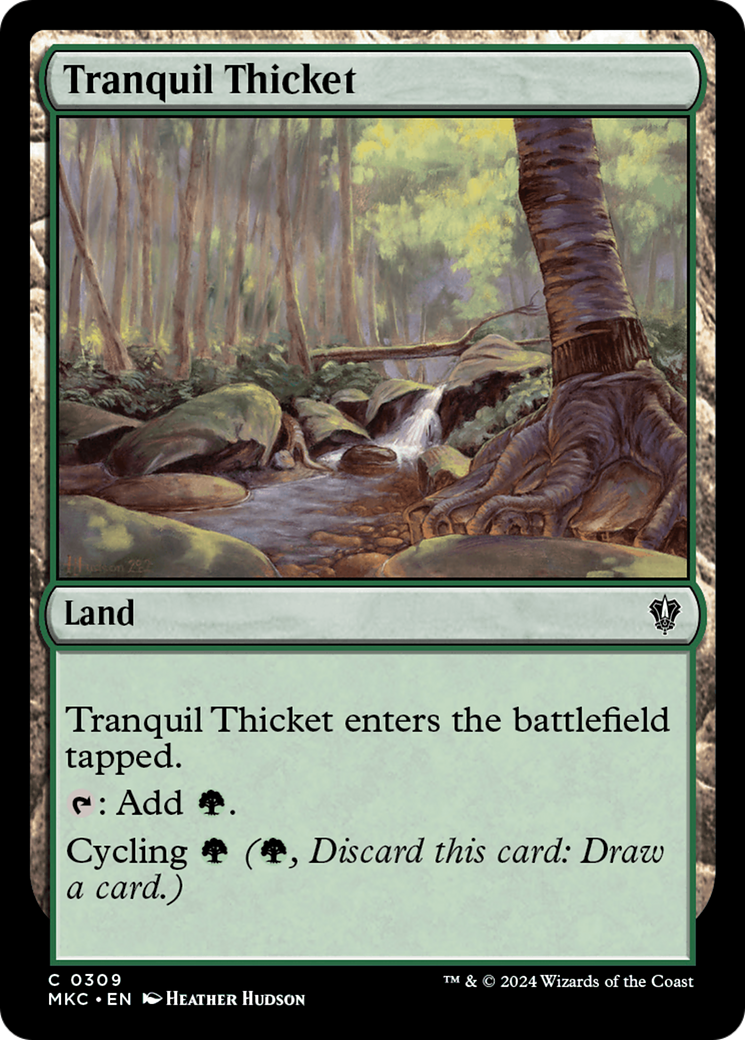
Tranquil Thicket
Tranquil Thicket
Land
This land enters tapped.
: Add .
Cycling ( , Discard this card: Draw a card.)
White 10
-
1
Aerial Extortionist
Aerial Extortionist
Creature — Bird Soldier
4/3
Flying
Whenever this creature enters or deals combat damage to a player, exile up to one target nonland permanent. For as long as that card remains exiled, its owner may cast it.
Whenever another player casts a spell from anywhere other than their hand, draw a card.
-
1
Armed with Proof
Armed with Proof
Enchantment
When this enchantment enters, investigate twice. (To investigate, create a Clue token. It's an artifact with " , Sacrifice this token: Draw a card.")
Clues you control are Equipment in addition to their other types and have "Equipped creature gets +2/+0" and equip .
- Clues stop being Equipment if Armed with Proof leaves the battlefield. If any of them are attached to creatures at that time, they become unattached.
- If you control more than one Armed with Proof, creatures equipped with Clue Equipment will get +2/+0 for each Armed with Proof you control. The equip cost is still .
- An Equipment without reconfigure that's also a creature can't be attached to anything. You can activate its equip ability, but it won't become attached. For example, if you control both Red Herring and Armed with Proof, Red Herring will be an Artifact Creature – Clue Equipment Fish with "Equipped creature gets +2/+0" and equip , but activating its equip ability won't result in it becoming attached to the target creature.
- Clue is an artifact type. Even though it appears on some cards with other permanent types, it's never a creature type, a land type, or anything but an artifact type.
- If an effect refers to a Clue, it means any Clue artifact, not just a Clue artifact token. For example, you can sacrifice Wrench to pay for Alquist Proft, Master Sleuth's activated ability.
- You can't sacrifice a Clue to pay multiple costs. For example, you can't sacrifice a Clue token to activate its own ability and also to activate Alquist Proft, Master Sleuth's ability.
- Some spells and abilities that investigate may require targets. If each target chosen is an illegal target as that spell or ability tries to resolve, it won't resolve. You won't create any Clue tokens.
- Some abilities trigger "whenever you sacrifice a Clue". Those abilities trigger whenever you sacrifice a Clue for any reason, not just to activate a Clue's activated ability.
-
1
Bennie Bracks, Zoologist
Bennie Bracks, Zoologist
Legendary Creature — Elf Druid
3/2
Convoke (Your creatures can help cast this spell. Each creature you tap while casting this spell pays for or one mana of that creature's color.)
At the beginning of each end step, if you created a token this turn, draw a card.
- You can tap any untapped creature you control to convoke a spell, even one you haven't controlled continuously since the beginning of your most recent turn.
- Tapping an untapped creature that's attacking or blocking to convoke a spell won't cause that creature to stop attacking or blocking.
- When calculating a spell's total cost, include any alternative costs, additional costs, or anything else that increases or reduces the cost to cast the spell. Convoke applies after the total cost is calculated. Convoke doesn't change a spell's mana cost or mana value.
- If a creature you control has a mana ability with in the cost, activating that ability while casting a spell with convoke will result in the creature being tapped before you pay the spell's costs. You won't be able to tap it again for convoke. Similarly, if you sacrifice a creature to activate a mana ability while casting a spell with convoke, that creature won't be on the battlefield when you pay the spell's costs, so you won't be able to tap it for convoke.
- Because convoke isn't an alternative cost, it can be used in conjunction with alternative costs.
- Tapping a multicolored creature using convoke will pay for or one mana of your choice of any of that creature's colors.
-
1
Farewell
Farewell
Sorcery
Choose one or more —
- Exile all artifacts.
- Exile all creatures.
- Exile all enchantments.
- Exile all graveyards.
- If you choose more than one mode for Farewell, you perform the actions in the order written.
-
1
Fumigate
Fumigate
Sorcery
Destroy all creatures. You gain 1 life for each creature destroyed this way.
- Creatures destroyed this way count toward the life gained even if they're put into a zone other than a graveyard.
- You won't gain 1 life for a creature that isn't actually destroyed, such as a creature with indestructible.
-
1
Merchant of Truth
Merchant of Truth
Creature — Angel Detective
2/5
Flying
Whenever a nontoken creature you control dies, investigate.
Clues you control have exalted. (Whenever a creature you control attacks alone, that creature gets +1/+1 until end of turn for each instance of exalted among permanents you control.)
- If Merchant of Truth dies at the same time as one or more other nontoken creatures you control, its second ability will trigger for each of those creatures.
- A creature attacks alone if it’s the only creature declared as an attacker during the declare attackers step (including creatures controlled by your teammates, if applicable). For example, exalted won’t trigger if you attack with multiple creatures and all but one of them are removed from combat. Similarly, creatures that enter the battlefield attacking later in combat won’t affect exalted abilities that have already triggered or resolved.
- If you control multiple Merchants of Truth, Clues you control will have multiple instances of exalted.
- Clue is an artifact type. Even though it appears on some cards with other permanent types, it’s never a creature type, a land type, or anything but an artifact type.
- If an effect refers to a Clue, it means any Clue artifact, not just a Clue artifact token. For example, you can sacrifice Wrench to pay for Alquist Proft, Master Sleuth’s activated ability.
- You can’t sacrifice a Clue to pay multiple costs. For example, you can’t sacrifice a Clue token to activate its own ability and also to activate Alquist Proft, Master Sleuth’s ability.
- Some spells and abilities that investigate may require targets. If each target chosen is an illegal target as that spell or ability tries to resolve, it won’t resolve. You won’t create any Clue tokens.
- Some abilities trigger “whenever you sacrifice a Clue”. Those abilities trigger whenever you sacrifice a Clue for any reason, not just to activate a Clue’s activated ability.
-
1
Organic Extinction
Organic Extinction
Sorcery
Improvise (Your artifacts can help cast this spell. Each artifact you tap after you're done activating mana abilities pays for .)
Destroy all nonartifact creatures.
-
1
Search the Premises
Search the Premises
Enchantment
Whenever a creature attacks you or a planeswalker you control, investigate. (Create a Clue token. It's an artifact with " , Sacrifice this token: Draw a card.")
-
1
Serene Sleuth
Serene Sleuth
Creature — Human Detective
2/2
When this creature enters, investigate. (Create a Clue token. It's an artifact with " , Sacrifice this token: Draw a card.")
At the beginning of combat on your turn, investigate for each goaded creature you control. Then each creature you control is no longer goaded.
- Clue is an artifact type. Even though it appears on some cards with other permanent types, it's never a creature type, a land type, or anything but an artifact type.
- If an effect refers to a Clue, it means any Clue artifact, not just a Clue artifact token. For example, you can sacrifice Wrench to pay for Alquist Proft, Master Sleuth's activated ability.
- You can't sacrifice a Clue to pay multiple costs. For example, you can't sacrifice a Clue token to activate its own ability and also to activate Alquist Proft, Master Sleuth's ability.
- Some spells and abilities that investigate may require targets. If each target chosen is an illegal target as that spell or ability tries to resolve, it won't resolve. You won't create any Clue tokens.
- Some abilities trigger "whenever you sacrifice a Clue". Those abilities trigger whenever you sacrifice a Clue for any reason, not just to activate a Clue's activated ability.
-
1
Swords to Plowshares
Swords to Plowshares
Instant
Exile target creature. Its controller gains life equal to its power.
- Use the power of the creature from when it was last on the battlefield to determine how much life is gained.
Blue 18
-
1
Alandra, Sky Dreamer
Alandra, Sky Dreamer
Legendary Creature — Merfolk Wizard
2/4
Whenever you draw your second card each turn, create a 2/2 blue Drake creature token with flying.
Whenever you draw your fifth card each turn, Alandra and Drakes you control each get +X/+X until end of turn, where X is the number of cards in your hand.
- The first triggered ability can trigger only once each turn. It doesn't matter whether Alandra, Sky Dreamer was on the battlefield when the first card was drawn. If it's not on the battlefield when the second card is drawn, the ability can't trigger at all that turn. It won't trigger when the third or fourth card is drawn.
- The same is true for the last ability and the fifth card drawn.
- The value of X is locked in as the last ability resolves. The bonus it grants won't change after that point, even if the number of cards in your hand does.
-
1
Confirm Suspicions
Confirm Suspicions
Instant
Counter target spell.
Investigate three times. (To investigate, create a Clue token. It's an artifact with " , Sacrifice this token: Draw a card.")
- Clue is an artifact type. Even though it appears on some cards with other permanent types, it's never a creature type, a land type, or anything but an artifact type.
- If an effect refers to a Clue, it means any Clue artifact, not just a Clue artifact token. For example, you can sacrifice Wrench to pay for Alquist Proft, Master Sleuth's activated ability.
- You can't sacrifice a Clue to pay multiple costs. For example, you can't sacrifice a Clue token to activate its own ability and also to activate Alquist Proft, Master Sleuth's ability.
- You can't cast a spell without choosing legal targets. If all of those targets become illegal, the spell doesn't resolve and you won't investigate.
-
1
Detective of the Month
Detective of the Month
Creature — Human Detective
2/3
Ascend (If you control ten or more permanents, you get the city's blessing for the rest of the game.)
As long as you have the city's blessing, Detectives you control can't be blocked.
Whenever you draw your second card each turn, create a 2/2 white and blue Detective creature token.
- If you cast a spell with ascend, you don't get the city’s blessing until it resolves. Players may respond to that spell by trying to change whether you get the city’s blessing.
- Once you have the city’s blessing, you have it for the rest of the game, even if you lose control of some or all your permanents. The city’s blessing isn’t a permanent itself and can’t be removed by any effect.
- A permanent is any object on the battlefield, including tokens and lands. Spells and emblems aren’t permanents.
- If you control ten permanents but don’t control a permanent or resolving spell with ascend, you don’t get the city’s blessing. For example, if you control ten permanents, lose control of two, then cast Detective of the Month, you won’t have the city’s blessing.
- If your tenth permanent enters the battlefield and then a permanent leaves the battlefield immediately afterwards (most likely due to the “legend rule” or due to being a creature with 0 toughness), you get the city’s blessing before it leaves the battlefield.
- Ascend on a permanent isn’t a triggered ability and doesn’t use the stack. Players can respond to a spell that will give you your tenth permanent, but they can’t respond to you getting the city’s blessing once you control that tenth permanent. This means that if your tenth permanent is a land you play, players can’t respond before you get the city’s blessing.
- Gaining the city’s blessing after a Detective you control has become blocked won’t cause that Detective to become unblocked.
-
1
Erdwal Illuminator
Erdwal Illuminator
Creature — Spirit
1/3
Flying
Whenever you investigate for the first time each turn, investigate an additional time.
-
1
Ethereal Investigator
Ethereal Investigator
Creature — Spirit
2/3
Flying
When this creature enters, investigate X times, where X is the number of opponents you have. (To investigate, create a Clue token. It's an artifact with " , Sacrifice this token: Draw a card.")
Whenever you draw your second card each turn, create a 1/1 white Spirit creature token with flying.
-
1
Finale of Revelation
Finale of Revelation
Sorcery
Draw X cards. If X is 10 or more, instead shuffle your graveyard into your library, draw X cards, untap up to five lands, and you have no maximum hand size for the rest of the game.
Exile Finale of Revelation.
-
1
Follow the Bodies
Follow the Bodies
Sorcery
Gravestorm (When you cast this spell, copy it for each permanent put into a graveyard from the battlefield this turn.)
Investigate. (Create a Clue token. It's an artifact with " , Sacrifice this token: Draw a card.")
- Gravestorm counts all permanents put into graveyards from the battlefield this turn. It doesn't matter who controlled those permanents, who owns them, or whether or not they were tokens.
- The copies of Follow the Bodies created by its gravestorm ability are created on the stack, so they're not cast and won't cause abilities that trigger when a player casts a spell to trigger.
- A copy of a spell can be countered like any other spell, but it must be countered individually. Countering a spell with gravestorm won't affect the copies.
- The triggered ability that creates the copies can itself be countered by anything that can counter a triggered ability. If it is countered, no copies will be put onto the stack.
- Clue is an artifact type. Even though it appears on some cards with other permanent types, it's never a creature type, a land type, or anything but an artifact type.
- If an effect refers to a Clue, it means any Clue artifact, not just a Clue artifact token. For example, you can sacrifice Wrench to pay for Alquist Proft, Master Sleuth's activated ability.
- You can't sacrifice a Clue to pay multiple costs. For example, you can't sacrifice a Clue token to activate its own ability and also to activate Alquist Proft, Master Sleuth's ability.
- Some spells and abilities that investigate may require targets. If each target chosen is an illegal target as that spell or ability tries to resolve, it won't resolve. You won't create any Clue tokens.
- Some abilities trigger "whenever you sacrifice a Clue". Those abilities trigger whenever you sacrifice a Clue for any reason, not just to activate a Clue's activated ability.
-
1
Junk Winder
Junk Winder
Creature — Serpent
5/6
Affinity for tokens (This spell costs less to cast for each token you control.)
Whenever a token you control enters, tap target nonland permanent an opponent controls. It doesn't untap during its controller's next untap step.
-
1
Kappa Cannoneer
Kappa Cannoneer
Artifact Creature — Turtle Warrior
4/4
Improvise (Your artifacts can help cast this spell. Each artifact you tap after you're done activating mana abilities pays for .)
Ward
Whenever this creature or another artifact you control enters, put a +1/+1 counter on this creature and it can't be blocked this turn.
- If a player casts a spell that targets multiple permanents their opponent controls with ward, each of those ward abilities will trigger. If that player doesn't pay for all of them, the spell will be countered.
-
1
Mechanized Production
Mechanized Production
Enchantment — Aura
Enchant artifact you control
At the beginning of your upkeep, create a token that's a copy of enchanted artifact. Then if you control eight or more artifacts with the same name as one another, you win the game.
- Any abilities that trigger on the token being created won't resolve until after Mechanized Production's triggered ability has finished resolving entirely and performed its check for eight artifacts with the same name.
- The eight artifacts with the same name don't have to have the same name as the enchanted artifact. For example, you win the game if you control eight Thopter artifact creature tokens as Mechanized Production's ability resolves, even if Mechanized Production isn't attached to a Thopter.
- All eight of the permanents sharing a name must be artifacts. If you control only seven artifacts with the same name and a nonartifact permanent with that same name, you won't win the game.
- If you control eight or more artifacts that share a name while you control Mechanized Production, you won't win the game yet. You'll win the game while resolving its triggered ability during your upkeep.
- The token copies exactly what was printed on the original artifact and nothing else (unless that artifact is copying something else or is a token; see below). It doesn't copy whether that artifact is tapped or untapped, whether it has any counters on it or Auras attached to it, or any non-copy effects that have changed its types, color, or so on.
- If the copied artifact has in its mana cost, X is considered to be zero.
- If the copied artifact is copying something else (for example, if the copied artifact is a Sculpting Steel), then the token enters the battlefield as whatever that artifact copied.
- If the copied artifact is a token, the token that's created copies the original characteristics of that token as stated by the effect that created it.
- Any enters-the-battlefield abilities of the copied artifact trigger when the artifact token enters the battlefield. The artifact token also has any "this enters the battlefield with" or "as this enters the battlefield" abilities that the copied artifact has.
- If Mechanized Production and the enchanted artifact leave the battlefield simultaneously in response to the triggered ability, then the effect creates a token that's a copy of the artifact as it last existed on the battlefield.
- If the enchanted artifact leaves the battlefield in response to Mechanized Production's triggered ability but Mechanized Production does not, Mechanized Production is put into its owner's graveyard as a state-based action with no enchanted artifact. The triggered ability creates no token, but you can still win the game if you control enough artifacts with the same name.
-
1
Nadir Kraken
Nadir Kraken
Creature — Kraken
2/3
Whenever you draw a card, you may pay . If you do, put a +1/+1 counter on this creature and create a 1/1 blue Tentacle creature token.
- While resolving Nadir Kraken's ability, you can't pay multiple times to create multiple Tentacles or to give it multiple +1/+1 counters.
- You choose whether to pay after drawing the card and seeing what it is. If you draw multiple cards, you see them all before deciding how many of the resulting triggers you'll pay for.
- If Nadir Kraken leaves the battlefield after its ability has triggered, you can still pay and get a Tentacle, even though you won't put a +1/+1 counter on Nadir Kraken.
-
1
Ongoing Investigation
Ongoing Investigation
Enchantment
Whenever one or more creatures you control deal combat damage to a player, investigate. (Create a Clue token. It's an artifact with " , Sacrifice this token: Draw a card.")
, Exile a creature card from your graveyard: Investigate. You gain 2 life.
- In a Two-Headed Giant game, if you control more than one creature that can attack, you may have them attack different opponents so that Ongoing Investigation's first ability triggers twice.
- Clue is an artifact type. Even though it appears on some cards with other permanent types, it's never a creature type, a land type, or anything but an artifact type.
- If an effect refers to a Clue, it means any Clue artifact, not just a Clue artifact token. For example, you can sacrifice Wrench to pay for Alquist Proft, Master Sleuth's activated ability.
- You can't sacrifice a Clue to pay multiple costs. For example, you can't sacrifice a Clue token to activate its own ability and also to activate Alquist Proft, Master Sleuth's ability.
-
1
Shimmer Dragon
Shimmer Dragon
Creature — Dragon
5/6
Flying
As long as you control four or more artifacts, this creature has hexproof. (It can't be the target of spells or abilities your opponents control.)
Tap two untapped artifacts you control: Draw a card.
-
1
Tangletrove Kelp
Tangletrove Kelp
Artifact Creature — Clue Plant
6/6
Ward
At the beginning of each combat, other Clues you control become 6/6 Plant creatures in addition to their other types until end of turn.
, Sacrifice this creature: Draw a card.
- If a Clue you control is already a creature when Tangletrove Kelp’s second ability resolves, Tangletrove Kelp’s second ability will overwrite any previous effects that set that creature’s power and toughness to specific numbers. Effects that otherwise modify its power and toughness will still apply no matter when they took effect. The same is true for +1/+1 counters.
- Clues you control will keep any abilities they previously had while they’re creatures.
- Clue is an artifact type. Even though it appears on some cards with other permanent types, it’s never a creature type, a land type, or anything but an artifact type.
- If an effect refers to a Clue, it means any Clue artifact, not just a Clue artifact token. For example, you can sacrifice Wrench to pay for Alquist Proft, Master Sleuth’s activated ability.
- You can’t sacrifice a Clue to pay multiple costs. For example, you can’t sacrifice a Clue token to activate its own ability and also to activate Alquist Proft, Master Sleuth’s ability.
- Some spells and abilities that investigate may require targets. If each target chosen is an illegal target as that spell or ability tries to resolve, it won’t resolve. You won’t create any Clue tokens.
- Some abilities trigger “whenever you sacrifice a Clue”. Those abilities trigger whenever you sacrifice a Clue for any reason, not just to activate a Clue’s activated ability.
-
1
Teferi's Ageless Insight
Teferi's Ageless Insight
Legendary Enchantment
If you would draw a card except the first one you draw in each of your draw steps, draw two cards instead.
- If a spell or ability causes you to put a card into your hand without specifically using the word "draw," it's not a card drawn.
- If two or more replacement effects would apply to a card-drawing event, the player drawing the card chooses the order in which to apply them.
- Because Teferi's Ageless Insight is legendary, it's unlikely that one player will control two. However, if that happens, each card that player would draw after the first will result in four cards being drawn. If they control three, they draw eight cards, and so on.
-
1
Tezzeret, Betrayer of Flesh
Tezzeret, Betrayer of Flesh
Legendary Planeswalker — Tezzeret
The first activated ability of an artifact you activate each turn costs less to activate.
+1: Draw two cards. Then discard two cards unless you discard an artifact card.
−2: Target artifact becomes an artifact creature. If it isn't a Vehicle, it has base power and toughness 4/4.
−6: You get an emblem with "Whenever an artifact you control becomes tapped, draw a card."
- Tezzeret, Betrayer of Flesh's first ability reduces the cost of the first activated ability of an artifact that you begin to activate each turn. The second ability (and any subsequent abilities) of an artifact you activate that turn won't cost less to activate, even if the first ability you activated didn't cost any mana to begin with. Notably, this does not exclude mana abilities.
- If you begin to activate an ability that costs mana before activating any mana abilities you need to pay for it, that ability will be the one to get Tezzeret's discount. The total cost for that ability becomes locked in, and then you can activate mana abilities to pay for it.
- If you activate Tezzeret's second loyalty ability targeting a Vehicle, it will have its printed power and toughness.
- If Tezzeret's second loyalty ability causes a Vehicle to become an artifact creature, it doesn't count as "crewing" that Vehicle for any ability that would trigger off of a Vehicle becoming crewed.
-
1
Thought Monitor
Thought Monitor
Artifact Creature — Construct
2/2
Affinity for artifacts (This spell costs less to cast for each artifact you control.)
Flying
When this creature enters, draw two cards.
-
1
Whirler Rogue
Whirler Rogue
Creature — Human Rogue Artificer
2/2
When this creature enters, create two 1/1 colorless Thopter artifact creature tokens with flying.
Tap two untapped artifacts you control: Target creature can't be blocked this turn.
- You may tap any two untapped artifacts you control, including artifact creatures that haven't been under your control continuously since the beginning of your most recent turn.
- Activating the second ability of Whirler Rogue after a creature has become blocked won't cause it to become unblocked.
Green 9
-
1
Graf Mole
Graf Mole
Creature — Mole Beast
2/4
Whenever you sacrifice a Clue, you gain 3 life.
-
1
Hornet Queen
Hornet Queen
Creature — Insect
2/2
Flying, deathtouch
When this creature enters, create four 1/1 green Insect creature tokens with flying and deathtouch.
-
1
Innocuous Researcher
Innocuous Researcher
Creature — Centaur Detective
3/4
Parley — Whenever this creature attacks, each player reveals the top card of their library. For each nonland card revealed this way, you investigate. Then each player draws a card.
At the beginning of your end step, you may untap all lands you control. If you do, you can't cast spells until your next turn.
- Except in some very unusual cases, the card each player reveals is the one they’ll draw.
- There’s no window for you to cast spells after untapping all lands you control but before the “you can’t cast spells” portion of Innocuous Researcher’s last ability takes effect. Once that ability resolves, it doesn’t matter whether Innocuous Researcher stays on the battlefield; you’ll still be unable to cast spells until your next turn begins.
- Clue is an artifact type. Even though it appears on some cards with other permanent types, it’s never a creature type, a land type, or anything but an artifact type.
- If an effect refers to a Clue, it means any Clue artifact, not just a Clue artifact token. For example, you can sacrifice Wrench to pay for Alquist Proft, Master Sleuth’s activated ability.
- You can’t sacrifice a Clue to pay multiple costs. For example, you can’t sacrifice a Clue token to activate its own ability and also to activate Alquist Proft, Master Sleuth’s ability.
- Some spells and abilities that investigate may require targets. If each target chosen is an illegal target as that spell or ability tries to resolve, it won’t resolve. You won’t create any Clue tokens.
- Some abilities trigger “whenever you sacrifice a Clue”. Those abilities trigger whenever you sacrifice a Clue for any reason, not just to activate a Clue’s activated ability.
-
1
Jolrael, Mwonvuli Recluse
Jolrael, Mwonvuli Recluse
Legendary Creature — Human Druid
1/2
Whenever you draw your second card each turn, create a 2/2 green Cat creature token.
: Until end of turn, creatures you control have base power and toughness X/X, where X is the number of cards in your hand.
- The triggered ability can trigger only once each turn. It doesn't matter if Jolrael was on the battlefield when the first card was drawn: if it's not on the battlefield when the second card is drawn, the ability can't trigger at all that turn.
- Jolrael's last ability overwrites all previous effects that set the affected creatures' power and/or toughness to specific values. If other effects that set these characteristics to specific values start to apply after Jolrael's ability resolves, they will overwrite that part of the effect.
- Effects that modify an affected creature's power and/or toughness without setting them to specific values will apply no matter when those effects began. The same is true for counters that change the creature's power and/or toughness.
- The value of X is determined only as Jolrael's last ability resolves. Once that happens, the value of X won't change later in the turn even if the number of cards in your hand changes.
-
1
Killer Service
Killer Service
Enchantment
When this enchantment enters, create a number of Food tokens equal to the number of opponents you have. (They're artifacts with " , , Sacrifice this token: You gain 3 life.")
At the beginning of your end step, you may pay and sacrifice a token. If you do, create a 4/4 green Rhino Warrior creature token.
- Food is an artifact type. Even though it appears on some creatures, it's never a creature type.
- You can't sacrifice a Food to pay multiple costs. For example, you can't sacrifice a Food token to activate its own ability and also to activate Maraleaf Rider's ability.
- Whatever you do, don't eat the delicious cards.
- As Killer Service's second ability resolves, you may sacrifice any token, not just a Food token.
-
1
On the Trail
On the Trail
Enchantment
Whenever you draw your second card each turn, you may put a land card from your hand onto the battlefield tapped.
-
1
Tireless Tracker
Tireless Tracker
Creature — Human Scout
3/2
Landfall — Whenever a land you control enters, investigate. (Create a Clue token. It's an artifact with " , Sacrifice this token: Draw a card.")
Whenever you sacrifice a Clue, put a +1/+1 counter on this creature.
- A landfall ability triggers whenever a land you control enters for any reason. It triggers whenever you play a land, as well as whenever a spell or ability puts a land onto the battlefield under your control.
- Whenever a land you control enters, each landfall ability of the permanents you control will trigger. You can put them on the stack in any order. The last ability you put on the stack will be the first one to resolve (As a result, you can have those abilities resolve in the order of your choosing.).
- A landfall ability doesn't trigger if a permanent already on the battlefield becomes a land.
- Some spells and abilities that investigate may require targets. If each target chosen is an illegal target as that spell or ability tries to resolve, it won't resolve. You won't create any Clue tokens.
- Some abilities trigger "whenever you sacrifice a Clue". Those abilities trigger whenever you sacrifice a Clue for any reason, not just to activate a Clue's activated ability.
- You can't sacrifice a Clue to pay multiple costs. For example, you can't sacrifice a Clue token to activate its own ability and also to activate Alquist Proft, Master Sleuth's ability.
- Clue is an artifact type. Even though it appears on some cards with other permanent types, it's never a creature type, a land type, or anything but an artifact type.
- If an effect refers to a Clue, it means any Clue artifact, not just a Clue artifact token. For example, you can sacrifice Wrench to pay for Alquist Proft, Master Sleuth's activated ability.
- Clue is an artifact type. Even though it appears on some cards with other permanent types, it's never a creature type, a land type, or anything but an artifact type.
- You can't sacrifice a Clue to pay multiple costs. For example, you can't sacrifice a Clue token to activate its own ability and also to activate Alquist Proft, Master Sleuth's ability.
- If an effect refers to a Clue, it means any Clue artifact, not just a Clue artifact token. For example, you can sacrifice Wrench to pay for Alquist Proft, Master Sleuth's activated ability.
-
1
Ulvenwald Mysteries
Ulvenwald Mysteries
Enchantment
Whenever a nontoken creature you control dies, investigate. (Create a Clue token. It's an artifact with " , Sacrifice this token: Draw a card.")
Whenever you sacrifice a Clue, create a 1/1 white Human Soldier creature token.
- If a nontoken creature dies at the same time as Ulvenwald Mysteries leaves the battlefield, the first ability triggers. Similarly, if Ulvenwald Mysteries isn’t a token and has become a creature, it dying will cause its own first ability to trigger.
- The last ability is a triggered ability, not an activated ability. It doesn’t allow you to sacrifice a Clue whenever you want; rather, you need some other way of sacrificing it, such as the activated ability that Clue tokens have.
- If you sacrifice a Clue as part of casting a spell or activating an ability, the last ability will resolve before that spell or ability.
-
1
Wilderness Reclamation
Wilderness Reclamation
Enchantment
At the beginning of your end step, untap all lands you control.
Multicolor 12
-
1
Adrix and Nev, Twincasters
Adrix and Nev, Twincasters
Legendary Creature — Merfolk Wizard
2/2
Ward (Whenever this creature becomes the target of a spell or ability an opponent controls, counter it unless that player pays .)
If one or more tokens would be created under your control, twice that many of those tokens are created instead.
- Everything that is specified by the effect creating the original token or tokens will also be true about the additional token or tokens created by Adrix and Nev's replacement effect. For example, if an effect tells you to create a token "tapped and attacking" the additional tokens will also be tapped and attacking. Similarly, if an effect creates a token and puts counters on it (such as a Fractal token) the additional token will also get those counters.
- If a player casts a spell that targets multiple permanents their opponent controls with ward, each of those ward abilities will trigger. If that player doesn't pay for all of them, the spell will be countered.
-
1
Chulane, Teller of Tales
Chulane, Teller of Tales
Legendary Creature — Human Druid
2/4
Vigilance
Whenever you cast a creature spell, draw a card, then you may put a land card from your hand onto the battlefield.
, : Return target creature you control to its owner's hand.
- Chulane's triggered ability resolves before the spell that caused it to trigger. It resolves even if that spell is countered.
- Chulane's triggered ability doesn't count as playing a land. It can put a land card onto the battlefield even if you've already played your land for the turn, and even if it's not your turn.
-
1
Disorder in the Court
Disorder in the Court
Instant
Exile X target creatures, then investigate X times. Return the exiled cards to the battlefield tapped under their owners' control at the beginning of the next end step. (To investigate, create a Clue token. It's an artifact with " , Sacrifice this token: Draw a card.")
-
1
Esix, Fractal Bloom
Esix, Fractal Bloom
Legendary Creature — Fractal
4/4
Flying
The first time you would create one or more tokens during each of your turns, you may instead choose a creature other than Esix and create that many tokens that are copies of that creature.
- This effect applies before anything that modifies how those tokens enter the battlefield.
- This effect can apply to any token, not just creature tokens. For example, you could replace creating a Treasure token with creating a copy of the chosen creature.
- If you choose a legendary creature, the copies will also be legendary. If this results in you controlling more than one legendary permanent with the same name, you'll put all but one of them into their owner's graveyard.
- If you choose not to apply the replacement effect, you will not get the choice to apply it again until your next turn.
- If you create one or more tokens during your turn, and then Esix comes under your control, the replacement effect won't apply to any tokens you create the rest of the turn. You'll have to wait until your next turn.
-
1
Hydroid Krasis
Hydroid Krasis
Creature — Jellyfish Hydra Beast
0/0
When you cast this spell, you gain half X life and draw half X cards. Round down each time.
Flying, trample
This creature enters with X +1/+1 counters on it.
- Hydroid Krasis's first ability triggers as you cast it, and that ability resolves before the spell itself. It resolves even if Hydroid Krasis is countered.
-
1
Knowledge Is Power
Knowledge Is Power
Enchantment
Creatures you control get +X/+X, where X is the number of cards you've drawn this turn.
-
1
Koma, Cosmos Serpent
Koma, Cosmos Serpent
Legendary Creature — Serpent
6/6
This spell can't be countered.
At the beginning of each upkeep, create a 3/3 blue Serpent creature token named Koma's Coil.
Sacrifice another Serpent: Choose one —
- Tap target permanent. Its activated abilities can't be activated this turn.
- Koma gains indestructible until end of turn.
- If you choose the first mode of Koma's activated ability, you can choose a permanent that's already tapped as the target. The effect stopping its activated abilities will still apply.
- A spell or ability that counters spells can still target Koma, Cosmos Serpent. When that spell or ability resolves, Koma won't be countered, but any additional effects of the countering spell or ability will still happen.
- You can't sacrifice Koma itself to activate its last ability, but you can sacrifice any other Serpent you control, including Koma's Coil.
- Activated abilities contain a colon and appear in the form "[Cost]: [Effect]." Some keywords such as equip are activated abilities and will have colons in their reminder texts. Loyalty abilities of planeswalkers are also activated abilities.
- The first mode of Koma's activated ability doesn't stop static abilities from affecting the game, and it doesn't stop triggered abilities from triggering. Unlike similar effects, it does stop mana abilities from being activated. Most activated abilities that produce mana as they resolve are mana abilities.
-
1
Lonis, Cryptozoologist
Lonis, Cryptozoologist
Legendary Creature — Snake Elf Scout
1/2
Whenever another nontoken creature you control enters, investigate.
, Sacrifice X Clues: Target opponent reveals the top X cards of their library. You may put a nonland permanent card with mana value X or less from among them onto the battlefield under your control. That player puts the rest on the bottom of their library in a random order.
- The token is named Clue Token and has the artifact subtype Clue. Clue isn't a creature type.
- The tokens are normal artifacts. For example, one can be sacrificed to activate the ability of Breya's Apprentice and one can be the target of Break Ties.
- You can't sacrifice a Clue to activate its own ability and also to activate the ability of Lonis, Cryptozoologist.
-
1
Morska, Undersea Sleuth
Morska, Undersea Sleuth
Legendary Creature — Vedalken Fish Detective
2/3
You have no maximum hand size.
At the beginning of your upkeep, investigate. (Create a Clue token. It's an artifact with " , Sacrifice this token: Draw a card.")
Whenever you draw your second card each turn, put two +1/+1 counters on Morska.
- Clue is an artifact type. Even though it appears on some cards with other permanent types, it's never a creature type, a land type, or anything but an artifact type.
- If an effect refers to a Clue, it means any Clue artifact, not just a Clue artifact token. For example, you can sacrifice Wrench to pay for Alquist Proft, Master Sleuth's activated ability.
- You can't sacrifice a Clue to pay multiple costs. For example, you can't sacrifice a Clue token to activate its own ability and also to activate Alquist Proft, Master Sleuth's ability.
- Some spells and abilities that investigate may require targets. If each target chosen is an illegal target as that spell or ability tries to resolve, it won't resolve. You won't create any Clue tokens.
- Some abilities trigger "whenever you sacrifice a Clue". Those abilities trigger whenever you sacrifice a Clue for any reason, not just to activate a Clue's activated ability.
-
1
Selvala, Explorer Returned
Selvala, Explorer Returned
Legendary Creature — Elf Scout
2/4
Parley — : Each player reveals the top card of their library. For each nonland card revealed this way, add and you gain 1 life. Then each player draws a card.
- Selvala's parley ability is a mana ability. It doesn't use the stack and can't be responded to.
- If you activate Selvala's ability while casting a spell, and you discover you can't produce enough mana to pay that spell's costs, the spell is reversed. The spell returns to whatever zone you were casting it from. You may reverse other mana abilities you activated while casting the spell, but Selvala's ability can't be reversed. You'll still have whatever mana that ability produced, and each player will have drawn a card.
- Except in some very rare cases, the card each player draws will be the card revealed from the top of their library.
-
1
Sophia, Dogged Detective
Sophia, Dogged Detective
Legendary Creature — Human Detective
3/4
When Sophia enters, create Tiny, a legendary 2/2 green Dog Detective creature token with trample.
, Sacrifice an artifact token: Put a +1/+1 counter on each Dog you control.
Whenever a Dog you control deals combat damage to a player, create a Food token, then investigate.
- Food is an artifact type. Even though it appears on some creatures, it's never a creature type.
- You can't sacrifice a Food to pay multiple costs. For example, you can't sacrifice a Food token to activate its own ability and also to activate Maraleaf Rider's ability.
- Whatever you do, don't eat the delicious cards.
- Some spells and abilities that investigate may require targets. If each target chosen is an illegal target as that spell or ability tries to resolve, it won't resolve. You won't create any Clue tokens.
- Clue is an artifact type. Even though it appears on some cards with other permanent types, it's never a creature type, a land type, or anything but an artifact type.
- Some abilities trigger "whenever you sacrifice a Clue". Those abilities trigger whenever you sacrifice a Clue for any reason, not just to activate a Clue's activated ability.
- If an effect refers to a Clue, it means any Clue artifact, not just a Clue artifact token. For example, you can sacrifice Wrench to pay for Alquist Proft, Master Sleuth's activated ability.
- You can't sacrifice a Clue to pay multiple costs. For example, you can't sacrifice a Clue token to activate its own ability and also to activate Alquist Proft, Master Sleuth's ability.
-
1
Wavesifter
Wavesifter
Creature — Elemental
3/2
Flying
When this creature enters, investigate twice. (To investigate, create a Clue token. It's an artifact with " , Sacrifice this token: Draw a card.")
Evoke (You may cast this spell for its evoke cost. If you do, it's sacrificed when it enters.)
- The token is named Clue Token and has the artifact subtype Clue. Clue isn't a creature type.
- The tokens are normal artifacts. For example, one can be sacrificed to activate the ability of Breya's Apprentice and one can be the target of Break Ties.
- You can't sacrifice a Clue to activate its own ability and also to activate another ability that requires sacrificing a Clue (or any artifact) as a cost, such as that of Lonis, Cryptozoologist.
Colorless 14
-
1
Academy Manufactor
Academy Manufactor
Artifact Creature — Assembly-Worker
1/3
If you would create a Clue, Food, or Treasure token, instead create one of each.
- If you control one Academy Manufactor and would create some number of Clue, Food, or Treasure tokens, you will instead create that many Clue tokens, that many Food tokens, and that many Treasure tokens.
- If you control two Academy Manufactors and would create some number of Clue, Food, or Treasure tokens, you will instead create three times that many Clue tokens, three times that many Food tokens, and three times that many Treasure tokens.
- If you control eighteen Academy Manufactors (I don't know, you figure it out) and would create some number of Clue, Food, or Treasure tokens, you will instead create 129,140,163 times that many Clue tokens, 129,140,163 times that many Food tokens, and 129,140,163 times that many Treasure tokens.
- Creating a Clue token this way isn't the same thing as investigating. Notably, an ability that triggers whenever you investigate won't trigger because you created a Clue token due to this replacement effect. If the original token creation was because you investigated once, those abilities will still each trigger once, no matter how many Clue tokens you end up creating.
-
1
Arcane Signet
Arcane Signet
Artifact
: Add one mana of any color in your commander's color identity.
- If your commander is a card that has no colors in its color identity, Arcane Signet's ability produces no mana. It doesn't produce .
- If you have two commanders, the ability adds one mana of any color in their combined color identities.
- If you don't have a commander, Arcane Signet's ability produces no mana.
-
1
Azorius Signet
Azorius Signet
Artifact
, : Add .
-
1
Idol of Oblivion
Idol of Oblivion
Artifact
: Draw a card. Activate only if you created a token this turn.
, , Sacrifice this artifact: Create a 10/10 colorless Eldrazi creature token.
- You can activate Idol of Oblivion's first ability even if the token you've created was created before Idol of Oblivion entered the battlefield or if the token has left the battlefield.
-
1
Inspiring Statuary
Inspiring Statuary
Artifact
Nonartifact spells you cast have improvise. (Your artifacts can help cast those spells. Each artifact you tap after you're done activating mana abilities pays for .)
- Multiple instances of improvise are redundant.
- If you cast a nonartifact spell that requires you to sacrifice a permanent as an additional cost, you may tap that permanent (if it's an artifact) for the spell's improvise ability before you sacrifice it to pay that cost.
-
1
Magnifying Glass
Magnifying Glass
Artifact
: Add .
, : Investigate. (Create a Clue token. It's an artifact with " , Sacrifice this token: Draw a card.")
-
1
Nettlecyst
Nettlecyst
Artifact — Equipment
Living weapon (When this Equipment enters, create a 0/0 black Phyrexian Germ creature token, then attach this to it.)
Equipped creature gets +1/+1 for each artifact and/or enchantment you control.
Equip
- The living weapon ability has been updated so that the triggered ability creates Phyrexian Germ tokens rather than Germ tokens. This update applies to all cards with living weapon.
- If a permanent you control is both an artifact and an enchantment, count it only once when determining the bonus from an equipped Nettlecyst.
- The Phyrexian Germ token enters the battlefield as a 0/0 creature and the Equipment becomes attached to it before state-based actions would cause the token to die. Abilities that trigger as the token enters the battlefield see that a 0/0 creature entered the battlefield.
- Like other Equipment, each Equipment with living weapon has an equip cost. You can pay this cost to attach an Equipment to another creature you control. Once the Phyrexian Germ token is no longer equipped, it will be put into your graveyard and subsequently cease to exist, unless another effect raises its toughness above 0.
- If the Phyrexian Germ token is destroyed, the Equipment remains on the battlefield as with any other Equipment.
- If the living weapon trigger causes two Phyrexian Germs to be created (due to an effect such as that of Doubling Season), the Equipment becomes attached to one of them. The other will be put into your graveyard and subsequently cease to exist, unless another effect raises its toughness above 0.
-
1
Psychosis Crawler
Psychosis Crawler
Artifact Creature — Phyrexian Horror
*/*
Psychosis Crawler's power and toughness are each equal to the number of cards in your hand.
Whenever you draw a card, each opponent loses 1 life.
- If an effect causes you to draw multiple cards, Psychosis Crawler will trigger that many times.
-
1
Ransom Note
Ransom Note
Artifact — Clue
When this artifact enters, surveil 1.
, Sacrifice this artifact: Choose one —
- Cloak the top card of your library.
- Goad target creature.
- Draw a card.
- To cloak a card, put it onto the battlefield face down. It becomes a 2/2 face-down creature card with ward and no name, mana cost, or creature types. It’s colorless and has a mana value of 0. Other effects that apply to the permanent can still grant it any characteristics it doesn’t have or change the characteristics it does have.
- Any time you have priority, you can turn a cloaked permanent you control face-up by revealing that it’s a creature card (ignoring any copy effects or type-changing effects that might be applying to it) and paying its mana cost. This is a special action. It doesn’t use the stack and can’t be responded to.
- If a cloaked creature would have disguise (or morph) if it were face up, you may also turn it face up by paying its disguise (or morph) cost.
- Unlike a face-down creature that was cast using a disguise or morph ability, a cloaked creature may still be turned face up after it loses its abilities if it’s a creature card.
- If a double-faced card is cloaked, it will be put onto the battlefield face down. While face down, it can’t transform. If the front face of the card is a creature card, you can turn it face up by paying its mana cost. If you do, its front face will be up.
- At any time, you can look at a face-down spell or permanent you control. You can’t look at face-down permanents or spells you don’t control unless an effect instructs or allows you to do so.
- If a face-down creature loses its abilities, it can’t be turned face up with a disguise ability because it will no longer have a disguise ability (or a disguise cost) once face up.
- Because the permanent is on the battlefield both before and after it’s turned face up, turning a permanent face up doesn’t cause any enters-the-battlefield abilities to trigger.
- Because face-down creatures don’t have a name, they can’t have the same name as any other creature, even another face-down creature.
- A permanent that turns face up or face down changes characteristics but is otherwise the same permanent. Spells and abilities that were targeting that permanent and Auras and Equipment that were attached to that permanent aren’t affected unless the new characteristics of the object change the legality of those targets or attachments.
- Turning a permanent face up or face down doesn’t change whether that permanent is tapped or untapped.
- If a face-down spell leaves the stack and goes to any zone other than the battlefield (if it was countered, for example), you must reveal it. Similarly, if a face-down permanent leaves the battlefield, you must reveal it. You must also reveal all face-down spells and permanents you control if you leave the game or the game ends.
- You must ensure that your face-down spells and permanents can be easily differentiated from each other. You’re not allowed to mix up the cards that represent them on the battlefield to confuse other players. The order in which they entered the battlefield should remain clear, as well as what ability caused them to be face down. (This includes disguise, cloak, and in games involving older cards, morph and manifest, as well as a few other effects that turn cards face down.) Common methods for doing this include using markers or dice, or simply placing them in order on the battlefield.
- If something tries to turn a face-down instant or sorcery card on the battlefield face up, reveal that card to show all players it’s an instant or sorcery card. The permanent remains on the battlefield face down. Abilities that trigger when a permanent turns face up won’t trigger, because even though you revealed the card, it never turned face up.
-
1
Simic Signet
Simic Signet
Artifact
, : Add .
-
1
Sol Ring
Sol Ring
Artifact
: Add .
-
1
Talisman of Curiosity
Talisman of Curiosity
Artifact
: Add .
: Add or . This artifact deals 1 damage to you.
-
1
Talisman of Progress
Talisman of Progress
Artifact
: Add .
: Add or . This artifact deals 1 damage to you.
-
1
Talisman of Unity
Talisman of Unity
Artifact
: Add .
: Add or . This artifact deals 1 damage to you.
Lands 37
-
1
Azorius Chancery
Azorius Chancery
Land
This land enters tapped.
When this land enters, return a land you control to its owner's hand.
: Add .
- If this land enters the battlefield and you control no other lands, its ability will force you to return it to your hand.
-
1
Canopy Vista
Canopy Vista
Land — Forest Plains
( : Add or .)
This land enters tapped unless you control two or more basic lands.
- Even though these lands have basic land types, they are not basic lands because "basic" doesn't appear on their type line. Notably, controlling two or more of them won't allow others to enter the battlefield untapped.
- If one of these lands enters the battlefield at the same time as any number of basic lands, those other lands are not counted when determining if this land enters the battlefield tapped or untapped.
- However, because these cards have basic land types, effects that specify a basic land type without also specifying that the land be basic can affect them. For example, a spell or ability that reads "Destroy target Forest" can target Canopy Vista, while one that reads "Destroy target basic Forest" cannot.
-
1
Command Tower
Command Tower
Land
: Add one mana of any color in your commander's color identity.
- If you don't have a commander, Command Tower's ability produces no mana.
- If your commander is a card that has no colors in its color identity, Command Tower's ability produces no mana. It doesn't produce .
- If you have two commanders, the ability adds one mana of any color in their combined color identities.
-
1
Exotic Orchard
Exotic Orchard
Land
: Add one mana of any color that a land an opponent controls could produce.
- Lands that produce mana based only on what other lands "could produce" won't help each other unless some other land allows one of them to actually produce some type of mana. For example, if you control an Exotic Orchard and your opponent controls an Exotic Orchard and a Reflecting Pool, none of those lands would produce mana if their mana abilities were activated. On the other hand, if you control a Forest and an Exotic Orchard, and your opponent controls an Exotic Orchard and a Reflecting Pool, then each of those lands can be tapped to produce . Your opponent's Exotic Orchard can produce because you control a Forest. Your Exotic Orchard and your opponent's Reflecting Pool can each produce because your opponent's Exotic Orchard can produce .
- When determining what colors of mana your opponents' lands could produce, Exotic Orchard takes into account any applicable replacement effects that would apply to those lands' mana abilities (such as Contamination's effect, for example). If there are more than one, consider them in any possible order.
- The colors of mana are white, blue, black, red, and green. Exotic Orchard can't be tapped for colorless mana, even if a land an opponent controls could produce colorless mana.
- Exotic Orchard doesn't care about any restrictions or riders your opponents' lands (such as Ancient Ziggurat or Hall of the Bandit Lord) put on the mana they produce. It just cares about colors of mana.
- Exotic Orchard checks the effects of all mana-producing abilities of lands your opponents control, but it doesn't check their costs. For example, Vivid Crag has the ability " , Remove a charge counter from Vivid Crag: Add one mana of any color." If an opponent controls Vivid Crag and you control Exotic Orchard, you can tap Exotic Orchard for any color of mana. It doesn't matter whether Vivid Crag has a charge counter on it, and it doesn't matter whether it's untapped.
-
5
Forest
Forest
Basic Land — Forest
( : Add .)
-
1
Irrigated Farmland
Irrigated Farmland
Land — Plains Island
( : Add or .)
This land enters tapped.
Cycling ( , Discard this card: Draw a card.)
-
6
Island
Island
Basic Land — Island
( : Add .)
-
1
Krosan Verge
Krosan Verge
Land
This land enters tapped.
: Add .
, , Sacrifice this land: Search your library for a Forest card and a Plains card, put them onto the battlefield tapped, then shuffle.
-
1
Lonely Sandbar
Lonely Sandbar
Land
This land enters tapped.
: Add .
Cycling ( , Discard this card: Draw a card.)
-
1
Path of Ancestry
Path of Ancestry
Land
This land enters tapped.
: Add one mana of any color in your commander's color identity. When that mana is spent to cast a creature spell that shares a creature type with your commander, scry 1. (Look at the top card of your library. You may put that card on the bottom.)
- Your commander's creature types are checked immediately after you cast a creature spell spending mana from Path of Ancestry's last ability. They aren't set before the game begins, and they may not be the same types your commander had when you activated that ability.
- If you have two commanders, the last ability adds one mana of any color in their combined color identities. When you spend that mana on a creature spell that shares a creature type with either of your commanders, you'll scry 1.
- If Path of Ancestry's last ability produces two mana (most likely due to Mana Reflection), spending those two mana to cast creature spells that share a creature type with your commander will cause two abilities to trigger. Each of those abilities will cause you to scry 1. You won't scry 2. This is true whether you spend the mana on one creature spell or two.
- If your commander has no creature types, it can't share a creature type with any spell that you cast.
- If you cast your commander with mana from Path of Ancestry, and your commander hasn't somehow lost all of its creature types while on the stack, you'll scry 1.
- If you don't have a commander, Path of Ancestry's ability produces no mana.
- If your commander is a card that has no colors in its color identity, Path of Ancestry's ability produces no mana. It doesn't produce .
-
3
Plains
Plains
Basic Land — Plains
( : Add .)
-
1
Prairie Stream
Prairie Stream
Land — Plains Island
( : Add or .)
This land enters tapped unless you control two or more basic lands.
- Even though these lands have basic land types, they are not basic lands because "basic" doesn't appear on their type line. Notably, controlling two or more of them won't allow others to enter the battlefield untapped.
- However, because these cards have basic land types, effects that specify a basic land type without also specifying that the land be basic can affect them. For example, a spell or ability that reads "Destroy target Forest" can target Canopy Vista, while one that reads "Destroy target basic Forest" cannot.
- If one of these lands enters the battlefield at the same time as any number of basic lands, those other lands are not counted when determining if this land enters the battlefield tapped or untapped.
-
1
Reliquary Tower
Reliquary Tower
Land
You have no maximum hand size.
: Add .
- If multiple effects modify your hand size, apply them in timestamp order. For example, if you put Null Profusion (an enchantment that says your maximum hand size is two) onto the battlefield and then put Reliquary Tower onto the battlefield, you'll have no maximum hand size. However, if those permanents enter in the opposite order, your maximum hand size would be two.
-
1
Scattered Groves
Scattered Groves
Land — Forest Plains
( : Add or .)
This land enters tapped.
Cycling ( , Discard this card: Draw a card.)
-
1
Seaside Citadel
Seaside Citadel
Land
This land enters tapped.
: Add , , or .
-
1
Secluded Steppe
Secluded Steppe
Land
This land enters tapped.
: Add .
Cycling ( , Discard this card: Draw a card.)
-
1
Selesnya Sanctuary
Selesnya Sanctuary
Land
This land enters tapped.
When this land enters, return a land you control to its owner's hand.
: Add .
- If this land enters the battlefield and you control no other lands, its ability will force you to return it to your hand.
-
1
Simic Growth Chamber
Simic Growth Chamber
Land
This land enters tapped.
When this land enters, return a land you control to its owner's hand.
: Add .
- If this land enters the battlefield and you control no other lands, its ability will force you to return it to your hand.
-
1
Skycloud Expanse
Skycloud Expanse
Land
, : Add .
-
1
Spire of Industry
Spire of Industry
Land
: Add .
, Pay 1 life: Add one mana of any color. Activate only if you control an artifact.
-
1
Sungrass Prairie
Sungrass Prairie
Land
, : Add .
-
1
Temple of Enlightenment
Temple of Enlightenment
Land
This land enters tapped.
When this land enters, scry 1. (Look at the top card of your library. You may put that card on the bottom.)
: Add or .
- When you scry, you may put all the cards you look at back on top of your library, you may put all of those cards on the bottom of your library, or you may put some of those cards on top and the rest of them on the bottom.
- You choose how to order cards returned to your library after scrying no matter where you put them.
- You perform the actions stated on a card in sequence. For some spells and abilities, that means you'll scry last. For others, that means you'll scry and then perform other actions.
- Scry appears on some spells and abilities with one or more targets. If all of the spell or ability's targets are illegal when it tries to resolve, it won't resolve and none of its effects will happen. You won't scry.
-
1
Temple of Mystery
Temple of Mystery
Land
This land enters tapped.
When this land enters, scry 1. (Look at the top card of your library. You may put that card on the bottom.)
: Add or .
- When you scry, you may put all the cards you look at back on top of your library, you may put all of those cards on the bottom of your library, or you may put some of those cards on top and the rest of them on the bottom.
- You choose how to order cards returned to your library after scrying no matter where you put them.
- You perform the actions stated on a card in sequence. For some spells and abilities, that means you'll scry last. For others, that means you'll scry and then perform other actions.
- Scry appears on some spells and abilities with one or more targets. If all of the spell or ability's targets are illegal when it tries to resolve, it won't resolve and none of its effects will happen. You won't scry.
-
1
Temple of Plenty
Temple of Plenty
Land
This land enters tapped.
When this land enters, scry 1. (Look at the top card of your library. You may put that card on the bottom.)
: Add or .
- You perform the actions stated on a card in sequence. For some spells and abilities, that means you'll scry last. For others, that means you'll scry and then perform other actions.
- You choose how to order cards returned to your library after scrying no matter where you put them.
- When you scry, you may put all the cards you look at back on top of your library, you may put all of those cards on the bottom of your library, or you may put some of those cards on top and the rest of them on the bottom.
- Scry appears on some spells and abilities with one or more targets. If all of the spell or ability's targets are illegal when it tries to resolve, it won't resolve and none of its effects will happen. You won't scry.
-
1
Temple of the False God
Temple of the False God
Land
: Add . Activate only if you control five or more lands.
-
1
Tranquil Thicket
Tranquil Thicket
Land
This land enters tapped.
: Add .
Cycling ( , Discard this card: Draw a card.)
1 3
-
1
Ransom Note
Ransom Note
Artifact — Clue
When this artifact enters, surveil 1.
, Sacrifice this artifact: Choose one —
- Cloak the top card of your library.
- Goad target creature.
- Draw a card.
- To cloak a card, put it onto the battlefield face down. It becomes a 2/2 face-down creature card with ward and no name, mana cost, or creature types. It’s colorless and has a mana value of 0. Other effects that apply to the permanent can still grant it any characteristics it doesn’t have or change the characteristics it does have.
- Any time you have priority, you can turn a cloaked permanent you control face-up by revealing that it’s a creature card (ignoring any copy effects or type-changing effects that might be applying to it) and paying its mana cost. This is a special action. It doesn’t use the stack and can’t be responded to.
- If a cloaked creature would have disguise (or morph) if it were face up, you may also turn it face up by paying its disguise (or morph) cost.
- Unlike a face-down creature that was cast using a disguise or morph ability, a cloaked creature may still be turned face up after it loses its abilities if it’s a creature card.
- If a double-faced card is cloaked, it will be put onto the battlefield face down. While face down, it can’t transform. If the front face of the card is a creature card, you can turn it face up by paying its mana cost. If you do, its front face will be up.
- At any time, you can look at a face-down spell or permanent you control. You can’t look at face-down permanents or spells you don’t control unless an effect instructs or allows you to do so.
- If a face-down creature loses its abilities, it can’t be turned face up with a disguise ability because it will no longer have a disguise ability (or a disguise cost) once face up.
- Because the permanent is on the battlefield both before and after it’s turned face up, turning a permanent face up doesn’t cause any enters-the-battlefield abilities to trigger.
- Because face-down creatures don’t have a name, they can’t have the same name as any other creature, even another face-down creature.
- A permanent that turns face up or face down changes characteristics but is otherwise the same permanent. Spells and abilities that were targeting that permanent and Auras and Equipment that were attached to that permanent aren’t affected unless the new characteristics of the object change the legality of those targets or attachments.
- Turning a permanent face up or face down doesn’t change whether that permanent is tapped or untapped.
- If a face-down spell leaves the stack and goes to any zone other than the battlefield (if it was countered, for example), you must reveal it. Similarly, if a face-down permanent leaves the battlefield, you must reveal it. You must also reveal all face-down spells and permanents you control if you leave the game or the game ends.
- You must ensure that your face-down spells and permanents can be easily differentiated from each other. You’re not allowed to mix up the cards that represent them on the battlefield to confuse other players. The order in which they entered the battlefield should remain clear, as well as what ability caused them to be face down. (This includes disguise, cloak, and in games involving older cards, morph and manifest, as well as a few other effects that turn cards face down.) Common methods for doing this include using markers or dice, or simply placing them in order on the battlefield.
- If something tries to turn a face-down instant or sorcery card on the battlefield face up, reveal that card to show all players it’s an instant or sorcery card. The permanent remains on the battlefield face down. Abilities that trigger when a permanent turns face up won’t trigger, because even though you revealed the card, it never turned face up.
-
1
Sol Ring
Sol Ring
Artifact
: Add .
-
1
Swords to Plowshares
Swords to Plowshares
Instant
Exile target creature. Its controller gains life equal to its power.
- Use the power of the creature from when it was last on the battlefield to determine how much life is gained.
2 16
-
1
Arcane Signet
Arcane Signet
Artifact
: Add one mana of any color in your commander's color identity.
- If your commander is a card that has no colors in its color identity, Arcane Signet's ability produces no mana. It doesn't produce .
- If you have two commanders, the ability adds one mana of any color in their combined color identities.
- If you don't have a commander, Arcane Signet's ability produces no mana.
-
1
Azorius Signet
Azorius Signet
Artifact
, : Add .
-
1
Disorder in the Court
Disorder in the Court
Instant
Exile X target creatures, then investigate X times. Return the exiled cards to the battlefield tapped under their owners' control at the beginning of the next end step. (To investigate, create a Clue token. It's an artifact with " , Sacrifice this token: Draw a card.")
-
1
Erdwal Illuminator
Erdwal Illuminator
Creature — Spirit
1/3
Flying
Whenever you investigate for the first time each turn, investigate an additional time.
-
1
Finale of Revelation
Finale of Revelation
Sorcery
Draw X cards. If X is 10 or more, instead shuffle your graveyard into your library, draw X cards, untap up to five lands, and you have no maximum hand size for the rest of the game.
Exile Finale of Revelation.
-
1
Hydroid Krasis
Hydroid Krasis
Creature — Jellyfish Hydra Beast
0/0
When you cast this spell, you gain half X life and draw half X cards. Round down each time.
Flying, trample
This creature enters with X +1/+1 counters on it.
- Hydroid Krasis's first ability triggers as you cast it, and that ability resolves before the spell itself. It resolves even if Hydroid Krasis is countered.
-
1
Idol of Oblivion
Idol of Oblivion
Artifact
: Draw a card. Activate only if you created a token this turn.
, , Sacrifice this artifact: Create a 10/10 colorless Eldrazi creature token.
- You can activate Idol of Oblivion's first ability even if the token you've created was created before Idol of Oblivion entered the battlefield or if the token has left the battlefield.
-
1
Jolrael, Mwonvuli Recluse
Jolrael, Mwonvuli Recluse
Legendary Creature — Human Druid
1/2
Whenever you draw your second card each turn, create a 2/2 green Cat creature token.
: Until end of turn, creatures you control have base power and toughness X/X, where X is the number of cards in your hand.
- The triggered ability can trigger only once each turn. It doesn't matter if Jolrael was on the battlefield when the first card was drawn: if it's not on the battlefield when the second card is drawn, the ability can't trigger at all that turn.
- Jolrael's last ability overwrites all previous effects that set the affected creatures' power and/or toughness to specific values. If other effects that set these characteristics to specific values start to apply after Jolrael's ability resolves, they will overwrite that part of the effect.
- Effects that modify an affected creature's power and/or toughness without setting them to specific values will apply no matter when those effects began. The same is true for counters that change the creature's power and/or toughness.
- The value of X is determined only as Jolrael's last ability resolves. Once that happens, the value of X won't change later in the turn even if the number of cards in your hand changes.
-
1
Lonis, Cryptozoologist
Lonis, Cryptozoologist
Legendary Creature — Snake Elf Scout
1/2
Whenever another nontoken creature you control enters, investigate.
, Sacrifice X Clues: Target opponent reveals the top X cards of their library. You may put a nonland permanent card with mana value X or less from among them onto the battlefield under your control. That player puts the rest on the bottom of their library in a random order.
- The token is named Clue Token and has the artifact subtype Clue. Clue isn't a creature type.
- The tokens are normal artifacts. For example, one can be sacrificed to activate the ability of Breya's Apprentice and one can be the target of Break Ties.
- You can't sacrifice a Clue to activate its own ability and also to activate the ability of Lonis, Cryptozoologist.
-
1
On the Trail
On the Trail
Enchantment
Whenever you draw your second card each turn, you may put a land card from your hand onto the battlefield tapped.
-
1
Ongoing Investigation
Ongoing Investigation
Enchantment
Whenever one or more creatures you control deal combat damage to a player, investigate. (Create a Clue token. It's an artifact with " , Sacrifice this token: Draw a card.")
, Exile a creature card from your graveyard: Investigate. You gain 2 life.
- In a Two-Headed Giant game, if you control more than one creature that can attack, you may have them attack different opponents so that Ongoing Investigation's first ability triggers twice.
- Clue is an artifact type. Even though it appears on some cards with other permanent types, it's never a creature type, a land type, or anything but an artifact type.
- If an effect refers to a Clue, it means any Clue artifact, not just a Clue artifact token. For example, you can sacrifice Wrench to pay for Alquist Proft, Master Sleuth's activated ability.
- You can't sacrifice a Clue to pay multiple costs. For example, you can't sacrifice a Clue token to activate its own ability and also to activate Alquist Proft, Master Sleuth's ability.
-
1
Serene Sleuth
Serene Sleuth
Creature — Human Detective
2/2
When this creature enters, investigate. (Create a Clue token. It's an artifact with " , Sacrifice this token: Draw a card.")
At the beginning of combat on your turn, investigate for each goaded creature you control. Then each creature you control is no longer goaded.
- Clue is an artifact type. Even though it appears on some cards with other permanent types, it's never a creature type, a land type, or anything but an artifact type.
- If an effect refers to a Clue, it means any Clue artifact, not just a Clue artifact token. For example, you can sacrifice Wrench to pay for Alquist Proft, Master Sleuth's activated ability.
- You can't sacrifice a Clue to pay multiple costs. For example, you can't sacrifice a Clue token to activate its own ability and also to activate Alquist Proft, Master Sleuth's ability.
- Some spells and abilities that investigate may require targets. If each target chosen is an illegal target as that spell or ability tries to resolve, it won't resolve. You won't create any Clue tokens.
- Some abilities trigger "whenever you sacrifice a Clue". Those abilities trigger whenever you sacrifice a Clue for any reason, not just to activate a Clue's activated ability.
-
1
Simic Signet
Simic Signet
Artifact
, : Add .
-
1
Talisman of Curiosity
Talisman of Curiosity
Artifact
: Add .
: Add or . This artifact deals 1 damage to you.
-
1
Talisman of Progress
Talisman of Progress
Artifact
: Add .
: Add or . This artifact deals 1 damage to you.
-
1
Talisman of Unity
Talisman of Unity
Artifact
: Add .
: Add or . This artifact deals 1 damage to you.
3 14
-
1
Academy Manufactor
Academy Manufactor
Artifact Creature — Assembly-Worker
1/3
If you would create a Clue, Food, or Treasure token, instead create one of each.
- If you control one Academy Manufactor and would create some number of Clue, Food, or Treasure tokens, you will instead create that many Clue tokens, that many Food tokens, and that many Treasure tokens.
- If you control two Academy Manufactors and would create some number of Clue, Food, or Treasure tokens, you will instead create three times that many Clue tokens, three times that many Food tokens, and three times that many Treasure tokens.
- If you control eighteen Academy Manufactors (I don't know, you figure it out) and would create some number of Clue, Food, or Treasure tokens, you will instead create 129,140,163 times that many Clue tokens, 129,140,163 times that many Food tokens, and 129,140,163 times that many Treasure tokens.
- Creating a Clue token this way isn't the same thing as investigating. Notably, an ability that triggers whenever you investigate won't trigger because you created a Clue token due to this replacement effect. If the original token creation was because you investigated once, those abilities will still each trigger once, no matter how many Clue tokens you end up creating.
-
1
Armed with Proof
Armed with Proof
Enchantment
When this enchantment enters, investigate twice. (To investigate, create a Clue token. It's an artifact with " , Sacrifice this token: Draw a card.")
Clues you control are Equipment in addition to their other types and have "Equipped creature gets +2/+0" and equip .
- Clues stop being Equipment if Armed with Proof leaves the battlefield. If any of them are attached to creatures at that time, they become unattached.
- If you control more than one Armed with Proof, creatures equipped with Clue Equipment will get +2/+0 for each Armed with Proof you control. The equip cost is still .
- An Equipment without reconfigure that's also a creature can't be attached to anything. You can activate its equip ability, but it won't become attached. For example, if you control both Red Herring and Armed with Proof, Red Herring will be an Artifact Creature – Clue Equipment Fish with "Equipped creature gets +2/+0" and equip , but activating its equip ability won't result in it becoming attached to the target creature.
- Clue is an artifact type. Even though it appears on some cards with other permanent types, it's never a creature type, a land type, or anything but an artifact type.
- If an effect refers to a Clue, it means any Clue artifact, not just a Clue artifact token. For example, you can sacrifice Wrench to pay for Alquist Proft, Master Sleuth's activated ability.
- You can't sacrifice a Clue to pay multiple costs. For example, you can't sacrifice a Clue token to activate its own ability and also to activate Alquist Proft, Master Sleuth's ability.
- Some spells and abilities that investigate may require targets. If each target chosen is an illegal target as that spell or ability tries to resolve, it won't resolve. You won't create any Clue tokens.
- Some abilities trigger "whenever you sacrifice a Clue". Those abilities trigger whenever you sacrifice a Clue for any reason, not just to activate a Clue's activated ability.
-
1
Detective of the Month
Detective of the Month
Creature — Human Detective
2/3
Ascend (If you control ten or more permanents, you get the city's blessing for the rest of the game.)
As long as you have the city's blessing, Detectives you control can't be blocked.
Whenever you draw your second card each turn, create a 2/2 white and blue Detective creature token.
- If you cast a spell with ascend, you don't get the city’s blessing until it resolves. Players may respond to that spell by trying to change whether you get the city’s blessing.
- Once you have the city’s blessing, you have it for the rest of the game, even if you lose control of some or all your permanents. The city’s blessing isn’t a permanent itself and can’t be removed by any effect.
- A permanent is any object on the battlefield, including tokens and lands. Spells and emblems aren’t permanents.
- If you control ten permanents but don’t control a permanent or resolving spell with ascend, you don’t get the city’s blessing. For example, if you control ten permanents, lose control of two, then cast Detective of the Month, you won’t have the city’s blessing.
- If your tenth permanent enters the battlefield and then a permanent leaves the battlefield immediately afterwards (most likely due to the “legend rule” or due to being a creature with 0 toughness), you get the city’s blessing before it leaves the battlefield.
- Ascend on a permanent isn’t a triggered ability and doesn’t use the stack. Players can respond to a spell that will give you your tenth permanent, but they can’t respond to you getting the city’s blessing once you control that tenth permanent. This means that if your tenth permanent is a land you play, players can’t respond before you get the city’s blessing.
- Gaining the city’s blessing after a Detective you control has become blocked won’t cause that Detective to become unblocked.
-
1
Follow the Bodies
Follow the Bodies
Sorcery
Gravestorm (When you cast this spell, copy it for each permanent put into a graveyard from the battlefield this turn.)
Investigate. (Create a Clue token. It's an artifact with " , Sacrifice this token: Draw a card.")
- Gravestorm counts all permanents put into graveyards from the battlefield this turn. It doesn't matter who controlled those permanents, who owns them, or whether or not they were tokens.
- The copies of Follow the Bodies created by its gravestorm ability are created on the stack, so they're not cast and won't cause abilities that trigger when a player casts a spell to trigger.
- A copy of a spell can be countered like any other spell, but it must be countered individually. Countering a spell with gravestorm won't affect the copies.
- The triggered ability that creates the copies can itself be countered by anything that can counter a triggered ability. If it is countered, no copies will be put onto the stack.
- Clue is an artifact type. Even though it appears on some cards with other permanent types, it's never a creature type, a land type, or anything but an artifact type.
- If an effect refers to a Clue, it means any Clue artifact, not just a Clue artifact token. For example, you can sacrifice Wrench to pay for Alquist Proft, Master Sleuth's activated ability.
- You can't sacrifice a Clue to pay multiple costs. For example, you can't sacrifice a Clue token to activate its own ability and also to activate Alquist Proft, Master Sleuth's ability.
- Some spells and abilities that investigate may require targets. If each target chosen is an illegal target as that spell or ability tries to resolve, it won't resolve. You won't create any Clue tokens.
- Some abilities trigger "whenever you sacrifice a Clue". Those abilities trigger whenever you sacrifice a Clue for any reason, not just to activate a Clue's activated ability.
-
1
Graf Mole
Graf Mole
Creature — Mole Beast
2/4
Whenever you sacrifice a Clue, you gain 3 life.
-
1
Inspiring Statuary
Inspiring Statuary
Artifact
Nonartifact spells you cast have improvise. (Your artifacts can help cast those spells. Each artifact you tap after you're done activating mana abilities pays for .)
- Multiple instances of improvise are redundant.
- If you cast a nonartifact spell that requires you to sacrifice a permanent as an additional cost, you may tap that permanent (if it's an artifact) for the spell's improvise ability before you sacrifice it to pay that cost.
-
1
Killer Service
Killer Service
Enchantment
When this enchantment enters, create a number of Food tokens equal to the number of opponents you have. (They're artifacts with " , , Sacrifice this token: You gain 3 life.")
At the beginning of your end step, you may pay and sacrifice a token. If you do, create a 4/4 green Rhino Warrior creature token.
- Food is an artifact type. Even though it appears on some creatures, it's never a creature type.
- You can't sacrifice a Food to pay multiple costs. For example, you can't sacrifice a Food token to activate its own ability and also to activate Maraleaf Rider's ability.
- Whatever you do, don't eat the delicious cards.
- As Killer Service's second ability resolves, you may sacrifice any token, not just a Food token.
-
1
Magnifying Glass
Magnifying Glass
Artifact
: Add .
, : Investigate. (Create a Clue token. It's an artifact with " , Sacrifice this token: Draw a card.")
-
1
Morska, Undersea Sleuth
Morska, Undersea Sleuth
Legendary Creature — Vedalken Fish Detective
2/3
You have no maximum hand size.
At the beginning of your upkeep, investigate. (Create a Clue token. It's an artifact with " , Sacrifice this token: Draw a card.")
Whenever you draw your second card each turn, put two +1/+1 counters on Morska.
- Clue is an artifact type. Even though it appears on some cards with other permanent types, it's never a creature type, a land type, or anything but an artifact type.
- If an effect refers to a Clue, it means any Clue artifact, not just a Clue artifact token. For example, you can sacrifice Wrench to pay for Alquist Proft, Master Sleuth's activated ability.
- You can't sacrifice a Clue to pay multiple costs. For example, you can't sacrifice a Clue token to activate its own ability and also to activate Alquist Proft, Master Sleuth's ability.
- Some spells and abilities that investigate may require targets. If each target chosen is an illegal target as that spell or ability tries to resolve, it won't resolve. You won't create any Clue tokens.
- Some abilities trigger "whenever you sacrifice a Clue". Those abilities trigger whenever you sacrifice a Clue for any reason, not just to activate a Clue's activated ability.
-
1
Nadir Kraken
Nadir Kraken
Creature — Kraken
2/3
Whenever you draw a card, you may pay . If you do, put a +1/+1 counter on this creature and create a 1/1 blue Tentacle creature token.
- While resolving Nadir Kraken's ability, you can't pay multiple times to create multiple Tentacles or to give it multiple +1/+1 counters.
- You choose whether to pay after drawing the card and seeing what it is. If you draw multiple cards, you see them all before deciding how many of the resulting triggers you'll pay for.
- If Nadir Kraken leaves the battlefield after its ability has triggered, you can still pay and get a Tentacle, even though you won't put a +1/+1 counter on Nadir Kraken.
-
1
Nettlecyst
Nettlecyst
Artifact — Equipment
Living weapon (When this Equipment enters, create a 0/0 black Phyrexian Germ creature token, then attach this to it.)
Equipped creature gets +1/+1 for each artifact and/or enchantment you control.
Equip
- The living weapon ability has been updated so that the triggered ability creates Phyrexian Germ tokens rather than Germ tokens. This update applies to all cards with living weapon.
- If a permanent you control is both an artifact and an enchantment, count it only once when determining the bonus from an equipped Nettlecyst.
- The Phyrexian Germ token enters the battlefield as a 0/0 creature and the Equipment becomes attached to it before state-based actions would cause the token to die. Abilities that trigger as the token enters the battlefield see that a 0/0 creature entered the battlefield.
- Like other Equipment, each Equipment with living weapon has an equip cost. You can pay this cost to attach an Equipment to another creature you control. Once the Phyrexian Germ token is no longer equipped, it will be put into your graveyard and subsequently cease to exist, unless another effect raises its toughness above 0.
- If the Phyrexian Germ token is destroyed, the Equipment remains on the battlefield as with any other Equipment.
- If the living weapon trigger causes two Phyrexian Germs to be created (due to an effect such as that of Doubling Season), the Equipment becomes attached to one of them. The other will be put into your graveyard and subsequently cease to exist, unless another effect raises its toughness above 0.
-
1
Selvala, Explorer Returned
Selvala, Explorer Returned
Legendary Creature — Elf Scout
2/4
Parley — : Each player reveals the top card of their library. For each nonland card revealed this way, add and you gain 1 life. Then each player draws a card.
- Selvala's parley ability is a mana ability. It doesn't use the stack and can't be responded to.
- If you activate Selvala's ability while casting a spell, and you discover you can't produce enough mana to pay that spell's costs, the spell is reversed. The spell returns to whatever zone you were casting it from. You may reverse other mana abilities you activated while casting the spell, but Selvala's ability can't be reversed. You'll still have whatever mana that ability produced, and each player will have drawn a card.
- Except in some very rare cases, the card each player draws will be the card revealed from the top of their library.
-
1
Tireless Tracker
Tireless Tracker
Creature — Human Scout
3/2
Landfall — Whenever a land you control enters, investigate. (Create a Clue token. It's an artifact with " , Sacrifice this token: Draw a card.")
Whenever you sacrifice a Clue, put a +1/+1 counter on this creature.
- A landfall ability triggers whenever a land you control enters for any reason. It triggers whenever you play a land, as well as whenever a spell or ability puts a land onto the battlefield under your control.
- Whenever a land you control enters, each landfall ability of the permanents you control will trigger. You can put them on the stack in any order. The last ability you put on the stack will be the first one to resolve (As a result, you can have those abilities resolve in the order of your choosing.).
- A landfall ability doesn't trigger if a permanent already on the battlefield becomes a land.
- Some spells and abilities that investigate may require targets. If each target chosen is an illegal target as that spell or ability tries to resolve, it won't resolve. You won't create any Clue tokens.
- Some abilities trigger "whenever you sacrifice a Clue". Those abilities trigger whenever you sacrifice a Clue for any reason, not just to activate a Clue's activated ability.
- You can't sacrifice a Clue to pay multiple costs. For example, you can't sacrifice a Clue token to activate its own ability and also to activate Alquist Proft, Master Sleuth's ability.
- Clue is an artifact type. Even though it appears on some cards with other permanent types, it's never a creature type, a land type, or anything but an artifact type.
- If an effect refers to a Clue, it means any Clue artifact, not just a Clue artifact token. For example, you can sacrifice Wrench to pay for Alquist Proft, Master Sleuth's activated ability.
- Clue is an artifact type. Even though it appears on some cards with other permanent types, it's never a creature type, a land type, or anything but an artifact type.
- You can't sacrifice a Clue to pay multiple costs. For example, you can't sacrifice a Clue token to activate its own ability and also to activate Alquist Proft, Master Sleuth's ability.
- If an effect refers to a Clue, it means any Clue artifact, not just a Clue artifact token. For example, you can sacrifice Wrench to pay for Alquist Proft, Master Sleuth's activated ability.
-
1
Ulvenwald Mysteries
Ulvenwald Mysteries
Enchantment
Whenever a nontoken creature you control dies, investigate. (Create a Clue token. It's an artifact with " , Sacrifice this token: Draw a card.")
Whenever you sacrifice a Clue, create a 1/1 white Human Soldier creature token.
- If a nontoken creature dies at the same time as Ulvenwald Mysteries leaves the battlefield, the first ability triggers. Similarly, if Ulvenwald Mysteries isn’t a token and has become a creature, it dying will cause its own first ability to trigger.
- The last ability is a triggered ability, not an activated ability. It doesn’t allow you to sacrifice a Clue whenever you want; rather, you need some other way of sacrificing it, such as the activated ability that Clue tokens have.
- If you sacrifice a Clue as part of casting a spell or activating an ability, the last ability will resolve before that spell or ability.
4 13
-
1
Adrix and Nev, Twincasters
Adrix and Nev, Twincasters
Legendary Creature — Merfolk Wizard
2/2
Ward (Whenever this creature becomes the target of a spell or ability an opponent controls, counter it unless that player pays .)
If one or more tokens would be created under your control, twice that many of those tokens are created instead.
- Everything that is specified by the effect creating the original token or tokens will also be true about the additional token or tokens created by Adrix and Nev's replacement effect. For example, if an effect tells you to create a token "tapped and attacking" the additional tokens will also be tapped and attacking. Similarly, if an effect creates a token and puts counters on it (such as a Fractal token) the additional token will also get those counters.
- If a player casts a spell that targets multiple permanents their opponent controls with ward, each of those ward abilities will trigger. If that player doesn't pay for all of them, the spell will be countered.
-
1
Alandra, Sky Dreamer
Alandra, Sky Dreamer
Legendary Creature — Merfolk Wizard
2/4
Whenever you draw your second card each turn, create a 2/2 blue Drake creature token with flying.
Whenever you draw your fifth card each turn, Alandra and Drakes you control each get +X/+X until end of turn, where X is the number of cards in your hand.
- The first triggered ability can trigger only once each turn. It doesn't matter whether Alandra, Sky Dreamer was on the battlefield when the first card was drawn. If it's not on the battlefield when the second card is drawn, the ability can't trigger at all that turn. It won't trigger when the third or fourth card is drawn.
- The same is true for the last ability and the fifth card drawn.
- The value of X is locked in as the last ability resolves. The bonus it grants won't change after that point, even if the number of cards in your hand does.
-
1
Bennie Bracks, Zoologist
Bennie Bracks, Zoologist
Legendary Creature — Elf Druid
3/2
Convoke (Your creatures can help cast this spell. Each creature you tap while casting this spell pays for or one mana of that creature's color.)
At the beginning of each end step, if you created a token this turn, draw a card.
- You can tap any untapped creature you control to convoke a spell, even one you haven't controlled continuously since the beginning of your most recent turn.
- Tapping an untapped creature that's attacking or blocking to convoke a spell won't cause that creature to stop attacking or blocking.
- When calculating a spell's total cost, include any alternative costs, additional costs, or anything else that increases or reduces the cost to cast the spell. Convoke applies after the total cost is calculated. Convoke doesn't change a spell's mana cost or mana value.
- If a creature you control has a mana ability with in the cost, activating that ability while casting a spell with convoke will result in the creature being tapped before you pay the spell's costs. You won't be able to tap it again for convoke. Similarly, if you sacrifice a creature to activate a mana ability while casting a spell with convoke, that creature won't be on the battlefield when you pay the spell's costs, so you won't be able to tap it for convoke.
- Because convoke isn't an alternative cost, it can be used in conjunction with alternative costs.
- Tapping a multicolored creature using convoke will pay for or one mana of your choice of any of that creature's colors.
-
1
Ethereal Investigator
Ethereal Investigator
Creature — Spirit
2/3
Flying
When this creature enters, investigate X times, where X is the number of opponents you have. (To investigate, create a Clue token. It's an artifact with " , Sacrifice this token: Draw a card.")
Whenever you draw your second card each turn, create a 1/1 white Spirit creature token with flying.
-
1
Innocuous Researcher
Innocuous Researcher
Creature — Centaur Detective
3/4
Parley — Whenever this creature attacks, each player reveals the top card of their library. For each nonland card revealed this way, you investigate. Then each player draws a card.
At the beginning of your end step, you may untap all lands you control. If you do, you can't cast spells until your next turn.
- Except in some very unusual cases, the card each player reveals is the one they’ll draw.
- There’s no window for you to cast spells after untapping all lands you control but before the “you can’t cast spells” portion of Innocuous Researcher’s last ability takes effect. Once that ability resolves, it doesn’t matter whether Innocuous Researcher stays on the battlefield; you’ll still be unable to cast spells until your next turn begins.
- Clue is an artifact type. Even though it appears on some cards with other permanent types, it’s never a creature type, a land type, or anything but an artifact type.
- If an effect refers to a Clue, it means any Clue artifact, not just a Clue artifact token. For example, you can sacrifice Wrench to pay for Alquist Proft, Master Sleuth’s activated ability.
- You can’t sacrifice a Clue to pay multiple costs. For example, you can’t sacrifice a Clue token to activate its own ability and also to activate Alquist Proft, Master Sleuth’s ability.
- Some spells and abilities that investigate may require targets. If each target chosen is an illegal target as that spell or ability tries to resolve, it won’t resolve. You won’t create any Clue tokens.
- Some abilities trigger “whenever you sacrifice a Clue”. Those abilities trigger whenever you sacrifice a Clue for any reason, not just to activate a Clue’s activated ability.
-
1
Mechanized Production
Mechanized Production
Enchantment — Aura
Enchant artifact you control
At the beginning of your upkeep, create a token that's a copy of enchanted artifact. Then if you control eight or more artifacts with the same name as one another, you win the game.
- Any abilities that trigger on the token being created won't resolve until after Mechanized Production's triggered ability has finished resolving entirely and performed its check for eight artifacts with the same name.
- The eight artifacts with the same name don't have to have the same name as the enchanted artifact. For example, you win the game if you control eight Thopter artifact creature tokens as Mechanized Production's ability resolves, even if Mechanized Production isn't attached to a Thopter.
- All eight of the permanents sharing a name must be artifacts. If you control only seven artifacts with the same name and a nonartifact permanent with that same name, you won't win the game.
- If you control eight or more artifacts that share a name while you control Mechanized Production, you won't win the game yet. You'll win the game while resolving its triggered ability during your upkeep.
- The token copies exactly what was printed on the original artifact and nothing else (unless that artifact is copying something else or is a token; see below). It doesn't copy whether that artifact is tapped or untapped, whether it has any counters on it or Auras attached to it, or any non-copy effects that have changed its types, color, or so on.
- If the copied artifact has in its mana cost, X is considered to be zero.
- If the copied artifact is copying something else (for example, if the copied artifact is a Sculpting Steel), then the token enters the battlefield as whatever that artifact copied.
- If the copied artifact is a token, the token that's created copies the original characteristics of that token as stated by the effect that created it.
- Any enters-the-battlefield abilities of the copied artifact trigger when the artifact token enters the battlefield. The artifact token also has any "this enters the battlefield with" or "as this enters the battlefield" abilities that the copied artifact has.
- If Mechanized Production and the enchanted artifact leave the battlefield simultaneously in response to the triggered ability, then the effect creates a token that's a copy of the artifact as it last existed on the battlefield.
- If the enchanted artifact leaves the battlefield in response to Mechanized Production's triggered ability but Mechanized Production does not, Mechanized Production is put into its owner's graveyard as a state-based action with no enchanted artifact. The triggered ability creates no token, but you can still win the game if you control enough artifacts with the same name.
-
1
Merchant of Truth
Merchant of Truth
Creature — Angel Detective
2/5
Flying
Whenever a nontoken creature you control dies, investigate.
Clues you control have exalted. (Whenever a creature you control attacks alone, that creature gets +1/+1 until end of turn for each instance of exalted among permanents you control.)
- If Merchant of Truth dies at the same time as one or more other nontoken creatures you control, its second ability will trigger for each of those creatures.
- A creature attacks alone if it’s the only creature declared as an attacker during the declare attackers step (including creatures controlled by your teammates, if applicable). For example, exalted won’t trigger if you attack with multiple creatures and all but one of them are removed from combat. Similarly, creatures that enter the battlefield attacking later in combat won’t affect exalted abilities that have already triggered or resolved.
- If you control multiple Merchants of Truth, Clues you control will have multiple instances of exalted.
- Clue is an artifact type. Even though it appears on some cards with other permanent types, it’s never a creature type, a land type, or anything but an artifact type.
- If an effect refers to a Clue, it means any Clue artifact, not just a Clue artifact token. For example, you can sacrifice Wrench to pay for Alquist Proft, Master Sleuth’s activated ability.
- You can’t sacrifice a Clue to pay multiple costs. For example, you can’t sacrifice a Clue token to activate its own ability and also to activate Alquist Proft, Master Sleuth’s ability.
- Some spells and abilities that investigate may require targets. If each target chosen is an illegal target as that spell or ability tries to resolve, it won’t resolve. You won’t create any Clue tokens.
- Some abilities trigger “whenever you sacrifice a Clue”. Those abilities trigger whenever you sacrifice a Clue for any reason, not just to activate a Clue’s activated ability.
-
1
Search the Premises
Search the Premises
Enchantment
Whenever a creature attacks you or a planeswalker you control, investigate. (Create a Clue token. It's an artifact with " , Sacrifice this token: Draw a card.")
-
1
Sophia, Dogged Detective
Sophia, Dogged Detective
Legendary Creature — Human Detective
3/4
When Sophia enters, create Tiny, a legendary 2/2 green Dog Detective creature token with trample.
, Sacrifice an artifact token: Put a +1/+1 counter on each Dog you control.
Whenever a Dog you control deals combat damage to a player, create a Food token, then investigate.
- Food is an artifact type. Even though it appears on some creatures, it's never a creature type.
- You can't sacrifice a Food to pay multiple costs. For example, you can't sacrifice a Food token to activate its own ability and also to activate Maraleaf Rider's ability.
- Whatever you do, don't eat the delicious cards.
- Some spells and abilities that investigate may require targets. If each target chosen is an illegal target as that spell or ability tries to resolve, it won't resolve. You won't create any Clue tokens.
- Clue is an artifact type. Even though it appears on some cards with other permanent types, it's never a creature type, a land type, or anything but an artifact type.
- Some abilities trigger "whenever you sacrifice a Clue". Those abilities trigger whenever you sacrifice a Clue for any reason, not just to activate a Clue's activated ability.
- If an effect refers to a Clue, it means any Clue artifact, not just a Clue artifact token. For example, you can sacrifice Wrench to pay for Alquist Proft, Master Sleuth's activated ability.
- You can't sacrifice a Clue to pay multiple costs. For example, you can't sacrifice a Clue token to activate its own ability and also to activate Alquist Proft, Master Sleuth's ability.
-
1
Teferi's Ageless Insight
Teferi's Ageless Insight
Legendary Enchantment
If you would draw a card except the first one you draw in each of your draw steps, draw two cards instead.
- If a spell or ability causes you to put a card into your hand without specifically using the word "draw," it's not a card drawn.
- If two or more replacement effects would apply to a card-drawing event, the player drawing the card chooses the order in which to apply them.
- Because Teferi's Ageless Insight is legendary, it's unlikely that one player will control two. However, if that happens, each card that player would draw after the first will result in four cards being drawn. If they control three, they draw eight cards, and so on.
-
1
Tezzeret, Betrayer of Flesh
Tezzeret, Betrayer of Flesh
Legendary Planeswalker — Tezzeret
The first activated ability of an artifact you activate each turn costs less to activate.
+1: Draw two cards. Then discard two cards unless you discard an artifact card.
−2: Target artifact becomes an artifact creature. If it isn't a Vehicle, it has base power and toughness 4/4.
−6: You get an emblem with "Whenever an artifact you control becomes tapped, draw a card."
- Tezzeret, Betrayer of Flesh's first ability reduces the cost of the first activated ability of an artifact that you begin to activate each turn. The second ability (and any subsequent abilities) of an artifact you activate that turn won't cost less to activate, even if the first ability you activated didn't cost any mana to begin with. Notably, this does not exclude mana abilities.
- If you begin to activate an ability that costs mana before activating any mana abilities you need to pay for it, that ability will be the one to get Tezzeret's discount. The total cost for that ability becomes locked in, and then you can activate mana abilities to pay for it.
- If you activate Tezzeret's second loyalty ability targeting a Vehicle, it will have its printed power and toughness.
- If Tezzeret's second loyalty ability causes a Vehicle to become an artifact creature, it doesn't count as "crewing" that Vehicle for any ability that would trigger off of a Vehicle becoming crewed.
-
1
Whirler Rogue
Whirler Rogue
Creature — Human Rogue Artificer
2/2
When this creature enters, create two 1/1 colorless Thopter artifact creature tokens with flying.
Tap two untapped artifacts you control: Target creature can't be blocked this turn.
- You may tap any two untapped artifacts you control, including artifact creatures that haven't been under your control continuously since the beginning of your most recent turn.
- Activating the second ability of Whirler Rogue after a creature has become blocked won't cause it to become unblocked.
-
1
Wilderness Reclamation
Wilderness Reclamation
Enchantment
At the beginning of your end step, untap all lands you control.
5 7
-
1
Aerial Extortionist
Aerial Extortionist
Creature — Bird Soldier
4/3
Flying
Whenever this creature enters or deals combat damage to a player, exile up to one target nonland permanent. For as long as that card remains exiled, its owner may cast it.
Whenever another player casts a spell from anywhere other than their hand, draw a card.
-
1
Chulane, Teller of Tales
Chulane, Teller of Tales
Legendary Creature — Human Druid
2/4
Vigilance
Whenever you cast a creature spell, draw a card, then you may put a land card from your hand onto the battlefield.
, : Return target creature you control to its owner's hand.
- Chulane's triggered ability resolves before the spell that caused it to trigger. It resolves even if that spell is countered.
- Chulane's triggered ability doesn't count as playing a land. It can put a land card onto the battlefield even if you've already played your land for the turn, and even if it's not your turn.
-
1
Confirm Suspicions
Confirm Suspicions
Instant
Counter target spell.
Investigate three times. (To investigate, create a Clue token. It's an artifact with " , Sacrifice this token: Draw a card.")
- Clue is an artifact type. Even though it appears on some cards with other permanent types, it's never a creature type, a land type, or anything but an artifact type.
- If an effect refers to a Clue, it means any Clue artifact, not just a Clue artifact token. For example, you can sacrifice Wrench to pay for Alquist Proft, Master Sleuth's activated ability.
- You can't sacrifice a Clue to pay multiple costs. For example, you can't sacrifice a Clue token to activate its own ability and also to activate Alquist Proft, Master Sleuth's ability.
- You can't cast a spell without choosing legal targets. If all of those targets become illegal, the spell doesn't resolve and you won't investigate.
-
1
Fumigate
Fumigate
Sorcery
Destroy all creatures. You gain 1 life for each creature destroyed this way.
- Creatures destroyed this way count toward the life gained even if they're put into a zone other than a graveyard.
- You won't gain 1 life for a creature that isn't actually destroyed, such as a creature with indestructible.
-
1
Knowledge Is Power
Knowledge Is Power
Enchantment
Creatures you control get +X/+X, where X is the number of cards you've drawn this turn.
-
1
Psychosis Crawler
Psychosis Crawler
Artifact Creature — Phyrexian Horror
*/*
Psychosis Crawler's power and toughness are each equal to the number of cards in your hand.
Whenever you draw a card, each opponent loses 1 life.
- If an effect causes you to draw multiple cards, Psychosis Crawler will trigger that many times.
-
1
Wavesifter
Wavesifter
Creature — Elemental
3/2
Flying
When this creature enters, investigate twice. (To investigate, create a Clue token. It's an artifact with " , Sacrifice this token: Draw a card.")
Evoke (You may cast this spell for its evoke cost. If you do, it's sacrificed when it enters.)
- The token is named Clue Token and has the artifact subtype Clue. Clue isn't a creature type.
- The tokens are normal artifacts. For example, one can be sacrificed to activate the ability of Breya's Apprentice and one can be the target of Break Ties.
- You can't sacrifice a Clue to activate its own ability and also to activate another ability that requires sacrificing a Clue (or any artifact) as a cost, such as that of Lonis, Cryptozoologist.
6 4
-
1
Esix, Fractal Bloom
Esix, Fractal Bloom
Legendary Creature — Fractal
4/4
Flying
The first time you would create one or more tokens during each of your turns, you may instead choose a creature other than Esix and create that many tokens that are copies of that creature.
- This effect applies before anything that modifies how those tokens enter the battlefield.
- This effect can apply to any token, not just creature tokens. For example, you could replace creating a Treasure token with creating a copy of the chosen creature.
- If you choose a legendary creature, the copies will also be legendary. If this results in you controlling more than one legendary permanent with the same name, you'll put all but one of them into their owner's graveyard.
- If you choose not to apply the replacement effect, you will not get the choice to apply it again until your next turn.
- If you create one or more tokens during your turn, and then Esix comes under your control, the replacement effect won't apply to any tokens you create the rest of the turn. You'll have to wait until your next turn.
-
1
Farewell
Farewell
Sorcery
Choose one or more —
- Exile all artifacts.
- Exile all creatures.
- Exile all enchantments.
- Exile all graveyards.
- If you choose more than one mode for Farewell, you perform the actions in the order written.
-
1
Kappa Cannoneer
Kappa Cannoneer
Artifact Creature — Turtle Warrior
4/4
Improvise (Your artifacts can help cast this spell. Each artifact you tap after you're done activating mana abilities pays for .)
Ward
Whenever this creature or another artifact you control enters, put a +1/+1 counter on this creature and it can't be blocked this turn.
- If a player casts a spell that targets multiple permanents their opponent controls with ward, each of those ward abilities will trigger. If that player doesn't pay for all of them, the spell will be countered.
-
1
Shimmer Dragon
Shimmer Dragon
Creature — Dragon
5/6
Flying
As long as you control four or more artifacts, this creature has hexproof. (It can't be the target of spells or abilities your opponents control.)
Tap two untapped artifacts you control: Draw a card.
7+ 6
-
1
Hornet Queen
Hornet Queen
Creature — Insect
2/2
Flying, deathtouch
When this creature enters, create four 1/1 green Insect creature tokens with flying and deathtouch.
-
1
Junk Winder
Junk Winder
Creature — Serpent
5/6
Affinity for tokens (This spell costs less to cast for each token you control.)
Whenever a token you control enters, tap target nonland permanent an opponent controls. It doesn't untap during its controller's next untap step.
-
1
Koma, Cosmos Serpent
Koma, Cosmos Serpent
Legendary Creature — Serpent
6/6
This spell can't be countered.
At the beginning of each upkeep, create a 3/3 blue Serpent creature token named Koma's Coil.
Sacrifice another Serpent: Choose one —
- Tap target permanent. Its activated abilities can't be activated this turn.
- Koma gains indestructible until end of turn.
- If you choose the first mode of Koma's activated ability, you can choose a permanent that's already tapped as the target. The effect stopping its activated abilities will still apply.
- A spell or ability that counters spells can still target Koma, Cosmos Serpent. When that spell or ability resolves, Koma won't be countered, but any additional effects of the countering spell or ability will still happen.
- You can't sacrifice Koma itself to activate its last ability, but you can sacrifice any other Serpent you control, including Koma's Coil.
- Activated abilities contain a colon and appear in the form "[Cost]: [Effect]." Some keywords such as equip are activated abilities and will have colons in their reminder texts. Loyalty abilities of planeswalkers are also activated abilities.
- The first mode of Koma's activated ability doesn't stop static abilities from affecting the game, and it doesn't stop triggered abilities from triggering. Unlike similar effects, it does stop mana abilities from being activated. Most activated abilities that produce mana as they resolve are mana abilities.
-
1
Organic Extinction
Organic Extinction
Sorcery
Improvise (Your artifacts can help cast this spell. Each artifact you tap after you're done activating mana abilities pays for .)
Destroy all nonartifact creatures.
-
1
Tangletrove Kelp
Tangletrove Kelp
Artifact Creature — Clue Plant
6/6
Ward
At the beginning of each combat, other Clues you control become 6/6 Plant creatures in addition to their other types until end of turn.
, Sacrifice this creature: Draw a card.
- If a Clue you control is already a creature when Tangletrove Kelp’s second ability resolves, Tangletrove Kelp’s second ability will overwrite any previous effects that set that creature’s power and toughness to specific numbers. Effects that otherwise modify its power and toughness will still apply no matter when they took effect. The same is true for +1/+1 counters.
- Clues you control will keep any abilities they previously had while they’re creatures.
- Clue is an artifact type. Even though it appears on some cards with other permanent types, it’s never a creature type, a land type, or anything but an artifact type.
- If an effect refers to a Clue, it means any Clue artifact, not just a Clue artifact token. For example, you can sacrifice Wrench to pay for Alquist Proft, Master Sleuth’s activated ability.
- You can’t sacrifice a Clue to pay multiple costs. For example, you can’t sacrifice a Clue token to activate its own ability and also to activate Alquist Proft, Master Sleuth’s ability.
- Some spells and abilities that investigate may require targets. If each target chosen is an illegal target as that spell or ability tries to resolve, it won’t resolve. You won’t create any Clue tokens.
- Some abilities trigger “whenever you sacrifice a Clue”. Those abilities trigger whenever you sacrifice a Clue for any reason, not just to activate a Clue’s activated ability.
-
1
Thought Monitor
Thought Monitor
Artifact Creature — Construct
2/2
Affinity for artifacts (This spell costs less to cast for each artifact you control.)
Flying
When this creature enters, draw two cards.
Lands 37
-
1
Azorius Chancery
Azorius Chancery
Land
This land enters tapped.
When this land enters, return a land you control to its owner's hand.
: Add .
- If this land enters the battlefield and you control no other lands, its ability will force you to return it to your hand.
-
1
Canopy Vista
Canopy Vista
Land — Forest Plains
( : Add or .)
This land enters tapped unless you control two or more basic lands.
- Even though these lands have basic land types, they are not basic lands because "basic" doesn't appear on their type line. Notably, controlling two or more of them won't allow others to enter the battlefield untapped.
- If one of these lands enters the battlefield at the same time as any number of basic lands, those other lands are not counted when determining if this land enters the battlefield tapped or untapped.
- However, because these cards have basic land types, effects that specify a basic land type without also specifying that the land be basic can affect them. For example, a spell or ability that reads "Destroy target Forest" can target Canopy Vista, while one that reads "Destroy target basic Forest" cannot.
-
1
Command Tower
Command Tower
Land
: Add one mana of any color in your commander's color identity.
- If you don't have a commander, Command Tower's ability produces no mana.
- If your commander is a card that has no colors in its color identity, Command Tower's ability produces no mana. It doesn't produce .
- If you have two commanders, the ability adds one mana of any color in their combined color identities.
-
1
Exotic Orchard
Exotic Orchard
Land
: Add one mana of any color that a land an opponent controls could produce.
- Lands that produce mana based only on what other lands "could produce" won't help each other unless some other land allows one of them to actually produce some type of mana. For example, if you control an Exotic Orchard and your opponent controls an Exotic Orchard and a Reflecting Pool, none of those lands would produce mana if their mana abilities were activated. On the other hand, if you control a Forest and an Exotic Orchard, and your opponent controls an Exotic Orchard and a Reflecting Pool, then each of those lands can be tapped to produce . Your opponent's Exotic Orchard can produce because you control a Forest. Your Exotic Orchard and your opponent's Reflecting Pool can each produce because your opponent's Exotic Orchard can produce .
- When determining what colors of mana your opponents' lands could produce, Exotic Orchard takes into account any applicable replacement effects that would apply to those lands' mana abilities (such as Contamination's effect, for example). If there are more than one, consider them in any possible order.
- The colors of mana are white, blue, black, red, and green. Exotic Orchard can't be tapped for colorless mana, even if a land an opponent controls could produce colorless mana.
- Exotic Orchard doesn't care about any restrictions or riders your opponents' lands (such as Ancient Ziggurat or Hall of the Bandit Lord) put on the mana they produce. It just cares about colors of mana.
- Exotic Orchard checks the effects of all mana-producing abilities of lands your opponents control, but it doesn't check their costs. For example, Vivid Crag has the ability " , Remove a charge counter from Vivid Crag: Add one mana of any color." If an opponent controls Vivid Crag and you control Exotic Orchard, you can tap Exotic Orchard for any color of mana. It doesn't matter whether Vivid Crag has a charge counter on it, and it doesn't matter whether it's untapped.
-
5
Forest
Forest
Basic Land — Forest
( : Add .)
-
1
Irrigated Farmland
Irrigated Farmland
Land — Plains Island
( : Add or .)
This land enters tapped.
Cycling ( , Discard this card: Draw a card.)
-
6
Island
Island
Basic Land — Island
( : Add .)
-
1
Krosan Verge
Krosan Verge
Land
This land enters tapped.
: Add .
, , Sacrifice this land: Search your library for a Forest card and a Plains card, put them onto the battlefield tapped, then shuffle.
-
1
Lonely Sandbar
Lonely Sandbar
Land
This land enters tapped.
: Add .
Cycling ( , Discard this card: Draw a card.)
-
1
Path of Ancestry
Path of Ancestry
Land
This land enters tapped.
: Add one mana of any color in your commander's color identity. When that mana is spent to cast a creature spell that shares a creature type with your commander, scry 1. (Look at the top card of your library. You may put that card on the bottom.)
- Your commander's creature types are checked immediately after you cast a creature spell spending mana from Path of Ancestry's last ability. They aren't set before the game begins, and they may not be the same types your commander had when you activated that ability.
- If you have two commanders, the last ability adds one mana of any color in their combined color identities. When you spend that mana on a creature spell that shares a creature type with either of your commanders, you'll scry 1.
- If Path of Ancestry's last ability produces two mana (most likely due to Mana Reflection), spending those two mana to cast creature spells that share a creature type with your commander will cause two abilities to trigger. Each of those abilities will cause you to scry 1. You won't scry 2. This is true whether you spend the mana on one creature spell or two.
- If your commander has no creature types, it can't share a creature type with any spell that you cast.
- If you cast your commander with mana from Path of Ancestry, and your commander hasn't somehow lost all of its creature types while on the stack, you'll scry 1.
- If you don't have a commander, Path of Ancestry's ability produces no mana.
- If your commander is a card that has no colors in its color identity, Path of Ancestry's ability produces no mana. It doesn't produce .
-
3
Plains
Plains
Basic Land — Plains
( : Add .)
-
1
Prairie Stream
Prairie Stream
Land — Plains Island
( : Add or .)
This land enters tapped unless you control two or more basic lands.
- Even though these lands have basic land types, they are not basic lands because "basic" doesn't appear on their type line. Notably, controlling two or more of them won't allow others to enter the battlefield untapped.
- However, because these cards have basic land types, effects that specify a basic land type without also specifying that the land be basic can affect them. For example, a spell or ability that reads "Destroy target Forest" can target Canopy Vista, while one that reads "Destroy target basic Forest" cannot.
- If one of these lands enters the battlefield at the same time as any number of basic lands, those other lands are not counted when determining if this land enters the battlefield tapped or untapped.
-
1
Reliquary Tower
Reliquary Tower
Land
You have no maximum hand size.
: Add .
- If multiple effects modify your hand size, apply them in timestamp order. For example, if you put Null Profusion (an enchantment that says your maximum hand size is two) onto the battlefield and then put Reliquary Tower onto the battlefield, you'll have no maximum hand size. However, if those permanents enter in the opposite order, your maximum hand size would be two.
-
1
Scattered Groves
Scattered Groves
Land — Forest Plains
( : Add or .)
This land enters tapped.
Cycling ( , Discard this card: Draw a card.)
-
1
Seaside Citadel
Seaside Citadel
Land
This land enters tapped.
: Add , , or .
-
1
Secluded Steppe
Secluded Steppe
Land
This land enters tapped.
: Add .
Cycling ( , Discard this card: Draw a card.)
-
1
Selesnya Sanctuary
Selesnya Sanctuary
Land
This land enters tapped.
When this land enters, return a land you control to its owner's hand.
: Add .
- If this land enters the battlefield and you control no other lands, its ability will force you to return it to your hand.
-
1
Simic Growth Chamber
Simic Growth Chamber
Land
This land enters tapped.
When this land enters, return a land you control to its owner's hand.
: Add .
- If this land enters the battlefield and you control no other lands, its ability will force you to return it to your hand.
-
1
Skycloud Expanse
Skycloud Expanse
Land
, : Add .
-
1
Spire of Industry
Spire of Industry
Land
: Add .
, Pay 1 life: Add one mana of any color. Activate only if you control an artifact.
-
1
Sungrass Prairie
Sungrass Prairie
Land
, : Add .
-
1
Temple of Enlightenment
Temple of Enlightenment
Land
This land enters tapped.
When this land enters, scry 1. (Look at the top card of your library. You may put that card on the bottom.)
: Add or .
- When you scry, you may put all the cards you look at back on top of your library, you may put all of those cards on the bottom of your library, or you may put some of those cards on top and the rest of them on the bottom.
- You choose how to order cards returned to your library after scrying no matter where you put them.
- You perform the actions stated on a card in sequence. For some spells and abilities, that means you'll scry last. For others, that means you'll scry and then perform other actions.
- Scry appears on some spells and abilities with one or more targets. If all of the spell or ability's targets are illegal when it tries to resolve, it won't resolve and none of its effects will happen. You won't scry.
-
1
Temple of Mystery
Temple of Mystery
Land
This land enters tapped.
When this land enters, scry 1. (Look at the top card of your library. You may put that card on the bottom.)
: Add or .
- When you scry, you may put all the cards you look at back on top of your library, you may put all of those cards on the bottom of your library, or you may put some of those cards on top and the rest of them on the bottom.
- You choose how to order cards returned to your library after scrying no matter where you put them.
- You perform the actions stated on a card in sequence. For some spells and abilities, that means you'll scry last. For others, that means you'll scry and then perform other actions.
- Scry appears on some spells and abilities with one or more targets. If all of the spell or ability's targets are illegal when it tries to resolve, it won't resolve and none of its effects will happen. You won't scry.
-
1
Temple of Plenty
Temple of Plenty
Land
This land enters tapped.
When this land enters, scry 1. (Look at the top card of your library. You may put that card on the bottom.)
: Add or .
- You perform the actions stated on a card in sequence. For some spells and abilities, that means you'll scry last. For others, that means you'll scry and then perform other actions.
- You choose how to order cards returned to your library after scrying no matter where you put them.
- When you scry, you may put all the cards you look at back on top of your library, you may put all of those cards on the bottom of your library, or you may put some of those cards on top and the rest of them on the bottom.
- Scry appears on some spells and abilities with one or more targets. If all of the spell or ability's targets are illegal when it tries to resolve, it won't resolve and none of its effects will happen. You won't scry.
-
1
Temple of the False God
Temple of the False God
Land
: Add . Activate only if you control five or more lands.
-
1
Tranquil Thicket
Tranquil Thicket
Land
This land enters tapped.
: Add .
Cycling ( , Discard this card: Draw a card.)