Creatures 34
-
1
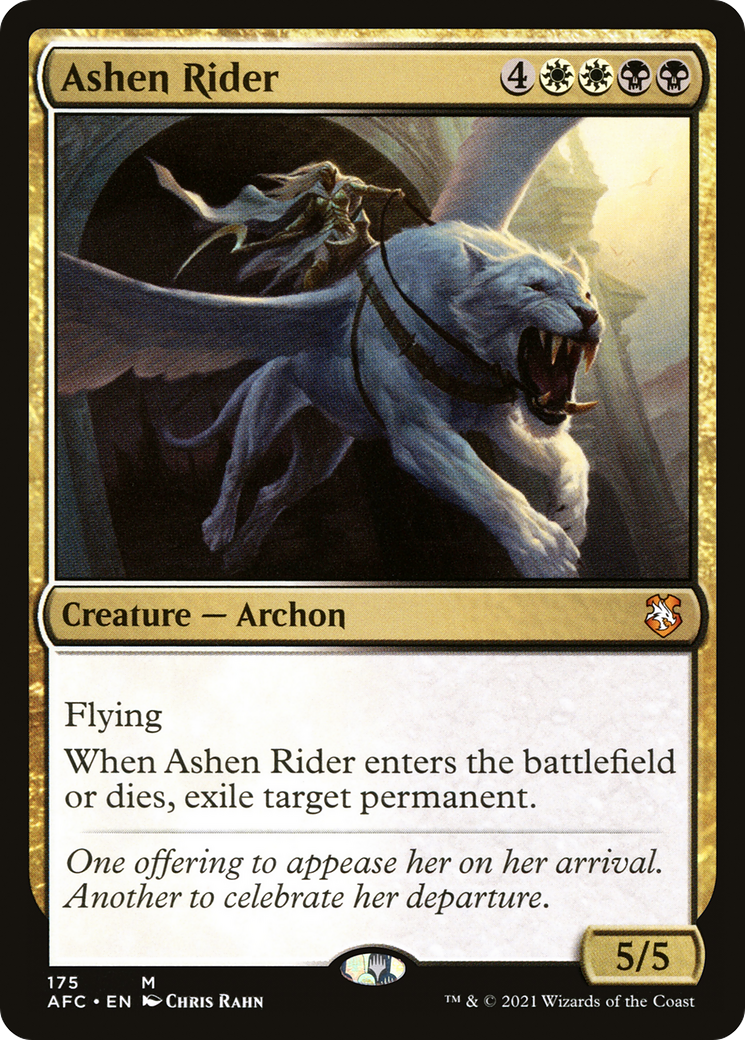
Ashen Rider
Ashen Rider
Creature — Archon
5/5
Flying
When this creature enters or dies, exile target permanent.
-
1
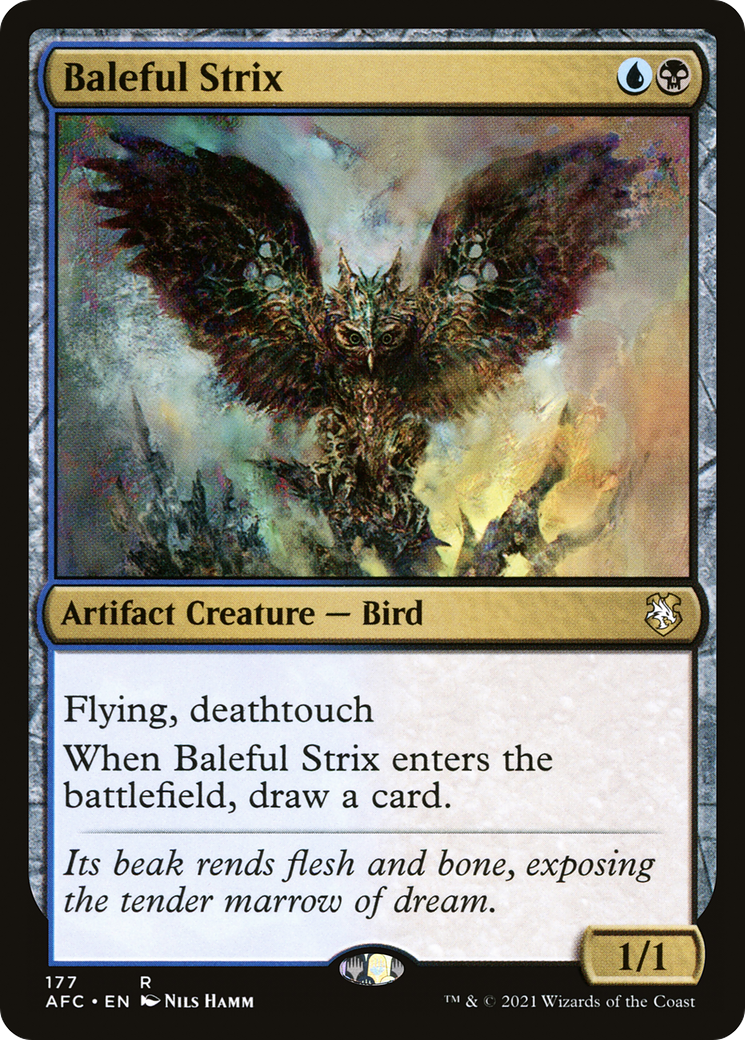
Baleful Strix
Baleful Strix
Artifact Creature — Bird
1/1
Flying, deathtouch
When this creature enters, draw a card.
-
1
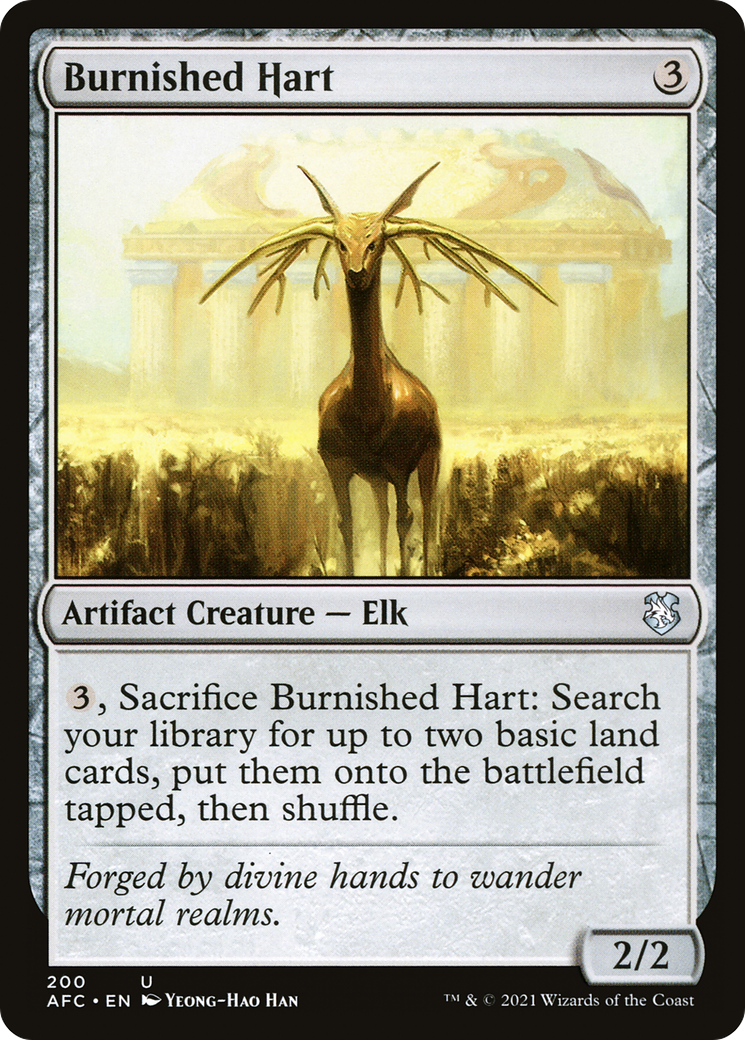
Burnished Hart
Burnished Hart
Artifact Creature — Elk
2/2
, Sacrifice this creature: Search your library for up to two basic land cards, put them onto the battlefield tapped, then shuffle.
-
1
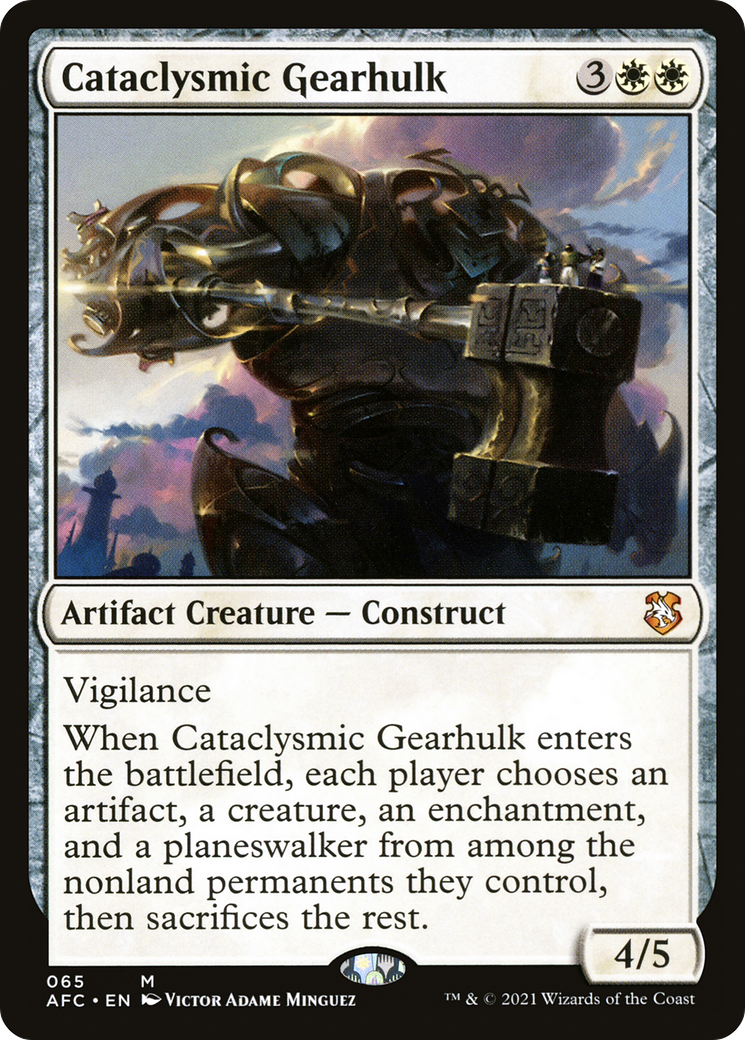
Cataclysmic Gearhulk
Cataclysmic Gearhulk
Artifact Creature — Construct
4/5
Vigilance
When this creature enters, each player chooses an artifact, a creature, an enchantment, and a planeswalker from among the nonland permanents they control, then sacrifices the rest.
- First the player whose turn it is chooses permanents they control, then each other player in turn order does the same. Each player will know the choices made by players who chose before them. All of the unchosen nonland permanents are then sacrificed simultaneously.
- A permanent with more than one type may be chosen as either of the types or both. For example, an artifact creature may be chosen as the artifact, the creature, or both. Choosing the same permanent twice this way has the same result as choosing it once.
- Cataclysmic Gearhulk will be sacrificed to its own ability if you don't choose it as your artifact or your creature.
- Lands can't be chosen and won't be sacrificed, even if they have other types (such as an artifact land).
- If you don't control any permanents of one of the types, you'll still choose the permanents of the types you do control.
-
1
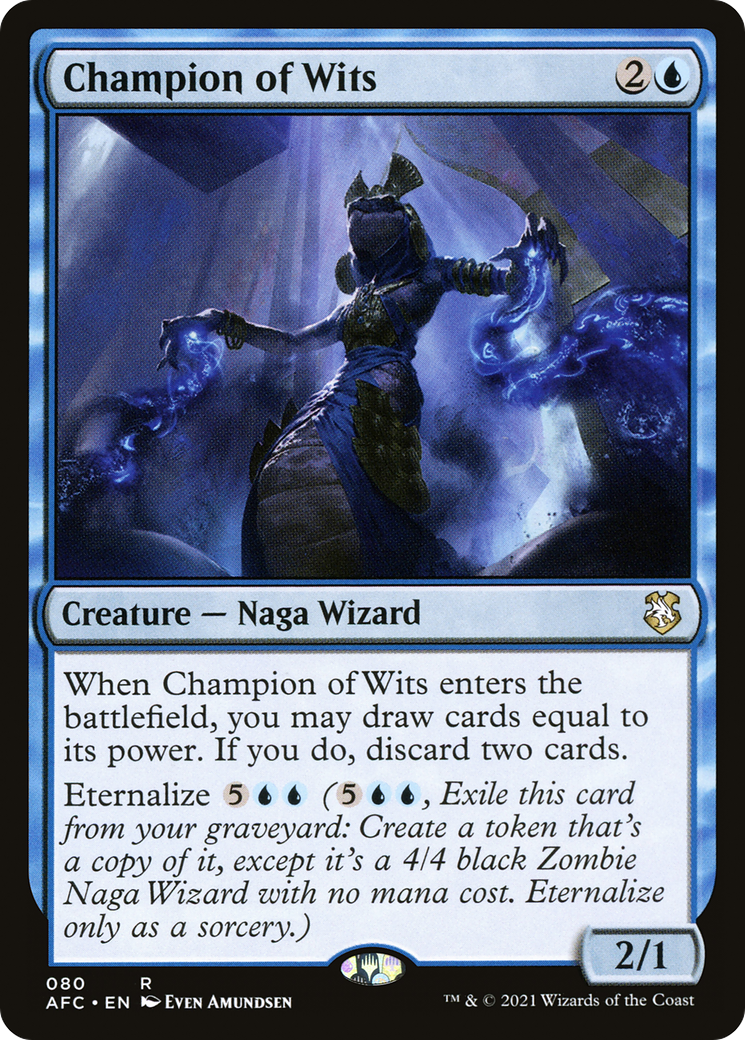
Champion of Wits
Champion of Wits
Creature — Snake Wizard
2/1
When this creature enters, you may draw cards equal to its power. If you do, discard two cards.
Eternalize ( , Exile this card from your graveyard: Create a token that's a copy of it, except it's a 4/4 black Zombie Snake Wizard with no mana cost. Eternalize only as a sorcery.)
- Use Champion of Wits's power as the first ability resolves to determine if you want to use the ability and how many cards you draw if you do. If you use the ability, you discard two cards regardless of how many cards you draw. If Champion of Wits leaves the battlefield before that ability resolves, use its last known power.
- For each card with eternalize, a corresponding game play supplement token can be found in some Hour of Devastation booster packs. These supplements are not required to play with cards with eternalize; you can use the same items to represent an eternalized token as you would any other token.
- If a creature card with eternalize is put into your graveyard during your main phase, you'll have priority immediately afterward. You can activate its eternalize ability before any player can try to exile it, such as with Crook of Condemnation, if it's legal for you to do so.
- Once you've activated an eternalize ability, the card is immediately exiled. Opponents can't try to stop the ability by exiling the card with an effect such as that of Crook of Condemnation.
- The token copies exactly what was printed on the original card and nothing else, except the characteristics specifically modified by eternalize. It doesn't copy any information about the object the card was before it was put into your graveyard.
- The token is a Zombie in addition to its other types and is black instead of its other colors. Its base power and toughness are 4/4. It has no mana cost, and thus its mana value is 0. These are copiable values of the token that other effects may copy.
- If the card copied by the token had any “when [this permanent] enters the battlefield” abilities, then the token also has those abilities and will trigger them when it's created. Similarly, any “as [this permanent] enters the battlefield” or “[this permanent] enters the battlefield with” abilities that the token has copied will also work.
-
1
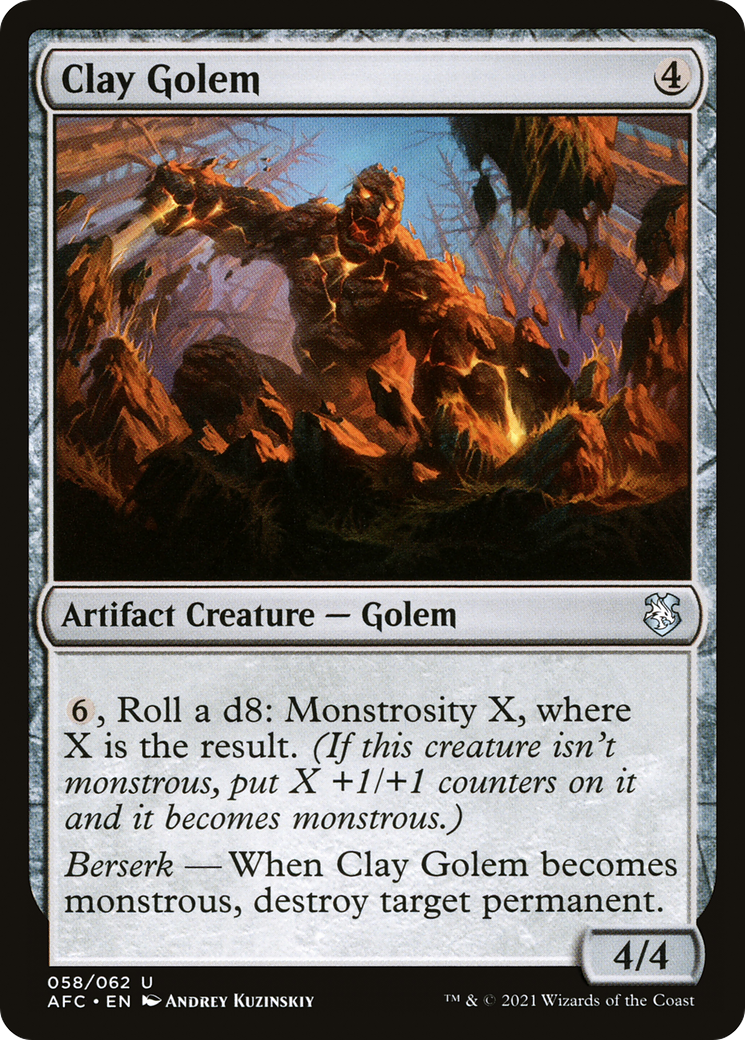
Clay Golem
Clay Golem
Artifact Creature — Golem
4/4
, Roll a d8: Monstrosity X, where X is the result. (If this creature isn't monstrous, put X +1/+1 counters on it and it becomes monstrous.)
Berserk — When this creature becomes monstrous, destroy target permanent.
- Once a creature becomes monstrous, it can't become monstrous again. If the creature is already monstrous when the monstrosity ability resolves, nothing happens. However, because rolling the d8 is part of the cost of activating the ability, if you don't like what you rolled and have another handy, you can respond to the ability by activating the ability again. Good luck!
- Monstrous isn't an ability that a creature has. It's just something true about that creature. If the creature stops being a creature or loses its abilities, it will continue to be monstrous.
- An ability that triggers when a creature becomes monstrous won't trigger if that creature isn't on the battlefield when its monstrosity ability resolves.
- You can activate Clay Golem's first ability even after it has become monstrous. It won't become monstrous again and you won't put any counters on it, but you will roll a die to activate the ability, which may cause abilities of other permanents to trigger.
- Dice are identified by the number of faces each one has. For example, a d20 is a twenty-sided die.
- Dice used must have equally likely outcomes and the roll must be fair. Although physical dice are recommended, digital substitutes are allowed, provided they have the same number of equally likely outcomes as specified in the original roll instruction.
- An ability that tells you to roll a die will also specify what to do with the result of that roll. Most often, this is in the form of a “results table” in the card text.
- The instruction to roll a die and the effect that occurs because of the result are all part of the same ability. Players do not get the chance to respond to the ability after knowing the result of the roll.
- An effect that says “choose a target, then roll a d20” or similar still uses the normal process of putting an ability on the stack and resolving it. Choosing targets is part of putting the ability on the stack and rolling the d20 happens later, as the ability resolves.
- Some effects may modify the result of a die roll. This may be part of the instruction to roll a die or it may come from other cards. Anything that references the “result” of a die roll is looking for the result after these modifications. Anything that is looking for the “natural result” is looking for the number shown on the face of the die before these modifications.
- Some abilities, like that of Pixie Guide and Barbarian Class, replace rolling a die with rolling extra dice and ignoring the lowest roll. The ignored rolls are not considered for the effect that instructed you to roll a die, and do not cause abilities to trigger. For all intents and purposes, once you determine which dice count, any extra dice were never rolled.
- Some effects instruct you to roll again. This uses the same number and type of dice as the original roll, and that roll will use the same set of possible outcomes.
- While playing Planechase, rolling the planar die will cause any ability that triggers whenever a player rolls one or more dice to trigger. However, any effect that refers to a numerical result will ignore the rolling of the planar die.
- Tournament events have more specific rules regarding dice and die-rolling. For more information, please see the most recent version of the Magic Tournament Rules at https://wpn.wizards.com/en/document/magic-gathering-tournament-rules.
-
1
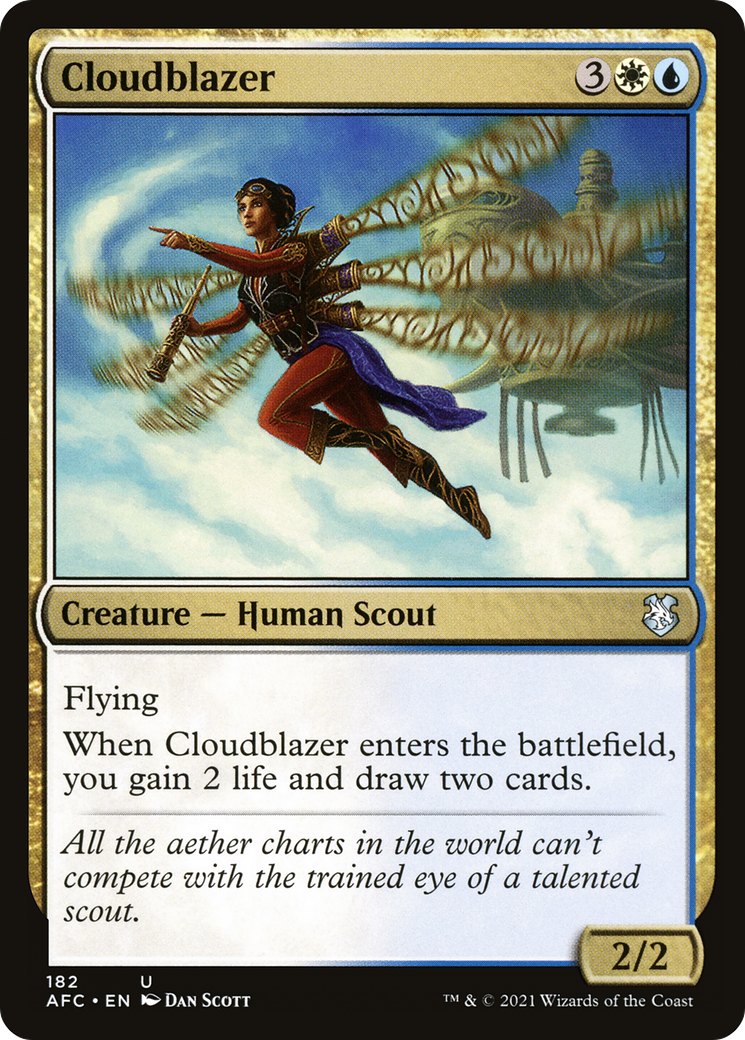
Cloudblazer
Cloudblazer
Creature — Human Scout
2/2
Flying
When this creature enters, you gain 2 life and draw two cards.
-
1
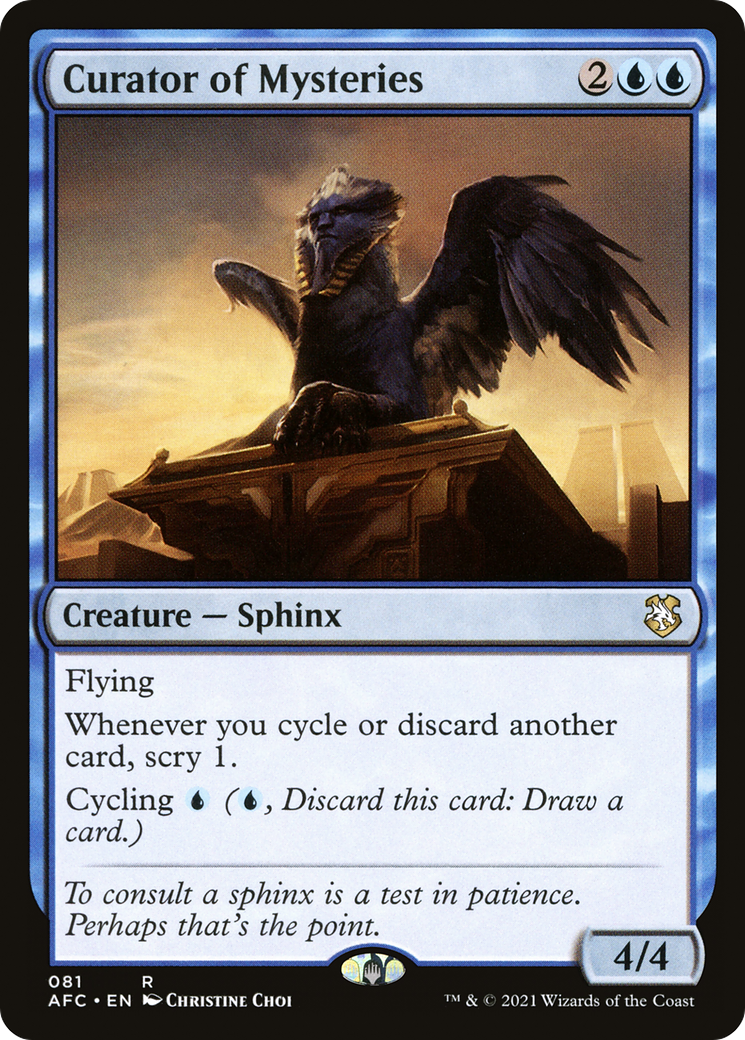
Curator of Mysteries
Curator of Mysteries
Creature — Sphinx
4/4
Flying
Whenever you cycle or discard another card, scry 1.
Cycling ( , Discard this card: Draw a card.)
- Some cards have an ability that triggers whenever you cycle any card. These triggered abilities resolve before you draw from the cycling ability.
- An ability that triggers whenever you discard a card doesn't give you permission to discard cards. You'll need another effect that instructs or allows you to discard them.
- An ability that triggers whenever you “cycle or discard” a card triggers only once if you cycle a card. The ability “Whenever you discard a card” is functionally identical to this ability; cycling is mentioned for clarity.
- If a player discards a card during their cleanup step due to having too many cards in hand, any appropriate abilities that trigger on discarding that card trigger. If this happens, those triggered abilities are put onto the stack and players receive priority in that cleanup step to cast spells or activate abilities (normally, no players may take actions during a cleanup step). Another cleanup step is created following that one.
-
1
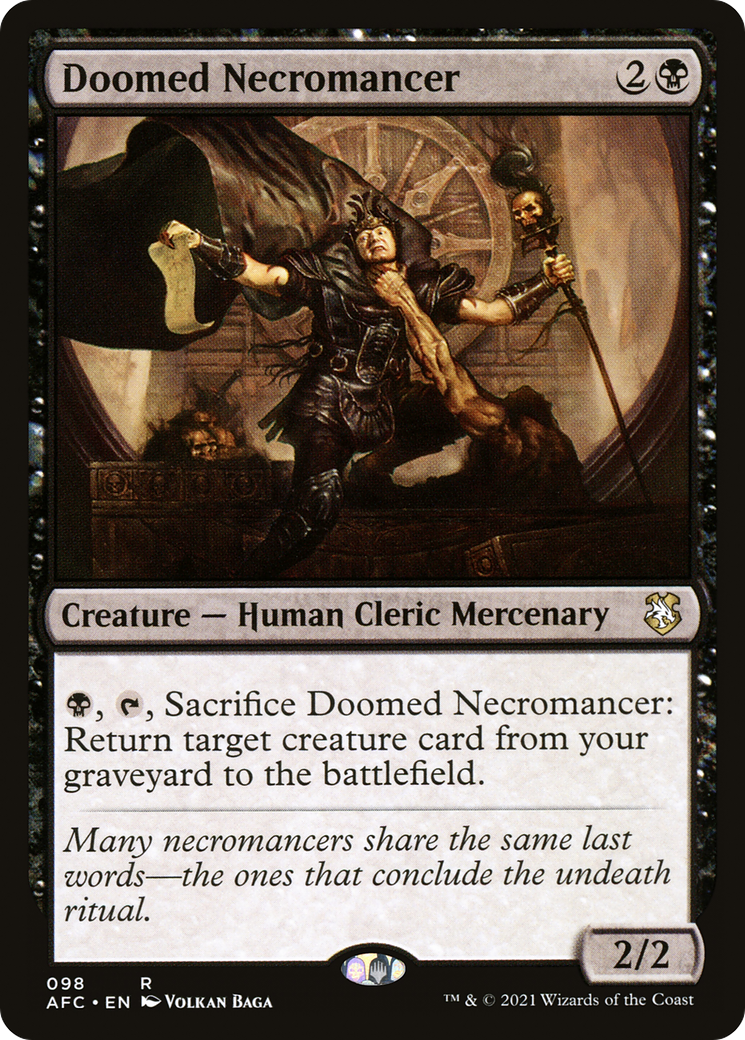
Doomed Necromancer
Doomed Necromancer
Creature — Human Cleric Mercenary
2/2
, , Sacrifice this creature: Return target creature card from your graveyard to the battlefield.
- Because targets are chosen before costs are paid, Doomed Necromancer can't be the target of its own ability.
-
1
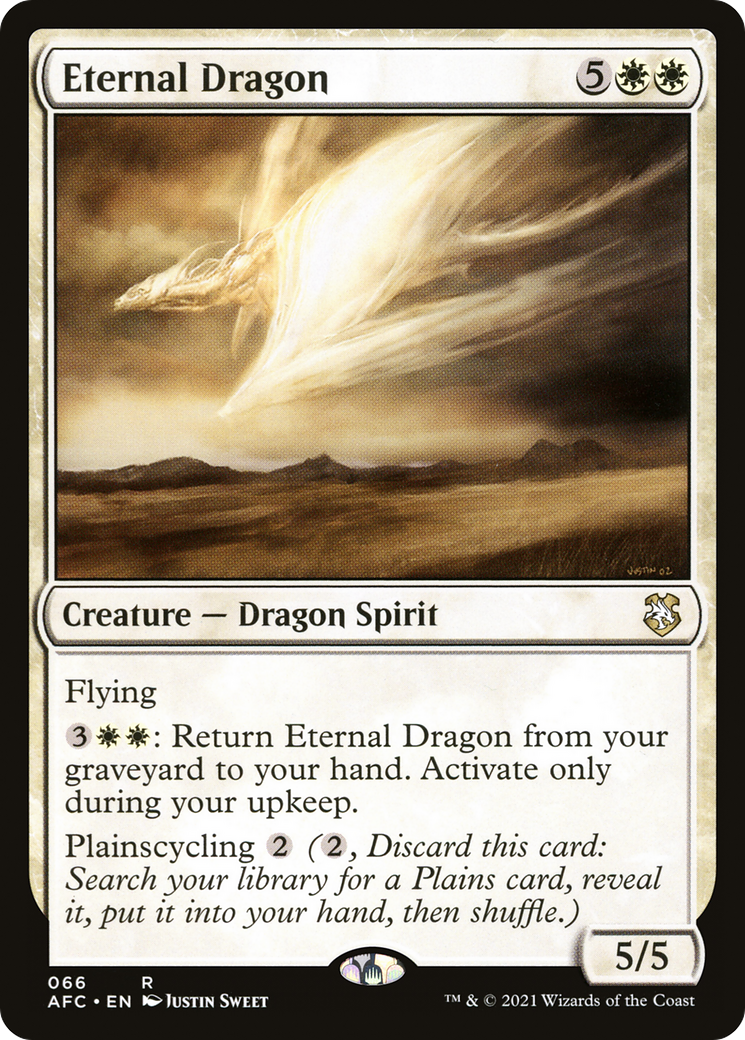
Eternal Dragon
Eternal Dragon
Creature — Dragon Spirit
5/5
Flying
: Return this card from your graveyard to your hand. Activate only during your upkeep.
Plainscycling ( , Discard this card: Search your library for a Plains card, reveal it, put it into your hand, then shuffle.)
- Unlike the normal cycling ability, Plainscycling doesn't allow you to draw a card. Instead, it lets you search your library for a Plains card. After you find a Plains card in your library, you reveal it, put it into your hand, then shuffle your library.
- Plainscycling is a form of cycling. Any ability that triggers on a card being cycled also triggers on Plainscycling this card. Any ability that stops a cycling ability from being activated also stops Plainscycling from being activated.
- Plainscycling is an activated ability. Effects that interact with activated abilities (such as Stifle or Rings of Brighthearth) will interact with Plainscycling. Effects that interact with spells (such as Remove Soul or Faerie Tauntings) will not.
- You can choose to find any card with the Plains land type, including nonbasic lands. You can also choose not to find a card, even if there is a Plains card in your library.
-
1
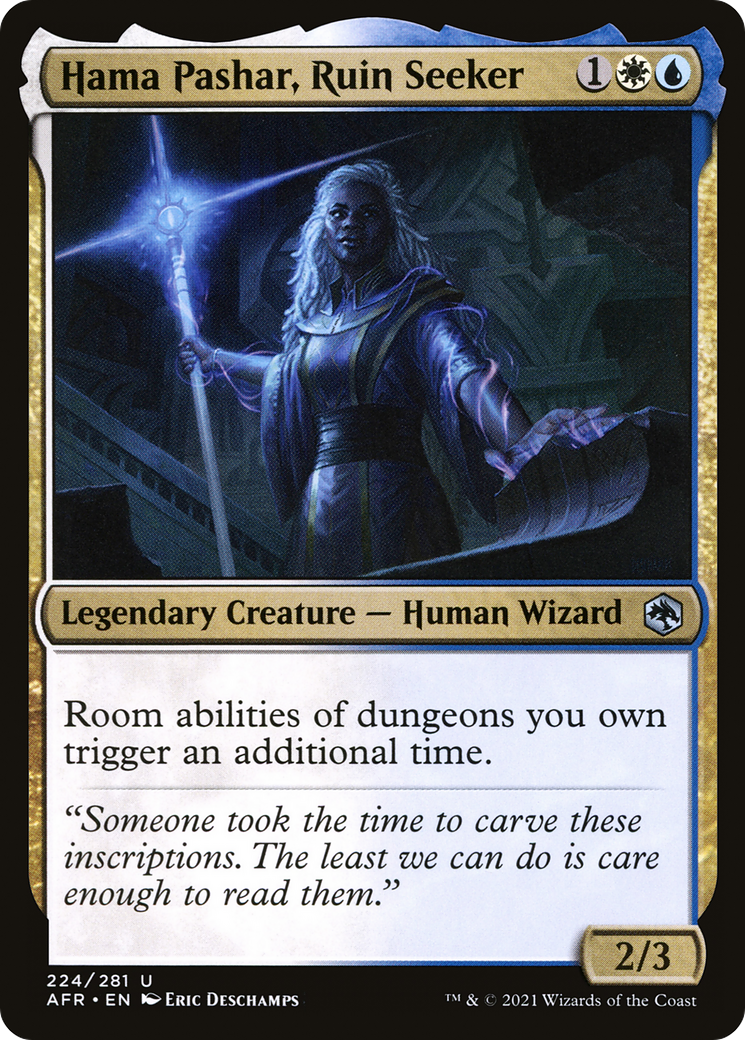
Hama Pashar, Ruin Seeker
Hama Pashar, Ruin Seeker
Legendary Creature — Human Wizard
2/3
Room abilities of dungeons you own trigger an additional time.
-
1
Hostage Taker
Hostage Taker
Creature — Human Pirate
2/3
When this creature enters, exile another target creature or artifact until this creature leaves the battlefield. You may cast that card for as long as it remains exiled, and mana of any type can be spent to cast that spell.
- Hostage Taker has received errata to prevent it from targeting itself. The correct Oracle wording appears above.
- If Hostage Taker leaves the battlefield before its triggered ability resolves, the target permanent won't be exiled.
- Auras attached to the exiled permanent will be put into their owners' graveyards. Any Equipment will become unattached and remain on the battlefield. Any counters on the exiled permanent will cease to exist.
- If a token is exiled this way, it will cease to exist and won't return to the battlefield. You can't cast it.
- Once you begin to cast the exiled card, it's considered a new object. You'll control that spell and the permanent that spell becomes even if Hostage Taker leaves the battlefield.
- If it's still in exile, the exiled card returns to the battlefield immediately after Hostage Taker leaves the battlefield. Nothing happens between the two events, including state-based actions.
- In a multiplayer game, if Hostage Taker's owner leaves the game while the card is still exiled and another player owns that card, the exiled card will return to the battlefield under its owner's control. Because the one-shot effect that returns the card isn't an ability that goes on the stack, it won't cease to exist along with the leaving player's spells and abilities on the stack.
- In a multiplayer game, if a player leaves the game, all cards that player owns leave as well. If you leave the game, any spell or permanent cards you control from Hostage Taker's ability are exiled.
-
1
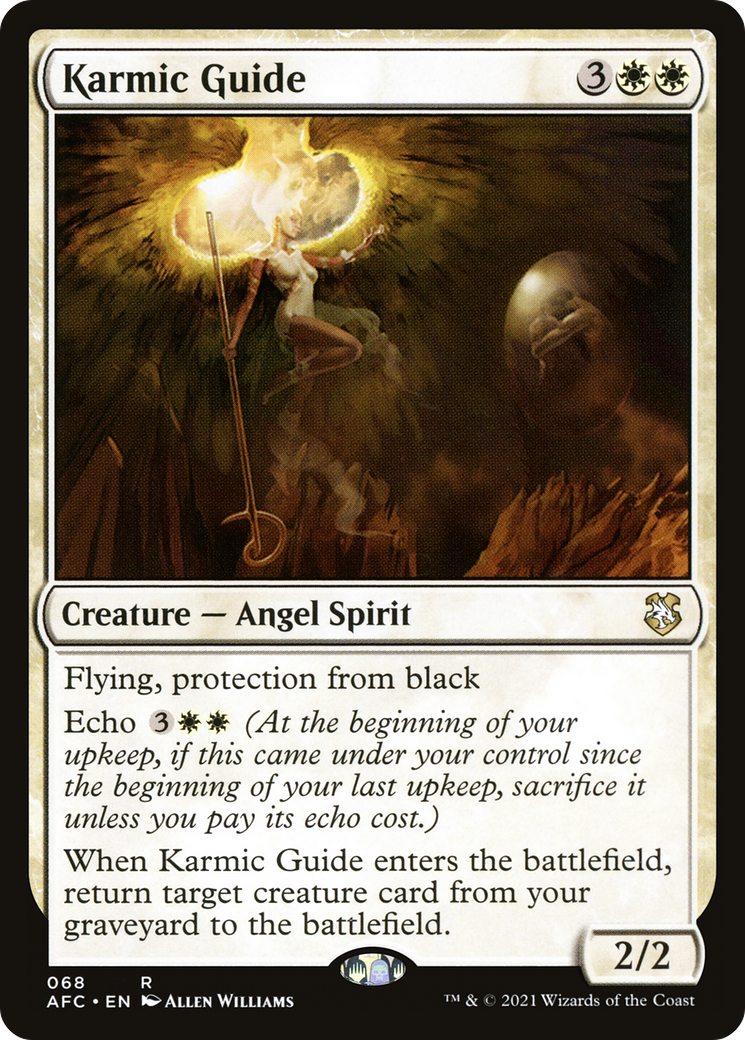
Karmic Guide
Karmic Guide
Creature — Angel Spirit
2/2
Flying, protection from black
Echo (At the beginning of your upkeep, if this came under your control since the beginning of your last upkeep, sacrifice it unless you pay its echo cost.)
When this creature enters, return target creature card from your graveyard to the battlefield.
- Your permanent's echo ability will trigger at the beginning of your upkeep if it entered the battlefield since the beginning of your last upkeep, or if you gained control of it since the beginning of your last upkeep.
- Paying for echo is always optional. When the echo triggered ability resolves, if you can't pay the echo cost or choose not to, you sacrifice that permanent.
-
1
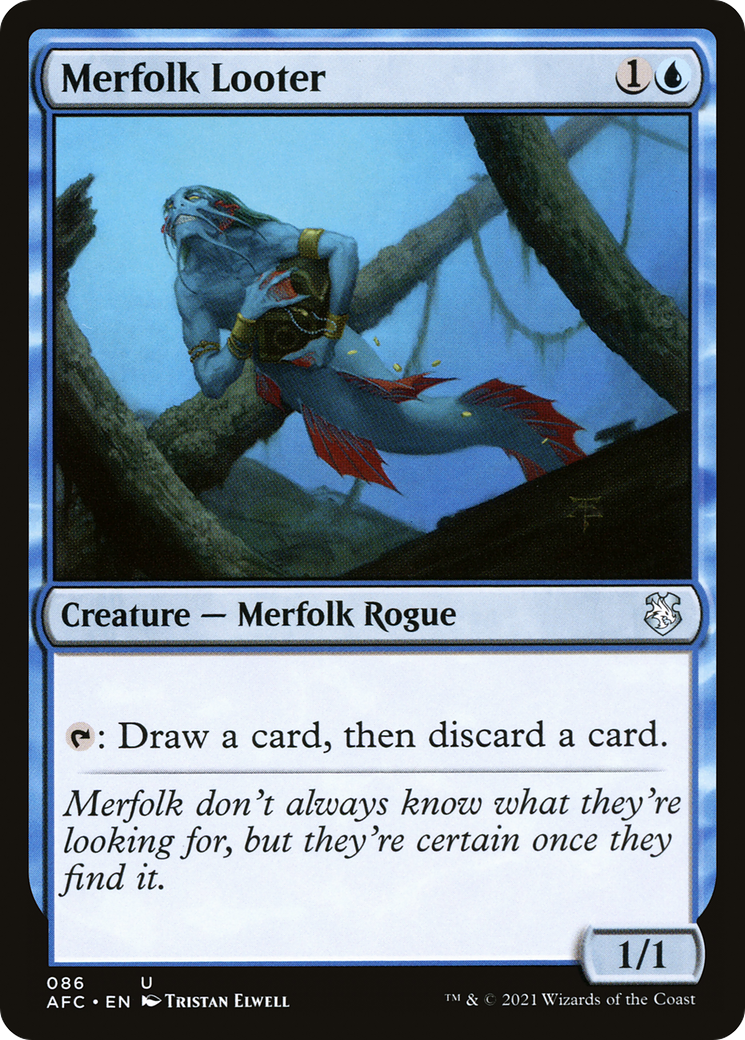
Merfolk Looter
Merfolk Looter
Creature — Merfolk Rogue
1/1
: Draw a card, then discard a card.
- You can't do anything in between drawing a card and discarding a card, including casting or cycling the card you drew.
-
1
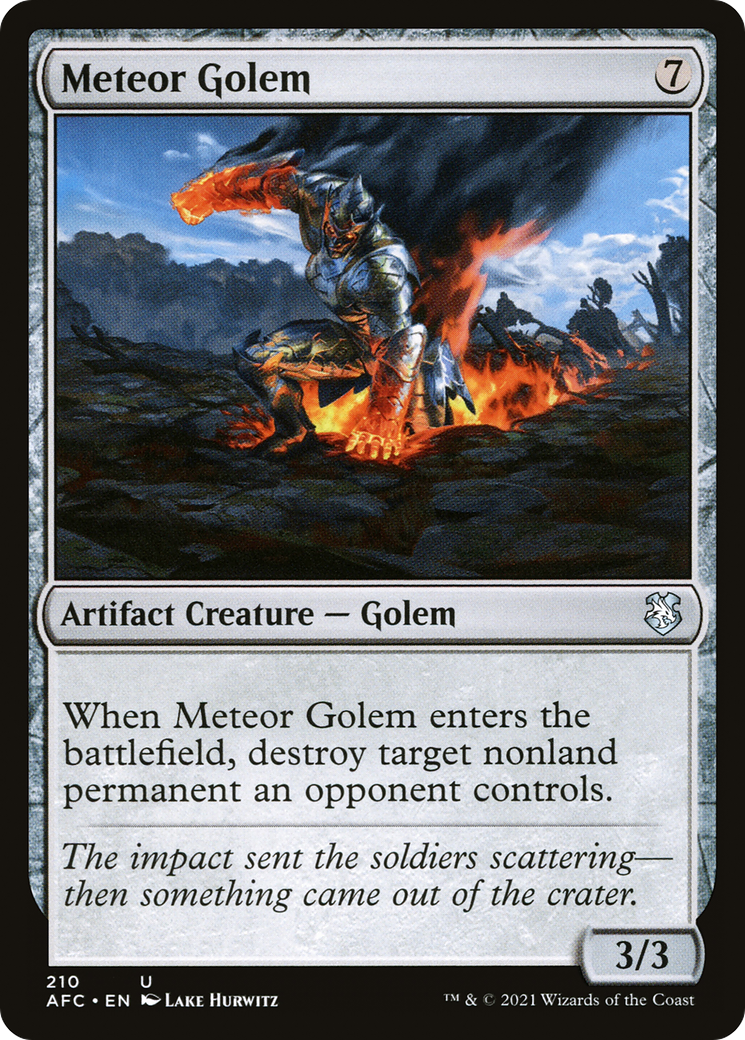
Meteor Golem
Meteor Golem
Artifact Creature — Golem
3/3
When this creature enters, destroy target nonland permanent an opponent controls.
-
1
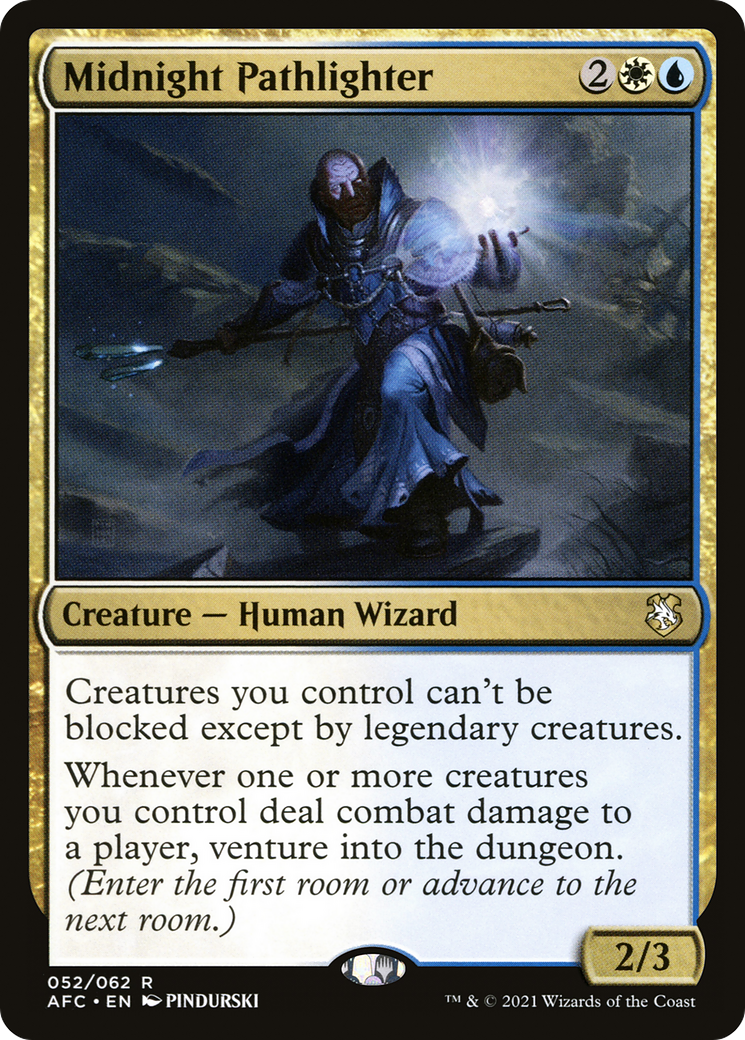
Midnight Pathlighter
Midnight Pathlighter
Creature — Human Wizard
2/3
Creatures you control can't be blocked except by legendary creatures.
Whenever one or more creatures you control deal combat damage to a player, venture into the dungeon. (Enter the first room or advance to the next room.)
- Unblocked creatures with double strike deal damage twice, which will cause Midnight Pathlighter's last ability to trigger twice.
- To venture into the dungeon, a player moves their venture marker into the next room of the dungeon they are currently in. If they aren't currently in a dungeon, that player instead chooses a dungeon card from outside the game, puts it into the command zone, and moves their venture marker onto the first room.
- Moving into a dungeon room will cause its room ability to trigger.
- Once you resolve the last room ability of a dungeon, that dungeon is now completed and is removed from the game.
- A player may only have one dungeon in the command zone at a time.
- The player venturing into the dungeon chooses which dungeon they will venture into. They may choose a dungeon that they have already completed this game.
- Dungeon cards are not part of a player's deck or sideboard. In both constructed and limited formats, players can use any dungeon card when they venture into the dungeon.
- You can only move forward (well, downward) in a dungeon, never backwards or sideways.
- Dungeons are removed from the game as a state-based action.
- If you somehow venture into the dungeon while a room's ability is on the stack, you will continue on in the dungeon. If you're already in the last room, complete that dungeon and start a new one.
- Choosing the dungeon or room to venture into is part of resolving the venture into the dungeon keyword action. Once that choice is made, players may not respond until after the appropriate room ability has triggered.
-
1
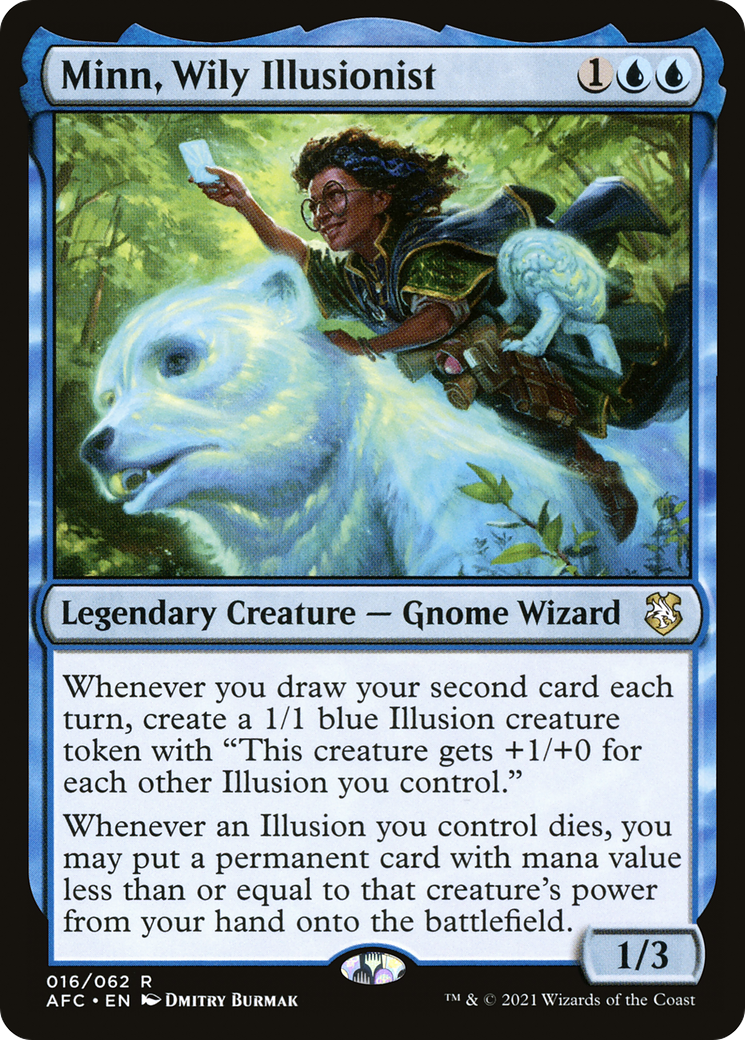
Minn, Wily Illusionist
Minn, Wily Illusionist
Legendary Creature — Gnome Wizard
1/3
Whenever you draw your second card each turn, create a 1/1 blue Illusion creature token with "This token gets +1/+0 for each other Illusion you control."
Whenever an Illusion you control dies, you may put a permanent card with mana value less than or equal to that creature's power from your hand onto the battlefield.
- Minn's last ability uses the Illusion's power the last time it existed on the battlefield to determine what cards you may put onto the battlefield.
-
1
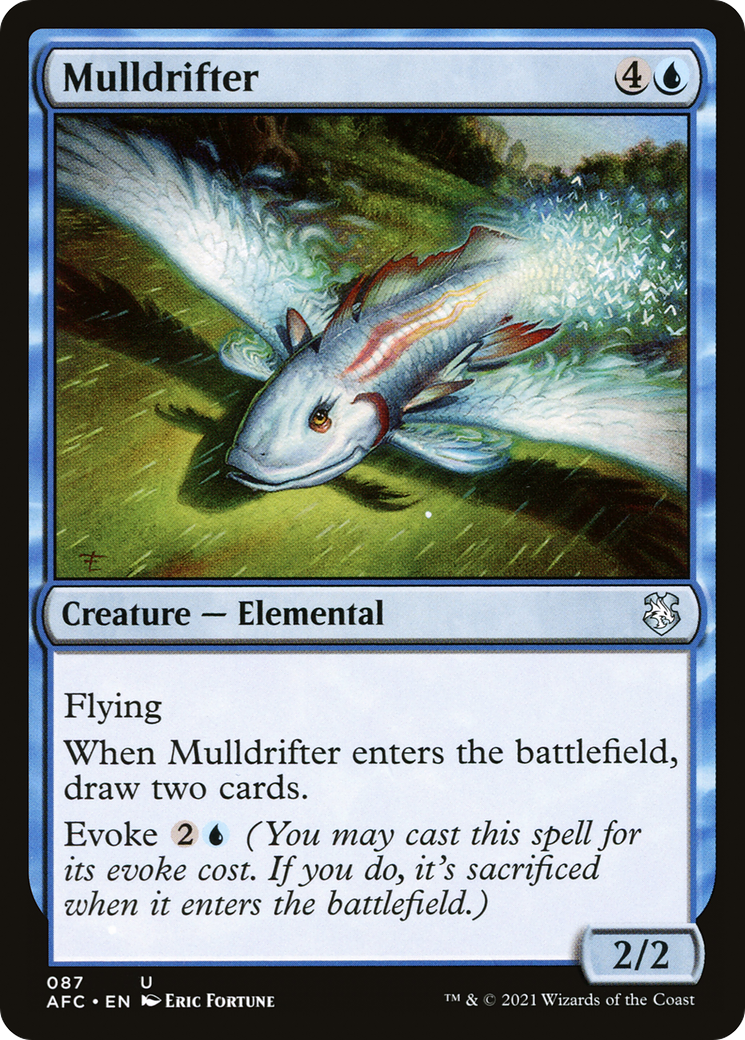
Mulldrifter
Mulldrifter
Creature — Elemental
2/2
Flying
When this creature enters, draw two cards.
Evoke (You may cast this spell for its evoke cost. If you do, it's sacrificed when it enters.)
- To determine the total cost of a spell, start with the mana cost or alternative cost you're paying (such as an evoke cost), add any cost increases, then apply any cost reductions. The mana value of the spell is determined by only its mana cost, no matter what the total cost to cast that spell was.
- If you pay the evoke cost, you can have Mulldrifter's own triggered ability resolve before the evoke triggered ability. You can cast spells after that ability resolves but before you have to sacrifice Mulldrifter.
-
1
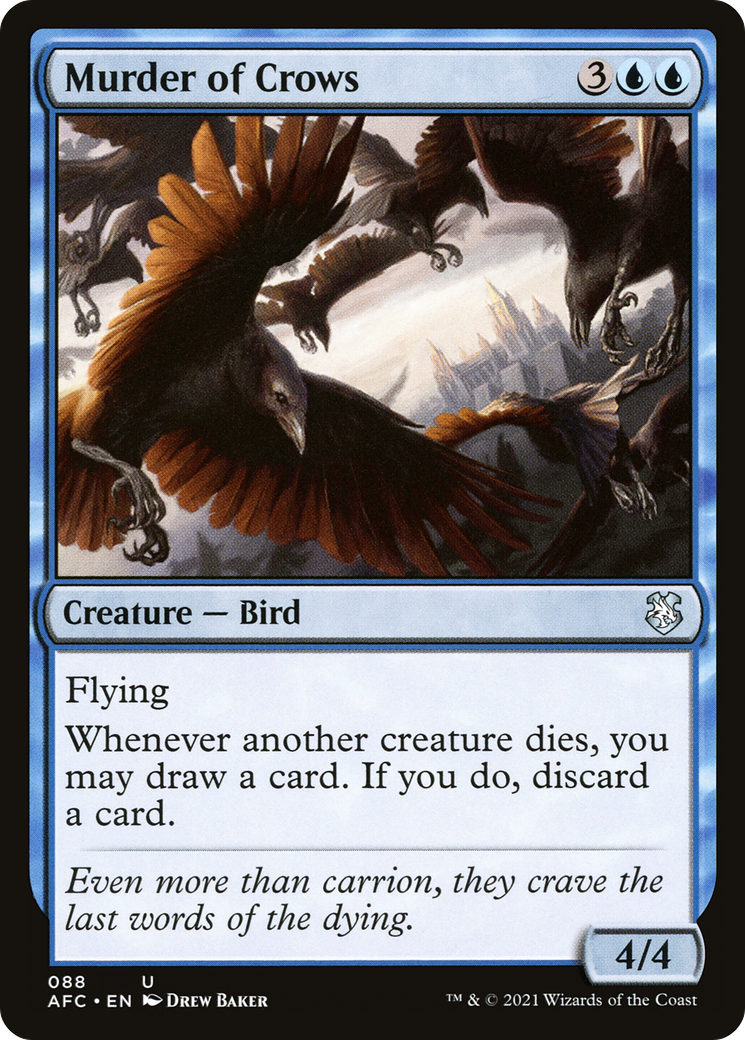
Murder of Crows
Murder of Crows
Creature — Bird
4/4
Flying
Whenever another creature dies, you may draw a card. If you do, discard a card.
- If another creature dies at the same time as Murder of Crows, its last ability triggers.
- You can't do anything in between drawing a card and discarding a card, including casting or cycling the card you drew.
-
1
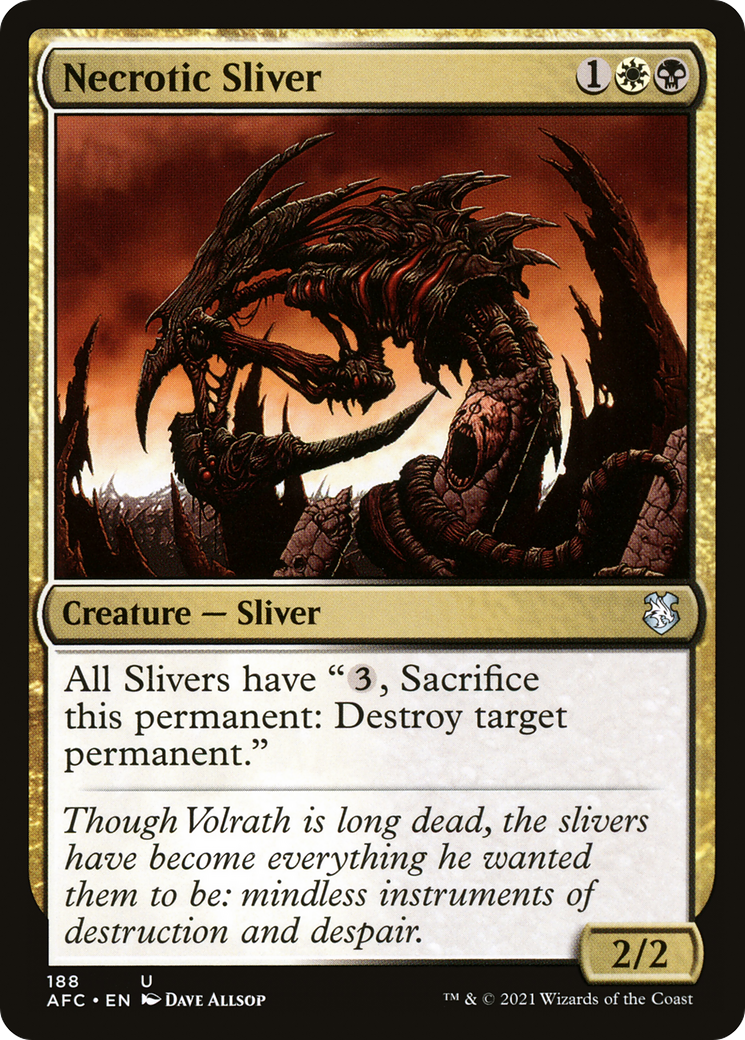
Necrotic Sliver
Necrotic Sliver
Creature — Sliver
2/2
All Slivers have " , Sacrifice this permanent: Destroy target permanent."
- Abilities that Slivers grant, as well as power/toughness boosts, are cumulative. However, for some abilities, like flying, having more than one instance of the ability doesn't provide any additional benefit.
- If the creature type of a Sliver changes so it's no longer a Sliver, it will no longer be affected by its own ability. Its ability will continue to affect other Sliver creatures.
-
1
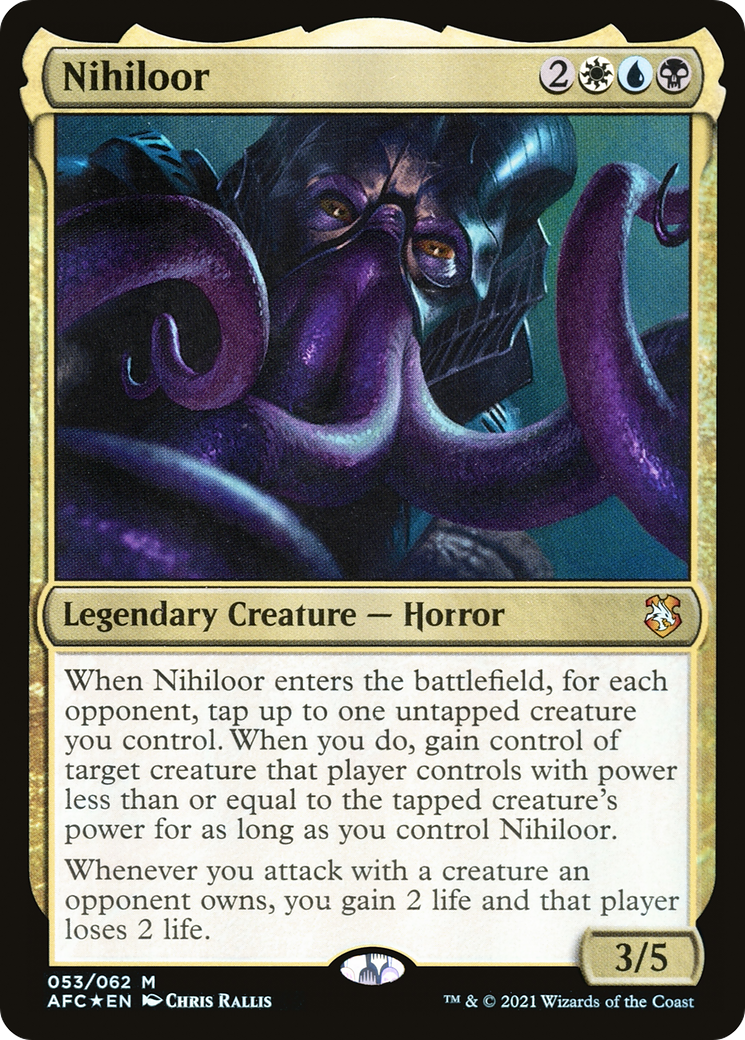
Nihiloor
Nihiloor
Legendary Creature — Horror
3/5
When Nihiloor enters, for each opponent, tap up to one untapped creature you control. When you do, gain control of target creature that player controls with power less than or equal to the tapped creature's power for as long as you control Nihiloor.
Whenever you attack with a creature an opponent owns, you gain 2 life and that player loses 2 life.
- As Nihiloor's first triggered ability resolves, you choose up to one creature for each opponent, and tap them all at the same time. Then, a separate triggered ability is put on the stack for each creature you tapped this way. Those abilities are placed on the stack in the order you choose. If tapping those creature caused any other abilities you control to trigger, those are also placed on the stack at this time.
- Both the tapped creature's power and the target creature's power are checked both as you put the ability on the stack and as the ability resolves in order to make sure the target is legal.
- If the tapped creature is no longer on the battlefield as the trigger resolves, use its last existence on the battlefield to determine whether the target is still legal as the ability resolves.
- If a creature you tapped for Nihiloor's ability is somehow no longer tapped as the reflexive triggered ability resolves, that ability will still resolve and you will still gain control of the target as long as it has less power than the creature you tapped.
- If Nihiloor leaves the battlefield before its enters-the-battlefield ability resolves or before its reflexive triggered abilities resolve, then you won't gain control of any creatures.
-
1
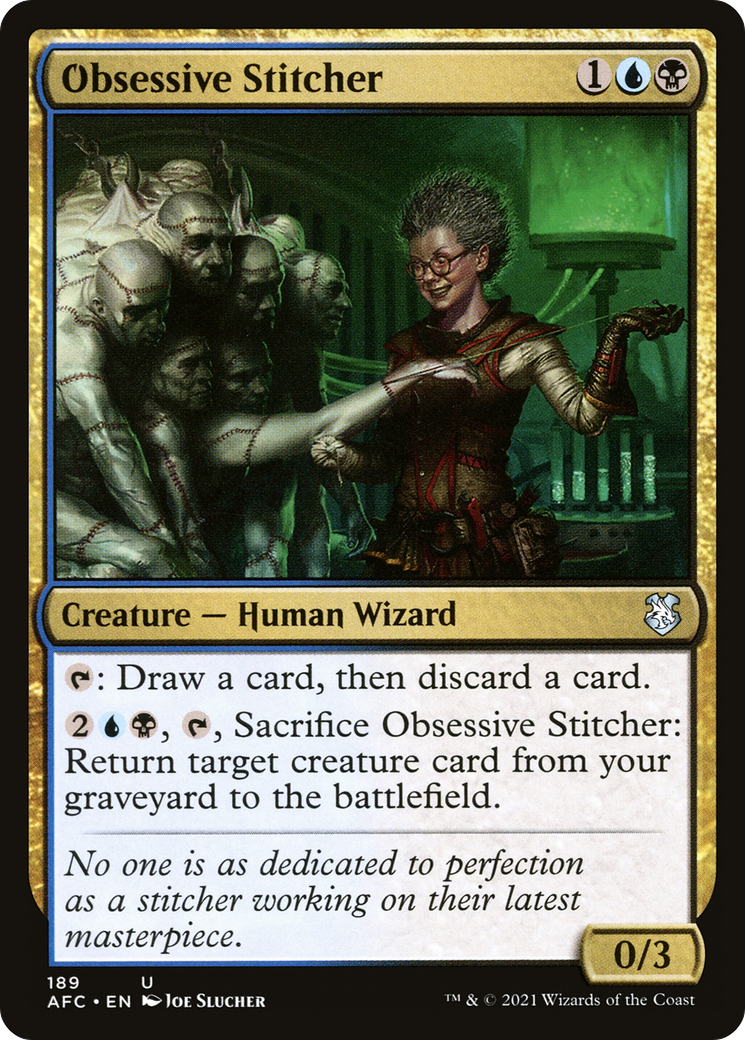
Obsessive Stitcher
Obsessive Stitcher
Creature — Human Wizard
0/3
: Draw a card, then discard a card.
, , Sacrifice this creature: Return target creature card from your graveyard to the battlefield.
- You draw a card and discard a card all while Obsessive Stitcher's first ability is resolving. Nothing can happen between the two, and no player may choose to take actions.
- Obsessive Stitcher can't be the target of its last ability.
-
1
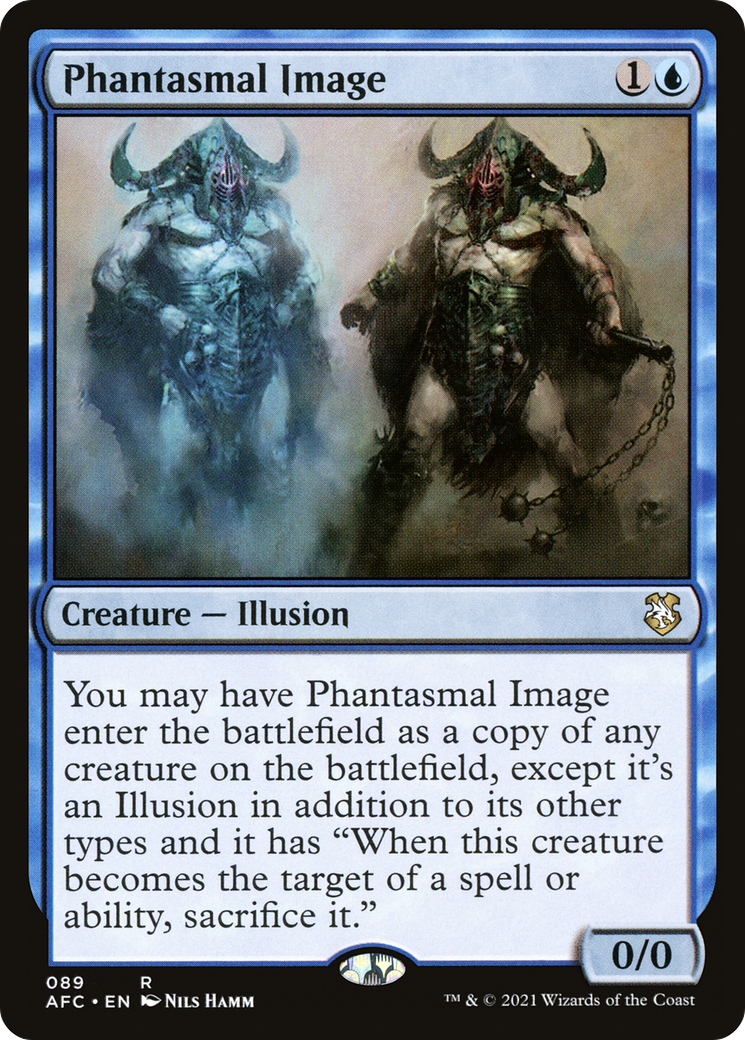
Phantasmal Image
Phantasmal Image
Creature — Illusion
0/0
You may have this creature enter as a copy of any creature on the battlefield, except it's an Illusion in addition to its other types and it has "When this creature becomes the target of a spell or ability, sacrifice it."
- Phantasmal Image copies exactly what was printed on the original creature (unless that creature is copying something else or is a token; see below) and it gains the Illusion creature type and the triggered ability. It doesn't copy whether that creature is tapped or untapped, whether it has any counters on it or Auras attached to it, or any non-copy effects that have changed its power, toughness, types, color, or so on.
- The Illusion creature type and the triggered ability that Phantasmal Image gains as part of its copy effect are both copiable values that other effects may copy.
- If the chosen creature has in its mana cost, X is considered to be 0.
- If the chosen creature is copying something else (for example, if the chosen creature is another Phantasmal Image), then Phantasmal Image enters the battlefield as whatever the chosen creature copied.
- If the chosen creature is a token, Phantasmal Image copies the original characteristics of that token as stated by the effect that created the token. Phantasmal Image is not a token in this case.
- Any enters-the-battlefield abilities of the copied creature will trigger when Phantasmal Image enters the battlefield. Any “as [this creature] enters the battlefield” or “[this creature] enters the battlefield with” abilities of the chosen creature will also work.
- If Phantasmal Image somehow enters the battlefield at the same time as another creature, Phantasmal Image can't become a copy of that creature. You may choose only a creature that's already on the battlefield.
-
1
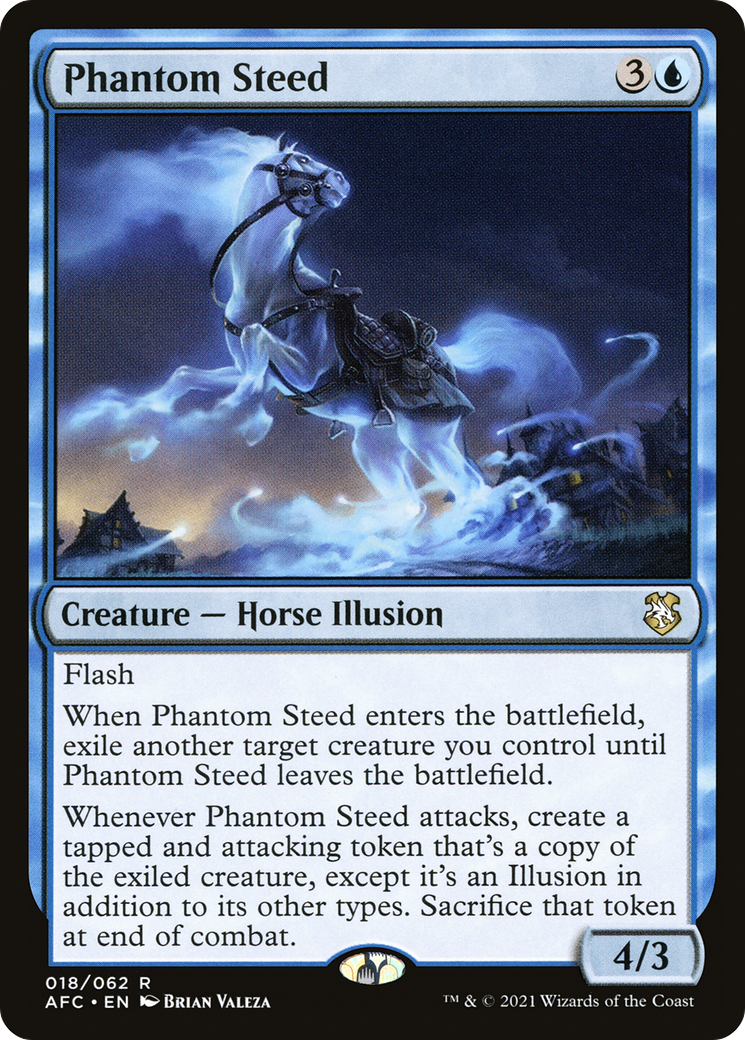
Phantom Steed
Phantom Steed
Creature — Horse Illusion
4/3
Flash
When this creature enters, exile another target creature you control until this creature leaves the battlefield.
Whenever this creature attacks, create a tapped and attacking token that's a copy of the exiled card, except it's an Illusion in addition to its other types. Sacrifice that token at end of combat.
- Phantom Steed has received a nonfunctional update to its wording. The printed card refers to the “exiled creature.” The corrected text (“exiled card”) is included above.
- If Phantom Steed leaves the battlefield before its ability resolves, the target creature won't be exiled.
- Auras attached to the exiled creature will be put into their owners' graveyards. Any Equipment will become unattached and remain on the battlefield. Any counters on the exiled creature will cease to exist. When the card returns to the battlefield, it will be a new object with no connection to the card that was exiled.
- If a token is exiled this way, it will cease to exist and won't return to the battlefield. Phantom Steed's last ability won't create any tokens.
- Although the token created by the triggered ability is attacking, it was never declared as an attacking creature (for the purposes of abilities that trigger whenever a creature attacks, for example).
- You declare which player or planeswalker the token is attacking as you put it onto the battlefield. It doesn't have to be the same player or planeswalker Phantom Steed is attacking.
- If the exiled card has in its mana cost, X is 0.
- Any enters-the-battlefield abilities of the copied creature will trigger when the token enters the battlefield. Any “As [this creature] enters the battlefield” or “[This creature] enters the battlefield with” abilities of the copied creature will also work.
- If Phantom Steed somehow exiles a noncreature card, such as an animated land, it will still create a copy of that card when it attacks. It enters the battlefield tapped and will be sacrificed at the end of combat. However, it is not attacking and it is not an Illusion.
-
1
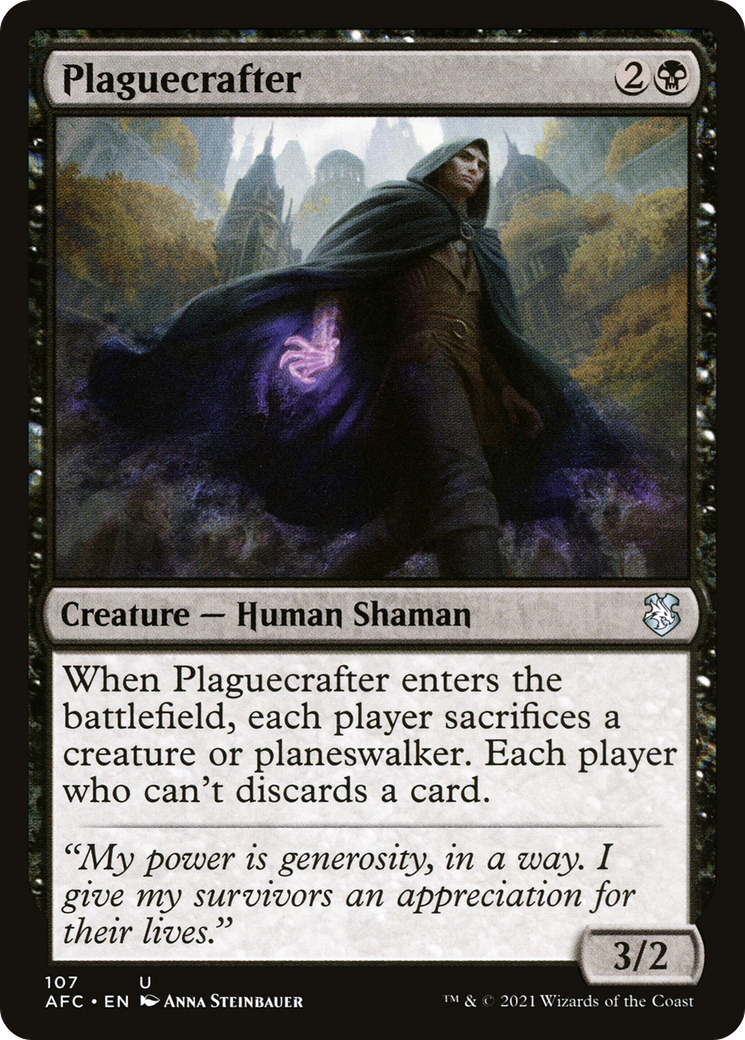
Plaguecrafter
Plaguecrafter
Creature — Human Shaman
3/2
When this creature enters, each player sacrifices a creature or planeswalker of their choice. Each player who can't discards a card.
- As Plaguecrafter's ability resolves, first the player whose turn it is chooses a creature or planeswalker they control, then each other player in turn order does the same, knowing the choices made before them. Then all the chosen permanents are sacrificed at the same time. Next, each player in the same order who couldn't sacrifice a permanent chooses a card in hand without revealing it, then the chosen cards are discarded at the same time.
- Each player chooses a permanent to sacrifice from among the creatures and planeswalkers they control. You don't choose which type of permanent any other player has to sacrifice.
- Plaguecrafter can be the creature its controller sacrifices for its own ability.
-
1
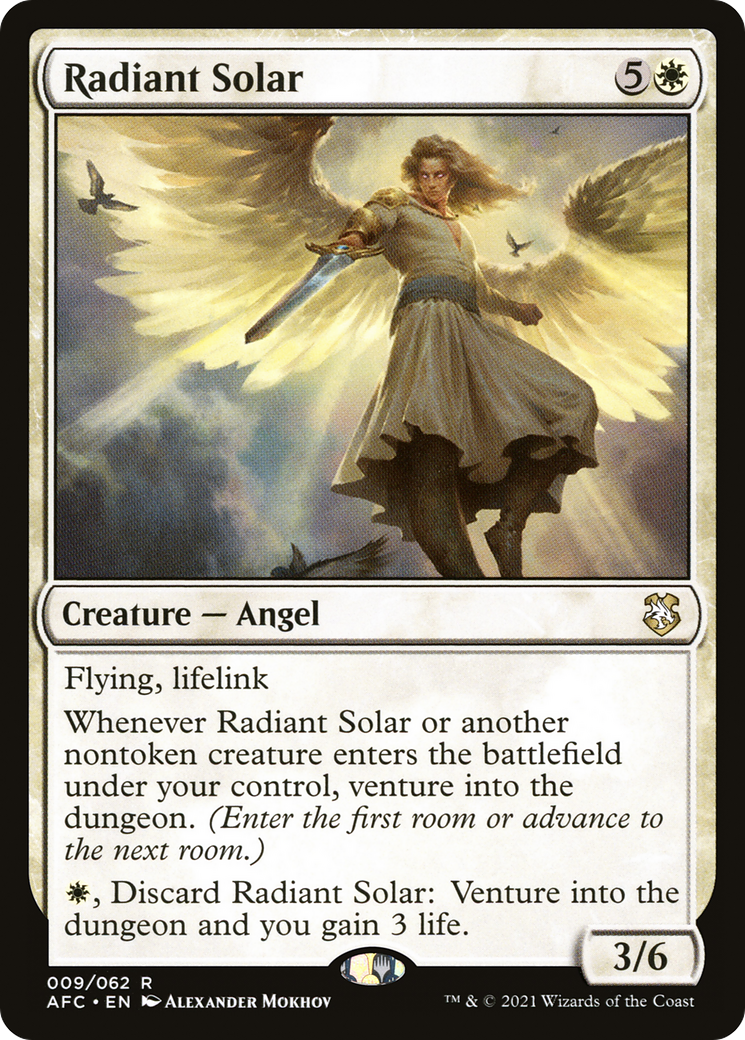
Radiant Solar
Radiant Solar
Creature — Angel
3/6
Flying, lifelink
Whenever this creature or another nontoken creature you control enters, venture into the dungeon. (Enter the first room or advance to the next room.)
, Discard this card: Venture into the dungeon and you gain 3 life.
- A token copy of Radiant Solar entering the battlefield will cause its own ability to trigger, but not that of any other Radiant Solars.
- To venture into the dungeon, a player moves their venture marker into the next room of the dungeon they are currently in. If they aren't currently in a dungeon, that player instead chooses a dungeon card from outside the game, puts it into the command zone, and moves their venture marker onto the first room.
- Moving into a dungeon room will cause its room ability to trigger.
- Once you resolve the last room ability of a dungeon, that dungeon is now completed and is removed from the game.
- A player may only have one dungeon in the command zone at a time.
- The player venturing into the dungeon chooses which dungeon they will venture into. They may choose a dungeon that they have already completed this game.
- Dungeon cards are not part of a player's deck or sideboard. In both constructed and limited formats, players can use any dungeon card when they venture into the dungeon.
- You can only move forward (well, downward) in a dungeon, never backwards or sideways.
- Dungeons are removed from the game as a state-based action.
- If you somehow venture into the dungeon while a room's ability is on the stack, you will continue on in the dungeon. If you're already in the last room, complete that dungeon and start a new one.
- Choosing the dungeon or room to venture into is part of resolving the venture into the dungeon keyword action. Once that choice is made, players may not respond until after the appropriate room ability has triggered.
-
1
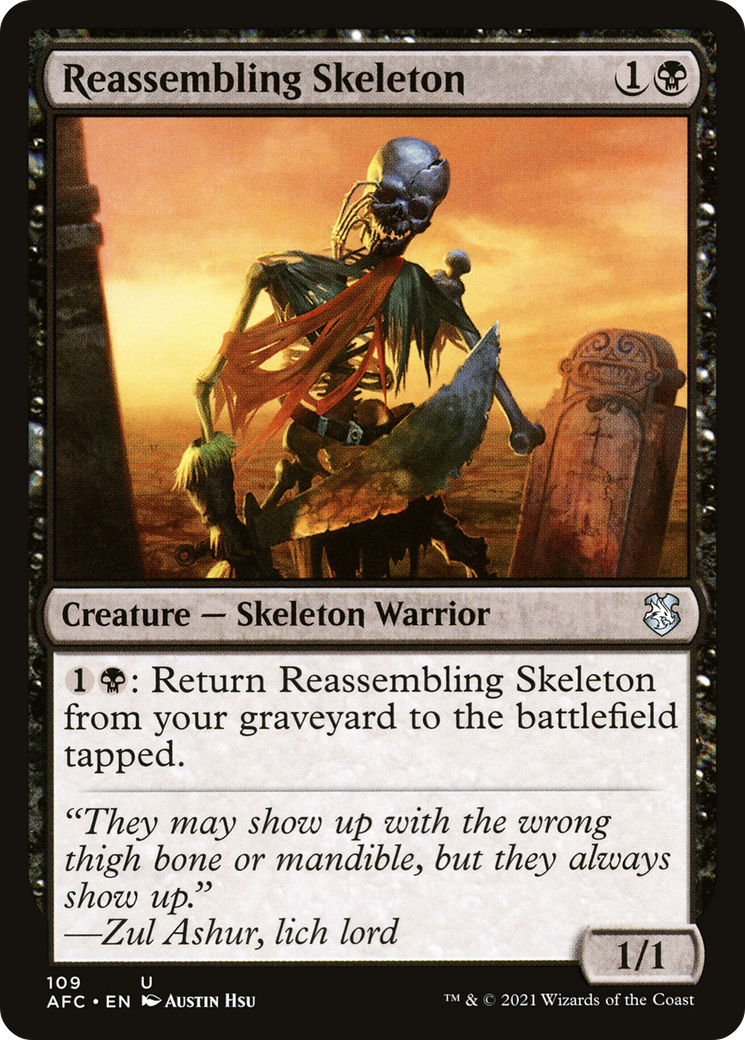
Reassembling Skeleton
Reassembling Skeleton
Creature — Skeleton Warrior
1/1
: Return this card from your graveyard to the battlefield tapped.
-
1
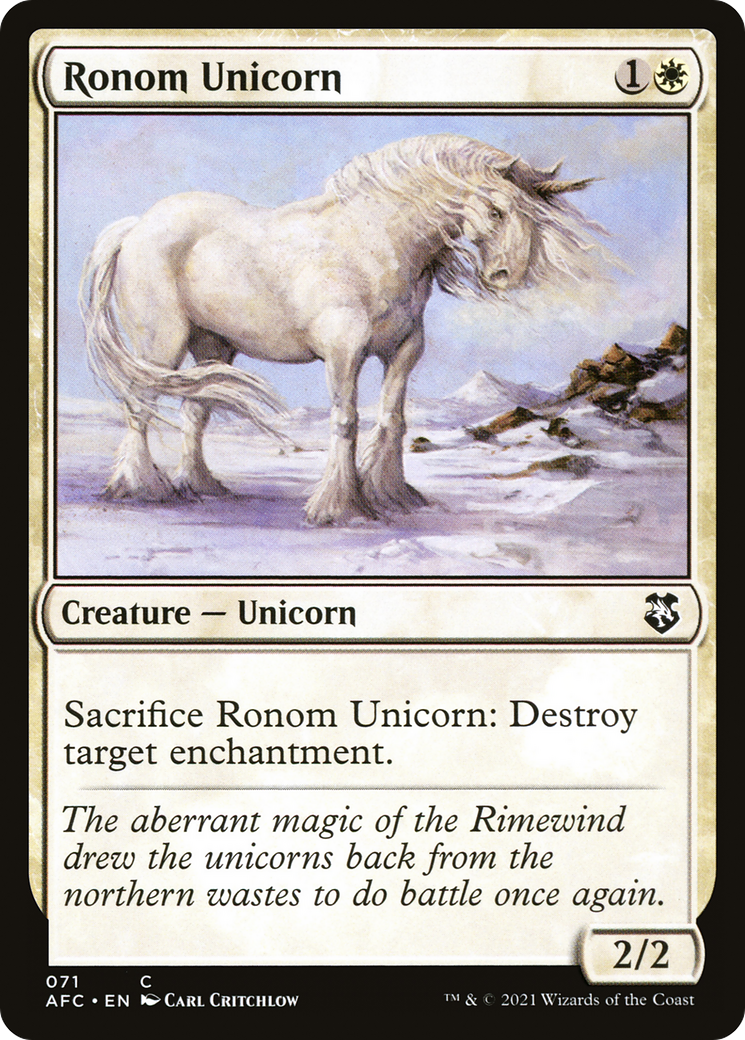
Ronom Unicorn
Ronom Unicorn
Creature — Unicorn
2/2
Sacrifice this creature: Destroy target enchantment.
-
1
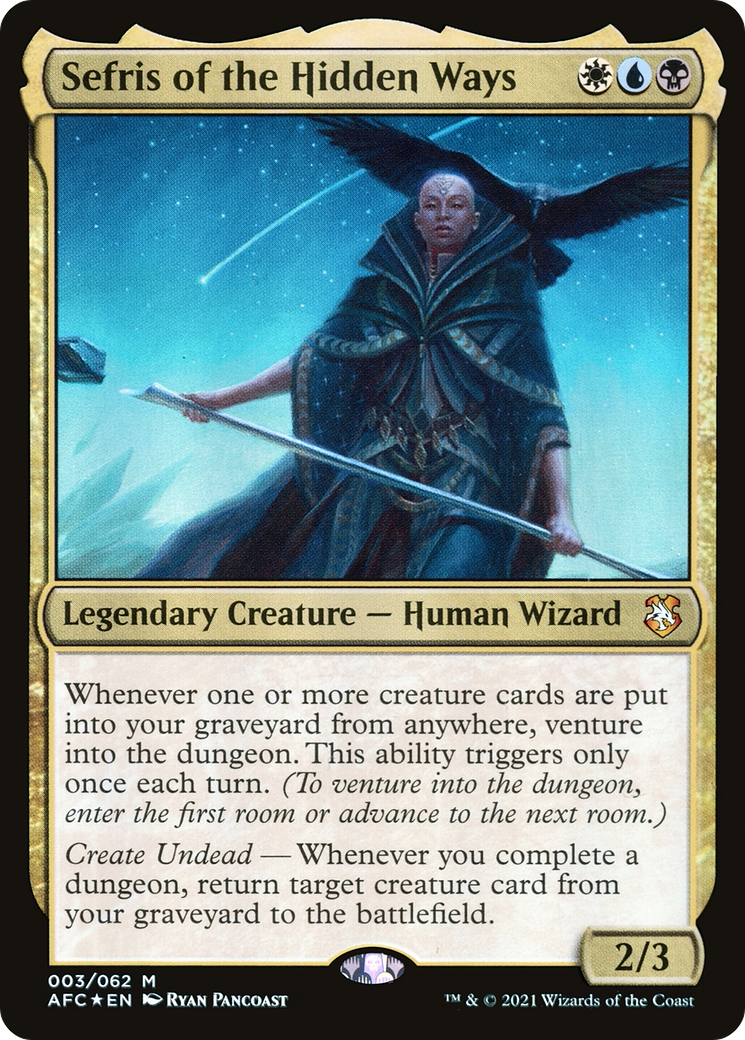
Sefris of the Hidden Ways
Sefris of the Hidden Ways
Legendary Creature — Human Wizard
2/3
Whenever one or more creature cards are put into your graveyard from anywhere, venture into the dungeon. This ability triggers only once each turn. (To venture into the dungeon, enter the first room or advance to the next room.)
Create Undead — Whenever you complete a dungeon, return target creature card from your graveyard to the battlefield.
- Sefris of the Hidden Ways must be on the battlefield for its first ability to trigger. It does not trigger when Sefris goes to the graveyard from the battlefield, even if other creature cards also went to the graveyard at the same time.
- To venture into the dungeon, a player moves their venture marker into the next room of the dungeon they are currently in. If they aren't currently in a dungeon, that player instead chooses a dungeon card from outside the game, puts it into the command zone, and moves their venture marker onto the first room.
- Moving into a dungeon room will cause its room ability to trigger.
- Once you resolve the last room ability of a dungeon, that dungeon is now completed and is removed from the game.
- A player may only have one dungeon in the command zone at a time.
- The player venturing into the dungeon chooses which dungeon they will venture into. They may choose a dungeon that they have already completed this game.
- Sefris of the Hidden Ways' first ability looks only at the type the card has in the graveyard, not the type it had in any other zone. For example, animated lands dying won't cause the ability to trigger. The opposite is also true. For example, if a creature that was cast as an Adventure is countered, it's a creature card in the graveyard and the first ability will trigger.
- You can only move forward (well, downward) in a dungeon, never backwards or sideways.
- Dungeons are removed from the game as a state-based action.
- If you somehow venture into the dungeon while a room's ability is on the stack, you will continue on in the dungeon. If you're already in the last room, complete that dungeon and start a new one.
- Choosing the dungeon or room to venture into is part of resolving the venture into the dungeon keyword action. Once that choice is made, players may not respond until after the appropriate room ability has triggered.
- Dungeon cards are not part of a player's deck or sideboard. In both constructed and limited formats, players can use any dungeon card when they venture into the dungeon.
-
1
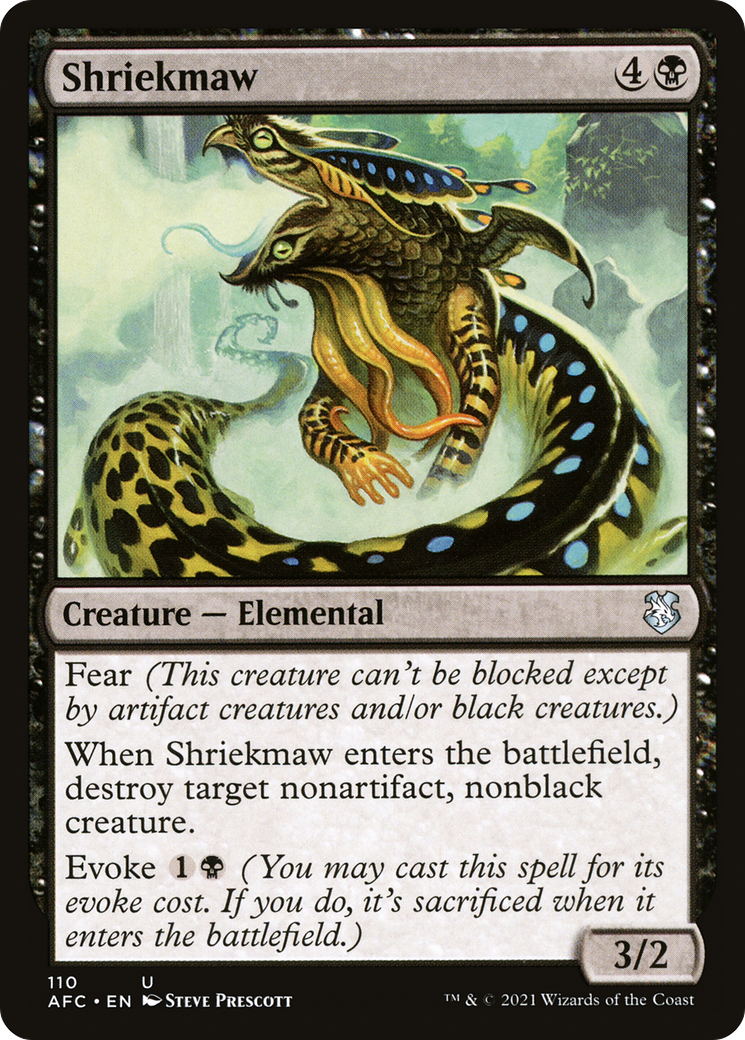
Shriekmaw
Shriekmaw
Creature — Elemental
3/2
Fear (This creature can't be blocked except by artifact creatures and/or black creatures.)
When this creature enters, destroy target nonartifact, nonblack creature.
Evoke (You may cast this spell for its evoke cost. If you do, it's sacrificed when it enters.)
- To determine the total cost of a spell, start with the mana cost or alternative cost you're paying (such as an evoke cost), add any cost increases, then apply any cost reductions. The mana value of the spell is determined by only its mana cost, no matter what the total cost to cast that spell was.
- If you pay the evoke cost, you can have Shriekmaw's own triggered ability resolve before the evoke triggered ability. You can cast spells after that ability resolves but before you have to sacrifice Shriekmaw.
-
1
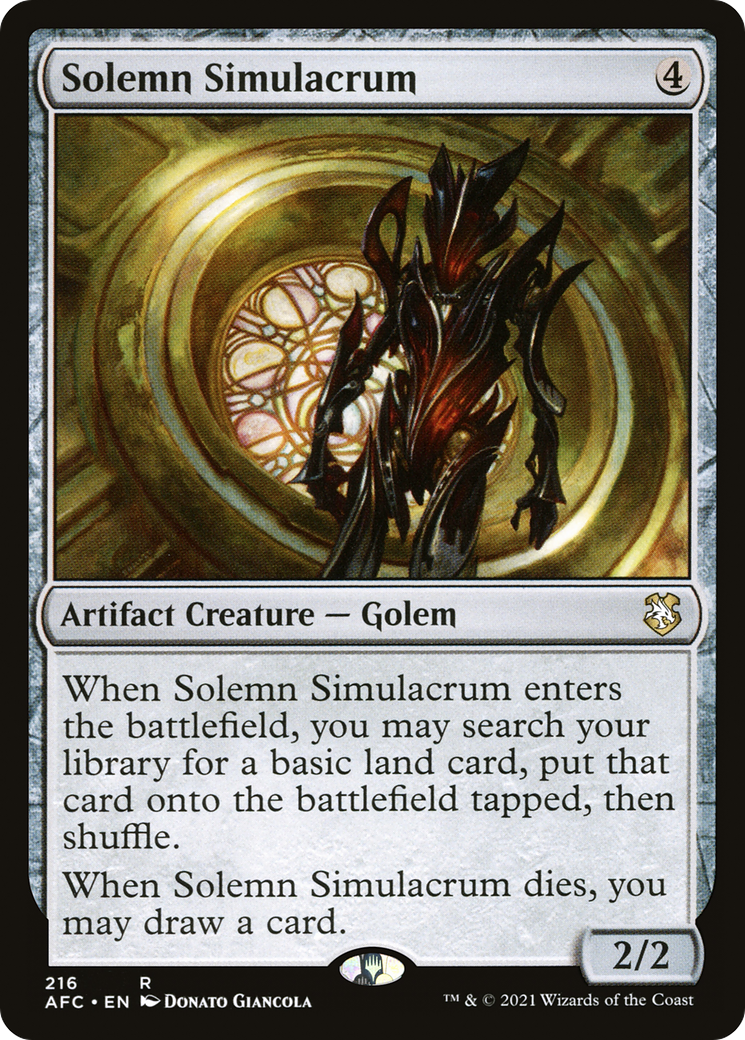
Solemn Simulacrum
Solemn Simulacrum
Artifact Creature — Golem
2/2
When this creature enters, you may search your library for a basic land card, put that card onto the battlefield tapped, then shuffle.
When this creature dies, you may draw a card.
-
1
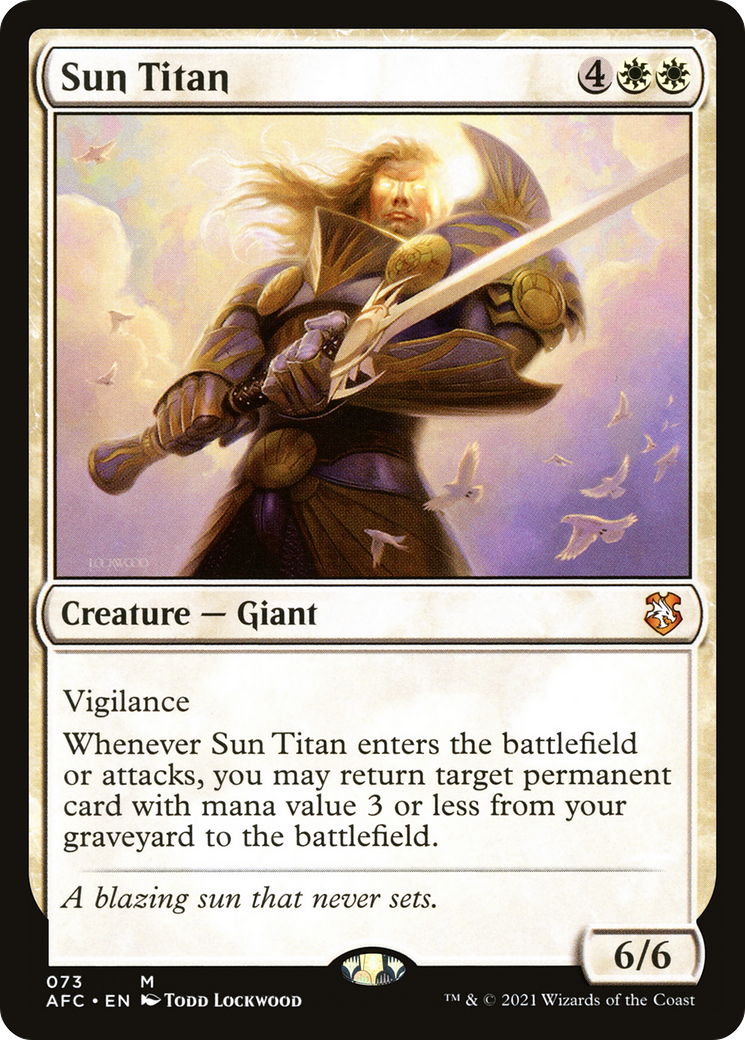
Sun Titan
Sun Titan
Creature — Giant
6/6
Vigilance
Whenever this creature enters or attacks, you may return target permanent card with mana value 3 or less from your graveyard to the battlefield.
- A permanent card is an artifact, creature, enchantment, land, or planeswalker card.
- If a card in your graveyard has no mana symbols in its upper right corner (because it's a land card, for example), its mana value is 0.
- The mana value of a card in your graveyard is determined solely by the mana symbols printed in its upper right corner. The mana value is the total amount of mana in that cost, regardless of color. For example, a card with mana cost has mana value 5.
- If the mana cost of a card in your graveyard includes , X is considered to be 0.
-
1
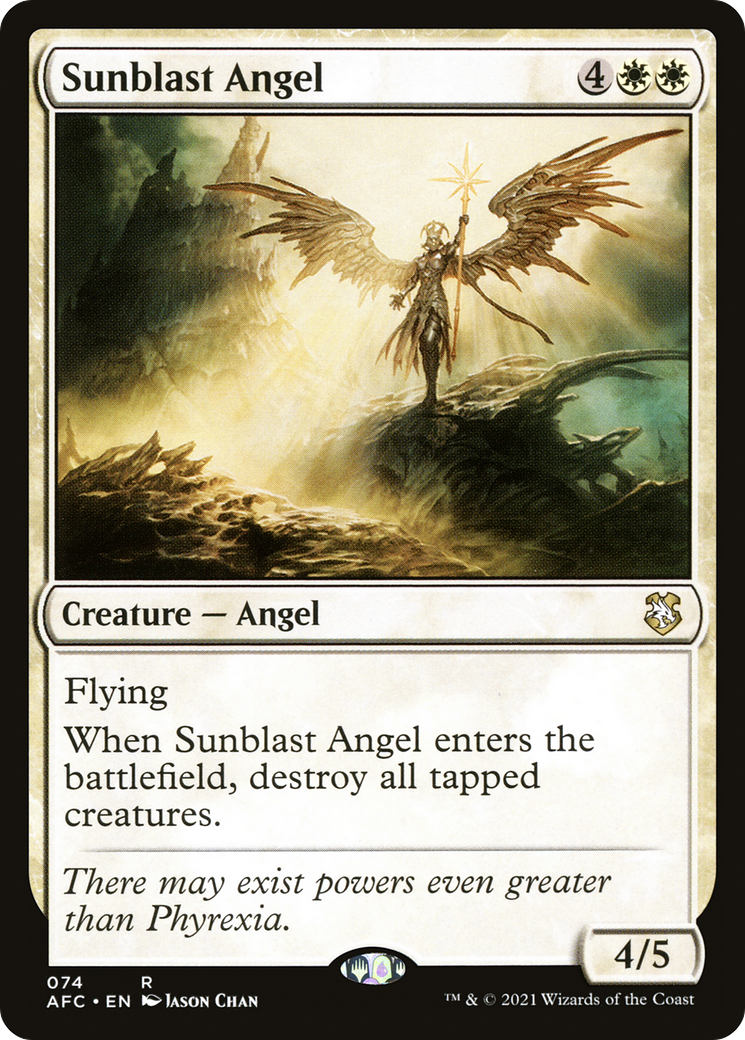
Sunblast Angel
Sunblast Angel
Creature — Angel
4/5
Flying
When this creature enters, destroy all tapped creatures.
- The second ability destroys each creature that's tapped at the time it resolves, including creatures you control. If Sunblast Angel has become tapped by the time its ability resolves, it will be destroyed too.
-
1
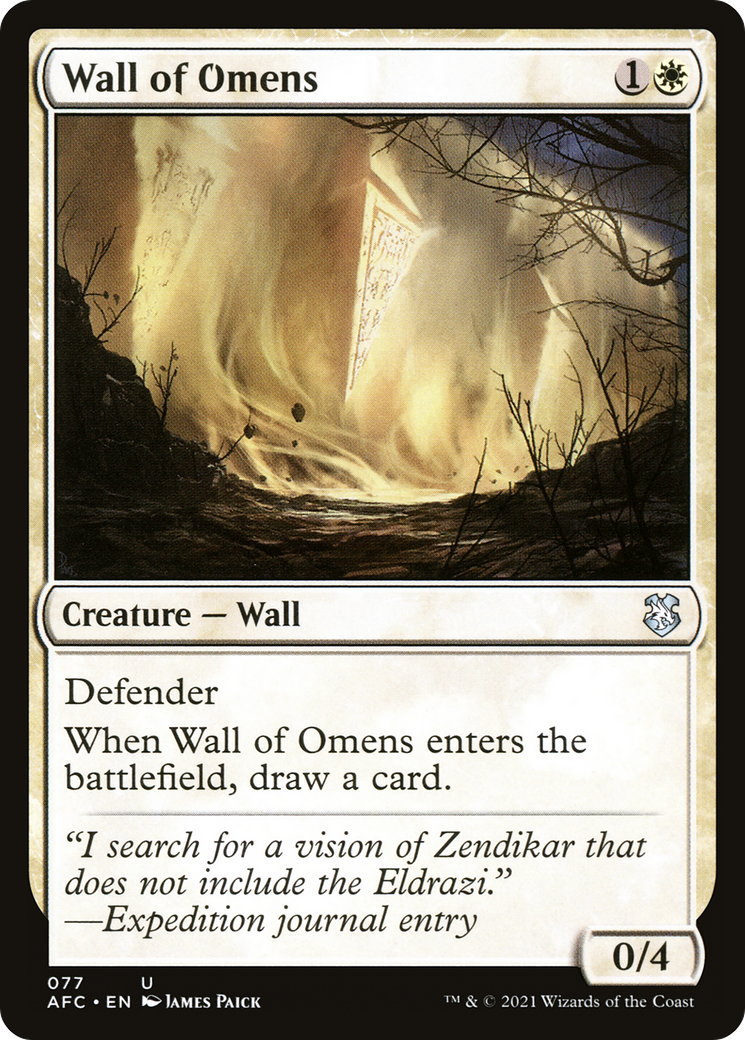
Wall of Omens
Wall of Omens
Creature — Wall
0/4
Defender
When this creature enters, draw a card.
Instants 7
-
1
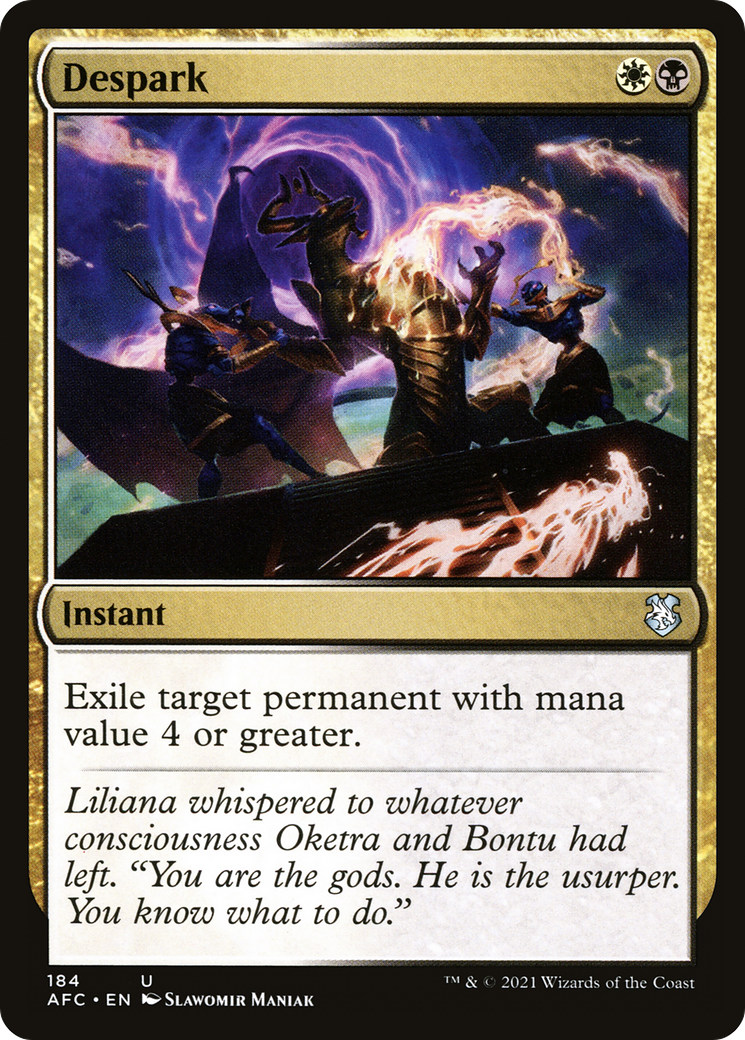
Despark
Despark
Instant
Exile target permanent with mana value 4 or greater.
- If a permanent has in its mana cost, X is considered to be 0.
-
1
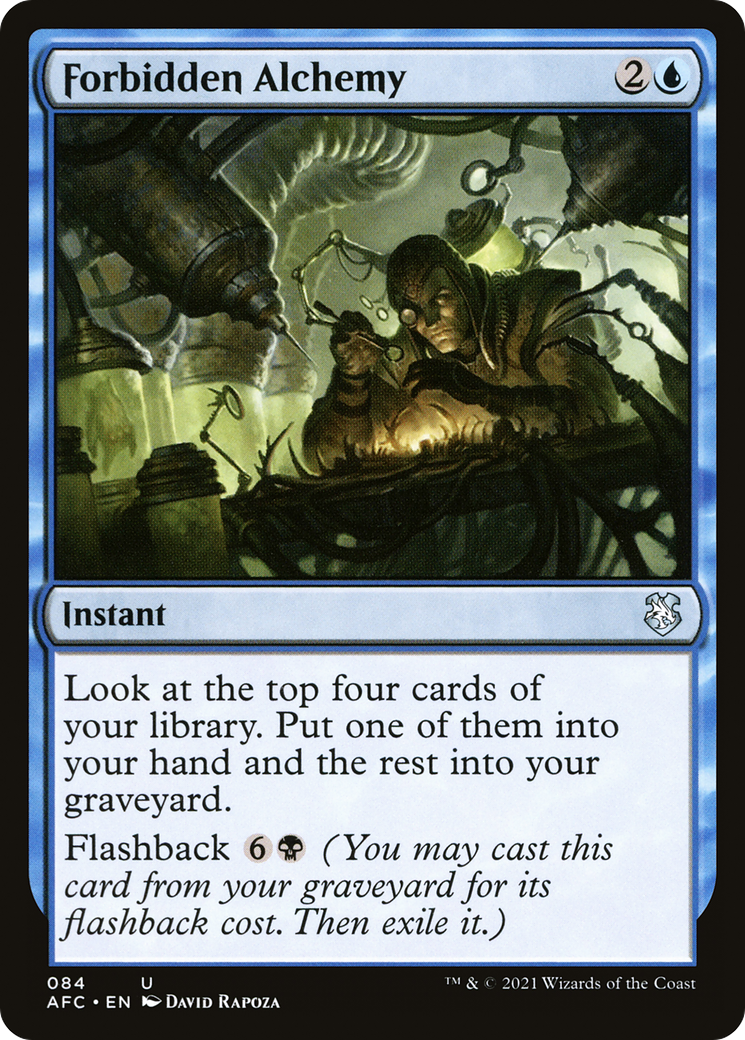
Forbidden Alchemy
Forbidden Alchemy
Instant
Look at the top four cards of your library. Put one of them into your hand and the rest into your graveyard.
Flashback (You may cast this card from your graveyard for its flashback cost. Then exile it.)
- To determine the total cost of a spell, start with the mana cost or alternative cost (such as a flashback cost) you're paying, add any cost increases, then apply any cost reductions. The mana value of the spell is determined only by its mana cost, no matter what the total cost to cast the spell was.
- "Flashback [cost]" means "You may cast this card from your graveyard by paying [cost] rather than paying its mana cost" and "If the flashback cost was paid, exile this card instead of putting it anywhere else any time it would leave the stack."
- You must still follow any timing restrictions and permissions, including those based on the card's type. For instance, you can cast a sorcery using flashback only when you could normally cast a sorcery.
- If a card with flashback is put into your graveyard during your turn, you can cast it if it's legal to do so before any other player can take any actions.
- A spell cast using flashback will always be exiled afterward, whether it resolves, is countered, or leaves the stack in some other way.
- You can cast a spell using flashback even if it was somehow put into your graveyard without having been cast.
- If you have fewer than four cards in your library, you'll look at all the cards there and put one into your hand and the rest into your graveyard.
-
1
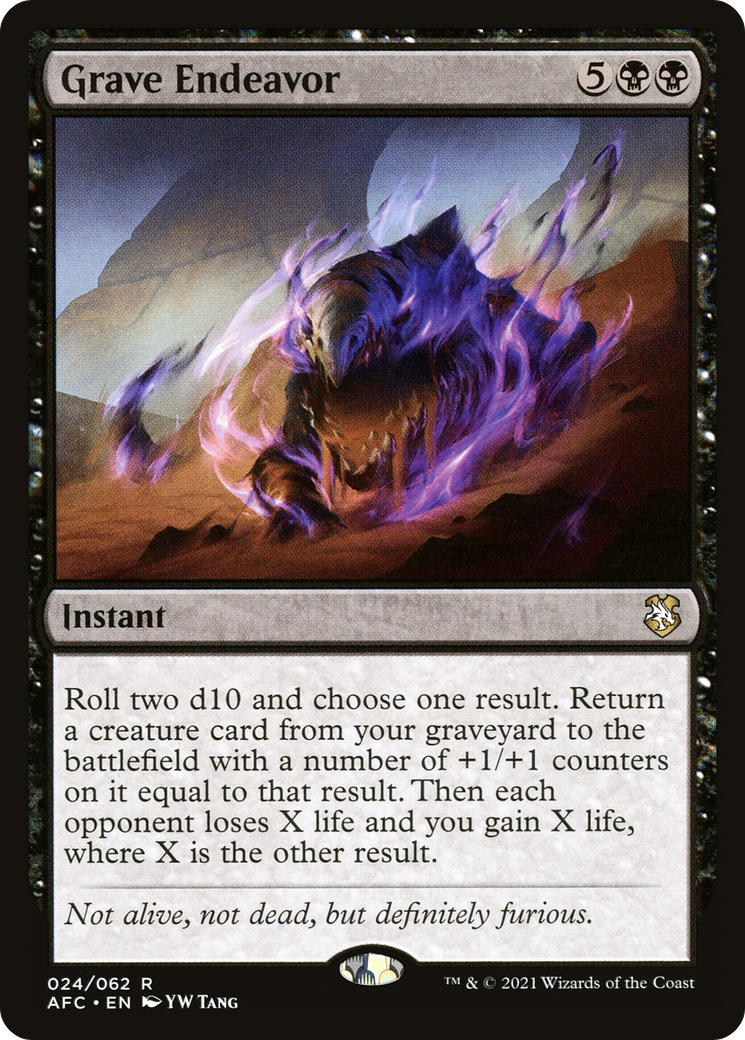
Grave Endeavor
Grave Endeavor
Instant
Roll two d10 and choose one result. Return a creature card from your graveyard to the battlefield with a number of +1/+1 counters on it equal to that result. Then each opponent loses X life and you gain X life, where X is the other result.
- Dice are identified by the number of faces each one has. For example, a d20 is a twenty-sided die.
- Dice used must have equally likely outcomes and the roll must be fair. Although physical dice are recommended, digital substitutes are allowed, provided they have the same number of equally likely outcomes as specified in the original roll instruction.
- An ability that tells you to roll a die will also specify what to do with the result of that roll. Most often, this is in the form of a “results table” in the card text.
- The instruction to roll a die and the effect that occurs because of the result are all part of the same ability. Players do not get the chance to respond to the ability after knowing the result of the roll.
- An effect that says “choose a target, then roll a d20” or similar still uses the normal process of putting an ability on the stack and resolving it. Choosing targets is part of putting the ability on the stack and rolling the d20 happens later, as the ability resolves.
- Some effects may modify the result of a die roll. This may be part of the instruction to roll a die or it may come from other cards. Anything that references the “result” of a die roll is looking for the result after these modifications. Anything that is looking for the “natural result” is looking for the number shown on the face of the die before these modifications.
- Some abilities, like that of Pixie Guide and Barbarian Class, replace rolling a die with rolling extra dice and ignoring the lowest roll. The ignored rolls are not considered for the effect that instructed you to roll a die, and do not cause abilities to trigger. For all intents and purposes, once you determine which dice count, any extra dice were never rolled.
- Some effects instruct you to roll again. This uses the same number and type of dice as the original roll, and that roll will use the same set of possible outcomes.
- While playing Planechase, rolling the planar die will cause any ability that triggers whenever a player rolls one or more dice to trigger. However, any effect that refers to a numerical result will ignore the rolling of the planar die.
- Tournament events have more specific rules regarding dice and die-rolling. For more information, please see the most recent version of the Magic Tournament Rules at https://wpn.wizards.com/en/document/magic-gathering-tournament-rules.
-
1
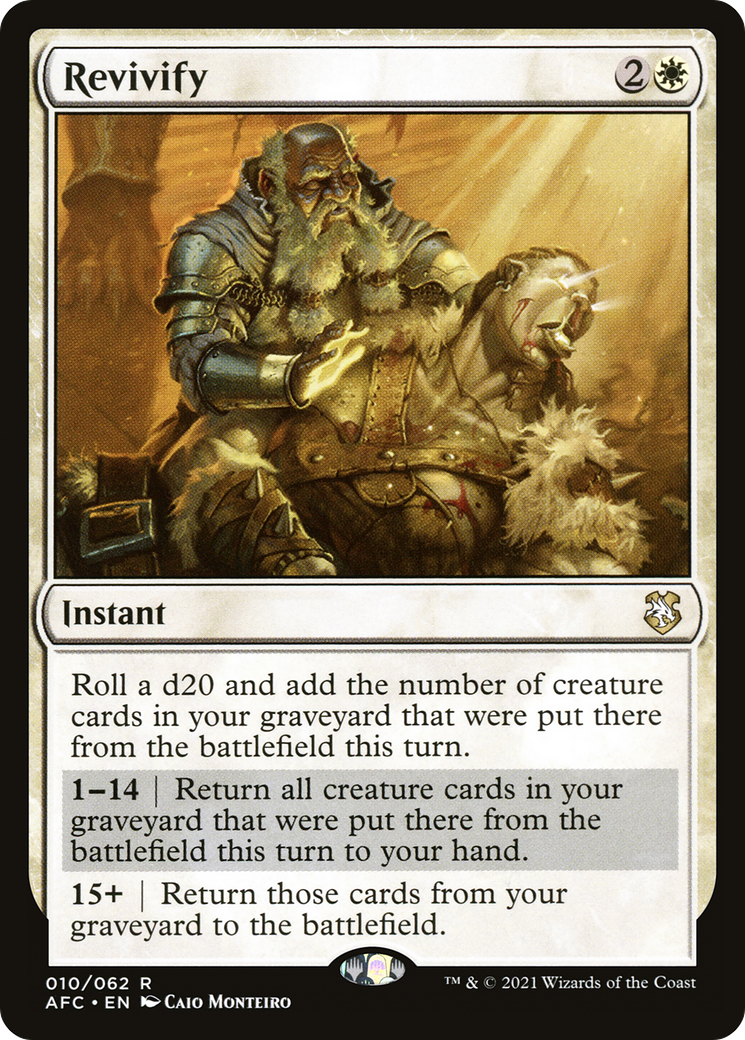
Revivify
Revivify
Instant
Roll a d20 and add the number of creature cards in your graveyard that were put there from the battlefield this turn.
1—14 | Return all creature cards in your graveyard that were put there from the battlefield this turn to your hand.
15+ | Return those cards from your graveyard to the battlefield.
-
1
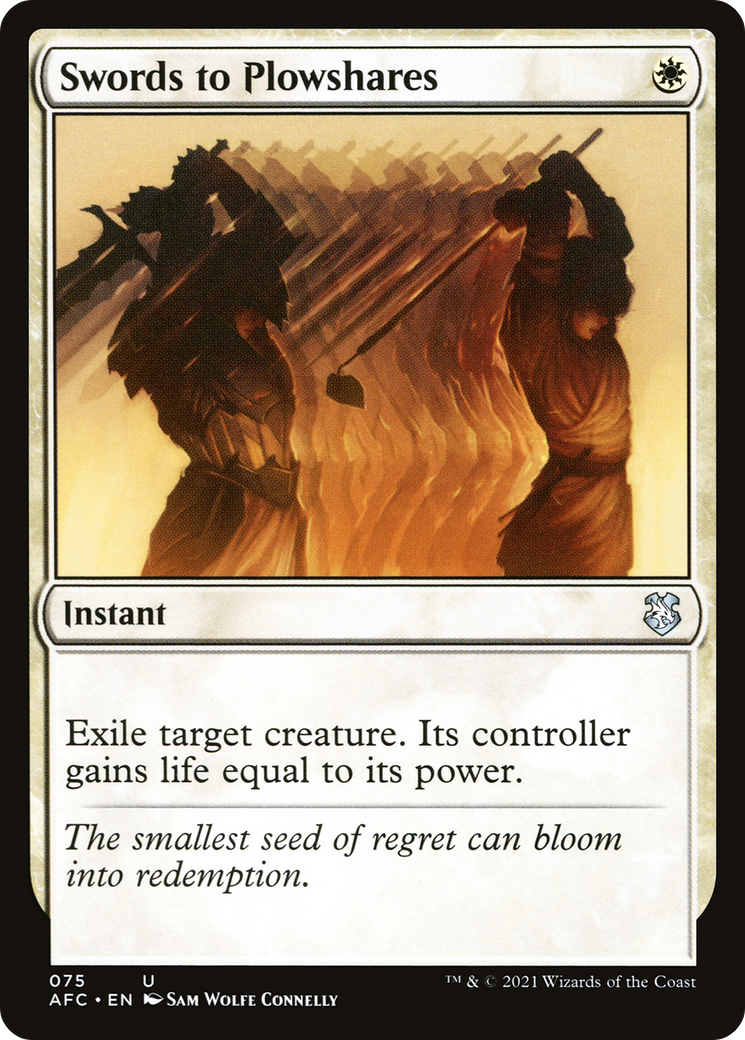
Swords to Plowshares
Swords to Plowshares
Instant
Exile target creature. Its controller gains life equal to its power.
- Use the power of the creature from when it was last on the battlefield to determine how much life is gained.
-
1
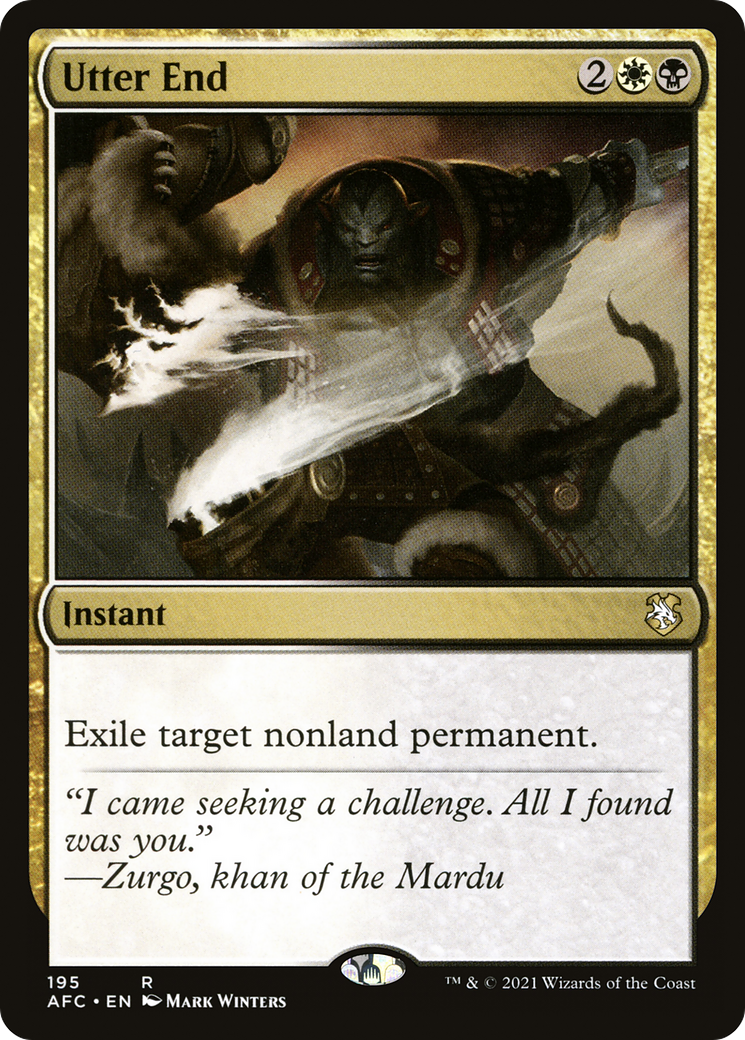
Utter End
Utter End
Instant
Exile target nonland permanent.
-
1
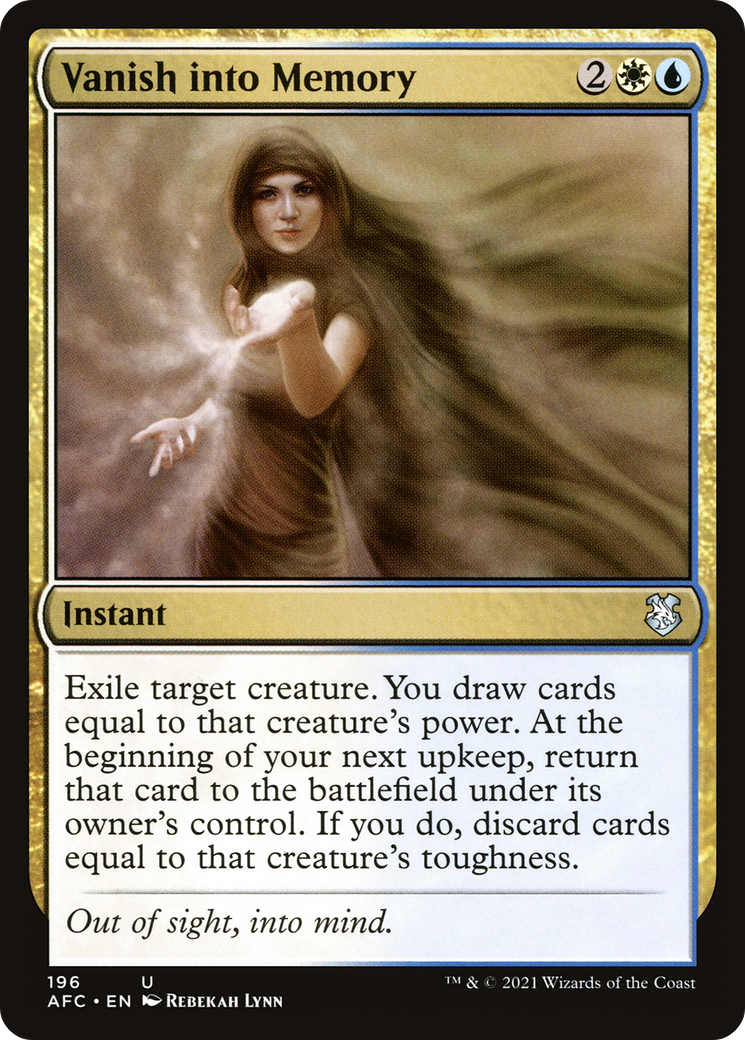
Vanish into Memory
Vanish into Memory
Instant
Exile target creature. You draw cards equal to that creature's power. At the beginning of your next upkeep, return that card to the battlefield under its owner's control. If you do, discard cards equal to that creature's toughness.
- Vanish into Memory cares about the creature's power just before it left the battlefield and its toughness just after it returns to the battlefield. For example, if you target a 2/2 creature with two +1/+1 counters on it, you'll draw four cards, then when it returns to the battlefield without any counters on it, you'll discard two cards.
- If the creature exiled with Vanish into Memory never returns to the battlefield (because it was a token creature, for example), you don't discard any cards.
- If the creature exiled with Vanish into Memory isn't a creature card (for example, a crewed Vehicle), that card will still be returned to the battlefield, but not as a creature. Since the card returned to the battlefield has no toughness, you discard no cards.
Sorceries 5
-
1
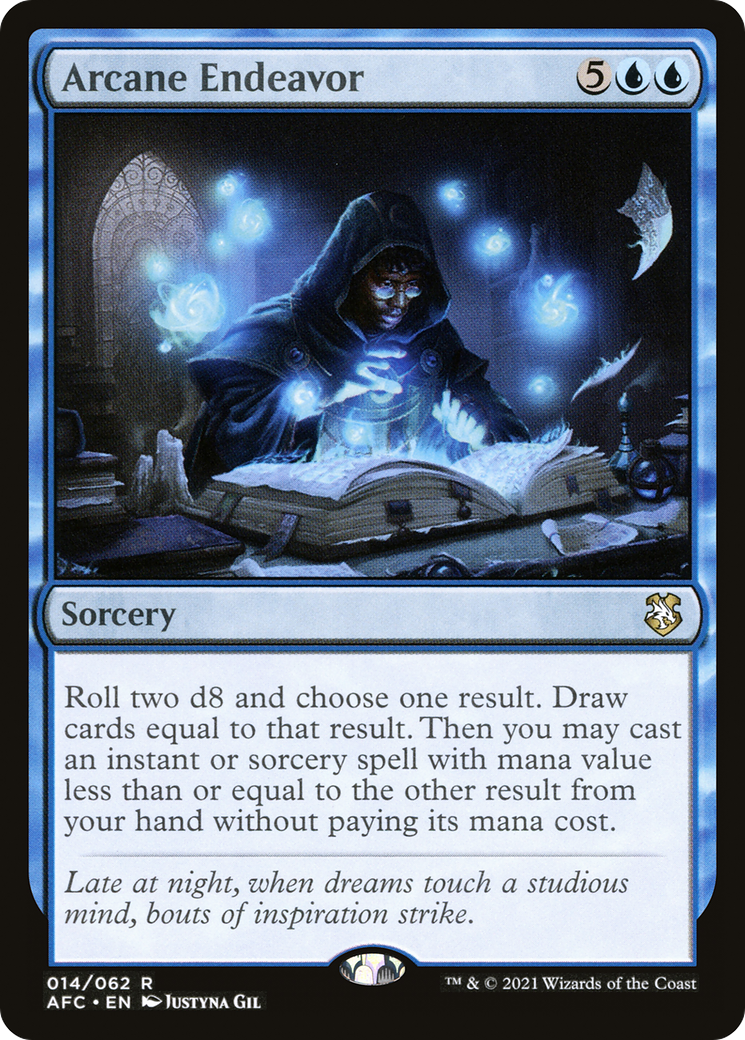
Arcane Endeavor
Arcane Endeavor
Sorcery
Roll two d8 and choose one result. Draw cards equal to that result. Then you may cast an instant or sorcery spell with mana value less than or equal to the other result from your hand without paying its mana cost.
- Dice are identified by the number of faces each one has. For example, a d20 is a twenty-sided die.
- Dice used must have equally likely outcomes and the roll must be fair. Although physical dice are recommended, digital substitutes are allowed, provided they have the same number of equally likely outcomes as specified in the original roll instruction.
- An ability that tells you to roll a die will also specify what to do with the result of that roll. Most often, this is in the form of a “results table” in the card text.
- The instruction to roll a die and the effect that occurs because of the result are all part of the same ability. Players do not get the chance to respond to the ability after knowing the result of the roll.
- An effect that says “choose a target, then roll a d20” or similar still uses the normal process of putting an ability on the stack and resolving it. Choosing targets is part of putting the ability on the stack and rolling the d20 happens later, as the ability resolves.
- Some effects may modify the result of a die roll. This may be part of the instruction to roll a die or it may come from other cards. Anything that references the “result” of a die roll is looking for the result after these modifications. Anything that is looking for the “natural result” is looking for the number shown on the face of the die before these modifications.
- Some abilities, like that of Pixie Guide and Barbarian Class, replace rolling a die with rolling extra dice and ignoring the lowest roll. The ignored rolls are not considered for the effect that instructed you to roll a die, and do not cause abilities to trigger. For all intents and purposes, once you determine which dice count, any extra dice were never rolled.
- Some effects instruct you to roll again. This uses the same number and type of dice as the original roll, and that roll will use the same set of possible outcomes.
- While playing Planechase, rolling the planar die will cause any ability that triggers whenever a player rolls one or more dice to trigger. However, any effect that refers to a numerical result will ignore the rolling of the planar die.
- Tournament events have more specific rules regarding dice and die-rolling. For more information, please see the most recent version of the Magic Tournament Rules at https://wpn.wizards.com/en/document/magic-gathering-tournament-rules.
-
1
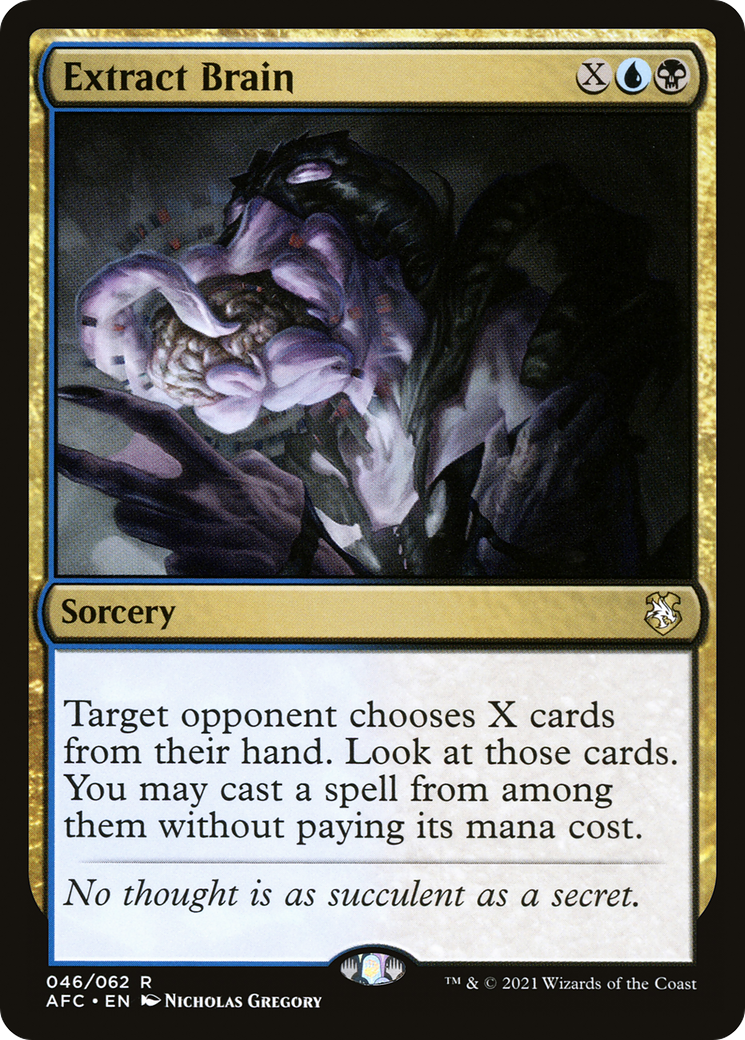
Extract Brain
Extract Brain
Sorcery
Target opponent chooses X cards from their hand. Look at those cards. You may cast a spell from among them without paying its mana cost.
-
1
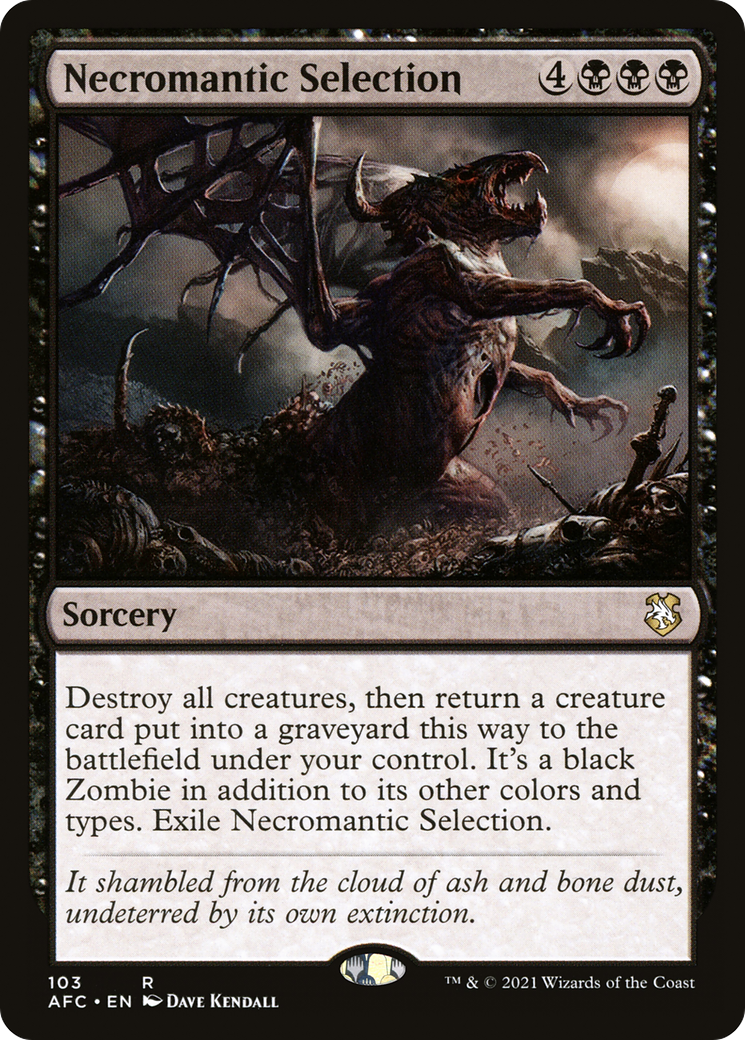
Necromantic Selection
Necromantic Selection
Sorcery
Destroy all creatures, then return a creature card put into a graveyard this way to the battlefield under your control. It's a black Zombie in addition to its other colors and types. Exile Necromantic Selection.
- Necromantic Selection doesn't overwrite any of the creature's colors or types. Rather, it adds another color and another creature type.
- If the creature is normally colorless, it will simply become black. It can't be both black and colorless.
-
1
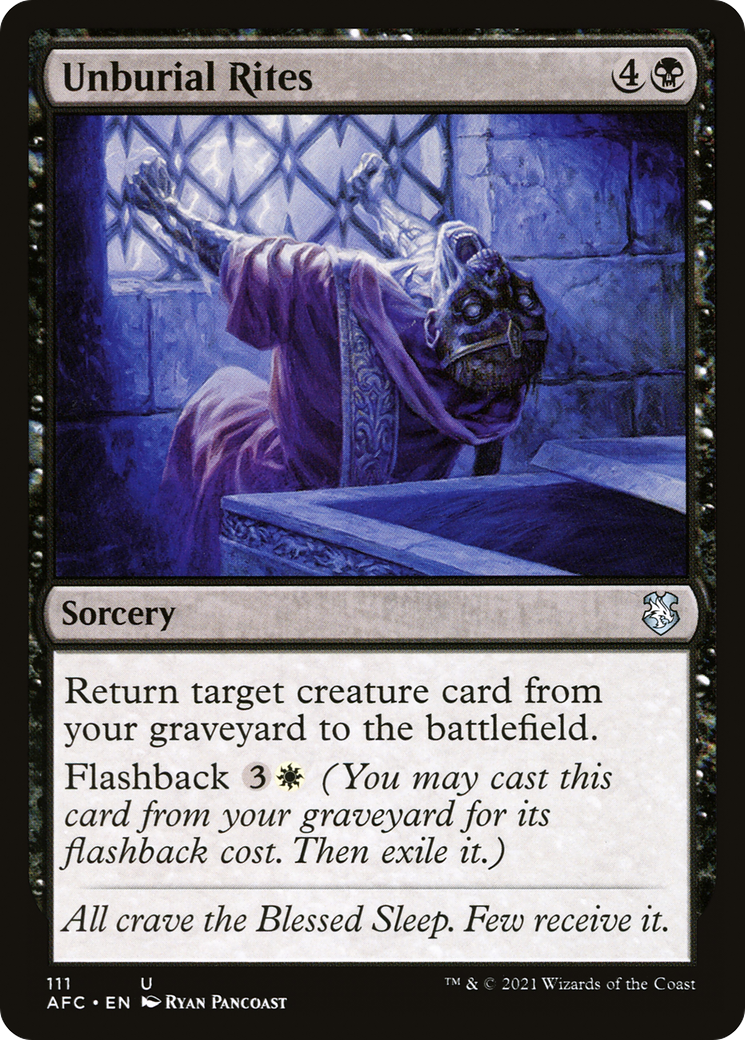
Unburial Rites
Unburial Rites
Sorcery
Return target creature card from your graveyard to the battlefield.
Flashback (You may cast this card from your graveyard for its flashback cost. Then exile it.)
- "Flashback [cost]" means "You may cast this card from your graveyard by paying [cost] rather than paying its mana cost" and "If the flashback cost was paid, exile this card instead of putting it anywhere else any time it would leave the stack."
- You must still follow any timing restrictions and permissions, including those based on the card's type. For instance, you can cast a sorcery using flashback only when you could normally cast a sorcery.
- To determine the total cost of a spell, start with the mana cost or alternative cost (such as a flashback cost) you're paying, add any cost increases, then apply any cost reductions. The mana value of the spell is determined only by its mana cost, no matter what the total cost to cast the spell was.
- A spell cast using flashback will always be exiled afterward, whether it resolves, is countered, or leaves the stack in some other way.
- You can cast a spell using flashback even if it was somehow put into your graveyard without having been cast.
- If a card with flashback is put into your graveyard during your turn, you can cast it if it's legal to do so before any other player can take any actions.
-
1
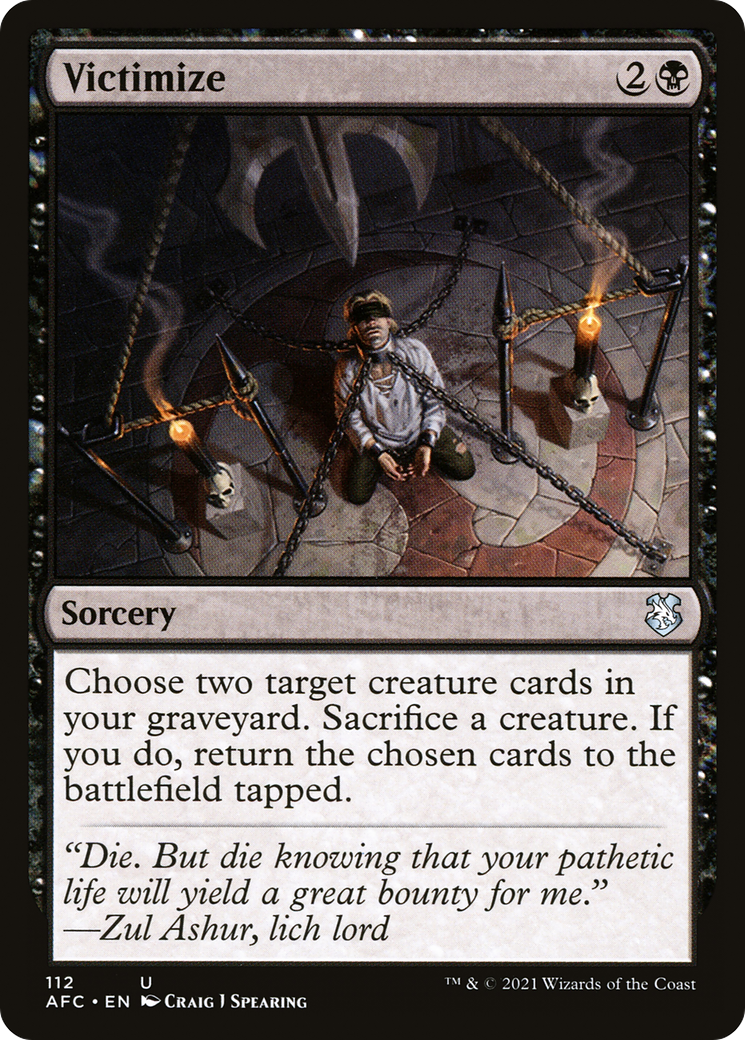
Victimize
Victimize
Sorcery
Choose two target creature cards in your graveyard. Sacrifice a creature. If you do, return the chosen cards to the battlefield tapped.
- You must choose two targets. You can't cast Victimize targeting only one creature card.
- If one of the targeted creature cards is an illegal target (for instance, because it has left your graveyard before Victimize resolves), you'll still sacrifice a creature and put the other card onto the battlefield. If both are illegal targets, Victimize won't resolve. You won't sacrifice a creature.
- The creature you sacrifice isn't chosen until Victimize resolves. You can't return the creature you sacrifice because it will still be on the battlefield at the time targets are chosen.
- As Victimize resolves, you must sacrifice a creature if able. You can't change your mind and choose not to sacrifice anything.
Artifacts 12
-
1
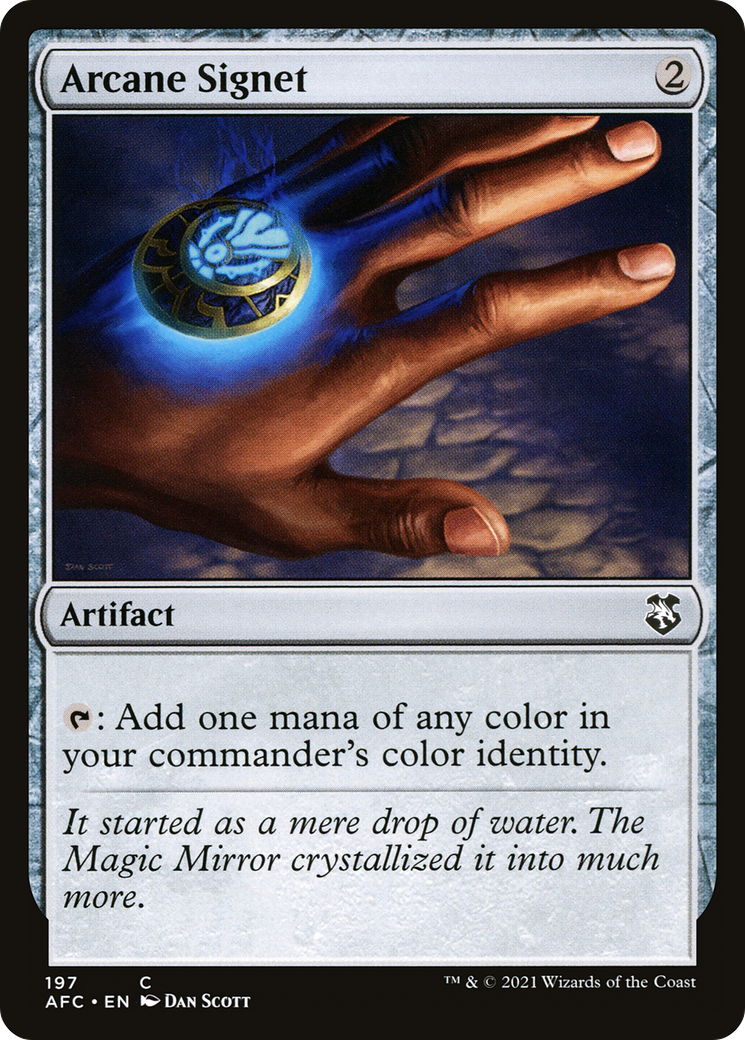
Arcane Signet
Arcane Signet
Artifact
: Add one mana of any color in your commander's color identity.
- If your commander is a card that has no colors in its color identity, Arcane Signet's ability produces no mana. It doesn't produce .
- If you have two commanders, the ability adds one mana of any color in their combined color identities.
- If you don't have a commander, Arcane Signet's ability produces no mana.
-
1
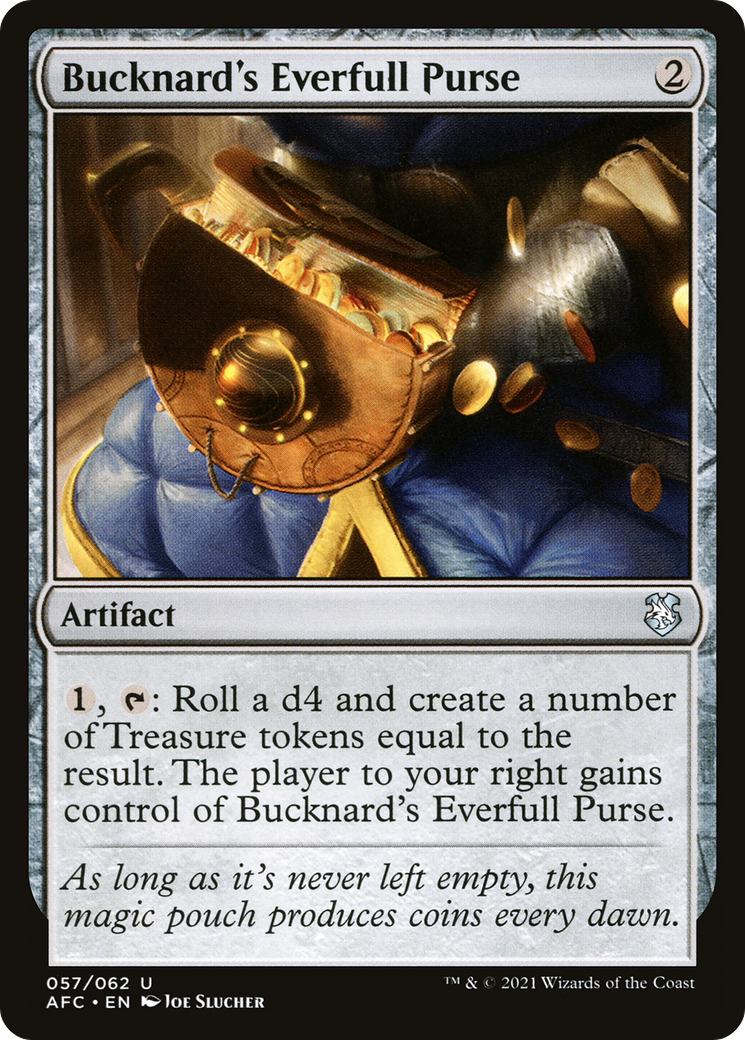
Bucknard's Everfull Purse
Bucknard's Everfull Purse
Artifact
, : Roll a d4 and create a number of Treasure tokens equal to the result. The player to your right gains control of this artifact.
- Dice are identified by the number of faces each one has. For example, a d20 is a twenty-sided die.
- Dice used must have equally likely outcomes and the roll must be fair. Although physical dice are recommended, digital substitutes are allowed, provided they have the same number of equally likely outcomes as specified in the original roll instruction.
- An ability that tells you to roll a die will also specify what to do with the result of that roll. Most often, this is in the form of a “results table” in the card text.
- The instruction to roll a die and the effect that occurs because of the result are all part of the same ability. Players do not get the chance to respond to the ability after knowing the result of the roll.
- An effect that says “choose a target, then roll a d20” or similar still uses the normal process of putting an ability on the stack and resolving it. Choosing targets is part of putting the ability on the stack and rolling the d20 happens later, as the ability resolves.
- Some effects may modify the result of a die roll. This may be part of the instruction to roll a die or it may come from other cards. Anything that references the “result” of a die roll is looking for the result after these modifications. Anything that is looking for the “natural result” is looking for the number shown on the face of the die before these modifications.
- Some abilities, like that of Pixie Guide and Barbarian Class, replace rolling a die with rolling extra dice and ignoring the lowest roll. The ignored rolls are not considered for the effect that instructed you to roll a die, and do not cause abilities to trigger. For all intents and purposes, once you determine which dice count, any extra dice were never rolled.
- Some effects instruct you to roll again. This uses the same number and type of dice as the original roll, and that roll will use the same set of possible outcomes.
- While playing Planechase, rolling the planar die will cause any ability that triggers whenever a player rolls one or more dice to trigger. However, any effect that refers to a numerical result will ignore the rolling of the planar die.
- Tournament events have more specific rules regarding dice and die-rolling. For more information, please see the most recent version of the Magic Tournament Rules at https://wpn.wizards.com/en/document/magic-gathering-tournament-rules.
-
1
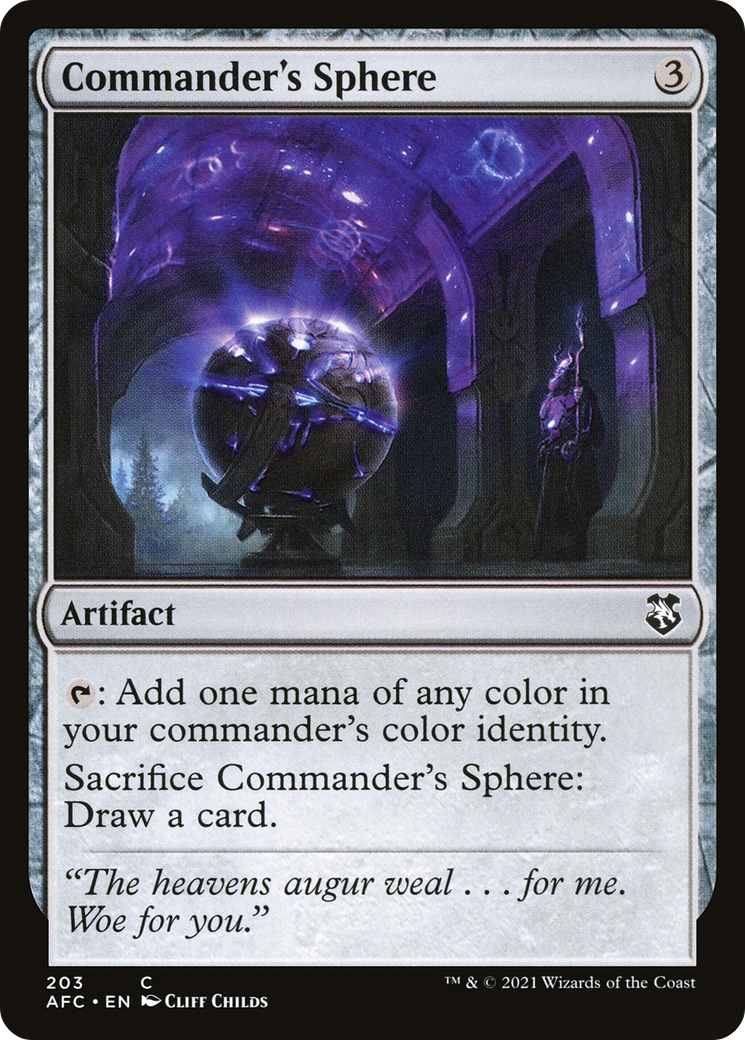
Commander's Sphere
Commander's Sphere
Artifact
: Add one mana of any color in your commander's color identity.
Sacrifice this artifact: Draw a card.
- If your commander is a card that has no colors in its color identity, Commander's Sphere's first ability produces no mana. It doesn't produce .
- If you don't have a commander, Commander's Sphere's first ability produces no mana.
- If you have two commanders, the ability adds one mana of any color in their combined color identities.
-
1
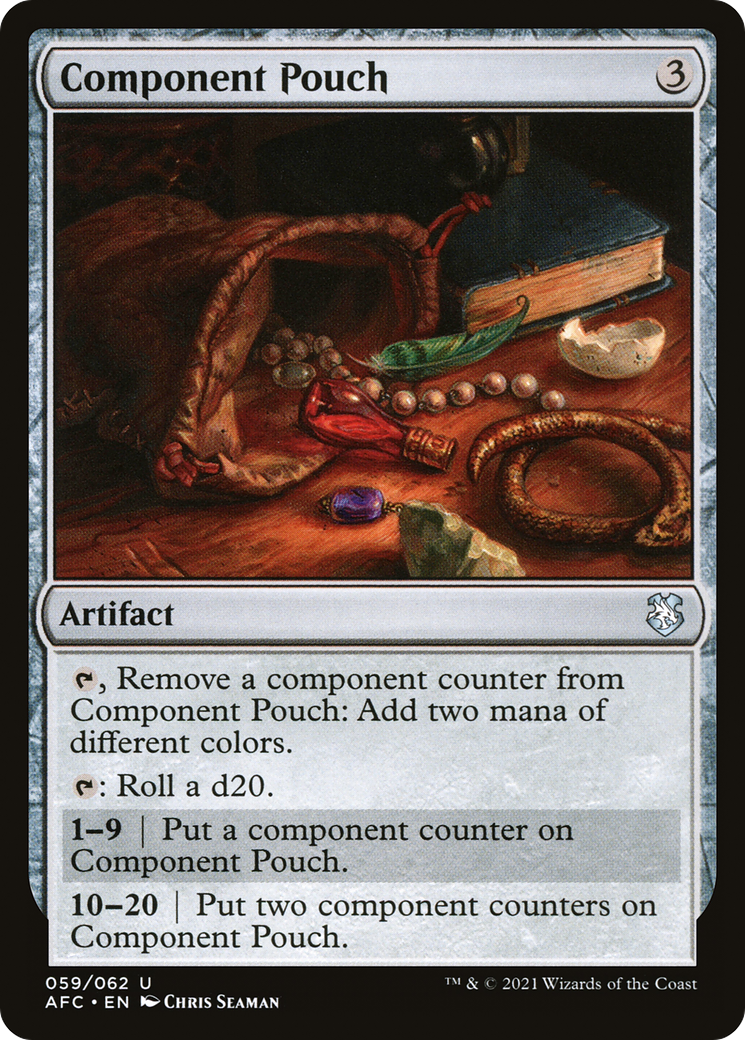
Component Pouch
Component Pouch
Artifact
, Remove a component counter from this artifact: Add two mana of different colors.
: Roll a d20.
1—9 | Put a component counter on this artifact.
10—20 | Put two component counters on this artifact.
- Dice are identified by the number of faces each one has. For example, a d20 is a twenty-sided die.
- Dice used must have equally likely outcomes and the roll must be fair. Although physical dice are recommended, digital substitutes are allowed, provided they have the same number of equally likely outcomes as specified in the original roll instruction.
- An ability that tells you to roll a die will also specify what to do with the result of that roll. Most often, this is in the form of a “results table” in the card text.
- The instruction to roll a die and the effect that occurs because of the result are all part of the same ability. Players do not get the chance to respond to the ability after knowing the result of the roll.
- An effect that says “choose a target, then roll a d20” or similar still uses the normal process of putting an ability on the stack and resolving it. Choosing targets is part of putting the ability on the stack and rolling the d20 happens later, as the ability resolves.
- Some effects may modify the result of a die roll. This may be part of the instruction to roll a die or it may come from other cards. Anything that references the “result” of a die roll is looking for the result after these modifications. Anything that is looking for the “natural result” is looking for the number shown on the face of the die before these modifications.
- Some abilities, like that of Pixie Guide and Barbarian Class, replace rolling a die with rolling extra dice and ignoring the lowest roll. The ignored rolls are not considered for the effect that instructed you to roll a die, and do not cause abilities to trigger. For all intents and purposes, once you determine which dice count, any extra dice were never rolled.
- Some effects instruct you to roll again. This uses the same number and type of dice as the original roll, and that roll will use the same set of possible outcomes.
- While playing Planechase, rolling the planar die will cause any ability that triggers whenever a player rolls one or more dice to trigger. However, any effect that refers to a numerical result will ignore the rolling of the planar die.
- Tournament events have more specific rules regarding dice and die-rolling. For more information, please see the most recent version of the Magic Tournament Rules at https://wpn.wizards.com/en/document/magic-gathering-tournament-rules.
-
1
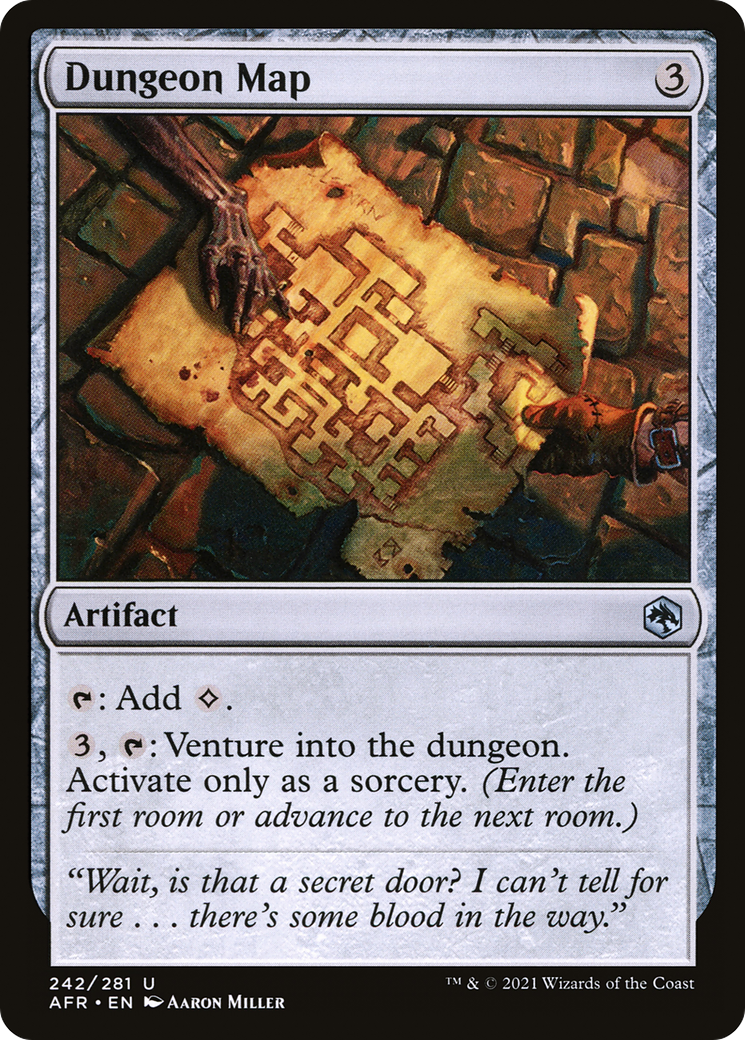
Dungeon Map
Dungeon Map
Artifact
: Add .
, : Venture into the dungeon. Activate only as a sorcery. (Enter the first room or advance to the next room.)
-
1
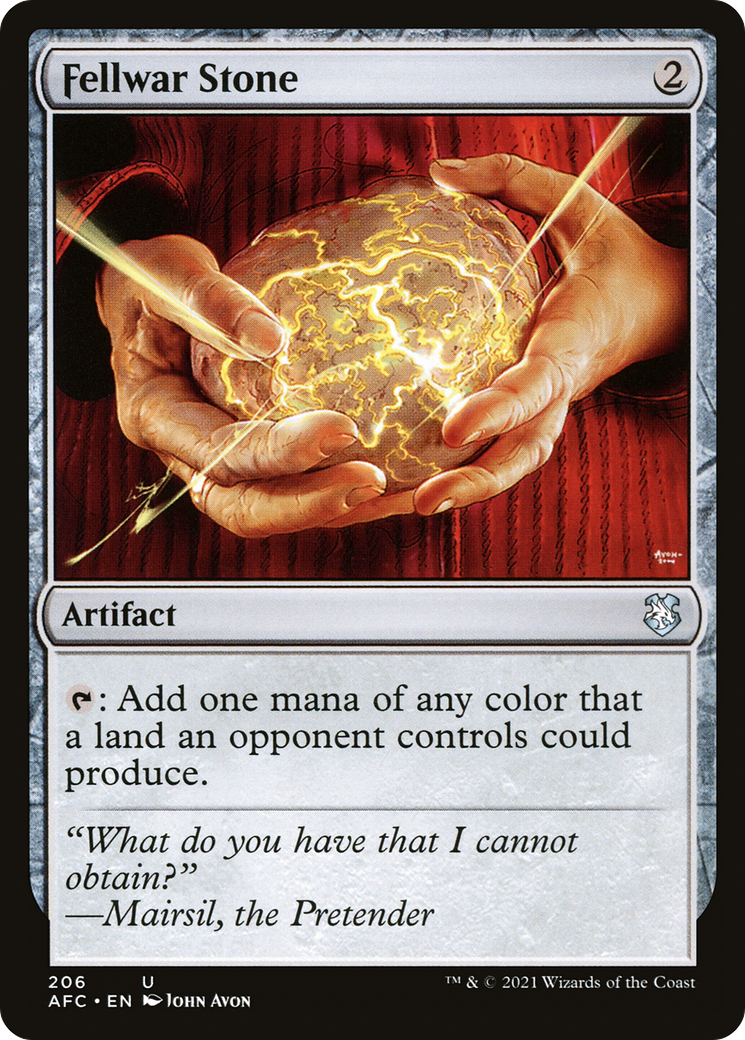
Fellwar Stone
Fellwar Stone
Artifact
: Add one mana of any color that a land an opponent controls could produce.
- When determining what colors of mana your opponents' lands could produce, take into account any applicable replacement effects that would apply to those lands' mana abilities (such as Contamination's effect, for example). If there is more than one, consider them in any possible order.
- Fellwar Stone doesn't care about any restrictions or riders your opponents' lands (such as Ancient Ziggurat or Hall of the Bandit Lord) put on the mana they produce. It just cares about colors of mana.
- The colors of mana are white, blue, black, red, and green. Fellwar Stone can't be tapped for colorless mana, even if a land an opponent controls could produce colorless mana.
- Fellwar Stone checks the effects of all mana-producing abilities of lands your opponents control, but it doesn't check their costs. For example, Vivid Crag has the ability " , Remove a charge counter from Vivid Crag: Add one mana of any color." If an opponent controls Vivid Crag and you control Fellwar Stone, you can tap Fellwar Stone for any color of mana. It doesn't matter whether Vivid Crag has a charge counter on it, and it doesn't matter whether it's untapped.
- This works even if the opponent's lands are tapped. It only checks what kinds of mana can be produced, not if the abilities that produce them are usable right now.
- It only produces one mana even if the land can produce more than one.
- The ability can be activated if the opponent has no lands that produce mana, but the effect will not be able to generate any mana.
-
1
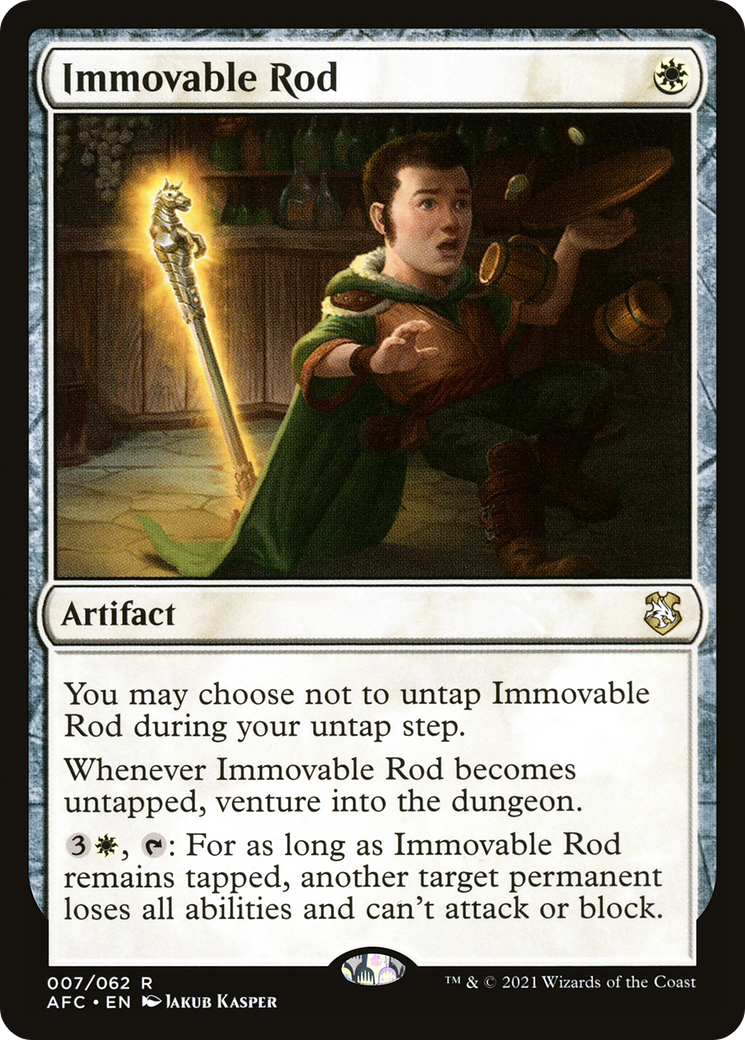
Immovable Rod
Immovable Rod
Artifact
You may choose not to untap this artifact during your untap step.
Whenever this artifact becomes untapped, venture into the dungeon.
, : For as long as this artifact remains tapped, another target permanent loses all abilities and can't attack or block.
- Some abilities still work even if they have been removed. Specifically, static abilities that change an object's types or change an object's colors will still apply even if those abilities are lost.
- If a creature has a characteristic-defining ability that sets its power and/or toughness loses that ability, the power and/or toughness (as appropriate) become 0.
- If you target an Aura with Immovable Rod's last ability, it will lose its enchant ability and be put into its owner's graveyard because it can't legally enchant anything. An Equipment that loses its abilities loses its equip ability, so you won't be able to move it that way, but it will stay attached to the creature it's equipping, if any.
- To venture into the dungeon, a player moves their venture marker into the next room of the dungeon they are currently in. If they aren't currently in a dungeon, that player instead chooses a dungeon card from outside the game, puts it into the command zone, and moves their venture marker onto the first room.
- Moving into a dungeon room will cause its room ability to trigger.
- Once you resolve the last room ability of a dungeon, that dungeon is now completed and is removed from the game.
- A player may only have one dungeon in the command zone at a time.
- The player venturing into the dungeon chooses which dungeon they will venture into. They may choose a dungeon that they have already completed this game.
- Dungeon cards are not part of a player's deck or sideboard. In both constructed and limited formats, players can use any dungeon card when they venture into the dungeon.
- You can only move forward (well, downward) in a dungeon, never backwards or sideways.
- Dungeons are removed from the game as a state-based action.
- If you somehow venture into the dungeon while a room's ability is on the stack, you will continue on in the dungeon. If you're already in the last room, complete that dungeon and start a new one.
- Choosing the dungeon or room to venture into is part of resolving the venture into the dungeon keyword action. Once that choice is made, players may not respond until after the appropriate room ability has triggered.
-
1
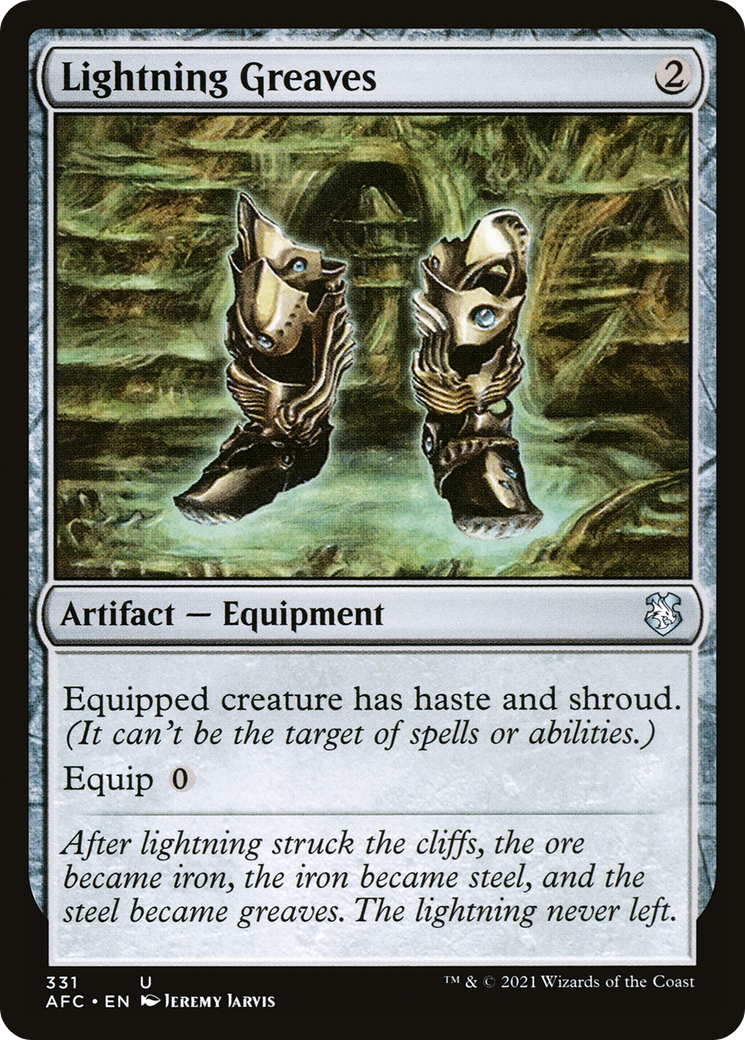
Lightning Greaves
Lightning Greaves
Artifact — Equipment
Equipped creature has haste and shroud. (It can't be the target of spells or abilities.)
Equip
- You can't simply unequip Equipment from a creature. If Lightning Greaves is attached to the only creature you control, you won't be able to attach other equipment to it (or target it with anything else) until you have another creature to which you can attach Lightning Greaves.
- If a creature enters the battlefield under your control and gains haste, but then loses it before attacking, it won't be able to attack that turn. This means that you can't use one Lightning Greaves to allow two new creatures to attack in the same turn.
-
1
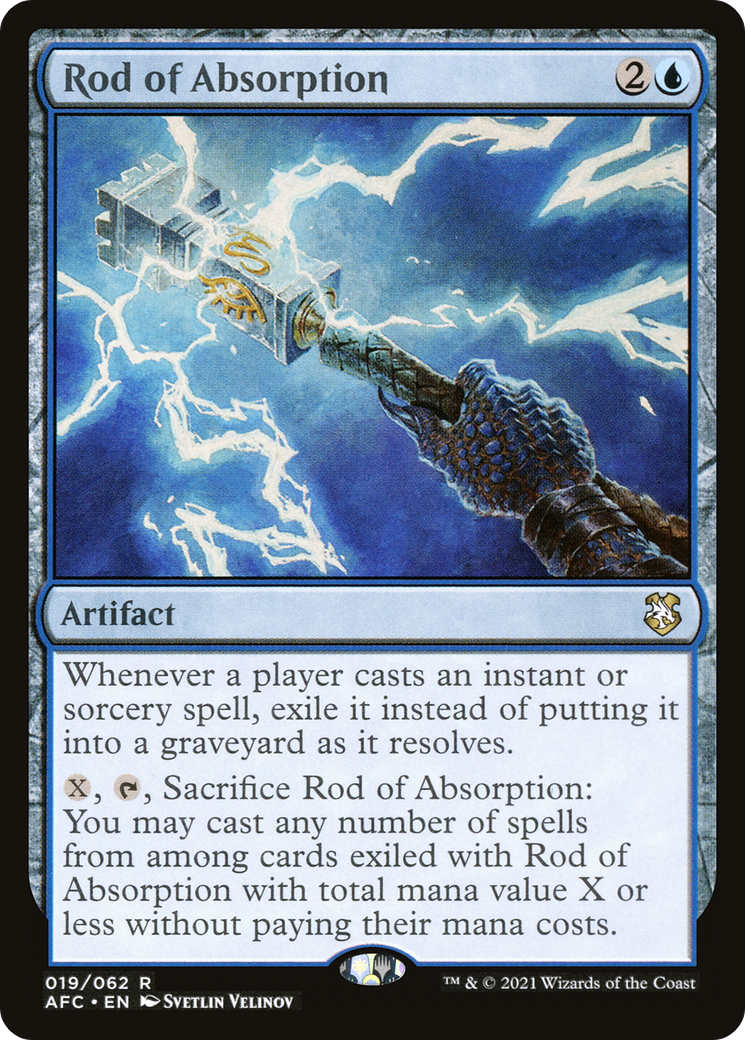
Rod of Absorption
Rod of Absorption
Artifact
Whenever a player casts an instant or sorcery spell, exile it instead of putting it into a graveyard as it resolves.
, , Sacrifice this artifact: You may cast any number of spells from among cards exiled with this artifact with total mana value X or less without paying their mana costs.
- If multiple Rods of Absorption are on the battlefield at the same time, any player casting an instant or sorcery spell will cause all of them to trigger. As the spell resolves, its controller will choose which of the Rods gets to exile it.
- Each Rod of Absorption tracks the cards it has exiled separately. If Rod of Absorption is destroyed and then later brought back to the battlefield, it will not be able to access any of the cards that it had exiled before.
- If a spell is countered or it never resolves, Rod of Absorption will not exile it.
- When Rod of Absorption's last ability resolves, you cast as many spells with total mana value X or less from among the exiled cards as you would like in any order you choose. Cards not cast this way will remain in exile indefinitely.
- If you cast a spell “without paying its mana cost,” you can't choose to cast it for any alternative costs. You can, however, pay additional costs. If the card has any mandatory additional costs, you must pay those to cast the spell.
- If the card has in its mana cost, you must choose 0 as the value of X when casting it without paying its mana cost.
-
1
Sol Ring
Sol Ring
Artifact
: Add .
-
1
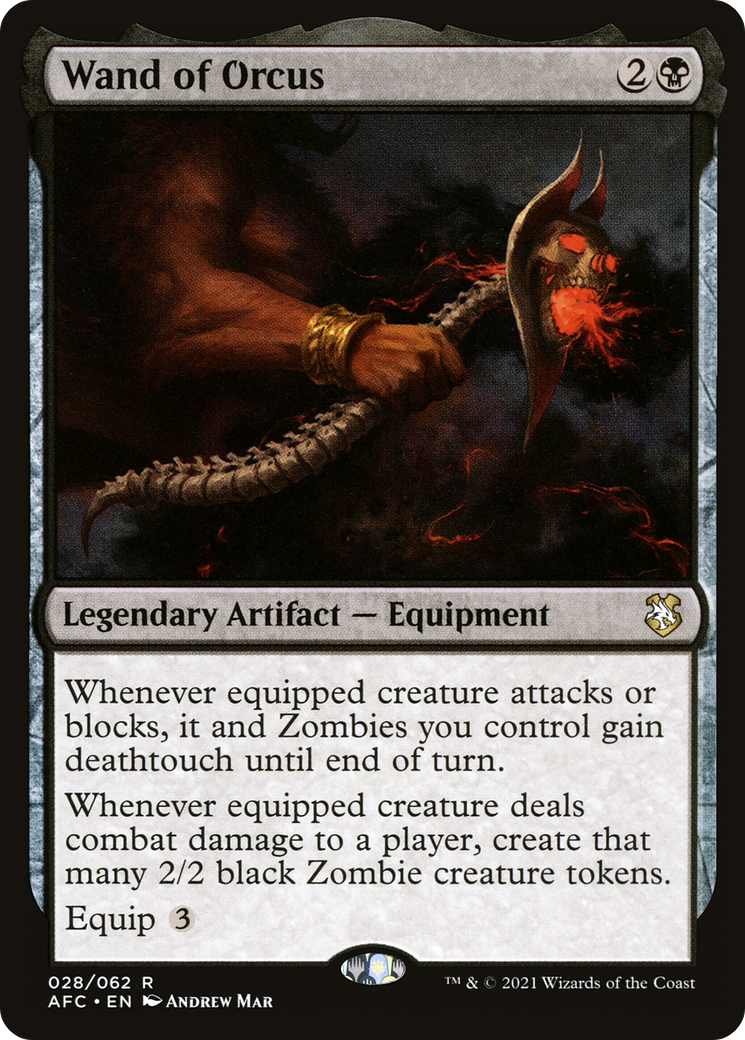
Wand of Orcus
Wand of Orcus
Legendary Artifact — Equipment
Whenever equipped creature attacks or blocks, it and Zombies you control gain deathtouch until end of turn.
Whenever equipped creature deals combat damage to a player, create that many 2/2 black Zombie creature tokens.
Equip
-
1
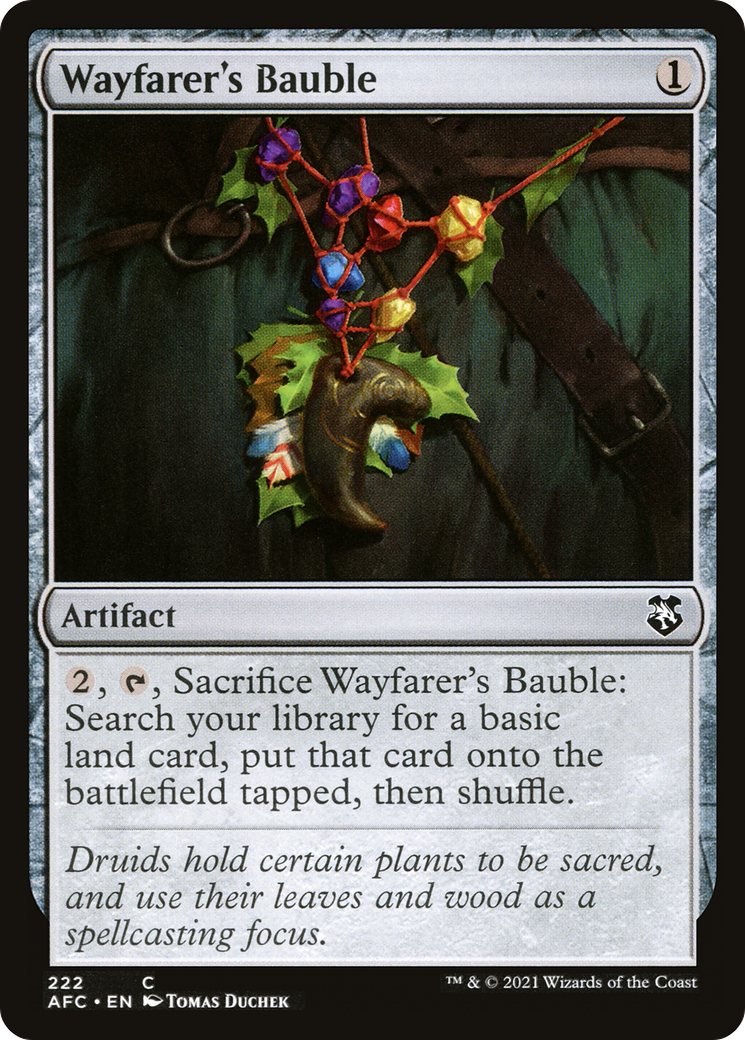
Wayfarer's Bauble
Wayfarer's Bauble
Artifact
, , Sacrifice this artifact: Search your library for a basic land card, put that card onto the battlefield tapped, then shuffle.
Enchantments 3
-
1
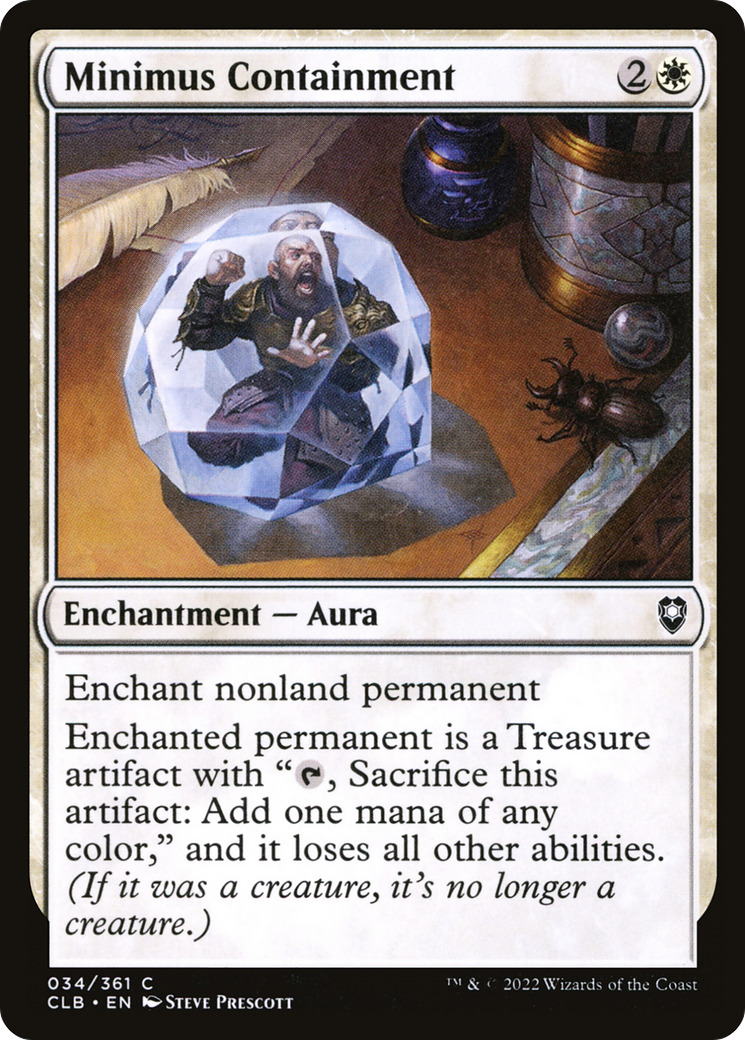
Minimus Containment
Minimus Containment
Enchantment — Aura
Enchant nonland permanent
Enchanted permanent is a Treasure artifact with " , Sacrifice this artifact: Add one mana of any color," and it loses all other abilities. (If it was a creature, it's no longer a creature.)
-
1
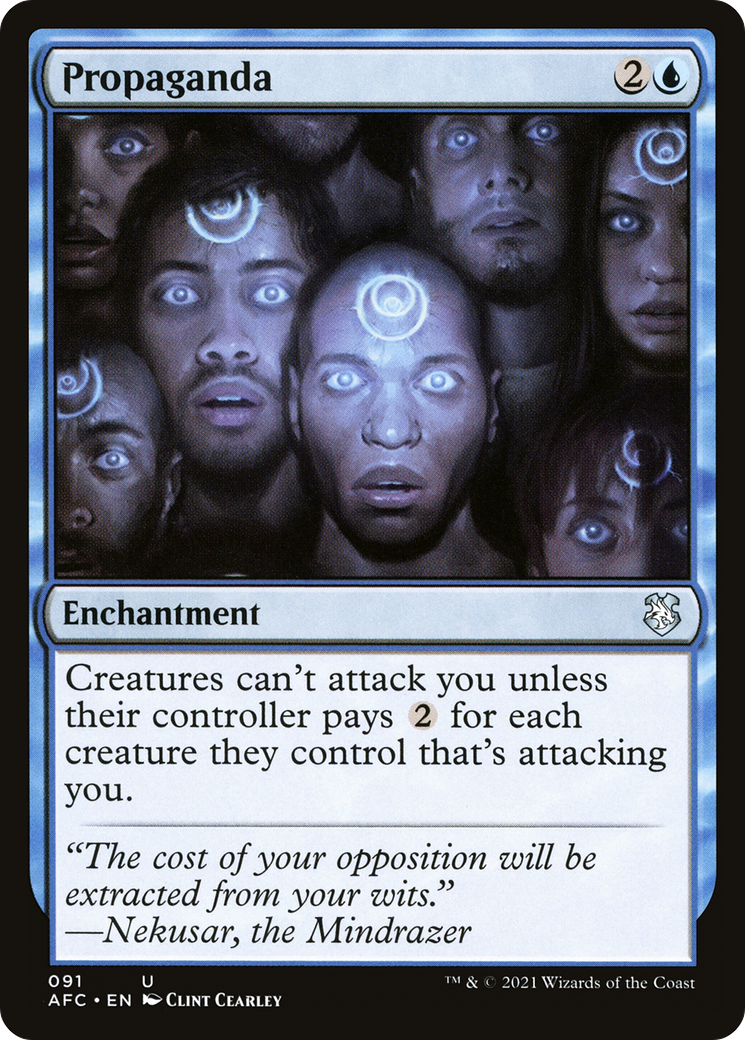
Propaganda
Propaganda
Enchantment
Creatures can't attack you unless their controller pays for each creature they control that's attacking you.
- The payment is made during the declare attackers step at the same time you are declaring the attacker.
- If there are multiple attacks in a turn, then you have to pay for each attack.
- If there is more than one Propaganda on the battlefield, the cost is cumulative.
- Paying this cost is not an instant or any other kind of ability, it is an additional cost on the declaration of the attacker.
-
1
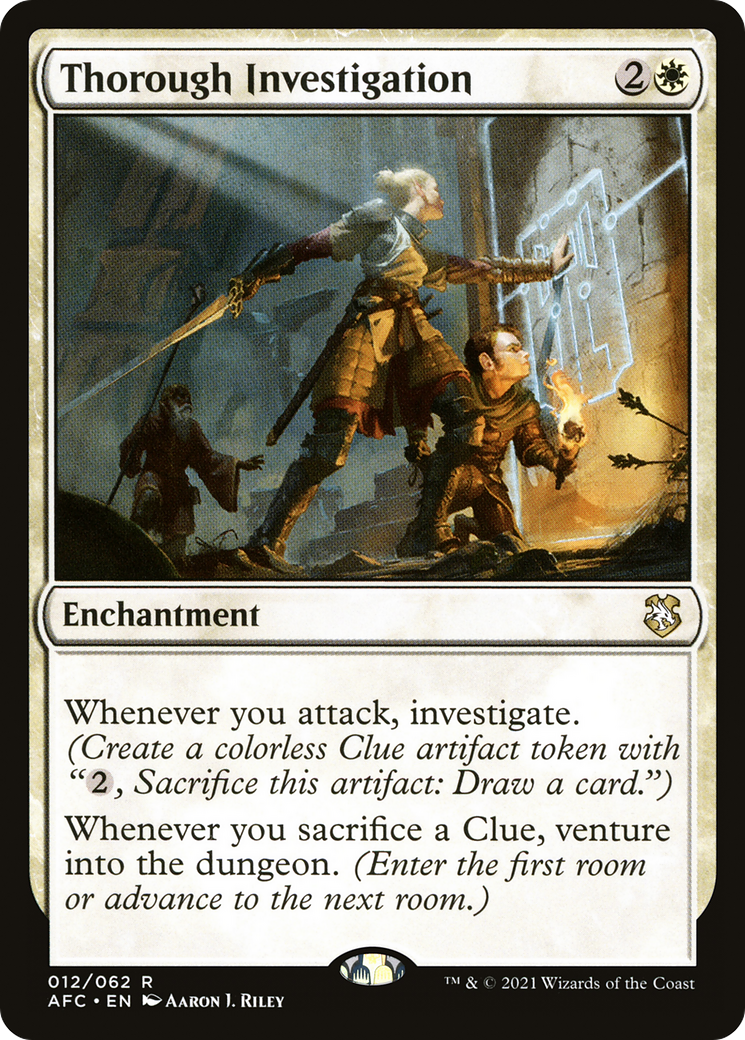
Thorough Investigation
Thorough Investigation
Enchantment
Whenever you attack, investigate. (Create a Clue token. It's an artifact with " , Sacrifice this token: Draw a card.")
Whenever you sacrifice a Clue, venture into the dungeon. (Enter the first room or advance to the next room.)
- Thorough Investigation's first ability can trigger only once per combat, no matter how many creatures you attack with.
- To venture into the dungeon, a player moves their venture marker into the next room of the dungeon they are currently in. If they aren't currently in a dungeon, that player instead chooses a dungeon card from outside the game, puts it into the command zone, and moves their venture marker onto the first room.
- Moving into a dungeon room will cause its room ability to trigger.
- Once you resolve the last room ability of a dungeon, that dungeon is now completed and is removed from the game.
- A player may only have one dungeon in the command zone at a time.
- The player venturing into the dungeon chooses which dungeon they will venture into. They may choose a dungeon that they have already completed this game.
- Dungeon cards are not part of a player's deck or sideboard. In both constructed and limited formats, players can use any dungeon card when they venture into the dungeon.
- You can only move forward (well, downward) in a dungeon, never backwards or sideways.
- Dungeons are removed from the game as a state-based action.
- If you somehow venture into the dungeon while a room's ability is on the stack, you will continue on in the dungeon. If you're already in the last room, complete that dungeon and start a new one.
- Choosing the dungeon or room to venture into is part of resolving the venture into the dungeon keyword action. Once that choice is made, players may not respond until after the appropriate room ability has triggered.
Lands 39
-
1
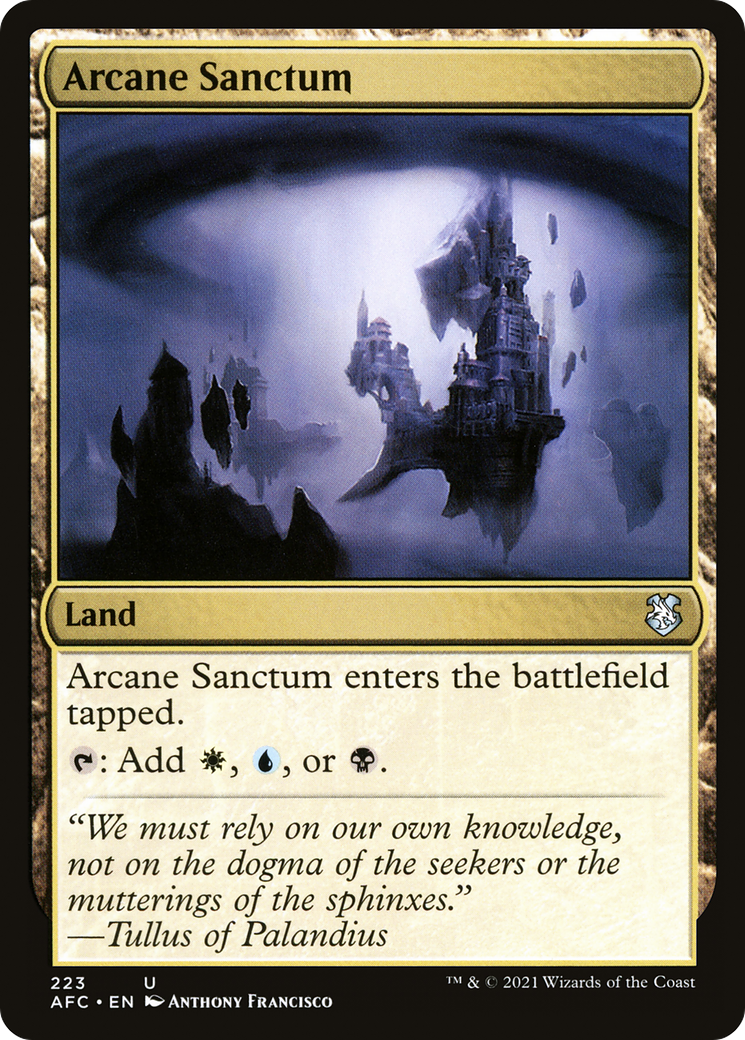
Arcane Sanctum
Arcane Sanctum
Land
This land enters tapped.
: Add , , or .
-
1
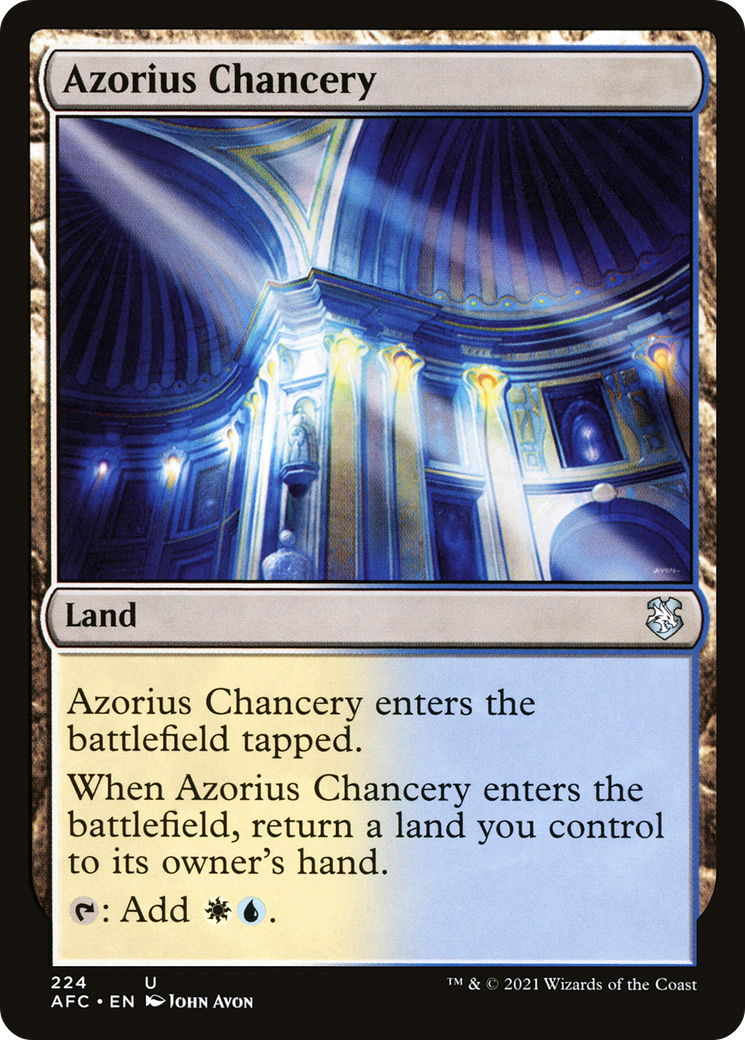
Azorius Chancery
Azorius Chancery
Land
This land enters tapped.
When this land enters, return a land you control to its owner's hand.
: Add .
- If this land enters the battlefield and you control no other lands, its ability will force you to return it to your hand.
-
1
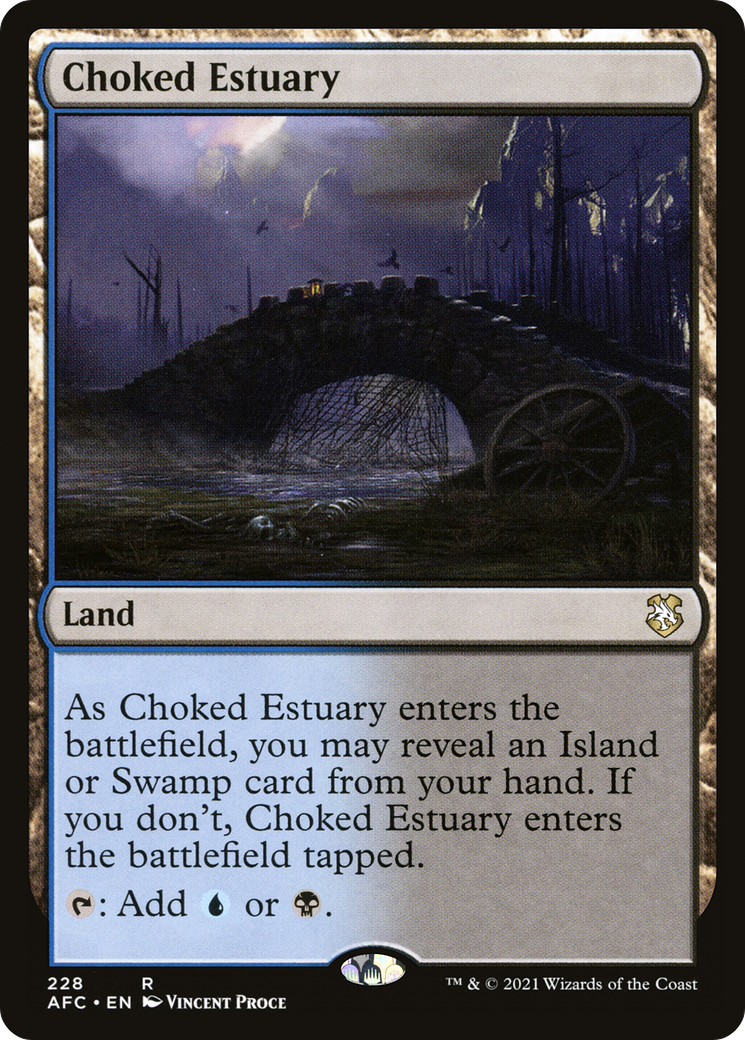
Choked Estuary
Choked Estuary
Land
As this land enters, you may reveal an Island or Swamp card from your hand. If you don't, this land enters tapped.
: Add or .
- Lands don't have a subtype just because they can produce mana of the corresponding color. Choked Estuary itself is neither an Island nor a Swamp, even though it produces blue and black mana, so you can't reveal one to satisfy the ability of another.
- If an effect instructs you to put Choked Estuary onto the battlefield tapped, it will still enter the battlefield tapped even if you reveal a land card from your hand.
- You may reveal any land card with either or both of the appropriate subtypes. It doesn't have to be a basic land. For example, you could reveal Prairie Stream from the Battle for Zendikar set to satisfy the ability of Choked Estuary.
- If an Island or Swamp is entering the battlefield from your hand at the same time as Choked Estuary, you may reveal the other land to have Choked Estuary enter untapped.
-
1
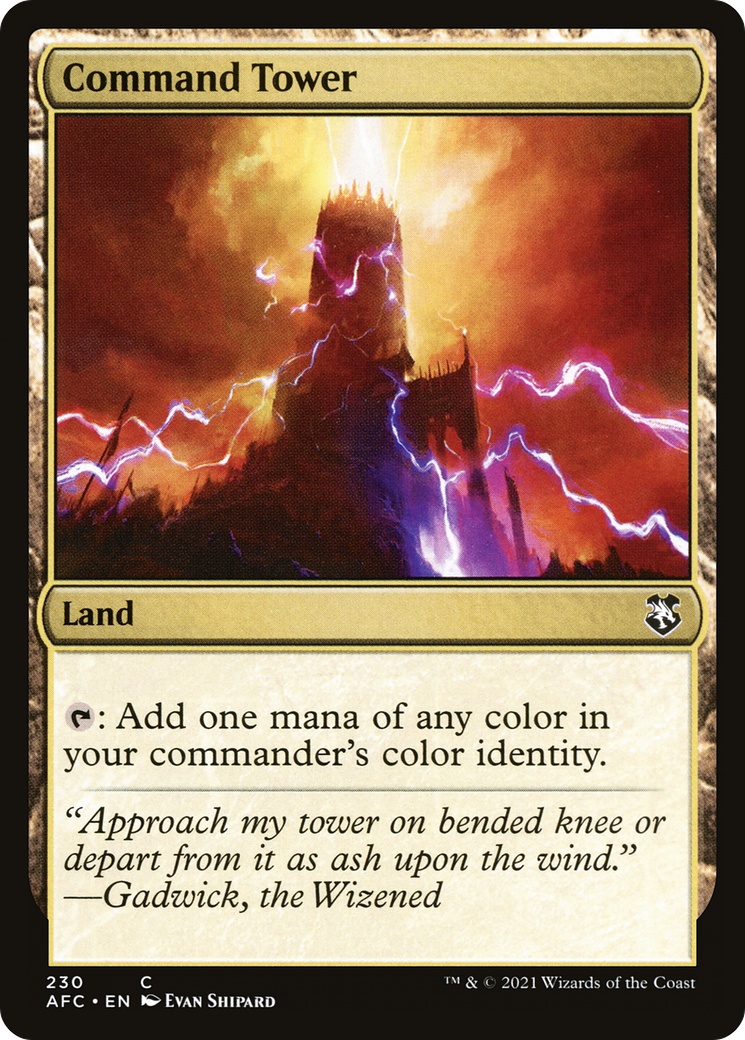
Command Tower
Command Tower
Land
: Add one mana of any color in your commander's color identity.
- If you don't have a commander, Command Tower's ability produces no mana.
- If your commander is a card that has no colors in its color identity, Command Tower's ability produces no mana. It doesn't produce .
- If you have two commanders, the ability adds one mana of any color in their combined color identities.
-
1
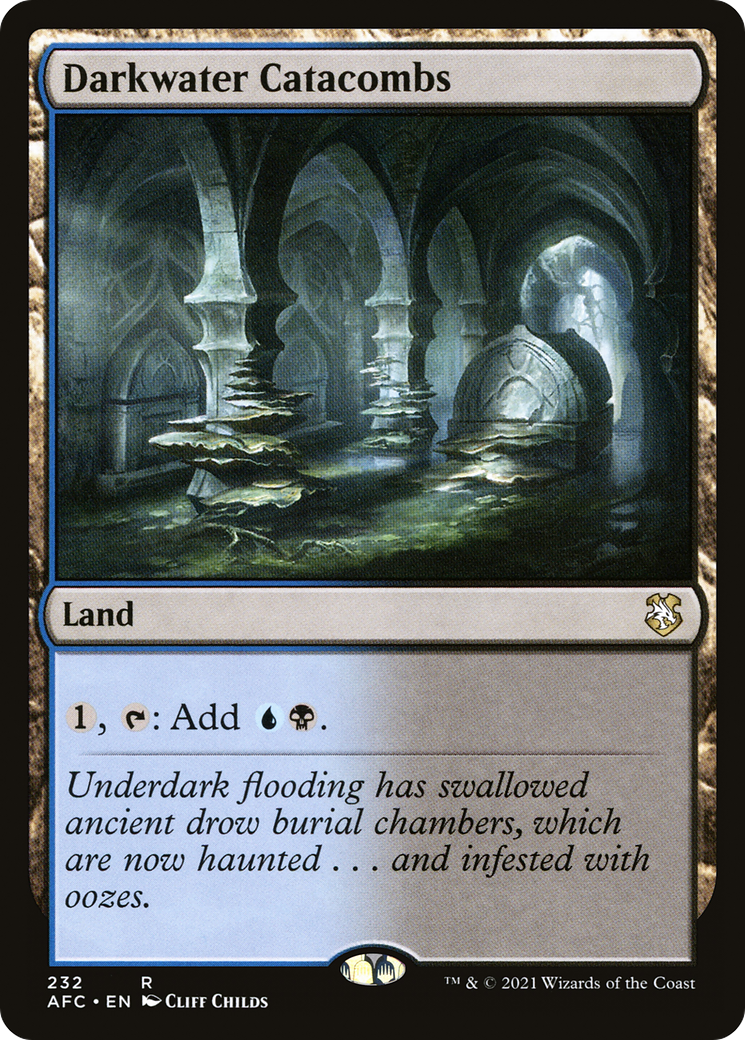
Darkwater Catacombs
Darkwater Catacombs
Land
, : Add .
-
1
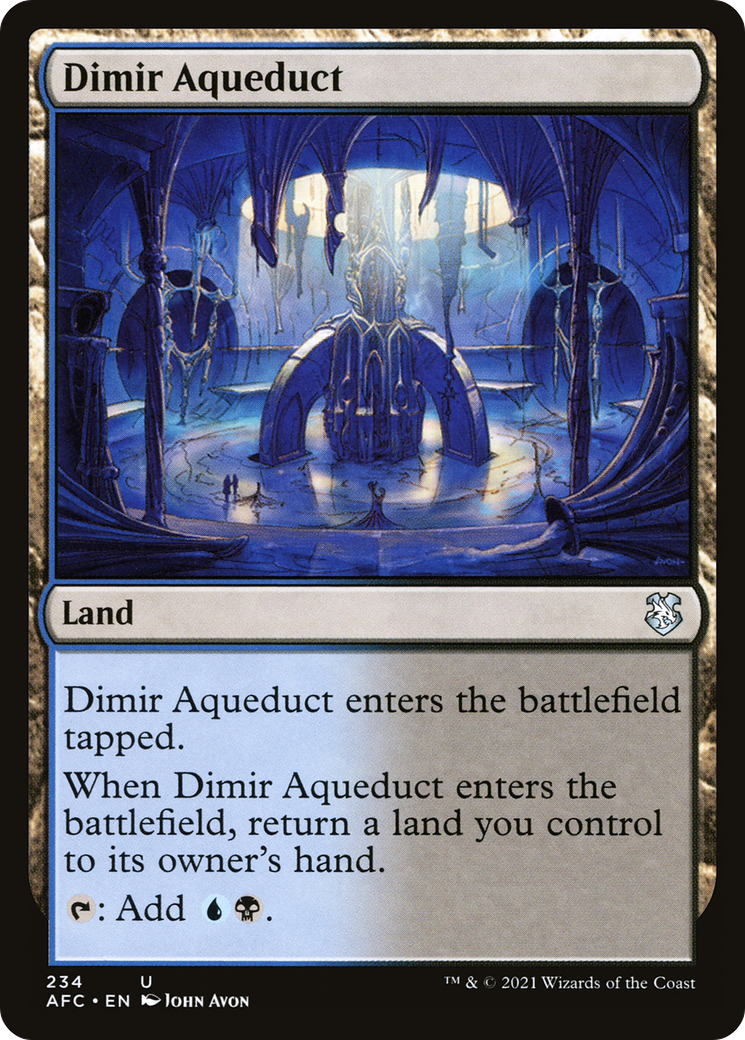
Dimir Aqueduct
Dimir Aqueduct
Land
This land enters tapped.
When this land enters, return a land you control to its owner's hand.
: Add .
- If this land enters the battlefield and you control no other lands, its ability will force you to return it to your hand.
-
1
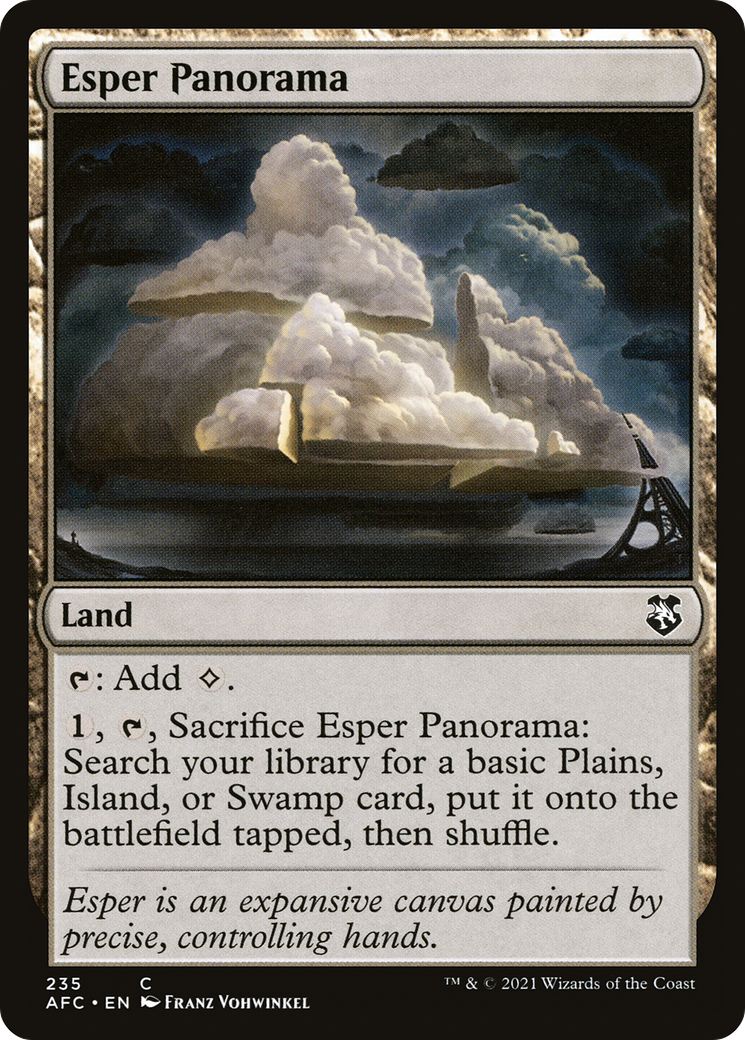
Esper Panorama
Esper Panorama
Land
: Add .
, , Sacrifice this land: Search your library for a basic Plains, Island, or Swamp card, put it onto the battlefield tapped, then shuffle.
-
1
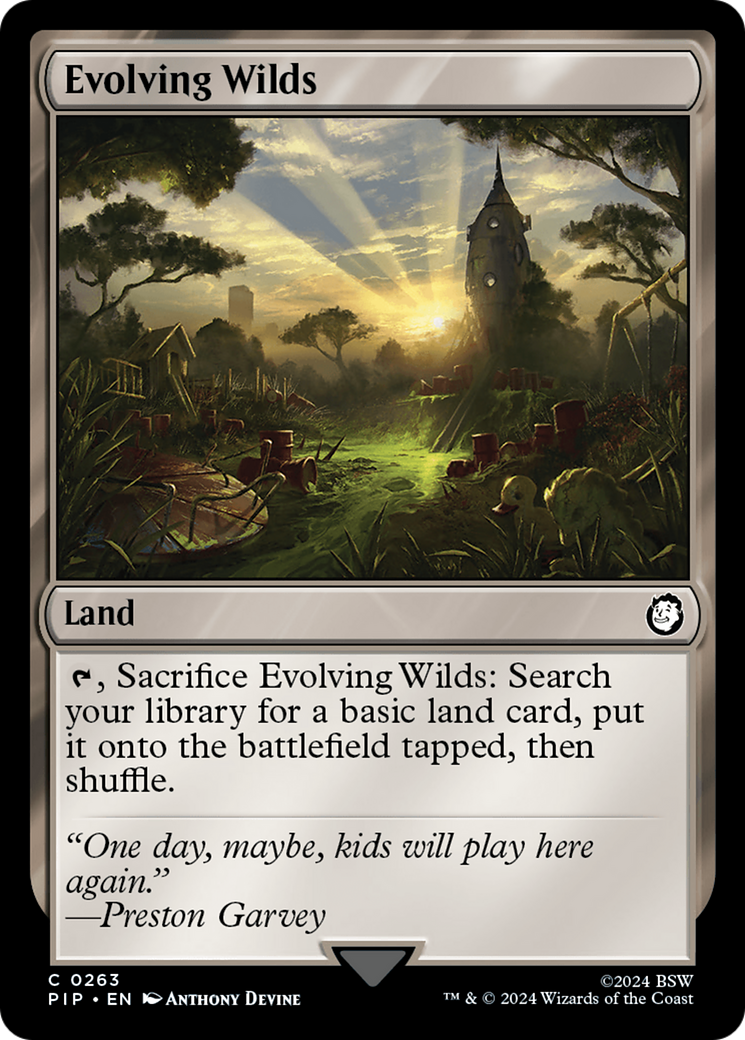
Evolving Wilds
Evolving Wilds
Land
, Sacrifice this land: Search your library for a basic land card, put it onto the battlefield tapped, then shuffle.
-
1
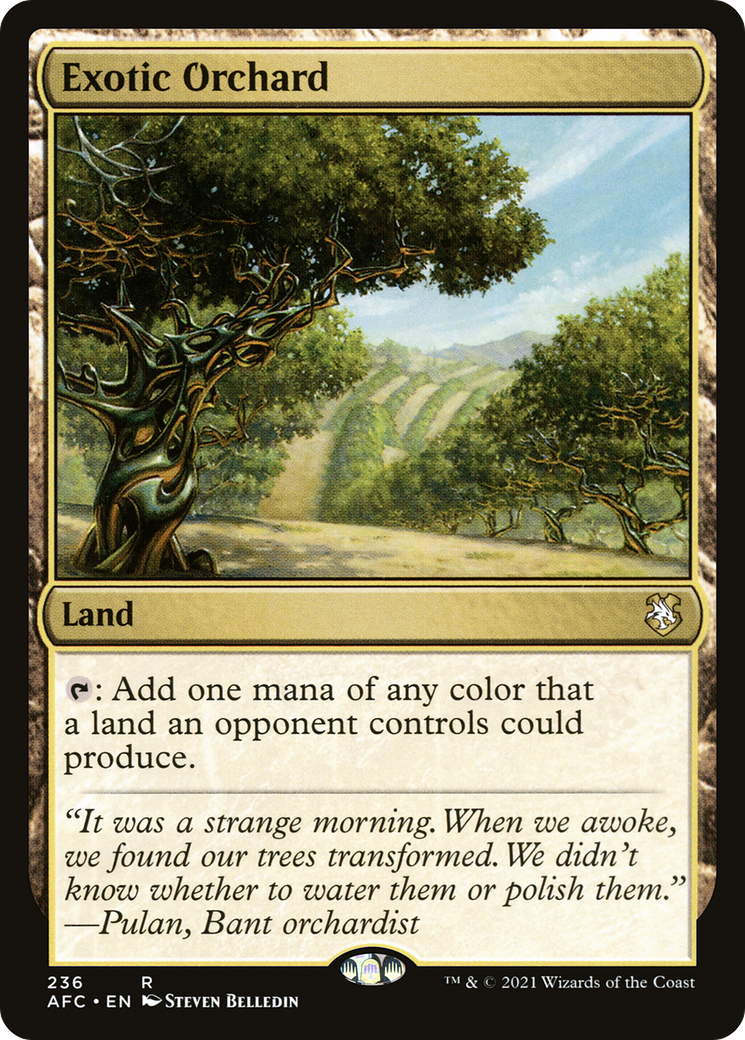
Exotic Orchard
Exotic Orchard
Land
: Add one mana of any color that a land an opponent controls could produce.
- Lands that produce mana based only on what other lands "could produce" won't help each other unless some other land allows one of them to actually produce some type of mana. For example, if you control an Exotic Orchard and your opponent controls an Exotic Orchard and a Reflecting Pool, none of those lands would produce mana if their mana abilities were activated. On the other hand, if you control a Forest and an Exotic Orchard, and your opponent controls an Exotic Orchard and a Reflecting Pool, then each of those lands can be tapped to produce . Your opponent's Exotic Orchard can produce because you control a Forest. Your Exotic Orchard and your opponent's Reflecting Pool can each produce because your opponent's Exotic Orchard can produce .
- When determining what colors of mana your opponents' lands could produce, Exotic Orchard takes into account any applicable replacement effects that would apply to those lands' mana abilities (such as Contamination's effect, for example). If there are more than one, consider them in any possible order.
- The colors of mana are white, blue, black, red, and green. Exotic Orchard can't be tapped for colorless mana, even if a land an opponent controls could produce colorless mana.
- Exotic Orchard doesn't care about any restrictions or riders your opponents' lands (such as Ancient Ziggurat or Hall of the Bandit Lord) put on the mana they produce. It just cares about colors of mana.
- Exotic Orchard checks the effects of all mana-producing abilities of lands your opponents control, but it doesn't check their costs. For example, Vivid Crag has the ability " , Remove a charge counter from Vivid Crag: Add one mana of any color." If an opponent controls Vivid Crag and you control Exotic Orchard, you can tap Exotic Orchard for any color of mana. It doesn't matter whether Vivid Crag has a charge counter on it, and it doesn't matter whether it's untapped.
-
1
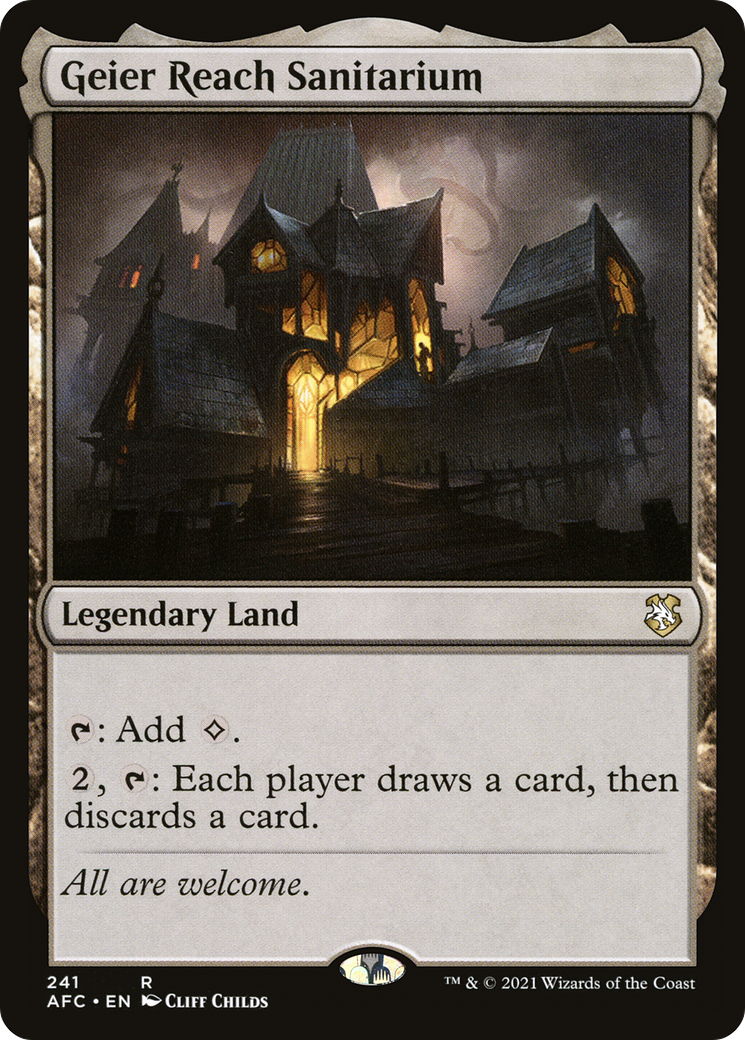
Geier Reach Sanitarium
Geier Reach Sanitarium
Legendary Land
: Add .
, : Each player draws a card, then discards a card.
- When you activate Geier Reach Sanitarium's last ability, first each player draws a card. Then the player whose turn it is selects a card from their hand and sets it aside without revealing it; proceeding in turn order, each other player does the same. Then the cards that were set aside are discarded at once.
- If more than one player discards a card with madness simultaneously, the player whose turn it is puts their madness abilities onto the stack first, then each other player does the same in turn order. The last one put onto the stack resolves first, and a spell cast this way will resolve before resolving the next madness ability.
-
1
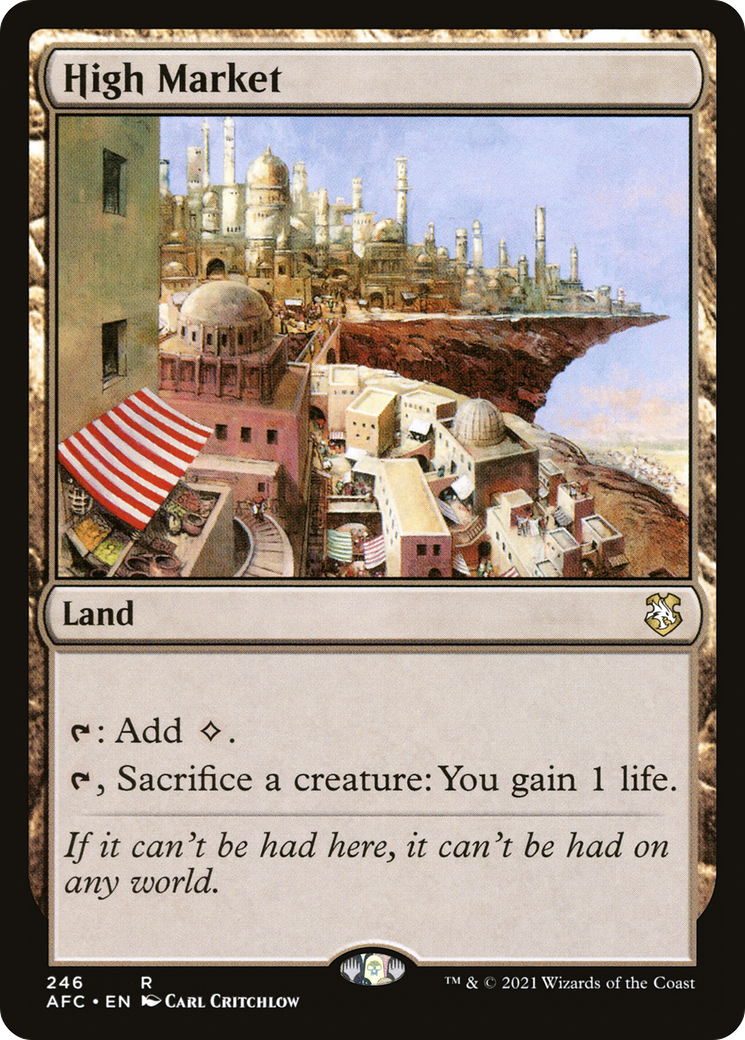
High Market
High Market
Land
: Add .
, Sacrifice a creature: You gain 1 life.
-
5
Island
Island
Basic Land — Island
( : Add .)
-
1
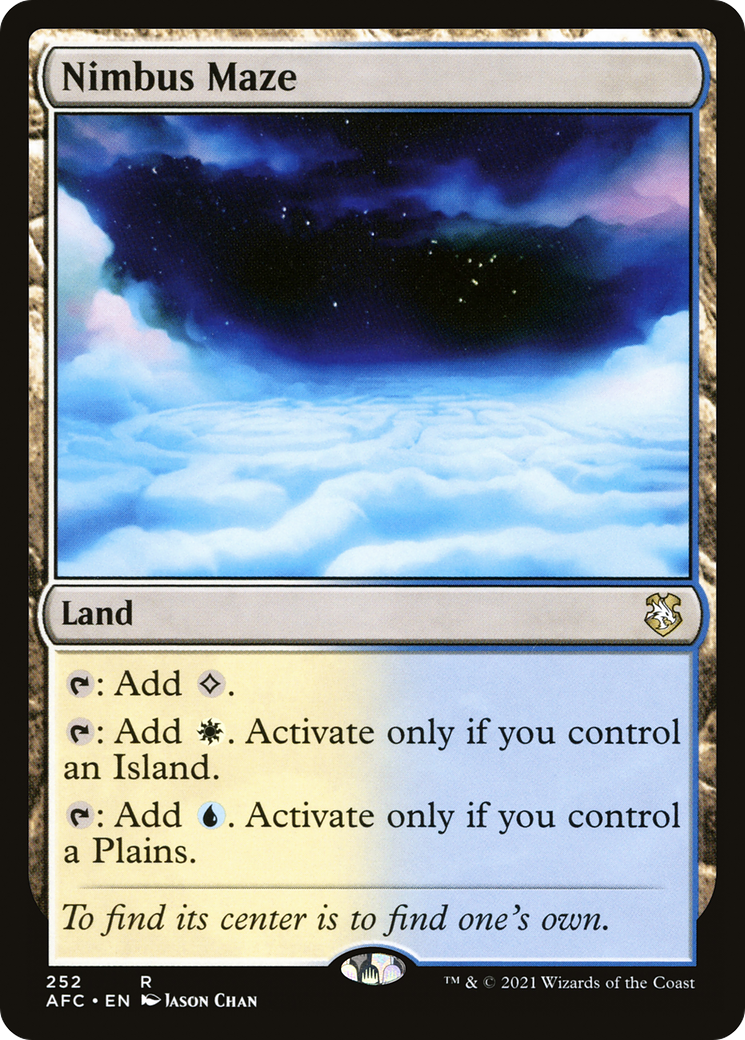
Nimbus Maze
Nimbus Maze
Land
: Add .
: Add . Activate only if you control an Island.
: Add . Activate only if you control a Plains.
- Nimbus Maze's last two abilities check the subtypes of lands you control, not their names. You can activate the appropriate abilities as long as you control a land with the corresponding subtype, Plains or Island. Most nonbasic lands don't have basic land types, even if they produce colored mana. For example, Nimbus Maze itself is neither a Plains nor an Island, while Hallowed Fountain is both.
-
1
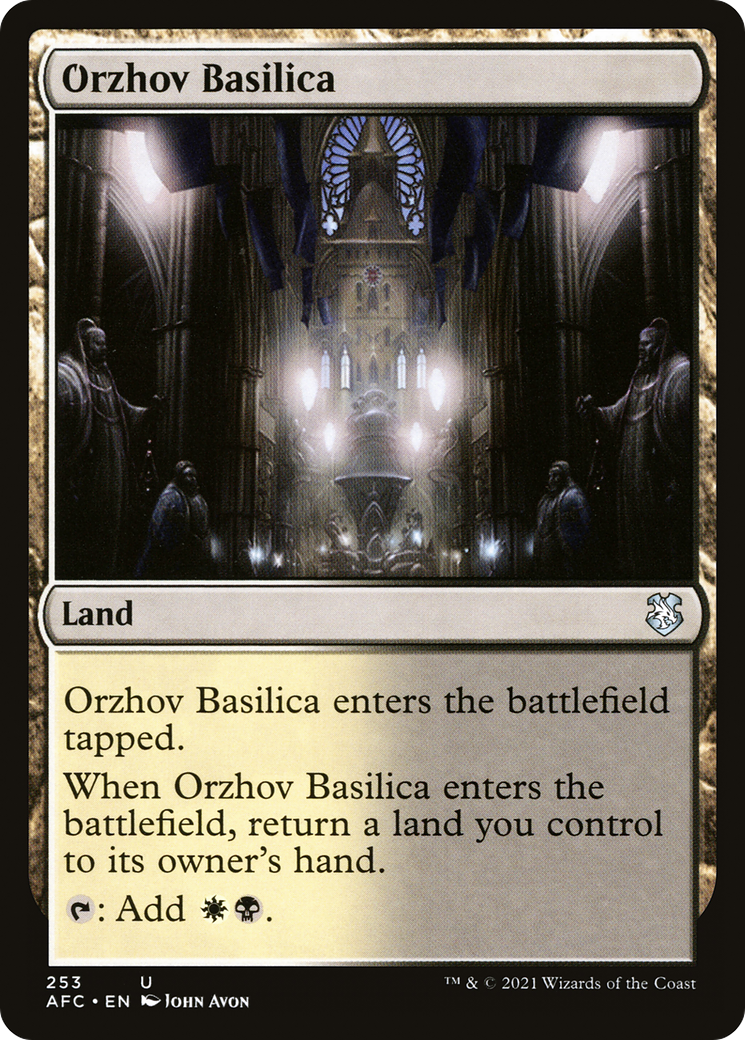
Orzhov Basilica
Orzhov Basilica
Land
This land enters tapped.
When this land enters, return a land you control to its owner's hand.
: Add .
- If this land enters the battlefield and you control no other lands, its ability will force you to return it to your hand.
-
7
Plains
Plains
Basic Land — Plains
( : Add .)
-
1
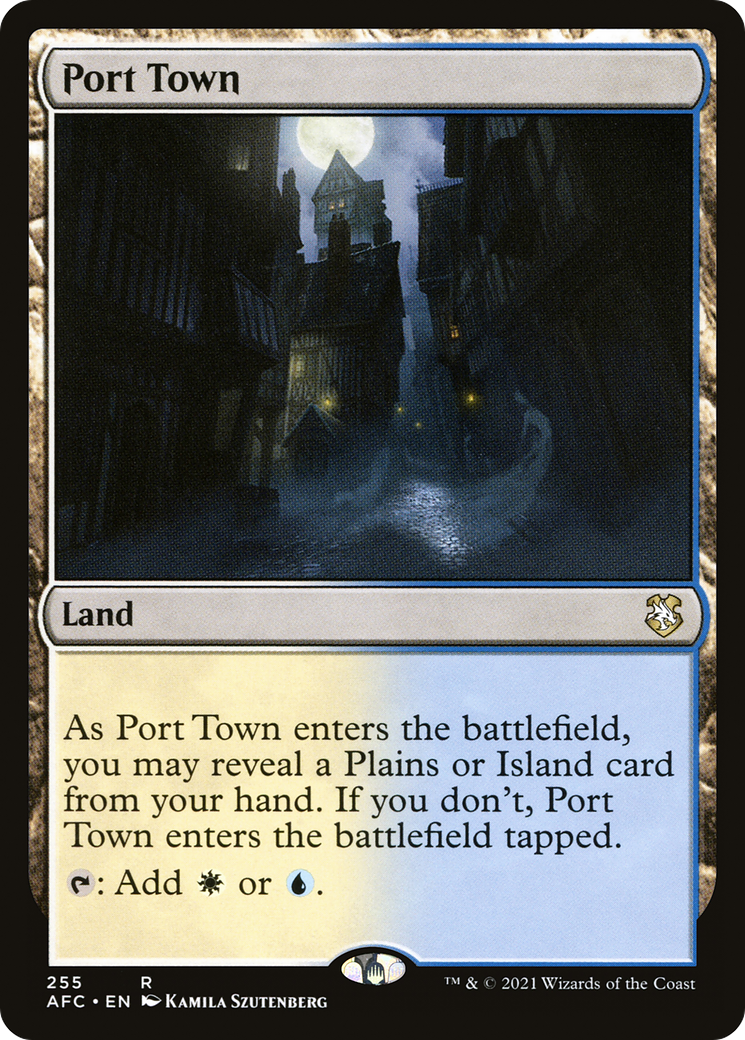
Port Town
Port Town
Land
As this land enters, you may reveal a Plains or Island card from your hand. If you don't, this land enters tapped.
: Add or .
- You may reveal any land card with either or both of the appropriate subtypes. It doesn't have to be a basic land. For example, you could reveal Canopy Vista from the Battle for Zendikar set to satisfy the ability of Port Town.
- Lands don't have a subtype just because they can produce mana of the corresponding color. Port Town itself is neither a Plains nor an Island, even though it produces white and blue mana, so you can't reveal one to satisfy the ability of another.
- If a Plains or Island is entering the battlefield from your hand at the same time as Port Town, you may reveal the other land to have Port Town enter untapped.
- If an effect instructs you to put Port Town onto the battlefield tapped, it will still enter the battlefield tapped even if you reveal a land card from your hand.
-
1
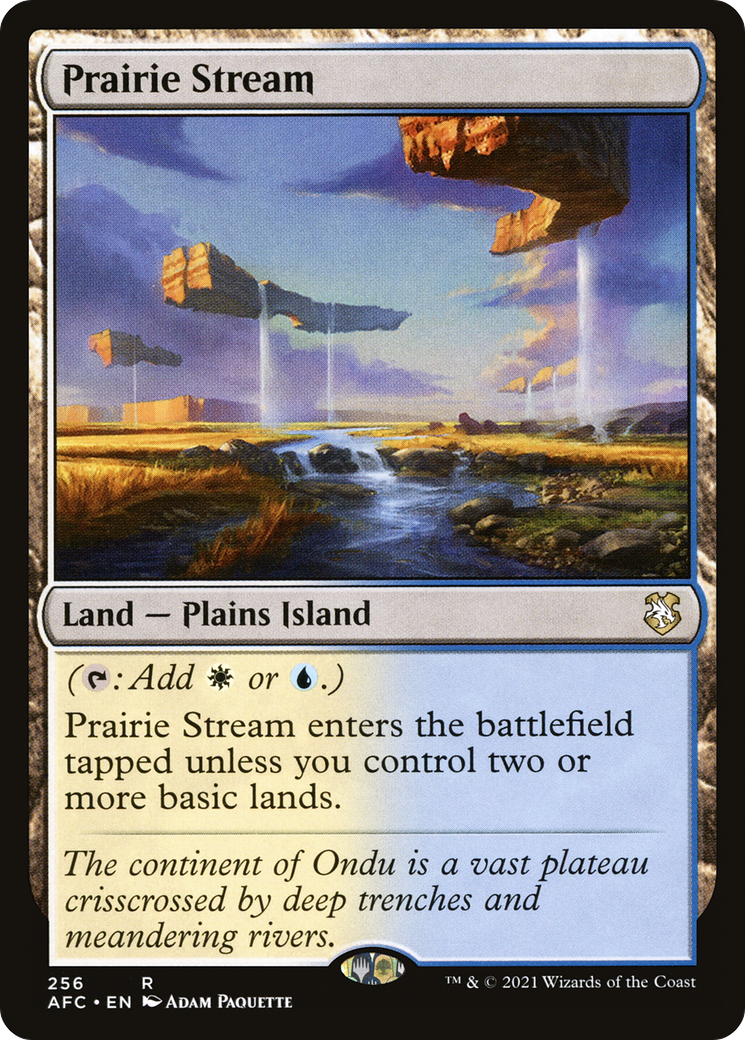
Prairie Stream
Prairie Stream
Land — Plains Island
( : Add or .)
This land enters tapped unless you control two or more basic lands.
- Even though these lands have basic land types, they are not basic lands because "basic" doesn't appear on their type line. Notably, controlling two or more of them won't allow others to enter the battlefield untapped.
- However, because these cards have basic land types, effects that specify a basic land type without also specifying that the land be basic can affect them. For example, a spell or ability that reads "Destroy target Forest" can target Canopy Vista, while one that reads "Destroy target basic Forest" cannot.
- If one of these lands enters the battlefield at the same time as any number of basic lands, those other lands are not counted when determining if this land enters the battlefield tapped or untapped.
-
1
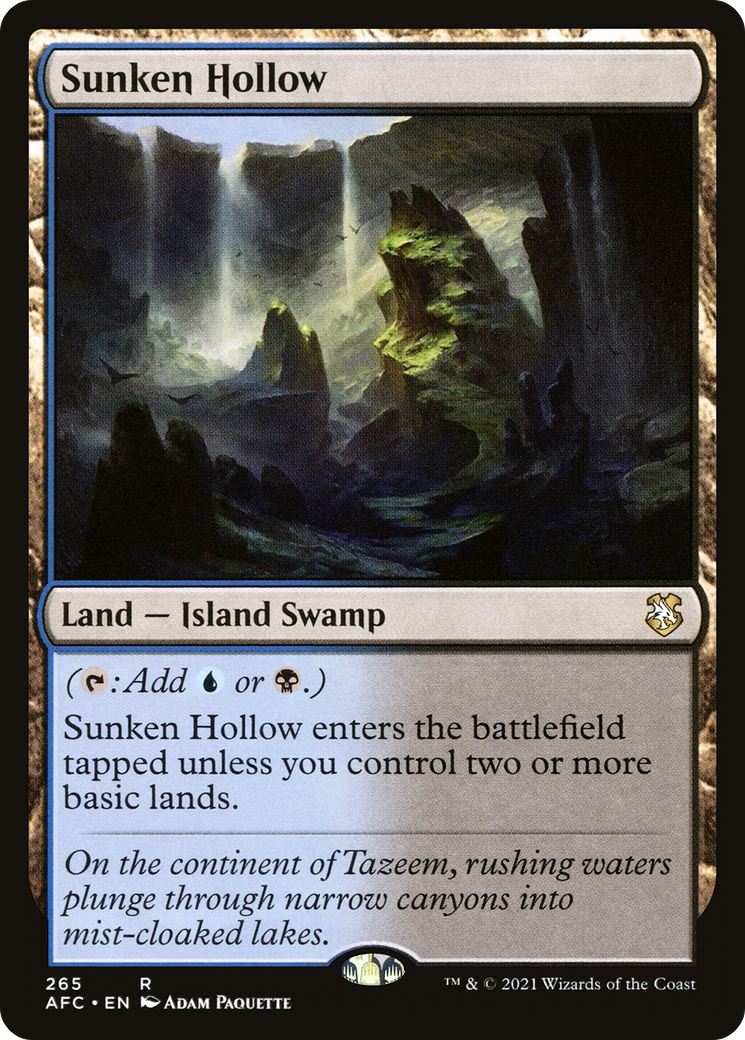
Sunken Hollow
Sunken Hollow
Land — Island Swamp
( : Add or .)
This land enters tapped unless you control two or more basic lands.
- Even though these lands have basic land types, they are not basic lands because "basic" doesn't appear on their type line. Notably, controlling two or more of them won't allow others to enter the battlefield untapped.
- However, because these cards have basic land types, effects that specify a basic land type without also specifying that the land be basic can affect them. For example, a spell or ability that reads "Destroy target Forest" can target Canopy Vista, while one that reads "Destroy target basic Forest" cannot.
- If one of these lands enters the battlefield at the same time as any number of basic lands, those other lands are not counted when determining if this land enters the battlefield tapped or untapped.
-
7
Swamp
Swamp
Basic Land — Swamp
( : Add .)
-
1
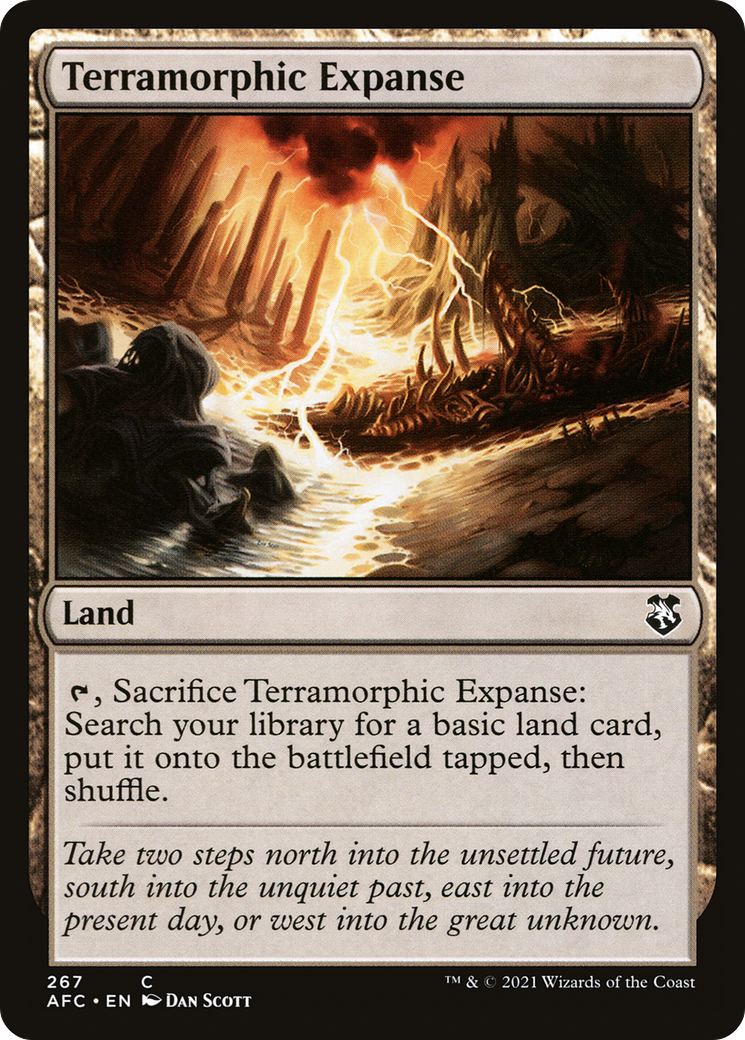
Terramorphic Expanse
Terramorphic Expanse
Land
, Sacrifice this land: Search your library for a basic land card, put it onto the battlefield tapped, then shuffle.
-
1
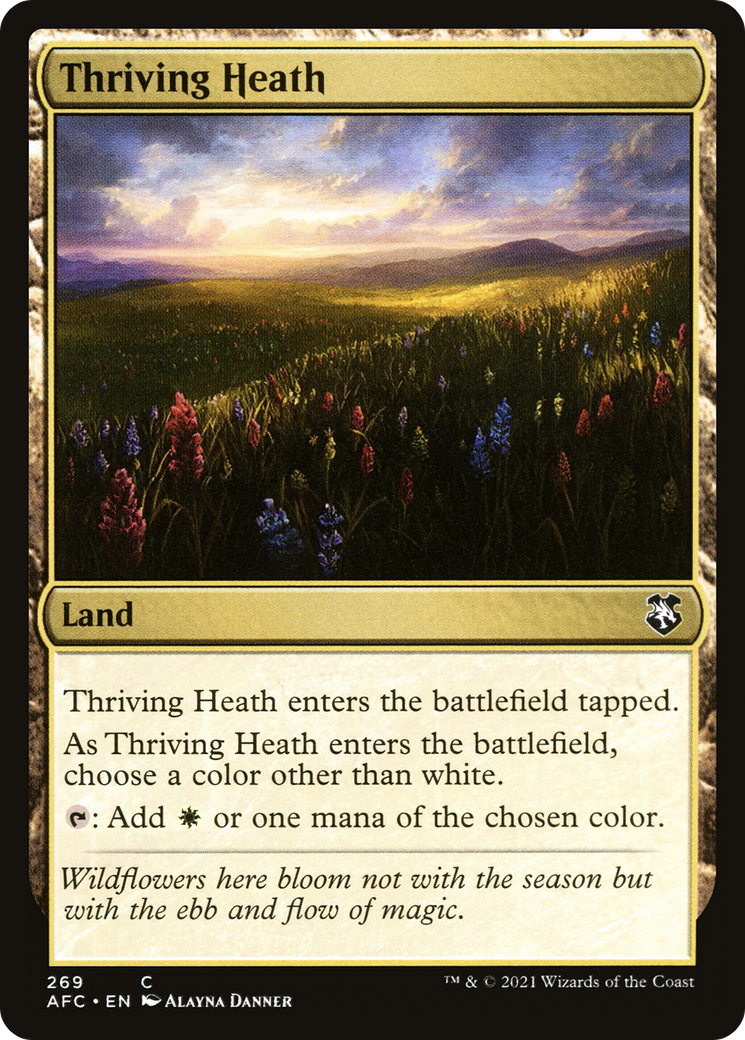
Thriving Heath
Thriving Heath
Land
This land enters tapped. As it enters, choose a color other than white.
: Add or one mana of the chosen color.
-
1
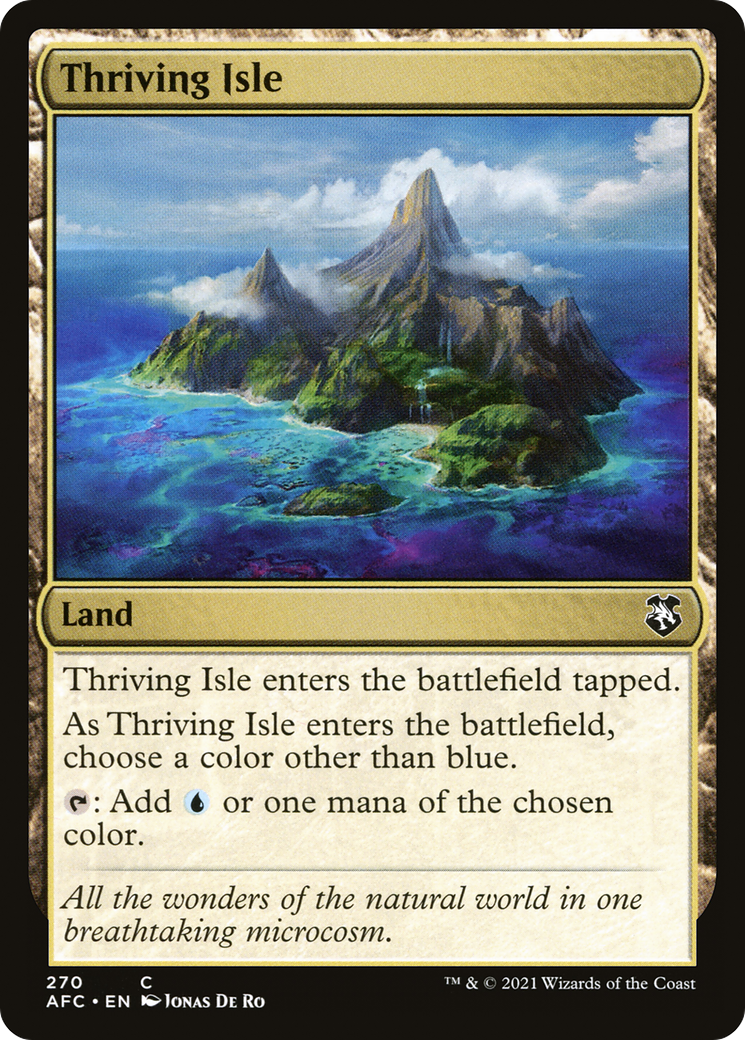
Thriving Isle
Thriving Isle
Land
This land enters tapped. As it enters, choose a color other than blue.
: Add or one mana of the chosen color.
-
1
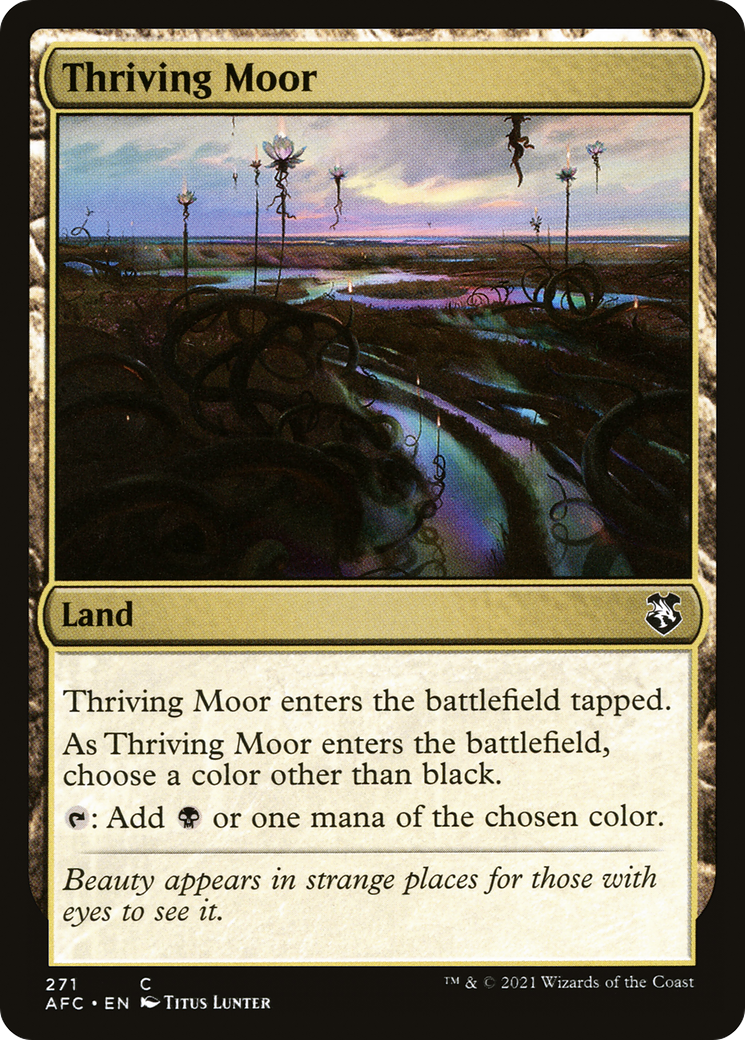
Thriving Moor
Thriving Moor
Land
This land enters tapped. As it enters, choose a color other than black.
: Add or one mana of the chosen color.
White 13
-
1
Cataclysmic Gearhulk
Cataclysmic Gearhulk
Artifact Creature — Construct
4/5
Vigilance
When this creature enters, each player chooses an artifact, a creature, an enchantment, and a planeswalker from among the nonland permanents they control, then sacrifices the rest.
- First the player whose turn it is chooses permanents they control, then each other player in turn order does the same. Each player will know the choices made by players who chose before them. All of the unchosen nonland permanents are then sacrificed simultaneously.
- A permanent with more than one type may be chosen as either of the types or both. For example, an artifact creature may be chosen as the artifact, the creature, or both. Choosing the same permanent twice this way has the same result as choosing it once.
- Cataclysmic Gearhulk will be sacrificed to its own ability if you don't choose it as your artifact or your creature.
- Lands can't be chosen and won't be sacrificed, even if they have other types (such as an artifact land).
- If you don't control any permanents of one of the types, you'll still choose the permanents of the types you do control.
-
1
Eternal Dragon
Eternal Dragon
Creature — Dragon Spirit
5/5
Flying
: Return this card from your graveyard to your hand. Activate only during your upkeep.
Plainscycling ( , Discard this card: Search your library for a Plains card, reveal it, put it into your hand, then shuffle.)
- Unlike the normal cycling ability, Plainscycling doesn't allow you to draw a card. Instead, it lets you search your library for a Plains card. After you find a Plains card in your library, you reveal it, put it into your hand, then shuffle your library.
- Plainscycling is a form of cycling. Any ability that triggers on a card being cycled also triggers on Plainscycling this card. Any ability that stops a cycling ability from being activated also stops Plainscycling from being activated.
- Plainscycling is an activated ability. Effects that interact with activated abilities (such as Stifle or Rings of Brighthearth) will interact with Plainscycling. Effects that interact with spells (such as Remove Soul or Faerie Tauntings) will not.
- You can choose to find any card with the Plains land type, including nonbasic lands. You can also choose not to find a card, even if there is a Plains card in your library.
-
1
Immovable Rod
Immovable Rod
Artifact
You may choose not to untap this artifact during your untap step.
Whenever this artifact becomes untapped, venture into the dungeon.
, : For as long as this artifact remains tapped, another target permanent loses all abilities and can't attack or block.
- Some abilities still work even if they have been removed. Specifically, static abilities that change an object's types or change an object's colors will still apply even if those abilities are lost.
- If a creature has a characteristic-defining ability that sets its power and/or toughness loses that ability, the power and/or toughness (as appropriate) become 0.
- If you target an Aura with Immovable Rod's last ability, it will lose its enchant ability and be put into its owner's graveyard because it can't legally enchant anything. An Equipment that loses its abilities loses its equip ability, so you won't be able to move it that way, but it will stay attached to the creature it's equipping, if any.
- To venture into the dungeon, a player moves their venture marker into the next room of the dungeon they are currently in. If they aren't currently in a dungeon, that player instead chooses a dungeon card from outside the game, puts it into the command zone, and moves their venture marker onto the first room.
- Moving into a dungeon room will cause its room ability to trigger.
- Once you resolve the last room ability of a dungeon, that dungeon is now completed and is removed from the game.
- A player may only have one dungeon in the command zone at a time.
- The player venturing into the dungeon chooses which dungeon they will venture into. They may choose a dungeon that they have already completed this game.
- Dungeon cards are not part of a player's deck or sideboard. In both constructed and limited formats, players can use any dungeon card when they venture into the dungeon.
- You can only move forward (well, downward) in a dungeon, never backwards or sideways.
- Dungeons are removed from the game as a state-based action.
- If you somehow venture into the dungeon while a room's ability is on the stack, you will continue on in the dungeon. If you're already in the last room, complete that dungeon and start a new one.
- Choosing the dungeon or room to venture into is part of resolving the venture into the dungeon keyword action. Once that choice is made, players may not respond until after the appropriate room ability has triggered.
-
1
Karmic Guide
Karmic Guide
Creature — Angel Spirit
2/2
Flying, protection from black
Echo (At the beginning of your upkeep, if this came under your control since the beginning of your last upkeep, sacrifice it unless you pay its echo cost.)
When this creature enters, return target creature card from your graveyard to the battlefield.
- Your permanent's echo ability will trigger at the beginning of your upkeep if it entered the battlefield since the beginning of your last upkeep, or if you gained control of it since the beginning of your last upkeep.
- Paying for echo is always optional. When the echo triggered ability resolves, if you can't pay the echo cost or choose not to, you sacrifice that permanent.
-
1
Minimus Containment
Minimus Containment
Enchantment — Aura
Enchant nonland permanent
Enchanted permanent is a Treasure artifact with " , Sacrifice this artifact: Add one mana of any color," and it loses all other abilities. (If it was a creature, it's no longer a creature.)
-
1
Radiant Solar
Radiant Solar
Creature — Angel
3/6
Flying, lifelink
Whenever this creature or another nontoken creature you control enters, venture into the dungeon. (Enter the first room or advance to the next room.)
, Discard this card: Venture into the dungeon and you gain 3 life.
- A token copy of Radiant Solar entering the battlefield will cause its own ability to trigger, but not that of any other Radiant Solars.
- To venture into the dungeon, a player moves their venture marker into the next room of the dungeon they are currently in. If they aren't currently in a dungeon, that player instead chooses a dungeon card from outside the game, puts it into the command zone, and moves their venture marker onto the first room.
- Moving into a dungeon room will cause its room ability to trigger.
- Once you resolve the last room ability of a dungeon, that dungeon is now completed and is removed from the game.
- A player may only have one dungeon in the command zone at a time.
- The player venturing into the dungeon chooses which dungeon they will venture into. They may choose a dungeon that they have already completed this game.
- Dungeon cards are not part of a player's deck or sideboard. In both constructed and limited formats, players can use any dungeon card when they venture into the dungeon.
- You can only move forward (well, downward) in a dungeon, never backwards or sideways.
- Dungeons are removed from the game as a state-based action.
- If you somehow venture into the dungeon while a room's ability is on the stack, you will continue on in the dungeon. If you're already in the last room, complete that dungeon and start a new one.
- Choosing the dungeon or room to venture into is part of resolving the venture into the dungeon keyword action. Once that choice is made, players may not respond until after the appropriate room ability has triggered.
-
1
Revivify
Revivify
Instant
Roll a d20 and add the number of creature cards in your graveyard that were put there from the battlefield this turn.
1—14 | Return all creature cards in your graveyard that were put there from the battlefield this turn to your hand.
15+ | Return those cards from your graveyard to the battlefield.
-
1
Ronom Unicorn
Ronom Unicorn
Creature — Unicorn
2/2
Sacrifice this creature: Destroy target enchantment.
-
1
Sun Titan
Sun Titan
Creature — Giant
6/6
Vigilance
Whenever this creature enters or attacks, you may return target permanent card with mana value 3 or less from your graveyard to the battlefield.
- A permanent card is an artifact, creature, enchantment, land, or planeswalker card.
- If a card in your graveyard has no mana symbols in its upper right corner (because it's a land card, for example), its mana value is 0.
- The mana value of a card in your graveyard is determined solely by the mana symbols printed in its upper right corner. The mana value is the total amount of mana in that cost, regardless of color. For example, a card with mana cost has mana value 5.
- If the mana cost of a card in your graveyard includes , X is considered to be 0.
-
1
Sunblast Angel
Sunblast Angel
Creature — Angel
4/5
Flying
When this creature enters, destroy all tapped creatures.
- The second ability destroys each creature that's tapped at the time it resolves, including creatures you control. If Sunblast Angel has become tapped by the time its ability resolves, it will be destroyed too.
-
1
Swords to Plowshares
Swords to Plowshares
Instant
Exile target creature. Its controller gains life equal to its power.
- Use the power of the creature from when it was last on the battlefield to determine how much life is gained.
-
1
Thorough Investigation
Thorough Investigation
Enchantment
Whenever you attack, investigate. (Create a Clue token. It's an artifact with " , Sacrifice this token: Draw a card.")
Whenever you sacrifice a Clue, venture into the dungeon. (Enter the first room or advance to the next room.)
- Thorough Investigation's first ability can trigger only once per combat, no matter how many creatures you attack with.
- To venture into the dungeon, a player moves their venture marker into the next room of the dungeon they are currently in. If they aren't currently in a dungeon, that player instead chooses a dungeon card from outside the game, puts it into the command zone, and moves their venture marker onto the first room.
- Moving into a dungeon room will cause its room ability to trigger.
- Once you resolve the last room ability of a dungeon, that dungeon is now completed and is removed from the game.
- A player may only have one dungeon in the command zone at a time.
- The player venturing into the dungeon chooses which dungeon they will venture into. They may choose a dungeon that they have already completed this game.
- Dungeon cards are not part of a player's deck or sideboard. In both constructed and limited formats, players can use any dungeon card when they venture into the dungeon.
- You can only move forward (well, downward) in a dungeon, never backwards or sideways.
- Dungeons are removed from the game as a state-based action.
- If you somehow venture into the dungeon while a room's ability is on the stack, you will continue on in the dungeon. If you're already in the last room, complete that dungeon and start a new one.
- Choosing the dungeon or room to venture into is part of resolving the venture into the dungeon keyword action. Once that choice is made, players may not respond until after the appropriate room ability has triggered.
-
1
Wall of Omens
Wall of Omens
Creature — Wall
0/4
Defender
When this creature enters, draw a card.
Blue 12
-
1
Arcane Endeavor
Arcane Endeavor
Sorcery
Roll two d8 and choose one result. Draw cards equal to that result. Then you may cast an instant or sorcery spell with mana value less than or equal to the other result from your hand without paying its mana cost.
- Dice are identified by the number of faces each one has. For example, a d20 is a twenty-sided die.
- Dice used must have equally likely outcomes and the roll must be fair. Although physical dice are recommended, digital substitutes are allowed, provided they have the same number of equally likely outcomes as specified in the original roll instruction.
- An ability that tells you to roll a die will also specify what to do with the result of that roll. Most often, this is in the form of a “results table” in the card text.
- The instruction to roll a die and the effect that occurs because of the result are all part of the same ability. Players do not get the chance to respond to the ability after knowing the result of the roll.
- An effect that says “choose a target, then roll a d20” or similar still uses the normal process of putting an ability on the stack and resolving it. Choosing targets is part of putting the ability on the stack and rolling the d20 happens later, as the ability resolves.
- Some effects may modify the result of a die roll. This may be part of the instruction to roll a die or it may come from other cards. Anything that references the “result” of a die roll is looking for the result after these modifications. Anything that is looking for the “natural result” is looking for the number shown on the face of the die before these modifications.
- Some abilities, like that of Pixie Guide and Barbarian Class, replace rolling a die with rolling extra dice and ignoring the lowest roll. The ignored rolls are not considered for the effect that instructed you to roll a die, and do not cause abilities to trigger. For all intents and purposes, once you determine which dice count, any extra dice were never rolled.
- Some effects instruct you to roll again. This uses the same number and type of dice as the original roll, and that roll will use the same set of possible outcomes.
- While playing Planechase, rolling the planar die will cause any ability that triggers whenever a player rolls one or more dice to trigger. However, any effect that refers to a numerical result will ignore the rolling of the planar die.
- Tournament events have more specific rules regarding dice and die-rolling. For more information, please see the most recent version of the Magic Tournament Rules at https://wpn.wizards.com/en/document/magic-gathering-tournament-rules.
-
1
Champion of Wits
Champion of Wits
Creature — Snake Wizard
2/1
When this creature enters, you may draw cards equal to its power. If you do, discard two cards.
Eternalize ( , Exile this card from your graveyard: Create a token that's a copy of it, except it's a 4/4 black Zombie Snake Wizard with no mana cost. Eternalize only as a sorcery.)
- Use Champion of Wits's power as the first ability resolves to determine if you want to use the ability and how many cards you draw if you do. If you use the ability, you discard two cards regardless of how many cards you draw. If Champion of Wits leaves the battlefield before that ability resolves, use its last known power.
- For each card with eternalize, a corresponding game play supplement token can be found in some Hour of Devastation booster packs. These supplements are not required to play with cards with eternalize; you can use the same items to represent an eternalized token as you would any other token.
- If a creature card with eternalize is put into your graveyard during your main phase, you'll have priority immediately afterward. You can activate its eternalize ability before any player can try to exile it, such as with Crook of Condemnation, if it's legal for you to do so.
- Once you've activated an eternalize ability, the card is immediately exiled. Opponents can't try to stop the ability by exiling the card with an effect such as that of Crook of Condemnation.
- The token copies exactly what was printed on the original card and nothing else, except the characteristics specifically modified by eternalize. It doesn't copy any information about the object the card was before it was put into your graveyard.
- The token is a Zombie in addition to its other types and is black instead of its other colors. Its base power and toughness are 4/4. It has no mana cost, and thus its mana value is 0. These are copiable values of the token that other effects may copy.
- If the card copied by the token had any “when [this permanent] enters the battlefield” abilities, then the token also has those abilities and will trigger them when it's created. Similarly, any “as [this permanent] enters the battlefield” or “[this permanent] enters the battlefield with” abilities that the token has copied will also work.
-
1
Curator of Mysteries
Curator of Mysteries
Creature — Sphinx
4/4
Flying
Whenever you cycle or discard another card, scry 1.
Cycling ( , Discard this card: Draw a card.)
- Some cards have an ability that triggers whenever you cycle any card. These triggered abilities resolve before you draw from the cycling ability.
- An ability that triggers whenever you discard a card doesn't give you permission to discard cards. You'll need another effect that instructs or allows you to discard them.
- An ability that triggers whenever you “cycle or discard” a card triggers only once if you cycle a card. The ability “Whenever you discard a card” is functionally identical to this ability; cycling is mentioned for clarity.
- If a player discards a card during their cleanup step due to having too many cards in hand, any appropriate abilities that trigger on discarding that card trigger. If this happens, those triggered abilities are put onto the stack and players receive priority in that cleanup step to cast spells or activate abilities (normally, no players may take actions during a cleanup step). Another cleanup step is created following that one.
-
1
Forbidden Alchemy
Forbidden Alchemy
Instant
Look at the top four cards of your library. Put one of them into your hand and the rest into your graveyard.
Flashback (You may cast this card from your graveyard for its flashback cost. Then exile it.)
- To determine the total cost of a spell, start with the mana cost or alternative cost (such as a flashback cost) you're paying, add any cost increases, then apply any cost reductions. The mana value of the spell is determined only by its mana cost, no matter what the total cost to cast the spell was.
- "Flashback [cost]" means "You may cast this card from your graveyard by paying [cost] rather than paying its mana cost" and "If the flashback cost was paid, exile this card instead of putting it anywhere else any time it would leave the stack."
- You must still follow any timing restrictions and permissions, including those based on the card's type. For instance, you can cast a sorcery using flashback only when you could normally cast a sorcery.
- If a card with flashback is put into your graveyard during your turn, you can cast it if it's legal to do so before any other player can take any actions.
- A spell cast using flashback will always be exiled afterward, whether it resolves, is countered, or leaves the stack in some other way.
- You can cast a spell using flashback even if it was somehow put into your graveyard without having been cast.
- If you have fewer than four cards in your library, you'll look at all the cards there and put one into your hand and the rest into your graveyard.
-
1
Merfolk Looter
Merfolk Looter
Creature — Merfolk Rogue
1/1
: Draw a card, then discard a card.
- You can't do anything in between drawing a card and discarding a card, including casting or cycling the card you drew.
-
1
Minn, Wily Illusionist
Minn, Wily Illusionist
Legendary Creature — Gnome Wizard
1/3
Whenever you draw your second card each turn, create a 1/1 blue Illusion creature token with "This token gets +1/+0 for each other Illusion you control."
Whenever an Illusion you control dies, you may put a permanent card with mana value less than or equal to that creature's power from your hand onto the battlefield.
- Minn's last ability uses the Illusion's power the last time it existed on the battlefield to determine what cards you may put onto the battlefield.
-
1
Mulldrifter
Mulldrifter
Creature — Elemental
2/2
Flying
When this creature enters, draw two cards.
Evoke (You may cast this spell for its evoke cost. If you do, it's sacrificed when it enters.)
- To determine the total cost of a spell, start with the mana cost or alternative cost you're paying (such as an evoke cost), add any cost increases, then apply any cost reductions. The mana value of the spell is determined by only its mana cost, no matter what the total cost to cast that spell was.
- If you pay the evoke cost, you can have Mulldrifter's own triggered ability resolve before the evoke triggered ability. You can cast spells after that ability resolves but before you have to sacrifice Mulldrifter.
-
1
Murder of Crows
Murder of Crows
Creature — Bird
4/4
Flying
Whenever another creature dies, you may draw a card. If you do, discard a card.
- If another creature dies at the same time as Murder of Crows, its last ability triggers.
- You can't do anything in between drawing a card and discarding a card, including casting or cycling the card you drew.
-
1
Phantasmal Image
Phantasmal Image
Creature — Illusion
0/0
You may have this creature enter as a copy of any creature on the battlefield, except it's an Illusion in addition to its other types and it has "When this creature becomes the target of a spell or ability, sacrifice it."
- Phantasmal Image copies exactly what was printed on the original creature (unless that creature is copying something else or is a token; see below) and it gains the Illusion creature type and the triggered ability. It doesn't copy whether that creature is tapped or untapped, whether it has any counters on it or Auras attached to it, or any non-copy effects that have changed its power, toughness, types, color, or so on.
- The Illusion creature type and the triggered ability that Phantasmal Image gains as part of its copy effect are both copiable values that other effects may copy.
- If the chosen creature has in its mana cost, X is considered to be 0.
- If the chosen creature is copying something else (for example, if the chosen creature is another Phantasmal Image), then Phantasmal Image enters the battlefield as whatever the chosen creature copied.
- If the chosen creature is a token, Phantasmal Image copies the original characteristics of that token as stated by the effect that created the token. Phantasmal Image is not a token in this case.
- Any enters-the-battlefield abilities of the copied creature will trigger when Phantasmal Image enters the battlefield. Any “as [this creature] enters the battlefield” or “[this creature] enters the battlefield with” abilities of the chosen creature will also work.
- If Phantasmal Image somehow enters the battlefield at the same time as another creature, Phantasmal Image can't become a copy of that creature. You may choose only a creature that's already on the battlefield.
-
1
Phantom Steed
Phantom Steed
Creature — Horse Illusion
4/3
Flash
When this creature enters, exile another target creature you control until this creature leaves the battlefield.
Whenever this creature attacks, create a tapped and attacking token that's a copy of the exiled card, except it's an Illusion in addition to its other types. Sacrifice that token at end of combat.
- Phantom Steed has received a nonfunctional update to its wording. The printed card refers to the “exiled creature.” The corrected text (“exiled card”) is included above.
- If Phantom Steed leaves the battlefield before its ability resolves, the target creature won't be exiled.
- Auras attached to the exiled creature will be put into their owners' graveyards. Any Equipment will become unattached and remain on the battlefield. Any counters on the exiled creature will cease to exist. When the card returns to the battlefield, it will be a new object with no connection to the card that was exiled.
- If a token is exiled this way, it will cease to exist and won't return to the battlefield. Phantom Steed's last ability won't create any tokens.
- Although the token created by the triggered ability is attacking, it was never declared as an attacking creature (for the purposes of abilities that trigger whenever a creature attacks, for example).
- You declare which player or planeswalker the token is attacking as you put it onto the battlefield. It doesn't have to be the same player or planeswalker Phantom Steed is attacking.
- If the exiled card has in its mana cost, X is 0.
- Any enters-the-battlefield abilities of the copied creature will trigger when the token enters the battlefield. Any “As [this creature] enters the battlefield” or “[This creature] enters the battlefield with” abilities of the copied creature will also work.
- If Phantom Steed somehow exiles a noncreature card, such as an animated land, it will still create a copy of that card when it attacks. It enters the battlefield tapped and will be sacrificed at the end of combat. However, it is not attacking and it is not an Illusion.
-
1
Propaganda
Propaganda
Enchantment
Creatures can't attack you unless their controller pays for each creature they control that's attacking you.
- The payment is made during the declare attackers step at the same time you are declaring the attacker.
- If there are multiple attacks in a turn, then you have to pay for each attack.
- If there is more than one Propaganda on the battlefield, the cost is cumulative.
- Paying this cost is not an instant or any other kind of ability, it is an additional cost on the declaration of the attacker.
-
1
Rod of Absorption
Rod of Absorption
Artifact
Whenever a player casts an instant or sorcery spell, exile it instead of putting it into a graveyard as it resolves.
, , Sacrifice this artifact: You may cast any number of spells from among cards exiled with this artifact with total mana value X or less without paying their mana costs.
- If multiple Rods of Absorption are on the battlefield at the same time, any player casting an instant or sorcery spell will cause all of them to trigger. As the spell resolves, its controller will choose which of the Rods gets to exile it.
- Each Rod of Absorption tracks the cards it has exiled separately. If Rod of Absorption is destroyed and then later brought back to the battlefield, it will not be able to access any of the cards that it had exiled before.
- If a spell is countered or it never resolves, Rod of Absorption will not exile it.
- When Rod of Absorption's last ability resolves, you cast as many spells with total mana value X or less from among the exiled cards as you would like in any order you choose. Cards not cast this way will remain in exile indefinitely.
- If you cast a spell “without paying its mana cost,” you can't choose to cast it for any alternative costs. You can, however, pay additional costs. If the card has any mandatory additional costs, you must pay those to cast the spell.
- If the card has in its mana cost, you must choose 0 as the value of X when casting it without paying its mana cost.
Black 9
-
1
Doomed Necromancer
Doomed Necromancer
Creature — Human Cleric Mercenary
2/2
, , Sacrifice this creature: Return target creature card from your graveyard to the battlefield.
- Because targets are chosen before costs are paid, Doomed Necromancer can't be the target of its own ability.
-
1
Grave Endeavor
Grave Endeavor
Instant
Roll two d10 and choose one result. Return a creature card from your graveyard to the battlefield with a number of +1/+1 counters on it equal to that result. Then each opponent loses X life and you gain X life, where X is the other result.
- Dice are identified by the number of faces each one has. For example, a d20 is a twenty-sided die.
- Dice used must have equally likely outcomes and the roll must be fair. Although physical dice are recommended, digital substitutes are allowed, provided they have the same number of equally likely outcomes as specified in the original roll instruction.
- An ability that tells you to roll a die will also specify what to do with the result of that roll. Most often, this is in the form of a “results table” in the card text.
- The instruction to roll a die and the effect that occurs because of the result are all part of the same ability. Players do not get the chance to respond to the ability after knowing the result of the roll.
- An effect that says “choose a target, then roll a d20” or similar still uses the normal process of putting an ability on the stack and resolving it. Choosing targets is part of putting the ability on the stack and rolling the d20 happens later, as the ability resolves.
- Some effects may modify the result of a die roll. This may be part of the instruction to roll a die or it may come from other cards. Anything that references the “result” of a die roll is looking for the result after these modifications. Anything that is looking for the “natural result” is looking for the number shown on the face of the die before these modifications.
- Some abilities, like that of Pixie Guide and Barbarian Class, replace rolling a die with rolling extra dice and ignoring the lowest roll. The ignored rolls are not considered for the effect that instructed you to roll a die, and do not cause abilities to trigger. For all intents and purposes, once you determine which dice count, any extra dice were never rolled.
- Some effects instruct you to roll again. This uses the same number and type of dice as the original roll, and that roll will use the same set of possible outcomes.
- While playing Planechase, rolling the planar die will cause any ability that triggers whenever a player rolls one or more dice to trigger. However, any effect that refers to a numerical result will ignore the rolling of the planar die.
- Tournament events have more specific rules regarding dice and die-rolling. For more information, please see the most recent version of the Magic Tournament Rules at https://wpn.wizards.com/en/document/magic-gathering-tournament-rules.
-
1
Necromantic Selection
Necromantic Selection
Sorcery
Destroy all creatures, then return a creature card put into a graveyard this way to the battlefield under your control. It's a black Zombie in addition to its other colors and types. Exile Necromantic Selection.
- Necromantic Selection doesn't overwrite any of the creature's colors or types. Rather, it adds another color and another creature type.
- If the creature is normally colorless, it will simply become black. It can't be both black and colorless.
-
1
Plaguecrafter
Plaguecrafter
Creature — Human Shaman
3/2
When this creature enters, each player sacrifices a creature or planeswalker of their choice. Each player who can't discards a card.
- As Plaguecrafter's ability resolves, first the player whose turn it is chooses a creature or planeswalker they control, then each other player in turn order does the same, knowing the choices made before them. Then all the chosen permanents are sacrificed at the same time. Next, each player in the same order who couldn't sacrifice a permanent chooses a card in hand without revealing it, then the chosen cards are discarded at the same time.
- Each player chooses a permanent to sacrifice from among the creatures and planeswalkers they control. You don't choose which type of permanent any other player has to sacrifice.
- Plaguecrafter can be the creature its controller sacrifices for its own ability.
-
1
Reassembling Skeleton
Reassembling Skeleton
Creature — Skeleton Warrior
1/1
: Return this card from your graveyard to the battlefield tapped.
-
1
Shriekmaw
Shriekmaw
Creature — Elemental
3/2
Fear (This creature can't be blocked except by artifact creatures and/or black creatures.)
When this creature enters, destroy target nonartifact, nonblack creature.
Evoke (You may cast this spell for its evoke cost. If you do, it's sacrificed when it enters.)
- To determine the total cost of a spell, start with the mana cost or alternative cost you're paying (such as an evoke cost), add any cost increases, then apply any cost reductions. The mana value of the spell is determined by only its mana cost, no matter what the total cost to cast that spell was.
- If you pay the evoke cost, you can have Shriekmaw's own triggered ability resolve before the evoke triggered ability. You can cast spells after that ability resolves but before you have to sacrifice Shriekmaw.
-
1
Unburial Rites
Unburial Rites
Sorcery
Return target creature card from your graveyard to the battlefield.
Flashback (You may cast this card from your graveyard for its flashback cost. Then exile it.)
- "Flashback [cost]" means "You may cast this card from your graveyard by paying [cost] rather than paying its mana cost" and "If the flashback cost was paid, exile this card instead of putting it anywhere else any time it would leave the stack."
- You must still follow any timing restrictions and permissions, including those based on the card's type. For instance, you can cast a sorcery using flashback only when you could normally cast a sorcery.
- To determine the total cost of a spell, start with the mana cost or alternative cost (such as a flashback cost) you're paying, add any cost increases, then apply any cost reductions. The mana value of the spell is determined only by its mana cost, no matter what the total cost to cast the spell was.
- A spell cast using flashback will always be exiled afterward, whether it resolves, is countered, or leaves the stack in some other way.
- You can cast a spell using flashback even if it was somehow put into your graveyard without having been cast.
- If a card with flashback is put into your graveyard during your turn, you can cast it if it's legal to do so before any other player can take any actions.
-
1
Victimize
Victimize
Sorcery
Choose two target creature cards in your graveyard. Sacrifice a creature. If you do, return the chosen cards to the battlefield tapped.
- You must choose two targets. You can't cast Victimize targeting only one creature card.
- If one of the targeted creature cards is an illegal target (for instance, because it has left your graveyard before Victimize resolves), you'll still sacrifice a creature and put the other card onto the battlefield. If both are illegal targets, Victimize won't resolve. You won't sacrifice a creature.
- The creature you sacrifice isn't chosen until Victimize resolves. You can't return the creature you sacrifice because it will still be on the battlefield at the time targets are chosen.
- As Victimize resolves, you must sacrifice a creature if able. You can't change your mind and choose not to sacrifice anything.
-
1
Wand of Orcus
Wand of Orcus
Legendary Artifact — Equipment
Whenever equipped creature attacks or blocks, it and Zombies you control gain deathtouch until end of turn.
Whenever equipped creature deals combat damage to a player, create that many 2/2 black Zombie creature tokens.
Equip
Multicolor 14
-
1
Ashen Rider
Ashen Rider
Creature — Archon
5/5
Flying
When this creature enters or dies, exile target permanent.
-
1
Baleful Strix
Baleful Strix
Artifact Creature — Bird
1/1
Flying, deathtouch
When this creature enters, draw a card.
-
1
Cloudblazer
Cloudblazer
Creature — Human Scout
2/2
Flying
When this creature enters, you gain 2 life and draw two cards.
-
1
Despark
Despark
Instant
Exile target permanent with mana value 4 or greater.
- If a permanent has in its mana cost, X is considered to be 0.
-
1
Extract Brain
Extract Brain
Sorcery
Target opponent chooses X cards from their hand. Look at those cards. You may cast a spell from among them without paying its mana cost.
-
1
Hama Pashar, Ruin Seeker
Hama Pashar, Ruin Seeker
Legendary Creature — Human Wizard
2/3
Room abilities of dungeons you own trigger an additional time.
-
1
Hostage Taker
Hostage Taker
Creature — Human Pirate
2/3
When this creature enters, exile another target creature or artifact until this creature leaves the battlefield. You may cast that card for as long as it remains exiled, and mana of any type can be spent to cast that spell.
- Hostage Taker has received errata to prevent it from targeting itself. The correct Oracle wording appears above.
- If Hostage Taker leaves the battlefield before its triggered ability resolves, the target permanent won't be exiled.
- Auras attached to the exiled permanent will be put into their owners' graveyards. Any Equipment will become unattached and remain on the battlefield. Any counters on the exiled permanent will cease to exist.
- If a token is exiled this way, it will cease to exist and won't return to the battlefield. You can't cast it.
- Once you begin to cast the exiled card, it's considered a new object. You'll control that spell and the permanent that spell becomes even if Hostage Taker leaves the battlefield.
- If it's still in exile, the exiled card returns to the battlefield immediately after Hostage Taker leaves the battlefield. Nothing happens between the two events, including state-based actions.
- In a multiplayer game, if Hostage Taker's owner leaves the game while the card is still exiled and another player owns that card, the exiled card will return to the battlefield under its owner's control. Because the one-shot effect that returns the card isn't an ability that goes on the stack, it won't cease to exist along with the leaving player's spells and abilities on the stack.
- In a multiplayer game, if a player leaves the game, all cards that player owns leave as well. If you leave the game, any spell or permanent cards you control from Hostage Taker's ability are exiled.
-
1
Midnight Pathlighter
Midnight Pathlighter
Creature — Human Wizard
2/3
Creatures you control can't be blocked except by legendary creatures.
Whenever one or more creatures you control deal combat damage to a player, venture into the dungeon. (Enter the first room or advance to the next room.)
- Unblocked creatures with double strike deal damage twice, which will cause Midnight Pathlighter's last ability to trigger twice.
- To venture into the dungeon, a player moves their venture marker into the next room of the dungeon they are currently in. If they aren't currently in a dungeon, that player instead chooses a dungeon card from outside the game, puts it into the command zone, and moves their venture marker onto the first room.
- Moving into a dungeon room will cause its room ability to trigger.
- Once you resolve the last room ability of a dungeon, that dungeon is now completed and is removed from the game.
- A player may only have one dungeon in the command zone at a time.
- The player venturing into the dungeon chooses which dungeon they will venture into. They may choose a dungeon that they have already completed this game.
- Dungeon cards are not part of a player's deck or sideboard. In both constructed and limited formats, players can use any dungeon card when they venture into the dungeon.
- You can only move forward (well, downward) in a dungeon, never backwards or sideways.
- Dungeons are removed from the game as a state-based action.
- If you somehow venture into the dungeon while a room's ability is on the stack, you will continue on in the dungeon. If you're already in the last room, complete that dungeon and start a new one.
- Choosing the dungeon or room to venture into is part of resolving the venture into the dungeon keyword action. Once that choice is made, players may not respond until after the appropriate room ability has triggered.
-
1
Necrotic Sliver
Necrotic Sliver
Creature — Sliver
2/2
All Slivers have " , Sacrifice this permanent: Destroy target permanent."
- Abilities that Slivers grant, as well as power/toughness boosts, are cumulative. However, for some abilities, like flying, having more than one instance of the ability doesn't provide any additional benefit.
- If the creature type of a Sliver changes so it's no longer a Sliver, it will no longer be affected by its own ability. Its ability will continue to affect other Sliver creatures.
-
1
Nihiloor
Nihiloor
Legendary Creature — Horror
3/5
When Nihiloor enters, for each opponent, tap up to one untapped creature you control. When you do, gain control of target creature that player controls with power less than or equal to the tapped creature's power for as long as you control Nihiloor.
Whenever you attack with a creature an opponent owns, you gain 2 life and that player loses 2 life.
- As Nihiloor's first triggered ability resolves, you choose up to one creature for each opponent, and tap them all at the same time. Then, a separate triggered ability is put on the stack for each creature you tapped this way. Those abilities are placed on the stack in the order you choose. If tapping those creature caused any other abilities you control to trigger, those are also placed on the stack at this time.
- Both the tapped creature's power and the target creature's power are checked both as you put the ability on the stack and as the ability resolves in order to make sure the target is legal.
- If the tapped creature is no longer on the battlefield as the trigger resolves, use its last existence on the battlefield to determine whether the target is still legal as the ability resolves.
- If a creature you tapped for Nihiloor's ability is somehow no longer tapped as the reflexive triggered ability resolves, that ability will still resolve and you will still gain control of the target as long as it has less power than the creature you tapped.
- If Nihiloor leaves the battlefield before its enters-the-battlefield ability resolves or before its reflexive triggered abilities resolve, then you won't gain control of any creatures.
-
1
Obsessive Stitcher
Obsessive Stitcher
Creature — Human Wizard
0/3
: Draw a card, then discard a card.
, , Sacrifice this creature: Return target creature card from your graveyard to the battlefield.
- You draw a card and discard a card all while Obsessive Stitcher's first ability is resolving. Nothing can happen between the two, and no player may choose to take actions.
- Obsessive Stitcher can't be the target of its last ability.
-
1
Sefris of the Hidden Ways
Sefris of the Hidden Ways
Legendary Creature — Human Wizard
2/3
Whenever one or more creature cards are put into your graveyard from anywhere, venture into the dungeon. This ability triggers only once each turn. (To venture into the dungeon, enter the first room or advance to the next room.)
Create Undead — Whenever you complete a dungeon, return target creature card from your graveyard to the battlefield.
- Sefris of the Hidden Ways must be on the battlefield for its first ability to trigger. It does not trigger when Sefris goes to the graveyard from the battlefield, even if other creature cards also went to the graveyard at the same time.
- To venture into the dungeon, a player moves their venture marker into the next room of the dungeon they are currently in. If they aren't currently in a dungeon, that player instead chooses a dungeon card from outside the game, puts it into the command zone, and moves their venture marker onto the first room.
- Moving into a dungeon room will cause its room ability to trigger.
- Once you resolve the last room ability of a dungeon, that dungeon is now completed and is removed from the game.
- A player may only have one dungeon in the command zone at a time.
- The player venturing into the dungeon chooses which dungeon they will venture into. They may choose a dungeon that they have already completed this game.
- Sefris of the Hidden Ways' first ability looks only at the type the card has in the graveyard, not the type it had in any other zone. For example, animated lands dying won't cause the ability to trigger. The opposite is also true. For example, if a creature that was cast as an Adventure is countered, it's a creature card in the graveyard and the first ability will trigger.
- You can only move forward (well, downward) in a dungeon, never backwards or sideways.
- Dungeons are removed from the game as a state-based action.
- If you somehow venture into the dungeon while a room's ability is on the stack, you will continue on in the dungeon. If you're already in the last room, complete that dungeon and start a new one.
- Choosing the dungeon or room to venture into is part of resolving the venture into the dungeon keyword action. Once that choice is made, players may not respond until after the appropriate room ability has triggered.
- Dungeon cards are not part of a player's deck or sideboard. In both constructed and limited formats, players can use any dungeon card when they venture into the dungeon.
-
1
Utter End
Utter End
Instant
Exile target nonland permanent.
-
1
Vanish into Memory
Vanish into Memory
Instant
Exile target creature. You draw cards equal to that creature's power. At the beginning of your next upkeep, return that card to the battlefield under its owner's control. If you do, discard cards equal to that creature's toughness.
- Vanish into Memory cares about the creature's power just before it left the battlefield and its toughness just after it returns to the battlefield. For example, if you target a 2/2 creature with two +1/+1 counters on it, you'll draw four cards, then when it returns to the battlefield without any counters on it, you'll discard two cards.
- If the creature exiled with Vanish into Memory never returns to the battlefield (because it was a token creature, for example), you don't discard any cards.
- If the creature exiled with Vanish into Memory isn't a creature card (for example, a crewed Vehicle), that card will still be returned to the battlefield, but not as a creature. Since the card returned to the battlefield has no toughness, you discard no cards.
Colorless 13
-
1
Arcane Signet
Arcane Signet
Artifact
: Add one mana of any color in your commander's color identity.
- If your commander is a card that has no colors in its color identity, Arcane Signet's ability produces no mana. It doesn't produce .
- If you have two commanders, the ability adds one mana of any color in their combined color identities.
- If you don't have a commander, Arcane Signet's ability produces no mana.
-
1
Bucknard's Everfull Purse
Bucknard's Everfull Purse
Artifact
, : Roll a d4 and create a number of Treasure tokens equal to the result. The player to your right gains control of this artifact.
- Dice are identified by the number of faces each one has. For example, a d20 is a twenty-sided die.
- Dice used must have equally likely outcomes and the roll must be fair. Although physical dice are recommended, digital substitutes are allowed, provided they have the same number of equally likely outcomes as specified in the original roll instruction.
- An ability that tells you to roll a die will also specify what to do with the result of that roll. Most often, this is in the form of a “results table” in the card text.
- The instruction to roll a die and the effect that occurs because of the result are all part of the same ability. Players do not get the chance to respond to the ability after knowing the result of the roll.
- An effect that says “choose a target, then roll a d20” or similar still uses the normal process of putting an ability on the stack and resolving it. Choosing targets is part of putting the ability on the stack and rolling the d20 happens later, as the ability resolves.
- Some effects may modify the result of a die roll. This may be part of the instruction to roll a die or it may come from other cards. Anything that references the “result” of a die roll is looking for the result after these modifications. Anything that is looking for the “natural result” is looking for the number shown on the face of the die before these modifications.
- Some abilities, like that of Pixie Guide and Barbarian Class, replace rolling a die with rolling extra dice and ignoring the lowest roll. The ignored rolls are not considered for the effect that instructed you to roll a die, and do not cause abilities to trigger. For all intents and purposes, once you determine which dice count, any extra dice were never rolled.
- Some effects instruct you to roll again. This uses the same number and type of dice as the original roll, and that roll will use the same set of possible outcomes.
- While playing Planechase, rolling the planar die will cause any ability that triggers whenever a player rolls one or more dice to trigger. However, any effect that refers to a numerical result will ignore the rolling of the planar die.
- Tournament events have more specific rules regarding dice and die-rolling. For more information, please see the most recent version of the Magic Tournament Rules at https://wpn.wizards.com/en/document/magic-gathering-tournament-rules.
-
1
Burnished Hart
Burnished Hart
Artifact Creature — Elk
2/2
, Sacrifice this creature: Search your library for up to two basic land cards, put them onto the battlefield tapped, then shuffle.
-
1
Clay Golem
Clay Golem
Artifact Creature — Golem
4/4
, Roll a d8: Monstrosity X, where X is the result. (If this creature isn't monstrous, put X +1/+1 counters on it and it becomes monstrous.)
Berserk — When this creature becomes monstrous, destroy target permanent.
- Once a creature becomes monstrous, it can't become monstrous again. If the creature is already monstrous when the monstrosity ability resolves, nothing happens. However, because rolling the d8 is part of the cost of activating the ability, if you don't like what you rolled and have another handy, you can respond to the ability by activating the ability again. Good luck!
- Monstrous isn't an ability that a creature has. It's just something true about that creature. If the creature stops being a creature or loses its abilities, it will continue to be monstrous.
- An ability that triggers when a creature becomes monstrous won't trigger if that creature isn't on the battlefield when its monstrosity ability resolves.
- You can activate Clay Golem's first ability even after it has become monstrous. It won't become monstrous again and you won't put any counters on it, but you will roll a die to activate the ability, which may cause abilities of other permanents to trigger.
- Dice are identified by the number of faces each one has. For example, a d20 is a twenty-sided die.
- Dice used must have equally likely outcomes and the roll must be fair. Although physical dice are recommended, digital substitutes are allowed, provided they have the same number of equally likely outcomes as specified in the original roll instruction.
- An ability that tells you to roll a die will also specify what to do with the result of that roll. Most often, this is in the form of a “results table” in the card text.
- The instruction to roll a die and the effect that occurs because of the result are all part of the same ability. Players do not get the chance to respond to the ability after knowing the result of the roll.
- An effect that says “choose a target, then roll a d20” or similar still uses the normal process of putting an ability on the stack and resolving it. Choosing targets is part of putting the ability on the stack and rolling the d20 happens later, as the ability resolves.
- Some effects may modify the result of a die roll. This may be part of the instruction to roll a die or it may come from other cards. Anything that references the “result” of a die roll is looking for the result after these modifications. Anything that is looking for the “natural result” is looking for the number shown on the face of the die before these modifications.
- Some abilities, like that of Pixie Guide and Barbarian Class, replace rolling a die with rolling extra dice and ignoring the lowest roll. The ignored rolls are not considered for the effect that instructed you to roll a die, and do not cause abilities to trigger. For all intents and purposes, once you determine which dice count, any extra dice were never rolled.
- Some effects instruct you to roll again. This uses the same number and type of dice as the original roll, and that roll will use the same set of possible outcomes.
- While playing Planechase, rolling the planar die will cause any ability that triggers whenever a player rolls one or more dice to trigger. However, any effect that refers to a numerical result will ignore the rolling of the planar die.
- Tournament events have more specific rules regarding dice and die-rolling. For more information, please see the most recent version of the Magic Tournament Rules at https://wpn.wizards.com/en/document/magic-gathering-tournament-rules.
-
1
Commander's Sphere
Commander's Sphere
Artifact
: Add one mana of any color in your commander's color identity.
Sacrifice this artifact: Draw a card.
- If your commander is a card that has no colors in its color identity, Commander's Sphere's first ability produces no mana. It doesn't produce .
- If you don't have a commander, Commander's Sphere's first ability produces no mana.
- If you have two commanders, the ability adds one mana of any color in their combined color identities.
-
1
Component Pouch
Component Pouch
Artifact
, Remove a component counter from this artifact: Add two mana of different colors.
: Roll a d20.
1—9 | Put a component counter on this artifact.
10—20 | Put two component counters on this artifact.
- Dice are identified by the number of faces each one has. For example, a d20 is a twenty-sided die.
- Dice used must have equally likely outcomes and the roll must be fair. Although physical dice are recommended, digital substitutes are allowed, provided they have the same number of equally likely outcomes as specified in the original roll instruction.
- An ability that tells you to roll a die will also specify what to do with the result of that roll. Most often, this is in the form of a “results table” in the card text.
- The instruction to roll a die and the effect that occurs because of the result are all part of the same ability. Players do not get the chance to respond to the ability after knowing the result of the roll.
- An effect that says “choose a target, then roll a d20” or similar still uses the normal process of putting an ability on the stack and resolving it. Choosing targets is part of putting the ability on the stack and rolling the d20 happens later, as the ability resolves.
- Some effects may modify the result of a die roll. This may be part of the instruction to roll a die or it may come from other cards. Anything that references the “result” of a die roll is looking for the result after these modifications. Anything that is looking for the “natural result” is looking for the number shown on the face of the die before these modifications.
- Some abilities, like that of Pixie Guide and Barbarian Class, replace rolling a die with rolling extra dice and ignoring the lowest roll. The ignored rolls are not considered for the effect that instructed you to roll a die, and do not cause abilities to trigger. For all intents and purposes, once you determine which dice count, any extra dice were never rolled.
- Some effects instruct you to roll again. This uses the same number and type of dice as the original roll, and that roll will use the same set of possible outcomes.
- While playing Planechase, rolling the planar die will cause any ability that triggers whenever a player rolls one or more dice to trigger. However, any effect that refers to a numerical result will ignore the rolling of the planar die.
- Tournament events have more specific rules regarding dice and die-rolling. For more information, please see the most recent version of the Magic Tournament Rules at https://wpn.wizards.com/en/document/magic-gathering-tournament-rules.
-
1
Dungeon Map
Dungeon Map
Artifact
: Add .
, : Venture into the dungeon. Activate only as a sorcery. (Enter the first room or advance to the next room.)
-
1
Fellwar Stone
Fellwar Stone
Artifact
: Add one mana of any color that a land an opponent controls could produce.
- When determining what colors of mana your opponents' lands could produce, take into account any applicable replacement effects that would apply to those lands' mana abilities (such as Contamination's effect, for example). If there is more than one, consider them in any possible order.
- Fellwar Stone doesn't care about any restrictions or riders your opponents' lands (such as Ancient Ziggurat or Hall of the Bandit Lord) put on the mana they produce. It just cares about colors of mana.
- The colors of mana are white, blue, black, red, and green. Fellwar Stone can't be tapped for colorless mana, even if a land an opponent controls could produce colorless mana.
- Fellwar Stone checks the effects of all mana-producing abilities of lands your opponents control, but it doesn't check their costs. For example, Vivid Crag has the ability " , Remove a charge counter from Vivid Crag: Add one mana of any color." If an opponent controls Vivid Crag and you control Fellwar Stone, you can tap Fellwar Stone for any color of mana. It doesn't matter whether Vivid Crag has a charge counter on it, and it doesn't matter whether it's untapped.
- This works even if the opponent's lands are tapped. It only checks what kinds of mana can be produced, not if the abilities that produce them are usable right now.
- It only produces one mana even if the land can produce more than one.
- The ability can be activated if the opponent has no lands that produce mana, but the effect will not be able to generate any mana.
-
1
Lightning Greaves
Lightning Greaves
Artifact — Equipment
Equipped creature has haste and shroud. (It can't be the target of spells or abilities.)
Equip
- You can't simply unequip Equipment from a creature. If Lightning Greaves is attached to the only creature you control, you won't be able to attach other equipment to it (or target it with anything else) until you have another creature to which you can attach Lightning Greaves.
- If a creature enters the battlefield under your control and gains haste, but then loses it before attacking, it won't be able to attack that turn. This means that you can't use one Lightning Greaves to allow two new creatures to attack in the same turn.
-
1
Meteor Golem
Meteor Golem
Artifact Creature — Golem
3/3
When this creature enters, destroy target nonland permanent an opponent controls.
-
1
Sol Ring
Sol Ring
Artifact
: Add .
-
1
Solemn Simulacrum
Solemn Simulacrum
Artifact Creature — Golem
2/2
When this creature enters, you may search your library for a basic land card, put that card onto the battlefield tapped, then shuffle.
When this creature dies, you may draw a card.
-
1
Wayfarer's Bauble
Wayfarer's Bauble
Artifact
, , Sacrifice this artifact: Search your library for a basic land card, put that card onto the battlefield tapped, then shuffle.
Lands 39
-
1
Arcane Sanctum
Arcane Sanctum
Land
This land enters tapped.
: Add , , or .
-
1
Azorius Chancery
Azorius Chancery
Land
This land enters tapped.
When this land enters, return a land you control to its owner's hand.
: Add .
- If this land enters the battlefield and you control no other lands, its ability will force you to return it to your hand.
-
1
Choked Estuary
Choked Estuary
Land
As this land enters, you may reveal an Island or Swamp card from your hand. If you don't, this land enters tapped.
: Add or .
- Lands don't have a subtype just because they can produce mana of the corresponding color. Choked Estuary itself is neither an Island nor a Swamp, even though it produces blue and black mana, so you can't reveal one to satisfy the ability of another.
- If an effect instructs you to put Choked Estuary onto the battlefield tapped, it will still enter the battlefield tapped even if you reveal a land card from your hand.
- You may reveal any land card with either or both of the appropriate subtypes. It doesn't have to be a basic land. For example, you could reveal Prairie Stream from the Battle for Zendikar set to satisfy the ability of Choked Estuary.
- If an Island or Swamp is entering the battlefield from your hand at the same time as Choked Estuary, you may reveal the other land to have Choked Estuary enter untapped.
-
1
Command Tower
Command Tower
Land
: Add one mana of any color in your commander's color identity.
- If you don't have a commander, Command Tower's ability produces no mana.
- If your commander is a card that has no colors in its color identity, Command Tower's ability produces no mana. It doesn't produce .
- If you have two commanders, the ability adds one mana of any color in their combined color identities.
-
1
Darkwater Catacombs
Darkwater Catacombs
Land
, : Add .
-
1
Dimir Aqueduct
Dimir Aqueduct
Land
This land enters tapped.
When this land enters, return a land you control to its owner's hand.
: Add .
- If this land enters the battlefield and you control no other lands, its ability will force you to return it to your hand.
-
1
Esper Panorama
Esper Panorama
Land
: Add .
, , Sacrifice this land: Search your library for a basic Plains, Island, or Swamp card, put it onto the battlefield tapped, then shuffle.
-
1
Evolving Wilds
Evolving Wilds
Land
, Sacrifice this land: Search your library for a basic land card, put it onto the battlefield tapped, then shuffle.
-
1
Exotic Orchard
Exotic Orchard
Land
: Add one mana of any color that a land an opponent controls could produce.
- Lands that produce mana based only on what other lands "could produce" won't help each other unless some other land allows one of them to actually produce some type of mana. For example, if you control an Exotic Orchard and your opponent controls an Exotic Orchard and a Reflecting Pool, none of those lands would produce mana if their mana abilities were activated. On the other hand, if you control a Forest and an Exotic Orchard, and your opponent controls an Exotic Orchard and a Reflecting Pool, then each of those lands can be tapped to produce . Your opponent's Exotic Orchard can produce because you control a Forest. Your Exotic Orchard and your opponent's Reflecting Pool can each produce because your opponent's Exotic Orchard can produce .
- When determining what colors of mana your opponents' lands could produce, Exotic Orchard takes into account any applicable replacement effects that would apply to those lands' mana abilities (such as Contamination's effect, for example). If there are more than one, consider them in any possible order.
- The colors of mana are white, blue, black, red, and green. Exotic Orchard can't be tapped for colorless mana, even if a land an opponent controls could produce colorless mana.
- Exotic Orchard doesn't care about any restrictions or riders your opponents' lands (such as Ancient Ziggurat or Hall of the Bandit Lord) put on the mana they produce. It just cares about colors of mana.
- Exotic Orchard checks the effects of all mana-producing abilities of lands your opponents control, but it doesn't check their costs. For example, Vivid Crag has the ability " , Remove a charge counter from Vivid Crag: Add one mana of any color." If an opponent controls Vivid Crag and you control Exotic Orchard, you can tap Exotic Orchard for any color of mana. It doesn't matter whether Vivid Crag has a charge counter on it, and it doesn't matter whether it's untapped.
-
1
Geier Reach Sanitarium
Geier Reach Sanitarium
Legendary Land
: Add .
, : Each player draws a card, then discards a card.
- When you activate Geier Reach Sanitarium's last ability, first each player draws a card. Then the player whose turn it is selects a card from their hand and sets it aside without revealing it; proceeding in turn order, each other player does the same. Then the cards that were set aside are discarded at once.
- If more than one player discards a card with madness simultaneously, the player whose turn it is puts their madness abilities onto the stack first, then each other player does the same in turn order. The last one put onto the stack resolves first, and a spell cast this way will resolve before resolving the next madness ability.
-
1
High Market
High Market
Land
: Add .
, Sacrifice a creature: You gain 1 life.
-
5
Island
Island
Basic Land — Island
( : Add .)
-
1
Nimbus Maze
Nimbus Maze
Land
: Add .
: Add . Activate only if you control an Island.
: Add . Activate only if you control a Plains.
- Nimbus Maze's last two abilities check the subtypes of lands you control, not their names. You can activate the appropriate abilities as long as you control a land with the corresponding subtype, Plains or Island. Most nonbasic lands don't have basic land types, even if they produce colored mana. For example, Nimbus Maze itself is neither a Plains nor an Island, while Hallowed Fountain is both.
-
1
Orzhov Basilica
Orzhov Basilica
Land
This land enters tapped.
When this land enters, return a land you control to its owner's hand.
: Add .
- If this land enters the battlefield and you control no other lands, its ability will force you to return it to your hand.
-
7
Plains
Plains
Basic Land — Plains
( : Add .)
-
1
Port Town
Port Town
Land
As this land enters, you may reveal a Plains or Island card from your hand. If you don't, this land enters tapped.
: Add or .
- You may reveal any land card with either or both of the appropriate subtypes. It doesn't have to be a basic land. For example, you could reveal Canopy Vista from the Battle for Zendikar set to satisfy the ability of Port Town.
- Lands don't have a subtype just because they can produce mana of the corresponding color. Port Town itself is neither a Plains nor an Island, even though it produces white and blue mana, so you can't reveal one to satisfy the ability of another.
- If a Plains or Island is entering the battlefield from your hand at the same time as Port Town, you may reveal the other land to have Port Town enter untapped.
- If an effect instructs you to put Port Town onto the battlefield tapped, it will still enter the battlefield tapped even if you reveal a land card from your hand.
-
1
Prairie Stream
Prairie Stream
Land — Plains Island
( : Add or .)
This land enters tapped unless you control two or more basic lands.
- Even though these lands have basic land types, they are not basic lands because "basic" doesn't appear on their type line. Notably, controlling two or more of them won't allow others to enter the battlefield untapped.
- However, because these cards have basic land types, effects that specify a basic land type without also specifying that the land be basic can affect them. For example, a spell or ability that reads "Destroy target Forest" can target Canopy Vista, while one that reads "Destroy target basic Forest" cannot.
- If one of these lands enters the battlefield at the same time as any number of basic lands, those other lands are not counted when determining if this land enters the battlefield tapped or untapped.
-
1
Sunken Hollow
Sunken Hollow
Land — Island Swamp
( : Add or .)
This land enters tapped unless you control two or more basic lands.
- Even though these lands have basic land types, they are not basic lands because "basic" doesn't appear on their type line. Notably, controlling two or more of them won't allow others to enter the battlefield untapped.
- However, because these cards have basic land types, effects that specify a basic land type without also specifying that the land be basic can affect them. For example, a spell or ability that reads "Destroy target Forest" can target Canopy Vista, while one that reads "Destroy target basic Forest" cannot.
- If one of these lands enters the battlefield at the same time as any number of basic lands, those other lands are not counted when determining if this land enters the battlefield tapped or untapped.
-
7
Swamp
Swamp
Basic Land — Swamp
( : Add .)
-
1
Terramorphic Expanse
Terramorphic Expanse
Land
, Sacrifice this land: Search your library for a basic land card, put it onto the battlefield tapped, then shuffle.
-
1
Thriving Heath
Thriving Heath
Land
This land enters tapped. As it enters, choose a color other than white.
: Add or one mana of the chosen color.
-
1
Thriving Isle
Thriving Isle
Land
This land enters tapped. As it enters, choose a color other than blue.
: Add or one mana of the chosen color.
-
1
Thriving Moor
Thriving Moor
Land
This land enters tapped. As it enters, choose a color other than black.
: Add or one mana of the chosen color.
1 4
-
1
Immovable Rod
Immovable Rod
Artifact
You may choose not to untap this artifact during your untap step.
Whenever this artifact becomes untapped, venture into the dungeon.
, : For as long as this artifact remains tapped, another target permanent loses all abilities and can't attack or block.
- Some abilities still work even if they have been removed. Specifically, static abilities that change an object's types or change an object's colors will still apply even if those abilities are lost.
- If a creature has a characteristic-defining ability that sets its power and/or toughness loses that ability, the power and/or toughness (as appropriate) become 0.
- If you target an Aura with Immovable Rod's last ability, it will lose its enchant ability and be put into its owner's graveyard because it can't legally enchant anything. An Equipment that loses its abilities loses its equip ability, so you won't be able to move it that way, but it will stay attached to the creature it's equipping, if any.
- To venture into the dungeon, a player moves their venture marker into the next room of the dungeon they are currently in. If they aren't currently in a dungeon, that player instead chooses a dungeon card from outside the game, puts it into the command zone, and moves their venture marker onto the first room.
- Moving into a dungeon room will cause its room ability to trigger.
- Once you resolve the last room ability of a dungeon, that dungeon is now completed and is removed from the game.
- A player may only have one dungeon in the command zone at a time.
- The player venturing into the dungeon chooses which dungeon they will venture into. They may choose a dungeon that they have already completed this game.
- Dungeon cards are not part of a player's deck or sideboard. In both constructed and limited formats, players can use any dungeon card when they venture into the dungeon.
- You can only move forward (well, downward) in a dungeon, never backwards or sideways.
- Dungeons are removed from the game as a state-based action.
- If you somehow venture into the dungeon while a room's ability is on the stack, you will continue on in the dungeon. If you're already in the last room, complete that dungeon and start a new one.
- Choosing the dungeon or room to venture into is part of resolving the venture into the dungeon keyword action. Once that choice is made, players may not respond until after the appropriate room ability has triggered.
-
1
Sol Ring
Sol Ring
Artifact
: Add .
-
1
Swords to Plowshares
Swords to Plowshares
Instant
Exile target creature. Its controller gains life equal to its power.
- Use the power of the creature from when it was last on the battlefield to determine how much life is gained.
-
1
Wayfarer's Bauble
Wayfarer's Bauble
Artifact
, , Sacrifice this artifact: Search your library for a basic land card, put that card onto the battlefield tapped, then shuffle.
2 12
-
1
Arcane Signet
Arcane Signet
Artifact
: Add one mana of any color in your commander's color identity.
- If your commander is a card that has no colors in its color identity, Arcane Signet's ability produces no mana. It doesn't produce .
- If you have two commanders, the ability adds one mana of any color in their combined color identities.
- If you don't have a commander, Arcane Signet's ability produces no mana.
-
1
Baleful Strix
Baleful Strix
Artifact Creature — Bird
1/1
Flying, deathtouch
When this creature enters, draw a card.
-
1
Bucknard's Everfull Purse
Bucknard's Everfull Purse
Artifact
, : Roll a d4 and create a number of Treasure tokens equal to the result. The player to your right gains control of this artifact.
- Dice are identified by the number of faces each one has. For example, a d20 is a twenty-sided die.
- Dice used must have equally likely outcomes and the roll must be fair. Although physical dice are recommended, digital substitutes are allowed, provided they have the same number of equally likely outcomes as specified in the original roll instruction.
- An ability that tells you to roll a die will also specify what to do with the result of that roll. Most often, this is in the form of a “results table” in the card text.
- The instruction to roll a die and the effect that occurs because of the result are all part of the same ability. Players do not get the chance to respond to the ability after knowing the result of the roll.
- An effect that says “choose a target, then roll a d20” or similar still uses the normal process of putting an ability on the stack and resolving it. Choosing targets is part of putting the ability on the stack and rolling the d20 happens later, as the ability resolves.
- Some effects may modify the result of a die roll. This may be part of the instruction to roll a die or it may come from other cards. Anything that references the “result” of a die roll is looking for the result after these modifications. Anything that is looking for the “natural result” is looking for the number shown on the face of the die before these modifications.
- Some abilities, like that of Pixie Guide and Barbarian Class, replace rolling a die with rolling extra dice and ignoring the lowest roll. The ignored rolls are not considered for the effect that instructed you to roll a die, and do not cause abilities to trigger. For all intents and purposes, once you determine which dice count, any extra dice were never rolled.
- Some effects instruct you to roll again. This uses the same number and type of dice as the original roll, and that roll will use the same set of possible outcomes.
- While playing Planechase, rolling the planar die will cause any ability that triggers whenever a player rolls one or more dice to trigger. However, any effect that refers to a numerical result will ignore the rolling of the planar die.
- Tournament events have more specific rules regarding dice and die-rolling. For more information, please see the most recent version of the Magic Tournament Rules at https://wpn.wizards.com/en/document/magic-gathering-tournament-rules.
-
1
Despark
Despark
Instant
Exile target permanent with mana value 4 or greater.
- If a permanent has in its mana cost, X is considered to be 0.
-
1
Extract Brain
Extract Brain
Sorcery
Target opponent chooses X cards from their hand. Look at those cards. You may cast a spell from among them without paying its mana cost.
-
1
Fellwar Stone
Fellwar Stone
Artifact
: Add one mana of any color that a land an opponent controls could produce.
- When determining what colors of mana your opponents' lands could produce, take into account any applicable replacement effects that would apply to those lands' mana abilities (such as Contamination's effect, for example). If there is more than one, consider them in any possible order.
- Fellwar Stone doesn't care about any restrictions or riders your opponents' lands (such as Ancient Ziggurat or Hall of the Bandit Lord) put on the mana they produce. It just cares about colors of mana.
- The colors of mana are white, blue, black, red, and green. Fellwar Stone can't be tapped for colorless mana, even if a land an opponent controls could produce colorless mana.
- Fellwar Stone checks the effects of all mana-producing abilities of lands your opponents control, but it doesn't check their costs. For example, Vivid Crag has the ability " , Remove a charge counter from Vivid Crag: Add one mana of any color." If an opponent controls Vivid Crag and you control Fellwar Stone, you can tap Fellwar Stone for any color of mana. It doesn't matter whether Vivid Crag has a charge counter on it, and it doesn't matter whether it's untapped.
- This works even if the opponent's lands are tapped. It only checks what kinds of mana can be produced, not if the abilities that produce them are usable right now.
- It only produces one mana even if the land can produce more than one.
- The ability can be activated if the opponent has no lands that produce mana, but the effect will not be able to generate any mana.
-
1
Lightning Greaves
Lightning Greaves
Artifact — Equipment
Equipped creature has haste and shroud. (It can't be the target of spells or abilities.)
Equip
- You can't simply unequip Equipment from a creature. If Lightning Greaves is attached to the only creature you control, you won't be able to attach other equipment to it (or target it with anything else) until you have another creature to which you can attach Lightning Greaves.
- If a creature enters the battlefield under your control and gains haste, but then loses it before attacking, it won't be able to attack that turn. This means that you can't use one Lightning Greaves to allow two new creatures to attack in the same turn.
-
1
Merfolk Looter
Merfolk Looter
Creature — Merfolk Rogue
1/1
: Draw a card, then discard a card.
- You can't do anything in between drawing a card and discarding a card, including casting or cycling the card you drew.
-
1
Phantasmal Image
Phantasmal Image
Creature — Illusion
0/0
You may have this creature enter as a copy of any creature on the battlefield, except it's an Illusion in addition to its other types and it has "When this creature becomes the target of a spell or ability, sacrifice it."
- Phantasmal Image copies exactly what was printed on the original creature (unless that creature is copying something else or is a token; see below) and it gains the Illusion creature type and the triggered ability. It doesn't copy whether that creature is tapped or untapped, whether it has any counters on it or Auras attached to it, or any non-copy effects that have changed its power, toughness, types, color, or so on.
- The Illusion creature type and the triggered ability that Phantasmal Image gains as part of its copy effect are both copiable values that other effects may copy.
- If the chosen creature has in its mana cost, X is considered to be 0.
- If the chosen creature is copying something else (for example, if the chosen creature is another Phantasmal Image), then Phantasmal Image enters the battlefield as whatever the chosen creature copied.
- If the chosen creature is a token, Phantasmal Image copies the original characteristics of that token as stated by the effect that created the token. Phantasmal Image is not a token in this case.
- Any enters-the-battlefield abilities of the copied creature will trigger when Phantasmal Image enters the battlefield. Any “as [this creature] enters the battlefield” or “[this creature] enters the battlefield with” abilities of the chosen creature will also work.
- If Phantasmal Image somehow enters the battlefield at the same time as another creature, Phantasmal Image can't become a copy of that creature. You may choose only a creature that's already on the battlefield.
-
1
Reassembling Skeleton
Reassembling Skeleton
Creature — Skeleton Warrior
1/1
: Return this card from your graveyard to the battlefield tapped.
-
1
Ronom Unicorn
Ronom Unicorn
Creature — Unicorn
2/2
Sacrifice this creature: Destroy target enchantment.
-
1
Wall of Omens
Wall of Omens
Creature — Wall
0/4
Defender
When this creature enters, draw a card.
3 20
-
1
Burnished Hart
Burnished Hart
Artifact Creature — Elk
2/2
, Sacrifice this creature: Search your library for up to two basic land cards, put them onto the battlefield tapped, then shuffle.
-
1
Champion of Wits
Champion of Wits
Creature — Snake Wizard
2/1
When this creature enters, you may draw cards equal to its power. If you do, discard two cards.
Eternalize ( , Exile this card from your graveyard: Create a token that's a copy of it, except it's a 4/4 black Zombie Snake Wizard with no mana cost. Eternalize only as a sorcery.)
- Use Champion of Wits's power as the first ability resolves to determine if you want to use the ability and how many cards you draw if you do. If you use the ability, you discard two cards regardless of how many cards you draw. If Champion of Wits leaves the battlefield before that ability resolves, use its last known power.
- For each card with eternalize, a corresponding game play supplement token can be found in some Hour of Devastation booster packs. These supplements are not required to play with cards with eternalize; you can use the same items to represent an eternalized token as you would any other token.
- If a creature card with eternalize is put into your graveyard during your main phase, you'll have priority immediately afterward. You can activate its eternalize ability before any player can try to exile it, such as with Crook of Condemnation, if it's legal for you to do so.
- Once you've activated an eternalize ability, the card is immediately exiled. Opponents can't try to stop the ability by exiling the card with an effect such as that of Crook of Condemnation.
- The token copies exactly what was printed on the original card and nothing else, except the characteristics specifically modified by eternalize. It doesn't copy any information about the object the card was before it was put into your graveyard.
- The token is a Zombie in addition to its other types and is black instead of its other colors. Its base power and toughness are 4/4. It has no mana cost, and thus its mana value is 0. These are copiable values of the token that other effects may copy.
- If the card copied by the token had any “when [this permanent] enters the battlefield” abilities, then the token also has those abilities and will trigger them when it's created. Similarly, any “as [this permanent] enters the battlefield” or “[this permanent] enters the battlefield with” abilities that the token has copied will also work.
-
1
Commander's Sphere
Commander's Sphere
Artifact
: Add one mana of any color in your commander's color identity.
Sacrifice this artifact: Draw a card.
- If your commander is a card that has no colors in its color identity, Commander's Sphere's first ability produces no mana. It doesn't produce .
- If you don't have a commander, Commander's Sphere's first ability produces no mana.
- If you have two commanders, the ability adds one mana of any color in their combined color identities.
-
1
Component Pouch
Component Pouch
Artifact
, Remove a component counter from this artifact: Add two mana of different colors.
: Roll a d20.
1—9 | Put a component counter on this artifact.
10—20 | Put two component counters on this artifact.
- Dice are identified by the number of faces each one has. For example, a d20 is a twenty-sided die.
- Dice used must have equally likely outcomes and the roll must be fair. Although physical dice are recommended, digital substitutes are allowed, provided they have the same number of equally likely outcomes as specified in the original roll instruction.
- An ability that tells you to roll a die will also specify what to do with the result of that roll. Most often, this is in the form of a “results table” in the card text.
- The instruction to roll a die and the effect that occurs because of the result are all part of the same ability. Players do not get the chance to respond to the ability after knowing the result of the roll.
- An effect that says “choose a target, then roll a d20” or similar still uses the normal process of putting an ability on the stack and resolving it. Choosing targets is part of putting the ability on the stack and rolling the d20 happens later, as the ability resolves.
- Some effects may modify the result of a die roll. This may be part of the instruction to roll a die or it may come from other cards. Anything that references the “result” of a die roll is looking for the result after these modifications. Anything that is looking for the “natural result” is looking for the number shown on the face of the die before these modifications.
- Some abilities, like that of Pixie Guide and Barbarian Class, replace rolling a die with rolling extra dice and ignoring the lowest roll. The ignored rolls are not considered for the effect that instructed you to roll a die, and do not cause abilities to trigger. For all intents and purposes, once you determine which dice count, any extra dice were never rolled.
- Some effects instruct you to roll again. This uses the same number and type of dice as the original roll, and that roll will use the same set of possible outcomes.
- While playing Planechase, rolling the planar die will cause any ability that triggers whenever a player rolls one or more dice to trigger. However, any effect that refers to a numerical result will ignore the rolling of the planar die.
- Tournament events have more specific rules regarding dice and die-rolling. For more information, please see the most recent version of the Magic Tournament Rules at https://wpn.wizards.com/en/document/magic-gathering-tournament-rules.
-
1
Doomed Necromancer
Doomed Necromancer
Creature — Human Cleric Mercenary
2/2
, , Sacrifice this creature: Return target creature card from your graveyard to the battlefield.
- Because targets are chosen before costs are paid, Doomed Necromancer can't be the target of its own ability.
-
1
Dungeon Map
Dungeon Map
Artifact
: Add .
, : Venture into the dungeon. Activate only as a sorcery. (Enter the first room or advance to the next room.)
-
1
Forbidden Alchemy
Forbidden Alchemy
Instant
Look at the top four cards of your library. Put one of them into your hand and the rest into your graveyard.
Flashback (You may cast this card from your graveyard for its flashback cost. Then exile it.)
- To determine the total cost of a spell, start with the mana cost or alternative cost (such as a flashback cost) you're paying, add any cost increases, then apply any cost reductions. The mana value of the spell is determined only by its mana cost, no matter what the total cost to cast the spell was.
- "Flashback [cost]" means "You may cast this card from your graveyard by paying [cost] rather than paying its mana cost" and "If the flashback cost was paid, exile this card instead of putting it anywhere else any time it would leave the stack."
- You must still follow any timing restrictions and permissions, including those based on the card's type. For instance, you can cast a sorcery using flashback only when you could normally cast a sorcery.
- If a card with flashback is put into your graveyard during your turn, you can cast it if it's legal to do so before any other player can take any actions.
- A spell cast using flashback will always be exiled afterward, whether it resolves, is countered, or leaves the stack in some other way.
- You can cast a spell using flashback even if it was somehow put into your graveyard without having been cast.
- If you have fewer than four cards in your library, you'll look at all the cards there and put one into your hand and the rest into your graveyard.
-
1
Hama Pashar, Ruin Seeker
Hama Pashar, Ruin Seeker
Legendary Creature — Human Wizard
2/3
Room abilities of dungeons you own trigger an additional time.
-
1
Minimus Containment
Minimus Containment
Enchantment — Aura
Enchant nonland permanent
Enchanted permanent is a Treasure artifact with " , Sacrifice this artifact: Add one mana of any color," and it loses all other abilities. (If it was a creature, it's no longer a creature.)
-
1
Minn, Wily Illusionist
Minn, Wily Illusionist
Legendary Creature — Gnome Wizard
1/3
Whenever you draw your second card each turn, create a 1/1 blue Illusion creature token with "This token gets +1/+0 for each other Illusion you control."
Whenever an Illusion you control dies, you may put a permanent card with mana value less than or equal to that creature's power from your hand onto the battlefield.
- Minn's last ability uses the Illusion's power the last time it existed on the battlefield to determine what cards you may put onto the battlefield.
-
1
Necrotic Sliver
Necrotic Sliver
Creature — Sliver
2/2
All Slivers have " , Sacrifice this permanent: Destroy target permanent."
- Abilities that Slivers grant, as well as power/toughness boosts, are cumulative. However, for some abilities, like flying, having more than one instance of the ability doesn't provide any additional benefit.
- If the creature type of a Sliver changes so it's no longer a Sliver, it will no longer be affected by its own ability. Its ability will continue to affect other Sliver creatures.
-
1
Obsessive Stitcher
Obsessive Stitcher
Creature — Human Wizard
0/3
: Draw a card, then discard a card.
, , Sacrifice this creature: Return target creature card from your graveyard to the battlefield.
- You draw a card and discard a card all while Obsessive Stitcher's first ability is resolving. Nothing can happen between the two, and no player may choose to take actions.
- Obsessive Stitcher can't be the target of its last ability.
-
1
Plaguecrafter
Plaguecrafter
Creature — Human Shaman
3/2
When this creature enters, each player sacrifices a creature or planeswalker of their choice. Each player who can't discards a card.
- As Plaguecrafter's ability resolves, first the player whose turn it is chooses a creature or planeswalker they control, then each other player in turn order does the same, knowing the choices made before them. Then all the chosen permanents are sacrificed at the same time. Next, each player in the same order who couldn't sacrifice a permanent chooses a card in hand without revealing it, then the chosen cards are discarded at the same time.
- Each player chooses a permanent to sacrifice from among the creatures and planeswalkers they control. You don't choose which type of permanent any other player has to sacrifice.
- Plaguecrafter can be the creature its controller sacrifices for its own ability.
-
1
Propaganda
Propaganda
Enchantment
Creatures can't attack you unless their controller pays for each creature they control that's attacking you.
- The payment is made during the declare attackers step at the same time you are declaring the attacker.
- If there are multiple attacks in a turn, then you have to pay for each attack.
- If there is more than one Propaganda on the battlefield, the cost is cumulative.
- Paying this cost is not an instant or any other kind of ability, it is an additional cost on the declaration of the attacker.
-
1
Revivify
Revivify
Instant
Roll a d20 and add the number of creature cards in your graveyard that were put there from the battlefield this turn.
1—14 | Return all creature cards in your graveyard that were put there from the battlefield this turn to your hand.
15+ | Return those cards from your graveyard to the battlefield.
-
1
Rod of Absorption
Rod of Absorption
Artifact
Whenever a player casts an instant or sorcery spell, exile it instead of putting it into a graveyard as it resolves.
, , Sacrifice this artifact: You may cast any number of spells from among cards exiled with this artifact with total mana value X or less without paying their mana costs.
- If multiple Rods of Absorption are on the battlefield at the same time, any player casting an instant or sorcery spell will cause all of them to trigger. As the spell resolves, its controller will choose which of the Rods gets to exile it.
- Each Rod of Absorption tracks the cards it has exiled separately. If Rod of Absorption is destroyed and then later brought back to the battlefield, it will not be able to access any of the cards that it had exiled before.
- If a spell is countered or it never resolves, Rod of Absorption will not exile it.
- When Rod of Absorption's last ability resolves, you cast as many spells with total mana value X or less from among the exiled cards as you would like in any order you choose. Cards not cast this way will remain in exile indefinitely.
- If you cast a spell “without paying its mana cost,” you can't choose to cast it for any alternative costs. You can, however, pay additional costs. If the card has any mandatory additional costs, you must pay those to cast the spell.
- If the card has in its mana cost, you must choose 0 as the value of X when casting it without paying its mana cost.
-
1
Sefris of the Hidden Ways
Sefris of the Hidden Ways
Legendary Creature — Human Wizard
2/3
Whenever one or more creature cards are put into your graveyard from anywhere, venture into the dungeon. This ability triggers only once each turn. (To venture into the dungeon, enter the first room or advance to the next room.)
Create Undead — Whenever you complete a dungeon, return target creature card from your graveyard to the battlefield.
- Sefris of the Hidden Ways must be on the battlefield for its first ability to trigger. It does not trigger when Sefris goes to the graveyard from the battlefield, even if other creature cards also went to the graveyard at the same time.
- To venture into the dungeon, a player moves their venture marker into the next room of the dungeon they are currently in. If they aren't currently in a dungeon, that player instead chooses a dungeon card from outside the game, puts it into the command zone, and moves their venture marker onto the first room.
- Moving into a dungeon room will cause its room ability to trigger.
- Once you resolve the last room ability of a dungeon, that dungeon is now completed and is removed from the game.
- A player may only have one dungeon in the command zone at a time.
- The player venturing into the dungeon chooses which dungeon they will venture into. They may choose a dungeon that they have already completed this game.
- Sefris of the Hidden Ways' first ability looks only at the type the card has in the graveyard, not the type it had in any other zone. For example, animated lands dying won't cause the ability to trigger. The opposite is also true. For example, if a creature that was cast as an Adventure is countered, it's a creature card in the graveyard and the first ability will trigger.
- You can only move forward (well, downward) in a dungeon, never backwards or sideways.
- Dungeons are removed from the game as a state-based action.
- If you somehow venture into the dungeon while a room's ability is on the stack, you will continue on in the dungeon. If you're already in the last room, complete that dungeon and start a new one.
- Choosing the dungeon or room to venture into is part of resolving the venture into the dungeon keyword action. Once that choice is made, players may not respond until after the appropriate room ability has triggered.
- Dungeon cards are not part of a player's deck or sideboard. In both constructed and limited formats, players can use any dungeon card when they venture into the dungeon.
-
1
Thorough Investigation
Thorough Investigation
Enchantment
Whenever you attack, investigate. (Create a Clue token. It's an artifact with " , Sacrifice this token: Draw a card.")
Whenever you sacrifice a Clue, venture into the dungeon. (Enter the first room or advance to the next room.)
- Thorough Investigation's first ability can trigger only once per combat, no matter how many creatures you attack with.
- To venture into the dungeon, a player moves their venture marker into the next room of the dungeon they are currently in. If they aren't currently in a dungeon, that player instead chooses a dungeon card from outside the game, puts it into the command zone, and moves their venture marker onto the first room.
- Moving into a dungeon room will cause its room ability to trigger.
- Once you resolve the last room ability of a dungeon, that dungeon is now completed and is removed from the game.
- A player may only have one dungeon in the command zone at a time.
- The player venturing into the dungeon chooses which dungeon they will venture into. They may choose a dungeon that they have already completed this game.
- Dungeon cards are not part of a player's deck or sideboard. In both constructed and limited formats, players can use any dungeon card when they venture into the dungeon.
- You can only move forward (well, downward) in a dungeon, never backwards or sideways.
- Dungeons are removed from the game as a state-based action.
- If you somehow venture into the dungeon while a room's ability is on the stack, you will continue on in the dungeon. If you're already in the last room, complete that dungeon and start a new one.
- Choosing the dungeon or room to venture into is part of resolving the venture into the dungeon keyword action. Once that choice is made, players may not respond until after the appropriate room ability has triggered.
-
1
Victimize
Victimize
Sorcery
Choose two target creature cards in your graveyard. Sacrifice a creature. If you do, return the chosen cards to the battlefield tapped.
- You must choose two targets. You can't cast Victimize targeting only one creature card.
- If one of the targeted creature cards is an illegal target (for instance, because it has left your graveyard before Victimize resolves), you'll still sacrifice a creature and put the other card onto the battlefield. If both are illegal targets, Victimize won't resolve. You won't sacrifice a creature.
- The creature you sacrifice isn't chosen until Victimize resolves. You can't return the creature you sacrifice because it will still be on the battlefield at the time targets are chosen.
- As Victimize resolves, you must sacrifice a creature if able. You can't change your mind and choose not to sacrifice anything.
-
1
Wand of Orcus
Wand of Orcus
Legendary Artifact — Equipment
Whenever equipped creature attacks or blocks, it and Zombies you control gain deathtouch until end of turn.
Whenever equipped creature deals combat damage to a player, create that many 2/2 black Zombie creature tokens.
Equip
4 8
-
1
Clay Golem
Clay Golem
Artifact Creature — Golem
4/4
, Roll a d8: Monstrosity X, where X is the result. (If this creature isn't monstrous, put X +1/+1 counters on it and it becomes monstrous.)
Berserk — When this creature becomes monstrous, destroy target permanent.
- Once a creature becomes monstrous, it can't become monstrous again. If the creature is already monstrous when the monstrosity ability resolves, nothing happens. However, because rolling the d8 is part of the cost of activating the ability, if you don't like what you rolled and have another handy, you can respond to the ability by activating the ability again. Good luck!
- Monstrous isn't an ability that a creature has. It's just something true about that creature. If the creature stops being a creature or loses its abilities, it will continue to be monstrous.
- An ability that triggers when a creature becomes monstrous won't trigger if that creature isn't on the battlefield when its monstrosity ability resolves.
- You can activate Clay Golem's first ability even after it has become monstrous. It won't become monstrous again and you won't put any counters on it, but you will roll a die to activate the ability, which may cause abilities of other permanents to trigger.
- Dice are identified by the number of faces each one has. For example, a d20 is a twenty-sided die.
- Dice used must have equally likely outcomes and the roll must be fair. Although physical dice are recommended, digital substitutes are allowed, provided they have the same number of equally likely outcomes as specified in the original roll instruction.
- An ability that tells you to roll a die will also specify what to do with the result of that roll. Most often, this is in the form of a “results table” in the card text.
- The instruction to roll a die and the effect that occurs because of the result are all part of the same ability. Players do not get the chance to respond to the ability after knowing the result of the roll.
- An effect that says “choose a target, then roll a d20” or similar still uses the normal process of putting an ability on the stack and resolving it. Choosing targets is part of putting the ability on the stack and rolling the d20 happens later, as the ability resolves.
- Some effects may modify the result of a die roll. This may be part of the instruction to roll a die or it may come from other cards. Anything that references the “result” of a die roll is looking for the result after these modifications. Anything that is looking for the “natural result” is looking for the number shown on the face of the die before these modifications.
- Some abilities, like that of Pixie Guide and Barbarian Class, replace rolling a die with rolling extra dice and ignoring the lowest roll. The ignored rolls are not considered for the effect that instructed you to roll a die, and do not cause abilities to trigger. For all intents and purposes, once you determine which dice count, any extra dice were never rolled.
- Some effects instruct you to roll again. This uses the same number and type of dice as the original roll, and that roll will use the same set of possible outcomes.
- While playing Planechase, rolling the planar die will cause any ability that triggers whenever a player rolls one or more dice to trigger. However, any effect that refers to a numerical result will ignore the rolling of the planar die.
- Tournament events have more specific rules regarding dice and die-rolling. For more information, please see the most recent version of the Magic Tournament Rules at https://wpn.wizards.com/en/document/magic-gathering-tournament-rules.
-
1
Curator of Mysteries
Curator of Mysteries
Creature — Sphinx
4/4
Flying
Whenever you cycle or discard another card, scry 1.
Cycling ( , Discard this card: Draw a card.)
- Some cards have an ability that triggers whenever you cycle any card. These triggered abilities resolve before you draw from the cycling ability.
- An ability that triggers whenever you discard a card doesn't give you permission to discard cards. You'll need another effect that instructs or allows you to discard them.
- An ability that triggers whenever you “cycle or discard” a card triggers only once if you cycle a card. The ability “Whenever you discard a card” is functionally identical to this ability; cycling is mentioned for clarity.
- If a player discards a card during their cleanup step due to having too many cards in hand, any appropriate abilities that trigger on discarding that card trigger. If this happens, those triggered abilities are put onto the stack and players receive priority in that cleanup step to cast spells or activate abilities (normally, no players may take actions during a cleanup step). Another cleanup step is created following that one.
-
1
Hostage Taker
Hostage Taker
Creature — Human Pirate
2/3
When this creature enters, exile another target creature or artifact until this creature leaves the battlefield. You may cast that card for as long as it remains exiled, and mana of any type can be spent to cast that spell.
- Hostage Taker has received errata to prevent it from targeting itself. The correct Oracle wording appears above.
- If Hostage Taker leaves the battlefield before its triggered ability resolves, the target permanent won't be exiled.
- Auras attached to the exiled permanent will be put into their owners' graveyards. Any Equipment will become unattached and remain on the battlefield. Any counters on the exiled permanent will cease to exist.
- If a token is exiled this way, it will cease to exist and won't return to the battlefield. You can't cast it.
- Once you begin to cast the exiled card, it's considered a new object. You'll control that spell and the permanent that spell becomes even if Hostage Taker leaves the battlefield.
- If it's still in exile, the exiled card returns to the battlefield immediately after Hostage Taker leaves the battlefield. Nothing happens between the two events, including state-based actions.
- In a multiplayer game, if Hostage Taker's owner leaves the game while the card is still exiled and another player owns that card, the exiled card will return to the battlefield under its owner's control. Because the one-shot effect that returns the card isn't an ability that goes on the stack, it won't cease to exist along with the leaving player's spells and abilities on the stack.
- In a multiplayer game, if a player leaves the game, all cards that player owns leave as well. If you leave the game, any spell or permanent cards you control from Hostage Taker's ability are exiled.
-
1
Midnight Pathlighter
Midnight Pathlighter
Creature — Human Wizard
2/3
Creatures you control can't be blocked except by legendary creatures.
Whenever one or more creatures you control deal combat damage to a player, venture into the dungeon. (Enter the first room or advance to the next room.)
- Unblocked creatures with double strike deal damage twice, which will cause Midnight Pathlighter's last ability to trigger twice.
- To venture into the dungeon, a player moves their venture marker into the next room of the dungeon they are currently in. If they aren't currently in a dungeon, that player instead chooses a dungeon card from outside the game, puts it into the command zone, and moves their venture marker onto the first room.
- Moving into a dungeon room will cause its room ability to trigger.
- Once you resolve the last room ability of a dungeon, that dungeon is now completed and is removed from the game.
- A player may only have one dungeon in the command zone at a time.
- The player venturing into the dungeon chooses which dungeon they will venture into. They may choose a dungeon that they have already completed this game.
- Dungeon cards are not part of a player's deck or sideboard. In both constructed and limited formats, players can use any dungeon card when they venture into the dungeon.
- You can only move forward (well, downward) in a dungeon, never backwards or sideways.
- Dungeons are removed from the game as a state-based action.
- If you somehow venture into the dungeon while a room's ability is on the stack, you will continue on in the dungeon. If you're already in the last room, complete that dungeon and start a new one.
- Choosing the dungeon or room to venture into is part of resolving the venture into the dungeon keyword action. Once that choice is made, players may not respond until after the appropriate room ability has triggered.
-
1
Phantom Steed
Phantom Steed
Creature — Horse Illusion
4/3
Flash
When this creature enters, exile another target creature you control until this creature leaves the battlefield.
Whenever this creature attacks, create a tapped and attacking token that's a copy of the exiled card, except it's an Illusion in addition to its other types. Sacrifice that token at end of combat.
- Phantom Steed has received a nonfunctional update to its wording. The printed card refers to the “exiled creature.” The corrected text (“exiled card”) is included above.
- If Phantom Steed leaves the battlefield before its ability resolves, the target creature won't be exiled.
- Auras attached to the exiled creature will be put into their owners' graveyards. Any Equipment will become unattached and remain on the battlefield. Any counters on the exiled creature will cease to exist. When the card returns to the battlefield, it will be a new object with no connection to the card that was exiled.
- If a token is exiled this way, it will cease to exist and won't return to the battlefield. Phantom Steed's last ability won't create any tokens.
- Although the token created by the triggered ability is attacking, it was never declared as an attacking creature (for the purposes of abilities that trigger whenever a creature attacks, for example).
- You declare which player or planeswalker the token is attacking as you put it onto the battlefield. It doesn't have to be the same player or planeswalker Phantom Steed is attacking.
- If the exiled card has in its mana cost, X is 0.
- Any enters-the-battlefield abilities of the copied creature will trigger when the token enters the battlefield. Any “As [this creature] enters the battlefield” or “[This creature] enters the battlefield with” abilities of the copied creature will also work.
- If Phantom Steed somehow exiles a noncreature card, such as an animated land, it will still create a copy of that card when it attacks. It enters the battlefield tapped and will be sacrificed at the end of combat. However, it is not attacking and it is not an Illusion.
-
1
Solemn Simulacrum
Solemn Simulacrum
Artifact Creature — Golem
2/2
When this creature enters, you may search your library for a basic land card, put that card onto the battlefield tapped, then shuffle.
When this creature dies, you may draw a card.
-
1
Utter End
Utter End
Instant
Exile target nonland permanent.
-
1
Vanish into Memory
Vanish into Memory
Instant
Exile target creature. You draw cards equal to that creature's power. At the beginning of your next upkeep, return that card to the battlefield under its owner's control. If you do, discard cards equal to that creature's toughness.
- Vanish into Memory cares about the creature's power just before it left the battlefield and its toughness just after it returns to the battlefield. For example, if you target a 2/2 creature with two +1/+1 counters on it, you'll draw four cards, then when it returns to the battlefield without any counters on it, you'll discard two cards.
- If the creature exiled with Vanish into Memory never returns to the battlefield (because it was a token creature, for example), you don't discard any cards.
- If the creature exiled with Vanish into Memory isn't a creature card (for example, a crewed Vehicle), that card will still be returned to the battlefield, but not as a creature. Since the card returned to the battlefield has no toughness, you discard no cards.
5 8
-
1
Cataclysmic Gearhulk
Cataclysmic Gearhulk
Artifact Creature — Construct
4/5
Vigilance
When this creature enters, each player chooses an artifact, a creature, an enchantment, and a planeswalker from among the nonland permanents they control, then sacrifices the rest.
- First the player whose turn it is chooses permanents they control, then each other player in turn order does the same. Each player will know the choices made by players who chose before them. All of the unchosen nonland permanents are then sacrificed simultaneously.
- A permanent with more than one type may be chosen as either of the types or both. For example, an artifact creature may be chosen as the artifact, the creature, or both. Choosing the same permanent twice this way has the same result as choosing it once.
- Cataclysmic Gearhulk will be sacrificed to its own ability if you don't choose it as your artifact or your creature.
- Lands can't be chosen and won't be sacrificed, even if they have other types (such as an artifact land).
- If you don't control any permanents of one of the types, you'll still choose the permanents of the types you do control.
-
1
Cloudblazer
Cloudblazer
Creature — Human Scout
2/2
Flying
When this creature enters, you gain 2 life and draw two cards.
-
1
Karmic Guide
Karmic Guide
Creature — Angel Spirit
2/2
Flying, protection from black
Echo (At the beginning of your upkeep, if this came under your control since the beginning of your last upkeep, sacrifice it unless you pay its echo cost.)
When this creature enters, return target creature card from your graveyard to the battlefield.
- Your permanent's echo ability will trigger at the beginning of your upkeep if it entered the battlefield since the beginning of your last upkeep, or if you gained control of it since the beginning of your last upkeep.
- Paying for echo is always optional. When the echo triggered ability resolves, if you can't pay the echo cost or choose not to, you sacrifice that permanent.
-
1
Mulldrifter
Mulldrifter
Creature — Elemental
2/2
Flying
When this creature enters, draw two cards.
Evoke (You may cast this spell for its evoke cost. If you do, it's sacrificed when it enters.)
- To determine the total cost of a spell, start with the mana cost or alternative cost you're paying (such as an evoke cost), add any cost increases, then apply any cost reductions. The mana value of the spell is determined by only its mana cost, no matter what the total cost to cast that spell was.
- If you pay the evoke cost, you can have Mulldrifter's own triggered ability resolve before the evoke triggered ability. You can cast spells after that ability resolves but before you have to sacrifice Mulldrifter.
-
1
Murder of Crows
Murder of Crows
Creature — Bird
4/4
Flying
Whenever another creature dies, you may draw a card. If you do, discard a card.
- If another creature dies at the same time as Murder of Crows, its last ability triggers.
- You can't do anything in between drawing a card and discarding a card, including casting or cycling the card you drew.
-
1
Nihiloor
Nihiloor
Legendary Creature — Horror
3/5
When Nihiloor enters, for each opponent, tap up to one untapped creature you control. When you do, gain control of target creature that player controls with power less than or equal to the tapped creature's power for as long as you control Nihiloor.
Whenever you attack with a creature an opponent owns, you gain 2 life and that player loses 2 life.
- As Nihiloor's first triggered ability resolves, you choose up to one creature for each opponent, and tap them all at the same time. Then, a separate triggered ability is put on the stack for each creature you tapped this way. Those abilities are placed on the stack in the order you choose. If tapping those creature caused any other abilities you control to trigger, those are also placed on the stack at this time.
- Both the tapped creature's power and the target creature's power are checked both as you put the ability on the stack and as the ability resolves in order to make sure the target is legal.
- If the tapped creature is no longer on the battlefield as the trigger resolves, use its last existence on the battlefield to determine whether the target is still legal as the ability resolves.
- If a creature you tapped for Nihiloor's ability is somehow no longer tapped as the reflexive triggered ability resolves, that ability will still resolve and you will still gain control of the target as long as it has less power than the creature you tapped.
- If Nihiloor leaves the battlefield before its enters-the-battlefield ability resolves or before its reflexive triggered abilities resolve, then you won't gain control of any creatures.
-
1
Shriekmaw
Shriekmaw
Creature — Elemental
3/2
Fear (This creature can't be blocked except by artifact creatures and/or black creatures.)
When this creature enters, destroy target nonartifact, nonblack creature.
Evoke (You may cast this spell for its evoke cost. If you do, it's sacrificed when it enters.)
- To determine the total cost of a spell, start with the mana cost or alternative cost you're paying (such as an evoke cost), add any cost increases, then apply any cost reductions. The mana value of the spell is determined by only its mana cost, no matter what the total cost to cast that spell was.
- If you pay the evoke cost, you can have Shriekmaw's own triggered ability resolve before the evoke triggered ability. You can cast spells after that ability resolves but before you have to sacrifice Shriekmaw.
-
1
Unburial Rites
Unburial Rites
Sorcery
Return target creature card from your graveyard to the battlefield.
Flashback (You may cast this card from your graveyard for its flashback cost. Then exile it.)
- "Flashback [cost]" means "You may cast this card from your graveyard by paying [cost] rather than paying its mana cost" and "If the flashback cost was paid, exile this card instead of putting it anywhere else any time it would leave the stack."
- You must still follow any timing restrictions and permissions, including those based on the card's type. For instance, you can cast a sorcery using flashback only when you could normally cast a sorcery.
- To determine the total cost of a spell, start with the mana cost or alternative cost (such as a flashback cost) you're paying, add any cost increases, then apply any cost reductions. The mana value of the spell is determined only by its mana cost, no matter what the total cost to cast the spell was.
- A spell cast using flashback will always be exiled afterward, whether it resolves, is countered, or leaves the stack in some other way.
- You can cast a spell using flashback even if it was somehow put into your graveyard without having been cast.
- If a card with flashback is put into your graveyard during your turn, you can cast it if it's legal to do so before any other player can take any actions.
6 3
-
1
Radiant Solar
Radiant Solar
Creature — Angel
3/6
Flying, lifelink
Whenever this creature or another nontoken creature you control enters, venture into the dungeon. (Enter the first room or advance to the next room.)
, Discard this card: Venture into the dungeon and you gain 3 life.
- A token copy of Radiant Solar entering the battlefield will cause its own ability to trigger, but not that of any other Radiant Solars.
- To venture into the dungeon, a player moves their venture marker into the next room of the dungeon they are currently in. If they aren't currently in a dungeon, that player instead chooses a dungeon card from outside the game, puts it into the command zone, and moves their venture marker onto the first room.
- Moving into a dungeon room will cause its room ability to trigger.
- Once you resolve the last room ability of a dungeon, that dungeon is now completed and is removed from the game.
- A player may only have one dungeon in the command zone at a time.
- The player venturing into the dungeon chooses which dungeon they will venture into. They may choose a dungeon that they have already completed this game.
- Dungeon cards are not part of a player's deck or sideboard. In both constructed and limited formats, players can use any dungeon card when they venture into the dungeon.
- You can only move forward (well, downward) in a dungeon, never backwards or sideways.
- Dungeons are removed from the game as a state-based action.
- If you somehow venture into the dungeon while a room's ability is on the stack, you will continue on in the dungeon. If you're already in the last room, complete that dungeon and start a new one.
- Choosing the dungeon or room to venture into is part of resolving the venture into the dungeon keyword action. Once that choice is made, players may not respond until after the appropriate room ability has triggered.
-
1
Sun Titan
Sun Titan
Creature — Giant
6/6
Vigilance
Whenever this creature enters or attacks, you may return target permanent card with mana value 3 or less from your graveyard to the battlefield.
- A permanent card is an artifact, creature, enchantment, land, or planeswalker card.
- If a card in your graveyard has no mana symbols in its upper right corner (because it's a land card, for example), its mana value is 0.
- The mana value of a card in your graveyard is determined solely by the mana symbols printed in its upper right corner. The mana value is the total amount of mana in that cost, regardless of color. For example, a card with mana cost has mana value 5.
- If the mana cost of a card in your graveyard includes , X is considered to be 0.
-
1
Sunblast Angel
Sunblast Angel
Creature — Angel
4/5
Flying
When this creature enters, destroy all tapped creatures.
- The second ability destroys each creature that's tapped at the time it resolves, including creatures you control. If Sunblast Angel has become tapped by the time its ability resolves, it will be destroyed too.
7+ 6
-
1
Arcane Endeavor
Arcane Endeavor
Sorcery
Roll two d8 and choose one result. Draw cards equal to that result. Then you may cast an instant or sorcery spell with mana value less than or equal to the other result from your hand without paying its mana cost.
- Dice are identified by the number of faces each one has. For example, a d20 is a twenty-sided die.
- Dice used must have equally likely outcomes and the roll must be fair. Although physical dice are recommended, digital substitutes are allowed, provided they have the same number of equally likely outcomes as specified in the original roll instruction.
- An ability that tells you to roll a die will also specify what to do with the result of that roll. Most often, this is in the form of a “results table” in the card text.
- The instruction to roll a die and the effect that occurs because of the result are all part of the same ability. Players do not get the chance to respond to the ability after knowing the result of the roll.
- An effect that says “choose a target, then roll a d20” or similar still uses the normal process of putting an ability on the stack and resolving it. Choosing targets is part of putting the ability on the stack and rolling the d20 happens later, as the ability resolves.
- Some effects may modify the result of a die roll. This may be part of the instruction to roll a die or it may come from other cards. Anything that references the “result” of a die roll is looking for the result after these modifications. Anything that is looking for the “natural result” is looking for the number shown on the face of the die before these modifications.
- Some abilities, like that of Pixie Guide and Barbarian Class, replace rolling a die with rolling extra dice and ignoring the lowest roll. The ignored rolls are not considered for the effect that instructed you to roll a die, and do not cause abilities to trigger. For all intents and purposes, once you determine which dice count, any extra dice were never rolled.
- Some effects instruct you to roll again. This uses the same number and type of dice as the original roll, and that roll will use the same set of possible outcomes.
- While playing Planechase, rolling the planar die will cause any ability that triggers whenever a player rolls one or more dice to trigger. However, any effect that refers to a numerical result will ignore the rolling of the planar die.
- Tournament events have more specific rules regarding dice and die-rolling. For more information, please see the most recent version of the Magic Tournament Rules at https://wpn.wizards.com/en/document/magic-gathering-tournament-rules.
-
1
Ashen Rider
Ashen Rider
Creature — Archon
5/5
Flying
When this creature enters or dies, exile target permanent.
-
1
Eternal Dragon
Eternal Dragon
Creature — Dragon Spirit
5/5
Flying
: Return this card from your graveyard to your hand. Activate only during your upkeep.
Plainscycling ( , Discard this card: Search your library for a Plains card, reveal it, put it into your hand, then shuffle.)
- Unlike the normal cycling ability, Plainscycling doesn't allow you to draw a card. Instead, it lets you search your library for a Plains card. After you find a Plains card in your library, you reveal it, put it into your hand, then shuffle your library.
- Plainscycling is a form of cycling. Any ability that triggers on a card being cycled also triggers on Plainscycling this card. Any ability that stops a cycling ability from being activated also stops Plainscycling from being activated.
- Plainscycling is an activated ability. Effects that interact with activated abilities (such as Stifle or Rings of Brighthearth) will interact with Plainscycling. Effects that interact with spells (such as Remove Soul or Faerie Tauntings) will not.
- You can choose to find any card with the Plains land type, including nonbasic lands. You can also choose not to find a card, even if there is a Plains card in your library.
-
1
Grave Endeavor
Grave Endeavor
Instant
Roll two d10 and choose one result. Return a creature card from your graveyard to the battlefield with a number of +1/+1 counters on it equal to that result. Then each opponent loses X life and you gain X life, where X is the other result.
- Dice are identified by the number of faces each one has. For example, a d20 is a twenty-sided die.
- Dice used must have equally likely outcomes and the roll must be fair. Although physical dice are recommended, digital substitutes are allowed, provided they have the same number of equally likely outcomes as specified in the original roll instruction.
- An ability that tells you to roll a die will also specify what to do with the result of that roll. Most often, this is in the form of a “results table” in the card text.
- The instruction to roll a die and the effect that occurs because of the result are all part of the same ability. Players do not get the chance to respond to the ability after knowing the result of the roll.
- An effect that says “choose a target, then roll a d20” or similar still uses the normal process of putting an ability on the stack and resolving it. Choosing targets is part of putting the ability on the stack and rolling the d20 happens later, as the ability resolves.
- Some effects may modify the result of a die roll. This may be part of the instruction to roll a die or it may come from other cards. Anything that references the “result” of a die roll is looking for the result after these modifications. Anything that is looking for the “natural result” is looking for the number shown on the face of the die before these modifications.
- Some abilities, like that of Pixie Guide and Barbarian Class, replace rolling a die with rolling extra dice and ignoring the lowest roll. The ignored rolls are not considered for the effect that instructed you to roll a die, and do not cause abilities to trigger. For all intents and purposes, once you determine which dice count, any extra dice were never rolled.
- Some effects instruct you to roll again. This uses the same number and type of dice as the original roll, and that roll will use the same set of possible outcomes.
- While playing Planechase, rolling the planar die will cause any ability that triggers whenever a player rolls one or more dice to trigger. However, any effect that refers to a numerical result will ignore the rolling of the planar die.
- Tournament events have more specific rules regarding dice and die-rolling. For more information, please see the most recent version of the Magic Tournament Rules at https://wpn.wizards.com/en/document/magic-gathering-tournament-rules.
-
1
Meteor Golem
Meteor Golem
Artifact Creature — Golem
3/3
When this creature enters, destroy target nonland permanent an opponent controls.
-
1
Necromantic Selection
Necromantic Selection
Sorcery
Destroy all creatures, then return a creature card put into a graveyard this way to the battlefield under your control. It's a black Zombie in addition to its other colors and types. Exile Necromantic Selection.
- Necromantic Selection doesn't overwrite any of the creature's colors or types. Rather, it adds another color and another creature type.
- If the creature is normally colorless, it will simply become black. It can't be both black and colorless.
Lands 39
-
1
Arcane Sanctum
Arcane Sanctum
Land
This land enters tapped.
: Add , , or .
-
1
Azorius Chancery
Azorius Chancery
Land
This land enters tapped.
When this land enters, return a land you control to its owner's hand.
: Add .
- If this land enters the battlefield and you control no other lands, its ability will force you to return it to your hand.
-
1
Choked Estuary
Choked Estuary
Land
As this land enters, you may reveal an Island or Swamp card from your hand. If you don't, this land enters tapped.
: Add or .
- Lands don't have a subtype just because they can produce mana of the corresponding color. Choked Estuary itself is neither an Island nor a Swamp, even though it produces blue and black mana, so you can't reveal one to satisfy the ability of another.
- If an effect instructs you to put Choked Estuary onto the battlefield tapped, it will still enter the battlefield tapped even if you reveal a land card from your hand.
- You may reveal any land card with either or both of the appropriate subtypes. It doesn't have to be a basic land. For example, you could reveal Prairie Stream from the Battle for Zendikar set to satisfy the ability of Choked Estuary.
- If an Island or Swamp is entering the battlefield from your hand at the same time as Choked Estuary, you may reveal the other land to have Choked Estuary enter untapped.
-
1
Command Tower
Command Tower
Land
: Add one mana of any color in your commander's color identity.
- If you don't have a commander, Command Tower's ability produces no mana.
- If your commander is a card that has no colors in its color identity, Command Tower's ability produces no mana. It doesn't produce .
- If you have two commanders, the ability adds one mana of any color in their combined color identities.
-
1
Darkwater Catacombs
Darkwater Catacombs
Land
, : Add .
-
1
Dimir Aqueduct
Dimir Aqueduct
Land
This land enters tapped.
When this land enters, return a land you control to its owner's hand.
: Add .
- If this land enters the battlefield and you control no other lands, its ability will force you to return it to your hand.
-
1
Esper Panorama
Esper Panorama
Land
: Add .
, , Sacrifice this land: Search your library for a basic Plains, Island, or Swamp card, put it onto the battlefield tapped, then shuffle.
-
1
Evolving Wilds
Evolving Wilds
Land
, Sacrifice this land: Search your library for a basic land card, put it onto the battlefield tapped, then shuffle.
-
1
Exotic Orchard
Exotic Orchard
Land
: Add one mana of any color that a land an opponent controls could produce.
- Lands that produce mana based only on what other lands "could produce" won't help each other unless some other land allows one of them to actually produce some type of mana. For example, if you control an Exotic Orchard and your opponent controls an Exotic Orchard and a Reflecting Pool, none of those lands would produce mana if their mana abilities were activated. On the other hand, if you control a Forest and an Exotic Orchard, and your opponent controls an Exotic Orchard and a Reflecting Pool, then each of those lands can be tapped to produce . Your opponent's Exotic Orchard can produce because you control a Forest. Your Exotic Orchard and your opponent's Reflecting Pool can each produce because your opponent's Exotic Orchard can produce .
- When determining what colors of mana your opponents' lands could produce, Exotic Orchard takes into account any applicable replacement effects that would apply to those lands' mana abilities (such as Contamination's effect, for example). If there are more than one, consider them in any possible order.
- The colors of mana are white, blue, black, red, and green. Exotic Orchard can't be tapped for colorless mana, even if a land an opponent controls could produce colorless mana.
- Exotic Orchard doesn't care about any restrictions or riders your opponents' lands (such as Ancient Ziggurat or Hall of the Bandit Lord) put on the mana they produce. It just cares about colors of mana.
- Exotic Orchard checks the effects of all mana-producing abilities of lands your opponents control, but it doesn't check their costs. For example, Vivid Crag has the ability " , Remove a charge counter from Vivid Crag: Add one mana of any color." If an opponent controls Vivid Crag and you control Exotic Orchard, you can tap Exotic Orchard for any color of mana. It doesn't matter whether Vivid Crag has a charge counter on it, and it doesn't matter whether it's untapped.
-
1
Geier Reach Sanitarium
Geier Reach Sanitarium
Legendary Land
: Add .
, : Each player draws a card, then discards a card.
- When you activate Geier Reach Sanitarium's last ability, first each player draws a card. Then the player whose turn it is selects a card from their hand and sets it aside without revealing it; proceeding in turn order, each other player does the same. Then the cards that were set aside are discarded at once.
- If more than one player discards a card with madness simultaneously, the player whose turn it is puts their madness abilities onto the stack first, then each other player does the same in turn order. The last one put onto the stack resolves first, and a spell cast this way will resolve before resolving the next madness ability.
-
1
High Market
High Market
Land
: Add .
, Sacrifice a creature: You gain 1 life.
-
5
Island
Island
Basic Land — Island
( : Add .)
-
1
Nimbus Maze
Nimbus Maze
Land
: Add .
: Add . Activate only if you control an Island.
: Add . Activate only if you control a Plains.
- Nimbus Maze's last two abilities check the subtypes of lands you control, not their names. You can activate the appropriate abilities as long as you control a land with the corresponding subtype, Plains or Island. Most nonbasic lands don't have basic land types, even if they produce colored mana. For example, Nimbus Maze itself is neither a Plains nor an Island, while Hallowed Fountain is both.
-
1
Orzhov Basilica
Orzhov Basilica
Land
This land enters tapped.
When this land enters, return a land you control to its owner's hand.
: Add .
- If this land enters the battlefield and you control no other lands, its ability will force you to return it to your hand.
-
7
Plains
Plains
Basic Land — Plains
( : Add .)
-
1
Port Town
Port Town
Land
As this land enters, you may reveal a Plains or Island card from your hand. If you don't, this land enters tapped.
: Add or .
- You may reveal any land card with either or both of the appropriate subtypes. It doesn't have to be a basic land. For example, you could reveal Canopy Vista from the Battle for Zendikar set to satisfy the ability of Port Town.
- Lands don't have a subtype just because they can produce mana of the corresponding color. Port Town itself is neither a Plains nor an Island, even though it produces white and blue mana, so you can't reveal one to satisfy the ability of another.
- If a Plains or Island is entering the battlefield from your hand at the same time as Port Town, you may reveal the other land to have Port Town enter untapped.
- If an effect instructs you to put Port Town onto the battlefield tapped, it will still enter the battlefield tapped even if you reveal a land card from your hand.
-
1
Prairie Stream
Prairie Stream
Land — Plains Island
( : Add or .)
This land enters tapped unless you control two or more basic lands.
- Even though these lands have basic land types, they are not basic lands because "basic" doesn't appear on their type line. Notably, controlling two or more of them won't allow others to enter the battlefield untapped.
- However, because these cards have basic land types, effects that specify a basic land type without also specifying that the land be basic can affect them. For example, a spell or ability that reads "Destroy target Forest" can target Canopy Vista, while one that reads "Destroy target basic Forest" cannot.
- If one of these lands enters the battlefield at the same time as any number of basic lands, those other lands are not counted when determining if this land enters the battlefield tapped or untapped.
-
1
Sunken Hollow
Sunken Hollow
Land — Island Swamp
( : Add or .)
This land enters tapped unless you control two or more basic lands.
- Even though these lands have basic land types, they are not basic lands because "basic" doesn't appear on their type line. Notably, controlling two or more of them won't allow others to enter the battlefield untapped.
- However, because these cards have basic land types, effects that specify a basic land type without also specifying that the land be basic can affect them. For example, a spell or ability that reads "Destroy target Forest" can target Canopy Vista, while one that reads "Destroy target basic Forest" cannot.
- If one of these lands enters the battlefield at the same time as any number of basic lands, those other lands are not counted when determining if this land enters the battlefield tapped or untapped.
-
7
Swamp
Swamp
Basic Land — Swamp
( : Add .)
-
1
Terramorphic Expanse
Terramorphic Expanse
Land
, Sacrifice this land: Search your library for a basic land card, put it onto the battlefield tapped, then shuffle.
-
1
Thriving Heath
Thriving Heath
Land
This land enters tapped. As it enters, choose a color other than white.
: Add or one mana of the chosen color.
-
1
Thriving Isle
Thriving Isle
Land
This land enters tapped. As it enters, choose a color other than blue.
: Add or one mana of the chosen color.
-
1
Thriving Moor
Thriving Moor
Land
This land enters tapped. As it enters, choose a color other than black.
: Add or one mana of the chosen color.