Creatures 30
-
1
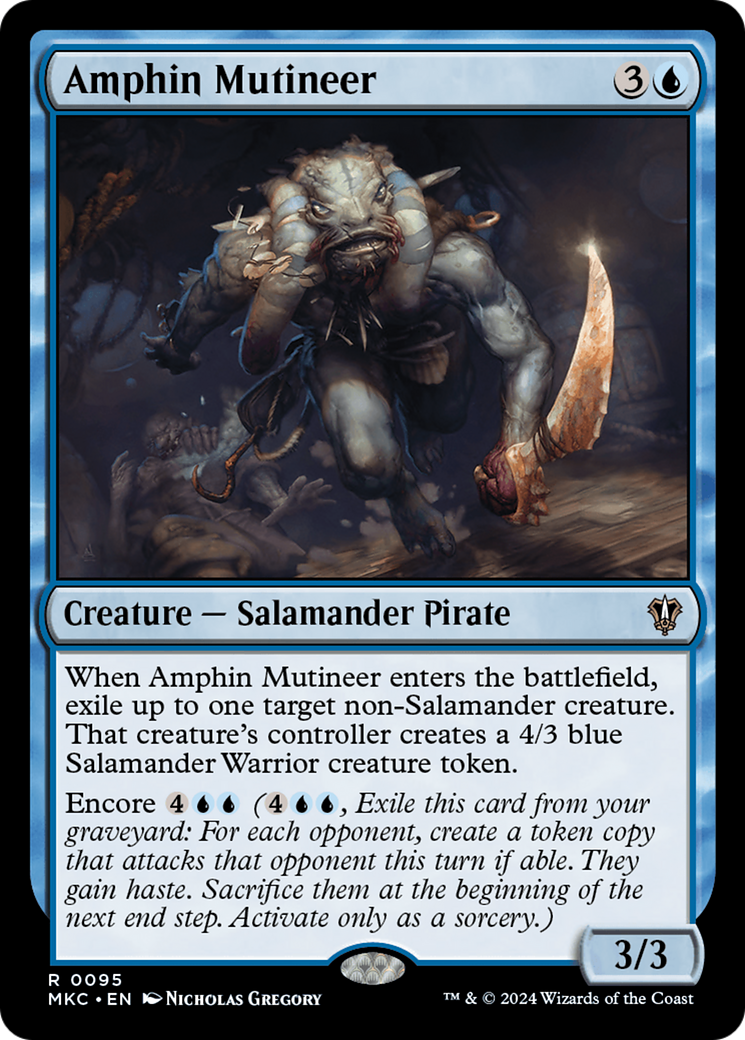
Amphin Mutineer
Amphin Mutineer
Creature — Salamander Pirate
3/3
When this creature enters, exile up to one target non-Salamander creature. That creature's controller creates a 4/3 blue Salamander Warrior creature token.
Encore ( , Exile this card from your graveyard: For each opponent, create a token copy that attacks that opponent this turn if able. They gain haste. Sacrifice them at the beginning of the next end step. Activate only as a sorcery.)
- If an effect stops a token from attacking a specific player, that token can attack any player, planeswalker, or battle, or not attack at all. If the effect stops the token from attacking a specific player unless a cost is paid, you don't have to pay that cost unless you want to attack that player.
- Exiling the card with encore is a cost to activate the ability. Once you announce that you're activating it, no player may take actions until you've finished. They can't try to remove the card from your graveyard to stop you from paying the cost.
- Opponents who have left the game aren't counted when determining how many tokens to create.
- The tokens copy only what's on the original card. Effects that modified that creature when it was previously on the battlefield won't be copied.
- If the target non-Salamander creature is an illegal target by the time Amphin Mutineer's ability tries to resolve, the ability doesn't resolve. No player creates a Salamander Warrior token.
- If one of the tokens can't attack for any reason (such as being tapped), then it doesn't attack. If there's a cost associated with having it attack, you aren't forced to pay that cost, so it doesn't have to attack in that case either.
- If one of the tokens somehow is under another player's control as the delayed triggered ability resolves, you can't sacrifice that token. It remains on the battlefield indefinitely, even if you regain control of it later.
- Each token must attack the appropriate player if able.
-
1
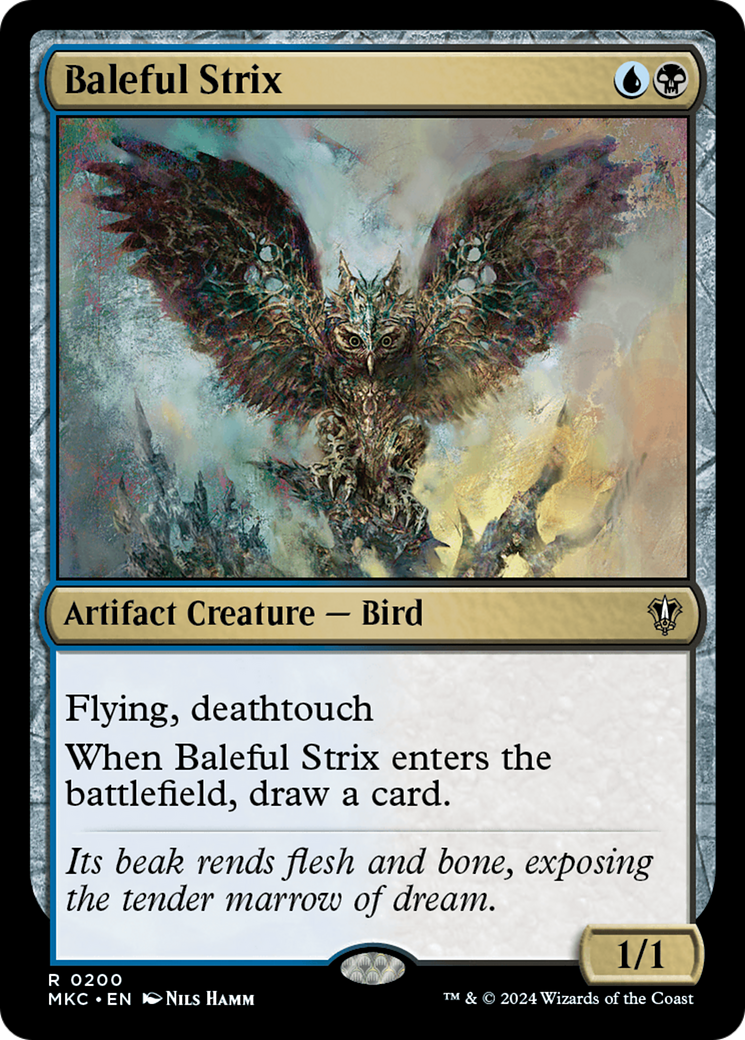
Baleful Strix
Baleful Strix
Artifact Creature — Bird
1/1
Flying, deathtouch
When this creature enters, draw a card.
-
1
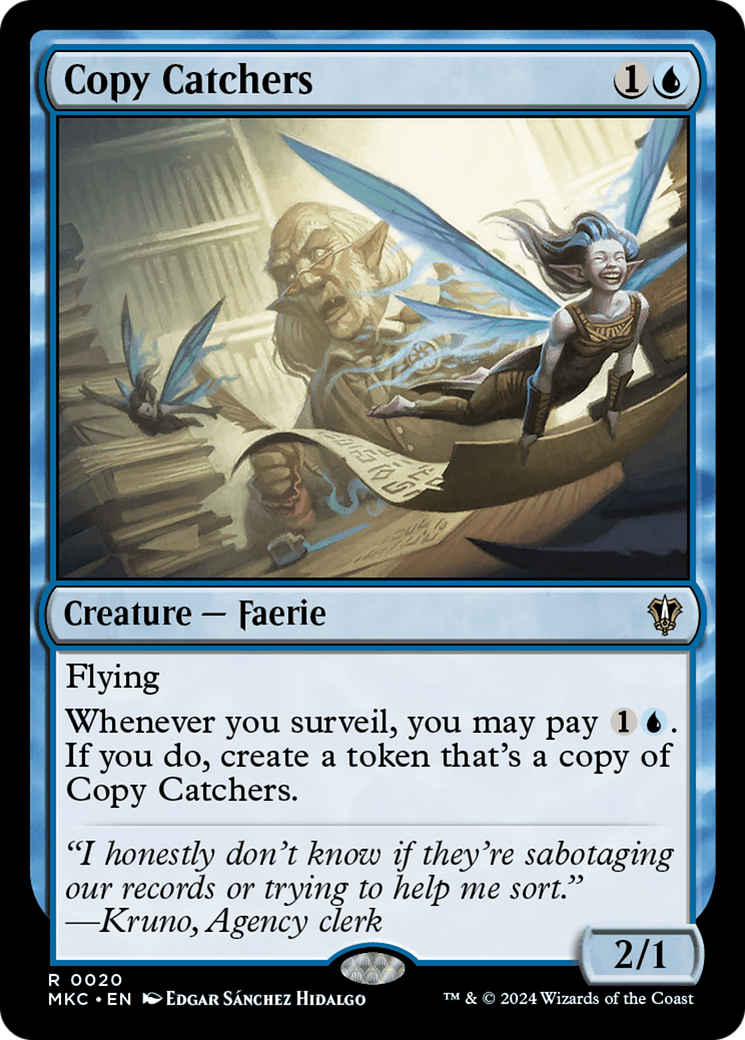
Copy Catchers
Copy Catchers
Creature — Faerie
2/1
Flying
Whenever you surveil, you may pay . If you do, create a token that's a copy of this creature.
- An ability that triggers “whenever you surveil” triggers after you’re done surveilling, even if you have fewer cards in your library than the number of cards you’re instructed to surveil. It triggers even if you have no cards in your library.
- The token copy will have Copy Catchers’s abilities and will be able to create copies of itself.
- The token doesn’t copy whether Copy Catchers is tapped or untapped, whether it has any counters on it or Auras attached to it, or any non-copy effects that have changed its power, toughness, types, color, and so on.
- If Copy Catchers leaves the battlefield before its triggered ability resolves, the token will still enter the battlefield as a copy of Copy Catchers, using Copy Catchers’s copiable values from when it was last on the battlefield.
- In the unusual case where Copy Catchers becomes a copy of something else while its triggered ability is on the stack but before it resolves, the token will enter the battlefield as a copy of whatever Copy Catchers is copying. (Do you copy? Over.)
-
1
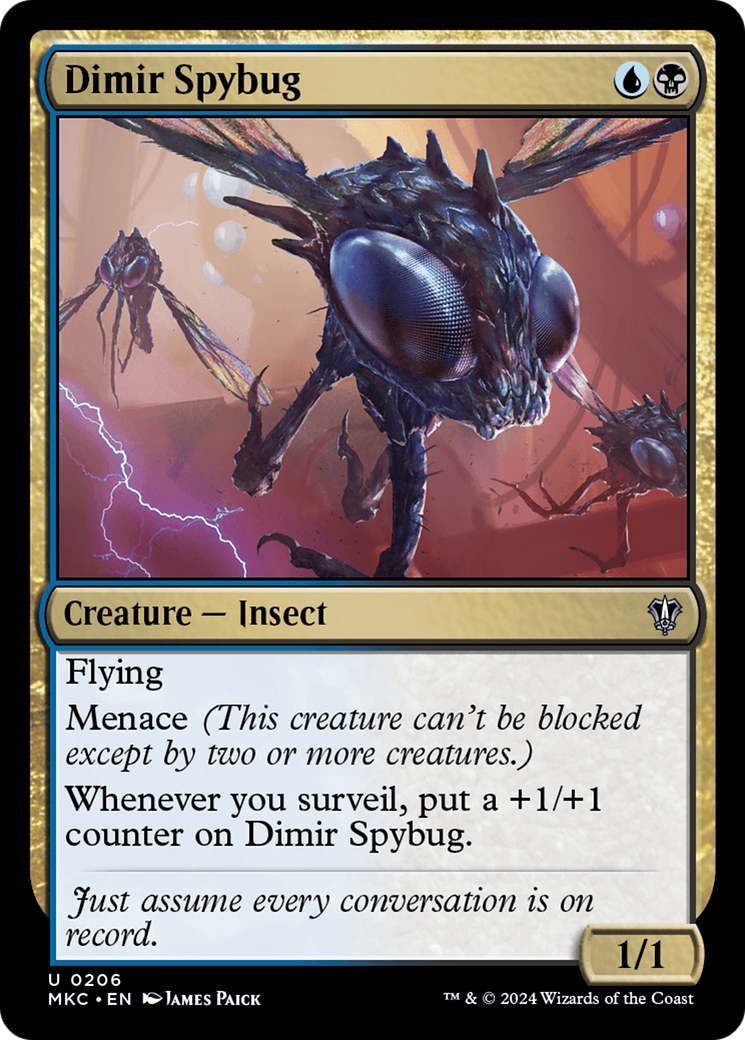
Dimir Spybug
Dimir Spybug
Creature — Insect
1/1
Flying
Menace (This creature can't be blocked except by two or more creatures.)
Whenever you surveil, put a +1/+1 counter on this creature.
- An ability that triggers "whenever you surveil" triggers after you're done surveilling, even if you have fewer cards in your library than the number of cards you're instructed to surveil. It even triggers if you have no cards in your library.
- You put only one +1/+1 counter on Dimir Spybug each time you surveil, no matter how many cards you looked at when you surveilled.
-
1
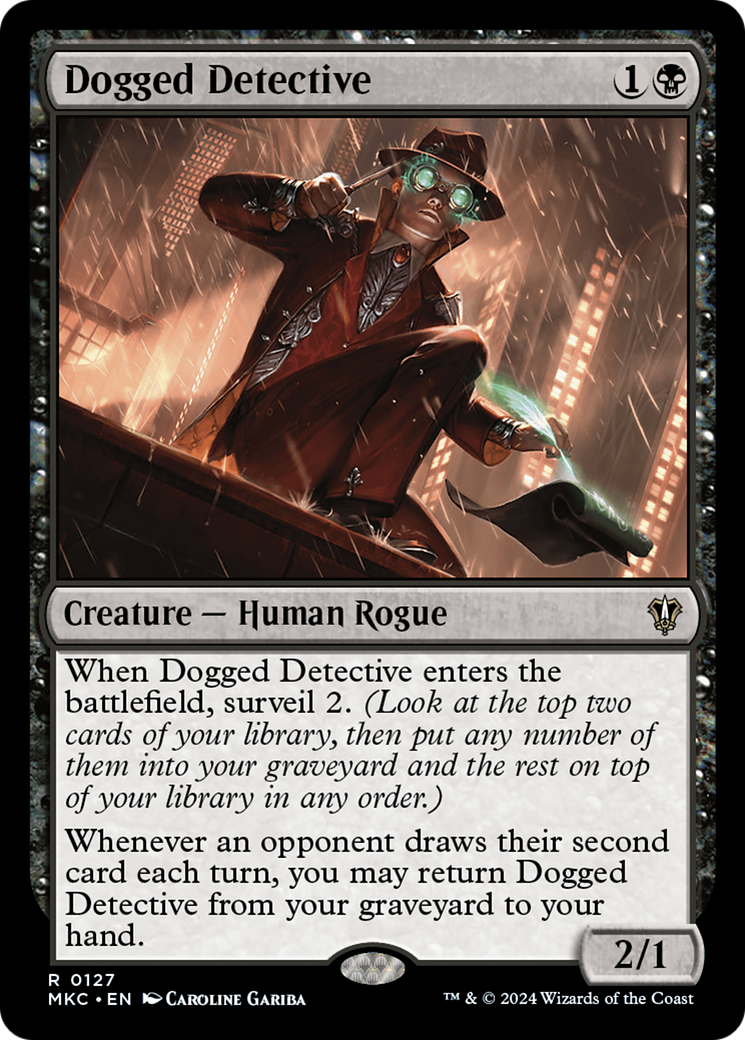
Dogged Detective
Dogged Detective
Creature — Human Rogue
2/1
When this creature enters, surveil 2. (Look at the top two cards of your library, then put any number of them into your graveyard and the rest on top of your library in any order.)
Whenever an opponent draws their second card each turn, you may return this card from your graveyard to your hand.
- When you surveil, you may put all the cards you look at back on top of your library, you may put all of those cards into your graveyard, or you may put some of those cards on top and the rest of them into your graveyard.
- Dogged Detective doesn't need to be in the graveyard when the first card is drawn for its last ability to trigger. As long as it is in the graveyard when an opponent draws their second card in a turn, it will trigger.
-
1
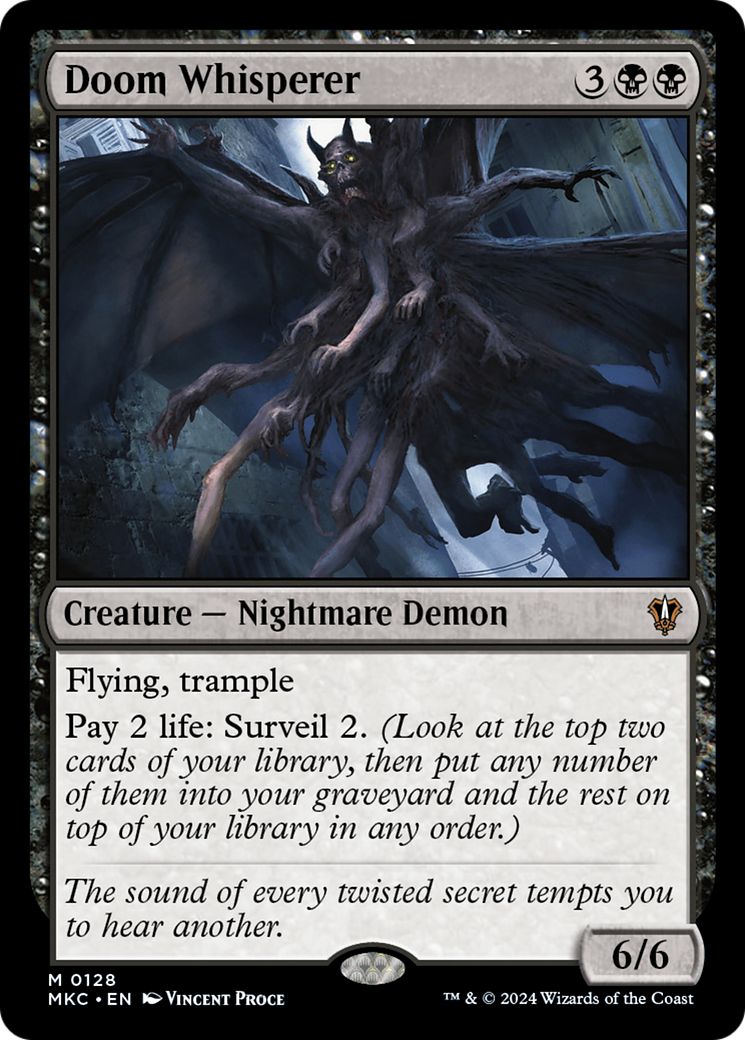
Doom Whisperer
Doom Whisperer
Creature — Nightmare Demon
6/6
Flying, trample
Pay 2 life: Surveil 2. (Look at the top two cards of your library, then put any number of them into your graveyard and the rest on top of your library in any order.)
- You perform the actions stated on a card in sequence. For some spells and abilities, you'll surveil last. For others, you'll surveil and then perform other actions.
- When you surveil, you may put all the cards you look at back on top of your library, you may put all of those cards into your graveyard, or you may put some of those cards on top and the rest of them into your graveyard.
-
1
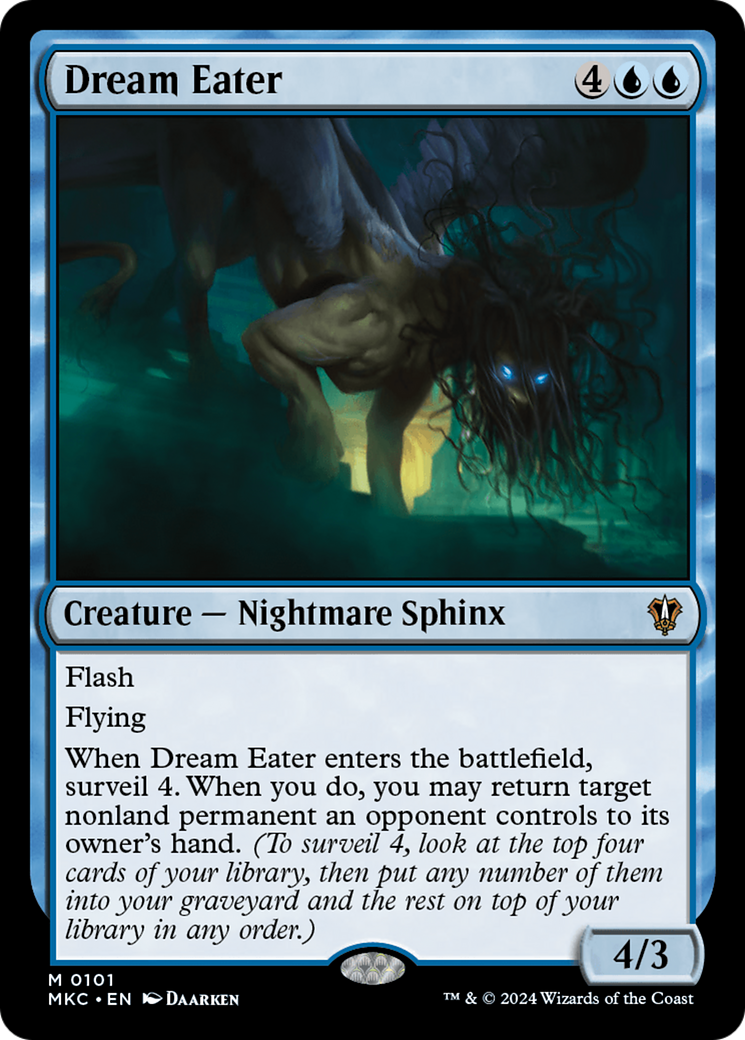
Dream Eater
Dream Eater
Creature — Nightmare Sphinx
4/3
Flash
Flying
When this creature enters, surveil 4. When you do, you may return target nonland permanent an opponent controls to its owner's hand. (To surveil 4, look at the top four cards of your library, then put any number of them into your graveyard and the rest on top of your library in any order.)
- You perform the actions stated on a card in sequence. For some spells and abilities, you'll surveil last. For others, you'll surveil and then perform other actions.
- When you surveil, you may put all the cards you look at back on top of your library, you may put all of those cards into your graveyard, or you may put some of those cards on top and the rest of them into your graveyard.
- Dream Eater's triggered ability goes on the stack without a target. While that ability is resolving, after you've surveilled, the reflexive triggered ability triggers and you pick a target nonland permanent to be returned to its owner's hand. This is different from effects that say "If you do . . ." in that you choose the target after having surveilled.
- Dream Eater's reflexive triggered ability triggers even if you have fewer than four cards in your library to surveil.
-
1
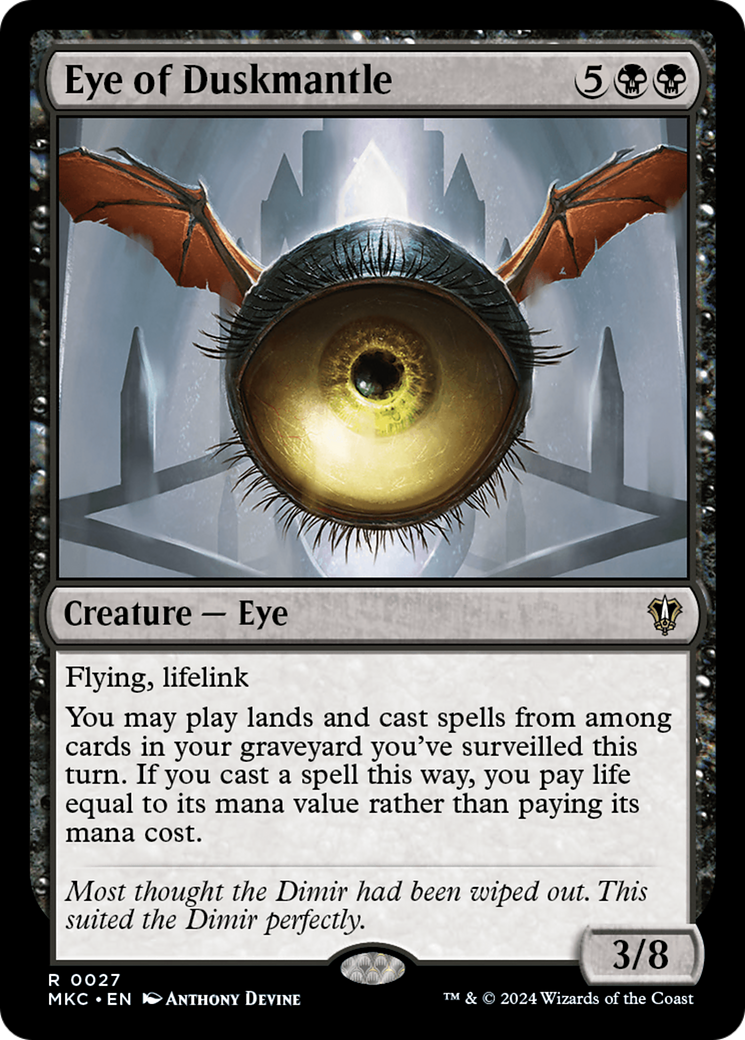
Eye of Duskmantle
Eye of Duskmantle
Creature — Eye
3/8
Flying, lifelink
You may play lands and cast spells from among cards in your graveyard you've surveilled this turn. If you cast a spell this way, you pay life equal to its mana value rather than paying its mana cost.
- “Cards in your graveyard you’ve surveilled this turn” includes cards you put into your graveyard while surveilling. It does not include cards you saw while surveilling, left on top of your library, and then put into your graveyard later that turn by other means.
- You may only cast spells this way by paying the appropriate amount of life. You may not pay their normal costs and may not pay any other alternative costs. You may still pay for additional costs, such as kicker costs. If the spell has mandatory additional costs, you must pay those.
- If you cast a spell with in its mana cost this way, the only legal choice for X is 0.
-
1
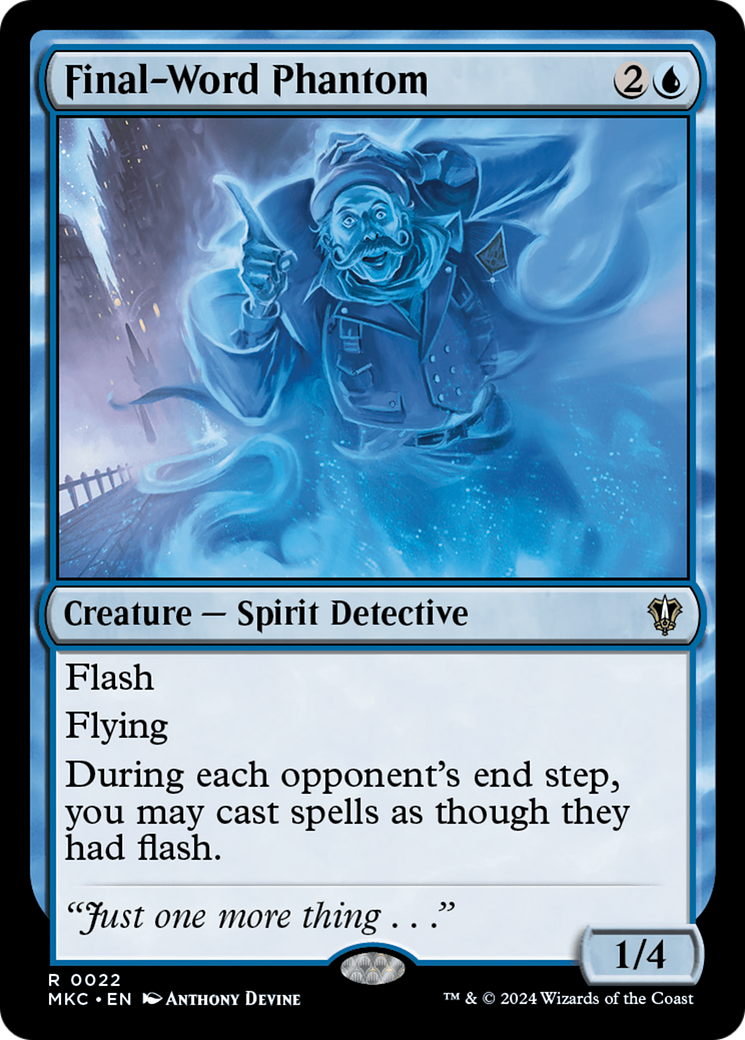
Final-Word Phantom
Final-Word Phantom
Creature — Spirit Detective
1/4
Flash
Flying
During each opponent's end step, you may cast spells as though they had flash.
- Final-Word Phantom’s last ability applies only to casting spells. It does not, for example, change when you may activate abilities that can be activated “only as a sorcery.”
-
1
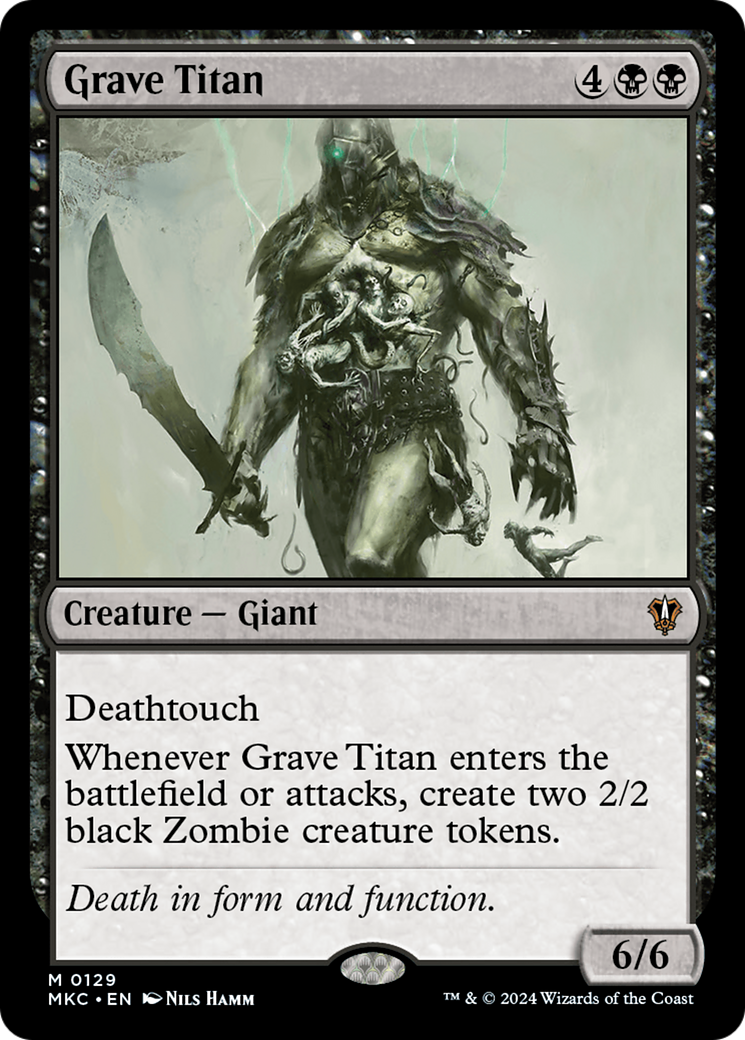
Grave Titan
Grave Titan
Creature — Giant
6/6
Deathtouch
Whenever this creature enters or attacks, create two 2/2 black Zombie creature tokens.
-
1
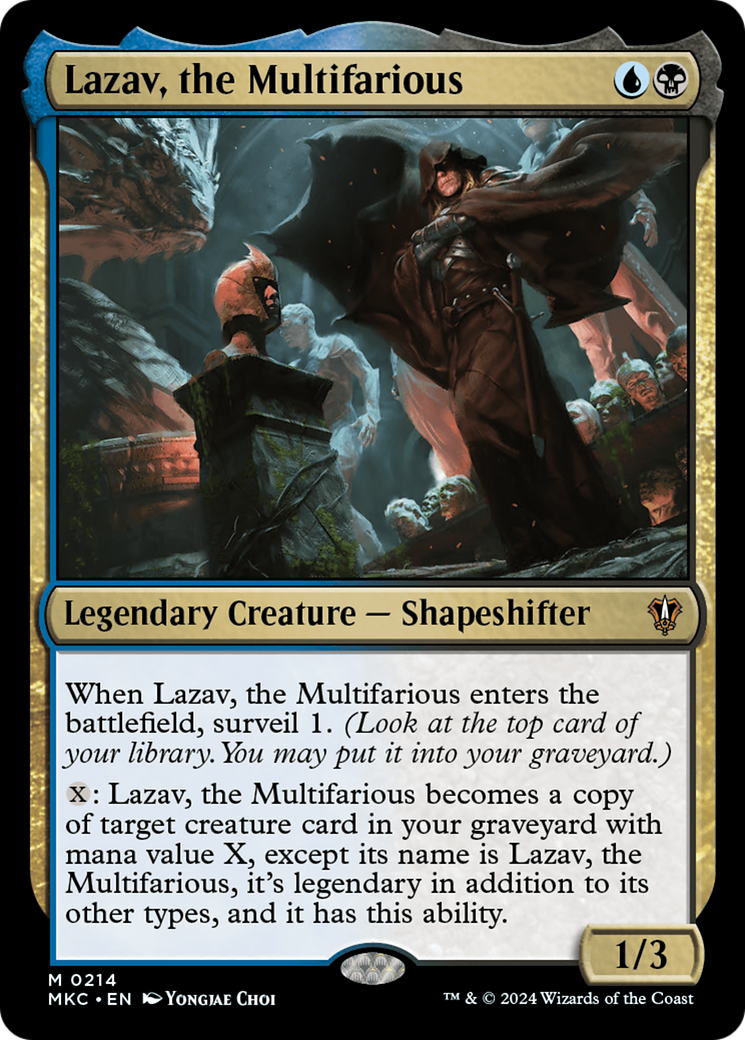
Lazav, the Multifarious
Lazav, the Multifarious
Legendary Creature — Shapeshifter
1/3
When Lazav enters, surveil 1. (Look at the top card of your library. You may put it into your graveyard.)
: Lazav becomes a copy of target creature card in your graveyard with mana value X, except its name is Lazav, the Multifarious, it's legendary in addition to its other types, and it has this ability.
- You perform the actions stated on a card in sequence. For some spells and abilities, you'll surveil last. For others, you'll surveil and then perform other actions.
- Lazav copies exactly what was printed on the original card and nothing else, except the characteristics it specifically modifies. It doesn't copy any information about the object the card was before it was put into your graveyard.
- Any effects that applied to Lazav before it becomes a copy of another card will continue to apply once it's become a copy. The same is true of any counters that are on Lazav.
- If a card in your graveyard has in its mana cost, X is considered to be 0.
- Because Lazav isn't entering the battlefield when it becomes a copy of a card, any "When this enters the battlefield" or "This enters the battlefield with" abilities of the copied card won't apply.
- If the copied card has an ability that can be activated only once each turn, copying that card a second time will allow you to activate the new instance of that ability.
-
1
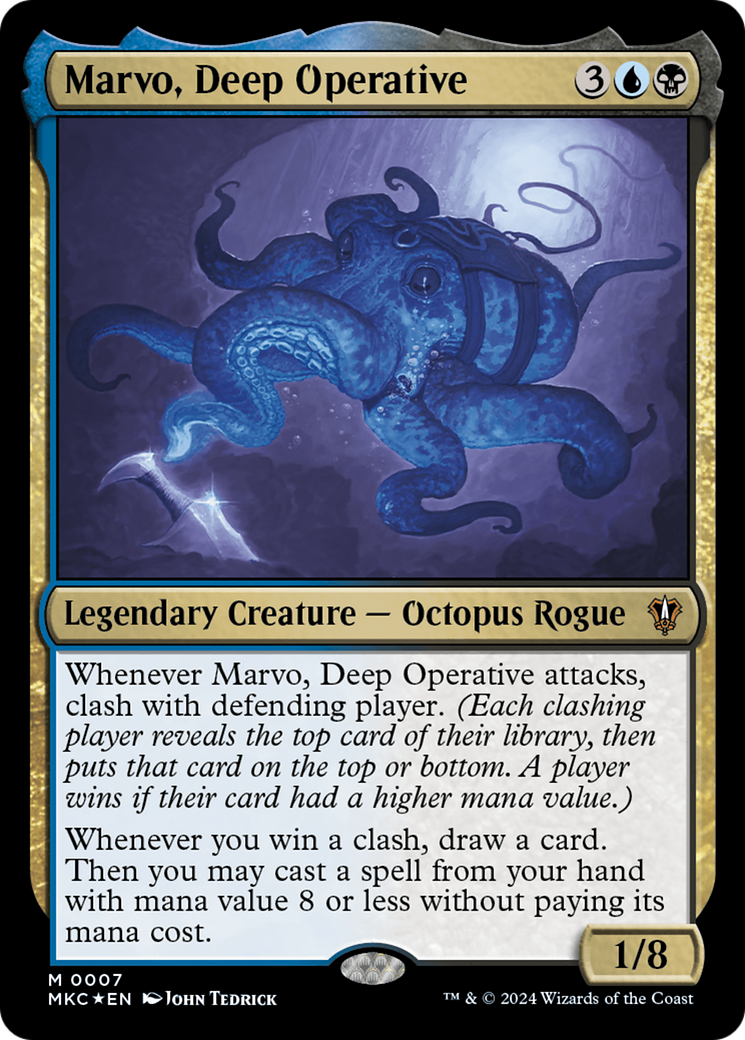
Marvo, Deep Operative
Marvo, Deep Operative
Legendary Creature — Octopus Rogue
1/8
Whenever Marvo attacks, clash with defending player. (Each clashing player reveals the top card of their library, then puts that card on the top or bottom. A player wins if their card had a higher mana value.)
Whenever you win a clash, draw a card. Then you may cast a spell from your hand with mana value 8 or less without paying its mana cost.
-
1
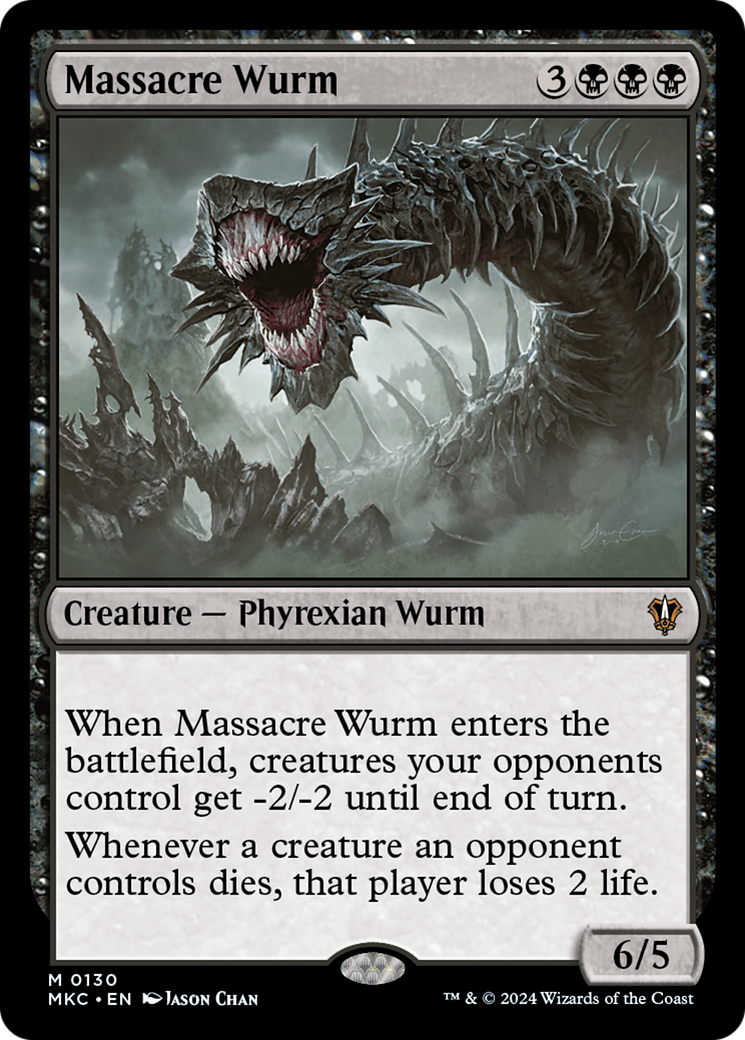
Massacre Wurm
Massacre Wurm
Creature — Phyrexian Wurm
6/5
When this creature enters, creatures your opponents control get -2/-2 until end of turn.
Whenever a creature an opponent controls dies, that player loses 2 life.
- Massacre Wurm's first ability affects only creatures your opponents control at the time it resolves. Creatures they begin to control later in the turn won't get -2/-2.
- Massacre Wurm's triggered ability triggers if a creature an opponent controls dies for any reason, including from its first ability reducing its toughness to 0, as long as Massacre Wurm remains on the battlefield.
- If a creature an opponent controls dies at the same time as Massacre Wurm, Massacre Wurm's last ability triggers for that creature.
- If your life total is brought to 0 or less at the same time that a creature an opponent controls is dealt lethal damage, you lose the game before Massacre Wurm's last ability goes on the stack.
-
1
Master of Death
Master of Death
Creature — Zombie Wizard
3/1
When this creature enters, surveil 2. (Look at the top two cards of your library, then put any number of them into your graveyard and the rest on top of your library in any order.)
At the beginning of your upkeep, if this card is in your graveyard, you may pay 1 life. If you do, return it to your hand.
- When you surveil, you may put all the cards you look at back on top of your library, you may put all of those cards into your graveyard, or you may put some of those cards on top and the rest of them into your graveyard.
-
1
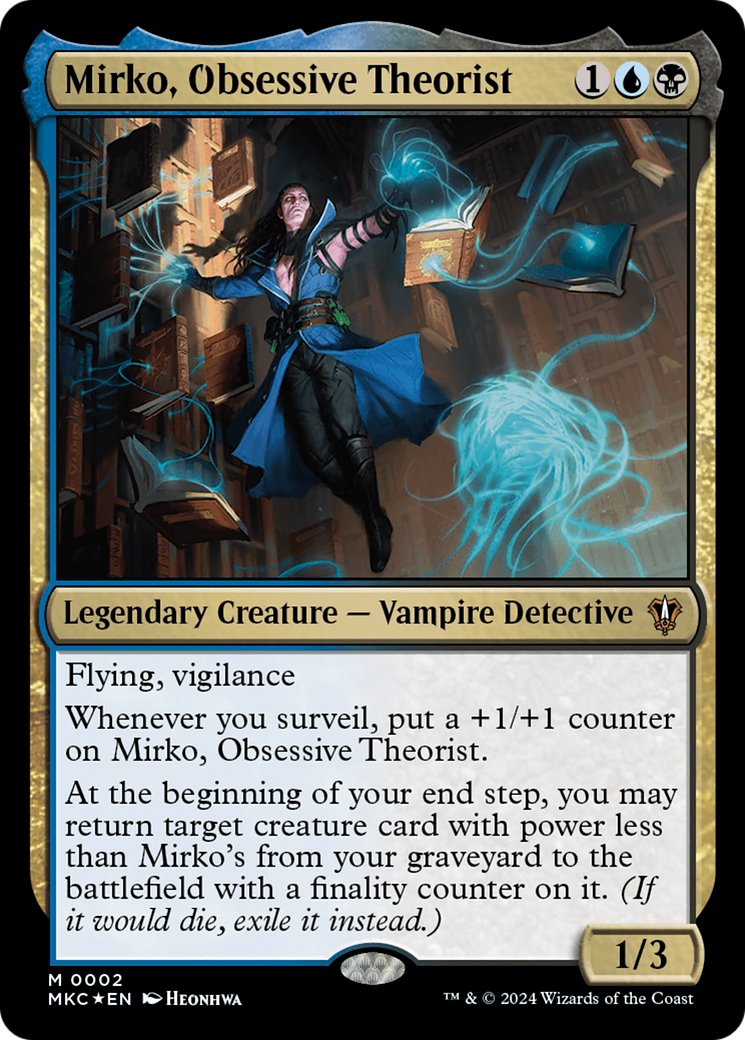
Mirko, Obsessive Theorist
Mirko, Obsessive Theorist
Legendary Creature — Vampire Detective
1/3
Flying, vigilance
Whenever you surveil, put a +1/+1 counter on Mirko.
At the beginning of your end step, you may return target creature card with power less than Mirko's from your graveyard to the battlefield with a finality counter on it. (If it would die, exile it instead.)
- An ability that triggers "whenever you surveil" triggers after you're done surveilling, even if you have fewer cards in your library than the number of cards you're instructed to surveil. It even triggers if you have no cards in your library.
- Finality counters work on any permanent, not only creatures. If a permanent with a finality counter on it would go to a graveyard from the battlefield, exile it instead.
- Finality counters don't stop permanents from going to zones other than the graveyard from the battlefield. For example, if a permanent with a finality counter on it would be put into its owner's hand from the battlefield, it does so normally.
- Finality counters aren't keyword counters, and a finality counter doesn't give any abilities to the permanent it's on. If that permanent loses its abilities and then would go to a graveyard, it will still be exiled instead.
- Multiple finality counters on a single permanent are redundant.
-
1
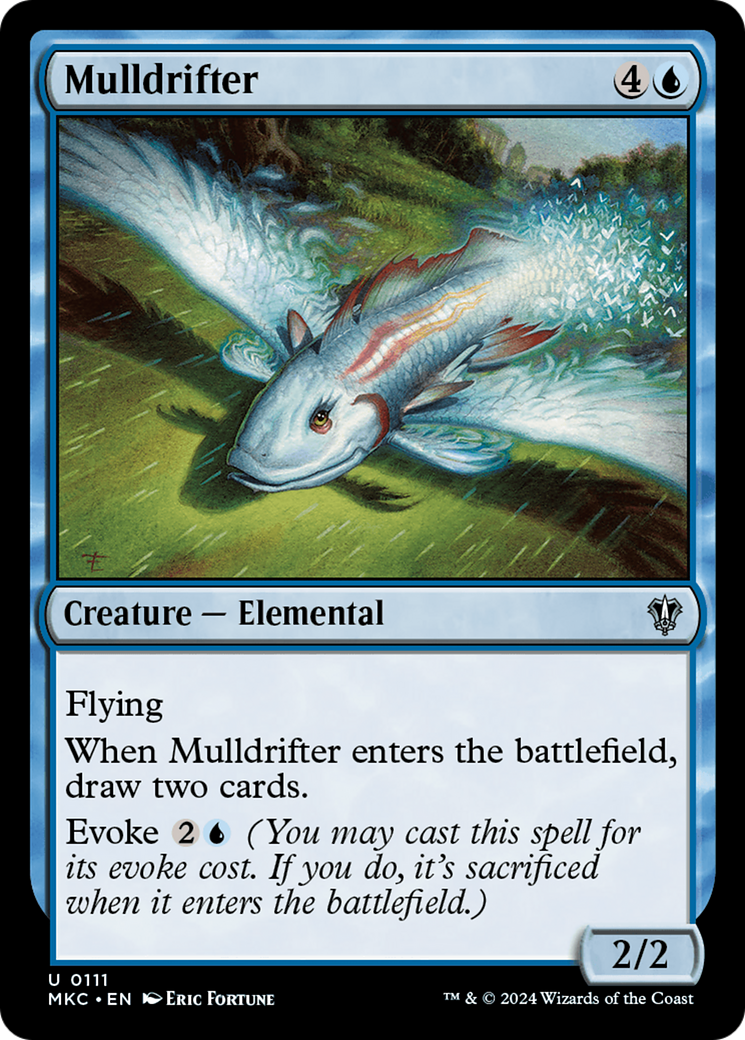
Mulldrifter
Mulldrifter
Creature — Elemental
2/2
Flying
When this creature enters, draw two cards.
Evoke (You may cast this spell for its evoke cost. If you do, it's sacrificed when it enters.)
- To determine the total cost of a spell, start with the mana cost or alternative cost you're paying (such as an evoke cost), add any cost increases, then apply any cost reductions. The mana value of the spell is determined by only its mana cost, no matter what the total cost to cast that spell was.
- If you pay the evoke cost, you can have Mulldrifter's own triggered ability resolve before the evoke triggered ability. You can cast spells after that ability resolves but before you have to sacrifice Mulldrifter.
-
1
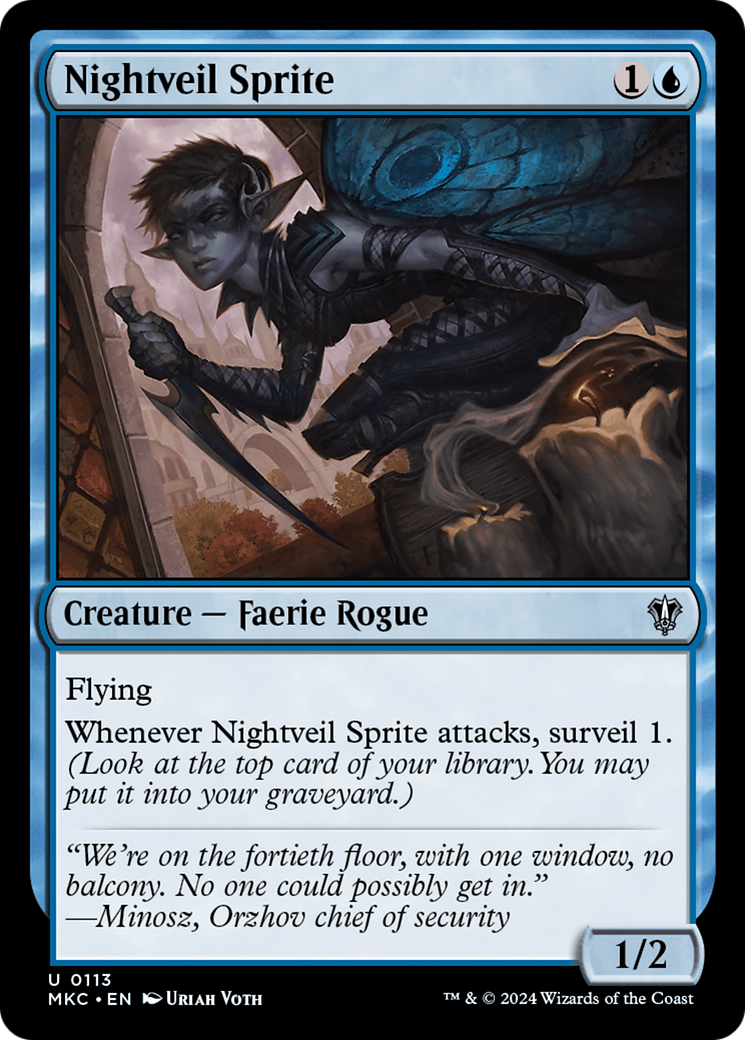
Nightveil Sprite
Nightveil Sprite
Creature — Faerie Rogue
1/2
Flying
Whenever this creature attacks, surveil 1. (Look at the top card of your library. You may put it into your graveyard.)
- You perform the actions stated on a card in sequence. For some spells and abilities, you'll surveil last. For others, you'll surveil and then perform other actions.
-
1
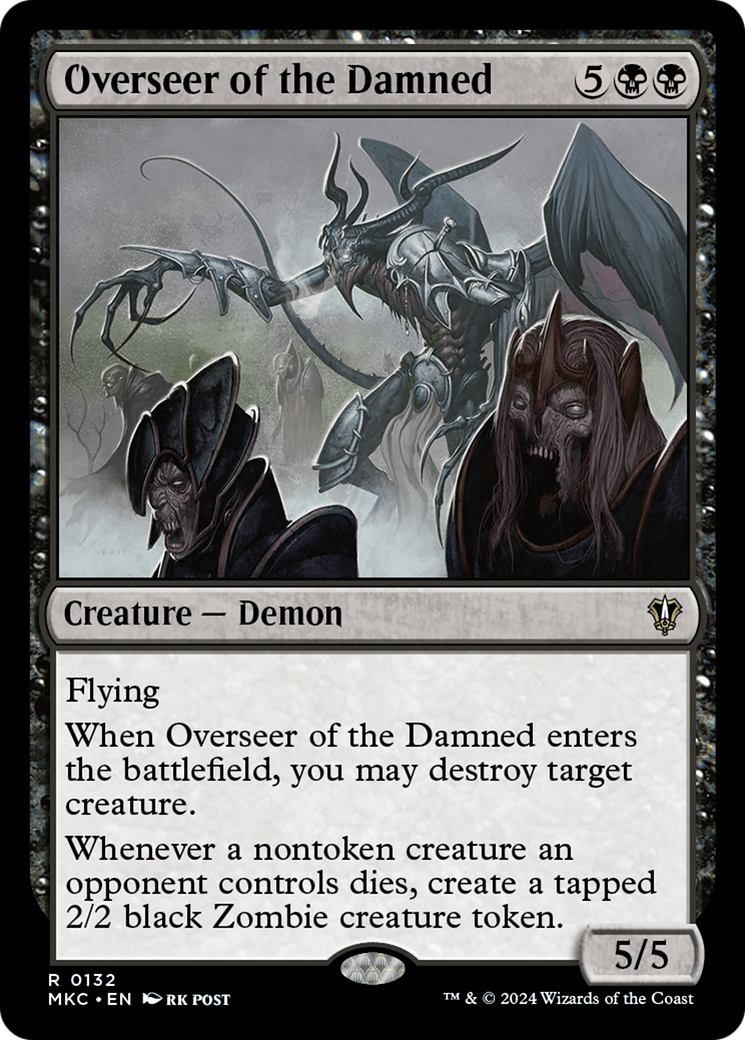
Overseer of the Damned
Overseer of the Damned
Creature — Demon
5/5
Flying
When this creature enters, you may destroy target creature.
Whenever a nontoken creature an opponent controls dies, create a tapped 2/2 black Zombie creature token.
-
1
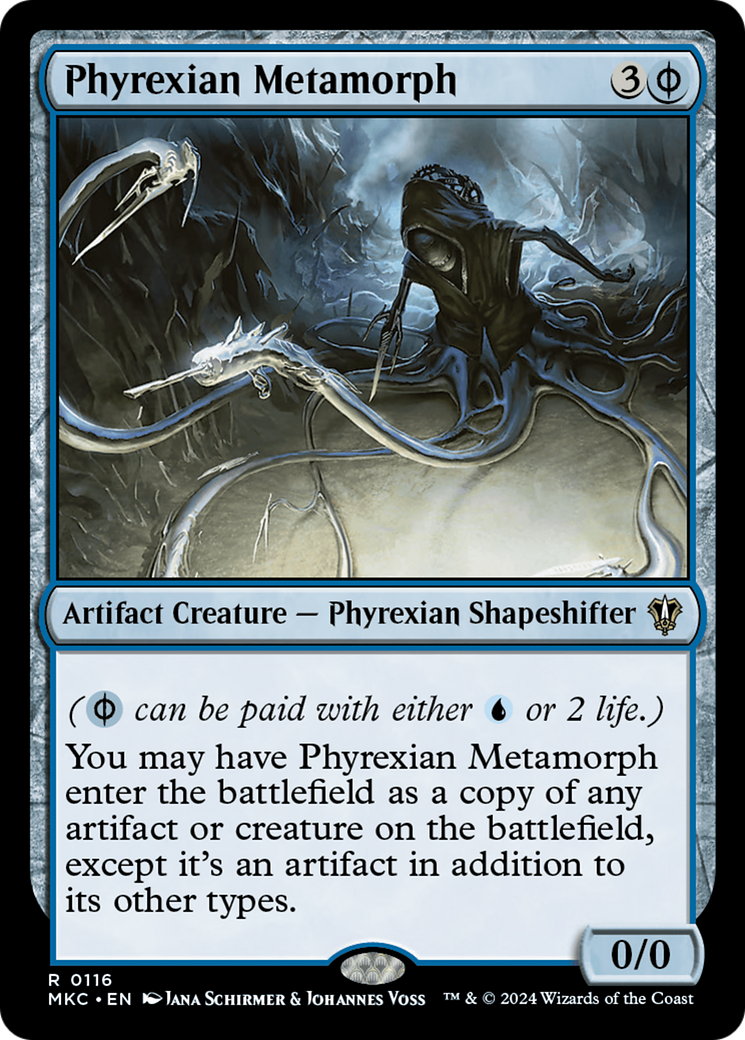
Phyrexian Metamorph
Phyrexian Metamorph
Artifact Creature — Phyrexian Shapeshifter
0/0
( can be paid with either or 2 life.)
You may have this creature enter as a copy of any artifact or creature on the battlefield, except it's an artifact in addition to its other types.
- If the chosen permanent has in its mana cost (such as Protean Hydra), X is considered to be zero.
- If the chosen permanent is a token, Phyrexian Metamorph copies the original characteristics of that token as stated by the effect that put the token onto the battlefield, except it's also an artifact. Phyrexian Metamorph is not a token.
- If Phyrexian Metamorph somehow enters at the same time as another permanent (due to Mass Polymorph or Liliana Vess's third ability, for example), Phyrexian Metamorph can't become a copy of that permanent. You may choose only a permanent that's already on the battlefield.
- If Phyrexian Metamorph copies a noncreature artifact, it is no longer a creature.
- If the chosen creature is copying something else (for example, if the chosen creature is a Clone), then your Phyrexian Metamorph enters as whatever the chosen creature copied, except it's also an artifact.
- Any "enters" abilities of the copied permanent will trigger when Phyrexian Metamorph enters. Any "as [this] enters" or "[this] enters with" abilities of the chosen permanent will also work.
- Except for also being an artifact, Phyrexian Metamorph copies exactly what was printed on the original permanent and nothing more (unless that creature is itself copying something or is a token; see below). It doesn't copy whether that permanent is tapped or untapped, whether it has any counters on it or Auras attached to it, or any noncopy effects that have changed its power, toughness, types, color, and so on.
- You can choose not to copy anything. In that case, Phyrexian Metamorph simply enters as a 0/0 artifact creature and is put into its owner's graveyard as a state-based action (unless something else is raising its toughness).
-
1
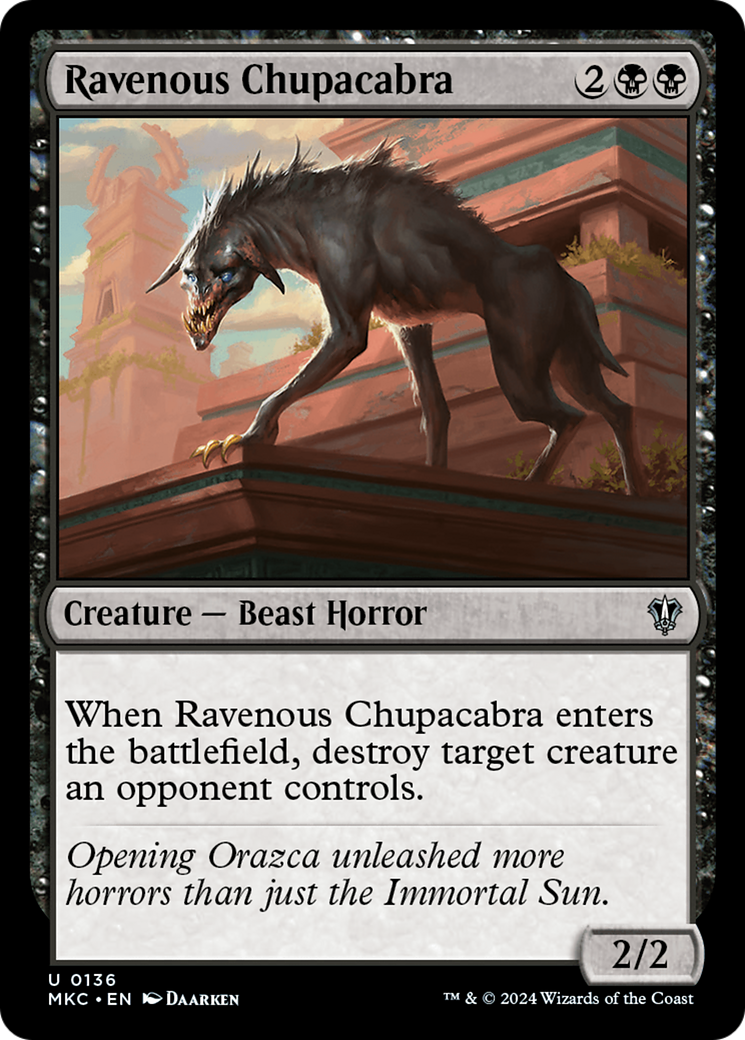
Ravenous Chupacabra
Ravenous Chupacabra
Creature — Beast Horror
2/2
When this creature enters, destroy target creature an opponent controls.
-
1
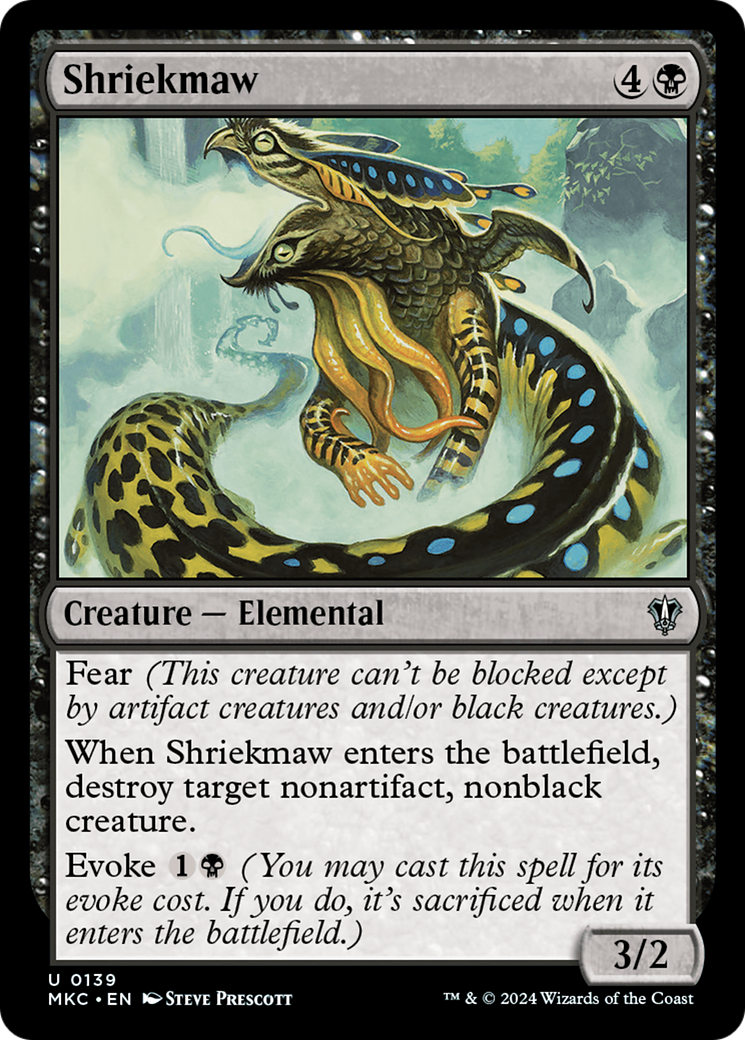
Shriekmaw
Shriekmaw
Creature — Elemental
3/2
Fear (This creature can't be blocked except by artifact creatures and/or black creatures.)
When this creature enters, destroy target nonartifact, nonblack creature.
Evoke (You may cast this spell for its evoke cost. If you do, it's sacrificed when it enters.)
- To determine the total cost of a spell, start with the mana cost or alternative cost you're paying (such as an evoke cost), add any cost increases, then apply any cost reductions. The mana value of the spell is determined by only its mana cost, no matter what the total cost to cast that spell was.
- If you pay the evoke cost, you can have Shriekmaw's own triggered ability resolve before the evoke triggered ability. You can cast spells after that ability resolves but before you have to sacrifice Shriekmaw.
-
1
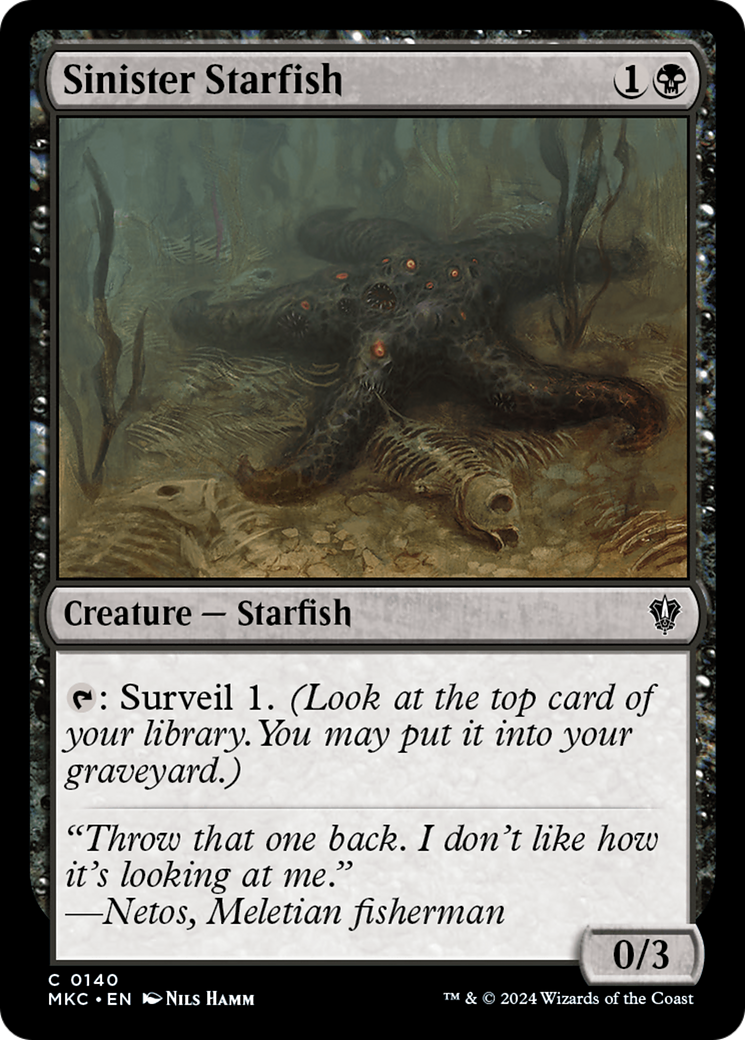
Sinister Starfish
Sinister Starfish
Creature — Starfish
0/3
: Surveil 1. (Look at the top card of your library. You may put it into your graveyard.)
-
1
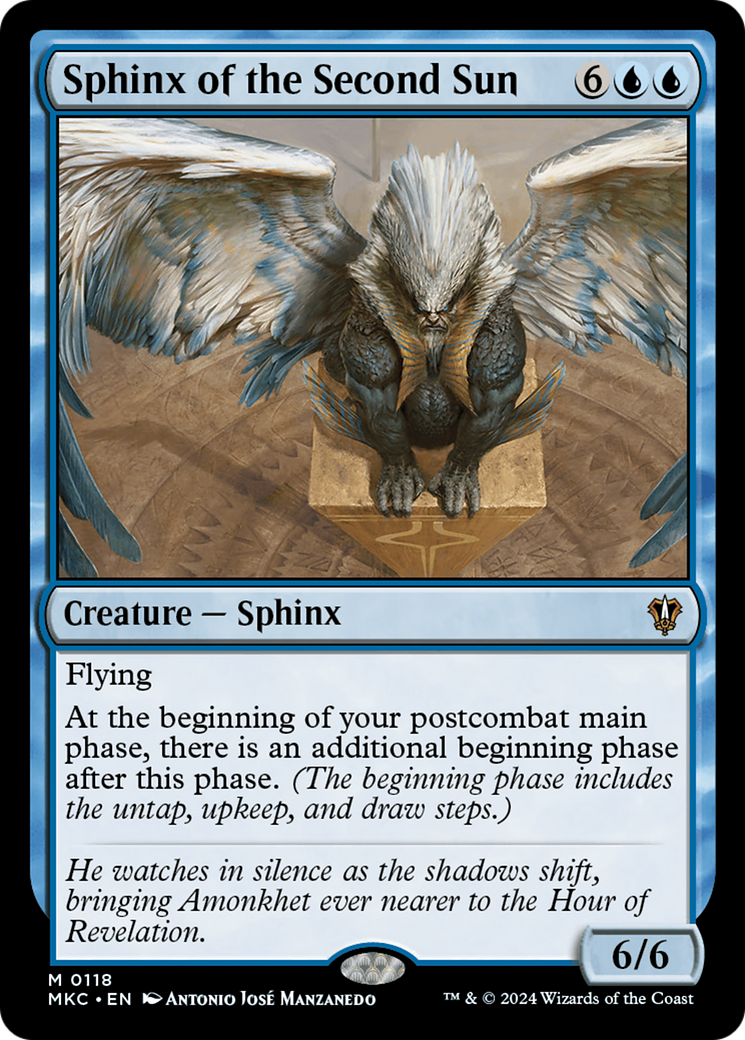
Sphinx of the Second Sun
Sphinx of the Second Sun
Creature — Sphinx
6/6
Flying
At the beginning of each of your postcombat main phases, there is an additional beginning phase after this phase. (The beginning phase includes the untap, upkeep, and draw steps.)
- The additional beginning phase will be a lot like your normal beginning phase. During the untap step, permanents will phase in or out as appropriate and you'll untap your tapped permanents. Anything that triggers "at the beginning of your upkeep" or similar will trigger during the upkeep step, and you'll eventually draw a card for your draw step.
- The additional beginning phase all happens during the current turn. Any effects that last "until your next turn" or similar won't expire just because you'll go through an additional beginning phase.
- After the additional beginning phase, the game proceeds to the ending phase (unless something has added even more phases; see below.)
- If multiple phases are added to the same point in your turn, the most recently created phase happens first. For example, say you control Sphinx of the Second Sun and its ability triggers during your postcombat main phase. Later during that same main phase, another effect gives you an additional combat phase after this main phase. The additional combat will happen first, followed by the additional beginning phase.
- Even if you don't attack with any creatures during combat, you'll still get a postcombat main phase and Sphinx of the Second Sun's ability will still trigger.
- If you somehow have more than two main phases in a turn, each main phase other than the first one is a postcombat main phase, and Sphinx of the Second Sun's ability triggers at the beginning of each of them.
-
1
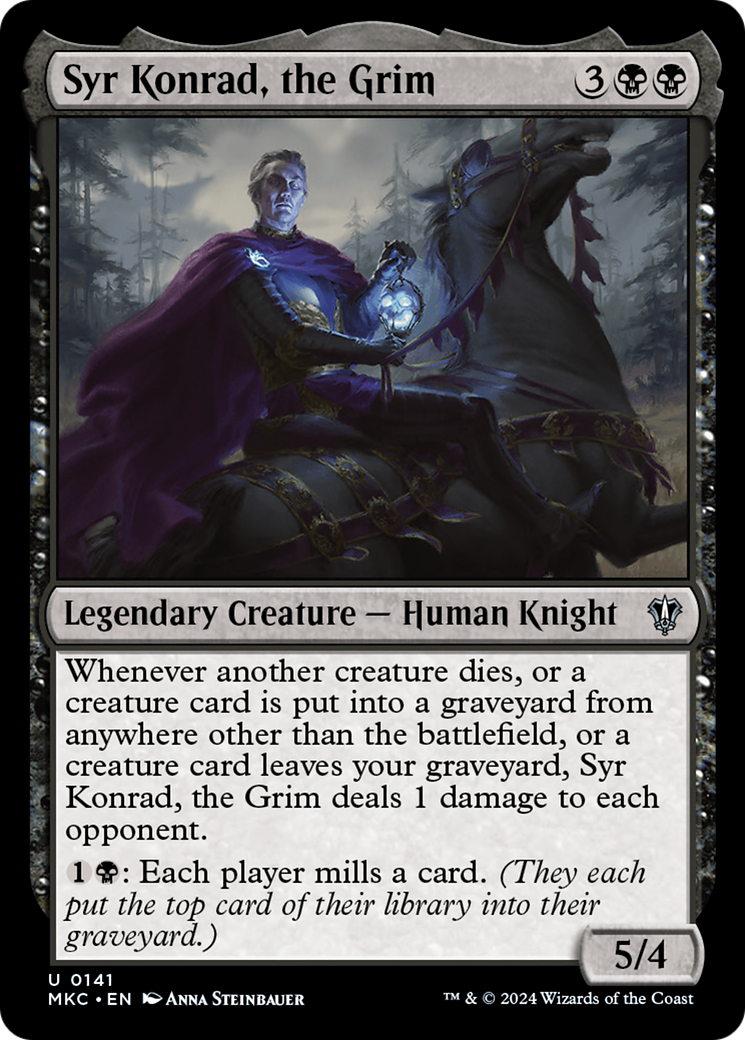
Syr Konrad, the Grim
Syr Konrad, the Grim
Legendary Creature — Human Knight
5/4
Whenever another creature dies, or a creature card is put into a graveyard from anywhere other than the battlefield, or a creature card leaves your graveyard, Syr Konrad deals 1 damage to each opponent.
: Each player mills a card. (They each put the top card of their library into their graveyard.)
- If one or more creatures die at the same time as Syr Konrad, its first ability triggers for each of those creatures.
- In a Two-Headed Giant game, Syr Konrad's first ability causes it to deal 1 damage twice.
-
1
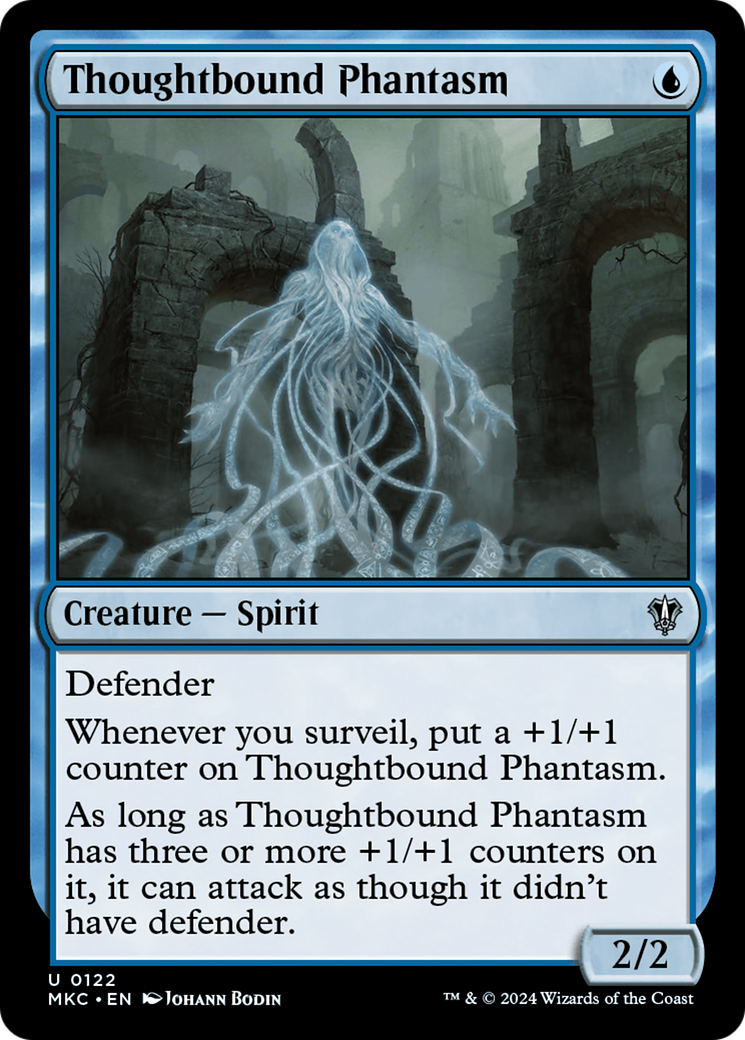
Thoughtbound Phantasm
Thoughtbound Phantasm
Creature — Spirit
2/2
Defender
Whenever you surveil, put a +1/+1 counter on this creature.
As long as this creature has three or more +1/+1 counters on it, it can attack as though it didn't have defender.
- An ability that triggers "whenever you surveil" triggers after you're done surveilling, even if you have fewer cards in your library than the number of cards you're instructed to surveil. It even triggers if you have no cards in your library.
- You put only one +1/+1 counter on Thoughtbound Phantasm each time you surveil, no matter how many cards you looked at when you surveilled.
- Once Thoughtbound Phantasm has attacked, removing +1/+1 counters from it won't remove it from combat.
-
1
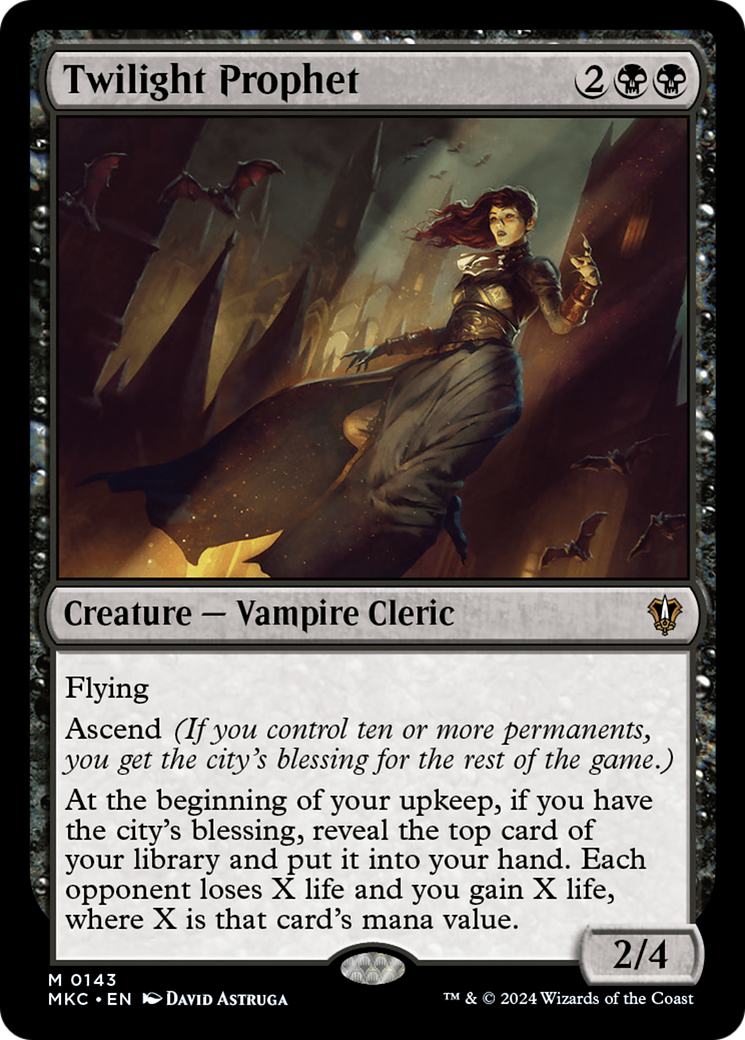
Twilight Prophet
Twilight Prophet
Creature — Vampire Cleric
2/4
Flying
Ascend (If you control ten or more permanents, you get the city's blessing for the rest of the game.)
At the beginning of your upkeep, if you have the city's blessing, reveal the top card of your library and put it into your hand. Each opponent loses X life and you gain X life, where X is that card's mana value.
- If the mana cost of the revealed card includes , X is considered to be 0.
- If the revealed card doesn't have a mana cost (because it's a land card, for example), its mana value is 0.
- The mana value of a split card, such as cards with aftermath from the Amonkhet block, is based on the combined mana cost of its two halves.
- In a Two-Headed Giant game, Twilight Prophet's last ability causes the opposing team to lose twice X life and you gain X life.
- Once you have the city's blessing, you have it for the rest of the game, even if you lose control of some or all of your permanents. The city's blessing isn't a permanent itself and can't be removed by any effect.
- A permanent is any object on the battlefield, including tokens and lands. Spells and emblems aren't permanents.
- If you cast a spell with ascend, you don't get the city's blessing until it resolves. Players may respond to that spell by trying to change whether you get the city's blessing.
- If you control ten permanents but don't control a permanent or resolving spell with ascend, you don't get the city's blessing. For example, if you control ten permanents, lose control of one, then cast Golden Demise, you won't have the city's blessing and the spell will affect creatures you control.
- If your tenth permanent enters the battlefield and then a permanent leaves the battlefield immediately afterwards (most likely due to the "Legend Rule" or due to being a creature with 0 toughness), you get the city's blessing before it leaves the battlefield.
- Ascend on a permanent isn't a triggered ability and doesn't use the stack. Players can respond to a spell that will give you your tenth permanent, but they can't respond to getting the city's blessing once you control that tenth permanent. This means that if your tenth permanent is a land you play, players can't respond before you get the city's blessing.
- Some cards have triggered abilities with an intervening "if" clause that checks whether you have the city's blessing. These are worded "[Trigger condition], if you have the city's blessing, [effect]." You must already have the city's blessing in order for these abilities to trigger; otherwise they do nothing. In other words, there's no way to have the ability trigger if you don't have the city's blessing, even if you intend to get it in response to the triggered ability.
-
1
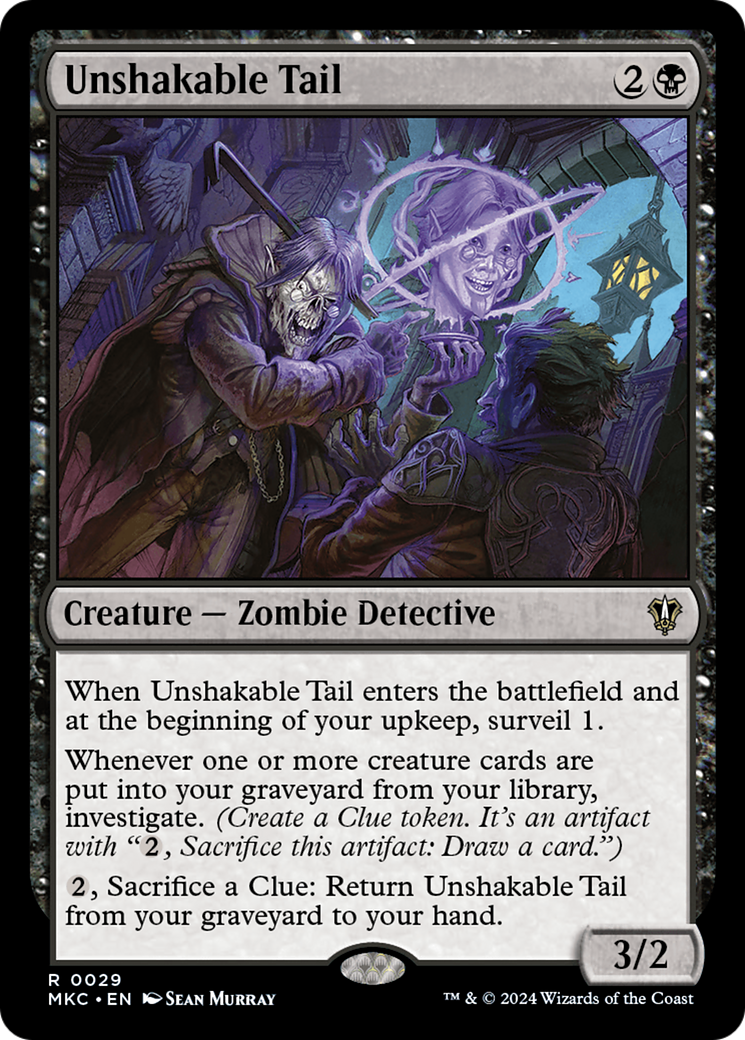
Unshakable Tail
Unshakable Tail
Creature — Zombie Detective
3/2
When this creature enters and at the beginning of your upkeep, surveil 1.
Whenever one or more creature cards are put into your graveyard from your library, investigate. (Create a Clue token. It's an artifact with " , Sacrifice this token: Draw a card.")
, Sacrifice a Clue: Return this card from your graveyard to your hand.
- If an effect puts multiple cards from a library into a graveyard, all of those cards move at the same time. For example, when Aftermath Analyst's enters the battlefield triggered ability resolves, you'll mill three cards at once. If one or more of those cards are creature cards, Unshakable Tail's second ability will trigger.
- Clue is an artifact type. Even though it appears on some cards with other permanent types, it's never a creature type, a land type, or anything but an artifact type.
- If an effect refers to a Clue, it means any Clue artifact, not just a Clue artifact token. For example, you can sacrifice Wrench to pay for Alquist Proft, Master Sleuth's activated ability.
- You can't sacrifice a Clue to pay multiple costs. For example, you can't sacrifice a Clue token to activate its own ability and also to activate Alquist Proft, Master Sleuth's ability.
- Some spells and abilities that investigate may require targets. If each target chosen is an illegal target as that spell or ability tries to resolve, it won't resolve. You won't create any Clue tokens.
- Some abilities trigger "whenever you sacrifice a Clue". Those abilities trigger whenever you sacrifice a Clue for any reason, not just to activate a Clue's activated ability.
-
1
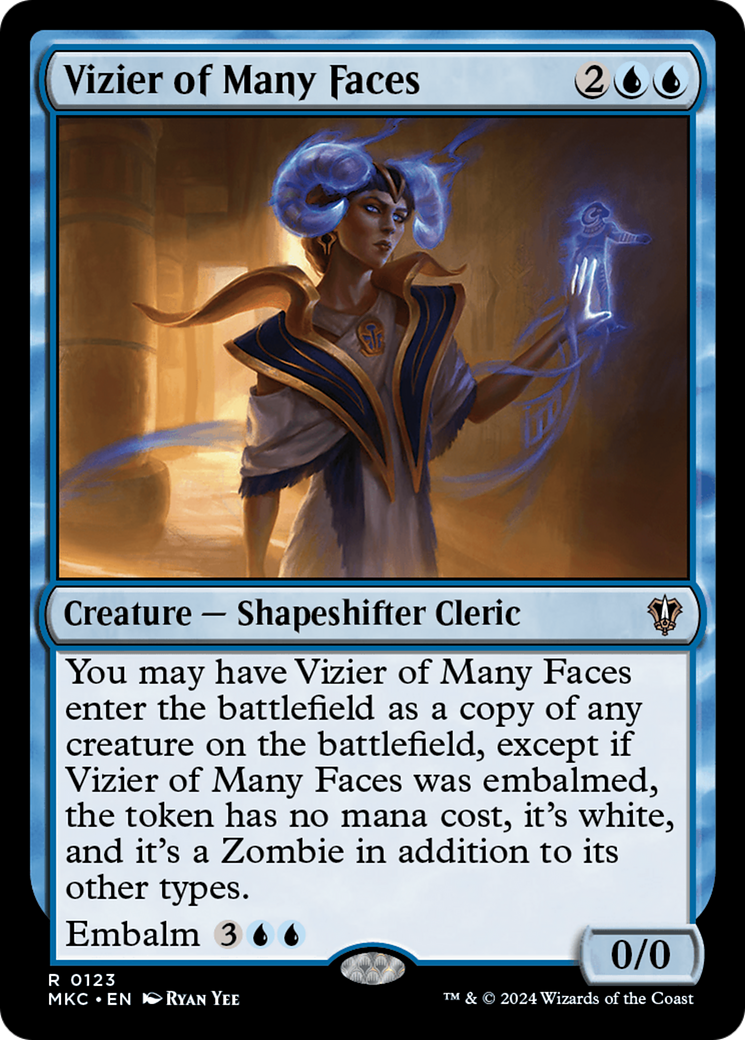
Vizier of Many Faces
Vizier of Many Faces
Creature — Shapeshifter Cleric
0/0
You may have this creature enter as a copy of any creature on the battlefield, except if this creature was embalmed, the token has no mana cost, it's white, and it's a Zombie in addition to its other types.
Embalm
- If a spell or ability puts a creature card with embalm into your graveyard during your main phase, you'll have priority immediately after that spell or ability resolves. You can activate the creature card's embalm ability before any player can exile it with an effect, such as that of Crook of Condemnation, if it's legal for you to do so.
- Once you've activated an embalm ability, the card is immediately exiled. Opponents can't try to stop the ability by exiling the card with an effect such as that of Crook of Condemnation.
- If the chosen creature has in its mana cost, X is considered to be 0.
- If the chosen creature is copying something else (for example, if the chosen creature is another Vizier of Many Faces), then Vizier of Many Faces enters the battlefield as whatever the chosen creature copied.
- If the chosen creature is a token, Vizier of Many Faces copies the original characteristics of that token as stated by the effect that created the token. Vizier of Many Faces is not a token in this case unless it's embalmed.
- Any enters-the-battlefield abilities of the copied creature will trigger when Vizier of Many Faces enters the battlefield. Any "as [this creature] enters the battlefield" or "[this creature] enters the battlefield with" abilities of the chosen creature will also work.
- Vizier of Many Faces copies exactly what was printed on the original creature (unless that creature is copying something else or is a token; see below). It doesn't copy whether that creature is tapped or untapped, whether it has any counters on it or Auras attached to it, or any non-copy effects that have changed its power, toughness, types, color, or so on.
- For each card with embalm, a corresponding game play supplement token can be found in some Amonkhet booster packs. These supplements are not required to play with cards with embalm; you can use the same items to represent an embalmed token as you would any other token.
- The token copies exactly what was printed on the original card and nothing else. It doesn't copy any information about the object the card was before it was put into your graveyard.
- The token is a Zombie in addition to its other types and is white instead of its other colors. It has no mana cost, and thus its mana value is 0. These are copiable values of the token that other effects may copy.
- If the card copied by the token had any "when [this permanent] enters the battlefield" abilities, then the token also has those abilities and will trigger them when it's created. Similarly, any "as [this permanent] enters the battlefield" or "[this permanent] enters the battlefield with" abilities that the token has copied will also work.
- If Vizier of Many Faces somehow enters the battlefield at the same time as another creature, Vizier of Many Faces can't become a copy of that creature. You may choose only a creature that's already on the battlefield.
- The characteristics Vizier of Many Faces gains as part of its copy effect are copiable values that other effects may copy.
-
1
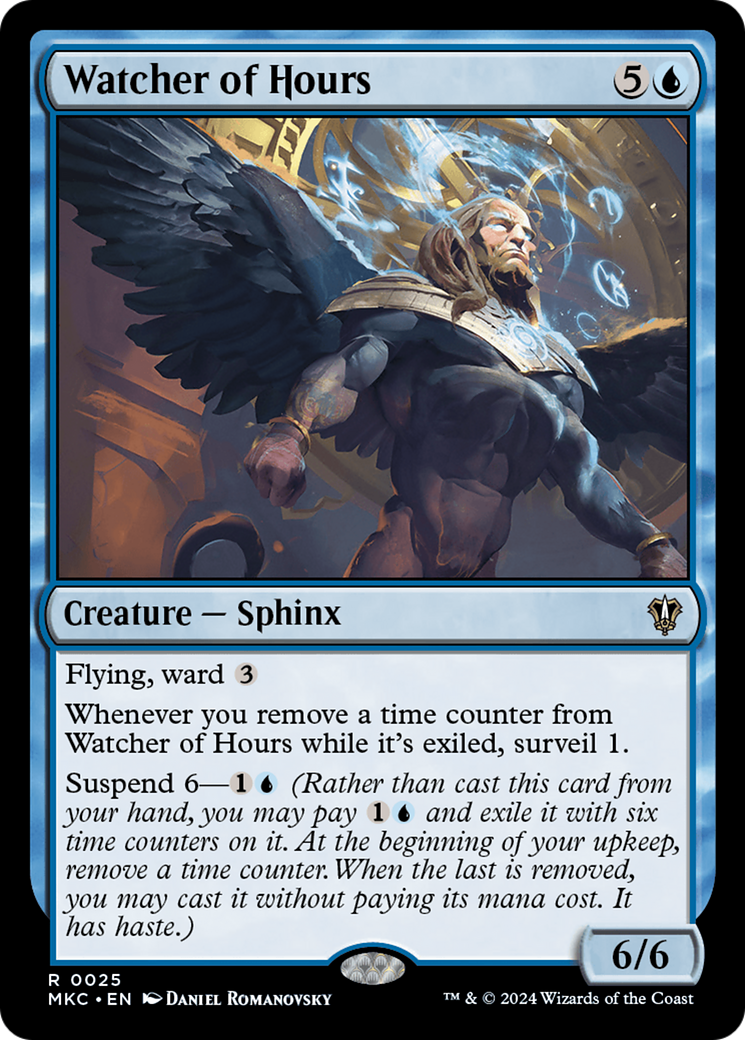
Watcher of Hours
Watcher of Hours
Creature — Sphinx
6/6
Flying, ward
Whenever you remove a time counter from this card while it's exiled, surveil 1.
Suspend 6— (Rather than cast this card from your hand, you may pay and exile it with six time counters on it. At the beginning of your upkeep, remove a time counter. When the last is removed, you may cast it without paying its mana cost. It has haste.)
- Suspend is a keyword that represents three abilities. The first is a static ability that allows you to exile the card from your hand with the specified number of time counters (the number before the dash) on it by paying its suspend cost (listed after the dash). The second is a triggered ability that removes a time counter from the suspended card at the beginning of each of your upkeeps. The third is a triggered ability that gives you the option to cast the card when the last time counter is removed.
- You can exile a card in your hand using suspend any time you could cast that card. Consider its card type, any effects that modify when you could cast it (such as flash) and any other effects that stop you from casting it (such as from Meddling Mage's ability) to determine if and when you can do this. Whether you could actually complete all steps in casting the card is irrelevant. For example, you can exile a card with suspend that has no mana cost or that requires a target even if no legal targets are available at that time.
- Cards exiled with suspend are exiled face up.
- Exiling a card with suspend isn't casting that card. This action doesn't use the stack and can't be responded to.
- If the spell requires any targets, those targets are chosen when the spell is finally cast, not when it's exiled.
- If an effect refers to a "suspended card," that means a card that (1) has suspend, (2) is in exile, and (3) has one or more time counters on it.
- If the first triggered ability of suspend (the one that removes time counters) is countered, no time counter is removed. The ability will trigger again at the beginning of the card's owner's next upkeep.
- When the last time counter is removed, the second triggered ability of suspend (the one that lets you cast the card) triggers. It doesn't matter why the last time counter was removed or what effect removed it.
- If the second triggered ability is countered, the card can't be cast. It remains exiled with no time counters on it, and it's no longer suspended.
- Due to a recent rules change to suspend, you are no longer required to cast the suspended card as the second triggered ability of suspend resolves. Instead, as the second triggered ability resolves, you may cast the card. Timing permissions based on the card's type are ignored. If you don't cast the card, it remains exiled with no time counters on it, and it's no longer suspended.
- If you cast a card "without paying its mana cost," such as with suspend, you can't choose to cast it for any alternative costs. You can, however, pay additional costs. If the card has any mandatory additional costs, you must pay those if you want to cast the card.
- If the card has in its mana cost, you must choose 0 as the value of X when casting it without paying its mana cost.
- The mana value of a spell cast without paying its mana cost is determined by its mana cost, even though that cost wasn't paid.
-
1
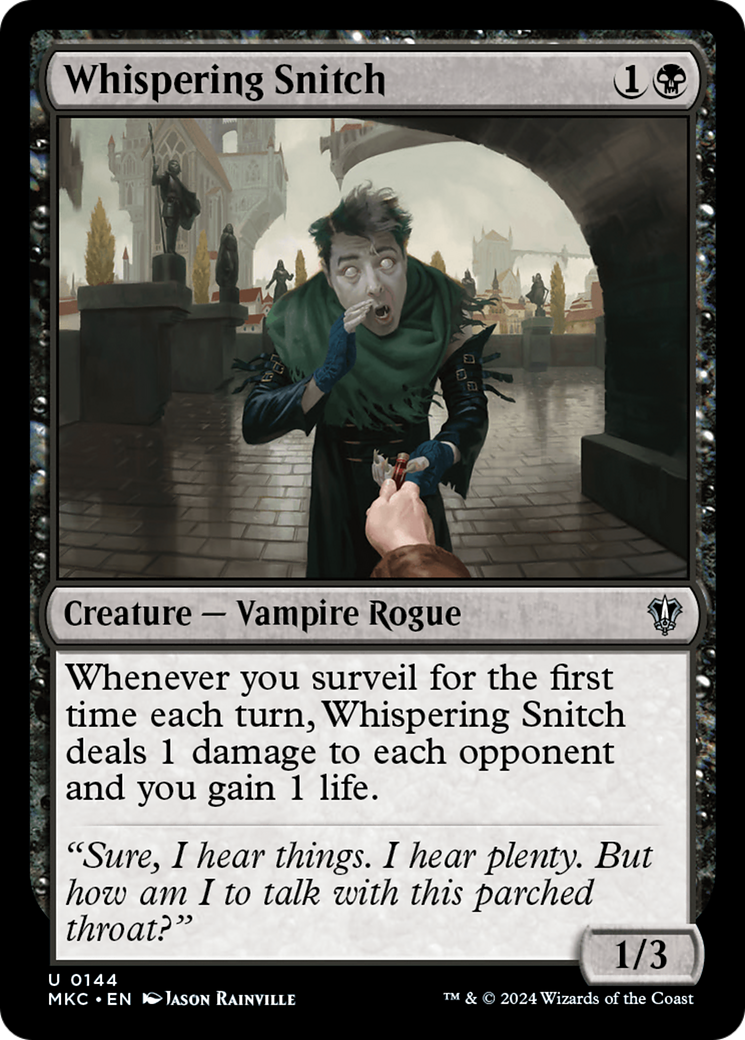
Whispering Snitch
Whispering Snitch
Creature — Vampire Rogue
1/3
Whenever you surveil for the first time each turn, this creature deals 1 damage to each opponent and you gain 1 life.
- An ability that triggers "whenever you surveil" triggers after you're done surveilling, even if you have fewer cards in your library than the number of cards you're instructed to surveil. It even triggers if you have no cards in your library.
- If you surveil before Whispering Snitch enters the battlefield, surveilling again during that turn won't cause its ability to trigger.
- In a Two-Headed Giant game, Whispering Snitch's ability causes the opposing team to lose 2 life and you gain 1 life.
Instants 10
-
1
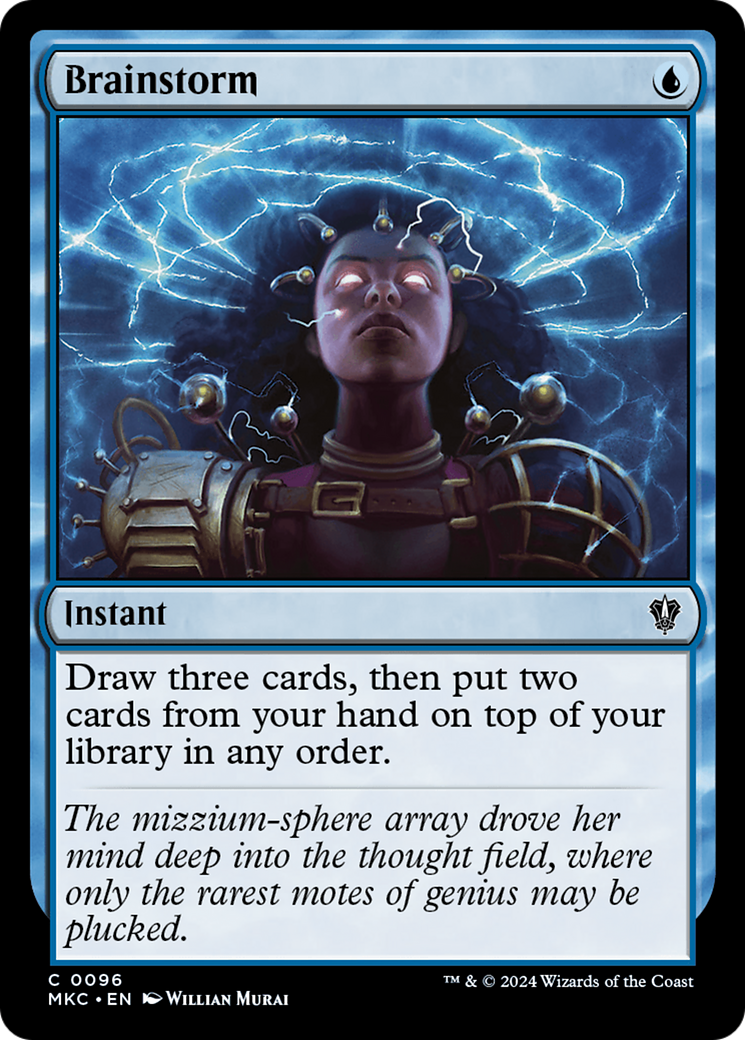
Brainstorm
Brainstorm
Instant
Draw three cards, then put two cards from your hand on top of your library in any order.
- You draw three cards and put two cards back all while Brainstorm is resolving. Nothing can happen between the two, and no player may choose to take actions.
-
1
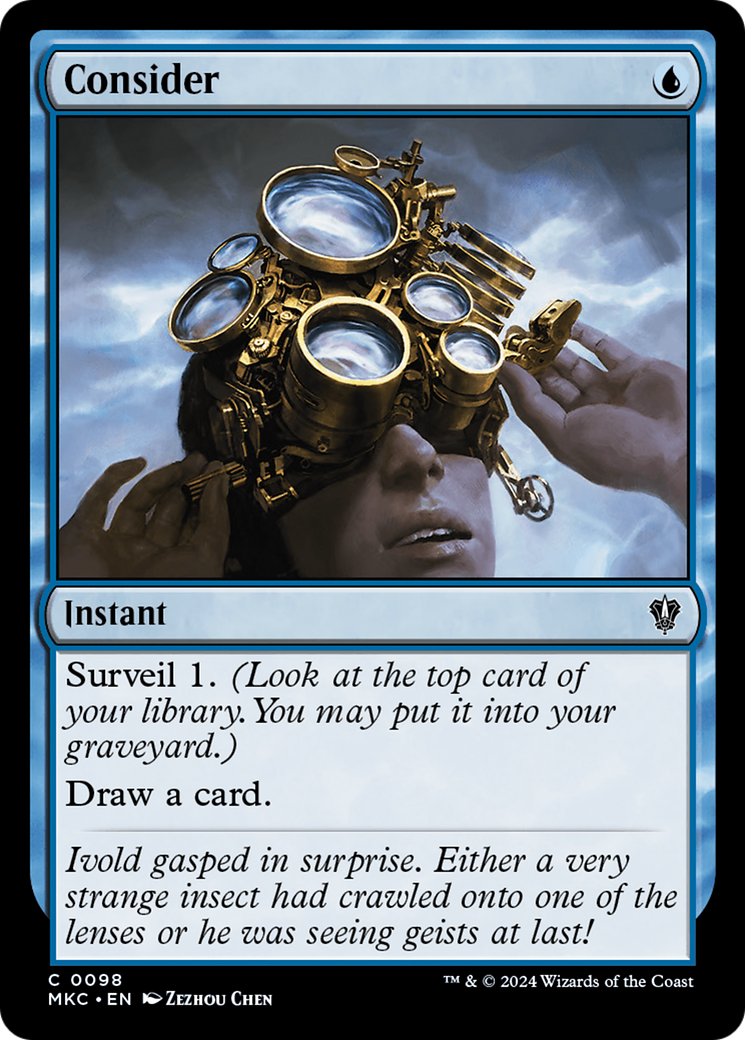
Consider
Consider
Instant
Surveil 1. (Look at the top card of your library. You may put it into your graveyard.)
Draw a card.
- You perform the actions stated on a card in sequence. For some spells and abilities, you'll surveil last. For others, you'll surveil and then perform other actions.
-
1
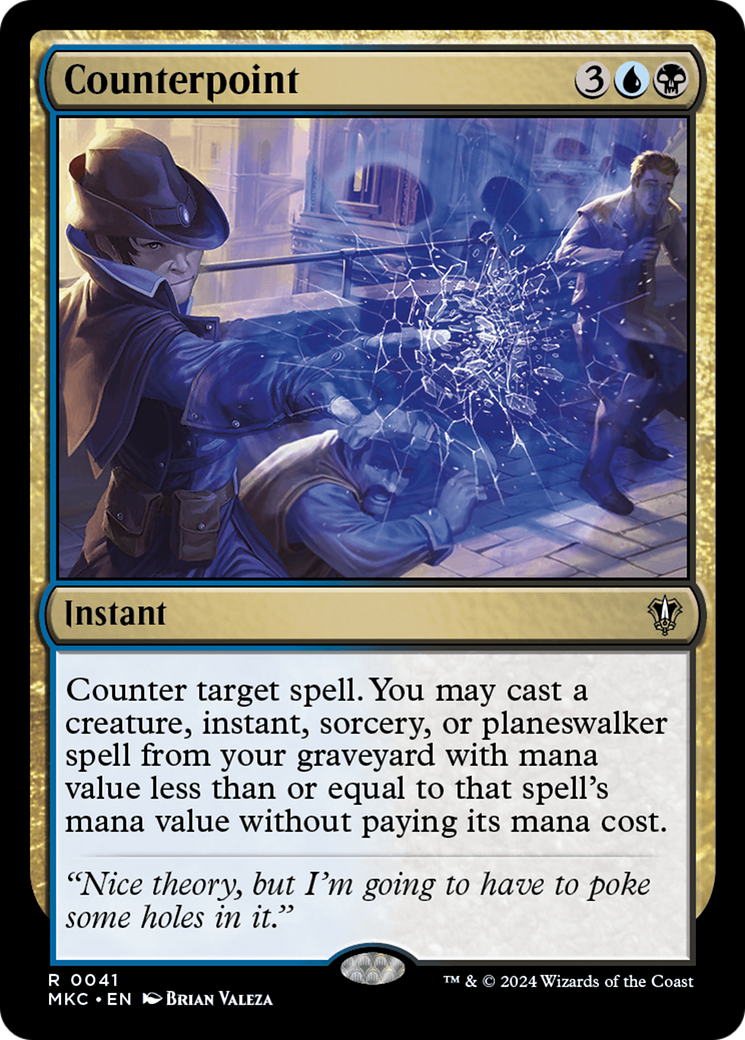
Counterpoint
Counterpoint
Instant
Counter target spell. You may cast a creature, instant, sorcery, or planeswalker spell from your graveyard with mana value less than or equal to that spell's mana value without paying its mana cost.
- If the target spell has in its mana cost, use the value chosen for X when determining that spell’s mana value.
- If the target spell is an illegal target as Counterpoint tries to resolve, it won’t resolve and none of its effects will happen.
- Alternatively, if the target spell is still a legal target but can’t be countered, Counterpoint will still resolve and allow you to cast a spell from your graveyard with mana value less than or equal to the target spell’s mana value.
- You cast the card from your graveyard as Counterpoint resolves. You can’t wait to cast it later in the turn. Timing restrictions based on the card’s types are ignored.
- If you cast a spell “without paying its mana cost,” you can’t choose to cast it for any alternative costs. You can, however, pay additional costs, such as kicker costs. If the card has any mandatory additional costs, those must be paid to cast the spell.
- If a spell you cast has in its mana cost, you must choose 0 as the value of X when casting it without paying its mana cost.
-
1
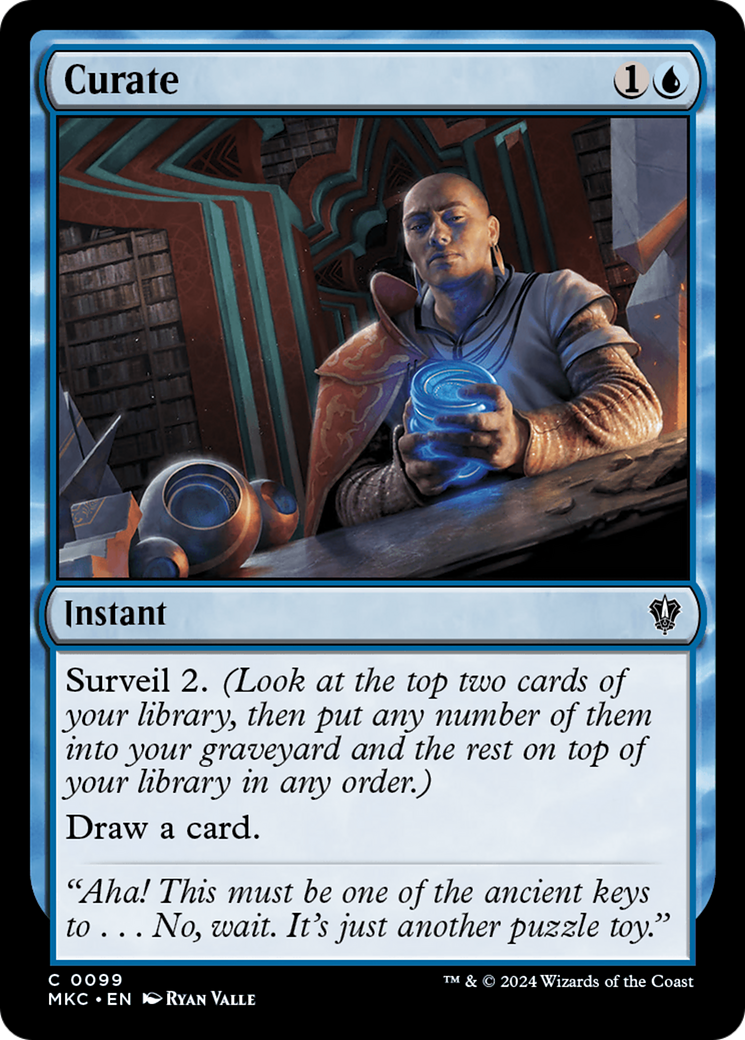
Curate
Curate
Instant
Surveil 2. (Look at the top two cards of your library, then put any number of them into your graveyard and the rest on top of your library in any order.)
Draw a card.
- You perform the actions stated on a card in sequence. For some spells and abilities, you'll surveil last. For others, you'll surveil and then perform other actions.
- When you surveil, you may put all the cards you look at back on top of your library, you may put all of those cards into your graveyard, or you may put some of those cards on top and the rest of them into your graveyard.
-
1
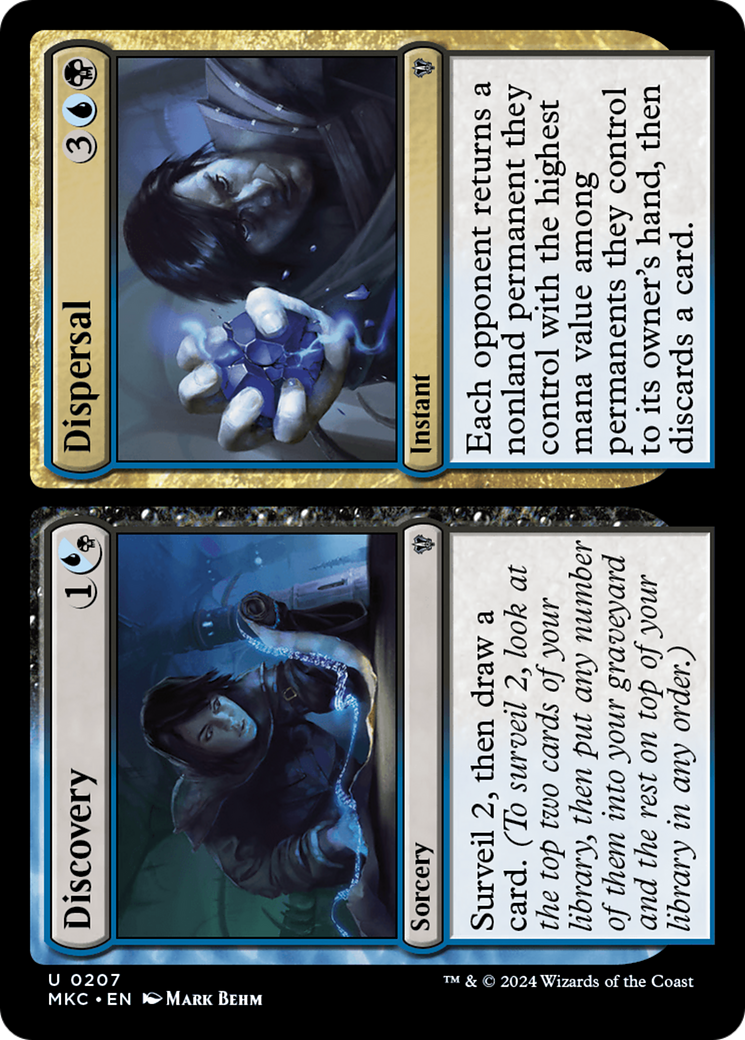
Discovery // Dispersal
//
Discovery
Sorcery
- You perform the actions stated on a card in sequence. For some spells and abilities, you'll surveil last. For others, you'll surveil and then perform other actions.
- Split cards have two card faces on a single card. The characteristics of the half you didn't cast are ignored while the spell is on the stack.
- Each split card is a single card. For example, if you discard a split card, you've discarded one card, not two. If an effect counts the number of sorcery cards in your graveyard, Assault // Battery counts once, not twice.
- Each split card has two names. If an effect instructs you to choose a card name, you may choose one of those names, but not both.
- A split card's characteristics are a combination of its two halves while it is not on the stack. For example, Assault // Battery has a mana value of 5 while it is in your library. If an effect allows you to search your library for a card with mana value 4 or less, you can't find Assault // Battery.
- If an effect allows you to cast a spell with certain characteristics, consider only the characteristics of the half you're casting. For example, if an effect allows you to cast a sorcery spell with mana value 2 or less from among cards in your graveyard, you could cast Assault this way, but not Battery.
- If you copy a spell that's half of a split card, the copy copies that same half. For example, if you copy Assault, the copy is also Assault, not Battery.
- To cast a split card, choose one of its halves to cast. There's no way to cast both halves of this split card.
- If an opponent controls only lands as Dispersal resolves, that player won't return any permanent to their hand. They'll still discard a card.
- If a permanent has in its mana cost, X is considered to be 0.
- As Dispersal resolves, first the next opponent in turn order (or, if it's an opponent's turn, that opponent) chooses a nonland permanent they control with the highest mana cost among their permanents, then each other opponent in turn order does the same, knowing the choices made before them. Then all the chosen permanents are returned at the same time. Next, each opponent in the same order chooses a card in hand without revealing it, then the chosen cards are discarded at the same time.
-
1
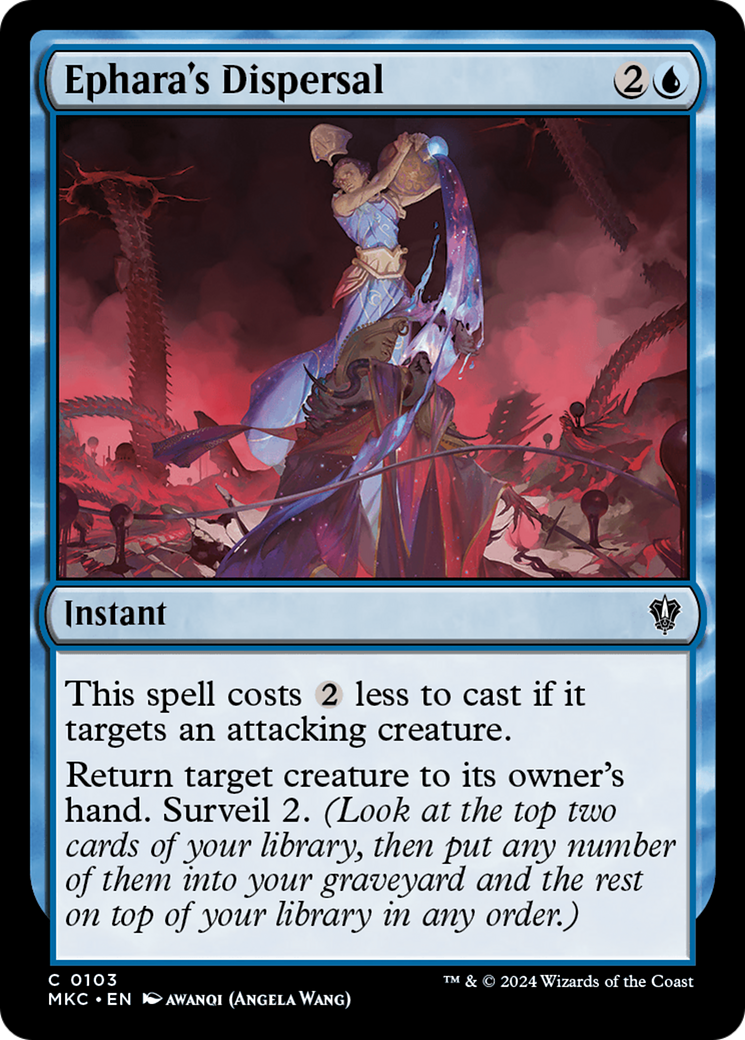
Ephara's Dispersal
Ephara's Dispersal
Instant
This spell costs less to cast if it targets an attacking creature.
Return target creature to its owner's hand. Surveil 2. (Look at the top two cards of your library, then put any number of them into your graveyard and the rest on top of your library in any order.)
- You perform the actions stated on a card in sequence. For some spells and abilities, you'll surveil last. For others, you'll surveil and then perform other actions.
- When you surveil, you may put all the cards you look at back on top of your library, you may put all of those cards into your graveyard, or you may put some of those cards on top and the rest of them into your graveyard.
- The cost reduction ability of Ephara's Dispersal doesn't affect its mana cost or mana value. It affects only the total cost you pay. Specifically, its mana value is always 3.
-
1
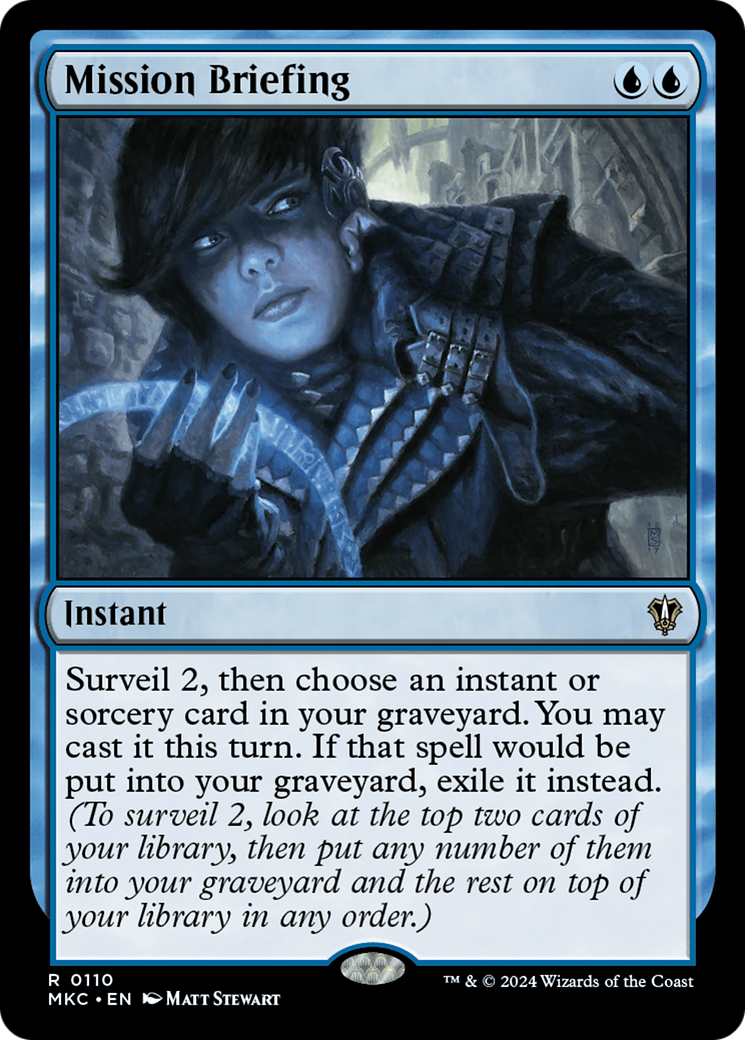
Mission Briefing
Mission Briefing
Instant
Surveil 2, then choose an instant or sorcery card in your graveyard. You may cast it this turn. If that spell would be put into your graveyard, exile it instead. (To surveil 2, look at the top two cards of your library, then put any number of them into your graveyard and the rest on top of your library in any order.)
- You perform the actions stated on a card in sequence. For some spells and abilities, you'll surveil last. For others, you'll surveil and then perform other actions.
- When you surveil, you may put all the cards you look at back on top of your library, you may put all of those cards into your graveyard, or you may put some of those cards on top and the rest of them into your graveyard.
- The instant or sorcery card you choose may be one that you just surveilled into your graveyard.
- Mission Briefing doesn't change when you can cast the chosen card. For example, if you choose a sorcery card, you can cast it only during your main phase when the stack is empty.
- Mission Briefing is still on the stack while you choose an instant or sorcery card in your graveyard. Your Mission Briefing can't be to give yourself that same Mission Briefing.
- If you cast a spell this way and that card is exiled, it's considered a new object in the zone it's put into. It won't be exiled if it's put into your graveyard later in the turn.
-
1
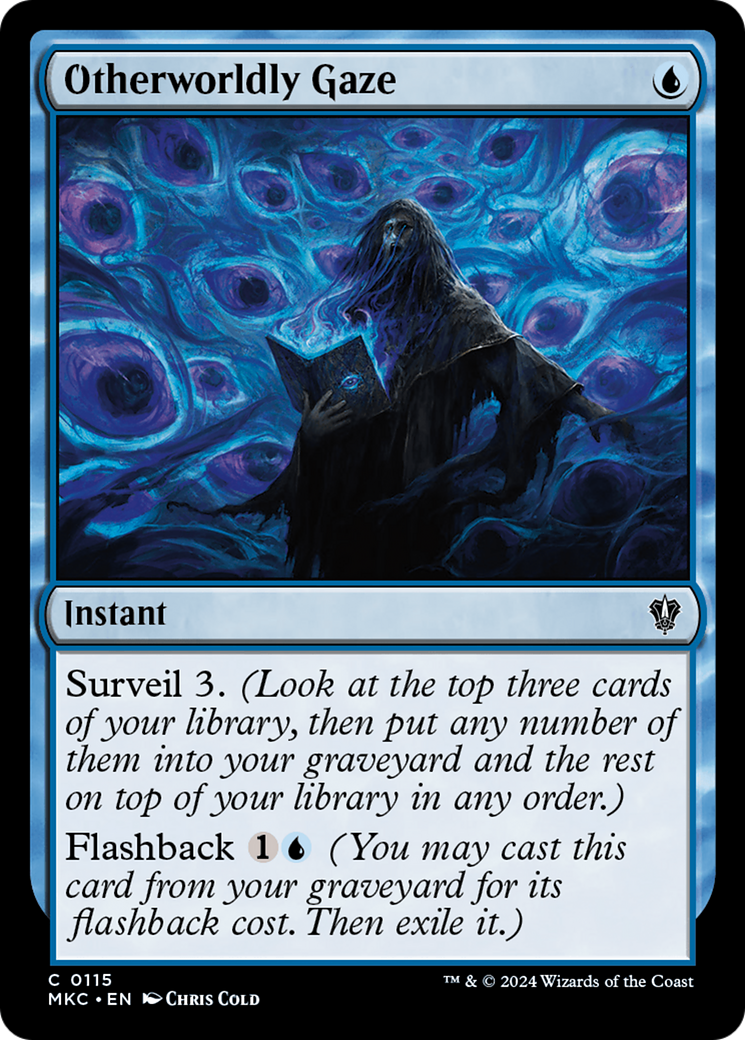
Otherworldly Gaze
Otherworldly Gaze
Instant
Surveil 3. (Look at the top three cards of your library, then put any number of them into your graveyard and the rest on top of your library in any order.)
Flashback (You may cast this card from your graveyard for its flashback cost. Then exile it.)
- When you surveil, you may put all the cards you look at back on top of your library, you may put all of those cards into your graveyard, or you may put some of those cards on top and the rest of them into your graveyard.
- You must still follow any timing restrictions and permissions, including those based on the card's type. For instance, you can cast a sorcery using flashback only when you could normally cast a sorcery.
- To determine the total cost of a spell, start with the mana cost or alternative cost (such as a flashback cost) you're paying, add any cost increases, then apply any cost reductions. The mana value of the spell is determined only by its mana cost, no matter what the total cost to cast the spell was.
- "Flashback [cost]" means "You may cast this card from your graveyard by paying [cost] rather than paying its mana cost" and "If the flashback cost was paid, exile this card instead of putting it anywhere else any time it would leave the stack."
- You can cast a spell using flashback even if it was somehow put into your graveyard without having been cast.
- If a card with flashback is put into your graveyard during your turn, you can cast it if it's legal to do so before any other player can take any actions.
- A spell cast using flashback will always be exiled afterward, whether it resolves, is countered, or leaves the stack in some other way.
-
1
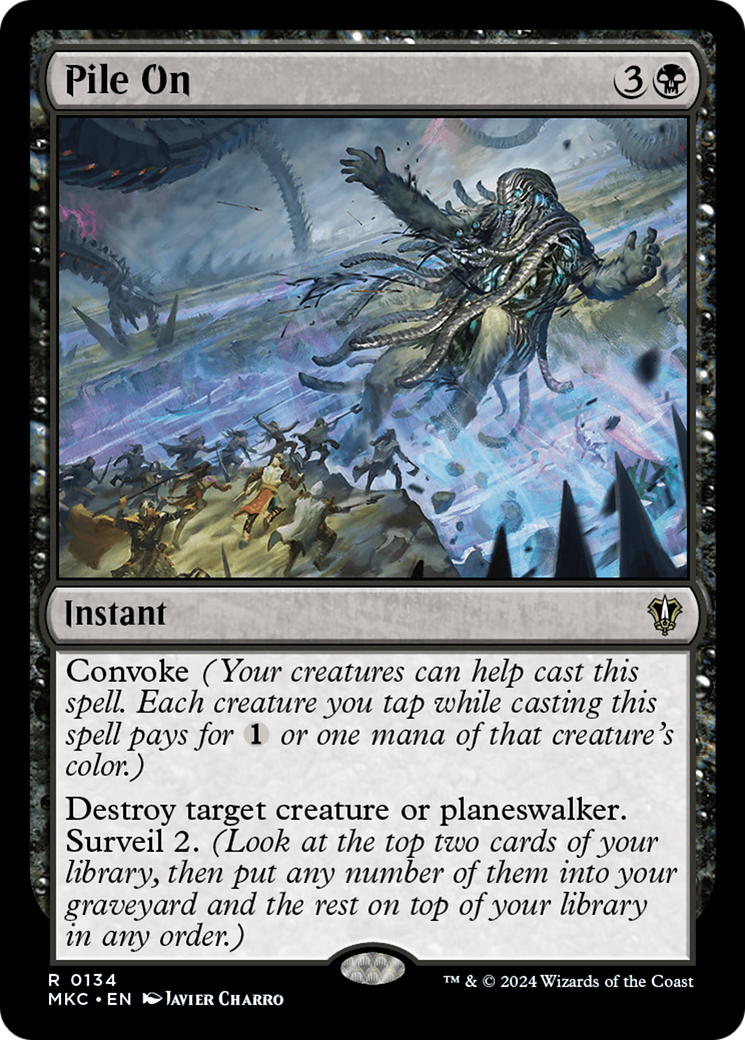
Pile On
Pile On
Instant
Convoke (Your creatures can help cast this spell. Each creature you tap while casting this spell pays for or one mana of that creature's color.)
Destroy target creature or planeswalker. Surveil 2. (Look at the top two cards of your library, then put any number of them into your graveyard and the rest on top of your library in any order.)
- You can tap any untapped creature you control to convoke a spell, even one you haven't controlled continuously since the beginning of your most recent turn.
- Tapping an untapped creature that's attacking or blocking to convoke a spell won't cause that creature to stop attacking or blocking.
- When calculating a spell's total cost, include any alternative costs, additional costs, or anything else that increases or reduces the cost to cast the spell. Convoke applies after the total cost is calculated. Convoke doesn't change a spell's mana cost or mana value.
- If a creature you control has a mana ability with in the cost, activating that ability while casting a spell with convoke will result in the creature being tapped before you pay the spell's costs. You won't be able to tap it again for convoke. Similarly, if you sacrifice a creature to activate a mana ability while casting a spell with convoke, that creature won't be on the battlefield when you pay the spell's costs, so you won't be able to tap it for convoke.
- Because convoke isn't an alternative cost, it can be used in conjunction with alternative costs.
- Tapping a multicolored creature using convoke will pay for or one mana of your choice of any of that creature's colors.
- You perform the actions stated on a card in sequence. For some spells and abilities, you'll surveil last. For others, you'll surveil and then perform other actions.
- When you surveil, you may put all the cards you look at back on top of your library, you may put all of those cards into your graveyard, or you may put some of those cards on top and the rest of them into your graveyard.
-
1
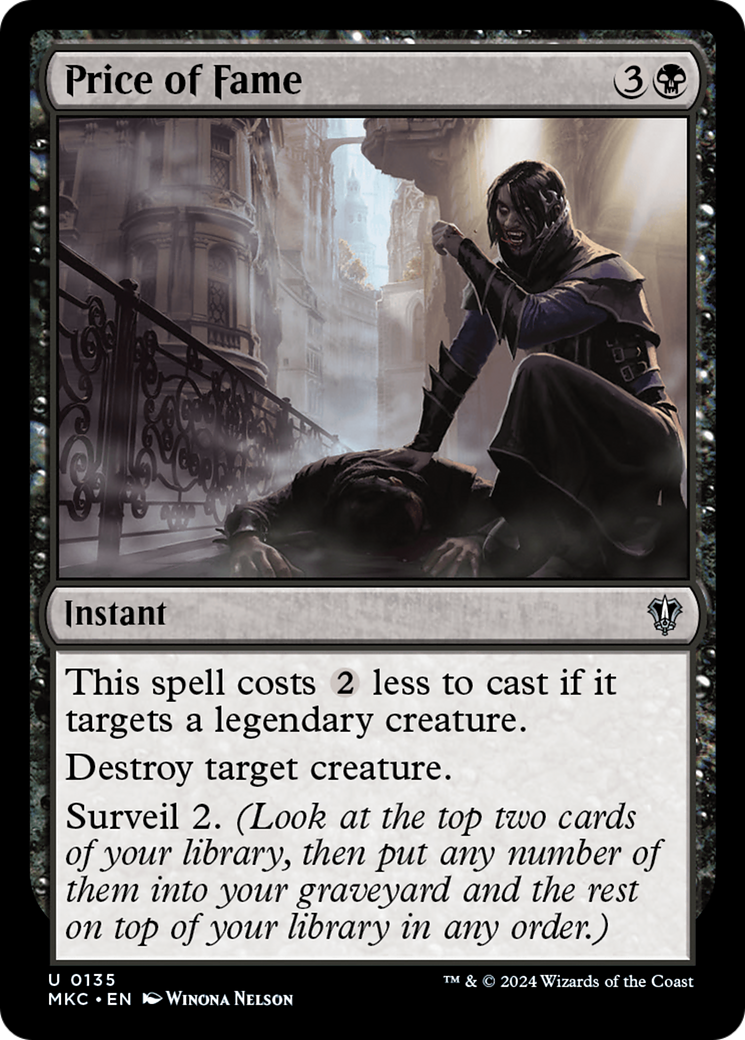
Price of Fame
Price of Fame
Instant
This spell costs less to cast if it targets a legendary creature.
Destroy target creature.
Surveil 2. (Look at the top two cards of your library, then put any number of them into your graveyard and the rest on top of your library in any order.)
- You perform the actions stated on a card in sequence. For some spells and abilities, you'll surveil last. For others, you'll surveil and then perform other actions.
- Some spells that instruct you to surveil require targets. You can't cast a spell without choosing legal targets. If all of those targets become illegal, the spell doesn't resolve and you won't surveil.
- When you surveil, you may put all the cards you look at back on top of your library, you may put all of those cards into your graveyard, or you may put some of those cards on top and the rest of them into your graveyard.
- Price of Fame's mana value is 4, even if it costs less to cast.
- You'll surveil before resolving any abilities that trigger on the target creature dying.
- Price of Fame can target a creature that's indestructible. It won't be destroyed, but you'll surveil.
Sorceries 8
-
1
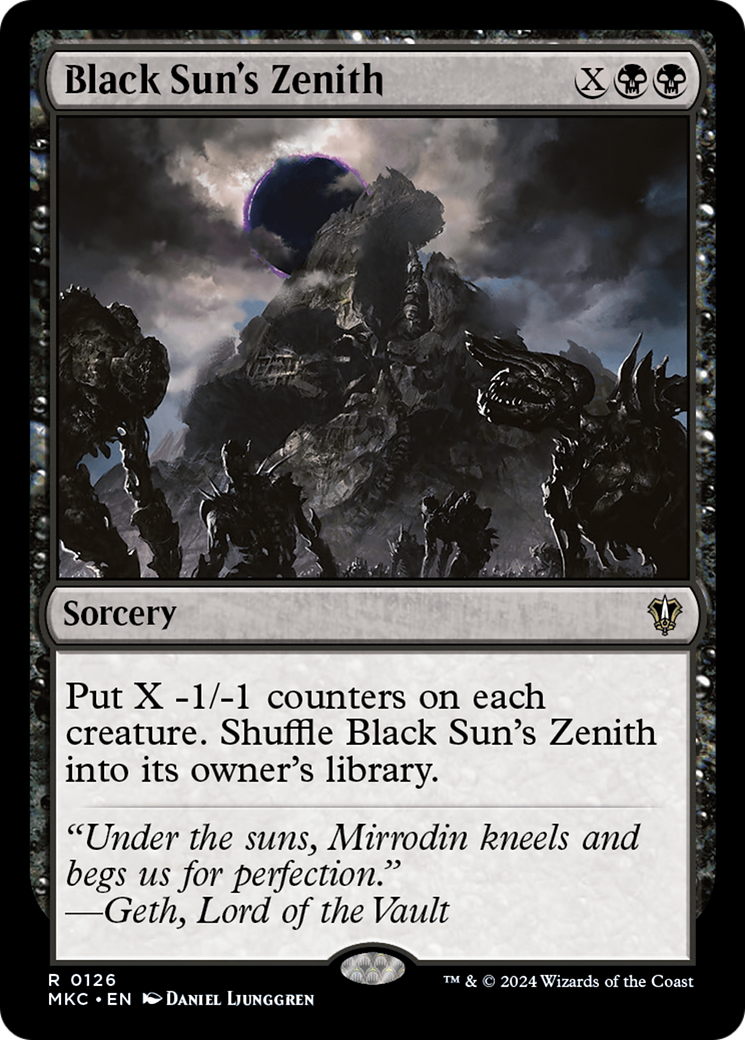
Black Sun's Zenith
Black Sun's Zenith
Sorcery
Put X -1/-1 counters on each creature. Shuffle Black Sun's Zenith into its owner's library.
- If this spell doesn't resolve, none of its effects occur. In particular, it will go to the graveyard rather than to its owner's library.
-
1
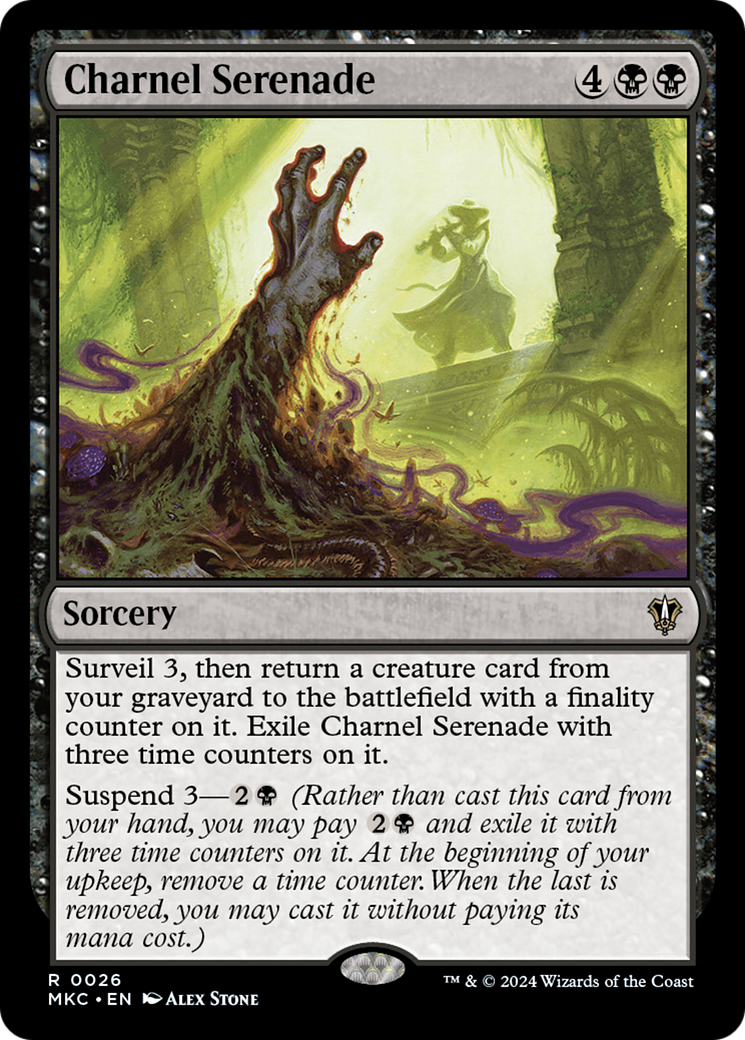
Charnel Serenade
Charnel Serenade
Sorcery
Surveil 3, then return a creature card from your graveyard to the battlefield with a finality counter on it. Exile Charnel Serenade with three time counters on it.
Suspend 3— (Rather than cast this card from your hand, you may pay and exile it with three time counters on it. At the beginning of your upkeep, remove a time counter. When the last is removed, you may cast it without paying its mana cost.)
- The creature card you choose doesn’t need to be a card you put in your graveyard with surveil. You may choose a creature card that was already in your graveyard before you surveilled.
- Finality counters work on any permanent, not only creatures. If a permanent with a finality counter on it would go to a graveyard from the battlefield, exile it instead.
- Finality counters don’t stop permanents from going to zones other than the graveyard from the battlefield. For example, if a permanent with a finality counter on it would be put into its owner’s hand from the battlefield, it does so normally.
- Finality counters aren’t keyword counters, and a finality counter doesn’t give any abilities to the permanent it’s on. If that permanent loses its abilities and then would go to a graveyard, it will still be exiled instead.
- Multiple finality counters on a single permanent are redundant.
- Suspend is a keyword that represents three abilities. The first is a static ability that allows you to exile the card from your hand with the specified number of time counters (the number before the dash) on it by paying its suspend cost (listed after the dash). The second is a triggered ability that removes a time counter from the suspended card at the beginning of each of your upkeeps. The third is a triggered ability that gives you the option to cast the card when the last time counter is removed.
- You can exile a card in your hand using suspend any time you could cast that card. Consider its card type, any effects that modify when you could cast it (such as flash) and any other effects that stop you from casting it (such as from Meddling Mage's ability) to determine if and when you can do this. Whether you could actually complete all steps in casting the card is irrelevant. For example, you can exile a card with suspend that has no mana cost or that requires a target even if no legal targets are available at that time.
- Cards exiled with suspend are exiled face up.
- Exiling a card with suspend isn't casting that card. This action doesn't use the stack and can't be responded to.
- If the spell requires any targets, those targets are chosen when the spell is finally cast, not when it's exiled.
- If an effect refers to a "suspended card," that means a card that (1) has suspend, (2) is in exile, and (3) has one or more time counters on it.
- If the first triggered ability of suspend (the one that removes time counters) is countered, no time counter is removed. The ability will trigger again at the beginning of the card's owner's next upkeep.
- When the last time counter is removed, the second triggered ability of suspend (the one that lets you cast the card) triggers. It doesn't matter why the last time counter was removed or what effect removed it.
- If the second triggered ability is countered, the card can't be cast. It remains exiled with no time counters on it, and it's no longer suspended.
- Due to a recent rules change to suspend, you are no longer required to cast the suspended card as the second triggered ability of suspend resolves. Instead, as the second triggered ability resolves, you may cast the card. Timing permissions based on the card’s type are ignored. If you don’t cast the card, it remains exiled with no time counters on it, and it’s no longer suspended.
- If you cast a card "without paying its mana cost," such as with suspend, you can't choose to cast it for any alternative costs. You can, however, pay additional costs. If the card has any mandatory additional costs, you must pay those if you want to cast the card.
- If the card has in its mana cost, you must choose 0 as the value of X when casting it without paying its mana cost.
- The mana value of a spell cast without paying its mana cost is determined by its mana cost, even though that cost wasn't paid.
-
1
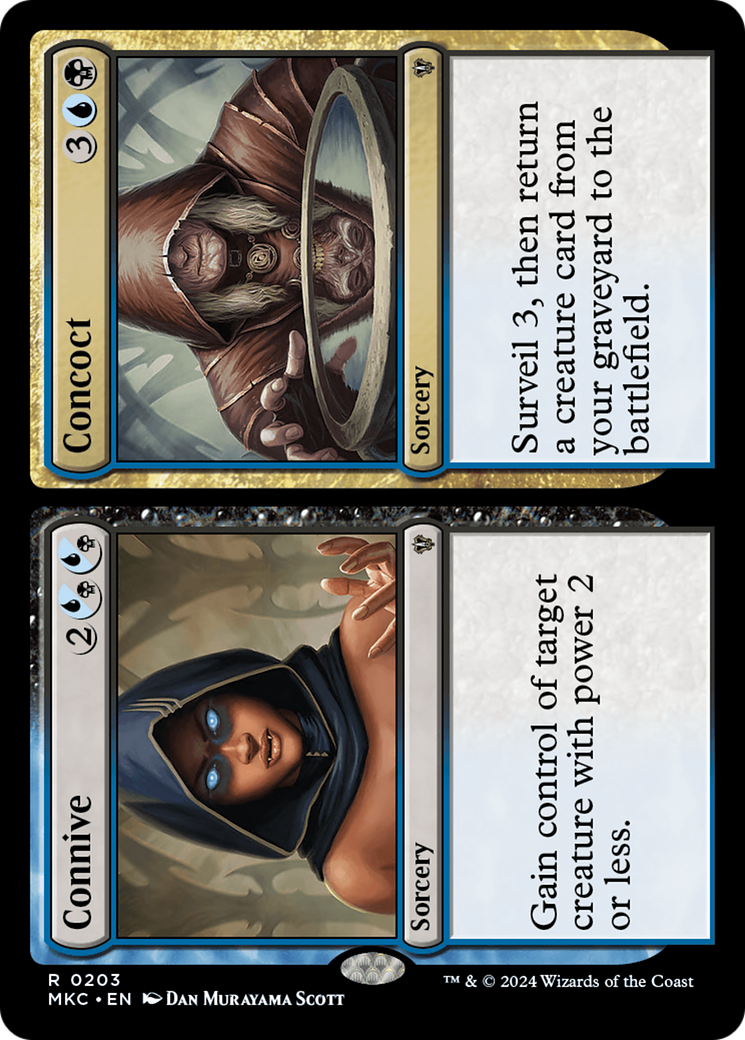
Connive // Concoct
//
Connive
Sorcery
- When you surveil, you may put all the cards you look at back on top of your library, you may put all of those cards into your graveyard, or you may put some of those cards on top and the rest of them into your graveyard.
- You perform the actions stated on a card in sequence. For some spells and abilities, you'll surveil last. For others, you'll surveil and then perform other actions.
- Split cards have two card faces on a single card. The characteristics of the half you didn't cast are ignored while the spell is on the stack.
- Each split card is a single card. For example, if you discard a split card, you've discarded one card, not two. If an effect counts the number of sorcery cards in your graveyard, Assault // Battery counts once, not twice.
- Each split card has two names. If an effect instructs you to choose a card name, you may choose one of those names, but not both.
- A split card's characteristics are a combination of its two halves while it is not on the stack. For example, Assault // Battery has a mana value of 5 while it is in your library. If an effect allows you to search your library for a card with mana value 4 or less, you can't find Assault // Battery.
- If you copy a spell that's half of a split card, the copy copies that same half. For example, if you copy Assault, the copy is also Assault, not Battery.
- If an effect allows you to cast a spell with certain characteristics, consider only the characteristics of the half you're casting. For example, if an effect allows you to cast a sorcery spell with mana value 2 or less from among cards in your graveyard, you could cast Assault this way, but not Battery.
- To cast a split card, choose one of its halves to cast. There's no way to cast both halves of this split card.
- No player may take actions between the time you surveil and the time you return a creature card to the battlefield.
- The creature card you return with Concoct may be one that you just surveilled into your graveyard.
- Connive's effect lasts indefinitely. It doesn't wear off during the cleanup step, and it doesn't expire if the creature's power becomes greater after Connive has resolved.
-
1
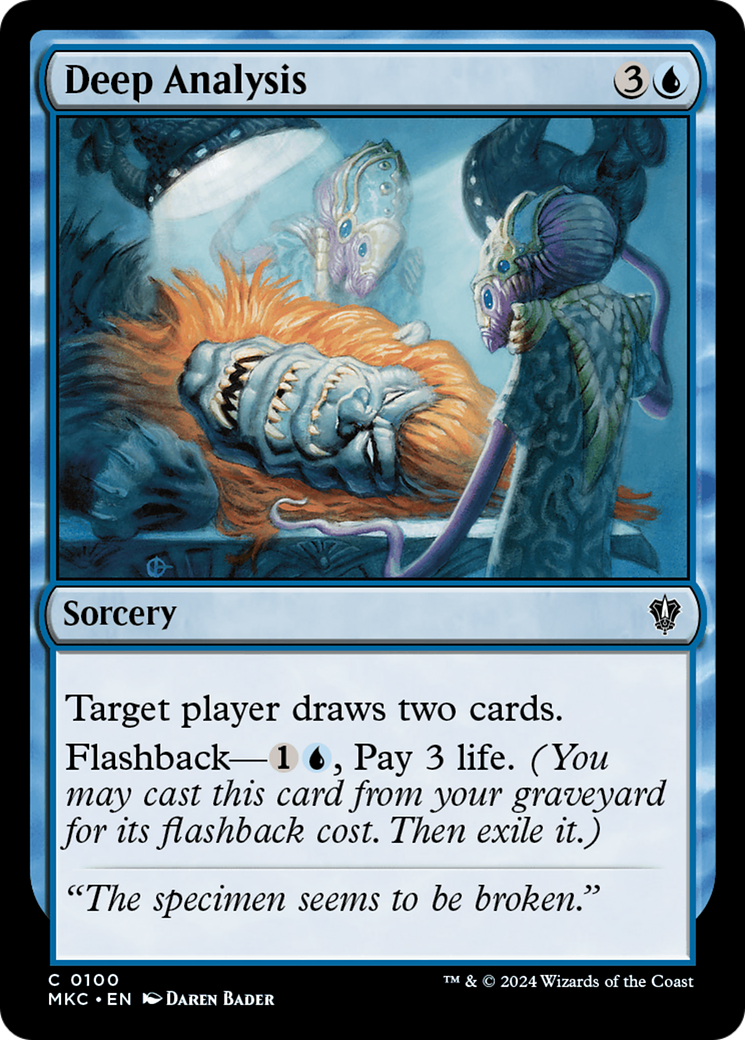
Deep Analysis
Deep Analysis
Sorcery
Target player draws two cards.
Flashback— , Pay 3 life. (You may cast this card from your graveyard for its flashback cost. Then exile it.)
- A spell cast using flashback will always be exiled afterward, whether it resolves, is countered, or leaves the stack in some other way.
- You must still follow any timing restrictions and permissions, including those based on the card's type. For instance, you can cast a sorcery using flashback only when you could normally cast a sorcery.
- You can cast a spell using flashback even if it was somehow put into your graveyard without having been cast.
- To determine the total cost of a spell, start with the mana cost or alternative cost (such as a flashback cost) you're paying, add any cost increases, then apply any cost reductions. The mana value of the spell is determined only by its mana cost, no matter what the total cost to cast the spell was.
- If a card with flashback is put into your graveyard during your turn, you can cast it if it's legal to do so before any other player can take any actions.
- "Flashback [cost]" means "You may cast this card from your graveyard by paying [cost] rather than paying its mana cost" and "If the flashback cost was paid, exile this card instead of putting it anywhere else any time it would leave the stack."
-
1
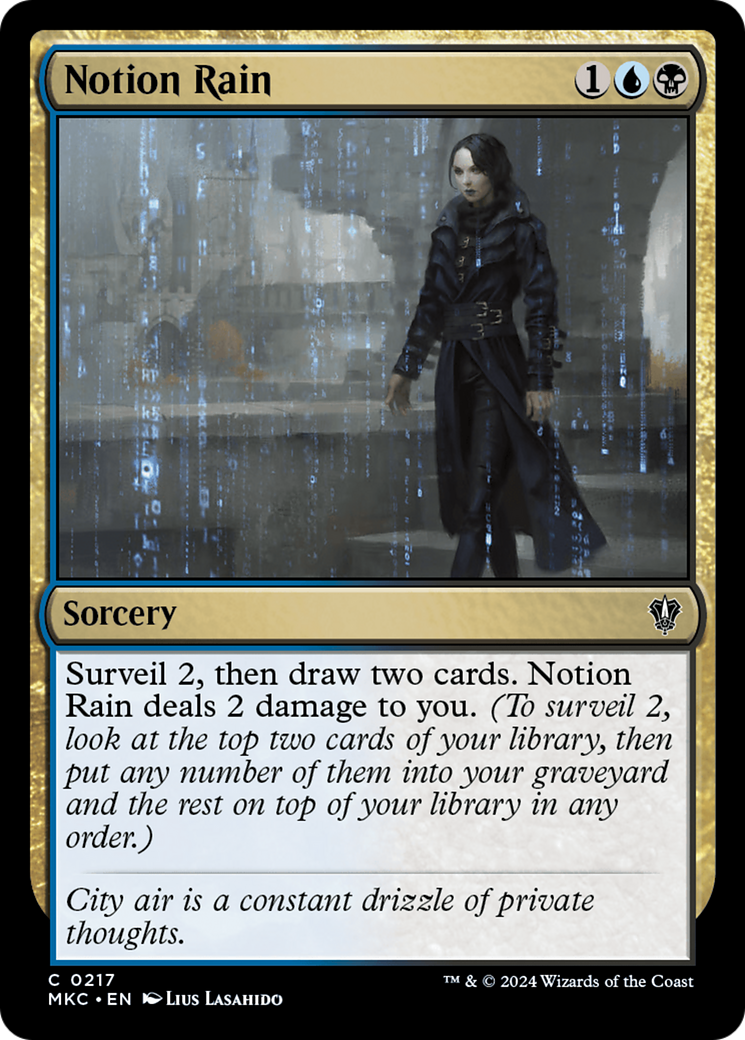
Notion Rain
Notion Rain
Sorcery
Surveil 2, then draw two cards. Notion Rain deals 2 damage to you. (To surveil 2, look at the top two cards of your library, then put any number of them into your graveyard and the rest on top of your library in any order.)
- You perform the actions stated on a card in sequence. For some spells and abilities, you'll surveil last. For others, you'll surveil and then perform other actions.
- When you surveil, you may put all the cards you look at back on top of your library, you may put all of those cards into your graveyard, or you may put some of those cards on top and the rest of them into your graveyard.
-
1
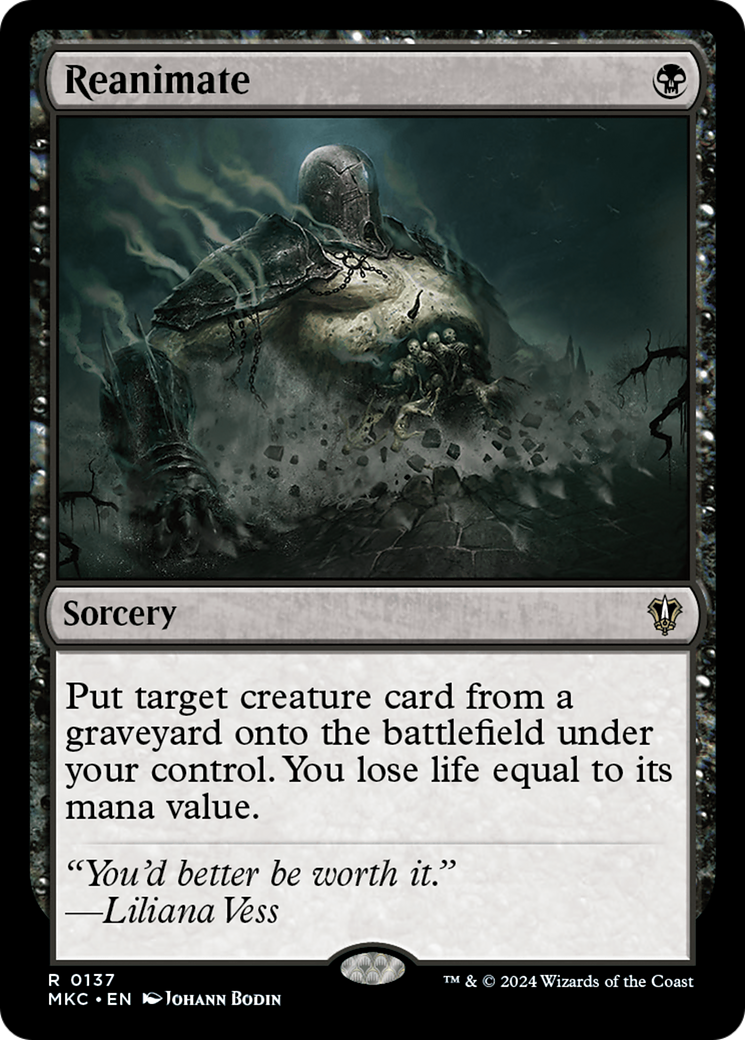
Reanimate
Reanimate
Sorcery
Put target creature card from a graveyard onto the battlefield under your control. You lose life equal to its mana value.
- If a card in a graveyard has in its mana cost, X is 0.
- The amount of life you lose is determined by the mana value of the card in your graveyard, not the creature once it's on the battlefield.
- You lose life after the creature is already on the battlefield. Any abilities it has that interact with loss of life, such as that of Platinum Emperion, apply to that loss of life.
- If any abilities trigger on the creature entering the battlefield, those abilities resolve after you lose life. If losing life results in you losing the game, those abilities won't resolve.
- In a multiplayer game, if a player leaves the game, all cards that player owns leave as well. If you leave the game, the creature you control from Reanimate is exiled.
-
1
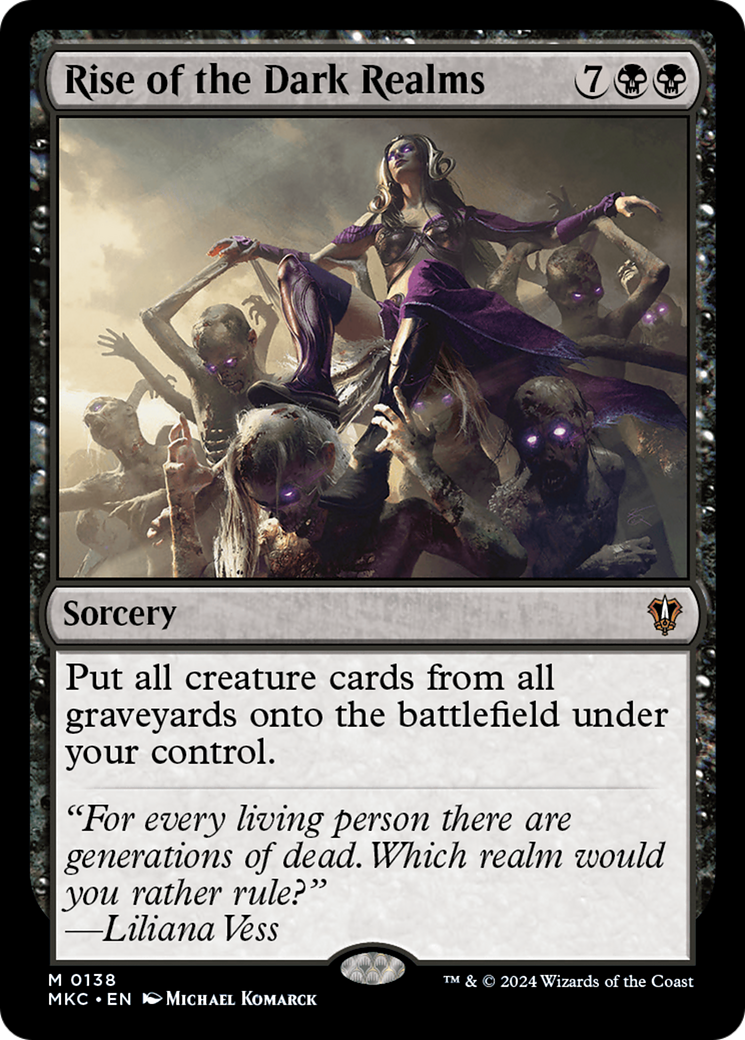
Rise of the Dark Realms
Rise of the Dark Realms
Sorcery
Put all creature cards from all graveyards onto the battlefield under your control.
-
1
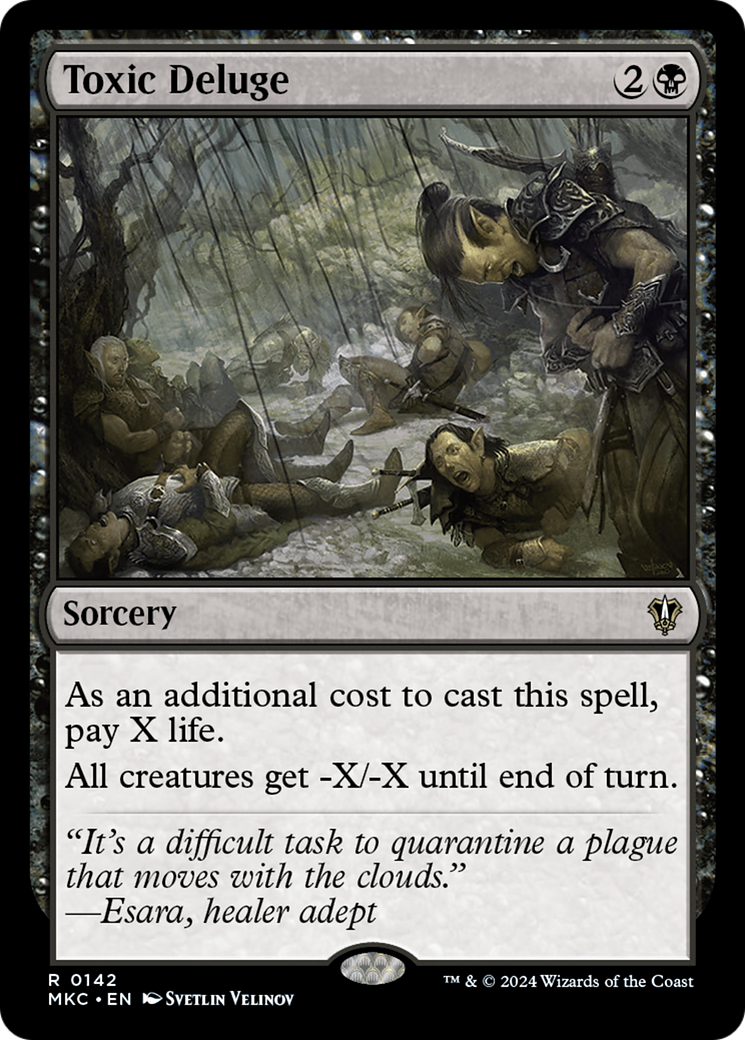
Toxic Deluge
Toxic Deluge
Sorcery
As an additional cost to cast this spell, pay X life.
All creatures get -X/-X until end of turn.
- All creatures on the battlefield when Toxic Deluge resolves are affected. Ones that enter the battlefield or become creatures later in the turn are not.
- If you cast Toxic Deluge without paying its mana cost, you'll still choose a value for X and pay X life. This is because it doesn't have in its mana cost.
Artifacts 9
-
1
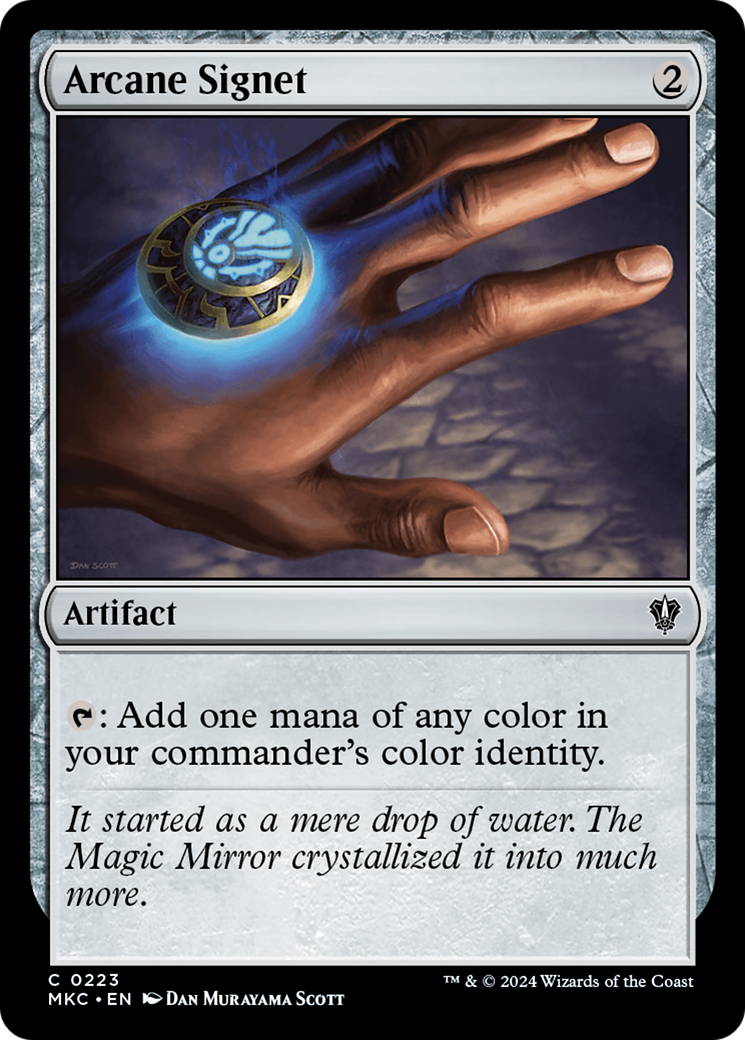
Arcane Signet
Arcane Signet
Artifact
: Add one mana of any color in your commander's color identity.
- If your commander is a card that has no colors in its color identity, Arcane Signet's ability produces no mana. It doesn't produce .
- If you have two commanders, the ability adds one mana of any color in their combined color identities.
- If you don't have a commander, Arcane Signet's ability produces no mana.
-
1
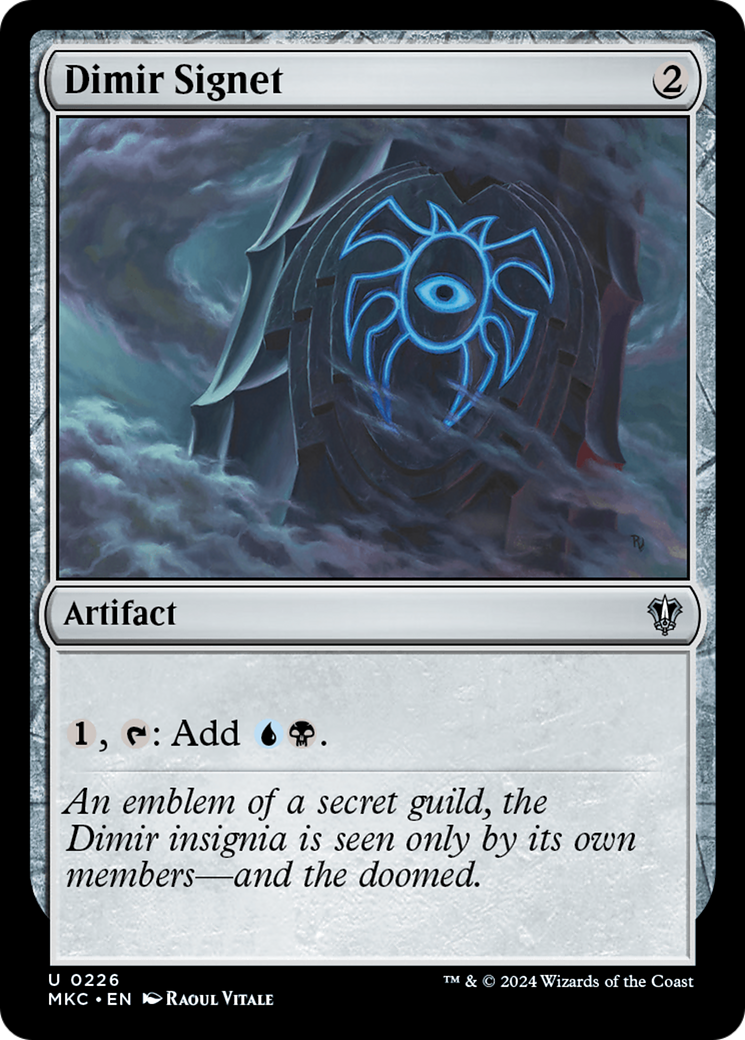
Dimir Signet
Dimir Signet
Artifact
, : Add .
-
1
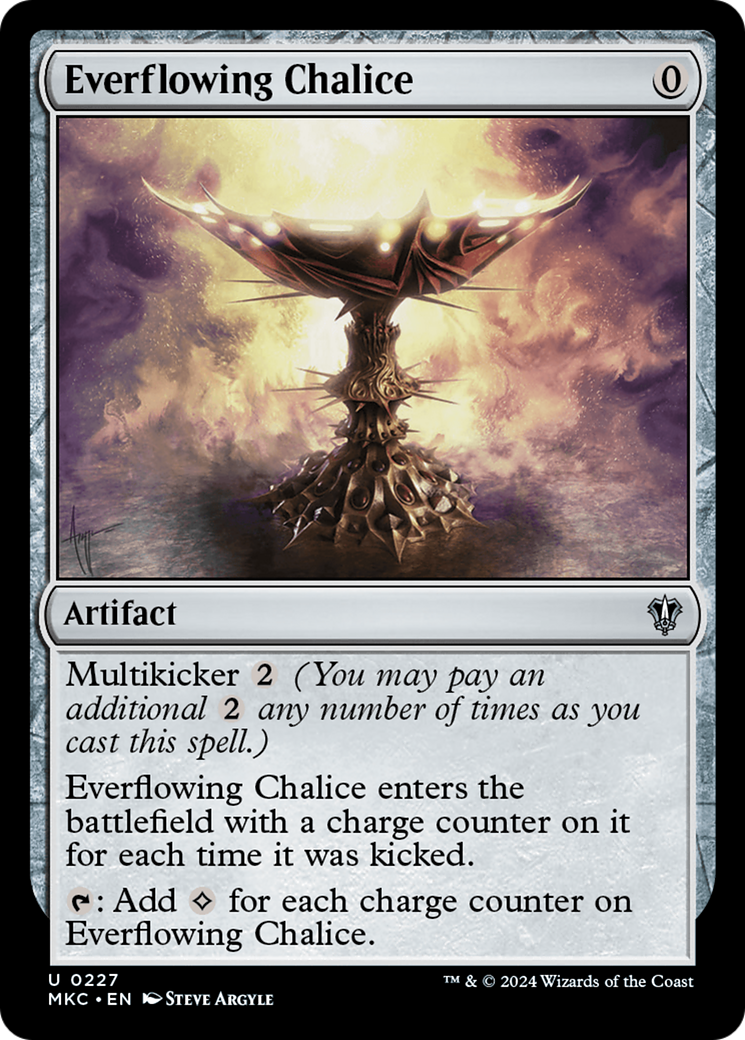
Everflowing Chalice
Everflowing Chalice
Artifact
Multikicker (You may pay an additional any number of times as you cast this spell.)
This artifact enters with a charge counter on it for each time it was kicked.
: Add for each charge counter on this artifact.
- You can cast Everflowing Chalice without kicking it at all if you wish. However, if Everflowing Chalice has no charge counters on it, activating its last ability won't produce any mana.
-
1
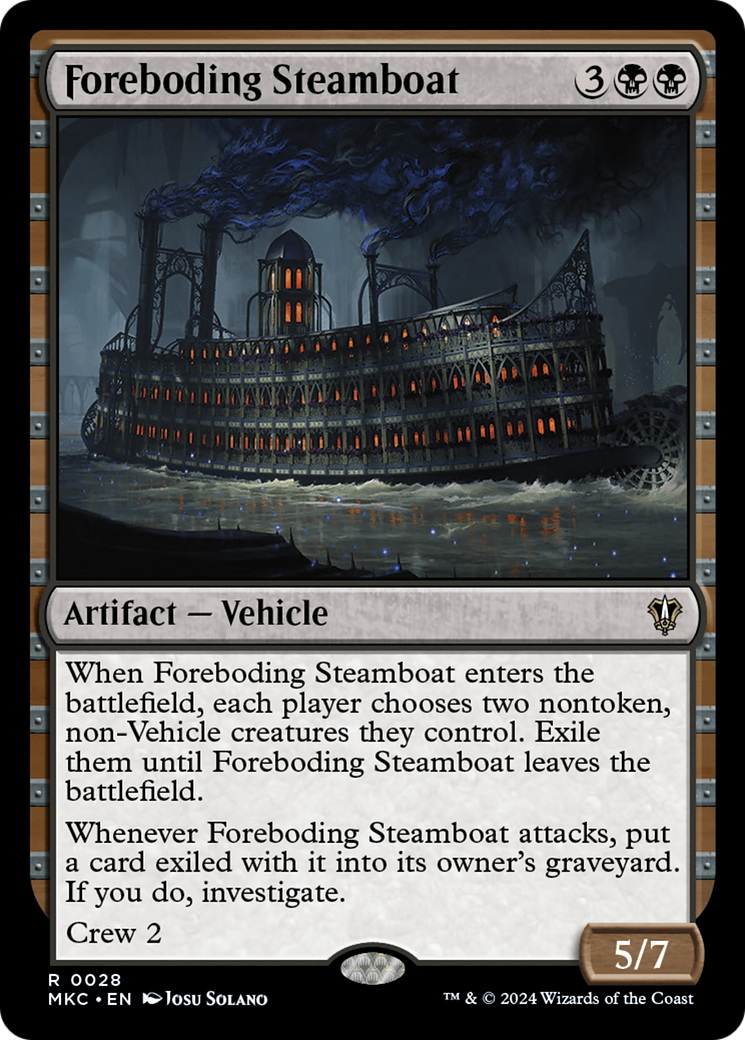
Foreboding Steamboat
Foreboding Steamboat
Artifact — Vehicle
5/7
When this Vehicle enters, each player chooses two nontoken, non-Vehicle creatures they control. Exile them until this Vehicle leaves the battlefield.
Whenever this Vehicle attacks, put a card exiled with it into its owner's graveyard. If you do, investigate.
Crew 2
- Starting with the player whose turn it is, each player in turn order chooses two nontoken, non-Vehicle creatures they control, then all the creatures chosen by all players are exiled at the same time. Players get to know the choices made by players who chose before them.
- If Foreboding Steamboat leaves the battlefield before its first triggered ability resolves, the chosen creatures won't be exiled at all.
- Clue is an artifact type. Even though it appears on some cards with other permanent types, it's never a creature type, a land type, or anything but an artifact type.
- If an effect refers to a Clue, it means any Clue artifact, not just a Clue artifact token. For example, you can sacrifice Wrench to pay for Alquist Proft, Master Sleuth's activated ability.
- You can't sacrifice a Clue to pay multiple costs. For example, you can't sacrifice a Clue token to activate its own ability and also to activate Alquist Proft, Master Sleuth's ability.
- Some spells and abilities that investigate may require targets. If each target chosen is an illegal target as that spell or ability tries to resolve, it won't resolve. You won't create any Clue tokens.
- Some abilities trigger "whenever you sacrifice a Clue". Those abilities trigger whenever you sacrifice a Clue for any reason, not just to activate a Clue's activated ability.
-
1
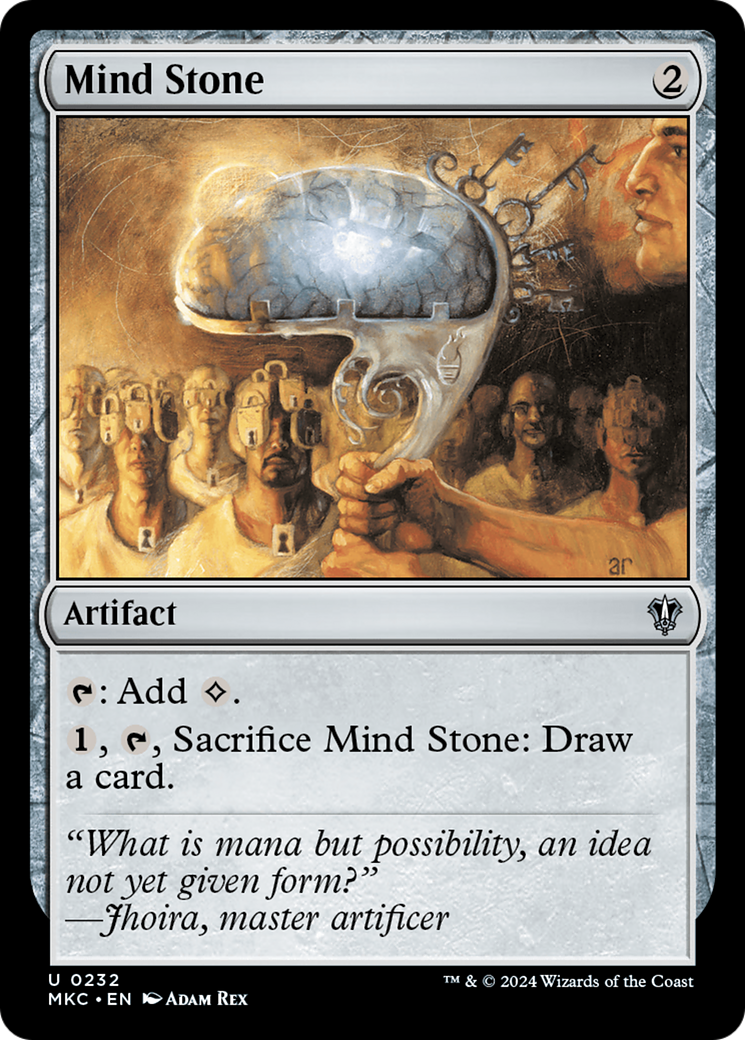
Mind Stone
Mind Stone
Artifact
: Add .
, , Sacrifice this artifact: Draw a card.
-
1
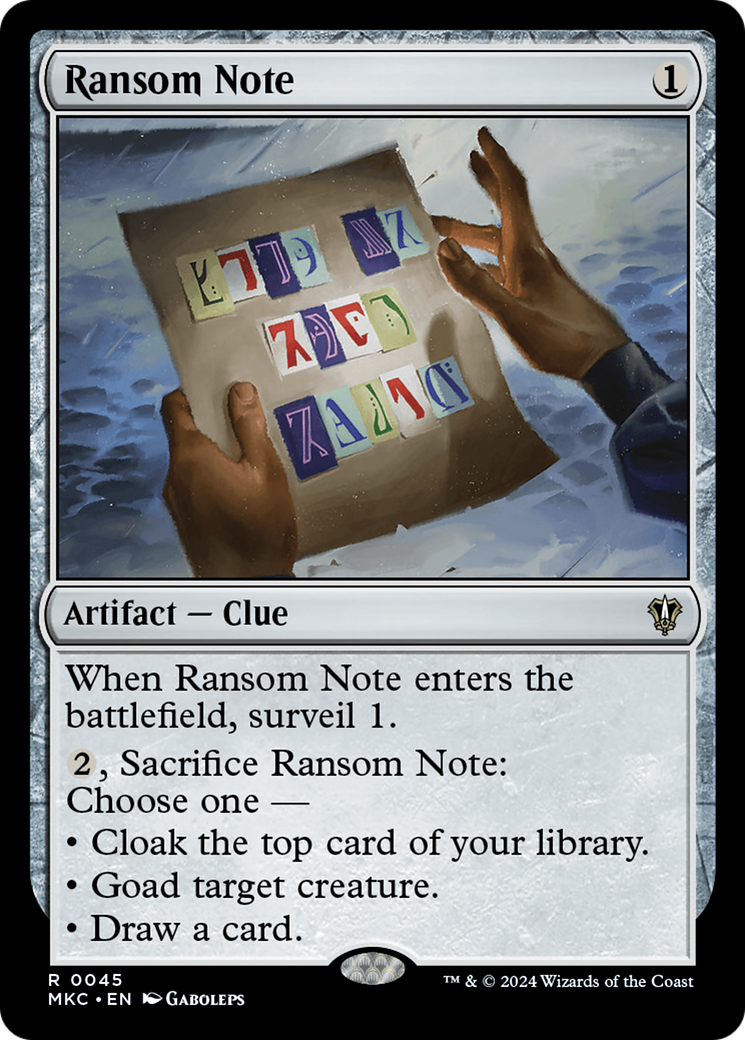
Ransom Note
Ransom Note
Artifact — Clue
When this artifact enters, surveil 1.
, Sacrifice this artifact: Choose one —
- Cloak the top card of your library.
- Goad target creature.
- Draw a card.
- To cloak a card, put it onto the battlefield face down. It becomes a 2/2 face-down creature card with ward and no name, mana cost, or creature types. It’s colorless and has a mana value of 0. Other effects that apply to the permanent can still grant it any characteristics it doesn’t have or change the characteristics it does have.
- Any time you have priority, you can turn a cloaked permanent you control face-up by revealing that it’s a creature card (ignoring any copy effects or type-changing effects that might be applying to it) and paying its mana cost. This is a special action. It doesn’t use the stack and can’t be responded to.
- If a cloaked creature would have disguise (or morph) if it were face up, you may also turn it face up by paying its disguise (or morph) cost.
- Unlike a face-down creature that was cast using a disguise or morph ability, a cloaked creature may still be turned face up after it loses its abilities if it’s a creature card.
- If a double-faced card is cloaked, it will be put onto the battlefield face down. While face down, it can’t transform. If the front face of the card is a creature card, you can turn it face up by paying its mana cost. If you do, its front face will be up.
- At any time, you can look at a face-down spell or permanent you control. You can’t look at face-down permanents or spells you don’t control unless an effect instructs or allows you to do so.
- If a face-down creature loses its abilities, it can’t be turned face up with a disguise ability because it will no longer have a disguise ability (or a disguise cost) once face up.
- Because the permanent is on the battlefield both before and after it’s turned face up, turning a permanent face up doesn’t cause any enters-the-battlefield abilities to trigger.
- Because face-down creatures don’t have a name, they can’t have the same name as any other creature, even another face-down creature.
- A permanent that turns face up or face down changes characteristics but is otherwise the same permanent. Spells and abilities that were targeting that permanent and Auras and Equipment that were attached to that permanent aren’t affected unless the new characteristics of the object change the legality of those targets or attachments.
- Turning a permanent face up or face down doesn’t change whether that permanent is tapped or untapped.
- If a face-down spell leaves the stack and goes to any zone other than the battlefield (if it was countered, for example), you must reveal it. Similarly, if a face-down permanent leaves the battlefield, you must reveal it. You must also reveal all face-down spells and permanents you control if you leave the game or the game ends.
- You must ensure that your face-down spells and permanents can be easily differentiated from each other. You’re not allowed to mix up the cards that represent them on the battlefield to confuse other players. The order in which they entered the battlefield should remain clear, as well as what ability caused them to be face down. (This includes disguise, cloak, and in games involving older cards, morph and manifest, as well as a few other effects that turn cards face down.) Common methods for doing this include using markers or dice, or simply placing them in order on the battlefield.
- If something tries to turn a face-down instant or sorcery card on the battlefield face up, reveal that card to show all players it’s an instant or sorcery card. The permanent remains on the battlefield face down. Abilities that trigger when a permanent turns face up won’t trigger, because even though you revealed the card, it never turned face up.
-
1
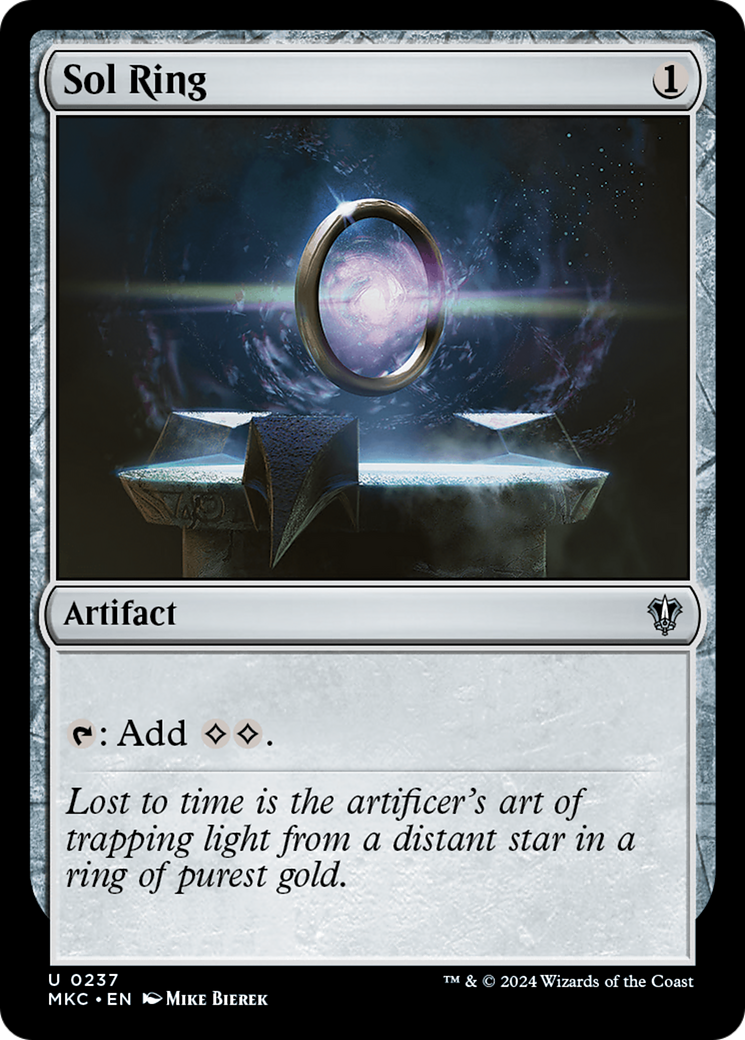
Sol Ring
Sol Ring
Artifact
: Add .
-
1
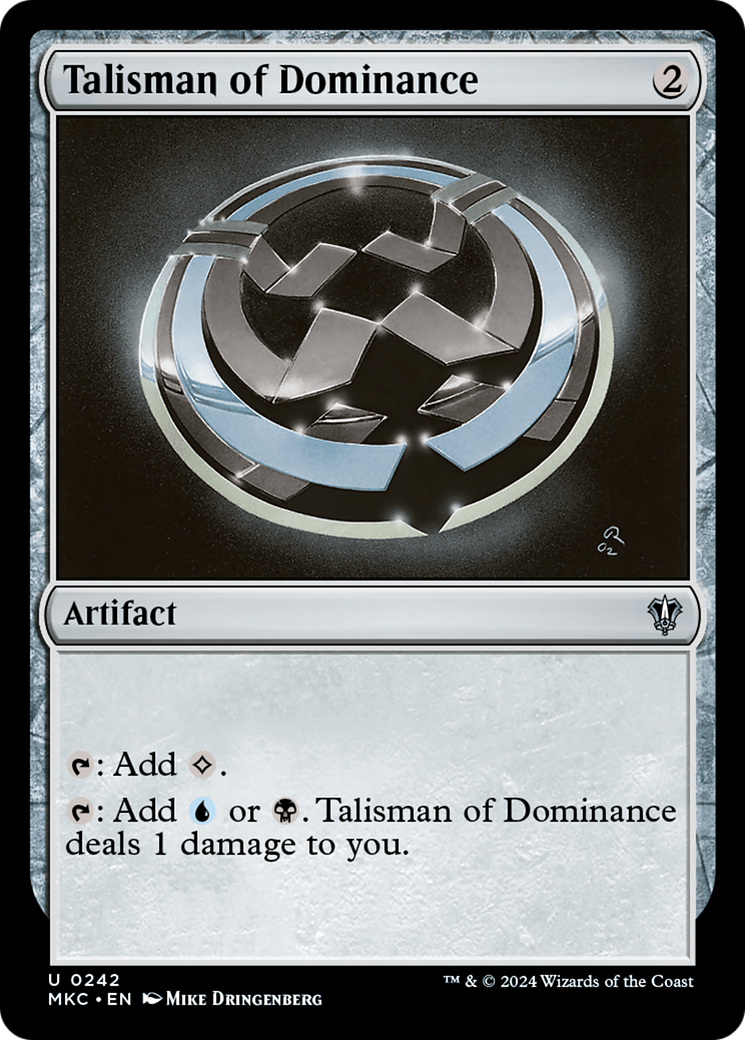
Talisman of Dominance
Talisman of Dominance
Artifact
: Add .
: Add or . This artifact deals 1 damage to you.
-
1
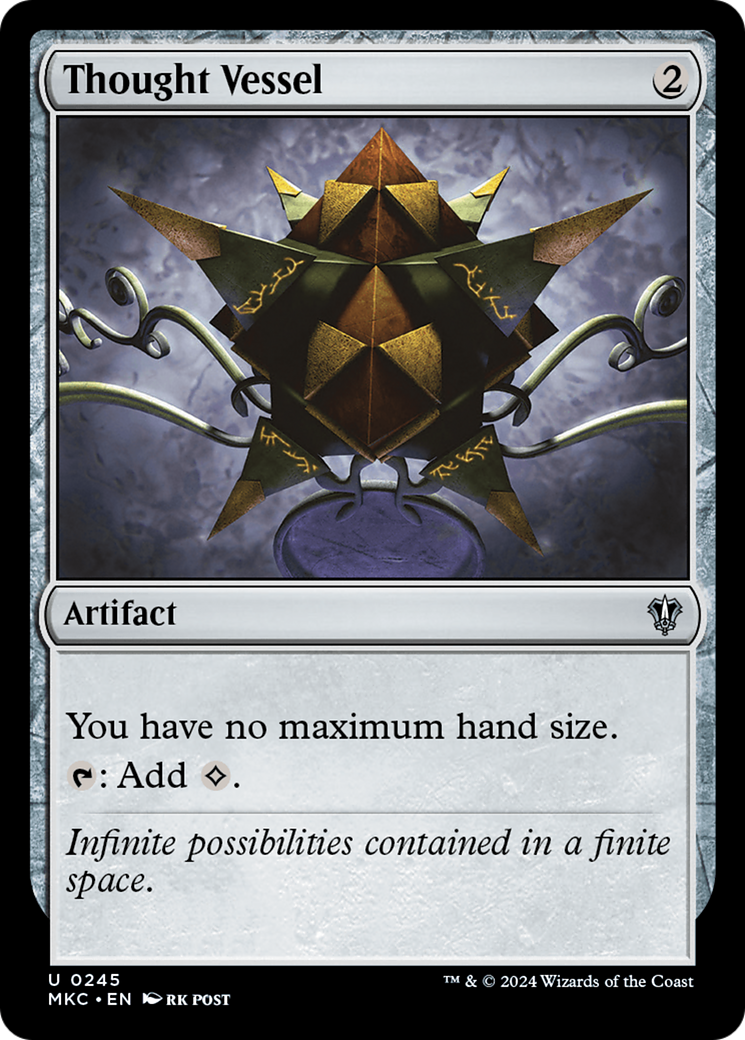
Thought Vessel
Thought Vessel
Artifact
You have no maximum hand size.
: Add .
Enchantments 6
-
1
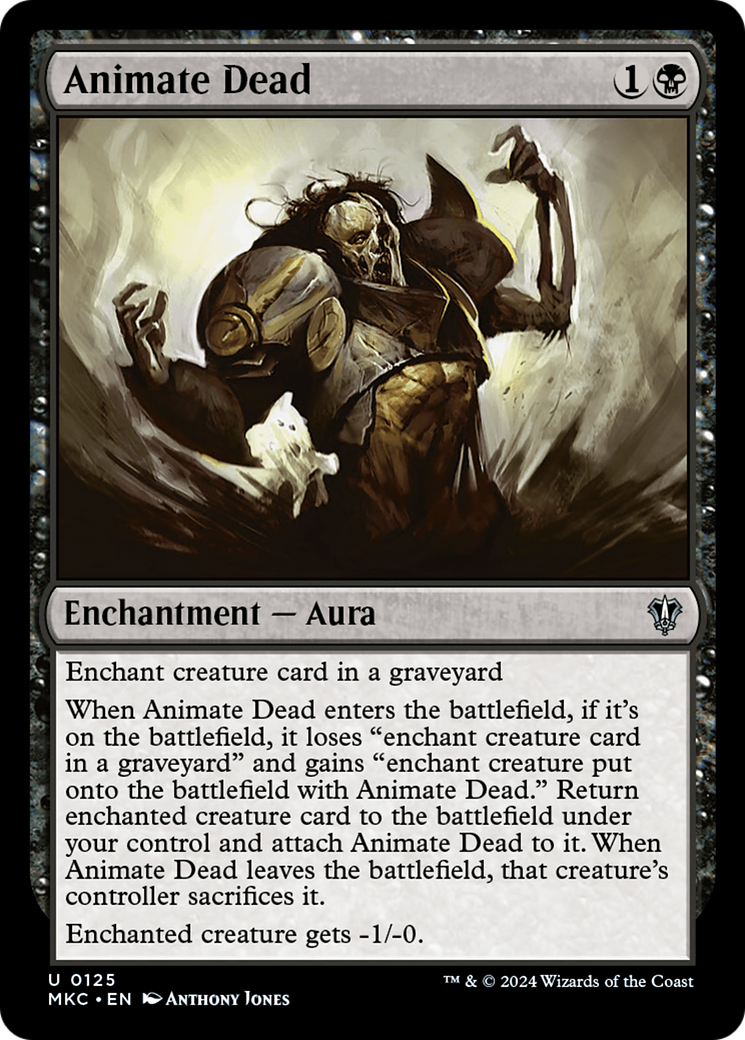
Animate Dead
Animate Dead
Enchantment — Aura
Enchant creature card in a graveyard
When this Aura enters, if it's on the battlefield, it loses "enchant creature card in a graveyard" and gains "enchant creature put onto the battlefield with this Aura." Return enchanted creature card to the battlefield under your control and attach this Aura to it. When this Aura leaves the battlefield, that creature's controller sacrifices it.
Enchanted creature gets -1/-0.
- If Animate Dead isn't on the battlefield as its triggered ability resolves, none of its effects happen. The creature card won't be returned to the battlefield.
- Animate Dead is an Aura, albeit with an unusual enchant ability. You target a creature card in a graveyard when you cast it. It enters the battlefield attached to that card. Then it returns that card to the battlefield, and attaches itself to the card again (since the card is a new object on the battlefield). Animate Dead itself never moves into a graveyard during this process.
- Once the creature is returned to the battlefield, Animate Dead can't be attached to anything other than it (unless Animate Dead somehow manages to put a different creature onto the battlefield). Attempting to move Animate Dead to another creature won't work.
- Abilities such as shroud and protection function only on the battlefield unless otherwise specified. A creature card with shroud may be targeted by Animate Dead, and Animate Dead will become attached to the creature that enters the battlefield.
- If the creature put onto the battlefield has protection from black—or if the creature can't legally be enchanted by Animate Dead for another reason—Animate Dead won't be able to attach to it. It will be put into the graveyard as a state-based action, causing its delayed triggered ability to trigger. When the trigger resolves, if the creature's still on the battlefield, its controller will sacrifice it.
-
1
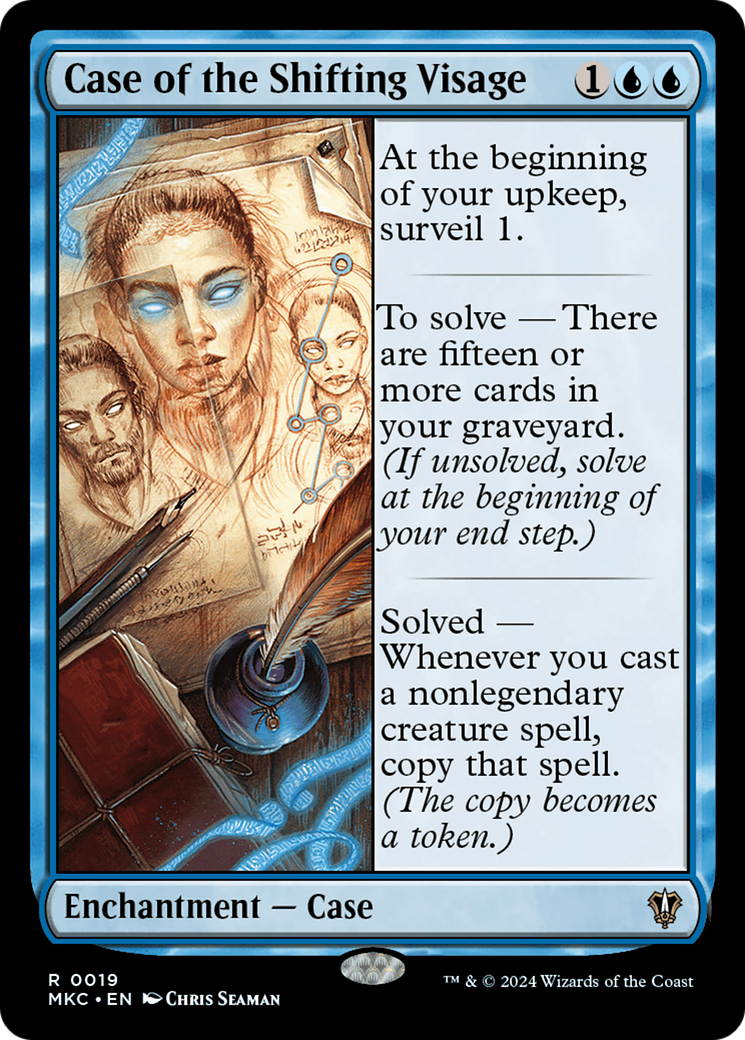
Case of the Shifting Visage
Case of the Shifting Visage
Enchantment — Case
At the beginning of your upkeep, surveil 1.
To solve — There are fifteen or more cards in your graveyard. (If unsolved, solve at the beginning of your end step.)
Solved — Whenever you cast a nonlegendary creature spell, copy that spell. (The copy becomes a token.)
- The triggered ability Case of the Shifting Visage has when it’s solved and the copy it creates will resolve before the spell that caused the ability to trigger.
- The copy is created on the stack, so it’s not “cast.” Creating the copy won’t cause abilities that trigger when a player casts a spell to trigger.
- If the spell that’s copied has an X whose value was determined as it was cast, the copy has the same value of X.
- You can’t choose to pay any additional costs for a copied spell. However, effects based on any additional costs that were paid for the original spell are copied as though those same costs were paid for the copy too.
- Any choices made when the spell resolves won’t have been made yet when it’s copied. Any such choices will be made separately when the copy resolves.
- If a permanent spell is copied, it’s put onto the battlefield as a token as the spell resolves rather than putting the copy of the spell onto the battlefield. The rules that apply to a permanent spell becoming a permanent apply to a copy of a spell becoming a token.
- The token that a resolving copy of a permanent spell becomes isn’t “created” and won’t interact with abilities that care about tokens being created, such as that of Case of the Pilfered Proof.
- Each Case has two special keyword abilities: to solve and solved.
- “To Solve — [condition]” means “At the beginning of your end step, if [condition] and this Case is not solved, it becomes solved.”
- The meaning of “solved” differs based on what type of ability follows it. “Solved — [activated ability]” means “[Activated ability]. Activate only if this Case is solved.” Activated abilities contain a colon. They’re generally written “[Cost]: [Effect].”
- “Solved — [Triggered ability]” means “[Triggered ability]. This ability triggers only if this Case is solved.” Triggered abilities use the word “when,” “whenever,” or “at.” They’re often written as “[Trigger condition], [effect].”
- “Solved — [static ability]” means “As long as this Case is solved, [static ability].” Static abilities are written as statements, such as “Creatures you control get +1/+1” or “Instant and sorcery spells you cast cost less to cast.”
- “To solve” abilities will check for their condition twice: once when the ability would trigger, and once when it resolves. If the condition isn’t true at the beginning of your end step, the ability won’t trigger at all. If the condition isn’t true when the ability resolves, the Case won’t become solved.
- Once a Case becomes solved, it stays solved until it leaves the battlefield.
- Cases don’t lose their other abilities when they become solved.
- Being solved is not part of a permanent’s copiable values. A permanent that becomes a copy of a solved Case is not solved. A solved Case that somehow becomes a copy of a different Case stays solved.
-
1
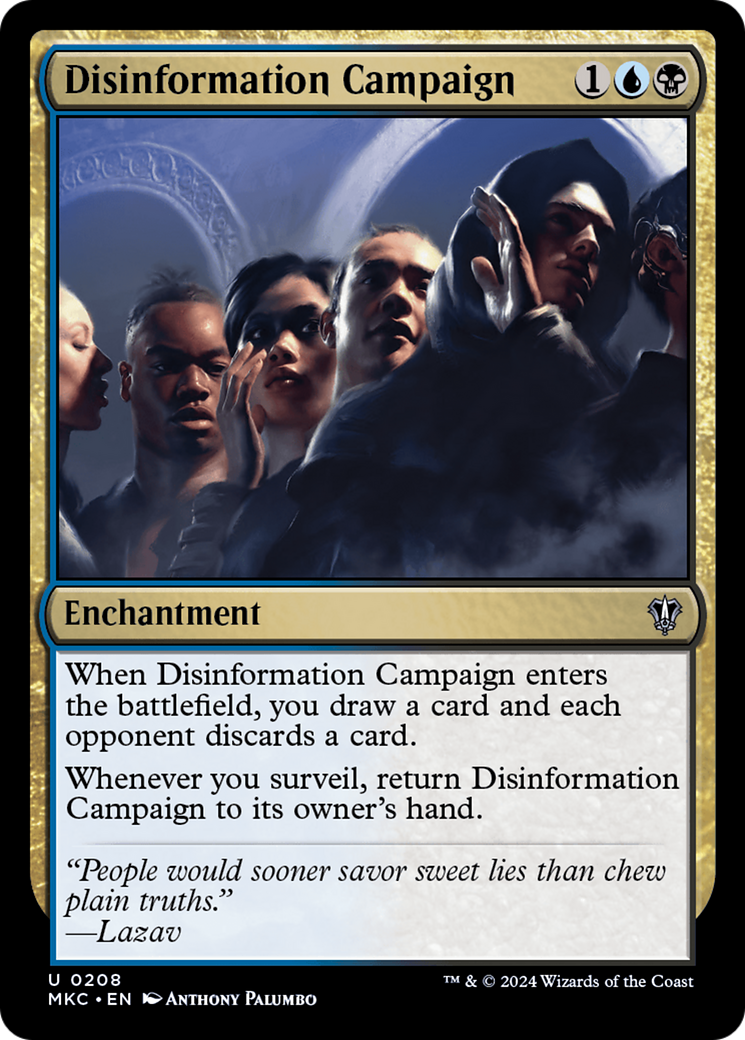
Disinformation Campaign
Disinformation Campaign
Enchantment
When this enchantment enters, you draw a card and each opponent discards a card.
Whenever you surveil, return this enchantment to its owner's hand.
- An ability that triggers "whenever you surveil" triggers after you're done surveilling, even if you have fewer cards in your library than the number of cards you're instructed to surveil. It even triggers if you have no cards in your library.
- Disinformation Campaign's last ability triggers only if it's on the battlefield. It won't return from your graveyard.
-
1
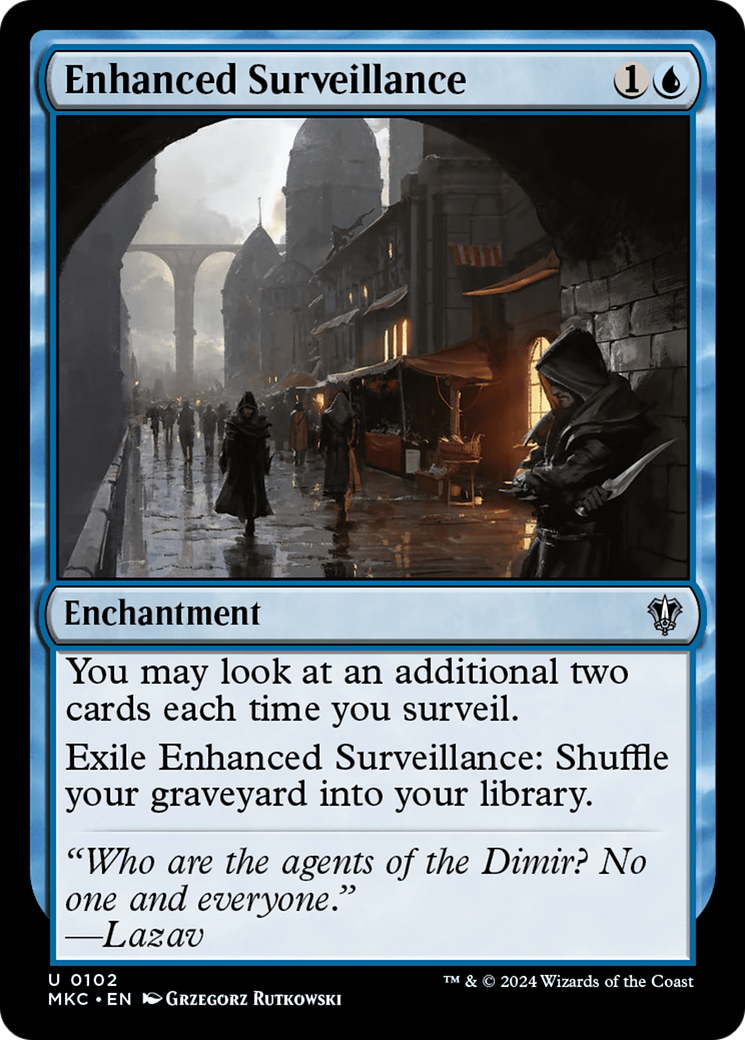
Enhanced Surveillance
Enhanced Surveillance
Enchantment
You may look at an additional two cards each time you surveil.
Exile this enchantment: Shuffle your graveyard into your library.
- The additional cards you look at due to Enhanced Surveillance's ability are part of what you surveil. You may put those cards into your graveyard or back on top in any order along with the others.
- If you control a second Enhanced Surveillance, their effects both apply and you may look at an additional four cards. If you control a third, may look at an additional six cards, and so on.
- Enhanced Surveillance's last ability can be activated only while it's on the battlefield.
-
1
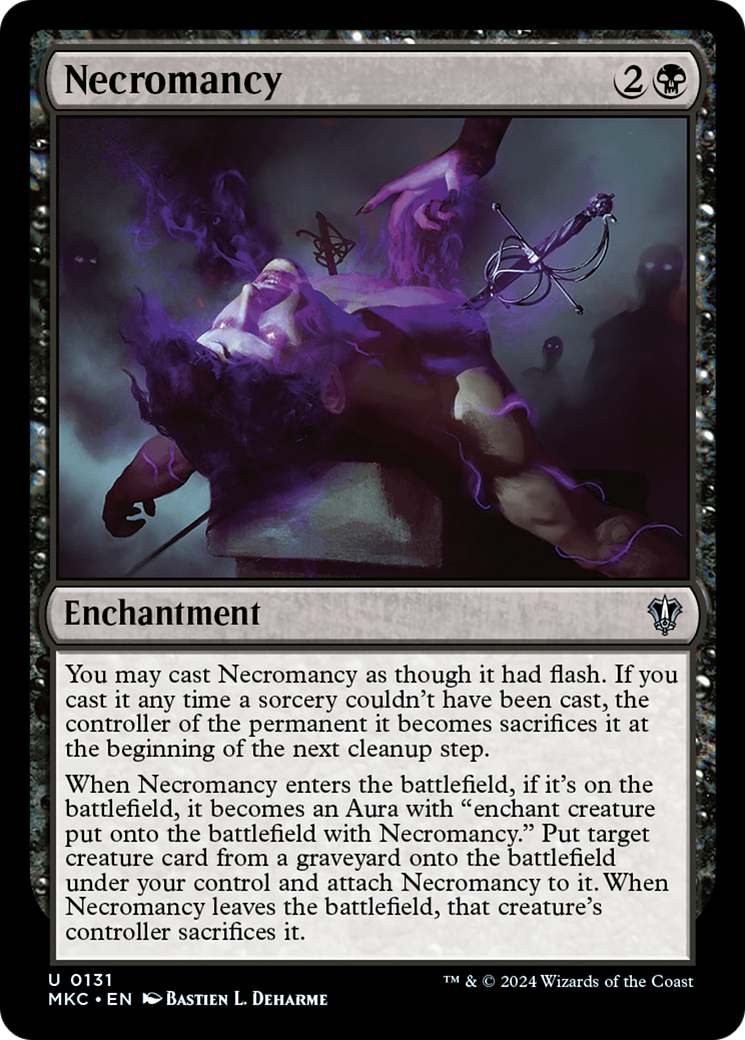
Necromancy
Necromancy
Enchantment
You may cast this spell as though it had flash. If you cast it any time a sorcery couldn't have been cast, the controller of the permanent it becomes sacrifices it at the beginning of the next cleanup step.
When this enchantment enters, if it's on the battlefield, it becomes an Aura with "enchant creature put onto the battlefield with Necromancy." Put target creature card from a graveyard onto the battlefield under your control and attach this enchantment to it. When this enchantment leaves the battlefield, that creature's controller sacrifices it.
- The sacrifice occurs only if you cast it using its own ability. If you cast it using some other effect (for example, if another effect allowed you to cast it as though it had flash), then it won't be sacrificed.
- If the creature card put onto the battlefield has protection from black (or anything that prevents this from legally being attached), this won't be able to attach to it. Then this will go to the graveyard as a state-based action, causing the creature to be sacrificed.
- Necromancy enters as an enchantment and then becomes an Enchant Creature Aura as a triggered ability upon entering. It follows all the rules for Auras from then on.
- The bringing of the creature onto the battlefield and then putting Necromancy on it is all done as part of the resolution.
- When putting a card onto the battlefield that requires a definition for its value or some other choice, you do what is needed to define the value or make the choice.
-
1
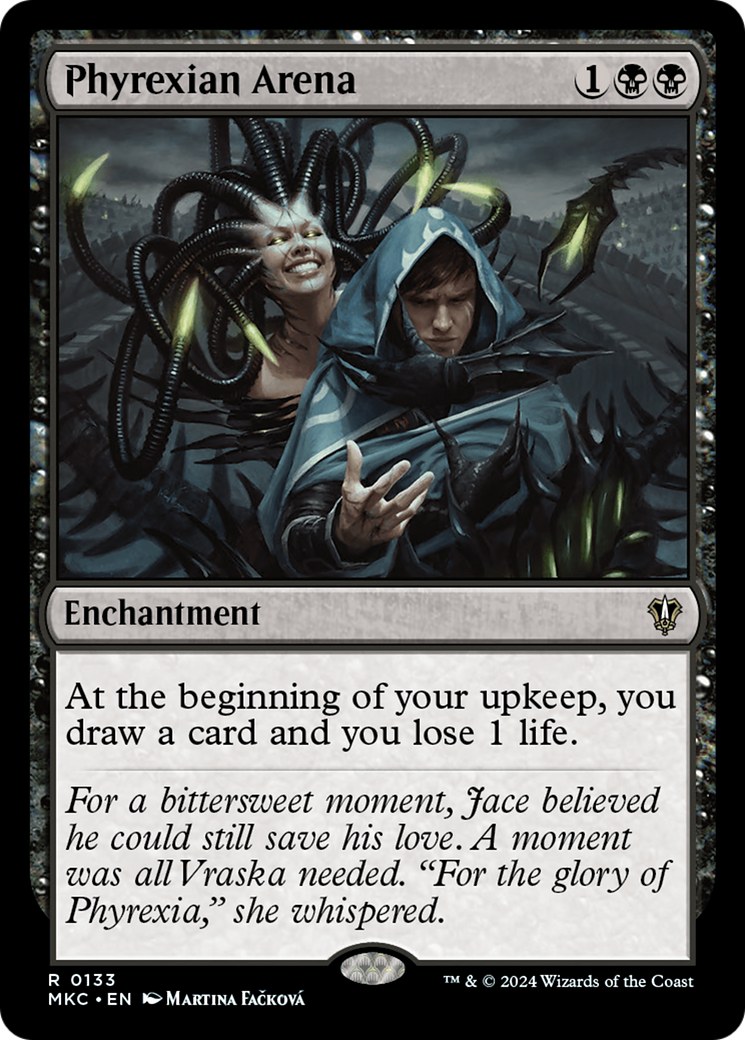
Phyrexian Arena
Phyrexian Arena
Enchantment
At the beginning of your upkeep, you draw a card and you lose 1 life.
Lands 37
-
1
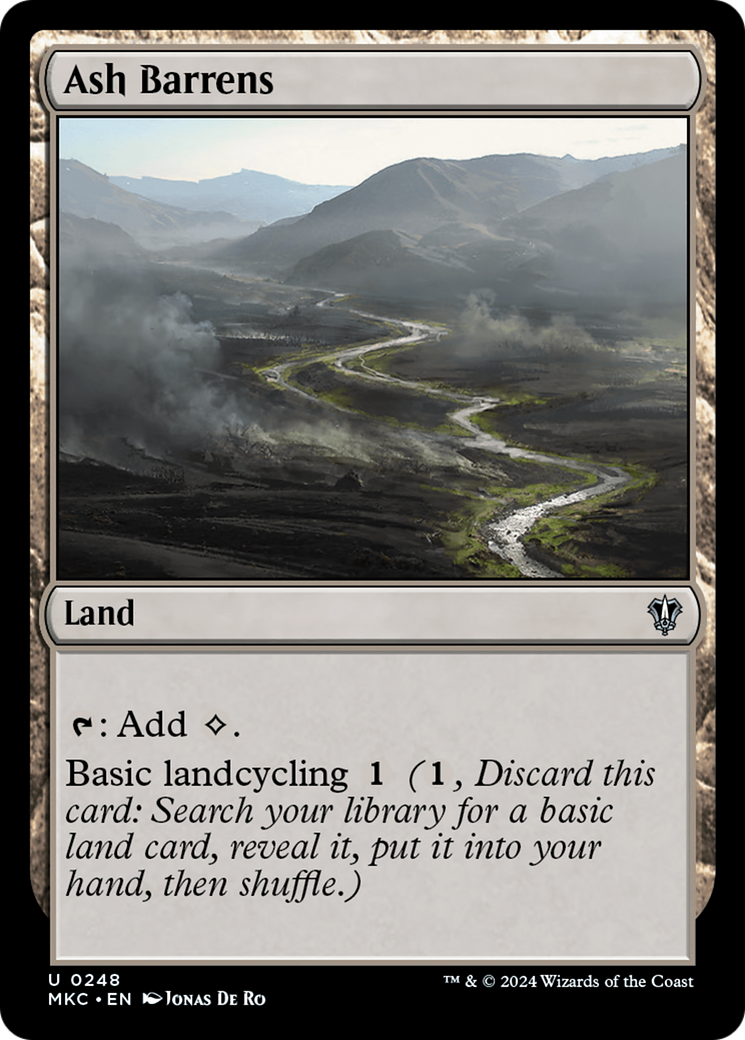
Ash Barrens
Ash Barrens
Land
: Add .
Basic landcycling ( , Discard this card: Search your library for a basic land card, reveal it, put it into your hand, then shuffle.)
-
1
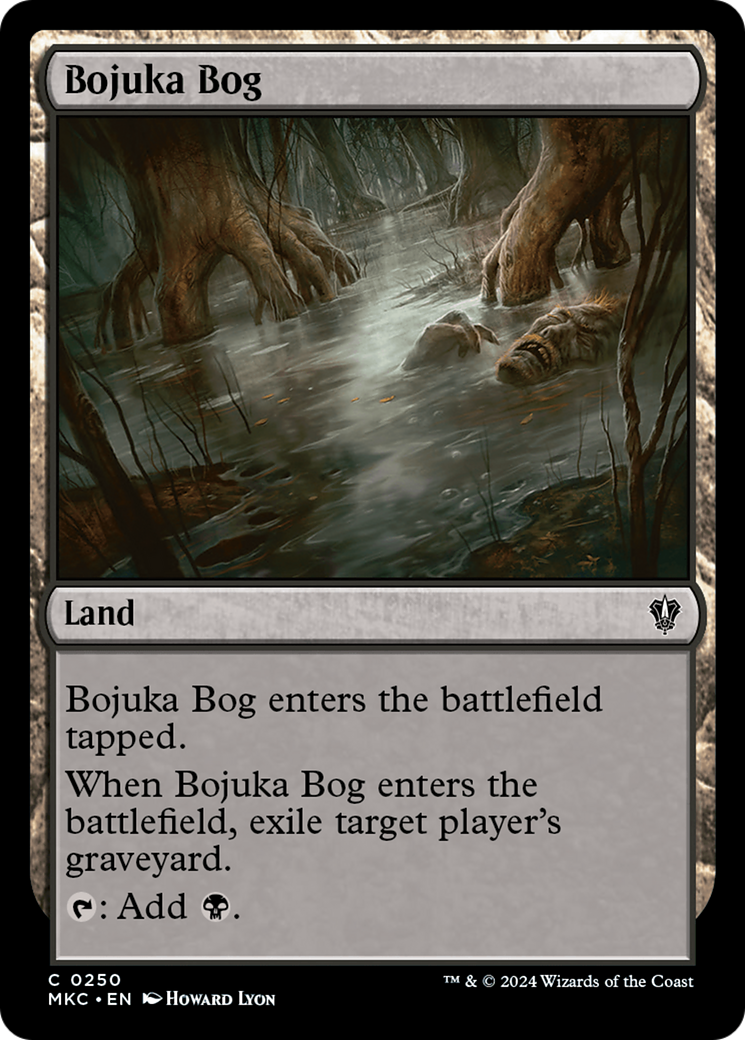
Bojuka Bog
Bojuka Bog
Land
This land enters tapped.
When this land enters, exile target player's graveyard.
: Add .
-
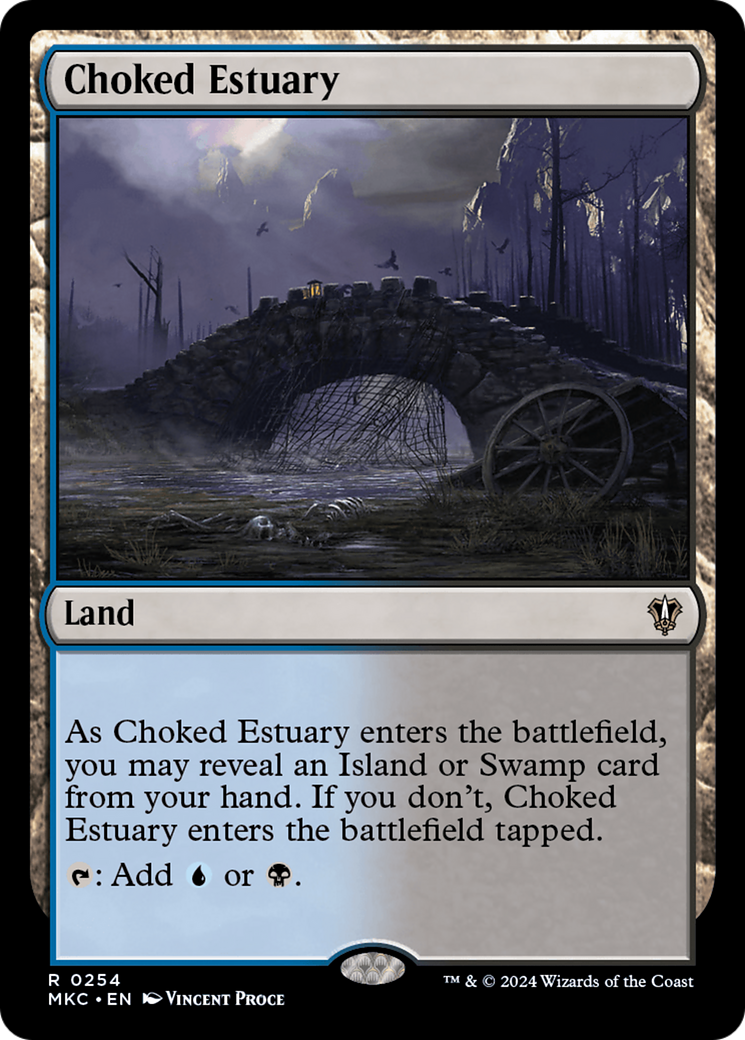
1
Choked Estuary
Choked Estuary
Land
As this land enters, you may reveal an Island or Swamp card from your hand. If you don't, this land enters tapped.
: Add or .
- Lands don't have a subtype just because they can produce mana of the corresponding color. Choked Estuary itself is neither an Island nor a Swamp, even though it produces blue and black mana, so you can't reveal one to satisfy the ability of another.
- If an effect instructs you to put Choked Estuary onto the battlefield tapped, it will still enter the battlefield tapped even if you reveal a land card from your hand.
- You may reveal any land card with either or both of the appropriate subtypes. It doesn't have to be a basic land. For example, you could reveal Prairie Stream from the Battle for Zendikar set to satisfy the ability of Choked Estuary.
- If an Island or Swamp is entering the battlefield from your hand at the same time as Choked Estuary, you may reveal the other land to have Choked Estuary enter untapped.
-
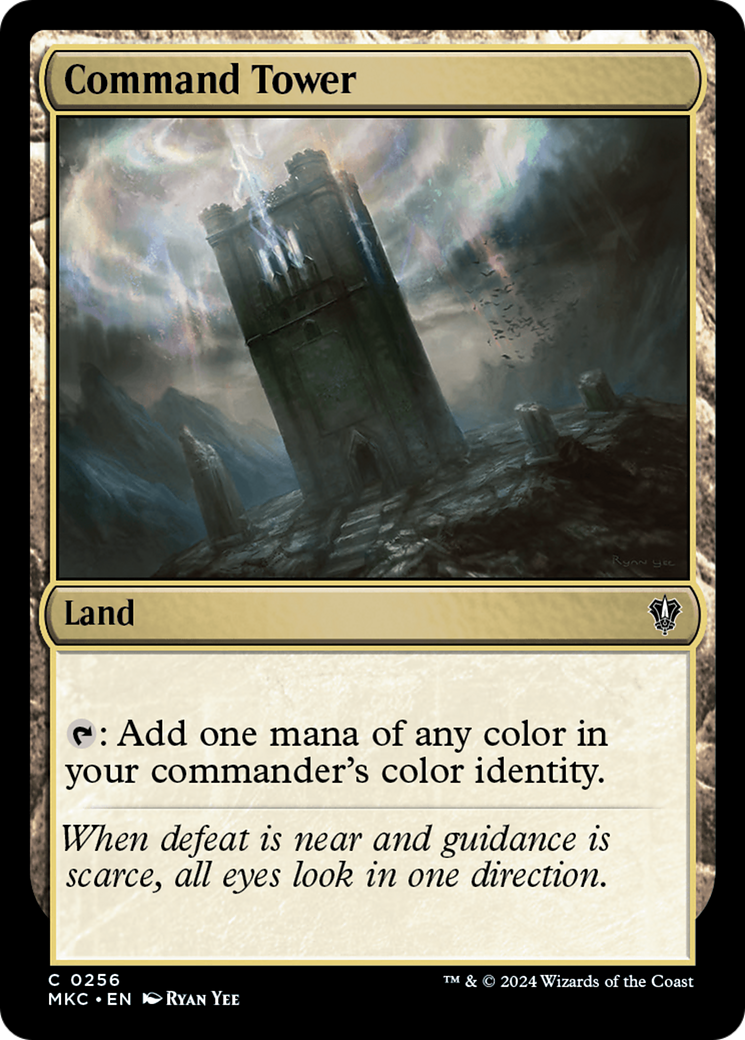
1
Command Tower
Command Tower
Land
: Add one mana of any color in your commander's color identity.
- If you don't have a commander, Command Tower's ability produces no mana.
- If your commander is a card that has no colors in its color identity, Command Tower's ability produces no mana. It doesn't produce .
- If you have two commanders, the ability adds one mana of any color in their combined color identities.
-
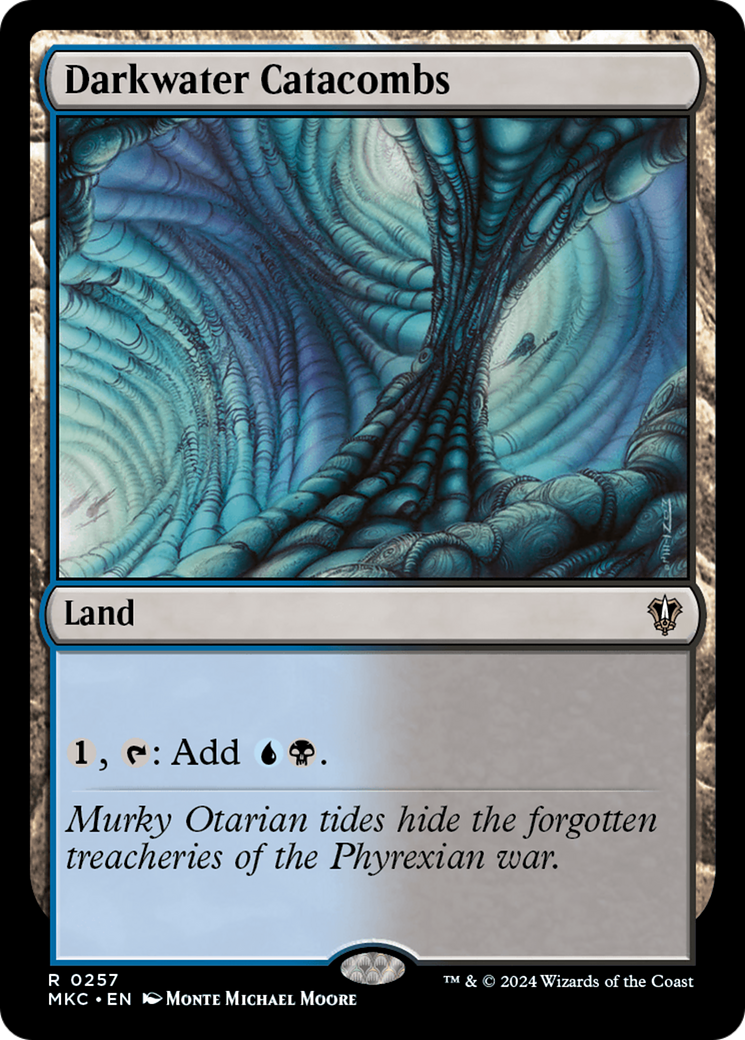
1
Darkwater Catacombs
Darkwater Catacombs
Land
, : Add .
-
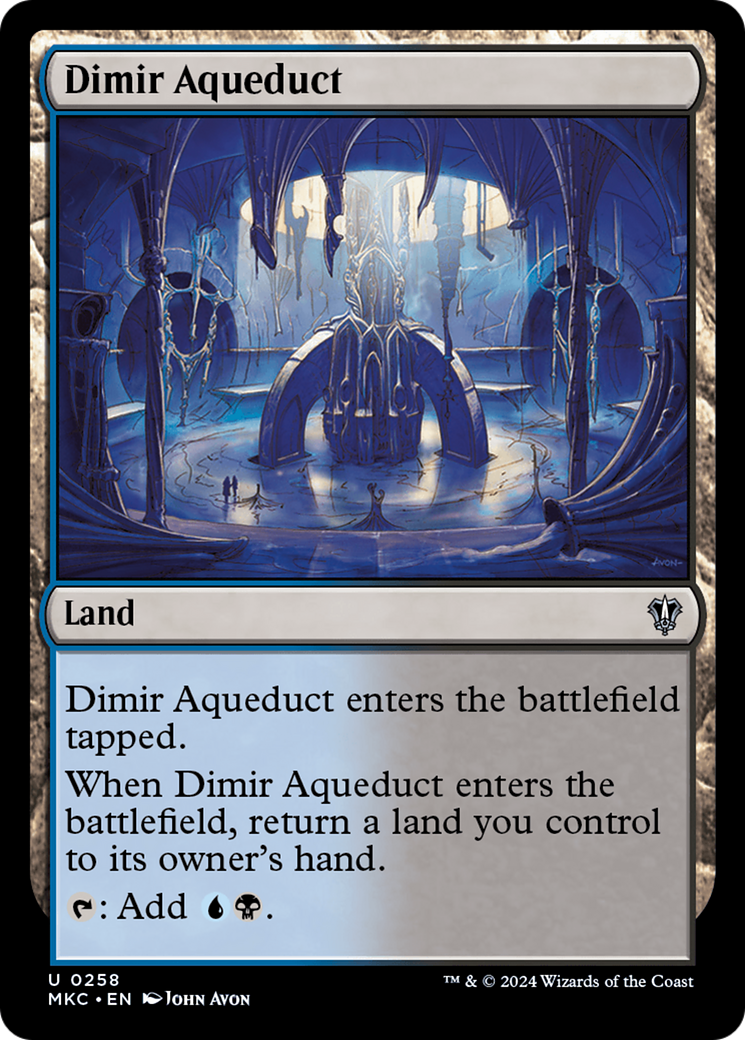
1
Dimir Aqueduct
Dimir Aqueduct
Land
This land enters tapped.
When this land enters, return a land you control to its owner's hand.
: Add .
- If this land enters the battlefield and you control no other lands, its ability will force you to return it to your hand.
-
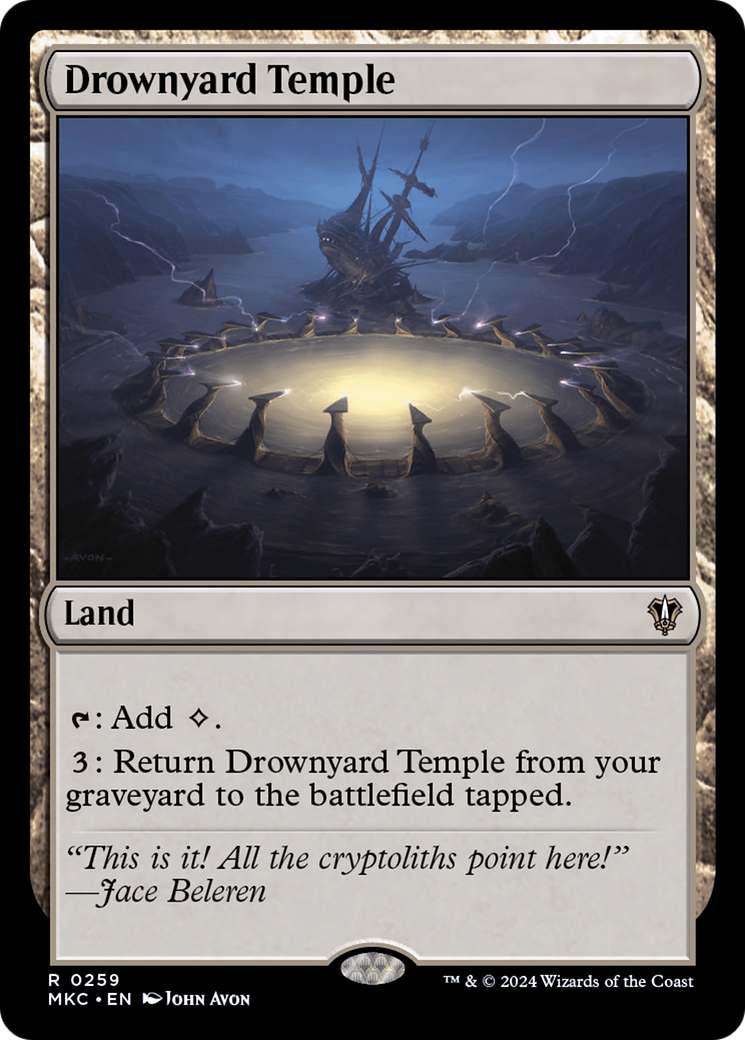
1
Drownyard Temple
Drownyard Temple
Land
: Add .
: Return this card from your graveyard to the battlefield tapped.
-
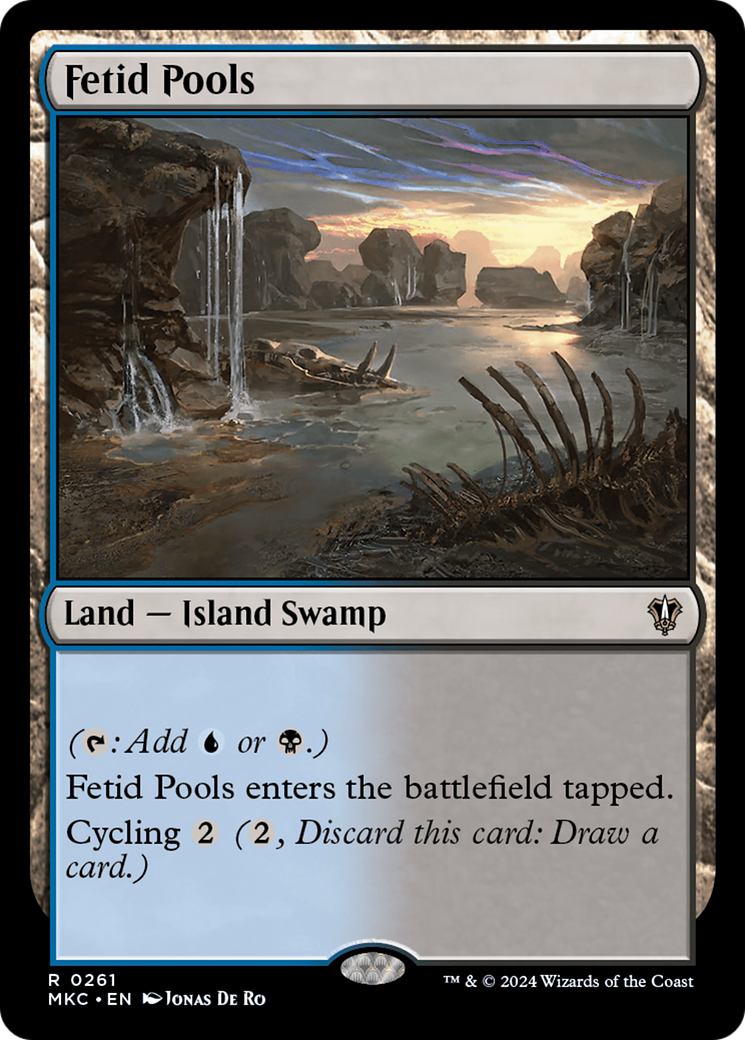
1
Fetid Pools
Fetid Pools
Land — Island Swamp
( : Add or .)
This land enters tapped.
Cycling ( , Discard this card: Draw a card.)
-
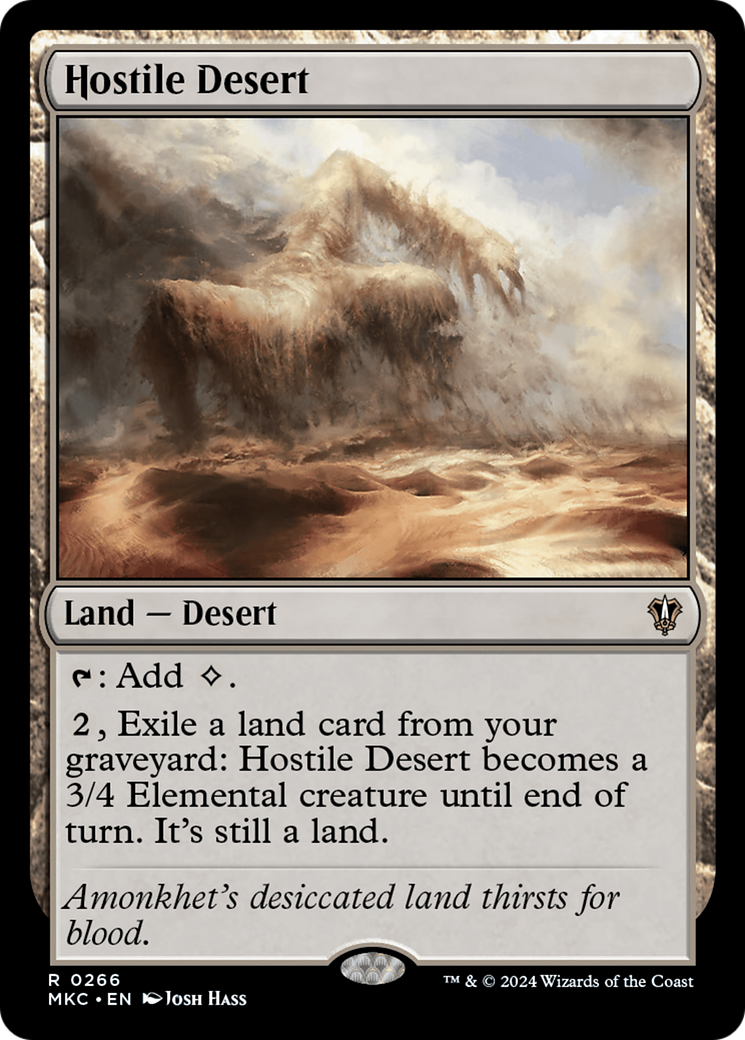
1
Hostile Desert
Hostile Desert
Land — Desert
: Add .
, Exile a land card from your graveyard: This land becomes a 3/4 Elemental creature until end of turn. It's still a land.
- If Hostile Desert becomes a creature the same turn it enters the battlefield, you can't attack with it or tap it for mana.
- Desert is a land subtype with no special meaning. It doesn't grant the land an intrinsic mana ability. Other cards may care about which lands are Deserts.
-
9
Island
Island
Basic Land — Island
( : Add .)
-
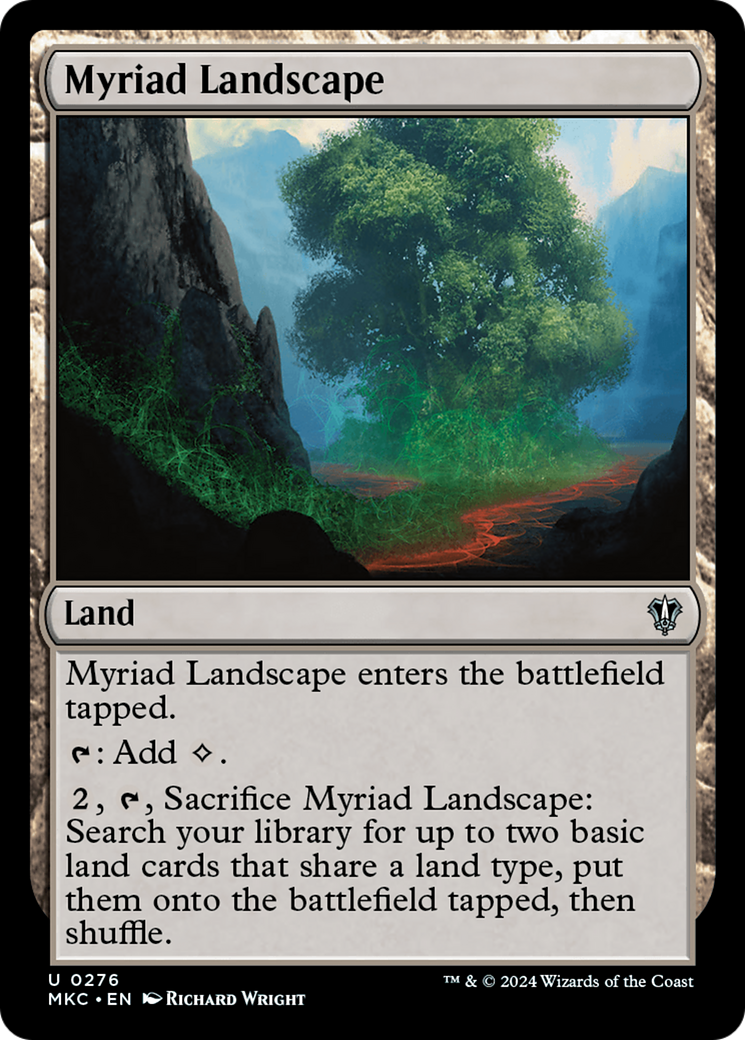
1
Myriad Landscape
Myriad Landscape
Land
This land enters tapped.
: Add .
, , Sacrifice this land: Search your library for up to two basic land cards that share a land type, put them onto the battlefield tapped, then shuffle.
- You can choose to find one basic land card with Myriad Landscape's last ability.
-
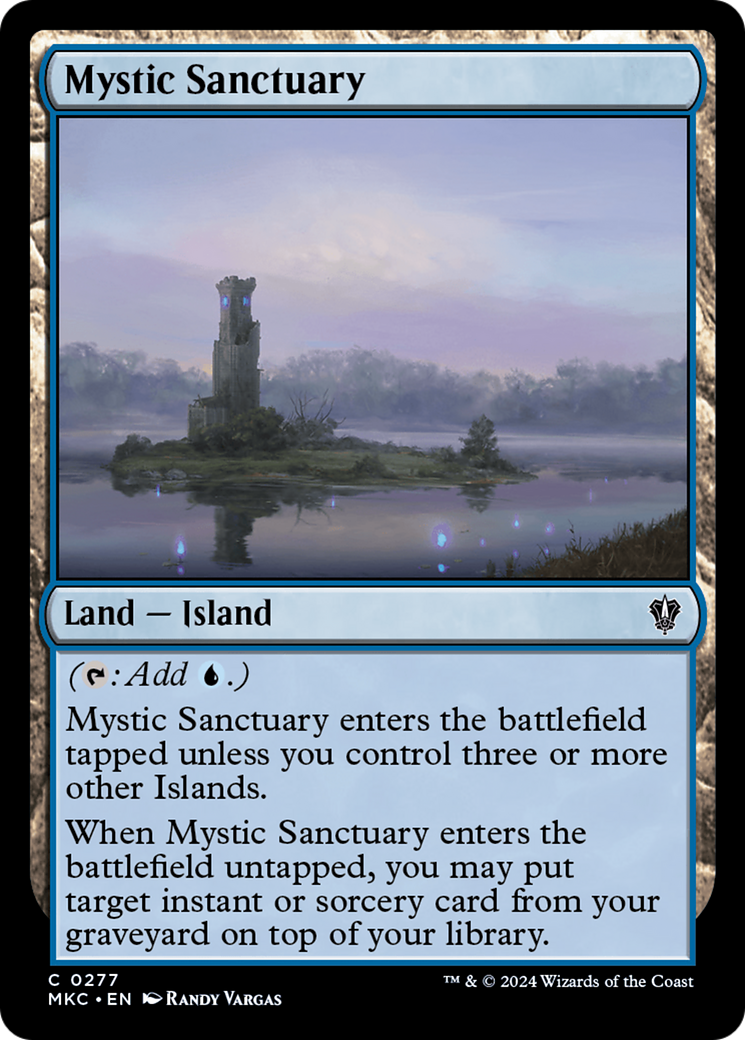
1
Mystic Sanctuary
Mystic Sanctuary
Land — Island
( : Add .)
This land enters tapped unless you control three or more other Islands.
When this land enters untapped, you may put target instant or sorcery card from your graveyard on top of your library.
- As these lands are entering the battlefield, they check for lands that are already on the battlefield. They won't see lands that are entering the battlefield at the same time (due to Scapeshift, for example).
- If another effect puts these lands onto the battlefield tapped, they enter tapped, even if you control enough lands with the appropriate basic land type.
-
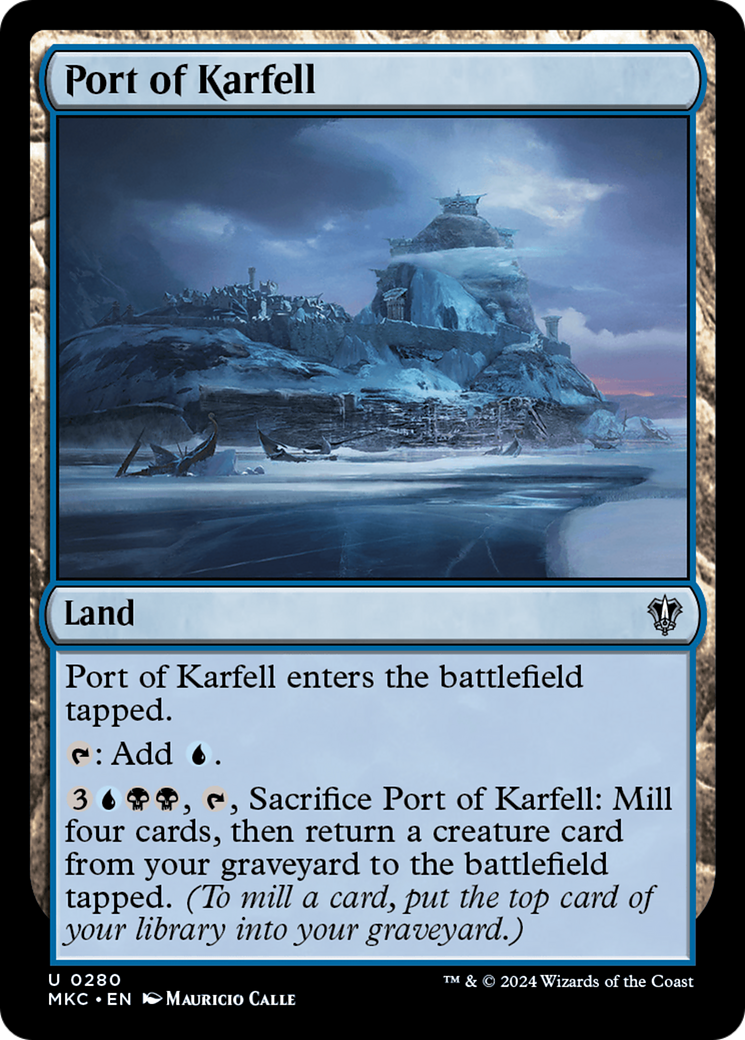
1
Port of Karfell
Port of Karfell
Land
This land enters tapped.
: Add .
, , Sacrifice this land: Mill four cards, then return a creature card from your graveyard to the battlefield tapped. (To mill a card, put the top card of your library into your graveyard.)
- The last activated ability doesn't target any creature cards in graveyards. You may return a creature card that was just milled or one that was already there.
-
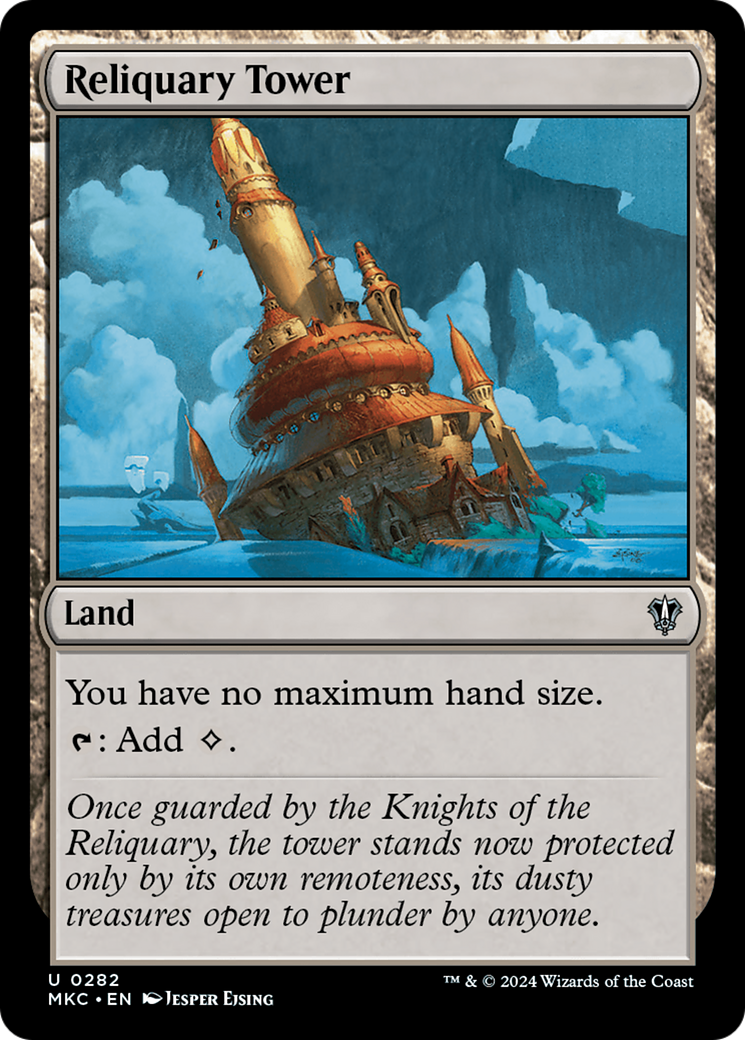
1
Reliquary Tower
Reliquary Tower
Land
You have no maximum hand size.
: Add .
- If multiple effects modify your hand size, apply them in timestamp order. For example, if you put Null Profusion (an enchantment that says your maximum hand size is two) onto the battlefield and then put Reliquary Tower onto the battlefield, you'll have no maximum hand size. However, if those permanents enter in the opposite order, your maximum hand size would be two.
-
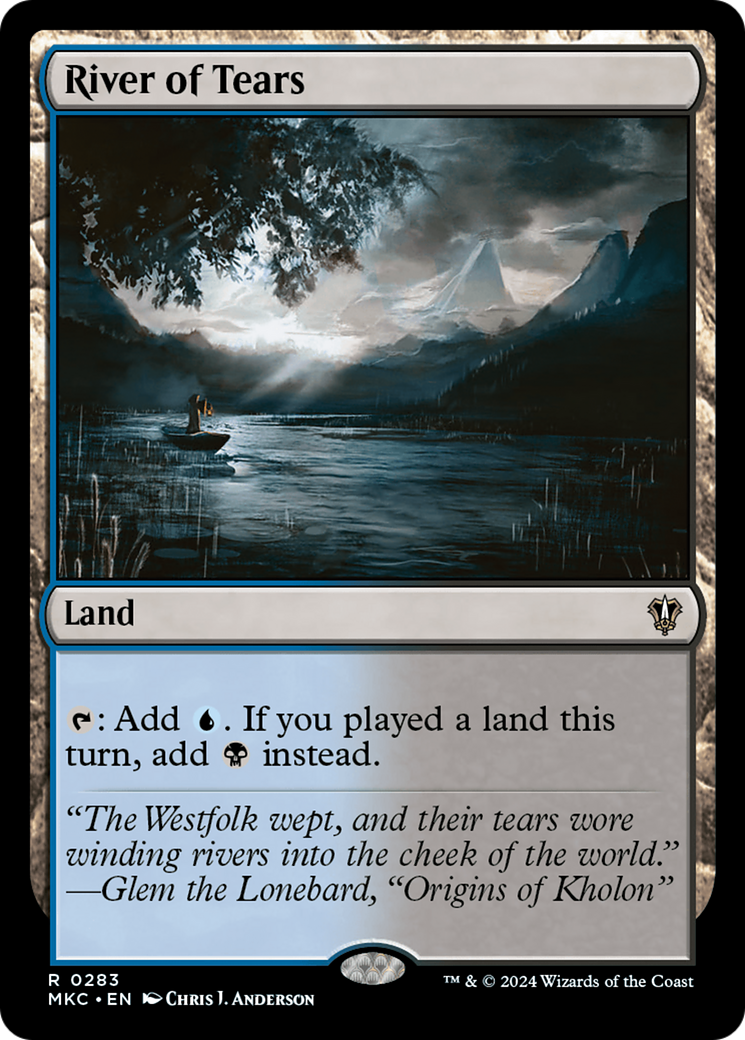
1
River of Tears
River of Tears
Land
: Add . If you played a land this turn, add instead.
- The turn you play River of Tears, it will produce when tapped for mana.
- River of Tears produces only after you've played a land, not after you've put a land onto the battlefield (such as with Evolving Wilds).
-
1
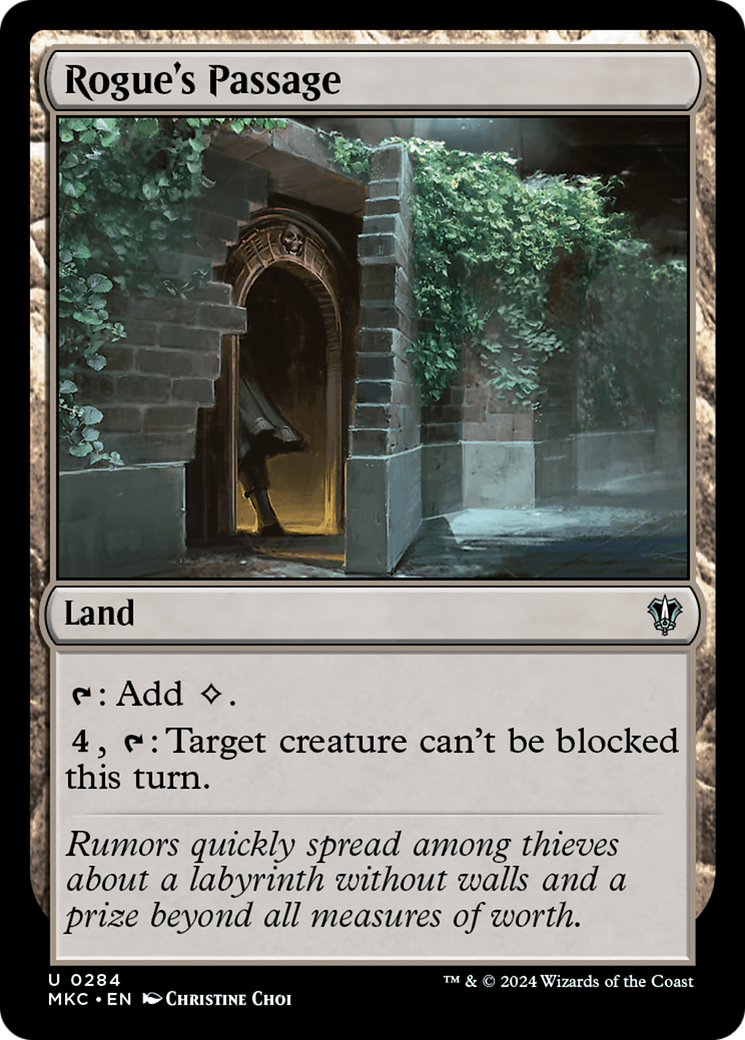
Rogue's Passage
Rogue's Passage
Land
: Add .
, : Target creature can't be blocked this turn.
- Activating the second ability of Rogue's Passage after a creature has become blocked won't cause that creature to become unblocked.
-
1
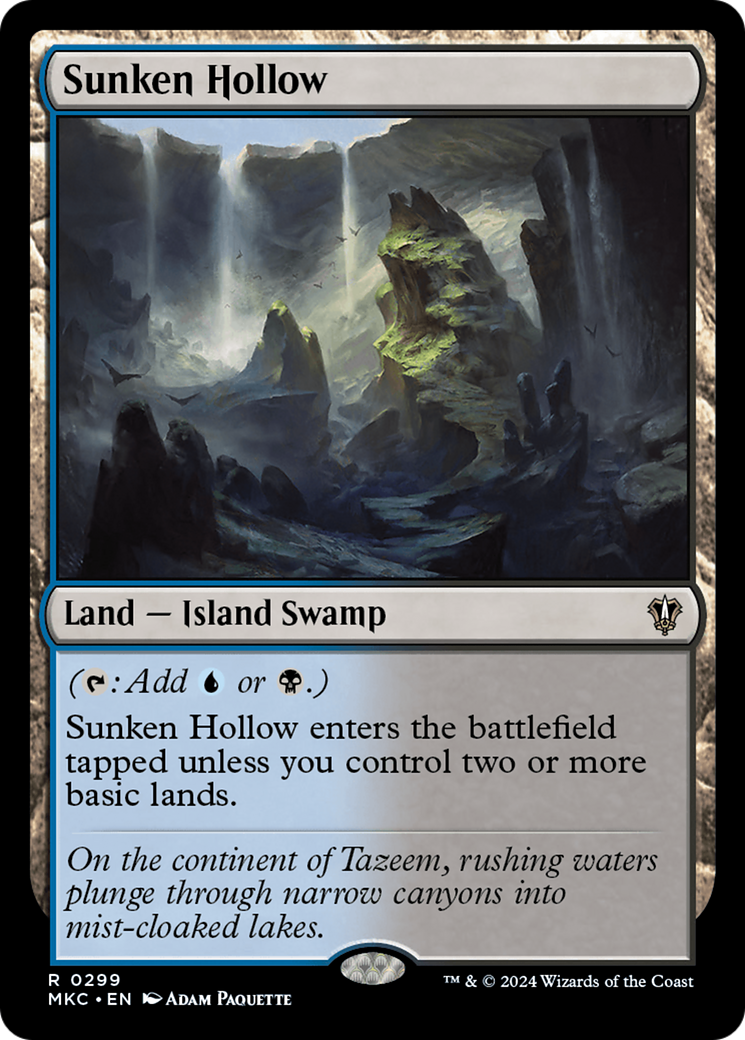
Sunken Hollow
Sunken Hollow
Land — Island Swamp
( : Add or .)
This land enters tapped unless you control two or more basic lands.
- Even though these lands have basic land types, they are not basic lands because "basic" doesn't appear on their type line. Notably, controlling two or more of them won't allow others to enter the battlefield untapped.
- However, because these cards have basic land types, effects that specify a basic land type without also specifying that the land be basic can affect them. For example, a spell or ability that reads "Destroy target Forest" can target Canopy Vista, while one that reads "Destroy target basic Forest" cannot.
- If one of these lands enters the battlefield at the same time as any number of basic lands, those other lands are not counted when determining if this land enters the battlefield tapped or untapped.
-
9
Swamp
Swamp
Basic Land — Swamp
( : Add .)
-
1
Tainted Isle
Tainted Isle
Land
: Add .
: Add or . Activate only if you control a Swamp.
-
1
Temple of the False God
Temple of the False God
Land
: Add . Activate only if you control five or more lands.
-
1
Tocasia's Dig Site
Tocasia's Dig Site
Land
: Add .
, : Surveil 1. (Look at the top card of your library. You may put it into your graveyard.)
Blue 19
-
1
Amphin Mutineer
Amphin Mutineer
Creature — Salamander Pirate
3/3
When this creature enters, exile up to one target non-Salamander creature. That creature's controller creates a 4/3 blue Salamander Warrior creature token.
Encore ( , Exile this card from your graveyard: For each opponent, create a token copy that attacks that opponent this turn if able. They gain haste. Sacrifice them at the beginning of the next end step. Activate only as a sorcery.)
- If an effect stops a token from attacking a specific player, that token can attack any player, planeswalker, or battle, or not attack at all. If the effect stops the token from attacking a specific player unless a cost is paid, you don't have to pay that cost unless you want to attack that player.
- Exiling the card with encore is a cost to activate the ability. Once you announce that you're activating it, no player may take actions until you've finished. They can't try to remove the card from your graveyard to stop you from paying the cost.
- Opponents who have left the game aren't counted when determining how many tokens to create.
- The tokens copy only what's on the original card. Effects that modified that creature when it was previously on the battlefield won't be copied.
- If the target non-Salamander creature is an illegal target by the time Amphin Mutineer's ability tries to resolve, the ability doesn't resolve. No player creates a Salamander Warrior token.
- If one of the tokens can't attack for any reason (such as being tapped), then it doesn't attack. If there's a cost associated with having it attack, you aren't forced to pay that cost, so it doesn't have to attack in that case either.
- If one of the tokens somehow is under another player's control as the delayed triggered ability resolves, you can't sacrifice that token. It remains on the battlefield indefinitely, even if you regain control of it later.
- Each token must attack the appropriate player if able.
-
1
Brainstorm
Brainstorm
Instant
Draw three cards, then put two cards from your hand on top of your library in any order.
- You draw three cards and put two cards back all while Brainstorm is resolving. Nothing can happen between the two, and no player may choose to take actions.
-
1
Case of the Shifting Visage
Case of the Shifting Visage
Enchantment — Case
At the beginning of your upkeep, surveil 1.
To solve — There are fifteen or more cards in your graveyard. (If unsolved, solve at the beginning of your end step.)
Solved — Whenever you cast a nonlegendary creature spell, copy that spell. (The copy becomes a token.)
- The triggered ability Case of the Shifting Visage has when it’s solved and the copy it creates will resolve before the spell that caused the ability to trigger.
- The copy is created on the stack, so it’s not “cast.” Creating the copy won’t cause abilities that trigger when a player casts a spell to trigger.
- If the spell that’s copied has an X whose value was determined as it was cast, the copy has the same value of X.
- You can’t choose to pay any additional costs for a copied spell. However, effects based on any additional costs that were paid for the original spell are copied as though those same costs were paid for the copy too.
- Any choices made when the spell resolves won’t have been made yet when it’s copied. Any such choices will be made separately when the copy resolves.
- If a permanent spell is copied, it’s put onto the battlefield as a token as the spell resolves rather than putting the copy of the spell onto the battlefield. The rules that apply to a permanent spell becoming a permanent apply to a copy of a spell becoming a token.
- The token that a resolving copy of a permanent spell becomes isn’t “created” and won’t interact with abilities that care about tokens being created, such as that of Case of the Pilfered Proof.
- Each Case has two special keyword abilities: to solve and solved.
- “To Solve — [condition]” means “At the beginning of your end step, if [condition] and this Case is not solved, it becomes solved.”
- The meaning of “solved” differs based on what type of ability follows it. “Solved — [activated ability]” means “[Activated ability]. Activate only if this Case is solved.” Activated abilities contain a colon. They’re generally written “[Cost]: [Effect].”
- “Solved — [Triggered ability]” means “[Triggered ability]. This ability triggers only if this Case is solved.” Triggered abilities use the word “when,” “whenever,” or “at.” They’re often written as “[Trigger condition], [effect].”
- “Solved — [static ability]” means “As long as this Case is solved, [static ability].” Static abilities are written as statements, such as “Creatures you control get +1/+1” or “Instant and sorcery spells you cast cost less to cast.”
- “To solve” abilities will check for their condition twice: once when the ability would trigger, and once when it resolves. If the condition isn’t true at the beginning of your end step, the ability won’t trigger at all. If the condition isn’t true when the ability resolves, the Case won’t become solved.
- Once a Case becomes solved, it stays solved until it leaves the battlefield.
- Cases don’t lose their other abilities when they become solved.
- Being solved is not part of a permanent’s copiable values. A permanent that becomes a copy of a solved Case is not solved. A solved Case that somehow becomes a copy of a different Case stays solved.
-
1
Consider
Consider
Instant
Surveil 1. (Look at the top card of your library. You may put it into your graveyard.)
Draw a card.
- You perform the actions stated on a card in sequence. For some spells and abilities, you'll surveil last. For others, you'll surveil and then perform other actions.
-
1
Copy Catchers
Copy Catchers
Creature — Faerie
2/1
Flying
Whenever you surveil, you may pay . If you do, create a token that's a copy of this creature.
- An ability that triggers “whenever you surveil” triggers after you’re done surveilling, even if you have fewer cards in your library than the number of cards you’re instructed to surveil. It triggers even if you have no cards in your library.
- The token copy will have Copy Catchers’s abilities and will be able to create copies of itself.
- The token doesn’t copy whether Copy Catchers is tapped or untapped, whether it has any counters on it or Auras attached to it, or any non-copy effects that have changed its power, toughness, types, color, and so on.
- If Copy Catchers leaves the battlefield before its triggered ability resolves, the token will still enter the battlefield as a copy of Copy Catchers, using Copy Catchers’s copiable values from when it was last on the battlefield.
- In the unusual case where Copy Catchers becomes a copy of something else while its triggered ability is on the stack but before it resolves, the token will enter the battlefield as a copy of whatever Copy Catchers is copying. (Do you copy? Over.)
-
1
Curate
Curate
Instant
Surveil 2. (Look at the top two cards of your library, then put any number of them into your graveyard and the rest on top of your library in any order.)
Draw a card.
- You perform the actions stated on a card in sequence. For some spells and abilities, you'll surveil last. For others, you'll surveil and then perform other actions.
- When you surveil, you may put all the cards you look at back on top of your library, you may put all of those cards into your graveyard, or you may put some of those cards on top and the rest of them into your graveyard.
-
1
Deep Analysis
Deep Analysis
Sorcery
Target player draws two cards.
Flashback— , Pay 3 life. (You may cast this card from your graveyard for its flashback cost. Then exile it.)
- A spell cast using flashback will always be exiled afterward, whether it resolves, is countered, or leaves the stack in some other way.
- You must still follow any timing restrictions and permissions, including those based on the card's type. For instance, you can cast a sorcery using flashback only when you could normally cast a sorcery.
- You can cast a spell using flashback even if it was somehow put into your graveyard without having been cast.
- To determine the total cost of a spell, start with the mana cost or alternative cost (such as a flashback cost) you're paying, add any cost increases, then apply any cost reductions. The mana value of the spell is determined only by its mana cost, no matter what the total cost to cast the spell was.
- If a card with flashback is put into your graveyard during your turn, you can cast it if it's legal to do so before any other player can take any actions.
- "Flashback [cost]" means "You may cast this card from your graveyard by paying [cost] rather than paying its mana cost" and "If the flashback cost was paid, exile this card instead of putting it anywhere else any time it would leave the stack."
-
1
Dream Eater
Dream Eater
Creature — Nightmare Sphinx
4/3
Flash
Flying
When this creature enters, surveil 4. When you do, you may return target nonland permanent an opponent controls to its owner's hand. (To surveil 4, look at the top four cards of your library, then put any number of them into your graveyard and the rest on top of your library in any order.)
- You perform the actions stated on a card in sequence. For some spells and abilities, you'll surveil last. For others, you'll surveil and then perform other actions.
- When you surveil, you may put all the cards you look at back on top of your library, you may put all of those cards into your graveyard, or you may put some of those cards on top and the rest of them into your graveyard.
- Dream Eater's triggered ability goes on the stack without a target. While that ability is resolving, after you've surveilled, the reflexive triggered ability triggers and you pick a target nonland permanent to be returned to its owner's hand. This is different from effects that say "If you do . . ." in that you choose the target after having surveilled.
- Dream Eater's reflexive triggered ability triggers even if you have fewer than four cards in your library to surveil.
-
1
Enhanced Surveillance
Enhanced Surveillance
Enchantment
You may look at an additional two cards each time you surveil.
Exile this enchantment: Shuffle your graveyard into your library.
- The additional cards you look at due to Enhanced Surveillance's ability are part of what you surveil. You may put those cards into your graveyard or back on top in any order along with the others.
- If you control a second Enhanced Surveillance, their effects both apply and you may look at an additional four cards. If you control a third, may look at an additional six cards, and so on.
- Enhanced Surveillance's last ability can be activated only while it's on the battlefield.
-
1
Ephara's Dispersal
Ephara's Dispersal
Instant
This spell costs less to cast if it targets an attacking creature.
Return target creature to its owner's hand. Surveil 2. (Look at the top two cards of your library, then put any number of them into your graveyard and the rest on top of your library in any order.)
- You perform the actions stated on a card in sequence. For some spells and abilities, you'll surveil last. For others, you'll surveil and then perform other actions.
- When you surveil, you may put all the cards you look at back on top of your library, you may put all of those cards into your graveyard, or you may put some of those cards on top and the rest of them into your graveyard.
- The cost reduction ability of Ephara's Dispersal doesn't affect its mana cost or mana value. It affects only the total cost you pay. Specifically, its mana value is always 3.
-
1
Final-Word Phantom
Final-Word Phantom
Creature — Spirit Detective
1/4
Flash
Flying
During each opponent's end step, you may cast spells as though they had flash.
- Final-Word Phantom’s last ability applies only to casting spells. It does not, for example, change when you may activate abilities that can be activated “only as a sorcery.”
-
1
Mission Briefing
Mission Briefing
Instant
Surveil 2, then choose an instant or sorcery card in your graveyard. You may cast it this turn. If that spell would be put into your graveyard, exile it instead. (To surveil 2, look at the top two cards of your library, then put any number of them into your graveyard and the rest on top of your library in any order.)
- You perform the actions stated on a card in sequence. For some spells and abilities, you'll surveil last. For others, you'll surveil and then perform other actions.
- When you surveil, you may put all the cards you look at back on top of your library, you may put all of those cards into your graveyard, or you may put some of those cards on top and the rest of them into your graveyard.
- The instant or sorcery card you choose may be one that you just surveilled into your graveyard.
- Mission Briefing doesn't change when you can cast the chosen card. For example, if you choose a sorcery card, you can cast it only during your main phase when the stack is empty.
- Mission Briefing is still on the stack while you choose an instant or sorcery card in your graveyard. Your Mission Briefing can't be to give yourself that same Mission Briefing.
- If you cast a spell this way and that card is exiled, it's considered a new object in the zone it's put into. It won't be exiled if it's put into your graveyard later in the turn.
-
1
Mulldrifter
Mulldrifter
Creature — Elemental
2/2
Flying
When this creature enters, draw two cards.
Evoke (You may cast this spell for its evoke cost. If you do, it's sacrificed when it enters.)
- To determine the total cost of a spell, start with the mana cost or alternative cost you're paying (such as an evoke cost), add any cost increases, then apply any cost reductions. The mana value of the spell is determined by only its mana cost, no matter what the total cost to cast that spell was.
- If you pay the evoke cost, you can have Mulldrifter's own triggered ability resolve before the evoke triggered ability. You can cast spells after that ability resolves but before you have to sacrifice Mulldrifter.
-
1
Nightveil Sprite
Nightveil Sprite
Creature — Faerie Rogue
1/2
Flying
Whenever this creature attacks, surveil 1. (Look at the top card of your library. You may put it into your graveyard.)
- You perform the actions stated on a card in sequence. For some spells and abilities, you'll surveil last. For others, you'll surveil and then perform other actions.
-
1
Otherworldly Gaze
Otherworldly Gaze
Instant
Surveil 3. (Look at the top three cards of your library, then put any number of them into your graveyard and the rest on top of your library in any order.)
Flashback (You may cast this card from your graveyard for its flashback cost. Then exile it.)
- When you surveil, you may put all the cards you look at back on top of your library, you may put all of those cards into your graveyard, or you may put some of those cards on top and the rest of them into your graveyard.
- You must still follow any timing restrictions and permissions, including those based on the card's type. For instance, you can cast a sorcery using flashback only when you could normally cast a sorcery.
- To determine the total cost of a spell, start with the mana cost or alternative cost (such as a flashback cost) you're paying, add any cost increases, then apply any cost reductions. The mana value of the spell is determined only by its mana cost, no matter what the total cost to cast the spell was.
- "Flashback [cost]" means "You may cast this card from your graveyard by paying [cost] rather than paying its mana cost" and "If the flashback cost was paid, exile this card instead of putting it anywhere else any time it would leave the stack."
- You can cast a spell using flashback even if it was somehow put into your graveyard without having been cast.
- If a card with flashback is put into your graveyard during your turn, you can cast it if it's legal to do so before any other player can take any actions.
- A spell cast using flashback will always be exiled afterward, whether it resolves, is countered, or leaves the stack in some other way.
-
1
Sphinx of the Second Sun
Sphinx of the Second Sun
Creature — Sphinx
6/6
Flying
At the beginning of each of your postcombat main phases, there is an additional beginning phase after this phase. (The beginning phase includes the untap, upkeep, and draw steps.)
- The additional beginning phase will be a lot like your normal beginning phase. During the untap step, permanents will phase in or out as appropriate and you'll untap your tapped permanents. Anything that triggers "at the beginning of your upkeep" or similar will trigger during the upkeep step, and you'll eventually draw a card for your draw step.
- The additional beginning phase all happens during the current turn. Any effects that last "until your next turn" or similar won't expire just because you'll go through an additional beginning phase.
- After the additional beginning phase, the game proceeds to the ending phase (unless something has added even more phases; see below.)
- If multiple phases are added to the same point in your turn, the most recently created phase happens first. For example, say you control Sphinx of the Second Sun and its ability triggers during your postcombat main phase. Later during that same main phase, another effect gives you an additional combat phase after this main phase. The additional combat will happen first, followed by the additional beginning phase.
- Even if you don't attack with any creatures during combat, you'll still get a postcombat main phase and Sphinx of the Second Sun's ability will still trigger.
- If you somehow have more than two main phases in a turn, each main phase other than the first one is a postcombat main phase, and Sphinx of the Second Sun's ability triggers at the beginning of each of them.
-
1
Thoughtbound Phantasm
Thoughtbound Phantasm
Creature — Spirit
2/2
Defender
Whenever you surveil, put a +1/+1 counter on this creature.
As long as this creature has three or more +1/+1 counters on it, it can attack as though it didn't have defender.
- An ability that triggers "whenever you surveil" triggers after you're done surveilling, even if you have fewer cards in your library than the number of cards you're instructed to surveil. It even triggers if you have no cards in your library.
- You put only one +1/+1 counter on Thoughtbound Phantasm each time you surveil, no matter how many cards you looked at when you surveilled.
- Once Thoughtbound Phantasm has attacked, removing +1/+1 counters from it won't remove it from combat.
-
1
Vizier of Many Faces
Vizier of Many Faces
Creature — Shapeshifter Cleric
0/0
You may have this creature enter as a copy of any creature on the battlefield, except if this creature was embalmed, the token has no mana cost, it's white, and it's a Zombie in addition to its other types.
Embalm
- If a spell or ability puts a creature card with embalm into your graveyard during your main phase, you'll have priority immediately after that spell or ability resolves. You can activate the creature card's embalm ability before any player can exile it with an effect, such as that of Crook of Condemnation, if it's legal for you to do so.
- Once you've activated an embalm ability, the card is immediately exiled. Opponents can't try to stop the ability by exiling the card with an effect such as that of Crook of Condemnation.
- If the chosen creature has in its mana cost, X is considered to be 0.
- If the chosen creature is copying something else (for example, if the chosen creature is another Vizier of Many Faces), then Vizier of Many Faces enters the battlefield as whatever the chosen creature copied.
- If the chosen creature is a token, Vizier of Many Faces copies the original characteristics of that token as stated by the effect that created the token. Vizier of Many Faces is not a token in this case unless it's embalmed.
- Any enters-the-battlefield abilities of the copied creature will trigger when Vizier of Many Faces enters the battlefield. Any "as [this creature] enters the battlefield" or "[this creature] enters the battlefield with" abilities of the chosen creature will also work.
- Vizier of Many Faces copies exactly what was printed on the original creature (unless that creature is copying something else or is a token; see below). It doesn't copy whether that creature is tapped or untapped, whether it has any counters on it or Auras attached to it, or any non-copy effects that have changed its power, toughness, types, color, or so on.
- For each card with embalm, a corresponding game play supplement token can be found in some Amonkhet booster packs. These supplements are not required to play with cards with embalm; you can use the same items to represent an embalmed token as you would any other token.
- The token copies exactly what was printed on the original card and nothing else. It doesn't copy any information about the object the card was before it was put into your graveyard.
- The token is a Zombie in addition to its other types and is white instead of its other colors. It has no mana cost, and thus its mana value is 0. These are copiable values of the token that other effects may copy.
- If the card copied by the token had any "when [this permanent] enters the battlefield" abilities, then the token also has those abilities and will trigger them when it's created. Similarly, any "as [this permanent] enters the battlefield" or "[this permanent] enters the battlefield with" abilities that the token has copied will also work.
- If Vizier of Many Faces somehow enters the battlefield at the same time as another creature, Vizier of Many Faces can't become a copy of that creature. You may choose only a creature that's already on the battlefield.
- The characteristics Vizier of Many Faces gains as part of its copy effect are copiable values that other effects may copy.
-
1
Watcher of Hours
Watcher of Hours
Creature — Sphinx
6/6
Flying, ward
Whenever you remove a time counter from this card while it's exiled, surveil 1.
Suspend 6— (Rather than cast this card from your hand, you may pay and exile it with six time counters on it. At the beginning of your upkeep, remove a time counter. When the last is removed, you may cast it without paying its mana cost. It has haste.)
- Suspend is a keyword that represents three abilities. The first is a static ability that allows you to exile the card from your hand with the specified number of time counters (the number before the dash) on it by paying its suspend cost (listed after the dash). The second is a triggered ability that removes a time counter from the suspended card at the beginning of each of your upkeeps. The third is a triggered ability that gives you the option to cast the card when the last time counter is removed.
- You can exile a card in your hand using suspend any time you could cast that card. Consider its card type, any effects that modify when you could cast it (such as flash) and any other effects that stop you from casting it (such as from Meddling Mage's ability) to determine if and when you can do this. Whether you could actually complete all steps in casting the card is irrelevant. For example, you can exile a card with suspend that has no mana cost or that requires a target even if no legal targets are available at that time.
- Cards exiled with suspend are exiled face up.
- Exiling a card with suspend isn't casting that card. This action doesn't use the stack and can't be responded to.
- If the spell requires any targets, those targets are chosen when the spell is finally cast, not when it's exiled.
- If an effect refers to a "suspended card," that means a card that (1) has suspend, (2) is in exile, and (3) has one or more time counters on it.
- If the first triggered ability of suspend (the one that removes time counters) is countered, no time counter is removed. The ability will trigger again at the beginning of the card's owner's next upkeep.
- When the last time counter is removed, the second triggered ability of suspend (the one that lets you cast the card) triggers. It doesn't matter why the last time counter was removed or what effect removed it.
- If the second triggered ability is countered, the card can't be cast. It remains exiled with no time counters on it, and it's no longer suspended.
- Due to a recent rules change to suspend, you are no longer required to cast the suspended card as the second triggered ability of suspend resolves. Instead, as the second triggered ability resolves, you may cast the card. Timing permissions based on the card's type are ignored. If you don't cast the card, it remains exiled with no time counters on it, and it's no longer suspended.
- If you cast a card "without paying its mana cost," such as with suspend, you can't choose to cast it for any alternative costs. You can, however, pay additional costs. If the card has any mandatory additional costs, you must pay those if you want to cast the card.
- If the card has in its mana cost, you must choose 0 as the value of X when casting it without paying its mana cost.
- The mana value of a spell cast without paying its mana cost is determined by its mana cost, even though that cost wasn't paid.
Black 24
-
1
Animate Dead
Animate Dead
Enchantment — Aura
Enchant creature card in a graveyard
When this Aura enters, if it's on the battlefield, it loses "enchant creature card in a graveyard" and gains "enchant creature put onto the battlefield with this Aura." Return enchanted creature card to the battlefield under your control and attach this Aura to it. When this Aura leaves the battlefield, that creature's controller sacrifices it.
Enchanted creature gets -1/-0.
- If Animate Dead isn't on the battlefield as its triggered ability resolves, none of its effects happen. The creature card won't be returned to the battlefield.
- Animate Dead is an Aura, albeit with an unusual enchant ability. You target a creature card in a graveyard when you cast it. It enters the battlefield attached to that card. Then it returns that card to the battlefield, and attaches itself to the card again (since the card is a new object on the battlefield). Animate Dead itself never moves into a graveyard during this process.
- Once the creature is returned to the battlefield, Animate Dead can't be attached to anything other than it (unless Animate Dead somehow manages to put a different creature onto the battlefield). Attempting to move Animate Dead to another creature won't work.
- Abilities such as shroud and protection function only on the battlefield unless otherwise specified. A creature card with shroud may be targeted by Animate Dead, and Animate Dead will become attached to the creature that enters the battlefield.
- If the creature put onto the battlefield has protection from black—or if the creature can't legally be enchanted by Animate Dead for another reason—Animate Dead won't be able to attach to it. It will be put into the graveyard as a state-based action, causing its delayed triggered ability to trigger. When the trigger resolves, if the creature's still on the battlefield, its controller will sacrifice it.
-
1
Black Sun's Zenith
Black Sun's Zenith
Sorcery
Put X -1/-1 counters on each creature. Shuffle Black Sun's Zenith into its owner's library.
- If this spell doesn't resolve, none of its effects occur. In particular, it will go to the graveyard rather than to its owner's library.
-
1
Charnel Serenade
Charnel Serenade
Sorcery
Surveil 3, then return a creature card from your graveyard to the battlefield with a finality counter on it. Exile Charnel Serenade with three time counters on it.
Suspend 3— (Rather than cast this card from your hand, you may pay and exile it with three time counters on it. At the beginning of your upkeep, remove a time counter. When the last is removed, you may cast it without paying its mana cost.)
- The creature card you choose doesn’t need to be a card you put in your graveyard with surveil. You may choose a creature card that was already in your graveyard before you surveilled.
- Finality counters work on any permanent, not only creatures. If a permanent with a finality counter on it would go to a graveyard from the battlefield, exile it instead.
- Finality counters don’t stop permanents from going to zones other than the graveyard from the battlefield. For example, if a permanent with a finality counter on it would be put into its owner’s hand from the battlefield, it does so normally.
- Finality counters aren’t keyword counters, and a finality counter doesn’t give any abilities to the permanent it’s on. If that permanent loses its abilities and then would go to a graveyard, it will still be exiled instead.
- Multiple finality counters on a single permanent are redundant.
- Suspend is a keyword that represents three abilities. The first is a static ability that allows you to exile the card from your hand with the specified number of time counters (the number before the dash) on it by paying its suspend cost (listed after the dash). The second is a triggered ability that removes a time counter from the suspended card at the beginning of each of your upkeeps. The third is a triggered ability that gives you the option to cast the card when the last time counter is removed.
- You can exile a card in your hand using suspend any time you could cast that card. Consider its card type, any effects that modify when you could cast it (such as flash) and any other effects that stop you from casting it (such as from Meddling Mage's ability) to determine if and when you can do this. Whether you could actually complete all steps in casting the card is irrelevant. For example, you can exile a card with suspend that has no mana cost or that requires a target even if no legal targets are available at that time.
- Cards exiled with suspend are exiled face up.
- Exiling a card with suspend isn't casting that card. This action doesn't use the stack and can't be responded to.
- If the spell requires any targets, those targets are chosen when the spell is finally cast, not when it's exiled.
- If an effect refers to a "suspended card," that means a card that (1) has suspend, (2) is in exile, and (3) has one or more time counters on it.
- If the first triggered ability of suspend (the one that removes time counters) is countered, no time counter is removed. The ability will trigger again at the beginning of the card's owner's next upkeep.
- When the last time counter is removed, the second triggered ability of suspend (the one that lets you cast the card) triggers. It doesn't matter why the last time counter was removed or what effect removed it.
- If the second triggered ability is countered, the card can't be cast. It remains exiled with no time counters on it, and it's no longer suspended.
- Due to a recent rules change to suspend, you are no longer required to cast the suspended card as the second triggered ability of suspend resolves. Instead, as the second triggered ability resolves, you may cast the card. Timing permissions based on the card’s type are ignored. If you don’t cast the card, it remains exiled with no time counters on it, and it’s no longer suspended.
- If you cast a card "without paying its mana cost," such as with suspend, you can't choose to cast it for any alternative costs. You can, however, pay additional costs. If the card has any mandatory additional costs, you must pay those if you want to cast the card.
- If the card has in its mana cost, you must choose 0 as the value of X when casting it without paying its mana cost.
- The mana value of a spell cast without paying its mana cost is determined by its mana cost, even though that cost wasn't paid.
-
1
Dogged Detective
Dogged Detective
Creature — Human Rogue
2/1
When this creature enters, surveil 2. (Look at the top two cards of your library, then put any number of them into your graveyard and the rest on top of your library in any order.)
Whenever an opponent draws their second card each turn, you may return this card from your graveyard to your hand.
- When you surveil, you may put all the cards you look at back on top of your library, you may put all of those cards into your graveyard, or you may put some of those cards on top and the rest of them into your graveyard.
- Dogged Detective doesn't need to be in the graveyard when the first card is drawn for its last ability to trigger. As long as it is in the graveyard when an opponent draws their second card in a turn, it will trigger.
-
1
Doom Whisperer
Doom Whisperer
Creature — Nightmare Demon
6/6
Flying, trample
Pay 2 life: Surveil 2. (Look at the top two cards of your library, then put any number of them into your graveyard and the rest on top of your library in any order.)
- You perform the actions stated on a card in sequence. For some spells and abilities, you'll surveil last. For others, you'll surveil and then perform other actions.
- When you surveil, you may put all the cards you look at back on top of your library, you may put all of those cards into your graveyard, or you may put some of those cards on top and the rest of them into your graveyard.
-
1
Eye of Duskmantle
Eye of Duskmantle
Creature — Eye
3/8
Flying, lifelink
You may play lands and cast spells from among cards in your graveyard you've surveilled this turn. If you cast a spell this way, you pay life equal to its mana value rather than paying its mana cost.
- “Cards in your graveyard you’ve surveilled this turn” includes cards you put into your graveyard while surveilling. It does not include cards you saw while surveilling, left on top of your library, and then put into your graveyard later that turn by other means.
- You may only cast spells this way by paying the appropriate amount of life. You may not pay their normal costs and may not pay any other alternative costs. You may still pay for additional costs, such as kicker costs. If the spell has mandatory additional costs, you must pay those.
- If you cast a spell with in its mana cost this way, the only legal choice for X is 0.
-
1
Foreboding Steamboat
Foreboding Steamboat
Artifact — Vehicle
5/7
When this Vehicle enters, each player chooses two nontoken, non-Vehicle creatures they control. Exile them until this Vehicle leaves the battlefield.
Whenever this Vehicle attacks, put a card exiled with it into its owner's graveyard. If you do, investigate.
Crew 2
- Starting with the player whose turn it is, each player in turn order chooses two nontoken, non-Vehicle creatures they control, then all the creatures chosen by all players are exiled at the same time. Players get to know the choices made by players who chose before them.
- If Foreboding Steamboat leaves the battlefield before its first triggered ability resolves, the chosen creatures won't be exiled at all.
- Clue is an artifact type. Even though it appears on some cards with other permanent types, it's never a creature type, a land type, or anything but an artifact type.
- If an effect refers to a Clue, it means any Clue artifact, not just a Clue artifact token. For example, you can sacrifice Wrench to pay for Alquist Proft, Master Sleuth's activated ability.
- You can't sacrifice a Clue to pay multiple costs. For example, you can't sacrifice a Clue token to activate its own ability and also to activate Alquist Proft, Master Sleuth's ability.
- Some spells and abilities that investigate may require targets. If each target chosen is an illegal target as that spell or ability tries to resolve, it won't resolve. You won't create any Clue tokens.
- Some abilities trigger "whenever you sacrifice a Clue". Those abilities trigger whenever you sacrifice a Clue for any reason, not just to activate a Clue's activated ability.
-
1
Grave Titan
Grave Titan
Creature — Giant
6/6
Deathtouch
Whenever this creature enters or attacks, create two 2/2 black Zombie creature tokens.
-
1
Massacre Wurm
Massacre Wurm
Creature — Phyrexian Wurm
6/5
When this creature enters, creatures your opponents control get -2/-2 until end of turn.
Whenever a creature an opponent controls dies, that player loses 2 life.
- Massacre Wurm's first ability affects only creatures your opponents control at the time it resolves. Creatures they begin to control later in the turn won't get -2/-2.
- Massacre Wurm's triggered ability triggers if a creature an opponent controls dies for any reason, including from its first ability reducing its toughness to 0, as long as Massacre Wurm remains on the battlefield.
- If a creature an opponent controls dies at the same time as Massacre Wurm, Massacre Wurm's last ability triggers for that creature.
- If your life total is brought to 0 or less at the same time that a creature an opponent controls is dealt lethal damage, you lose the game before Massacre Wurm's last ability goes on the stack.
-
1
Necromancy
Necromancy
Enchantment
You may cast this spell as though it had flash. If you cast it any time a sorcery couldn't have been cast, the controller of the permanent it becomes sacrifices it at the beginning of the next cleanup step.
When this enchantment enters, if it's on the battlefield, it becomes an Aura with "enchant creature put onto the battlefield with Necromancy." Put target creature card from a graveyard onto the battlefield under your control and attach this enchantment to it. When this enchantment leaves the battlefield, that creature's controller sacrifices it.
- The sacrifice occurs only if you cast it using its own ability. If you cast it using some other effect (for example, if another effect allowed you to cast it as though it had flash), then it won't be sacrificed.
- If the creature card put onto the battlefield has protection from black (or anything that prevents this from legally being attached), this won't be able to attach to it. Then this will go to the graveyard as a state-based action, causing the creature to be sacrificed.
- Necromancy enters as an enchantment and then becomes an Enchant Creature Aura as a triggered ability upon entering. It follows all the rules for Auras from then on.
- The bringing of the creature onto the battlefield and then putting Necromancy on it is all done as part of the resolution.
- When putting a card onto the battlefield that requires a definition for its value or some other choice, you do what is needed to define the value or make the choice.
-
1
Overseer of the Damned
Overseer of the Damned
Creature — Demon
5/5
Flying
When this creature enters, you may destroy target creature.
Whenever a nontoken creature an opponent controls dies, create a tapped 2/2 black Zombie creature token.
-
1
Phyrexian Arena
Phyrexian Arena
Enchantment
At the beginning of your upkeep, you draw a card and you lose 1 life.
-
1
Pile On
Pile On
Instant
Convoke (Your creatures can help cast this spell. Each creature you tap while casting this spell pays for or one mana of that creature's color.)
Destroy target creature or planeswalker. Surveil 2. (Look at the top two cards of your library, then put any number of them into your graveyard and the rest on top of your library in any order.)
- You can tap any untapped creature you control to convoke a spell, even one you haven't controlled continuously since the beginning of your most recent turn.
- Tapping an untapped creature that's attacking or blocking to convoke a spell won't cause that creature to stop attacking or blocking.
- When calculating a spell's total cost, include any alternative costs, additional costs, or anything else that increases or reduces the cost to cast the spell. Convoke applies after the total cost is calculated. Convoke doesn't change a spell's mana cost or mana value.
- If a creature you control has a mana ability with in the cost, activating that ability while casting a spell with convoke will result in the creature being tapped before you pay the spell's costs. You won't be able to tap it again for convoke. Similarly, if you sacrifice a creature to activate a mana ability while casting a spell with convoke, that creature won't be on the battlefield when you pay the spell's costs, so you won't be able to tap it for convoke.
- Because convoke isn't an alternative cost, it can be used in conjunction with alternative costs.
- Tapping a multicolored creature using convoke will pay for or one mana of your choice of any of that creature's colors.
- You perform the actions stated on a card in sequence. For some spells and abilities, you'll surveil last. For others, you'll surveil and then perform other actions.
- When you surveil, you may put all the cards you look at back on top of your library, you may put all of those cards into your graveyard, or you may put some of those cards on top and the rest of them into your graveyard.
-
1
Price of Fame
Price of Fame
Instant
This spell costs less to cast if it targets a legendary creature.
Destroy target creature.
Surveil 2. (Look at the top two cards of your library, then put any number of them into your graveyard and the rest on top of your library in any order.)
- You perform the actions stated on a card in sequence. For some spells and abilities, you'll surveil last. For others, you'll surveil and then perform other actions.
- Some spells that instruct you to surveil require targets. You can't cast a spell without choosing legal targets. If all of those targets become illegal, the spell doesn't resolve and you won't surveil.
- When you surveil, you may put all the cards you look at back on top of your library, you may put all of those cards into your graveyard, or you may put some of those cards on top and the rest of them into your graveyard.
- Price of Fame's mana value is 4, even if it costs less to cast.
- You'll surveil before resolving any abilities that trigger on the target creature dying.
- Price of Fame can target a creature that's indestructible. It won't be destroyed, but you'll surveil.
-
1
Ravenous Chupacabra
Ravenous Chupacabra
Creature — Beast Horror
2/2
When this creature enters, destroy target creature an opponent controls.
-
1
Reanimate
Reanimate
Sorcery
Put target creature card from a graveyard onto the battlefield under your control. You lose life equal to its mana value.
- If a card in a graveyard has in its mana cost, X is 0.
- The amount of life you lose is determined by the mana value of the card in your graveyard, not the creature once it's on the battlefield.
- You lose life after the creature is already on the battlefield. Any abilities it has that interact with loss of life, such as that of Platinum Emperion, apply to that loss of life.
- If any abilities trigger on the creature entering the battlefield, those abilities resolve after you lose life. If losing life results in you losing the game, those abilities won't resolve.
- In a multiplayer game, if a player leaves the game, all cards that player owns leave as well. If you leave the game, the creature you control from Reanimate is exiled.
-
1
Rise of the Dark Realms
Rise of the Dark Realms
Sorcery
Put all creature cards from all graveyards onto the battlefield under your control.
-
1
Shriekmaw
Shriekmaw
Creature — Elemental
3/2
Fear (This creature can't be blocked except by artifact creatures and/or black creatures.)
When this creature enters, destroy target nonartifact, nonblack creature.
Evoke (You may cast this spell for its evoke cost. If you do, it's sacrificed when it enters.)
- To determine the total cost of a spell, start with the mana cost or alternative cost you're paying (such as an evoke cost), add any cost increases, then apply any cost reductions. The mana value of the spell is determined by only its mana cost, no matter what the total cost to cast that spell was.
- If you pay the evoke cost, you can have Shriekmaw's own triggered ability resolve before the evoke triggered ability. You can cast spells after that ability resolves but before you have to sacrifice Shriekmaw.
-
1
Sinister Starfish
Sinister Starfish
Creature — Starfish
0/3
: Surveil 1. (Look at the top card of your library. You may put it into your graveyard.)
-
1
Syr Konrad, the Grim
Syr Konrad, the Grim
Legendary Creature — Human Knight
5/4
Whenever another creature dies, or a creature card is put into a graveyard from anywhere other than the battlefield, or a creature card leaves your graveyard, Syr Konrad deals 1 damage to each opponent.
: Each player mills a card. (They each put the top card of their library into their graveyard.)
- If one or more creatures die at the same time as Syr Konrad, its first ability triggers for each of those creatures.
- In a Two-Headed Giant game, Syr Konrad's first ability causes it to deal 1 damage twice.
-
1
Toxic Deluge
Toxic Deluge
Sorcery
As an additional cost to cast this spell, pay X life.
All creatures get -X/-X until end of turn.
- All creatures on the battlefield when Toxic Deluge resolves are affected. Ones that enter the battlefield or become creatures later in the turn are not.
- If you cast Toxic Deluge without paying its mana cost, you'll still choose a value for X and pay X life. This is because it doesn't have in its mana cost.
-
1
Twilight Prophet
Twilight Prophet
Creature — Vampire Cleric
2/4
Flying
Ascend (If you control ten or more permanents, you get the city's blessing for the rest of the game.)
At the beginning of your upkeep, if you have the city's blessing, reveal the top card of your library and put it into your hand. Each opponent loses X life and you gain X life, where X is that card's mana value.
- If the mana cost of the revealed card includes , X is considered to be 0.
- If the revealed card doesn't have a mana cost (because it's a land card, for example), its mana value is 0.
- The mana value of a split card, such as cards with aftermath from the Amonkhet block, is based on the combined mana cost of its two halves.
- In a Two-Headed Giant game, Twilight Prophet's last ability causes the opposing team to lose twice X life and you gain X life.
- Once you have the city's blessing, you have it for the rest of the game, even if you lose control of some or all of your permanents. The city's blessing isn't a permanent itself and can't be removed by any effect.
- A permanent is any object on the battlefield, including tokens and lands. Spells and emblems aren't permanents.
- If you cast a spell with ascend, you don't get the city's blessing until it resolves. Players may respond to that spell by trying to change whether you get the city's blessing.
- If you control ten permanents but don't control a permanent or resolving spell with ascend, you don't get the city's blessing. For example, if you control ten permanents, lose control of one, then cast Golden Demise, you won't have the city's blessing and the spell will affect creatures you control.
- If your tenth permanent enters the battlefield and then a permanent leaves the battlefield immediately afterwards (most likely due to the "Legend Rule" or due to being a creature with 0 toughness), you get the city's blessing before it leaves the battlefield.
- Ascend on a permanent isn't a triggered ability and doesn't use the stack. Players can respond to a spell that will give you your tenth permanent, but they can't respond to getting the city's blessing once you control that tenth permanent. This means that if your tenth permanent is a land you play, players can't respond before you get the city's blessing.
- Some cards have triggered abilities with an intervening "if" clause that checks whether you have the city's blessing. These are worded "[Trigger condition], if you have the city's blessing, [effect]." You must already have the city's blessing in order for these abilities to trigger; otherwise they do nothing. In other words, there's no way to have the ability trigger if you don't have the city's blessing, even if you intend to get it in response to the triggered ability.
-
1
Unshakable Tail
Unshakable Tail
Creature — Zombie Detective
3/2
When this creature enters and at the beginning of your upkeep, surveil 1.
Whenever one or more creature cards are put into your graveyard from your library, investigate. (Create a Clue token. It's an artifact with " , Sacrifice this token: Draw a card.")
, Sacrifice a Clue: Return this card from your graveyard to your hand.
- If an effect puts multiple cards from a library into a graveyard, all of those cards move at the same time. For example, when Aftermath Analyst's enters the battlefield triggered ability resolves, you'll mill three cards at once. If one or more of those cards are creature cards, Unshakable Tail's second ability will trigger.
- Clue is an artifact type. Even though it appears on some cards with other permanent types, it's never a creature type, a land type, or anything but an artifact type.
- If an effect refers to a Clue, it means any Clue artifact, not just a Clue artifact token. For example, you can sacrifice Wrench to pay for Alquist Proft, Master Sleuth's activated ability.
- You can't sacrifice a Clue to pay multiple costs. For example, you can't sacrifice a Clue token to activate its own ability and also to activate Alquist Proft, Master Sleuth's ability.
- Some spells and abilities that investigate may require targets. If each target chosen is an illegal target as that spell or ability tries to resolve, it won't resolve. You won't create any Clue tokens.
- Some abilities trigger "whenever you sacrifice a Clue". Those abilities trigger whenever you sacrifice a Clue for any reason, not just to activate a Clue's activated ability.
-
1
Whispering Snitch
Whispering Snitch
Creature — Vampire Rogue
1/3
Whenever you surveil for the first time each turn, this creature deals 1 damage to each opponent and you gain 1 life.
- An ability that triggers "whenever you surveil" triggers after you're done surveilling, even if you have fewer cards in your library than the number of cards you're instructed to surveil. It even triggers if you have no cards in your library.
- If you surveil before Whispering Snitch enters the battlefield, surveilling again during that turn won't cause its ability to trigger.
- In a Two-Headed Giant game, Whispering Snitch's ability causes the opposing team to lose 2 life and you gain 1 life.
Multicolor 11
-
1
Baleful Strix
Baleful Strix
Artifact Creature — Bird
1/1
Flying, deathtouch
When this creature enters, draw a card.
-
1
Connive // Concoct
//
Connive
Sorcery
- When you surveil, you may put all the cards you look at back on top of your library, you may put all of those cards into your graveyard, or you may put some of those cards on top and the rest of them into your graveyard.
- You perform the actions stated on a card in sequence. For some spells and abilities, you'll surveil last. For others, you'll surveil and then perform other actions.
- Split cards have two card faces on a single card. The characteristics of the half you didn't cast are ignored while the spell is on the stack.
- Each split card is a single card. For example, if you discard a split card, you've discarded one card, not two. If an effect counts the number of sorcery cards in your graveyard, Assault // Battery counts once, not twice.
- Each split card has two names. If an effect instructs you to choose a card name, you may choose one of those names, but not both.
- A split card's characteristics are a combination of its two halves while it is not on the stack. For example, Assault // Battery has a mana value of 5 while it is in your library. If an effect allows you to search your library for a card with mana value 4 or less, you can't find Assault // Battery.
- If you copy a spell that's half of a split card, the copy copies that same half. For example, if you copy Assault, the copy is also Assault, not Battery.
- If an effect allows you to cast a spell with certain characteristics, consider only the characteristics of the half you're casting. For example, if an effect allows you to cast a sorcery spell with mana value 2 or less from among cards in your graveyard, you could cast Assault this way, but not Battery.
- To cast a split card, choose one of its halves to cast. There's no way to cast both halves of this split card.
- No player may take actions between the time you surveil and the time you return a creature card to the battlefield.
- The creature card you return with Concoct may be one that you just surveilled into your graveyard.
- Connive's effect lasts indefinitely. It doesn't wear off during the cleanup step, and it doesn't expire if the creature's power becomes greater after Connive has resolved.
-
1
Counterpoint
Counterpoint
Instant
Counter target spell. You may cast a creature, instant, sorcery, or planeswalker spell from your graveyard with mana value less than or equal to that spell's mana value without paying its mana cost.
- If the target spell has in its mana cost, use the value chosen for X when determining that spell’s mana value.
- If the target spell is an illegal target as Counterpoint tries to resolve, it won’t resolve and none of its effects will happen.
- Alternatively, if the target spell is still a legal target but can’t be countered, Counterpoint will still resolve and allow you to cast a spell from your graveyard with mana value less than or equal to the target spell’s mana value.
- You cast the card from your graveyard as Counterpoint resolves. You can’t wait to cast it later in the turn. Timing restrictions based on the card’s types are ignored.
- If you cast a spell “without paying its mana cost,” you can’t choose to cast it for any alternative costs. You can, however, pay additional costs, such as kicker costs. If the card has any mandatory additional costs, those must be paid to cast the spell.
- If a spell you cast has in its mana cost, you must choose 0 as the value of X when casting it without paying its mana cost.
-
1
Dimir Spybug
Dimir Spybug
Creature — Insect
1/1
Flying
Menace (This creature can't be blocked except by two or more creatures.)
Whenever you surveil, put a +1/+1 counter on this creature.
- An ability that triggers "whenever you surveil" triggers after you're done surveilling, even if you have fewer cards in your library than the number of cards you're instructed to surveil. It even triggers if you have no cards in your library.
- You put only one +1/+1 counter on Dimir Spybug each time you surveil, no matter how many cards you looked at when you surveilled.
-
1
Discovery // Dispersal
//
Discovery
Sorcery
- You perform the actions stated on a card in sequence. For some spells and abilities, you'll surveil last. For others, you'll surveil and then perform other actions.
- Split cards have two card faces on a single card. The characteristics of the half you didn't cast are ignored while the spell is on the stack.
- Each split card is a single card. For example, if you discard a split card, you've discarded one card, not two. If an effect counts the number of sorcery cards in your graveyard, Assault // Battery counts once, not twice.
- Each split card has two names. If an effect instructs you to choose a card name, you may choose one of those names, but not both.
- A split card's characteristics are a combination of its two halves while it is not on the stack. For example, Assault // Battery has a mana value of 5 while it is in your library. If an effect allows you to search your library for a card with mana value 4 or less, you can't find Assault // Battery.
- If an effect allows you to cast a spell with certain characteristics, consider only the characteristics of the half you're casting. For example, if an effect allows you to cast a sorcery spell with mana value 2 or less from among cards in your graveyard, you could cast Assault this way, but not Battery.
- If you copy a spell that's half of a split card, the copy copies that same half. For example, if you copy Assault, the copy is also Assault, not Battery.
- To cast a split card, choose one of its halves to cast. There's no way to cast both halves of this split card.
- If an opponent controls only lands as Dispersal resolves, that player won't return any permanent to their hand. They'll still discard a card.
- If a permanent has in its mana cost, X is considered to be 0.
- As Dispersal resolves, first the next opponent in turn order (or, if it's an opponent's turn, that opponent) chooses a nonland permanent they control with the highest mana cost among their permanents, then each other opponent in turn order does the same, knowing the choices made before them. Then all the chosen permanents are returned at the same time. Next, each opponent in the same order chooses a card in hand without revealing it, then the chosen cards are discarded at the same time.
-
1
Disinformation Campaign
Disinformation Campaign
Enchantment
When this enchantment enters, you draw a card and each opponent discards a card.
Whenever you surveil, return this enchantment to its owner's hand.
- An ability that triggers "whenever you surveil" triggers after you're done surveilling, even if you have fewer cards in your library than the number of cards you're instructed to surveil. It even triggers if you have no cards in your library.
- Disinformation Campaign's last ability triggers only if it's on the battlefield. It won't return from your graveyard.
-
1
Lazav, the Multifarious
Lazav, the Multifarious
Legendary Creature — Shapeshifter
1/3
When Lazav enters, surveil 1. (Look at the top card of your library. You may put it into your graveyard.)
: Lazav becomes a copy of target creature card in your graveyard with mana value X, except its name is Lazav, the Multifarious, it's legendary in addition to its other types, and it has this ability.
- You perform the actions stated on a card in sequence. For some spells and abilities, you'll surveil last. For others, you'll surveil and then perform other actions.
- Lazav copies exactly what was printed on the original card and nothing else, except the characteristics it specifically modifies. It doesn't copy any information about the object the card was before it was put into your graveyard.
- Any effects that applied to Lazav before it becomes a copy of another card will continue to apply once it's become a copy. The same is true of any counters that are on Lazav.
- If a card in your graveyard has in its mana cost, X is considered to be 0.
- Because Lazav isn't entering the battlefield when it becomes a copy of a card, any "When this enters the battlefield" or "This enters the battlefield with" abilities of the copied card won't apply.
- If the copied card has an ability that can be activated only once each turn, copying that card a second time will allow you to activate the new instance of that ability.
-
1
Marvo, Deep Operative
Marvo, Deep Operative
Legendary Creature — Octopus Rogue
1/8
Whenever Marvo attacks, clash with defending player. (Each clashing player reveals the top card of their library, then puts that card on the top or bottom. A player wins if their card had a higher mana value.)
Whenever you win a clash, draw a card. Then you may cast a spell from your hand with mana value 8 or less without paying its mana cost.
-
1
Master of Death
Master of Death
Creature — Zombie Wizard
3/1
When this creature enters, surveil 2. (Look at the top two cards of your library, then put any number of them into your graveyard and the rest on top of your library in any order.)
At the beginning of your upkeep, if this card is in your graveyard, you may pay 1 life. If you do, return it to your hand.
- When you surveil, you may put all the cards you look at back on top of your library, you may put all of those cards into your graveyard, or you may put some of those cards on top and the rest of them into your graveyard.
-
1
Mirko, Obsessive Theorist
Mirko, Obsessive Theorist
Legendary Creature — Vampire Detective
1/3
Flying, vigilance
Whenever you surveil, put a +1/+1 counter on Mirko.
At the beginning of your end step, you may return target creature card with power less than Mirko's from your graveyard to the battlefield with a finality counter on it. (If it would die, exile it instead.)
- An ability that triggers "whenever you surveil" triggers after you're done surveilling, even if you have fewer cards in your library than the number of cards you're instructed to surveil. It even triggers if you have no cards in your library.
- Finality counters work on any permanent, not only creatures. If a permanent with a finality counter on it would go to a graveyard from the battlefield, exile it instead.
- Finality counters don't stop permanents from going to zones other than the graveyard from the battlefield. For example, if a permanent with a finality counter on it would be put into its owner's hand from the battlefield, it does so normally.
- Finality counters aren't keyword counters, and a finality counter doesn't give any abilities to the permanent it's on. If that permanent loses its abilities and then would go to a graveyard, it will still be exiled instead.
- Multiple finality counters on a single permanent are redundant.
-
1
Notion Rain
Notion Rain
Sorcery
Surveil 2, then draw two cards. Notion Rain deals 2 damage to you. (To surveil 2, look at the top two cards of your library, then put any number of them into your graveyard and the rest on top of your library in any order.)
- You perform the actions stated on a card in sequence. For some spells and abilities, you'll surveil last. For others, you'll surveil and then perform other actions.
- When you surveil, you may put all the cards you look at back on top of your library, you may put all of those cards into your graveyard, or you may put some of those cards on top and the rest of them into your graveyard.
Colorless 9
-
1
Arcane Signet
Arcane Signet
Artifact
: Add one mana of any color in your commander's color identity.
- If your commander is a card that has no colors in its color identity, Arcane Signet's ability produces no mana. It doesn't produce .
- If you have two commanders, the ability adds one mana of any color in their combined color identities.
- If you don't have a commander, Arcane Signet's ability produces no mana.
-
1
Dimir Signet
Dimir Signet
Artifact
, : Add .
-
1
Everflowing Chalice
Everflowing Chalice
Artifact
Multikicker (You may pay an additional any number of times as you cast this spell.)
This artifact enters with a charge counter on it for each time it was kicked.
: Add for each charge counter on this artifact.
- You can cast Everflowing Chalice without kicking it at all if you wish. However, if Everflowing Chalice has no charge counters on it, activating its last ability won't produce any mana.
-
1
Mind Stone
Mind Stone
Artifact
: Add .
, , Sacrifice this artifact: Draw a card.
-
1
Phyrexian Metamorph
Phyrexian Metamorph
Artifact Creature — Phyrexian Shapeshifter
0/0
( can be paid with either or 2 life.)
You may have this creature enter as a copy of any artifact or creature on the battlefield, except it's an artifact in addition to its other types.
- If the chosen permanent has in its mana cost (such as Protean Hydra), X is considered to be zero.
- If the chosen permanent is a token, Phyrexian Metamorph copies the original characteristics of that token as stated by the effect that put the token onto the battlefield, except it's also an artifact. Phyrexian Metamorph is not a token.
- If Phyrexian Metamorph somehow enters at the same time as another permanent (due to Mass Polymorph or Liliana Vess's third ability, for example), Phyrexian Metamorph can't become a copy of that permanent. You may choose only a permanent that's already on the battlefield.
- If Phyrexian Metamorph copies a noncreature artifact, it is no longer a creature.
- If the chosen creature is copying something else (for example, if the chosen creature is a Clone), then your Phyrexian Metamorph enters as whatever the chosen creature copied, except it's also an artifact.
- Any "enters" abilities of the copied permanent will trigger when Phyrexian Metamorph enters. Any "as [this] enters" or "[this] enters with" abilities of the chosen permanent will also work.
- Except for also being an artifact, Phyrexian Metamorph copies exactly what was printed on the original permanent and nothing more (unless that creature is itself copying something or is a token; see below). It doesn't copy whether that permanent is tapped or untapped, whether it has any counters on it or Auras attached to it, or any noncopy effects that have changed its power, toughness, types, color, and so on.
- You can choose not to copy anything. In that case, Phyrexian Metamorph simply enters as a 0/0 artifact creature and is put into its owner's graveyard as a state-based action (unless something else is raising its toughness).
-
1
Ransom Note
Ransom Note
Artifact — Clue
When this artifact enters, surveil 1.
, Sacrifice this artifact: Choose one —
- Cloak the top card of your library.
- Goad target creature.
- Draw a card.
- To cloak a card, put it onto the battlefield face down. It becomes a 2/2 face-down creature card with ward and no name, mana cost, or creature types. It’s colorless and has a mana value of 0. Other effects that apply to the permanent can still grant it any characteristics it doesn’t have or change the characteristics it does have.
- Any time you have priority, you can turn a cloaked permanent you control face-up by revealing that it’s a creature card (ignoring any copy effects or type-changing effects that might be applying to it) and paying its mana cost. This is a special action. It doesn’t use the stack and can’t be responded to.
- If a cloaked creature would have disguise (or morph) if it were face up, you may also turn it face up by paying its disguise (or morph) cost.
- Unlike a face-down creature that was cast using a disguise or morph ability, a cloaked creature may still be turned face up after it loses its abilities if it’s a creature card.
- If a double-faced card is cloaked, it will be put onto the battlefield face down. While face down, it can’t transform. If the front face of the card is a creature card, you can turn it face up by paying its mana cost. If you do, its front face will be up.
- At any time, you can look at a face-down spell or permanent you control. You can’t look at face-down permanents or spells you don’t control unless an effect instructs or allows you to do so.
- If a face-down creature loses its abilities, it can’t be turned face up with a disguise ability because it will no longer have a disguise ability (or a disguise cost) once face up.
- Because the permanent is on the battlefield both before and after it’s turned face up, turning a permanent face up doesn’t cause any enters-the-battlefield abilities to trigger.
- Because face-down creatures don’t have a name, they can’t have the same name as any other creature, even another face-down creature.
- A permanent that turns face up or face down changes characteristics but is otherwise the same permanent. Spells and abilities that were targeting that permanent and Auras and Equipment that were attached to that permanent aren’t affected unless the new characteristics of the object change the legality of those targets or attachments.
- Turning a permanent face up or face down doesn’t change whether that permanent is tapped or untapped.
- If a face-down spell leaves the stack and goes to any zone other than the battlefield (if it was countered, for example), you must reveal it. Similarly, if a face-down permanent leaves the battlefield, you must reveal it. You must also reveal all face-down spells and permanents you control if you leave the game or the game ends.
- You must ensure that your face-down spells and permanents can be easily differentiated from each other. You’re not allowed to mix up the cards that represent them on the battlefield to confuse other players. The order in which they entered the battlefield should remain clear, as well as what ability caused them to be face down. (This includes disguise, cloak, and in games involving older cards, morph and manifest, as well as a few other effects that turn cards face down.) Common methods for doing this include using markers or dice, or simply placing them in order on the battlefield.
- If something tries to turn a face-down instant or sorcery card on the battlefield face up, reveal that card to show all players it’s an instant or sorcery card. The permanent remains on the battlefield face down. Abilities that trigger when a permanent turns face up won’t trigger, because even though you revealed the card, it never turned face up.
-
1
Sol Ring
Sol Ring
Artifact
: Add .
-
1
Talisman of Dominance
Talisman of Dominance
Artifact
: Add .
: Add or . This artifact deals 1 damage to you.
-
1
Thought Vessel
Thought Vessel
Artifact
You have no maximum hand size.
: Add .
Lands 37
-
1
Ash Barrens
Ash Barrens
Land
: Add .
Basic landcycling ( , Discard this card: Search your library for a basic land card, reveal it, put it into your hand, then shuffle.)
-
1
Bojuka Bog
Bojuka Bog
Land
This land enters tapped.
When this land enters, exile target player's graveyard.
: Add .
-
1
Choked Estuary
Choked Estuary
Land
As this land enters, you may reveal an Island or Swamp card from your hand. If you don't, this land enters tapped.
: Add or .
- Lands don't have a subtype just because they can produce mana of the corresponding color. Choked Estuary itself is neither an Island nor a Swamp, even though it produces blue and black mana, so you can't reveal one to satisfy the ability of another.
- If an effect instructs you to put Choked Estuary onto the battlefield tapped, it will still enter the battlefield tapped even if you reveal a land card from your hand.
- You may reveal any land card with either or both of the appropriate subtypes. It doesn't have to be a basic land. For example, you could reveal Prairie Stream from the Battle for Zendikar set to satisfy the ability of Choked Estuary.
- If an Island or Swamp is entering the battlefield from your hand at the same time as Choked Estuary, you may reveal the other land to have Choked Estuary enter untapped.
-
1
Command Tower
Command Tower
Land
: Add one mana of any color in your commander's color identity.
- If you don't have a commander, Command Tower's ability produces no mana.
- If your commander is a card that has no colors in its color identity, Command Tower's ability produces no mana. It doesn't produce .
- If you have two commanders, the ability adds one mana of any color in their combined color identities.
-
1
Darkwater Catacombs
Darkwater Catacombs
Land
, : Add .
-
1
Dimir Aqueduct
Dimir Aqueduct
Land
This land enters tapped.
When this land enters, return a land you control to its owner's hand.
: Add .
- If this land enters the battlefield and you control no other lands, its ability will force you to return it to your hand.
-
1
Drownyard Temple
Drownyard Temple
Land
: Add .
: Return this card from your graveyard to the battlefield tapped.
-
1
Fetid Pools
Fetid Pools
Land — Island Swamp
( : Add or .)
This land enters tapped.
Cycling ( , Discard this card: Draw a card.)
-
1
Hostile Desert
Hostile Desert
Land — Desert
: Add .
, Exile a land card from your graveyard: This land becomes a 3/4 Elemental creature until end of turn. It's still a land.
- If Hostile Desert becomes a creature the same turn it enters the battlefield, you can't attack with it or tap it for mana.
- Desert is a land subtype with no special meaning. It doesn't grant the land an intrinsic mana ability. Other cards may care about which lands are Deserts.
-
9
Island
Island
Basic Land — Island
( : Add .)
-
1
Myriad Landscape
Myriad Landscape
Land
This land enters tapped.
: Add .
, , Sacrifice this land: Search your library for up to two basic land cards that share a land type, put them onto the battlefield tapped, then shuffle.
- You can choose to find one basic land card with Myriad Landscape's last ability.
-
1
Mystic Sanctuary
Mystic Sanctuary
Land — Island
( : Add .)
This land enters tapped unless you control three or more other Islands.
When this land enters untapped, you may put target instant or sorcery card from your graveyard on top of your library.
- As these lands are entering the battlefield, they check for lands that are already on the battlefield. They won't see lands that are entering the battlefield at the same time (due to Scapeshift, for example).
- If another effect puts these lands onto the battlefield tapped, they enter tapped, even if you control enough lands with the appropriate basic land type.
-
1
Port of Karfell
Port of Karfell
Land
This land enters tapped.
: Add .
, , Sacrifice this land: Mill four cards, then return a creature card from your graveyard to the battlefield tapped. (To mill a card, put the top card of your library into your graveyard.)
- The last activated ability doesn't target any creature cards in graveyards. You may return a creature card that was just milled or one that was already there.
-
1
Reliquary Tower
Reliquary Tower
Land
You have no maximum hand size.
: Add .
- If multiple effects modify your hand size, apply them in timestamp order. For example, if you put Null Profusion (an enchantment that says your maximum hand size is two) onto the battlefield and then put Reliquary Tower onto the battlefield, you'll have no maximum hand size. However, if those permanents enter in the opposite order, your maximum hand size would be two.
-
1
River of Tears
River of Tears
Land
: Add . If you played a land this turn, add instead.
- The turn you play River of Tears, it will produce when tapped for mana.
- River of Tears produces only after you've played a land, not after you've put a land onto the battlefield (such as with Evolving Wilds).
-
1
Rogue's Passage
Rogue's Passage
Land
: Add .
, : Target creature can't be blocked this turn.
- Activating the second ability of Rogue's Passage after a creature has become blocked won't cause that creature to become unblocked.
-
1
Sunken Hollow
Sunken Hollow
Land — Island Swamp
( : Add or .)
This land enters tapped unless you control two or more basic lands.
- Even though these lands have basic land types, they are not basic lands because "basic" doesn't appear on their type line. Notably, controlling two or more of them won't allow others to enter the battlefield untapped.
- However, because these cards have basic land types, effects that specify a basic land type without also specifying that the land be basic can affect them. For example, a spell or ability that reads "Destroy target Forest" can target Canopy Vista, while one that reads "Destroy target basic Forest" cannot.
- If one of these lands enters the battlefield at the same time as any number of basic lands, those other lands are not counted when determining if this land enters the battlefield tapped or untapped.
-
9
Swamp
Swamp
Basic Land — Swamp
( : Add .)
-
1
Tainted Isle
Tainted Isle
Land
: Add .
: Add or . Activate only if you control a Swamp.
-
1
Temple of the False God
Temple of the False God
Land
: Add . Activate only if you control five or more lands.
-
1
Tocasia's Dig Site
Tocasia's Dig Site
Land
: Add .
, : Surveil 1. (Look at the top card of your library. You may put it into your graveyard.)
1 7
-
1
Brainstorm
Brainstorm
Instant
Draw three cards, then put two cards from your hand on top of your library in any order.
- You draw three cards and put two cards back all while Brainstorm is resolving. Nothing can happen between the two, and no player may choose to take actions.
-
1
Consider
Consider
Instant
Surveil 1. (Look at the top card of your library. You may put it into your graveyard.)
Draw a card.
- You perform the actions stated on a card in sequence. For some spells and abilities, you'll surveil last. For others, you'll surveil and then perform other actions.
-
1
Otherworldly Gaze
Otherworldly Gaze
Instant
Surveil 3. (Look at the top three cards of your library, then put any number of them into your graveyard and the rest on top of your library in any order.)
Flashback (You may cast this card from your graveyard for its flashback cost. Then exile it.)
- When you surveil, you may put all the cards you look at back on top of your library, you may put all of those cards into your graveyard, or you may put some of those cards on top and the rest of them into your graveyard.
- You must still follow any timing restrictions and permissions, including those based on the card's type. For instance, you can cast a sorcery using flashback only when you could normally cast a sorcery.
- To determine the total cost of a spell, start with the mana cost or alternative cost (such as a flashback cost) you're paying, add any cost increases, then apply any cost reductions. The mana value of the spell is determined only by its mana cost, no matter what the total cost to cast the spell was.
- "Flashback [cost]" means "You may cast this card from your graveyard by paying [cost] rather than paying its mana cost" and "If the flashback cost was paid, exile this card instead of putting it anywhere else any time it would leave the stack."
- You can cast a spell using flashback even if it was somehow put into your graveyard without having been cast.
- If a card with flashback is put into your graveyard during your turn, you can cast it if it's legal to do so before any other player can take any actions.
- A spell cast using flashback will always be exiled afterward, whether it resolves, is countered, or leaves the stack in some other way.
-
1
Ransom Note
Ransom Note
Artifact — Clue
When this artifact enters, surveil 1.
, Sacrifice this artifact: Choose one —
- Cloak the top card of your library.
- Goad target creature.
- Draw a card.
- To cloak a card, put it onto the battlefield face down. It becomes a 2/2 face-down creature card with ward and no name, mana cost, or creature types. It’s colorless and has a mana value of 0. Other effects that apply to the permanent can still grant it any characteristics it doesn’t have or change the characteristics it does have.
- Any time you have priority, you can turn a cloaked permanent you control face-up by revealing that it’s a creature card (ignoring any copy effects or type-changing effects that might be applying to it) and paying its mana cost. This is a special action. It doesn’t use the stack and can’t be responded to.
- If a cloaked creature would have disguise (or morph) if it were face up, you may also turn it face up by paying its disguise (or morph) cost.
- Unlike a face-down creature that was cast using a disguise or morph ability, a cloaked creature may still be turned face up after it loses its abilities if it’s a creature card.
- If a double-faced card is cloaked, it will be put onto the battlefield face down. While face down, it can’t transform. If the front face of the card is a creature card, you can turn it face up by paying its mana cost. If you do, its front face will be up.
- At any time, you can look at a face-down spell or permanent you control. You can’t look at face-down permanents or spells you don’t control unless an effect instructs or allows you to do so.
- If a face-down creature loses its abilities, it can’t be turned face up with a disguise ability because it will no longer have a disguise ability (or a disguise cost) once face up.
- Because the permanent is on the battlefield both before and after it’s turned face up, turning a permanent face up doesn’t cause any enters-the-battlefield abilities to trigger.
- Because face-down creatures don’t have a name, they can’t have the same name as any other creature, even another face-down creature.
- A permanent that turns face up or face down changes characteristics but is otherwise the same permanent. Spells and abilities that were targeting that permanent and Auras and Equipment that were attached to that permanent aren’t affected unless the new characteristics of the object change the legality of those targets or attachments.
- Turning a permanent face up or face down doesn’t change whether that permanent is tapped or untapped.
- If a face-down spell leaves the stack and goes to any zone other than the battlefield (if it was countered, for example), you must reveal it. Similarly, if a face-down permanent leaves the battlefield, you must reveal it. You must also reveal all face-down spells and permanents you control if you leave the game or the game ends.
- You must ensure that your face-down spells and permanents can be easily differentiated from each other. You’re not allowed to mix up the cards that represent them on the battlefield to confuse other players. The order in which they entered the battlefield should remain clear, as well as what ability caused them to be face down. (This includes disguise, cloak, and in games involving older cards, morph and manifest, as well as a few other effects that turn cards face down.) Common methods for doing this include using markers or dice, or simply placing them in order on the battlefield.
- If something tries to turn a face-down instant or sorcery card on the battlefield face up, reveal that card to show all players it’s an instant or sorcery card. The permanent remains on the battlefield face down. Abilities that trigger when a permanent turns face up won’t trigger, because even though you revealed the card, it never turned face up.
-
1
Reanimate
Reanimate
Sorcery
Put target creature card from a graveyard onto the battlefield under your control. You lose life equal to its mana value.
- If a card in a graveyard has in its mana cost, X is 0.
- The amount of life you lose is determined by the mana value of the card in your graveyard, not the creature once it's on the battlefield.
- You lose life after the creature is already on the battlefield. Any abilities it has that interact with loss of life, such as that of Platinum Emperion, apply to that loss of life.
- If any abilities trigger on the creature entering the battlefield, those abilities resolve after you lose life. If losing life results in you losing the game, those abilities won't resolve.
- In a multiplayer game, if a player leaves the game, all cards that player owns leave as well. If you leave the game, the creature you control from Reanimate is exiled.
-
1
Sol Ring
Sol Ring
Artifact
: Add .
-
1
Thoughtbound Phantasm
Thoughtbound Phantasm
Creature — Spirit
2/2
Defender
Whenever you surveil, put a +1/+1 counter on this creature.
As long as this creature has three or more +1/+1 counters on it, it can attack as though it didn't have defender.
- An ability that triggers "whenever you surveil" triggers after you're done surveilling, even if you have fewer cards in your library than the number of cards you're instructed to surveil. It even triggers if you have no cards in your library.
- You put only one +1/+1 counter on Thoughtbound Phantasm each time you surveil, no matter how many cards you looked at when you surveilled.
- Once Thoughtbound Phantasm has attacked, removing +1/+1 counters from it won't remove it from combat.
2 18
-
1
Animate Dead
Animate Dead
Enchantment — Aura
Enchant creature card in a graveyard
When this Aura enters, if it's on the battlefield, it loses "enchant creature card in a graveyard" and gains "enchant creature put onto the battlefield with this Aura." Return enchanted creature card to the battlefield under your control and attach this Aura to it. When this Aura leaves the battlefield, that creature's controller sacrifices it.
Enchanted creature gets -1/-0.
- If Animate Dead isn't on the battlefield as its triggered ability resolves, none of its effects happen. The creature card won't be returned to the battlefield.
- Animate Dead is an Aura, albeit with an unusual enchant ability. You target a creature card in a graveyard when you cast it. It enters the battlefield attached to that card. Then it returns that card to the battlefield, and attaches itself to the card again (since the card is a new object on the battlefield). Animate Dead itself never moves into a graveyard during this process.
- Once the creature is returned to the battlefield, Animate Dead can't be attached to anything other than it (unless Animate Dead somehow manages to put a different creature onto the battlefield). Attempting to move Animate Dead to another creature won't work.
- Abilities such as shroud and protection function only on the battlefield unless otherwise specified. A creature card with shroud may be targeted by Animate Dead, and Animate Dead will become attached to the creature that enters the battlefield.
- If the creature put onto the battlefield has protection from black—or if the creature can't legally be enchanted by Animate Dead for another reason—Animate Dead won't be able to attach to it. It will be put into the graveyard as a state-based action, causing its delayed triggered ability to trigger. When the trigger resolves, if the creature's still on the battlefield, its controller will sacrifice it.
-
1
Arcane Signet
Arcane Signet
Artifact
: Add one mana of any color in your commander's color identity.
- If your commander is a card that has no colors in its color identity, Arcane Signet's ability produces no mana. It doesn't produce .
- If you have two commanders, the ability adds one mana of any color in their combined color identities.
- If you don't have a commander, Arcane Signet's ability produces no mana.
-
1
Baleful Strix
Baleful Strix
Artifact Creature — Bird
1/1
Flying, deathtouch
When this creature enters, draw a card.
-
1
Black Sun's Zenith
Black Sun's Zenith
Sorcery
Put X -1/-1 counters on each creature. Shuffle Black Sun's Zenith into its owner's library.
- If this spell doesn't resolve, none of its effects occur. In particular, it will go to the graveyard rather than to its owner's library.
-
1
Copy Catchers
Copy Catchers
Creature — Faerie
2/1
Flying
Whenever you surveil, you may pay . If you do, create a token that's a copy of this creature.
- An ability that triggers “whenever you surveil” triggers after you’re done surveilling, even if you have fewer cards in your library than the number of cards you’re instructed to surveil. It triggers even if you have no cards in your library.
- The token copy will have Copy Catchers’s abilities and will be able to create copies of itself.
- The token doesn’t copy whether Copy Catchers is tapped or untapped, whether it has any counters on it or Auras attached to it, or any non-copy effects that have changed its power, toughness, types, color, and so on.
- If Copy Catchers leaves the battlefield before its triggered ability resolves, the token will still enter the battlefield as a copy of Copy Catchers, using Copy Catchers’s copiable values from when it was last on the battlefield.
- In the unusual case where Copy Catchers becomes a copy of something else while its triggered ability is on the stack but before it resolves, the token will enter the battlefield as a copy of whatever Copy Catchers is copying. (Do you copy? Over.)
-
1
Curate
Curate
Instant
Surveil 2. (Look at the top two cards of your library, then put any number of them into your graveyard and the rest on top of your library in any order.)
Draw a card.
- You perform the actions stated on a card in sequence. For some spells and abilities, you'll surveil last. For others, you'll surveil and then perform other actions.
- When you surveil, you may put all the cards you look at back on top of your library, you may put all of those cards into your graveyard, or you may put some of those cards on top and the rest of them into your graveyard.
-
1
Dimir Signet
Dimir Signet
Artifact
, : Add .
-
1
Dimir Spybug
Dimir Spybug
Creature — Insect
1/1
Flying
Menace (This creature can't be blocked except by two or more creatures.)
Whenever you surveil, put a +1/+1 counter on this creature.
- An ability that triggers "whenever you surveil" triggers after you're done surveilling, even if you have fewer cards in your library than the number of cards you're instructed to surveil. It even triggers if you have no cards in your library.
- You put only one +1/+1 counter on Dimir Spybug each time you surveil, no matter how many cards you looked at when you surveilled.
-
1
Dogged Detective
Dogged Detective
Creature — Human Rogue
2/1
When this creature enters, surveil 2. (Look at the top two cards of your library, then put any number of them into your graveyard and the rest on top of your library in any order.)
Whenever an opponent draws their second card each turn, you may return this card from your graveyard to your hand.
- When you surveil, you may put all the cards you look at back on top of your library, you may put all of those cards into your graveyard, or you may put some of those cards on top and the rest of them into your graveyard.
- Dogged Detective doesn't need to be in the graveyard when the first card is drawn for its last ability to trigger. As long as it is in the graveyard when an opponent draws their second card in a turn, it will trigger.
-
1
Enhanced Surveillance
Enhanced Surveillance
Enchantment
You may look at an additional two cards each time you surveil.
Exile this enchantment: Shuffle your graveyard into your library.
- The additional cards you look at due to Enhanced Surveillance's ability are part of what you surveil. You may put those cards into your graveyard or back on top in any order along with the others.
- If you control a second Enhanced Surveillance, their effects both apply and you may look at an additional four cards. If you control a third, may look at an additional six cards, and so on.
- Enhanced Surveillance's last ability can be activated only while it's on the battlefield.
-
1
Lazav, the Multifarious
Lazav, the Multifarious
Legendary Creature — Shapeshifter
1/3
When Lazav enters, surveil 1. (Look at the top card of your library. You may put it into your graveyard.)
: Lazav becomes a copy of target creature card in your graveyard with mana value X, except its name is Lazav, the Multifarious, it's legendary in addition to its other types, and it has this ability.
- You perform the actions stated on a card in sequence. For some spells and abilities, you'll surveil last. For others, you'll surveil and then perform other actions.
- Lazav copies exactly what was printed on the original card and nothing else, except the characteristics it specifically modifies. It doesn't copy any information about the object the card was before it was put into your graveyard.
- Any effects that applied to Lazav before it becomes a copy of another card will continue to apply once it's become a copy. The same is true of any counters that are on Lazav.
- If a card in your graveyard has in its mana cost, X is considered to be 0.
- Because Lazav isn't entering the battlefield when it becomes a copy of a card, any "When this enters the battlefield" or "This enters the battlefield with" abilities of the copied card won't apply.
- If the copied card has an ability that can be activated only once each turn, copying that card a second time will allow you to activate the new instance of that ability.
-
1
Mind Stone
Mind Stone
Artifact
: Add .
, , Sacrifice this artifact: Draw a card.
-
1
Mission Briefing
Mission Briefing
Instant
Surveil 2, then choose an instant or sorcery card in your graveyard. You may cast it this turn. If that spell would be put into your graveyard, exile it instead. (To surveil 2, look at the top two cards of your library, then put any number of them into your graveyard and the rest on top of your library in any order.)
- You perform the actions stated on a card in sequence. For some spells and abilities, you'll surveil last. For others, you'll surveil and then perform other actions.
- When you surveil, you may put all the cards you look at back on top of your library, you may put all of those cards into your graveyard, or you may put some of those cards on top and the rest of them into your graveyard.
- The instant or sorcery card you choose may be one that you just surveilled into your graveyard.
- Mission Briefing doesn't change when you can cast the chosen card. For example, if you choose a sorcery card, you can cast it only during your main phase when the stack is empty.
- Mission Briefing is still on the stack while you choose an instant or sorcery card in your graveyard. Your Mission Briefing can't be to give yourself that same Mission Briefing.
- If you cast a spell this way and that card is exiled, it's considered a new object in the zone it's put into. It won't be exiled if it's put into your graveyard later in the turn.
-
1
Nightveil Sprite
Nightveil Sprite
Creature — Faerie Rogue
1/2
Flying
Whenever this creature attacks, surveil 1. (Look at the top card of your library. You may put it into your graveyard.)
- You perform the actions stated on a card in sequence. For some spells and abilities, you'll surveil last. For others, you'll surveil and then perform other actions.
-
1
Sinister Starfish
Sinister Starfish
Creature — Starfish
0/3
: Surveil 1. (Look at the top card of your library. You may put it into your graveyard.)
-
1
Talisman of Dominance
Talisman of Dominance
Artifact
: Add .
: Add or . This artifact deals 1 damage to you.
-
1
Thought Vessel
Thought Vessel
Artifact
You have no maximum hand size.
: Add .
-
1
Whispering Snitch
Whispering Snitch
Creature — Vampire Rogue
1/3
Whenever you surveil for the first time each turn, this creature deals 1 damage to each opponent and you gain 1 life.
- An ability that triggers "whenever you surveil" triggers after you're done surveilling, even if you have fewer cards in your library than the number of cards you're instructed to surveil. It even triggers if you have no cards in your library.
- If you surveil before Whispering Snitch enters the battlefield, surveilling again during that turn won't cause its ability to trigger.
- In a Two-Headed Giant game, Whispering Snitch's ability causes the opposing team to lose 2 life and you gain 1 life.
3 11
-
1
Case of the Shifting Visage
Case of the Shifting Visage
Enchantment — Case
At the beginning of your upkeep, surveil 1.
To solve — There are fifteen or more cards in your graveyard. (If unsolved, solve at the beginning of your end step.)
Solved — Whenever you cast a nonlegendary creature spell, copy that spell. (The copy becomes a token.)
- The triggered ability Case of the Shifting Visage has when it’s solved and the copy it creates will resolve before the spell that caused the ability to trigger.
- The copy is created on the stack, so it’s not “cast.” Creating the copy won’t cause abilities that trigger when a player casts a spell to trigger.
- If the spell that’s copied has an X whose value was determined as it was cast, the copy has the same value of X.
- You can’t choose to pay any additional costs for a copied spell. However, effects based on any additional costs that were paid for the original spell are copied as though those same costs were paid for the copy too.
- Any choices made when the spell resolves won’t have been made yet when it’s copied. Any such choices will be made separately when the copy resolves.
- If a permanent spell is copied, it’s put onto the battlefield as a token as the spell resolves rather than putting the copy of the spell onto the battlefield. The rules that apply to a permanent spell becoming a permanent apply to a copy of a spell becoming a token.
- The token that a resolving copy of a permanent spell becomes isn’t “created” and won’t interact with abilities that care about tokens being created, such as that of Case of the Pilfered Proof.
- Each Case has two special keyword abilities: to solve and solved.
- “To Solve — [condition]” means “At the beginning of your end step, if [condition] and this Case is not solved, it becomes solved.”
- The meaning of “solved” differs based on what type of ability follows it. “Solved — [activated ability]” means “[Activated ability]. Activate only if this Case is solved.” Activated abilities contain a colon. They’re generally written “[Cost]: [Effect].”
- “Solved — [Triggered ability]” means “[Triggered ability]. This ability triggers only if this Case is solved.” Triggered abilities use the word “when,” “whenever,” or “at.” They’re often written as “[Trigger condition], [effect].”
- “Solved — [static ability]” means “As long as this Case is solved, [static ability].” Static abilities are written as statements, such as “Creatures you control get +1/+1” or “Instant and sorcery spells you cast cost less to cast.”
- “To solve” abilities will check for their condition twice: once when the ability would trigger, and once when it resolves. If the condition isn’t true at the beginning of your end step, the ability won’t trigger at all. If the condition isn’t true when the ability resolves, the Case won’t become solved.
- Once a Case becomes solved, it stays solved until it leaves the battlefield.
- Cases don’t lose their other abilities when they become solved.
- Being solved is not part of a permanent’s copiable values. A permanent that becomes a copy of a solved Case is not solved. A solved Case that somehow becomes a copy of a different Case stays solved.
-
1
Disinformation Campaign
Disinformation Campaign
Enchantment
When this enchantment enters, you draw a card and each opponent discards a card.
Whenever you surveil, return this enchantment to its owner's hand.
- An ability that triggers "whenever you surveil" triggers after you're done surveilling, even if you have fewer cards in your library than the number of cards you're instructed to surveil. It even triggers if you have no cards in your library.
- Disinformation Campaign's last ability triggers only if it's on the battlefield. It won't return from your graveyard.
-
1
Ephara's Dispersal
Ephara's Dispersal
Instant
This spell costs less to cast if it targets an attacking creature.
Return target creature to its owner's hand. Surveil 2. (Look at the top two cards of your library, then put any number of them into your graveyard and the rest on top of your library in any order.)
- You perform the actions stated on a card in sequence. For some spells and abilities, you'll surveil last. For others, you'll surveil and then perform other actions.
- When you surveil, you may put all the cards you look at back on top of your library, you may put all of those cards into your graveyard, or you may put some of those cards on top and the rest of them into your graveyard.
- The cost reduction ability of Ephara's Dispersal doesn't affect its mana cost or mana value. It affects only the total cost you pay. Specifically, its mana value is always 3.
-
1
Final-Word Phantom
Final-Word Phantom
Creature — Spirit Detective
1/4
Flash
Flying
During each opponent's end step, you may cast spells as though they had flash.
- Final-Word Phantom’s last ability applies only to casting spells. It does not, for example, change when you may activate abilities that can be activated “only as a sorcery.”
-
1
Master of Death
Master of Death
Creature — Zombie Wizard
3/1
When this creature enters, surveil 2. (Look at the top two cards of your library, then put any number of them into your graveyard and the rest on top of your library in any order.)
At the beginning of your upkeep, if this card is in your graveyard, you may pay 1 life. If you do, return it to your hand.
- When you surveil, you may put all the cards you look at back on top of your library, you may put all of those cards into your graveyard, or you may put some of those cards on top and the rest of them into your graveyard.
-
1
Mirko, Obsessive Theorist
Mirko, Obsessive Theorist
Legendary Creature — Vampire Detective
1/3
Flying, vigilance
Whenever you surveil, put a +1/+1 counter on Mirko.
At the beginning of your end step, you may return target creature card with power less than Mirko's from your graveyard to the battlefield with a finality counter on it. (If it would die, exile it instead.)
- An ability that triggers "whenever you surveil" triggers after you're done surveilling, even if you have fewer cards in your library than the number of cards you're instructed to surveil. It even triggers if you have no cards in your library.
- Finality counters work on any permanent, not only creatures. If a permanent with a finality counter on it would go to a graveyard from the battlefield, exile it instead.
- Finality counters don't stop permanents from going to zones other than the graveyard from the battlefield. For example, if a permanent with a finality counter on it would be put into its owner's hand from the battlefield, it does so normally.
- Finality counters aren't keyword counters, and a finality counter doesn't give any abilities to the permanent it's on. If that permanent loses its abilities and then would go to a graveyard, it will still be exiled instead.
- Multiple finality counters on a single permanent are redundant.
-
1
Necromancy
Necromancy
Enchantment
You may cast this spell as though it had flash. If you cast it any time a sorcery couldn't have been cast, the controller of the permanent it becomes sacrifices it at the beginning of the next cleanup step.
When this enchantment enters, if it's on the battlefield, it becomes an Aura with "enchant creature put onto the battlefield with Necromancy." Put target creature card from a graveyard onto the battlefield under your control and attach this enchantment to it. When this enchantment leaves the battlefield, that creature's controller sacrifices it.
- The sacrifice occurs only if you cast it using its own ability. If you cast it using some other effect (for example, if another effect allowed you to cast it as though it had flash), then it won't be sacrificed.
- If the creature card put onto the battlefield has protection from black (or anything that prevents this from legally being attached), this won't be able to attach to it. Then this will go to the graveyard as a state-based action, causing the creature to be sacrificed.
- Necromancy enters as an enchantment and then becomes an Enchant Creature Aura as a triggered ability upon entering. It follows all the rules for Auras from then on.
- The bringing of the creature onto the battlefield and then putting Necromancy on it is all done as part of the resolution.
- When putting a card onto the battlefield that requires a definition for its value or some other choice, you do what is needed to define the value or make the choice.
-
1
Notion Rain
Notion Rain
Sorcery
Surveil 2, then draw two cards. Notion Rain deals 2 damage to you. (To surveil 2, look at the top two cards of your library, then put any number of them into your graveyard and the rest on top of your library in any order.)
- You perform the actions stated on a card in sequence. For some spells and abilities, you'll surveil last. For others, you'll surveil and then perform other actions.
- When you surveil, you may put all the cards you look at back on top of your library, you may put all of those cards into your graveyard, or you may put some of those cards on top and the rest of them into your graveyard.
-
1
Phyrexian Arena
Phyrexian Arena
Enchantment
At the beginning of your upkeep, you draw a card and you lose 1 life.
-
1
Toxic Deluge
Toxic Deluge
Sorcery
As an additional cost to cast this spell, pay X life.
All creatures get -X/-X until end of turn.
- All creatures on the battlefield when Toxic Deluge resolves are affected. Ones that enter the battlefield or become creatures later in the turn are not.
- If you cast Toxic Deluge without paying its mana cost, you'll still choose a value for X and pay X life. This is because it doesn't have in its mana cost.
-
1
Unshakable Tail
Unshakable Tail
Creature — Zombie Detective
3/2
When this creature enters and at the beginning of your upkeep, surveil 1.
Whenever one or more creature cards are put into your graveyard from your library, investigate. (Create a Clue token. It's an artifact with " , Sacrifice this token: Draw a card.")
, Sacrifice a Clue: Return this card from your graveyard to your hand.
- If an effect puts multiple cards from a library into a graveyard, all of those cards move at the same time. For example, when Aftermath Analyst's enters the battlefield triggered ability resolves, you'll mill three cards at once. If one or more of those cards are creature cards, Unshakable Tail's second ability will trigger.
- Clue is an artifact type. Even though it appears on some cards with other permanent types, it's never a creature type, a land type, or anything but an artifact type.
- If an effect refers to a Clue, it means any Clue artifact, not just a Clue artifact token. For example, you can sacrifice Wrench to pay for Alquist Proft, Master Sleuth's activated ability.
- You can't sacrifice a Clue to pay multiple costs. For example, you can't sacrifice a Clue token to activate its own ability and also to activate Alquist Proft, Master Sleuth's ability.
- Some spells and abilities that investigate may require targets. If each target chosen is an illegal target as that spell or ability tries to resolve, it won't resolve. You won't create any Clue tokens.
- Some abilities trigger "whenever you sacrifice a Clue". Those abilities trigger whenever you sacrifice a Clue for any reason, not just to activate a Clue's activated ability.
4 8
-
1
Amphin Mutineer
Amphin Mutineer
Creature — Salamander Pirate
3/3
When this creature enters, exile up to one target non-Salamander creature. That creature's controller creates a 4/3 blue Salamander Warrior creature token.
Encore ( , Exile this card from your graveyard: For each opponent, create a token copy that attacks that opponent this turn if able. They gain haste. Sacrifice them at the beginning of the next end step. Activate only as a sorcery.)
- If an effect stops a token from attacking a specific player, that token can attack any player, planeswalker, or battle, or not attack at all. If the effect stops the token from attacking a specific player unless a cost is paid, you don't have to pay that cost unless you want to attack that player.
- Exiling the card with encore is a cost to activate the ability. Once you announce that you're activating it, no player may take actions until you've finished. They can't try to remove the card from your graveyard to stop you from paying the cost.
- Opponents who have left the game aren't counted when determining how many tokens to create.
- The tokens copy only what's on the original card. Effects that modified that creature when it was previously on the battlefield won't be copied.
- If the target non-Salamander creature is an illegal target by the time Amphin Mutineer's ability tries to resolve, the ability doesn't resolve. No player creates a Salamander Warrior token.
- If one of the tokens can't attack for any reason (such as being tapped), then it doesn't attack. If there's a cost associated with having it attack, you aren't forced to pay that cost, so it doesn't have to attack in that case either.
- If one of the tokens somehow is under another player's control as the delayed triggered ability resolves, you can't sacrifice that token. It remains on the battlefield indefinitely, even if you regain control of it later.
- Each token must attack the appropriate player if able.
-
1
Deep Analysis
Deep Analysis
Sorcery
Target player draws two cards.
Flashback— , Pay 3 life. (You may cast this card from your graveyard for its flashback cost. Then exile it.)
- A spell cast using flashback will always be exiled afterward, whether it resolves, is countered, or leaves the stack in some other way.
- You must still follow any timing restrictions and permissions, including those based on the card's type. For instance, you can cast a sorcery using flashback only when you could normally cast a sorcery.
- You can cast a spell using flashback even if it was somehow put into your graveyard without having been cast.
- To determine the total cost of a spell, start with the mana cost or alternative cost (such as a flashback cost) you're paying, add any cost increases, then apply any cost reductions. The mana value of the spell is determined only by its mana cost, no matter what the total cost to cast the spell was.
- If a card with flashback is put into your graveyard during your turn, you can cast it if it's legal to do so before any other player can take any actions.
- "Flashback [cost]" means "You may cast this card from your graveyard by paying [cost] rather than paying its mana cost" and "If the flashback cost was paid, exile this card instead of putting it anywhere else any time it would leave the stack."
-
1
Phyrexian Metamorph
Phyrexian Metamorph
Artifact Creature — Phyrexian Shapeshifter
0/0
( can be paid with either or 2 life.)
You may have this creature enter as a copy of any artifact or creature on the battlefield, except it's an artifact in addition to its other types.
- If the chosen permanent has in its mana cost (such as Protean Hydra), X is considered to be zero.
- If the chosen permanent is a token, Phyrexian Metamorph copies the original characteristics of that token as stated by the effect that put the token onto the battlefield, except it's also an artifact. Phyrexian Metamorph is not a token.
- If Phyrexian Metamorph somehow enters at the same time as another permanent (due to Mass Polymorph or Liliana Vess's third ability, for example), Phyrexian Metamorph can't become a copy of that permanent. You may choose only a permanent that's already on the battlefield.
- If Phyrexian Metamorph copies a noncreature artifact, it is no longer a creature.
- If the chosen creature is copying something else (for example, if the chosen creature is a Clone), then your Phyrexian Metamorph enters as whatever the chosen creature copied, except it's also an artifact.
- Any "enters" abilities of the copied permanent will trigger when Phyrexian Metamorph enters. Any "as [this] enters" or "[this] enters with" abilities of the chosen permanent will also work.
- Except for also being an artifact, Phyrexian Metamorph copies exactly what was printed on the original permanent and nothing more (unless that creature is itself copying something or is a token; see below). It doesn't copy whether that permanent is tapped or untapped, whether it has any counters on it or Auras attached to it, or any noncopy effects that have changed its power, toughness, types, color, and so on.
- You can choose not to copy anything. In that case, Phyrexian Metamorph simply enters as a 0/0 artifact creature and is put into its owner's graveyard as a state-based action (unless something else is raising its toughness).
-
1
Pile On
Pile On
Instant
Convoke (Your creatures can help cast this spell. Each creature you tap while casting this spell pays for or one mana of that creature's color.)
Destroy target creature or planeswalker. Surveil 2. (Look at the top two cards of your library, then put any number of them into your graveyard and the rest on top of your library in any order.)
- You can tap any untapped creature you control to convoke a spell, even one you haven't controlled continuously since the beginning of your most recent turn.
- Tapping an untapped creature that's attacking or blocking to convoke a spell won't cause that creature to stop attacking or blocking.
- When calculating a spell's total cost, include any alternative costs, additional costs, or anything else that increases or reduces the cost to cast the spell. Convoke applies after the total cost is calculated. Convoke doesn't change a spell's mana cost or mana value.
- If a creature you control has a mana ability with in the cost, activating that ability while casting a spell with convoke will result in the creature being tapped before you pay the spell's costs. You won't be able to tap it again for convoke. Similarly, if you sacrifice a creature to activate a mana ability while casting a spell with convoke, that creature won't be on the battlefield when you pay the spell's costs, so you won't be able to tap it for convoke.
- Because convoke isn't an alternative cost, it can be used in conjunction with alternative costs.
- Tapping a multicolored creature using convoke will pay for or one mana of your choice of any of that creature's colors.
- You perform the actions stated on a card in sequence. For some spells and abilities, you'll surveil last. For others, you'll surveil and then perform other actions.
- When you surveil, you may put all the cards you look at back on top of your library, you may put all of those cards into your graveyard, or you may put some of those cards on top and the rest of them into your graveyard.
-
1
Price of Fame
Price of Fame
Instant
This spell costs less to cast if it targets a legendary creature.
Destroy target creature.
Surveil 2. (Look at the top two cards of your library, then put any number of them into your graveyard and the rest on top of your library in any order.)
- You perform the actions stated on a card in sequence. For some spells and abilities, you'll surveil last. For others, you'll surveil and then perform other actions.
- Some spells that instruct you to surveil require targets. You can't cast a spell without choosing legal targets. If all of those targets become illegal, the spell doesn't resolve and you won't surveil.
- When you surveil, you may put all the cards you look at back on top of your library, you may put all of those cards into your graveyard, or you may put some of those cards on top and the rest of them into your graveyard.
- Price of Fame's mana value is 4, even if it costs less to cast.
- You'll surveil before resolving any abilities that trigger on the target creature dying.
- Price of Fame can target a creature that's indestructible. It won't be destroyed, but you'll surveil.
-
1
Ravenous Chupacabra
Ravenous Chupacabra
Creature — Beast Horror
2/2
When this creature enters, destroy target creature an opponent controls.
-
1
Twilight Prophet
Twilight Prophet
Creature — Vampire Cleric
2/4
Flying
Ascend (If you control ten or more permanents, you get the city's blessing for the rest of the game.)
At the beginning of your upkeep, if you have the city's blessing, reveal the top card of your library and put it into your hand. Each opponent loses X life and you gain X life, where X is that card's mana value.
- If the mana cost of the revealed card includes , X is considered to be 0.
- If the revealed card doesn't have a mana cost (because it's a land card, for example), its mana value is 0.
- The mana value of a split card, such as cards with aftermath from the Amonkhet block, is based on the combined mana cost of its two halves.
- In a Two-Headed Giant game, Twilight Prophet's last ability causes the opposing team to lose twice X life and you gain X life.
- Once you have the city's blessing, you have it for the rest of the game, even if you lose control of some or all of your permanents. The city's blessing isn't a permanent itself and can't be removed by any effect.
- A permanent is any object on the battlefield, including tokens and lands. Spells and emblems aren't permanents.
- If you cast a spell with ascend, you don't get the city's blessing until it resolves. Players may respond to that spell by trying to change whether you get the city's blessing.
- If you control ten permanents but don't control a permanent or resolving spell with ascend, you don't get the city's blessing. For example, if you control ten permanents, lose control of one, then cast Golden Demise, you won't have the city's blessing and the spell will affect creatures you control.
- If your tenth permanent enters the battlefield and then a permanent leaves the battlefield immediately afterwards (most likely due to the "Legend Rule" or due to being a creature with 0 toughness), you get the city's blessing before it leaves the battlefield.
- Ascend on a permanent isn't a triggered ability and doesn't use the stack. Players can respond to a spell that will give you your tenth permanent, but they can't respond to getting the city's blessing once you control that tenth permanent. This means that if your tenth permanent is a land you play, players can't respond before you get the city's blessing.
- Some cards have triggered abilities with an intervening "if" clause that checks whether you have the city's blessing. These are worded "[Trigger condition], if you have the city's blessing, [effect]." You must already have the city's blessing in order for these abilities to trigger; otherwise they do nothing. In other words, there's no way to have the ability trigger if you don't have the city's blessing, even if you intend to get it in response to the triggered ability.
-
1
Vizier of Many Faces
Vizier of Many Faces
Creature — Shapeshifter Cleric
0/0
You may have this creature enter as a copy of any creature on the battlefield, except if this creature was embalmed, the token has no mana cost, it's white, and it's a Zombie in addition to its other types.
Embalm
- If a spell or ability puts a creature card with embalm into your graveyard during your main phase, you'll have priority immediately after that spell or ability resolves. You can activate the creature card's embalm ability before any player can exile it with an effect, such as that of Crook of Condemnation, if it's legal for you to do so.
- Once you've activated an embalm ability, the card is immediately exiled. Opponents can't try to stop the ability by exiling the card with an effect such as that of Crook of Condemnation.
- If the chosen creature has in its mana cost, X is considered to be 0.
- If the chosen creature is copying something else (for example, if the chosen creature is another Vizier of Many Faces), then Vizier of Many Faces enters the battlefield as whatever the chosen creature copied.
- If the chosen creature is a token, Vizier of Many Faces copies the original characteristics of that token as stated by the effect that created the token. Vizier of Many Faces is not a token in this case unless it's embalmed.
- Any enters-the-battlefield abilities of the copied creature will trigger when Vizier of Many Faces enters the battlefield. Any "as [this creature] enters the battlefield" or "[this creature] enters the battlefield with" abilities of the chosen creature will also work.
- Vizier of Many Faces copies exactly what was printed on the original creature (unless that creature is copying something else or is a token; see below). It doesn't copy whether that creature is tapped or untapped, whether it has any counters on it or Auras attached to it, or any non-copy effects that have changed its power, toughness, types, color, or so on.
- For each card with embalm, a corresponding game play supplement token can be found in some Amonkhet booster packs. These supplements are not required to play with cards with embalm; you can use the same items to represent an embalmed token as you would any other token.
- The token copies exactly what was printed on the original card and nothing else. It doesn't copy any information about the object the card was before it was put into your graveyard.
- The token is a Zombie in addition to its other types and is white instead of its other colors. It has no mana cost, and thus its mana value is 0. These are copiable values of the token that other effects may copy.
- If the card copied by the token had any "when [this permanent] enters the battlefield" abilities, then the token also has those abilities and will trigger them when it's created. Similarly, any "as [this permanent] enters the battlefield" or "[this permanent] enters the battlefield with" abilities that the token has copied will also work.
- If Vizier of Many Faces somehow enters the battlefield at the same time as another creature, Vizier of Many Faces can't become a copy of that creature. You may choose only a creature that's already on the battlefield.
- The characteristics Vizier of Many Faces gains as part of its copy effect are copiable values that other effects may copy.
5 7
-
1
Counterpoint
Counterpoint
Instant
Counter target spell. You may cast a creature, instant, sorcery, or planeswalker spell from your graveyard with mana value less than or equal to that spell's mana value without paying its mana cost.
- If the target spell has in its mana cost, use the value chosen for X when determining that spell’s mana value.
- If the target spell is an illegal target as Counterpoint tries to resolve, it won’t resolve and none of its effects will happen.
- Alternatively, if the target spell is still a legal target but can’t be countered, Counterpoint will still resolve and allow you to cast a spell from your graveyard with mana value less than or equal to the target spell’s mana value.
- You cast the card from your graveyard as Counterpoint resolves. You can’t wait to cast it later in the turn. Timing restrictions based on the card’s types are ignored.
- If you cast a spell “without paying its mana cost,” you can’t choose to cast it for any alternative costs. You can, however, pay additional costs, such as kicker costs. If the card has any mandatory additional costs, those must be paid to cast the spell.
- If a spell you cast has in its mana cost, you must choose 0 as the value of X when casting it without paying its mana cost.
-
1
Doom Whisperer
Doom Whisperer
Creature — Nightmare Demon
6/6
Flying, trample
Pay 2 life: Surveil 2. (Look at the top two cards of your library, then put any number of them into your graveyard and the rest on top of your library in any order.)
- You perform the actions stated on a card in sequence. For some spells and abilities, you'll surveil last. For others, you'll surveil and then perform other actions.
- When you surveil, you may put all the cards you look at back on top of your library, you may put all of those cards into your graveyard, or you may put some of those cards on top and the rest of them into your graveyard.
-
1
Foreboding Steamboat
Foreboding Steamboat
Artifact — Vehicle
5/7
When this Vehicle enters, each player chooses two nontoken, non-Vehicle creatures they control. Exile them until this Vehicle leaves the battlefield.
Whenever this Vehicle attacks, put a card exiled with it into its owner's graveyard. If you do, investigate.
Crew 2
- Starting with the player whose turn it is, each player in turn order chooses two nontoken, non-Vehicle creatures they control, then all the creatures chosen by all players are exiled at the same time. Players get to know the choices made by players who chose before them.
- If Foreboding Steamboat leaves the battlefield before its first triggered ability resolves, the chosen creatures won't be exiled at all.
- Clue is an artifact type. Even though it appears on some cards with other permanent types, it's never a creature type, a land type, or anything but an artifact type.
- If an effect refers to a Clue, it means any Clue artifact, not just a Clue artifact token. For example, you can sacrifice Wrench to pay for Alquist Proft, Master Sleuth's activated ability.
- You can't sacrifice a Clue to pay multiple costs. For example, you can't sacrifice a Clue token to activate its own ability and also to activate Alquist Proft, Master Sleuth's ability.
- Some spells and abilities that investigate may require targets. If each target chosen is an illegal target as that spell or ability tries to resolve, it won't resolve. You won't create any Clue tokens.
- Some abilities trigger "whenever you sacrifice a Clue". Those abilities trigger whenever you sacrifice a Clue for any reason, not just to activate a Clue's activated ability.
-
1
Marvo, Deep Operative
Marvo, Deep Operative
Legendary Creature — Octopus Rogue
1/8
Whenever Marvo attacks, clash with defending player. (Each clashing player reveals the top card of their library, then puts that card on the top or bottom. A player wins if their card had a higher mana value.)
Whenever you win a clash, draw a card. Then you may cast a spell from your hand with mana value 8 or less without paying its mana cost.
-
1
Mulldrifter
Mulldrifter
Creature — Elemental
2/2
Flying
When this creature enters, draw two cards.
Evoke (You may cast this spell for its evoke cost. If you do, it's sacrificed when it enters.)
- To determine the total cost of a spell, start with the mana cost or alternative cost you're paying (such as an evoke cost), add any cost increases, then apply any cost reductions. The mana value of the spell is determined by only its mana cost, no matter what the total cost to cast that spell was.
- If you pay the evoke cost, you can have Mulldrifter's own triggered ability resolve before the evoke triggered ability. You can cast spells after that ability resolves but before you have to sacrifice Mulldrifter.
-
1
Shriekmaw
Shriekmaw
Creature — Elemental
3/2
Fear (This creature can't be blocked except by artifact creatures and/or black creatures.)
When this creature enters, destroy target nonartifact, nonblack creature.
Evoke (You may cast this spell for its evoke cost. If you do, it's sacrificed when it enters.)
- To determine the total cost of a spell, start with the mana cost or alternative cost you're paying (such as an evoke cost), add any cost increases, then apply any cost reductions. The mana value of the spell is determined by only its mana cost, no matter what the total cost to cast that spell was.
- If you pay the evoke cost, you can have Shriekmaw's own triggered ability resolve before the evoke triggered ability. You can cast spells after that ability resolves but before you have to sacrifice Shriekmaw.
-
1
Syr Konrad, the Grim
Syr Konrad, the Grim
Legendary Creature — Human Knight
5/4
Whenever another creature dies, or a creature card is put into a graveyard from anywhere other than the battlefield, or a creature card leaves your graveyard, Syr Konrad deals 1 damage to each opponent.
: Each player mills a card. (They each put the top card of their library into their graveyard.)
- If one or more creatures die at the same time as Syr Konrad, its first ability triggers for each of those creatures.
- In a Two-Headed Giant game, Syr Konrad's first ability causes it to deal 1 damage twice.
6 5
-
1
Charnel Serenade
Charnel Serenade
Sorcery
Surveil 3, then return a creature card from your graveyard to the battlefield with a finality counter on it. Exile Charnel Serenade with three time counters on it.
Suspend 3— (Rather than cast this card from your hand, you may pay and exile it with three time counters on it. At the beginning of your upkeep, remove a time counter. When the last is removed, you may cast it without paying its mana cost.)
- The creature card you choose doesn’t need to be a card you put in your graveyard with surveil. You may choose a creature card that was already in your graveyard before you surveilled.
- Finality counters work on any permanent, not only creatures. If a permanent with a finality counter on it would go to a graveyard from the battlefield, exile it instead.
- Finality counters don’t stop permanents from going to zones other than the graveyard from the battlefield. For example, if a permanent with a finality counter on it would be put into its owner’s hand from the battlefield, it does so normally.
- Finality counters aren’t keyword counters, and a finality counter doesn’t give any abilities to the permanent it’s on. If that permanent loses its abilities and then would go to a graveyard, it will still be exiled instead.
- Multiple finality counters on a single permanent are redundant.
- Suspend is a keyword that represents three abilities. The first is a static ability that allows you to exile the card from your hand with the specified number of time counters (the number before the dash) on it by paying its suspend cost (listed after the dash). The second is a triggered ability that removes a time counter from the suspended card at the beginning of each of your upkeeps. The third is a triggered ability that gives you the option to cast the card when the last time counter is removed.
- You can exile a card in your hand using suspend any time you could cast that card. Consider its card type, any effects that modify when you could cast it (such as flash) and any other effects that stop you from casting it (such as from Meddling Mage's ability) to determine if and when you can do this. Whether you could actually complete all steps in casting the card is irrelevant. For example, you can exile a card with suspend that has no mana cost or that requires a target even if no legal targets are available at that time.
- Cards exiled with suspend are exiled face up.
- Exiling a card with suspend isn't casting that card. This action doesn't use the stack and can't be responded to.
- If the spell requires any targets, those targets are chosen when the spell is finally cast, not when it's exiled.
- If an effect refers to a "suspended card," that means a card that (1) has suspend, (2) is in exile, and (3) has one or more time counters on it.
- If the first triggered ability of suspend (the one that removes time counters) is countered, no time counter is removed. The ability will trigger again at the beginning of the card's owner's next upkeep.
- When the last time counter is removed, the second triggered ability of suspend (the one that lets you cast the card) triggers. It doesn't matter why the last time counter was removed or what effect removed it.
- If the second triggered ability is countered, the card can't be cast. It remains exiled with no time counters on it, and it's no longer suspended.
- Due to a recent rules change to suspend, you are no longer required to cast the suspended card as the second triggered ability of suspend resolves. Instead, as the second triggered ability resolves, you may cast the card. Timing permissions based on the card’s type are ignored. If you don’t cast the card, it remains exiled with no time counters on it, and it’s no longer suspended.
- If you cast a card "without paying its mana cost," such as with suspend, you can't choose to cast it for any alternative costs. You can, however, pay additional costs. If the card has any mandatory additional costs, you must pay those if you want to cast the card.
- If the card has in its mana cost, you must choose 0 as the value of X when casting it without paying its mana cost.
- The mana value of a spell cast without paying its mana cost is determined by its mana cost, even though that cost wasn't paid.
-
1
Dream Eater
Dream Eater
Creature — Nightmare Sphinx
4/3
Flash
Flying
When this creature enters, surveil 4. When you do, you may return target nonland permanent an opponent controls to its owner's hand. (To surveil 4, look at the top four cards of your library, then put any number of them into your graveyard and the rest on top of your library in any order.)
- You perform the actions stated on a card in sequence. For some spells and abilities, you'll surveil last. For others, you'll surveil and then perform other actions.
- When you surveil, you may put all the cards you look at back on top of your library, you may put all of those cards into your graveyard, or you may put some of those cards on top and the rest of them into your graveyard.
- Dream Eater's triggered ability goes on the stack without a target. While that ability is resolving, after you've surveilled, the reflexive triggered ability triggers and you pick a target nonland permanent to be returned to its owner's hand. This is different from effects that say "If you do . . ." in that you choose the target after having surveilled.
- Dream Eater's reflexive triggered ability triggers even if you have fewer than four cards in your library to surveil.
-
1
Grave Titan
Grave Titan
Creature — Giant
6/6
Deathtouch
Whenever this creature enters or attacks, create two 2/2 black Zombie creature tokens.
-
1
Massacre Wurm
Massacre Wurm
Creature — Phyrexian Wurm
6/5
When this creature enters, creatures your opponents control get -2/-2 until end of turn.
Whenever a creature an opponent controls dies, that player loses 2 life.
- Massacre Wurm's first ability affects only creatures your opponents control at the time it resolves. Creatures they begin to control later in the turn won't get -2/-2.
- Massacre Wurm's triggered ability triggers if a creature an opponent controls dies for any reason, including from its first ability reducing its toughness to 0, as long as Massacre Wurm remains on the battlefield.
- If a creature an opponent controls dies at the same time as Massacre Wurm, Massacre Wurm's last ability triggers for that creature.
- If your life total is brought to 0 or less at the same time that a creature an opponent controls is dealt lethal damage, you lose the game before Massacre Wurm's last ability goes on the stack.
-
1
Watcher of Hours
Watcher of Hours
Creature — Sphinx
6/6
Flying, ward
Whenever you remove a time counter from this card while it's exiled, surveil 1.
Suspend 6— (Rather than cast this card from your hand, you may pay and exile it with six time counters on it. At the beginning of your upkeep, remove a time counter. When the last is removed, you may cast it without paying its mana cost. It has haste.)
- Suspend is a keyword that represents three abilities. The first is a static ability that allows you to exile the card from your hand with the specified number of time counters (the number before the dash) on it by paying its suspend cost (listed after the dash). The second is a triggered ability that removes a time counter from the suspended card at the beginning of each of your upkeeps. The third is a triggered ability that gives you the option to cast the card when the last time counter is removed.
- You can exile a card in your hand using suspend any time you could cast that card. Consider its card type, any effects that modify when you could cast it (such as flash) and any other effects that stop you from casting it (such as from Meddling Mage's ability) to determine if and when you can do this. Whether you could actually complete all steps in casting the card is irrelevant. For example, you can exile a card with suspend that has no mana cost or that requires a target even if no legal targets are available at that time.
- Cards exiled with suspend are exiled face up.
- Exiling a card with suspend isn't casting that card. This action doesn't use the stack and can't be responded to.
- If the spell requires any targets, those targets are chosen when the spell is finally cast, not when it's exiled.
- If an effect refers to a "suspended card," that means a card that (1) has suspend, (2) is in exile, and (3) has one or more time counters on it.
- If the first triggered ability of suspend (the one that removes time counters) is countered, no time counter is removed. The ability will trigger again at the beginning of the card's owner's next upkeep.
- When the last time counter is removed, the second triggered ability of suspend (the one that lets you cast the card) triggers. It doesn't matter why the last time counter was removed or what effect removed it.
- If the second triggered ability is countered, the card can't be cast. It remains exiled with no time counters on it, and it's no longer suspended.
- Due to a recent rules change to suspend, you are no longer required to cast the suspended card as the second triggered ability of suspend resolves. Instead, as the second triggered ability resolves, you may cast the card. Timing permissions based on the card's type are ignored. If you don't cast the card, it remains exiled with no time counters on it, and it's no longer suspended.
- If you cast a card "without paying its mana cost," such as with suspend, you can't choose to cast it for any alternative costs. You can, however, pay additional costs. If the card has any mandatory additional costs, you must pay those if you want to cast the card.
- If the card has in its mana cost, you must choose 0 as the value of X when casting it without paying its mana cost.
- The mana value of a spell cast without paying its mana cost is determined by its mana cost, even though that cost wasn't paid.
7+ 6
-
1
Connive // Concoct
//
Connive
Sorcery
- When you surveil, you may put all the cards you look at back on top of your library, you may put all of those cards into your graveyard, or you may put some of those cards on top and the rest of them into your graveyard.
- You perform the actions stated on a card in sequence. For some spells and abilities, you'll surveil last. For others, you'll surveil and then perform other actions.
- Split cards have two card faces on a single card. The characteristics of the half you didn't cast are ignored while the spell is on the stack.
- Each split card is a single card. For example, if you discard a split card, you've discarded one card, not two. If an effect counts the number of sorcery cards in your graveyard, Assault // Battery counts once, not twice.
- Each split card has two names. If an effect instructs you to choose a card name, you may choose one of those names, but not both.
- A split card's characteristics are a combination of its two halves while it is not on the stack. For example, Assault // Battery has a mana value of 5 while it is in your library. If an effect allows you to search your library for a card with mana value 4 or less, you can't find Assault // Battery.
- If you copy a spell that's half of a split card, the copy copies that same half. For example, if you copy Assault, the copy is also Assault, not Battery.
- If an effect allows you to cast a spell with certain characteristics, consider only the characteristics of the half you're casting. For example, if an effect allows you to cast a sorcery spell with mana value 2 or less from among cards in your graveyard, you could cast Assault this way, but not Battery.
- To cast a split card, choose one of its halves to cast. There's no way to cast both halves of this split card.
- No player may take actions between the time you surveil and the time you return a creature card to the battlefield.
- The creature card you return with Concoct may be one that you just surveilled into your graveyard.
- Connive's effect lasts indefinitely. It doesn't wear off during the cleanup step, and it doesn't expire if the creature's power becomes greater after Connive has resolved.
-
1
Discovery // Dispersal
//
Discovery
Sorcery
- You perform the actions stated on a card in sequence. For some spells and abilities, you'll surveil last. For others, you'll surveil and then perform other actions.
- Split cards have two card faces on a single card. The characteristics of the half you didn't cast are ignored while the spell is on the stack.
- Each split card is a single card. For example, if you discard a split card, you've discarded one card, not two. If an effect counts the number of sorcery cards in your graveyard, Assault // Battery counts once, not twice.
- Each split card has two names. If an effect instructs you to choose a card name, you may choose one of those names, but not both.
- A split card's characteristics are a combination of its two halves while it is not on the stack. For example, Assault // Battery has a mana value of 5 while it is in your library. If an effect allows you to search your library for a card with mana value 4 or less, you can't find Assault // Battery.
- If an effect allows you to cast a spell with certain characteristics, consider only the characteristics of the half you're casting. For example, if an effect allows you to cast a sorcery spell with mana value 2 or less from among cards in your graveyard, you could cast Assault this way, but not Battery.
- If you copy a spell that's half of a split card, the copy copies that same half. For example, if you copy Assault, the copy is also Assault, not Battery.
- To cast a split card, choose one of its halves to cast. There's no way to cast both halves of this split card.
- If an opponent controls only lands as Dispersal resolves, that player won't return any permanent to their hand. They'll still discard a card.
- If a permanent has in its mana cost, X is considered to be 0.
- As Dispersal resolves, first the next opponent in turn order (or, if it's an opponent's turn, that opponent) chooses a nonland permanent they control with the highest mana cost among their permanents, then each other opponent in turn order does the same, knowing the choices made before them. Then all the chosen permanents are returned at the same time. Next, each opponent in the same order chooses a card in hand without revealing it, then the chosen cards are discarded at the same time.
-
1
Eye of Duskmantle
Eye of Duskmantle
Creature — Eye
3/8
Flying, lifelink
You may play lands and cast spells from among cards in your graveyard you've surveilled this turn. If you cast a spell this way, you pay life equal to its mana value rather than paying its mana cost.
- “Cards in your graveyard you’ve surveilled this turn” includes cards you put into your graveyard while surveilling. It does not include cards you saw while surveilling, left on top of your library, and then put into your graveyard later that turn by other means.
- You may only cast spells this way by paying the appropriate amount of life. You may not pay their normal costs and may not pay any other alternative costs. You may still pay for additional costs, such as kicker costs. If the spell has mandatory additional costs, you must pay those.
- If you cast a spell with in its mana cost this way, the only legal choice for X is 0.
-
1
Overseer of the Damned
Overseer of the Damned
Creature — Demon
5/5
Flying
When this creature enters, you may destroy target creature.
Whenever a nontoken creature an opponent controls dies, create a tapped 2/2 black Zombie creature token.
-
1
Rise of the Dark Realms
Rise of the Dark Realms
Sorcery
Put all creature cards from all graveyards onto the battlefield under your control.
-
1
Sphinx of the Second Sun
Sphinx of the Second Sun
Creature — Sphinx
6/6
Flying
At the beginning of each of your postcombat main phases, there is an additional beginning phase after this phase. (The beginning phase includes the untap, upkeep, and draw steps.)
- The additional beginning phase will be a lot like your normal beginning phase. During the untap step, permanents will phase in or out as appropriate and you'll untap your tapped permanents. Anything that triggers "at the beginning of your upkeep" or similar will trigger during the upkeep step, and you'll eventually draw a card for your draw step.
- The additional beginning phase all happens during the current turn. Any effects that last "until your next turn" or similar won't expire just because you'll go through an additional beginning phase.
- After the additional beginning phase, the game proceeds to the ending phase (unless something has added even more phases; see below.)
- If multiple phases are added to the same point in your turn, the most recently created phase happens first. For example, say you control Sphinx of the Second Sun and its ability triggers during your postcombat main phase. Later during that same main phase, another effect gives you an additional combat phase after this main phase. The additional combat will happen first, followed by the additional beginning phase.
- Even if you don't attack with any creatures during combat, you'll still get a postcombat main phase and Sphinx of the Second Sun's ability will still trigger.
- If you somehow have more than two main phases in a turn, each main phase other than the first one is a postcombat main phase, and Sphinx of the Second Sun's ability triggers at the beginning of each of them.
Lands 37
-
1
Ash Barrens
Ash Barrens
Land
: Add .
Basic landcycling ( , Discard this card: Search your library for a basic land card, reveal it, put it into your hand, then shuffle.)
-
1
Bojuka Bog
Bojuka Bog
Land
This land enters tapped.
When this land enters, exile target player's graveyard.
: Add .
-
1
Choked Estuary
Choked Estuary
Land
As this land enters, you may reveal an Island or Swamp card from your hand. If you don't, this land enters tapped.
: Add or .
- Lands don't have a subtype just because they can produce mana of the corresponding color. Choked Estuary itself is neither an Island nor a Swamp, even though it produces blue and black mana, so you can't reveal one to satisfy the ability of another.
- If an effect instructs you to put Choked Estuary onto the battlefield tapped, it will still enter the battlefield tapped even if you reveal a land card from your hand.
- You may reveal any land card with either or both of the appropriate subtypes. It doesn't have to be a basic land. For example, you could reveal Prairie Stream from the Battle for Zendikar set to satisfy the ability of Choked Estuary.
- If an Island or Swamp is entering the battlefield from your hand at the same time as Choked Estuary, you may reveal the other land to have Choked Estuary enter untapped.
-
1
Command Tower
Command Tower
Land
: Add one mana of any color in your commander's color identity.
- If you don't have a commander, Command Tower's ability produces no mana.
- If your commander is a card that has no colors in its color identity, Command Tower's ability produces no mana. It doesn't produce .
- If you have two commanders, the ability adds one mana of any color in their combined color identities.
-
1
Darkwater Catacombs
Darkwater Catacombs
Land
, : Add .
-
1
Dimir Aqueduct
Dimir Aqueduct
Land
This land enters tapped.
When this land enters, return a land you control to its owner's hand.
: Add .
- If this land enters the battlefield and you control no other lands, its ability will force you to return it to your hand.
-
1
Drownyard Temple
Drownyard Temple
Land
: Add .
: Return this card from your graveyard to the battlefield tapped.
-
1
Fetid Pools
Fetid Pools
Land — Island Swamp
( : Add or .)
This land enters tapped.
Cycling ( , Discard this card: Draw a card.)
-
1
Hostile Desert
Hostile Desert
Land — Desert
: Add .
, Exile a land card from your graveyard: This land becomes a 3/4 Elemental creature until end of turn. It's still a land.
- If Hostile Desert becomes a creature the same turn it enters the battlefield, you can't attack with it or tap it for mana.
- Desert is a land subtype with no special meaning. It doesn't grant the land an intrinsic mana ability. Other cards may care about which lands are Deserts.
-
9
Island
Island
Basic Land — Island
( : Add .)
-
1
Myriad Landscape
Myriad Landscape
Land
This land enters tapped.
: Add .
, , Sacrifice this land: Search your library for up to two basic land cards that share a land type, put them onto the battlefield tapped, then shuffle.
- You can choose to find one basic land card with Myriad Landscape's last ability.
-
1
Mystic Sanctuary
Mystic Sanctuary
Land — Island
( : Add .)
This land enters tapped unless you control three or more other Islands.
When this land enters untapped, you may put target instant or sorcery card from your graveyard on top of your library.
- As these lands are entering the battlefield, they check for lands that are already on the battlefield. They won't see lands that are entering the battlefield at the same time (due to Scapeshift, for example).
- If another effect puts these lands onto the battlefield tapped, they enter tapped, even if you control enough lands with the appropriate basic land type.
-
1
Port of Karfell
Port of Karfell
Land
This land enters tapped.
: Add .
, , Sacrifice this land: Mill four cards, then return a creature card from your graveyard to the battlefield tapped. (To mill a card, put the top card of your library into your graveyard.)
- The last activated ability doesn't target any creature cards in graveyards. You may return a creature card that was just milled or one that was already there.
-
1
Reliquary Tower
Reliquary Tower
Land
You have no maximum hand size.
: Add .
- If multiple effects modify your hand size, apply them in timestamp order. For example, if you put Null Profusion (an enchantment that says your maximum hand size is two) onto the battlefield and then put Reliquary Tower onto the battlefield, you'll have no maximum hand size. However, if those permanents enter in the opposite order, your maximum hand size would be two.
-
1
River of Tears
River of Tears
Land
: Add . If you played a land this turn, add instead.
- The turn you play River of Tears, it will produce when tapped for mana.
- River of Tears produces only after you've played a land, not after you've put a land onto the battlefield (such as with Evolving Wilds).
-
1
Rogue's Passage
Rogue's Passage
Land
: Add .
, : Target creature can't be blocked this turn.
- Activating the second ability of Rogue's Passage after a creature has become blocked won't cause that creature to become unblocked.
-
1
Sunken Hollow
Sunken Hollow
Land — Island Swamp
( : Add or .)
This land enters tapped unless you control two or more basic lands.
- Even though these lands have basic land types, they are not basic lands because "basic" doesn't appear on their type line. Notably, controlling two or more of them won't allow others to enter the battlefield untapped.
- However, because these cards have basic land types, effects that specify a basic land type without also specifying that the land be basic can affect them. For example, a spell or ability that reads "Destroy target Forest" can target Canopy Vista, while one that reads "Destroy target basic Forest" cannot.
- If one of these lands enters the battlefield at the same time as any number of basic lands, those other lands are not counted when determining if this land enters the battlefield tapped or untapped.
-
9
Swamp
Swamp
Basic Land — Swamp
( : Add .)
-
1
Tainted Isle
Tainted Isle
Land
: Add .
: Add or . Activate only if you control a Swamp.
-
1
Temple of the False God
Temple of the False God
Land
: Add . Activate only if you control five or more lands.
-
1
Tocasia's Dig Site
Tocasia's Dig Site
Land
: Add .
, : Surveil 1. (Look at the top card of your library. You may put it into your graveyard.)