Creatures 38
-
1
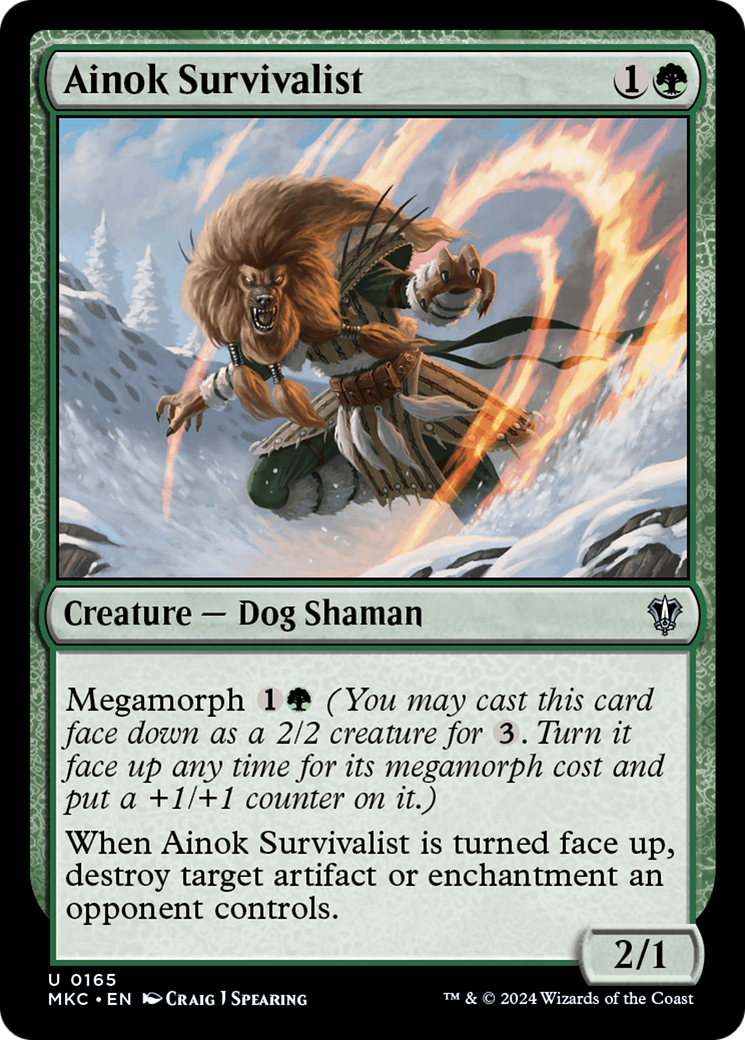
Ainok Survivalist
Ainok Survivalist
Creature — Dog Shaman
2/1
Megamorph (You may cast this card face down as a 2/2 creature for . Turn it face up any time for its megamorph cost and put a +1/+1 counter on it.)
When this creature is turned face up, destroy target artifact or enchantment an opponent controls.
- Turning a face-down creature with megamorph face up and putting a +1/+1 counter on it is a special action. It doesn't use the stack and can't be responded to.
- If a face-down creature with megamorph is turned face up some other way (for example, if you manifest a card with megamorph and then pay its mana cost to turn it face up), you won't put a +1/+1 counter on it.
- Megamorph is a variant of the morph ability. You can find more information on morph on cards with morph from the Khans of Tarkir set.
-
1
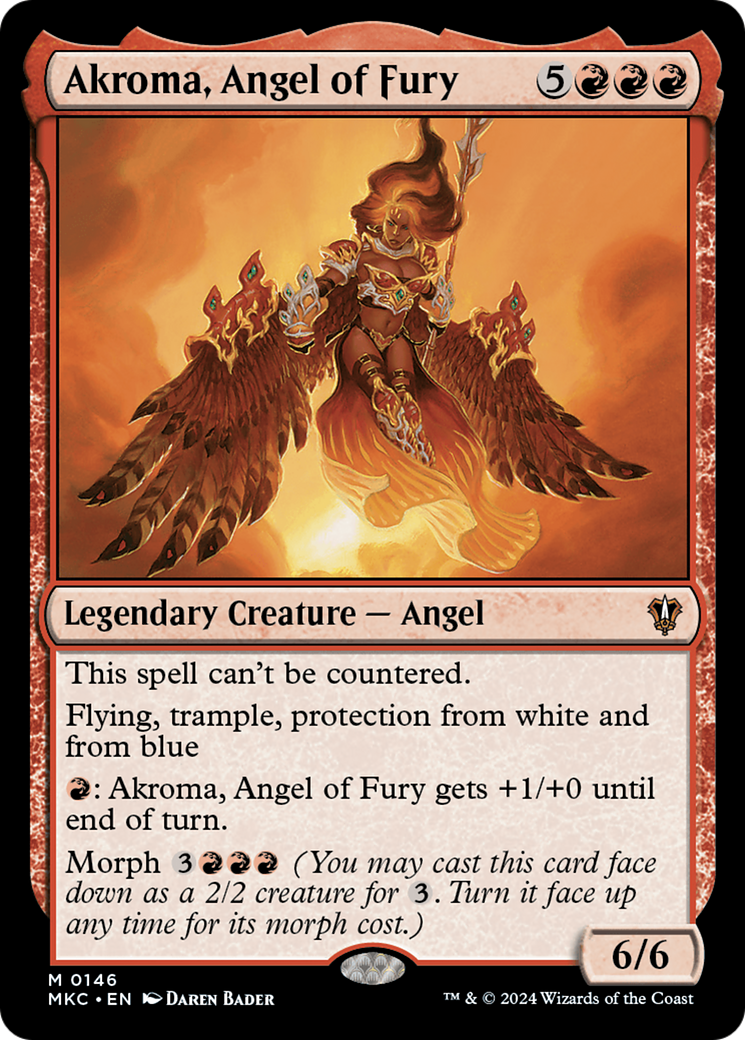
Akroma, Angel of Fury
Akroma, Angel of Fury
Legendary Creature — Angel
6/6
This spell can't be countered.
Flying, trample, protection from white and from blue
: Akroma gets +1/+0 until end of turn.
Morph (You may cast this card face down as a 2/2 creature for . Turn it face up any time for its morph cost.)
- A spell or ability that counters spells can still target Akroma. When that spell or ability resolves, Akroma won't be countered, but any additional effects of the countering spell or ability will still happen.
- If Akroma, Angel of Fury is cast face down, it can be countered.
- In a Commander game where Akroma is your commander, you may cast it face down from the command zone by paying plus for each time it has been cast from your command zone. The cost to turn it face up is unaffected. While face down, the combat damage it deals is still counted as damage dealt by your commander.
-
1
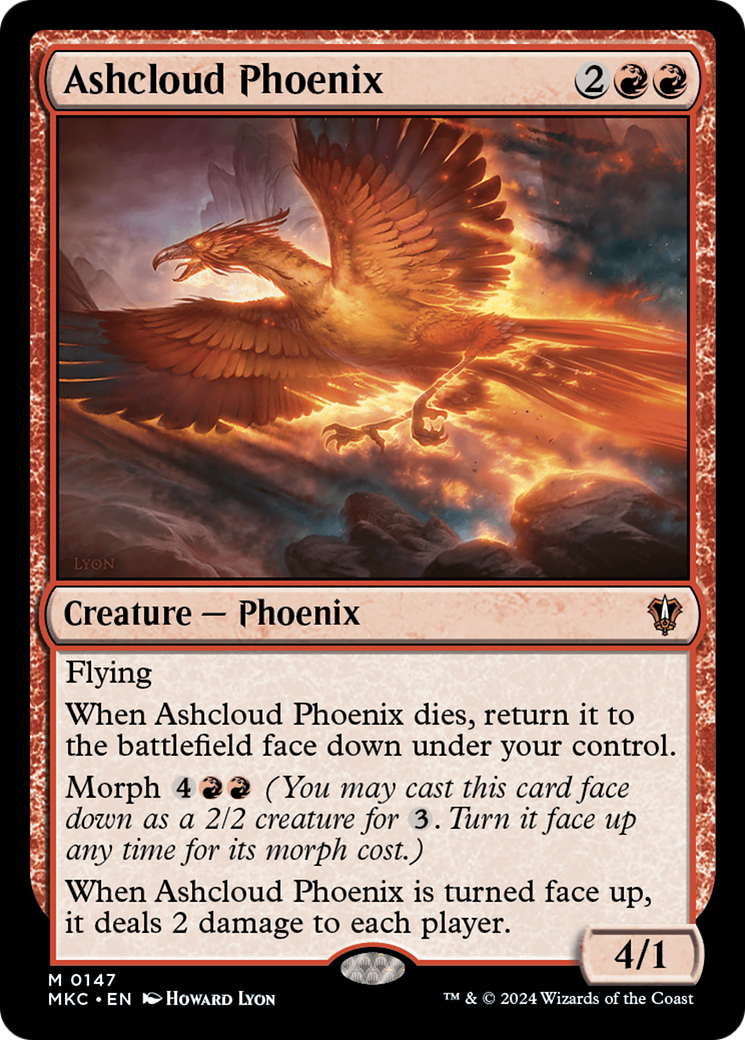
Ashcloud Phoenix
Ashcloud Phoenix
Creature — Phoenix
4/1
Flying
When this creature dies, return it to the battlefield face down under your control.
Morph (You may cast this card face down as a 2/2 creature for . Turn it face up any time for its morph cost.)
When this creature is turned face up, it deals 2 damage to each player.
- If Ashcloud Phoenix is face down, you can turn it face up for its morph cost, even if you didn't cast Ashcloud Phoenix face down using its morph ability.
- If Ashcloud Phoenix leaves the graveyard before its "dies" ability resolves, it won't return to the battlefield.
- Once Ashcloud Phoenix returns to the battlefield face down, each player will know which face-down creature it is. You can't mix up the positions of your face-down permanents to disguise this.
- Morph lets you cast a card face down by paying , and lets you turn the face-down permanent face up any time you have priority by paying its morph cost.
- The face-down spell has no mana cost and has a mana value of 0. When you cast a face-down spell, put it on the stack face down so no other player knows what it is, and pay . This is an alternative cost.
- When the spell resolves, it enters the battlefield as a 2/2 creature with no name, mana cost, creature types, or abilities. It's colorless and has a mana value of 0. Other effects that apply to the creature can still grant it any of these characteristics.
- Any time you have priority, you may turn the face-down creature face up by revealing what its morph cost is and paying that cost. This is a special action. It doesn't use the stack and can't be responded to. Only a face-down permanent can be turned face up this way; a face-down spell cannot.
- Because the permanent is on the battlefield both before and after it's turned face up, turning a permanent face up doesn't cause any enters-the-battlefield abilities to trigger.
- A permanent that turns face up or face down changes characteristics but is otherwise the same permanent. Spells and abilities that were targeting that permanent, as well as Auras and Equipment that were attached to the permanent, aren't affected.
- At any time, you can look at a face-down spell or permanent you control. You can't look at face-down spells or permanents you don't control unless an effect instructs you to do so.
- You must ensure that your face-down spells and permanents can easily be differentiated from each other. You're not allowed to mix up the cards that represent them on the battlefield in order to confuse other players. The order they entered the battlefield should remain clear. Common methods for doing this include using markers or dice, or simply placing them in order on the battlefield.
- If a face-down permanent leaves the battlefield, you must reveal it. You must also reveal all face-down spells and permanents you control if you leave the game or if the game ends.
-
1
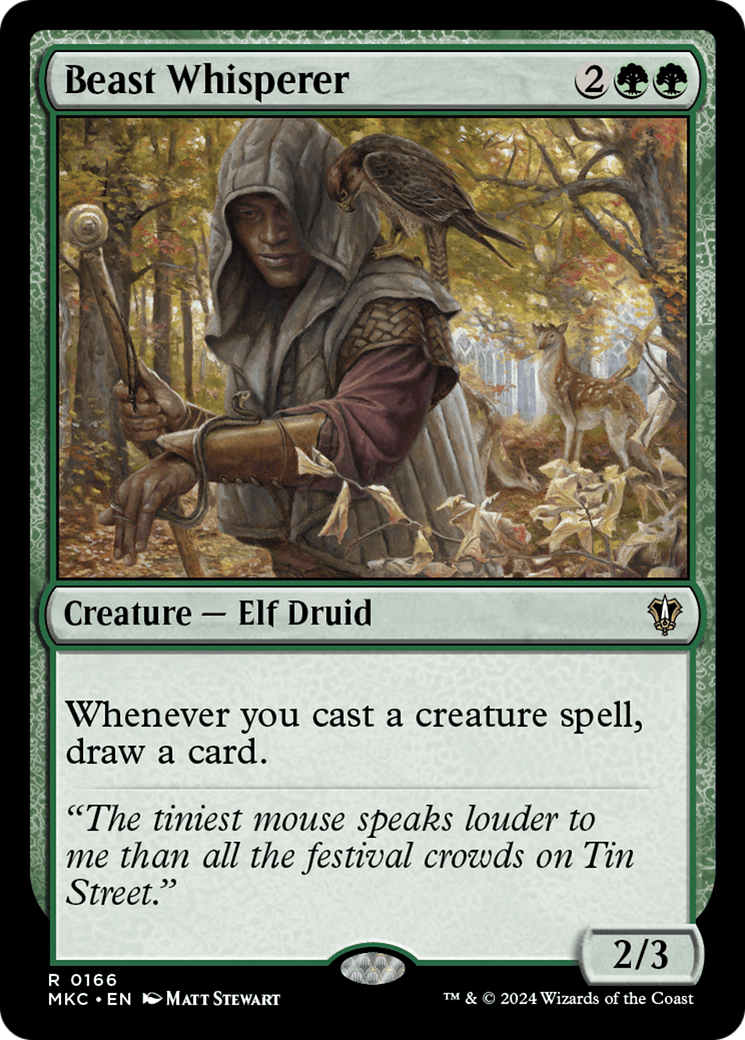
Beast Whisperer
Beast Whisperer
Creature — Elf Druid
2/3
Whenever you cast a creature spell, draw a card.
- An ability that triggers when a player casts a spell resolves before the spell that caused it to trigger. It resolves even if that spell is countered.
-
1
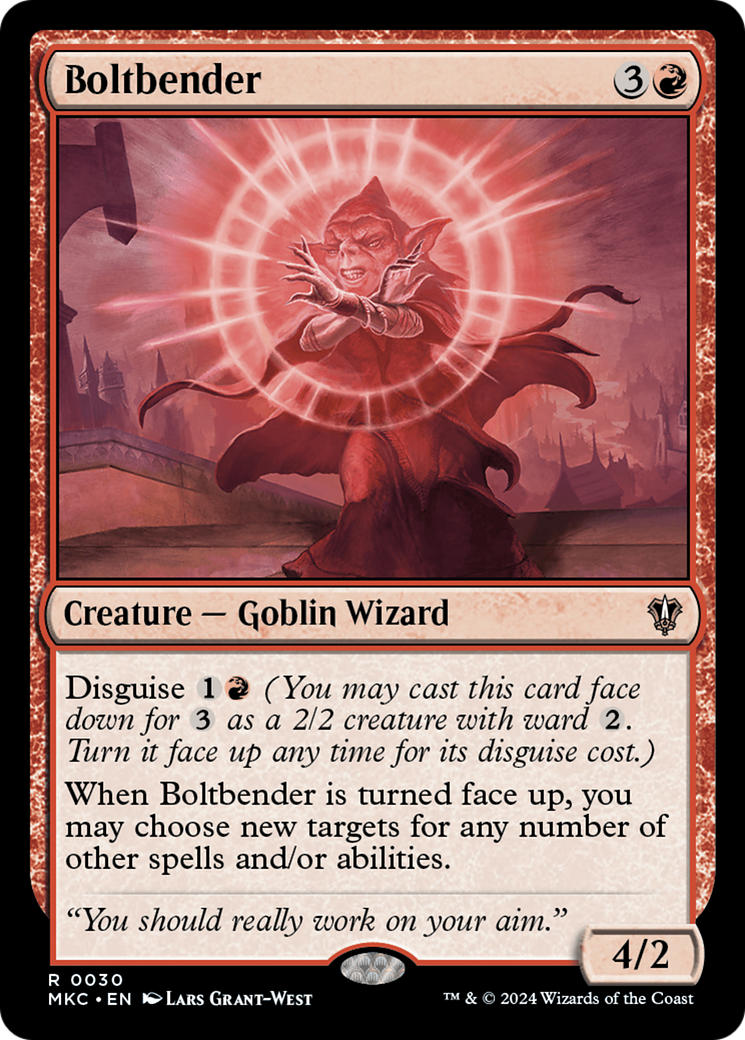
Boltbender
Boltbender
Creature — Goblin Wizard
4/2
Disguise (You may cast this card face down for as a 2/2 creature with ward . Turn it face up any time for its disguise cost.)
When this creature is turned face up, you may choose new targets for any number of other spells and/or abilities.
- If a spell or ability has a variable number of targets, you can’t change how many targets it has.
- If a spell or ability has damage divided, the division can’t be changed, although the targets receiving that damage still can. The same is true of spells and abilities that distribute counters.
- If you choose new targets for a spell or ability, those new targets must be legal.
- A disguise ability lets you cast a card face down by paying and announcing that you are using a disguise ability. Any time you have priority, you can turn a face-down permanent with disguise face up by paying its disguise cost.
- The face-down spell has no mana cost and a mana value of 0. When you cast a face-down spell, put it on the stack face down so no other player knows what it is, and pay to cast it. This is an alternative cost.
- The creature spell is a 2/2 creature spell with ward that has no name, mana cost, or creature types. The resulting creature is a 2/2 creature with ward that has no name, mana cost, or creature types. Both the spell and the resulting creature are colorless and have a mana value of 0. Other effects that apply to the spell or creature can still grant it any characteristics it doesn’t have or change the characteristics it does have.
- Any time you have priority, you may turn the face-down creature face up by revealing what its disguise cost is and paying that cost. This is a special action. It doesn’t use the stack and can’t be responded to. Only a face-down permanent can be turned face up this way; a face-down spell cannot.
- At any time, you can look at a face-down spell or permanent you control. You can’t look at face-down permanents or spells you don’t control unless an effect instructs or allows you to do so.
- If a face-down creature loses its abilities, it can’t be turned face up with a disguise ability because it will no longer have a disguise ability (or a disguise cost) once face up.
- Because the permanent is on the battlefield both before and after it’s turned face up, turning a permanent face up doesn’t cause any enters-the-battlefield abilities to trigger.
- Because face-down creatures don’t have a name, they can’t have the same name as any other creature, even another face-down creature.
- A permanent that turns face up or face down changes characteristics but is otherwise the same permanent. Spells and abilities that were targeting that permanent and Auras and Equipment that were attached to that permanent aren’t affected unless the new characteristics of the object change the legality of those targets or attachments.
- Turning a permanent face up or face down doesn’t change whether that permanent is tapped or untapped.
- If a face-down spell leaves the stack and goes to any zone other than the battlefield (if it was countered, for example), you must reveal it. Similarly, if a face-down permanent leaves the battlefield, you must reveal it. You must also reveal all face-down spells and permanents you control if you leave the game or the game ends.
- You must ensure that your face-down spells and permanents can be easily differentiated from each other. You’re not allowed to mix up the cards that represent them on the battlefield to confuse other players. The order in which they entered the battlefield should remain clear, as well as what ability caused them to be face down. (This includes disguise, cloak, and in games involving older cards, morph and manifest, as well as a few other effects that turn cards face down.) Common methods for doing this include using markers or dice, or simply placing them in order on the battlefield.
-
1
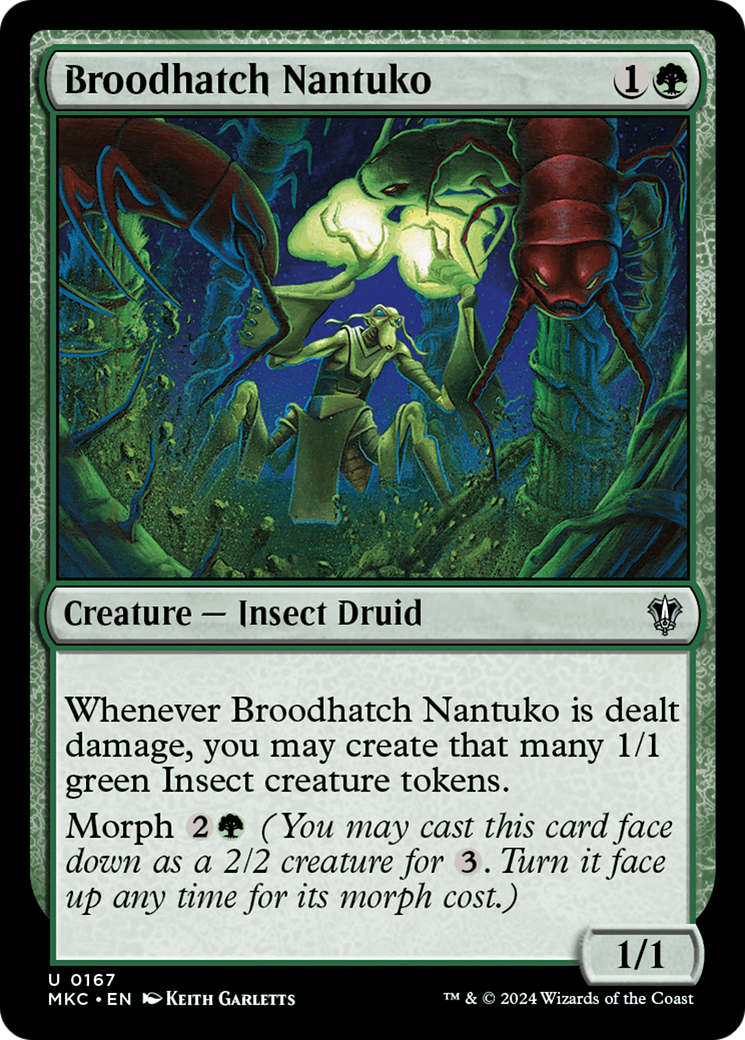
Broodhatch Nantuko
Broodhatch Nantuko
Creature — Insect Druid
1/1
Whenever this creature is dealt damage, you may create that many 1/1 green Insect creature tokens.
Morph (You may cast this card face down as a 2/2 creature for . Turn it face up any time for its morph cost.)
- You can choose to put zero tokens or all the tokens onto the battlefield. You can't choose a number in between.
-
1
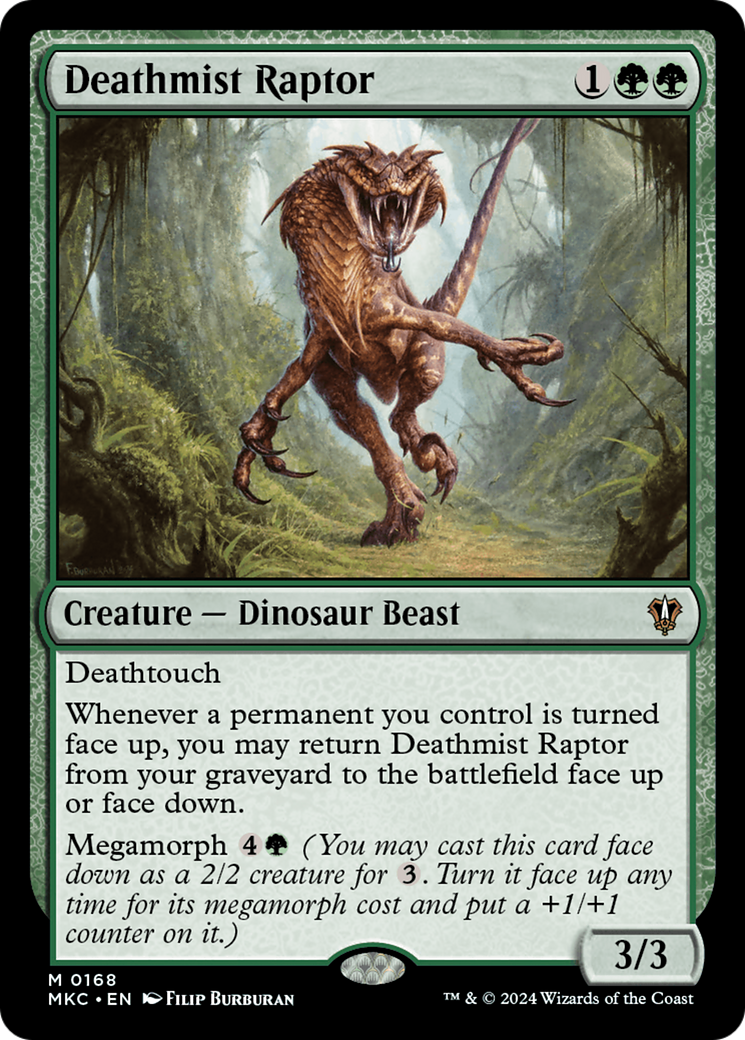
Deathmist Raptor
Deathmist Raptor
Creature — Dinosaur Beast
3/3
Deathtouch
Whenever a permanent you control is turned face up, you may return this card from your graveyard to the battlefield face up or face down.
Megamorph (You may cast this card face down as a 2/2 creature for . Turn it face up any time for its megamorph cost and put a +1/+1 counter on it.)
- Deathmist Raptor's second ability triggers only if Deathmist Raptor is in the graveyard when a permanent you control is turned face up.
- You choose whether Deathmist Raptor will enter the battlefield face up or face down as the ability resolves. You may also choose to leave it in the graveyard.
- Turning a face-down creature with megamorph face up and putting a +1/+1 counter on it is a special action. It doesn't use the stack and can't be responded to.
- If a face-down creature with megamorph is turned face up some other way (for example, if you manifest a card with megamorph and then pay its mana cost to turn it face up), you won't put a +1/+1 counter on it.
- Megamorph is a variant of the morph ability. You can find more information on morph on cards with morph from the Khans of Tarkir set.
-
1
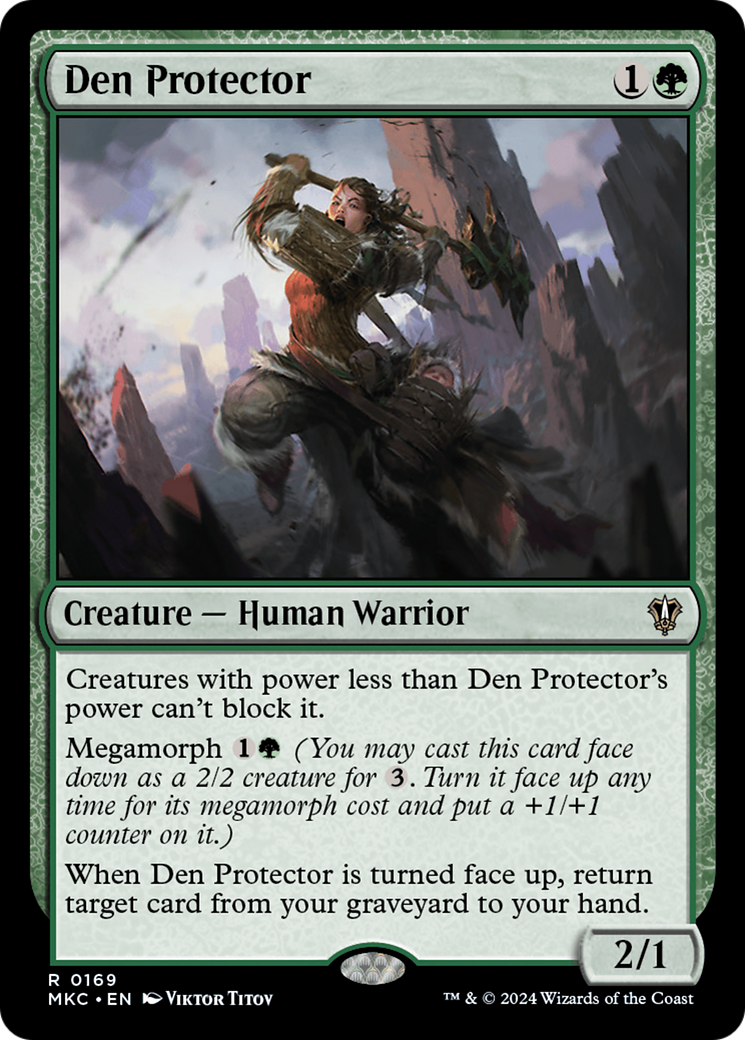
Den Protector
Den Protector
Creature — Human Warrior
2/1
Creatures with power less than this creature's power can't block it.
Megamorph (You may cast this card face down as a 2/2 creature for . Turn it face up any time for its megamorph cost and put a +1/+1 counter on it.)
When this creature is turned face up, return target card from your graveyard to your hand.
- You compare Den Protector's power to the power of any creature trying to block it only as blockers are assigned. Once Den Protector has been legally blocked by a creature, changing the power of either creature won't change or undo the block.
- Turning a face-down creature with megamorph face up and putting a +1/+1 counter on it is a special action. It doesn't use the stack and can't be responded to.
- If a face-down creature with megamorph is turned face up some other way (for example, if you manifest a card with megamorph and then pay its mana cost to turn it face up), you won't put a +1/+1 counter on it.
- Megamorph is a variant of the morph ability. You can find more information on morph on cards with morph from the Khans of Tarkir set.
-
1
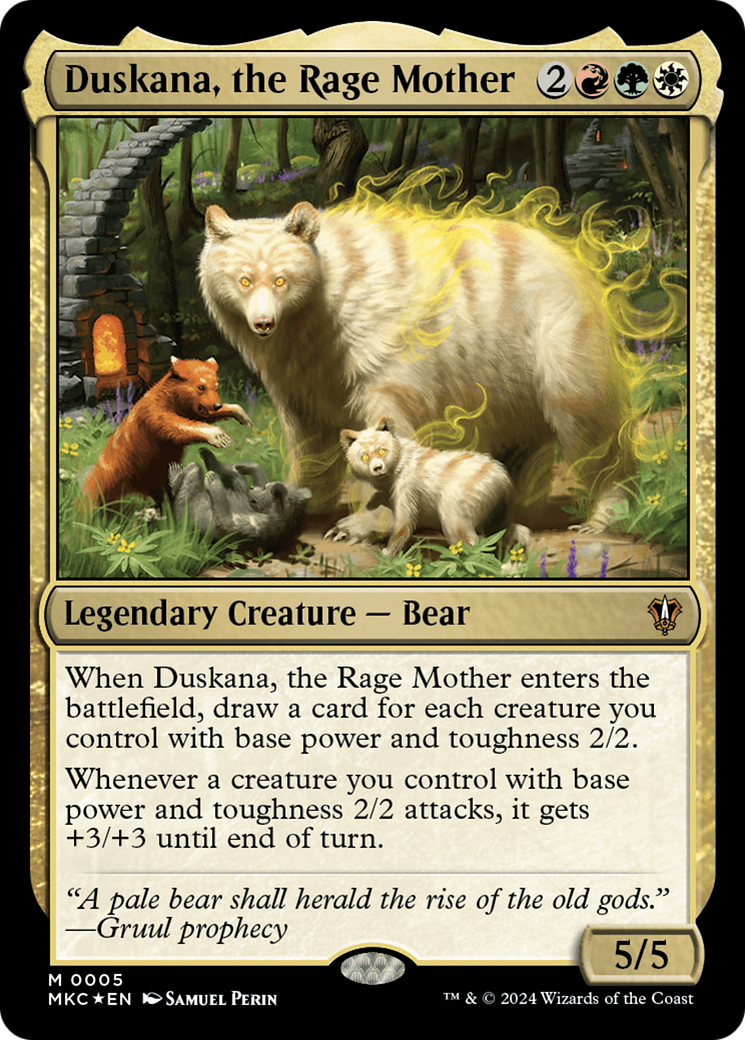
Duskana, the Rage Mother
Duskana, the Rage Mother
Legendary Creature — Bear
5/5
When Duskana enters, draw a card for each creature you control with base power and toughness 2/2.
Whenever a creature you control with base power and toughness 2/2 attacks, it gets +3/+3 until end of turn.
- Normally, a creature's base power and toughness are the power and toughness printed on the card or, for a token, the power and toughness set by the effect that created it. If another effect sets a creature's power and toughness to specific numbers or values, those become its base power and toughness. If an effect modifies a creature's power and/or toughness without setting them, that is not included when determining its base power and toughness.
- If a creature has a characteristic-defining ability that sets its power and toughness, indicated with a */* or similar in the power and toughness box, that ability is taken into account when determining its base power and toughness.
- Some creatures have base power and toughness 0/0 and an ability that gives them a bonus based on some criteria. Those are not characteristic-defining abilities, and that ability doesn't change its base power and toughness.
-
1
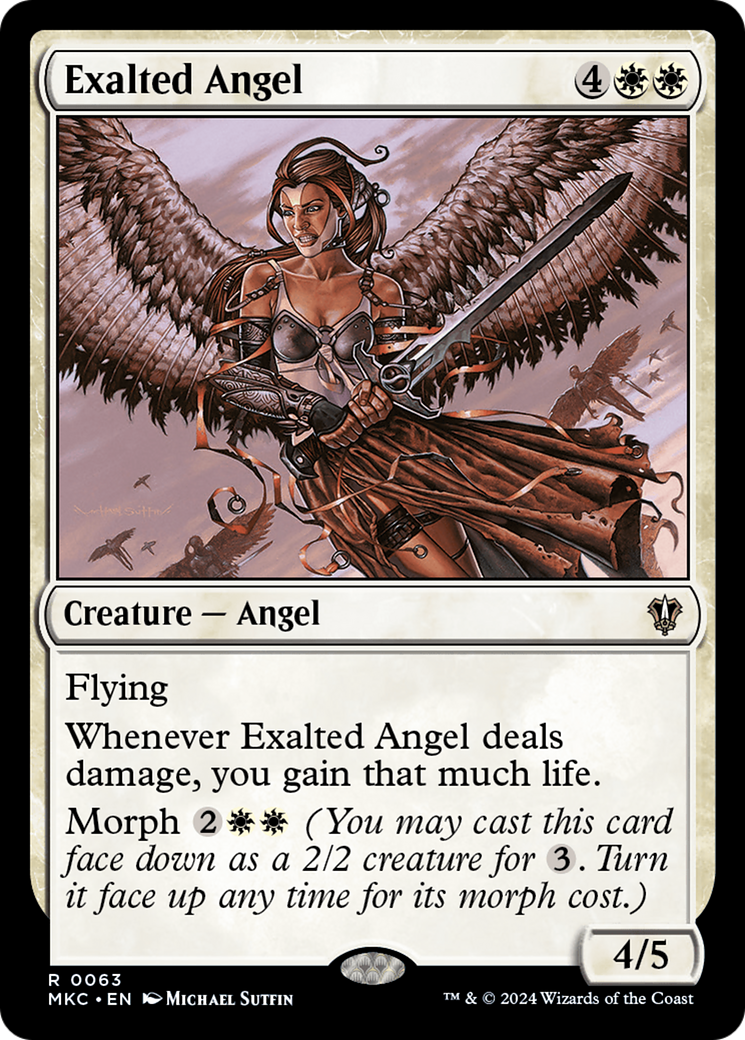
Exalted Angel
Exalted Angel
Creature — Angel
4/5
Flying
Whenever this creature deals damage, you gain that much life.
Morph (You may cast this card face down as a 2/2 creature for . Turn it face up any time for its morph cost.)
- You only gain the life when the triggered ability resolves. If you are reduced to zero life before the ability resolves, you will lose before gaining the life.
-
1
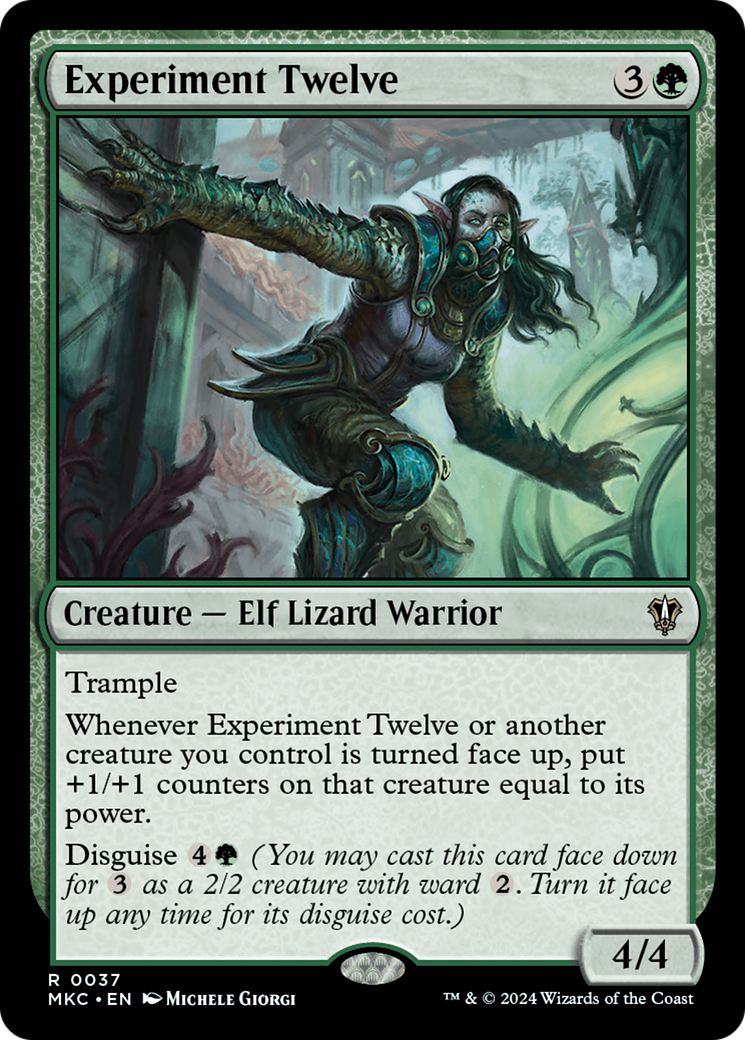
Experiment Twelve
Experiment Twelve
Creature — Elf Lizard Warrior
4/4
Trample
Whenever this creature or another creature you control is turned face up, put +1/+1 counters on that creature equal to its power.
Disguise (You may cast this card face down for as a 2/2 creature with ward . Turn it face up any time for its disguise cost.)
- A disguise ability lets you cast a card face down by paying and announcing that you are using a disguise ability. Any time you have priority, you can turn a face-down permanent with disguise face up by paying its disguise cost.
- The face-down spell has no mana cost and a mana value of 0. When you cast a face-down spell, put it on the stack face down so no other player knows what it is, and pay to cast it. This is an alternative cost.
- The creature spell is a 2/2 creature spell with ward that has no name, mana cost, or creature types. The resulting creature is a 2/2 creature with ward that has no name, mana cost, or creature types. Both the spell and the resulting creature are colorless and have a mana value of 0. Other effects that apply to the spell or creature can still grant it any characteristics it doesn’t have or change the characteristics it does have.
- Any time you have priority, you may turn the face-down creature face up by revealing what its disguise cost is and paying that cost. This is a special action. It doesn’t use the stack and can’t be responded to. Only a face-down permanent can be turned face up this way; a face-down spell cannot.
- At any time, you can look at a face-down spell or permanent you control. You can’t look at face-down permanents or spells you don’t control unless an effect instructs or allows you to do so.
- If a face-down creature loses its abilities, it can’t be turned face up with a disguise ability because it will no longer have a disguise ability (or a disguise cost) once face up.
- Because the permanent is on the battlefield both before and after it’s turned face up, turning a permanent face up doesn’t cause any enters-the-battlefield abilities to trigger.
- Because face-down creatures don’t have a name, they can’t have the same name as any other creature, even another face-down creature.
- A permanent that turns face up or face down changes characteristics but is otherwise the same permanent. Spells and abilities that were targeting that permanent and Auras and Equipment that were attached to that permanent aren’t affected unless the new characteristics of the object change the legality of those targets or attachments.
- Turning a permanent face up or face down doesn’t change whether that permanent is tapped or untapped.
- If a face-down spell leaves the stack and goes to any zone other than the battlefield (if it was countered, for example), you must reveal it. Similarly, if a face-down permanent leaves the battlefield, you must reveal it. You must also reveal all face-down spells and permanents you control if you leave the game or the game ends.
- You must ensure that your face-down spells and permanents can be easily differentiated from each other. You’re not allowed to mix up the cards that represent them on the battlefield to confuse other players. The order in which they entered the battlefield should remain clear, as well as what ability caused them to be face down. (This includes disguise, cloak, and in games involving older cards, morph and manifest, as well as a few other effects that turn cards face down.) Common methods for doing this include using markers or dice, or simply placing them in order on the battlefield.
-
1
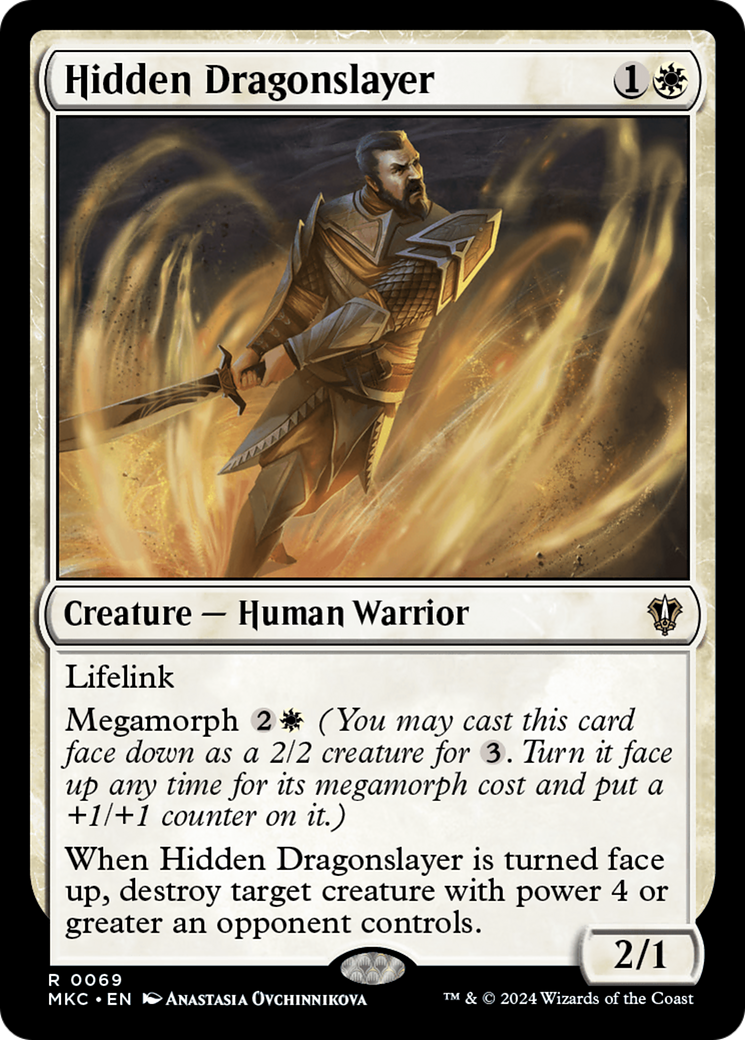
Hidden Dragonslayer
Hidden Dragonslayer
Creature — Human Warrior
2/1
Lifelink
Megamorph (You may cast this card face down as a 2/2 creature for . Turn it face up any time for its megamorph cost and put a +1/+1 counter on it.)
When this creature is turned face up, destroy target creature with power 4 or greater an opponent controls.
- Turning a face-down creature with megamorph face up and putting a +1/+1 counter on it is a special action. It doesn't use the stack and can't be responded to.
- If a face-down creature with megamorph is turned face up some other way (for example, if you manifest a card with megamorph and then pay its mana cost to turn it face up), you won't put a +1/+1 counter on it.
- Megamorph is a variant of the morph ability. You can find more information on morph on cards with morph from the Khans of Tarkir set.
-
1
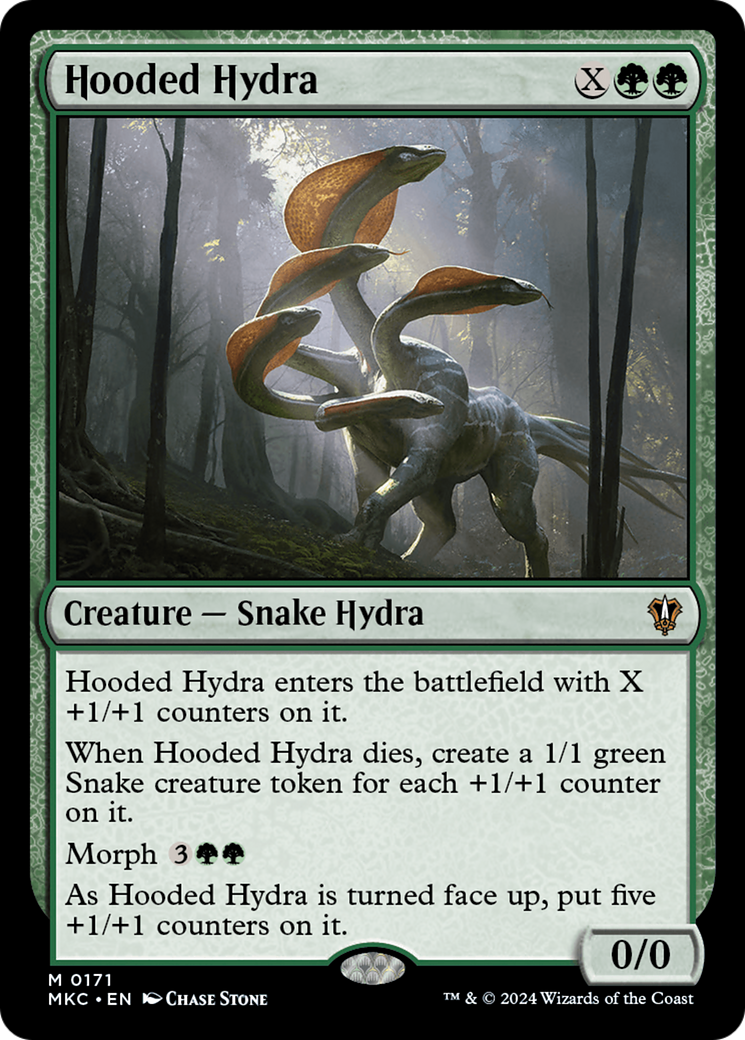
Hooded Hydra
Hooded Hydra
Creature — Snake Hydra
0/0
This creature enters with X +1/+1 counters on it.
When this creature dies, create a 1/1 green Snake creature token for each +1/+1 counter on it.
Morph
As this creature is turned face up, put five +1/+1 counters on it.
- Use the number of +1/+1 counters that were on Hooded Hydra the last time it was on the battlefield to determine how many Snake tokens to create.
- Hooded Hydra's last ability isn't a triggered ability. It's a replacement ability that modifies how Hooded Hydra is turned face up. Players can't respond to Hooded Hydra being turned face up and having five +1/+1 counters put on it.
- If Hooded Hydra is face down and it's turned face up some other way than by having its morph cost paid, the last ability will still apply.
- Morph lets you cast a card face down by paying , and lets you turn the face-down permanent face up any time you have priority by paying its morph cost.
- The face-down spell has no mana cost and has a mana value of 0. When you cast a face-down spell, put it on the stack face down so no other player knows what it is, and pay . This is an alternative cost.
- When the spell resolves, it enters the battlefield as a 2/2 creature with no name, mana cost, creature types, or abilities. It's colorless and has a mana value of 0. Other effects that apply to the creature can still grant it any of these characteristics.
- Any time you have priority, you may turn the face-down creature face up by revealing what its morph cost is and paying that cost. This is a special action. It doesn't use the stack and can't be responded to. Only a face-down permanent can be turned face up this way; a face-down spell cannot.
- Because the permanent is on the battlefield both before and after it's turned face up, turning a permanent face up doesn't cause any enters-the-battlefield abilities to trigger.
- A permanent that turns face up or face down changes characteristics but is otherwise the same permanent. Spells and abilities that were targeting that permanent, as well as Auras and Equipment that were attached to the permanent, aren't affected.
- At any time, you can look at a face-down spell or permanent you control. You can't look at face-down spells or permanents you don't control unless an effect instructs you to do so.
- You must ensure that your face-down spells and permanents can easily be differentiated from each other. You're not allowed to mix up the cards that represent them on the battlefield in order to confuse other players. The order they entered the battlefield should remain clear. Common methods for doing this include using markers or dice, or simply placing them in order on the battlefield.
- If a face-down permanent leaves the battlefield, you must reveal it. You must also reveal all face-down spells and permanents you control if you leave the game or if the game ends.
-
1
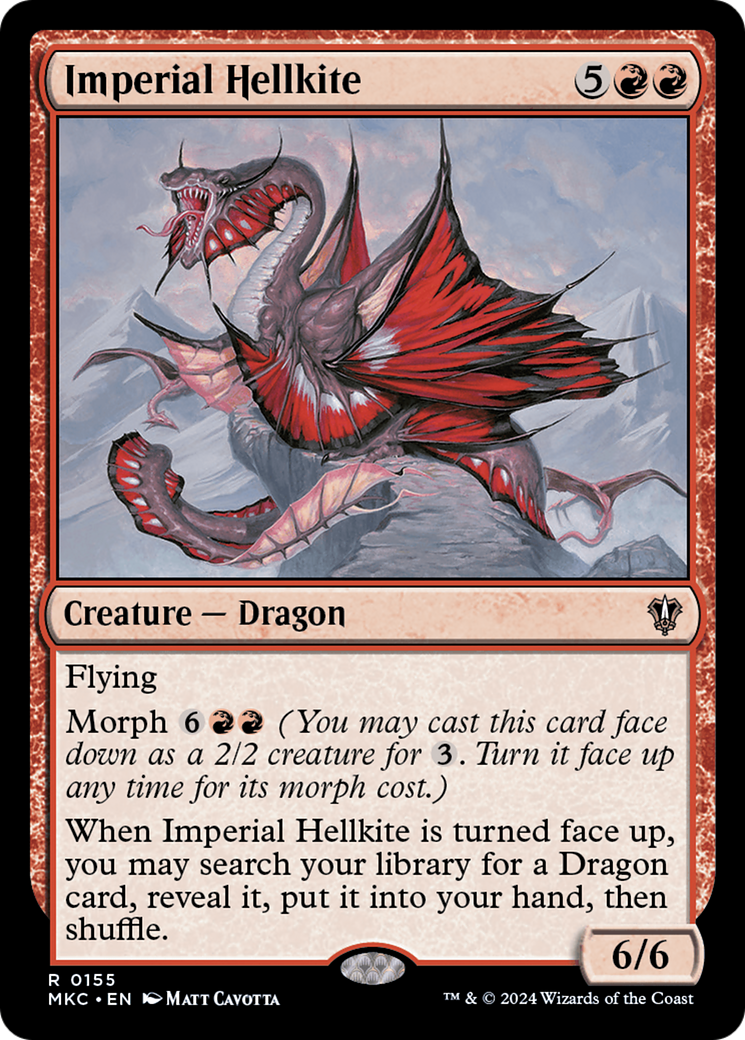
Imperial Hellkite
Imperial Hellkite
Creature — Dragon
6/6
Flying
Morph (You may cast this card face down as a 2/2 creature for . Turn it face up any time for its morph cost.)
When this creature is turned face up, you may search your library for a Dragon card, reveal it, put it into your hand, then shuffle.
- You do not have to find a Dragon card if you do not want to, even if you have one in your library.
- The trigger occurs when you use the Morph ability to turn the card face up, or when an effect turns it face up. It will not trigger on being revealed or on leaving the battlefield.
-
1
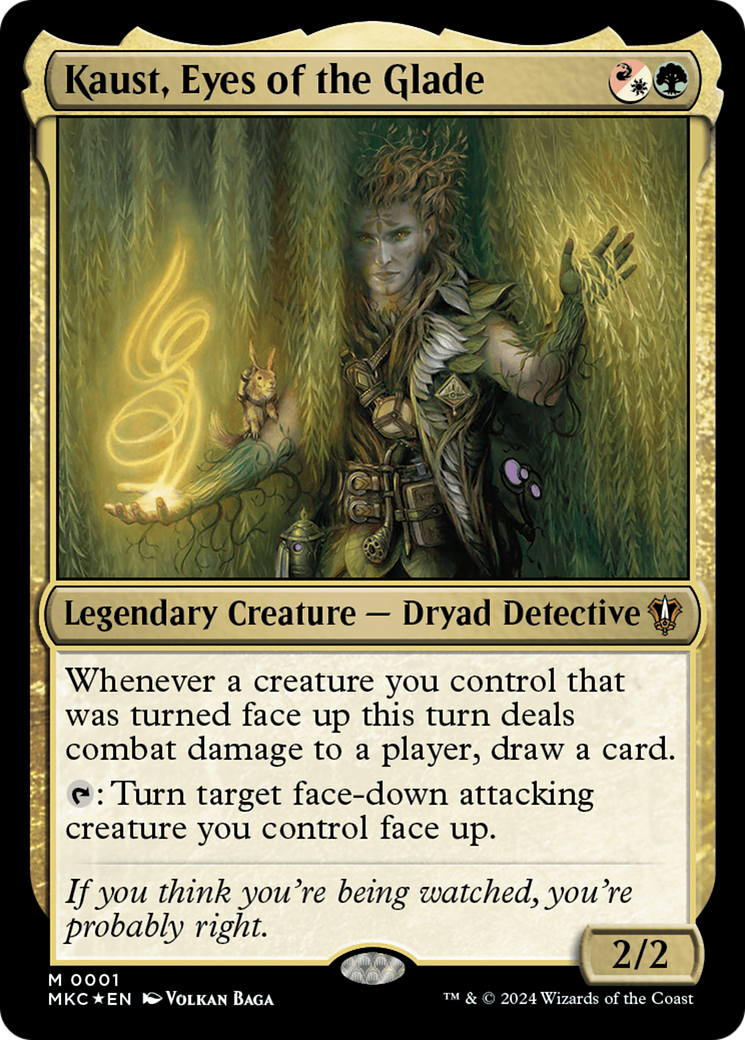
Kaust, Eyes of the Glade
Kaust, Eyes of the Glade
Legendary Creature — Dryad Detective
2/2
Whenever a creature you control that was turned face up this turn deals combat damage to a player, draw a card.
: Turn target face-down attacking creature you control face up.
- The creature must have been turned face up before dealing combat damage to a player for Kaust, Eyes of the Glade’s first ability to trigger.
-
1
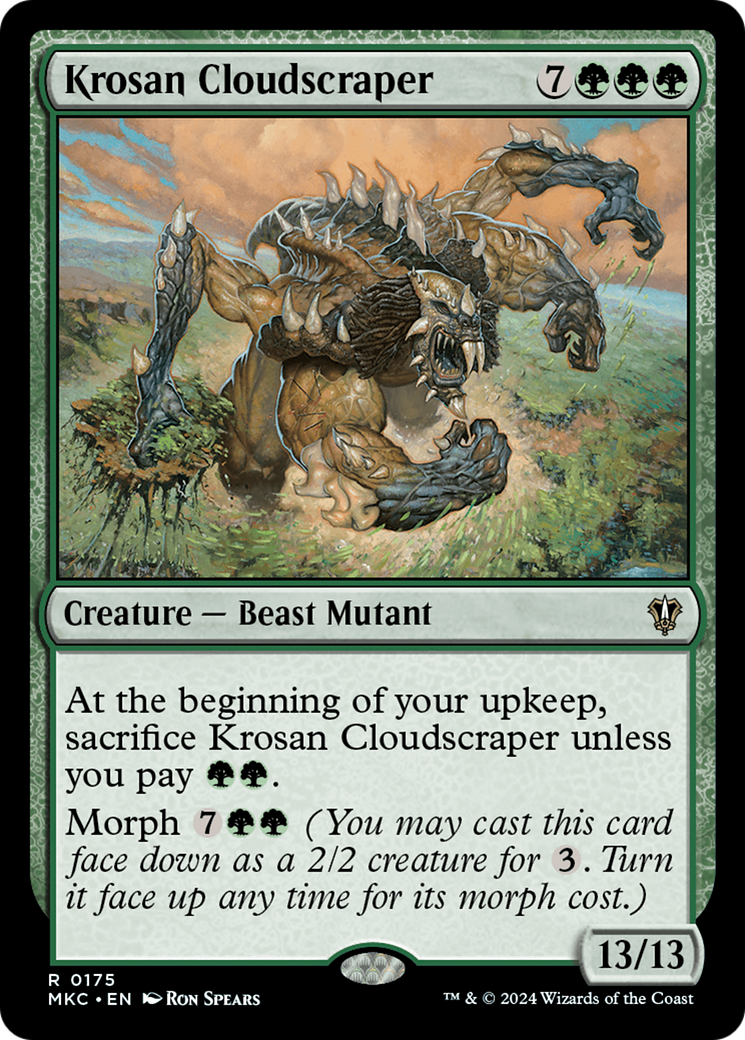
Krosan Cloudscraper
Krosan Cloudscraper
Creature — Beast Mutant
13/13
At the beginning of your upkeep, sacrifice this creature unless you pay .
Morph (You may cast this card face down as a 2/2 creature for . Turn it face up any time for its morph cost.)
-
1
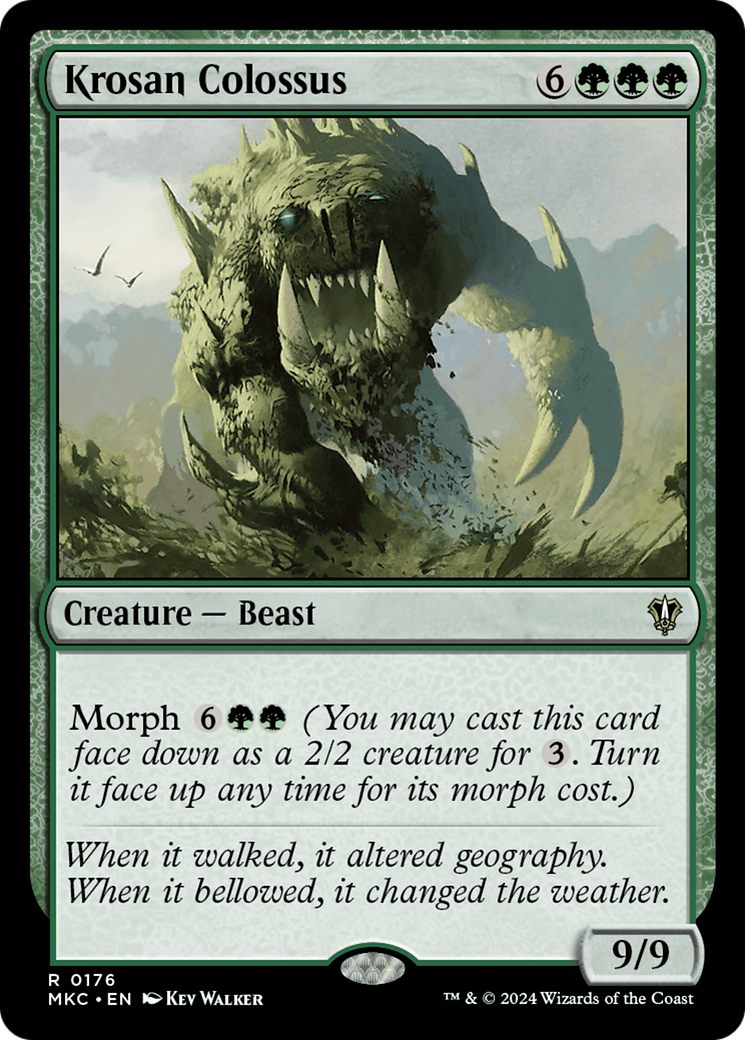
Krosan Colossus
Krosan Colossus
Creature — Beast
9/9
Morph (You may cast this card face down as a 2/2 creature for . Turn it face up any time for its morph cost.)
-
1
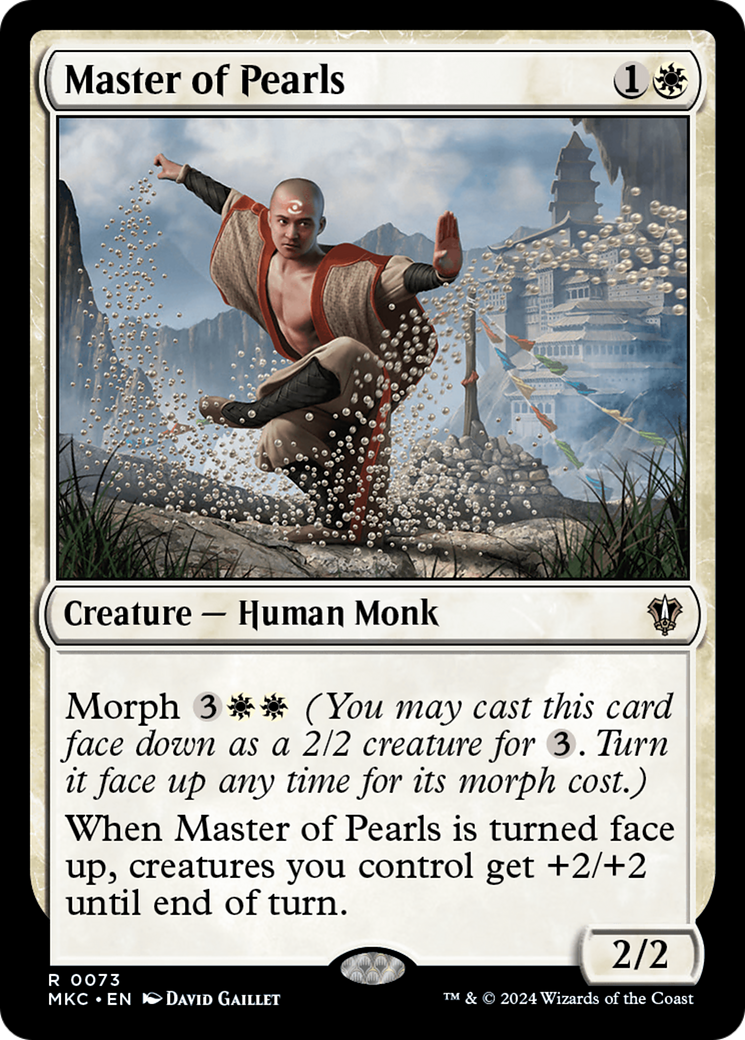
Master of Pearls
Master of Pearls
Creature — Human Monk
2/2
Morph (You may cast this card face down as a 2/2 creature for . Turn it face up any time for its morph cost.)
When this creature is turned face up, creatures you control get +2/+2 until end of turn.
- Morph lets you cast a card face down by paying , and lets you turn the face-down permanent face up any time you have priority by paying its morph cost.
- The face-down spell has no mana cost and has a mana value of 0. When you cast a face-down spell, put it on the stack face down so no other player knows what it is, and pay . This is an alternative cost.
- When the spell resolves, it enters the battlefield as a 2/2 creature with no name, mana cost, creature types, or abilities. It's colorless and has a mana value of 0. Other effects that apply to the creature can still grant it any of these characteristics.
- Any time you have priority, you may turn the face-down creature face up by revealing what its morph cost is and paying that cost. This is a special action. It doesn't use the stack and can't be responded to. Only a face-down permanent can be turned face up this way; a face-down spell cannot.
- Because the permanent is on the battlefield both before and after it's turned face up, turning a permanent face up doesn't cause any enters-the-battlefield abilities to trigger.
- A permanent that turns face up or face down changes characteristics but is otherwise the same permanent. Spells and abilities that were targeting that permanent, as well as Auras and Equipment that were attached to the permanent, aren't affected.
- At any time, you can look at a face-down spell or permanent you control. You can't look at face-down spells or permanents you don't control unless an effect instructs you to do so.
- You must ensure that your face-down spells and permanents can easily be differentiated from each other. You're not allowed to mix up the cards that represent them on the battlefield in order to confuse other players. The order they entered the battlefield should remain clear. Common methods for doing this include using markers or dice, or simply placing them in order on the battlefield.
- If a face-down permanent leaves the battlefield, you must reveal it. You must also reveal all face-down spells and permanents you control if you leave the game or if the game ends.
-
1
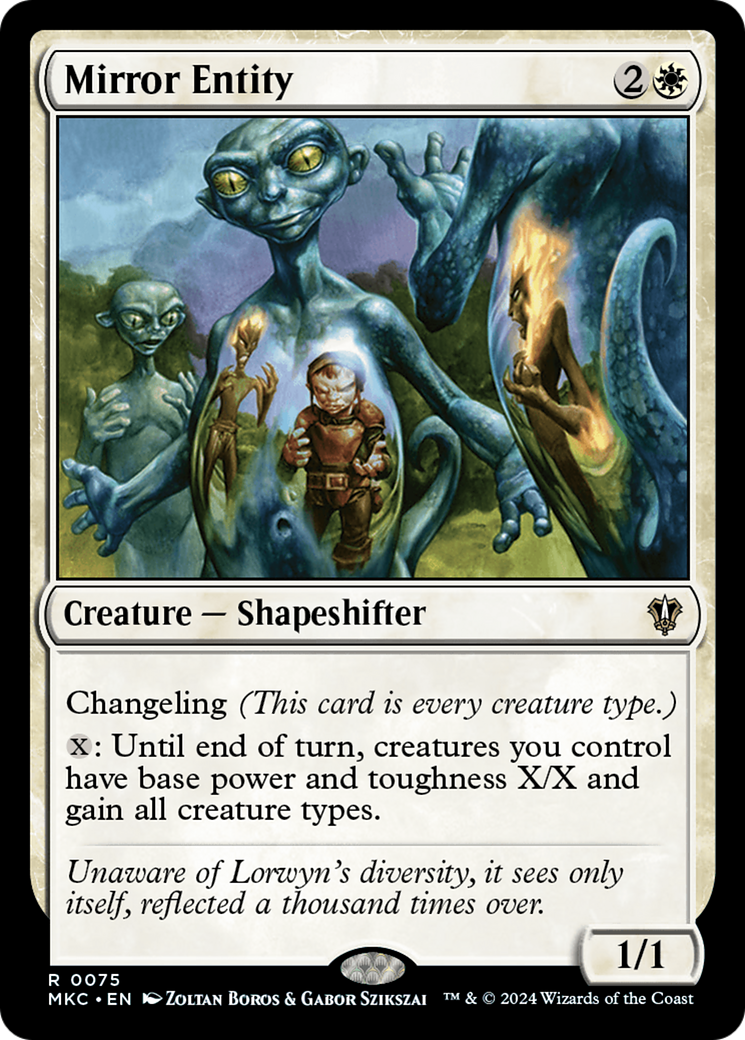
Mirror Entity
Mirror Entity
Creature — Shapeshifter
1/1
Changeling (This card is every creature type.)
: Until end of turn, creatures you control have base power and toughness X/X and gain all creature types.
- Changeling applies in all zones, not just the battlefield.
- Mirror Entity's ability overwrites any effects that previously set a creature's base power and/or toughness. Any existing effects or counters that raise or lower a creature's power and/or toughness continue to apply to the creature's newly-set power and toughness.
- Activating the ability with X = 0 will cause all creatures you control to become 0/0 and be put into the graveyard.
-
1
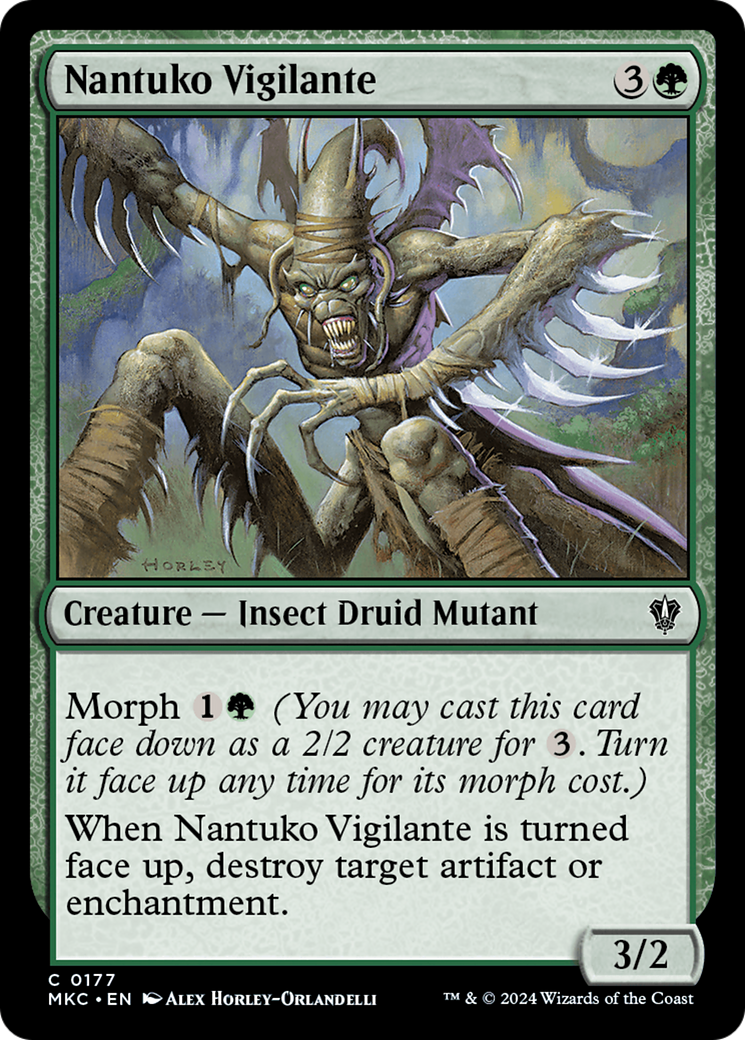
Nantuko Vigilante
Nantuko Vigilante
Creature — Insect Druid Mutant
3/2
Morph (You may cast this card face down as a 2/2 creature for . Turn it face up any time for its morph cost.)
When this creature is turned face up, destroy target artifact or enchantment.
- The trigger occurs when you use the Morph ability to turn the card face up, or when an effect turns it face up. It will not trigger on being revealed or on leaving the battlefield.
-
1
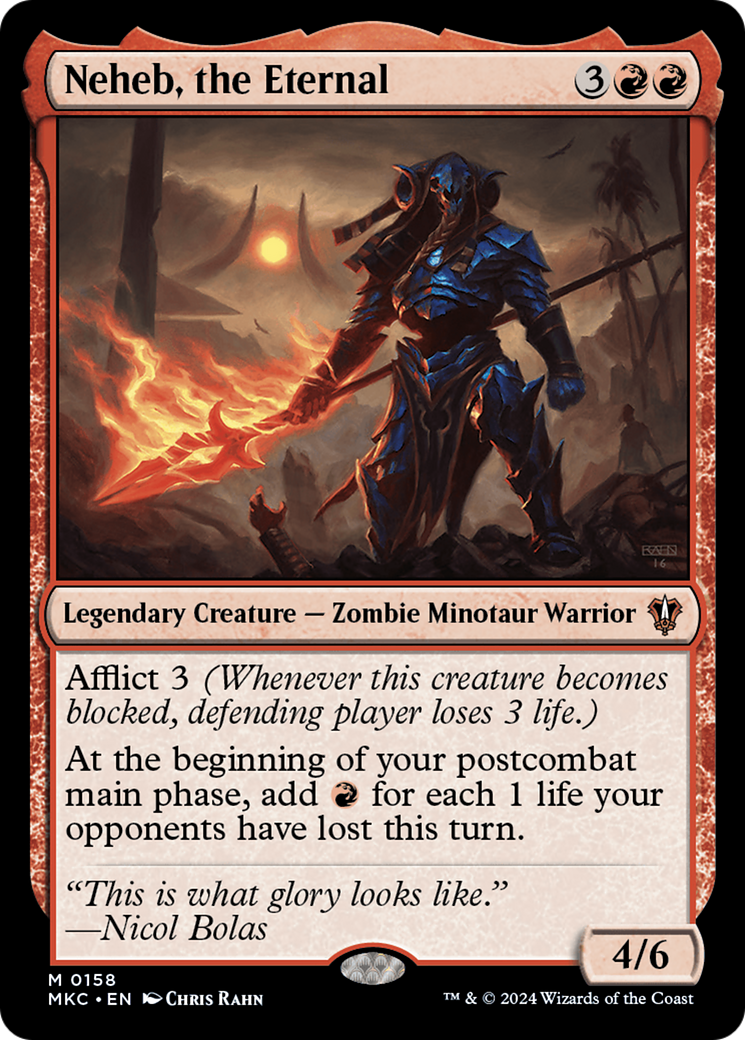
Neheb, the Eternal
Neheb, the Eternal
Legendary Creature — Zombie Minotaur Warrior
4/6
Afflict 3 (Whenever this creature becomes blocked, defending player loses 3 life.)
At the beginning of each of your postcombat main phases, add for each 1 life your opponents have lost this turn.
- If a creature is attacking a planeswalker, that planeswalker's controller is the defending player. If a creature is attacking a battle, that battle's protector is the defending player.
- Because it triggers at the beginning of a phase, Neheb's last ability isn't a mana ability. It uses the stack and can be countered by effects that interact with triggered abilities, such as that of Nimble Obstructionist.
- You get a postcombat main phase even if no creatures attacked during a turn. Neheb's last ability will trigger.
- If an opponent loses life but Neheb leaves the battlefield before your postcombat main phase begins, its last ability doesn't trigger.
- Neheb's ability checks only how much life opponents lost during the turn, not by how much their life total decreased compared to the start of the turn. For example, if an opponent lost 2 life and then gained 8 life before your postcombat main phase, you'll add .
- Damage dealt to a player causes that player to lose that much life.
- If you somehow have more than two main phases in a turn, each main phase after your first one is a postcombat main phase, and Neheb's last ability triggers at the beginning of each of them.
- If multiple creatures block a creature with afflict, afflict triggers only once.
- Afflict causes the defending player to lose life; it's not damage or combat damage.
- Afflict resolves before combat damage is dealt. If this loss of life brings a player to 0 life or less, that player loses the game immediately. A blocking creature with lifelink won't deal combat damage in time to save that player.
- If an opponent loses life and subsequently loses the game before your postcombat main phase, Neheb's last ability counts that loss of life.
-
1
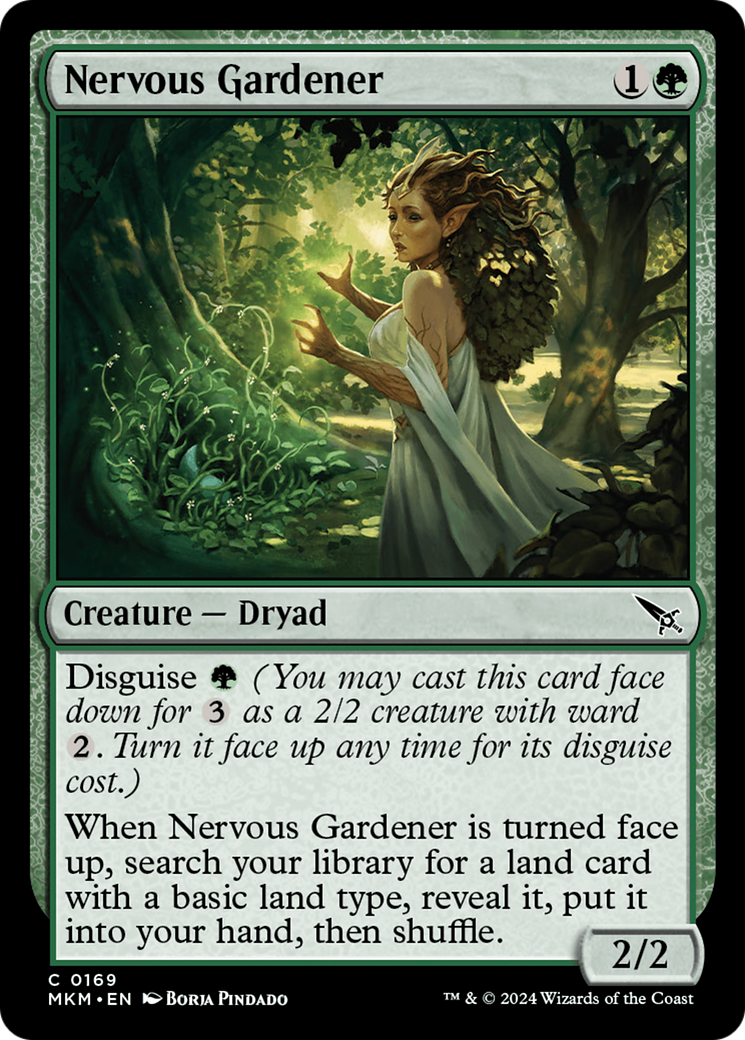
Nervous Gardener
Nervous Gardener
Creature — Dryad
2/2
Disguise (You may cast this card face down for as a 2/2 creature with ward . Turn it face up any time for its disguise cost.)
When this creature is turned face up, search your library for a land card with a basic land type, reveal it, put it into your hand, then shuffle.
-
1
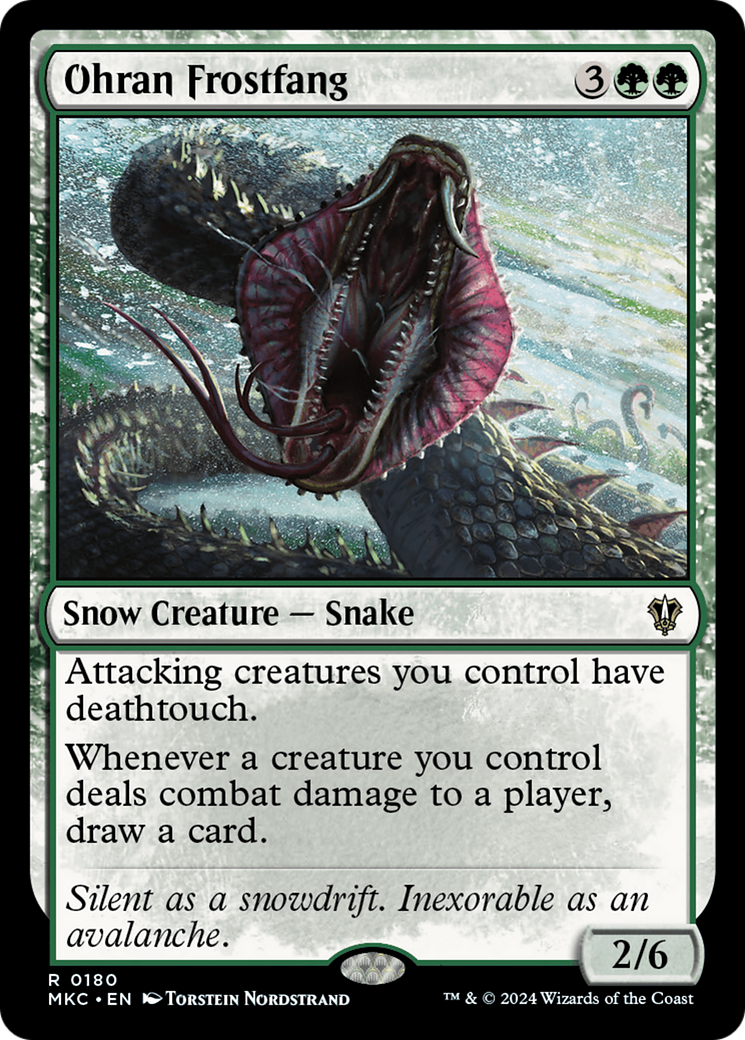
Ohran Frostfang
Ohran Frostfang
Snow Creature — Snake
2/6
Attacking creatures you control have deathtouch.
Whenever a creature you control deals combat damage to a player, draw a card.
- If one or more creatures you control deal combat damage to players at the same time that lethal damage is dealt to Ohran Frostfang, its ability triggers for each of those creatures.
- Snow is a supertype, not a card type. It has no rules meaning or function by itself, but other cards and abilities may refer to it.
-
1
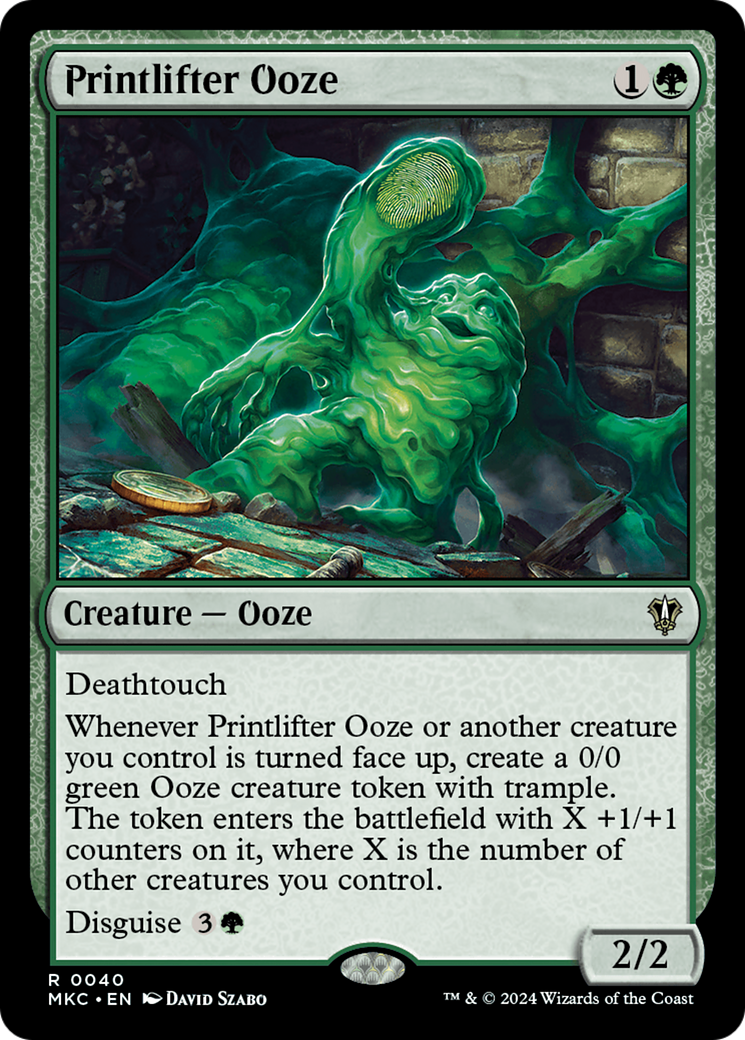
Printlifter Ooze
Printlifter Ooze
Creature — Ooze
2/2
Deathtouch
Whenever this creature or another creature you control is turned face up, create a 0/0 green Ooze creature token with trample. The token enters with X +1/+1 counters on it, where X is the number of other creatures you control.
Disguise
- A disguise ability lets you cast a card face down by paying and announcing that you are using a disguise ability. Any time you have priority, you can turn a face-down permanent with disguise face up by paying its disguise cost.
- The face-down spell has no mana cost and a mana value of 0. When you cast a face-down spell, put it on the stack face down so no other player knows what it is, and pay to cast it. This is an alternative cost.
- The creature spell is a 2/2 creature spell with ward that has no name, mana cost, or creature types. The resulting creature is a 2/2 creature with ward that has no name, mana cost, or creature types. Both the spell and the resulting creature are colorless and have a mana value of 0. Other effects that apply to the spell or creature can still grant it any characteristics it doesn’t have or change the characteristics it does have.
- Any time you have priority, you may turn the face-down creature face up by revealing what its disguise cost is and paying that cost. This is a special action. It doesn’t use the stack and can’t be responded to. Only a face-down permanent can be turned face up this way; a face-down spell cannot.
- At any time, you can look at a face-down spell or permanent you control. You can’t look at face-down permanents or spells you don’t control unless an effect instructs or allows you to do so.
- If a face-down creature loses its abilities, it can’t be turned face up with a disguise ability because it will no longer have a disguise ability (or a disguise cost) once face up.
- Because the permanent is on the battlefield both before and after it’s turned face up, turning a permanent face up doesn’t cause any enters-the-battlefield abilities to trigger.
- Because face-down creatures don’t have a name, they can’t have the same name as any other creature, even another face-down creature.
- A permanent that turns face up or face down changes characteristics but is otherwise the same permanent. Spells and abilities that were targeting that permanent and Auras and Equipment that were attached to that permanent aren’t affected unless the new characteristics of the object change the legality of those targets or attachments.
- Turning a permanent face up or face down doesn’t change whether that permanent is tapped or untapped.
- If a face-down spell leaves the stack and goes to any zone other than the battlefield (if it was countered, for example), you must reveal it. Similarly, if a face-down permanent leaves the battlefield, you must reveal it. You must also reveal all face-down spells and permanents you control if you leave the game or the game ends.
- You must ensure that your face-down spells and permanents can be easily differentiated from each other. You’re not allowed to mix up the cards that represent them on the battlefield to confuse other players. The order in which they entered the battlefield should remain clear, as well as what ability caused them to be face down. (This includes disguise, cloak, and in games involving older cards, morph and manifest, as well as a few other effects that turn cards face down.) Common methods for doing this include using markers or dice, or simply placing them in order on the battlefield.
-
1
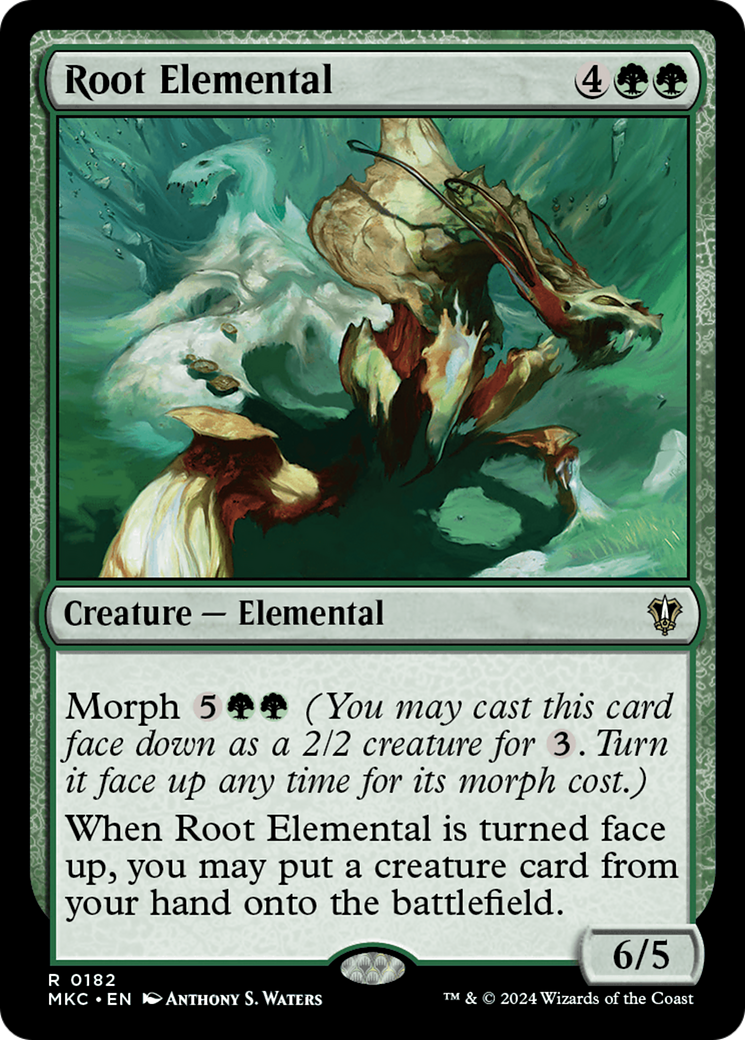
Root Elemental
Root Elemental
Creature — Elemental
6/5
Morph (You may cast this card face down as a 2/2 creature for . Turn it face up any time for its morph cost.)
When this creature is turned face up, you may put a creature card from your hand onto the battlefield.
-
1
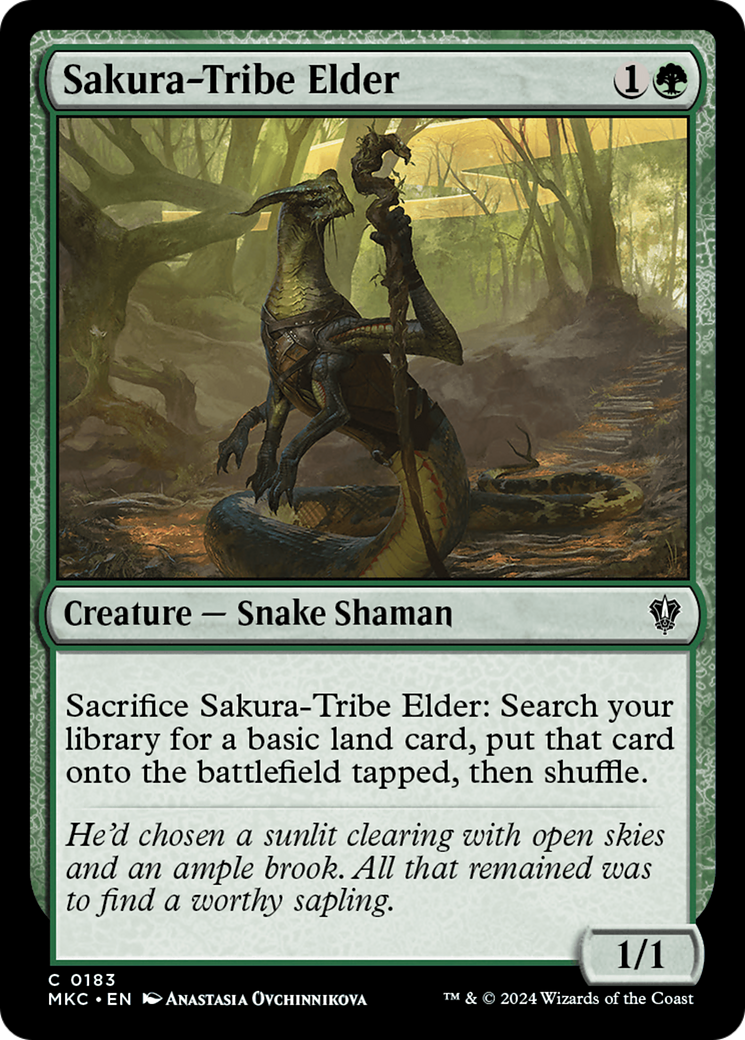
Sakura-Tribe Elder
Sakura-Tribe Elder
Creature — Snake Shaman
1/1
Sacrifice this creature: Search your library for a basic land card, put that card onto the battlefield tapped, then shuffle.
-
1
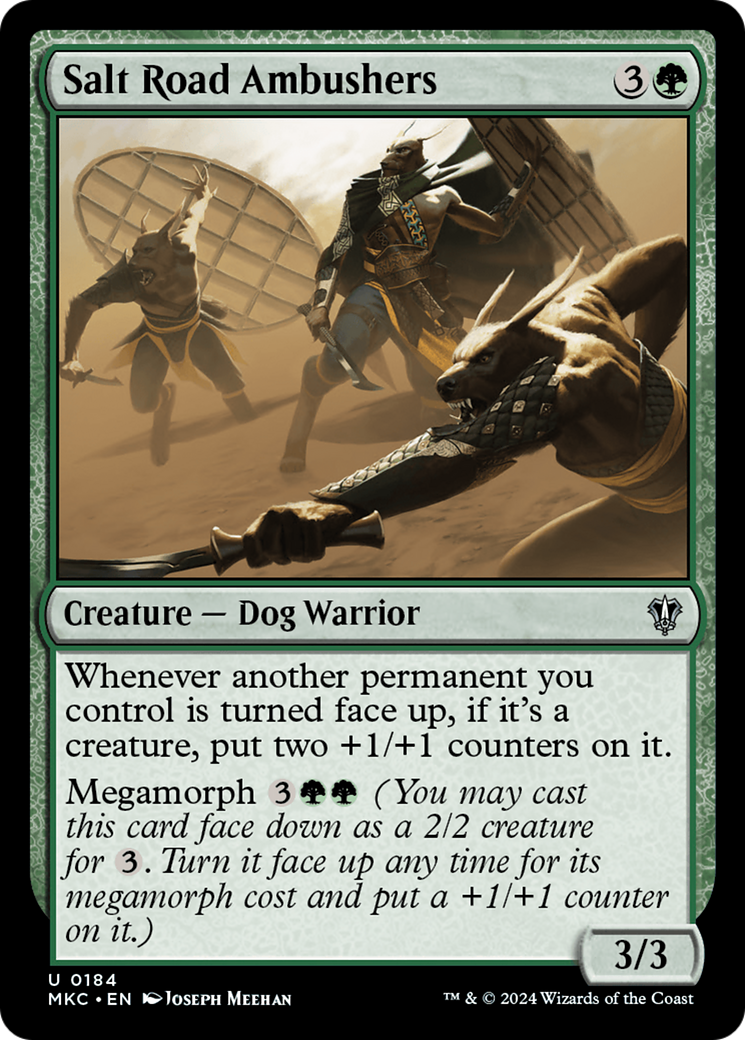
Salt Road Ambushers
Salt Road Ambushers
Creature — Dog Warrior
3/3
Whenever another permanent you control is turned face up, if it's a creature, put two +1/+1 counters on it.
Megamorph (You may cast this card face down as a 2/2 creature for . Turn it face up any time for its megamorph cost and put a +1/+1 counter on it.)
- The face-down permanent must be a creature both before it's turned face up and when the triggered ability resolves to have +1/+1 counters placed on it.
- Turning a face-down creature with megamorph face up and putting a +1/+1 counter on it is a special action. It doesn't use the stack and can't be responded to.
- If a face-down creature with megamorph is turned face up some other way (for example, if you manifest a card with megamorph and then pay its mana cost to turn it face up), you won't put a +1/+1 counter on it.
- Megamorph is a variant of the morph ability. You can find more information on morph on cards with morph from the Khans of Tarkir set.
-
1
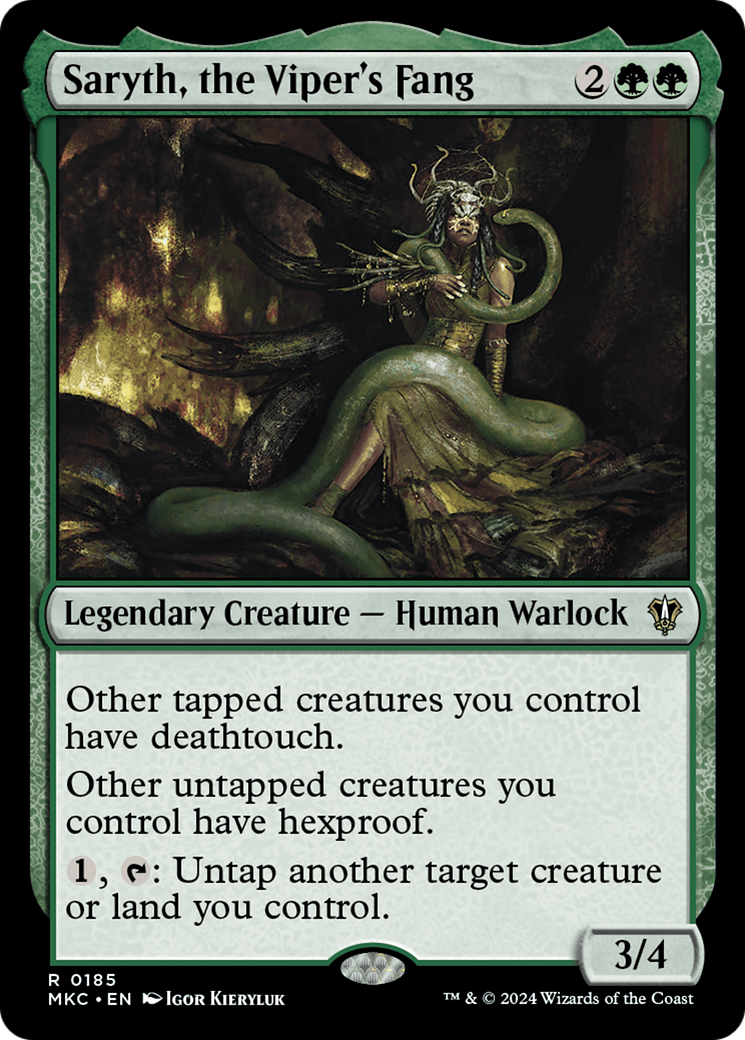
Saryth, the Viper's Fang
Saryth, the Viper's Fang
Legendary Creature — Human Warlock
3/4
Other tapped creatures you control have deathtouch.
Other untapped creatures you control have hexproof.
, : Untap another target creature or land you control.
- Saryth's first ability doesn't care whether Saryth is tapped or untapped. The same is true for the second ability. Both abilities apply as long as Saryth is on the battlefield.
-
1
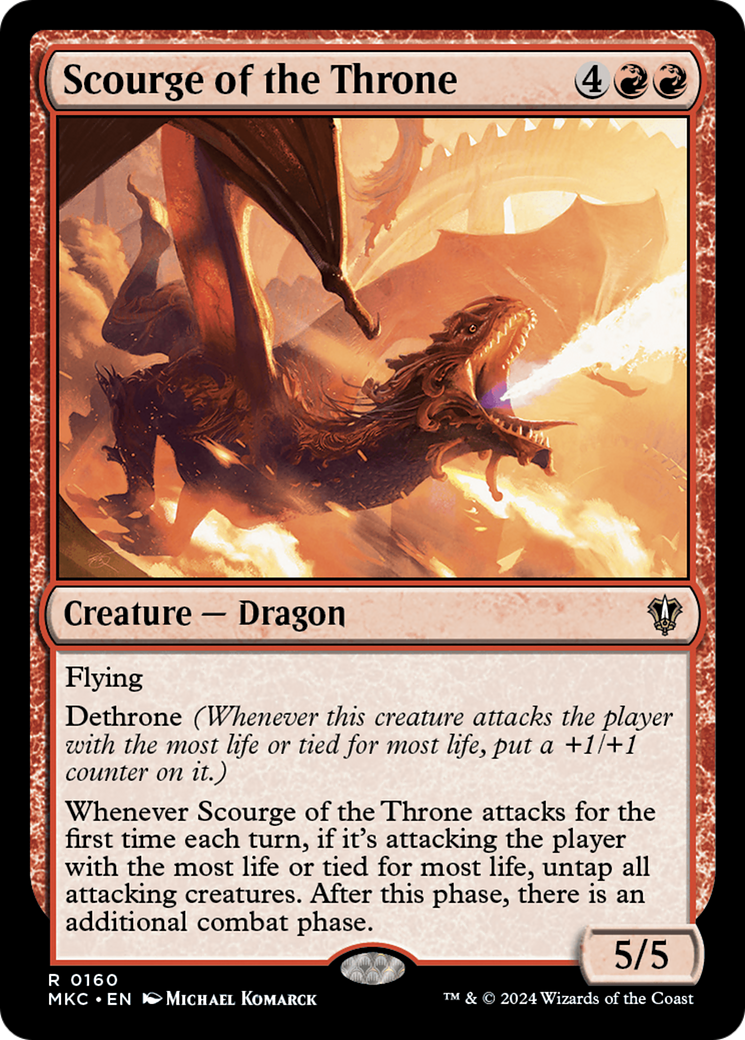
Scourge of the Throne
Scourge of the Throne
Creature — Dragon
5/5
Flying
Dethrone (Whenever this creature attacks the player with the most life or tied for most life, put a +1/+1 counter on it.)
Whenever this creature attacks for the first time each turn, if it's attacking the player with the most life or tied for most life, untap all attacking creatures. After this phase, there is an additional combat phase.
- Dethrone doesn't trigger if the creature attacks a planeswalker, even if its controller has the most life. The same is true if the creature attacks a battle, even if its protector has the most life.
- Scourge of the Throne's ability has an intervening "if" clause. It must be attacking the player with the most life or tied with the most life both when it's declared as an attacker and as it starts to resolve for it to have any effect. If, at either time, the player isn't the one with the most life or tied for the most life, the ability will have no effect. Notably, this is different than how dethrone works. (Dethrone checks only once to see if the ability triggers.)
- Once dethrone triggers, it doesn't matter what happens to the players' life totals before the ability resolves. You'll put a +1/+1 counter on the creature even if the defending player doesn't have the most life as the ability resolves.
- The +1/+1 counter is put on the creature before blockers are declared.
- In a Two-Headed Giant game, dethrone will trigger if the creature attacks either player on the team with the most life or tied for the most life.
-
1
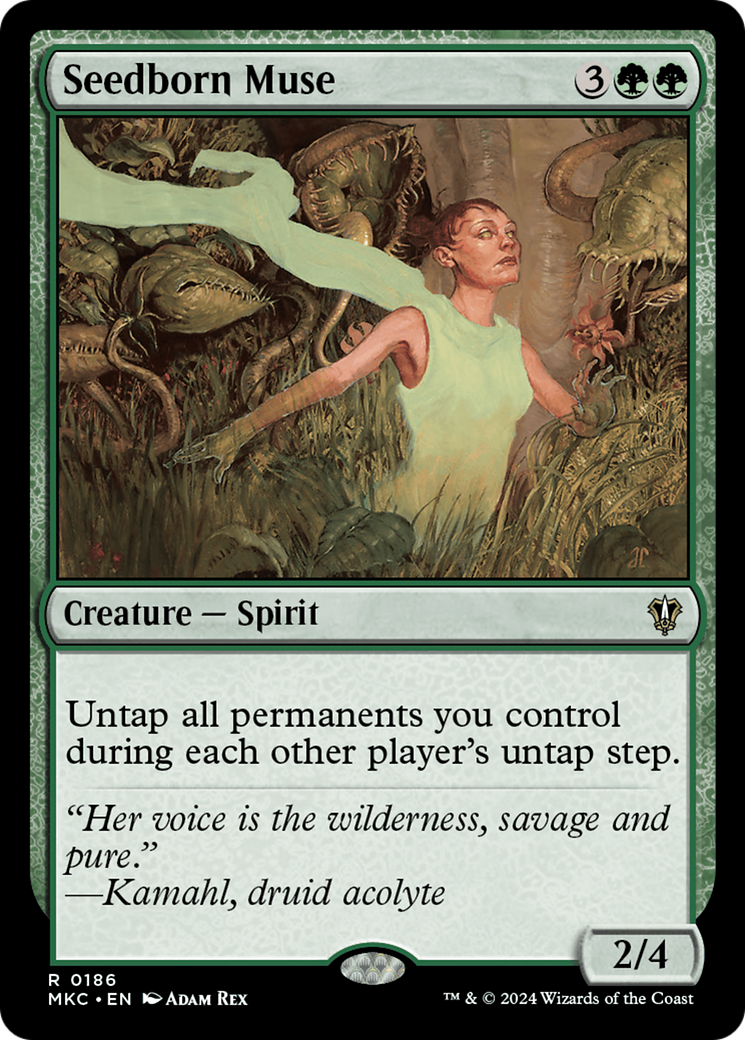
Seedborn Muse
Seedborn Muse
Creature — Spirit
2/4
Untap all permanents you control during each other player's untap step.
- All your permanents untap during each other player's untap step. You have no choice about what untaps.
- Other effects can prevent a permanent from untapping during an untap step. You do need to look carefully, however, as many effects say that the permanent does not untap during its controller's untap step, and this card's ability occurs during other players' untap steps. If a card does say this, then Seedborn Muse can untap it. But some other abilities are not written this way and can still prevent a card from untapping.
-
1
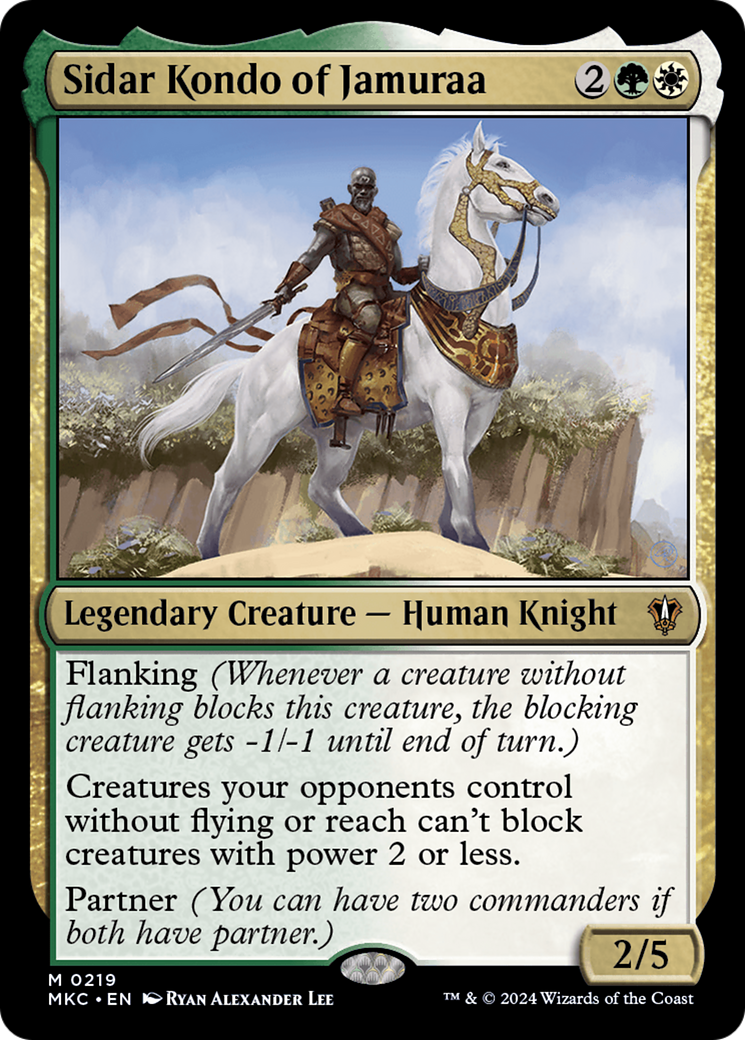
Sidar Kondo of Jamuraa
Sidar Kondo of Jamuraa
Legendary Creature — Human Knight
2/5
Flanking (Whenever a creature without flanking blocks this creature, the blocking creature gets -1/-1 until end of turn.)
Creatures your opponents control without flying or reach can't block creatures with power 2 or less.
Partner (You can have two commanders if both have partner.)
- If something refers to your commander while you have two commanders, it refers to one of them of your choice. If you are instructed to perform an action on your commander (e.g. put it from the command zone into your hand due to Command Beacon), you choose one of your commanders at the time the effect happens.
- Sidar Kondo's blocking restriction applies to creatures your opponents control even when an opponent is being attacked by a player other than you.
- Once an attacking creature has been blocked by a creature without flying or reach, reducing its power to 2 or less won't change or undo that block.
- If your Commander deck has two commanders, you can only include cards whose own color identities are also found in your commanders' combined color identities. If Falthis and Kediss are your commanders, your deck may contain cards with black and/or red in their color identity, but not cards with green, white, or blue.
- Both commanders start in the command zone, and the remaining 98 cards (or 58 cards in a Commander Draft game) of your deck are shuffled to become your library.
- To have two commanders, both must have the partner ability as the game begins. Losing the ability during the game doesn't cause either to cease to be your commander.
- Once the game begins, your two commanders are tracked separately. If you cast one, you won't have to pay an additional the first time you cast the other. A player loses the game after having been dealt 21 damage from any one of them, not from both of them combined.
- An effect that checks whether you control your commander is satisfied if you control one or both of your two commanders.
- You can choose two commanders with partner that are the same color or colors. In Commander Draft, you can even choose two of the same commander with partner if you drafted them. If you do this, make sure you keep the number of times you've cast each from the command zone clear for "commander tax" purposes.
-
1
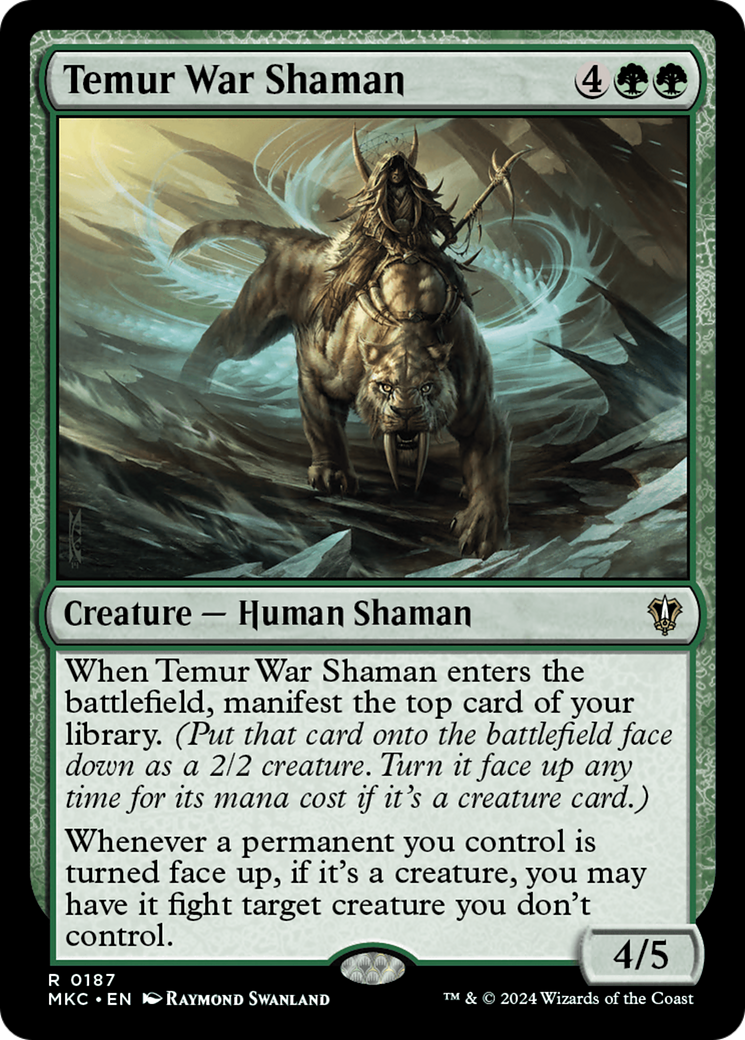
Temur War Shaman
Temur War Shaman
Creature — Human Shaman
4/5
When this creature enters, manifest the top card of your library. (Put that card onto the battlefield face down as a 2/2 creature. Turn it face up any time for its mana cost if it's a creature card.)
Whenever a permanent you control is turned face up, if it's a creature, you may have it fight target creature you don't control.
- The face-down permanent is a 2/2 creature with no name, mana cost, creature types, or abilities. It's colorless and has a mana value of 0. Other effects that apply to the permanent can still grant or change any of these characteristics.
- Any time you have priority, you may turn a manifested creature face up by revealing that it's a creature card (ignoring any copy effects or type-changing effects that might be applying to it) and paying its mana cost. This is a special action. It doesn't use the stack and can't be responded to.
- If a manifested creature would have morph if it were face up, you may also turn it face up by paying its morph cost.
- Unlike a face-down creature that was cast using the morph ability, a manifested creature may still be turned face up after it loses its abilities if it's a creature card.
- Because the permanent is on the battlefield both before and after it's turned face up, turning a permanent face up doesn't cause any enters-the-battlefield abilities to trigger.
- Because face-down creatures don't have names, they can't have the same name as any other creature, even another face-down creature.
- A permanent that turns face up or face down changes characteristics but is otherwise the same permanent. Spells and abilities that were targeting that permanent, as well as Auras and Equipment that were attached to the permanent, aren't affected.
- Turning a permanent face up or face down doesn't change whether that permanent is tapped or untapped.
- At any time, you can look at a face-down permanent you control. You can't look at face-down permanents you don't control unless an effect allows you to or instructs you to.
- If a face-down permanent you control leaves the battlefield, you must reveal it. You must also reveal all face-down spells and permanents you control if you leave the game or if the game ends.
- You must ensure that your face-down spells and permanents can easily be differentiated from each other. You're not allowed to mix up the cards that represent them on the battlefield in order to confuse other players. The order they entered the battlefield should remain clear. Common methods for indicating this include using markers or dice, or simply placing them in order on the battlefield. You must also track how each became face down (manifested, cast face down using the morph ability, and so on).
- There are no cards in the Fate Reforged set that would turn a face-down instant or sorcery card on the battlefield face up, but some older cards can try to do this. If something tries to turn a face-down instant or sorcery card on the battlefield face up, reveal that card to show all players it's an instant or sorcery card. The permanent remains on the battlefield face down. Abilities that trigger when a permanent turns face up won't trigger, because even though you revealed the card, it never turned face up.
- If a double-faced card is manifested, it will be put onto the battlefield face down. While face down, it can't transform. If the front face of the card is a creature card, you can turn it face up by paying its mana cost. If you do, its front face will be up.
-
1
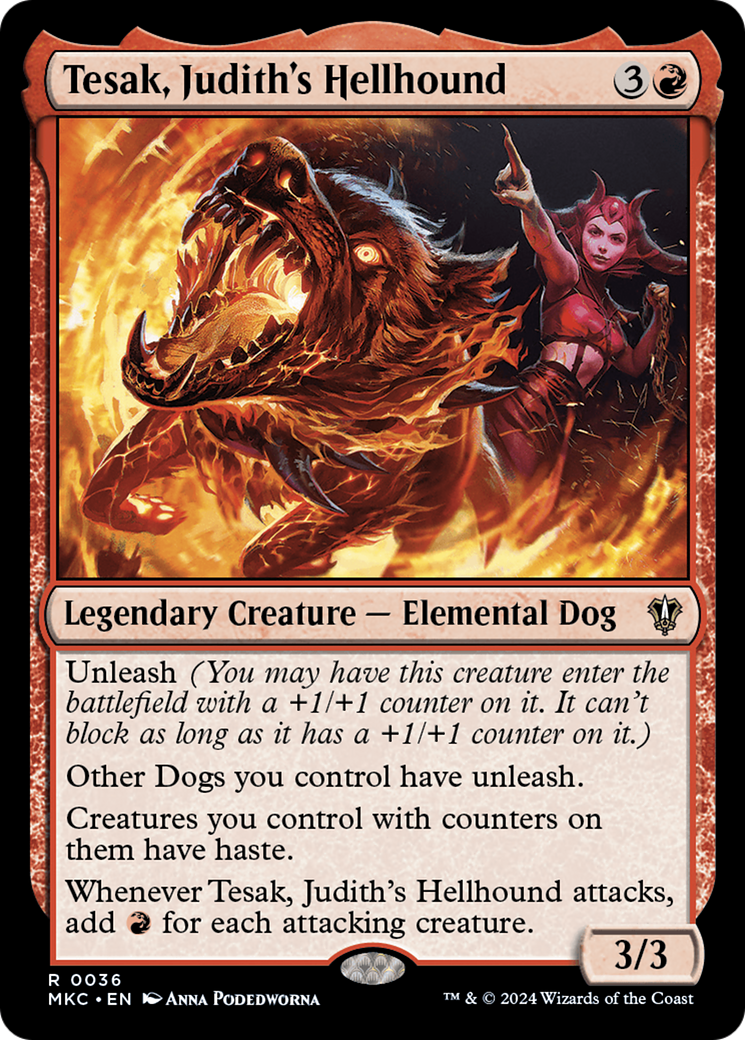
Tesak, Judith's Hellhound
Tesak, Judith's Hellhound
Legendary Creature — Elemental Dog
3/3
Unleash (You may have this creature enter with a +1/+1 counter on it. It can't block as long as it has a +1/+1 counter on it.)
Other Dogs you control have unleash.
Creatures you control with counters on them have haste.
Whenever Tesak attacks, add for each attacking creature.
- You make the choice to have the creature with unleash enter the battlefield with a +1/+1 counter or not as it's entering the battlefield. At that point, it's too late for a player to respond to the creature spell by trying to counter it, for example.
- The unleash ability applies no matter where the creature is entering the battlefield from.
- A creature with unleash can't block if it has any +1/+1 counter on it, not just one put on it by the unleash ability.
- Putting a +1/+1 counter on a creature with unleash that's already blocking won't remove it from combat. It will continue to block.
- Count the number of attacking creatures when Tesak, Judith's Hellhound's last ability resolves, including Tesak itself if it's still on the battlefield, to determine how much mana to add.
-
1
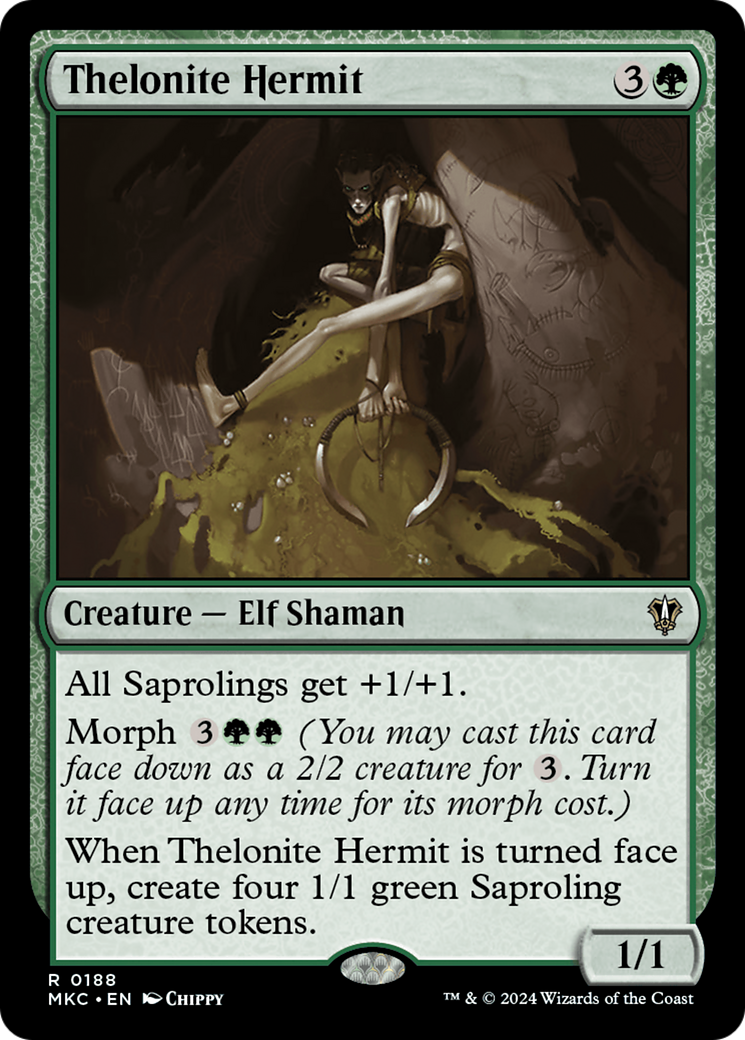
Thelonite Hermit
Thelonite Hermit
Creature — Elf Shaman
1/1
All Saprolings get +1/+1.
Morph (You may cast this card face down as a 2/2 creature for . Turn it face up any time for its morph cost.)
When this creature is turned face up, create four 1/1 green Saproling creature tokens.
- Because damage remains marked on a creature until the damage is removed as the turn ends, nonlethal damage dealt to a Saproling may become lethal if Thelonite Hermit leaves the battlefield during that turn.
-
1
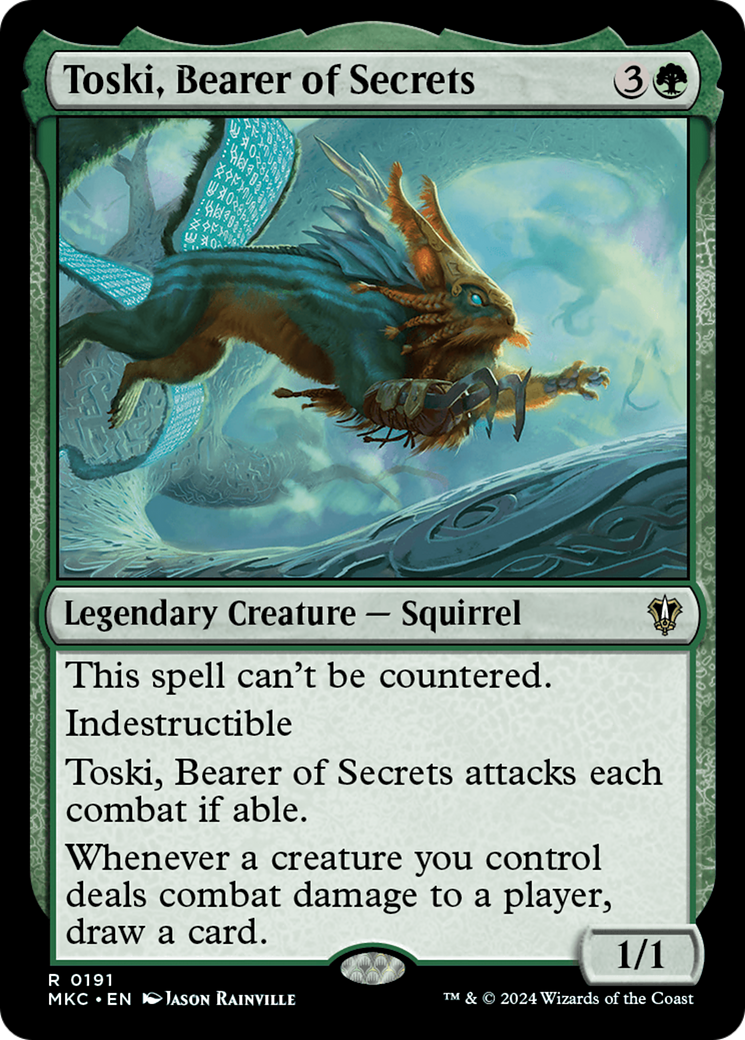
Toski, Bearer of Secrets
Toski, Bearer of Secrets
Legendary Creature — Squirrel
1/1
This spell can't be countered.
Indestructible
Toski attacks each combat if able.
Whenever a creature you control deals combat damage to a player, draw a card.
- A spell or ability that counters spells can still target Toski. When that spell or ability resolves, Toski won't be countered, but any additional effects of that spell or ability will still happen.
- If Toski can't attack for some reason (such as being tapped or having come under that player's control that turn), then it doesn't attack. If there's a cost associated with having it attack, you aren't forced to pay that cost, so it doesn't have to attack in that case either.
-
1
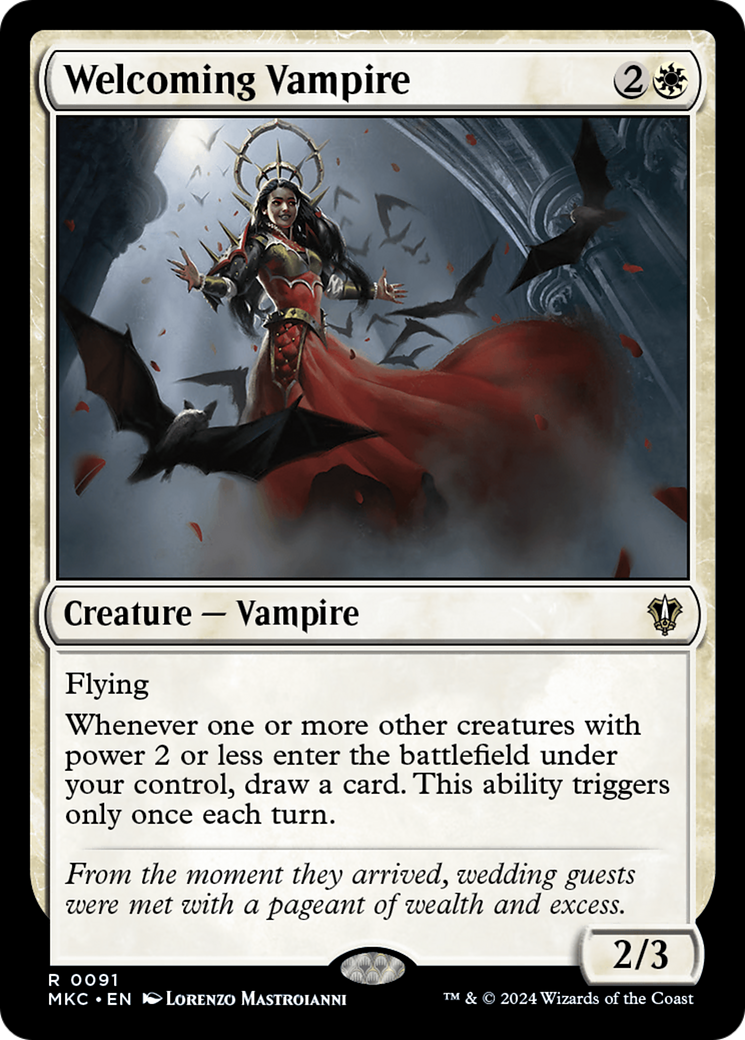
Welcoming Vampire
Welcoming Vampire
Creature — Vampire
2/3
Flying
Whenever one or more other creatures you control with power 2 or less enter, draw a card. This ability triggers only once each turn.
- Welcoming Vampire's ability checks the power of the other creatures only as they enter the battlefield. If one of those creatures has power 2 or less, the ability will trigger. Once the ability triggers, raising that creature's power above 2 won't affect that ability. Similarly, reducing a creature's power to 2 or less after it enters the battlefield won't cause the ability to trigger.
- If creatures enter the battlefield with +1/+1 counters or a continuous effect such as that of Wedding Festivity will apply to the creatures on the battlefield, those effects apply when checking to see if Welcoming Vampire's ability will trigger.
-
1
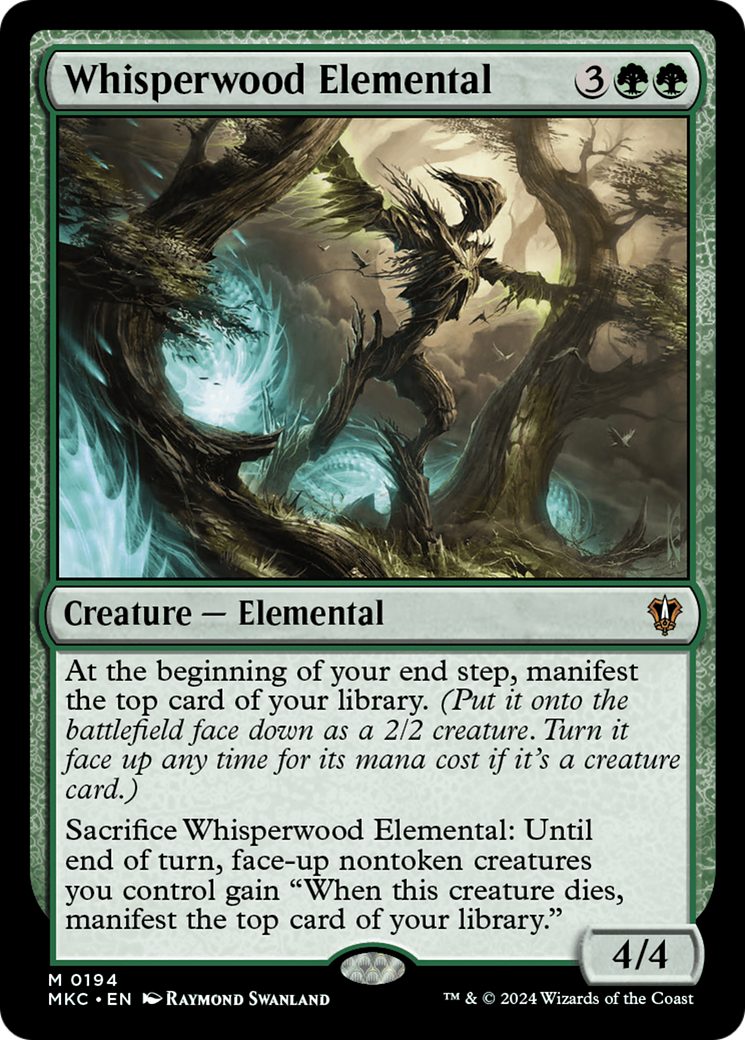
Whisperwood Elemental
Whisperwood Elemental
Creature — Elemental
4/4
At the beginning of your end step, manifest the top card of your library. (Put it onto the battlefield face down as a 2/2 creature. Turn it face up any time for its mana cost if it's a creature card.)
Sacrifice this creature: Until end of turn, face-up nontoken creatures you control gain "When this creature dies, manifest the top card of your library."
- The last ability grants that ability to face-up nontoken creatures you control as that ability resolves. Creatures that come under your control later in the turn won't have that ability.
- The face-down permanent is a 2/2 creature with no name, mana cost, creature types, or abilities. It's colorless and has a mana value of 0. Other effects that apply to the permanent can still grant or change any of these characteristics.
- Any time you have priority, you may turn a manifested creature face up by revealing that it's a creature card (ignoring any copy effects or type-changing effects that might be applying to it) and paying its mana cost. This is a special action. It doesn't use the stack and can't be responded to.
- If a manifested creature would have morph if it were face up, you may also turn it face up by paying its morph cost.
- Unlike a face-down creature that was cast using the morph ability, a manifested creature may still be turned face up after it loses its abilities if it's a creature card.
- Because the permanent is on the battlefield both before and after it's turned face up, turning a permanent face up doesn't cause any enters-the-battlefield abilities to trigger.
- Because face-down creatures don't have names, they can't have the same name as any other creature, even another face-down creature.
- A permanent that turns face up or face down changes characteristics but is otherwise the same permanent. Spells and abilities that were targeting that permanent, as well as Auras and Equipment that were attached to the permanent, aren't affected.
- Turning a permanent face up or face down doesn't change whether that permanent is tapped or untapped.
- At any time, you can look at a face-down permanent you control. You can't look at face-down permanents you don't control unless an effect allows you to or instructs you to.
- If a face-down permanent you control leaves the battlefield, you must reveal it. You must also reveal all face-down spells and permanents you control if you leave the game or if the game ends.
- You must ensure that your face-down spells and permanents can easily be differentiated from each other. You're not allowed to mix up the cards that represent them on the battlefield in order to confuse other players. The order they entered the battlefield should remain clear. Common methods for indicating this include using markers or dice, or simply placing them in order on the battlefield. You must also track how each became face down (manifested, cast face down using the morph ability, and so on).
- There are no cards in the Fate Reforged set that would turn a face-down instant or sorcery card on the battlefield face up, but some older cards can try to do this. If something tries to turn a face-down instant or sorcery card on the battlefield face up, reveal that card to show all players it's an instant or sorcery card. The permanent remains on the battlefield face down. Abilities that trigger when a permanent turns face up won't trigger, because even though you revealed the card, it never turned face up.
- If a double-faced card is manifested, it will be put onto the battlefield face down. While face down, it can't transform. If the front face of the card is a creature card, you can turn it face up by paying its mana cost. If you do, its front face will be up.
-
1
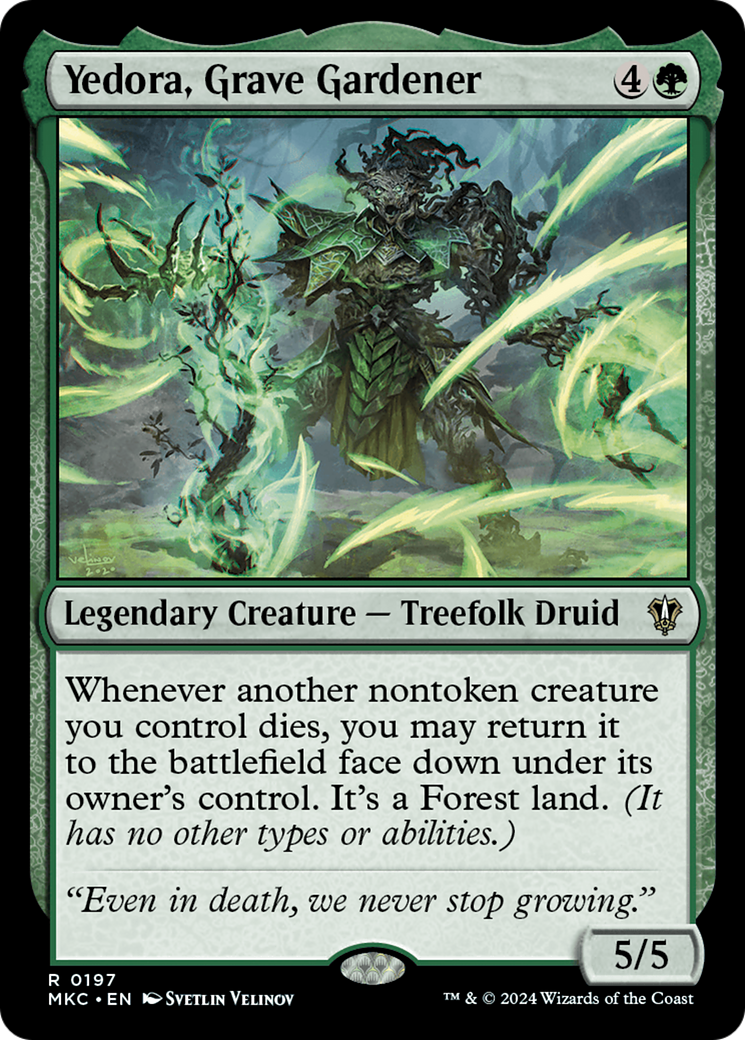
Yedora, Grave Gardener
Yedora, Grave Gardener
Legendary Creature — Treefolk Druid
5/5
Whenever another nontoken creature you control dies, you may return it to the battlefield face down under its owner's control. It's a Forest land. (It has no other types or abilities.)
- The face-down card has no name or colors. Its only type is land, its only subtype is Forest, and its only ability is " : Add ."
- If the face-down card has morph, you can pay its morph cost to turn it face up.
- If one of these Forests is turned face up, the effect making it a Forest land will expire. The face-up permanent will again have its printed name, type line, mana cost, abilities, and so on.
Instants 5
-
1
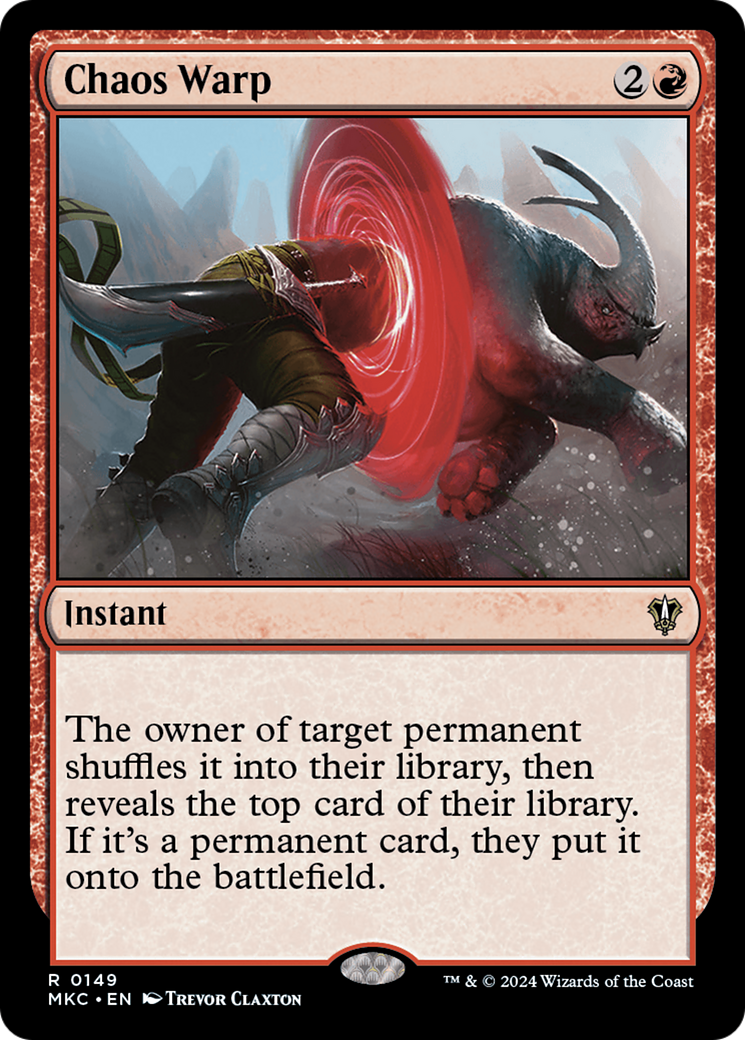
Chaos Warp
Chaos Warp
Instant
The owner of target permanent shuffles it into their library, then reveals the top card of their library. If it's a permanent card, they put it onto the battlefield.
- A permanent card is a card with one or more of the following card types: artifact, creature, enchantment, land, or planeswalker.
- The owner of a token is the player under whose control the token was put onto the battlefield. If a token is shuffled into a player's library this way, that player shuffles before revealing the top card of that library.
- If the revealed card is not a permanent card, it remains on top of that library.
- If the permanent is an illegal target by the time Chaos Warp tries to resolve, it won't resolve and none of its effects will occur. No library will be shuffled and no card will be revealed.
- If the revealed card is a permanent card but can't enter (perhaps because it's an Aura with nothing to enchant), it remains on top of that library.
-
1
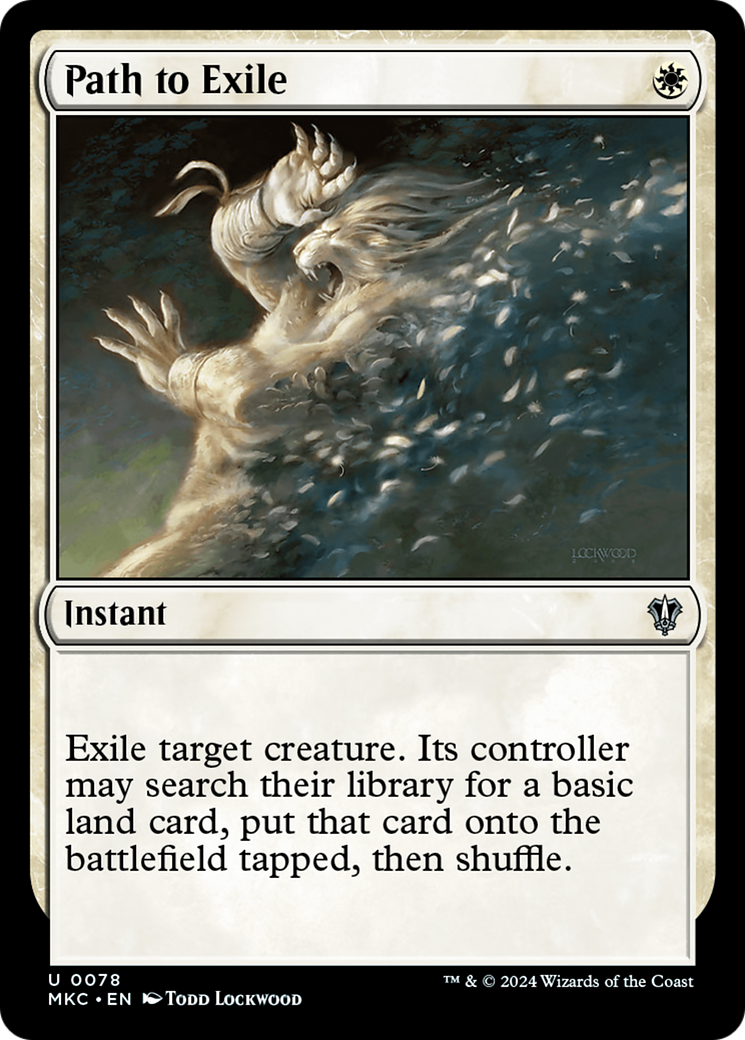
Path to Exile
Path to Exile
Instant
Exile target creature. Its controller may search their library for a basic land card, put that card onto the battlefield tapped, then shuffle.
- The controller of the exiled creature isn't required to search their library for a basic land. If that player doesn't, the player won't shuffle their library.
- If the target creature is an illegal target by the time Path to Exile tries to resolve, it won't resolve and none of its effects will happen. The creature's controller won't search for a basic land card.
-
1
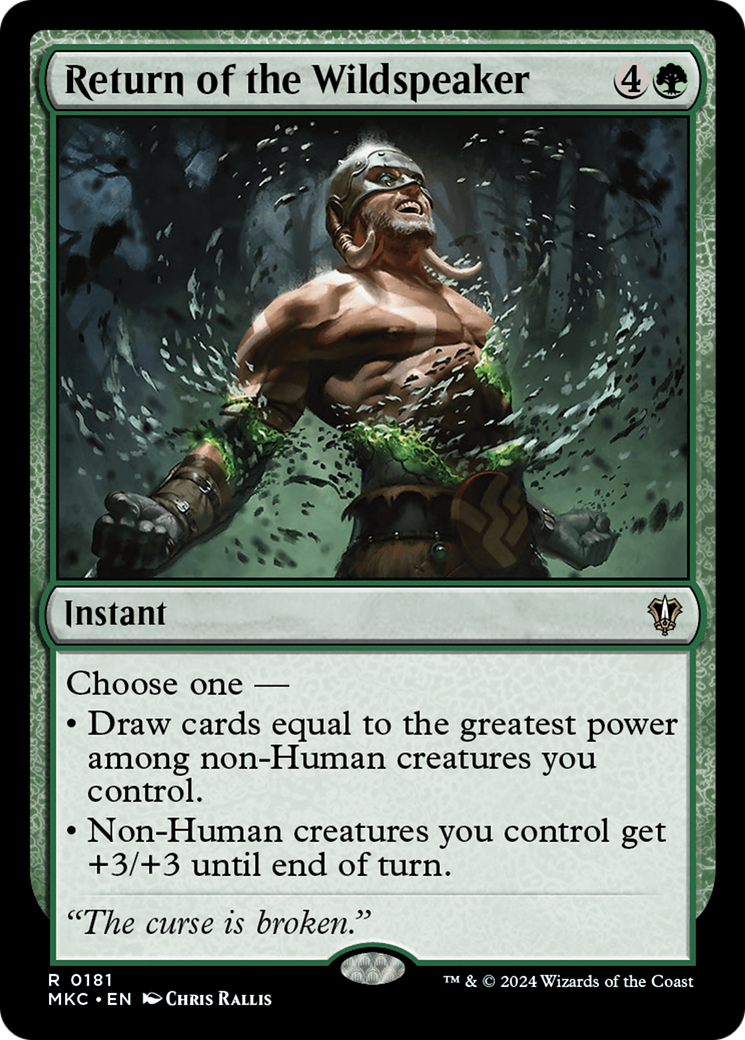
Return of the Wildspeaker
Return of the Wildspeaker
Instant
Choose one —
- Draw cards equal to the greatest power among non-Human creatures you control.
- Non-Human creatures you control get +3/+3 until end of turn.
-
1
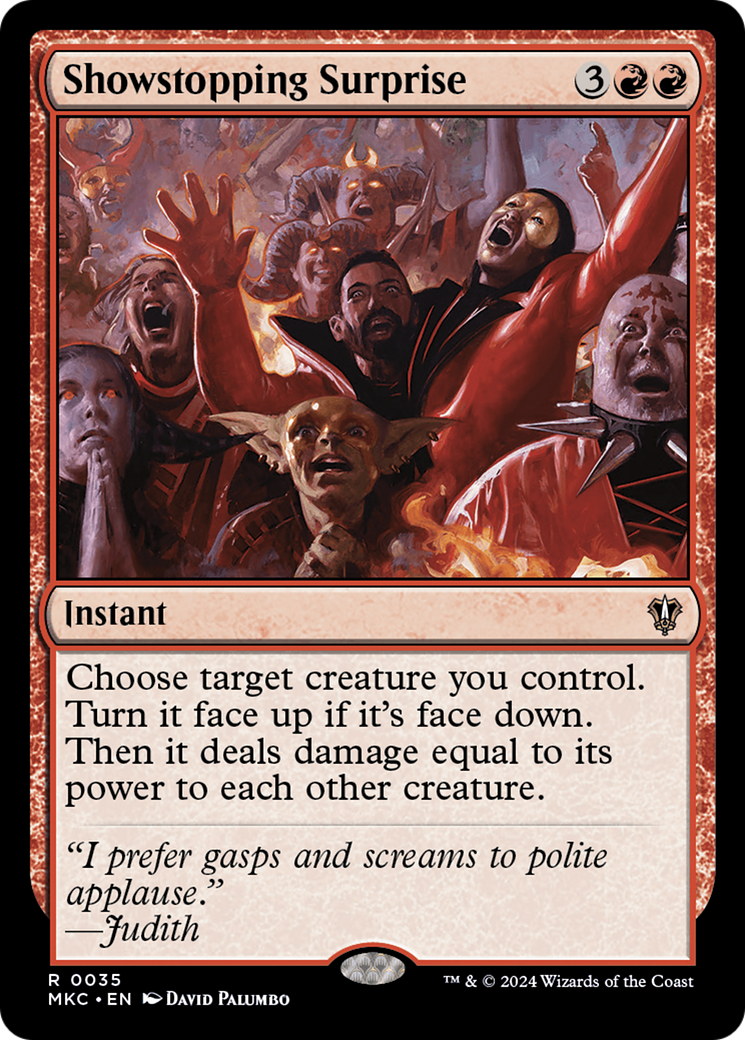
Showstopping Surprise
Showstopping Surprise
Instant
Choose target creature you control. Turn it face up if it's face down. Then it deals damage equal to its power to each other creature.
- If the target creature is a face-down creature that can’t be turned face up for any reason, it will remain face down on the battlefield and still deal damage equal to its power (which is very likely to be 2) to each other creature.
-
1
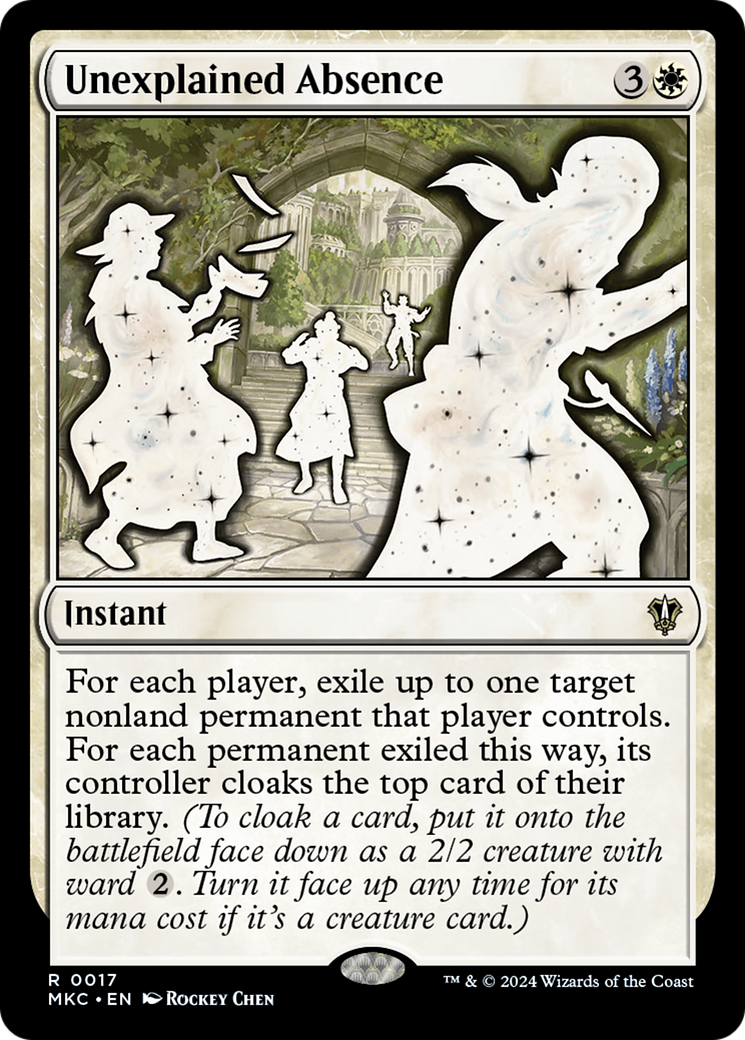
Unexplained Absence
Unexplained Absence
Instant
For each player, exile up to one target nonland permanent that player controls. For each permanent exiled this way, its controller cloaks the top card of their library. (To cloak a card, put it onto the battlefield face down as a 2/2 creature with ward . Turn it face up any time for its mana cost if it's a creature card.)
- To cloak a card, put it onto the battlefield face down. It becomes a 2/2 face-down creature card with ward and no name, mana cost, or creature types. It’s colorless and has a mana value of 0. Other effects that apply to the permanent can still grant it any characteristics it doesn’t have or change the characteristics it does have.
- Any time you have priority, you can turn a cloaked permanent you control face-up by revealing that it’s a creature card (ignoring any copy effects or type-changing effects that might be applying to it) and paying its mana cost. This is a special action. It doesn’t use the stack and can’t be responded to.
- If a cloaked creature would have disguise (or morph) if it were face up, you may also turn it face up by paying its disguise (or morph) cost.
- Unlike a face-down creature that was cast using a disguise or morph ability, a cloaked creature may still be turned face up after it loses its abilities if it’s a creature card.
- If a double-faced card is cloaked, it will be put onto the battlefield face down. While face down, it can’t transform. If the front face of the card is a creature card, you can turn it face up by paying its mana cost. If you do, its front face will be up.
- At any time, you can look at a face-down spell or permanent you control. You can’t look at face-down permanents or spells you don’t control unless an effect instructs or allows you to do so.
- If a face-down creature loses its abilities, it can’t be turned face up with a disguise ability because it will no longer have a disguise ability (or a disguise cost) once face up.
- Because the permanent is on the battlefield both before and after it’s turned face up, turning a permanent face up doesn’t cause any enters-the-battlefield abilities to trigger.
- Because face-down creatures don’t have a name, they can’t have the same name as any other creature, even another face-down creature.
- A permanent that turns face up or face down changes characteristics but is otherwise the same permanent. Spells and abilities that were targeting that permanent and Auras and Equipment that were attached to that permanent aren’t affected unless the new characteristics of the object change the legality of those targets or attachments.
- Turning a permanent face up or face down doesn’t change whether that permanent is tapped or untapped.
- If a face-down spell leaves the stack and goes to any zone other than the battlefield (if it was countered, for example), you must reveal it. Similarly, if a face-down permanent leaves the battlefield, you must reveal it. You must also reveal all face-down spells and permanents you control if you leave the game or the game ends.
- You must ensure that your face-down spells and permanents can be easily differentiated from each other. You’re not allowed to mix up the cards that represent them on the battlefield to confuse other players. The order in which they entered the battlefield should remain clear, as well as what ability caused them to be face down. (This includes disguise, cloak, and in games involving older cards, morph and manifest, as well as a few other effects that turn cards face down.) Common methods for doing this include using markers or dice, or simply placing them in order on the battlefield.
- If something tries to turn a face-down instant or sorcery card on the battlefield face up, reveal that card to show all players it’s an instant or sorcery card. The permanent remains on the battlefield face down. Abilities that trigger when a permanent turns face up won’t trigger, because even though you revealed the card, it never turned face up.
Sorceries 7
-
1
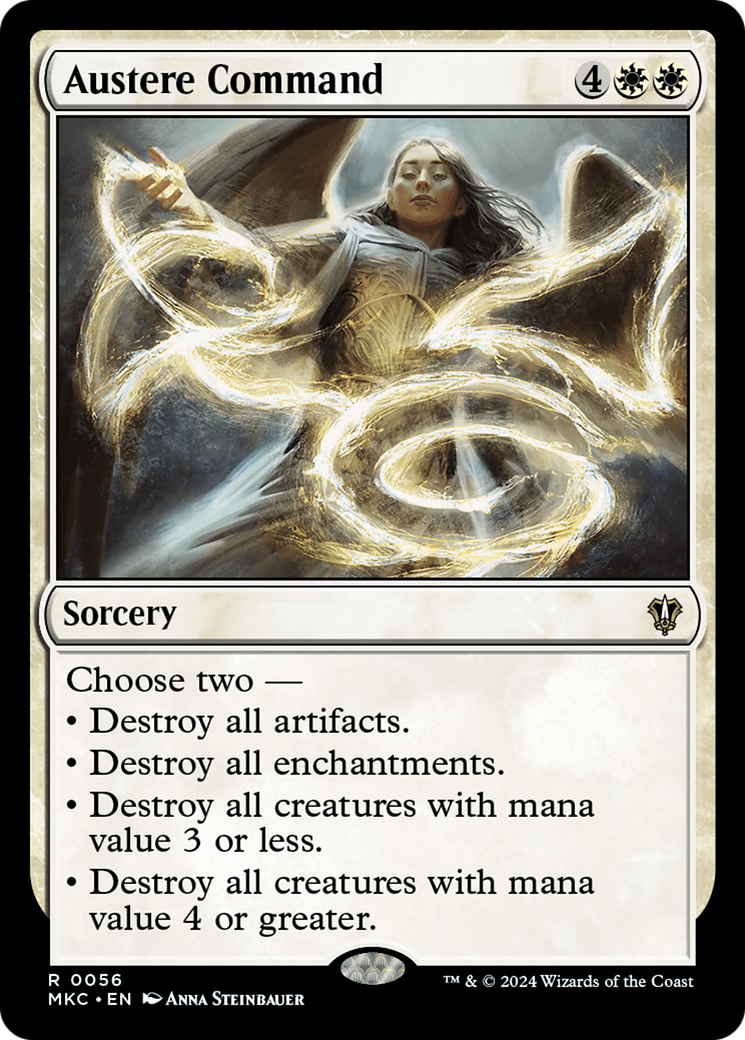
Austere Command
Austere Command
Sorcery
Choose two —
- Destroy all artifacts.
- Destroy all enchantments.
- Destroy all creatures with mana value 3 or less.
- Destroy all creatures with mana value 4 or greater.
- Each of the chosen modes happens sequentially. If a permanent has an ability that triggers whenever it or another permanent is destroyed, it will see permanents destroyed at the same time as it or before it, but not permanents destroyed by later modes.
- If a card is exiled "until" another permanent leaves the battlefield, the exiled card returns to the battlefield immediately after that permanent leaves the battlefield during Austere Command's resolution, and it may be destroyed by a later mode.
- If the first and last modes are chosen, an artifact creature with mana value 4 or greater will have to be regenerated twice to survive. This is because the modes happen sequentially, and the regeneration "shield" is used up by the first one. The same is true with any other combination of modes that covers one permanent twice.
-
1
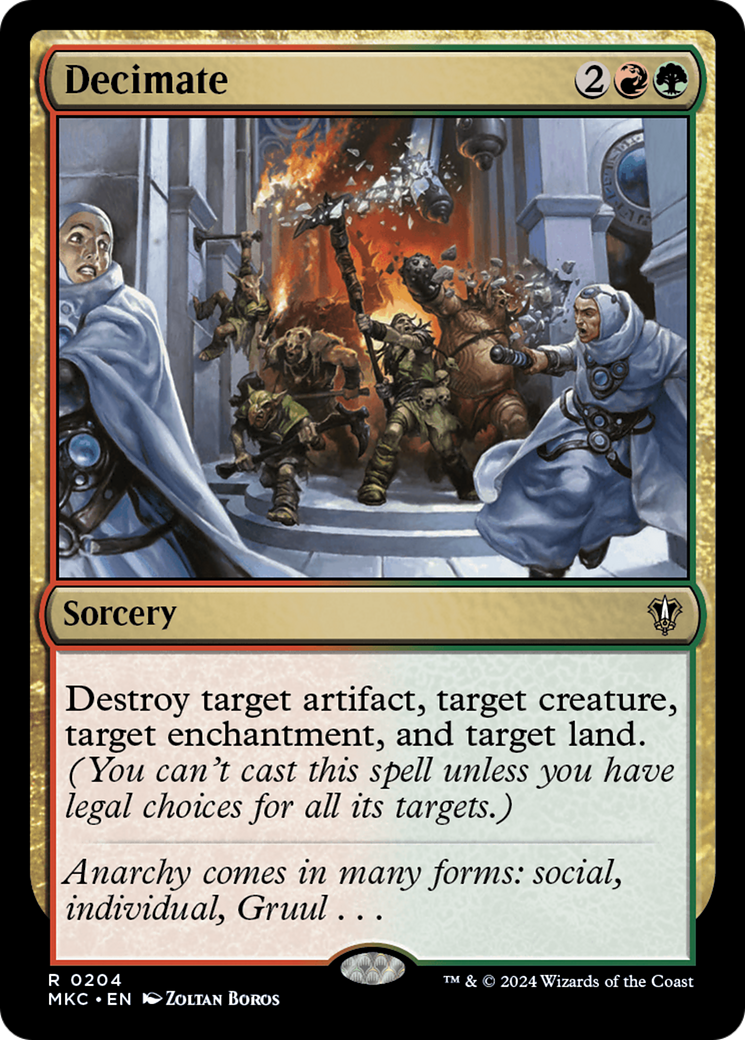
Decimate
Decimate
Sorcery
Destroy target artifact, target creature, target enchantment, and target land. (You can't cast this spell unless you have legal choices for all its targets.)
- You must choose a legal target for each target required by Decimate. However, if a permanent has multiple card types, it may be chosen as the target for more than one instance of the word "target." For example, you could cast Decimate targeting an artifact creature, an enchantment, and a land.
-
1
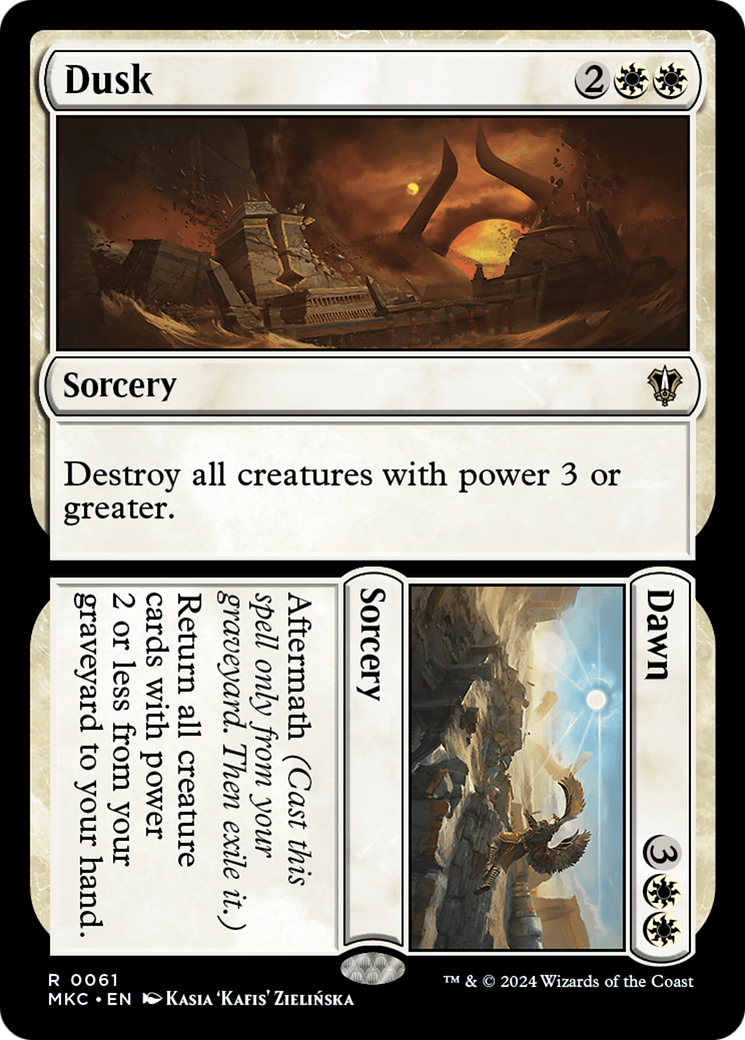
Dusk // Dawn
//
Dusk
Sorcery
- Once you've started to cast a spell with aftermath from your graveyard, the card is immediately moved to the stack. Opponents can't try to stop the ability by exiling the card with an effect such as that of Crook of Condemnation.
- All split cards have two card faces on a single card, and you put a split card onto the stack with only the half you're casting. The characteristics of the half of the card you didn't cast are ignored while the spell is on the stack. For example, if an effect prevents you from casting green spells, you can cast Destined of Destined // Lead, but not Lead.
- Each split card is a single card. For example, if you discard one, you've discarded one card, not two. If an effect counts the number of instant and sorcery cards in your graveyard, Destined // Lead counts once, not twice.
- Each split card has two names. If an effect instructs you to choose a card name, you may choose one, but not both.
- While not on the stack, the characteristics of a split card are the combination of its two halves. For example, Destined // Lead is a green and black card, it is both an instant card and a sorcery card, and its mana value is 6. This means that if an effect allows you to cast a card with mana value 2 from your hand, you can't cast Destined. This is a change from the previous rules for split cards.
- Split cards with aftermath have a new frame treatment—the half you can cast from your hand is oriented the same as other cards you'd cast from your hand, while the half you can cast from your graveyard is a traditional split card half. This frame treatment is for your convenience and has no rules significance.
- If another effect allows you to cast a split card with aftermath from any zone other than a graveyard, you can't cast the half with aftermath.
- If another effect allows you to cast a split card with aftermath from a graveyard, you may cast either half. If you cast the half that has aftermath, you'll exile the card if it would leave the stack.
- A spell with aftermath cast from a graveyard will always be exiled afterward, whether it resolves, it's countered, or it leaves the stack in some other way.
- If you cast the first half of a split card with aftermath during your turn, you'll have priority immediately after it resolves. You can cast the half with aftermath from your graveyard before any player can take any other action if it's legal for you to do so.
-
1
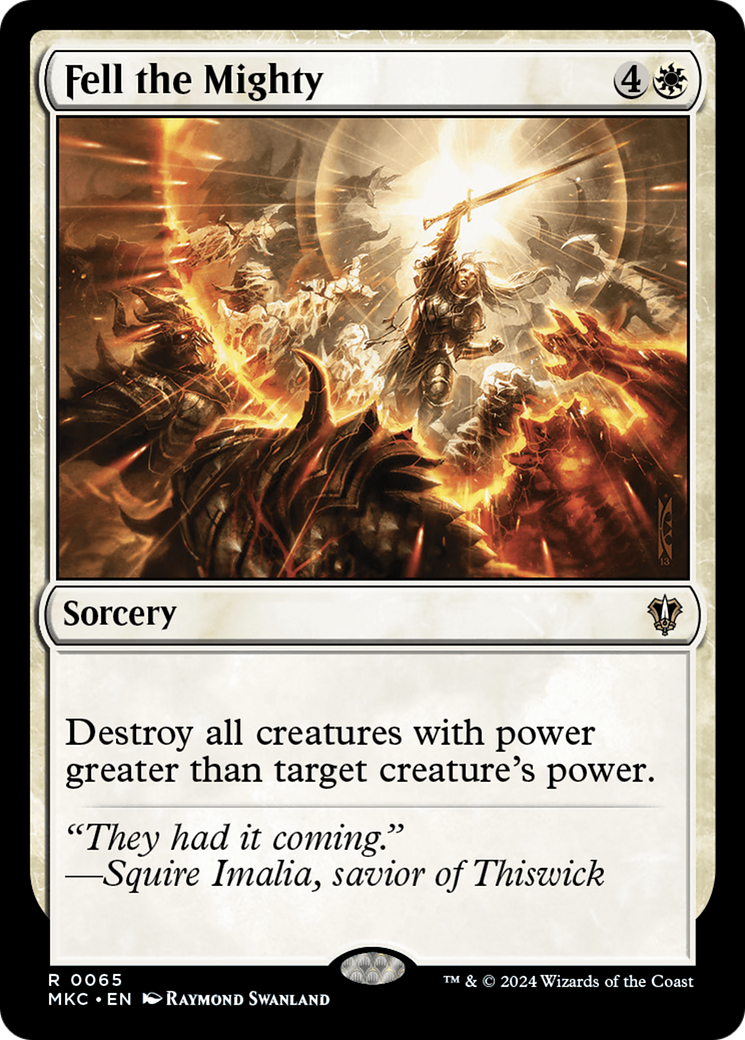
Fell the Mighty
Fell the Mighty
Sorcery
Destroy all creatures with power greater than target creature's power.
- Use the power of the target creature as Fell the Mighty resolves to determine which creatures are destroyed. Fell the Mighty doesn't target any of those creatures, so a creature with hexproof or protection from white will be destroyed if its power is high enough.
- Fell the Mighty won't destroy the target creature.
- If the target creature is an illegal target when Fell the Mighty tries to resolve, Fell the Mighty won't resolve and none of its effects will happen. No creatures will be destroyed.
-
1
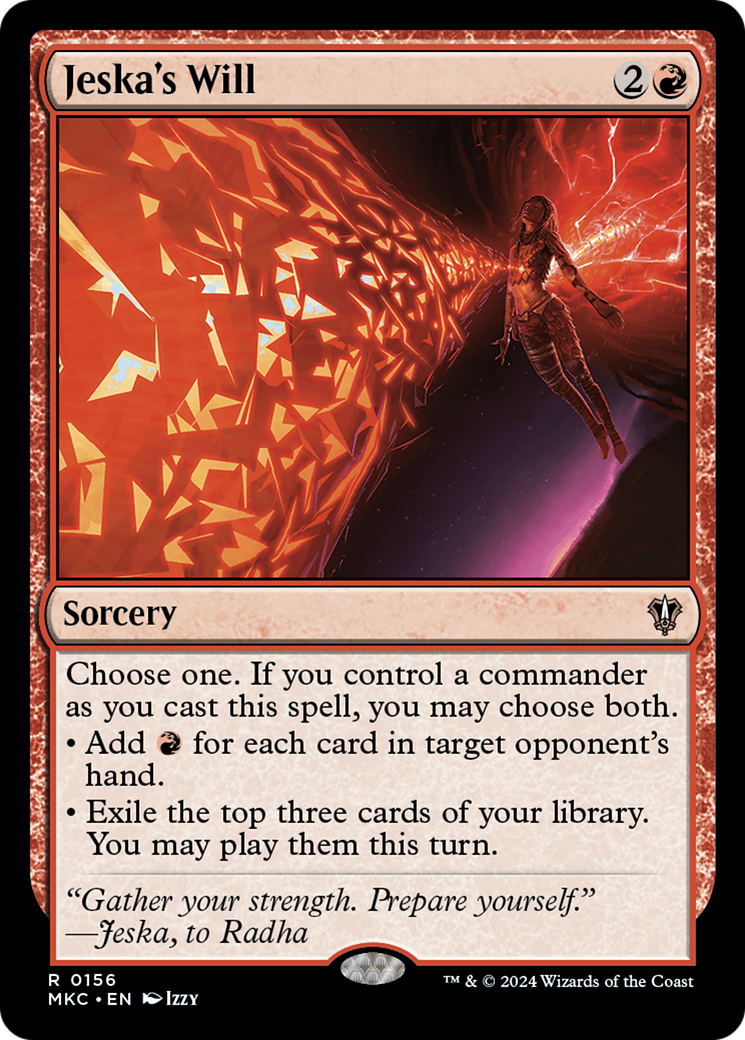
Jeska's Will
Jeska's Will
Sorcery
Choose one. If you control a commander as you cast this spell, you may choose both instead.
- Add for each card in target opponent's hand.
- Exile the top three cards of your library. You may play them this turn.
- Any of the exiled cards you don't play will remain exiled.
- There's no extra bonus if you control more than one commander.
- Use the number of cards in the target opponent's hand as Jeska's Will resolves to determine how much to add.
- Even though the card is named after a specific character, controlling any commander will satisfy its condition.
- The commander you control doesn't have to be your commander.
- You pay all costs and follow all timing rules for cards played with the permission from the last mode of Jeska's Will. For example, if one of the exiled cards is a land card, you may play it only during your main phase while the stack is empty and only if you have an available land play remaining.
- Once you've announced that you're casting a spell, players can't take any actions until you've finished doing so. Notably, opponents can't try to remove your commander to change how many modes you may choose.
- Once you've chosen both modes for the spell, it doesn't matter whether you continue to control a commander. This is true even if you somehow no longer control a commander as you finish casting the spell.
-
1
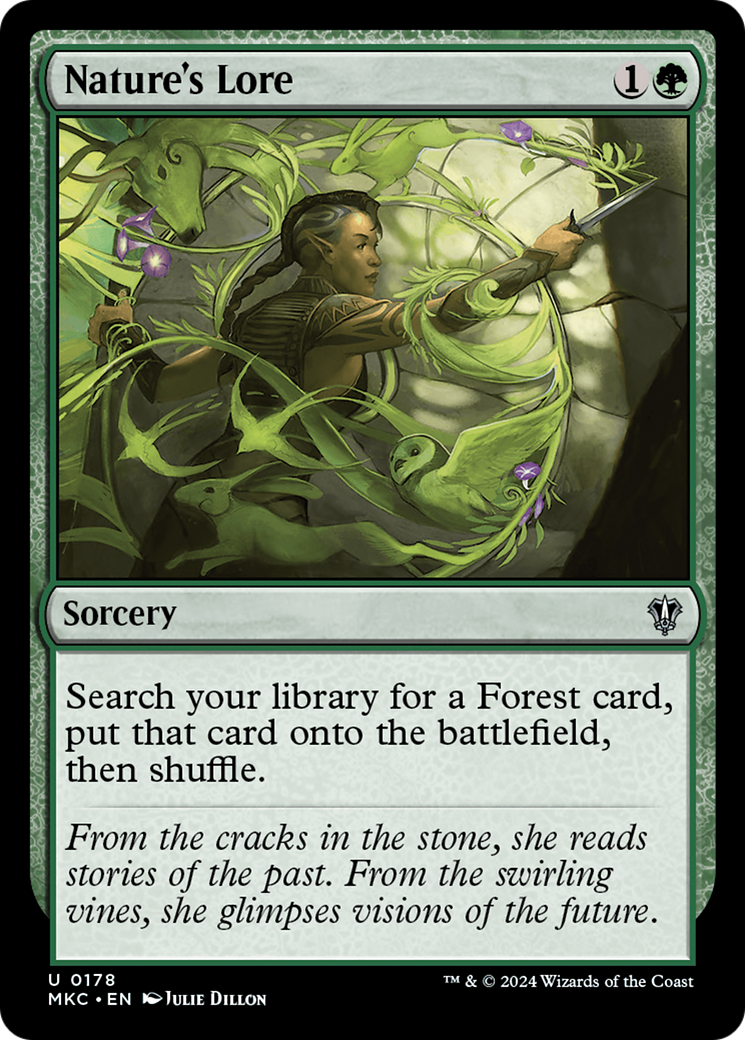
Nature's Lore
Nature's Lore
Sorcery
Search your library for a Forest card, put that card onto the battlefield, then shuffle.
- You may find a basic Forest or any land card with the land type Forest.
-
1
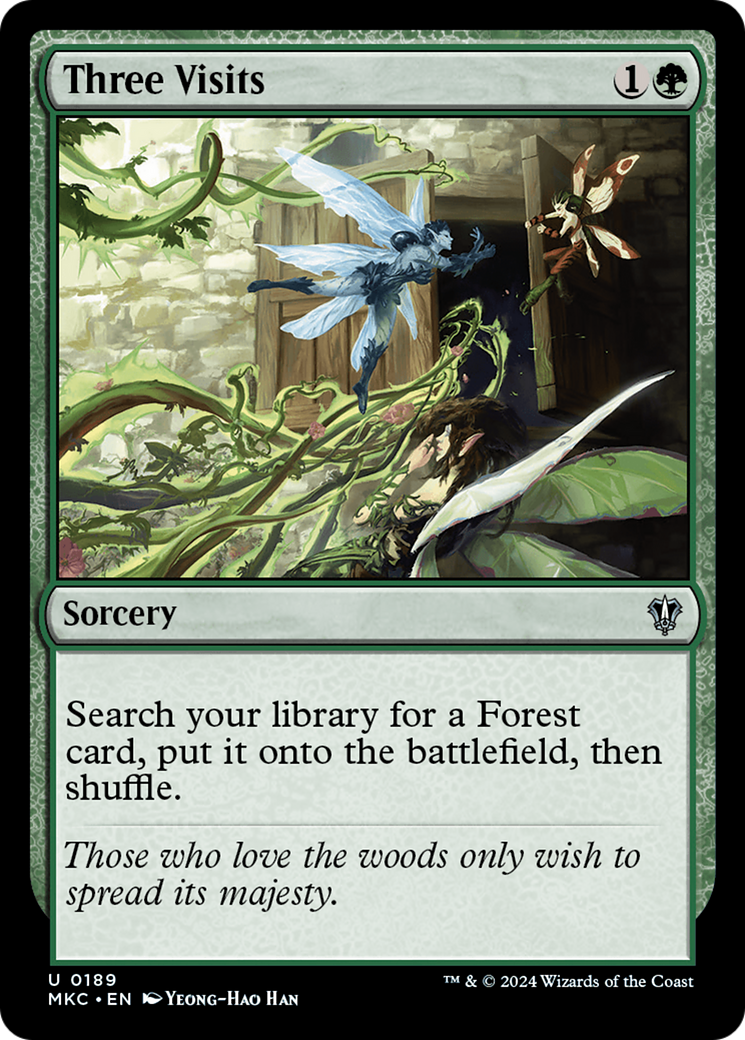
Three Visits
Three Visits
Sorcery
Search your library for a Forest card, put it onto the battlefield, then shuffle.
- Three Visits allows you to search your library for any card with the land type Forest, not just a card with the name Forest.
- Because the "search" requires you to find a card with certain characteristics, you don't have to find the card if you don't want to.
Artifacts 6
-
1
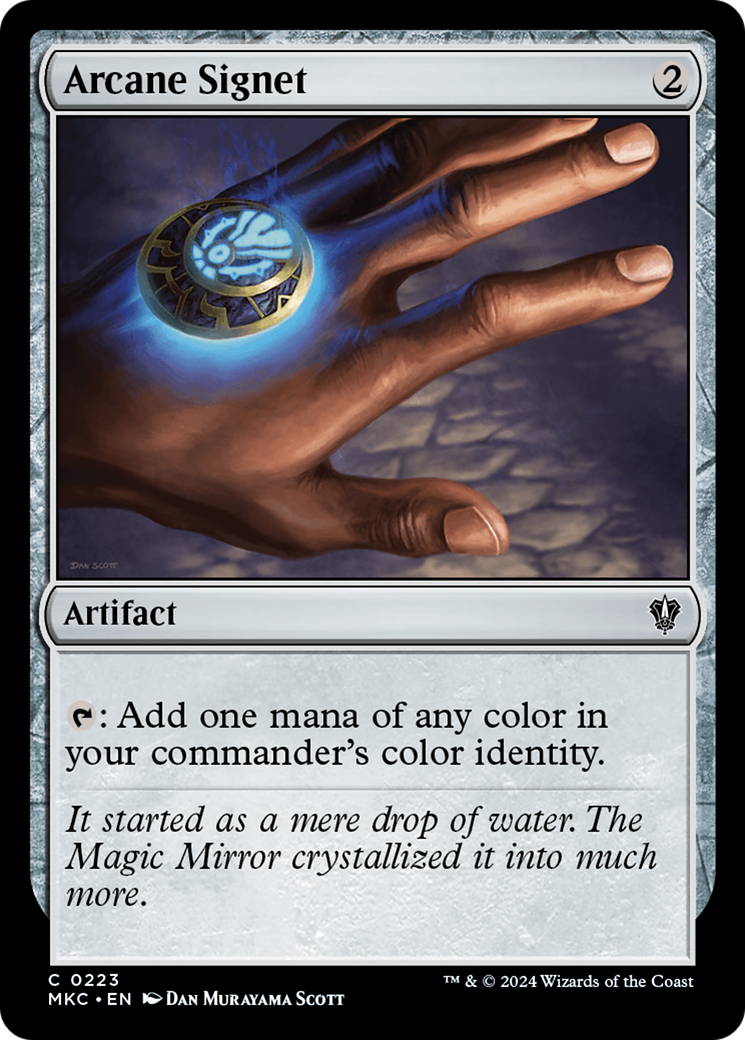
Arcane Signet
Arcane Signet
Artifact
: Add one mana of any color in your commander's color identity.
- If your commander is a card that has no colors in its color identity, Arcane Signet's ability produces no mana. It doesn't produce .
- If you have two commanders, the ability adds one mana of any color in their combined color identities.
- If you don't have a commander, Arcane Signet's ability produces no mana.
-
1
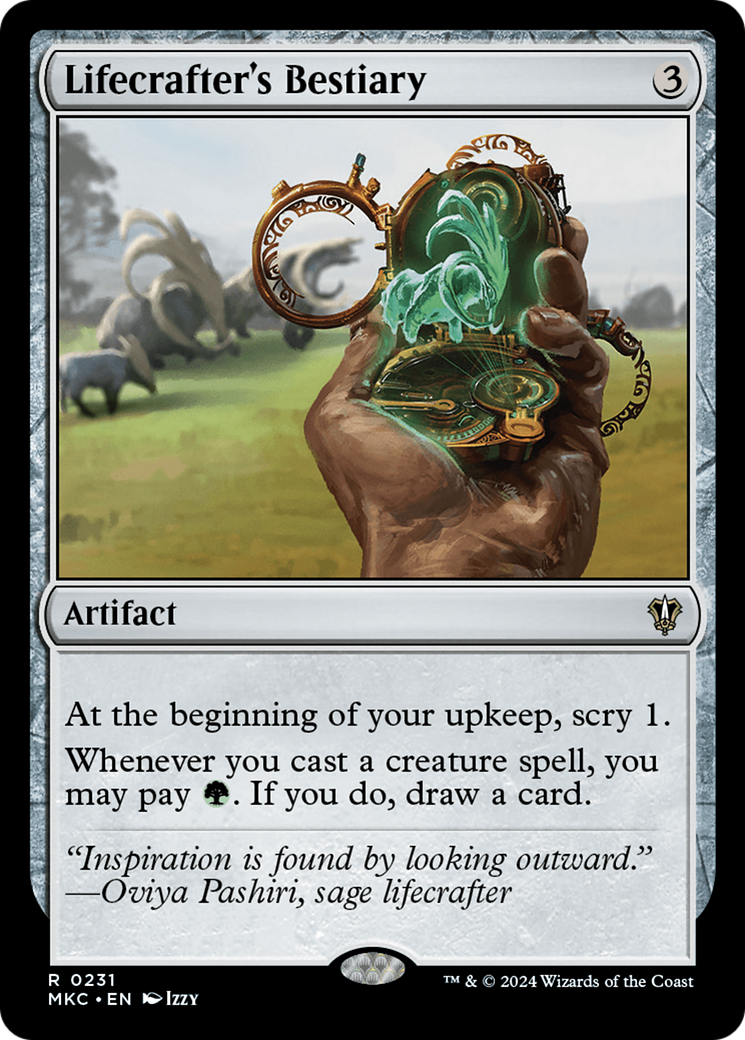
Lifecrafter's Bestiary
Lifecrafter's Bestiary
Artifact
At the beginning of your upkeep, scry 1.
Whenever you cast a creature spell, you may pay . If you do, draw a card.
- The draw step is after the upkeep step, so you'll scry 1 before you draw for the turn.
- Lifecrafter's Bestiary's second triggered ability resolves before the spell that caused it to trigger. The ability will resolve even if that spell is countered.
- While resolving Lifecrafter's Bestiary's second triggered ability, you can't pay multiple times to draw multiple cards.
-
1
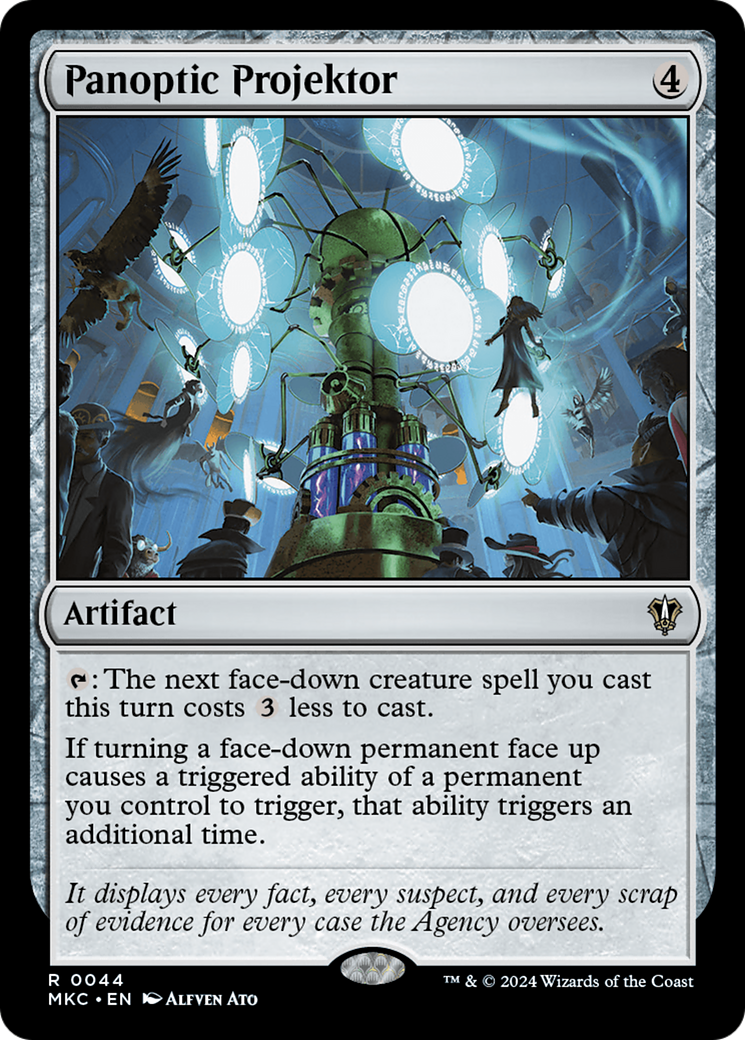
Panoptic Projektor
Panoptic Projektor
Artifact
: The next face-down creature spell you cast this turn costs less to cast.
If turning a face-down permanent face up causes a triggered ability of a permanent you control to trigger, that ability triggers an additional time.
- Panoptic Projektor’s last ability affects a permanent’s own abilities that trigger when it turns face up as well as other triggered abilities that trigger when that permanent turns face up. Such triggered abilities start with “when” or “whenever”.
- Replacement effects are unaffected by Panoptic Projektor’s last ability. For example, abilities that apply “as [this permanent] is turned face up,” such as that of Crowd-Control Warden, are unaffected.
- Panoptic Projektor’s last ability doesn’t copy the triggered ability; it just causes the ability to trigger twice. Any choices made as you put the ability onto the stack, such as modes and targets, are made separately for each instance of the ability. Any choices made on resolution, such as whether to put counters on a permanent, are also made individually.
- If you control two copies of Panoptic Projektor, a face-down permanent turning face up causes abilities to trigger three times, not four. A third Panoptic Projektor causes abilities to trigger four times, a fourth causes abilities to trigger five times, and so on.
-
1
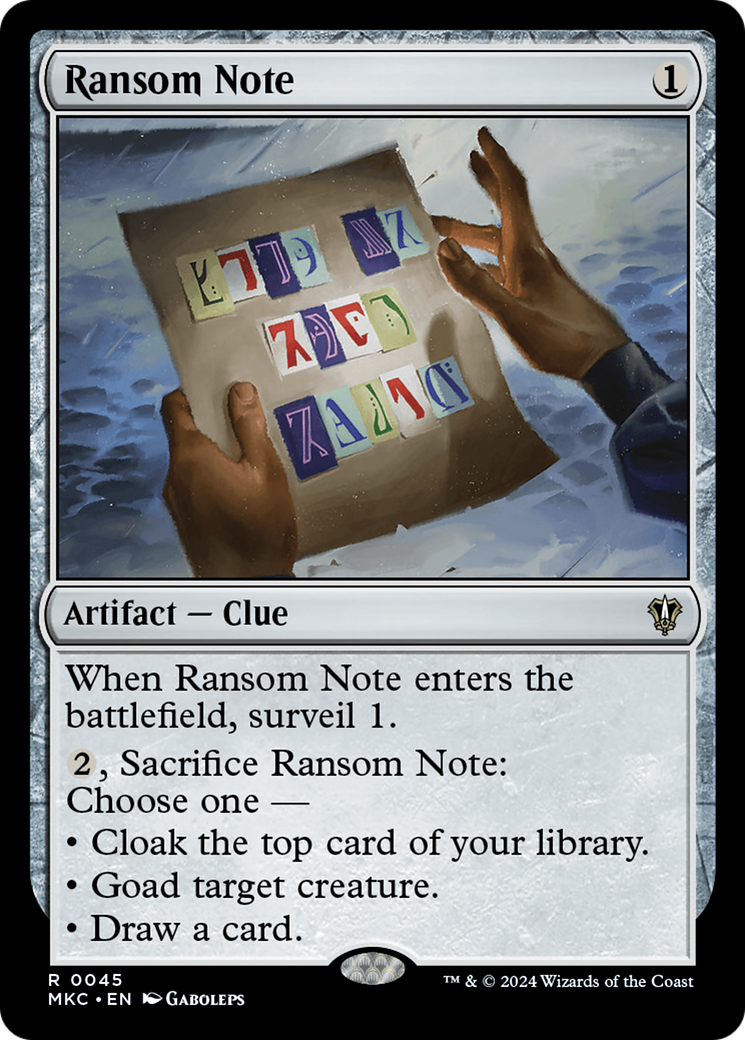
Ransom Note
Ransom Note
Artifact — Clue
When this artifact enters, surveil 1.
, Sacrifice this artifact: Choose one —
- Cloak the top card of your library.
- Goad target creature.
- Draw a card.
- To cloak a card, put it onto the battlefield face down. It becomes a 2/2 face-down creature card with ward and no name, mana cost, or creature types. It’s colorless and has a mana value of 0. Other effects that apply to the permanent can still grant it any characteristics it doesn’t have or change the characteristics it does have.
- Any time you have priority, you can turn a cloaked permanent you control face-up by revealing that it’s a creature card (ignoring any copy effects or type-changing effects that might be applying to it) and paying its mana cost. This is a special action. It doesn’t use the stack and can’t be responded to.
- If a cloaked creature would have disguise (or morph) if it were face up, you may also turn it face up by paying its disguise (or morph) cost.
- Unlike a face-down creature that was cast using a disguise or morph ability, a cloaked creature may still be turned face up after it loses its abilities if it’s a creature card.
- If a double-faced card is cloaked, it will be put onto the battlefield face down. While face down, it can’t transform. If the front face of the card is a creature card, you can turn it face up by paying its mana cost. If you do, its front face will be up.
- At any time, you can look at a face-down spell or permanent you control. You can’t look at face-down permanents or spells you don’t control unless an effect instructs or allows you to do so.
- If a face-down creature loses its abilities, it can’t be turned face up with a disguise ability because it will no longer have a disguise ability (or a disguise cost) once face up.
- Because the permanent is on the battlefield both before and after it’s turned face up, turning a permanent face up doesn’t cause any enters-the-battlefield abilities to trigger.
- Because face-down creatures don’t have a name, they can’t have the same name as any other creature, even another face-down creature.
- A permanent that turns face up or face down changes characteristics but is otherwise the same permanent. Spells and abilities that were targeting that permanent and Auras and Equipment that were attached to that permanent aren’t affected unless the new characteristics of the object change the legality of those targets or attachments.
- Turning a permanent face up or face down doesn’t change whether that permanent is tapped or untapped.
- If a face-down spell leaves the stack and goes to any zone other than the battlefield (if it was countered, for example), you must reveal it. Similarly, if a face-down permanent leaves the battlefield, you must reveal it. You must also reveal all face-down spells and permanents you control if you leave the game or the game ends.
- You must ensure that your face-down spells and permanents can be easily differentiated from each other. You’re not allowed to mix up the cards that represent them on the battlefield to confuse other players. The order in which they entered the battlefield should remain clear, as well as what ability caused them to be face down. (This includes disguise, cloak, and in games involving older cards, morph and manifest, as well as a few other effects that turn cards face down.) Common methods for doing this include using markers or dice, or simply placing them in order on the battlefield.
- If something tries to turn a face-down instant or sorcery card on the battlefield face up, reveal that card to show all players it’s an instant or sorcery card. The permanent remains on the battlefield face down. Abilities that trigger when a permanent turns face up won’t trigger, because even though you revealed the card, it never turned face up.
-
1
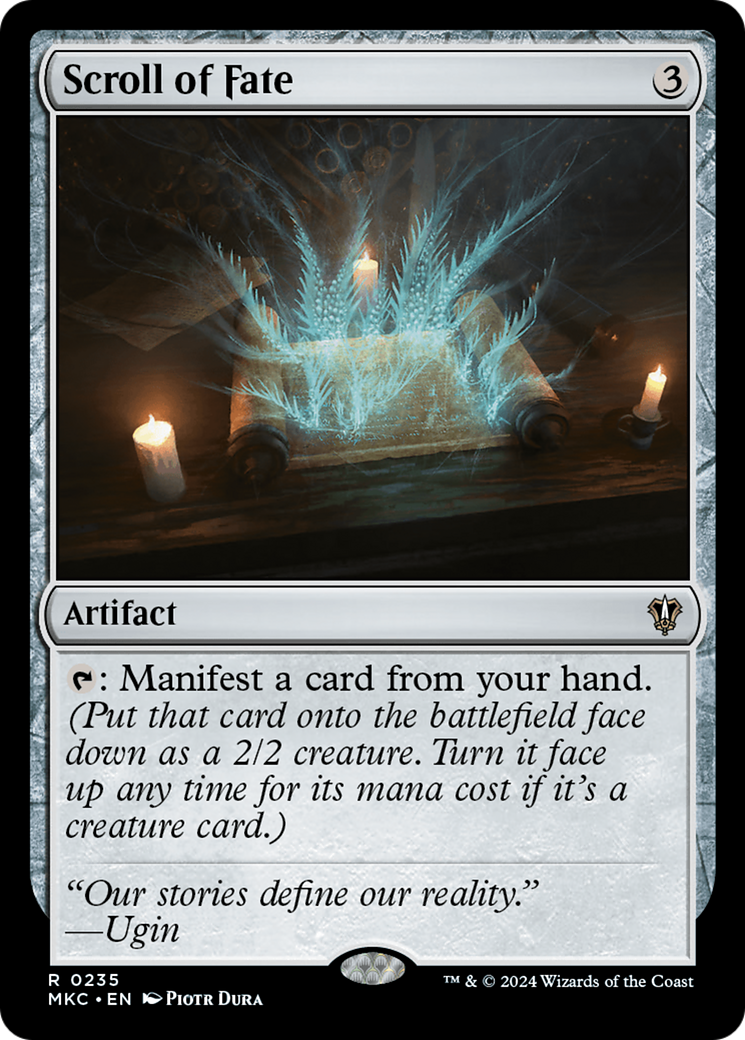
Scroll of Fate
Scroll of Fate
Artifact
: Manifest a card from your hand. (Put that card onto the battlefield face down as a 2/2 creature. Turn it face up any time for its mana cost if it's a creature card.)
-
1
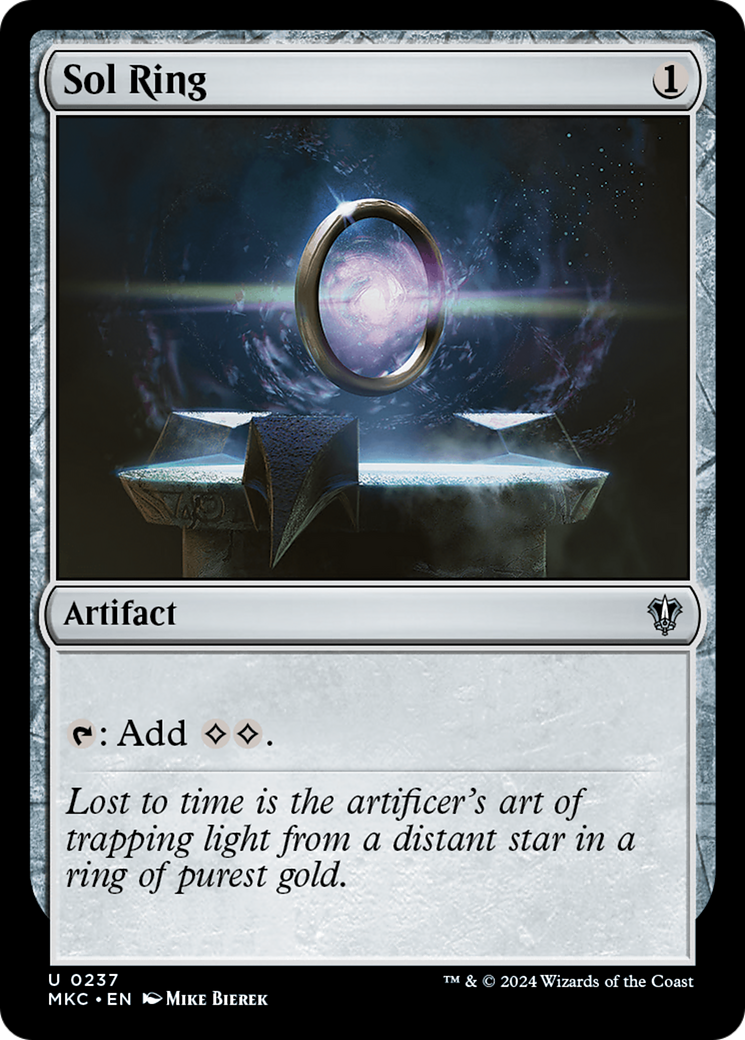
Sol Ring
Sol Ring
Artifact
: Add .
Enchantments 7
-
1
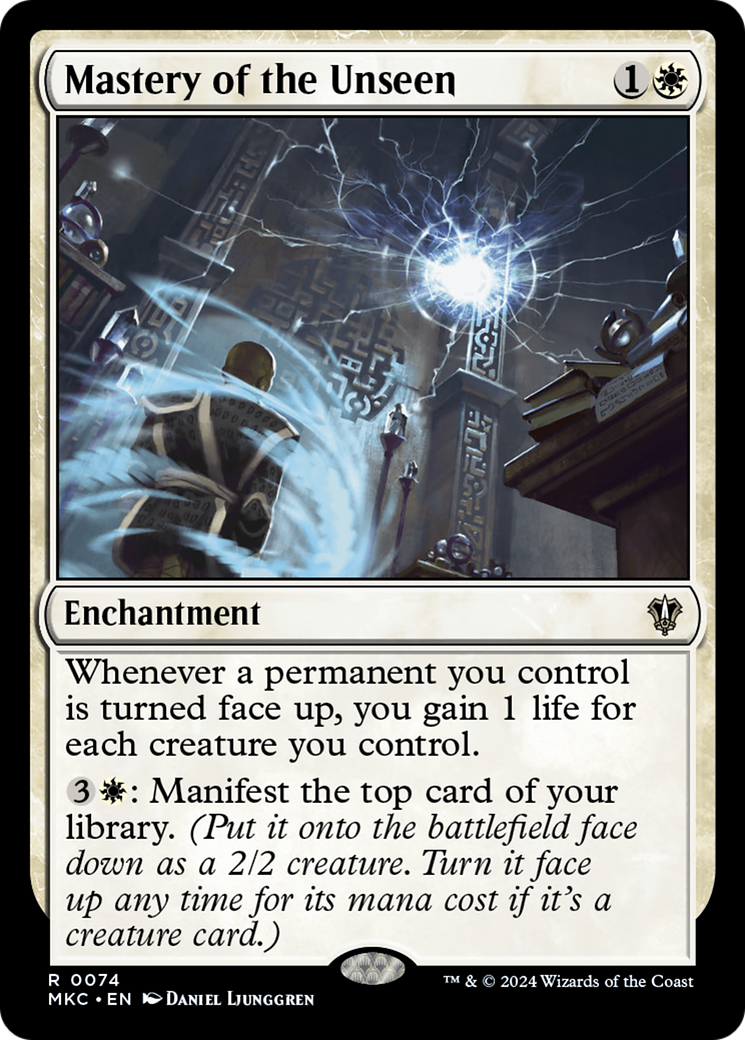
Mastery of the Unseen
Mastery of the Unseen
Enchantment
Whenever a permanent you control is turned face up, you gain 1 life for each creature you control.
: Manifest the top card of your library. (Put it onto the battlefield face down as a 2/2 creature. Turn it face up any time for its mana cost if it's a creature card.)
- The face-down permanent is a 2/2 creature with no name, mana cost, creature types, or abilities. It's colorless and has a mana value of 0. Other effects that apply to the permanent can still grant or change any of these characteristics.
- Any time you have priority, you may turn a manifested creature face up by revealing that it's a creature card (ignoring any copy effects or type-changing effects that might be applying to it) and paying its mana cost. This is a special action. It doesn't use the stack and can't be responded to.
- If a manifested creature would have morph if it were face up, you may also turn it face up by paying its morph cost.
- Unlike a face-down creature that was cast using the morph ability, a manifested creature may still be turned face up after it loses its abilities if it's a creature card.
- Because the permanent is on the battlefield both before and after it's turned face up, turning a permanent face up doesn't cause any enters-the-battlefield abilities to trigger.
- Because face-down creatures don't have names, they can't have the same name as any other creature, even another face-down creature.
- A permanent that turns face up or face down changes characteristics but is otherwise the same permanent. Spells and abilities that were targeting that permanent, as well as Auras and Equipment that were attached to the permanent, aren't affected.
- Turning a permanent face up or face down doesn't change whether that permanent is tapped or untapped.
- At any time, you can look at a face-down permanent you control. You can't look at face-down permanents you don't control unless an effect allows you to or instructs you to.
- If a face-down permanent you control leaves the battlefield, you must reveal it. You must also reveal all face-down spells and permanents you control if you leave the game or if the game ends.
- You must ensure that your face-down spells and permanents can easily be differentiated from each other. You're not allowed to mix up the cards that represent them on the battlefield in order to confuse other players. The order they entered the battlefield should remain clear. Common methods for indicating this include using markers or dice, or simply placing them in order on the battlefield. You must also track how each became face down (manifested, cast face down using the morph ability, and so on).
- There are no cards in the Fate Reforged set that would turn a face-down instant or sorcery card on the battlefield face up, but some older cards can try to do this. If something tries to turn a face-down instant or sorcery card on the battlefield face up, reveal that card to show all players it's an instant or sorcery card. The permanent remains on the battlefield face down. Abilities that trigger when a permanent turns face up won't trigger, because even though you revealed the card, it never turned face up.
- If a double-faced card is manifested, it will be put onto the battlefield face down. While face down, it can't transform. If the front face of the card is a creature card, you can turn it face up by paying its mana cost. If you do, its front face will be up.
-
1
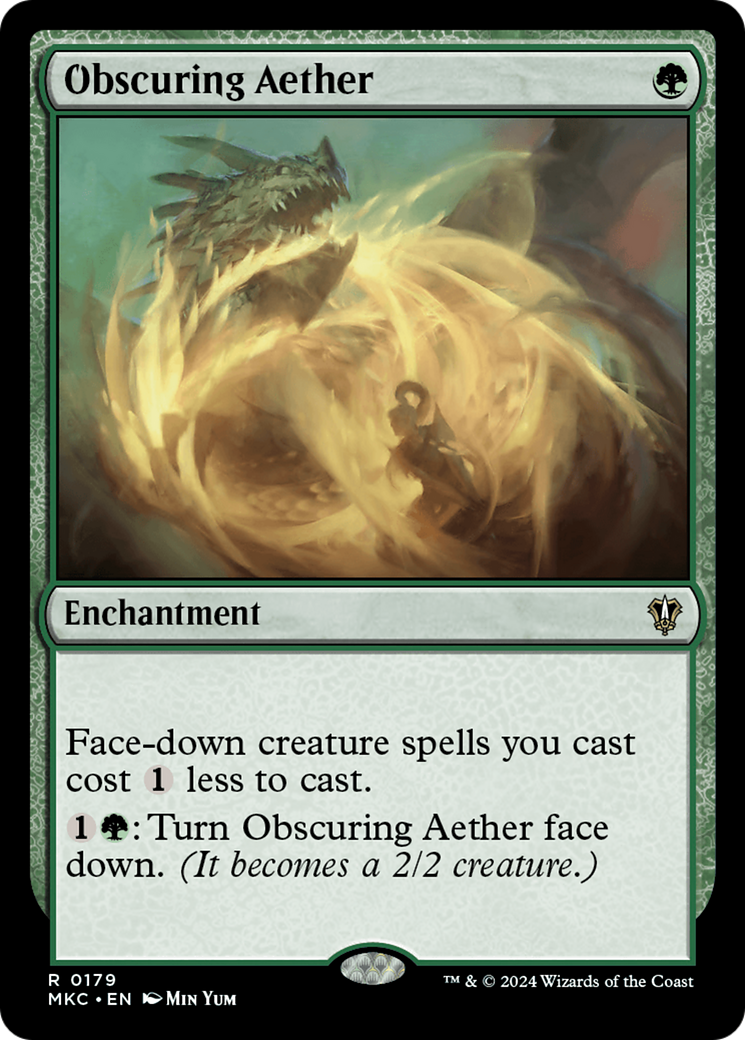
Obscuring Aether
Obscuring Aether
Enchantment
Face-down creature spells you cast cost less to cast.
: Turn this enchantment face down. (It becomes a 2/2 creature.)
- Obscuring Aether has no effect on spells that instruct you to manifest cards.
- Note that Obscuring Aether doesn't have a morph cost. Once it's turned face down, it doesn't have a way to turn itself face up.
-
1
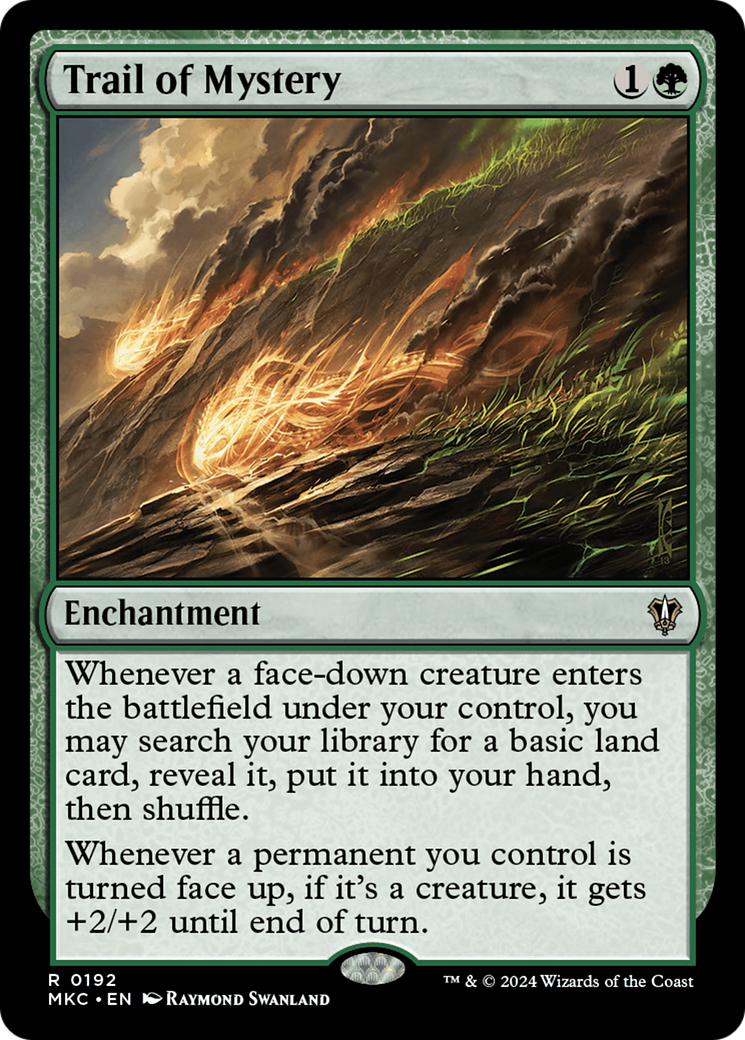
Trail of Mystery
Trail of Mystery
Enchantment
Whenever a face-down creature you control enters, you may search your library for a basic land card, reveal it, put it into your hand, then shuffle.
Whenever a permanent you control is turned face up, if it's a creature, it gets +2/+2 until end of turn.
-
1
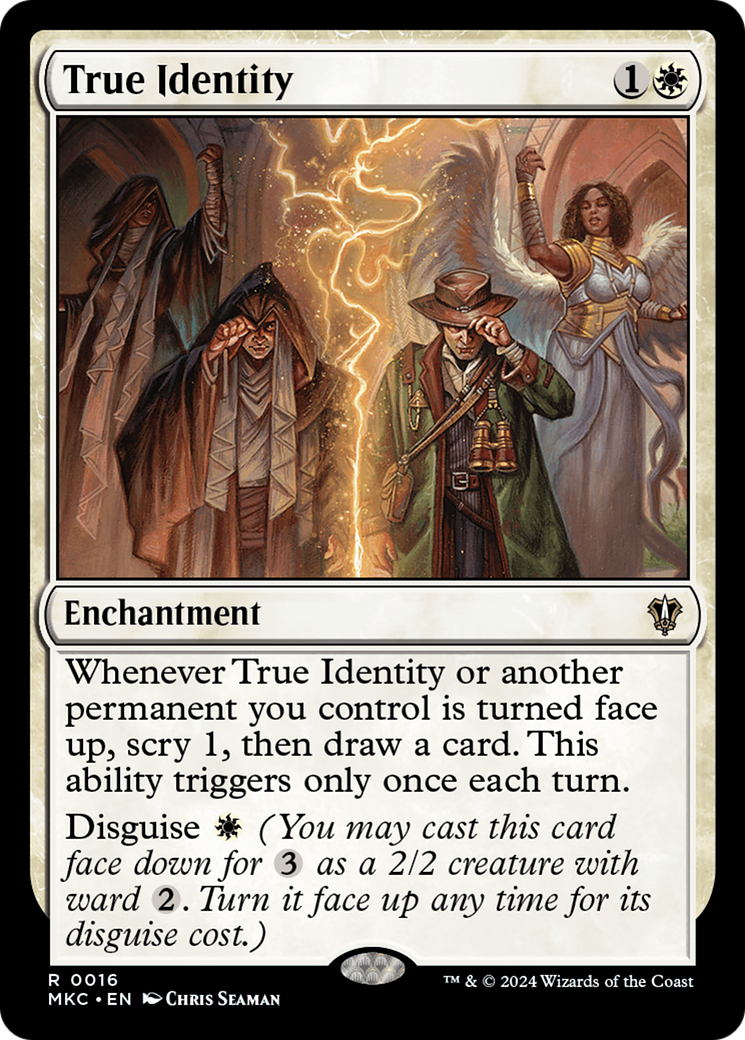
True Identity
True Identity
Enchantment
Whenever this enchantment or another permanent you control is turned face up, scry 1, then draw a card. This ability triggers only once each turn.
Disguise (You may cast this card face down for as a 2/2 creature with ward . Turn it face up any time for its disguise cost.)
- A disguise ability lets you cast a card face down by paying and announcing that you are using a disguise ability. Any time you have priority, you can turn a face-down permanent with disguise face up by paying its disguise cost.
- The face-down spell has no mana cost and a mana value of 0. When you cast a face-down spell, put it on the stack face down so no other player knows what it is, and pay to cast it. This is an alternative cost.
- The creature spell is a 2/2 creature spell with ward that has no name, mana cost, or creature types. The resulting creature is a 2/2 creature with ward that has no name, mana cost, or creature types. Both the spell and the resulting creature are colorless and have a mana value of 0. Other effects that apply to the spell or creature can still grant it any characteristics it doesn’t have or change the characteristics it does have.
- Any time you have priority, you may turn the face-down creature face up by revealing what its disguise cost is and paying that cost. This is a special action. It doesn’t use the stack and can’t be responded to. Only a face-down permanent can be turned face up this way; a face-down spell cannot.
- At any time, you can look at a face-down spell or permanent you control. You can’t look at face-down permanents or spells you don’t control unless an effect instructs or allows you to do so.
- If a face-down creature loses its abilities, it can’t be turned face up with a disguise ability because it will no longer have a disguise ability (or a disguise cost) once face up.
- Because the permanent is on the battlefield both before and after it’s turned face up, turning a permanent face up doesn’t cause any enters-the-battlefield abilities to trigger.
- Because face-down creatures don’t have a name, they can’t have the same name as any other creature, even another face-down creature.
- A permanent that turns face up or face down changes characteristics but is otherwise the same permanent. Spells and abilities that were targeting that permanent and Auras and Equipment that were attached to that permanent aren’t affected unless the new characteristics of the object change the legality of those targets or attachments.
- Turning a permanent face up or face down doesn’t change whether that permanent is tapped or untapped.
- If a face-down spell leaves the stack and goes to any zone other than the battlefield (if it was countered, for example), you must reveal it. Similarly, if a face-down permanent leaves the battlefield, you must reveal it. You must also reveal all face-down spells and permanents you control if you leave the game or the game ends.
- You must ensure that your face-down spells and permanents can be easily differentiated from each other. You’re not allowed to mix up the cards that represent them on the battlefield to confuse other players. The order in which they entered the battlefield should remain clear, as well as what ability caused them to be face down. (This includes disguise, cloak, and in games involving older cards, morph and manifest, as well as a few other effects that turn cards face down.) Common methods for doing this include using markers or dice, or simply placing them in order on the battlefield.
-
1
Ugin's Mastery
Ugin's Mastery
Enchantment
Whenever you cast a colorless creature spell, manifest the top card of your library. (Put it onto the battlefield face down as a 2/2 creature. Turn it face up any time for its mana cost if it's a creature card.)
Whenever you attack with creatures with total power 6 or greater, you may turn a face-down creature you control face up.
- Because the permanent is on the battlefield both before and after it's turned face up, turning a permanent face up doesn't cause any enters-the-battlefield abilities to trigger.
- Because face-down creatures don't have names, they can't have the same name as any other creature, even another face-down creature.
- The face-down permanent is a 2/2 creature with no name, mana cost, creature types, or abilities. It's colorless and has a mana value of 0. Other effects that apply to the permanent can still grant or change any of these characteristics.
- Any time you have priority, you may turn a manifested creature face up by revealing that it's a creature card (ignoring any copy effects or type-changing effects that might be applying to it) and paying its mana cost. This is a special action. It doesn't use the stack and can't be responded to.
- If a manifested creature would have morph if it were face up, you may also turn it face up by paying its morph cost.
- Unlike a face-down creature that was cast using the morph ability, a manifested creature may still be turned face up after it loses its abilities if it's a creature card.
- A permanent that turns face up or face down changes characteristics but is otherwise the same permanent. Spells and abilities that were targeting that permanent, as well as Auras and Equipment that were attached to the permanent, aren't affected.
- Turning a permanent face up or face down doesn't change whether that permanent is tapped or untapped.
- You can look at a face-down permanent you control any time. You can't look at face-down permanents you don't control unless an effect allows you to or instructs you to.
- If a face-down permanent you control leaves the battlefield, you must reveal it. You must also reveal all face-down spells and permanents you control if you leave the game or if the game ends.
- You must ensure that your face-down spells and permanents can easily be differentiated from each other. You're not allowed to mix up the cards that represent them on the battlefield to confuse other players. The order they entered the battlefield should remain clear. Common methods for indicating this include using markers or dice, or simply placing them in order on the battlefield. You must also track how each became face down (manifested, cast face down using the morph ability, and so on).
- If something tries to turn a face-down instant or sorcery card on the battlefield face up, reveal that card to show all players it's an instant or sorcery card. The permanent remains on the battlefield face down. Abilities that trigger when a permanent turns face up won't trigger, because even though you revealed the card, it never turned face up.
- If a double-faced card is manifested, it will be put onto the battlefield face down. While face down, a transforming double-faced card can't transform or convert. If the front face of a face down double-faced card is a creature card, you can turn it face up by paying its mana cost. If you do, its front face will be up.
-
1
Veiled Ascension
Veiled Ascension
Enchantment
When this enchantment enters, put a flying counter on each face-down creature you control.
Face-down creatures you control enter with a flying counter on them.
At the beginning of your upkeep, you may cloak the top card of your library.
- To cloak a card, put it onto the battlefield face down. It becomes a 2/2 face-down creature card with ward and no name, mana cost, or creature types. It’s colorless and has a mana value of 0. Other effects that apply to the permanent can still grant it any characteristics it doesn’t have or change the characteristics it does have.
- Any time you have priority, you can turn a cloaked permanent you control face-up by revealing that it’s a creature card (ignoring any copy effects or type-changing effects that might be applying to it) and paying its mana cost. This is a special action. It doesn’t use the stack and can’t be responded to.
- If a cloaked creature would have disguise (or morph) if it were face up, you may also turn it face up by paying its disguise (or morph) cost.
- Unlike a face-down creature that was cast using a disguise or morph ability, a cloaked creature may still be turned face up after it loses its abilities if it’s a creature card.
- If a double-faced card is cloaked, it will be put onto the battlefield face down. While face down, it can’t transform. If the front face of the card is a creature card, you can turn it face up by paying its mana cost. If you do, its front face will be up.
- At any time, you can look at a face-down spell or permanent you control. You can’t look at face-down permanents or spells you don’t control unless an effect instructs or allows you to do so.
- If a face-down creature loses its abilities, it can’t be turned face up with a disguise ability because it will no longer have a disguise ability (or a disguise cost) once face up.
- Because the permanent is on the battlefield both before and after it’s turned face up, turning a permanent face up doesn’t cause any enters-the-battlefield abilities to trigger.
- Because face-down creatures don’t have a name, they can’t have the same name as any other creature, even another face-down creature.
- A permanent that turns face up or face down changes characteristics but is otherwise the same permanent. Spells and abilities that were targeting that permanent and Auras and Equipment that were attached to that permanent aren’t affected unless the new characteristics of the object change the legality of those targets or attachments.
- Turning a permanent face up or face down doesn’t change whether that permanent is tapped or untapped.
- If a face-down spell leaves the stack and goes to any zone other than the battlefield (if it was countered, for example), you must reveal it. Similarly, if a face-down permanent leaves the battlefield, you must reveal it. You must also reveal all face-down spells and permanents you control if you leave the game or the game ends.
- You must ensure that your face-down spells and permanents can be easily differentiated from each other. You’re not allowed to mix up the cards that represent them on the battlefield to confuse other players. The order in which they entered the battlefield should remain clear, as well as what ability caused them to be face down. (This includes disguise, cloak, and in games involving older cards, morph and manifest, as well as a few other effects that turn cards face down.) Common methods for doing this include using markers or dice, or simply placing them in order on the battlefield.
- If something tries to turn a face-down instant or sorcery card on the battlefield face up, reveal that card to show all players it’s an instant or sorcery card. The permanent remains on the battlefield face down. Abilities that trigger when a permanent turns face up won’t trigger, because even though you revealed the card, it never turned face up.
-
1
Wild Growth
Wild Growth
Enchantment — Aura
Enchant land
Whenever enchanted land is tapped for mana, its controller adds an additional .
- The additional mana is not an ability of the land and is not something the land can produce.
Lands 37
-
1
Boros Garrison
Boros Garrison
Land
This land enters tapped.
When this land enters, return a land you control to its owner's hand.
: Add .
- If this land enters the battlefield and you control no other lands, its ability will force you to return it to your hand.
-
1
Branch of Vitu-Ghazi
Branch of Vitu-Ghazi
Land
: Add .
Disguise (You may cast this card face down for as a 2/2 creature with ward . Turn it face up any time for its disguise cost.)
When this land is turned face up, add two mana of any one color. Until end of turn, you don't lose this mana as steps and phases end.
-
1
Canopy Vista
Canopy Vista
Land — Forest Plains
( : Add or .)
This land enters tapped unless you control two or more basic lands.
- Even though these lands have basic land types, they are not basic lands because "basic" doesn't appear on their type line. Notably, controlling two or more of them won't allow others to enter the battlefield untapped.
- If one of these lands enters the battlefield at the same time as any number of basic lands, those other lands are not counted when determining if this land enters the battlefield tapped or untapped.
- However, because these cards have basic land types, effects that specify a basic land type without also specifying that the land be basic can affect them. For example, a spell or ability that reads "Destroy target Forest" can target Canopy Vista, while one that reads "Destroy target basic Forest" cannot.
-
1
Cinder Glade
Cinder Glade
Land — Mountain Forest
( : Add or .)
This land enters tapped unless you control two or more basic lands.
- If one of these lands enters the battlefield at the same time as any number of basic lands, those other lands are not counted when determining if this land enters the battlefield tapped or untapped.
- However, because these cards have basic land types, effects that specify a basic land type without also specifying that the land be basic can affect them. For example, a spell or ability that reads "Destroy target Forest" can target Canopy Vista, while one that reads "Destroy target basic Forest" cannot.
- Even though these lands have basic land types, they are not basic lands because "basic" doesn't appear on their type line. Notably, controlling two or more of them won't allow others to enter the battlefield untapped.
-
1
Command Tower
Command Tower
Land
: Add one mana of any color in your commander's color identity.
- If you don't have a commander, Command Tower's ability produces no mana.
- If your commander is a card that has no colors in its color identity, Command Tower's ability produces no mana. It doesn't produce .
- If you have two commanders, the ability adds one mana of any color in their combined color identities.
-
1
Exotic Orchard
Exotic Orchard
Land
: Add one mana of any color that a land an opponent controls could produce.
- Lands that produce mana based only on what other lands "could produce" won't help each other unless some other land allows one of them to actually produce some type of mana. For example, if you control an Exotic Orchard and your opponent controls an Exotic Orchard and a Reflecting Pool, none of those lands would produce mana if their mana abilities were activated. On the other hand, if you control a Forest and an Exotic Orchard, and your opponent controls an Exotic Orchard and a Reflecting Pool, then each of those lands can be tapped to produce . Your opponent's Exotic Orchard can produce because you control a Forest. Your Exotic Orchard and your opponent's Reflecting Pool can each produce because your opponent's Exotic Orchard can produce .
- When determining what colors of mana your opponents' lands could produce, Exotic Orchard takes into account any applicable replacement effects that would apply to those lands' mana abilities (such as Contamination's effect, for example). If there are more than one, consider them in any possible order.
- The colors of mana are white, blue, black, red, and green. Exotic Orchard can't be tapped for colorless mana, even if a land an opponent controls could produce colorless mana.
- Exotic Orchard doesn't care about any restrictions or riders your opponents' lands (such as Ancient Ziggurat or Hall of the Bandit Lord) put on the mana they produce. It just cares about colors of mana.
- Exotic Orchard checks the effects of all mana-producing abilities of lands your opponents control, but it doesn't check their costs. For example, Vivid Crag has the ability " , Remove a charge counter from Vivid Crag: Add one mana of any color." If an opponent controls Vivid Crag and you control Exotic Orchard, you can tap Exotic Orchard for any color of mana. It doesn't matter whether Vivid Crag has a charge counter on it, and it doesn't matter whether it's untapped.
-
4
Forest
Forest
Basic Land — Forest
( : Add .)
-
1
Fortified Village
Fortified Village
Land
As this land enters, you may reveal a Forest or Plains card from your hand. If you don't, this land enters tapped.
: Add or .
- If a Forest or Plains is entering the battlefield from your hand at the same time as Fortified Village, you may reveal the other land to have Fortified Village enter untapped.
- You may reveal any land card with either or both of the appropriate subtypes. It doesn't have to be a basic land. For example, you could reveal Prairie Stream from the Battle for Zendikar set to satisfy the ability of Fortified Village.
- Lands don't have a subtype just because they can produce mana of the corresponding color. Fortified Village itself is neither a Forest nor a Plains, even though it produces green and white mana, so you can't reveal one to satisfy the ability of another.
- If an effect instructs you to put Fortified Village onto the battlefield tapped, it will still enter the battlefield tapped even if you reveal a land card from your hand.
-
1
Furycalm Snarl
Furycalm Snarl
Land
As this land enters, you may reveal a Mountain or Plains card from your hand. If you don't, this land enters tapped.
: Add or .
- The "Snarl" itself doesn't have any land subtypes. You can't reveal one to satisfy the ability of another.
- If a land card with an appropriate subtype is entering the battlefield from your hand at the same time as one of these lands, you may reveal the other land to have the "Snarl" enter untapped.
- If an effect instructs you to put one of these lands onto the battlefield tapped, it will still enter the battlefield tapped even if you reveal a land card from your hand.
- You may reveal any land card with either or both of the appropriate subtypes. It doesn't have to be a basic land card.
-
1
Game Trail
Game Trail
Land
As this land enters, you may reveal a Mountain or Forest card from your hand. If you don't, this land enters tapped.
: Add or .
- Lands don't have a subtype just because they can produce mana of the corresponding color. Game Trail itself is neither a Mountain nor a Forest, even though it produces red and green mana, so you can't reveal one to satisfy the ability of another.
- If an effect instructs you to put Game Trail onto the battlefield tapped, it will still enter the battlefield tapped even if you reveal a land card from your hand.
- You may reveal any land card with either or both of the appropriate subtypes. It doesn't have to be a basic land. For example, you could reveal Canopy Vista from the Battle for Zendikar set to satisfy the ability of Game Trail.
- If a Mountain or Forest is entering the battlefield from your hand at the same time as Game Trail, you may reveal the other land to have Game Trail enter untapped.
-
1
Gruul Turf
Gruul Turf
Land
This land enters tapped.
When this land enters, return a land you control to its owner's hand.
: Add .
- If this land enters the battlefield and you control no other lands, its ability will force you to return it to your hand.
-
1
Jungle Shrine
Jungle Shrine
Land
This land enters tapped.
: Add , , or .
-
1
Kessig Wolf Run
Kessig Wolf Run
Land
: Add .
, : Target creature gets +X/+0 and gains trample until end of turn.
-
1
Krosan Verge
Krosan Verge
Land
This land enters tapped.
: Add .
, , Sacrifice this land: Search your library for a Forest card and a Plains card, put them onto the battlefield tapped, then shuffle.
-
1
Mossfire Valley
Mossfire Valley
Land
, : Add .
-
1
Mosswort Bridge
Mosswort Bridge
Land
Hideaway 4 (When this land enters, look at the top four cards of your library, exile one face down, then put the rest on the bottom in a random order.)
This land enters tapped.
: Add .
, : You may play the exiled card without paying its mana cost if creatures you control have total power 10 or greater.
- "Hideaway N" means "When this permanent enters the battlefield, look at the top N cards of your library. Exile one of them face down and put the rest on the bottom of your library in a random order. The exiled card gains 'The player who controls the permanent that exiled this card may look at this card in the exile zone.'"
- Any player who has controlled a permanent with a hideaway ability since a card was exiled with it may look at that card.
- Previously, permanents with hideaway entered the battlefield tapped. This ability has been removed from the definition of hideaway. Older cards have received errata to have an additional paragraph that reads "[This permanent] enters the battlefield tapped," and they now have hideaway 4.
- Hideaway now causes you to put the rest of the cards on the bottom of your library in a random order instead of any order.
-
3
Mountain
Mountain
Basic Land — Mountain
( : Add .)
-
4
Plains
Plains
Basic Land — Plains
( : Add .)
-
1
Sacred Peaks
Sacred Peaks
Land — Mountain Plains
( : Add or .)
This land enters tapped.
-
1
Scattered Groves
Scattered Groves
Land — Forest Plains
( : Add or .)
This land enters tapped.
Cycling ( , Discard this card: Draw a card.)
-
1
Selesnya Sanctuary
Selesnya Sanctuary
Land
This land enters tapped.
When this land enters, return a land you control to its owner's hand.
: Add .
- If this land enters the battlefield and you control no other lands, its ability will force you to return it to your hand.
-
1
Sheltered Thicket
Sheltered Thicket
Land — Mountain Forest
( : Add or .)
This land enters tapped.
Cycling ( , Discard this card: Draw a card.)
-
1
Shrine of the Forsaken Gods
Shrine of the Forsaken Gods
Land
: Add .
: Add . Spend this mana only to cast colorless spells. Activate only if you control seven or more lands.
-
1
Sungrass Prairie
Sungrass Prairie
Land
, : Add .
-
1
Temple of Abandon
Temple of Abandon
Land
This land enters tapped.
When this land enters, scry 1. (Look at the top card of your library. You may put that card on the bottom.)
: Add or .
- You perform the actions stated on a card in sequence. For some spells and abilities, that means you'll scry last. For others, that means you'll scry and then perform other actions.
- When you scry, you may put all the cards you look at back on top of your library, you may put all of those cards on the bottom of your library, or you may put some of those cards on top and the rest of them on the bottom.
- You choose how to order cards returned to your library after scrying no matter where you put them.
- Scry appears on some spells and abilities with one or more targets. If all of the spell or ability's targets are illegal when it tries to resolve, it won't resolve and none of its effects will happen. You won't scry.
-
1
Temple of Plenty
Temple of Plenty
Land
This land enters tapped.
When this land enters, scry 1. (Look at the top card of your library. You may put that card on the bottom.)
: Add or .
- You perform the actions stated on a card in sequence. For some spells and abilities, that means you'll scry last. For others, that means you'll scry and then perform other actions.
- You choose how to order cards returned to your library after scrying no matter where you put them.
- When you scry, you may put all the cards you look at back on top of your library, you may put all of those cards on the bottom of your library, or you may put some of those cards on top and the rest of them on the bottom.
- Scry appears on some spells and abilities with one or more targets. If all of the spell or ability's targets are illegal when it tries to resolve, it won't resolve and none of its effects will happen. You won't scry.
-
1
Temple of the False God
Temple of the False God
Land
: Add . Activate only if you control five or more lands.
-
1
Temple of Triumph
Temple of Triumph
Land
This land enters tapped.
When this land enters, scry 1. (Look at the top card of your library. You may put that card on the bottom.)
: Add or .
- When you scry, you may put all the cards you look at back on top of your library, you may put all of those cards on the bottom of your library, or you may put some of those cards on top and the rest of them on the bottom.
- You choose how to order cards returned to your library after scrying no matter where you put them.
- You perform the actions stated on a card in sequence. For some spells and abilities, that means you'll scry last. For others, that means you'll scry and then perform other actions.
- Scry appears on some spells and abilities with one or more targets. If all of the spell or ability's targets are illegal when it tries to resolve, it won't resolve and none of its effects will happen. You won't scry.
-
1
Zoetic Cavern
Zoetic Cavern
Land
: Add .
Morph (You may cast this card face down as a 2/2 creature for . Turn it face up any time for its morph cost.)
- When Zoetic Cavern is turned face up, any Auras on it that can't legally enchant it will be put into their owners' graveyards. Any Equipment will become unattached and remain on the battlefield. Any counters on it will remain on it.
- If Blood Moon is on the battlefield and a player controls a face-down Zoetic Cavern, it can't be turned face up since it won't have a morph cost.
White 13
-
1
Austere Command
Austere Command
Sorcery
Choose two —
- Destroy all artifacts.
- Destroy all enchantments.
- Destroy all creatures with mana value 3 or less.
- Destroy all creatures with mana value 4 or greater.
- Each of the chosen modes happens sequentially. If a permanent has an ability that triggers whenever it or another permanent is destroyed, it will see permanents destroyed at the same time as it or before it, but not permanents destroyed by later modes.
- If a card is exiled "until" another permanent leaves the battlefield, the exiled card returns to the battlefield immediately after that permanent leaves the battlefield during Austere Command's resolution, and it may be destroyed by a later mode.
- If the first and last modes are chosen, an artifact creature with mana value 4 or greater will have to be regenerated twice to survive. This is because the modes happen sequentially, and the regeneration "shield" is used up by the first one. The same is true with any other combination of modes that covers one permanent twice.
-
1
Dusk // Dawn
//
Dusk
Sorcery
- Once you've started to cast a spell with aftermath from your graveyard, the card is immediately moved to the stack. Opponents can't try to stop the ability by exiling the card with an effect such as that of Crook of Condemnation.
- All split cards have two card faces on a single card, and you put a split card onto the stack with only the half you're casting. The characteristics of the half of the card you didn't cast are ignored while the spell is on the stack. For example, if an effect prevents you from casting green spells, you can cast Destined of Destined // Lead, but not Lead.
- Each split card is a single card. For example, if you discard one, you've discarded one card, not two. If an effect counts the number of instant and sorcery cards in your graveyard, Destined // Lead counts once, not twice.
- Each split card has two names. If an effect instructs you to choose a card name, you may choose one, but not both.
- While not on the stack, the characteristics of a split card are the combination of its two halves. For example, Destined // Lead is a green and black card, it is both an instant card and a sorcery card, and its mana value is 6. This means that if an effect allows you to cast a card with mana value 2 from your hand, you can't cast Destined. This is a change from the previous rules for split cards.
- Split cards with aftermath have a new frame treatment—the half you can cast from your hand is oriented the same as other cards you'd cast from your hand, while the half you can cast from your graveyard is a traditional split card half. This frame treatment is for your convenience and has no rules significance.
- If another effect allows you to cast a split card with aftermath from any zone other than a graveyard, you can't cast the half with aftermath.
- If another effect allows you to cast a split card with aftermath from a graveyard, you may cast either half. If you cast the half that has aftermath, you'll exile the card if it would leave the stack.
- A spell with aftermath cast from a graveyard will always be exiled afterward, whether it resolves, it's countered, or it leaves the stack in some other way.
- If you cast the first half of a split card with aftermath during your turn, you'll have priority immediately after it resolves. You can cast the half with aftermath from your graveyard before any player can take any other action if it's legal for you to do so.
-
1
Exalted Angel
Exalted Angel
Creature — Angel
4/5
Flying
Whenever this creature deals damage, you gain that much life.
Morph (You may cast this card face down as a 2/2 creature for . Turn it face up any time for its morph cost.)
- You only gain the life when the triggered ability resolves. If you are reduced to zero life before the ability resolves, you will lose before gaining the life.
-
1
Fell the Mighty
Fell the Mighty
Sorcery
Destroy all creatures with power greater than target creature's power.
- Use the power of the target creature as Fell the Mighty resolves to determine which creatures are destroyed. Fell the Mighty doesn't target any of those creatures, so a creature with hexproof or protection from white will be destroyed if its power is high enough.
- Fell the Mighty won't destroy the target creature.
- If the target creature is an illegal target when Fell the Mighty tries to resolve, Fell the Mighty won't resolve and none of its effects will happen. No creatures will be destroyed.
-
1
Hidden Dragonslayer
Hidden Dragonslayer
Creature — Human Warrior
2/1
Lifelink
Megamorph (You may cast this card face down as a 2/2 creature for . Turn it face up any time for its megamorph cost and put a +1/+1 counter on it.)
When this creature is turned face up, destroy target creature with power 4 or greater an opponent controls.
- Turning a face-down creature with megamorph face up and putting a +1/+1 counter on it is a special action. It doesn't use the stack and can't be responded to.
- If a face-down creature with megamorph is turned face up some other way (for example, if you manifest a card with megamorph and then pay its mana cost to turn it face up), you won't put a +1/+1 counter on it.
- Megamorph is a variant of the morph ability. You can find more information on morph on cards with morph from the Khans of Tarkir set.
-
1
Master of Pearls
Master of Pearls
Creature — Human Monk
2/2
Morph (You may cast this card face down as a 2/2 creature for . Turn it face up any time for its morph cost.)
When this creature is turned face up, creatures you control get +2/+2 until end of turn.
- Morph lets you cast a card face down by paying , and lets you turn the face-down permanent face up any time you have priority by paying its morph cost.
- The face-down spell has no mana cost and has a mana value of 0. When you cast a face-down spell, put it on the stack face down so no other player knows what it is, and pay . This is an alternative cost.
- When the spell resolves, it enters the battlefield as a 2/2 creature with no name, mana cost, creature types, or abilities. It's colorless and has a mana value of 0. Other effects that apply to the creature can still grant it any of these characteristics.
- Any time you have priority, you may turn the face-down creature face up by revealing what its morph cost is and paying that cost. This is a special action. It doesn't use the stack and can't be responded to. Only a face-down permanent can be turned face up this way; a face-down spell cannot.
- Because the permanent is on the battlefield both before and after it's turned face up, turning a permanent face up doesn't cause any enters-the-battlefield abilities to trigger.
- A permanent that turns face up or face down changes characteristics but is otherwise the same permanent. Spells and abilities that were targeting that permanent, as well as Auras and Equipment that were attached to the permanent, aren't affected.
- At any time, you can look at a face-down spell or permanent you control. You can't look at face-down spells or permanents you don't control unless an effect instructs you to do so.
- You must ensure that your face-down spells and permanents can easily be differentiated from each other. You're not allowed to mix up the cards that represent them on the battlefield in order to confuse other players. The order they entered the battlefield should remain clear. Common methods for doing this include using markers or dice, or simply placing them in order on the battlefield.
- If a face-down permanent leaves the battlefield, you must reveal it. You must also reveal all face-down spells and permanents you control if you leave the game or if the game ends.
-
1
Mastery of the Unseen
Mastery of the Unseen
Enchantment
Whenever a permanent you control is turned face up, you gain 1 life for each creature you control.
: Manifest the top card of your library. (Put it onto the battlefield face down as a 2/2 creature. Turn it face up any time for its mana cost if it's a creature card.)
- The face-down permanent is a 2/2 creature with no name, mana cost, creature types, or abilities. It's colorless and has a mana value of 0. Other effects that apply to the permanent can still grant or change any of these characteristics.
- Any time you have priority, you may turn a manifested creature face up by revealing that it's a creature card (ignoring any copy effects or type-changing effects that might be applying to it) and paying its mana cost. This is a special action. It doesn't use the stack and can't be responded to.
- If a manifested creature would have morph if it were face up, you may also turn it face up by paying its morph cost.
- Unlike a face-down creature that was cast using the morph ability, a manifested creature may still be turned face up after it loses its abilities if it's a creature card.
- Because the permanent is on the battlefield both before and after it's turned face up, turning a permanent face up doesn't cause any enters-the-battlefield abilities to trigger.
- Because face-down creatures don't have names, they can't have the same name as any other creature, even another face-down creature.
- A permanent that turns face up or face down changes characteristics but is otherwise the same permanent. Spells and abilities that were targeting that permanent, as well as Auras and Equipment that were attached to the permanent, aren't affected.
- Turning a permanent face up or face down doesn't change whether that permanent is tapped or untapped.
- At any time, you can look at a face-down permanent you control. You can't look at face-down permanents you don't control unless an effect allows you to or instructs you to.
- If a face-down permanent you control leaves the battlefield, you must reveal it. You must also reveal all face-down spells and permanents you control if you leave the game or if the game ends.
- You must ensure that your face-down spells and permanents can easily be differentiated from each other. You're not allowed to mix up the cards that represent them on the battlefield in order to confuse other players. The order they entered the battlefield should remain clear. Common methods for indicating this include using markers or dice, or simply placing them in order on the battlefield. You must also track how each became face down (manifested, cast face down using the morph ability, and so on).
- There are no cards in the Fate Reforged set that would turn a face-down instant or sorcery card on the battlefield face up, but some older cards can try to do this. If something tries to turn a face-down instant or sorcery card on the battlefield face up, reveal that card to show all players it's an instant or sorcery card. The permanent remains on the battlefield face down. Abilities that trigger when a permanent turns face up won't trigger, because even though you revealed the card, it never turned face up.
- If a double-faced card is manifested, it will be put onto the battlefield face down. While face down, it can't transform. If the front face of the card is a creature card, you can turn it face up by paying its mana cost. If you do, its front face will be up.
-
1
Mirror Entity
Mirror Entity
Creature — Shapeshifter
1/1
Changeling (This card is every creature type.)
: Until end of turn, creatures you control have base power and toughness X/X and gain all creature types.
- Changeling applies in all zones, not just the battlefield.
- Mirror Entity's ability overwrites any effects that previously set a creature's base power and/or toughness. Any existing effects or counters that raise or lower a creature's power and/or toughness continue to apply to the creature's newly-set power and toughness.
- Activating the ability with X = 0 will cause all creatures you control to become 0/0 and be put into the graveyard.
-
1
Path to Exile
Path to Exile
Instant
Exile target creature. Its controller may search their library for a basic land card, put that card onto the battlefield tapped, then shuffle.
- The controller of the exiled creature isn't required to search their library for a basic land. If that player doesn't, the player won't shuffle their library.
- If the target creature is an illegal target by the time Path to Exile tries to resolve, it won't resolve and none of its effects will happen. The creature's controller won't search for a basic land card.
-
1
True Identity
True Identity
Enchantment
Whenever this enchantment or another permanent you control is turned face up, scry 1, then draw a card. This ability triggers only once each turn.
Disguise (You may cast this card face down for as a 2/2 creature with ward . Turn it face up any time for its disguise cost.)
- A disguise ability lets you cast a card face down by paying and announcing that you are using a disguise ability. Any time you have priority, you can turn a face-down permanent with disguise face up by paying its disguise cost.
- The face-down spell has no mana cost and a mana value of 0. When you cast a face-down spell, put it on the stack face down so no other player knows what it is, and pay to cast it. This is an alternative cost.
- The creature spell is a 2/2 creature spell with ward that has no name, mana cost, or creature types. The resulting creature is a 2/2 creature with ward that has no name, mana cost, or creature types. Both the spell and the resulting creature are colorless and have a mana value of 0. Other effects that apply to the spell or creature can still grant it any characteristics it doesn’t have or change the characteristics it does have.
- Any time you have priority, you may turn the face-down creature face up by revealing what its disguise cost is and paying that cost. This is a special action. It doesn’t use the stack and can’t be responded to. Only a face-down permanent can be turned face up this way; a face-down spell cannot.
- At any time, you can look at a face-down spell or permanent you control. You can’t look at face-down permanents or spells you don’t control unless an effect instructs or allows you to do so.
- If a face-down creature loses its abilities, it can’t be turned face up with a disguise ability because it will no longer have a disguise ability (or a disguise cost) once face up.
- Because the permanent is on the battlefield both before and after it’s turned face up, turning a permanent face up doesn’t cause any enters-the-battlefield abilities to trigger.
- Because face-down creatures don’t have a name, they can’t have the same name as any other creature, even another face-down creature.
- A permanent that turns face up or face down changes characteristics but is otherwise the same permanent. Spells and abilities that were targeting that permanent and Auras and Equipment that were attached to that permanent aren’t affected unless the new characteristics of the object change the legality of those targets or attachments.
- Turning a permanent face up or face down doesn’t change whether that permanent is tapped or untapped.
- If a face-down spell leaves the stack and goes to any zone other than the battlefield (if it was countered, for example), you must reveal it. Similarly, if a face-down permanent leaves the battlefield, you must reveal it. You must also reveal all face-down spells and permanents you control if you leave the game or the game ends.
- You must ensure that your face-down spells and permanents can be easily differentiated from each other. You’re not allowed to mix up the cards that represent them on the battlefield to confuse other players. The order in which they entered the battlefield should remain clear, as well as what ability caused them to be face down. (This includes disguise, cloak, and in games involving older cards, morph and manifest, as well as a few other effects that turn cards face down.) Common methods for doing this include using markers or dice, or simply placing them in order on the battlefield.
-
1
Unexplained Absence
Unexplained Absence
Instant
For each player, exile up to one target nonland permanent that player controls. For each permanent exiled this way, its controller cloaks the top card of their library. (To cloak a card, put it onto the battlefield face down as a 2/2 creature with ward . Turn it face up any time for its mana cost if it's a creature card.)
- To cloak a card, put it onto the battlefield face down. It becomes a 2/2 face-down creature card with ward and no name, mana cost, or creature types. It’s colorless and has a mana value of 0. Other effects that apply to the permanent can still grant it any characteristics it doesn’t have or change the characteristics it does have.
- Any time you have priority, you can turn a cloaked permanent you control face-up by revealing that it’s a creature card (ignoring any copy effects or type-changing effects that might be applying to it) and paying its mana cost. This is a special action. It doesn’t use the stack and can’t be responded to.
- If a cloaked creature would have disguise (or morph) if it were face up, you may also turn it face up by paying its disguise (or morph) cost.
- Unlike a face-down creature that was cast using a disguise or morph ability, a cloaked creature may still be turned face up after it loses its abilities if it’s a creature card.
- If a double-faced card is cloaked, it will be put onto the battlefield face down. While face down, it can’t transform. If the front face of the card is a creature card, you can turn it face up by paying its mana cost. If you do, its front face will be up.
- At any time, you can look at a face-down spell or permanent you control. You can’t look at face-down permanents or spells you don’t control unless an effect instructs or allows you to do so.
- If a face-down creature loses its abilities, it can’t be turned face up with a disguise ability because it will no longer have a disguise ability (or a disguise cost) once face up.
- Because the permanent is on the battlefield both before and after it’s turned face up, turning a permanent face up doesn’t cause any enters-the-battlefield abilities to trigger.
- Because face-down creatures don’t have a name, they can’t have the same name as any other creature, even another face-down creature.
- A permanent that turns face up or face down changes characteristics but is otherwise the same permanent. Spells and abilities that were targeting that permanent and Auras and Equipment that were attached to that permanent aren’t affected unless the new characteristics of the object change the legality of those targets or attachments.
- Turning a permanent face up or face down doesn’t change whether that permanent is tapped or untapped.
- If a face-down spell leaves the stack and goes to any zone other than the battlefield (if it was countered, for example), you must reveal it. Similarly, if a face-down permanent leaves the battlefield, you must reveal it. You must also reveal all face-down spells and permanents you control if you leave the game or the game ends.
- You must ensure that your face-down spells and permanents can be easily differentiated from each other. You’re not allowed to mix up the cards that represent them on the battlefield to confuse other players. The order in which they entered the battlefield should remain clear, as well as what ability caused them to be face down. (This includes disguise, cloak, and in games involving older cards, morph and manifest, as well as a few other effects that turn cards face down.) Common methods for doing this include using markers or dice, or simply placing them in order on the battlefield.
- If something tries to turn a face-down instant or sorcery card on the battlefield face up, reveal that card to show all players it’s an instant or sorcery card. The permanent remains on the battlefield face down. Abilities that trigger when a permanent turns face up won’t trigger, because even though you revealed the card, it never turned face up.
-
1
Veiled Ascension
Veiled Ascension
Enchantment
When this enchantment enters, put a flying counter on each face-down creature you control.
Face-down creatures you control enter with a flying counter on them.
At the beginning of your upkeep, you may cloak the top card of your library.
- To cloak a card, put it onto the battlefield face down. It becomes a 2/2 face-down creature card with ward and no name, mana cost, or creature types. It’s colorless and has a mana value of 0. Other effects that apply to the permanent can still grant it any characteristics it doesn’t have or change the characteristics it does have.
- Any time you have priority, you can turn a cloaked permanent you control face-up by revealing that it’s a creature card (ignoring any copy effects or type-changing effects that might be applying to it) and paying its mana cost. This is a special action. It doesn’t use the stack and can’t be responded to.
- If a cloaked creature would have disguise (or morph) if it were face up, you may also turn it face up by paying its disguise (or morph) cost.
- Unlike a face-down creature that was cast using a disguise or morph ability, a cloaked creature may still be turned face up after it loses its abilities if it’s a creature card.
- If a double-faced card is cloaked, it will be put onto the battlefield face down. While face down, it can’t transform. If the front face of the card is a creature card, you can turn it face up by paying its mana cost. If you do, its front face will be up.
- At any time, you can look at a face-down spell or permanent you control. You can’t look at face-down permanents or spells you don’t control unless an effect instructs or allows you to do so.
- If a face-down creature loses its abilities, it can’t be turned face up with a disguise ability because it will no longer have a disguise ability (or a disguise cost) once face up.
- Because the permanent is on the battlefield both before and after it’s turned face up, turning a permanent face up doesn’t cause any enters-the-battlefield abilities to trigger.
- Because face-down creatures don’t have a name, they can’t have the same name as any other creature, even another face-down creature.
- A permanent that turns face up or face down changes characteristics but is otherwise the same permanent. Spells and abilities that were targeting that permanent and Auras and Equipment that were attached to that permanent aren’t affected unless the new characteristics of the object change the legality of those targets or attachments.
- Turning a permanent face up or face down doesn’t change whether that permanent is tapped or untapped.
- If a face-down spell leaves the stack and goes to any zone other than the battlefield (if it was countered, for example), you must reveal it. Similarly, if a face-down permanent leaves the battlefield, you must reveal it. You must also reveal all face-down spells and permanents you control if you leave the game or the game ends.
- You must ensure that your face-down spells and permanents can be easily differentiated from each other. You’re not allowed to mix up the cards that represent them on the battlefield to confuse other players. The order in which they entered the battlefield should remain clear, as well as what ability caused them to be face down. (This includes disguise, cloak, and in games involving older cards, morph and manifest, as well as a few other effects that turn cards face down.) Common methods for doing this include using markers or dice, or simply placing them in order on the battlefield.
- If something tries to turn a face-down instant or sorcery card on the battlefield face up, reveal that card to show all players it’s an instant or sorcery card. The permanent remains on the battlefield face down. Abilities that trigger when a permanent turns face up won’t trigger, because even though you revealed the card, it never turned face up.
-
1
Welcoming Vampire
Welcoming Vampire
Creature — Vampire
2/3
Flying
Whenever one or more other creatures you control with power 2 or less enter, draw a card. This ability triggers only once each turn.
- Welcoming Vampire's ability checks the power of the other creatures only as they enter the battlefield. If one of those creatures has power 2 or less, the ability will trigger. Once the ability triggers, raising that creature's power above 2 won't affect that ability. Similarly, reducing a creature's power to 2 or less after it enters the battlefield won't cause the ability to trigger.
- If creatures enter the battlefield with +1/+1 counters or a continuous effect such as that of Wedding Festivity will apply to the creatures on the battlefield, those effects apply when checking to see if Welcoming Vampire's ability will trigger.
Red 10
-
1
Akroma, Angel of Fury
Akroma, Angel of Fury
Legendary Creature — Angel
6/6
This spell can't be countered.
Flying, trample, protection from white and from blue
: Akroma gets +1/+0 until end of turn.
Morph (You may cast this card face down as a 2/2 creature for . Turn it face up any time for its morph cost.)
- A spell or ability that counters spells can still target Akroma. When that spell or ability resolves, Akroma won't be countered, but any additional effects of the countering spell or ability will still happen.
- If Akroma, Angel of Fury is cast face down, it can be countered.
- In a Commander game where Akroma is your commander, you may cast it face down from the command zone by paying plus for each time it has been cast from your command zone. The cost to turn it face up is unaffected. While face down, the combat damage it deals is still counted as damage dealt by your commander.
-
1
Ashcloud Phoenix
Ashcloud Phoenix
Creature — Phoenix
4/1
Flying
When this creature dies, return it to the battlefield face down under your control.
Morph (You may cast this card face down as a 2/2 creature for . Turn it face up any time for its morph cost.)
When this creature is turned face up, it deals 2 damage to each player.
- If Ashcloud Phoenix is face down, you can turn it face up for its morph cost, even if you didn't cast Ashcloud Phoenix face down using its morph ability.
- If Ashcloud Phoenix leaves the graveyard before its "dies" ability resolves, it won't return to the battlefield.
- Once Ashcloud Phoenix returns to the battlefield face down, each player will know which face-down creature it is. You can't mix up the positions of your face-down permanents to disguise this.
- Morph lets you cast a card face down by paying , and lets you turn the face-down permanent face up any time you have priority by paying its morph cost.
- The face-down spell has no mana cost and has a mana value of 0. When you cast a face-down spell, put it on the stack face down so no other player knows what it is, and pay . This is an alternative cost.
- When the spell resolves, it enters the battlefield as a 2/2 creature with no name, mana cost, creature types, or abilities. It's colorless and has a mana value of 0. Other effects that apply to the creature can still grant it any of these characteristics.
- Any time you have priority, you may turn the face-down creature face up by revealing what its morph cost is and paying that cost. This is a special action. It doesn't use the stack and can't be responded to. Only a face-down permanent can be turned face up this way; a face-down spell cannot.
- Because the permanent is on the battlefield both before and after it's turned face up, turning a permanent face up doesn't cause any enters-the-battlefield abilities to trigger.
- A permanent that turns face up or face down changes characteristics but is otherwise the same permanent. Spells and abilities that were targeting that permanent, as well as Auras and Equipment that were attached to the permanent, aren't affected.
- At any time, you can look at a face-down spell or permanent you control. You can't look at face-down spells or permanents you don't control unless an effect instructs you to do so.
- You must ensure that your face-down spells and permanents can easily be differentiated from each other. You're not allowed to mix up the cards that represent them on the battlefield in order to confuse other players. The order they entered the battlefield should remain clear. Common methods for doing this include using markers or dice, or simply placing them in order on the battlefield.
- If a face-down permanent leaves the battlefield, you must reveal it. You must also reveal all face-down spells and permanents you control if you leave the game or if the game ends.
-
1
Boltbender
Boltbender
Creature — Goblin Wizard
4/2
Disguise (You may cast this card face down for as a 2/2 creature with ward . Turn it face up any time for its disguise cost.)
When this creature is turned face up, you may choose new targets for any number of other spells and/or abilities.
- If a spell or ability has a variable number of targets, you can’t change how many targets it has.
- If a spell or ability has damage divided, the division can’t be changed, although the targets receiving that damage still can. The same is true of spells and abilities that distribute counters.
- If you choose new targets for a spell or ability, those new targets must be legal.
- A disguise ability lets you cast a card face down by paying and announcing that you are using a disguise ability. Any time you have priority, you can turn a face-down permanent with disguise face up by paying its disguise cost.
- The face-down spell has no mana cost and a mana value of 0. When you cast a face-down spell, put it on the stack face down so no other player knows what it is, and pay to cast it. This is an alternative cost.
- The creature spell is a 2/2 creature spell with ward that has no name, mana cost, or creature types. The resulting creature is a 2/2 creature with ward that has no name, mana cost, or creature types. Both the spell and the resulting creature are colorless and have a mana value of 0. Other effects that apply to the spell or creature can still grant it any characteristics it doesn’t have or change the characteristics it does have.
- Any time you have priority, you may turn the face-down creature face up by revealing what its disguise cost is and paying that cost. This is a special action. It doesn’t use the stack and can’t be responded to. Only a face-down permanent can be turned face up this way; a face-down spell cannot.
- At any time, you can look at a face-down spell or permanent you control. You can’t look at face-down permanents or spells you don’t control unless an effect instructs or allows you to do so.
- If a face-down creature loses its abilities, it can’t be turned face up with a disguise ability because it will no longer have a disguise ability (or a disguise cost) once face up.
- Because the permanent is on the battlefield both before and after it’s turned face up, turning a permanent face up doesn’t cause any enters-the-battlefield abilities to trigger.
- Because face-down creatures don’t have a name, they can’t have the same name as any other creature, even another face-down creature.
- A permanent that turns face up or face down changes characteristics but is otherwise the same permanent. Spells and abilities that were targeting that permanent and Auras and Equipment that were attached to that permanent aren’t affected unless the new characteristics of the object change the legality of those targets or attachments.
- Turning a permanent face up or face down doesn’t change whether that permanent is tapped or untapped.
- If a face-down spell leaves the stack and goes to any zone other than the battlefield (if it was countered, for example), you must reveal it. Similarly, if a face-down permanent leaves the battlefield, you must reveal it. You must also reveal all face-down spells and permanents you control if you leave the game or the game ends.
- You must ensure that your face-down spells and permanents can be easily differentiated from each other. You’re not allowed to mix up the cards that represent them on the battlefield to confuse other players. The order in which they entered the battlefield should remain clear, as well as what ability caused them to be face down. (This includes disguise, cloak, and in games involving older cards, morph and manifest, as well as a few other effects that turn cards face down.) Common methods for doing this include using markers or dice, or simply placing them in order on the battlefield.
-
1
Chaos Warp
Chaos Warp
Instant
The owner of target permanent shuffles it into their library, then reveals the top card of their library. If it's a permanent card, they put it onto the battlefield.
- A permanent card is a card with one or more of the following card types: artifact, creature, enchantment, land, or planeswalker.
- The owner of a token is the player under whose control the token was put onto the battlefield. If a token is shuffled into a player's library this way, that player shuffles before revealing the top card of that library.
- If the revealed card is not a permanent card, it remains on top of that library.
- If the permanent is an illegal target by the time Chaos Warp tries to resolve, it won't resolve and none of its effects will occur. No library will be shuffled and no card will be revealed.
- If the revealed card is a permanent card but can't enter (perhaps because it's an Aura with nothing to enchant), it remains on top of that library.
-
1
Imperial Hellkite
Imperial Hellkite
Creature — Dragon
6/6
Flying
Morph (You may cast this card face down as a 2/2 creature for . Turn it face up any time for its morph cost.)
When this creature is turned face up, you may search your library for a Dragon card, reveal it, put it into your hand, then shuffle.
- You do not have to find a Dragon card if you do not want to, even if you have one in your library.
- The trigger occurs when you use the Morph ability to turn the card face up, or when an effect turns it face up. It will not trigger on being revealed or on leaving the battlefield.
-
1
Jeska's Will
Jeska's Will
Sorcery
Choose one. If you control a commander as you cast this spell, you may choose both instead.
- Add for each card in target opponent's hand.
- Exile the top three cards of your library. You may play them this turn.
- Any of the exiled cards you don't play will remain exiled.
- There's no extra bonus if you control more than one commander.
- Use the number of cards in the target opponent's hand as Jeska's Will resolves to determine how much to add.
- Even though the card is named after a specific character, controlling any commander will satisfy its condition.
- The commander you control doesn't have to be your commander.
- You pay all costs and follow all timing rules for cards played with the permission from the last mode of Jeska's Will. For example, if one of the exiled cards is a land card, you may play it only during your main phase while the stack is empty and only if you have an available land play remaining.
- Once you've announced that you're casting a spell, players can't take any actions until you've finished doing so. Notably, opponents can't try to remove your commander to change how many modes you may choose.
- Once you've chosen both modes for the spell, it doesn't matter whether you continue to control a commander. This is true even if you somehow no longer control a commander as you finish casting the spell.
-
1
Neheb, the Eternal
Neheb, the Eternal
Legendary Creature — Zombie Minotaur Warrior
4/6
Afflict 3 (Whenever this creature becomes blocked, defending player loses 3 life.)
At the beginning of each of your postcombat main phases, add for each 1 life your opponents have lost this turn.
- If a creature is attacking a planeswalker, that planeswalker's controller is the defending player. If a creature is attacking a battle, that battle's protector is the defending player.
- Because it triggers at the beginning of a phase, Neheb's last ability isn't a mana ability. It uses the stack and can be countered by effects that interact with triggered abilities, such as that of Nimble Obstructionist.
- You get a postcombat main phase even if no creatures attacked during a turn. Neheb's last ability will trigger.
- If an opponent loses life but Neheb leaves the battlefield before your postcombat main phase begins, its last ability doesn't trigger.
- Neheb's ability checks only how much life opponents lost during the turn, not by how much their life total decreased compared to the start of the turn. For example, if an opponent lost 2 life and then gained 8 life before your postcombat main phase, you'll add .
- Damage dealt to a player causes that player to lose that much life.
- If you somehow have more than two main phases in a turn, each main phase after your first one is a postcombat main phase, and Neheb's last ability triggers at the beginning of each of them.
- If multiple creatures block a creature with afflict, afflict triggers only once.
- Afflict causes the defending player to lose life; it's not damage or combat damage.
- Afflict resolves before combat damage is dealt. If this loss of life brings a player to 0 life or less, that player loses the game immediately. A blocking creature with lifelink won't deal combat damage in time to save that player.
- If an opponent loses life and subsequently loses the game before your postcombat main phase, Neheb's last ability counts that loss of life.
-
1
Scourge of the Throne
Scourge of the Throne
Creature — Dragon
5/5
Flying
Dethrone (Whenever this creature attacks the player with the most life or tied for most life, put a +1/+1 counter on it.)
Whenever this creature attacks for the first time each turn, if it's attacking the player with the most life or tied for most life, untap all attacking creatures. After this phase, there is an additional combat phase.
- Dethrone doesn't trigger if the creature attacks a planeswalker, even if its controller has the most life. The same is true if the creature attacks a battle, even if its protector has the most life.
- Scourge of the Throne's ability has an intervening "if" clause. It must be attacking the player with the most life or tied with the most life both when it's declared as an attacker and as it starts to resolve for it to have any effect. If, at either time, the player isn't the one with the most life or tied for the most life, the ability will have no effect. Notably, this is different than how dethrone works. (Dethrone checks only once to see if the ability triggers.)
- Once dethrone triggers, it doesn't matter what happens to the players' life totals before the ability resolves. You'll put a +1/+1 counter on the creature even if the defending player doesn't have the most life as the ability resolves.
- The +1/+1 counter is put on the creature before blockers are declared.
- In a Two-Headed Giant game, dethrone will trigger if the creature attacks either player on the team with the most life or tied for the most life.
-
1
Showstopping Surprise
Showstopping Surprise
Instant
Choose target creature you control. Turn it face up if it's face down. Then it deals damage equal to its power to each other creature.
- If the target creature is a face-down creature that can’t be turned face up for any reason, it will remain face down on the battlefield and still deal damage equal to its power (which is very likely to be 2) to each other creature.
-
1
Tesak, Judith's Hellhound
Tesak, Judith's Hellhound
Legendary Creature — Elemental Dog
3/3
Unleash (You may have this creature enter with a +1/+1 counter on it. It can't block as long as it has a +1/+1 counter on it.)
Other Dogs you control have unleash.
Creatures you control with counters on them have haste.
Whenever Tesak attacks, add for each attacking creature.
- You make the choice to have the creature with unleash enter the battlefield with a +1/+1 counter or not as it's entering the battlefield. At that point, it's too late for a player to respond to the creature spell by trying to counter it, for example.
- The unleash ability applies no matter where the creature is entering the battlefield from.
- A creature with unleash can't block if it has any +1/+1 counter on it, not just one put on it by the unleash ability.
- Putting a +1/+1 counter on a creature with unleash that's already blocking won't remove it from combat. It will continue to block.
- Count the number of attacking creatures when Tesak, Judith's Hellhound's last ability resolves, including Tesak itself if it's still on the battlefield, to determine how much mana to add.
Green 30
-
1
Ainok Survivalist
Ainok Survivalist
Creature — Dog Shaman
2/1
Megamorph (You may cast this card face down as a 2/2 creature for . Turn it face up any time for its megamorph cost and put a +1/+1 counter on it.)
When this creature is turned face up, destroy target artifact or enchantment an opponent controls.
- Turning a face-down creature with megamorph face up and putting a +1/+1 counter on it is a special action. It doesn't use the stack and can't be responded to.
- If a face-down creature with megamorph is turned face up some other way (for example, if you manifest a card with megamorph and then pay its mana cost to turn it face up), you won't put a +1/+1 counter on it.
- Megamorph is a variant of the morph ability. You can find more information on morph on cards with morph from the Khans of Tarkir set.
-
1
Beast Whisperer
Beast Whisperer
Creature — Elf Druid
2/3
Whenever you cast a creature spell, draw a card.
- An ability that triggers when a player casts a spell resolves before the spell that caused it to trigger. It resolves even if that spell is countered.
-
1
Broodhatch Nantuko
Broodhatch Nantuko
Creature — Insect Druid
1/1
Whenever this creature is dealt damage, you may create that many 1/1 green Insect creature tokens.
Morph (You may cast this card face down as a 2/2 creature for . Turn it face up any time for its morph cost.)
- You can choose to put zero tokens or all the tokens onto the battlefield. You can't choose a number in between.
-
1
Deathmist Raptor
Deathmist Raptor
Creature — Dinosaur Beast
3/3
Deathtouch
Whenever a permanent you control is turned face up, you may return this card from your graveyard to the battlefield face up or face down.
Megamorph (You may cast this card face down as a 2/2 creature for . Turn it face up any time for its megamorph cost and put a +1/+1 counter on it.)
- Deathmist Raptor's second ability triggers only if Deathmist Raptor is in the graveyard when a permanent you control is turned face up.
- You choose whether Deathmist Raptor will enter the battlefield face up or face down as the ability resolves. You may also choose to leave it in the graveyard.
- Turning a face-down creature with megamorph face up and putting a +1/+1 counter on it is a special action. It doesn't use the stack and can't be responded to.
- If a face-down creature with megamorph is turned face up some other way (for example, if you manifest a card with megamorph and then pay its mana cost to turn it face up), you won't put a +1/+1 counter on it.
- Megamorph is a variant of the morph ability. You can find more information on morph on cards with morph from the Khans of Tarkir set.
-
1
Den Protector
Den Protector
Creature — Human Warrior
2/1
Creatures with power less than this creature's power can't block it.
Megamorph (You may cast this card face down as a 2/2 creature for . Turn it face up any time for its megamorph cost and put a +1/+1 counter on it.)
When this creature is turned face up, return target card from your graveyard to your hand.
- You compare Den Protector's power to the power of any creature trying to block it only as blockers are assigned. Once Den Protector has been legally blocked by a creature, changing the power of either creature won't change or undo the block.
- Turning a face-down creature with megamorph face up and putting a +1/+1 counter on it is a special action. It doesn't use the stack and can't be responded to.
- If a face-down creature with megamorph is turned face up some other way (for example, if you manifest a card with megamorph and then pay its mana cost to turn it face up), you won't put a +1/+1 counter on it.
- Megamorph is a variant of the morph ability. You can find more information on morph on cards with morph from the Khans of Tarkir set.
-
1
Experiment Twelve
Experiment Twelve
Creature — Elf Lizard Warrior
4/4
Trample
Whenever this creature or another creature you control is turned face up, put +1/+1 counters on that creature equal to its power.
Disguise (You may cast this card face down for as a 2/2 creature with ward . Turn it face up any time for its disguise cost.)
- A disguise ability lets you cast a card face down by paying and announcing that you are using a disguise ability. Any time you have priority, you can turn a face-down permanent with disguise face up by paying its disguise cost.
- The face-down spell has no mana cost and a mana value of 0. When you cast a face-down spell, put it on the stack face down so no other player knows what it is, and pay to cast it. This is an alternative cost.
- The creature spell is a 2/2 creature spell with ward that has no name, mana cost, or creature types. The resulting creature is a 2/2 creature with ward that has no name, mana cost, or creature types. Both the spell and the resulting creature are colorless and have a mana value of 0. Other effects that apply to the spell or creature can still grant it any characteristics it doesn’t have or change the characteristics it does have.
- Any time you have priority, you may turn the face-down creature face up by revealing what its disguise cost is and paying that cost. This is a special action. It doesn’t use the stack and can’t be responded to. Only a face-down permanent can be turned face up this way; a face-down spell cannot.
- At any time, you can look at a face-down spell or permanent you control. You can’t look at face-down permanents or spells you don’t control unless an effect instructs or allows you to do so.
- If a face-down creature loses its abilities, it can’t be turned face up with a disguise ability because it will no longer have a disguise ability (or a disguise cost) once face up.
- Because the permanent is on the battlefield both before and after it’s turned face up, turning a permanent face up doesn’t cause any enters-the-battlefield abilities to trigger.
- Because face-down creatures don’t have a name, they can’t have the same name as any other creature, even another face-down creature.
- A permanent that turns face up or face down changes characteristics but is otherwise the same permanent. Spells and abilities that were targeting that permanent and Auras and Equipment that were attached to that permanent aren’t affected unless the new characteristics of the object change the legality of those targets or attachments.
- Turning a permanent face up or face down doesn’t change whether that permanent is tapped or untapped.
- If a face-down spell leaves the stack and goes to any zone other than the battlefield (if it was countered, for example), you must reveal it. Similarly, if a face-down permanent leaves the battlefield, you must reveal it. You must also reveal all face-down spells and permanents you control if you leave the game or the game ends.
- You must ensure that your face-down spells and permanents can be easily differentiated from each other. You’re not allowed to mix up the cards that represent them on the battlefield to confuse other players. The order in which they entered the battlefield should remain clear, as well as what ability caused them to be face down. (This includes disguise, cloak, and in games involving older cards, morph and manifest, as well as a few other effects that turn cards face down.) Common methods for doing this include using markers or dice, or simply placing them in order on the battlefield.
-
1
Hooded Hydra
Hooded Hydra
Creature — Snake Hydra
0/0
This creature enters with X +1/+1 counters on it.
When this creature dies, create a 1/1 green Snake creature token for each +1/+1 counter on it.
Morph
As this creature is turned face up, put five +1/+1 counters on it.
- Use the number of +1/+1 counters that were on Hooded Hydra the last time it was on the battlefield to determine how many Snake tokens to create.
- Hooded Hydra's last ability isn't a triggered ability. It's a replacement ability that modifies how Hooded Hydra is turned face up. Players can't respond to Hooded Hydra being turned face up and having five +1/+1 counters put on it.
- If Hooded Hydra is face down and it's turned face up some other way than by having its morph cost paid, the last ability will still apply.
- Morph lets you cast a card face down by paying , and lets you turn the face-down permanent face up any time you have priority by paying its morph cost.
- The face-down spell has no mana cost and has a mana value of 0. When you cast a face-down spell, put it on the stack face down so no other player knows what it is, and pay . This is an alternative cost.
- When the spell resolves, it enters the battlefield as a 2/2 creature with no name, mana cost, creature types, or abilities. It's colorless and has a mana value of 0. Other effects that apply to the creature can still grant it any of these characteristics.
- Any time you have priority, you may turn the face-down creature face up by revealing what its morph cost is and paying that cost. This is a special action. It doesn't use the stack and can't be responded to. Only a face-down permanent can be turned face up this way; a face-down spell cannot.
- Because the permanent is on the battlefield both before and after it's turned face up, turning a permanent face up doesn't cause any enters-the-battlefield abilities to trigger.
- A permanent that turns face up or face down changes characteristics but is otherwise the same permanent. Spells and abilities that were targeting that permanent, as well as Auras and Equipment that were attached to the permanent, aren't affected.
- At any time, you can look at a face-down spell or permanent you control. You can't look at face-down spells or permanents you don't control unless an effect instructs you to do so.
- You must ensure that your face-down spells and permanents can easily be differentiated from each other. You're not allowed to mix up the cards that represent them on the battlefield in order to confuse other players. The order they entered the battlefield should remain clear. Common methods for doing this include using markers or dice, or simply placing them in order on the battlefield.
- If a face-down permanent leaves the battlefield, you must reveal it. You must also reveal all face-down spells and permanents you control if you leave the game or if the game ends.
-
1
Kaust, Eyes of the Glade
Kaust, Eyes of the Glade
Legendary Creature — Dryad Detective
2/2
Whenever a creature you control that was turned face up this turn deals combat damage to a player, draw a card.
: Turn target face-down attacking creature you control face up.
- The creature must have been turned face up before dealing combat damage to a player for Kaust, Eyes of the Glade’s first ability to trigger.
-
1
Krosan Cloudscraper
Krosan Cloudscraper
Creature — Beast Mutant
13/13
At the beginning of your upkeep, sacrifice this creature unless you pay .
Morph (You may cast this card face down as a 2/2 creature for . Turn it face up any time for its morph cost.)
-
1
Krosan Colossus
Krosan Colossus
Creature — Beast
9/9
Morph (You may cast this card face down as a 2/2 creature for . Turn it face up any time for its morph cost.)
-
1
Nantuko Vigilante
Nantuko Vigilante
Creature — Insect Druid Mutant
3/2
Morph (You may cast this card face down as a 2/2 creature for . Turn it face up any time for its morph cost.)
When this creature is turned face up, destroy target artifact or enchantment.
- The trigger occurs when you use the Morph ability to turn the card face up, or when an effect turns it face up. It will not trigger on being revealed or on leaving the battlefield.
-
1
Nature's Lore
Nature's Lore
Sorcery
Search your library for a Forest card, put that card onto the battlefield, then shuffle.
- You may find a basic Forest or any land card with the land type Forest.
-
1
Nervous Gardener
Nervous Gardener
Creature — Dryad
2/2
Disguise (You may cast this card face down for as a 2/2 creature with ward . Turn it face up any time for its disguise cost.)
When this creature is turned face up, search your library for a land card with a basic land type, reveal it, put it into your hand, then shuffle.
-
1
Obscuring Aether
Obscuring Aether
Enchantment
Face-down creature spells you cast cost less to cast.
: Turn this enchantment face down. (It becomes a 2/2 creature.)
- Obscuring Aether has no effect on spells that instruct you to manifest cards.
- Note that Obscuring Aether doesn't have a morph cost. Once it's turned face down, it doesn't have a way to turn itself face up.
-
1
Ohran Frostfang
Ohran Frostfang
Snow Creature — Snake
2/6
Attacking creatures you control have deathtouch.
Whenever a creature you control deals combat damage to a player, draw a card.
- If one or more creatures you control deal combat damage to players at the same time that lethal damage is dealt to Ohran Frostfang, its ability triggers for each of those creatures.
- Snow is a supertype, not a card type. It has no rules meaning or function by itself, but other cards and abilities may refer to it.
-
1
Printlifter Ooze
Printlifter Ooze
Creature — Ooze
2/2
Deathtouch
Whenever this creature or another creature you control is turned face up, create a 0/0 green Ooze creature token with trample. The token enters with X +1/+1 counters on it, where X is the number of other creatures you control.
Disguise
- A disguise ability lets you cast a card face down by paying and announcing that you are using a disguise ability. Any time you have priority, you can turn a face-down permanent with disguise face up by paying its disguise cost.
- The face-down spell has no mana cost and a mana value of 0. When you cast a face-down spell, put it on the stack face down so no other player knows what it is, and pay to cast it. This is an alternative cost.
- The creature spell is a 2/2 creature spell with ward that has no name, mana cost, or creature types. The resulting creature is a 2/2 creature with ward that has no name, mana cost, or creature types. Both the spell and the resulting creature are colorless and have a mana value of 0. Other effects that apply to the spell or creature can still grant it any characteristics it doesn’t have or change the characteristics it does have.
- Any time you have priority, you may turn the face-down creature face up by revealing what its disguise cost is and paying that cost. This is a special action. It doesn’t use the stack and can’t be responded to. Only a face-down permanent can be turned face up this way; a face-down spell cannot.
- At any time, you can look at a face-down spell or permanent you control. You can’t look at face-down permanents or spells you don’t control unless an effect instructs or allows you to do so.
- If a face-down creature loses its abilities, it can’t be turned face up with a disguise ability because it will no longer have a disguise ability (or a disguise cost) once face up.
- Because the permanent is on the battlefield both before and after it’s turned face up, turning a permanent face up doesn’t cause any enters-the-battlefield abilities to trigger.
- Because face-down creatures don’t have a name, they can’t have the same name as any other creature, even another face-down creature.
- A permanent that turns face up or face down changes characteristics but is otherwise the same permanent. Spells and abilities that were targeting that permanent and Auras and Equipment that were attached to that permanent aren’t affected unless the new characteristics of the object change the legality of those targets or attachments.
- Turning a permanent face up or face down doesn’t change whether that permanent is tapped or untapped.
- If a face-down spell leaves the stack and goes to any zone other than the battlefield (if it was countered, for example), you must reveal it. Similarly, if a face-down permanent leaves the battlefield, you must reveal it. You must also reveal all face-down spells and permanents you control if you leave the game or the game ends.
- You must ensure that your face-down spells and permanents can be easily differentiated from each other. You’re not allowed to mix up the cards that represent them on the battlefield to confuse other players. The order in which they entered the battlefield should remain clear, as well as what ability caused them to be face down. (This includes disguise, cloak, and in games involving older cards, morph and manifest, as well as a few other effects that turn cards face down.) Common methods for doing this include using markers or dice, or simply placing them in order on the battlefield.
-
1
Return of the Wildspeaker
Return of the Wildspeaker
Instant
Choose one —
- Draw cards equal to the greatest power among non-Human creatures you control.
- Non-Human creatures you control get +3/+3 until end of turn.
-
1
Root Elemental
Root Elemental
Creature — Elemental
6/5
Morph (You may cast this card face down as a 2/2 creature for . Turn it face up any time for its morph cost.)
When this creature is turned face up, you may put a creature card from your hand onto the battlefield.
-
1
Sakura-Tribe Elder
Sakura-Tribe Elder
Creature — Snake Shaman
1/1
Sacrifice this creature: Search your library for a basic land card, put that card onto the battlefield tapped, then shuffle.
-
1
Salt Road Ambushers
Salt Road Ambushers
Creature — Dog Warrior
3/3
Whenever another permanent you control is turned face up, if it's a creature, put two +1/+1 counters on it.
Megamorph (You may cast this card face down as a 2/2 creature for . Turn it face up any time for its megamorph cost and put a +1/+1 counter on it.)
- The face-down permanent must be a creature both before it's turned face up and when the triggered ability resolves to have +1/+1 counters placed on it.
- Turning a face-down creature with megamorph face up and putting a +1/+1 counter on it is a special action. It doesn't use the stack and can't be responded to.
- If a face-down creature with megamorph is turned face up some other way (for example, if you manifest a card with megamorph and then pay its mana cost to turn it face up), you won't put a +1/+1 counter on it.
- Megamorph is a variant of the morph ability. You can find more information on morph on cards with morph from the Khans of Tarkir set.
-
1
Saryth, the Viper's Fang
Saryth, the Viper's Fang
Legendary Creature — Human Warlock
3/4
Other tapped creatures you control have deathtouch.
Other untapped creatures you control have hexproof.
, : Untap another target creature or land you control.
- Saryth's first ability doesn't care whether Saryth is tapped or untapped. The same is true for the second ability. Both abilities apply as long as Saryth is on the battlefield.
-
1
Seedborn Muse
Seedborn Muse
Creature — Spirit
2/4
Untap all permanents you control during each other player's untap step.
- All your permanents untap during each other player's untap step. You have no choice about what untaps.
- Other effects can prevent a permanent from untapping during an untap step. You do need to look carefully, however, as many effects say that the permanent does not untap during its controller's untap step, and this card's ability occurs during other players' untap steps. If a card does say this, then Seedborn Muse can untap it. But some other abilities are not written this way and can still prevent a card from untapping.
-
1
Temur War Shaman
Temur War Shaman
Creature — Human Shaman
4/5
When this creature enters, manifest the top card of your library. (Put that card onto the battlefield face down as a 2/2 creature. Turn it face up any time for its mana cost if it's a creature card.)
Whenever a permanent you control is turned face up, if it's a creature, you may have it fight target creature you don't control.
- The face-down permanent is a 2/2 creature with no name, mana cost, creature types, or abilities. It's colorless and has a mana value of 0. Other effects that apply to the permanent can still grant or change any of these characteristics.
- Any time you have priority, you may turn a manifested creature face up by revealing that it's a creature card (ignoring any copy effects or type-changing effects that might be applying to it) and paying its mana cost. This is a special action. It doesn't use the stack and can't be responded to.
- If a manifested creature would have morph if it were face up, you may also turn it face up by paying its morph cost.
- Unlike a face-down creature that was cast using the morph ability, a manifested creature may still be turned face up after it loses its abilities if it's a creature card.
- Because the permanent is on the battlefield both before and after it's turned face up, turning a permanent face up doesn't cause any enters-the-battlefield abilities to trigger.
- Because face-down creatures don't have names, they can't have the same name as any other creature, even another face-down creature.
- A permanent that turns face up or face down changes characteristics but is otherwise the same permanent. Spells and abilities that were targeting that permanent, as well as Auras and Equipment that were attached to the permanent, aren't affected.
- Turning a permanent face up or face down doesn't change whether that permanent is tapped or untapped.
- At any time, you can look at a face-down permanent you control. You can't look at face-down permanents you don't control unless an effect allows you to or instructs you to.
- If a face-down permanent you control leaves the battlefield, you must reveal it. You must also reveal all face-down spells and permanents you control if you leave the game or if the game ends.
- You must ensure that your face-down spells and permanents can easily be differentiated from each other. You're not allowed to mix up the cards that represent them on the battlefield in order to confuse other players. The order they entered the battlefield should remain clear. Common methods for indicating this include using markers or dice, or simply placing them in order on the battlefield. You must also track how each became face down (manifested, cast face down using the morph ability, and so on).
- There are no cards in the Fate Reforged set that would turn a face-down instant or sorcery card on the battlefield face up, but some older cards can try to do this. If something tries to turn a face-down instant or sorcery card on the battlefield face up, reveal that card to show all players it's an instant or sorcery card. The permanent remains on the battlefield face down. Abilities that trigger when a permanent turns face up won't trigger, because even though you revealed the card, it never turned face up.
- If a double-faced card is manifested, it will be put onto the battlefield face down. While face down, it can't transform. If the front face of the card is a creature card, you can turn it face up by paying its mana cost. If you do, its front face will be up.
-
1
Thelonite Hermit
Thelonite Hermit
Creature — Elf Shaman
1/1
All Saprolings get +1/+1.
Morph (You may cast this card face down as a 2/2 creature for . Turn it face up any time for its morph cost.)
When this creature is turned face up, create four 1/1 green Saproling creature tokens.
- Because damage remains marked on a creature until the damage is removed as the turn ends, nonlethal damage dealt to a Saproling may become lethal if Thelonite Hermit leaves the battlefield during that turn.
-
1
Three Visits
Three Visits
Sorcery
Search your library for a Forest card, put it onto the battlefield, then shuffle.
- Three Visits allows you to search your library for any card with the land type Forest, not just a card with the name Forest.
- Because the "search" requires you to find a card with certain characteristics, you don't have to find the card if you don't want to.
-
1
Toski, Bearer of Secrets
Toski, Bearer of Secrets
Legendary Creature — Squirrel
1/1
This spell can't be countered.
Indestructible
Toski attacks each combat if able.
Whenever a creature you control deals combat damage to a player, draw a card.
- A spell or ability that counters spells can still target Toski. When that spell or ability resolves, Toski won't be countered, but any additional effects of that spell or ability will still happen.
- If Toski can't attack for some reason (such as being tapped or having come under that player's control that turn), then it doesn't attack. If there's a cost associated with having it attack, you aren't forced to pay that cost, so it doesn't have to attack in that case either.
-
1
Trail of Mystery
Trail of Mystery
Enchantment
Whenever a face-down creature you control enters, you may search your library for a basic land card, reveal it, put it into your hand, then shuffle.
Whenever a permanent you control is turned face up, if it's a creature, it gets +2/+2 until end of turn.
-
1
Whisperwood Elemental
Whisperwood Elemental
Creature — Elemental
4/4
At the beginning of your end step, manifest the top card of your library. (Put it onto the battlefield face down as a 2/2 creature. Turn it face up any time for its mana cost if it's a creature card.)
Sacrifice this creature: Until end of turn, face-up nontoken creatures you control gain "When this creature dies, manifest the top card of your library."
- The last ability grants that ability to face-up nontoken creatures you control as that ability resolves. Creatures that come under your control later in the turn won't have that ability.
- The face-down permanent is a 2/2 creature with no name, mana cost, creature types, or abilities. It's colorless and has a mana value of 0. Other effects that apply to the permanent can still grant or change any of these characteristics.
- Any time you have priority, you may turn a manifested creature face up by revealing that it's a creature card (ignoring any copy effects or type-changing effects that might be applying to it) and paying its mana cost. This is a special action. It doesn't use the stack and can't be responded to.
- If a manifested creature would have morph if it were face up, you may also turn it face up by paying its morph cost.
- Unlike a face-down creature that was cast using the morph ability, a manifested creature may still be turned face up after it loses its abilities if it's a creature card.
- Because the permanent is on the battlefield both before and after it's turned face up, turning a permanent face up doesn't cause any enters-the-battlefield abilities to trigger.
- Because face-down creatures don't have names, they can't have the same name as any other creature, even another face-down creature.
- A permanent that turns face up or face down changes characteristics but is otherwise the same permanent. Spells and abilities that were targeting that permanent, as well as Auras and Equipment that were attached to the permanent, aren't affected.
- Turning a permanent face up or face down doesn't change whether that permanent is tapped or untapped.
- At any time, you can look at a face-down permanent you control. You can't look at face-down permanents you don't control unless an effect allows you to or instructs you to.
- If a face-down permanent you control leaves the battlefield, you must reveal it. You must also reveal all face-down spells and permanents you control if you leave the game or if the game ends.
- You must ensure that your face-down spells and permanents can easily be differentiated from each other. You're not allowed to mix up the cards that represent them on the battlefield in order to confuse other players. The order they entered the battlefield should remain clear. Common methods for indicating this include using markers or dice, or simply placing them in order on the battlefield. You must also track how each became face down (manifested, cast face down using the morph ability, and so on).
- There are no cards in the Fate Reforged set that would turn a face-down instant or sorcery card on the battlefield face up, but some older cards can try to do this. If something tries to turn a face-down instant or sorcery card on the battlefield face up, reveal that card to show all players it's an instant or sorcery card. The permanent remains on the battlefield face down. Abilities that trigger when a permanent turns face up won't trigger, because even though you revealed the card, it never turned face up.
- If a double-faced card is manifested, it will be put onto the battlefield face down. While face down, it can't transform. If the front face of the card is a creature card, you can turn it face up by paying its mana cost. If you do, its front face will be up.
-
1
Wild Growth
Wild Growth
Enchantment — Aura
Enchant land
Whenever enchanted land is tapped for mana, its controller adds an additional .
- The additional mana is not an ability of the land and is not something the land can produce.
-
1
Yedora, Grave Gardener
Yedora, Grave Gardener
Legendary Creature — Treefolk Druid
5/5
Whenever another nontoken creature you control dies, you may return it to the battlefield face down under its owner's control. It's a Forest land. (It has no other types or abilities.)
- The face-down card has no name or colors. Its only type is land, its only subtype is Forest, and its only ability is " : Add ."
- If the face-down card has morph, you can pay its morph cost to turn it face up.
- If one of these Forests is turned face up, the effect making it a Forest land will expire. The face-up permanent will again have its printed name, type line, mana cost, abilities, and so on.
Multicolor 3
-
1
Decimate
Decimate
Sorcery
Destroy target artifact, target creature, target enchantment, and target land. (You can't cast this spell unless you have legal choices for all its targets.)
- You must choose a legal target for each target required by Decimate. However, if a permanent has multiple card types, it may be chosen as the target for more than one instance of the word "target." For example, you could cast Decimate targeting an artifact creature, an enchantment, and a land.
-
1
Duskana, the Rage Mother
Duskana, the Rage Mother
Legendary Creature — Bear
5/5
When Duskana enters, draw a card for each creature you control with base power and toughness 2/2.
Whenever a creature you control with base power and toughness 2/2 attacks, it gets +3/+3 until end of turn.
- Normally, a creature's base power and toughness are the power and toughness printed on the card or, for a token, the power and toughness set by the effect that created it. If another effect sets a creature's power and toughness to specific numbers or values, those become its base power and toughness. If an effect modifies a creature's power and/or toughness without setting them, that is not included when determining its base power and toughness.
- If a creature has a characteristic-defining ability that sets its power and toughness, indicated with a */* or similar in the power and toughness box, that ability is taken into account when determining its base power and toughness.
- Some creatures have base power and toughness 0/0 and an ability that gives them a bonus based on some criteria. Those are not characteristic-defining abilities, and that ability doesn't change its base power and toughness.
-
1
Sidar Kondo of Jamuraa
Sidar Kondo of Jamuraa
Legendary Creature — Human Knight
2/5
Flanking (Whenever a creature without flanking blocks this creature, the blocking creature gets -1/-1 until end of turn.)
Creatures your opponents control without flying or reach can't block creatures with power 2 or less.
Partner (You can have two commanders if both have partner.)
- If something refers to your commander while you have two commanders, it refers to one of them of your choice. If you are instructed to perform an action on your commander (e.g. put it from the command zone into your hand due to Command Beacon), you choose one of your commanders at the time the effect happens.
- Sidar Kondo's blocking restriction applies to creatures your opponents control even when an opponent is being attacked by a player other than you.
- Once an attacking creature has been blocked by a creature without flying or reach, reducing its power to 2 or less won't change or undo that block.
- If your Commander deck has two commanders, you can only include cards whose own color identities are also found in your commanders' combined color identities. If Falthis and Kediss are your commanders, your deck may contain cards with black and/or red in their color identity, but not cards with green, white, or blue.
- Both commanders start in the command zone, and the remaining 98 cards (or 58 cards in a Commander Draft game) of your deck are shuffled to become your library.
- To have two commanders, both must have the partner ability as the game begins. Losing the ability during the game doesn't cause either to cease to be your commander.
- Once the game begins, your two commanders are tracked separately. If you cast one, you won't have to pay an additional the first time you cast the other. A player loses the game after having been dealt 21 damage from any one of them, not from both of them combined.
- An effect that checks whether you control your commander is satisfied if you control one or both of your two commanders.
- You can choose two commanders with partner that are the same color or colors. In Commander Draft, you can even choose two of the same commander with partner if you drafted them. If you do this, make sure you keep the number of times you've cast each from the command zone clear for "commander tax" purposes.
Colorless 7
-
1
Arcane Signet
Arcane Signet
Artifact
: Add one mana of any color in your commander's color identity.
- If your commander is a card that has no colors in its color identity, Arcane Signet's ability produces no mana. It doesn't produce .
- If you have two commanders, the ability adds one mana of any color in their combined color identities.
- If you don't have a commander, Arcane Signet's ability produces no mana.
-
1
Lifecrafter's Bestiary
Lifecrafter's Bestiary
Artifact
At the beginning of your upkeep, scry 1.
Whenever you cast a creature spell, you may pay . If you do, draw a card.
- The draw step is after the upkeep step, so you'll scry 1 before you draw for the turn.
- Lifecrafter's Bestiary's second triggered ability resolves before the spell that caused it to trigger. The ability will resolve even if that spell is countered.
- While resolving Lifecrafter's Bestiary's second triggered ability, you can't pay multiple times to draw multiple cards.
-
1
Panoptic Projektor
Panoptic Projektor
Artifact
: The next face-down creature spell you cast this turn costs less to cast.
If turning a face-down permanent face up causes a triggered ability of a permanent you control to trigger, that ability triggers an additional time.
- Panoptic Projektor’s last ability affects a permanent’s own abilities that trigger when it turns face up as well as other triggered abilities that trigger when that permanent turns face up. Such triggered abilities start with “when” or “whenever”.
- Replacement effects are unaffected by Panoptic Projektor’s last ability. For example, abilities that apply “as [this permanent] is turned face up,” such as that of Crowd-Control Warden, are unaffected.
- Panoptic Projektor’s last ability doesn’t copy the triggered ability; it just causes the ability to trigger twice. Any choices made as you put the ability onto the stack, such as modes and targets, are made separately for each instance of the ability. Any choices made on resolution, such as whether to put counters on a permanent, are also made individually.
- If you control two copies of Panoptic Projektor, a face-down permanent turning face up causes abilities to trigger three times, not four. A third Panoptic Projektor causes abilities to trigger four times, a fourth causes abilities to trigger five times, and so on.
-
1
Ransom Note
Ransom Note
Artifact — Clue
When this artifact enters, surveil 1.
, Sacrifice this artifact: Choose one —
- Cloak the top card of your library.
- Goad target creature.
- Draw a card.
- To cloak a card, put it onto the battlefield face down. It becomes a 2/2 face-down creature card with ward and no name, mana cost, or creature types. It’s colorless and has a mana value of 0. Other effects that apply to the permanent can still grant it any characteristics it doesn’t have or change the characteristics it does have.
- Any time you have priority, you can turn a cloaked permanent you control face-up by revealing that it’s a creature card (ignoring any copy effects or type-changing effects that might be applying to it) and paying its mana cost. This is a special action. It doesn’t use the stack and can’t be responded to.
- If a cloaked creature would have disguise (or morph) if it were face up, you may also turn it face up by paying its disguise (or morph) cost.
- Unlike a face-down creature that was cast using a disguise or morph ability, a cloaked creature may still be turned face up after it loses its abilities if it’s a creature card.
- If a double-faced card is cloaked, it will be put onto the battlefield face down. While face down, it can’t transform. If the front face of the card is a creature card, you can turn it face up by paying its mana cost. If you do, its front face will be up.
- At any time, you can look at a face-down spell or permanent you control. You can’t look at face-down permanents or spells you don’t control unless an effect instructs or allows you to do so.
- If a face-down creature loses its abilities, it can’t be turned face up with a disguise ability because it will no longer have a disguise ability (or a disguise cost) once face up.
- Because the permanent is on the battlefield both before and after it’s turned face up, turning a permanent face up doesn’t cause any enters-the-battlefield abilities to trigger.
- Because face-down creatures don’t have a name, they can’t have the same name as any other creature, even another face-down creature.
- A permanent that turns face up or face down changes characteristics but is otherwise the same permanent. Spells and abilities that were targeting that permanent and Auras and Equipment that were attached to that permanent aren’t affected unless the new characteristics of the object change the legality of those targets or attachments.
- Turning a permanent face up or face down doesn’t change whether that permanent is tapped or untapped.
- If a face-down spell leaves the stack and goes to any zone other than the battlefield (if it was countered, for example), you must reveal it. Similarly, if a face-down permanent leaves the battlefield, you must reveal it. You must also reveal all face-down spells and permanents you control if you leave the game or the game ends.
- You must ensure that your face-down spells and permanents can be easily differentiated from each other. You’re not allowed to mix up the cards that represent them on the battlefield to confuse other players. The order in which they entered the battlefield should remain clear, as well as what ability caused them to be face down. (This includes disguise, cloak, and in games involving older cards, morph and manifest, as well as a few other effects that turn cards face down.) Common methods for doing this include using markers or dice, or simply placing them in order on the battlefield.
- If something tries to turn a face-down instant or sorcery card on the battlefield face up, reveal that card to show all players it’s an instant or sorcery card. The permanent remains on the battlefield face down. Abilities that trigger when a permanent turns face up won’t trigger, because even though you revealed the card, it never turned face up.
-
1
Scroll of Fate
Scroll of Fate
Artifact
: Manifest a card from your hand. (Put that card onto the battlefield face down as a 2/2 creature. Turn it face up any time for its mana cost if it's a creature card.)
-
1
Sol Ring
Sol Ring
Artifact
: Add .
-
1
Ugin's Mastery
Ugin's Mastery
Enchantment
Whenever you cast a colorless creature spell, manifest the top card of your library. (Put it onto the battlefield face down as a 2/2 creature. Turn it face up any time for its mana cost if it's a creature card.)
Whenever you attack with creatures with total power 6 or greater, you may turn a face-down creature you control face up.
- Because the permanent is on the battlefield both before and after it's turned face up, turning a permanent face up doesn't cause any enters-the-battlefield abilities to trigger.
- Because face-down creatures don't have names, they can't have the same name as any other creature, even another face-down creature.
- The face-down permanent is a 2/2 creature with no name, mana cost, creature types, or abilities. It's colorless and has a mana value of 0. Other effects that apply to the permanent can still grant or change any of these characteristics.
- Any time you have priority, you may turn a manifested creature face up by revealing that it's a creature card (ignoring any copy effects or type-changing effects that might be applying to it) and paying its mana cost. This is a special action. It doesn't use the stack and can't be responded to.
- If a manifested creature would have morph if it were face up, you may also turn it face up by paying its morph cost.
- Unlike a face-down creature that was cast using the morph ability, a manifested creature may still be turned face up after it loses its abilities if it's a creature card.
- A permanent that turns face up or face down changes characteristics but is otherwise the same permanent. Spells and abilities that were targeting that permanent, as well as Auras and Equipment that were attached to the permanent, aren't affected.
- Turning a permanent face up or face down doesn't change whether that permanent is tapped or untapped.
- You can look at a face-down permanent you control any time. You can't look at face-down permanents you don't control unless an effect allows you to or instructs you to.
- If a face-down permanent you control leaves the battlefield, you must reveal it. You must also reveal all face-down spells and permanents you control if you leave the game or if the game ends.
- You must ensure that your face-down spells and permanents can easily be differentiated from each other. You're not allowed to mix up the cards that represent them on the battlefield to confuse other players. The order they entered the battlefield should remain clear. Common methods for indicating this include using markers or dice, or simply placing them in order on the battlefield. You must also track how each became face down (manifested, cast face down using the morph ability, and so on).
- If something tries to turn a face-down instant or sorcery card on the battlefield face up, reveal that card to show all players it's an instant or sorcery card. The permanent remains on the battlefield face down. Abilities that trigger when a permanent turns face up won't trigger, because even though you revealed the card, it never turned face up.
- If a double-faced card is manifested, it will be put onto the battlefield face down. While face down, a transforming double-faced card can't transform or convert. If the front face of a face down double-faced card is a creature card, you can turn it face up by paying its mana cost. If you do, its front face will be up.
Lands 37
-
1
Boros Garrison
Boros Garrison
Land
This land enters tapped.
When this land enters, return a land you control to its owner's hand.
: Add .
- If this land enters the battlefield and you control no other lands, its ability will force you to return it to your hand.
-
1
Branch of Vitu-Ghazi
Branch of Vitu-Ghazi
Land
: Add .
Disguise (You may cast this card face down for as a 2/2 creature with ward . Turn it face up any time for its disguise cost.)
When this land is turned face up, add two mana of any one color. Until end of turn, you don't lose this mana as steps and phases end.
-
1
Canopy Vista
Canopy Vista
Land — Forest Plains
( : Add or .)
This land enters tapped unless you control two or more basic lands.
- Even though these lands have basic land types, they are not basic lands because "basic" doesn't appear on their type line. Notably, controlling two or more of them won't allow others to enter the battlefield untapped.
- If one of these lands enters the battlefield at the same time as any number of basic lands, those other lands are not counted when determining if this land enters the battlefield tapped or untapped.
- However, because these cards have basic land types, effects that specify a basic land type without also specifying that the land be basic can affect them. For example, a spell or ability that reads "Destroy target Forest" can target Canopy Vista, while one that reads "Destroy target basic Forest" cannot.
-
1
Cinder Glade
Cinder Glade
Land — Mountain Forest
( : Add or .)
This land enters tapped unless you control two or more basic lands.
- If one of these lands enters the battlefield at the same time as any number of basic lands, those other lands are not counted when determining if this land enters the battlefield tapped or untapped.
- However, because these cards have basic land types, effects that specify a basic land type without also specifying that the land be basic can affect them. For example, a spell or ability that reads "Destroy target Forest" can target Canopy Vista, while one that reads "Destroy target basic Forest" cannot.
- Even though these lands have basic land types, they are not basic lands because "basic" doesn't appear on their type line. Notably, controlling two or more of them won't allow others to enter the battlefield untapped.
-
1
Command Tower
Command Tower
Land
: Add one mana of any color in your commander's color identity.
- If you don't have a commander, Command Tower's ability produces no mana.
- If your commander is a card that has no colors in its color identity, Command Tower's ability produces no mana. It doesn't produce .
- If you have two commanders, the ability adds one mana of any color in their combined color identities.
-
1
Exotic Orchard
Exotic Orchard
Land
: Add one mana of any color that a land an opponent controls could produce.
- Lands that produce mana based only on what other lands "could produce" won't help each other unless some other land allows one of them to actually produce some type of mana. For example, if you control an Exotic Orchard and your opponent controls an Exotic Orchard and a Reflecting Pool, none of those lands would produce mana if their mana abilities were activated. On the other hand, if you control a Forest and an Exotic Orchard, and your opponent controls an Exotic Orchard and a Reflecting Pool, then each of those lands can be tapped to produce . Your opponent's Exotic Orchard can produce because you control a Forest. Your Exotic Orchard and your opponent's Reflecting Pool can each produce because your opponent's Exotic Orchard can produce .
- When determining what colors of mana your opponents' lands could produce, Exotic Orchard takes into account any applicable replacement effects that would apply to those lands' mana abilities (such as Contamination's effect, for example). If there are more than one, consider them in any possible order.
- The colors of mana are white, blue, black, red, and green. Exotic Orchard can't be tapped for colorless mana, even if a land an opponent controls could produce colorless mana.
- Exotic Orchard doesn't care about any restrictions or riders your opponents' lands (such as Ancient Ziggurat or Hall of the Bandit Lord) put on the mana they produce. It just cares about colors of mana.
- Exotic Orchard checks the effects of all mana-producing abilities of lands your opponents control, but it doesn't check their costs. For example, Vivid Crag has the ability " , Remove a charge counter from Vivid Crag: Add one mana of any color." If an opponent controls Vivid Crag and you control Exotic Orchard, you can tap Exotic Orchard for any color of mana. It doesn't matter whether Vivid Crag has a charge counter on it, and it doesn't matter whether it's untapped.
-
4
Forest
Forest
Basic Land — Forest
( : Add .)
-
1
Fortified Village
Fortified Village
Land
As this land enters, you may reveal a Forest or Plains card from your hand. If you don't, this land enters tapped.
: Add or .
- If a Forest or Plains is entering the battlefield from your hand at the same time as Fortified Village, you may reveal the other land to have Fortified Village enter untapped.
- You may reveal any land card with either or both of the appropriate subtypes. It doesn't have to be a basic land. For example, you could reveal Prairie Stream from the Battle for Zendikar set to satisfy the ability of Fortified Village.
- Lands don't have a subtype just because they can produce mana of the corresponding color. Fortified Village itself is neither a Forest nor a Plains, even though it produces green and white mana, so you can't reveal one to satisfy the ability of another.
- If an effect instructs you to put Fortified Village onto the battlefield tapped, it will still enter the battlefield tapped even if you reveal a land card from your hand.
-
1
Furycalm Snarl
Furycalm Snarl
Land
As this land enters, you may reveal a Mountain or Plains card from your hand. If you don't, this land enters tapped.
: Add or .
- The "Snarl" itself doesn't have any land subtypes. You can't reveal one to satisfy the ability of another.
- If a land card with an appropriate subtype is entering the battlefield from your hand at the same time as one of these lands, you may reveal the other land to have the "Snarl" enter untapped.
- If an effect instructs you to put one of these lands onto the battlefield tapped, it will still enter the battlefield tapped even if you reveal a land card from your hand.
- You may reveal any land card with either or both of the appropriate subtypes. It doesn't have to be a basic land card.
-
1
Game Trail
Game Trail
Land
As this land enters, you may reveal a Mountain or Forest card from your hand. If you don't, this land enters tapped.
: Add or .
- Lands don't have a subtype just because they can produce mana of the corresponding color. Game Trail itself is neither a Mountain nor a Forest, even though it produces red and green mana, so you can't reveal one to satisfy the ability of another.
- If an effect instructs you to put Game Trail onto the battlefield tapped, it will still enter the battlefield tapped even if you reveal a land card from your hand.
- You may reveal any land card with either or both of the appropriate subtypes. It doesn't have to be a basic land. For example, you could reveal Canopy Vista from the Battle for Zendikar set to satisfy the ability of Game Trail.
- If a Mountain or Forest is entering the battlefield from your hand at the same time as Game Trail, you may reveal the other land to have Game Trail enter untapped.
-
1
Gruul Turf
Gruul Turf
Land
This land enters tapped.
When this land enters, return a land you control to its owner's hand.
: Add .
- If this land enters the battlefield and you control no other lands, its ability will force you to return it to your hand.
-
1
Jungle Shrine
Jungle Shrine
Land
This land enters tapped.
: Add , , or .
-
1
Kessig Wolf Run
Kessig Wolf Run
Land
: Add .
, : Target creature gets +X/+0 and gains trample until end of turn.
-
1
Krosan Verge
Krosan Verge
Land
This land enters tapped.
: Add .
, , Sacrifice this land: Search your library for a Forest card and a Plains card, put them onto the battlefield tapped, then shuffle.
-
1
Mossfire Valley
Mossfire Valley
Land
, : Add .
-
1
Mosswort Bridge
Mosswort Bridge
Land
Hideaway 4 (When this land enters, look at the top four cards of your library, exile one face down, then put the rest on the bottom in a random order.)
This land enters tapped.
: Add .
, : You may play the exiled card without paying its mana cost if creatures you control have total power 10 or greater.
- "Hideaway N" means "When this permanent enters the battlefield, look at the top N cards of your library. Exile one of them face down and put the rest on the bottom of your library in a random order. The exiled card gains 'The player who controls the permanent that exiled this card may look at this card in the exile zone.'"
- Any player who has controlled a permanent with a hideaway ability since a card was exiled with it may look at that card.
- Previously, permanents with hideaway entered the battlefield tapped. This ability has been removed from the definition of hideaway. Older cards have received errata to have an additional paragraph that reads "[This permanent] enters the battlefield tapped," and they now have hideaway 4.
- Hideaway now causes you to put the rest of the cards on the bottom of your library in a random order instead of any order.
-
3
Mountain
Mountain
Basic Land — Mountain
( : Add .)
-
4
Plains
Plains
Basic Land — Plains
( : Add .)
-
1
Sacred Peaks
Sacred Peaks
Land — Mountain Plains
( : Add or .)
This land enters tapped.
-
1
Scattered Groves
Scattered Groves
Land — Forest Plains
( : Add or .)
This land enters tapped.
Cycling ( , Discard this card: Draw a card.)
-
1
Selesnya Sanctuary
Selesnya Sanctuary
Land
This land enters tapped.
When this land enters, return a land you control to its owner's hand.
: Add .
- If this land enters the battlefield and you control no other lands, its ability will force you to return it to your hand.
-
1
Sheltered Thicket
Sheltered Thicket
Land — Mountain Forest
( : Add or .)
This land enters tapped.
Cycling ( , Discard this card: Draw a card.)
-
1
Shrine of the Forsaken Gods
Shrine of the Forsaken Gods
Land
: Add .
: Add . Spend this mana only to cast colorless spells. Activate only if you control seven or more lands.
-
1
Sungrass Prairie
Sungrass Prairie
Land
, : Add .
-
1
Temple of Abandon
Temple of Abandon
Land
This land enters tapped.
When this land enters, scry 1. (Look at the top card of your library. You may put that card on the bottom.)
: Add or .
- You perform the actions stated on a card in sequence. For some spells and abilities, that means you'll scry last. For others, that means you'll scry and then perform other actions.
- When you scry, you may put all the cards you look at back on top of your library, you may put all of those cards on the bottom of your library, or you may put some of those cards on top and the rest of them on the bottom.
- You choose how to order cards returned to your library after scrying no matter where you put them.
- Scry appears on some spells and abilities with one or more targets. If all of the spell or ability's targets are illegal when it tries to resolve, it won't resolve and none of its effects will happen. You won't scry.
-
1
Temple of Plenty
Temple of Plenty
Land
This land enters tapped.
When this land enters, scry 1. (Look at the top card of your library. You may put that card on the bottom.)
: Add or .
- You perform the actions stated on a card in sequence. For some spells and abilities, that means you'll scry last. For others, that means you'll scry and then perform other actions.
- You choose how to order cards returned to your library after scrying no matter where you put them.
- When you scry, you may put all the cards you look at back on top of your library, you may put all of those cards on the bottom of your library, or you may put some of those cards on top and the rest of them on the bottom.
- Scry appears on some spells and abilities with one or more targets. If all of the spell or ability's targets are illegal when it tries to resolve, it won't resolve and none of its effects will happen. You won't scry.
-
1
Temple of the False God
Temple of the False God
Land
: Add . Activate only if you control five or more lands.
-
1
Temple of Triumph
Temple of Triumph
Land
This land enters tapped.
When this land enters, scry 1. (Look at the top card of your library. You may put that card on the bottom.)
: Add or .
- When you scry, you may put all the cards you look at back on top of your library, you may put all of those cards on the bottom of your library, or you may put some of those cards on top and the rest of them on the bottom.
- You choose how to order cards returned to your library after scrying no matter where you put them.
- You perform the actions stated on a card in sequence. For some spells and abilities, that means you'll scry last. For others, that means you'll scry and then perform other actions.
- Scry appears on some spells and abilities with one or more targets. If all of the spell or ability's targets are illegal when it tries to resolve, it won't resolve and none of its effects will happen. You won't scry.
-
1
Zoetic Cavern
Zoetic Cavern
Land
: Add .
Morph (You may cast this card face down as a 2/2 creature for . Turn it face up any time for its morph cost.)
- When Zoetic Cavern is turned face up, any Auras on it that can't legally enchant it will be put into their owners' graveyards. Any Equipment will become unattached and remain on the battlefield. Any counters on it will remain on it.
- If Blood Moon is on the battlefield and a player controls a face-down Zoetic Cavern, it can't be turned face up since it won't have a morph cost.
1 5
-
1
Obscuring Aether
Obscuring Aether
Enchantment
Face-down creature spells you cast cost less to cast.
: Turn this enchantment face down. (It becomes a 2/2 creature.)
- Obscuring Aether has no effect on spells that instruct you to manifest cards.
- Note that Obscuring Aether doesn't have a morph cost. Once it's turned face down, it doesn't have a way to turn itself face up.
-
1
Path to Exile
Path to Exile
Instant
Exile target creature. Its controller may search their library for a basic land card, put that card onto the battlefield tapped, then shuffle.
- The controller of the exiled creature isn't required to search their library for a basic land. If that player doesn't, the player won't shuffle their library.
- If the target creature is an illegal target by the time Path to Exile tries to resolve, it won't resolve and none of its effects will happen. The creature's controller won't search for a basic land card.
-
1
Ransom Note
Ransom Note
Artifact — Clue
When this artifact enters, surveil 1.
, Sacrifice this artifact: Choose one —
- Cloak the top card of your library.
- Goad target creature.
- Draw a card.
- To cloak a card, put it onto the battlefield face down. It becomes a 2/2 face-down creature card with ward and no name, mana cost, or creature types. It’s colorless and has a mana value of 0. Other effects that apply to the permanent can still grant it any characteristics it doesn’t have or change the characteristics it does have.
- Any time you have priority, you can turn a cloaked permanent you control face-up by revealing that it’s a creature card (ignoring any copy effects or type-changing effects that might be applying to it) and paying its mana cost. This is a special action. It doesn’t use the stack and can’t be responded to.
- If a cloaked creature would have disguise (or morph) if it were face up, you may also turn it face up by paying its disguise (or morph) cost.
- Unlike a face-down creature that was cast using a disguise or morph ability, a cloaked creature may still be turned face up after it loses its abilities if it’s a creature card.
- If a double-faced card is cloaked, it will be put onto the battlefield face down. While face down, it can’t transform. If the front face of the card is a creature card, you can turn it face up by paying its mana cost. If you do, its front face will be up.
- At any time, you can look at a face-down spell or permanent you control. You can’t look at face-down permanents or spells you don’t control unless an effect instructs or allows you to do so.
- If a face-down creature loses its abilities, it can’t be turned face up with a disguise ability because it will no longer have a disguise ability (or a disguise cost) once face up.
- Because the permanent is on the battlefield both before and after it’s turned face up, turning a permanent face up doesn’t cause any enters-the-battlefield abilities to trigger.
- Because face-down creatures don’t have a name, they can’t have the same name as any other creature, even another face-down creature.
- A permanent that turns face up or face down changes characteristics but is otherwise the same permanent. Spells and abilities that were targeting that permanent and Auras and Equipment that were attached to that permanent aren’t affected unless the new characteristics of the object change the legality of those targets or attachments.
- Turning a permanent face up or face down doesn’t change whether that permanent is tapped or untapped.
- If a face-down spell leaves the stack and goes to any zone other than the battlefield (if it was countered, for example), you must reveal it. Similarly, if a face-down permanent leaves the battlefield, you must reveal it. You must also reveal all face-down spells and permanents you control if you leave the game or the game ends.
- You must ensure that your face-down spells and permanents can be easily differentiated from each other. You’re not allowed to mix up the cards that represent them on the battlefield to confuse other players. The order in which they entered the battlefield should remain clear, as well as what ability caused them to be face down. (This includes disguise, cloak, and in games involving older cards, morph and manifest, as well as a few other effects that turn cards face down.) Common methods for doing this include using markers or dice, or simply placing them in order on the battlefield.
- If something tries to turn a face-down instant or sorcery card on the battlefield face up, reveal that card to show all players it’s an instant or sorcery card. The permanent remains on the battlefield face down. Abilities that trigger when a permanent turns face up won’t trigger, because even though you revealed the card, it never turned face up.
-
1
Sol Ring
Sol Ring
Artifact
: Add .
-
1
Wild Growth
Wild Growth
Enchantment — Aura
Enchant land
Whenever enchanted land is tapped for mana, its controller adds an additional .
- The additional mana is not an ability of the land and is not something the land can produce.
2 16
-
1
Ainok Survivalist
Ainok Survivalist
Creature — Dog Shaman
2/1
Megamorph (You may cast this card face down as a 2/2 creature for . Turn it face up any time for its megamorph cost and put a +1/+1 counter on it.)
When this creature is turned face up, destroy target artifact or enchantment an opponent controls.
- Turning a face-down creature with megamorph face up and putting a +1/+1 counter on it is a special action. It doesn't use the stack and can't be responded to.
- If a face-down creature with megamorph is turned face up some other way (for example, if you manifest a card with megamorph and then pay its mana cost to turn it face up), you won't put a +1/+1 counter on it.
- Megamorph is a variant of the morph ability. You can find more information on morph on cards with morph from the Khans of Tarkir set.
-
1
Arcane Signet
Arcane Signet
Artifact
: Add one mana of any color in your commander's color identity.
- If your commander is a card that has no colors in its color identity, Arcane Signet's ability produces no mana. It doesn't produce .
- If you have two commanders, the ability adds one mana of any color in their combined color identities.
- If you don't have a commander, Arcane Signet's ability produces no mana.
-
1
Broodhatch Nantuko
Broodhatch Nantuko
Creature — Insect Druid
1/1
Whenever this creature is dealt damage, you may create that many 1/1 green Insect creature tokens.
Morph (You may cast this card face down as a 2/2 creature for . Turn it face up any time for its morph cost.)
- You can choose to put zero tokens or all the tokens onto the battlefield. You can't choose a number in between.
-
1
Den Protector
Den Protector
Creature — Human Warrior
2/1
Creatures with power less than this creature's power can't block it.
Megamorph (You may cast this card face down as a 2/2 creature for . Turn it face up any time for its megamorph cost and put a +1/+1 counter on it.)
When this creature is turned face up, return target card from your graveyard to your hand.
- You compare Den Protector's power to the power of any creature trying to block it only as blockers are assigned. Once Den Protector has been legally blocked by a creature, changing the power of either creature won't change or undo the block.
- Turning a face-down creature with megamorph face up and putting a +1/+1 counter on it is a special action. It doesn't use the stack and can't be responded to.
- If a face-down creature with megamorph is turned face up some other way (for example, if you manifest a card with megamorph and then pay its mana cost to turn it face up), you won't put a +1/+1 counter on it.
- Megamorph is a variant of the morph ability. You can find more information on morph on cards with morph from the Khans of Tarkir set.
-
1
Hidden Dragonslayer
Hidden Dragonslayer
Creature — Human Warrior
2/1
Lifelink
Megamorph (You may cast this card face down as a 2/2 creature for . Turn it face up any time for its megamorph cost and put a +1/+1 counter on it.)
When this creature is turned face up, destroy target creature with power 4 or greater an opponent controls.
- Turning a face-down creature with megamorph face up and putting a +1/+1 counter on it is a special action. It doesn't use the stack and can't be responded to.
- If a face-down creature with megamorph is turned face up some other way (for example, if you manifest a card with megamorph and then pay its mana cost to turn it face up), you won't put a +1/+1 counter on it.
- Megamorph is a variant of the morph ability. You can find more information on morph on cards with morph from the Khans of Tarkir set.
-
1
Hooded Hydra
Hooded Hydra
Creature — Snake Hydra
0/0
This creature enters with X +1/+1 counters on it.
When this creature dies, create a 1/1 green Snake creature token for each +1/+1 counter on it.
Morph
As this creature is turned face up, put five +1/+1 counters on it.
- Use the number of +1/+1 counters that were on Hooded Hydra the last time it was on the battlefield to determine how many Snake tokens to create.
- Hooded Hydra's last ability isn't a triggered ability. It's a replacement ability that modifies how Hooded Hydra is turned face up. Players can't respond to Hooded Hydra being turned face up and having five +1/+1 counters put on it.
- If Hooded Hydra is face down and it's turned face up some other way than by having its morph cost paid, the last ability will still apply.
- Morph lets you cast a card face down by paying , and lets you turn the face-down permanent face up any time you have priority by paying its morph cost.
- The face-down spell has no mana cost and has a mana value of 0. When you cast a face-down spell, put it on the stack face down so no other player knows what it is, and pay . This is an alternative cost.
- When the spell resolves, it enters the battlefield as a 2/2 creature with no name, mana cost, creature types, or abilities. It's colorless and has a mana value of 0. Other effects that apply to the creature can still grant it any of these characteristics.
- Any time you have priority, you may turn the face-down creature face up by revealing what its morph cost is and paying that cost. This is a special action. It doesn't use the stack and can't be responded to. Only a face-down permanent can be turned face up this way; a face-down spell cannot.
- Because the permanent is on the battlefield both before and after it's turned face up, turning a permanent face up doesn't cause any enters-the-battlefield abilities to trigger.
- A permanent that turns face up or face down changes characteristics but is otherwise the same permanent. Spells and abilities that were targeting that permanent, as well as Auras and Equipment that were attached to the permanent, aren't affected.
- At any time, you can look at a face-down spell or permanent you control. You can't look at face-down spells or permanents you don't control unless an effect instructs you to do so.
- You must ensure that your face-down spells and permanents can easily be differentiated from each other. You're not allowed to mix up the cards that represent them on the battlefield in order to confuse other players. The order they entered the battlefield should remain clear. Common methods for doing this include using markers or dice, or simply placing them in order on the battlefield.
- If a face-down permanent leaves the battlefield, you must reveal it. You must also reveal all face-down spells and permanents you control if you leave the game or if the game ends.
-
1
Kaust, Eyes of the Glade
Kaust, Eyes of the Glade
Legendary Creature — Dryad Detective
2/2
Whenever a creature you control that was turned face up this turn deals combat damage to a player, draw a card.
: Turn target face-down attacking creature you control face up.
- The creature must have been turned face up before dealing combat damage to a player for Kaust, Eyes of the Glade’s first ability to trigger.
-
1
Master of Pearls
Master of Pearls
Creature — Human Monk
2/2
Morph (You may cast this card face down as a 2/2 creature for . Turn it face up any time for its morph cost.)
When this creature is turned face up, creatures you control get +2/+2 until end of turn.
- Morph lets you cast a card face down by paying , and lets you turn the face-down permanent face up any time you have priority by paying its morph cost.
- The face-down spell has no mana cost and has a mana value of 0. When you cast a face-down spell, put it on the stack face down so no other player knows what it is, and pay . This is an alternative cost.
- When the spell resolves, it enters the battlefield as a 2/2 creature with no name, mana cost, creature types, or abilities. It's colorless and has a mana value of 0. Other effects that apply to the creature can still grant it any of these characteristics.
- Any time you have priority, you may turn the face-down creature face up by revealing what its morph cost is and paying that cost. This is a special action. It doesn't use the stack and can't be responded to. Only a face-down permanent can be turned face up this way; a face-down spell cannot.
- Because the permanent is on the battlefield both before and after it's turned face up, turning a permanent face up doesn't cause any enters-the-battlefield abilities to trigger.
- A permanent that turns face up or face down changes characteristics but is otherwise the same permanent. Spells and abilities that were targeting that permanent, as well as Auras and Equipment that were attached to the permanent, aren't affected.
- At any time, you can look at a face-down spell or permanent you control. You can't look at face-down spells or permanents you don't control unless an effect instructs you to do so.
- You must ensure that your face-down spells and permanents can easily be differentiated from each other. You're not allowed to mix up the cards that represent them on the battlefield in order to confuse other players. The order they entered the battlefield should remain clear. Common methods for doing this include using markers or dice, or simply placing them in order on the battlefield.
- If a face-down permanent leaves the battlefield, you must reveal it. You must also reveal all face-down spells and permanents you control if you leave the game or if the game ends.
-
1
Mastery of the Unseen
Mastery of the Unseen
Enchantment
Whenever a permanent you control is turned face up, you gain 1 life for each creature you control.
: Manifest the top card of your library. (Put it onto the battlefield face down as a 2/2 creature. Turn it face up any time for its mana cost if it's a creature card.)
- The face-down permanent is a 2/2 creature with no name, mana cost, creature types, or abilities. It's colorless and has a mana value of 0. Other effects that apply to the permanent can still grant or change any of these characteristics.
- Any time you have priority, you may turn a manifested creature face up by revealing that it's a creature card (ignoring any copy effects or type-changing effects that might be applying to it) and paying its mana cost. This is a special action. It doesn't use the stack and can't be responded to.
- If a manifested creature would have morph if it were face up, you may also turn it face up by paying its morph cost.
- Unlike a face-down creature that was cast using the morph ability, a manifested creature may still be turned face up after it loses its abilities if it's a creature card.
- Because the permanent is on the battlefield both before and after it's turned face up, turning a permanent face up doesn't cause any enters-the-battlefield abilities to trigger.
- Because face-down creatures don't have names, they can't have the same name as any other creature, even another face-down creature.
- A permanent that turns face up or face down changes characteristics but is otherwise the same permanent. Spells and abilities that were targeting that permanent, as well as Auras and Equipment that were attached to the permanent, aren't affected.
- Turning a permanent face up or face down doesn't change whether that permanent is tapped or untapped.
- At any time, you can look at a face-down permanent you control. You can't look at face-down permanents you don't control unless an effect allows you to or instructs you to.
- If a face-down permanent you control leaves the battlefield, you must reveal it. You must also reveal all face-down spells and permanents you control if you leave the game or if the game ends.
- You must ensure that your face-down spells and permanents can easily be differentiated from each other. You're not allowed to mix up the cards that represent them on the battlefield in order to confuse other players. The order they entered the battlefield should remain clear. Common methods for indicating this include using markers or dice, or simply placing them in order on the battlefield. You must also track how each became face down (manifested, cast face down using the morph ability, and so on).
- There are no cards in the Fate Reforged set that would turn a face-down instant or sorcery card on the battlefield face up, but some older cards can try to do this. If something tries to turn a face-down instant or sorcery card on the battlefield face up, reveal that card to show all players it's an instant or sorcery card. The permanent remains on the battlefield face down. Abilities that trigger when a permanent turns face up won't trigger, because even though you revealed the card, it never turned face up.
- If a double-faced card is manifested, it will be put onto the battlefield face down. While face down, it can't transform. If the front face of the card is a creature card, you can turn it face up by paying its mana cost. If you do, its front face will be up.
-
1
Nature's Lore
Nature's Lore
Sorcery
Search your library for a Forest card, put that card onto the battlefield, then shuffle.
- You may find a basic Forest or any land card with the land type Forest.
-
1
Nervous Gardener
Nervous Gardener
Creature — Dryad
2/2
Disguise (You may cast this card face down for as a 2/2 creature with ward . Turn it face up any time for its disguise cost.)
When this creature is turned face up, search your library for a land card with a basic land type, reveal it, put it into your hand, then shuffle.
-
1
Printlifter Ooze
Printlifter Ooze
Creature — Ooze
2/2
Deathtouch
Whenever this creature or another creature you control is turned face up, create a 0/0 green Ooze creature token with trample. The token enters with X +1/+1 counters on it, where X is the number of other creatures you control.
Disguise
- A disguise ability lets you cast a card face down by paying and announcing that you are using a disguise ability. Any time you have priority, you can turn a face-down permanent with disguise face up by paying its disguise cost.
- The face-down spell has no mana cost and a mana value of 0. When you cast a face-down spell, put it on the stack face down so no other player knows what it is, and pay to cast it. This is an alternative cost.
- The creature spell is a 2/2 creature spell with ward that has no name, mana cost, or creature types. The resulting creature is a 2/2 creature with ward that has no name, mana cost, or creature types. Both the spell and the resulting creature are colorless and have a mana value of 0. Other effects that apply to the spell or creature can still grant it any characteristics it doesn’t have or change the characteristics it does have.
- Any time you have priority, you may turn the face-down creature face up by revealing what its disguise cost is and paying that cost. This is a special action. It doesn’t use the stack and can’t be responded to. Only a face-down permanent can be turned face up this way; a face-down spell cannot.
- At any time, you can look at a face-down spell or permanent you control. You can’t look at face-down permanents or spells you don’t control unless an effect instructs or allows you to do so.
- If a face-down creature loses its abilities, it can’t be turned face up with a disguise ability because it will no longer have a disguise ability (or a disguise cost) once face up.
- Because the permanent is on the battlefield both before and after it’s turned face up, turning a permanent face up doesn’t cause any enters-the-battlefield abilities to trigger.
- Because face-down creatures don’t have a name, they can’t have the same name as any other creature, even another face-down creature.
- A permanent that turns face up or face down changes characteristics but is otherwise the same permanent. Spells and abilities that were targeting that permanent and Auras and Equipment that were attached to that permanent aren’t affected unless the new characteristics of the object change the legality of those targets or attachments.
- Turning a permanent face up or face down doesn’t change whether that permanent is tapped or untapped.
- If a face-down spell leaves the stack and goes to any zone other than the battlefield (if it was countered, for example), you must reveal it. Similarly, if a face-down permanent leaves the battlefield, you must reveal it. You must also reveal all face-down spells and permanents you control if you leave the game or the game ends.
- You must ensure that your face-down spells and permanents can be easily differentiated from each other. You’re not allowed to mix up the cards that represent them on the battlefield to confuse other players. The order in which they entered the battlefield should remain clear, as well as what ability caused them to be face down. (This includes disguise, cloak, and in games involving older cards, morph and manifest, as well as a few other effects that turn cards face down.) Common methods for doing this include using markers or dice, or simply placing them in order on the battlefield.
-
1
Sakura-Tribe Elder
Sakura-Tribe Elder
Creature — Snake Shaman
1/1
Sacrifice this creature: Search your library for a basic land card, put that card onto the battlefield tapped, then shuffle.
-
1
Three Visits
Three Visits
Sorcery
Search your library for a Forest card, put it onto the battlefield, then shuffle.
- Three Visits allows you to search your library for any card with the land type Forest, not just a card with the name Forest.
- Because the "search" requires you to find a card with certain characteristics, you don't have to find the card if you don't want to.
-
1
Trail of Mystery
Trail of Mystery
Enchantment
Whenever a face-down creature you control enters, you may search your library for a basic land card, reveal it, put it into your hand, then shuffle.
Whenever a permanent you control is turned face up, if it's a creature, it gets +2/+2 until end of turn.
-
1
True Identity
True Identity
Enchantment
Whenever this enchantment or another permanent you control is turned face up, scry 1, then draw a card. This ability triggers only once each turn.
Disguise (You may cast this card face down for as a 2/2 creature with ward . Turn it face up any time for its disguise cost.)
- A disguise ability lets you cast a card face down by paying and announcing that you are using a disguise ability. Any time you have priority, you can turn a face-down permanent with disguise face up by paying its disguise cost.
- The face-down spell has no mana cost and a mana value of 0. When you cast a face-down spell, put it on the stack face down so no other player knows what it is, and pay to cast it. This is an alternative cost.
- The creature spell is a 2/2 creature spell with ward that has no name, mana cost, or creature types. The resulting creature is a 2/2 creature with ward that has no name, mana cost, or creature types. Both the spell and the resulting creature are colorless and have a mana value of 0. Other effects that apply to the spell or creature can still grant it any characteristics it doesn’t have or change the characteristics it does have.
- Any time you have priority, you may turn the face-down creature face up by revealing what its disguise cost is and paying that cost. This is a special action. It doesn’t use the stack and can’t be responded to. Only a face-down permanent can be turned face up this way; a face-down spell cannot.
- At any time, you can look at a face-down spell or permanent you control. You can’t look at face-down permanents or spells you don’t control unless an effect instructs or allows you to do so.
- If a face-down creature loses its abilities, it can’t be turned face up with a disguise ability because it will no longer have a disguise ability (or a disguise cost) once face up.
- Because the permanent is on the battlefield both before and after it’s turned face up, turning a permanent face up doesn’t cause any enters-the-battlefield abilities to trigger.
- Because face-down creatures don’t have a name, they can’t have the same name as any other creature, even another face-down creature.
- A permanent that turns face up or face down changes characteristics but is otherwise the same permanent. Spells and abilities that were targeting that permanent and Auras and Equipment that were attached to that permanent aren’t affected unless the new characteristics of the object change the legality of those targets or attachments.
- Turning a permanent face up or face down doesn’t change whether that permanent is tapped or untapped.
- If a face-down spell leaves the stack and goes to any zone other than the battlefield (if it was countered, for example), you must reveal it. Similarly, if a face-down permanent leaves the battlefield, you must reveal it. You must also reveal all face-down spells and permanents you control if you leave the game or the game ends.
- You must ensure that your face-down spells and permanents can be easily differentiated from each other. You’re not allowed to mix up the cards that represent them on the battlefield to confuse other players. The order in which they entered the battlefield should remain clear, as well as what ability caused them to be face down. (This includes disguise, cloak, and in games involving older cards, morph and manifest, as well as a few other effects that turn cards face down.) Common methods for doing this include using markers or dice, or simply placing them in order on the battlefield.
3 7
-
1
Chaos Warp
Chaos Warp
Instant
The owner of target permanent shuffles it into their library, then reveals the top card of their library. If it's a permanent card, they put it onto the battlefield.
- A permanent card is a card with one or more of the following card types: artifact, creature, enchantment, land, or planeswalker.
- The owner of a token is the player under whose control the token was put onto the battlefield. If a token is shuffled into a player's library this way, that player shuffles before revealing the top card of that library.
- If the revealed card is not a permanent card, it remains on top of that library.
- If the permanent is an illegal target by the time Chaos Warp tries to resolve, it won't resolve and none of its effects will occur. No library will be shuffled and no card will be revealed.
- If the revealed card is a permanent card but can't enter (perhaps because it's an Aura with nothing to enchant), it remains on top of that library.
-
1
Deathmist Raptor
Deathmist Raptor
Creature — Dinosaur Beast
3/3
Deathtouch
Whenever a permanent you control is turned face up, you may return this card from your graveyard to the battlefield face up or face down.
Megamorph (You may cast this card face down as a 2/2 creature for . Turn it face up any time for its megamorph cost and put a +1/+1 counter on it.)
- Deathmist Raptor's second ability triggers only if Deathmist Raptor is in the graveyard when a permanent you control is turned face up.
- You choose whether Deathmist Raptor will enter the battlefield face up or face down as the ability resolves. You may also choose to leave it in the graveyard.
- Turning a face-down creature with megamorph face up and putting a +1/+1 counter on it is a special action. It doesn't use the stack and can't be responded to.
- If a face-down creature with megamorph is turned face up some other way (for example, if you manifest a card with megamorph and then pay its mana cost to turn it face up), you won't put a +1/+1 counter on it.
- Megamorph is a variant of the morph ability. You can find more information on morph on cards with morph from the Khans of Tarkir set.
-
1
Jeska's Will
Jeska's Will
Sorcery
Choose one. If you control a commander as you cast this spell, you may choose both instead.
- Add for each card in target opponent's hand.
- Exile the top three cards of your library. You may play them this turn.
- Any of the exiled cards you don't play will remain exiled.
- There's no extra bonus if you control more than one commander.
- Use the number of cards in the target opponent's hand as Jeska's Will resolves to determine how much to add.
- Even though the card is named after a specific character, controlling any commander will satisfy its condition.
- The commander you control doesn't have to be your commander.
- You pay all costs and follow all timing rules for cards played with the permission from the last mode of Jeska's Will. For example, if one of the exiled cards is a land card, you may play it only during your main phase while the stack is empty and only if you have an available land play remaining.
- Once you've announced that you're casting a spell, players can't take any actions until you've finished doing so. Notably, opponents can't try to remove your commander to change how many modes you may choose.
- Once you've chosen both modes for the spell, it doesn't matter whether you continue to control a commander. This is true even if you somehow no longer control a commander as you finish casting the spell.
-
1
Lifecrafter's Bestiary
Lifecrafter's Bestiary
Artifact
At the beginning of your upkeep, scry 1.
Whenever you cast a creature spell, you may pay . If you do, draw a card.
- The draw step is after the upkeep step, so you'll scry 1 before you draw for the turn.
- Lifecrafter's Bestiary's second triggered ability resolves before the spell that caused it to trigger. The ability will resolve even if that spell is countered.
- While resolving Lifecrafter's Bestiary's second triggered ability, you can't pay multiple times to draw multiple cards.
-
1
Mirror Entity
Mirror Entity
Creature — Shapeshifter
1/1
Changeling (This card is every creature type.)
: Until end of turn, creatures you control have base power and toughness X/X and gain all creature types.
- Changeling applies in all zones, not just the battlefield.
- Mirror Entity's ability overwrites any effects that previously set a creature's base power and/or toughness. Any existing effects or counters that raise or lower a creature's power and/or toughness continue to apply to the creature's newly-set power and toughness.
- Activating the ability with X = 0 will cause all creatures you control to become 0/0 and be put into the graveyard.
-
1
Scroll of Fate
Scroll of Fate
Artifact
: Manifest a card from your hand. (Put that card onto the battlefield face down as a 2/2 creature. Turn it face up any time for its mana cost if it's a creature card.)
-
1
Welcoming Vampire
Welcoming Vampire
Creature — Vampire
2/3
Flying
Whenever one or more other creatures you control with power 2 or less enter, draw a card. This ability triggers only once each turn.
- Welcoming Vampire's ability checks the power of the other creatures only as they enter the battlefield. If one of those creatures has power 2 or less, the ability will trigger. Once the ability triggers, raising that creature's power above 2 won't affect that ability. Similarly, reducing a creature's power to 2 or less after it enters the battlefield won't cause the ability to trigger.
- If creatures enter the battlefield with +1/+1 counters or a continuous effect such as that of Wedding Festivity will apply to the creatures on the battlefield, those effects apply when checking to see if Welcoming Vampire's ability will trigger.
4 16
-
1
Ashcloud Phoenix
Ashcloud Phoenix
Creature — Phoenix
4/1
Flying
When this creature dies, return it to the battlefield face down under your control.
Morph (You may cast this card face down as a 2/2 creature for . Turn it face up any time for its morph cost.)
When this creature is turned face up, it deals 2 damage to each player.
- If Ashcloud Phoenix is face down, you can turn it face up for its morph cost, even if you didn't cast Ashcloud Phoenix face down using its morph ability.
- If Ashcloud Phoenix leaves the graveyard before its "dies" ability resolves, it won't return to the battlefield.
- Once Ashcloud Phoenix returns to the battlefield face down, each player will know which face-down creature it is. You can't mix up the positions of your face-down permanents to disguise this.
- Morph lets you cast a card face down by paying , and lets you turn the face-down permanent face up any time you have priority by paying its morph cost.
- The face-down spell has no mana cost and has a mana value of 0. When you cast a face-down spell, put it on the stack face down so no other player knows what it is, and pay . This is an alternative cost.
- When the spell resolves, it enters the battlefield as a 2/2 creature with no name, mana cost, creature types, or abilities. It's colorless and has a mana value of 0. Other effects that apply to the creature can still grant it any of these characteristics.
- Any time you have priority, you may turn the face-down creature face up by revealing what its morph cost is and paying that cost. This is a special action. It doesn't use the stack and can't be responded to. Only a face-down permanent can be turned face up this way; a face-down spell cannot.
- Because the permanent is on the battlefield both before and after it's turned face up, turning a permanent face up doesn't cause any enters-the-battlefield abilities to trigger.
- A permanent that turns face up or face down changes characteristics but is otherwise the same permanent. Spells and abilities that were targeting that permanent, as well as Auras and Equipment that were attached to the permanent, aren't affected.
- At any time, you can look at a face-down spell or permanent you control. You can't look at face-down spells or permanents you don't control unless an effect instructs you to do so.
- You must ensure that your face-down spells and permanents can easily be differentiated from each other. You're not allowed to mix up the cards that represent them on the battlefield in order to confuse other players. The order they entered the battlefield should remain clear. Common methods for doing this include using markers or dice, or simply placing them in order on the battlefield.
- If a face-down permanent leaves the battlefield, you must reveal it. You must also reveal all face-down spells and permanents you control if you leave the game or if the game ends.
-
1
Beast Whisperer
Beast Whisperer
Creature — Elf Druid
2/3
Whenever you cast a creature spell, draw a card.
- An ability that triggers when a player casts a spell resolves before the spell that caused it to trigger. It resolves even if that spell is countered.
-
1
Boltbender
Boltbender
Creature — Goblin Wizard
4/2
Disguise (You may cast this card face down for as a 2/2 creature with ward . Turn it face up any time for its disguise cost.)
When this creature is turned face up, you may choose new targets for any number of other spells and/or abilities.
- If a spell or ability has a variable number of targets, you can’t change how many targets it has.
- If a spell or ability has damage divided, the division can’t be changed, although the targets receiving that damage still can. The same is true of spells and abilities that distribute counters.
- If you choose new targets for a spell or ability, those new targets must be legal.
- A disguise ability lets you cast a card face down by paying and announcing that you are using a disguise ability. Any time you have priority, you can turn a face-down permanent with disguise face up by paying its disguise cost.
- The face-down spell has no mana cost and a mana value of 0. When you cast a face-down spell, put it on the stack face down so no other player knows what it is, and pay to cast it. This is an alternative cost.
- The creature spell is a 2/2 creature spell with ward that has no name, mana cost, or creature types. The resulting creature is a 2/2 creature with ward that has no name, mana cost, or creature types. Both the spell and the resulting creature are colorless and have a mana value of 0. Other effects that apply to the spell or creature can still grant it any characteristics it doesn’t have or change the characteristics it does have.
- Any time you have priority, you may turn the face-down creature face up by revealing what its disguise cost is and paying that cost. This is a special action. It doesn’t use the stack and can’t be responded to. Only a face-down permanent can be turned face up this way; a face-down spell cannot.
- At any time, you can look at a face-down spell or permanent you control. You can’t look at face-down permanents or spells you don’t control unless an effect instructs or allows you to do so.
- If a face-down creature loses its abilities, it can’t be turned face up with a disguise ability because it will no longer have a disguise ability (or a disguise cost) once face up.
- Because the permanent is on the battlefield both before and after it’s turned face up, turning a permanent face up doesn’t cause any enters-the-battlefield abilities to trigger.
- Because face-down creatures don’t have a name, they can’t have the same name as any other creature, even another face-down creature.
- A permanent that turns face up or face down changes characteristics but is otherwise the same permanent. Spells and abilities that were targeting that permanent and Auras and Equipment that were attached to that permanent aren’t affected unless the new characteristics of the object change the legality of those targets or attachments.
- Turning a permanent face up or face down doesn’t change whether that permanent is tapped or untapped.
- If a face-down spell leaves the stack and goes to any zone other than the battlefield (if it was countered, for example), you must reveal it. Similarly, if a face-down permanent leaves the battlefield, you must reveal it. You must also reveal all face-down spells and permanents you control if you leave the game or the game ends.
- You must ensure that your face-down spells and permanents can be easily differentiated from each other. You’re not allowed to mix up the cards that represent them on the battlefield to confuse other players. The order in which they entered the battlefield should remain clear, as well as what ability caused them to be face down. (This includes disguise, cloak, and in games involving older cards, morph and manifest, as well as a few other effects that turn cards face down.) Common methods for doing this include using markers or dice, or simply placing them in order on the battlefield.
-
1
Decimate
Decimate
Sorcery
Destroy target artifact, target creature, target enchantment, and target land. (You can't cast this spell unless you have legal choices for all its targets.)
- You must choose a legal target for each target required by Decimate. However, if a permanent has multiple card types, it may be chosen as the target for more than one instance of the word "target." For example, you could cast Decimate targeting an artifact creature, an enchantment, and a land.
-
1
Experiment Twelve
Experiment Twelve
Creature — Elf Lizard Warrior
4/4
Trample
Whenever this creature or another creature you control is turned face up, put +1/+1 counters on that creature equal to its power.
Disguise (You may cast this card face down for as a 2/2 creature with ward . Turn it face up any time for its disguise cost.)
- A disguise ability lets you cast a card face down by paying and announcing that you are using a disguise ability. Any time you have priority, you can turn a face-down permanent with disguise face up by paying its disguise cost.
- The face-down spell has no mana cost and a mana value of 0. When you cast a face-down spell, put it on the stack face down so no other player knows what it is, and pay to cast it. This is an alternative cost.
- The creature spell is a 2/2 creature spell with ward that has no name, mana cost, or creature types. The resulting creature is a 2/2 creature with ward that has no name, mana cost, or creature types. Both the spell and the resulting creature are colorless and have a mana value of 0. Other effects that apply to the spell or creature can still grant it any characteristics it doesn’t have or change the characteristics it does have.
- Any time you have priority, you may turn the face-down creature face up by revealing what its disguise cost is and paying that cost. This is a special action. It doesn’t use the stack and can’t be responded to. Only a face-down permanent can be turned face up this way; a face-down spell cannot.
- At any time, you can look at a face-down spell or permanent you control. You can’t look at face-down permanents or spells you don’t control unless an effect instructs or allows you to do so.
- If a face-down creature loses its abilities, it can’t be turned face up with a disguise ability because it will no longer have a disguise ability (or a disguise cost) once face up.
- Because the permanent is on the battlefield both before and after it’s turned face up, turning a permanent face up doesn’t cause any enters-the-battlefield abilities to trigger.
- Because face-down creatures don’t have a name, they can’t have the same name as any other creature, even another face-down creature.
- A permanent that turns face up or face down changes characteristics but is otherwise the same permanent. Spells and abilities that were targeting that permanent and Auras and Equipment that were attached to that permanent aren’t affected unless the new characteristics of the object change the legality of those targets or attachments.
- Turning a permanent face up or face down doesn’t change whether that permanent is tapped or untapped.
- If a face-down spell leaves the stack and goes to any zone other than the battlefield (if it was countered, for example), you must reveal it. Similarly, if a face-down permanent leaves the battlefield, you must reveal it. You must also reveal all face-down spells and permanents you control if you leave the game or the game ends.
- You must ensure that your face-down spells and permanents can be easily differentiated from each other. You’re not allowed to mix up the cards that represent them on the battlefield to confuse other players. The order in which they entered the battlefield should remain clear, as well as what ability caused them to be face down. (This includes disguise, cloak, and in games involving older cards, morph and manifest, as well as a few other effects that turn cards face down.) Common methods for doing this include using markers or dice, or simply placing them in order on the battlefield.
-
1
Nantuko Vigilante
Nantuko Vigilante
Creature — Insect Druid Mutant
3/2
Morph (You may cast this card face down as a 2/2 creature for . Turn it face up any time for its morph cost.)
When this creature is turned face up, destroy target artifact or enchantment.
- The trigger occurs when you use the Morph ability to turn the card face up, or when an effect turns it face up. It will not trigger on being revealed or on leaving the battlefield.
-
1
Panoptic Projektor
Panoptic Projektor
Artifact
: The next face-down creature spell you cast this turn costs less to cast.
If turning a face-down permanent face up causes a triggered ability of a permanent you control to trigger, that ability triggers an additional time.
- Panoptic Projektor’s last ability affects a permanent’s own abilities that trigger when it turns face up as well as other triggered abilities that trigger when that permanent turns face up. Such triggered abilities start with “when” or “whenever”.
- Replacement effects are unaffected by Panoptic Projektor’s last ability. For example, abilities that apply “as [this permanent] is turned face up,” such as that of Crowd-Control Warden, are unaffected.
- Panoptic Projektor’s last ability doesn’t copy the triggered ability; it just causes the ability to trigger twice. Any choices made as you put the ability onto the stack, such as modes and targets, are made separately for each instance of the ability. Any choices made on resolution, such as whether to put counters on a permanent, are also made individually.
- If you control two copies of Panoptic Projektor, a face-down permanent turning face up causes abilities to trigger three times, not four. A third Panoptic Projektor causes abilities to trigger four times, a fourth causes abilities to trigger five times, and so on.
-
1
Salt Road Ambushers
Salt Road Ambushers
Creature — Dog Warrior
3/3
Whenever another permanent you control is turned face up, if it's a creature, put two +1/+1 counters on it.
Megamorph (You may cast this card face down as a 2/2 creature for . Turn it face up any time for its megamorph cost and put a +1/+1 counter on it.)
- The face-down permanent must be a creature both before it's turned face up and when the triggered ability resolves to have +1/+1 counters placed on it.
- Turning a face-down creature with megamorph face up and putting a +1/+1 counter on it is a special action. It doesn't use the stack and can't be responded to.
- If a face-down creature with megamorph is turned face up some other way (for example, if you manifest a card with megamorph and then pay its mana cost to turn it face up), you won't put a +1/+1 counter on it.
- Megamorph is a variant of the morph ability. You can find more information on morph on cards with morph from the Khans of Tarkir set.
-
1
Saryth, the Viper's Fang
Saryth, the Viper's Fang
Legendary Creature — Human Warlock
3/4
Other tapped creatures you control have deathtouch.
Other untapped creatures you control have hexproof.
, : Untap another target creature or land you control.
- Saryth's first ability doesn't care whether Saryth is tapped or untapped. The same is true for the second ability. Both abilities apply as long as Saryth is on the battlefield.
-
1
Sidar Kondo of Jamuraa
Sidar Kondo of Jamuraa
Legendary Creature — Human Knight
2/5
Flanking (Whenever a creature without flanking blocks this creature, the blocking creature gets -1/-1 until end of turn.)
Creatures your opponents control without flying or reach can't block creatures with power 2 or less.
Partner (You can have two commanders if both have partner.)
- If something refers to your commander while you have two commanders, it refers to one of them of your choice. If you are instructed to perform an action on your commander (e.g. put it from the command zone into your hand due to Command Beacon), you choose one of your commanders at the time the effect happens.
- Sidar Kondo's blocking restriction applies to creatures your opponents control even when an opponent is being attacked by a player other than you.
- Once an attacking creature has been blocked by a creature without flying or reach, reducing its power to 2 or less won't change or undo that block.
- If your Commander deck has two commanders, you can only include cards whose own color identities are also found in your commanders' combined color identities. If Falthis and Kediss are your commanders, your deck may contain cards with black and/or red in their color identity, but not cards with green, white, or blue.
- Both commanders start in the command zone, and the remaining 98 cards (or 58 cards in a Commander Draft game) of your deck are shuffled to become your library.
- To have two commanders, both must have the partner ability as the game begins. Losing the ability during the game doesn't cause either to cease to be your commander.
- Once the game begins, your two commanders are tracked separately. If you cast one, you won't have to pay an additional the first time you cast the other. A player loses the game after having been dealt 21 damage from any one of them, not from both of them combined.
- An effect that checks whether you control your commander is satisfied if you control one or both of your two commanders.
- You can choose two commanders with partner that are the same color or colors. In Commander Draft, you can even choose two of the same commander with partner if you drafted them. If you do this, make sure you keep the number of times you've cast each from the command zone clear for "commander tax" purposes.
-
1
Tesak, Judith's Hellhound
Tesak, Judith's Hellhound
Legendary Creature — Elemental Dog
3/3
Unleash (You may have this creature enter with a +1/+1 counter on it. It can't block as long as it has a +1/+1 counter on it.)
Other Dogs you control have unleash.
Creatures you control with counters on them have haste.
Whenever Tesak attacks, add for each attacking creature.
- You make the choice to have the creature with unleash enter the battlefield with a +1/+1 counter or not as it's entering the battlefield. At that point, it's too late for a player to respond to the creature spell by trying to counter it, for example.
- The unleash ability applies no matter where the creature is entering the battlefield from.
- A creature with unleash can't block if it has any +1/+1 counter on it, not just one put on it by the unleash ability.
- Putting a +1/+1 counter on a creature with unleash that's already blocking won't remove it from combat. It will continue to block.
- Count the number of attacking creatures when Tesak, Judith's Hellhound's last ability resolves, including Tesak itself if it's still on the battlefield, to determine how much mana to add.
-
1
Thelonite Hermit
Thelonite Hermit
Creature — Elf Shaman
1/1
All Saprolings get +1/+1.
Morph (You may cast this card face down as a 2/2 creature for . Turn it face up any time for its morph cost.)
When this creature is turned face up, create four 1/1 green Saproling creature tokens.
- Because damage remains marked on a creature until the damage is removed as the turn ends, nonlethal damage dealt to a Saproling may become lethal if Thelonite Hermit leaves the battlefield during that turn.
-
1
Toski, Bearer of Secrets
Toski, Bearer of Secrets
Legendary Creature — Squirrel
1/1
This spell can't be countered.
Indestructible
Toski attacks each combat if able.
Whenever a creature you control deals combat damage to a player, draw a card.
- A spell or ability that counters spells can still target Toski. When that spell or ability resolves, Toski won't be countered, but any additional effects of that spell or ability will still happen.
- If Toski can't attack for some reason (such as being tapped or having come under that player's control that turn), then it doesn't attack. If there's a cost associated with having it attack, you aren't forced to pay that cost, so it doesn't have to attack in that case either.
-
1
Ugin's Mastery
Ugin's Mastery
Enchantment
Whenever you cast a colorless creature spell, manifest the top card of your library. (Put it onto the battlefield face down as a 2/2 creature. Turn it face up any time for its mana cost if it's a creature card.)
Whenever you attack with creatures with total power 6 or greater, you may turn a face-down creature you control face up.
- Because the permanent is on the battlefield both before and after it's turned face up, turning a permanent face up doesn't cause any enters-the-battlefield abilities to trigger.
- Because face-down creatures don't have names, they can't have the same name as any other creature, even another face-down creature.
- The face-down permanent is a 2/2 creature with no name, mana cost, creature types, or abilities. It's colorless and has a mana value of 0. Other effects that apply to the permanent can still grant or change any of these characteristics.
- Any time you have priority, you may turn a manifested creature face up by revealing that it's a creature card (ignoring any copy effects or type-changing effects that might be applying to it) and paying its mana cost. This is a special action. It doesn't use the stack and can't be responded to.
- If a manifested creature would have morph if it were face up, you may also turn it face up by paying its morph cost.
- Unlike a face-down creature that was cast using the morph ability, a manifested creature may still be turned face up after it loses its abilities if it's a creature card.
- A permanent that turns face up or face down changes characteristics but is otherwise the same permanent. Spells and abilities that were targeting that permanent, as well as Auras and Equipment that were attached to the permanent, aren't affected.
- Turning a permanent face up or face down doesn't change whether that permanent is tapped or untapped.
- You can look at a face-down permanent you control any time. You can't look at face-down permanents you don't control unless an effect allows you to or instructs you to.
- If a face-down permanent you control leaves the battlefield, you must reveal it. You must also reveal all face-down spells and permanents you control if you leave the game or if the game ends.
- You must ensure that your face-down spells and permanents can easily be differentiated from each other. You're not allowed to mix up the cards that represent them on the battlefield to confuse other players. The order they entered the battlefield should remain clear. Common methods for indicating this include using markers or dice, or simply placing them in order on the battlefield. You must also track how each became face down (manifested, cast face down using the morph ability, and so on).
- If something tries to turn a face-down instant or sorcery card on the battlefield face up, reveal that card to show all players it's an instant or sorcery card. The permanent remains on the battlefield face down. Abilities that trigger when a permanent turns face up won't trigger, because even though you revealed the card, it never turned face up.
- If a double-faced card is manifested, it will be put onto the battlefield face down. While face down, a transforming double-faced card can't transform or convert. If the front face of a face down double-faced card is a creature card, you can turn it face up by paying its mana cost. If you do, its front face will be up.
-
1
Unexplained Absence
Unexplained Absence
Instant
For each player, exile up to one target nonland permanent that player controls. For each permanent exiled this way, its controller cloaks the top card of their library. (To cloak a card, put it onto the battlefield face down as a 2/2 creature with ward . Turn it face up any time for its mana cost if it's a creature card.)
- To cloak a card, put it onto the battlefield face down. It becomes a 2/2 face-down creature card with ward and no name, mana cost, or creature types. It’s colorless and has a mana value of 0. Other effects that apply to the permanent can still grant it any characteristics it doesn’t have or change the characteristics it does have.
- Any time you have priority, you can turn a cloaked permanent you control face-up by revealing that it’s a creature card (ignoring any copy effects or type-changing effects that might be applying to it) and paying its mana cost. This is a special action. It doesn’t use the stack and can’t be responded to.
- If a cloaked creature would have disguise (or morph) if it were face up, you may also turn it face up by paying its disguise (or morph) cost.
- Unlike a face-down creature that was cast using a disguise or morph ability, a cloaked creature may still be turned face up after it loses its abilities if it’s a creature card.
- If a double-faced card is cloaked, it will be put onto the battlefield face down. While face down, it can’t transform. If the front face of the card is a creature card, you can turn it face up by paying its mana cost. If you do, its front face will be up.
- At any time, you can look at a face-down spell or permanent you control. You can’t look at face-down permanents or spells you don’t control unless an effect instructs or allows you to do so.
- If a face-down creature loses its abilities, it can’t be turned face up with a disguise ability because it will no longer have a disguise ability (or a disguise cost) once face up.
- Because the permanent is on the battlefield both before and after it’s turned face up, turning a permanent face up doesn’t cause any enters-the-battlefield abilities to trigger.
- Because face-down creatures don’t have a name, they can’t have the same name as any other creature, even another face-down creature.
- A permanent that turns face up or face down changes characteristics but is otherwise the same permanent. Spells and abilities that were targeting that permanent and Auras and Equipment that were attached to that permanent aren’t affected unless the new characteristics of the object change the legality of those targets or attachments.
- Turning a permanent face up or face down doesn’t change whether that permanent is tapped or untapped.
- If a face-down spell leaves the stack and goes to any zone other than the battlefield (if it was countered, for example), you must reveal it. Similarly, if a face-down permanent leaves the battlefield, you must reveal it. You must also reveal all face-down spells and permanents you control if you leave the game or the game ends.
- You must ensure that your face-down spells and permanents can be easily differentiated from each other. You’re not allowed to mix up the cards that represent them on the battlefield to confuse other players. The order in which they entered the battlefield should remain clear, as well as what ability caused them to be face down. (This includes disguise, cloak, and in games involving older cards, morph and manifest, as well as a few other effects that turn cards face down.) Common methods for doing this include using markers or dice, or simply placing them in order on the battlefield.
- If something tries to turn a face-down instant or sorcery card on the battlefield face up, reveal that card to show all players it’s an instant or sorcery card. The permanent remains on the battlefield face down. Abilities that trigger when a permanent turns face up won’t trigger, because even though you revealed the card, it never turned face up.
-
1
Veiled Ascension
Veiled Ascension
Enchantment
When this enchantment enters, put a flying counter on each face-down creature you control.
Face-down creatures you control enter with a flying counter on them.
At the beginning of your upkeep, you may cloak the top card of your library.
- To cloak a card, put it onto the battlefield face down. It becomes a 2/2 face-down creature card with ward and no name, mana cost, or creature types. It’s colorless and has a mana value of 0. Other effects that apply to the permanent can still grant it any characteristics it doesn’t have or change the characteristics it does have.
- Any time you have priority, you can turn a cloaked permanent you control face-up by revealing that it’s a creature card (ignoring any copy effects or type-changing effects that might be applying to it) and paying its mana cost. This is a special action. It doesn’t use the stack and can’t be responded to.
- If a cloaked creature would have disguise (or morph) if it were face up, you may also turn it face up by paying its disguise (or morph) cost.
- Unlike a face-down creature that was cast using a disguise or morph ability, a cloaked creature may still be turned face up after it loses its abilities if it’s a creature card.
- If a double-faced card is cloaked, it will be put onto the battlefield face down. While face down, it can’t transform. If the front face of the card is a creature card, you can turn it face up by paying its mana cost. If you do, its front face will be up.
- At any time, you can look at a face-down spell or permanent you control. You can’t look at face-down permanents or spells you don’t control unless an effect instructs or allows you to do so.
- If a face-down creature loses its abilities, it can’t be turned face up with a disguise ability because it will no longer have a disguise ability (or a disguise cost) once face up.
- Because the permanent is on the battlefield both before and after it’s turned face up, turning a permanent face up doesn’t cause any enters-the-battlefield abilities to trigger.
- Because face-down creatures don’t have a name, they can’t have the same name as any other creature, even another face-down creature.
- A permanent that turns face up or face down changes characteristics but is otherwise the same permanent. Spells and abilities that were targeting that permanent and Auras and Equipment that were attached to that permanent aren’t affected unless the new characteristics of the object change the legality of those targets or attachments.
- Turning a permanent face up or face down doesn’t change whether that permanent is tapped or untapped.
- If a face-down spell leaves the stack and goes to any zone other than the battlefield (if it was countered, for example), you must reveal it. Similarly, if a face-down permanent leaves the battlefield, you must reveal it. You must also reveal all face-down spells and permanents you control if you leave the game or the game ends.
- You must ensure that your face-down spells and permanents can be easily differentiated from each other. You’re not allowed to mix up the cards that represent them on the battlefield to confuse other players. The order in which they entered the battlefield should remain clear, as well as what ability caused them to be face down. (This includes disguise, cloak, and in games involving older cards, morph and manifest, as well as a few other effects that turn cards face down.) Common methods for doing this include using markers or dice, or simply placing them in order on the battlefield.
- If something tries to turn a face-down instant or sorcery card on the battlefield face up, reveal that card to show all players it’s an instant or sorcery card. The permanent remains on the battlefield face down. Abilities that trigger when a permanent turns face up won’t trigger, because even though you revealed the card, it never turned face up.
5 9
-
1
Duskana, the Rage Mother
Duskana, the Rage Mother
Legendary Creature — Bear
5/5
When Duskana enters, draw a card for each creature you control with base power and toughness 2/2.
Whenever a creature you control with base power and toughness 2/2 attacks, it gets +3/+3 until end of turn.
- Normally, a creature's base power and toughness are the power and toughness printed on the card or, for a token, the power and toughness set by the effect that created it. If another effect sets a creature's power and toughness to specific numbers or values, those become its base power and toughness. If an effect modifies a creature's power and/or toughness without setting them, that is not included when determining its base power and toughness.
- If a creature has a characteristic-defining ability that sets its power and toughness, indicated with a */* or similar in the power and toughness box, that ability is taken into account when determining its base power and toughness.
- Some creatures have base power and toughness 0/0 and an ability that gives them a bonus based on some criteria. Those are not characteristic-defining abilities, and that ability doesn't change its base power and toughness.
-
1
Fell the Mighty
Fell the Mighty
Sorcery
Destroy all creatures with power greater than target creature's power.
- Use the power of the target creature as Fell the Mighty resolves to determine which creatures are destroyed. Fell the Mighty doesn't target any of those creatures, so a creature with hexproof or protection from white will be destroyed if its power is high enough.
- Fell the Mighty won't destroy the target creature.
- If the target creature is an illegal target when Fell the Mighty tries to resolve, Fell the Mighty won't resolve and none of its effects will happen. No creatures will be destroyed.
-
1
Neheb, the Eternal
Neheb, the Eternal
Legendary Creature — Zombie Minotaur Warrior
4/6
Afflict 3 (Whenever this creature becomes blocked, defending player loses 3 life.)
At the beginning of each of your postcombat main phases, add for each 1 life your opponents have lost this turn.
- If a creature is attacking a planeswalker, that planeswalker's controller is the defending player. If a creature is attacking a battle, that battle's protector is the defending player.
- Because it triggers at the beginning of a phase, Neheb's last ability isn't a mana ability. It uses the stack and can be countered by effects that interact with triggered abilities, such as that of Nimble Obstructionist.
- You get a postcombat main phase even if no creatures attacked during a turn. Neheb's last ability will trigger.
- If an opponent loses life but Neheb leaves the battlefield before your postcombat main phase begins, its last ability doesn't trigger.
- Neheb's ability checks only how much life opponents lost during the turn, not by how much their life total decreased compared to the start of the turn. For example, if an opponent lost 2 life and then gained 8 life before your postcombat main phase, you'll add .
- Damage dealt to a player causes that player to lose that much life.
- If you somehow have more than two main phases in a turn, each main phase after your first one is a postcombat main phase, and Neheb's last ability triggers at the beginning of each of them.
- If multiple creatures block a creature with afflict, afflict triggers only once.
- Afflict causes the defending player to lose life; it's not damage or combat damage.
- Afflict resolves before combat damage is dealt. If this loss of life brings a player to 0 life or less, that player loses the game immediately. A blocking creature with lifelink won't deal combat damage in time to save that player.
- If an opponent loses life and subsequently loses the game before your postcombat main phase, Neheb's last ability counts that loss of life.
-
1
Ohran Frostfang
Ohran Frostfang
Snow Creature — Snake
2/6
Attacking creatures you control have deathtouch.
Whenever a creature you control deals combat damage to a player, draw a card.
- If one or more creatures you control deal combat damage to players at the same time that lethal damage is dealt to Ohran Frostfang, its ability triggers for each of those creatures.
- Snow is a supertype, not a card type. It has no rules meaning or function by itself, but other cards and abilities may refer to it.
-
1
Return of the Wildspeaker
Return of the Wildspeaker
Instant
Choose one —
- Draw cards equal to the greatest power among non-Human creatures you control.
- Non-Human creatures you control get +3/+3 until end of turn.
-
1
Seedborn Muse
Seedborn Muse
Creature — Spirit
2/4
Untap all permanents you control during each other player's untap step.
- All your permanents untap during each other player's untap step. You have no choice about what untaps.
- Other effects can prevent a permanent from untapping during an untap step. You do need to look carefully, however, as many effects say that the permanent does not untap during its controller's untap step, and this card's ability occurs during other players' untap steps. If a card does say this, then Seedborn Muse can untap it. But some other abilities are not written this way and can still prevent a card from untapping.
-
1
Showstopping Surprise
Showstopping Surprise
Instant
Choose target creature you control. Turn it face up if it's face down. Then it deals damage equal to its power to each other creature.
- If the target creature is a face-down creature that can’t be turned face up for any reason, it will remain face down on the battlefield and still deal damage equal to its power (which is very likely to be 2) to each other creature.
-
1
Whisperwood Elemental
Whisperwood Elemental
Creature — Elemental
4/4
At the beginning of your end step, manifest the top card of your library. (Put it onto the battlefield face down as a 2/2 creature. Turn it face up any time for its mana cost if it's a creature card.)
Sacrifice this creature: Until end of turn, face-up nontoken creatures you control gain "When this creature dies, manifest the top card of your library."
- The last ability grants that ability to face-up nontoken creatures you control as that ability resolves. Creatures that come under your control later in the turn won't have that ability.
- The face-down permanent is a 2/2 creature with no name, mana cost, creature types, or abilities. It's colorless and has a mana value of 0. Other effects that apply to the permanent can still grant or change any of these characteristics.
- Any time you have priority, you may turn a manifested creature face up by revealing that it's a creature card (ignoring any copy effects or type-changing effects that might be applying to it) and paying its mana cost. This is a special action. It doesn't use the stack and can't be responded to.
- If a manifested creature would have morph if it were face up, you may also turn it face up by paying its morph cost.
- Unlike a face-down creature that was cast using the morph ability, a manifested creature may still be turned face up after it loses its abilities if it's a creature card.
- Because the permanent is on the battlefield both before and after it's turned face up, turning a permanent face up doesn't cause any enters-the-battlefield abilities to trigger.
- Because face-down creatures don't have names, they can't have the same name as any other creature, even another face-down creature.
- A permanent that turns face up or face down changes characteristics but is otherwise the same permanent. Spells and abilities that were targeting that permanent, as well as Auras and Equipment that were attached to the permanent, aren't affected.
- Turning a permanent face up or face down doesn't change whether that permanent is tapped or untapped.
- At any time, you can look at a face-down permanent you control. You can't look at face-down permanents you don't control unless an effect allows you to or instructs you to.
- If a face-down permanent you control leaves the battlefield, you must reveal it. You must also reveal all face-down spells and permanents you control if you leave the game or if the game ends.
- You must ensure that your face-down spells and permanents can easily be differentiated from each other. You're not allowed to mix up the cards that represent them on the battlefield in order to confuse other players. The order they entered the battlefield should remain clear. Common methods for indicating this include using markers or dice, or simply placing them in order on the battlefield. You must also track how each became face down (manifested, cast face down using the morph ability, and so on).
- There are no cards in the Fate Reforged set that would turn a face-down instant or sorcery card on the battlefield face up, but some older cards can try to do this. If something tries to turn a face-down instant or sorcery card on the battlefield face up, reveal that card to show all players it's an instant or sorcery card. The permanent remains on the battlefield face down. Abilities that trigger when a permanent turns face up won't trigger, because even though you revealed the card, it never turned face up.
- If a double-faced card is manifested, it will be put onto the battlefield face down. While face down, it can't transform. If the front face of the card is a creature card, you can turn it face up by paying its mana cost. If you do, its front face will be up.
-
1
Yedora, Grave Gardener
Yedora, Grave Gardener
Legendary Creature — Treefolk Druid
5/5
Whenever another nontoken creature you control dies, you may return it to the battlefield face down under its owner's control. It's a Forest land. (It has no other types or abilities.)
- The face-down card has no name or colors. Its only type is land, its only subtype is Forest, and its only ability is " : Add ."
- If the face-down card has morph, you can pay its morph cost to turn it face up.
- If one of these Forests is turned face up, the effect making it a Forest land will expire. The face-up permanent will again have its printed name, type line, mana cost, abilities, and so on.
6 5
-
1
Austere Command
Austere Command
Sorcery
Choose two —
- Destroy all artifacts.
- Destroy all enchantments.
- Destroy all creatures with mana value 3 or less.
- Destroy all creatures with mana value 4 or greater.
- Each of the chosen modes happens sequentially. If a permanent has an ability that triggers whenever it or another permanent is destroyed, it will see permanents destroyed at the same time as it or before it, but not permanents destroyed by later modes.
- If a card is exiled "until" another permanent leaves the battlefield, the exiled card returns to the battlefield immediately after that permanent leaves the battlefield during Austere Command's resolution, and it may be destroyed by a later mode.
- If the first and last modes are chosen, an artifact creature with mana value 4 or greater will have to be regenerated twice to survive. This is because the modes happen sequentially, and the regeneration "shield" is used up by the first one. The same is true with any other combination of modes that covers one permanent twice.
-
1
Exalted Angel
Exalted Angel
Creature — Angel
4/5
Flying
Whenever this creature deals damage, you gain that much life.
Morph (You may cast this card face down as a 2/2 creature for . Turn it face up any time for its morph cost.)
- You only gain the life when the triggered ability resolves. If you are reduced to zero life before the ability resolves, you will lose before gaining the life.
-
1
Root Elemental
Root Elemental
Creature — Elemental
6/5
Morph (You may cast this card face down as a 2/2 creature for . Turn it face up any time for its morph cost.)
When this creature is turned face up, you may put a creature card from your hand onto the battlefield.
-
1
Scourge of the Throne
Scourge of the Throne
Creature — Dragon
5/5
Flying
Dethrone (Whenever this creature attacks the player with the most life or tied for most life, put a +1/+1 counter on it.)
Whenever this creature attacks for the first time each turn, if it's attacking the player with the most life or tied for most life, untap all attacking creatures. After this phase, there is an additional combat phase.
- Dethrone doesn't trigger if the creature attacks a planeswalker, even if its controller has the most life. The same is true if the creature attacks a battle, even if its protector has the most life.
- Scourge of the Throne's ability has an intervening "if" clause. It must be attacking the player with the most life or tied with the most life both when it's declared as an attacker and as it starts to resolve for it to have any effect. If, at either time, the player isn't the one with the most life or tied for the most life, the ability will have no effect. Notably, this is different than how dethrone works. (Dethrone checks only once to see if the ability triggers.)
- Once dethrone triggers, it doesn't matter what happens to the players' life totals before the ability resolves. You'll put a +1/+1 counter on the creature even if the defending player doesn't have the most life as the ability resolves.
- The +1/+1 counter is put on the creature before blockers are declared.
- In a Two-Headed Giant game, dethrone will trigger if the creature attacks either player on the team with the most life or tied for the most life.
-
1
Temur War Shaman
Temur War Shaman
Creature — Human Shaman
4/5
When this creature enters, manifest the top card of your library. (Put that card onto the battlefield face down as a 2/2 creature. Turn it face up any time for its mana cost if it's a creature card.)
Whenever a permanent you control is turned face up, if it's a creature, you may have it fight target creature you don't control.
- The face-down permanent is a 2/2 creature with no name, mana cost, creature types, or abilities. It's colorless and has a mana value of 0. Other effects that apply to the permanent can still grant or change any of these characteristics.
- Any time you have priority, you may turn a manifested creature face up by revealing that it's a creature card (ignoring any copy effects or type-changing effects that might be applying to it) and paying its mana cost. This is a special action. It doesn't use the stack and can't be responded to.
- If a manifested creature would have morph if it were face up, you may also turn it face up by paying its morph cost.
- Unlike a face-down creature that was cast using the morph ability, a manifested creature may still be turned face up after it loses its abilities if it's a creature card.
- Because the permanent is on the battlefield both before and after it's turned face up, turning a permanent face up doesn't cause any enters-the-battlefield abilities to trigger.
- Because face-down creatures don't have names, they can't have the same name as any other creature, even another face-down creature.
- A permanent that turns face up or face down changes characteristics but is otherwise the same permanent. Spells and abilities that were targeting that permanent, as well as Auras and Equipment that were attached to the permanent, aren't affected.
- Turning a permanent face up or face down doesn't change whether that permanent is tapped or untapped.
- At any time, you can look at a face-down permanent you control. You can't look at face-down permanents you don't control unless an effect allows you to or instructs you to.
- If a face-down permanent you control leaves the battlefield, you must reveal it. You must also reveal all face-down spells and permanents you control if you leave the game or if the game ends.
- You must ensure that your face-down spells and permanents can easily be differentiated from each other. You're not allowed to mix up the cards that represent them on the battlefield in order to confuse other players. The order they entered the battlefield should remain clear. Common methods for indicating this include using markers or dice, or simply placing them in order on the battlefield. You must also track how each became face down (manifested, cast face down using the morph ability, and so on).
- There are no cards in the Fate Reforged set that would turn a face-down instant or sorcery card on the battlefield face up, but some older cards can try to do this. If something tries to turn a face-down instant or sorcery card on the battlefield face up, reveal that card to show all players it's an instant or sorcery card. The permanent remains on the battlefield face down. Abilities that trigger when a permanent turns face up won't trigger, because even though you revealed the card, it never turned face up.
- If a double-faced card is manifested, it will be put onto the battlefield face down. While face down, it can't transform. If the front face of the card is a creature card, you can turn it face up by paying its mana cost. If you do, its front face will be up.
7+ 5
-
1
Akroma, Angel of Fury
Akroma, Angel of Fury
Legendary Creature — Angel
6/6
This spell can't be countered.
Flying, trample, protection from white and from blue
: Akroma gets +1/+0 until end of turn.
Morph (You may cast this card face down as a 2/2 creature for . Turn it face up any time for its morph cost.)
- A spell or ability that counters spells can still target Akroma. When that spell or ability resolves, Akroma won't be countered, but any additional effects of the countering spell or ability will still happen.
- If Akroma, Angel of Fury is cast face down, it can be countered.
- In a Commander game where Akroma is your commander, you may cast it face down from the command zone by paying plus for each time it has been cast from your command zone. The cost to turn it face up is unaffected. While face down, the combat damage it deals is still counted as damage dealt by your commander.
-
1
Dusk // Dawn
//
Dusk
Sorcery
- Once you've started to cast a spell with aftermath from your graveyard, the card is immediately moved to the stack. Opponents can't try to stop the ability by exiling the card with an effect such as that of Crook of Condemnation.
- All split cards have two card faces on a single card, and you put a split card onto the stack with only the half you're casting. The characteristics of the half of the card you didn't cast are ignored while the spell is on the stack. For example, if an effect prevents you from casting green spells, you can cast Destined of Destined // Lead, but not Lead.
- Each split card is a single card. For example, if you discard one, you've discarded one card, not two. If an effect counts the number of instant and sorcery cards in your graveyard, Destined // Lead counts once, not twice.
- Each split card has two names. If an effect instructs you to choose a card name, you may choose one, but not both.
- While not on the stack, the characteristics of a split card are the combination of its two halves. For example, Destined // Lead is a green and black card, it is both an instant card and a sorcery card, and its mana value is 6. This means that if an effect allows you to cast a card with mana value 2 from your hand, you can't cast Destined. This is a change from the previous rules for split cards.
- Split cards with aftermath have a new frame treatment—the half you can cast from your hand is oriented the same as other cards you'd cast from your hand, while the half you can cast from your graveyard is a traditional split card half. This frame treatment is for your convenience and has no rules significance.
- If another effect allows you to cast a split card with aftermath from any zone other than a graveyard, you can't cast the half with aftermath.
- If another effect allows you to cast a split card with aftermath from a graveyard, you may cast either half. If you cast the half that has aftermath, you'll exile the card if it would leave the stack.
- A spell with aftermath cast from a graveyard will always be exiled afterward, whether it resolves, it's countered, or it leaves the stack in some other way.
- If you cast the first half of a split card with aftermath during your turn, you'll have priority immediately after it resolves. You can cast the half with aftermath from your graveyard before any player can take any other action if it's legal for you to do so.
-
1
Imperial Hellkite
Imperial Hellkite
Creature — Dragon
6/6
Flying
Morph (You may cast this card face down as a 2/2 creature for . Turn it face up any time for its morph cost.)
When this creature is turned face up, you may search your library for a Dragon card, reveal it, put it into your hand, then shuffle.
- You do not have to find a Dragon card if you do not want to, even if you have one in your library.
- The trigger occurs when you use the Morph ability to turn the card face up, or when an effect turns it face up. It will not trigger on being revealed or on leaving the battlefield.
-
1
Krosan Cloudscraper
Krosan Cloudscraper
Creature — Beast Mutant
13/13
At the beginning of your upkeep, sacrifice this creature unless you pay .
Morph (You may cast this card face down as a 2/2 creature for . Turn it face up any time for its morph cost.)
-
1
Krosan Colossus
Krosan Colossus
Creature — Beast
9/9
Morph (You may cast this card face down as a 2/2 creature for . Turn it face up any time for its morph cost.)
Lands 37
-
1
Boros Garrison
Boros Garrison
Land
This land enters tapped.
When this land enters, return a land you control to its owner's hand.
: Add .
- If this land enters the battlefield and you control no other lands, its ability will force you to return it to your hand.
-
1
Branch of Vitu-Ghazi
Branch of Vitu-Ghazi
Land
: Add .
Disguise (You may cast this card face down for as a 2/2 creature with ward . Turn it face up any time for its disguise cost.)
When this land is turned face up, add two mana of any one color. Until end of turn, you don't lose this mana as steps and phases end.
-
1
Canopy Vista
Canopy Vista
Land — Forest Plains
( : Add or .)
This land enters tapped unless you control two or more basic lands.
- Even though these lands have basic land types, they are not basic lands because "basic" doesn't appear on their type line. Notably, controlling two or more of them won't allow others to enter the battlefield untapped.
- If one of these lands enters the battlefield at the same time as any number of basic lands, those other lands are not counted when determining if this land enters the battlefield tapped or untapped.
- However, because these cards have basic land types, effects that specify a basic land type without also specifying that the land be basic can affect them. For example, a spell or ability that reads "Destroy target Forest" can target Canopy Vista, while one that reads "Destroy target basic Forest" cannot.
-
1
Cinder Glade
Cinder Glade
Land — Mountain Forest
( : Add or .)
This land enters tapped unless you control two or more basic lands.
- If one of these lands enters the battlefield at the same time as any number of basic lands, those other lands are not counted when determining if this land enters the battlefield tapped or untapped.
- However, because these cards have basic land types, effects that specify a basic land type without also specifying that the land be basic can affect them. For example, a spell or ability that reads "Destroy target Forest" can target Canopy Vista, while one that reads "Destroy target basic Forest" cannot.
- Even though these lands have basic land types, they are not basic lands because "basic" doesn't appear on their type line. Notably, controlling two or more of them won't allow others to enter the battlefield untapped.
-
1
Command Tower
Command Tower
Land
: Add one mana of any color in your commander's color identity.
- If you don't have a commander, Command Tower's ability produces no mana.
- If your commander is a card that has no colors in its color identity, Command Tower's ability produces no mana. It doesn't produce .
- If you have two commanders, the ability adds one mana of any color in their combined color identities.
-
1
Exotic Orchard
Exotic Orchard
Land
: Add one mana of any color that a land an opponent controls could produce.
- Lands that produce mana based only on what other lands "could produce" won't help each other unless some other land allows one of them to actually produce some type of mana. For example, if you control an Exotic Orchard and your opponent controls an Exotic Orchard and a Reflecting Pool, none of those lands would produce mana if their mana abilities were activated. On the other hand, if you control a Forest and an Exotic Orchard, and your opponent controls an Exotic Orchard and a Reflecting Pool, then each of those lands can be tapped to produce . Your opponent's Exotic Orchard can produce because you control a Forest. Your Exotic Orchard and your opponent's Reflecting Pool can each produce because your opponent's Exotic Orchard can produce .
- When determining what colors of mana your opponents' lands could produce, Exotic Orchard takes into account any applicable replacement effects that would apply to those lands' mana abilities (such as Contamination's effect, for example). If there are more than one, consider them in any possible order.
- The colors of mana are white, blue, black, red, and green. Exotic Orchard can't be tapped for colorless mana, even if a land an opponent controls could produce colorless mana.
- Exotic Orchard doesn't care about any restrictions or riders your opponents' lands (such as Ancient Ziggurat or Hall of the Bandit Lord) put on the mana they produce. It just cares about colors of mana.
- Exotic Orchard checks the effects of all mana-producing abilities of lands your opponents control, but it doesn't check their costs. For example, Vivid Crag has the ability " , Remove a charge counter from Vivid Crag: Add one mana of any color." If an opponent controls Vivid Crag and you control Exotic Orchard, you can tap Exotic Orchard for any color of mana. It doesn't matter whether Vivid Crag has a charge counter on it, and it doesn't matter whether it's untapped.
-
4
Forest
Forest
Basic Land — Forest
( : Add .)
-
1
Fortified Village
Fortified Village
Land
As this land enters, you may reveal a Forest or Plains card from your hand. If you don't, this land enters tapped.
: Add or .
- If a Forest or Plains is entering the battlefield from your hand at the same time as Fortified Village, you may reveal the other land to have Fortified Village enter untapped.
- You may reveal any land card with either or both of the appropriate subtypes. It doesn't have to be a basic land. For example, you could reveal Prairie Stream from the Battle for Zendikar set to satisfy the ability of Fortified Village.
- Lands don't have a subtype just because they can produce mana of the corresponding color. Fortified Village itself is neither a Forest nor a Plains, even though it produces green and white mana, so you can't reveal one to satisfy the ability of another.
- If an effect instructs you to put Fortified Village onto the battlefield tapped, it will still enter the battlefield tapped even if you reveal a land card from your hand.
-
1
Furycalm Snarl
Furycalm Snarl
Land
As this land enters, you may reveal a Mountain or Plains card from your hand. If you don't, this land enters tapped.
: Add or .
- The "Snarl" itself doesn't have any land subtypes. You can't reveal one to satisfy the ability of another.
- If a land card with an appropriate subtype is entering the battlefield from your hand at the same time as one of these lands, you may reveal the other land to have the "Snarl" enter untapped.
- If an effect instructs you to put one of these lands onto the battlefield tapped, it will still enter the battlefield tapped even if you reveal a land card from your hand.
- You may reveal any land card with either or both of the appropriate subtypes. It doesn't have to be a basic land card.
-
1
Game Trail
Game Trail
Land
As this land enters, you may reveal a Mountain or Forest card from your hand. If you don't, this land enters tapped.
: Add or .
- Lands don't have a subtype just because they can produce mana of the corresponding color. Game Trail itself is neither a Mountain nor a Forest, even though it produces red and green mana, so you can't reveal one to satisfy the ability of another.
- If an effect instructs you to put Game Trail onto the battlefield tapped, it will still enter the battlefield tapped even if you reveal a land card from your hand.
- You may reveal any land card with either or both of the appropriate subtypes. It doesn't have to be a basic land. For example, you could reveal Canopy Vista from the Battle for Zendikar set to satisfy the ability of Game Trail.
- If a Mountain or Forest is entering the battlefield from your hand at the same time as Game Trail, you may reveal the other land to have Game Trail enter untapped.
-
1
Gruul Turf
Gruul Turf
Land
This land enters tapped.
When this land enters, return a land you control to its owner's hand.
: Add .
- If this land enters the battlefield and you control no other lands, its ability will force you to return it to your hand.
-
1
Jungle Shrine
Jungle Shrine
Land
This land enters tapped.
: Add , , or .
-
1
Kessig Wolf Run
Kessig Wolf Run
Land
: Add .
, : Target creature gets +X/+0 and gains trample until end of turn.
-
1
Krosan Verge
Krosan Verge
Land
This land enters tapped.
: Add .
, , Sacrifice this land: Search your library for a Forest card and a Plains card, put them onto the battlefield tapped, then shuffle.
-
1
Mossfire Valley
Mossfire Valley
Land
, : Add .
-
1
Mosswort Bridge
Mosswort Bridge
Land
Hideaway 4 (When this land enters, look at the top four cards of your library, exile one face down, then put the rest on the bottom in a random order.)
This land enters tapped.
: Add .
, : You may play the exiled card without paying its mana cost if creatures you control have total power 10 or greater.
- "Hideaway N" means "When this permanent enters the battlefield, look at the top N cards of your library. Exile one of them face down and put the rest on the bottom of your library in a random order. The exiled card gains 'The player who controls the permanent that exiled this card may look at this card in the exile zone.'"
- Any player who has controlled a permanent with a hideaway ability since a card was exiled with it may look at that card.
- Previously, permanents with hideaway entered the battlefield tapped. This ability has been removed from the definition of hideaway. Older cards have received errata to have an additional paragraph that reads "[This permanent] enters the battlefield tapped," and they now have hideaway 4.
- Hideaway now causes you to put the rest of the cards on the bottom of your library in a random order instead of any order.
-
3
Mountain
Mountain
Basic Land — Mountain
( : Add .)
-
4
Plains
Plains
Basic Land — Plains
( : Add .)
-
1
Sacred Peaks
Sacred Peaks
Land — Mountain Plains
( : Add or .)
This land enters tapped.
-
1
Scattered Groves
Scattered Groves
Land — Forest Plains
( : Add or .)
This land enters tapped.
Cycling ( , Discard this card: Draw a card.)
-
1
Selesnya Sanctuary
Selesnya Sanctuary
Land
This land enters tapped.
When this land enters, return a land you control to its owner's hand.
: Add .
- If this land enters the battlefield and you control no other lands, its ability will force you to return it to your hand.
-
1
Sheltered Thicket
Sheltered Thicket
Land — Mountain Forest
( : Add or .)
This land enters tapped.
Cycling ( , Discard this card: Draw a card.)
-
1
Shrine of the Forsaken Gods
Shrine of the Forsaken Gods
Land
: Add .
: Add . Spend this mana only to cast colorless spells. Activate only if you control seven or more lands.
-
1
Sungrass Prairie
Sungrass Prairie
Land
, : Add .
-
1
Temple of Abandon
Temple of Abandon
Land
This land enters tapped.
When this land enters, scry 1. (Look at the top card of your library. You may put that card on the bottom.)
: Add or .
- You perform the actions stated on a card in sequence. For some spells and abilities, that means you'll scry last. For others, that means you'll scry and then perform other actions.
- When you scry, you may put all the cards you look at back on top of your library, you may put all of those cards on the bottom of your library, or you may put some of those cards on top and the rest of them on the bottom.
- You choose how to order cards returned to your library after scrying no matter where you put them.
- Scry appears on some spells and abilities with one or more targets. If all of the spell or ability's targets are illegal when it tries to resolve, it won't resolve and none of its effects will happen. You won't scry.
-
1
Temple of Plenty
Temple of Plenty
Land
This land enters tapped.
When this land enters, scry 1. (Look at the top card of your library. You may put that card on the bottom.)
: Add or .
- You perform the actions stated on a card in sequence. For some spells and abilities, that means you'll scry last. For others, that means you'll scry and then perform other actions.
- You choose how to order cards returned to your library after scrying no matter where you put them.
- When you scry, you may put all the cards you look at back on top of your library, you may put all of those cards on the bottom of your library, or you may put some of those cards on top and the rest of them on the bottom.
- Scry appears on some spells and abilities with one or more targets. If all of the spell or ability's targets are illegal when it tries to resolve, it won't resolve and none of its effects will happen. You won't scry.
-
1
Temple of the False God
Temple of the False God
Land
: Add . Activate only if you control five or more lands.
-
1
Temple of Triumph
Temple of Triumph
Land
This land enters tapped.
When this land enters, scry 1. (Look at the top card of your library. You may put that card on the bottom.)
: Add or .
- When you scry, you may put all the cards you look at back on top of your library, you may put all of those cards on the bottom of your library, or you may put some of those cards on top and the rest of them on the bottom.
- You choose how to order cards returned to your library after scrying no matter where you put them.
- You perform the actions stated on a card in sequence. For some spells and abilities, that means you'll scry last. For others, that means you'll scry and then perform other actions.
- Scry appears on some spells and abilities with one or more targets. If all of the spell or ability's targets are illegal when it tries to resolve, it won't resolve and none of its effects will happen. You won't scry.
-
1
Zoetic Cavern
Zoetic Cavern
Land
: Add .
Morph (You may cast this card face down as a 2/2 creature for . Turn it face up any time for its morph cost.)
- When Zoetic Cavern is turned face up, any Auras on it that can't legally enchant it will be put into their owners' graveyards. Any Equipment will become unattached and remain on the battlefield. Any counters on it will remain on it.
- If Blood Moon is on the battlefield and a player controls a face-down Zoetic Cavern, it can't be turned face up since it won't have a morph cost.