Creatures 21
-
1
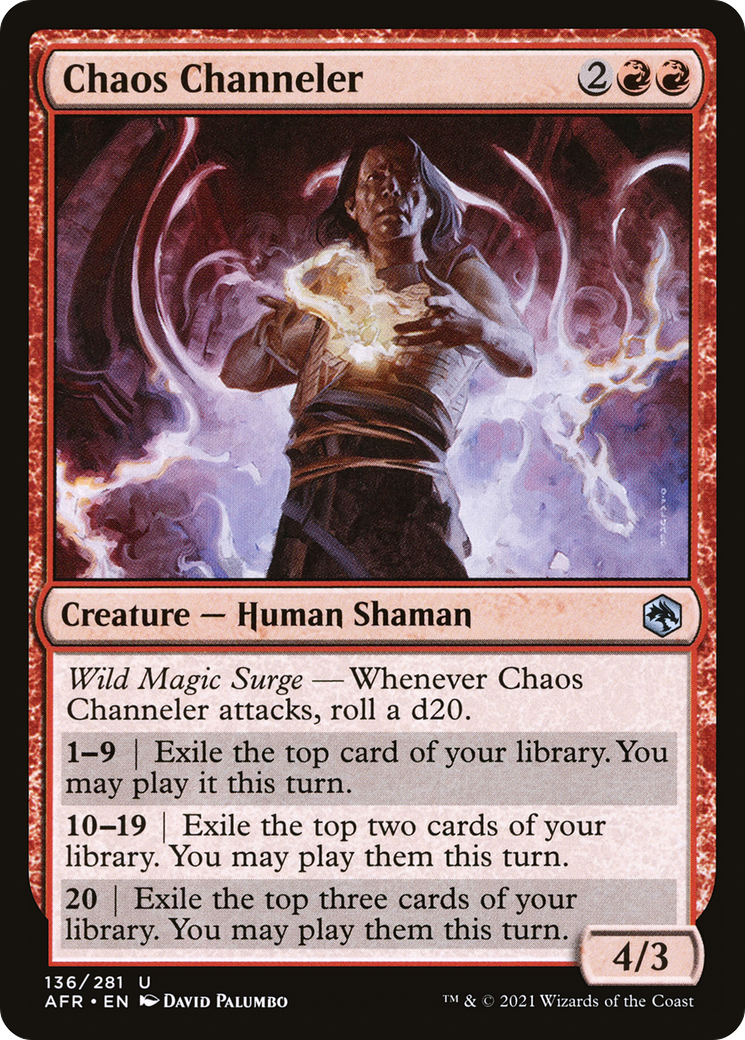
Chaos Channeler
Chaos Channeler
Creature — Human Shaman
4/3
Wild Magic Surge — Whenever this creature attacks, roll a d20.
1—9 | Exile the top card of your library. You may play it this turn.
10—19 | Exile the top two cards of your library. You may play them this turn.
20 | Exile the top three cards of your library. You may play them this turn.
-
1
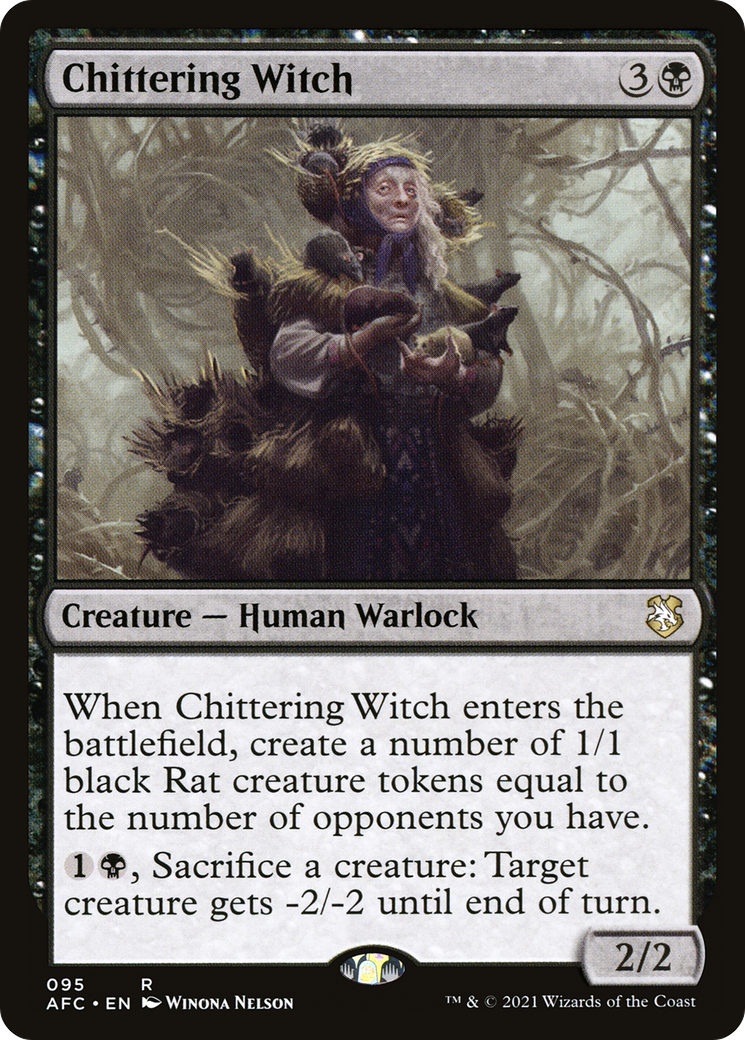
Chittering Witch
Chittering Witch
Creature — Human Warlock
2/2
When this creature enters, create a number of 1/1 black Rat creature tokens equal to the number of opponents you have.
, Sacrifice a creature: Target creature gets -2/-2 until end of turn.
- You can sacrifice Chittering Witch to pay the cost of its last ability.
- In a multiplayer game, opponents who have left the game aren't counted by Chittering Witch's triggered ability.
-
1
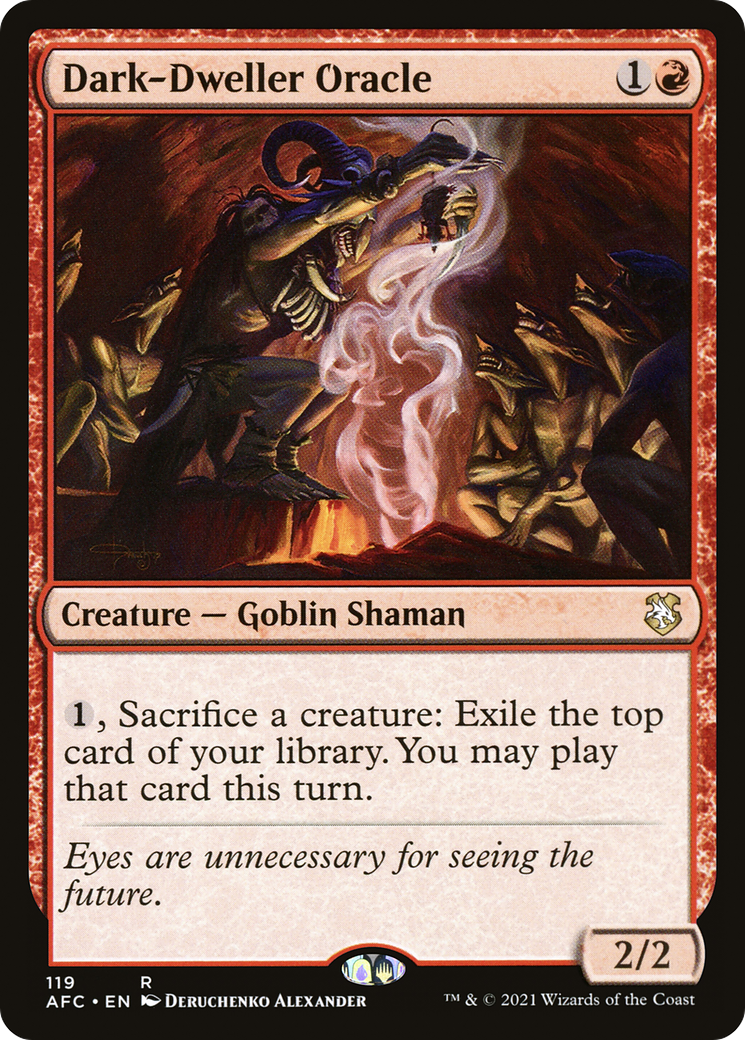
Dark-Dweller Oracle
Dark-Dweller Oracle
Creature — Goblin Shaman
2/2
, Sacrifice a creature: Exile the top card of your library. You may play that card this turn. (You still pay its costs. You can play a land this way only if you have an available land play remaining.)
- Dark-Dweller Oracle doesn't change when you can cast the exiled card. For example, if you exile a sorcery card, you can cast it only during your main phase when the stack is empty. If you exile a land card, you can play it only during your main phase and only if you have an available land play remaining.
- Casting an exiled card causes it to leave exile. You can't cast it multiple times.
- If you don't cast the exiled card, it remains in exile.
- You can sacrifice Dark-Dweller Oracle to pay the cost for its own ability.
-
1
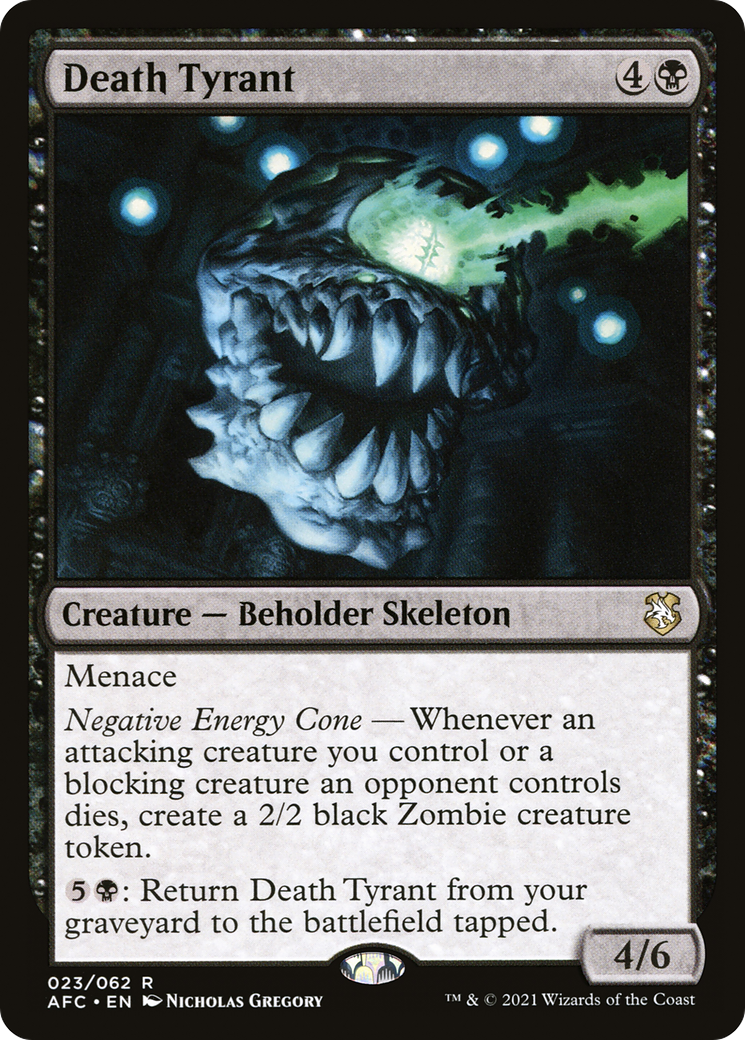
Death Tyrant
Death Tyrant
Creature — Beholder Skeleton
4/6
Menace
Negative Energy Cone — Whenever an attacking creature you control or a blocking creature an opponent controls dies, create a 2/2 black Zombie creature token.
: Return this card from your graveyard to the battlefield tapped.
-
1
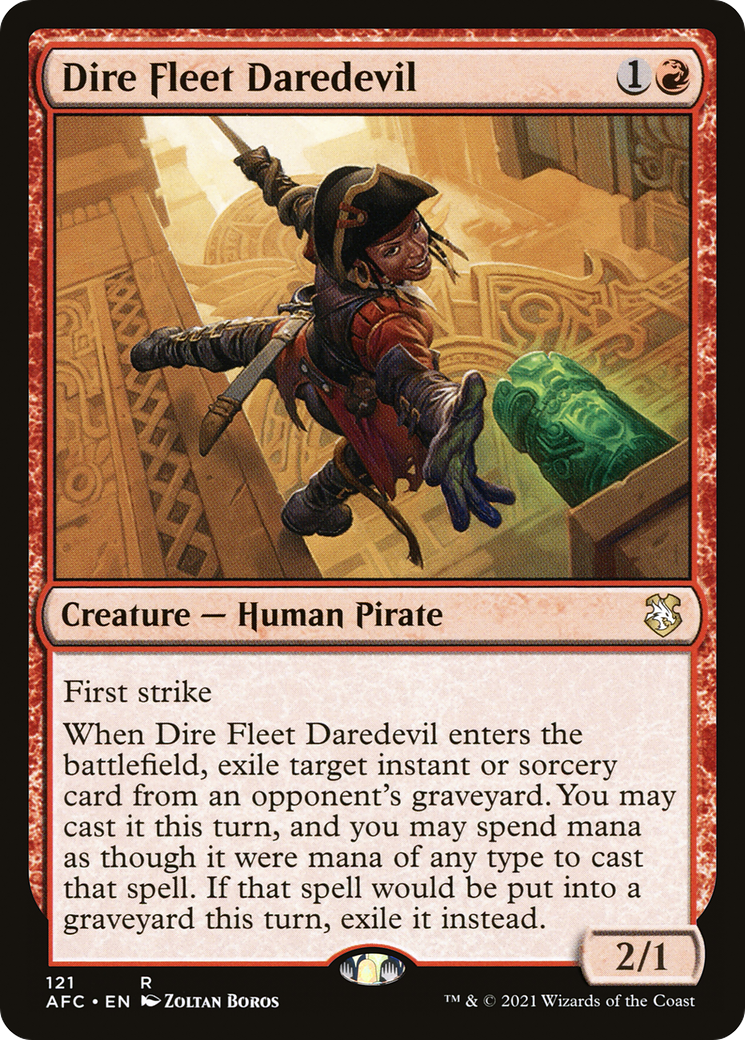
Dire Fleet Daredevil
Dire Fleet Daredevil
Creature — Human Pirate
2/1
First strike
When this creature enters, exile target instant or sorcery card from an opponent's graveyard. You may cast it this turn, and mana of any type can be spent to cast that spell. If that spell would be put into a graveyard, exile it instead.
- Casting an exiled card causes it to leave exile. You can't cast it multiple times.
- The effect of Dire Fleet Daredevil doesn't change when you can cast the exiled card. For example, if you exile a sorcery card, you can cast it only during your main phase when the stack is empty.
-
1
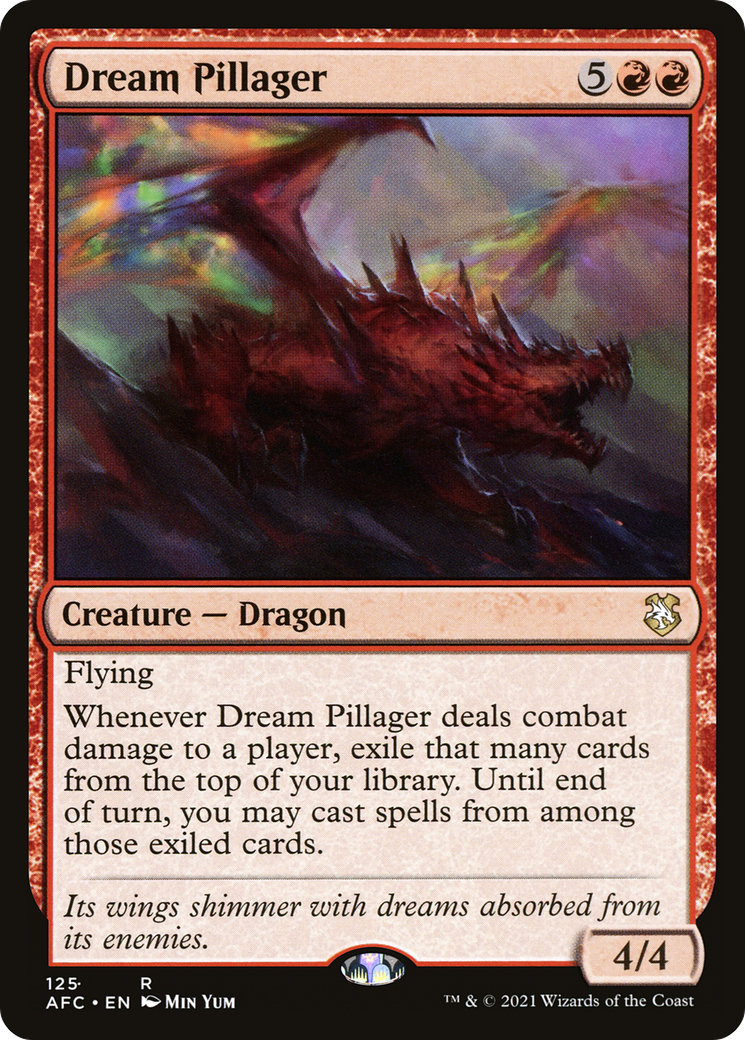
Dream Pillager
Dream Pillager
Creature — Dragon
4/4
Flying
Whenever this creature deals combat damage to a player, exile that many cards from the top of your library. Until end of turn, you may cast spells from among those exiled cards.
- Casting a card this way follows the normal rules for casting the card. You must pay its costs, and you must follow all applicable timing rules. For example, if one of the cards is a creature card, you can cast that card only during your main phase while the stack is empty.
- The cards are exiled face up.
- If you cast an instant or sorcery card this way, it will go to your graveyard after it resolves, fails to resolve, or is countered. It won't return to exile.
- Any cards you don't cast will remain exiled.
- Exiling all the cards from your library this way won't cause you to lose the game. You'll lose only if you attempt to draw a card from an empty library.
-
1
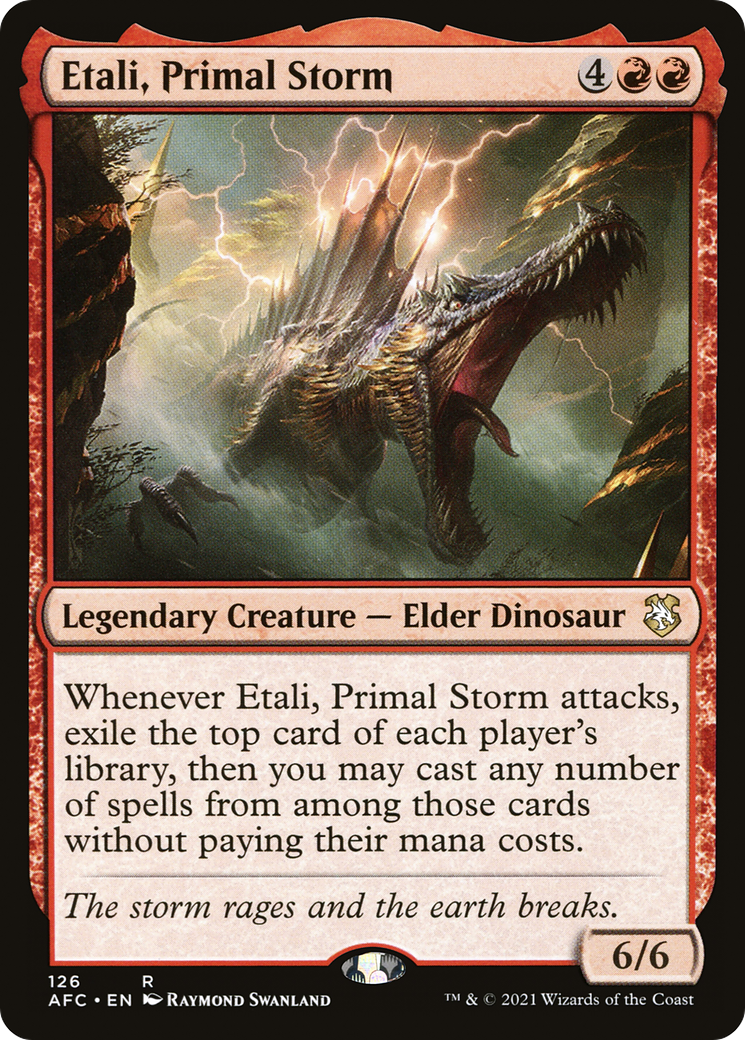
Etali, Primal Storm
Etali, Primal Storm
Legendary Creature — Elder Dinosaur
6/6
Whenever Etali attacks, exile the top card of each player's library, then you may cast any number of spells from among those cards without paying their mana costs.
- If an exiled card has in its mana cost, you must choose 0 as the value of X when casting it without paying its mana cost.
- If you cast any of the exiled cards, you do so as part of the resolution of the triggered ability. You can't wait to cast them later in the turn. Timing permissions based on a card's type are ignored, and the spells resolve before blockers are declared.
- If you cast a card "without paying its mana cost," you can't pay any alternative costs. You can, however, pay additional costs. If the card has any mandatory additional costs, those must be paid to cast the card.
- If you cast more than one of the exiled cards, you choose the order in which to cast them. A spell you cast this way can be the target of a later spell you cast this way. However, permanent spells cast this way won't resolve until you're done casting spells, so the permanents they become can't be the target of spells cast this way. For example, if you exile Twincast and Lightning Strike, you can cast Lightning Strike and then cast Twincast targeting it; but if you exile a creature card and an Aura card, you can't cast that Aura targeting that creature.
- Any cards not cast, including land cards, remain in exile. They can't be cast on later turns, even if Etali attacks again.
- Because all attacking creatures are chosen at once, a creature cast this way can't attack during the same combat as Etali, even if it has haste.
- In a multiplayer game, if a player leaves the game, all cards that player owns leave as well. If you leave the game, any spells or permanents you control from Etali's ability are exiled.
-
1
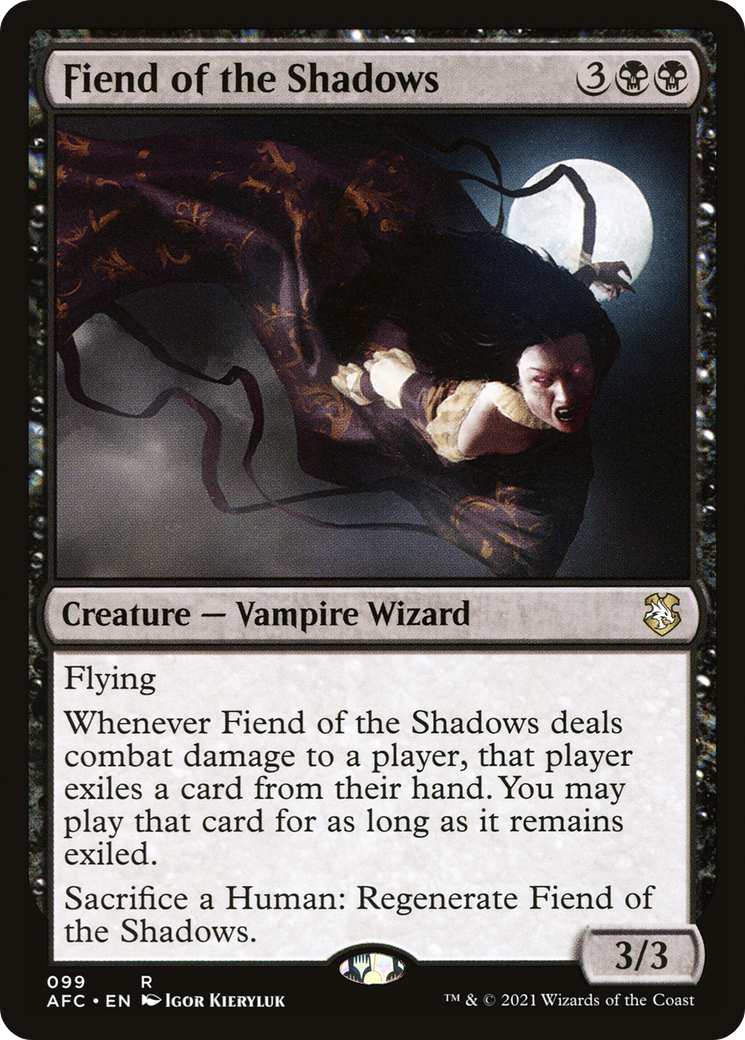
Fiend of the Shadows
Fiend of the Shadows
Creature — Vampire Wizard
3/3
Flying
Whenever this creature deals combat damage to a player, that player exiles a card from their hand. You may play that card for as long as it remains exiled.
Sacrifice a Human: Regenerate this creature.
- Playing a card exiled with Fiend of the Shadows follows all the normal rules for playing that card. You must pay its costs, and you must follow all timing restrictions, for example.
- You may only play the card, meaning play it as a land or cast it as a spell. It's not in your hand. You can't discard it, activate its cycling abilities, and so on.
- As long as the card remains exiled, you may still play it, even if Fiend of the Shadows leaves the battlefield or changes controllers.
- If this creature deals combat damage to multiple players simultaneously, perhaps because some combat damage was redirected, its ability will trigger for each of those players.
-
1
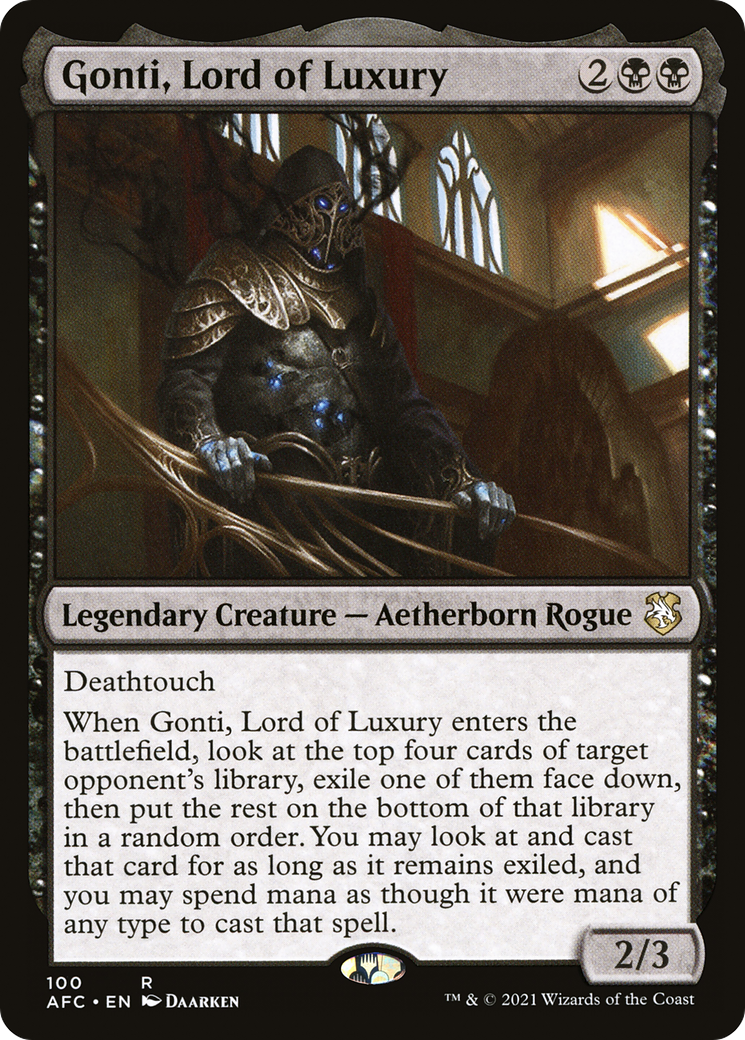
Gonti, Lord of Luxury
Gonti, Lord of Luxury
Legendary Creature — Aetherborn Rogue
2/3
Deathtouch
When Gonti enters, look at the top four cards of target opponent's library, exile one of them face down, then put the rest on the bottom of that library in a random order. You may cast that card for as long as it remains exiled, and mana of any type can be spent to cast that spell.
- The six types of mana are white, blue, black, red, green, and colorless. Snow mana is not a type of mana. Gonti, Lord of Luxury won't let you pay a snow cost using mana produced by a nonsnow source.
- An effect that instructs you to "cast" a card doesn't allow you to play lands.
- You pay the costs for the exiled card if you cast it. You may pay alternative costs such as emerge rather than the card's mana cost.
- You may look at and cast that card (and spend mana as though it were mana of any type to do so) even if Gonti leaves the battlefield. If another player gains control of Gonti, that player can't look at or cast the card, and you still can.
- Casting the card causes it to leave exile. You can't cast it multiple times.
- If you leave the game, the card remains exiled face down indefinitely. No player may look at it.
- Gonti doesn't change when you can cast the exiled card. For example, if you exile a creature card without flash, you can cast it only during your main phase when the stack is empty.
-
1
Grim Hireling
Grim Hireling
Creature — Tiefling Rogue
3/2
Whenever one or more creatures you control deal combat damage to a player, create two Treasure tokens.
, Sacrifice X Treasures: Target creature gets -X/-X until end of turn. Activate only as a sorcery.
-
1
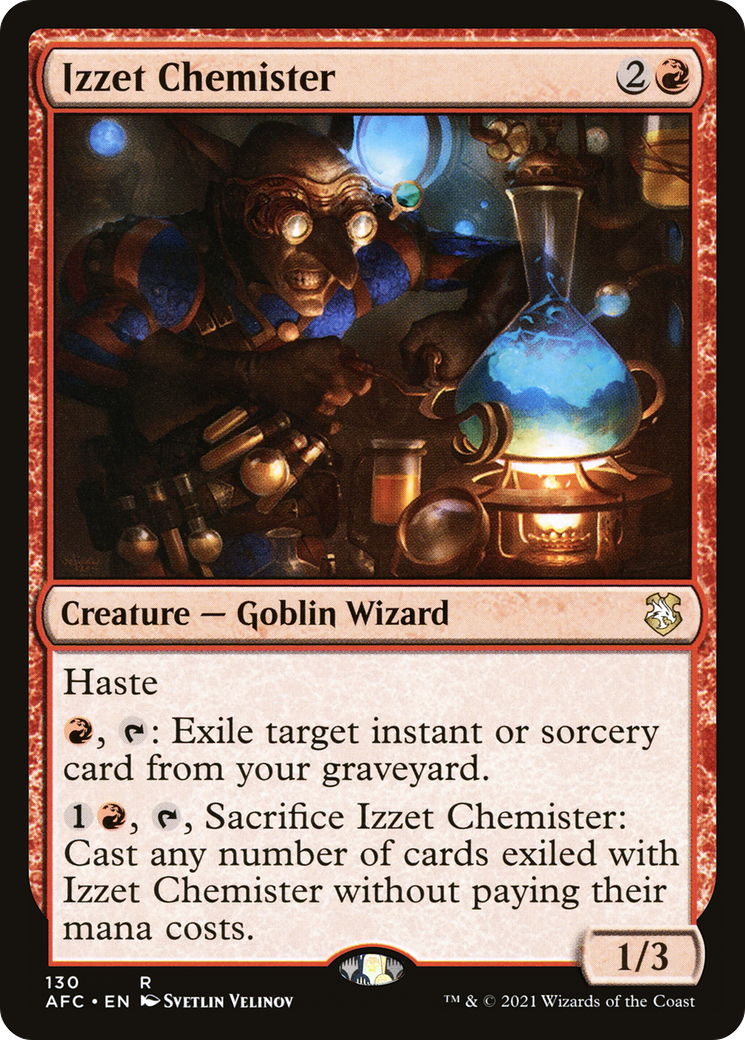
Izzet Chemister
Izzet Chemister
Creature — Goblin Wizard
1/3
Haste
, : Exile target instant or sorcery card from your graveyard.
, , Sacrifice this creature: Cast any number of cards exiled with this creature without paying their mana costs.
- The last ability of Izzet Chemister only lets you cast cards exiled by that card. If Izzet Chemister leaves the battlefield before you activate that ability, the exiled cards are lost forever.
- If you cast a card "without paying its mana cost," you can't pay any alternative costs. You can, however, pay additional costs. If the card has any mandatory additional costs, such as that of Tormenting Voice, those must be paid to cast the card.
- If the card has in its mana cost, you must choose 0 as the value of X when casting it without paying its mana cost.
- You must cast any of the exiled cards you wish to cast while Izzet Chemister's last ability is resolving. You can't cast them later in the turn. A sorcery cast this way will be cast at a time you normally wouldn't be able to.
- You cast the exiled cards one at a time in any order. Later spells can target ones you cast earlier. None of the spells resolve until after you're done casting them all.
- Any of the cards you don't cast will remain exiled.
-
1
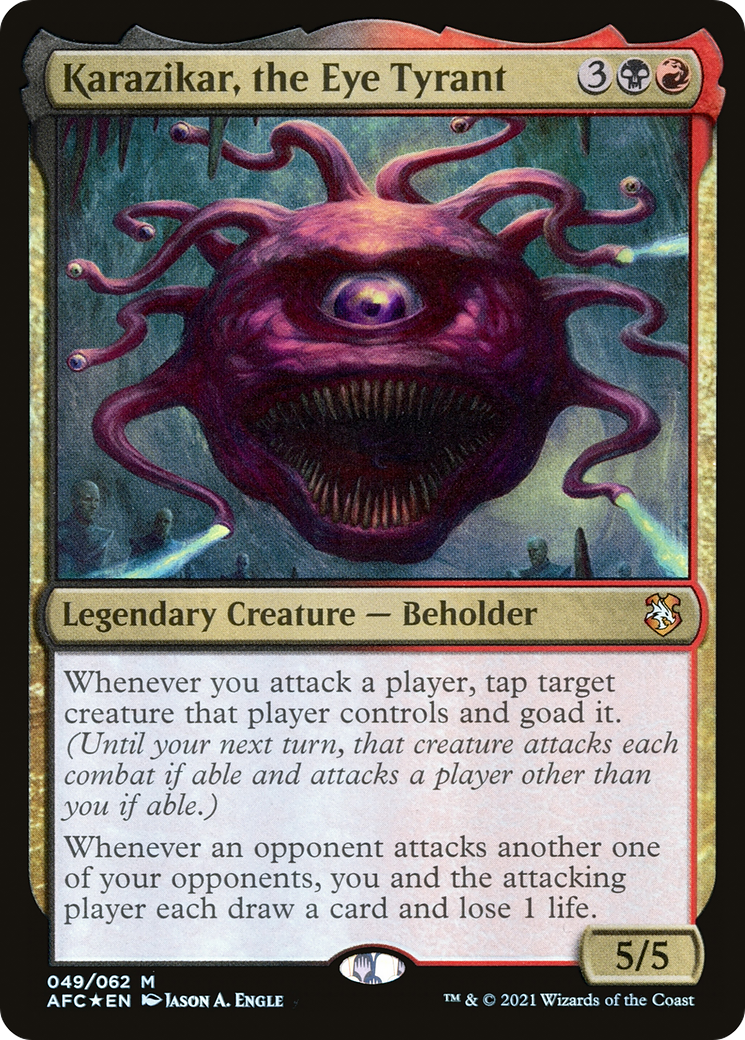
Karazikar, the Eye Tyrant
Karazikar, the Eye Tyrant
Legendary Creature — Beholder
5/5
Whenever you attack a player, tap target creature that player controls and goad it. (Until your next turn, that creature attacks each combat if able and attacks a player other than you if able.)
Whenever an opponent attacks another one of your opponents, you and the attacking player each draw a card and lose 1 life.
-
1
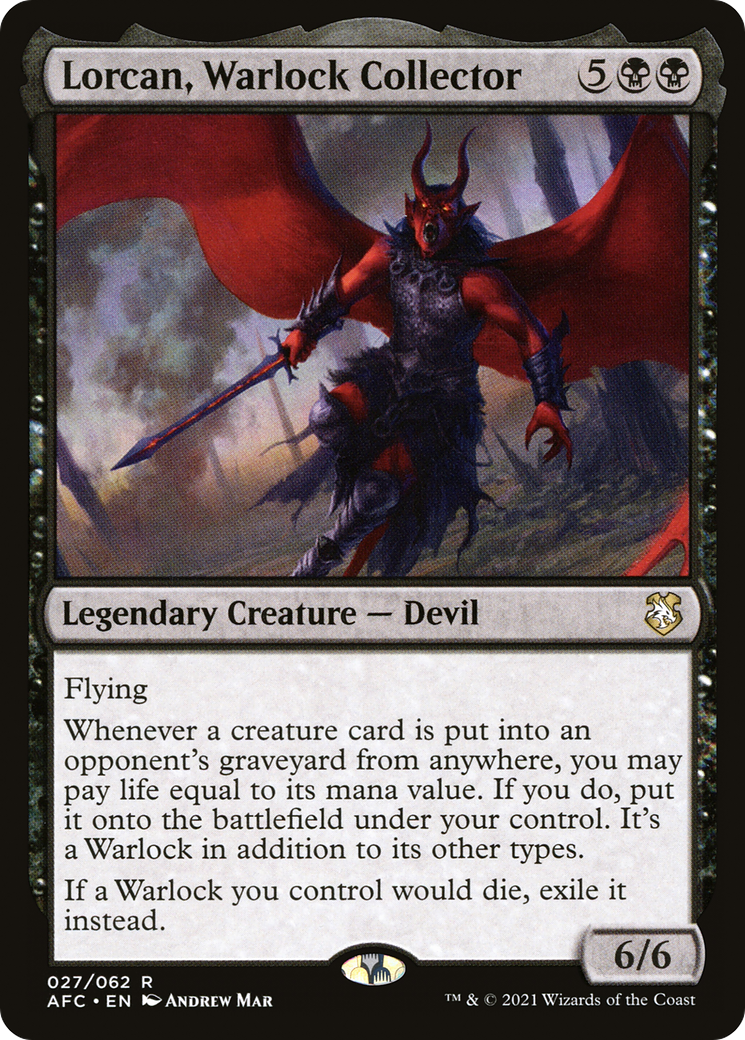
Lorcan, Warlock Collector
Lorcan, Warlock Collector
Legendary Creature — Devil
6/6
Flying
Whenever a creature card is put into an opponent's graveyard from anywhere, you may pay life equal to its mana value. If you do, put it onto the battlefield under your control. It's a Warlock in addition to its other types.
If a Warlock you control would die, exile it instead.
- Lorcan, Warlock Collector's second ability looks only at the type the card has in the graveyard, not the type it had in any other zone. For example, animated lands dying won't cause the ability to trigger. The opposite is also true. For example, if a creature that was cast as an Adventure is countered, it's a creature card in the graveyard and the triggered ability will trigger.
- Lorcan's last ability affects all Warlocks you control, not only ones he collected from an opponent's graveyard.
-
1
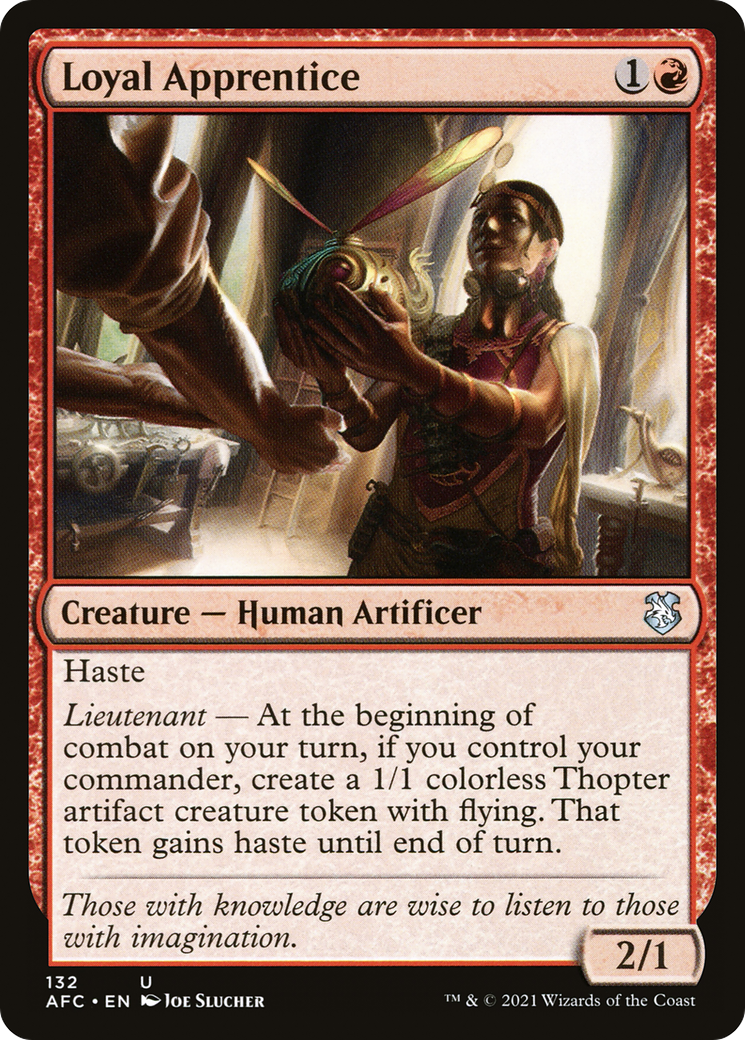
Loyal Apprentice
Loyal Apprentice
Creature — Human Artificer
2/1
Haste
Lieutenant — At the beginning of combat on your turn, if you control your commander, create a 1/1 colorless Thopter artifact creature token with flying. That token gains haste until end of turn.
- If you don't control your commander as the lieutenant ability resolves, you won't get its effect.
- The lieutenant effect happens only once each combat, even if you somehow control multiple commanders (perhaps because you have two commanders with a partner ability from the Battlebond™ set).
- If you have multiple commanders, you need to control only one for the lieutenant effect to happen.
-
1
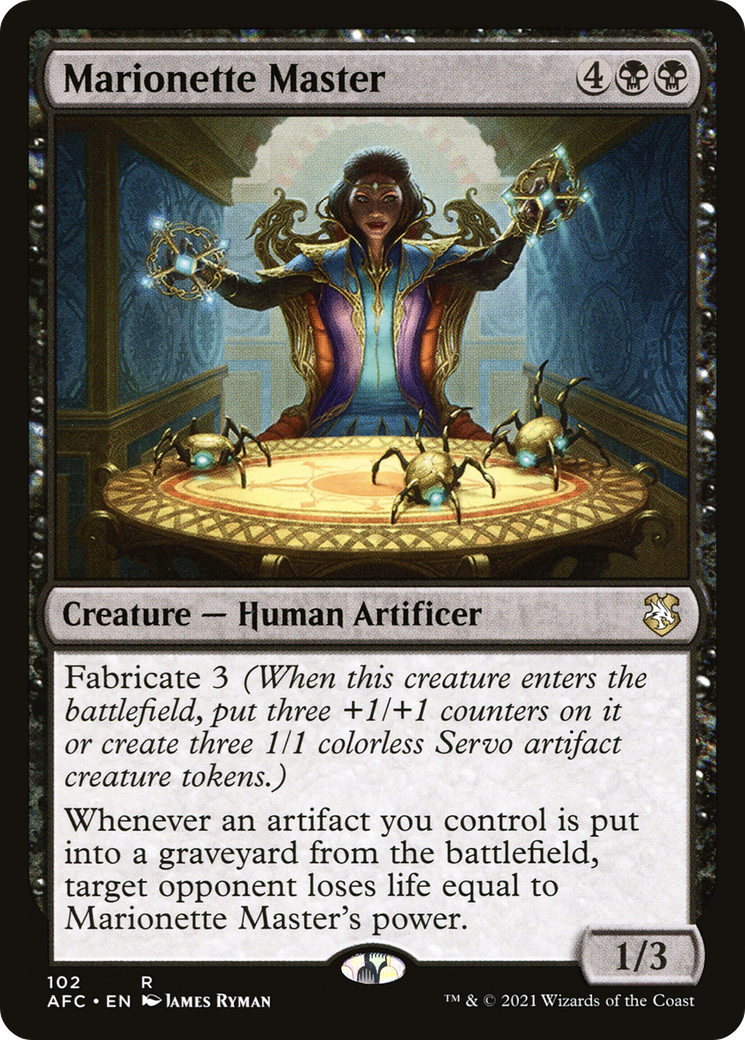
Marionette Master
Marionette Master
Creature — Human Artificer
1/3
Fabricate 3 (When this creature enters, put three +1/+1 counters on it or create three 1/1 colorless Servo artifact creature tokens.)
Whenever an artifact you control is put into a graveyard from the battlefield, target opponent loses life equal to this creature's power.
- The amount of life lost is determined as Marionette Master's last ability resolves. If Marionette Master is no longer on the battlefield, use its power as it last existed on the battlefield to determine how much life is lost.
- If Marionette Master's power is negative, the target opponent doesn't lose (or gain) life.
- If Marionette Master and an artifact you control are put into a graveyard at the same time, Marionette Master's ability triggers.
- Artifact tokens that are sacrificed or destroyed are put into their owner's graveyard before ceasing to exist. If you controlled the token, Marionette Master's last ability will trigger.
- You choose whether to put +1/+1 counters on the creature or create Servo tokens as the fabricate ability is resolving. No player may take actions between the time you choose and the time that counters are added or tokens are created.
- Fabricate doesn't cause the creature with the ability to enter the battlefield with +1/+1 counters already on it. For example, Weaponcraft Enthusiast will enter the battlefield as a 0/1 creature, then its fabricate ability goes on the stack. Players may take actions (such as casting instants) while the ability is waiting to resolve.
- If you can't put +1/+1 counters on the creature for any reason as fabricate resolves (for instance, if it's no longer on the battlefield), you just create Servo tokens.
-
1
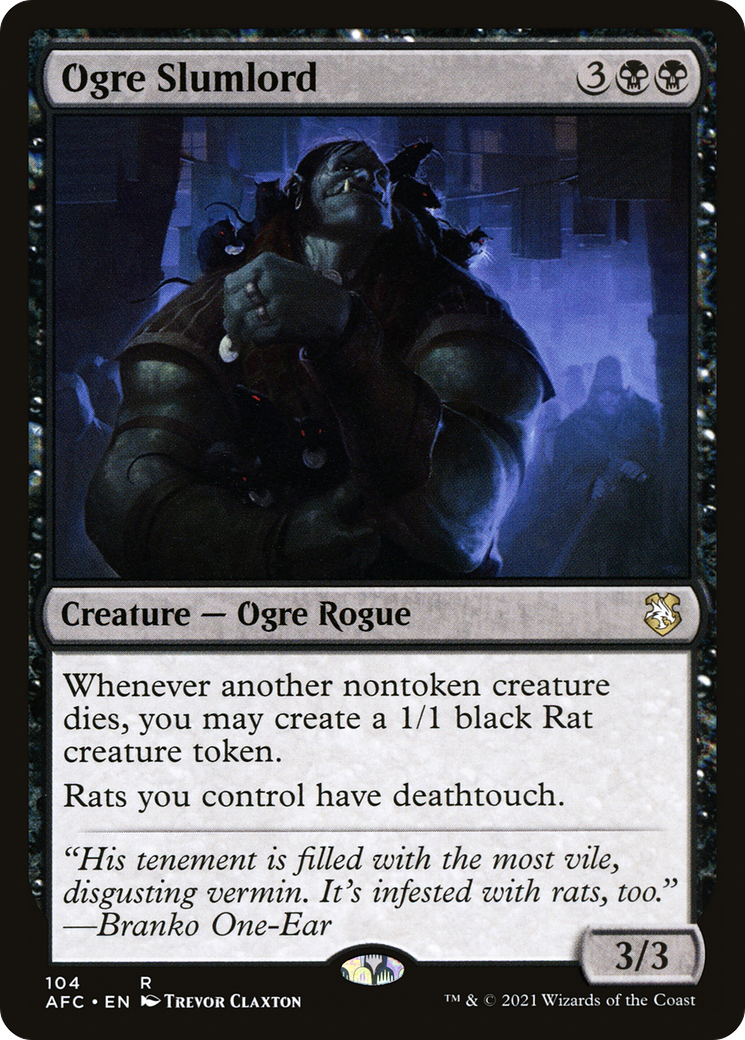
Ogre Slumlord
Ogre Slumlord
Creature — Ogre Rogue
3/3
Whenever another nontoken creature dies, you may create a 1/1 black Rat creature token.
Rats you control have deathtouch.
- All Rats you control have deathtouch while Ogre Slumlord is on the battlefield, not just the ones created by Ogre Slumlord.
-
1
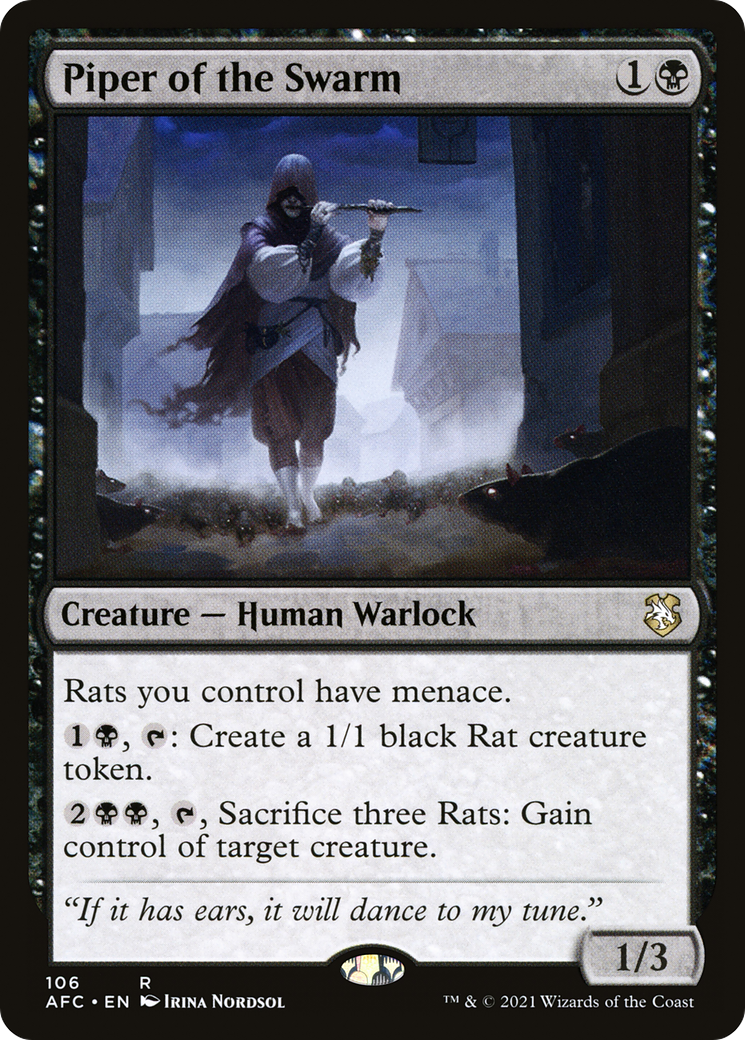
Piper of the Swarm
Piper of the Swarm
Creature — Human Warlock
1/3
Rats you control have menace.
, : Create a 1/1 black Rat creature token.
, , Sacrifice three Rats: Gain control of target creature.
- The control-change effect of Piper of the Swarm's last ability lasts indefinitely. It doesn't wear off during the cleanup step, and it doesn't expire if Piper of the Swarm leaves the battlefield. In a multiplayer game, it does expire if you leave the game.
-
1
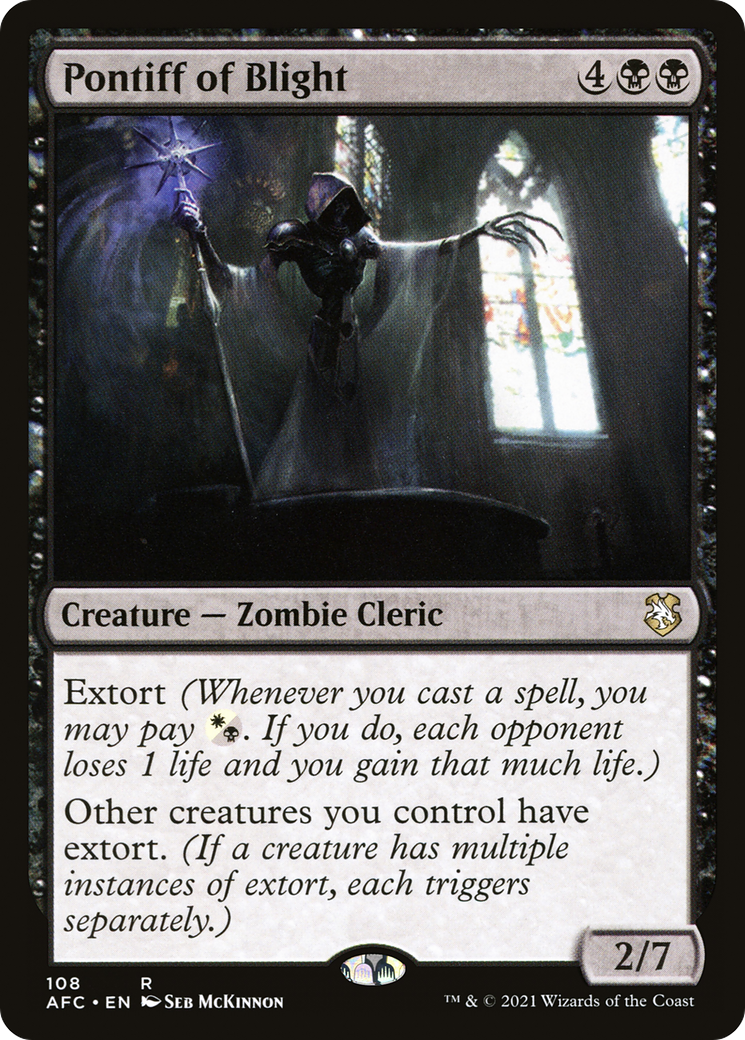
Pontiff of Blight
Pontiff of Blight
Creature — Zombie Cleric
2/7
Extort (Whenever you cast a spell, you may pay . If you do, each opponent loses 1 life and you gain that much life.)
Other creatures you control have extort. (If a creature has multiple instances of extort, each triggers separately.)
- You may pay a maximum of one time for each extort triggered ability. You decide whether to pay when the ability resolves.
- The amount of life you gain from extort is based on the total amount of life lost, not necessarily the number of opponents you have. For example, if your opponent's life total can't change (perhaps because that player controls Platinum Emperion), you won't gain any life.
- The extort ability doesn't target any player.
- The extort ability resolves before the spell that caused it to trigger. The ability resolves even if that spell is countered.
-
1
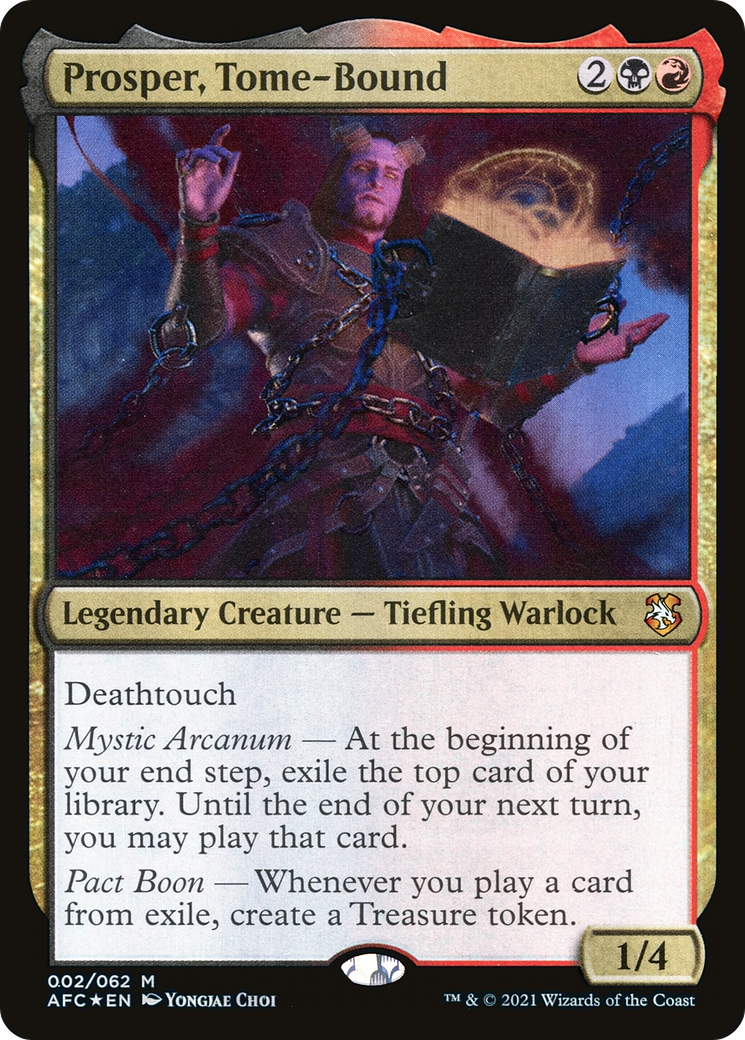
Prosper, Tome-Bound
Prosper, Tome-Bound
Legendary Creature — Tiefling Warlock
1/4
Deathtouch
Mystic Arcanum — At the beginning of your end step, exile the top card of your library. Until the end of your next turn, you may play that card.
Pact Boon — Whenever you play a card from exile, create a Treasure token.
- You must still pay all costs and follow all timing rules for cards played with the Mystic Arcanum ability.
- The Pact Boon ability triggers whenever you play any cards from exile, not just those exiled with the Mystic Arcanum ability.
-
1
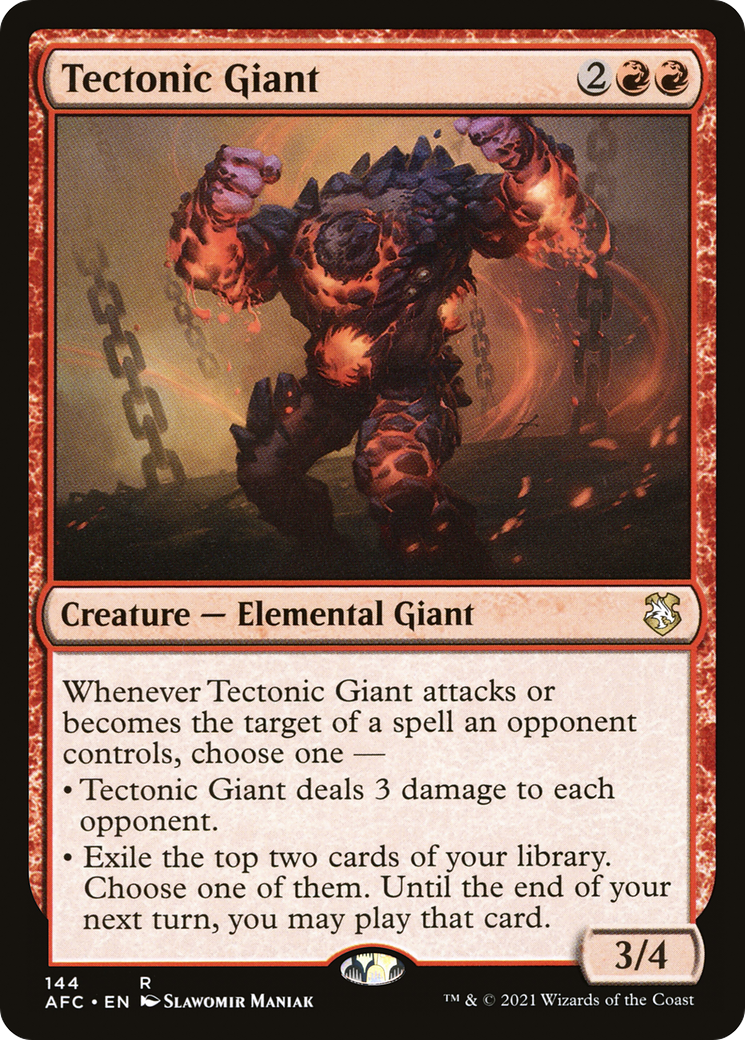
Tectonic Giant
Tectonic Giant
Creature — Elemental Giant
3/4
Whenever this creature attacks or becomes the target of a spell an opponent controls, choose one —
- This creature deals 3 damage to each opponent.
- Exile the top two cards of your library. Choose one of them. Until the end of your next turn, you may play that card.
- An ability that triggers when a creature becomes the target of a spell resolves before the spell that caused it to trigger. It resolves even if that spell is countered.
- Players can cast spells and activate abilities after the triggered ability resolves but before the spell that caused it to trigger does.
- If a spell targets Tectonic Giant more than once, its ability triggers only once.
- You choose which of the exiled cards you'll be able to play while the ability is resolving. You can't wait to pick one later. The other card remains in exile.
- Tectonic Giant doesn't change when you can play the exiled card. For example, if you exile a sorcery card, you can cast it only during your main phase when the stack is empty. If you exile a land card, you can play it only during your main phase and only if you have an available land play remaining.
- Playing an exiled card causes it to leave exile. You can't play it multiple times.
- If you don't play the exiled card that you chose, it remains in exile with the card you didn't choose.
-
1
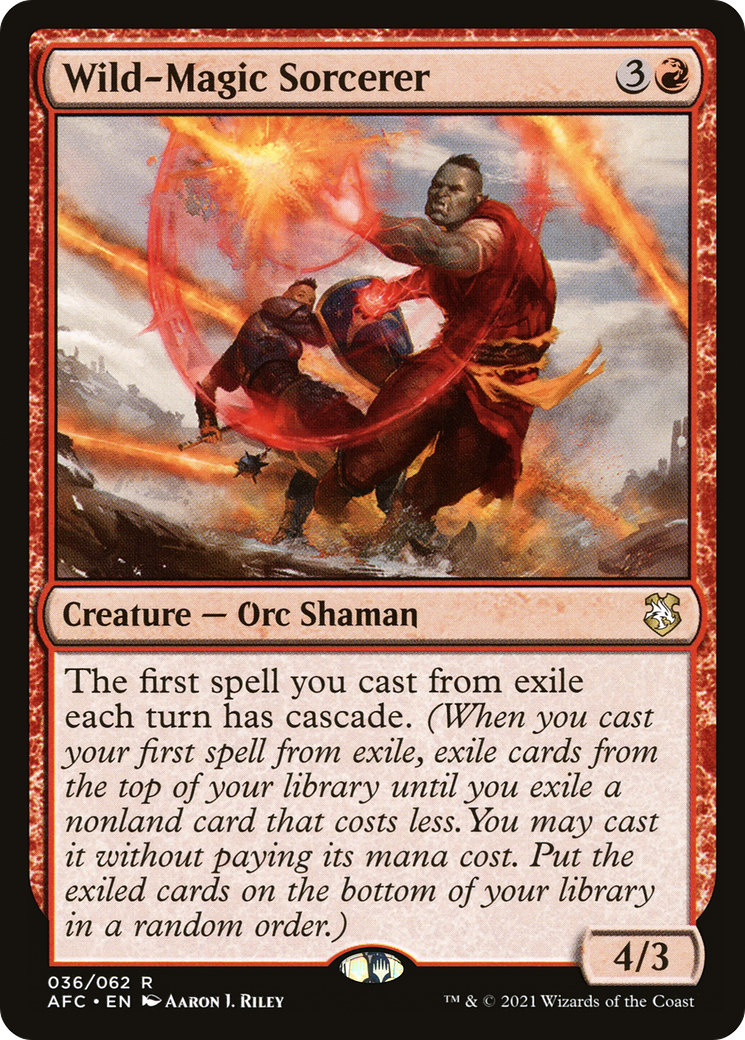
Wild-Magic Sorcerer
Wild-Magic Sorcerer
Creature — Orc Shaman
4/3
The first spell you cast from exile each turn has cascade. (When you cast your first spell from exile, exile cards from the top of your library until you exile a nonland card that costs less. You may cast it without paying its mana cost. Put the exiled cards on the bottom in a random order.)
- The first spell you cast from exile each turn will have cascade, even if it's not the first spell you've cast that turn.
- However, if you cast a spell from exile and then later that turn Wild-Magic Sorcerer comes under your control, Wild-Mage Sorcerer won't give cascade to any other spell you cast from exile that turn.
- If you control more than one Wild-Magic Sorcerer, the first spell you cast from exile will have that many instances of cascade, each of which will trigger separately.
- If, while resolving the cascade ability from the first spell you cast from exile in a turn, you cascade into a second Wild-Magic Sorcerer, the spell will not cascade again.
- A spell's mana value is determined only by its mana cost. Ignore any alternative costs, additional costs, cost increases, or cost reductions. For example, Wild-Magic Sorcerer's mana value is always 4.
- Cascade triggers when you cast the spell, meaning that it resolves before that spell. If you end up casting the exiled card, it will go on the stack above the spell with cascade.
- When the cascade ability resolves, you must exile cards. The only optional part of the ability is whether or not you cast the last card exiled.
- If a spell with cascade is countered, the cascade ability will still resolve normally.
- You exile the cards face up. All players will be able to see them.
- If you cast a card “without paying its mana cost,” you can't choose to cast it for any alternative costs. You can, however, pay additional costs. If the card has any mandatory additional costs, you must pay those to cast the card.
- If the card has in its mana cost, you must choose 0 as the value of X when casting it without paying its mana cost.
- Due to a recent rules change to cascade, not only do you stop exiling cards if you exile a nonland card with lesser mana value than the spell with cascade, but the resulting spell you cast must also have lesser mana value. Previously, in cases where a card's mana value differed from the resulting spell, such as with some modal double-faced cards or cards with an Adventure, you could cast a spell with a higher mana value than the exiled card.
- The mana value of a split card is determined by the combined mana cost of its two halves. If cascade allows you to cast a split card, you may cast either half but not both halves.
Instants 9
-
1
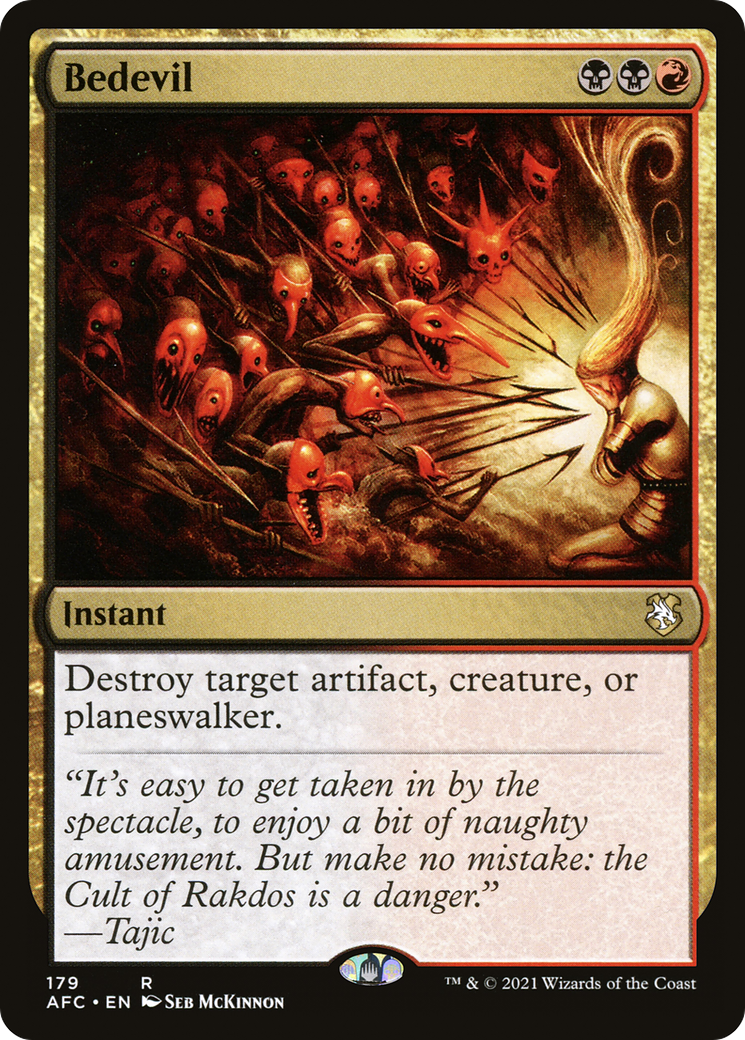
Bedevil
Bedevil
Instant
Destroy target artifact, creature, or planeswalker.
-
1
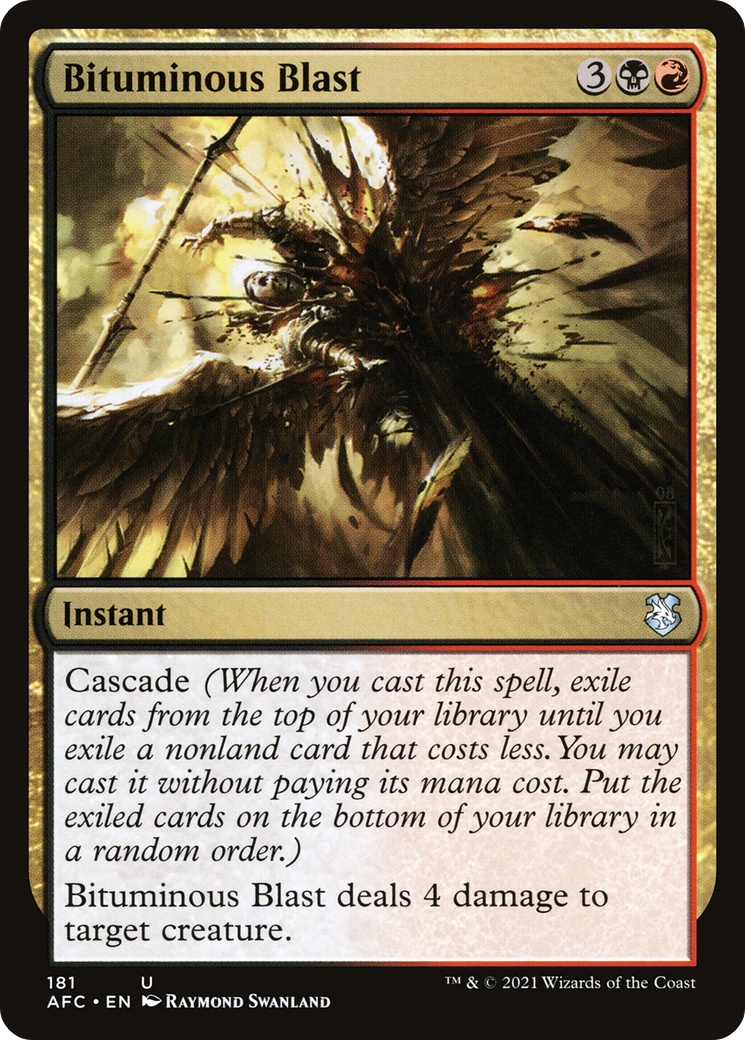
Bituminous Blast
Bituminous Blast
Instant
Cascade (When you cast this spell, exile cards from the top of your library until you exile a nonland card that costs less. You may cast it without paying its mana cost. Put the exiled cards on the bottom in a random order.)
Bituminous Blast deals 4 damage to target creature.
- A spell's mana value is determined only by its mana cost. Ignore any alternative costs, additional costs, cost increases, or cost reductions.
- Cascade triggers when you cast the spell, meaning that it resolves before that spell. If you end up casting the exiled card, it will go on the stack above the spell with cascade.
- When the cascade ability resolves, you must exile cards. The only optional part of the ability is whether or not you cast the last card exiled.
- If a spell with cascade is countered, the cascade ability will still resolve normally.
- You exile the cards face up. All players will be able to see them.
- If you cast a card "without paying its mana cost," you can't choose to cast it for any alternative costs. You can, however, pay additional costs. If the card has any mandatory additional costs, you must pay those to cast the card.
- If the card has in its mana cost, you must choose 0 as the value of X when casting it without paying its mana cost.
- Due to a 2021 rules change to cascade, not only do you stop exiling cards if you exile a nonland card with lesser mana value than the spell with cascade, but the resulting spell you cast must also have lesser mana value. Previously, in cases where a card's mana value differed from the resulting spell, such as with some modal double-faced cards or cards with an Adventure, you could cast a spell with a higher mana value than the exiled card.
- The mana value of a split card is determined by the combined mana cost of its two halves. If cascade allows you to cast a split card, you may cast either half but not both halves.
-
1
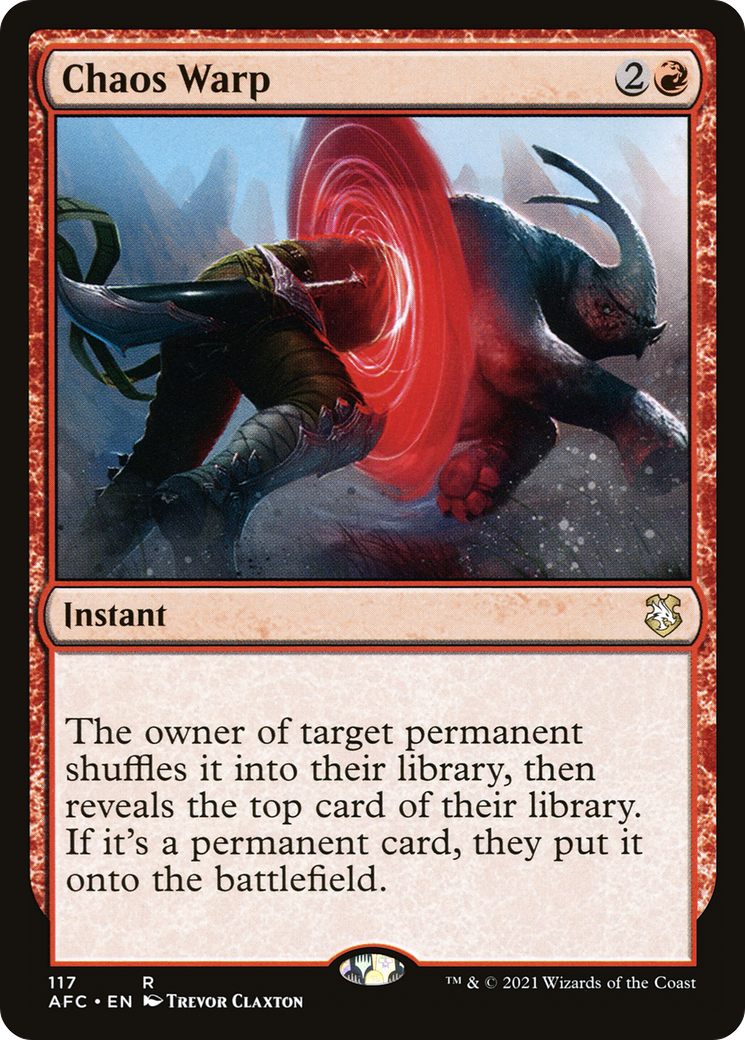
Chaos Warp
Chaos Warp
Instant
The owner of target permanent shuffles it into their library, then reveals the top card of their library. If it's a permanent card, they put it onto the battlefield.
- A permanent card is a card with one or more of the following card types: artifact, creature, enchantment, land, or planeswalker.
- The owner of a token is the player under whose control the token was put onto the battlefield. If a token is shuffled into a player's library this way, that player shuffles before revealing the top card of that library.
- If the revealed card is not a permanent card, it remains on top of that library.
- If the permanent is an illegal target by the time Chaos Warp tries to resolve, it won't resolve and none of its effects will occur. No library will be shuffled and no card will be revealed.
- If the revealed card is a permanent card but can't enter (perhaps because it's an Aura with nothing to enchant), it remains on top of that library.
-
1
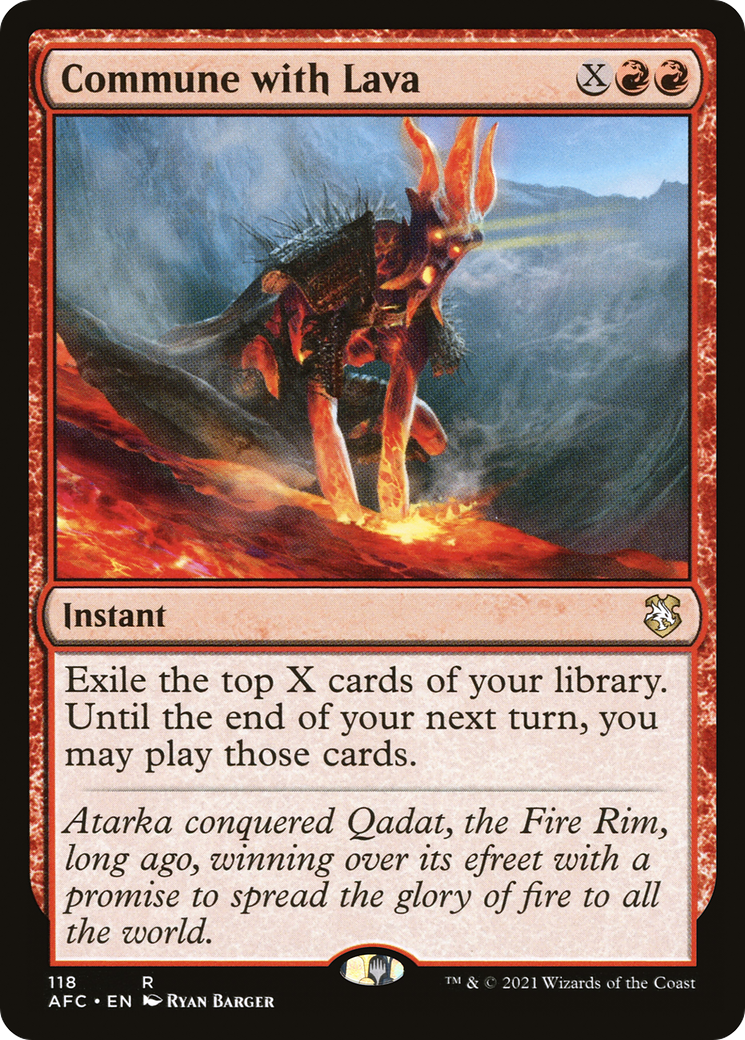
Commune with Lava
Commune with Lava
Instant
Exile the top X cards of your library. Until the end of your next turn, you may play those cards.
- The cards are exiled face up.
- Playing a card this way follows the normal rules for playing the card. You must pay its costs, and you must follow all applicable timing rules. For example, if one of the cards is a creature card, you can cast that card only during your main phase while the stack is empty.
- Under normal circumstances, you can play a land card exiled with Commune with Lava only if you haven't played a land yet that turn.
- Any cards you don't play will remain exiled.
-
1
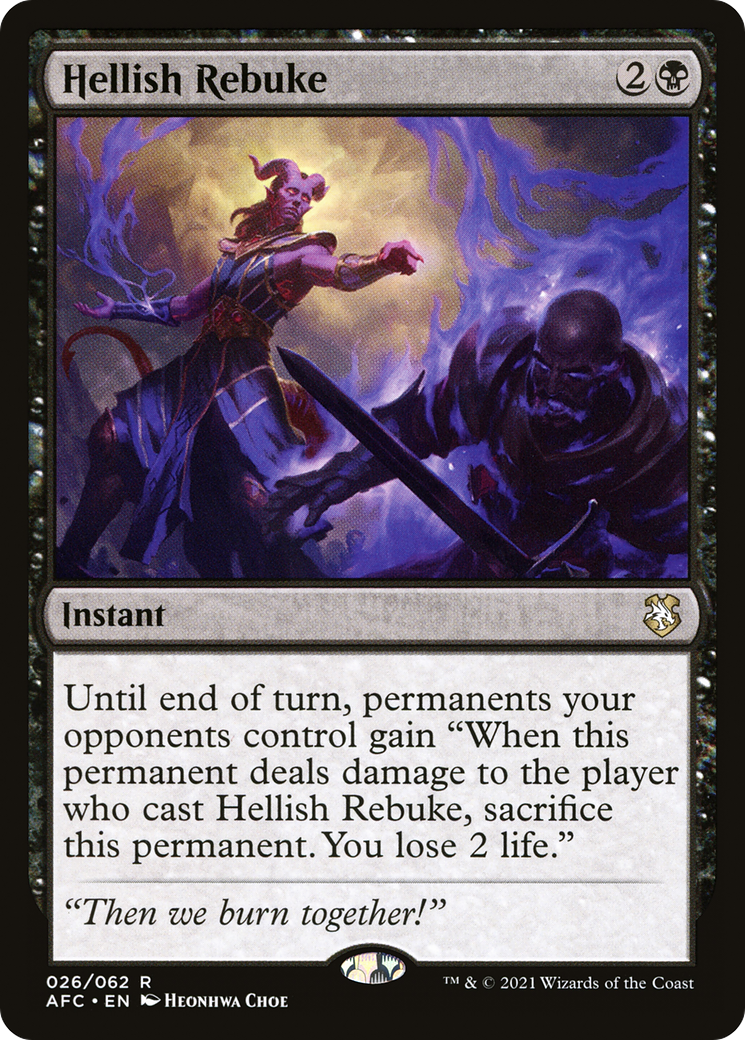
Hellish Rebuke
Hellish Rebuke
Instant
Until end of turn, permanents your opponents control gain "When this permanent deals damage to the player who cast Hellish Rebuke, sacrifice this permanent. You lose 2 life."
- When the triggered ability that Hellish Rebuke grants permanents resolves, if that permanent's controller can't sacrifice it, they will still lose 2 life. Similarly, if they can't lose life, they will still sacrifice the permanent.
- If a player casts more than one Hellish Rebuke in a turn, permanents will gain multiple instances of the triggered ability. Each will trigger and resolve separately. For instance, if you cast Hellish Rebuke twice, each permanent which damaged you will cause its controller to lose 4 life.
- If more than one player casts Hellish Rebuke in a turn, some permanents will gain multiple instances of the triggered ability that refer to different players. Each will trigger only for the player who cast the Hellish Rebuke that granted it the ability.
- Copies of Hellish Rebuke that weren't cast will give opponents permanents the ability, but that ability won't do anything because no player cast that copy of Hellish Rebuke.
- If a spell or ability causes another player to gain control of Hellish Rebuke while it is on the stack, permanents controlled by the opponents of that player will gain the ability (probably including permanents you control). However, you're still the player that cast Hellish Rebuke, so the ability will trigger whenever one of those permanents deals damage to you, not the player who controlled Hellish Rebuke as it resolved.
-
1
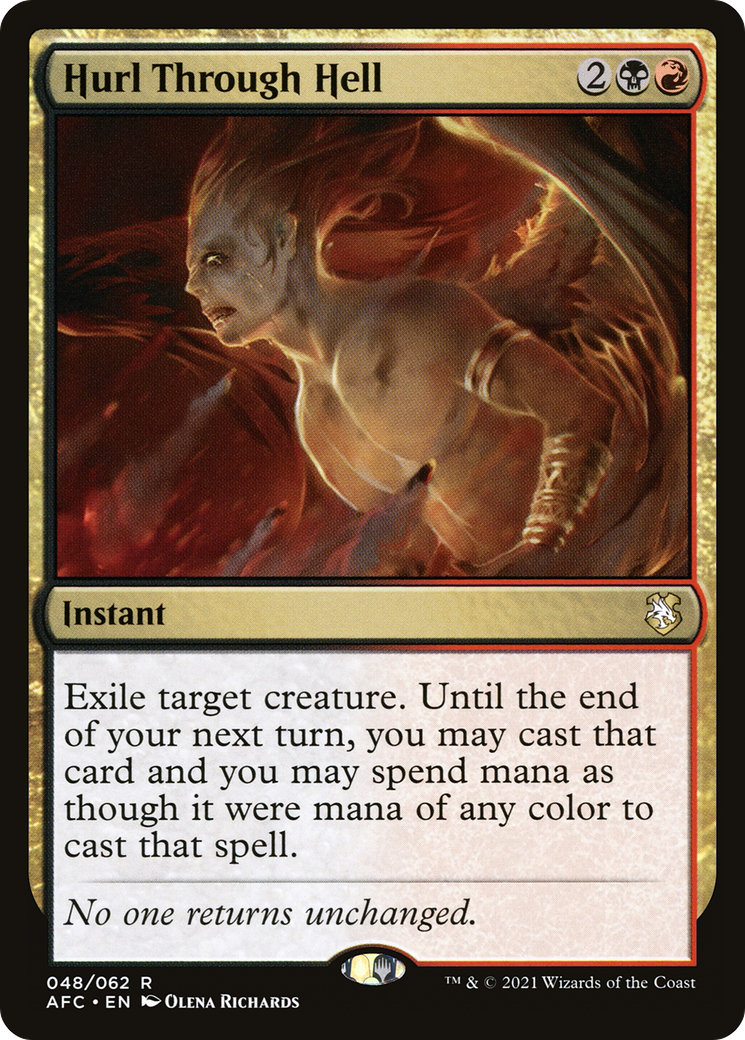
Hurl Through Hell
Hurl Through Hell
Instant
Exile target creature. Until the end of your next turn, you may cast that card and you may spend mana as though it were mana of any color to cast that spell.
- You must still follow all normal timing rules for casting the spell.
- If the creature you exile is actually a land card that was animated, you won't be able to play the land card from exile.
-
1
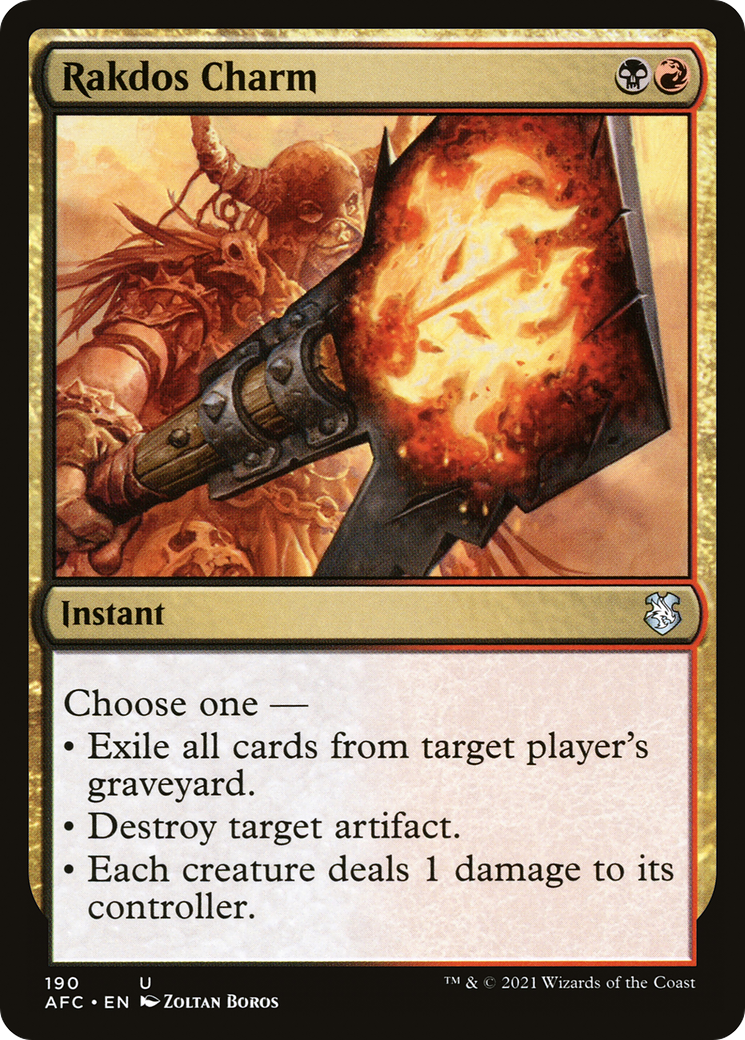
Rakdos Charm
Rakdos Charm
Instant
Choose one —
- Exile target player's graveyard.
- Destroy target artifact.
- Each creature deals 1 damage to its controller.
-
1
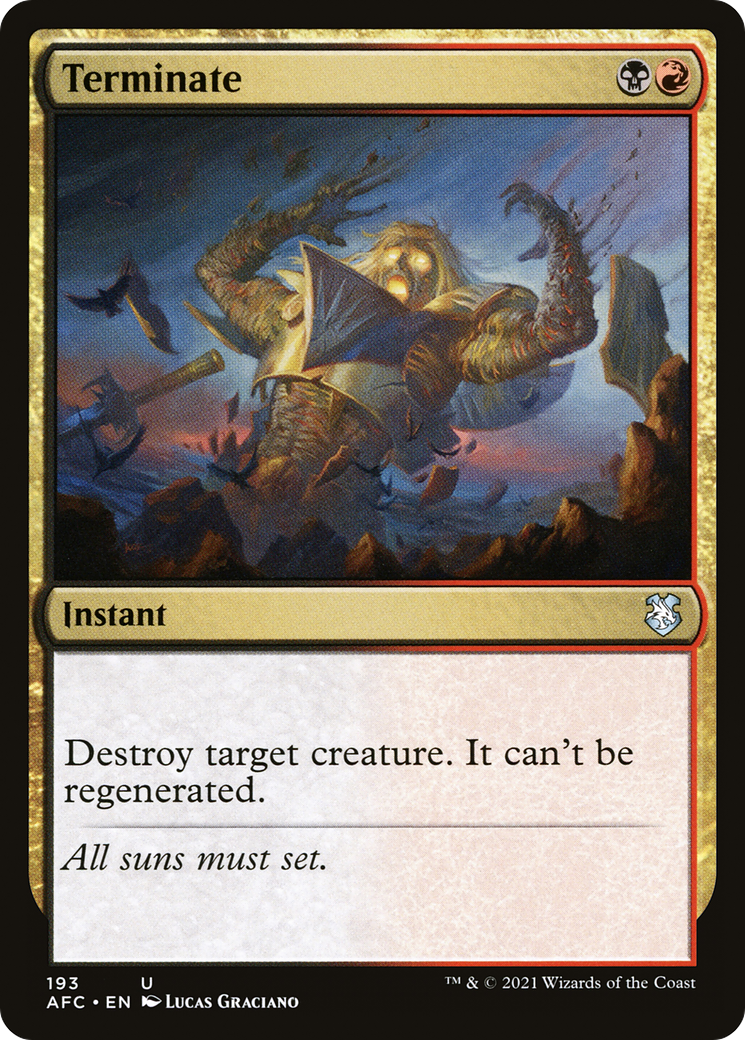
Terminate
Terminate
Instant
Destroy target creature. It can't be regenerated.
-
1
You Find Some Prisoners
You Find Some Prisoners
Instant
Choose one —
- Break Their Chains — Destroy target artifact.
- Interrogate Them — Exile the top three cards of target opponent's library. Choose one of them. Until the end of your next turn, you may play that card, and you may spend mana as though it were mana of any color to cast it.
Sorceries 12
-
1
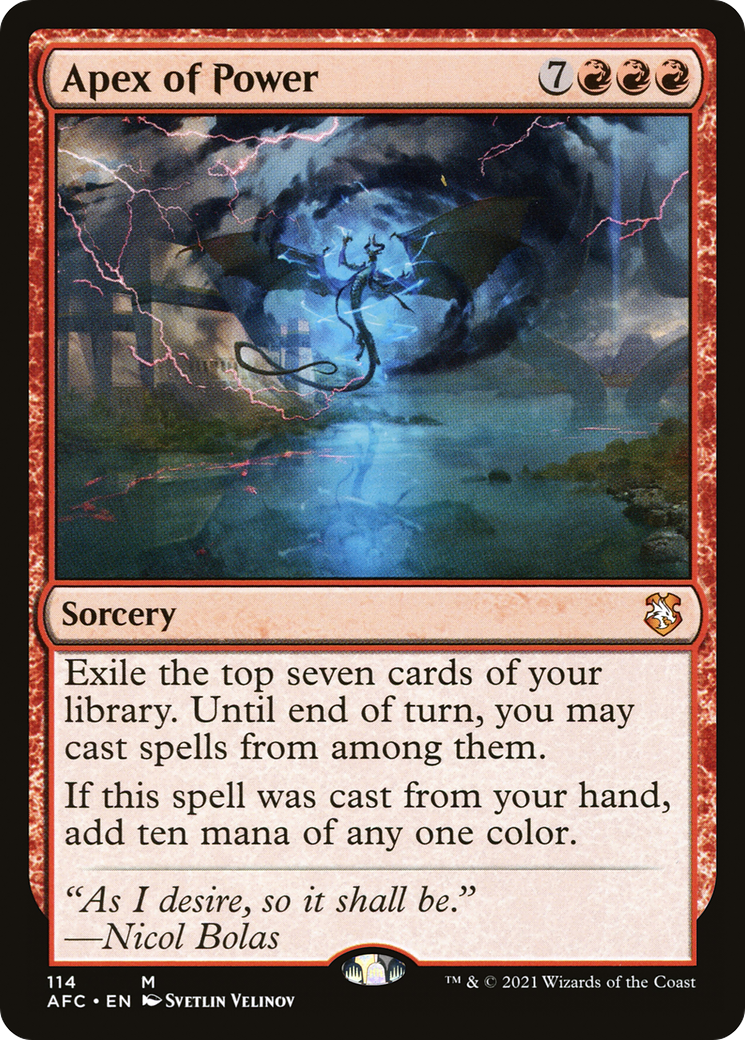
Apex of Power
Apex of Power
Sorcery
Exile the top seven cards of your library. Until end of turn, you may cast spells from among them.
If this spell was cast from your hand, add ten mana of any one color.
- Apex of Power doesn't change when you can cast the exiled cards. For example, if you exile a sorcery card, you can cast it only during your main phase when the stack is empty.
- Casting an exiled card causes it to leave exile. You can't cast it multiple times.
- Any cards not cast, including land cards, remain in exile.
- If an effect copies Apex of Power, the copy wasn't cast at all, so you won't add ten mana.
-
1
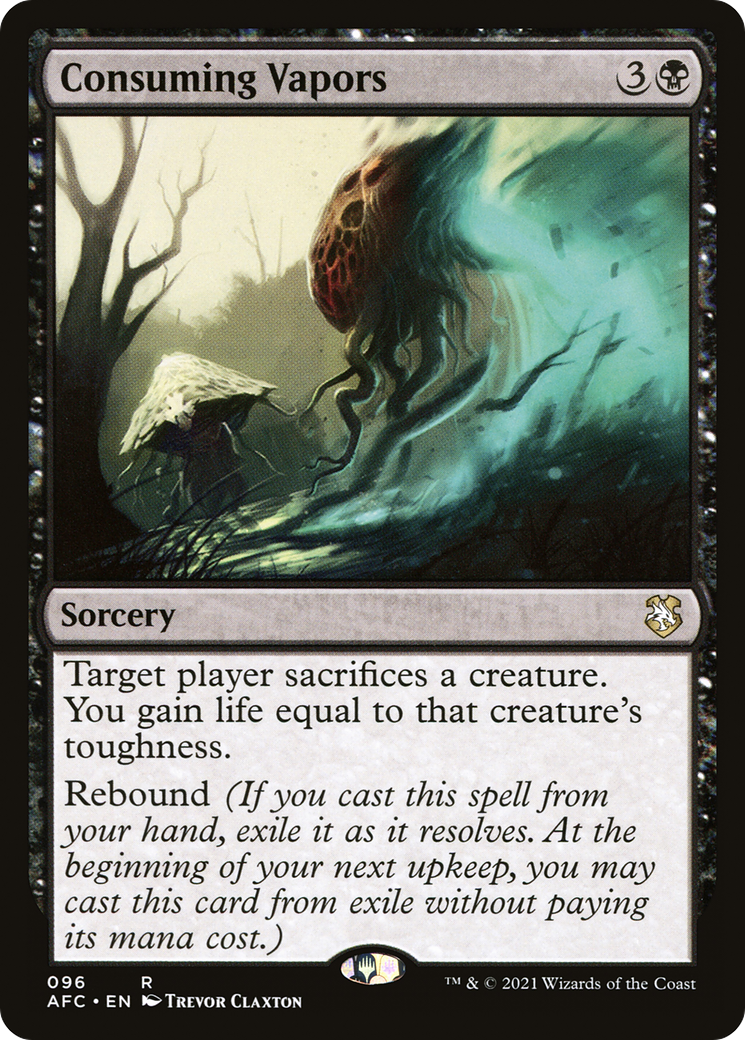
Consuming Vapors
Consuming Vapors
Sorcery
Target player sacrifices a creature of their choice. You gain life equal to that creature's toughness.
Rebound (If you cast this spell from your hand, exile it as it resolves. At the beginning of your next upkeep, you may cast this card from exile without paying its mana cost.)
- If a spell with rebound that you cast from your hand doesn't resolve for any reason (due being countered by a spell like Cancel, or because all of its targets are illegal), rebound has no effect. The spell is simply put into your graveyard. You won't get to cast it again next turn.
- If you cast a spell with rebound from anywhere other than your hand (such as from your graveyard due to Sins of the Past, from your library due to cascade, or from your opponent's hand due to Sen Triplets), rebound won't have any effect. If you do cast it from your hand, rebound will work regardless of whether you paid its mana cost (for example, if you cast it from your hand due to Maelstrom Archangel).
- If a replacement effect would cause a spell with rebound that you cast from your hand to be put somewhere else instead of your graveyard (such as Leyline of the Void might), you choose whether to apply the rebound effect or the other effect as the spell resolves.
- Rebound will have no effect on copies of spells because you don't cast them from your hand.
- If you cast a spell with rebound from your hand and it resolves, it isn't put into your graveyard. Rather, it's exiled directly from the stack. Effects that care about cards being put into your graveyard won't do anything.
- At the beginning of your upkeep, all delayed triggered abilities created by rebound effects trigger. You may handle them in any order. If you want to cast a card this way, you do so as part of the resolution of its delayed triggered ability. Timing restrictions based on the card's type (if it's a sorcery) are ignored. Other restrictions are not (such as the one from Rule of Law).
- If you are unable to cast a card from exile this way, or you choose not to, nothing happens when the delayed triggered ability resolves. The card remains exiled for the rest of the game, and you won't get another chance to cast the card. The same is true if the ability is countered (due to Stifle, perhaps).
- If you cast a card from exile this way, it will go to your graveyard when it resolves, fails to resolve, or is countered. It won't go back to exile.
- The sacrificed creature's last known existence on the battlefield is checked to determine its toughness.
- If the targeted player doesn't sacrifice a creature (because the player didn't control any creatures or due to Tajuru Preserver, perhaps), you gain no life.
-
1
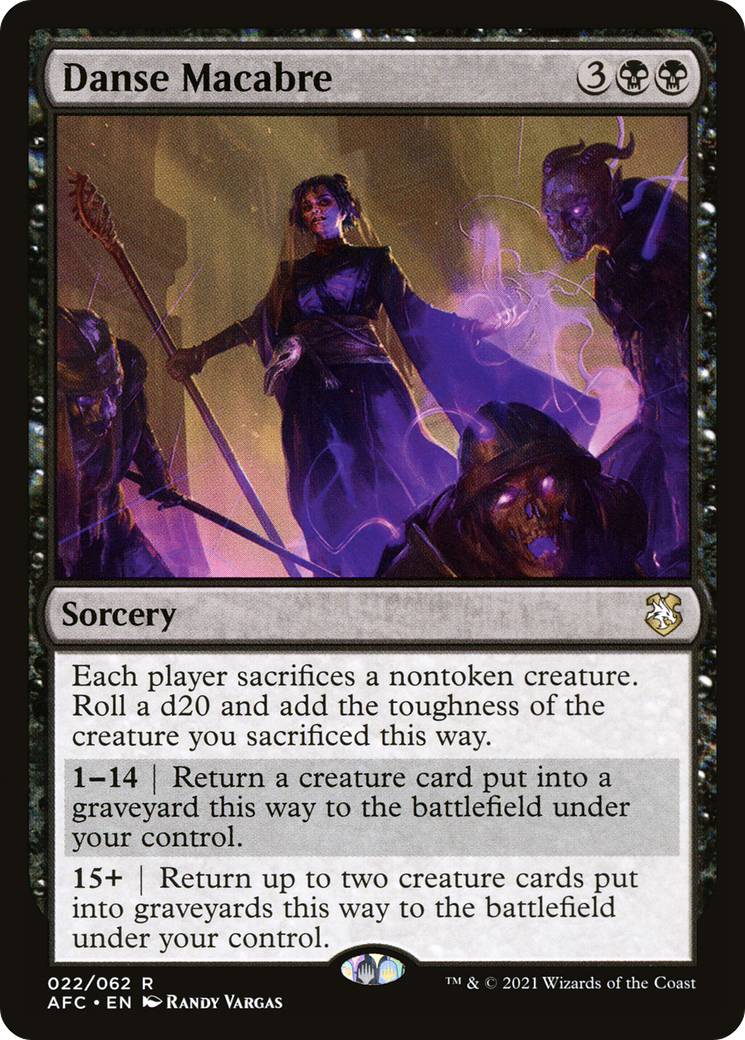
Danse Macabre
Danse Macabre
Sorcery
Each player sacrifices a nontoken creature of their choice. Roll a d20 and add the toughness of the creature you sacrificed this way.
1—14 | Return a creature card put into a graveyard this way to the battlefield under your control.
15+ | Return up to two creature cards put into graveyards this way to the battlefield under your control.
- Starting with you and continuing in turn order, each player will choose which creature they will sacrifice. They will know the choices made by players before them in this order when they make that choice. The creatures are all sacrificed at the same time.
- All creatures are chosen and sacrificed before the die is rolled. You don't get to see what the result of the die roll is before choosing which creature to sacrifice.
- You add only the toughness of the creature you sacrificed this way, not the toughness of any creatures your opponent sacrificed. If you didn't sacrifice a creature this way, you will still roll a d20, but you will not add anything to the roll.
- If a player sacrifices their commander this way, they won't be able to choose whether to put it into the command zone until after Danse Macabre has finished resolving. Notably, this means that the sacrificed commander is a legal choice for the spell's controller to return to the battlefield. If they choose it this way, it will stay on the battlefield under their control.
-
1
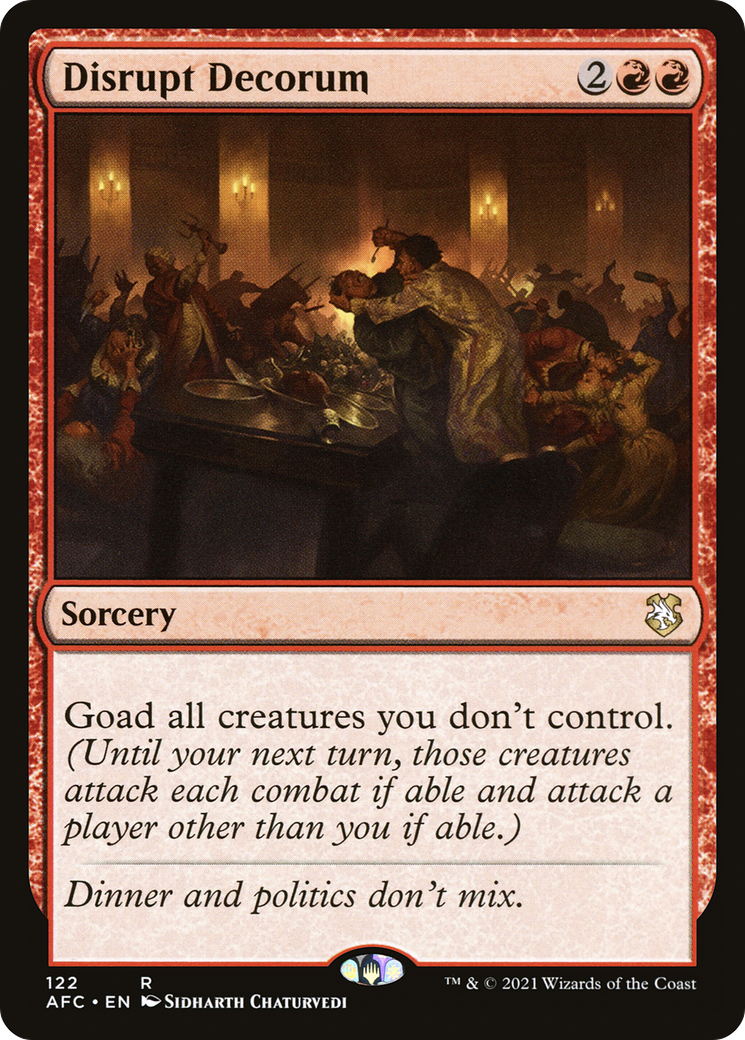
Disrupt Decorum
Disrupt Decorum
Sorcery
Goad all creatures you don't control. (Until your next turn, those creatures attack each combat if able and attack a player other than you if able.)
- If, during a player's declare attackers step, a creature that player controls that's been goaded is tapped, is affected by a spell or ability that says it can't attack, or hasn't been under that player's control continuously since the turn began (and doesn't have haste), then it doesn't attack. If there's a cost associated with having a creature attack a player, its controller isn't forced to pay that cost, so it doesn't have to attack that player.
- If the creature doesn't meet any of the above exceptions and can attack, it must attack a player other than the controller of the spell or ability that goaded it if able. If the creature can't attack any of those players but could otherwise attack, it must attack a planeswalker an opponent controls, a battle an opponent controls, or a player who goaded it.
- Being goaded isn't an ability the creature has. Once it's been goaded, it must attack as detailed above even if it loses all abilities.
- Attacking with a goaded creature doesn't cause it to stop being goaded. If there is an additional combat phase that turn, or if another player gains control of it before it stops being goaded, it must attack again if able.
- If a creature you control has been goaded by multiple opponents, it must attack one of your opponents that hasn't goaded it, as that fulfills the maximum number of goad requirements. If a creature you control has been goaded by each of your opponents, the creature must attack an opponent (rather than a planeswalker or battle), but you choose which opponent it attacks.
- Creatures that enter the battlefield after Disrupt Decorum resolves won't be goaded.
-
1
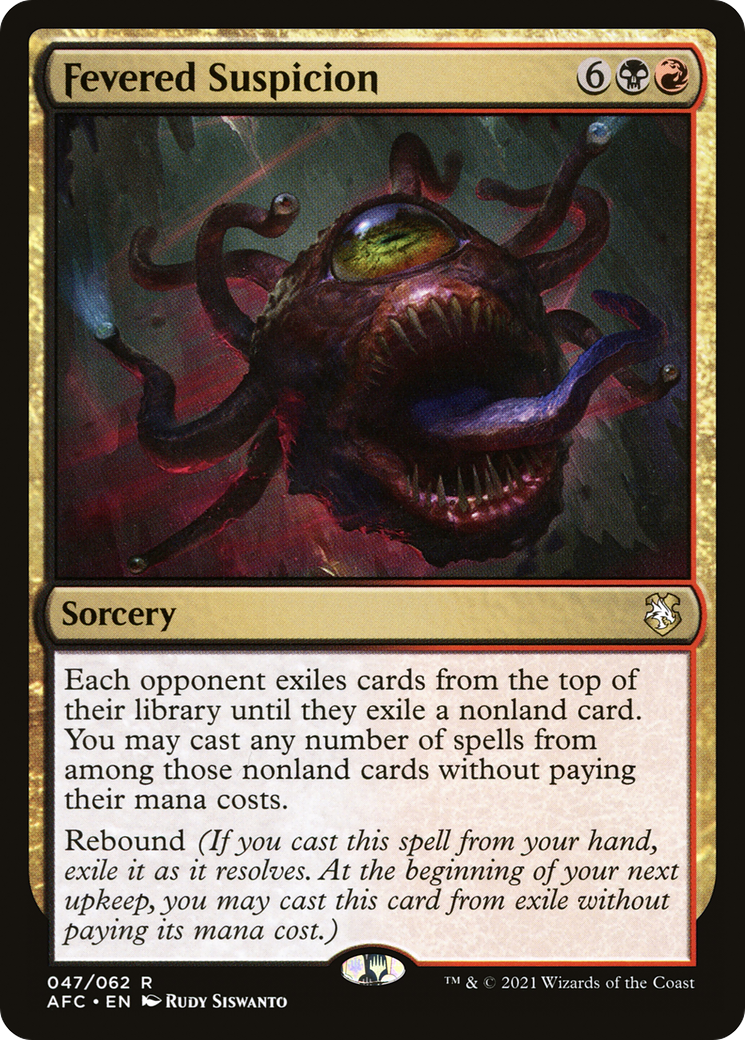
Fevered Suspicion
Fevered Suspicion
Sorcery
Each opponent exiles cards from the top of their library until they exile a nonland card. You may cast any number of spells from among those nonland cards without paying their mana costs.
Rebound (If you cast this spell from your hand, exile it as it resolves. At the beginning of your next upkeep, you may cast this card from exile without paying its mana cost.)
- You cast the cards exiled with Fevered Suspicion as it is resolving. If you choose not to cast them, you cannot cast them later.
- You may cast the exiled cards in any order, not just the order they were exiled.
- If you cast a spell “without paying its mana cost,” you can't choose to cast it for any alternative costs. You can, however, pay additional costs. If the card has any mandatory additional costs, you must pay those to cast the spell.
- If the card has in its mana cost, you must choose 0 as the value of X when casting it without paying its mana cost.
- Cards you don't cast this way, including any exiled land cards, will remain in exile indefinitely.
-
1
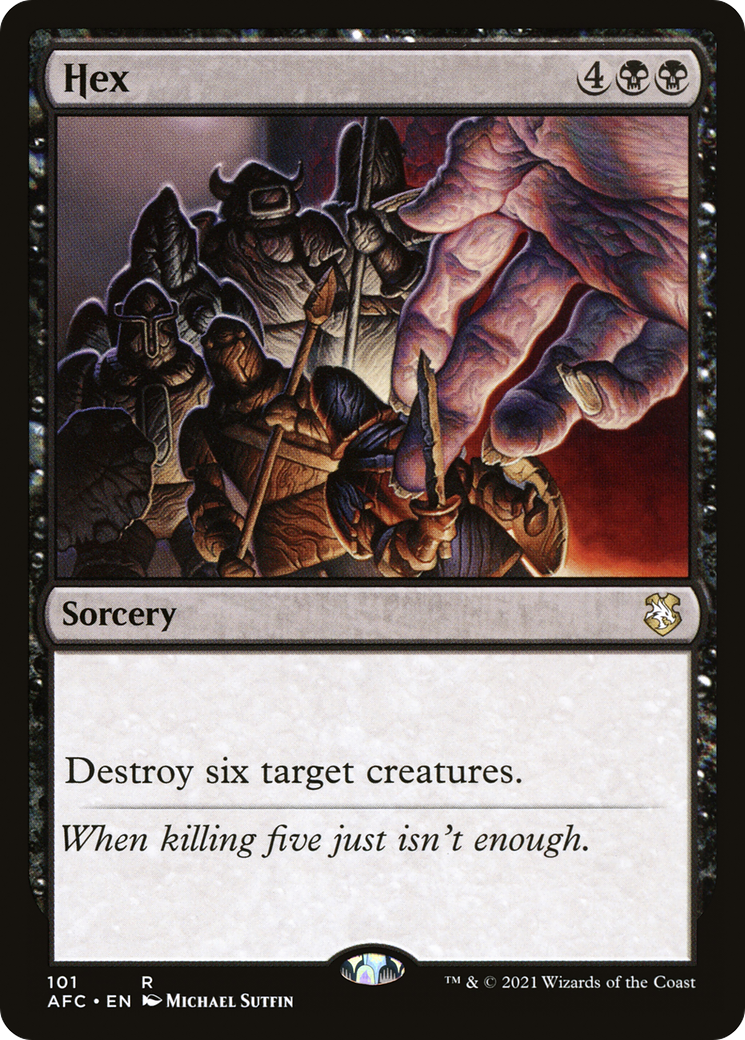
Hex
Hex
Sorcery
Destroy six target creatures.
- You must target six different creatures. If you can't, you can't cast Hex. If some of the creatures become illegal targets before the spell resolves, Hex will still destroy the rest of them.
-
1
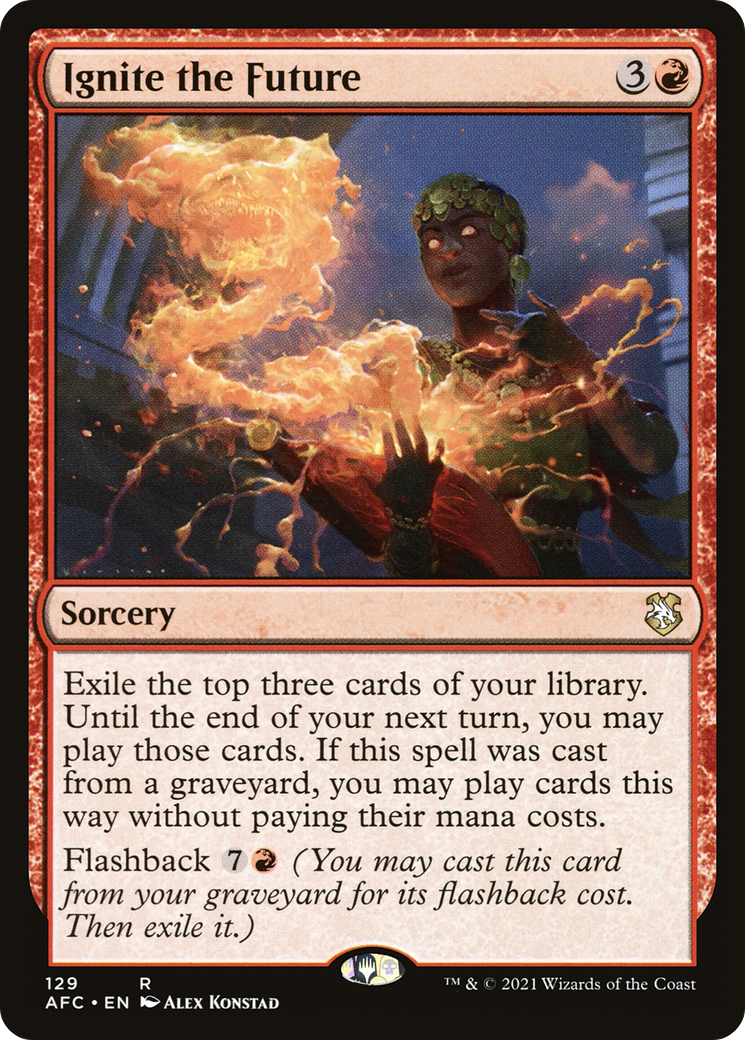
Ignite the Future
Ignite the Future
Sorcery
Exile the top three cards of your library. Until the end of your next turn, you may play those cards. If this spell was cast from a graveyard, you may play cards this way without paying their mana costs.
Flashback (You may cast this card from your graveyard for its flashback cost. Then exile it.)
- If a card with flashback is put into your graveyard during your turn, you can cast it if it's legal to do so before any other player can take any actions.
- “Flashback [cost]” means “You may cast this card from your graveyard by paying [cost] rather than paying its mana cost” and “If the flashback cost was paid, exile this card instead of putting it anywhere else any time it would leave the stack.”
- You must still follow any timing restrictions and permissions, including those based on the card's type. For instance, you can cast a sorcery using flashback only when you could normally cast a sorcery.
- To determine the total cost of a spell, start with the mana cost or alternative cost (such as a flashback cost) you're paying, add any cost increases, then apply any cost reductions. The mana value of the spell is determined only by its mana cost, no matter what the total cost to cast the spell was.
- A spell cast using flashback will always be exiled afterward, whether it resolves, is countered, or leaves the stack in some other way.
- You can cast a spell using flashback even if it was somehow put into your graveyard without having been cast.
- Ignite the Future doesn't change when you can play the exiled cards. For example, if you exile a sorcery card, you can cast it only during your main phase when the stack is empty. If you exile a land card, you can play it only during your main phase and only if you have an available land play remaining.
- If you cast Ignite the Future from a zone other than a graveyard, you must pay the mana cost or an alternative cost for each spell cast this way. If you cast Ignite the Future from a graveyard, you may choose to cast each spell for its mana cost, an alternative cost, or without paying its mana cost.
- If a spell has in its mana cost, you must choose 0 as the value of X when casting it without paying its mana cost.
- If you cast a card “without paying its mana cost,” you can't choose to cast it for any alternative costs and not pay that cost. You can, however, pay additional costs. If the card has any mandatory additional costs, such as that of Momentous Fall, you must pay those to cast the card.
- If you don't play some or all of the exiled cards, those cards remain in exile.
-
1
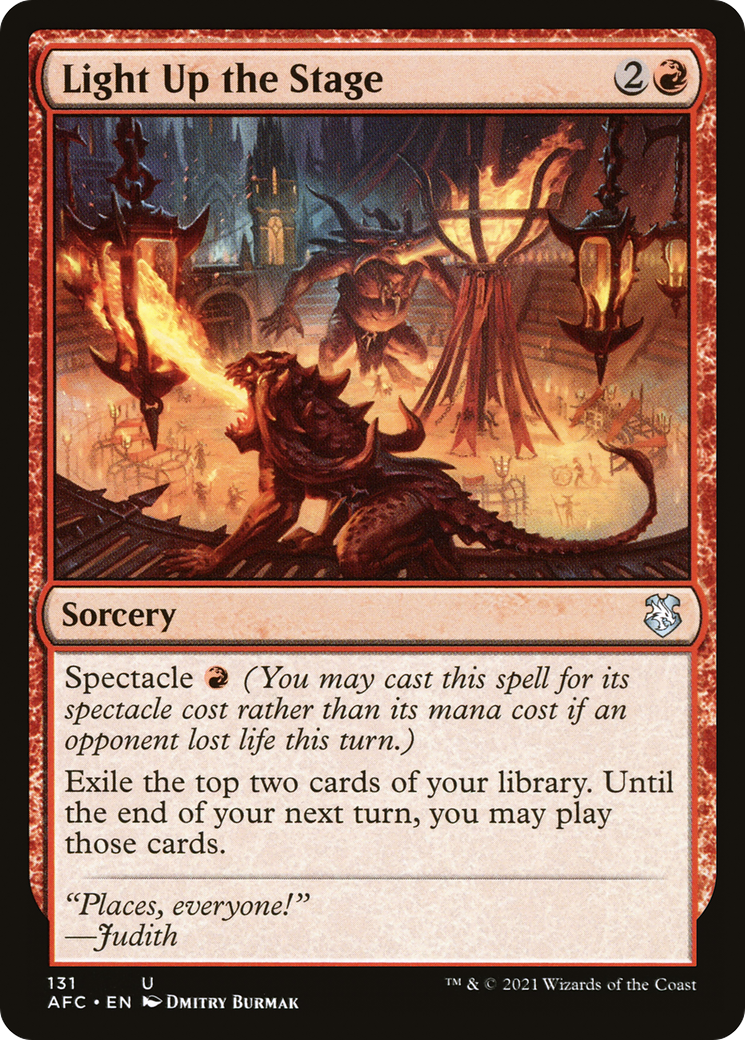
Light Up the Stage
Light Up the Stage
Sorcery
Spectacle (You may cast this spell for its spectacle cost rather than its mana cost if an opponent lost life this turn.)
Exile the top two cards of your library. Until the end of your next turn, you may play those cards.
- In a multiplayer game, if an opponent loses life and later that turn leaves the game, you can cast a spell for its spectacle cost. (If a player leaves the game during their turn, that turn continues without an active player.)
- Spectacle doesn't change when you can cast the spell. For example, you can't cast a sorcery with spectacle during an opponent's turn unless another effect allows you to do so, even if that player has lost life this turn.
- To determine the total cost of a spell, start with the mana cost or alternative cost you're paying (such as a spectacle cost), add any cost increases, then apply any cost reductions. The mana value of the spell remains unchanged, no matter what the total cost to cast it was.
- A card's spectacle cost is the same no matter how much life your opponents lost or how many opponents lost life.
- Damage dealt to a player causes that player to lose that much life.
- Spectacle cares only that an opponent lost life during the turn, not that the opponent's life total is currently lower than it was. For example, if an opponent loses 1 life and then gains 2 life in the same turn, you can cast a spell for its spectacle cost that turn.
- Casting an exiled card causes it to leave exile. You can't cast it multiple times.
- If you don't play a card exiled this way, it remains in exile.
- Light Up the Stage doesn't change when you can play the exiled cards. For example, if you exile a sorcery card, you can cast it only during your main phase when the stack is empty. If you exile a land card, you can play it only during your main phase and only if you have an available land play remaining.
-
1
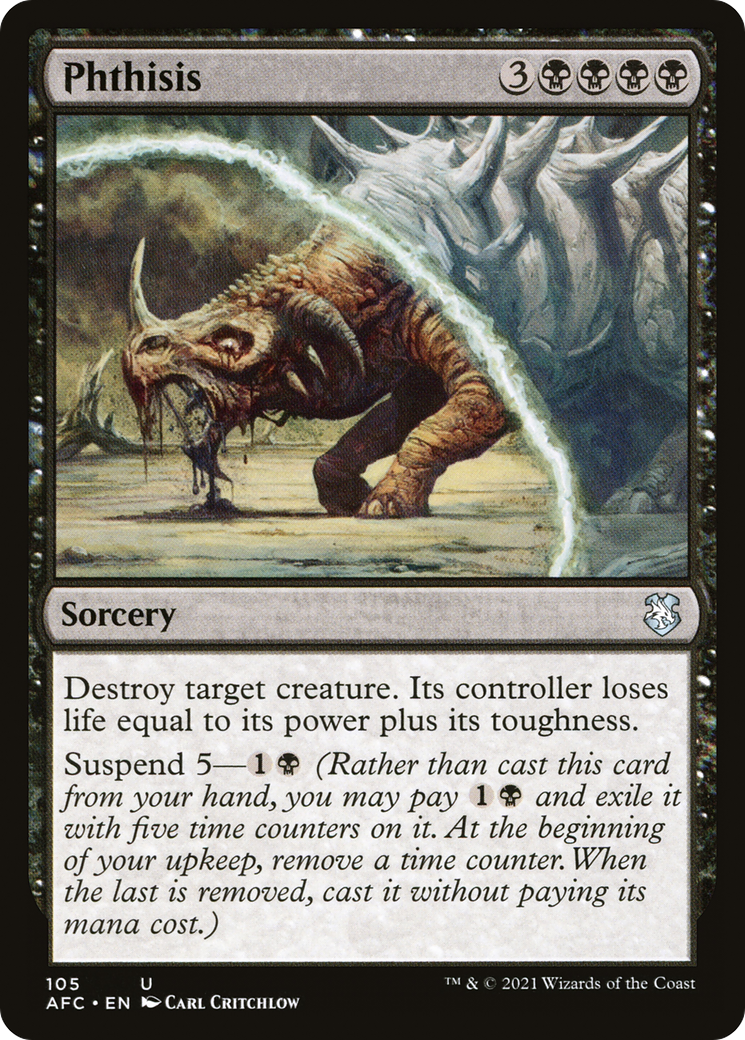
Phthisis
Phthisis
Sorcery
Destroy target creature. Its controller loses life equal to its power plus its toughness.
Suspend 5— (Rather than cast this card from your hand, you may pay and exile it with five time counters on it. At the beginning of your upkeep, remove a time counter. When the last is removed, you may cast it without paying its mana cost.)
- The mana value of a spell cast without paying its mana cost is determined by its mana cost, even though that cost wasn't paid.
- If you cast a card "without paying its mana cost," such as with suspend, you can't choose to cast it for any alternative costs. You can, however, pay additional costs. If the card has any mandatory additional costs, you must pay those if you want to cast the card.
- If the card has in its mana cost, you must choose 0 as the value of X when casting it without paying its mana cost.
- Suspend is a keyword that represents three abilities. The first is a static ability that allows you to exile the card from your hand with the specified number of time counters (the number before the dash) on it by paying its suspend cost (listed after the dash). The second is a triggered ability that removes a time counter from the suspended card at the beginning of each of your upkeeps. The third is a triggered ability that gives you the option to cast the card when the last time counter is removed.
- You can exile a card in your hand using suspend any time you could cast that card. Consider its card type, any effects that modify when you could cast it (such as flash) and any other effects that stop you from casting it (such as from Meddling Mage's ability) to determine if and when you can do this. Whether you could actually complete all steps in casting the card is irrelevant. For example, you can exile a card with suspend that has no mana cost or that requires a target even if no legal targets are available at that time.
- Cards exiled with suspend are exiled face up.
- Exiling a card with suspend isn't casting that card. This action doesn't use the stack and can't be responded to.
- If the spell requires any targets, those targets are chosen when the spell is finally cast, not when it's exiled.
- If an effect refers to a "suspended card," that means a card that (1) has suspend, (2) is in exile, and (3) has one or more time counters on it.
- If the first triggered ability of suspend (the one that removes time counters) is countered, no time counter is removed. The ability will trigger again at the beginning of the card's owner's next upkeep.
- When the last time counter is removed, the second triggered ability of suspend (the one that lets you cast the card) triggers. It doesn't matter why the last time counter was removed or what effect removed it.
- If the second triggered ability is countered, the card can't be cast. It remains exiled with no time counters on it, and it's no longer suspended.
- Due to a recent rules change to suspend, you are no longer required to cast the suspended card as the second triggered ability of suspend resolves. Instead, as the second triggered ability resolves, you may cast the card. Timing permissions based on the card's type are ignored. If you don't cast the card, it remains exiled with no time counters on it, and it's no longer suspended.
- If the creature's power is negative, you still add its power and toughness to determine how much life is lost. If that total is negative, its controller doesn't gain or lose any life. For example, Phthisis destroying a -1/3 creature would cause a loss of 2 life. Pthisis destroying a -4/3 creature would cause no loss of life.
- If the target creature is an illegal target by the time Phthisis tries to resolve, the spell doesn't resolve. No player loses life. If the target is legal but not destroyed (most likely because it has indestructible), its controller does lose life.
-
1
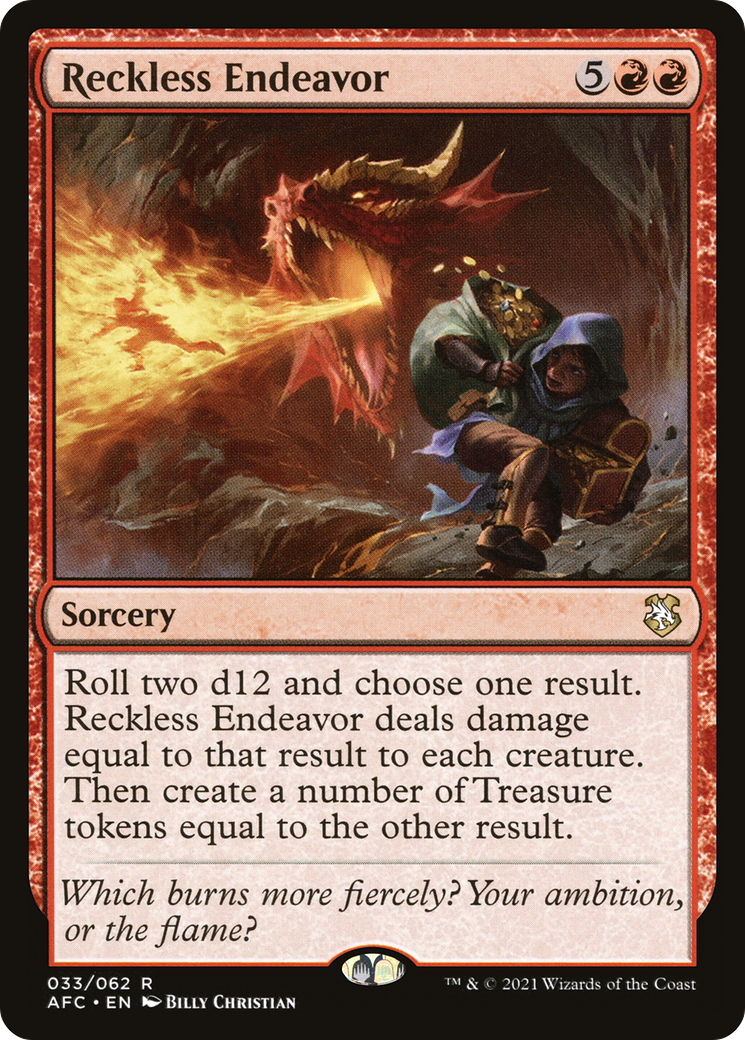
Reckless Endeavor
Reckless Endeavor
Sorcery
Roll two d12 and choose one result. Reckless Endeavor deals damage equal to that result to each creature. Then create a number of Treasure tokens equal to the other result.
- Dice are identified by the number of faces each one has. For example, a d20 is a twenty-sided die.
- Dice used must have equally likely outcomes and the roll must be fair. Although physical dice are recommended, digital substitutes are allowed, provided they have the same number of equally likely outcomes as specified in the original roll instruction.
- An ability that tells you to roll a die will also specify what to do with the result of that roll. Most often, this is in the form of a “results table” in the card text.
- The instruction to roll a die and the effect that occurs because of the result are all part of the same ability. Players do not get the chance to respond to the ability after knowing the result of the roll.
- An effect that says “choose a target, then roll a d20” or similar still uses the normal process of putting an ability on the stack and resolving it. Choosing targets is part of putting the ability on the stack and rolling the d20 happens later, as the ability resolves.
- Some effects may modify the result of a die roll. This may be part of the instruction to roll a die or it may come from other cards. Anything that references the “result” of a die roll is looking for the result after these modifications. Anything that is looking for the “natural result” is looking for the number shown on the face of the die before these modifications.
- Some abilities, like that of Pixie Guide and Barbarian Class, replace rolling a die with rolling extra dice and ignoring the lowest roll. The ignored rolls are not considered for the effect that instructed you to roll a die, and do not cause abilities to trigger. For all intents and purposes, once you determine which dice count, any extra dice were never rolled.
- Some effects instruct you to roll again. This uses the same number and type of dice as the original roll, and that roll will use the same set of possible outcomes.
- While playing Planechase, rolling the planar die will cause any ability that triggers whenever a player rolls one or more dice to trigger. However, any effect that refers to a numerical result will ignore the rolling of the planar die.
- Tournament events have more specific rules regarding dice and die-rolling. For more information, please see the most recent version of the Magic Tournament Rules at https://wpn.wizards.com/en/document/magic-gathering-tournament-rules.
-
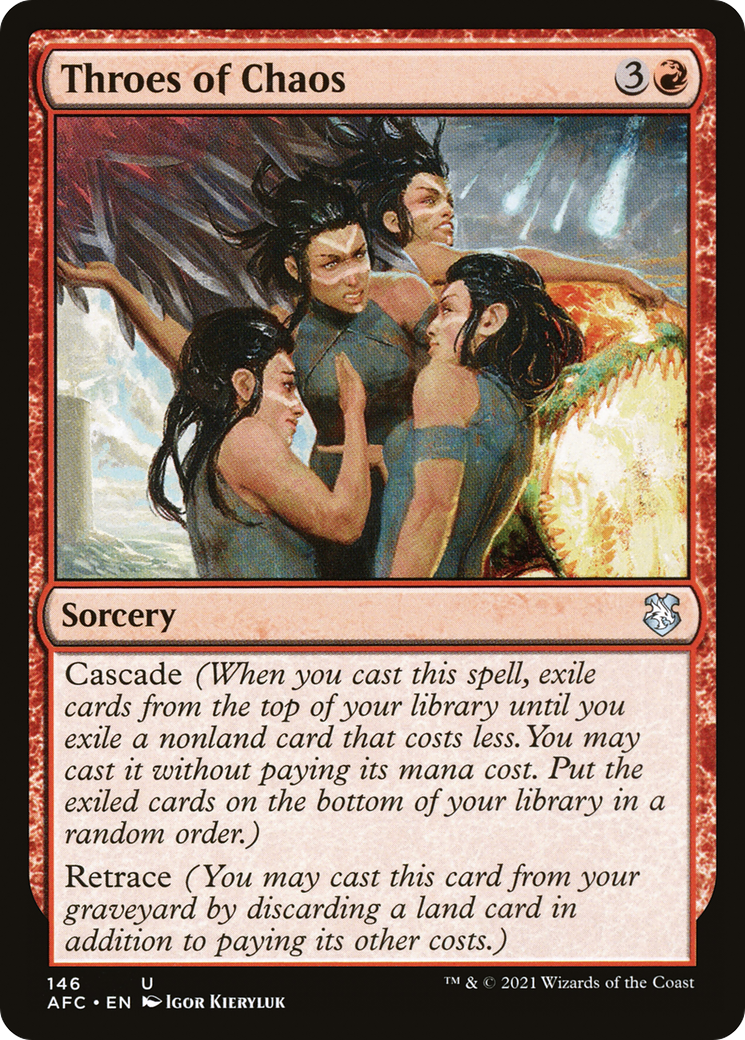
1
Throes of Chaos
Throes of Chaos
Sorcery
Cascade (When you cast this spell, exile cards from the top of your library until you exile a nonland card that costs less. You may cast it without paying its mana cost. Put the exiled cards on the bottom in a random order.)
Retrace (You may cast this card from your graveyard by discarding a land card in addition to paying its other costs.)
- A spell's mana value is determined only by its mana cost. Ignore any alternative costs, additional costs, cost increases, or cost reductions.
- If the card has in its mana cost, you must choose 0 as the value of X when casting it without paying its mana cost.
- You exile the cards face up. All players will be able to see them.
- If a spell with cascade is countered, the cascade ability will still resolve normally.
- The mana value of a split card is determined by the combined mana cost of its two halves. If cascade allows you to cast a split card, you may cast either half but not both halves.
- When the cascade ability resolves, you must exile cards. The only optional part of the ability is whether or not you cast the last card exiled.
- Due to a 2021 rules change to cascade, not only do you stop exiling cards if you exile a nonland card with lesser mana value than the spell with cascade, but the resulting spell you cast must also have lesser mana value. Previously, in cases where a card's mana value differed from the resulting spell, such as with some modal double-faced cards or cards with an Adventure, you could cast a spell with a higher mana value than the exiled card.
- If you cast a card "without paying its mana cost," you can't choose to cast it for any alternative costs. You can, however, pay additional costs. If the card has any mandatory additional costs, you must pay those to cast the card.
- Cascade triggers when you cast the spell, meaning that it resolves before that spell. If you end up casting the exiled card, it will go on the stack above the spell with cascade.
- When a spell you cast with retrace resolves or is countered, it's put back into your graveyard. You may use the retrace ability to cast it again.
- Throes of Chaos does nothing as it resolves. All of its chaos happens before it resolves.
-
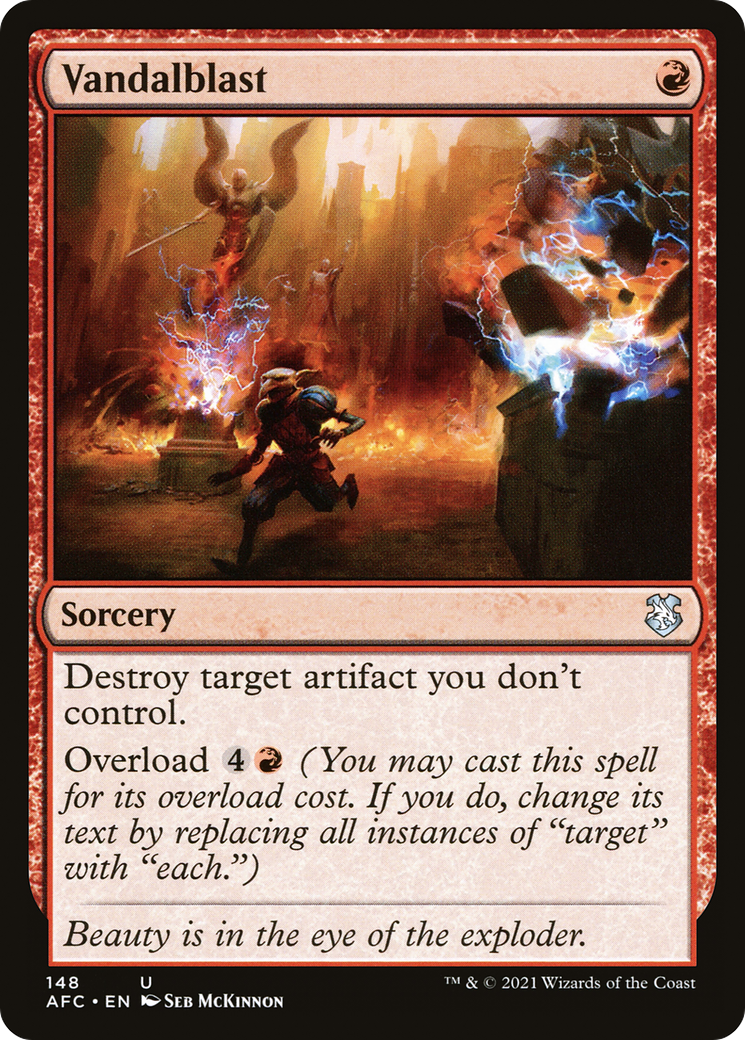
1
Vandalblast
Vandalblast
Sorcery
Destroy target artifact you don't control.
Overload (You may cast this spell for its overload cost. If you do, change "target" in its text to "each.")
- If you don't pay the overload cost of a spell with overload, that spell will have a single target. If you pay the overload cost, the spell won't have any targets.
- Because a spell with overload doesn't target when its overload cost is paid, it may affect permanents with hexproof or with protection from the appropriate color.
- To determine the total cost of a spell, start with the mana cost or alternative cost you're paying (such as an overload cost), add any cost increases, then apply any cost reductions. The mana value of the spell remains unchanged, no matter what the total cost to cast it was.
- If you are instructed to cast a spell with overload "without paying its mana cost," you can't choose to pay its overload cost instead.
Artifacts 14
-
1
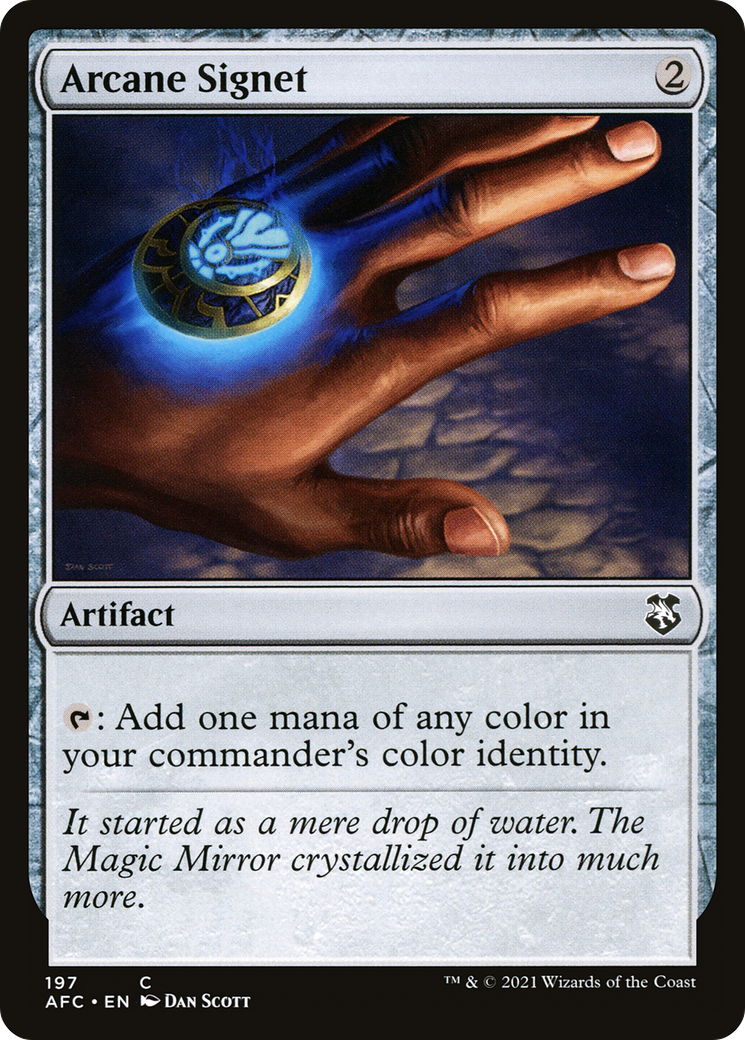
Arcane Signet
Arcane Signet
Artifact
: Add one mana of any color in your commander's color identity.
- If your commander is a card that has no colors in its color identity, Arcane Signet's ability produces no mana. It doesn't produce .
- If you have two commanders, the ability adds one mana of any color in their combined color identities.
- If you don't have a commander, Arcane Signet's ability produces no mana.
-
1
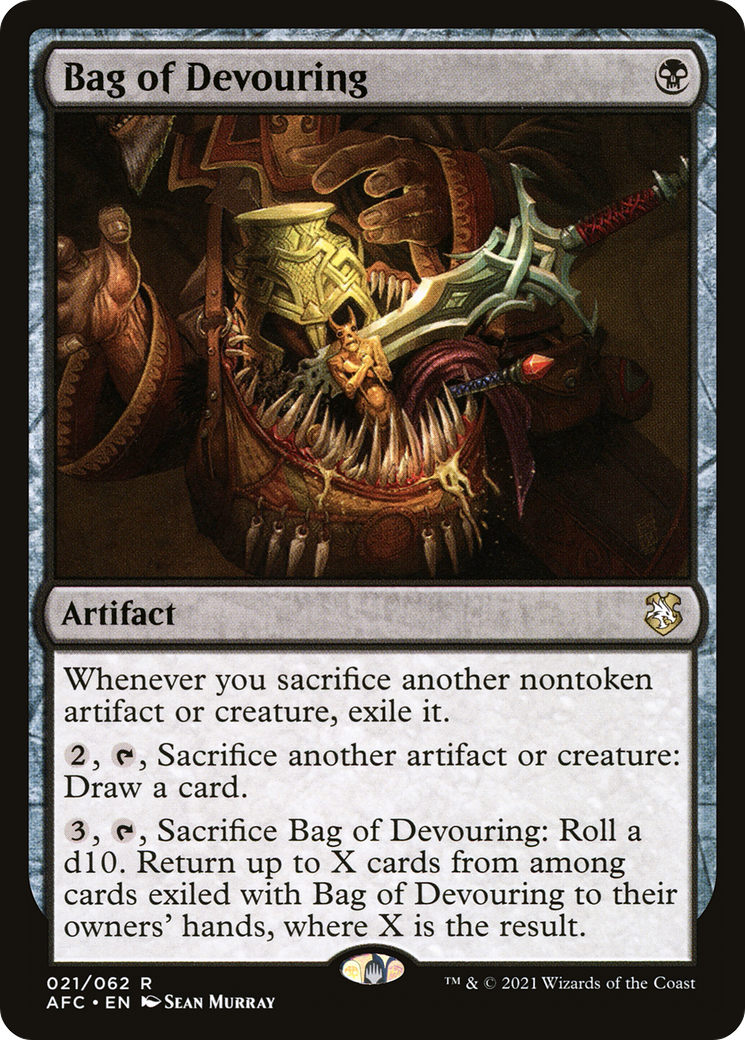
Bag of Devouring
Bag of Devouring
Artifact
Whenever you sacrifice another nontoken artifact or creature, exile it.
, , Sacrifice another artifact or creature: Draw a card.
, , Sacrifice this artifact: Roll a d10. Return up to X cards from among cards exiled with this artifact to their owners' hands, where X is the result.
- Bag of Devouring's first ability is a triggered ability that happens when you sacrifice permanents, but you can't just sacrifice permanents whenever you want. You need to have some other means to do so, such as activating Bag of Devouring's second ability.
- If the card you sacrifice isn't still in the graveyard as the first ability resolves, it won't be exiled. It won't be a card exiled with Bag of Devouring for the third ability.
-
1
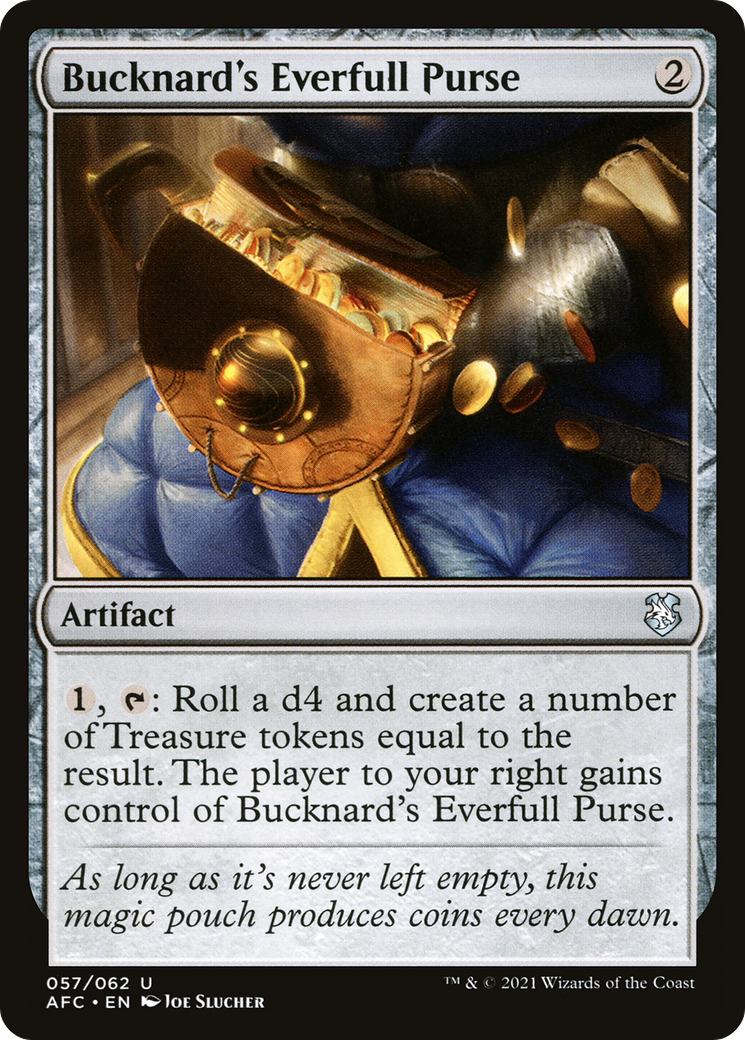
Bucknard's Everfull Purse
Bucknard's Everfull Purse
Artifact
, : Roll a d4 and create a number of Treasure tokens equal to the result. The player to your right gains control of this artifact.
- Dice are identified by the number of faces each one has. For example, a d20 is a twenty-sided die.
- Dice used must have equally likely outcomes and the roll must be fair. Although physical dice are recommended, digital substitutes are allowed, provided they have the same number of equally likely outcomes as specified in the original roll instruction.
- An ability that tells you to roll a die will also specify what to do with the result of that roll. Most often, this is in the form of a “results table” in the card text.
- The instruction to roll a die and the effect that occurs because of the result are all part of the same ability. Players do not get the chance to respond to the ability after knowing the result of the roll.
- An effect that says “choose a target, then roll a d20” or similar still uses the normal process of putting an ability on the stack and resolving it. Choosing targets is part of putting the ability on the stack and rolling the d20 happens later, as the ability resolves.
- Some effects may modify the result of a die roll. This may be part of the instruction to roll a die or it may come from other cards. Anything that references the “result” of a die roll is looking for the result after these modifications. Anything that is looking for the “natural result” is looking for the number shown on the face of the die before these modifications.
- Some abilities, like that of Pixie Guide and Barbarian Class, replace rolling a die with rolling extra dice and ignoring the lowest roll. The ignored rolls are not considered for the effect that instructed you to roll a die, and do not cause abilities to trigger. For all intents and purposes, once you determine which dice count, any extra dice were never rolled.
- Some effects instruct you to roll again. This uses the same number and type of dice as the original roll, and that roll will use the same set of possible outcomes.
- While playing Planechase, rolling the planar die will cause any ability that triggers whenever a player rolls one or more dice to trigger. However, any effect that refers to a numerical result will ignore the rolling of the planar die.
- Tournament events have more specific rules regarding dice and die-rolling. For more information, please see the most recent version of the Magic Tournament Rules at https://wpn.wizards.com/en/document/magic-gathering-tournament-rules.
-
1
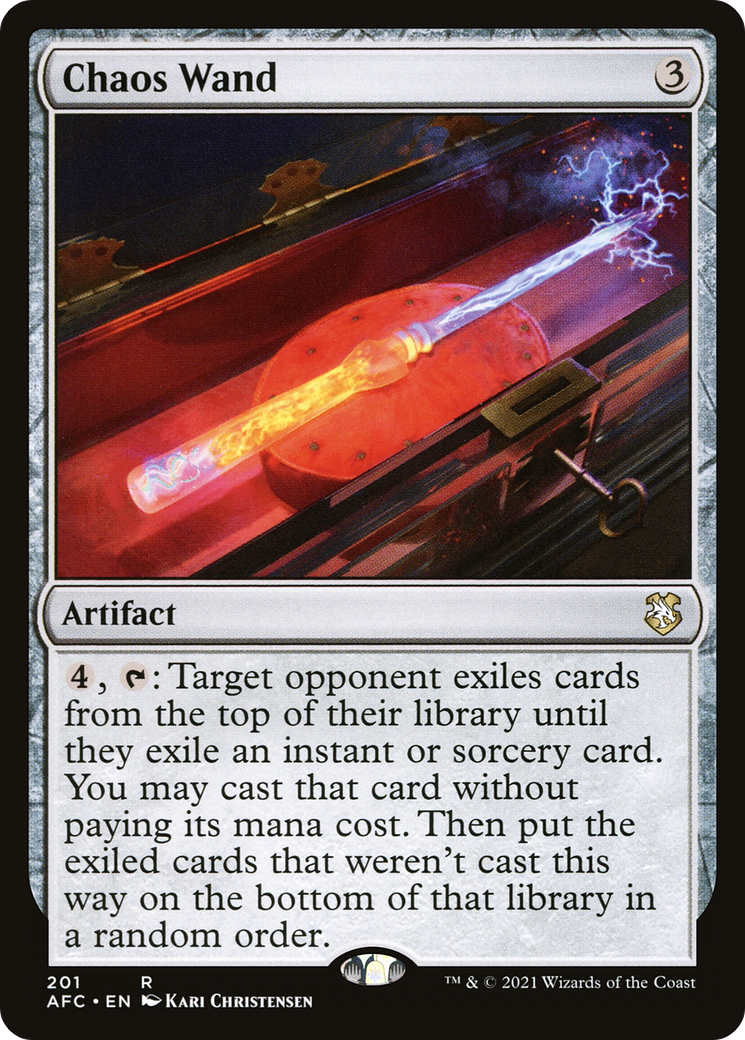
Chaos Wand
Chaos Wand
Artifact
, : Target opponent exiles cards from the top of their library until they exile an instant or sorcery card. You may cast that card without paying its mana cost. Then put the exiled cards that weren't cast this way on the bottom of that library in a random order.
- The opponent stops exiling cards as soon as they exile any instant or sorcery card. You don't choose which card type to look for.
- If the opponent exiles their entire library without exiling an instant or sorcery card, that player stops exiling cards, and the exiled cards are put into their library in a random order.
- If you don't cast the exiled instant or sorcery card, it's put on the bottom of that library with the other cards.
- If you wish to cast the exiled card, you must cast it while Chaos Wand's ability is resolving. You can't cast it later in the turn. A spell cast this way may be cast at a time you normally wouldn't be able to cast a spell of that type, but other restrictions (such as "Cast this spell only during combat") are enforced.
- If you cast a card "without paying its mana cost," you can't choose to cast it for any alternative costs. You can, however, pay additional costs. If the card has any mandatory additional costs, such as that of Tormenting Voice, those must be paid to cast the card.
- If the exiled card has in its mana cost, you must choose 0 as the value of X when casting it without paying its mana cost.
-
1
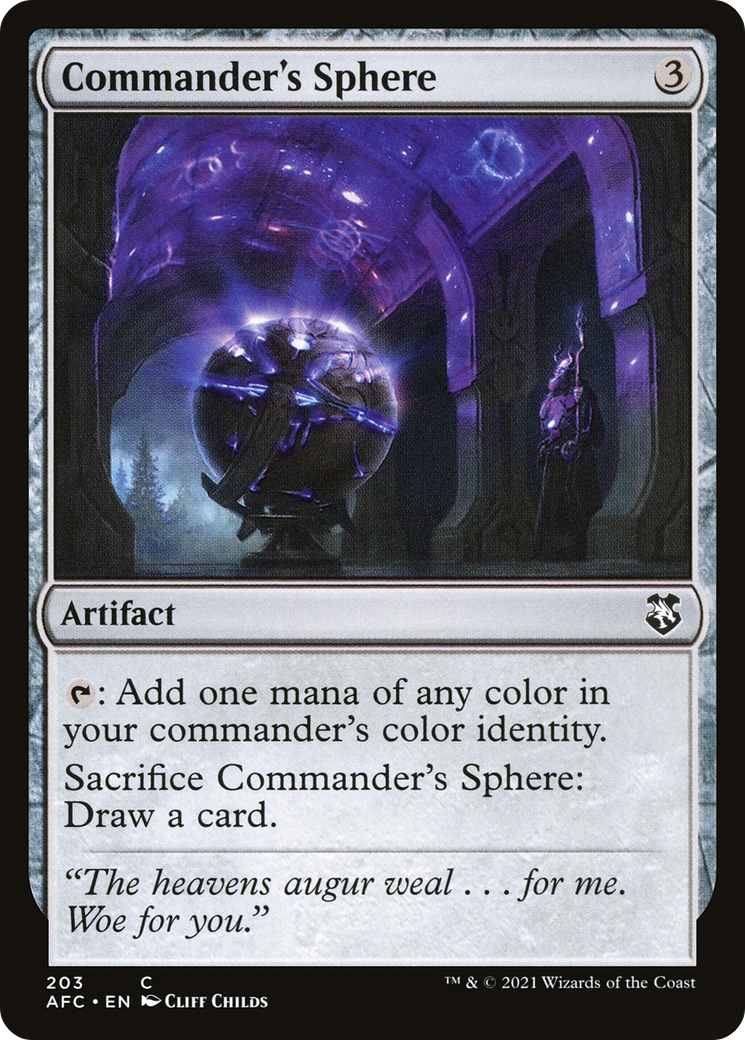
Commander's Sphere
Commander's Sphere
Artifact
: Add one mana of any color in your commander's color identity.
Sacrifice this artifact: Draw a card.
- If your commander is a card that has no colors in its color identity, Commander's Sphere's first ability produces no mana. It doesn't produce .
- If you don't have a commander, Commander's Sphere's first ability produces no mana.
- If you have two commanders, the ability adds one mana of any color in their combined color identities.
-
1
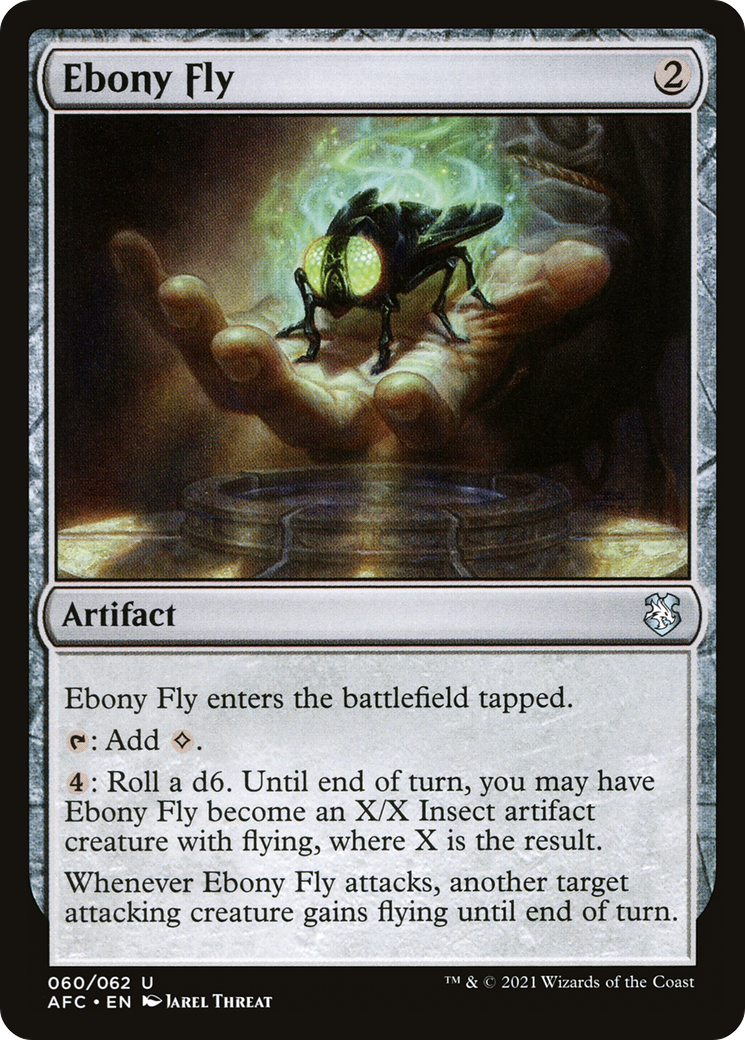
Ebony Fly
Ebony Fly
Artifact
This artifact enters tapped.
: Add .
: Roll a d6. Until end of turn, you may have this artifact become an X/X Insect artifact creature with flying, where X is the result.
Whenever this artifact attacks, another target attacking creature gains flying until end of turn.
- Dice are identified by the number of faces each one has. For example, a d20 is a twenty-sided die.
- Dice used must have equally likely outcomes and the roll must be fair. Although physical dice are recommended, digital substitutes are allowed, provided they have the same number of equally likely outcomes as specified in the original roll instruction.
- An ability that tells you to roll a die will also specify what to do with the result of that roll. Most often, this is in the form of a “results table” in the card text.
- The instruction to roll a die and the effect that occurs because of the result are all part of the same ability. Players do not get the chance to respond to the ability after knowing the result of the roll.
- An effect that says “choose a target, then roll a d20” or similar still uses the normal process of putting an ability on the stack and resolving it. Choosing targets is part of putting the ability on the stack and rolling the d20 happens later, as the ability resolves.
- Some effects may modify the result of a die roll. This may be part of the instruction to roll a die or it may come from other cards. Anything that references the “result” of a die roll is looking for the result after these modifications. Anything that is looking for the “natural result” is looking for the number shown on the face of the die before these modifications.
- Some abilities, like that of Pixie Guide and Barbarian Class, replace rolling a die with rolling extra dice and ignoring the lowest roll. The ignored rolls are not considered for the effect that instructed you to roll a die, and do not cause abilities to trigger. For all intents and purposes, once you determine which dice count, any extra dice were never rolled.
- Some effects instruct you to roll again. This uses the same number and type of dice as the original roll, and that roll will use the same set of possible outcomes.
- While playing Planechase, rolling the planar die will cause any ability that triggers whenever a player rolls one or more dice to trigger. However, any effect that refers to a numerical result will ignore the rolling of the planar die.
- Tournament events have more specific rules regarding dice and die-rolling. For more information, please see the most recent version of the Magic Tournament Rules at https://wpn.wizards.com/en/document/magic-gathering-tournament-rules.
- You choose whether Ebony Fly becomes a creature as the second ability resolves, after you see the result of the die roll. If you don't choose to make it a creature at that time, you can't choose to make it a creature later in the turn unless you activate the ability again.
-
1
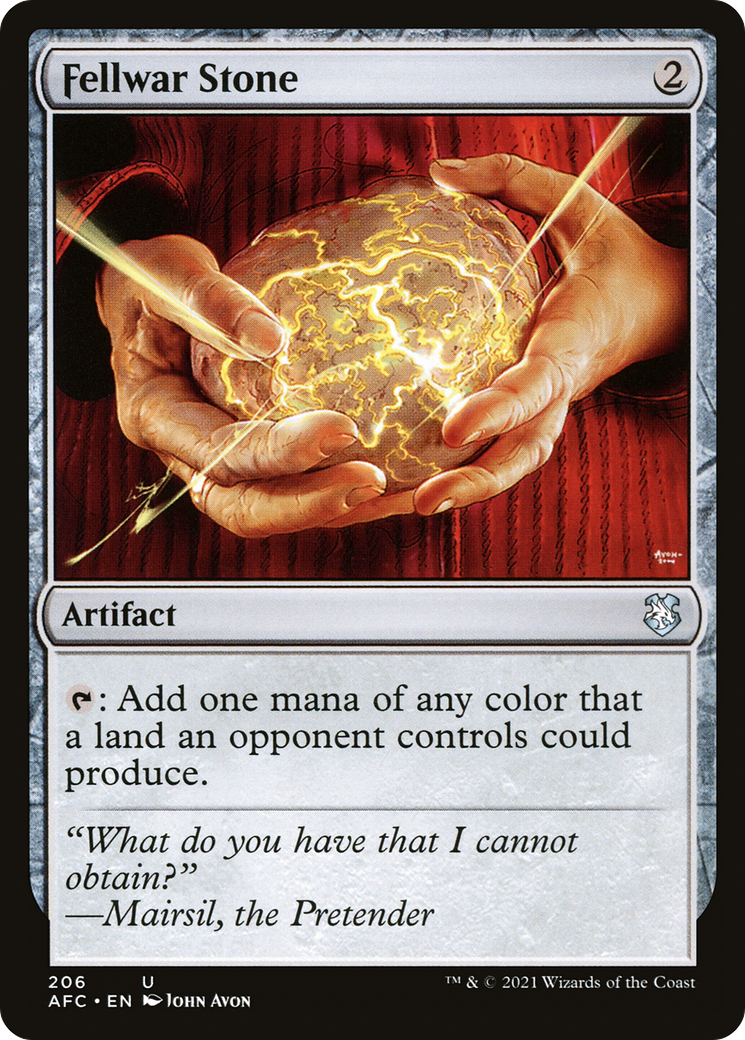
Fellwar Stone
Fellwar Stone
Artifact
: Add one mana of any color that a land an opponent controls could produce.
- When determining what colors of mana your opponents' lands could produce, take into account any applicable replacement effects that would apply to those lands' mana abilities (such as Contamination's effect, for example). If there is more than one, consider them in any possible order.
- Fellwar Stone doesn't care about any restrictions or riders your opponents' lands (such as Ancient Ziggurat or Hall of the Bandit Lord) put on the mana they produce. It just cares about colors of mana.
- The colors of mana are white, blue, black, red, and green. Fellwar Stone can't be tapped for colorless mana, even if a land an opponent controls could produce colorless mana.
- Fellwar Stone checks the effects of all mana-producing abilities of lands your opponents control, but it doesn't check their costs. For example, Vivid Crag has the ability " , Remove a charge counter from Vivid Crag: Add one mana of any color." If an opponent controls Vivid Crag and you control Fellwar Stone, you can tap Fellwar Stone for any color of mana. It doesn't matter whether Vivid Crag has a charge counter on it, and it doesn't matter whether it's untapped.
- This works even if the opponent's lands are tapped. It only checks what kinds of mana can be produced, not if the abilities that produce them are usable right now.
- It only produces one mana even if the land can produce more than one.
- The ability can be activated if the opponent has no lands that produce mana, but the effect will not be able to generate any mana.
-
1
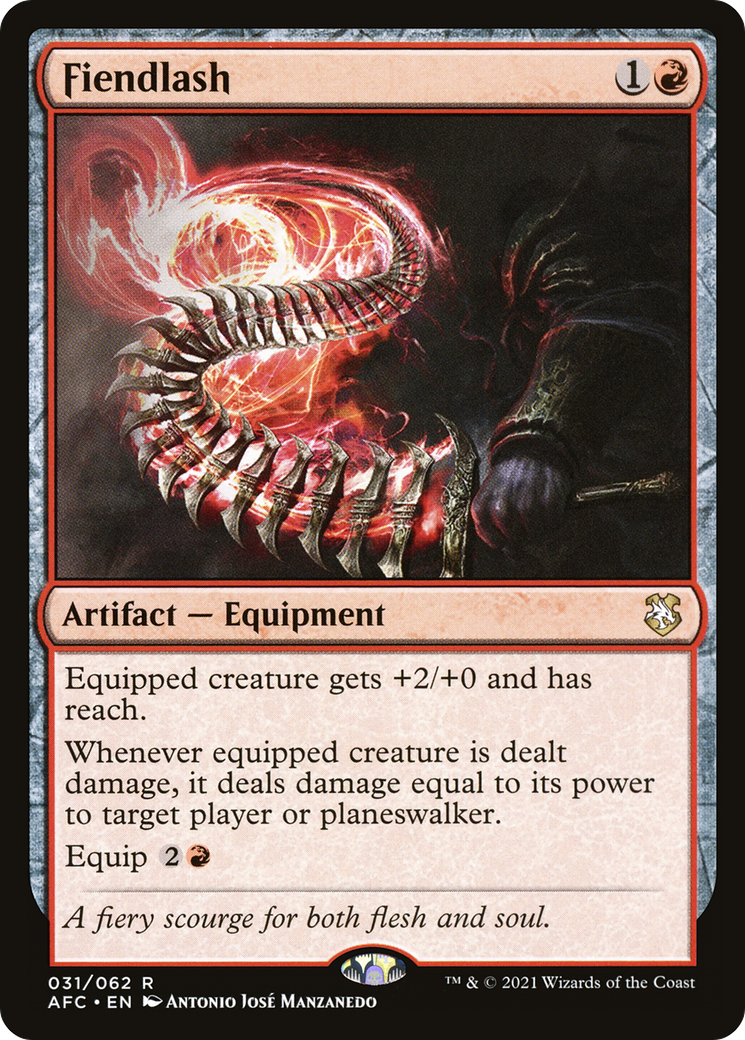
Fiendlash
Fiendlash
Artifact — Equipment
Equipped creature gets +2/+0 and has reach.
Whenever equipped creature is dealt damage, it deals damage equal to its power to target player or planeswalker.
Equip
- Use the equipped creature's power as the triggered ability resolves to determine how much damage is dealt. If the equipped creature is no longer on the battlefield at that time, use its power as it last existed on the battlefield.
- If the equipped creature isn't on the battlefield as the triggered ability resolves but it had lifelink when it left the battlefield, you will gain life.
-
1
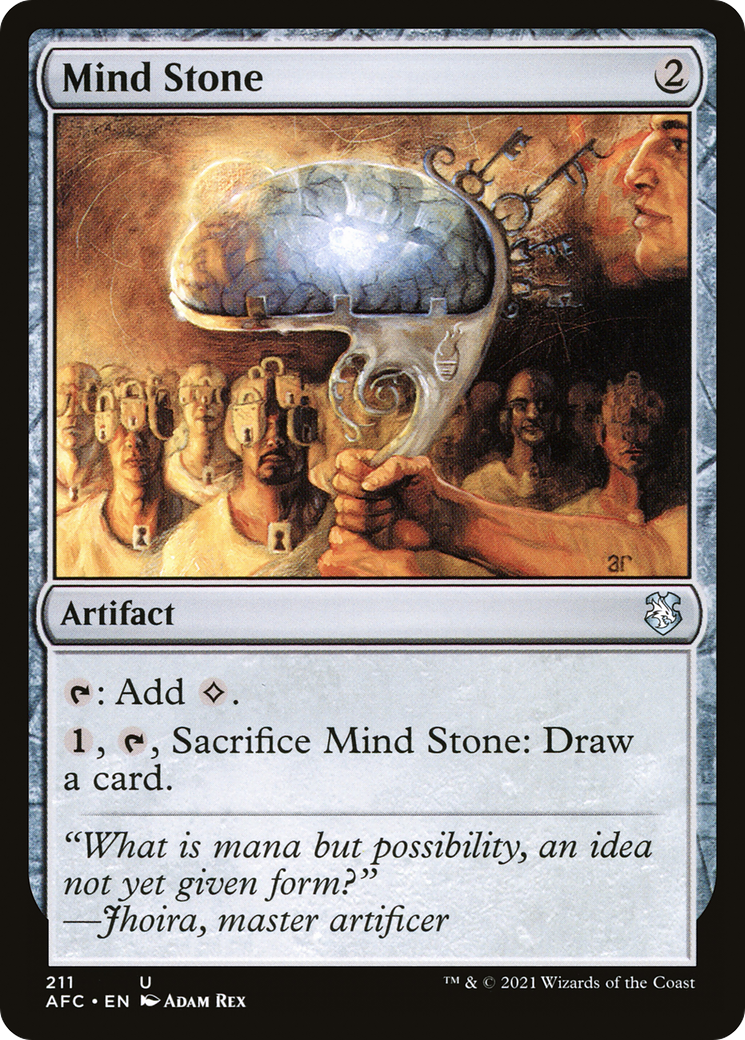
Mind Stone
Mind Stone
Artifact
: Add .
, , Sacrifice this artifact: Draw a card.
-
1
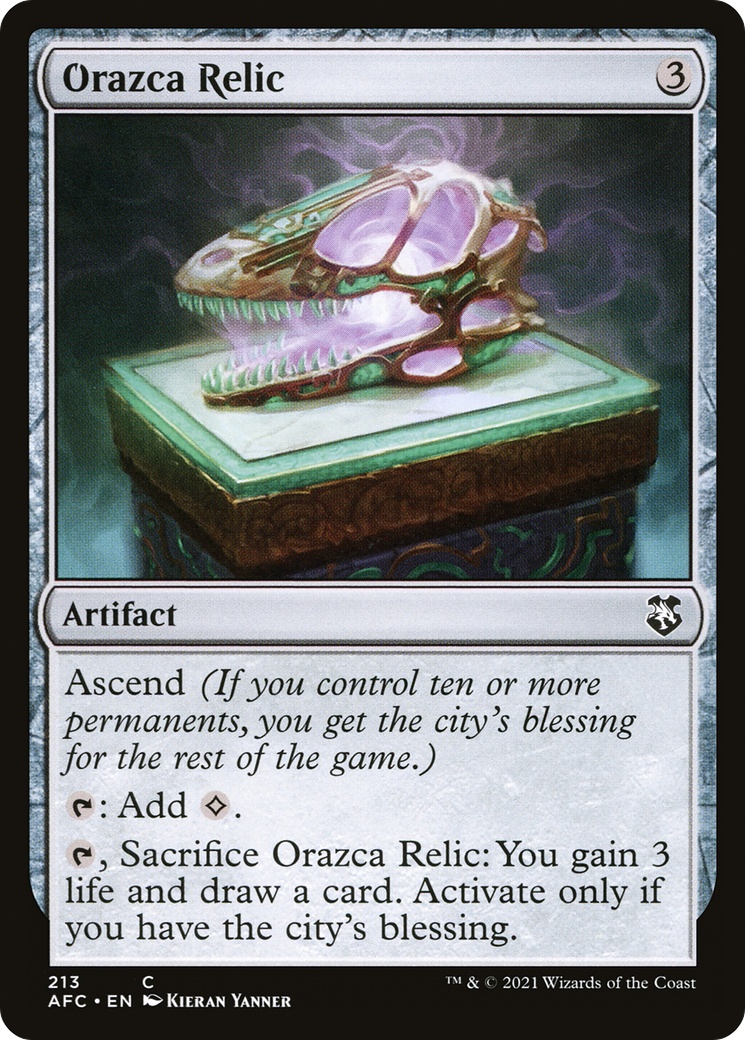
Orazca Relic
Orazca Relic
Artifact
Ascend (If you control ten or more permanents, you get the city's blessing for the rest of the game.)
: Add .
, Sacrifice this artifact: You gain 3 life and draw a card. Activate only if you have the city's blessing.
- If you cast a spell with ascend, you don't get the city's blessing until it resolves. Players may respond to that spell by trying to change whether you get the city's blessing.
- Once you have the city's blessing, you have it for the rest of the game, even if you lose control of some or all of your permanents. The city's blessing isn't a permanent itself and can't be removed by any effect.
- A permanent is any object on the battlefield, including tokens and lands. Spells and emblems aren't permanents.
- If you control ten permanents but don't control a permanent or resolving spell with ascend, you don't get the city's blessing. For example, if you control ten permanents, lose control of one, then cast Golden Demise, you won't have the city's blessing and the spell will affect creatures you control.
- If your tenth permanent enters the battlefield and then a permanent leaves the battlefield immediately afterwards (most likely due to the “Legend Rule” or due to being a creature with 0 toughness), you get the city's blessing before it leaves the battlefield.
- Ascend on a permanent isn't a triggered ability and doesn't use the stack. Players can respond to a spell that will give you your tenth permanent, but they can't respond to getting the city's blessing once you control that tenth permanent. This means that if your tenth permanent is a land you play, players can't respond before you get the city's blessing.
-
1
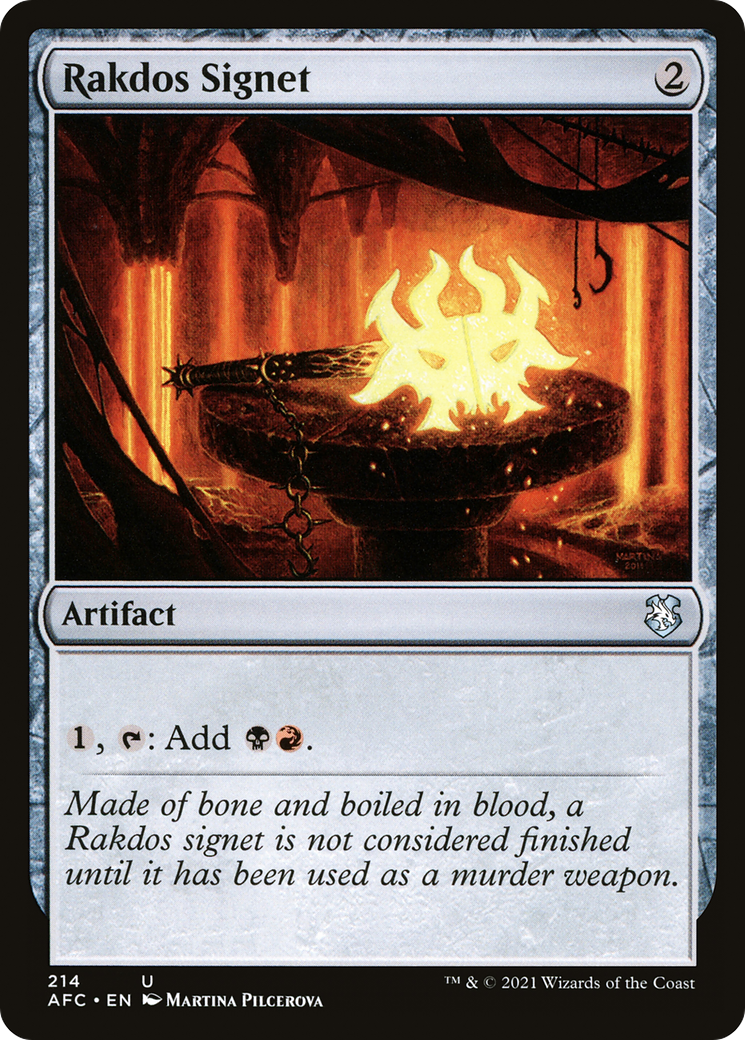
Rakdos Signet
Rakdos Signet
Artifact
, : Add .
-
1
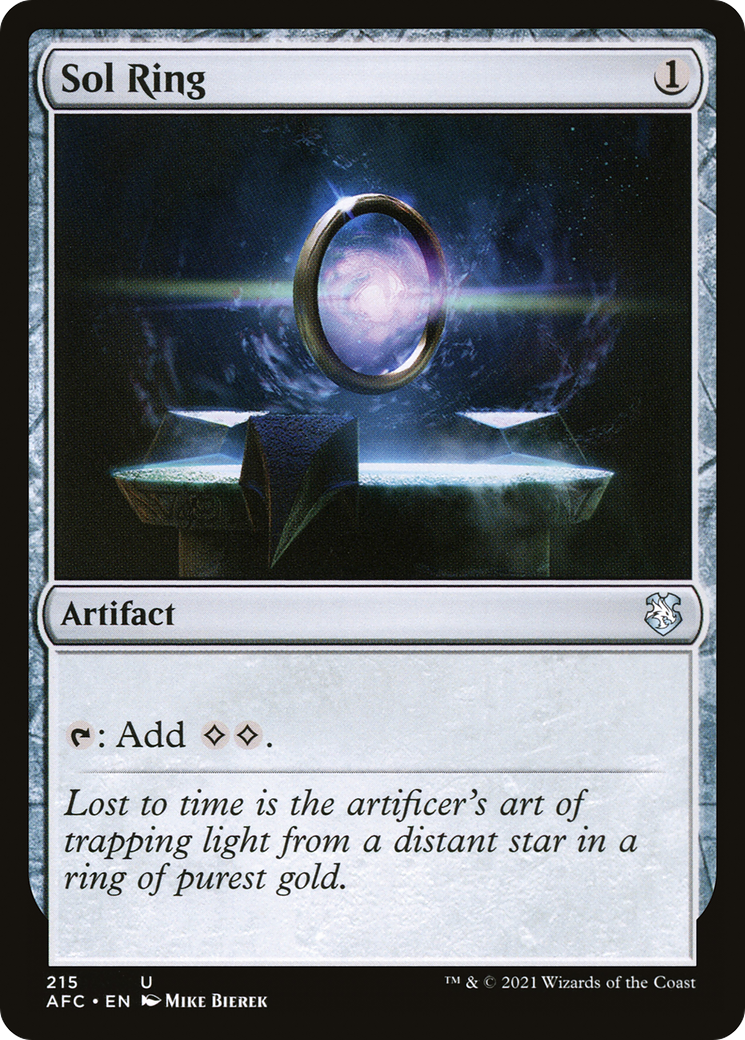
Sol Ring
Sol Ring
Artifact
: Add .
-
1
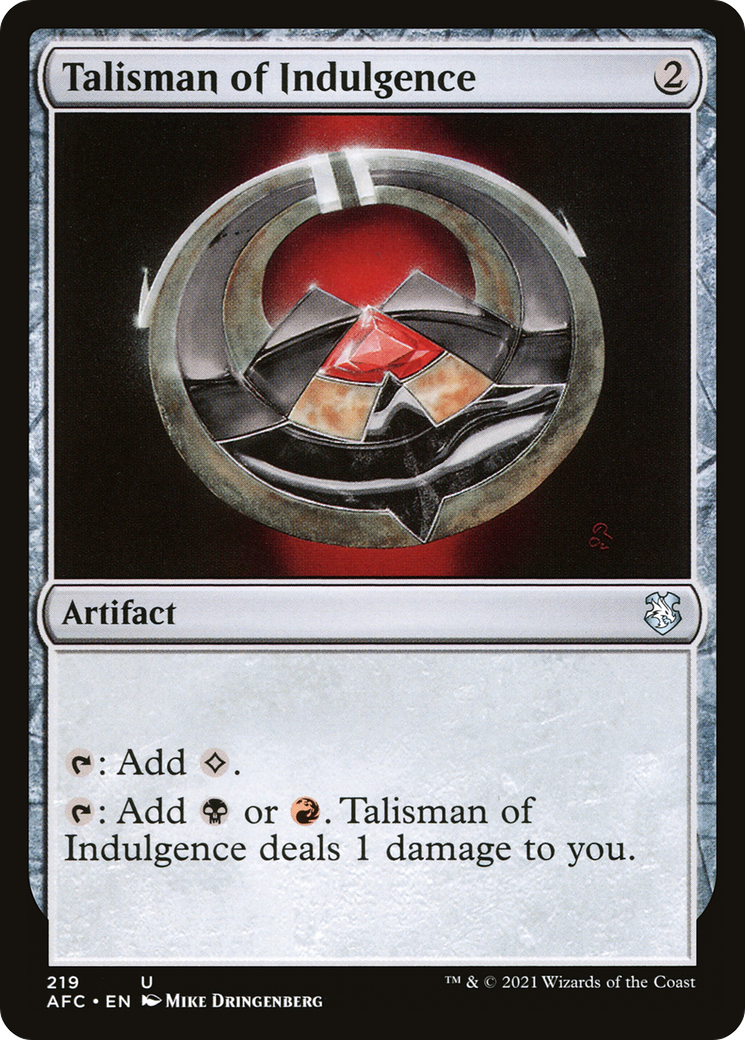
Talisman of Indulgence
Talisman of Indulgence
Artifact
: Add .
: Add or . This artifact deals 1 damage to you.
-
1
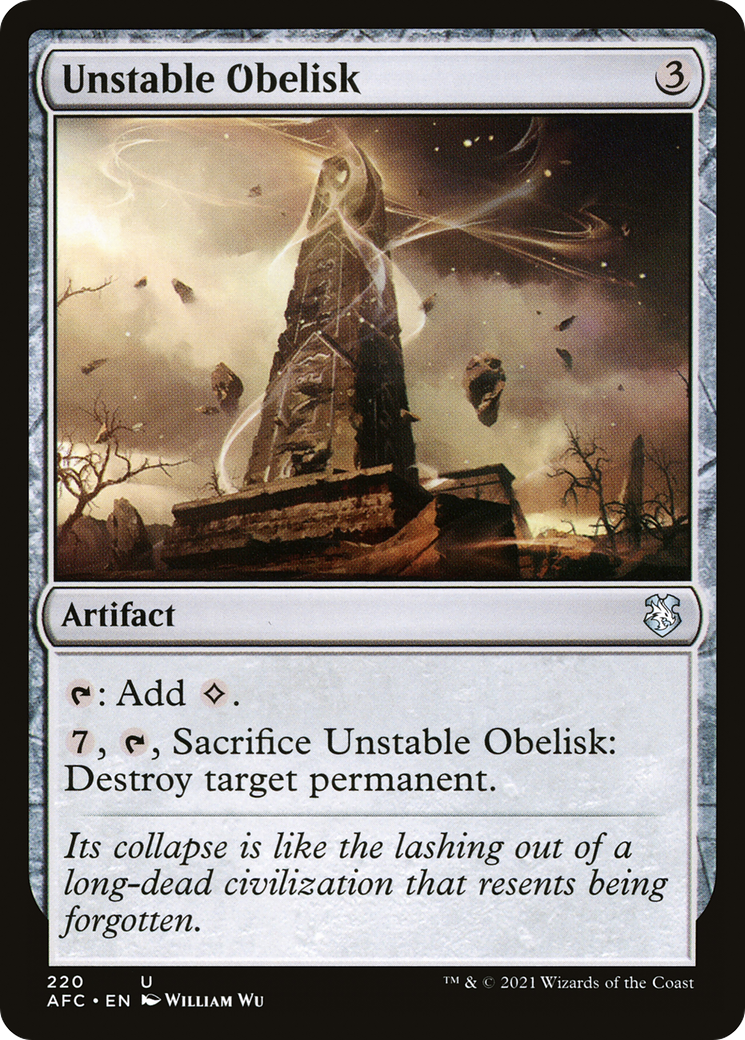
Unstable Obelisk
Unstable Obelisk
Artifact
: Add .
, , Sacrifice this artifact: Destroy target permanent.
Enchantments 5
-
1
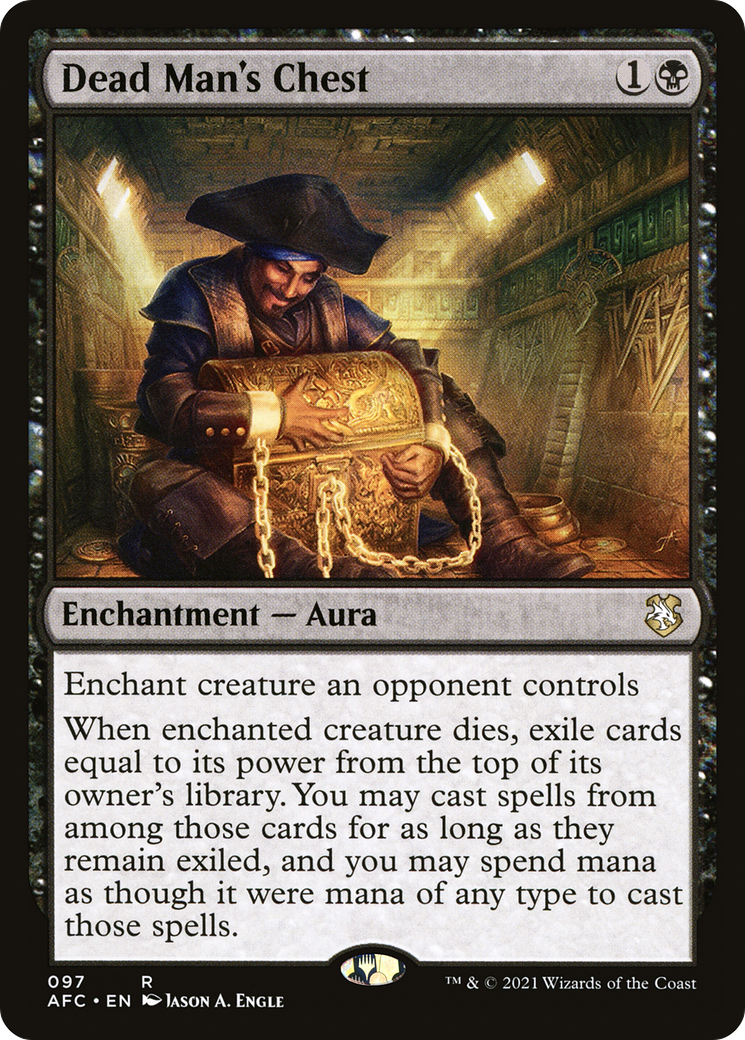
Dead Man's Chest
Dead Man's Chest
Enchantment — Aura
Enchant creature an opponent controls
When enchanted creature dies, exile cards equal to its power from the top of its owner's library. You may cast spells from among those cards for as long as they remain exiled, and mana of any type can be spent to cast them.
- If you gain control of the enchanted creature, Dead Man's Chest will be put into your graveyard.
- If Dead Man's Chest and the enchanted creature are both put into graveyards at the same time, the last ability of Dead Man's Chest still triggers.
- To determine how many cards to exile, use the enchanted creature's power as it last existed on the battlefield.
- You are a creature's owner if the card representing it began the game in your deck, or if it's a token that entered the battlefield under your control. If Dead Man's Chest enchants a creature that you own but an opponent controls, you'll exile cards from your library.
- The effect of Dead Man's Chest doesn't change when you can cast the exiled cards. For example, if you exile a creature card without flash, you can cast it only during your main phase when the stack is empty.
- Casting an exiled card causes it to leave exile. You can't cast it multiple times.
- In a multiplayer game, if a player leaves the game, all cards that player owns leave as well. If you leave the game, any spells or permanents you control from Dead Man's Chest's ability are exiled.
-
1
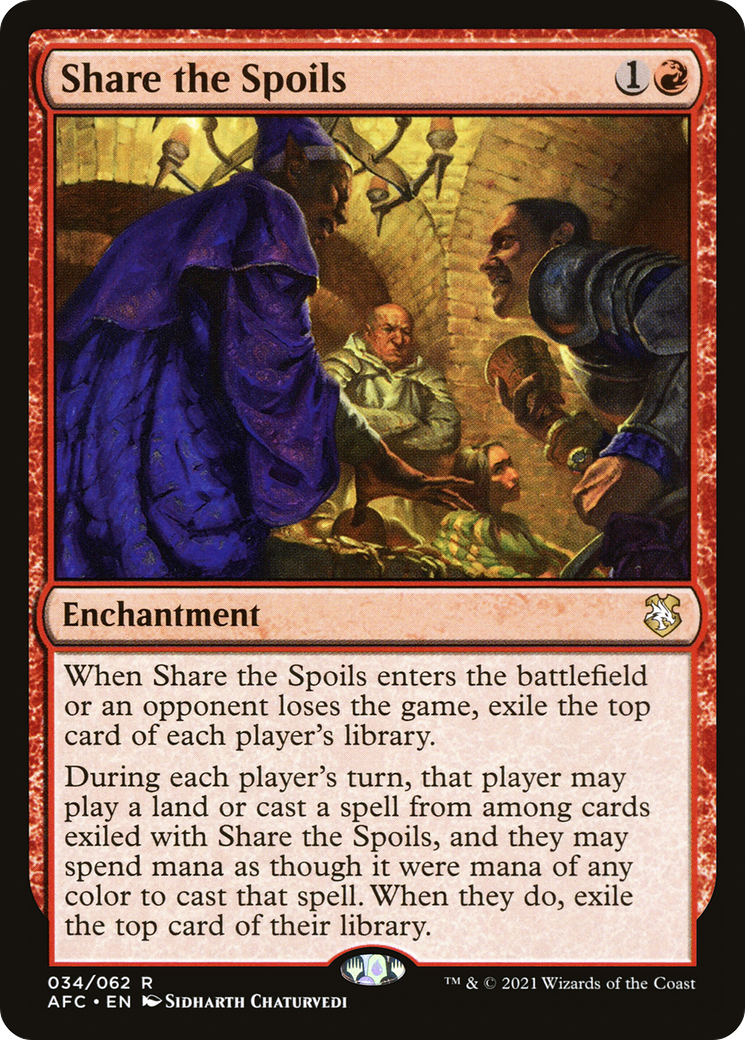
Share the Spoils
Share the Spoils
Enchantment
When this enchantment enters and whenever an opponent loses the game, exile the top card of each player's library.
During each player's turn, that player may play a land or cast a spell from among cards exiled with this enchantment, and they may spend mana as though it were mana of any color to cast that spell. When they do, exile the top card of their library.
- Once a player plays a land or casts a spell from among the exiled cards, they can't play any more of those cards that turn. That is, it's one land or one spell, not one of each.
- Playing a card this way follows all the normal timing rules for that card. For example, if you play a land this way, you may do so only during your main phase while the stack is empty and only if you havem't yet played a land (unless another effect allows you to play additional lands).
- If you control an opponent's Share the Spoils and that player loses the game, Share the Spoils leaves the game with them and the first ability won't trigger.
- Once Share the Spoils leaves the battlefield, players may no longer play the exiled cards. If Share the Spoils is destroyed and somehow returns to the battlefield, it's a new object with no memory of the previously exiled cards.
-
1
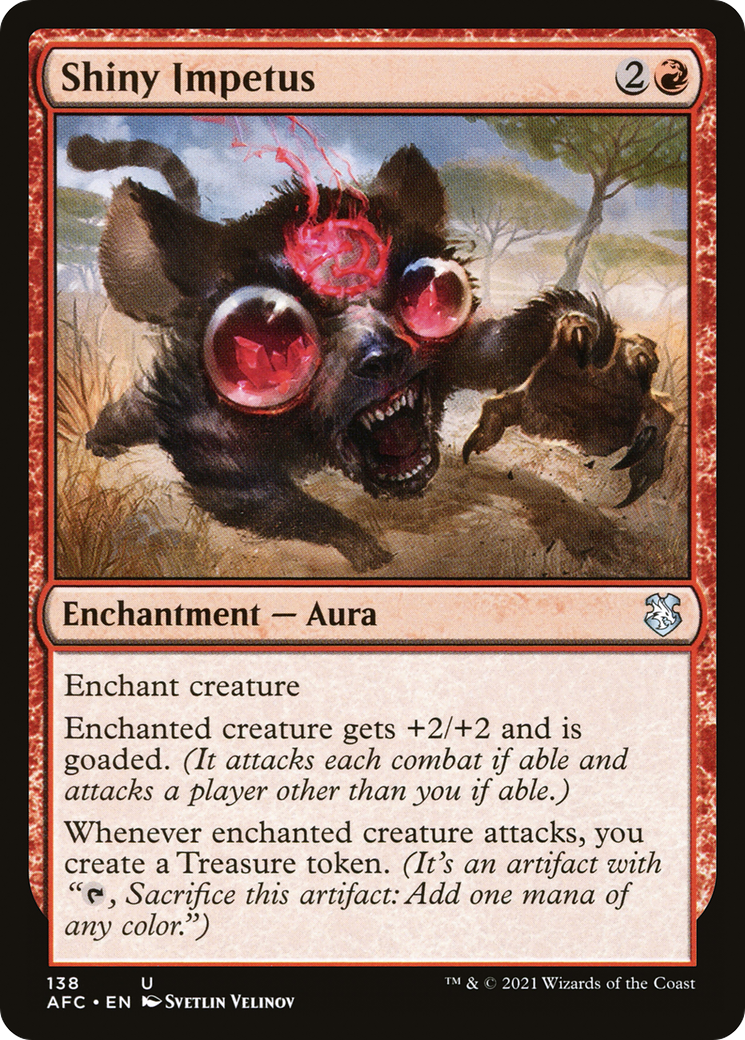
Shiny Impetus
Shiny Impetus
Enchantment — Aura
Enchant creature
Enchanted creature gets +2/+2 and is goaded. (It attacks each combat if able and attacks a player other than you if able.)
Whenever enchanted creature attacks, you create a Treasure token. (It's an artifact with " , Sacrifice this token: Add one mana of any color.")
- If, during a player's declare attackers step, a creature that player controls that's been goaded is tapped, is affected by a spell or ability that says it can't attack, or hasn't been under that player's control continuously since the turn began (and doesn't have haste), then it doesn't attack. If there's a cost associated with having a creature attack a player, its controller isn't forced to pay that cost, so it doesn't have to attack that player.
- If the creature doesn't meet any of the above exceptions and can attack, it must attack a player other than the controller of the spell or ability that goaded it if able. If the creature can't attack any of those players but could otherwise attack, it must attack a planeswalker an opponent controls, a battle an opponent controls, or a player who goaded it.
- Being goaded isn't an ability the creature has. Once it's been goaded, it must attack as detailed above even if it loses all abilities.
- Attacking with a goaded creature doesn't cause it to stop being goaded. If there is an additional combat phase that turn, or if another player gains control of it before it stops being goaded, it must attack again if able.
- If a creature you control has been goaded by multiple opponents, it must attack one of your opponents that hasn't goaded it, as that fulfills the maximum number of goad requirements. If a creature you control has been goaded by each of your opponents, the creature must attack an opponent (rather than a planeswalker or battle), but you choose which opponent it attacks.
- Shiny Impetus causes you to create a Treasure token, not the attacking creature's controller.
-
1
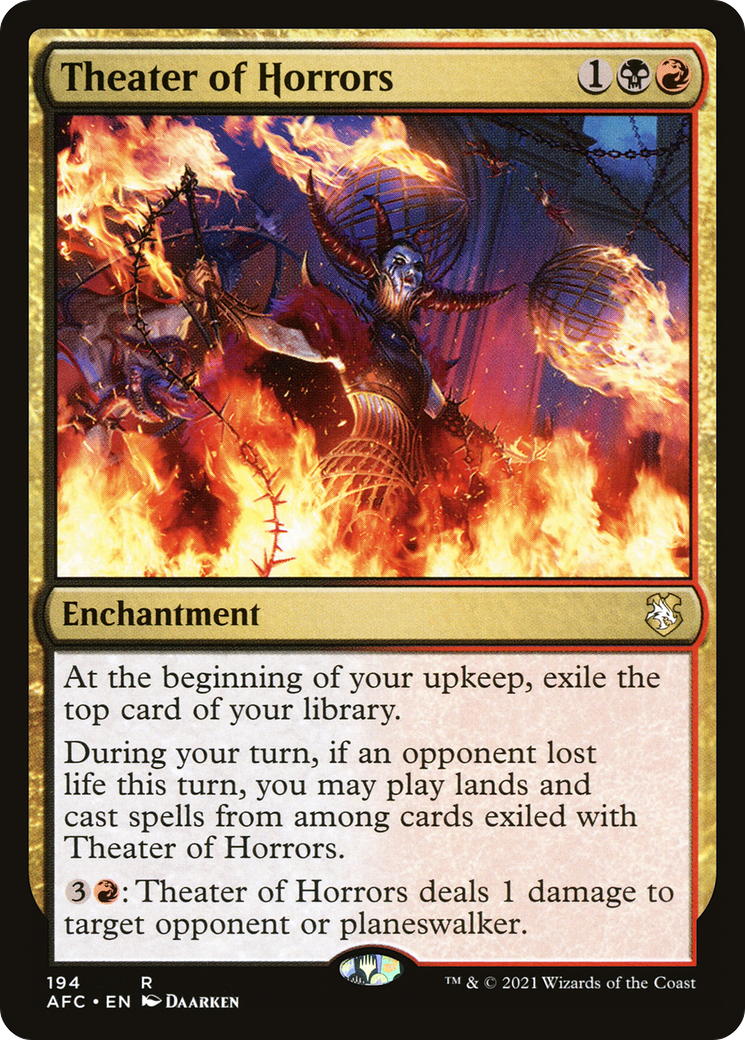
Theater of Horrors
Theater of Horrors
Enchantment
At the beginning of your upkeep, exile the top card of your library.
During your turn, if an opponent lost life this turn, you may play lands and cast spells from among cards exiled with this enchantment.
: This enchantment deals 1 damage to target opponent or planeswalker.
- Damage dealt to a player causes that player to lose that much life.
- Theater of Horrors doesn't change when you can play the exiled cards during your turn. For example, if you exile a sorcery card, you can cast it only during your main phase when the stack is empty. If you exile a land card, you can play it only during your main phase and only if you have an available land play remaining.
- Casting an exiled card causes it to leave exile. You can't cast it multiple times.
- In a multiplayer game, if an opponent loses life during your turn and then leaves the game, you can play cards exiled with Theater of Horrors.
-
1
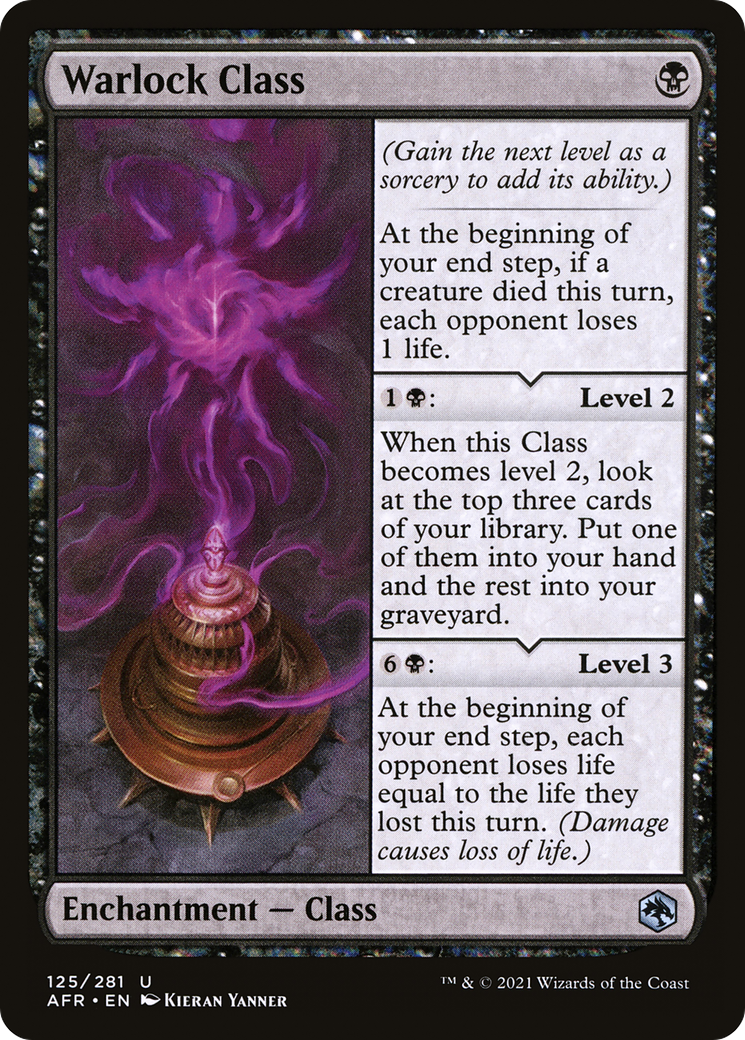
Warlock Class
Warlock Class
Enchantment — Class
(Gain the next level as a sorcery to add its ability.)
At the beginning of your end step, if a creature died this turn, each opponent loses 1 life.
: Level 2
When this Class becomes level 2, look at the top three cards of your library. Put one of them into your hand and the rest into your graveyard.
: Level 3
At the beginning of your end step, each opponent loses life equal to the life they lost this turn. (Damage causes loss of life.)
Lands 39
-
1
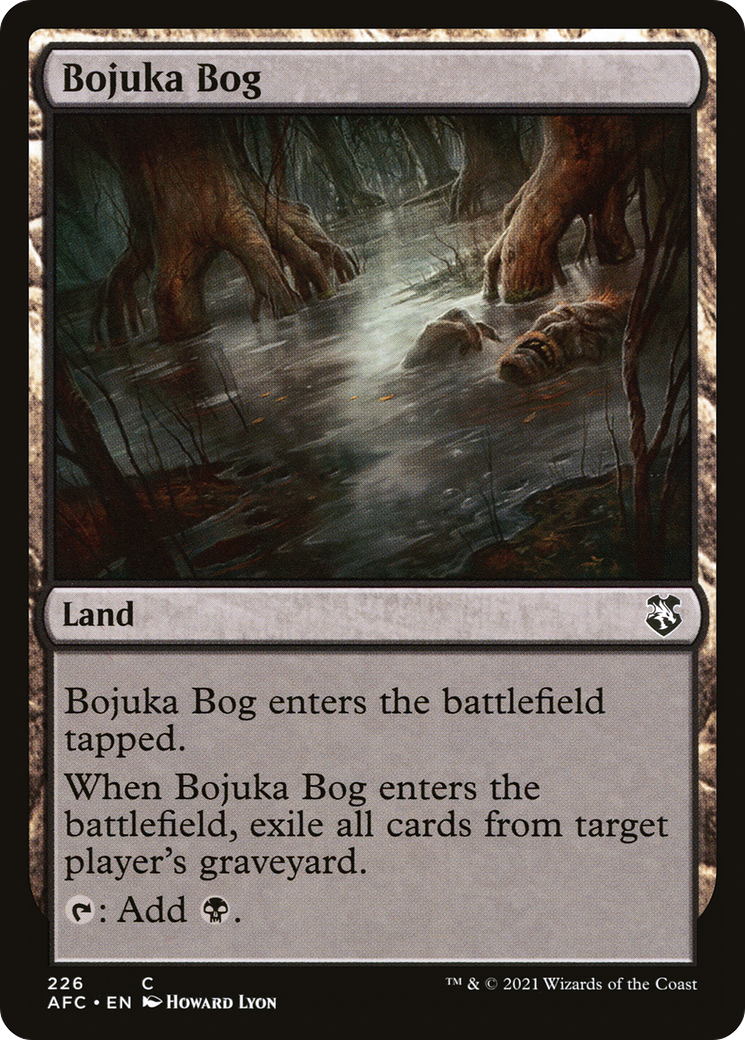
Bojuka Bog
Bojuka Bog
Land
This land enters tapped.
When this land enters, exile target player's graveyard.
: Add .
-
1
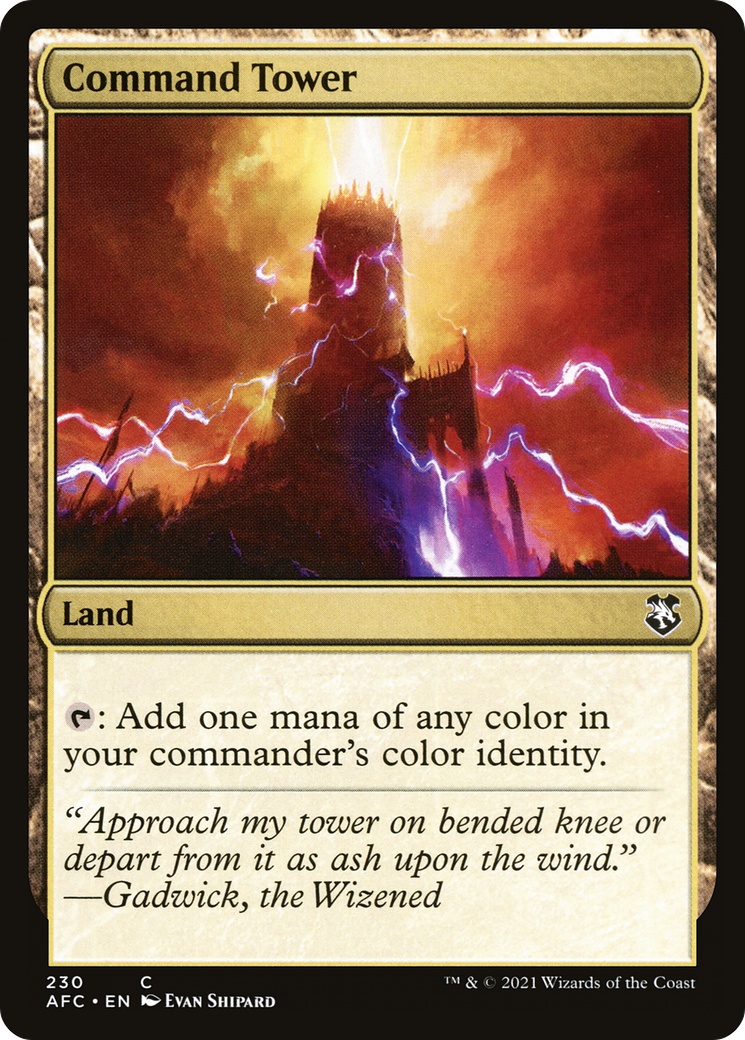
Command Tower
Command Tower
Land
: Add one mana of any color in your commander's color identity.
- If you don't have a commander, Command Tower's ability produces no mana.
- If your commander is a card that has no colors in its color identity, Command Tower's ability produces no mana. It doesn't produce .
- If you have two commanders, the ability adds one mana of any color in their combined color identities.
-
1
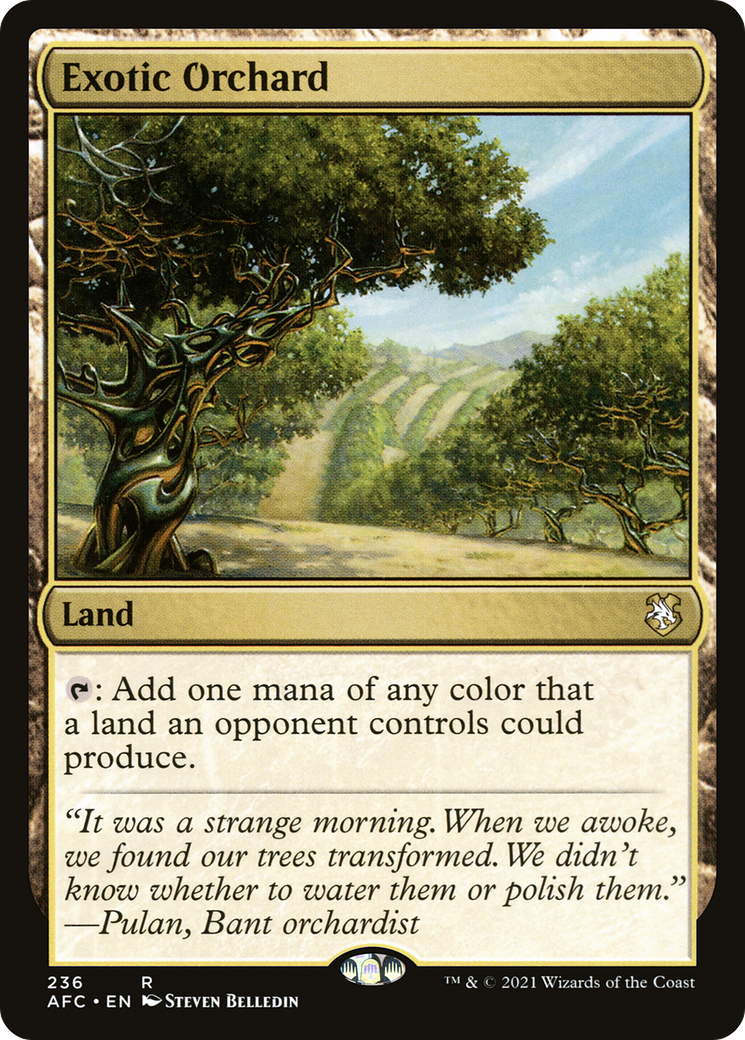
Exotic Orchard
Exotic Orchard
Land
: Add one mana of any color that a land an opponent controls could produce.
- Lands that produce mana based only on what other lands "could produce" won't help each other unless some other land allows one of them to actually produce some type of mana. For example, if you control an Exotic Orchard and your opponent controls an Exotic Orchard and a Reflecting Pool, none of those lands would produce mana if their mana abilities were activated. On the other hand, if you control a Forest and an Exotic Orchard, and your opponent controls an Exotic Orchard and a Reflecting Pool, then each of those lands can be tapped to produce . Your opponent's Exotic Orchard can produce because you control a Forest. Your Exotic Orchard and your opponent's Reflecting Pool can each produce because your opponent's Exotic Orchard can produce .
- When determining what colors of mana your opponents' lands could produce, Exotic Orchard takes into account any applicable replacement effects that would apply to those lands' mana abilities (such as Contamination's effect, for example). If there are more than one, consider them in any possible order.
- The colors of mana are white, blue, black, red, and green. Exotic Orchard can't be tapped for colorless mana, even if a land an opponent controls could produce colorless mana.
- Exotic Orchard doesn't care about any restrictions or riders your opponents' lands (such as Ancient Ziggurat or Hall of the Bandit Lord) put on the mana they produce. It just cares about colors of mana.
- Exotic Orchard checks the effects of all mana-producing abilities of lands your opponents control, but it doesn't check their costs. For example, Vivid Crag has the ability " , Remove a charge counter from Vivid Crag: Add one mana of any color." If an opponent controls Vivid Crag and you control Exotic Orchard, you can tap Exotic Orchard for any color of mana. It doesn't matter whether Vivid Crag has a charge counter on it, and it doesn't matter whether it's untapped.
-
1
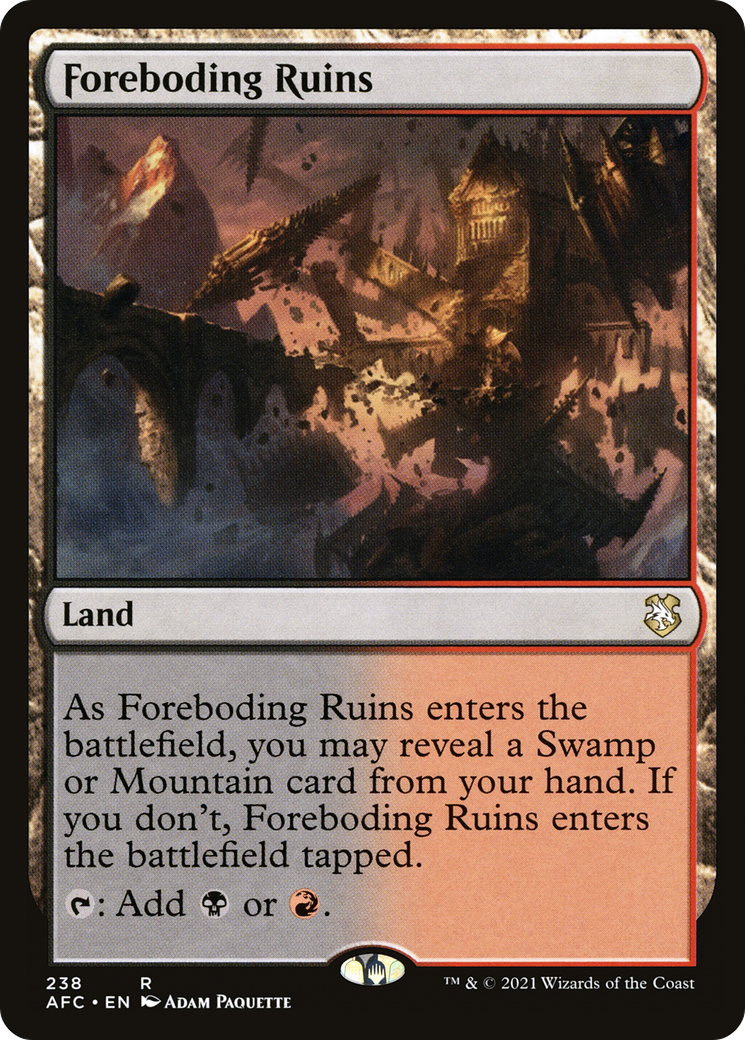
Foreboding Ruins
Foreboding Ruins
Land
As this land enters, you may reveal a Swamp or Mountain card from your hand. If you don't, this land enters tapped.
: Add or .
- You may reveal any land card with either or both of the appropriate subtypes. It doesn't have to be a basic land. For example, you could reveal Sunken Hollow from the Battle for Zendikar set to satisfy the ability of Foreboding Ruins.
- If a Swamp or Mountain is entering the battlefield from your hand at the same time as Foreboding Ruins, you may reveal the other land to have Foreboding Ruins enter untapped.
- Lands don't have a subtype just because they can produce mana of the corresponding color. Foreboding Ruins itself is neither a Swamp nor a Mountain, even though it produces black and red mana, so you can't reveal one to satisfy the ability of another.
- If an effect instructs you to put Foreboding Ruins onto the battlefield tapped, it will still enter the battlefield tapped even if you reveal a land card from your hand.
-
1
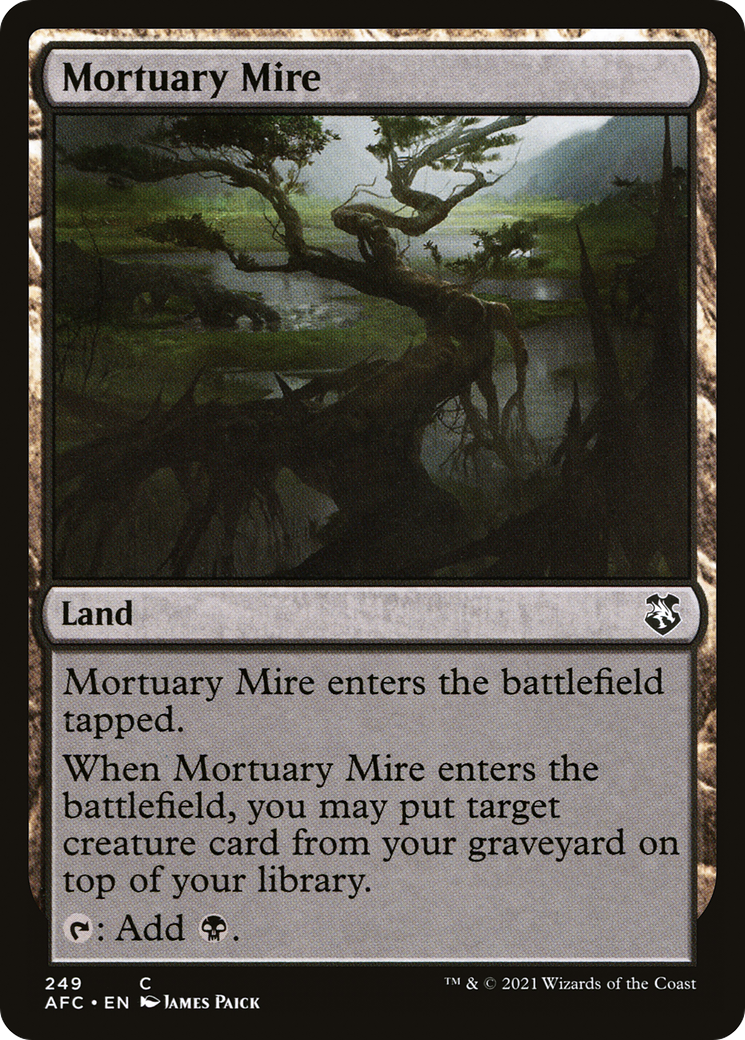
Mortuary Mire
Mortuary Mire
Land
This land enters tapped.
When this land enters, you may put target creature card from your graveyard on top of your library.
: Add .
-
13
Mountain
Mountain
Basic Land — Mountain
( : Add .)
-
1
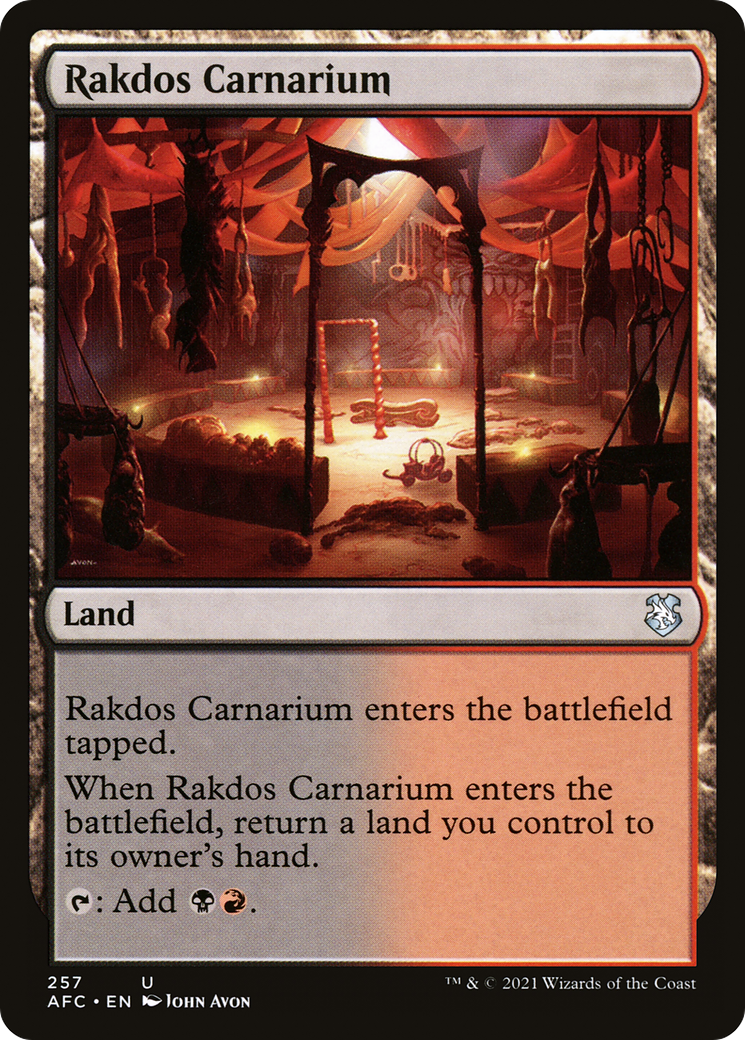
Rakdos Carnarium
Rakdos Carnarium
Land
This land enters tapped.
When this land enters, return a land you control to its owner's hand.
: Add .
- If this land enters the battlefield and you control no other lands, its ability will force you to return it to your hand.
-
1
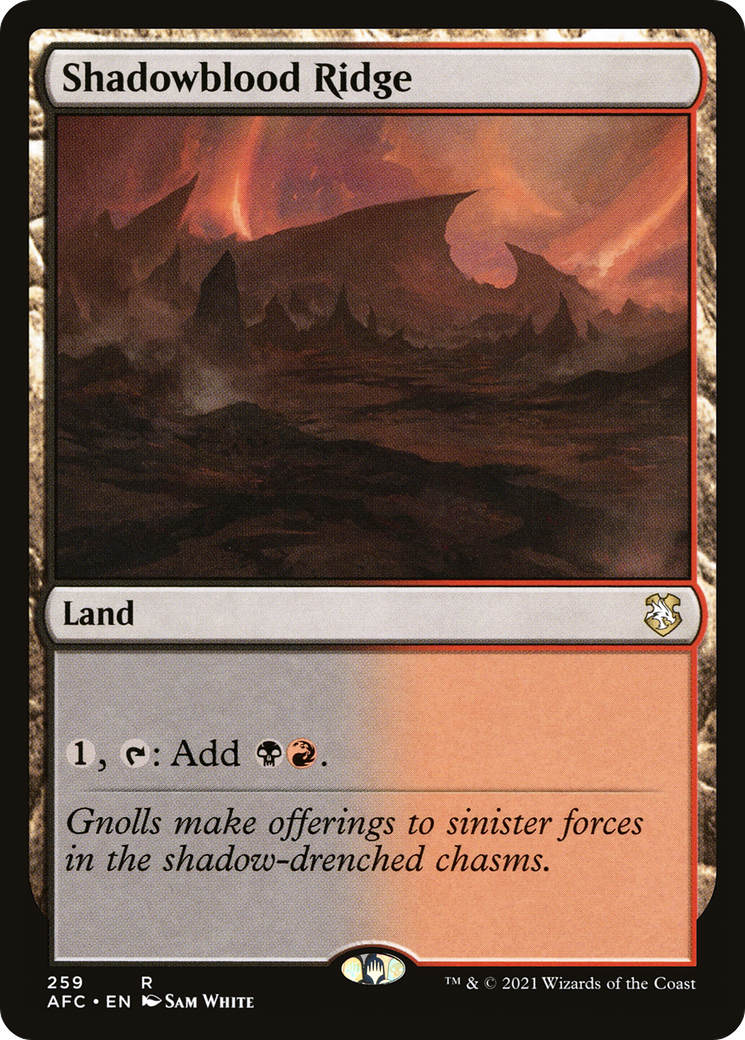
Shadowblood Ridge
Shadowblood Ridge
Land
, : Add .
-
1
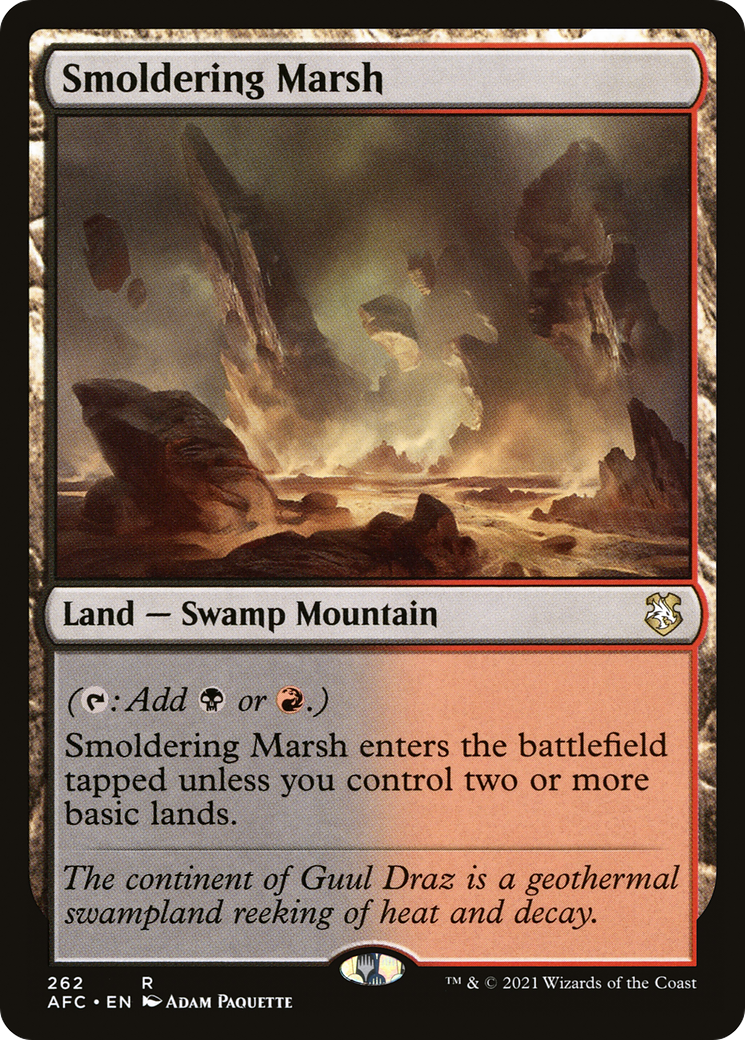
Smoldering Marsh
Smoldering Marsh
Land — Swamp Mountain
( : Add or .)
This land enters tapped unless you control two or more basic lands.
- However, because these cards have basic land types, effects that specify a basic land type without also specifying that the land be basic can affect them. For example, a spell or ability that reads "Destroy target Forest" can target Canopy Vista, while one that reads "Destroy target basic Forest" cannot.
- Even though these lands have basic land types, they are not basic lands because "basic" doesn't appear on their type line. Notably, controlling two or more of them won't allow others to enter the battlefield untapped.
- If one of these lands enters the battlefield at the same time as any number of basic lands, those other lands are not counted when determining if this land enters the battlefield tapped or untapped.
-
1
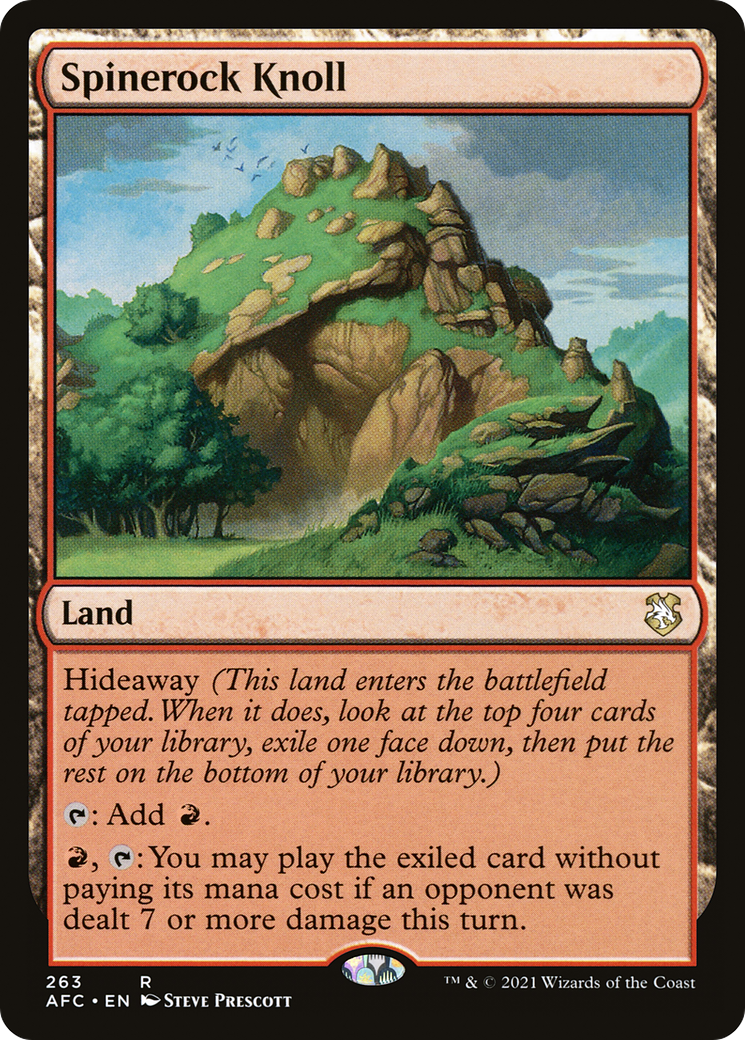
Spinerock Knoll
Spinerock Knoll
Land
Hideaway 4 (When this land enters, look at the top four cards of your library, exile one face down, then put the rest on the bottom in a random order.)
This land enters tapped.
: Add .
, : You may play the exiled card without paying its mana cost if an opponent was dealt 7 or more damage this turn.
- "Hideaway N" means "When this permanent enters the battlefield, look at the top N cards of your library. Exile one of them face down and put the rest on the bottom of your library in a random order. The exiled card gains 'The player who controls the permanent that exiled this card may look at this card in the exile zone.'"
- Any player who has controlled a permanent with a hideaway ability since a card was exiled with it may look at that card.
- Previously, permanents with hideaway entered the battlefield tapped. This ability has been removed from the definition of hideaway. Older cards have received errata to have an additional paragraph that reads "[This permanent] enters the battlefield tapped," and they now have hideaway 4.
- Hideaway now causes you to put the rest of the cards on the bottom of your library in a random order instead of any order.
- It doesn't matter how the opponent was dealt damage or by whom, as long as the total damage is 7 or more. You don't specify an opponent when you activate the ability.
- You'll get to play the card even if Spinerock Knoll wasn't on the battlefield at the time some or all of the 7 damage was dealt.
- At the time the last ability resolves, you'll get to play the card if a player who is currently your opponent, or a player who was your opponent at the time they left the game, has been dealt 7 damage over the course of the turn.
-
14
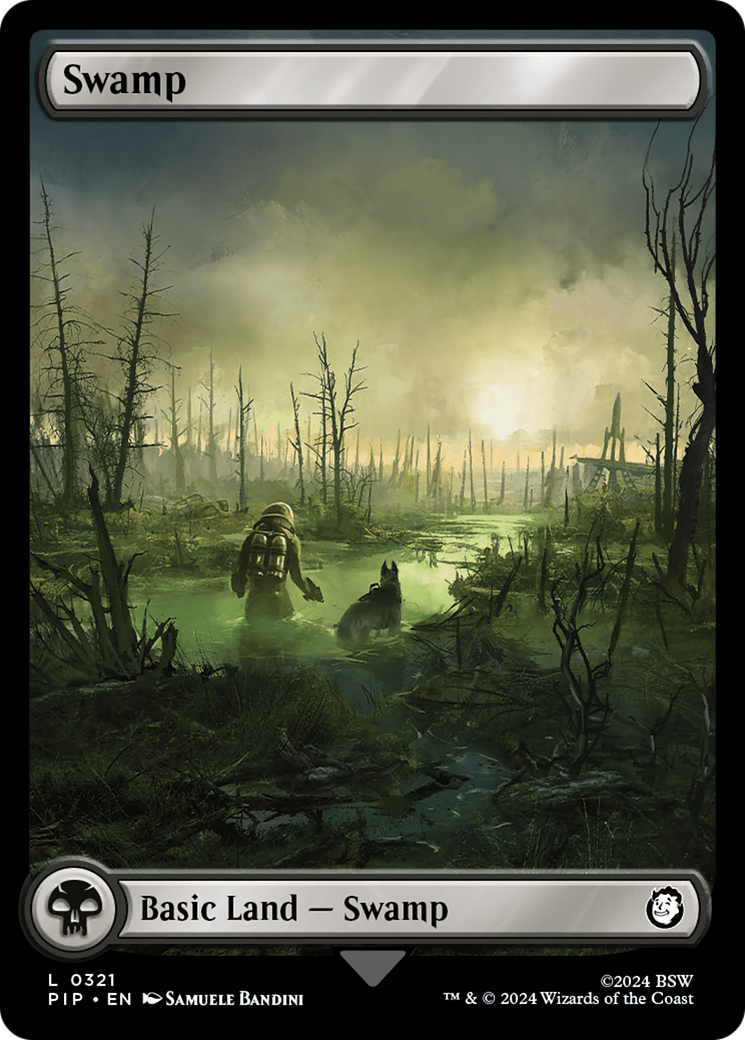
Swamp
Swamp
Basic Land — Swamp
( : Add .)
-
1
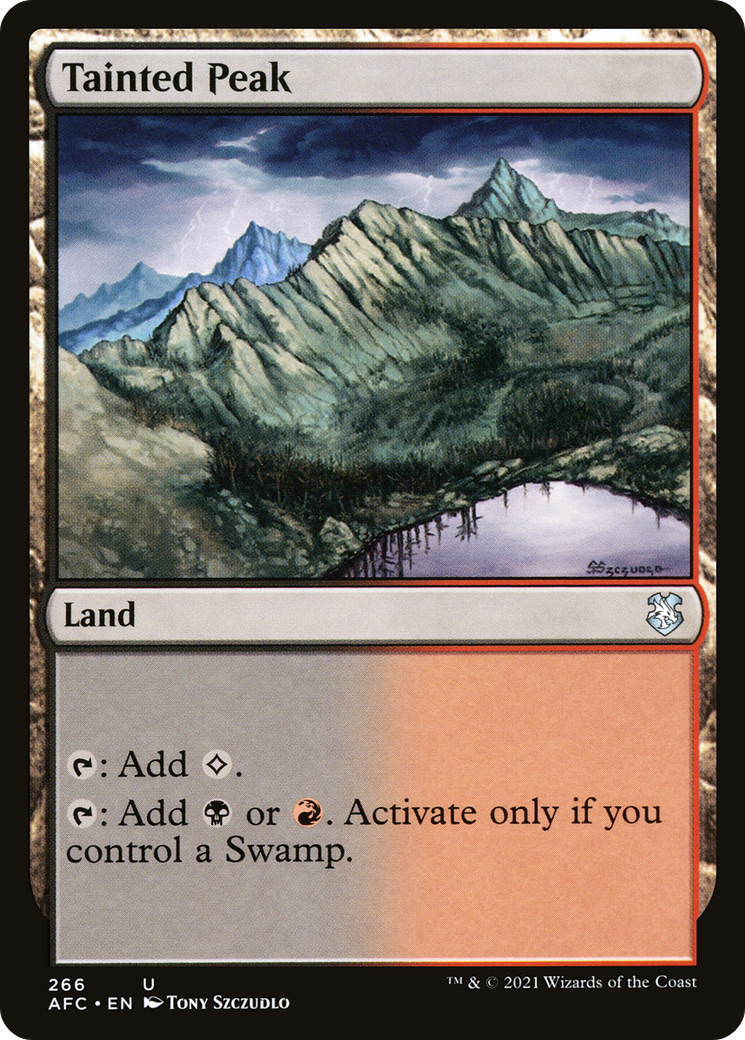
Tainted Peak
Tainted Peak
Land
: Add .
: Add or . Activate only if you control a Swamp.
-
1
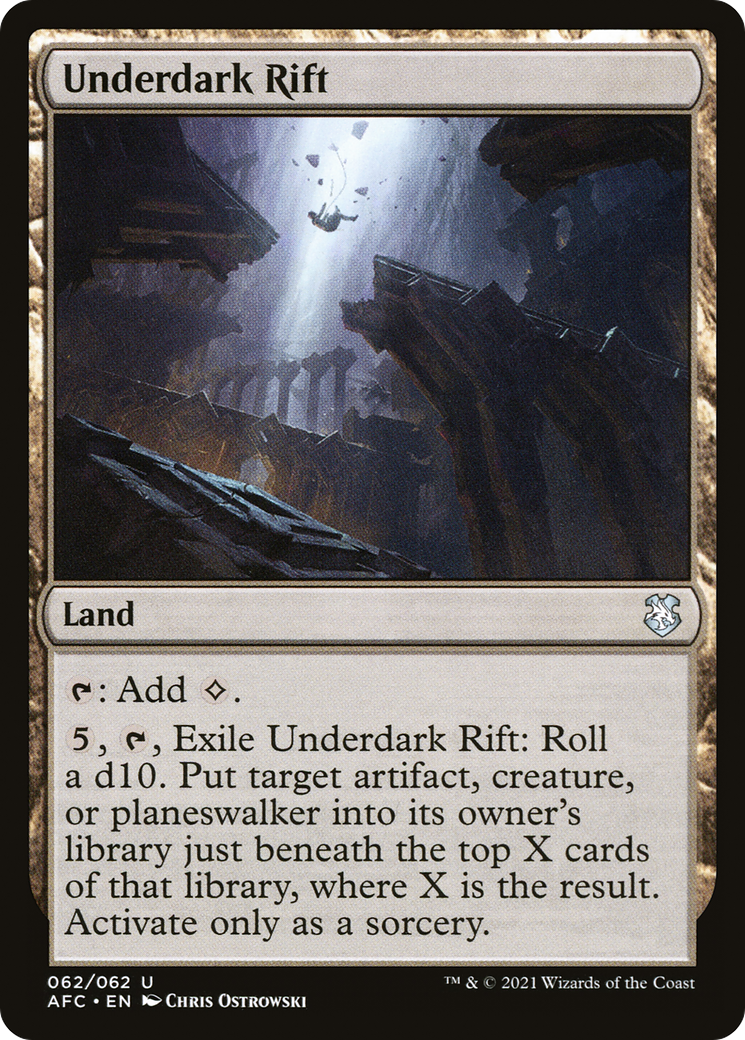
Underdark Rift
Underdark Rift
Land
: Add .
, , Exile this land: Roll a d10. Put target artifact, creature, or planeswalker into its owner's library just beneath the top X cards of that library, where X is the result. Activate only as a sorcery.
- If that permanent's owner has fewer than X cards in their library, put the permanent on the bottom of its owner's library.
- Dice are identified by the number of faces each one has. For example, a d20 is a twenty-sided die.
- Dice used must have equally likely outcomes and the roll must be fair. Although physical dice are recommended, digital substitutes are allowed, provided they have the same number of equally likely outcomes as specified in the original roll instruction.
- An ability that tells you to roll a die will also specify what to do with the result of that roll. Most often, this is in the form of a “results table” in the card text.
- The instruction to roll a die and the effect that occurs because of the result are all part of the same ability. Players do not get the chance to respond to the ability after knowing the result of the roll.
- An effect that says “choose a target, then roll a d20” or similar still uses the normal process of putting an ability on the stack and resolving it. Choosing targets is part of putting the ability on the stack and rolling the d20 happens later, as the ability resolves.
- Some effects may modify the result of a die roll. This may be part of the instruction to roll a die or it may come from other cards. Anything that references the “result” of a die roll is looking for the result after these modifications. Anything that is looking for the “natural result” is looking for the number shown on the face of the die before these modifications.
- Some abilities, like that of Pixie Guide and Barbarian Class, replace rolling a die with rolling extra dice and ignoring the lowest roll. The ignored rolls are not considered for the effect that instructed you to roll a die, and do not cause abilities to trigger. For all intents and purposes, once you determine which dice count, any extra dice were never rolled.
- Some effects instruct you to roll again. This uses the same number and type of dice as the original roll, and that roll will use the same set of possible outcomes.
- While playing Planechase, rolling the planar die will cause any ability that triggers whenever a player rolls one or more dice to trigger. However, any effect that refers to a numerical result will ignore the rolling of the planar die.
- Tournament events have more specific rules regarding dice and die-rolling. For more information, please see the most recent version of the Magic Tournament Rules at https://wpn.wizards.com/en/document/magic-gathering-tournament-rules.
-
1
Zhalfirin Void
Zhalfirin Void
Land
When this land enters, scry 1. (Look at the top card of your library. You may put that card on the bottom.)
: Add .
Black 18
-
1
Bag of Devouring
Bag of Devouring
Artifact
Whenever you sacrifice another nontoken artifact or creature, exile it.
, , Sacrifice another artifact or creature: Draw a card.
, , Sacrifice this artifact: Roll a d10. Return up to X cards from among cards exiled with this artifact to their owners' hands, where X is the result.
- Bag of Devouring's first ability is a triggered ability that happens when you sacrifice permanents, but you can't just sacrifice permanents whenever you want. You need to have some other means to do so, such as activating Bag of Devouring's second ability.
- If the card you sacrifice isn't still in the graveyard as the first ability resolves, it won't be exiled. It won't be a card exiled with Bag of Devouring for the third ability.
-
1
Chittering Witch
Chittering Witch
Creature — Human Warlock
2/2
When this creature enters, create a number of 1/1 black Rat creature tokens equal to the number of opponents you have.
, Sacrifice a creature: Target creature gets -2/-2 until end of turn.
- You can sacrifice Chittering Witch to pay the cost of its last ability.
- In a multiplayer game, opponents who have left the game aren't counted by Chittering Witch's triggered ability.
-
1
Consuming Vapors
Consuming Vapors
Sorcery
Target player sacrifices a creature of their choice. You gain life equal to that creature's toughness.
Rebound (If you cast this spell from your hand, exile it as it resolves. At the beginning of your next upkeep, you may cast this card from exile without paying its mana cost.)
- If a spell with rebound that you cast from your hand doesn't resolve for any reason (due being countered by a spell like Cancel, or because all of its targets are illegal), rebound has no effect. The spell is simply put into your graveyard. You won't get to cast it again next turn.
- If you cast a spell with rebound from anywhere other than your hand (such as from your graveyard due to Sins of the Past, from your library due to cascade, or from your opponent's hand due to Sen Triplets), rebound won't have any effect. If you do cast it from your hand, rebound will work regardless of whether you paid its mana cost (for example, if you cast it from your hand due to Maelstrom Archangel).
- If a replacement effect would cause a spell with rebound that you cast from your hand to be put somewhere else instead of your graveyard (such as Leyline of the Void might), you choose whether to apply the rebound effect or the other effect as the spell resolves.
- Rebound will have no effect on copies of spells because you don't cast them from your hand.
- If you cast a spell with rebound from your hand and it resolves, it isn't put into your graveyard. Rather, it's exiled directly from the stack. Effects that care about cards being put into your graveyard won't do anything.
- At the beginning of your upkeep, all delayed triggered abilities created by rebound effects trigger. You may handle them in any order. If you want to cast a card this way, you do so as part of the resolution of its delayed triggered ability. Timing restrictions based on the card's type (if it's a sorcery) are ignored. Other restrictions are not (such as the one from Rule of Law).
- If you are unable to cast a card from exile this way, or you choose not to, nothing happens when the delayed triggered ability resolves. The card remains exiled for the rest of the game, and you won't get another chance to cast the card. The same is true if the ability is countered (due to Stifle, perhaps).
- If you cast a card from exile this way, it will go to your graveyard when it resolves, fails to resolve, or is countered. It won't go back to exile.
- The sacrificed creature's last known existence on the battlefield is checked to determine its toughness.
- If the targeted player doesn't sacrifice a creature (because the player didn't control any creatures or due to Tajuru Preserver, perhaps), you gain no life.
-
1
Danse Macabre
Danse Macabre
Sorcery
Each player sacrifices a nontoken creature of their choice. Roll a d20 and add the toughness of the creature you sacrificed this way.
1—14 | Return a creature card put into a graveyard this way to the battlefield under your control.
15+ | Return up to two creature cards put into graveyards this way to the battlefield under your control.
- Starting with you and continuing in turn order, each player will choose which creature they will sacrifice. They will know the choices made by players before them in this order when they make that choice. The creatures are all sacrificed at the same time.
- All creatures are chosen and sacrificed before the die is rolled. You don't get to see what the result of the die roll is before choosing which creature to sacrifice.
- You add only the toughness of the creature you sacrificed this way, not the toughness of any creatures your opponent sacrificed. If you didn't sacrifice a creature this way, you will still roll a d20, but you will not add anything to the roll.
- If a player sacrifices their commander this way, they won't be able to choose whether to put it into the command zone until after Danse Macabre has finished resolving. Notably, this means that the sacrificed commander is a legal choice for the spell's controller to return to the battlefield. If they choose it this way, it will stay on the battlefield under their control.
-
1
Dead Man's Chest
Dead Man's Chest
Enchantment — Aura
Enchant creature an opponent controls
When enchanted creature dies, exile cards equal to its power from the top of its owner's library. You may cast spells from among those cards for as long as they remain exiled, and mana of any type can be spent to cast them.
- If you gain control of the enchanted creature, Dead Man's Chest will be put into your graveyard.
- If Dead Man's Chest and the enchanted creature are both put into graveyards at the same time, the last ability of Dead Man's Chest still triggers.
- To determine how many cards to exile, use the enchanted creature's power as it last existed on the battlefield.
- You are a creature's owner if the card representing it began the game in your deck, or if it's a token that entered the battlefield under your control. If Dead Man's Chest enchants a creature that you own but an opponent controls, you'll exile cards from your library.
- The effect of Dead Man's Chest doesn't change when you can cast the exiled cards. For example, if you exile a creature card without flash, you can cast it only during your main phase when the stack is empty.
- Casting an exiled card causes it to leave exile. You can't cast it multiple times.
- In a multiplayer game, if a player leaves the game, all cards that player owns leave as well. If you leave the game, any spells or permanents you control from Dead Man's Chest's ability are exiled.
-
1
Death Tyrant
Death Tyrant
Creature — Beholder Skeleton
4/6
Menace
Negative Energy Cone — Whenever an attacking creature you control or a blocking creature an opponent controls dies, create a 2/2 black Zombie creature token.
: Return this card from your graveyard to the battlefield tapped.
-
1
Fiend of the Shadows
Fiend of the Shadows
Creature — Vampire Wizard
3/3
Flying
Whenever this creature deals combat damage to a player, that player exiles a card from their hand. You may play that card for as long as it remains exiled.
Sacrifice a Human: Regenerate this creature.
- Playing a card exiled with Fiend of the Shadows follows all the normal rules for playing that card. You must pay its costs, and you must follow all timing restrictions, for example.
- You may only play the card, meaning play it as a land or cast it as a spell. It's not in your hand. You can't discard it, activate its cycling abilities, and so on.
- As long as the card remains exiled, you may still play it, even if Fiend of the Shadows leaves the battlefield or changes controllers.
- If this creature deals combat damage to multiple players simultaneously, perhaps because some combat damage was redirected, its ability will trigger for each of those players.
-
1
Gonti, Lord of Luxury
Gonti, Lord of Luxury
Legendary Creature — Aetherborn Rogue
2/3
Deathtouch
When Gonti enters, look at the top four cards of target opponent's library, exile one of them face down, then put the rest on the bottom of that library in a random order. You may cast that card for as long as it remains exiled, and mana of any type can be spent to cast that spell.
- The six types of mana are white, blue, black, red, green, and colorless. Snow mana is not a type of mana. Gonti, Lord of Luxury won't let you pay a snow cost using mana produced by a nonsnow source.
- An effect that instructs you to "cast" a card doesn't allow you to play lands.
- You pay the costs for the exiled card if you cast it. You may pay alternative costs such as emerge rather than the card's mana cost.
- You may look at and cast that card (and spend mana as though it were mana of any type to do so) even if Gonti leaves the battlefield. If another player gains control of Gonti, that player can't look at or cast the card, and you still can.
- Casting the card causes it to leave exile. You can't cast it multiple times.
- If you leave the game, the card remains exiled face down indefinitely. No player may look at it.
- Gonti doesn't change when you can cast the exiled card. For example, if you exile a creature card without flash, you can cast it only during your main phase when the stack is empty.
-
1
Grim Hireling
Grim Hireling
Creature — Tiefling Rogue
3/2
Whenever one or more creatures you control deal combat damage to a player, create two Treasure tokens.
, Sacrifice X Treasures: Target creature gets -X/-X until end of turn. Activate only as a sorcery.
-
1
Hellish Rebuke
Hellish Rebuke
Instant
Until end of turn, permanents your opponents control gain "When this permanent deals damage to the player who cast Hellish Rebuke, sacrifice this permanent. You lose 2 life."
- When the triggered ability that Hellish Rebuke grants permanents resolves, if that permanent's controller can't sacrifice it, they will still lose 2 life. Similarly, if they can't lose life, they will still sacrifice the permanent.
- If a player casts more than one Hellish Rebuke in a turn, permanents will gain multiple instances of the triggered ability. Each will trigger and resolve separately. For instance, if you cast Hellish Rebuke twice, each permanent which damaged you will cause its controller to lose 4 life.
- If more than one player casts Hellish Rebuke in a turn, some permanents will gain multiple instances of the triggered ability that refer to different players. Each will trigger only for the player who cast the Hellish Rebuke that granted it the ability.
- Copies of Hellish Rebuke that weren't cast will give opponents permanents the ability, but that ability won't do anything because no player cast that copy of Hellish Rebuke.
- If a spell or ability causes another player to gain control of Hellish Rebuke while it is on the stack, permanents controlled by the opponents of that player will gain the ability (probably including permanents you control). However, you're still the player that cast Hellish Rebuke, so the ability will trigger whenever one of those permanents deals damage to you, not the player who controlled Hellish Rebuke as it resolved.
-
1
Hex
Hex
Sorcery
Destroy six target creatures.
- You must target six different creatures. If you can't, you can't cast Hex. If some of the creatures become illegal targets before the spell resolves, Hex will still destroy the rest of them.
-
1
Lorcan, Warlock Collector
Lorcan, Warlock Collector
Legendary Creature — Devil
6/6
Flying
Whenever a creature card is put into an opponent's graveyard from anywhere, you may pay life equal to its mana value. If you do, put it onto the battlefield under your control. It's a Warlock in addition to its other types.
If a Warlock you control would die, exile it instead.
- Lorcan, Warlock Collector's second ability looks only at the type the card has in the graveyard, not the type it had in any other zone. For example, animated lands dying won't cause the ability to trigger. The opposite is also true. For example, if a creature that was cast as an Adventure is countered, it's a creature card in the graveyard and the triggered ability will trigger.
- Lorcan's last ability affects all Warlocks you control, not only ones he collected from an opponent's graveyard.
-
1
Marionette Master
Marionette Master
Creature — Human Artificer
1/3
Fabricate 3 (When this creature enters, put three +1/+1 counters on it or create three 1/1 colorless Servo artifact creature tokens.)
Whenever an artifact you control is put into a graveyard from the battlefield, target opponent loses life equal to this creature's power.
- The amount of life lost is determined as Marionette Master's last ability resolves. If Marionette Master is no longer on the battlefield, use its power as it last existed on the battlefield to determine how much life is lost.
- If Marionette Master's power is negative, the target opponent doesn't lose (or gain) life.
- If Marionette Master and an artifact you control are put into a graveyard at the same time, Marionette Master's ability triggers.
- Artifact tokens that are sacrificed or destroyed are put into their owner's graveyard before ceasing to exist. If you controlled the token, Marionette Master's last ability will trigger.
- You choose whether to put +1/+1 counters on the creature or create Servo tokens as the fabricate ability is resolving. No player may take actions between the time you choose and the time that counters are added or tokens are created.
- Fabricate doesn't cause the creature with the ability to enter the battlefield with +1/+1 counters already on it. For example, Weaponcraft Enthusiast will enter the battlefield as a 0/1 creature, then its fabricate ability goes on the stack. Players may take actions (such as casting instants) while the ability is waiting to resolve.
- If you can't put +1/+1 counters on the creature for any reason as fabricate resolves (for instance, if it's no longer on the battlefield), you just create Servo tokens.
-
1
Ogre Slumlord
Ogre Slumlord
Creature — Ogre Rogue
3/3
Whenever another nontoken creature dies, you may create a 1/1 black Rat creature token.
Rats you control have deathtouch.
- All Rats you control have deathtouch while Ogre Slumlord is on the battlefield, not just the ones created by Ogre Slumlord.
-
1
Phthisis
Phthisis
Sorcery
Destroy target creature. Its controller loses life equal to its power plus its toughness.
Suspend 5— (Rather than cast this card from your hand, you may pay and exile it with five time counters on it. At the beginning of your upkeep, remove a time counter. When the last is removed, you may cast it without paying its mana cost.)
- The mana value of a spell cast without paying its mana cost is determined by its mana cost, even though that cost wasn't paid.
- If you cast a card "without paying its mana cost," such as with suspend, you can't choose to cast it for any alternative costs. You can, however, pay additional costs. If the card has any mandatory additional costs, you must pay those if you want to cast the card.
- If the card has in its mana cost, you must choose 0 as the value of X when casting it without paying its mana cost.
- Suspend is a keyword that represents three abilities. The first is a static ability that allows you to exile the card from your hand with the specified number of time counters (the number before the dash) on it by paying its suspend cost (listed after the dash). The second is a triggered ability that removes a time counter from the suspended card at the beginning of each of your upkeeps. The third is a triggered ability that gives you the option to cast the card when the last time counter is removed.
- You can exile a card in your hand using suspend any time you could cast that card. Consider its card type, any effects that modify when you could cast it (such as flash) and any other effects that stop you from casting it (such as from Meddling Mage's ability) to determine if and when you can do this. Whether you could actually complete all steps in casting the card is irrelevant. For example, you can exile a card with suspend that has no mana cost or that requires a target even if no legal targets are available at that time.
- Cards exiled with suspend are exiled face up.
- Exiling a card with suspend isn't casting that card. This action doesn't use the stack and can't be responded to.
- If the spell requires any targets, those targets are chosen when the spell is finally cast, not when it's exiled.
- If an effect refers to a "suspended card," that means a card that (1) has suspend, (2) is in exile, and (3) has one or more time counters on it.
- If the first triggered ability of suspend (the one that removes time counters) is countered, no time counter is removed. The ability will trigger again at the beginning of the card's owner's next upkeep.
- When the last time counter is removed, the second triggered ability of suspend (the one that lets you cast the card) triggers. It doesn't matter why the last time counter was removed or what effect removed it.
- If the second triggered ability is countered, the card can't be cast. It remains exiled with no time counters on it, and it's no longer suspended.
- Due to a recent rules change to suspend, you are no longer required to cast the suspended card as the second triggered ability of suspend resolves. Instead, as the second triggered ability resolves, you may cast the card. Timing permissions based on the card's type are ignored. If you don't cast the card, it remains exiled with no time counters on it, and it's no longer suspended.
- If the creature's power is negative, you still add its power and toughness to determine how much life is lost. If that total is negative, its controller doesn't gain or lose any life. For example, Phthisis destroying a -1/3 creature would cause a loss of 2 life. Pthisis destroying a -4/3 creature would cause no loss of life.
- If the target creature is an illegal target by the time Phthisis tries to resolve, the spell doesn't resolve. No player loses life. If the target is legal but not destroyed (most likely because it has indestructible), its controller does lose life.
-
1
Piper of the Swarm
Piper of the Swarm
Creature — Human Warlock
1/3
Rats you control have menace.
, : Create a 1/1 black Rat creature token.
, , Sacrifice three Rats: Gain control of target creature.
- The control-change effect of Piper of the Swarm's last ability lasts indefinitely. It doesn't wear off during the cleanup step, and it doesn't expire if Piper of the Swarm leaves the battlefield. In a multiplayer game, it does expire if you leave the game.
-
1
Pontiff of Blight
Pontiff of Blight
Creature — Zombie Cleric
2/7
Extort (Whenever you cast a spell, you may pay . If you do, each opponent loses 1 life and you gain that much life.)
Other creatures you control have extort. (If a creature has multiple instances of extort, each triggers separately.)
- You may pay a maximum of one time for each extort triggered ability. You decide whether to pay when the ability resolves.
- The amount of life you gain from extort is based on the total amount of life lost, not necessarily the number of opponents you have. For example, if your opponent's life total can't change (perhaps because that player controls Platinum Emperion), you won't gain any life.
- The extort ability doesn't target any player.
- The extort ability resolves before the spell that caused it to trigger. The ability resolves even if that spell is countered.
-
1
Warlock Class
Warlock Class
Enchantment — Class
(Gain the next level as a sorcery to add its ability.)
At the beginning of your end step, if a creature died this turn, each opponent loses 1 life.
: Level 2
When this Class becomes level 2, look at the top three cards of your library. Put one of them into your hand and the rest into your graveyard.
: Level 3
At the beginning of your end step, each opponent loses life equal to the life they lost this turn. (Damage causes loss of life.)
Red 22
-
1
Apex of Power
Apex of Power
Sorcery
Exile the top seven cards of your library. Until end of turn, you may cast spells from among them.
If this spell was cast from your hand, add ten mana of any one color.
- Apex of Power doesn't change when you can cast the exiled cards. For example, if you exile a sorcery card, you can cast it only during your main phase when the stack is empty.
- Casting an exiled card causes it to leave exile. You can't cast it multiple times.
- Any cards not cast, including land cards, remain in exile.
- If an effect copies Apex of Power, the copy wasn't cast at all, so you won't add ten mana.
-
1
Chaos Channeler
Chaos Channeler
Creature — Human Shaman
4/3
Wild Magic Surge — Whenever this creature attacks, roll a d20.
1—9 | Exile the top card of your library. You may play it this turn.
10—19 | Exile the top two cards of your library. You may play them this turn.
20 | Exile the top three cards of your library. You may play them this turn.
-
1
Chaos Warp
Chaos Warp
Instant
The owner of target permanent shuffles it into their library, then reveals the top card of their library. If it's a permanent card, they put it onto the battlefield.
- A permanent card is a card with one or more of the following card types: artifact, creature, enchantment, land, or planeswalker.
- The owner of a token is the player under whose control the token was put onto the battlefield. If a token is shuffled into a player's library this way, that player shuffles before revealing the top card of that library.
- If the revealed card is not a permanent card, it remains on top of that library.
- If the permanent is an illegal target by the time Chaos Warp tries to resolve, it won't resolve and none of its effects will occur. No library will be shuffled and no card will be revealed.
- If the revealed card is a permanent card but can't enter (perhaps because it's an Aura with nothing to enchant), it remains on top of that library.
-
1
Commune with Lava
Commune with Lava
Instant
Exile the top X cards of your library. Until the end of your next turn, you may play those cards.
- The cards are exiled face up.
- Playing a card this way follows the normal rules for playing the card. You must pay its costs, and you must follow all applicable timing rules. For example, if one of the cards is a creature card, you can cast that card only during your main phase while the stack is empty.
- Under normal circumstances, you can play a land card exiled with Commune with Lava only if you haven't played a land yet that turn.
- Any cards you don't play will remain exiled.
-
1
Dark-Dweller Oracle
Dark-Dweller Oracle
Creature — Goblin Shaman
2/2
, Sacrifice a creature: Exile the top card of your library. You may play that card this turn. (You still pay its costs. You can play a land this way only if you have an available land play remaining.)
- Dark-Dweller Oracle doesn't change when you can cast the exiled card. For example, if you exile a sorcery card, you can cast it only during your main phase when the stack is empty. If you exile a land card, you can play it only during your main phase and only if you have an available land play remaining.
- Casting an exiled card causes it to leave exile. You can't cast it multiple times.
- If you don't cast the exiled card, it remains in exile.
- You can sacrifice Dark-Dweller Oracle to pay the cost for its own ability.
-
1
Dire Fleet Daredevil
Dire Fleet Daredevil
Creature — Human Pirate
2/1
First strike
When this creature enters, exile target instant or sorcery card from an opponent's graveyard. You may cast it this turn, and mana of any type can be spent to cast that spell. If that spell would be put into a graveyard, exile it instead.
- Casting an exiled card causes it to leave exile. You can't cast it multiple times.
- The effect of Dire Fleet Daredevil doesn't change when you can cast the exiled card. For example, if you exile a sorcery card, you can cast it only during your main phase when the stack is empty.
-
1
Disrupt Decorum
Disrupt Decorum
Sorcery
Goad all creatures you don't control. (Until your next turn, those creatures attack each combat if able and attack a player other than you if able.)
- If, during a player's declare attackers step, a creature that player controls that's been goaded is tapped, is affected by a spell or ability that says it can't attack, or hasn't been under that player's control continuously since the turn began (and doesn't have haste), then it doesn't attack. If there's a cost associated with having a creature attack a player, its controller isn't forced to pay that cost, so it doesn't have to attack that player.
- If the creature doesn't meet any of the above exceptions and can attack, it must attack a player other than the controller of the spell or ability that goaded it if able. If the creature can't attack any of those players but could otherwise attack, it must attack a planeswalker an opponent controls, a battle an opponent controls, or a player who goaded it.
- Being goaded isn't an ability the creature has. Once it's been goaded, it must attack as detailed above even if it loses all abilities.
- Attacking with a goaded creature doesn't cause it to stop being goaded. If there is an additional combat phase that turn, or if another player gains control of it before it stops being goaded, it must attack again if able.
- If a creature you control has been goaded by multiple opponents, it must attack one of your opponents that hasn't goaded it, as that fulfills the maximum number of goad requirements. If a creature you control has been goaded by each of your opponents, the creature must attack an opponent (rather than a planeswalker or battle), but you choose which opponent it attacks.
- Creatures that enter the battlefield after Disrupt Decorum resolves won't be goaded.
-
1
Dream Pillager
Dream Pillager
Creature — Dragon
4/4
Flying
Whenever this creature deals combat damage to a player, exile that many cards from the top of your library. Until end of turn, you may cast spells from among those exiled cards.
- Casting a card this way follows the normal rules for casting the card. You must pay its costs, and you must follow all applicable timing rules. For example, if one of the cards is a creature card, you can cast that card only during your main phase while the stack is empty.
- The cards are exiled face up.
- If you cast an instant or sorcery card this way, it will go to your graveyard after it resolves, fails to resolve, or is countered. It won't return to exile.
- Any cards you don't cast will remain exiled.
- Exiling all the cards from your library this way won't cause you to lose the game. You'll lose only if you attempt to draw a card from an empty library.
-
1
Etali, Primal Storm
Etali, Primal Storm
Legendary Creature — Elder Dinosaur
6/6
Whenever Etali attacks, exile the top card of each player's library, then you may cast any number of spells from among those cards without paying their mana costs.
- If an exiled card has in its mana cost, you must choose 0 as the value of X when casting it without paying its mana cost.
- If you cast any of the exiled cards, you do so as part of the resolution of the triggered ability. You can't wait to cast them later in the turn. Timing permissions based on a card's type are ignored, and the spells resolve before blockers are declared.
- If you cast a card "without paying its mana cost," you can't pay any alternative costs. You can, however, pay additional costs. If the card has any mandatory additional costs, those must be paid to cast the card.
- If you cast more than one of the exiled cards, you choose the order in which to cast them. A spell you cast this way can be the target of a later spell you cast this way. However, permanent spells cast this way won't resolve until you're done casting spells, so the permanents they become can't be the target of spells cast this way. For example, if you exile Twincast and Lightning Strike, you can cast Lightning Strike and then cast Twincast targeting it; but if you exile a creature card and an Aura card, you can't cast that Aura targeting that creature.
- Any cards not cast, including land cards, remain in exile. They can't be cast on later turns, even if Etali attacks again.
- Because all attacking creatures are chosen at once, a creature cast this way can't attack during the same combat as Etali, even if it has haste.
- In a multiplayer game, if a player leaves the game, all cards that player owns leave as well. If you leave the game, any spells or permanents you control from Etali's ability are exiled.
-
1
Fiendlash
Fiendlash
Artifact — Equipment
Equipped creature gets +2/+0 and has reach.
Whenever equipped creature is dealt damage, it deals damage equal to its power to target player or planeswalker.
Equip
- Use the equipped creature's power as the triggered ability resolves to determine how much damage is dealt. If the equipped creature is no longer on the battlefield at that time, use its power as it last existed on the battlefield.
- If the equipped creature isn't on the battlefield as the triggered ability resolves but it had lifelink when it left the battlefield, you will gain life.
-
1
Ignite the Future
Ignite the Future
Sorcery
Exile the top three cards of your library. Until the end of your next turn, you may play those cards. If this spell was cast from a graveyard, you may play cards this way without paying their mana costs.
Flashback (You may cast this card from your graveyard for its flashback cost. Then exile it.)
- If a card with flashback is put into your graveyard during your turn, you can cast it if it's legal to do so before any other player can take any actions.
- “Flashback [cost]” means “You may cast this card from your graveyard by paying [cost] rather than paying its mana cost” and “If the flashback cost was paid, exile this card instead of putting it anywhere else any time it would leave the stack.”
- You must still follow any timing restrictions and permissions, including those based on the card's type. For instance, you can cast a sorcery using flashback only when you could normally cast a sorcery.
- To determine the total cost of a spell, start with the mana cost or alternative cost (such as a flashback cost) you're paying, add any cost increases, then apply any cost reductions. The mana value of the spell is determined only by its mana cost, no matter what the total cost to cast the spell was.
- A spell cast using flashback will always be exiled afterward, whether it resolves, is countered, or leaves the stack in some other way.
- You can cast a spell using flashback even if it was somehow put into your graveyard without having been cast.
- Ignite the Future doesn't change when you can play the exiled cards. For example, if you exile a sorcery card, you can cast it only during your main phase when the stack is empty. If you exile a land card, you can play it only during your main phase and only if you have an available land play remaining.
- If you cast Ignite the Future from a zone other than a graveyard, you must pay the mana cost or an alternative cost for each spell cast this way. If you cast Ignite the Future from a graveyard, you may choose to cast each spell for its mana cost, an alternative cost, or without paying its mana cost.
- If a spell has in its mana cost, you must choose 0 as the value of X when casting it without paying its mana cost.
- If you cast a card “without paying its mana cost,” you can't choose to cast it for any alternative costs and not pay that cost. You can, however, pay additional costs. If the card has any mandatory additional costs, such as that of Momentous Fall, you must pay those to cast the card.
- If you don't play some or all of the exiled cards, those cards remain in exile.
-
1
Izzet Chemister
Izzet Chemister
Creature — Goblin Wizard
1/3
Haste
, : Exile target instant or sorcery card from your graveyard.
, , Sacrifice this creature: Cast any number of cards exiled with this creature without paying their mana costs.
- The last ability of Izzet Chemister only lets you cast cards exiled by that card. If Izzet Chemister leaves the battlefield before you activate that ability, the exiled cards are lost forever.
- If you cast a card "without paying its mana cost," you can't pay any alternative costs. You can, however, pay additional costs. If the card has any mandatory additional costs, such as that of Tormenting Voice, those must be paid to cast the card.
- If the card has in its mana cost, you must choose 0 as the value of X when casting it without paying its mana cost.
- You must cast any of the exiled cards you wish to cast while Izzet Chemister's last ability is resolving. You can't cast them later in the turn. A sorcery cast this way will be cast at a time you normally wouldn't be able to.
- You cast the exiled cards one at a time in any order. Later spells can target ones you cast earlier. None of the spells resolve until after you're done casting them all.
- Any of the cards you don't cast will remain exiled.
-
1
Light Up the Stage
Light Up the Stage
Sorcery
Spectacle (You may cast this spell for its spectacle cost rather than its mana cost if an opponent lost life this turn.)
Exile the top two cards of your library. Until the end of your next turn, you may play those cards.
- In a multiplayer game, if an opponent loses life and later that turn leaves the game, you can cast a spell for its spectacle cost. (If a player leaves the game during their turn, that turn continues without an active player.)
- Spectacle doesn't change when you can cast the spell. For example, you can't cast a sorcery with spectacle during an opponent's turn unless another effect allows you to do so, even if that player has lost life this turn.
- To determine the total cost of a spell, start with the mana cost or alternative cost you're paying (such as a spectacle cost), add any cost increases, then apply any cost reductions. The mana value of the spell remains unchanged, no matter what the total cost to cast it was.
- A card's spectacle cost is the same no matter how much life your opponents lost or how many opponents lost life.
- Damage dealt to a player causes that player to lose that much life.
- Spectacle cares only that an opponent lost life during the turn, not that the opponent's life total is currently lower than it was. For example, if an opponent loses 1 life and then gains 2 life in the same turn, you can cast a spell for its spectacle cost that turn.
- Casting an exiled card causes it to leave exile. You can't cast it multiple times.
- If you don't play a card exiled this way, it remains in exile.
- Light Up the Stage doesn't change when you can play the exiled cards. For example, if you exile a sorcery card, you can cast it only during your main phase when the stack is empty. If you exile a land card, you can play it only during your main phase and only if you have an available land play remaining.
-
1
Loyal Apprentice
Loyal Apprentice
Creature — Human Artificer
2/1
Haste
Lieutenant — At the beginning of combat on your turn, if you control your commander, create a 1/1 colorless Thopter artifact creature token with flying. That token gains haste until end of turn.
- If you don't control your commander as the lieutenant ability resolves, you won't get its effect.
- The lieutenant effect happens only once each combat, even if you somehow control multiple commanders (perhaps because you have two commanders with a partner ability from the Battlebond™ set).
- If you have multiple commanders, you need to control only one for the lieutenant effect to happen.
-
1
Reckless Endeavor
Reckless Endeavor
Sorcery
Roll two d12 and choose one result. Reckless Endeavor deals damage equal to that result to each creature. Then create a number of Treasure tokens equal to the other result.
- Dice are identified by the number of faces each one has. For example, a d20 is a twenty-sided die.
- Dice used must have equally likely outcomes and the roll must be fair. Although physical dice are recommended, digital substitutes are allowed, provided they have the same number of equally likely outcomes as specified in the original roll instruction.
- An ability that tells you to roll a die will also specify what to do with the result of that roll. Most often, this is in the form of a “results table” in the card text.
- The instruction to roll a die and the effect that occurs because of the result are all part of the same ability. Players do not get the chance to respond to the ability after knowing the result of the roll.
- An effect that says “choose a target, then roll a d20” or similar still uses the normal process of putting an ability on the stack and resolving it. Choosing targets is part of putting the ability on the stack and rolling the d20 happens later, as the ability resolves.
- Some effects may modify the result of a die roll. This may be part of the instruction to roll a die or it may come from other cards. Anything that references the “result” of a die roll is looking for the result after these modifications. Anything that is looking for the “natural result” is looking for the number shown on the face of the die before these modifications.
- Some abilities, like that of Pixie Guide and Barbarian Class, replace rolling a die with rolling extra dice and ignoring the lowest roll. The ignored rolls are not considered for the effect that instructed you to roll a die, and do not cause abilities to trigger. For all intents and purposes, once you determine which dice count, any extra dice were never rolled.
- Some effects instruct you to roll again. This uses the same number and type of dice as the original roll, and that roll will use the same set of possible outcomes.
- While playing Planechase, rolling the planar die will cause any ability that triggers whenever a player rolls one or more dice to trigger. However, any effect that refers to a numerical result will ignore the rolling of the planar die.
- Tournament events have more specific rules regarding dice and die-rolling. For more information, please see the most recent version of the Magic Tournament Rules at https://wpn.wizards.com/en/document/magic-gathering-tournament-rules.
-
1
Share the Spoils
Share the Spoils
Enchantment
When this enchantment enters and whenever an opponent loses the game, exile the top card of each player's library.
During each player's turn, that player may play a land or cast a spell from among cards exiled with this enchantment, and they may spend mana as though it were mana of any color to cast that spell. When they do, exile the top card of their library.
- Once a player plays a land or casts a spell from among the exiled cards, they can't play any more of those cards that turn. That is, it's one land or one spell, not one of each.
- Playing a card this way follows all the normal timing rules for that card. For example, if you play a land this way, you may do so only during your main phase while the stack is empty and only if you havem't yet played a land (unless another effect allows you to play additional lands).
- If you control an opponent's Share the Spoils and that player loses the game, Share the Spoils leaves the game with them and the first ability won't trigger.
- Once Share the Spoils leaves the battlefield, players may no longer play the exiled cards. If Share the Spoils is destroyed and somehow returns to the battlefield, it's a new object with no memory of the previously exiled cards.
-
1
Shiny Impetus
Shiny Impetus
Enchantment — Aura
Enchant creature
Enchanted creature gets +2/+2 and is goaded. (It attacks each combat if able and attacks a player other than you if able.)
Whenever enchanted creature attacks, you create a Treasure token. (It's an artifact with " , Sacrifice this token: Add one mana of any color.")
- If, during a player's declare attackers step, a creature that player controls that's been goaded is tapped, is affected by a spell or ability that says it can't attack, or hasn't been under that player's control continuously since the turn began (and doesn't have haste), then it doesn't attack. If there's a cost associated with having a creature attack a player, its controller isn't forced to pay that cost, so it doesn't have to attack that player.
- If the creature doesn't meet any of the above exceptions and can attack, it must attack a player other than the controller of the spell or ability that goaded it if able. If the creature can't attack any of those players but could otherwise attack, it must attack a planeswalker an opponent controls, a battle an opponent controls, or a player who goaded it.
- Being goaded isn't an ability the creature has. Once it's been goaded, it must attack as detailed above even if it loses all abilities.
- Attacking with a goaded creature doesn't cause it to stop being goaded. If there is an additional combat phase that turn, or if another player gains control of it before it stops being goaded, it must attack again if able.
- If a creature you control has been goaded by multiple opponents, it must attack one of your opponents that hasn't goaded it, as that fulfills the maximum number of goad requirements. If a creature you control has been goaded by each of your opponents, the creature must attack an opponent (rather than a planeswalker or battle), but you choose which opponent it attacks.
- Shiny Impetus causes you to create a Treasure token, not the attacking creature's controller.
-
1
Tectonic Giant
Tectonic Giant
Creature — Elemental Giant
3/4
Whenever this creature attacks or becomes the target of a spell an opponent controls, choose one —
- This creature deals 3 damage to each opponent.
- Exile the top two cards of your library. Choose one of them. Until the end of your next turn, you may play that card.
- An ability that triggers when a creature becomes the target of a spell resolves before the spell that caused it to trigger. It resolves even if that spell is countered.
- Players can cast spells and activate abilities after the triggered ability resolves but before the spell that caused it to trigger does.
- If a spell targets Tectonic Giant more than once, its ability triggers only once.
- You choose which of the exiled cards you'll be able to play while the ability is resolving. You can't wait to pick one later. The other card remains in exile.
- Tectonic Giant doesn't change when you can play the exiled card. For example, if you exile a sorcery card, you can cast it only during your main phase when the stack is empty. If you exile a land card, you can play it only during your main phase and only if you have an available land play remaining.
- Playing an exiled card causes it to leave exile. You can't play it multiple times.
- If you don't play the exiled card that you chose, it remains in exile with the card you didn't choose.
-
1
Throes of Chaos
Throes of Chaos
Sorcery
Cascade (When you cast this spell, exile cards from the top of your library until you exile a nonland card that costs less. You may cast it without paying its mana cost. Put the exiled cards on the bottom in a random order.)
Retrace (You may cast this card from your graveyard by discarding a land card in addition to paying its other costs.)
- A spell's mana value is determined only by its mana cost. Ignore any alternative costs, additional costs, cost increases, or cost reductions.
- If the card has in its mana cost, you must choose 0 as the value of X when casting it without paying its mana cost.
- You exile the cards face up. All players will be able to see them.
- If a spell with cascade is countered, the cascade ability will still resolve normally.
- The mana value of a split card is determined by the combined mana cost of its two halves. If cascade allows you to cast a split card, you may cast either half but not both halves.
- When the cascade ability resolves, you must exile cards. The only optional part of the ability is whether or not you cast the last card exiled.
- Due to a 2021 rules change to cascade, not only do you stop exiling cards if you exile a nonland card with lesser mana value than the spell with cascade, but the resulting spell you cast must also have lesser mana value. Previously, in cases where a card's mana value differed from the resulting spell, such as with some modal double-faced cards or cards with an Adventure, you could cast a spell with a higher mana value than the exiled card.
- If you cast a card "without paying its mana cost," you can't choose to cast it for any alternative costs. You can, however, pay additional costs. If the card has any mandatory additional costs, you must pay those to cast the card.
- Cascade triggers when you cast the spell, meaning that it resolves before that spell. If you end up casting the exiled card, it will go on the stack above the spell with cascade.
- When a spell you cast with retrace resolves or is countered, it's put back into your graveyard. You may use the retrace ability to cast it again.
- Throes of Chaos does nothing as it resolves. All of its chaos happens before it resolves.
-
1
Vandalblast
Vandalblast
Sorcery
Destroy target artifact you don't control.
Overload (You may cast this spell for its overload cost. If you do, change "target" in its text to "each.")
- If you don't pay the overload cost of a spell with overload, that spell will have a single target. If you pay the overload cost, the spell won't have any targets.
- Because a spell with overload doesn't target when its overload cost is paid, it may affect permanents with hexproof or with protection from the appropriate color.
- To determine the total cost of a spell, start with the mana cost or alternative cost you're paying (such as an overload cost), add any cost increases, then apply any cost reductions. The mana value of the spell remains unchanged, no matter what the total cost to cast it was.
- If you are instructed to cast a spell with overload "without paying its mana cost," you can't choose to pay its overload cost instead.
-
1
Wild-Magic Sorcerer
Wild-Magic Sorcerer
Creature — Orc Shaman
4/3
The first spell you cast from exile each turn has cascade. (When you cast your first spell from exile, exile cards from the top of your library until you exile a nonland card that costs less. You may cast it without paying its mana cost. Put the exiled cards on the bottom in a random order.)
- The first spell you cast from exile each turn will have cascade, even if it's not the first spell you've cast that turn.
- However, if you cast a spell from exile and then later that turn Wild-Magic Sorcerer comes under your control, Wild-Mage Sorcerer won't give cascade to any other spell you cast from exile that turn.
- If you control more than one Wild-Magic Sorcerer, the first spell you cast from exile will have that many instances of cascade, each of which will trigger separately.
- If, while resolving the cascade ability from the first spell you cast from exile in a turn, you cascade into a second Wild-Magic Sorcerer, the spell will not cascade again.
- A spell's mana value is determined only by its mana cost. Ignore any alternative costs, additional costs, cost increases, or cost reductions. For example, Wild-Magic Sorcerer's mana value is always 4.
- Cascade triggers when you cast the spell, meaning that it resolves before that spell. If you end up casting the exiled card, it will go on the stack above the spell with cascade.
- When the cascade ability resolves, you must exile cards. The only optional part of the ability is whether or not you cast the last card exiled.
- If a spell with cascade is countered, the cascade ability will still resolve normally.
- You exile the cards face up. All players will be able to see them.
- If you cast a card “without paying its mana cost,” you can't choose to cast it for any alternative costs. You can, however, pay additional costs. If the card has any mandatory additional costs, you must pay those to cast the card.
- If the card has in its mana cost, you must choose 0 as the value of X when casting it without paying its mana cost.
- Due to a recent rules change to cascade, not only do you stop exiling cards if you exile a nonland card with lesser mana value than the spell with cascade, but the resulting spell you cast must also have lesser mana value. Previously, in cases where a card's mana value differed from the resulting spell, such as with some modal double-faced cards or cards with an Adventure, you could cast a spell with a higher mana value than the exiled card.
- The mana value of a split card is determined by the combined mana cost of its two halves. If cascade allows you to cast a split card, you may cast either half but not both halves.
-
1
You Find Some Prisoners
You Find Some Prisoners
Instant
Choose one —
- Break Their Chains — Destroy target artifact.
- Interrogate Them — Exile the top three cards of target opponent's library. Choose one of them. Until the end of your next turn, you may play that card, and you may spend mana as though it were mana of any color to cast it.
Multicolor 9
-
1
Bedevil
Bedevil
Instant
Destroy target artifact, creature, or planeswalker.
-
1
Bituminous Blast
Bituminous Blast
Instant
Cascade (When you cast this spell, exile cards from the top of your library until you exile a nonland card that costs less. You may cast it without paying its mana cost. Put the exiled cards on the bottom in a random order.)
Bituminous Blast deals 4 damage to target creature.
- A spell's mana value is determined only by its mana cost. Ignore any alternative costs, additional costs, cost increases, or cost reductions.
- Cascade triggers when you cast the spell, meaning that it resolves before that spell. If you end up casting the exiled card, it will go on the stack above the spell with cascade.
- When the cascade ability resolves, you must exile cards. The only optional part of the ability is whether or not you cast the last card exiled.
- If a spell with cascade is countered, the cascade ability will still resolve normally.
- You exile the cards face up. All players will be able to see them.
- If you cast a card "without paying its mana cost," you can't choose to cast it for any alternative costs. You can, however, pay additional costs. If the card has any mandatory additional costs, you must pay those to cast the card.
- If the card has in its mana cost, you must choose 0 as the value of X when casting it without paying its mana cost.
- Due to a 2021 rules change to cascade, not only do you stop exiling cards if you exile a nonland card with lesser mana value than the spell with cascade, but the resulting spell you cast must also have lesser mana value. Previously, in cases where a card's mana value differed from the resulting spell, such as with some modal double-faced cards or cards with an Adventure, you could cast a spell with a higher mana value than the exiled card.
- The mana value of a split card is determined by the combined mana cost of its two halves. If cascade allows you to cast a split card, you may cast either half but not both halves.
-
1
Fevered Suspicion
Fevered Suspicion
Sorcery
Each opponent exiles cards from the top of their library until they exile a nonland card. You may cast any number of spells from among those nonland cards without paying their mana costs.
Rebound (If you cast this spell from your hand, exile it as it resolves. At the beginning of your next upkeep, you may cast this card from exile without paying its mana cost.)
- You cast the cards exiled with Fevered Suspicion as it is resolving. If you choose not to cast them, you cannot cast them later.
- You may cast the exiled cards in any order, not just the order they were exiled.
- If you cast a spell “without paying its mana cost,” you can't choose to cast it for any alternative costs. You can, however, pay additional costs. If the card has any mandatory additional costs, you must pay those to cast the spell.
- If the card has in its mana cost, you must choose 0 as the value of X when casting it without paying its mana cost.
- Cards you don't cast this way, including any exiled land cards, will remain in exile indefinitely.
-
1
Hurl Through Hell
Hurl Through Hell
Instant
Exile target creature. Until the end of your next turn, you may cast that card and you may spend mana as though it were mana of any color to cast that spell.
- You must still follow all normal timing rules for casting the spell.
- If the creature you exile is actually a land card that was animated, you won't be able to play the land card from exile.
-
1
Karazikar, the Eye Tyrant
Karazikar, the Eye Tyrant
Legendary Creature — Beholder
5/5
Whenever you attack a player, tap target creature that player controls and goad it. (Until your next turn, that creature attacks each combat if able and attacks a player other than you if able.)
Whenever an opponent attacks another one of your opponents, you and the attacking player each draw a card and lose 1 life.
-
1
Prosper, Tome-Bound
Prosper, Tome-Bound
Legendary Creature — Tiefling Warlock
1/4
Deathtouch
Mystic Arcanum — At the beginning of your end step, exile the top card of your library. Until the end of your next turn, you may play that card.
Pact Boon — Whenever you play a card from exile, create a Treasure token.
- You must still pay all costs and follow all timing rules for cards played with the Mystic Arcanum ability.
- The Pact Boon ability triggers whenever you play any cards from exile, not just those exiled with the Mystic Arcanum ability.
-
1
Rakdos Charm
Rakdos Charm
Instant
Choose one —
- Exile target player's graveyard.
- Destroy target artifact.
- Each creature deals 1 damage to its controller.
-
1
Terminate
Terminate
Instant
Destroy target creature. It can't be regenerated.
-
1
Theater of Horrors
Theater of Horrors
Enchantment
At the beginning of your upkeep, exile the top card of your library.
During your turn, if an opponent lost life this turn, you may play lands and cast spells from among cards exiled with this enchantment.
: This enchantment deals 1 damage to target opponent or planeswalker.
- Damage dealt to a player causes that player to lose that much life.
- Theater of Horrors doesn't change when you can play the exiled cards during your turn. For example, if you exile a sorcery card, you can cast it only during your main phase when the stack is empty. If you exile a land card, you can play it only during your main phase and only if you have an available land play remaining.
- Casting an exiled card causes it to leave exile. You can't cast it multiple times.
- In a multiplayer game, if an opponent loses life during your turn and then leaves the game, you can play cards exiled with Theater of Horrors.
Colorless 12
-
1
Arcane Signet
Arcane Signet
Artifact
: Add one mana of any color in your commander's color identity.
- If your commander is a card that has no colors in its color identity, Arcane Signet's ability produces no mana. It doesn't produce .
- If you have two commanders, the ability adds one mana of any color in their combined color identities.
- If you don't have a commander, Arcane Signet's ability produces no mana.
-
1
Bucknard's Everfull Purse
Bucknard's Everfull Purse
Artifact
, : Roll a d4 and create a number of Treasure tokens equal to the result. The player to your right gains control of this artifact.
- Dice are identified by the number of faces each one has. For example, a d20 is a twenty-sided die.
- Dice used must have equally likely outcomes and the roll must be fair. Although physical dice are recommended, digital substitutes are allowed, provided they have the same number of equally likely outcomes as specified in the original roll instruction.
- An ability that tells you to roll a die will also specify what to do with the result of that roll. Most often, this is in the form of a “results table” in the card text.
- The instruction to roll a die and the effect that occurs because of the result are all part of the same ability. Players do not get the chance to respond to the ability after knowing the result of the roll.
- An effect that says “choose a target, then roll a d20” or similar still uses the normal process of putting an ability on the stack and resolving it. Choosing targets is part of putting the ability on the stack and rolling the d20 happens later, as the ability resolves.
- Some effects may modify the result of a die roll. This may be part of the instruction to roll a die or it may come from other cards. Anything that references the “result” of a die roll is looking for the result after these modifications. Anything that is looking for the “natural result” is looking for the number shown on the face of the die before these modifications.
- Some abilities, like that of Pixie Guide and Barbarian Class, replace rolling a die with rolling extra dice and ignoring the lowest roll. The ignored rolls are not considered for the effect that instructed you to roll a die, and do not cause abilities to trigger. For all intents and purposes, once you determine which dice count, any extra dice were never rolled.
- Some effects instruct you to roll again. This uses the same number and type of dice as the original roll, and that roll will use the same set of possible outcomes.
- While playing Planechase, rolling the planar die will cause any ability that triggers whenever a player rolls one or more dice to trigger. However, any effect that refers to a numerical result will ignore the rolling of the planar die.
- Tournament events have more specific rules regarding dice and die-rolling. For more information, please see the most recent version of the Magic Tournament Rules at https://wpn.wizards.com/en/document/magic-gathering-tournament-rules.
-
1
Chaos Wand
Chaos Wand
Artifact
, : Target opponent exiles cards from the top of their library until they exile an instant or sorcery card. You may cast that card without paying its mana cost. Then put the exiled cards that weren't cast this way on the bottom of that library in a random order.
- The opponent stops exiling cards as soon as they exile any instant or sorcery card. You don't choose which card type to look for.
- If the opponent exiles their entire library without exiling an instant or sorcery card, that player stops exiling cards, and the exiled cards are put into their library in a random order.
- If you don't cast the exiled instant or sorcery card, it's put on the bottom of that library with the other cards.
- If you wish to cast the exiled card, you must cast it while Chaos Wand's ability is resolving. You can't cast it later in the turn. A spell cast this way may be cast at a time you normally wouldn't be able to cast a spell of that type, but other restrictions (such as "Cast this spell only during combat") are enforced.
- If you cast a card "without paying its mana cost," you can't choose to cast it for any alternative costs. You can, however, pay additional costs. If the card has any mandatory additional costs, such as that of Tormenting Voice, those must be paid to cast the card.
- If the exiled card has in its mana cost, you must choose 0 as the value of X when casting it without paying its mana cost.
-
1
Commander's Sphere
Commander's Sphere
Artifact
: Add one mana of any color in your commander's color identity.
Sacrifice this artifact: Draw a card.
- If your commander is a card that has no colors in its color identity, Commander's Sphere's first ability produces no mana. It doesn't produce .
- If you don't have a commander, Commander's Sphere's first ability produces no mana.
- If you have two commanders, the ability adds one mana of any color in their combined color identities.
-
1
Ebony Fly
Ebony Fly
Artifact
This artifact enters tapped.
: Add .
: Roll a d6. Until end of turn, you may have this artifact become an X/X Insect artifact creature with flying, where X is the result.
Whenever this artifact attacks, another target attacking creature gains flying until end of turn.
- Dice are identified by the number of faces each one has. For example, a d20 is a twenty-sided die.
- Dice used must have equally likely outcomes and the roll must be fair. Although physical dice are recommended, digital substitutes are allowed, provided they have the same number of equally likely outcomes as specified in the original roll instruction.
- An ability that tells you to roll a die will also specify what to do with the result of that roll. Most often, this is in the form of a “results table” in the card text.
- The instruction to roll a die and the effect that occurs because of the result are all part of the same ability. Players do not get the chance to respond to the ability after knowing the result of the roll.
- An effect that says “choose a target, then roll a d20” or similar still uses the normal process of putting an ability on the stack and resolving it. Choosing targets is part of putting the ability on the stack and rolling the d20 happens later, as the ability resolves.
- Some effects may modify the result of a die roll. This may be part of the instruction to roll a die or it may come from other cards. Anything that references the “result” of a die roll is looking for the result after these modifications. Anything that is looking for the “natural result” is looking for the number shown on the face of the die before these modifications.
- Some abilities, like that of Pixie Guide and Barbarian Class, replace rolling a die with rolling extra dice and ignoring the lowest roll. The ignored rolls are not considered for the effect that instructed you to roll a die, and do not cause abilities to trigger. For all intents and purposes, once you determine which dice count, any extra dice were never rolled.
- Some effects instruct you to roll again. This uses the same number and type of dice as the original roll, and that roll will use the same set of possible outcomes.
- While playing Planechase, rolling the planar die will cause any ability that triggers whenever a player rolls one or more dice to trigger. However, any effect that refers to a numerical result will ignore the rolling of the planar die.
- Tournament events have more specific rules regarding dice and die-rolling. For more information, please see the most recent version of the Magic Tournament Rules at https://wpn.wizards.com/en/document/magic-gathering-tournament-rules.
- You choose whether Ebony Fly becomes a creature as the second ability resolves, after you see the result of the die roll. If you don't choose to make it a creature at that time, you can't choose to make it a creature later in the turn unless you activate the ability again.
-
1
Fellwar Stone
Fellwar Stone
Artifact
: Add one mana of any color that a land an opponent controls could produce.
- When determining what colors of mana your opponents' lands could produce, take into account any applicable replacement effects that would apply to those lands' mana abilities (such as Contamination's effect, for example). If there is more than one, consider them in any possible order.
- Fellwar Stone doesn't care about any restrictions or riders your opponents' lands (such as Ancient Ziggurat or Hall of the Bandit Lord) put on the mana they produce. It just cares about colors of mana.
- The colors of mana are white, blue, black, red, and green. Fellwar Stone can't be tapped for colorless mana, even if a land an opponent controls could produce colorless mana.
- Fellwar Stone checks the effects of all mana-producing abilities of lands your opponents control, but it doesn't check their costs. For example, Vivid Crag has the ability " , Remove a charge counter from Vivid Crag: Add one mana of any color." If an opponent controls Vivid Crag and you control Fellwar Stone, you can tap Fellwar Stone for any color of mana. It doesn't matter whether Vivid Crag has a charge counter on it, and it doesn't matter whether it's untapped.
- This works even if the opponent's lands are tapped. It only checks what kinds of mana can be produced, not if the abilities that produce them are usable right now.
- It only produces one mana even if the land can produce more than one.
- The ability can be activated if the opponent has no lands that produce mana, but the effect will not be able to generate any mana.
-
1
Mind Stone
Mind Stone
Artifact
: Add .
, , Sacrifice this artifact: Draw a card.
-
1
Orazca Relic
Orazca Relic
Artifact
Ascend (If you control ten or more permanents, you get the city's blessing for the rest of the game.)
: Add .
, Sacrifice this artifact: You gain 3 life and draw a card. Activate only if you have the city's blessing.
- If you cast a spell with ascend, you don't get the city's blessing until it resolves. Players may respond to that spell by trying to change whether you get the city's blessing.
- Once you have the city's blessing, you have it for the rest of the game, even if you lose control of some or all of your permanents. The city's blessing isn't a permanent itself and can't be removed by any effect.
- A permanent is any object on the battlefield, including tokens and lands. Spells and emblems aren't permanents.
- If you control ten permanents but don't control a permanent or resolving spell with ascend, you don't get the city's blessing. For example, if you control ten permanents, lose control of one, then cast Golden Demise, you won't have the city's blessing and the spell will affect creatures you control.
- If your tenth permanent enters the battlefield and then a permanent leaves the battlefield immediately afterwards (most likely due to the “Legend Rule” or due to being a creature with 0 toughness), you get the city's blessing before it leaves the battlefield.
- Ascend on a permanent isn't a triggered ability and doesn't use the stack. Players can respond to a spell that will give you your tenth permanent, but they can't respond to getting the city's blessing once you control that tenth permanent. This means that if your tenth permanent is a land you play, players can't respond before you get the city's blessing.
-
1
Rakdos Signet
Rakdos Signet
Artifact
, : Add .
-
1
Sol Ring
Sol Ring
Artifact
: Add .
-
1
Talisman of Indulgence
Talisman of Indulgence
Artifact
: Add .
: Add or . This artifact deals 1 damage to you.
-
1
Unstable Obelisk
Unstable Obelisk
Artifact
: Add .
, , Sacrifice this artifact: Destroy target permanent.
Lands 39
-
1
Bojuka Bog
Bojuka Bog
Land
This land enters tapped.
When this land enters, exile target player's graveyard.
: Add .
-
1
Command Tower
Command Tower
Land
: Add one mana of any color in your commander's color identity.
- If you don't have a commander, Command Tower's ability produces no mana.
- If your commander is a card that has no colors in its color identity, Command Tower's ability produces no mana. It doesn't produce .
- If you have two commanders, the ability adds one mana of any color in their combined color identities.
-
1
Exotic Orchard
Exotic Orchard
Land
: Add one mana of any color that a land an opponent controls could produce.
- Lands that produce mana based only on what other lands "could produce" won't help each other unless some other land allows one of them to actually produce some type of mana. For example, if you control an Exotic Orchard and your opponent controls an Exotic Orchard and a Reflecting Pool, none of those lands would produce mana if their mana abilities were activated. On the other hand, if you control a Forest and an Exotic Orchard, and your opponent controls an Exotic Orchard and a Reflecting Pool, then each of those lands can be tapped to produce . Your opponent's Exotic Orchard can produce because you control a Forest. Your Exotic Orchard and your opponent's Reflecting Pool can each produce because your opponent's Exotic Orchard can produce .
- When determining what colors of mana your opponents' lands could produce, Exotic Orchard takes into account any applicable replacement effects that would apply to those lands' mana abilities (such as Contamination's effect, for example). If there are more than one, consider them in any possible order.
- The colors of mana are white, blue, black, red, and green. Exotic Orchard can't be tapped for colorless mana, even if a land an opponent controls could produce colorless mana.
- Exotic Orchard doesn't care about any restrictions or riders your opponents' lands (such as Ancient Ziggurat or Hall of the Bandit Lord) put on the mana they produce. It just cares about colors of mana.
- Exotic Orchard checks the effects of all mana-producing abilities of lands your opponents control, but it doesn't check their costs. For example, Vivid Crag has the ability " , Remove a charge counter from Vivid Crag: Add one mana of any color." If an opponent controls Vivid Crag and you control Exotic Orchard, you can tap Exotic Orchard for any color of mana. It doesn't matter whether Vivid Crag has a charge counter on it, and it doesn't matter whether it's untapped.
-
1
Foreboding Ruins
Foreboding Ruins
Land
As this land enters, you may reveal a Swamp or Mountain card from your hand. If you don't, this land enters tapped.
: Add or .
- You may reveal any land card with either or both of the appropriate subtypes. It doesn't have to be a basic land. For example, you could reveal Sunken Hollow from the Battle for Zendikar set to satisfy the ability of Foreboding Ruins.
- If a Swamp or Mountain is entering the battlefield from your hand at the same time as Foreboding Ruins, you may reveal the other land to have Foreboding Ruins enter untapped.
- Lands don't have a subtype just because they can produce mana of the corresponding color. Foreboding Ruins itself is neither a Swamp nor a Mountain, even though it produces black and red mana, so you can't reveal one to satisfy the ability of another.
- If an effect instructs you to put Foreboding Ruins onto the battlefield tapped, it will still enter the battlefield tapped even if you reveal a land card from your hand.
-
1
Mortuary Mire
Mortuary Mire
Land
This land enters tapped.
When this land enters, you may put target creature card from your graveyard on top of your library.
: Add .
-
13
Mountain
Mountain
Basic Land — Mountain
( : Add .)
-
1
Rakdos Carnarium
Rakdos Carnarium
Land
This land enters tapped.
When this land enters, return a land you control to its owner's hand.
: Add .
- If this land enters the battlefield and you control no other lands, its ability will force you to return it to your hand.
-
1
Shadowblood Ridge
Shadowblood Ridge
Land
, : Add .
-
1
Smoldering Marsh
Smoldering Marsh
Land — Swamp Mountain
( : Add or .)
This land enters tapped unless you control two or more basic lands.
- However, because these cards have basic land types, effects that specify a basic land type without also specifying that the land be basic can affect them. For example, a spell or ability that reads "Destroy target Forest" can target Canopy Vista, while one that reads "Destroy target basic Forest" cannot.
- Even though these lands have basic land types, they are not basic lands because "basic" doesn't appear on their type line. Notably, controlling two or more of them won't allow others to enter the battlefield untapped.
- If one of these lands enters the battlefield at the same time as any number of basic lands, those other lands are not counted when determining if this land enters the battlefield tapped or untapped.
-
1
Spinerock Knoll
Spinerock Knoll
Land
Hideaway 4 (When this land enters, look at the top four cards of your library, exile one face down, then put the rest on the bottom in a random order.)
This land enters tapped.
: Add .
, : You may play the exiled card without paying its mana cost if an opponent was dealt 7 or more damage this turn.
- "Hideaway N" means "When this permanent enters the battlefield, look at the top N cards of your library. Exile one of them face down and put the rest on the bottom of your library in a random order. The exiled card gains 'The player who controls the permanent that exiled this card may look at this card in the exile zone.'"
- Any player who has controlled a permanent with a hideaway ability since a card was exiled with it may look at that card.
- Previously, permanents with hideaway entered the battlefield tapped. This ability has been removed from the definition of hideaway. Older cards have received errata to have an additional paragraph that reads "[This permanent] enters the battlefield tapped," and they now have hideaway 4.
- Hideaway now causes you to put the rest of the cards on the bottom of your library in a random order instead of any order.
- It doesn't matter how the opponent was dealt damage or by whom, as long as the total damage is 7 or more. You don't specify an opponent when you activate the ability.
- You'll get to play the card even if Spinerock Knoll wasn't on the battlefield at the time some or all of the 7 damage was dealt.
- At the time the last ability resolves, you'll get to play the card if a player who is currently your opponent, or a player who was your opponent at the time they left the game, has been dealt 7 damage over the course of the turn.
-
14
Swamp
Swamp
Basic Land — Swamp
( : Add .)
-
1
Tainted Peak
Tainted Peak
Land
: Add .
: Add or . Activate only if you control a Swamp.
-
1
Underdark Rift
Underdark Rift
Land
: Add .
, , Exile this land: Roll a d10. Put target artifact, creature, or planeswalker into its owner's library just beneath the top X cards of that library, where X is the result. Activate only as a sorcery.
- If that permanent's owner has fewer than X cards in their library, put the permanent on the bottom of its owner's library.
- Dice are identified by the number of faces each one has. For example, a d20 is a twenty-sided die.
- Dice used must have equally likely outcomes and the roll must be fair. Although physical dice are recommended, digital substitutes are allowed, provided they have the same number of equally likely outcomes as specified in the original roll instruction.
- An ability that tells you to roll a die will also specify what to do with the result of that roll. Most often, this is in the form of a “results table” in the card text.
- The instruction to roll a die and the effect that occurs because of the result are all part of the same ability. Players do not get the chance to respond to the ability after knowing the result of the roll.
- An effect that says “choose a target, then roll a d20” or similar still uses the normal process of putting an ability on the stack and resolving it. Choosing targets is part of putting the ability on the stack and rolling the d20 happens later, as the ability resolves.
- Some effects may modify the result of a die roll. This may be part of the instruction to roll a die or it may come from other cards. Anything that references the “result” of a die roll is looking for the result after these modifications. Anything that is looking for the “natural result” is looking for the number shown on the face of the die before these modifications.
- Some abilities, like that of Pixie Guide and Barbarian Class, replace rolling a die with rolling extra dice and ignoring the lowest roll. The ignored rolls are not considered for the effect that instructed you to roll a die, and do not cause abilities to trigger. For all intents and purposes, once you determine which dice count, any extra dice were never rolled.
- Some effects instruct you to roll again. This uses the same number and type of dice as the original roll, and that roll will use the same set of possible outcomes.
- While playing Planechase, rolling the planar die will cause any ability that triggers whenever a player rolls one or more dice to trigger. However, any effect that refers to a numerical result will ignore the rolling of the planar die.
- Tournament events have more specific rules regarding dice and die-rolling. For more information, please see the most recent version of the Magic Tournament Rules at https://wpn.wizards.com/en/document/magic-gathering-tournament-rules.
-
1
Zhalfirin Void
Zhalfirin Void
Land
When this land enters, scry 1. (Look at the top card of your library. You may put that card on the bottom.)
: Add .
1 4
-
1
Bag of Devouring
Bag of Devouring
Artifact
Whenever you sacrifice another nontoken artifact or creature, exile it.
, , Sacrifice another artifact or creature: Draw a card.
, , Sacrifice this artifact: Roll a d10. Return up to X cards from among cards exiled with this artifact to their owners' hands, where X is the result.
- Bag of Devouring's first ability is a triggered ability that happens when you sacrifice permanents, but you can't just sacrifice permanents whenever you want. You need to have some other means to do so, such as activating Bag of Devouring's second ability.
- If the card you sacrifice isn't still in the graveyard as the first ability resolves, it won't be exiled. It won't be a card exiled with Bag of Devouring for the third ability.
-
1
Sol Ring
Sol Ring
Artifact
: Add .
-
1
Vandalblast
Vandalblast
Sorcery
Destroy target artifact you don't control.
Overload (You may cast this spell for its overload cost. If you do, change "target" in its text to "each.")
- If you don't pay the overload cost of a spell with overload, that spell will have a single target. If you pay the overload cost, the spell won't have any targets.
- Because a spell with overload doesn't target when its overload cost is paid, it may affect permanents with hexproof or with protection from the appropriate color.
- To determine the total cost of a spell, start with the mana cost or alternative cost you're paying (such as an overload cost), add any cost increases, then apply any cost reductions. The mana value of the spell remains unchanged, no matter what the total cost to cast it was.
- If you are instructed to cast a spell with overload "without paying its mana cost," you can't choose to pay its overload cost instead.
-
1
Warlock Class
Warlock Class
Enchantment — Class
(Gain the next level as a sorcery to add its ability.)
At the beginning of your end step, if a creature died this turn, each opponent loses 1 life.
: Level 2
When this Class becomes level 2, look at the top three cards of your library. Put one of them into your hand and the rest into your graveyard.
: Level 3
At the beginning of your end step, each opponent loses life equal to the life they lost this turn. (Damage causes loss of life.)
2 18
-
1
Arcane Signet
Arcane Signet
Artifact
: Add one mana of any color in your commander's color identity.
- If your commander is a card that has no colors in its color identity, Arcane Signet's ability produces no mana. It doesn't produce .
- If you have two commanders, the ability adds one mana of any color in their combined color identities.
- If you don't have a commander, Arcane Signet's ability produces no mana.
-
1
Bucknard's Everfull Purse
Bucknard's Everfull Purse
Artifact
, : Roll a d4 and create a number of Treasure tokens equal to the result. The player to your right gains control of this artifact.
- Dice are identified by the number of faces each one has. For example, a d20 is a twenty-sided die.
- Dice used must have equally likely outcomes and the roll must be fair. Although physical dice are recommended, digital substitutes are allowed, provided they have the same number of equally likely outcomes as specified in the original roll instruction.
- An ability that tells you to roll a die will also specify what to do with the result of that roll. Most often, this is in the form of a “results table” in the card text.
- The instruction to roll a die and the effect that occurs because of the result are all part of the same ability. Players do not get the chance to respond to the ability after knowing the result of the roll.
- An effect that says “choose a target, then roll a d20” or similar still uses the normal process of putting an ability on the stack and resolving it. Choosing targets is part of putting the ability on the stack and rolling the d20 happens later, as the ability resolves.
- Some effects may modify the result of a die roll. This may be part of the instruction to roll a die or it may come from other cards. Anything that references the “result” of a die roll is looking for the result after these modifications. Anything that is looking for the “natural result” is looking for the number shown on the face of the die before these modifications.
- Some abilities, like that of Pixie Guide and Barbarian Class, replace rolling a die with rolling extra dice and ignoring the lowest roll. The ignored rolls are not considered for the effect that instructed you to roll a die, and do not cause abilities to trigger. For all intents and purposes, once you determine which dice count, any extra dice were never rolled.
- Some effects instruct you to roll again. This uses the same number and type of dice as the original roll, and that roll will use the same set of possible outcomes.
- While playing Planechase, rolling the planar die will cause any ability that triggers whenever a player rolls one or more dice to trigger. However, any effect that refers to a numerical result will ignore the rolling of the planar die.
- Tournament events have more specific rules regarding dice and die-rolling. For more information, please see the most recent version of the Magic Tournament Rules at https://wpn.wizards.com/en/document/magic-gathering-tournament-rules.
-
1
Commune with Lava
Commune with Lava
Instant
Exile the top X cards of your library. Until the end of your next turn, you may play those cards.
- The cards are exiled face up.
- Playing a card this way follows the normal rules for playing the card. You must pay its costs, and you must follow all applicable timing rules. For example, if one of the cards is a creature card, you can cast that card only during your main phase while the stack is empty.
- Under normal circumstances, you can play a land card exiled with Commune with Lava only if you haven't played a land yet that turn.
- Any cards you don't play will remain exiled.
-
1
Dark-Dweller Oracle
Dark-Dweller Oracle
Creature — Goblin Shaman
2/2
, Sacrifice a creature: Exile the top card of your library. You may play that card this turn. (You still pay its costs. You can play a land this way only if you have an available land play remaining.)
- Dark-Dweller Oracle doesn't change when you can cast the exiled card. For example, if you exile a sorcery card, you can cast it only during your main phase when the stack is empty. If you exile a land card, you can play it only during your main phase and only if you have an available land play remaining.
- Casting an exiled card causes it to leave exile. You can't cast it multiple times.
- If you don't cast the exiled card, it remains in exile.
- You can sacrifice Dark-Dweller Oracle to pay the cost for its own ability.
-
1
Dead Man's Chest
Dead Man's Chest
Enchantment — Aura
Enchant creature an opponent controls
When enchanted creature dies, exile cards equal to its power from the top of its owner's library. You may cast spells from among those cards for as long as they remain exiled, and mana of any type can be spent to cast them.
- If you gain control of the enchanted creature, Dead Man's Chest will be put into your graveyard.
- If Dead Man's Chest and the enchanted creature are both put into graveyards at the same time, the last ability of Dead Man's Chest still triggers.
- To determine how many cards to exile, use the enchanted creature's power as it last existed on the battlefield.
- You are a creature's owner if the card representing it began the game in your deck, or if it's a token that entered the battlefield under your control. If Dead Man's Chest enchants a creature that you own but an opponent controls, you'll exile cards from your library.
- The effect of Dead Man's Chest doesn't change when you can cast the exiled cards. For example, if you exile a creature card without flash, you can cast it only during your main phase when the stack is empty.
- Casting an exiled card causes it to leave exile. You can't cast it multiple times.
- In a multiplayer game, if a player leaves the game, all cards that player owns leave as well. If you leave the game, any spells or permanents you control from Dead Man's Chest's ability are exiled.
-
1
Dire Fleet Daredevil
Dire Fleet Daredevil
Creature — Human Pirate
2/1
First strike
When this creature enters, exile target instant or sorcery card from an opponent's graveyard. You may cast it this turn, and mana of any type can be spent to cast that spell. If that spell would be put into a graveyard, exile it instead.
- Casting an exiled card causes it to leave exile. You can't cast it multiple times.
- The effect of Dire Fleet Daredevil doesn't change when you can cast the exiled card. For example, if you exile a sorcery card, you can cast it only during your main phase when the stack is empty.
-
1
Ebony Fly
Ebony Fly
Artifact
This artifact enters tapped.
: Add .
: Roll a d6. Until end of turn, you may have this artifact become an X/X Insect artifact creature with flying, where X is the result.
Whenever this artifact attacks, another target attacking creature gains flying until end of turn.
- Dice are identified by the number of faces each one has. For example, a d20 is a twenty-sided die.
- Dice used must have equally likely outcomes and the roll must be fair. Although physical dice are recommended, digital substitutes are allowed, provided they have the same number of equally likely outcomes as specified in the original roll instruction.
- An ability that tells you to roll a die will also specify what to do with the result of that roll. Most often, this is in the form of a “results table” in the card text.
- The instruction to roll a die and the effect that occurs because of the result are all part of the same ability. Players do not get the chance to respond to the ability after knowing the result of the roll.
- An effect that says “choose a target, then roll a d20” or similar still uses the normal process of putting an ability on the stack and resolving it. Choosing targets is part of putting the ability on the stack and rolling the d20 happens later, as the ability resolves.
- Some effects may modify the result of a die roll. This may be part of the instruction to roll a die or it may come from other cards. Anything that references the “result” of a die roll is looking for the result after these modifications. Anything that is looking for the “natural result” is looking for the number shown on the face of the die before these modifications.
- Some abilities, like that of Pixie Guide and Barbarian Class, replace rolling a die with rolling extra dice and ignoring the lowest roll. The ignored rolls are not considered for the effect that instructed you to roll a die, and do not cause abilities to trigger. For all intents and purposes, once you determine which dice count, any extra dice were never rolled.
- Some effects instruct you to roll again. This uses the same number and type of dice as the original roll, and that roll will use the same set of possible outcomes.
- While playing Planechase, rolling the planar die will cause any ability that triggers whenever a player rolls one or more dice to trigger. However, any effect that refers to a numerical result will ignore the rolling of the planar die.
- Tournament events have more specific rules regarding dice and die-rolling. For more information, please see the most recent version of the Magic Tournament Rules at https://wpn.wizards.com/en/document/magic-gathering-tournament-rules.
- You choose whether Ebony Fly becomes a creature as the second ability resolves, after you see the result of the die roll. If you don't choose to make it a creature at that time, you can't choose to make it a creature later in the turn unless you activate the ability again.
-
1
Fellwar Stone
Fellwar Stone
Artifact
: Add one mana of any color that a land an opponent controls could produce.
- When determining what colors of mana your opponents' lands could produce, take into account any applicable replacement effects that would apply to those lands' mana abilities (such as Contamination's effect, for example). If there is more than one, consider them in any possible order.
- Fellwar Stone doesn't care about any restrictions or riders your opponents' lands (such as Ancient Ziggurat or Hall of the Bandit Lord) put on the mana they produce. It just cares about colors of mana.
- The colors of mana are white, blue, black, red, and green. Fellwar Stone can't be tapped for colorless mana, even if a land an opponent controls could produce colorless mana.
- Fellwar Stone checks the effects of all mana-producing abilities of lands your opponents control, but it doesn't check their costs. For example, Vivid Crag has the ability " , Remove a charge counter from Vivid Crag: Add one mana of any color." If an opponent controls Vivid Crag and you control Fellwar Stone, you can tap Fellwar Stone for any color of mana. It doesn't matter whether Vivid Crag has a charge counter on it, and it doesn't matter whether it's untapped.
- This works even if the opponent's lands are tapped. It only checks what kinds of mana can be produced, not if the abilities that produce them are usable right now.
- It only produces one mana even if the land can produce more than one.
- The ability can be activated if the opponent has no lands that produce mana, but the effect will not be able to generate any mana.
-
1
Fiendlash
Fiendlash
Artifact — Equipment
Equipped creature gets +2/+0 and has reach.
Whenever equipped creature is dealt damage, it deals damage equal to its power to target player or planeswalker.
Equip
- Use the equipped creature's power as the triggered ability resolves to determine how much damage is dealt. If the equipped creature is no longer on the battlefield at that time, use its power as it last existed on the battlefield.
- If the equipped creature isn't on the battlefield as the triggered ability resolves but it had lifelink when it left the battlefield, you will gain life.
-
1
Loyal Apprentice
Loyal Apprentice
Creature — Human Artificer
2/1
Haste
Lieutenant — At the beginning of combat on your turn, if you control your commander, create a 1/1 colorless Thopter artifact creature token with flying. That token gains haste until end of turn.
- If you don't control your commander as the lieutenant ability resolves, you won't get its effect.
- The lieutenant effect happens only once each combat, even if you somehow control multiple commanders (perhaps because you have two commanders with a partner ability from the Battlebond™ set).
- If you have multiple commanders, you need to control only one for the lieutenant effect to happen.
-
1
Mind Stone
Mind Stone
Artifact
: Add .
, , Sacrifice this artifact: Draw a card.
-
1
Piper of the Swarm
Piper of the Swarm
Creature — Human Warlock
1/3
Rats you control have menace.
, : Create a 1/1 black Rat creature token.
, , Sacrifice three Rats: Gain control of target creature.
- The control-change effect of Piper of the Swarm's last ability lasts indefinitely. It doesn't wear off during the cleanup step, and it doesn't expire if Piper of the Swarm leaves the battlefield. In a multiplayer game, it does expire if you leave the game.
-
1
Rakdos Charm
Rakdos Charm
Instant
Choose one —
- Exile target player's graveyard.
- Destroy target artifact.
- Each creature deals 1 damage to its controller.
-
1
Rakdos Signet
Rakdos Signet
Artifact
, : Add .
-
1
Share the Spoils
Share the Spoils
Enchantment
When this enchantment enters and whenever an opponent loses the game, exile the top card of each player's library.
During each player's turn, that player may play a land or cast a spell from among cards exiled with this enchantment, and they may spend mana as though it were mana of any color to cast that spell. When they do, exile the top card of their library.
- Once a player plays a land or casts a spell from among the exiled cards, they can't play any more of those cards that turn. That is, it's one land or one spell, not one of each.
- Playing a card this way follows all the normal timing rules for that card. For example, if you play a land this way, you may do so only during your main phase while the stack is empty and only if you havem't yet played a land (unless another effect allows you to play additional lands).
- If you control an opponent's Share the Spoils and that player loses the game, Share the Spoils leaves the game with them and the first ability won't trigger.
- Once Share the Spoils leaves the battlefield, players may no longer play the exiled cards. If Share the Spoils is destroyed and somehow returns to the battlefield, it's a new object with no memory of the previously exiled cards.
-
1
Talisman of Indulgence
Talisman of Indulgence
Artifact
: Add .
: Add or . This artifact deals 1 damage to you.
-
1
Terminate
Terminate
Instant
Destroy target creature. It can't be regenerated.
-
1
You Find Some Prisoners
You Find Some Prisoners
Instant
Choose one —
- Break Their Chains — Destroy target artifact.
- Interrogate Them — Exile the top three cards of target opponent's library. Choose one of them. Until the end of your next turn, you may play that card, and you may spend mana as though it were mana of any color to cast it.
3 11
-
1
Bedevil
Bedevil
Instant
Destroy target artifact, creature, or planeswalker.
-
1
Chaos Wand
Chaos Wand
Artifact
, : Target opponent exiles cards from the top of their library until they exile an instant or sorcery card. You may cast that card without paying its mana cost. Then put the exiled cards that weren't cast this way on the bottom of that library in a random order.
- The opponent stops exiling cards as soon as they exile any instant or sorcery card. You don't choose which card type to look for.
- If the opponent exiles their entire library without exiling an instant or sorcery card, that player stops exiling cards, and the exiled cards are put into their library in a random order.
- If you don't cast the exiled instant or sorcery card, it's put on the bottom of that library with the other cards.
- If you wish to cast the exiled card, you must cast it while Chaos Wand's ability is resolving. You can't cast it later in the turn. A spell cast this way may be cast at a time you normally wouldn't be able to cast a spell of that type, but other restrictions (such as "Cast this spell only during combat") are enforced.
- If you cast a card "without paying its mana cost," you can't choose to cast it for any alternative costs. You can, however, pay additional costs. If the card has any mandatory additional costs, such as that of Tormenting Voice, those must be paid to cast the card.
- If the exiled card has in its mana cost, you must choose 0 as the value of X when casting it without paying its mana cost.
-
1
Chaos Warp
Chaos Warp
Instant
The owner of target permanent shuffles it into their library, then reveals the top card of their library. If it's a permanent card, they put it onto the battlefield.
- A permanent card is a card with one or more of the following card types: artifact, creature, enchantment, land, or planeswalker.
- The owner of a token is the player under whose control the token was put onto the battlefield. If a token is shuffled into a player's library this way, that player shuffles before revealing the top card of that library.
- If the revealed card is not a permanent card, it remains on top of that library.
- If the permanent is an illegal target by the time Chaos Warp tries to resolve, it won't resolve and none of its effects will occur. No library will be shuffled and no card will be revealed.
- If the revealed card is a permanent card but can't enter (perhaps because it's an Aura with nothing to enchant), it remains on top of that library.
-
1
Commander's Sphere
Commander's Sphere
Artifact
: Add one mana of any color in your commander's color identity.
Sacrifice this artifact: Draw a card.
- If your commander is a card that has no colors in its color identity, Commander's Sphere's first ability produces no mana. It doesn't produce .
- If you don't have a commander, Commander's Sphere's first ability produces no mana.
- If you have two commanders, the ability adds one mana of any color in their combined color identities.
-
1
Hellish Rebuke
Hellish Rebuke
Instant
Until end of turn, permanents your opponents control gain "When this permanent deals damage to the player who cast Hellish Rebuke, sacrifice this permanent. You lose 2 life."
- When the triggered ability that Hellish Rebuke grants permanents resolves, if that permanent's controller can't sacrifice it, they will still lose 2 life. Similarly, if they can't lose life, they will still sacrifice the permanent.
- If a player casts more than one Hellish Rebuke in a turn, permanents will gain multiple instances of the triggered ability. Each will trigger and resolve separately. For instance, if you cast Hellish Rebuke twice, each permanent which damaged you will cause its controller to lose 4 life.
- If more than one player casts Hellish Rebuke in a turn, some permanents will gain multiple instances of the triggered ability that refer to different players. Each will trigger only for the player who cast the Hellish Rebuke that granted it the ability.
- Copies of Hellish Rebuke that weren't cast will give opponents permanents the ability, but that ability won't do anything because no player cast that copy of Hellish Rebuke.
- If a spell or ability causes another player to gain control of Hellish Rebuke while it is on the stack, permanents controlled by the opponents of that player will gain the ability (probably including permanents you control). However, you're still the player that cast Hellish Rebuke, so the ability will trigger whenever one of those permanents deals damage to you, not the player who controlled Hellish Rebuke as it resolved.
-
1
Izzet Chemister
Izzet Chemister
Creature — Goblin Wizard
1/3
Haste
, : Exile target instant or sorcery card from your graveyard.
, , Sacrifice this creature: Cast any number of cards exiled with this creature without paying their mana costs.
- The last ability of Izzet Chemister only lets you cast cards exiled by that card. If Izzet Chemister leaves the battlefield before you activate that ability, the exiled cards are lost forever.
- If you cast a card "without paying its mana cost," you can't pay any alternative costs. You can, however, pay additional costs. If the card has any mandatory additional costs, such as that of Tormenting Voice, those must be paid to cast the card.
- If the card has in its mana cost, you must choose 0 as the value of X when casting it without paying its mana cost.
- You must cast any of the exiled cards you wish to cast while Izzet Chemister's last ability is resolving. You can't cast them later in the turn. A sorcery cast this way will be cast at a time you normally wouldn't be able to.
- You cast the exiled cards one at a time in any order. Later spells can target ones you cast earlier. None of the spells resolve until after you're done casting them all.
- Any of the cards you don't cast will remain exiled.
-
1
Light Up the Stage
Light Up the Stage
Sorcery
Spectacle (You may cast this spell for its spectacle cost rather than its mana cost if an opponent lost life this turn.)
Exile the top two cards of your library. Until the end of your next turn, you may play those cards.
- In a multiplayer game, if an opponent loses life and later that turn leaves the game, you can cast a spell for its spectacle cost. (If a player leaves the game during their turn, that turn continues without an active player.)
- Spectacle doesn't change when you can cast the spell. For example, you can't cast a sorcery with spectacle during an opponent's turn unless another effect allows you to do so, even if that player has lost life this turn.
- To determine the total cost of a spell, start with the mana cost or alternative cost you're paying (such as a spectacle cost), add any cost increases, then apply any cost reductions. The mana value of the spell remains unchanged, no matter what the total cost to cast it was.
- A card's spectacle cost is the same no matter how much life your opponents lost or how many opponents lost life.
- Damage dealt to a player causes that player to lose that much life.
- Spectacle cares only that an opponent lost life during the turn, not that the opponent's life total is currently lower than it was. For example, if an opponent loses 1 life and then gains 2 life in the same turn, you can cast a spell for its spectacle cost that turn.
- Casting an exiled card causes it to leave exile. You can't cast it multiple times.
- If you don't play a card exiled this way, it remains in exile.
- Light Up the Stage doesn't change when you can play the exiled cards. For example, if you exile a sorcery card, you can cast it only during your main phase when the stack is empty. If you exile a land card, you can play it only during your main phase and only if you have an available land play remaining.
-
1
Orazca Relic
Orazca Relic
Artifact
Ascend (If you control ten or more permanents, you get the city's blessing for the rest of the game.)
: Add .
, Sacrifice this artifact: You gain 3 life and draw a card. Activate only if you have the city's blessing.
- If you cast a spell with ascend, you don't get the city's blessing until it resolves. Players may respond to that spell by trying to change whether you get the city's blessing.
- Once you have the city's blessing, you have it for the rest of the game, even if you lose control of some or all of your permanents. The city's blessing isn't a permanent itself and can't be removed by any effect.
- A permanent is any object on the battlefield, including tokens and lands. Spells and emblems aren't permanents.
- If you control ten permanents but don't control a permanent or resolving spell with ascend, you don't get the city's blessing. For example, if you control ten permanents, lose control of one, then cast Golden Demise, you won't have the city's blessing and the spell will affect creatures you control.
- If your tenth permanent enters the battlefield and then a permanent leaves the battlefield immediately afterwards (most likely due to the “Legend Rule” or due to being a creature with 0 toughness), you get the city's blessing before it leaves the battlefield.
- Ascend on a permanent isn't a triggered ability and doesn't use the stack. Players can respond to a spell that will give you your tenth permanent, but they can't respond to getting the city's blessing once you control that tenth permanent. This means that if your tenth permanent is a land you play, players can't respond before you get the city's blessing.
-
1
Shiny Impetus
Shiny Impetus
Enchantment — Aura
Enchant creature
Enchanted creature gets +2/+2 and is goaded. (It attacks each combat if able and attacks a player other than you if able.)
Whenever enchanted creature attacks, you create a Treasure token. (It's an artifact with " , Sacrifice this token: Add one mana of any color.")
- If, during a player's declare attackers step, a creature that player controls that's been goaded is tapped, is affected by a spell or ability that says it can't attack, or hasn't been under that player's control continuously since the turn began (and doesn't have haste), then it doesn't attack. If there's a cost associated with having a creature attack a player, its controller isn't forced to pay that cost, so it doesn't have to attack that player.
- If the creature doesn't meet any of the above exceptions and can attack, it must attack a player other than the controller of the spell or ability that goaded it if able. If the creature can't attack any of those players but could otherwise attack, it must attack a planeswalker an opponent controls, a battle an opponent controls, or a player who goaded it.
- Being goaded isn't an ability the creature has. Once it's been goaded, it must attack as detailed above even if it loses all abilities.
- Attacking with a goaded creature doesn't cause it to stop being goaded. If there is an additional combat phase that turn, or if another player gains control of it before it stops being goaded, it must attack again if able.
- If a creature you control has been goaded by multiple opponents, it must attack one of your opponents that hasn't goaded it, as that fulfills the maximum number of goad requirements. If a creature you control has been goaded by each of your opponents, the creature must attack an opponent (rather than a planeswalker or battle), but you choose which opponent it attacks.
- Shiny Impetus causes you to create a Treasure token, not the attacking creature's controller.
-
1
Theater of Horrors
Theater of Horrors
Enchantment
At the beginning of your upkeep, exile the top card of your library.
During your turn, if an opponent lost life this turn, you may play lands and cast spells from among cards exiled with this enchantment.
: This enchantment deals 1 damage to target opponent or planeswalker.
- Damage dealt to a player causes that player to lose that much life.
- Theater of Horrors doesn't change when you can play the exiled cards during your turn. For example, if you exile a sorcery card, you can cast it only during your main phase when the stack is empty. If you exile a land card, you can play it only during your main phase and only if you have an available land play remaining.
- Casting an exiled card causes it to leave exile. You can't cast it multiple times.
- In a multiplayer game, if an opponent loses life during your turn and then leaves the game, you can play cards exiled with Theater of Horrors.
-
1
Unstable Obelisk
Unstable Obelisk
Artifact
: Add .
, , Sacrifice this artifact: Destroy target permanent.
4 12
-
1
Chaos Channeler
Chaos Channeler
Creature — Human Shaman
4/3
Wild Magic Surge — Whenever this creature attacks, roll a d20.
1—9 | Exile the top card of your library. You may play it this turn.
10—19 | Exile the top two cards of your library. You may play them this turn.
20 | Exile the top three cards of your library. You may play them this turn.
-
1
Chittering Witch
Chittering Witch
Creature — Human Warlock
2/2
When this creature enters, create a number of 1/1 black Rat creature tokens equal to the number of opponents you have.
, Sacrifice a creature: Target creature gets -2/-2 until end of turn.
- You can sacrifice Chittering Witch to pay the cost of its last ability.
- In a multiplayer game, opponents who have left the game aren't counted by Chittering Witch's triggered ability.
-
1
Consuming Vapors
Consuming Vapors
Sorcery
Target player sacrifices a creature of their choice. You gain life equal to that creature's toughness.
Rebound (If you cast this spell from your hand, exile it as it resolves. At the beginning of your next upkeep, you may cast this card from exile without paying its mana cost.)
- If a spell with rebound that you cast from your hand doesn't resolve for any reason (due being countered by a spell like Cancel, or because all of its targets are illegal), rebound has no effect. The spell is simply put into your graveyard. You won't get to cast it again next turn.
- If you cast a spell with rebound from anywhere other than your hand (such as from your graveyard due to Sins of the Past, from your library due to cascade, or from your opponent's hand due to Sen Triplets), rebound won't have any effect. If you do cast it from your hand, rebound will work regardless of whether you paid its mana cost (for example, if you cast it from your hand due to Maelstrom Archangel).
- If a replacement effect would cause a spell with rebound that you cast from your hand to be put somewhere else instead of your graveyard (such as Leyline of the Void might), you choose whether to apply the rebound effect or the other effect as the spell resolves.
- Rebound will have no effect on copies of spells because you don't cast them from your hand.
- If you cast a spell with rebound from your hand and it resolves, it isn't put into your graveyard. Rather, it's exiled directly from the stack. Effects that care about cards being put into your graveyard won't do anything.
- At the beginning of your upkeep, all delayed triggered abilities created by rebound effects trigger. You may handle them in any order. If you want to cast a card this way, you do so as part of the resolution of its delayed triggered ability. Timing restrictions based on the card's type (if it's a sorcery) are ignored. Other restrictions are not (such as the one from Rule of Law).
- If you are unable to cast a card from exile this way, or you choose not to, nothing happens when the delayed triggered ability resolves. The card remains exiled for the rest of the game, and you won't get another chance to cast the card. The same is true if the ability is countered (due to Stifle, perhaps).
- If you cast a card from exile this way, it will go to your graveyard when it resolves, fails to resolve, or is countered. It won't go back to exile.
- The sacrificed creature's last known existence on the battlefield is checked to determine its toughness.
- If the targeted player doesn't sacrifice a creature (because the player didn't control any creatures or due to Tajuru Preserver, perhaps), you gain no life.
-
1
Disrupt Decorum
Disrupt Decorum
Sorcery
Goad all creatures you don't control. (Until your next turn, those creatures attack each combat if able and attack a player other than you if able.)
- If, during a player's declare attackers step, a creature that player controls that's been goaded is tapped, is affected by a spell or ability that says it can't attack, or hasn't been under that player's control continuously since the turn began (and doesn't have haste), then it doesn't attack. If there's a cost associated with having a creature attack a player, its controller isn't forced to pay that cost, so it doesn't have to attack that player.
- If the creature doesn't meet any of the above exceptions and can attack, it must attack a player other than the controller of the spell or ability that goaded it if able. If the creature can't attack any of those players but could otherwise attack, it must attack a planeswalker an opponent controls, a battle an opponent controls, or a player who goaded it.
- Being goaded isn't an ability the creature has. Once it's been goaded, it must attack as detailed above even if it loses all abilities.
- Attacking with a goaded creature doesn't cause it to stop being goaded. If there is an additional combat phase that turn, or if another player gains control of it before it stops being goaded, it must attack again if able.
- If a creature you control has been goaded by multiple opponents, it must attack one of your opponents that hasn't goaded it, as that fulfills the maximum number of goad requirements. If a creature you control has been goaded by each of your opponents, the creature must attack an opponent (rather than a planeswalker or battle), but you choose which opponent it attacks.
- Creatures that enter the battlefield after Disrupt Decorum resolves won't be goaded.
-
1
Gonti, Lord of Luxury
Gonti, Lord of Luxury
Legendary Creature — Aetherborn Rogue
2/3
Deathtouch
When Gonti enters, look at the top four cards of target opponent's library, exile one of them face down, then put the rest on the bottom of that library in a random order. You may cast that card for as long as it remains exiled, and mana of any type can be spent to cast that spell.
- The six types of mana are white, blue, black, red, green, and colorless. Snow mana is not a type of mana. Gonti, Lord of Luxury won't let you pay a snow cost using mana produced by a nonsnow source.
- An effect that instructs you to "cast" a card doesn't allow you to play lands.
- You pay the costs for the exiled card if you cast it. You may pay alternative costs such as emerge rather than the card's mana cost.
- You may look at and cast that card (and spend mana as though it were mana of any type to do so) even if Gonti leaves the battlefield. If another player gains control of Gonti, that player can't look at or cast the card, and you still can.
- Casting the card causes it to leave exile. You can't cast it multiple times.
- If you leave the game, the card remains exiled face down indefinitely. No player may look at it.
- Gonti doesn't change when you can cast the exiled card. For example, if you exile a creature card without flash, you can cast it only during your main phase when the stack is empty.
-
1
Grim Hireling
Grim Hireling
Creature — Tiefling Rogue
3/2
Whenever one or more creatures you control deal combat damage to a player, create two Treasure tokens.
, Sacrifice X Treasures: Target creature gets -X/-X until end of turn. Activate only as a sorcery.
-
1
Hurl Through Hell
Hurl Through Hell
Instant
Exile target creature. Until the end of your next turn, you may cast that card and you may spend mana as though it were mana of any color to cast that spell.
- You must still follow all normal timing rules for casting the spell.
- If the creature you exile is actually a land card that was animated, you won't be able to play the land card from exile.
-
1
Ignite the Future
Ignite the Future
Sorcery
Exile the top three cards of your library. Until the end of your next turn, you may play those cards. If this spell was cast from a graveyard, you may play cards this way without paying their mana costs.
Flashback (You may cast this card from your graveyard for its flashback cost. Then exile it.)
- If a card with flashback is put into your graveyard during your turn, you can cast it if it's legal to do so before any other player can take any actions.
- “Flashback [cost]” means “You may cast this card from your graveyard by paying [cost] rather than paying its mana cost” and “If the flashback cost was paid, exile this card instead of putting it anywhere else any time it would leave the stack.”
- You must still follow any timing restrictions and permissions, including those based on the card's type. For instance, you can cast a sorcery using flashback only when you could normally cast a sorcery.
- To determine the total cost of a spell, start with the mana cost or alternative cost (such as a flashback cost) you're paying, add any cost increases, then apply any cost reductions. The mana value of the spell is determined only by its mana cost, no matter what the total cost to cast the spell was.
- A spell cast using flashback will always be exiled afterward, whether it resolves, is countered, or leaves the stack in some other way.
- You can cast a spell using flashback even if it was somehow put into your graveyard without having been cast.
- Ignite the Future doesn't change when you can play the exiled cards. For example, if you exile a sorcery card, you can cast it only during your main phase when the stack is empty. If you exile a land card, you can play it only during your main phase and only if you have an available land play remaining.
- If you cast Ignite the Future from a zone other than a graveyard, you must pay the mana cost or an alternative cost for each spell cast this way. If you cast Ignite the Future from a graveyard, you may choose to cast each spell for its mana cost, an alternative cost, or without paying its mana cost.
- If a spell has in its mana cost, you must choose 0 as the value of X when casting it without paying its mana cost.
- If you cast a card “without paying its mana cost,” you can't choose to cast it for any alternative costs and not pay that cost. You can, however, pay additional costs. If the card has any mandatory additional costs, such as that of Momentous Fall, you must pay those to cast the card.
- If you don't play some or all of the exiled cards, those cards remain in exile.
-
1
Prosper, Tome-Bound
Prosper, Tome-Bound
Legendary Creature — Tiefling Warlock
1/4
Deathtouch
Mystic Arcanum — At the beginning of your end step, exile the top card of your library. Until the end of your next turn, you may play that card.
Pact Boon — Whenever you play a card from exile, create a Treasure token.
- You must still pay all costs and follow all timing rules for cards played with the Mystic Arcanum ability.
- The Pact Boon ability triggers whenever you play any cards from exile, not just those exiled with the Mystic Arcanum ability.
-
1
Tectonic Giant
Tectonic Giant
Creature — Elemental Giant
3/4
Whenever this creature attacks or becomes the target of a spell an opponent controls, choose one —
- This creature deals 3 damage to each opponent.
- Exile the top two cards of your library. Choose one of them. Until the end of your next turn, you may play that card.
- An ability that triggers when a creature becomes the target of a spell resolves before the spell that caused it to trigger. It resolves even if that spell is countered.
- Players can cast spells and activate abilities after the triggered ability resolves but before the spell that caused it to trigger does.
- If a spell targets Tectonic Giant more than once, its ability triggers only once.
- You choose which of the exiled cards you'll be able to play while the ability is resolving. You can't wait to pick one later. The other card remains in exile.
- Tectonic Giant doesn't change when you can play the exiled card. For example, if you exile a sorcery card, you can cast it only during your main phase when the stack is empty. If you exile a land card, you can play it only during your main phase and only if you have an available land play remaining.
- Playing an exiled card causes it to leave exile. You can't play it multiple times.
- If you don't play the exiled card that you chose, it remains in exile with the card you didn't choose.
-
1
Throes of Chaos
Throes of Chaos
Sorcery
Cascade (When you cast this spell, exile cards from the top of your library until you exile a nonland card that costs less. You may cast it without paying its mana cost. Put the exiled cards on the bottom in a random order.)
Retrace (You may cast this card from your graveyard by discarding a land card in addition to paying its other costs.)
- A spell's mana value is determined only by its mana cost. Ignore any alternative costs, additional costs, cost increases, or cost reductions.
- If the card has in its mana cost, you must choose 0 as the value of X when casting it without paying its mana cost.
- You exile the cards face up. All players will be able to see them.
- If a spell with cascade is countered, the cascade ability will still resolve normally.
- The mana value of a split card is determined by the combined mana cost of its two halves. If cascade allows you to cast a split card, you may cast either half but not both halves.
- When the cascade ability resolves, you must exile cards. The only optional part of the ability is whether or not you cast the last card exiled.
- Due to a 2021 rules change to cascade, not only do you stop exiling cards if you exile a nonland card with lesser mana value than the spell with cascade, but the resulting spell you cast must also have lesser mana value. Previously, in cases where a card's mana value differed from the resulting spell, such as with some modal double-faced cards or cards with an Adventure, you could cast a spell with a higher mana value than the exiled card.
- If you cast a card "without paying its mana cost," you can't choose to cast it for any alternative costs. You can, however, pay additional costs. If the card has any mandatory additional costs, you must pay those to cast the card.
- Cascade triggers when you cast the spell, meaning that it resolves before that spell. If you end up casting the exiled card, it will go on the stack above the spell with cascade.
- When a spell you cast with retrace resolves or is countered, it's put back into your graveyard. You may use the retrace ability to cast it again.
- Throes of Chaos does nothing as it resolves. All of its chaos happens before it resolves.
-
1
Wild-Magic Sorcerer
Wild-Magic Sorcerer
Creature — Orc Shaman
4/3
The first spell you cast from exile each turn has cascade. (When you cast your first spell from exile, exile cards from the top of your library until you exile a nonland card that costs less. You may cast it without paying its mana cost. Put the exiled cards on the bottom in a random order.)
- The first spell you cast from exile each turn will have cascade, even if it's not the first spell you've cast that turn.
- However, if you cast a spell from exile and then later that turn Wild-Magic Sorcerer comes under your control, Wild-Mage Sorcerer won't give cascade to any other spell you cast from exile that turn.
- If you control more than one Wild-Magic Sorcerer, the first spell you cast from exile will have that many instances of cascade, each of which will trigger separately.
- If, while resolving the cascade ability from the first spell you cast from exile in a turn, you cascade into a second Wild-Magic Sorcerer, the spell will not cascade again.
- A spell's mana value is determined only by its mana cost. Ignore any alternative costs, additional costs, cost increases, or cost reductions. For example, Wild-Magic Sorcerer's mana value is always 4.
- Cascade triggers when you cast the spell, meaning that it resolves before that spell. If you end up casting the exiled card, it will go on the stack above the spell with cascade.
- When the cascade ability resolves, you must exile cards. The only optional part of the ability is whether or not you cast the last card exiled.
- If a spell with cascade is countered, the cascade ability will still resolve normally.
- You exile the cards face up. All players will be able to see them.
- If you cast a card “without paying its mana cost,” you can't choose to cast it for any alternative costs. You can, however, pay additional costs. If the card has any mandatory additional costs, you must pay those to cast the card.
- If the card has in its mana cost, you must choose 0 as the value of X when casting it without paying its mana cost.
- Due to a recent rules change to cascade, not only do you stop exiling cards if you exile a nonland card with lesser mana value than the spell with cascade, but the resulting spell you cast must also have lesser mana value. Previously, in cases where a card's mana value differed from the resulting spell, such as with some modal double-faced cards or cards with an Adventure, you could cast a spell with a higher mana value than the exiled card.
- The mana value of a split card is determined by the combined mana cost of its two halves. If cascade allows you to cast a split card, you may cast either half but not both halves.
5 6
-
1
Bituminous Blast
Bituminous Blast
Instant
Cascade (When you cast this spell, exile cards from the top of your library until you exile a nonland card that costs less. You may cast it without paying its mana cost. Put the exiled cards on the bottom in a random order.)
Bituminous Blast deals 4 damage to target creature.
- A spell's mana value is determined only by its mana cost. Ignore any alternative costs, additional costs, cost increases, or cost reductions.
- Cascade triggers when you cast the spell, meaning that it resolves before that spell. If you end up casting the exiled card, it will go on the stack above the spell with cascade.
- When the cascade ability resolves, you must exile cards. The only optional part of the ability is whether or not you cast the last card exiled.
- If a spell with cascade is countered, the cascade ability will still resolve normally.
- You exile the cards face up. All players will be able to see them.
- If you cast a card "without paying its mana cost," you can't choose to cast it for any alternative costs. You can, however, pay additional costs. If the card has any mandatory additional costs, you must pay those to cast the card.
- If the card has in its mana cost, you must choose 0 as the value of X when casting it without paying its mana cost.
- Due to a 2021 rules change to cascade, not only do you stop exiling cards if you exile a nonland card with lesser mana value than the spell with cascade, but the resulting spell you cast must also have lesser mana value. Previously, in cases where a card's mana value differed from the resulting spell, such as with some modal double-faced cards or cards with an Adventure, you could cast a spell with a higher mana value than the exiled card.
- The mana value of a split card is determined by the combined mana cost of its two halves. If cascade allows you to cast a split card, you may cast either half but not both halves.
-
1
Danse Macabre
Danse Macabre
Sorcery
Each player sacrifices a nontoken creature of their choice. Roll a d20 and add the toughness of the creature you sacrificed this way.
1—14 | Return a creature card put into a graveyard this way to the battlefield under your control.
15+ | Return up to two creature cards put into graveyards this way to the battlefield under your control.
- Starting with you and continuing in turn order, each player will choose which creature they will sacrifice. They will know the choices made by players before them in this order when they make that choice. The creatures are all sacrificed at the same time.
- All creatures are chosen and sacrificed before the die is rolled. You don't get to see what the result of the die roll is before choosing which creature to sacrifice.
- You add only the toughness of the creature you sacrificed this way, not the toughness of any creatures your opponent sacrificed. If you didn't sacrifice a creature this way, you will still roll a d20, but you will not add anything to the roll.
- If a player sacrifices their commander this way, they won't be able to choose whether to put it into the command zone until after Danse Macabre has finished resolving. Notably, this means that the sacrificed commander is a legal choice for the spell's controller to return to the battlefield. If they choose it this way, it will stay on the battlefield under their control.
-
1
Death Tyrant
Death Tyrant
Creature — Beholder Skeleton
4/6
Menace
Negative Energy Cone — Whenever an attacking creature you control or a blocking creature an opponent controls dies, create a 2/2 black Zombie creature token.
: Return this card from your graveyard to the battlefield tapped.
-
1
Fiend of the Shadows
Fiend of the Shadows
Creature — Vampire Wizard
3/3
Flying
Whenever this creature deals combat damage to a player, that player exiles a card from their hand. You may play that card for as long as it remains exiled.
Sacrifice a Human: Regenerate this creature.
- Playing a card exiled with Fiend of the Shadows follows all the normal rules for playing that card. You must pay its costs, and you must follow all timing restrictions, for example.
- You may only play the card, meaning play it as a land or cast it as a spell. It's not in your hand. You can't discard it, activate its cycling abilities, and so on.
- As long as the card remains exiled, you may still play it, even if Fiend of the Shadows leaves the battlefield or changes controllers.
- If this creature deals combat damage to multiple players simultaneously, perhaps because some combat damage was redirected, its ability will trigger for each of those players.
-
1
Karazikar, the Eye Tyrant
Karazikar, the Eye Tyrant
Legendary Creature — Beholder
5/5
Whenever you attack a player, tap target creature that player controls and goad it. (Until your next turn, that creature attacks each combat if able and attacks a player other than you if able.)
Whenever an opponent attacks another one of your opponents, you and the attacking player each draw a card and lose 1 life.
-
1
Ogre Slumlord
Ogre Slumlord
Creature — Ogre Rogue
3/3
Whenever another nontoken creature dies, you may create a 1/1 black Rat creature token.
Rats you control have deathtouch.
- All Rats you control have deathtouch while Ogre Slumlord is on the battlefield, not just the ones created by Ogre Slumlord.
6 4
-
1
Etali, Primal Storm
Etali, Primal Storm
Legendary Creature — Elder Dinosaur
6/6
Whenever Etali attacks, exile the top card of each player's library, then you may cast any number of spells from among those cards without paying their mana costs.
- If an exiled card has in its mana cost, you must choose 0 as the value of X when casting it without paying its mana cost.
- If you cast any of the exiled cards, you do so as part of the resolution of the triggered ability. You can't wait to cast them later in the turn. Timing permissions based on a card's type are ignored, and the spells resolve before blockers are declared.
- If you cast a card "without paying its mana cost," you can't pay any alternative costs. You can, however, pay additional costs. If the card has any mandatory additional costs, those must be paid to cast the card.
- If you cast more than one of the exiled cards, you choose the order in which to cast them. A spell you cast this way can be the target of a later spell you cast this way. However, permanent spells cast this way won't resolve until you're done casting spells, so the permanents they become can't be the target of spells cast this way. For example, if you exile Twincast and Lightning Strike, you can cast Lightning Strike and then cast Twincast targeting it; but if you exile a creature card and an Aura card, you can't cast that Aura targeting that creature.
- Any cards not cast, including land cards, remain in exile. They can't be cast on later turns, even if Etali attacks again.
- Because all attacking creatures are chosen at once, a creature cast this way can't attack during the same combat as Etali, even if it has haste.
- In a multiplayer game, if a player leaves the game, all cards that player owns leave as well. If you leave the game, any spells or permanents you control from Etali's ability are exiled.
-
1
Hex
Hex
Sorcery
Destroy six target creatures.
- You must target six different creatures. If you can't, you can't cast Hex. If some of the creatures become illegal targets before the spell resolves, Hex will still destroy the rest of them.
-
1
Marionette Master
Marionette Master
Creature — Human Artificer
1/3
Fabricate 3 (When this creature enters, put three +1/+1 counters on it or create three 1/1 colorless Servo artifact creature tokens.)
Whenever an artifact you control is put into a graveyard from the battlefield, target opponent loses life equal to this creature's power.
- The amount of life lost is determined as Marionette Master's last ability resolves. If Marionette Master is no longer on the battlefield, use its power as it last existed on the battlefield to determine how much life is lost.
- If Marionette Master's power is negative, the target opponent doesn't lose (or gain) life.
- If Marionette Master and an artifact you control are put into a graveyard at the same time, Marionette Master's ability triggers.
- Artifact tokens that are sacrificed or destroyed are put into their owner's graveyard before ceasing to exist. If you controlled the token, Marionette Master's last ability will trigger.
- You choose whether to put +1/+1 counters on the creature or create Servo tokens as the fabricate ability is resolving. No player may take actions between the time you choose and the time that counters are added or tokens are created.
- Fabricate doesn't cause the creature with the ability to enter the battlefield with +1/+1 counters already on it. For example, Weaponcraft Enthusiast will enter the battlefield as a 0/1 creature, then its fabricate ability goes on the stack. Players may take actions (such as casting instants) while the ability is waiting to resolve.
- If you can't put +1/+1 counters on the creature for any reason as fabricate resolves (for instance, if it's no longer on the battlefield), you just create Servo tokens.
-
1
Pontiff of Blight
Pontiff of Blight
Creature — Zombie Cleric
2/7
Extort (Whenever you cast a spell, you may pay . If you do, each opponent loses 1 life and you gain that much life.)
Other creatures you control have extort. (If a creature has multiple instances of extort, each triggers separately.)
- You may pay a maximum of one time for each extort triggered ability. You decide whether to pay when the ability resolves.
- The amount of life you gain from extort is based on the total amount of life lost, not necessarily the number of opponents you have. For example, if your opponent's life total can't change (perhaps because that player controls Platinum Emperion), you won't gain any life.
- The extort ability doesn't target any player.
- The extort ability resolves before the spell that caused it to trigger. The ability resolves even if that spell is countered.
7+ 6
-
1
Apex of Power
Apex of Power
Sorcery
Exile the top seven cards of your library. Until end of turn, you may cast spells from among them.
If this spell was cast from your hand, add ten mana of any one color.
- Apex of Power doesn't change when you can cast the exiled cards. For example, if you exile a sorcery card, you can cast it only during your main phase when the stack is empty.
- Casting an exiled card causes it to leave exile. You can't cast it multiple times.
- Any cards not cast, including land cards, remain in exile.
- If an effect copies Apex of Power, the copy wasn't cast at all, so you won't add ten mana.
-
1
Dream Pillager
Dream Pillager
Creature — Dragon
4/4
Flying
Whenever this creature deals combat damage to a player, exile that many cards from the top of your library. Until end of turn, you may cast spells from among those exiled cards.
- Casting a card this way follows the normal rules for casting the card. You must pay its costs, and you must follow all applicable timing rules. For example, if one of the cards is a creature card, you can cast that card only during your main phase while the stack is empty.
- The cards are exiled face up.
- If you cast an instant or sorcery card this way, it will go to your graveyard after it resolves, fails to resolve, or is countered. It won't return to exile.
- Any cards you don't cast will remain exiled.
- Exiling all the cards from your library this way won't cause you to lose the game. You'll lose only if you attempt to draw a card from an empty library.
-
1
Fevered Suspicion
Fevered Suspicion
Sorcery
Each opponent exiles cards from the top of their library until they exile a nonland card. You may cast any number of spells from among those nonland cards without paying their mana costs.
Rebound (If you cast this spell from your hand, exile it as it resolves. At the beginning of your next upkeep, you may cast this card from exile without paying its mana cost.)
- You cast the cards exiled with Fevered Suspicion as it is resolving. If you choose not to cast them, you cannot cast them later.
- You may cast the exiled cards in any order, not just the order they were exiled.
- If you cast a spell “without paying its mana cost,” you can't choose to cast it for any alternative costs. You can, however, pay additional costs. If the card has any mandatory additional costs, you must pay those to cast the spell.
- If the card has in its mana cost, you must choose 0 as the value of X when casting it without paying its mana cost.
- Cards you don't cast this way, including any exiled land cards, will remain in exile indefinitely.
-
1
Lorcan, Warlock Collector
Lorcan, Warlock Collector
Legendary Creature — Devil
6/6
Flying
Whenever a creature card is put into an opponent's graveyard from anywhere, you may pay life equal to its mana value. If you do, put it onto the battlefield under your control. It's a Warlock in addition to its other types.
If a Warlock you control would die, exile it instead.
- Lorcan, Warlock Collector's second ability looks only at the type the card has in the graveyard, not the type it had in any other zone. For example, animated lands dying won't cause the ability to trigger. The opposite is also true. For example, if a creature that was cast as an Adventure is countered, it's a creature card in the graveyard and the triggered ability will trigger.
- Lorcan's last ability affects all Warlocks you control, not only ones he collected from an opponent's graveyard.
-
1
Phthisis
Phthisis
Sorcery
Destroy target creature. Its controller loses life equal to its power plus its toughness.
Suspend 5— (Rather than cast this card from your hand, you may pay and exile it with five time counters on it. At the beginning of your upkeep, remove a time counter. When the last is removed, you may cast it without paying its mana cost.)
- The mana value of a spell cast without paying its mana cost is determined by its mana cost, even though that cost wasn't paid.
- If you cast a card "without paying its mana cost," such as with suspend, you can't choose to cast it for any alternative costs. You can, however, pay additional costs. If the card has any mandatory additional costs, you must pay those if you want to cast the card.
- If the card has in its mana cost, you must choose 0 as the value of X when casting it without paying its mana cost.
- Suspend is a keyword that represents three abilities. The first is a static ability that allows you to exile the card from your hand with the specified number of time counters (the number before the dash) on it by paying its suspend cost (listed after the dash). The second is a triggered ability that removes a time counter from the suspended card at the beginning of each of your upkeeps. The third is a triggered ability that gives you the option to cast the card when the last time counter is removed.
- You can exile a card in your hand using suspend any time you could cast that card. Consider its card type, any effects that modify when you could cast it (such as flash) and any other effects that stop you from casting it (such as from Meddling Mage's ability) to determine if and when you can do this. Whether you could actually complete all steps in casting the card is irrelevant. For example, you can exile a card with suspend that has no mana cost or that requires a target even if no legal targets are available at that time.
- Cards exiled with suspend are exiled face up.
- Exiling a card with suspend isn't casting that card. This action doesn't use the stack and can't be responded to.
- If the spell requires any targets, those targets are chosen when the spell is finally cast, not when it's exiled.
- If an effect refers to a "suspended card," that means a card that (1) has suspend, (2) is in exile, and (3) has one or more time counters on it.
- If the first triggered ability of suspend (the one that removes time counters) is countered, no time counter is removed. The ability will trigger again at the beginning of the card's owner's next upkeep.
- When the last time counter is removed, the second triggered ability of suspend (the one that lets you cast the card) triggers. It doesn't matter why the last time counter was removed or what effect removed it.
- If the second triggered ability is countered, the card can't be cast. It remains exiled with no time counters on it, and it's no longer suspended.
- Due to a recent rules change to suspend, you are no longer required to cast the suspended card as the second triggered ability of suspend resolves. Instead, as the second triggered ability resolves, you may cast the card. Timing permissions based on the card's type are ignored. If you don't cast the card, it remains exiled with no time counters on it, and it's no longer suspended.
- If the creature's power is negative, you still add its power and toughness to determine how much life is lost. If that total is negative, its controller doesn't gain or lose any life. For example, Phthisis destroying a -1/3 creature would cause a loss of 2 life. Pthisis destroying a -4/3 creature would cause no loss of life.
- If the target creature is an illegal target by the time Phthisis tries to resolve, the spell doesn't resolve. No player loses life. If the target is legal but not destroyed (most likely because it has indestructible), its controller does lose life.
-
1
Reckless Endeavor
Reckless Endeavor
Sorcery
Roll two d12 and choose one result. Reckless Endeavor deals damage equal to that result to each creature. Then create a number of Treasure tokens equal to the other result.
- Dice are identified by the number of faces each one has. For example, a d20 is a twenty-sided die.
- Dice used must have equally likely outcomes and the roll must be fair. Although physical dice are recommended, digital substitutes are allowed, provided they have the same number of equally likely outcomes as specified in the original roll instruction.
- An ability that tells you to roll a die will also specify what to do with the result of that roll. Most often, this is in the form of a “results table” in the card text.
- The instruction to roll a die and the effect that occurs because of the result are all part of the same ability. Players do not get the chance to respond to the ability after knowing the result of the roll.
- An effect that says “choose a target, then roll a d20” or similar still uses the normal process of putting an ability on the stack and resolving it. Choosing targets is part of putting the ability on the stack and rolling the d20 happens later, as the ability resolves.
- Some effects may modify the result of a die roll. This may be part of the instruction to roll a die or it may come from other cards. Anything that references the “result” of a die roll is looking for the result after these modifications. Anything that is looking for the “natural result” is looking for the number shown on the face of the die before these modifications.
- Some abilities, like that of Pixie Guide and Barbarian Class, replace rolling a die with rolling extra dice and ignoring the lowest roll. The ignored rolls are not considered for the effect that instructed you to roll a die, and do not cause abilities to trigger. For all intents and purposes, once you determine which dice count, any extra dice were never rolled.
- Some effects instruct you to roll again. This uses the same number and type of dice as the original roll, and that roll will use the same set of possible outcomes.
- While playing Planechase, rolling the planar die will cause any ability that triggers whenever a player rolls one or more dice to trigger. However, any effect that refers to a numerical result will ignore the rolling of the planar die.
- Tournament events have more specific rules regarding dice and die-rolling. For more information, please see the most recent version of the Magic Tournament Rules at https://wpn.wizards.com/en/document/magic-gathering-tournament-rules.
Lands 39
-
1
Bojuka Bog
Bojuka Bog
Land
This land enters tapped.
When this land enters, exile target player's graveyard.
: Add .
-
1
Command Tower
Command Tower
Land
: Add one mana of any color in your commander's color identity.
- If you don't have a commander, Command Tower's ability produces no mana.
- If your commander is a card that has no colors in its color identity, Command Tower's ability produces no mana. It doesn't produce .
- If you have two commanders, the ability adds one mana of any color in their combined color identities.
-
1
Exotic Orchard
Exotic Orchard
Land
: Add one mana of any color that a land an opponent controls could produce.
- Lands that produce mana based only on what other lands "could produce" won't help each other unless some other land allows one of them to actually produce some type of mana. For example, if you control an Exotic Orchard and your opponent controls an Exotic Orchard and a Reflecting Pool, none of those lands would produce mana if their mana abilities were activated. On the other hand, if you control a Forest and an Exotic Orchard, and your opponent controls an Exotic Orchard and a Reflecting Pool, then each of those lands can be tapped to produce . Your opponent's Exotic Orchard can produce because you control a Forest. Your Exotic Orchard and your opponent's Reflecting Pool can each produce because your opponent's Exotic Orchard can produce .
- When determining what colors of mana your opponents' lands could produce, Exotic Orchard takes into account any applicable replacement effects that would apply to those lands' mana abilities (such as Contamination's effect, for example). If there are more than one, consider them in any possible order.
- The colors of mana are white, blue, black, red, and green. Exotic Orchard can't be tapped for colorless mana, even if a land an opponent controls could produce colorless mana.
- Exotic Orchard doesn't care about any restrictions or riders your opponents' lands (such as Ancient Ziggurat or Hall of the Bandit Lord) put on the mana they produce. It just cares about colors of mana.
- Exotic Orchard checks the effects of all mana-producing abilities of lands your opponents control, but it doesn't check their costs. For example, Vivid Crag has the ability " , Remove a charge counter from Vivid Crag: Add one mana of any color." If an opponent controls Vivid Crag and you control Exotic Orchard, you can tap Exotic Orchard for any color of mana. It doesn't matter whether Vivid Crag has a charge counter on it, and it doesn't matter whether it's untapped.
-
1
Foreboding Ruins
Foreboding Ruins
Land
As this land enters, you may reveal a Swamp or Mountain card from your hand. If you don't, this land enters tapped.
: Add or .
- You may reveal any land card with either or both of the appropriate subtypes. It doesn't have to be a basic land. For example, you could reveal Sunken Hollow from the Battle for Zendikar set to satisfy the ability of Foreboding Ruins.
- If a Swamp or Mountain is entering the battlefield from your hand at the same time as Foreboding Ruins, you may reveal the other land to have Foreboding Ruins enter untapped.
- Lands don't have a subtype just because they can produce mana of the corresponding color. Foreboding Ruins itself is neither a Swamp nor a Mountain, even though it produces black and red mana, so you can't reveal one to satisfy the ability of another.
- If an effect instructs you to put Foreboding Ruins onto the battlefield tapped, it will still enter the battlefield tapped even if you reveal a land card from your hand.
-
1
Mortuary Mire
Mortuary Mire
Land
This land enters tapped.
When this land enters, you may put target creature card from your graveyard on top of your library.
: Add .
-
13
Mountain
Mountain
Basic Land — Mountain
( : Add .)
-
1
Rakdos Carnarium
Rakdos Carnarium
Land
This land enters tapped.
When this land enters, return a land you control to its owner's hand.
: Add .
- If this land enters the battlefield and you control no other lands, its ability will force you to return it to your hand.
-
1
Shadowblood Ridge
Shadowblood Ridge
Land
, : Add .
-
1
Smoldering Marsh
Smoldering Marsh
Land — Swamp Mountain
( : Add or .)
This land enters tapped unless you control two or more basic lands.
- However, because these cards have basic land types, effects that specify a basic land type without also specifying that the land be basic can affect them. For example, a spell or ability that reads "Destroy target Forest" can target Canopy Vista, while one that reads "Destroy target basic Forest" cannot.
- Even though these lands have basic land types, they are not basic lands because "basic" doesn't appear on their type line. Notably, controlling two or more of them won't allow others to enter the battlefield untapped.
- If one of these lands enters the battlefield at the same time as any number of basic lands, those other lands are not counted when determining if this land enters the battlefield tapped or untapped.
-
1
Spinerock Knoll
Spinerock Knoll
Land
Hideaway 4 (When this land enters, look at the top four cards of your library, exile one face down, then put the rest on the bottom in a random order.)
This land enters tapped.
: Add .
, : You may play the exiled card without paying its mana cost if an opponent was dealt 7 or more damage this turn.
- "Hideaway N" means "When this permanent enters the battlefield, look at the top N cards of your library. Exile one of them face down and put the rest on the bottom of your library in a random order. The exiled card gains 'The player who controls the permanent that exiled this card may look at this card in the exile zone.'"
- Any player who has controlled a permanent with a hideaway ability since a card was exiled with it may look at that card.
- Previously, permanents with hideaway entered the battlefield tapped. This ability has been removed from the definition of hideaway. Older cards have received errata to have an additional paragraph that reads "[This permanent] enters the battlefield tapped," and they now have hideaway 4.
- Hideaway now causes you to put the rest of the cards on the bottom of your library in a random order instead of any order.
- It doesn't matter how the opponent was dealt damage or by whom, as long as the total damage is 7 or more. You don't specify an opponent when you activate the ability.
- You'll get to play the card even if Spinerock Knoll wasn't on the battlefield at the time some or all of the 7 damage was dealt.
- At the time the last ability resolves, you'll get to play the card if a player who is currently your opponent, or a player who was your opponent at the time they left the game, has been dealt 7 damage over the course of the turn.
-
14
Swamp
Swamp
Basic Land — Swamp
( : Add .)
-
1
Tainted Peak
Tainted Peak
Land
: Add .
: Add or . Activate only if you control a Swamp.
-
1
Underdark Rift
Underdark Rift
Land
: Add .
, , Exile this land: Roll a d10. Put target artifact, creature, or planeswalker into its owner's library just beneath the top X cards of that library, where X is the result. Activate only as a sorcery.
- If that permanent's owner has fewer than X cards in their library, put the permanent on the bottom of its owner's library.
- Dice are identified by the number of faces each one has. For example, a d20 is a twenty-sided die.
- Dice used must have equally likely outcomes and the roll must be fair. Although physical dice are recommended, digital substitutes are allowed, provided they have the same number of equally likely outcomes as specified in the original roll instruction.
- An ability that tells you to roll a die will also specify what to do with the result of that roll. Most often, this is in the form of a “results table” in the card text.
- The instruction to roll a die and the effect that occurs because of the result are all part of the same ability. Players do not get the chance to respond to the ability after knowing the result of the roll.
- An effect that says “choose a target, then roll a d20” or similar still uses the normal process of putting an ability on the stack and resolving it. Choosing targets is part of putting the ability on the stack and rolling the d20 happens later, as the ability resolves.
- Some effects may modify the result of a die roll. This may be part of the instruction to roll a die or it may come from other cards. Anything that references the “result” of a die roll is looking for the result after these modifications. Anything that is looking for the “natural result” is looking for the number shown on the face of the die before these modifications.
- Some abilities, like that of Pixie Guide and Barbarian Class, replace rolling a die with rolling extra dice and ignoring the lowest roll. The ignored rolls are not considered for the effect that instructed you to roll a die, and do not cause abilities to trigger. For all intents and purposes, once you determine which dice count, any extra dice were never rolled.
- Some effects instruct you to roll again. This uses the same number and type of dice as the original roll, and that roll will use the same set of possible outcomes.
- While playing Planechase, rolling the planar die will cause any ability that triggers whenever a player rolls one or more dice to trigger. However, any effect that refers to a numerical result will ignore the rolling of the planar die.
- Tournament events have more specific rules regarding dice and die-rolling. For more information, please see the most recent version of the Magic Tournament Rules at https://wpn.wizards.com/en/document/magic-gathering-tournament-rules.
-
1
Zhalfirin Void
Zhalfirin Void
Land
When this land enters, scry 1. (Look at the top card of your library. You may put that card on the bottom.)
: Add .