Creatures 29
-
1
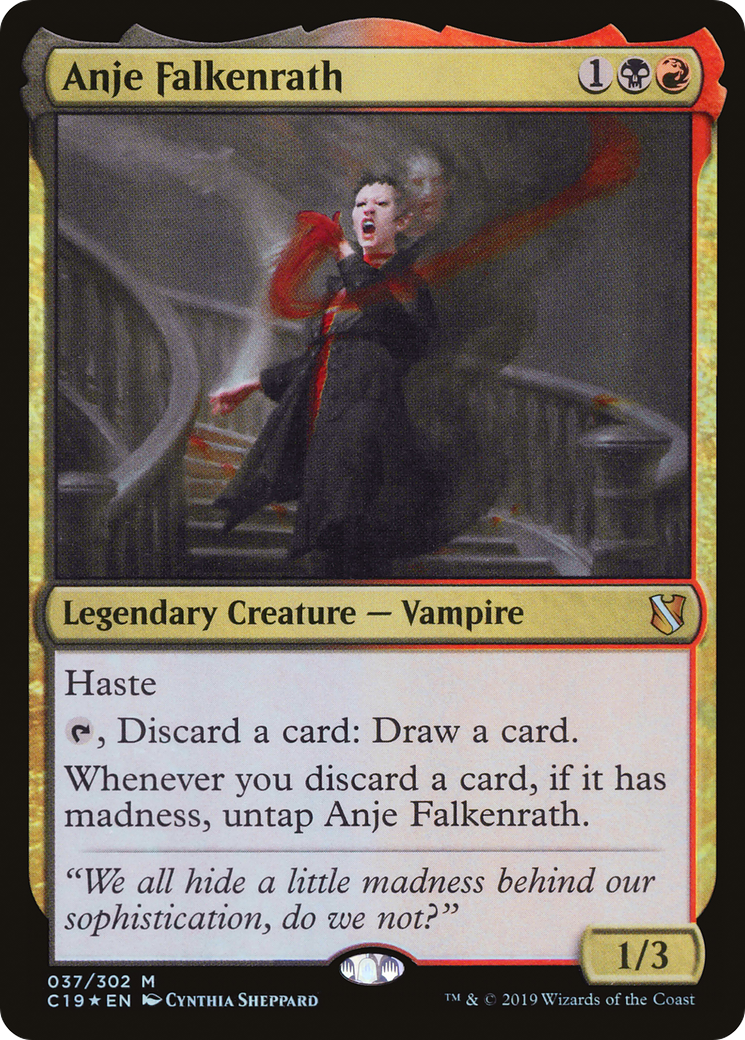
Anje Falkenrath
Anje Falkenrath
Legendary Creature — Vampire
1/3
Haste
, Discard a card: Draw a card.
Whenever you discard a card, if it has madness, untap Anje Falkenrath.
- If you discard a card with madness to pay the cost of Anje’s activated ability, you’ll draw a card last. You may untap Anje before or after you choose whether to cast the discarded card, but not after you’ve chosen to cast it but before that spell resolves.
-
1
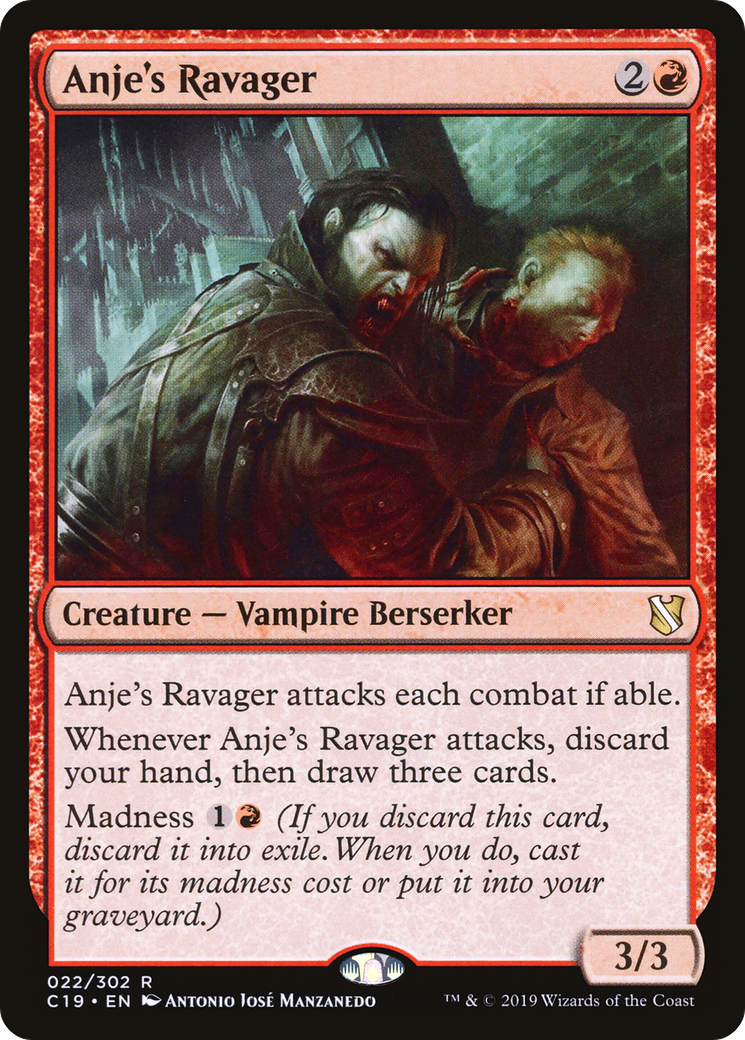
Anje's Ravager
Anje's Ravager
Creature — Vampire Berserker
3/3
This creature attacks each combat if able.
Whenever this creature attacks, discard your hand, then draw three cards.
Madness (If you discard this card, discard it into exile. When you do, cast it for its madness cost or put it into your graveyard.)
- If you discard a card with madness while a spell or ability is resolving, it moves immediately to exile. Continue resolving that spell or ability, noting that the card you discarded is not in your graveyard at this time. Its madness triggered ability will be placed onto the stack once that spell or ability has completely resolved.
- To determine the total cost of a spell, start with the mana cost or alternative cost (such as a madness cost) you're paying, add any cost increases, then apply any cost reductions. The mana value of the spell is determined by only its mana cost, no matter what the total cost to cast that spell was.
- If you choose not to cast a card with madness when the madness triggered ability resolves, it's put into your graveyard. Madness doesn't give you another chance to cast it later.
- If you discard a card with madness to pay the cost of a spell or activated ability, that card's madness triggered ability (and the spell that card becomes, if you choose to cast it) will resolve before the spell or ability the discard paid for.
- Cards are discarded in a Magic game only from a player's hand. Effects that put cards into a player's graveyard from anywhere else do not cause those cards to be discarded.
- Madness works independently of why you're discarding the card. You could discard it to pay a cost, because a spell or ability tells you to, or because you have too many cards in your hand during your cleanup step. You can't discard a card with madness just because you want to, though.
- A card with madness that's discarded counts as having been discarded even though it's put into exile rather than a graveyard. If it was discarded to pay a cost, that cost is still paid. Abilities that trigger when a card is discarded will still trigger.
- A spell cast for its madness cost is put onto the stack like any other spell. It can be countered, copied, and so on. As it resolves, it's put onto the battlefield if it's a permanent card or into its owner's graveyard if it's an instant or sorcery card.
- Casting a spell with madness ignores the timing rules based on the card's card type. For example, you can cast a sorcery with madness if you discard it during an opponent's turn.
- You draw three cards while resolving the triggered ability, even if you discarded zero cards.
- If any of the cards you discard have madness, you'll choose whether to cast them after you've drawn three cards.
- If Anje's Ravager can't attack for any reason (such as being tapped or having come under that player's control that turn), then it doesn't attack. If there's a cost associated with having it attack, its controller isn't forced to pay that cost, so it doesn't have to attack in that case either.
-
1
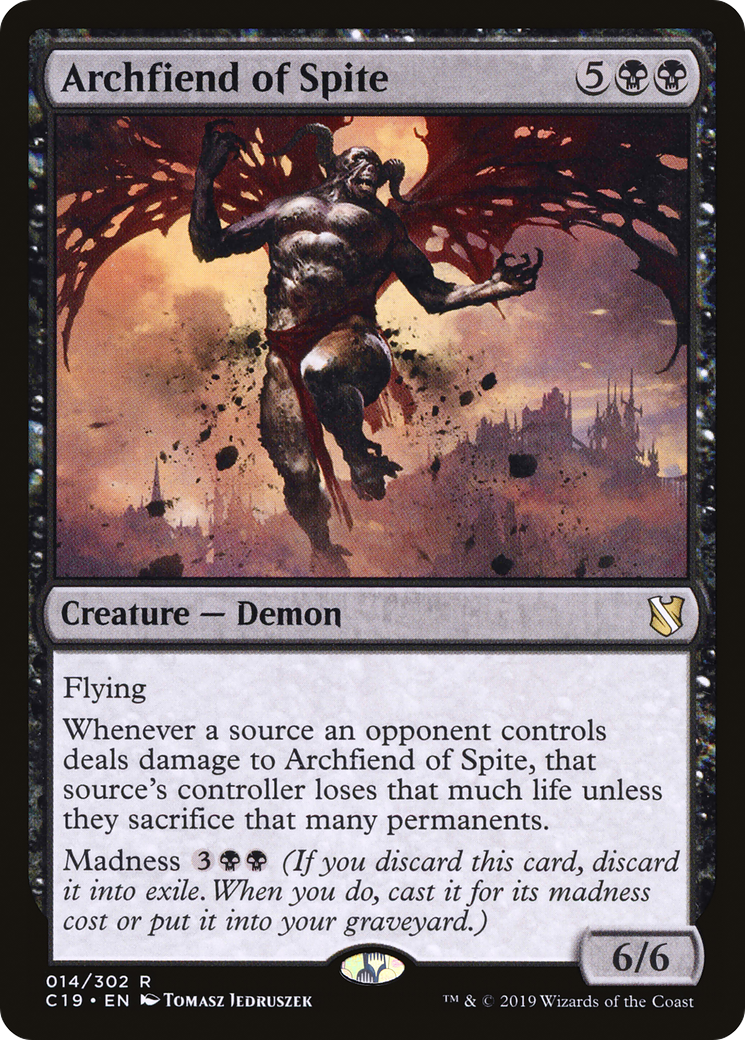
Archfiend of Spite
Archfiend of Spite
Creature — Demon
6/6
Flying
Whenever a source an opponent controls deals damage to this creature, that source's controller loses that much life unless they sacrifice that many permanents of their choice.
Madness (If you discard this card, discard it into exile. When you do, cast it for its madness cost or put it into your graveyard.)
- If you discard a card with madness while a spell or ability is resolving, it moves immediately to exile. Continue resolving that spell or ability, noting that the card you discarded is not in your graveyard at this time. Its madness triggered ability will be placed onto the stack once that spell or ability has completely resolved.
- A spell cast for its madness cost is put onto the stack like any other spell. It can be countered, copied, and so on. As it resolves, it's put onto the battlefield if it's a permanent card or into its owner's graveyard if it's an instant or sorcery card.
- Casting a spell with madness ignores the timing rules based on the card's card type. For example, you can cast a sorcery with madness if you discard it during an opponent's turn.
- To determine the total cost of a spell, start with the mana cost or alternative cost (such as a madness cost) you're paying, add any cost increases, then apply any cost reductions. The mana value of the spell is determined by only its mana cost, no matter what the total cost to cast that spell was.
- If you choose not to cast a card with madness when the madness triggered ability resolves, it's put into your graveyard. Madness doesn't give you another chance to cast it later.
- If you discard a card with madness to pay the cost of a spell or activated ability, that card's madness triggered ability (and the spell that card becomes, if you choose to cast it) will resolve before the spell or ability the discard paid for.
- Cards are discarded in a Magic game only from a player's hand. Effects that put cards into a player's graveyard from anywhere else do not cause those cards to be discarded.
- Madness works independently of why you're discarding the card. You could discard it to pay a cost, because a spell or ability tells you to, or because you have too many cards in your hand during your cleanup step. You can't discard a card with madness just because you want to, though.
- A card with madness that's discarded counts as having been discarded even though it's put into exile rather than a graveyard. If it was discarded to pay a cost, that cost is still paid. Abilities that trigger when a card is discarded will still trigger.
- The source's controller must either sacrifice permanents or lose life. They can't choose to sacrifice some permanents and lose some life.
- If the player doesn't control enough permanents that they can sacrifice, they must lose life.
- The player may always choose not to sacrifice permanents, even if they will end up losing more life than they have or if an effect (such as that of Platinum Emperion) says that they can't lose life.
- The player who loses life or permanents is the player who controls the source as Archfiend of Spite's triggered ability resolves. In some rare cases, this may not be the same player who controlled the source as it dealt damage. If the source is no longer in the zone it was in as it dealt damage, the source's last known information is used to determine who controlled it.
- Archfiend of Spite's triggered ability will trigger even if it is dealt lethal damage. For example, if Archfiend of Spite blocks a 7/7 creature, its ability will trigger when combat damage is dealt and the attacking player will sacrifice seven permanents or lose 7 life.
-
1
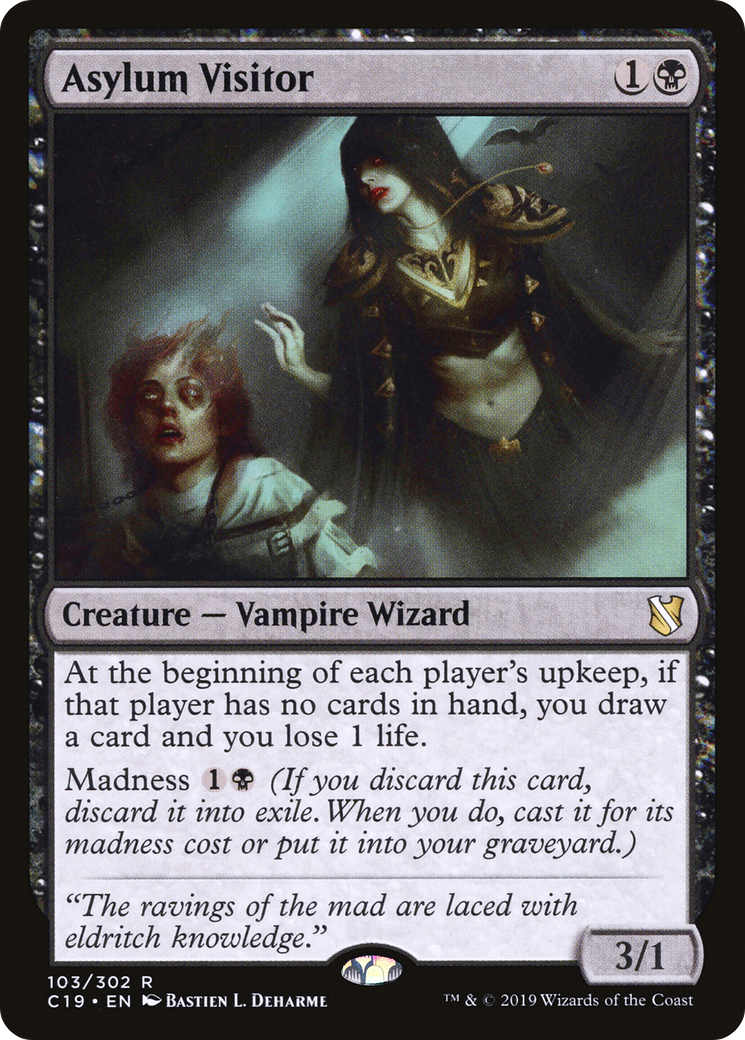
Asylum Visitor
Asylum Visitor
Creature — Vampire Wizard
3/1
At the beginning of each player's upkeep, if that player has no cards in hand, you draw a card and you lose 1 life.
Madness (If you discard this card, discard it into exile. When you do, cast it for its madness cost or put it into your graveyard.)
- If you discard a card with madness while a spell or ability is resolving, it moves immediately to exile. Continue resolving that spell or ability, noting that the card you discarded is not in your graveyard at this time. Its madness triggered ability will be placed onto the stack once that spell or ability has completely resolved.
- To determine the total cost of a spell, start with the mana cost or alternative cost (such as a madness cost) you're paying, add any cost increases, then apply any cost reductions. The mana value of the spell is determined by only its mana cost, no matter what the total cost to cast that spell was.
- If you choose not to cast a card with madness when the madness triggered ability resolves, it's put into your graveyard. Madness doesn't give you another chance to cast it later.
- If you discard a card with madness to pay the cost of a spell or activated ability, that card's madness triggered ability (and the spell that card becomes, if you choose to cast it) will resolve before the spell or ability the discard paid for.
- Cards are discarded in a Magic game only from a player's hand. Effects that put cards into a player's graveyard from anywhere else do not cause those cards to be discarded.
- Madness works independently of why you're discarding the card. You could discard it to pay a cost, because a spell or ability tells you to, or because you have too many cards in your hand during your cleanup step. You can't discard a card with madness just because you want to, though.
- A card with madness that's discarded counts as having been discarded even though it's put into exile rather than a graveyard. If it was discarded to pay a cost, that cost is still paid. Abilities that trigger when a card is discarded will still trigger.
- A spell cast for its madness cost is put onto the stack like any other spell. It can be countered, copied, and so on. As it resolves, it's put onto the battlefield if it's a permanent card or into its owner's graveyard if it's an instant or sorcery card.
- Casting a spell with madness ignores the timing rules based on the card's card type. For example, you can cast a sorcery with madness if you discard it during an opponent's turn.
- Asylum Visitor's triggered ability checks the active player's hand as the upkeep begins and as the trigger resolves. If that player has a card in hand as it resolves, you won't draw a card or lose 1 life. Notably, if you control multiple Asylum Visitors during your upkeep, whichever one's first ability resolves first will stop the other's first ability from having any effect unless you have a way to get the card you drew out of your hand before it resolves.
- On an opponent's turn, triggered abilities you control will resolve before any triggered abilities of permanents that opponent controls if they trigger at the same time. This means that if you and your opponent each control an Asylum Visitor during your opponent's upkeep, and they have no cards in hand, you'll always draw a card before your opponent has a card in their hand.
- The upkeep step is before the draw step, after the untap step. Asylum Visitor's first ability will trigger and resolve before the active player draws a card in their draw step if that player has no cards in hand.
-
1
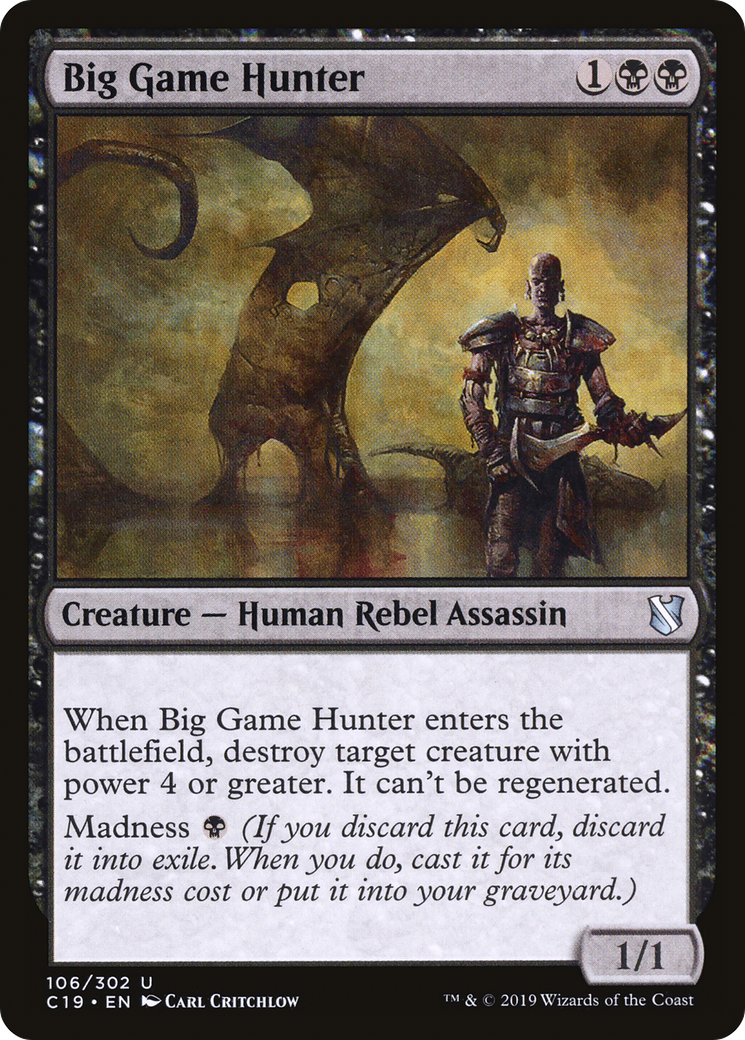
Big Game Hunter
Big Game Hunter
Creature — Human Rebel Assassin
1/1
When this creature enters, destroy target creature with power 4 or greater. It can't be regenerated.
Madness (If you discard this card, discard it into exile. When you do, cast it for its madness cost or put it into your graveyard.)
- Cards are discarded in a Magic game only from a player's hand. Effects that put cards into a player's graveyard from anywhere else do not cause those cards to be discarded.
- Madness works independently of why you're discarding the card. You could discard it to pay a cost, because a spell or ability tells you to, or because you have too many cards in your hand during your cleanup step. You can't discard a card with madness just because you want to, though.
- A card with madness that's discarded counts as having been discarded even though it's put into exile rather than a graveyard. If it was discarded to pay a cost, that cost is still paid. Abilities that trigger when a card is discarded will still trigger.
- A spell cast for its madness cost is put onto the stack like any other spell. It can be countered, copied, and so on. As it resolves, it's put onto the battlefield if it's a permanent card or into its owner's graveyard if it's an instant or sorcery card.
- Casting a spell with madness ignores the timing rules based on the card's card type. For example, you can cast a sorcery with madness if you discard it during an opponent's turn.
- To determine the total cost of a spell, start with the mana cost or alternative cost (such as a madness cost) you're paying, add any cost increases, then apply any cost reductions. The mana value of the spell is determined by only its mana cost, no matter what the total cost to cast that spell was.
- If you choose not to cast a card with madness when the madness triggered ability resolves, it's put into your graveyard. Madness doesn't give you another chance to cast it later.
- If you discard a card with madness to pay the cost of a spell or activated ability, that card's madness triggered ability (and the spell that card becomes, if you choose to cast it) will resolve before the spell or ability the discard paid for.
- If you discard a card with madness while a spell or ability is resolving, it moves immediately to exile. Continue resolving that spell or ability, noting that the card you discarded is not in your graveyard at this time. Its madness triggered ability will be placed onto the stack once that spell or ability has completely resolved.
-
1
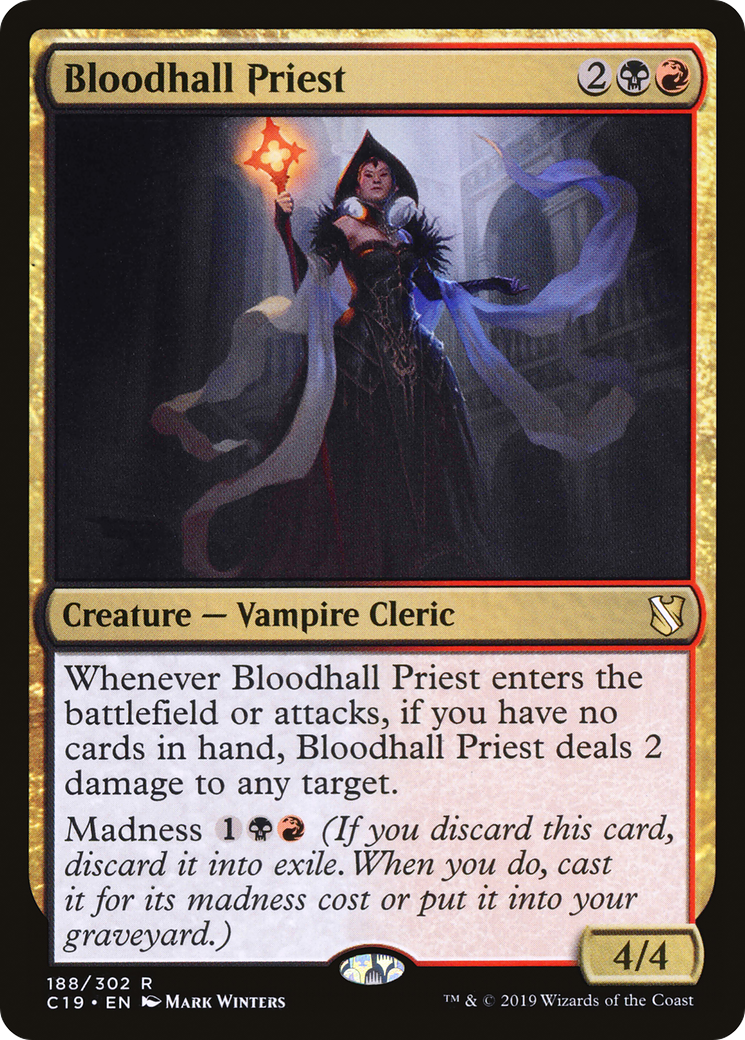
Bloodhall Priest
Bloodhall Priest
Creature — Vampire Cleric
4/4
Whenever this creature enters or attacks, if you have no cards in hand, this creature deals 2 damage to any target.
Madness (If you discard this card, discard it into exile. When you do, cast it for its madness cost or put it into your graveyard.)
- If you have a card in hand at the moment the trigger condition occurs, Bloodhall Priest’s ability won’t trigger, even if you can get that card out of your hand immediately afterward. If you have a card in hand as the ability resolves, it has no effect. No damage will be dealt.
- Madness works independently of why you're discarding the card. You could discard it to pay a cost, because a spell or ability tells you to, or because you have too many cards in your hand during your cleanup step. You can't discard a card with madness just because you want to, though.
- A card with madness that's discarded counts as having been discarded even though it's put into exile rather than a graveyard. If it was discarded to pay a cost, that cost is still paid. Abilities that trigger when a card is discarded will still trigger.
- A spell cast for its madness cost is put onto the stack like any other spell. It can be countered, copied, and so on. As it resolves, it's put onto the battlefield if it's a permanent card or into its owner's graveyard if it's an instant or sorcery card.
- Casting a spell with madness ignores the timing rules based on the card's card type. For example, you can cast a sorcery with madness if you discard it during an opponent's turn.
- Cards are discarded in a Magic game only from a player's hand. Effects that put cards into a player's graveyard from anywhere else do not cause those cards to be discarded.
- If you choose not to cast a card with madness when the madness triggered ability resolves, it's put into your graveyard. Madness doesn't give you another chance to cast it later.
- If you discard a card with madness to pay the cost of a spell or activated ability, that card's madness triggered ability (and the spell that card becomes, if you choose to cast it) will resolve before the spell or ability the discard paid for.
- If you discard a card with madness while a spell or ability is resolving, it moves immediately to exile. Continue resolving that spell or ability, noting that the card you discarded is not in your graveyard at this time. Its madness triggered ability will be placed onto the stack once that spell or ability has completely resolved.
- To determine the total cost of a spell, start with the mana cost or alternative cost (such as a madness cost) you're paying, add any cost increases, then apply any cost reductions. The mana value of the spell is determined by only its mana cost, no matter what the total cost to cast that spell was.
-
1
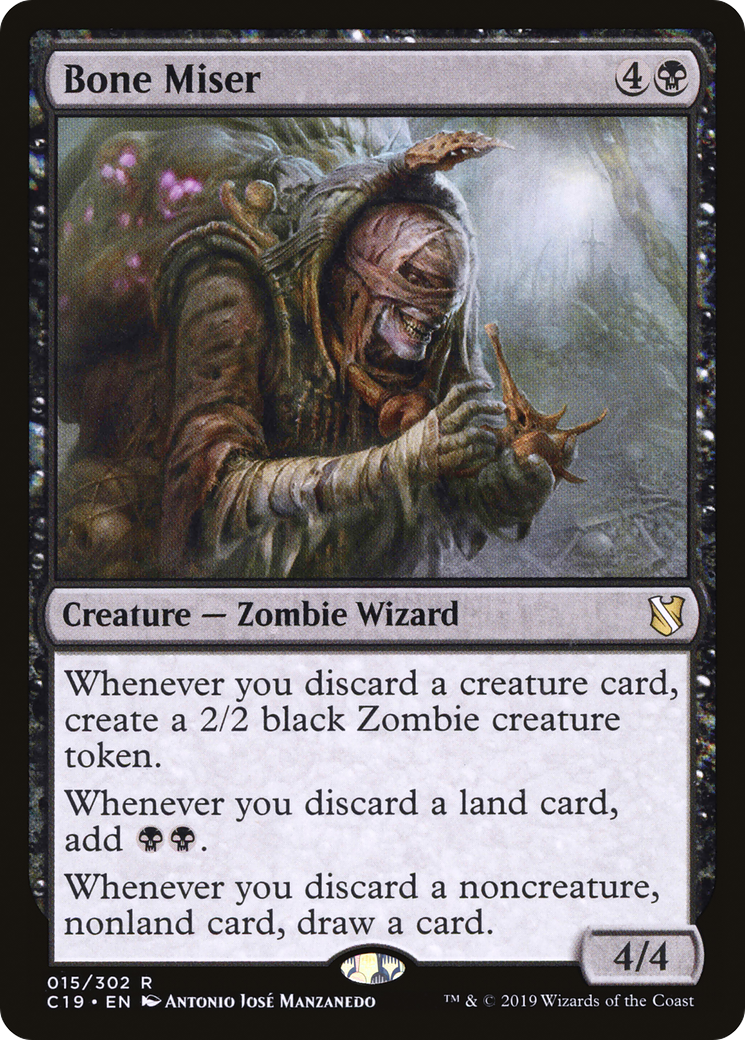
Bone Miser
Bone Miser
Creature — Zombie Wizard
4/4
Whenever you discard a creature card, create a 2/2 black Zombie creature token.
Whenever you discard a land card, add .
Whenever you discard a noncreature, nonland card, draw a card.
- This creature’s abilities are triggered abilities, not activated abilities. They don’t allow you to discard a card whenever you want; rather, you need some other way of discarding a card (such as cycling).
- This creature’s second ability isn’t a mana ability. It uses the stack and can be responded to. Notably, this means that you can’t pay a cost of “ , Discard a card” by discarding a land card and using the produced to pay for the .
- If you discard a card as a cost to cast a spell or activate an ability, this creature’s triggered ability resolves before that spell or ability but after you’ve chosen targets for it. If you discard a card while a spell or ability is resolving, the triggered ability resolves after you’ve finished resolving that spell or ability.
-
1
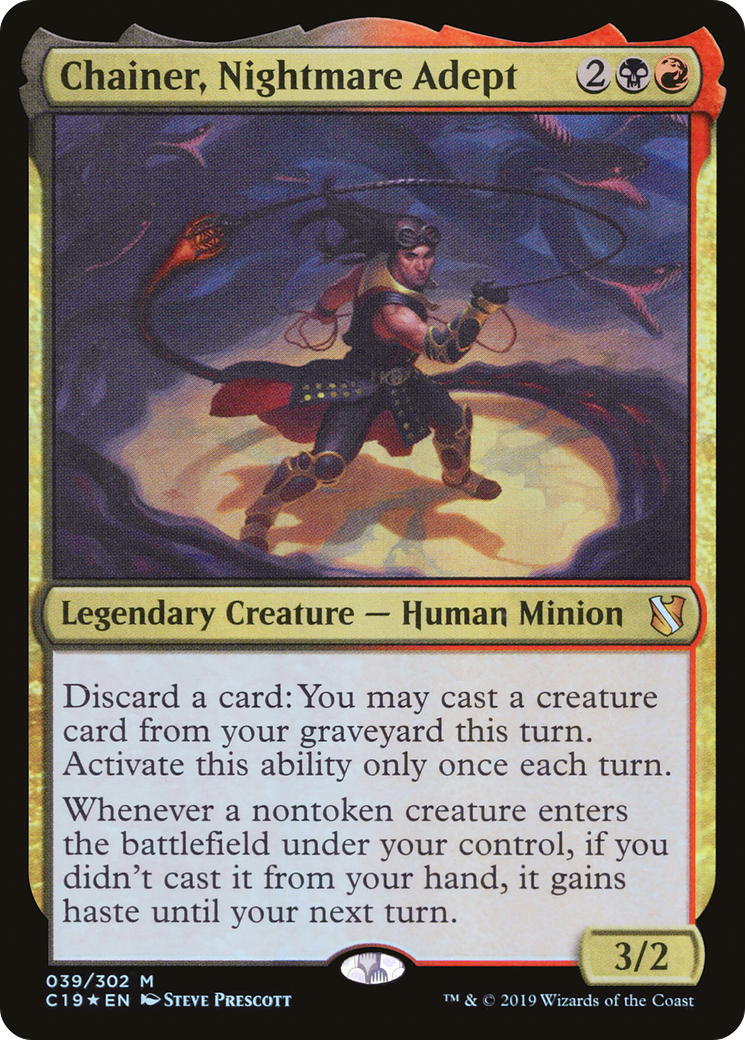
Chainer, Nightmare Adept
Chainer, Nightmare Adept
Legendary Creature — Human Minion
3/2
Discard a card: You may cast a creature spell from your graveyard this turn. Activate only once each turn.
Whenever a nontoken creature you control enters, if you didn't cast it from your hand, it gains haste until your next turn.
- You don't choose a creature card to cast while activating or resolving Chainer's first ability. The ability creates a permission for you to cast a creature card from your graveyard later in the turn.
- Chainer's first ability doesn't change when you can cast the creature card. You can normally only cast it during your turn while the stack is empty, but if the creature card has flash, you can cast it at other times.
- If you somehow activate Chainer's first ability more than once during a turn (perhaps because Chainer left the battlefield and returned), you can cast a creature card for each ability's permission. Similarly, if another effect allows you to cast a creature card from your graveyard, you may use that permission and later use Chainer's permission to cast another creature card.
- Chainer's last ability triggers if the entering creature was cast from a zone other than your hand, or if it wasn't cast at all and is entering the battlefield from anywhere (including from your hand).
- Chainer's last ability triggers if Chainer enters the battlefield without being cast from your hand.
-
1
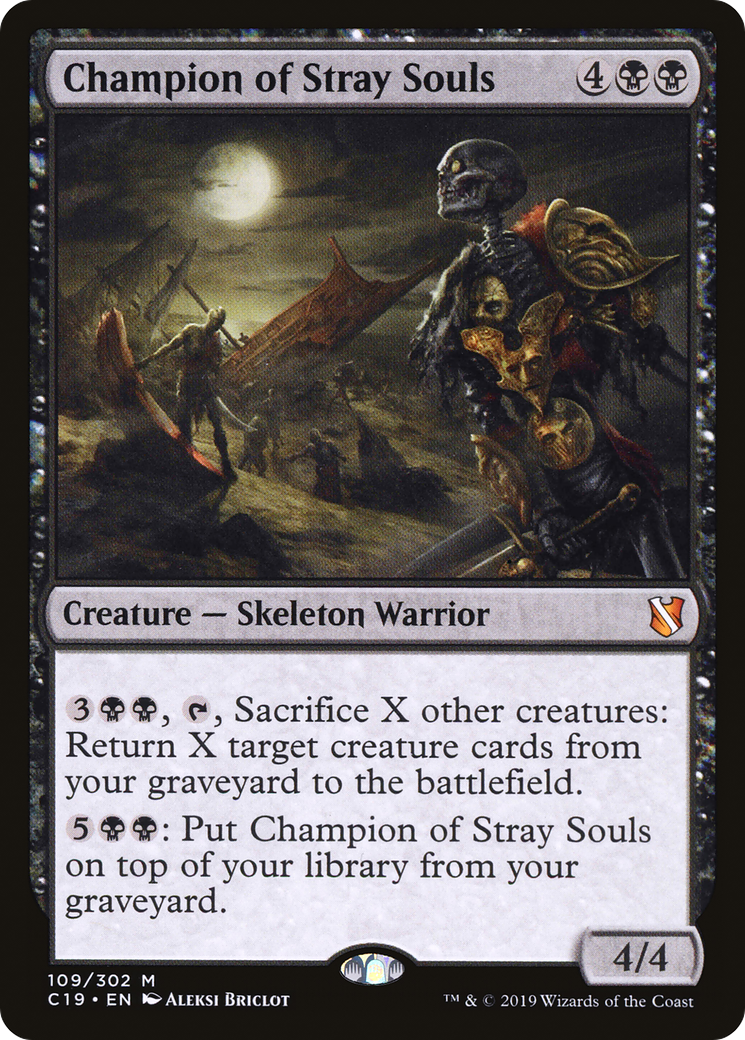
Champion of Stray Souls
Champion of Stray Souls
Creature — Skeleton Warrior
4/4
, , Sacrifice X other creatures: Return X target creature cards from your graveyard to the battlefield.
: Put this card from your graveyard on top of your library.
- You choose the targets of the first ability as you activate that ability, before you pay any costs. You can't target any of the creatures you sacrifice.
- The last ability can be activated only if Champion of Stray Souls is in your graveyard.
-
1
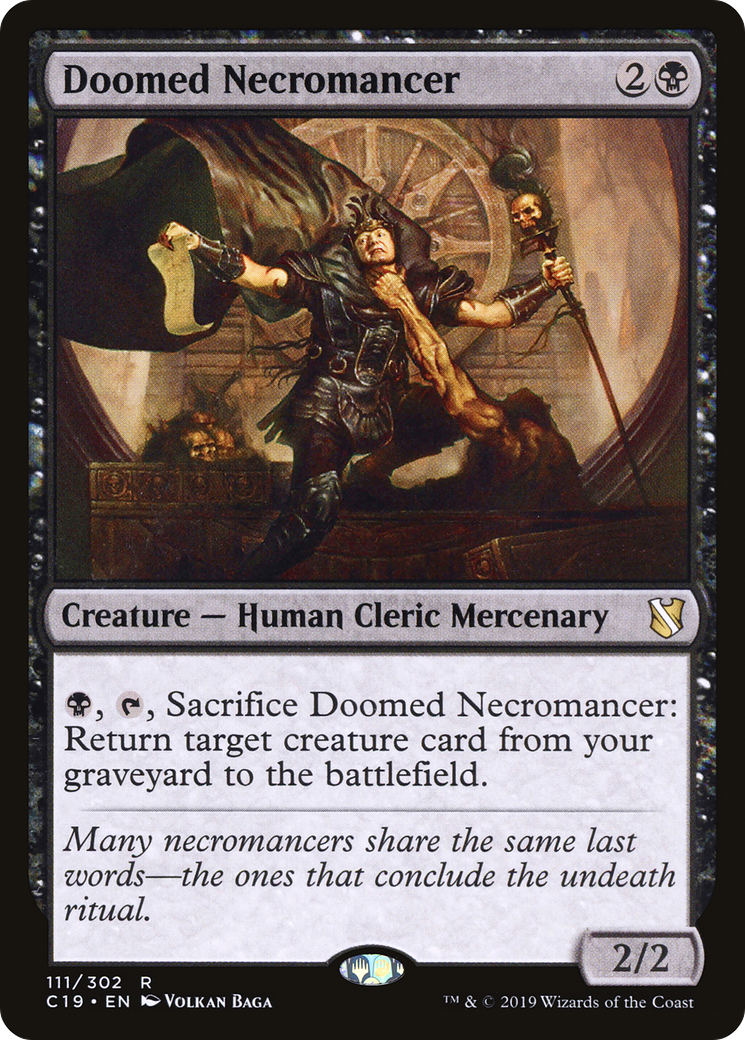
Doomed Necromancer
Doomed Necromancer
Creature — Human Cleric Mercenary
2/2
, , Sacrifice this creature: Return target creature card from your graveyard to the battlefield.
- Because targets are chosen before costs are paid, Doomed Necromancer can't be the target of its own ability.
-
1
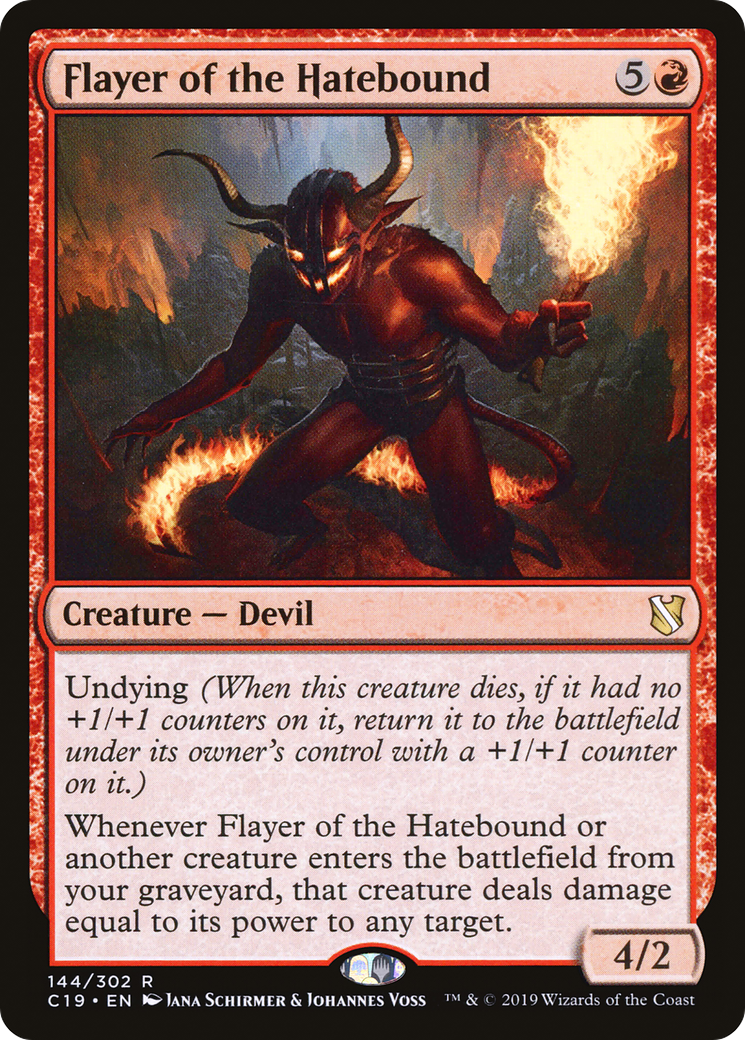
Flayer of the Hatebound
Flayer of the Hatebound
Creature — Devil
4/2
Undying (When this creature dies, if it had no +1/+1 counters on it, return it to the battlefield under its owner's control with a +1/+1 counter on it.)
Whenever this creature or another creature enters from your graveyard, that creature deals damage equal to its power to any target.
- Flayer of the Hatebound's last ability will trigger even if a creature enters from your graveyard under another player's control.
- The creature that entered from your graveyard deals damage equal to its current power (including any +1/+1 counters it entered with) to the target permanent or player. If it's no longer on the battlefield when the ability resolves, its last known existence on the battlefield is checked to determine its power.
- Flayer of the Hatebound is the source of the ability, but it may be another creature that is the source of the damage. If a black creature enters from your graveyard, the ability could target a creature with protection from black, although the damage will be prevented. It couldn't target a creature with protection from red.
- Since damage is dealt by the creature, abilities like lifelink and deathtouch are taken into account, even if the creature has left the battlefield by the time it deals damage.
- If you cast a creature card from your graveyard, that card will be put on the stack before entering. Flayer of the Hatebound won't trigger.
-
1
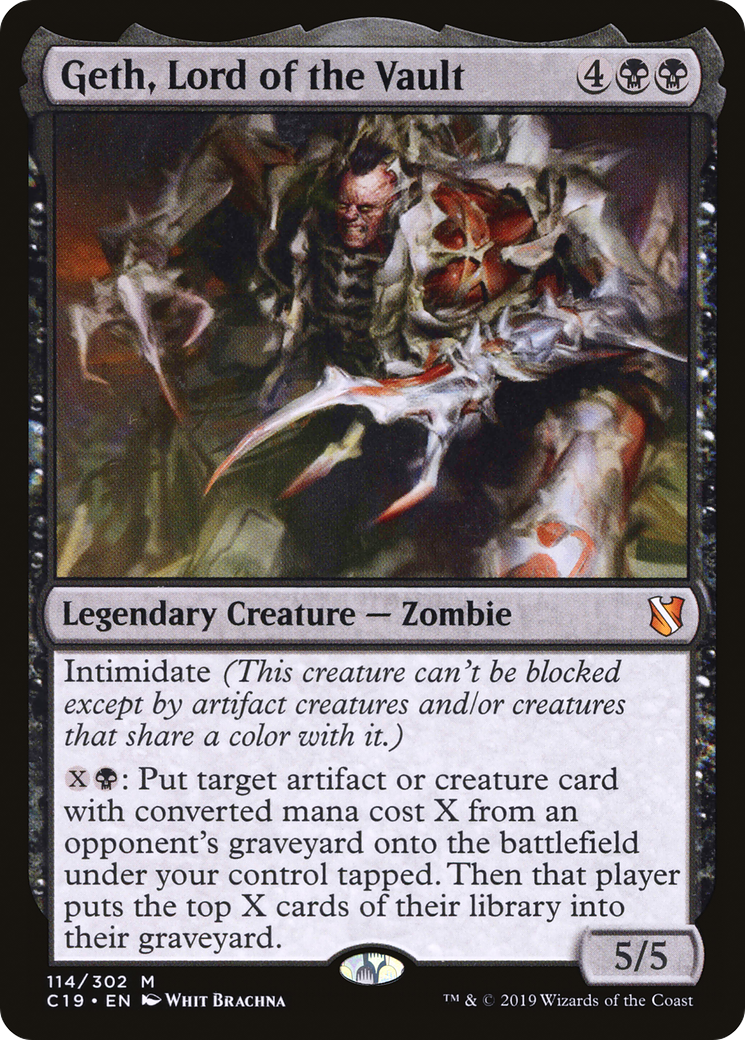
Geth, Lord of the Vault
Geth, Lord of the Vault
Legendary Creature — Phyrexian Zombie
5/5
Intimidate (This creature can't be blocked except by artifact creatures and/or creatures that share a color with it.)
: Put target artifact or creature card with mana value X from an opponent's graveyard onto the battlefield under your control tapped. Then that player mills X cards.
- If a card in a player's graveyard has in its mana cost, X is considered to be 0.
- The target card must have mana value exactly X. You can't overpay to have the player mill more cards.
- In a multiplayer game, if a player leaves the game, all cards that player owns leave as well. If you leave the game, any spells and/or permanents you control from Geth's last ability are exiled.
-
1
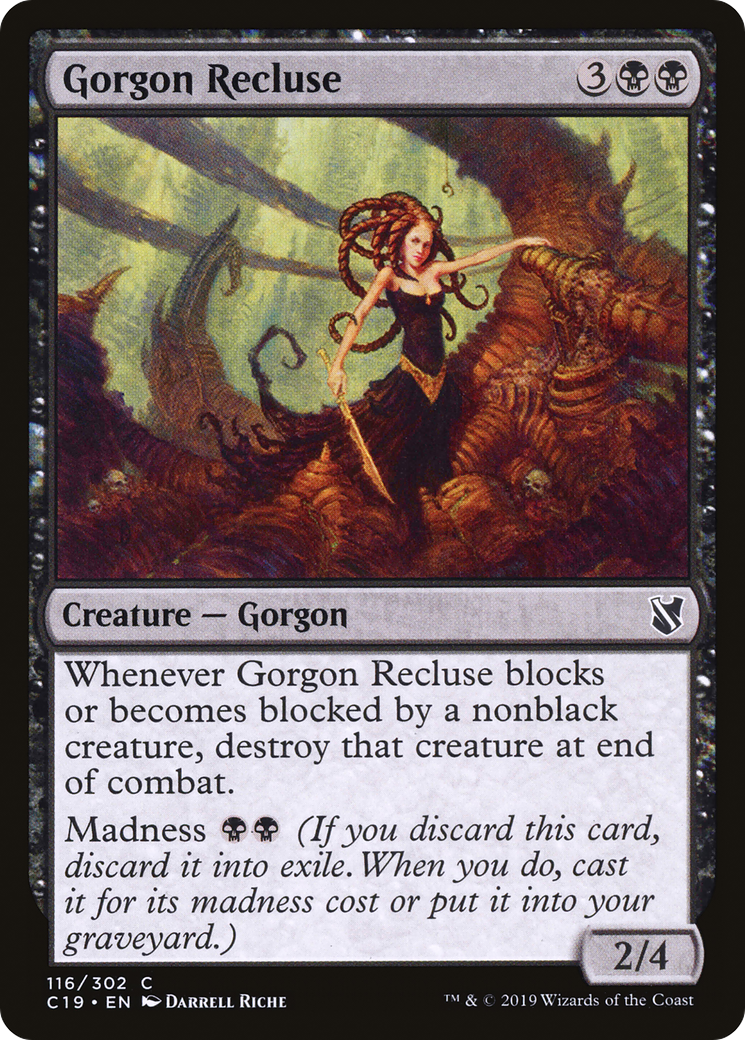
Gorgon Recluse
Gorgon Recluse
Creature — Gorgon
2/4
Whenever this creature blocks or becomes blocked by a nonblack creature, destroy that creature at end of combat.
Madness (If you discard this card, discard it into exile. When you do, cast it for its madness cost or put it into your graveyard.)
- If you discard a card with madness while a spell or ability is resolving, it moves immediately to exile. Continue resolving that spell or ability, noting that the card you discarded is not in your graveyard at this time. Its madness triggered ability will be placed onto the stack once that spell or ability has completely resolved.
- Cards are discarded in a Magic game only from a player's hand. Effects that put cards into a player's graveyard from anywhere else do not cause those cards to be discarded.
- Madness works independently of why you're discarding the card. You could discard it to pay a cost, because a spell or ability tells you to, or because you have too many cards in your hand during your cleanup step. You can't discard a card with madness just because you want to, though.
- A card with madness that's discarded counts as having been discarded even though it's put into exile rather than a graveyard. If it was discarded to pay a cost, that cost is still paid. Abilities that trigger when a card is discarded will still trigger.
- A spell cast for its madness cost is put onto the stack like any other spell. It can be countered, copied, and so on. As it resolves, it's put onto the battlefield if it's a permanent card or into its owner's graveyard if it's an instant or sorcery card.
- Casting a spell with madness ignores the timing rules based on the card's card type. For example, you can cast a sorcery with madness if you discard it during an opponent's turn.
- To determine the total cost of a spell, start with the mana cost or alternative cost (such as a madness cost) you're paying, add any cost increases, then apply any cost reductions. The mana value of the spell is determined by only its mana cost, no matter what the total cost to cast that spell was.
- If you choose not to cast a card with madness when the madness triggered ability resolves, it's put into your graveyard. Madness doesn't give you another chance to cast it later.
- If you discard a card with madness to pay the cost of a spell or activated ability, that card's madness triggered ability (and the spell that card becomes, if you choose to cast it) will resolve before the spell or ability the discard paid for.
- Gorgon Recluse's ability triggers when it blocks or becomes blocked by a nonblack creature and creates a delayed triggered ability that will destroy that creature at the end of combat step. It destroys that creature then even if Gorgon Recluse doesn't survive that long or the creature somehow becomes black.
-
1
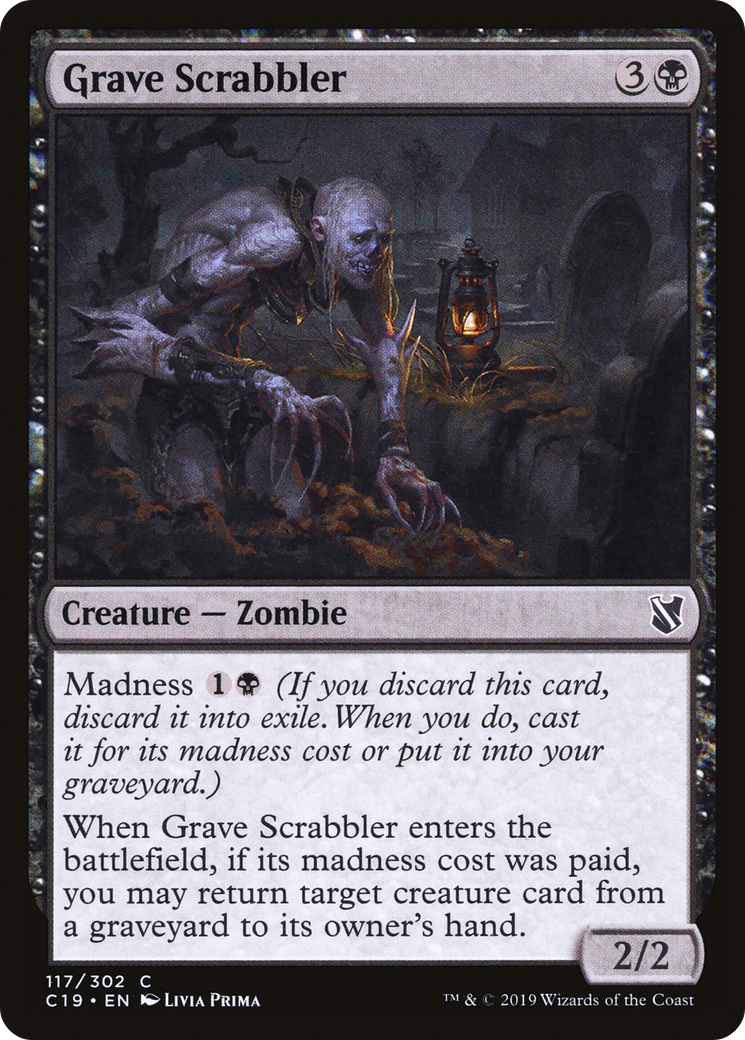
Grave Scrabbler
Grave Scrabbler
Creature — Zombie
2/2
Madness (If you discard this card, discard it into exile. When you do, cast it for its madness cost or put it into your graveyard.)
When this creature enters, if its madness cost was paid, you may return target creature card from a graveyard to its owner's hand.
- If you discard a card with madness while a spell or ability is resolving, it moves immediately to exile. Continue resolving that spell or ability, noting that the card you discarded is not in your graveyard at this time. Its madness triggered ability will be placed onto the stack once that spell or ability has completely resolved.
- Cards are discarded in a Magic game only from a player's hand. Effects that put cards into a player's graveyard from anywhere else do not cause those cards to be discarded.
- Madness works independently of why you're discarding the card. You could discard it to pay a cost, because a spell or ability tells you to, or because you have too many cards in your hand during your cleanup step. You can't discard a card with madness just because you want to, though.
- A card with madness that's discarded counts as having been discarded even though it's put into exile rather than a graveyard. If it was discarded to pay a cost, that cost is still paid. Abilities that trigger when a card is discarded will still trigger.
- A spell cast for its madness cost is put onto the stack like any other spell. It can be countered, copied, and so on. As it resolves, it's put onto the battlefield if it's a permanent card or into its owner's graveyard if it's an instant or sorcery card.
- Casting a spell with madness ignores the timing rules based on the card's card type. For example, you can cast a sorcery with madness if you discard it during an opponent's turn.
- To determine the total cost of a spell, start with the mana cost or alternative cost (such as a madness cost) you're paying, add any cost increases, then apply any cost reductions. The mana value of the spell is determined by only its mana cost, no matter what the total cost to cast that spell was.
- If you choose not to cast a card with madness when the madness triggered ability resolves, it's put into your graveyard. Madness doesn't give you another chance to cast it later.
- If you discard a card with madness to pay the cost of a spell or activated ability, that card's madness triggered ability (and the spell that card becomes, if you choose to cast it) will resolve before the spell or ability the discard paid for.
- Grave Scrabbler's madness cost was paid if you cast it using its madness ability, even if an effect changed the amount of mana you paid for that cost.
-
1
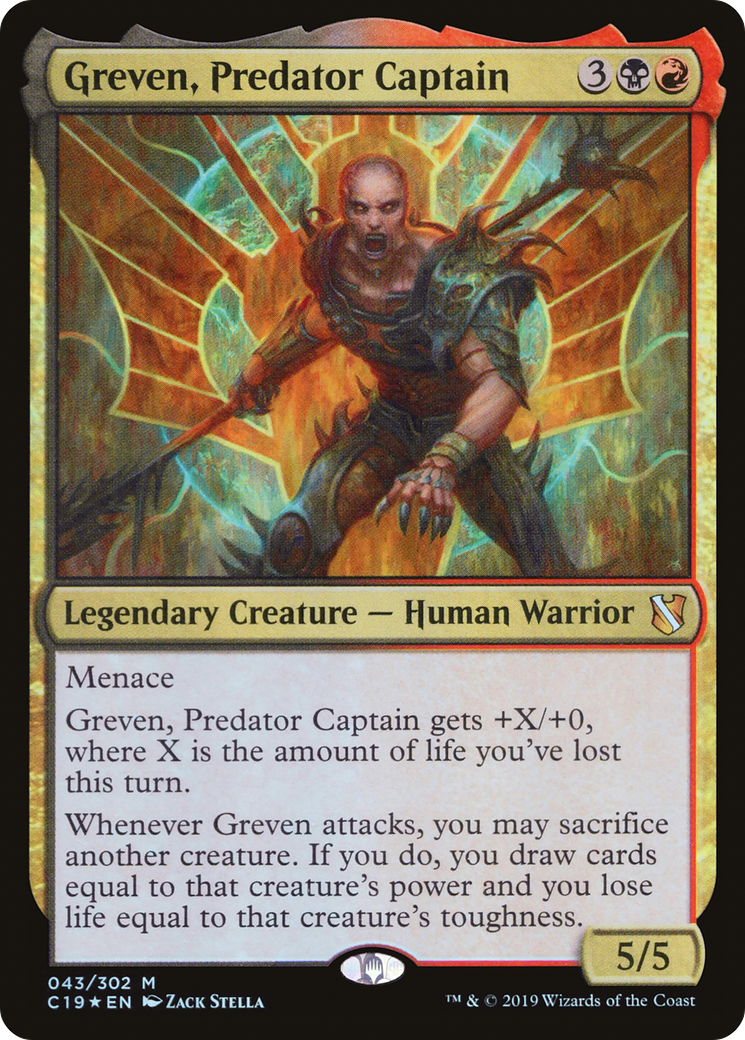
Greven, Predator Captain
Greven, Predator Captain
Legendary Creature — Phyrexian Human Warrior
5/5
Menace
Greven gets +X/+0, where X is the amount of life you've lost this turn.
Whenever Greven attacks, you may sacrifice another creature. If you do, you draw cards equal to that creature's power and you lose life equal to that creature's toughness.
- A player loses life if they're dealt damage or if they pay life.
- Greven checks for how much life you lost, not how much your life total has changed. If you lost 4 life but also gained 6 life, you still lost 4 life and Greven gets +4/+0.
- The sacrificed creature's power and toughness are determined by its last known information before it left the battlefield.
- You sacrifice a creature (or choose not to), draw cards, and lose life all while Greven's triggered ability is resolving. Nothing can happen in between, and no player may choose to take actions.
-
1
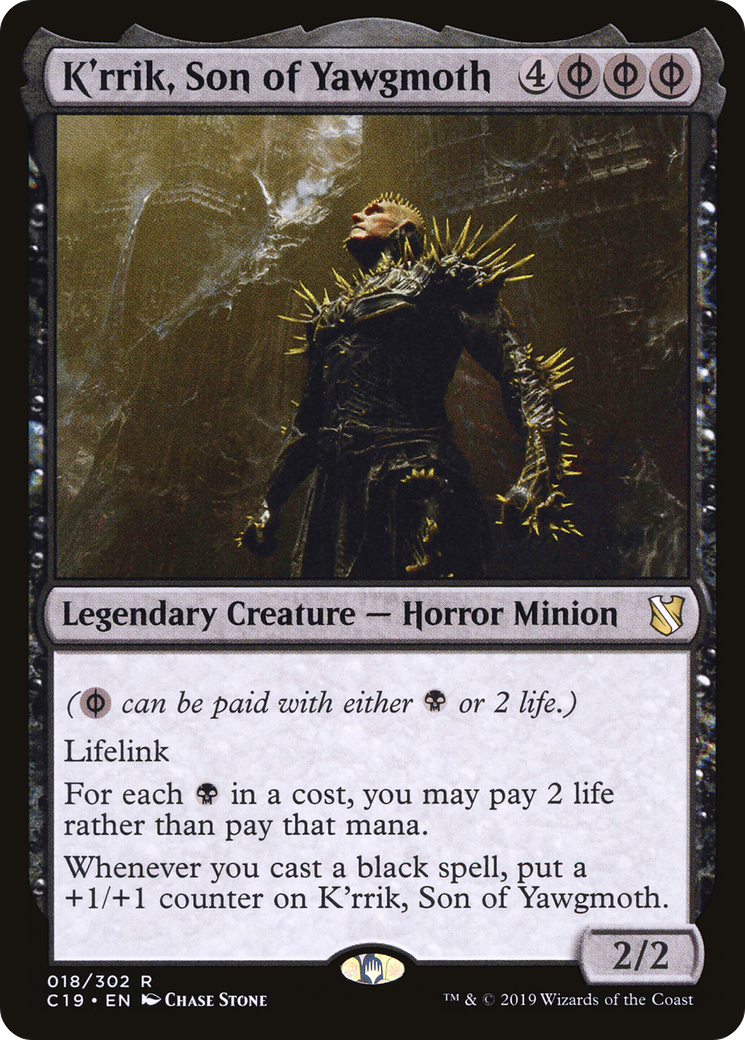
K'rrik, Son of Yawgmoth
K'rrik, Son of Yawgmoth
Legendary Creature — Phyrexian Horror Minion
2/2
( can be paid with either or 2 life.)
Lifelink
For each in a cost, you may pay 2 life rather than pay that mana.
Whenever you cast a black spell, put a +1/+1 counter on K'rrik.
- A Phyrexian mana symbol contributes 1 toward the mana value of a card, even if life is paid for it. Specifically, K'rrik's mana value is always 7.
- K'rrik's ability lets you pay 2 life for in any cost you pay, including the mana costs of spells, activation costs, and even costs for special actions (such as morph). Any time you pay mana, that's a cost.
- K'rrik's ability doesn't modify or reduce costs you pay. It changes only how you may pay those costs.
- You can't pay 2 life to pay for generic mana in costs you pay, even if an effect says that you must spend black mana to pay that generic mana.
- If a cost contains a mana symbol that may be paid in multiple ways, such as , , or , you choose how you'll pay it before you do so. If you choose to pay this way, K'rrik's ability allows you to pay life rather than pay that mana.
- K'rrik's last ability resolves before the spell that caused it to trigger. It resolves even if that spell is countered.
-
1
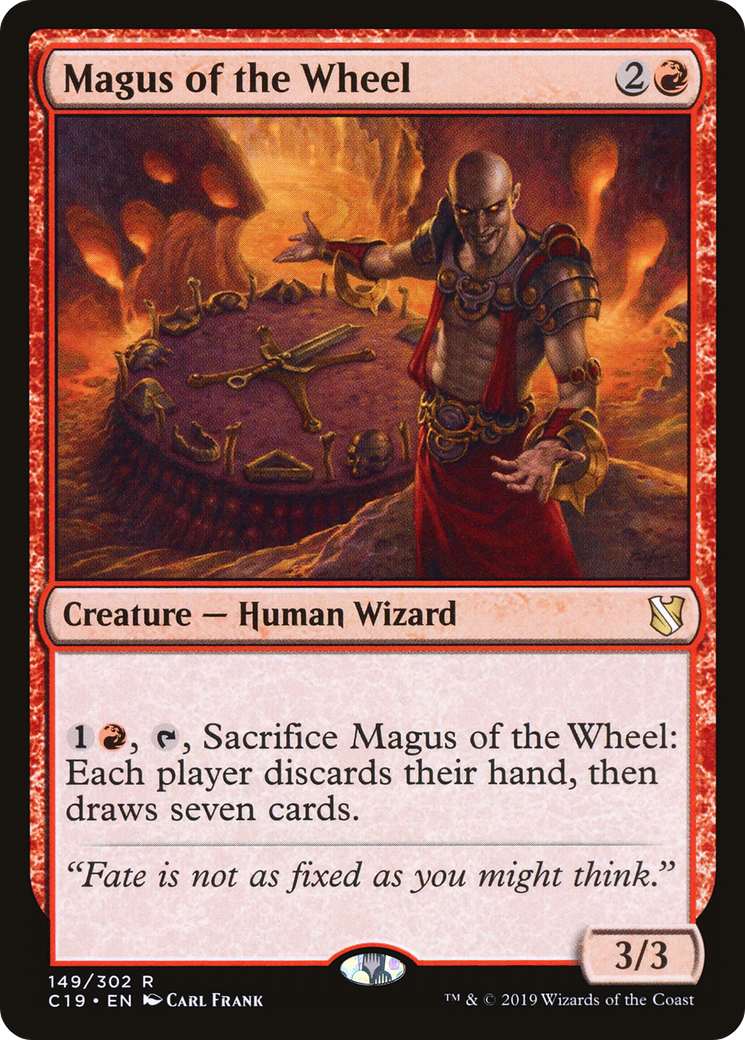
Magus of the Wheel
Magus of the Wheel
Creature — Human Wizard
3/3
, , Sacrifice this creature: Each player discards their hand, then draws seven cards.
- If each player has fewer than seven cards in their library as Magus of the Wheel's ability resolves, the game ends in a draw.
-
1
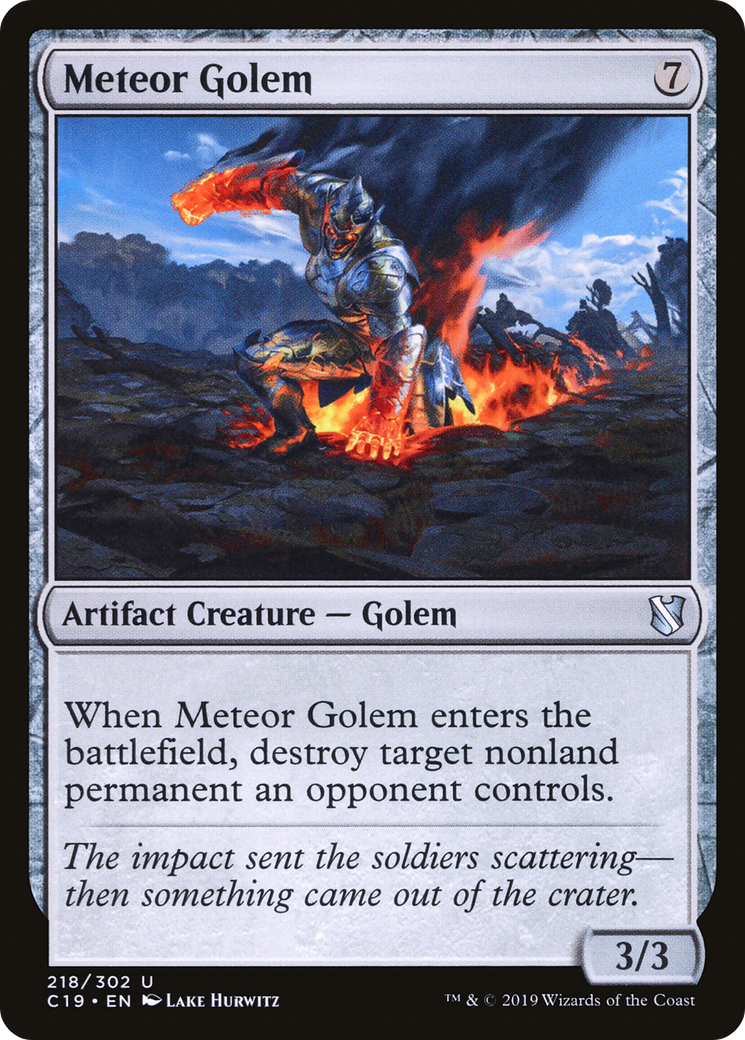
Meteor Golem
Meteor Golem
Artifact Creature — Golem
3/3
When this creature enters, destroy target nonland permanent an opponent controls.
-
1
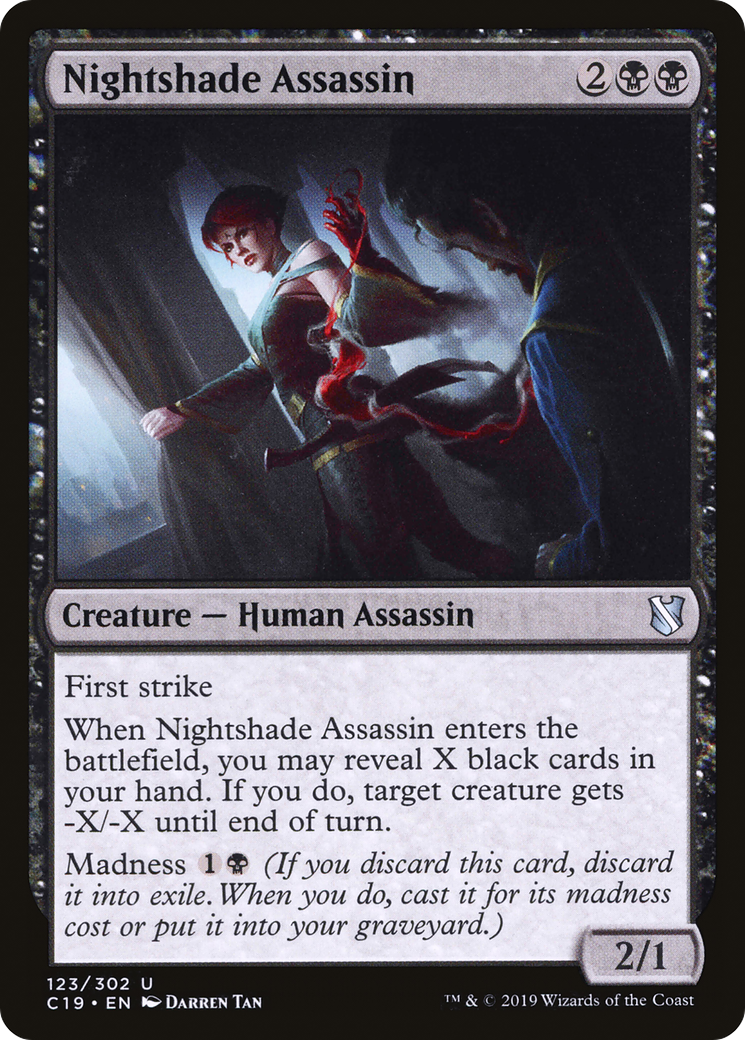
Nightshade Assassin
Nightshade Assassin
Creature — Human Assassin
2/1
First strike
When this creature enters, you may reveal X black cards in your hand. If you do, target creature gets -X/-X until end of turn.
Madness (If you discard this card, discard it into exile. When you do, cast it for its madness cost or put it into your graveyard.)
- If you discard a card with madness while a spell or ability is resolving, it moves immediately to exile. Continue resolving that spell or ability, noting that the card you discarded is not in your graveyard at this time. Its madness triggered ability will be placed onto the stack once that spell or ability has completely resolved.
- If you choose not to cast a card with madness when the madness triggered ability resolves, it's put into your graveyard. Madness doesn't give you another chance to cast it later.
- If you discard a card with madness to pay the cost of a spell or activated ability, that card's madness triggered ability (and the spell that card becomes, if you choose to cast it) will resolve before the spell or ability the discard paid for.
- Cards are discarded in a Magic game only from a player's hand. Effects that put cards into a player's graveyard from anywhere else do not cause those cards to be discarded.
- Madness works independently of why you're discarding the card. You could discard it to pay a cost, because a spell or ability tells you to, or because you have too many cards in your hand during your cleanup step. You can't discard a card with madness just because you want to, though.
- A card with madness that's discarded counts as having been discarded even though it's put into exile rather than a graveyard. If it was discarded to pay a cost, that cost is still paid. Abilities that trigger when a card is discarded will still trigger.
- A spell cast for its madness cost is put onto the stack like any other spell. It can be countered, copied, and so on. As it resolves, it's put onto the battlefield if it's a permanent card or into its owner's graveyard if it's an instant or sorcery card.
- Casting a spell with madness ignores the timing rules based on the card's card type. For example, you can cast a sorcery with madness if you discard it during an opponent's turn.
- To determine the total cost of a spell, start with the mana cost or alternative cost (such as a madness cost) you're paying, add any cost increases, then apply any cost reductions. The mana value of the spell is determined by only its mana cost, no matter what the total cost to cast that spell was.
- You choose how many cards to reveal and which as Nightshade Assassin's triggered ability resolves. Players can't take actions between the time you reveal cards and the time the target creature gets -X/-X.
- If the target creature becomes an illegal target, you don't reveal any cards.
-
1
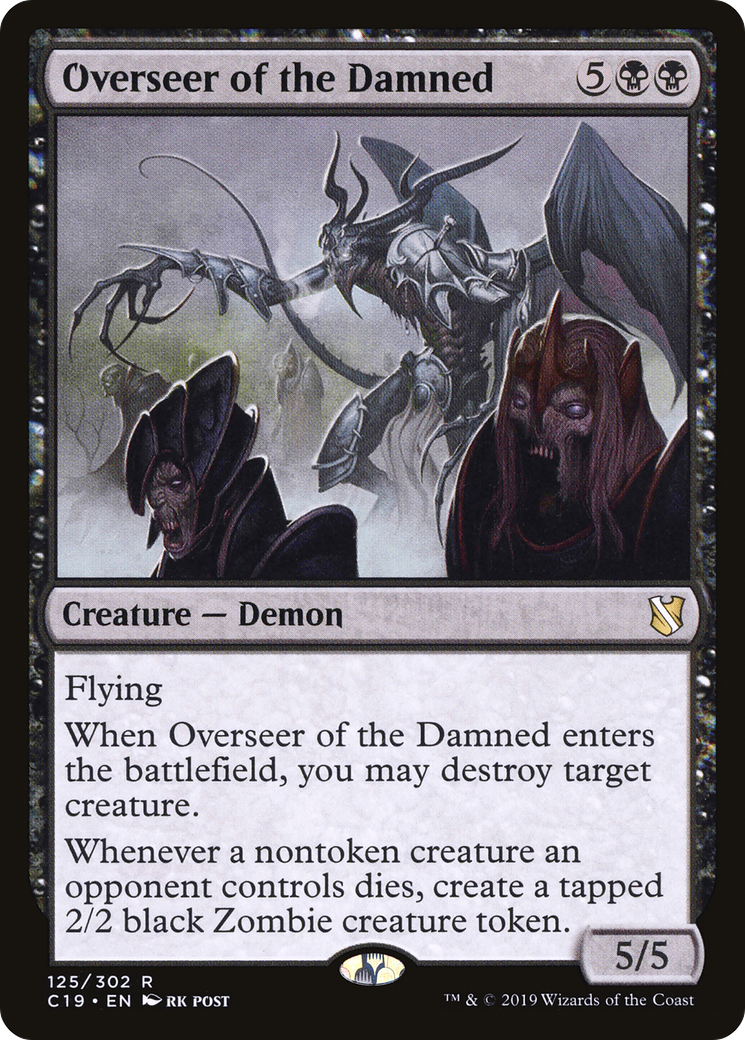
Overseer of the Damned
Overseer of the Damned
Creature — Demon
5/5
Flying
When this creature enters, you may destroy target creature.
Whenever a nontoken creature an opponent controls dies, create a tapped 2/2 black Zombie creature token.
-
1
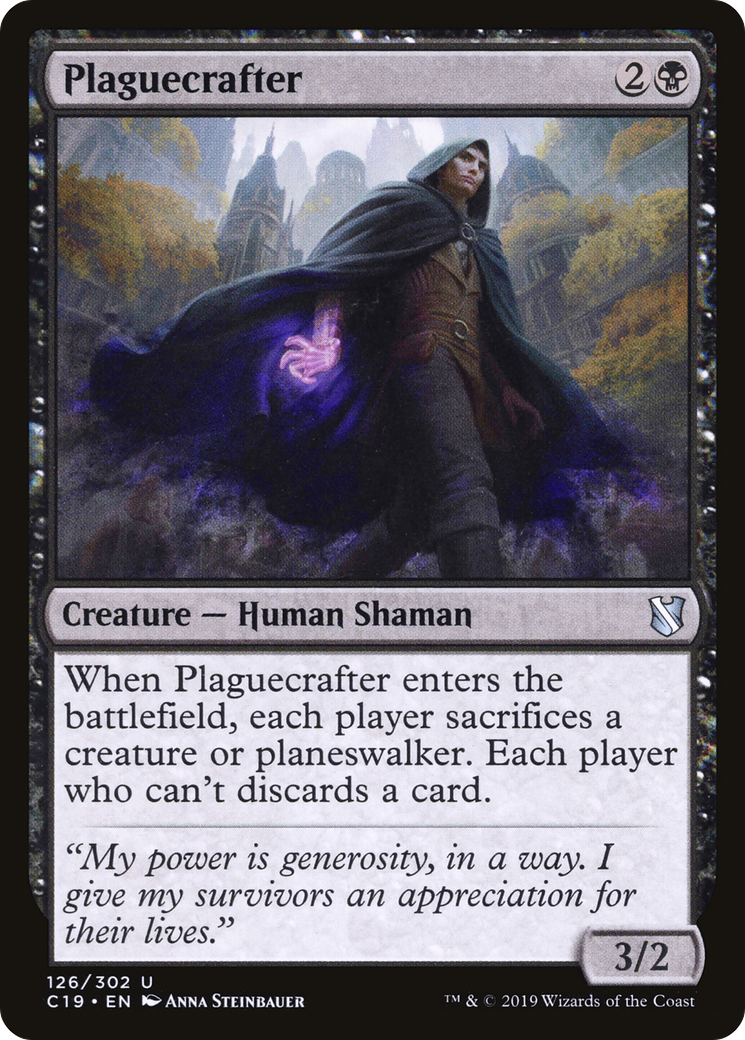
Plaguecrafter
Plaguecrafter
Creature — Human Shaman
3/2
When this creature enters, each player sacrifices a creature or planeswalker of their choice. Each player who can't discards a card.
- As Plaguecrafter's ability resolves, first the player whose turn it is chooses a creature or planeswalker they control, then each other player in turn order does the same, knowing the choices made before them. Then all the chosen permanents are sacrificed at the same time. Next, each player in the same order who couldn't sacrifice a permanent chooses a card in hand without revealing it, then the chosen cards are discarded at the same time.
- Each player chooses a permanent to sacrifice from among the creatures and planeswalkers they control. You don't choose which type of permanent any other player has to sacrifice.
- Plaguecrafter can be the creature its controller sacrifices for its own ability.
-
1
Sanitarium Skeleton
Sanitarium Skeleton
Creature — Skeleton
1/2
: Return this card from your graveyard to your hand.
-
1
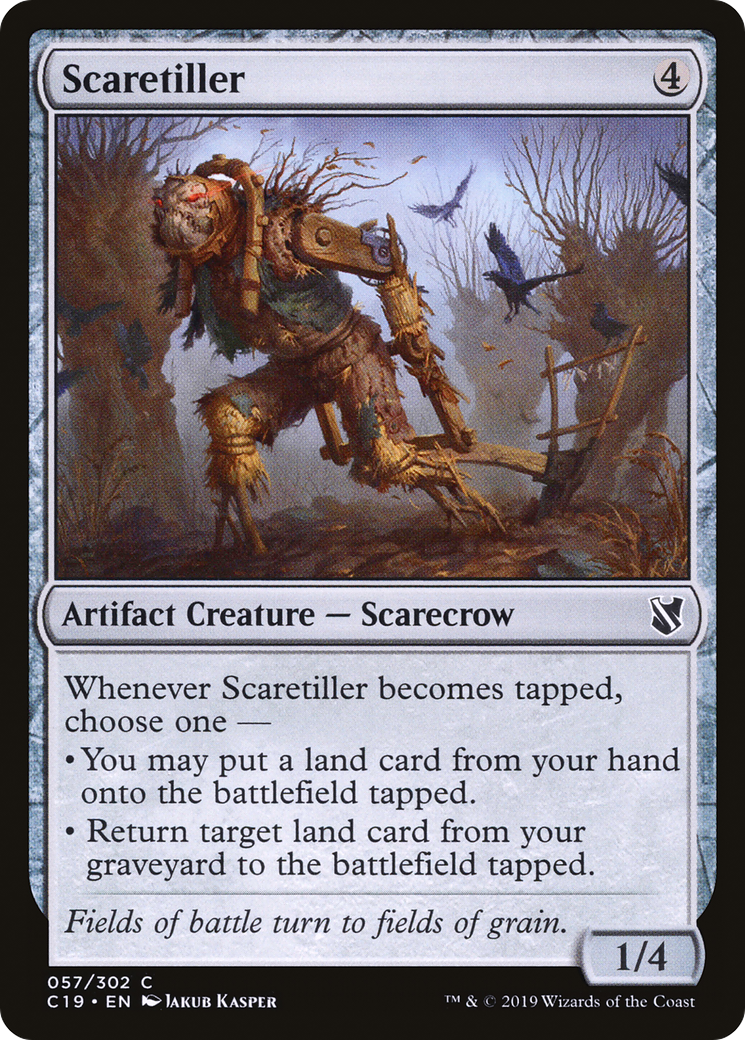
Scaretiller
Scaretiller
Artifact Creature — Scarecrow
1/4
Whenever this creature becomes tapped, choose one —
- You may put a land card from your hand onto the battlefield tapped.
- Return target land card from your graveyard to the battlefield tapped.
- Scaretiller's ability is a triggered ability, not an activated ability. It doesn't allow you to tap it whenever you want; rather, you need some other way of tapping it, such as by attacking.
- If Scaretiller becomes tapped while casting a spell or activating an ability, that spell or ability resolves after Scaretiller's triggered ability has resolved.
- Neither mode of Scaretiller's ability counts as playing a land. It can put a land card onto the battlefield even if you've already played your land for the turn, and even if it's not your turn.
-
1
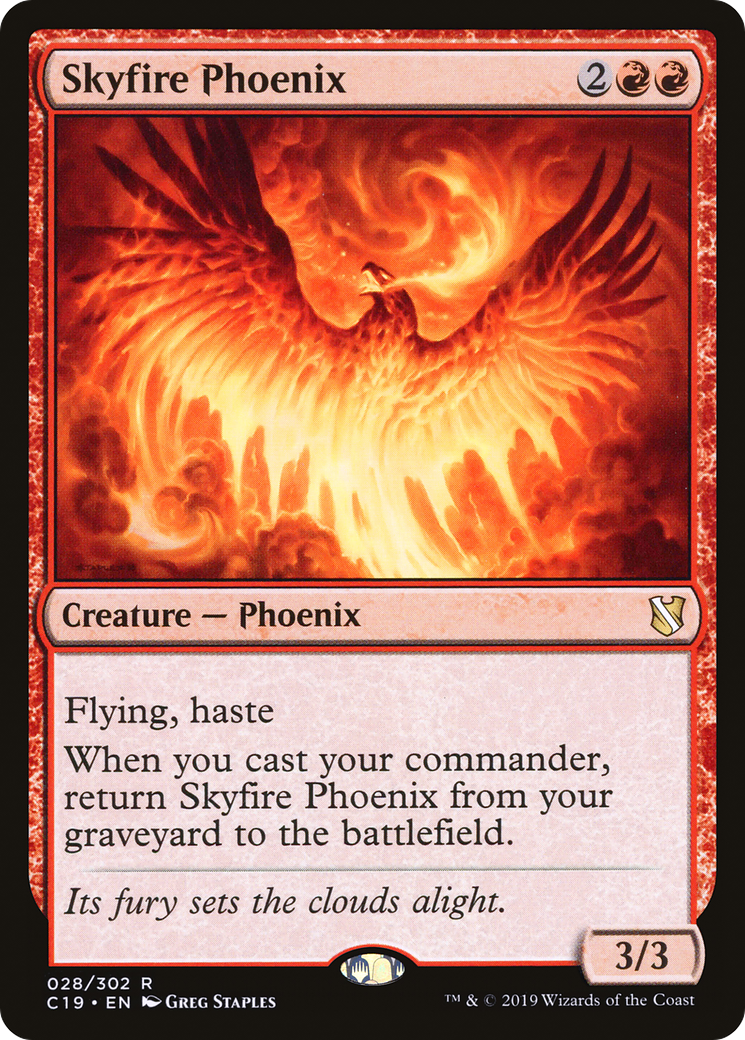
Skyfire Phoenix
Skyfire Phoenix
Creature — Phoenix
3/3
Flying, haste
When you cast your commander, return this card from your graveyard to the battlefield.
- Skyfire Phoenix's triggered ability resolves before the commander spell that caused the ability to trigger. The ability resolves even if that commander spell is countered.
-
1
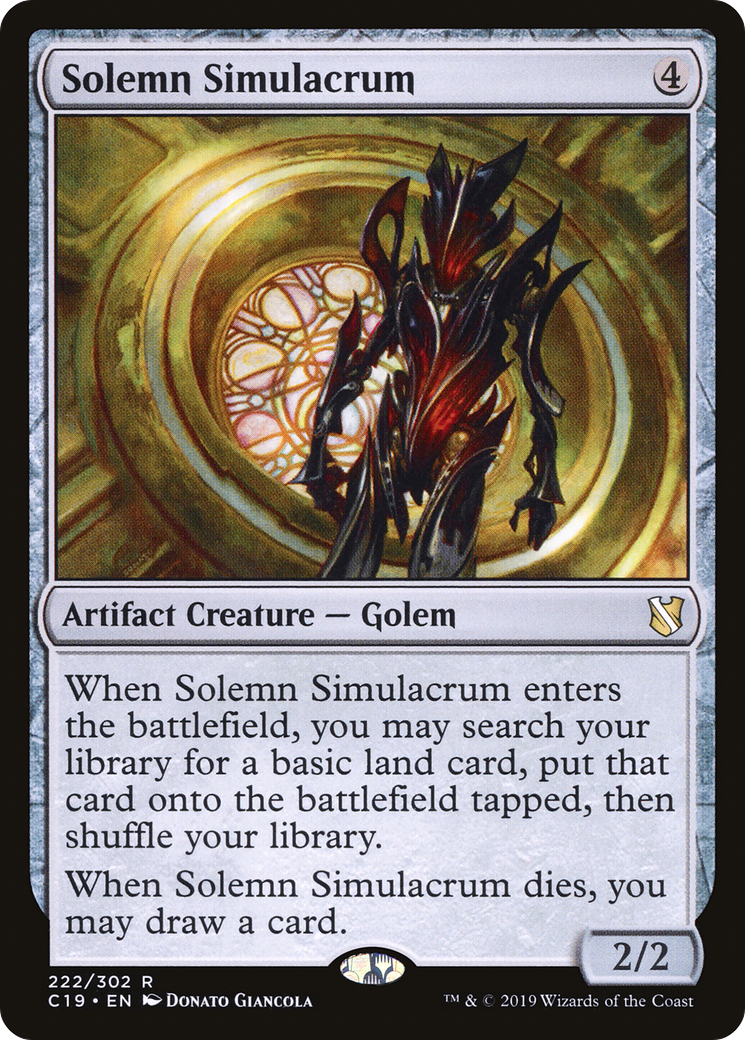
Solemn Simulacrum
Solemn Simulacrum
Artifact Creature — Golem
2/2
When this creature enters, you may search your library for a basic land card, put that card onto the battlefield tapped, then shuffle.
When this creature dies, you may draw a card.
-
1
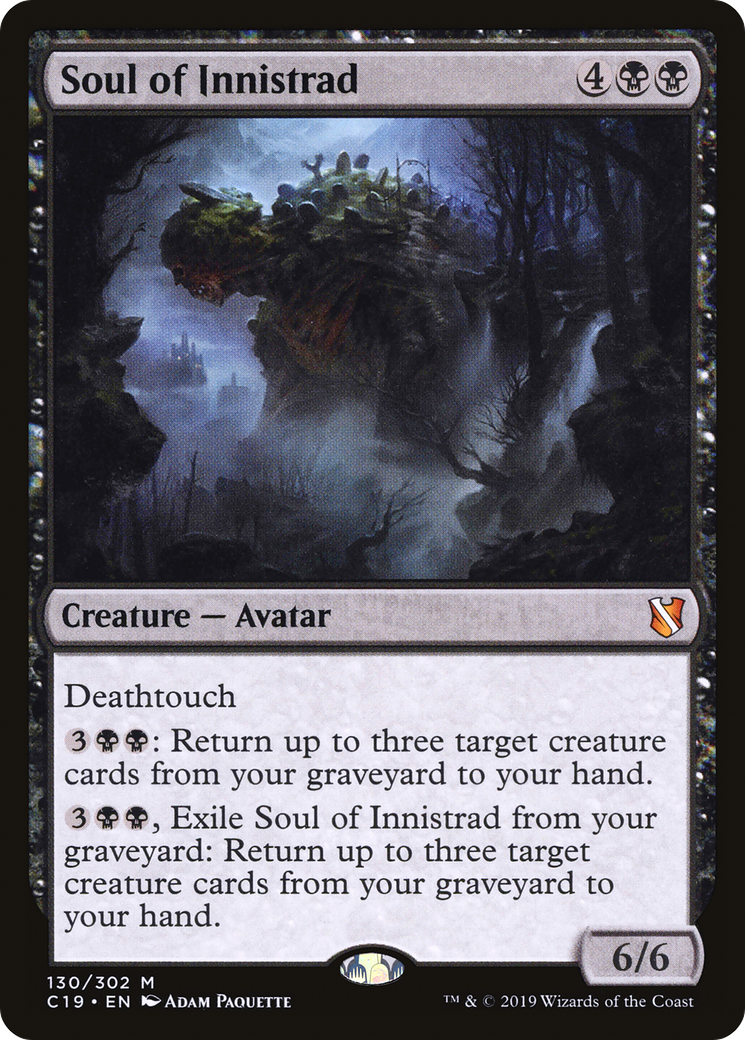
Soul of Innistrad
Soul of Innistrad
Creature — Avatar
6/6
Deathtouch
: Return up to three target creature cards from your graveyard to your hand.
, Exile this card from your graveyard: Return up to three target creature cards from your graveyard to your hand.
- You can activate the last ability only if the Soul is in your graveyard.
- Exiling the Soul from your graveyard is part of the last ability's activation cost. A player can't remove the Soul in response to prevent you from activating the ability.
-
1
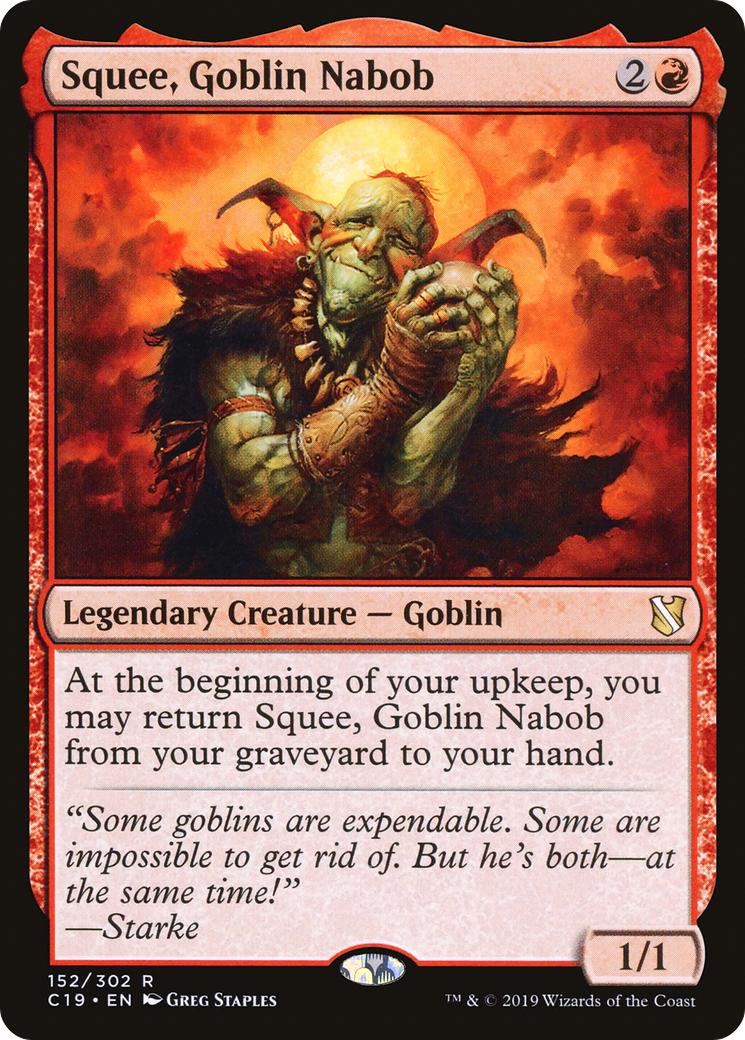
Squee, Goblin Nabob
Squee, Goblin Nabob
Legendary Creature — Goblin
1/1
At the beginning of your upkeep, you may return this card from your graveyard to your hand.
- If Squee isn't in your graveyard as your upkeep begins, its ability won't trigger. You can't take any actions during your turn before your upkeep begins.
-
1
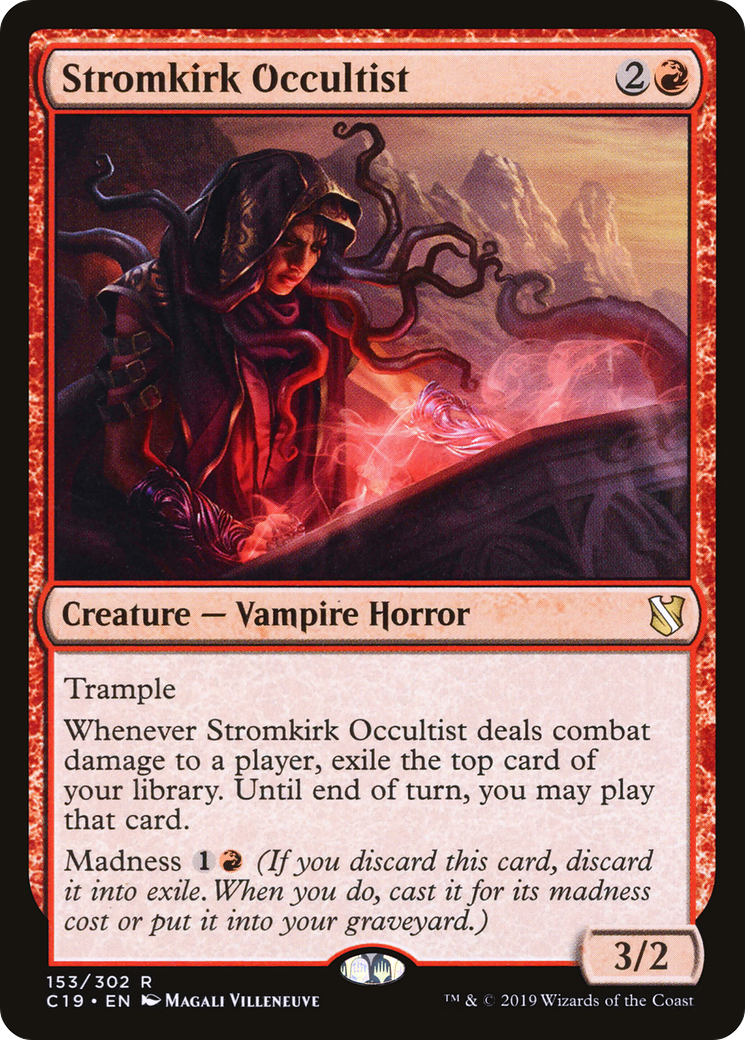
Stromkirk Occultist
Stromkirk Occultist
Creature — Vampire Horror
3/2
Trample
Whenever this creature deals combat damage to a player, exile the top card of your library. Until end of turn, you may play that card.
Madness (If you discard this card, discard it into exile. When you do, cast it for its madness cost or put it into your graveyard.)
- Cards are discarded in a Magic game only from a player's hand. Effects that put cards into a player's graveyard from anywhere else do not cause those cards to be discarded.
- Madness works independently of why you're discarding the card. You could discard it to pay a cost, because a spell or ability tells you to, or because you have too many cards in your hand during your cleanup step. You can't discard a card with madness just because you want to, though.
- A card with madness that's discarded counts as having been discarded even though it's put into exile rather than a graveyard. If it was discarded to pay a cost, that cost is still paid. Abilities that trigger when a card is discarded will still trigger.
- A spell cast for its madness cost is put onto the stack like any other spell. It can be countered, copied, and so on. As it resolves, it's put onto the battlefield if it's a permanent card or into its owner's graveyard if it's an instant or sorcery card.
- Casting a spell with madness ignores the timing rules based on the card's card type. For example, you can cast a sorcery with madness if you discard it during an opponent's turn.
- To determine the total cost of a spell, start with the mana cost or alternative cost (such as a madness cost) you're paying, add any cost increases, then apply any cost reductions. The mana value of the spell is determined by only its mana cost, no matter what the total cost to cast that spell was.
- If you choose not to cast a card with madness when the madness triggered ability resolves, it's put into your graveyard. Madness doesn't give you another chance to cast it later.
- If you discard a card with madness to pay the cost of a spell or activated ability, that card's madness triggered ability (and the spell that card becomes, if you choose to cast it) will resolve before the spell or ability the discard paid for.
- If you discard a card with madness while a spell or ability is resolving, it moves immediately to exile. Continue resolving that spell or ability, noting that the card you discarded is not in your graveyard at this time. Its madness triggered ability will be placed onto the stack once that spell or ability has completely resolved.
-
1
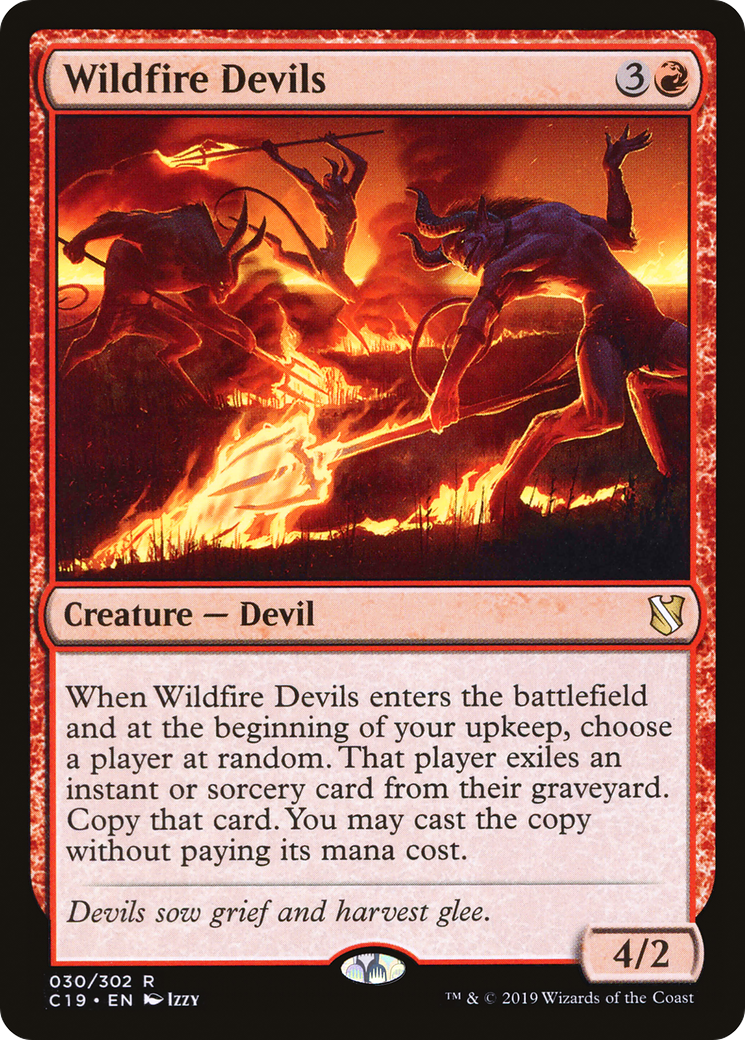
Wildfire Devils
Wildfire Devils
Creature — Devil
4/2
When this creature enters and at the beginning of your upkeep, choose a player at random. That player exiles an instant or sorcery card from their graveyard. Copy that card. You may cast the copy without paying its mana cost.
- You choose a player at random and they exile a card all while the triggered ability is resolving. No player may take any actions between the two or between exiling the card and you copying and casting it.
- The chosen player chooses which card to exile from their graveyard.
- If the chosen player has no instant or sorcery cards in their graveyard, Wildfire Devils’s ability does nothing. You don’t pick a different player.
- The copy of the card is created in exile and cast from exile, not from a graveyard.
- You can cast the copy only as the triggered ability resolves. If you don’t want to cast it at that time (or you can’t cast it, perhaps because there are no legal targets available), the copy ceases to exist. You can’t cast it later.
- You can cast the copy during the resolution of the triggered ability if it’s a sorcery, no matter whose turn it is or which phase it is.
- If a spell has in its mana cost, you must choose 0 as the value of X when casting it without paying its mana cost.
- If you cast a card “without paying its mana cost,” you can’t choose to cast it for any alternative costs. You can, however, pay additional costs. If the card has any mandatory additional costs, such as that of Momentous Fall, you must pay those to cast the card.
Instants 4
-
1
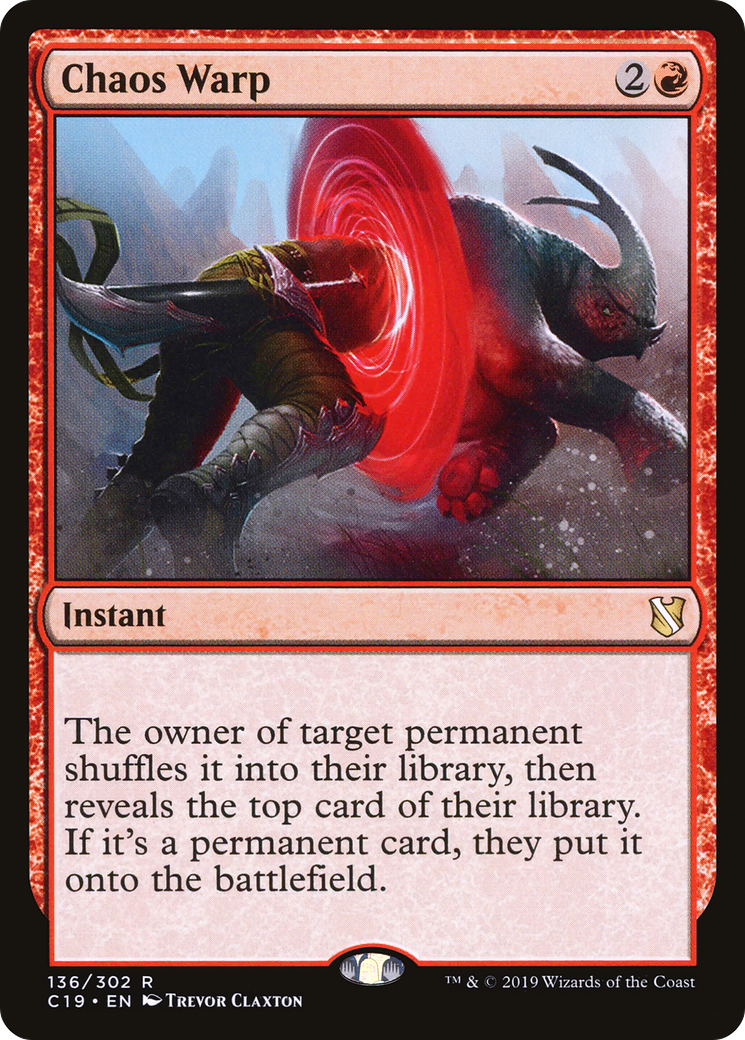
Chaos Warp
Chaos Warp
Instant
The owner of target permanent shuffles it into their library, then reveals the top card of their library. If it's a permanent card, they put it onto the battlefield.
- A permanent card is a card with one or more of the following card types: artifact, creature, enchantment, land, or planeswalker.
- The owner of a token is the player under whose control the token was put onto the battlefield. If a token is shuffled into a player's library this way, that player shuffles before revealing the top card of that library.
- If the revealed card is not a permanent card, it remains on top of that library.
- If the permanent is an illegal target by the time Chaos Warp tries to resolve, it won't resolve and none of its effects will occur. No library will be shuffled and no card will be revealed.
- If the revealed card is a permanent card but can't enter (perhaps because it's an Aura with nothing to enchant), it remains on top of that library.
-
1
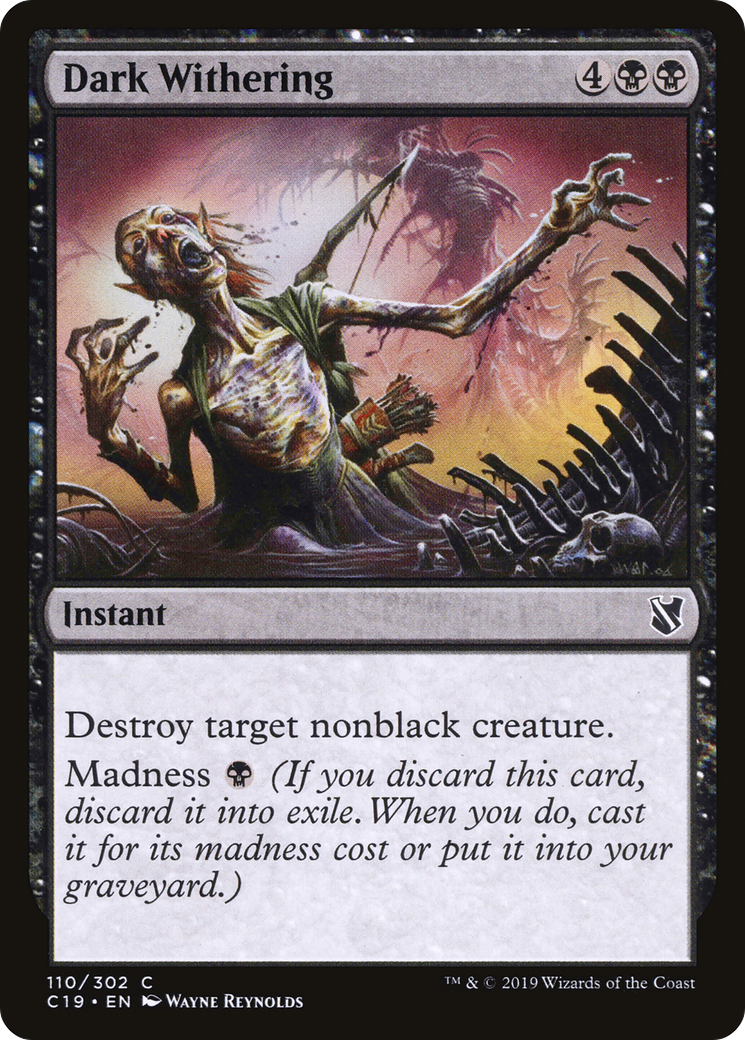
Dark Withering
Dark Withering
Instant
Destroy target nonblack creature.
Madness (If you discard this card, discard it into exile. When you do, cast it for its madness cost or put it into your graveyard.)
- Cards are discarded in a Magic game only from a player's hand. Effects that put cards into a player's graveyard from anywhere else do not cause those cards to be discarded.
- Madness works independently of why you're discarding the card. You could discard it to pay a cost, because a spell or ability tells you to, or because you have too many cards in your hand during your cleanup step. You can't discard a card with madness just because you want to, though.
- A card with madness that's discarded counts as having been discarded even though it's put into exile rather than a graveyard. If it was discarded to pay a cost, that cost is still paid. Abilities that trigger when a card is discarded will still trigger.
- A spell cast for its madness cost is put onto the stack like any other spell. It can be countered, copied, and so on. As it resolves, it's put onto the battlefield if it's a permanent card or into its owner's graveyard if it's an instant or sorcery card.
- Casting a spell with madness ignores the timing rules based on the card's card type. For example, you can cast a sorcery with madness if you discard it during an opponent's turn.
- To determine the total cost of a spell, start with the mana cost or alternative cost (such as a madness cost) you're paying, add any cost increases, then apply any cost reductions. The mana value of the spell is determined by only its mana cost, no matter what the total cost to cast that spell was.
- If you choose not to cast a card with madness when the madness triggered ability resolves, it's put into your graveyard. Madness doesn't give you another chance to cast it later.
- If you discard a card with madness to pay the cost of a spell or activated ability, that card's madness triggered ability (and the spell that card becomes, if you choose to cast it) will resolve before the spell or ability the discard paid for.
- If you discard a card with madness while a spell or ability is resolving, it moves immediately to exile. Continue resolving that spell or ability, noting that the card you discarded is not in your graveyard at this time. Its madness triggered ability will be placed onto the stack once that spell or ability has completely resolved.
-
1
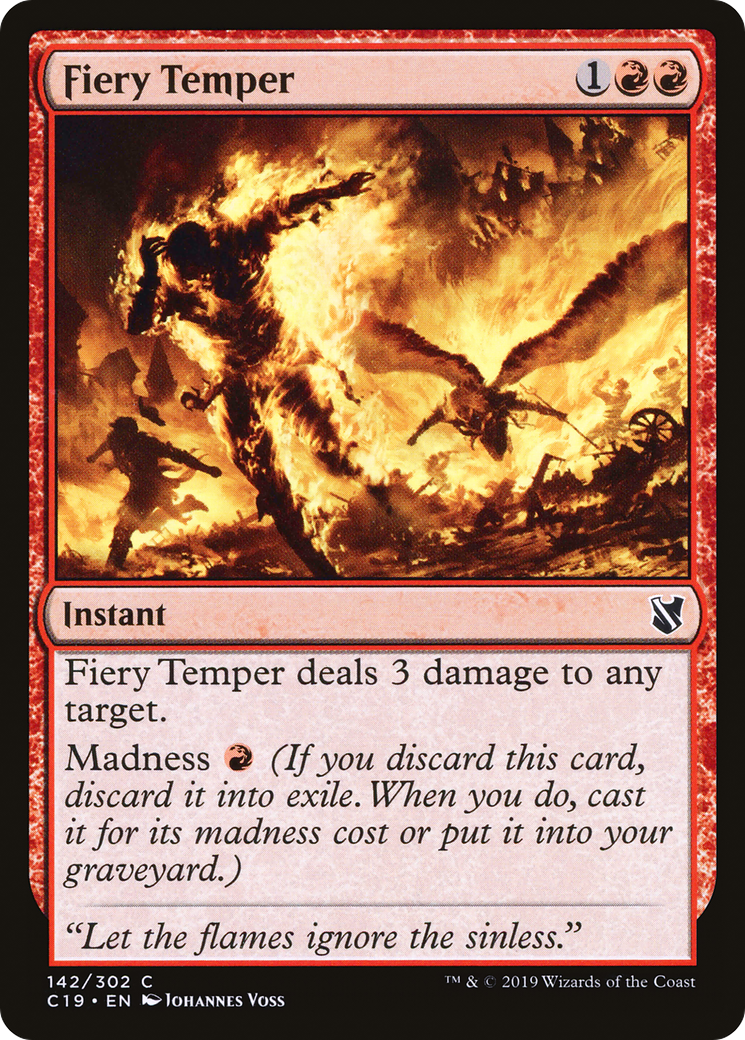
Fiery Temper
Fiery Temper
Instant
Fiery Temper deals 3 damage to any target.
Madness (If you discard this card, discard it into exile. When you do, cast it for its madness cost or put it into your graveyard.)
- Cards are discarded in a Magic game only from a player's hand. Effects that put cards into a player's graveyard from anywhere else do not cause those cards to be discarded.
- Madness works independently of why you're discarding the card. You could discard it to pay a cost, because a spell or ability tells you to, or because you have too many cards in your hand during your cleanup step. You can't discard a card with madness just because you want to, though.
- A card with madness that's discarded counts as having been discarded even though it's put into exile rather than a graveyard. If it was discarded to pay a cost, that cost is still paid. Abilities that trigger when a card is discarded will still trigger.
- A spell cast for its madness cost is put onto the stack like any other spell. It can be countered, copied, and so on. As it resolves, it's put onto the battlefield if it's a permanent card or into its owner's graveyard if it's an instant or sorcery card.
- Casting a spell with madness ignores the timing rules based on the card's card type. For example, you can cast a sorcery with madness if you discard it during an opponent's turn.
- To determine the total cost of a spell, start with the mana cost or alternative cost (such as a madness cost) you're paying, add any cost increases, then apply any cost reductions. The mana value of the spell is determined by only its mana cost, no matter what the total cost to cast that spell was.
- If you choose not to cast a card with madness when the madness triggered ability resolves, it's put into your graveyard. Madness doesn't give you another chance to cast it later.
- If you discard a card with madness to pay the cost of a spell or activated ability, that card's madness triggered ability (and the spell that card becomes, if you choose to cast it) will resolve before the spell or ability the discard paid for.
- If you discard a card with madness while a spell or ability is resolving, it moves immediately to exile. Continue resolving that spell or ability, noting that the card you discarded is not in your graveyard at this time. Its madness triggered ability will be placed onto the stack once that spell or ability has completely resolved.
-
1
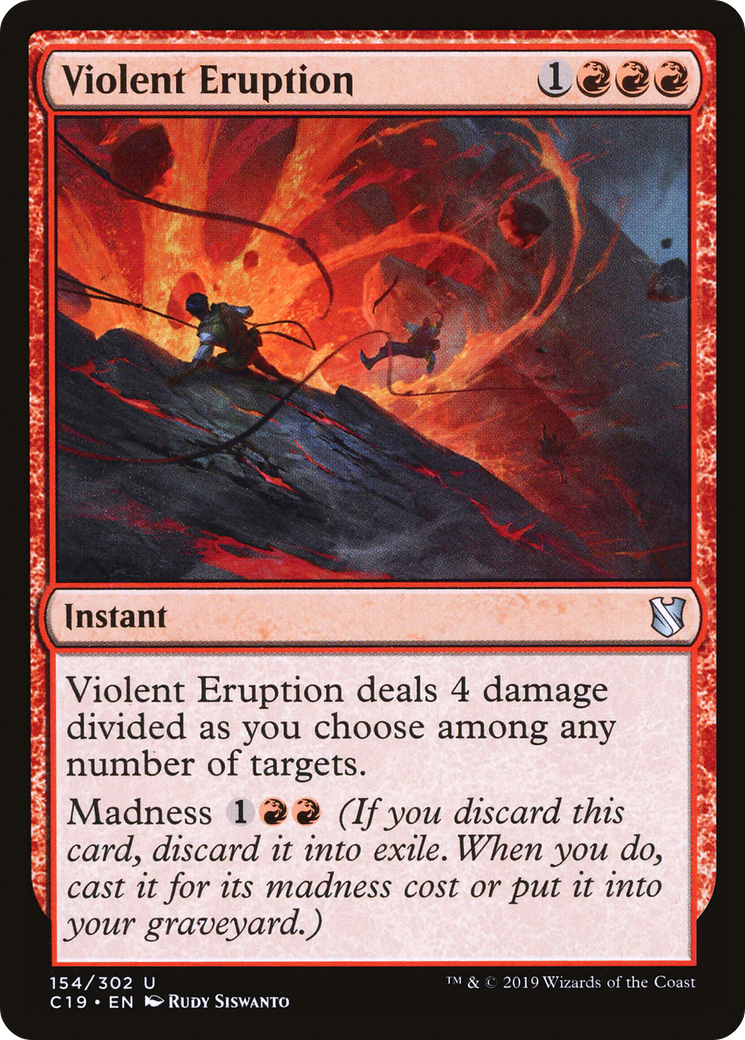
Violent Eruption
Violent Eruption
Instant
Violent Eruption deals 4 damage divided as you choose among any number of targets.
Madness (If you discard this card, discard it into exile. When you do, cast it for its madness cost or put it into your graveyard.)
- Cards are discarded in a Magic game only from a player's hand. Effects that put cards into a player's graveyard from anywhere else do not cause those cards to be discarded.
- Madness works independently of why you're discarding the card. You could discard it to pay a cost, because a spell or ability tells you to, or because you have too many cards in your hand during your cleanup step. You can't discard a card with madness just because you want to, though.
- A card with madness that's discarded counts as having been discarded even though it's put into exile rather than a graveyard. If it was discarded to pay a cost, that cost is still paid. Abilities that trigger when a card is discarded will still trigger.
- A spell cast for its madness cost is put onto the stack like any other spell. It can be countered, copied, and so on. As it resolves, it's put onto the battlefield if it's a permanent card or into its owner's graveyard if it's an instant or sorcery card.
- Casting a spell with madness ignores the timing rules based on the card's card type. For example, you can cast a sorcery with madness if you discard it during an opponent's turn.
- To determine the total cost of a spell, start with the mana cost or alternative cost (such as a madness cost) you're paying, add any cost increases, then apply any cost reductions. The mana value of the spell is determined by only its mana cost, no matter what the total cost to cast that spell was.
- If you choose not to cast a card with madness when the madness triggered ability resolves, it's put into your graveyard. Madness doesn't give you another chance to cast it later.
- If you discard a card with madness to pay the cost of a spell or activated ability, that card's madness triggered ability (and the spell that card becomes, if you choose to cast it) will resolve before the spell or ability the discard paid for.
- If you discard a card with madness while a spell or ability is resolving, it moves immediately to exile. Continue resolving that spell or ability, noting that the card you discarded is not in your graveyard at this time. Its madness triggered ability will be placed onto the stack once that spell or ability has completely resolved.
Sorceries 12
-
1
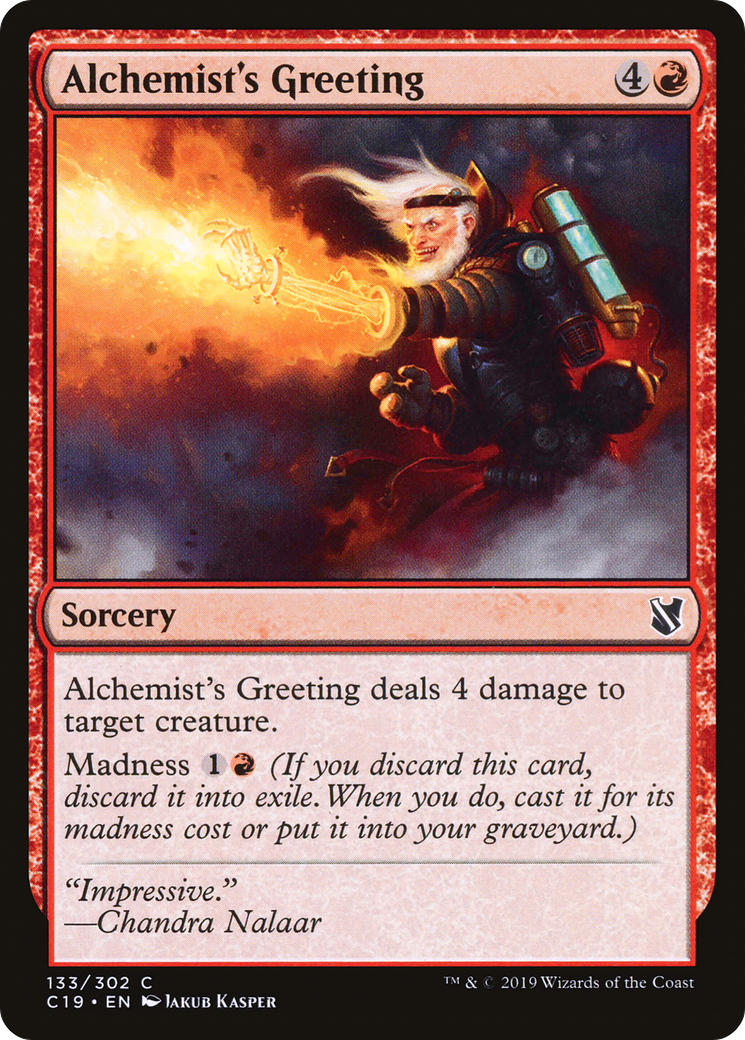
Alchemist's Greeting
Alchemist's Greeting
Sorcery
Alchemist's Greeting deals 4 damage to target creature.
Madness (If you discard this card, discard it into exile. When you do, cast it for its madness cost or put it into your graveyard.)
- Cards are discarded in a Magic game only from a player's hand. Effects that put cards into a player's graveyard from anywhere else do not cause those cards to be discarded.
- Madness works independently of why you're discarding the card. You could discard it to pay a cost, because a spell or ability tells you to, or because you have too many cards in your hand during your cleanup step. You can't discard a card with madness just because you want to, though.
- A card with madness that's discarded counts as having been discarded even though it's put into exile rather than a graveyard. If it was discarded to pay a cost, that cost is still paid. Abilities that trigger when a card is discarded will still trigger.
- A spell cast for its madness cost is put onto the stack like any other spell. It can be countered, copied, and so on. As it resolves, it's put onto the battlefield if it's a permanent card or into its owner's graveyard if it's an instant or sorcery card.
- Casting a spell with madness ignores the timing rules based on the card's card type. For example, you can cast a sorcery with madness if you discard it during an opponent's turn.
- To determine the total cost of a spell, start with the mana cost or alternative cost (such as a madness cost) you're paying, add any cost increases, then apply any cost reductions. The mana value of the spell is determined by only its mana cost, no matter what the total cost to cast that spell was.
- If you choose not to cast a card with madness when the madness triggered ability resolves, it's put into your graveyard. Madness doesn't give you another chance to cast it later.
- If you discard a card with madness to pay the cost of a spell or activated ability, that card's madness triggered ability (and the spell that card becomes, if you choose to cast it) will resolve before the spell or ability the discard paid for.
- If you discard a card with madness while a spell or ability is resolving, it moves immediately to exile. Continue resolving that spell or ability, noting that the card you discarded is not in your graveyard at this time. Its madness triggered ability will be placed onto the stack once that spell or ability has completely resolved.
-
1
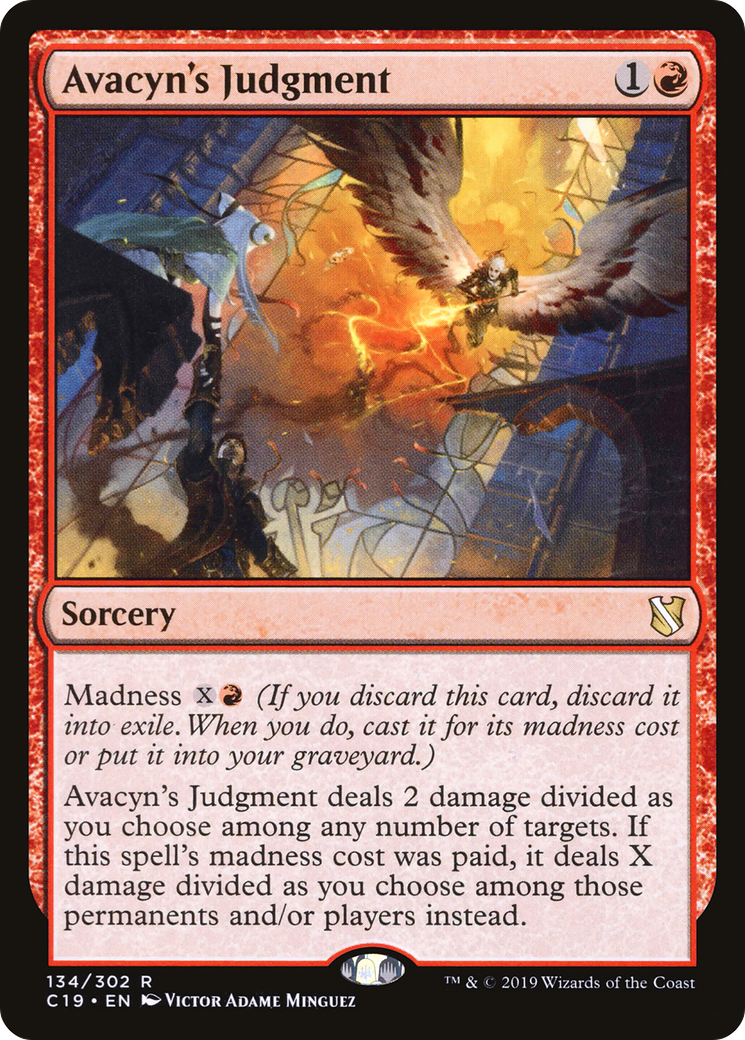
Avacyn's Judgment
Avacyn's Judgment
Sorcery
Madness (If you discard this card, discard it into exile. When you do, cast it for its madness cost or put it into your graveyard.)
Avacyn's Judgment deals 2 damage divided as you choose among any number of targets. If this spell's madness cost was paid, it deals X damage divided as you choose among those permanents and/or players instead.
- If you discard a card with madness while a spell or ability is resolving, it moves immediately to exile. Continue resolving that spell or ability, noting that the card you discarded is not in your graveyard at this time. Its madness triggered ability will be placed onto the stack once that spell or ability has completely resolved.
- If you choose not to cast a card with madness when the madness triggered ability resolves, it's put into your graveyard. Madness doesn't give you another chance to cast it later.
- If you discard a card with madness to pay the cost of a spell or activated ability, that card's madness triggered ability (and the spell that card becomes, if you choose to cast it) will resolve before the spell or ability the discard paid for.
- Cards are discarded in a Magic game only from a player's hand. Effects that put cards into a player's graveyard from anywhere else do not cause those cards to be discarded.
- Madness works independently of why you're discarding the card. You could discard it to pay a cost, because a spell or ability tells you to, or because you have too many cards in your hand during your cleanup step. You can't discard a card with madness just because you want to, though.
- A card with madness that's discarded counts as having been discarded even though it's put into exile rather than a graveyard. If it was discarded to pay a cost, that cost is still paid. Abilities that trigger when a card is discarded will still trigger.
- A spell cast for its madness cost is put onto the stack like any other spell. It can be countered, copied, and so on. As it resolves, it's put onto the battlefield if it's a permanent card or into its owner's graveyard if it's an instant or sorcery card.
- Casting a spell with madness ignores the timing rules based on the card's card type. For example, you can cast a sorcery with madness if you discard it during an opponent's turn.
- To determine the total cost of a spell, start with the mana cost or alternative cost (such as a madness cost) you're paying, add any cost increases, then apply any cost reductions. The mana value of the spell is determined by only its mana cost, no matter what the total cost to cast that spell was.
- If Avacyn's Judgment has multiple targets, and some but not all of them are illegal targets when Avacyn's Judgment resolves, Avacyn's Judgment will still deal damage to the remaining legal targets according to the original damage division.
- You announce how the damage will be divided as part of casting Avacyn's Judgment. Each chosen target must receive at least 1 damage.
-
1
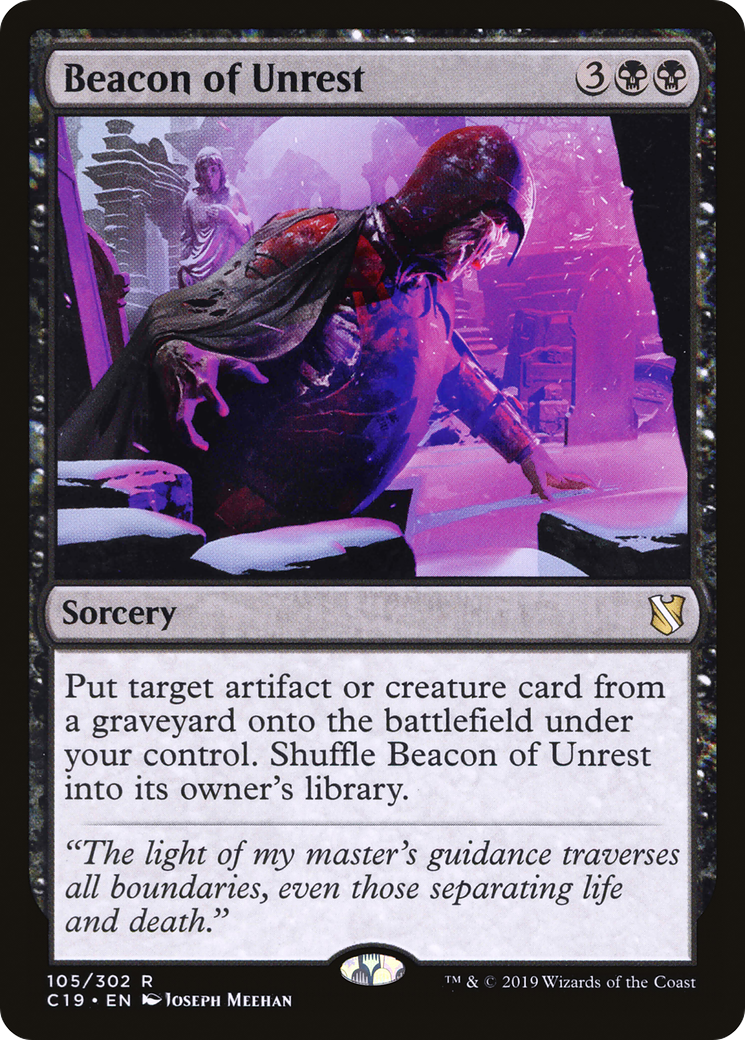
Beacon of Unrest
Beacon of Unrest
Sorcery
Put target artifact or creature card from a graveyard onto the battlefield under your control. Shuffle Beacon of Unrest into its owner's library.
- If the target card is an illegal target by the time Beacon of Unrest tries to resolve, the spell won't resolve. You won't shuffle it into your library.
- In a multiplayer game, if a player leaves the game, all cards that player owns leave as well. If you leave the game, the permanent you control from Beacon of Unrest is exiled.
-
1
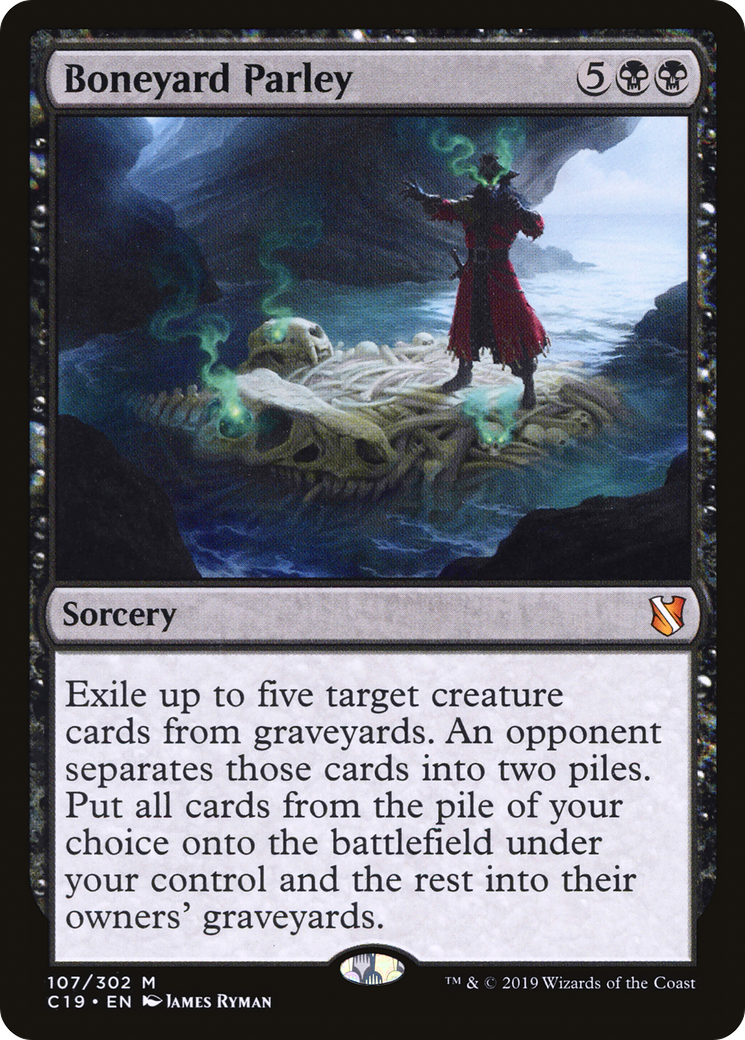
Boneyard Parley
Boneyard Parley
Sorcery
Exile up to five target creature cards from graveyards. An opponent separates those cards into two piles. Put all cards from the pile of your choice onto the battlefield under your control and the rest into their owners' graveyards.
- The creature cards may come from different graveyards.
- You (not your opponent) choose which pile to put onto the battlefield and which to return to graveyards.
- A pile can have no cards in it. In this case, you’ll choose whether to put all the exiled cards onto the battlefield or into graveyards.
- In multiplayer games, you choose an opponent to separate the cards when the ability resolves. This doesn’t target that opponent. Because the cards are revealed, all players may see the cards and offer opinions.
- In a multiplayer game, if a player leaves the game, all cards that player owns leave as well. If you leave the game, any creatures you control from Boneyard Parley’s effect are exiled.
-
1
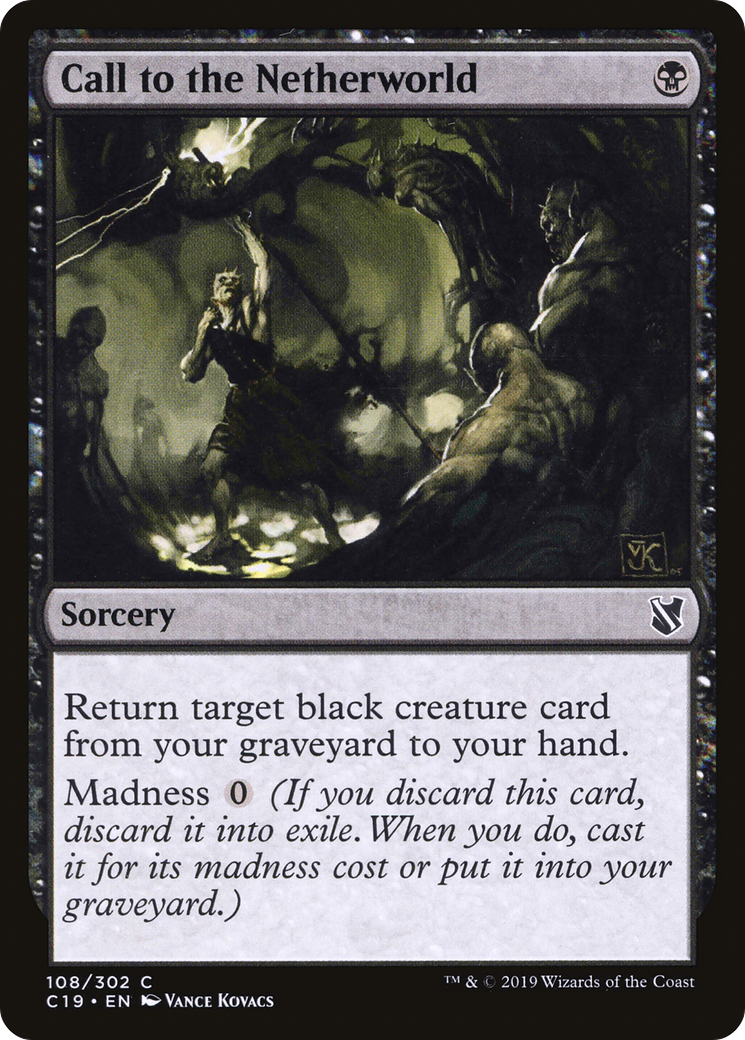
Call to the Netherworld
Call to the Netherworld
Sorcery
Return target black creature card from your graveyard to your hand.
Madness (If you discard this card, discard it into exile. When you do, cast it for its madness cost or put it into your graveyard.)
- Cards are discarded in a Magic game only from a player's hand. Effects that put cards into a player's graveyard from anywhere else do not cause those cards to be discarded.
- Madness works independently of why you're discarding the card. You could discard it to pay a cost, because a spell or ability tells you to, or because you have too many cards in your hand during your cleanup step. You can't discard a card with madness just because you want to, though.
- A card with madness that's discarded counts as having been discarded even though it's put into exile rather than a graveyard. If it was discarded to pay a cost, that cost is still paid. Abilities that trigger when a card is discarded will still trigger.
- A spell cast for its madness cost is put onto the stack like any other spell. It can be countered, copied, and so on. As it resolves, it's put onto the battlefield if it's a permanent card or into its owner's graveyard if it's an instant or sorcery card.
- Casting a spell with madness ignores the timing rules based on the card's card type. For example, you can cast a sorcery with madness if you discard it during an opponent's turn.
- To determine the total cost of a spell, start with the mana cost or alternative cost (such as a madness cost) you're paying, add any cost increases, then apply any cost reductions. The mana value of the spell is determined by only its mana cost, no matter what the total cost to cast that spell was.
- If you choose not to cast a card with madness when the madness triggered ability resolves, it's put into your graveyard. Madness doesn't give you another chance to cast it later.
- If you discard a card with madness to pay the cost of a spell or activated ability, that card's madness triggered ability (and the spell that card becomes, if you choose to cast it) will resolve before the spell or ability the discard paid for.
- If you discard a card with madness while a spell or ability is resolving, it moves immediately to exile. Continue resolving that spell or ability, noting that the card you discarded is not in your graveyard at this time. Its madness triggered ability will be placed onto the stack once that spell or ability has completely resolved.
-
1
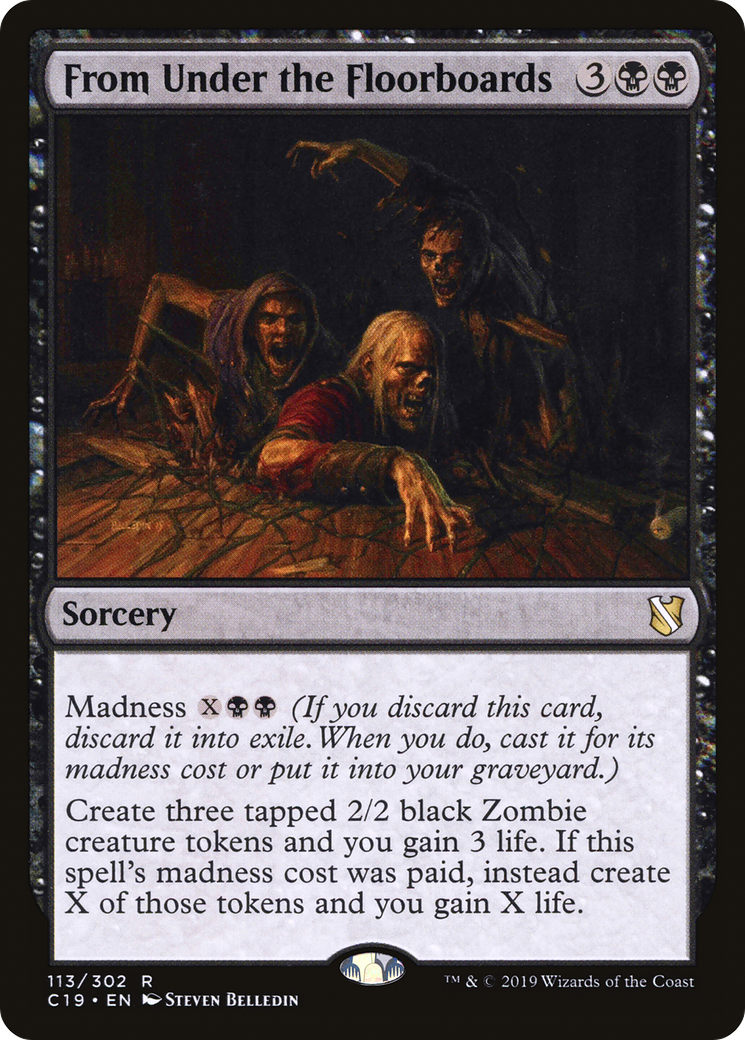
From Under the Floorboards
From Under the Floorboards
Sorcery
Madness (If you discard this card, discard it into exile. When you do, cast it for its madness cost or put it into your graveyard.)
Create three tapped 2/2 black Zombie creature tokens and you gain 3 life. If this spell's madness cost was paid, instead create X of those tokens and you gain X life.
- Cards are discarded in a Magic game only from a player's hand. Effects that put cards into a player's graveyard from anywhere else do not cause those cards to be discarded.
- Madness works independently of why you're discarding the card. You could discard it to pay a cost, because a spell or ability tells you to, or because you have too many cards in your hand during your cleanup step. You can't discard a card with madness just because you want to, though.
- A card with madness that's discarded counts as having been discarded even though it's put into exile rather than a graveyard. If it was discarded to pay a cost, that cost is still paid. Abilities that trigger when a card is discarded will still trigger.
- A spell cast for its madness cost is put onto the stack like any other spell. It can be countered, copied, and so on. As it resolves, it's put onto the battlefield if it's a permanent card or into its owner's graveyard if it's an instant or sorcery card.
- Casting a spell with madness ignores the timing rules based on the card's card type. For example, you can cast a sorcery with madness if you discard it during an opponent's turn.
- To determine the total cost of a spell, start with the mana cost or alternative cost (such as a madness cost) you're paying, add any cost increases, then apply any cost reductions. The mana value of the spell is determined by only its mana cost, no matter what the total cost to cast that spell was.
- If you choose not to cast a card with madness when the madness triggered ability resolves, it's put into your graveyard. Madness doesn't give you another chance to cast it later.
- If you discard a card with madness to pay the cost of a spell or activated ability, that card's madness triggered ability (and the spell that card becomes, if you choose to cast it) will resolve before the spell or ability the discard paid for.
- If you discard a card with madness while a spell or ability is resolving, it moves immediately to exile. Continue resolving that spell or ability, noting that the card you discarded is not in your graveyard at this time. Its madness triggered ability will be placed onto the stack once that spell or ability has completely resolved.
-
1
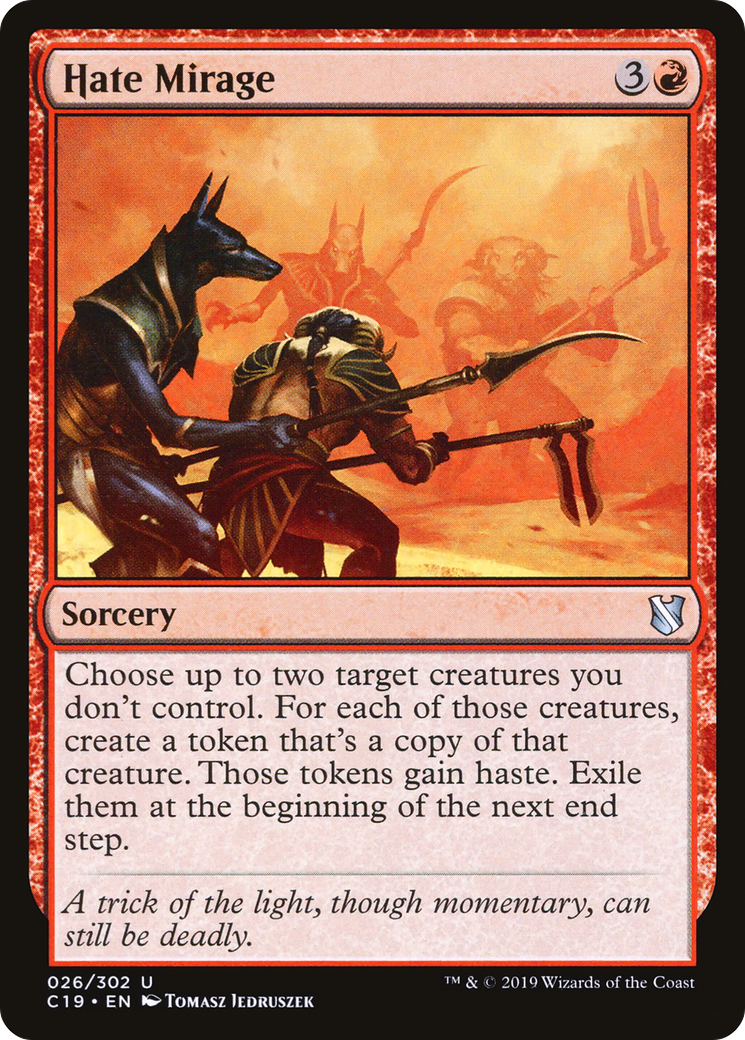
Hate Mirage
Hate Mirage
Sorcery
Choose up to two target creatures you don't control. For each of those creatures, create a token that's a copy of that creature. Those tokens gain haste. Exile them at the beginning of the next end step.
- If one of the two target creatures become illegal, you create one token that's a copy of the one that's still a legal target. You don't create two tokens.
- Each token copies exactly what was printed on the original creature and nothing else (unless that creature is copying something else or is a token; see below). It doesn't copy whether that creature is tapped or untapped, whether it has any counters on it or Auras and Equipment attached to it, or any non-copy effects that have changed its power, toughness, types, color, or so on.
- Each token gains haste after it has been created. If something copies one of these tokens, the copy won't have haste, and you won't exile it at the beginning of the next end step.
- If the copied creature has in its mana cost, X is considered to be 0.
- If the copied creature is a token, the token that's created copies the original characteristics of that token as stated by the effect that created the token.
- If the copied creature is copying something else (for example, if Volrath, the Shapestealer is having its own shape stolen by Hate Mirage), then the token enters the battlefield as whatever that creature copied.
- Any enters-the-battlefield abilities of the copied creature will trigger when the token enters the battlefield. Any “as [this creature] enters the battlefield” or “[this creature] enters the battlefield with” abilities of the creature will also work.
-
1
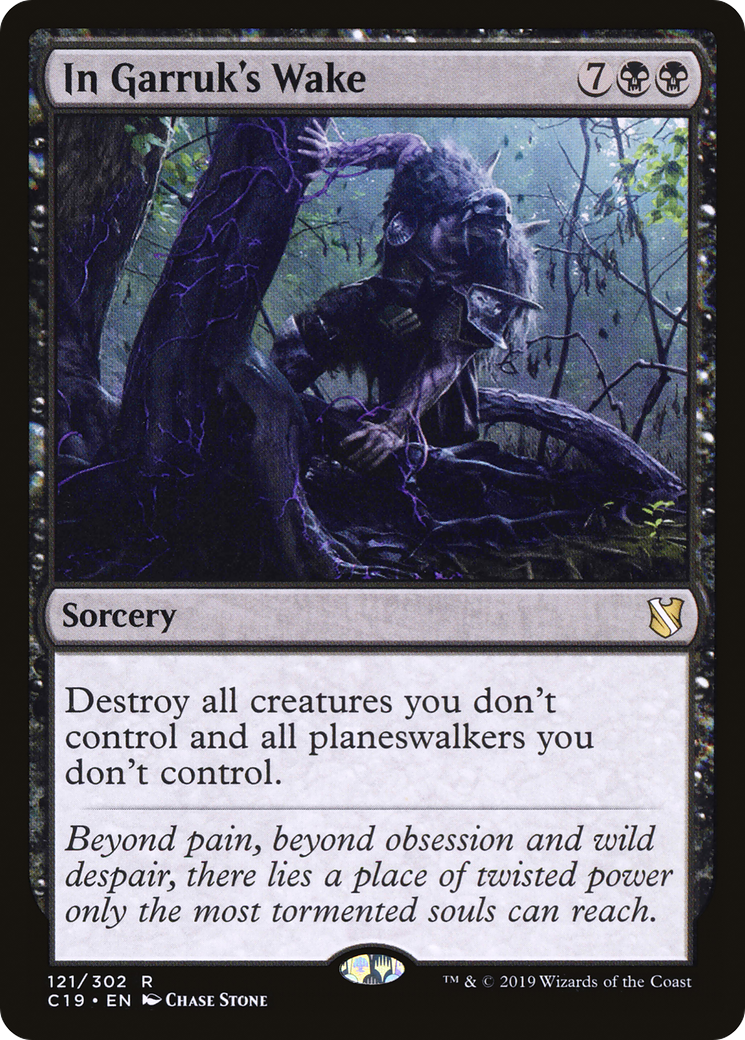
In Garruk's Wake
In Garruk's Wake
Sorcery
Destroy all creatures you don't control and all planeswalkers you don't control.
-
1
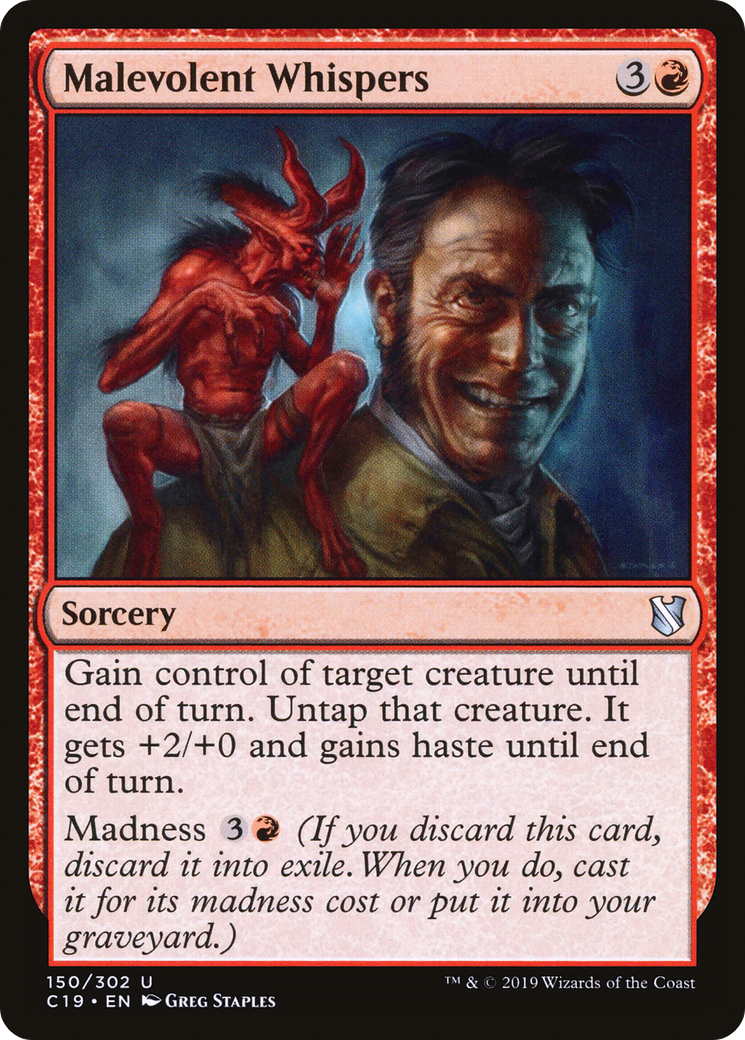
Malevolent Whispers
Malevolent Whispers
Sorcery
Gain control of target creature until end of turn. Untap that creature. It gets +2/+0 and gains haste until end of turn.
Madness (If you discard this card, discard it into exile. When you do, cast it for its madness cost or put it into your graveyard.)
- If you discard a card with madness while a spell or ability is resolving, it moves immediately to exile. Continue resolving that spell or ability, noting that the card you discarded is not in your graveyard at this time. Its madness triggered ability will be placed onto the stack once that spell or ability has completely resolved.
- If you choose not to cast a card with madness when the madness triggered ability resolves, it's put into your graveyard. Madness doesn't give you another chance to cast it later.
- If you discard a card with madness to pay the cost of a spell or activated ability, that card's madness triggered ability (and the spell that card becomes, if you choose to cast it) will resolve before the spell or ability the discard paid for.
- Cards are discarded in a Magic game only from a player's hand. Effects that put cards into a player's graveyard from anywhere else do not cause those cards to be discarded.
- Madness works independently of why you're discarding the card. You could discard it to pay a cost, because a spell or ability tells you to, or because you have too many cards in your hand during your cleanup step. You can't discard a card with madness just because you want to, though.
- A card with madness that's discarded counts as having been discarded even though it's put into exile rather than a graveyard. If it was discarded to pay a cost, that cost is still paid. Abilities that trigger when a card is discarded will still trigger.
- A spell cast for its madness cost is put onto the stack like any other spell. It can be countered, copied, and so on. As it resolves, it's put onto the battlefield if it's a permanent card or into its owner's graveyard if it's an instant or sorcery card.
- Casting a spell with madness ignores the timing rules based on the card's card type. For example, you can cast a sorcery with madness if you discard it during an opponent's turn.
- To determine the total cost of a spell, start with the mana cost or alternative cost (such as a madness cost) you're paying, add any cost increases, then apply any cost reductions. The mana value of the spell is determined by only its mana cost, no matter what the total cost to cast that spell was.
- Gaining control of a creature doesn't cause you to gain control of any Auras or Equipment attached to it, even though those remain attached to it.
- Malevolent Whispers can target any creature, even one that's untapped or one you already control.
-
1
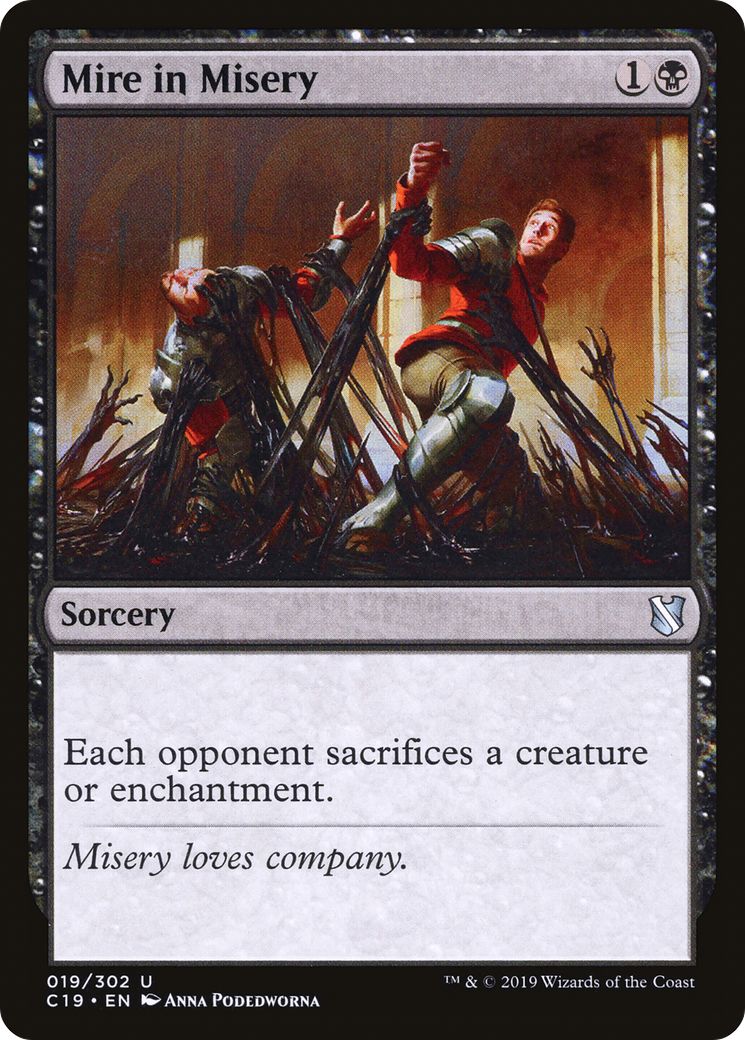
Mire in Misery
Mire in Misery
Sorcery
Each opponent sacrifices a creature or enchantment of their choice.
- As Mire in Misery resolves, first the next opponent in turn order (or, if it’s an opponent’s turn, the opponent whose turn it is) chooses a creature or an enchantment they control, then each other opponent in turn order does the same, knowing the choices made before them. Then all the chosen permanents are sacrificed at the same time.
- Your opponents choose what to sacrifice from among the creatures and enchantments they control. This means that you don’t decide which type of permanent a player sacrifices, and a player can’t choose to sacrifice an enchantment if they control none.
-
1
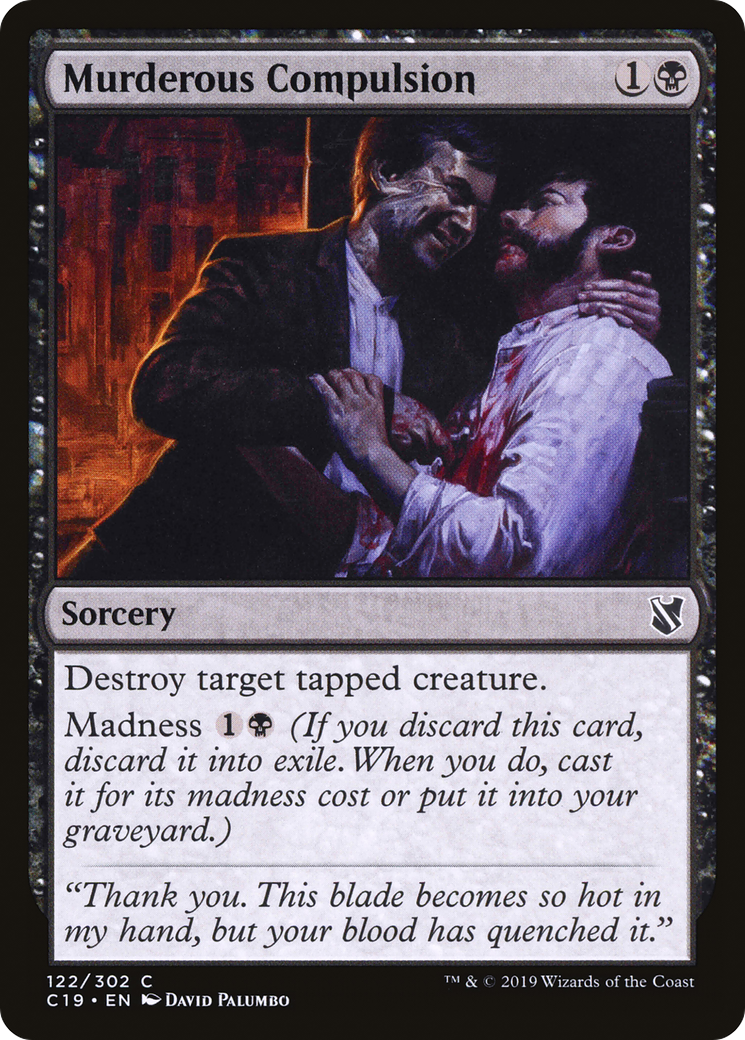
Murderous Compulsion
Murderous Compulsion
Sorcery
Destroy target tapped creature.
Madness (If you discard this card, discard it into exile. When you do, cast it for its madness cost or put it into your graveyard.)
- Cards are discarded in a Magic game only from a player's hand. Effects that put cards into a player's graveyard from anywhere else do not cause those cards to be discarded.
- Madness works independently of why you're discarding the card. You could discard it to pay a cost, because a spell or ability tells you to, or because you have too many cards in your hand during your cleanup step. You can't discard a card with madness just because you want to, though.
- A card with madness that's discarded counts as having been discarded even though it's put into exile rather than a graveyard. If it was discarded to pay a cost, that cost is still paid. Abilities that trigger when a card is discarded will still trigger.
- A spell cast for its madness cost is put onto the stack like any other spell. It can be countered, copied, and so on. As it resolves, it's put onto the battlefield if it's a permanent card or into its owner's graveyard if it's an instant or sorcery card.
- Casting a spell with madness ignores the timing rules based on the card's card type. For example, you can cast a sorcery with madness if you discard it during an opponent's turn.
- To determine the total cost of a spell, start with the mana cost or alternative cost (such as a madness cost) you're paying, add any cost increases, then apply any cost reductions. The mana value of the spell is determined by only its mana cost, no matter what the total cost to cast that spell was.
- If you choose not to cast a card with madness when the madness triggered ability resolves, it's put into your graveyard. Madness doesn't give you another chance to cast it later.
- If you discard a card with madness to pay the cost of a spell or activated ability, that card's madness triggered ability (and the spell that card becomes, if you choose to cast it) will resolve before the spell or ability the discard paid for.
- If you discard a card with madness while a spell or ability is resolving, it moves immediately to exile. Continue resolving that spell or ability, noting that the card you discarded is not in your graveyard at this time. Its madness triggered ability will be placed onto the stack once that spell or ability has completely resolved.
-
1
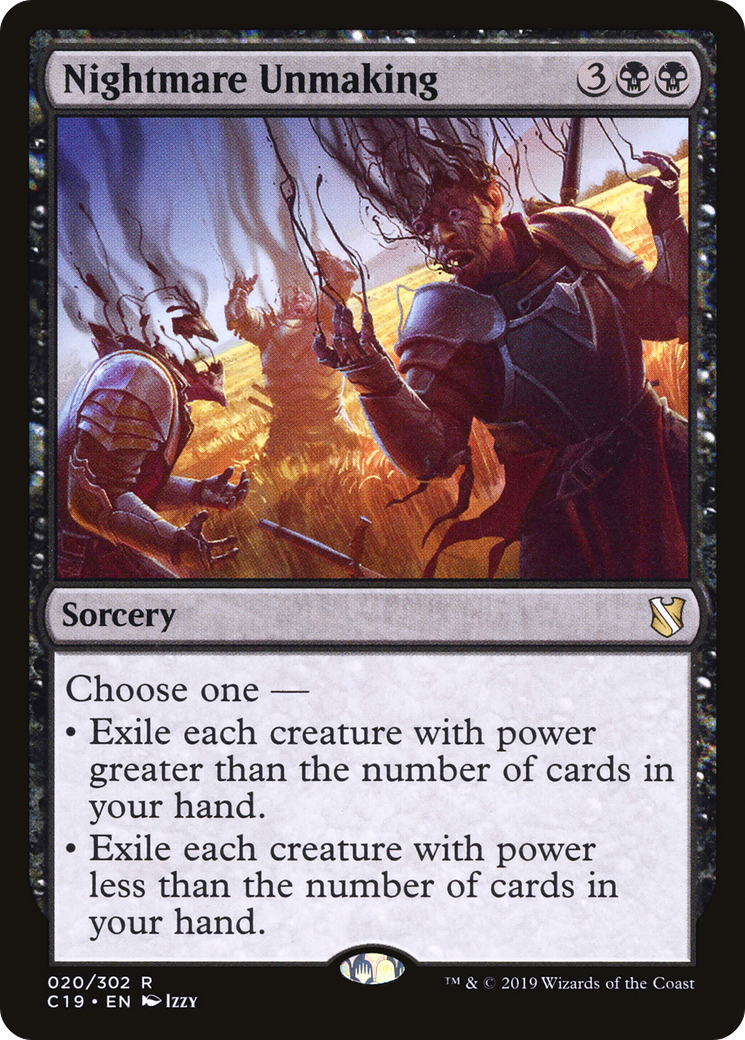
Nightmare Unmaking
Nightmare Unmaking
Sorcery
Choose one —
- Exile each creature with power greater than the number of cards in your hand.
- Exile each creature with power less than the number of cards in your hand.
- Because Nightmare Unmaking is on the stack while it's resolving, it won't be counted among the cards in your hand.
- The power of creatures and the number of cards in your hand are checked only as Nightmare Unmaking resolves. Players may respond to the spell knowing the chosen mode to try to save or doom a creature.
Artifacts 8
-
1
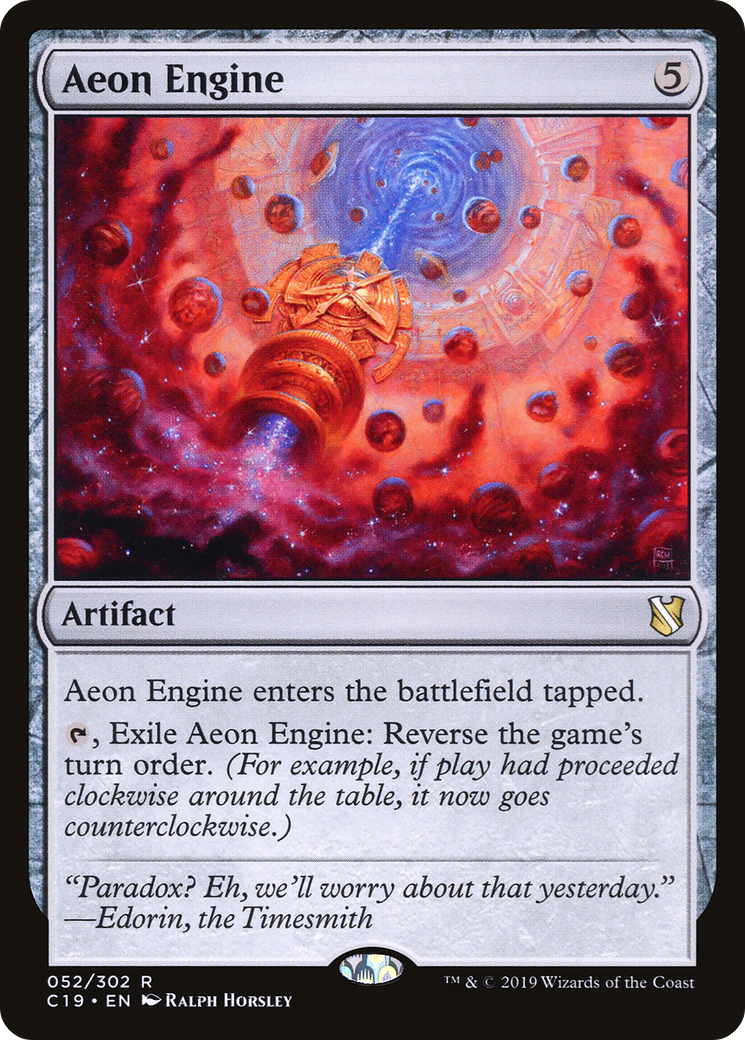
Aeon Engine
Aeon Engine
Artifact
This artifact enters tapped.
, Exile this artifact: Reverse the game's turn order. (For example, if play had proceeded clockwise around the table, it now goes counterclockwise.)
- This effect reverses the turn order for players established at the beginning of the game. While the order is reversed, anything that cares about this order (such as determining in what order choices are made) will use the new order.
- If the game’s turn order is reversed again, it will return to the default order used at the beginning of the game.
- If the turn order is reversed during an extra turn, the next non-extra turn will be taken by the next player in turn order from the last player who took a non-extra turn. The order of any pending extra turns isn’t affected.
- If the turn order is reversed during a two-player game, or during a multiplayer game that only has two players left, it has no noticeable effect on the game.
-
1
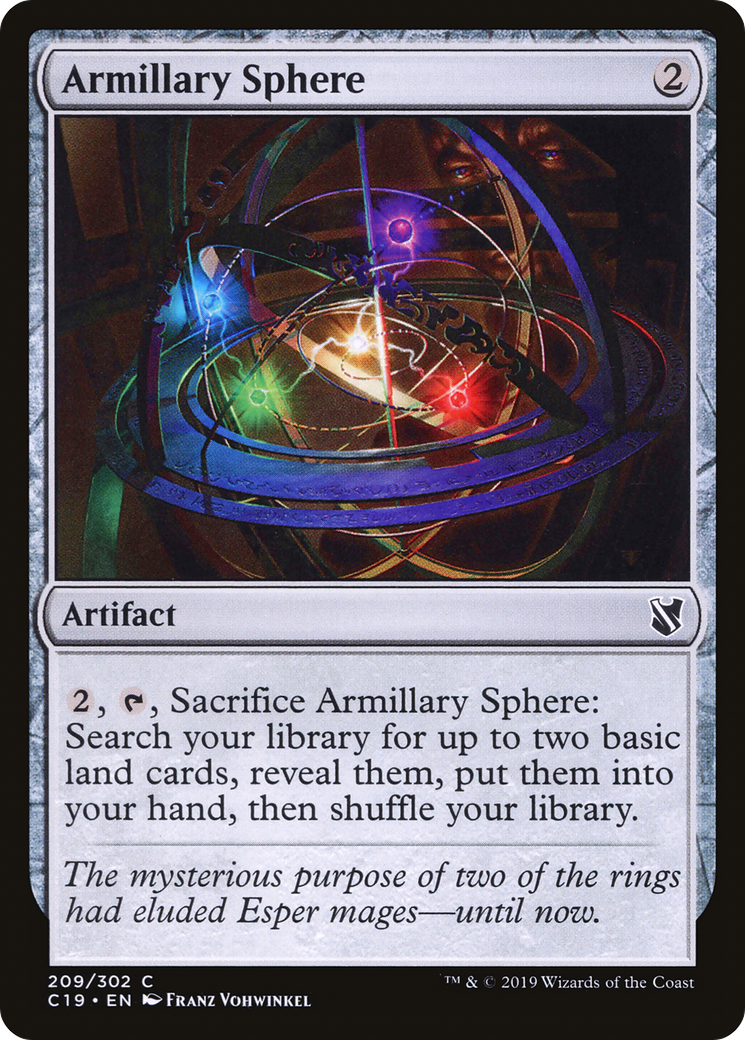
Armillary Sphere
Armillary Sphere
Artifact
, , Sacrifice this artifact: Search your library for up to two basic land cards, reveal them, put them into your hand, then shuffle.
-
1
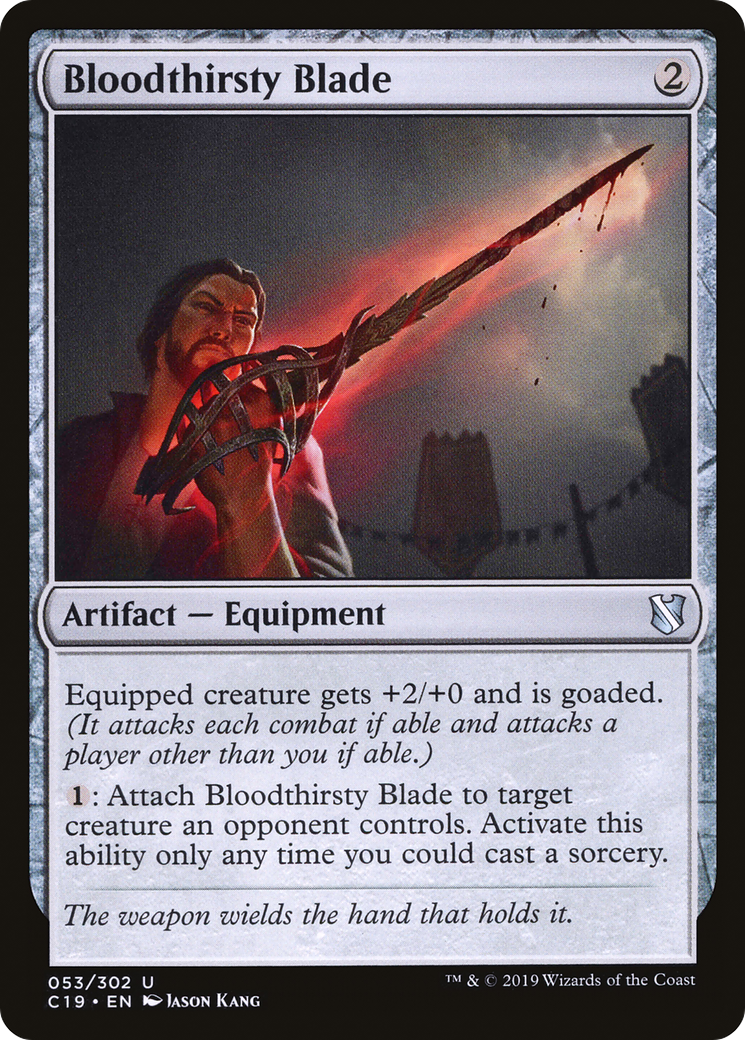
Bloodthirsty Blade
Bloodthirsty Blade
Artifact — Equipment
Equipped creature gets +2/+0 and is goaded. (It attacks each combat if able and attacks a player other than you if able.)
: Attach this Equipment to target creature an opponent controls. Activate only as a sorcery.
- If the creature doesn't meet any of the above exceptions and can attack, it must attack a player other than the controller of the spell or ability that goaded it if able. If the creature can't attack any of those players but could otherwise attack, it must attack a planeswalker an opponent controls, a battle an opponent controls, or a player who goaded it.
- Attacking with a goaded creature doesn't cause it to stop being goaded. If there is an additional combat phase that turn, or if another player gains control of it before it stops being goaded, it must attack again if able.
- If a creature you control has been goaded by multiple opponents, it must attack one of your opponents that hasn't goaded it, as that fulfills the maximum number of goad requirements. If a creature you control has been goaded by each of your opponents, the creature must attack an opponent (rather than a planeswalker or battle), but you choose which opponent it attacks.
- If, during a player's declare attackers step, a creature that player controls that's been goaded is tapped, is affected by a spell or ability that says it can't attack, or hasn't been under that player's control continuously since the turn began (and doesn't have haste), then it doesn't attack. If there's a cost associated with having a creature attack a player, its controller isn't forced to pay that cost, so it doesn't have to attack that player.
- Being goaded isn't an ability the creature has. Once it's been goaded, it must attack as detailed above even if it loses all abilities.
- You still control Bloodthirsty Blade while it's equipped to an opponent's creature. You can move it any time you could cast a sorcery; the equipped creature's controller can't.
- Bloodthirsty Blade has no equip ability. There's normally no way to have it attached to your own creature, although certain combinations of other cards make this possible.
-
1
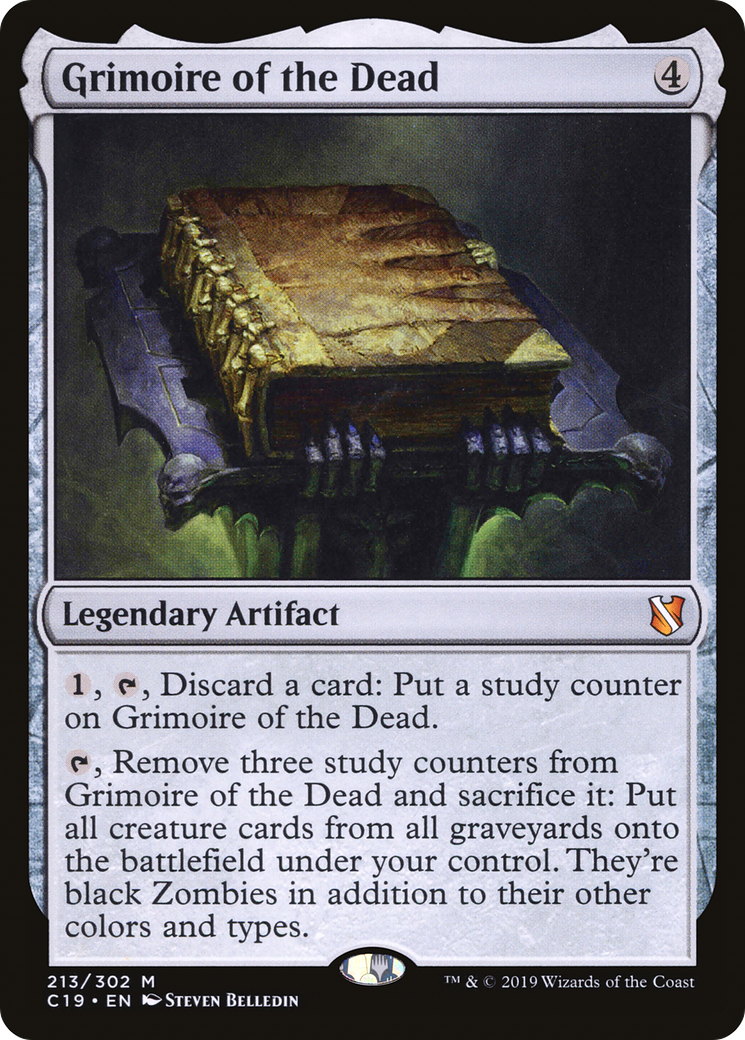
Grimoire of the Dead
Grimoire of the Dead
Legendary Artifact
, , Discard a card: Put a study counter on Grimoire of the Dead.
, Remove three study counters from Grimoire of the Dead and sacrifice it: Put all creature cards from all graveyards onto the battlefield under your control. They're black Zombies in addition to their other colors and types.
- “Creature cards” includes each card with the type creature, even if it has additional types, such as artifact.
-
1
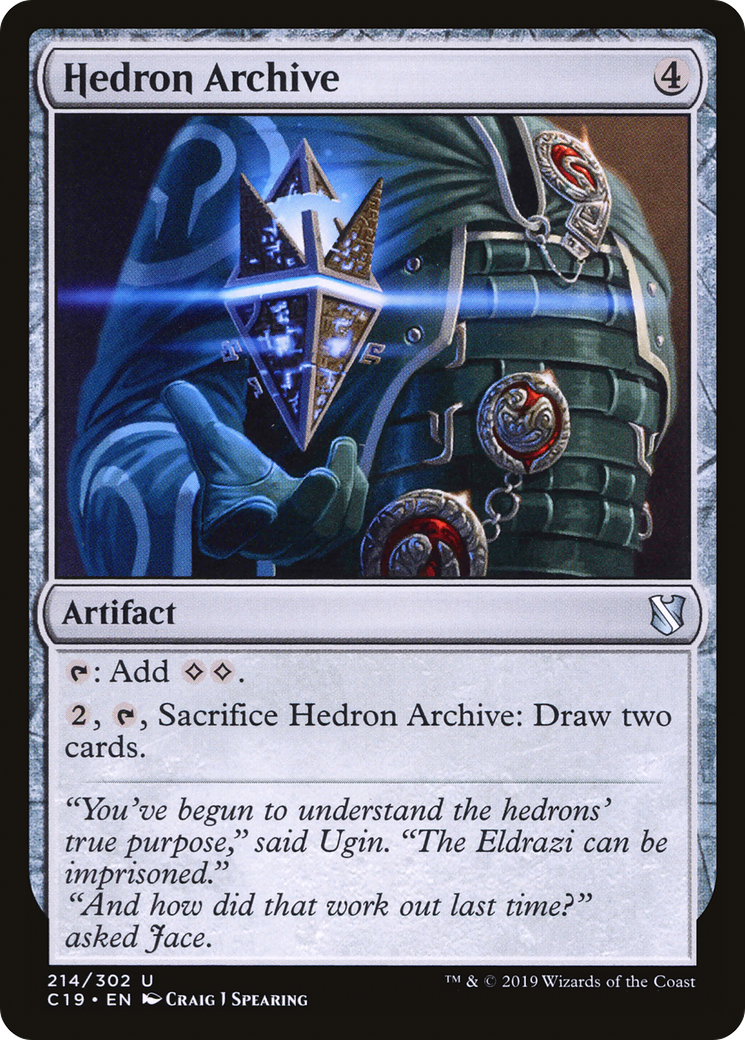
Hedron Archive
Hedron Archive
Artifact
: Add .
, , Sacrifice this artifact: Draw two cards.
-
1
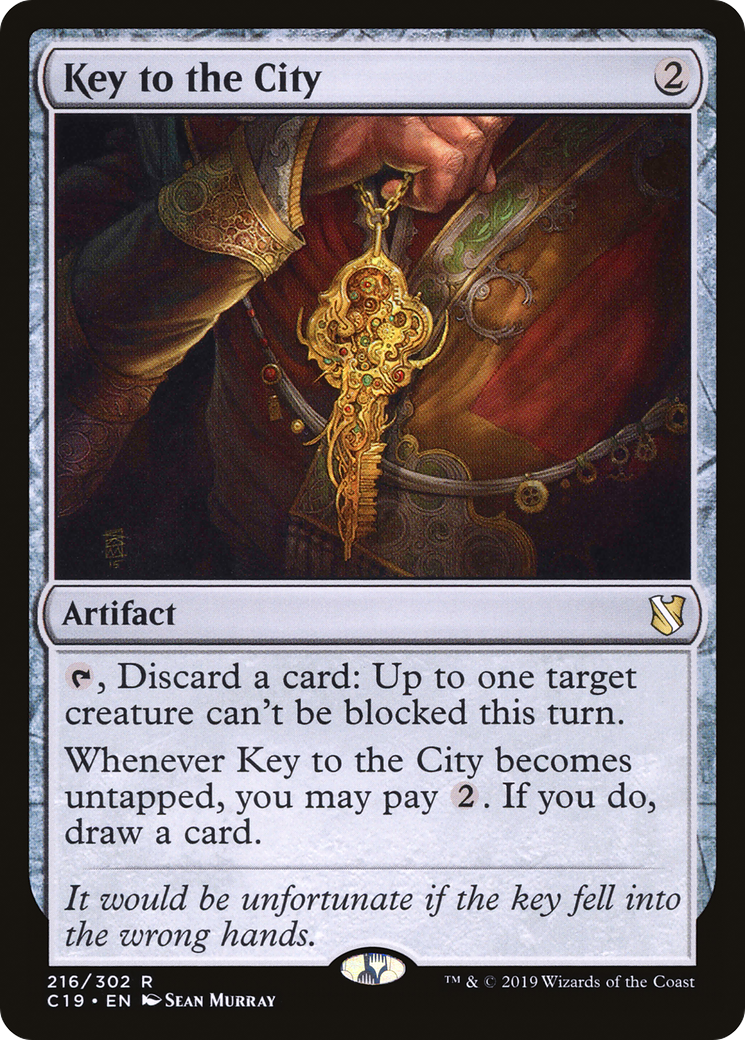
Key to the City
Key to the City
Artifact
, Discard a card: Up to one target creature can't be blocked this turn.
Whenever this artifact becomes untapped, you may pay . If you do, draw a card.
- You can activate Key to the City's first ability without targeting any creature.
- Activating Key to the City's ability targeting a creature that has already been blocked won't cause it to become unblocked.
- Key to the City's last ability triggers during your untap step, but it's put onto the stack at the same time as abilities that trigger at the beginning of your upkeep step. Even though Key to the City's ability triggered first, you may order it before or after other abilities you control that are put onto the stack at this time.
- You can pay only once each time Key to the City's triggered ability resolves. You can't pay more to draw additional cards.
-
1
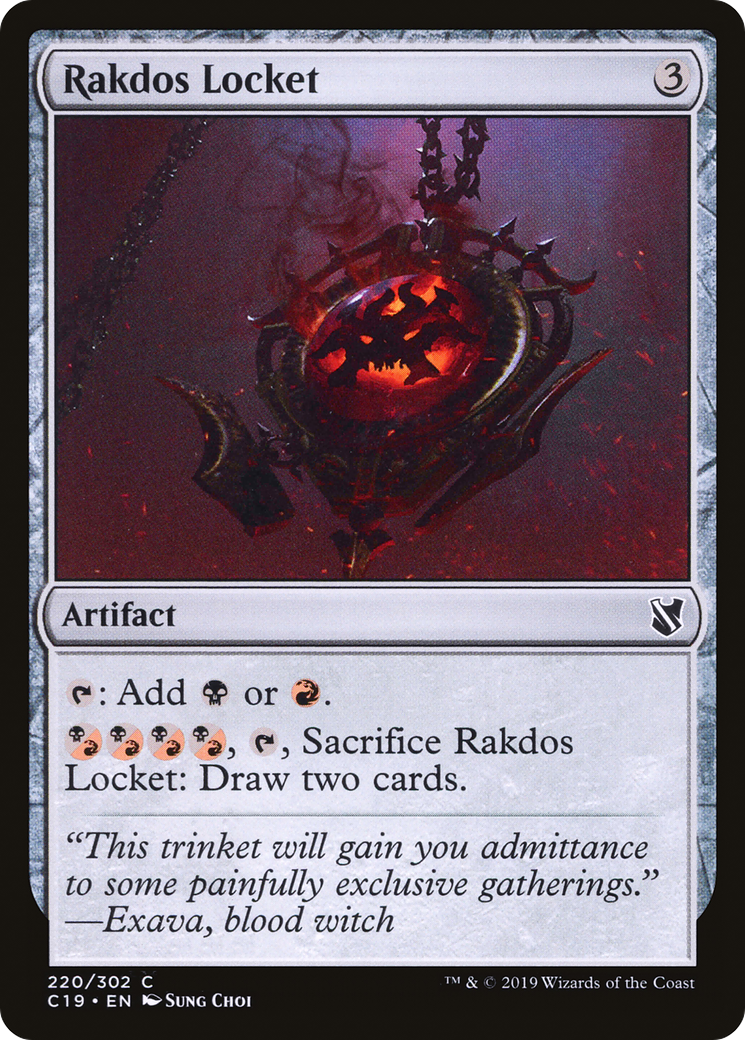
Rakdos Locket
Rakdos Locket
Artifact
: Add or .
, , Sacrifice this artifact: Draw two cards.
-
1
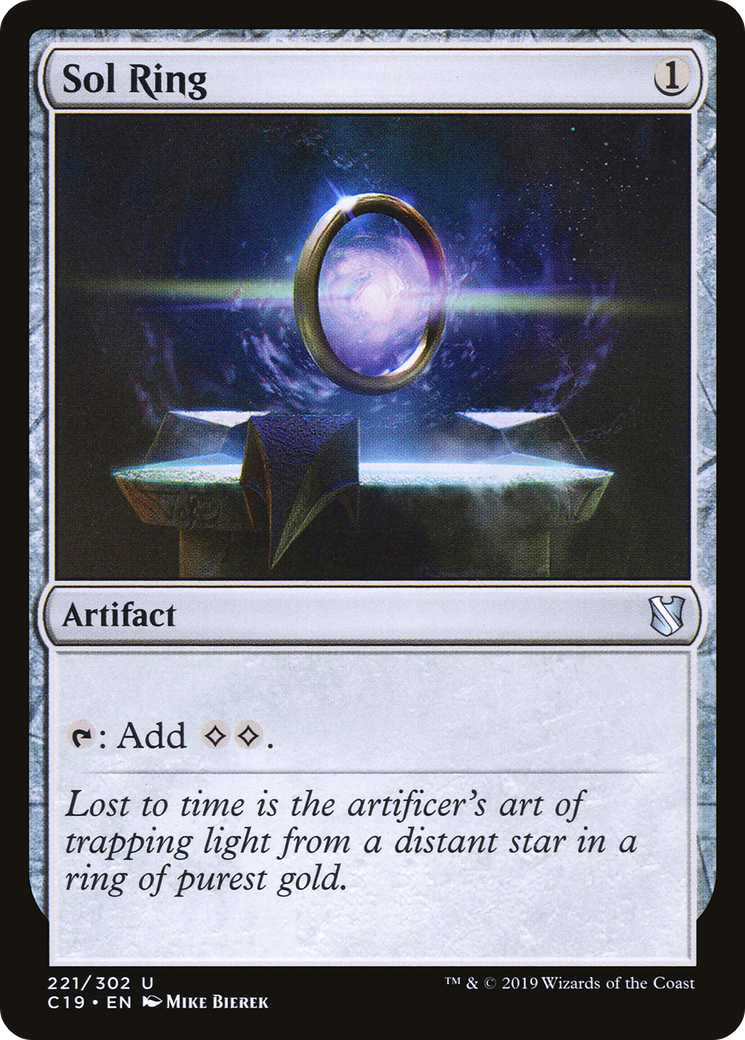
Sol Ring
Sol Ring
Artifact
: Add .
Enchantments 6
-
1
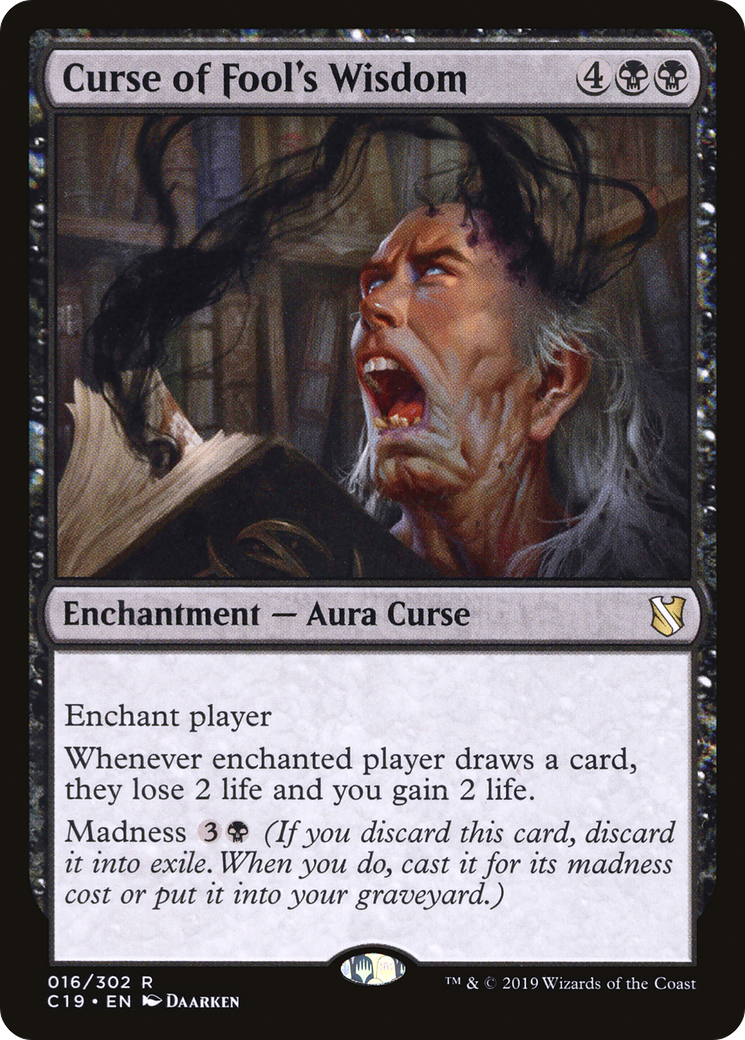
Curse of Fool's Wisdom
Curse of Fool's Wisdom
Enchantment — Aura Curse
Enchant player
Whenever enchanted player draws a card, they lose 2 life and you gain 2 life.
Madness (If you discard this card, discard it into exile. When you do, cast it for its madness cost or put it into your graveyard.)
- If you discard a card with madness while a spell or ability is resolving, it moves immediately to exile. Continue resolving that spell or ability, noting that the card you discarded is not in your graveyard at this time. Its madness triggered ability will be placed onto the stack once that spell or ability has completely resolved.
- If you choose not to cast a card with madness when the madness triggered ability resolves, it's put into your graveyard. Madness doesn't give you another chance to cast it later.
- If you discard a card with madness to pay the cost of a spell or activated ability, that card's madness triggered ability (and the spell that card becomes, if you choose to cast it) will resolve before the spell or ability the discard paid for.
- Cards are discarded in a Magic game only from a player's hand. Effects that put cards into a player's graveyard from anywhere else do not cause those cards to be discarded.
- Madness works independently of why you're discarding the card. You could discard it to pay a cost, because a spell or ability tells you to, or because you have too many cards in your hand during your cleanup step. You can't discard a card with madness just because you want to, though.
- A card with madness that's discarded counts as having been discarded even though it's put into exile rather than a graveyard. If it was discarded to pay a cost, that cost is still paid. Abilities that trigger when a card is discarded will still trigger.
- A spell cast for its madness cost is put onto the stack like any other spell. It can be countered, copied, and so on. As it resolves, it's put onto the battlefield if it's a permanent card or into its owner's graveyard if it's an instant or sorcery card.
- Casting a spell with madness ignores the timing rules based on the card's card type. For example, you can cast a sorcery with madness if you discard it during an opponent's turn.
- To determine the total cost of a spell, start with the mana cost or alternative cost (such as a madness cost) you're paying, add any cost increases, then apply any cost reductions. The mana value of the spell is determined by only its mana cost, no matter what the total cost to cast that spell was.
- Once the enchanted player has drawn one or more cards, they'll still lose life (and you'll still gain life) even if Curse of Fool's Wisdom leaves the battlefield before its triggered ability resolves.
- If you become enchanted by your own Curse of Fool's Wisdom, you'll lose 2 life and gain 2 life whenever you draw a card. You won't lose the game if your life total is 0 or less between those events.
-
1
Faith of the Devoted
Faith of the Devoted
Enchantment
Whenever you cycle or discard a card, you may pay . If you do, each opponent loses 2 life and you gain 2 life.
- While resolving the triggered ability of Faith of the Devoted, you can't pay multiple times to multiply the effect.
- In a Two-Headed Giant game, the triggered ability of Faith of the Devoted causes the opposing team to lose 4 life and you gain 2 life.
- Some cards have an ability that triggers whenever you cycle any card. These triggered abilities resolve before you draw from the cycling ability.
- An ability that triggers whenever you discard a card doesn't give you permission to discard cards. You'll need another effect that instructs or allows you to discard them.
- An ability that triggers whenever you "cycle or discard" a card triggers only once if you cycle a card. The ability "Whenever you discard a card" is functionally identical to this ability; cycling is mentioned for clarity.
- If a player discards a card during their cleanup step due to having too many cards in hand, any appropriate abilities that trigger on discarding that card trigger. If this happens, those triggered abilities are put onto the stack and players receive priority in that cleanup step to cast spells or activate abilities (normally, no players may take actions during a cleanup step). Another cleanup step is created following that one.
-
1
Hedonist's Trove
Hedonist's Trove
Enchantment
When this enchantment enters, exile target opponent's graveyard.
You may play lands from among cards exiled with this enchantment.
You may cast spells from among cards exiled with this enchantment. You can't cast more than one spell this way each turn.
- The cards are exiled face up.
- The once-a-turn restriction of the last ability applies only to nonland cards. You can play a land card exiled with Hedonist’s Trove on the same turn you cast a nonland card exiled that way.
- Playing a card this way follows the normal rules for playing the card. You must pay its costs, and you must follow all applicable timing rules. For example, if one of the cards is a creature card, you can cast that card only during your main phase while the stack is empty.
- Under normal circumstances, you can play a land card exiled with Hedonist’s Trove only if you haven’t played a land yet that turn.
- If Hedonist’s Trove leaves the battlefield, any cards it exiled remain exiled. Those cards can no longer be played. Any future instance of Hedonist’s Trove (even one represented by the same card) will be a new object and won’t allow you to play those cards.
-
1
The Eldest Reborn
The Eldest Reborn
Enchantment — Saga
(As this Saga enters and after your draw step, add a lore counter. Sacrifice after III.)
I — Each opponent sacrifices a creature or planeswalker of their choice.
II — Each opponent discards a card.
III — Put target creature or planeswalker card from a graveyard onto the battlefield under your control.
- When the first chapter ability of The Eldest Reborn resolves, the next opponent in turn order (or, if it's an opponent's turn, that opponent) chooses a creature or planeswalker they control, then each other opponent in turn order (if any) does the same. All chosen permanents are then sacrificed at the same time. Players will know the choices made by earlier players when making their choices.
- When the second chapter ability of The Eldest Reborn resolves, the next opponent in turn order (or, if it's an opponent's turn, that opponent) chooses a card in hand without revealing it, then each other opponent in turn order (if any) does the same. All chosen cards are then discarded at the same time.
- In a multiplayer game, if a player leaves the game, all cards that player owns leave as well. If you leave the game, the permanent you control from The Eldest Reborn's final chapter ability is exiled.
- As a Saga enters the battlefield, its controller puts a lore counter on it. As your precombat main phase begins (immediately after your draw step), you put another lore counter on each Saga you control. Putting a lore counter on a Saga in either of these ways doesn't use the stack.
- Each symbol on the left of a Saga's text box represents a chapter ability. A chapter ability is a triggered ability that triggers when a lore counter that is put on the Saga causes the number of lore counters on the Saga to become equal to or greater than the ability's chapter number. Chapter abilities are put onto the stack and may be responded to.
- A chapter ability doesn't trigger if a lore counter is put on a Saga that already had a number of lore counters greater than or equal to that chapter's number. For example, the third lore counter put on a Saga causes the III chapter ability to trigger, but I and II won't trigger again.
- Once a chapter ability has triggered, the ability on the stack won't be affected if the Saga gains or loses counters, or if it leaves the battlefield.
- If multiple chapter abilities trigger at the same time, their controller puts them on the stack in any order. If any of them require targets, those targets are chosen as you put the abilities on the stack, before any of those abilities resolve.
- If counters are removed from a Saga, the appropriate chapter abilities will trigger again when the Saga receives lore counters. Removing lore counters won't cause a previous chapter ability to trigger.
- Once the number of lore counters on a Saga is greater than or equal to the greatest number among its chapter abilities—in the Dominaria set, this is always three—the Saga's controller sacrifices it as soon as its chapter ability has left the stack, most likely by resolving or being countered. This state-based action doesn't use the stack.
-
1
Warstorm Surge
Warstorm Surge
Enchantment
Whenever a creature you control enters, it deals damage equal to its power to any target.
- The creature that entered deals damage equal to its current power to the targeted permanent or player. If it's no longer on the battlefield, its last known existence on the battlefield is checked to determine its power.
- Warstorm Surge is the source of the ability, but the creature is the source of the damage. The ability couldn't target a creature with protection from red, for example. It could target a creature with protection from creatures, but all the damage would be prevented. Since damage is dealt by the creature, abilities like lifelink, deathtouch and infect are taken into account, even if the creature has left the battlefield by the time it deals damage.
-
1
Zombie Infestation
Zombie Infestation
Enchantment
Discard two cards: Create a 2/2 black Zombie creature token.
Lands 40
-
1
Akoum Refuge
Akoum Refuge
Land
This land enters tapped.
When this land enters, you gain 1 life.
: Add or .
-
1
Ash Barrens
Ash Barrens
Land
: Add .
Basic landcycling ( , Discard this card: Search your library for a basic land card, reveal it, put it into your hand, then shuffle.)
-
1
Barren Moor
Barren Moor
Land
This land enters tapped.
: Add .
Cycling ( , Discard this card: Draw a card.)
- Cycling is an activated ability. Effects that interact with activated abilities (such as Stifle or Rings of Brighthearth) will interact with cycling. Effects that interact with spells (such as Remove Soul or Faerie Tauntings) will not.
-
1
Bloodfell Caves
Bloodfell Caves
Land
This land enters tapped.
When this land enters, you gain 1 life.
: Add or .
-
1
Cinder Barrens
Cinder Barrens
Land
This land enters tapped.
: Add or .
-
1
Command Tower
Command Tower
Land
: Add one mana of any color in your commander's color identity.
- If you don't have a commander, Command Tower's ability produces no mana.
- If your commander is a card that has no colors in its color identity, Command Tower's ability produces no mana. It doesn't produce .
- If you have two commanders, the ability adds one mana of any color in their combined color identities.
-
1
Drownyard Temple
Drownyard Temple
Land
: Add .
: Return this card from your graveyard to the battlefield tapped.
-
1
Evolving Wilds
Evolving Wilds
Land
, Sacrifice this land: Search your library for a basic land card, put it onto the battlefield tapped, then shuffle.
-
1
Exotic Orchard
Exotic Orchard
Land
: Add one mana of any color that a land an opponent controls could produce.
- Lands that produce mana based only on what other lands "could produce" won't help each other unless some other land allows one of them to actually produce some type of mana. For example, if you control an Exotic Orchard and your opponent controls an Exotic Orchard and a Reflecting Pool, none of those lands would produce mana if their mana abilities were activated. On the other hand, if you control a Forest and an Exotic Orchard, and your opponent controls an Exotic Orchard and a Reflecting Pool, then each of those lands can be tapped to produce . Your opponent's Exotic Orchard can produce because you control a Forest. Your Exotic Orchard and your opponent's Reflecting Pool can each produce because your opponent's Exotic Orchard can produce .
- When determining what colors of mana your opponents' lands could produce, Exotic Orchard takes into account any applicable replacement effects that would apply to those lands' mana abilities (such as Contamination's effect, for example). If there are more than one, consider them in any possible order.
- The colors of mana are white, blue, black, red, and green. Exotic Orchard can't be tapped for colorless mana, even if a land an opponent controls could produce colorless mana.
- Exotic Orchard doesn't care about any restrictions or riders your opponents' lands (such as Ancient Ziggurat or Hall of the Bandit Lord) put on the mana they produce. It just cares about colors of mana.
- Exotic Orchard checks the effects of all mana-producing abilities of lands your opponents control, but it doesn't check their costs. For example, Vivid Crag has the ability " , Remove a charge counter from Vivid Crag: Add one mana of any color." If an opponent controls Vivid Crag and you control Exotic Orchard, you can tap Exotic Orchard for any color of mana. It doesn't matter whether Vivid Crag has a charge counter on it, and it doesn't matter whether it's untapped.
-
1
Forgotten Cave
Forgotten Cave
Land
This land enters tapped.
: Add .
Cycling ( , Discard this card: Draw a card.)
-
1
Geier Reach Sanitarium
Geier Reach Sanitarium
Legendary Land
: Add .
, : Each player draws a card, then discards a card.
- When you activate Geier Reach Sanitarium's last ability, first each player draws a card. Then the player whose turn it is selects a card from their hand and sets it aside without revealing it; proceeding in turn order, each other player does the same. Then the cards that were set aside are discarded at once.
- If more than one player discards a card with madness simultaneously, the player whose turn it is puts their madness abilities onto the stack first, then each other player does the same in turn order. The last one put onto the stack resolves first, and a spell cast this way will resolve before resolving the next madness ability.
-
1
Memorial to Folly
Memorial to Folly
Land
This land enters tapped.
: Add .
, , Sacrifice this land: Return target creature card from your graveyard to your hand.
-
1
Mortuary Mire
Mortuary Mire
Land
This land enters tapped.
When this land enters, you may put target creature card from your graveyard on top of your library.
: Add .
-
10
Mountain
Mountain
Basic Land — Mountain
( : Add .)
-
1
Myriad Landscape
Myriad Landscape
Land
This land enters tapped.
: Add .
, , Sacrifice this land: Search your library for up to two basic land cards that share a land type, put them onto the battlefield tapped, then shuffle.
- You can choose to find one basic land card with Myriad Landscape's last ability.
-
1
Rakdos Carnarium
Rakdos Carnarium
Land
This land enters tapped.
When this land enters, return a land you control to its owner's hand.
: Add .
- If this land enters the battlefield and you control no other lands, its ability will force you to return it to your hand.
-
1
Rakdos Guildgate
Rakdos Guildgate
Land — Gate
This land enters tapped.
: Add or .
- The subtype Gate has no special rules significance, but other spells and abilities may refer to it.
- Gate is not a basic land type.
-
1
Rix Maadi, Dungeon Palace
Rix Maadi, Dungeon Palace
Land
: Add .
, : Each player discards a card. Activate only as a sorcery.
- When the second ability resolves, first the active player chooses a card to discard, then the nonactive player chooses, then all chosen cards are discarded at the same time. No one sees what the other players are discarding before deciding which cards to discard.
-
1
Sanctum of Eternity
Sanctum of Eternity
Land
: Add .
, : Return target commander you own from the battlefield to your hand. Activate only during your turn.
- The “commander tax” increases based on how many times a commander was cast from the command zone. Casting a commander from your hand doesn’t require that additional cost, and it doesn’t increase what the cost will be the next time you cast that commander from the command zone.
- If your commander isn’t on the battlefield (or if you’re not playing the Commander variant), Sanctum of Eternity’s second ability does nothing.
-
10
Swamp
Swamp
Basic Land — Swamp
( : Add .)
-
1
Temple of the False God
Temple of the False God
Land
: Add . Activate only if you control five or more lands.
-
1
Terramorphic Expanse
Terramorphic Expanse
Land
, Sacrifice this land: Search your library for a basic land card, put it onto the battlefield tapped, then shuffle.
Black 29
-
1
Archfiend of Spite
Archfiend of Spite
Creature — Demon
6/6
Flying
Whenever a source an opponent controls deals damage to this creature, that source's controller loses that much life unless they sacrifice that many permanents of their choice.
Madness (If you discard this card, discard it into exile. When you do, cast it for its madness cost or put it into your graveyard.)
- If you discard a card with madness while a spell or ability is resolving, it moves immediately to exile. Continue resolving that spell or ability, noting that the card you discarded is not in your graveyard at this time. Its madness triggered ability will be placed onto the stack once that spell or ability has completely resolved.
- A spell cast for its madness cost is put onto the stack like any other spell. It can be countered, copied, and so on. As it resolves, it's put onto the battlefield if it's a permanent card or into its owner's graveyard if it's an instant or sorcery card.
- Casting a spell with madness ignores the timing rules based on the card's card type. For example, you can cast a sorcery with madness if you discard it during an opponent's turn.
- To determine the total cost of a spell, start with the mana cost or alternative cost (such as a madness cost) you're paying, add any cost increases, then apply any cost reductions. The mana value of the spell is determined by only its mana cost, no matter what the total cost to cast that spell was.
- If you choose not to cast a card with madness when the madness triggered ability resolves, it's put into your graveyard. Madness doesn't give you another chance to cast it later.
- If you discard a card with madness to pay the cost of a spell or activated ability, that card's madness triggered ability (and the spell that card becomes, if you choose to cast it) will resolve before the spell or ability the discard paid for.
- Cards are discarded in a Magic game only from a player's hand. Effects that put cards into a player's graveyard from anywhere else do not cause those cards to be discarded.
- Madness works independently of why you're discarding the card. You could discard it to pay a cost, because a spell or ability tells you to, or because you have too many cards in your hand during your cleanup step. You can't discard a card with madness just because you want to, though.
- A card with madness that's discarded counts as having been discarded even though it's put into exile rather than a graveyard. If it was discarded to pay a cost, that cost is still paid. Abilities that trigger when a card is discarded will still trigger.
- The source's controller must either sacrifice permanents or lose life. They can't choose to sacrifice some permanents and lose some life.
- If the player doesn't control enough permanents that they can sacrifice, they must lose life.
- The player may always choose not to sacrifice permanents, even if they will end up losing more life than they have or if an effect (such as that of Platinum Emperion) says that they can't lose life.
- The player who loses life or permanents is the player who controls the source as Archfiend of Spite's triggered ability resolves. In some rare cases, this may not be the same player who controlled the source as it dealt damage. If the source is no longer in the zone it was in as it dealt damage, the source's last known information is used to determine who controlled it.
- Archfiend of Spite's triggered ability will trigger even if it is dealt lethal damage. For example, if Archfiend of Spite blocks a 7/7 creature, its ability will trigger when combat damage is dealt and the attacking player will sacrifice seven permanents or lose 7 life.
-
1
Asylum Visitor
Asylum Visitor
Creature — Vampire Wizard
3/1
At the beginning of each player's upkeep, if that player has no cards in hand, you draw a card and you lose 1 life.
Madness (If you discard this card, discard it into exile. When you do, cast it for its madness cost or put it into your graveyard.)
- If you discard a card with madness while a spell or ability is resolving, it moves immediately to exile. Continue resolving that spell or ability, noting that the card you discarded is not in your graveyard at this time. Its madness triggered ability will be placed onto the stack once that spell or ability has completely resolved.
- To determine the total cost of a spell, start with the mana cost or alternative cost (such as a madness cost) you're paying, add any cost increases, then apply any cost reductions. The mana value of the spell is determined by only its mana cost, no matter what the total cost to cast that spell was.
- If you choose not to cast a card with madness when the madness triggered ability resolves, it's put into your graveyard. Madness doesn't give you another chance to cast it later.
- If you discard a card with madness to pay the cost of a spell or activated ability, that card's madness triggered ability (and the spell that card becomes, if you choose to cast it) will resolve before the spell or ability the discard paid for.
- Cards are discarded in a Magic game only from a player's hand. Effects that put cards into a player's graveyard from anywhere else do not cause those cards to be discarded.
- Madness works independently of why you're discarding the card. You could discard it to pay a cost, because a spell or ability tells you to, or because you have too many cards in your hand during your cleanup step. You can't discard a card with madness just because you want to, though.
- A card with madness that's discarded counts as having been discarded even though it's put into exile rather than a graveyard. If it was discarded to pay a cost, that cost is still paid. Abilities that trigger when a card is discarded will still trigger.
- A spell cast for its madness cost is put onto the stack like any other spell. It can be countered, copied, and so on. As it resolves, it's put onto the battlefield if it's a permanent card or into its owner's graveyard if it's an instant or sorcery card.
- Casting a spell with madness ignores the timing rules based on the card's card type. For example, you can cast a sorcery with madness if you discard it during an opponent's turn.
- Asylum Visitor's triggered ability checks the active player's hand as the upkeep begins and as the trigger resolves. If that player has a card in hand as it resolves, you won't draw a card or lose 1 life. Notably, if you control multiple Asylum Visitors during your upkeep, whichever one's first ability resolves first will stop the other's first ability from having any effect unless you have a way to get the card you drew out of your hand before it resolves.
- On an opponent's turn, triggered abilities you control will resolve before any triggered abilities of permanents that opponent controls if they trigger at the same time. This means that if you and your opponent each control an Asylum Visitor during your opponent's upkeep, and they have no cards in hand, you'll always draw a card before your opponent has a card in their hand.
- The upkeep step is before the draw step, after the untap step. Asylum Visitor's first ability will trigger and resolve before the active player draws a card in their draw step if that player has no cards in hand.
-
1
Beacon of Unrest
Beacon of Unrest
Sorcery
Put target artifact or creature card from a graveyard onto the battlefield under your control. Shuffle Beacon of Unrest into its owner's library.
- If the target card is an illegal target by the time Beacon of Unrest tries to resolve, the spell won't resolve. You won't shuffle it into your library.
- In a multiplayer game, if a player leaves the game, all cards that player owns leave as well. If you leave the game, the permanent you control from Beacon of Unrest is exiled.
-
1
Big Game Hunter
Big Game Hunter
Creature — Human Rebel Assassin
1/1
When this creature enters, destroy target creature with power 4 or greater. It can't be regenerated.
Madness (If you discard this card, discard it into exile. When you do, cast it for its madness cost or put it into your graveyard.)
- Cards are discarded in a Magic game only from a player's hand. Effects that put cards into a player's graveyard from anywhere else do not cause those cards to be discarded.
- Madness works independently of why you're discarding the card. You could discard it to pay a cost, because a spell or ability tells you to, or because you have too many cards in your hand during your cleanup step. You can't discard a card with madness just because you want to, though.
- A card with madness that's discarded counts as having been discarded even though it's put into exile rather than a graveyard. If it was discarded to pay a cost, that cost is still paid. Abilities that trigger when a card is discarded will still trigger.
- A spell cast for its madness cost is put onto the stack like any other spell. It can be countered, copied, and so on. As it resolves, it's put onto the battlefield if it's a permanent card or into its owner's graveyard if it's an instant or sorcery card.
- Casting a spell with madness ignores the timing rules based on the card's card type. For example, you can cast a sorcery with madness if you discard it during an opponent's turn.
- To determine the total cost of a spell, start with the mana cost or alternative cost (such as a madness cost) you're paying, add any cost increases, then apply any cost reductions. The mana value of the spell is determined by only its mana cost, no matter what the total cost to cast that spell was.
- If you choose not to cast a card with madness when the madness triggered ability resolves, it's put into your graveyard. Madness doesn't give you another chance to cast it later.
- If you discard a card with madness to pay the cost of a spell or activated ability, that card's madness triggered ability (and the spell that card becomes, if you choose to cast it) will resolve before the spell or ability the discard paid for.
- If you discard a card with madness while a spell or ability is resolving, it moves immediately to exile. Continue resolving that spell or ability, noting that the card you discarded is not in your graveyard at this time. Its madness triggered ability will be placed onto the stack once that spell or ability has completely resolved.
-
1
Bone Miser
Bone Miser
Creature — Zombie Wizard
4/4
Whenever you discard a creature card, create a 2/2 black Zombie creature token.
Whenever you discard a land card, add .
Whenever you discard a noncreature, nonland card, draw a card.
- This creature’s abilities are triggered abilities, not activated abilities. They don’t allow you to discard a card whenever you want; rather, you need some other way of discarding a card (such as cycling).
- This creature’s second ability isn’t a mana ability. It uses the stack and can be responded to. Notably, this means that you can’t pay a cost of “ , Discard a card” by discarding a land card and using the produced to pay for the .
- If you discard a card as a cost to cast a spell or activate an ability, this creature’s triggered ability resolves before that spell or ability but after you’ve chosen targets for it. If you discard a card while a spell or ability is resolving, the triggered ability resolves after you’ve finished resolving that spell or ability.
-
1
Boneyard Parley
Boneyard Parley
Sorcery
Exile up to five target creature cards from graveyards. An opponent separates those cards into two piles. Put all cards from the pile of your choice onto the battlefield under your control and the rest into their owners' graveyards.
- The creature cards may come from different graveyards.
- You (not your opponent) choose which pile to put onto the battlefield and which to return to graveyards.
- A pile can have no cards in it. In this case, you’ll choose whether to put all the exiled cards onto the battlefield or into graveyards.
- In multiplayer games, you choose an opponent to separate the cards when the ability resolves. This doesn’t target that opponent. Because the cards are revealed, all players may see the cards and offer opinions.
- In a multiplayer game, if a player leaves the game, all cards that player owns leave as well. If you leave the game, any creatures you control from Boneyard Parley’s effect are exiled.
-
1
Call to the Netherworld
Call to the Netherworld
Sorcery
Return target black creature card from your graveyard to your hand.
Madness (If you discard this card, discard it into exile. When you do, cast it for its madness cost or put it into your graveyard.)
- Cards are discarded in a Magic game only from a player's hand. Effects that put cards into a player's graveyard from anywhere else do not cause those cards to be discarded.
- Madness works independently of why you're discarding the card. You could discard it to pay a cost, because a spell or ability tells you to, or because you have too many cards in your hand during your cleanup step. You can't discard a card with madness just because you want to, though.
- A card with madness that's discarded counts as having been discarded even though it's put into exile rather than a graveyard. If it was discarded to pay a cost, that cost is still paid. Abilities that trigger when a card is discarded will still trigger.
- A spell cast for its madness cost is put onto the stack like any other spell. It can be countered, copied, and so on. As it resolves, it's put onto the battlefield if it's a permanent card or into its owner's graveyard if it's an instant or sorcery card.
- Casting a spell with madness ignores the timing rules based on the card's card type. For example, you can cast a sorcery with madness if you discard it during an opponent's turn.
- To determine the total cost of a spell, start with the mana cost or alternative cost (such as a madness cost) you're paying, add any cost increases, then apply any cost reductions. The mana value of the spell is determined by only its mana cost, no matter what the total cost to cast that spell was.
- If you choose not to cast a card with madness when the madness triggered ability resolves, it's put into your graveyard. Madness doesn't give you another chance to cast it later.
- If you discard a card with madness to pay the cost of a spell or activated ability, that card's madness triggered ability (and the spell that card becomes, if you choose to cast it) will resolve before the spell or ability the discard paid for.
- If you discard a card with madness while a spell or ability is resolving, it moves immediately to exile. Continue resolving that spell or ability, noting that the card you discarded is not in your graveyard at this time. Its madness triggered ability will be placed onto the stack once that spell or ability has completely resolved.
-
1
Champion of Stray Souls
Champion of Stray Souls
Creature — Skeleton Warrior
4/4
, , Sacrifice X other creatures: Return X target creature cards from your graveyard to the battlefield.
: Put this card from your graveyard on top of your library.
- You choose the targets of the first ability as you activate that ability, before you pay any costs. You can't target any of the creatures you sacrifice.
- The last ability can be activated only if Champion of Stray Souls is in your graveyard.
-
1
Curse of Fool's Wisdom
Curse of Fool's Wisdom
Enchantment — Aura Curse
Enchant player
Whenever enchanted player draws a card, they lose 2 life and you gain 2 life.
Madness (If you discard this card, discard it into exile. When you do, cast it for its madness cost or put it into your graveyard.)
- If you discard a card with madness while a spell or ability is resolving, it moves immediately to exile. Continue resolving that spell or ability, noting that the card you discarded is not in your graveyard at this time. Its madness triggered ability will be placed onto the stack once that spell or ability has completely resolved.
- If you choose not to cast a card with madness when the madness triggered ability resolves, it's put into your graveyard. Madness doesn't give you another chance to cast it later.
- If you discard a card with madness to pay the cost of a spell or activated ability, that card's madness triggered ability (and the spell that card becomes, if you choose to cast it) will resolve before the spell or ability the discard paid for.
- Cards are discarded in a Magic game only from a player's hand. Effects that put cards into a player's graveyard from anywhere else do not cause those cards to be discarded.
- Madness works independently of why you're discarding the card. You could discard it to pay a cost, because a spell or ability tells you to, or because you have too many cards in your hand during your cleanup step. You can't discard a card with madness just because you want to, though.
- A card with madness that's discarded counts as having been discarded even though it's put into exile rather than a graveyard. If it was discarded to pay a cost, that cost is still paid. Abilities that trigger when a card is discarded will still trigger.
- A spell cast for its madness cost is put onto the stack like any other spell. It can be countered, copied, and so on. As it resolves, it's put onto the battlefield if it's a permanent card or into its owner's graveyard if it's an instant or sorcery card.
- Casting a spell with madness ignores the timing rules based on the card's card type. For example, you can cast a sorcery with madness if you discard it during an opponent's turn.
- To determine the total cost of a spell, start with the mana cost or alternative cost (such as a madness cost) you're paying, add any cost increases, then apply any cost reductions. The mana value of the spell is determined by only its mana cost, no matter what the total cost to cast that spell was.
- Once the enchanted player has drawn one or more cards, they'll still lose life (and you'll still gain life) even if Curse of Fool's Wisdom leaves the battlefield before its triggered ability resolves.
- If you become enchanted by your own Curse of Fool's Wisdom, you'll lose 2 life and gain 2 life whenever you draw a card. You won't lose the game if your life total is 0 or less between those events.
-
1
Dark Withering
Dark Withering
Instant
Destroy target nonblack creature.
Madness (If you discard this card, discard it into exile. When you do, cast it for its madness cost or put it into your graveyard.)
- Cards are discarded in a Magic game only from a player's hand. Effects that put cards into a player's graveyard from anywhere else do not cause those cards to be discarded.
- Madness works independently of why you're discarding the card. You could discard it to pay a cost, because a spell or ability tells you to, or because you have too many cards in your hand during your cleanup step. You can't discard a card with madness just because you want to, though.
- A card with madness that's discarded counts as having been discarded even though it's put into exile rather than a graveyard. If it was discarded to pay a cost, that cost is still paid. Abilities that trigger when a card is discarded will still trigger.
- A spell cast for its madness cost is put onto the stack like any other spell. It can be countered, copied, and so on. As it resolves, it's put onto the battlefield if it's a permanent card or into its owner's graveyard if it's an instant or sorcery card.
- Casting a spell with madness ignores the timing rules based on the card's card type. For example, you can cast a sorcery with madness if you discard it during an opponent's turn.
- To determine the total cost of a spell, start with the mana cost or alternative cost (such as a madness cost) you're paying, add any cost increases, then apply any cost reductions. The mana value of the spell is determined by only its mana cost, no matter what the total cost to cast that spell was.
- If you choose not to cast a card with madness when the madness triggered ability resolves, it's put into your graveyard. Madness doesn't give you another chance to cast it later.
- If you discard a card with madness to pay the cost of a spell or activated ability, that card's madness triggered ability (and the spell that card becomes, if you choose to cast it) will resolve before the spell or ability the discard paid for.
- If you discard a card with madness while a spell or ability is resolving, it moves immediately to exile. Continue resolving that spell or ability, noting that the card you discarded is not in your graveyard at this time. Its madness triggered ability will be placed onto the stack once that spell or ability has completely resolved.
-
1
Doomed Necromancer
Doomed Necromancer
Creature — Human Cleric Mercenary
2/2
, , Sacrifice this creature: Return target creature card from your graveyard to the battlefield.
- Because targets are chosen before costs are paid, Doomed Necromancer can't be the target of its own ability.
-
1
Faith of the Devoted
Faith of the Devoted
Enchantment
Whenever you cycle or discard a card, you may pay . If you do, each opponent loses 2 life and you gain 2 life.
- While resolving the triggered ability of Faith of the Devoted, you can't pay multiple times to multiply the effect.
- In a Two-Headed Giant game, the triggered ability of Faith of the Devoted causes the opposing team to lose 4 life and you gain 2 life.
- Some cards have an ability that triggers whenever you cycle any card. These triggered abilities resolve before you draw from the cycling ability.
- An ability that triggers whenever you discard a card doesn't give you permission to discard cards. You'll need another effect that instructs or allows you to discard them.
- An ability that triggers whenever you "cycle or discard" a card triggers only once if you cycle a card. The ability "Whenever you discard a card" is functionally identical to this ability; cycling is mentioned for clarity.
- If a player discards a card during their cleanup step due to having too many cards in hand, any appropriate abilities that trigger on discarding that card trigger. If this happens, those triggered abilities are put onto the stack and players receive priority in that cleanup step to cast spells or activate abilities (normally, no players may take actions during a cleanup step). Another cleanup step is created following that one.
-
1
From Under the Floorboards
From Under the Floorboards
Sorcery
Madness (If you discard this card, discard it into exile. When you do, cast it for its madness cost or put it into your graveyard.)
Create three tapped 2/2 black Zombie creature tokens and you gain 3 life. If this spell's madness cost was paid, instead create X of those tokens and you gain X life.
- Cards are discarded in a Magic game only from a player's hand. Effects that put cards into a player's graveyard from anywhere else do not cause those cards to be discarded.
- Madness works independently of why you're discarding the card. You could discard it to pay a cost, because a spell or ability tells you to, or because you have too many cards in your hand during your cleanup step. You can't discard a card with madness just because you want to, though.
- A card with madness that's discarded counts as having been discarded even though it's put into exile rather than a graveyard. If it was discarded to pay a cost, that cost is still paid. Abilities that trigger when a card is discarded will still trigger.
- A spell cast for its madness cost is put onto the stack like any other spell. It can be countered, copied, and so on. As it resolves, it's put onto the battlefield if it's a permanent card or into its owner's graveyard if it's an instant or sorcery card.
- Casting a spell with madness ignores the timing rules based on the card's card type. For example, you can cast a sorcery with madness if you discard it during an opponent's turn.
- To determine the total cost of a spell, start with the mana cost or alternative cost (such as a madness cost) you're paying, add any cost increases, then apply any cost reductions. The mana value of the spell is determined by only its mana cost, no matter what the total cost to cast that spell was.
- If you choose not to cast a card with madness when the madness triggered ability resolves, it's put into your graveyard. Madness doesn't give you another chance to cast it later.
- If you discard a card with madness to pay the cost of a spell or activated ability, that card's madness triggered ability (and the spell that card becomes, if you choose to cast it) will resolve before the spell or ability the discard paid for.
- If you discard a card with madness while a spell or ability is resolving, it moves immediately to exile. Continue resolving that spell or ability, noting that the card you discarded is not in your graveyard at this time. Its madness triggered ability will be placed onto the stack once that spell or ability has completely resolved.
-
1
Geth, Lord of the Vault
Geth, Lord of the Vault
Legendary Creature — Phyrexian Zombie
5/5
Intimidate (This creature can't be blocked except by artifact creatures and/or creatures that share a color with it.)
: Put target artifact or creature card with mana value X from an opponent's graveyard onto the battlefield under your control tapped. Then that player mills X cards.
- If a card in a player's graveyard has in its mana cost, X is considered to be 0.
- The target card must have mana value exactly X. You can't overpay to have the player mill more cards.
- In a multiplayer game, if a player leaves the game, all cards that player owns leave as well. If you leave the game, any spells and/or permanents you control from Geth's last ability are exiled.
-
1
Gorgon Recluse
Gorgon Recluse
Creature — Gorgon
2/4
Whenever this creature blocks or becomes blocked by a nonblack creature, destroy that creature at end of combat.
Madness (If you discard this card, discard it into exile. When you do, cast it for its madness cost or put it into your graveyard.)
- If you discard a card with madness while a spell or ability is resolving, it moves immediately to exile. Continue resolving that spell or ability, noting that the card you discarded is not in your graveyard at this time. Its madness triggered ability will be placed onto the stack once that spell or ability has completely resolved.
- Cards are discarded in a Magic game only from a player's hand. Effects that put cards into a player's graveyard from anywhere else do not cause those cards to be discarded.
- Madness works independently of why you're discarding the card. You could discard it to pay a cost, because a spell or ability tells you to, or because you have too many cards in your hand during your cleanup step. You can't discard a card with madness just because you want to, though.
- A card with madness that's discarded counts as having been discarded even though it's put into exile rather than a graveyard. If it was discarded to pay a cost, that cost is still paid. Abilities that trigger when a card is discarded will still trigger.
- A spell cast for its madness cost is put onto the stack like any other spell. It can be countered, copied, and so on. As it resolves, it's put onto the battlefield if it's a permanent card or into its owner's graveyard if it's an instant or sorcery card.
- Casting a spell with madness ignores the timing rules based on the card's card type. For example, you can cast a sorcery with madness if you discard it during an opponent's turn.
- To determine the total cost of a spell, start with the mana cost or alternative cost (such as a madness cost) you're paying, add any cost increases, then apply any cost reductions. The mana value of the spell is determined by only its mana cost, no matter what the total cost to cast that spell was.
- If you choose not to cast a card with madness when the madness triggered ability resolves, it's put into your graveyard. Madness doesn't give you another chance to cast it later.
- If you discard a card with madness to pay the cost of a spell or activated ability, that card's madness triggered ability (and the spell that card becomes, if you choose to cast it) will resolve before the spell or ability the discard paid for.
- Gorgon Recluse's ability triggers when it blocks or becomes blocked by a nonblack creature and creates a delayed triggered ability that will destroy that creature at the end of combat step. It destroys that creature then even if Gorgon Recluse doesn't survive that long or the creature somehow becomes black.
-
1
Grave Scrabbler
Grave Scrabbler
Creature — Zombie
2/2
Madness (If you discard this card, discard it into exile. When you do, cast it for its madness cost or put it into your graveyard.)
When this creature enters, if its madness cost was paid, you may return target creature card from a graveyard to its owner's hand.
- If you discard a card with madness while a spell or ability is resolving, it moves immediately to exile. Continue resolving that spell or ability, noting that the card you discarded is not in your graveyard at this time. Its madness triggered ability will be placed onto the stack once that spell or ability has completely resolved.
- Cards are discarded in a Magic game only from a player's hand. Effects that put cards into a player's graveyard from anywhere else do not cause those cards to be discarded.
- Madness works independently of why you're discarding the card. You could discard it to pay a cost, because a spell or ability tells you to, or because you have too many cards in your hand during your cleanup step. You can't discard a card with madness just because you want to, though.
- A card with madness that's discarded counts as having been discarded even though it's put into exile rather than a graveyard. If it was discarded to pay a cost, that cost is still paid. Abilities that trigger when a card is discarded will still trigger.
- A spell cast for its madness cost is put onto the stack like any other spell. It can be countered, copied, and so on. As it resolves, it's put onto the battlefield if it's a permanent card or into its owner's graveyard if it's an instant or sorcery card.
- Casting a spell with madness ignores the timing rules based on the card's card type. For example, you can cast a sorcery with madness if you discard it during an opponent's turn.
- To determine the total cost of a spell, start with the mana cost or alternative cost (such as a madness cost) you're paying, add any cost increases, then apply any cost reductions. The mana value of the spell is determined by only its mana cost, no matter what the total cost to cast that spell was.
- If you choose not to cast a card with madness when the madness triggered ability resolves, it's put into your graveyard. Madness doesn't give you another chance to cast it later.
- If you discard a card with madness to pay the cost of a spell or activated ability, that card's madness triggered ability (and the spell that card becomes, if you choose to cast it) will resolve before the spell or ability the discard paid for.
- Grave Scrabbler's madness cost was paid if you cast it using its madness ability, even if an effect changed the amount of mana you paid for that cost.
-
1
Hedonist's Trove
Hedonist's Trove
Enchantment
When this enchantment enters, exile target opponent's graveyard.
You may play lands from among cards exiled with this enchantment.
You may cast spells from among cards exiled with this enchantment. You can't cast more than one spell this way each turn.
- The cards are exiled face up.
- The once-a-turn restriction of the last ability applies only to nonland cards. You can play a land card exiled with Hedonist’s Trove on the same turn you cast a nonland card exiled that way.
- Playing a card this way follows the normal rules for playing the card. You must pay its costs, and you must follow all applicable timing rules. For example, if one of the cards is a creature card, you can cast that card only during your main phase while the stack is empty.
- Under normal circumstances, you can play a land card exiled with Hedonist’s Trove only if you haven’t played a land yet that turn.
- If Hedonist’s Trove leaves the battlefield, any cards it exiled remain exiled. Those cards can no longer be played. Any future instance of Hedonist’s Trove (even one represented by the same card) will be a new object and won’t allow you to play those cards.
-
1
In Garruk's Wake
In Garruk's Wake
Sorcery
Destroy all creatures you don't control and all planeswalkers you don't control.
-
1
Mire in Misery
Mire in Misery
Sorcery
Each opponent sacrifices a creature or enchantment of their choice.
- As Mire in Misery resolves, first the next opponent in turn order (or, if it’s an opponent’s turn, the opponent whose turn it is) chooses a creature or an enchantment they control, then each other opponent in turn order does the same, knowing the choices made before them. Then all the chosen permanents are sacrificed at the same time.
- Your opponents choose what to sacrifice from among the creatures and enchantments they control. This means that you don’t decide which type of permanent a player sacrifices, and a player can’t choose to sacrifice an enchantment if they control none.
-
1
Murderous Compulsion
Murderous Compulsion
Sorcery
Destroy target tapped creature.
Madness (If you discard this card, discard it into exile. When you do, cast it for its madness cost or put it into your graveyard.)
- Cards are discarded in a Magic game only from a player's hand. Effects that put cards into a player's graveyard from anywhere else do not cause those cards to be discarded.
- Madness works independently of why you're discarding the card. You could discard it to pay a cost, because a spell or ability tells you to, or because you have too many cards in your hand during your cleanup step. You can't discard a card with madness just because you want to, though.
- A card with madness that's discarded counts as having been discarded even though it's put into exile rather than a graveyard. If it was discarded to pay a cost, that cost is still paid. Abilities that trigger when a card is discarded will still trigger.
- A spell cast for its madness cost is put onto the stack like any other spell. It can be countered, copied, and so on. As it resolves, it's put onto the battlefield if it's a permanent card or into its owner's graveyard if it's an instant or sorcery card.
- Casting a spell with madness ignores the timing rules based on the card's card type. For example, you can cast a sorcery with madness if you discard it during an opponent's turn.
- To determine the total cost of a spell, start with the mana cost or alternative cost (such as a madness cost) you're paying, add any cost increases, then apply any cost reductions. The mana value of the spell is determined by only its mana cost, no matter what the total cost to cast that spell was.
- If you choose not to cast a card with madness when the madness triggered ability resolves, it's put into your graveyard. Madness doesn't give you another chance to cast it later.
- If you discard a card with madness to pay the cost of a spell or activated ability, that card's madness triggered ability (and the spell that card becomes, if you choose to cast it) will resolve before the spell or ability the discard paid for.
- If you discard a card with madness while a spell or ability is resolving, it moves immediately to exile. Continue resolving that spell or ability, noting that the card you discarded is not in your graveyard at this time. Its madness triggered ability will be placed onto the stack once that spell or ability has completely resolved.
-
1
Nightmare Unmaking
Nightmare Unmaking
Sorcery
Choose one —
- Exile each creature with power greater than the number of cards in your hand.
- Exile each creature with power less than the number of cards in your hand.
- Because Nightmare Unmaking is on the stack while it's resolving, it won't be counted among the cards in your hand.
- The power of creatures and the number of cards in your hand are checked only as Nightmare Unmaking resolves. Players may respond to the spell knowing the chosen mode to try to save or doom a creature.
-
1
Nightshade Assassin
Nightshade Assassin
Creature — Human Assassin
2/1
First strike
When this creature enters, you may reveal X black cards in your hand. If you do, target creature gets -X/-X until end of turn.
Madness (If you discard this card, discard it into exile. When you do, cast it for its madness cost or put it into your graveyard.)
- If you discard a card with madness while a spell or ability is resolving, it moves immediately to exile. Continue resolving that spell or ability, noting that the card you discarded is not in your graveyard at this time. Its madness triggered ability will be placed onto the stack once that spell or ability has completely resolved.
- If you choose not to cast a card with madness when the madness triggered ability resolves, it's put into your graveyard. Madness doesn't give you another chance to cast it later.
- If you discard a card with madness to pay the cost of a spell or activated ability, that card's madness triggered ability (and the spell that card becomes, if you choose to cast it) will resolve before the spell or ability the discard paid for.
- Cards are discarded in a Magic game only from a player's hand. Effects that put cards into a player's graveyard from anywhere else do not cause those cards to be discarded.
- Madness works independently of why you're discarding the card. You could discard it to pay a cost, because a spell or ability tells you to, or because you have too many cards in your hand during your cleanup step. You can't discard a card with madness just because you want to, though.
- A card with madness that's discarded counts as having been discarded even though it's put into exile rather than a graveyard. If it was discarded to pay a cost, that cost is still paid. Abilities that trigger when a card is discarded will still trigger.
- A spell cast for its madness cost is put onto the stack like any other spell. It can be countered, copied, and so on. As it resolves, it's put onto the battlefield if it's a permanent card or into its owner's graveyard if it's an instant or sorcery card.
- Casting a spell with madness ignores the timing rules based on the card's card type. For example, you can cast a sorcery with madness if you discard it during an opponent's turn.
- To determine the total cost of a spell, start with the mana cost or alternative cost (such as a madness cost) you're paying, add any cost increases, then apply any cost reductions. The mana value of the spell is determined by only its mana cost, no matter what the total cost to cast that spell was.
- You choose how many cards to reveal and which as Nightshade Assassin's triggered ability resolves. Players can't take actions between the time you reveal cards and the time the target creature gets -X/-X.
- If the target creature becomes an illegal target, you don't reveal any cards.
-
1
Ob Nixilis Reignited
Ob Nixilis Reignited
Legendary Planeswalker — Nixilis
+1: You draw a card and you lose 1 life.
−3: Destroy target creature.
−8: Target opponent gets an emblem with "Whenever a player draws a card, you lose 2 life."
- The emblem created by Ob Nixilis Reignited's last ability is both owned and controlled by the target opponent. In a multiplayer game, if you own Ob Nixilis Reignited and use him to give one of your opponents an emblem, the emblem remains even if you leave the game.
-
1
Overseer of the Damned
Overseer of the Damned
Creature — Demon
5/5
Flying
When this creature enters, you may destroy target creature.
Whenever a nontoken creature an opponent controls dies, create a tapped 2/2 black Zombie creature token.
-
1
Plaguecrafter
Plaguecrafter
Creature — Human Shaman
3/2
When this creature enters, each player sacrifices a creature or planeswalker of their choice. Each player who can't discards a card.
- As Plaguecrafter's ability resolves, first the player whose turn it is chooses a creature or planeswalker they control, then each other player in turn order does the same, knowing the choices made before them. Then all the chosen permanents are sacrificed at the same time. Next, each player in the same order who couldn't sacrifice a permanent chooses a card in hand without revealing it, then the chosen cards are discarded at the same time.
- Each player chooses a permanent to sacrifice from among the creatures and planeswalkers they control. You don't choose which type of permanent any other player has to sacrifice.
- Plaguecrafter can be the creature its controller sacrifices for its own ability.
-
1
Sanitarium Skeleton
Sanitarium Skeleton
Creature — Skeleton
1/2
: Return this card from your graveyard to your hand.
-
1
Soul of Innistrad
Soul of Innistrad
Creature — Avatar
6/6
Deathtouch
: Return up to three target creature cards from your graveyard to your hand.
, Exile this card from your graveyard: Return up to three target creature cards from your graveyard to your hand.
- You can activate the last ability only if the Soul is in your graveyard.
- Exiling the Soul from your graveyard is part of the last ability's activation cost. A player can't remove the Soul in response to prevent you from activating the ability.
-
1
The Eldest Reborn
The Eldest Reborn
Enchantment — Saga
(As this Saga enters and after your draw step, add a lore counter. Sacrifice after III.)
I — Each opponent sacrifices a creature or planeswalker of their choice.
II — Each opponent discards a card.
III — Put target creature or planeswalker card from a graveyard onto the battlefield under your control.
- When the first chapter ability of The Eldest Reborn resolves, the next opponent in turn order (or, if it's an opponent's turn, that opponent) chooses a creature or planeswalker they control, then each other opponent in turn order (if any) does the same. All chosen permanents are then sacrificed at the same time. Players will know the choices made by earlier players when making their choices.
- When the second chapter ability of The Eldest Reborn resolves, the next opponent in turn order (or, if it's an opponent's turn, that opponent) chooses a card in hand without revealing it, then each other opponent in turn order (if any) does the same. All chosen cards are then discarded at the same time.
- In a multiplayer game, if a player leaves the game, all cards that player owns leave as well. If you leave the game, the permanent you control from The Eldest Reborn's final chapter ability is exiled.
- As a Saga enters the battlefield, its controller puts a lore counter on it. As your precombat main phase begins (immediately after your draw step), you put another lore counter on each Saga you control. Putting a lore counter on a Saga in either of these ways doesn't use the stack.
- Each symbol on the left of a Saga's text box represents a chapter ability. A chapter ability is a triggered ability that triggers when a lore counter that is put on the Saga causes the number of lore counters on the Saga to become equal to or greater than the ability's chapter number. Chapter abilities are put onto the stack and may be responded to.
- A chapter ability doesn't trigger if a lore counter is put on a Saga that already had a number of lore counters greater than or equal to that chapter's number. For example, the third lore counter put on a Saga causes the III chapter ability to trigger, but I and II won't trigger again.
- Once a chapter ability has triggered, the ability on the stack won't be affected if the Saga gains or loses counters, or if it leaves the battlefield.
- If multiple chapter abilities trigger at the same time, their controller puts them on the stack in any order. If any of them require targets, those targets are chosen as you put the abilities on the stack, before any of those abilities resolve.
- If counters are removed from a Saga, the appropriate chapter abilities will trigger again when the Saga receives lore counters. Removing lore counters won't cause a previous chapter ability to trigger.
- Once the number of lore counters on a Saga is greater than or equal to the greatest number among its chapter abilities—in the Dominaria set, this is always three—the Saga's controller sacrifices it as soon as its chapter ability has left the stack, most likely by resolving or being countered. This state-based action doesn't use the stack.
-
1
Zombie Infestation
Zombie Infestation
Enchantment
Discard two cards: Create a 2/2 black Zombie creature token.
Red 15
-
1
Alchemist's Greeting
Alchemist's Greeting
Sorcery
Alchemist's Greeting deals 4 damage to target creature.
Madness (If you discard this card, discard it into exile. When you do, cast it for its madness cost or put it into your graveyard.)
- Cards are discarded in a Magic game only from a player's hand. Effects that put cards into a player's graveyard from anywhere else do not cause those cards to be discarded.
- Madness works independently of why you're discarding the card. You could discard it to pay a cost, because a spell or ability tells you to, or because you have too many cards in your hand during your cleanup step. You can't discard a card with madness just because you want to, though.
- A card with madness that's discarded counts as having been discarded even though it's put into exile rather than a graveyard. If it was discarded to pay a cost, that cost is still paid. Abilities that trigger when a card is discarded will still trigger.
- A spell cast for its madness cost is put onto the stack like any other spell. It can be countered, copied, and so on. As it resolves, it's put onto the battlefield if it's a permanent card or into its owner's graveyard if it's an instant or sorcery card.
- Casting a spell with madness ignores the timing rules based on the card's card type. For example, you can cast a sorcery with madness if you discard it during an opponent's turn.
- To determine the total cost of a spell, start with the mana cost or alternative cost (such as a madness cost) you're paying, add any cost increases, then apply any cost reductions. The mana value of the spell is determined by only its mana cost, no matter what the total cost to cast that spell was.
- If you choose not to cast a card with madness when the madness triggered ability resolves, it's put into your graveyard. Madness doesn't give you another chance to cast it later.
- If you discard a card with madness to pay the cost of a spell or activated ability, that card's madness triggered ability (and the spell that card becomes, if you choose to cast it) will resolve before the spell or ability the discard paid for.
- If you discard a card with madness while a spell or ability is resolving, it moves immediately to exile. Continue resolving that spell or ability, noting that the card you discarded is not in your graveyard at this time. Its madness triggered ability will be placed onto the stack once that spell or ability has completely resolved.
-
1
Anje's Ravager
Anje's Ravager
Creature — Vampire Berserker
3/3
This creature attacks each combat if able.
Whenever this creature attacks, discard your hand, then draw three cards.
Madness (If you discard this card, discard it into exile. When you do, cast it for its madness cost or put it into your graveyard.)
- If you discard a card with madness while a spell or ability is resolving, it moves immediately to exile. Continue resolving that spell or ability, noting that the card you discarded is not in your graveyard at this time. Its madness triggered ability will be placed onto the stack once that spell or ability has completely resolved.
- To determine the total cost of a spell, start with the mana cost or alternative cost (such as a madness cost) you're paying, add any cost increases, then apply any cost reductions. The mana value of the spell is determined by only its mana cost, no matter what the total cost to cast that spell was.
- If you choose not to cast a card with madness when the madness triggered ability resolves, it's put into your graveyard. Madness doesn't give you another chance to cast it later.
- If you discard a card with madness to pay the cost of a spell or activated ability, that card's madness triggered ability (and the spell that card becomes, if you choose to cast it) will resolve before the spell or ability the discard paid for.
- Cards are discarded in a Magic game only from a player's hand. Effects that put cards into a player's graveyard from anywhere else do not cause those cards to be discarded.
- Madness works independently of why you're discarding the card. You could discard it to pay a cost, because a spell or ability tells you to, or because you have too many cards in your hand during your cleanup step. You can't discard a card with madness just because you want to, though.
- A card with madness that's discarded counts as having been discarded even though it's put into exile rather than a graveyard. If it was discarded to pay a cost, that cost is still paid. Abilities that trigger when a card is discarded will still trigger.
- A spell cast for its madness cost is put onto the stack like any other spell. It can be countered, copied, and so on. As it resolves, it's put onto the battlefield if it's a permanent card or into its owner's graveyard if it's an instant or sorcery card.
- Casting a spell with madness ignores the timing rules based on the card's card type. For example, you can cast a sorcery with madness if you discard it during an opponent's turn.
- You draw three cards while resolving the triggered ability, even if you discarded zero cards.
- If any of the cards you discard have madness, you'll choose whether to cast them after you've drawn three cards.
- If Anje's Ravager can't attack for any reason (such as being tapped or having come under that player's control that turn), then it doesn't attack. If there's a cost associated with having it attack, its controller isn't forced to pay that cost, so it doesn't have to attack in that case either.
-
1
Avacyn's Judgment
Avacyn's Judgment
Sorcery
Madness (If you discard this card, discard it into exile. When you do, cast it for its madness cost or put it into your graveyard.)
Avacyn's Judgment deals 2 damage divided as you choose among any number of targets. If this spell's madness cost was paid, it deals X damage divided as you choose among those permanents and/or players instead.
- If you discard a card with madness while a spell or ability is resolving, it moves immediately to exile. Continue resolving that spell or ability, noting that the card you discarded is not in your graveyard at this time. Its madness triggered ability will be placed onto the stack once that spell or ability has completely resolved.
- If you choose not to cast a card with madness when the madness triggered ability resolves, it's put into your graveyard. Madness doesn't give you another chance to cast it later.
- If you discard a card with madness to pay the cost of a spell or activated ability, that card's madness triggered ability (and the spell that card becomes, if you choose to cast it) will resolve before the spell or ability the discard paid for.
- Cards are discarded in a Magic game only from a player's hand. Effects that put cards into a player's graveyard from anywhere else do not cause those cards to be discarded.
- Madness works independently of why you're discarding the card. You could discard it to pay a cost, because a spell or ability tells you to, or because you have too many cards in your hand during your cleanup step. You can't discard a card with madness just because you want to, though.
- A card with madness that's discarded counts as having been discarded even though it's put into exile rather than a graveyard. If it was discarded to pay a cost, that cost is still paid. Abilities that trigger when a card is discarded will still trigger.
- A spell cast for its madness cost is put onto the stack like any other spell. It can be countered, copied, and so on. As it resolves, it's put onto the battlefield if it's a permanent card or into its owner's graveyard if it's an instant or sorcery card.
- Casting a spell with madness ignores the timing rules based on the card's card type. For example, you can cast a sorcery with madness if you discard it during an opponent's turn.
- To determine the total cost of a spell, start with the mana cost or alternative cost (such as a madness cost) you're paying, add any cost increases, then apply any cost reductions. The mana value of the spell is determined by only its mana cost, no matter what the total cost to cast that spell was.
- If Avacyn's Judgment has multiple targets, and some but not all of them are illegal targets when Avacyn's Judgment resolves, Avacyn's Judgment will still deal damage to the remaining legal targets according to the original damage division.
- You announce how the damage will be divided as part of casting Avacyn's Judgment. Each chosen target must receive at least 1 damage.
-
1
Chaos Warp
Chaos Warp
Instant
The owner of target permanent shuffles it into their library, then reveals the top card of their library. If it's a permanent card, they put it onto the battlefield.
- A permanent card is a card with one or more of the following card types: artifact, creature, enchantment, land, or planeswalker.
- The owner of a token is the player under whose control the token was put onto the battlefield. If a token is shuffled into a player's library this way, that player shuffles before revealing the top card of that library.
- If the revealed card is not a permanent card, it remains on top of that library.
- If the permanent is an illegal target by the time Chaos Warp tries to resolve, it won't resolve and none of its effects will occur. No library will be shuffled and no card will be revealed.
- If the revealed card is a permanent card but can't enter (perhaps because it's an Aura with nothing to enchant), it remains on top of that library.
-
1
Fiery Temper
Fiery Temper
Instant
Fiery Temper deals 3 damage to any target.
Madness (If you discard this card, discard it into exile. When you do, cast it for its madness cost or put it into your graveyard.)
- Cards are discarded in a Magic game only from a player's hand. Effects that put cards into a player's graveyard from anywhere else do not cause those cards to be discarded.
- Madness works independently of why you're discarding the card. You could discard it to pay a cost, because a spell or ability tells you to, or because you have too many cards in your hand during your cleanup step. You can't discard a card with madness just because you want to, though.
- A card with madness that's discarded counts as having been discarded even though it's put into exile rather than a graveyard. If it was discarded to pay a cost, that cost is still paid. Abilities that trigger when a card is discarded will still trigger.
- A spell cast for its madness cost is put onto the stack like any other spell. It can be countered, copied, and so on. As it resolves, it's put onto the battlefield if it's a permanent card or into its owner's graveyard if it's an instant or sorcery card.
- Casting a spell with madness ignores the timing rules based on the card's card type. For example, you can cast a sorcery with madness if you discard it during an opponent's turn.
- To determine the total cost of a spell, start with the mana cost or alternative cost (such as a madness cost) you're paying, add any cost increases, then apply any cost reductions. The mana value of the spell is determined by only its mana cost, no matter what the total cost to cast that spell was.
- If you choose not to cast a card with madness when the madness triggered ability resolves, it's put into your graveyard. Madness doesn't give you another chance to cast it later.
- If you discard a card with madness to pay the cost of a spell or activated ability, that card's madness triggered ability (and the spell that card becomes, if you choose to cast it) will resolve before the spell or ability the discard paid for.
- If you discard a card with madness while a spell or ability is resolving, it moves immediately to exile. Continue resolving that spell or ability, noting that the card you discarded is not in your graveyard at this time. Its madness triggered ability will be placed onto the stack once that spell or ability has completely resolved.
-
1
Flayer of the Hatebound
Flayer of the Hatebound
Creature — Devil
4/2
Undying (When this creature dies, if it had no +1/+1 counters on it, return it to the battlefield under its owner's control with a +1/+1 counter on it.)
Whenever this creature or another creature enters from your graveyard, that creature deals damage equal to its power to any target.
- Flayer of the Hatebound's last ability will trigger even if a creature enters from your graveyard under another player's control.
- The creature that entered from your graveyard deals damage equal to its current power (including any +1/+1 counters it entered with) to the target permanent or player. If it's no longer on the battlefield when the ability resolves, its last known existence on the battlefield is checked to determine its power.
- Flayer of the Hatebound is the source of the ability, but it may be another creature that is the source of the damage. If a black creature enters from your graveyard, the ability could target a creature with protection from black, although the damage will be prevented. It couldn't target a creature with protection from red.
- Since damage is dealt by the creature, abilities like lifelink and deathtouch are taken into account, even if the creature has left the battlefield by the time it deals damage.
- If you cast a creature card from your graveyard, that card will be put on the stack before entering. Flayer of the Hatebound won't trigger.
-
1
Hate Mirage
Hate Mirage
Sorcery
Choose up to two target creatures you don't control. For each of those creatures, create a token that's a copy of that creature. Those tokens gain haste. Exile them at the beginning of the next end step.
- If one of the two target creatures become illegal, you create one token that's a copy of the one that's still a legal target. You don't create two tokens.
- Each token copies exactly what was printed on the original creature and nothing else (unless that creature is copying something else or is a token; see below). It doesn't copy whether that creature is tapped or untapped, whether it has any counters on it or Auras and Equipment attached to it, or any non-copy effects that have changed its power, toughness, types, color, or so on.
- Each token gains haste after it has been created. If something copies one of these tokens, the copy won't have haste, and you won't exile it at the beginning of the next end step.
- If the copied creature has in its mana cost, X is considered to be 0.
- If the copied creature is a token, the token that's created copies the original characteristics of that token as stated by the effect that created the token.
- If the copied creature is copying something else (for example, if Volrath, the Shapestealer is having its own shape stolen by Hate Mirage), then the token enters the battlefield as whatever that creature copied.
- Any enters-the-battlefield abilities of the copied creature will trigger when the token enters the battlefield. Any “as [this creature] enters the battlefield” or “[this creature] enters the battlefield with” abilities of the creature will also work.
-
1
Magus of the Wheel
Magus of the Wheel
Creature — Human Wizard
3/3
, , Sacrifice this creature: Each player discards their hand, then draws seven cards.
- If each player has fewer than seven cards in their library as Magus of the Wheel's ability resolves, the game ends in a draw.
-
1
Malevolent Whispers
Malevolent Whispers
Sorcery
Gain control of target creature until end of turn. Untap that creature. It gets +2/+0 and gains haste until end of turn.
Madness (If you discard this card, discard it into exile. When you do, cast it for its madness cost or put it into your graveyard.)
- If you discard a card with madness while a spell or ability is resolving, it moves immediately to exile. Continue resolving that spell or ability, noting that the card you discarded is not in your graveyard at this time. Its madness triggered ability will be placed onto the stack once that spell or ability has completely resolved.
- If you choose not to cast a card with madness when the madness triggered ability resolves, it's put into your graveyard. Madness doesn't give you another chance to cast it later.
- If you discard a card with madness to pay the cost of a spell or activated ability, that card's madness triggered ability (and the spell that card becomes, if you choose to cast it) will resolve before the spell or ability the discard paid for.
- Cards are discarded in a Magic game only from a player's hand. Effects that put cards into a player's graveyard from anywhere else do not cause those cards to be discarded.
- Madness works independently of why you're discarding the card. You could discard it to pay a cost, because a spell or ability tells you to, or because you have too many cards in your hand during your cleanup step. You can't discard a card with madness just because you want to, though.
- A card with madness that's discarded counts as having been discarded even though it's put into exile rather than a graveyard. If it was discarded to pay a cost, that cost is still paid. Abilities that trigger when a card is discarded will still trigger.
- A spell cast for its madness cost is put onto the stack like any other spell. It can be countered, copied, and so on. As it resolves, it's put onto the battlefield if it's a permanent card or into its owner's graveyard if it's an instant or sorcery card.
- Casting a spell with madness ignores the timing rules based on the card's card type. For example, you can cast a sorcery with madness if you discard it during an opponent's turn.
- To determine the total cost of a spell, start with the mana cost or alternative cost (such as a madness cost) you're paying, add any cost increases, then apply any cost reductions. The mana value of the spell is determined by only its mana cost, no matter what the total cost to cast that spell was.
- Gaining control of a creature doesn't cause you to gain control of any Auras or Equipment attached to it, even though those remain attached to it.
- Malevolent Whispers can target any creature, even one that's untapped or one you already control.
-
1
Skyfire Phoenix
Skyfire Phoenix
Creature — Phoenix
3/3
Flying, haste
When you cast your commander, return this card from your graveyard to the battlefield.
- Skyfire Phoenix's triggered ability resolves before the commander spell that caused the ability to trigger. The ability resolves even if that commander spell is countered.
-
1
Squee, Goblin Nabob
Squee, Goblin Nabob
Legendary Creature — Goblin
1/1
At the beginning of your upkeep, you may return this card from your graveyard to your hand.
- If Squee isn't in your graveyard as your upkeep begins, its ability won't trigger. You can't take any actions during your turn before your upkeep begins.
-
1
Stromkirk Occultist
Stromkirk Occultist
Creature — Vampire Horror
3/2
Trample
Whenever this creature deals combat damage to a player, exile the top card of your library. Until end of turn, you may play that card.
Madness (If you discard this card, discard it into exile. When you do, cast it for its madness cost or put it into your graveyard.)
- Cards are discarded in a Magic game only from a player's hand. Effects that put cards into a player's graveyard from anywhere else do not cause those cards to be discarded.
- Madness works independently of why you're discarding the card. You could discard it to pay a cost, because a spell or ability tells you to, or because you have too many cards in your hand during your cleanup step. You can't discard a card with madness just because you want to, though.
- A card with madness that's discarded counts as having been discarded even though it's put into exile rather than a graveyard. If it was discarded to pay a cost, that cost is still paid. Abilities that trigger when a card is discarded will still trigger.
- A spell cast for its madness cost is put onto the stack like any other spell. It can be countered, copied, and so on. As it resolves, it's put onto the battlefield if it's a permanent card or into its owner's graveyard if it's an instant or sorcery card.
- Casting a spell with madness ignores the timing rules based on the card's card type. For example, you can cast a sorcery with madness if you discard it during an opponent's turn.
- To determine the total cost of a spell, start with the mana cost or alternative cost (such as a madness cost) you're paying, add any cost increases, then apply any cost reductions. The mana value of the spell is determined by only its mana cost, no matter what the total cost to cast that spell was.
- If you choose not to cast a card with madness when the madness triggered ability resolves, it's put into your graveyard. Madness doesn't give you another chance to cast it later.
- If you discard a card with madness to pay the cost of a spell or activated ability, that card's madness triggered ability (and the spell that card becomes, if you choose to cast it) will resolve before the spell or ability the discard paid for.
- If you discard a card with madness while a spell or ability is resolving, it moves immediately to exile. Continue resolving that spell or ability, noting that the card you discarded is not in your graveyard at this time. Its madness triggered ability will be placed onto the stack once that spell or ability has completely resolved.
-
1
Violent Eruption
Violent Eruption
Instant
Violent Eruption deals 4 damage divided as you choose among any number of targets.
Madness (If you discard this card, discard it into exile. When you do, cast it for its madness cost or put it into your graveyard.)
- Cards are discarded in a Magic game only from a player's hand. Effects that put cards into a player's graveyard from anywhere else do not cause those cards to be discarded.
- Madness works independently of why you're discarding the card. You could discard it to pay a cost, because a spell or ability tells you to, or because you have too many cards in your hand during your cleanup step. You can't discard a card with madness just because you want to, though.
- A card with madness that's discarded counts as having been discarded even though it's put into exile rather than a graveyard. If it was discarded to pay a cost, that cost is still paid. Abilities that trigger when a card is discarded will still trigger.
- A spell cast for its madness cost is put onto the stack like any other spell. It can be countered, copied, and so on. As it resolves, it's put onto the battlefield if it's a permanent card or into its owner's graveyard if it's an instant or sorcery card.
- Casting a spell with madness ignores the timing rules based on the card's card type. For example, you can cast a sorcery with madness if you discard it during an opponent's turn.
- To determine the total cost of a spell, start with the mana cost or alternative cost (such as a madness cost) you're paying, add any cost increases, then apply any cost reductions. The mana value of the spell is determined by only its mana cost, no matter what the total cost to cast that spell was.
- If you choose not to cast a card with madness when the madness triggered ability resolves, it's put into your graveyard. Madness doesn't give you another chance to cast it later.
- If you discard a card with madness to pay the cost of a spell or activated ability, that card's madness triggered ability (and the spell that card becomes, if you choose to cast it) will resolve before the spell or ability the discard paid for.
- If you discard a card with madness while a spell or ability is resolving, it moves immediately to exile. Continue resolving that spell or ability, noting that the card you discarded is not in your graveyard at this time. Its madness triggered ability will be placed onto the stack once that spell or ability has completely resolved.
-
1
Warstorm Surge
Warstorm Surge
Enchantment
Whenever a creature you control enters, it deals damage equal to its power to any target.
- The creature that entered deals damage equal to its current power to the targeted permanent or player. If it's no longer on the battlefield, its last known existence on the battlefield is checked to determine its power.
- Warstorm Surge is the source of the ability, but the creature is the source of the damage. The ability couldn't target a creature with protection from red, for example. It could target a creature with protection from creatures, but all the damage would be prevented. Since damage is dealt by the creature, abilities like lifelink, deathtouch and infect are taken into account, even if the creature has left the battlefield by the time it deals damage.
-
1
Wildfire Devils
Wildfire Devils
Creature — Devil
4/2
When this creature enters and at the beginning of your upkeep, choose a player at random. That player exiles an instant or sorcery card from their graveyard. Copy that card. You may cast the copy without paying its mana cost.
- You choose a player at random and they exile a card all while the triggered ability is resolving. No player may take any actions between the two or between exiling the card and you copying and casting it.
- The chosen player chooses which card to exile from their graveyard.
- If the chosen player has no instant or sorcery cards in their graveyard, Wildfire Devils’s ability does nothing. You don’t pick a different player.
- The copy of the card is created in exile and cast from exile, not from a graveyard.
- You can cast the copy only as the triggered ability resolves. If you don’t want to cast it at that time (or you can’t cast it, perhaps because there are no legal targets available), the copy ceases to exist. You can’t cast it later.
- You can cast the copy during the resolution of the triggered ability if it’s a sorcery, no matter whose turn it is or which phase it is.
- If a spell has in its mana cost, you must choose 0 as the value of X when casting it without paying its mana cost.
- If you cast a card “without paying its mana cost,” you can’t choose to cast it for any alternative costs. You can, however, pay additional costs. If the card has any mandatory additional costs, such as that of Momentous Fall, you must pay those to cast the card.
Multicolor 4
-
1
Anje Falkenrath
Anje Falkenrath
Legendary Creature — Vampire
1/3
Haste
, Discard a card: Draw a card.
Whenever you discard a card, if it has madness, untap Anje Falkenrath.
- If you discard a card with madness to pay the cost of Anje’s activated ability, you’ll draw a card last. You may untap Anje before or after you choose whether to cast the discarded card, but not after you’ve chosen to cast it but before that spell resolves.
-
1
Bloodhall Priest
Bloodhall Priest
Creature — Vampire Cleric
4/4
Whenever this creature enters or attacks, if you have no cards in hand, this creature deals 2 damage to any target.
Madness (If you discard this card, discard it into exile. When you do, cast it for its madness cost or put it into your graveyard.)
- If you have a card in hand at the moment the trigger condition occurs, Bloodhall Priest’s ability won’t trigger, even if you can get that card out of your hand immediately afterward. If you have a card in hand as the ability resolves, it has no effect. No damage will be dealt.
- Madness works independently of why you're discarding the card. You could discard it to pay a cost, because a spell or ability tells you to, or because you have too many cards in your hand during your cleanup step. You can't discard a card with madness just because you want to, though.
- A card with madness that's discarded counts as having been discarded even though it's put into exile rather than a graveyard. If it was discarded to pay a cost, that cost is still paid. Abilities that trigger when a card is discarded will still trigger.
- A spell cast for its madness cost is put onto the stack like any other spell. It can be countered, copied, and so on. As it resolves, it's put onto the battlefield if it's a permanent card or into its owner's graveyard if it's an instant or sorcery card.
- Casting a spell with madness ignores the timing rules based on the card's card type. For example, you can cast a sorcery with madness if you discard it during an opponent's turn.
- Cards are discarded in a Magic game only from a player's hand. Effects that put cards into a player's graveyard from anywhere else do not cause those cards to be discarded.
- If you choose not to cast a card with madness when the madness triggered ability resolves, it's put into your graveyard. Madness doesn't give you another chance to cast it later.
- If you discard a card with madness to pay the cost of a spell or activated ability, that card's madness triggered ability (and the spell that card becomes, if you choose to cast it) will resolve before the spell or ability the discard paid for.
- If you discard a card with madness while a spell or ability is resolving, it moves immediately to exile. Continue resolving that spell or ability, noting that the card you discarded is not in your graveyard at this time. Its madness triggered ability will be placed onto the stack once that spell or ability has completely resolved.
- To determine the total cost of a spell, start with the mana cost or alternative cost (such as a madness cost) you're paying, add any cost increases, then apply any cost reductions. The mana value of the spell is determined by only its mana cost, no matter what the total cost to cast that spell was.
-
1
Chainer, Nightmare Adept
Chainer, Nightmare Adept
Legendary Creature — Human Minion
3/2
Discard a card: You may cast a creature spell from your graveyard this turn. Activate only once each turn.
Whenever a nontoken creature you control enters, if you didn't cast it from your hand, it gains haste until your next turn.
- You don't choose a creature card to cast while activating or resolving Chainer's first ability. The ability creates a permission for you to cast a creature card from your graveyard later in the turn.
- Chainer's first ability doesn't change when you can cast the creature card. You can normally only cast it during your turn while the stack is empty, but if the creature card has flash, you can cast it at other times.
- If you somehow activate Chainer's first ability more than once during a turn (perhaps because Chainer left the battlefield and returned), you can cast a creature card for each ability's permission. Similarly, if another effect allows you to cast a creature card from your graveyard, you may use that permission and later use Chainer's permission to cast another creature card.
- Chainer's last ability triggers if the entering creature was cast from a zone other than your hand, or if it wasn't cast at all and is entering the battlefield from anywhere (including from your hand).
- Chainer's last ability triggers if Chainer enters the battlefield without being cast from your hand.
-
1
Greven, Predator Captain
Greven, Predator Captain
Legendary Creature — Phyrexian Human Warrior
5/5
Menace
Greven gets +X/+0, where X is the amount of life you've lost this turn.
Whenever Greven attacks, you may sacrifice another creature. If you do, you draw cards equal to that creature's power and you lose life equal to that creature's toughness.
- A player loses life if they're dealt damage or if they pay life.
- Greven checks for how much life you lost, not how much your life total has changed. If you lost 4 life but also gained 6 life, you still lost 4 life and Greven gets +4/+0.
- The sacrificed creature's power and toughness are determined by its last known information before it left the battlefield.
- You sacrifice a creature (or choose not to), draw cards, and lose life all while Greven's triggered ability is resolving. Nothing can happen in between, and no player may choose to take actions.
Colorless 12
-
1
Aeon Engine
Aeon Engine
Artifact
This artifact enters tapped.
, Exile this artifact: Reverse the game's turn order. (For example, if play had proceeded clockwise around the table, it now goes counterclockwise.)
- This effect reverses the turn order for players established at the beginning of the game. While the order is reversed, anything that cares about this order (such as determining in what order choices are made) will use the new order.
- If the game’s turn order is reversed again, it will return to the default order used at the beginning of the game.
- If the turn order is reversed during an extra turn, the next non-extra turn will be taken by the next player in turn order from the last player who took a non-extra turn. The order of any pending extra turns isn’t affected.
- If the turn order is reversed during a two-player game, or during a multiplayer game that only has two players left, it has no noticeable effect on the game.
-
1
Armillary Sphere
Armillary Sphere
Artifact
, , Sacrifice this artifact: Search your library for up to two basic land cards, reveal them, put them into your hand, then shuffle.
-
1
Bloodthirsty Blade
Bloodthirsty Blade
Artifact — Equipment
Equipped creature gets +2/+0 and is goaded. (It attacks each combat if able and attacks a player other than you if able.)
: Attach this Equipment to target creature an opponent controls. Activate only as a sorcery.
- If the creature doesn't meet any of the above exceptions and can attack, it must attack a player other than the controller of the spell or ability that goaded it if able. If the creature can't attack any of those players but could otherwise attack, it must attack a planeswalker an opponent controls, a battle an opponent controls, or a player who goaded it.
- Attacking with a goaded creature doesn't cause it to stop being goaded. If there is an additional combat phase that turn, or if another player gains control of it before it stops being goaded, it must attack again if able.
- If a creature you control has been goaded by multiple opponents, it must attack one of your opponents that hasn't goaded it, as that fulfills the maximum number of goad requirements. If a creature you control has been goaded by each of your opponents, the creature must attack an opponent (rather than a planeswalker or battle), but you choose which opponent it attacks.
- If, during a player's declare attackers step, a creature that player controls that's been goaded is tapped, is affected by a spell or ability that says it can't attack, or hasn't been under that player's control continuously since the turn began (and doesn't have haste), then it doesn't attack. If there's a cost associated with having a creature attack a player, its controller isn't forced to pay that cost, so it doesn't have to attack that player.
- Being goaded isn't an ability the creature has. Once it's been goaded, it must attack as detailed above even if it loses all abilities.
- You still control Bloodthirsty Blade while it's equipped to an opponent's creature. You can move it any time you could cast a sorcery; the equipped creature's controller can't.
- Bloodthirsty Blade has no equip ability. There's normally no way to have it attached to your own creature, although certain combinations of other cards make this possible.
-
1
Grimoire of the Dead
Grimoire of the Dead
Legendary Artifact
, , Discard a card: Put a study counter on Grimoire of the Dead.
, Remove three study counters from Grimoire of the Dead and sacrifice it: Put all creature cards from all graveyards onto the battlefield under your control. They're black Zombies in addition to their other colors and types.
- “Creature cards” includes each card with the type creature, even if it has additional types, such as artifact.
-
1
Hedron Archive
Hedron Archive
Artifact
: Add .
, , Sacrifice this artifact: Draw two cards.
-
1
K'rrik, Son of Yawgmoth
K'rrik, Son of Yawgmoth
Legendary Creature — Phyrexian Horror Minion
2/2
( can be paid with either or 2 life.)
Lifelink
For each in a cost, you may pay 2 life rather than pay that mana.
Whenever you cast a black spell, put a +1/+1 counter on K'rrik.
- A Phyrexian mana symbol contributes 1 toward the mana value of a card, even if life is paid for it. Specifically, K'rrik's mana value is always 7.
- K'rrik's ability lets you pay 2 life for in any cost you pay, including the mana costs of spells, activation costs, and even costs for special actions (such as morph). Any time you pay mana, that's a cost.
- K'rrik's ability doesn't modify or reduce costs you pay. It changes only how you may pay those costs.
- You can't pay 2 life to pay for generic mana in costs you pay, even if an effect says that you must spend black mana to pay that generic mana.
- If a cost contains a mana symbol that may be paid in multiple ways, such as , , or , you choose how you'll pay it before you do so. If you choose to pay this way, K'rrik's ability allows you to pay life rather than pay that mana.
- K'rrik's last ability resolves before the spell that caused it to trigger. It resolves even if that spell is countered.
-
1
Key to the City
Key to the City
Artifact
, Discard a card: Up to one target creature can't be blocked this turn.
Whenever this artifact becomes untapped, you may pay . If you do, draw a card.
- You can activate Key to the City's first ability without targeting any creature.
- Activating Key to the City's ability targeting a creature that has already been blocked won't cause it to become unblocked.
- Key to the City's last ability triggers during your untap step, but it's put onto the stack at the same time as abilities that trigger at the beginning of your upkeep step. Even though Key to the City's ability triggered first, you may order it before or after other abilities you control that are put onto the stack at this time.
- You can pay only once each time Key to the City's triggered ability resolves. You can't pay more to draw additional cards.
-
1
Meteor Golem
Meteor Golem
Artifact Creature — Golem
3/3
When this creature enters, destroy target nonland permanent an opponent controls.
-
1
Rakdos Locket
Rakdos Locket
Artifact
: Add or .
, , Sacrifice this artifact: Draw two cards.
-
1
Scaretiller
Scaretiller
Artifact Creature — Scarecrow
1/4
Whenever this creature becomes tapped, choose one —
- You may put a land card from your hand onto the battlefield tapped.
- Return target land card from your graveyard to the battlefield tapped.
- Scaretiller's ability is a triggered ability, not an activated ability. It doesn't allow you to tap it whenever you want; rather, you need some other way of tapping it, such as by attacking.
- If Scaretiller becomes tapped while casting a spell or activating an ability, that spell or ability resolves after Scaretiller's triggered ability has resolved.
- Neither mode of Scaretiller's ability counts as playing a land. It can put a land card onto the battlefield even if you've already played your land for the turn, and even if it's not your turn.
-
1
Sol Ring
Sol Ring
Artifact
: Add .
-
1
Solemn Simulacrum
Solemn Simulacrum
Artifact Creature — Golem
2/2
When this creature enters, you may search your library for a basic land card, put that card onto the battlefield tapped, then shuffle.
When this creature dies, you may draw a card.
Lands 40
-
1
Akoum Refuge
Akoum Refuge
Land
This land enters tapped.
When this land enters, you gain 1 life.
: Add or .
-
1
Ash Barrens
Ash Barrens
Land
: Add .
Basic landcycling ( , Discard this card: Search your library for a basic land card, reveal it, put it into your hand, then shuffle.)
-
1
Barren Moor
Barren Moor
Land
This land enters tapped.
: Add .
Cycling ( , Discard this card: Draw a card.)
- Cycling is an activated ability. Effects that interact with activated abilities (such as Stifle or Rings of Brighthearth) will interact with cycling. Effects that interact with spells (such as Remove Soul or Faerie Tauntings) will not.
-
1
Bloodfell Caves
Bloodfell Caves
Land
This land enters tapped.
When this land enters, you gain 1 life.
: Add or .
-
1
Cinder Barrens
Cinder Barrens
Land
This land enters tapped.
: Add or .
-
1
Command Tower
Command Tower
Land
: Add one mana of any color in your commander's color identity.
- If you don't have a commander, Command Tower's ability produces no mana.
- If your commander is a card that has no colors in its color identity, Command Tower's ability produces no mana. It doesn't produce .
- If you have two commanders, the ability adds one mana of any color in their combined color identities.
-
1
Drownyard Temple
Drownyard Temple
Land
: Add .
: Return this card from your graveyard to the battlefield tapped.
-
1
Evolving Wilds
Evolving Wilds
Land
, Sacrifice this land: Search your library for a basic land card, put it onto the battlefield tapped, then shuffle.
-
1
Exotic Orchard
Exotic Orchard
Land
: Add one mana of any color that a land an opponent controls could produce.
- Lands that produce mana based only on what other lands "could produce" won't help each other unless some other land allows one of them to actually produce some type of mana. For example, if you control an Exotic Orchard and your opponent controls an Exotic Orchard and a Reflecting Pool, none of those lands would produce mana if their mana abilities were activated. On the other hand, if you control a Forest and an Exotic Orchard, and your opponent controls an Exotic Orchard and a Reflecting Pool, then each of those lands can be tapped to produce . Your opponent's Exotic Orchard can produce because you control a Forest. Your Exotic Orchard and your opponent's Reflecting Pool can each produce because your opponent's Exotic Orchard can produce .
- When determining what colors of mana your opponents' lands could produce, Exotic Orchard takes into account any applicable replacement effects that would apply to those lands' mana abilities (such as Contamination's effect, for example). If there are more than one, consider them in any possible order.
- The colors of mana are white, blue, black, red, and green. Exotic Orchard can't be tapped for colorless mana, even if a land an opponent controls could produce colorless mana.
- Exotic Orchard doesn't care about any restrictions or riders your opponents' lands (such as Ancient Ziggurat or Hall of the Bandit Lord) put on the mana they produce. It just cares about colors of mana.
- Exotic Orchard checks the effects of all mana-producing abilities of lands your opponents control, but it doesn't check their costs. For example, Vivid Crag has the ability " , Remove a charge counter from Vivid Crag: Add one mana of any color." If an opponent controls Vivid Crag and you control Exotic Orchard, you can tap Exotic Orchard for any color of mana. It doesn't matter whether Vivid Crag has a charge counter on it, and it doesn't matter whether it's untapped.
-
1
Forgotten Cave
Forgotten Cave
Land
This land enters tapped.
: Add .
Cycling ( , Discard this card: Draw a card.)
-
1
Geier Reach Sanitarium
Geier Reach Sanitarium
Legendary Land
: Add .
, : Each player draws a card, then discards a card.
- When you activate Geier Reach Sanitarium's last ability, first each player draws a card. Then the player whose turn it is selects a card from their hand and sets it aside without revealing it; proceeding in turn order, each other player does the same. Then the cards that were set aside are discarded at once.
- If more than one player discards a card with madness simultaneously, the player whose turn it is puts their madness abilities onto the stack first, then each other player does the same in turn order. The last one put onto the stack resolves first, and a spell cast this way will resolve before resolving the next madness ability.
-
1
Memorial to Folly
Memorial to Folly
Land
This land enters tapped.
: Add .
, , Sacrifice this land: Return target creature card from your graveyard to your hand.
-
1
Mortuary Mire
Mortuary Mire
Land
This land enters tapped.
When this land enters, you may put target creature card from your graveyard on top of your library.
: Add .
-
10
Mountain
Mountain
Basic Land — Mountain
( : Add .)
-
1
Myriad Landscape
Myriad Landscape
Land
This land enters tapped.
: Add .
, , Sacrifice this land: Search your library for up to two basic land cards that share a land type, put them onto the battlefield tapped, then shuffle.
- You can choose to find one basic land card with Myriad Landscape's last ability.
-
1
Rakdos Carnarium
Rakdos Carnarium
Land
This land enters tapped.
When this land enters, return a land you control to its owner's hand.
: Add .
- If this land enters the battlefield and you control no other lands, its ability will force you to return it to your hand.
-
1
Rakdos Guildgate
Rakdos Guildgate
Land — Gate
This land enters tapped.
: Add or .
- The subtype Gate has no special rules significance, but other spells and abilities may refer to it.
- Gate is not a basic land type.
-
1
Rix Maadi, Dungeon Palace
Rix Maadi, Dungeon Palace
Land
: Add .
, : Each player discards a card. Activate only as a sorcery.
- When the second ability resolves, first the active player chooses a card to discard, then the nonactive player chooses, then all chosen cards are discarded at the same time. No one sees what the other players are discarding before deciding which cards to discard.
-
1
Sanctum of Eternity
Sanctum of Eternity
Land
: Add .
, : Return target commander you own from the battlefield to your hand. Activate only during your turn.
- The “commander tax” increases based on how many times a commander was cast from the command zone. Casting a commander from your hand doesn’t require that additional cost, and it doesn’t increase what the cost will be the next time you cast that commander from the command zone.
- If your commander isn’t on the battlefield (or if you’re not playing the Commander variant), Sanctum of Eternity’s second ability does nothing.
-
10
Swamp
Swamp
Basic Land — Swamp
( : Add .)
-
1
Temple of the False God
Temple of the False God
Land
: Add . Activate only if you control five or more lands.
-
1
Terramorphic Expanse
Terramorphic Expanse
Land
, Sacrifice this land: Search your library for a basic land card, put it onto the battlefield tapped, then shuffle.
1 3
-
1
Call to the Netherworld
Call to the Netherworld
Sorcery
Return target black creature card from your graveyard to your hand.
Madness (If you discard this card, discard it into exile. When you do, cast it for its madness cost or put it into your graveyard.)
- Cards are discarded in a Magic game only from a player's hand. Effects that put cards into a player's graveyard from anywhere else do not cause those cards to be discarded.
- Madness works independently of why you're discarding the card. You could discard it to pay a cost, because a spell or ability tells you to, or because you have too many cards in your hand during your cleanup step. You can't discard a card with madness just because you want to, though.
- A card with madness that's discarded counts as having been discarded even though it's put into exile rather than a graveyard. If it was discarded to pay a cost, that cost is still paid. Abilities that trigger when a card is discarded will still trigger.
- A spell cast for its madness cost is put onto the stack like any other spell. It can be countered, copied, and so on. As it resolves, it's put onto the battlefield if it's a permanent card or into its owner's graveyard if it's an instant or sorcery card.
- Casting a spell with madness ignores the timing rules based on the card's card type. For example, you can cast a sorcery with madness if you discard it during an opponent's turn.
- To determine the total cost of a spell, start with the mana cost or alternative cost (such as a madness cost) you're paying, add any cost increases, then apply any cost reductions. The mana value of the spell is determined by only its mana cost, no matter what the total cost to cast that spell was.
- If you choose not to cast a card with madness when the madness triggered ability resolves, it's put into your graveyard. Madness doesn't give you another chance to cast it later.
- If you discard a card with madness to pay the cost of a spell or activated ability, that card's madness triggered ability (and the spell that card becomes, if you choose to cast it) will resolve before the spell or ability the discard paid for.
- If you discard a card with madness while a spell or ability is resolving, it moves immediately to exile. Continue resolving that spell or ability, noting that the card you discarded is not in your graveyard at this time. Its madness triggered ability will be placed onto the stack once that spell or ability has completely resolved.
-
1
Sanitarium Skeleton
Sanitarium Skeleton
Creature — Skeleton
1/2
: Return this card from your graveyard to your hand.
-
1
Sol Ring
Sol Ring
Artifact
: Add .
2 8
-
1
Armillary Sphere
Armillary Sphere
Artifact
, , Sacrifice this artifact: Search your library for up to two basic land cards, reveal them, put them into your hand, then shuffle.
-
1
Asylum Visitor
Asylum Visitor
Creature — Vampire Wizard
3/1
At the beginning of each player's upkeep, if that player has no cards in hand, you draw a card and you lose 1 life.
Madness (If you discard this card, discard it into exile. When you do, cast it for its madness cost or put it into your graveyard.)
- If you discard a card with madness while a spell or ability is resolving, it moves immediately to exile. Continue resolving that spell or ability, noting that the card you discarded is not in your graveyard at this time. Its madness triggered ability will be placed onto the stack once that spell or ability has completely resolved.
- To determine the total cost of a spell, start with the mana cost or alternative cost (such as a madness cost) you're paying, add any cost increases, then apply any cost reductions. The mana value of the spell is determined by only its mana cost, no matter what the total cost to cast that spell was.
- If you choose not to cast a card with madness when the madness triggered ability resolves, it's put into your graveyard. Madness doesn't give you another chance to cast it later.
- If you discard a card with madness to pay the cost of a spell or activated ability, that card's madness triggered ability (and the spell that card becomes, if you choose to cast it) will resolve before the spell or ability the discard paid for.
- Cards are discarded in a Magic game only from a player's hand. Effects that put cards into a player's graveyard from anywhere else do not cause those cards to be discarded.
- Madness works independently of why you're discarding the card. You could discard it to pay a cost, because a spell or ability tells you to, or because you have too many cards in your hand during your cleanup step. You can't discard a card with madness just because you want to, though.
- A card with madness that's discarded counts as having been discarded even though it's put into exile rather than a graveyard. If it was discarded to pay a cost, that cost is still paid. Abilities that trigger when a card is discarded will still trigger.
- A spell cast for its madness cost is put onto the stack like any other spell. It can be countered, copied, and so on. As it resolves, it's put onto the battlefield if it's a permanent card or into its owner's graveyard if it's an instant or sorcery card.
- Casting a spell with madness ignores the timing rules based on the card's card type. For example, you can cast a sorcery with madness if you discard it during an opponent's turn.
- Asylum Visitor's triggered ability checks the active player's hand as the upkeep begins and as the trigger resolves. If that player has a card in hand as it resolves, you won't draw a card or lose 1 life. Notably, if you control multiple Asylum Visitors during your upkeep, whichever one's first ability resolves first will stop the other's first ability from having any effect unless you have a way to get the card you drew out of your hand before it resolves.
- On an opponent's turn, triggered abilities you control will resolve before any triggered abilities of permanents that opponent controls if they trigger at the same time. This means that if you and your opponent each control an Asylum Visitor during your opponent's upkeep, and they have no cards in hand, you'll always draw a card before your opponent has a card in their hand.
- The upkeep step is before the draw step, after the untap step. Asylum Visitor's first ability will trigger and resolve before the active player draws a card in their draw step if that player has no cards in hand.
-
1
Avacyn's Judgment
Avacyn's Judgment
Sorcery
Madness (If you discard this card, discard it into exile. When you do, cast it for its madness cost or put it into your graveyard.)
Avacyn's Judgment deals 2 damage divided as you choose among any number of targets. If this spell's madness cost was paid, it deals X damage divided as you choose among those permanents and/or players instead.
- If you discard a card with madness while a spell or ability is resolving, it moves immediately to exile. Continue resolving that spell or ability, noting that the card you discarded is not in your graveyard at this time. Its madness triggered ability will be placed onto the stack once that spell or ability has completely resolved.
- If you choose not to cast a card with madness when the madness triggered ability resolves, it's put into your graveyard. Madness doesn't give you another chance to cast it later.
- If you discard a card with madness to pay the cost of a spell or activated ability, that card's madness triggered ability (and the spell that card becomes, if you choose to cast it) will resolve before the spell or ability the discard paid for.
- Cards are discarded in a Magic game only from a player's hand. Effects that put cards into a player's graveyard from anywhere else do not cause those cards to be discarded.
- Madness works independently of why you're discarding the card. You could discard it to pay a cost, because a spell or ability tells you to, or because you have too many cards in your hand during your cleanup step. You can't discard a card with madness just because you want to, though.
- A card with madness that's discarded counts as having been discarded even though it's put into exile rather than a graveyard. If it was discarded to pay a cost, that cost is still paid. Abilities that trigger when a card is discarded will still trigger.
- A spell cast for its madness cost is put onto the stack like any other spell. It can be countered, copied, and so on. As it resolves, it's put onto the battlefield if it's a permanent card or into its owner's graveyard if it's an instant or sorcery card.
- Casting a spell with madness ignores the timing rules based on the card's card type. For example, you can cast a sorcery with madness if you discard it during an opponent's turn.
- To determine the total cost of a spell, start with the mana cost or alternative cost (such as a madness cost) you're paying, add any cost increases, then apply any cost reductions. The mana value of the spell is determined by only its mana cost, no matter what the total cost to cast that spell was.
- If Avacyn's Judgment has multiple targets, and some but not all of them are illegal targets when Avacyn's Judgment resolves, Avacyn's Judgment will still deal damage to the remaining legal targets according to the original damage division.
- You announce how the damage will be divided as part of casting Avacyn's Judgment. Each chosen target must receive at least 1 damage.
-
1
Bloodthirsty Blade
Bloodthirsty Blade
Artifact — Equipment
Equipped creature gets +2/+0 and is goaded. (It attacks each combat if able and attacks a player other than you if able.)
: Attach this Equipment to target creature an opponent controls. Activate only as a sorcery.
- If the creature doesn't meet any of the above exceptions and can attack, it must attack a player other than the controller of the spell or ability that goaded it if able. If the creature can't attack any of those players but could otherwise attack, it must attack a planeswalker an opponent controls, a battle an opponent controls, or a player who goaded it.
- Attacking with a goaded creature doesn't cause it to stop being goaded. If there is an additional combat phase that turn, or if another player gains control of it before it stops being goaded, it must attack again if able.
- If a creature you control has been goaded by multiple opponents, it must attack one of your opponents that hasn't goaded it, as that fulfills the maximum number of goad requirements. If a creature you control has been goaded by each of your opponents, the creature must attack an opponent (rather than a planeswalker or battle), but you choose which opponent it attacks.
- If, during a player's declare attackers step, a creature that player controls that's been goaded is tapped, is affected by a spell or ability that says it can't attack, or hasn't been under that player's control continuously since the turn began (and doesn't have haste), then it doesn't attack. If there's a cost associated with having a creature attack a player, its controller isn't forced to pay that cost, so it doesn't have to attack that player.
- Being goaded isn't an ability the creature has. Once it's been goaded, it must attack as detailed above even if it loses all abilities.
- You still control Bloodthirsty Blade while it's equipped to an opponent's creature. You can move it any time you could cast a sorcery; the equipped creature's controller can't.
- Bloodthirsty Blade has no equip ability. There's normally no way to have it attached to your own creature, although certain combinations of other cards make this possible.
-
1
Key to the City
Key to the City
Artifact
, Discard a card: Up to one target creature can't be blocked this turn.
Whenever this artifact becomes untapped, you may pay . If you do, draw a card.
- You can activate Key to the City's first ability without targeting any creature.
- Activating Key to the City's ability targeting a creature that has already been blocked won't cause it to become unblocked.
- Key to the City's last ability triggers during your untap step, but it's put onto the stack at the same time as abilities that trigger at the beginning of your upkeep step. Even though Key to the City's ability triggered first, you may order it before or after other abilities you control that are put onto the stack at this time.
- You can pay only once each time Key to the City's triggered ability resolves. You can't pay more to draw additional cards.
-
1
Mire in Misery
Mire in Misery
Sorcery
Each opponent sacrifices a creature or enchantment of their choice.
- As Mire in Misery resolves, first the next opponent in turn order (or, if it’s an opponent’s turn, the opponent whose turn it is) chooses a creature or an enchantment they control, then each other opponent in turn order does the same, knowing the choices made before them. Then all the chosen permanents are sacrificed at the same time.
- Your opponents choose what to sacrifice from among the creatures and enchantments they control. This means that you don’t decide which type of permanent a player sacrifices, and a player can’t choose to sacrifice an enchantment if they control none.
-
1
Murderous Compulsion
Murderous Compulsion
Sorcery
Destroy target tapped creature.
Madness (If you discard this card, discard it into exile. When you do, cast it for its madness cost or put it into your graveyard.)
- Cards are discarded in a Magic game only from a player's hand. Effects that put cards into a player's graveyard from anywhere else do not cause those cards to be discarded.
- Madness works independently of why you're discarding the card. You could discard it to pay a cost, because a spell or ability tells you to, or because you have too many cards in your hand during your cleanup step. You can't discard a card with madness just because you want to, though.
- A card with madness that's discarded counts as having been discarded even though it's put into exile rather than a graveyard. If it was discarded to pay a cost, that cost is still paid. Abilities that trigger when a card is discarded will still trigger.
- A spell cast for its madness cost is put onto the stack like any other spell. It can be countered, copied, and so on. As it resolves, it's put onto the battlefield if it's a permanent card or into its owner's graveyard if it's an instant or sorcery card.
- Casting a spell with madness ignores the timing rules based on the card's card type. For example, you can cast a sorcery with madness if you discard it during an opponent's turn.
- To determine the total cost of a spell, start with the mana cost or alternative cost (such as a madness cost) you're paying, add any cost increases, then apply any cost reductions. The mana value of the spell is determined by only its mana cost, no matter what the total cost to cast that spell was.
- If you choose not to cast a card with madness when the madness triggered ability resolves, it's put into your graveyard. Madness doesn't give you another chance to cast it later.
- If you discard a card with madness to pay the cost of a spell or activated ability, that card's madness triggered ability (and the spell that card becomes, if you choose to cast it) will resolve before the spell or ability the discard paid for.
- If you discard a card with madness while a spell or ability is resolving, it moves immediately to exile. Continue resolving that spell or ability, noting that the card you discarded is not in your graveyard at this time. Its madness triggered ability will be placed onto the stack once that spell or ability has completely resolved.
-
1
Zombie Infestation
Zombie Infestation
Enchantment
Discard two cards: Create a 2/2 black Zombie creature token.
3 12
-
1
Anje Falkenrath
Anje Falkenrath
Legendary Creature — Vampire
1/3
Haste
, Discard a card: Draw a card.
Whenever you discard a card, if it has madness, untap Anje Falkenrath.
- If you discard a card with madness to pay the cost of Anje’s activated ability, you’ll draw a card last. You may untap Anje before or after you choose whether to cast the discarded card, but not after you’ve chosen to cast it but before that spell resolves.
-
1
Anje's Ravager
Anje's Ravager
Creature — Vampire Berserker
3/3
This creature attacks each combat if able.
Whenever this creature attacks, discard your hand, then draw three cards.
Madness (If you discard this card, discard it into exile. When you do, cast it for its madness cost or put it into your graveyard.)
- If you discard a card with madness while a spell or ability is resolving, it moves immediately to exile. Continue resolving that spell or ability, noting that the card you discarded is not in your graveyard at this time. Its madness triggered ability will be placed onto the stack once that spell or ability has completely resolved.
- To determine the total cost of a spell, start with the mana cost or alternative cost (such as a madness cost) you're paying, add any cost increases, then apply any cost reductions. The mana value of the spell is determined by only its mana cost, no matter what the total cost to cast that spell was.
- If you choose not to cast a card with madness when the madness triggered ability resolves, it's put into your graveyard. Madness doesn't give you another chance to cast it later.
- If you discard a card with madness to pay the cost of a spell or activated ability, that card's madness triggered ability (and the spell that card becomes, if you choose to cast it) will resolve before the spell or ability the discard paid for.
- Cards are discarded in a Magic game only from a player's hand. Effects that put cards into a player's graveyard from anywhere else do not cause those cards to be discarded.
- Madness works independently of why you're discarding the card. You could discard it to pay a cost, because a spell or ability tells you to, or because you have too many cards in your hand during your cleanup step. You can't discard a card with madness just because you want to, though.
- A card with madness that's discarded counts as having been discarded even though it's put into exile rather than a graveyard. If it was discarded to pay a cost, that cost is still paid. Abilities that trigger when a card is discarded will still trigger.
- A spell cast for its madness cost is put onto the stack like any other spell. It can be countered, copied, and so on. As it resolves, it's put onto the battlefield if it's a permanent card or into its owner's graveyard if it's an instant or sorcery card.
- Casting a spell with madness ignores the timing rules based on the card's card type. For example, you can cast a sorcery with madness if you discard it during an opponent's turn.
- You draw three cards while resolving the triggered ability, even if you discarded zero cards.
- If any of the cards you discard have madness, you'll choose whether to cast them after you've drawn three cards.
- If Anje's Ravager can't attack for any reason (such as being tapped or having come under that player's control that turn), then it doesn't attack. If there's a cost associated with having it attack, its controller isn't forced to pay that cost, so it doesn't have to attack in that case either.
-
1
Big Game Hunter
Big Game Hunter
Creature — Human Rebel Assassin
1/1
When this creature enters, destroy target creature with power 4 or greater. It can't be regenerated.
Madness (If you discard this card, discard it into exile. When you do, cast it for its madness cost or put it into your graveyard.)
- Cards are discarded in a Magic game only from a player's hand. Effects that put cards into a player's graveyard from anywhere else do not cause those cards to be discarded.
- Madness works independently of why you're discarding the card. You could discard it to pay a cost, because a spell or ability tells you to, or because you have too many cards in your hand during your cleanup step. You can't discard a card with madness just because you want to, though.
- A card with madness that's discarded counts as having been discarded even though it's put into exile rather than a graveyard. If it was discarded to pay a cost, that cost is still paid. Abilities that trigger when a card is discarded will still trigger.
- A spell cast for its madness cost is put onto the stack like any other spell. It can be countered, copied, and so on. As it resolves, it's put onto the battlefield if it's a permanent card or into its owner's graveyard if it's an instant or sorcery card.
- Casting a spell with madness ignores the timing rules based on the card's card type. For example, you can cast a sorcery with madness if you discard it during an opponent's turn.
- To determine the total cost of a spell, start with the mana cost or alternative cost (such as a madness cost) you're paying, add any cost increases, then apply any cost reductions. The mana value of the spell is determined by only its mana cost, no matter what the total cost to cast that spell was.
- If you choose not to cast a card with madness when the madness triggered ability resolves, it's put into your graveyard. Madness doesn't give you another chance to cast it later.
- If you discard a card with madness to pay the cost of a spell or activated ability, that card's madness triggered ability (and the spell that card becomes, if you choose to cast it) will resolve before the spell or ability the discard paid for.
- If you discard a card with madness while a spell or ability is resolving, it moves immediately to exile. Continue resolving that spell or ability, noting that the card you discarded is not in your graveyard at this time. Its madness triggered ability will be placed onto the stack once that spell or ability has completely resolved.
-
1
Chaos Warp
Chaos Warp
Instant
The owner of target permanent shuffles it into their library, then reveals the top card of their library. If it's a permanent card, they put it onto the battlefield.
- A permanent card is a card with one or more of the following card types: artifact, creature, enchantment, land, or planeswalker.
- The owner of a token is the player under whose control the token was put onto the battlefield. If a token is shuffled into a player's library this way, that player shuffles before revealing the top card of that library.
- If the revealed card is not a permanent card, it remains on top of that library.
- If the permanent is an illegal target by the time Chaos Warp tries to resolve, it won't resolve and none of its effects will occur. No library will be shuffled and no card will be revealed.
- If the revealed card is a permanent card but can't enter (perhaps because it's an Aura with nothing to enchant), it remains on top of that library.
-
1
Doomed Necromancer
Doomed Necromancer
Creature — Human Cleric Mercenary
2/2
, , Sacrifice this creature: Return target creature card from your graveyard to the battlefield.
- Because targets are chosen before costs are paid, Doomed Necromancer can't be the target of its own ability.
-
1
Faith of the Devoted
Faith of the Devoted
Enchantment
Whenever you cycle or discard a card, you may pay . If you do, each opponent loses 2 life and you gain 2 life.
- While resolving the triggered ability of Faith of the Devoted, you can't pay multiple times to multiply the effect.
- In a Two-Headed Giant game, the triggered ability of Faith of the Devoted causes the opposing team to lose 4 life and you gain 2 life.
- Some cards have an ability that triggers whenever you cycle any card. These triggered abilities resolve before you draw from the cycling ability.
- An ability that triggers whenever you discard a card doesn't give you permission to discard cards. You'll need another effect that instructs or allows you to discard them.
- An ability that triggers whenever you "cycle or discard" a card triggers only once if you cycle a card. The ability "Whenever you discard a card" is functionally identical to this ability; cycling is mentioned for clarity.
- If a player discards a card during their cleanup step due to having too many cards in hand, any appropriate abilities that trigger on discarding that card trigger. If this happens, those triggered abilities are put onto the stack and players receive priority in that cleanup step to cast spells or activate abilities (normally, no players may take actions during a cleanup step). Another cleanup step is created following that one.
-
1
Fiery Temper
Fiery Temper
Instant
Fiery Temper deals 3 damage to any target.
Madness (If you discard this card, discard it into exile. When you do, cast it for its madness cost or put it into your graveyard.)
- Cards are discarded in a Magic game only from a player's hand. Effects that put cards into a player's graveyard from anywhere else do not cause those cards to be discarded.
- Madness works independently of why you're discarding the card. You could discard it to pay a cost, because a spell or ability tells you to, or because you have too many cards in your hand during your cleanup step. You can't discard a card with madness just because you want to, though.
- A card with madness that's discarded counts as having been discarded even though it's put into exile rather than a graveyard. If it was discarded to pay a cost, that cost is still paid. Abilities that trigger when a card is discarded will still trigger.
- A spell cast for its madness cost is put onto the stack like any other spell. It can be countered, copied, and so on. As it resolves, it's put onto the battlefield if it's a permanent card or into its owner's graveyard if it's an instant or sorcery card.
- Casting a spell with madness ignores the timing rules based on the card's card type. For example, you can cast a sorcery with madness if you discard it during an opponent's turn.
- To determine the total cost of a spell, start with the mana cost or alternative cost (such as a madness cost) you're paying, add any cost increases, then apply any cost reductions. The mana value of the spell is determined by only its mana cost, no matter what the total cost to cast that spell was.
- If you choose not to cast a card with madness when the madness triggered ability resolves, it's put into your graveyard. Madness doesn't give you another chance to cast it later.
- If you discard a card with madness to pay the cost of a spell or activated ability, that card's madness triggered ability (and the spell that card becomes, if you choose to cast it) will resolve before the spell or ability the discard paid for.
- If you discard a card with madness while a spell or ability is resolving, it moves immediately to exile. Continue resolving that spell or ability, noting that the card you discarded is not in your graveyard at this time. Its madness triggered ability will be placed onto the stack once that spell or ability has completely resolved.
-
1
Magus of the Wheel
Magus of the Wheel
Creature — Human Wizard
3/3
, , Sacrifice this creature: Each player discards their hand, then draws seven cards.
- If each player has fewer than seven cards in their library as Magus of the Wheel's ability resolves, the game ends in a draw.
-
1
Plaguecrafter
Plaguecrafter
Creature — Human Shaman
3/2
When this creature enters, each player sacrifices a creature or planeswalker of their choice. Each player who can't discards a card.
- As Plaguecrafter's ability resolves, first the player whose turn it is chooses a creature or planeswalker they control, then each other player in turn order does the same, knowing the choices made before them. Then all the chosen permanents are sacrificed at the same time. Next, each player in the same order who couldn't sacrifice a permanent chooses a card in hand without revealing it, then the chosen cards are discarded at the same time.
- Each player chooses a permanent to sacrifice from among the creatures and planeswalkers they control. You don't choose which type of permanent any other player has to sacrifice.
- Plaguecrafter can be the creature its controller sacrifices for its own ability.
-
1
Rakdos Locket
Rakdos Locket
Artifact
: Add or .
, , Sacrifice this artifact: Draw two cards.
-
1
Squee, Goblin Nabob
Squee, Goblin Nabob
Legendary Creature — Goblin
1/1
At the beginning of your upkeep, you may return this card from your graveyard to your hand.
- If Squee isn't in your graveyard as your upkeep begins, its ability won't trigger. You can't take any actions during your turn before your upkeep begins.
-
1
Stromkirk Occultist
Stromkirk Occultist
Creature — Vampire Horror
3/2
Trample
Whenever this creature deals combat damage to a player, exile the top card of your library. Until end of turn, you may play that card.
Madness (If you discard this card, discard it into exile. When you do, cast it for its madness cost or put it into your graveyard.)
- Cards are discarded in a Magic game only from a player's hand. Effects that put cards into a player's graveyard from anywhere else do not cause those cards to be discarded.
- Madness works independently of why you're discarding the card. You could discard it to pay a cost, because a spell or ability tells you to, or because you have too many cards in your hand during your cleanup step. You can't discard a card with madness just because you want to, though.
- A card with madness that's discarded counts as having been discarded even though it's put into exile rather than a graveyard. If it was discarded to pay a cost, that cost is still paid. Abilities that trigger when a card is discarded will still trigger.
- A spell cast for its madness cost is put onto the stack like any other spell. It can be countered, copied, and so on. As it resolves, it's put onto the battlefield if it's a permanent card or into its owner's graveyard if it's an instant or sorcery card.
- Casting a spell with madness ignores the timing rules based on the card's card type. For example, you can cast a sorcery with madness if you discard it during an opponent's turn.
- To determine the total cost of a spell, start with the mana cost or alternative cost (such as a madness cost) you're paying, add any cost increases, then apply any cost reductions. The mana value of the spell is determined by only its mana cost, no matter what the total cost to cast that spell was.
- If you choose not to cast a card with madness when the madness triggered ability resolves, it's put into your graveyard. Madness doesn't give you another chance to cast it later.
- If you discard a card with madness to pay the cost of a spell or activated ability, that card's madness triggered ability (and the spell that card becomes, if you choose to cast it) will resolve before the spell or ability the discard paid for.
- If you discard a card with madness while a spell or ability is resolving, it moves immediately to exile. Continue resolving that spell or ability, noting that the card you discarded is not in your graveyard at this time. Its madness triggered ability will be placed onto the stack once that spell or ability has completely resolved.
4 13
-
1
Bloodhall Priest
Bloodhall Priest
Creature — Vampire Cleric
4/4
Whenever this creature enters or attacks, if you have no cards in hand, this creature deals 2 damage to any target.
Madness (If you discard this card, discard it into exile. When you do, cast it for its madness cost or put it into your graveyard.)
- If you have a card in hand at the moment the trigger condition occurs, Bloodhall Priest’s ability won’t trigger, even if you can get that card out of your hand immediately afterward. If you have a card in hand as the ability resolves, it has no effect. No damage will be dealt.
- Madness works independently of why you're discarding the card. You could discard it to pay a cost, because a spell or ability tells you to, or because you have too many cards in your hand during your cleanup step. You can't discard a card with madness just because you want to, though.
- A card with madness that's discarded counts as having been discarded even though it's put into exile rather than a graveyard. If it was discarded to pay a cost, that cost is still paid. Abilities that trigger when a card is discarded will still trigger.
- A spell cast for its madness cost is put onto the stack like any other spell. It can be countered, copied, and so on. As it resolves, it's put onto the battlefield if it's a permanent card or into its owner's graveyard if it's an instant or sorcery card.
- Casting a spell with madness ignores the timing rules based on the card's card type. For example, you can cast a sorcery with madness if you discard it during an opponent's turn.
- Cards are discarded in a Magic game only from a player's hand. Effects that put cards into a player's graveyard from anywhere else do not cause those cards to be discarded.
- If you choose not to cast a card with madness when the madness triggered ability resolves, it's put into your graveyard. Madness doesn't give you another chance to cast it later.
- If you discard a card with madness to pay the cost of a spell or activated ability, that card's madness triggered ability (and the spell that card becomes, if you choose to cast it) will resolve before the spell or ability the discard paid for.
- If you discard a card with madness while a spell or ability is resolving, it moves immediately to exile. Continue resolving that spell or ability, noting that the card you discarded is not in your graveyard at this time. Its madness triggered ability will be placed onto the stack once that spell or ability has completely resolved.
- To determine the total cost of a spell, start with the mana cost or alternative cost (such as a madness cost) you're paying, add any cost increases, then apply any cost reductions. The mana value of the spell is determined by only its mana cost, no matter what the total cost to cast that spell was.
-
1
Chainer, Nightmare Adept
Chainer, Nightmare Adept
Legendary Creature — Human Minion
3/2
Discard a card: You may cast a creature spell from your graveyard this turn. Activate only once each turn.
Whenever a nontoken creature you control enters, if you didn't cast it from your hand, it gains haste until your next turn.
- You don't choose a creature card to cast while activating or resolving Chainer's first ability. The ability creates a permission for you to cast a creature card from your graveyard later in the turn.
- Chainer's first ability doesn't change when you can cast the creature card. You can normally only cast it during your turn while the stack is empty, but if the creature card has flash, you can cast it at other times.
- If you somehow activate Chainer's first ability more than once during a turn (perhaps because Chainer left the battlefield and returned), you can cast a creature card for each ability's permission. Similarly, if another effect allows you to cast a creature card from your graveyard, you may use that permission and later use Chainer's permission to cast another creature card.
- Chainer's last ability triggers if the entering creature was cast from a zone other than your hand, or if it wasn't cast at all and is entering the battlefield from anywhere (including from your hand).
- Chainer's last ability triggers if Chainer enters the battlefield without being cast from your hand.
-
1
Grave Scrabbler
Grave Scrabbler
Creature — Zombie
2/2
Madness (If you discard this card, discard it into exile. When you do, cast it for its madness cost or put it into your graveyard.)
When this creature enters, if its madness cost was paid, you may return target creature card from a graveyard to its owner's hand.
- If you discard a card with madness while a spell or ability is resolving, it moves immediately to exile. Continue resolving that spell or ability, noting that the card you discarded is not in your graveyard at this time. Its madness triggered ability will be placed onto the stack once that spell or ability has completely resolved.
- Cards are discarded in a Magic game only from a player's hand. Effects that put cards into a player's graveyard from anywhere else do not cause those cards to be discarded.
- Madness works independently of why you're discarding the card. You could discard it to pay a cost, because a spell or ability tells you to, or because you have too many cards in your hand during your cleanup step. You can't discard a card with madness just because you want to, though.
- A card with madness that's discarded counts as having been discarded even though it's put into exile rather than a graveyard. If it was discarded to pay a cost, that cost is still paid. Abilities that trigger when a card is discarded will still trigger.
- A spell cast for its madness cost is put onto the stack like any other spell. It can be countered, copied, and so on. As it resolves, it's put onto the battlefield if it's a permanent card or into its owner's graveyard if it's an instant or sorcery card.
- Casting a spell with madness ignores the timing rules based on the card's card type. For example, you can cast a sorcery with madness if you discard it during an opponent's turn.
- To determine the total cost of a spell, start with the mana cost or alternative cost (such as a madness cost) you're paying, add any cost increases, then apply any cost reductions. The mana value of the spell is determined by only its mana cost, no matter what the total cost to cast that spell was.
- If you choose not to cast a card with madness when the madness triggered ability resolves, it's put into your graveyard. Madness doesn't give you another chance to cast it later.
- If you discard a card with madness to pay the cost of a spell or activated ability, that card's madness triggered ability (and the spell that card becomes, if you choose to cast it) will resolve before the spell or ability the discard paid for.
- Grave Scrabbler's madness cost was paid if you cast it using its madness ability, even if an effect changed the amount of mana you paid for that cost.
-
1
Grimoire of the Dead
Grimoire of the Dead
Legendary Artifact
, , Discard a card: Put a study counter on Grimoire of the Dead.
, Remove three study counters from Grimoire of the Dead and sacrifice it: Put all creature cards from all graveyards onto the battlefield under your control. They're black Zombies in addition to their other colors and types.
- “Creature cards” includes each card with the type creature, even if it has additional types, such as artifact.
-
1
Hate Mirage
Hate Mirage
Sorcery
Choose up to two target creatures you don't control. For each of those creatures, create a token that's a copy of that creature. Those tokens gain haste. Exile them at the beginning of the next end step.
- If one of the two target creatures become illegal, you create one token that's a copy of the one that's still a legal target. You don't create two tokens.
- Each token copies exactly what was printed on the original creature and nothing else (unless that creature is copying something else or is a token; see below). It doesn't copy whether that creature is tapped or untapped, whether it has any counters on it or Auras and Equipment attached to it, or any non-copy effects that have changed its power, toughness, types, color, or so on.
- Each token gains haste after it has been created. If something copies one of these tokens, the copy won't have haste, and you won't exile it at the beginning of the next end step.
- If the copied creature has in its mana cost, X is considered to be 0.
- If the copied creature is a token, the token that's created copies the original characteristics of that token as stated by the effect that created the token.
- If the copied creature is copying something else (for example, if Volrath, the Shapestealer is having its own shape stolen by Hate Mirage), then the token enters the battlefield as whatever that creature copied.
- Any enters-the-battlefield abilities of the copied creature will trigger when the token enters the battlefield. Any “as [this creature] enters the battlefield” or “[this creature] enters the battlefield with” abilities of the creature will also work.
-
1
Hedron Archive
Hedron Archive
Artifact
: Add .
, , Sacrifice this artifact: Draw two cards.
-
1
Malevolent Whispers
Malevolent Whispers
Sorcery
Gain control of target creature until end of turn. Untap that creature. It gets +2/+0 and gains haste until end of turn.
Madness (If you discard this card, discard it into exile. When you do, cast it for its madness cost or put it into your graveyard.)
- If you discard a card with madness while a spell or ability is resolving, it moves immediately to exile. Continue resolving that spell or ability, noting that the card you discarded is not in your graveyard at this time. Its madness triggered ability will be placed onto the stack once that spell or ability has completely resolved.
- If you choose not to cast a card with madness when the madness triggered ability resolves, it's put into your graveyard. Madness doesn't give you another chance to cast it later.
- If you discard a card with madness to pay the cost of a spell or activated ability, that card's madness triggered ability (and the spell that card becomes, if you choose to cast it) will resolve before the spell or ability the discard paid for.
- Cards are discarded in a Magic game only from a player's hand. Effects that put cards into a player's graveyard from anywhere else do not cause those cards to be discarded.
- Madness works independently of why you're discarding the card. You could discard it to pay a cost, because a spell or ability tells you to, or because you have too many cards in your hand during your cleanup step. You can't discard a card with madness just because you want to, though.
- A card with madness that's discarded counts as having been discarded even though it's put into exile rather than a graveyard. If it was discarded to pay a cost, that cost is still paid. Abilities that trigger when a card is discarded will still trigger.
- A spell cast for its madness cost is put onto the stack like any other spell. It can be countered, copied, and so on. As it resolves, it's put onto the battlefield if it's a permanent card or into its owner's graveyard if it's an instant or sorcery card.
- Casting a spell with madness ignores the timing rules based on the card's card type. For example, you can cast a sorcery with madness if you discard it during an opponent's turn.
- To determine the total cost of a spell, start with the mana cost or alternative cost (such as a madness cost) you're paying, add any cost increases, then apply any cost reductions. The mana value of the spell is determined by only its mana cost, no matter what the total cost to cast that spell was.
- Gaining control of a creature doesn't cause you to gain control of any Auras or Equipment attached to it, even though those remain attached to it.
- Malevolent Whispers can target any creature, even one that's untapped or one you already control.
-
1
Nightshade Assassin
Nightshade Assassin
Creature — Human Assassin
2/1
First strike
When this creature enters, you may reveal X black cards in your hand. If you do, target creature gets -X/-X until end of turn.
Madness (If you discard this card, discard it into exile. When you do, cast it for its madness cost or put it into your graveyard.)
- If you discard a card with madness while a spell or ability is resolving, it moves immediately to exile. Continue resolving that spell or ability, noting that the card you discarded is not in your graveyard at this time. Its madness triggered ability will be placed onto the stack once that spell or ability has completely resolved.
- If you choose not to cast a card with madness when the madness triggered ability resolves, it's put into your graveyard. Madness doesn't give you another chance to cast it later.
- If you discard a card with madness to pay the cost of a spell or activated ability, that card's madness triggered ability (and the spell that card becomes, if you choose to cast it) will resolve before the spell or ability the discard paid for.
- Cards are discarded in a Magic game only from a player's hand. Effects that put cards into a player's graveyard from anywhere else do not cause those cards to be discarded.
- Madness works independently of why you're discarding the card. You could discard it to pay a cost, because a spell or ability tells you to, or because you have too many cards in your hand during your cleanup step. You can't discard a card with madness just because you want to, though.
- A card with madness that's discarded counts as having been discarded even though it's put into exile rather than a graveyard. If it was discarded to pay a cost, that cost is still paid. Abilities that trigger when a card is discarded will still trigger.
- A spell cast for its madness cost is put onto the stack like any other spell. It can be countered, copied, and so on. As it resolves, it's put onto the battlefield if it's a permanent card or into its owner's graveyard if it's an instant or sorcery card.
- Casting a spell with madness ignores the timing rules based on the card's card type. For example, you can cast a sorcery with madness if you discard it during an opponent's turn.
- To determine the total cost of a spell, start with the mana cost or alternative cost (such as a madness cost) you're paying, add any cost increases, then apply any cost reductions. The mana value of the spell is determined by only its mana cost, no matter what the total cost to cast that spell was.
- You choose how many cards to reveal and which as Nightshade Assassin's triggered ability resolves. Players can't take actions between the time you reveal cards and the time the target creature gets -X/-X.
- If the target creature becomes an illegal target, you don't reveal any cards.
-
1
Scaretiller
Scaretiller
Artifact Creature — Scarecrow
1/4
Whenever this creature becomes tapped, choose one —
- You may put a land card from your hand onto the battlefield tapped.
- Return target land card from your graveyard to the battlefield tapped.
- Scaretiller's ability is a triggered ability, not an activated ability. It doesn't allow you to tap it whenever you want; rather, you need some other way of tapping it, such as by attacking.
- If Scaretiller becomes tapped while casting a spell or activating an ability, that spell or ability resolves after Scaretiller's triggered ability has resolved.
- Neither mode of Scaretiller's ability counts as playing a land. It can put a land card onto the battlefield even if you've already played your land for the turn, and even if it's not your turn.
-
1
Skyfire Phoenix
Skyfire Phoenix
Creature — Phoenix
3/3
Flying, haste
When you cast your commander, return this card from your graveyard to the battlefield.
- Skyfire Phoenix's triggered ability resolves before the commander spell that caused the ability to trigger. The ability resolves even if that commander spell is countered.
-
1
Solemn Simulacrum
Solemn Simulacrum
Artifact Creature — Golem
2/2
When this creature enters, you may search your library for a basic land card, put that card onto the battlefield tapped, then shuffle.
When this creature dies, you may draw a card.
-
1
Violent Eruption
Violent Eruption
Instant
Violent Eruption deals 4 damage divided as you choose among any number of targets.
Madness (If you discard this card, discard it into exile. When you do, cast it for its madness cost or put it into your graveyard.)
- Cards are discarded in a Magic game only from a player's hand. Effects that put cards into a player's graveyard from anywhere else do not cause those cards to be discarded.
- Madness works independently of why you're discarding the card. You could discard it to pay a cost, because a spell or ability tells you to, or because you have too many cards in your hand during your cleanup step. You can't discard a card with madness just because you want to, though.
- A card with madness that's discarded counts as having been discarded even though it's put into exile rather than a graveyard. If it was discarded to pay a cost, that cost is still paid. Abilities that trigger when a card is discarded will still trigger.
- A spell cast for its madness cost is put onto the stack like any other spell. It can be countered, copied, and so on. As it resolves, it's put onto the battlefield if it's a permanent card or into its owner's graveyard if it's an instant or sorcery card.
- Casting a spell with madness ignores the timing rules based on the card's card type. For example, you can cast a sorcery with madness if you discard it during an opponent's turn.
- To determine the total cost of a spell, start with the mana cost or alternative cost (such as a madness cost) you're paying, add any cost increases, then apply any cost reductions. The mana value of the spell is determined by only its mana cost, no matter what the total cost to cast that spell was.
- If you choose not to cast a card with madness when the madness triggered ability resolves, it's put into your graveyard. Madness doesn't give you another chance to cast it later.
- If you discard a card with madness to pay the cost of a spell or activated ability, that card's madness triggered ability (and the spell that card becomes, if you choose to cast it) will resolve before the spell or ability the discard paid for.
- If you discard a card with madness while a spell or ability is resolving, it moves immediately to exile. Continue resolving that spell or ability, noting that the card you discarded is not in your graveyard at this time. Its madness triggered ability will be placed onto the stack once that spell or ability has completely resolved.
-
1
Wildfire Devils
Wildfire Devils
Creature — Devil
4/2
When this creature enters and at the beginning of your upkeep, choose a player at random. That player exiles an instant or sorcery card from their graveyard. Copy that card. You may cast the copy without paying its mana cost.
- You choose a player at random and they exile a card all while the triggered ability is resolving. No player may take any actions between the two or between exiling the card and you copying and casting it.
- The chosen player chooses which card to exile from their graveyard.
- If the chosen player has no instant or sorcery cards in their graveyard, Wildfire Devils’s ability does nothing. You don’t pick a different player.
- The copy of the card is created in exile and cast from exile, not from a graveyard.
- You can cast the copy only as the triggered ability resolves. If you don’t want to cast it at that time (or you can’t cast it, perhaps because there are no legal targets available), the copy ceases to exist. You can’t cast it later.
- You can cast the copy during the resolution of the triggered ability if it’s a sorcery, no matter whose turn it is or which phase it is.
- If a spell has in its mana cost, you must choose 0 as the value of X when casting it without paying its mana cost.
- If you cast a card “without paying its mana cost,” you can’t choose to cast it for any alternative costs. You can, however, pay additional costs. If the card has any mandatory additional costs, such as that of Momentous Fall, you must pay those to cast the card.
5 10
-
1
Aeon Engine
Aeon Engine
Artifact
This artifact enters tapped.
, Exile this artifact: Reverse the game's turn order. (For example, if play had proceeded clockwise around the table, it now goes counterclockwise.)
- This effect reverses the turn order for players established at the beginning of the game. While the order is reversed, anything that cares about this order (such as determining in what order choices are made) will use the new order.
- If the game’s turn order is reversed again, it will return to the default order used at the beginning of the game.
- If the turn order is reversed during an extra turn, the next non-extra turn will be taken by the next player in turn order from the last player who took a non-extra turn. The order of any pending extra turns isn’t affected.
- If the turn order is reversed during a two-player game, or during a multiplayer game that only has two players left, it has no noticeable effect on the game.
-
1
Alchemist's Greeting
Alchemist's Greeting
Sorcery
Alchemist's Greeting deals 4 damage to target creature.
Madness (If you discard this card, discard it into exile. When you do, cast it for its madness cost or put it into your graveyard.)
- Cards are discarded in a Magic game only from a player's hand. Effects that put cards into a player's graveyard from anywhere else do not cause those cards to be discarded.
- Madness works independently of why you're discarding the card. You could discard it to pay a cost, because a spell or ability tells you to, or because you have too many cards in your hand during your cleanup step. You can't discard a card with madness just because you want to, though.
- A card with madness that's discarded counts as having been discarded even though it's put into exile rather than a graveyard. If it was discarded to pay a cost, that cost is still paid. Abilities that trigger when a card is discarded will still trigger.
- A spell cast for its madness cost is put onto the stack like any other spell. It can be countered, copied, and so on. As it resolves, it's put onto the battlefield if it's a permanent card or into its owner's graveyard if it's an instant or sorcery card.
- Casting a spell with madness ignores the timing rules based on the card's card type. For example, you can cast a sorcery with madness if you discard it during an opponent's turn.
- To determine the total cost of a spell, start with the mana cost or alternative cost (such as a madness cost) you're paying, add any cost increases, then apply any cost reductions. The mana value of the spell is determined by only its mana cost, no matter what the total cost to cast that spell was.
- If you choose not to cast a card with madness when the madness triggered ability resolves, it's put into your graveyard. Madness doesn't give you another chance to cast it later.
- If you discard a card with madness to pay the cost of a spell or activated ability, that card's madness triggered ability (and the spell that card becomes, if you choose to cast it) will resolve before the spell or ability the discard paid for.
- If you discard a card with madness while a spell or ability is resolving, it moves immediately to exile. Continue resolving that spell or ability, noting that the card you discarded is not in your graveyard at this time. Its madness triggered ability will be placed onto the stack once that spell or ability has completely resolved.
-
1
Beacon of Unrest
Beacon of Unrest
Sorcery
Put target artifact or creature card from a graveyard onto the battlefield under your control. Shuffle Beacon of Unrest into its owner's library.
- If the target card is an illegal target by the time Beacon of Unrest tries to resolve, the spell won't resolve. You won't shuffle it into your library.
- In a multiplayer game, if a player leaves the game, all cards that player owns leave as well. If you leave the game, the permanent you control from Beacon of Unrest is exiled.
-
1
Bone Miser
Bone Miser
Creature — Zombie Wizard
4/4
Whenever you discard a creature card, create a 2/2 black Zombie creature token.
Whenever you discard a land card, add .
Whenever you discard a noncreature, nonland card, draw a card.
- This creature’s abilities are triggered abilities, not activated abilities. They don’t allow you to discard a card whenever you want; rather, you need some other way of discarding a card (such as cycling).
- This creature’s second ability isn’t a mana ability. It uses the stack and can be responded to. Notably, this means that you can’t pay a cost of “ , Discard a card” by discarding a land card and using the produced to pay for the .
- If you discard a card as a cost to cast a spell or activate an ability, this creature’s triggered ability resolves before that spell or ability but after you’ve chosen targets for it. If you discard a card while a spell or ability is resolving, the triggered ability resolves after you’ve finished resolving that spell or ability.
-
1
From Under the Floorboards
From Under the Floorboards
Sorcery
Madness (If you discard this card, discard it into exile. When you do, cast it for its madness cost or put it into your graveyard.)
Create three tapped 2/2 black Zombie creature tokens and you gain 3 life. If this spell's madness cost was paid, instead create X of those tokens and you gain X life.
- Cards are discarded in a Magic game only from a player's hand. Effects that put cards into a player's graveyard from anywhere else do not cause those cards to be discarded.
- Madness works independently of why you're discarding the card. You could discard it to pay a cost, because a spell or ability tells you to, or because you have too many cards in your hand during your cleanup step. You can't discard a card with madness just because you want to, though.
- A card with madness that's discarded counts as having been discarded even though it's put into exile rather than a graveyard. If it was discarded to pay a cost, that cost is still paid. Abilities that trigger when a card is discarded will still trigger.
- A spell cast for its madness cost is put onto the stack like any other spell. It can be countered, copied, and so on. As it resolves, it's put onto the battlefield if it's a permanent card or into its owner's graveyard if it's an instant or sorcery card.
- Casting a spell with madness ignores the timing rules based on the card's card type. For example, you can cast a sorcery with madness if you discard it during an opponent's turn.
- To determine the total cost of a spell, start with the mana cost or alternative cost (such as a madness cost) you're paying, add any cost increases, then apply any cost reductions. The mana value of the spell is determined by only its mana cost, no matter what the total cost to cast that spell was.
- If you choose not to cast a card with madness when the madness triggered ability resolves, it's put into your graveyard. Madness doesn't give you another chance to cast it later.
- If you discard a card with madness to pay the cost of a spell or activated ability, that card's madness triggered ability (and the spell that card becomes, if you choose to cast it) will resolve before the spell or ability the discard paid for.
- If you discard a card with madness while a spell or ability is resolving, it moves immediately to exile. Continue resolving that spell or ability, noting that the card you discarded is not in your graveyard at this time. Its madness triggered ability will be placed onto the stack once that spell or ability has completely resolved.
-
1
Gorgon Recluse
Gorgon Recluse
Creature — Gorgon
2/4
Whenever this creature blocks or becomes blocked by a nonblack creature, destroy that creature at end of combat.
Madness (If you discard this card, discard it into exile. When you do, cast it for its madness cost or put it into your graveyard.)
- If you discard a card with madness while a spell or ability is resolving, it moves immediately to exile. Continue resolving that spell or ability, noting that the card you discarded is not in your graveyard at this time. Its madness triggered ability will be placed onto the stack once that spell or ability has completely resolved.
- Cards are discarded in a Magic game only from a player's hand. Effects that put cards into a player's graveyard from anywhere else do not cause those cards to be discarded.
- Madness works independently of why you're discarding the card. You could discard it to pay a cost, because a spell or ability tells you to, or because you have too many cards in your hand during your cleanup step. You can't discard a card with madness just because you want to, though.
- A card with madness that's discarded counts as having been discarded even though it's put into exile rather than a graveyard. If it was discarded to pay a cost, that cost is still paid. Abilities that trigger when a card is discarded will still trigger.
- A spell cast for its madness cost is put onto the stack like any other spell. It can be countered, copied, and so on. As it resolves, it's put onto the battlefield if it's a permanent card or into its owner's graveyard if it's an instant or sorcery card.
- Casting a spell with madness ignores the timing rules based on the card's card type. For example, you can cast a sorcery with madness if you discard it during an opponent's turn.
- To determine the total cost of a spell, start with the mana cost or alternative cost (such as a madness cost) you're paying, add any cost increases, then apply any cost reductions. The mana value of the spell is determined by only its mana cost, no matter what the total cost to cast that spell was.
- If you choose not to cast a card with madness when the madness triggered ability resolves, it's put into your graveyard. Madness doesn't give you another chance to cast it later.
- If you discard a card with madness to pay the cost of a spell or activated ability, that card's madness triggered ability (and the spell that card becomes, if you choose to cast it) will resolve before the spell or ability the discard paid for.
- Gorgon Recluse's ability triggers when it blocks or becomes blocked by a nonblack creature and creates a delayed triggered ability that will destroy that creature at the end of combat step. It destroys that creature then even if Gorgon Recluse doesn't survive that long or the creature somehow becomes black.
-
1
Greven, Predator Captain
Greven, Predator Captain
Legendary Creature — Phyrexian Human Warrior
5/5
Menace
Greven gets +X/+0, where X is the amount of life you've lost this turn.
Whenever Greven attacks, you may sacrifice another creature. If you do, you draw cards equal to that creature's power and you lose life equal to that creature's toughness.
- A player loses life if they're dealt damage or if they pay life.
- Greven checks for how much life you lost, not how much your life total has changed. If you lost 4 life but also gained 6 life, you still lost 4 life and Greven gets +4/+0.
- The sacrificed creature's power and toughness are determined by its last known information before it left the battlefield.
- You sacrifice a creature (or choose not to), draw cards, and lose life all while Greven's triggered ability is resolving. Nothing can happen in between, and no player may choose to take actions.
-
1
Nightmare Unmaking
Nightmare Unmaking
Sorcery
Choose one —
- Exile each creature with power greater than the number of cards in your hand.
- Exile each creature with power less than the number of cards in your hand.
- Because Nightmare Unmaking is on the stack while it's resolving, it won't be counted among the cards in your hand.
- The power of creatures and the number of cards in your hand are checked only as Nightmare Unmaking resolves. Players may respond to the spell knowing the chosen mode to try to save or doom a creature.
-
1
Ob Nixilis Reignited
Ob Nixilis Reignited
Legendary Planeswalker — Nixilis
+1: You draw a card and you lose 1 life.
−3: Destroy target creature.
−8: Target opponent gets an emblem with "Whenever a player draws a card, you lose 2 life."
- The emblem created by Ob Nixilis Reignited's last ability is both owned and controlled by the target opponent. In a multiplayer game, if you own Ob Nixilis Reignited and use him to give one of your opponents an emblem, the emblem remains even if you leave the game.
-
1
The Eldest Reborn
The Eldest Reborn
Enchantment — Saga
(As this Saga enters and after your draw step, add a lore counter. Sacrifice after III.)
I — Each opponent sacrifices a creature or planeswalker of their choice.
II — Each opponent discards a card.
III — Put target creature or planeswalker card from a graveyard onto the battlefield under your control.
- When the first chapter ability of The Eldest Reborn resolves, the next opponent in turn order (or, if it's an opponent's turn, that opponent) chooses a creature or planeswalker they control, then each other opponent in turn order (if any) does the same. All chosen permanents are then sacrificed at the same time. Players will know the choices made by earlier players when making their choices.
- When the second chapter ability of The Eldest Reborn resolves, the next opponent in turn order (or, if it's an opponent's turn, that opponent) chooses a card in hand without revealing it, then each other opponent in turn order (if any) does the same. All chosen cards are then discarded at the same time.
- In a multiplayer game, if a player leaves the game, all cards that player owns leave as well. If you leave the game, the permanent you control from The Eldest Reborn's final chapter ability is exiled.
- As a Saga enters the battlefield, its controller puts a lore counter on it. As your precombat main phase begins (immediately after your draw step), you put another lore counter on each Saga you control. Putting a lore counter on a Saga in either of these ways doesn't use the stack.
- Each symbol on the left of a Saga's text box represents a chapter ability. A chapter ability is a triggered ability that triggers when a lore counter that is put on the Saga causes the number of lore counters on the Saga to become equal to or greater than the ability's chapter number. Chapter abilities are put onto the stack and may be responded to.
- A chapter ability doesn't trigger if a lore counter is put on a Saga that already had a number of lore counters greater than or equal to that chapter's number. For example, the third lore counter put on a Saga causes the III chapter ability to trigger, but I and II won't trigger again.
- Once a chapter ability has triggered, the ability on the stack won't be affected if the Saga gains or loses counters, or if it leaves the battlefield.
- If multiple chapter abilities trigger at the same time, their controller puts them on the stack in any order. If any of them require targets, those targets are chosen as you put the abilities on the stack, before any of those abilities resolve.
- If counters are removed from a Saga, the appropriate chapter abilities will trigger again when the Saga receives lore counters. Removing lore counters won't cause a previous chapter ability to trigger.
- Once the number of lore counters on a Saga is greater than or equal to the greatest number among its chapter abilities—in the Dominaria set, this is always three—the Saga's controller sacrifices it as soon as its chapter ability has left the stack, most likely by resolving or being countered. This state-based action doesn't use the stack.
6 7
-
1
Champion of Stray Souls
Champion of Stray Souls
Creature — Skeleton Warrior
4/4
, , Sacrifice X other creatures: Return X target creature cards from your graveyard to the battlefield.
: Put this card from your graveyard on top of your library.
- You choose the targets of the first ability as you activate that ability, before you pay any costs. You can't target any of the creatures you sacrifice.
- The last ability can be activated only if Champion of Stray Souls is in your graveyard.
-
1
Curse of Fool's Wisdom
Curse of Fool's Wisdom
Enchantment — Aura Curse
Enchant player
Whenever enchanted player draws a card, they lose 2 life and you gain 2 life.
Madness (If you discard this card, discard it into exile. When you do, cast it for its madness cost or put it into your graveyard.)
- If you discard a card with madness while a spell or ability is resolving, it moves immediately to exile. Continue resolving that spell or ability, noting that the card you discarded is not in your graveyard at this time. Its madness triggered ability will be placed onto the stack once that spell or ability has completely resolved.
- If you choose not to cast a card with madness when the madness triggered ability resolves, it's put into your graveyard. Madness doesn't give you another chance to cast it later.
- If you discard a card with madness to pay the cost of a spell or activated ability, that card's madness triggered ability (and the spell that card becomes, if you choose to cast it) will resolve before the spell or ability the discard paid for.
- Cards are discarded in a Magic game only from a player's hand. Effects that put cards into a player's graveyard from anywhere else do not cause those cards to be discarded.
- Madness works independently of why you're discarding the card. You could discard it to pay a cost, because a spell or ability tells you to, or because you have too many cards in your hand during your cleanup step. You can't discard a card with madness just because you want to, though.
- A card with madness that's discarded counts as having been discarded even though it's put into exile rather than a graveyard. If it was discarded to pay a cost, that cost is still paid. Abilities that trigger when a card is discarded will still trigger.
- A spell cast for its madness cost is put onto the stack like any other spell. It can be countered, copied, and so on. As it resolves, it's put onto the battlefield if it's a permanent card or into its owner's graveyard if it's an instant or sorcery card.
- Casting a spell with madness ignores the timing rules based on the card's card type. For example, you can cast a sorcery with madness if you discard it during an opponent's turn.
- To determine the total cost of a spell, start with the mana cost or alternative cost (such as a madness cost) you're paying, add any cost increases, then apply any cost reductions. The mana value of the spell is determined by only its mana cost, no matter what the total cost to cast that spell was.
- Once the enchanted player has drawn one or more cards, they'll still lose life (and you'll still gain life) even if Curse of Fool's Wisdom leaves the battlefield before its triggered ability resolves.
- If you become enchanted by your own Curse of Fool's Wisdom, you'll lose 2 life and gain 2 life whenever you draw a card. You won't lose the game if your life total is 0 or less between those events.
-
1
Dark Withering
Dark Withering
Instant
Destroy target nonblack creature.
Madness (If you discard this card, discard it into exile. When you do, cast it for its madness cost or put it into your graveyard.)
- Cards are discarded in a Magic game only from a player's hand. Effects that put cards into a player's graveyard from anywhere else do not cause those cards to be discarded.
- Madness works independently of why you're discarding the card. You could discard it to pay a cost, because a spell or ability tells you to, or because you have too many cards in your hand during your cleanup step. You can't discard a card with madness just because you want to, though.
- A card with madness that's discarded counts as having been discarded even though it's put into exile rather than a graveyard. If it was discarded to pay a cost, that cost is still paid. Abilities that trigger when a card is discarded will still trigger.
- A spell cast for its madness cost is put onto the stack like any other spell. It can be countered, copied, and so on. As it resolves, it's put onto the battlefield if it's a permanent card or into its owner's graveyard if it's an instant or sorcery card.
- Casting a spell with madness ignores the timing rules based on the card's card type. For example, you can cast a sorcery with madness if you discard it during an opponent's turn.
- To determine the total cost of a spell, start with the mana cost or alternative cost (such as a madness cost) you're paying, add any cost increases, then apply any cost reductions. The mana value of the spell is determined by only its mana cost, no matter what the total cost to cast that spell was.
- If you choose not to cast a card with madness when the madness triggered ability resolves, it's put into your graveyard. Madness doesn't give you another chance to cast it later.
- If you discard a card with madness to pay the cost of a spell or activated ability, that card's madness triggered ability (and the spell that card becomes, if you choose to cast it) will resolve before the spell or ability the discard paid for.
- If you discard a card with madness while a spell or ability is resolving, it moves immediately to exile. Continue resolving that spell or ability, noting that the card you discarded is not in your graveyard at this time. Its madness triggered ability will be placed onto the stack once that spell or ability has completely resolved.
-
1
Flayer of the Hatebound
Flayer of the Hatebound
Creature — Devil
4/2
Undying (When this creature dies, if it had no +1/+1 counters on it, return it to the battlefield under its owner's control with a +1/+1 counter on it.)
Whenever this creature or another creature enters from your graveyard, that creature deals damage equal to its power to any target.
- Flayer of the Hatebound's last ability will trigger even if a creature enters from your graveyard under another player's control.
- The creature that entered from your graveyard deals damage equal to its current power (including any +1/+1 counters it entered with) to the target permanent or player. If it's no longer on the battlefield when the ability resolves, its last known existence on the battlefield is checked to determine its power.
- Flayer of the Hatebound is the source of the ability, but it may be another creature that is the source of the damage. If a black creature enters from your graveyard, the ability could target a creature with protection from black, although the damage will be prevented. It couldn't target a creature with protection from red.
- Since damage is dealt by the creature, abilities like lifelink and deathtouch are taken into account, even if the creature has left the battlefield by the time it deals damage.
- If you cast a creature card from your graveyard, that card will be put on the stack before entering. Flayer of the Hatebound won't trigger.
-
1
Geth, Lord of the Vault
Geth, Lord of the Vault
Legendary Creature — Phyrexian Zombie
5/5
Intimidate (This creature can't be blocked except by artifact creatures and/or creatures that share a color with it.)
: Put target artifact or creature card with mana value X from an opponent's graveyard onto the battlefield under your control tapped. Then that player mills X cards.
- If a card in a player's graveyard has in its mana cost, X is considered to be 0.
- The target card must have mana value exactly X. You can't overpay to have the player mill more cards.
- In a multiplayer game, if a player leaves the game, all cards that player owns leave as well. If you leave the game, any spells and/or permanents you control from Geth's last ability are exiled.
-
1
Soul of Innistrad
Soul of Innistrad
Creature — Avatar
6/6
Deathtouch
: Return up to three target creature cards from your graveyard to your hand.
, Exile this card from your graveyard: Return up to three target creature cards from your graveyard to your hand.
- You can activate the last ability only if the Soul is in your graveyard.
- Exiling the Soul from your graveyard is part of the last ability's activation cost. A player can't remove the Soul in response to prevent you from activating the ability.
-
1
Warstorm Surge
Warstorm Surge
Enchantment
Whenever a creature you control enters, it deals damage equal to its power to any target.
- The creature that entered deals damage equal to its current power to the targeted permanent or player. If it's no longer on the battlefield, its last known existence on the battlefield is checked to determine its power.
- Warstorm Surge is the source of the ability, but the creature is the source of the damage. The ability couldn't target a creature with protection from red, for example. It could target a creature with protection from creatures, but all the damage would be prevented. Since damage is dealt by the creature, abilities like lifelink, deathtouch and infect are taken into account, even if the creature has left the battlefield by the time it deals damage.
7+ 7
-
1
Archfiend of Spite
Archfiend of Spite
Creature — Demon
6/6
Flying
Whenever a source an opponent controls deals damage to this creature, that source's controller loses that much life unless they sacrifice that many permanents of their choice.
Madness (If you discard this card, discard it into exile. When you do, cast it for its madness cost or put it into your graveyard.)
- If you discard a card with madness while a spell or ability is resolving, it moves immediately to exile. Continue resolving that spell or ability, noting that the card you discarded is not in your graveyard at this time. Its madness triggered ability will be placed onto the stack once that spell or ability has completely resolved.
- A spell cast for its madness cost is put onto the stack like any other spell. It can be countered, copied, and so on. As it resolves, it's put onto the battlefield if it's a permanent card or into its owner's graveyard if it's an instant or sorcery card.
- Casting a spell with madness ignores the timing rules based on the card's card type. For example, you can cast a sorcery with madness if you discard it during an opponent's turn.
- To determine the total cost of a spell, start with the mana cost or alternative cost (such as a madness cost) you're paying, add any cost increases, then apply any cost reductions. The mana value of the spell is determined by only its mana cost, no matter what the total cost to cast that spell was.
- If you choose not to cast a card with madness when the madness triggered ability resolves, it's put into your graveyard. Madness doesn't give you another chance to cast it later.
- If you discard a card with madness to pay the cost of a spell or activated ability, that card's madness triggered ability (and the spell that card becomes, if you choose to cast it) will resolve before the spell or ability the discard paid for.
- Cards are discarded in a Magic game only from a player's hand. Effects that put cards into a player's graveyard from anywhere else do not cause those cards to be discarded.
- Madness works independently of why you're discarding the card. You could discard it to pay a cost, because a spell or ability tells you to, or because you have too many cards in your hand during your cleanup step. You can't discard a card with madness just because you want to, though.
- A card with madness that's discarded counts as having been discarded even though it's put into exile rather than a graveyard. If it was discarded to pay a cost, that cost is still paid. Abilities that trigger when a card is discarded will still trigger.
- The source's controller must either sacrifice permanents or lose life. They can't choose to sacrifice some permanents and lose some life.
- If the player doesn't control enough permanents that they can sacrifice, they must lose life.
- The player may always choose not to sacrifice permanents, even if they will end up losing more life than they have or if an effect (such as that of Platinum Emperion) says that they can't lose life.
- The player who loses life or permanents is the player who controls the source as Archfiend of Spite's triggered ability resolves. In some rare cases, this may not be the same player who controlled the source as it dealt damage. If the source is no longer in the zone it was in as it dealt damage, the source's last known information is used to determine who controlled it.
- Archfiend of Spite's triggered ability will trigger even if it is dealt lethal damage. For example, if Archfiend of Spite blocks a 7/7 creature, its ability will trigger when combat damage is dealt and the attacking player will sacrifice seven permanents or lose 7 life.
-
1
Boneyard Parley
Boneyard Parley
Sorcery
Exile up to five target creature cards from graveyards. An opponent separates those cards into two piles. Put all cards from the pile of your choice onto the battlefield under your control and the rest into their owners' graveyards.
- The creature cards may come from different graveyards.
- You (not your opponent) choose which pile to put onto the battlefield and which to return to graveyards.
- A pile can have no cards in it. In this case, you’ll choose whether to put all the exiled cards onto the battlefield or into graveyards.
- In multiplayer games, you choose an opponent to separate the cards when the ability resolves. This doesn’t target that opponent. Because the cards are revealed, all players may see the cards and offer opinions.
- In a multiplayer game, if a player leaves the game, all cards that player owns leave as well. If you leave the game, any creatures you control from Boneyard Parley’s effect are exiled.
-
1
Hedonist's Trove
Hedonist's Trove
Enchantment
When this enchantment enters, exile target opponent's graveyard.
You may play lands from among cards exiled with this enchantment.
You may cast spells from among cards exiled with this enchantment. You can't cast more than one spell this way each turn.
- The cards are exiled face up.
- The once-a-turn restriction of the last ability applies only to nonland cards. You can play a land card exiled with Hedonist’s Trove on the same turn you cast a nonland card exiled that way.
- Playing a card this way follows the normal rules for playing the card. You must pay its costs, and you must follow all applicable timing rules. For example, if one of the cards is a creature card, you can cast that card only during your main phase while the stack is empty.
- Under normal circumstances, you can play a land card exiled with Hedonist’s Trove only if you haven’t played a land yet that turn.
- If Hedonist’s Trove leaves the battlefield, any cards it exiled remain exiled. Those cards can no longer be played. Any future instance of Hedonist’s Trove (even one represented by the same card) will be a new object and won’t allow you to play those cards.
-
1
In Garruk's Wake
In Garruk's Wake
Sorcery
Destroy all creatures you don't control and all planeswalkers you don't control.
-
1
K'rrik, Son of Yawgmoth
K'rrik, Son of Yawgmoth
Legendary Creature — Phyrexian Horror Minion
2/2
( can be paid with either or 2 life.)
Lifelink
For each in a cost, you may pay 2 life rather than pay that mana.
Whenever you cast a black spell, put a +1/+1 counter on K'rrik.
- A Phyrexian mana symbol contributes 1 toward the mana value of a card, even if life is paid for it. Specifically, K'rrik's mana value is always 7.
- K'rrik's ability lets you pay 2 life for in any cost you pay, including the mana costs of spells, activation costs, and even costs for special actions (such as morph). Any time you pay mana, that's a cost.
- K'rrik's ability doesn't modify or reduce costs you pay. It changes only how you may pay those costs.
- You can't pay 2 life to pay for generic mana in costs you pay, even if an effect says that you must spend black mana to pay that generic mana.
- If a cost contains a mana symbol that may be paid in multiple ways, such as , , or , you choose how you'll pay it before you do so. If you choose to pay this way, K'rrik's ability allows you to pay life rather than pay that mana.
- K'rrik's last ability resolves before the spell that caused it to trigger. It resolves even if that spell is countered.
-
1
Meteor Golem
Meteor Golem
Artifact Creature — Golem
3/3
When this creature enters, destroy target nonland permanent an opponent controls.
-
1
Overseer of the Damned
Overseer of the Damned
Creature — Demon
5/5
Flying
When this creature enters, you may destroy target creature.
Whenever a nontoken creature an opponent controls dies, create a tapped 2/2 black Zombie creature token.
Lands 40
-
1
Akoum Refuge
Akoum Refuge
Land
This land enters tapped.
When this land enters, you gain 1 life.
: Add or .
-
1
Ash Barrens
Ash Barrens
Land
: Add .
Basic landcycling ( , Discard this card: Search your library for a basic land card, reveal it, put it into your hand, then shuffle.)
-
1
Barren Moor
Barren Moor
Land
This land enters tapped.
: Add .
Cycling ( , Discard this card: Draw a card.)
- Cycling is an activated ability. Effects that interact with activated abilities (such as Stifle or Rings of Brighthearth) will interact with cycling. Effects that interact with spells (such as Remove Soul or Faerie Tauntings) will not.
-
1
Bloodfell Caves
Bloodfell Caves
Land
This land enters tapped.
When this land enters, you gain 1 life.
: Add or .
-
1
Cinder Barrens
Cinder Barrens
Land
This land enters tapped.
: Add or .
-
1
Command Tower
Command Tower
Land
: Add one mana of any color in your commander's color identity.
- If you don't have a commander, Command Tower's ability produces no mana.
- If your commander is a card that has no colors in its color identity, Command Tower's ability produces no mana. It doesn't produce .
- If you have two commanders, the ability adds one mana of any color in their combined color identities.
-
1
Drownyard Temple
Drownyard Temple
Land
: Add .
: Return this card from your graveyard to the battlefield tapped.
-
1
Evolving Wilds
Evolving Wilds
Land
, Sacrifice this land: Search your library for a basic land card, put it onto the battlefield tapped, then shuffle.
-
1
Exotic Orchard
Exotic Orchard
Land
: Add one mana of any color that a land an opponent controls could produce.
- Lands that produce mana based only on what other lands "could produce" won't help each other unless some other land allows one of them to actually produce some type of mana. For example, if you control an Exotic Orchard and your opponent controls an Exotic Orchard and a Reflecting Pool, none of those lands would produce mana if their mana abilities were activated. On the other hand, if you control a Forest and an Exotic Orchard, and your opponent controls an Exotic Orchard and a Reflecting Pool, then each of those lands can be tapped to produce . Your opponent's Exotic Orchard can produce because you control a Forest. Your Exotic Orchard and your opponent's Reflecting Pool can each produce because your opponent's Exotic Orchard can produce .
- When determining what colors of mana your opponents' lands could produce, Exotic Orchard takes into account any applicable replacement effects that would apply to those lands' mana abilities (such as Contamination's effect, for example). If there are more than one, consider them in any possible order.
- The colors of mana are white, blue, black, red, and green. Exotic Orchard can't be tapped for colorless mana, even if a land an opponent controls could produce colorless mana.
- Exotic Orchard doesn't care about any restrictions or riders your opponents' lands (such as Ancient Ziggurat or Hall of the Bandit Lord) put on the mana they produce. It just cares about colors of mana.
- Exotic Orchard checks the effects of all mana-producing abilities of lands your opponents control, but it doesn't check their costs. For example, Vivid Crag has the ability " , Remove a charge counter from Vivid Crag: Add one mana of any color." If an opponent controls Vivid Crag and you control Exotic Orchard, you can tap Exotic Orchard for any color of mana. It doesn't matter whether Vivid Crag has a charge counter on it, and it doesn't matter whether it's untapped.
-
1
Forgotten Cave
Forgotten Cave
Land
This land enters tapped.
: Add .
Cycling ( , Discard this card: Draw a card.)
-
1
Geier Reach Sanitarium
Geier Reach Sanitarium
Legendary Land
: Add .
, : Each player draws a card, then discards a card.
- When you activate Geier Reach Sanitarium's last ability, first each player draws a card. Then the player whose turn it is selects a card from their hand and sets it aside without revealing it; proceeding in turn order, each other player does the same. Then the cards that were set aside are discarded at once.
- If more than one player discards a card with madness simultaneously, the player whose turn it is puts their madness abilities onto the stack first, then each other player does the same in turn order. The last one put onto the stack resolves first, and a spell cast this way will resolve before resolving the next madness ability.
-
1
Memorial to Folly
Memorial to Folly
Land
This land enters tapped.
: Add .
, , Sacrifice this land: Return target creature card from your graveyard to your hand.
-
1
Mortuary Mire
Mortuary Mire
Land
This land enters tapped.
When this land enters, you may put target creature card from your graveyard on top of your library.
: Add .
-
10
Mountain
Mountain
Basic Land — Mountain
( : Add .)
-
1
Myriad Landscape
Myriad Landscape
Land
This land enters tapped.
: Add .
, , Sacrifice this land: Search your library for up to two basic land cards that share a land type, put them onto the battlefield tapped, then shuffle.
- You can choose to find one basic land card with Myriad Landscape's last ability.
-
1
Rakdos Carnarium
Rakdos Carnarium
Land
This land enters tapped.
When this land enters, return a land you control to its owner's hand.
: Add .
- If this land enters the battlefield and you control no other lands, its ability will force you to return it to your hand.
-
1
Rakdos Guildgate
Rakdos Guildgate
Land — Gate
This land enters tapped.
: Add or .
- The subtype Gate has no special rules significance, but other spells and abilities may refer to it.
- Gate is not a basic land type.
-
1
Rix Maadi, Dungeon Palace
Rix Maadi, Dungeon Palace
Land
: Add .
, : Each player discards a card. Activate only as a sorcery.
- When the second ability resolves, first the active player chooses a card to discard, then the nonactive player chooses, then all chosen cards are discarded at the same time. No one sees what the other players are discarding before deciding which cards to discard.
-
1
Sanctum of Eternity
Sanctum of Eternity
Land
: Add .
, : Return target commander you own from the battlefield to your hand. Activate only during your turn.
- The “commander tax” increases based on how many times a commander was cast from the command zone. Casting a commander from your hand doesn’t require that additional cost, and it doesn’t increase what the cost will be the next time you cast that commander from the command zone.
- If your commander isn’t on the battlefield (or if you’re not playing the Commander variant), Sanctum of Eternity’s second ability does nothing.
-
10
Swamp
Swamp
Basic Land — Swamp
( : Add .)
-
1
Temple of the False God
Temple of the False God
Land
: Add . Activate only if you control five or more lands.
-
1
Terramorphic Expanse
Terramorphic Expanse
Land
, Sacrifice this land: Search your library for a basic land card, put it onto the battlefield tapped, then shuffle.