Creatures 32
-
1
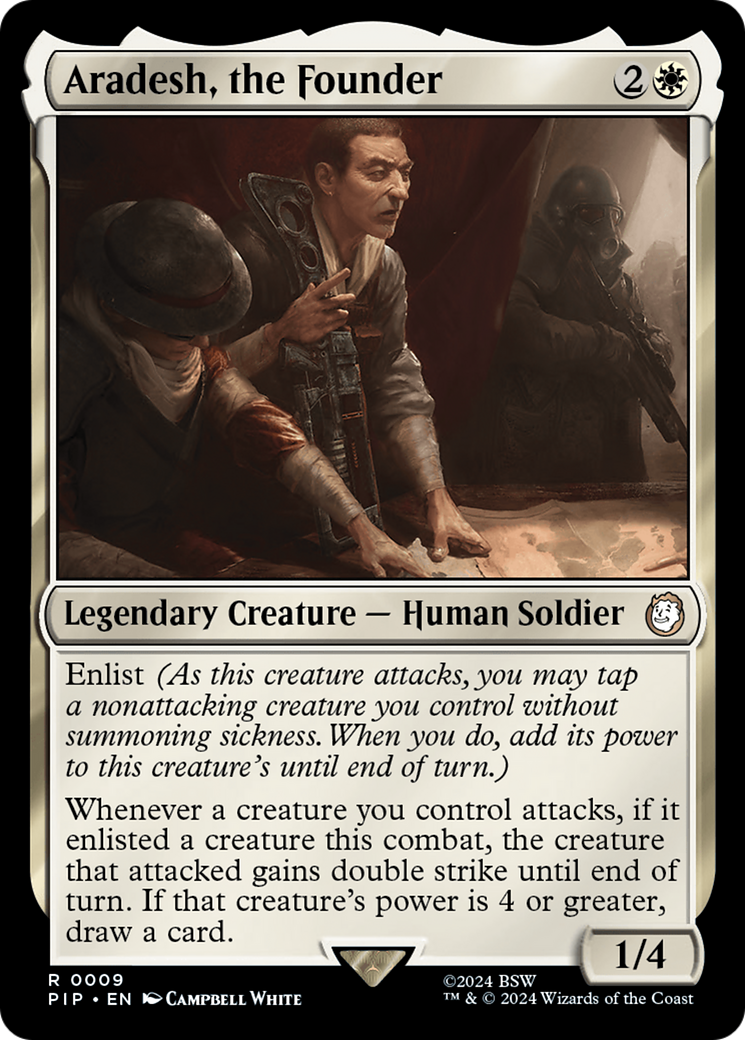
Aradesh, the Founder
Aradesh, the Founder
Legendary Creature — Human Soldier
1/4
Enlist (As this creature attacks, you may tap a nonattacking creature you control without summoning sickness. When you do, add its power to this creature's until end of turn.)
Whenever a creature you control attacks, if it enlisted a creature this combat, the creature that attacked gains double strike until end of turn. If that creature's power is 4 or greater, draw a card.
- The attacking player chooses whether to tap a creature for an enlist ability immediately after they tap the creatures that they have chosen to attack with. You can’t choose to enlist a creature later.
- To enlist a creature, that creature must be untapped, it must not be attacking (even if it has vigilance), and it must have haste or have been under that attacking player’s control since the beginning of their current turn.
- When a player taps a creature for an attacking creature’s enlist ability, that attacking creature gets +X/+0 until end of turn, where X is the tapped creature’s power. This is a triggered ability that goes on the stack immediately after attackers have been declared in the declare attackers step.
- You may tap only one creature for an enlist ability of an attacking creature, and a single creature can’t be tapped for more than one enlist ability.
- Aradesh’s last ability has an intervening if clause. If a creature that attacks hasn’t enlisted a creature this combat, the ability won’t trigger at all for that creature.
- It doesn’t matter what happens to the enlisted creature after Aradesh’s last ability triggers. As long as the creature that attacked enlisted a creature this combat, when Aradesh’s last ability resolves, the creature that attacked will still get double strike, and if that creature’s power is 4 or greater, you’ll still draw a card.
-
1
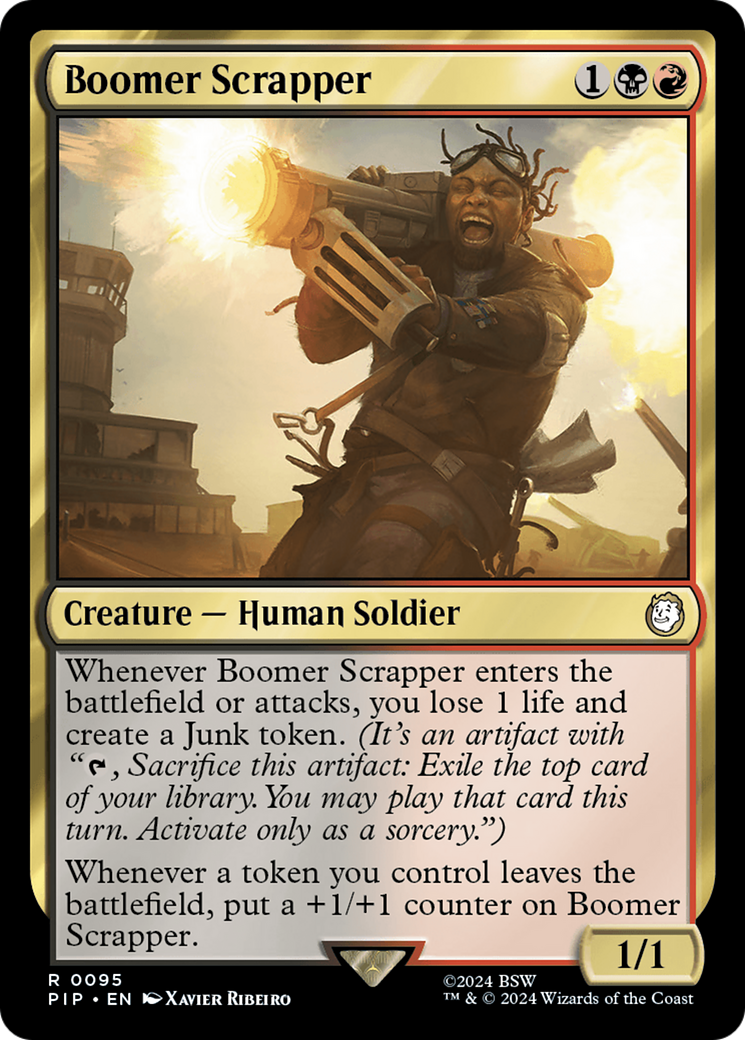
Boomer Scrapper
Boomer Scrapper
Creature — Human Soldier
1/1
Whenever this creature enters or attacks, you lose 1 life and create a Junk token. (It's an artifact with " , Sacrifice this token: Exile the top card of your library. You may play that card this turn. Activate only as a sorcery.")
Whenever a token you control leaves the battlefield, put a +1/+1 counter on this creature.
- You can't sacrifice a Junk token to pay multiple costs. For example, you can't sacrifice a Junk token to activate its own ability and also to activate the second ability of Junk Jet.
- You pay all costs and follow all normal timing rules for the card played from exile with a Junk token's ability. For example, if the exiled card is a land card, you may play it only during your main phase while the stack is empty.
- Some spells and abilities that create Junk tokens may require targets. If each target chosen is illegal as that spell or ability tries to resolve, it won't resolve and none of its effects happen. You won't create any Junk tokens.
-
1
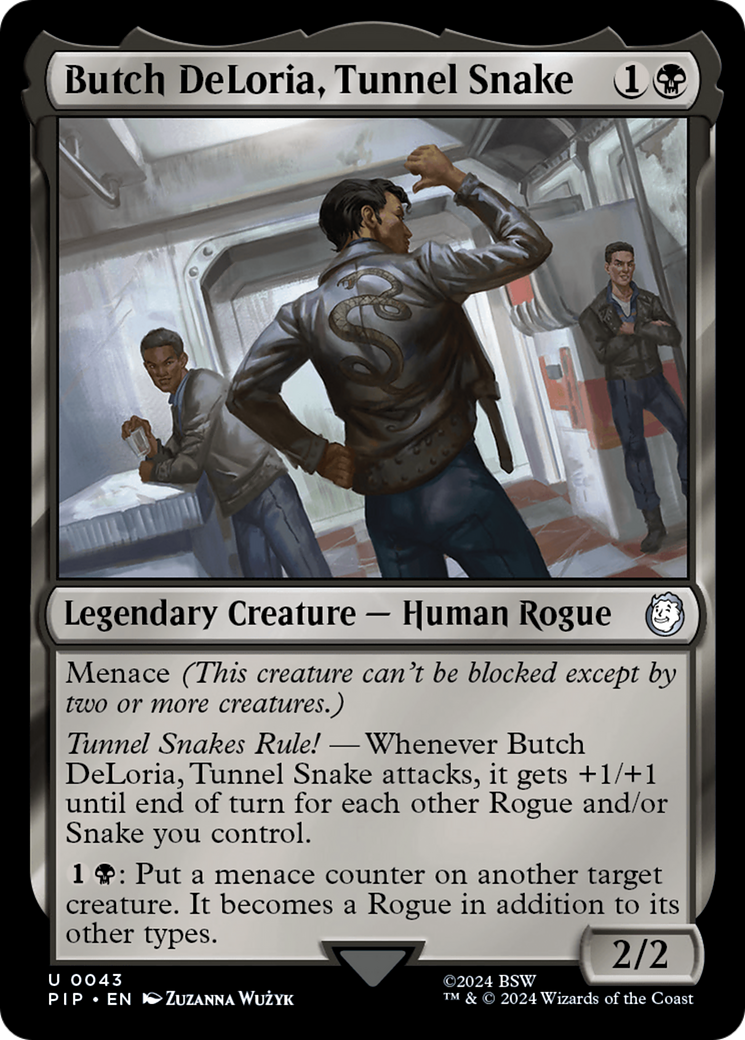
Butch DeLoria, Tunnel Snake
Butch DeLoria, Tunnel Snake
Legendary Creature — Human Rogue
2/2
Menace (This creature can't be blocked except by two or more creatures.)
Tunnel Snakes Rule! — Whenever Butch DeLoria attacks, it gets +1/+1 until end of turn for each other Rogue and/or Snake you control.
: Put a menace counter on another target creature. It becomes a Rogue in addition to its other types.
- A permanent that's both a Rogue and a Snake is counted only once for Butch DeLoria's second ability.
-
1
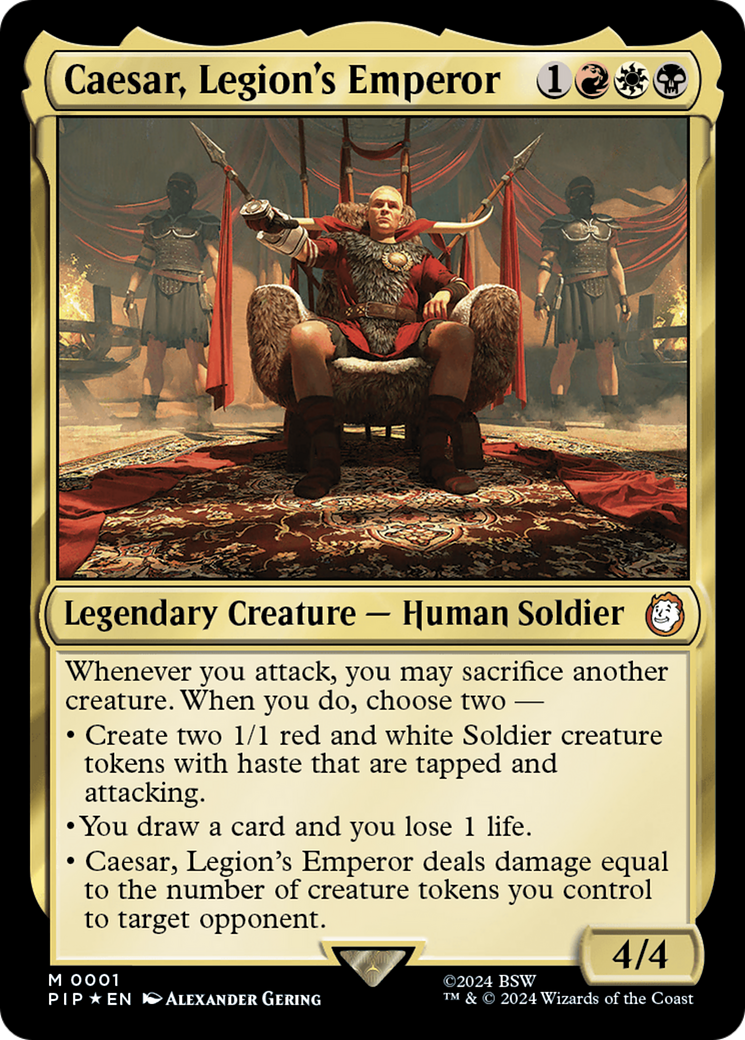
Caesar, Legion's Emperor
Caesar, Legion's Emperor
Legendary Creature — Human Soldier
4/4
Whenever you attack, you may sacrifice another creature. When you do, choose two —
- Create two 1/1 red and white Soldier creature tokens with haste that are tapped and attacking.
- You draw a card and you lose 1 life.
- Caesar deals damage equal to the number of creature tokens you control to target opponent.
- You don't choose modes or a target for Caesar, Legion's Emperor's ability at the time it triggers. Rather, a second "reflexive" ability triggers when you sacrifice another creature this way. You choose modes and, if you chose the third mode, a target for that ability as it goes on the stack. Each player may respond to this triggered ability as normal.
- The Soldier tokens created by Caesar's ability enter the battlefield tapped and attacking, but since they weren't declared as attacking creatures, no abilities that trigger whenever a creature attacks or whenever you attack (such as Caesar's own ability) will trigger.
-
1
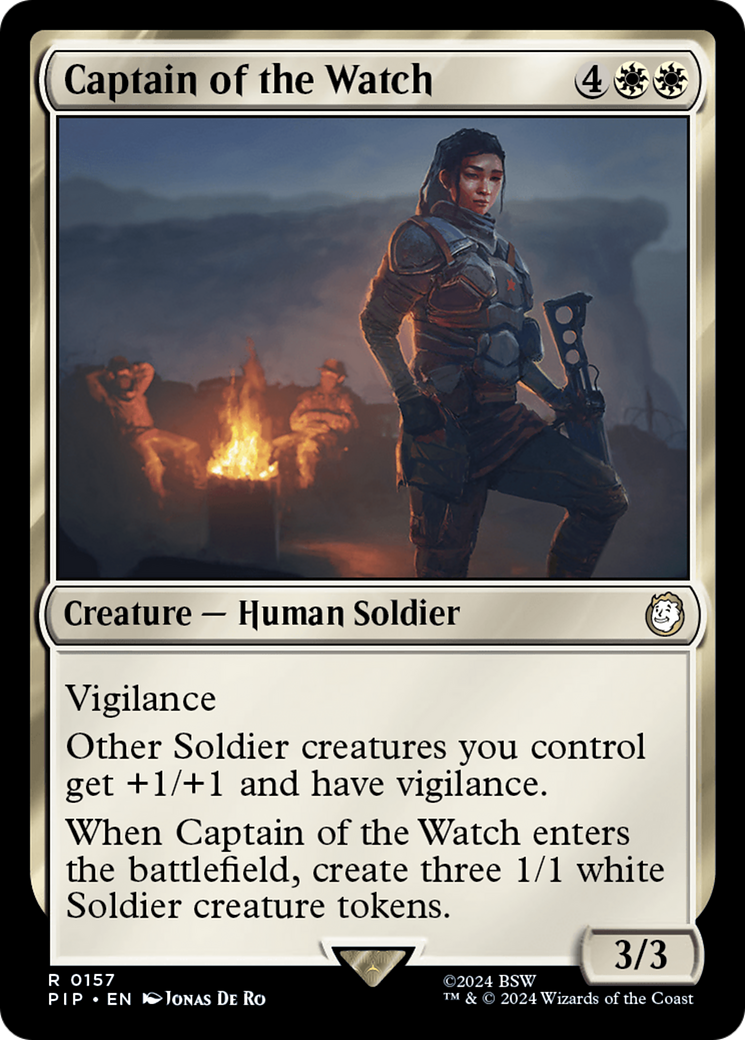
Captain of the Watch
Captain of the Watch
Creature — Human Soldier
3/3
Vigilance (Attacking doesn't cause this creature to tap.)
Other Soldier creatures you control get +1/+1 and have vigilance.
When this creature enters, create three 1/1 white Soldier creature tokens.
- Captain of the Watch grants +1/+1 and vigilance to all other Soldier creatures you control, not just the ones its ability puts onto the battlefield.
-
1
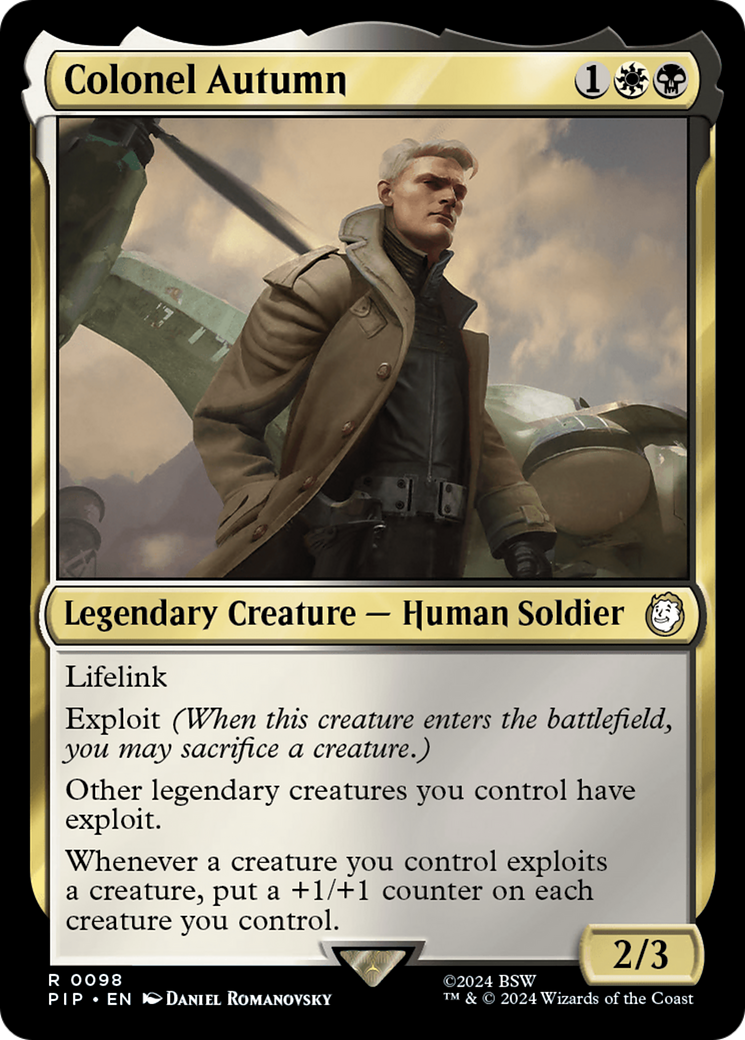
Colonel Autumn
Colonel Autumn
Legendary Creature — Human Soldier
2/3
Lifelink
Exploit (When this creature enters, you may sacrifice a creature.)
Other legendary creatures you control have exploit.
Whenever a creature you control exploits a creature, put a +1/+1 counter on each creature you control.
- A creature with exploit “exploits a creature” when the controller of an exploit ability sacrifices a creature as that ability resolves.
- You choose whether to sacrifice a creature and which creature to sacrifice as an exploit ability resolves.
- You can sacrifice the creature with exploit if it’s still on the battlefield. If it has an ability that triggers when it exploits a creature (or, in this case, when any creature you control exploits a creature), that ability will trigger.
- If Colonel Autumn isn’t on the battlefield as an exploit ability of a creature you control resolves, Colonel Autumn’s last ability won’t trigger. You won’t get +1/+1 counters, even if you sacrifice a creature.
- You can’t sacrifice more than one creature to any one exploit ability.
-
1
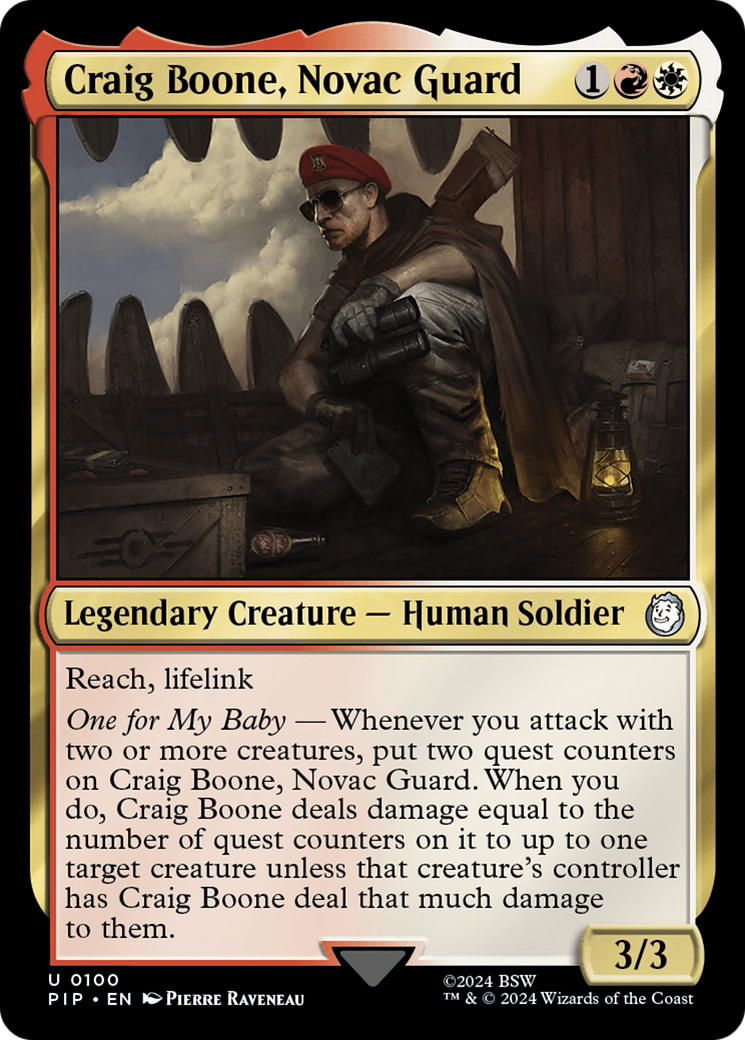
Craig Boone, Novac Guard
Craig Boone, Novac Guard
Legendary Creature — Human Soldier
3/3
Reach, lifelink
One for My Baby — Whenever you attack with two or more creatures, put two quest counters on Craig Boone. When you do, Craig Boone deals damage equal to the number of quest counters on it to up to one target creature unless that creature's controller has Craig Boone deal that much damage to them.
- In the rare case where more than two quest counters are placed on Craig Boone because of the effect of its last ability (for example, because of the effect of Doubling Season), the reflexive triggered ability will trigger once for every two quest counters placed on Craig Boone this way.
- You don't choose a target for Craig Boone's last ability at the time it triggers. Rather, a second "reflexive" ability triggers when you put two quest counters on Craig Boone this way. You choose up to one target for that ability as it goes on the stack. Each player may respond to this triggered ability as normal.
- If Craig Boone is no longer on the battlefield when the reflexive triggered ability resolves, use the number of quest counters that were on it when it was last on the battlefield to determine how much damage it deals.
-
1
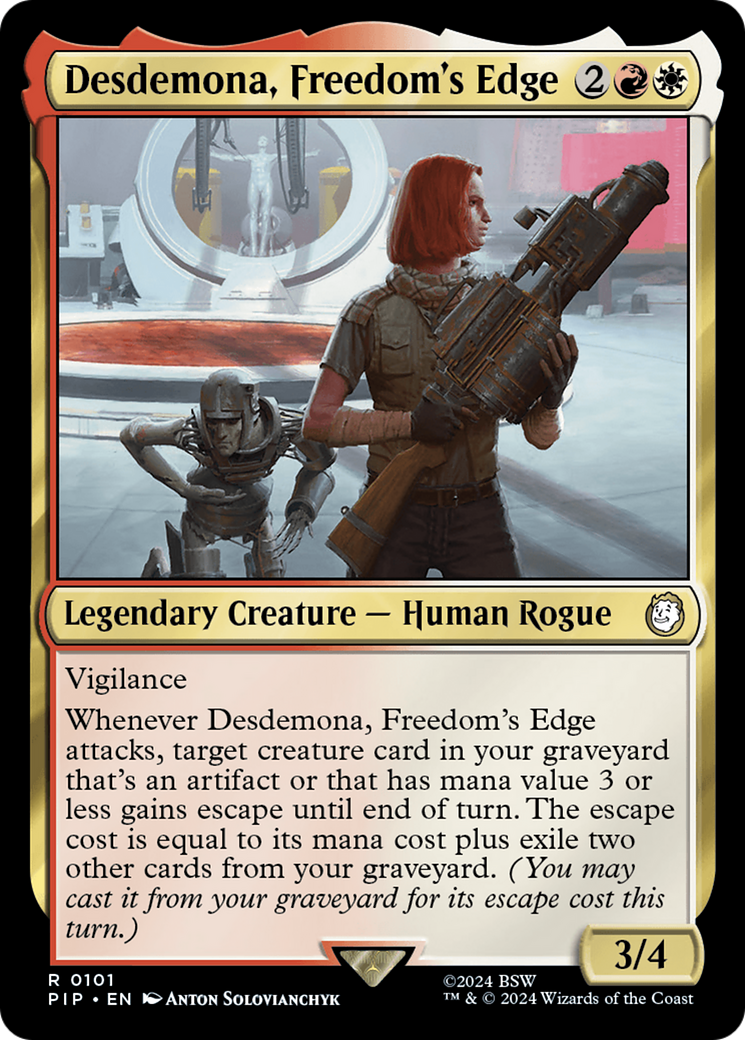
Desdemona, Freedom's Edge
Desdemona, Freedom's Edge
Legendary Creature — Human Rogue
3/4
Vigilance
Whenever Desdemona attacks, target creature card in your graveyard that's an artifact or that has mana value 3 or less gains escape until end of turn. The escape cost is equal to its mana cost plus exile two other cards from your graveyard. (You may cast it from your graveyard for its escape cost this turn.)
- If a spell you're casting with escape has an additional cost of discarding cards or sacrificing permanents, you may exile cards discarded or sacrificed this way to pay that part of its escape cost.
- Escape's permission doesn't change when you may cast the spell from your graveyard.
- To determine the total cost of a spell, start with the mana cost or alternative cost you're paying (such as an escape cost), add any cost increases, then apply any cost reductions. The mana value of the spell remains unchanged, no matter what the total cost to cast it was and no matter whether an alternative cost was paid.
- After an escaped permanent spell resolves, it enters the battlefield and will return to its owner's graveyard if it dies later.
- If a card has multiple abilities giving you permission to cast it, such as two escape abilities or an escape ability and a flashback ability, you choose which one to apply. The others have no effect.
- If you cast a spell with its escape permission, you can't choose to apply any other alternative costs or to cast it without paying its mana cost. You may pay any optional additional costs the spell has, such as kicker costs. If it has any mandatory additional costs, you must pay those.
- Once you begin casting a spell with escape, it immediately moves to the stack. Players can't take any other actions until you're done casting the spell.
-
1
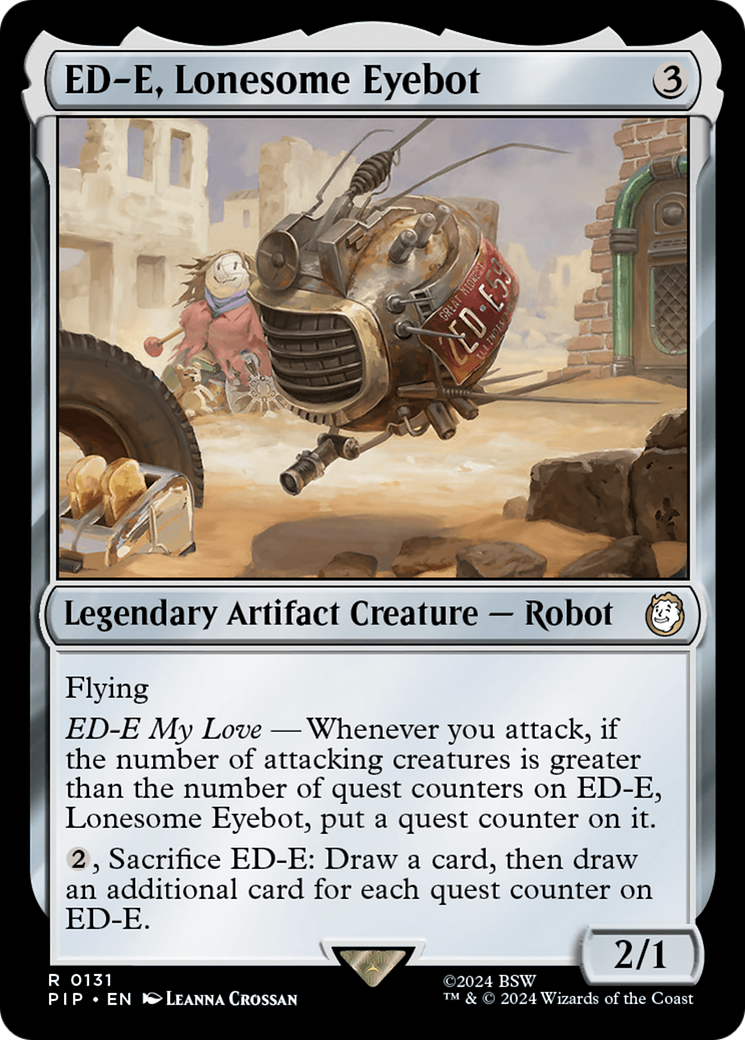
ED-E, Lonesome Eyebot
ED-E, Lonesome Eyebot
Legendary Artifact Creature — Robot
2/1
Flying
ED-E My Love — Whenever you attack, if the number of attacking creatures is greater than the number of quest counters on ED-E, put a quest counter on it.
, Sacrifice ED-E: Draw a card, then draw an additional card for each quest counter on ED-E.
- If the number of attacking creatures isn't greater than the number of quest counters on ED-E when you attack, its second ability won't trigger at all. When the ability tries to resolve, if the number of attacking creatures is no longer greater than the number of quest counters on ED-E, it won't resolve, and you won't put a quest counter on ED-E.
-
1
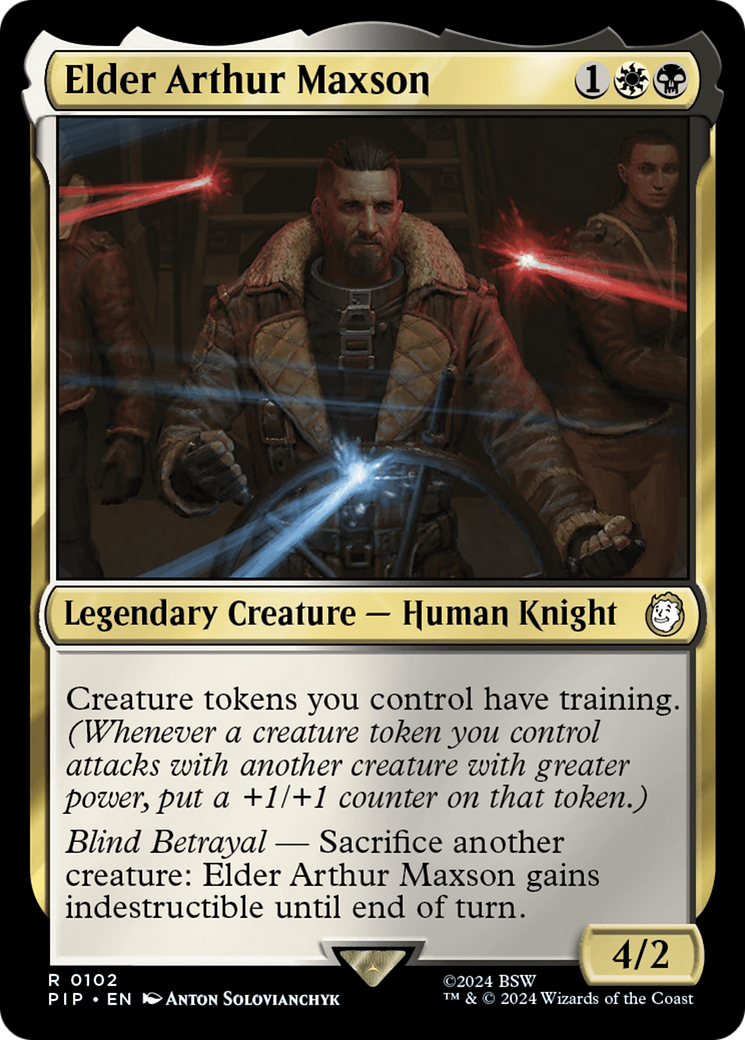
Elder Arthur Maxson
Elder Arthur Maxson
Legendary Creature — Human Knight
4/2
Creature tokens you control have training. (Whenever a creature token you control attacks with another creature with greater power, put a +1/+1 counter on that token.)
Blind Betrayal — Sacrifice another creature: Elder Arthur Maxson gains indestructible until end of turn.
- A creature’s training ability triggers only when both that creature and a creature with greater power are declared as attackers. Increasing a creature’s power after attackers are declared won’t cause a training ability to trigger.
- Once a creature’s training ability has triggered, destroying the other attacking creature or reducing its power won’t stop the creature with training from getting a +1/+1 counter.
-
1
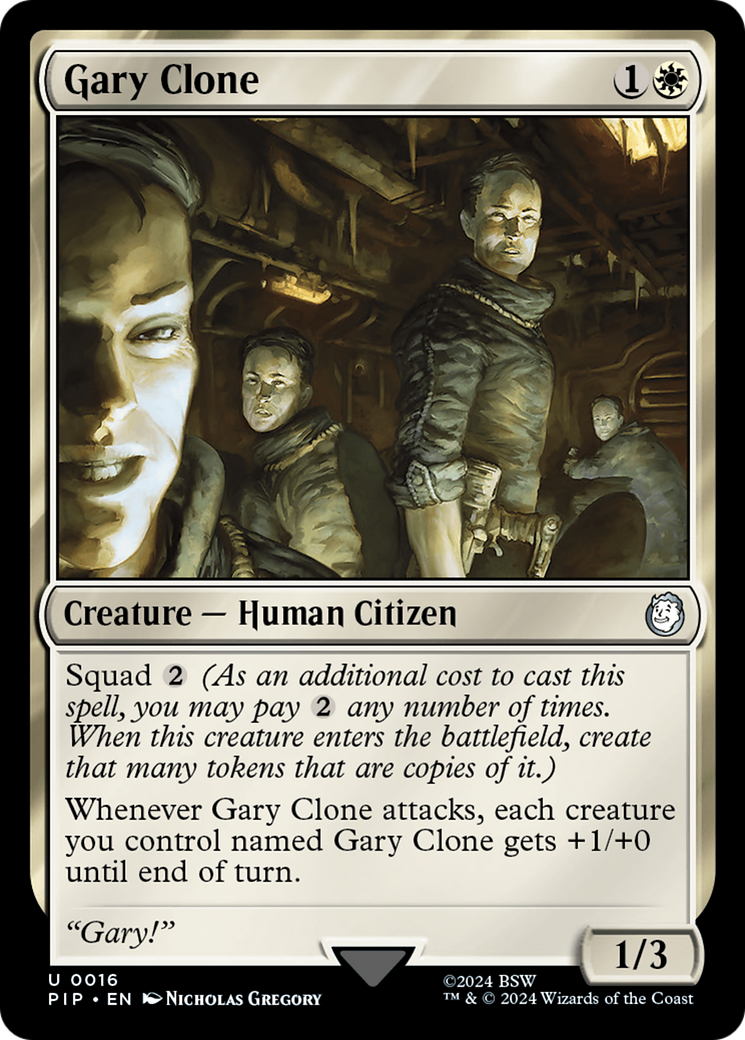
Gary Clone
Gary Clone
Creature — Human Citizen
1/3
Squad (As an additional cost to cast this spell, you may pay any number of times. When this creature enters, create that many tokens that are copies of it.)
Whenever this creature attacks, each creature you control named Gary Clone gets +1/+0 until end of turn.
- You may pay the squad cost any number of times. You will create a token that is a copy of that permanent for each time you paid the squad cost. If you paid the squad cost multiple times, the tokens will all enter the battlefield simultaneously.
- If the spell is countered, the squad ability will not trigger, and no tokens will be created.
- If the spell resolves but the creature with squad leaves the battlefield before its squad ability resolves, you'll still create the token copies.
- The tokens created by the squad ability aren't "cast," so any abilities that trigger when a spell is cast won't trigger for the copies.
- If, for some reason, the creature doesn't have the squad ability when it's on the battlefield, the ability won't trigger, even if you've paid the squad cost one or more times.
-
1
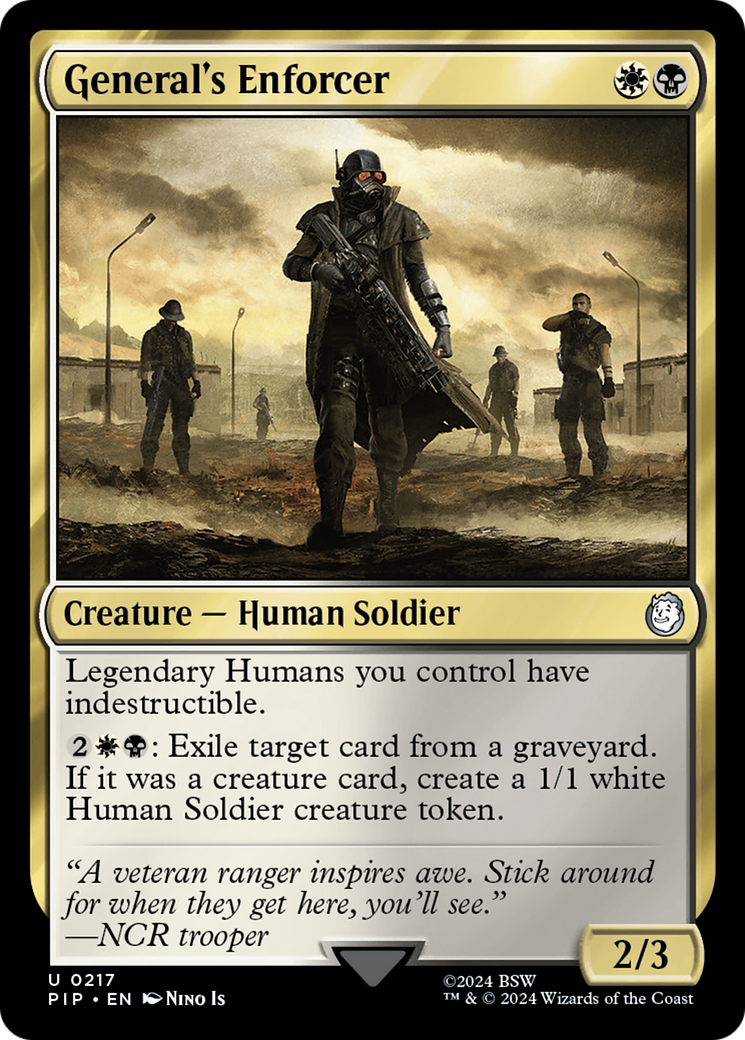
General's Enforcer
General's Enforcer
Creature — Human Soldier
2/3
Legendary Humans you control have indestructible.
: Exile target card from a graveyard. If it was a creature card, create a 1/1 white Human Soldier creature token.
- Because damage remains marked on a creature until the damage is removed as the turn ends, nonlethal damage dealt to a legendary Human you control may become lethal if General's Enforcer leaves the battlefield during that turn.
- Only creatures are Humans. Planeswalkers such as Lukka and Narset who represent human characters aren't affected by General's Enforcer.
-
1
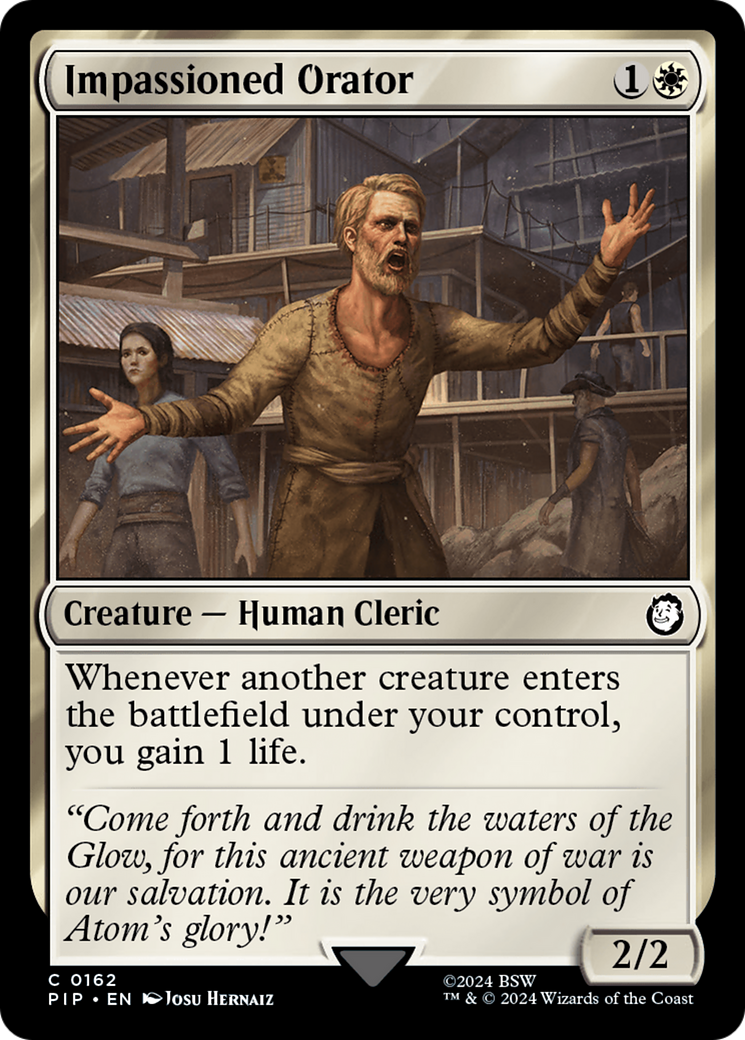
Impassioned Orator
Impassioned Orator
Creature — Human Cleric
2/2
Whenever another creature you control enters, you gain 1 life.
-
1
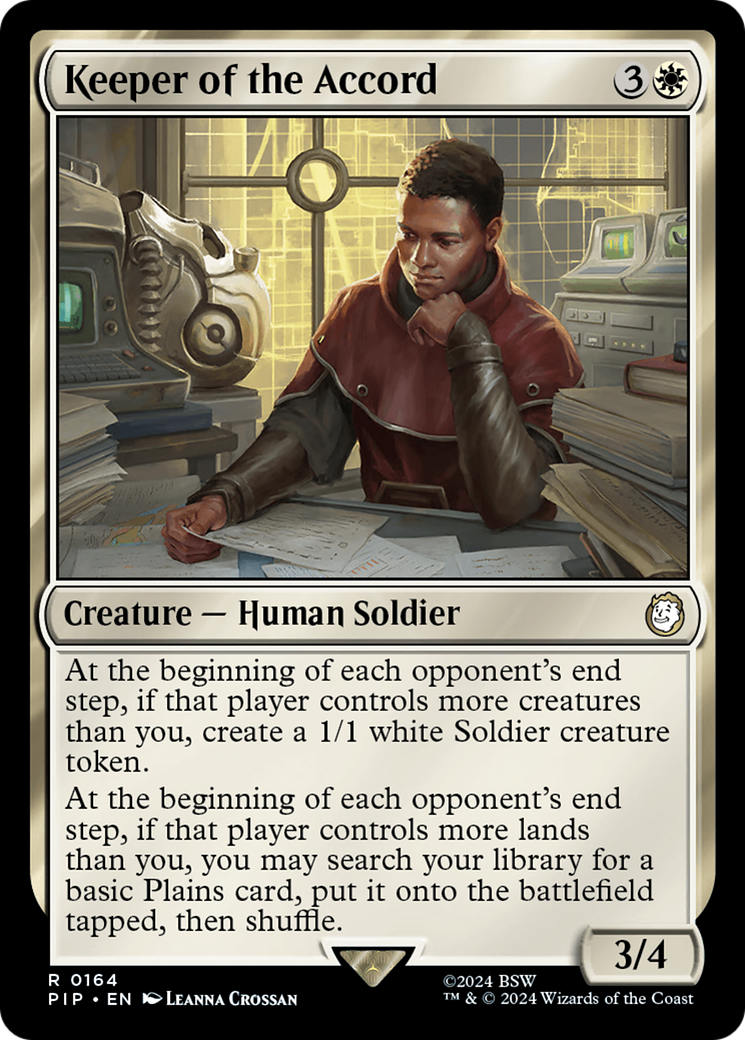
Keeper of the Accord
Keeper of the Accord
Creature — Human Soldier
3/4
At the beginning of each opponent's end step, if that player controls more creatures than you, create a 1/1 white Soldier creature token.
At the beginning of each opponent's end step, if that player controls more lands than you, you may search your library for a basic Plains card, put it onto the battlefield tapped, then shuffle.
- Both triggered abilities trigger at the same time. You may put them on the stack in either order.
- If the opponent doesn't control more creatures than you as their end step begins, the first ability won't trigger. The same is true for lands and the second ability. Each of those abilities will check again when it tries to resolve. If the opponent no longer controls more creatures (or lands) than you, the ability won't resolve and will have no effect.
-
1
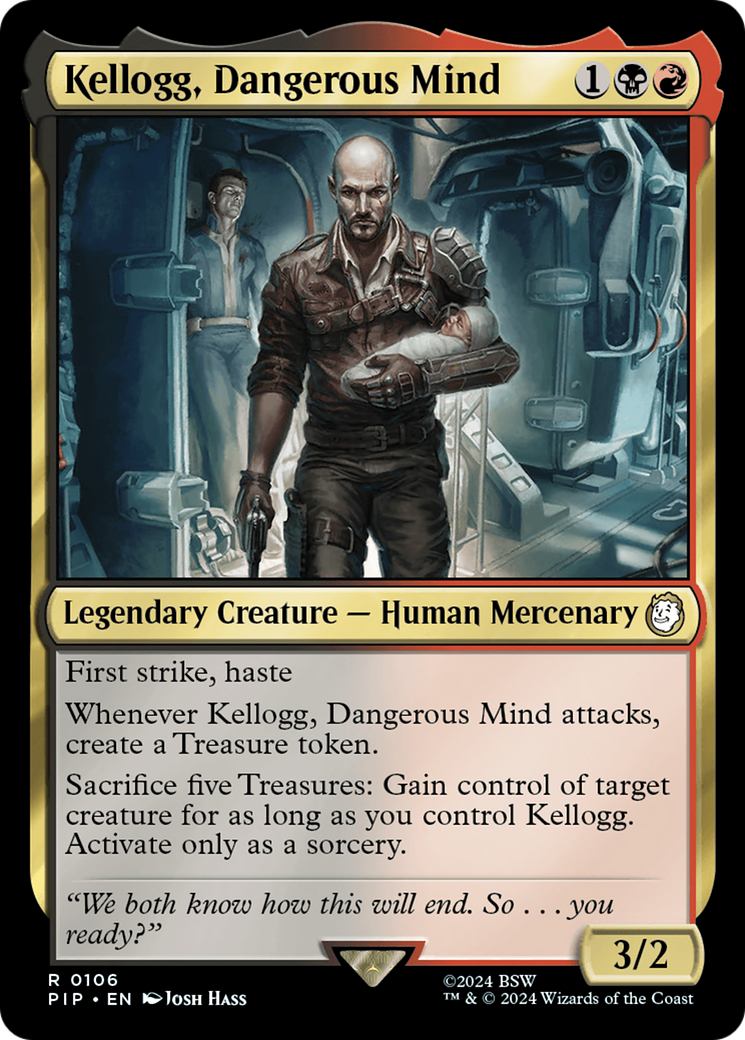
Kellogg, Dangerous Mind
Kellogg, Dangerous Mind
Legendary Creature — Human Mercenary
3/2
First strike, haste
Whenever Kellogg attacks, create a Treasure token.
Sacrifice five Treasures: Gain control of target creature for as long as you control Kellogg. Activate only as a sorcery.
- If you lose control of Kellogg before its last ability resolves, you won't gain control of the target creature at all.
-
1
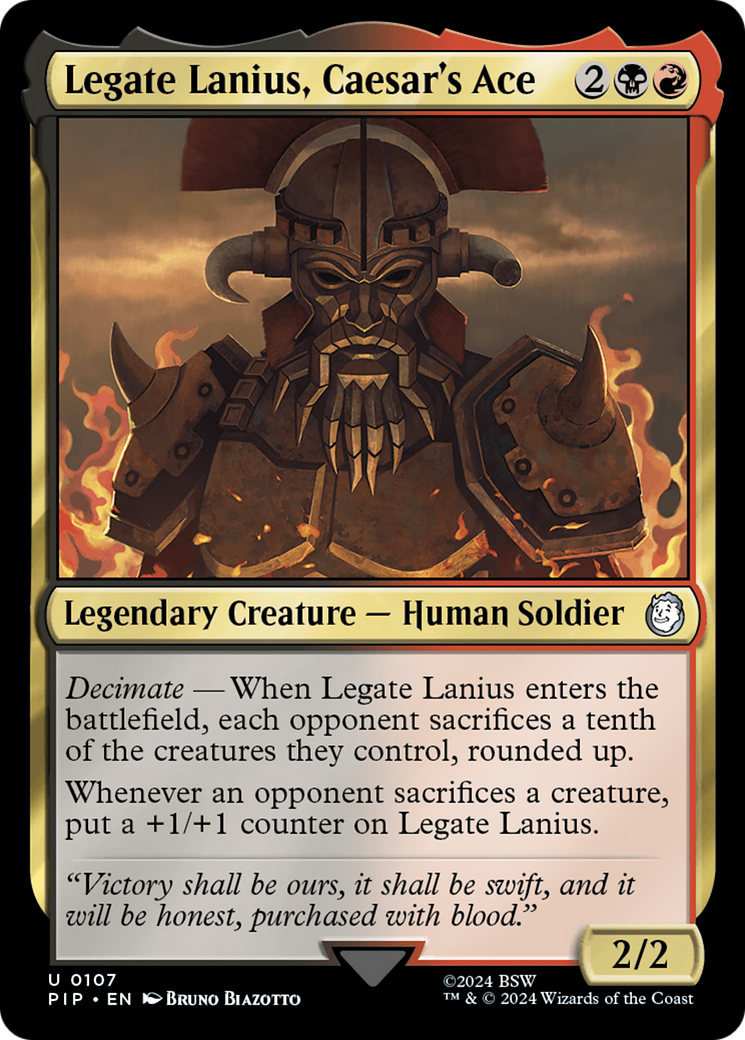
Legate Lanius, Caesar's Ace
Legate Lanius, Caesar's Ace
Legendary Creature — Human Soldier
2/2
Decimate — When Legate Lanius enters, each opponent sacrifices a tenth of the creatures they control of their choice, rounded up.
Whenever an opponent sacrifices a creature, put a +1/+1 counter on Legate Lanius.
- For example, when Legate Lanius's first ability resolves, an opponent who controls between one and ten creatures will sacrifice one creature. An opponent who controls between eleven and twenty creatures will sacrifice two creatures, and so on.
-
1
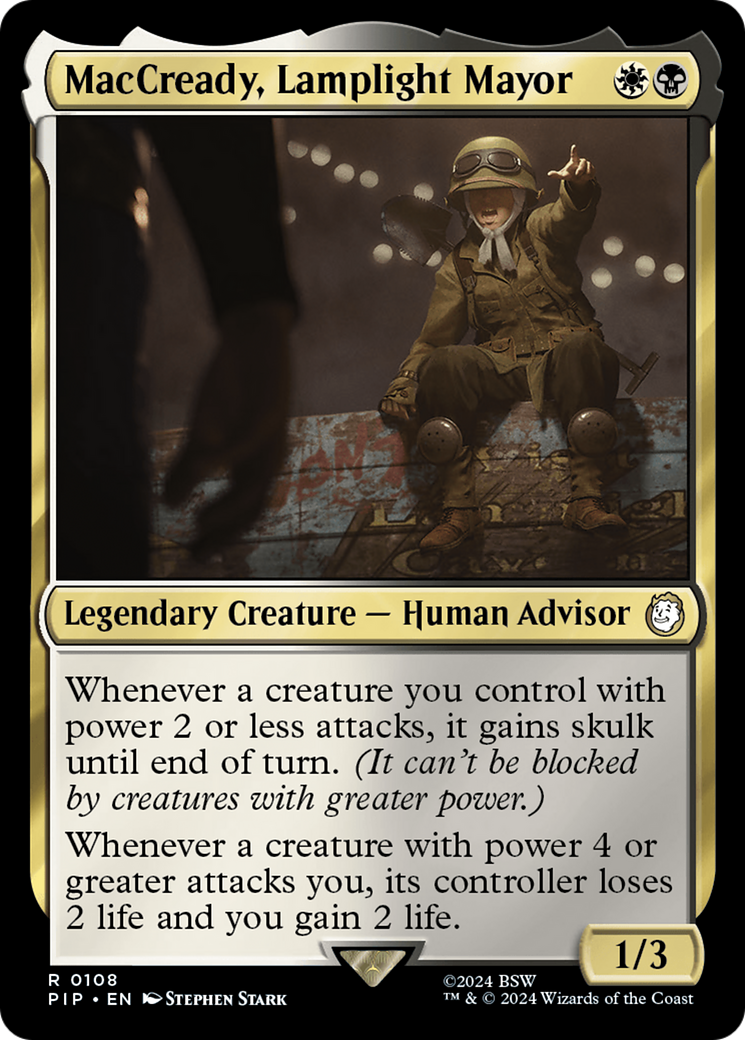
MacCready, Lamplight Mayor
MacCready, Lamplight Mayor
Legendary Creature — Human Advisor
1/3
Whenever a creature you control with power 2 or less attacks, it gains skulk until end of turn. (It can't be blocked by creatures with greater power.)
Whenever a creature with power 4 or greater attacks you, its controller loses 2 life and you gain 2 life.
- The power of your attacking creature is checked only when MacCready’s first ability triggers. Once it triggers, the creature will gain skulk until end of turn when the ability resolves, regardless of whether or not its power is still 2 or less at that time.
- Similarly, the power of the creature attacking you is checked only when MacCready’s second ability triggers. Once it triggers, the creature’s controller will lose 2 life and you’ll gain 2 life when the ability resolves, regardless of whether or not its power is still 4 or greater at that time or whether or not it’s still on the battlefield.
-
1
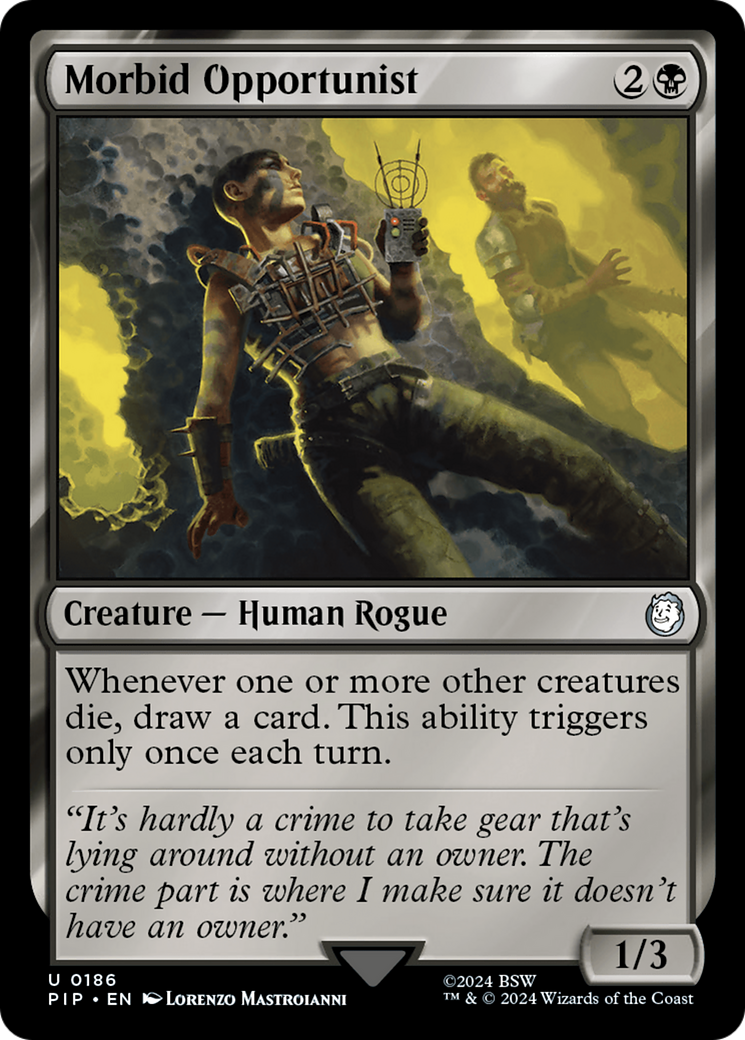
Morbid Opportunist
Morbid Opportunist
Creature — Human Rogue
1/3
Whenever one or more other creatures die, draw a card. This ability triggers only once each turn.
- If Morbid Opportunist dies at the same time as one or more other creatures, Morbid Opportunist's ability still triggers.
-
1
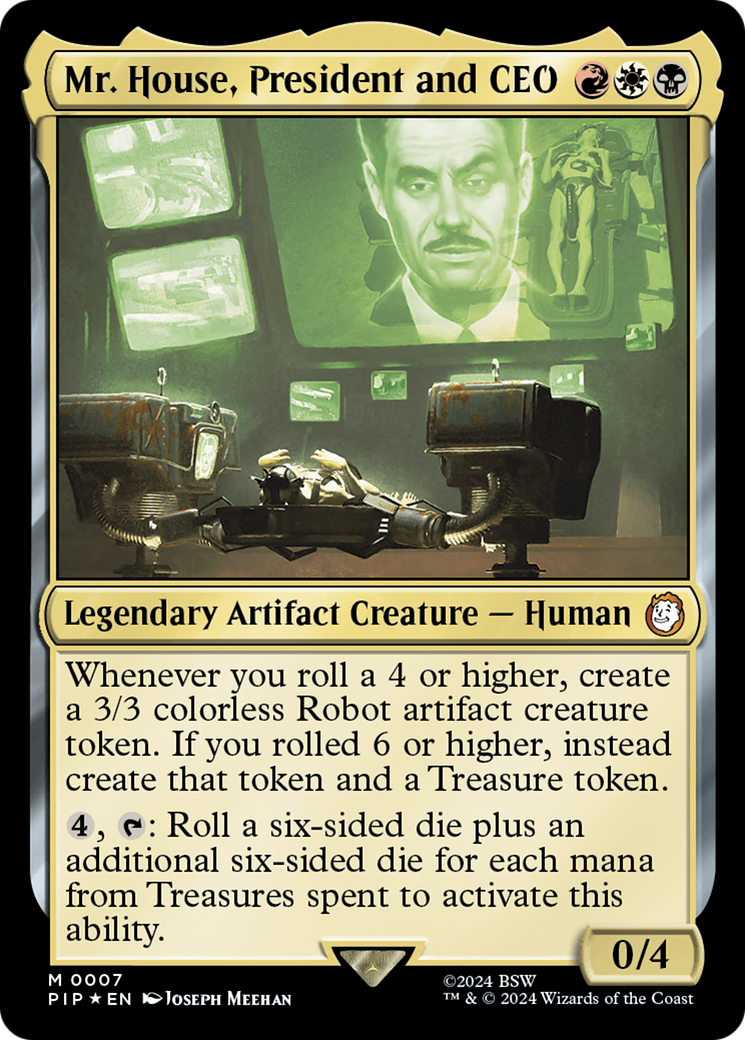
Mr. House, President and CEO
Mr. House, President and CEO
Legendary Artifact Creature — Human
0/4
Whenever you roll a 4 or higher, create a 3/3 colorless Robot artifact creature token. If you rolled 6 or higher, instead create that token and a Treasure token.
, : Roll a six-sided die plus an additional six-sided die for each mana from Treasures spent to activate this ability.
- Some cards from other releases may instruct you to roll dice other than six-sided dice. Results of 4 or higher on those dice cause Mr. House's first ability to trigger.
- The die rolls caused by Mr. House's last ability have no inherent effect. Abilities that trigger whenever you roll dice or whenever you roll a certain result, such as Mr. House's first ability, will trigger as appropriate.
-
1
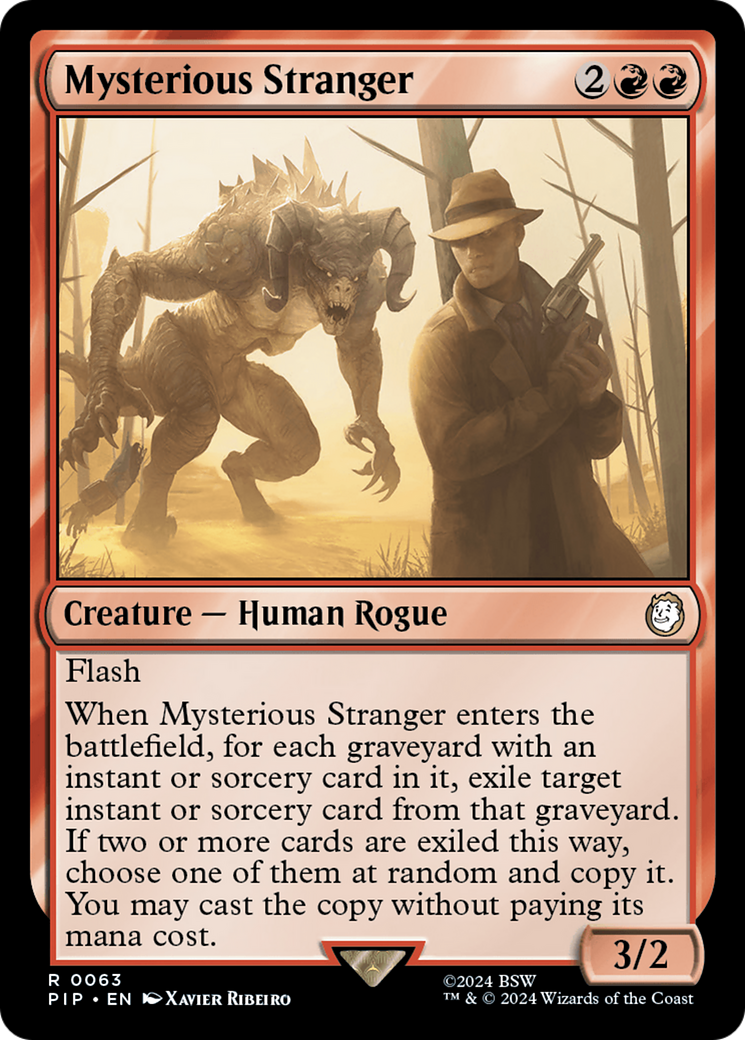
Mysterious Stranger
Mysterious Stranger
Creature — Human Rogue
3/2
Flash
When this creature enters, for each graveyard with an instant or sorcery card in it, exile target instant or sorcery card from that graveyard. If two or more cards are exiled this way, choose one of them at random and copy it. You may cast the copy without paying its mana cost.
- You cast the copy while Mysterious Stranger’s last ability is resolving and still on the stack. You can’t wait to cast it later in the turn.
- If a spell has in its mana cost, you must choose 0 as the value of X when casting it without paying its mana cost.
- If you cast a spell “without paying its mana cost,” you can’t choose to cast it for any alternative costs. You can, however, pay additional costs. If the spell has any mandatory additional costs, those must be paid to cast the card.
- If you don’t want to cast the copy, you can choose not to; the copy ceases to exist the next time state-based actions are checked.
-
1
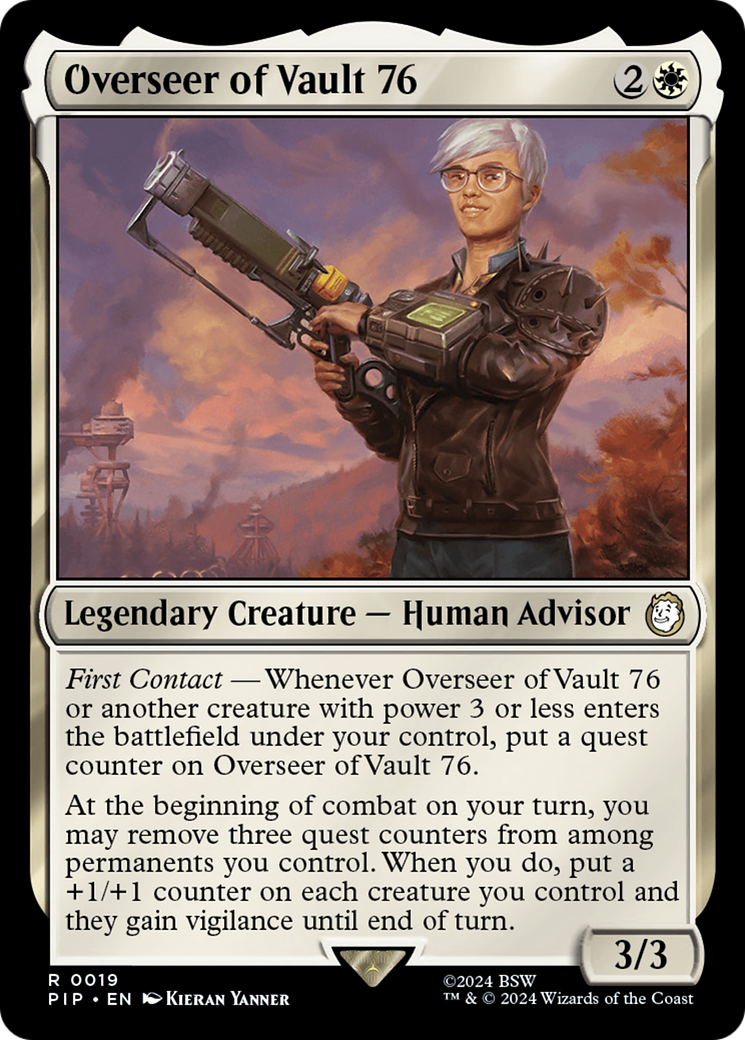
Overseer of Vault 76
Overseer of Vault 76
Legendary Creature — Human Advisor
3/3
First Contact — Whenever Overseer of Vault 76 or another creature you control with power 3 or less enters, put a quest counter on Overseer of Vault 76.
At the beginning of combat on your turn, you may remove three quest counters from among permanents you control. When you do, put a +1/+1 counter on each creature you control and they gain vigilance until end of turn.
- If Overseer of Vault 76 and one or more other creatures with power 3 or less enter the battlefield under your control at the same time, Overseer of Vault 76’s first ability will trigger for each of them.
- Overseer of Vault 76’s last ability lets you choose to remove exactly three quest counters from among permanents you control when it resolves. You can’t remove more quest counters to multiply the effect.
-
1
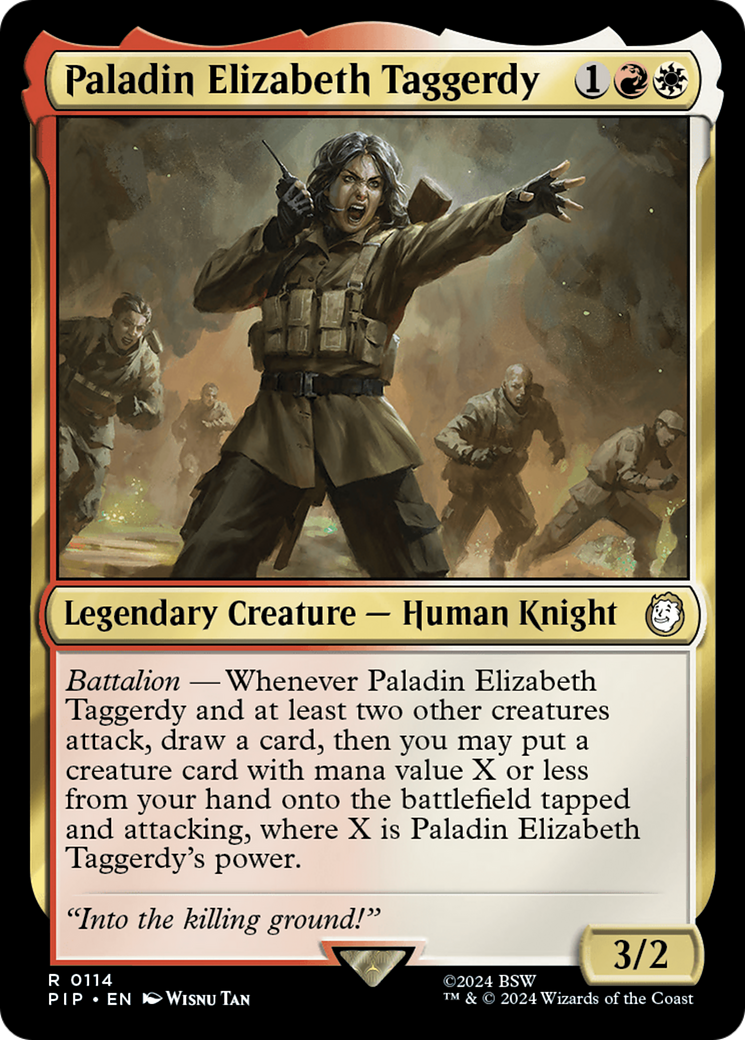
Paladin Elizabeth Taggerdy
Paladin Elizabeth Taggerdy
Legendary Creature — Human Knight
3/2
Battalion — Whenever Paladin Elizabeth Taggerdy and at least two other creatures attack, draw a card, then you may put a creature card with mana value X or less from your hand onto the battlefield tapped and attacking, where X is Paladin Elizabeth Taggerdy's power.
- The three attacking creatures don’t have to be attacking the same player, planeswalker, or battle.
- Once Paladin Elizabeth Taggerdy’s battalion ability has triggered, it doesn’t matter how many creatures are still attacking when that ability resolves.
- If Paladin Elizabeth Taggerdy is no longer on the battlefield when its battalion ability resolves, use its power as it last existed on the battlefield to determine the value of X.
- Although the creature you put onto the battlefield is attacking, it was never declared as an attacking creature. This means that abilities that trigger whenever a creature attacks won’t trigger when it enters the battlefield attacking.
- You choose which player, planeswalker, or battle the creature you put onto the battlefield is attacking as it enters the battlefield. It doesn’t have to be attacking the same player, planeswalker, or battle that Paladin Elizabeth Taggerdy is attacking.
-
1
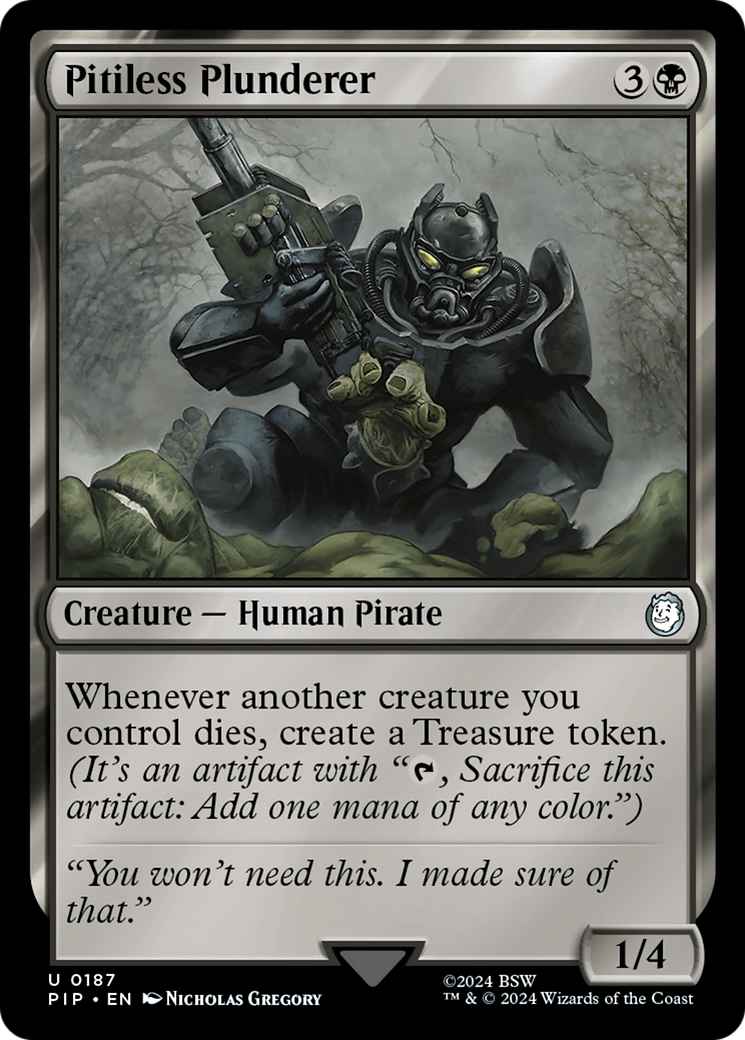
Pitiless Plunderer
Pitiless Plunderer
Creature — Human Pirate
1/4
Whenever another creature you control dies, create a Treasure token. (It's an artifact with " , Sacrifice this token: Add one mana of any color.")
- If Pitiless Plunderer dies at the same time as one or more other creatures you control, its ability will still trigger for each of those other creatures.
-
1
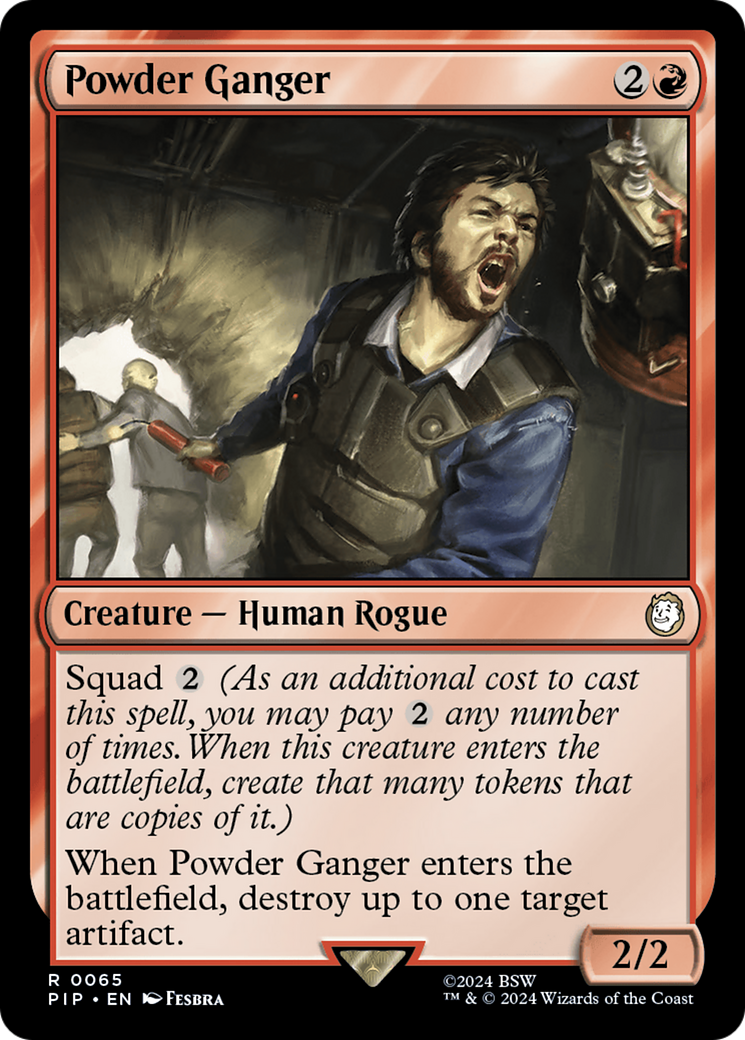
Powder Ganger
Powder Ganger
Creature — Human Rogue
2/2
Squad (As an additional cost to cast this spell, you may pay any number of times. When this creature enters, create that many tokens that are copies of it.)
When this creature enters, destroy up to one target artifact.
- You may pay the squad cost any number of times. You will create a token that is a copy of that permanent for each time you paid the squad cost. If you paid the squad cost multiple times, the tokens will all enter the battlefield simultaneously.
- If the spell is countered, the squad ability will not trigger, and no tokens will be created.
- If the spell resolves but the creature with squad leaves the battlefield before its squad ability resolves, you’ll still create the token copies.
- The tokens created by the squad ability aren’t “cast,” so any abilities that trigger when a spell is cast won’t trigger for the copies.
- If, for some reason, the creature doesn’t have the squad ability when it’s on the battlefield, the ability won’t trigger, even if you’ve paid the squad cost one or more times.
-
1
Rose, Cutthroat Raider
Rose, Cutthroat Raider
Legendary Artifact Creature — Robot
3/2
First strike
Raid — At end of combat on your turn, if you attacked this turn, create a Junk token for each opponent you attacked. (It's an artifact with " , Sacrifice this token: Exile the top card of your library. You may play that card this turn. Activate only as a sorcery.")
Whenever you sacrifice a Junk, add .
- Raid abilities care only that you attacked with a creature. It doesn't matter how many creatures you attacked with or which player, planeswalker, or battle those creatures attacked.
- Raid abilities evaluate the entire turn to see if you attacked with a creature. That creature doesn't have to still be on the battlefield. Similarly, the player, planeswalker, or battle it attacked doesn't have to still be in the game or on the battlefield.
- Rose's last ability triggers when you sacrifice a Junk for any reason, not just to activate a Junk's activated ability.
- You can't sacrifice a Junk token to pay multiple costs. For example, you can't sacrifice a Junk token to activate its own ability and also to activate the second ability of Junk Jet.
- You pay all costs and follow all normal timing rules for the card played from exile with a Junk token's ability. For example, if the exiled card is a land card, you may play it only during your main phase while the stack is empty.
- Some spells and abilities that create Junk tokens may require targets. If each target chosen is illegal as that spell or ability tries to resolve, it won't resolve and none of its effects happen. You won't create any Junk tokens.
-
1
Ruthless Radrat
Ruthless Radrat
Creature — Rat Mutant
2/2
Squad—Exile four cards from your graveyard. (As an additional cost to cast this spell, you may pay its squad cost any number of times. When this creature enters, create that many tokens that are copies of it.)
Menace (This creature can't be blocked except by two or more creatures.)
- Once you announce that you’re casting Ruthless Radrat, no player may take actions until you’re done casting it. Notably, opponents can’t try to remove cards from your graveyard to stop you from paying Ruthless Radrat’s squad cost.
- You may pay the squad cost any number of times. You will create a token that is a copy of that permanent for each time you paid the squad cost. If you paid the squad cost multiple times, the tokens will all enter the battlefield simultaneously.
- If the spell is countered, the squad ability will not trigger, and no tokens will be created.
- If the spell resolves but the creature with squad leaves the battlefield before its squad ability resolves, you’ll still create the token copies.
- The tokens created by the squad ability aren’t “cast,” so any abilities that trigger when a spell is cast won’t trigger for the copies.
- If, for some reason, the creature doesn’t have the squad ability when it’s on the battlefield, the ability won’t trigger, even if you’ve paid the squad cost one or more times.
-
1
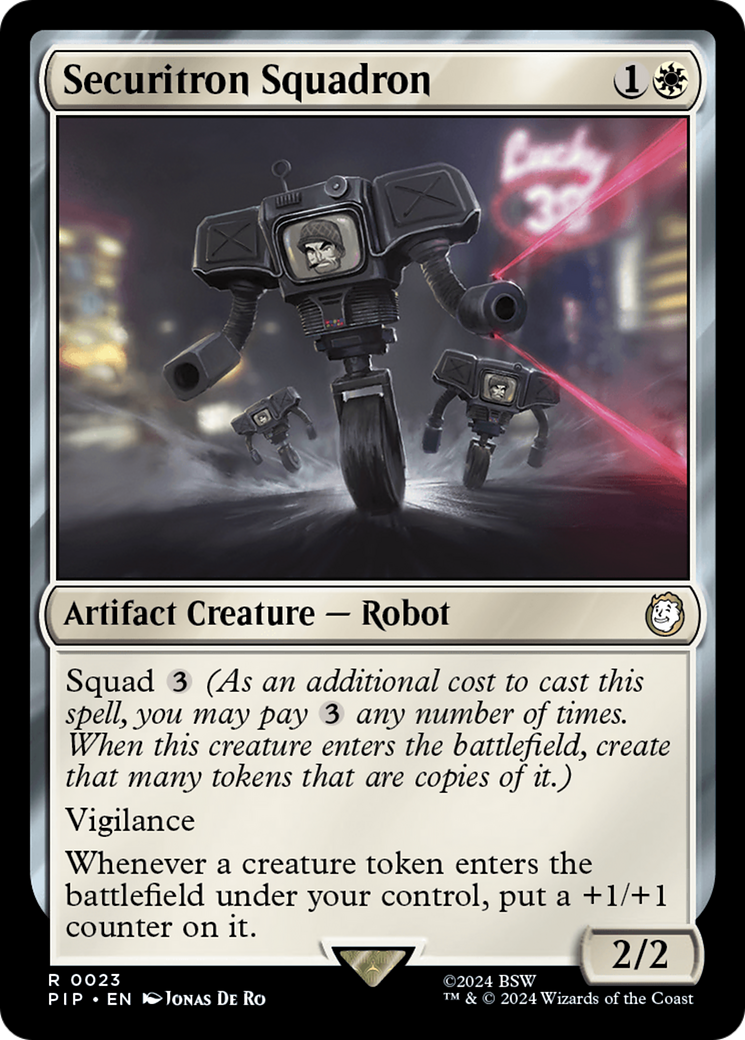
Securitron Squadron
Securitron Squadron
Artifact Creature — Robot
2/2
Squad (As an additional cost to cast this spell, you may pay any number of times. When this creature enters, create that many tokens that are copies of it.)
Vigilance
Whenever a creature token you control enters, put a +1/+1 counter on it.
- If the spell resolves but the creature with squad leaves the battlefield before its squad ability resolves, you’ll still create the token copies.
- The tokens created by the squad ability aren’t “cast,” so any abilities that trigger when a spell is cast won’t trigger for the copies.
- If, for some reason, the creature doesn’t have the squad ability when it’s on the battlefield, the ability won’t trigger, even if you’ve paid the squad cost one or more times.
- If Securitron Squadron enters the battlefield at the same time as one or more creature tokens, its last ability will trigger for each of those creature tokens. If that Securitron Squadron is itself a creature token, its last ability will trigger when it enters the battlefield as well.
- For example, if you pay Securitron Squadron’s squad cost three times, then you’ll create three token copies of Securitron Squadron when its squad ability resolves. Each of those tokens will enter the battlefield simultaneously. When they enter, their last abilities will each trigger three times (once for each of the other two tokens, and once for itself.) If the original Securitron Squadron is still on the battlefield, its last ability will trigger three times as well. After all of the triggered abilities resolve, each of the three token copies of Securitron Squadron will have four +1/+1 counters on it.
- You may pay the squad cost any number of times. You will create a token that is a copy of that permanent for each time you paid the squad cost. If you paid the squad cost multiple times, the tokens will all enter the battlefield simultaneously.
- If the spell is countered, the squad ability will not trigger, and no tokens will be created.
-
1
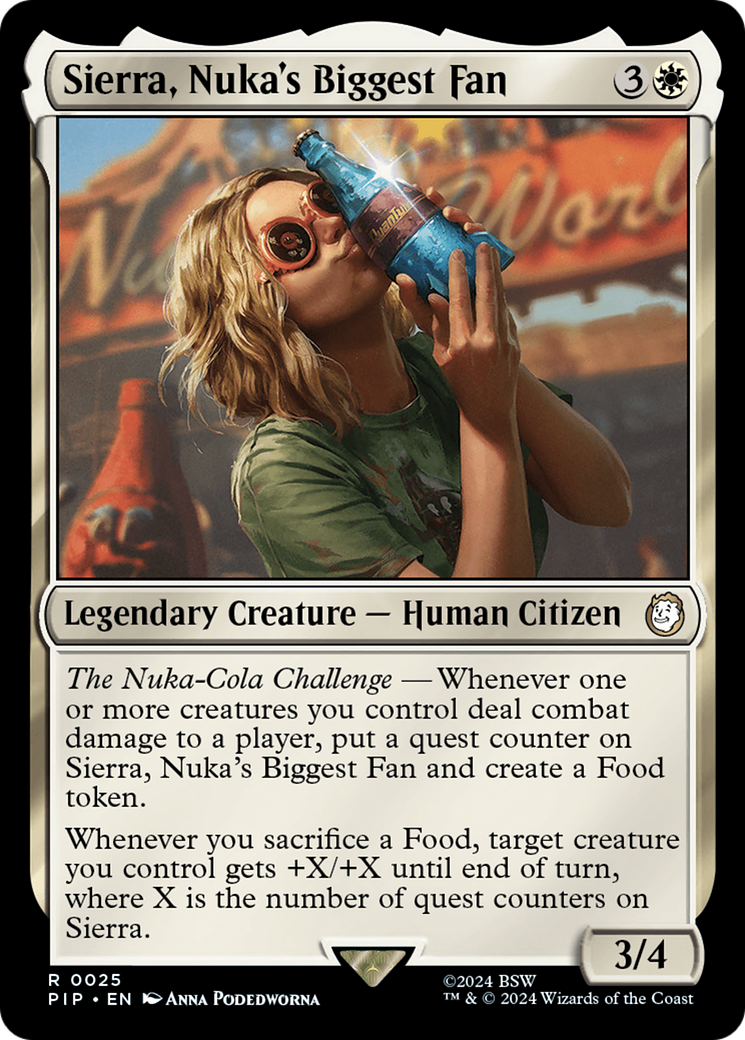
Sierra, Nuka's Biggest Fan
Sierra, Nuka's Biggest Fan
Legendary Creature — Human Citizen
3/4
The Nuka-Cola Challenge — Whenever one or more creatures you control deal combat damage to a player, put a quest counter on Sierra and create a Food token.
Whenever you sacrifice a Food, target creature you control gets +X/+X until end of turn, where X is the number of quest counters on Sierra.
- Food is an artifact type. Even though it appears on some creatures, it's never a creature type.
- You can't sacrifice a Food to pay multiple costs. For example, you can't sacrifice a Food token to activate its own ability and also to activate Maraleaf Rider's ability.
- Whatever you do, don't eat the delicious cards.
- If an effect refers to a Food, it means any Food artifact, not just a Food artifact token. For example, if you sacrifice a nontoken Food artifact, such as Candy Trail from the Wilds of Eldraine set, Sierra's last ability will trigger.
- Sierra's last ability triggers whenever you sacrifice a Food for any reason, not just to activate a Food's activated ability.
-
1
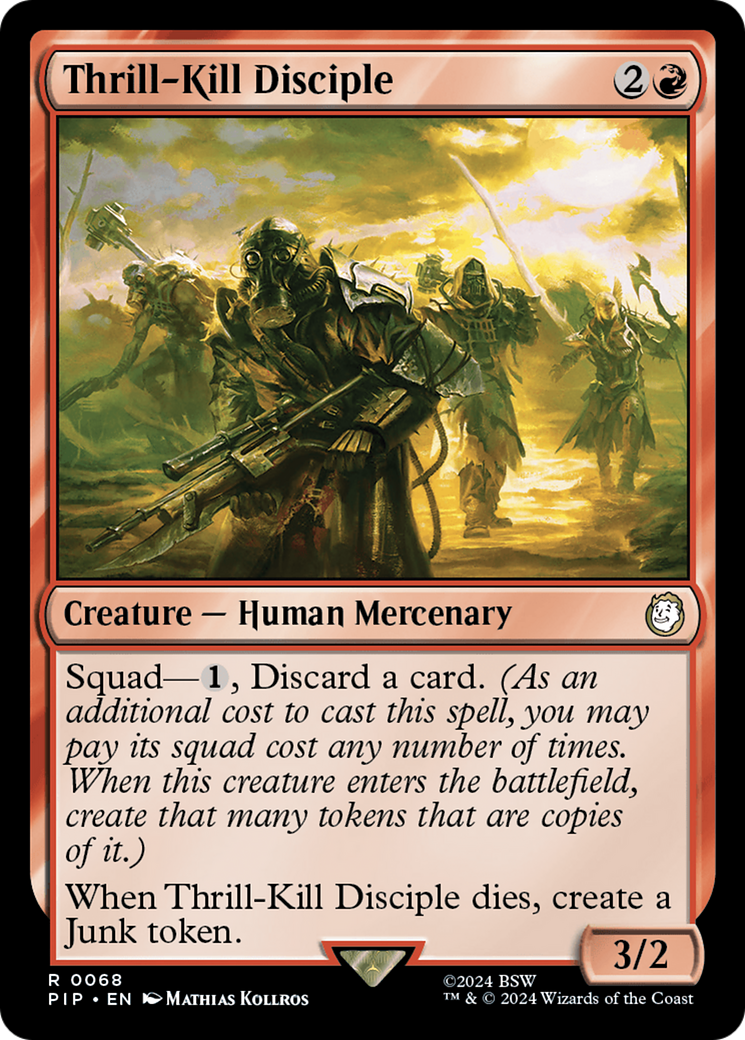
Thrill-Kill Disciple
Thrill-Kill Disciple
Creature — Human Mercenary
3/2
Squad— , Discard a card. (As an additional cost to cast this spell, you may pay its squad cost any number of times. When this creature enters, create that many tokens that are copies of it.)
When this creature dies, create a Junk token.
- You can’t sacrifice a Junk token to pay multiple costs. For example, you can’t sacrifice a Junk token to activate its own ability and also to activate the second ability of Junk Jet.
- You pay all costs and follow all normal timing rules for the card played from exile with a Junk token’s ability. For example, if the exiled card is a land card, you may play it only during your main phase while the stack is empty.
- Some spells and abilities that create Junk tokens may require targets. If each target chosen is illegal as that spell or ability tries to resolve, it won’t resolve and none of its effects happen. You won’t create any Junk tokens.
- You may pay the squad cost any number of times. You will create a token that is a copy of that permanent for each time you paid the squad cost. If you paid the squad cost multiple times, the tokens will all enter the battlefield simultaneously.
- If the spell is countered, the squad ability will not trigger, and no tokens will be created.
- If the spell resolves but the creature with squad leaves the battlefield before its squad ability resolves, you’ll still create the token copies.
- The tokens created by the squad ability aren’t “cast,” so any abilities that trigger when a spell is cast won’t trigger for the copies.
- If, for some reason, the creature doesn’t have the squad ability when it’s on the battlefield, the ability won’t trigger, even if you’ve paid the squad cost one or more times.
-
1
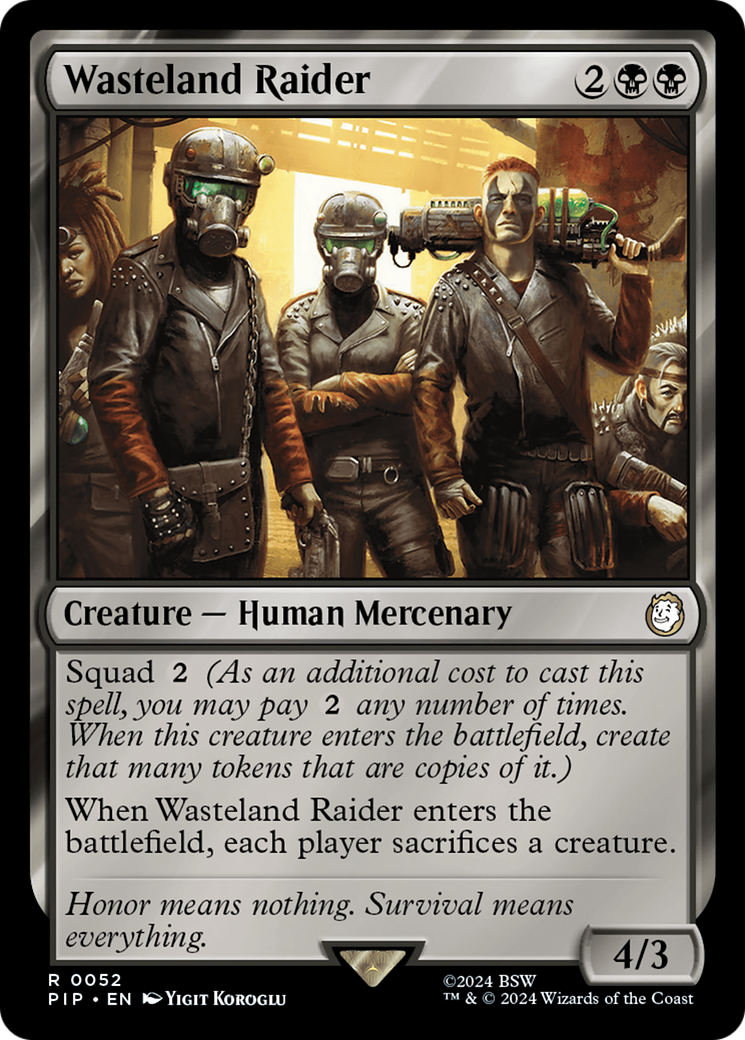
Wasteland Raider
Wasteland Raider
Creature — Human Mercenary
4/3
Squad (As an additional cost to cast this spell, you may pay any number of times. When this creature enters, create that many tokens that are copies of it.)
When this creature enters, each player sacrifices a creature of their choice.
- You may pay the squad cost any number of times. You will create a token that is a copy of that permanent for each time you paid the squad cost. If you paid the squad cost multiple times, the tokens will all enter the battlefield simultaneously.
- If the spell is countered, the squad ability will not trigger, and no tokens will be created.
- If the spell resolves but the creature with squad leaves the battlefield before its squad ability resolves, you’ll still create the token copies.
- The tokens created by the squad ability aren’t “cast,” so any abilities that trigger when a spell is cast won’t trigger for the copies.
- If, for some reason, the creature doesn’t have the squad ability when it’s on the battlefield, the ability won’t trigger, even if you’ve paid the squad cost one or more times.
-
1
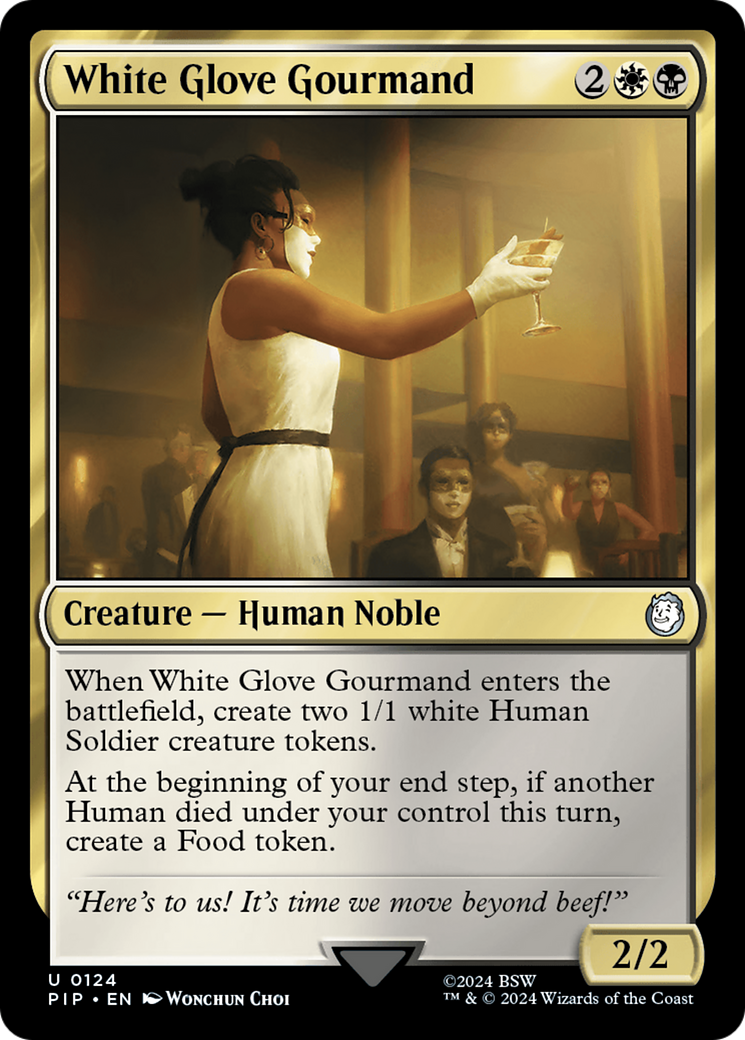
White Glove Gourmand
White Glove Gourmand
Creature — Human Noble
2/2
When this creature enters, create two 1/1 white Human Soldier creature tokens.
At the beginning of your end step, if another Human died under your control this turn, create a Food token.
- Food is an artifact type. Even though it appears on some creatures, it's never a creature type.
- You can't sacrifice a Food to pay multiple costs. For example, you can't sacrifice a Food token to activate its own ability and also to activate Maraleaf Rider's ability.
- Whatever you do, don't eat the delicious cards.
- White Glove Gourmand doesn't need to have been on the battlefield when the Human died. For example, if a Human dies during combat on your turn and you cast White Glove Gourmand during your second main phase, its last ability will trigger at the beginning of your end step.
- White Glove Gourmand's last ability will trigger only once during your end step, no matter how many Humans died under your control this turn. However, if no Humans have died under your control so far this turn as your end step begins, the ability won't trigger at all. It's not possible to cause a Human to die under your control during the end step in time to have the ability trigger.
-
1
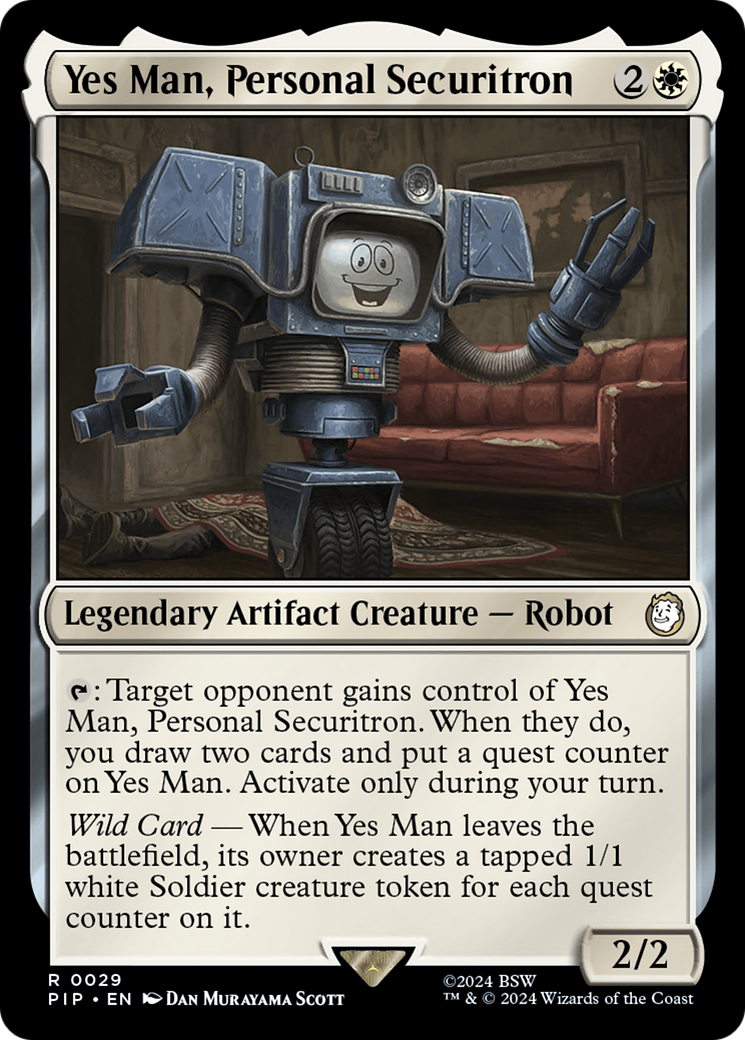
Yes Man, Personal Securitron
Yes Man, Personal Securitron
Legendary Artifact Creature — Robot
2/2
: Target opponent gains control of Yes Man. When they do, you draw two cards and put a quest counter on Yes Man. Activate only during your turn.
Wild Card — When Yes Man leaves the battlefield, its owner creates a tapped 1/1 white Soldier creature token for each quest counter on it.
- If Yes Man isn't on the battlefield as its first ability resolves, or if the target opponent is an illegal target as the ability tries to resolve, nothing will happen. You won't draw two cards, because that effect is part of a reflexive triggered ability that triggers only if the target opponent gains control of Yes Man.
- When Yes Man's controller leaves the game, if that player wasn't its owner, the effect giving that player control of Yes Man ends. Yes Man will return to the control of the player still in the game who most recently controlled it, ignoring any control effects whose durations have already expired.
- When Yes Man's owner leaves the game, Yes Man leaves the game along with that player. It's just doing what it's told.
Instants 7
-
1
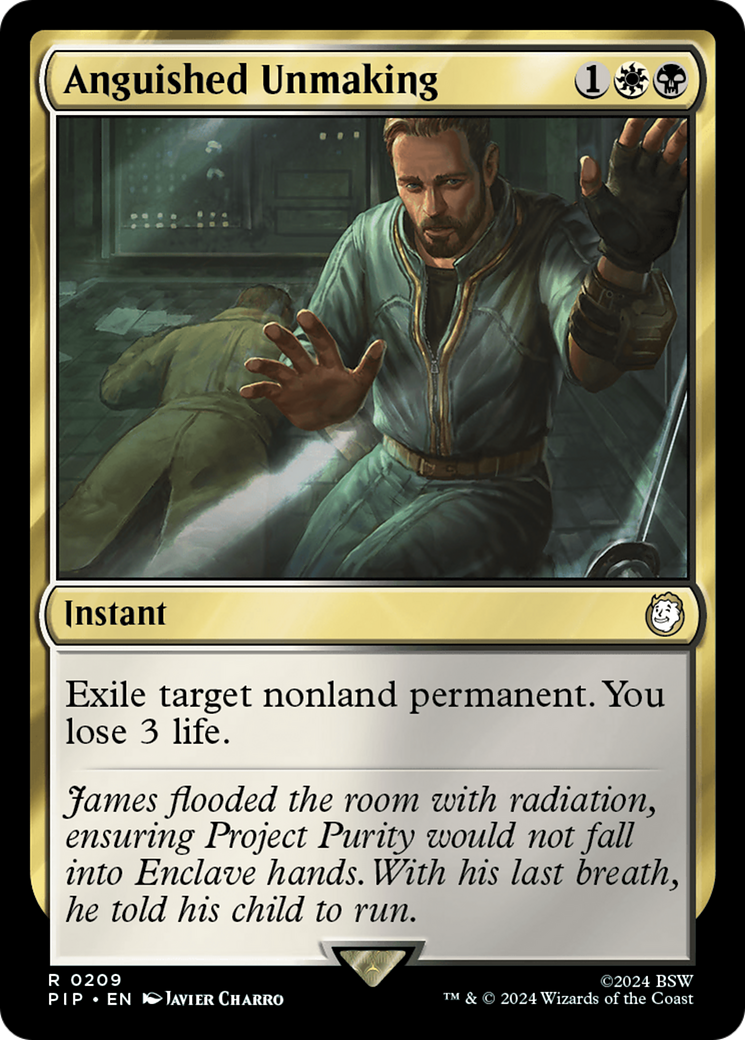
Anguished Unmaking
Anguished Unmaking
Instant
Exile target nonland permanent. You lose 3 life.
- If the target nonland permanent is an illegal target as Anguished Unmaking tries to resolve, it won't resolve and none of its effects will happen. You won't lose 3 life.
-
1
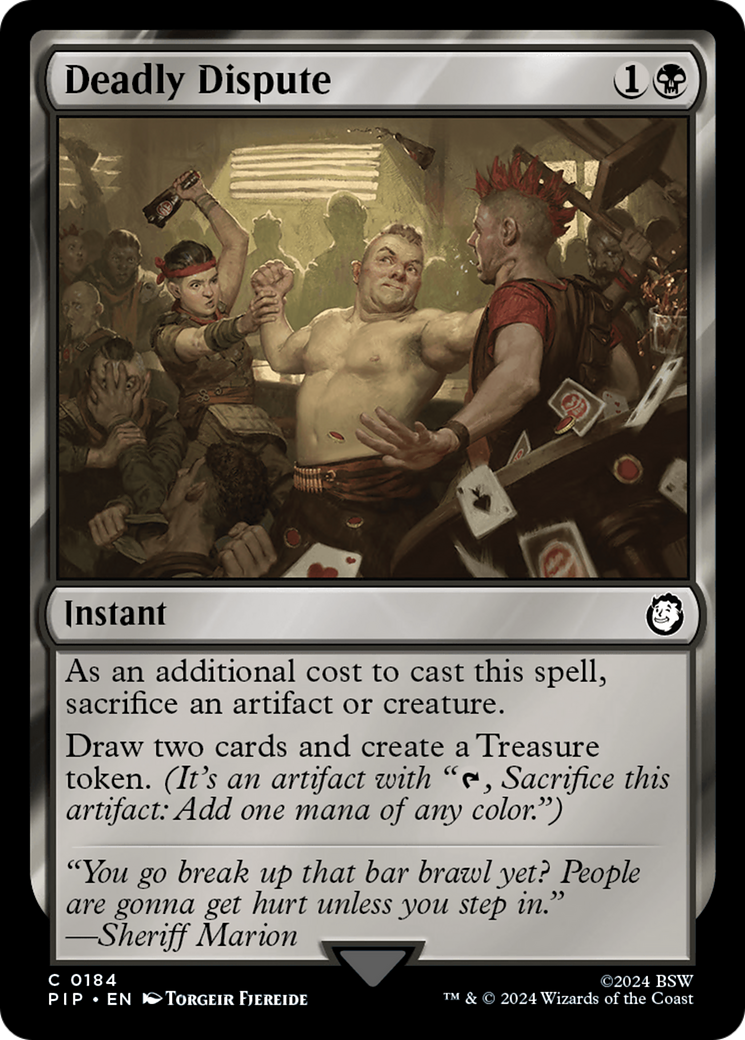
Deadly Dispute
Deadly Dispute
Instant
As an additional cost to cast this spell, sacrifice an artifact or creature.
Draw two cards and create a Treasure token. (It's an artifact with " , Sacrifice this token: Add one mana of any color.")
-
1
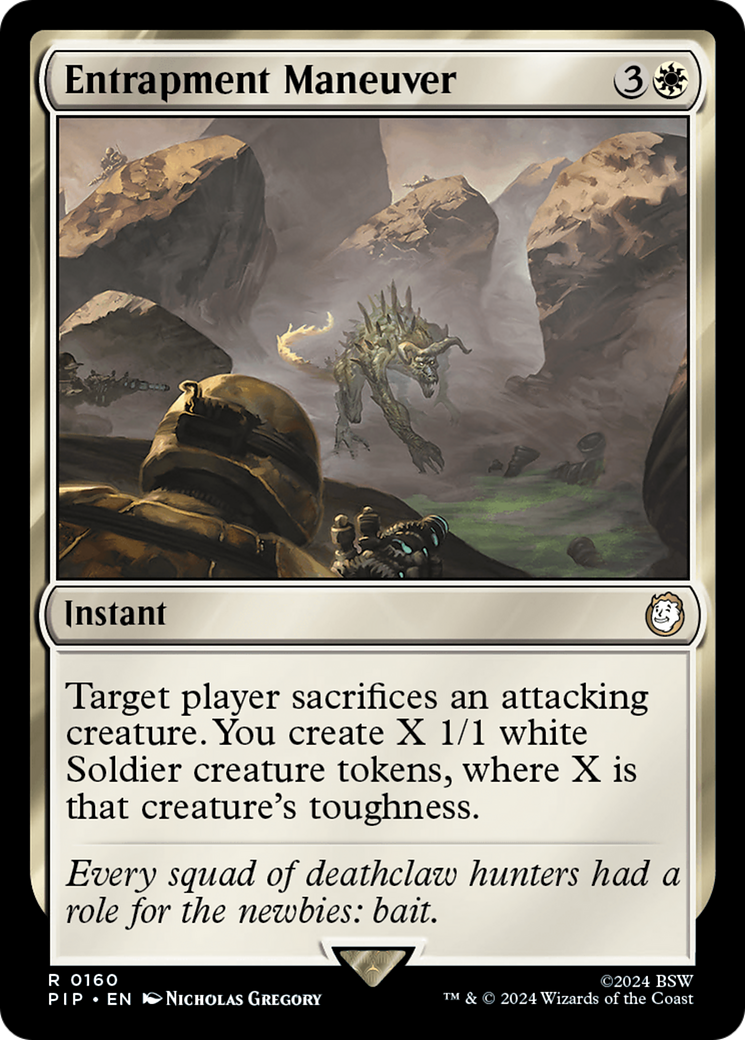
Entrapment Maneuver
Entrapment Maneuver
Instant
Target player sacrifices an attacking creature of their choice. You create X 1/1 white Soldier creature tokens, where X is that creature's toughness.
- An "attacking creature" is one that has been declared as an attacker or put onto the battlefield attacking during this combat. Unless that creature leaves combat, it continues to be an attacking creature through the end of combat step, even if the player it was attacking has left the game or the planeswalker it was attacking has left combat.
- If you cast Entrapment Maneuver after combat damage has been dealt, only creatures that survived combat can be sacrificed.
- Entrapment Maneuver doesn't target the creature to be sacrificed. The target player chooses one as it resolves. No player may take any other actions between the target player choosing the creature and you creating Soldier tokens.
- To determine how many Soldier tokens are created, use the toughness of the sacrificed creature as it last existed on the battlefield.
-
1
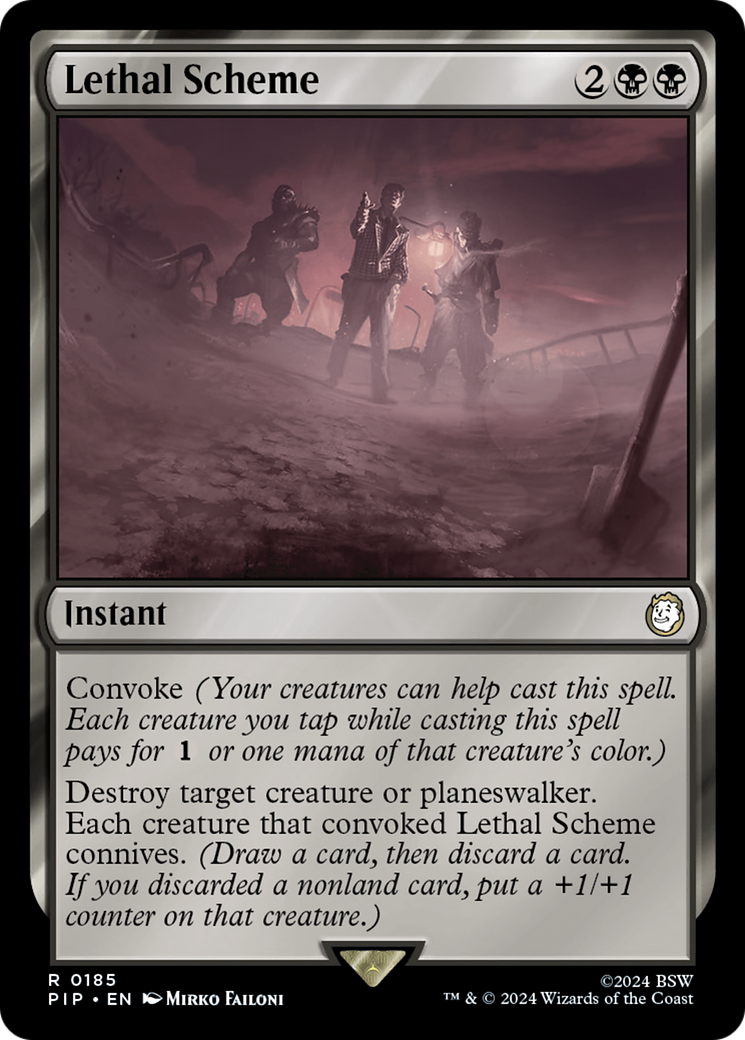
Lethal Scheme
Lethal Scheme
Instant
Convoke (Your creatures can help cast this spell. Each creature you tap while casting this spell pays for or one mana of that creature's color.)
Destroy target creature or planeswalker. Each creature that convoked Lethal Scheme connives. (Draw a card, then discard a card. If you discarded a nonland card, put a +1/+1 counter on that creature.)
- When multiple creatures are instructed to connive simultaneously, they connive one at a time in the order of their controller's choice.
- You can't tap more creatures to convoke Lethal Scheme than it takes to pay for its total cost. This means that normally no more than four creatures can convoke it.
-
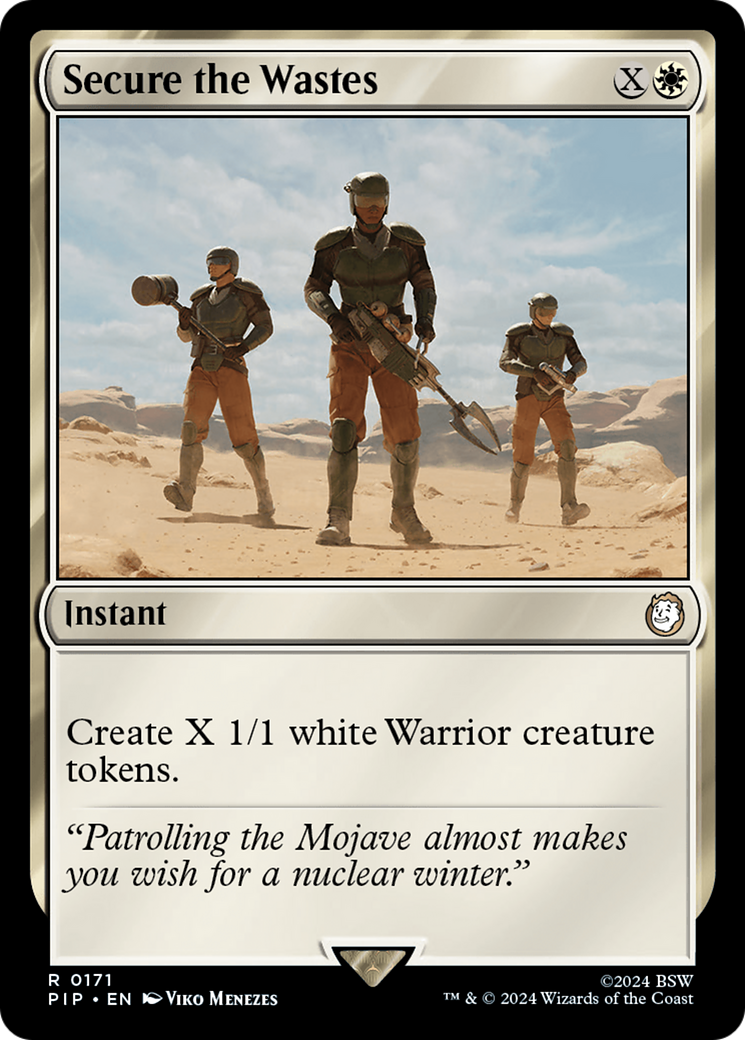
1
Secure the Wastes
Secure the Wastes
Instant
Create X 1/1 white Warrior creature tokens.
-
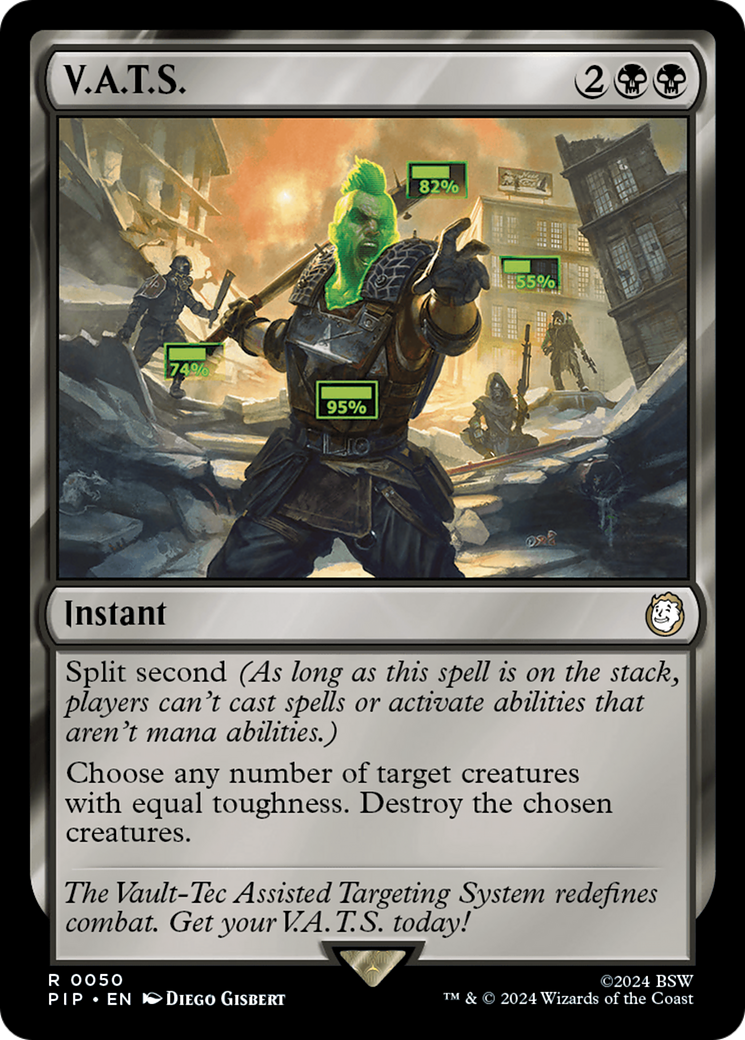
1
V.A.T.S.
V.A.T.S.
Instant
Split second (As long as this spell is on the stack, players can't cast spells or activate abilities that aren't mana abilities.)
Choose any number of target creatures with equal toughness. Destroy the chosen creatures.
- Players still get priority while a spell with split second is on the stack; their options are just limited to mana abilities and certain special actions.
- Players may turn face-down creatures face up while a spell with split second is on the stack.
- Split second doesn’t stop triggered abilities from triggering. If one does, its controller puts it on the stack and chooses targets for it, if any. Those abilities will resolve as normal.
- Casting a spell with split second won’t affect spells and abilities that are already on the stack.
- If the resolution of a triggered ability involves casting a spell, that spell can’t be cast if a spell with split second is on the stack.
- After a spell with split second resolves (or otherwise leaves the stack), players may again cast spells and activate abilities before the next object on the stack resolves.
- If you choose just one target for V.A.T.S., that creature will be destroyed when V.A.T.S. resolves as long as it’s still a legal target, regardless of whether or not its toughness has changed since V.A.T.S. was cast.
- In the rare case where the legal targets no longer all have equal toughness (probably because of a triggered ability or special action) when V.A.T.S. tries to resolve, it won’t resolve. None of the chosen creatures will be destroyed.
-
1
Wear // Tear
//
Wear
Instant
- If you're casting a split card with fuse from any zone other than your hand, you can't cast both halves. You'll only be able to cast one half or the other.
- To cast a fused split spell, pay both of its mana costs. While the spell is on the stack, its mana value is the total amount of mana in both costs.
- You can choose the same object as the target of each half of a fused split spell, if appropriate.
- When resolving a fused split spell with multiple targets, treat it as you would any spell with multiple targets. If all targets are illegal when the spell tries to resolve, the spell doesn't resolve and none of its effects happen. If at least one target is still legal at that time, the spell resolves, but an illegal target can't perform any actions or have any actions performed on it.
- When a fused split spell resolves, follow the instructions of the left half first, then the instructions on the right half.
- On the stack, a split spell that hasn't been fused has only that half's characteristics and mana value. The other half is treated as though it didn't exist.
- Some split cards with fuse have two monocolor halves of different colors. If such a card is cast as a fused split spell, the resulting spell is multicolored. If only one half is cast, the spell is the color of that half. While not on the stack, such a card is multicolored.
- Some split cards with fuse have two halves that are both multicolored. That card is multicolored no matter which half is cast, or if both halves are cast. It's also multicolored while not on the stack.
- If a player names a card, the player may name either half of a split card, but not both. A split card has the chosen name if one of its two names matches the chosen name.
- If you cast a split card with fuse from your hand without paying its mana cost, you can choose to use its fuse ability and cast both halves without paying their mana costs.
Sorceries 5
-
1
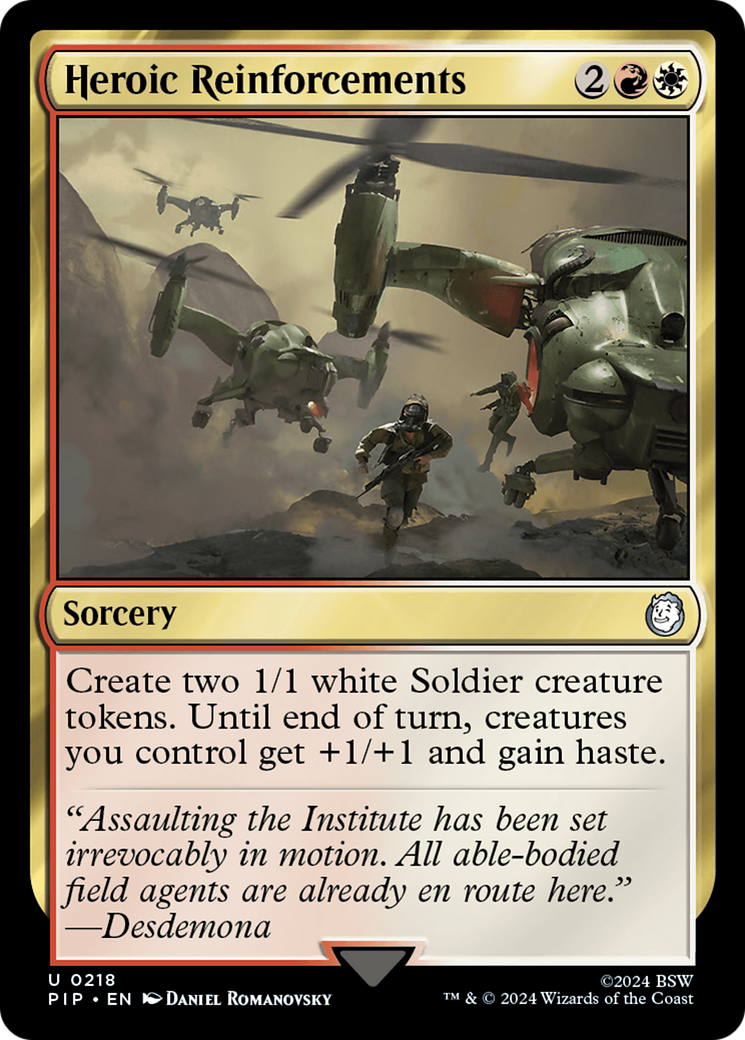
Heroic Reinforcements
Heroic Reinforcements
Sorcery
Create two 1/1 white Soldier creature tokens. Until end of turn, creatures you control get +1/+1 and gain haste. (They can attack and this turn.)
- The second part of Heroic Reinforcements's effect affects only creatures you control at the time it's applied, including the tokens created by the first part of its effect. Creatures you begin to control later in the turn won't get +1/+1 or gain haste.
-
1
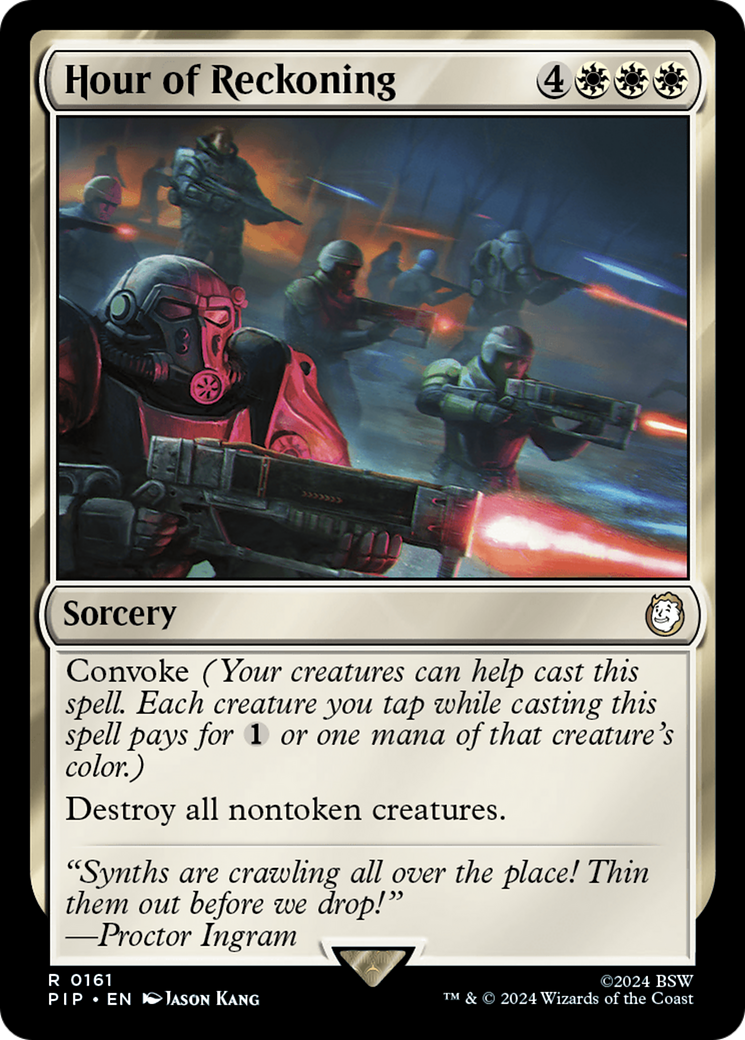
Hour of Reckoning
Hour of Reckoning
Sorcery
Convoke (Your creatures can help cast this spell. Each creature you tap while casting this spell pays for or one mana of that creature's color.)
Destroy all nontoken creatures.
- You can tap any untapped creature you control to convoke a spell, even one you haven't controlled continuously since the beginning of your most recent turn.
- Tapping an untapped creature that's attacking or blocking to convoke a spell won't cause that creature to stop attacking or blocking.
- When calculating a spell's total cost, include any alternative costs, additional costs, or anything else that increases or reduces the cost to cast the spell. Convoke applies after the total cost is calculated. Convoke doesn't change a spell's mana cost or mana value.
- If a creature you control has a mana ability with in the cost, activating that ability while casting a spell with convoke will result in the creature being tapped before you pay the spell's costs. You won't be able to tap it again for convoke. Similarly, if you sacrifice a creature to activate a mana ability while casting a spell with convoke, that creature won't be on the battlefield when you pay the spell's costs, so you won't be able to tap it for convoke.
- Because convoke isn't an alternative cost, it can be used in conjunction with alternative costs.
- Tapping a multicolored creature using convoke will pay for or one mana of your choice of any of that creature's colors.
-
1
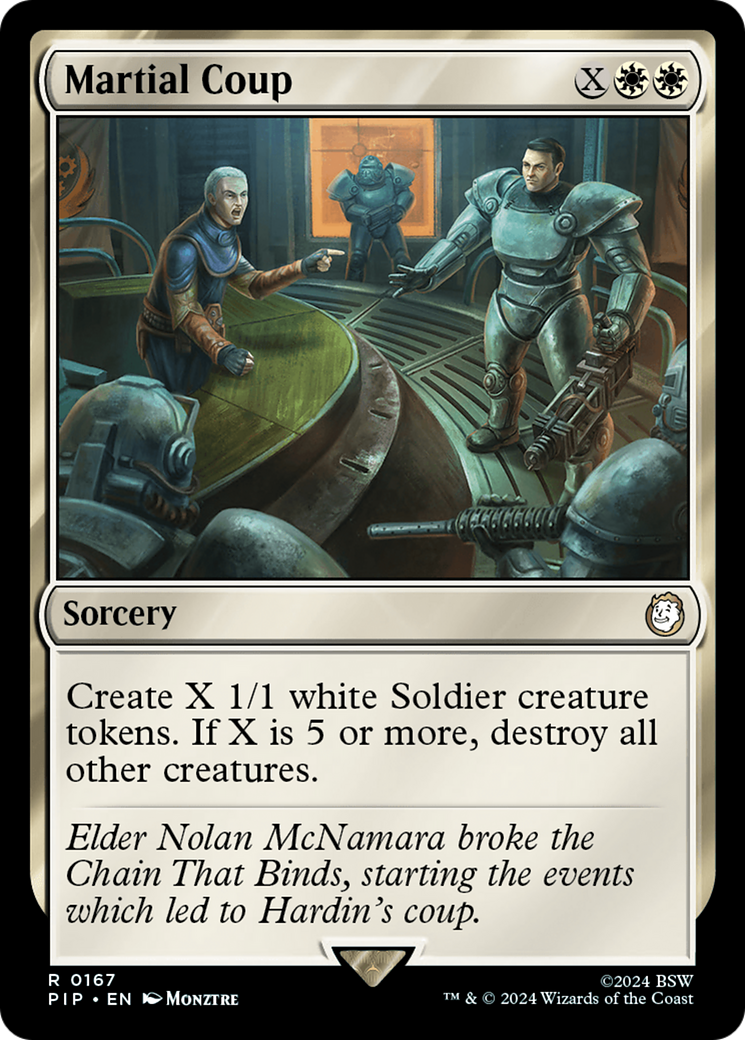
Martial Coup
Martial Coup
Sorcery
Create X 1/1 white Soldier creature tokens. If X is 5 or more, destroy all other creatures.
- Martial Coup checks the number you chose for X, not the amount of mana you actually spent.
- You do what the spell says in order. If X is 5 or more, you'll put the Soldier tokens onto the battlefield, then you'll destroy all other creatures.
- No one can cast spells or activate abilities between the time the Soldier tokens are put onto the battlefield and the time all other creatures are destroyed. For example, you can't sacrifice one of those Soldier tokens to regenerate a Skeletal Kathari.
-
1
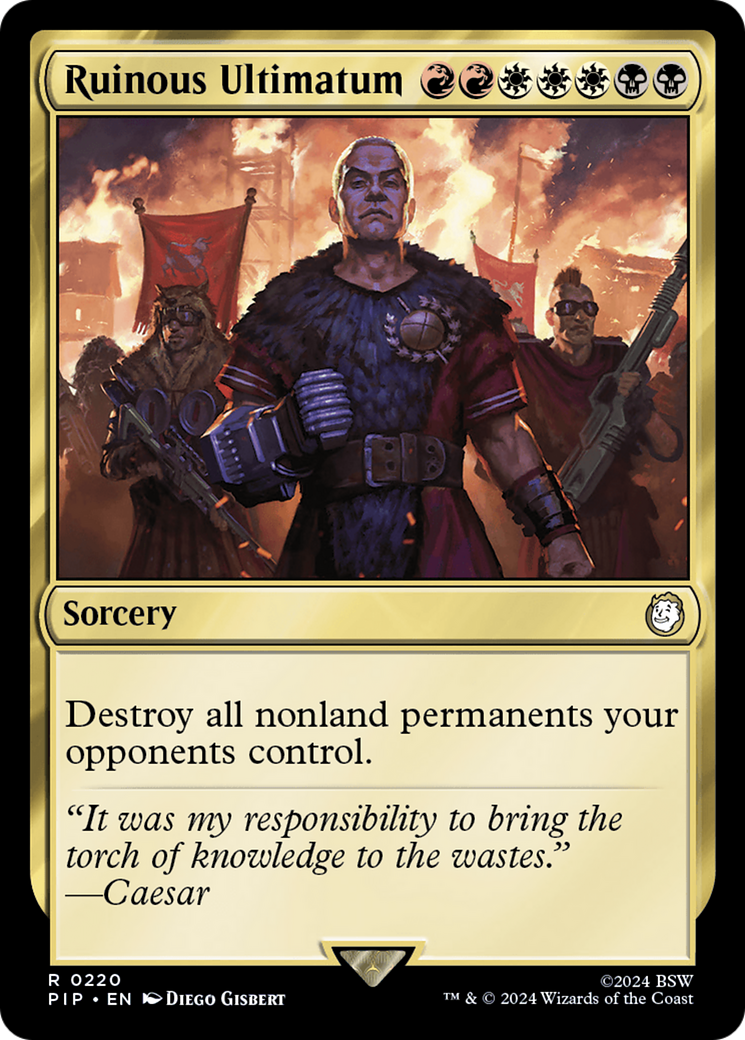
Ruinous Ultimatum
Ruinous Ultimatum
Sorcery
Destroy all nonland permanents your opponents control.
-
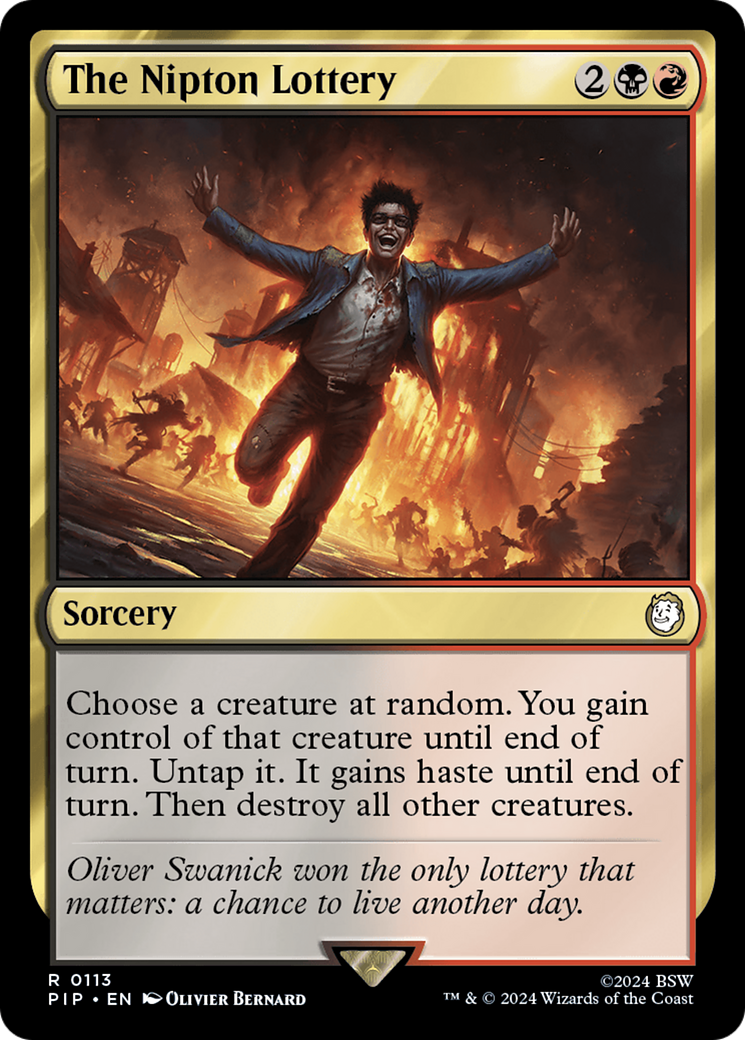
1
The Nipton Lottery
The Nipton Lottery
Sorcery
Choose a creature at random. You gain control of that creature until end of turn. Untap it. It gains haste until end of turn. Then destroy all other creatures.
- The creature chosen at random isn’t targeted, so a creature with shroud or an opponent’s creature with hexproof can be chosen this way.
- Players can’t take actions between the time the creature is randomly chosen and the time at which the rest of the effects occur.
Artifacts 9
-
1
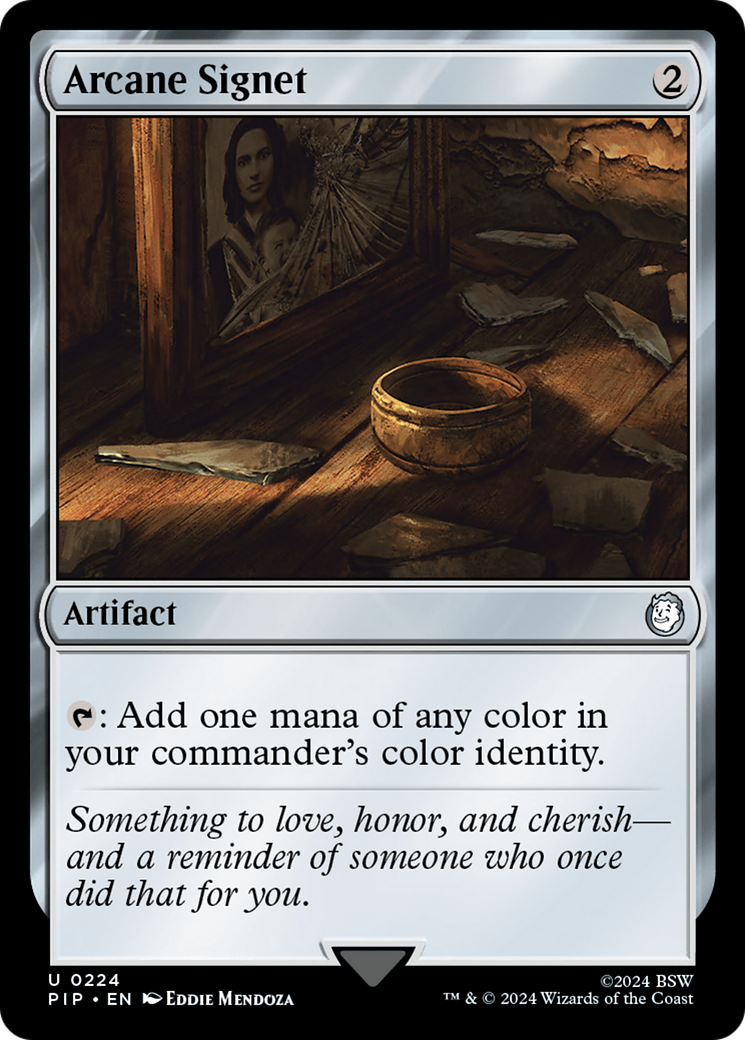
Arcane Signet
Arcane Signet
Artifact
: Add one mana of any color in your commander's color identity.
- If your commander is a card that has no colors in its color identity, Arcane Signet's ability produces no mana. It doesn't produce .
- If you have two commanders, the ability adds one mana of any color in their combined color identities.
- If you don't have a commander, Arcane Signet's ability produces no mana.
-
1
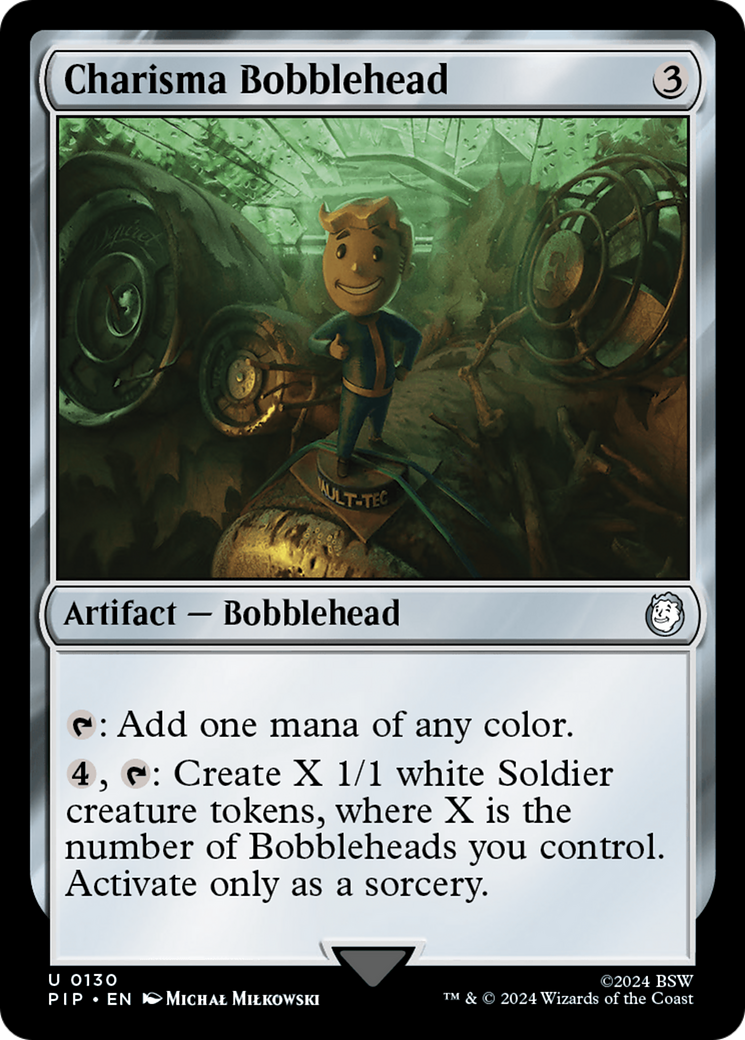
Charisma Bobblehead
Charisma Bobblehead
Artifact — Bobblehead
: Add one mana of any color.
, : Create X 1/1 white Soldier creature tokens, where X is the number of Bobbleheads you control. Activate only as a sorcery.
- The value of X is calculated only once, as Charisma Bobblehead’s last ability resolves.
-
1
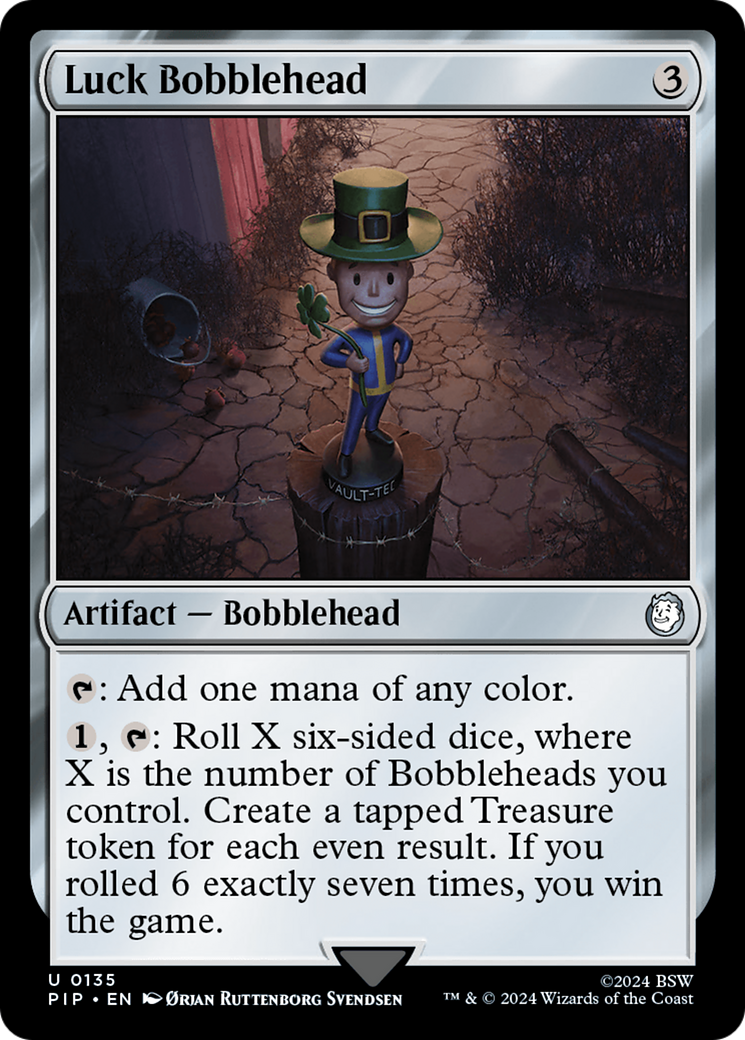
Luck Bobblehead
Luck Bobblehead
Artifact — Bobblehead
: Add one mana of any color.
, : Roll X six-sided dice, where X is the number of Bobbleheads you control. Create a tapped Treasure token for each even result. If you rolled 6 exactly seven times, you win the game.
- The value of X is determined only once, as Luck Bobblehead’s last ability resolves.
- If X is a very large number, you may be required to roll more dice than you physically can in a reasonable time frame. In such cases, we encourage you to use digital resources for simulating die rolls or generating random numbers.
- You win the game only if you rolled 6 exactly seven times while resolving a single instance of Luck Bobblehead’s last ability. Results of previous die rolls, whether they’re from previous resolutions of Luck Bobblehead’s last ability or from other effects that instruct you to roll dice, don’t matter for the purposes of this effect.
-
1
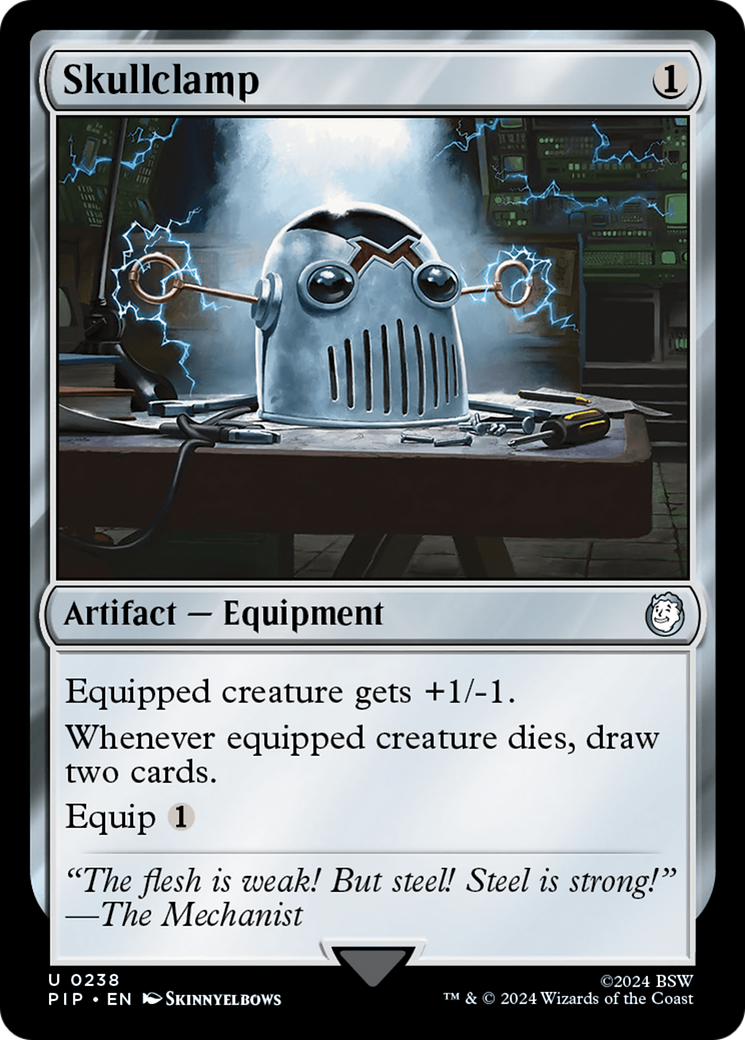
Skullclamp
Skullclamp
Artifact — Equipment
Equipped creature gets +1/-1.
Whenever equipped creature dies, draw two cards.
Equip
-
1
Sol Ring
Sol Ring
Artifact
: Add .
-
1
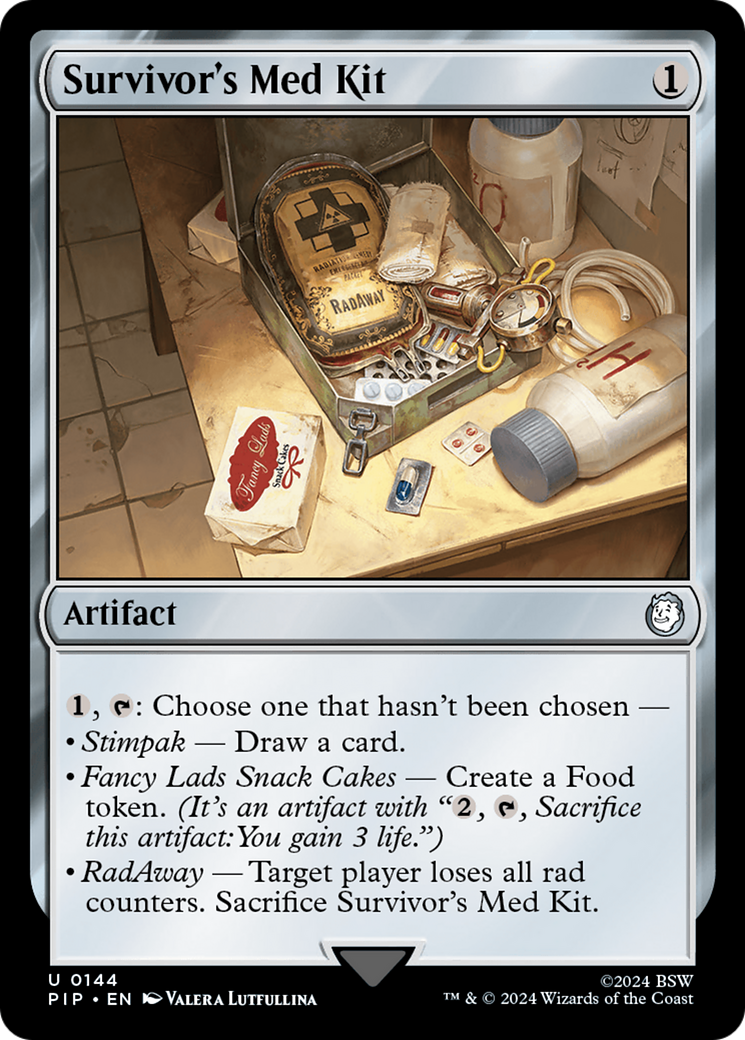
Survivor's Med Kit
Survivor's Med Kit
Artifact
, : Choose one that hasn't been chosen —
- Stimpak — Draw a card.
- Fancy Lads Snack Cakes — Create a Food token. (It's an artifact with " , , Sacrifice this token: You gain 3 life.")
- RadAway — Target player loses all rad counters. Sacrifice this artifact.
- Food is an artifact type. Even though it appears on some creatures, it's never a creature type.
- You can't sacrifice a Food to pay multiple costs. For example, you can't sacrifice a Food token to activate its own ability and also to activate Maraleaf Rider's ability.
- Whatever you do, don't eat the delicious cards.
- There is an inherent triggered ability associated with having rad counters. This triggered ability has no source and is controlled by the active player. The full text of this ability is "At the beginning of the precombat main phase of a player with rad counters, that player mills cards equal to the number of rad counters they have. For each nonland card milled this way, that player loses 1 life and removes one rad counter from themselves."
- In a game using the shared team turns option, such as an Archenemy or Two-Headed Giant game, the inherent triggered ability associated with rad counters triggers once for each player on the active team that has rad counters. Each instance of that ability is controlled by one of those players.
- Rad counters are a kind of counter that a player may have. They're not associated with any specific permanents.
- The cards are milled all at once, which means abilities that trigger "whenever one or more nonland cards are milled" will trigger exactly once as long as at least one nonland card was milled.
- If a player has fewer cards remaining in their library than the number of rad counters they have when the triggered ability resolves, they'll mill as many cards as they can.
- Any effects (such as proliferate) that interact with counters a player gets, has, or loses can interact with rad counters.
- Keep track of how many rad counters each player has. Potential ways to track this include writing them down on paper or using dice, but any method that is clear and mutually agreeable is fine.
- Rad counters don't go away as steps, phases, or turns end. They only go away when an effect instructs a player to remove rad counters from themselves.
-
1
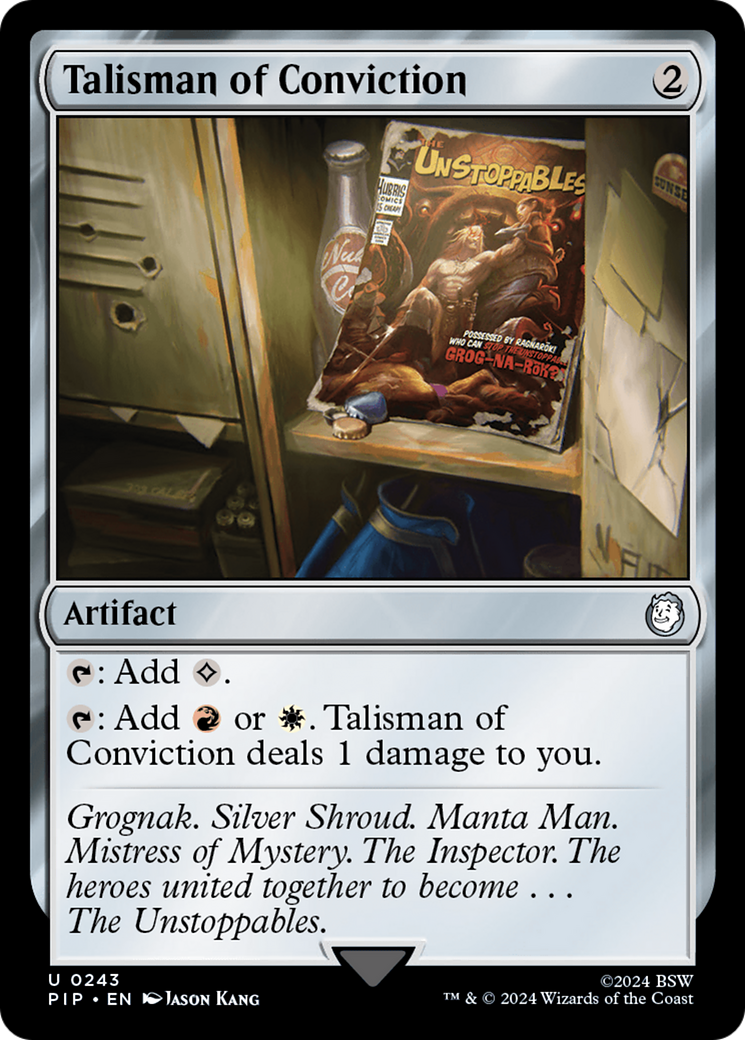
Talisman of Conviction
Talisman of Conviction
Artifact
: Add .
: Add or . This artifact deals 1 damage to you.
-
1
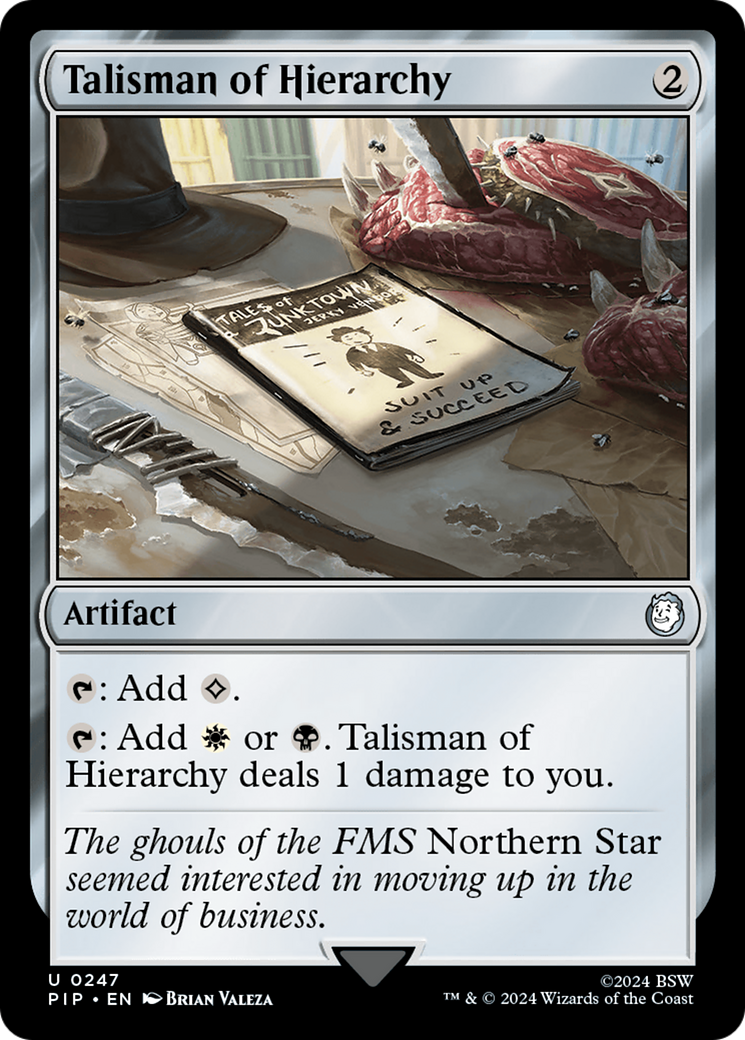
Talisman of Hierarchy
Talisman of Hierarchy
Artifact
: Add .
: Add or . This artifact deals 1 damage to you.
-
1
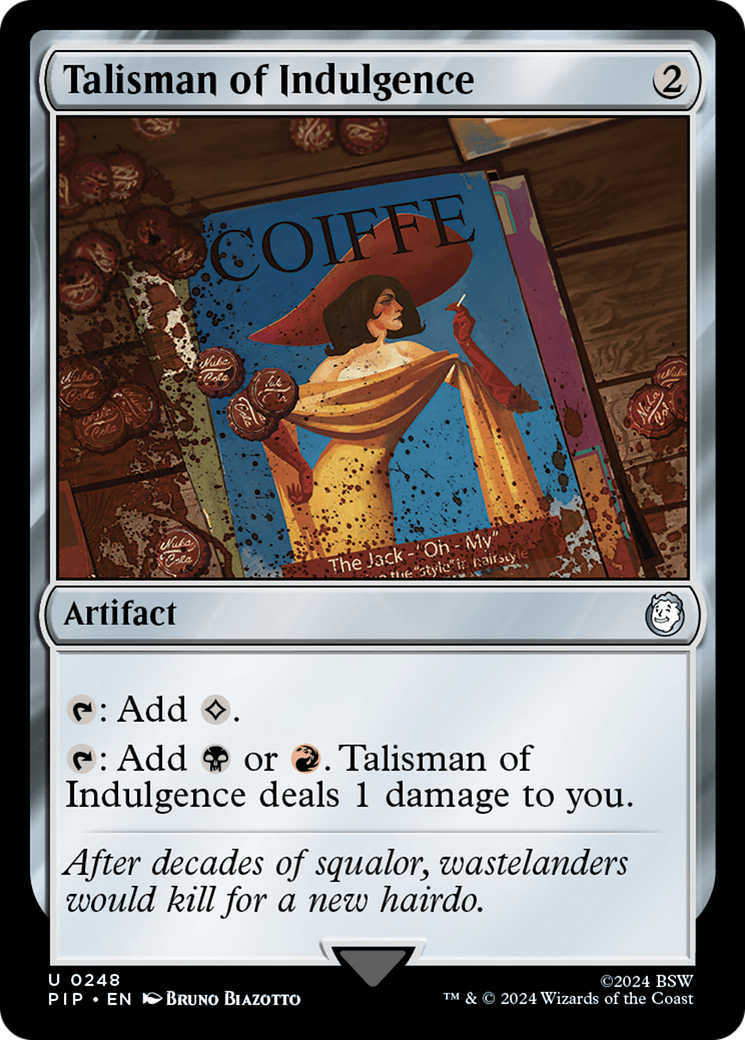
Talisman of Indulgence
Talisman of Indulgence
Artifact
: Add .
: Add or . This artifact deals 1 damage to you.
Enchantments 11
-
1
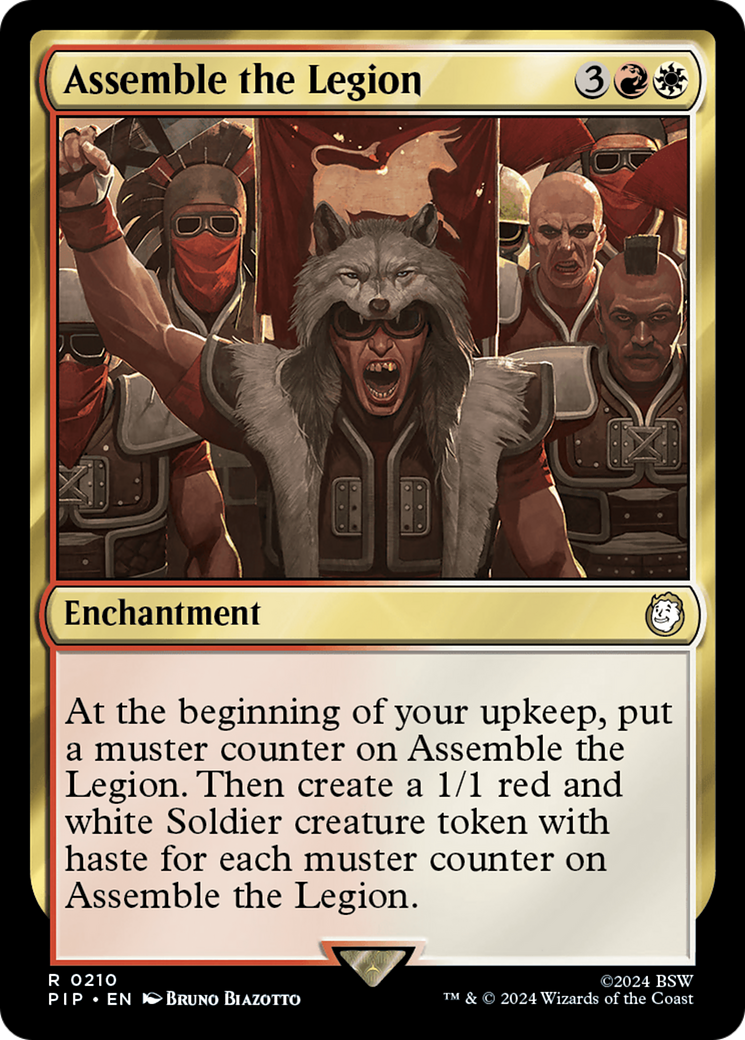
Assemble the Legion
Assemble the Legion
Enchantment
At the beginning of your upkeep, put a muster counter on this enchantment. Then create a 1/1 red and white Soldier creature token with haste for each muster counter on this enchantment.
- If Assemble the Legion isn't on the battlefield when its ability resolves, use the number of muster counters it had when it was last on the battlefield to determine how many Soldier tokens to create.
-
1
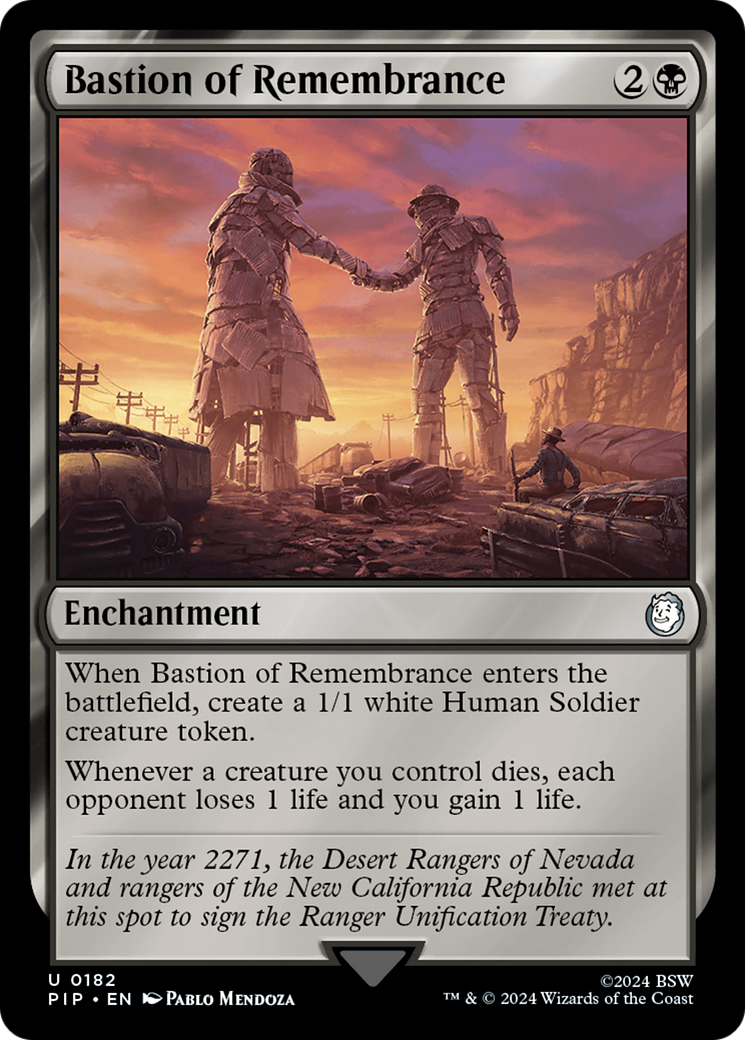
Bastion of Remembrance
Bastion of Remembrance
Enchantment
When this enchantment enters, create a 1/1 white Human Soldier creature token.
Whenever a creature you control dies, each opponent loses 1 life and you gain 1 life.
- If your life total is brought to 0 or less at the same time that creatures you control are dealt lethal damage, you lose the game before the last ability goes on the stack.
- In a Two-Headed Giant game, Bastion of Remembrance's last ability causes the opposing team to lose 2 life and you to gain 1 life.
- If one or more creatures you control die at the same time that Bastion of Remembrance leaves the battlefield, its last ability triggers for each of those creatures.
-
1
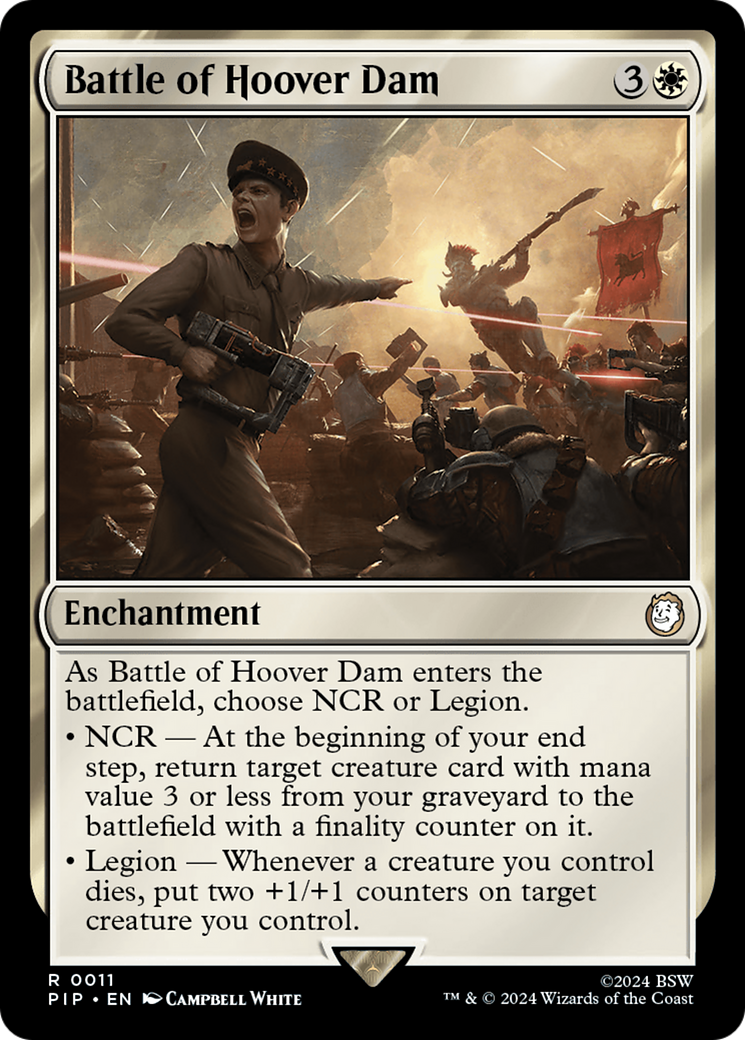
Battle of Hoover Dam
Battle of Hoover Dam
Enchantment
As this enchantment enters, choose NCR or Legion.
- NCR — At the beginning of your end step, return target creature card with mana value 3 or less from your graveyard to the battlefield with a finality counter on it.
- Legion — Whenever a creature you control dies, put two +1/+1 counters on target creature you control.
- Finality counters aren’t keyword counters, and a finality counter doesn’t give any abilities to the permanent it’s on. If that permanent loses its abilities and then would go to a graveyard, it will still be exiled instead.
- Finality counters work on any permanent, not only creatures. If a permanent with a finality counter on it would be put into a graveyard from the battlefield, exile it instead.
- Finality counters don’t stop permanents from going to zones other than the graveyard from the battlefield. For example, if a permanent with a finality counter on it would be put into its owner’s hand from the battlefield, it does so normally.
- Multiple finality counters on a single permanent are redundant.
- If you somehow control Battle of Hoover Dam and no choice was made for it (perhaps because another permanent on the battlefield became a copy of it), it has neither of the two triggered abilities.
-
1
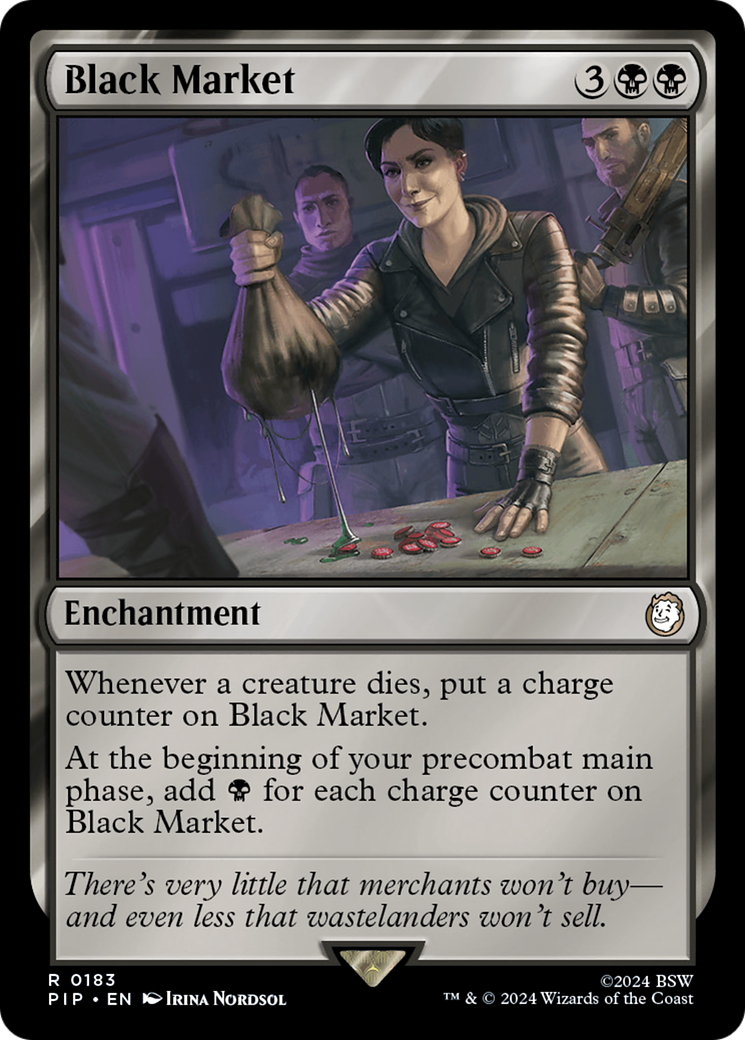
Black Market
Black Market
Enchantment
Whenever a creature dies, put a charge counter on this enchantment.
At the beginning of your first main phase, add for each charge counter on this enchantment.
- Getting the mana is not optional.
-
1
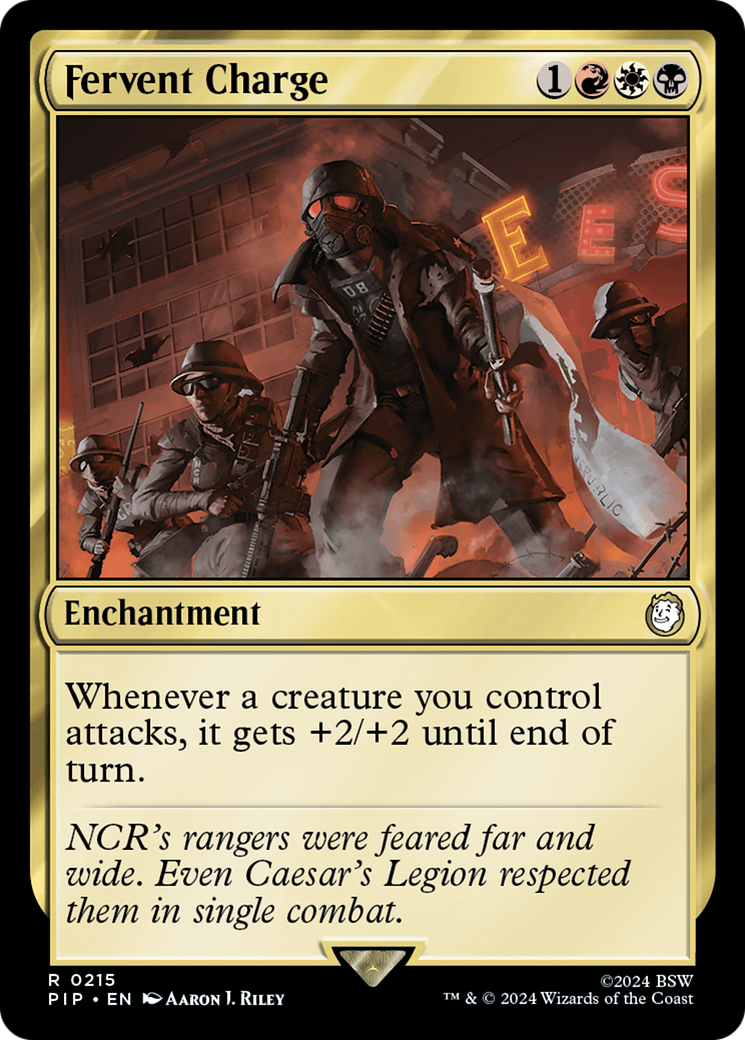
Fervent Charge
Fervent Charge
Enchantment
Whenever a creature you control attacks, it gets +2/+2 until end of turn.
-
1
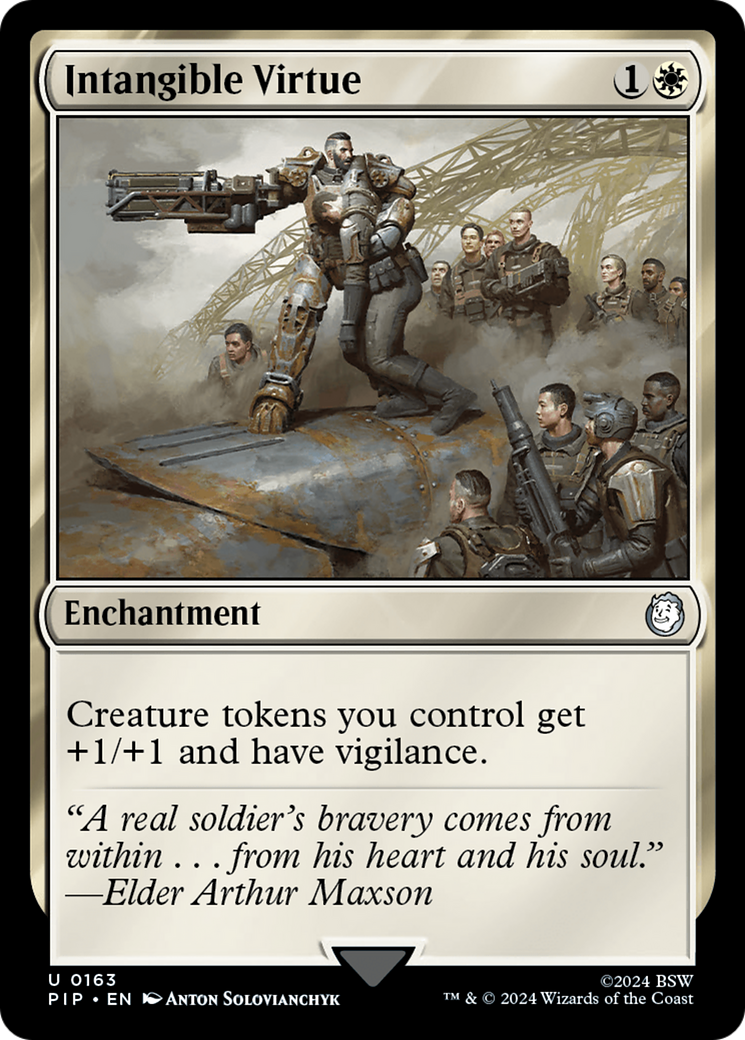
Intangible Virtue
Intangible Virtue
Enchantment
Creature tokens you control get +1/+1 and have vigilance.
-
1
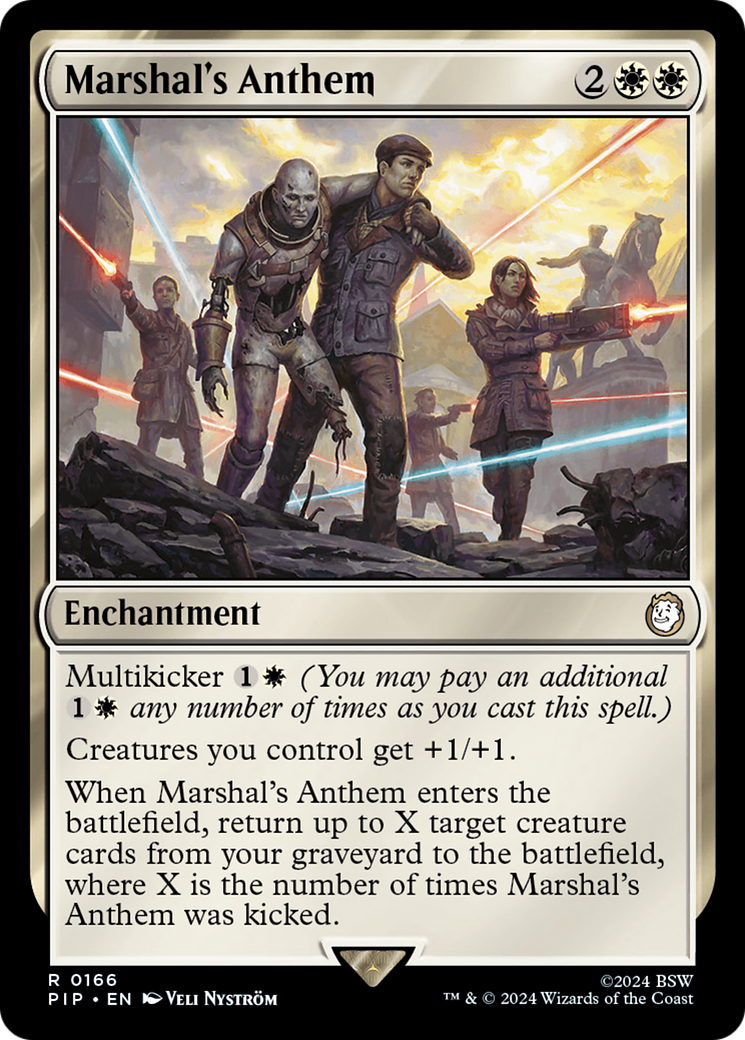
Marshal's Anthem
Marshal's Anthem
Enchantment
Multikicker (You may pay an additional any number of times as you cast this spell.)
Creatures you control get +1/+1.
When this enchantment enters, return up to X target creature cards from your graveyard to the battlefield, where X is the number of times this enchantment was kicked.
- If a spell's kicker cost was paid, the spell is "kicked."
- The kicker ability doesn't let you pay a kicker cost more than once.
- If you put a permanent with a kicker ability onto the battlefield without casting it, you can't kick it.
- If you copy a kicked spell on the stack, the copy is also kicked. If the copied spell is a permanent spell, the token the copy of that spell becomes when it enters is also kicked.
- If a card or token enters as a copy of a permanent, the new permanent isn't kicked, even if the original was.
- To determine a spell's total cost, start with the mana cost (or an alternative cost if another card's effect allows you to pay one instead), add any cost increases (such as kicker), then apply any cost reductions. The spell's mana value remains unchanged, no matter what the total cost to cast it was.
-
1
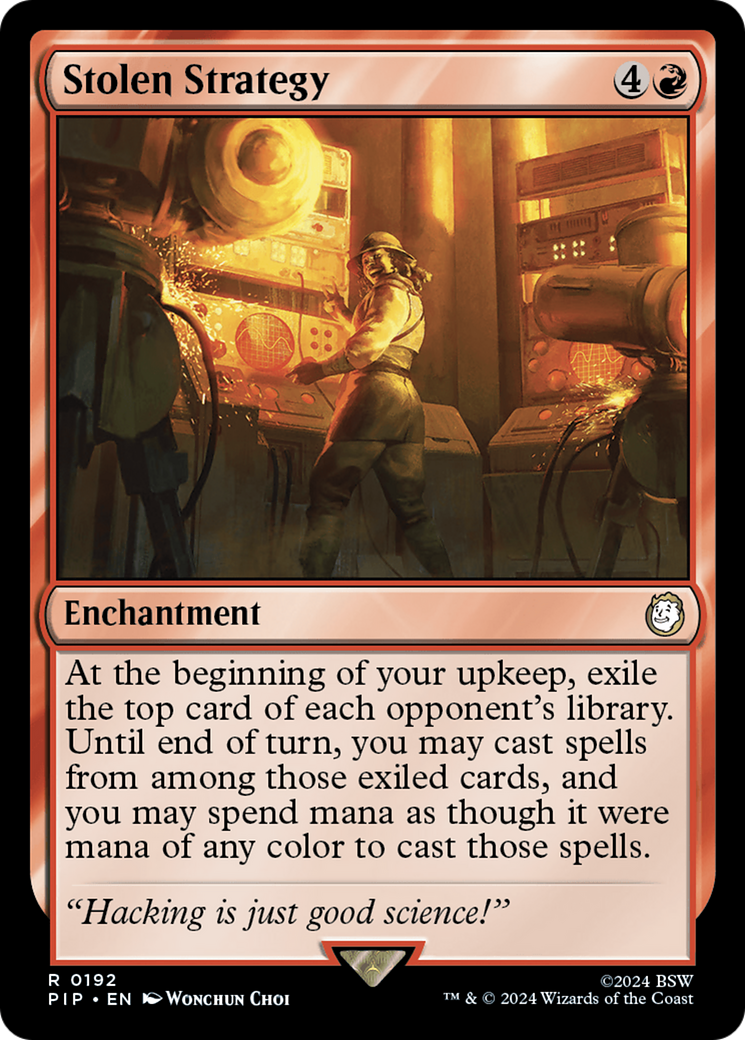
Stolen Strategy
Stolen Strategy
Enchantment
At the beginning of your upkeep, exile the top card of each opponent's library. Until end of turn, you may cast spells from among those exiled cards, and you may spend mana as though it were mana of any color to cast those spells.
- Stolen Strategy doesn't change when you can cast the exiled card. For example, if you exile a sorcery card, you can cast it only during your main phase when the stack is empty.
- Casting an exiled card causes it to leave exile. You can't cast it multiple times.
- If you don't cast the exiled cards, they remain exiled. They can't be cast on later turns.
-
1
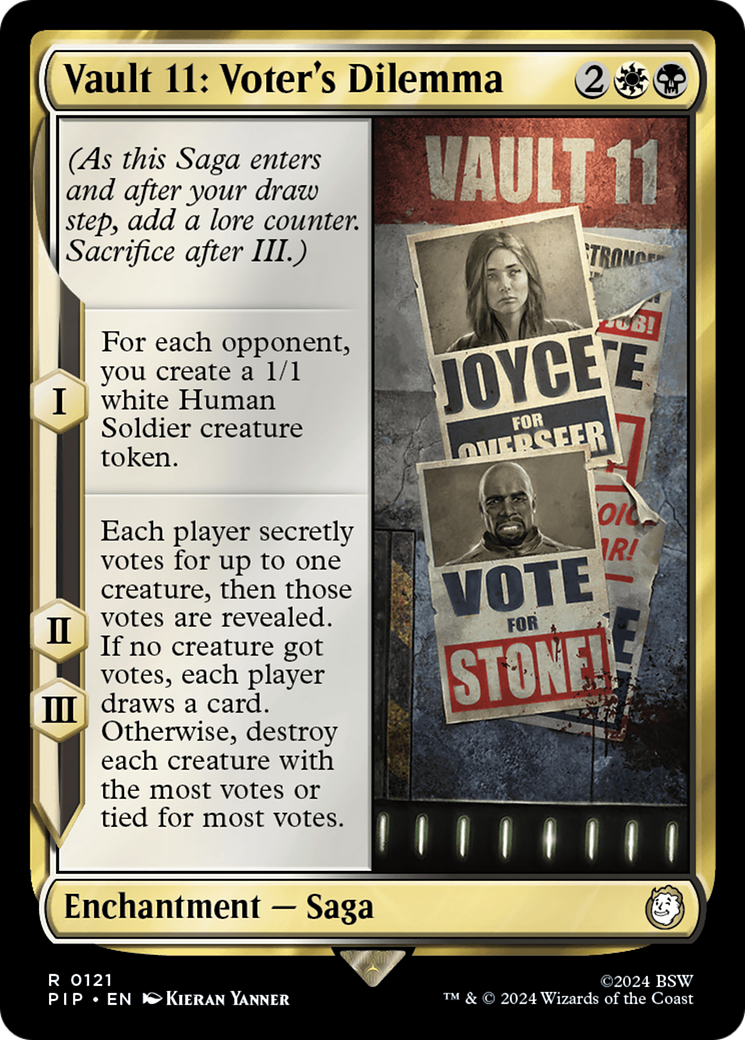
Vault 11: Voter's Dilemma
Vault 11: Voter's Dilemma
Enchantment — Saga
(As this Saga enters and after your draw step, add a lore counter. Sacrifice after III.)
I — For each opponent, you create a 1/1 white Human Soldier creature token.
II, III — Each player secretly votes for up to one creature, then those votes are revealed. If no creature got votes, each player draws a card. Otherwise, destroy each creature with the most votes or tied for most votes.
- To secretly vote, each player writes down their chosen option without showing it to anyone else. Each player then keeps their vote secret until all players simultaneously reveal their votes.
- Before secret votes are revealed, players may announce how they intend to vote, but they can't reveal what they actually wrote down until all votes are simultaneously revealed. Players can lie about how they intend to vote before the votes are revealed.
- Abilities that trigger "whenever players finish voting" trigger once all players have voted or once all secret votes are revealed, but they won't go on the stack until the current spell or ability finishes resolving.
- No player votes until Vault 11's last ability resolves. Any responses to the ability must be made without knowing the outcome of the vote.
-
1
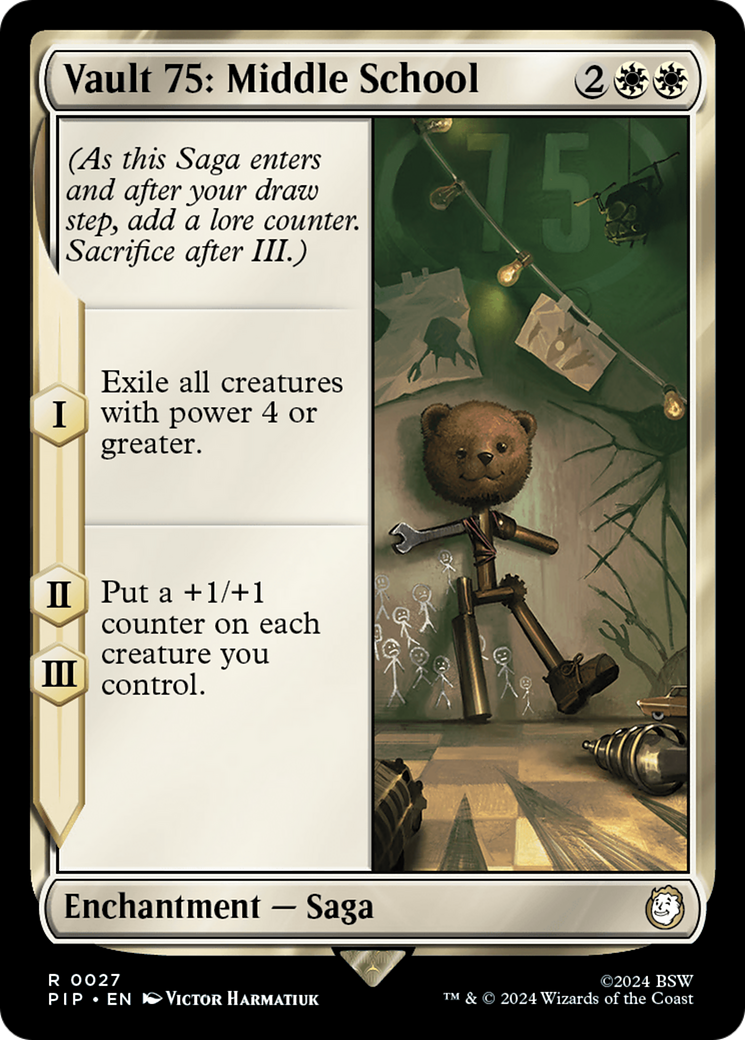
Vault 75: Middle School
Vault 75: Middle School
Enchantment — Saga
(As this Saga enters and after your draw step, add a lore counter. Sacrifice after III.)
I — Exile all creatures with power 4 or greater.
II, III — Put a +1/+1 counter on each creature you control.
-
1
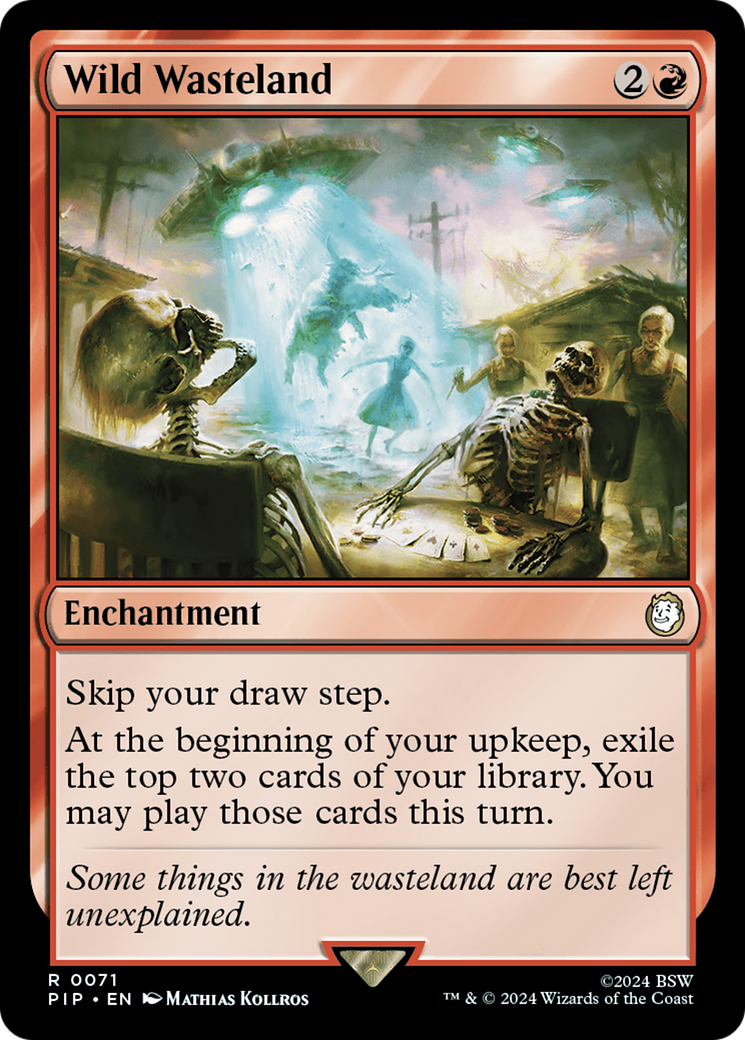
Wild Wasteland
Wild Wasteland
Enchantment
Skip your draw step.
At the beginning of your upkeep, exile the top two cards of your library. You may play those cards this turn.
- You pay all costs and follow all normal timing rules for cards played from exile with Wild Wasteland’s ability. For example, if one of the exiled cards is a land card, you may play it only during your main phase while the stack is empty.
Lands 36
-
1
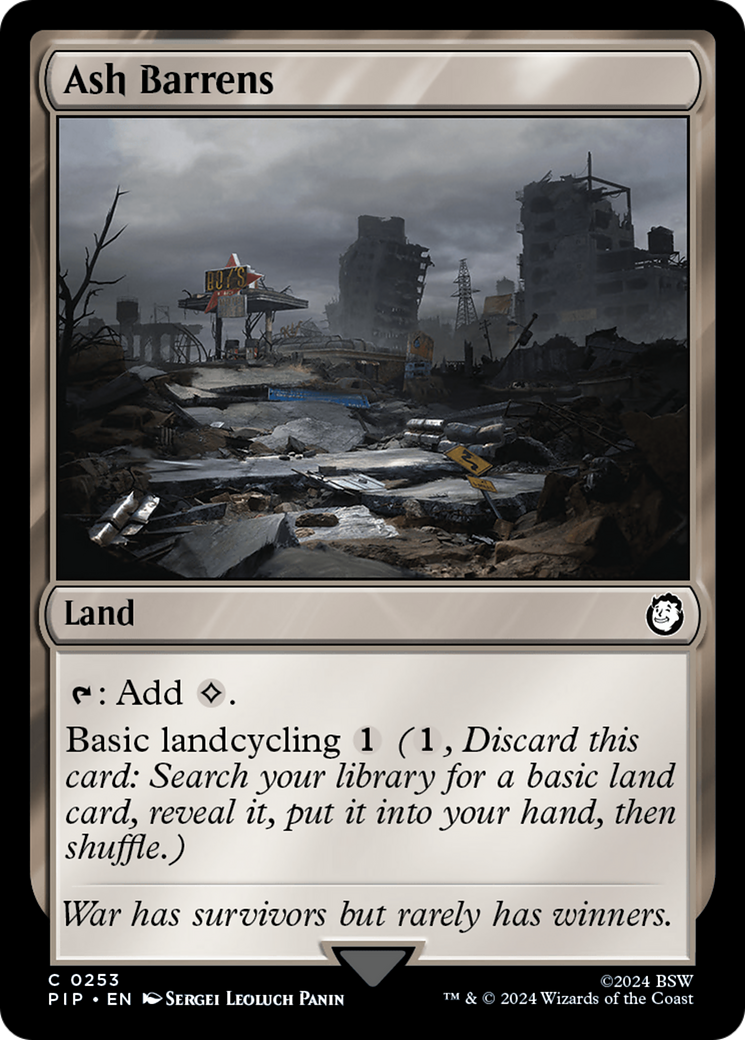
Ash Barrens
Ash Barrens
Land
: Add .
Basic landcycling ( , Discard this card: Search your library for a basic land card, reveal it, put it into your hand, then shuffle.)
-
1
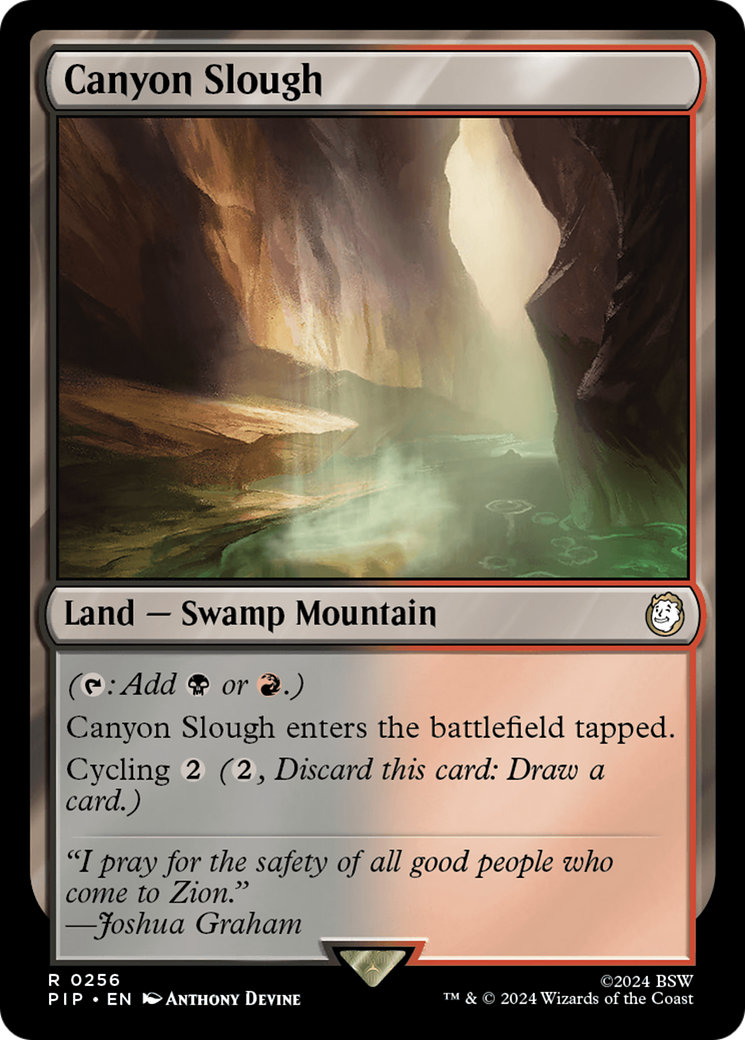
Canyon Slough
Canyon Slough
Land — Swamp Mountain
( : Add or .)
This land enters tapped.
Cycling ( , Discard this card: Draw a card.)
-
1
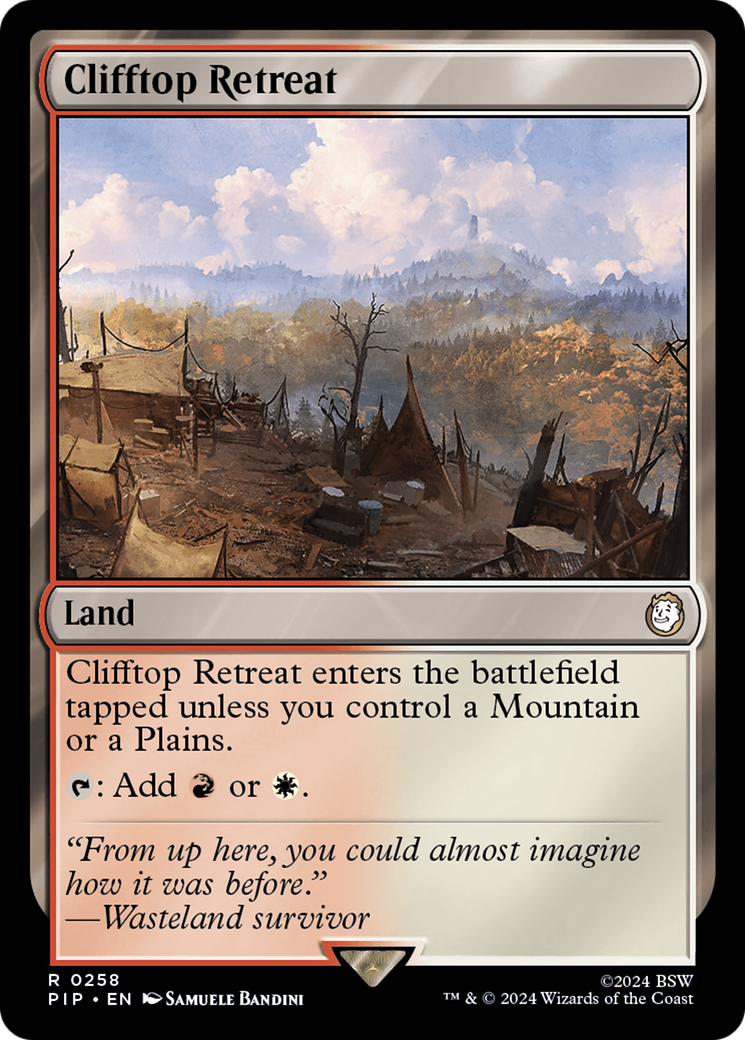
Clifftop Retreat
Clifftop Retreat
Land
This land enters tapped unless you control a Mountain or a Plains.
: Add or .
-
1
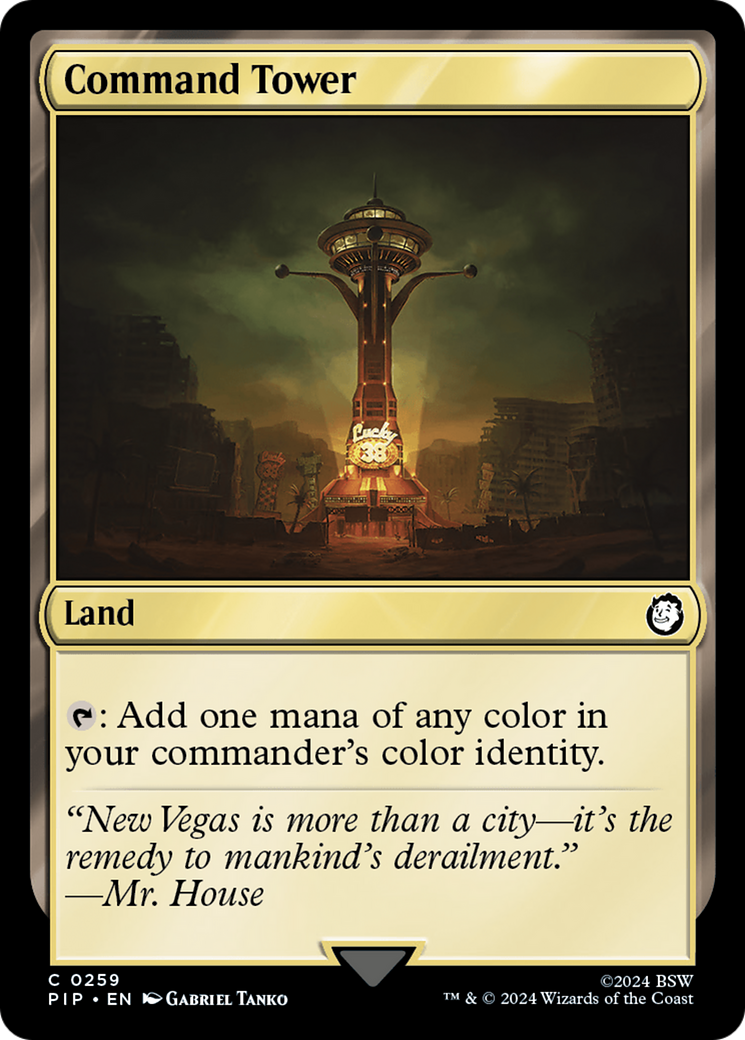
Command Tower
Command Tower
Land
: Add one mana of any color in your commander's color identity.
- If you don't have a commander, Command Tower's ability produces no mana.
- If your commander is a card that has no colors in its color identity, Command Tower's ability produces no mana. It doesn't produce .
- If you have two commanders, the ability adds one mana of any color in their combined color identities.
-
1
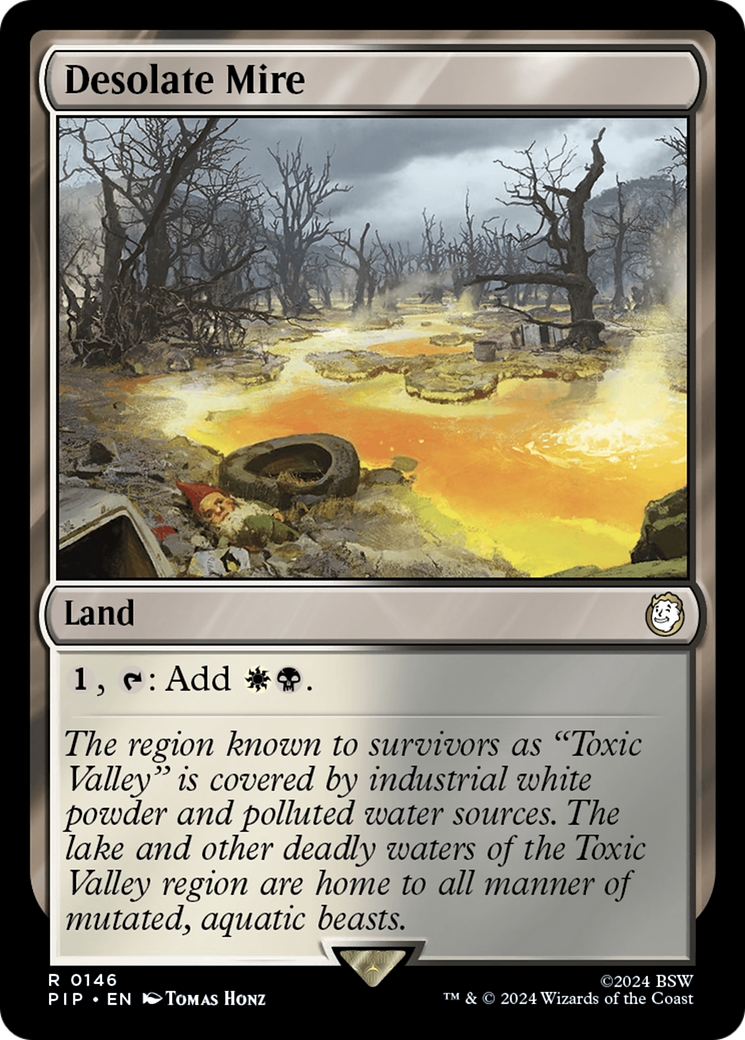
Desolate Mire
Desolate Mire
Land
, : Add .
-
1
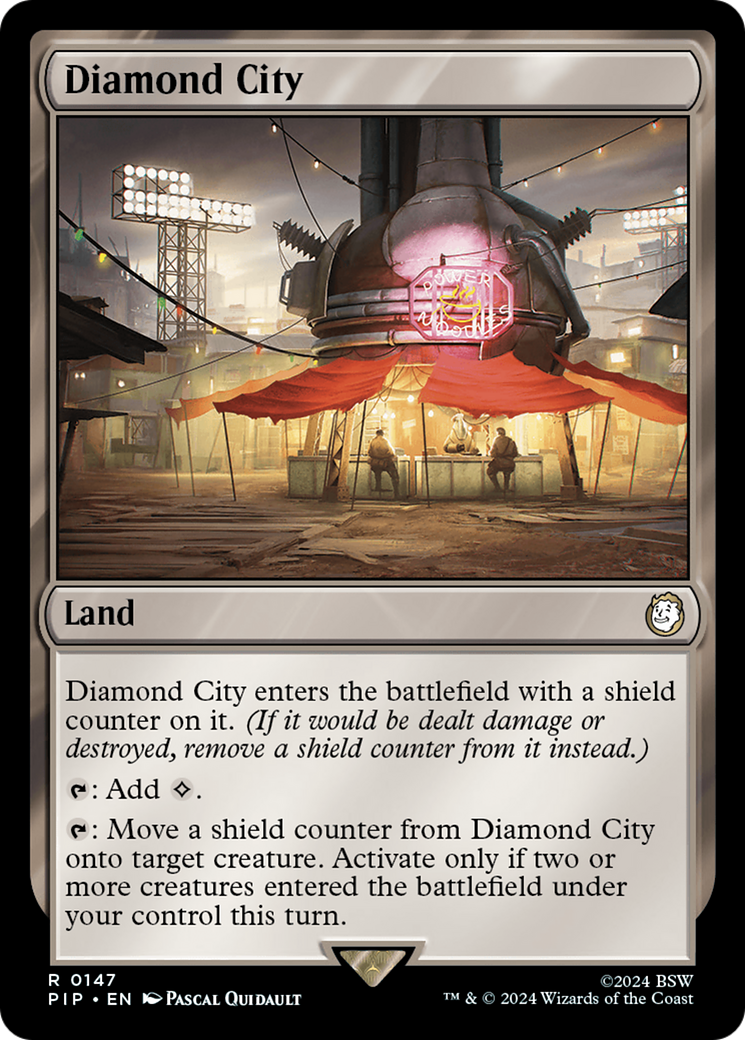
Diamond City
Diamond City
Land
This land enters with a shield counter on it. (If it would be dealt damage or destroyed, remove a shield counter from it instead.)
: Add .
: Move a shield counter from this land onto target creature. Activate only if two or more creatures entered the battlefield under your control this turn.
- Shield counters don’t prevent players from sacrificing permanents.
- Removing a shield counter when a permanent would be dealt damage or destroyed isn’t the same as regenerating a permanent.
- If a permanent that would be dealt damage has more than one shield counter on it, that damage is prevented and only one shield counter is removed.
- If a permanent with a shield counter is dealt unpreventable damage, that damage will be dealt and a shield counter will still be removed.
- A creature with a shield counter on it may still be destroyed by state-based actions if it has damage marked on it equal to its toughness or has been dealt unpreventable damage by a source with deathtouch.
- “Shield” is not an ability that permanents have and shield counters are not keyword counters. If a permanent with a shield counter loses its abilities, the shield counter will still protect it as normal.
-
1
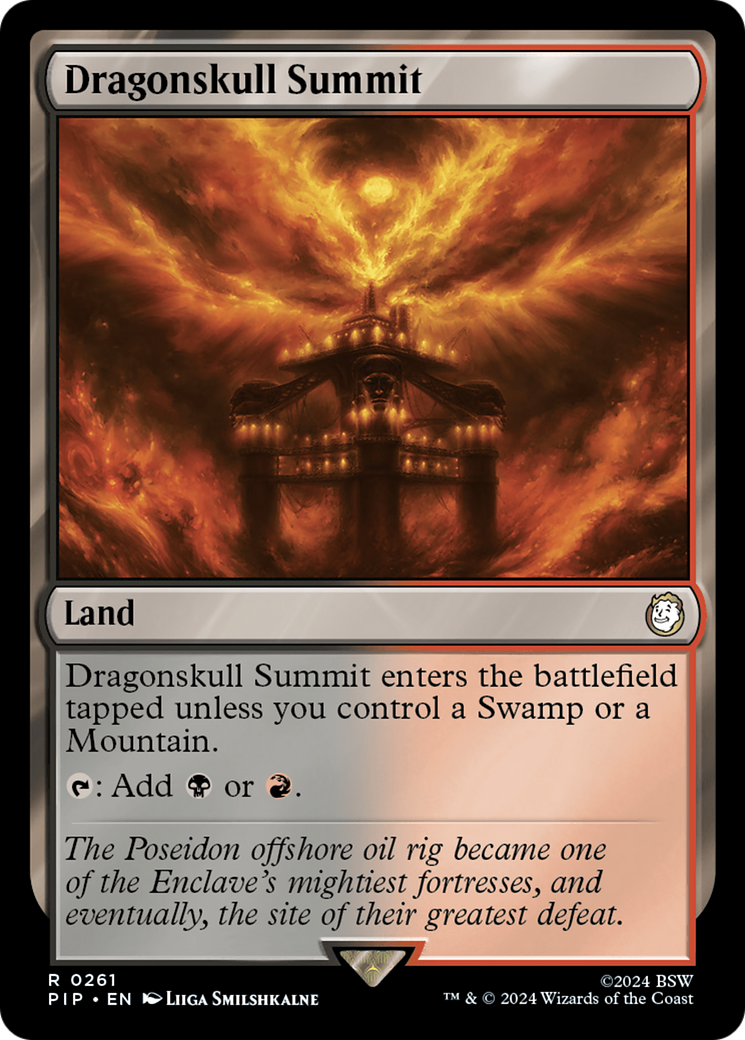
Dragonskull Summit
Dragonskull Summit
Land
This land enters tapped unless you control a Swamp or a Mountain.
: Add or .
- This checks for lands you control with the land type Swamp or Mountain, not for lands named Swamp or Mountain. The lands it checks for don't have to be basic lands. For example, if you control Stomping Ground (a nonbasic land with the land types Mountain and Forest), Dragonskull Summit will enter untapped.
- As this is entering, it checks for lands that are already on the battlefield. It won't see lands that are entering at the same time (due to Warp World, for example).
-
1
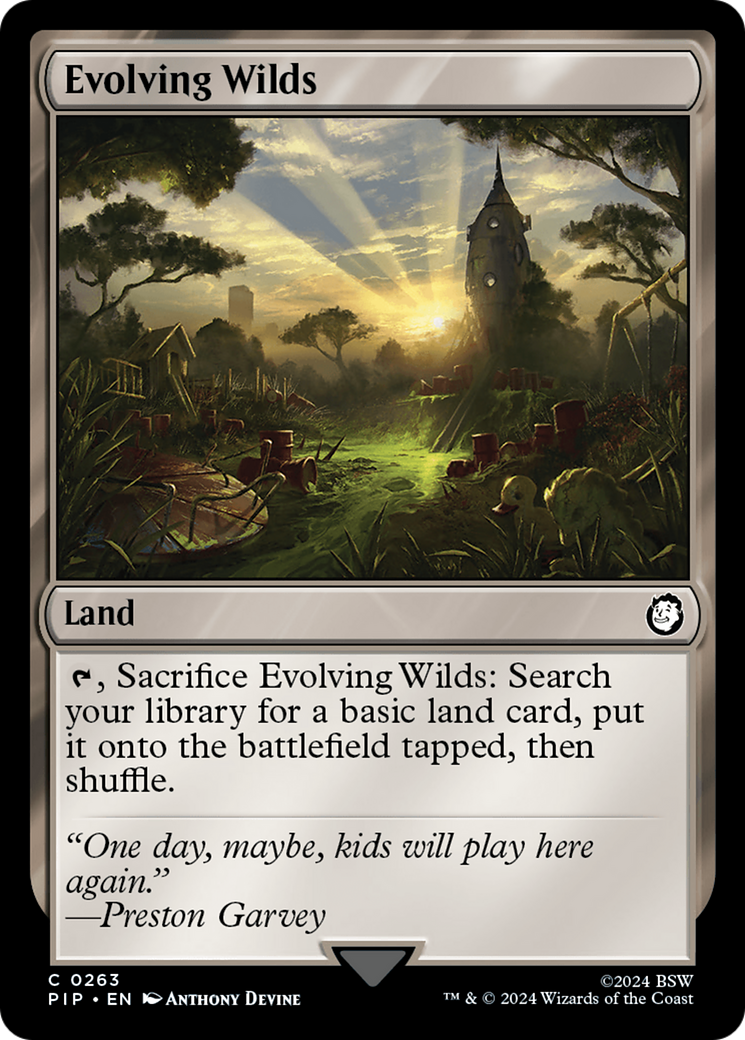
Evolving Wilds
Evolving Wilds
Land
, Sacrifice this land: Search your library for a basic land card, put it onto the battlefield tapped, then shuffle.
-
1
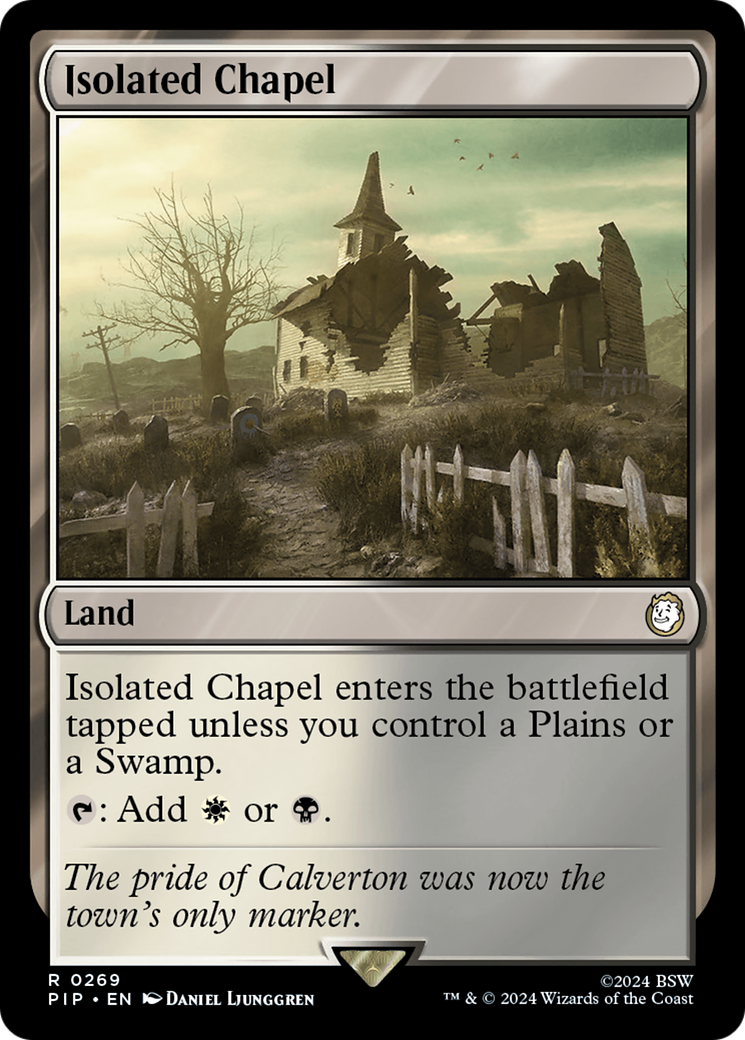
Isolated Chapel
Isolated Chapel
Land
This land enters tapped unless you control a Plains or a Swamp.
: Add or .
-
1
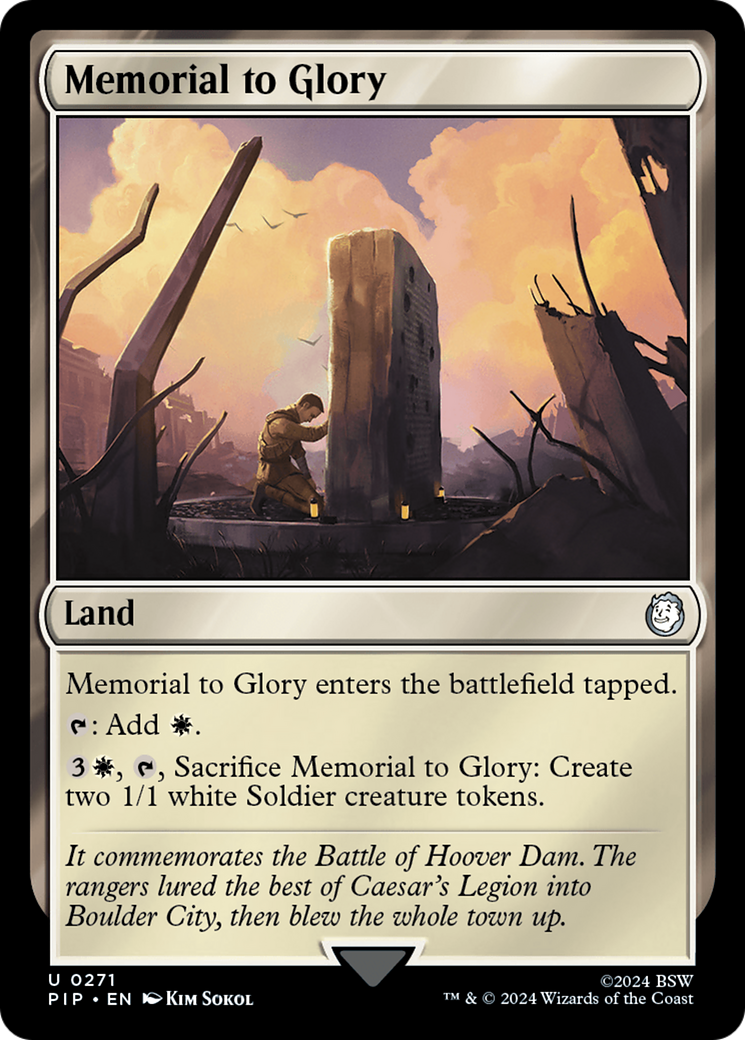
Memorial to Glory
Memorial to Glory
Land
This land enters tapped.
: Add .
, , Sacrifice this land: Create two 1/1 white Soldier creature tokens.
-
5
Mountain
Mountain
Basic Land — Mountain
( : Add .)
-
1
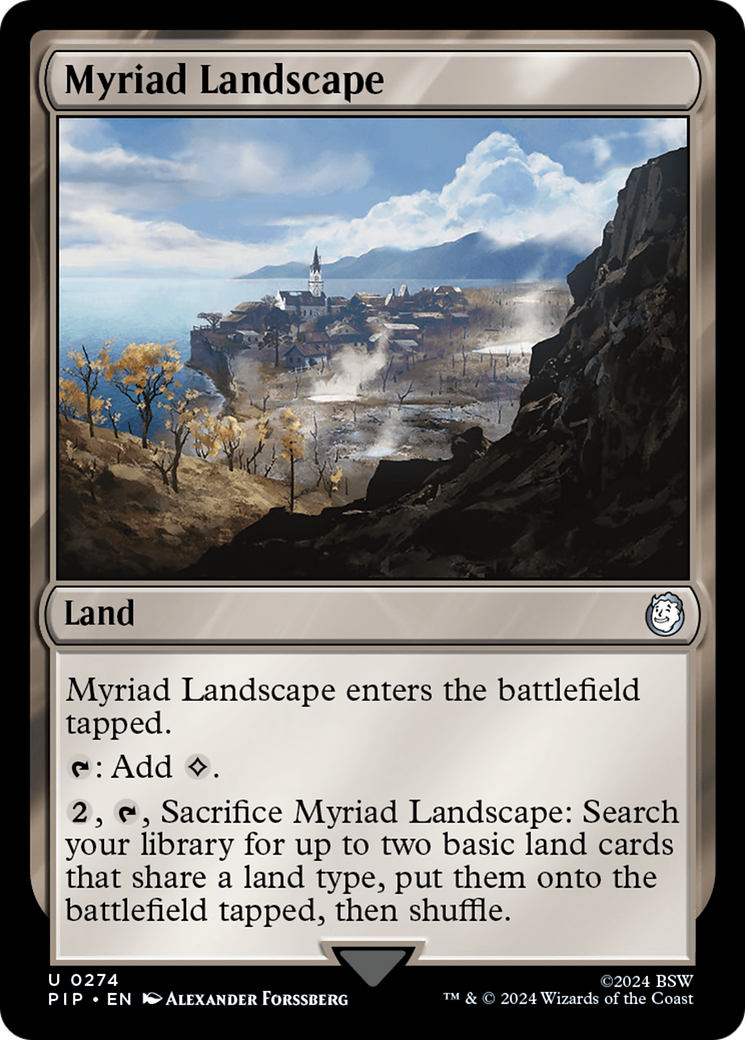
Myriad Landscape
Myriad Landscape
Land
This land enters tapped.
: Add .
, , Sacrifice this land: Search your library for up to two basic land cards that share a land type, put them onto the battlefield tapped, then shuffle.
- You can choose to find one basic land card with Myriad Landscape's last ability.
-
1
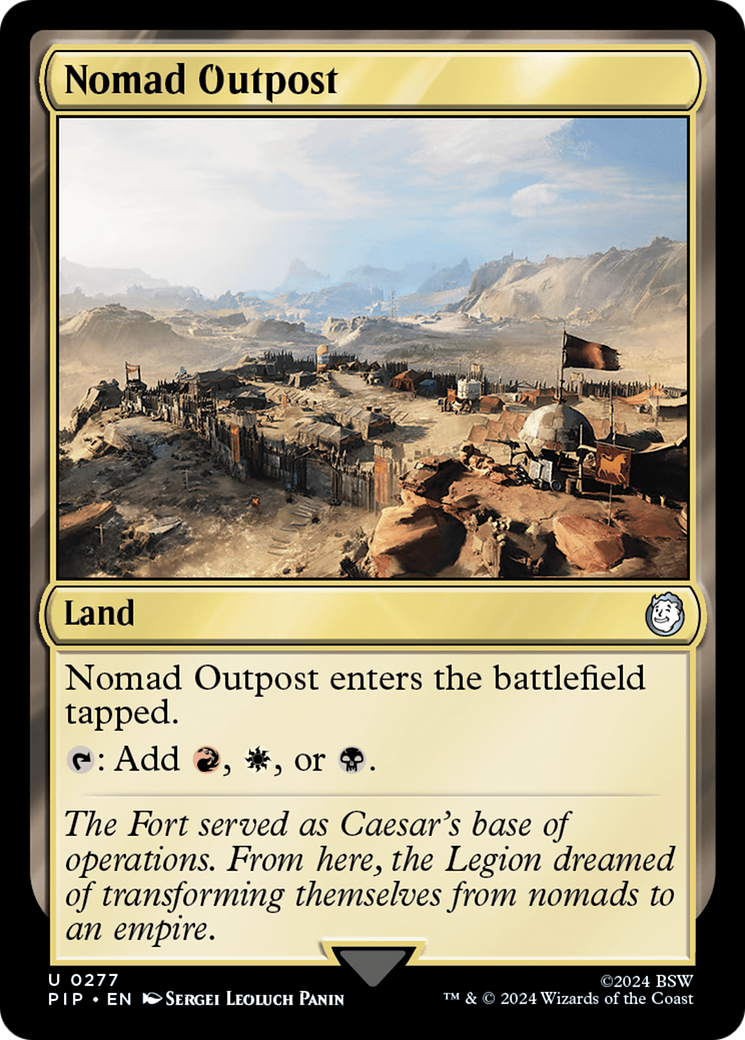
Nomad Outpost
Nomad Outpost
Land
This land enters tapped.
: Add , , or .
-
1
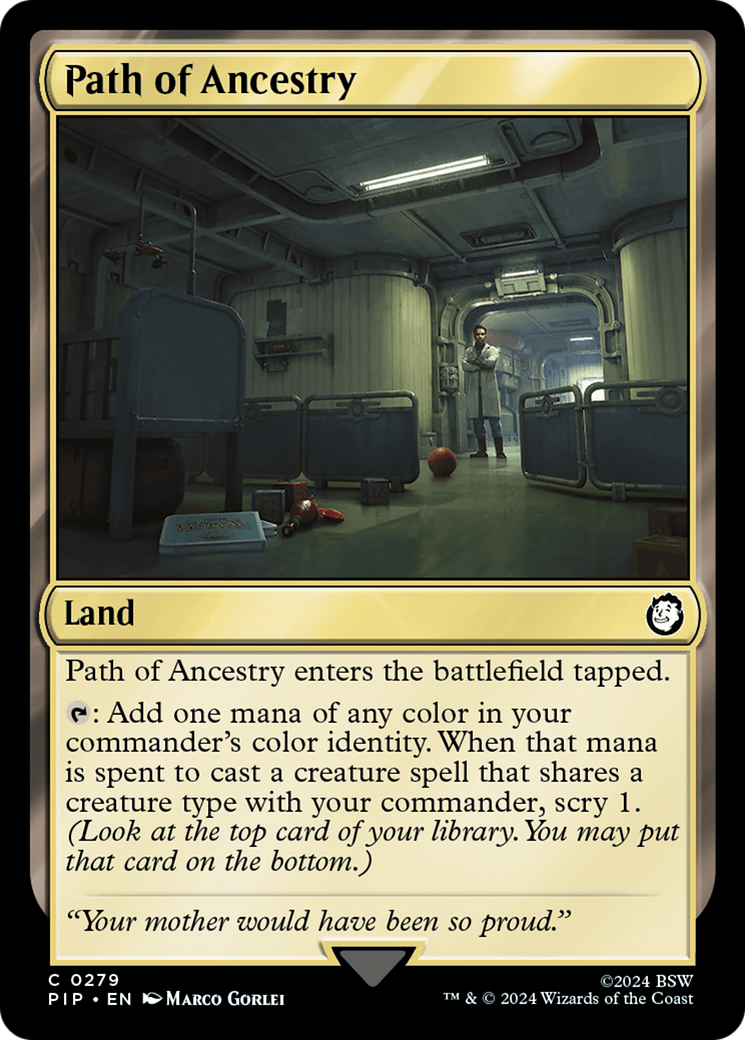
Path of Ancestry
Path of Ancestry
Land
This land enters tapped.
: Add one mana of any color in your commander's color identity. When that mana is spent to cast a creature spell that shares a creature type with your commander, scry 1. (Look at the top card of your library. You may put that card on the bottom.)
- Your commander's creature types are checked immediately after you cast a creature spell spending mana from Path of Ancestry's last ability. They aren't set before the game begins, and they may not be the same types your commander had when you activated that ability.
- If you have two commanders, the last ability adds one mana of any color in their combined color identities. When you spend that mana on a creature spell that shares a creature type with either of your commanders, you'll scry 1.
- If Path of Ancestry's last ability produces two mana (most likely due to Mana Reflection), spending those two mana to cast creature spells that share a creature type with your commander will cause two abilities to trigger. Each of those abilities will cause you to scry 1. You won't scry 2. This is true whether you spend the mana on one creature spell or two.
- If your commander has no creature types, it can't share a creature type with any spell that you cast.
- If you cast your commander with mana from Path of Ancestry, and your commander hasn't somehow lost all of its creature types while on the stack, you'll scry 1.
- If you don't have a commander, Path of Ancestry's ability produces no mana.
- If your commander is a card that has no colors in its color identity, Path of Ancestry's ability produces no mana. It doesn't produce .
-
5
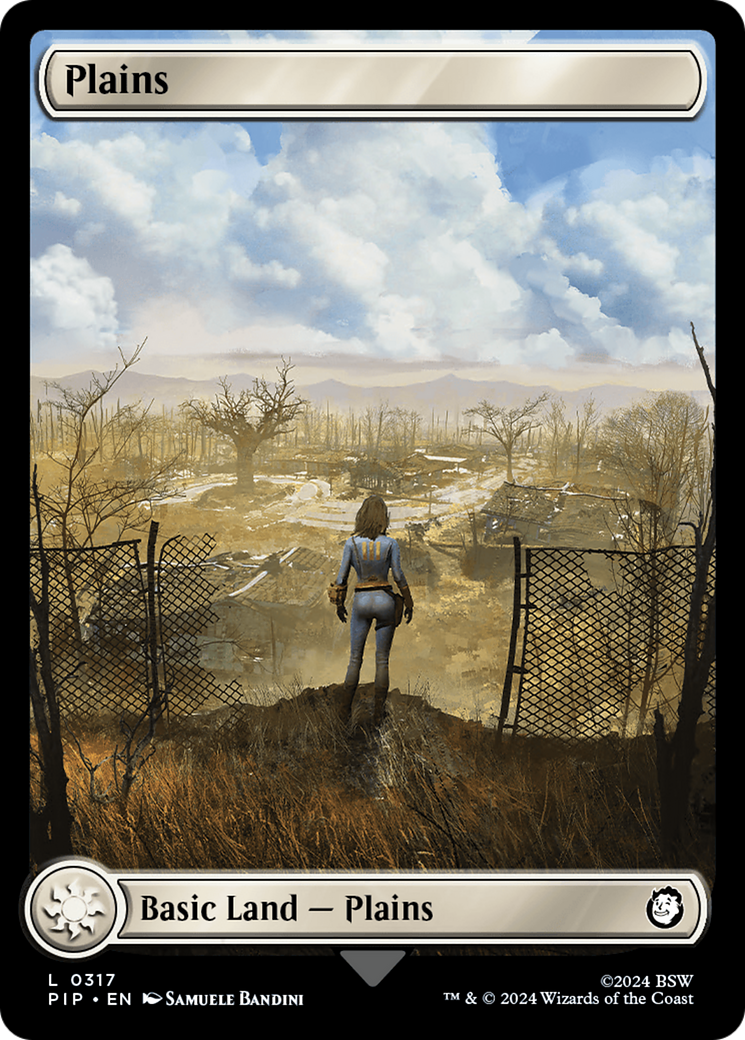
Plains
Plains
Basic Land — Plains
( : Add .)
-
1
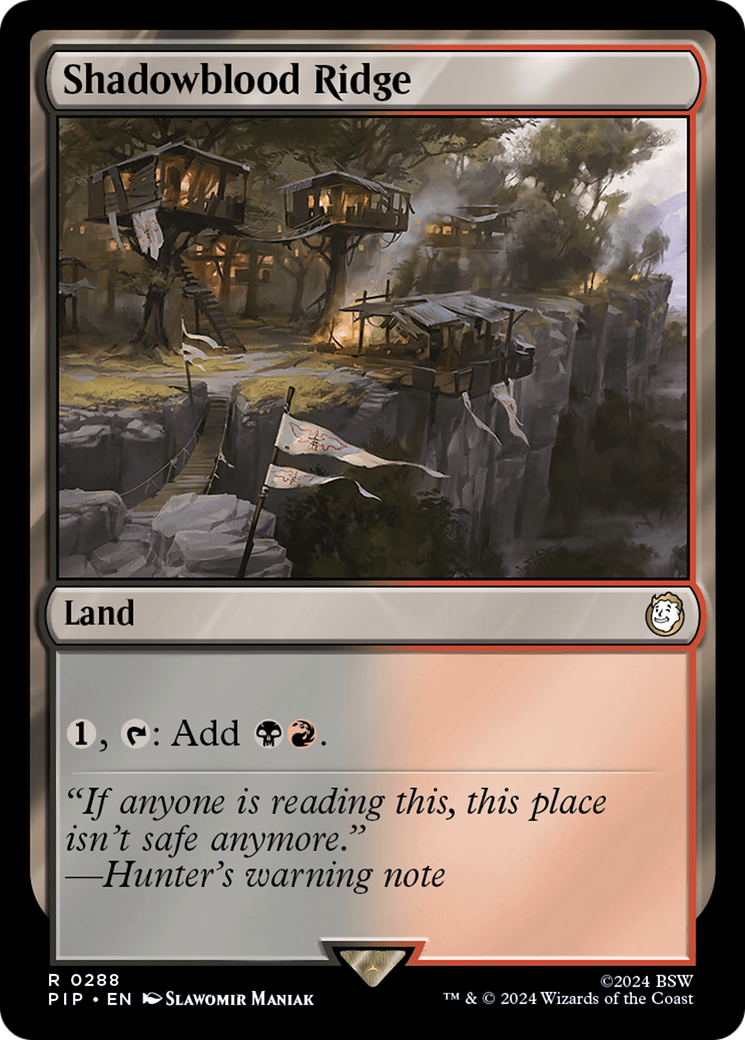
Shadowblood Ridge
Shadowblood Ridge
Land
, : Add .
-
1
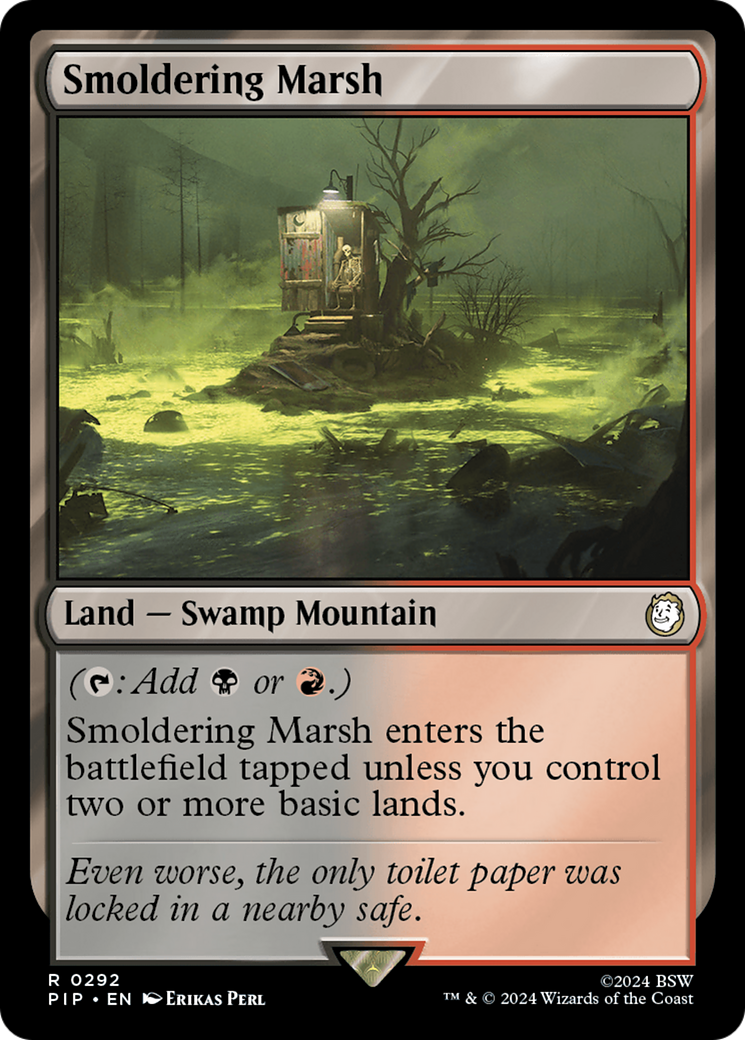
Smoldering Marsh
Smoldering Marsh
Land — Swamp Mountain
( : Add or .)
This land enters tapped unless you control two or more basic lands.
- However, because these cards have basic land types, effects that specify a basic land type without also specifying that the land be basic can affect them. For example, a spell or ability that reads "Destroy target Forest" can target Canopy Vista, while one that reads "Destroy target basic Forest" cannot.
- Even though these lands have basic land types, they are not basic lands because "basic" doesn't appear on their type line. Notably, controlling two or more of them won't allow others to enter the battlefield untapped.
- If one of these lands enters the battlefield at the same time as any number of basic lands, those other lands are not counted when determining if this land enters the battlefield tapped or untapped.
-
4
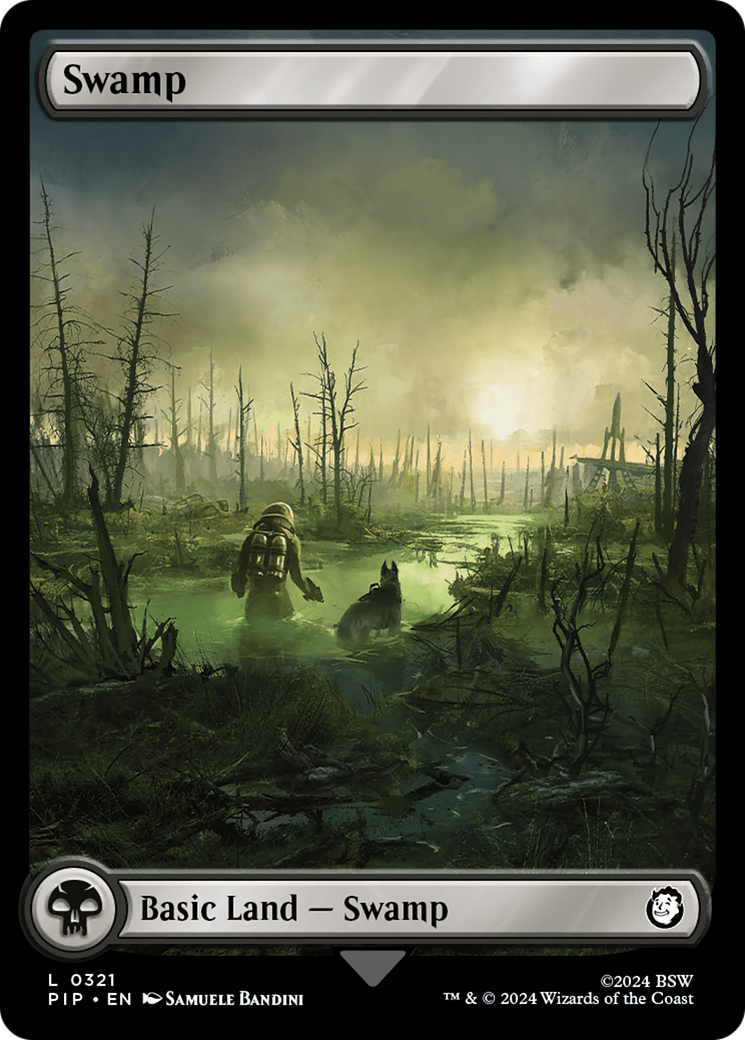
Swamp
Swamp
Basic Land — Swamp
( : Add .)
-
1
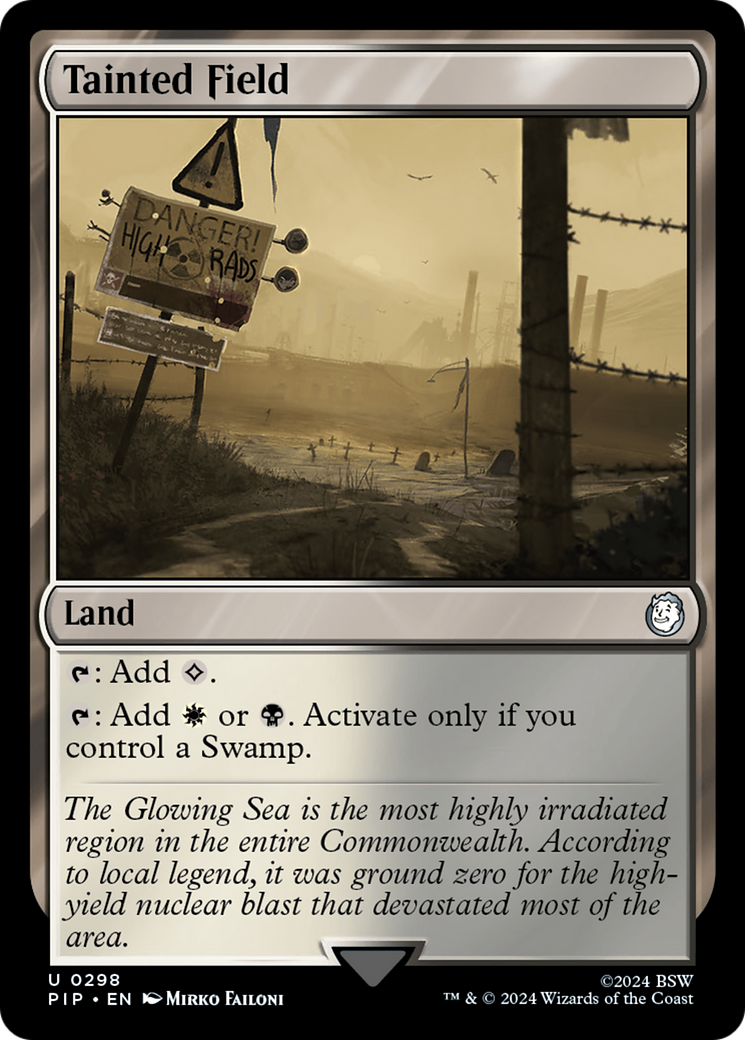
Tainted Field
Tainted Field
Land
: Add .
: Add or . Activate only if you control a Swamp.
-
1
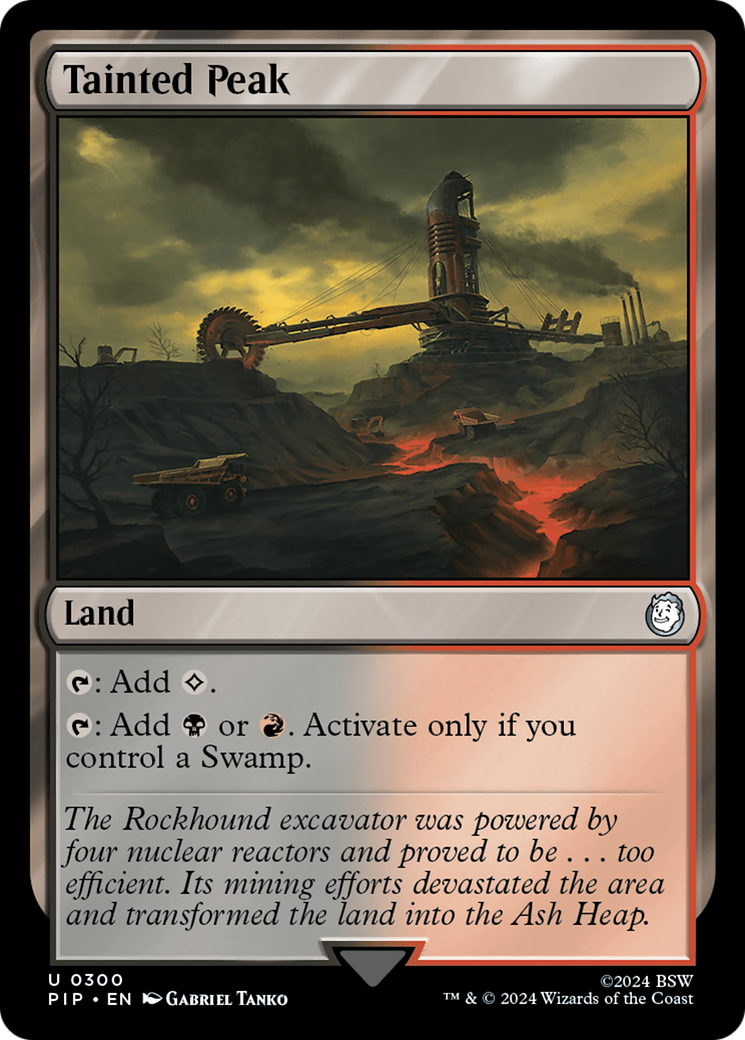
Tainted Peak
Tainted Peak
Land
: Add .
: Add or . Activate only if you control a Swamp.
-
1
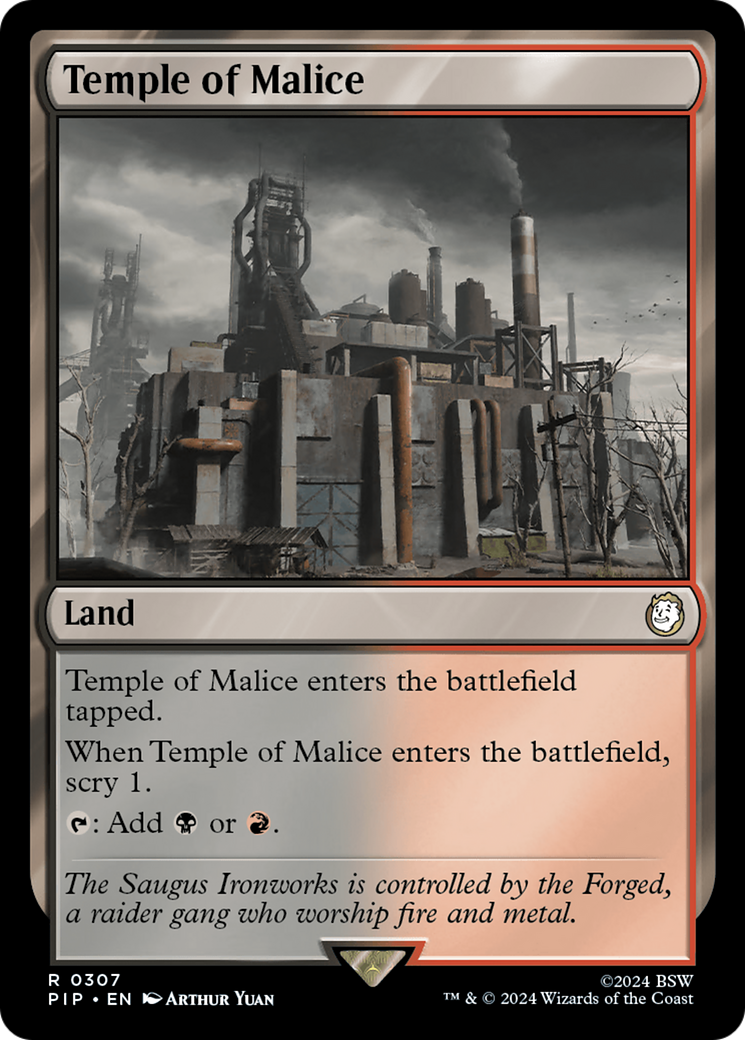
Temple of Malice
Temple of Malice
Land
This land enters tapped.
When this land enters, scry 1. (Look at the top card of your library. You may put that card on the bottom.)
: Add or .
- When you scry, you may put all the cards you look at back on top of your library, you may put all of those cards on the bottom of your library, or you may put some of those cards on top and the rest of them on the bottom.
- You choose how to order cards returned to your library after scrying no matter where you put them.
- You perform the actions stated on a card in sequence. For some spells and abilities, that means you'll scry last. For others, that means you'll scry and then perform other actions.
- Scry appears on some spells and abilities with one or more targets. If all of the spell or ability's targets are illegal when it tries to resolve, it won't resolve and none of its effects will happen. You won't scry.
-
1
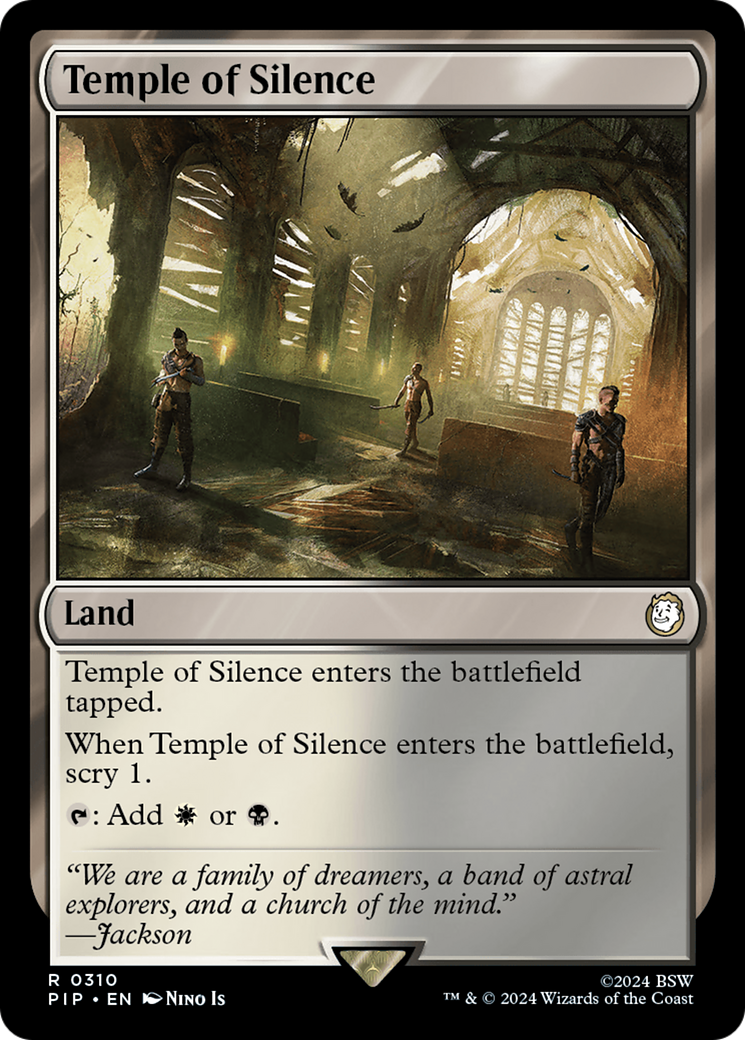
Temple of Silence
Temple of Silence
Land
This land enters tapped.
When this land enters, scry 1. (Look at the top card of your library. You may put that card on the bottom.)
: Add or .
- When you scry, you may put all the cards you look at back on top of your library, you may put all of those cards on the bottom of your library, or you may put some of those cards on top and the rest of them on the bottom.
- You choose how to order cards returned to your library after scrying no matter where you put them.
- You perform the actions stated on a card in sequence. For some spells and abilities, that means you'll scry last. For others, that means you'll scry and then perform other actions.
- Scry appears on some spells and abilities with one or more targets. If all of the spell or ability's targets are illegal when it tries to resolve, it won't resolve and none of its effects will happen. You won't scry.
-
1
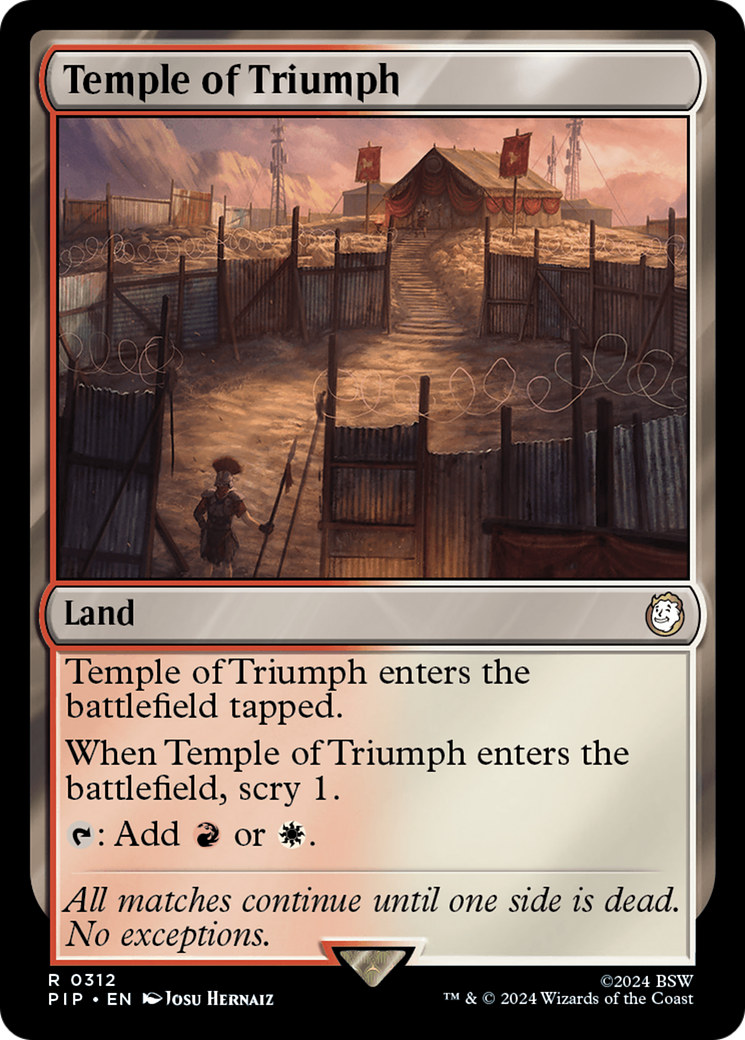
Temple of Triumph
Temple of Triumph
Land
This land enters tapped.
When this land enters, scry 1. (Look at the top card of your library. You may put that card on the bottom.)
: Add or .
- When you scry, you may put all the cards you look at back on top of your library, you may put all of those cards on the bottom of your library, or you may put some of those cards on top and the rest of them on the bottom.
- You choose how to order cards returned to your library after scrying no matter where you put them.
- You perform the actions stated on a card in sequence. For some spells and abilities, that means you'll scry last. For others, that means you'll scry and then perform other actions.
- Scry appears on some spells and abilities with one or more targets. If all of the spell or ability's targets are illegal when it tries to resolve, it won't resolve and none of its effects will happen. You won't scry.
-
1
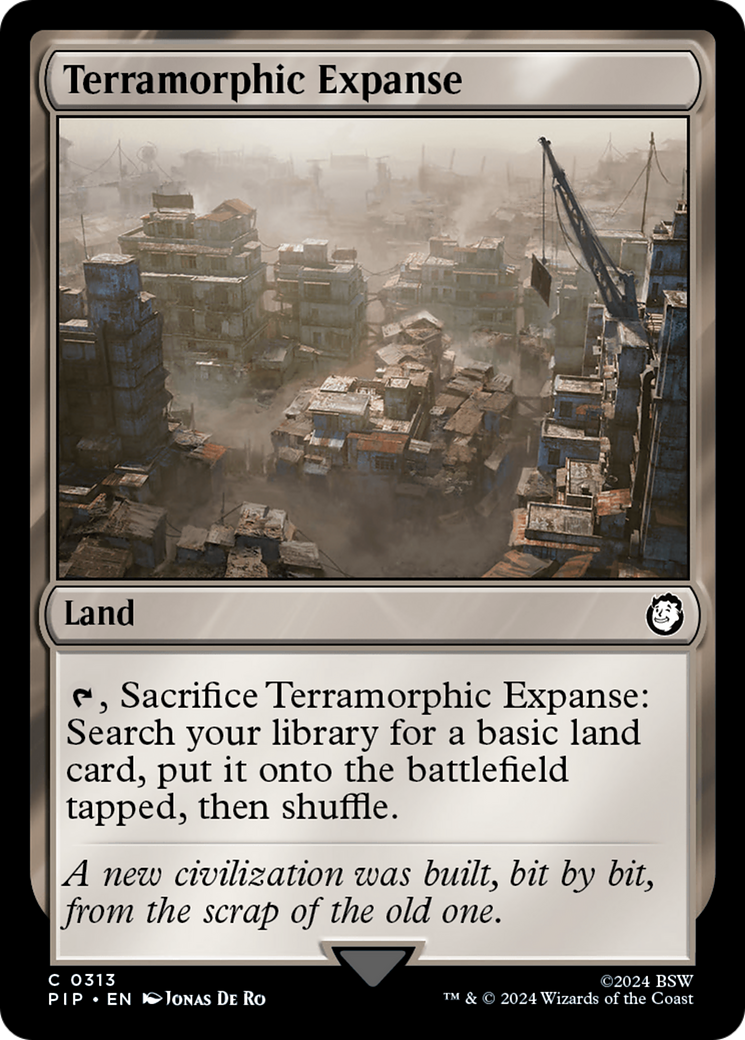
Terramorphic Expanse
Terramorphic Expanse
Land
, Sacrifice this land: Search your library for a basic land card, put it onto the battlefield tapped, then shuffle.
-
1
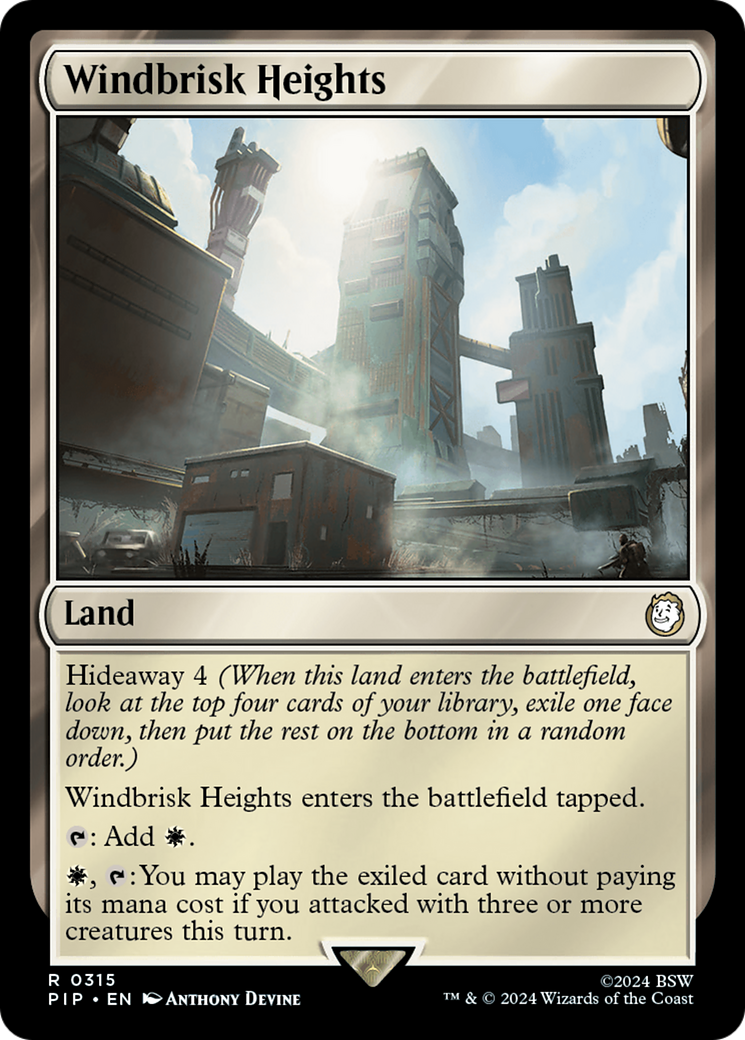
Windbrisk Heights
Windbrisk Heights
Land
Hideaway 4 (When this land enters, look at the top four cards of your library, exile one face down, then put the rest on the bottom in a random order.)
This land enters tapped.
: Add .
, : You may play the exiled card without paying its mana cost if you attacked with three or more creatures this turn.
- "Hideaway N" means "When this permanent enters the battlefield, look at the top N cards of your library. Exile one of them face down and put the rest on the bottom of your library in a random order. The exiled card gains 'The player who controls the permanent that exiled this card may look at this card in the exile zone.'"
- Any player who has controlled a permanent with a hideaway ability since a card was exiled with it may look at that card.
- Previously, permanents with hideaway entered the battlefield tapped. This ability has been removed from the definition of hideaway. Older cards have received errata to have an additional paragraph that reads "[This permanent] enters the battlefield tapped," and they now have hideaway 4.
- Hideaway now causes you to put the rest of the cards on the bottom of your library in a random order instead of any order.
- At the time the ability resolves, you'll get to play the card if you declared three different creatures as attackers at any point in the turn. A creature declared as an attacker in two different attack phases counts only once. A creature that entered attacking (such as a token created by Militia's Pride) doesn't count because you never attacked with it.
White 17
-
1
Aradesh, the Founder
Aradesh, the Founder
Legendary Creature — Human Soldier
1/4
Enlist (As this creature attacks, you may tap a nonattacking creature you control without summoning sickness. When you do, add its power to this creature's until end of turn.)
Whenever a creature you control attacks, if it enlisted a creature this combat, the creature that attacked gains double strike until end of turn. If that creature's power is 4 or greater, draw a card.
- The attacking player chooses whether to tap a creature for an enlist ability immediately after they tap the creatures that they have chosen to attack with. You can’t choose to enlist a creature later.
- To enlist a creature, that creature must be untapped, it must not be attacking (even if it has vigilance), and it must have haste or have been under that attacking player’s control since the beginning of their current turn.
- When a player taps a creature for an attacking creature’s enlist ability, that attacking creature gets +X/+0 until end of turn, where X is the tapped creature’s power. This is a triggered ability that goes on the stack immediately after attackers have been declared in the declare attackers step.
- You may tap only one creature for an enlist ability of an attacking creature, and a single creature can’t be tapped for more than one enlist ability.
- Aradesh’s last ability has an intervening if clause. If a creature that attacks hasn’t enlisted a creature this combat, the ability won’t trigger at all for that creature.
- It doesn’t matter what happens to the enlisted creature after Aradesh’s last ability triggers. As long as the creature that attacked enlisted a creature this combat, when Aradesh’s last ability resolves, the creature that attacked will still get double strike, and if that creature’s power is 4 or greater, you’ll still draw a card.
-
1
Battle of Hoover Dam
Battle of Hoover Dam
Enchantment
As this enchantment enters, choose NCR or Legion.
- NCR — At the beginning of your end step, return target creature card with mana value 3 or less from your graveyard to the battlefield with a finality counter on it.
- Legion — Whenever a creature you control dies, put two +1/+1 counters on target creature you control.
- Finality counters aren’t keyword counters, and a finality counter doesn’t give any abilities to the permanent it’s on. If that permanent loses its abilities and then would go to a graveyard, it will still be exiled instead.
- Finality counters work on any permanent, not only creatures. If a permanent with a finality counter on it would be put into a graveyard from the battlefield, exile it instead.
- Finality counters don’t stop permanents from going to zones other than the graveyard from the battlefield. For example, if a permanent with a finality counter on it would be put into its owner’s hand from the battlefield, it does so normally.
- Multiple finality counters on a single permanent are redundant.
- If you somehow control Battle of Hoover Dam and no choice was made for it (perhaps because another permanent on the battlefield became a copy of it), it has neither of the two triggered abilities.
-
1
Captain of the Watch
Captain of the Watch
Creature — Human Soldier
3/3
Vigilance (Attacking doesn't cause this creature to tap.)
Other Soldier creatures you control get +1/+1 and have vigilance.
When this creature enters, create three 1/1 white Soldier creature tokens.
- Captain of the Watch grants +1/+1 and vigilance to all other Soldier creatures you control, not just the ones its ability puts onto the battlefield.
-
1
Entrapment Maneuver
Entrapment Maneuver
Instant
Target player sacrifices an attacking creature of their choice. You create X 1/1 white Soldier creature tokens, where X is that creature's toughness.
- An "attacking creature" is one that has been declared as an attacker or put onto the battlefield attacking during this combat. Unless that creature leaves combat, it continues to be an attacking creature through the end of combat step, even if the player it was attacking has left the game or the planeswalker it was attacking has left combat.
- If you cast Entrapment Maneuver after combat damage has been dealt, only creatures that survived combat can be sacrificed.
- Entrapment Maneuver doesn't target the creature to be sacrificed. The target player chooses one as it resolves. No player may take any other actions between the target player choosing the creature and you creating Soldier tokens.
- To determine how many Soldier tokens are created, use the toughness of the sacrificed creature as it last existed on the battlefield.
-
1
Gary Clone
Gary Clone
Creature — Human Citizen
1/3
Squad (As an additional cost to cast this spell, you may pay any number of times. When this creature enters, create that many tokens that are copies of it.)
Whenever this creature attacks, each creature you control named Gary Clone gets +1/+0 until end of turn.
- You may pay the squad cost any number of times. You will create a token that is a copy of that permanent for each time you paid the squad cost. If you paid the squad cost multiple times, the tokens will all enter the battlefield simultaneously.
- If the spell is countered, the squad ability will not trigger, and no tokens will be created.
- If the spell resolves but the creature with squad leaves the battlefield before its squad ability resolves, you'll still create the token copies.
- The tokens created by the squad ability aren't "cast," so any abilities that trigger when a spell is cast won't trigger for the copies.
- If, for some reason, the creature doesn't have the squad ability when it's on the battlefield, the ability won't trigger, even if you've paid the squad cost one or more times.
-
1
Hour of Reckoning
Hour of Reckoning
Sorcery
Convoke (Your creatures can help cast this spell. Each creature you tap while casting this spell pays for or one mana of that creature's color.)
Destroy all nontoken creatures.
- You can tap any untapped creature you control to convoke a spell, even one you haven't controlled continuously since the beginning of your most recent turn.
- Tapping an untapped creature that's attacking or blocking to convoke a spell won't cause that creature to stop attacking or blocking.
- When calculating a spell's total cost, include any alternative costs, additional costs, or anything else that increases or reduces the cost to cast the spell. Convoke applies after the total cost is calculated. Convoke doesn't change a spell's mana cost or mana value.
- If a creature you control has a mana ability with in the cost, activating that ability while casting a spell with convoke will result in the creature being tapped before you pay the spell's costs. You won't be able to tap it again for convoke. Similarly, if you sacrifice a creature to activate a mana ability while casting a spell with convoke, that creature won't be on the battlefield when you pay the spell's costs, so you won't be able to tap it for convoke.
- Because convoke isn't an alternative cost, it can be used in conjunction with alternative costs.
- Tapping a multicolored creature using convoke will pay for or one mana of your choice of any of that creature's colors.
-
1
Impassioned Orator
Impassioned Orator
Creature — Human Cleric
2/2
Whenever another creature you control enters, you gain 1 life.
-
1
Intangible Virtue
Intangible Virtue
Enchantment
Creature tokens you control get +1/+1 and have vigilance.
-
1
Keeper of the Accord
Keeper of the Accord
Creature — Human Soldier
3/4
At the beginning of each opponent's end step, if that player controls more creatures than you, create a 1/1 white Soldier creature token.
At the beginning of each opponent's end step, if that player controls more lands than you, you may search your library for a basic Plains card, put it onto the battlefield tapped, then shuffle.
- Both triggered abilities trigger at the same time. You may put them on the stack in either order.
- If the opponent doesn't control more creatures than you as their end step begins, the first ability won't trigger. The same is true for lands and the second ability. Each of those abilities will check again when it tries to resolve. If the opponent no longer controls more creatures (or lands) than you, the ability won't resolve and will have no effect.
-
1
Marshal's Anthem
Marshal's Anthem
Enchantment
Multikicker (You may pay an additional any number of times as you cast this spell.)
Creatures you control get +1/+1.
When this enchantment enters, return up to X target creature cards from your graveyard to the battlefield, where X is the number of times this enchantment was kicked.
- If a spell's kicker cost was paid, the spell is "kicked."
- The kicker ability doesn't let you pay a kicker cost more than once.
- If you put a permanent with a kicker ability onto the battlefield without casting it, you can't kick it.
- If you copy a kicked spell on the stack, the copy is also kicked. If the copied spell is a permanent spell, the token the copy of that spell becomes when it enters is also kicked.
- If a card or token enters as a copy of a permanent, the new permanent isn't kicked, even if the original was.
- To determine a spell's total cost, start with the mana cost (or an alternative cost if another card's effect allows you to pay one instead), add any cost increases (such as kicker), then apply any cost reductions. The spell's mana value remains unchanged, no matter what the total cost to cast it was.
-
1
Martial Coup
Martial Coup
Sorcery
Create X 1/1 white Soldier creature tokens. If X is 5 or more, destroy all other creatures.
- Martial Coup checks the number you chose for X, not the amount of mana you actually spent.
- You do what the spell says in order. If X is 5 or more, you'll put the Soldier tokens onto the battlefield, then you'll destroy all other creatures.
- No one can cast spells or activate abilities between the time the Soldier tokens are put onto the battlefield and the time all other creatures are destroyed. For example, you can't sacrifice one of those Soldier tokens to regenerate a Skeletal Kathari.
-
1
Overseer of Vault 76
Overseer of Vault 76
Legendary Creature — Human Advisor
3/3
First Contact — Whenever Overseer of Vault 76 or another creature you control with power 3 or less enters, put a quest counter on Overseer of Vault 76.
At the beginning of combat on your turn, you may remove three quest counters from among permanents you control. When you do, put a +1/+1 counter on each creature you control and they gain vigilance until end of turn.
- If Overseer of Vault 76 and one or more other creatures with power 3 or less enter the battlefield under your control at the same time, Overseer of Vault 76’s first ability will trigger for each of them.
- Overseer of Vault 76’s last ability lets you choose to remove exactly three quest counters from among permanents you control when it resolves. You can’t remove more quest counters to multiply the effect.
-
1
Secure the Wastes
Secure the Wastes
Instant
Create X 1/1 white Warrior creature tokens.
-
1
Securitron Squadron
Securitron Squadron
Artifact Creature — Robot
2/2
Squad (As an additional cost to cast this spell, you may pay any number of times. When this creature enters, create that many tokens that are copies of it.)
Vigilance
Whenever a creature token you control enters, put a +1/+1 counter on it.
- If the spell resolves but the creature with squad leaves the battlefield before its squad ability resolves, you’ll still create the token copies.
- The tokens created by the squad ability aren’t “cast,” so any abilities that trigger when a spell is cast won’t trigger for the copies.
- If, for some reason, the creature doesn’t have the squad ability when it’s on the battlefield, the ability won’t trigger, even if you’ve paid the squad cost one or more times.
- If Securitron Squadron enters the battlefield at the same time as one or more creature tokens, its last ability will trigger for each of those creature tokens. If that Securitron Squadron is itself a creature token, its last ability will trigger when it enters the battlefield as well.
- For example, if you pay Securitron Squadron’s squad cost three times, then you’ll create three token copies of Securitron Squadron when its squad ability resolves. Each of those tokens will enter the battlefield simultaneously. When they enter, their last abilities will each trigger three times (once for each of the other two tokens, and once for itself.) If the original Securitron Squadron is still on the battlefield, its last ability will trigger three times as well. After all of the triggered abilities resolve, each of the three token copies of Securitron Squadron will have four +1/+1 counters on it.
- You may pay the squad cost any number of times. You will create a token that is a copy of that permanent for each time you paid the squad cost. If you paid the squad cost multiple times, the tokens will all enter the battlefield simultaneously.
- If the spell is countered, the squad ability will not trigger, and no tokens will be created.
-
1
Sierra, Nuka's Biggest Fan
Sierra, Nuka's Biggest Fan
Legendary Creature — Human Citizen
3/4
The Nuka-Cola Challenge — Whenever one or more creatures you control deal combat damage to a player, put a quest counter on Sierra and create a Food token.
Whenever you sacrifice a Food, target creature you control gets +X/+X until end of turn, where X is the number of quest counters on Sierra.
- Food is an artifact type. Even though it appears on some creatures, it's never a creature type.
- You can't sacrifice a Food to pay multiple costs. For example, you can't sacrifice a Food token to activate its own ability and also to activate Maraleaf Rider's ability.
- Whatever you do, don't eat the delicious cards.
- If an effect refers to a Food, it means any Food artifact, not just a Food artifact token. For example, if you sacrifice a nontoken Food artifact, such as Candy Trail from the Wilds of Eldraine set, Sierra's last ability will trigger.
- Sierra's last ability triggers whenever you sacrifice a Food for any reason, not just to activate a Food's activated ability.
-
1
Vault 75: Middle School
Vault 75: Middle School
Enchantment — Saga
(As this Saga enters and after your draw step, add a lore counter. Sacrifice after III.)
I — Exile all creatures with power 4 or greater.
II, III — Put a +1/+1 counter on each creature you control.
-
1
Yes Man, Personal Securitron
Yes Man, Personal Securitron
Legendary Artifact Creature — Robot
2/2
: Target opponent gains control of Yes Man. When they do, you draw two cards and put a quest counter on Yes Man. Activate only during your turn.
Wild Card — When Yes Man leaves the battlefield, its owner creates a tapped 1/1 white Soldier creature token for each quest counter on it.
- If Yes Man isn't on the battlefield as its first ability resolves, or if the target opponent is an illegal target as the ability tries to resolve, nothing will happen. You won't draw two cards, because that effect is part of a reflexive triggered ability that triggers only if the target opponent gains control of Yes Man.
- When Yes Man's controller leaves the game, if that player wasn't its owner, the effect giving that player control of Yes Man ends. Yes Man will return to the control of the player still in the game who most recently controlled it, ignoring any control effects whose durations have already expired.
- When Yes Man's owner leaves the game, Yes Man leaves the game along with that player. It's just doing what it's told.
Black 10
-
1
Bastion of Remembrance
Bastion of Remembrance
Enchantment
When this enchantment enters, create a 1/1 white Human Soldier creature token.
Whenever a creature you control dies, each opponent loses 1 life and you gain 1 life.
- If your life total is brought to 0 or less at the same time that creatures you control are dealt lethal damage, you lose the game before the last ability goes on the stack.
- In a Two-Headed Giant game, Bastion of Remembrance's last ability causes the opposing team to lose 2 life and you to gain 1 life.
- If one or more creatures you control die at the same time that Bastion of Remembrance leaves the battlefield, its last ability triggers for each of those creatures.
-
1
Black Market
Black Market
Enchantment
Whenever a creature dies, put a charge counter on this enchantment.
At the beginning of your first main phase, add for each charge counter on this enchantment.
- Getting the mana is not optional.
-
1
Butch DeLoria, Tunnel Snake
Butch DeLoria, Tunnel Snake
Legendary Creature — Human Rogue
2/2
Menace (This creature can't be blocked except by two or more creatures.)
Tunnel Snakes Rule! — Whenever Butch DeLoria attacks, it gets +1/+1 until end of turn for each other Rogue and/or Snake you control.
: Put a menace counter on another target creature. It becomes a Rogue in addition to its other types.
- A permanent that's both a Rogue and a Snake is counted only once for Butch DeLoria's second ability.
-
1
Deadly Dispute
Deadly Dispute
Instant
As an additional cost to cast this spell, sacrifice an artifact or creature.
Draw two cards and create a Treasure token. (It's an artifact with " , Sacrifice this token: Add one mana of any color.")
-
1
Lethal Scheme
Lethal Scheme
Instant
Convoke (Your creatures can help cast this spell. Each creature you tap while casting this spell pays for or one mana of that creature's color.)
Destroy target creature or planeswalker. Each creature that convoked Lethal Scheme connives. (Draw a card, then discard a card. If you discarded a nonland card, put a +1/+1 counter on that creature.)
- When multiple creatures are instructed to connive simultaneously, they connive one at a time in the order of their controller's choice.
- You can't tap more creatures to convoke Lethal Scheme than it takes to pay for its total cost. This means that normally no more than four creatures can convoke it.
-
1
Morbid Opportunist
Morbid Opportunist
Creature — Human Rogue
1/3
Whenever one or more other creatures die, draw a card. This ability triggers only once each turn.
- If Morbid Opportunist dies at the same time as one or more other creatures, Morbid Opportunist's ability still triggers.
-
1
Pitiless Plunderer
Pitiless Plunderer
Creature — Human Pirate
1/4
Whenever another creature you control dies, create a Treasure token. (It's an artifact with " , Sacrifice this token: Add one mana of any color.")
- If Pitiless Plunderer dies at the same time as one or more other creatures you control, its ability will still trigger for each of those other creatures.
-
1
Ruthless Radrat
Ruthless Radrat
Creature — Rat Mutant
2/2
Squad—Exile four cards from your graveyard. (As an additional cost to cast this spell, you may pay its squad cost any number of times. When this creature enters, create that many tokens that are copies of it.)
Menace (This creature can't be blocked except by two or more creatures.)
- Once you announce that you’re casting Ruthless Radrat, no player may take actions until you’re done casting it. Notably, opponents can’t try to remove cards from your graveyard to stop you from paying Ruthless Radrat’s squad cost.
- You may pay the squad cost any number of times. You will create a token that is a copy of that permanent for each time you paid the squad cost. If you paid the squad cost multiple times, the tokens will all enter the battlefield simultaneously.
- If the spell is countered, the squad ability will not trigger, and no tokens will be created.
- If the spell resolves but the creature with squad leaves the battlefield before its squad ability resolves, you’ll still create the token copies.
- The tokens created by the squad ability aren’t “cast,” so any abilities that trigger when a spell is cast won’t trigger for the copies.
- If, for some reason, the creature doesn’t have the squad ability when it’s on the battlefield, the ability won’t trigger, even if you’ve paid the squad cost one or more times.
-
1
V.A.T.S.
V.A.T.S.
Instant
Split second (As long as this spell is on the stack, players can't cast spells or activate abilities that aren't mana abilities.)
Choose any number of target creatures with equal toughness. Destroy the chosen creatures.
- Players still get priority while a spell with split second is on the stack; their options are just limited to mana abilities and certain special actions.
- Players may turn face-down creatures face up while a spell with split second is on the stack.
- Split second doesn’t stop triggered abilities from triggering. If one does, its controller puts it on the stack and chooses targets for it, if any. Those abilities will resolve as normal.
- Casting a spell with split second won’t affect spells and abilities that are already on the stack.
- If the resolution of a triggered ability involves casting a spell, that spell can’t be cast if a spell with split second is on the stack.
- After a spell with split second resolves (or otherwise leaves the stack), players may again cast spells and activate abilities before the next object on the stack resolves.
- If you choose just one target for V.A.T.S., that creature will be destroyed when V.A.T.S. resolves as long as it’s still a legal target, regardless of whether or not its toughness has changed since V.A.T.S. was cast.
- In the rare case where the legal targets no longer all have equal toughness (probably because of a triggered ability or special action) when V.A.T.S. tries to resolve, it won’t resolve. None of the chosen creatures will be destroyed.
-
1
Wasteland Raider
Wasteland Raider
Creature — Human Mercenary
4/3
Squad (As an additional cost to cast this spell, you may pay any number of times. When this creature enters, create that many tokens that are copies of it.)
When this creature enters, each player sacrifices a creature of their choice.
- You may pay the squad cost any number of times. You will create a token that is a copy of that permanent for each time you paid the squad cost. If you paid the squad cost multiple times, the tokens will all enter the battlefield simultaneously.
- If the spell is countered, the squad ability will not trigger, and no tokens will be created.
- If the spell resolves but the creature with squad leaves the battlefield before its squad ability resolves, you’ll still create the token copies.
- The tokens created by the squad ability aren’t “cast,” so any abilities that trigger when a spell is cast won’t trigger for the copies.
- If, for some reason, the creature doesn’t have the squad ability when it’s on the battlefield, the ability won’t trigger, even if you’ve paid the squad cost one or more times.
Red 6
-
1
Mysterious Stranger
Mysterious Stranger
Creature — Human Rogue
3/2
Flash
When this creature enters, for each graveyard with an instant or sorcery card in it, exile target instant or sorcery card from that graveyard. If two or more cards are exiled this way, choose one of them at random and copy it. You may cast the copy without paying its mana cost.
- You cast the copy while Mysterious Stranger’s last ability is resolving and still on the stack. You can’t wait to cast it later in the turn.
- If a spell has in its mana cost, you must choose 0 as the value of X when casting it without paying its mana cost.
- If you cast a spell “without paying its mana cost,” you can’t choose to cast it for any alternative costs. You can, however, pay additional costs. If the spell has any mandatory additional costs, those must be paid to cast the card.
- If you don’t want to cast the copy, you can choose not to; the copy ceases to exist the next time state-based actions are checked.
-
1
Powder Ganger
Powder Ganger
Creature — Human Rogue
2/2
Squad (As an additional cost to cast this spell, you may pay any number of times. When this creature enters, create that many tokens that are copies of it.)
When this creature enters, destroy up to one target artifact.
- You may pay the squad cost any number of times. You will create a token that is a copy of that permanent for each time you paid the squad cost. If you paid the squad cost multiple times, the tokens will all enter the battlefield simultaneously.
- If the spell is countered, the squad ability will not trigger, and no tokens will be created.
- If the spell resolves but the creature with squad leaves the battlefield before its squad ability resolves, you’ll still create the token copies.
- The tokens created by the squad ability aren’t “cast,” so any abilities that trigger when a spell is cast won’t trigger for the copies.
- If, for some reason, the creature doesn’t have the squad ability when it’s on the battlefield, the ability won’t trigger, even if you’ve paid the squad cost one or more times.
-
1
Rose, Cutthroat Raider
Rose, Cutthroat Raider
Legendary Artifact Creature — Robot
3/2
First strike
Raid — At end of combat on your turn, if you attacked this turn, create a Junk token for each opponent you attacked. (It's an artifact with " , Sacrifice this token: Exile the top card of your library. You may play that card this turn. Activate only as a sorcery.")
Whenever you sacrifice a Junk, add .
- Raid abilities care only that you attacked with a creature. It doesn't matter how many creatures you attacked with or which player, planeswalker, or battle those creatures attacked.
- Raid abilities evaluate the entire turn to see if you attacked with a creature. That creature doesn't have to still be on the battlefield. Similarly, the player, planeswalker, or battle it attacked doesn't have to still be in the game or on the battlefield.
- Rose's last ability triggers when you sacrifice a Junk for any reason, not just to activate a Junk's activated ability.
- You can't sacrifice a Junk token to pay multiple costs. For example, you can't sacrifice a Junk token to activate its own ability and also to activate the second ability of Junk Jet.
- You pay all costs and follow all normal timing rules for the card played from exile with a Junk token's ability. For example, if the exiled card is a land card, you may play it only during your main phase while the stack is empty.
- Some spells and abilities that create Junk tokens may require targets. If each target chosen is illegal as that spell or ability tries to resolve, it won't resolve and none of its effects happen. You won't create any Junk tokens.
-
1
Stolen Strategy
Stolen Strategy
Enchantment
At the beginning of your upkeep, exile the top card of each opponent's library. Until end of turn, you may cast spells from among those exiled cards, and you may spend mana as though it were mana of any color to cast those spells.
- Stolen Strategy doesn't change when you can cast the exiled card. For example, if you exile a sorcery card, you can cast it only during your main phase when the stack is empty.
- Casting an exiled card causes it to leave exile. You can't cast it multiple times.
- If you don't cast the exiled cards, they remain exiled. They can't be cast on later turns.
-
1
Thrill-Kill Disciple
Thrill-Kill Disciple
Creature — Human Mercenary
3/2
Squad— , Discard a card. (As an additional cost to cast this spell, you may pay its squad cost any number of times. When this creature enters, create that many tokens that are copies of it.)
When this creature dies, create a Junk token.
- You can’t sacrifice a Junk token to pay multiple costs. For example, you can’t sacrifice a Junk token to activate its own ability and also to activate the second ability of Junk Jet.
- You pay all costs and follow all normal timing rules for the card played from exile with a Junk token’s ability. For example, if the exiled card is a land card, you may play it only during your main phase while the stack is empty.
- Some spells and abilities that create Junk tokens may require targets. If each target chosen is illegal as that spell or ability tries to resolve, it won’t resolve and none of its effects happen. You won’t create any Junk tokens.
- You may pay the squad cost any number of times. You will create a token that is a copy of that permanent for each time you paid the squad cost. If you paid the squad cost multiple times, the tokens will all enter the battlefield simultaneously.
- If the spell is countered, the squad ability will not trigger, and no tokens will be created.
- If the spell resolves but the creature with squad leaves the battlefield before its squad ability resolves, you’ll still create the token copies.
- The tokens created by the squad ability aren’t “cast,” so any abilities that trigger when a spell is cast won’t trigger for the copies.
- If, for some reason, the creature doesn’t have the squad ability when it’s on the battlefield, the ability won’t trigger, even if you’ve paid the squad cost one or more times.
-
1
Wild Wasteland
Wild Wasteland
Enchantment
Skip your draw step.
At the beginning of your upkeep, exile the top two cards of your library. You may play those cards this turn.
- You pay all costs and follow all normal timing rules for cards played from exile with Wild Wasteland’s ability. For example, if one of the exiled cards is a land card, you may play it only during your main phase while the stack is empty.
Multicolor 20
-
1
Anguished Unmaking
Anguished Unmaking
Instant
Exile target nonland permanent. You lose 3 life.
- If the target nonland permanent is an illegal target as Anguished Unmaking tries to resolve, it won't resolve and none of its effects will happen. You won't lose 3 life.
-
1
Assemble the Legion
Assemble the Legion
Enchantment
At the beginning of your upkeep, put a muster counter on this enchantment. Then create a 1/1 red and white Soldier creature token with haste for each muster counter on this enchantment.
- If Assemble the Legion isn't on the battlefield when its ability resolves, use the number of muster counters it had when it was last on the battlefield to determine how many Soldier tokens to create.
-
1
Boomer Scrapper
Boomer Scrapper
Creature — Human Soldier
1/1
Whenever this creature enters or attacks, you lose 1 life and create a Junk token. (It's an artifact with " , Sacrifice this token: Exile the top card of your library. You may play that card this turn. Activate only as a sorcery.")
Whenever a token you control leaves the battlefield, put a +1/+1 counter on this creature.
- You can't sacrifice a Junk token to pay multiple costs. For example, you can't sacrifice a Junk token to activate its own ability and also to activate the second ability of Junk Jet.
- You pay all costs and follow all normal timing rules for the card played from exile with a Junk token's ability. For example, if the exiled card is a land card, you may play it only during your main phase while the stack is empty.
- Some spells and abilities that create Junk tokens may require targets. If each target chosen is illegal as that spell or ability tries to resolve, it won't resolve and none of its effects happen. You won't create any Junk tokens.
-
1
Caesar, Legion's Emperor
Caesar, Legion's Emperor
Legendary Creature — Human Soldier
4/4
Whenever you attack, you may sacrifice another creature. When you do, choose two —
- Create two 1/1 red and white Soldier creature tokens with haste that are tapped and attacking.
- You draw a card and you lose 1 life.
- Caesar deals damage equal to the number of creature tokens you control to target opponent.
- You don't choose modes or a target for Caesar, Legion's Emperor's ability at the time it triggers. Rather, a second "reflexive" ability triggers when you sacrifice another creature this way. You choose modes and, if you chose the third mode, a target for that ability as it goes on the stack. Each player may respond to this triggered ability as normal.
- The Soldier tokens created by Caesar's ability enter the battlefield tapped and attacking, but since they weren't declared as attacking creatures, no abilities that trigger whenever a creature attacks or whenever you attack (such as Caesar's own ability) will trigger.
-
1
Colonel Autumn
Colonel Autumn
Legendary Creature — Human Soldier
2/3
Lifelink
Exploit (When this creature enters, you may sacrifice a creature.)
Other legendary creatures you control have exploit.
Whenever a creature you control exploits a creature, put a +1/+1 counter on each creature you control.
- A creature with exploit “exploits a creature” when the controller of an exploit ability sacrifices a creature as that ability resolves.
- You choose whether to sacrifice a creature and which creature to sacrifice as an exploit ability resolves.
- You can sacrifice the creature with exploit if it’s still on the battlefield. If it has an ability that triggers when it exploits a creature (or, in this case, when any creature you control exploits a creature), that ability will trigger.
- If Colonel Autumn isn’t on the battlefield as an exploit ability of a creature you control resolves, Colonel Autumn’s last ability won’t trigger. You won’t get +1/+1 counters, even if you sacrifice a creature.
- You can’t sacrifice more than one creature to any one exploit ability.
-
1
Craig Boone, Novac Guard
Craig Boone, Novac Guard
Legendary Creature — Human Soldier
3/3
Reach, lifelink
One for My Baby — Whenever you attack with two or more creatures, put two quest counters on Craig Boone. When you do, Craig Boone deals damage equal to the number of quest counters on it to up to one target creature unless that creature's controller has Craig Boone deal that much damage to them.
- In the rare case where more than two quest counters are placed on Craig Boone because of the effect of its last ability (for example, because of the effect of Doubling Season), the reflexive triggered ability will trigger once for every two quest counters placed on Craig Boone this way.
- You don't choose a target for Craig Boone's last ability at the time it triggers. Rather, a second "reflexive" ability triggers when you put two quest counters on Craig Boone this way. You choose up to one target for that ability as it goes on the stack. Each player may respond to this triggered ability as normal.
- If Craig Boone is no longer on the battlefield when the reflexive triggered ability resolves, use the number of quest counters that were on it when it was last on the battlefield to determine how much damage it deals.
-
1
Desdemona, Freedom's Edge
Desdemona, Freedom's Edge
Legendary Creature — Human Rogue
3/4
Vigilance
Whenever Desdemona attacks, target creature card in your graveyard that's an artifact or that has mana value 3 or less gains escape until end of turn. The escape cost is equal to its mana cost plus exile two other cards from your graveyard. (You may cast it from your graveyard for its escape cost this turn.)
- If a spell you're casting with escape has an additional cost of discarding cards or sacrificing permanents, you may exile cards discarded or sacrificed this way to pay that part of its escape cost.
- Escape's permission doesn't change when you may cast the spell from your graveyard.
- To determine the total cost of a spell, start with the mana cost or alternative cost you're paying (such as an escape cost), add any cost increases, then apply any cost reductions. The mana value of the spell remains unchanged, no matter what the total cost to cast it was and no matter whether an alternative cost was paid.
- After an escaped permanent spell resolves, it enters the battlefield and will return to its owner's graveyard if it dies later.
- If a card has multiple abilities giving you permission to cast it, such as two escape abilities or an escape ability and a flashback ability, you choose which one to apply. The others have no effect.
- If you cast a spell with its escape permission, you can't choose to apply any other alternative costs or to cast it without paying its mana cost. You may pay any optional additional costs the spell has, such as kicker costs. If it has any mandatory additional costs, you must pay those.
- Once you begin casting a spell with escape, it immediately moves to the stack. Players can't take any other actions until you're done casting the spell.
-
1
Elder Arthur Maxson
Elder Arthur Maxson
Legendary Creature — Human Knight
4/2
Creature tokens you control have training. (Whenever a creature token you control attacks with another creature with greater power, put a +1/+1 counter on that token.)
Blind Betrayal — Sacrifice another creature: Elder Arthur Maxson gains indestructible until end of turn.
- A creature’s training ability triggers only when both that creature and a creature with greater power are declared as attackers. Increasing a creature’s power after attackers are declared won’t cause a training ability to trigger.
- Once a creature’s training ability has triggered, destroying the other attacking creature or reducing its power won’t stop the creature with training from getting a +1/+1 counter.
-
1
Fervent Charge
Fervent Charge
Enchantment
Whenever a creature you control attacks, it gets +2/+2 until end of turn.
-
1
General's Enforcer
General's Enforcer
Creature — Human Soldier
2/3
Legendary Humans you control have indestructible.
: Exile target card from a graveyard. If it was a creature card, create a 1/1 white Human Soldier creature token.
- Because damage remains marked on a creature until the damage is removed as the turn ends, nonlethal damage dealt to a legendary Human you control may become lethal if General's Enforcer leaves the battlefield during that turn.
- Only creatures are Humans. Planeswalkers such as Lukka and Narset who represent human characters aren't affected by General's Enforcer.
-
1
Heroic Reinforcements
Heroic Reinforcements
Sorcery
Create two 1/1 white Soldier creature tokens. Until end of turn, creatures you control get +1/+1 and gain haste. (They can attack and this turn.)
- The second part of Heroic Reinforcements's effect affects only creatures you control at the time it's applied, including the tokens created by the first part of its effect. Creatures you begin to control later in the turn won't get +1/+1 or gain haste.
-
1
Kellogg, Dangerous Mind
Kellogg, Dangerous Mind
Legendary Creature — Human Mercenary
3/2
First strike, haste
Whenever Kellogg attacks, create a Treasure token.
Sacrifice five Treasures: Gain control of target creature for as long as you control Kellogg. Activate only as a sorcery.
- If you lose control of Kellogg before its last ability resolves, you won't gain control of the target creature at all.
-
1
Legate Lanius, Caesar's Ace
Legate Lanius, Caesar's Ace
Legendary Creature — Human Soldier
2/2
Decimate — When Legate Lanius enters, each opponent sacrifices a tenth of the creatures they control of their choice, rounded up.
Whenever an opponent sacrifices a creature, put a +1/+1 counter on Legate Lanius.
- For example, when Legate Lanius's first ability resolves, an opponent who controls between one and ten creatures will sacrifice one creature. An opponent who controls between eleven and twenty creatures will sacrifice two creatures, and so on.
-
1
MacCready, Lamplight Mayor
MacCready, Lamplight Mayor
Legendary Creature — Human Advisor
1/3
Whenever a creature you control with power 2 or less attacks, it gains skulk until end of turn. (It can't be blocked by creatures with greater power.)
Whenever a creature with power 4 or greater attacks you, its controller loses 2 life and you gain 2 life.
- The power of your attacking creature is checked only when MacCready’s first ability triggers. Once it triggers, the creature will gain skulk until end of turn when the ability resolves, regardless of whether or not its power is still 2 or less at that time.
- Similarly, the power of the creature attacking you is checked only when MacCready’s second ability triggers. Once it triggers, the creature’s controller will lose 2 life and you’ll gain 2 life when the ability resolves, regardless of whether or not its power is still 4 or greater at that time or whether or not it’s still on the battlefield.
-
1
Mr. House, President and CEO
Mr. House, President and CEO
Legendary Artifact Creature — Human
0/4
Whenever you roll a 4 or higher, create a 3/3 colorless Robot artifact creature token. If you rolled 6 or higher, instead create that token and a Treasure token.
, : Roll a six-sided die plus an additional six-sided die for each mana from Treasures spent to activate this ability.
- Some cards from other releases may instruct you to roll dice other than six-sided dice. Results of 4 or higher on those dice cause Mr. House's first ability to trigger.
- The die rolls caused by Mr. House's last ability have no inherent effect. Abilities that trigger whenever you roll dice or whenever you roll a certain result, such as Mr. House's first ability, will trigger as appropriate.
-
1
Paladin Elizabeth Taggerdy
Paladin Elizabeth Taggerdy
Legendary Creature — Human Knight
3/2
Battalion — Whenever Paladin Elizabeth Taggerdy and at least two other creatures attack, draw a card, then you may put a creature card with mana value X or less from your hand onto the battlefield tapped and attacking, where X is Paladin Elizabeth Taggerdy's power.
- The three attacking creatures don’t have to be attacking the same player, planeswalker, or battle.
- Once Paladin Elizabeth Taggerdy’s battalion ability has triggered, it doesn’t matter how many creatures are still attacking when that ability resolves.
- If Paladin Elizabeth Taggerdy is no longer on the battlefield when its battalion ability resolves, use its power as it last existed on the battlefield to determine the value of X.
- Although the creature you put onto the battlefield is attacking, it was never declared as an attacking creature. This means that abilities that trigger whenever a creature attacks won’t trigger when it enters the battlefield attacking.
- You choose which player, planeswalker, or battle the creature you put onto the battlefield is attacking as it enters the battlefield. It doesn’t have to be attacking the same player, planeswalker, or battle that Paladin Elizabeth Taggerdy is attacking.
-
1
Ruinous Ultimatum
Ruinous Ultimatum
Sorcery
Destroy all nonland permanents your opponents control.
-
1
The Nipton Lottery
The Nipton Lottery
Sorcery
Choose a creature at random. You gain control of that creature until end of turn. Untap it. It gains haste until end of turn. Then destroy all other creatures.
- The creature chosen at random isn’t targeted, so a creature with shroud or an opponent’s creature with hexproof can be chosen this way.
- Players can’t take actions between the time the creature is randomly chosen and the time at which the rest of the effects occur.
-
1
Vault 11: Voter's Dilemma
Vault 11: Voter's Dilemma
Enchantment — Saga
(As this Saga enters and after your draw step, add a lore counter. Sacrifice after III.)
I — For each opponent, you create a 1/1 white Human Soldier creature token.
II, III — Each player secretly votes for up to one creature, then those votes are revealed. If no creature got votes, each player draws a card. Otherwise, destroy each creature with the most votes or tied for most votes.
- To secretly vote, each player writes down their chosen option without showing it to anyone else. Each player then keeps their vote secret until all players simultaneously reveal their votes.
- Before secret votes are revealed, players may announce how they intend to vote, but they can't reveal what they actually wrote down until all votes are simultaneously revealed. Players can lie about how they intend to vote before the votes are revealed.
- Abilities that trigger "whenever players finish voting" trigger once all players have voted or once all secret votes are revealed, but they won't go on the stack until the current spell or ability finishes resolving.
- No player votes until Vault 11's last ability resolves. Any responses to the ability must be made without knowing the outcome of the vote.
-
1
White Glove Gourmand
White Glove Gourmand
Creature — Human Noble
2/2
When this creature enters, create two 1/1 white Human Soldier creature tokens.
At the beginning of your end step, if another Human died under your control this turn, create a Food token.
- Food is an artifact type. Even though it appears on some creatures, it's never a creature type.
- You can't sacrifice a Food to pay multiple costs. For example, you can't sacrifice a Food token to activate its own ability and also to activate Maraleaf Rider's ability.
- Whatever you do, don't eat the delicious cards.
- White Glove Gourmand doesn't need to have been on the battlefield when the Human died. For example, if a Human dies during combat on your turn and you cast White Glove Gourmand during your second main phase, its last ability will trigger at the beginning of your end step.
- White Glove Gourmand's last ability will trigger only once during your end step, no matter how many Humans died under your control this turn. However, if no Humans have died under your control so far this turn as your end step begins, the ability won't trigger at all. It's not possible to cause a Human to die under your control during the end step in time to have the ability trigger.
Colorless 11
-
1
Arcane Signet
Arcane Signet
Artifact
: Add one mana of any color in your commander's color identity.
- If your commander is a card that has no colors in its color identity, Arcane Signet's ability produces no mana. It doesn't produce .
- If you have two commanders, the ability adds one mana of any color in their combined color identities.
- If you don't have a commander, Arcane Signet's ability produces no mana.
-
1
Charisma Bobblehead
Charisma Bobblehead
Artifact — Bobblehead
: Add one mana of any color.
, : Create X 1/1 white Soldier creature tokens, where X is the number of Bobbleheads you control. Activate only as a sorcery.
- The value of X is calculated only once, as Charisma Bobblehead’s last ability resolves.
-
1
ED-E, Lonesome Eyebot
ED-E, Lonesome Eyebot
Legendary Artifact Creature — Robot
2/1
Flying
ED-E My Love — Whenever you attack, if the number of attacking creatures is greater than the number of quest counters on ED-E, put a quest counter on it.
, Sacrifice ED-E: Draw a card, then draw an additional card for each quest counter on ED-E.
- If the number of attacking creatures isn't greater than the number of quest counters on ED-E when you attack, its second ability won't trigger at all. When the ability tries to resolve, if the number of attacking creatures is no longer greater than the number of quest counters on ED-E, it won't resolve, and you won't put a quest counter on ED-E.
-
1
Luck Bobblehead
Luck Bobblehead
Artifact — Bobblehead
: Add one mana of any color.
, : Roll X six-sided dice, where X is the number of Bobbleheads you control. Create a tapped Treasure token for each even result. If you rolled 6 exactly seven times, you win the game.
- The value of X is determined only once, as Luck Bobblehead’s last ability resolves.
- If X is a very large number, you may be required to roll more dice than you physically can in a reasonable time frame. In such cases, we encourage you to use digital resources for simulating die rolls or generating random numbers.
- You win the game only if you rolled 6 exactly seven times while resolving a single instance of Luck Bobblehead’s last ability. Results of previous die rolls, whether they’re from previous resolutions of Luck Bobblehead’s last ability or from other effects that instruct you to roll dice, don’t matter for the purposes of this effect.
-
1
Skullclamp
Skullclamp
Artifact — Equipment
Equipped creature gets +1/-1.
Whenever equipped creature dies, draw two cards.
Equip
-
1
Sol Ring
Sol Ring
Artifact
: Add .
-
1
Survivor's Med Kit
Survivor's Med Kit
Artifact
, : Choose one that hasn't been chosen —
- Stimpak — Draw a card.
- Fancy Lads Snack Cakes — Create a Food token. (It's an artifact with " , , Sacrifice this token: You gain 3 life.")
- RadAway — Target player loses all rad counters. Sacrifice this artifact.
- Food is an artifact type. Even though it appears on some creatures, it's never a creature type.
- You can't sacrifice a Food to pay multiple costs. For example, you can't sacrifice a Food token to activate its own ability and also to activate Maraleaf Rider's ability.
- Whatever you do, don't eat the delicious cards.
- There is an inherent triggered ability associated with having rad counters. This triggered ability has no source and is controlled by the active player. The full text of this ability is "At the beginning of the precombat main phase of a player with rad counters, that player mills cards equal to the number of rad counters they have. For each nonland card milled this way, that player loses 1 life and removes one rad counter from themselves."
- In a game using the shared team turns option, such as an Archenemy or Two-Headed Giant game, the inherent triggered ability associated with rad counters triggers once for each player on the active team that has rad counters. Each instance of that ability is controlled by one of those players.
- Rad counters are a kind of counter that a player may have. They're not associated with any specific permanents.
- The cards are milled all at once, which means abilities that trigger "whenever one or more nonland cards are milled" will trigger exactly once as long as at least one nonland card was milled.
- If a player has fewer cards remaining in their library than the number of rad counters they have when the triggered ability resolves, they'll mill as many cards as they can.
- Any effects (such as proliferate) that interact with counters a player gets, has, or loses can interact with rad counters.
- Keep track of how many rad counters each player has. Potential ways to track this include writing them down on paper or using dice, but any method that is clear and mutually agreeable is fine.
- Rad counters don't go away as steps, phases, or turns end. They only go away when an effect instructs a player to remove rad counters from themselves.
-
1
Talisman of Conviction
Talisman of Conviction
Artifact
: Add .
: Add or . This artifact deals 1 damage to you.
-
1
Talisman of Hierarchy
Talisman of Hierarchy
Artifact
: Add .
: Add or . This artifact deals 1 damage to you.
-
1
Talisman of Indulgence
Talisman of Indulgence
Artifact
: Add .
: Add or . This artifact deals 1 damage to you.
-
1
Wear // Tear
//
Wear
Instant
- If you're casting a split card with fuse from any zone other than your hand, you can't cast both halves. You'll only be able to cast one half or the other.
- To cast a fused split spell, pay both of its mana costs. While the spell is on the stack, its mana value is the total amount of mana in both costs.
- You can choose the same object as the target of each half of a fused split spell, if appropriate.
- When resolving a fused split spell with multiple targets, treat it as you would any spell with multiple targets. If all targets are illegal when the spell tries to resolve, the spell doesn't resolve and none of its effects happen. If at least one target is still legal at that time, the spell resolves, but an illegal target can't perform any actions or have any actions performed on it.
- When a fused split spell resolves, follow the instructions of the left half first, then the instructions on the right half.
- On the stack, a split spell that hasn't been fused has only that half's characteristics and mana value. The other half is treated as though it didn't exist.
- Some split cards with fuse have two monocolor halves of different colors. If such a card is cast as a fused split spell, the resulting spell is multicolored. If only one half is cast, the spell is the color of that half. While not on the stack, such a card is multicolored.
- Some split cards with fuse have two halves that are both multicolored. That card is multicolored no matter which half is cast, or if both halves are cast. It's also multicolored while not on the stack.
- If a player names a card, the player may name either half of a split card, but not both. A split card has the chosen name if one of its two names matches the chosen name.
- If you cast a split card with fuse from your hand without paying its mana cost, you can choose to use its fuse ability and cast both halves without paying their mana costs.
Lands 36
-
1
Ash Barrens
Ash Barrens
Land
: Add .
Basic landcycling ( , Discard this card: Search your library for a basic land card, reveal it, put it into your hand, then shuffle.)
-
1
Canyon Slough
Canyon Slough
Land — Swamp Mountain
( : Add or .)
This land enters tapped.
Cycling ( , Discard this card: Draw a card.)
-
1
Clifftop Retreat
Clifftop Retreat
Land
This land enters tapped unless you control a Mountain or a Plains.
: Add or .
-
1
Command Tower
Command Tower
Land
: Add one mana of any color in your commander's color identity.
- If you don't have a commander, Command Tower's ability produces no mana.
- If your commander is a card that has no colors in its color identity, Command Tower's ability produces no mana. It doesn't produce .
- If you have two commanders, the ability adds one mana of any color in their combined color identities.
-
1
Desolate Mire
Desolate Mire
Land
, : Add .
-
1
Diamond City
Diamond City
Land
This land enters with a shield counter on it. (If it would be dealt damage or destroyed, remove a shield counter from it instead.)
: Add .
: Move a shield counter from this land onto target creature. Activate only if two or more creatures entered the battlefield under your control this turn.
- Shield counters don’t prevent players from sacrificing permanents.
- Removing a shield counter when a permanent would be dealt damage or destroyed isn’t the same as regenerating a permanent.
- If a permanent that would be dealt damage has more than one shield counter on it, that damage is prevented and only one shield counter is removed.
- If a permanent with a shield counter is dealt unpreventable damage, that damage will be dealt and a shield counter will still be removed.
- A creature with a shield counter on it may still be destroyed by state-based actions if it has damage marked on it equal to its toughness or has been dealt unpreventable damage by a source with deathtouch.
- “Shield” is not an ability that permanents have and shield counters are not keyword counters. If a permanent with a shield counter loses its abilities, the shield counter will still protect it as normal.
-
1
Dragonskull Summit
Dragonskull Summit
Land
This land enters tapped unless you control a Swamp or a Mountain.
: Add or .
- This checks for lands you control with the land type Swamp or Mountain, not for lands named Swamp or Mountain. The lands it checks for don't have to be basic lands. For example, if you control Stomping Ground (a nonbasic land with the land types Mountain and Forest), Dragonskull Summit will enter untapped.
- As this is entering, it checks for lands that are already on the battlefield. It won't see lands that are entering at the same time (due to Warp World, for example).
-
1
Evolving Wilds
Evolving Wilds
Land
, Sacrifice this land: Search your library for a basic land card, put it onto the battlefield tapped, then shuffle.
-
1
Isolated Chapel
Isolated Chapel
Land
This land enters tapped unless you control a Plains or a Swamp.
: Add or .
-
1
Memorial to Glory
Memorial to Glory
Land
This land enters tapped.
: Add .
, , Sacrifice this land: Create two 1/1 white Soldier creature tokens.
-
5
Mountain
Mountain
Basic Land — Mountain
( : Add .)
-
1
Myriad Landscape
Myriad Landscape
Land
This land enters tapped.
: Add .
, , Sacrifice this land: Search your library for up to two basic land cards that share a land type, put them onto the battlefield tapped, then shuffle.
- You can choose to find one basic land card with Myriad Landscape's last ability.
-
1
Nomad Outpost
Nomad Outpost
Land
This land enters tapped.
: Add , , or .
-
1
Path of Ancestry
Path of Ancestry
Land
This land enters tapped.
: Add one mana of any color in your commander's color identity. When that mana is spent to cast a creature spell that shares a creature type with your commander, scry 1. (Look at the top card of your library. You may put that card on the bottom.)
- Your commander's creature types are checked immediately after you cast a creature spell spending mana from Path of Ancestry's last ability. They aren't set before the game begins, and they may not be the same types your commander had when you activated that ability.
- If you have two commanders, the last ability adds one mana of any color in their combined color identities. When you spend that mana on a creature spell that shares a creature type with either of your commanders, you'll scry 1.
- If Path of Ancestry's last ability produces two mana (most likely due to Mana Reflection), spending those two mana to cast creature spells that share a creature type with your commander will cause two abilities to trigger. Each of those abilities will cause you to scry 1. You won't scry 2. This is true whether you spend the mana on one creature spell or two.
- If your commander has no creature types, it can't share a creature type with any spell that you cast.
- If you cast your commander with mana from Path of Ancestry, and your commander hasn't somehow lost all of its creature types while on the stack, you'll scry 1.
- If you don't have a commander, Path of Ancestry's ability produces no mana.
- If your commander is a card that has no colors in its color identity, Path of Ancestry's ability produces no mana. It doesn't produce .
-
5
Plains
Plains
Basic Land — Plains
( : Add .)
-
1
Shadowblood Ridge
Shadowblood Ridge
Land
, : Add .
-
1
Smoldering Marsh
Smoldering Marsh
Land — Swamp Mountain
( : Add or .)
This land enters tapped unless you control two or more basic lands.
- However, because these cards have basic land types, effects that specify a basic land type without also specifying that the land be basic can affect them. For example, a spell or ability that reads "Destroy target Forest" can target Canopy Vista, while one that reads "Destroy target basic Forest" cannot.
- Even though these lands have basic land types, they are not basic lands because "basic" doesn't appear on their type line. Notably, controlling two or more of them won't allow others to enter the battlefield untapped.
- If one of these lands enters the battlefield at the same time as any number of basic lands, those other lands are not counted when determining if this land enters the battlefield tapped or untapped.
-
4
Swamp
Swamp
Basic Land — Swamp
( : Add .)
-
1
Tainted Field
Tainted Field
Land
: Add .
: Add or . Activate only if you control a Swamp.
-
1
Tainted Peak
Tainted Peak
Land
: Add .
: Add or . Activate only if you control a Swamp.
-
1
Temple of Malice
Temple of Malice
Land
This land enters tapped.
When this land enters, scry 1. (Look at the top card of your library. You may put that card on the bottom.)
: Add or .
- When you scry, you may put all the cards you look at back on top of your library, you may put all of those cards on the bottom of your library, or you may put some of those cards on top and the rest of them on the bottom.
- You choose how to order cards returned to your library after scrying no matter where you put them.
- You perform the actions stated on a card in sequence. For some spells and abilities, that means you'll scry last. For others, that means you'll scry and then perform other actions.
- Scry appears on some spells and abilities with one or more targets. If all of the spell or ability's targets are illegal when it tries to resolve, it won't resolve and none of its effects will happen. You won't scry.
-
1
Temple of Silence
Temple of Silence
Land
This land enters tapped.
When this land enters, scry 1. (Look at the top card of your library. You may put that card on the bottom.)
: Add or .
- When you scry, you may put all the cards you look at back on top of your library, you may put all of those cards on the bottom of your library, or you may put some of those cards on top and the rest of them on the bottom.
- You choose how to order cards returned to your library after scrying no matter where you put them.
- You perform the actions stated on a card in sequence. For some spells and abilities, that means you'll scry last. For others, that means you'll scry and then perform other actions.
- Scry appears on some spells and abilities with one or more targets. If all of the spell or ability's targets are illegal when it tries to resolve, it won't resolve and none of its effects will happen. You won't scry.
-
1
Temple of Triumph
Temple of Triumph
Land
This land enters tapped.
When this land enters, scry 1. (Look at the top card of your library. You may put that card on the bottom.)
: Add or .
- When you scry, you may put all the cards you look at back on top of your library, you may put all of those cards on the bottom of your library, or you may put some of those cards on top and the rest of them on the bottom.
- You choose how to order cards returned to your library after scrying no matter where you put them.
- You perform the actions stated on a card in sequence. For some spells and abilities, that means you'll scry last. For others, that means you'll scry and then perform other actions.
- Scry appears on some spells and abilities with one or more targets. If all of the spell or ability's targets are illegal when it tries to resolve, it won't resolve and none of its effects will happen. You won't scry.
-
1
Terramorphic Expanse
Terramorphic Expanse
Land
, Sacrifice this land: Search your library for a basic land card, put it onto the battlefield tapped, then shuffle.
-
1
Windbrisk Heights
Windbrisk Heights
Land
Hideaway 4 (When this land enters, look at the top four cards of your library, exile one face down, then put the rest on the bottom in a random order.)
This land enters tapped.
: Add .
, : You may play the exiled card without paying its mana cost if you attacked with three or more creatures this turn.
- "Hideaway N" means "When this permanent enters the battlefield, look at the top N cards of your library. Exile one of them face down and put the rest on the bottom of your library in a random order. The exiled card gains 'The player who controls the permanent that exiled this card may look at this card in the exile zone.'"
- Any player who has controlled a permanent with a hideaway ability since a card was exiled with it may look at that card.
- Previously, permanents with hideaway entered the battlefield tapped. This ability has been removed from the definition of hideaway. Older cards have received errata to have an additional paragraph that reads "[This permanent] enters the battlefield tapped," and they now have hideaway 4.
- Hideaway now causes you to put the rest of the cards on the bottom of your library in a random order instead of any order.
- At the time the ability resolves, you'll get to play the card if you declared three different creatures as attackers at any point in the turn. A creature declared as an attacker in two different attack phases counts only once. A creature that entered attacking (such as a token created by Militia's Pride) doesn't count because you never attacked with it.
1 4
-
1
Secure the Wastes
Secure the Wastes
Instant
Create X 1/1 white Warrior creature tokens.
-
1
Skullclamp
Skullclamp
Artifact — Equipment
Equipped creature gets +1/-1.
Whenever equipped creature dies, draw two cards.
Equip
-
1
Sol Ring
Sol Ring
Artifact
: Add .
-
1
Survivor's Med Kit
Survivor's Med Kit
Artifact
, : Choose one that hasn't been chosen —
- Stimpak — Draw a card.
- Fancy Lads Snack Cakes — Create a Food token. (It's an artifact with " , , Sacrifice this token: You gain 3 life.")
- RadAway — Target player loses all rad counters. Sacrifice this artifact.
- Food is an artifact type. Even though it appears on some creatures, it's never a creature type.
- You can't sacrifice a Food to pay multiple costs. For example, you can't sacrifice a Food token to activate its own ability and also to activate Maraleaf Rider's ability.
- Whatever you do, don't eat the delicious cards.
- There is an inherent triggered ability associated with having rad counters. This triggered ability has no source and is controlled by the active player. The full text of this ability is "At the beginning of the precombat main phase of a player with rad counters, that player mills cards equal to the number of rad counters they have. For each nonland card milled this way, that player loses 1 life and removes one rad counter from themselves."
- In a game using the shared team turns option, such as an Archenemy or Two-Headed Giant game, the inherent triggered ability associated with rad counters triggers once for each player on the active team that has rad counters. Each instance of that ability is controlled by one of those players.
- Rad counters are a kind of counter that a player may have. They're not associated with any specific permanents.
- The cards are milled all at once, which means abilities that trigger "whenever one or more nonland cards are milled" will trigger exactly once as long as at least one nonland card was milled.
- If a player has fewer cards remaining in their library than the number of rad counters they have when the triggered ability resolves, they'll mill as many cards as they can.
- Any effects (such as proliferate) that interact with counters a player gets, has, or loses can interact with rad counters.
- Keep track of how many rad counters each player has. Potential ways to track this include writing them down on paper or using dice, but any method that is clear and mutually agreeable is fine.
- Rad counters don't go away as steps, phases, or turns end. They only go away when an effect instructs a player to remove rad counters from themselves.
2 13
-
1
Arcane Signet
Arcane Signet
Artifact
: Add one mana of any color in your commander's color identity.
- If your commander is a card that has no colors in its color identity, Arcane Signet's ability produces no mana. It doesn't produce .
- If you have two commanders, the ability adds one mana of any color in their combined color identities.
- If you don't have a commander, Arcane Signet's ability produces no mana.
-
1
Butch DeLoria, Tunnel Snake
Butch DeLoria, Tunnel Snake
Legendary Creature — Human Rogue
2/2
Menace (This creature can't be blocked except by two or more creatures.)
Tunnel Snakes Rule! — Whenever Butch DeLoria attacks, it gets +1/+1 until end of turn for each other Rogue and/or Snake you control.
: Put a menace counter on another target creature. It becomes a Rogue in addition to its other types.
- A permanent that's both a Rogue and a Snake is counted only once for Butch DeLoria's second ability.
-
1
Deadly Dispute
Deadly Dispute
Instant
As an additional cost to cast this spell, sacrifice an artifact or creature.
Draw two cards and create a Treasure token. (It's an artifact with " , Sacrifice this token: Add one mana of any color.")
-
1
Gary Clone
Gary Clone
Creature — Human Citizen
1/3
Squad (As an additional cost to cast this spell, you may pay any number of times. When this creature enters, create that many tokens that are copies of it.)
Whenever this creature attacks, each creature you control named Gary Clone gets +1/+0 until end of turn.
- You may pay the squad cost any number of times. You will create a token that is a copy of that permanent for each time you paid the squad cost. If you paid the squad cost multiple times, the tokens will all enter the battlefield simultaneously.
- If the spell is countered, the squad ability will not trigger, and no tokens will be created.
- If the spell resolves but the creature with squad leaves the battlefield before its squad ability resolves, you'll still create the token copies.
- The tokens created by the squad ability aren't "cast," so any abilities that trigger when a spell is cast won't trigger for the copies.
- If, for some reason, the creature doesn't have the squad ability when it's on the battlefield, the ability won't trigger, even if you've paid the squad cost one or more times.
-
1
General's Enforcer
General's Enforcer
Creature — Human Soldier
2/3
Legendary Humans you control have indestructible.
: Exile target card from a graveyard. If it was a creature card, create a 1/1 white Human Soldier creature token.
- Because damage remains marked on a creature until the damage is removed as the turn ends, nonlethal damage dealt to a legendary Human you control may become lethal if General's Enforcer leaves the battlefield during that turn.
- Only creatures are Humans. Planeswalkers such as Lukka and Narset who represent human characters aren't affected by General's Enforcer.
-
1
Impassioned Orator
Impassioned Orator
Creature — Human Cleric
2/2
Whenever another creature you control enters, you gain 1 life.
-
1
Intangible Virtue
Intangible Virtue
Enchantment
Creature tokens you control get +1/+1 and have vigilance.
-
1
MacCready, Lamplight Mayor
MacCready, Lamplight Mayor
Legendary Creature — Human Advisor
1/3
Whenever a creature you control with power 2 or less attacks, it gains skulk until end of turn. (It can't be blocked by creatures with greater power.)
Whenever a creature with power 4 or greater attacks you, its controller loses 2 life and you gain 2 life.
- The power of your attacking creature is checked only when MacCready’s first ability triggers. Once it triggers, the creature will gain skulk until end of turn when the ability resolves, regardless of whether or not its power is still 2 or less at that time.
- Similarly, the power of the creature attacking you is checked only when MacCready’s second ability triggers. Once it triggers, the creature’s controller will lose 2 life and you’ll gain 2 life when the ability resolves, regardless of whether or not its power is still 4 or greater at that time or whether or not it’s still on the battlefield.
-
1
Martial Coup
Martial Coup
Sorcery
Create X 1/1 white Soldier creature tokens. If X is 5 or more, destroy all other creatures.
- Martial Coup checks the number you chose for X, not the amount of mana you actually spent.
- You do what the spell says in order. If X is 5 or more, you'll put the Soldier tokens onto the battlefield, then you'll destroy all other creatures.
- No one can cast spells or activate abilities between the time the Soldier tokens are put onto the battlefield and the time all other creatures are destroyed. For example, you can't sacrifice one of those Soldier tokens to regenerate a Skeletal Kathari.
-
1
Securitron Squadron
Securitron Squadron
Artifact Creature — Robot
2/2
Squad (As an additional cost to cast this spell, you may pay any number of times. When this creature enters, create that many tokens that are copies of it.)
Vigilance
Whenever a creature token you control enters, put a +1/+1 counter on it.
- If the spell resolves but the creature with squad leaves the battlefield before its squad ability resolves, you’ll still create the token copies.
- The tokens created by the squad ability aren’t “cast,” so any abilities that trigger when a spell is cast won’t trigger for the copies.
- If, for some reason, the creature doesn’t have the squad ability when it’s on the battlefield, the ability won’t trigger, even if you’ve paid the squad cost one or more times.
- If Securitron Squadron enters the battlefield at the same time as one or more creature tokens, its last ability will trigger for each of those creature tokens. If that Securitron Squadron is itself a creature token, its last ability will trigger when it enters the battlefield as well.
- For example, if you pay Securitron Squadron’s squad cost three times, then you’ll create three token copies of Securitron Squadron when its squad ability resolves. Each of those tokens will enter the battlefield simultaneously. When they enter, their last abilities will each trigger three times (once for each of the other two tokens, and once for itself.) If the original Securitron Squadron is still on the battlefield, its last ability will trigger three times as well. After all of the triggered abilities resolve, each of the three token copies of Securitron Squadron will have four +1/+1 counters on it.
- You may pay the squad cost any number of times. You will create a token that is a copy of that permanent for each time you paid the squad cost. If you paid the squad cost multiple times, the tokens will all enter the battlefield simultaneously.
- If the spell is countered, the squad ability will not trigger, and no tokens will be created.
-
1
Talisman of Conviction
Talisman of Conviction
Artifact
: Add .
: Add or . This artifact deals 1 damage to you.
-
1
Talisman of Hierarchy
Talisman of Hierarchy
Artifact
: Add .
: Add or . This artifact deals 1 damage to you.
-
1
Talisman of Indulgence
Talisman of Indulgence
Artifact
: Add .
: Add or . This artifact deals 1 damage to you.
3 21
-
1
Anguished Unmaking
Anguished Unmaking
Instant
Exile target nonland permanent. You lose 3 life.
- If the target nonland permanent is an illegal target as Anguished Unmaking tries to resolve, it won't resolve and none of its effects will happen. You won't lose 3 life.
-
1
Aradesh, the Founder
Aradesh, the Founder
Legendary Creature — Human Soldier
1/4
Enlist (As this creature attacks, you may tap a nonattacking creature you control without summoning sickness. When you do, add its power to this creature's until end of turn.)
Whenever a creature you control attacks, if it enlisted a creature this combat, the creature that attacked gains double strike until end of turn. If that creature's power is 4 or greater, draw a card.
- The attacking player chooses whether to tap a creature for an enlist ability immediately after they tap the creatures that they have chosen to attack with. You can’t choose to enlist a creature later.
- To enlist a creature, that creature must be untapped, it must not be attacking (even if it has vigilance), and it must have haste or have been under that attacking player’s control since the beginning of their current turn.
- When a player taps a creature for an attacking creature’s enlist ability, that attacking creature gets +X/+0 until end of turn, where X is the tapped creature’s power. This is a triggered ability that goes on the stack immediately after attackers have been declared in the declare attackers step.
- You may tap only one creature for an enlist ability of an attacking creature, and a single creature can’t be tapped for more than one enlist ability.
- Aradesh’s last ability has an intervening if clause. If a creature that attacks hasn’t enlisted a creature this combat, the ability won’t trigger at all for that creature.
- It doesn’t matter what happens to the enlisted creature after Aradesh’s last ability triggers. As long as the creature that attacked enlisted a creature this combat, when Aradesh’s last ability resolves, the creature that attacked will still get double strike, and if that creature’s power is 4 or greater, you’ll still draw a card.
-
1
Bastion of Remembrance
Bastion of Remembrance
Enchantment
When this enchantment enters, create a 1/1 white Human Soldier creature token.
Whenever a creature you control dies, each opponent loses 1 life and you gain 1 life.
- If your life total is brought to 0 or less at the same time that creatures you control are dealt lethal damage, you lose the game before the last ability goes on the stack.
- In a Two-Headed Giant game, Bastion of Remembrance's last ability causes the opposing team to lose 2 life and you to gain 1 life.
- If one or more creatures you control die at the same time that Bastion of Remembrance leaves the battlefield, its last ability triggers for each of those creatures.
-
1
Boomer Scrapper
Boomer Scrapper
Creature — Human Soldier
1/1
Whenever this creature enters or attacks, you lose 1 life and create a Junk token. (It's an artifact with " , Sacrifice this token: Exile the top card of your library. You may play that card this turn. Activate only as a sorcery.")
Whenever a token you control leaves the battlefield, put a +1/+1 counter on this creature.
- You can't sacrifice a Junk token to pay multiple costs. For example, you can't sacrifice a Junk token to activate its own ability and also to activate the second ability of Junk Jet.
- You pay all costs and follow all normal timing rules for the card played from exile with a Junk token's ability. For example, if the exiled card is a land card, you may play it only during your main phase while the stack is empty.
- Some spells and abilities that create Junk tokens may require targets. If each target chosen is illegal as that spell or ability tries to resolve, it won't resolve and none of its effects happen. You won't create any Junk tokens.
-
1
Charisma Bobblehead
Charisma Bobblehead
Artifact — Bobblehead
: Add one mana of any color.
, : Create X 1/1 white Soldier creature tokens, where X is the number of Bobbleheads you control. Activate only as a sorcery.
- The value of X is calculated only once, as Charisma Bobblehead’s last ability resolves.
-
1
Colonel Autumn
Colonel Autumn
Legendary Creature — Human Soldier
2/3
Lifelink
Exploit (When this creature enters, you may sacrifice a creature.)
Other legendary creatures you control have exploit.
Whenever a creature you control exploits a creature, put a +1/+1 counter on each creature you control.
- A creature with exploit “exploits a creature” when the controller of an exploit ability sacrifices a creature as that ability resolves.
- You choose whether to sacrifice a creature and which creature to sacrifice as an exploit ability resolves.
- You can sacrifice the creature with exploit if it’s still on the battlefield. If it has an ability that triggers when it exploits a creature (or, in this case, when any creature you control exploits a creature), that ability will trigger.
- If Colonel Autumn isn’t on the battlefield as an exploit ability of a creature you control resolves, Colonel Autumn’s last ability won’t trigger. You won’t get +1/+1 counters, even if you sacrifice a creature.
- You can’t sacrifice more than one creature to any one exploit ability.
-
1
Craig Boone, Novac Guard
Craig Boone, Novac Guard
Legendary Creature — Human Soldier
3/3
Reach, lifelink
One for My Baby — Whenever you attack with two or more creatures, put two quest counters on Craig Boone. When you do, Craig Boone deals damage equal to the number of quest counters on it to up to one target creature unless that creature's controller has Craig Boone deal that much damage to them.
- In the rare case where more than two quest counters are placed on Craig Boone because of the effect of its last ability (for example, because of the effect of Doubling Season), the reflexive triggered ability will trigger once for every two quest counters placed on Craig Boone this way.
- You don't choose a target for Craig Boone's last ability at the time it triggers. Rather, a second "reflexive" ability triggers when you put two quest counters on Craig Boone this way. You choose up to one target for that ability as it goes on the stack. Each player may respond to this triggered ability as normal.
- If Craig Boone is no longer on the battlefield when the reflexive triggered ability resolves, use the number of quest counters that were on it when it was last on the battlefield to determine how much damage it deals.
-
1
ED-E, Lonesome Eyebot
ED-E, Lonesome Eyebot
Legendary Artifact Creature — Robot
2/1
Flying
ED-E My Love — Whenever you attack, if the number of attacking creatures is greater than the number of quest counters on ED-E, put a quest counter on it.
, Sacrifice ED-E: Draw a card, then draw an additional card for each quest counter on ED-E.
- If the number of attacking creatures isn't greater than the number of quest counters on ED-E when you attack, its second ability won't trigger at all. When the ability tries to resolve, if the number of attacking creatures is no longer greater than the number of quest counters on ED-E, it won't resolve, and you won't put a quest counter on ED-E.
-
1
Elder Arthur Maxson
Elder Arthur Maxson
Legendary Creature — Human Knight
4/2
Creature tokens you control have training. (Whenever a creature token you control attacks with another creature with greater power, put a +1/+1 counter on that token.)
Blind Betrayal — Sacrifice another creature: Elder Arthur Maxson gains indestructible until end of turn.
- A creature’s training ability triggers only when both that creature and a creature with greater power are declared as attackers. Increasing a creature’s power after attackers are declared won’t cause a training ability to trigger.
- Once a creature’s training ability has triggered, destroying the other attacking creature or reducing its power won’t stop the creature with training from getting a +1/+1 counter.
-
1
Kellogg, Dangerous Mind
Kellogg, Dangerous Mind
Legendary Creature — Human Mercenary
3/2
First strike, haste
Whenever Kellogg attacks, create a Treasure token.
Sacrifice five Treasures: Gain control of target creature for as long as you control Kellogg. Activate only as a sorcery.
- If you lose control of Kellogg before its last ability resolves, you won't gain control of the target creature at all.
-
1
Luck Bobblehead
Luck Bobblehead
Artifact — Bobblehead
: Add one mana of any color.
, : Roll X six-sided dice, where X is the number of Bobbleheads you control. Create a tapped Treasure token for each even result. If you rolled 6 exactly seven times, you win the game.
- The value of X is determined only once, as Luck Bobblehead’s last ability resolves.
- If X is a very large number, you may be required to roll more dice than you physically can in a reasonable time frame. In such cases, we encourage you to use digital resources for simulating die rolls or generating random numbers.
- You win the game only if you rolled 6 exactly seven times while resolving a single instance of Luck Bobblehead’s last ability. Results of previous die rolls, whether they’re from previous resolutions of Luck Bobblehead’s last ability or from other effects that instruct you to roll dice, don’t matter for the purposes of this effect.
-
1
Morbid Opportunist
Morbid Opportunist
Creature — Human Rogue
1/3
Whenever one or more other creatures die, draw a card. This ability triggers only once each turn.
- If Morbid Opportunist dies at the same time as one or more other creatures, Morbid Opportunist's ability still triggers.
-
1
Mr. House, President and CEO
Mr. House, President and CEO
Legendary Artifact Creature — Human
0/4
Whenever you roll a 4 or higher, create a 3/3 colorless Robot artifact creature token. If you rolled 6 or higher, instead create that token and a Treasure token.
, : Roll a six-sided die plus an additional six-sided die for each mana from Treasures spent to activate this ability.
- Some cards from other releases may instruct you to roll dice other than six-sided dice. Results of 4 or higher on those dice cause Mr. House's first ability to trigger.
- The die rolls caused by Mr. House's last ability have no inherent effect. Abilities that trigger whenever you roll dice or whenever you roll a certain result, such as Mr. House's first ability, will trigger as appropriate.
-
1
Overseer of Vault 76
Overseer of Vault 76
Legendary Creature — Human Advisor
3/3
First Contact — Whenever Overseer of Vault 76 or another creature you control with power 3 or less enters, put a quest counter on Overseer of Vault 76.
At the beginning of combat on your turn, you may remove three quest counters from among permanents you control. When you do, put a +1/+1 counter on each creature you control and they gain vigilance until end of turn.
- If Overseer of Vault 76 and one or more other creatures with power 3 or less enter the battlefield under your control at the same time, Overseer of Vault 76’s first ability will trigger for each of them.
- Overseer of Vault 76’s last ability lets you choose to remove exactly three quest counters from among permanents you control when it resolves. You can’t remove more quest counters to multiply the effect.
-
1
Paladin Elizabeth Taggerdy
Paladin Elizabeth Taggerdy
Legendary Creature — Human Knight
3/2
Battalion — Whenever Paladin Elizabeth Taggerdy and at least two other creatures attack, draw a card, then you may put a creature card with mana value X or less from your hand onto the battlefield tapped and attacking, where X is Paladin Elizabeth Taggerdy's power.
- The three attacking creatures don’t have to be attacking the same player, planeswalker, or battle.
- Once Paladin Elizabeth Taggerdy’s battalion ability has triggered, it doesn’t matter how many creatures are still attacking when that ability resolves.
- If Paladin Elizabeth Taggerdy is no longer on the battlefield when its battalion ability resolves, use its power as it last existed on the battlefield to determine the value of X.
- Although the creature you put onto the battlefield is attacking, it was never declared as an attacking creature. This means that abilities that trigger whenever a creature attacks won’t trigger when it enters the battlefield attacking.
- You choose which player, planeswalker, or battle the creature you put onto the battlefield is attacking as it enters the battlefield. It doesn’t have to be attacking the same player, planeswalker, or battle that Paladin Elizabeth Taggerdy is attacking.
-
1
Powder Ganger
Powder Ganger
Creature — Human Rogue
2/2
Squad (As an additional cost to cast this spell, you may pay any number of times. When this creature enters, create that many tokens that are copies of it.)
When this creature enters, destroy up to one target artifact.
- You may pay the squad cost any number of times. You will create a token that is a copy of that permanent for each time you paid the squad cost. If you paid the squad cost multiple times, the tokens will all enter the battlefield simultaneously.
- If the spell is countered, the squad ability will not trigger, and no tokens will be created.
- If the spell resolves but the creature with squad leaves the battlefield before its squad ability resolves, you’ll still create the token copies.
- The tokens created by the squad ability aren’t “cast,” so any abilities that trigger when a spell is cast won’t trigger for the copies.
- If, for some reason, the creature doesn’t have the squad ability when it’s on the battlefield, the ability won’t trigger, even if you’ve paid the squad cost one or more times.
-
1
Ruthless Radrat
Ruthless Radrat
Creature — Rat Mutant
2/2
Squad—Exile four cards from your graveyard. (As an additional cost to cast this spell, you may pay its squad cost any number of times. When this creature enters, create that many tokens that are copies of it.)
Menace (This creature can't be blocked except by two or more creatures.)
- Once you announce that you’re casting Ruthless Radrat, no player may take actions until you’re done casting it. Notably, opponents can’t try to remove cards from your graveyard to stop you from paying Ruthless Radrat’s squad cost.
- You may pay the squad cost any number of times. You will create a token that is a copy of that permanent for each time you paid the squad cost. If you paid the squad cost multiple times, the tokens will all enter the battlefield simultaneously.
- If the spell is countered, the squad ability will not trigger, and no tokens will be created.
- If the spell resolves but the creature with squad leaves the battlefield before its squad ability resolves, you’ll still create the token copies.
- The tokens created by the squad ability aren’t “cast,” so any abilities that trigger when a spell is cast won’t trigger for the copies.
- If, for some reason, the creature doesn’t have the squad ability when it’s on the battlefield, the ability won’t trigger, even if you’ve paid the squad cost one or more times.
-
1
Thrill-Kill Disciple
Thrill-Kill Disciple
Creature — Human Mercenary
3/2
Squad— , Discard a card. (As an additional cost to cast this spell, you may pay its squad cost any number of times. When this creature enters, create that many tokens that are copies of it.)
When this creature dies, create a Junk token.
- You can’t sacrifice a Junk token to pay multiple costs. For example, you can’t sacrifice a Junk token to activate its own ability and also to activate the second ability of Junk Jet.
- You pay all costs and follow all normal timing rules for the card played from exile with a Junk token’s ability. For example, if the exiled card is a land card, you may play it only during your main phase while the stack is empty.
- Some spells and abilities that create Junk tokens may require targets. If each target chosen is illegal as that spell or ability tries to resolve, it won’t resolve and none of its effects happen. You won’t create any Junk tokens.
- You may pay the squad cost any number of times. You will create a token that is a copy of that permanent for each time you paid the squad cost. If you paid the squad cost multiple times, the tokens will all enter the battlefield simultaneously.
- If the spell is countered, the squad ability will not trigger, and no tokens will be created.
- If the spell resolves but the creature with squad leaves the battlefield before its squad ability resolves, you’ll still create the token copies.
- The tokens created by the squad ability aren’t “cast,” so any abilities that trigger when a spell is cast won’t trigger for the copies.
- If, for some reason, the creature doesn’t have the squad ability when it’s on the battlefield, the ability won’t trigger, even if you’ve paid the squad cost one or more times.
-
1
Wear // Tear
//
Wear
Instant
- If you're casting a split card with fuse from any zone other than your hand, you can't cast both halves. You'll only be able to cast one half or the other.
- To cast a fused split spell, pay both of its mana costs. While the spell is on the stack, its mana value is the total amount of mana in both costs.
- You can choose the same object as the target of each half of a fused split spell, if appropriate.
- When resolving a fused split spell with multiple targets, treat it as you would any spell with multiple targets. If all targets are illegal when the spell tries to resolve, the spell doesn't resolve and none of its effects happen. If at least one target is still legal at that time, the spell resolves, but an illegal target can't perform any actions or have any actions performed on it.
- When a fused split spell resolves, follow the instructions of the left half first, then the instructions on the right half.
- On the stack, a split spell that hasn't been fused has only that half's characteristics and mana value. The other half is treated as though it didn't exist.
- Some split cards with fuse have two monocolor halves of different colors. If such a card is cast as a fused split spell, the resulting spell is multicolored. If only one half is cast, the spell is the color of that half. While not on the stack, such a card is multicolored.
- Some split cards with fuse have two halves that are both multicolored. That card is multicolored no matter which half is cast, or if both halves are cast. It's also multicolored while not on the stack.
- If a player names a card, the player may name either half of a split card, but not both. A split card has the chosen name if one of its two names matches the chosen name.
- If you cast a split card with fuse from your hand without paying its mana cost, you can choose to use its fuse ability and cast both halves without paying their mana costs.
-
1
Wild Wasteland
Wild Wasteland
Enchantment
Skip your draw step.
At the beginning of your upkeep, exile the top two cards of your library. You may play those cards this turn.
- You pay all costs and follow all normal timing rules for cards played from exile with Wild Wasteland’s ability. For example, if one of the exiled cards is a land card, you may play it only during your main phase while the stack is empty.
-
1
Yes Man, Personal Securitron
Yes Man, Personal Securitron
Legendary Artifact Creature — Robot
2/2
: Target opponent gains control of Yes Man. When they do, you draw two cards and put a quest counter on Yes Man. Activate only during your turn.
Wild Card — When Yes Man leaves the battlefield, its owner creates a tapped 1/1 white Soldier creature token for each quest counter on it.
- If Yes Man isn't on the battlefield as its first ability resolves, or if the target opponent is an illegal target as the ability tries to resolve, nothing will happen. You won't draw two cards, because that effect is part of a reflexive triggered ability that triggers only if the target opponent gains control of Yes Man.
- When Yes Man's controller leaves the game, if that player wasn't its owner, the effect giving that player control of Yes Man ends. Yes Man will return to the control of the player still in the game who most recently controlled it, ignoring any control effects whose durations have already expired.
- When Yes Man's owner leaves the game, Yes Man leaves the game along with that player. It's just doing what it's told.
4 20
-
1
Battle of Hoover Dam
Battle of Hoover Dam
Enchantment
As this enchantment enters, choose NCR or Legion.
- NCR — At the beginning of your end step, return target creature card with mana value 3 or less from your graveyard to the battlefield with a finality counter on it.
- Legion — Whenever a creature you control dies, put two +1/+1 counters on target creature you control.
- Finality counters aren’t keyword counters, and a finality counter doesn’t give any abilities to the permanent it’s on. If that permanent loses its abilities and then would go to a graveyard, it will still be exiled instead.
- Finality counters work on any permanent, not only creatures. If a permanent with a finality counter on it would be put into a graveyard from the battlefield, exile it instead.
- Finality counters don’t stop permanents from going to zones other than the graveyard from the battlefield. For example, if a permanent with a finality counter on it would be put into its owner’s hand from the battlefield, it does so normally.
- Multiple finality counters on a single permanent are redundant.
- If you somehow control Battle of Hoover Dam and no choice was made for it (perhaps because another permanent on the battlefield became a copy of it), it has neither of the two triggered abilities.
-
1
Caesar, Legion's Emperor
Caesar, Legion's Emperor
Legendary Creature — Human Soldier
4/4
Whenever you attack, you may sacrifice another creature. When you do, choose two —
- Create two 1/1 red and white Soldier creature tokens with haste that are tapped and attacking.
- You draw a card and you lose 1 life.
- Caesar deals damage equal to the number of creature tokens you control to target opponent.
- You don't choose modes or a target for Caesar, Legion's Emperor's ability at the time it triggers. Rather, a second "reflexive" ability triggers when you sacrifice another creature this way. You choose modes and, if you chose the third mode, a target for that ability as it goes on the stack. Each player may respond to this triggered ability as normal.
- The Soldier tokens created by Caesar's ability enter the battlefield tapped and attacking, but since they weren't declared as attacking creatures, no abilities that trigger whenever a creature attacks or whenever you attack (such as Caesar's own ability) will trigger.
-
1
Desdemona, Freedom's Edge
Desdemona, Freedom's Edge
Legendary Creature — Human Rogue
3/4
Vigilance
Whenever Desdemona attacks, target creature card in your graveyard that's an artifact or that has mana value 3 or less gains escape until end of turn. The escape cost is equal to its mana cost plus exile two other cards from your graveyard. (You may cast it from your graveyard for its escape cost this turn.)
- If a spell you're casting with escape has an additional cost of discarding cards or sacrificing permanents, you may exile cards discarded or sacrificed this way to pay that part of its escape cost.
- Escape's permission doesn't change when you may cast the spell from your graveyard.
- To determine the total cost of a spell, start with the mana cost or alternative cost you're paying (such as an escape cost), add any cost increases, then apply any cost reductions. The mana value of the spell remains unchanged, no matter what the total cost to cast it was and no matter whether an alternative cost was paid.
- After an escaped permanent spell resolves, it enters the battlefield and will return to its owner's graveyard if it dies later.
- If a card has multiple abilities giving you permission to cast it, such as two escape abilities or an escape ability and a flashback ability, you choose which one to apply. The others have no effect.
- If you cast a spell with its escape permission, you can't choose to apply any other alternative costs or to cast it without paying its mana cost. You may pay any optional additional costs the spell has, such as kicker costs. If it has any mandatory additional costs, you must pay those.
- Once you begin casting a spell with escape, it immediately moves to the stack. Players can't take any other actions until you're done casting the spell.
-
1
Entrapment Maneuver
Entrapment Maneuver
Instant
Target player sacrifices an attacking creature of their choice. You create X 1/1 white Soldier creature tokens, where X is that creature's toughness.
- An "attacking creature" is one that has been declared as an attacker or put onto the battlefield attacking during this combat. Unless that creature leaves combat, it continues to be an attacking creature through the end of combat step, even if the player it was attacking has left the game or the planeswalker it was attacking has left combat.
- If you cast Entrapment Maneuver after combat damage has been dealt, only creatures that survived combat can be sacrificed.
- Entrapment Maneuver doesn't target the creature to be sacrificed. The target player chooses one as it resolves. No player may take any other actions between the target player choosing the creature and you creating Soldier tokens.
- To determine how many Soldier tokens are created, use the toughness of the sacrificed creature as it last existed on the battlefield.
-
1
Fervent Charge
Fervent Charge
Enchantment
Whenever a creature you control attacks, it gets +2/+2 until end of turn.
-
1
Heroic Reinforcements
Heroic Reinforcements
Sorcery
Create two 1/1 white Soldier creature tokens. Until end of turn, creatures you control get +1/+1 and gain haste. (They can attack and this turn.)
- The second part of Heroic Reinforcements's effect affects only creatures you control at the time it's applied, including the tokens created by the first part of its effect. Creatures you begin to control later in the turn won't get +1/+1 or gain haste.
-
1
Keeper of the Accord
Keeper of the Accord
Creature — Human Soldier
3/4
At the beginning of each opponent's end step, if that player controls more creatures than you, create a 1/1 white Soldier creature token.
At the beginning of each opponent's end step, if that player controls more lands than you, you may search your library for a basic Plains card, put it onto the battlefield tapped, then shuffle.
- Both triggered abilities trigger at the same time. You may put them on the stack in either order.
- If the opponent doesn't control more creatures than you as their end step begins, the first ability won't trigger. The same is true for lands and the second ability. Each of those abilities will check again when it tries to resolve. If the opponent no longer controls more creatures (or lands) than you, the ability won't resolve and will have no effect.
-
1
Legate Lanius, Caesar's Ace
Legate Lanius, Caesar's Ace
Legendary Creature — Human Soldier
2/2
Decimate — When Legate Lanius enters, each opponent sacrifices a tenth of the creatures they control of their choice, rounded up.
Whenever an opponent sacrifices a creature, put a +1/+1 counter on Legate Lanius.
- For example, when Legate Lanius's first ability resolves, an opponent who controls between one and ten creatures will sacrifice one creature. An opponent who controls between eleven and twenty creatures will sacrifice two creatures, and so on.
-
1
Lethal Scheme
Lethal Scheme
Instant
Convoke (Your creatures can help cast this spell. Each creature you tap while casting this spell pays for or one mana of that creature's color.)
Destroy target creature or planeswalker. Each creature that convoked Lethal Scheme connives. (Draw a card, then discard a card. If you discarded a nonland card, put a +1/+1 counter on that creature.)
- When multiple creatures are instructed to connive simultaneously, they connive one at a time in the order of their controller's choice.
- You can't tap more creatures to convoke Lethal Scheme than it takes to pay for its total cost. This means that normally no more than four creatures can convoke it.
-
1
Marshal's Anthem
Marshal's Anthem
Enchantment
Multikicker (You may pay an additional any number of times as you cast this spell.)
Creatures you control get +1/+1.
When this enchantment enters, return up to X target creature cards from your graveyard to the battlefield, where X is the number of times this enchantment was kicked.
- If a spell's kicker cost was paid, the spell is "kicked."
- The kicker ability doesn't let you pay a kicker cost more than once.
- If you put a permanent with a kicker ability onto the battlefield without casting it, you can't kick it.
- If you copy a kicked spell on the stack, the copy is also kicked. If the copied spell is a permanent spell, the token the copy of that spell becomes when it enters is also kicked.
- If a card or token enters as a copy of a permanent, the new permanent isn't kicked, even if the original was.
- To determine a spell's total cost, start with the mana cost (or an alternative cost if another card's effect allows you to pay one instead), add any cost increases (such as kicker), then apply any cost reductions. The spell's mana value remains unchanged, no matter what the total cost to cast it was.
-
1
Mysterious Stranger
Mysterious Stranger
Creature — Human Rogue
3/2
Flash
When this creature enters, for each graveyard with an instant or sorcery card in it, exile target instant or sorcery card from that graveyard. If two or more cards are exiled this way, choose one of them at random and copy it. You may cast the copy without paying its mana cost.
- You cast the copy while Mysterious Stranger’s last ability is resolving and still on the stack. You can’t wait to cast it later in the turn.
- If a spell has in its mana cost, you must choose 0 as the value of X when casting it without paying its mana cost.
- If you cast a spell “without paying its mana cost,” you can’t choose to cast it for any alternative costs. You can, however, pay additional costs. If the spell has any mandatory additional costs, those must be paid to cast the card.
- If you don’t want to cast the copy, you can choose not to; the copy ceases to exist the next time state-based actions are checked.
-
1
Pitiless Plunderer
Pitiless Plunderer
Creature — Human Pirate
1/4
Whenever another creature you control dies, create a Treasure token. (It's an artifact with " , Sacrifice this token: Add one mana of any color.")
- If Pitiless Plunderer dies at the same time as one or more other creatures you control, its ability will still trigger for each of those other creatures.
-
1
Rose, Cutthroat Raider
Rose, Cutthroat Raider
Legendary Artifact Creature — Robot
3/2
First strike
Raid — At end of combat on your turn, if you attacked this turn, create a Junk token for each opponent you attacked. (It's an artifact with " , Sacrifice this token: Exile the top card of your library. You may play that card this turn. Activate only as a sorcery.")
Whenever you sacrifice a Junk, add .
- Raid abilities care only that you attacked with a creature. It doesn't matter how many creatures you attacked with or which player, planeswalker, or battle those creatures attacked.
- Raid abilities evaluate the entire turn to see if you attacked with a creature. That creature doesn't have to still be on the battlefield. Similarly, the player, planeswalker, or battle it attacked doesn't have to still be in the game or on the battlefield.
- Rose's last ability triggers when you sacrifice a Junk for any reason, not just to activate a Junk's activated ability.
- You can't sacrifice a Junk token to pay multiple costs. For example, you can't sacrifice a Junk token to activate its own ability and also to activate the second ability of Junk Jet.
- You pay all costs and follow all normal timing rules for the card played from exile with a Junk token's ability. For example, if the exiled card is a land card, you may play it only during your main phase while the stack is empty.
- Some spells and abilities that create Junk tokens may require targets. If each target chosen is illegal as that spell or ability tries to resolve, it won't resolve and none of its effects happen. You won't create any Junk tokens.
-
1
Sierra, Nuka's Biggest Fan
Sierra, Nuka's Biggest Fan
Legendary Creature — Human Citizen
3/4
The Nuka-Cola Challenge — Whenever one or more creatures you control deal combat damage to a player, put a quest counter on Sierra and create a Food token.
Whenever you sacrifice a Food, target creature you control gets +X/+X until end of turn, where X is the number of quest counters on Sierra.
- Food is an artifact type. Even though it appears on some creatures, it's never a creature type.
- You can't sacrifice a Food to pay multiple costs. For example, you can't sacrifice a Food token to activate its own ability and also to activate Maraleaf Rider's ability.
- Whatever you do, don't eat the delicious cards.
- If an effect refers to a Food, it means any Food artifact, not just a Food artifact token. For example, if you sacrifice a nontoken Food artifact, such as Candy Trail from the Wilds of Eldraine set, Sierra's last ability will trigger.
- Sierra's last ability triggers whenever you sacrifice a Food for any reason, not just to activate a Food's activated ability.
-
1
The Nipton Lottery
The Nipton Lottery
Sorcery
Choose a creature at random. You gain control of that creature until end of turn. Untap it. It gains haste until end of turn. Then destroy all other creatures.
- The creature chosen at random isn’t targeted, so a creature with shroud or an opponent’s creature with hexproof can be chosen this way.
- Players can’t take actions between the time the creature is randomly chosen and the time at which the rest of the effects occur.
-
1
V.A.T.S.
V.A.T.S.
Instant
Split second (As long as this spell is on the stack, players can't cast spells or activate abilities that aren't mana abilities.)
Choose any number of target creatures with equal toughness. Destroy the chosen creatures.
- Players still get priority while a spell with split second is on the stack; their options are just limited to mana abilities and certain special actions.
- Players may turn face-down creatures face up while a spell with split second is on the stack.
- Split second doesn’t stop triggered abilities from triggering. If one does, its controller puts it on the stack and chooses targets for it, if any. Those abilities will resolve as normal.
- Casting a spell with split second won’t affect spells and abilities that are already on the stack.
- If the resolution of a triggered ability involves casting a spell, that spell can’t be cast if a spell with split second is on the stack.
- After a spell with split second resolves (or otherwise leaves the stack), players may again cast spells and activate abilities before the next object on the stack resolves.
- If you choose just one target for V.A.T.S., that creature will be destroyed when V.A.T.S. resolves as long as it’s still a legal target, regardless of whether or not its toughness has changed since V.A.T.S. was cast.
- In the rare case where the legal targets no longer all have equal toughness (probably because of a triggered ability or special action) when V.A.T.S. tries to resolve, it won’t resolve. None of the chosen creatures will be destroyed.
-
1
Vault 11: Voter's Dilemma
Vault 11: Voter's Dilemma
Enchantment — Saga
(As this Saga enters and after your draw step, add a lore counter. Sacrifice after III.)
I — For each opponent, you create a 1/1 white Human Soldier creature token.
II, III — Each player secretly votes for up to one creature, then those votes are revealed. If no creature got votes, each player draws a card. Otherwise, destroy each creature with the most votes or tied for most votes.
- To secretly vote, each player writes down their chosen option without showing it to anyone else. Each player then keeps their vote secret until all players simultaneously reveal their votes.
- Before secret votes are revealed, players may announce how they intend to vote, but they can't reveal what they actually wrote down until all votes are simultaneously revealed. Players can lie about how they intend to vote before the votes are revealed.
- Abilities that trigger "whenever players finish voting" trigger once all players have voted or once all secret votes are revealed, but they won't go on the stack until the current spell or ability finishes resolving.
- No player votes until Vault 11's last ability resolves. Any responses to the ability must be made without knowing the outcome of the vote.
-
1
Vault 75: Middle School
Vault 75: Middle School
Enchantment — Saga
(As this Saga enters and after your draw step, add a lore counter. Sacrifice after III.)
I — Exile all creatures with power 4 or greater.
II, III — Put a +1/+1 counter on each creature you control.
-
1
Wasteland Raider
Wasteland Raider
Creature — Human Mercenary
4/3
Squad (As an additional cost to cast this spell, you may pay any number of times. When this creature enters, create that many tokens that are copies of it.)
When this creature enters, each player sacrifices a creature of their choice.
- You may pay the squad cost any number of times. You will create a token that is a copy of that permanent for each time you paid the squad cost. If you paid the squad cost multiple times, the tokens will all enter the battlefield simultaneously.
- If the spell is countered, the squad ability will not trigger, and no tokens will be created.
- If the spell resolves but the creature with squad leaves the battlefield before its squad ability resolves, you’ll still create the token copies.
- The tokens created by the squad ability aren’t “cast,” so any abilities that trigger when a spell is cast won’t trigger for the copies.
- If, for some reason, the creature doesn’t have the squad ability when it’s on the battlefield, the ability won’t trigger, even if you’ve paid the squad cost one or more times.
-
1
White Glove Gourmand
White Glove Gourmand
Creature — Human Noble
2/2
When this creature enters, create two 1/1 white Human Soldier creature tokens.
At the beginning of your end step, if another Human died under your control this turn, create a Food token.
- Food is an artifact type. Even though it appears on some creatures, it's never a creature type.
- You can't sacrifice a Food to pay multiple costs. For example, you can't sacrifice a Food token to activate its own ability and also to activate Maraleaf Rider's ability.
- Whatever you do, don't eat the delicious cards.
- White Glove Gourmand doesn't need to have been on the battlefield when the Human died. For example, if a Human dies during combat on your turn and you cast White Glove Gourmand during your second main phase, its last ability will trigger at the beginning of your end step.
- White Glove Gourmand's last ability will trigger only once during your end step, no matter how many Humans died under your control this turn. However, if no Humans have died under your control so far this turn as your end step begins, the ability won't trigger at all. It's not possible to cause a Human to die under your control during the end step in time to have the ability trigger.
5 3
-
1
Assemble the Legion
Assemble the Legion
Enchantment
At the beginning of your upkeep, put a muster counter on this enchantment. Then create a 1/1 red and white Soldier creature token with haste for each muster counter on this enchantment.
- If Assemble the Legion isn't on the battlefield when its ability resolves, use the number of muster counters it had when it was last on the battlefield to determine how many Soldier tokens to create.
-
1
Black Market
Black Market
Enchantment
Whenever a creature dies, put a charge counter on this enchantment.
At the beginning of your first main phase, add for each charge counter on this enchantment.
- Getting the mana is not optional.
-
1
Stolen Strategy
Stolen Strategy
Enchantment
At the beginning of your upkeep, exile the top card of each opponent's library. Until end of turn, you may cast spells from among those exiled cards, and you may spend mana as though it were mana of any color to cast those spells.
- Stolen Strategy doesn't change when you can cast the exiled card. For example, if you exile a sorcery card, you can cast it only during your main phase when the stack is empty.
- Casting an exiled card causes it to leave exile. You can't cast it multiple times.
- If you don't cast the exiled cards, they remain exiled. They can't be cast on later turns.
7+ 2
-
1
Hour of Reckoning
Hour of Reckoning
Sorcery
Convoke (Your creatures can help cast this spell. Each creature you tap while casting this spell pays for or one mana of that creature's color.)
Destroy all nontoken creatures.
- You can tap any untapped creature you control to convoke a spell, even one you haven't controlled continuously since the beginning of your most recent turn.
- Tapping an untapped creature that's attacking or blocking to convoke a spell won't cause that creature to stop attacking or blocking.
- When calculating a spell's total cost, include any alternative costs, additional costs, or anything else that increases or reduces the cost to cast the spell. Convoke applies after the total cost is calculated. Convoke doesn't change a spell's mana cost or mana value.
- If a creature you control has a mana ability with in the cost, activating that ability while casting a spell with convoke will result in the creature being tapped before you pay the spell's costs. You won't be able to tap it again for convoke. Similarly, if you sacrifice a creature to activate a mana ability while casting a spell with convoke, that creature won't be on the battlefield when you pay the spell's costs, so you won't be able to tap it for convoke.
- Because convoke isn't an alternative cost, it can be used in conjunction with alternative costs.
- Tapping a multicolored creature using convoke will pay for or one mana of your choice of any of that creature's colors.
-
1
Ruinous Ultimatum
Ruinous Ultimatum
Sorcery
Destroy all nonland permanents your opponents control.
Lands 36
-
1
Ash Barrens
Ash Barrens
Land
: Add .
Basic landcycling ( , Discard this card: Search your library for a basic land card, reveal it, put it into your hand, then shuffle.)
-
1
Canyon Slough
Canyon Slough
Land — Swamp Mountain
( : Add or .)
This land enters tapped.
Cycling ( , Discard this card: Draw a card.)
-
1
Clifftop Retreat
Clifftop Retreat
Land
This land enters tapped unless you control a Mountain or a Plains.
: Add or .
-
1
Command Tower
Command Tower
Land
: Add one mana of any color in your commander's color identity.
- If you don't have a commander, Command Tower's ability produces no mana.
- If your commander is a card that has no colors in its color identity, Command Tower's ability produces no mana. It doesn't produce .
- If you have two commanders, the ability adds one mana of any color in their combined color identities.
-
1
Desolate Mire
Desolate Mire
Land
, : Add .
-
1
Diamond City
Diamond City
Land
This land enters with a shield counter on it. (If it would be dealt damage or destroyed, remove a shield counter from it instead.)
: Add .
: Move a shield counter from this land onto target creature. Activate only if two or more creatures entered the battlefield under your control this turn.
- Shield counters don’t prevent players from sacrificing permanents.
- Removing a shield counter when a permanent would be dealt damage or destroyed isn’t the same as regenerating a permanent.
- If a permanent that would be dealt damage has more than one shield counter on it, that damage is prevented and only one shield counter is removed.
- If a permanent with a shield counter is dealt unpreventable damage, that damage will be dealt and a shield counter will still be removed.
- A creature with a shield counter on it may still be destroyed by state-based actions if it has damage marked on it equal to its toughness or has been dealt unpreventable damage by a source with deathtouch.
- “Shield” is not an ability that permanents have and shield counters are not keyword counters. If a permanent with a shield counter loses its abilities, the shield counter will still protect it as normal.
-
1
Dragonskull Summit
Dragonskull Summit
Land
This land enters tapped unless you control a Swamp or a Mountain.
: Add or .
- This checks for lands you control with the land type Swamp or Mountain, not for lands named Swamp or Mountain. The lands it checks for don't have to be basic lands. For example, if you control Stomping Ground (a nonbasic land with the land types Mountain and Forest), Dragonskull Summit will enter untapped.
- As this is entering, it checks for lands that are already on the battlefield. It won't see lands that are entering at the same time (due to Warp World, for example).
-
1
Evolving Wilds
Evolving Wilds
Land
, Sacrifice this land: Search your library for a basic land card, put it onto the battlefield tapped, then shuffle.
-
1
Isolated Chapel
Isolated Chapel
Land
This land enters tapped unless you control a Plains or a Swamp.
: Add or .
-
1
Memorial to Glory
Memorial to Glory
Land
This land enters tapped.
: Add .
, , Sacrifice this land: Create two 1/1 white Soldier creature tokens.
-
5
Mountain
Mountain
Basic Land — Mountain
( : Add .)
-
1
Myriad Landscape
Myriad Landscape
Land
This land enters tapped.
: Add .
, , Sacrifice this land: Search your library for up to two basic land cards that share a land type, put them onto the battlefield tapped, then shuffle.
- You can choose to find one basic land card with Myriad Landscape's last ability.
-
1
Nomad Outpost
Nomad Outpost
Land
This land enters tapped.
: Add , , or .
-
1
Path of Ancestry
Path of Ancestry
Land
This land enters tapped.
: Add one mana of any color in your commander's color identity. When that mana is spent to cast a creature spell that shares a creature type with your commander, scry 1. (Look at the top card of your library. You may put that card on the bottom.)
- Your commander's creature types are checked immediately after you cast a creature spell spending mana from Path of Ancestry's last ability. They aren't set before the game begins, and they may not be the same types your commander had when you activated that ability.
- If you have two commanders, the last ability adds one mana of any color in their combined color identities. When you spend that mana on a creature spell that shares a creature type with either of your commanders, you'll scry 1.
- If Path of Ancestry's last ability produces two mana (most likely due to Mana Reflection), spending those two mana to cast creature spells that share a creature type with your commander will cause two abilities to trigger. Each of those abilities will cause you to scry 1. You won't scry 2. This is true whether you spend the mana on one creature spell or two.
- If your commander has no creature types, it can't share a creature type with any spell that you cast.
- If you cast your commander with mana from Path of Ancestry, and your commander hasn't somehow lost all of its creature types while on the stack, you'll scry 1.
- If you don't have a commander, Path of Ancestry's ability produces no mana.
- If your commander is a card that has no colors in its color identity, Path of Ancestry's ability produces no mana. It doesn't produce .
-
5
Plains
Plains
Basic Land — Plains
( : Add .)
-
1
Shadowblood Ridge
Shadowblood Ridge
Land
, : Add .
-
1
Smoldering Marsh
Smoldering Marsh
Land — Swamp Mountain
( : Add or .)
This land enters tapped unless you control two or more basic lands.
- However, because these cards have basic land types, effects that specify a basic land type without also specifying that the land be basic can affect them. For example, a spell or ability that reads "Destroy target Forest" can target Canopy Vista, while one that reads "Destroy target basic Forest" cannot.
- Even though these lands have basic land types, they are not basic lands because "basic" doesn't appear on their type line. Notably, controlling two or more of them won't allow others to enter the battlefield untapped.
- If one of these lands enters the battlefield at the same time as any number of basic lands, those other lands are not counted when determining if this land enters the battlefield tapped or untapped.
-
4
Swamp
Swamp
Basic Land — Swamp
( : Add .)
-
1
Tainted Field
Tainted Field
Land
: Add .
: Add or . Activate only if you control a Swamp.
-
1
Tainted Peak
Tainted Peak
Land
: Add .
: Add or . Activate only if you control a Swamp.
-
1
Temple of Malice
Temple of Malice
Land
This land enters tapped.
When this land enters, scry 1. (Look at the top card of your library. You may put that card on the bottom.)
: Add or .
- When you scry, you may put all the cards you look at back on top of your library, you may put all of those cards on the bottom of your library, or you may put some of those cards on top and the rest of them on the bottom.
- You choose how to order cards returned to your library after scrying no matter where you put them.
- You perform the actions stated on a card in sequence. For some spells and abilities, that means you'll scry last. For others, that means you'll scry and then perform other actions.
- Scry appears on some spells and abilities with one or more targets. If all of the spell or ability's targets are illegal when it tries to resolve, it won't resolve and none of its effects will happen. You won't scry.
-
1
Temple of Silence
Temple of Silence
Land
This land enters tapped.
When this land enters, scry 1. (Look at the top card of your library. You may put that card on the bottom.)
: Add or .
- When you scry, you may put all the cards you look at back on top of your library, you may put all of those cards on the bottom of your library, or you may put some of those cards on top and the rest of them on the bottom.
- You choose how to order cards returned to your library after scrying no matter where you put them.
- You perform the actions stated on a card in sequence. For some spells and abilities, that means you'll scry last. For others, that means you'll scry and then perform other actions.
- Scry appears on some spells and abilities with one or more targets. If all of the spell or ability's targets are illegal when it tries to resolve, it won't resolve and none of its effects will happen. You won't scry.
-
1
Temple of Triumph
Temple of Triumph
Land
This land enters tapped.
When this land enters, scry 1. (Look at the top card of your library. You may put that card on the bottom.)
: Add or .
- When you scry, you may put all the cards you look at back on top of your library, you may put all of those cards on the bottom of your library, or you may put some of those cards on top and the rest of them on the bottom.
- You choose how to order cards returned to your library after scrying no matter where you put them.
- You perform the actions stated on a card in sequence. For some spells and abilities, that means you'll scry last. For others, that means you'll scry and then perform other actions.
- Scry appears on some spells and abilities with one or more targets. If all of the spell or ability's targets are illegal when it tries to resolve, it won't resolve and none of its effects will happen. You won't scry.
-
1
Terramorphic Expanse
Terramorphic Expanse
Land
, Sacrifice this land: Search your library for a basic land card, put it onto the battlefield tapped, then shuffle.
-
1
Windbrisk Heights
Windbrisk Heights
Land
Hideaway 4 (When this land enters, look at the top four cards of your library, exile one face down, then put the rest on the bottom in a random order.)
This land enters tapped.
: Add .
, : You may play the exiled card without paying its mana cost if you attacked with three or more creatures this turn.
- "Hideaway N" means "When this permanent enters the battlefield, look at the top N cards of your library. Exile one of them face down and put the rest on the bottom of your library in a random order. The exiled card gains 'The player who controls the permanent that exiled this card may look at this card in the exile zone.'"
- Any player who has controlled a permanent with a hideaway ability since a card was exiled with it may look at that card.
- Previously, permanents with hideaway entered the battlefield tapped. This ability has been removed from the definition of hideaway. Older cards have received errata to have an additional paragraph that reads "[This permanent] enters the battlefield tapped," and they now have hideaway 4.
- Hideaway now causes you to put the rest of the cards on the bottom of your library in a random order instead of any order.
- At the time the ability resolves, you'll get to play the card if you declared three different creatures as attackers at any point in the turn. A creature declared as an attacker in two different attack phases counts only once. A creature that entered attacking (such as a token created by Militia's Pride) doesn't count because you never attacked with it.