Creatures 20
-
1
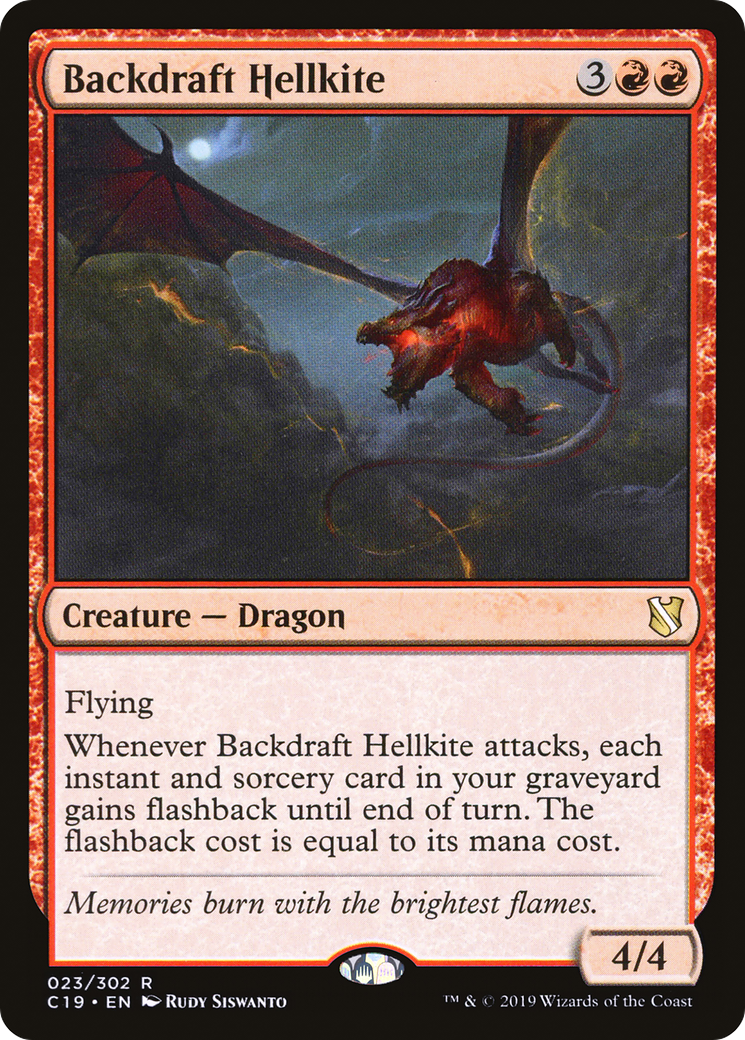
Backdraft Hellkite
Backdraft Hellkite
Creature — Dragon
4/4
Flying
Whenever this creature attacks, each instant and sorcery card in your graveyard gains flashback until end of turn. The flashback cost is equal to its mana cost.
- If a card with no mana cost gains flashback, it has no flashback cost. It can't be cast this way.
- If a card has multiple instances of flashback, you may choose any of its flashback costs to pay.
- If a split card gains flashback, you pay only the cost of the half you're casting.
- "Flashback [cost]" means "You may cast this card from your graveyard by paying [cost] rather than paying its mana cost" and "If the flashback cost was paid, exile this card instead of putting it anywhere else any time it would leave the stack."
- You must still follow any timing restrictions and permissions, including those based on the card's type. For instance, you can cast a sorcery using flashback only when you could normally cast a sorcery.
- To determine the total cost of a spell, start with the mana cost or alternative cost (such as a flashback cost) you're paying, add any cost increases, then apply any cost reductions. The mana value of the spell is determined only by its mana cost, no matter what the total cost to cast the spell was.
- A spell cast using flashback will always be exiled afterward, whether it resolves, is countered, or leaves the stack in some other way.
- You can cast a spell using flashback even if it was somehow put into your graveyard without having been cast.
- If a card with flashback is put into your graveyard during your turn, you can cast it if it's legal to do so before any other player can take any actions.
- If you cast an instant or sorcery with in its mana cost this way, you still choose the value of X as part of casting the spell and pay that cost.
- If you cast a spell with flashback, you can't pay any alternative costs such as overload costs. You can pay additional costs such as kicker costs. If the spell has any mandatory additional costs, you must pay those to cast the spell with flashback.
- Once Backdraft Hellkite has attacked, its ability will resolve and grant the appropriate cards flashback even if Backdraft Hellkite leaves the battlefield before the ability resolves or after it resolves but before you cast the spells.
- Only instant and sorcery cards in your graveyard when Backdraft Hellkite's triggered ability resolves will gain flashback. Instant and sorcery cards that are put into your graveyard later in the turn won't gain flashback.
-
1
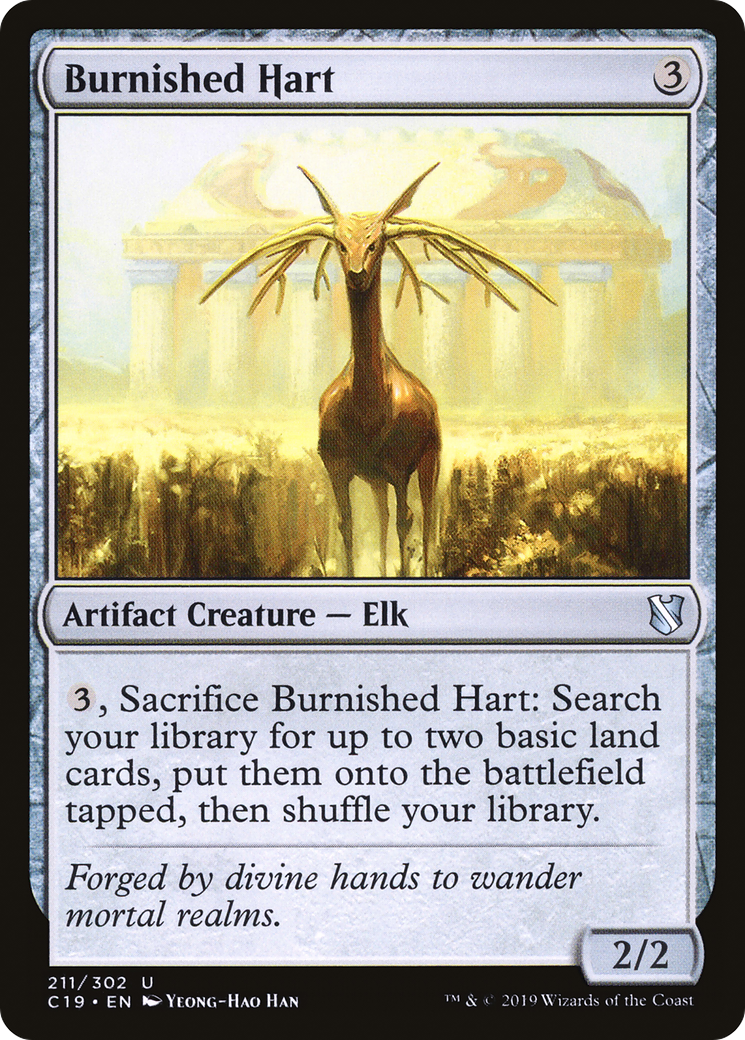
Burnished Hart
Burnished Hart
Artifact Creature — Elk
2/2
, Sacrifice this creature: Search your library for up to two basic land cards, put them onto the battlefield tapped, then shuffle.
-
1
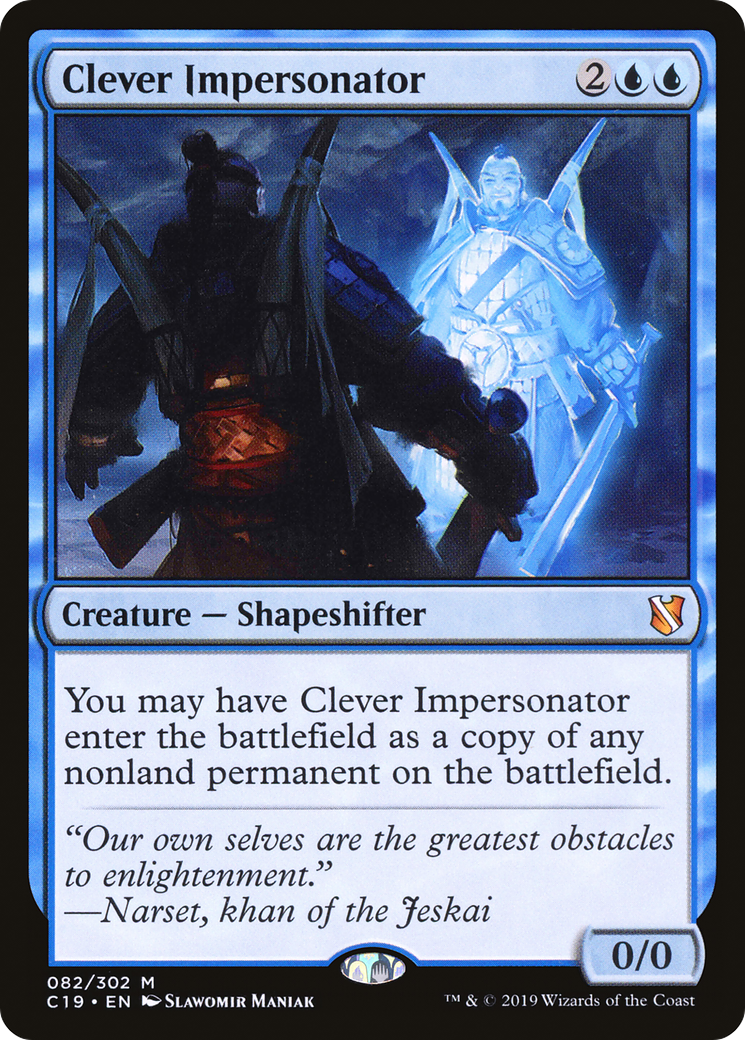
Clever Impersonator
Clever Impersonator
Creature — Shapeshifter
0/0
You may have this creature enter as a copy of any nonland permanent on the battlefield.
- Remember that if you control more than one legendary permanent with the same name, you'll choose one to remain on the battlefield and put the rest into their owner's graveyard.
- If Clever Impersonator enters the battlefield as a copy of a planeswalker, it will enter the battlefield with a number of loyalty counters on it equal to the loyalty printed in the lower right corner of the planeswalker card. It won't copy the number of loyalty counters on the original planeswalker.
- Clever Impersonator copies exactly what is printed on the chosen permanent (unless that permanent is copying something else or is a token; see below). It doesn't copy whether that permanent is tapped or untapped, whether that permanent has any counters on it or any Auras and/or Equipment attached to it, and it doesn't copy any non-copy effects that have changed that permanent's power, toughness, types, color, abilities, or so on.
- If the chosen permanent has in its mana cost, X is considered to be 0.
- Any enters-the-battlefield abilities of the chosen permanent will trigger when Clever Impersonator enters the battlefield. Any "as [this permanent] enters the battlefield" or "[this permanent] enters the battlefield with" abilities of the chosen permanent will also work.
- You can choose not to copy anything. In that case, Clever Impersonator enters the battlefield as a 0/0 creature, and it's put into the graveyard immediately (unless something is raising its toughness above 0).
- You choose which nonland permanent Clever Impersonator will copy, if any, as it enters the battlefield. This doesn't target that nonland permanent.
- If the chosen permanent is a copy of something else (for example, if the chosen permanent is another Clever Impersonator), then your Clever Impersonator enters the battlefield as whatever the chosen permanent copied.
- If the chosen permanent is a token, Clever Impersonator copies the original characteristics of that token as defined by the effect that put that token onto the battlefield. Clever Impersonator is not a token.
- If Clever Impersonator enters the battlefield at the same time as another permanent, it can't become a copy of that permanent. You may choose only a nonland permanent that's already on the battlefield.
-
1
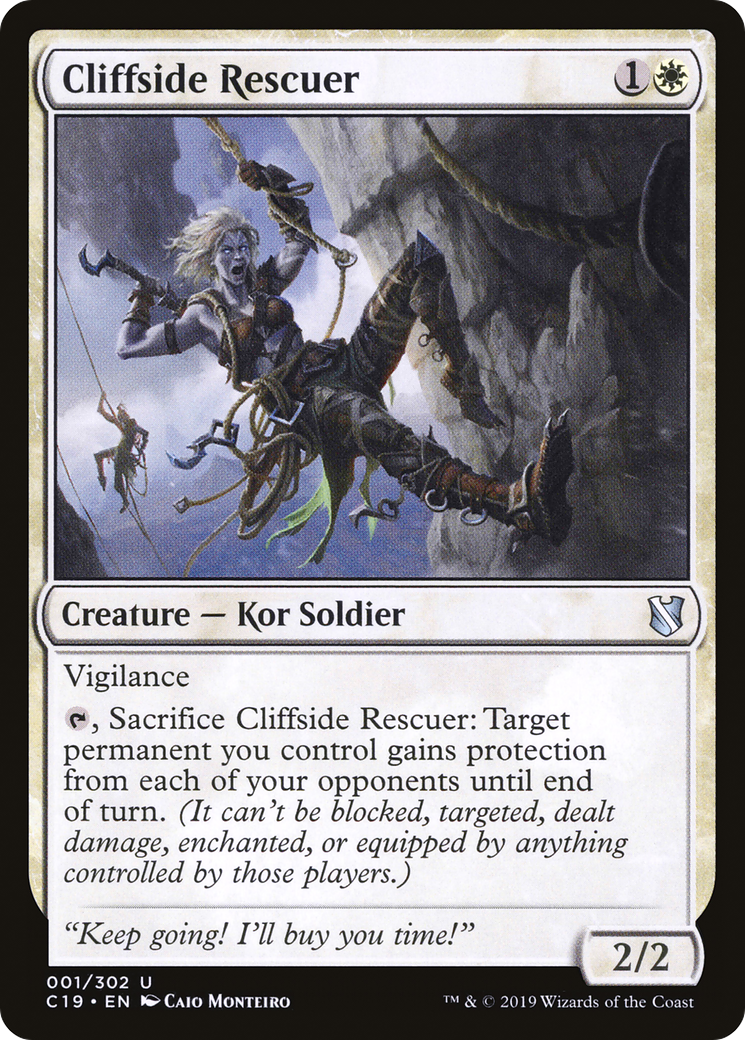
Cliffside Rescuer
Cliffside Rescuer
Creature — Kor Soldier
2/2
Vigilance
, Sacrifice this creature: Target permanent you control gains protection from each of your opponents until end of turn. (It can't be blocked, targeted, dealt damage, enchanted, or equipped by anything controlled by those players.)
- The players that the target permanent has protection from are determined as Cliffside Rescuer’s ability resolves. If an opponent somehow gains control of that permanent later in the turn, it still has protection from your opponents, including its new controller.
- Protection from a player means that the permanent has protection from each object controlled by that player. If an object has no controller (such as a card in a graveyard), its owner is considered its controller for this purpose.
-
1
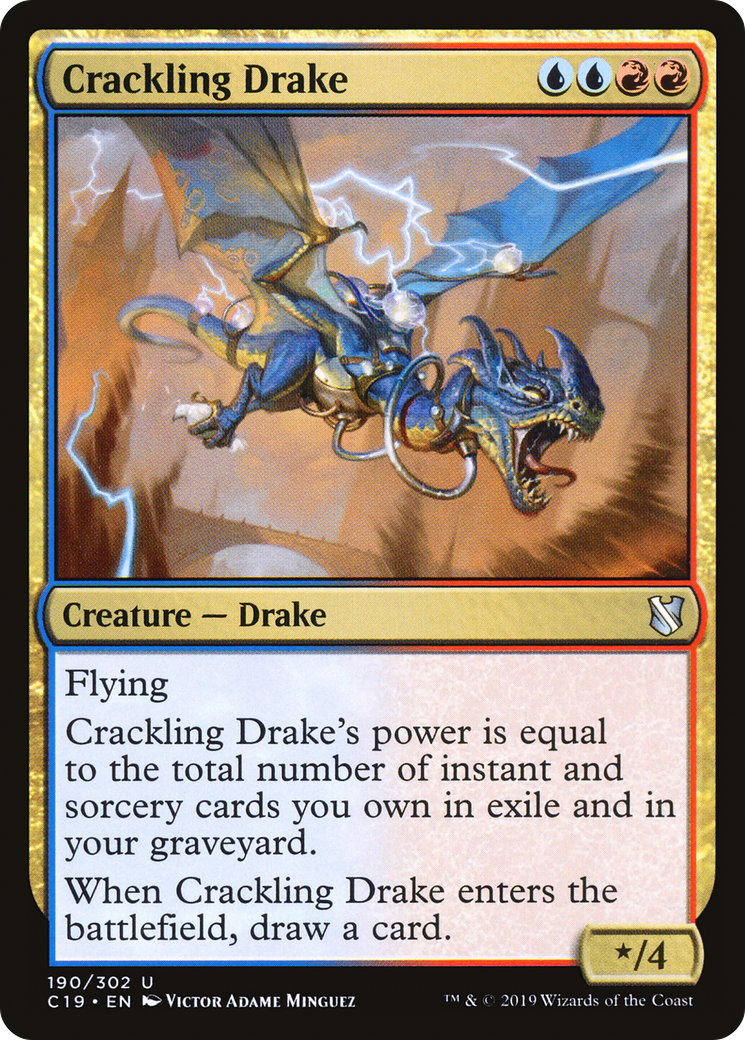
Crackling Drake
Crackling Drake
Creature — Drake
*/4
Flying
Crackling Drake's power is equal to the total number of instant and sorcery cards you own in exile and in your graveyard.
When this creature enters, draw a card.
- If any exiled cards you own are face down, they have no characteristics. If they're normally instants or sorceries, they won't be counted.
- The ability that defines Crackling Drake's power works in all zones.
-
1
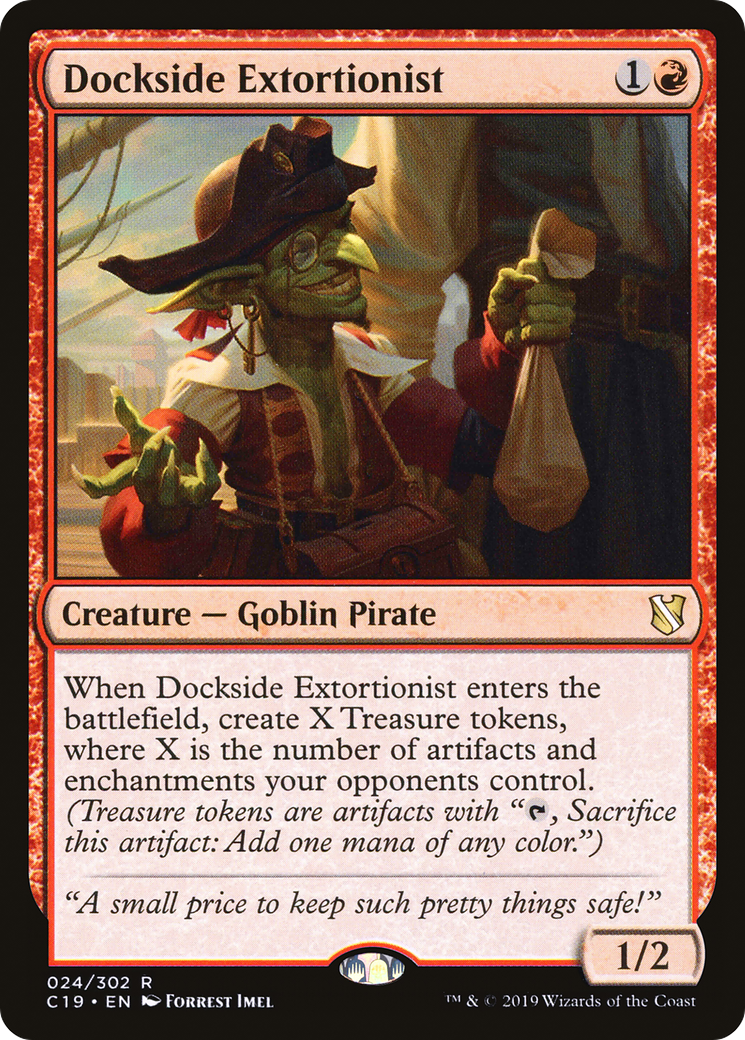
Dockside Extortionist
Dockside Extortionist
Creature — Goblin Pirate
1/2
When this creature enters, create X Treasure tokens, where X is the number of artifacts and enchantments your opponents control. (Treasure tokens are artifacts with " , Sacrifice this token: Add one mana of any color.")
- If an opponent controls an artifact that's also an enchantment, that permanent is counted only once for Dockside Extortionist's ability.
-
1
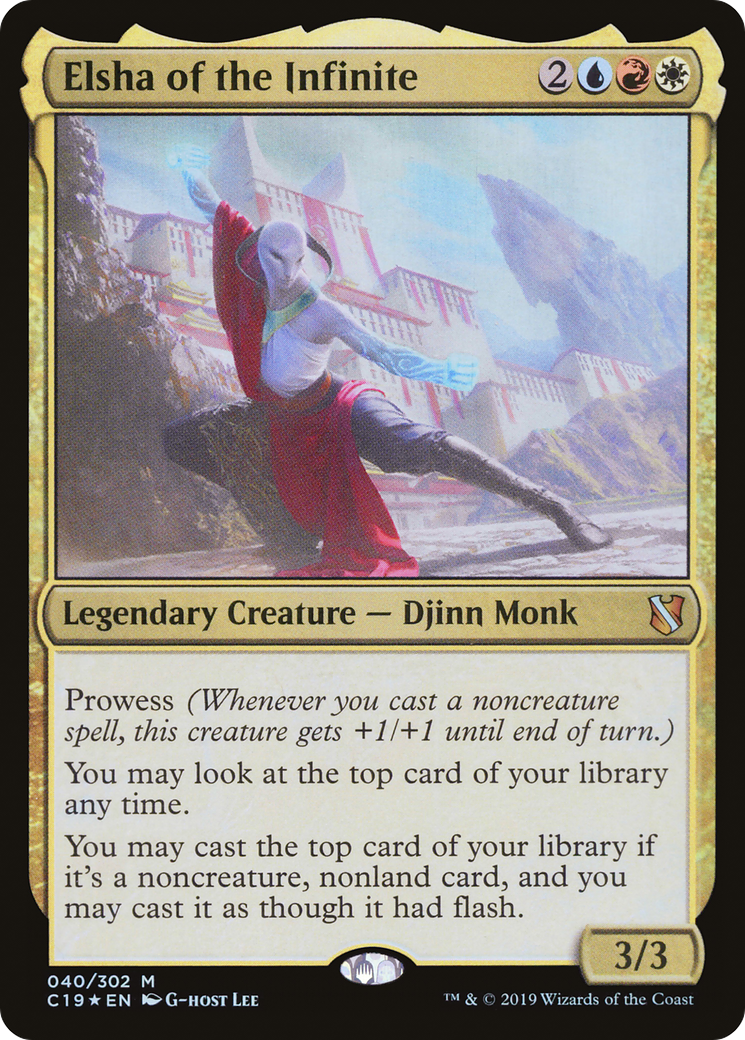
Elsha of the Infinite
Elsha of the Infinite
Legendary Creature — Djinn Monk
3/3
Prowess (Whenever you cast a noncreature spell, this creature gets +1/+1 until end of turn.)
You may look at the top card of your library any time.
You may cast noncreature spells from the top of your library. If you cast a spell this way, you may cast it as though it had flash.
- Elsha lets you look at the top card of your library whenever you want (with one restriction—see below), even if you don't have priority. This action doesn't use the stack. Knowing what that card is becomes part of the information you have access to, just like you can look at the cards in your hand.
- If the top card of your library changes while you're casting a spell, playing a land, or activating an ability, you can't look at the new top card until you finish doing so. This means that if you cast the top card of your library, you can't look at the next one until you're done paying for that spell.
- You'll still pay all costs for a spell you cast from your library, including additional costs. You may also pay alternative costs.
-
1
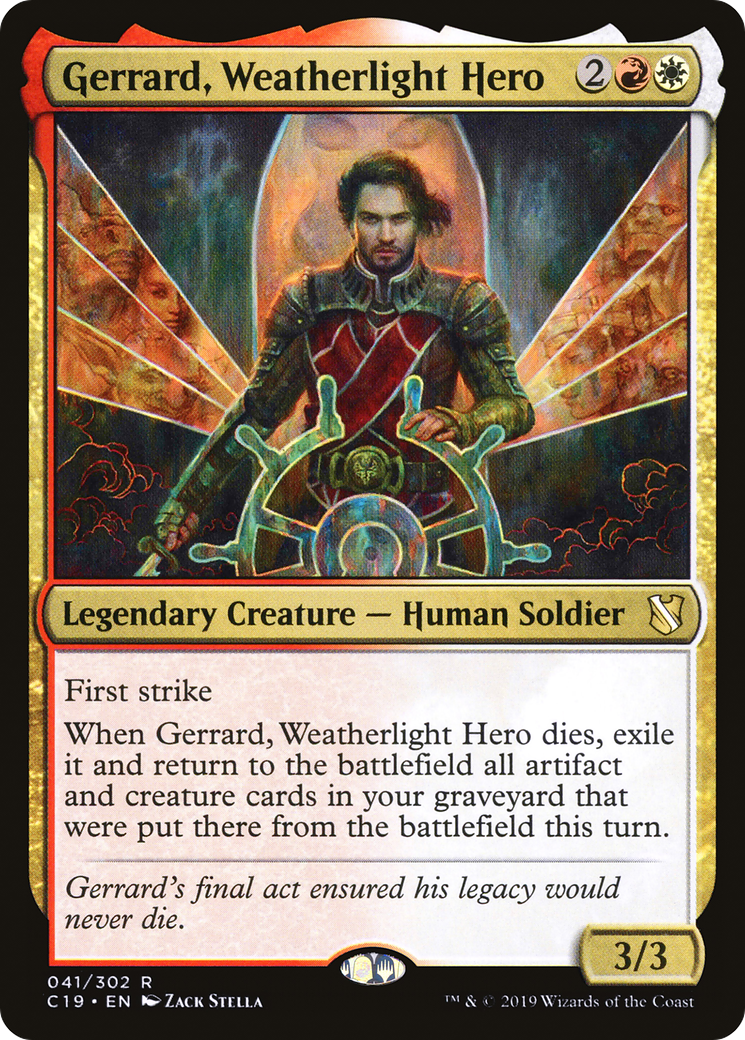
Gerrard, Weatherlight Hero
Gerrard, Weatherlight Hero
Legendary Creature — Human Soldier
3/3
First strike
When Gerrard dies, exile it and return to the battlefield all artifact and creature cards in your graveyard that were put there from the battlefield this turn.
- Gerrard's triggered ability returns artifact and creature cards even if Gerrard leaves your graveyard before you can exile it.
- Gerrard's triggered ability returns artifact and creature cards even if they were put into your graveyard while Gerrard wasn't on the battlefield, so long as they were put there this turn.
- If Gerrard is your commander and you can exile it from your graveyard as its triggered ability resolves, you'll still be able to put it into the command zone after you return your artifact and creature cards to the battlefield.
- Permanent spells that were countered earlier in the turn never entered the battlefield, so they won't be returned by Gerrard's ability.
-
1
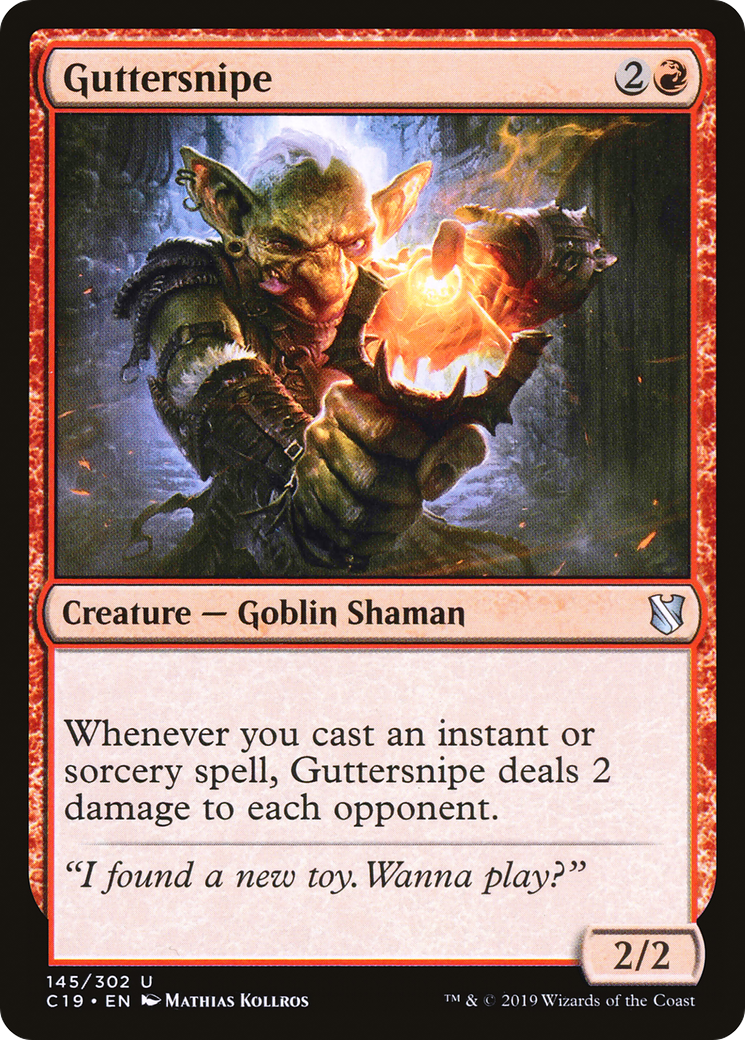
Guttersnipe
Guttersnipe
Creature — Goblin Shaman
2/2
Whenever you cast an instant or sorcery spell, this creature deals 2 damage to each opponent.
- Guttersnipe's triggered ability resolves before the spell that caused it to trigger. It resolves even if that spell is countered or otherwise leaves the stack without resolving.
- In a Two-Headed Giant game, Guttersnipe's ability causes the opposing team to lose 4 life.
-
1
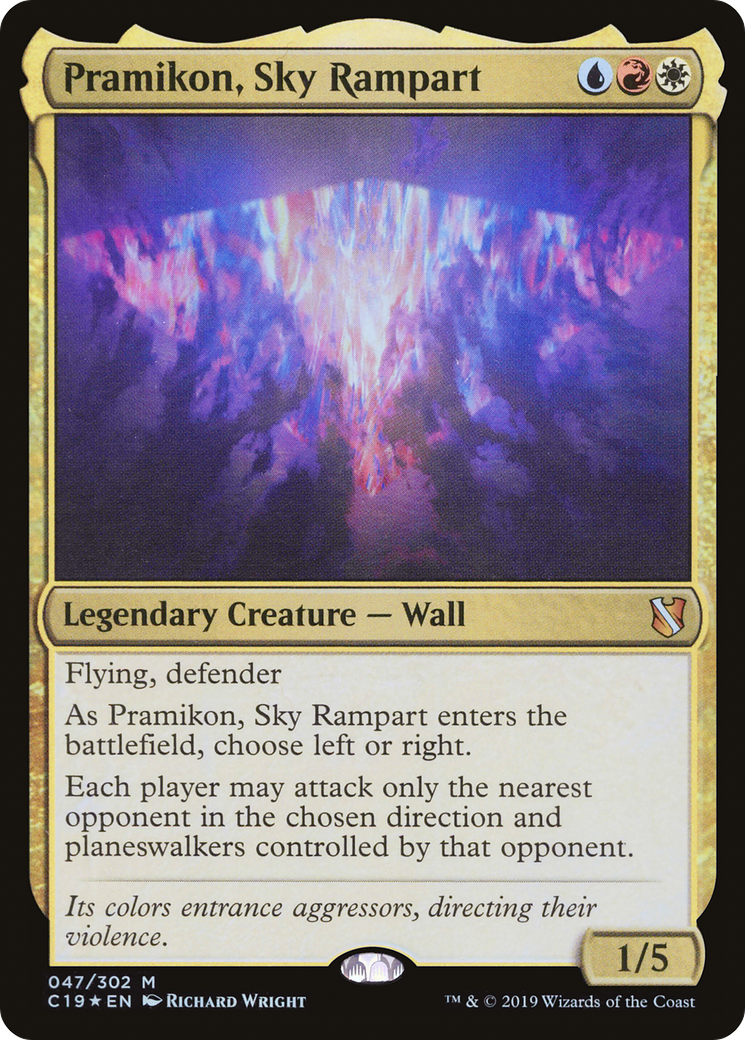
Pramikon, Sky Rampart
Pramikon, Sky Rampart
Legendary Creature — Wall
1/5
Flying, defender
As Pramikon enters, choose left or right.
Each player may attack only the nearest opponent in the chosen direction and planeswalkers controlled by that opponent.
- If two Pramikons on the battlefield disagree on which direction three or more players must attack, players can't attack at all.
- If no choice was made for Pramikon (perhaps because it's actually Volrath, the Shapestealer in an impressively clever disguise), its last ability has no effect.
- In a multiplayer game, players may use any mutually agreeable method to determine seating order after they've chosen decks but before the game begins. If players can't agree (perhaps because Pramikon has them worried about who their nearest opponent is), players should be seated randomly.
-
1
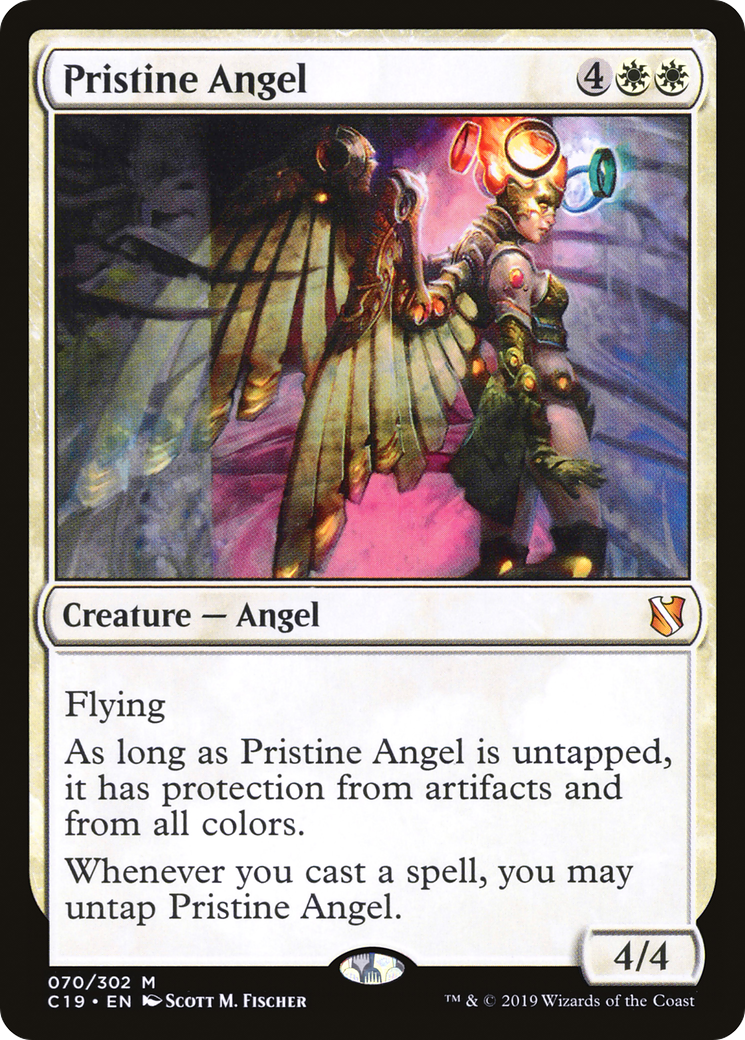
Pristine Angel
Pristine Angel
Creature — Angel
4/4
Flying
As long as this creature is untapped, it has protection from artifacts and from each color.
Whenever you cast a spell, you may untap this creature.
-
1
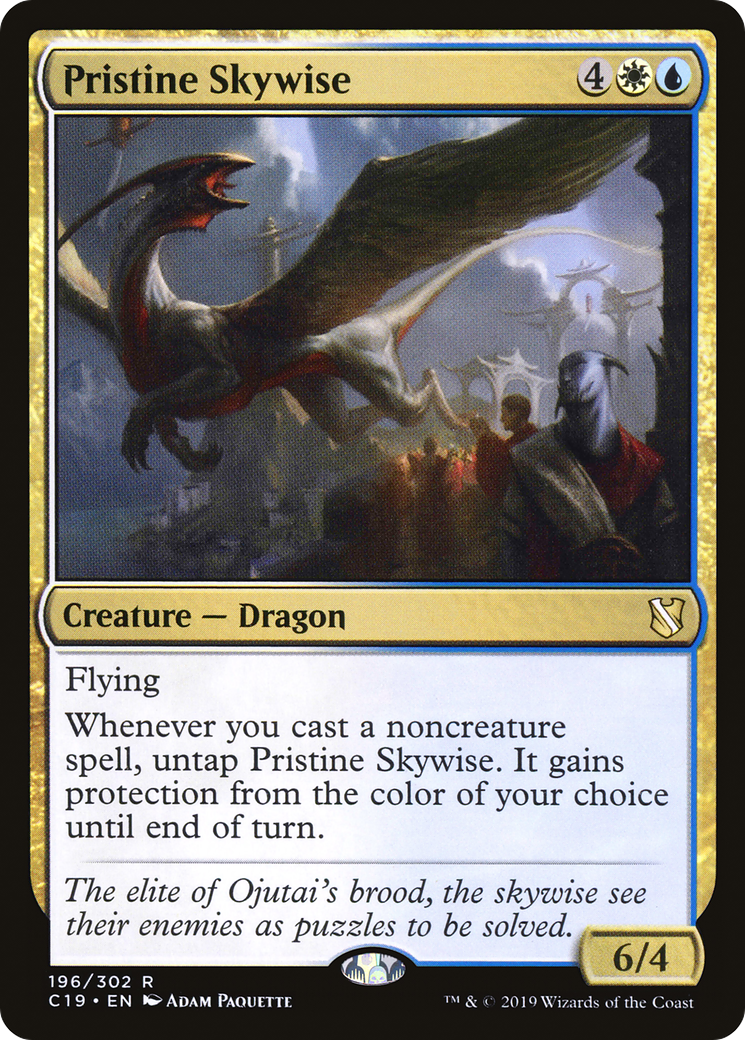
Pristine Skywise
Pristine Skywise
Creature — Dragon
6/4
Flying
Whenever you cast a noncreature spell, untap this creature. It gains protection from the color of your choice until end of turn.
-
1
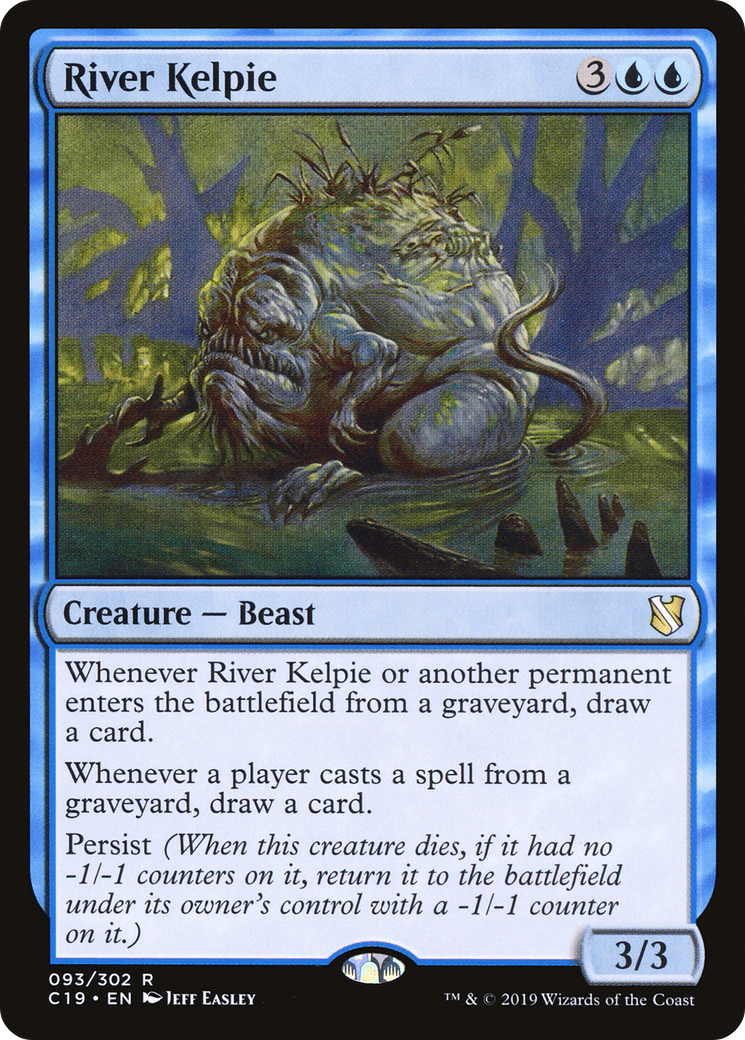
River Kelpie
River Kelpie
Creature — Beast
3/3
Whenever this creature or another permanent enters from a graveyard, draw a card.
Whenever a player casts a spell from a graveyard, draw a card.
Persist (When this creature dies, if it had no -1/-1 counters on it, return it to the battlefield under its owner's control with a -1/-1 counter on it.)
- If a creature with persist that has +1/+1 counters on it receives enough -1/-1 counters to cause it to be destroyed by lethal damage or put into its owner's graveyard for having 0 or less toughness, persist won't trigger and the card won't return to the battlefield. That's because persist checks the creature's existence just before it leaves the battlefield, and it still has all those counters on it at that point.
- The persist ability triggers when the permanent is put into a graveyard. Its last known information (that is, how the creature last existed on the battlefield) is used to determine whether it had a -1/-1 counter on it.
- If a permanent has multiple instances of persist, they'll each trigger separately, but the redundant instances will have no effect. If one instance returns the card to the battlefield, the next to resolve will do nothing.
- If a token with no -1/-1 counters on it has persist, the ability will trigger when the token is put into the graveyard. However, the token will cease to exist and can't return to the battlefield.
- When a permanent with persist returns to the battlefield, it's a new object with no memory of or connection to its previous existence.
- If multiple creatures with persist are put into the graveyard at the same time (due to combat damage or a spell that destroys all creatures, for example), the active player (the player whose turn it is) puts all of their persist triggers on the stack in any order, then each other player in turn order does the same. The last trigger put on the stack is the first one that resolves. That means that in a two-player game, the nonactive player's persist creatures will return to the battlefield first, then the active player's persist creatures do the same. The creatures return to the battlefield one at a time.
- If a creature with persist stops being a creature, persist will still work.
- If River Kelpie and another permanent are each put onto the battlefield from a graveyard at the same time, River Kelpie's first ability will trigger twice. (It will see the other permanent entering.)
- If you cast another artifact, creature, enchantment, or planeswalker spell from a graveyard, only the second ability triggers. That's because the card is put onto the stack, not onto the battlefield.
- If you cast River Kelpie itself from your graveyard (by using Yawgmoth's Will, for example), neither ability triggers. The first ability doesn't trigger because River Kelpie is put onto the stack; the second ability doesn't trigger because it works only while River Kelpie is already on the battlefield.
- If you play a land card from a graveyard (by using Crucible of Worlds, for example), only the first ability triggers. That's because the land (which isn't a spell) is put directly onto the battlefield from the graveyard.
- River Kelpie doesn't give you the ability to cast spells from graveyards. Its second ability merely triggers whenever a spell is cast this way (by using Memory Plunder, for example).
-
1
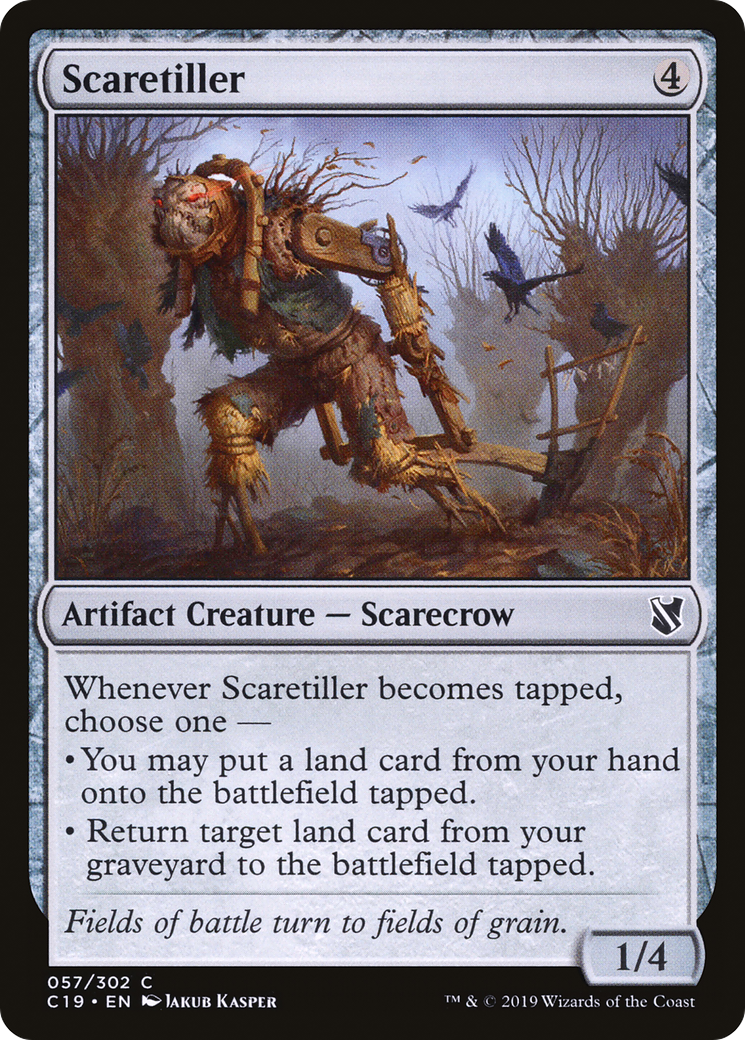
Scaretiller
Scaretiller
Artifact Creature — Scarecrow
1/4
Whenever this creature becomes tapped, choose one —
- You may put a land card from your hand onto the battlefield tapped.
- Return target land card from your graveyard to the battlefield tapped.
- Scaretiller's ability is a triggered ability, not an activated ability. It doesn't allow you to tap it whenever you want; rather, you need some other way of tapping it, such as by attacking.
- If Scaretiller becomes tapped while casting a spell or activating an ability, that spell or ability resolves after Scaretiller's triggered ability has resolved.
- Neither mode of Scaretiller's ability counts as playing a land. It can put a land card onto the battlefield even if you've already played your land for the turn, and even if it's not your turn.
-
1
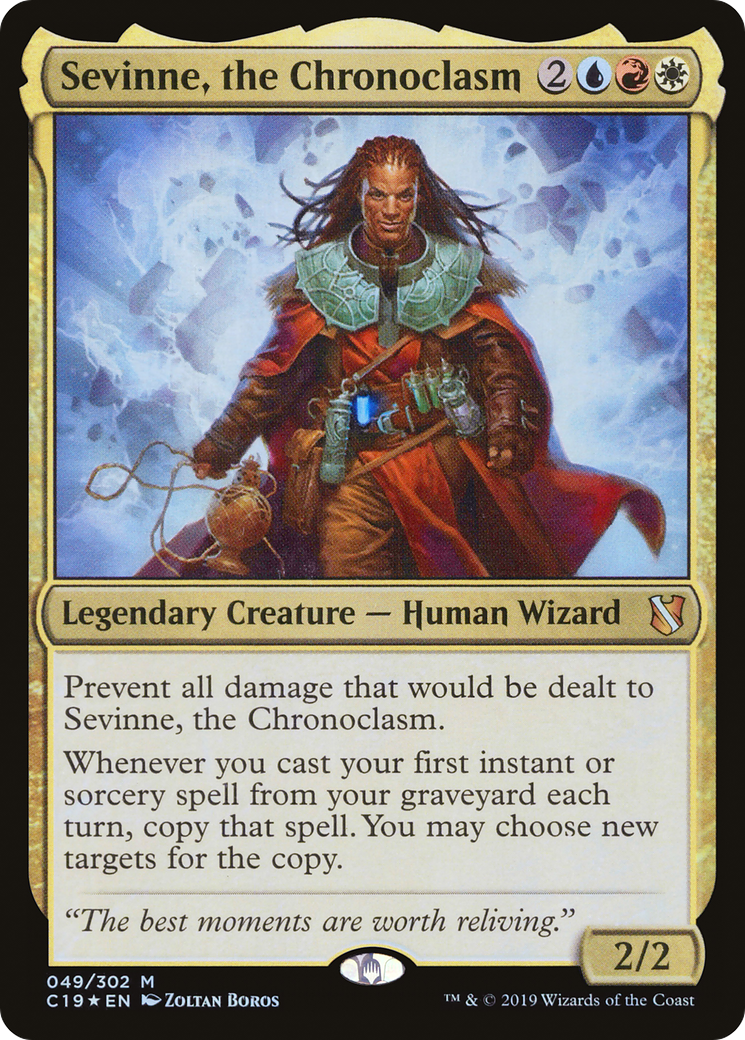
Sevinne, the Chronoclasm
Sevinne, the Chronoclasm
Legendary Creature — Human Wizard
2/2
Prevent all damage that would be dealt to Sevinne.
Whenever you cast your first instant or sorcery spell from your graveyard each turn, copy that spell. You may choose new targets for the copy.
- If you cast an instant or sorcery spell from your graveyard before Sevinne enters the battlefield during the same turn, its last ability can't trigger that turn.
- Sevinne's ability will copy any instant or sorcery spell, not just one with targets.
- A copy is created even if the spell that caused Sevinne's ability to trigger has been countered by the time that ability resolves. The copy resolves before the original spell.
- The copy will have the same targets as the spell it's copying unless you choose new ones. You may change any number of the targets, including all of them or none of them. The new targets must be legal.
- If the spell that's copied is modal (that is, it says "Choose one —" or the like), the copy will have the same mode or modes. You can't choose different ones.
- If the spell that's copied has an X whose value was determined as it was cast, the copy has the same value of X.
- You can't choose to pay any additional costs for the copy. However, effects based on any additional costs that were paid for the original spell are copied as though those same costs were paid for the copy too.
- The copy that Sevinne's ability creates is created on the stack, so it's not "cast." Abilities that trigger when a player casts a spell won't trigger. Any of that spell's effects that apply only if it was cast from a graveyard won't apply.
-
1
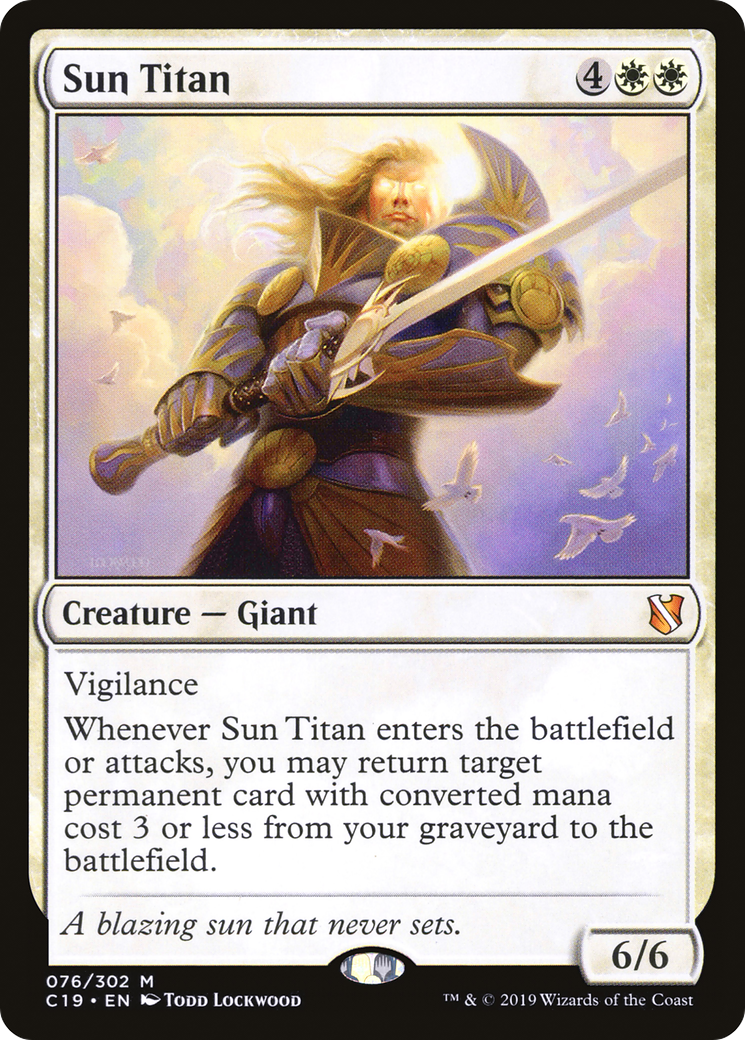
Sun Titan
Sun Titan
Creature — Giant
6/6
Vigilance
Whenever this creature enters or attacks, you may return target permanent card with mana value 3 or less from your graveyard to the battlefield.
- A permanent card is an artifact, creature, enchantment, land, or planeswalker card.
- If a card in your graveyard has no mana symbols in its upper right corner (because it's a land card, for example), its mana value is 0.
- The mana value of a card in your graveyard is determined solely by the mana symbols printed in its upper right corner. The mana value is the total amount of mana in that cost, regardless of color. For example, a card with mana cost has mana value 5.
- If the mana cost of a card in your graveyard includes , X is considered to be 0.
-
1
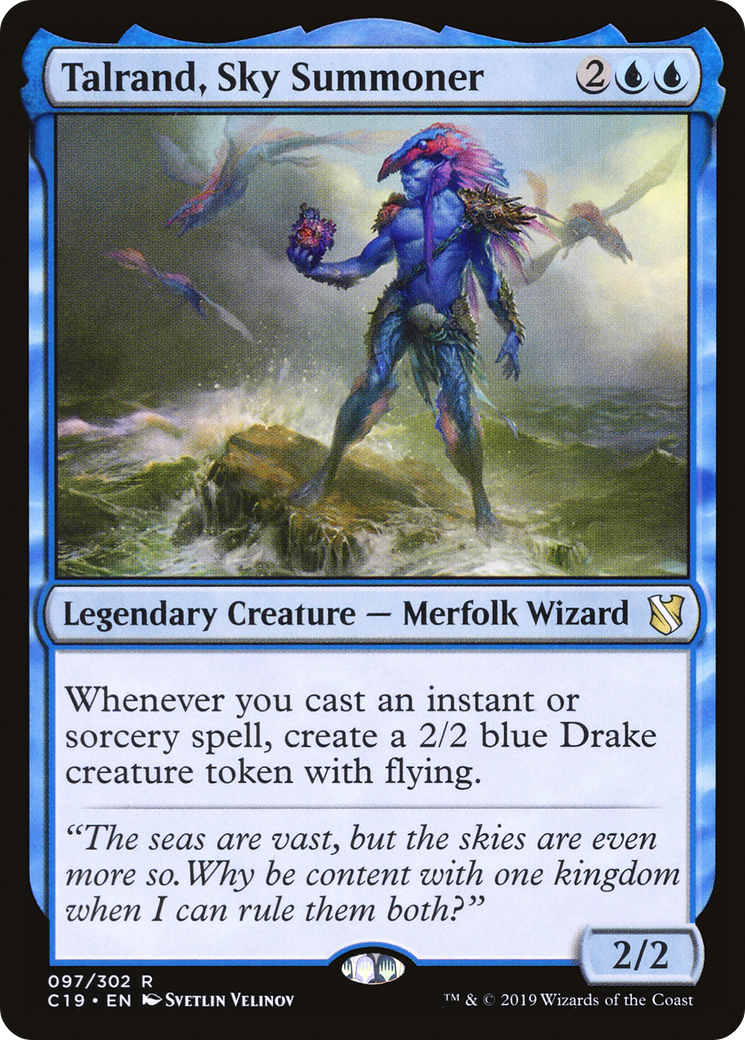
Talrand, Sky Summoner
Talrand, Sky Summoner
Legendary Creature — Merfolk Wizard
2/2
Whenever you cast an instant or sorcery spell, create a 2/2 blue Drake creature token with flying.
- An ability that triggers when a player casts a spell resolves before the spell that caused it to trigger, but after targets have been chosen for that spell. It resolves even if that spell is countered.
-
1
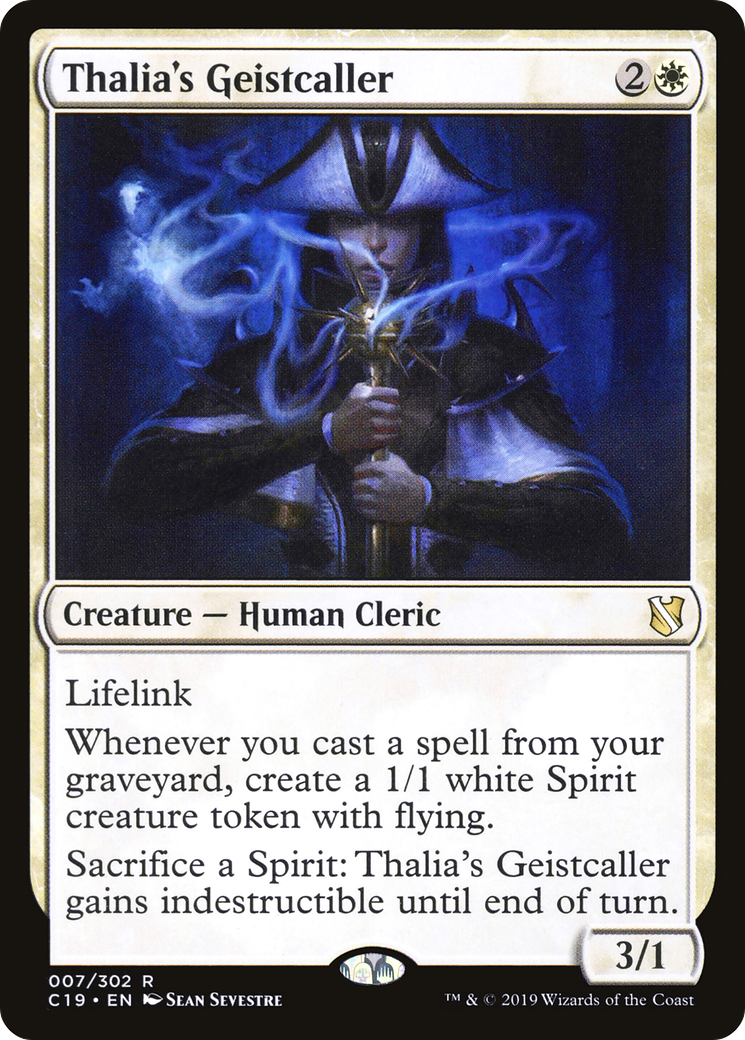
Thalia's Geistcaller
Thalia's Geistcaller
Creature — Human Cleric
3/1
Lifelink
Whenever you cast a spell from your graveyard, create a 1/1 white Spirit creature token with flying.
Sacrifice a Spirit: This creature gains indestructible until end of turn.
- The triggered ability of Thalia's Geistcaller will resolve before the spell that caused it to trigger but after targets have been chosen for that spell. It resolves even if that spell is countered.
- You can sacrifice any Spirit you control to activate the last ability of Thalia's Geistcaller, not just a Spirit token it created.
-
1
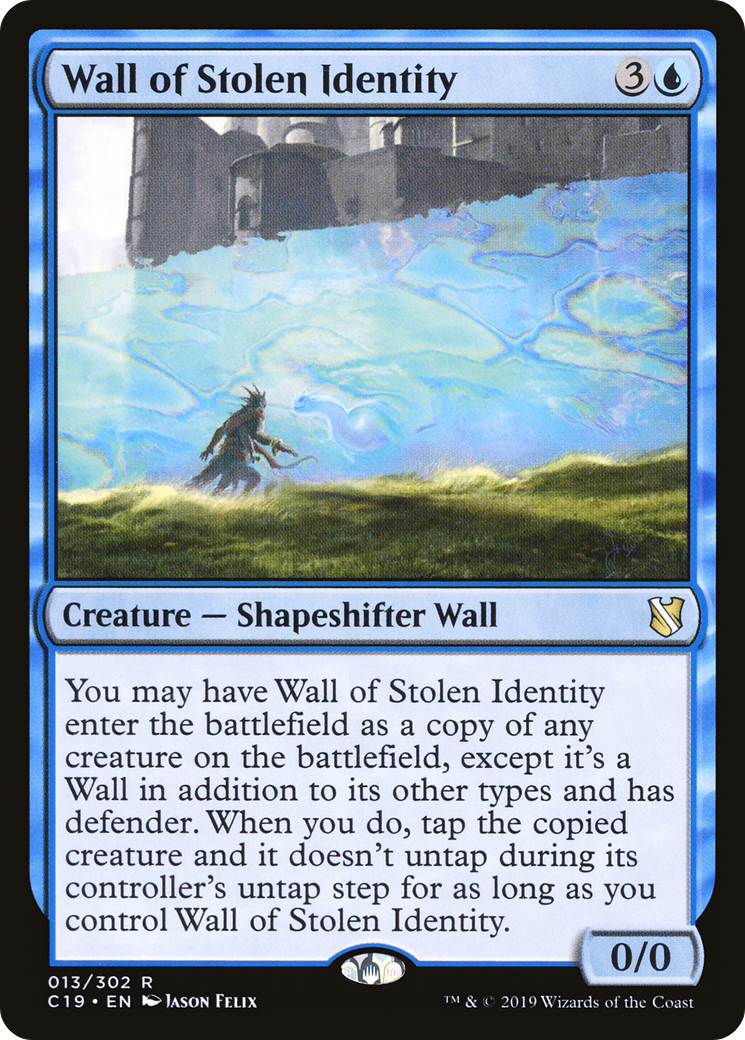
Wall of Stolen Identity
Wall of Stolen Identity
Creature — Shapeshifter Wall
0/0
You may have this creature enter as a copy of any creature on the battlefield, except it's a Wall in addition to its other types and has defender. When you do, tap the copied creature and it doesn't untap during its controller's untap step for as long as you control this creature.
- If Wall of Stolen Identity somehow enters the battlefield at the same time as another creature, it can’t become a copy of that creature. You may choose only a creature that’s already on the battlefield.
- Wall of Stolen Identity copies exactly what was printed on the original creature (unless that creature is copying something else or is a token; see below). It doesn’t copy whether that creature is tapped or untapped, whether it has any counters on it or any Auras and Equipment attached to it, or any non-copy effects that have changed its power, toughness, types, color, or so on.
- If Wall of Stolen Identity copies a creature that’s normally not a creature (such as Mutavault), the copied permanent will be tapped and will remain tapped even when it’s no longer a creature for as long as you control Wall of Stolen Identity.
- If the copied creature has in its mana cost, X is considered to be 0.
- If the chosen creature is copying something else (for example, if the chosen creature is another Wall of Stolen Identity), then Wall of Stolen Identity enters the battlefield as whatever the chosen creature copied.
- If the chosen creature is a token, Wall of Stolen Identity copies the original characteristics of that token as stated by the effect that created the token. Wall of Stolen Identity doesn’t become a token in this case.
- Any enters-the-battlefield abilities of the copied creature will trigger when Wall of Stolen Identity enters the battlefield. Any “as [this creature] enters the battlefield” or “[this creature] enters the battlefield with” abilities of the chosen creature will also work.
- Once Wall of Stolen Identity has entered the battlefield and stolen a creature’s identity, players can take actions before the creature is tapped.
- If another player gains control of Wall of Stolen Identity, its effect keeping the creature tapped expires. It won’t keep the creature from untapping anymore, even if you later regain control of Wall of Stolen Identity.
- Wall of Stolen Identity can copy a tapped creature. That creature just remains tapped and doesn’t untap during its controller’s next untap step for as long as you control Wall of Stolen Identity.
- If Wall of Stolen Identity leaves the battlefield before its triggered ability has resolved, the copied creature will be tapped, but it will untap as normal.
-
1
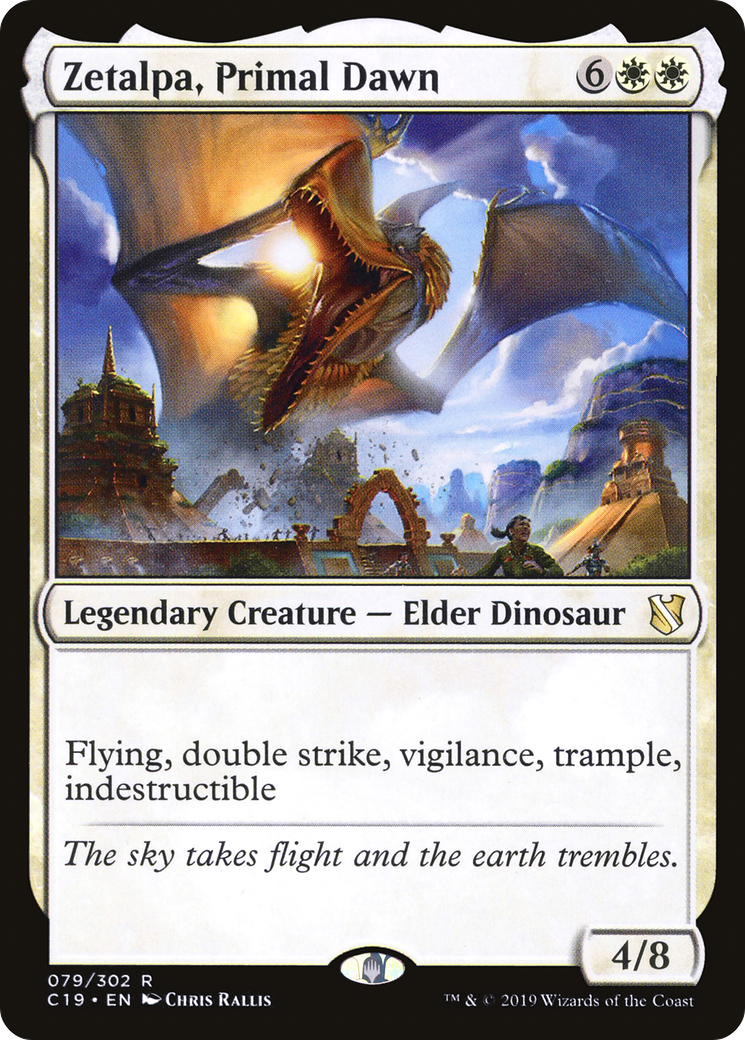
Zetalpa, Primal Dawn
Zetalpa, Primal Dawn
Legendary Creature — Elder Dinosaur
4/8
Flying, double strike, vigilance, trample, indestructible
- If an attacking creature with double strike and trample destroys all of its blocking creatures with first-strike combat damage, all of its normal combat damage is assigned to the player, planeswalker, or battle that creature's attacking.
Instants 15
-
1
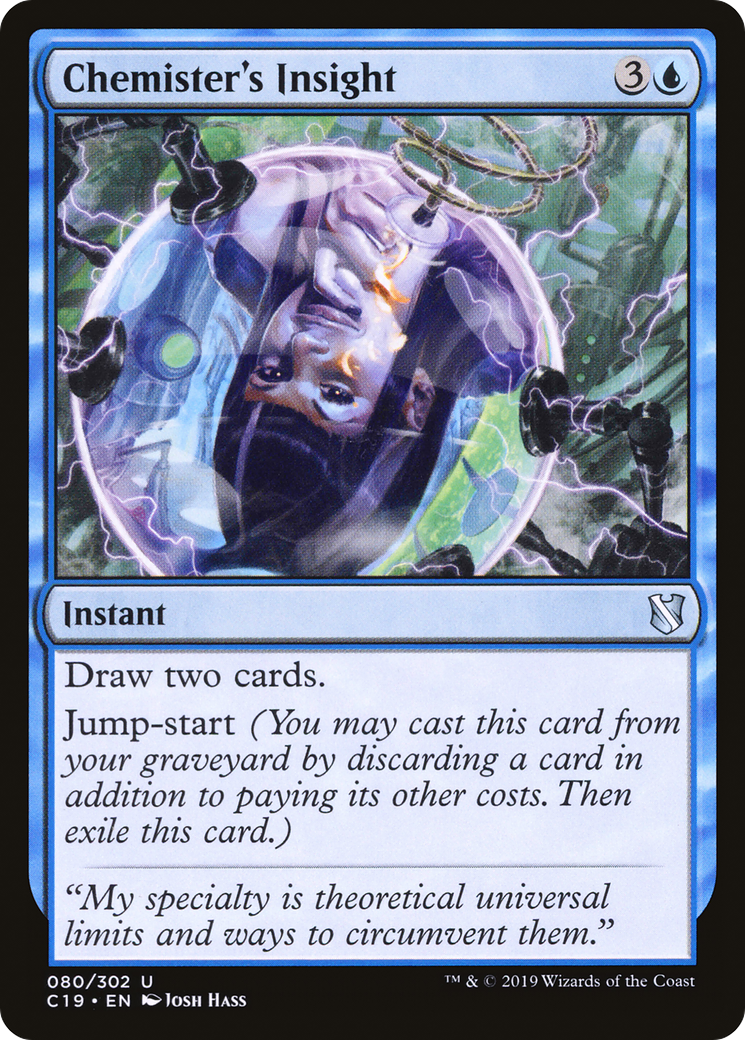
Chemister's Insight
Chemister's Insight
Instant
Draw two cards.
Jump-start (You may cast this card from your graveyard by discarding a card in addition to paying its other costs. Then exile this card.)
- If a card with jump-start is put into your graveyard during your turn, you'll be able to cast it right away if it's legal to do so, before an opponent can take any actions.
- You must still follow any timing restrictions and permissions when casting a spell with jump-start, including those based on the card's type. For instance, you can cast a sorcery using jump-start only when you could normally cast a sorcery.
- A spell cast using jump-start will always be exiled afterward, whether it resolves, it's countered, or it leaves the stack in some other way.
- If an effect allows you to pay an alternative cost rather than a spell's mana cost, you may pay that alternative cost when you jump-start a spell. You'll still discard a card as an additional cost to cast it.
-
1
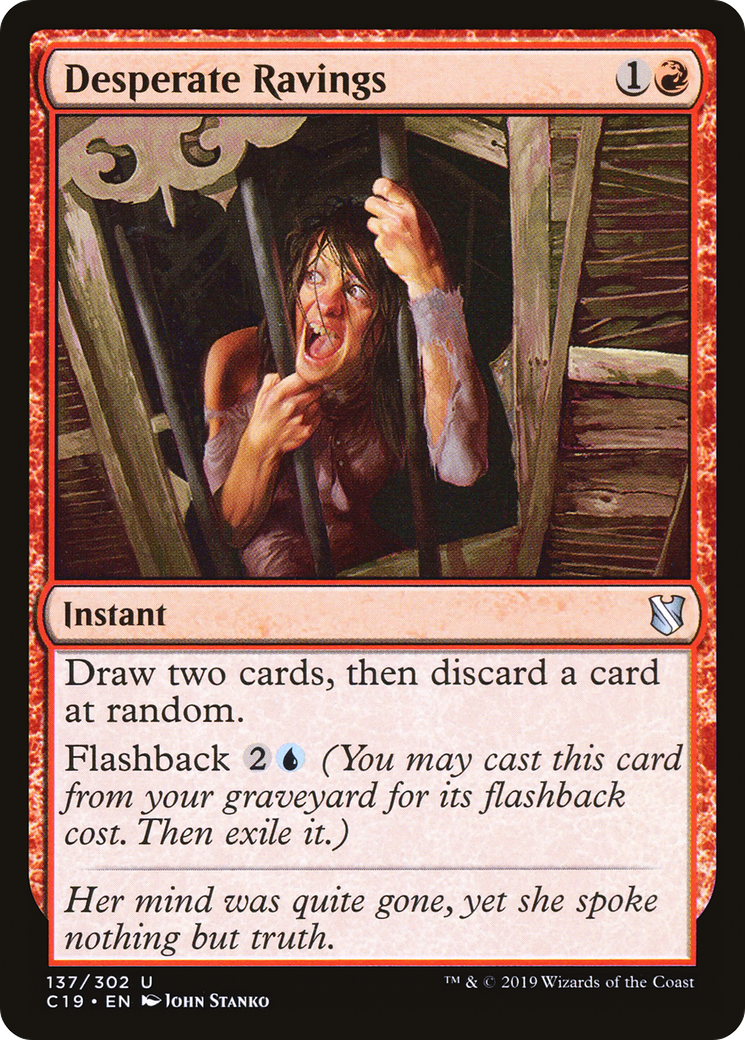
Desperate Ravings
Desperate Ravings
Instant
Draw two cards, then discard a card at random.
Flashback (You may cast this card from your graveyard for its flashback cost. Then exile it.)
- To determine the total cost of a spell, start with the mana cost or alternative cost (such as a flashback cost) you're paying, add any cost increases, then apply any cost reductions. The mana value of the spell is determined only by its mana cost, no matter what the total cost to cast the spell was.
- "Flashback [cost]" means "You may cast this card from your graveyard by paying [cost] rather than paying its mana cost" and "If the flashback cost was paid, exile this card instead of putting it anywhere else any time it would leave the stack."
- You must still follow any timing restrictions and permissions, including those based on the card's type. For instance, you can cast a sorcery using flashback only when you could normally cast a sorcery.
- If a card with flashback is put into your graveyard during your turn, you can cast it if it's legal to do so before any other player can take any actions.
- A spell cast using flashback will always be exiled afterward, whether it resolves, is countered, or leaves the stack in some other way.
- You can cast a spell using flashback even if it was somehow put into your graveyard without having been cast.
- You draw two cards and discard one randomly all while Desperate Ravings is resolving. Nothing can happen between the two, and no player may choose to take actions.
-
1
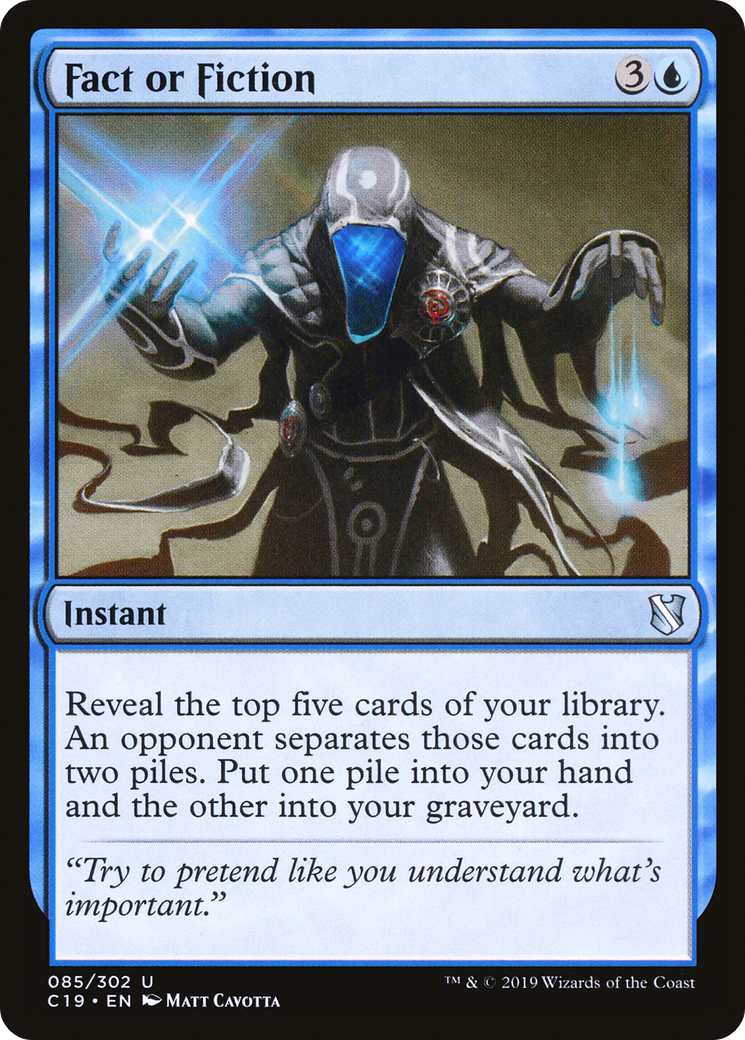
Fact or Fiction
Fact or Fiction
Instant
Reveal the top five cards of your library. An opponent separates those cards into two piles. Put one pile into your hand and the other into your graveyard.
- Piles may be empty.
-
1
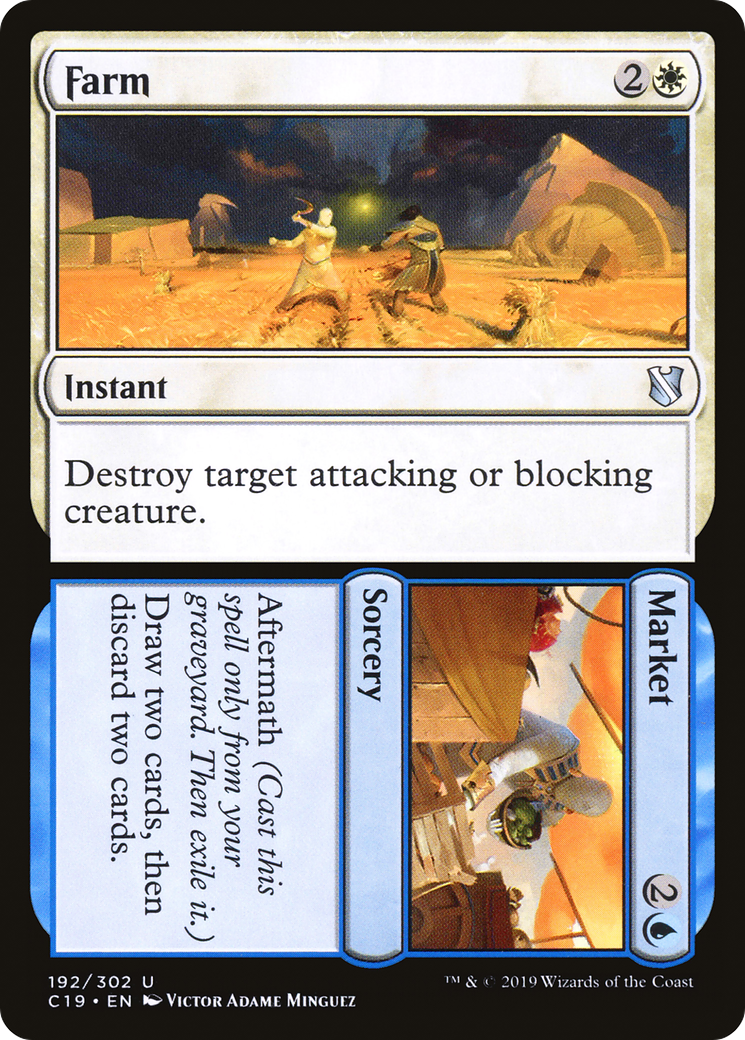
Farm // Market
//
Farm
Instant
- Once you've started to cast a spell with aftermath from your graveyard, the card is immediately moved to the stack. Opponents can't try to stop the ability by exiling the card with an effect such as that of Crook of Condemnation.
- All split cards have two card faces on a single card, and you put a split card onto the stack with only the half you're casting. The characteristics of the half of the card you didn't cast are ignored while the spell is on the stack. For example, if an effect prevents you from casting green spells, you can cast Destined of Destined // Lead, but not Lead.
- Each split card is a single card. For example, if you discard one, you've discarded one card, not two. If an effect counts the number of instant and sorcery cards in your graveyard, Destined // Lead counts once, not twice.
- Each split card has two names. If an effect instructs you to choose a card name, you may choose one, but not both.
- While not on the stack, the characteristics of a split card are the combination of its two halves. For example, Destined // Lead is a green and black card, it is both an instant card and a sorcery card, and its mana value is 6. This means that if an effect allows you to cast a card with mana value 2 from your hand, you can't cast Destined. This is a change from the previous rules for split cards.
- Split cards with aftermath have a new frame treatment—the half you can cast from your hand is oriented the same as other cards you'd cast from your hand, while the half you can cast from your graveyard is a traditional split card half. This frame treatment is for your convenience and has no rules significance.
- If another effect allows you to cast a split card with aftermath from any zone other than a graveyard, you can't cast the half with aftermath.
- If another effect allows you to cast a split card with aftermath from a graveyard, you may cast either half. If you cast the half that has aftermath, you'll exile the card if it would leave the stack.
- A spell with aftermath cast from a graveyard will always be exiled afterward, whether it resolves, it's countered, or it leaves the stack in some other way.
- If you cast the first half of a split card with aftermath during your turn, you'll have priority immediately after it resolves. You can cast the half with aftermath from your graveyard before any player can take any other action if it's legal for you to do so.
-
1
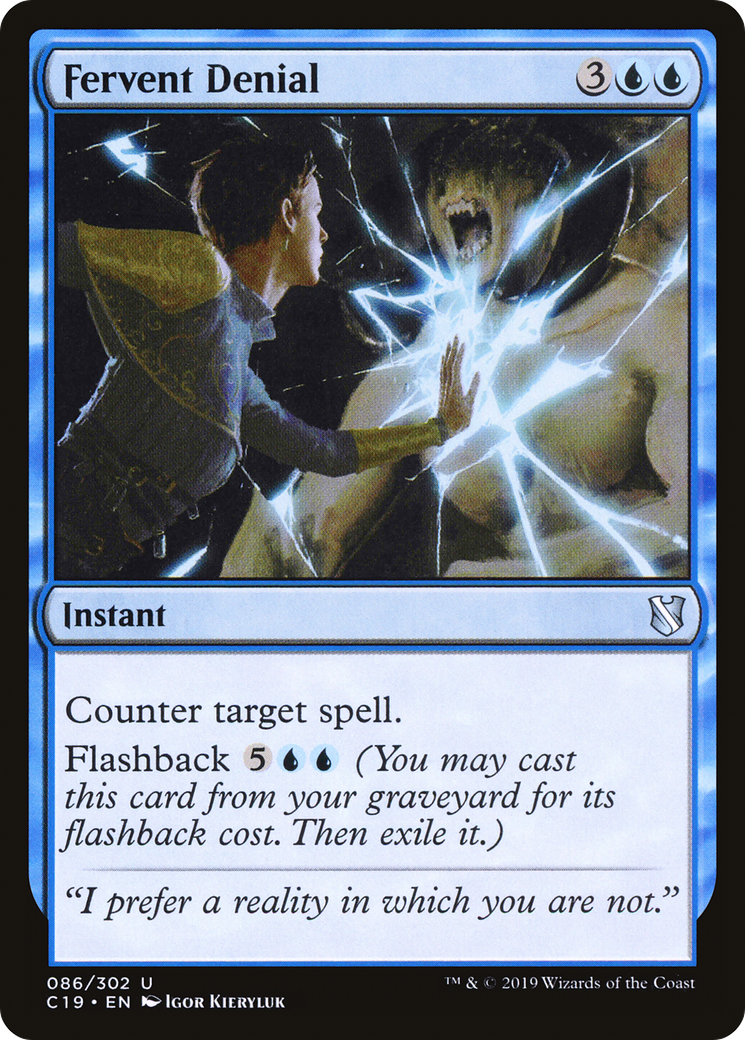
Fervent Denial
Fervent Denial
Instant
Counter target spell.
Flashback (You may cast this card from your graveyard for its flashback cost. Then exile it.)
- "Flashback [cost]" means "You may cast this card from your graveyard by paying [cost] rather than paying its mana cost" and "If the flashback cost was paid, exile this card instead of putting it anywhere else any time it would leave the stack."
- You must still follow any timing restrictions and permissions, including those based on the card's type. For instance, you can cast a sorcery using flashback only when you could normally cast a sorcery.
- To determine the total cost of a spell, start with the mana cost or alternative cost (such as a flashback cost) you're paying, add any cost increases, then apply any cost reductions. The mana value of the spell is determined only by its mana cost, no matter what the total cost to cast the spell was.
- A spell cast using flashback will always be exiled afterward, whether it resolves, is countered, or leaves the stack in some other way.
- You can cast a spell using flashback even if it was somehow put into your graveyard without having been cast.
- If a card with flashback is put into your graveyard during your turn, you can cast it if it's legal to do so before any other player can take any actions.
-
1
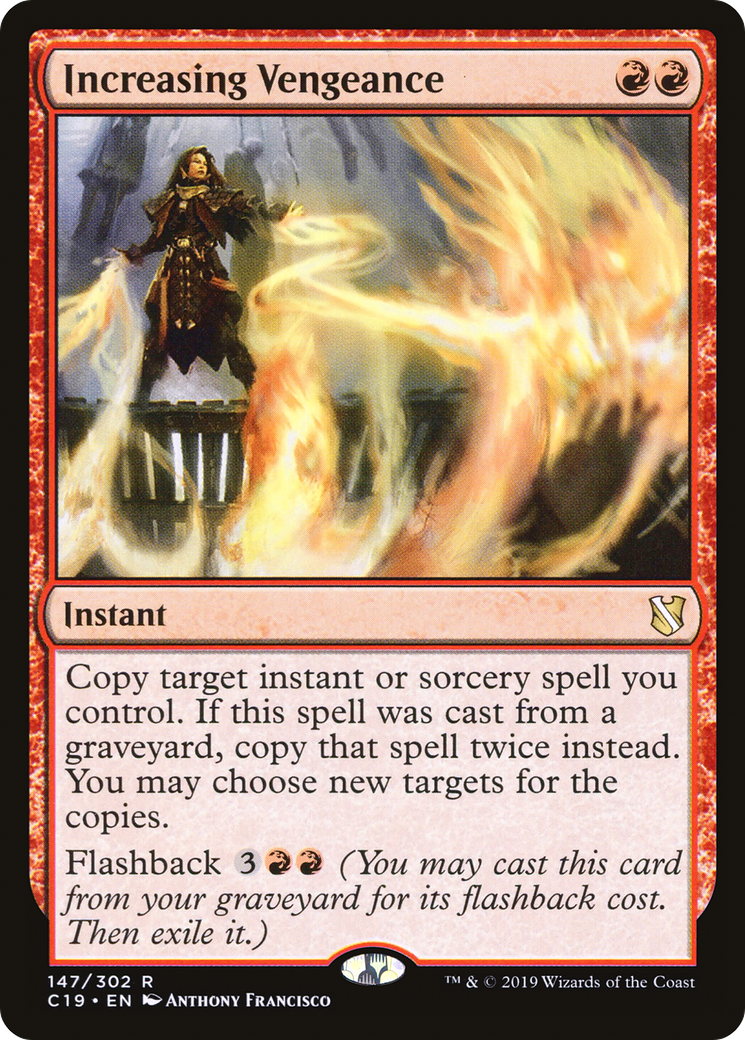
Increasing Vengeance
Increasing Vengeance
Instant
Copy target instant or sorcery spell you control. If this spell was cast from a graveyard, copy that spell twice instead. You may choose new targets for the copies.
Flashback (You may cast this card from your graveyard for its flashback cost. Then exile it.)
- If a card with flashback is put into your graveyard during your turn, you can cast it if it's legal to do so before any other player can take any actions.
- “Flashback [cost]” means “You may cast this card from your graveyard by paying [cost] rather than paying its mana cost” and “If the flashback cost was paid, exile this card instead of putting it anywhere else any time it would leave the stack.”
- You must still follow any timing restrictions and permissions, including those based on the card's type. For instance, you can cast a sorcery using flashback only when you could normally cast a sorcery.
- To determine the total cost of a spell, start with the mana cost or alternative cost (such as a flashback cost) you're paying, add any cost increases, then apply any cost reductions. The mana value of the spell is determined only by its mana cost, no matter what the total cost to cast the spell was.
- A spell cast using flashback will always be exiled afterward, whether it resolves, is countered, or leaves the stack in some other way.
- You can cast a spell using flashback even if it was somehow put into your graveyard without having been cast.
- Increasing Vengeance can target (and copy) any instant or sorcery spell you control, not just one with targets.
- When Increasing Vengeance resolves, it creates one or two copies of a spell. You control each of the copies. Those copies are created on the stack, so they're not “cast.” Abilities that trigger when a player casts a spell won't trigger. The copies will then resolve like normal spells, after players get a chance to cast spells and activate abilities.
- Each of the copies will have the same targets as the spell it's copying unless you choose new ones. You may change any number of the targets, including all of them or none of them. If, for one of the targets, you can't choose a new legal target, then it remains unchanged (even if the current target is illegal). If there are two copies, you may change the targets of each of them to different legal targets.
- If the spell Increasing Vengeance copies is modal (that is, it says “Choose one —” or the like), the copies will have the same mode(s). You can't choose different ones.
- If the spell Increasing Vengeance copies has an X whose value was determined as it was cast (like Earthquake does), the copy has the same value of X.
- You can't choose to pay any additional costs for the copies. However, effects based on any additional costs that were paid for the original spell are copied as though those same costs were paid for the copies too. For example, if you sacrifice a 3/3 creature to cast Fling and then copy it with Increasing Vengeance, the copies of Fling will also deal 3 damage to its target.
-
1
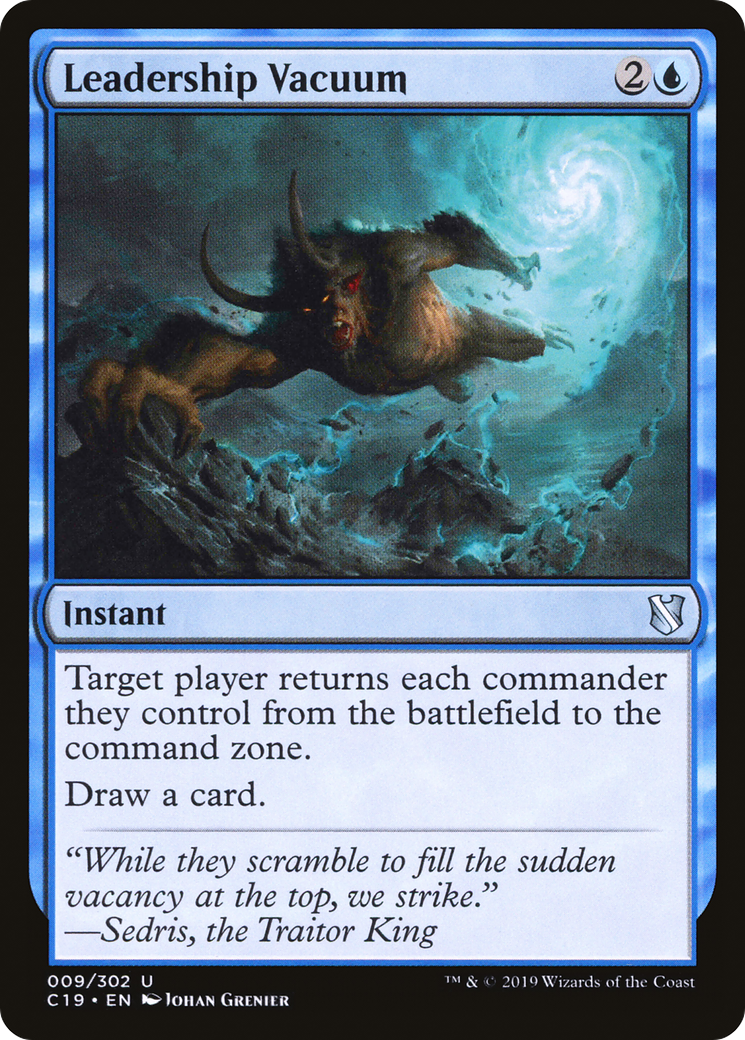
Leadership Vacuum
Leadership Vacuum
Instant
Target player returns each commander they control from the battlefield to the command zone.
Draw a card.
- Leadership Vacuum targets the player, not their creatures. A commander with hexproof or protection from blue may be returned this way.
- You'll draw a card even if the target player controls no commanders as Leadership Vacuum resolves.
- The "commander tax" increases based on how many times a commander was cast from the command zone, not how many times it was put there as a result of Commander rules. The returned commander will cost more to cast again even though it was put directly into the command zone.
-
1
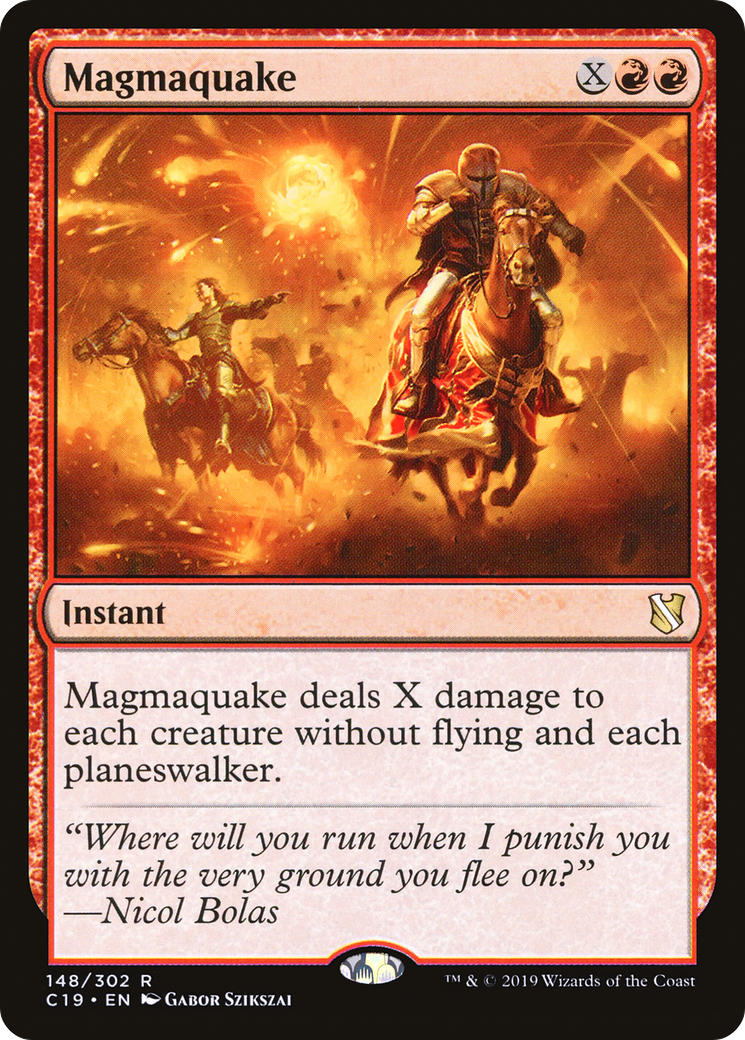
Magmaquake
Magmaquake
Instant
Magmaquake deals X damage to each creature without flying and each planeswalker.
- Magmaquake doesn't target any creature or planeswalker. For example, it will deal damage to a creature without flying that has hexproof.
-
1
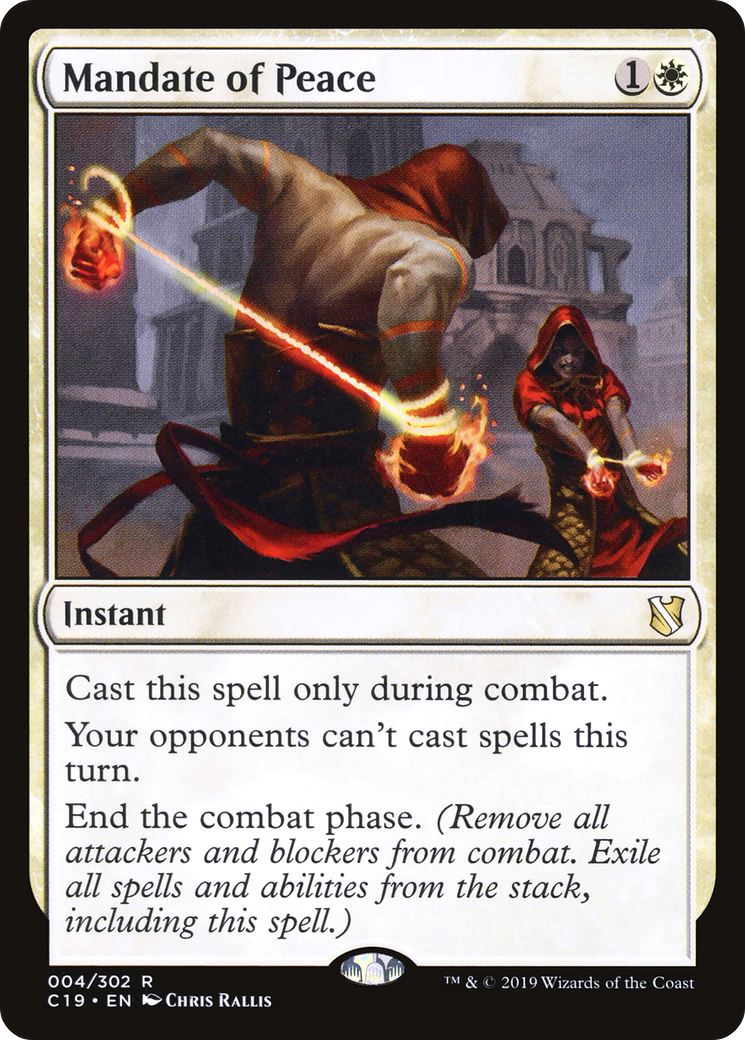
Mandate of Peace
Mandate of Peace
Instant
Cast this spell only during combat.
Your opponents can't cast spells this turn.
End the combat phase. (Remove all attackers and blockers from combat. Exile all spells and abilities from the stack, including this spell.)
- Though other spells and abilities that are exiled won’t get a chance to resolve, they don’t count as being countered.
- If any triggered abilities trigger during this process, they’re put onto the stack after the game skips to the appropriate phase or step.
- Any “at end of combat” triggered abilities won’t get the chance to trigger that combat because the end of combat step is skipped.
- If an effect allows or instructs you to cast Mandate of Peace outside of a combat phase, you can’t do so. Its restriction takes precedence over that permission. Similarly, once Mandate of Peace has resolved, your opponents can’t cast spells even if another effect allows or instructs one of them to cast a spell.
- Mandate of Peace doesn’t stop any player from casting spells in response to Mandate of Peace before it resolves.
- Your opponents can still activate abilities, including abilities of cards in their hand (such as cycling abilities), and can still play lands.
- Ending the combat phase this way means the following things happen in order: 1) All spells and abilities on the stack are exiled. This includes spells and abilities that can’t be countered. 2) State-based actions are checked. No player gets priority, and no triggered abilities are put onto the stack. 3) The current phase and step ends. The game skips straight to the postcombat main phase. As this happens, all attacking and blocking creatures are removed from combat and effects that last “until end of combat” expire.
- In the rare case that the postcombat main phase is skipped, the game skips to the end step of the ending phase. If that step is also skipped, the game skips straight to the turn’s cleanup step. The cleanup step can’t be skipped.
-
1
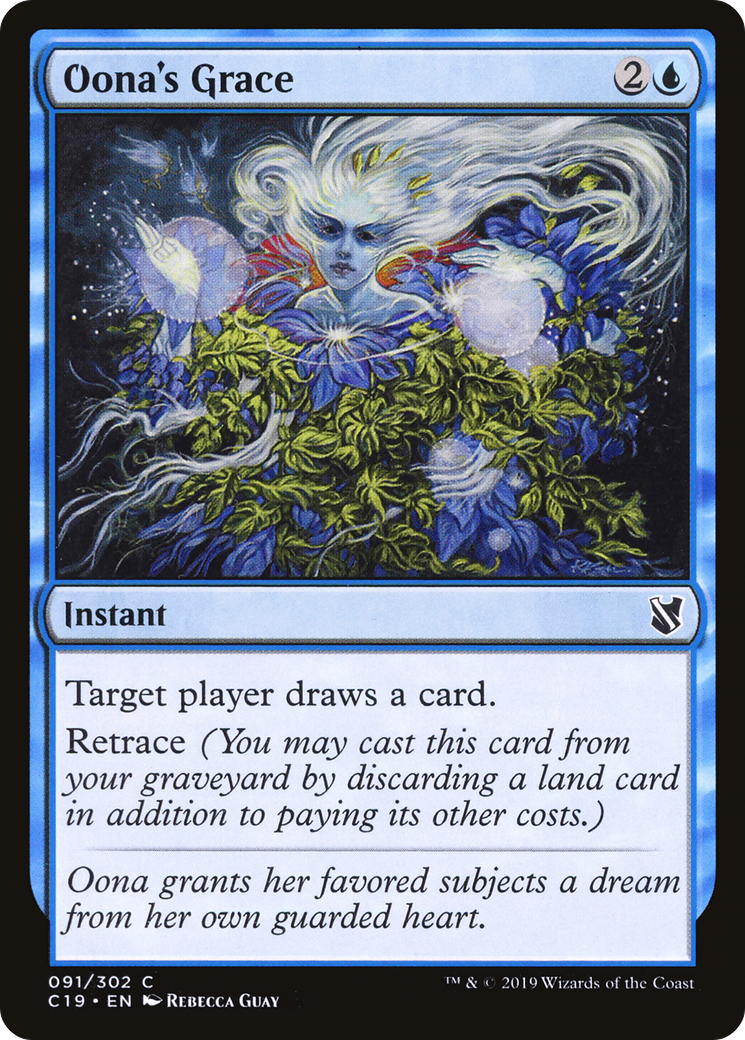
Oona's Grace
Oona's Grace
Instant
Target player draws a card.
Retrace (You may cast this card from your graveyard by discarding a land card in addition to paying its other costs.)
- Casting a card by using its retrace ability works just like casting any other spell, with two exceptions: You’re casting it from your graveyard rather than your hand, and you must discard a land card in addition to any other costs.
- A retrace card cast from your graveyard follows the normal timing rules for its card type.
- When a retrace card you cast from your graveyard resolves, fails to resolve, or is countered, it’s put back into your graveyard. You may use the retrace ability to cast it again.
- If the active player casts a spell that has retrace, that player may cast that card again after it resolves, before another player can remove the card from the graveyard. The active player has priority after the spell resolves, so they can immediately cast a new spell. Since casting a card with retrace from the graveyard moves that card onto the stack, no one else would have the chance to affect it while it’s still in the graveyard.
-
1
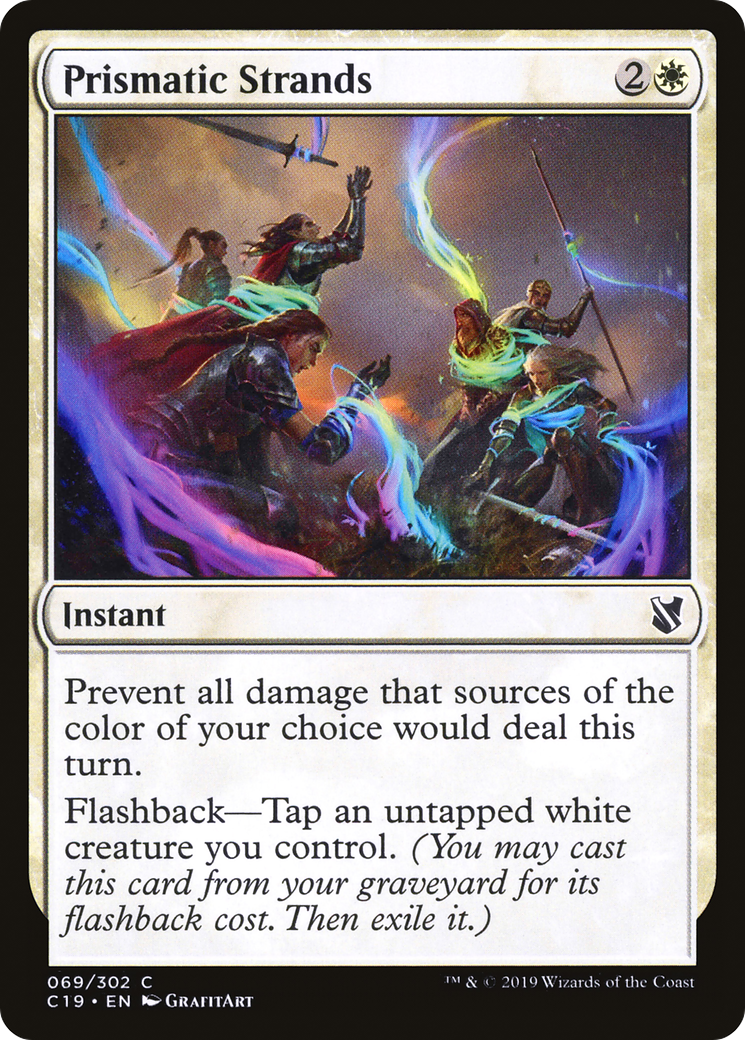
Prismatic Strands
Prismatic Strands
Instant
Prevent all damage that sources of the color of your choice would deal this turn.
Flashback—Tap an untapped white creature you control. (You may cast this card from your graveyard for its flashback cost. Then exile it.)
- "Flashback [cost]" means "You may cast this card from your graveyard by paying [cost] rather than paying its mana cost" and "If the flashback cost was paid, exile this card instead of putting it anywhere else any time it would leave the stack."
- You must still follow any timing restrictions and permissions, including those based on the card's type. For instance, you can cast a sorcery using flashback only when you could normally cast a sorcery.
- To determine the total cost of a spell, start with the mana cost or alternative cost (such as a flashback cost) you're paying, add any cost increases, then apply any cost reductions. The mana value of the spell is determined only by its mana cost, no matter what the total cost to cast the spell was.
- A spell cast using flashback will always be exiled afterward, whether it resolves, is countered, or leaves the stack in some other way.
- You can cast a spell using flashback even if it was somehow put into your graveyard without having been cast.
- If a card with flashback is put into your graveyard during your turn, you can cast it if it's legal to do so before any other player can take any actions.
-
1
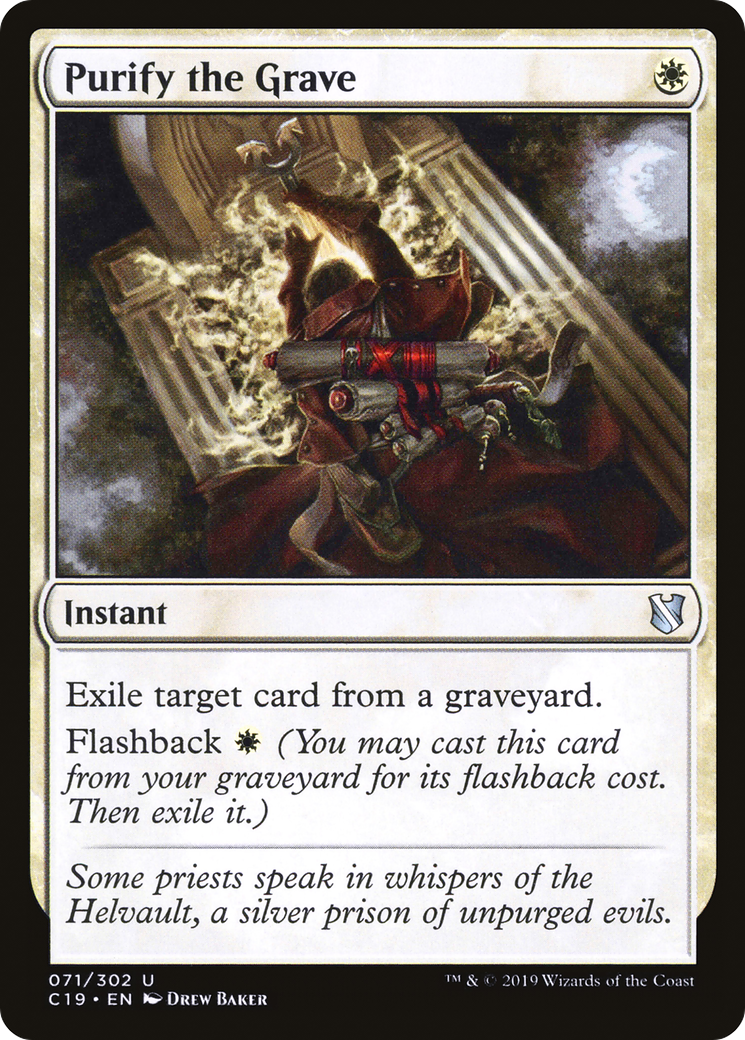
Purify the Grave
Purify the Grave
Instant
Exile target card from a graveyard.
Flashback (You may cast this card from your graveyard for its flashback cost. Then exile it.)
- If a card with flashback is put into your graveyard during your turn, you can cast it if it's legal to do so before any other player can take any actions.
- A spell cast using flashback will always be exiled afterward, whether it resolves, is countered, or leaves the stack in some other way.
- You can cast a spell using flashback even if it was somehow put into your graveyard without having been cast.
- "Flashback [cost]" means "You may cast this card from your graveyard by paying [cost] rather than paying its mana cost" and "If the flashback cost was paid, exile this card instead of putting it anywhere else any time it would leave the stack."
- You must still follow any timing restrictions and permissions, including those based on the card's type. For instance, you can cast a sorcery using flashback only when you could normally cast a sorcery.
- To determine the total cost of a spell, start with the mana cost or alternative cost (such as a flashback cost) you're paying, add any cost increases, then apply any cost reductions. The mana value of the spell is determined only by its mana cost, no matter what the total cost to cast the spell was.
- If it's your turn, and you cast a spell with flashback from your hand, you'll have priority to cast that spell again using flashback before any other player has priority to cast Purify the Grave in order to remove that card from your graveyard.
- Purify the Grave can't be used in response to a spell being cast with flashback or a spell that requires cards to exiled from a graveyard as an additional cost to try and counter the spell or prevent it from being cast.
-
1
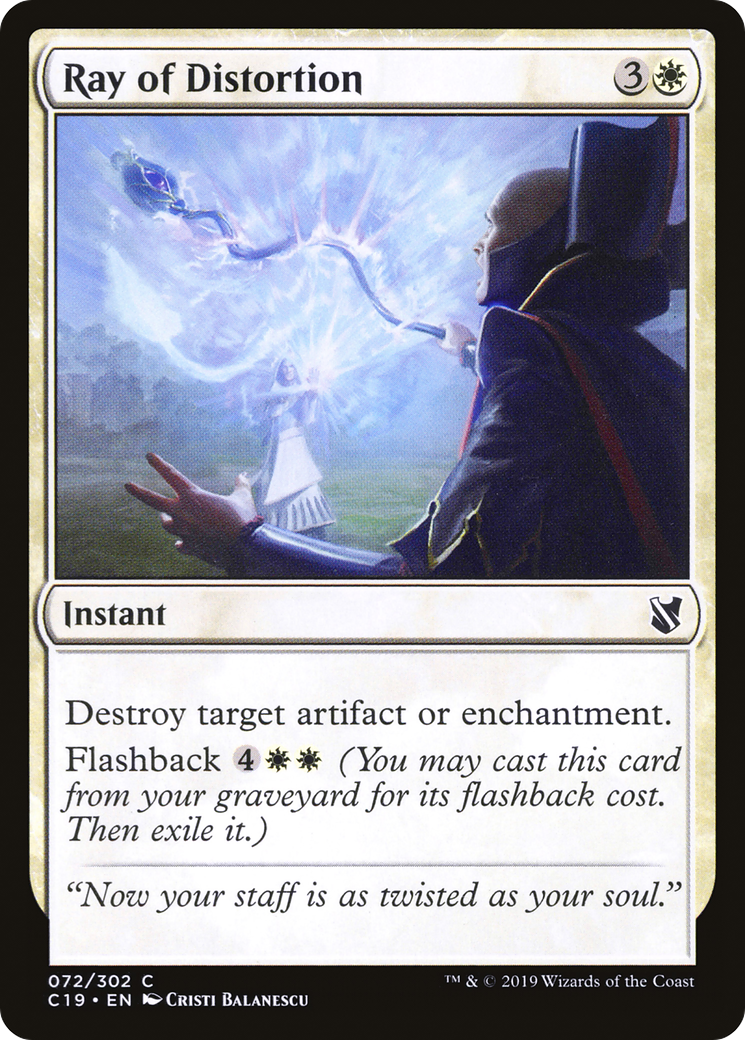
Ray of Distortion
Ray of Distortion
Instant
Destroy target artifact or enchantment.
Flashback (You may cast this card from your graveyard for its flashback cost. Then exile it.)
- "Flashback [cost]" means "You may cast this card from your graveyard by paying [cost] rather than paying its mana cost" and "If the flashback cost was paid, exile this card instead of putting it anywhere else any time it would leave the stack."
- You must still follow any timing restrictions and permissions, including those based on the card's type. For instance, you can cast a sorcery using flashback only when you could normally cast a sorcery.
- To determine the total cost of a spell, start with the mana cost or alternative cost (such as a flashback cost) you're paying, add any cost increases, then apply any cost reductions. The mana value of the spell is determined only by its mana cost, no matter what the total cost to cast the spell was.
- A spell cast using flashback will always be exiled afterward, whether it resolves, is countered, or leaves the stack in some other way.
- You can cast a spell using flashback even if it was somehow put into your graveyard without having been cast.
- If a card with flashback is put into your graveyard during your turn, you can cast it if it's legal to do so before any other player can take any actions.
-
1
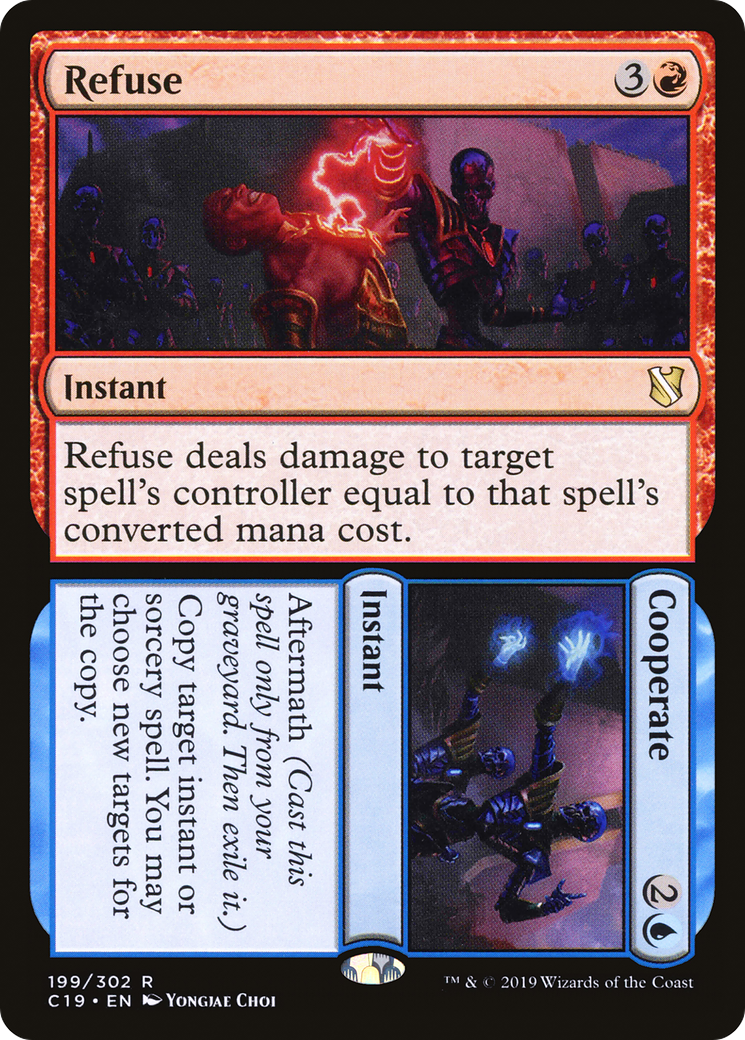
Refuse // Cooperate
//
Refuse
Instant
- Once you've started to cast a spell with aftermath from your graveyard, the card is immediately moved to the stack. Opponents can't try to stop the ability by exiling the card with an effect such as that of Crook of Condemnation.
- If a spell has in its mana cost, include the value chosen for that X when determining the mana value of that spell.
- Cooperate can copy any instant or sorcery spell, not just one with targets.
- The copy is created on the stack, so it's not "cast." Abilities that trigger when a player casts a spell won't trigger.
- If you copy a spell, you control the copy. It will resolve before the original spell does.
- The copy will have the same targets as the spell it's copying unless you choose new ones. You may change any number of the targets, including all of them or none of them. If, for one of the targets, you can't choose a new legal target, then it remains unchanged (even if the current target is illegal).
- If the spell that's copied is modal (that is, it says "Choose one —" or the like), the copy will have the same mode. A different mode can't be chosen.
- If the spell that's copied has an X whose value was determined as it was cast (like Torment of Hailfire does), the copy will have the same value of X.
- If the spell has damage divided as it was cast (like Chandra's Pyrohelix), the division can't be changed (although the targets receiving that damage still can).
- The controller of a copy can't choose to pay any alternative or additional costs for the copy. However, effects based on any alternative or additional costs that were paid for the original spell are copied as though those same costs were paid for the copy.
- All split cards have two card faces on a single card, and you put a split card onto the stack with only the half you're casting. The characteristics of the half of the card you didn't cast are ignored while the spell is on the stack. For example, if an effect prevents you from casting green spells, you can cast Destined of Destined // Lead, but not Lead.
- Each split card is a single card. For example, if you discard one, you've discarded one card, not two. If an effect counts the number of instant and sorcery cards in your graveyard, Destined // Lead counts once, not twice.
- Each split card has two names. If an effect instructs you to choose a card name, you may choose one, but not both.
- While not on the stack, the characteristics of a split card are the combination of its two halves. For example, Destined // Lead is a green and black card, it is both an instant card and a sorcery card, and its mana value is 6. This means that if an effect allows you to cast a card with mana value 2 from your hand, you can't cast Destined. This is a change from the previous rules for split cards.
- If you cast the first half of a split card with aftermath during your turn, you'll have priority immediately after it resolves. You can cast the half with aftermath from your graveyard before any player can take any other action if it's legal for you to do so.
- If another effect allows you to cast a split card with aftermath from any zone other than a graveyard, you can't cast the half with aftermath.
- If another effect allows you to cast a split card with aftermath from a graveyard, you may cast either half. If you cast the half that has aftermath, you'll exile the card if it would leave the stack.
- A spell with aftermath cast from a graveyard will always be exiled afterward, whether it resolves, it's countered, or it leaves the stack in some other way.
- Split cards with aftermath have a new frame treatment—the half you can cast from your hand is oriented the same as other cards you'd cast from your hand, while the half you can cast from your graveyard is a traditional split card half. This frame treatment is for your convenience and has no rules significance.
-
1
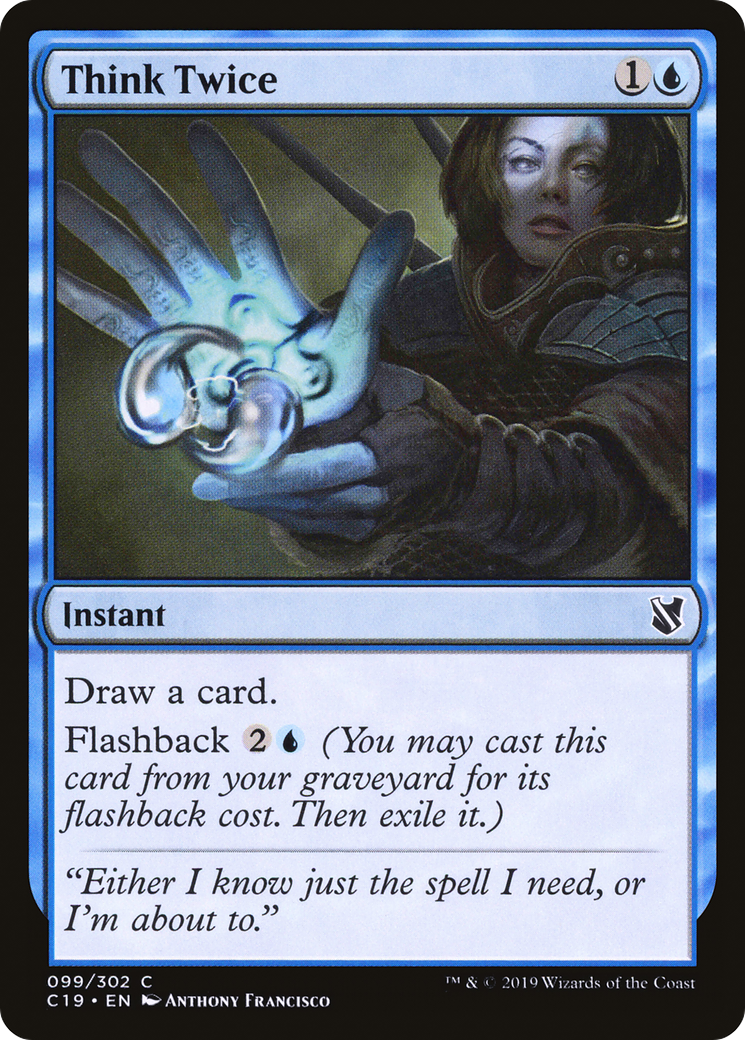
Think Twice
Think Twice
Instant
Draw a card.
Flashback (You may cast this card from your graveyard for its flashback cost. Then exile it.)
- "Flashback [cost]" means "You may cast this card from your graveyard by paying [cost] rather than paying its mana cost" and "If the flashback cost was paid, exile this card instead of putting it anywhere else any time it would leave the stack."
- You must still follow any timing restrictions and permissions, including those based on the card's type. For instance, you can cast a sorcery using flashback only when you could normally cast a sorcery.
- To determine the total cost of a spell, start with the mana cost or alternative cost (such as a flashback cost) you're paying, add any cost increases, then apply any cost reductions. The mana value of the spell is determined only by its mana cost, no matter what the total cost to cast the spell was.
- A spell cast using flashback will always be exiled afterward, whether it resolves, is countered, or leaves the stack in some other way.
- You can cast a spell using flashback even if it was somehow put into your graveyard without having been cast.
- If a card with flashback is put into your graveyard during your turn, you can cast it if it's legal to do so before any other player can take any actions.
Sorceries 13
-
1
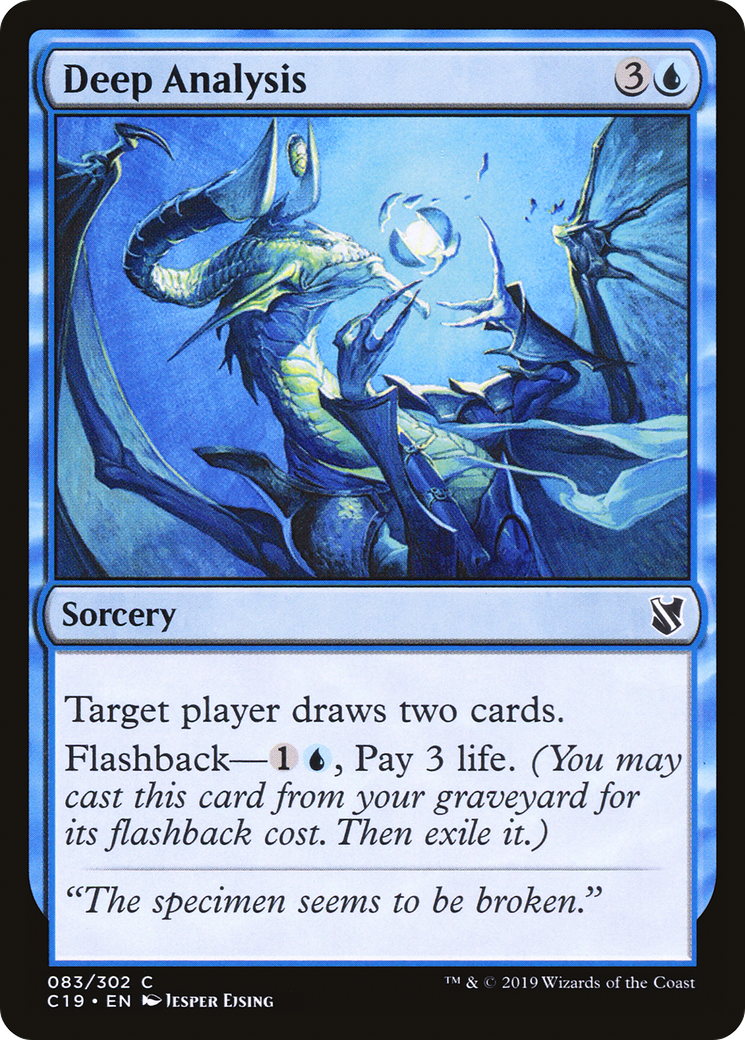
Deep Analysis
Deep Analysis
Sorcery
Target player draws two cards.
Flashback— , Pay 3 life. (You may cast this card from your graveyard for its flashback cost. Then exile it.)
- A spell cast using flashback will always be exiled afterward, whether it resolves, is countered, or leaves the stack in some other way.
- You must still follow any timing restrictions and permissions, including those based on the card's type. For instance, you can cast a sorcery using flashback only when you could normally cast a sorcery.
- You can cast a spell using flashback even if it was somehow put into your graveyard without having been cast.
- To determine the total cost of a spell, start with the mana cost or alternative cost (such as a flashback cost) you're paying, add any cost increases, then apply any cost reductions. The mana value of the spell is determined only by its mana cost, no matter what the total cost to cast the spell was.
- If a card with flashback is put into your graveyard during your turn, you can cast it if it's legal to do so before any other player can take any actions.
- "Flashback [cost]" means "You may cast this card from your graveyard by paying [cost] rather than paying its mana cost" and "If the flashback cost was paid, exile this card instead of putting it anywhere else any time it would leave the stack."
-
1
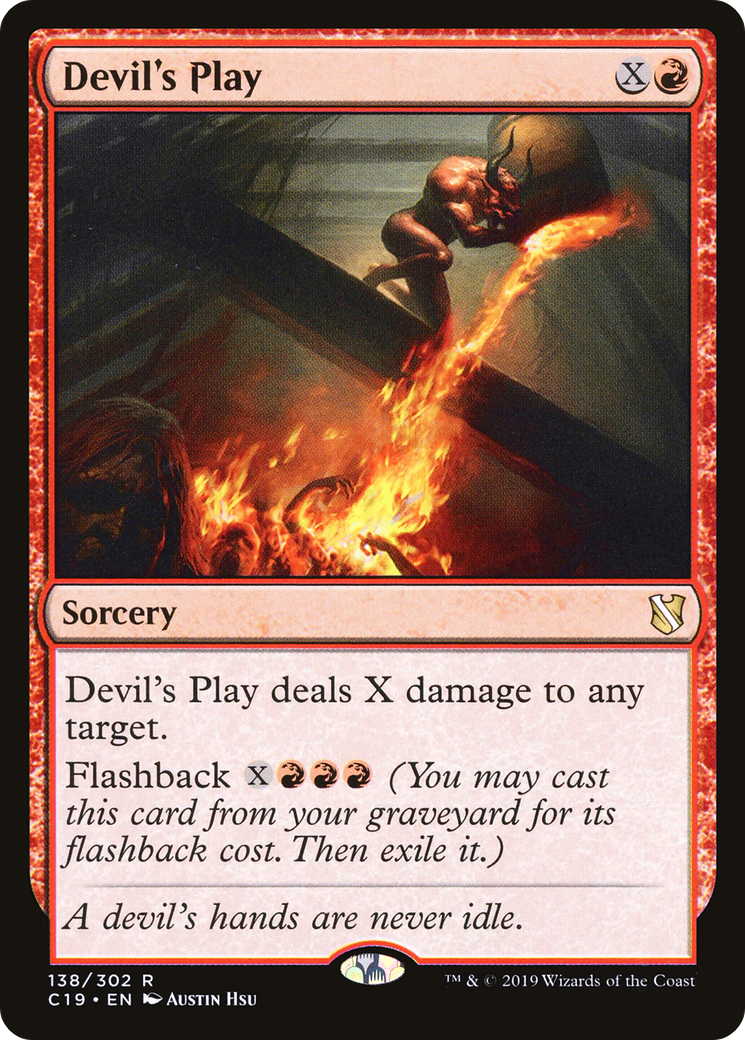
Devil's Play
Devil's Play
Sorcery
Devil's Play deals X damage to any target.
Flashback (You may cast this card from your graveyard for its flashback cost. Then exile it.)
- If a card with flashback is put into your graveyard during your turn, you can cast it if it's legal to do so before any other player can take any actions.
- "Flashback [cost]" means "You may cast this card from your graveyard by paying [cost] rather than paying its mana cost" and "If the flashback cost was paid, exile this card instead of putting it anywhere else any time it would leave the stack."
- You must still follow any timing restrictions and permissions, including those based on the card's type. For instance, you can cast a sorcery using flashback only when you could normally cast a sorcery.
- To determine the total cost of a spell, start with the mana cost or alternative cost (such as a flashback cost) you're paying, add any cost increases, then apply any cost reductions. The mana value of the spell is determined only by its mana cost, no matter what the total cost to cast the spell was.
- A spell cast using flashback will always be exiled afterward, whether it resolves, is countered, or leaves the stack in some other way.
- You can cast a spell using flashback even if it was somehow put into your graveyard without having been cast.
-
1
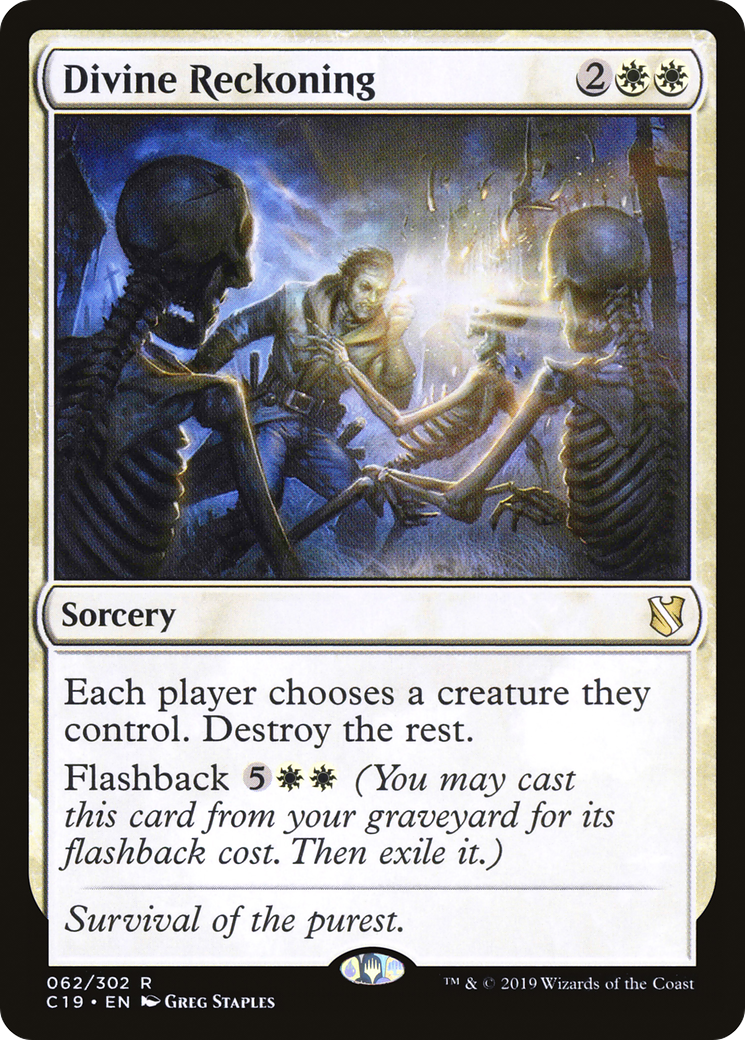
Divine Reckoning
Divine Reckoning
Sorcery
Each player chooses a creature they control. Destroy the rest.
Flashback (You may cast this card from your graveyard for its flashback cost. Then exile it.)
- To determine the total cost of a spell, start with the mana cost or alternative cost (such as a flashback cost) you're paying, add any cost increases, then apply any cost reductions. The mana value of the spell is determined only by its mana cost, no matter what the total cost to cast the spell was.
- "Flashback [cost]" means "You may cast this card from your graveyard by paying [cost] rather than paying its mana cost" and "If the flashback cost was paid, exile this card instead of putting it anywhere else any time it would leave the stack."
- You must still follow any timing restrictions and permissions, including those based on the card's type. For instance, you can cast a sorcery using flashback only when you could normally cast a sorcery.
- If a card with flashback is put into your graveyard during your turn, you can cast it if it's legal to do so before any other player can take any actions.
- A spell cast using flashback will always be exiled afterward, whether it resolves, is countered, or leaves the stack in some other way.
- You can cast a spell using flashback even if it was somehow put into your graveyard without having been cast.
- Starting with the player whose turn it is, each player chooses a creature in turn order. Players will know the choice of each player who chose before them.
-
1
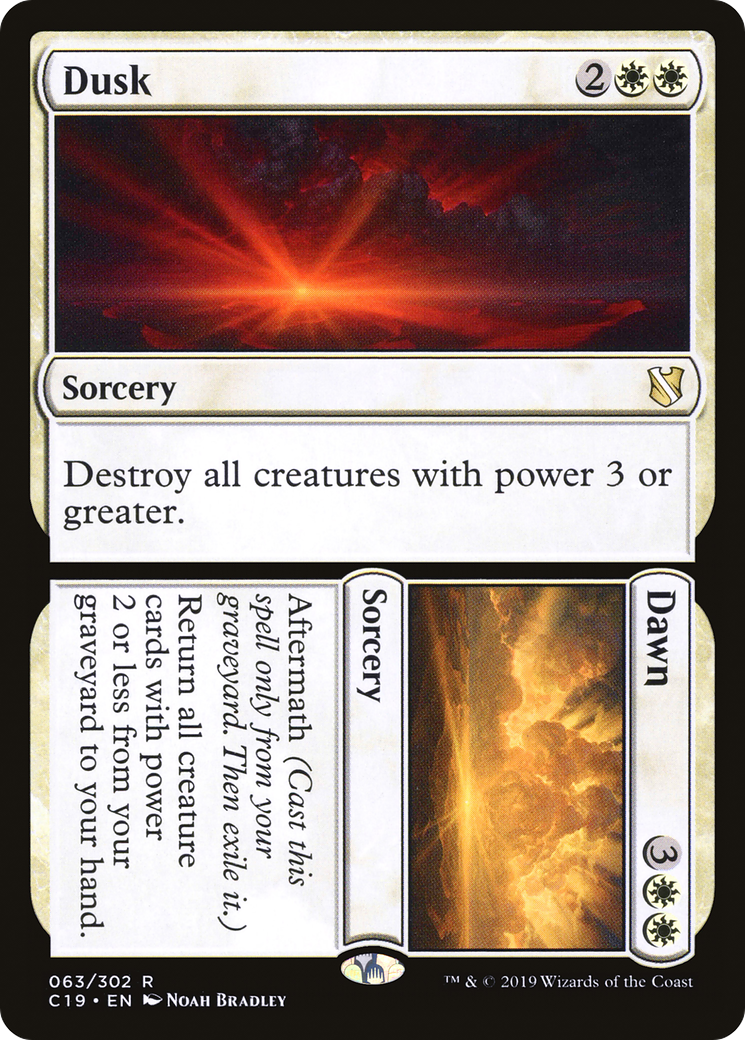
Dusk // Dawn
//
Dusk
Sorcery
- Once you've started to cast a spell with aftermath from your graveyard, the card is immediately moved to the stack. Opponents can't try to stop the ability by exiling the card with an effect such as that of Crook of Condemnation.
- All split cards have two card faces on a single card, and you put a split card onto the stack with only the half you're casting. The characteristics of the half of the card you didn't cast are ignored while the spell is on the stack. For example, if an effect prevents you from casting green spells, you can cast Destined of Destined // Lead, but not Lead.
- Each split card is a single card. For example, if you discard one, you've discarded one card, not two. If an effect counts the number of instant and sorcery cards in your graveyard, Destined // Lead counts once, not twice.
- Each split card has two names. If an effect instructs you to choose a card name, you may choose one, but not both.
- While not on the stack, the characteristics of a split card are the combination of its two halves. For example, Destined // Lead is a green and black card, it is both an instant card and a sorcery card, and its mana value is 6. This means that if an effect allows you to cast a card with mana value 2 from your hand, you can't cast Destined. This is a change from the previous rules for split cards.
- Split cards with aftermath have a new frame treatment—the half you can cast from your hand is oriented the same as other cards you'd cast from your hand, while the half you can cast from your graveyard is a traditional split card half. This frame treatment is for your convenience and has no rules significance.
- If another effect allows you to cast a split card with aftermath from any zone other than a graveyard, you can't cast the half with aftermath.
- If another effect allows you to cast a split card with aftermath from a graveyard, you may cast either half. If you cast the half that has aftermath, you'll exile the card if it would leave the stack.
- A spell with aftermath cast from a graveyard will always be exiled afterward, whether it resolves, it's countered, or it leaves the stack in some other way.
- If you cast the first half of a split card with aftermath during your turn, you'll have priority immediately after it resolves. You can cast the half with aftermath from your graveyard before any player can take any other action if it's legal for you to do so.
-
1
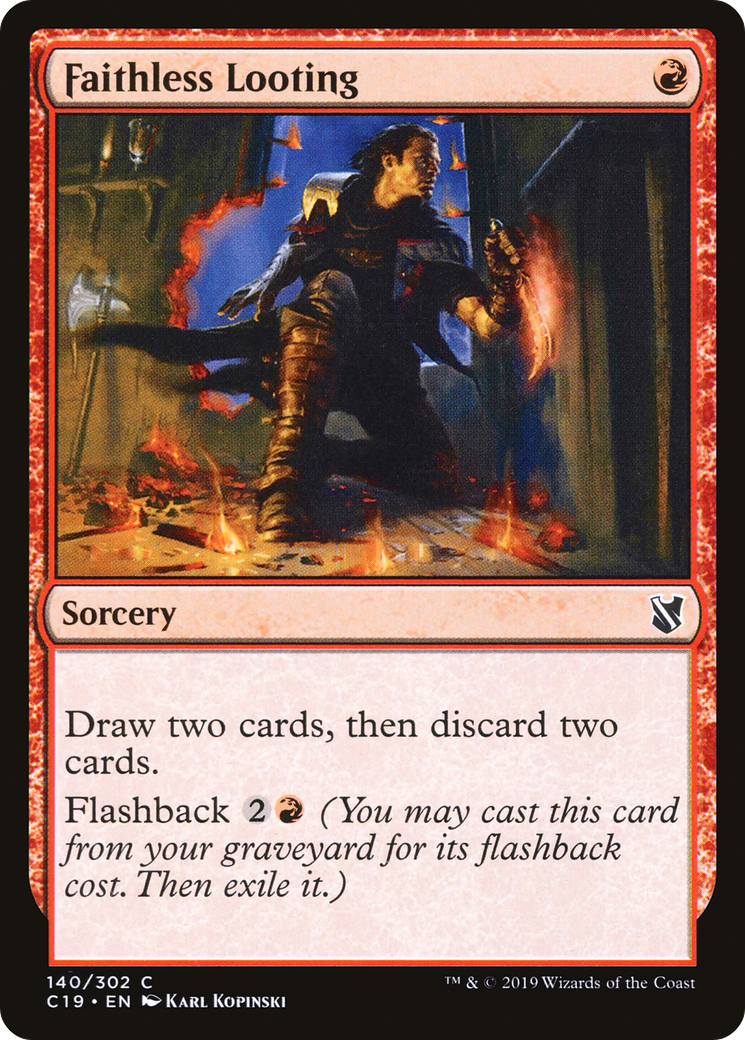
Faithless Looting
Faithless Looting
Sorcery
Draw two cards, then discard two cards.
Flashback (You may cast this card from your graveyard for its flashback cost. Then exile it.)
- To determine the total cost of a spell, start with the mana cost or alternative cost (such as a flashback cost) you're paying, add any cost increases, then apply any cost reductions. The mana value of the spell is determined only by its mana cost, no matter what the total cost to cast the spell was.
- A spell cast using flashback will always be exiled afterward, whether it resolves, is countered, or leaves the stack in some other way.
- "Flashback [cost]" means "You may cast this card from your graveyard if the resulting spell is an instant or sorcery spell by paying [cost] rather than paying its mana cost" and "If the flashback cost was paid, exile this card instead of putting it anywhere else any time it would leave the stack."
- If a card with flashback is put into your graveyard during your turn, you can cast it if it's legal to do so before any other player can take any actions.
- You can cast a spell using flashback even if it was somehow put into your graveyard without having been cast.
- You must still follow any timing restrictions and permissions, including those based on the card's type. For instance, you can cast a sorcery using flashback only when you could normally cast a sorcery.
- You draw two cards and discard two cards all while Faithless Looting is resolving. Nothing can happen between the two, and no player may choose to take actions.
-
1
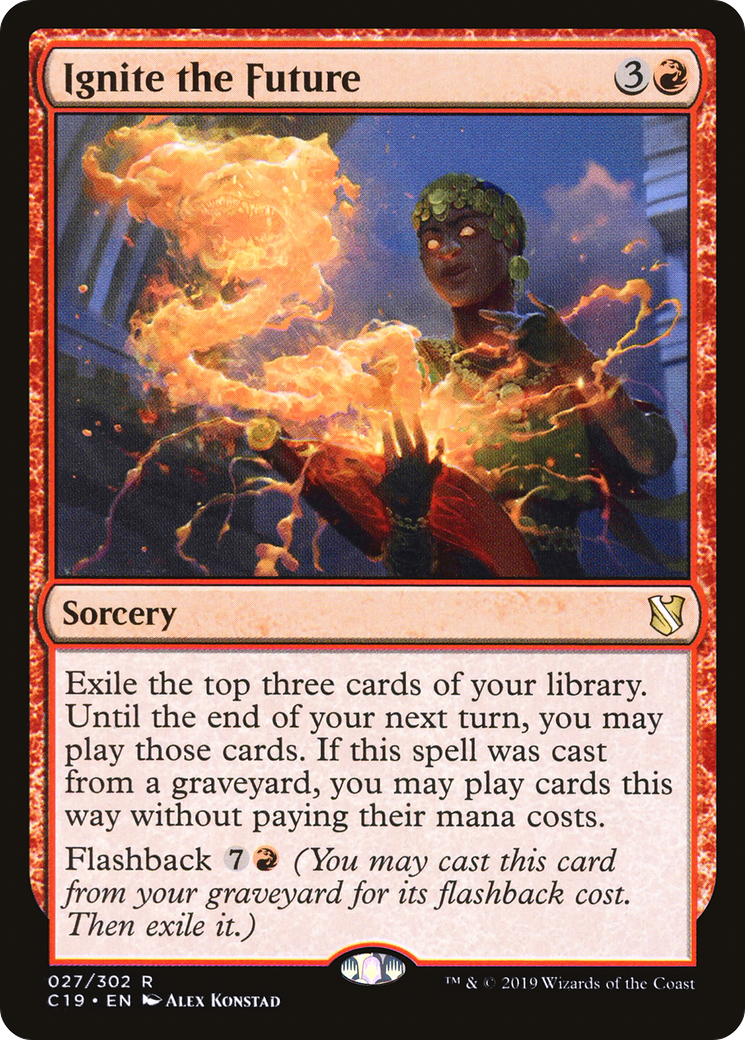
Ignite the Future
Ignite the Future
Sorcery
Exile the top three cards of your library. Until the end of your next turn, you may play those cards. If this spell was cast from a graveyard, you may play cards this way without paying their mana costs.
Flashback (You may cast this card from your graveyard for its flashback cost. Then exile it.)
- If a card with flashback is put into your graveyard during your turn, you can cast it if it's legal to do so before any other player can take any actions.
- “Flashback [cost]” means “You may cast this card from your graveyard by paying [cost] rather than paying its mana cost” and “If the flashback cost was paid, exile this card instead of putting it anywhere else any time it would leave the stack.”
- You must still follow any timing restrictions and permissions, including those based on the card's type. For instance, you can cast a sorcery using flashback only when you could normally cast a sorcery.
- To determine the total cost of a spell, start with the mana cost or alternative cost (such as a flashback cost) you're paying, add any cost increases, then apply any cost reductions. The mana value of the spell is determined only by its mana cost, no matter what the total cost to cast the spell was.
- A spell cast using flashback will always be exiled afterward, whether it resolves, is countered, or leaves the stack in some other way.
- You can cast a spell using flashback even if it was somehow put into your graveyard without having been cast.
- Ignite the Future doesn't change when you can play the exiled cards. For example, if you exile a sorcery card, you can cast it only during your main phase when the stack is empty. If you exile a land card, you can play it only during your main phase and only if you have an available land play remaining.
- If you cast Ignite the Future from a zone other than a graveyard, you must pay the mana cost or an alternative cost for each spell cast this way. If you cast Ignite the Future from a graveyard, you may choose to cast each spell for its mana cost, an alternative cost, or without paying its mana cost.
- If a spell has in its mana cost, you must choose 0 as the value of X when casting it without paying its mana cost.
- If you cast a card “without paying its mana cost,” you can't choose to cast it for any alternative costs and not pay that cost. You can, however, pay additional costs. If the card has any mandatory additional costs, such as that of Momentous Fall, you must pay those to cast the card.
- If you don't play some or all of the exiled cards, those cards remain in exile.
-
1
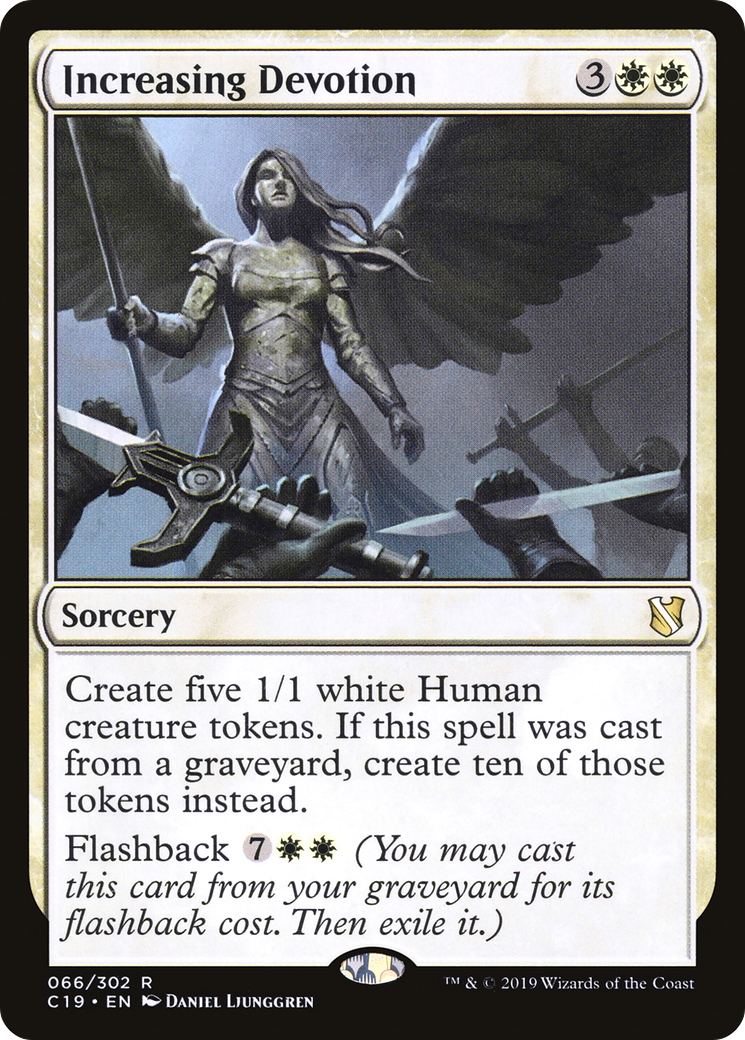
Increasing Devotion
Increasing Devotion
Sorcery
Create five 1/1 white Human creature tokens. If this spell was cast from a graveyard, create ten of those tokens instead.
Flashback (You may cast this card from your graveyard for its flashback cost. Then exile it.)
- "Flashback [cost]" means "You may cast this card from your graveyard by paying [cost] rather than paying its mana cost" and "If the flashback cost was paid, exile this card instead of putting it anywhere else any time it would leave the stack."
- You must still follow any timing restrictions and permissions, including those based on the card's type. For instance, you can cast a sorcery using flashback only when you could normally cast a sorcery.
- To determine the total cost of a spell, start with the mana cost or alternative cost (such as a flashback cost) you're paying, add any cost increases, then apply any cost reductions. The mana value of the spell is determined only by its mana cost, no matter what the total cost to cast the spell was.
- A spell cast using flashback will always be exiled afterward, whether it resolves, is countered, or leaves the stack in some other way.
- You can cast a spell using flashback even if it was somehow put into your graveyard without having been cast.
- If a card with flashback is put into your graveyard during your turn, you can cast it if it's legal to do so before any other player can take any actions.
-
1
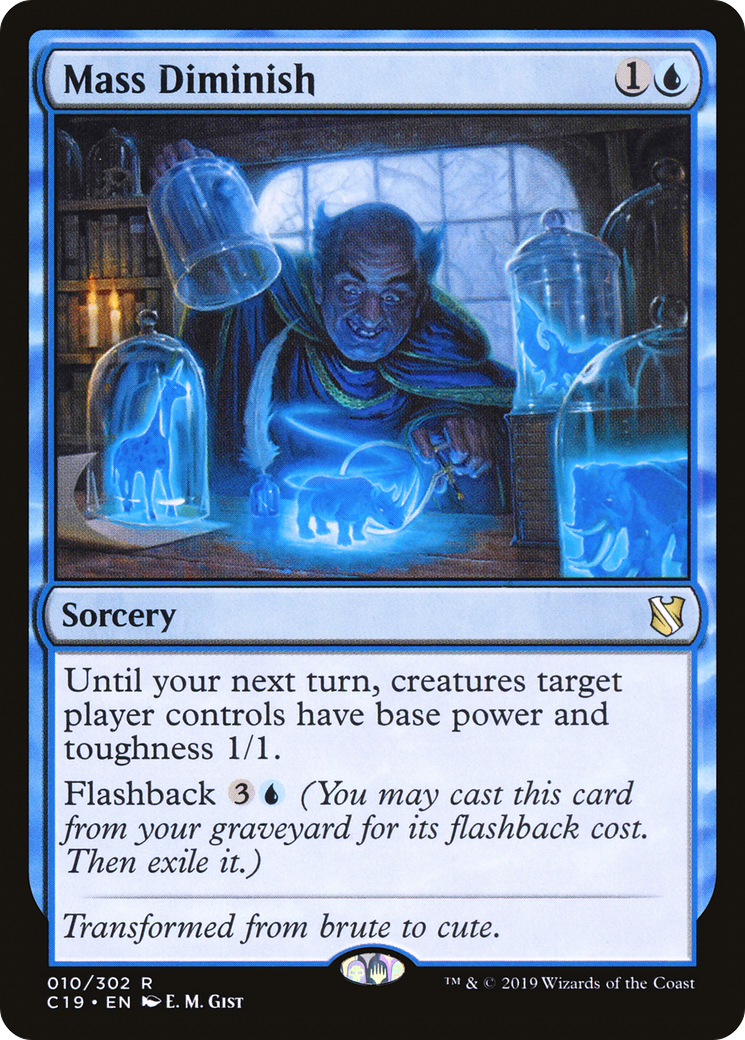
Mass Diminish
Mass Diminish
Sorcery
Until your next turn, creatures target player controls have base power and toughness 1/1.
Flashback (You may cast this card from your graveyard for its flashback cost. Then exile it.)
- If a card with flashback is put into your graveyard during your turn, you can cast it if it's legal to do so before any other player can take any actions.
- "Flashback [cost]" means "You may cast this card from your graveyard by paying [cost] rather than paying its mana cost" and "If the flashback cost was paid, exile this card instead of putting it anywhere else any time it would leave the stack."
- You must still follow any timing restrictions and permissions, including those based on the card's type. For instance, you can cast a sorcery using flashback only when you could normally cast a sorcery.
- To determine the total cost of a spell, start with the mana cost or alternative cost (such as a flashback cost) you're paying, add any cost increases, then apply any cost reductions. The mana value of the spell is determined only by its mana cost, no matter what the total cost to cast the spell was.
- A spell cast using flashback will always be exiled afterward, whether it resolves, is countered, or leaves the stack in some other way.
- You can cast a spell using flashback even if it was somehow put into your graveyard without having been cast.
- Mass Diminish overwrites all previous effects that set a creature's base power and toughness to specific values. Any power- or toughness-setting effects that start to apply after that ability resolves will overwrite this effect.
- Effects that raise or lower a creature's power and/or toughness, such as the effect of Titanic Growth, will apply to that creature no matter when they started to take effect. The same is true for any counters that change its power and/or toughness.
- Mass Diminish targets the player, not their creatures. A creature with hexproof or protection from blue may be shrunk this way.
- Mass Diminish affects only creatures the target player controls at the time it resolves. Creatures they begin to control later before your next turn won't be 1/1.
- Because damage remains marked on a creature until it's removed as the turn ends, nonlethal damage dealt to a creature the target player controls may become lethal once its base toughness becomes 1.
- In a multiplayer game, if you leave the game after Mass Diminish resolves but before your next turn begins, its effect lasts until your next turn would have begun. It neither expires immediately nor lasts indefinitely.
-
1
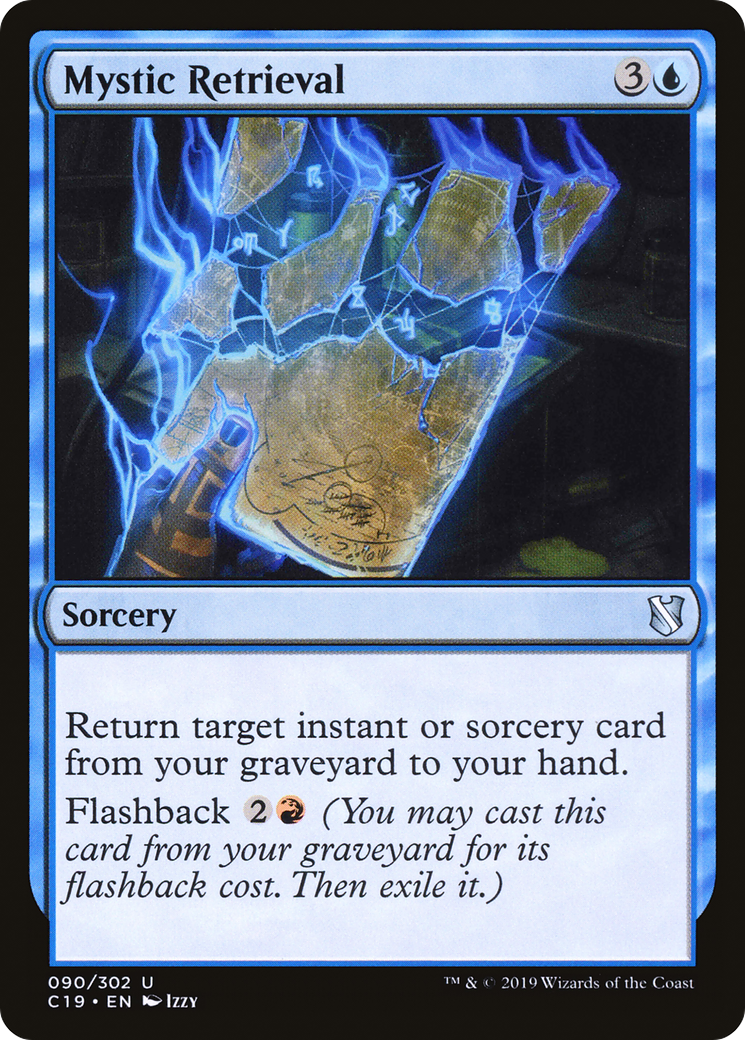
Mystic Retrieval
Mystic Retrieval
Sorcery
Return target instant or sorcery card from your graveyard to your hand.
Flashback (You may cast this card from your graveyard for its flashback cost. Then exile it.)
- To determine the total cost of a spell, start with the mana cost or alternative cost (such as a flashback cost) you're paying, add any cost increases, then apply any cost reductions. The mana value of the spell is determined only by its mana cost, no matter what the total cost to cast the spell was.
- "Flashback [cost]" means "You may cast this card from your graveyard by paying [cost] rather than paying its mana cost" and "If the flashback cost was paid, exile this card instead of putting it anywhere else any time it would leave the stack."
- You must still follow any timing restrictions and permissions, including those based on the card's type. For instance, you can cast a sorcery using flashback only when you could normally cast a sorcery.
- If a card with flashback is put into your graveyard during your turn, you can cast it if it's legal to do so before any other player can take any actions.
- A spell cast using flashback will always be exiled afterward, whether it resolves, is countered, or leaves the stack in some other way.
- You can cast a spell using flashback even if it was somehow put into your graveyard without having been cast.
- Mystic Retrieval can't target itself. It's on the stack when you choose its target.
-
1
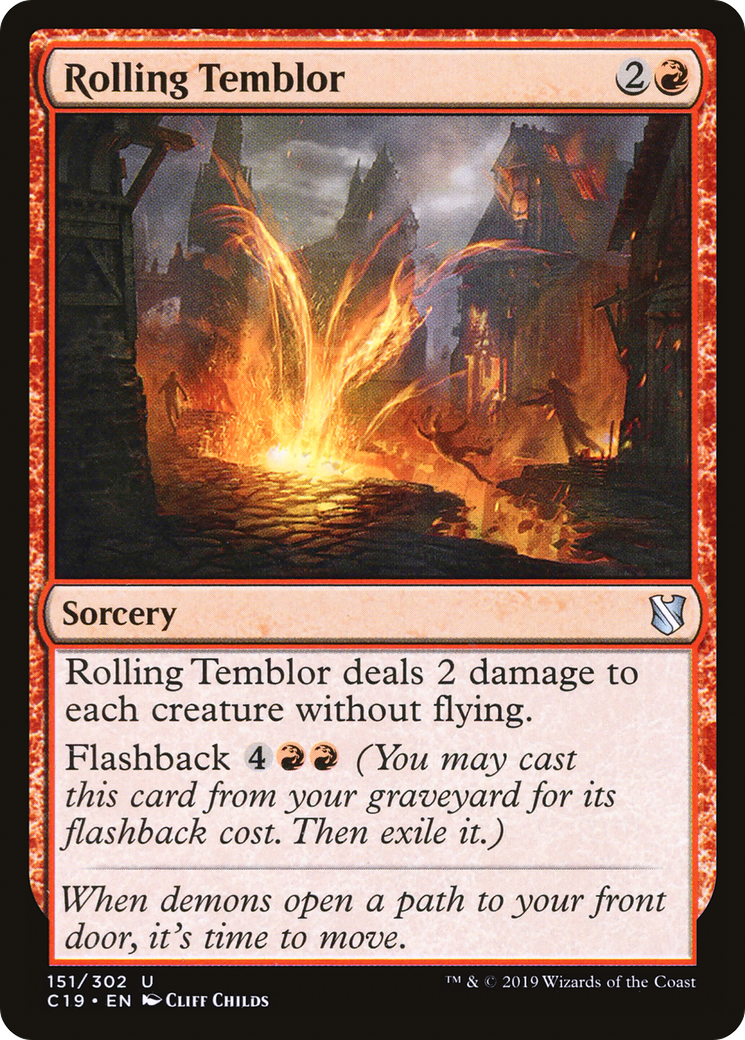
Rolling Temblor
Rolling Temblor
Sorcery
Rolling Temblor deals 2 damage to each creature without flying.
Flashback (You may cast this card from your graveyard for its flashback cost. Then exile it.)
- "Flashback [cost]" means "You may cast this card from your graveyard by paying [cost] rather than paying its mana cost" and "If the flashback cost was paid, exile this card instead of putting it anywhere else any time it would leave the stack."
- You must still follow any timing restrictions and permissions, including those based on the card's type. For instance, you can cast a sorcery using flashback only when you could normally cast a sorcery.
- To determine the total cost of a spell, start with the mana cost or alternative cost (such as a flashback cost) you're paying, add any cost increases, then apply any cost reductions. The mana value of the spell is determined only by its mana cost, no matter what the total cost to cast the spell was.
- A spell cast using flashback will always be exiled afterward, whether it resolves, is countered, or leaves the stack in some other way.
- You can cast a spell using flashback even if it was somehow put into your graveyard without having been cast.
- If a card with flashback is put into your graveyard during your turn, you can cast it if it's legal to do so before any other player can take any actions.
-
1
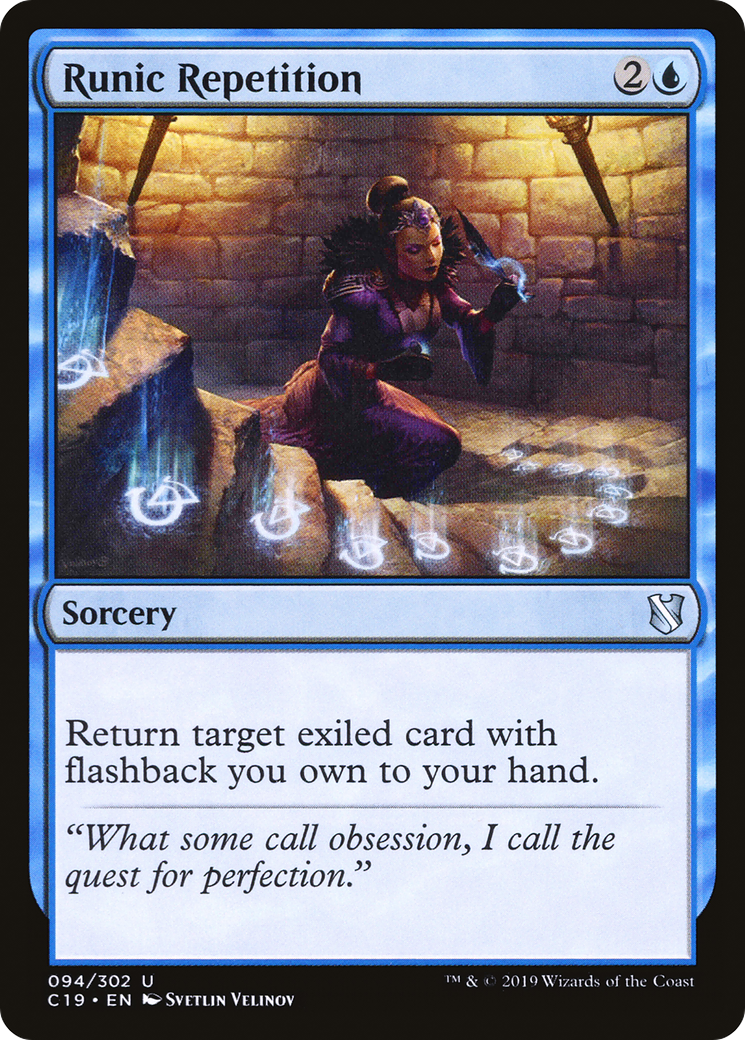
Runic Repetition
Runic Repetition
Sorcery
Return target exiled card with flashback you own to your hand.
- The card could have been exiled for any reason, not just because it was cast using flashback.
- An effect that gives flashback to an instant or sorcery card in your graveyard stops applying once that card has left the stack. The card won’t have flashback while exiled and can’t be the target of Runic Repetition (unless it naturally has flashback).
- A card that’s exiled face down doesn’t have any characteristics or abilities, so it can’t be the target of Runic Repetition.
-
1
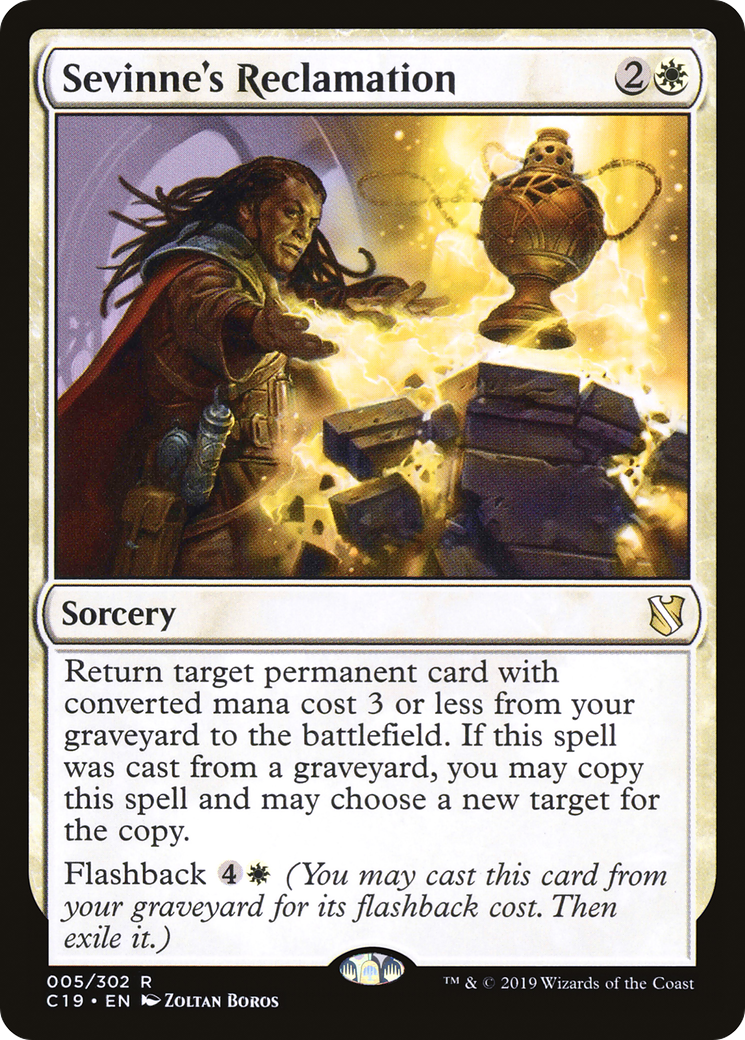
Sevinne's Reclamation
Sevinne's Reclamation
Sorcery
Return target permanent card with mana value 3 or less from your graveyard to the battlefield. If this spell was cast from a graveyard, you may copy this spell and may choose a new target for the copy.
Flashback (You may cast this card from your graveyard for its flashback cost. Then exile it.)
- A spell cast using flashback will always be exiled afterward, whether it resolves, is countered, or leaves the stack in some other way.
- You can cast a spell using flashback even if it was somehow put into your graveyard without having been cast.
- To determine the total cost of a spell, start with the mana cost or alternative cost (such as a flashback cost) you're paying, add any cost increases, then apply any cost reductions. The mana value of the spell is determined only by its mana cost, no matter what the total cost to cast the spell was.
- You must still follow any timing restrictions and permissions, including those based on the card's type. For instance, you can cast a sorcery using flashback only when you could normally cast a sorcery.
- "Flashback [cost]" means "You may cast this card from your graveyard if the resulting spell is an instant or sorcery spell by paying [cost] rather than paying its mana cost" and "If the flashback cost was paid, exile this card instead of putting it anywhere else any time it would leave the stack."
- If a card with flashback is put into your graveyard during your turn, you can cast it if it's legal to do so before any other player can take any actions.
- A permanent card is an artifact, battle, creature, enchantment, land, or planeswalker card.
- The copy that Sevinne's Reclamation creates is created on the stack, so it's not "cast." Abilities that trigger when a player casts a spell won't trigger. The copy wasn't cast from a graveyard, so it won't make another copy of itself.
- If you cast Sevinne's Reclamation from your graveyard, any abilities that trigger as the permanent card returns to the battlefield will resolve before the copy of Sevinne's Reclamation resolves but after new targets for the copy have been chosen.
- If a card in a graveyard has in its mana cost, X is considered to be 0.
- If the target card is an illegal target by the time Sevinne's Reclamation tries to resolve, the spell doesn't resolve. You won't copy it if you cast it from a graveyard.
-
1
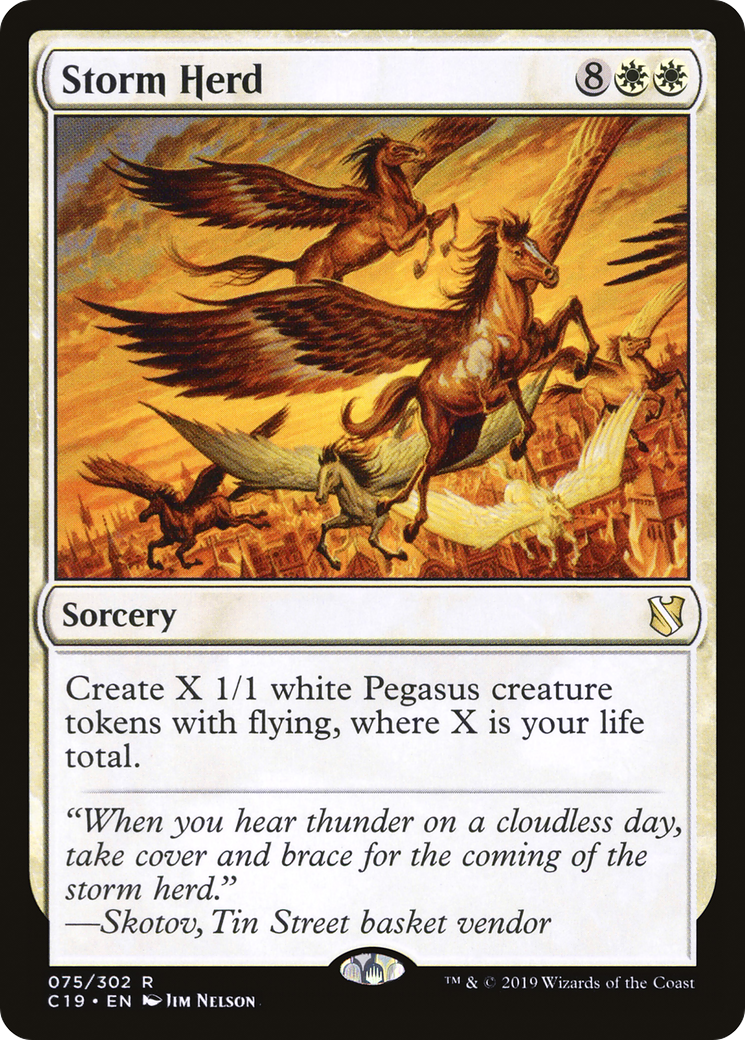
Storm Herd
Storm Herd
Sorcery
Create X 1/1 white Pegasus creature tokens with flying, where X is your life total.
Artifacts 7
-
1
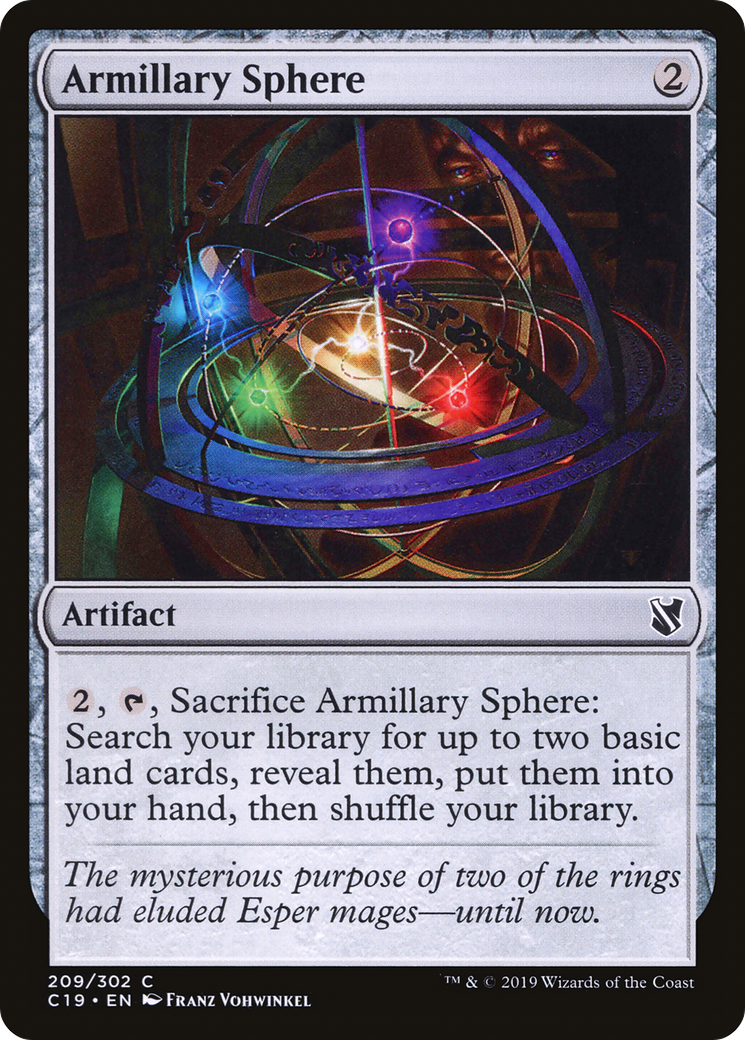
Armillary Sphere
Armillary Sphere
Artifact
, , Sacrifice this artifact: Search your library for up to two basic land cards, reveal them, put them into your hand, then shuffle.
-
1
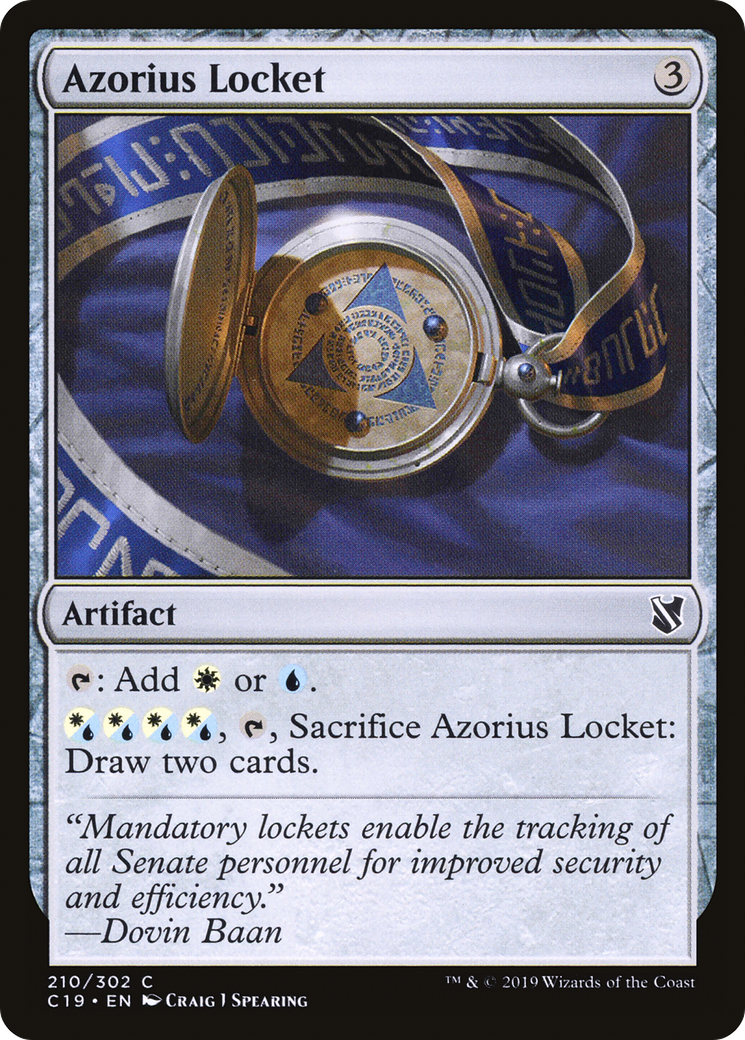
Azorius Locket
Azorius Locket
Artifact
: Add or .
, , Sacrifice this artifact: Draw two cards.
-
1
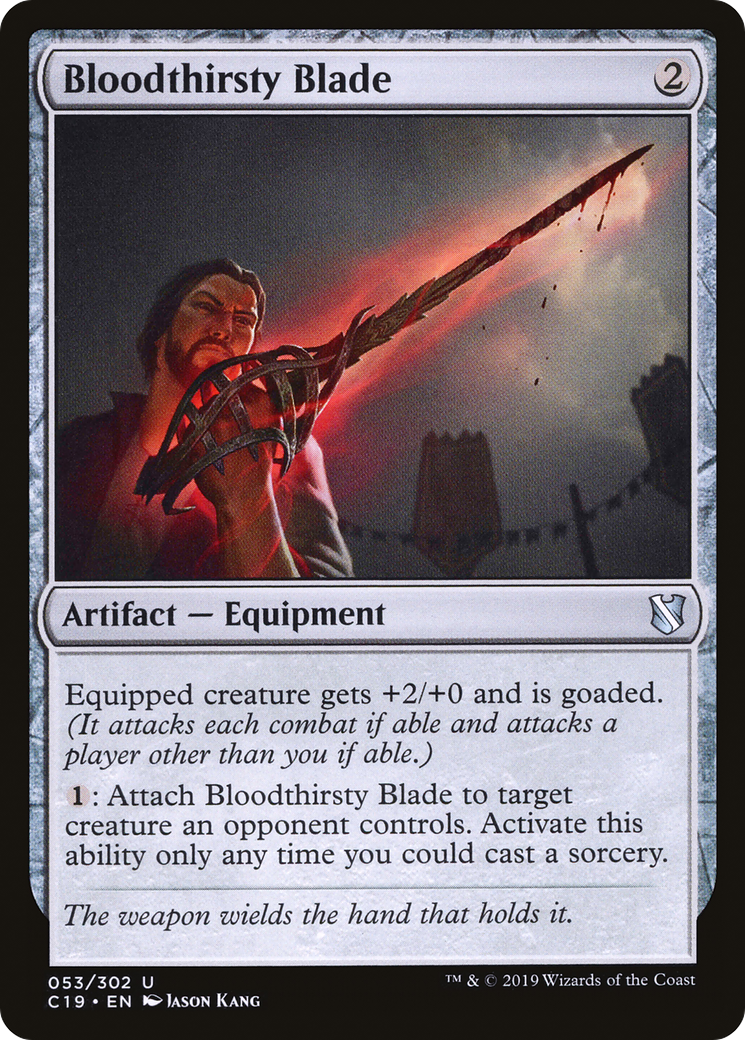
Bloodthirsty Blade
Bloodthirsty Blade
Artifact — Equipment
Equipped creature gets +2/+0 and is goaded. (It attacks each combat if able and attacks a player other than you if able.)
: Attach this Equipment to target creature an opponent controls. Activate only as a sorcery.
- If the creature doesn't meet any of the above exceptions and can attack, it must attack a player other than the controller of the spell or ability that goaded it if able. If the creature can't attack any of those players but could otherwise attack, it must attack a planeswalker an opponent controls, a battle an opponent controls, or a player who goaded it.
- Attacking with a goaded creature doesn't cause it to stop being goaded. If there is an additional combat phase that turn, or if another player gains control of it before it stops being goaded, it must attack again if able.
- If a creature you control has been goaded by multiple opponents, it must attack one of your opponents that hasn't goaded it, as that fulfills the maximum number of goad requirements. If a creature you control has been goaded by each of your opponents, the creature must attack an opponent (rather than a planeswalker or battle), but you choose which opponent it attacks.
- If, during a player's declare attackers step, a creature that player controls that's been goaded is tapped, is affected by a spell or ability that says it can't attack, or hasn't been under that player's control continuously since the turn began (and doesn't have haste), then it doesn't attack. If there's a cost associated with having a creature attack a player, its controller isn't forced to pay that cost, so it doesn't have to attack that player.
- Being goaded isn't an ability the creature has. Once it's been goaded, it must attack as detailed above even if it loses all abilities.
- You still control Bloodthirsty Blade while it's equipped to an opponent's creature. You can move it any time you could cast a sorcery; the equipped creature's controller can't.
- Bloodthirsty Blade has no equip ability. There's normally no way to have it attached to your own creature, although certain combinations of other cards make this possible.
-
1
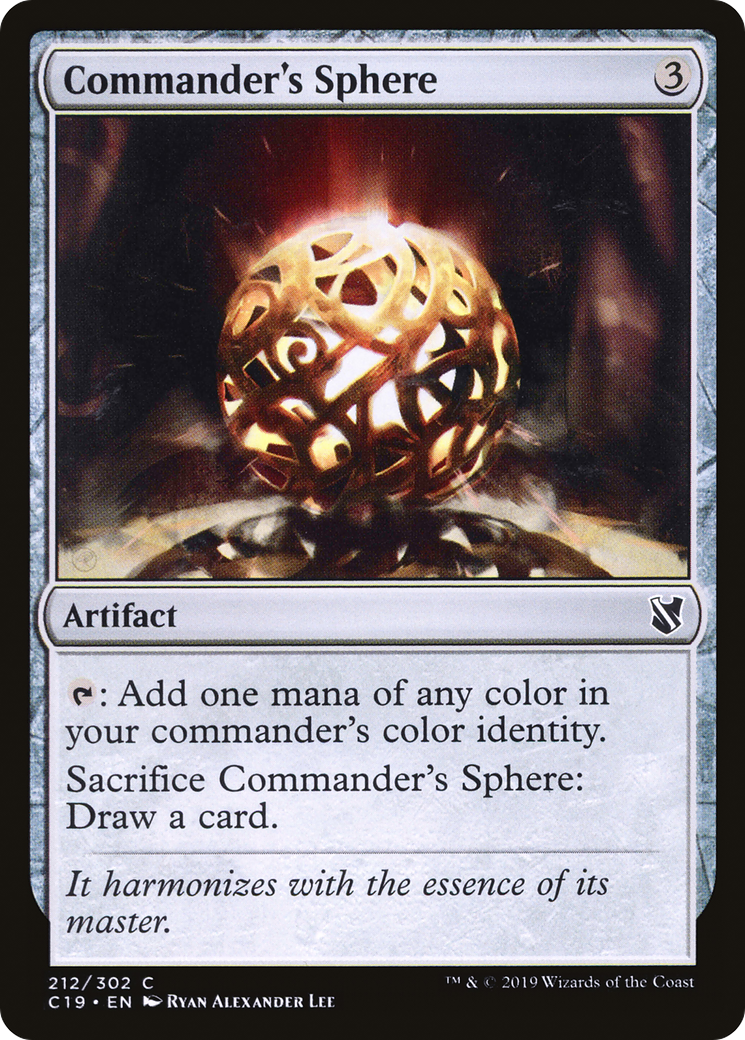
Commander's Sphere
Commander's Sphere
Artifact
: Add one mana of any color in your commander's color identity.
Sacrifice this artifact: Draw a card.
- If your commander is a card that has no colors in its color identity, Commander's Sphere's first ability produces no mana. It doesn't produce .
- If you don't have a commander, Commander's Sphere's first ability produces no mana.
- If you have two commanders, the ability adds one mana of any color in their combined color identities.
-
1
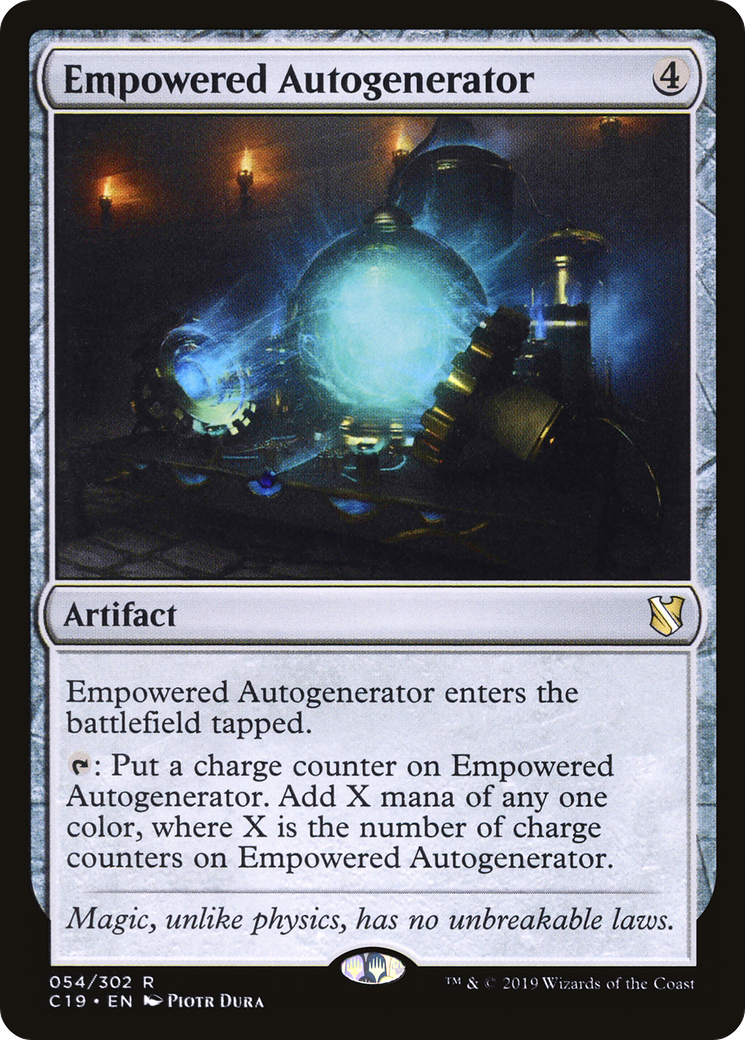
Empowered Autogenerator
Empowered Autogenerator
Artifact
This artifact enters tapped.
: Put a charge counter on this artifact. Add X mana of any one color, where X is the number of charge counters on this artifact.
- Empowered Autogenerator's activated ability is a mana ability. It doesn't use the stack and can't be responded to.
-
1
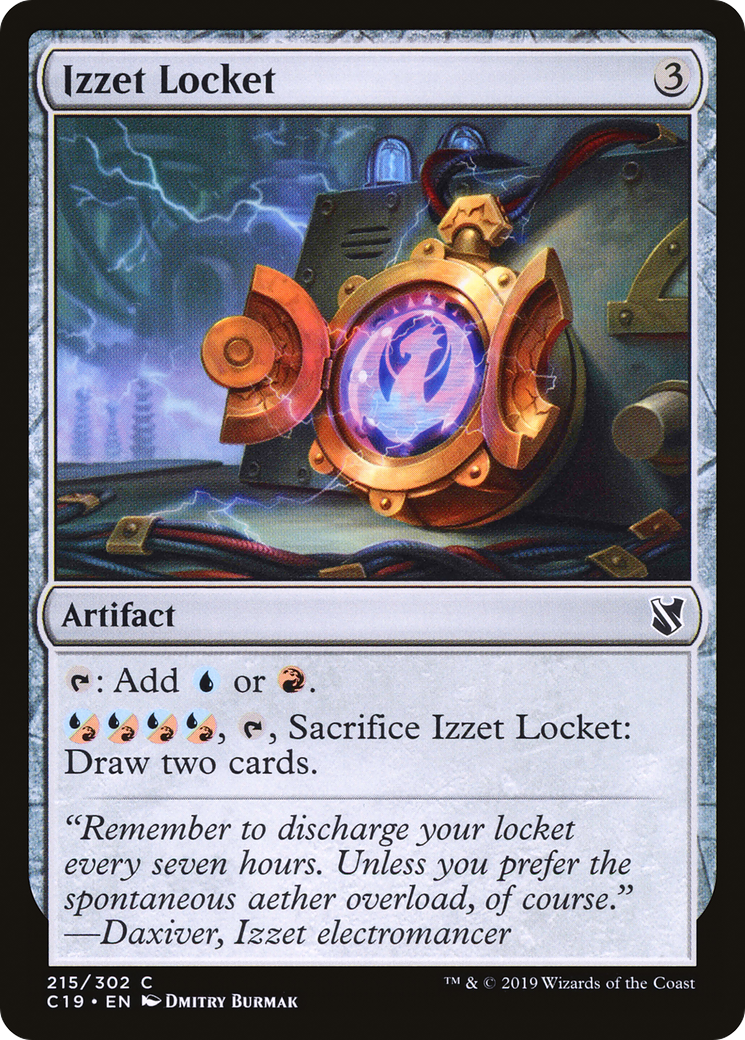
Izzet Locket
Izzet Locket
Artifact
: Add or .
, , Sacrifice this artifact: Draw two cards.
-
1
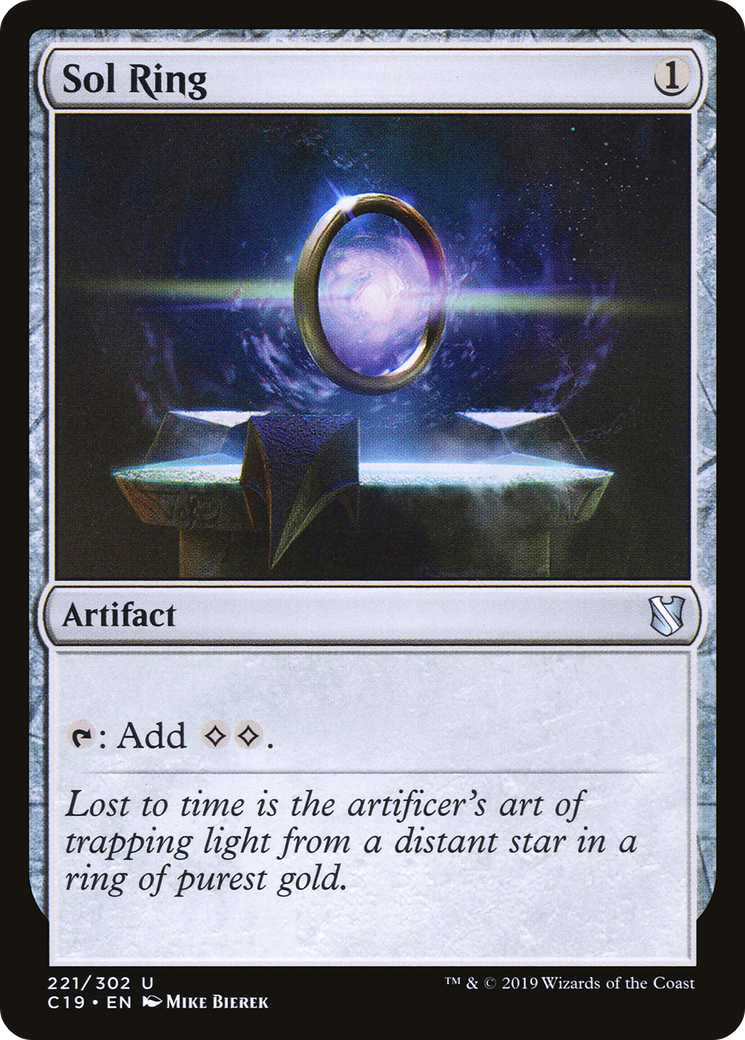
Sol Ring
Sol Ring
Artifact
: Add .
Enchantments 4
-
1
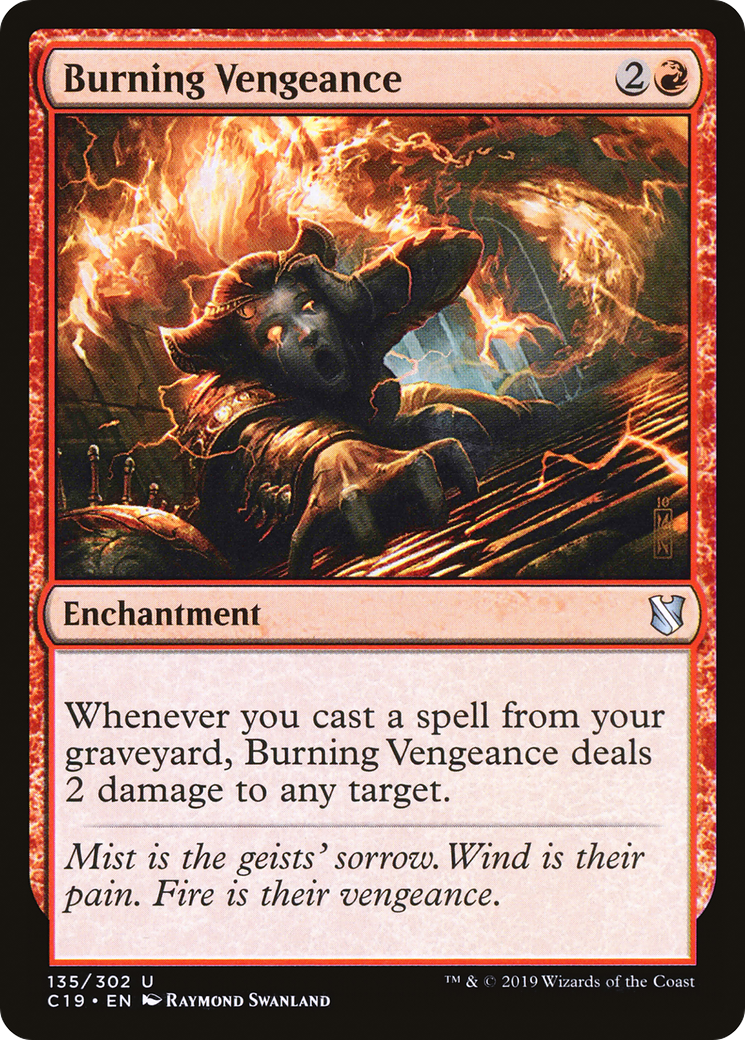
Burning Vengeance
Burning Vengeance
Enchantment
Whenever you cast a spell from your graveyard, this enchantment deals 2 damage to any target.
- Burning Vengeance doesn’t trigger when you activate an ability of a card in your graveyard, such as unearth or the ability of Reassembling Skeleton.
- Burning Vengeance’s triggered ability will resolve before the spell you cast from your graveyard.
-
1
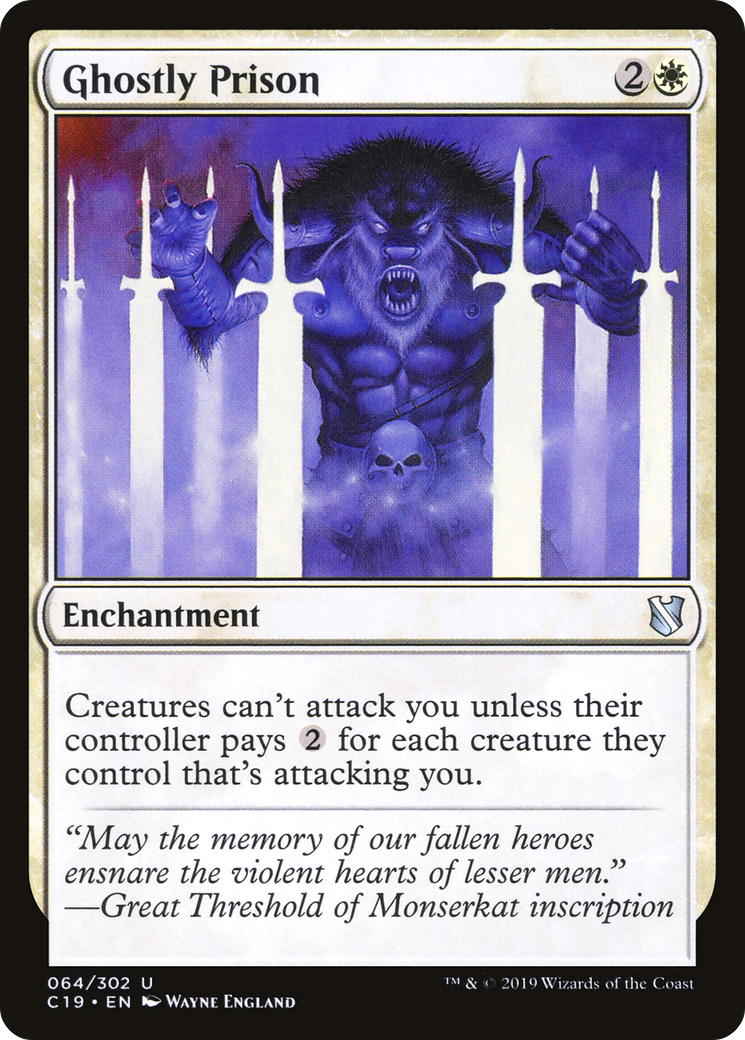
Ghostly Prison
Ghostly Prison
Enchantment
Creatures can't attack you unless their controller pays for each creature they control that's attacking you.
- Unless some effect explicitly says otherwise, a creature that can't attack you can still attack a planeswalker you control.
- In the Two-Headed Giant format, you still only have to pay once per creature.
-
1
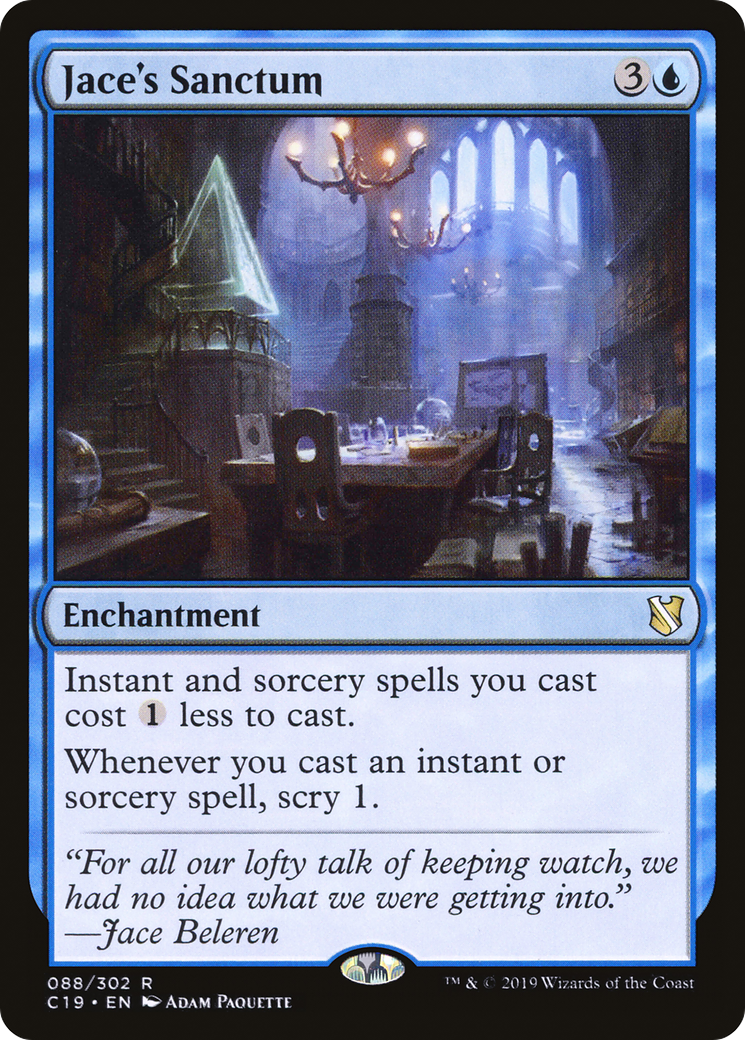
Jace's Sanctum
Jace's Sanctum
Enchantment
Instant and sorcery spells you cast cost less to cast.
Whenever you cast an instant or sorcery spell, scry 1.
- The first ability of Jace’s Sanctum can’t reduce the colored mana requirement of an instant or sorcery spell.
- If there are additional costs to cast an instant or sorcery spell, apply those before applying cost reductions.
- Jace’s Sanctum can reduce alternative costs such as miracle or overload costs.
- Jace’s Sanctum’s scry ability will resolve before the instant or sorcery spell that caused it to trigger.
-
1
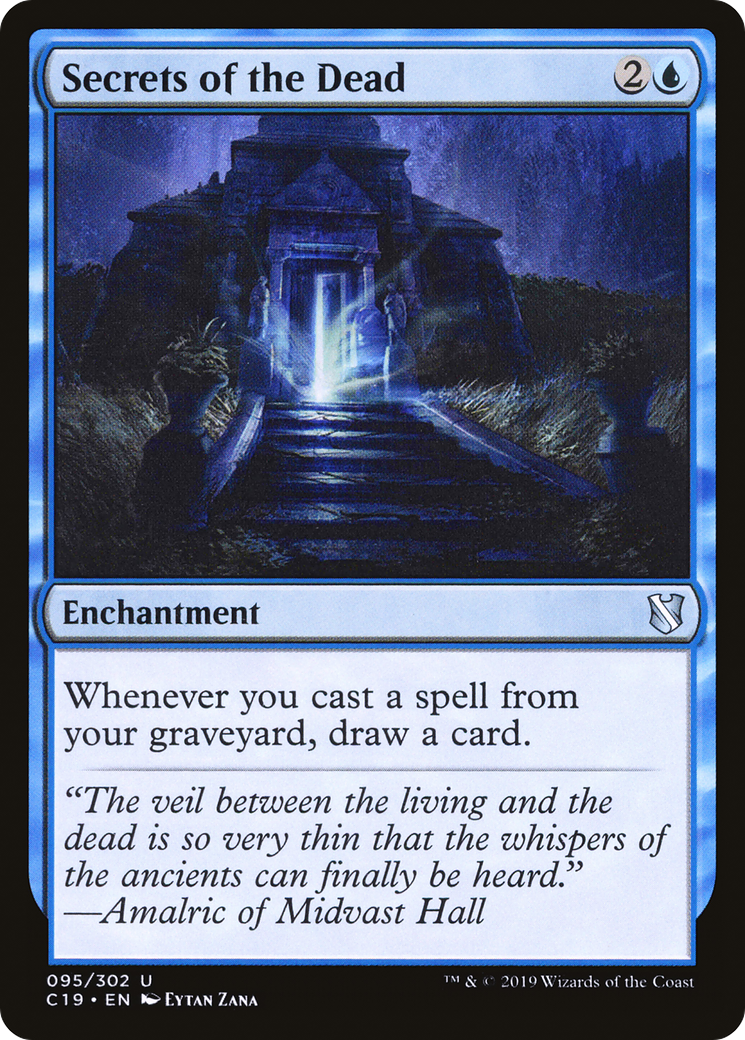
Secrets of the Dead
Secrets of the Dead
Enchantment
Whenever you cast a spell from your graveyard, draw a card.
- Secrets of the Dead’s triggered ability resolves before the spell you cast from your graveyard does.
Lands 40
-
1
Ash Barrens
Ash Barrens
Land
: Add .
Basic landcycling ( , Discard this card: Search your library for a basic land card, reveal it, put it into your hand, then shuffle.)
-
1
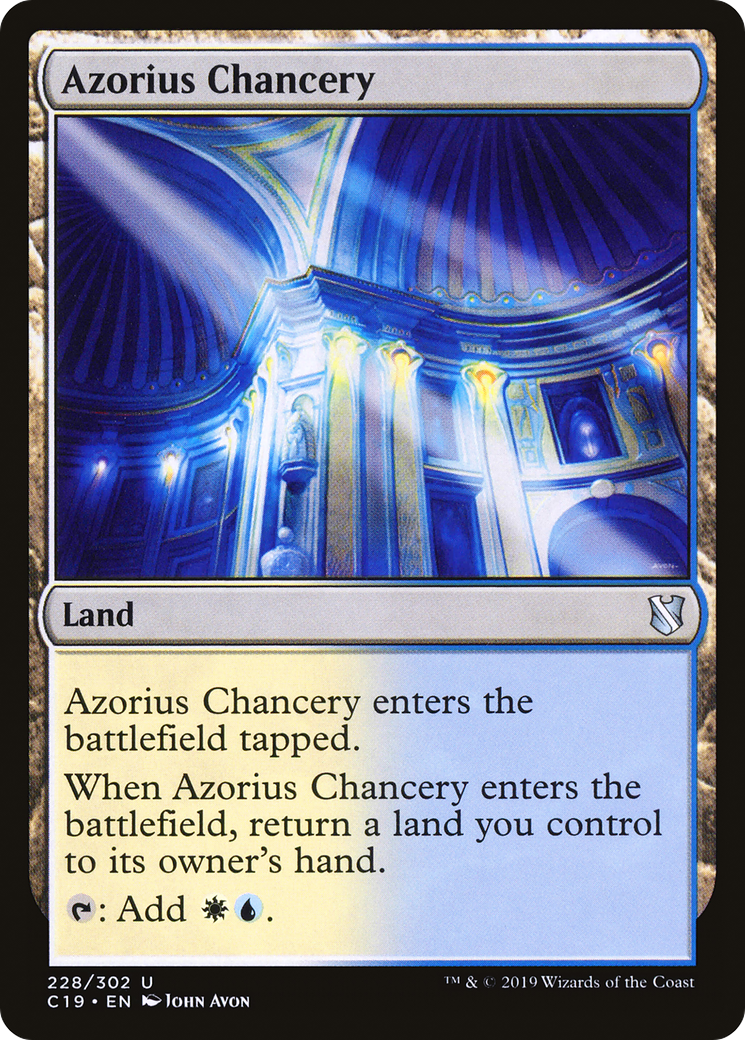
Azorius Chancery
Azorius Chancery
Land
This land enters tapped.
When this land enters, return a land you control to its owner's hand.
: Add .
- If this land enters the battlefield and you control no other lands, its ability will force you to return it to your hand.
-
1
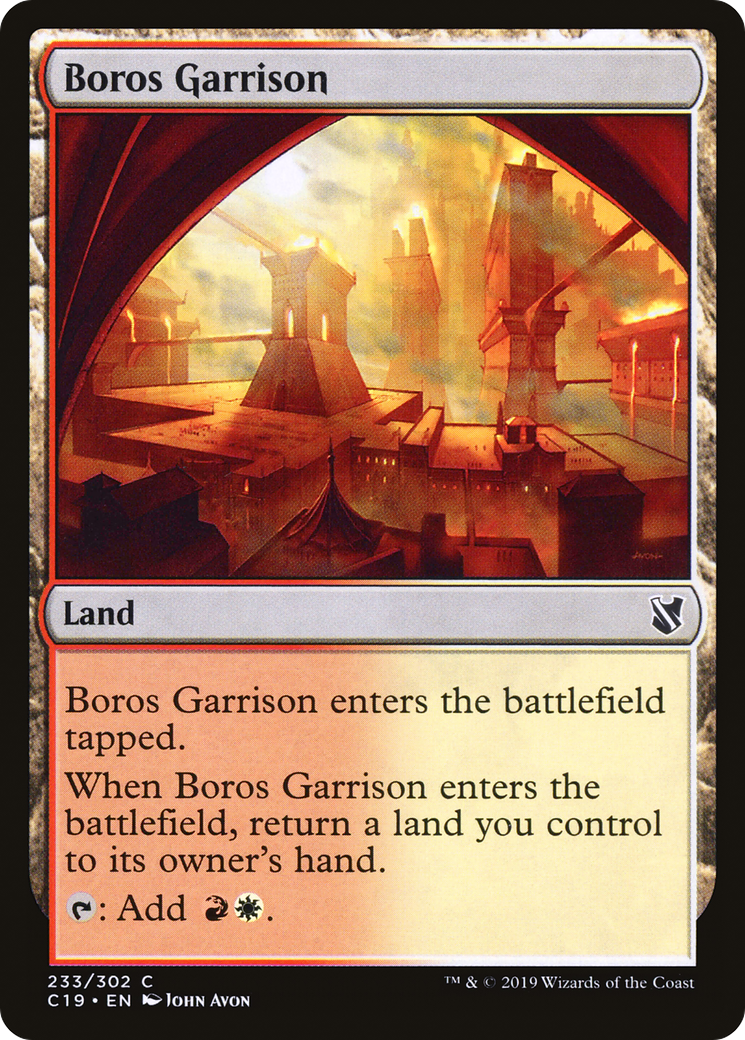
Boros Garrison
Boros Garrison
Land
This land enters tapped.
When this land enters, return a land you control to its owner's hand.
: Add .
- If this land enters the battlefield and you control no other lands, its ability will force you to return it to your hand.
-
1
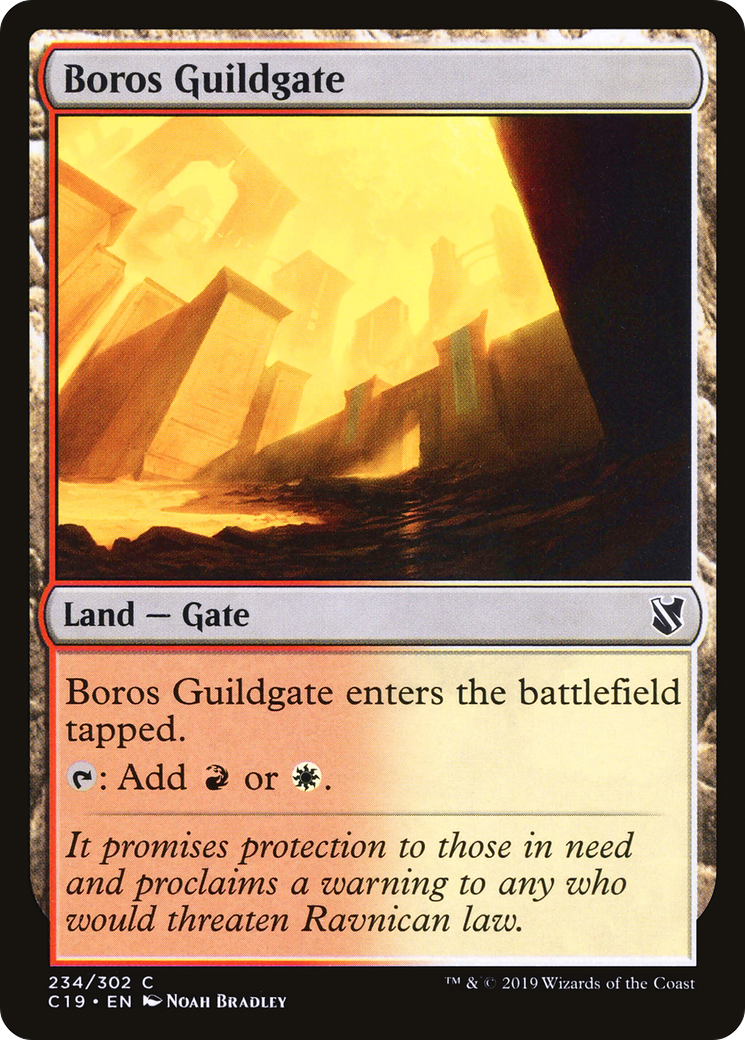
Boros Guildgate
Boros Guildgate
Land — Gate
This land enters tapped.
: Add or .
- The subtype Gate has no special rules significance, but other spells and abilities may refer to it.
- Gate is not a basic land type.
-
1
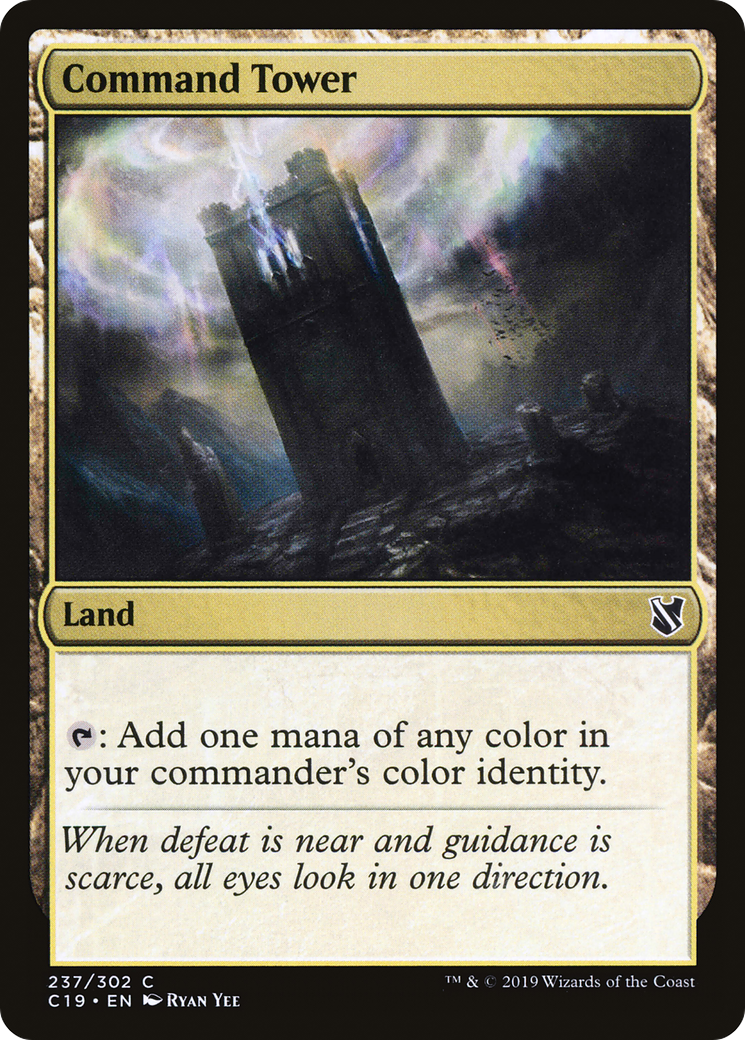
Command Tower
Command Tower
Land
: Add one mana of any color in your commander's color identity.
- If you don't have a commander, Command Tower's ability produces no mana.
- If your commander is a card that has no colors in its color identity, Command Tower's ability produces no mana. It doesn't produce .
- If you have two commanders, the ability adds one mana of any color in their combined color identities.
-
1
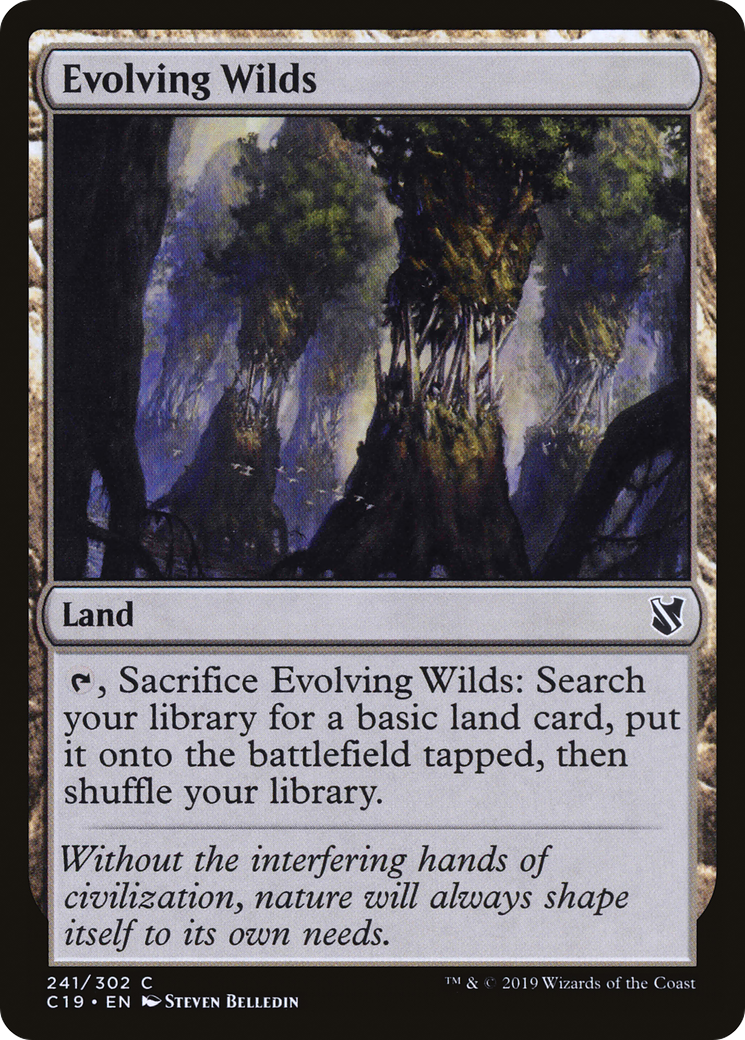
Evolving Wilds
Evolving Wilds
Land
, Sacrifice this land: Search your library for a basic land card, put it onto the battlefield tapped, then shuffle.
-
1
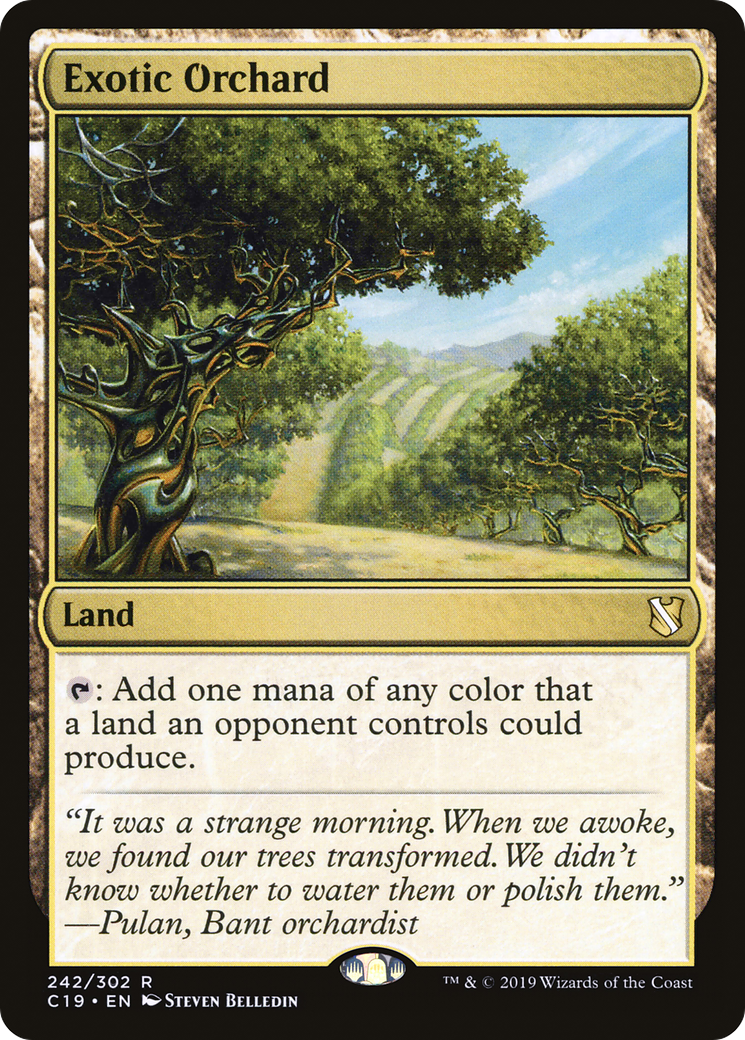
Exotic Orchard
Exotic Orchard
Land
: Add one mana of any color that a land an opponent controls could produce.
- Lands that produce mana based only on what other lands "could produce" won't help each other unless some other land allows one of them to actually produce some type of mana. For example, if you control an Exotic Orchard and your opponent controls an Exotic Orchard and a Reflecting Pool, none of those lands would produce mana if their mana abilities were activated. On the other hand, if you control a Forest and an Exotic Orchard, and your opponent controls an Exotic Orchard and a Reflecting Pool, then each of those lands can be tapped to produce . Your opponent's Exotic Orchard can produce because you control a Forest. Your Exotic Orchard and your opponent's Reflecting Pool can each produce because your opponent's Exotic Orchard can produce .
- When determining what colors of mana your opponents' lands could produce, Exotic Orchard takes into account any applicable replacement effects that would apply to those lands' mana abilities (such as Contamination's effect, for example). If there are more than one, consider them in any possible order.
- The colors of mana are white, blue, black, red, and green. Exotic Orchard can't be tapped for colorless mana, even if a land an opponent controls could produce colorless mana.
- Exotic Orchard doesn't care about any restrictions or riders your opponents' lands (such as Ancient Ziggurat or Hall of the Bandit Lord) put on the mana they produce. It just cares about colors of mana.
- Exotic Orchard checks the effects of all mana-producing abilities of lands your opponents control, but it doesn't check their costs. For example, Vivid Crag has the ability " , Remove a charge counter from Vivid Crag: Add one mana of any color." If an opponent controls Vivid Crag and you control Exotic Orchard, you can tap Exotic Orchard for any color of mana. It doesn't matter whether Vivid Crag has a charge counter on it, and it doesn't matter whether it's untapped.
-
1
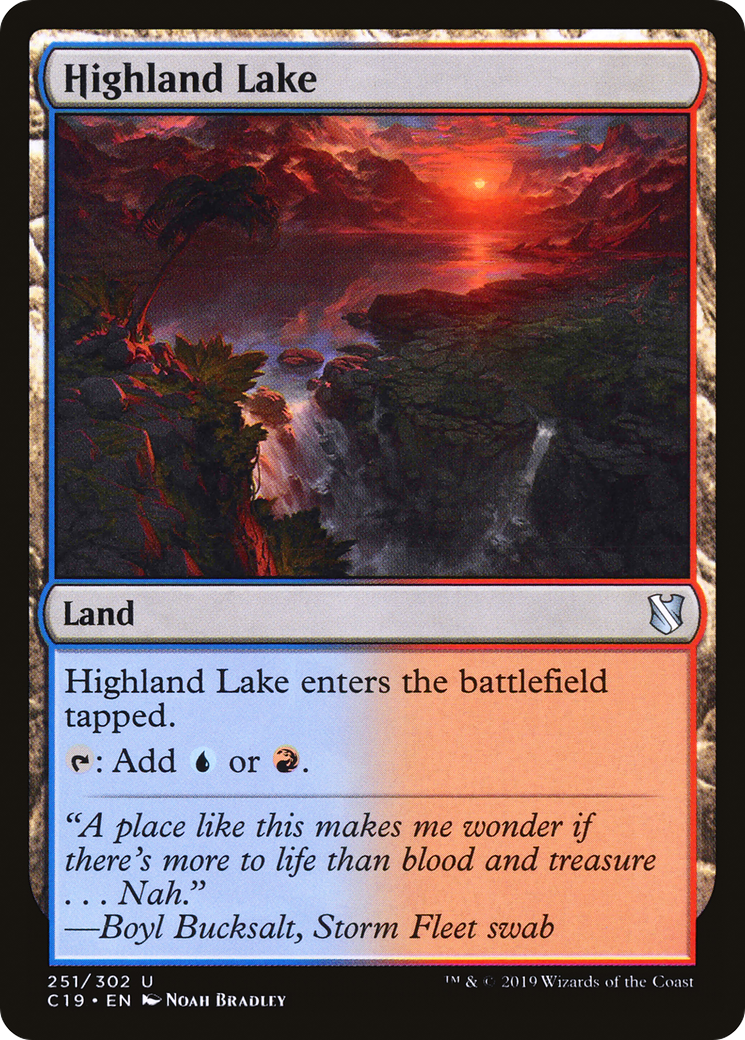
Highland Lake
Highland Lake
Land
This land enters tapped.
: Add or .
-
8
Island
Island
Basic Land — Island
( : Add .)
-
1
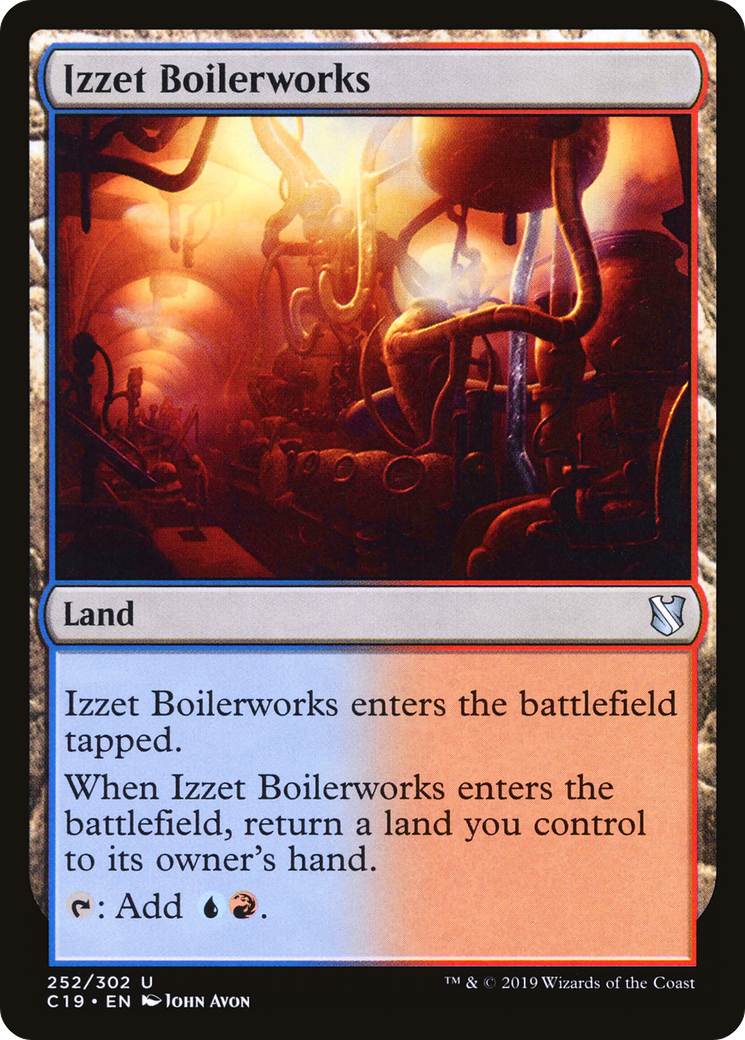
Izzet Boilerworks
Izzet Boilerworks
Land
This land enters tapped.
When this land enters, return a land you control to its owner's hand.
: Add .
- If this land enters the battlefield and you control no other lands, its ability will force you to return it to your hand.
-
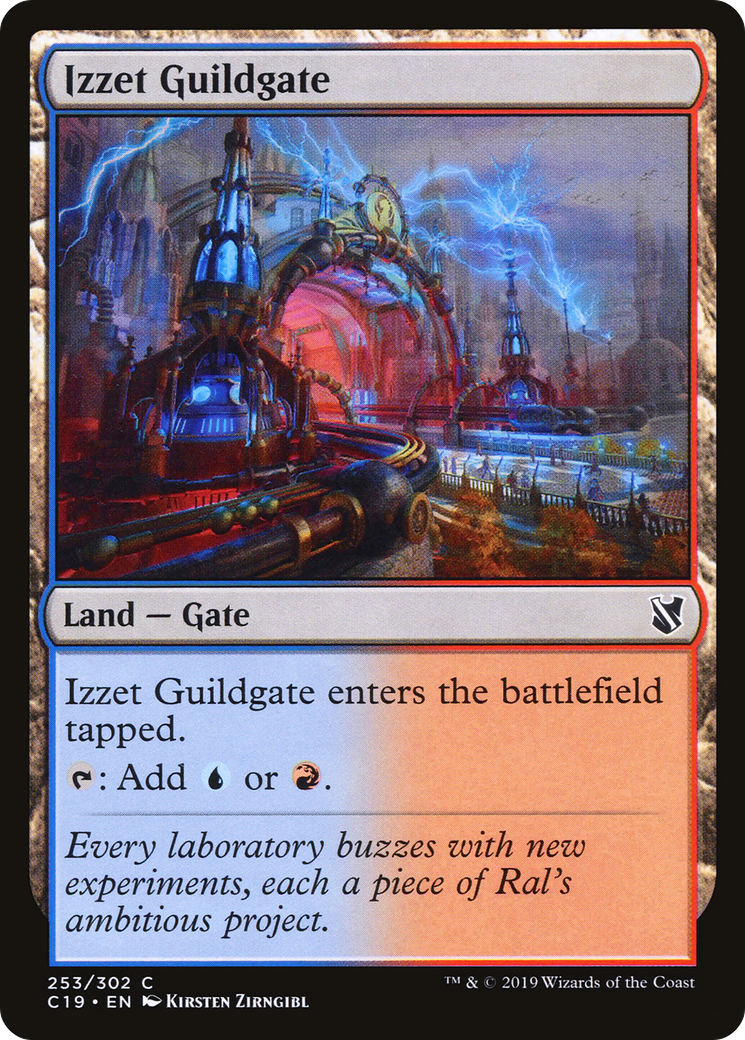
1
Izzet Guildgate
Izzet Guildgate
Land — Gate
This land enters tapped.
: Add or .
- The subtype Gate has no special rules significance, but other spells and abilities may refer to it.
- Gate is not a basic land type.
-
4
Mountain
Mountain
Basic Land — Mountain
( : Add .)
-
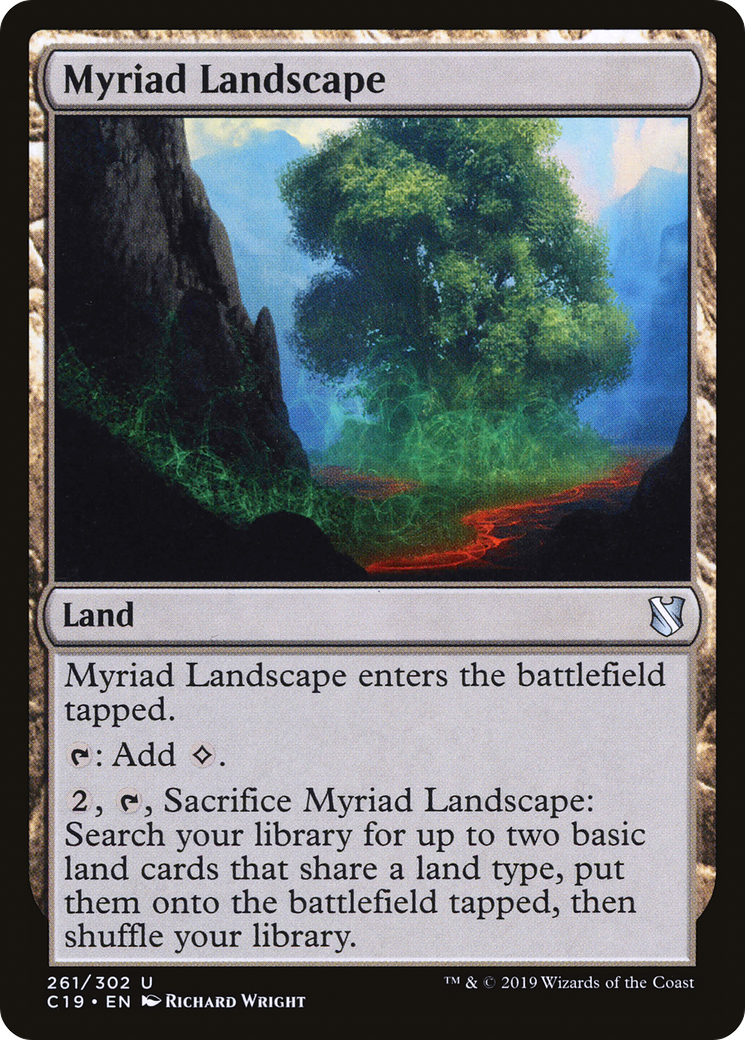
1
Myriad Landscape
Myriad Landscape
Land
This land enters tapped.
: Add .
, , Sacrifice this land: Search your library for up to two basic land cards that share a land type, put them onto the battlefield tapped, then shuffle.
- You can choose to find one basic land card with Myriad Landscape's last ability.
-
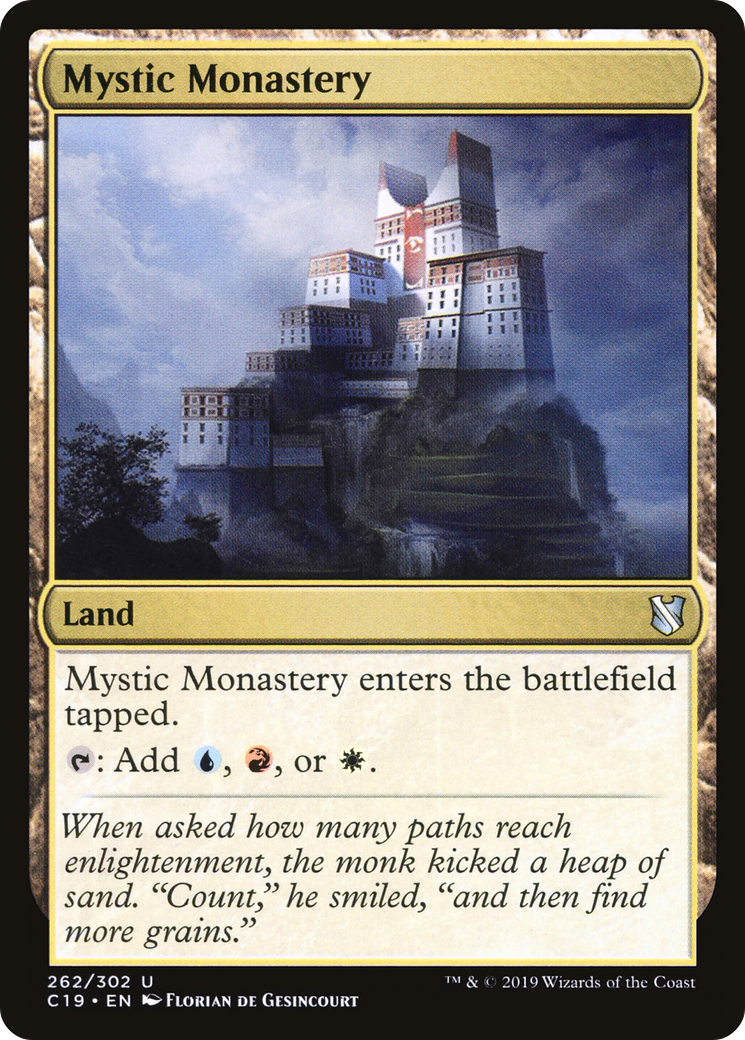
1
Mystic Monastery
Mystic Monastery
Land
This land enters tapped.
: Add , , or .
-
9
Plains
Plains
Basic Land — Plains
( : Add .)
-
1
Prairie Stream
Prairie Stream
Land — Plains Island
( : Add or .)
This land enters tapped unless you control two or more basic lands.
- Even though these lands have basic land types, they are not basic lands because "basic" doesn't appear on their type line. Notably, controlling two or more of them won't allow others to enter the battlefield untapped.
- However, because these cards have basic land types, effects that specify a basic land type without also specifying that the land be basic can affect them. For example, a spell or ability that reads "Destroy target Forest" can target Canopy Vista, while one that reads "Destroy target basic Forest" cannot.
- If one of these lands enters the battlefield at the same time as any number of basic lands, those other lands are not counted when determining if this land enters the battlefield tapped or untapped.
-
1
Stone Quarry
Stone Quarry
Land
This land enters tapped.
: Add or .
-
1
Swiftwater Cliffs
Swiftwater Cliffs
Land
This land enters tapped.
When this land enters, you gain 1 life.
: Add or .
-
1
Temple of the False God
Temple of the False God
Land
: Add . Activate only if you control five or more lands.
-
1
Terramorphic Expanse
Terramorphic Expanse
Land
, Sacrifice this land: Search your library for a basic land card, put it onto the battlefield tapped, then shuffle.
-
1
Tranquil Cove
Tranquil Cove
Land
This land enters tapped.
When this land enters, you gain 1 life.
: Add or .
-
1
Wind-Scarred Crag
Wind-Scarred Crag
Land
This land enters tapped.
When this land enters, you gain 1 life.
: Add or .
White 15
-
1
Cliffside Rescuer
Cliffside Rescuer
Creature — Kor Soldier
2/2
Vigilance
, Sacrifice this creature: Target permanent you control gains protection from each of your opponents until end of turn. (It can't be blocked, targeted, dealt damage, enchanted, or equipped by anything controlled by those players.)
- The players that the target permanent has protection from are determined as Cliffside Rescuer’s ability resolves. If an opponent somehow gains control of that permanent later in the turn, it still has protection from your opponents, including its new controller.
- Protection from a player means that the permanent has protection from each object controlled by that player. If an object has no controller (such as a card in a graveyard), its owner is considered its controller for this purpose.
-
1
Divine Reckoning
Divine Reckoning
Sorcery
Each player chooses a creature they control. Destroy the rest.
Flashback (You may cast this card from your graveyard for its flashback cost. Then exile it.)
- To determine the total cost of a spell, start with the mana cost or alternative cost (such as a flashback cost) you're paying, add any cost increases, then apply any cost reductions. The mana value of the spell is determined only by its mana cost, no matter what the total cost to cast the spell was.
- "Flashback [cost]" means "You may cast this card from your graveyard by paying [cost] rather than paying its mana cost" and "If the flashback cost was paid, exile this card instead of putting it anywhere else any time it would leave the stack."
- You must still follow any timing restrictions and permissions, including those based on the card's type. For instance, you can cast a sorcery using flashback only when you could normally cast a sorcery.
- If a card with flashback is put into your graveyard during your turn, you can cast it if it's legal to do so before any other player can take any actions.
- A spell cast using flashback will always be exiled afterward, whether it resolves, is countered, or leaves the stack in some other way.
- You can cast a spell using flashback even if it was somehow put into your graveyard without having been cast.
- Starting with the player whose turn it is, each player chooses a creature in turn order. Players will know the choice of each player who chose before them.
-
1
Dusk // Dawn
//
Dusk
Sorcery
- Once you've started to cast a spell with aftermath from your graveyard, the card is immediately moved to the stack. Opponents can't try to stop the ability by exiling the card with an effect such as that of Crook of Condemnation.
- All split cards have two card faces on a single card, and you put a split card onto the stack with only the half you're casting. The characteristics of the half of the card you didn't cast are ignored while the spell is on the stack. For example, if an effect prevents you from casting green spells, you can cast Destined of Destined // Lead, but not Lead.
- Each split card is a single card. For example, if you discard one, you've discarded one card, not two. If an effect counts the number of instant and sorcery cards in your graveyard, Destined // Lead counts once, not twice.
- Each split card has two names. If an effect instructs you to choose a card name, you may choose one, but not both.
- While not on the stack, the characteristics of a split card are the combination of its two halves. For example, Destined // Lead is a green and black card, it is both an instant card and a sorcery card, and its mana value is 6. This means that if an effect allows you to cast a card with mana value 2 from your hand, you can't cast Destined. This is a change from the previous rules for split cards.
- Split cards with aftermath have a new frame treatment—the half you can cast from your hand is oriented the same as other cards you'd cast from your hand, while the half you can cast from your graveyard is a traditional split card half. This frame treatment is for your convenience and has no rules significance.
- If another effect allows you to cast a split card with aftermath from any zone other than a graveyard, you can't cast the half with aftermath.
- If another effect allows you to cast a split card with aftermath from a graveyard, you may cast either half. If you cast the half that has aftermath, you'll exile the card if it would leave the stack.
- A spell with aftermath cast from a graveyard will always be exiled afterward, whether it resolves, it's countered, or it leaves the stack in some other way.
- If you cast the first half of a split card with aftermath during your turn, you'll have priority immediately after it resolves. You can cast the half with aftermath from your graveyard before any player can take any other action if it's legal for you to do so.
-
1
Ghostly Prison
Ghostly Prison
Enchantment
Creatures can't attack you unless their controller pays for each creature they control that's attacking you.
- Unless some effect explicitly says otherwise, a creature that can't attack you can still attack a planeswalker you control.
- In the Two-Headed Giant format, you still only have to pay once per creature.
-
1
Increasing Devotion
Increasing Devotion
Sorcery
Create five 1/1 white Human creature tokens. If this spell was cast from a graveyard, create ten of those tokens instead.
Flashback (You may cast this card from your graveyard for its flashback cost. Then exile it.)
- "Flashback [cost]" means "You may cast this card from your graveyard by paying [cost] rather than paying its mana cost" and "If the flashback cost was paid, exile this card instead of putting it anywhere else any time it would leave the stack."
- You must still follow any timing restrictions and permissions, including those based on the card's type. For instance, you can cast a sorcery using flashback only when you could normally cast a sorcery.
- To determine the total cost of a spell, start with the mana cost or alternative cost (such as a flashback cost) you're paying, add any cost increases, then apply any cost reductions. The mana value of the spell is determined only by its mana cost, no matter what the total cost to cast the spell was.
- A spell cast using flashback will always be exiled afterward, whether it resolves, is countered, or leaves the stack in some other way.
- You can cast a spell using flashback even if it was somehow put into your graveyard without having been cast.
- If a card with flashback is put into your graveyard during your turn, you can cast it if it's legal to do so before any other player can take any actions.
-
1
Mandate of Peace
Mandate of Peace
Instant
Cast this spell only during combat.
Your opponents can't cast spells this turn.
End the combat phase. (Remove all attackers and blockers from combat. Exile all spells and abilities from the stack, including this spell.)
- Though other spells and abilities that are exiled won’t get a chance to resolve, they don’t count as being countered.
- If any triggered abilities trigger during this process, they’re put onto the stack after the game skips to the appropriate phase or step.
- Any “at end of combat” triggered abilities won’t get the chance to trigger that combat because the end of combat step is skipped.
- If an effect allows or instructs you to cast Mandate of Peace outside of a combat phase, you can’t do so. Its restriction takes precedence over that permission. Similarly, once Mandate of Peace has resolved, your opponents can’t cast spells even if another effect allows or instructs one of them to cast a spell.
- Mandate of Peace doesn’t stop any player from casting spells in response to Mandate of Peace before it resolves.
- Your opponents can still activate abilities, including abilities of cards in their hand (such as cycling abilities), and can still play lands.
- Ending the combat phase this way means the following things happen in order: 1) All spells and abilities on the stack are exiled. This includes spells and abilities that can’t be countered. 2) State-based actions are checked. No player gets priority, and no triggered abilities are put onto the stack. 3) The current phase and step ends. The game skips straight to the postcombat main phase. As this happens, all attacking and blocking creatures are removed from combat and effects that last “until end of combat” expire.
- In the rare case that the postcombat main phase is skipped, the game skips to the end step of the ending phase. If that step is also skipped, the game skips straight to the turn’s cleanup step. The cleanup step can’t be skipped.
-
1
Prismatic Strands
Prismatic Strands
Instant
Prevent all damage that sources of the color of your choice would deal this turn.
Flashback—Tap an untapped white creature you control. (You may cast this card from your graveyard for its flashback cost. Then exile it.)
- "Flashback [cost]" means "You may cast this card from your graveyard by paying [cost] rather than paying its mana cost" and "If the flashback cost was paid, exile this card instead of putting it anywhere else any time it would leave the stack."
- You must still follow any timing restrictions and permissions, including those based on the card's type. For instance, you can cast a sorcery using flashback only when you could normally cast a sorcery.
- To determine the total cost of a spell, start with the mana cost or alternative cost (such as a flashback cost) you're paying, add any cost increases, then apply any cost reductions. The mana value of the spell is determined only by its mana cost, no matter what the total cost to cast the spell was.
- A spell cast using flashback will always be exiled afterward, whether it resolves, is countered, or leaves the stack in some other way.
- You can cast a spell using flashback even if it was somehow put into your graveyard without having been cast.
- If a card with flashback is put into your graveyard during your turn, you can cast it if it's legal to do so before any other player can take any actions.
-
1
Pristine Angel
Pristine Angel
Creature — Angel
4/4
Flying
As long as this creature is untapped, it has protection from artifacts and from each color.
Whenever you cast a spell, you may untap this creature.
-
1
Purify the Grave
Purify the Grave
Instant
Exile target card from a graveyard.
Flashback (You may cast this card from your graveyard for its flashback cost. Then exile it.)
- If a card with flashback is put into your graveyard during your turn, you can cast it if it's legal to do so before any other player can take any actions.
- A spell cast using flashback will always be exiled afterward, whether it resolves, is countered, or leaves the stack in some other way.
- You can cast a spell using flashback even if it was somehow put into your graveyard without having been cast.
- "Flashback [cost]" means "You may cast this card from your graveyard by paying [cost] rather than paying its mana cost" and "If the flashback cost was paid, exile this card instead of putting it anywhere else any time it would leave the stack."
- You must still follow any timing restrictions and permissions, including those based on the card's type. For instance, you can cast a sorcery using flashback only when you could normally cast a sorcery.
- To determine the total cost of a spell, start with the mana cost or alternative cost (such as a flashback cost) you're paying, add any cost increases, then apply any cost reductions. The mana value of the spell is determined only by its mana cost, no matter what the total cost to cast the spell was.
- If it's your turn, and you cast a spell with flashback from your hand, you'll have priority to cast that spell again using flashback before any other player has priority to cast Purify the Grave in order to remove that card from your graveyard.
- Purify the Grave can't be used in response to a spell being cast with flashback or a spell that requires cards to exiled from a graveyard as an additional cost to try and counter the spell or prevent it from being cast.
-
1
Ray of Distortion
Ray of Distortion
Instant
Destroy target artifact or enchantment.
Flashback (You may cast this card from your graveyard for its flashback cost. Then exile it.)
- "Flashback [cost]" means "You may cast this card from your graveyard by paying [cost] rather than paying its mana cost" and "If the flashback cost was paid, exile this card instead of putting it anywhere else any time it would leave the stack."
- You must still follow any timing restrictions and permissions, including those based on the card's type. For instance, you can cast a sorcery using flashback only when you could normally cast a sorcery.
- To determine the total cost of a spell, start with the mana cost or alternative cost (such as a flashback cost) you're paying, add any cost increases, then apply any cost reductions. The mana value of the spell is determined only by its mana cost, no matter what the total cost to cast the spell was.
- A spell cast using flashback will always be exiled afterward, whether it resolves, is countered, or leaves the stack in some other way.
- You can cast a spell using flashback even if it was somehow put into your graveyard without having been cast.
- If a card with flashback is put into your graveyard during your turn, you can cast it if it's legal to do so before any other player can take any actions.
-
1
Sevinne's Reclamation
Sevinne's Reclamation
Sorcery
Return target permanent card with mana value 3 or less from your graveyard to the battlefield. If this spell was cast from a graveyard, you may copy this spell and may choose a new target for the copy.
Flashback (You may cast this card from your graveyard for its flashback cost. Then exile it.)
- A spell cast using flashback will always be exiled afterward, whether it resolves, is countered, or leaves the stack in some other way.
- You can cast a spell using flashback even if it was somehow put into your graveyard without having been cast.
- To determine the total cost of a spell, start with the mana cost or alternative cost (such as a flashback cost) you're paying, add any cost increases, then apply any cost reductions. The mana value of the spell is determined only by its mana cost, no matter what the total cost to cast the spell was.
- You must still follow any timing restrictions and permissions, including those based on the card's type. For instance, you can cast a sorcery using flashback only when you could normally cast a sorcery.
- "Flashback [cost]" means "You may cast this card from your graveyard if the resulting spell is an instant or sorcery spell by paying [cost] rather than paying its mana cost" and "If the flashback cost was paid, exile this card instead of putting it anywhere else any time it would leave the stack."
- If a card with flashback is put into your graveyard during your turn, you can cast it if it's legal to do so before any other player can take any actions.
- A permanent card is an artifact, battle, creature, enchantment, land, or planeswalker card.
- The copy that Sevinne's Reclamation creates is created on the stack, so it's not "cast." Abilities that trigger when a player casts a spell won't trigger. The copy wasn't cast from a graveyard, so it won't make another copy of itself.
- If you cast Sevinne's Reclamation from your graveyard, any abilities that trigger as the permanent card returns to the battlefield will resolve before the copy of Sevinne's Reclamation resolves but after new targets for the copy have been chosen.
- If a card in a graveyard has in its mana cost, X is considered to be 0.
- If the target card is an illegal target by the time Sevinne's Reclamation tries to resolve, the spell doesn't resolve. You won't copy it if you cast it from a graveyard.
-
1
Storm Herd
Storm Herd
Sorcery
Create X 1/1 white Pegasus creature tokens with flying, where X is your life total.
-
1
Sun Titan
Sun Titan
Creature — Giant
6/6
Vigilance
Whenever this creature enters or attacks, you may return target permanent card with mana value 3 or less from your graveyard to the battlefield.
- A permanent card is an artifact, creature, enchantment, land, or planeswalker card.
- If a card in your graveyard has no mana symbols in its upper right corner (because it's a land card, for example), its mana value is 0.
- The mana value of a card in your graveyard is determined solely by the mana symbols printed in its upper right corner. The mana value is the total amount of mana in that cost, regardless of color. For example, a card with mana cost has mana value 5.
- If the mana cost of a card in your graveyard includes , X is considered to be 0.
-
1
Thalia's Geistcaller
Thalia's Geistcaller
Creature — Human Cleric
3/1
Lifelink
Whenever you cast a spell from your graveyard, create a 1/1 white Spirit creature token with flying.
Sacrifice a Spirit: This creature gains indestructible until end of turn.
- The triggered ability of Thalia's Geistcaller will resolve before the spell that caused it to trigger but after targets have been chosen for that spell. It resolves even if that spell is countered.
- You can sacrifice any Spirit you control to activate the last ability of Thalia's Geistcaller, not just a Spirit token it created.
-
1
Zetalpa, Primal Dawn
Zetalpa, Primal Dawn
Legendary Creature — Elder Dinosaur
4/8
Flying, double strike, vigilance, trample, indestructible
- If an attacking creature with double strike and trample destroys all of its blocking creatures with first-strike combat damage, all of its normal combat damage is assigned to the player, planeswalker, or battle that creature's attacking.
Blue 18
-
1
Chemister's Insight
Chemister's Insight
Instant
Draw two cards.
Jump-start (You may cast this card from your graveyard by discarding a card in addition to paying its other costs. Then exile this card.)
- If a card with jump-start is put into your graveyard during your turn, you'll be able to cast it right away if it's legal to do so, before an opponent can take any actions.
- You must still follow any timing restrictions and permissions when casting a spell with jump-start, including those based on the card's type. For instance, you can cast a sorcery using jump-start only when you could normally cast a sorcery.
- A spell cast using jump-start will always be exiled afterward, whether it resolves, it's countered, or it leaves the stack in some other way.
- If an effect allows you to pay an alternative cost rather than a spell's mana cost, you may pay that alternative cost when you jump-start a spell. You'll still discard a card as an additional cost to cast it.
-
1
Clever Impersonator
Clever Impersonator
Creature — Shapeshifter
0/0
You may have this creature enter as a copy of any nonland permanent on the battlefield.
- Remember that if you control more than one legendary permanent with the same name, you'll choose one to remain on the battlefield and put the rest into their owner's graveyard.
- If Clever Impersonator enters the battlefield as a copy of a planeswalker, it will enter the battlefield with a number of loyalty counters on it equal to the loyalty printed in the lower right corner of the planeswalker card. It won't copy the number of loyalty counters on the original planeswalker.
- Clever Impersonator copies exactly what is printed on the chosen permanent (unless that permanent is copying something else or is a token; see below). It doesn't copy whether that permanent is tapped or untapped, whether that permanent has any counters on it or any Auras and/or Equipment attached to it, and it doesn't copy any non-copy effects that have changed that permanent's power, toughness, types, color, abilities, or so on.
- If the chosen permanent has in its mana cost, X is considered to be 0.
- Any enters-the-battlefield abilities of the chosen permanent will trigger when Clever Impersonator enters the battlefield. Any "as [this permanent] enters the battlefield" or "[this permanent] enters the battlefield with" abilities of the chosen permanent will also work.
- You can choose not to copy anything. In that case, Clever Impersonator enters the battlefield as a 0/0 creature, and it's put into the graveyard immediately (unless something is raising its toughness above 0).
- You choose which nonland permanent Clever Impersonator will copy, if any, as it enters the battlefield. This doesn't target that nonland permanent.
- If the chosen permanent is a copy of something else (for example, if the chosen permanent is another Clever Impersonator), then your Clever Impersonator enters the battlefield as whatever the chosen permanent copied.
- If the chosen permanent is a token, Clever Impersonator copies the original characteristics of that token as defined by the effect that put that token onto the battlefield. Clever Impersonator is not a token.
- If Clever Impersonator enters the battlefield at the same time as another permanent, it can't become a copy of that permanent. You may choose only a nonland permanent that's already on the battlefield.
-
1
Deep Analysis
Deep Analysis
Sorcery
Target player draws two cards.
Flashback— , Pay 3 life. (You may cast this card from your graveyard for its flashback cost. Then exile it.)
- A spell cast using flashback will always be exiled afterward, whether it resolves, is countered, or leaves the stack in some other way.
- You must still follow any timing restrictions and permissions, including those based on the card's type. For instance, you can cast a sorcery using flashback only when you could normally cast a sorcery.
- You can cast a spell using flashback even if it was somehow put into your graveyard without having been cast.
- To determine the total cost of a spell, start with the mana cost or alternative cost (such as a flashback cost) you're paying, add any cost increases, then apply any cost reductions. The mana value of the spell is determined only by its mana cost, no matter what the total cost to cast the spell was.
- If a card with flashback is put into your graveyard during your turn, you can cast it if it's legal to do so before any other player can take any actions.
- "Flashback [cost]" means "You may cast this card from your graveyard by paying [cost] rather than paying its mana cost" and "If the flashback cost was paid, exile this card instead of putting it anywhere else any time it would leave the stack."
-
1
Fact or Fiction
Fact or Fiction
Instant
Reveal the top five cards of your library. An opponent separates those cards into two piles. Put one pile into your hand and the other into your graveyard.
- Piles may be empty.
-
1
Farm // Market
//
Farm
Instant
- Once you've started to cast a spell with aftermath from your graveyard, the card is immediately moved to the stack. Opponents can't try to stop the ability by exiling the card with an effect such as that of Crook of Condemnation.
- All split cards have two card faces on a single card, and you put a split card onto the stack with only the half you're casting. The characteristics of the half of the card you didn't cast are ignored while the spell is on the stack. For example, if an effect prevents you from casting green spells, you can cast Destined of Destined // Lead, but not Lead.
- Each split card is a single card. For example, if you discard one, you've discarded one card, not two. If an effect counts the number of instant and sorcery cards in your graveyard, Destined // Lead counts once, not twice.
- Each split card has two names. If an effect instructs you to choose a card name, you may choose one, but not both.
- While not on the stack, the characteristics of a split card are the combination of its two halves. For example, Destined // Lead is a green and black card, it is both an instant card and a sorcery card, and its mana value is 6. This means that if an effect allows you to cast a card with mana value 2 from your hand, you can't cast Destined. This is a change from the previous rules for split cards.
- Split cards with aftermath have a new frame treatment—the half you can cast from your hand is oriented the same as other cards you'd cast from your hand, while the half you can cast from your graveyard is a traditional split card half. This frame treatment is for your convenience and has no rules significance.
- If another effect allows you to cast a split card with aftermath from any zone other than a graveyard, you can't cast the half with aftermath.
- If another effect allows you to cast a split card with aftermath from a graveyard, you may cast either half. If you cast the half that has aftermath, you'll exile the card if it would leave the stack.
- A spell with aftermath cast from a graveyard will always be exiled afterward, whether it resolves, it's countered, or it leaves the stack in some other way.
- If you cast the first half of a split card with aftermath during your turn, you'll have priority immediately after it resolves. You can cast the half with aftermath from your graveyard before any player can take any other action if it's legal for you to do so.
-
1
Fervent Denial
Fervent Denial
Instant
Counter target spell.
Flashback (You may cast this card from your graveyard for its flashback cost. Then exile it.)
- "Flashback [cost]" means "You may cast this card from your graveyard by paying [cost] rather than paying its mana cost" and "If the flashback cost was paid, exile this card instead of putting it anywhere else any time it would leave the stack."
- You must still follow any timing restrictions and permissions, including those based on the card's type. For instance, you can cast a sorcery using flashback only when you could normally cast a sorcery.
- To determine the total cost of a spell, start with the mana cost or alternative cost (such as a flashback cost) you're paying, add any cost increases, then apply any cost reductions. The mana value of the spell is determined only by its mana cost, no matter what the total cost to cast the spell was.
- A spell cast using flashback will always be exiled afterward, whether it resolves, is countered, or leaves the stack in some other way.
- You can cast a spell using flashback even if it was somehow put into your graveyard without having been cast.
- If a card with flashback is put into your graveyard during your turn, you can cast it if it's legal to do so before any other player can take any actions.
-
1
Jace's Sanctum
Jace's Sanctum
Enchantment
Instant and sorcery spells you cast cost less to cast.
Whenever you cast an instant or sorcery spell, scry 1.
- The first ability of Jace’s Sanctum can’t reduce the colored mana requirement of an instant or sorcery spell.
- If there are additional costs to cast an instant or sorcery spell, apply those before applying cost reductions.
- Jace’s Sanctum can reduce alternative costs such as miracle or overload costs.
- Jace’s Sanctum’s scry ability will resolve before the instant or sorcery spell that caused it to trigger.
-
1
Leadership Vacuum
Leadership Vacuum
Instant
Target player returns each commander they control from the battlefield to the command zone.
Draw a card.
- Leadership Vacuum targets the player, not their creatures. A commander with hexproof or protection from blue may be returned this way.
- You'll draw a card even if the target player controls no commanders as Leadership Vacuum resolves.
- The "commander tax" increases based on how many times a commander was cast from the command zone, not how many times it was put there as a result of Commander rules. The returned commander will cost more to cast again even though it was put directly into the command zone.
-
1
Mass Diminish
Mass Diminish
Sorcery
Until your next turn, creatures target player controls have base power and toughness 1/1.
Flashback (You may cast this card from your graveyard for its flashback cost. Then exile it.)
- If a card with flashback is put into your graveyard during your turn, you can cast it if it's legal to do so before any other player can take any actions.
- "Flashback [cost]" means "You may cast this card from your graveyard by paying [cost] rather than paying its mana cost" and "If the flashback cost was paid, exile this card instead of putting it anywhere else any time it would leave the stack."
- You must still follow any timing restrictions and permissions, including those based on the card's type. For instance, you can cast a sorcery using flashback only when you could normally cast a sorcery.
- To determine the total cost of a spell, start with the mana cost or alternative cost (such as a flashback cost) you're paying, add any cost increases, then apply any cost reductions. The mana value of the spell is determined only by its mana cost, no matter what the total cost to cast the spell was.
- A spell cast using flashback will always be exiled afterward, whether it resolves, is countered, or leaves the stack in some other way.
- You can cast a spell using flashback even if it was somehow put into your graveyard without having been cast.
- Mass Diminish overwrites all previous effects that set a creature's base power and toughness to specific values. Any power- or toughness-setting effects that start to apply after that ability resolves will overwrite this effect.
- Effects that raise or lower a creature's power and/or toughness, such as the effect of Titanic Growth, will apply to that creature no matter when they started to take effect. The same is true for any counters that change its power and/or toughness.
- Mass Diminish targets the player, not their creatures. A creature with hexproof or protection from blue may be shrunk this way.
- Mass Diminish affects only creatures the target player controls at the time it resolves. Creatures they begin to control later before your next turn won't be 1/1.
- Because damage remains marked on a creature until it's removed as the turn ends, nonlethal damage dealt to a creature the target player controls may become lethal once its base toughness becomes 1.
- In a multiplayer game, if you leave the game after Mass Diminish resolves but before your next turn begins, its effect lasts until your next turn would have begun. It neither expires immediately nor lasts indefinitely.
-
1
Mystic Retrieval
Mystic Retrieval
Sorcery
Return target instant or sorcery card from your graveyard to your hand.
Flashback (You may cast this card from your graveyard for its flashback cost. Then exile it.)
- To determine the total cost of a spell, start with the mana cost or alternative cost (such as a flashback cost) you're paying, add any cost increases, then apply any cost reductions. The mana value of the spell is determined only by its mana cost, no matter what the total cost to cast the spell was.
- "Flashback [cost]" means "You may cast this card from your graveyard by paying [cost] rather than paying its mana cost" and "If the flashback cost was paid, exile this card instead of putting it anywhere else any time it would leave the stack."
- You must still follow any timing restrictions and permissions, including those based on the card's type. For instance, you can cast a sorcery using flashback only when you could normally cast a sorcery.
- If a card with flashback is put into your graveyard during your turn, you can cast it if it's legal to do so before any other player can take any actions.
- A spell cast using flashback will always be exiled afterward, whether it resolves, is countered, or leaves the stack in some other way.
- You can cast a spell using flashback even if it was somehow put into your graveyard without having been cast.
- Mystic Retrieval can't target itself. It's on the stack when you choose its target.
-
1
Oona's Grace
Oona's Grace
Instant
Target player draws a card.
Retrace (You may cast this card from your graveyard by discarding a land card in addition to paying its other costs.)
- Casting a card by using its retrace ability works just like casting any other spell, with two exceptions: You’re casting it from your graveyard rather than your hand, and you must discard a land card in addition to any other costs.
- A retrace card cast from your graveyard follows the normal timing rules for its card type.
- When a retrace card you cast from your graveyard resolves, fails to resolve, or is countered, it’s put back into your graveyard. You may use the retrace ability to cast it again.
- If the active player casts a spell that has retrace, that player may cast that card again after it resolves, before another player can remove the card from the graveyard. The active player has priority after the spell resolves, so they can immediately cast a new spell. Since casting a card with retrace from the graveyard moves that card onto the stack, no one else would have the chance to affect it while it’s still in the graveyard.
-
1
Refuse // Cooperate
//
Refuse
Instant
- Once you've started to cast a spell with aftermath from your graveyard, the card is immediately moved to the stack. Opponents can't try to stop the ability by exiling the card with an effect such as that of Crook of Condemnation.
- If a spell has in its mana cost, include the value chosen for that X when determining the mana value of that spell.
- Cooperate can copy any instant or sorcery spell, not just one with targets.
- The copy is created on the stack, so it's not "cast." Abilities that trigger when a player casts a spell won't trigger.
- If you copy a spell, you control the copy. It will resolve before the original spell does.
- The copy will have the same targets as the spell it's copying unless you choose new ones. You may change any number of the targets, including all of them or none of them. If, for one of the targets, you can't choose a new legal target, then it remains unchanged (even if the current target is illegal).
- If the spell that's copied is modal (that is, it says "Choose one —" or the like), the copy will have the same mode. A different mode can't be chosen.
- If the spell that's copied has an X whose value was determined as it was cast (like Torment of Hailfire does), the copy will have the same value of X.
- If the spell has damage divided as it was cast (like Chandra's Pyrohelix), the division can't be changed (although the targets receiving that damage still can).
- The controller of a copy can't choose to pay any alternative or additional costs for the copy. However, effects based on any alternative or additional costs that were paid for the original spell are copied as though those same costs were paid for the copy.
- All split cards have two card faces on a single card, and you put a split card onto the stack with only the half you're casting. The characteristics of the half of the card you didn't cast are ignored while the spell is on the stack. For example, if an effect prevents you from casting green spells, you can cast Destined of Destined // Lead, but not Lead.
- Each split card is a single card. For example, if you discard one, you've discarded one card, not two. If an effect counts the number of instant and sorcery cards in your graveyard, Destined // Lead counts once, not twice.
- Each split card has two names. If an effect instructs you to choose a card name, you may choose one, but not both.
- While not on the stack, the characteristics of a split card are the combination of its two halves. For example, Destined // Lead is a green and black card, it is both an instant card and a sorcery card, and its mana value is 6. This means that if an effect allows you to cast a card with mana value 2 from your hand, you can't cast Destined. This is a change from the previous rules for split cards.
- If you cast the first half of a split card with aftermath during your turn, you'll have priority immediately after it resolves. You can cast the half with aftermath from your graveyard before any player can take any other action if it's legal for you to do so.
- If another effect allows you to cast a split card with aftermath from any zone other than a graveyard, you can't cast the half with aftermath.
- If another effect allows you to cast a split card with aftermath from a graveyard, you may cast either half. If you cast the half that has aftermath, you'll exile the card if it would leave the stack.
- A spell with aftermath cast from a graveyard will always be exiled afterward, whether it resolves, it's countered, or it leaves the stack in some other way.
- Split cards with aftermath have a new frame treatment—the half you can cast from your hand is oriented the same as other cards you'd cast from your hand, while the half you can cast from your graveyard is a traditional split card half. This frame treatment is for your convenience and has no rules significance.
-
1
River Kelpie
River Kelpie
Creature — Beast
3/3
Whenever this creature or another permanent enters from a graveyard, draw a card.
Whenever a player casts a spell from a graveyard, draw a card.
Persist (When this creature dies, if it had no -1/-1 counters on it, return it to the battlefield under its owner's control with a -1/-1 counter on it.)
- If a creature with persist that has +1/+1 counters on it receives enough -1/-1 counters to cause it to be destroyed by lethal damage or put into its owner's graveyard for having 0 or less toughness, persist won't trigger and the card won't return to the battlefield. That's because persist checks the creature's existence just before it leaves the battlefield, and it still has all those counters on it at that point.
- The persist ability triggers when the permanent is put into a graveyard. Its last known information (that is, how the creature last existed on the battlefield) is used to determine whether it had a -1/-1 counter on it.
- If a permanent has multiple instances of persist, they'll each trigger separately, but the redundant instances will have no effect. If one instance returns the card to the battlefield, the next to resolve will do nothing.
- If a token with no -1/-1 counters on it has persist, the ability will trigger when the token is put into the graveyard. However, the token will cease to exist and can't return to the battlefield.
- When a permanent with persist returns to the battlefield, it's a new object with no memory of or connection to its previous existence.
- If multiple creatures with persist are put into the graveyard at the same time (due to combat damage or a spell that destroys all creatures, for example), the active player (the player whose turn it is) puts all of their persist triggers on the stack in any order, then each other player in turn order does the same. The last trigger put on the stack is the first one that resolves. That means that in a two-player game, the nonactive player's persist creatures will return to the battlefield first, then the active player's persist creatures do the same. The creatures return to the battlefield one at a time.
- If a creature with persist stops being a creature, persist will still work.
- If River Kelpie and another permanent are each put onto the battlefield from a graveyard at the same time, River Kelpie's first ability will trigger twice. (It will see the other permanent entering.)
- If you cast another artifact, creature, enchantment, or planeswalker spell from a graveyard, only the second ability triggers. That's because the card is put onto the stack, not onto the battlefield.
- If you cast River Kelpie itself from your graveyard (by using Yawgmoth's Will, for example), neither ability triggers. The first ability doesn't trigger because River Kelpie is put onto the stack; the second ability doesn't trigger because it works only while River Kelpie is already on the battlefield.
- If you play a land card from a graveyard (by using Crucible of Worlds, for example), only the first ability triggers. That's because the land (which isn't a spell) is put directly onto the battlefield from the graveyard.
- River Kelpie doesn't give you the ability to cast spells from graveyards. Its second ability merely triggers whenever a spell is cast this way (by using Memory Plunder, for example).
-
1
Runic Repetition
Runic Repetition
Sorcery
Return target exiled card with flashback you own to your hand.
- The card could have been exiled for any reason, not just because it was cast using flashback.
- An effect that gives flashback to an instant or sorcery card in your graveyard stops applying once that card has left the stack. The card won’t have flashback while exiled and can’t be the target of Runic Repetition (unless it naturally has flashback).
- A card that’s exiled face down doesn’t have any characteristics or abilities, so it can’t be the target of Runic Repetition.
-
1
Secrets of the Dead
Secrets of the Dead
Enchantment
Whenever you cast a spell from your graveyard, draw a card.
- Secrets of the Dead’s triggered ability resolves before the spell you cast from your graveyard does.
-
1
Talrand, Sky Summoner
Talrand, Sky Summoner
Legendary Creature — Merfolk Wizard
2/2
Whenever you cast an instant or sorcery spell, create a 2/2 blue Drake creature token with flying.
- An ability that triggers when a player casts a spell resolves before the spell that caused it to trigger, but after targets have been chosen for that spell. It resolves even if that spell is countered.
-
1
Think Twice
Think Twice
Instant
Draw a card.
Flashback (You may cast this card from your graveyard for its flashback cost. Then exile it.)
- "Flashback [cost]" means "You may cast this card from your graveyard by paying [cost] rather than paying its mana cost" and "If the flashback cost was paid, exile this card instead of putting it anywhere else any time it would leave the stack."
- You must still follow any timing restrictions and permissions, including those based on the card's type. For instance, you can cast a sorcery using flashback only when you could normally cast a sorcery.
- To determine the total cost of a spell, start with the mana cost or alternative cost (such as a flashback cost) you're paying, add any cost increases, then apply any cost reductions. The mana value of the spell is determined only by its mana cost, no matter what the total cost to cast the spell was.
- A spell cast using flashback will always be exiled afterward, whether it resolves, is countered, or leaves the stack in some other way.
- You can cast a spell using flashback even if it was somehow put into your graveyard without having been cast.
- If a card with flashback is put into your graveyard during your turn, you can cast it if it's legal to do so before any other player can take any actions.
-
1
Wall of Stolen Identity
Wall of Stolen Identity
Creature — Shapeshifter Wall
0/0
You may have this creature enter as a copy of any creature on the battlefield, except it's a Wall in addition to its other types and has defender. When you do, tap the copied creature and it doesn't untap during its controller's untap step for as long as you control this creature.
- If Wall of Stolen Identity somehow enters the battlefield at the same time as another creature, it can’t become a copy of that creature. You may choose only a creature that’s already on the battlefield.
- Wall of Stolen Identity copies exactly what was printed on the original creature (unless that creature is copying something else or is a token; see below). It doesn’t copy whether that creature is tapped or untapped, whether it has any counters on it or any Auras and Equipment attached to it, or any non-copy effects that have changed its power, toughness, types, color, or so on.
- If Wall of Stolen Identity copies a creature that’s normally not a creature (such as Mutavault), the copied permanent will be tapped and will remain tapped even when it’s no longer a creature for as long as you control Wall of Stolen Identity.
- If the copied creature has in its mana cost, X is considered to be 0.
- If the chosen creature is copying something else (for example, if the chosen creature is another Wall of Stolen Identity), then Wall of Stolen Identity enters the battlefield as whatever the chosen creature copied.
- If the chosen creature is a token, Wall of Stolen Identity copies the original characteristics of that token as stated by the effect that created the token. Wall of Stolen Identity doesn’t become a token in this case.
- Any enters-the-battlefield abilities of the copied creature will trigger when Wall of Stolen Identity enters the battlefield. Any “as [this creature] enters the battlefield” or “[this creature] enters the battlefield with” abilities of the chosen creature will also work.
- Once Wall of Stolen Identity has entered the battlefield and stolen a creature’s identity, players can take actions before the creature is tapped.
- If another player gains control of Wall of Stolen Identity, its effect keeping the creature tapped expires. It won’t keep the creature from untapping anymore, even if you later regain control of Wall of Stolen Identity.
- Wall of Stolen Identity can copy a tapped creature. That creature just remains tapped and doesn’t untap during its controller’s next untap step for as long as you control Wall of Stolen Identity.
- If Wall of Stolen Identity leaves the battlefield before its triggered ability has resolved, the copied creature will be tapped, but it will untap as normal.
Red 11
-
1
Backdraft Hellkite
Backdraft Hellkite
Creature — Dragon
4/4
Flying
Whenever this creature attacks, each instant and sorcery card in your graveyard gains flashback until end of turn. The flashback cost is equal to its mana cost.
- If a card with no mana cost gains flashback, it has no flashback cost. It can't be cast this way.
- If a card has multiple instances of flashback, you may choose any of its flashback costs to pay.
- If a split card gains flashback, you pay only the cost of the half you're casting.
- "Flashback [cost]" means "You may cast this card from your graveyard by paying [cost] rather than paying its mana cost" and "If the flashback cost was paid, exile this card instead of putting it anywhere else any time it would leave the stack."
- You must still follow any timing restrictions and permissions, including those based on the card's type. For instance, you can cast a sorcery using flashback only when you could normally cast a sorcery.
- To determine the total cost of a spell, start with the mana cost or alternative cost (such as a flashback cost) you're paying, add any cost increases, then apply any cost reductions. The mana value of the spell is determined only by its mana cost, no matter what the total cost to cast the spell was.
- A spell cast using flashback will always be exiled afterward, whether it resolves, is countered, or leaves the stack in some other way.
- You can cast a spell using flashback even if it was somehow put into your graveyard without having been cast.
- If a card with flashback is put into your graveyard during your turn, you can cast it if it's legal to do so before any other player can take any actions.
- If you cast an instant or sorcery with in its mana cost this way, you still choose the value of X as part of casting the spell and pay that cost.
- If you cast a spell with flashback, you can't pay any alternative costs such as overload costs. You can pay additional costs such as kicker costs. If the spell has any mandatory additional costs, you must pay those to cast the spell with flashback.
- Once Backdraft Hellkite has attacked, its ability will resolve and grant the appropriate cards flashback even if Backdraft Hellkite leaves the battlefield before the ability resolves or after it resolves but before you cast the spells.
- Only instant and sorcery cards in your graveyard when Backdraft Hellkite's triggered ability resolves will gain flashback. Instant and sorcery cards that are put into your graveyard later in the turn won't gain flashback.
-
1
Burning Vengeance
Burning Vengeance
Enchantment
Whenever you cast a spell from your graveyard, this enchantment deals 2 damage to any target.
- Burning Vengeance doesn’t trigger when you activate an ability of a card in your graveyard, such as unearth or the ability of Reassembling Skeleton.
- Burning Vengeance’s triggered ability will resolve before the spell you cast from your graveyard.
-
1
Desperate Ravings
Desperate Ravings
Instant
Draw two cards, then discard a card at random.
Flashback (You may cast this card from your graveyard for its flashback cost. Then exile it.)
- To determine the total cost of a spell, start with the mana cost or alternative cost (such as a flashback cost) you're paying, add any cost increases, then apply any cost reductions. The mana value of the spell is determined only by its mana cost, no matter what the total cost to cast the spell was.
- "Flashback [cost]" means "You may cast this card from your graveyard by paying [cost] rather than paying its mana cost" and "If the flashback cost was paid, exile this card instead of putting it anywhere else any time it would leave the stack."
- You must still follow any timing restrictions and permissions, including those based on the card's type. For instance, you can cast a sorcery using flashback only when you could normally cast a sorcery.
- If a card with flashback is put into your graveyard during your turn, you can cast it if it's legal to do so before any other player can take any actions.
- A spell cast using flashback will always be exiled afterward, whether it resolves, is countered, or leaves the stack in some other way.
- You can cast a spell using flashback even if it was somehow put into your graveyard without having been cast.
- You draw two cards and discard one randomly all while Desperate Ravings is resolving. Nothing can happen between the two, and no player may choose to take actions.
-
1
Devil's Play
Devil's Play
Sorcery
Devil's Play deals X damage to any target.
Flashback (You may cast this card from your graveyard for its flashback cost. Then exile it.)
- If a card with flashback is put into your graveyard during your turn, you can cast it if it's legal to do so before any other player can take any actions.
- "Flashback [cost]" means "You may cast this card from your graveyard by paying [cost] rather than paying its mana cost" and "If the flashback cost was paid, exile this card instead of putting it anywhere else any time it would leave the stack."
- You must still follow any timing restrictions and permissions, including those based on the card's type. For instance, you can cast a sorcery using flashback only when you could normally cast a sorcery.
- To determine the total cost of a spell, start with the mana cost or alternative cost (such as a flashback cost) you're paying, add any cost increases, then apply any cost reductions. The mana value of the spell is determined only by its mana cost, no matter what the total cost to cast the spell was.
- A spell cast using flashback will always be exiled afterward, whether it resolves, is countered, or leaves the stack in some other way.
- You can cast a spell using flashback even if it was somehow put into your graveyard without having been cast.
-
1
Dockside Extortionist
Dockside Extortionist
Creature — Goblin Pirate
1/2
When this creature enters, create X Treasure tokens, where X is the number of artifacts and enchantments your opponents control. (Treasure tokens are artifacts with " , Sacrifice this token: Add one mana of any color.")
- If an opponent controls an artifact that's also an enchantment, that permanent is counted only once for Dockside Extortionist's ability.
-
1
Faithless Looting
Faithless Looting
Sorcery
Draw two cards, then discard two cards.
Flashback (You may cast this card from your graveyard for its flashback cost. Then exile it.)
- To determine the total cost of a spell, start with the mana cost or alternative cost (such as a flashback cost) you're paying, add any cost increases, then apply any cost reductions. The mana value of the spell is determined only by its mana cost, no matter what the total cost to cast the spell was.
- A spell cast using flashback will always be exiled afterward, whether it resolves, is countered, or leaves the stack in some other way.
- "Flashback [cost]" means "You may cast this card from your graveyard if the resulting spell is an instant or sorcery spell by paying [cost] rather than paying its mana cost" and "If the flashback cost was paid, exile this card instead of putting it anywhere else any time it would leave the stack."
- If a card with flashback is put into your graveyard during your turn, you can cast it if it's legal to do so before any other player can take any actions.
- You can cast a spell using flashback even if it was somehow put into your graveyard without having been cast.
- You must still follow any timing restrictions and permissions, including those based on the card's type. For instance, you can cast a sorcery using flashback only when you could normally cast a sorcery.
- You draw two cards and discard two cards all while Faithless Looting is resolving. Nothing can happen between the two, and no player may choose to take actions.
-
1
Guttersnipe
Guttersnipe
Creature — Goblin Shaman
2/2
Whenever you cast an instant or sorcery spell, this creature deals 2 damage to each opponent.
- Guttersnipe's triggered ability resolves before the spell that caused it to trigger. It resolves even if that spell is countered or otherwise leaves the stack without resolving.
- In a Two-Headed Giant game, Guttersnipe's ability causes the opposing team to lose 4 life.
-
1
Ignite the Future
Ignite the Future
Sorcery
Exile the top three cards of your library. Until the end of your next turn, you may play those cards. If this spell was cast from a graveyard, you may play cards this way without paying their mana costs.
Flashback (You may cast this card from your graveyard for its flashback cost. Then exile it.)
- If a card with flashback is put into your graveyard during your turn, you can cast it if it's legal to do so before any other player can take any actions.
- “Flashback [cost]” means “You may cast this card from your graveyard by paying [cost] rather than paying its mana cost” and “If the flashback cost was paid, exile this card instead of putting it anywhere else any time it would leave the stack.”
- You must still follow any timing restrictions and permissions, including those based on the card's type. For instance, you can cast a sorcery using flashback only when you could normally cast a sorcery.
- To determine the total cost of a spell, start with the mana cost or alternative cost (such as a flashback cost) you're paying, add any cost increases, then apply any cost reductions. The mana value of the spell is determined only by its mana cost, no matter what the total cost to cast the spell was.
- A spell cast using flashback will always be exiled afterward, whether it resolves, is countered, or leaves the stack in some other way.
- You can cast a spell using flashback even if it was somehow put into your graveyard without having been cast.
- Ignite the Future doesn't change when you can play the exiled cards. For example, if you exile a sorcery card, you can cast it only during your main phase when the stack is empty. If you exile a land card, you can play it only during your main phase and only if you have an available land play remaining.
- If you cast Ignite the Future from a zone other than a graveyard, you must pay the mana cost or an alternative cost for each spell cast this way. If you cast Ignite the Future from a graveyard, you may choose to cast each spell for its mana cost, an alternative cost, or without paying its mana cost.
- If a spell has in its mana cost, you must choose 0 as the value of X when casting it without paying its mana cost.
- If you cast a card “without paying its mana cost,” you can't choose to cast it for any alternative costs and not pay that cost. You can, however, pay additional costs. If the card has any mandatory additional costs, such as that of Momentous Fall, you must pay those to cast the card.
- If you don't play some or all of the exiled cards, those cards remain in exile.
-
1
Increasing Vengeance
Increasing Vengeance
Instant
Copy target instant or sorcery spell you control. If this spell was cast from a graveyard, copy that spell twice instead. You may choose new targets for the copies.
Flashback (You may cast this card from your graveyard for its flashback cost. Then exile it.)
- If a card with flashback is put into your graveyard during your turn, you can cast it if it's legal to do so before any other player can take any actions.
- “Flashback [cost]” means “You may cast this card from your graveyard by paying [cost] rather than paying its mana cost” and “If the flashback cost was paid, exile this card instead of putting it anywhere else any time it would leave the stack.”
- You must still follow any timing restrictions and permissions, including those based on the card's type. For instance, you can cast a sorcery using flashback only when you could normally cast a sorcery.
- To determine the total cost of a spell, start with the mana cost or alternative cost (such as a flashback cost) you're paying, add any cost increases, then apply any cost reductions. The mana value of the spell is determined only by its mana cost, no matter what the total cost to cast the spell was.
- A spell cast using flashback will always be exiled afterward, whether it resolves, is countered, or leaves the stack in some other way.
- You can cast a spell using flashback even if it was somehow put into your graveyard without having been cast.
- Increasing Vengeance can target (and copy) any instant or sorcery spell you control, not just one with targets.
- When Increasing Vengeance resolves, it creates one or two copies of a spell. You control each of the copies. Those copies are created on the stack, so they're not “cast.” Abilities that trigger when a player casts a spell won't trigger. The copies will then resolve like normal spells, after players get a chance to cast spells and activate abilities.
- Each of the copies will have the same targets as the spell it's copying unless you choose new ones. You may change any number of the targets, including all of them or none of them. If, for one of the targets, you can't choose a new legal target, then it remains unchanged (even if the current target is illegal). If there are two copies, you may change the targets of each of them to different legal targets.
- If the spell Increasing Vengeance copies is modal (that is, it says “Choose one —” or the like), the copies will have the same mode(s). You can't choose different ones.
- If the spell Increasing Vengeance copies has an X whose value was determined as it was cast (like Earthquake does), the copy has the same value of X.
- You can't choose to pay any additional costs for the copies. However, effects based on any additional costs that were paid for the original spell are copied as though those same costs were paid for the copies too. For example, if you sacrifice a 3/3 creature to cast Fling and then copy it with Increasing Vengeance, the copies of Fling will also deal 3 damage to its target.
-
1
Magmaquake
Magmaquake
Instant
Magmaquake deals X damage to each creature without flying and each planeswalker.
- Magmaquake doesn't target any creature or planeswalker. For example, it will deal damage to a creature without flying that has hexproof.
-
1
Rolling Temblor
Rolling Temblor
Sorcery
Rolling Temblor deals 2 damage to each creature without flying.
Flashback (You may cast this card from your graveyard for its flashback cost. Then exile it.)
- "Flashback [cost]" means "You may cast this card from your graveyard by paying [cost] rather than paying its mana cost" and "If the flashback cost was paid, exile this card instead of putting it anywhere else any time it would leave the stack."
- You must still follow any timing restrictions and permissions, including those based on the card's type. For instance, you can cast a sorcery using flashback only when you could normally cast a sorcery.
- To determine the total cost of a spell, start with the mana cost or alternative cost (such as a flashback cost) you're paying, add any cost increases, then apply any cost reductions. The mana value of the spell is determined only by its mana cost, no matter what the total cost to cast the spell was.
- A spell cast using flashback will always be exiled afterward, whether it resolves, is countered, or leaves the stack in some other way.
- You can cast a spell using flashback even if it was somehow put into your graveyard without having been cast.
- If a card with flashback is put into your graveyard during your turn, you can cast it if it's legal to do so before any other player can take any actions.
Multicolor 7
-
1
Crackling Drake
Crackling Drake
Creature — Drake
*/4
Flying
Crackling Drake's power is equal to the total number of instant and sorcery cards you own in exile and in your graveyard.
When this creature enters, draw a card.
- If any exiled cards you own are face down, they have no characteristics. If they're normally instants or sorceries, they won't be counted.
- The ability that defines Crackling Drake's power works in all zones.
-
1
Elsha of the Infinite
Elsha of the Infinite
Legendary Creature — Djinn Monk
3/3
Prowess (Whenever you cast a noncreature spell, this creature gets +1/+1 until end of turn.)
You may look at the top card of your library any time.
You may cast noncreature spells from the top of your library. If you cast a spell this way, you may cast it as though it had flash.
- Elsha lets you look at the top card of your library whenever you want (with one restriction—see below), even if you don't have priority. This action doesn't use the stack. Knowing what that card is becomes part of the information you have access to, just like you can look at the cards in your hand.
- If the top card of your library changes while you're casting a spell, playing a land, or activating an ability, you can't look at the new top card until you finish doing so. This means that if you cast the top card of your library, you can't look at the next one until you're done paying for that spell.
- You'll still pay all costs for a spell you cast from your library, including additional costs. You may also pay alternative costs.
-
1
Gerrard, Weatherlight Hero
Gerrard, Weatherlight Hero
Legendary Creature — Human Soldier
3/3
First strike
When Gerrard dies, exile it and return to the battlefield all artifact and creature cards in your graveyard that were put there from the battlefield this turn.
- Gerrard's triggered ability returns artifact and creature cards even if Gerrard leaves your graveyard before you can exile it.
- Gerrard's triggered ability returns artifact and creature cards even if they were put into your graveyard while Gerrard wasn't on the battlefield, so long as they were put there this turn.
- If Gerrard is your commander and you can exile it from your graveyard as its triggered ability resolves, you'll still be able to put it into the command zone after you return your artifact and creature cards to the battlefield.
- Permanent spells that were countered earlier in the turn never entered the battlefield, so they won't be returned by Gerrard's ability.
-
1
Pramikon, Sky Rampart
Pramikon, Sky Rampart
Legendary Creature — Wall
1/5
Flying, defender
As Pramikon enters, choose left or right.
Each player may attack only the nearest opponent in the chosen direction and planeswalkers controlled by that opponent.
- If two Pramikons on the battlefield disagree on which direction three or more players must attack, players can't attack at all.
- If no choice was made for Pramikon (perhaps because it's actually Volrath, the Shapestealer in an impressively clever disguise), its last ability has no effect.
- In a multiplayer game, players may use any mutually agreeable method to determine seating order after they've chosen decks but before the game begins. If players can't agree (perhaps because Pramikon has them worried about who their nearest opponent is), players should be seated randomly.
-
1
Pristine Skywise
Pristine Skywise
Creature — Dragon
6/4
Flying
Whenever you cast a noncreature spell, untap this creature. It gains protection from the color of your choice until end of turn.
-
1
Ral Zarek
Ral Zarek
Legendary Planeswalker — Ral
+1: Tap target permanent, then untap another target permanent.
−2: Ral Zarek deals 3 damage to any target.
−7: Flip five coins. Take an extra turn after this one for each coin that comes up heads.
- Ral Zarek's first ability can target any two permanents. It doesn't matter whether they're tapped or untapped. If the first target is tapped as the ability resolves, it will just stay tapped. Similarly, if the second target is untapped as the ability resolves, it will stay untapped.
- The five coins you flip for Ral Zarek's last ability aren't called, and no one wins or loses these flips. Abilities that care about a player winning or losing a coin flip won't consider these flips.
-
1
Sevinne, the Chronoclasm
Sevinne, the Chronoclasm
Legendary Creature — Human Wizard
2/2
Prevent all damage that would be dealt to Sevinne.
Whenever you cast your first instant or sorcery spell from your graveyard each turn, copy that spell. You may choose new targets for the copy.
- If you cast an instant or sorcery spell from your graveyard before Sevinne enters the battlefield during the same turn, its last ability can't trigger that turn.
- Sevinne's ability will copy any instant or sorcery spell, not just one with targets.
- A copy is created even if the spell that caused Sevinne's ability to trigger has been countered by the time that ability resolves. The copy resolves before the original spell.
- The copy will have the same targets as the spell it's copying unless you choose new ones. You may change any number of the targets, including all of them or none of them. The new targets must be legal.
- If the spell that's copied is modal (that is, it says "Choose one —" or the like), the copy will have the same mode or modes. You can't choose different ones.
- If the spell that's copied has an X whose value was determined as it was cast, the copy has the same value of X.
- You can't choose to pay any additional costs for the copy. However, effects based on any additional costs that were paid for the original spell are copied as though those same costs were paid for the copy too.
- The copy that Sevinne's ability creates is created on the stack, so it's not "cast." Abilities that trigger when a player casts a spell won't trigger. Any of that spell's effects that apply only if it was cast from a graveyard won't apply.
Colorless 9
-
1
Armillary Sphere
Armillary Sphere
Artifact
, , Sacrifice this artifact: Search your library for up to two basic land cards, reveal them, put them into your hand, then shuffle.
-
1
Azorius Locket
Azorius Locket
Artifact
: Add or .
, , Sacrifice this artifact: Draw two cards.
-
1
Bloodthirsty Blade
Bloodthirsty Blade
Artifact — Equipment
Equipped creature gets +2/+0 and is goaded. (It attacks each combat if able and attacks a player other than you if able.)
: Attach this Equipment to target creature an opponent controls. Activate only as a sorcery.
- If the creature doesn't meet any of the above exceptions and can attack, it must attack a player other than the controller of the spell or ability that goaded it if able. If the creature can't attack any of those players but could otherwise attack, it must attack a planeswalker an opponent controls, a battle an opponent controls, or a player who goaded it.
- Attacking with a goaded creature doesn't cause it to stop being goaded. If there is an additional combat phase that turn, or if another player gains control of it before it stops being goaded, it must attack again if able.
- If a creature you control has been goaded by multiple opponents, it must attack one of your opponents that hasn't goaded it, as that fulfills the maximum number of goad requirements. If a creature you control has been goaded by each of your opponents, the creature must attack an opponent (rather than a planeswalker or battle), but you choose which opponent it attacks.
- If, during a player's declare attackers step, a creature that player controls that's been goaded is tapped, is affected by a spell or ability that says it can't attack, or hasn't been under that player's control continuously since the turn began (and doesn't have haste), then it doesn't attack. If there's a cost associated with having a creature attack a player, its controller isn't forced to pay that cost, so it doesn't have to attack that player.
- Being goaded isn't an ability the creature has. Once it's been goaded, it must attack as detailed above even if it loses all abilities.
- You still control Bloodthirsty Blade while it's equipped to an opponent's creature. You can move it any time you could cast a sorcery; the equipped creature's controller can't.
- Bloodthirsty Blade has no equip ability. There's normally no way to have it attached to your own creature, although certain combinations of other cards make this possible.
-
1
Burnished Hart
Burnished Hart
Artifact Creature — Elk
2/2
, Sacrifice this creature: Search your library for up to two basic land cards, put them onto the battlefield tapped, then shuffle.
-
1
Commander's Sphere
Commander's Sphere
Artifact
: Add one mana of any color in your commander's color identity.
Sacrifice this artifact: Draw a card.
- If your commander is a card that has no colors in its color identity, Commander's Sphere's first ability produces no mana. It doesn't produce .
- If you don't have a commander, Commander's Sphere's first ability produces no mana.
- If you have two commanders, the ability adds one mana of any color in their combined color identities.
-
1
Empowered Autogenerator
Empowered Autogenerator
Artifact
This artifact enters tapped.
: Put a charge counter on this artifact. Add X mana of any one color, where X is the number of charge counters on this artifact.
- Empowered Autogenerator's activated ability is a mana ability. It doesn't use the stack and can't be responded to.
-
1
Izzet Locket
Izzet Locket
Artifact
: Add or .
, , Sacrifice this artifact: Draw two cards.
-
1
Scaretiller
Scaretiller
Artifact Creature — Scarecrow
1/4
Whenever this creature becomes tapped, choose one —
- You may put a land card from your hand onto the battlefield tapped.
- Return target land card from your graveyard to the battlefield tapped.
- Scaretiller's ability is a triggered ability, not an activated ability. It doesn't allow you to tap it whenever you want; rather, you need some other way of tapping it, such as by attacking.
- If Scaretiller becomes tapped while casting a spell or activating an ability, that spell or ability resolves after Scaretiller's triggered ability has resolved.
- Neither mode of Scaretiller's ability counts as playing a land. It can put a land card onto the battlefield even if you've already played your land for the turn, and even if it's not your turn.
-
1
Sol Ring
Sol Ring
Artifact
: Add .
Lands 40
-
1
Ash Barrens
Ash Barrens
Land
: Add .
Basic landcycling ( , Discard this card: Search your library for a basic land card, reveal it, put it into your hand, then shuffle.)
-
1
Azorius Chancery
Azorius Chancery
Land
This land enters tapped.
When this land enters, return a land you control to its owner's hand.
: Add .
- If this land enters the battlefield and you control no other lands, its ability will force you to return it to your hand.
-
1
Boros Garrison
Boros Garrison
Land
This land enters tapped.
When this land enters, return a land you control to its owner's hand.
: Add .
- If this land enters the battlefield and you control no other lands, its ability will force you to return it to your hand.
-
1
Boros Guildgate
Boros Guildgate
Land — Gate
This land enters tapped.
: Add or .
- The subtype Gate has no special rules significance, but other spells and abilities may refer to it.
- Gate is not a basic land type.
-
1
Command Tower
Command Tower
Land
: Add one mana of any color in your commander's color identity.
- If you don't have a commander, Command Tower's ability produces no mana.
- If your commander is a card that has no colors in its color identity, Command Tower's ability produces no mana. It doesn't produce .
- If you have two commanders, the ability adds one mana of any color in their combined color identities.
-
1
Evolving Wilds
Evolving Wilds
Land
, Sacrifice this land: Search your library for a basic land card, put it onto the battlefield tapped, then shuffle.
-
1
Exotic Orchard
Exotic Orchard
Land
: Add one mana of any color that a land an opponent controls could produce.
- Lands that produce mana based only on what other lands "could produce" won't help each other unless some other land allows one of them to actually produce some type of mana. For example, if you control an Exotic Orchard and your opponent controls an Exotic Orchard and a Reflecting Pool, none of those lands would produce mana if their mana abilities were activated. On the other hand, if you control a Forest and an Exotic Orchard, and your opponent controls an Exotic Orchard and a Reflecting Pool, then each of those lands can be tapped to produce . Your opponent's Exotic Orchard can produce because you control a Forest. Your Exotic Orchard and your opponent's Reflecting Pool can each produce because your opponent's Exotic Orchard can produce .
- When determining what colors of mana your opponents' lands could produce, Exotic Orchard takes into account any applicable replacement effects that would apply to those lands' mana abilities (such as Contamination's effect, for example). If there are more than one, consider them in any possible order.
- The colors of mana are white, blue, black, red, and green. Exotic Orchard can't be tapped for colorless mana, even if a land an opponent controls could produce colorless mana.
- Exotic Orchard doesn't care about any restrictions or riders your opponents' lands (such as Ancient Ziggurat or Hall of the Bandit Lord) put on the mana they produce. It just cares about colors of mana.
- Exotic Orchard checks the effects of all mana-producing abilities of lands your opponents control, but it doesn't check their costs. For example, Vivid Crag has the ability " , Remove a charge counter from Vivid Crag: Add one mana of any color." If an opponent controls Vivid Crag and you control Exotic Orchard, you can tap Exotic Orchard for any color of mana. It doesn't matter whether Vivid Crag has a charge counter on it, and it doesn't matter whether it's untapped.
-
1
Highland Lake
Highland Lake
Land
This land enters tapped.
: Add or .
-
8
Island
Island
Basic Land — Island
( : Add .)
-
1
Izzet Boilerworks
Izzet Boilerworks
Land
This land enters tapped.
When this land enters, return a land you control to its owner's hand.
: Add .
- If this land enters the battlefield and you control no other lands, its ability will force you to return it to your hand.
-
1
Izzet Guildgate
Izzet Guildgate
Land — Gate
This land enters tapped.
: Add or .
- The subtype Gate has no special rules significance, but other spells and abilities may refer to it.
- Gate is not a basic land type.
-
4
Mountain
Mountain
Basic Land — Mountain
( : Add .)
-
1
Myriad Landscape
Myriad Landscape
Land
This land enters tapped.
: Add .
, , Sacrifice this land: Search your library for up to two basic land cards that share a land type, put them onto the battlefield tapped, then shuffle.
- You can choose to find one basic land card with Myriad Landscape's last ability.
-
1
Mystic Monastery
Mystic Monastery
Land
This land enters tapped.
: Add , , or .
-
9
Plains
Plains
Basic Land — Plains
( : Add .)
-
1
Prairie Stream
Prairie Stream
Land — Plains Island
( : Add or .)
This land enters tapped unless you control two or more basic lands.
- Even though these lands have basic land types, they are not basic lands because "basic" doesn't appear on their type line. Notably, controlling two or more of them won't allow others to enter the battlefield untapped.
- However, because these cards have basic land types, effects that specify a basic land type without also specifying that the land be basic can affect them. For example, a spell or ability that reads "Destroy target Forest" can target Canopy Vista, while one that reads "Destroy target basic Forest" cannot.
- If one of these lands enters the battlefield at the same time as any number of basic lands, those other lands are not counted when determining if this land enters the battlefield tapped or untapped.
-
1
Stone Quarry
Stone Quarry
Land
This land enters tapped.
: Add or .
-
1
Swiftwater Cliffs
Swiftwater Cliffs
Land
This land enters tapped.
When this land enters, you gain 1 life.
: Add or .
-
1
Temple of the False God
Temple of the False God
Land
: Add . Activate only if you control five or more lands.
-
1
Terramorphic Expanse
Terramorphic Expanse
Land
, Sacrifice this land: Search your library for a basic land card, put it onto the battlefield tapped, then shuffle.
-
1
Tranquil Cove
Tranquil Cove
Land
This land enters tapped.
When this land enters, you gain 1 life.
: Add or .
-
1
Wind-Scarred Crag
Wind-Scarred Crag
Land
This land enters tapped.
When this land enters, you gain 1 life.
: Add or .
1 4
-
1
Devil's Play
Devil's Play
Sorcery
Devil's Play deals X damage to any target.
Flashback (You may cast this card from your graveyard for its flashback cost. Then exile it.)
- If a card with flashback is put into your graveyard during your turn, you can cast it if it's legal to do so before any other player can take any actions.
- "Flashback [cost]" means "You may cast this card from your graveyard by paying [cost] rather than paying its mana cost" and "If the flashback cost was paid, exile this card instead of putting it anywhere else any time it would leave the stack."
- You must still follow any timing restrictions and permissions, including those based on the card's type. For instance, you can cast a sorcery using flashback only when you could normally cast a sorcery.
- To determine the total cost of a spell, start with the mana cost or alternative cost (such as a flashback cost) you're paying, add any cost increases, then apply any cost reductions. The mana value of the spell is determined only by its mana cost, no matter what the total cost to cast the spell was.
- A spell cast using flashback will always be exiled afterward, whether it resolves, is countered, or leaves the stack in some other way.
- You can cast a spell using flashback even if it was somehow put into your graveyard without having been cast.
-
1
Faithless Looting
Faithless Looting
Sorcery
Draw two cards, then discard two cards.
Flashback (You may cast this card from your graveyard for its flashback cost. Then exile it.)
- To determine the total cost of a spell, start with the mana cost or alternative cost (such as a flashback cost) you're paying, add any cost increases, then apply any cost reductions. The mana value of the spell is determined only by its mana cost, no matter what the total cost to cast the spell was.
- A spell cast using flashback will always be exiled afterward, whether it resolves, is countered, or leaves the stack in some other way.
- "Flashback [cost]" means "You may cast this card from your graveyard if the resulting spell is an instant or sorcery spell by paying [cost] rather than paying its mana cost" and "If the flashback cost was paid, exile this card instead of putting it anywhere else any time it would leave the stack."
- If a card with flashback is put into your graveyard during your turn, you can cast it if it's legal to do so before any other player can take any actions.
- You can cast a spell using flashback even if it was somehow put into your graveyard without having been cast.
- You must still follow any timing restrictions and permissions, including those based on the card's type. For instance, you can cast a sorcery using flashback only when you could normally cast a sorcery.
- You draw two cards and discard two cards all while Faithless Looting is resolving. Nothing can happen between the two, and no player may choose to take actions.
-
1
Purify the Grave
Purify the Grave
Instant
Exile target card from a graveyard.
Flashback (You may cast this card from your graveyard for its flashback cost. Then exile it.)
- If a card with flashback is put into your graveyard during your turn, you can cast it if it's legal to do so before any other player can take any actions.
- A spell cast using flashback will always be exiled afterward, whether it resolves, is countered, or leaves the stack in some other way.
- You can cast a spell using flashback even if it was somehow put into your graveyard without having been cast.
- "Flashback [cost]" means "You may cast this card from your graveyard by paying [cost] rather than paying its mana cost" and "If the flashback cost was paid, exile this card instead of putting it anywhere else any time it would leave the stack."
- You must still follow any timing restrictions and permissions, including those based on the card's type. For instance, you can cast a sorcery using flashback only when you could normally cast a sorcery.
- To determine the total cost of a spell, start with the mana cost or alternative cost (such as a flashback cost) you're paying, add any cost increases, then apply any cost reductions. The mana value of the spell is determined only by its mana cost, no matter what the total cost to cast the spell was.
- If it's your turn, and you cast a spell with flashback from your hand, you'll have priority to cast that spell again using flashback before any other player has priority to cast Purify the Grave in order to remove that card from your graveyard.
- Purify the Grave can't be used in response to a spell being cast with flashback or a spell that requires cards to exiled from a graveyard as an additional cost to try and counter the spell or prevent it from being cast.
-
1
Sol Ring
Sol Ring
Artifact
: Add .
2 10
-
1
Armillary Sphere
Armillary Sphere
Artifact
, , Sacrifice this artifact: Search your library for up to two basic land cards, reveal them, put them into your hand, then shuffle.
-
1
Bloodthirsty Blade
Bloodthirsty Blade
Artifact — Equipment
Equipped creature gets +2/+0 and is goaded. (It attacks each combat if able and attacks a player other than you if able.)
: Attach this Equipment to target creature an opponent controls. Activate only as a sorcery.
- If the creature doesn't meet any of the above exceptions and can attack, it must attack a player other than the controller of the spell or ability that goaded it if able. If the creature can't attack any of those players but could otherwise attack, it must attack a planeswalker an opponent controls, a battle an opponent controls, or a player who goaded it.
- Attacking with a goaded creature doesn't cause it to stop being goaded. If there is an additional combat phase that turn, or if another player gains control of it before it stops being goaded, it must attack again if able.
- If a creature you control has been goaded by multiple opponents, it must attack one of your opponents that hasn't goaded it, as that fulfills the maximum number of goad requirements. If a creature you control has been goaded by each of your opponents, the creature must attack an opponent (rather than a planeswalker or battle), but you choose which opponent it attacks.
- If, during a player's declare attackers step, a creature that player controls that's been goaded is tapped, is affected by a spell or ability that says it can't attack, or hasn't been under that player's control continuously since the turn began (and doesn't have haste), then it doesn't attack. If there's a cost associated with having a creature attack a player, its controller isn't forced to pay that cost, so it doesn't have to attack that player.
- Being goaded isn't an ability the creature has. Once it's been goaded, it must attack as detailed above even if it loses all abilities.
- You still control Bloodthirsty Blade while it's equipped to an opponent's creature. You can move it any time you could cast a sorcery; the equipped creature's controller can't.
- Bloodthirsty Blade has no equip ability. There's normally no way to have it attached to your own creature, although certain combinations of other cards make this possible.
-
1
Cliffside Rescuer
Cliffside Rescuer
Creature — Kor Soldier
2/2
Vigilance
, Sacrifice this creature: Target permanent you control gains protection from each of your opponents until end of turn. (It can't be blocked, targeted, dealt damage, enchanted, or equipped by anything controlled by those players.)
- The players that the target permanent has protection from are determined as Cliffside Rescuer’s ability resolves. If an opponent somehow gains control of that permanent later in the turn, it still has protection from your opponents, including its new controller.
- Protection from a player means that the permanent has protection from each object controlled by that player. If an object has no controller (such as a card in a graveyard), its owner is considered its controller for this purpose.
-
1
Desperate Ravings
Desperate Ravings
Instant
Draw two cards, then discard a card at random.
Flashback (You may cast this card from your graveyard for its flashback cost. Then exile it.)
- To determine the total cost of a spell, start with the mana cost or alternative cost (such as a flashback cost) you're paying, add any cost increases, then apply any cost reductions. The mana value of the spell is determined only by its mana cost, no matter what the total cost to cast the spell was.
- "Flashback [cost]" means "You may cast this card from your graveyard by paying [cost] rather than paying its mana cost" and "If the flashback cost was paid, exile this card instead of putting it anywhere else any time it would leave the stack."
- You must still follow any timing restrictions and permissions, including those based on the card's type. For instance, you can cast a sorcery using flashback only when you could normally cast a sorcery.
- If a card with flashback is put into your graveyard during your turn, you can cast it if it's legal to do so before any other player can take any actions.
- A spell cast using flashback will always be exiled afterward, whether it resolves, is countered, or leaves the stack in some other way.
- You can cast a spell using flashback even if it was somehow put into your graveyard without having been cast.
- You draw two cards and discard one randomly all while Desperate Ravings is resolving. Nothing can happen between the two, and no player may choose to take actions.
-
1
Dockside Extortionist
Dockside Extortionist
Creature — Goblin Pirate
1/2
When this creature enters, create X Treasure tokens, where X is the number of artifacts and enchantments your opponents control. (Treasure tokens are artifacts with " , Sacrifice this token: Add one mana of any color.")
- If an opponent controls an artifact that's also an enchantment, that permanent is counted only once for Dockside Extortionist's ability.
-
1
Increasing Vengeance
Increasing Vengeance
Instant
Copy target instant or sorcery spell you control. If this spell was cast from a graveyard, copy that spell twice instead. You may choose new targets for the copies.
Flashback (You may cast this card from your graveyard for its flashback cost. Then exile it.)
- If a card with flashback is put into your graveyard during your turn, you can cast it if it's legal to do so before any other player can take any actions.
- “Flashback [cost]” means “You may cast this card from your graveyard by paying [cost] rather than paying its mana cost” and “If the flashback cost was paid, exile this card instead of putting it anywhere else any time it would leave the stack.”
- You must still follow any timing restrictions and permissions, including those based on the card's type. For instance, you can cast a sorcery using flashback only when you could normally cast a sorcery.
- To determine the total cost of a spell, start with the mana cost or alternative cost (such as a flashback cost) you're paying, add any cost increases, then apply any cost reductions. The mana value of the spell is determined only by its mana cost, no matter what the total cost to cast the spell was.
- A spell cast using flashback will always be exiled afterward, whether it resolves, is countered, or leaves the stack in some other way.
- You can cast a spell using flashback even if it was somehow put into your graveyard without having been cast.
- Increasing Vengeance can target (and copy) any instant or sorcery spell you control, not just one with targets.
- When Increasing Vengeance resolves, it creates one or two copies of a spell. You control each of the copies. Those copies are created on the stack, so they're not “cast.” Abilities that trigger when a player casts a spell won't trigger. The copies will then resolve like normal spells, after players get a chance to cast spells and activate abilities.
- Each of the copies will have the same targets as the spell it's copying unless you choose new ones. You may change any number of the targets, including all of them or none of them. If, for one of the targets, you can't choose a new legal target, then it remains unchanged (even if the current target is illegal). If there are two copies, you may change the targets of each of them to different legal targets.
- If the spell Increasing Vengeance copies is modal (that is, it says “Choose one —” or the like), the copies will have the same mode(s). You can't choose different ones.
- If the spell Increasing Vengeance copies has an X whose value was determined as it was cast (like Earthquake does), the copy has the same value of X.
- You can't choose to pay any additional costs for the copies. However, effects based on any additional costs that were paid for the original spell are copied as though those same costs were paid for the copies too. For example, if you sacrifice a 3/3 creature to cast Fling and then copy it with Increasing Vengeance, the copies of Fling will also deal 3 damage to its target.
-
1
Magmaquake
Magmaquake
Instant
Magmaquake deals X damage to each creature without flying and each planeswalker.
- Magmaquake doesn't target any creature or planeswalker. For example, it will deal damage to a creature without flying that has hexproof.
-
1
Mandate of Peace
Mandate of Peace
Instant
Cast this spell only during combat.
Your opponents can't cast spells this turn.
End the combat phase. (Remove all attackers and blockers from combat. Exile all spells and abilities from the stack, including this spell.)
- Though other spells and abilities that are exiled won’t get a chance to resolve, they don’t count as being countered.
- If any triggered abilities trigger during this process, they’re put onto the stack after the game skips to the appropriate phase or step.
- Any “at end of combat” triggered abilities won’t get the chance to trigger that combat because the end of combat step is skipped.
- If an effect allows or instructs you to cast Mandate of Peace outside of a combat phase, you can’t do so. Its restriction takes precedence over that permission. Similarly, once Mandate of Peace has resolved, your opponents can’t cast spells even if another effect allows or instructs one of them to cast a spell.
- Mandate of Peace doesn’t stop any player from casting spells in response to Mandate of Peace before it resolves.
- Your opponents can still activate abilities, including abilities of cards in their hand (such as cycling abilities), and can still play lands.
- Ending the combat phase this way means the following things happen in order: 1) All spells and abilities on the stack are exiled. This includes spells and abilities that can’t be countered. 2) State-based actions are checked. No player gets priority, and no triggered abilities are put onto the stack. 3) The current phase and step ends. The game skips straight to the postcombat main phase. As this happens, all attacking and blocking creatures are removed from combat and effects that last “until end of combat” expire.
- In the rare case that the postcombat main phase is skipped, the game skips to the end step of the ending phase. If that step is also skipped, the game skips straight to the turn’s cleanup step. The cleanup step can’t be skipped.
-
1
Mass Diminish
Mass Diminish
Sorcery
Until your next turn, creatures target player controls have base power and toughness 1/1.
Flashback (You may cast this card from your graveyard for its flashback cost. Then exile it.)
- If a card with flashback is put into your graveyard during your turn, you can cast it if it's legal to do so before any other player can take any actions.
- "Flashback [cost]" means "You may cast this card from your graveyard by paying [cost] rather than paying its mana cost" and "If the flashback cost was paid, exile this card instead of putting it anywhere else any time it would leave the stack."
- You must still follow any timing restrictions and permissions, including those based on the card's type. For instance, you can cast a sorcery using flashback only when you could normally cast a sorcery.
- To determine the total cost of a spell, start with the mana cost or alternative cost (such as a flashback cost) you're paying, add any cost increases, then apply any cost reductions. The mana value of the spell is determined only by its mana cost, no matter what the total cost to cast the spell was.
- A spell cast using flashback will always be exiled afterward, whether it resolves, is countered, or leaves the stack in some other way.
- You can cast a spell using flashback even if it was somehow put into your graveyard without having been cast.
- Mass Diminish overwrites all previous effects that set a creature's base power and toughness to specific values. Any power- or toughness-setting effects that start to apply after that ability resolves will overwrite this effect.
- Effects that raise or lower a creature's power and/or toughness, such as the effect of Titanic Growth, will apply to that creature no matter when they started to take effect. The same is true for any counters that change its power and/or toughness.
- Mass Diminish targets the player, not their creatures. A creature with hexproof or protection from blue may be shrunk this way.
- Mass Diminish affects only creatures the target player controls at the time it resolves. Creatures they begin to control later before your next turn won't be 1/1.
- Because damage remains marked on a creature until it's removed as the turn ends, nonlethal damage dealt to a creature the target player controls may become lethal once its base toughness becomes 1.
- In a multiplayer game, if you leave the game after Mass Diminish resolves but before your next turn begins, its effect lasts until your next turn would have begun. It neither expires immediately nor lasts indefinitely.
-
1
Think Twice
Think Twice
Instant
Draw a card.
Flashback (You may cast this card from your graveyard for its flashback cost. Then exile it.)
- "Flashback [cost]" means "You may cast this card from your graveyard by paying [cost] rather than paying its mana cost" and "If the flashback cost was paid, exile this card instead of putting it anywhere else any time it would leave the stack."
- You must still follow any timing restrictions and permissions, including those based on the card's type. For instance, you can cast a sorcery using flashback only when you could normally cast a sorcery.
- To determine the total cost of a spell, start with the mana cost or alternative cost (such as a flashback cost) you're paying, add any cost increases, then apply any cost reductions. The mana value of the spell is determined only by its mana cost, no matter what the total cost to cast the spell was.
- A spell cast using flashback will always be exiled afterward, whether it resolves, is countered, or leaves the stack in some other way.
- You can cast a spell using flashback even if it was somehow put into your graveyard without having been cast.
- If a card with flashback is put into your graveyard during your turn, you can cast it if it's legal to do so before any other player can take any actions.
3 16
-
1
Azorius Locket
Azorius Locket
Artifact
: Add or .
, , Sacrifice this artifact: Draw two cards.
-
1
Burning Vengeance
Burning Vengeance
Enchantment
Whenever you cast a spell from your graveyard, this enchantment deals 2 damage to any target.
- Burning Vengeance doesn’t trigger when you activate an ability of a card in your graveyard, such as unearth or the ability of Reassembling Skeleton.
- Burning Vengeance’s triggered ability will resolve before the spell you cast from your graveyard.
-
1
Burnished Hart
Burnished Hart
Artifact Creature — Elk
2/2
, Sacrifice this creature: Search your library for up to two basic land cards, put them onto the battlefield tapped, then shuffle.
-
1
Commander's Sphere
Commander's Sphere
Artifact
: Add one mana of any color in your commander's color identity.
Sacrifice this artifact: Draw a card.
- If your commander is a card that has no colors in its color identity, Commander's Sphere's first ability produces no mana. It doesn't produce .
- If you don't have a commander, Commander's Sphere's first ability produces no mana.
- If you have two commanders, the ability adds one mana of any color in their combined color identities.
-
1
Ghostly Prison
Ghostly Prison
Enchantment
Creatures can't attack you unless their controller pays for each creature they control that's attacking you.
- Unless some effect explicitly says otherwise, a creature that can't attack you can still attack a planeswalker you control.
- In the Two-Headed Giant format, you still only have to pay once per creature.
-
1
Guttersnipe
Guttersnipe
Creature — Goblin Shaman
2/2
Whenever you cast an instant or sorcery spell, this creature deals 2 damage to each opponent.
- Guttersnipe's triggered ability resolves before the spell that caused it to trigger. It resolves even if that spell is countered or otherwise leaves the stack without resolving.
- In a Two-Headed Giant game, Guttersnipe's ability causes the opposing team to lose 4 life.
-
1
Izzet Locket
Izzet Locket
Artifact
: Add or .
, , Sacrifice this artifact: Draw two cards.
-
1
Leadership Vacuum
Leadership Vacuum
Instant
Target player returns each commander they control from the battlefield to the command zone.
Draw a card.
- Leadership Vacuum targets the player, not their creatures. A commander with hexproof or protection from blue may be returned this way.
- You'll draw a card even if the target player controls no commanders as Leadership Vacuum resolves.
- The "commander tax" increases based on how many times a commander was cast from the command zone, not how many times it was put there as a result of Commander rules. The returned commander will cost more to cast again even though it was put directly into the command zone.
-
1
Oona's Grace
Oona's Grace
Instant
Target player draws a card.
Retrace (You may cast this card from your graveyard by discarding a land card in addition to paying its other costs.)
- Casting a card by using its retrace ability works just like casting any other spell, with two exceptions: You’re casting it from your graveyard rather than your hand, and you must discard a land card in addition to any other costs.
- A retrace card cast from your graveyard follows the normal timing rules for its card type.
- When a retrace card you cast from your graveyard resolves, fails to resolve, or is countered, it’s put back into your graveyard. You may use the retrace ability to cast it again.
- If the active player casts a spell that has retrace, that player may cast that card again after it resolves, before another player can remove the card from the graveyard. The active player has priority after the spell resolves, so they can immediately cast a new spell. Since casting a card with retrace from the graveyard moves that card onto the stack, no one else would have the chance to affect it while it’s still in the graveyard.
-
1
Pramikon, Sky Rampart
Pramikon, Sky Rampart
Legendary Creature — Wall
1/5
Flying, defender
As Pramikon enters, choose left or right.
Each player may attack only the nearest opponent in the chosen direction and planeswalkers controlled by that opponent.
- If two Pramikons on the battlefield disagree on which direction three or more players must attack, players can't attack at all.
- If no choice was made for Pramikon (perhaps because it's actually Volrath, the Shapestealer in an impressively clever disguise), its last ability has no effect.
- In a multiplayer game, players may use any mutually agreeable method to determine seating order after they've chosen decks but before the game begins. If players can't agree (perhaps because Pramikon has them worried about who their nearest opponent is), players should be seated randomly.
-
1
Prismatic Strands
Prismatic Strands
Instant
Prevent all damage that sources of the color of your choice would deal this turn.
Flashback—Tap an untapped white creature you control. (You may cast this card from your graveyard for its flashback cost. Then exile it.)
- "Flashback [cost]" means "You may cast this card from your graveyard by paying [cost] rather than paying its mana cost" and "If the flashback cost was paid, exile this card instead of putting it anywhere else any time it would leave the stack."
- You must still follow any timing restrictions and permissions, including those based on the card's type. For instance, you can cast a sorcery using flashback only when you could normally cast a sorcery.
- To determine the total cost of a spell, start with the mana cost or alternative cost (such as a flashback cost) you're paying, add any cost increases, then apply any cost reductions. The mana value of the spell is determined only by its mana cost, no matter what the total cost to cast the spell was.
- A spell cast using flashback will always be exiled afterward, whether it resolves, is countered, or leaves the stack in some other way.
- You can cast a spell using flashback even if it was somehow put into your graveyard without having been cast.
- If a card with flashback is put into your graveyard during your turn, you can cast it if it's legal to do so before any other player can take any actions.
-
1
Rolling Temblor
Rolling Temblor
Sorcery
Rolling Temblor deals 2 damage to each creature without flying.
Flashback (You may cast this card from your graveyard for its flashback cost. Then exile it.)
- "Flashback [cost]" means "You may cast this card from your graveyard by paying [cost] rather than paying its mana cost" and "If the flashback cost was paid, exile this card instead of putting it anywhere else any time it would leave the stack."
- You must still follow any timing restrictions and permissions, including those based on the card's type. For instance, you can cast a sorcery using flashback only when you could normally cast a sorcery.
- To determine the total cost of a spell, start with the mana cost or alternative cost (such as a flashback cost) you're paying, add any cost increases, then apply any cost reductions. The mana value of the spell is determined only by its mana cost, no matter what the total cost to cast the spell was.
- A spell cast using flashback will always be exiled afterward, whether it resolves, is countered, or leaves the stack in some other way.
- You can cast a spell using flashback even if it was somehow put into your graveyard without having been cast.
- If a card with flashback is put into your graveyard during your turn, you can cast it if it's legal to do so before any other player can take any actions.
-
1
Runic Repetition
Runic Repetition
Sorcery
Return target exiled card with flashback you own to your hand.
- The card could have been exiled for any reason, not just because it was cast using flashback.
- An effect that gives flashback to an instant or sorcery card in your graveyard stops applying once that card has left the stack. The card won’t have flashback while exiled and can’t be the target of Runic Repetition (unless it naturally has flashback).
- A card that’s exiled face down doesn’t have any characteristics or abilities, so it can’t be the target of Runic Repetition.
-
1
Secrets of the Dead
Secrets of the Dead
Enchantment
Whenever you cast a spell from your graveyard, draw a card.
- Secrets of the Dead’s triggered ability resolves before the spell you cast from your graveyard does.
-
1
Sevinne's Reclamation
Sevinne's Reclamation
Sorcery
Return target permanent card with mana value 3 or less from your graveyard to the battlefield. If this spell was cast from a graveyard, you may copy this spell and may choose a new target for the copy.
Flashback (You may cast this card from your graveyard for its flashback cost. Then exile it.)
- A spell cast using flashback will always be exiled afterward, whether it resolves, is countered, or leaves the stack in some other way.
- You can cast a spell using flashback even if it was somehow put into your graveyard without having been cast.
- To determine the total cost of a spell, start with the mana cost or alternative cost (such as a flashback cost) you're paying, add any cost increases, then apply any cost reductions. The mana value of the spell is determined only by its mana cost, no matter what the total cost to cast the spell was.
- You must still follow any timing restrictions and permissions, including those based on the card's type. For instance, you can cast a sorcery using flashback only when you could normally cast a sorcery.
- "Flashback [cost]" means "You may cast this card from your graveyard if the resulting spell is an instant or sorcery spell by paying [cost] rather than paying its mana cost" and "If the flashback cost was paid, exile this card instead of putting it anywhere else any time it would leave the stack."
- If a card with flashback is put into your graveyard during your turn, you can cast it if it's legal to do so before any other player can take any actions.
- A permanent card is an artifact, battle, creature, enchantment, land, or planeswalker card.
- The copy that Sevinne's Reclamation creates is created on the stack, so it's not "cast." Abilities that trigger when a player casts a spell won't trigger. The copy wasn't cast from a graveyard, so it won't make another copy of itself.
- If you cast Sevinne's Reclamation from your graveyard, any abilities that trigger as the permanent card returns to the battlefield will resolve before the copy of Sevinne's Reclamation resolves but after new targets for the copy have been chosen.
- If a card in a graveyard has in its mana cost, X is considered to be 0.
- If the target card is an illegal target by the time Sevinne's Reclamation tries to resolve, the spell doesn't resolve. You won't copy it if you cast it from a graveyard.
-
1
Thalia's Geistcaller
Thalia's Geistcaller
Creature — Human Cleric
3/1
Lifelink
Whenever you cast a spell from your graveyard, create a 1/1 white Spirit creature token with flying.
Sacrifice a Spirit: This creature gains indestructible until end of turn.
- The triggered ability of Thalia's Geistcaller will resolve before the spell that caused it to trigger but after targets have been chosen for that spell. It resolves even if that spell is countered.
- You can sacrifice any Spirit you control to activate the last ability of Thalia's Geistcaller, not just a Spirit token it created.
4 16
-
1
Chemister's Insight
Chemister's Insight
Instant
Draw two cards.
Jump-start (You may cast this card from your graveyard by discarding a card in addition to paying its other costs. Then exile this card.)
- If a card with jump-start is put into your graveyard during your turn, you'll be able to cast it right away if it's legal to do so, before an opponent can take any actions.
- You must still follow any timing restrictions and permissions when casting a spell with jump-start, including those based on the card's type. For instance, you can cast a sorcery using jump-start only when you could normally cast a sorcery.
- A spell cast using jump-start will always be exiled afterward, whether it resolves, it's countered, or it leaves the stack in some other way.
- If an effect allows you to pay an alternative cost rather than a spell's mana cost, you may pay that alternative cost when you jump-start a spell. You'll still discard a card as an additional cost to cast it.
-
1
Clever Impersonator
Clever Impersonator
Creature — Shapeshifter
0/0
You may have this creature enter as a copy of any nonland permanent on the battlefield.
- Remember that if you control more than one legendary permanent with the same name, you'll choose one to remain on the battlefield and put the rest into their owner's graveyard.
- If Clever Impersonator enters the battlefield as a copy of a planeswalker, it will enter the battlefield with a number of loyalty counters on it equal to the loyalty printed in the lower right corner of the planeswalker card. It won't copy the number of loyalty counters on the original planeswalker.
- Clever Impersonator copies exactly what is printed on the chosen permanent (unless that permanent is copying something else or is a token; see below). It doesn't copy whether that permanent is tapped or untapped, whether that permanent has any counters on it or any Auras and/or Equipment attached to it, and it doesn't copy any non-copy effects that have changed that permanent's power, toughness, types, color, abilities, or so on.
- If the chosen permanent has in its mana cost, X is considered to be 0.
- Any enters-the-battlefield abilities of the chosen permanent will trigger when Clever Impersonator enters the battlefield. Any "as [this permanent] enters the battlefield" or "[this permanent] enters the battlefield with" abilities of the chosen permanent will also work.
- You can choose not to copy anything. In that case, Clever Impersonator enters the battlefield as a 0/0 creature, and it's put into the graveyard immediately (unless something is raising its toughness above 0).
- You choose which nonland permanent Clever Impersonator will copy, if any, as it enters the battlefield. This doesn't target that nonland permanent.
- If the chosen permanent is a copy of something else (for example, if the chosen permanent is another Clever Impersonator), then your Clever Impersonator enters the battlefield as whatever the chosen permanent copied.
- If the chosen permanent is a token, Clever Impersonator copies the original characteristics of that token as defined by the effect that put that token onto the battlefield. Clever Impersonator is not a token.
- If Clever Impersonator enters the battlefield at the same time as another permanent, it can't become a copy of that permanent. You may choose only a nonland permanent that's already on the battlefield.
-
1
Crackling Drake
Crackling Drake
Creature — Drake
*/4
Flying
Crackling Drake's power is equal to the total number of instant and sorcery cards you own in exile and in your graveyard.
When this creature enters, draw a card.
- If any exiled cards you own are face down, they have no characteristics. If they're normally instants or sorceries, they won't be counted.
- The ability that defines Crackling Drake's power works in all zones.
-
1
Deep Analysis
Deep Analysis
Sorcery
Target player draws two cards.
Flashback— , Pay 3 life. (You may cast this card from your graveyard for its flashback cost. Then exile it.)
- A spell cast using flashback will always be exiled afterward, whether it resolves, is countered, or leaves the stack in some other way.
- You must still follow any timing restrictions and permissions, including those based on the card's type. For instance, you can cast a sorcery using flashback only when you could normally cast a sorcery.
- You can cast a spell using flashback even if it was somehow put into your graveyard without having been cast.
- To determine the total cost of a spell, start with the mana cost or alternative cost (such as a flashback cost) you're paying, add any cost increases, then apply any cost reductions. The mana value of the spell is determined only by its mana cost, no matter what the total cost to cast the spell was.
- If a card with flashback is put into your graveyard during your turn, you can cast it if it's legal to do so before any other player can take any actions.
- "Flashback [cost]" means "You may cast this card from your graveyard by paying [cost] rather than paying its mana cost" and "If the flashback cost was paid, exile this card instead of putting it anywhere else any time it would leave the stack."
-
1
Divine Reckoning
Divine Reckoning
Sorcery
Each player chooses a creature they control. Destroy the rest.
Flashback (You may cast this card from your graveyard for its flashback cost. Then exile it.)
- To determine the total cost of a spell, start with the mana cost or alternative cost (such as a flashback cost) you're paying, add any cost increases, then apply any cost reductions. The mana value of the spell is determined only by its mana cost, no matter what the total cost to cast the spell was.
- "Flashback [cost]" means "You may cast this card from your graveyard by paying [cost] rather than paying its mana cost" and "If the flashback cost was paid, exile this card instead of putting it anywhere else any time it would leave the stack."
- You must still follow any timing restrictions and permissions, including those based on the card's type. For instance, you can cast a sorcery using flashback only when you could normally cast a sorcery.
- If a card with flashback is put into your graveyard during your turn, you can cast it if it's legal to do so before any other player can take any actions.
- A spell cast using flashback will always be exiled afterward, whether it resolves, is countered, or leaves the stack in some other way.
- You can cast a spell using flashback even if it was somehow put into your graveyard without having been cast.
- Starting with the player whose turn it is, each player chooses a creature in turn order. Players will know the choice of each player who chose before them.
-
1
Empowered Autogenerator
Empowered Autogenerator
Artifact
This artifact enters tapped.
: Put a charge counter on this artifact. Add X mana of any one color, where X is the number of charge counters on this artifact.
- Empowered Autogenerator's activated ability is a mana ability. It doesn't use the stack and can't be responded to.
-
1
Fact or Fiction
Fact or Fiction
Instant
Reveal the top five cards of your library. An opponent separates those cards into two piles. Put one pile into your hand and the other into your graveyard.
- Piles may be empty.
-
1
Gerrard, Weatherlight Hero
Gerrard, Weatherlight Hero
Legendary Creature — Human Soldier
3/3
First strike
When Gerrard dies, exile it and return to the battlefield all artifact and creature cards in your graveyard that were put there from the battlefield this turn.
- Gerrard's triggered ability returns artifact and creature cards even if Gerrard leaves your graveyard before you can exile it.
- Gerrard's triggered ability returns artifact and creature cards even if they were put into your graveyard while Gerrard wasn't on the battlefield, so long as they were put there this turn.
- If Gerrard is your commander and you can exile it from your graveyard as its triggered ability resolves, you'll still be able to put it into the command zone after you return your artifact and creature cards to the battlefield.
- Permanent spells that were countered earlier in the turn never entered the battlefield, so they won't be returned by Gerrard's ability.
-
1
Ignite the Future
Ignite the Future
Sorcery
Exile the top three cards of your library. Until the end of your next turn, you may play those cards. If this spell was cast from a graveyard, you may play cards this way without paying their mana costs.
Flashback (You may cast this card from your graveyard for its flashback cost. Then exile it.)
- If a card with flashback is put into your graveyard during your turn, you can cast it if it's legal to do so before any other player can take any actions.
- “Flashback [cost]” means “You may cast this card from your graveyard by paying [cost] rather than paying its mana cost” and “If the flashback cost was paid, exile this card instead of putting it anywhere else any time it would leave the stack.”
- You must still follow any timing restrictions and permissions, including those based on the card's type. For instance, you can cast a sorcery using flashback only when you could normally cast a sorcery.
- To determine the total cost of a spell, start with the mana cost or alternative cost (such as a flashback cost) you're paying, add any cost increases, then apply any cost reductions. The mana value of the spell is determined only by its mana cost, no matter what the total cost to cast the spell was.
- A spell cast using flashback will always be exiled afterward, whether it resolves, is countered, or leaves the stack in some other way.
- You can cast a spell using flashback even if it was somehow put into your graveyard without having been cast.
- Ignite the Future doesn't change when you can play the exiled cards. For example, if you exile a sorcery card, you can cast it only during your main phase when the stack is empty. If you exile a land card, you can play it only during your main phase and only if you have an available land play remaining.
- If you cast Ignite the Future from a zone other than a graveyard, you must pay the mana cost or an alternative cost for each spell cast this way. If you cast Ignite the Future from a graveyard, you may choose to cast each spell for its mana cost, an alternative cost, or without paying its mana cost.
- If a spell has in its mana cost, you must choose 0 as the value of X when casting it without paying its mana cost.
- If you cast a card “without paying its mana cost,” you can't choose to cast it for any alternative costs and not pay that cost. You can, however, pay additional costs. If the card has any mandatory additional costs, such as that of Momentous Fall, you must pay those to cast the card.
- If you don't play some or all of the exiled cards, those cards remain in exile.
-
1
Jace's Sanctum
Jace's Sanctum
Enchantment
Instant and sorcery spells you cast cost less to cast.
Whenever you cast an instant or sorcery spell, scry 1.
- The first ability of Jace’s Sanctum can’t reduce the colored mana requirement of an instant or sorcery spell.
- If there are additional costs to cast an instant or sorcery spell, apply those before applying cost reductions.
- Jace’s Sanctum can reduce alternative costs such as miracle or overload costs.
- Jace’s Sanctum’s scry ability will resolve before the instant or sorcery spell that caused it to trigger.
-
1
Mystic Retrieval
Mystic Retrieval
Sorcery
Return target instant or sorcery card from your graveyard to your hand.
Flashback (You may cast this card from your graveyard for its flashback cost. Then exile it.)
- To determine the total cost of a spell, start with the mana cost or alternative cost (such as a flashback cost) you're paying, add any cost increases, then apply any cost reductions. The mana value of the spell is determined only by its mana cost, no matter what the total cost to cast the spell was.
- "Flashback [cost]" means "You may cast this card from your graveyard by paying [cost] rather than paying its mana cost" and "If the flashback cost was paid, exile this card instead of putting it anywhere else any time it would leave the stack."
- You must still follow any timing restrictions and permissions, including those based on the card's type. For instance, you can cast a sorcery using flashback only when you could normally cast a sorcery.
- If a card with flashback is put into your graveyard during your turn, you can cast it if it's legal to do so before any other player can take any actions.
- A spell cast using flashback will always be exiled afterward, whether it resolves, is countered, or leaves the stack in some other way.
- You can cast a spell using flashback even if it was somehow put into your graveyard without having been cast.
- Mystic Retrieval can't target itself. It's on the stack when you choose its target.
-
1
Ral Zarek
Ral Zarek
Legendary Planeswalker — Ral
+1: Tap target permanent, then untap another target permanent.
−2: Ral Zarek deals 3 damage to any target.
−7: Flip five coins. Take an extra turn after this one for each coin that comes up heads.
- Ral Zarek's first ability can target any two permanents. It doesn't matter whether they're tapped or untapped. If the first target is tapped as the ability resolves, it will just stay tapped. Similarly, if the second target is untapped as the ability resolves, it will stay untapped.
- The five coins you flip for Ral Zarek's last ability aren't called, and no one wins or loses these flips. Abilities that care about a player winning or losing a coin flip won't consider these flips.
-
1
Ray of Distortion
Ray of Distortion
Instant
Destroy target artifact or enchantment.
Flashback (You may cast this card from your graveyard for its flashback cost. Then exile it.)
- "Flashback [cost]" means "You may cast this card from your graveyard by paying [cost] rather than paying its mana cost" and "If the flashback cost was paid, exile this card instead of putting it anywhere else any time it would leave the stack."
- You must still follow any timing restrictions and permissions, including those based on the card's type. For instance, you can cast a sorcery using flashback only when you could normally cast a sorcery.
- To determine the total cost of a spell, start with the mana cost or alternative cost (such as a flashback cost) you're paying, add any cost increases, then apply any cost reductions. The mana value of the spell is determined only by its mana cost, no matter what the total cost to cast the spell was.
- A spell cast using flashback will always be exiled afterward, whether it resolves, is countered, or leaves the stack in some other way.
- You can cast a spell using flashback even if it was somehow put into your graveyard without having been cast.
- If a card with flashback is put into your graveyard during your turn, you can cast it if it's legal to do so before any other player can take any actions.
-
1
Scaretiller
Scaretiller
Artifact Creature — Scarecrow
1/4
Whenever this creature becomes tapped, choose one —
- You may put a land card from your hand onto the battlefield tapped.
- Return target land card from your graveyard to the battlefield tapped.
- Scaretiller's ability is a triggered ability, not an activated ability. It doesn't allow you to tap it whenever you want; rather, you need some other way of tapping it, such as by attacking.
- If Scaretiller becomes tapped while casting a spell or activating an ability, that spell or ability resolves after Scaretiller's triggered ability has resolved.
- Neither mode of Scaretiller's ability counts as playing a land. It can put a land card onto the battlefield even if you've already played your land for the turn, and even if it's not your turn.
-
1
Talrand, Sky Summoner
Talrand, Sky Summoner
Legendary Creature — Merfolk Wizard
2/2
Whenever you cast an instant or sorcery spell, create a 2/2 blue Drake creature token with flying.
- An ability that triggers when a player casts a spell resolves before the spell that caused it to trigger, but after targets have been chosen for that spell. It resolves even if that spell is countered.
-
1
Wall of Stolen Identity
Wall of Stolen Identity
Creature — Shapeshifter Wall
0/0
You may have this creature enter as a copy of any creature on the battlefield, except it's a Wall in addition to its other types and has defender. When you do, tap the copied creature and it doesn't untap during its controller's untap step for as long as you control this creature.
- If Wall of Stolen Identity somehow enters the battlefield at the same time as another creature, it can’t become a copy of that creature. You may choose only a creature that’s already on the battlefield.
- Wall of Stolen Identity copies exactly what was printed on the original creature (unless that creature is copying something else or is a token; see below). It doesn’t copy whether that creature is tapped or untapped, whether it has any counters on it or any Auras and Equipment attached to it, or any non-copy effects that have changed its power, toughness, types, color, or so on.
- If Wall of Stolen Identity copies a creature that’s normally not a creature (such as Mutavault), the copied permanent will be tapped and will remain tapped even when it’s no longer a creature for as long as you control Wall of Stolen Identity.
- If the copied creature has in its mana cost, X is considered to be 0.
- If the chosen creature is copying something else (for example, if the chosen creature is another Wall of Stolen Identity), then Wall of Stolen Identity enters the battlefield as whatever the chosen creature copied.
- If the chosen creature is a token, Wall of Stolen Identity copies the original characteristics of that token as stated by the effect that created the token. Wall of Stolen Identity doesn’t become a token in this case.
- Any enters-the-battlefield abilities of the copied creature will trigger when Wall of Stolen Identity enters the battlefield. Any “as [this creature] enters the battlefield” or “[this creature] enters the battlefield with” abilities of the chosen creature will also work.
- Once Wall of Stolen Identity has entered the battlefield and stolen a creature’s identity, players can take actions before the creature is tapped.
- If another player gains control of Wall of Stolen Identity, its effect keeping the creature tapped expires. It won’t keep the creature from untapping anymore, even if you later regain control of Wall of Stolen Identity.
- Wall of Stolen Identity can copy a tapped creature. That creature just remains tapped and doesn’t untap during its controller’s next untap step for as long as you control Wall of Stolen Identity.
- If Wall of Stolen Identity leaves the battlefield before its triggered ability has resolved, the copied creature will be tapped, but it will untap as normal.
5 6
-
1
Backdraft Hellkite
Backdraft Hellkite
Creature — Dragon
4/4
Flying
Whenever this creature attacks, each instant and sorcery card in your graveyard gains flashback until end of turn. The flashback cost is equal to its mana cost.
- If a card with no mana cost gains flashback, it has no flashback cost. It can't be cast this way.
- If a card has multiple instances of flashback, you may choose any of its flashback costs to pay.
- If a split card gains flashback, you pay only the cost of the half you're casting.
- "Flashback [cost]" means "You may cast this card from your graveyard by paying [cost] rather than paying its mana cost" and "If the flashback cost was paid, exile this card instead of putting it anywhere else any time it would leave the stack."
- You must still follow any timing restrictions and permissions, including those based on the card's type. For instance, you can cast a sorcery using flashback only when you could normally cast a sorcery.
- To determine the total cost of a spell, start with the mana cost or alternative cost (such as a flashback cost) you're paying, add any cost increases, then apply any cost reductions. The mana value of the spell is determined only by its mana cost, no matter what the total cost to cast the spell was.
- A spell cast using flashback will always be exiled afterward, whether it resolves, is countered, or leaves the stack in some other way.
- You can cast a spell using flashback even if it was somehow put into your graveyard without having been cast.
- If a card with flashback is put into your graveyard during your turn, you can cast it if it's legal to do so before any other player can take any actions.
- If you cast an instant or sorcery with in its mana cost this way, you still choose the value of X as part of casting the spell and pay that cost.
- If you cast a spell with flashback, you can't pay any alternative costs such as overload costs. You can pay additional costs such as kicker costs. If the spell has any mandatory additional costs, you must pay those to cast the spell with flashback.
- Once Backdraft Hellkite has attacked, its ability will resolve and grant the appropriate cards flashback even if Backdraft Hellkite leaves the battlefield before the ability resolves or after it resolves but before you cast the spells.
- Only instant and sorcery cards in your graveyard when Backdraft Hellkite's triggered ability resolves will gain flashback. Instant and sorcery cards that are put into your graveyard later in the turn won't gain flashback.
-
1
Elsha of the Infinite
Elsha of the Infinite
Legendary Creature — Djinn Monk
3/3
Prowess (Whenever you cast a noncreature spell, this creature gets +1/+1 until end of turn.)
You may look at the top card of your library any time.
You may cast noncreature spells from the top of your library. If you cast a spell this way, you may cast it as though it had flash.
- Elsha lets you look at the top card of your library whenever you want (with one restriction—see below), even if you don't have priority. This action doesn't use the stack. Knowing what that card is becomes part of the information you have access to, just like you can look at the cards in your hand.
- If the top card of your library changes while you're casting a spell, playing a land, or activating an ability, you can't look at the new top card until you finish doing so. This means that if you cast the top card of your library, you can't look at the next one until you're done paying for that spell.
- You'll still pay all costs for a spell you cast from your library, including additional costs. You may also pay alternative costs.
-
1
Fervent Denial
Fervent Denial
Instant
Counter target spell.
Flashback (You may cast this card from your graveyard for its flashback cost. Then exile it.)
- "Flashback [cost]" means "You may cast this card from your graveyard by paying [cost] rather than paying its mana cost" and "If the flashback cost was paid, exile this card instead of putting it anywhere else any time it would leave the stack."
- You must still follow any timing restrictions and permissions, including those based on the card's type. For instance, you can cast a sorcery using flashback only when you could normally cast a sorcery.
- To determine the total cost of a spell, start with the mana cost or alternative cost (such as a flashback cost) you're paying, add any cost increases, then apply any cost reductions. The mana value of the spell is determined only by its mana cost, no matter what the total cost to cast the spell was.
- A spell cast using flashback will always be exiled afterward, whether it resolves, is countered, or leaves the stack in some other way.
- You can cast a spell using flashback even if it was somehow put into your graveyard without having been cast.
- If a card with flashback is put into your graveyard during your turn, you can cast it if it's legal to do so before any other player can take any actions.
-
1
Increasing Devotion
Increasing Devotion
Sorcery
Create five 1/1 white Human creature tokens. If this spell was cast from a graveyard, create ten of those tokens instead.
Flashback (You may cast this card from your graveyard for its flashback cost. Then exile it.)
- "Flashback [cost]" means "You may cast this card from your graveyard by paying [cost] rather than paying its mana cost" and "If the flashback cost was paid, exile this card instead of putting it anywhere else any time it would leave the stack."
- You must still follow any timing restrictions and permissions, including those based on the card's type. For instance, you can cast a sorcery using flashback only when you could normally cast a sorcery.
- To determine the total cost of a spell, start with the mana cost or alternative cost (such as a flashback cost) you're paying, add any cost increases, then apply any cost reductions. The mana value of the spell is determined only by its mana cost, no matter what the total cost to cast the spell was.
- A spell cast using flashback will always be exiled afterward, whether it resolves, is countered, or leaves the stack in some other way.
- You can cast a spell using flashback even if it was somehow put into your graveyard without having been cast.
- If a card with flashback is put into your graveyard during your turn, you can cast it if it's legal to do so before any other player can take any actions.
-
1
River Kelpie
River Kelpie
Creature — Beast
3/3
Whenever this creature or another permanent enters from a graveyard, draw a card.
Whenever a player casts a spell from a graveyard, draw a card.
Persist (When this creature dies, if it had no -1/-1 counters on it, return it to the battlefield under its owner's control with a -1/-1 counter on it.)
- If a creature with persist that has +1/+1 counters on it receives enough -1/-1 counters to cause it to be destroyed by lethal damage or put into its owner's graveyard for having 0 or less toughness, persist won't trigger and the card won't return to the battlefield. That's because persist checks the creature's existence just before it leaves the battlefield, and it still has all those counters on it at that point.
- The persist ability triggers when the permanent is put into a graveyard. Its last known information (that is, how the creature last existed on the battlefield) is used to determine whether it had a -1/-1 counter on it.
- If a permanent has multiple instances of persist, they'll each trigger separately, but the redundant instances will have no effect. If one instance returns the card to the battlefield, the next to resolve will do nothing.
- If a token with no -1/-1 counters on it has persist, the ability will trigger when the token is put into the graveyard. However, the token will cease to exist and can't return to the battlefield.
- When a permanent with persist returns to the battlefield, it's a new object with no memory of or connection to its previous existence.
- If multiple creatures with persist are put into the graveyard at the same time (due to combat damage or a spell that destroys all creatures, for example), the active player (the player whose turn it is) puts all of their persist triggers on the stack in any order, then each other player in turn order does the same. The last trigger put on the stack is the first one that resolves. That means that in a two-player game, the nonactive player's persist creatures will return to the battlefield first, then the active player's persist creatures do the same. The creatures return to the battlefield one at a time.
- If a creature with persist stops being a creature, persist will still work.
- If River Kelpie and another permanent are each put onto the battlefield from a graveyard at the same time, River Kelpie's first ability will trigger twice. (It will see the other permanent entering.)
- If you cast another artifact, creature, enchantment, or planeswalker spell from a graveyard, only the second ability triggers. That's because the card is put onto the stack, not onto the battlefield.
- If you cast River Kelpie itself from your graveyard (by using Yawgmoth's Will, for example), neither ability triggers. The first ability doesn't trigger because River Kelpie is put onto the stack; the second ability doesn't trigger because it works only while River Kelpie is already on the battlefield.
- If you play a land card from a graveyard (by using Crucible of Worlds, for example), only the first ability triggers. That's because the land (which isn't a spell) is put directly onto the battlefield from the graveyard.
- River Kelpie doesn't give you the ability to cast spells from graveyards. Its second ability merely triggers whenever a spell is cast this way (by using Memory Plunder, for example).
-
1
Sevinne, the Chronoclasm
Sevinne, the Chronoclasm
Legendary Creature — Human Wizard
2/2
Prevent all damage that would be dealt to Sevinne.
Whenever you cast your first instant or sorcery spell from your graveyard each turn, copy that spell. You may choose new targets for the copy.
- If you cast an instant or sorcery spell from your graveyard before Sevinne enters the battlefield during the same turn, its last ability can't trigger that turn.
- Sevinne's ability will copy any instant or sorcery spell, not just one with targets.
- A copy is created even if the spell that caused Sevinne's ability to trigger has been countered by the time that ability resolves. The copy resolves before the original spell.
- The copy will have the same targets as the spell it's copying unless you choose new ones. You may change any number of the targets, including all of them or none of them. The new targets must be legal.
- If the spell that's copied is modal (that is, it says "Choose one —" or the like), the copy will have the same mode or modes. You can't choose different ones.
- If the spell that's copied has an X whose value was determined as it was cast, the copy has the same value of X.
- You can't choose to pay any additional costs for the copy. However, effects based on any additional costs that were paid for the original spell are copied as though those same costs were paid for the copy too.
- The copy that Sevinne's ability creates is created on the stack, so it's not "cast." Abilities that trigger when a player casts a spell won't trigger. Any of that spell's effects that apply only if it was cast from a graveyard won't apply.
6 4
-
1
Farm // Market
//
Farm
Instant
- Once you've started to cast a spell with aftermath from your graveyard, the card is immediately moved to the stack. Opponents can't try to stop the ability by exiling the card with an effect such as that of Crook of Condemnation.
- All split cards have two card faces on a single card, and you put a split card onto the stack with only the half you're casting. The characteristics of the half of the card you didn't cast are ignored while the spell is on the stack. For example, if an effect prevents you from casting green spells, you can cast Destined of Destined // Lead, but not Lead.
- Each split card is a single card. For example, if you discard one, you've discarded one card, not two. If an effect counts the number of instant and sorcery cards in your graveyard, Destined // Lead counts once, not twice.
- Each split card has two names. If an effect instructs you to choose a card name, you may choose one, but not both.
- While not on the stack, the characteristics of a split card are the combination of its two halves. For example, Destined // Lead is a green and black card, it is both an instant card and a sorcery card, and its mana value is 6. This means that if an effect allows you to cast a card with mana value 2 from your hand, you can't cast Destined. This is a change from the previous rules for split cards.
- Split cards with aftermath have a new frame treatment—the half you can cast from your hand is oriented the same as other cards you'd cast from your hand, while the half you can cast from your graveyard is a traditional split card half. This frame treatment is for your convenience and has no rules significance.
- If another effect allows you to cast a split card with aftermath from any zone other than a graveyard, you can't cast the half with aftermath.
- If another effect allows you to cast a split card with aftermath from a graveyard, you may cast either half. If you cast the half that has aftermath, you'll exile the card if it would leave the stack.
- A spell with aftermath cast from a graveyard will always be exiled afterward, whether it resolves, it's countered, or it leaves the stack in some other way.
- If you cast the first half of a split card with aftermath during your turn, you'll have priority immediately after it resolves. You can cast the half with aftermath from your graveyard before any player can take any other action if it's legal for you to do so.
-
1
Pristine Angel
Pristine Angel
Creature — Angel
4/4
Flying
As long as this creature is untapped, it has protection from artifacts and from each color.
Whenever you cast a spell, you may untap this creature.
-
1
Pristine Skywise
Pristine Skywise
Creature — Dragon
6/4
Flying
Whenever you cast a noncreature spell, untap this creature. It gains protection from the color of your choice until end of turn.
-
1
Sun Titan
Sun Titan
Creature — Giant
6/6
Vigilance
Whenever this creature enters or attacks, you may return target permanent card with mana value 3 or less from your graveyard to the battlefield.
- A permanent card is an artifact, creature, enchantment, land, or planeswalker card.
- If a card in your graveyard has no mana symbols in its upper right corner (because it's a land card, for example), its mana value is 0.
- The mana value of a card in your graveyard is determined solely by the mana symbols printed in its upper right corner. The mana value is the total amount of mana in that cost, regardless of color. For example, a card with mana cost has mana value 5.
- If the mana cost of a card in your graveyard includes , X is considered to be 0.
7+ 4
-
1
Dusk // Dawn
//
Dusk
Sorcery
- Once you've started to cast a spell with aftermath from your graveyard, the card is immediately moved to the stack. Opponents can't try to stop the ability by exiling the card with an effect such as that of Crook of Condemnation.
- All split cards have two card faces on a single card, and you put a split card onto the stack with only the half you're casting. The characteristics of the half of the card you didn't cast are ignored while the spell is on the stack. For example, if an effect prevents you from casting green spells, you can cast Destined of Destined // Lead, but not Lead.
- Each split card is a single card. For example, if you discard one, you've discarded one card, not two. If an effect counts the number of instant and sorcery cards in your graveyard, Destined // Lead counts once, not twice.
- Each split card has two names. If an effect instructs you to choose a card name, you may choose one, but not both.
- While not on the stack, the characteristics of a split card are the combination of its two halves. For example, Destined // Lead is a green and black card, it is both an instant card and a sorcery card, and its mana value is 6. This means that if an effect allows you to cast a card with mana value 2 from your hand, you can't cast Destined. This is a change from the previous rules for split cards.
- Split cards with aftermath have a new frame treatment—the half you can cast from your hand is oriented the same as other cards you'd cast from your hand, while the half you can cast from your graveyard is a traditional split card half. This frame treatment is for your convenience and has no rules significance.
- If another effect allows you to cast a split card with aftermath from any zone other than a graveyard, you can't cast the half with aftermath.
- If another effect allows you to cast a split card with aftermath from a graveyard, you may cast either half. If you cast the half that has aftermath, you'll exile the card if it would leave the stack.
- A spell with aftermath cast from a graveyard will always be exiled afterward, whether it resolves, it's countered, or it leaves the stack in some other way.
- If you cast the first half of a split card with aftermath during your turn, you'll have priority immediately after it resolves. You can cast the half with aftermath from your graveyard before any player can take any other action if it's legal for you to do so.
-
1
Refuse // Cooperate
//
Refuse
Instant
- Once you've started to cast a spell with aftermath from your graveyard, the card is immediately moved to the stack. Opponents can't try to stop the ability by exiling the card with an effect such as that of Crook of Condemnation.
- If a spell has in its mana cost, include the value chosen for that X when determining the mana value of that spell.
- Cooperate can copy any instant or sorcery spell, not just one with targets.
- The copy is created on the stack, so it's not "cast." Abilities that trigger when a player casts a spell won't trigger.
- If you copy a spell, you control the copy. It will resolve before the original spell does.
- The copy will have the same targets as the spell it's copying unless you choose new ones. You may change any number of the targets, including all of them or none of them. If, for one of the targets, you can't choose a new legal target, then it remains unchanged (even if the current target is illegal).
- If the spell that's copied is modal (that is, it says "Choose one —" or the like), the copy will have the same mode. A different mode can't be chosen.
- If the spell that's copied has an X whose value was determined as it was cast (like Torment of Hailfire does), the copy will have the same value of X.
- If the spell has damage divided as it was cast (like Chandra's Pyrohelix), the division can't be changed (although the targets receiving that damage still can).
- The controller of a copy can't choose to pay any alternative or additional costs for the copy. However, effects based on any alternative or additional costs that were paid for the original spell are copied as though those same costs were paid for the copy.
- All split cards have two card faces on a single card, and you put a split card onto the stack with only the half you're casting. The characteristics of the half of the card you didn't cast are ignored while the spell is on the stack. For example, if an effect prevents you from casting green spells, you can cast Destined of Destined // Lead, but not Lead.
- Each split card is a single card. For example, if you discard one, you've discarded one card, not two. If an effect counts the number of instant and sorcery cards in your graveyard, Destined // Lead counts once, not twice.
- Each split card has two names. If an effect instructs you to choose a card name, you may choose one, but not both.
- While not on the stack, the characteristics of a split card are the combination of its two halves. For example, Destined // Lead is a green and black card, it is both an instant card and a sorcery card, and its mana value is 6. This means that if an effect allows you to cast a card with mana value 2 from your hand, you can't cast Destined. This is a change from the previous rules for split cards.
- If you cast the first half of a split card with aftermath during your turn, you'll have priority immediately after it resolves. You can cast the half with aftermath from your graveyard before any player can take any other action if it's legal for you to do so.
- If another effect allows you to cast a split card with aftermath from any zone other than a graveyard, you can't cast the half with aftermath.
- If another effect allows you to cast a split card with aftermath from a graveyard, you may cast either half. If you cast the half that has aftermath, you'll exile the card if it would leave the stack.
- A spell with aftermath cast from a graveyard will always be exiled afterward, whether it resolves, it's countered, or it leaves the stack in some other way.
- Split cards with aftermath have a new frame treatment—the half you can cast from your hand is oriented the same as other cards you'd cast from your hand, while the half you can cast from your graveyard is a traditional split card half. This frame treatment is for your convenience and has no rules significance.
-
1
Storm Herd
Storm Herd
Sorcery
Create X 1/1 white Pegasus creature tokens with flying, where X is your life total.
-
1
Zetalpa, Primal Dawn
Zetalpa, Primal Dawn
Legendary Creature — Elder Dinosaur
4/8
Flying, double strike, vigilance, trample, indestructible
- If an attacking creature with double strike and trample destroys all of its blocking creatures with first-strike combat damage, all of its normal combat damage is assigned to the player, planeswalker, or battle that creature's attacking.
Lands 40
-
1
Ash Barrens
Ash Barrens
Land
: Add .
Basic landcycling ( , Discard this card: Search your library for a basic land card, reveal it, put it into your hand, then shuffle.)
-
1
Azorius Chancery
Azorius Chancery
Land
This land enters tapped.
When this land enters, return a land you control to its owner's hand.
: Add .
- If this land enters the battlefield and you control no other lands, its ability will force you to return it to your hand.
-
1
Boros Garrison
Boros Garrison
Land
This land enters tapped.
When this land enters, return a land you control to its owner's hand.
: Add .
- If this land enters the battlefield and you control no other lands, its ability will force you to return it to your hand.
-
1
Boros Guildgate
Boros Guildgate
Land — Gate
This land enters tapped.
: Add or .
- The subtype Gate has no special rules significance, but other spells and abilities may refer to it.
- Gate is not a basic land type.
-
1
Command Tower
Command Tower
Land
: Add one mana of any color in your commander's color identity.
- If you don't have a commander, Command Tower's ability produces no mana.
- If your commander is a card that has no colors in its color identity, Command Tower's ability produces no mana. It doesn't produce .
- If you have two commanders, the ability adds one mana of any color in their combined color identities.
-
1
Evolving Wilds
Evolving Wilds
Land
, Sacrifice this land: Search your library for a basic land card, put it onto the battlefield tapped, then shuffle.
-
1
Exotic Orchard
Exotic Orchard
Land
: Add one mana of any color that a land an opponent controls could produce.
- Lands that produce mana based only on what other lands "could produce" won't help each other unless some other land allows one of them to actually produce some type of mana. For example, if you control an Exotic Orchard and your opponent controls an Exotic Orchard and a Reflecting Pool, none of those lands would produce mana if their mana abilities were activated. On the other hand, if you control a Forest and an Exotic Orchard, and your opponent controls an Exotic Orchard and a Reflecting Pool, then each of those lands can be tapped to produce . Your opponent's Exotic Orchard can produce because you control a Forest. Your Exotic Orchard and your opponent's Reflecting Pool can each produce because your opponent's Exotic Orchard can produce .
- When determining what colors of mana your opponents' lands could produce, Exotic Orchard takes into account any applicable replacement effects that would apply to those lands' mana abilities (such as Contamination's effect, for example). If there are more than one, consider them in any possible order.
- The colors of mana are white, blue, black, red, and green. Exotic Orchard can't be tapped for colorless mana, even if a land an opponent controls could produce colorless mana.
- Exotic Orchard doesn't care about any restrictions or riders your opponents' lands (such as Ancient Ziggurat or Hall of the Bandit Lord) put on the mana they produce. It just cares about colors of mana.
- Exotic Orchard checks the effects of all mana-producing abilities of lands your opponents control, but it doesn't check their costs. For example, Vivid Crag has the ability " , Remove a charge counter from Vivid Crag: Add one mana of any color." If an opponent controls Vivid Crag and you control Exotic Orchard, you can tap Exotic Orchard for any color of mana. It doesn't matter whether Vivid Crag has a charge counter on it, and it doesn't matter whether it's untapped.
-
1
Highland Lake
Highland Lake
Land
This land enters tapped.
: Add or .
-
8
Island
Island
Basic Land — Island
( : Add .)
-
1
Izzet Boilerworks
Izzet Boilerworks
Land
This land enters tapped.
When this land enters, return a land you control to its owner's hand.
: Add .
- If this land enters the battlefield and you control no other lands, its ability will force you to return it to your hand.
-
1
Izzet Guildgate
Izzet Guildgate
Land — Gate
This land enters tapped.
: Add or .
- The subtype Gate has no special rules significance, but other spells and abilities may refer to it.
- Gate is not a basic land type.
-
4
Mountain
Mountain
Basic Land — Mountain
( : Add .)
-
1
Myriad Landscape
Myriad Landscape
Land
This land enters tapped.
: Add .
, , Sacrifice this land: Search your library for up to two basic land cards that share a land type, put them onto the battlefield tapped, then shuffle.
- You can choose to find one basic land card with Myriad Landscape's last ability.
-
1
Mystic Monastery
Mystic Monastery
Land
This land enters tapped.
: Add , , or .
-
9
Plains
Plains
Basic Land — Plains
( : Add .)
-
1
Prairie Stream
Prairie Stream
Land — Plains Island
( : Add or .)
This land enters tapped unless you control two or more basic lands.
- Even though these lands have basic land types, they are not basic lands because "basic" doesn't appear on their type line. Notably, controlling two or more of them won't allow others to enter the battlefield untapped.
- However, because these cards have basic land types, effects that specify a basic land type without also specifying that the land be basic can affect them. For example, a spell or ability that reads "Destroy target Forest" can target Canopy Vista, while one that reads "Destroy target basic Forest" cannot.
- If one of these lands enters the battlefield at the same time as any number of basic lands, those other lands are not counted when determining if this land enters the battlefield tapped or untapped.
-
1
Stone Quarry
Stone Quarry
Land
This land enters tapped.
: Add or .
-
1
Swiftwater Cliffs
Swiftwater Cliffs
Land
This land enters tapped.
When this land enters, you gain 1 life.
: Add or .
-
1
Temple of the False God
Temple of the False God
Land
: Add . Activate only if you control five or more lands.
-
1
Terramorphic Expanse
Terramorphic Expanse
Land
, Sacrifice this land: Search your library for a basic land card, put it onto the battlefield tapped, then shuffle.
-
1
Tranquil Cove
Tranquil Cove
Land
This land enters tapped.
When this land enters, you gain 1 life.
: Add or .
-
1
Wind-Scarred Crag
Wind-Scarred Crag
Land
This land enters tapped.
When this land enters, you gain 1 life.
: Add or .