Creatures 32
-
1
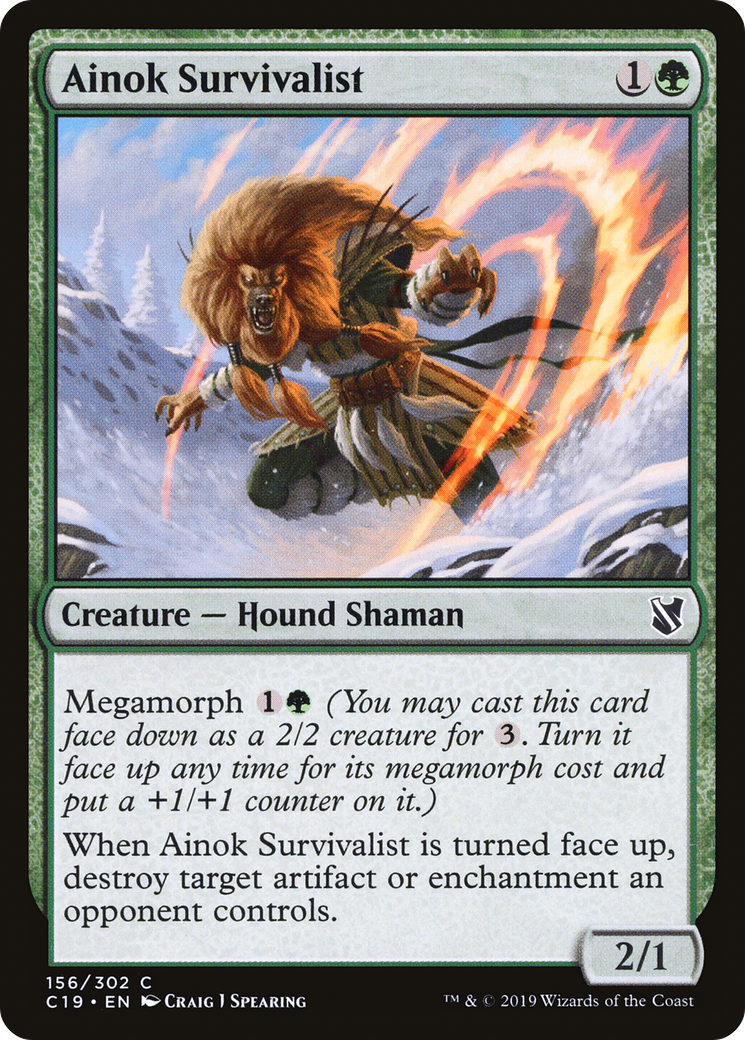
Ainok Survivalist
Ainok Survivalist
Creature — Dog Shaman
2/1
Megamorph (You may cast this card face down as a 2/2 creature for . Turn it face up any time for its megamorph cost and put a +1/+1 counter on it.)
When this creature is turned face up, destroy target artifact or enchantment an opponent controls.
- Turning a face-down creature with megamorph face up and putting a +1/+1 counter on it is a special action. It doesn't use the stack and can't be responded to.
- If a face-down creature with megamorph is turned face up some other way (for example, if you manifest a card with megamorph and then pay its mana cost to turn it face up), you won't put a +1/+1 counter on it.
- Megamorph is a variant of the morph ability. You can find more information on morph on cards with morph from the Khans of Tarkir set.
-
1
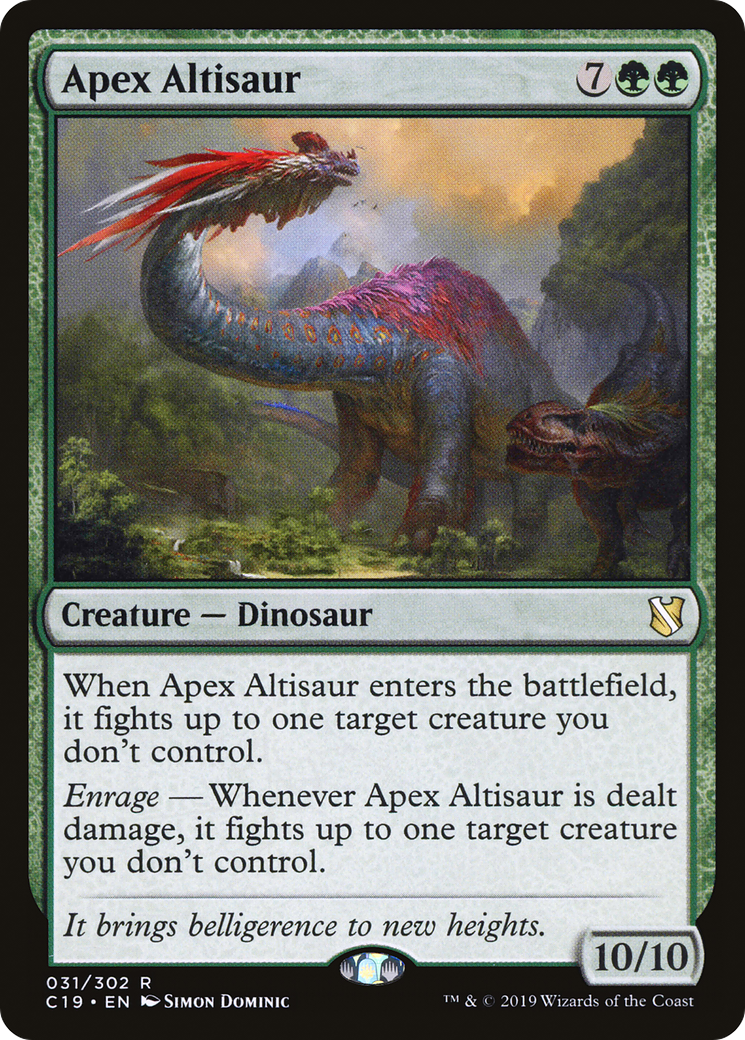
Apex Altisaur
Apex Altisaur
Creature — Dinosaur
10/10
When this creature enters, it fights up to one target creature you don't control.
Enrage — Whenever this creature is dealt damage, it fights up to one target creature you don't control.
- If Apex Altisaur fights a creature while either of its abilities is resolving, being dealt damage this way causes its second ability to trigger. It may fight several times in a row this way.
- If the target creature is an illegal target when Apex Altisaur's last ability tries to resolve, the ability doesn't resolve. If it's a legal target but Apex Altisaur is no longer on the battlefield when the ability resolves (perhaps because it has already died from picking too many fights) the target creature won't deal or be dealt damage.
-
1
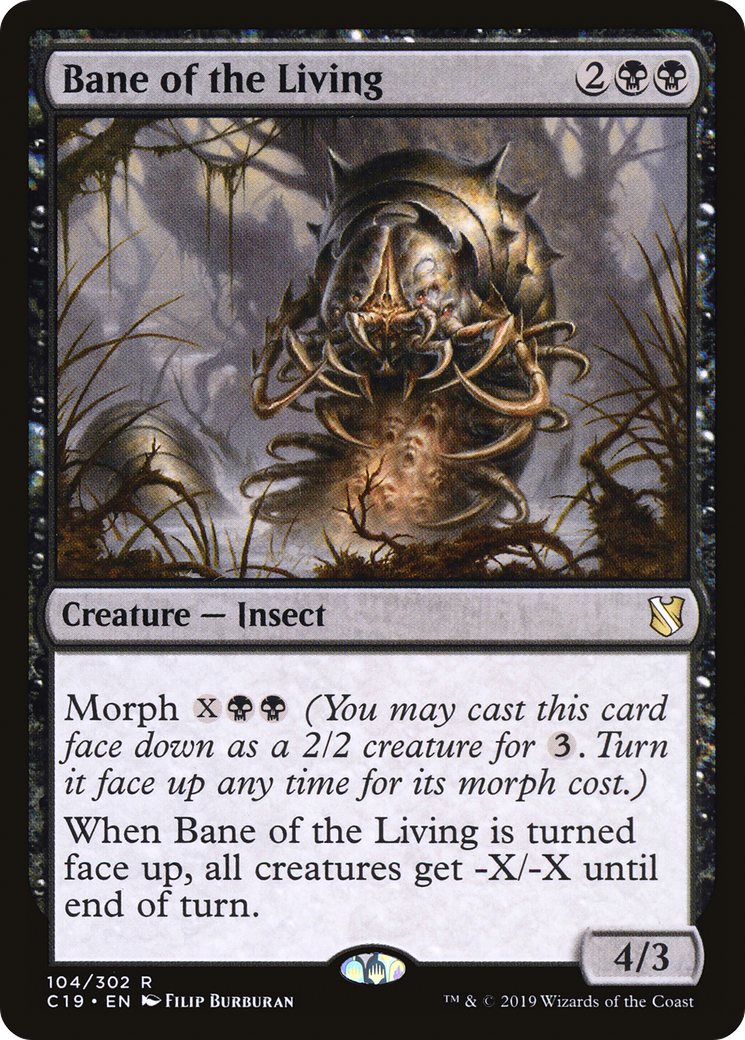
Bane of the Living
Bane of the Living
Creature — Insect
4/3
Morph (You may cast this card face down as a 2/2 creature for . Turn it face up any time for its morph cost.)
When this creature is turned face up, all creatures get -X/-X until end of turn.
- The trigger occurs when you use the Morph ability to turn the card face up, or when an effect turns it face up. It will not trigger on being revealed or on leaving the battlefield.
- The X in the ability has the same value as the X paid in the Morph ability. This is pretty easy to derive since there is no other source of X.
-
1
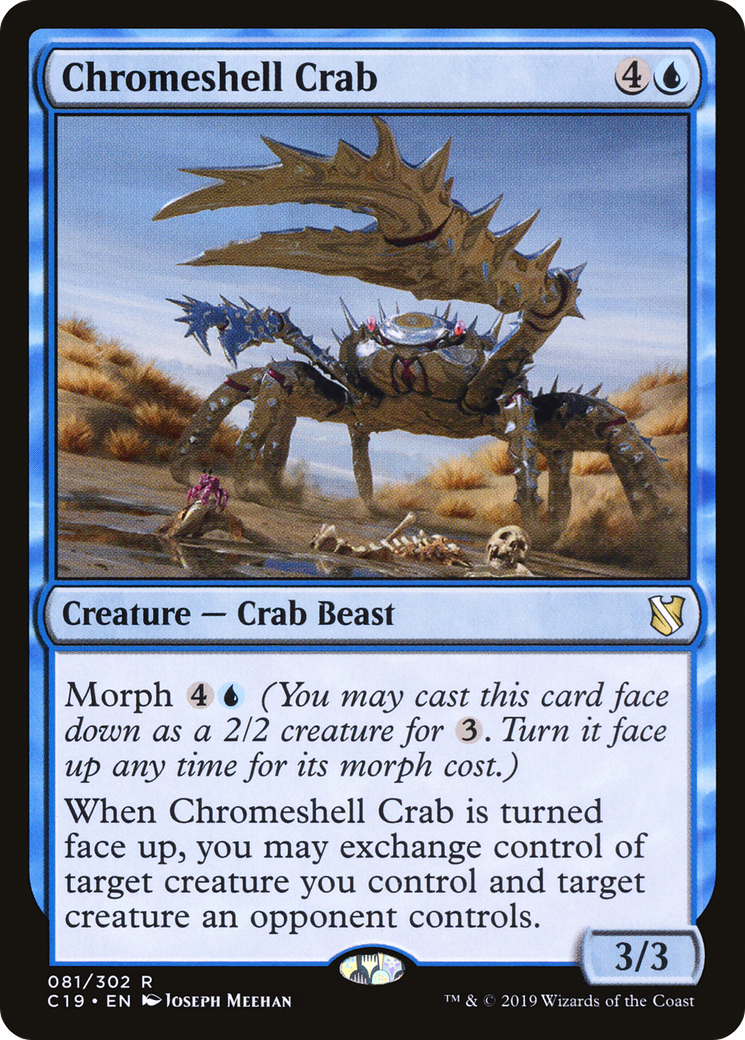
Chromeshell Crab
Chromeshell Crab
Creature — Crab Beast
3/3
Morph (You may cast this card face down as a 2/2 creature for . Turn it face up any time for its morph cost.)
When this creature is turned face up, you may exchange control of target creature you control and target creature an opponent controls.
- You choose the two target creatures when the triggered ability is put onto the stack. You do not have to choose Chromeshell Crab. You choose whether or not to do the exchange on resolution.
- The exchange fails if either target is not still on the battlefield at that time.
- The exchange fails if either you no longer control your creature or the other creature is now controlled by you.
- The creatures can’t attack until you start a turn with them under your control. So you can’t swap and then attack.
- The trigger occurs when you use the Morph ability to turn the card face up, or when an effect turns it face up. It will not trigger on being revealed or on leaving the battlefield.
-
1
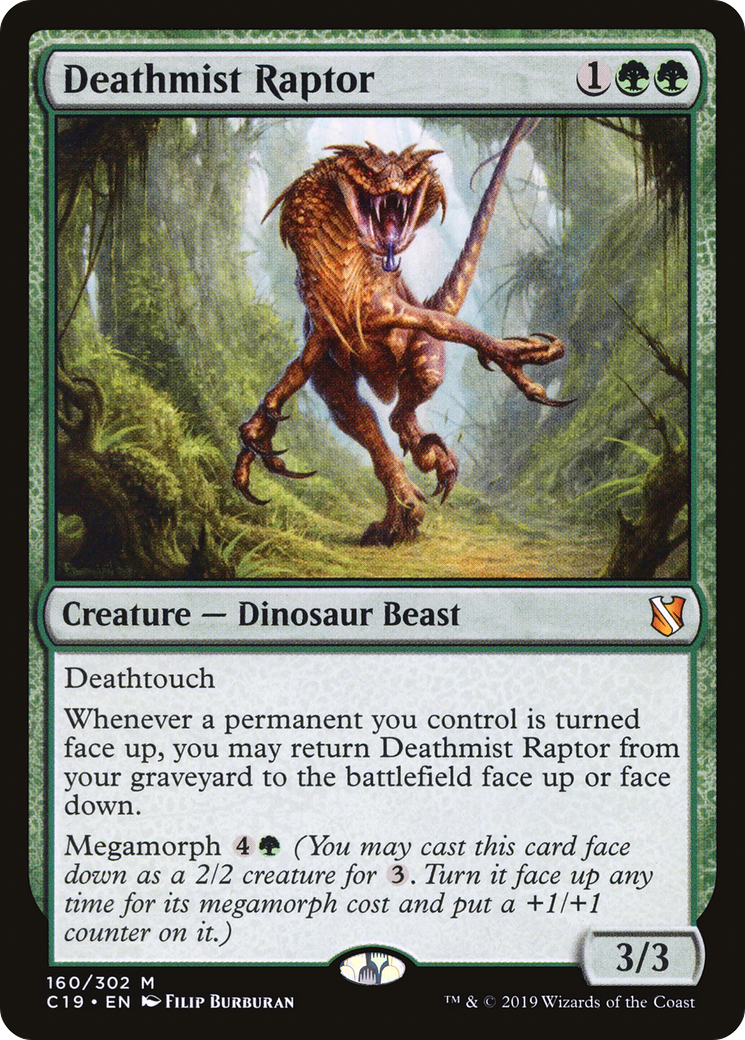
Deathmist Raptor
Deathmist Raptor
Creature — Dinosaur Beast
3/3
Deathtouch
Whenever a permanent you control is turned face up, you may return this card from your graveyard to the battlefield face up or face down.
Megamorph (You may cast this card face down as a 2/2 creature for . Turn it face up any time for its megamorph cost and put a +1/+1 counter on it.)
- Deathmist Raptor's second ability triggers only if Deathmist Raptor is in the graveyard when a permanent you control is turned face up.
- You choose whether Deathmist Raptor will enter the battlefield face up or face down as the ability resolves. You may also choose to leave it in the graveyard.
- Turning a face-down creature with megamorph face up and putting a +1/+1 counter on it is a special action. It doesn't use the stack and can't be responded to.
- If a face-down creature with megamorph is turned face up some other way (for example, if you manifest a card with megamorph and then pay its mana cost to turn it face up), you won't put a +1/+1 counter on it.
- Megamorph is a variant of the morph ability. You can find more information on morph on cards with morph from the Khans of Tarkir set.
-
1
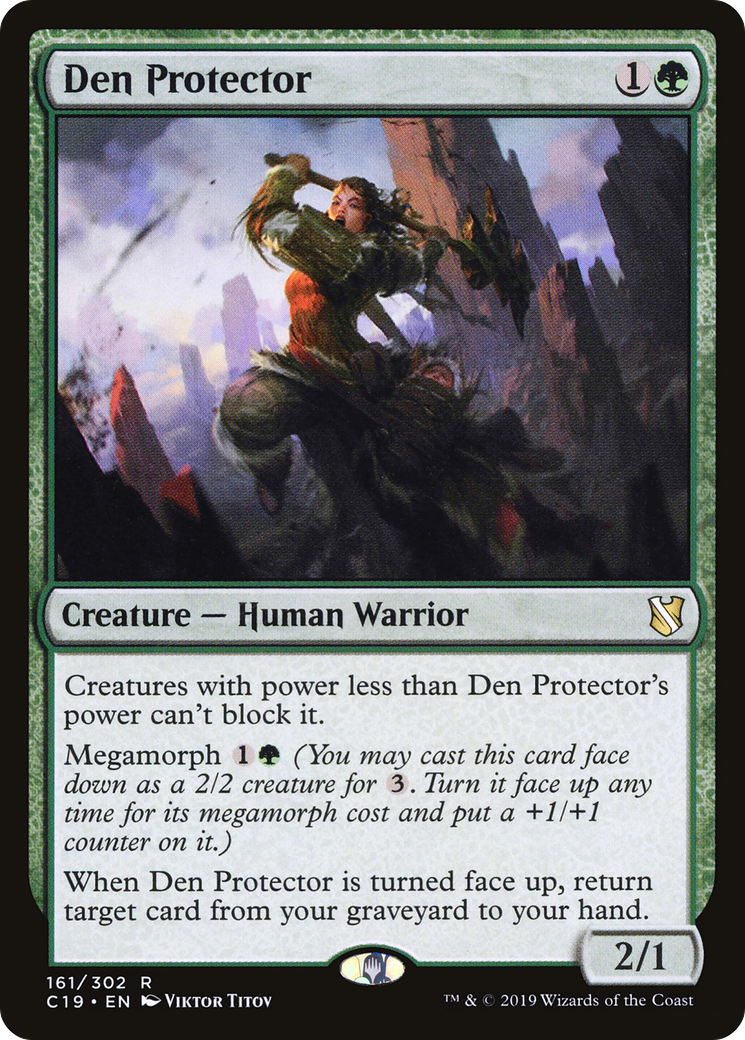
Den Protector
Den Protector
Creature — Human Warrior
2/1
Creatures with power less than this creature's power can't block it.
Megamorph (You may cast this card face down as a 2/2 creature for . Turn it face up any time for its megamorph cost and put a +1/+1 counter on it.)
When this creature is turned face up, return target card from your graveyard to your hand.
- You compare Den Protector's power to the power of any creature trying to block it only as blockers are assigned. Once Den Protector has been legally blocked by a creature, changing the power of either creature won't change or undo the block.
- Turning a face-down creature with megamorph face up and putting a +1/+1 counter on it is a special action. It doesn't use the stack and can't be responded to.
- If a face-down creature with megamorph is turned face up some other way (for example, if you manifest a card with megamorph and then pay its mana cost to turn it face up), you won't put a +1/+1 counter on it.
- Megamorph is a variant of the morph ability. You can find more information on morph on cards with morph from the Khans of Tarkir set.
-
1
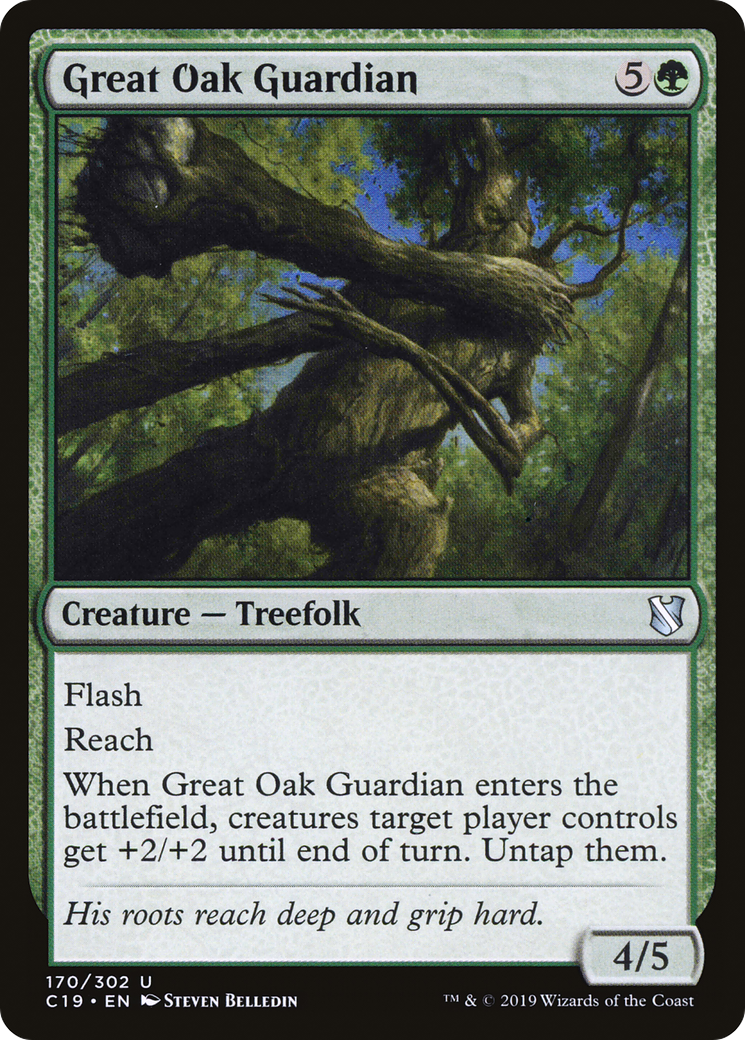
Great Oak Guardian
Great Oak Guardian
Creature — Treefolk
4/5
Flash (You may cast this spell any time you could cast an instant.)
Reach
When this creature enters, creatures target player controls get +2/+2 until end of turn. Untap them.
- Great Oak Guardian's last ability targets only the player, not any creatures. Creatures with shroud that player controls will be affected, for example.
- Any creatures controlled by the player that are already untapped will just get +2/+2 until end of turn.
-
1
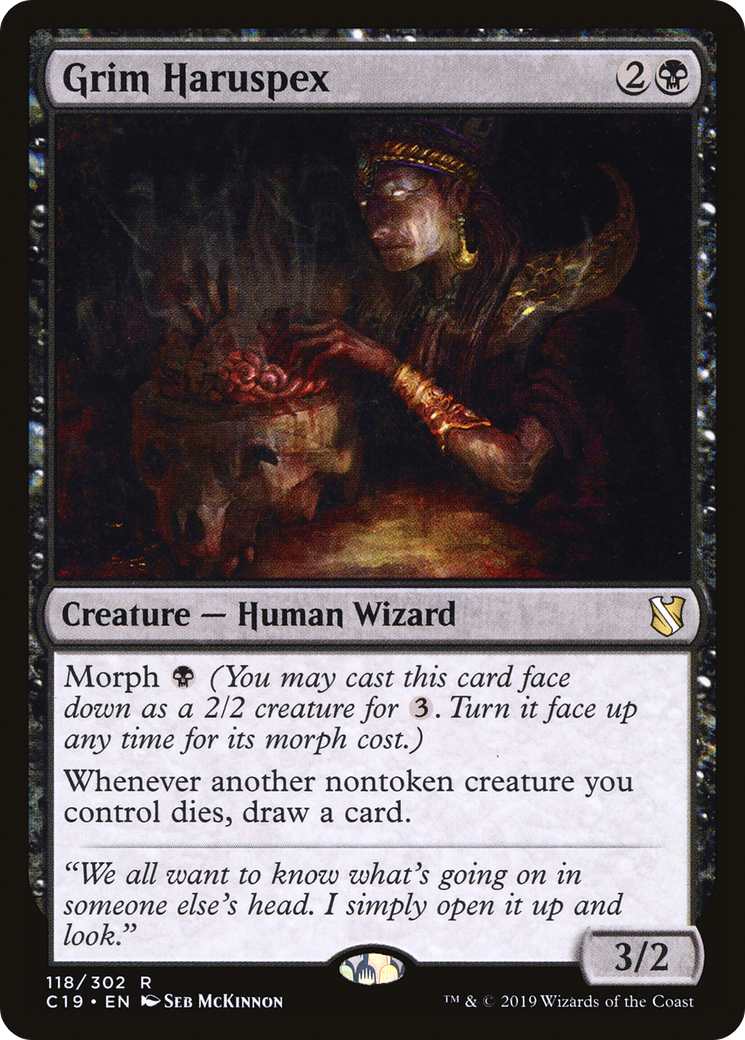
Grim Haruspex
Grim Haruspex
Creature — Human Wizard
3/2
Morph (You may cast this card face down as a 2/2 creature for . Turn it face up any time for its morph cost.)
Whenever another nontoken creature you control dies, draw a card.
- Morph lets you cast a card face down by paying , and lets you turn the face-down permanent face up any time you have priority by paying its morph cost.
- The face-down spell has no mana cost and has a mana value of 0. When you cast a face-down spell, put it on the stack face down so no other player knows what it is, and pay . This is an alternative cost.
- When the spell resolves, it enters the battlefield as a 2/2 creature with no name, mana cost, creature types, or abilities. It's colorless and has a mana value of 0. Other effects that apply to the creature can still grant it any of these characteristics.
- Any time you have priority, you may turn the face-down creature face up by revealing what its morph cost is and paying that cost. This is a special action. It doesn't use the stack and can't be responded to. Only a face-down permanent can be turned face up this way; a face-down spell cannot.
- Because the permanent is on the battlefield both before and after it's turned face up, turning a permanent face up doesn't cause any enters-the-battlefield abilities to trigger.
- A permanent that turns face up or face down changes characteristics but is otherwise the same permanent. Spells and abilities that were targeting that permanent, as well as Auras and Equipment that were attached to the permanent, aren't affected.
- At any time, you can look at a face-down spell or permanent you control. You can't look at face-down spells or permanents you don't control unless an effect instructs you to do so.
- You must ensure that your face-down spells and permanents can easily be differentiated from each other. You're not allowed to mix up the cards that represent them on the battlefield in order to confuse other players. The order they entered the battlefield should remain clear. Common methods for doing this include using markers or dice, or simply placing them in order on the battlefield.
- If a face-down permanent leaves the battlefield, you must reveal it. You must also reveal all face-down spells and permanents you control if you leave the game or if the game ends.
-
1
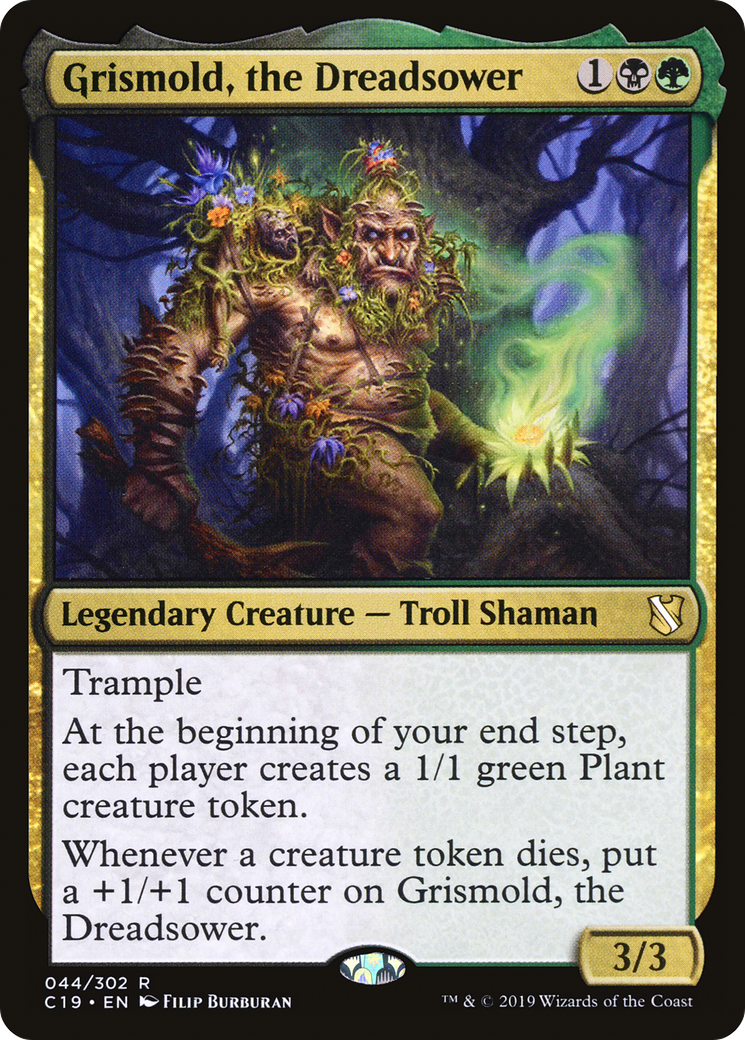
Grismold, the Dreadsower
Grismold, the Dreadsower
Legendary Creature — Troll Shaman
3/3
Trample
At the beginning of your end step, each player creates a 1/1 green Plant creature token.
Whenever a creature token dies, put a +1/+1 counter on Grismold.
- Each Plant token is owned by the player who created it. You don't own them all.
- If Grismold is dealt lethal damage at the same time as a creature token, Grismold won't receive a counter from its ability in time to save it.
- In a multiplayer game, if a creature token dies at the same time its controller loses the game, Grismold's last ability triggers.
-
1
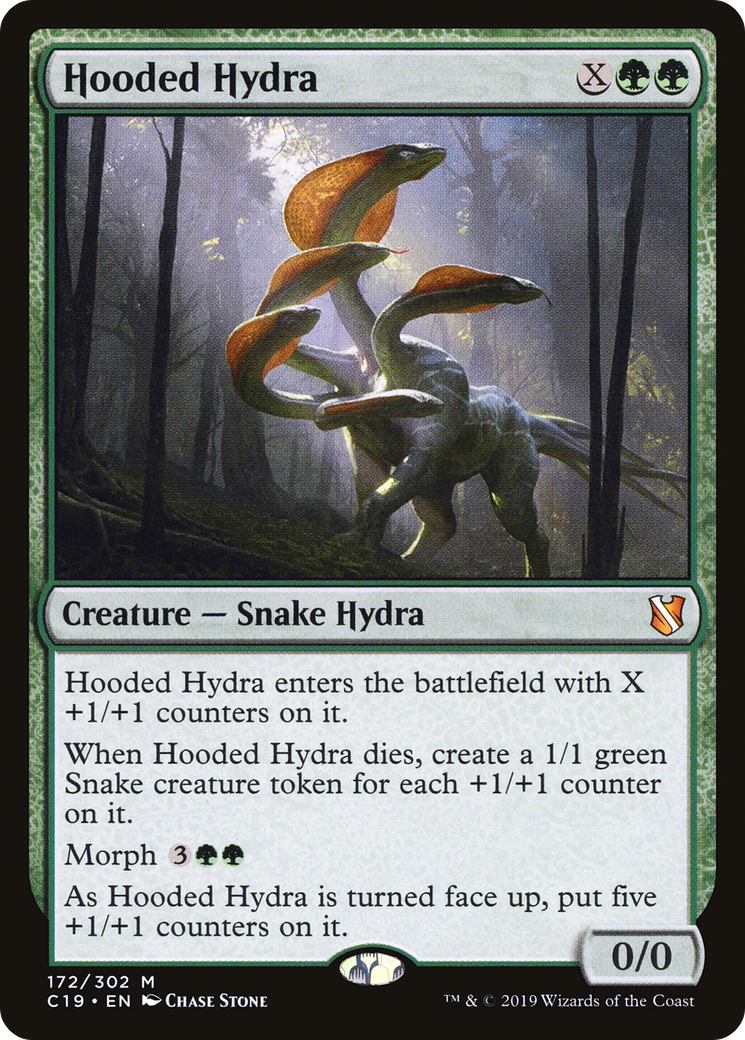
Hooded Hydra
Hooded Hydra
Creature — Snake Hydra
0/0
This creature enters with X +1/+1 counters on it.
When this creature dies, create a 1/1 green Snake creature token for each +1/+1 counter on it.
Morph
As this creature is turned face up, put five +1/+1 counters on it.
- Use the number of +1/+1 counters that were on Hooded Hydra the last time it was on the battlefield to determine how many Snake tokens to create.
- Hooded Hydra's last ability isn't a triggered ability. It's a replacement ability that modifies how Hooded Hydra is turned face up. Players can't respond to Hooded Hydra being turned face up and having five +1/+1 counters put on it.
- If Hooded Hydra is face down and it's turned face up some other way than by having its morph cost paid, the last ability will still apply.
- Morph lets you cast a card face down by paying , and lets you turn the face-down permanent face up any time you have priority by paying its morph cost.
- The face-down spell has no mana cost and has a mana value of 0. When you cast a face-down spell, put it on the stack face down so no other player knows what it is, and pay . This is an alternative cost.
- When the spell resolves, it enters the battlefield as a 2/2 creature with no name, mana cost, creature types, or abilities. It's colorless and has a mana value of 0. Other effects that apply to the creature can still grant it any of these characteristics.
- Any time you have priority, you may turn the face-down creature face up by revealing what its morph cost is and paying that cost. This is a special action. It doesn't use the stack and can't be responded to. Only a face-down permanent can be turned face up this way; a face-down spell cannot.
- Because the permanent is on the battlefield both before and after it's turned face up, turning a permanent face up doesn't cause any enters-the-battlefield abilities to trigger.
- A permanent that turns face up or face down changes characteristics but is otherwise the same permanent. Spells and abilities that were targeting that permanent, as well as Auras and Equipment that were attached to the permanent, aren't affected.
- At any time, you can look at a face-down spell or permanent you control. You can't look at face-down spells or permanents you don't control unless an effect instructs you to do so.
- You must ensure that your face-down spells and permanents can easily be differentiated from each other. You're not allowed to mix up the cards that represent them on the battlefield in order to confuse other players. The order they entered the battlefield should remain clear. Common methods for doing this include using markers or dice, or simply placing them in order on the battlefield.
- If a face-down permanent leaves the battlefield, you must reveal it. You must also reveal all face-down spells and permanents you control if you leave the game or if the game ends.
-
1
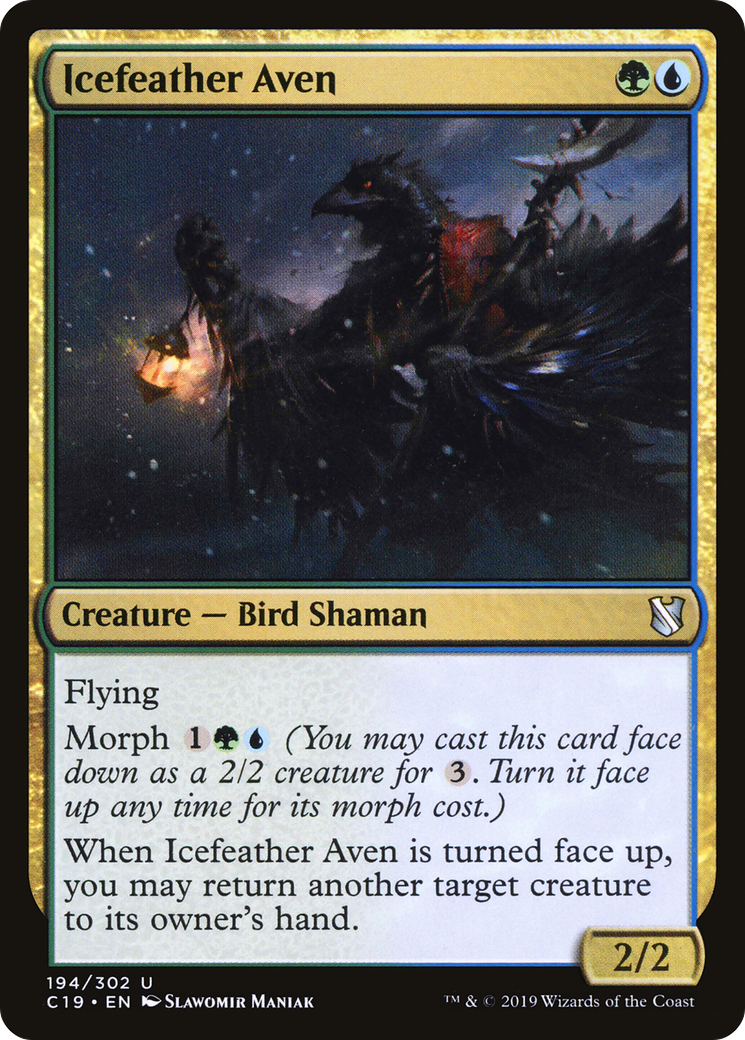
Icefeather Aven
Icefeather Aven
Creature — Bird Shaman
2/2
Flying
Morph (You may cast this card face down as a 2/2 creature for . Turn it face up any time for its morph cost.)
When this creature is turned face up, you may return another target creature to its owner's hand.
- At any time, you can look at a face-down spell or permanent you control. You can't look at face-down spells or permanents you don't control unless an effect instructs you to do so.
- If you control the only other creatures when Icefeather Aven is turned face up, you must target one of them. You choose whether that creature is returned to its owner's hand as the ability resolves.
- Morph lets you cast a card face down by paying , and lets you turn the face-down permanent face up any time you have priority by paying its morph cost.
- The face-down spell has no mana cost and has a mana value of 0. When you cast a face-down spell, put it on the stack face down so no other player knows what it is, and pay . This is an alternative cost.
- When the spell resolves, it enters the battlefield as a 2/2 creature with no name, mana cost, creature types, or abilities. It's colorless and has a mana value of 0. Other effects that apply to the creature can still grant it any of these characteristics.
- Any time you have priority, you may turn the face-down creature face up by revealing what its morph cost is and paying that cost. This is a special action. It doesn't use the stack and can't be responded to. Only a face-down permanent can be turned face up this way; a face-down spell cannot.
- Because the permanent is on the battlefield both before and after it's turned face up, turning a permanent face up doesn't cause any enters-the-battlefield abilities to trigger.
- A permanent that turns face up or face down changes characteristics but is otherwise the same permanent. Spells and abilities that were targeting that permanent, as well as Auras and Equipment that were attached to the permanent, aren't affected.
- You must ensure that your face-down spells and permanents can easily be differentiated from each other. You're not allowed to mix up the cards that represent them on the battlefield in order to confuse other players. The order they entered the battlefield should remain clear. Common methods for doing this include using markers or dice, or simply placing them in order on the battlefield.
- If a face-down permanent leaves the battlefield, you must reveal it. You must also reveal all face-down spells and permanents you control if you leave the game or if the game ends.
-
1
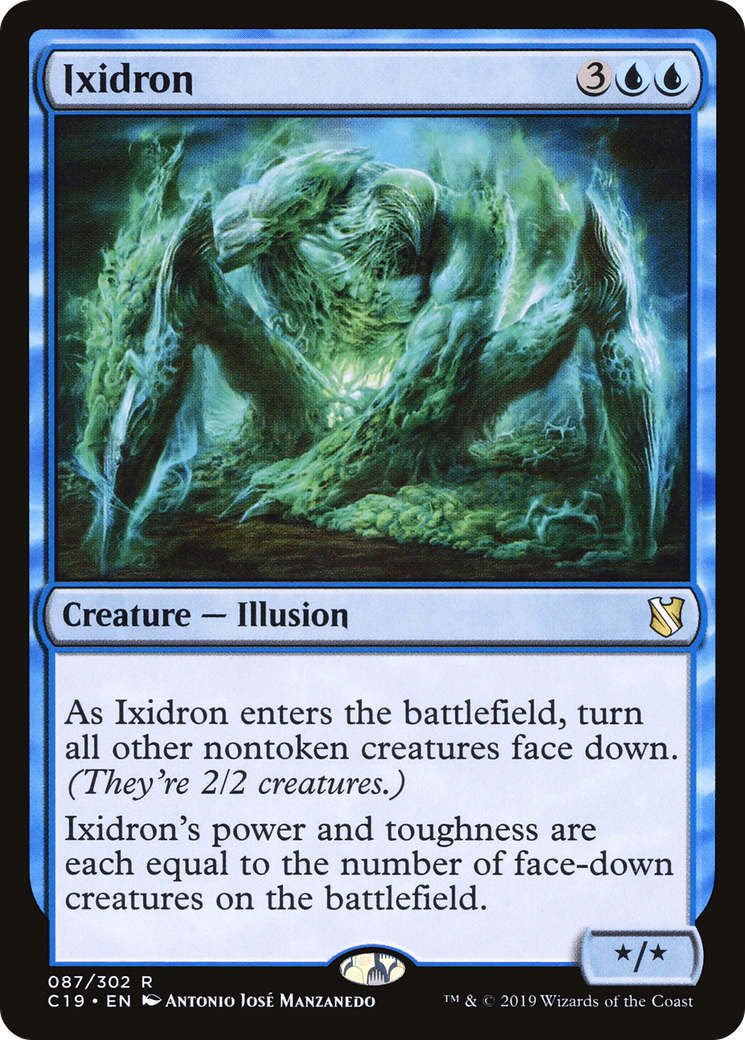
Ixidron
Ixidron
Creature — Illusion
*/*
As this creature enters, turn all other nontoken creatures face down. (They're 2/2 creatures.)
Ixidron's power and toughness are each equal to the number of face-down creatures on the battlefield.
- Creatures turned face down by Ixidron are 2/2 creatures with no text, no name, no subtypes, no expansion symbol, and no mana cost. These values are copiable if an object becomes a copy of one of those creatures, and their normal values are not copiable.
- If Ixidron and another creature are entering at the same time, the other creature enters face up.
- The controller of a face-down creature can look at it at any time, even if it doesn't have morph. Other players can't, but the rules for face-down permanents state that "you must ensure at all times that your face-down spells and permanents can be easily differentiated from each other." As a result, all players must be able to figure out what each of the creatures Ixidron turned face down is.
- You turn the creatures face-down *as* Ixidron enters. There is never a moment when Ixidron is on the battlefield and the creatures are face-up. If a creature on the battlefield has a "whenever another creature enters" ability, it won't trigger because that creature will be face down before Ixidron enters.
- Turning a face-down creature face-down typically has no effect; the creature's status is unchanged.
-
1
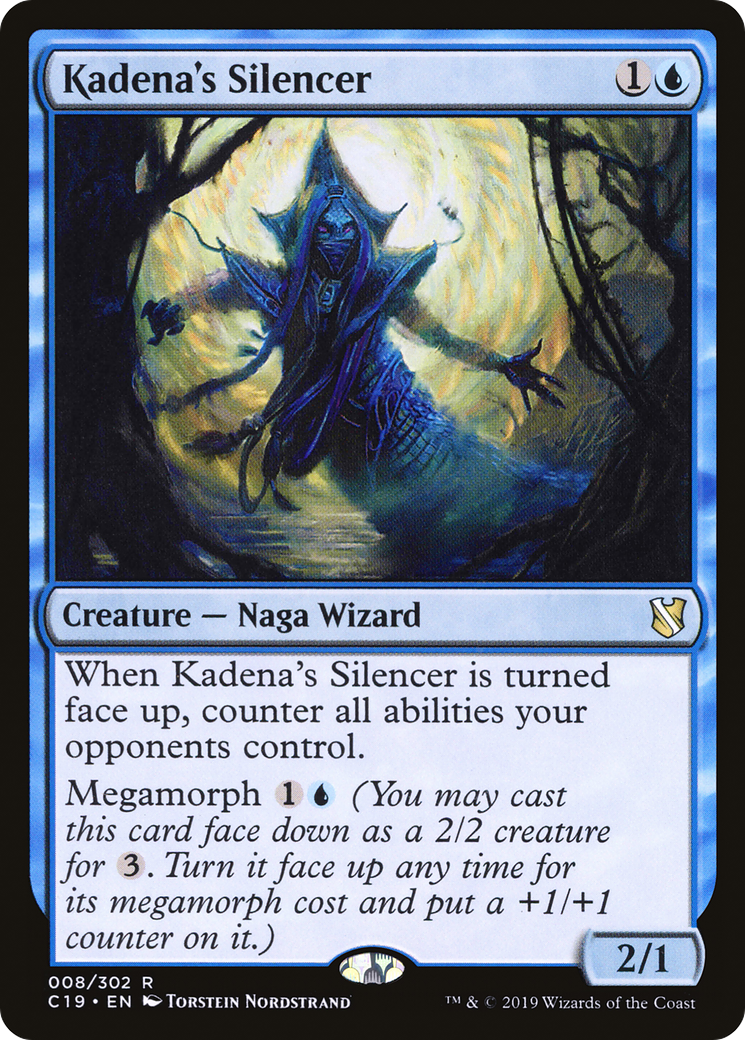
Kadena's Silencer
Kadena's Silencer
Creature — Snake Wizard
2/1
When this creature is turned face up, counter all abilities your opponents control.
Megamorph (You may cast this card face down as a 2/2 creature for . Turn it face up any time for its megamorph cost and put a +1/+1 counter on it.)
- Kadena's Silencer counters only activated and triggered abilities already on the stack. It doesn't prevent abilities from being activated or from triggering later in the turn, and it has no effect on static abilities.
- Kadena's Silencer can't counter an activated or triggered mana ability. An activated mana ability is one that could add mana as it resolves, doesn't have a target, and isn't a loyalty ability. A triggered mana ability is one that could add mana as it resolves and triggers on an activated mana ability.
- Activated abilities are written in the form "[Cost]: [Effect]." Some keyword abilities (such as equip) are activated abilities and will have colons in their reminder texts. Notably, turning a creature face up is not an activated ability.
- Triggered abilities use the word "when," "whenever," or "at." They're often written as "[Trigger condition], [effect]." Some keyword abilities (such as madness's ability to cast the exiled card) are triggered abilities and will have "when," "whenever," or "at" in their reminder text.
- Abilities that create replacement effects, such as a permanent entering the battlefield tapped or with counters on it, can't be countered. Abilities that apply "as [this creature] enters the battlefield" are also replacement effects and can't be countered.
- If you counter a delayed triggered ability that triggered at the beginning of the "next" occurrence of a specified step or phase, that ability won't trigger again the following time that phase or step occurs.
-
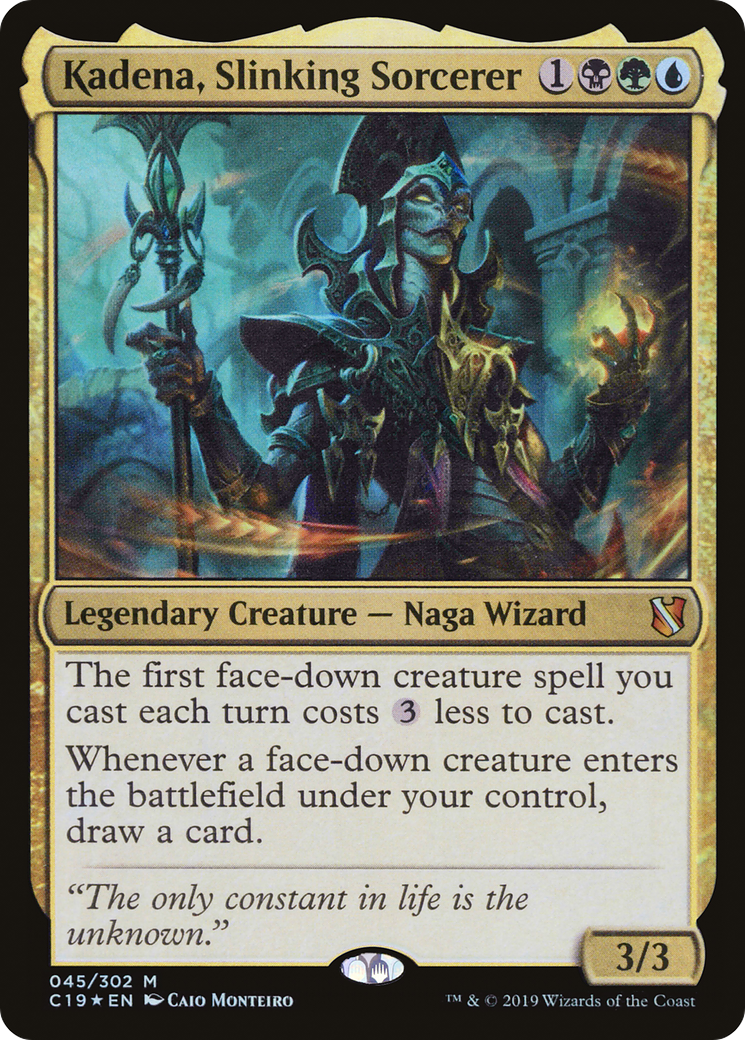
1
Kadena, Slinking Sorcerer
Kadena, Slinking Sorcerer
Legendary Creature — Snake Wizard
3/3
The first face-down creature spell you cast each turn costs less to cast.
Whenever a face-down creature you control enters, draw a card.
-
1
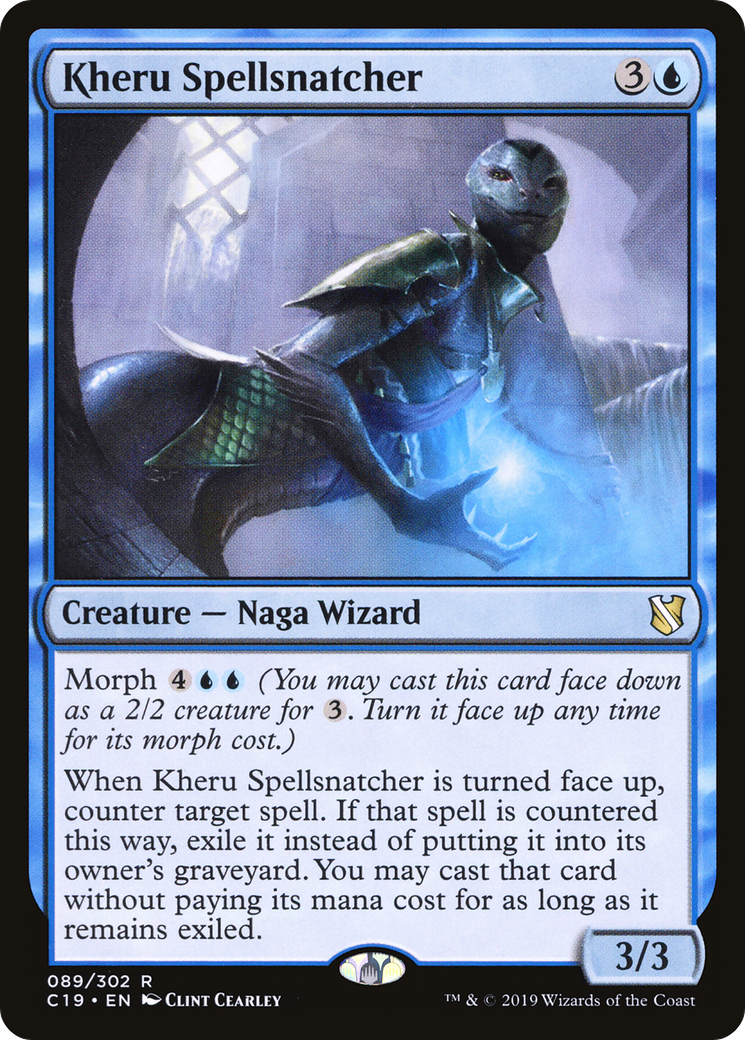
Kheru Spellsnatcher
Kheru Spellsnatcher
Creature — Snake Wizard
3/3
Morph (You may cast this card face down as a 2/2 creature for . Turn it face up any time for its morph cost.)
When this creature is turned face up, counter target spell. If that spell is countered this way, exile it instead of putting it into its owner's graveyard. You may cast that card without paying its mana cost for as long as it remains exiled.
- You can target a spell you control with Kheru Spellsnatcher's triggered ability. This will give you the ability to cast the card later without paying its mana cost.
- Because you're already casting the card using an alternative cost (by casting it without paying its mana cost), you can't pay any other alternative costs for the card, including casting it face down using the morph ability. You can pay additional costs, such as kicker costs. If the card has any mandatory additional costs, you must pay those.
- If the card has in its mana cost, you must choose 0 as the value for X when casting it.
- Morph lets you cast a card face down by paying , and lets you turn the face-down permanent face up any time you have priority by paying its morph cost.
- The face-down spell has no mana cost and has a mana value of 0. When you cast a face-down spell, put it on the stack face down so no other player knows what it is, and pay . This is an alternative cost.
- When the spell resolves, it enters the battlefield as a 2/2 creature with no name, mana cost, creature types, or abilities. It's colorless and has a mana value of 0. Other effects that apply to the creature can still grant it any of these characteristics.
- Any time you have priority, you may turn the face-down creature face up by revealing what its morph cost is and paying that cost. This is a special action. It doesn't use the stack and can't be responded to. Only a face-down permanent can be turned face up this way; a face-down spell cannot.
- Because the permanent is on the battlefield both before and after it's turned face up, turning a permanent face up doesn't cause any enters-the-battlefield abilities to trigger.
- A permanent that turns face up or face down changes characteristics but is otherwise the same permanent. Spells and abilities that were targeting that permanent, as well as Auras and Equipment that were attached to the permanent, aren't affected.
- At any time, you can look at a face-down spell or permanent you control. You can't look at face-down spells or permanents you don't control unless an effect instructs you to do so.
- You must ensure that your face-down spells and permanents can easily be differentiated from each other. You're not allowed to mix up the cards that represent them on the battlefield in order to confuse other players. The order they entered the battlefield should remain clear. Common methods for doing this include using markers or dice, or simply placing them in order on the battlefield.
- If a face-down permanent leaves the battlefield, you must reveal it. You must also reveal all face-down spells and permanents you control if you leave the game or if the game ends.
-
1
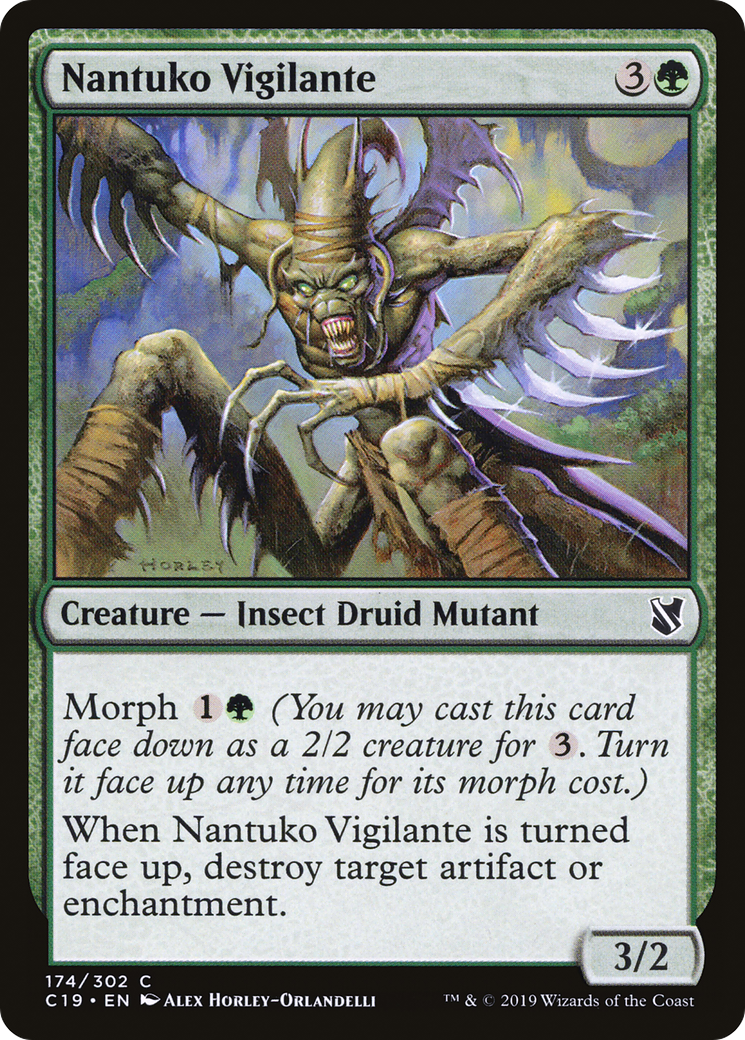
Nantuko Vigilante
Nantuko Vigilante
Creature — Insect Druid Mutant
3/2
Morph (You may cast this card face down as a 2/2 creature for . Turn it face up any time for its morph cost.)
When this creature is turned face up, destroy target artifact or enchantment.
- The trigger occurs when you use the Morph ability to turn the card face up, or when an effect turns it face up. It will not trigger on being revealed or on leaving the battlefield.
-
1
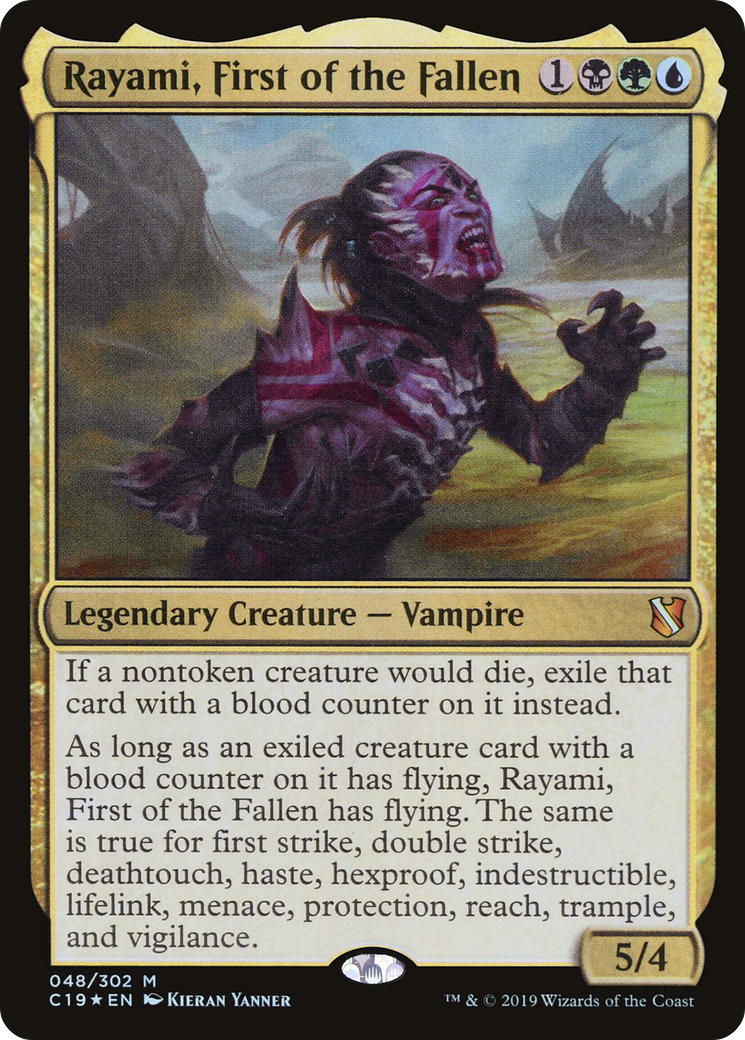
Rayami, First of the Fallen
Rayami, First of the Fallen
Legendary Creature — Vampire
5/4
If a nontoken creature would die, exile that card with a blood counter on it instead.
As long as an exiled creature card with a blood counter on it has flying, Rayami has flying. The same is true for first strike, double strike, deathtouch, haste, hexproof, indestructible, lifelink, menace, protection, reach, trample, and vigilance.
- Rayami looks at all exiled creature cards with blood counters, not only those exiled with its ability. It even looks at those exiled by an ability of another player's Rayami, First of the Fallen.
- If a nontoken creature that isn't normally a creature (such as a Vehicle) would die, Rayami exiles it with a blood counter on it, although Rayami won't gain any of its abilities.
- If an exiled creature card has one or more variants of the listed keywords (for example, protection from black or hexproof from white), Rayami gains those specific variants.
- If an exiled creature card has one of the listed keywords only if certain conditions are met, the ability granting that keyword doesn't apply while the card is in exile. Rayami won't gain that ability from that card.
- Nontoken creatures that would die at the same time that Rayami leaves the battlefield are exiled with blood counters.
- If multiple replacement effects try to change where a dying creature would go, the controller of the creature chooses one to apply. If Rayami's effect doesn't exile the creature, it won't have a blood counter on it, even if another effect exiles it.
-
1
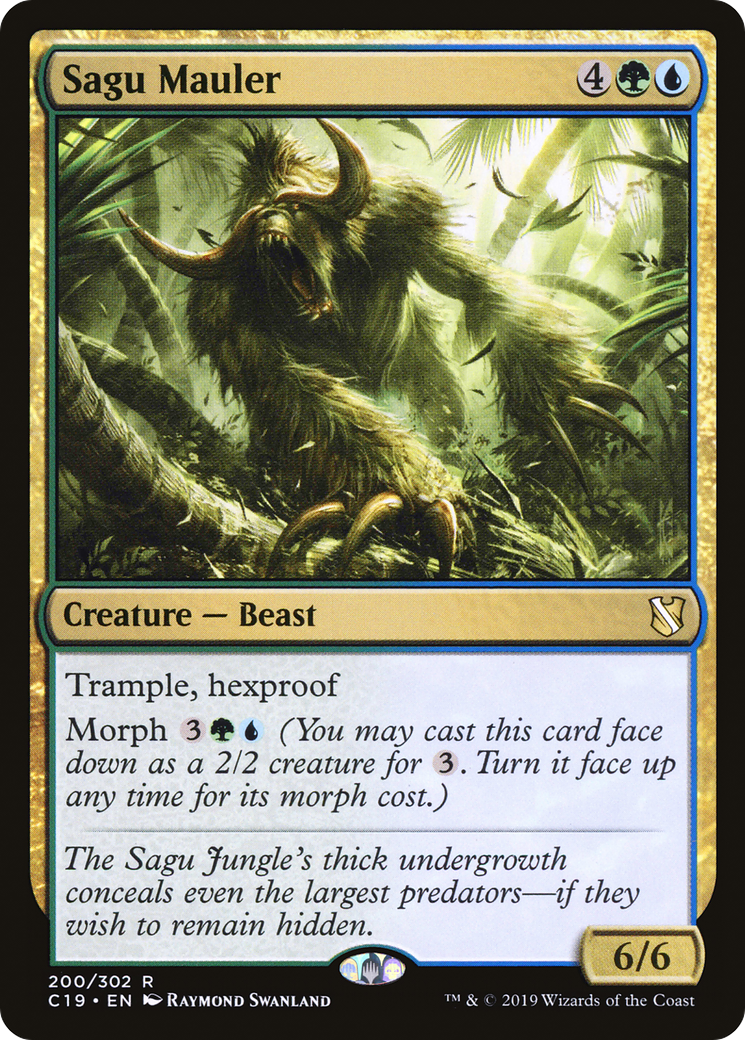
Sagu Mauler
Sagu Mauler
Creature — Beast
6/6
Trample, hexproof
Morph (You may cast this card face down as a 2/2 creature for . Turn it face up any time for its morph cost.)
- Morph lets you cast a card face down by paying , and lets you turn the face-down permanent face up any time you have priority by paying its morph cost.
- The face-down spell has no mana cost and has a mana value of 0. When you cast a face-down spell, put it on the stack face down so no other player knows what it is, and pay . This is an alternative cost.
- When the spell resolves, it enters the battlefield as a 2/2 creature with no name, mana cost, creature types, or abilities. It's colorless and has a mana value of 0. Other effects that apply to the creature can still grant it any of these characteristics.
- Any time you have priority, you may turn the face-down creature face up by revealing what its morph cost is and paying that cost. This is a special action. It doesn't use the stack and can't be responded to. Only a face-down permanent can be turned face up this way; a face-down spell cannot.
- Because the permanent is on the battlefield both before and after it's turned face up, turning a permanent face up doesn't cause any enters-the-battlefield abilities to trigger.
- A permanent that turns face up or face down changes characteristics but is otherwise the same permanent. Spells and abilities that were targeting that permanent, as well as Auras and Equipment that were attached to the permanent, aren't affected.
- At any time, you can look at a face-down spell or permanent you control. You can't look at face-down spells or permanents you don't control unless an effect instructs you to do so.
- You must ensure that your face-down spells and permanents can easily be differentiated from each other. You're not allowed to mix up the cards that represent them on the battlefield in order to confuse other players. The order they entered the battlefield should remain clear. Common methods for doing this include using markers or dice, or simply placing them in order on the battlefield.
- If a face-down permanent leaves the battlefield, you must reveal it. You must also reveal all face-down spells and permanents you control if you leave the game or if the game ends.
-
1
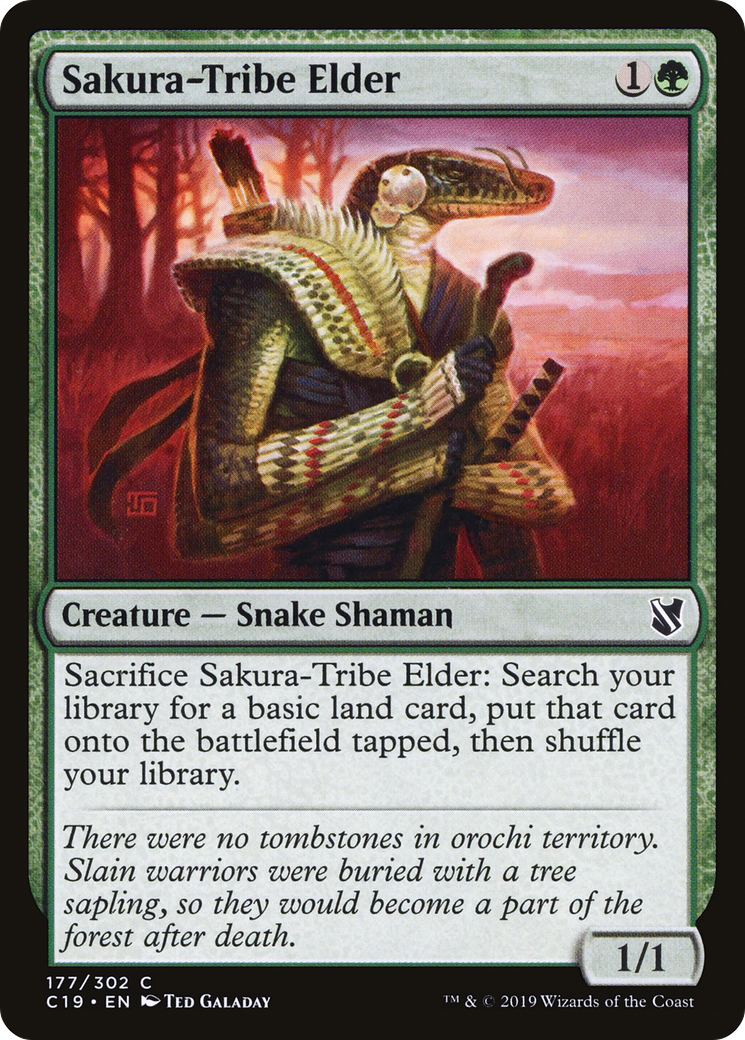
Sakura-Tribe Elder
Sakura-Tribe Elder
Creature — Snake Shaman
1/1
Sacrifice this creature: Search your library for a basic land card, put that card onto the battlefield tapped, then shuffle.
-
1
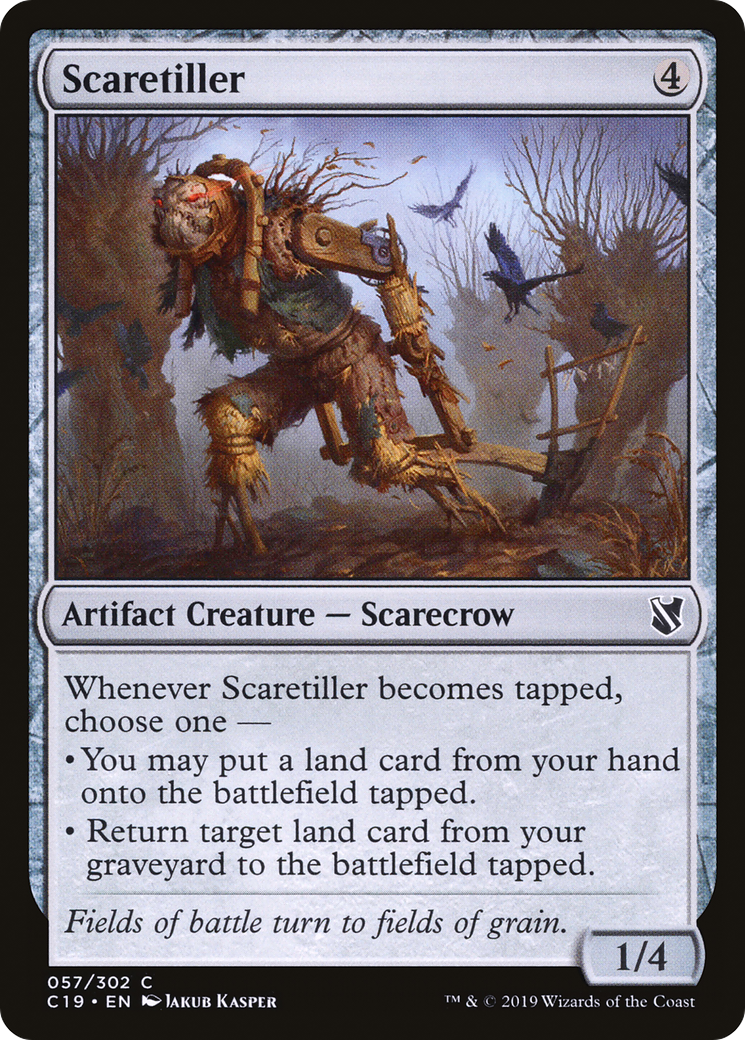
Scaretiller
Scaretiller
Artifact Creature — Scarecrow
1/4
Whenever this creature becomes tapped, choose one —
- You may put a land card from your hand onto the battlefield tapped.
- Return target land card from your graveyard to the battlefield tapped.
- Scaretiller's ability is a triggered ability, not an activated ability. It doesn't allow you to tap it whenever you want; rather, you need some other way of tapping it, such as by attacking.
- If Scaretiller becomes tapped while casting a spell or activating an ability, that spell or ability resolves after Scaretiller's triggered ability has resolved.
- Neither mode of Scaretiller's ability counts as playing a land. It can put a land card onto the battlefield even if you've already played your land for the turn, and even if it's not your turn.
-
1
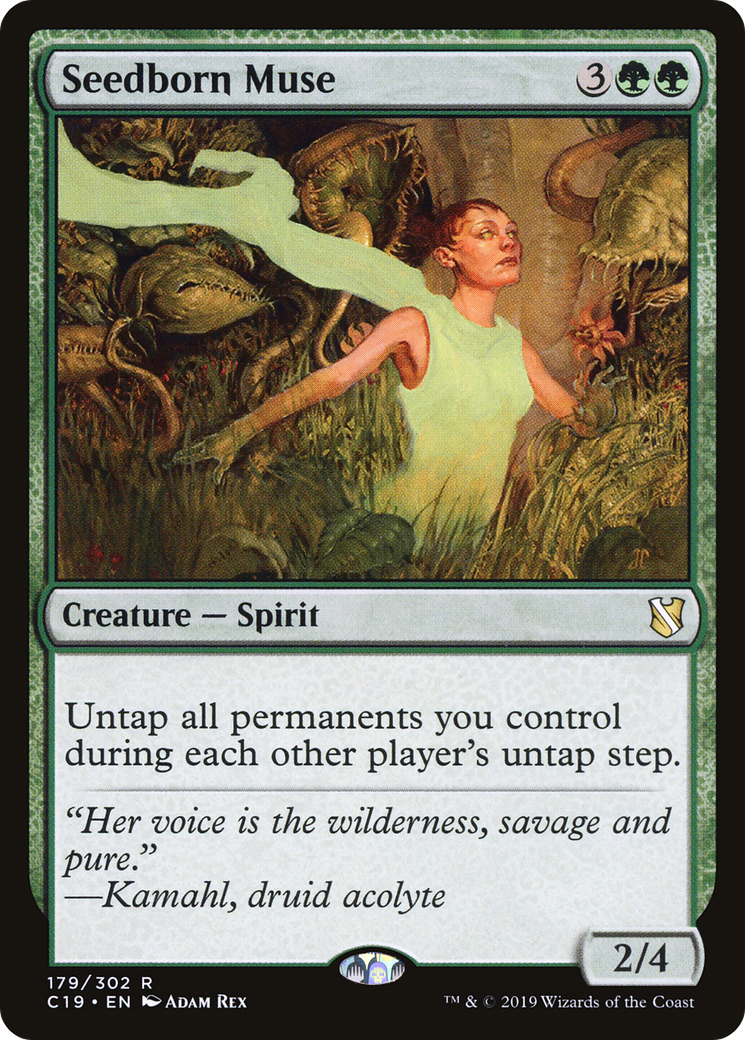
Seedborn Muse
Seedborn Muse
Creature — Spirit
2/4
Untap all permanents you control during each other player's untap step.
- All your permanents untap during each other player's untap step. You have no choice about what untaps.
- Other effects can prevent a permanent from untapping during an untap step. You do need to look carefully, however, as many effects say that the permanent does not untap during its controller's untap step, and this card's ability occurs during other players' untap steps. If a card does say this, then Seedborn Muse can untap it. But some other abilities are not written this way and can still prevent a card from untapping.
-
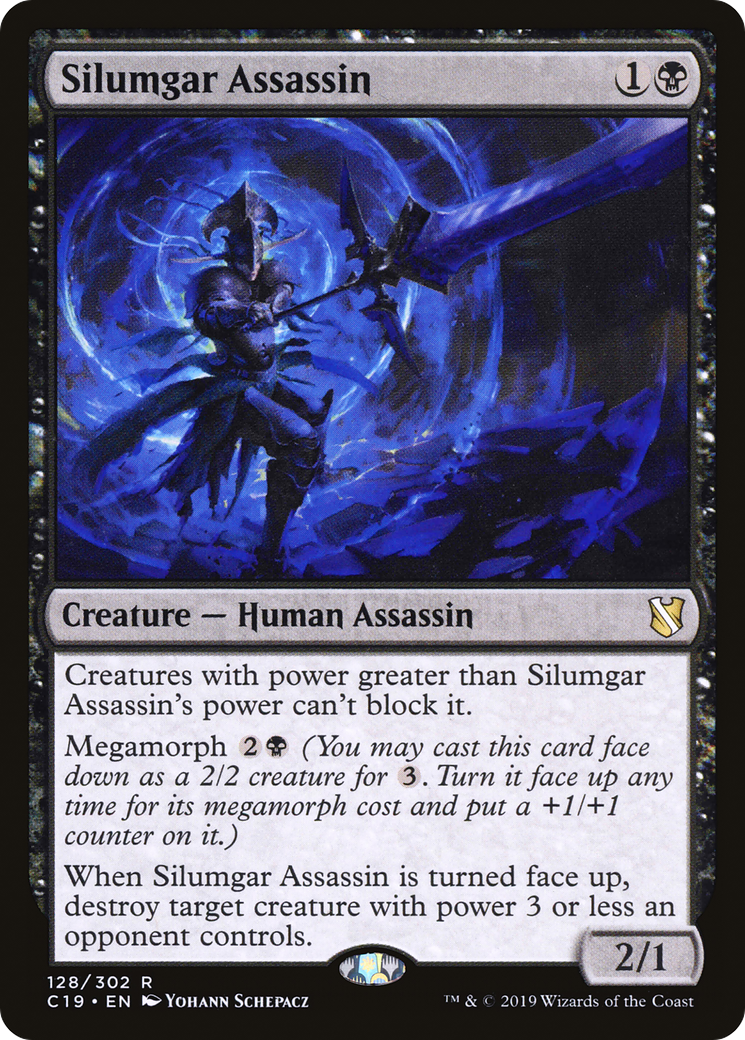
1
Silumgar Assassin
Silumgar Assassin
Creature — Human Assassin
2/1
Creatures with power greater than this creature's power can't block it.
Megamorph (You may cast this card face down as a 2/2 creature for . Turn it face up any time for its megamorph cost and put a +1/+1 counter on it.)
When this creature is turned face up, destroy target creature with power 3 or less an opponent controls.
- The powers of Silumgar Assassin and the creature trying to block it are checked only as blockers are declared. Changing the powers of either of those creatures after Silumgar Assassin is legally blocked won’t change or undo the block.
- Turning a face-down creature with megamorph face up and putting a +1/+1 counter on it is a special action. It doesn’t use the stack and can’t be responded to.
- If a face-down creature with megamorph is turned face up some other way (for example, if you manifest a card with megamorph and then pay its mana cost to turn it face up), you won’t put a +1/+1 counter on it.
- Megamorph is a variant of the morph ability. You can find more information on morph on cards with morph from the Khans of Tarkir set.
-
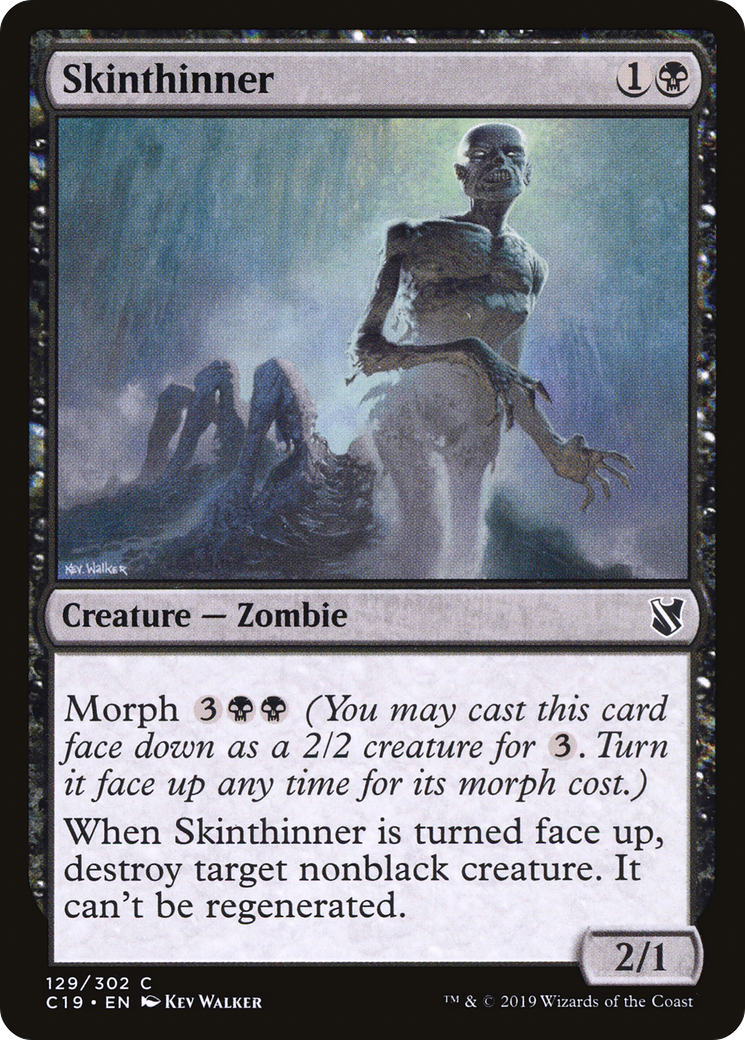
1
Skinthinner
Skinthinner
Creature — Zombie
2/1
Morph (You may cast this card face down as a 2/2 creature for . Turn it face up any time for its morph cost.)
When this creature is turned face up, destroy target nonblack creature. It can't be regenerated.
- The trigger occurs when you use the Morph ability to turn the card face up, or when an effect turns it face up. It will not trigger on being revealed or on leaving the battlefield.
-
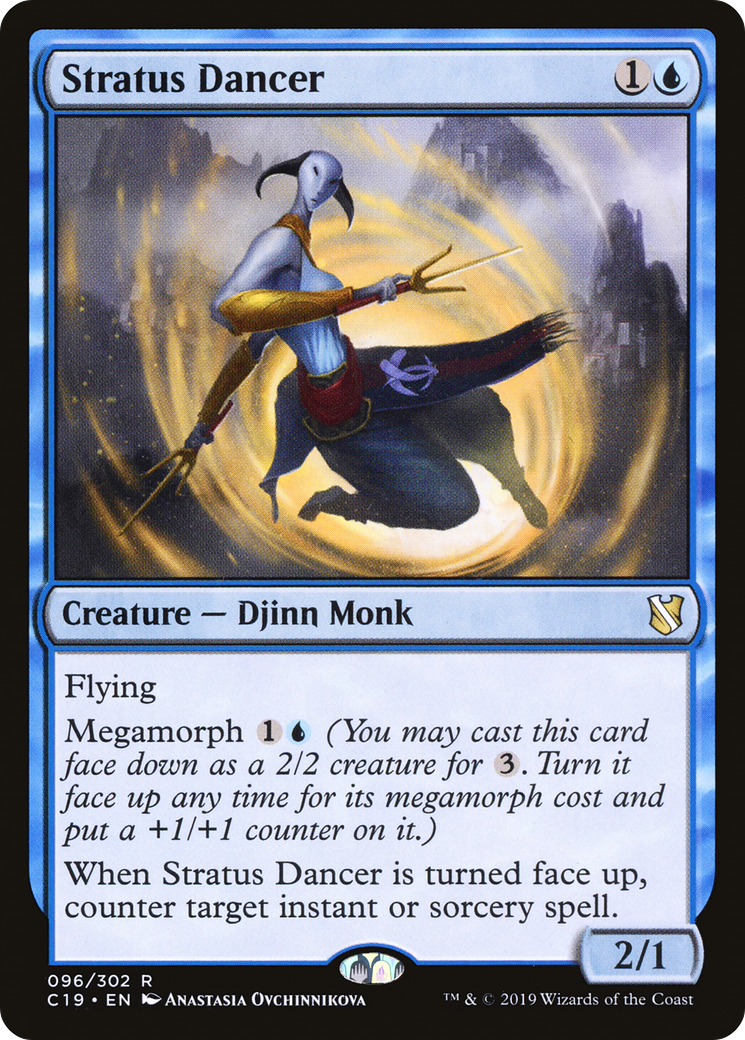
1
Stratus Dancer
Stratus Dancer
Creature — Djinn Monk
2/1
Flying
Megamorph (You may cast this card face down as a 2/2 creature for . Turn it face up any time for its megamorph cost and put a +1/+1 counter on it.)
When this creature is turned face up, counter target instant or sorcery spell.
- Turning a face-down creature with megamorph face up and putting a +1/+1 counter on it is a special action. It doesn’t use the stack and can’t be responded to.
- If a face-down creature with megamorph is turned face up some other way (for example, if you manifest a card with megamorph and then pay its mana cost to turn it face up), you won’t put a +1/+1 counter on it.
- Megamorph is a variant of the morph ability. You can find more information on morph on cards with morph from the Khans of Tarkir set.
-
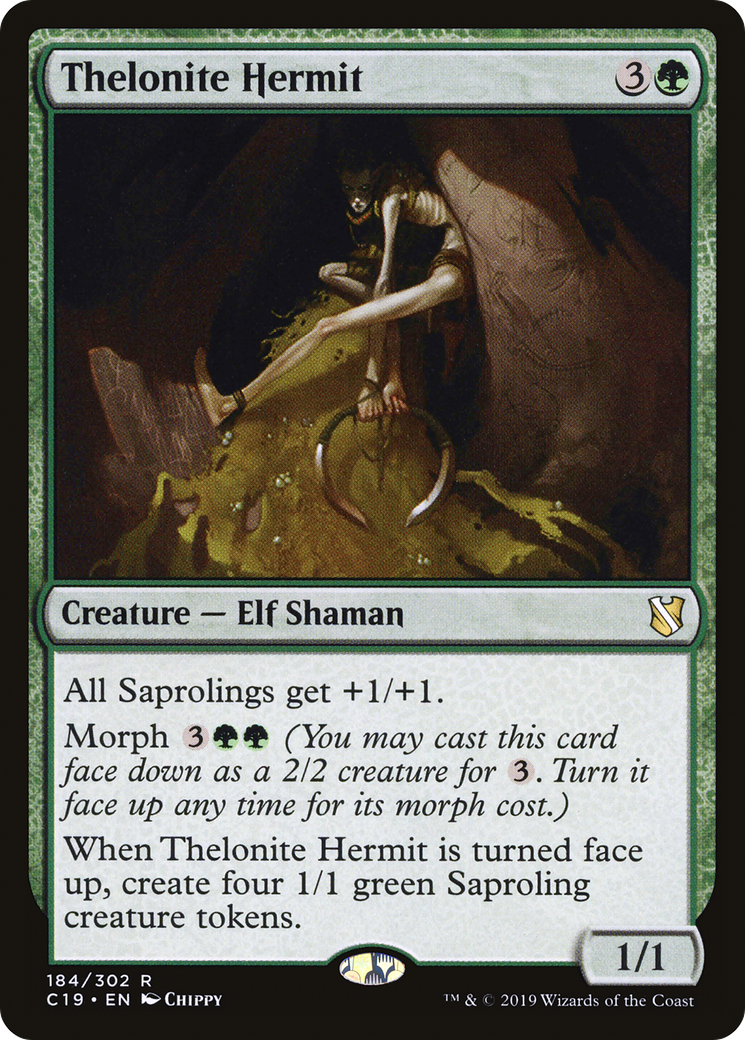
1
Thelonite Hermit
Thelonite Hermit
Creature — Elf Shaman
1/1
All Saprolings get +1/+1.
Morph (You may cast this card face down as a 2/2 creature for . Turn it face up any time for its morph cost.)
When this creature is turned face up, create four 1/1 green Saproling creature tokens.
- Because damage remains marked on a creature until the damage is removed as the turn ends, nonlethal damage dealt to a Saproling may become lethal if Thelonite Hermit leaves the battlefield during that turn.
-
1
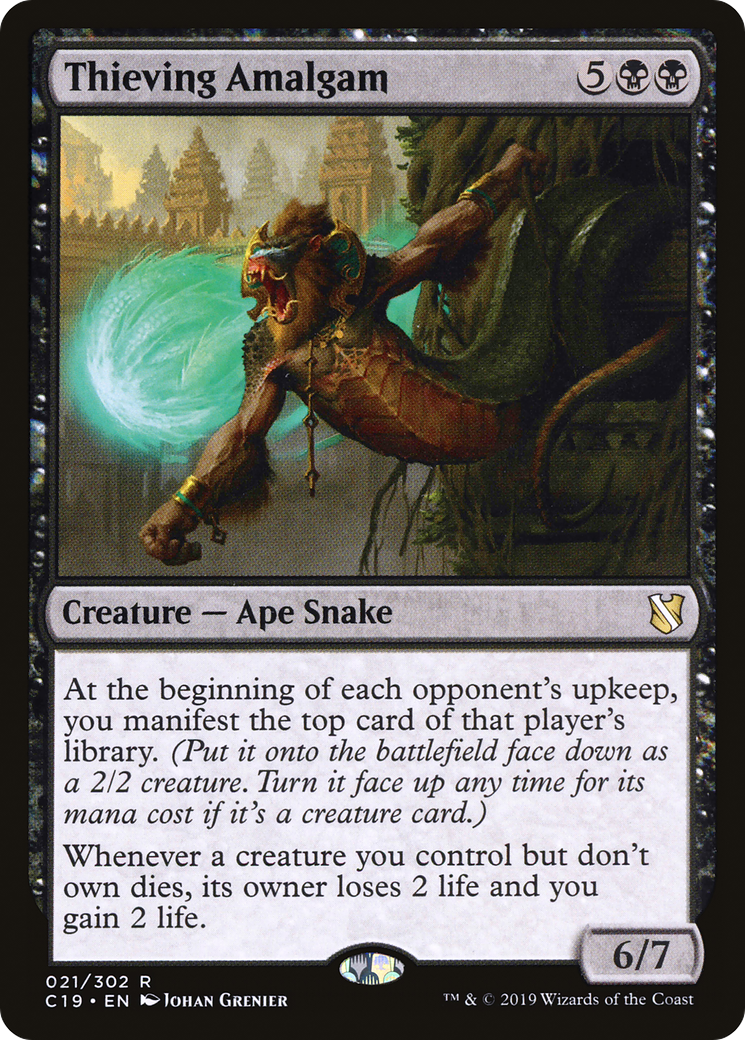
Thieving Amalgam
Thieving Amalgam
Creature — Ape Snake
6/7
At the beginning of each opponent's upkeep, you manifest the top card of that player's library. (Put it onto the battlefield face down as a 2/2 creature. Turn it face up any time for its mana cost if it's a creature card.)
Whenever a creature you control but don't own dies, its owner loses 2 life and you gain 2 life.
- Your opponents can't look at the card they own that you manifested.
- If a creature you control but don't own dies at the same time that your life total becomes 0 or less, you lose the game before Thieving Amalgam's last ability can save you.
- If a creature you control but don't own dies at the same time that its owner leaves the game, Thieving Amalgam's last ability triggers. No player loses 2 life, but you gain 2 life.
- In the Commander variant, you can produce mana that isn't of your commander's color identity if an effect lets you produce mana of that color or mana of any color, even though those symbols can't appear on cards in your deck. You may be able to turn a manifested creature card face up this way if it's not the same colors as your commander.
- In a multiplayer game, if a player leaves the game, all cards that player owns leave as well. If you leave the game, the creatures you manifested with Thieving Amalgam's triggered ability are exiled.
-
1
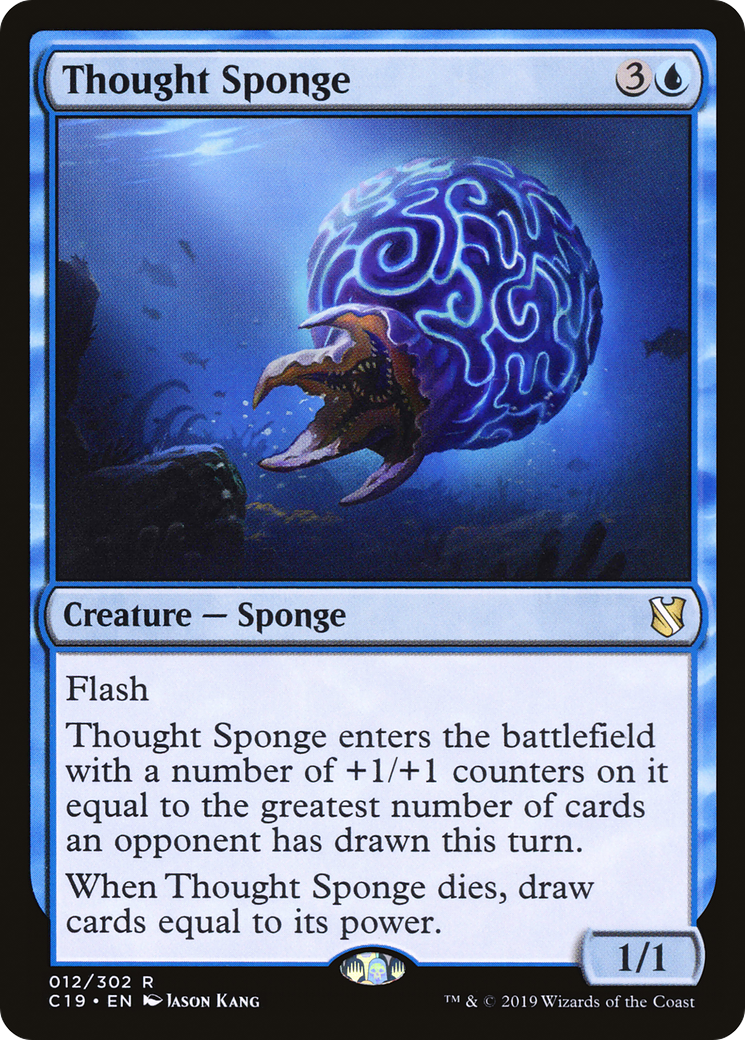
Thought Sponge
Thought Sponge
Creature — Sponge
1/1
Flash
This creature enters with a number of +1/+1 counters on it equal to the greatest number of cards an opponent has drawn this turn.
When this creature dies, draw cards equal to its power.
- Thought Sponge checks how many cards were drawn by opponents this turn, even opponents who have left the game. The greatest number drawn by a single opponent is how many +1/+1 counters it enters with.
- Thought Sponge checks the total number of cards drawn by each opponent, not how many were drawn due to a single instruction.
- Use Thought Sponge's power as it last existed on the battlefield to determine how many cards to draw for its last ability. If that number is negative, you neither draw nor discard cards.
- Thought Sponge gets its +1/+1 counters at the moment it enters the battlefield. There's not a time that it's on the battlefield before its replacement effect has applied.
-
1
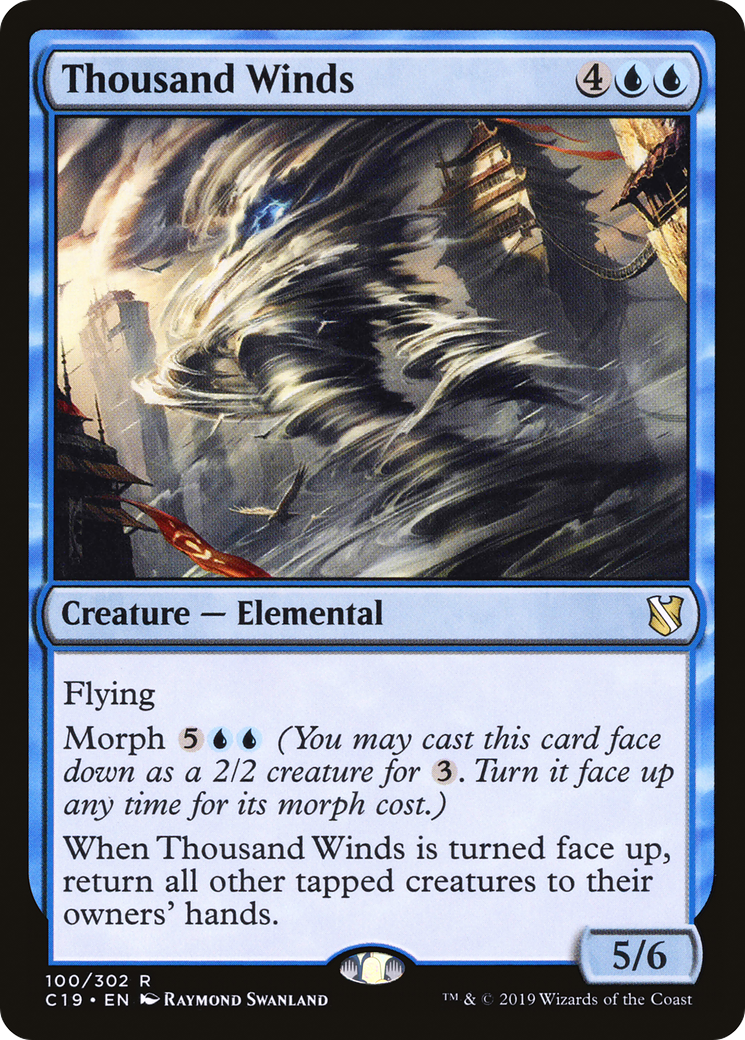
Thousand Winds
Thousand Winds
Creature — Elemental
5/6
Flying
Morph (You may cast this card face down as a 2/2 creature for . Turn it face up any time for its morph cost.)
When this creature is turned face up, return all other tapped creatures to their owners' hands.
- It doesn't matter if Thousand Winds is tapped or untapped (or even on the battlefield) when its last ability resolves. Tapped creatures except Thousand Winds will be returned to their owners' hands.
- Morph lets you cast a card face down by paying , and lets you turn the face-down permanent face up any time you have priority by paying its morph cost.
- The face-down spell has no mana cost and has a mana value of 0. When you cast a face-down spell, put it on the stack face down so no other player knows what it is, and pay . This is an alternative cost.
- When the spell resolves, it enters the battlefield as a 2/2 creature with no name, mana cost, creature types, or abilities. It's colorless and has a mana value of 0. Other effects that apply to the creature can still grant it any of these characteristics.
- Any time you have priority, you may turn the face-down creature face up by revealing what its morph cost is and paying that cost. This is a special action. It doesn't use the stack and can't be responded to. Only a face-down permanent can be turned face up this way; a face-down spell cannot.
- Because the permanent is on the battlefield both before and after it's turned face up, turning a permanent face up doesn't cause any enters-the-battlefield abilities to trigger.
- A permanent that turns face up or face down changes characteristics but is otherwise the same permanent. Spells and abilities that were targeting that permanent, as well as Auras and Equipment that were attached to the permanent, aren't affected.
- At any time, you can look at a face-down spell or permanent you control. You can't look at face-down spells or permanents you don't control unless an effect instructs you to do so.
- You must ensure that your face-down spells and permanents can easily be differentiated from each other. You're not allowed to mix up the cards that represent them on the battlefield in order to confuse other players. The order they entered the battlefield should remain clear. Common methods for doing this include using markers or dice, or simply placing them in order on the battlefield.
- If a face-down permanent leaves the battlefield, you must reveal it. You must also reveal all face-down spells and permanents you control if you leave the game or if the game ends.
-
1
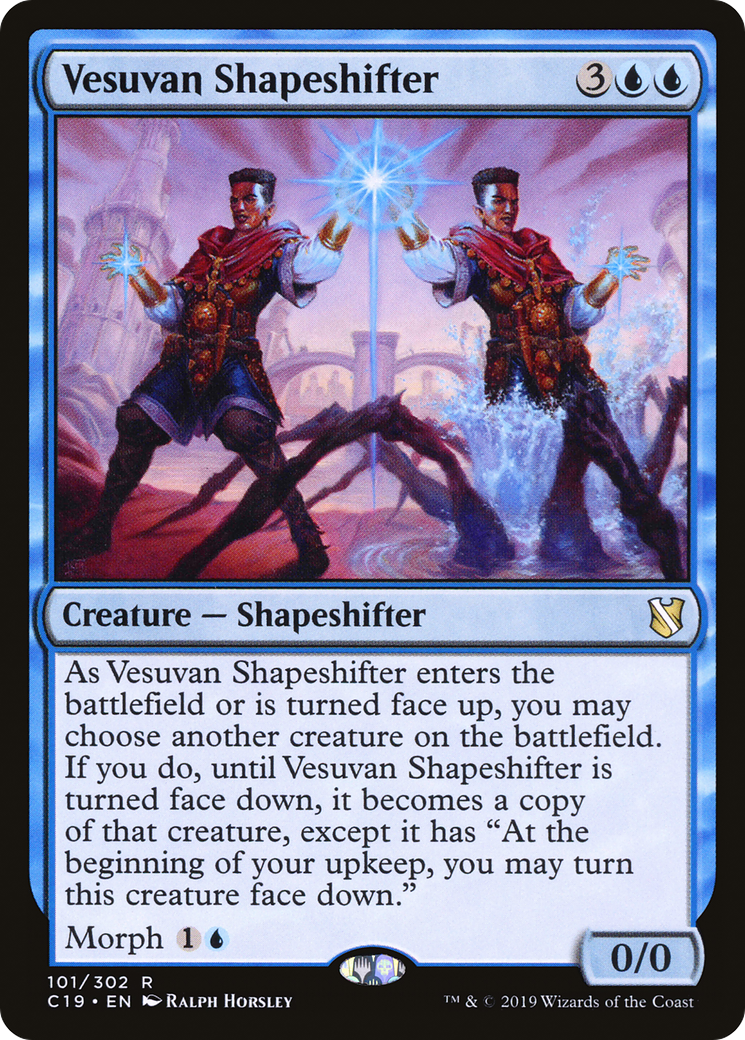
Vesuvan Shapeshifter
Vesuvan Shapeshifter
Creature — Shapeshifter
0/0
As this creature enters or is turned face up, you may choose another creature on the battlefield. If you do, until this creature is turned face down, it becomes a copy of that creature, except it has "At the beginning of your upkeep, you may turn this creature face down."
Morph
- Vesuvan Shapeshifter copies exactly what is printed on the creature it's copying and nothing else (unless it's copying a creature that's copying something else or that's a token; see below). It doesn't copy whether a creature is tapped or untapped, whether it has any counters on it or Auras and/or Equipment attached to it, or any non-copy effects that changed its power, toughness, types, color, and so on. Most notably, if it copies a creature that's not normally a creature, it won't be a creature.
- If a copied creature has in its mana cost, X is 0.
- If a copied creature is copying something else, Vesuvan Shapeshifter uses the copiable values of that creature. In most cases, Vesuvan Shapeshifter will copy whatever that creature is copying.
- If a copied creature is a token that isn't a copy of something else, Vesuvan Shapeshifter copies the original characteristics of that token as stated by the effect that created it. Vesuvan Shapeshifter isn't a token in this case.
- Any enters-the-battlefield abilities of the copied creature will trigger if Vesuvan Shapeshifter is entering the battlefield. Any "As [this creature] enters the battlefield" or "[This creature] enters the battlefield with" abilities of the copied creature will also work. If a Vesuvan Shapeshifter becomes a copy of a creature after it's already on the battlefield, these abilities won't apply as Vesuvan Shapeshifter becomes a copy since it's not entering the battlefield; instead, any "As [this creature] is turned face up" or "When [this creature] is turned face up" abilities will apply.
- If something copies Vesuvan Shapeshifter, the new copy will also have the triggered ability to turn it face down. However, once face-down, it won't have Vesuvan Shapeshifter's morph ability, so it can't be turned face up unless whatever it's copying also has a morph ability.
-
1
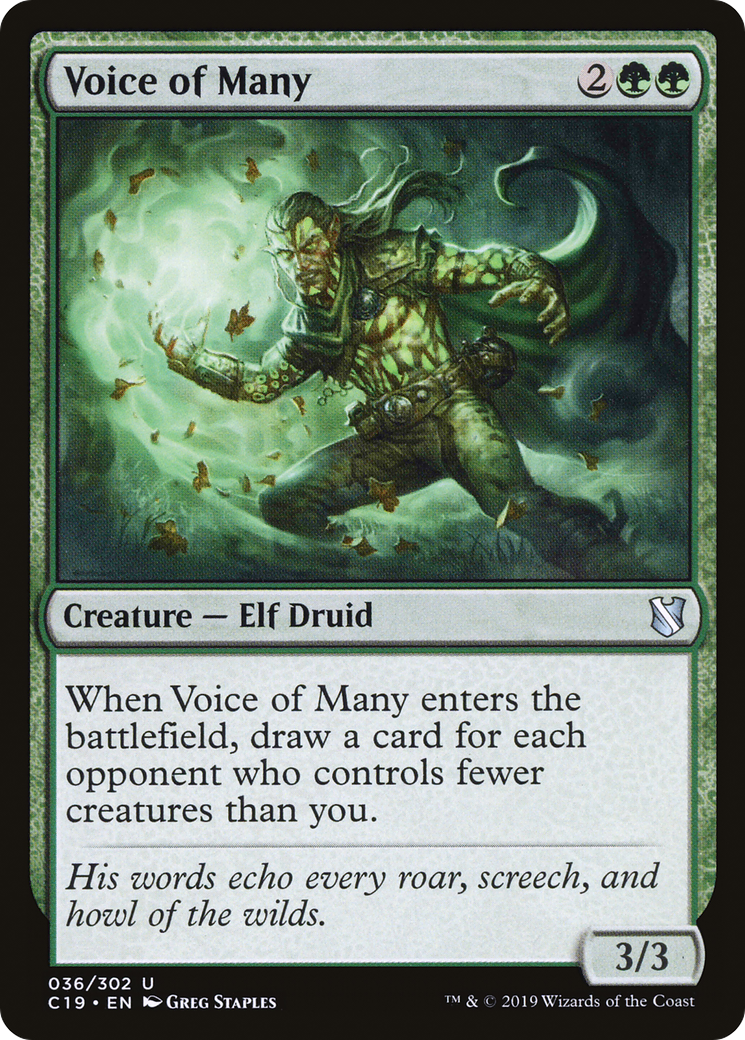
Voice of Many
Voice of Many
Creature — Elf Druid
3/3
When this creature enters, draw a card for each opponent who controls fewer creatures than you.
- Opponents who have left the game aren’t counted.
- You compare how many creatures opponents control only as Voice of Many’s triggered ability resolves. If it’s still on the battlefield, it’ll count among the creatures you control.
-
1
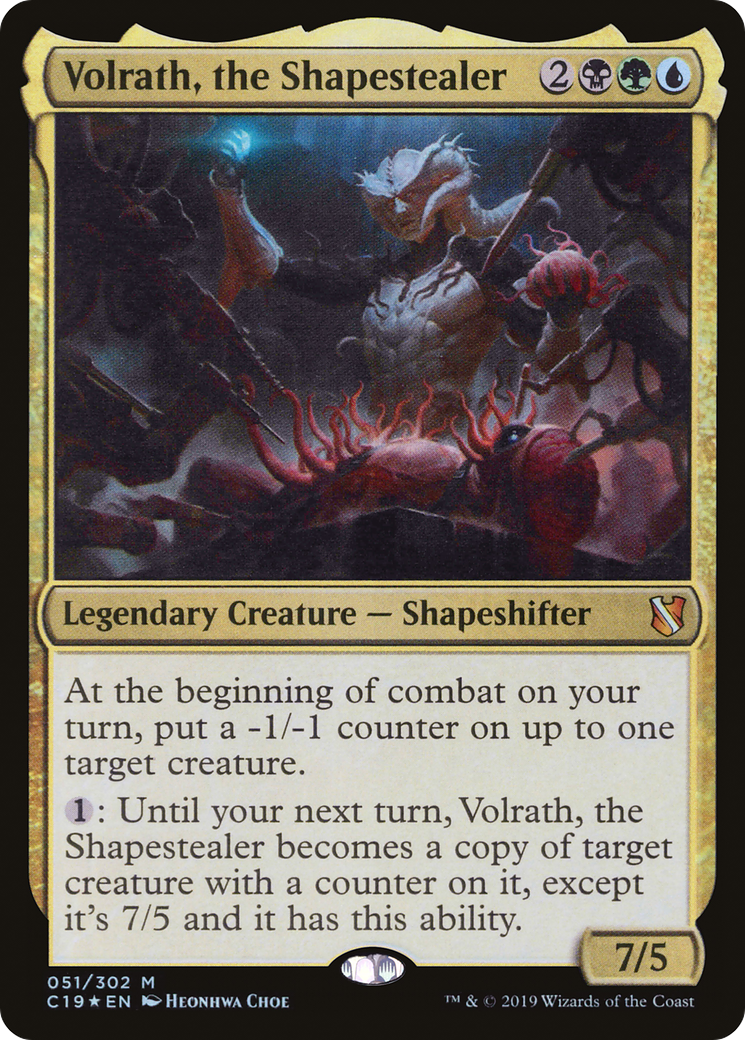
Volrath, the Shapestealer
Volrath, the Shapestealer
Legendary Creature — Phyrexian Shapeshifter
7/5
At the beginning of combat on your turn, put a -1/-1 counter on up to one target creature.
: Until your next turn, Volrath becomes a copy of target creature with a counter on it, except it's 7/5 and it has this ability.
- Activating Volrath's last ability causes it to lose its first ability until your next turn, so if you activate it before the beginning of combat step, it won't trigger during that turn. Players can cast instant spells and activate abilities (such as the second ability) during the beginning of combat step after that first ability has triggered or resolved but before attackers are chosen in the declare attackers step.
- If a creature has +1/+1 counters and -1/-1 counters on it, state-based actions remove the same number of each so that it has only one of those kinds of counters on it. This may cause the creature to no longer have any counters on it.
- Volrath copies the printed values of the target creature, plus any copy effects that have been applied to it. It won't copy counters on that creature. It also won't copy any effects that have changed its power, toughness, types, color, or so on. Notably, it won't copy effects that made the target become a creature if it's not normally a creature.
- If Volrath becomes a copy of a face-down creature, Volrath becomes a 7/5 creature with no color, cost, or creature type. Volrath is still face up.
- If Volrath copies a creature that's copying something else, it will become whatever the target is copying.
- If the target creature is a token, Volrath copies the original characteristics of that token as stated by the effect that created the token. Volrath doesn't become a token in this case.
- If an effect begins to apply to Volrath before it becomes a copy of another creature, that effect will continue to apply.
- If Volrath copies a creature the same turn Volrath enters the battlefield, you can't attack with it or use any of its abilities (if it gains any) unless the copied creature has haste.
- If Volrath becomes a copy of a legendary creature you control, you'll put one of them into your graveyard.
- If another object becomes a copy of Volrath, it has the ability to become a copy of something else and it's 7/5.
- If Volrath becomes a copy of a creature whose power and toughness are defined by an ability (usually printed as */* or similar), Volrath doesn't copy the ability that defines its power and toughness. Volrath remains a 7/5 creature.
- If Volrath copies a creature with an ability that can be activated only once each turn (such as Chainer, Nightmare Adept), you can activate that ability once. If Volrath then becomes a copy of that same creature, you can activate that ability another time, and so on.
-
1
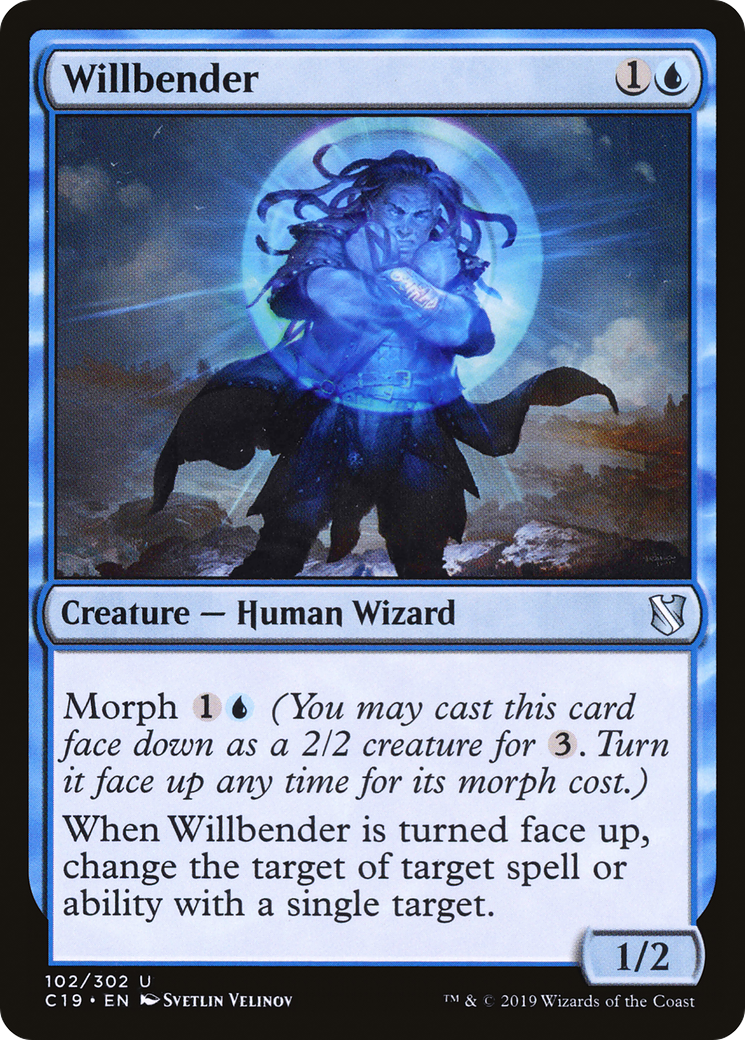
Willbender
Willbender
Creature — Human Wizard
1/2
Morph (You may cast this card face down as a 2/2 creature for . Turn it face up any time for its morph cost.)
When this creature is turned face up, change the target of target spell or ability with a single target.
- You don't choose the new target for the spell until Willbender's triggered ability resolves. You must change the target if possible. However, you can't change the target to an illegal target. If there are no legal targets to choose from, the target isn't changed. It doesn't matter if the original target of that spell has somehow become illegal itself.
- If a spell or ability targets multiple things, you can't target it with Willbender's triggered ability, even if all but one of those targets have become illegal.
- If a spell or ability targets the same player or object multiple times, you can't target it with Willbender's ability.
- If a spell with split second is on the stack, you can still respond by turning this creature face up and targeting that spell with the trigger. This is because split second only stops players from casting spells or activating abilities, while turning a creature face up is a special action.
- The trigger occurs when you use the Morph ability to turn the card face up, or when an effect turns it face up. It will not trigger on being revealed or on leaving the battlefield.
Instants 7
-
1
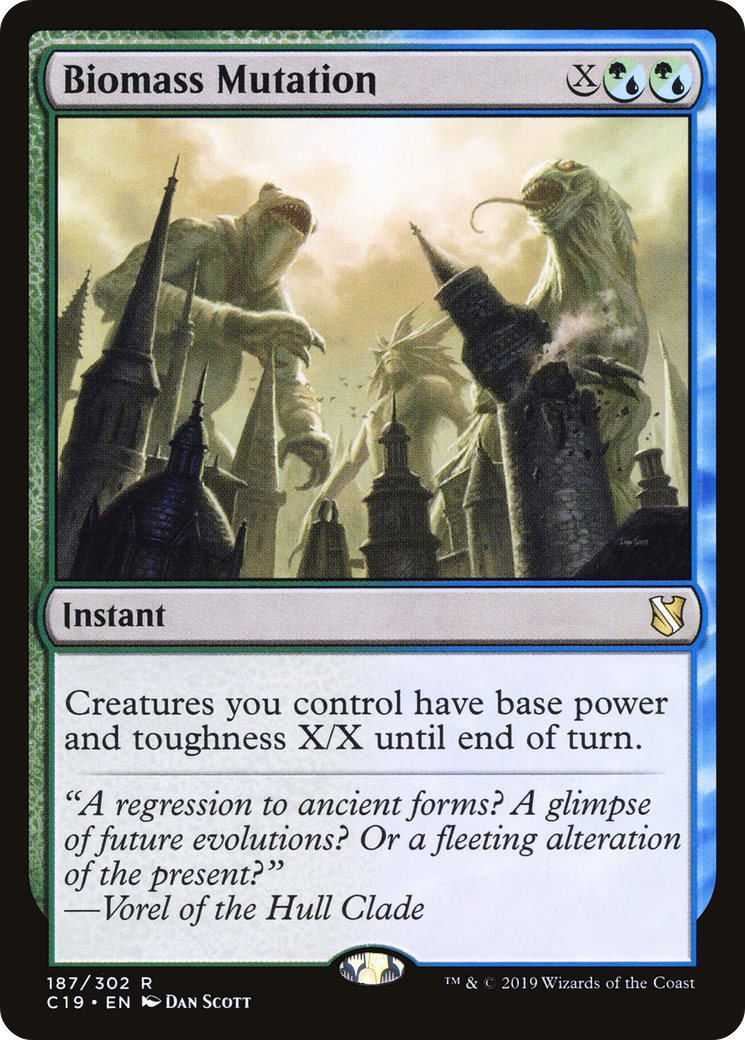
Biomass Mutation
Biomass Mutation
Instant
Creatures you control have base power and toughness X/X until end of turn.
- Choosing 0 as the value for X will likely cause creatures you control to become 0/0 and be put into the graveyard.
- Biomass Mutation overwrites any effects that set the power and/or toughness of a creature you control to a specific value. Effects that modify power and/or toughness but don't set them to a specific value (like the one created by Giant Growth), power/toughness changes from counters, and effects that switch a creature's power and toughness will continue to apply. For example, say you control a 1/1 creature that's getting +4/+2 from an Aura, has a +1/+1 counter on it, and is affected by an effect that switches its power and toughness. This creature is 4/6. If you cast Biomass Mutation with X equal to 4, the creature would become 7/9 (4/4, +4/+2 from the Aura, +1/+1 from the counter, then switch power and toughness).
-
1
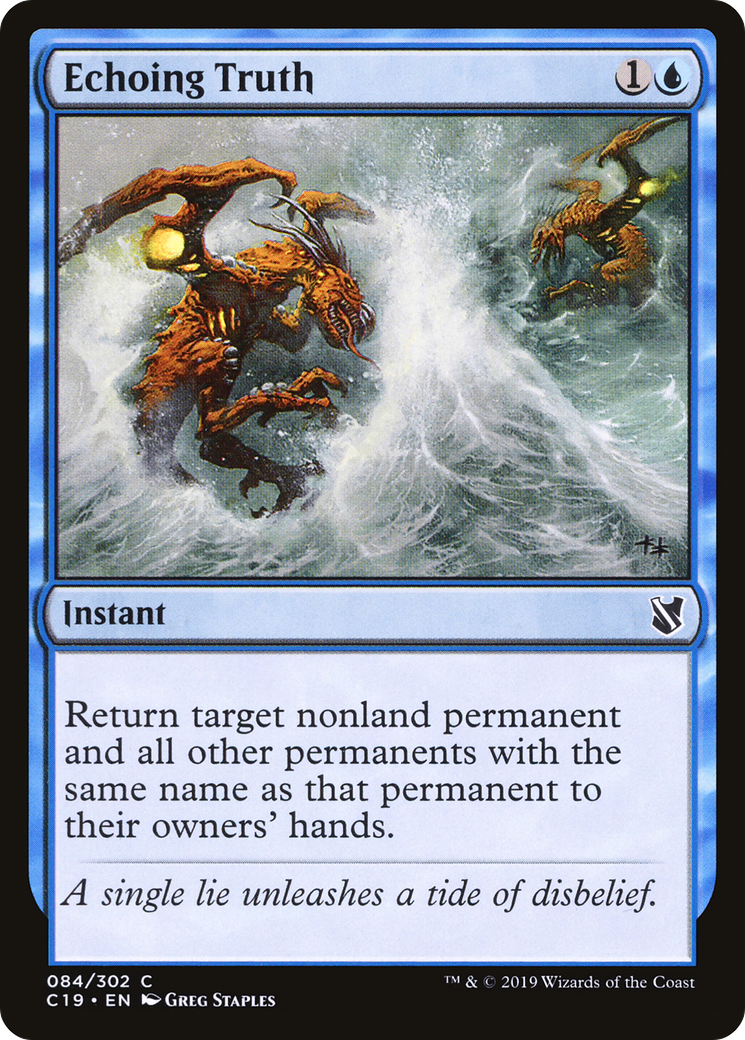
Echoing Truth
Echoing Truth
Instant
Return target nonland permanent and all other permanents with the same name as that permanent to their owners' hands.
-
1
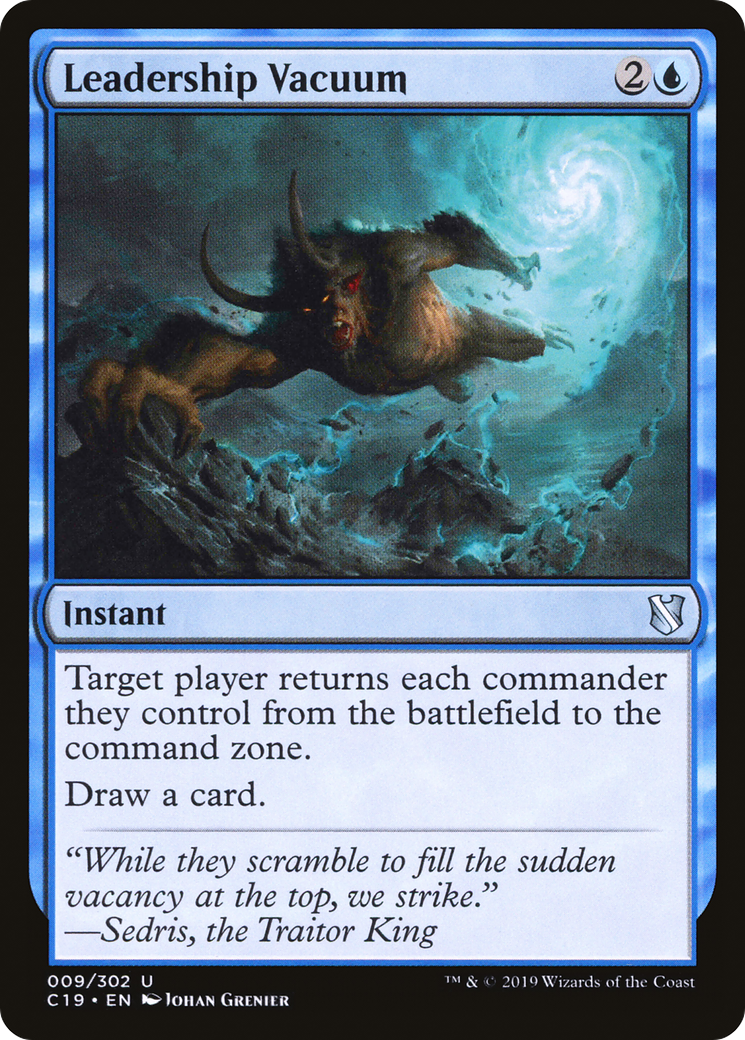
Leadership Vacuum
Leadership Vacuum
Instant
Target player returns each commander they control from the battlefield to the command zone.
Draw a card.
- Leadership Vacuum targets the player, not their creatures. A commander with hexproof or protection from blue may be returned this way.
- You'll draw a card even if the target player controls no commanders as Leadership Vacuum resolves.
- The "commander tax" increases based on how many times a commander was cast from the command zone, not how many times it was put there as a result of Commander rules. The returned commander will cost more to cast again even though it was put directly into the command zone.
-
1
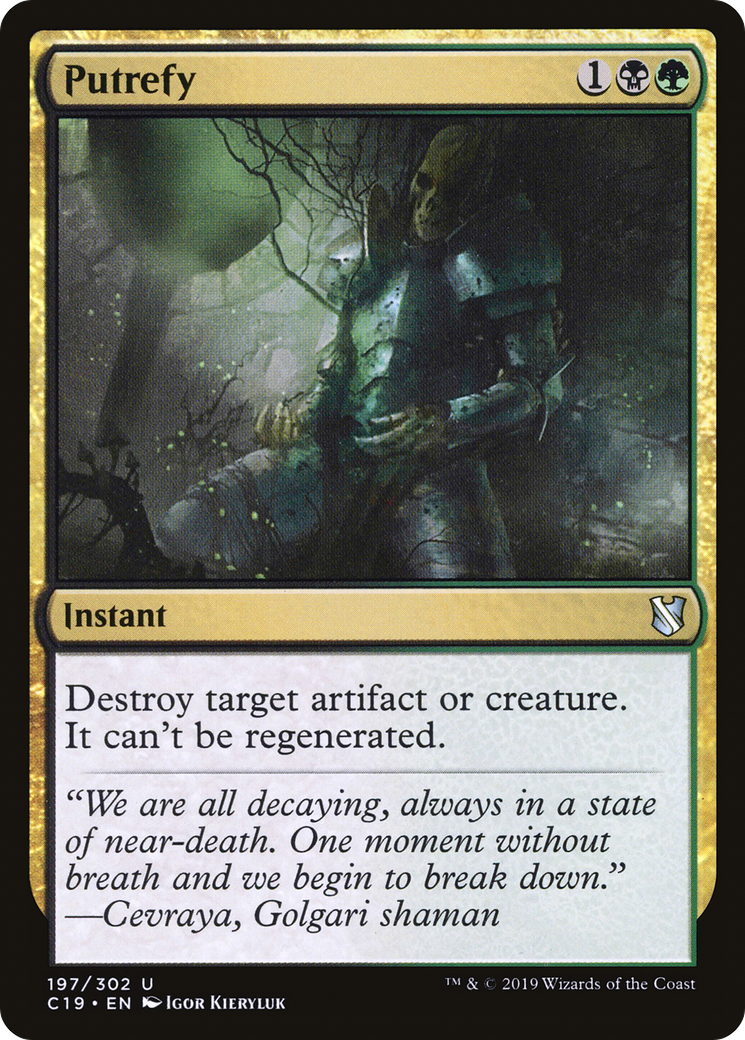
Putrefy
Putrefy
Instant
Destroy target artifact or creature. It can't be regenerated.
- This spell isn't modal. When it resolves, it will destroy the target if it's a creature or an artifact, even if it changed from one to the other between targeting and resolution.
-
1
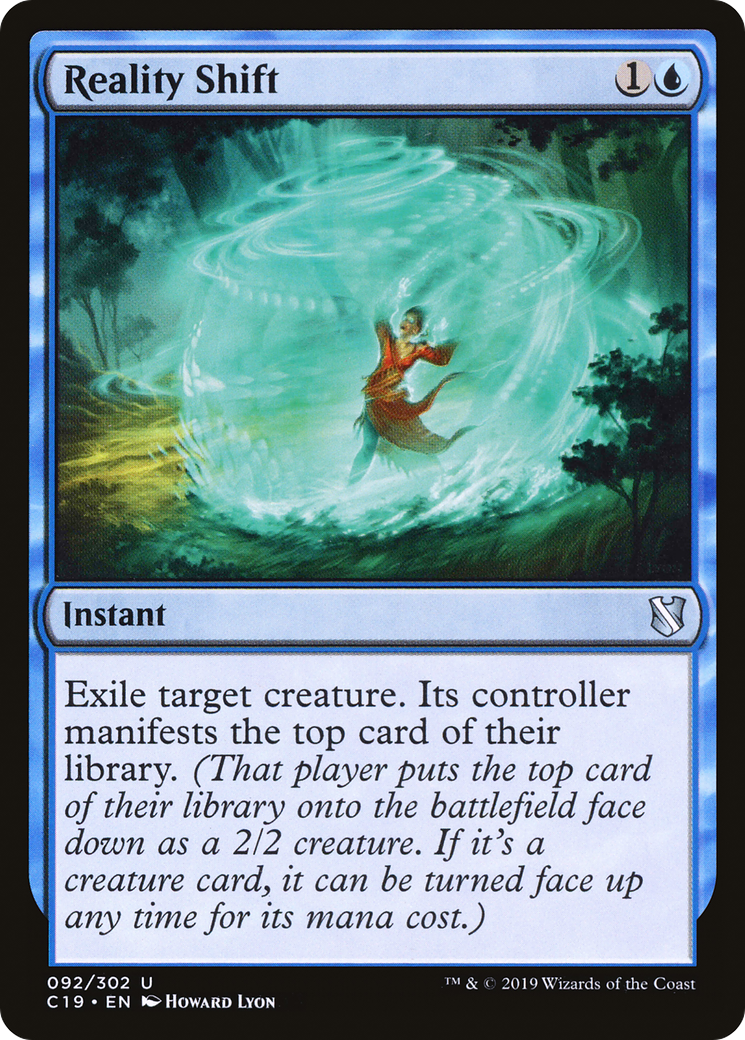
Reality Shift
Reality Shift
Instant
Exile target creature. Its controller manifests the top card of their library. (That player puts the top card of their library onto the battlefield face down as a 2/2 creature. If it's a creature card, it can be turned face up any time for its mana cost.)
- Any time you have priority, you may turn a manifested creature face up by revealing that it's a creature card (ignoring any copy effects or type-changing effects that might be applying to it) and paying its mana cost. This is a special action. It doesn't use the stack and can't be responded to.
- Because the permanent is on the battlefield both before and after it's turned face up, turning a permanent face up doesn't cause any enters-the-battlefield abilities to trigger.
- A permanent that turns face up or face down changes characteristics but is otherwise the same permanent. Spells and abilities that were targeting that permanent, as well as Auras and Equipment that were attached to the permanent, aren't affected.
- At any time, you can look at a face-down permanent you control. You can't look at face-down permanents you don't control unless an effect allows you to or instructs you to.
- The face-down permanent is a 2/2 creature with no name, mana cost, creature types, or abilities. It's colorless and has a mana value of 0. Other effects that apply to the permanent can still grant or change any of these characteristics.
- If a face-down permanent you control leaves the battlefield, you must reveal it. You must also reveal all face-down spells and permanents you control if you leave the game or if the game ends.
- If a manifested creature would have morph if it were face up, you may also turn it face up by paying its morph cost.
- Turning a permanent face up or face down doesn't change whether that permanent is tapped or untapped.
- Because face-down creatures don't have names, they can't have the same name as any other creature, even another face-down creature.
- If a double-faced card is manifested, it will be put onto the battlefield face down. While face down, it can't transform. If the front face of the card is a creature card, you can turn it face up by paying its mana cost. If you do, its front face will be up.
- There are no cards in the Fate Reforged set that would turn a face-down instant or sorcery card on the battlefield face up, but some older cards can try to do this. If something tries to turn a face-down instant or sorcery card on the battlefield face up, reveal that card to show all players it's an instant or sorcery card. The permanent remains on the battlefield face down. Abilities that trigger when a permanent turns face up won't trigger, because even though you revealed the card, it never turned face up.
- Unlike a face-down creature that was cast using the morph ability, a manifested creature may still be turned face up after it loses its abilities if it's a creature card.
- You must ensure that your face-down spells and permanents can easily be differentiated from each other. You're not allowed to mix up the cards that represent them on the battlefield in order to confuse other players. The order they entered the battlefield should remain clear. Common methods for indicating this include using markers or dice, or simply placing them in order on the battlefield. You must also track how each became face down (manifested, cast face down using the morph ability, and so on).
-
1
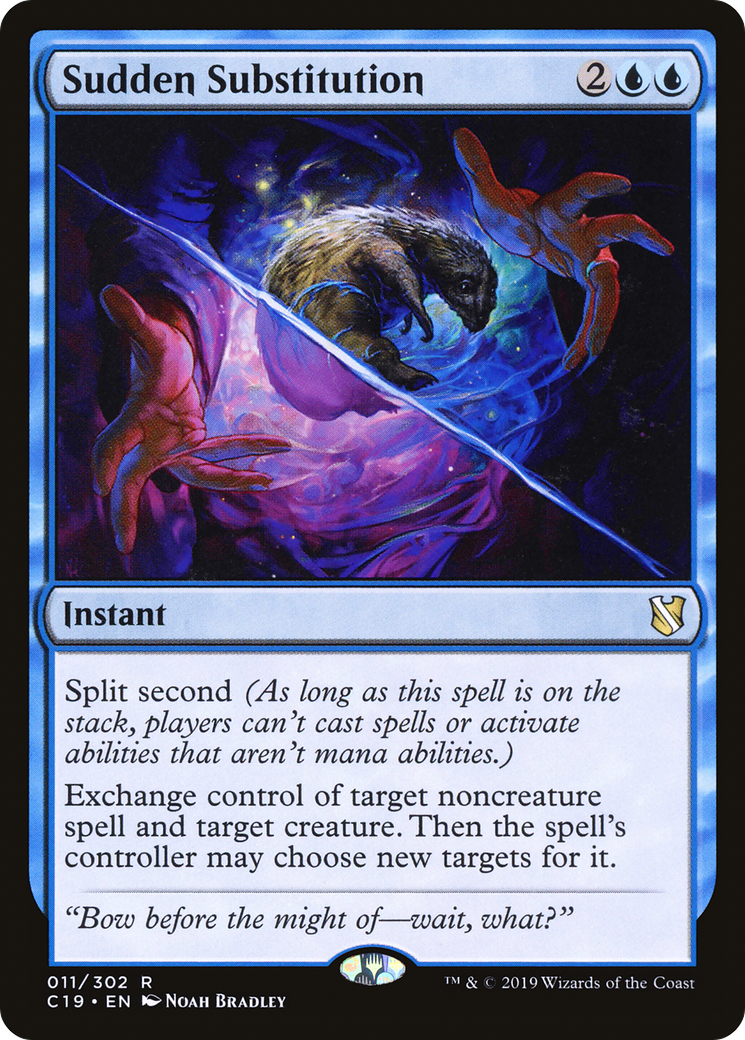
Sudden Substitution
Sudden Substitution
Instant
Split second (As long as this spell is on the stack, players can't cast spells or activate abilities that aren't mana abilities.)
Exchange control of target noncreature spell and target creature. Then the spell's controller may choose new targets for it.
- Players still get priority while a card with split second is on the stack; their options are just limited to mana abilities and certain special actions.
- Players may turn face-down creatures face up while a spell with split second is on the stack.
- Split second doesn't stop triggered abilities from triggering, such as that of Chalice of the Void. If one does, its controller puts it on the stack and chooses targets for it, if any. Those abilities will resolve as normal.
- Casting a spell with split second won't affect spells and abilities that are already on the stack.
- If the resolution of a triggered ability involves casting a spell, that spell can't be cast if a spell with split second is on the stack.
- After a spell with split second resolves (or otherwise leaves the stack), players may again cast spells and activate abilities before the next object on the stack resolves.
- A mana ability is an ability that produces mana, not an ability that costs mana.
- In a multiplayer game, if the controller of one of the objects leaves the game after Sudden Substitution resolves, the effect that gave them control of the spell or permanent expires. If the spell is still on the stack, the player who gains control of it this way can't choose new targets for it.
- If the target spell or the target creature is an illegal target as Sudden Substitution resolves, the exchange won't happen. If both targets are legal but are both controlled by the same player, the exchange won't happen.
- If the exchange doesn't happen but the spell is still a legal target, its controller may choose new targets for it.
- The noncreature spell is still on the stack after exchanging control, and the creature is still on the battlefield.
- If a permanent spell is exchanged this way, its new controller will control the permanent it becomes.
- The exchange lasts indefinitely. It doesn't expire for the spell if the creature changes zones or leaves the game, or vice versa.
-
1
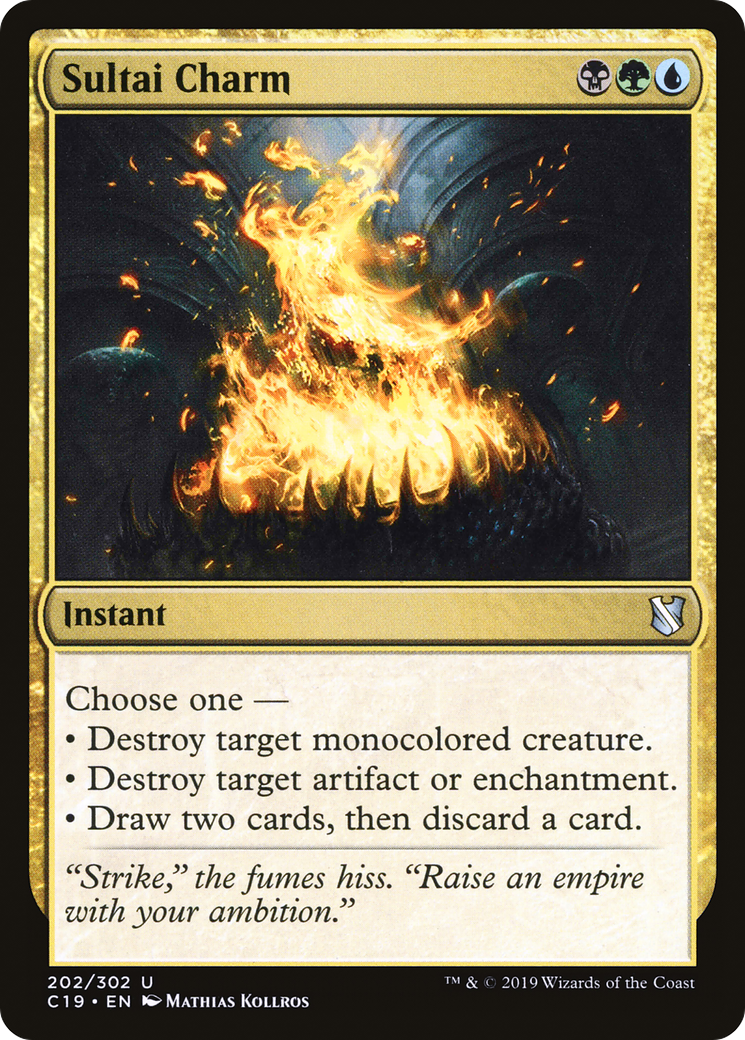
Sultai Charm
Sultai Charm
Instant
Choose one —
- Destroy target monocolored creature.
- Destroy target artifact or enchantment.
- Draw two cards, then discard a card.
- A monocolored creature is exactly one color. Colorless creatures aren't monocolored.
Sorceries 11
-
1
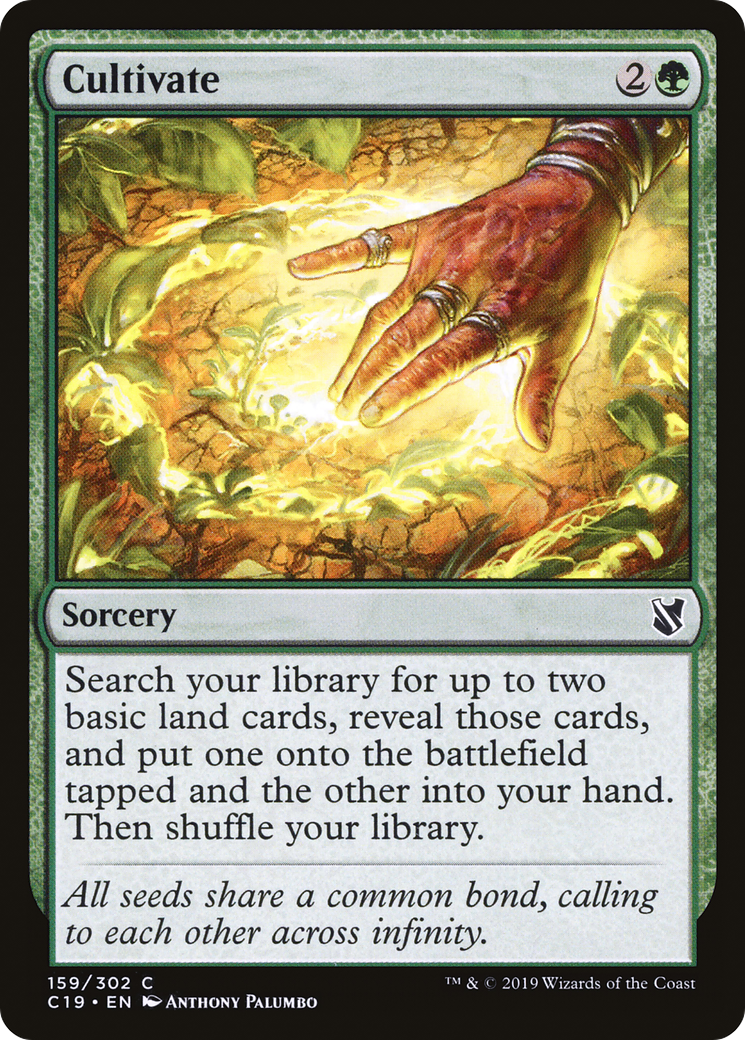
Cultivate
Cultivate
Sorcery
Search your library for up to two basic land cards, reveal those cards, put one onto the battlefield tapped and the other into your hand, then shuffle.
- If you choose to find only one basic land card, you put it onto the battlefield tapped.
-
1
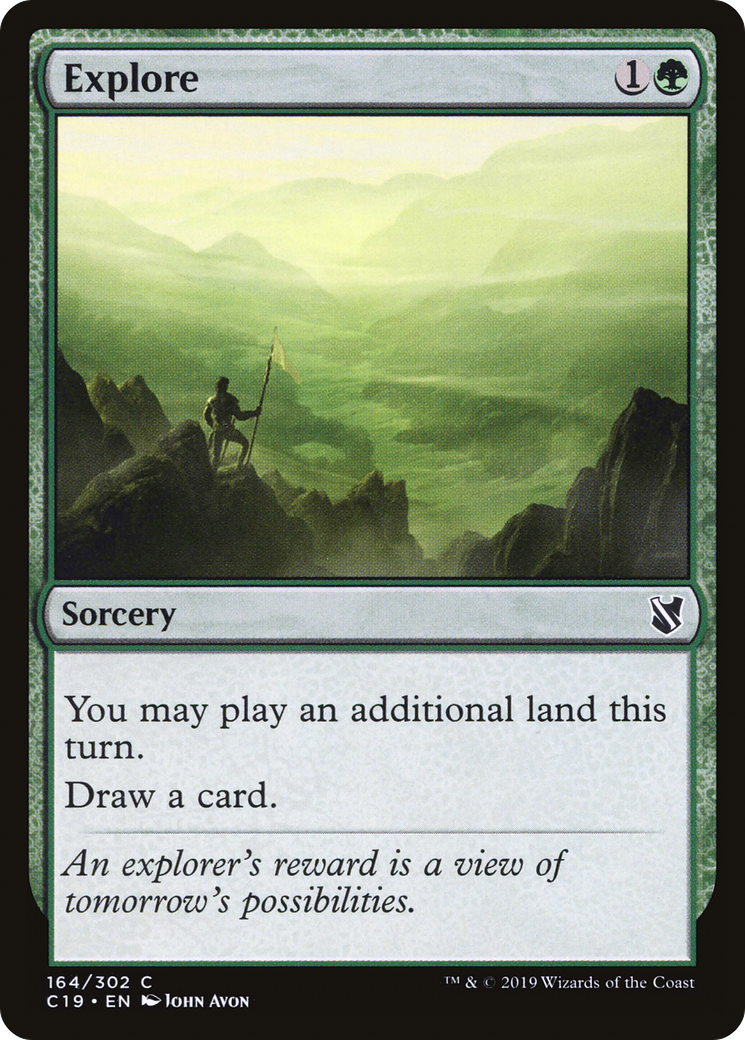
Explore
Explore
Sorcery
You may play an additional land this turn.
Draw a card.
- The effects of multiple Explores in the same turn are cumulative. They're also cumulative with other effects that let you play additional lands, such as the one from Urban Evolution.
- Explore's effect allows you to play an additional land during your main phase. Doing so follows the normal timing rules for playing lands. In particular, you don't get to play a land as Explore resolves; Explore fully resolves first and you draw a card, perhaps a land you'll play later.
- If you somehow manage to cast Explore when it's not your turn, you'll draw a card when it resolves, but you won't be able to play a land that turn.
-
1
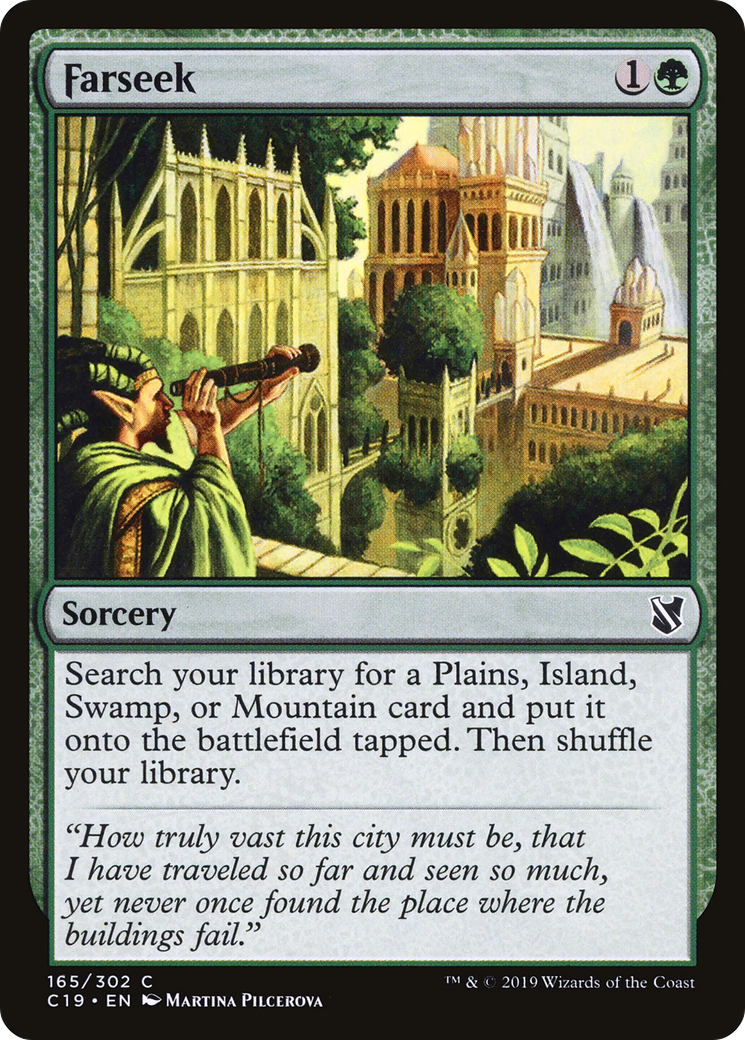
Farseek
Farseek
Sorcery
Search your library for a Plains, Island, Swamp, or Mountain card, put it onto the battlefield tapped, then shuffle.
- Farseek can find any land with any of the listed land types, including nonbasic ones, even if that land is a Forest in addition to one or more of those types.
-
1
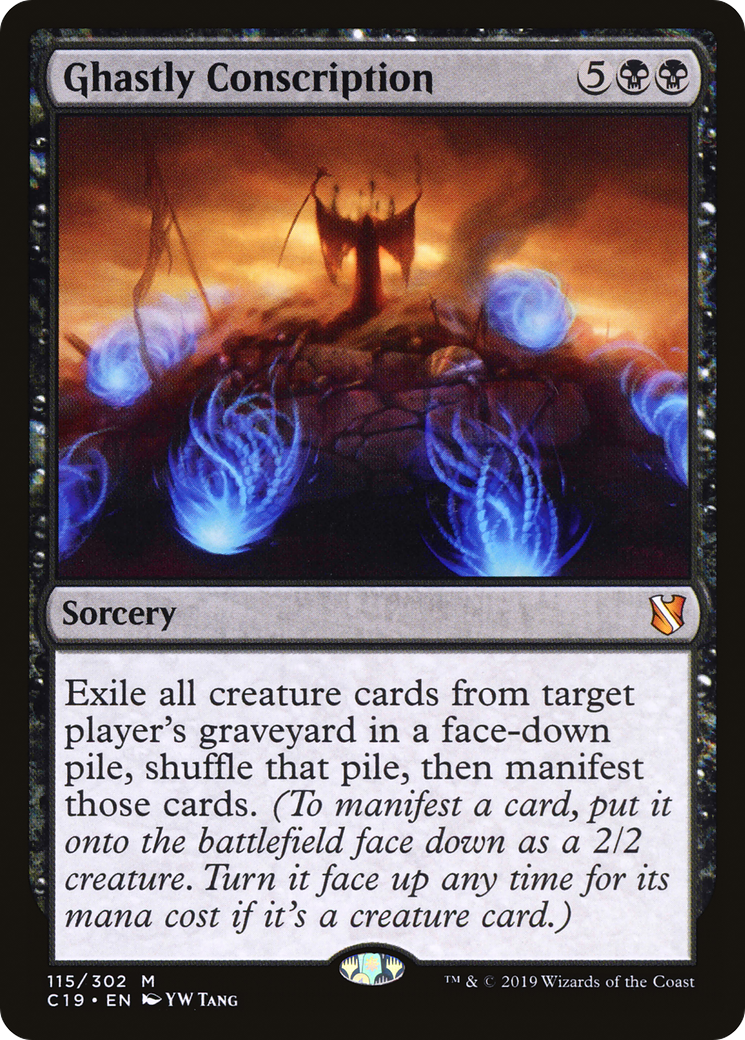
Ghastly Conscription
Ghastly Conscription
Sorcery
Exile all creature cards from target player's graveyard in a face-down pile, shuffle that pile, then manifest those cards. (To manifest a card, put it onto the battlefield face down as a 2/2 creature. Turn it face up any time for its mana cost if it's a creature card.)
- The pile is shuffled to disguise from your opponents which manifested creature is which. After you manifest the cards, you can look at them.
- If you manifest a card owned by an opponent and you leave the game, that card is exiled.
- The face-down permanent is a 2/2 creature with no name, mana cost, creature types, or abilities. It's colorless and has a mana value of 0. Other effects that apply to the permanent can still grant or change any of these characteristics.
- Any time you have priority, you may turn a manifested creature face up by revealing that it's a creature card (ignoring any copy effects or type-changing effects that might be applying to it) and paying its mana cost. This is a special action. It doesn't use the stack and can't be responded to.
- If a manifested creature would have morph if it were face up, you may also turn it face up by paying its morph cost.
- Unlike a face-down creature that was cast using the morph ability, a manifested creature may still be turned face up after it loses its abilities if it's a creature card.
- Because the permanent is on the battlefield both before and after it's turned face up, turning a permanent face up doesn't cause any enters-the-battlefield abilities to trigger.
- Because face-down creatures don't have names, they can't have the same name as any other creature, even another face-down creature.
- A permanent that turns face up or face down changes characteristics but is otherwise the same permanent. Spells and abilities that were targeting that permanent, as well as Auras and Equipment that were attached to the permanent, aren't affected.
- Turning a permanent face up or face down doesn't change whether that permanent is tapped or untapped.
- At any time, you can look at a face-down permanent you control. You can't look at face-down permanents you don't control unless an effect allows you to or instructs you to.
- If a face-down permanent you control leaves the battlefield, you must reveal it. You must also reveal all face-down spells and permanents you control if you leave the game or if the game ends.
- You must ensure that your face-down spells and permanents can easily be differentiated from each other. You're not allowed to mix up the cards that represent them on the battlefield in order to confuse other players. The order they entered the battlefield should remain clear. Common methods for indicating this include using markers or dice, or simply placing them in order on the battlefield. You must also track how each became face down (manifested, cast face down using the morph ability, and so on).
- There are no cards in the Fate Reforged set that would turn a face-down instant or sorcery card on the battlefield face up, but some older cards can try to do this. If something tries to turn a face-down instant or sorcery card on the battlefield face up, reveal that card to show all players it's an instant or sorcery card. The permanent remains on the battlefield face down. Abilities that trigger when a permanent turns face up won't trigger, because even though you revealed the card, it never turned face up.
- If a double-faced card is manifested, it will be put onto the battlefield face down. While face down, it can't transform. If the front face of the card is a creature card, you can turn it face up by paying its mana cost. If you do, its front face will be up.
-
1
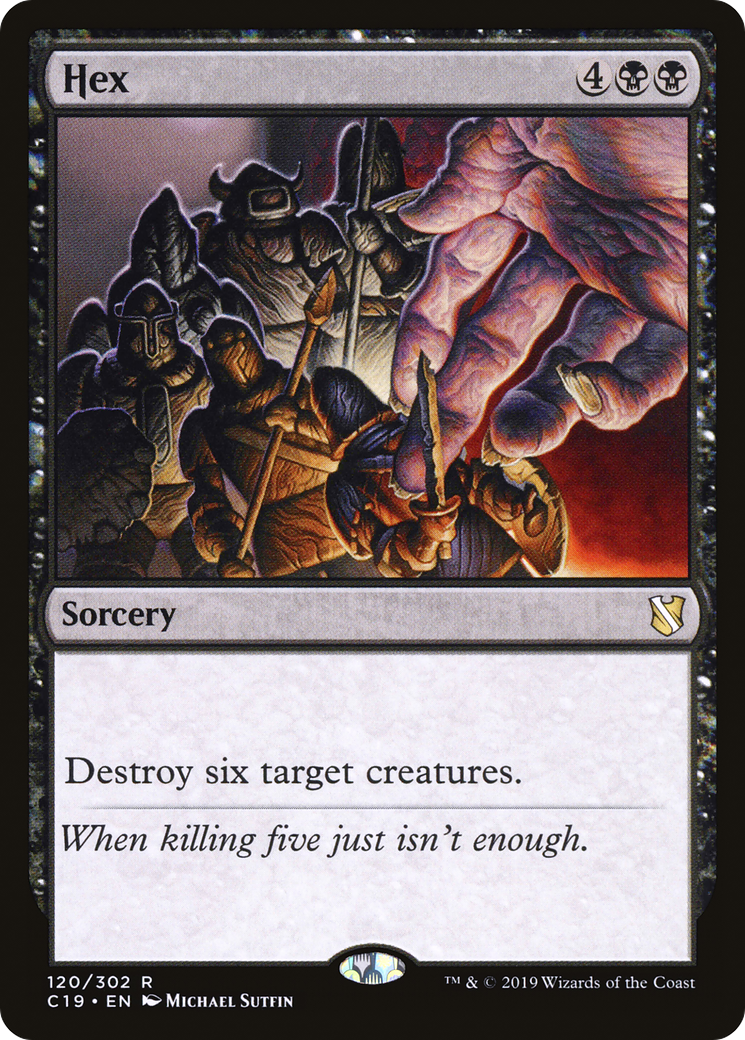
Hex
Hex
Sorcery
Destroy six target creatures.
- You must target six different creatures. If you can't, you can't cast Hex. If some of the creatures become illegal targets before the spell resolves, Hex will still destroy the rest of them.
-
1
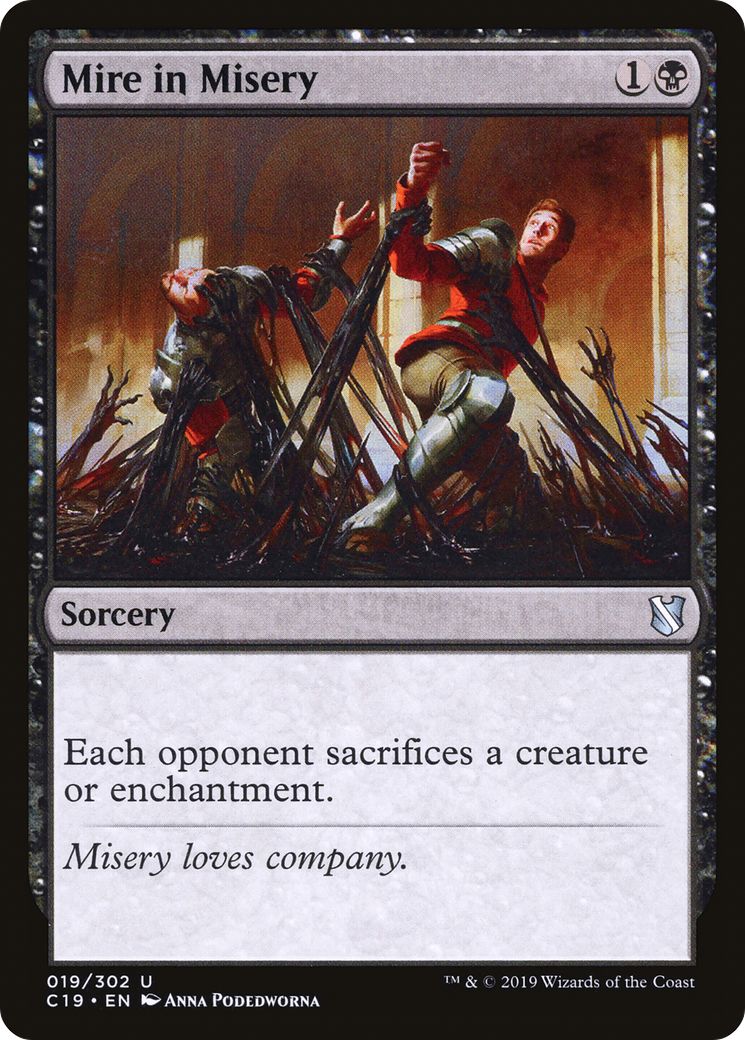
Mire in Misery
Mire in Misery
Sorcery
Each opponent sacrifices a creature or enchantment of their choice.
- As Mire in Misery resolves, first the next opponent in turn order (or, if it’s an opponent’s turn, the opponent whose turn it is) chooses a creature or an enchantment they control, then each other opponent in turn order does the same, knowing the choices made before them. Then all the chosen permanents are sacrificed at the same time.
- Your opponents choose what to sacrifice from among the creatures and enchantments they control. This means that you don’t decide which type of permanent a player sacrifices, and a player can’t choose to sacrifice an enchantment if they control none.
-
1
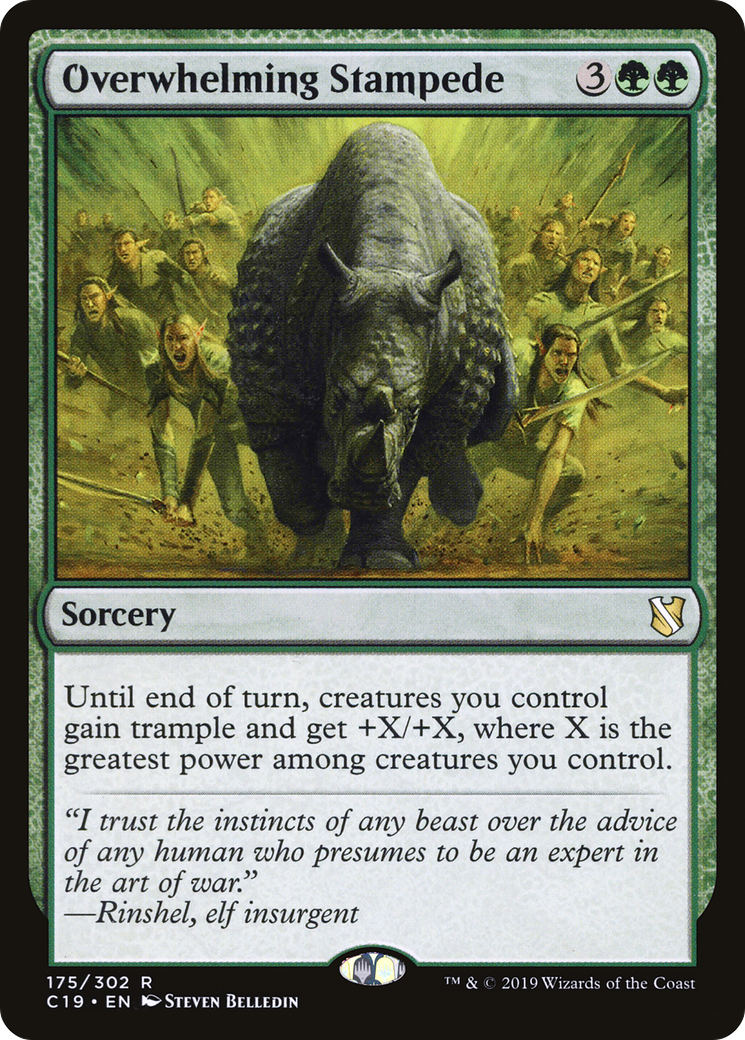
Overwhelming Stampede
Overwhelming Stampede
Sorcery
Until end of turn, creatures you control gain trample and get +X/+X, where X is the greatest power among creatures you control.
- You check the power of your creatures as Overwhelming Stampede resolves. For example, if you control a 2/1 creature, a 2/2 creature, a 2/4 creature, a 4/1 creature, a 5/5 creature, and a 5/6 creature at that time, each of your creatures gets +5/+5 and gains trample until end of turn.
-
1
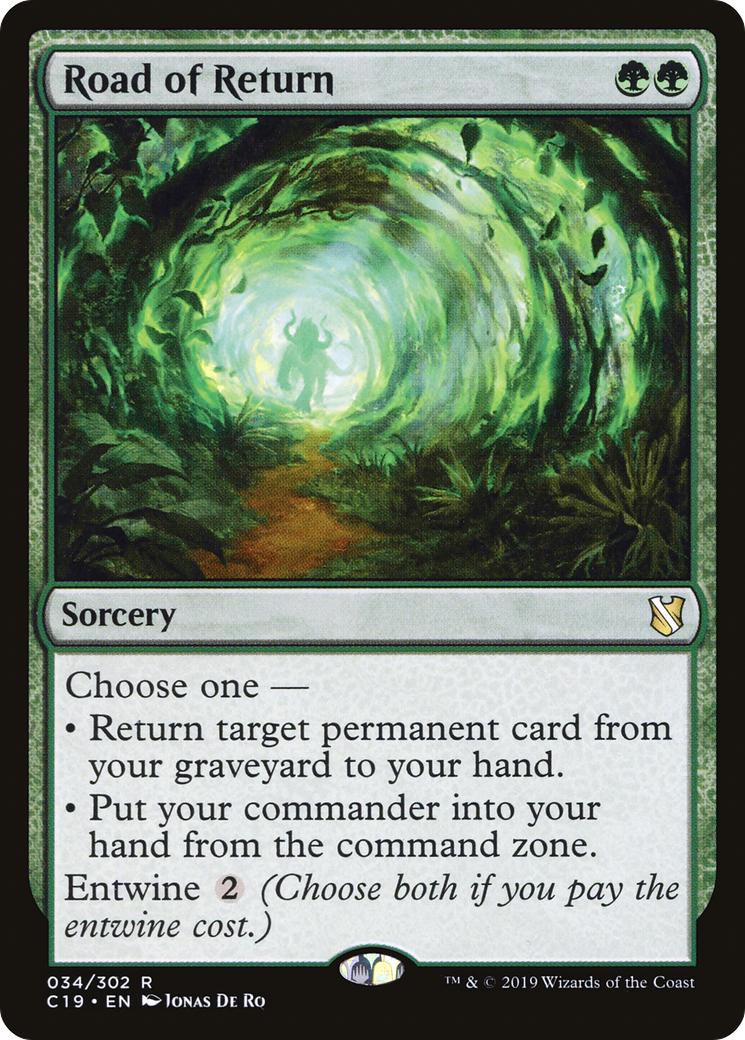
Road of Return
Road of Return
Sorcery
Choose one —
- Return target permanent card from your graveyard to your hand.
- Put your commander into your hand from the command zone.
Entwine (Choose both if you pay the entwine cost.)
- The “commander tax” increases based on how many times a commander was cast from the command zone. Casting a commander from your hand doesn’t require that additional cost, and it doesn’t increase what the cost will be the next time you cast that commander from the command zone.
- If your commander isn’t in the command zone (or if you’re not playing the Commander variant), Road of Return’s second mode does nothing.
- Certain cards in other sets with the partner keyword may allow you to have more than one commander. If you have two commanders in the command zone, Road of Return’s second mode puts one of your choice into your hand, not both.
-
1
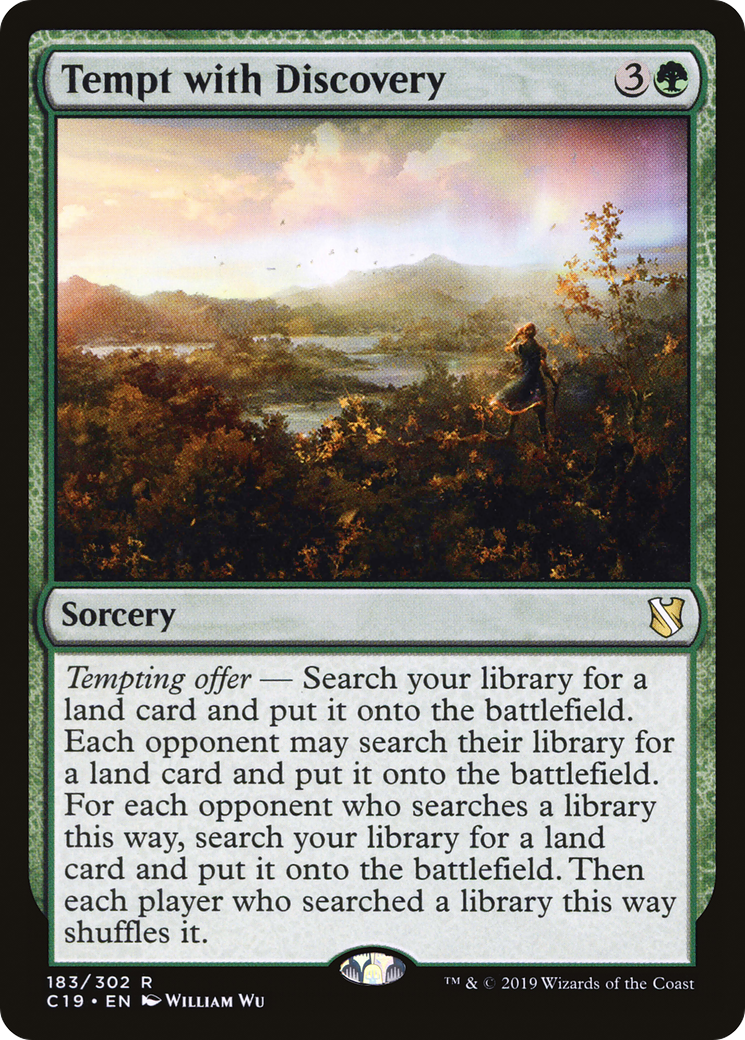
Tempt with Discovery
Tempt with Discovery
Sorcery
Tempting offer — Search your library for a land card and put it onto the battlefield. Each opponent may search their library for a land card and put it onto the battlefield. For each opponent who searches a library this way, search your library for a land card and put it onto the battlefield. Then each player who searched a library this way shuffles.
- Your opponents decide in turn order whether or not they accept the offer, starting with the opponent on your left. Each opponent will know the decisions of previous opponents in turn order when making their decision.
- After each opponent has decided, the effect happens simultaneously for each one who accepted the offer. Then, the effect happens again for you a number of times equal to the number of opponents who accepted.
-
1
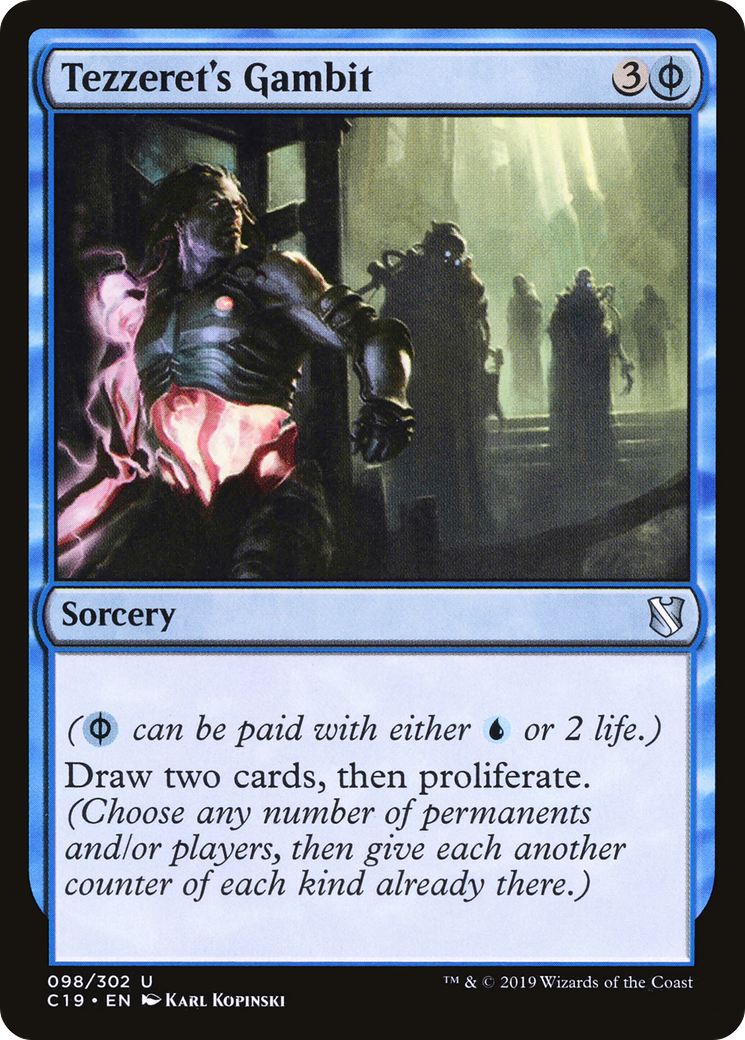
Tezzeret's Gambit
Tezzeret's Gambit
Sorcery
( can be paid with either or 2 life.)
Draw two cards, then proliferate. (Choose any number of permanents and/or players, then give each another counter of each kind already there.)
- If a permanent ever has both +1/+1 counters and -1/-1 counters on it at the same time, they're removed in pairs as a state-based action so that the permanent has only one of those kinds of counters on it.
- To proliferate, you can choose any permanent that has a counter, including ones controlled by opponents. You can choose any player who has a counter, including opponents. You can't choose cards in any zone other than the battlefield, even if they have counters on them.
- You don't have to choose every permanent or player that has a counter, only the ones you want to add another counter to. Since "any number" includes zero, you don't have to choose any permanents at all, and you don't have to choose any players at all.
- If a player or permanent has more than one kind of counter on it, and you choose for it to get additional counters, it must get one of each kind of counter it already has. You can't have it get just one kind of counter it already has and not the others.
- An ability that triggers "Whenever you proliferate" triggers even if you chose no permanents or players while doing so.
- Players can respond to a spell or ability whose effect includes proliferating. Once that spell or ability starts to resolve, however, and its controller chooses which permanents and players will get new counters, it's too late for anyone to respond.
- To calculate the mana value of a card with Phyrexian mana symbols in its cost, count each Phyrexian mana symbol as 1.
- As you cast a spell or activate an activated ability with one or more Phyrexian mana symbols in its cost, you choose how to pay for each Phyrexian mana symbol at the same time you would choose modes or choose a value for X.
- If you're at 1 life or less, you can't pay 2 life.
- Phyrexian mana is not a new color. Players can't produce Phyrexian mana.
- A card with Phyrexian mana symbols in its mana cost is each color that appears in that mana cost, regardless of how that cost may have been paid.
-
1
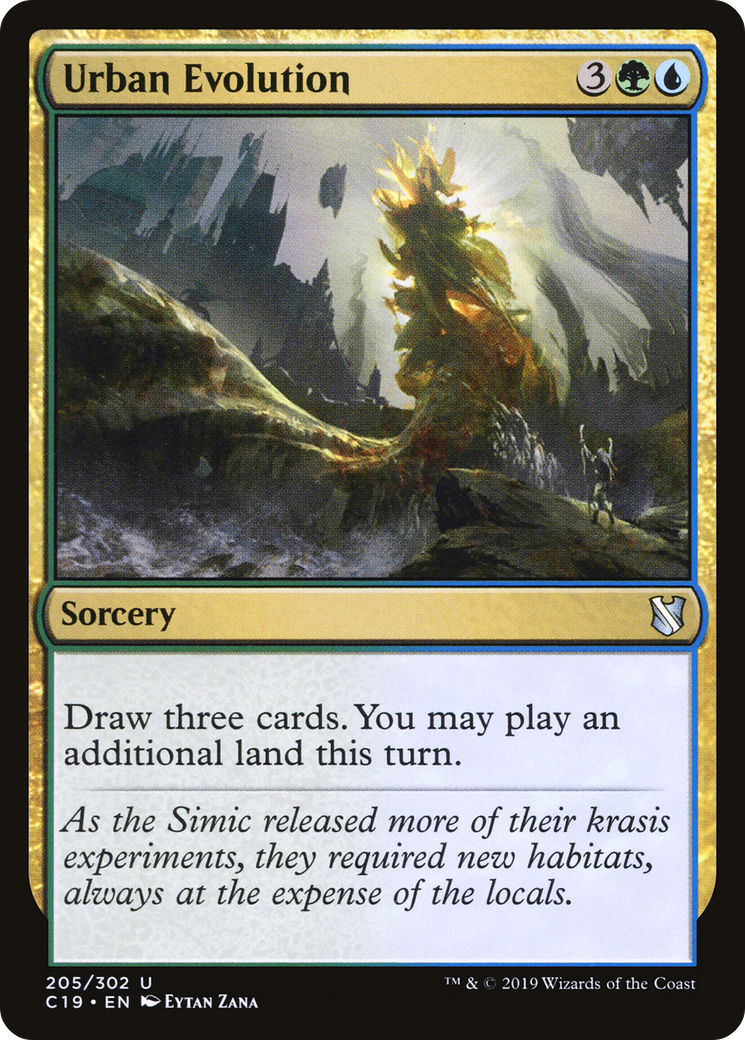
Urban Evolution
Urban Evolution
Sorcery
Draw three cards. You may play an additional land this turn.
- Urban Evolution's effect allows you to play an additional land during your main phase. Doing so follows the normal timing rules for playing lands. In particular, you don't get to play a land as Urban Evolution resolves; Urban Evolution fully resolves first and you draw three cards, perhaps including a land you'll play later.
- The effects of multiple Urban Evolutions in the same turn are cumulative. They're also cumulative with other effects that let you play additional lands, such as the one from Explore.
- If you somehow manage to cast Urban Evolution when it's not your turn, you'll draw three cards when it resolves, but you won't be able to play a land that turn.
Artifacts 5
-
1
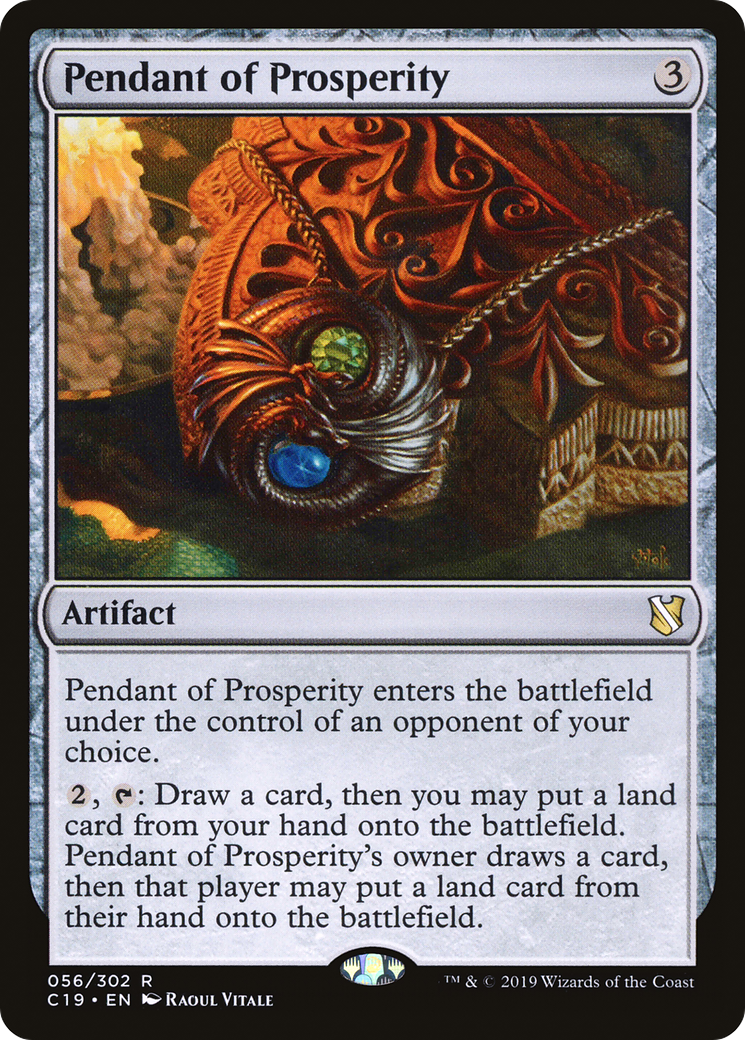
Pendant of Prosperity
Pendant of Prosperity
Artifact
This artifact enters under the control of an opponent of your choice.
, : Draw a card, then you may put a land card from your hand onto the battlefield. This artifact's owner draws a card, then that player may put a land card from their hand onto the battlefield.
- Pendant of Prosperity's effect doesn't count as playing a land. It can put a land card onto the battlefield even if you've already played your land for the turn, and even if it's not your turn.
- If you control your own Pendant of Prosperity and activate its last ability, you'll draw a card, then you may put a land card onto the battlefield, then you'll draw a second card, then you may once again put a land card onto the battlefield.
- In a multiplayer game, if Pendant of Prosperity's owner leaves the game, Pendant of Prosperity leaves the game with them. If Pendant of Prosperity's controller leaves the game, Pendant of Prosperity is exiled (assuming that player wasn't also Pendant of Prosperity's owner).
-
1
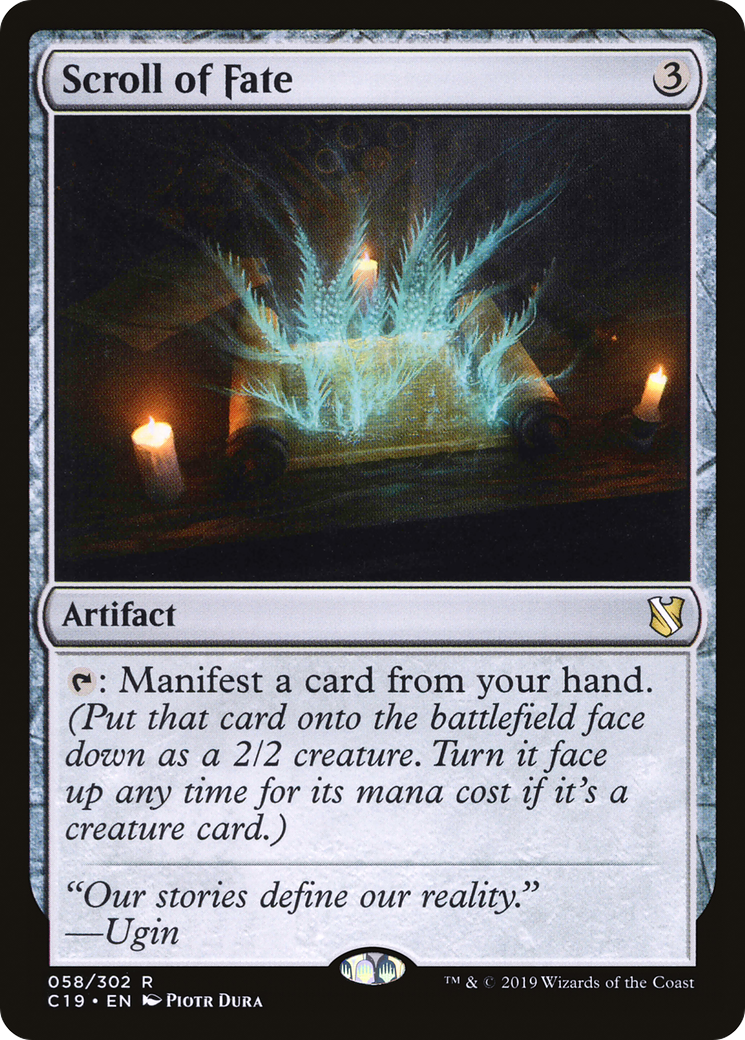
Scroll of Fate
Scroll of Fate
Artifact
: Manifest a card from your hand. (Put that card onto the battlefield face down as a 2/2 creature. Turn it face up any time for its mana cost if it's a creature card.)
-
1
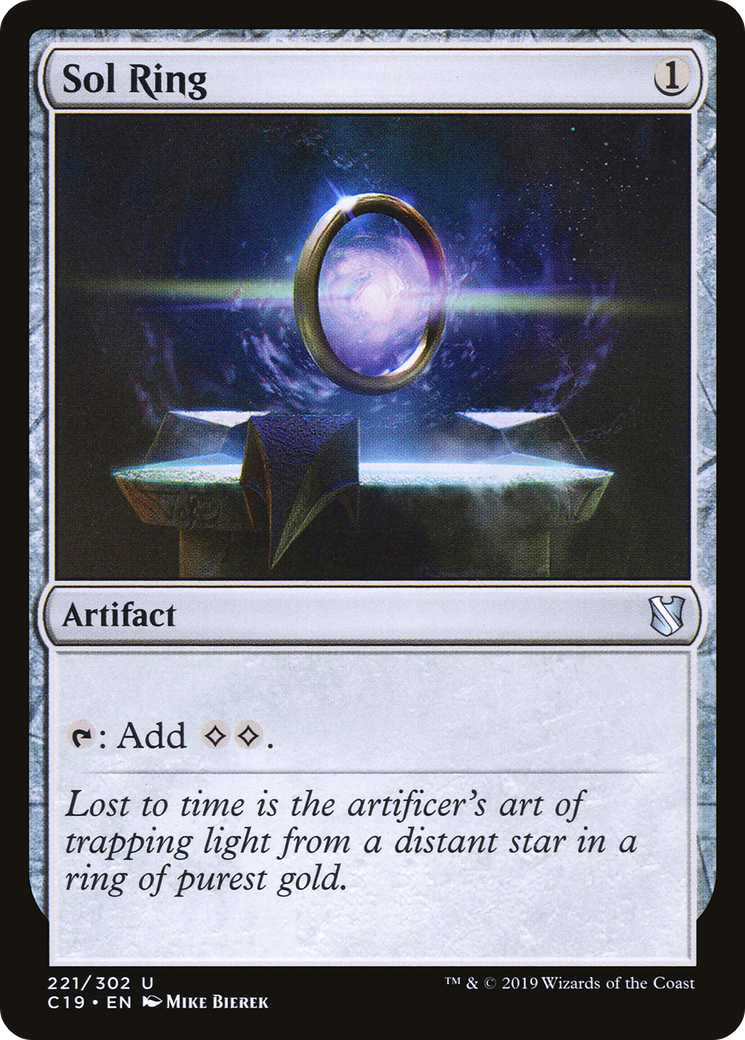
Sol Ring
Sol Ring
Artifact
: Add .
-
1
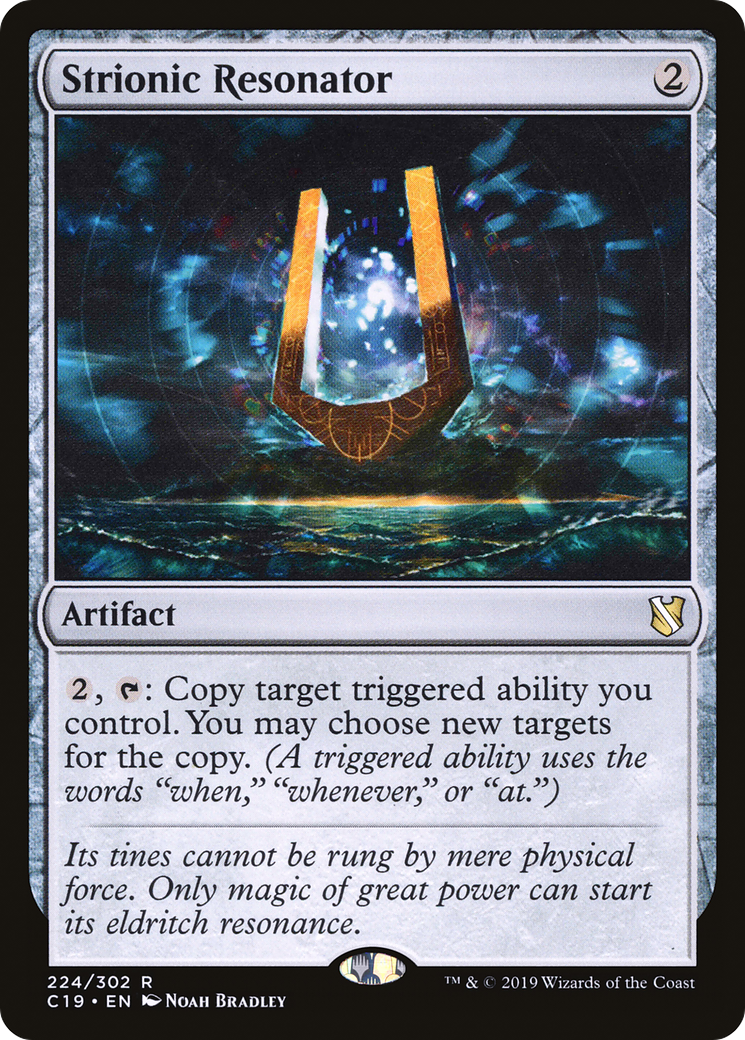
Strionic Resonator
Strionic Resonator
Artifact
, : Copy target triggered ability you control. You may choose new targets for the copy. (A triggered ability uses the words "when," "whenever," or "at.")
- Triggered abilities use the word "when," "whenever," or "at." They're often written as "[Trigger condition], [effect]."
- Strionic Resonator targets a triggered ability that has triggered and is on the stack and creates another instance of that ability on the stack. It doesn't cause any object to gain an ability.
- The source of the copy is the same as the source of the original ability.
- If the triggered ability is modal (that is, if it says, "Choose one —" or similar), the mode is copied and can't be changed.
- If the triggered ability divides damage or distributes counters among a number of targets (for example, the ability of Bogardan Hellkite), the division and number of targets can't be changed. If you choose new targets, you must choose the same number of targets.
- Any choices made when the triggered ability resolves won't have been made yet when it's copied. Any such choices will be made separately when the copy resolves. If the triggered ability asks you to pay a cost (such as that of Frenzied Goblin), you pay that cost for the copy.
- If a triggered ability is linked to a second ability, copies of that triggered ability are also linked to that second ability. If the second ability refers to "the exiled card," it refers to all cards exiled by the triggered ability and the copy. For example, if Fiend Hunter's enters-the-battlefield ability is copied and two creatures are exiled, they both return when Fiend Hunter leaves the battlefield.
- In some cases involving linked abilities, an ability requires information about "the exiled card." When this happens, the ability gets multiple answers. If these answers are being used to determine the value of a variable, the sum is used. For example, if Elite Arcanist's enters-the-battlefield ability is copied, two cards are exiled. The value of X in the activation cost of Elite Arcanist's other ability is the sum of the two cards' mana values. As the ability resolves, you create copies of both cards and can cast none, one, or both of the copies in any order.
-
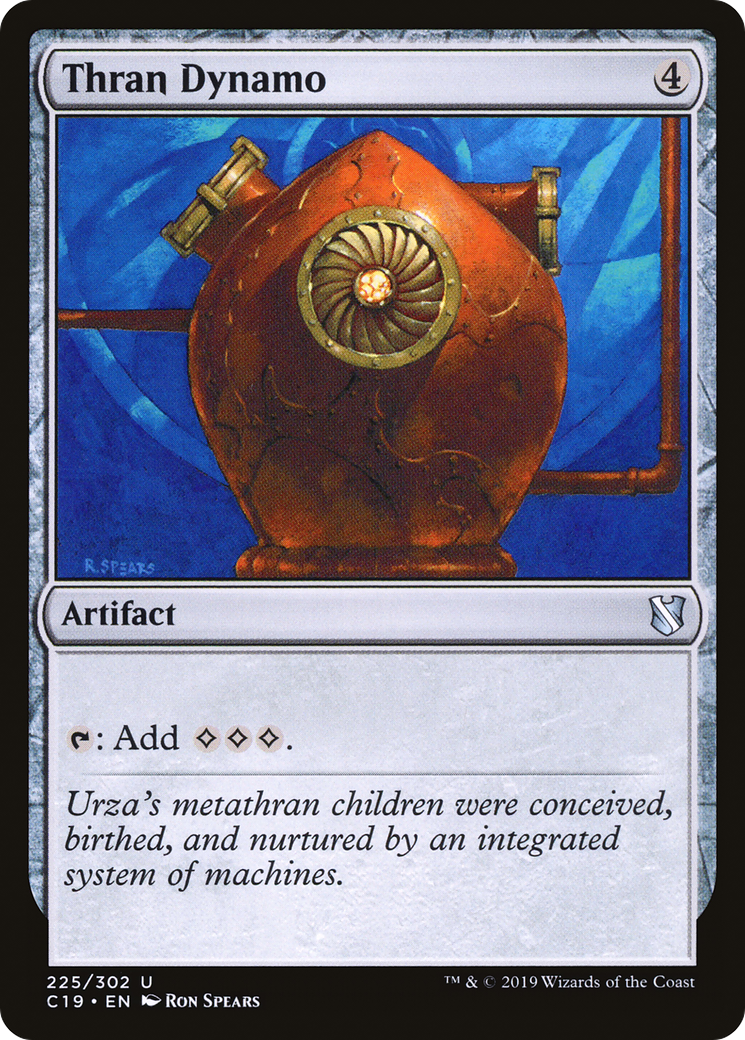
1
Thran Dynamo
Thran Dynamo
Artifact
: Add .
Enchantments 4
-
1
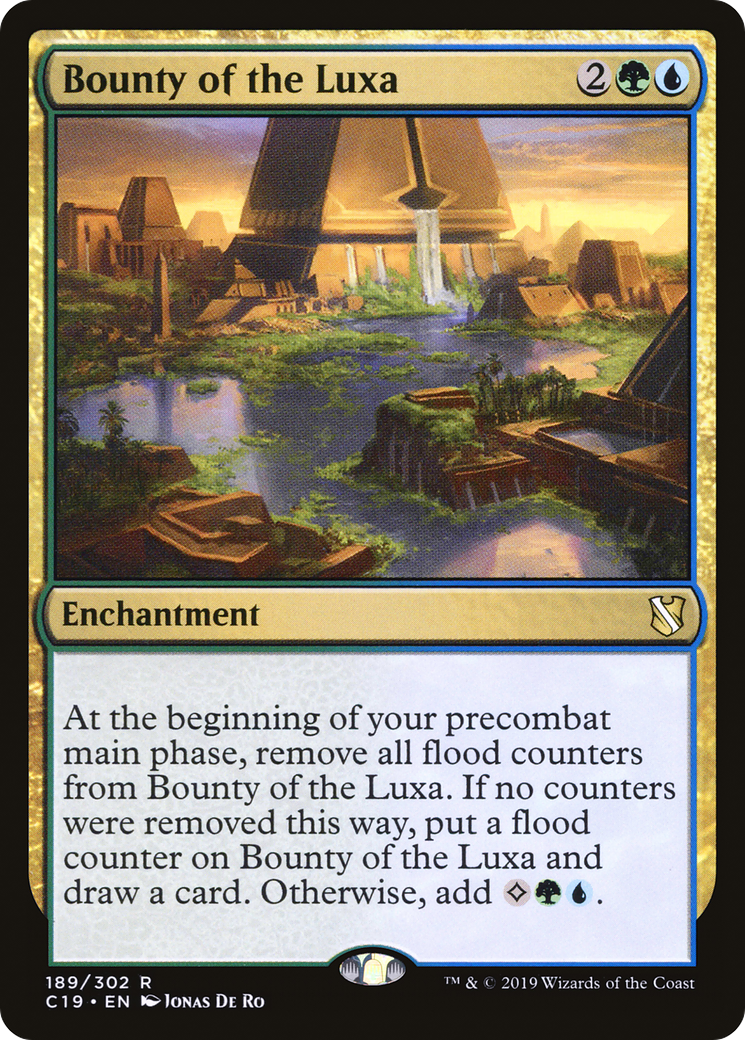
Bounty of the Luxa
Bounty of the Luxa
Enchantment
At the beginning of your first main phase, remove all flood counters from this enchantment. If no counters were removed this way, put a flood counter on this enchantment and draw a card. Otherwise, add .
- If Bounty of the Luxa somehow has multiple flood counters on it, you'll still get only when you remove them all.
- If Bounty of the Luxa leaves the battlefield while its triggered ability is on the stack, you can't remove any flood counters from it, even if it had one before it left the battlefield. You won't put one on it as the ability resolves, but you will draw a card.
-
1
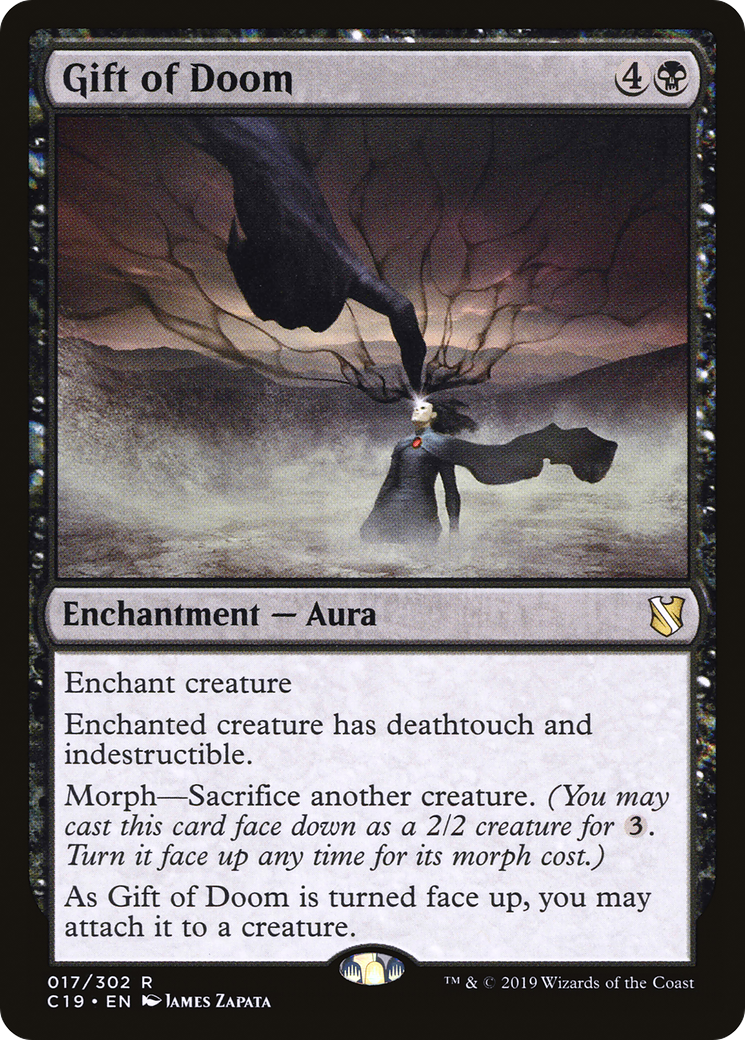
Gift of Doom
Gift of Doom
Enchantment — Aura
Enchant creature
Enchanted creature has deathtouch and indestructible.
Morph—Sacrifice another creature. (You may cast this card face down as a 2/2 creature for . Turn it face up any time for its morph cost.)
As this Aura is turned face up, you may attach it to a creature.
- You can't pay Gift of Doom's morph cost more than once.
- No player may take any actions between the time you announce that you're turning Gift of Doom face up and the time it's attached to the chosen creature.
- If there's no creature you can legally attach Gift of Doom to as you turn it face up, or if you choose not to attach it to a creature, it's put into its owner's graveyard.
- This doesn't target the creature Gift of Doom will enchant, so an opponent's creature with hexproof or a creature with shroud may be chosen this way. The chosen recipient must be able to legally be enchanted by the Aura, so a creature with protection from black can't be chosen this way.
-
1
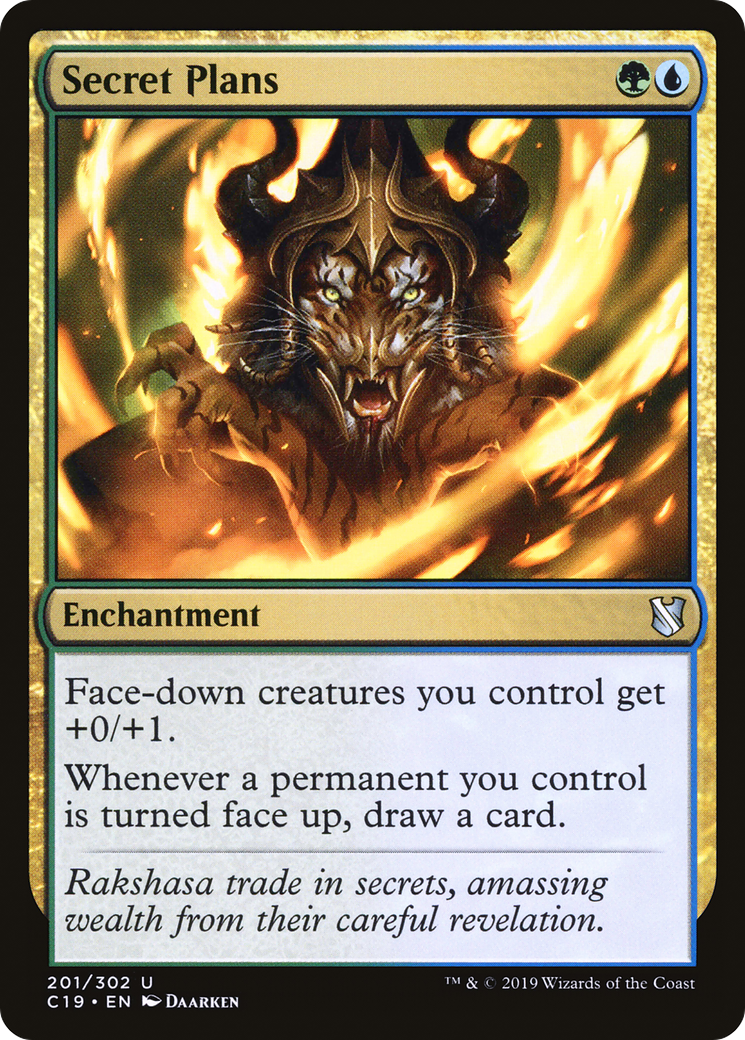
Secret Plans
Secret Plans
Enchantment
Face-down creatures you control get +0/+1.
Whenever a permanent you control is turned face up, draw a card.
- As soon as a creature turns face up, it loses the +0/+1 from Secret Plans. If damage marked on that creature is equal to or greater than its new toughness, the creature will be destroyed.
-
1
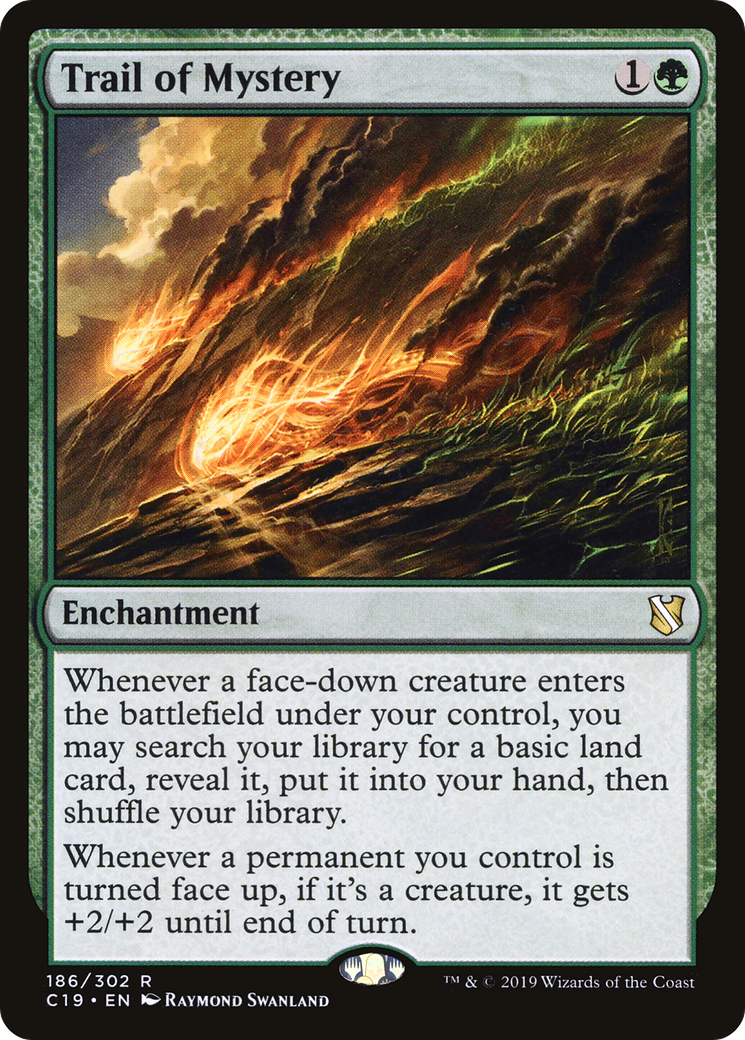
Trail of Mystery
Trail of Mystery
Enchantment
Whenever a face-down creature you control enters, you may search your library for a basic land card, reveal it, put it into your hand, then shuffle.
Whenever a permanent you control is turned face up, if it's a creature, it gets +2/+2 until end of turn.
Lands 40
-
1
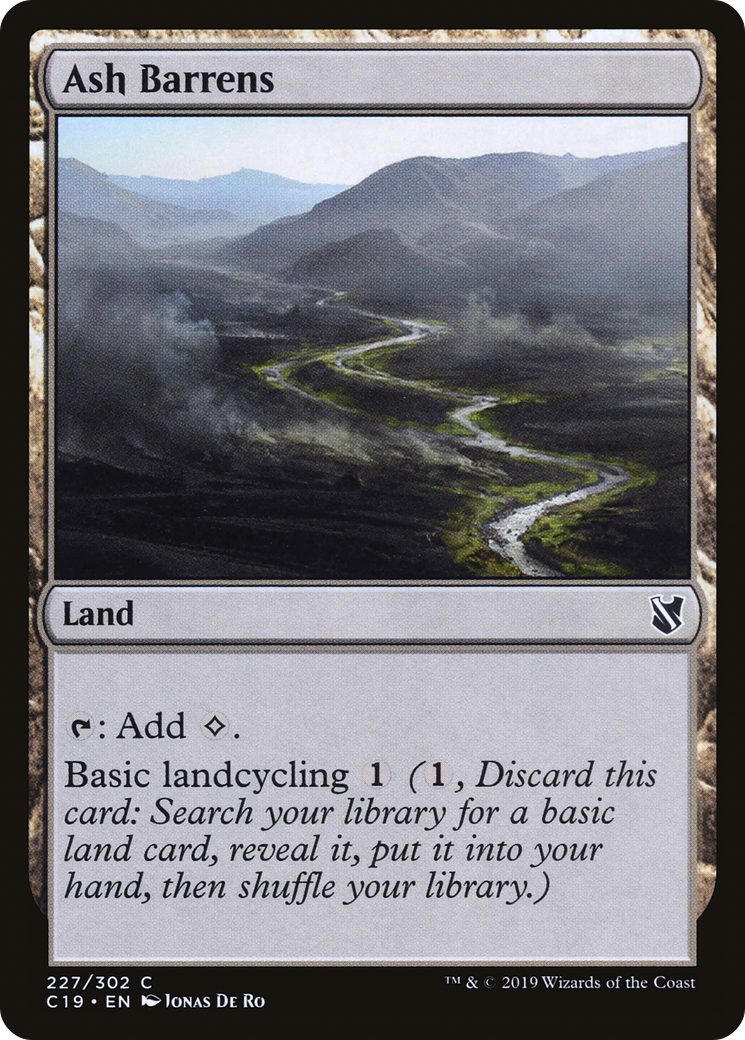
Ash Barrens
Ash Barrens
Land
: Add .
Basic landcycling ( , Discard this card: Search your library for a basic land card, reveal it, put it into your hand, then shuffle.)
-
1
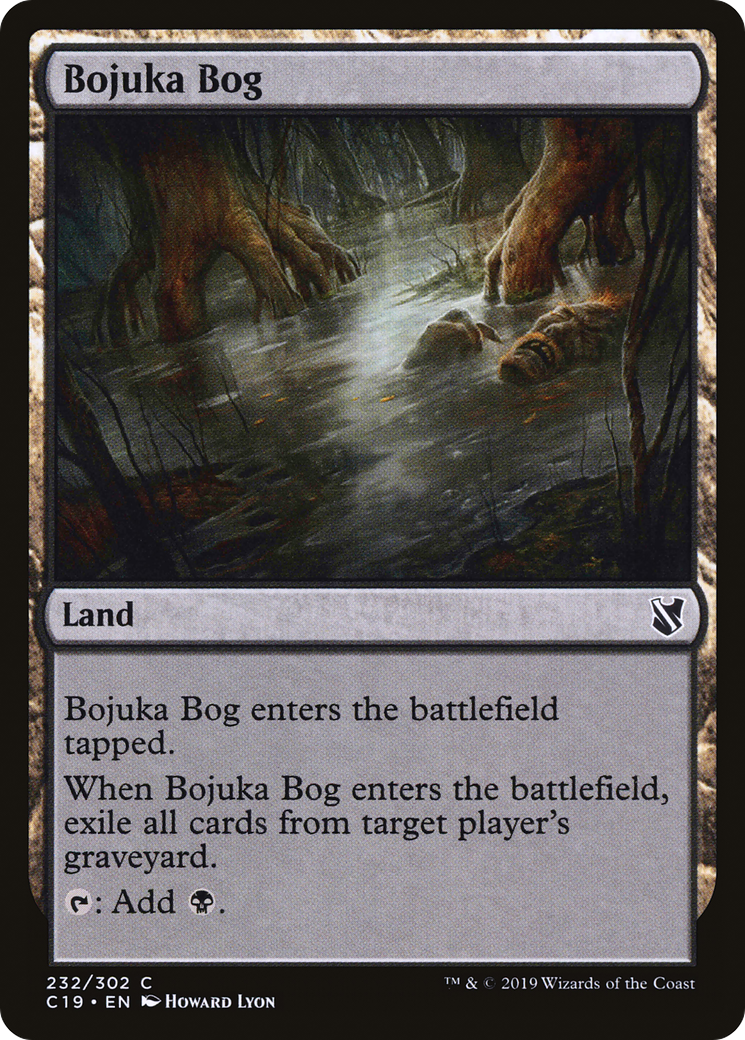
Bojuka Bog
Bojuka Bog
Land
This land enters tapped.
When this land enters, exile target player's graveyard.
: Add .
-
1
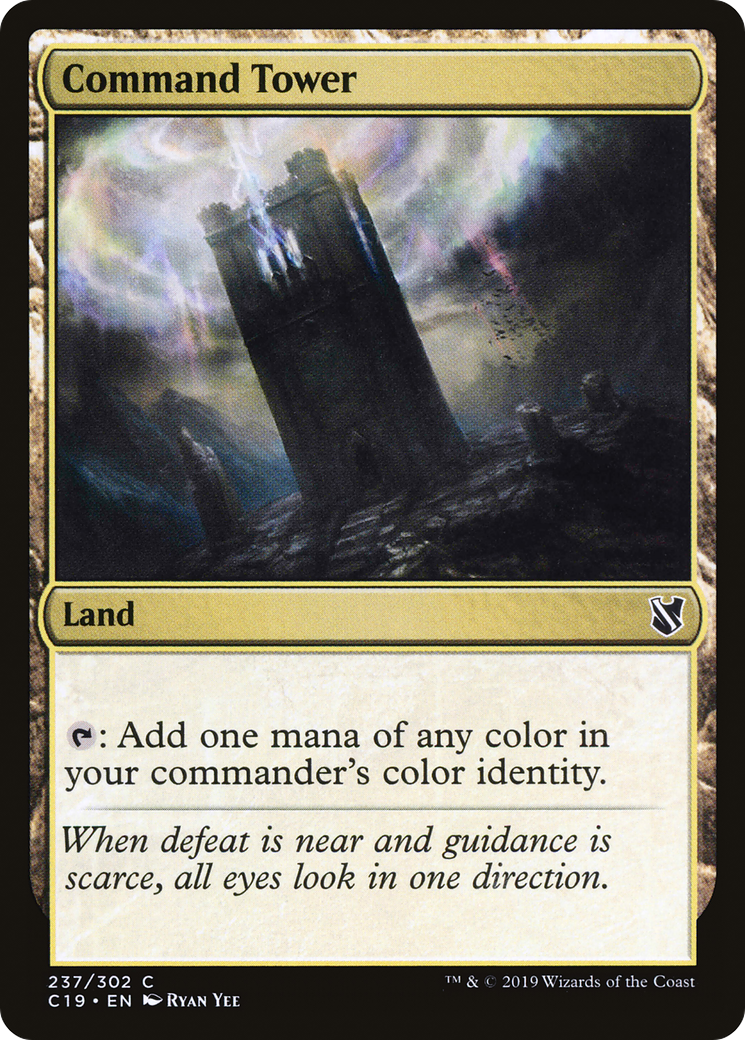
Command Tower
Command Tower
Land
: Add one mana of any color in your commander's color identity.
- If you don't have a commander, Command Tower's ability produces no mana.
- If your commander is a card that has no colors in its color identity, Command Tower's ability produces no mana. It doesn't produce .
- If you have two commanders, the ability adds one mana of any color in their combined color identities.
-
1
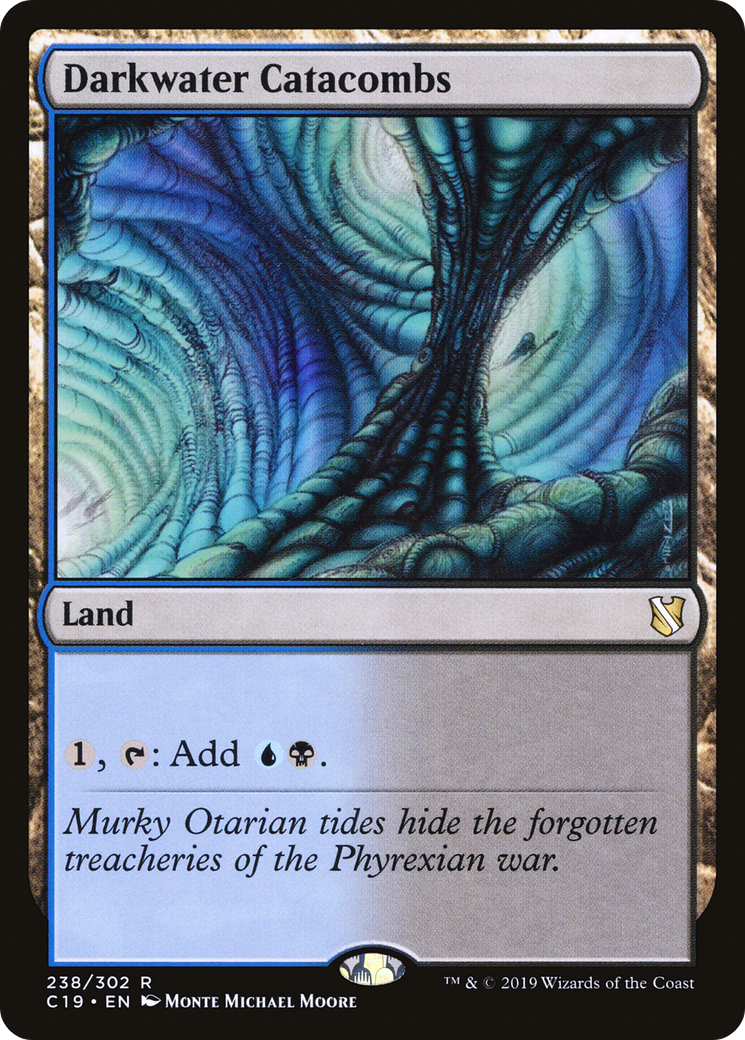
Darkwater Catacombs
Darkwater Catacombs
Land
, : Add .
-
1
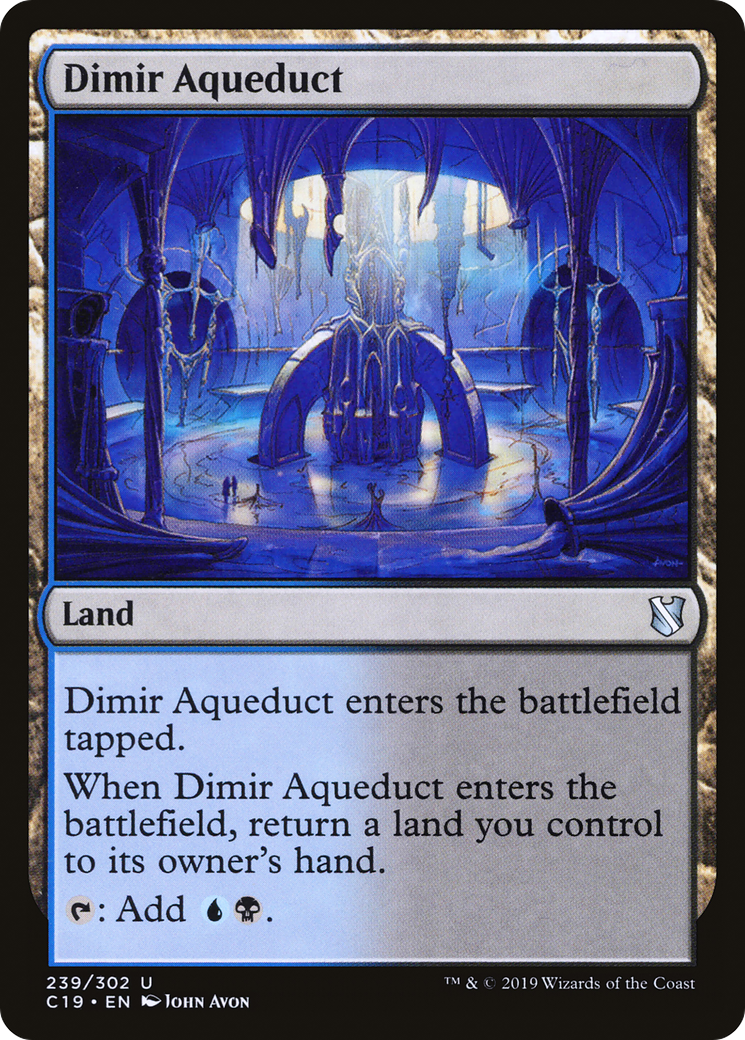
Dimir Aqueduct
Dimir Aqueduct
Land
This land enters tapped.
When this land enters, return a land you control to its owner's hand.
: Add .
- If this land enters the battlefield and you control no other lands, its ability will force you to return it to your hand.
-
1
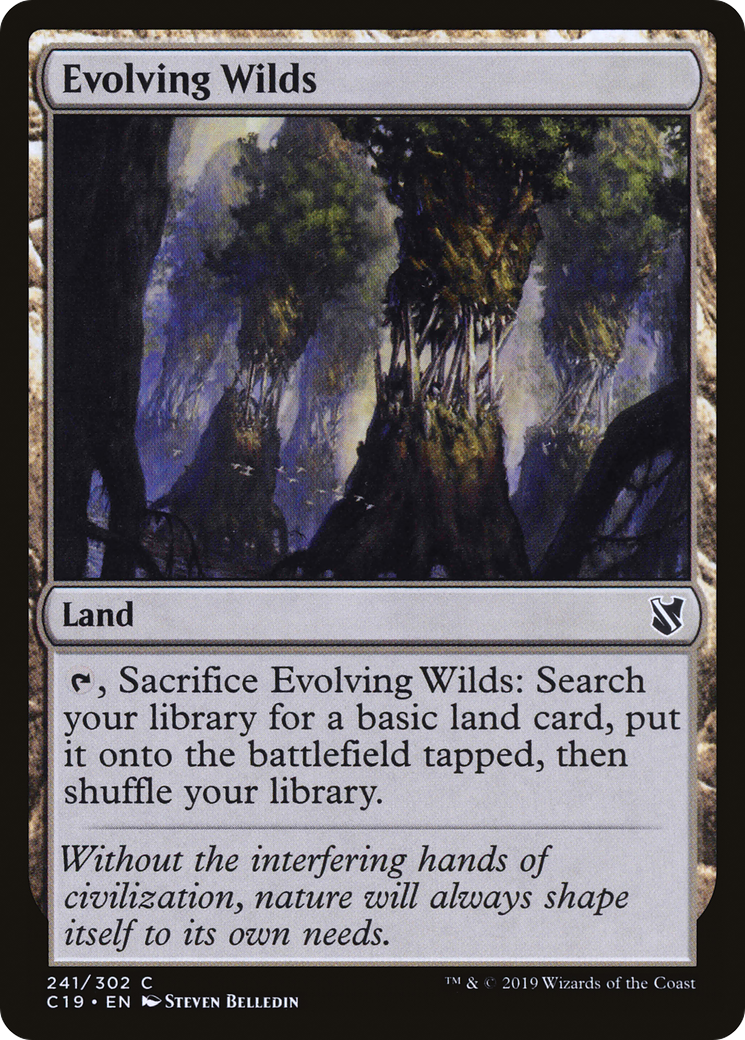
Evolving Wilds
Evolving Wilds
Land
, Sacrifice this land: Search your library for a basic land card, put it onto the battlefield tapped, then shuffle.
-
1
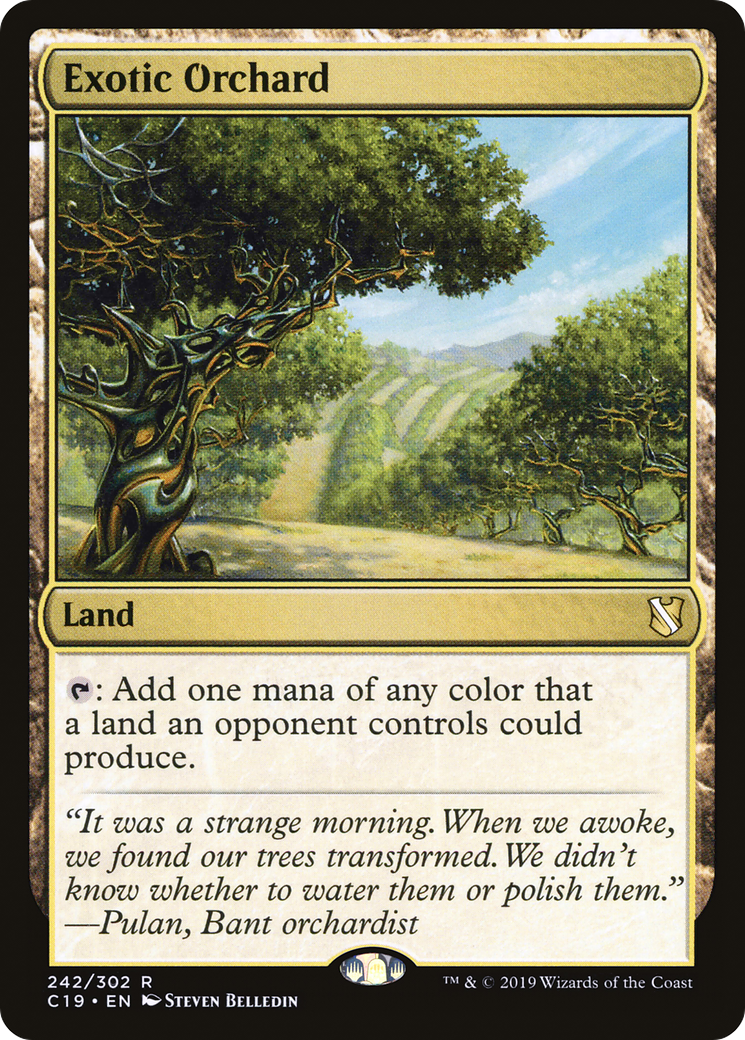
Exotic Orchard
Exotic Orchard
Land
: Add one mana of any color that a land an opponent controls could produce.
- Lands that produce mana based only on what other lands "could produce" won't help each other unless some other land allows one of them to actually produce some type of mana. For example, if you control an Exotic Orchard and your opponent controls an Exotic Orchard and a Reflecting Pool, none of those lands would produce mana if their mana abilities were activated. On the other hand, if you control a Forest and an Exotic Orchard, and your opponent controls an Exotic Orchard and a Reflecting Pool, then each of those lands can be tapped to produce . Your opponent's Exotic Orchard can produce because you control a Forest. Your Exotic Orchard and your opponent's Reflecting Pool can each produce because your opponent's Exotic Orchard can produce .
- When determining what colors of mana your opponents' lands could produce, Exotic Orchard takes into account any applicable replacement effects that would apply to those lands' mana abilities (such as Contamination's effect, for example). If there are more than one, consider them in any possible order.
- The colors of mana are white, blue, black, red, and green. Exotic Orchard can't be tapped for colorless mana, even if a land an opponent controls could produce colorless mana.
- Exotic Orchard doesn't care about any restrictions or riders your opponents' lands (such as Ancient Ziggurat or Hall of the Bandit Lord) put on the mana they produce. It just cares about colors of mana.
- Exotic Orchard checks the effects of all mana-producing abilities of lands your opponents control, but it doesn't check their costs. For example, Vivid Crag has the ability " , Remove a charge counter from Vivid Crag: Add one mana of any color." If an opponent controls Vivid Crag and you control Exotic Orchard, you can tap Exotic Orchard for any color of mana. It doesn't matter whether Vivid Crag has a charge counter on it, and it doesn't matter whether it's untapped.
-
7
Forest
Forest
Basic Land — Forest
( : Add .)
-
1
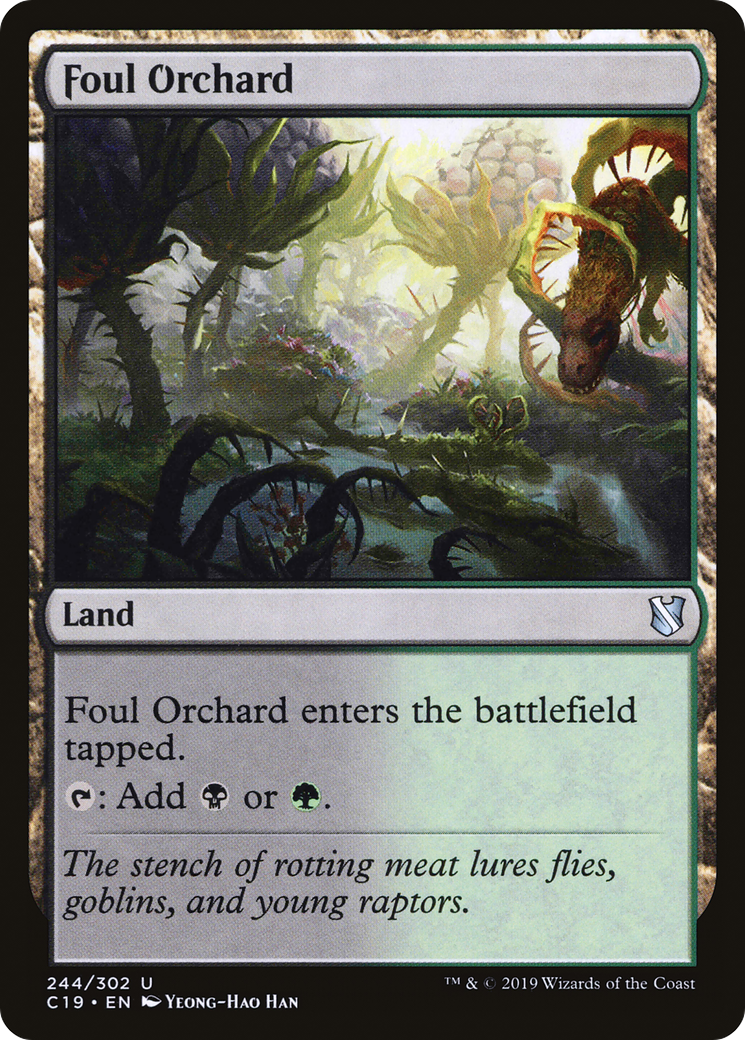
Foul Orchard
Foul Orchard
Land
This land enters tapped.
: Add or .
-
1
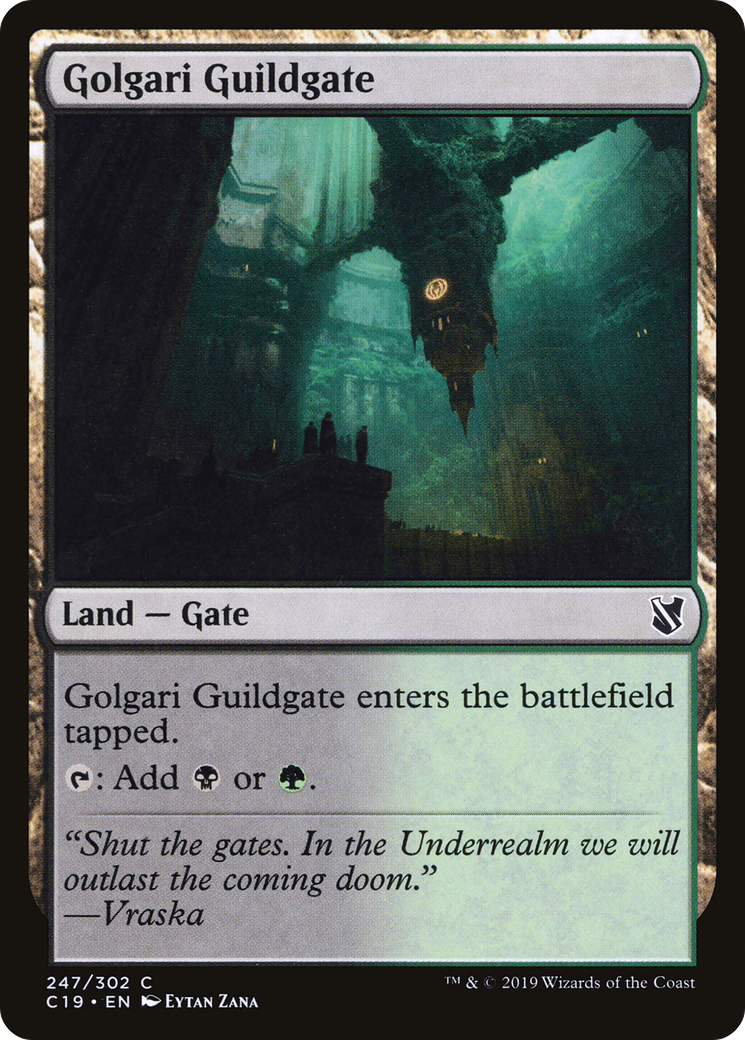
Golgari Guildgate
Golgari Guildgate
Land — Gate
This land enters tapped.
: Add or .
- The subtype Gate has no special rules significance, but other spells and abilities may refer to it.
- Gate is not a basic land type.
-
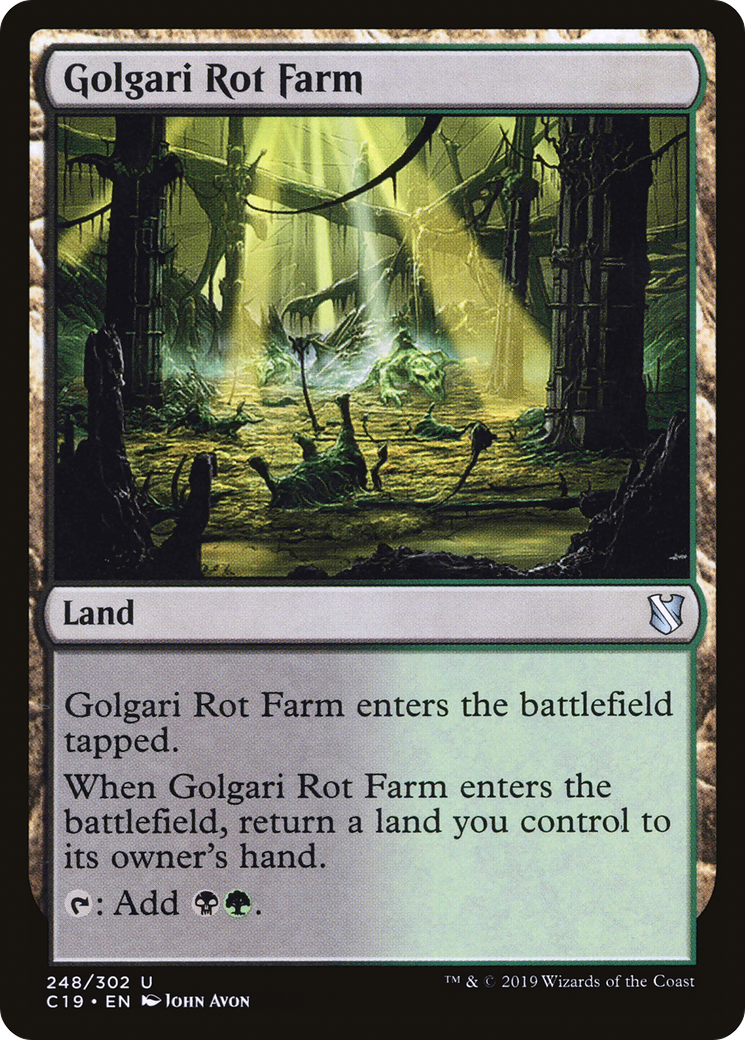
1
Golgari Rot Farm
Golgari Rot Farm
Land
This land enters tapped.
When this land enters, return a land you control to its owner's hand.
: Add .
- If this land enters the battlefield and you control no other lands, its ability will force you to return it to your hand.
-
5
Island
Island
Basic Land — Island
( : Add .)
-
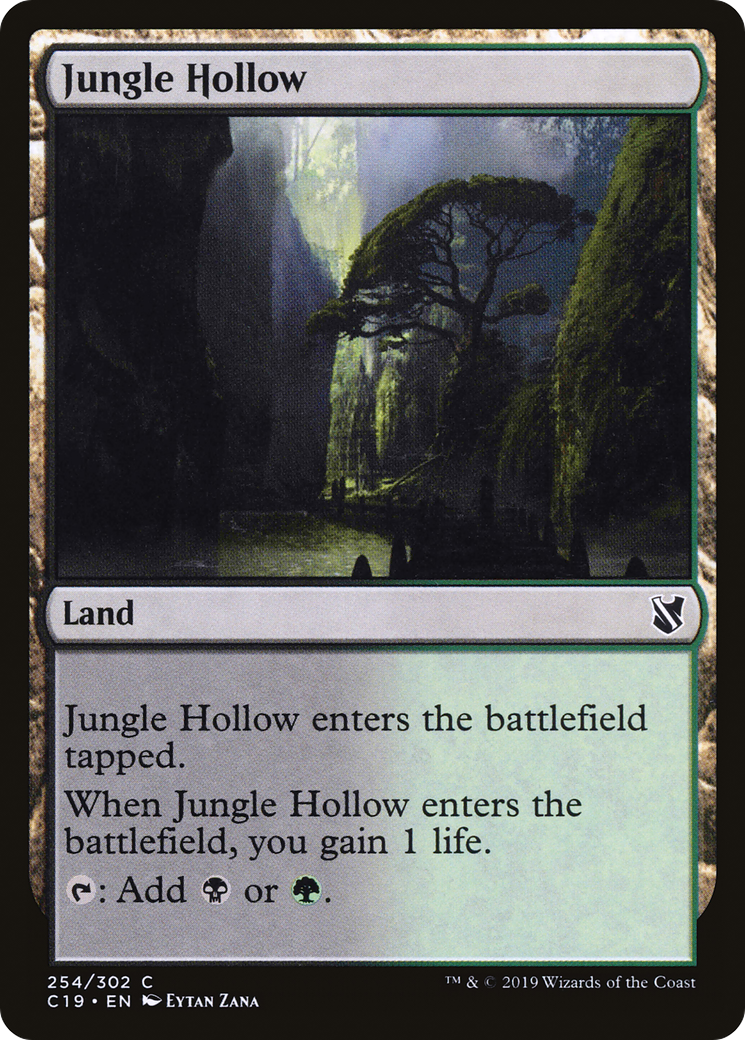
1
Jungle Hollow
Jungle Hollow
Land
This land enters tapped.
When this land enters, you gain 1 life.
: Add or .
-
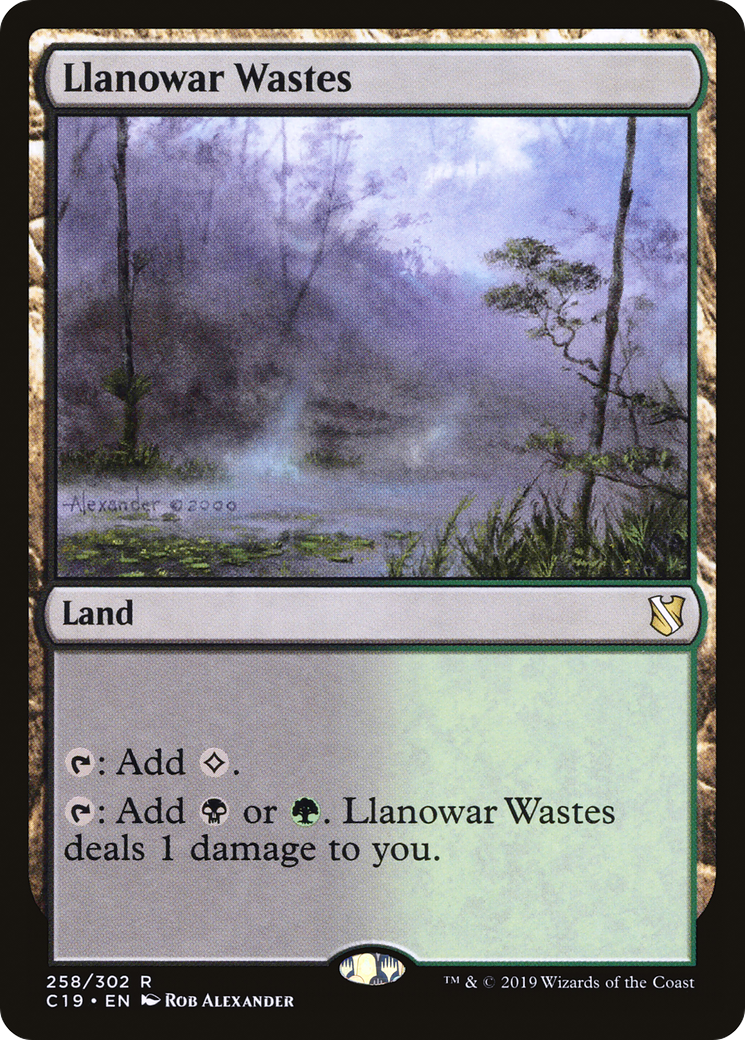
1
Llanowar Wastes
Llanowar Wastes
Land
: Add .
: Add or . This land deals 1 damage to you.
- The damage dealt to you is part of the second mana ability. It doesn't use the stack and can't be responded to.
- Like most lands, each land in this cycle is colorless. The damage dealt to you is dealt by a colorless source.
-
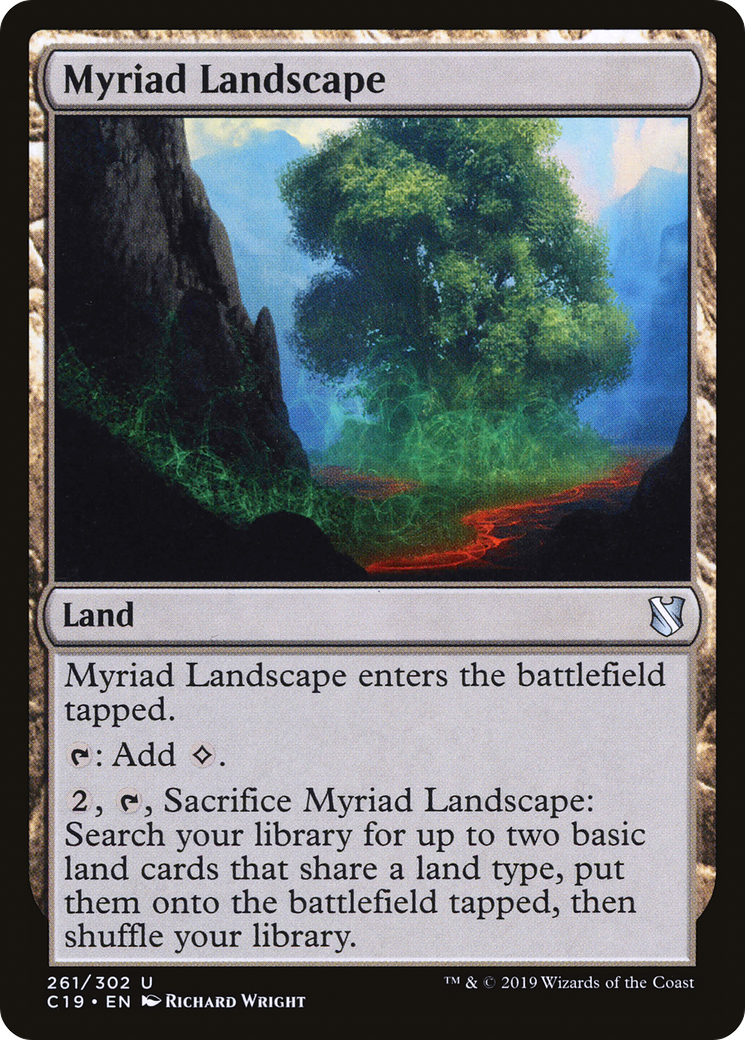
1
Myriad Landscape
Myriad Landscape
Land
This land enters tapped.
: Add .
, , Sacrifice this land: Search your library for up to two basic land cards that share a land type, put them onto the battlefield tapped, then shuffle.
- You can choose to find one basic land card with Myriad Landscape's last ability.
-
1
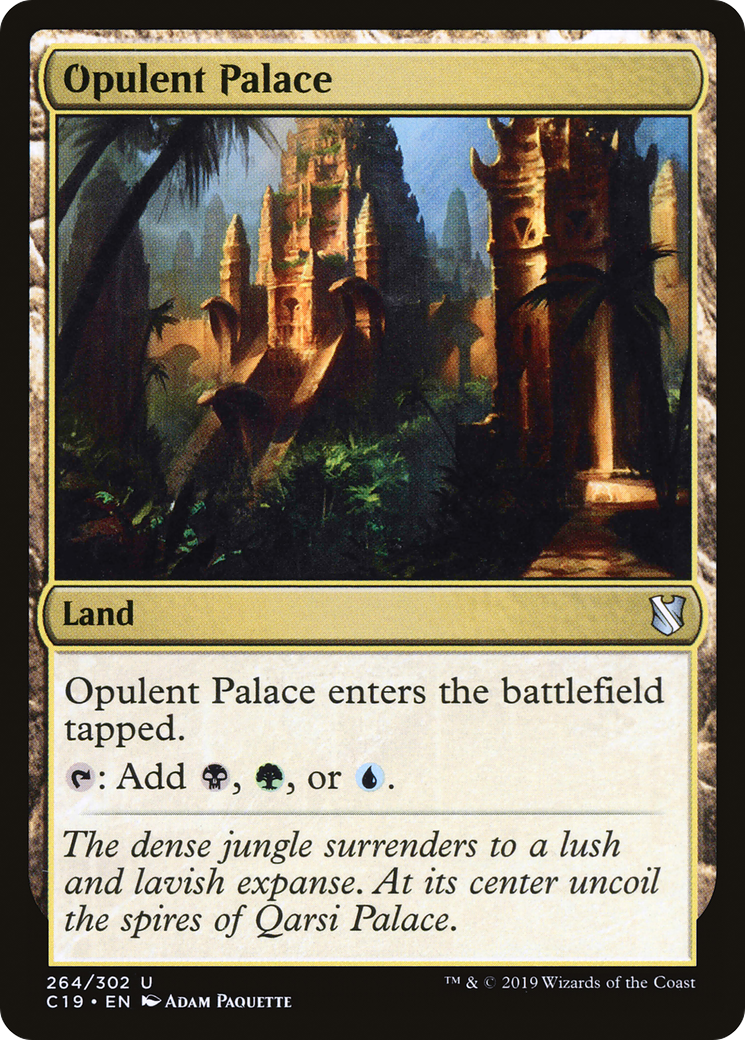
Opulent Palace
Opulent Palace
Land
This land enters tapped.
: Add , , or .
-
1
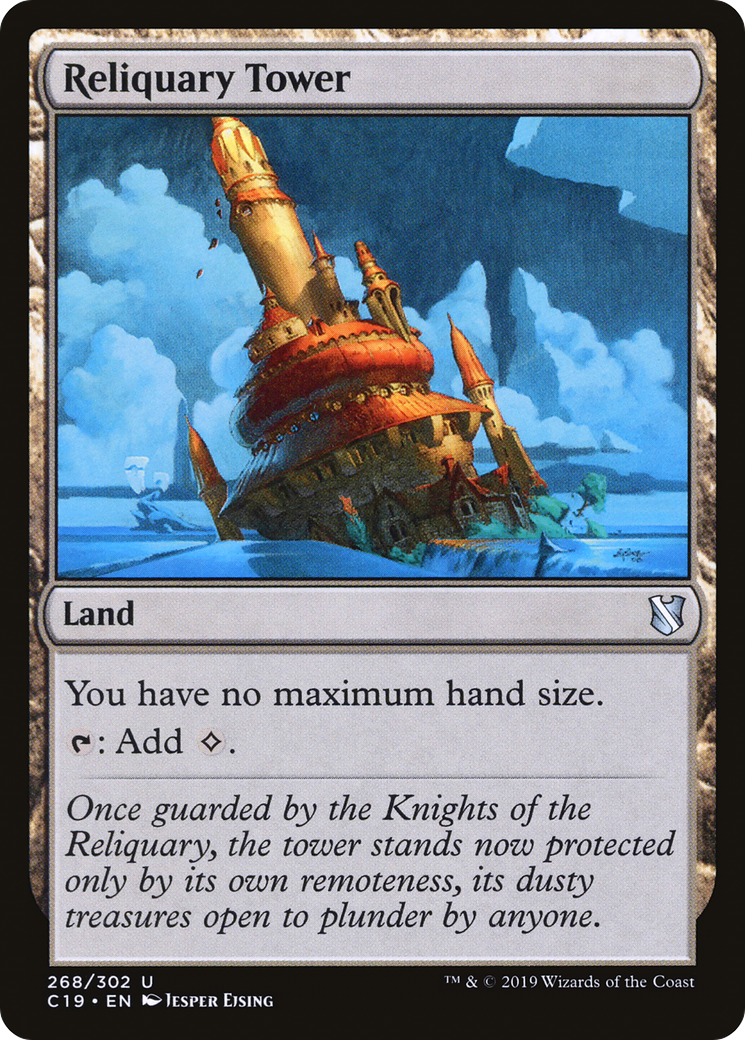
Reliquary Tower
Reliquary Tower
Land
You have no maximum hand size.
: Add .
- If multiple effects modify your hand size, apply them in timestamp order. For example, if you put Null Profusion (an enchantment that says your maximum hand size is two) onto the battlefield and then put Reliquary Tower onto the battlefield, you'll have no maximum hand size. However, if those permanents enter in the opposite order, your maximum hand size would be two.
-
1
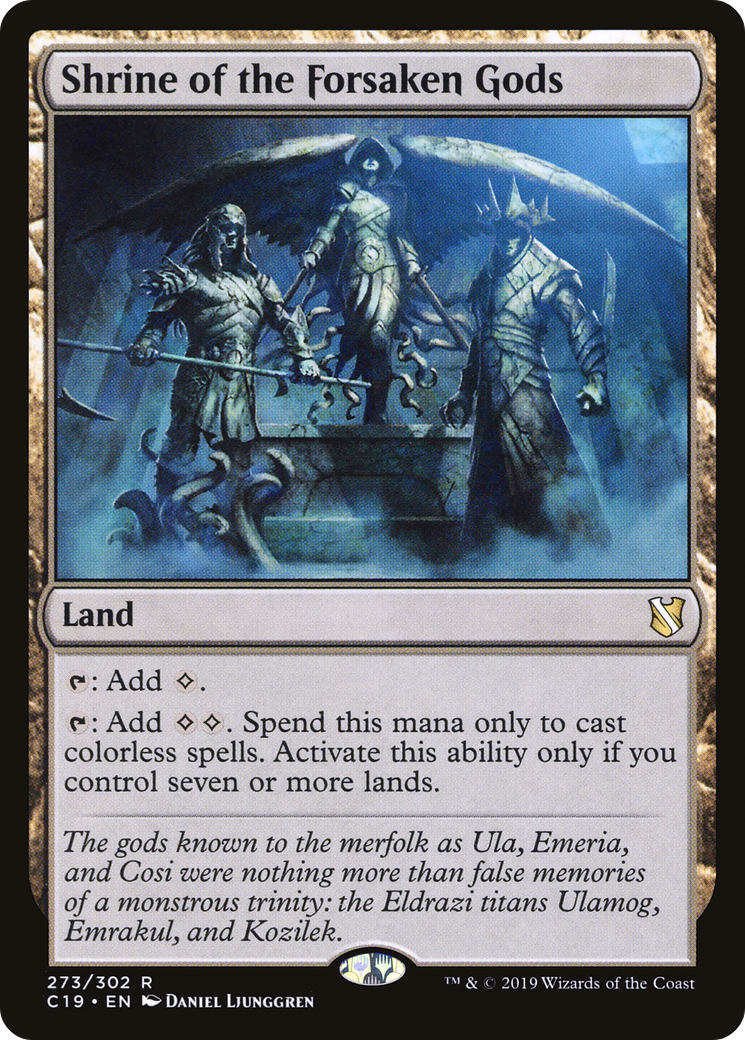
Shrine of the Forsaken Gods
Shrine of the Forsaken Gods
Land
: Add .
: Add . Spend this mana only to cast colorless spells. Activate only if you control seven or more lands.
-
1
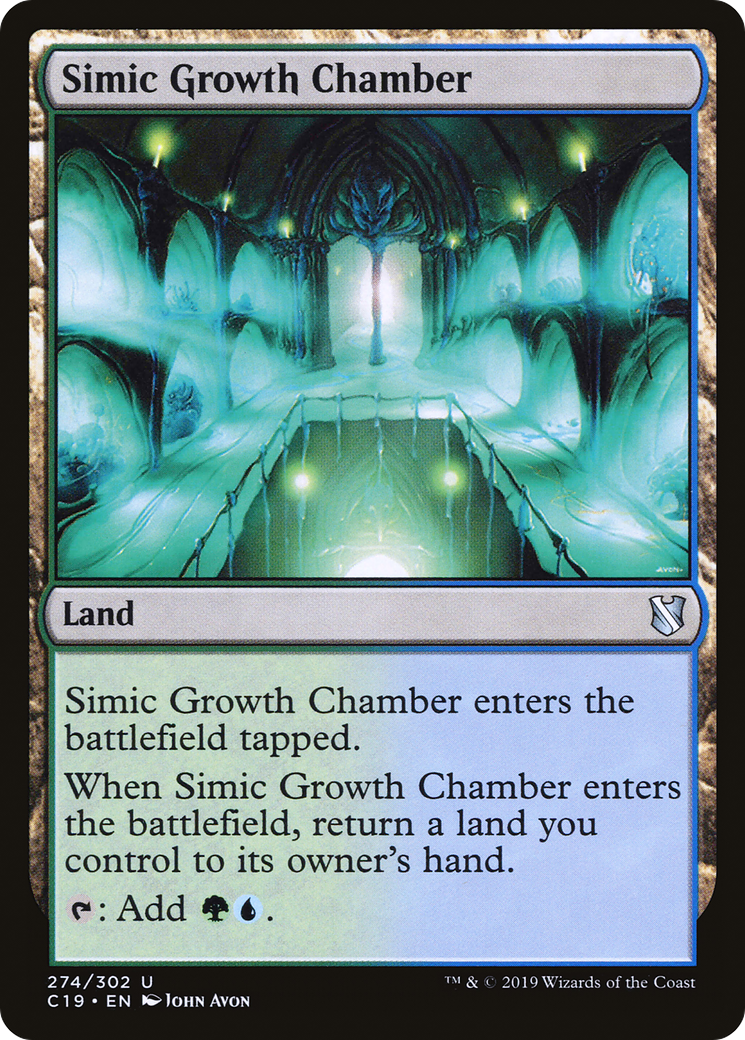
Simic Growth Chamber
Simic Growth Chamber
Land
This land enters tapped.
When this land enters, return a land you control to its owner's hand.
: Add .
- If this land enters the battlefield and you control no other lands, its ability will force you to return it to your hand.
-
1
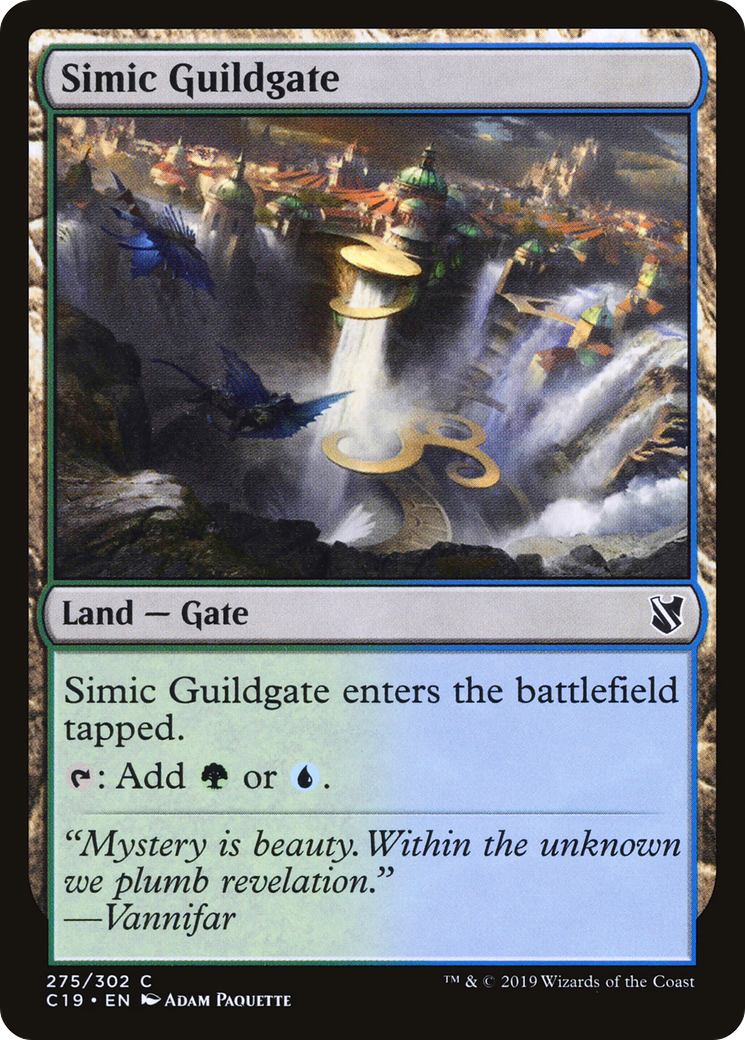
Simic Guildgate
Simic Guildgate
Land — Gate
This land enters tapped.
: Add or .
- The subtype Gate has no special rules significance, but other spells and abilities may refer to it.
- Gate is not a basic land type.
-
1
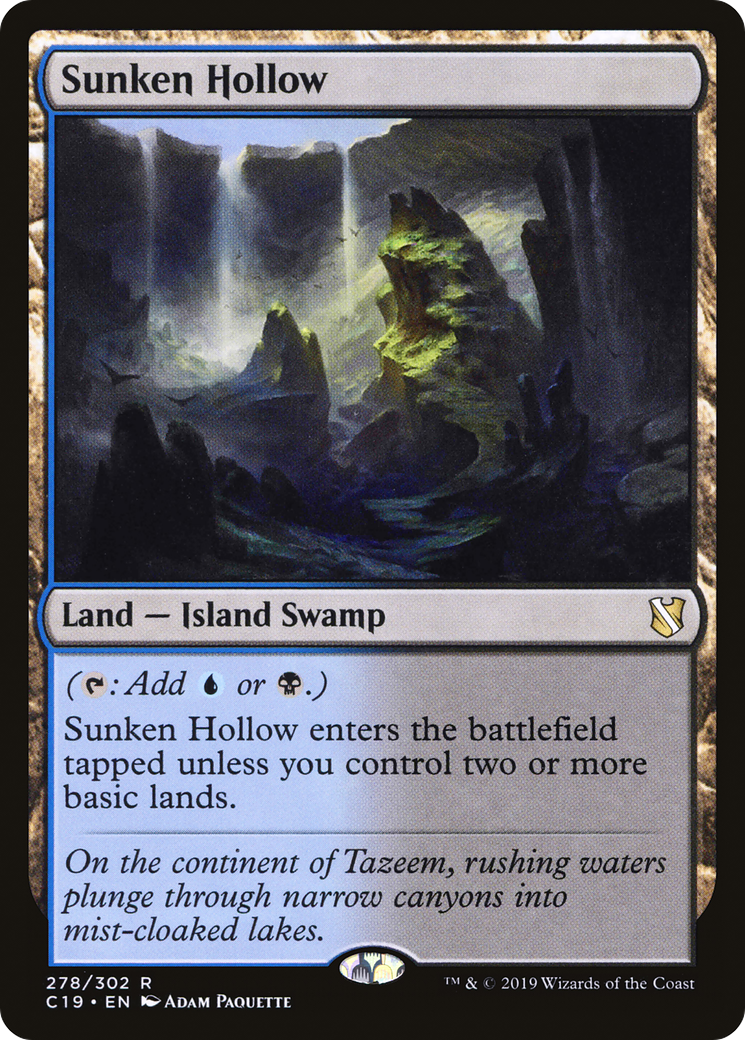
Sunken Hollow
Sunken Hollow
Land — Island Swamp
( : Add or .)
This land enters tapped unless you control two or more basic lands.
- Even though these lands have basic land types, they are not basic lands because "basic" doesn't appear on their type line. Notably, controlling two or more of them won't allow others to enter the battlefield untapped.
- However, because these cards have basic land types, effects that specify a basic land type without also specifying that the land be basic can affect them. For example, a spell or ability that reads "Destroy target Forest" can target Canopy Vista, while one that reads "Destroy target basic Forest" cannot.
- If one of these lands enters the battlefield at the same time as any number of basic lands, those other lands are not counted when determining if this land enters the battlefield tapped or untapped.
-
3
Swamp
Swamp
Basic Land — Swamp
( : Add .)
-
1
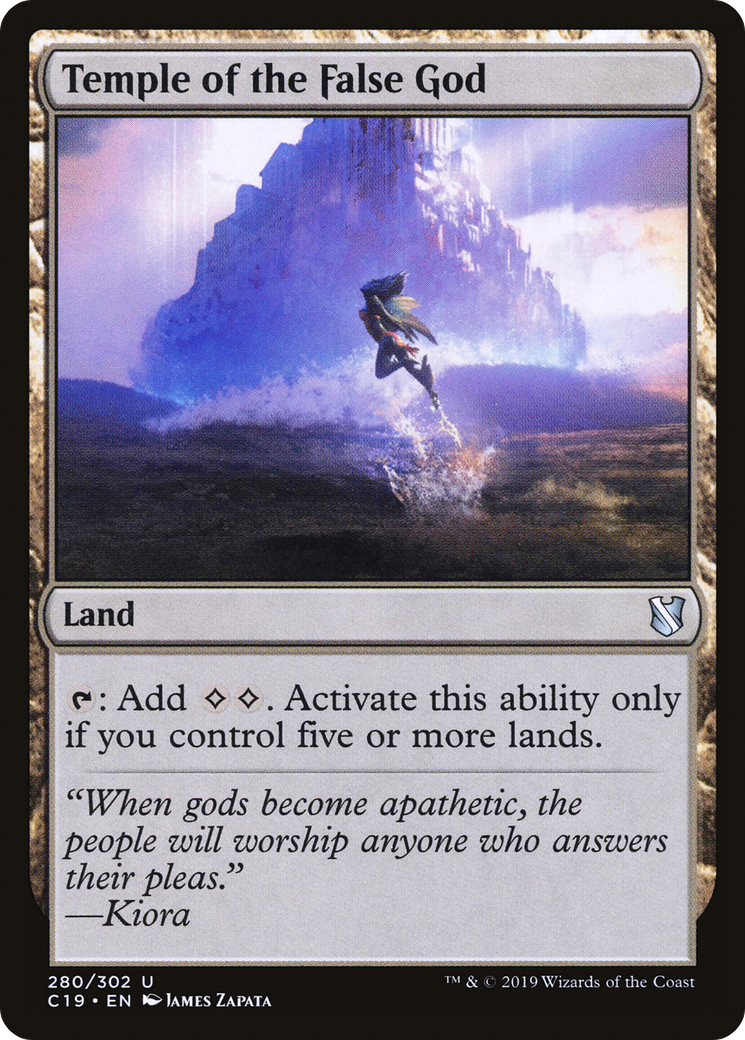
Temple of the False God
Temple of the False God
Land
: Add . Activate only if you control five or more lands.
-
1
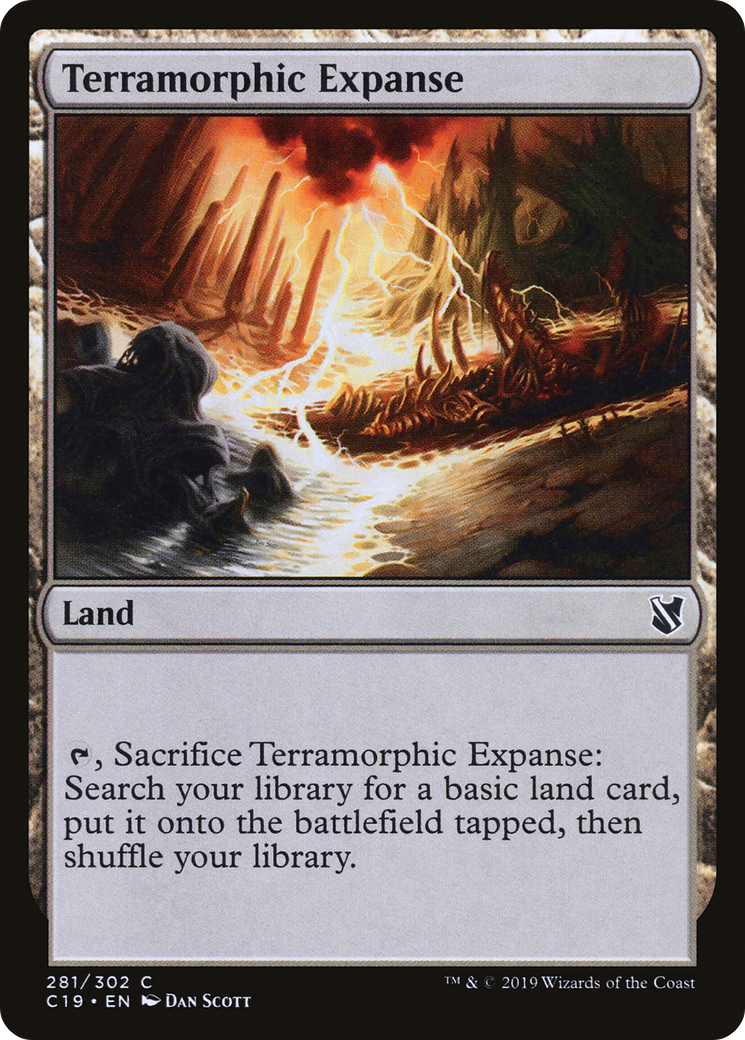
Terramorphic Expanse
Terramorphic Expanse
Land
, Sacrifice this land: Search your library for a basic land card, put it onto the battlefield tapped, then shuffle.
-
1
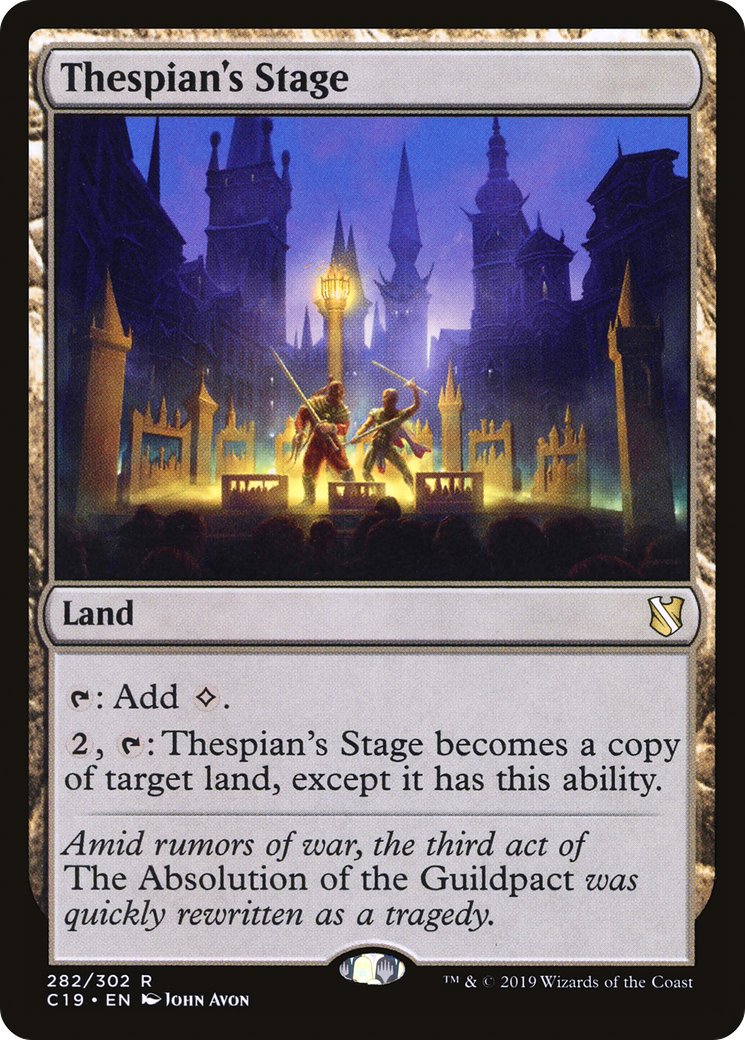
Thespian's Stage
Thespian's Stage
Land
: Add .
, : This land becomes a copy of target land, except it has this ability.
- The copy effect created by the last activated ability doesn't have a duration. It will last until Thespian's Stage leaves the battlefield or another copy effect overwrites it. The permanent will no longer have the first ability of Thespian's Stage.
- A land's copiable values are those printed on it, as modified by other copy effects. Counters and other effects aren't copied. Notably, if you copy a land that is also a creature because of a temporary effect (such as Celestial Colonnade), Thespian's Stage will become just the "unanimated" land.
- Thespian's Stage doesn't become untapped when it becomes a copy, even if the target land is untapped.
- No enters-the-battlefield abilities of the land Thespian's Stage is copying will trigger. Thespian's Stage was already on the battlefield. Similarly, no "as this land enters the battlefield" or "this land enters the battlefield with" effects, such as that of Dark Depths, will apply.
-
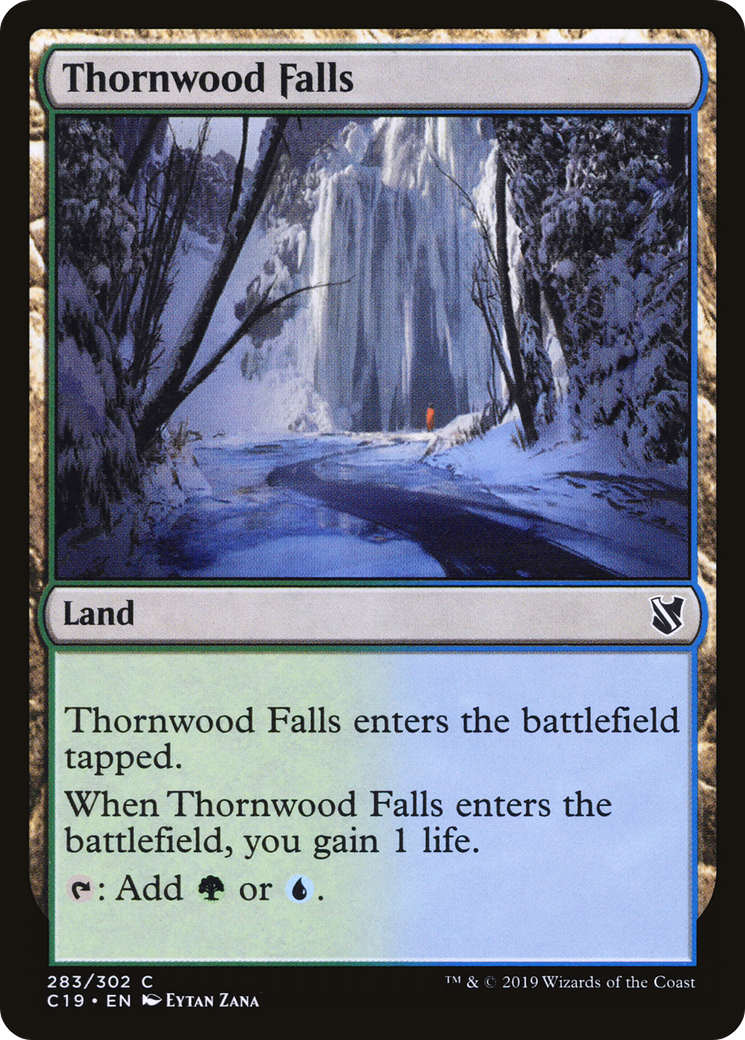
1
Thornwood Falls
Thornwood Falls
Land
This land enters tapped.
When this land enters, you gain 1 life.
: Add or .
-
1
Woodland Stream
Woodland Stream
Land
This land enters tapped.
: Add or .
-
1
Yavimaya Coast
Yavimaya Coast
Land
: Add .
: Add or . This land deals 1 damage to you.
- Like most lands, each land in this cycle is colorless. The damage dealt to you is dealt by a colorless source.
- The damage dealt to you is part of the second mana ability. It doesn't use the stack and can't be responded to.
Blue 13
-
1
Chromeshell Crab
Chromeshell Crab
Creature — Crab Beast
3/3
Morph (You may cast this card face down as a 2/2 creature for . Turn it face up any time for its morph cost.)
When this creature is turned face up, you may exchange control of target creature you control and target creature an opponent controls.
- You choose the two target creatures when the triggered ability is put onto the stack. You do not have to choose Chromeshell Crab. You choose whether or not to do the exchange on resolution.
- The exchange fails if either target is not still on the battlefield at that time.
- The exchange fails if either you no longer control your creature or the other creature is now controlled by you.
- The creatures can’t attack until you start a turn with them under your control. So you can’t swap and then attack.
- The trigger occurs when you use the Morph ability to turn the card face up, or when an effect turns it face up. It will not trigger on being revealed or on leaving the battlefield.
-
1
Echoing Truth
Echoing Truth
Instant
Return target nonland permanent and all other permanents with the same name as that permanent to their owners' hands.
-
1
Ixidron
Ixidron
Creature — Illusion
*/*
As this creature enters, turn all other nontoken creatures face down. (They're 2/2 creatures.)
Ixidron's power and toughness are each equal to the number of face-down creatures on the battlefield.
- Creatures turned face down by Ixidron are 2/2 creatures with no text, no name, no subtypes, no expansion symbol, and no mana cost. These values are copiable if an object becomes a copy of one of those creatures, and their normal values are not copiable.
- If Ixidron and another creature are entering at the same time, the other creature enters face up.
- The controller of a face-down creature can look at it at any time, even if it doesn't have morph. Other players can't, but the rules for face-down permanents state that "you must ensure at all times that your face-down spells and permanents can be easily differentiated from each other." As a result, all players must be able to figure out what each of the creatures Ixidron turned face down is.
- You turn the creatures face-down *as* Ixidron enters. There is never a moment when Ixidron is on the battlefield and the creatures are face-up. If a creature on the battlefield has a "whenever another creature enters" ability, it won't trigger because that creature will be face down before Ixidron enters.
- Turning a face-down creature face-down typically has no effect; the creature's status is unchanged.
-
1
Kadena's Silencer
Kadena's Silencer
Creature — Snake Wizard
2/1
When this creature is turned face up, counter all abilities your opponents control.
Megamorph (You may cast this card face down as a 2/2 creature for . Turn it face up any time for its megamorph cost and put a +1/+1 counter on it.)
- Kadena's Silencer counters only activated and triggered abilities already on the stack. It doesn't prevent abilities from being activated or from triggering later in the turn, and it has no effect on static abilities.
- Kadena's Silencer can't counter an activated or triggered mana ability. An activated mana ability is one that could add mana as it resolves, doesn't have a target, and isn't a loyalty ability. A triggered mana ability is one that could add mana as it resolves and triggers on an activated mana ability.
- Activated abilities are written in the form "[Cost]: [Effect]." Some keyword abilities (such as equip) are activated abilities and will have colons in their reminder texts. Notably, turning a creature face up is not an activated ability.
- Triggered abilities use the word "when," "whenever," or "at." They're often written as "[Trigger condition], [effect]." Some keyword abilities (such as madness's ability to cast the exiled card) are triggered abilities and will have "when," "whenever," or "at" in their reminder text.
- Abilities that create replacement effects, such as a permanent entering the battlefield tapped or with counters on it, can't be countered. Abilities that apply "as [this creature] enters the battlefield" are also replacement effects and can't be countered.
- If you counter a delayed triggered ability that triggered at the beginning of the "next" occurrence of a specified step or phase, that ability won't trigger again the following time that phase or step occurs.
-
1
Kheru Spellsnatcher
Kheru Spellsnatcher
Creature — Snake Wizard
3/3
Morph (You may cast this card face down as a 2/2 creature for . Turn it face up any time for its morph cost.)
When this creature is turned face up, counter target spell. If that spell is countered this way, exile it instead of putting it into its owner's graveyard. You may cast that card without paying its mana cost for as long as it remains exiled.
- You can target a spell you control with Kheru Spellsnatcher's triggered ability. This will give you the ability to cast the card later without paying its mana cost.
- Because you're already casting the card using an alternative cost (by casting it without paying its mana cost), you can't pay any other alternative costs for the card, including casting it face down using the morph ability. You can pay additional costs, such as kicker costs. If the card has any mandatory additional costs, you must pay those.
- If the card has in its mana cost, you must choose 0 as the value for X when casting it.
- Morph lets you cast a card face down by paying , and lets you turn the face-down permanent face up any time you have priority by paying its morph cost.
- The face-down spell has no mana cost and has a mana value of 0. When you cast a face-down spell, put it on the stack face down so no other player knows what it is, and pay . This is an alternative cost.
- When the spell resolves, it enters the battlefield as a 2/2 creature with no name, mana cost, creature types, or abilities. It's colorless and has a mana value of 0. Other effects that apply to the creature can still grant it any of these characteristics.
- Any time you have priority, you may turn the face-down creature face up by revealing what its morph cost is and paying that cost. This is a special action. It doesn't use the stack and can't be responded to. Only a face-down permanent can be turned face up this way; a face-down spell cannot.
- Because the permanent is on the battlefield both before and after it's turned face up, turning a permanent face up doesn't cause any enters-the-battlefield abilities to trigger.
- A permanent that turns face up or face down changes characteristics but is otherwise the same permanent. Spells and abilities that were targeting that permanent, as well as Auras and Equipment that were attached to the permanent, aren't affected.
- At any time, you can look at a face-down spell or permanent you control. You can't look at face-down spells or permanents you don't control unless an effect instructs you to do so.
- You must ensure that your face-down spells and permanents can easily be differentiated from each other. You're not allowed to mix up the cards that represent them on the battlefield in order to confuse other players. The order they entered the battlefield should remain clear. Common methods for doing this include using markers or dice, or simply placing them in order on the battlefield.
- If a face-down permanent leaves the battlefield, you must reveal it. You must also reveal all face-down spells and permanents you control if you leave the game or if the game ends.
-
1
Leadership Vacuum
Leadership Vacuum
Instant
Target player returns each commander they control from the battlefield to the command zone.
Draw a card.
- Leadership Vacuum targets the player, not their creatures. A commander with hexproof or protection from blue may be returned this way.
- You'll draw a card even if the target player controls no commanders as Leadership Vacuum resolves.
- The "commander tax" increases based on how many times a commander was cast from the command zone, not how many times it was put there as a result of Commander rules. The returned commander will cost more to cast again even though it was put directly into the command zone.
-
1
Reality Shift
Reality Shift
Instant
Exile target creature. Its controller manifests the top card of their library. (That player puts the top card of their library onto the battlefield face down as a 2/2 creature. If it's a creature card, it can be turned face up any time for its mana cost.)
- Any time you have priority, you may turn a manifested creature face up by revealing that it's a creature card (ignoring any copy effects or type-changing effects that might be applying to it) and paying its mana cost. This is a special action. It doesn't use the stack and can't be responded to.
- Because the permanent is on the battlefield both before and after it's turned face up, turning a permanent face up doesn't cause any enters-the-battlefield abilities to trigger.
- A permanent that turns face up or face down changes characteristics but is otherwise the same permanent. Spells and abilities that were targeting that permanent, as well as Auras and Equipment that were attached to the permanent, aren't affected.
- At any time, you can look at a face-down permanent you control. You can't look at face-down permanents you don't control unless an effect allows you to or instructs you to.
- The face-down permanent is a 2/2 creature with no name, mana cost, creature types, or abilities. It's colorless and has a mana value of 0. Other effects that apply to the permanent can still grant or change any of these characteristics.
- If a face-down permanent you control leaves the battlefield, you must reveal it. You must also reveal all face-down spells and permanents you control if you leave the game or if the game ends.
- If a manifested creature would have morph if it were face up, you may also turn it face up by paying its morph cost.
- Turning a permanent face up or face down doesn't change whether that permanent is tapped or untapped.
- Because face-down creatures don't have names, they can't have the same name as any other creature, even another face-down creature.
- If a double-faced card is manifested, it will be put onto the battlefield face down. While face down, it can't transform. If the front face of the card is a creature card, you can turn it face up by paying its mana cost. If you do, its front face will be up.
- There are no cards in the Fate Reforged set that would turn a face-down instant or sorcery card on the battlefield face up, but some older cards can try to do this. If something tries to turn a face-down instant or sorcery card on the battlefield face up, reveal that card to show all players it's an instant or sorcery card. The permanent remains on the battlefield face down. Abilities that trigger when a permanent turns face up won't trigger, because even though you revealed the card, it never turned face up.
- Unlike a face-down creature that was cast using the morph ability, a manifested creature may still be turned face up after it loses its abilities if it's a creature card.
- You must ensure that your face-down spells and permanents can easily be differentiated from each other. You're not allowed to mix up the cards that represent them on the battlefield in order to confuse other players. The order they entered the battlefield should remain clear. Common methods for indicating this include using markers or dice, or simply placing them in order on the battlefield. You must also track how each became face down (manifested, cast face down using the morph ability, and so on).
-
1
Stratus Dancer
Stratus Dancer
Creature — Djinn Monk
2/1
Flying
Megamorph (You may cast this card face down as a 2/2 creature for . Turn it face up any time for its megamorph cost and put a +1/+1 counter on it.)
When this creature is turned face up, counter target instant or sorcery spell.
- Turning a face-down creature with megamorph face up and putting a +1/+1 counter on it is a special action. It doesn’t use the stack and can’t be responded to.
- If a face-down creature with megamorph is turned face up some other way (for example, if you manifest a card with megamorph and then pay its mana cost to turn it face up), you won’t put a +1/+1 counter on it.
- Megamorph is a variant of the morph ability. You can find more information on morph on cards with morph from the Khans of Tarkir set.
-
1
Sudden Substitution
Sudden Substitution
Instant
Split second (As long as this spell is on the stack, players can't cast spells or activate abilities that aren't mana abilities.)
Exchange control of target noncreature spell and target creature. Then the spell's controller may choose new targets for it.
- Players still get priority while a card with split second is on the stack; their options are just limited to mana abilities and certain special actions.
- Players may turn face-down creatures face up while a spell with split second is on the stack.
- Split second doesn't stop triggered abilities from triggering, such as that of Chalice of the Void. If one does, its controller puts it on the stack and chooses targets for it, if any. Those abilities will resolve as normal.
- Casting a spell with split second won't affect spells and abilities that are already on the stack.
- If the resolution of a triggered ability involves casting a spell, that spell can't be cast if a spell with split second is on the stack.
- After a spell with split second resolves (or otherwise leaves the stack), players may again cast spells and activate abilities before the next object on the stack resolves.
- A mana ability is an ability that produces mana, not an ability that costs mana.
- In a multiplayer game, if the controller of one of the objects leaves the game after Sudden Substitution resolves, the effect that gave them control of the spell or permanent expires. If the spell is still on the stack, the player who gains control of it this way can't choose new targets for it.
- If the target spell or the target creature is an illegal target as Sudden Substitution resolves, the exchange won't happen. If both targets are legal but are both controlled by the same player, the exchange won't happen.
- If the exchange doesn't happen but the spell is still a legal target, its controller may choose new targets for it.
- The noncreature spell is still on the stack after exchanging control, and the creature is still on the battlefield.
- If a permanent spell is exchanged this way, its new controller will control the permanent it becomes.
- The exchange lasts indefinitely. It doesn't expire for the spell if the creature changes zones or leaves the game, or vice versa.
-
1
Thought Sponge
Thought Sponge
Creature — Sponge
1/1
Flash
This creature enters with a number of +1/+1 counters on it equal to the greatest number of cards an opponent has drawn this turn.
When this creature dies, draw cards equal to its power.
- Thought Sponge checks how many cards were drawn by opponents this turn, even opponents who have left the game. The greatest number drawn by a single opponent is how many +1/+1 counters it enters with.
- Thought Sponge checks the total number of cards drawn by each opponent, not how many were drawn due to a single instruction.
- Use Thought Sponge's power as it last existed on the battlefield to determine how many cards to draw for its last ability. If that number is negative, you neither draw nor discard cards.
- Thought Sponge gets its +1/+1 counters at the moment it enters the battlefield. There's not a time that it's on the battlefield before its replacement effect has applied.
-
1
Thousand Winds
Thousand Winds
Creature — Elemental
5/6
Flying
Morph (You may cast this card face down as a 2/2 creature for . Turn it face up any time for its morph cost.)
When this creature is turned face up, return all other tapped creatures to their owners' hands.
- It doesn't matter if Thousand Winds is tapped or untapped (or even on the battlefield) when its last ability resolves. Tapped creatures except Thousand Winds will be returned to their owners' hands.
- Morph lets you cast a card face down by paying , and lets you turn the face-down permanent face up any time you have priority by paying its morph cost.
- The face-down spell has no mana cost and has a mana value of 0. When you cast a face-down spell, put it on the stack face down so no other player knows what it is, and pay . This is an alternative cost.
- When the spell resolves, it enters the battlefield as a 2/2 creature with no name, mana cost, creature types, or abilities. It's colorless and has a mana value of 0. Other effects that apply to the creature can still grant it any of these characteristics.
- Any time you have priority, you may turn the face-down creature face up by revealing what its morph cost is and paying that cost. This is a special action. It doesn't use the stack and can't be responded to. Only a face-down permanent can be turned face up this way; a face-down spell cannot.
- Because the permanent is on the battlefield both before and after it's turned face up, turning a permanent face up doesn't cause any enters-the-battlefield abilities to trigger.
- A permanent that turns face up or face down changes characteristics but is otherwise the same permanent. Spells and abilities that were targeting that permanent, as well as Auras and Equipment that were attached to the permanent, aren't affected.
- At any time, you can look at a face-down spell or permanent you control. You can't look at face-down spells or permanents you don't control unless an effect instructs you to do so.
- You must ensure that your face-down spells and permanents can easily be differentiated from each other. You're not allowed to mix up the cards that represent them on the battlefield in order to confuse other players. The order they entered the battlefield should remain clear. Common methods for doing this include using markers or dice, or simply placing them in order on the battlefield.
- If a face-down permanent leaves the battlefield, you must reveal it. You must also reveal all face-down spells and permanents you control if you leave the game or if the game ends.
-
1
Vesuvan Shapeshifter
Vesuvan Shapeshifter
Creature — Shapeshifter
0/0
As this creature enters or is turned face up, you may choose another creature on the battlefield. If you do, until this creature is turned face down, it becomes a copy of that creature, except it has "At the beginning of your upkeep, you may turn this creature face down."
Morph
- Vesuvan Shapeshifter copies exactly what is printed on the creature it's copying and nothing else (unless it's copying a creature that's copying something else or that's a token; see below). It doesn't copy whether a creature is tapped or untapped, whether it has any counters on it or Auras and/or Equipment attached to it, or any non-copy effects that changed its power, toughness, types, color, and so on. Most notably, if it copies a creature that's not normally a creature, it won't be a creature.
- If a copied creature has in its mana cost, X is 0.
- If a copied creature is copying something else, Vesuvan Shapeshifter uses the copiable values of that creature. In most cases, Vesuvan Shapeshifter will copy whatever that creature is copying.
- If a copied creature is a token that isn't a copy of something else, Vesuvan Shapeshifter copies the original characteristics of that token as stated by the effect that created it. Vesuvan Shapeshifter isn't a token in this case.
- Any enters-the-battlefield abilities of the copied creature will trigger if Vesuvan Shapeshifter is entering the battlefield. Any "As [this creature] enters the battlefield" or "[This creature] enters the battlefield with" abilities of the copied creature will also work. If a Vesuvan Shapeshifter becomes a copy of a creature after it's already on the battlefield, these abilities won't apply as Vesuvan Shapeshifter becomes a copy since it's not entering the battlefield; instead, any "As [this creature] is turned face up" or "When [this creature] is turned face up" abilities will apply.
- If something copies Vesuvan Shapeshifter, the new copy will also have the triggered ability to turn it face down. However, once face-down, it won't have Vesuvan Shapeshifter's morph ability, so it can't be turned face up unless whatever it's copying also has a morph ability.
-
1
Willbender
Willbender
Creature — Human Wizard
1/2
Morph (You may cast this card face down as a 2/2 creature for . Turn it face up any time for its morph cost.)
When this creature is turned face up, change the target of target spell or ability with a single target.
- You don't choose the new target for the spell until Willbender's triggered ability resolves. You must change the target if possible. However, you can't change the target to an illegal target. If there are no legal targets to choose from, the target isn't changed. It doesn't matter if the original target of that spell has somehow become illegal itself.
- If a spell or ability targets multiple things, you can't target it with Willbender's triggered ability, even if all but one of those targets have become illegal.
- If a spell or ability targets the same player or object multiple times, you can't target it with Willbender's ability.
- If a spell with split second is on the stack, you can still respond by turning this creature face up and targeting that spell with the trigger. This is because split second only stops players from casting spells or activating abilities, while turning a creature face up is a special action.
- The trigger occurs when you use the Morph ability to turn the card face up, or when an effect turns it face up. It will not trigger on being revealed or on leaving the battlefield.
Black 9
-
1
Bane of the Living
Bane of the Living
Creature — Insect
4/3
Morph (You may cast this card face down as a 2/2 creature for . Turn it face up any time for its morph cost.)
When this creature is turned face up, all creatures get -X/-X until end of turn.
- The trigger occurs when you use the Morph ability to turn the card face up, or when an effect turns it face up. It will not trigger on being revealed or on leaving the battlefield.
- The X in the ability has the same value as the X paid in the Morph ability. This is pretty easy to derive since there is no other source of X.
-
1
Ghastly Conscription
Ghastly Conscription
Sorcery
Exile all creature cards from target player's graveyard in a face-down pile, shuffle that pile, then manifest those cards. (To manifest a card, put it onto the battlefield face down as a 2/2 creature. Turn it face up any time for its mana cost if it's a creature card.)
- The pile is shuffled to disguise from your opponents which manifested creature is which. After you manifest the cards, you can look at them.
- If you manifest a card owned by an opponent and you leave the game, that card is exiled.
- The face-down permanent is a 2/2 creature with no name, mana cost, creature types, or abilities. It's colorless and has a mana value of 0. Other effects that apply to the permanent can still grant or change any of these characteristics.
- Any time you have priority, you may turn a manifested creature face up by revealing that it's a creature card (ignoring any copy effects or type-changing effects that might be applying to it) and paying its mana cost. This is a special action. It doesn't use the stack and can't be responded to.
- If a manifested creature would have morph if it were face up, you may also turn it face up by paying its morph cost.
- Unlike a face-down creature that was cast using the morph ability, a manifested creature may still be turned face up after it loses its abilities if it's a creature card.
- Because the permanent is on the battlefield both before and after it's turned face up, turning a permanent face up doesn't cause any enters-the-battlefield abilities to trigger.
- Because face-down creatures don't have names, they can't have the same name as any other creature, even another face-down creature.
- A permanent that turns face up or face down changes characteristics but is otherwise the same permanent. Spells and abilities that were targeting that permanent, as well as Auras and Equipment that were attached to the permanent, aren't affected.
- Turning a permanent face up or face down doesn't change whether that permanent is tapped or untapped.
- At any time, you can look at a face-down permanent you control. You can't look at face-down permanents you don't control unless an effect allows you to or instructs you to.
- If a face-down permanent you control leaves the battlefield, you must reveal it. You must also reveal all face-down spells and permanents you control if you leave the game or if the game ends.
- You must ensure that your face-down spells and permanents can easily be differentiated from each other. You're not allowed to mix up the cards that represent them on the battlefield in order to confuse other players. The order they entered the battlefield should remain clear. Common methods for indicating this include using markers or dice, or simply placing them in order on the battlefield. You must also track how each became face down (manifested, cast face down using the morph ability, and so on).
- There are no cards in the Fate Reforged set that would turn a face-down instant or sorcery card on the battlefield face up, but some older cards can try to do this. If something tries to turn a face-down instant or sorcery card on the battlefield face up, reveal that card to show all players it's an instant or sorcery card. The permanent remains on the battlefield face down. Abilities that trigger when a permanent turns face up won't trigger, because even though you revealed the card, it never turned face up.
- If a double-faced card is manifested, it will be put onto the battlefield face down. While face down, it can't transform. If the front face of the card is a creature card, you can turn it face up by paying its mana cost. If you do, its front face will be up.
-
1
Gift of Doom
Gift of Doom
Enchantment — Aura
Enchant creature
Enchanted creature has deathtouch and indestructible.
Morph—Sacrifice another creature. (You may cast this card face down as a 2/2 creature for . Turn it face up any time for its morph cost.)
As this Aura is turned face up, you may attach it to a creature.
- You can't pay Gift of Doom's morph cost more than once.
- No player may take any actions between the time you announce that you're turning Gift of Doom face up and the time it's attached to the chosen creature.
- If there's no creature you can legally attach Gift of Doom to as you turn it face up, or if you choose not to attach it to a creature, it's put into its owner's graveyard.
- This doesn't target the creature Gift of Doom will enchant, so an opponent's creature with hexproof or a creature with shroud may be chosen this way. The chosen recipient must be able to legally be enchanted by the Aura, so a creature with protection from black can't be chosen this way.
-
1
Grim Haruspex
Grim Haruspex
Creature — Human Wizard
3/2
Morph (You may cast this card face down as a 2/2 creature for . Turn it face up any time for its morph cost.)
Whenever another nontoken creature you control dies, draw a card.
- Morph lets you cast a card face down by paying , and lets you turn the face-down permanent face up any time you have priority by paying its morph cost.
- The face-down spell has no mana cost and has a mana value of 0. When you cast a face-down spell, put it on the stack face down so no other player knows what it is, and pay . This is an alternative cost.
- When the spell resolves, it enters the battlefield as a 2/2 creature with no name, mana cost, creature types, or abilities. It's colorless and has a mana value of 0. Other effects that apply to the creature can still grant it any of these characteristics.
- Any time you have priority, you may turn the face-down creature face up by revealing what its morph cost is and paying that cost. This is a special action. It doesn't use the stack and can't be responded to. Only a face-down permanent can be turned face up this way; a face-down spell cannot.
- Because the permanent is on the battlefield both before and after it's turned face up, turning a permanent face up doesn't cause any enters-the-battlefield abilities to trigger.
- A permanent that turns face up or face down changes characteristics but is otherwise the same permanent. Spells and abilities that were targeting that permanent, as well as Auras and Equipment that were attached to the permanent, aren't affected.
- At any time, you can look at a face-down spell or permanent you control. You can't look at face-down spells or permanents you don't control unless an effect instructs you to do so.
- You must ensure that your face-down spells and permanents can easily be differentiated from each other. You're not allowed to mix up the cards that represent them on the battlefield in order to confuse other players. The order they entered the battlefield should remain clear. Common methods for doing this include using markers or dice, or simply placing them in order on the battlefield.
- If a face-down permanent leaves the battlefield, you must reveal it. You must also reveal all face-down spells and permanents you control if you leave the game or if the game ends.
-
1
Hex
Hex
Sorcery
Destroy six target creatures.
- You must target six different creatures. If you can't, you can't cast Hex. If some of the creatures become illegal targets before the spell resolves, Hex will still destroy the rest of them.
-
1
Mire in Misery
Mire in Misery
Sorcery
Each opponent sacrifices a creature or enchantment of their choice.
- As Mire in Misery resolves, first the next opponent in turn order (or, if it’s an opponent’s turn, the opponent whose turn it is) chooses a creature or an enchantment they control, then each other opponent in turn order does the same, knowing the choices made before them. Then all the chosen permanents are sacrificed at the same time.
- Your opponents choose what to sacrifice from among the creatures and enchantments they control. This means that you don’t decide which type of permanent a player sacrifices, and a player can’t choose to sacrifice an enchantment if they control none.
-
1
Silumgar Assassin
Silumgar Assassin
Creature — Human Assassin
2/1
Creatures with power greater than this creature's power can't block it.
Megamorph (You may cast this card face down as a 2/2 creature for . Turn it face up any time for its megamorph cost and put a +1/+1 counter on it.)
When this creature is turned face up, destroy target creature with power 3 or less an opponent controls.
- The powers of Silumgar Assassin and the creature trying to block it are checked only as blockers are declared. Changing the powers of either of those creatures after Silumgar Assassin is legally blocked won’t change or undo the block.
- Turning a face-down creature with megamorph face up and putting a +1/+1 counter on it is a special action. It doesn’t use the stack and can’t be responded to.
- If a face-down creature with megamorph is turned face up some other way (for example, if you manifest a card with megamorph and then pay its mana cost to turn it face up), you won’t put a +1/+1 counter on it.
- Megamorph is a variant of the morph ability. You can find more information on morph on cards with morph from the Khans of Tarkir set.
-
1
Skinthinner
Skinthinner
Creature — Zombie
2/1
Morph (You may cast this card face down as a 2/2 creature for . Turn it face up any time for its morph cost.)
When this creature is turned face up, destroy target nonblack creature. It can't be regenerated.
- The trigger occurs when you use the Morph ability to turn the card face up, or when an effect turns it face up. It will not trigger on being revealed or on leaving the battlefield.
-
1
Thieving Amalgam
Thieving Amalgam
Creature — Ape Snake
6/7
At the beginning of each opponent's upkeep, you manifest the top card of that player's library. (Put it onto the battlefield face down as a 2/2 creature. Turn it face up any time for its mana cost if it's a creature card.)
Whenever a creature you control but don't own dies, its owner loses 2 life and you gain 2 life.
- Your opponents can't look at the card they own that you manifested.
- If a creature you control but don't own dies at the same time that your life total becomes 0 or less, you lose the game before Thieving Amalgam's last ability can save you.
- If a creature you control but don't own dies at the same time that its owner leaves the game, Thieving Amalgam's last ability triggers. No player loses 2 life, but you gain 2 life.
- In the Commander variant, you can produce mana that isn't of your commander's color identity if an effect lets you produce mana of that color or mana of any color, even though those symbols can't appear on cards in your deck. You may be able to turn a manifested creature card face up this way if it's not the same colors as your commander.
- In a multiplayer game, if a player leaves the game, all cards that player owns leave as well. If you leave the game, the creatures you manifested with Thieving Amalgam's triggered ability are exiled.
Green 18
-
1
Ainok Survivalist
Ainok Survivalist
Creature — Dog Shaman
2/1
Megamorph (You may cast this card face down as a 2/2 creature for . Turn it face up any time for its megamorph cost and put a +1/+1 counter on it.)
When this creature is turned face up, destroy target artifact or enchantment an opponent controls.
- Turning a face-down creature with megamorph face up and putting a +1/+1 counter on it is a special action. It doesn't use the stack and can't be responded to.
- If a face-down creature with megamorph is turned face up some other way (for example, if you manifest a card with megamorph and then pay its mana cost to turn it face up), you won't put a +1/+1 counter on it.
- Megamorph is a variant of the morph ability. You can find more information on morph on cards with morph from the Khans of Tarkir set.
-
1
Apex Altisaur
Apex Altisaur
Creature — Dinosaur
10/10
When this creature enters, it fights up to one target creature you don't control.
Enrage — Whenever this creature is dealt damage, it fights up to one target creature you don't control.
- If Apex Altisaur fights a creature while either of its abilities is resolving, being dealt damage this way causes its second ability to trigger. It may fight several times in a row this way.
- If the target creature is an illegal target when Apex Altisaur's last ability tries to resolve, the ability doesn't resolve. If it's a legal target but Apex Altisaur is no longer on the battlefield when the ability resolves (perhaps because it has already died from picking too many fights) the target creature won't deal or be dealt damage.
-
1
Cultivate
Cultivate
Sorcery
Search your library for up to two basic land cards, reveal those cards, put one onto the battlefield tapped and the other into your hand, then shuffle.
- If you choose to find only one basic land card, you put it onto the battlefield tapped.
-
1
Deathmist Raptor
Deathmist Raptor
Creature — Dinosaur Beast
3/3
Deathtouch
Whenever a permanent you control is turned face up, you may return this card from your graveyard to the battlefield face up or face down.
Megamorph (You may cast this card face down as a 2/2 creature for . Turn it face up any time for its megamorph cost and put a +1/+1 counter on it.)
- Deathmist Raptor's second ability triggers only if Deathmist Raptor is in the graveyard when a permanent you control is turned face up.
- You choose whether Deathmist Raptor will enter the battlefield face up or face down as the ability resolves. You may also choose to leave it in the graveyard.
- Turning a face-down creature with megamorph face up and putting a +1/+1 counter on it is a special action. It doesn't use the stack and can't be responded to.
- If a face-down creature with megamorph is turned face up some other way (for example, if you manifest a card with megamorph and then pay its mana cost to turn it face up), you won't put a +1/+1 counter on it.
- Megamorph is a variant of the morph ability. You can find more information on morph on cards with morph from the Khans of Tarkir set.
-
1
Den Protector
Den Protector
Creature — Human Warrior
2/1
Creatures with power less than this creature's power can't block it.
Megamorph (You may cast this card face down as a 2/2 creature for . Turn it face up any time for its megamorph cost and put a +1/+1 counter on it.)
When this creature is turned face up, return target card from your graveyard to your hand.
- You compare Den Protector's power to the power of any creature trying to block it only as blockers are assigned. Once Den Protector has been legally blocked by a creature, changing the power of either creature won't change or undo the block.
- Turning a face-down creature with megamorph face up and putting a +1/+1 counter on it is a special action. It doesn't use the stack and can't be responded to.
- If a face-down creature with megamorph is turned face up some other way (for example, if you manifest a card with megamorph and then pay its mana cost to turn it face up), you won't put a +1/+1 counter on it.
- Megamorph is a variant of the morph ability. You can find more information on morph on cards with morph from the Khans of Tarkir set.
-
1
Explore
Explore
Sorcery
You may play an additional land this turn.
Draw a card.
- The effects of multiple Explores in the same turn are cumulative. They're also cumulative with other effects that let you play additional lands, such as the one from Urban Evolution.
- Explore's effect allows you to play an additional land during your main phase. Doing so follows the normal timing rules for playing lands. In particular, you don't get to play a land as Explore resolves; Explore fully resolves first and you draw a card, perhaps a land you'll play later.
- If you somehow manage to cast Explore when it's not your turn, you'll draw a card when it resolves, but you won't be able to play a land that turn.
-
1
Farseek
Farseek
Sorcery
Search your library for a Plains, Island, Swamp, or Mountain card, put it onto the battlefield tapped, then shuffle.
- Farseek can find any land with any of the listed land types, including nonbasic ones, even if that land is a Forest in addition to one or more of those types.
-
1
Great Oak Guardian
Great Oak Guardian
Creature — Treefolk
4/5
Flash (You may cast this spell any time you could cast an instant.)
Reach
When this creature enters, creatures target player controls get +2/+2 until end of turn. Untap them.
- Great Oak Guardian's last ability targets only the player, not any creatures. Creatures with shroud that player controls will be affected, for example.
- Any creatures controlled by the player that are already untapped will just get +2/+2 until end of turn.
-
1
Hooded Hydra
Hooded Hydra
Creature — Snake Hydra
0/0
This creature enters with X +1/+1 counters on it.
When this creature dies, create a 1/1 green Snake creature token for each +1/+1 counter on it.
Morph
As this creature is turned face up, put five +1/+1 counters on it.
- Use the number of +1/+1 counters that were on Hooded Hydra the last time it was on the battlefield to determine how many Snake tokens to create.
- Hooded Hydra's last ability isn't a triggered ability. It's a replacement ability that modifies how Hooded Hydra is turned face up. Players can't respond to Hooded Hydra being turned face up and having five +1/+1 counters put on it.
- If Hooded Hydra is face down and it's turned face up some other way than by having its morph cost paid, the last ability will still apply.
- Morph lets you cast a card face down by paying , and lets you turn the face-down permanent face up any time you have priority by paying its morph cost.
- The face-down spell has no mana cost and has a mana value of 0. When you cast a face-down spell, put it on the stack face down so no other player knows what it is, and pay . This is an alternative cost.
- When the spell resolves, it enters the battlefield as a 2/2 creature with no name, mana cost, creature types, or abilities. It's colorless and has a mana value of 0. Other effects that apply to the creature can still grant it any of these characteristics.
- Any time you have priority, you may turn the face-down creature face up by revealing what its morph cost is and paying that cost. This is a special action. It doesn't use the stack and can't be responded to. Only a face-down permanent can be turned face up this way; a face-down spell cannot.
- Because the permanent is on the battlefield both before and after it's turned face up, turning a permanent face up doesn't cause any enters-the-battlefield abilities to trigger.
- A permanent that turns face up or face down changes characteristics but is otherwise the same permanent. Spells and abilities that were targeting that permanent, as well as Auras and Equipment that were attached to the permanent, aren't affected.
- At any time, you can look at a face-down spell or permanent you control. You can't look at face-down spells or permanents you don't control unless an effect instructs you to do so.
- You must ensure that your face-down spells and permanents can easily be differentiated from each other. You're not allowed to mix up the cards that represent them on the battlefield in order to confuse other players. The order they entered the battlefield should remain clear. Common methods for doing this include using markers or dice, or simply placing them in order on the battlefield.
- If a face-down permanent leaves the battlefield, you must reveal it. You must also reveal all face-down spells and permanents you control if you leave the game or if the game ends.
-
1
Nantuko Vigilante
Nantuko Vigilante
Creature — Insect Druid Mutant
3/2
Morph (You may cast this card face down as a 2/2 creature for . Turn it face up any time for its morph cost.)
When this creature is turned face up, destroy target artifact or enchantment.
- The trigger occurs when you use the Morph ability to turn the card face up, or when an effect turns it face up. It will not trigger on being revealed or on leaving the battlefield.
-
1
Overwhelming Stampede
Overwhelming Stampede
Sorcery
Until end of turn, creatures you control gain trample and get +X/+X, where X is the greatest power among creatures you control.
- You check the power of your creatures as Overwhelming Stampede resolves. For example, if you control a 2/1 creature, a 2/2 creature, a 2/4 creature, a 4/1 creature, a 5/5 creature, and a 5/6 creature at that time, each of your creatures gets +5/+5 and gains trample until end of turn.
-
1
Road of Return
Road of Return
Sorcery
Choose one —
- Return target permanent card from your graveyard to your hand.
- Put your commander into your hand from the command zone.
Entwine (Choose both if you pay the entwine cost.)
- The “commander tax” increases based on how many times a commander was cast from the command zone. Casting a commander from your hand doesn’t require that additional cost, and it doesn’t increase what the cost will be the next time you cast that commander from the command zone.
- If your commander isn’t in the command zone (or if you’re not playing the Commander variant), Road of Return’s second mode does nothing.
- Certain cards in other sets with the partner keyword may allow you to have more than one commander. If you have two commanders in the command zone, Road of Return’s second mode puts one of your choice into your hand, not both.
-
1
Sakura-Tribe Elder
Sakura-Tribe Elder
Creature — Snake Shaman
1/1
Sacrifice this creature: Search your library for a basic land card, put that card onto the battlefield tapped, then shuffle.
-
1
Seedborn Muse
Seedborn Muse
Creature — Spirit
2/4
Untap all permanents you control during each other player's untap step.
- All your permanents untap during each other player's untap step. You have no choice about what untaps.
- Other effects can prevent a permanent from untapping during an untap step. You do need to look carefully, however, as many effects say that the permanent does not untap during its controller's untap step, and this card's ability occurs during other players' untap steps. If a card does say this, then Seedborn Muse can untap it. But some other abilities are not written this way and can still prevent a card from untapping.
-
1
Tempt with Discovery
Tempt with Discovery
Sorcery
Tempting offer — Search your library for a land card and put it onto the battlefield. Each opponent may search their library for a land card and put it onto the battlefield. For each opponent who searches a library this way, search your library for a land card and put it onto the battlefield. Then each player who searched a library this way shuffles.
- Your opponents decide in turn order whether or not they accept the offer, starting with the opponent on your left. Each opponent will know the decisions of previous opponents in turn order when making their decision.
- After each opponent has decided, the effect happens simultaneously for each one who accepted the offer. Then, the effect happens again for you a number of times equal to the number of opponents who accepted.
-
1
Thelonite Hermit
Thelonite Hermit
Creature — Elf Shaman
1/1
All Saprolings get +1/+1.
Morph (You may cast this card face down as a 2/2 creature for . Turn it face up any time for its morph cost.)
When this creature is turned face up, create four 1/1 green Saproling creature tokens.
- Because damage remains marked on a creature until the damage is removed as the turn ends, nonlethal damage dealt to a Saproling may become lethal if Thelonite Hermit leaves the battlefield during that turn.
-
1
Trail of Mystery
Trail of Mystery
Enchantment
Whenever a face-down creature you control enters, you may search your library for a basic land card, reveal it, put it into your hand, then shuffle.
Whenever a permanent you control is turned face up, if it's a creature, it gets +2/+2 until end of turn.
-
1
Voice of Many
Voice of Many
Creature — Elf Druid
3/3
When this creature enters, draw a card for each opponent who controls fewer creatures than you.
- Opponents who have left the game aren’t counted.
- You compare how many creatures opponents control only as Voice of Many’s triggered ability resolves. If it’s still on the battlefield, it’ll count among the creatures you control.
Multicolor 12
-
1
Bounty of the Luxa
Bounty of the Luxa
Enchantment
At the beginning of your first main phase, remove all flood counters from this enchantment. If no counters were removed this way, put a flood counter on this enchantment and draw a card. Otherwise, add .
- If Bounty of the Luxa somehow has multiple flood counters on it, you'll still get only when you remove them all.
- If Bounty of the Luxa leaves the battlefield while its triggered ability is on the stack, you can't remove any flood counters from it, even if it had one before it left the battlefield. You won't put one on it as the ability resolves, but you will draw a card.
-
1
Grismold, the Dreadsower
Grismold, the Dreadsower
Legendary Creature — Troll Shaman
3/3
Trample
At the beginning of your end step, each player creates a 1/1 green Plant creature token.
Whenever a creature token dies, put a +1/+1 counter on Grismold.
- Each Plant token is owned by the player who created it. You don't own them all.
- If Grismold is dealt lethal damage at the same time as a creature token, Grismold won't receive a counter from its ability in time to save it.
- In a multiplayer game, if a creature token dies at the same time its controller loses the game, Grismold's last ability triggers.
-
1
Icefeather Aven
Icefeather Aven
Creature — Bird Shaman
2/2
Flying
Morph (You may cast this card face down as a 2/2 creature for . Turn it face up any time for its morph cost.)
When this creature is turned face up, you may return another target creature to its owner's hand.
- At any time, you can look at a face-down spell or permanent you control. You can't look at face-down spells or permanents you don't control unless an effect instructs you to do so.
- If you control the only other creatures when Icefeather Aven is turned face up, you must target one of them. You choose whether that creature is returned to its owner's hand as the ability resolves.
- Morph lets you cast a card face down by paying , and lets you turn the face-down permanent face up any time you have priority by paying its morph cost.
- The face-down spell has no mana cost and has a mana value of 0. When you cast a face-down spell, put it on the stack face down so no other player knows what it is, and pay . This is an alternative cost.
- When the spell resolves, it enters the battlefield as a 2/2 creature with no name, mana cost, creature types, or abilities. It's colorless and has a mana value of 0. Other effects that apply to the creature can still grant it any of these characteristics.
- Any time you have priority, you may turn the face-down creature face up by revealing what its morph cost is and paying that cost. This is a special action. It doesn't use the stack and can't be responded to. Only a face-down permanent can be turned face up this way; a face-down spell cannot.
- Because the permanent is on the battlefield both before and after it's turned face up, turning a permanent face up doesn't cause any enters-the-battlefield abilities to trigger.
- A permanent that turns face up or face down changes characteristics but is otherwise the same permanent. Spells and abilities that were targeting that permanent, as well as Auras and Equipment that were attached to the permanent, aren't affected.
- You must ensure that your face-down spells and permanents can easily be differentiated from each other. You're not allowed to mix up the cards that represent them on the battlefield in order to confuse other players. The order they entered the battlefield should remain clear. Common methods for doing this include using markers or dice, or simply placing them in order on the battlefield.
- If a face-down permanent leaves the battlefield, you must reveal it. You must also reveal all face-down spells and permanents you control if you leave the game or if the game ends.
-
1
Kadena, Slinking Sorcerer
Kadena, Slinking Sorcerer
Legendary Creature — Snake Wizard
3/3
The first face-down creature spell you cast each turn costs less to cast.
Whenever a face-down creature you control enters, draw a card.
-
1
Putrefy
Putrefy
Instant
Destroy target artifact or creature. It can't be regenerated.
- This spell isn't modal. When it resolves, it will destroy the target if it's a creature or an artifact, even if it changed from one to the other between targeting and resolution.
-
1
Rayami, First of the Fallen
Rayami, First of the Fallen
Legendary Creature — Vampire
5/4
If a nontoken creature would die, exile that card with a blood counter on it instead.
As long as an exiled creature card with a blood counter on it has flying, Rayami has flying. The same is true for first strike, double strike, deathtouch, haste, hexproof, indestructible, lifelink, menace, protection, reach, trample, and vigilance.
- Rayami looks at all exiled creature cards with blood counters, not only those exiled with its ability. It even looks at those exiled by an ability of another player's Rayami, First of the Fallen.
- If a nontoken creature that isn't normally a creature (such as a Vehicle) would die, Rayami exiles it with a blood counter on it, although Rayami won't gain any of its abilities.
- If an exiled creature card has one or more variants of the listed keywords (for example, protection from black or hexproof from white), Rayami gains those specific variants.
- If an exiled creature card has one of the listed keywords only if certain conditions are met, the ability granting that keyword doesn't apply while the card is in exile. Rayami won't gain that ability from that card.
- Nontoken creatures that would die at the same time that Rayami leaves the battlefield are exiled with blood counters.
- If multiple replacement effects try to change where a dying creature would go, the controller of the creature chooses one to apply. If Rayami's effect doesn't exile the creature, it won't have a blood counter on it, even if another effect exiles it.
-
1
Sagu Mauler
Sagu Mauler
Creature — Beast
6/6
Trample, hexproof
Morph (You may cast this card face down as a 2/2 creature for . Turn it face up any time for its morph cost.)
- Morph lets you cast a card face down by paying , and lets you turn the face-down permanent face up any time you have priority by paying its morph cost.
- The face-down spell has no mana cost and has a mana value of 0. When you cast a face-down spell, put it on the stack face down so no other player knows what it is, and pay . This is an alternative cost.
- When the spell resolves, it enters the battlefield as a 2/2 creature with no name, mana cost, creature types, or abilities. It's colorless and has a mana value of 0. Other effects that apply to the creature can still grant it any of these characteristics.
- Any time you have priority, you may turn the face-down creature face up by revealing what its morph cost is and paying that cost. This is a special action. It doesn't use the stack and can't be responded to. Only a face-down permanent can be turned face up this way; a face-down spell cannot.
- Because the permanent is on the battlefield both before and after it's turned face up, turning a permanent face up doesn't cause any enters-the-battlefield abilities to trigger.
- A permanent that turns face up or face down changes characteristics but is otherwise the same permanent. Spells and abilities that were targeting that permanent, as well as Auras and Equipment that were attached to the permanent, aren't affected.
- At any time, you can look at a face-down spell or permanent you control. You can't look at face-down spells or permanents you don't control unless an effect instructs you to do so.
- You must ensure that your face-down spells and permanents can easily be differentiated from each other. You're not allowed to mix up the cards that represent them on the battlefield in order to confuse other players. The order they entered the battlefield should remain clear. Common methods for doing this include using markers or dice, or simply placing them in order on the battlefield.
- If a face-down permanent leaves the battlefield, you must reveal it. You must also reveal all face-down spells and permanents you control if you leave the game or if the game ends.
-
1
Secret Plans
Secret Plans
Enchantment
Face-down creatures you control get +0/+1.
Whenever a permanent you control is turned face up, draw a card.
- As soon as a creature turns face up, it loses the +0/+1 from Secret Plans. If damage marked on that creature is equal to or greater than its new toughness, the creature will be destroyed.
-
1
Sultai Charm
Sultai Charm
Instant
Choose one —
- Destroy target monocolored creature.
- Destroy target artifact or enchantment.
- Draw two cards, then discard a card.
- A monocolored creature is exactly one color. Colorless creatures aren't monocolored.
-
1
Urban Evolution
Urban Evolution
Sorcery
Draw three cards. You may play an additional land this turn.
- Urban Evolution's effect allows you to play an additional land during your main phase. Doing so follows the normal timing rules for playing lands. In particular, you don't get to play a land as Urban Evolution resolves; Urban Evolution fully resolves first and you draw three cards, perhaps including a land you'll play later.
- The effects of multiple Urban Evolutions in the same turn are cumulative. They're also cumulative with other effects that let you play additional lands, such as the one from Explore.
- If you somehow manage to cast Urban Evolution when it's not your turn, you'll draw three cards when it resolves, but you won't be able to play a land that turn.
-
1
Volrath, the Shapestealer
Volrath, the Shapestealer
Legendary Creature — Phyrexian Shapeshifter
7/5
At the beginning of combat on your turn, put a -1/-1 counter on up to one target creature.
: Until your next turn, Volrath becomes a copy of target creature with a counter on it, except it's 7/5 and it has this ability.
- Activating Volrath's last ability causes it to lose its first ability until your next turn, so if you activate it before the beginning of combat step, it won't trigger during that turn. Players can cast instant spells and activate abilities (such as the second ability) during the beginning of combat step after that first ability has triggered or resolved but before attackers are chosen in the declare attackers step.
- If a creature has +1/+1 counters and -1/-1 counters on it, state-based actions remove the same number of each so that it has only one of those kinds of counters on it. This may cause the creature to no longer have any counters on it.
- Volrath copies the printed values of the target creature, plus any copy effects that have been applied to it. It won't copy counters on that creature. It also won't copy any effects that have changed its power, toughness, types, color, or so on. Notably, it won't copy effects that made the target become a creature if it's not normally a creature.
- If Volrath becomes a copy of a face-down creature, Volrath becomes a 7/5 creature with no color, cost, or creature type. Volrath is still face up.
- If Volrath copies a creature that's copying something else, it will become whatever the target is copying.
- If the target creature is a token, Volrath copies the original characteristics of that token as stated by the effect that created the token. Volrath doesn't become a token in this case.
- If an effect begins to apply to Volrath before it becomes a copy of another creature, that effect will continue to apply.
- If Volrath copies a creature the same turn Volrath enters the battlefield, you can't attack with it or use any of its abilities (if it gains any) unless the copied creature has haste.
- If Volrath becomes a copy of a legendary creature you control, you'll put one of them into your graveyard.
- If another object becomes a copy of Volrath, it has the ability to become a copy of something else and it's 7/5.
- If Volrath becomes a copy of a creature whose power and toughness are defined by an ability (usually printed as */* or similar), Volrath doesn't copy the ability that defines its power and toughness. Volrath remains a 7/5 creature.
- If Volrath copies a creature with an ability that can be activated only once each turn (such as Chainer, Nightmare Adept), you can activate that ability once. If Volrath then becomes a copy of that same creature, you can activate that ability another time, and so on.
-
1
Vraska the Unseen
Vraska the Unseen
Legendary Planeswalker — Vraska
+1: Until your next turn, whenever a creature deals combat damage to Vraska, destroy that creature.
−3: Destroy target nonland permanent.
−7: Create three 1/1 black Assassin creature tokens with "Whenever this token deals combat damage to a player, that player loses the game."
- If an effect creates a copy of one of the Assassin creature tokens, the copy will also have the triggered ability.
- Each Assassin token's triggered ability will trigger whenever it deals combat damage to any player, including you.
Colorless 8
-
1
Biomass Mutation
Biomass Mutation
Instant
Creatures you control have base power and toughness X/X until end of turn.
- Choosing 0 as the value for X will likely cause creatures you control to become 0/0 and be put into the graveyard.
- Biomass Mutation overwrites any effects that set the power and/or toughness of a creature you control to a specific value. Effects that modify power and/or toughness but don't set them to a specific value (like the one created by Giant Growth), power/toughness changes from counters, and effects that switch a creature's power and toughness will continue to apply. For example, say you control a 1/1 creature that's getting +4/+2 from an Aura, has a +1/+1 counter on it, and is affected by an effect that switches its power and toughness. This creature is 4/6. If you cast Biomass Mutation with X equal to 4, the creature would become 7/9 (4/4, +4/+2 from the Aura, +1/+1 from the counter, then switch power and toughness).
-
1
Pendant of Prosperity
Pendant of Prosperity
Artifact
This artifact enters under the control of an opponent of your choice.
, : Draw a card, then you may put a land card from your hand onto the battlefield. This artifact's owner draws a card, then that player may put a land card from their hand onto the battlefield.
- Pendant of Prosperity's effect doesn't count as playing a land. It can put a land card onto the battlefield even if you've already played your land for the turn, and even if it's not your turn.
- If you control your own Pendant of Prosperity and activate its last ability, you'll draw a card, then you may put a land card onto the battlefield, then you'll draw a second card, then you may once again put a land card onto the battlefield.
- In a multiplayer game, if Pendant of Prosperity's owner leaves the game, Pendant of Prosperity leaves the game with them. If Pendant of Prosperity's controller leaves the game, Pendant of Prosperity is exiled (assuming that player wasn't also Pendant of Prosperity's owner).
-
1
Scaretiller
Scaretiller
Artifact Creature — Scarecrow
1/4
Whenever this creature becomes tapped, choose one —
- You may put a land card from your hand onto the battlefield tapped.
- Return target land card from your graveyard to the battlefield tapped.
- Scaretiller's ability is a triggered ability, not an activated ability. It doesn't allow you to tap it whenever you want; rather, you need some other way of tapping it, such as by attacking.
- If Scaretiller becomes tapped while casting a spell or activating an ability, that spell or ability resolves after Scaretiller's triggered ability has resolved.
- Neither mode of Scaretiller's ability counts as playing a land. It can put a land card onto the battlefield even if you've already played your land for the turn, and even if it's not your turn.
-
1
Scroll of Fate
Scroll of Fate
Artifact
: Manifest a card from your hand. (Put that card onto the battlefield face down as a 2/2 creature. Turn it face up any time for its mana cost if it's a creature card.)
-
1
Sol Ring
Sol Ring
Artifact
: Add .
-
1
Strionic Resonator
Strionic Resonator
Artifact
, : Copy target triggered ability you control. You may choose new targets for the copy. (A triggered ability uses the words "when," "whenever," or "at.")
- Triggered abilities use the word "when," "whenever," or "at." They're often written as "[Trigger condition], [effect]."
- Strionic Resonator targets a triggered ability that has triggered and is on the stack and creates another instance of that ability on the stack. It doesn't cause any object to gain an ability.
- The source of the copy is the same as the source of the original ability.
- If the triggered ability is modal (that is, if it says, "Choose one —" or similar), the mode is copied and can't be changed.
- If the triggered ability divides damage or distributes counters among a number of targets (for example, the ability of Bogardan Hellkite), the division and number of targets can't be changed. If you choose new targets, you must choose the same number of targets.
- Any choices made when the triggered ability resolves won't have been made yet when it's copied. Any such choices will be made separately when the copy resolves. If the triggered ability asks you to pay a cost (such as that of Frenzied Goblin), you pay that cost for the copy.
- If a triggered ability is linked to a second ability, copies of that triggered ability are also linked to that second ability. If the second ability refers to "the exiled card," it refers to all cards exiled by the triggered ability and the copy. For example, if Fiend Hunter's enters-the-battlefield ability is copied and two creatures are exiled, they both return when Fiend Hunter leaves the battlefield.
- In some cases involving linked abilities, an ability requires information about "the exiled card." When this happens, the ability gets multiple answers. If these answers are being used to determine the value of a variable, the sum is used. For example, if Elite Arcanist's enters-the-battlefield ability is copied, two cards are exiled. The value of X in the activation cost of Elite Arcanist's other ability is the sum of the two cards' mana values. As the ability resolves, you create copies of both cards and can cast none, one, or both of the copies in any order.
-
1
Tezzeret's Gambit
Tezzeret's Gambit
Sorcery
( can be paid with either or 2 life.)
Draw two cards, then proliferate. (Choose any number of permanents and/or players, then give each another counter of each kind already there.)
- If a permanent ever has both +1/+1 counters and -1/-1 counters on it at the same time, they're removed in pairs as a state-based action so that the permanent has only one of those kinds of counters on it.
- To proliferate, you can choose any permanent that has a counter, including ones controlled by opponents. You can choose any player who has a counter, including opponents. You can't choose cards in any zone other than the battlefield, even if they have counters on them.
- You don't have to choose every permanent or player that has a counter, only the ones you want to add another counter to. Since "any number" includes zero, you don't have to choose any permanents at all, and you don't have to choose any players at all.
- If a player or permanent has more than one kind of counter on it, and you choose for it to get additional counters, it must get one of each kind of counter it already has. You can't have it get just one kind of counter it already has and not the others.
- An ability that triggers "Whenever you proliferate" triggers even if you chose no permanents or players while doing so.
- Players can respond to a spell or ability whose effect includes proliferating. Once that spell or ability starts to resolve, however, and its controller chooses which permanents and players will get new counters, it's too late for anyone to respond.
- To calculate the mana value of a card with Phyrexian mana symbols in its cost, count each Phyrexian mana symbol as 1.
- As you cast a spell or activate an activated ability with one or more Phyrexian mana symbols in its cost, you choose how to pay for each Phyrexian mana symbol at the same time you would choose modes or choose a value for X.
- If you're at 1 life or less, you can't pay 2 life.
- Phyrexian mana is not a new color. Players can't produce Phyrexian mana.
- A card with Phyrexian mana symbols in its mana cost is each color that appears in that mana cost, regardless of how that cost may have been paid.
-
1
Thran Dynamo
Thran Dynamo
Artifact
: Add .
Lands 40
-
1
Ash Barrens
Ash Barrens
Land
: Add .
Basic landcycling ( , Discard this card: Search your library for a basic land card, reveal it, put it into your hand, then shuffle.)
-
1
Bojuka Bog
Bojuka Bog
Land
This land enters tapped.
When this land enters, exile target player's graveyard.
: Add .
-
1
Command Tower
Command Tower
Land
: Add one mana of any color in your commander's color identity.
- If you don't have a commander, Command Tower's ability produces no mana.
- If your commander is a card that has no colors in its color identity, Command Tower's ability produces no mana. It doesn't produce .
- If you have two commanders, the ability adds one mana of any color in their combined color identities.
-
1
Darkwater Catacombs
Darkwater Catacombs
Land
, : Add .
-
1
Dimir Aqueduct
Dimir Aqueduct
Land
This land enters tapped.
When this land enters, return a land you control to its owner's hand.
: Add .
- If this land enters the battlefield and you control no other lands, its ability will force you to return it to your hand.
-
1
Evolving Wilds
Evolving Wilds
Land
, Sacrifice this land: Search your library for a basic land card, put it onto the battlefield tapped, then shuffle.
-
1
Exotic Orchard
Exotic Orchard
Land
: Add one mana of any color that a land an opponent controls could produce.
- Lands that produce mana based only on what other lands "could produce" won't help each other unless some other land allows one of them to actually produce some type of mana. For example, if you control an Exotic Orchard and your opponent controls an Exotic Orchard and a Reflecting Pool, none of those lands would produce mana if their mana abilities were activated. On the other hand, if you control a Forest and an Exotic Orchard, and your opponent controls an Exotic Orchard and a Reflecting Pool, then each of those lands can be tapped to produce . Your opponent's Exotic Orchard can produce because you control a Forest. Your Exotic Orchard and your opponent's Reflecting Pool can each produce because your opponent's Exotic Orchard can produce .
- When determining what colors of mana your opponents' lands could produce, Exotic Orchard takes into account any applicable replacement effects that would apply to those lands' mana abilities (such as Contamination's effect, for example). If there are more than one, consider them in any possible order.
- The colors of mana are white, blue, black, red, and green. Exotic Orchard can't be tapped for colorless mana, even if a land an opponent controls could produce colorless mana.
- Exotic Orchard doesn't care about any restrictions or riders your opponents' lands (such as Ancient Ziggurat or Hall of the Bandit Lord) put on the mana they produce. It just cares about colors of mana.
- Exotic Orchard checks the effects of all mana-producing abilities of lands your opponents control, but it doesn't check their costs. For example, Vivid Crag has the ability " , Remove a charge counter from Vivid Crag: Add one mana of any color." If an opponent controls Vivid Crag and you control Exotic Orchard, you can tap Exotic Orchard for any color of mana. It doesn't matter whether Vivid Crag has a charge counter on it, and it doesn't matter whether it's untapped.
-
7
Forest
Forest
Basic Land — Forest
( : Add .)
-
1
Foul Orchard
Foul Orchard
Land
This land enters tapped.
: Add or .
-
1
Golgari Guildgate
Golgari Guildgate
Land — Gate
This land enters tapped.
: Add or .
- The subtype Gate has no special rules significance, but other spells and abilities may refer to it.
- Gate is not a basic land type.
-
1
Golgari Rot Farm
Golgari Rot Farm
Land
This land enters tapped.
When this land enters, return a land you control to its owner's hand.
: Add .
- If this land enters the battlefield and you control no other lands, its ability will force you to return it to your hand.
-
5
Island
Island
Basic Land — Island
( : Add .)
-
1
Jungle Hollow
Jungle Hollow
Land
This land enters tapped.
When this land enters, you gain 1 life.
: Add or .
-
1
Llanowar Wastes
Llanowar Wastes
Land
: Add .
: Add or . This land deals 1 damage to you.
- The damage dealt to you is part of the second mana ability. It doesn't use the stack and can't be responded to.
- Like most lands, each land in this cycle is colorless. The damage dealt to you is dealt by a colorless source.
-
1
Myriad Landscape
Myriad Landscape
Land
This land enters tapped.
: Add .
, , Sacrifice this land: Search your library for up to two basic land cards that share a land type, put them onto the battlefield tapped, then shuffle.
- You can choose to find one basic land card with Myriad Landscape's last ability.
-
1
Opulent Palace
Opulent Palace
Land
This land enters tapped.
: Add , , or .
-
1
Reliquary Tower
Reliquary Tower
Land
You have no maximum hand size.
: Add .
- If multiple effects modify your hand size, apply them in timestamp order. For example, if you put Null Profusion (an enchantment that says your maximum hand size is two) onto the battlefield and then put Reliquary Tower onto the battlefield, you'll have no maximum hand size. However, if those permanents enter in the opposite order, your maximum hand size would be two.
-
1
Shrine of the Forsaken Gods
Shrine of the Forsaken Gods
Land
: Add .
: Add . Spend this mana only to cast colorless spells. Activate only if you control seven or more lands.
-
1
Simic Growth Chamber
Simic Growth Chamber
Land
This land enters tapped.
When this land enters, return a land you control to its owner's hand.
: Add .
- If this land enters the battlefield and you control no other lands, its ability will force you to return it to your hand.
-
1
Simic Guildgate
Simic Guildgate
Land — Gate
This land enters tapped.
: Add or .
- The subtype Gate has no special rules significance, but other spells and abilities may refer to it.
- Gate is not a basic land type.
-
1
Sunken Hollow
Sunken Hollow
Land — Island Swamp
( : Add or .)
This land enters tapped unless you control two or more basic lands.
- Even though these lands have basic land types, they are not basic lands because "basic" doesn't appear on their type line. Notably, controlling two or more of them won't allow others to enter the battlefield untapped.
- However, because these cards have basic land types, effects that specify a basic land type without also specifying that the land be basic can affect them. For example, a spell or ability that reads "Destroy target Forest" can target Canopy Vista, while one that reads "Destroy target basic Forest" cannot.
- If one of these lands enters the battlefield at the same time as any number of basic lands, those other lands are not counted when determining if this land enters the battlefield tapped or untapped.
-
3
Swamp
Swamp
Basic Land — Swamp
( : Add .)
-
1
Temple of the False God
Temple of the False God
Land
: Add . Activate only if you control five or more lands.
-
1
Terramorphic Expanse
Terramorphic Expanse
Land
, Sacrifice this land: Search your library for a basic land card, put it onto the battlefield tapped, then shuffle.
-
1
Thespian's Stage
Thespian's Stage
Land
: Add .
, : This land becomes a copy of target land, except it has this ability.
- The copy effect created by the last activated ability doesn't have a duration. It will last until Thespian's Stage leaves the battlefield or another copy effect overwrites it. The permanent will no longer have the first ability of Thespian's Stage.
- A land's copiable values are those printed on it, as modified by other copy effects. Counters and other effects aren't copied. Notably, if you copy a land that is also a creature because of a temporary effect (such as Celestial Colonnade), Thespian's Stage will become just the "unanimated" land.
- Thespian's Stage doesn't become untapped when it becomes a copy, even if the target land is untapped.
- No enters-the-battlefield abilities of the land Thespian's Stage is copying will trigger. Thespian's Stage was already on the battlefield. Similarly, no "as this land enters the battlefield" or "this land enters the battlefield with" effects, such as that of Dark Depths, will apply.
-
1
Thornwood Falls
Thornwood Falls
Land
This land enters tapped.
When this land enters, you gain 1 life.
: Add or .
-
1
Woodland Stream
Woodland Stream
Land
This land enters tapped.
: Add or .
-
1
Yavimaya Coast
Yavimaya Coast
Land
: Add .
: Add or . This land deals 1 damage to you.
- Like most lands, each land in this cycle is colorless. The damage dealt to you is dealt by a colorless source.
- The damage dealt to you is part of the second mana ability. It doesn't use the stack and can't be responded to.
2 20
-
1
Ainok Survivalist
Ainok Survivalist
Creature — Dog Shaman
2/1
Megamorph (You may cast this card face down as a 2/2 creature for . Turn it face up any time for its megamorph cost and put a +1/+1 counter on it.)
When this creature is turned face up, destroy target artifact or enchantment an opponent controls.
- Turning a face-down creature with megamorph face up and putting a +1/+1 counter on it is a special action. It doesn't use the stack and can't be responded to.
- If a face-down creature with megamorph is turned face up some other way (for example, if you manifest a card with megamorph and then pay its mana cost to turn it face up), you won't put a +1/+1 counter on it.
- Megamorph is a variant of the morph ability. You can find more information on morph on cards with morph from the Khans of Tarkir set.
-
1
Biomass Mutation
Biomass Mutation
Instant
Creatures you control have base power and toughness X/X until end of turn.
- Choosing 0 as the value for X will likely cause creatures you control to become 0/0 and be put into the graveyard.
- Biomass Mutation overwrites any effects that set the power and/or toughness of a creature you control to a specific value. Effects that modify power and/or toughness but don't set them to a specific value (like the one created by Giant Growth), power/toughness changes from counters, and effects that switch a creature's power and toughness will continue to apply. For example, say you control a 1/1 creature that's getting +4/+2 from an Aura, has a +1/+1 counter on it, and is affected by an effect that switches its power and toughness. This creature is 4/6. If you cast Biomass Mutation with X equal to 4, the creature would become 7/9 (4/4, +4/+2 from the Aura, +1/+1 from the counter, then switch power and toughness).
-
1
Den Protector
Den Protector
Creature — Human Warrior
2/1
Creatures with power less than this creature's power can't block it.
Megamorph (You may cast this card face down as a 2/2 creature for . Turn it face up any time for its megamorph cost and put a +1/+1 counter on it.)
When this creature is turned face up, return target card from your graveyard to your hand.
- You compare Den Protector's power to the power of any creature trying to block it only as blockers are assigned. Once Den Protector has been legally blocked by a creature, changing the power of either creature won't change or undo the block.
- Turning a face-down creature with megamorph face up and putting a +1/+1 counter on it is a special action. It doesn't use the stack and can't be responded to.
- If a face-down creature with megamorph is turned face up some other way (for example, if you manifest a card with megamorph and then pay its mana cost to turn it face up), you won't put a +1/+1 counter on it.
- Megamorph is a variant of the morph ability. You can find more information on morph on cards with morph from the Khans of Tarkir set.
-
1
Echoing Truth
Echoing Truth
Instant
Return target nonland permanent and all other permanents with the same name as that permanent to their owners' hands.
-
1
Explore
Explore
Sorcery
You may play an additional land this turn.
Draw a card.
- The effects of multiple Explores in the same turn are cumulative. They're also cumulative with other effects that let you play additional lands, such as the one from Urban Evolution.
- Explore's effect allows you to play an additional land during your main phase. Doing so follows the normal timing rules for playing lands. In particular, you don't get to play a land as Explore resolves; Explore fully resolves first and you draw a card, perhaps a land you'll play later.
- If you somehow manage to cast Explore when it's not your turn, you'll draw a card when it resolves, but you won't be able to play a land that turn.
-
1
Farseek
Farseek
Sorcery
Search your library for a Plains, Island, Swamp, or Mountain card, put it onto the battlefield tapped, then shuffle.
- Farseek can find any land with any of the listed land types, including nonbasic ones, even if that land is a Forest in addition to one or more of those types.
-
1
Hooded Hydra
Hooded Hydra
Creature — Snake Hydra
0/0
This creature enters with X +1/+1 counters on it.
When this creature dies, create a 1/1 green Snake creature token for each +1/+1 counter on it.
Morph
As this creature is turned face up, put five +1/+1 counters on it.
- Use the number of +1/+1 counters that were on Hooded Hydra the last time it was on the battlefield to determine how many Snake tokens to create.
- Hooded Hydra's last ability isn't a triggered ability. It's a replacement ability that modifies how Hooded Hydra is turned face up. Players can't respond to Hooded Hydra being turned face up and having five +1/+1 counters put on it.
- If Hooded Hydra is face down and it's turned face up some other way than by having its morph cost paid, the last ability will still apply.
- Morph lets you cast a card face down by paying , and lets you turn the face-down permanent face up any time you have priority by paying its morph cost.
- The face-down spell has no mana cost and has a mana value of 0. When you cast a face-down spell, put it on the stack face down so no other player knows what it is, and pay . This is an alternative cost.
- When the spell resolves, it enters the battlefield as a 2/2 creature with no name, mana cost, creature types, or abilities. It's colorless and has a mana value of 0. Other effects that apply to the creature can still grant it any of these characteristics.
- Any time you have priority, you may turn the face-down creature face up by revealing what its morph cost is and paying that cost. This is a special action. It doesn't use the stack and can't be responded to. Only a face-down permanent can be turned face up this way; a face-down spell cannot.
- Because the permanent is on the battlefield both before and after it's turned face up, turning a permanent face up doesn't cause any enters-the-battlefield abilities to trigger.
- A permanent that turns face up or face down changes characteristics but is otherwise the same permanent. Spells and abilities that were targeting that permanent, as well as Auras and Equipment that were attached to the permanent, aren't affected.
- At any time, you can look at a face-down spell or permanent you control. You can't look at face-down spells or permanents you don't control unless an effect instructs you to do so.
- You must ensure that your face-down spells and permanents can easily be differentiated from each other. You're not allowed to mix up the cards that represent them on the battlefield in order to confuse other players. The order they entered the battlefield should remain clear. Common methods for doing this include using markers or dice, or simply placing them in order on the battlefield.
- If a face-down permanent leaves the battlefield, you must reveal it. You must also reveal all face-down spells and permanents you control if you leave the game or if the game ends.
-
1
Icefeather Aven
Icefeather Aven
Creature — Bird Shaman
2/2
Flying
Morph (You may cast this card face down as a 2/2 creature for . Turn it face up any time for its morph cost.)
When this creature is turned face up, you may return another target creature to its owner's hand.
- At any time, you can look at a face-down spell or permanent you control. You can't look at face-down spells or permanents you don't control unless an effect instructs you to do so.
- If you control the only other creatures when Icefeather Aven is turned face up, you must target one of them. You choose whether that creature is returned to its owner's hand as the ability resolves.
- Morph lets you cast a card face down by paying , and lets you turn the face-down permanent face up any time you have priority by paying its morph cost.
- The face-down spell has no mana cost and has a mana value of 0. When you cast a face-down spell, put it on the stack face down so no other player knows what it is, and pay . This is an alternative cost.
- When the spell resolves, it enters the battlefield as a 2/2 creature with no name, mana cost, creature types, or abilities. It's colorless and has a mana value of 0. Other effects that apply to the creature can still grant it any of these characteristics.
- Any time you have priority, you may turn the face-down creature face up by revealing what its morph cost is and paying that cost. This is a special action. It doesn't use the stack and can't be responded to. Only a face-down permanent can be turned face up this way; a face-down spell cannot.
- Because the permanent is on the battlefield both before and after it's turned face up, turning a permanent face up doesn't cause any enters-the-battlefield abilities to trigger.
- A permanent that turns face up or face down changes characteristics but is otherwise the same permanent. Spells and abilities that were targeting that permanent, as well as Auras and Equipment that were attached to the permanent, aren't affected.
- You must ensure that your face-down spells and permanents can easily be differentiated from each other. You're not allowed to mix up the cards that represent them on the battlefield in order to confuse other players. The order they entered the battlefield should remain clear. Common methods for doing this include using markers or dice, or simply placing them in order on the battlefield.
- If a face-down permanent leaves the battlefield, you must reveal it. You must also reveal all face-down spells and permanents you control if you leave the game or if the game ends.
-
1
Kadena's Silencer
Kadena's Silencer
Creature — Snake Wizard
2/1
When this creature is turned face up, counter all abilities your opponents control.
Megamorph (You may cast this card face down as a 2/2 creature for . Turn it face up any time for its megamorph cost and put a +1/+1 counter on it.)
- Kadena's Silencer counters only activated and triggered abilities already on the stack. It doesn't prevent abilities from being activated or from triggering later in the turn, and it has no effect on static abilities.
- Kadena's Silencer can't counter an activated or triggered mana ability. An activated mana ability is one that could add mana as it resolves, doesn't have a target, and isn't a loyalty ability. A triggered mana ability is one that could add mana as it resolves and triggers on an activated mana ability.
- Activated abilities are written in the form "[Cost]: [Effect]." Some keyword abilities (such as equip) are activated abilities and will have colons in their reminder texts. Notably, turning a creature face up is not an activated ability.
- Triggered abilities use the word "when," "whenever," or "at." They're often written as "[Trigger condition], [effect]." Some keyword abilities (such as madness's ability to cast the exiled card) are triggered abilities and will have "when," "whenever," or "at" in their reminder text.
- Abilities that create replacement effects, such as a permanent entering the battlefield tapped or with counters on it, can't be countered. Abilities that apply "as [this creature] enters the battlefield" are also replacement effects and can't be countered.
- If you counter a delayed triggered ability that triggered at the beginning of the "next" occurrence of a specified step or phase, that ability won't trigger again the following time that phase or step occurs.
-
1
Mire in Misery
Mire in Misery
Sorcery
Each opponent sacrifices a creature or enchantment of their choice.
- As Mire in Misery resolves, first the next opponent in turn order (or, if it’s an opponent’s turn, the opponent whose turn it is) chooses a creature or an enchantment they control, then each other opponent in turn order does the same, knowing the choices made before them. Then all the chosen permanents are sacrificed at the same time.
- Your opponents choose what to sacrifice from among the creatures and enchantments they control. This means that you don’t decide which type of permanent a player sacrifices, and a player can’t choose to sacrifice an enchantment if they control none.
-
1
Reality Shift
Reality Shift
Instant
Exile target creature. Its controller manifests the top card of their library. (That player puts the top card of their library onto the battlefield face down as a 2/2 creature. If it's a creature card, it can be turned face up any time for its mana cost.)
- Any time you have priority, you may turn a manifested creature face up by revealing that it's a creature card (ignoring any copy effects or type-changing effects that might be applying to it) and paying its mana cost. This is a special action. It doesn't use the stack and can't be responded to.
- Because the permanent is on the battlefield both before and after it's turned face up, turning a permanent face up doesn't cause any enters-the-battlefield abilities to trigger.
- A permanent that turns face up or face down changes characteristics but is otherwise the same permanent. Spells and abilities that were targeting that permanent, as well as Auras and Equipment that were attached to the permanent, aren't affected.
- At any time, you can look at a face-down permanent you control. You can't look at face-down permanents you don't control unless an effect allows you to or instructs you to.
- The face-down permanent is a 2/2 creature with no name, mana cost, creature types, or abilities. It's colorless and has a mana value of 0. Other effects that apply to the permanent can still grant or change any of these characteristics.
- If a face-down permanent you control leaves the battlefield, you must reveal it. You must also reveal all face-down spells and permanents you control if you leave the game or if the game ends.
- If a manifested creature would have morph if it were face up, you may also turn it face up by paying its morph cost.
- Turning a permanent face up or face down doesn't change whether that permanent is tapped or untapped.
- Because face-down creatures don't have names, they can't have the same name as any other creature, even another face-down creature.
- If a double-faced card is manifested, it will be put onto the battlefield face down. While face down, it can't transform. If the front face of the card is a creature card, you can turn it face up by paying its mana cost. If you do, its front face will be up.
- There are no cards in the Fate Reforged set that would turn a face-down instant or sorcery card on the battlefield face up, but some older cards can try to do this. If something tries to turn a face-down instant or sorcery card on the battlefield face up, reveal that card to show all players it's an instant or sorcery card. The permanent remains on the battlefield face down. Abilities that trigger when a permanent turns face up won't trigger, because even though you revealed the card, it never turned face up.
- Unlike a face-down creature that was cast using the morph ability, a manifested creature may still be turned face up after it loses its abilities if it's a creature card.
- You must ensure that your face-down spells and permanents can easily be differentiated from each other. You're not allowed to mix up the cards that represent them on the battlefield in order to confuse other players. The order they entered the battlefield should remain clear. Common methods for indicating this include using markers or dice, or simply placing them in order on the battlefield. You must also track how each became face down (manifested, cast face down using the morph ability, and so on).
-
1
Road of Return
Road of Return
Sorcery
Choose one —
- Return target permanent card from your graveyard to your hand.
- Put your commander into your hand from the command zone.
Entwine (Choose both if you pay the entwine cost.)
- The “commander tax” increases based on how many times a commander was cast from the command zone. Casting a commander from your hand doesn’t require that additional cost, and it doesn’t increase what the cost will be the next time you cast that commander from the command zone.
- If your commander isn’t in the command zone (or if you’re not playing the Commander variant), Road of Return’s second mode does nothing.
- Certain cards in other sets with the partner keyword may allow you to have more than one commander. If you have two commanders in the command zone, Road of Return’s second mode puts one of your choice into your hand, not both.
-
1
Sakura-Tribe Elder
Sakura-Tribe Elder
Creature — Snake Shaman
1/1
Sacrifice this creature: Search your library for a basic land card, put that card onto the battlefield tapped, then shuffle.
-
1
Secret Plans
Secret Plans
Enchantment
Face-down creatures you control get +0/+1.
Whenever a permanent you control is turned face up, draw a card.
- As soon as a creature turns face up, it loses the +0/+1 from Secret Plans. If damage marked on that creature is equal to or greater than its new toughness, the creature will be destroyed.
-
1
Silumgar Assassin
Silumgar Assassin
Creature — Human Assassin
2/1
Creatures with power greater than this creature's power can't block it.
Megamorph (You may cast this card face down as a 2/2 creature for . Turn it face up any time for its megamorph cost and put a +1/+1 counter on it.)
When this creature is turned face up, destroy target creature with power 3 or less an opponent controls.
- The powers of Silumgar Assassin and the creature trying to block it are checked only as blockers are declared. Changing the powers of either of those creatures after Silumgar Assassin is legally blocked won’t change or undo the block.
- Turning a face-down creature with megamorph face up and putting a +1/+1 counter on it is a special action. It doesn’t use the stack and can’t be responded to.
- If a face-down creature with megamorph is turned face up some other way (for example, if you manifest a card with megamorph and then pay its mana cost to turn it face up), you won’t put a +1/+1 counter on it.
- Megamorph is a variant of the morph ability. You can find more information on morph on cards with morph from the Khans of Tarkir set.
-
1
Skinthinner
Skinthinner
Creature — Zombie
2/1
Morph (You may cast this card face down as a 2/2 creature for . Turn it face up any time for its morph cost.)
When this creature is turned face up, destroy target nonblack creature. It can't be regenerated.
- The trigger occurs when you use the Morph ability to turn the card face up, or when an effect turns it face up. It will not trigger on being revealed or on leaving the battlefield.
-
1
Stratus Dancer
Stratus Dancer
Creature — Djinn Monk
2/1
Flying
Megamorph (You may cast this card face down as a 2/2 creature for . Turn it face up any time for its megamorph cost and put a +1/+1 counter on it.)
When this creature is turned face up, counter target instant or sorcery spell.
- Turning a face-down creature with megamorph face up and putting a +1/+1 counter on it is a special action. It doesn’t use the stack and can’t be responded to.
- If a face-down creature with megamorph is turned face up some other way (for example, if you manifest a card with megamorph and then pay its mana cost to turn it face up), you won’t put a +1/+1 counter on it.
- Megamorph is a variant of the morph ability. You can find more information on morph on cards with morph from the Khans of Tarkir set.
-
1
Strionic Resonator
Strionic Resonator
Artifact
, : Copy target triggered ability you control. You may choose new targets for the copy. (A triggered ability uses the words "when," "whenever," or "at.")
- Triggered abilities use the word "when," "whenever," or "at." They're often written as "[Trigger condition], [effect]."
- Strionic Resonator targets a triggered ability that has triggered and is on the stack and creates another instance of that ability on the stack. It doesn't cause any object to gain an ability.
- The source of the copy is the same as the source of the original ability.
- If the triggered ability is modal (that is, if it says, "Choose one —" or similar), the mode is copied and can't be changed.
- If the triggered ability divides damage or distributes counters among a number of targets (for example, the ability of Bogardan Hellkite), the division and number of targets can't be changed. If you choose new targets, you must choose the same number of targets.
- Any choices made when the triggered ability resolves won't have been made yet when it's copied. Any such choices will be made separately when the copy resolves. If the triggered ability asks you to pay a cost (such as that of Frenzied Goblin), you pay that cost for the copy.
- If a triggered ability is linked to a second ability, copies of that triggered ability are also linked to that second ability. If the second ability refers to "the exiled card," it refers to all cards exiled by the triggered ability and the copy. For example, if Fiend Hunter's enters-the-battlefield ability is copied and two creatures are exiled, they both return when Fiend Hunter leaves the battlefield.
- In some cases involving linked abilities, an ability requires information about "the exiled card." When this happens, the ability gets multiple answers. If these answers are being used to determine the value of a variable, the sum is used. For example, if Elite Arcanist's enters-the-battlefield ability is copied, two cards are exiled. The value of X in the activation cost of Elite Arcanist's other ability is the sum of the two cards' mana values. As the ability resolves, you create copies of both cards and can cast none, one, or both of the copies in any order.
-
1
Trail of Mystery
Trail of Mystery
Enchantment
Whenever a face-down creature you control enters, you may search your library for a basic land card, reveal it, put it into your hand, then shuffle.
Whenever a permanent you control is turned face up, if it's a creature, it gets +2/+2 until end of turn.
-
1
Willbender
Willbender
Creature — Human Wizard
1/2
Morph (You may cast this card face down as a 2/2 creature for . Turn it face up any time for its morph cost.)
When this creature is turned face up, change the target of target spell or ability with a single target.
- You don't choose the new target for the spell until Willbender's triggered ability resolves. You must change the target if possible. However, you can't change the target to an illegal target. If there are no legal targets to choose from, the target isn't changed. It doesn't matter if the original target of that spell has somehow become illegal itself.
- If a spell or ability targets multiple things, you can't target it with Willbender's triggered ability, even if all but one of those targets have become illegal.
- If a spell or ability targets the same player or object multiple times, you can't target it with Willbender's ability.
- If a spell with split second is on the stack, you can still respond by turning this creature face up and targeting that spell with the trigger. This is because split second only stops players from casting spells or activating abilities, while turning a creature face up is a special action.
- The trigger occurs when you use the Morph ability to turn the card face up, or when an effect turns it face up. It will not trigger on being revealed or on leaving the battlefield.
3 9
-
1
Cultivate
Cultivate
Sorcery
Search your library for up to two basic land cards, reveal those cards, put one onto the battlefield tapped and the other into your hand, then shuffle.
- If you choose to find only one basic land card, you put it onto the battlefield tapped.
-
1
Deathmist Raptor
Deathmist Raptor
Creature — Dinosaur Beast
3/3
Deathtouch
Whenever a permanent you control is turned face up, you may return this card from your graveyard to the battlefield face up or face down.
Megamorph (You may cast this card face down as a 2/2 creature for . Turn it face up any time for its megamorph cost and put a +1/+1 counter on it.)
- Deathmist Raptor's second ability triggers only if Deathmist Raptor is in the graveyard when a permanent you control is turned face up.
- You choose whether Deathmist Raptor will enter the battlefield face up or face down as the ability resolves. You may also choose to leave it in the graveyard.
- Turning a face-down creature with megamorph face up and putting a +1/+1 counter on it is a special action. It doesn't use the stack and can't be responded to.
- If a face-down creature with megamorph is turned face up some other way (for example, if you manifest a card with megamorph and then pay its mana cost to turn it face up), you won't put a +1/+1 counter on it.
- Megamorph is a variant of the morph ability. You can find more information on morph on cards with morph from the Khans of Tarkir set.
-
1
Grim Haruspex
Grim Haruspex
Creature — Human Wizard
3/2
Morph (You may cast this card face down as a 2/2 creature for . Turn it face up any time for its morph cost.)
Whenever another nontoken creature you control dies, draw a card.
- Morph lets you cast a card face down by paying , and lets you turn the face-down permanent face up any time you have priority by paying its morph cost.
- The face-down spell has no mana cost and has a mana value of 0. When you cast a face-down spell, put it on the stack face down so no other player knows what it is, and pay . This is an alternative cost.
- When the spell resolves, it enters the battlefield as a 2/2 creature with no name, mana cost, creature types, or abilities. It's colorless and has a mana value of 0. Other effects that apply to the creature can still grant it any of these characteristics.
- Any time you have priority, you may turn the face-down creature face up by revealing what its morph cost is and paying that cost. This is a special action. It doesn't use the stack and can't be responded to. Only a face-down permanent can be turned face up this way; a face-down spell cannot.
- Because the permanent is on the battlefield both before and after it's turned face up, turning a permanent face up doesn't cause any enters-the-battlefield abilities to trigger.
- A permanent that turns face up or face down changes characteristics but is otherwise the same permanent. Spells and abilities that were targeting that permanent, as well as Auras and Equipment that were attached to the permanent, aren't affected.
- At any time, you can look at a face-down spell or permanent you control. You can't look at face-down spells or permanents you don't control unless an effect instructs you to do so.
- You must ensure that your face-down spells and permanents can easily be differentiated from each other. You're not allowed to mix up the cards that represent them on the battlefield in order to confuse other players. The order they entered the battlefield should remain clear. Common methods for doing this include using markers or dice, or simply placing them in order on the battlefield.
- If a face-down permanent leaves the battlefield, you must reveal it. You must also reveal all face-down spells and permanents you control if you leave the game or if the game ends.
-
1
Grismold, the Dreadsower
Grismold, the Dreadsower
Legendary Creature — Troll Shaman
3/3
Trample
At the beginning of your end step, each player creates a 1/1 green Plant creature token.
Whenever a creature token dies, put a +1/+1 counter on Grismold.
- Each Plant token is owned by the player who created it. You don't own them all.
- If Grismold is dealt lethal damage at the same time as a creature token, Grismold won't receive a counter from its ability in time to save it.
- In a multiplayer game, if a creature token dies at the same time its controller loses the game, Grismold's last ability triggers.
-
1
Leadership Vacuum
Leadership Vacuum
Instant
Target player returns each commander they control from the battlefield to the command zone.
Draw a card.
- Leadership Vacuum targets the player, not their creatures. A commander with hexproof or protection from blue may be returned this way.
- You'll draw a card even if the target player controls no commanders as Leadership Vacuum resolves.
- The "commander tax" increases based on how many times a commander was cast from the command zone, not how many times it was put there as a result of Commander rules. The returned commander will cost more to cast again even though it was put directly into the command zone.
-
1
Pendant of Prosperity
Pendant of Prosperity
Artifact
This artifact enters under the control of an opponent of your choice.
, : Draw a card, then you may put a land card from your hand onto the battlefield. This artifact's owner draws a card, then that player may put a land card from their hand onto the battlefield.
- Pendant of Prosperity's effect doesn't count as playing a land. It can put a land card onto the battlefield even if you've already played your land for the turn, and even if it's not your turn.
- If you control your own Pendant of Prosperity and activate its last ability, you'll draw a card, then you may put a land card onto the battlefield, then you'll draw a second card, then you may once again put a land card onto the battlefield.
- In a multiplayer game, if Pendant of Prosperity's owner leaves the game, Pendant of Prosperity leaves the game with them. If Pendant of Prosperity's controller leaves the game, Pendant of Prosperity is exiled (assuming that player wasn't also Pendant of Prosperity's owner).
-
1
Putrefy
Putrefy
Instant
Destroy target artifact or creature. It can't be regenerated.
- This spell isn't modal. When it resolves, it will destroy the target if it's a creature or an artifact, even if it changed from one to the other between targeting and resolution.
-
1
Scroll of Fate
Scroll of Fate
Artifact
: Manifest a card from your hand. (Put that card onto the battlefield face down as a 2/2 creature. Turn it face up any time for its mana cost if it's a creature card.)
-
1
Sultai Charm
Sultai Charm
Instant
Choose one —
- Destroy target monocolored creature.
- Destroy target artifact or enchantment.
- Draw two cards, then discard a card.
- A monocolored creature is exactly one color. Colorless creatures aren't monocolored.
4 14
-
1
Bane of the Living
Bane of the Living
Creature — Insect
4/3
Morph (You may cast this card face down as a 2/2 creature for . Turn it face up any time for its morph cost.)
When this creature is turned face up, all creatures get -X/-X until end of turn.
- The trigger occurs when you use the Morph ability to turn the card face up, or when an effect turns it face up. It will not trigger on being revealed or on leaving the battlefield.
- The X in the ability has the same value as the X paid in the Morph ability. This is pretty easy to derive since there is no other source of X.
-
1
Bounty of the Luxa
Bounty of the Luxa
Enchantment
At the beginning of your first main phase, remove all flood counters from this enchantment. If no counters were removed this way, put a flood counter on this enchantment and draw a card. Otherwise, add .
- If Bounty of the Luxa somehow has multiple flood counters on it, you'll still get only when you remove them all.
- If Bounty of the Luxa leaves the battlefield while its triggered ability is on the stack, you can't remove any flood counters from it, even if it had one before it left the battlefield. You won't put one on it as the ability resolves, but you will draw a card.
-
1
Kadena, Slinking Sorcerer
Kadena, Slinking Sorcerer
Legendary Creature — Snake Wizard
3/3
The first face-down creature spell you cast each turn costs less to cast.
Whenever a face-down creature you control enters, draw a card.
-
1
Kheru Spellsnatcher
Kheru Spellsnatcher
Creature — Snake Wizard
3/3
Morph (You may cast this card face down as a 2/2 creature for . Turn it face up any time for its morph cost.)
When this creature is turned face up, counter target spell. If that spell is countered this way, exile it instead of putting it into its owner's graveyard. You may cast that card without paying its mana cost for as long as it remains exiled.
- You can target a spell you control with Kheru Spellsnatcher's triggered ability. This will give you the ability to cast the card later without paying its mana cost.
- Because you're already casting the card using an alternative cost (by casting it without paying its mana cost), you can't pay any other alternative costs for the card, including casting it face down using the morph ability. You can pay additional costs, such as kicker costs. If the card has any mandatory additional costs, you must pay those.
- If the card has in its mana cost, you must choose 0 as the value for X when casting it.
- Morph lets you cast a card face down by paying , and lets you turn the face-down permanent face up any time you have priority by paying its morph cost.
- The face-down spell has no mana cost and has a mana value of 0. When you cast a face-down spell, put it on the stack face down so no other player knows what it is, and pay . This is an alternative cost.
- When the spell resolves, it enters the battlefield as a 2/2 creature with no name, mana cost, creature types, or abilities. It's colorless and has a mana value of 0. Other effects that apply to the creature can still grant it any of these characteristics.
- Any time you have priority, you may turn the face-down creature face up by revealing what its morph cost is and paying that cost. This is a special action. It doesn't use the stack and can't be responded to. Only a face-down permanent can be turned face up this way; a face-down spell cannot.
- Because the permanent is on the battlefield both before and after it's turned face up, turning a permanent face up doesn't cause any enters-the-battlefield abilities to trigger.
- A permanent that turns face up or face down changes characteristics but is otherwise the same permanent. Spells and abilities that were targeting that permanent, as well as Auras and Equipment that were attached to the permanent, aren't affected.
- At any time, you can look at a face-down spell or permanent you control. You can't look at face-down spells or permanents you don't control unless an effect instructs you to do so.
- You must ensure that your face-down spells and permanents can easily be differentiated from each other. You're not allowed to mix up the cards that represent them on the battlefield in order to confuse other players. The order they entered the battlefield should remain clear. Common methods for doing this include using markers or dice, or simply placing them in order on the battlefield.
- If a face-down permanent leaves the battlefield, you must reveal it. You must also reveal all face-down spells and permanents you control if you leave the game or if the game ends.
-
1
Nantuko Vigilante
Nantuko Vigilante
Creature — Insect Druid Mutant
3/2
Morph (You may cast this card face down as a 2/2 creature for . Turn it face up any time for its morph cost.)
When this creature is turned face up, destroy target artifact or enchantment.
- The trigger occurs when you use the Morph ability to turn the card face up, or when an effect turns it face up. It will not trigger on being revealed or on leaving the battlefield.
-
1
Rayami, First of the Fallen
Rayami, First of the Fallen
Legendary Creature — Vampire
5/4
If a nontoken creature would die, exile that card with a blood counter on it instead.
As long as an exiled creature card with a blood counter on it has flying, Rayami has flying. The same is true for first strike, double strike, deathtouch, haste, hexproof, indestructible, lifelink, menace, protection, reach, trample, and vigilance.
- Rayami looks at all exiled creature cards with blood counters, not only those exiled with its ability. It even looks at those exiled by an ability of another player's Rayami, First of the Fallen.
- If a nontoken creature that isn't normally a creature (such as a Vehicle) would die, Rayami exiles it with a blood counter on it, although Rayami won't gain any of its abilities.
- If an exiled creature card has one or more variants of the listed keywords (for example, protection from black or hexproof from white), Rayami gains those specific variants.
- If an exiled creature card has one of the listed keywords only if certain conditions are met, the ability granting that keyword doesn't apply while the card is in exile. Rayami won't gain that ability from that card.
- Nontoken creatures that would die at the same time that Rayami leaves the battlefield are exiled with blood counters.
- If multiple replacement effects try to change where a dying creature would go, the controller of the creature chooses one to apply. If Rayami's effect doesn't exile the creature, it won't have a blood counter on it, even if another effect exiles it.
-
1
Scaretiller
Scaretiller
Artifact Creature — Scarecrow
1/4
Whenever this creature becomes tapped, choose one —
- You may put a land card from your hand onto the battlefield tapped.
- Return target land card from your graveyard to the battlefield tapped.
- Scaretiller's ability is a triggered ability, not an activated ability. It doesn't allow you to tap it whenever you want; rather, you need some other way of tapping it, such as by attacking.
- If Scaretiller becomes tapped while casting a spell or activating an ability, that spell or ability resolves after Scaretiller's triggered ability has resolved.
- Neither mode of Scaretiller's ability counts as playing a land. It can put a land card onto the battlefield even if you've already played your land for the turn, and even if it's not your turn.
-
1
Sudden Substitution
Sudden Substitution
Instant
Split second (As long as this spell is on the stack, players can't cast spells or activate abilities that aren't mana abilities.)
Exchange control of target noncreature spell and target creature. Then the spell's controller may choose new targets for it.
- Players still get priority while a card with split second is on the stack; their options are just limited to mana abilities and certain special actions.
- Players may turn face-down creatures face up while a spell with split second is on the stack.
- Split second doesn't stop triggered abilities from triggering, such as that of Chalice of the Void. If one does, its controller puts it on the stack and chooses targets for it, if any. Those abilities will resolve as normal.
- Casting a spell with split second won't affect spells and abilities that are already on the stack.
- If the resolution of a triggered ability involves casting a spell, that spell can't be cast if a spell with split second is on the stack.
- After a spell with split second resolves (or otherwise leaves the stack), players may again cast spells and activate abilities before the next object on the stack resolves.
- A mana ability is an ability that produces mana, not an ability that costs mana.
- In a multiplayer game, if the controller of one of the objects leaves the game after Sudden Substitution resolves, the effect that gave them control of the spell or permanent expires. If the spell is still on the stack, the player who gains control of it this way can't choose new targets for it.
- If the target spell or the target creature is an illegal target as Sudden Substitution resolves, the exchange won't happen. If both targets are legal but are both controlled by the same player, the exchange won't happen.
- If the exchange doesn't happen but the spell is still a legal target, its controller may choose new targets for it.
- The noncreature spell is still on the stack after exchanging control, and the creature is still on the battlefield.
- If a permanent spell is exchanged this way, its new controller will control the permanent it becomes.
- The exchange lasts indefinitely. It doesn't expire for the spell if the creature changes zones or leaves the game, or vice versa.
-
1
Tempt with Discovery
Tempt with Discovery
Sorcery
Tempting offer — Search your library for a land card and put it onto the battlefield. Each opponent may search their library for a land card and put it onto the battlefield. For each opponent who searches a library this way, search your library for a land card and put it onto the battlefield. Then each player who searched a library this way shuffles.
- Your opponents decide in turn order whether or not they accept the offer, starting with the opponent on your left. Each opponent will know the decisions of previous opponents in turn order when making their decision.
- After each opponent has decided, the effect happens simultaneously for each one who accepted the offer. Then, the effect happens again for you a number of times equal to the number of opponents who accepted.
-
1
Tezzeret's Gambit
Tezzeret's Gambit
Sorcery
( can be paid with either or 2 life.)
Draw two cards, then proliferate. (Choose any number of permanents and/or players, then give each another counter of each kind already there.)
- If a permanent ever has both +1/+1 counters and -1/-1 counters on it at the same time, they're removed in pairs as a state-based action so that the permanent has only one of those kinds of counters on it.
- To proliferate, you can choose any permanent that has a counter, including ones controlled by opponents. You can choose any player who has a counter, including opponents. You can't choose cards in any zone other than the battlefield, even if they have counters on them.
- You don't have to choose every permanent or player that has a counter, only the ones you want to add another counter to. Since "any number" includes zero, you don't have to choose any permanents at all, and you don't have to choose any players at all.
- If a player or permanent has more than one kind of counter on it, and you choose for it to get additional counters, it must get one of each kind of counter it already has. You can't have it get just one kind of counter it already has and not the others.
- An ability that triggers "Whenever you proliferate" triggers even if you chose no permanents or players while doing so.
- Players can respond to a spell or ability whose effect includes proliferating. Once that spell or ability starts to resolve, however, and its controller chooses which permanents and players will get new counters, it's too late for anyone to respond.
- To calculate the mana value of a card with Phyrexian mana symbols in its cost, count each Phyrexian mana symbol as 1.
- As you cast a spell or activate an activated ability with one or more Phyrexian mana symbols in its cost, you choose how to pay for each Phyrexian mana symbol at the same time you would choose modes or choose a value for X.
- If you're at 1 life or less, you can't pay 2 life.
- Phyrexian mana is not a new color. Players can't produce Phyrexian mana.
- A card with Phyrexian mana symbols in its mana cost is each color that appears in that mana cost, regardless of how that cost may have been paid.
-
1
Thelonite Hermit
Thelonite Hermit
Creature — Elf Shaman
1/1
All Saprolings get +1/+1.
Morph (You may cast this card face down as a 2/2 creature for . Turn it face up any time for its morph cost.)
When this creature is turned face up, create four 1/1 green Saproling creature tokens.
- Because damage remains marked on a creature until the damage is removed as the turn ends, nonlethal damage dealt to a Saproling may become lethal if Thelonite Hermit leaves the battlefield during that turn.
-
1
Thought Sponge
Thought Sponge
Creature — Sponge
1/1
Flash
This creature enters with a number of +1/+1 counters on it equal to the greatest number of cards an opponent has drawn this turn.
When this creature dies, draw cards equal to its power.
- Thought Sponge checks how many cards were drawn by opponents this turn, even opponents who have left the game. The greatest number drawn by a single opponent is how many +1/+1 counters it enters with.
- Thought Sponge checks the total number of cards drawn by each opponent, not how many were drawn due to a single instruction.
- Use Thought Sponge's power as it last existed on the battlefield to determine how many cards to draw for its last ability. If that number is negative, you neither draw nor discard cards.
- Thought Sponge gets its +1/+1 counters at the moment it enters the battlefield. There's not a time that it's on the battlefield before its replacement effect has applied.
-
1
Thran Dynamo
Thran Dynamo
Artifact
: Add .
-
1
Voice of Many
Voice of Many
Creature — Elf Druid
3/3
When this creature enters, draw a card for each opponent who controls fewer creatures than you.
- Opponents who have left the game aren’t counted.
- You compare how many creatures opponents control only as Voice of Many’s triggered ability resolves. If it’s still on the battlefield, it’ll count among the creatures you control.
5 9
-
1
Chromeshell Crab
Chromeshell Crab
Creature — Crab Beast
3/3
Morph (You may cast this card face down as a 2/2 creature for . Turn it face up any time for its morph cost.)
When this creature is turned face up, you may exchange control of target creature you control and target creature an opponent controls.
- You choose the two target creatures when the triggered ability is put onto the stack. You do not have to choose Chromeshell Crab. You choose whether or not to do the exchange on resolution.
- The exchange fails if either target is not still on the battlefield at that time.
- The exchange fails if either you no longer control your creature or the other creature is now controlled by you.
- The creatures can’t attack until you start a turn with them under your control. So you can’t swap and then attack.
- The trigger occurs when you use the Morph ability to turn the card face up, or when an effect turns it face up. It will not trigger on being revealed or on leaving the battlefield.
-
1
Gift of Doom
Gift of Doom
Enchantment — Aura
Enchant creature
Enchanted creature has deathtouch and indestructible.
Morph—Sacrifice another creature. (You may cast this card face down as a 2/2 creature for . Turn it face up any time for its morph cost.)
As this Aura is turned face up, you may attach it to a creature.
- You can't pay Gift of Doom's morph cost more than once.
- No player may take any actions between the time you announce that you're turning Gift of Doom face up and the time it's attached to the chosen creature.
- If there's no creature you can legally attach Gift of Doom to as you turn it face up, or if you choose not to attach it to a creature, it's put into its owner's graveyard.
- This doesn't target the creature Gift of Doom will enchant, so an opponent's creature with hexproof or a creature with shroud may be chosen this way. The chosen recipient must be able to legally be enchanted by the Aura, so a creature with protection from black can't be chosen this way.
-
1
Ixidron
Ixidron
Creature — Illusion
*/*
As this creature enters, turn all other nontoken creatures face down. (They're 2/2 creatures.)
Ixidron's power and toughness are each equal to the number of face-down creatures on the battlefield.
- Creatures turned face down by Ixidron are 2/2 creatures with no text, no name, no subtypes, no expansion symbol, and no mana cost. These values are copiable if an object becomes a copy of one of those creatures, and their normal values are not copiable.
- If Ixidron and another creature are entering at the same time, the other creature enters face up.
- The controller of a face-down creature can look at it at any time, even if it doesn't have morph. Other players can't, but the rules for face-down permanents state that "you must ensure at all times that your face-down spells and permanents can be easily differentiated from each other." As a result, all players must be able to figure out what each of the creatures Ixidron turned face down is.
- You turn the creatures face-down *as* Ixidron enters. There is never a moment when Ixidron is on the battlefield and the creatures are face-up. If a creature on the battlefield has a "whenever another creature enters" ability, it won't trigger because that creature will be face down before Ixidron enters.
- Turning a face-down creature face-down typically has no effect; the creature's status is unchanged.
-
1
Overwhelming Stampede
Overwhelming Stampede
Sorcery
Until end of turn, creatures you control gain trample and get +X/+X, where X is the greatest power among creatures you control.
- You check the power of your creatures as Overwhelming Stampede resolves. For example, if you control a 2/1 creature, a 2/2 creature, a 2/4 creature, a 4/1 creature, a 5/5 creature, and a 5/6 creature at that time, each of your creatures gets +5/+5 and gains trample until end of turn.
-
1
Seedborn Muse
Seedborn Muse
Creature — Spirit
2/4
Untap all permanents you control during each other player's untap step.
- All your permanents untap during each other player's untap step. You have no choice about what untaps.
- Other effects can prevent a permanent from untapping during an untap step. You do need to look carefully, however, as many effects say that the permanent does not untap during its controller's untap step, and this card's ability occurs during other players' untap steps. If a card does say this, then Seedborn Muse can untap it. But some other abilities are not written this way and can still prevent a card from untapping.
-
1
Urban Evolution
Urban Evolution
Sorcery
Draw three cards. You may play an additional land this turn.
- Urban Evolution's effect allows you to play an additional land during your main phase. Doing so follows the normal timing rules for playing lands. In particular, you don't get to play a land as Urban Evolution resolves; Urban Evolution fully resolves first and you draw three cards, perhaps including a land you'll play later.
- The effects of multiple Urban Evolutions in the same turn are cumulative. They're also cumulative with other effects that let you play additional lands, such as the one from Explore.
- If you somehow manage to cast Urban Evolution when it's not your turn, you'll draw three cards when it resolves, but you won't be able to play a land that turn.
-
1
Vesuvan Shapeshifter
Vesuvan Shapeshifter
Creature — Shapeshifter
0/0
As this creature enters or is turned face up, you may choose another creature on the battlefield. If you do, until this creature is turned face down, it becomes a copy of that creature, except it has "At the beginning of your upkeep, you may turn this creature face down."
Morph
- Vesuvan Shapeshifter copies exactly what is printed on the creature it's copying and nothing else (unless it's copying a creature that's copying something else or that's a token; see below). It doesn't copy whether a creature is tapped or untapped, whether it has any counters on it or Auras and/or Equipment attached to it, or any non-copy effects that changed its power, toughness, types, color, and so on. Most notably, if it copies a creature that's not normally a creature, it won't be a creature.
- If a copied creature has in its mana cost, X is 0.
- If a copied creature is copying something else, Vesuvan Shapeshifter uses the copiable values of that creature. In most cases, Vesuvan Shapeshifter will copy whatever that creature is copying.
- If a copied creature is a token that isn't a copy of something else, Vesuvan Shapeshifter copies the original characteristics of that token as stated by the effect that created it. Vesuvan Shapeshifter isn't a token in this case.
- Any enters-the-battlefield abilities of the copied creature will trigger if Vesuvan Shapeshifter is entering the battlefield. Any "As [this creature] enters the battlefield" or "[This creature] enters the battlefield with" abilities of the copied creature will also work. If a Vesuvan Shapeshifter becomes a copy of a creature after it's already on the battlefield, these abilities won't apply as Vesuvan Shapeshifter becomes a copy since it's not entering the battlefield; instead, any "As [this creature] is turned face up" or "When [this creature] is turned face up" abilities will apply.
- If something copies Vesuvan Shapeshifter, the new copy will also have the triggered ability to turn it face down. However, once face-down, it won't have Vesuvan Shapeshifter's morph ability, so it can't be turned face up unless whatever it's copying also has a morph ability.
-
1
Volrath, the Shapestealer
Volrath, the Shapestealer
Legendary Creature — Phyrexian Shapeshifter
7/5
At the beginning of combat on your turn, put a -1/-1 counter on up to one target creature.
: Until your next turn, Volrath becomes a copy of target creature with a counter on it, except it's 7/5 and it has this ability.
- Activating Volrath's last ability causes it to lose its first ability until your next turn, so if you activate it before the beginning of combat step, it won't trigger during that turn. Players can cast instant spells and activate abilities (such as the second ability) during the beginning of combat step after that first ability has triggered or resolved but before attackers are chosen in the declare attackers step.
- If a creature has +1/+1 counters and -1/-1 counters on it, state-based actions remove the same number of each so that it has only one of those kinds of counters on it. This may cause the creature to no longer have any counters on it.
- Volrath copies the printed values of the target creature, plus any copy effects that have been applied to it. It won't copy counters on that creature. It also won't copy any effects that have changed its power, toughness, types, color, or so on. Notably, it won't copy effects that made the target become a creature if it's not normally a creature.
- If Volrath becomes a copy of a face-down creature, Volrath becomes a 7/5 creature with no color, cost, or creature type. Volrath is still face up.
- If Volrath copies a creature that's copying something else, it will become whatever the target is copying.
- If the target creature is a token, Volrath copies the original characteristics of that token as stated by the effect that created the token. Volrath doesn't become a token in this case.
- If an effect begins to apply to Volrath before it becomes a copy of another creature, that effect will continue to apply.
- If Volrath copies a creature the same turn Volrath enters the battlefield, you can't attack with it or use any of its abilities (if it gains any) unless the copied creature has haste.
- If Volrath becomes a copy of a legendary creature you control, you'll put one of them into your graveyard.
- If another object becomes a copy of Volrath, it has the ability to become a copy of something else and it's 7/5.
- If Volrath becomes a copy of a creature whose power and toughness are defined by an ability (usually printed as */* or similar), Volrath doesn't copy the ability that defines its power and toughness. Volrath remains a 7/5 creature.
- If Volrath copies a creature with an ability that can be activated only once each turn (such as Chainer, Nightmare Adept), you can activate that ability once. If Volrath then becomes a copy of that same creature, you can activate that ability another time, and so on.
-
1
Vraska the Unseen
Vraska the Unseen
Legendary Planeswalker — Vraska
+1: Until your next turn, whenever a creature deals combat damage to Vraska, destroy that creature.
−3: Destroy target nonland permanent.
−7: Create three 1/1 black Assassin creature tokens with "Whenever this token deals combat damage to a player, that player loses the game."
- If an effect creates a copy of one of the Assassin creature tokens, the copy will also have the triggered ability.
- Each Assassin token's triggered ability will trigger whenever it deals combat damage to any player, including you.
6 4
-
1
Great Oak Guardian
Great Oak Guardian
Creature — Treefolk
4/5
Flash (You may cast this spell any time you could cast an instant.)
Reach
When this creature enters, creatures target player controls get +2/+2 until end of turn. Untap them.
- Great Oak Guardian's last ability targets only the player, not any creatures. Creatures with shroud that player controls will be affected, for example.
- Any creatures controlled by the player that are already untapped will just get +2/+2 until end of turn.
-
1
Hex
Hex
Sorcery
Destroy six target creatures.
- You must target six different creatures. If you can't, you can't cast Hex. If some of the creatures become illegal targets before the spell resolves, Hex will still destroy the rest of them.
-
1
Sagu Mauler
Sagu Mauler
Creature — Beast
6/6
Trample, hexproof
Morph (You may cast this card face down as a 2/2 creature for . Turn it face up any time for its morph cost.)
- Morph lets you cast a card face down by paying , and lets you turn the face-down permanent face up any time you have priority by paying its morph cost.
- The face-down spell has no mana cost and has a mana value of 0. When you cast a face-down spell, put it on the stack face down so no other player knows what it is, and pay . This is an alternative cost.
- When the spell resolves, it enters the battlefield as a 2/2 creature with no name, mana cost, creature types, or abilities. It's colorless and has a mana value of 0. Other effects that apply to the creature can still grant it any of these characteristics.
- Any time you have priority, you may turn the face-down creature face up by revealing what its morph cost is and paying that cost. This is a special action. It doesn't use the stack and can't be responded to. Only a face-down permanent can be turned face up this way; a face-down spell cannot.
- Because the permanent is on the battlefield both before and after it's turned face up, turning a permanent face up doesn't cause any enters-the-battlefield abilities to trigger.
- A permanent that turns face up or face down changes characteristics but is otherwise the same permanent. Spells and abilities that were targeting that permanent, as well as Auras and Equipment that were attached to the permanent, aren't affected.
- At any time, you can look at a face-down spell or permanent you control. You can't look at face-down spells or permanents you don't control unless an effect instructs you to do so.
- You must ensure that your face-down spells and permanents can easily be differentiated from each other. You're not allowed to mix up the cards that represent them on the battlefield in order to confuse other players. The order they entered the battlefield should remain clear. Common methods for doing this include using markers or dice, or simply placing them in order on the battlefield.
- If a face-down permanent leaves the battlefield, you must reveal it. You must also reveal all face-down spells and permanents you control if you leave the game or if the game ends.
-
1
Thousand Winds
Thousand Winds
Creature — Elemental
5/6
Flying
Morph (You may cast this card face down as a 2/2 creature for . Turn it face up any time for its morph cost.)
When this creature is turned face up, return all other tapped creatures to their owners' hands.
- It doesn't matter if Thousand Winds is tapped or untapped (or even on the battlefield) when its last ability resolves. Tapped creatures except Thousand Winds will be returned to their owners' hands.
- Morph lets you cast a card face down by paying , and lets you turn the face-down permanent face up any time you have priority by paying its morph cost.
- The face-down spell has no mana cost and has a mana value of 0. When you cast a face-down spell, put it on the stack face down so no other player knows what it is, and pay . This is an alternative cost.
- When the spell resolves, it enters the battlefield as a 2/2 creature with no name, mana cost, creature types, or abilities. It's colorless and has a mana value of 0. Other effects that apply to the creature can still grant it any of these characteristics.
- Any time you have priority, you may turn the face-down creature face up by revealing what its morph cost is and paying that cost. This is a special action. It doesn't use the stack and can't be responded to. Only a face-down permanent can be turned face up this way; a face-down spell cannot.
- Because the permanent is on the battlefield both before and after it's turned face up, turning a permanent face up doesn't cause any enters-the-battlefield abilities to trigger.
- A permanent that turns face up or face down changes characteristics but is otherwise the same permanent. Spells and abilities that were targeting that permanent, as well as Auras and Equipment that were attached to the permanent, aren't affected.
- At any time, you can look at a face-down spell or permanent you control. You can't look at face-down spells or permanents you don't control unless an effect instructs you to do so.
- You must ensure that your face-down spells and permanents can easily be differentiated from each other. You're not allowed to mix up the cards that represent them on the battlefield in order to confuse other players. The order they entered the battlefield should remain clear. Common methods for doing this include using markers or dice, or simply placing them in order on the battlefield.
- If a face-down permanent leaves the battlefield, you must reveal it. You must also reveal all face-down spells and permanents you control if you leave the game or if the game ends.
7+ 3
-
1
Apex Altisaur
Apex Altisaur
Creature — Dinosaur
10/10
When this creature enters, it fights up to one target creature you don't control.
Enrage — Whenever this creature is dealt damage, it fights up to one target creature you don't control.
- If Apex Altisaur fights a creature while either of its abilities is resolving, being dealt damage this way causes its second ability to trigger. It may fight several times in a row this way.
- If the target creature is an illegal target when Apex Altisaur's last ability tries to resolve, the ability doesn't resolve. If it's a legal target but Apex Altisaur is no longer on the battlefield when the ability resolves (perhaps because it has already died from picking too many fights) the target creature won't deal or be dealt damage.
-
1
Ghastly Conscription
Ghastly Conscription
Sorcery
Exile all creature cards from target player's graveyard in a face-down pile, shuffle that pile, then manifest those cards. (To manifest a card, put it onto the battlefield face down as a 2/2 creature. Turn it face up any time for its mana cost if it's a creature card.)
- The pile is shuffled to disguise from your opponents which manifested creature is which. After you manifest the cards, you can look at them.
- If you manifest a card owned by an opponent and you leave the game, that card is exiled.
- The face-down permanent is a 2/2 creature with no name, mana cost, creature types, or abilities. It's colorless and has a mana value of 0. Other effects that apply to the permanent can still grant or change any of these characteristics.
- Any time you have priority, you may turn a manifested creature face up by revealing that it's a creature card (ignoring any copy effects or type-changing effects that might be applying to it) and paying its mana cost. This is a special action. It doesn't use the stack and can't be responded to.
- If a manifested creature would have morph if it were face up, you may also turn it face up by paying its morph cost.
- Unlike a face-down creature that was cast using the morph ability, a manifested creature may still be turned face up after it loses its abilities if it's a creature card.
- Because the permanent is on the battlefield both before and after it's turned face up, turning a permanent face up doesn't cause any enters-the-battlefield abilities to trigger.
- Because face-down creatures don't have names, they can't have the same name as any other creature, even another face-down creature.
- A permanent that turns face up or face down changes characteristics but is otherwise the same permanent. Spells and abilities that were targeting that permanent, as well as Auras and Equipment that were attached to the permanent, aren't affected.
- Turning a permanent face up or face down doesn't change whether that permanent is tapped or untapped.
- At any time, you can look at a face-down permanent you control. You can't look at face-down permanents you don't control unless an effect allows you to or instructs you to.
- If a face-down permanent you control leaves the battlefield, you must reveal it. You must also reveal all face-down spells and permanents you control if you leave the game or if the game ends.
- You must ensure that your face-down spells and permanents can easily be differentiated from each other. You're not allowed to mix up the cards that represent them on the battlefield in order to confuse other players. The order they entered the battlefield should remain clear. Common methods for indicating this include using markers or dice, or simply placing them in order on the battlefield. You must also track how each became face down (manifested, cast face down using the morph ability, and so on).
- There are no cards in the Fate Reforged set that would turn a face-down instant or sorcery card on the battlefield face up, but some older cards can try to do this. If something tries to turn a face-down instant or sorcery card on the battlefield face up, reveal that card to show all players it's an instant or sorcery card. The permanent remains on the battlefield face down. Abilities that trigger when a permanent turns face up won't trigger, because even though you revealed the card, it never turned face up.
- If a double-faced card is manifested, it will be put onto the battlefield face down. While face down, it can't transform. If the front face of the card is a creature card, you can turn it face up by paying its mana cost. If you do, its front face will be up.
-
1
Thieving Amalgam
Thieving Amalgam
Creature — Ape Snake
6/7
At the beginning of each opponent's upkeep, you manifest the top card of that player's library. (Put it onto the battlefield face down as a 2/2 creature. Turn it face up any time for its mana cost if it's a creature card.)
Whenever a creature you control but don't own dies, its owner loses 2 life and you gain 2 life.
- Your opponents can't look at the card they own that you manifested.
- If a creature you control but don't own dies at the same time that your life total becomes 0 or less, you lose the game before Thieving Amalgam's last ability can save you.
- If a creature you control but don't own dies at the same time that its owner leaves the game, Thieving Amalgam's last ability triggers. No player loses 2 life, but you gain 2 life.
- In the Commander variant, you can produce mana that isn't of your commander's color identity if an effect lets you produce mana of that color or mana of any color, even though those symbols can't appear on cards in your deck. You may be able to turn a manifested creature card face up this way if it's not the same colors as your commander.
- In a multiplayer game, if a player leaves the game, all cards that player owns leave as well. If you leave the game, the creatures you manifested with Thieving Amalgam's triggered ability are exiled.
Lands 40
-
1
Ash Barrens
Ash Barrens
Land
: Add .
Basic landcycling ( , Discard this card: Search your library for a basic land card, reveal it, put it into your hand, then shuffle.)
-
1
Bojuka Bog
Bojuka Bog
Land
This land enters tapped.
When this land enters, exile target player's graveyard.
: Add .
-
1
Command Tower
Command Tower
Land
: Add one mana of any color in your commander's color identity.
- If you don't have a commander, Command Tower's ability produces no mana.
- If your commander is a card that has no colors in its color identity, Command Tower's ability produces no mana. It doesn't produce .
- If you have two commanders, the ability adds one mana of any color in their combined color identities.
-
1
Darkwater Catacombs
Darkwater Catacombs
Land
, : Add .
-
1
Dimir Aqueduct
Dimir Aqueduct
Land
This land enters tapped.
When this land enters, return a land you control to its owner's hand.
: Add .
- If this land enters the battlefield and you control no other lands, its ability will force you to return it to your hand.
-
1
Evolving Wilds
Evolving Wilds
Land
, Sacrifice this land: Search your library for a basic land card, put it onto the battlefield tapped, then shuffle.
-
1
Exotic Orchard
Exotic Orchard
Land
: Add one mana of any color that a land an opponent controls could produce.
- Lands that produce mana based only on what other lands "could produce" won't help each other unless some other land allows one of them to actually produce some type of mana. For example, if you control an Exotic Orchard and your opponent controls an Exotic Orchard and a Reflecting Pool, none of those lands would produce mana if their mana abilities were activated. On the other hand, if you control a Forest and an Exotic Orchard, and your opponent controls an Exotic Orchard and a Reflecting Pool, then each of those lands can be tapped to produce . Your opponent's Exotic Orchard can produce because you control a Forest. Your Exotic Orchard and your opponent's Reflecting Pool can each produce because your opponent's Exotic Orchard can produce .
- When determining what colors of mana your opponents' lands could produce, Exotic Orchard takes into account any applicable replacement effects that would apply to those lands' mana abilities (such as Contamination's effect, for example). If there are more than one, consider them in any possible order.
- The colors of mana are white, blue, black, red, and green. Exotic Orchard can't be tapped for colorless mana, even if a land an opponent controls could produce colorless mana.
- Exotic Orchard doesn't care about any restrictions or riders your opponents' lands (such as Ancient Ziggurat or Hall of the Bandit Lord) put on the mana they produce. It just cares about colors of mana.
- Exotic Orchard checks the effects of all mana-producing abilities of lands your opponents control, but it doesn't check their costs. For example, Vivid Crag has the ability " , Remove a charge counter from Vivid Crag: Add one mana of any color." If an opponent controls Vivid Crag and you control Exotic Orchard, you can tap Exotic Orchard for any color of mana. It doesn't matter whether Vivid Crag has a charge counter on it, and it doesn't matter whether it's untapped.
-
7
Forest
Forest
Basic Land — Forest
( : Add .)
-
1
Foul Orchard
Foul Orchard
Land
This land enters tapped.
: Add or .
-
1
Golgari Guildgate
Golgari Guildgate
Land — Gate
This land enters tapped.
: Add or .
- The subtype Gate has no special rules significance, but other spells and abilities may refer to it.
- Gate is not a basic land type.
-
1
Golgari Rot Farm
Golgari Rot Farm
Land
This land enters tapped.
When this land enters, return a land you control to its owner's hand.
: Add .
- If this land enters the battlefield and you control no other lands, its ability will force you to return it to your hand.
-
5
Island
Island
Basic Land — Island
( : Add .)
-
1
Jungle Hollow
Jungle Hollow
Land
This land enters tapped.
When this land enters, you gain 1 life.
: Add or .
-
1
Llanowar Wastes
Llanowar Wastes
Land
: Add .
: Add or . This land deals 1 damage to you.
- The damage dealt to you is part of the second mana ability. It doesn't use the stack and can't be responded to.
- Like most lands, each land in this cycle is colorless. The damage dealt to you is dealt by a colorless source.
-
1
Myriad Landscape
Myriad Landscape
Land
This land enters tapped.
: Add .
, , Sacrifice this land: Search your library for up to two basic land cards that share a land type, put them onto the battlefield tapped, then shuffle.
- You can choose to find one basic land card with Myriad Landscape's last ability.
-
1
Opulent Palace
Opulent Palace
Land
This land enters tapped.
: Add , , or .
-
1
Reliquary Tower
Reliquary Tower
Land
You have no maximum hand size.
: Add .
- If multiple effects modify your hand size, apply them in timestamp order. For example, if you put Null Profusion (an enchantment that says your maximum hand size is two) onto the battlefield and then put Reliquary Tower onto the battlefield, you'll have no maximum hand size. However, if those permanents enter in the opposite order, your maximum hand size would be two.
-
1
Shrine of the Forsaken Gods
Shrine of the Forsaken Gods
Land
: Add .
: Add . Spend this mana only to cast colorless spells. Activate only if you control seven or more lands.
-
1
Simic Growth Chamber
Simic Growth Chamber
Land
This land enters tapped.
When this land enters, return a land you control to its owner's hand.
: Add .
- If this land enters the battlefield and you control no other lands, its ability will force you to return it to your hand.
-
1
Simic Guildgate
Simic Guildgate
Land — Gate
This land enters tapped.
: Add or .
- The subtype Gate has no special rules significance, but other spells and abilities may refer to it.
- Gate is not a basic land type.
-
1
Sunken Hollow
Sunken Hollow
Land — Island Swamp
( : Add or .)
This land enters tapped unless you control two or more basic lands.
- Even though these lands have basic land types, they are not basic lands because "basic" doesn't appear on their type line. Notably, controlling two or more of them won't allow others to enter the battlefield untapped.
- However, because these cards have basic land types, effects that specify a basic land type without also specifying that the land be basic can affect them. For example, a spell or ability that reads "Destroy target Forest" can target Canopy Vista, while one that reads "Destroy target basic Forest" cannot.
- If one of these lands enters the battlefield at the same time as any number of basic lands, those other lands are not counted when determining if this land enters the battlefield tapped or untapped.
-
3
Swamp
Swamp
Basic Land — Swamp
( : Add .)
-
1
Temple of the False God
Temple of the False God
Land
: Add . Activate only if you control five or more lands.
-
1
Terramorphic Expanse
Terramorphic Expanse
Land
, Sacrifice this land: Search your library for a basic land card, put it onto the battlefield tapped, then shuffle.
-
1
Thespian's Stage
Thespian's Stage
Land
: Add .
, : This land becomes a copy of target land, except it has this ability.
- The copy effect created by the last activated ability doesn't have a duration. It will last until Thespian's Stage leaves the battlefield or another copy effect overwrites it. The permanent will no longer have the first ability of Thespian's Stage.
- A land's copiable values are those printed on it, as modified by other copy effects. Counters and other effects aren't copied. Notably, if you copy a land that is also a creature because of a temporary effect (such as Celestial Colonnade), Thespian's Stage will become just the "unanimated" land.
- Thespian's Stage doesn't become untapped when it becomes a copy, even if the target land is untapped.
- No enters-the-battlefield abilities of the land Thespian's Stage is copying will trigger. Thespian's Stage was already on the battlefield. Similarly, no "as this land enters the battlefield" or "this land enters the battlefield with" effects, such as that of Dark Depths, will apply.
-
1
Thornwood Falls
Thornwood Falls
Land
This land enters tapped.
When this land enters, you gain 1 life.
: Add or .
-
1
Woodland Stream
Woodland Stream
Land
This land enters tapped.
: Add or .
-
1
Yavimaya Coast
Yavimaya Coast
Land
: Add .
: Add or . This land deals 1 damage to you.
- Like most lands, each land in this cycle is colorless. The damage dealt to you is dealt by a colorless source.
- The damage dealt to you is part of the second mana ability. It doesn't use the stack and can't be responded to.