Creatures 35
-
1
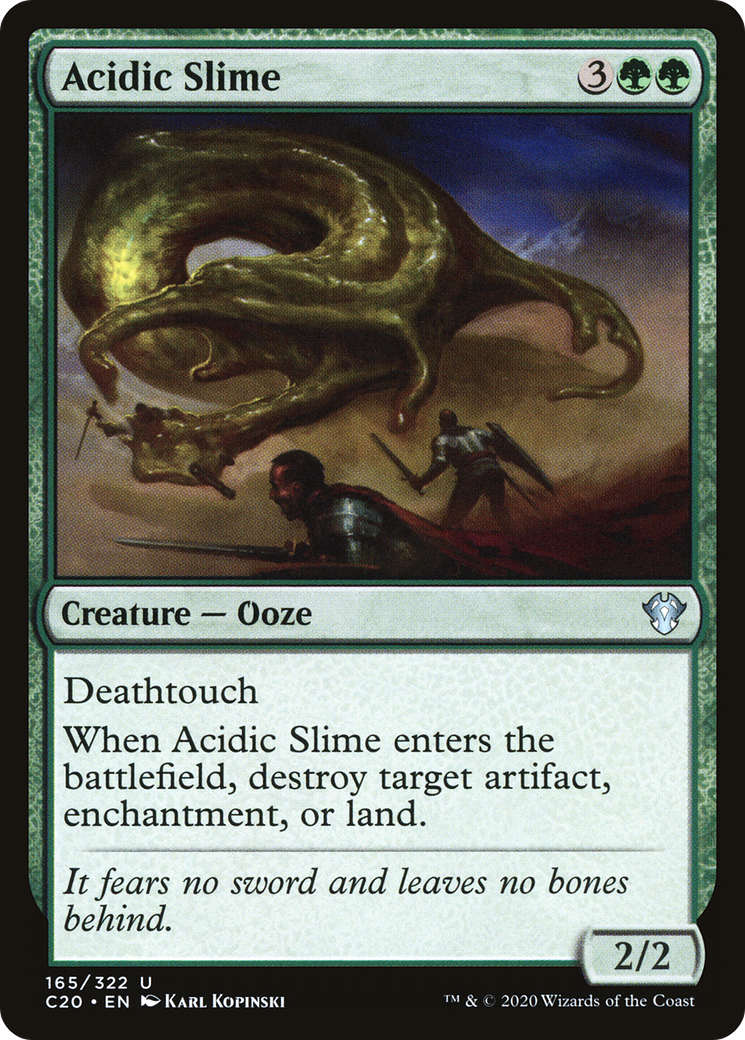
Acidic Slime
Acidic Slime
Creature — Ooze
2/2
Deathtouch (Any amount of damage this deals to a creature is enough to destroy it.)
When this creature enters, destroy target artifact, enchantment, or land.
-
1
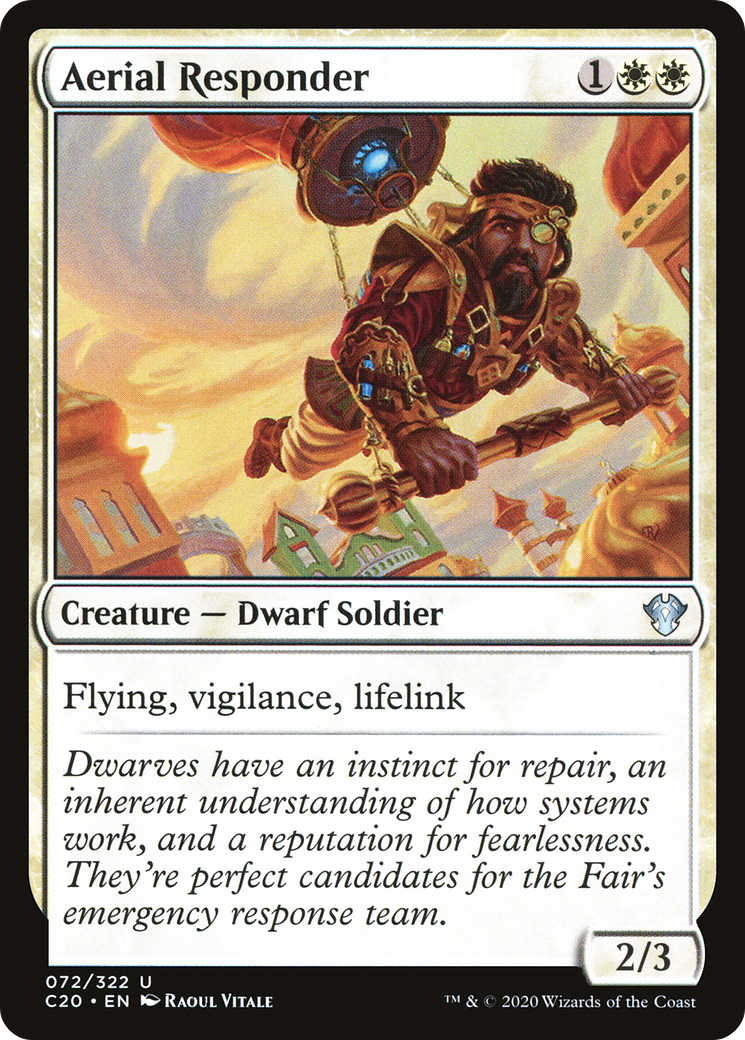
Aerial Responder
Aerial Responder
Creature — Dwarf Soldier
2/3
Flying, vigilance, lifelink
-
1
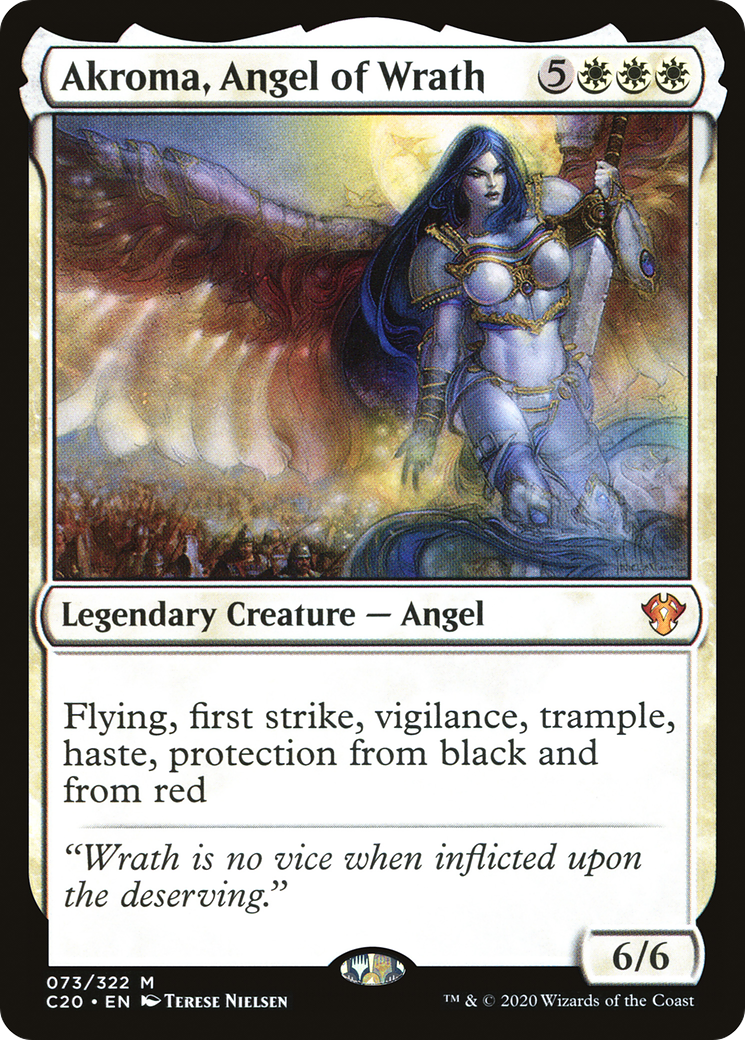
Akroma, Angel of Wrath
Akroma, Angel of Wrath
Legendary Creature — Angel
6/6
Flying, first strike, vigilance, trample, haste, protection from black and from red
-
1
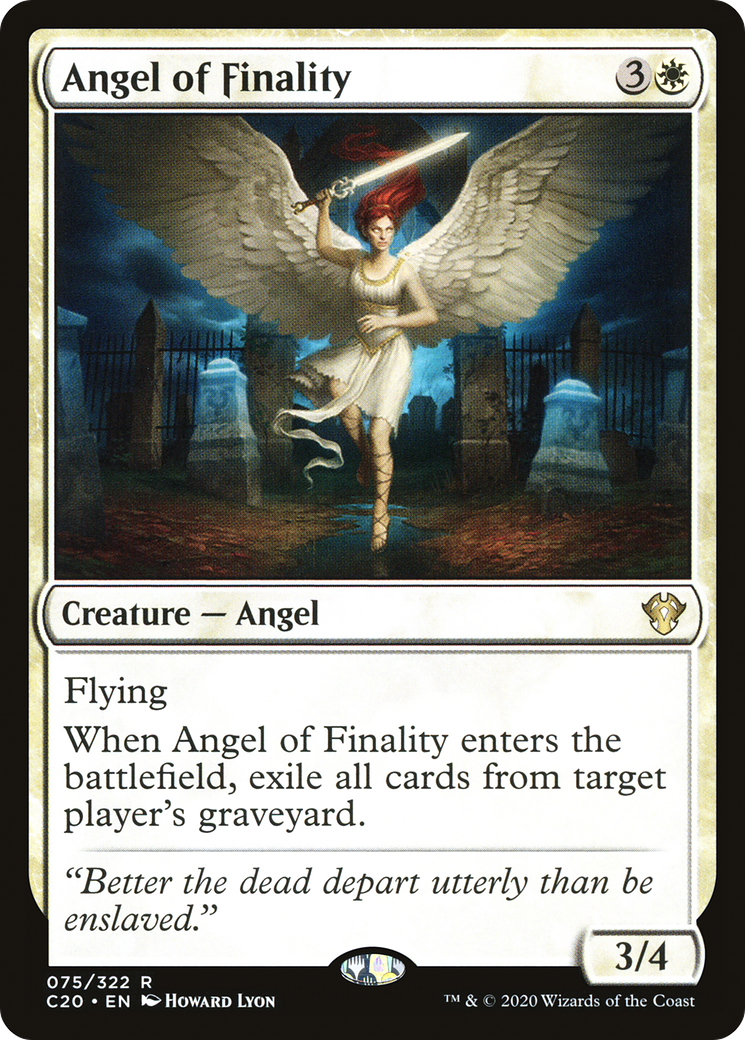
Angel of Finality
Angel of Finality
Creature — Angel
3/4
Flying
When this creature enters, exile target player's graveyard.
-
1
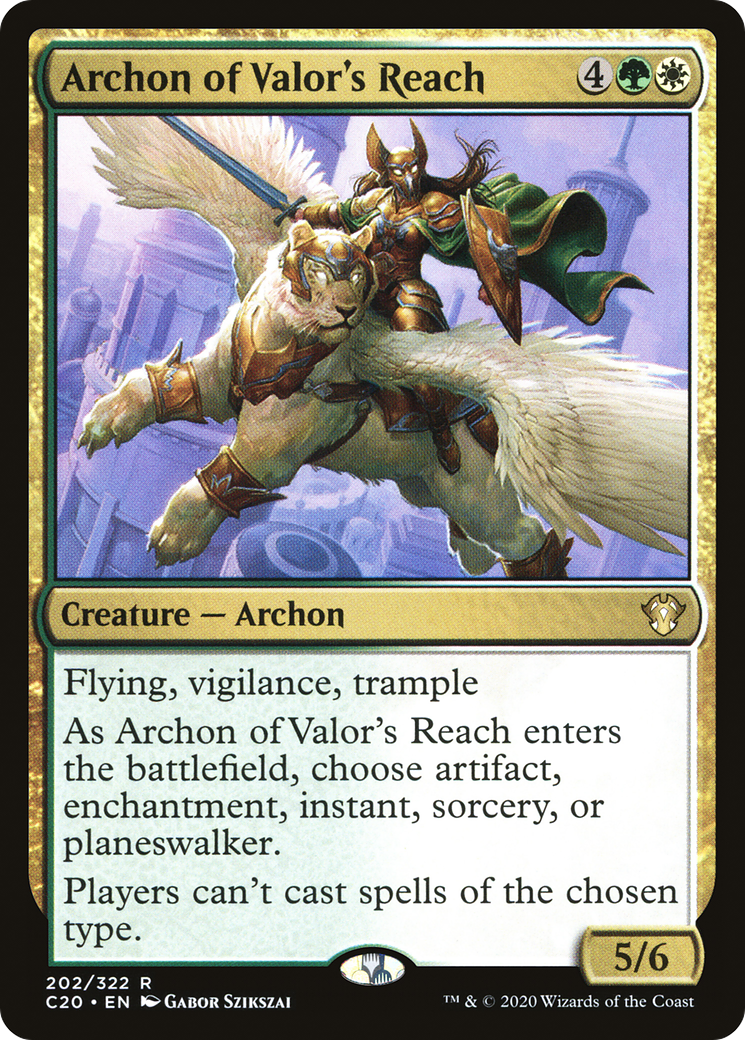
Archon of Valor's Reach
Archon of Valor's Reach
Creature — Archon
5/6
Flying, vigilance, trample
As this creature enters, choose artifact, enchantment, instant, sorcery, or planeswalker.
Players can't cast spells of the chosen type.
- The enters-the-battlefield effect of Archon of Valor’s Reach is a replacement effect that doesn’t use the stack. No player can cast spells or activate abilities after it has entered the battlefield but before you choose a card type.
- Whether it’s legal to cast a spell is determined before its costs are paid. This means that if Archon of Valor’s Reach has sorcery as the chosen type, you can’t cast Morbid Curiosity, even if you wish to sacrifice Archon of Valor’s Reach to do so.
-
1
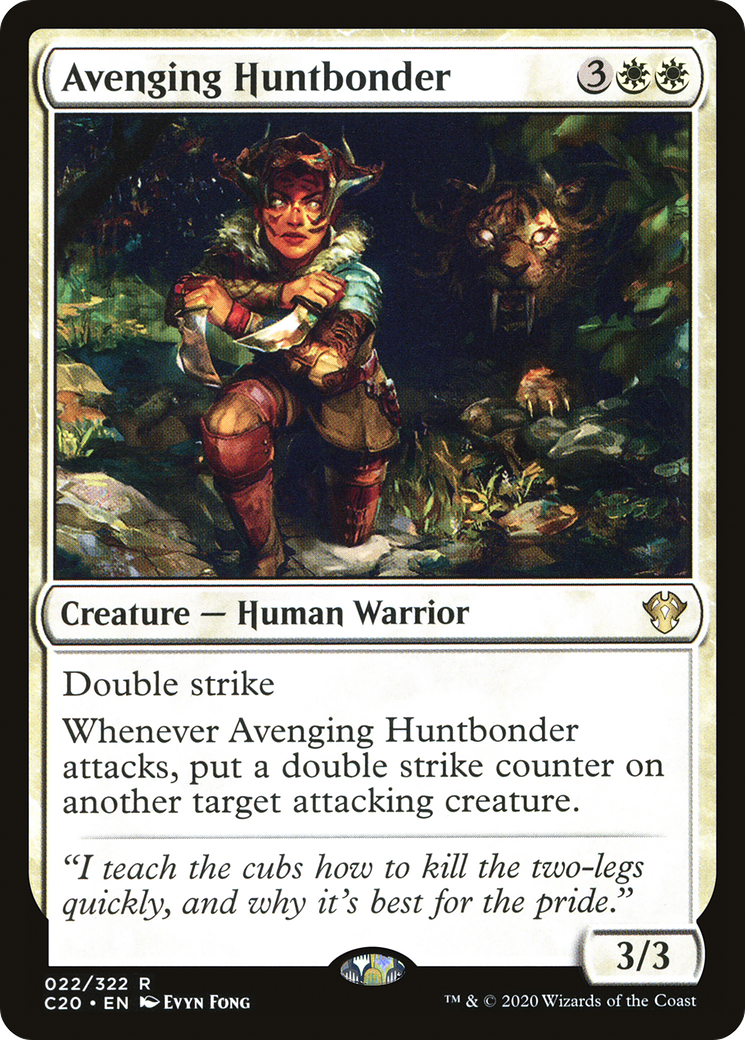
Avenging Huntbonder
Avenging Huntbonder
Creature — Human Warrior
3/3
Double strike
Whenever this creature attacks, put a double strike counter on another target attacking creature.
-
1
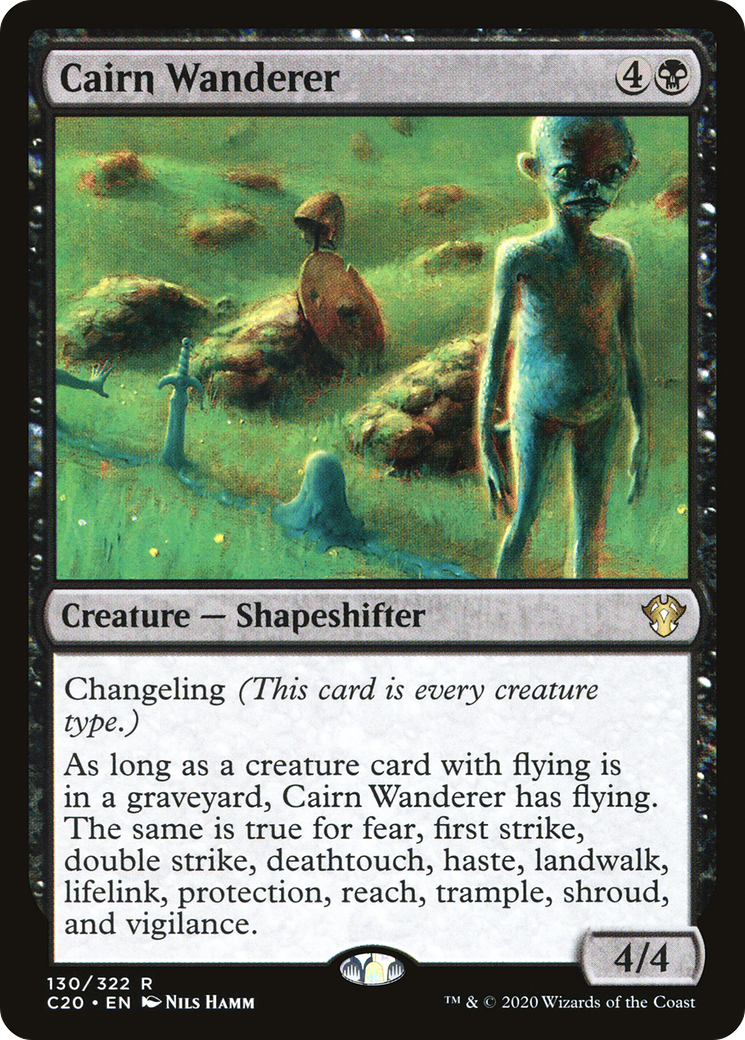
Cairn Wanderer
Cairn Wanderer
Creature — Shapeshifter
4/4
Changeling (This card is every creature type.)
As long as a creature card with flying is in a graveyard, this creature has flying. The same is true for fear, first strike, double strike, deathtouch, haste, landwalk, lifelink, protection, reach, trample, shroud, and vigilance.
- Cairn Wanderer’s ability looks at all cards in all graveyards. It gains any landwalk abilities and any protection abilities.
-
1
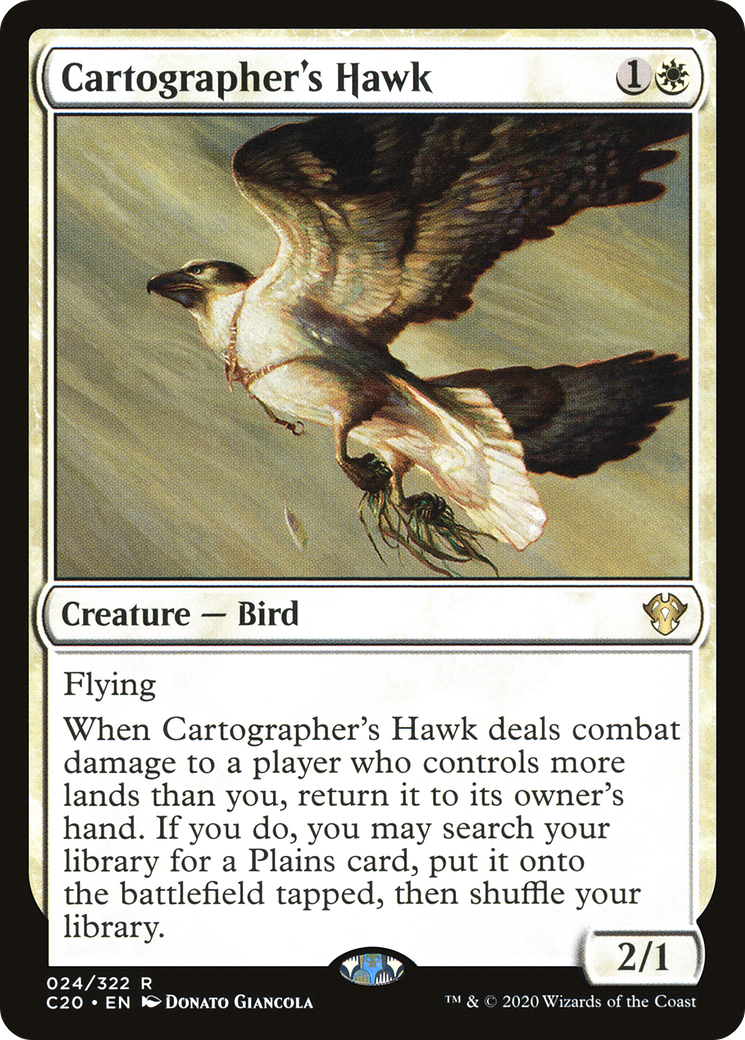
Cartographer's Hawk
Cartographer's Hawk
Creature — Bird
2/1
Flying
When this creature deals combat damage to a player who controls more lands than you, return it to its owner's hand. If you do, you may search your library for a Plains card, put it onto the battlefield tapped, then shuffle.
- If Cartographer’s Hawk leaves the battlefield before its triggered ability resolves, you can’t return it to its owner’s hand from its new zone.
-
1
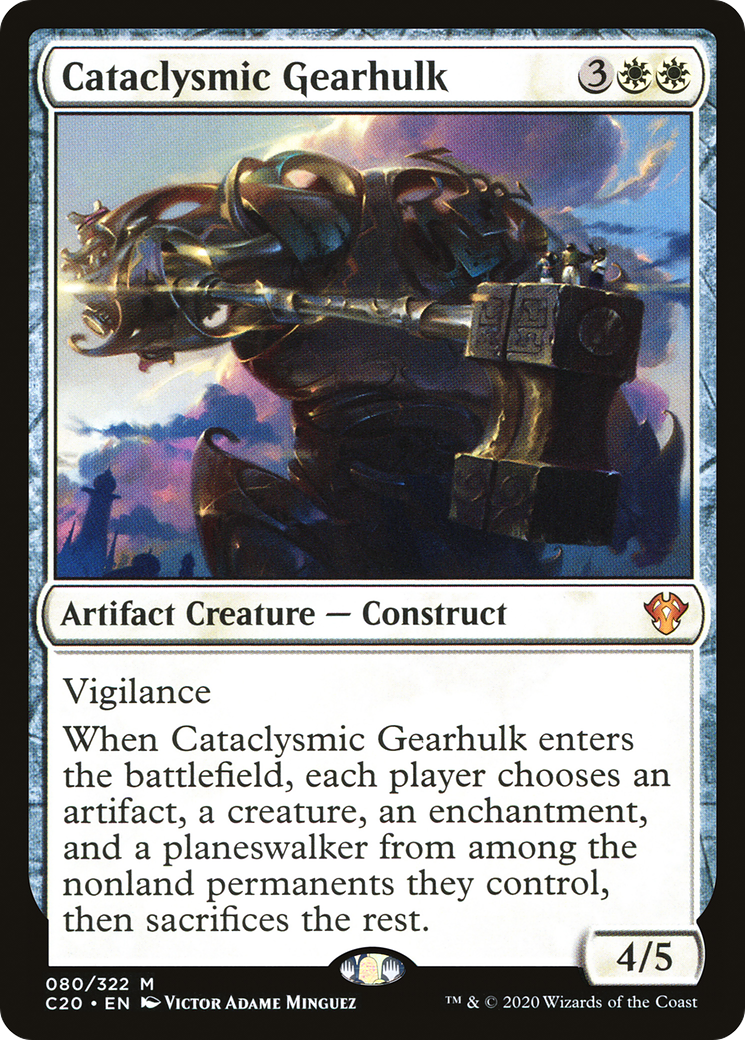
Cataclysmic Gearhulk
Cataclysmic Gearhulk
Artifact Creature — Construct
4/5
Vigilance
When this creature enters, each player chooses an artifact, a creature, an enchantment, and a planeswalker from among the nonland permanents they control, then sacrifices the rest.
- First the player whose turn it is chooses permanents they control, then each other player in turn order does the same. Each player will know the choices made by players who chose before them. All of the unchosen nonland permanents are then sacrificed simultaneously.
- A permanent with more than one type may be chosen as either of the types or both. For example, an artifact creature may be chosen as the artifact, the creature, or both. Choosing the same permanent twice this way has the same result as choosing it once.
- Cataclysmic Gearhulk will be sacrificed to its own ability if you don't choose it as your artifact or your creature.
- Lands can't be chosen and won't be sacrificed, even if they have other types (such as an artifact land).
- If you don't control any permanents of one of the types, you'll still choose the permanents of the types you do control.
-
1
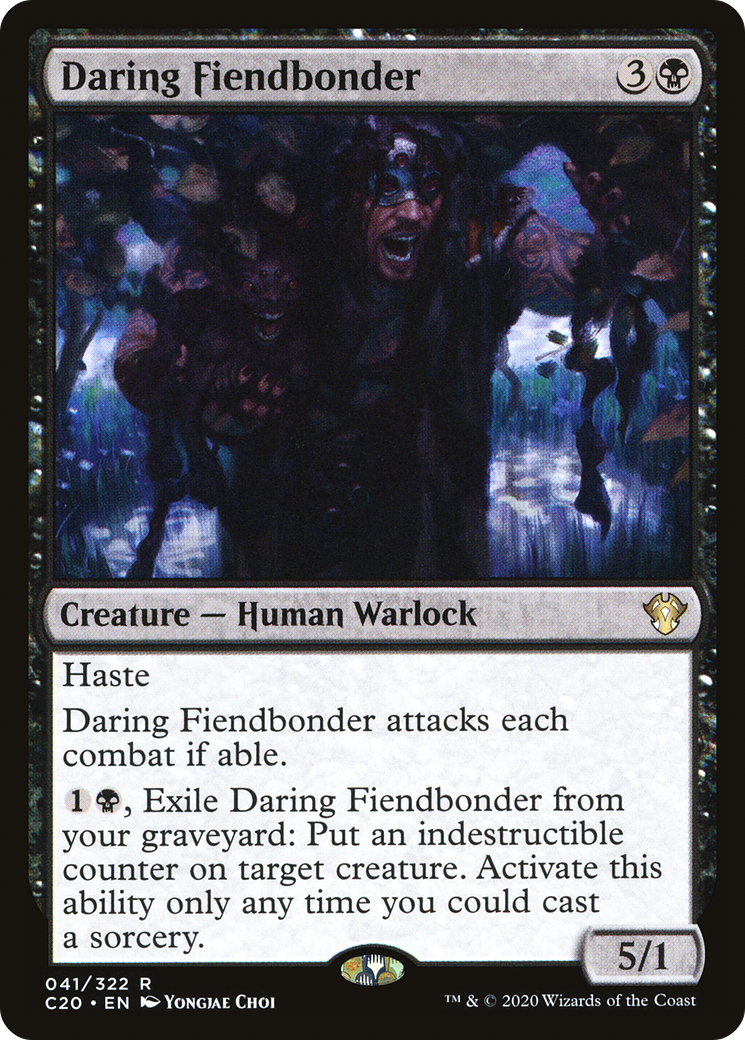
Daring Fiendbonder
Daring Fiendbonder
Creature — Human Warlock
5/1
Haste
This creature attacks each combat if able.
, Exile this card from your graveyard: Put an indestructible counter on target creature. Activate only as a sorcery.
- If Daring Fiendbonder can't attack for any reason (such as being tapped), then it doesn't attack. If there's a cost associated with having it attack, the player isn't forced to pay that cost, so it doesn't have to attack in that case either.
-
1
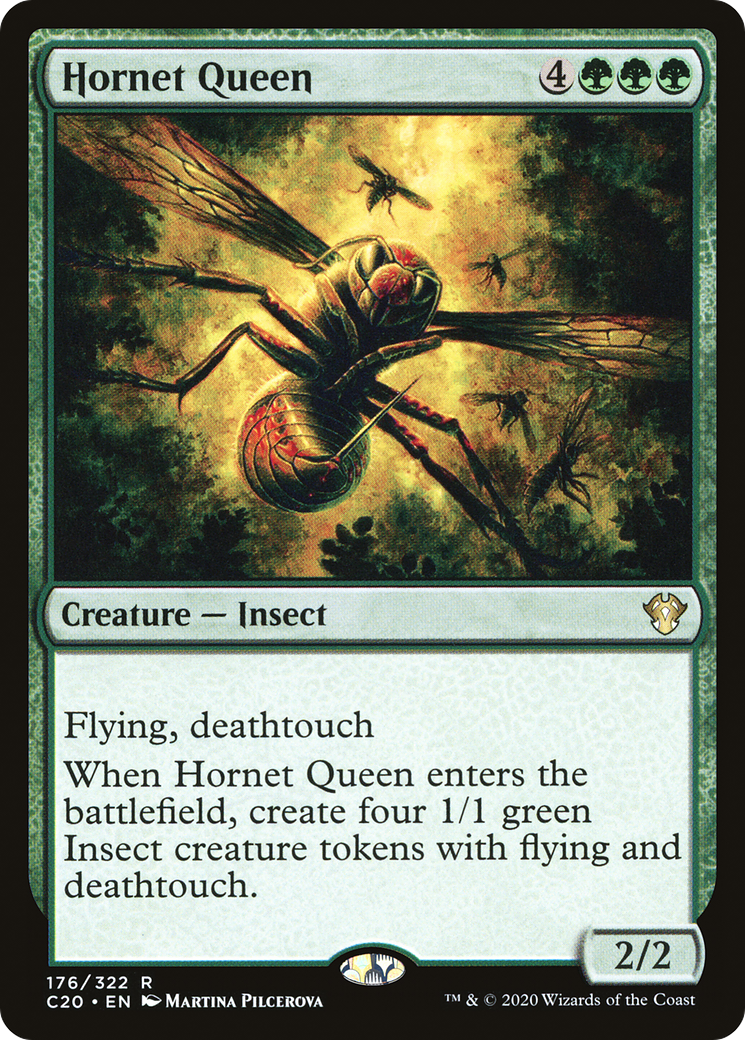
Hornet Queen
Hornet Queen
Creature — Insect
2/2
Flying, deathtouch
When this creature enters, create four 1/1 green Insect creature tokens with flying and deathtouch.
-
1
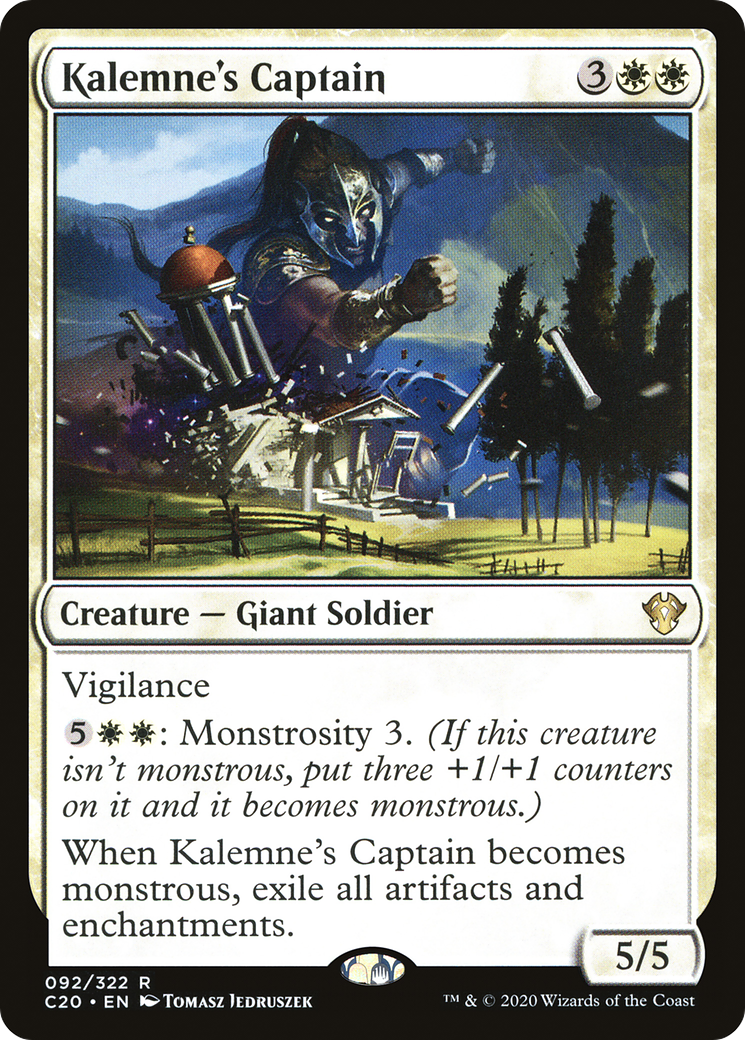
Kalemne's Captain
Kalemne's Captain
Creature — Giant Soldier
5/5
Vigilance
: Monstrosity 3. (If this creature isn't monstrous, put three +1/+1 counters on it and it becomes monstrous.)
When this creature becomes monstrous, exile all artifacts and enchantments.
- Once a creature becomes monstrous, it can’t become monstrous again. If Kalemne’s Captain is already monstrous, the activated ability won’t do anything.
- Monstrous isn’t an ability that the creature has. It’s just something true about that creature. If the creature stops being a creature or loses its abilities, it continues to be monstrous.
- An ability that triggers when a creature becomes monstrous won’t trigger if that creature isn’t on the battlefield when its monstrosity ability resolves.
-
1
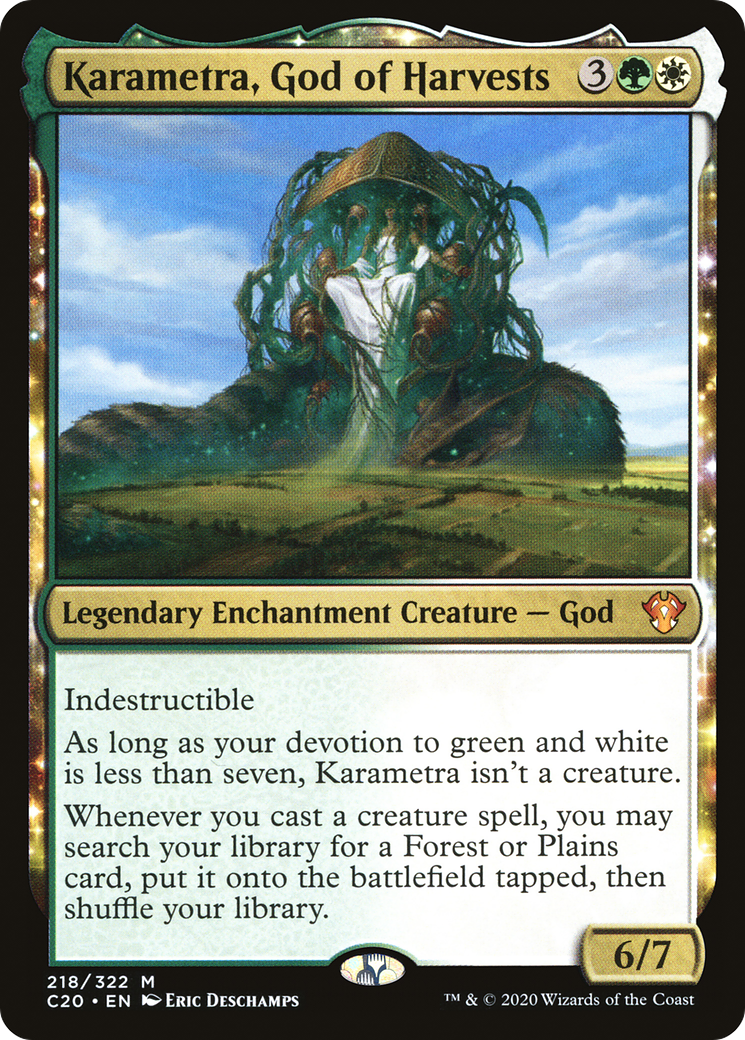
Karametra, God of Harvests
Karametra, God of Harvests
Legendary Enchantment Creature — God
6/7
Indestructible
As long as your devotion to green and white is less than seven, Karametra isn't a creature.
Whenever you cast a creature spell, you may search your library for a Forest or Plains card, put it onto the battlefield tapped, then shuffle.
- If Karametra stops being a creature, it loses the type creature and the creature type God. It continues to be a legendary enchantment.
- If an effect causes Karametra to lose all abilities, its ability that causes it to stop being a creature still applies if appropriate.
- When Karametra enters the battlefield, your devotion to green and white will determine if a creature entered the battlefield or not for abilities that trigger whenever a creature enters the battlefield. The mana symbols in Karametra's own mana cost are counted when determining this.
- Counters put on Karametra remain on it while it's not a creature, even if they have no effect.
- If Karametra is attacking or blocking and it stops being a creature, it will be removed from combat. It won't rejoin combat if it resumes being a creature later during that combat.
- An ability that triggers when a player casts a spell resolves before the spell that caused it to trigger. It resolves even if that spell is countered.
- Your devotion to two colors is the number of mana symbols among mana costs of permanents you control that are the first color, the second, or both. If an effect counts your devotion to two colors, a hybrid symbol that is both of those colors is counted just once.
- The type-changing ability that can make Karametra not be a creature functions only on the battlefield. It's always a creature card in other zones, regardless of your devotion to its color. It's always a creature spell while it's on the stack.
- As Karametra enters the battlefield, your devotion to green and white will determine whether any replacement effects that affect creatures entering the battlefield apply. Because replacement effects are considered before Karametra is on the battlefield, the mana symbols in its mana cost won't be counted when determining this.
- Karametra's abilities function as long as it's on the battlefield, regardless of whether it's a creature.
- If a God is attacking or blocking and it stops being a creature, it will be removed from combat. It won't rejoin combat if it resumes being a creature later during that combat.
- Your devotion to two colors is the number of mana symbols among mana costs of permanents you control that are the first color, the second, or both. If an effect counts your devotion to two colors, a hybrid symbol that is both of those colors is counted just once.
- The type-changing ability that can make a God not be a creature functions only on the battlefield. It's always a creature card in other zones, regardless of your devotion to its color. It's always a creature spell while it's on the stack.
- As a God enters the battlefield, your devotion to its color will determine whether any replacement effects that affect creatures entering the battlefield apply to that God. Because replacement effects are considered before the God is on the battlefield, the mana symbols in its mana cost won't be counted when determining this.
- When a God enters the battlefield, your devotion to its color (including the mana symbols in the mana cost of the God itself) will determine if a creature entered the battlefield or not for abilities that trigger whenever a creature enters the battlefield.
- If a God stops being a creature, it loses the type creature and the creature type God. It continues to be a legendary enchantment.
- The abilities of Gods function as long as they're on the battlefield, regardless of whether they're creatures.
- Counters put on a God remain on it while it's not a creature, even if they have no effect.
- If an effect causes a God to lose all abilities, its ability that causes it to stop being a creature still applies if appropriate.
- You can use the last ability to put any land card with the subtype Forest or Plains onto the battlefield, not just ones named Forest or Plains.
- If you cast a creature card with bestow for its bestow cost, it becomes an Aura spell and not a creature spell. Karametra's last ability won't trigger.
- Numeric mana symbols ( , , and so on) in mana costs of permanents you control don't count toward your devotion to any color.
- If an activated ability or triggered ability has an effect that depends on your devotion to a color, you count the number of mana symbols of that color among the mana costs of permanents you control as the ability resolves. The permanent with that ability will be counted if it's still on the battlefield at that time.
- Hybrid mana symbols, monocolored hybrid mana symbols, and Phyrexian mana symbols do count toward your devotion to their color(s).
- Mana symbols in the text boxes of permanents you control don't count toward your devotion to any color.
-
1
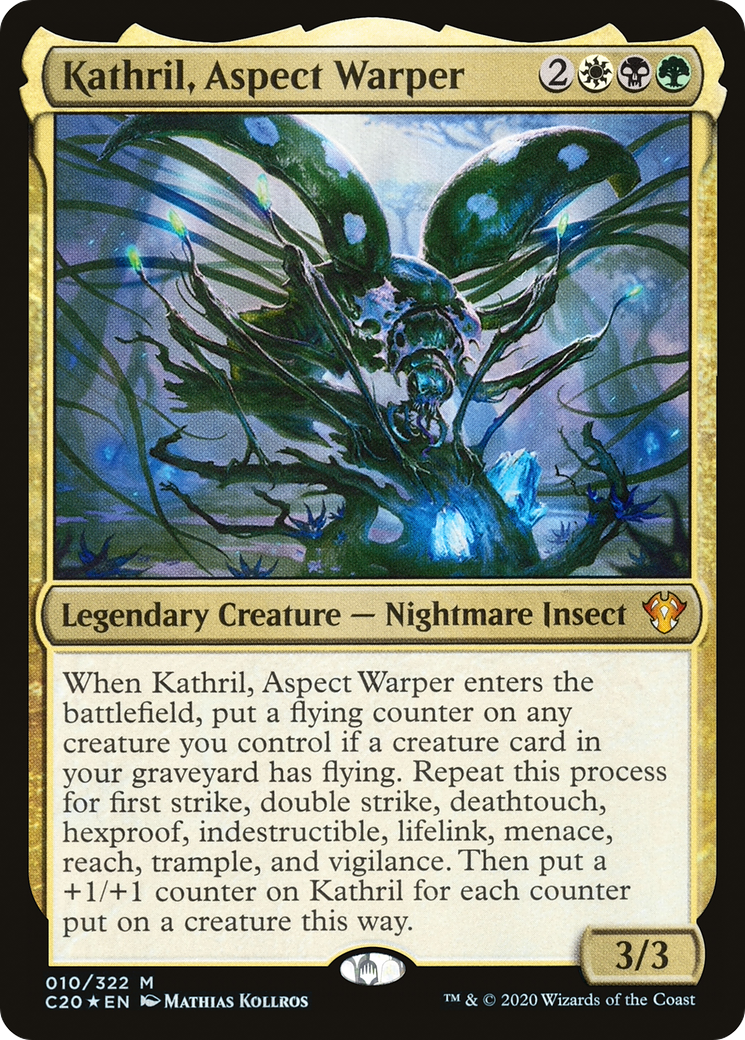
Kathril, Aspect Warper
Kathril, Aspect Warper
Legendary Creature — Nightmare Insect
3/3
When Kathril enters, put a flying counter on any creature you control if a creature card in your graveyard has flying. Repeat this process for first strike, double strike, deathtouch, hexproof, indestructible, lifelink, menace, reach, trample, and vigilance. Then put a +1/+1 counter on Kathril for each counter put on a creature this way.
- If cards in your graveyard have multiple hexproof abilities (such as hexproof, hexproof from white, and hexproof from black), a counter of each variant kind will be put onto a creature.
- For each applicable keyword, the appropriate counter may be put on any creature you control, including Kathril. The counters don't need to all be put on the same creature.
- You check once for each keyword. If you have two creature cards with flying in your graveyard, you put just one flying counter on a creature you control, not two.
- Once Kathril's ability begins resolving, no player may take other actions until it's done and you've put +1/+1 counters on Kathril.
-
1
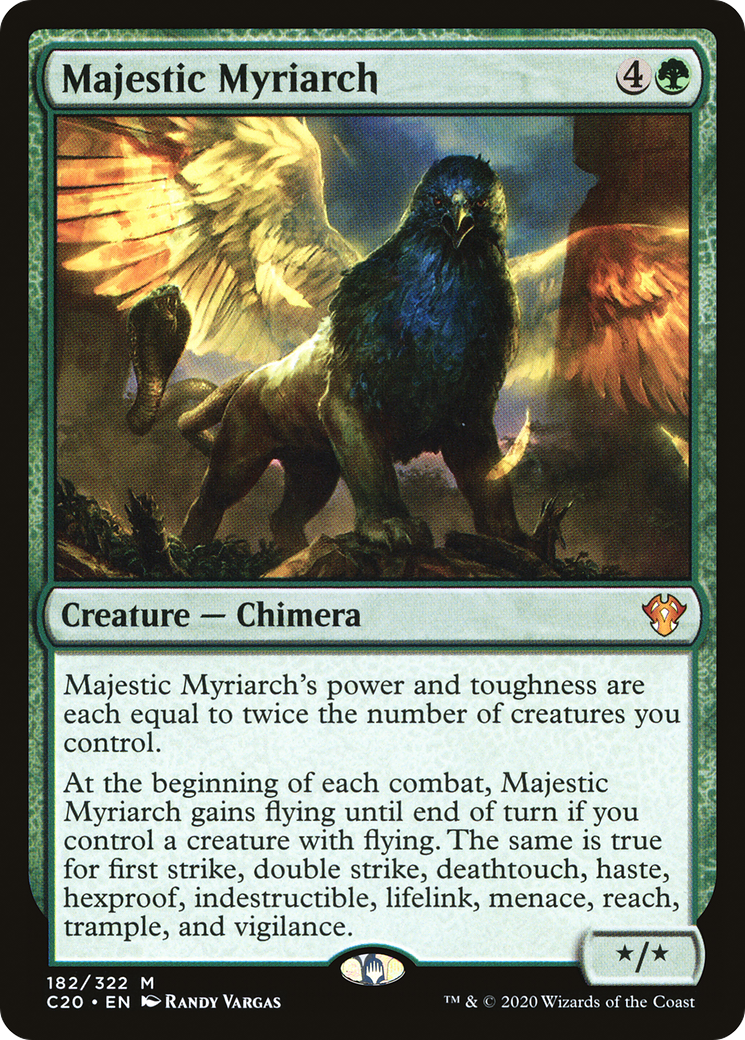
Majestic Myriarch
Majestic Myriarch
Creature — Chimera
*/*
Majestic Myriarch's power and toughness are each equal to twice the number of creatures you control.
At the beginning of each combat, this creature gains flying until end of turn if you control a creature with flying. The same is true for first strike, double strike, deathtouch, haste, hexproof, indestructible, lifelink, menace, reach, trample, and vigilance.
- If one of those creatures has one or more variants of the listed keywords (for example, hexproof from white), this creature gains those specific variants.
- Majestic Myriarch's first ability applies in all zones. While it's on the battlefield, it counts itself, so it'll be at least 2/2.
- Majestic Myriarch's second ability triggers at the beginning of each combat, not just combat on your turn, whether or not any creatures you control have any of the listed abilities.
- Which abilities Majestic Myriarch gains is determined as the ability resolves. They won't change even if every other creature that has the abilities leaves the battlefield or if creatures enter the battlefield or gain abilities.
- If a creature gains one of the listed abilities before Majestic Mryiarch's triggered ability resolves, perhaps due to another ability that triggered at the beginning of combat, Majestic Myriarch will gain that ability.
- Multiple instances of any of the abilities Majestic Myriarch can gain are redundant.
-
1
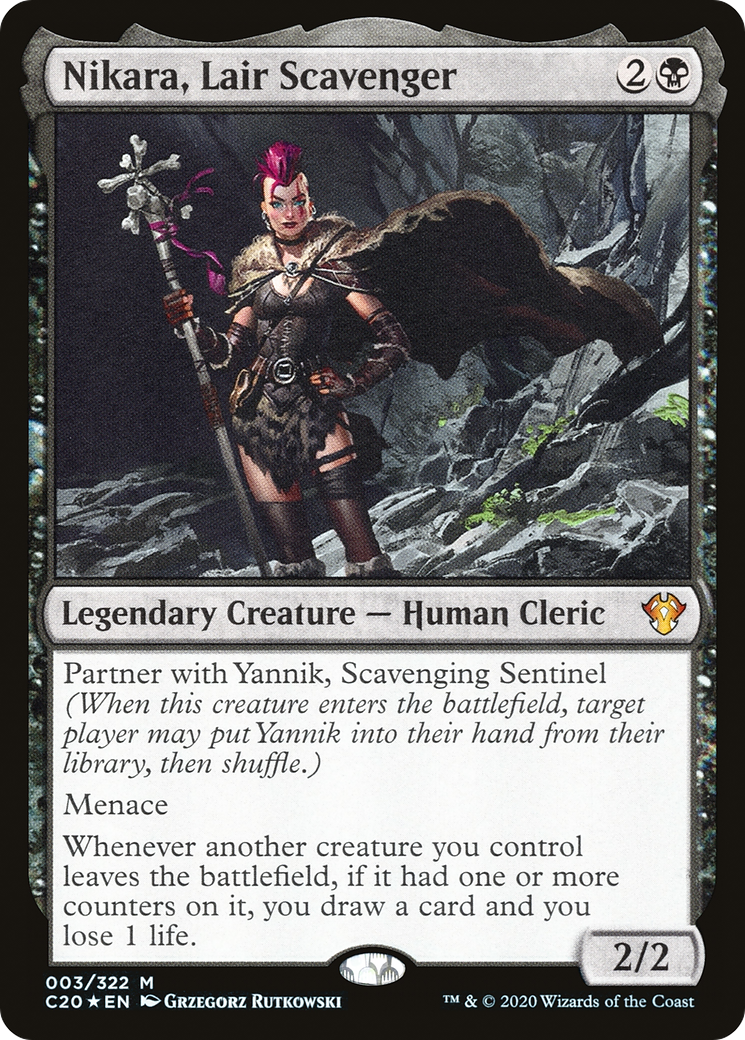
Nikara, Lair Scavenger
Nikara, Lair Scavenger
Legendary Creature — Human Cleric
2/2
Partner with Yannik, Scavenging Sentinel (When this creature enters, target player may put Yannik into their hand from their library, then shuffle.)
Menace
Whenever another creature you control leaves the battlefield, if it had one or more counters on it, you draw a card and you lose 1 life.
- Nikara's last ability causes you to draw only one card and lose only 1 life, no matter how many counters or kinds of counters that creature had on it.
- If a creature with +1/+1 counters on it receives an equal number of -1/-1 counters and this causes it to be destroyed by lethal damage or put into its owner's graveyard for having 0 or less toughness, Nikara's last ability triggers. That's because the ability checks the creature as it last existed on the battlefield, and it still had those counters on it at that point.
- If a creature with counters on it leaves the battlefield at the same time as Nikara, Nikara's ability triggers for that creature.
- "Partner with [name]" represents two abilities. The first is a triggered ability: "When this permanent enters the battlefield, target player may search their library for a card named [name], reveal it, put it into their hand, then shuffle their library."
- Note that the target player searches their library (which may be affected by effects such as that of Stranglehold) and that the card they find is revealed, even though these words aren't included in the ability's reminder text.
- The second ability represented by the "partner with [name]" keyword modifies the rules for deck construction in the Commander variant and has no function outside of that variant. If a legendary creature card with "partner with [name]" is designated as your commander, the named legendary creature card can also be designated as your commander.
- If your Commander deck has two commanders, you can only include cards whose own color identities are also found in your commanders' combined color identities. If Haldan and Pako are your commanders, your deck may contain cards with blue, red, and/or green in their color identity, but not cards with white or black.
- Both commanders start in the command zone, and the remaining 98 cards of your deck are shuffled to become your library.
- A creature with a "partner with" ability can't partner with any creature other than its designated partner. Losing a partner ability during the game doesn't cause either to cease to be your commander.
- Once the game begins, your two commanders are tracked separately. If you cast one, you won't have to pay an additional the first time you cast the other. A player loses the game after having been dealt 21 damage from one of them, not from both of them combined. Command Beacon's effect puts one into your hand from the command zone, not both.
- The triggered ability of the "partner with" keyword still triggers in a Commander game. If your other commander has somehow ended up in your library, you can find it. You can also target another player who might have that card in their library.
-
1
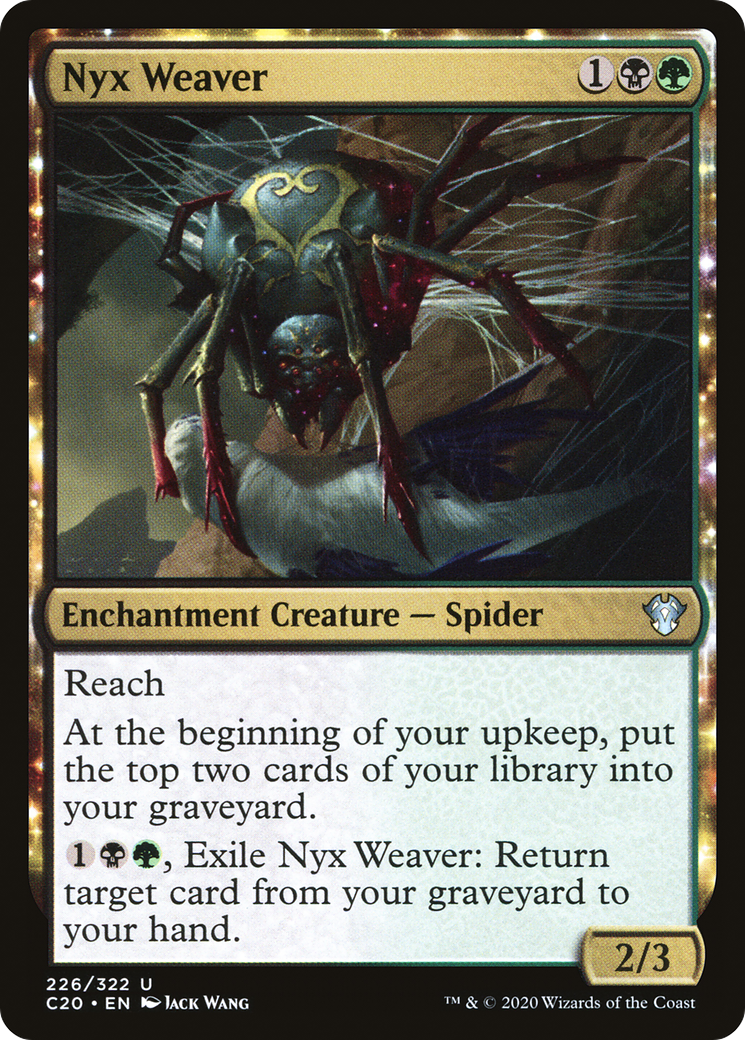
Nyx Weaver
Nyx Weaver
Enchantment Creature — Spider
2/3
Reach
At the beginning of your upkeep, mill two cards. (Put the top two cards of your library into your graveyard.)
, Exile this creature: Return target card from your graveyard to your hand.
-
1
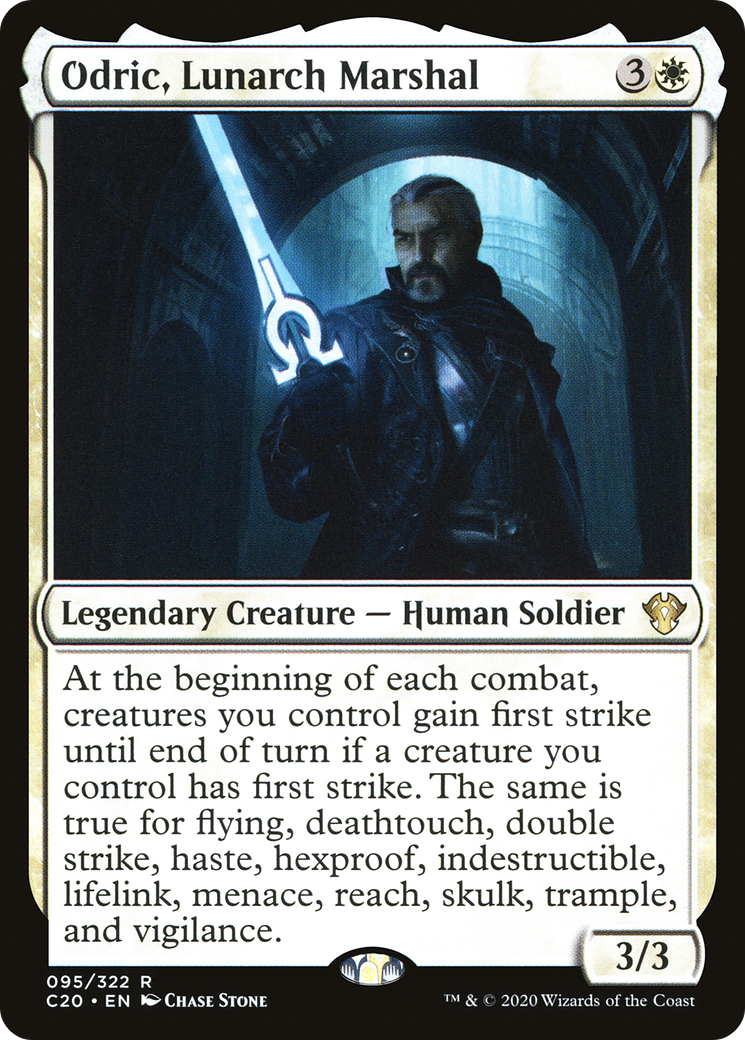
Odric, Lunarch Marshal
Odric, Lunarch Marshal
Legendary Creature — Human Soldier
3/3
At the beginning of each combat, creatures you control gain first strike until end of turn if a creature you control has first strike. The same is true for flying, deathtouch, double strike, haste, hexproof, indestructible, lifelink, menace, reach, skulk, trample, and vigilance.
- If one of those creatures has one or more variants of the listed keywords (for example, hexproof from white), creatures you control gain those specific variants.
- Odric's ability triggers at the beginning of each combat, not just combat on your turn, whether or not any creatures you control have any of the listed abilities. If a creature gains one of the listed abilities before Odric's triggered ability resolves, perhaps due to another ability that triggered at the beginning of combat, then creatures you control will gain that ability.
- The set of creatures affected by Odric's ability and how they are affected is determined as the ability resolves. Creatures you begin to control later in the turn won't gain any abilities or cause creatures to gain new abilities, and the abilities gained won't change even if every creature that normally had the abilities leaves the battlefield.
- Multiple instances of any of the abilities Odric can grant your creatures are redundant.
-
1
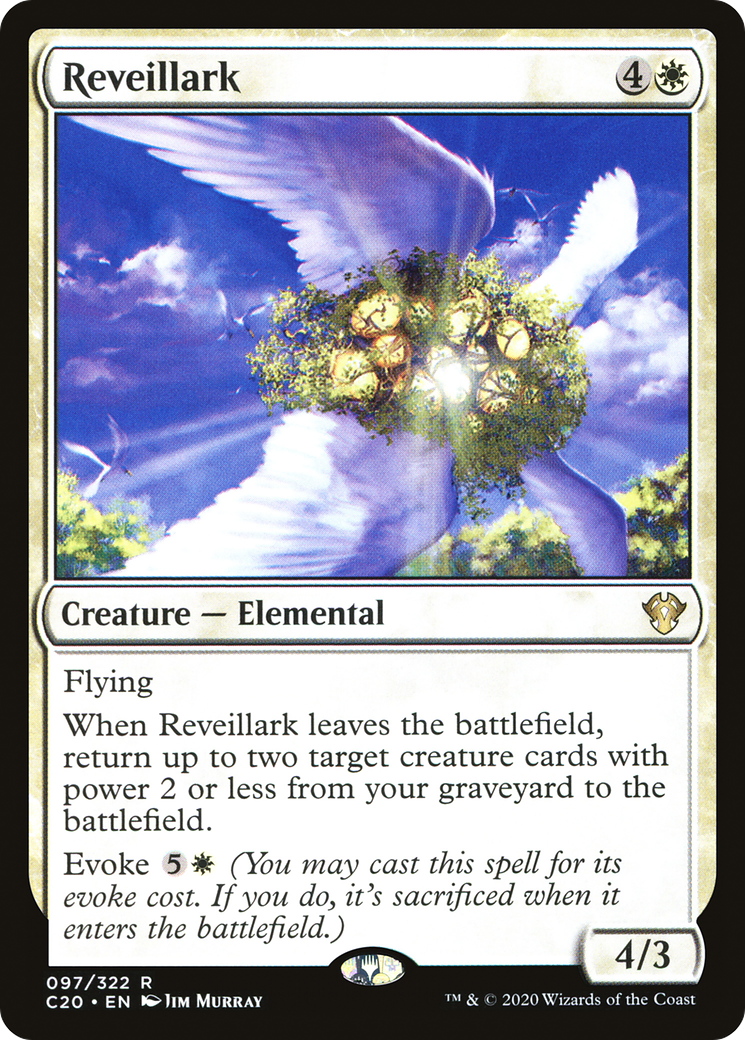
Reveillark
Reveillark
Creature — Elemental
4/3
Flying
When this creature leaves the battlefield, return up to two target creature cards with power 2 or less from your graveyard to the battlefield.
Evoke (You may cast this spell for its evoke cost. If you do, it's sacrificed when it enters.)
- Reveillark's ability may target zero, one, or two creature cards in your graveyard. Each target must have power 2 or less.
- If a creature spell cast with evoke changes controllers before it enters, it will still be sacrificed when it enters. Similarly, if a creature cast with evoke changes controllers after it enters but before its sacrifice ability resolves, it will still be sacrificed. In both cases, the controller of the creature at the time it left the battlefield will control its leaves-the-battlefield ability.
- When you cast a spell by paying its evoke cost, its mana cost doesn't change. You just pay the evoke cost instead.
- Evoke doesn't change the timing of when you can cast the creature that has it. If you could cast that creature spell only when you could cast a sorcery, the same is true for cast it with evoke.
- Whether evoke's sacrifice ability triggers when the creature enters depends on whether the spell's controller chose to pay the evoke cost, not whether they actually paid it (if it was reduced or otherwise altered by another ability, for example).
- If you're casting a spell "without paying its mana cost," you can't use its evoke ability.
- Effects that cause you to pay more or less to cast a spell will cause you to pay that much more or less while casting it for its evoke cost, too. That's because they affect the total cost of the spell, not its mana cost.
-
1
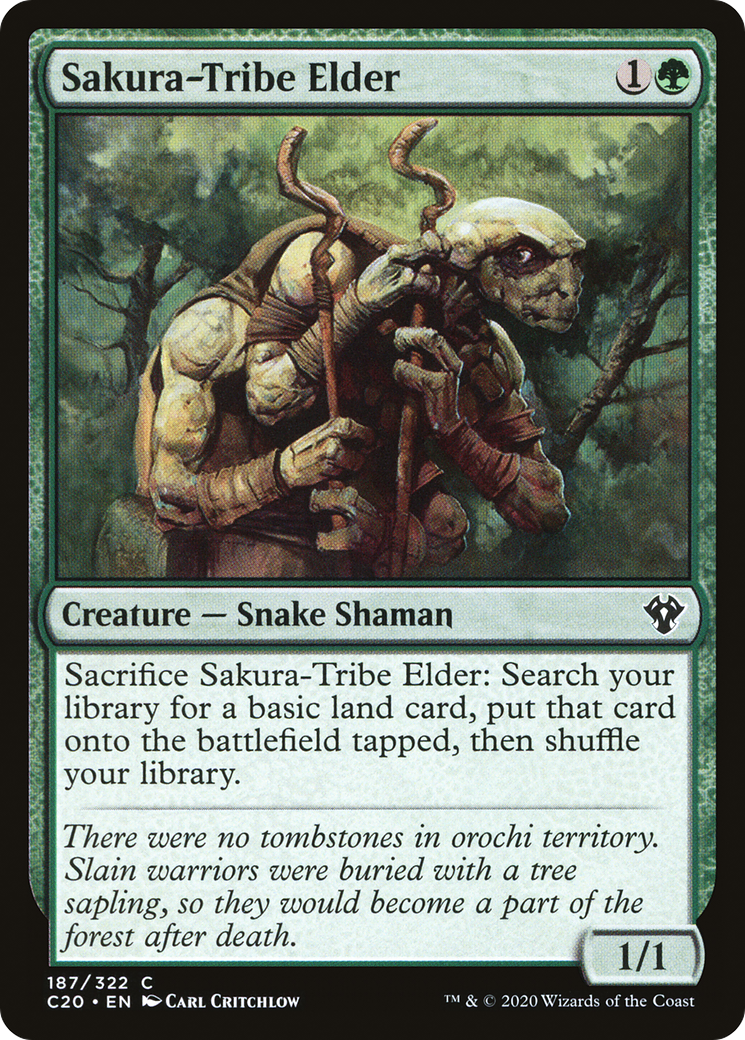
Sakura-Tribe Elder
Sakura-Tribe Elder
Creature — Snake Shaman
1/1
Sacrifice this creature: Search your library for a basic land card, put that card onto the battlefield tapped, then shuffle.
-
1
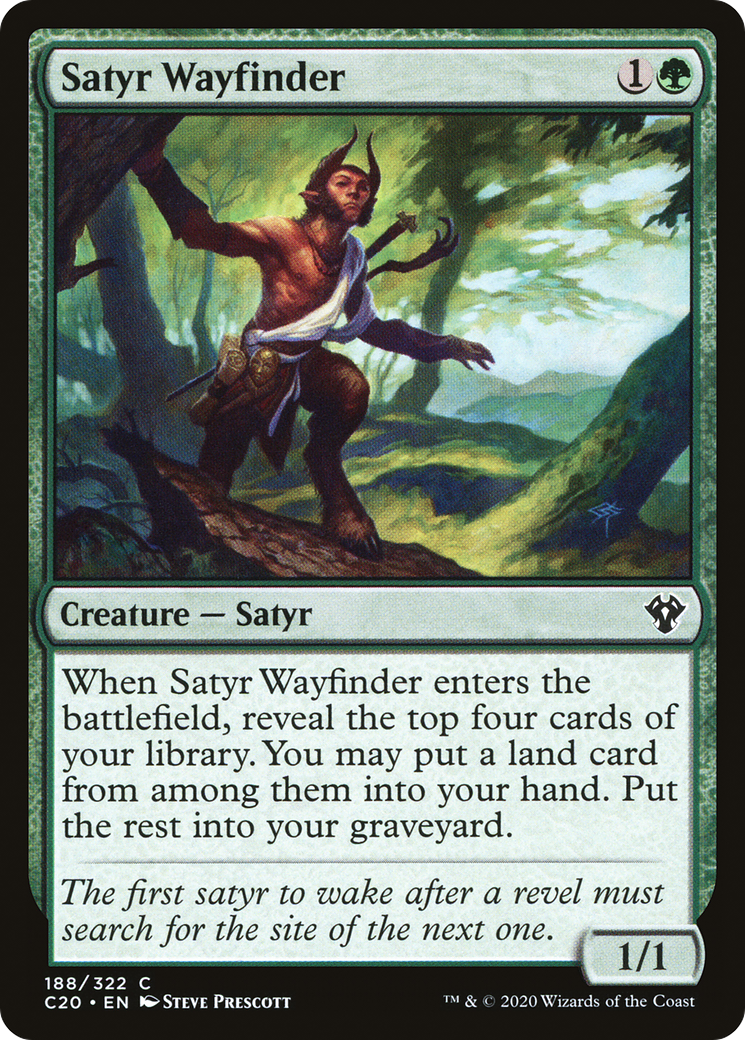
Satyr Wayfinder
Satyr Wayfinder
Creature — Satyr
1/1
When this creature enters, reveal the top four cards of your library. You may put a land card from among them into your hand. Put the rest into your graveyard.
-
1
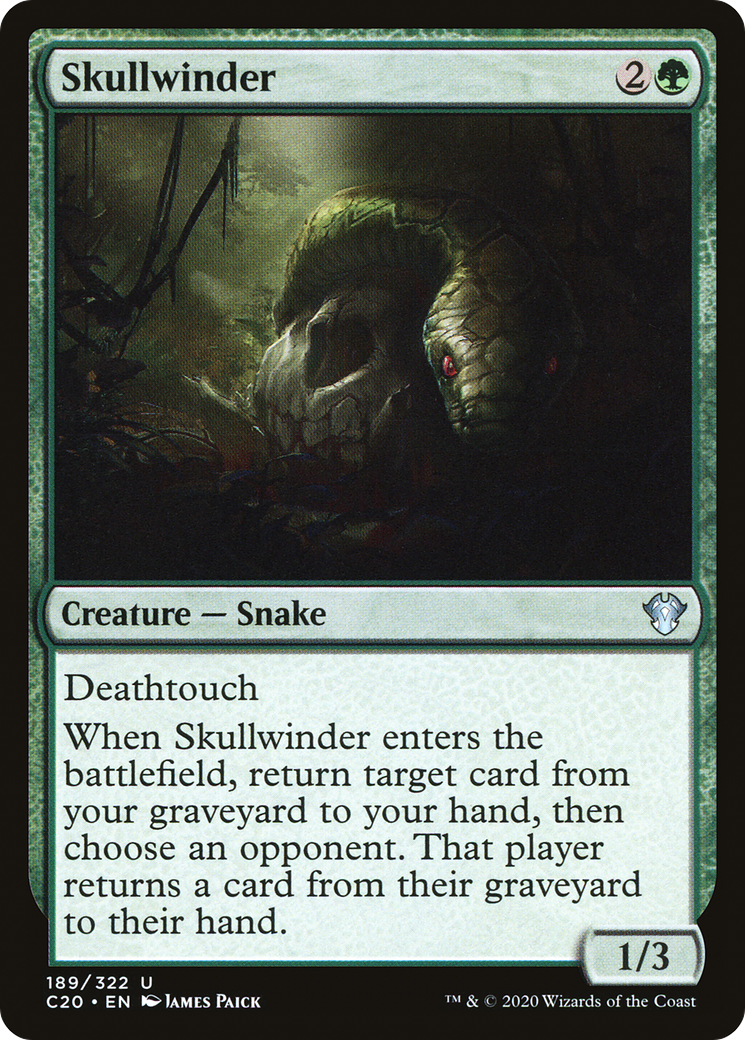
Skullwinder
Skullwinder
Creature — Snake
1/3
Deathtouch
When this creature enters, return target card from your graveyard to your hand, then choose an opponent. That player returns a card from their graveyard to their hand.
- Skullwinder's enters-the-battlefield ability targets only the card in your graveyard. If that card is an illegal target as the ability tries to resolve, the ability won't resolve and none of its effects will happen. No cards will be returned to any player's hand.
- You choose the target card as you put Skullwinder's triggered ability on the stack, but you don't choose an opponent until after you have returned the card to your hand.
- The chosen opponent gets to choose which card to return from their graveyard to their hand.
- You may choose an opponent with no cards in their graveyard. In that case, they will not get to return anything.
- Skullwinder's enters-the-battlefield ability targets only the card in your graveyard. If that card is an illegal target as the ability tries to resolve, the ability won't resolve and none of its effects will happen. No cards will be returned to any player's hand.
- You choose the opponent as the ability is resolving. You may choose an opponent with no cards in their graveyard.
-
1
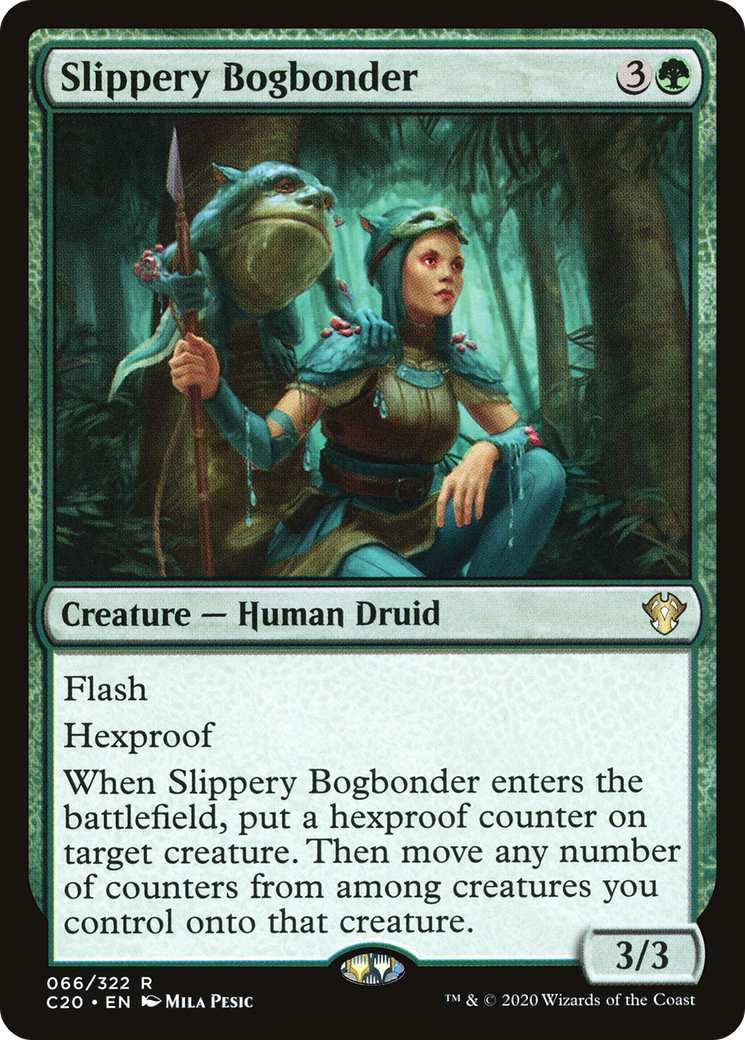
Slippery Bogbonder
Slippery Bogbonder
Creature — Human Druid
3/3
Flash
Hexproof
When this creature enters, put a hexproof counter on target creature. Then move any number of counters from among creatures you control onto that creature.
- You may move counters from any number of other creatures you control, not just from one.
- You choose which counters to move as Slippery Bogbonder's triggered ability resolves.
- You may choose to move zero counters.
- If Slippery Bogbonder's triggered ability puts a hexproof counter on a creature an opponent controls, you can still move counters onto that creature.
- You can't move counters from the target creature to itself.
-
1
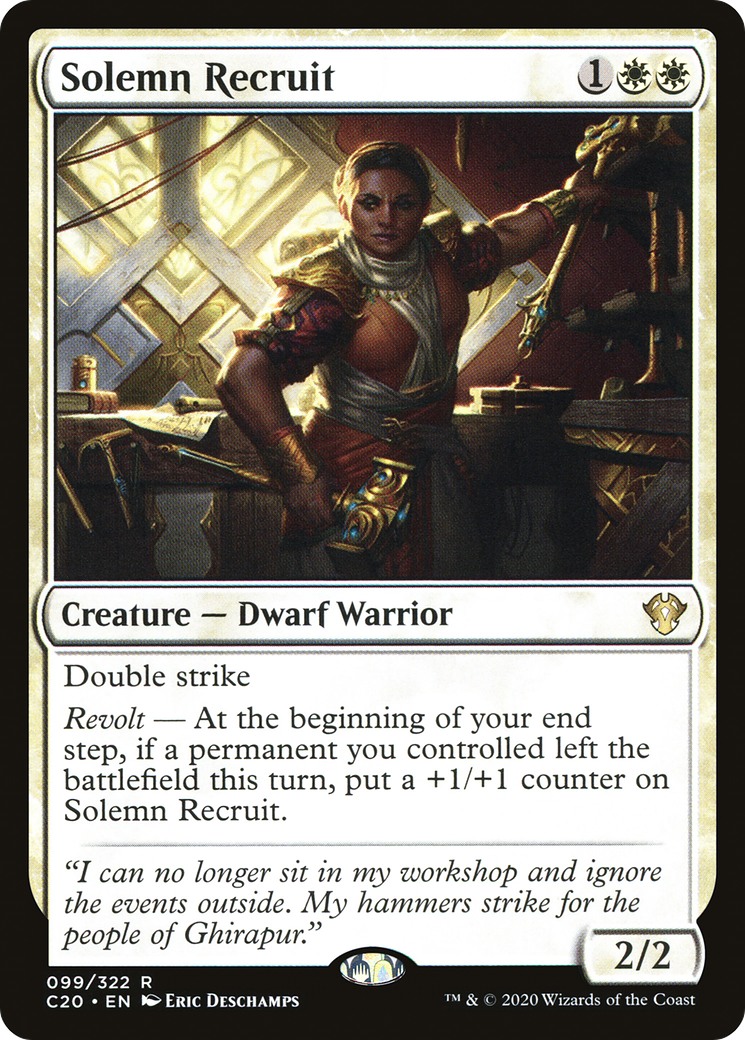
Solemn Recruit
Solemn Recruit
Creature — Dwarf Warrior
2/2
Double strike
Revolt — At the beginning of your end step, if a permanent left the battlefield under your control this turn, put a +1/+1 counter on this creature.
- Revolt abilities check only whether a permanent you controlled left the battlefield this turn or not. They don't apply multiple times if more than one permanent you controlled left the battlefield. They don't check whether the permanent that left the battlefield is still in the zone it moved to.
- Revolt abilities don't care why the permanent left the battlefield, who caused it to move, or where it moved to. They're equally satisfied by an artifact you sacrificed to pay a cost, a creature you controlled that was destroyed by Murder, or an enchantment you returned to your hand with Leave in the Dust.
- Tokens that leave the battlefield will satisfy a revolt ability.
- Energy counters aren't permanents. Paying won't satisfy a revolt ability.
- All cards in the Aether Revolt set with triggered revolt abilities use an intervening "if" clause. A permanent you controlled must have left the battlefield earlier in the turn in order for these abilities to trigger; otherwise they do nothing. In other words, there's no way to have the ability trigger if no permanent you controlled has left the battlefield that turn, even if you intend to have one do so in response to the triggered ability.
-
1
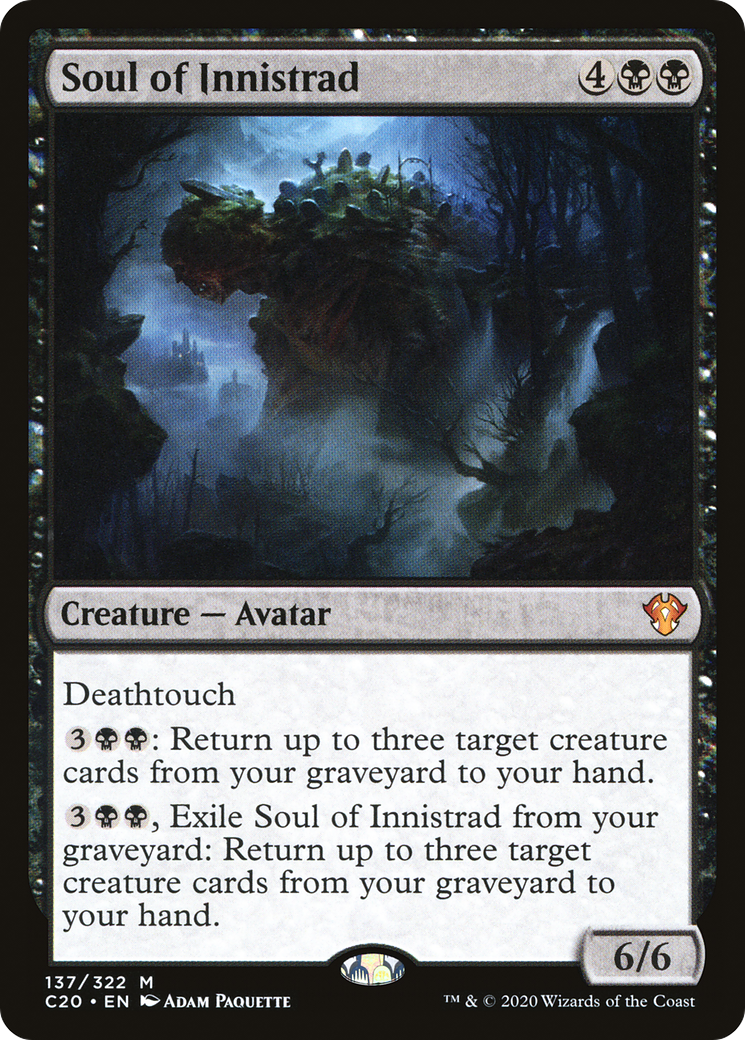
Soul of Innistrad
Soul of Innistrad
Creature — Avatar
6/6
Deathtouch
: Return up to three target creature cards from your graveyard to your hand.
, Exile this card from your graveyard: Return up to three target creature cards from your graveyard to your hand.
- You can activate the last ability only if the Soul is in your graveyard.
- Exiling the Soul from your graveyard is part of the last ability's activation cost. A player can't remove the Soul in response to prevent you from activating the ability.
-
1
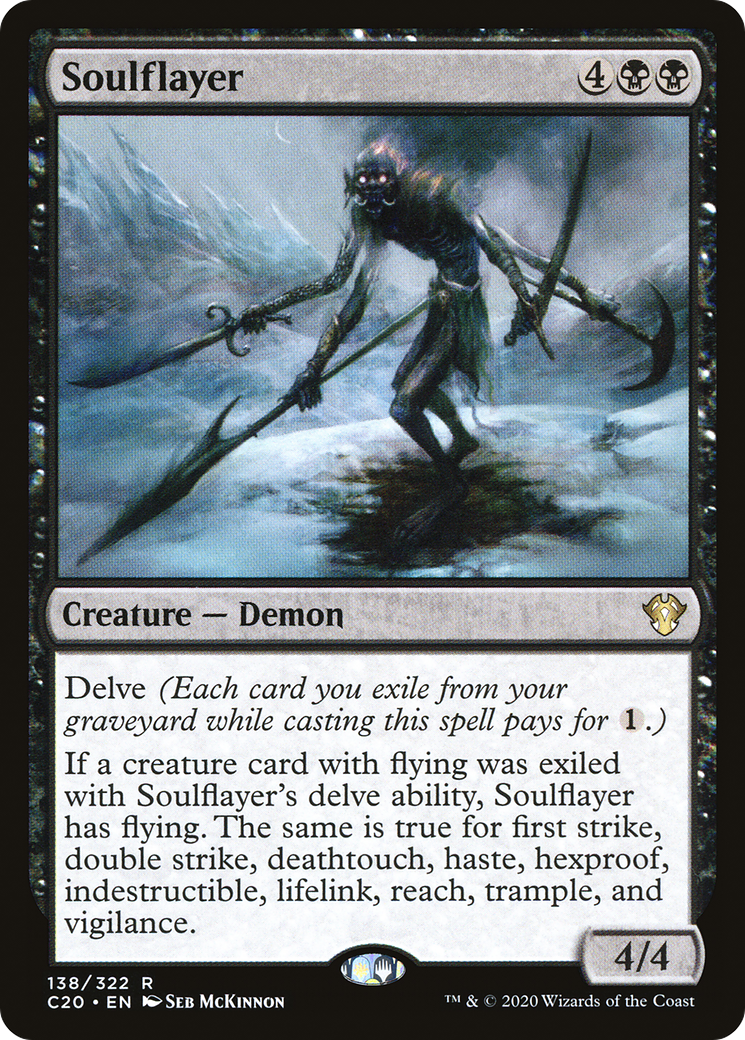
Soulflayer
Soulflayer
Creature — Demon
4/4
Delve (Each card you exile from your graveyard while casting this spell pays for .)
If a creature card with flying was exiled with this creature's delve ability, this creature has flying. The same is true for first strike, double strike, deathtouch, haste, hexproof, indestructible, lifelink, reach, trample, and vigilance.
- Delve doesn’t change a spell’s mana cost or mana value. For example, Treasure Cruise’s mana value is 8 even if you exiled three cards to cast it.
- You can exile cards to pay only for generic mana, and you can’t exile more cards than the generic mana requirement of a spell with delve. For example, you can’t exile more than seven cards from your graveyard to cast Treasure Cruise unless an effect has increased its cost.
- Because delve isn’t an alternative cost, it can be used in conjunction with alternative costs, such as flashback. It can also be used to pay for additional costs that include generic mana.
- If one of those creature cards has one or more variants of the listed keywords (for example, hexproof from white), this creature gains those specific variants.
- Creature cards that have abilities that grant the listed keyword abilities to themselves won’t count. For example, exiling a Battle Brawler (a creature with “As long as you control a red or white permanent, Battle Brawler gets +1/+0 and has first strike”) with Soulflayer’s delve ability won’t cause Soulflayer to have first strike, even if you control a red or white permanent.
- You can’t exile more cards from your graveyard than you’d need to pay Soulflayer’s generic mana requirement. In most situations, this means you can’t exile more than four cards, even if you want to exile more to give it extra abilities.
-
1
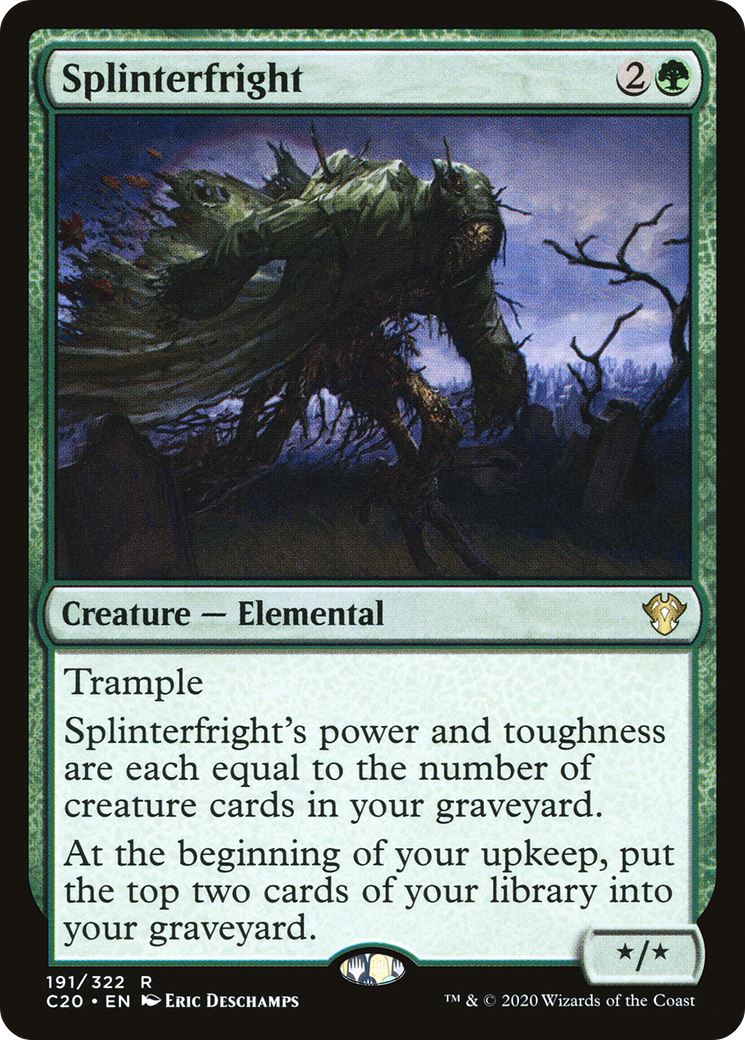
Splinterfright
Splinterfright
Creature — Elemental
*/*
Trample
Splinterfright's power and toughness are each equal to the number of creature cards in your graveyard.
At the beginning of your upkeep, mill two cards. (Put the top two cards of your library into your graveyard.)
- The ability that defines Splinterfright’s power and toughness works in all zones, not just the battlefield. If Splinterfright is in your graveyard, it will count itself.
- If Splinterfright’s controller has only one card in their library when its triggered ability resolves, they put that card into their graveyard.
- The ability that defines Splinterfright’s power and toughness works in all zones, not just the battlefield. If Splinterfright is in your graveyard, it will count itself.
- If Splinterfright’s controller has only one card in their library when its triggered ability resolves, they put that card into their graveyard.
-
1
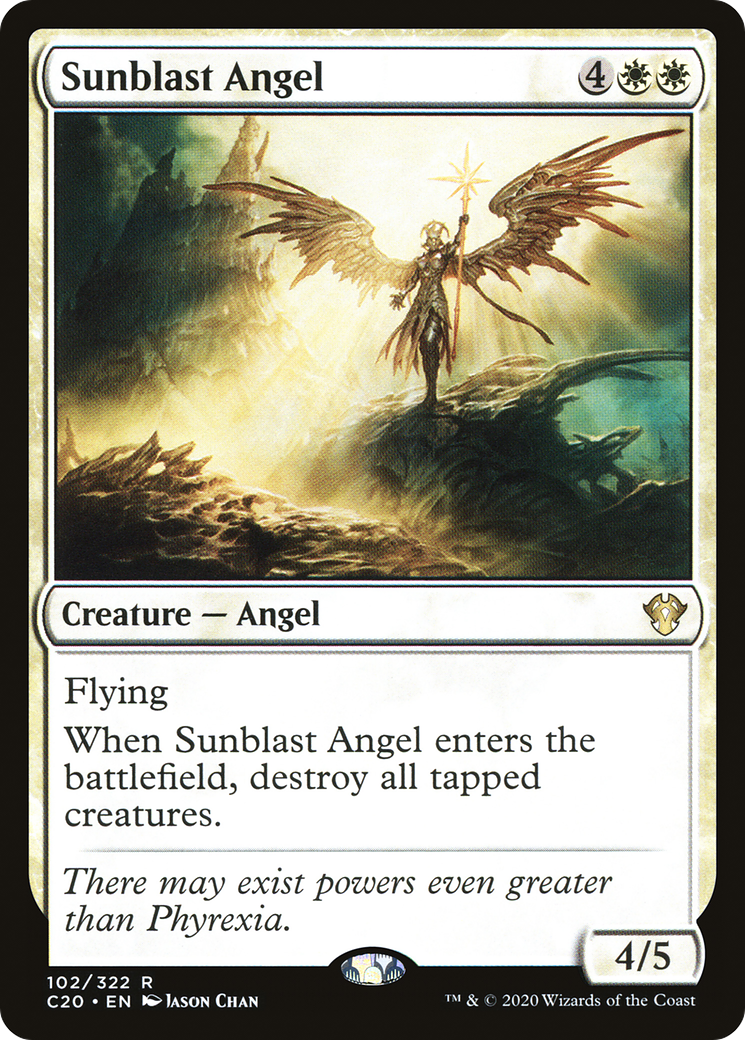
Sunblast Angel
Sunblast Angel
Creature — Angel
4/5
Flying
When this creature enters, destroy all tapped creatures.
- The second ability destroys each creature that's tapped at the time it resolves, including creatures you control. If Sunblast Angel has become tapped by the time its ability resolves, it will be destroyed too.
-
1
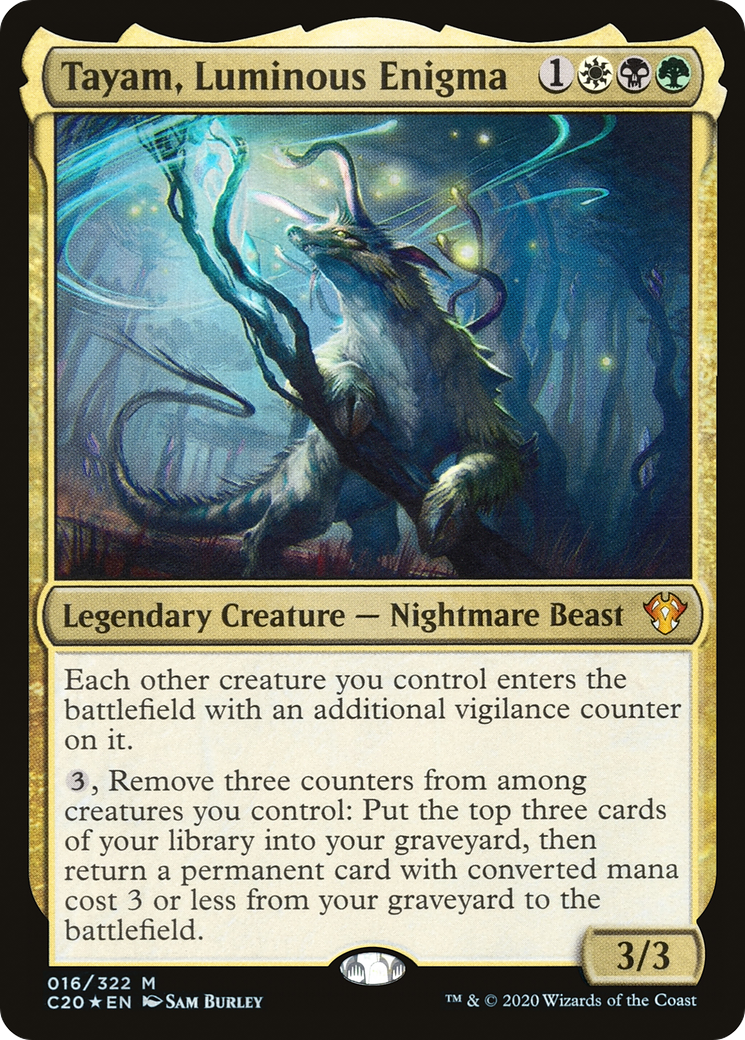
Tayam, Luminous Enigma
Tayam, Luminous Enigma
Legendary Creature — Nightmare Beast
3/3
Each other creature you control enters with an additional vigilance counter on it.
, Remove three counters from among creatures you control: Mill three cards, then return a permanent card with mana value 3 or less from your graveyard to the battlefield.
- You can remove any three counters to activate Tayam’s last ability, not just vigilance counters.
- Because the activated ability doesn’t target the permanent card in your graveyard, you may choose one of the three cards you put there from your library.
- If a card in your graveyard has in its mana cost, X is considered to be 0.
-
1
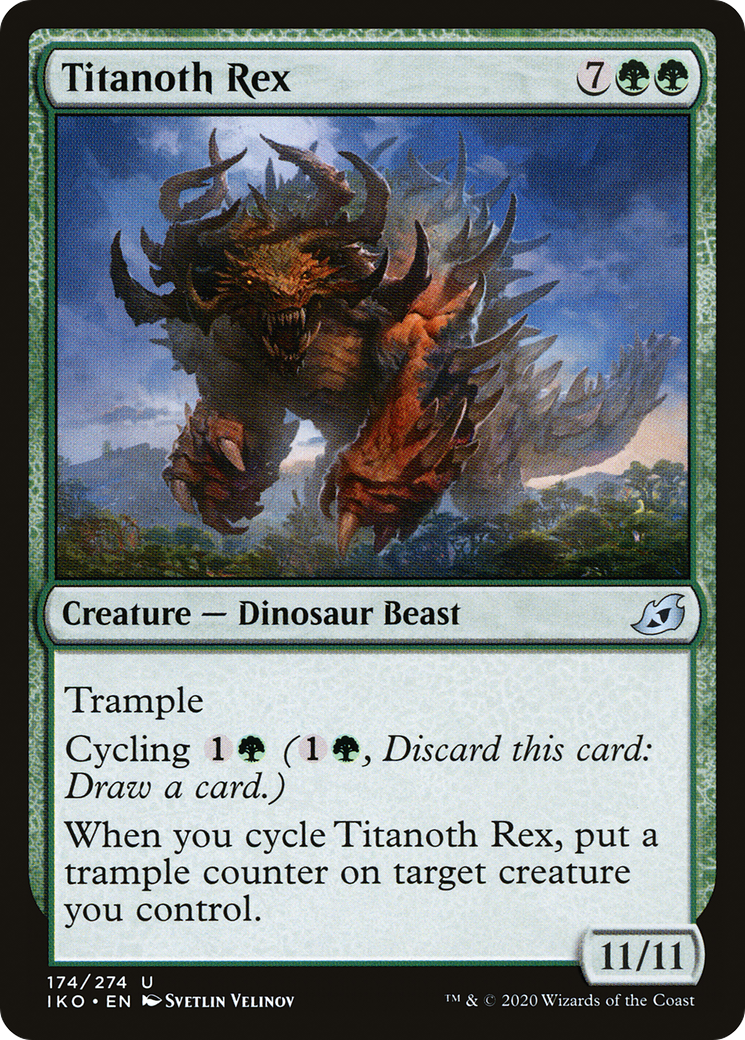
Titanoth Rex
Titanoth Rex
Creature — Dinosaur Beast
11/11
Trample
Cycling ( , Discard this card: Draw a card.)
When you cycle this card, put a trample counter on target creature you control.
-
1
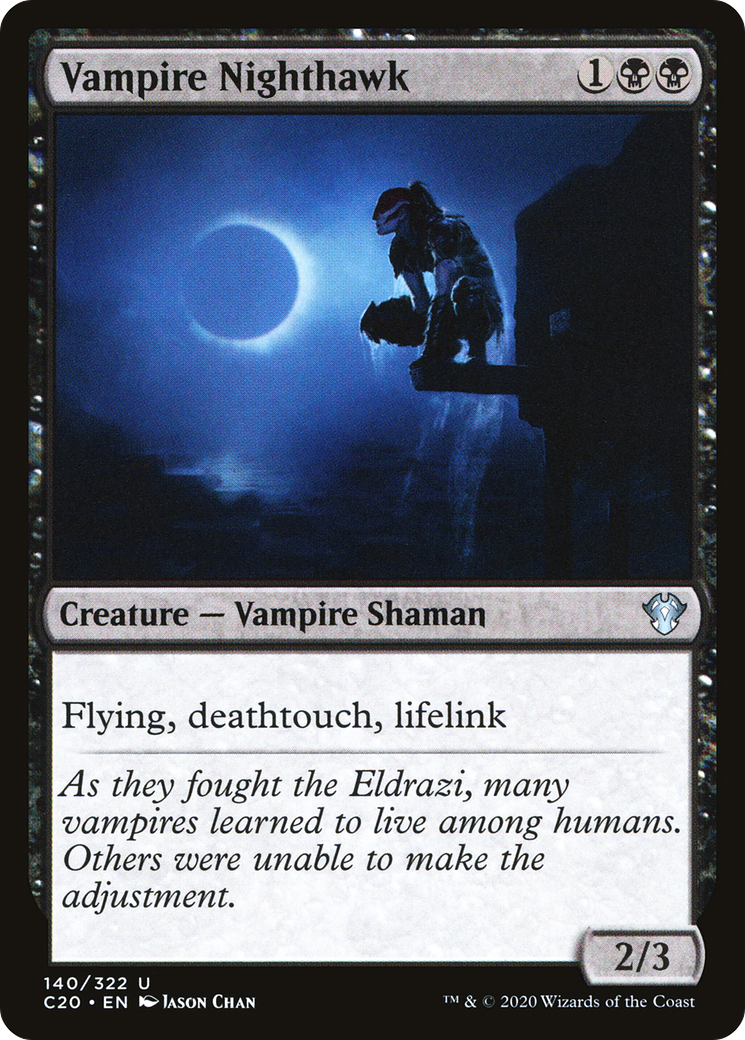
Vampire Nighthawk
Vampire Nighthawk
Creature — Vampire Shaman
2/3
Flying
Deathtouch (Any amount of damage this deals to a creature is enough to destroy it.)
Lifelink (Damage dealt by this creature also causes you to gain that much life.)
-
1
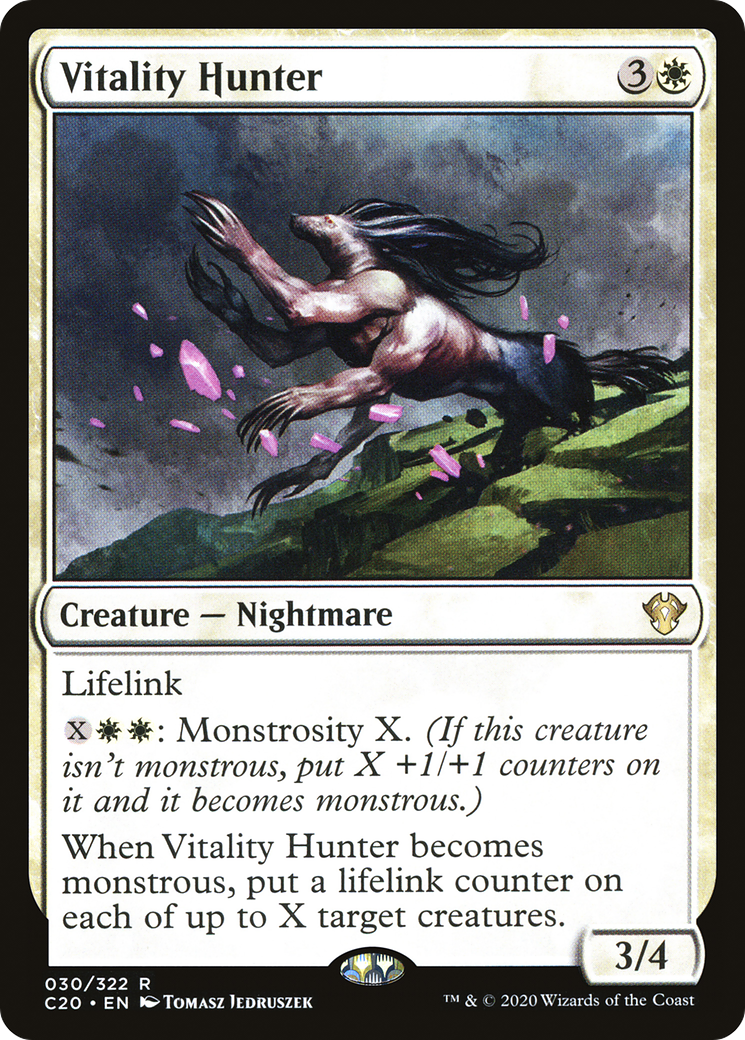
Vitality Hunter
Vitality Hunter
Creature — Nightmare
3/4
Lifelink
: Monstrosity X. (If this creature isn't monstrous, put X +1/+1 counters on it and it becomes monstrous.)
When this creature becomes monstrous, put a lifelink counter on each of up to X target creatures.
- Once a creature becomes monstrous, it can’t become monstrous again. If the creature is already monstrous when the monstrosity ability resolves, nothing happens.
- Monstrous isn’t an ability that a creature has. It’s just something true about that creature. If the creature stops being a creature, loses its abilities, or loses its +1/+1 counters, it will continue to be monstrous.
-
1
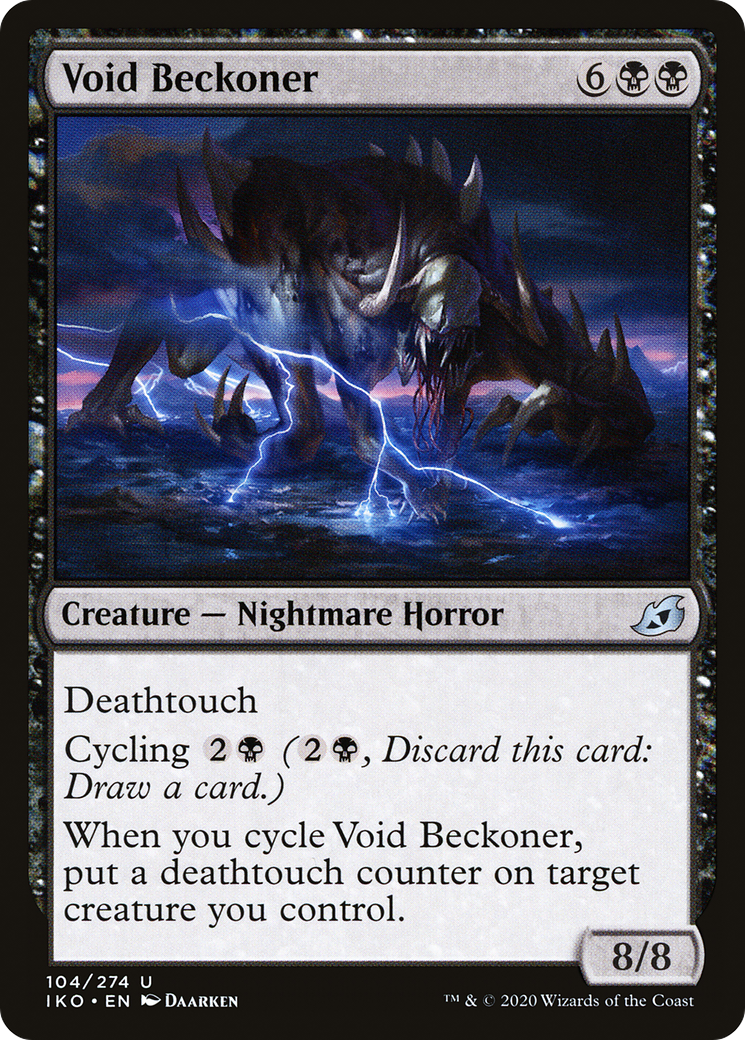
Void Beckoner
Void Beckoner
Creature — Nightmare Horror
8/8
Deathtouch
Cycling ( , Discard this card: Draw a card.)
When you cycle this card, put a deathtouch counter on target creature you control.
-
1
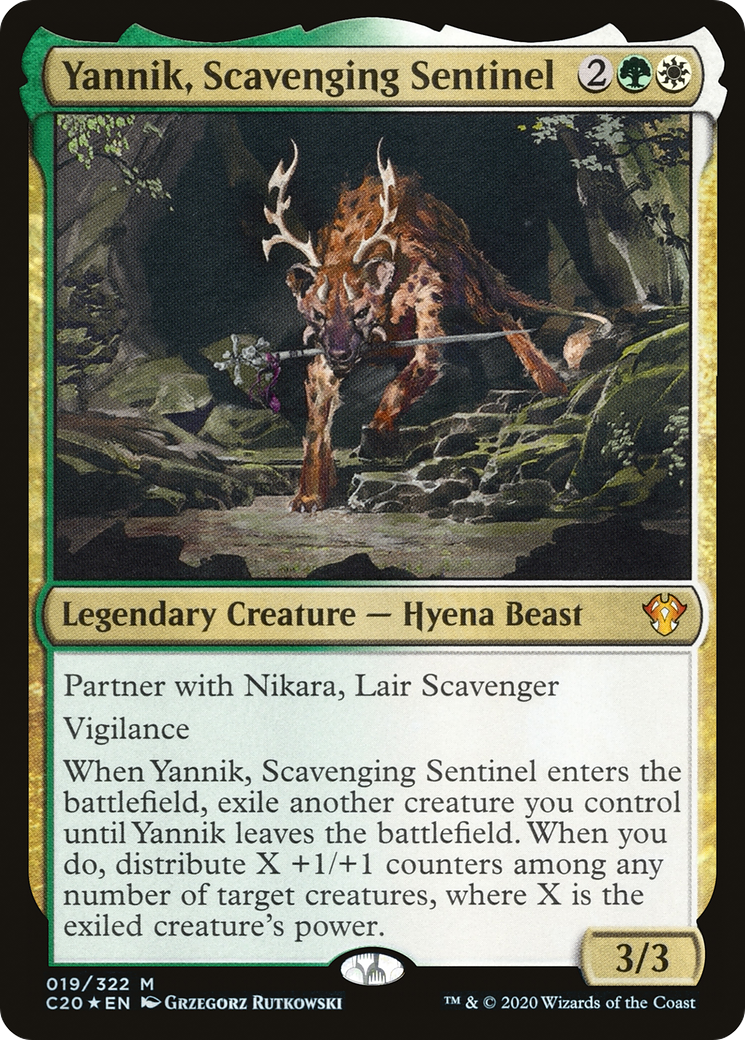
Yannik, Scavenging Sentinel
Yannik, Scavenging Sentinel
Legendary Creature — Hyena Beast
3/3
Partner with Nikara, Lair Scavenger
Vigilance
When Yannik enters, exile another creature you control until Yannik leaves the battlefield. When you do, distribute X +1/+1 counters among any number of target creatures, where X is the exiled creature's power.
- You choose how the counters will be distributed as you put the reflexive triggered ability onto the stack. Each target creature must be assigned at least one counter.
- You may choose zero target creatures for Yannik's reflexive triggered ability. If you do, no creature receives +1/+1 counters.
- If Yannik leaves the battlefield before its triggered ability resolves, you won't exile any creature you control. Yannik's reflexive triggered ability won't trigger.
- Auras attached to the exiled creature will be put into their owners' graveyards. Any Equipment will become unattached and remain on the battlefield. Any counters on the exiled creature will cease to exist. When the card returns to the battlefield, it will be a new object with no connection to the card that was exiled.
- If a token is exiled this way, it will cease to exist and won't return to the battlefield. It will still let the ability distribute counters.
- Yannik's triggered ability doesn't target the creature you control. That creature is chosen as the triggered ability resolves. After it's exiled, the reflexive triggered ability triggers and targets are chosen to receive the counters.
- Use the power of the creature as it last existed on the battlefield to determine how many +1/+1 counters to distribute.
- If one of the target creatures becomes an illegal target in response to the reflexive triggered ability, the +1/+1 counters that would have been put on that creature are lost. They can't be put on another legal target.
- Yannik can be the target of its own reflexive triggered ability.
-
1
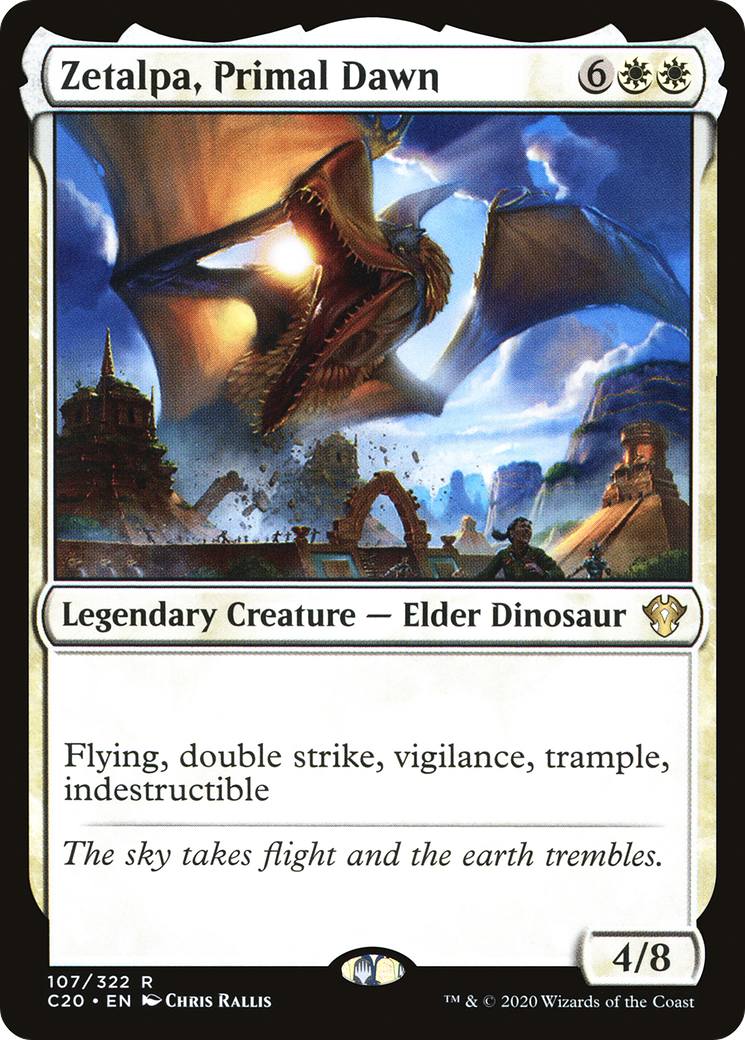
Zetalpa, Primal Dawn
Zetalpa, Primal Dawn
Legendary Creature — Elder Dinosaur
4/8
Flying, double strike, vigilance, trample, indestructible
- If an attacking creature with double strike and trample destroys all of its blocking creatures with first-strike combat damage, all of its normal combat damage is assigned to the player, planeswalker, or battle that creature's attacking.
Instants 6
-
1
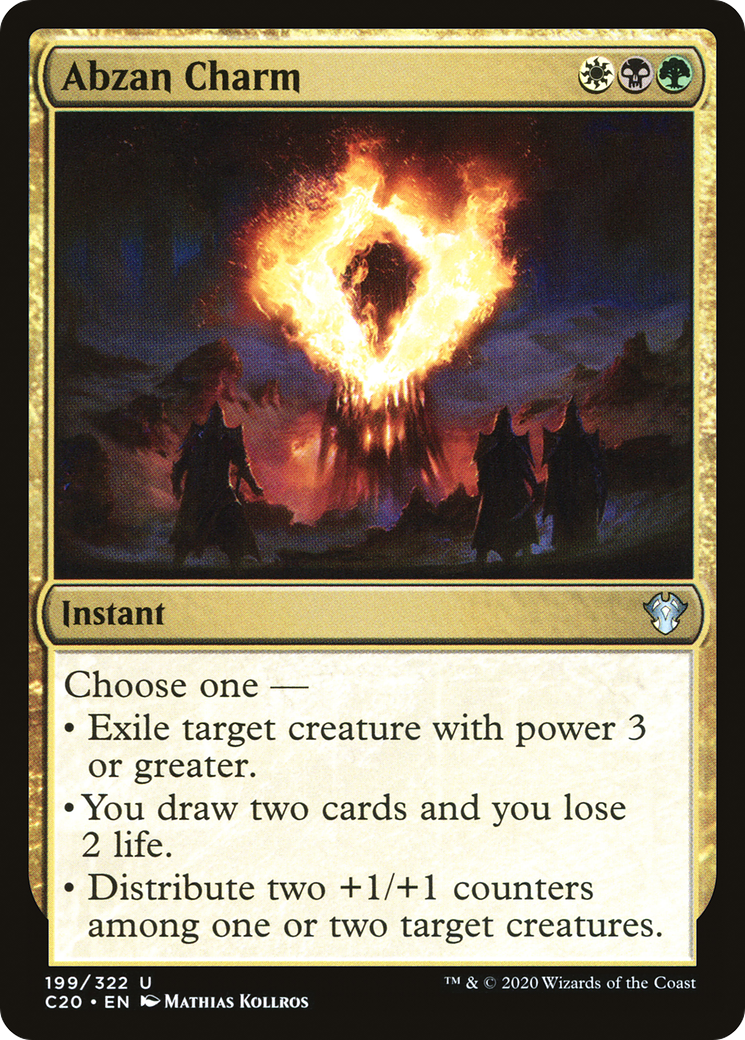
Abzan Charm
Abzan Charm
Instant
Choose one —
- Exile target creature with power 3 or greater.
- You draw two cards and you lose 2 life.
- Distribute two +1/+1 counters among one or two target creatures.
- If you choose the third mode, you choose how the counters will be distributed as you cast the spell. Notably, if you choose to put one +1/+1 counter on each of two target creatures, and one of those creatures becomes an illegal target in response, the +1/+1 counter that would have been put on that creature is lost. It can't be put on the remaining legal target.
-
1
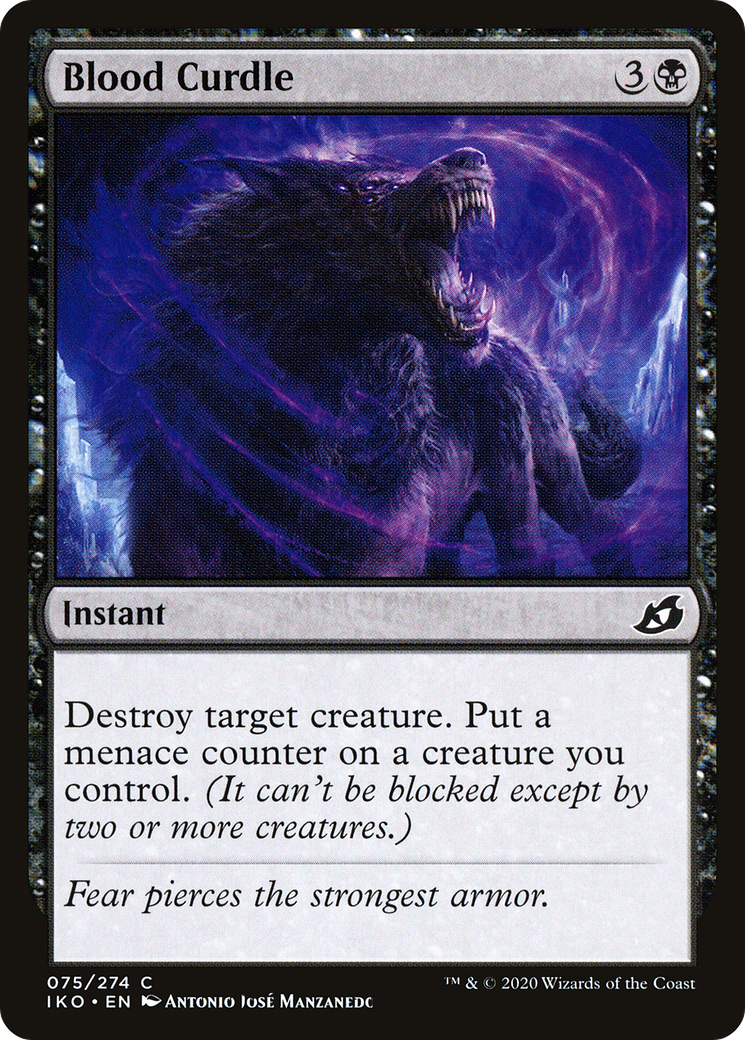
Blood Curdle
Blood Curdle
Instant
Destroy target creature. Put a menace counter on a creature you control. (It can't be blocked except by two or more creatures.)
-
1
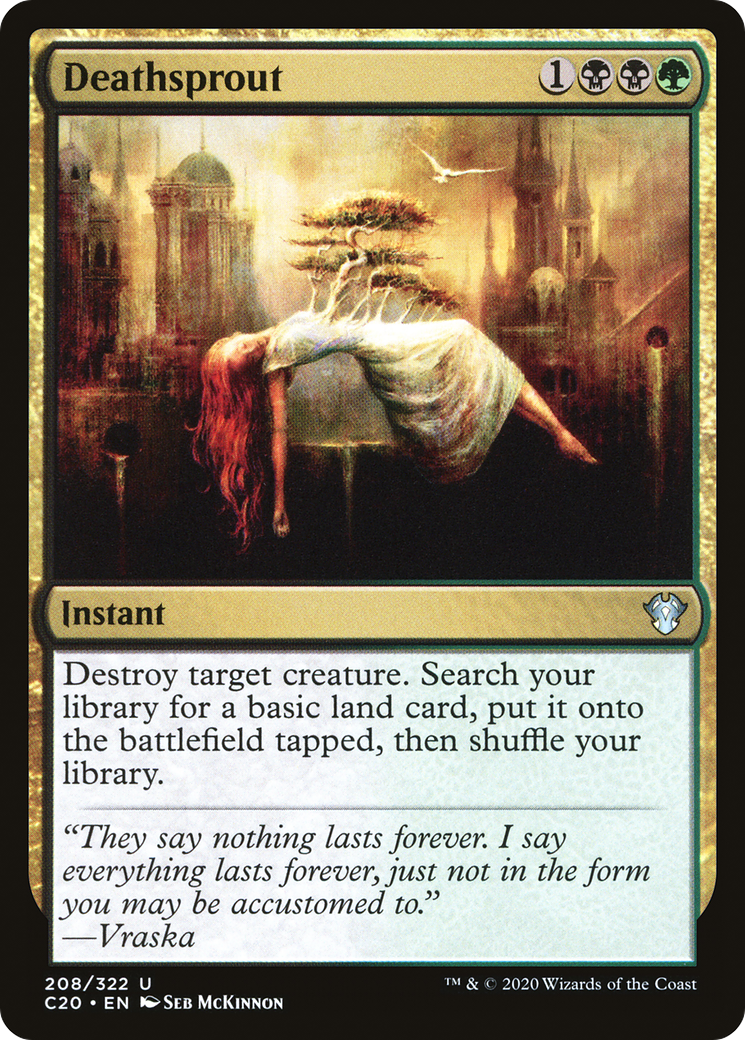
Deathsprout
Deathsprout
Instant
Destroy target creature. Search your library for a basic land card, put it onto the battlefield tapped, then shuffle.
- If the target creature is an illegal target by the time Deathsprout tries to resolve, the spell doesn’t resolve. You don’t search for a land card. If the target is legal but not destroyed (most likely because it has indestructible), you do search.
-
1
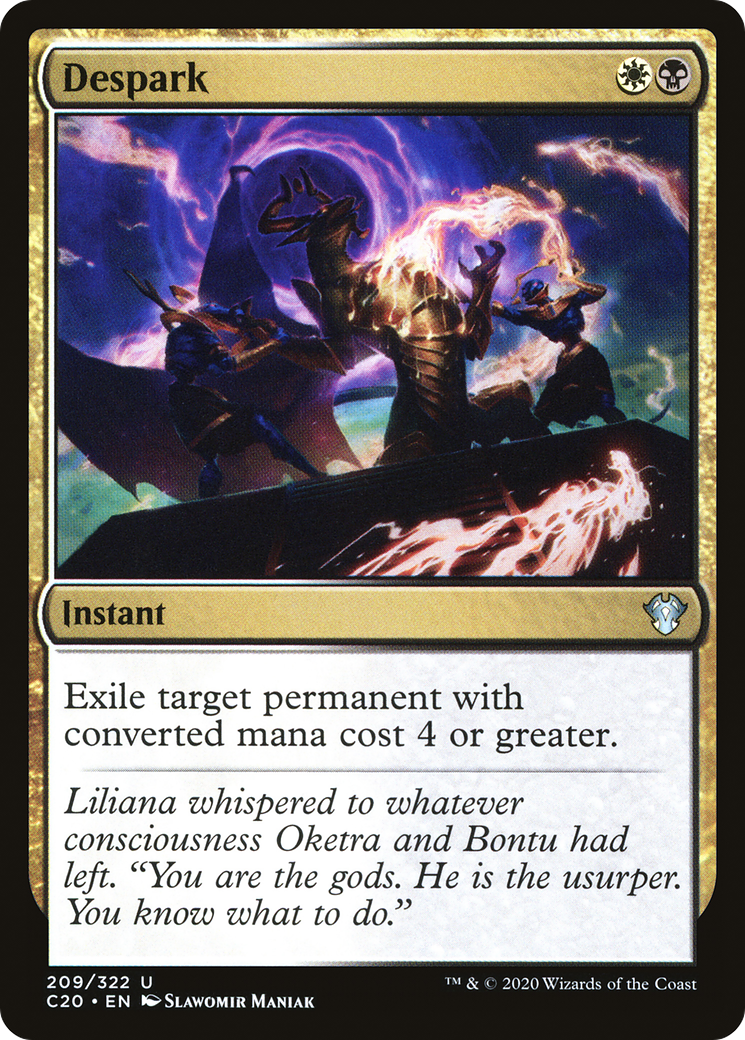
Despark
Despark
Instant
Exile target permanent with mana value 4 or greater.
- If a permanent has in its mana cost, X is considered to be 0.
-
1
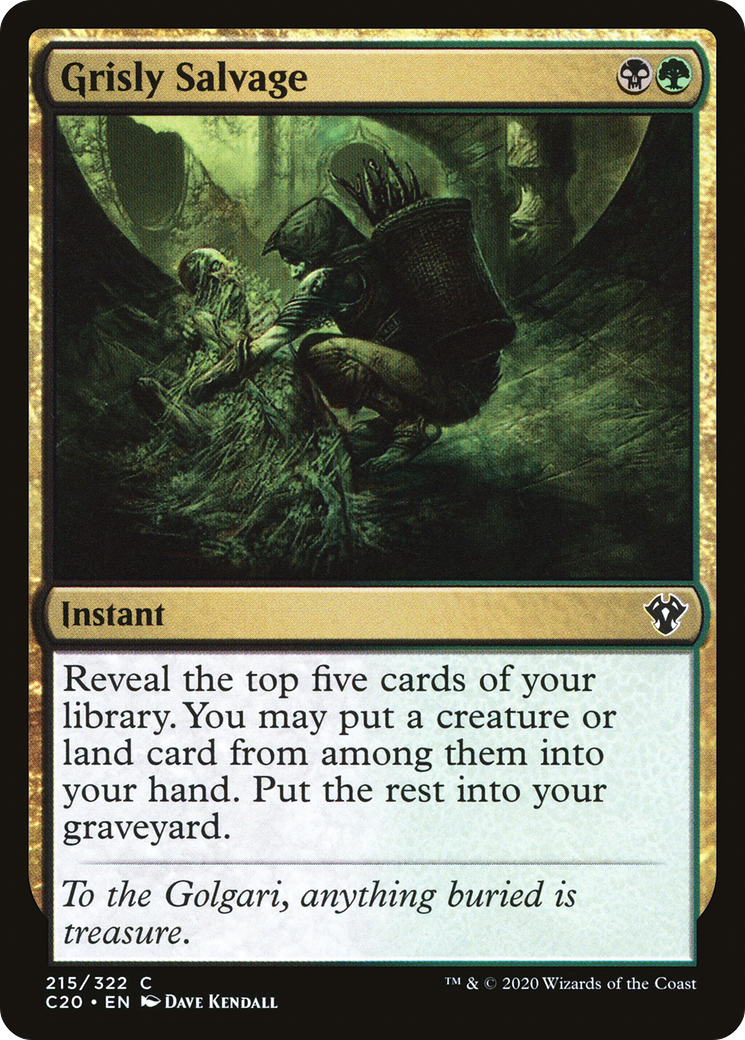
Grisly Salvage
Grisly Salvage
Instant
Reveal the top five cards of your library. You may put a creature or land card from among them into your hand. Put the rest into your graveyard.
-
1
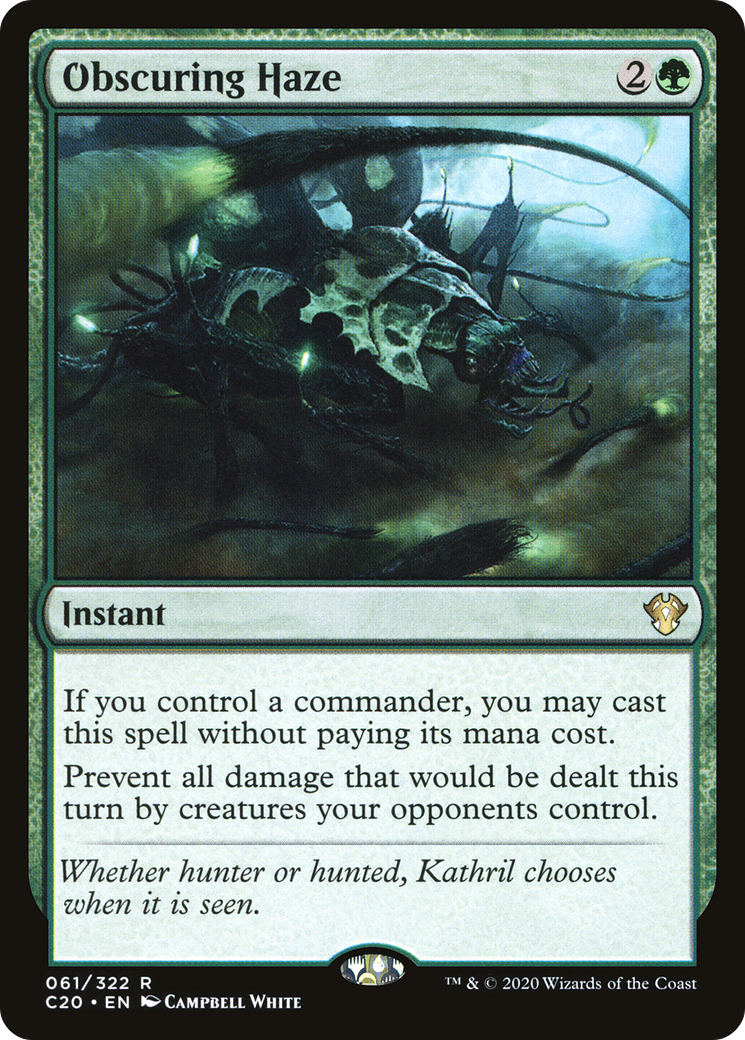
Obscuring Haze
Obscuring Haze
Instant
If you control a commander, you may cast this spell without paying its mana cost.
Prevent all damage that would be dealt this turn by creatures your opponents control.
- Once you begin casting this spell, players can’t take any other actions until you’re done casting it. Notably, they can’t try to remove the commander you control to make you pay its cost.
- It doesn’t matter whose commander you control. Any one will do. If you have two commanders, you just need to control one of them.
Sorceries 7
-
1
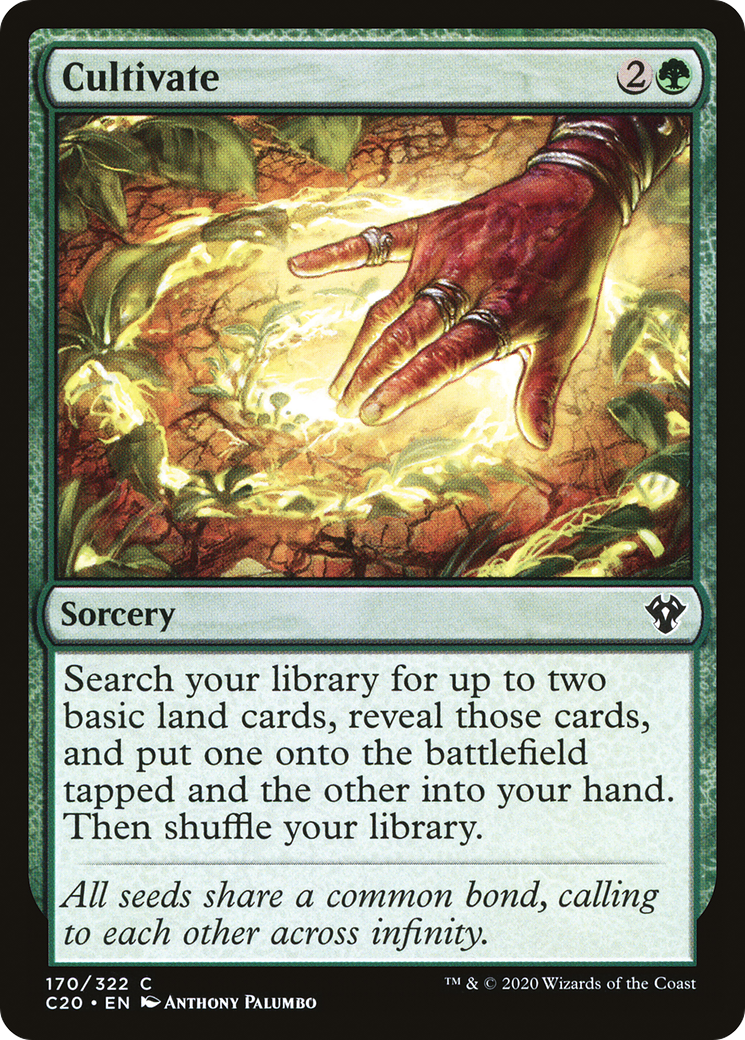
Cultivate
Cultivate
Sorcery
Search your library for up to two basic land cards, reveal those cards, put one onto the battlefield tapped and the other into your hand, then shuffle.
- If you choose to find only one basic land card, you put it onto the battlefield tapped.
-
1
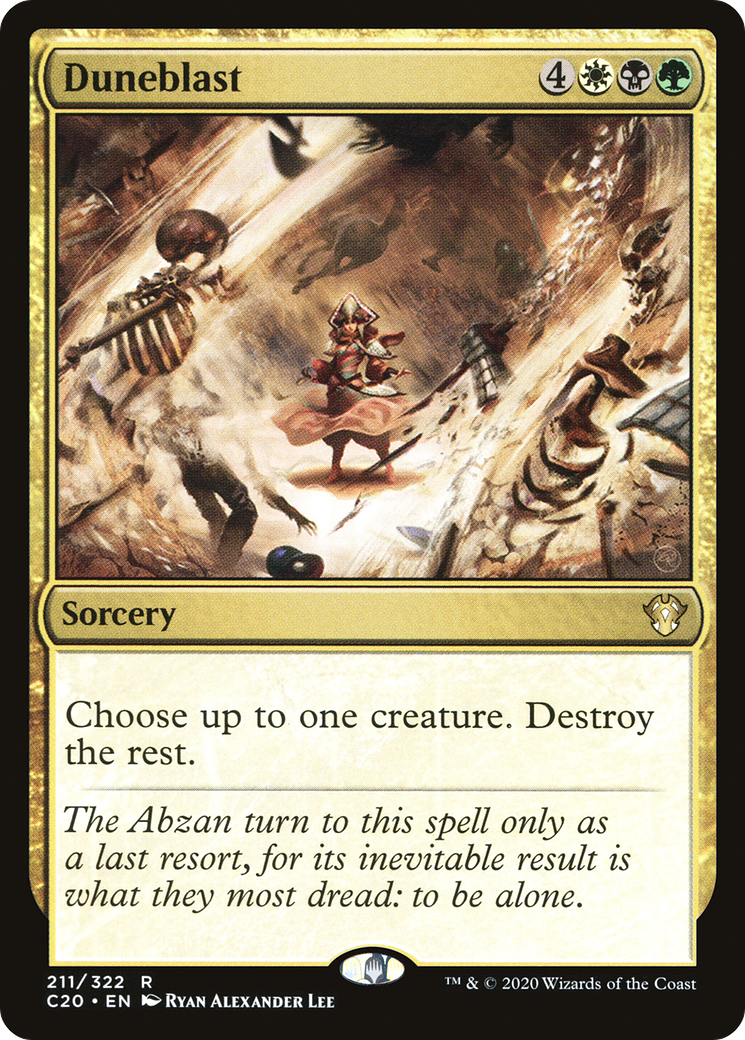
Duneblast
Duneblast
Sorcery
Choose up to one creature. Destroy the rest.
- You decide which creature to spare as Duneblast resolves. This choice doesn't target the creature. If you don't choose a creature, then all creatures will be destroyed.
-
1
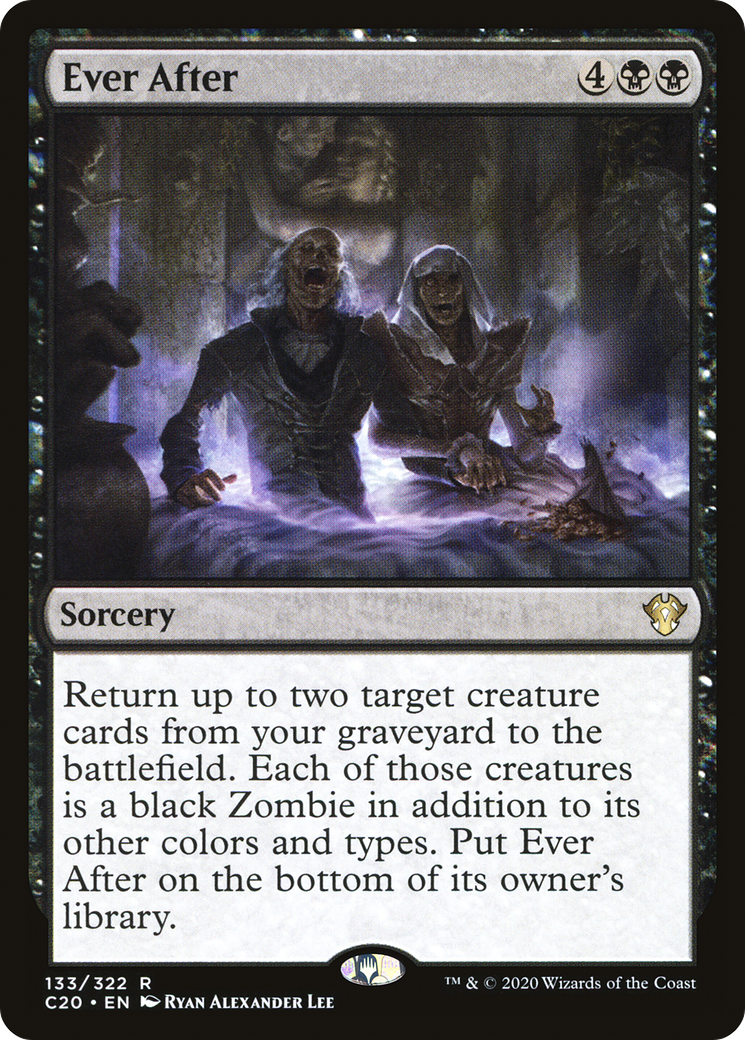
Ever After
Ever After
Sorcery
Return up to two target creature cards from your graveyard to the battlefield. Each of those creatures is a black Zombie in addition to its other colors and types. Put Ever After on the bottom of its owner's library.
- If a targeted creature card is normally colorless, it will simply become black. It won’t be both black and colorless.
-
1
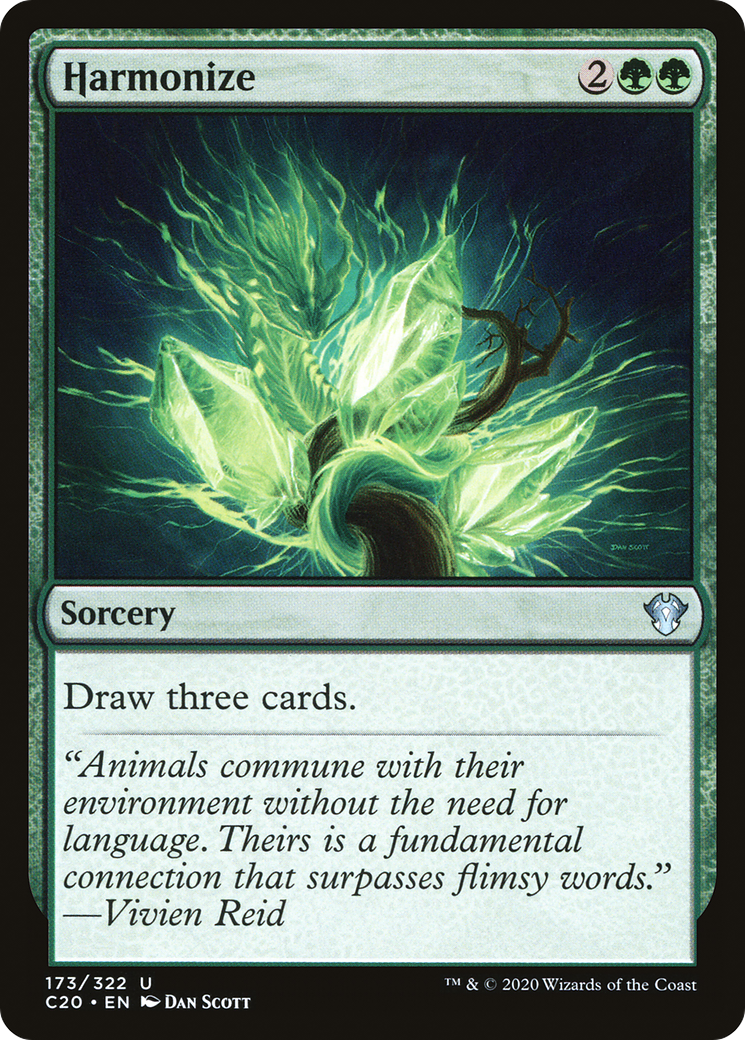
Harmonize
Harmonize
Sorcery
Draw three cards.
-
1
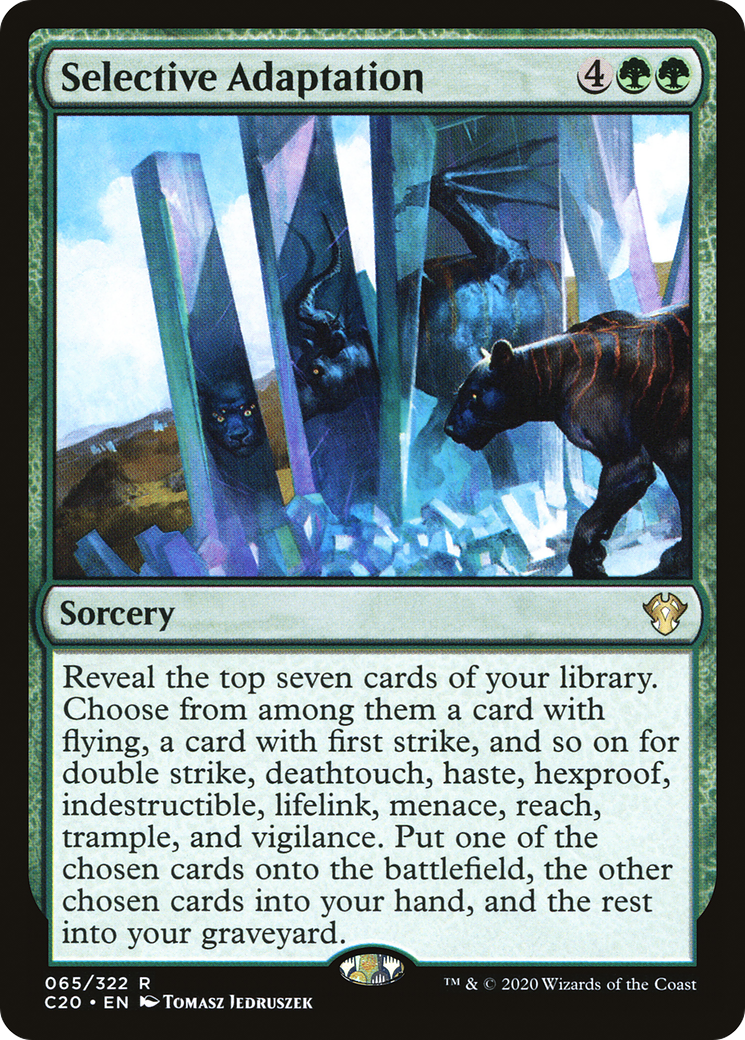
Selective Adaptation
Selective Adaptation
Sorcery
Reveal the top seven cards of your library. Choose from among them a card with flying, a card with first strike, and so on for double strike, deathtouch, haste, hexproof, indestructible, lifelink, menace, reach, trample, and vigilance. Put one of the chosen cards onto the battlefield, the other chosen cards into your hand, and the rest into your graveyard.
- If a card has more than one of the listed keywords, you pick which keyword you’re choosing it for. For example, if you choose a card with flying and first strike, you may choose it as the card with flying and choose another card with first strike, or you may choose it as the card with first strike and choose another card with flying.
-
1
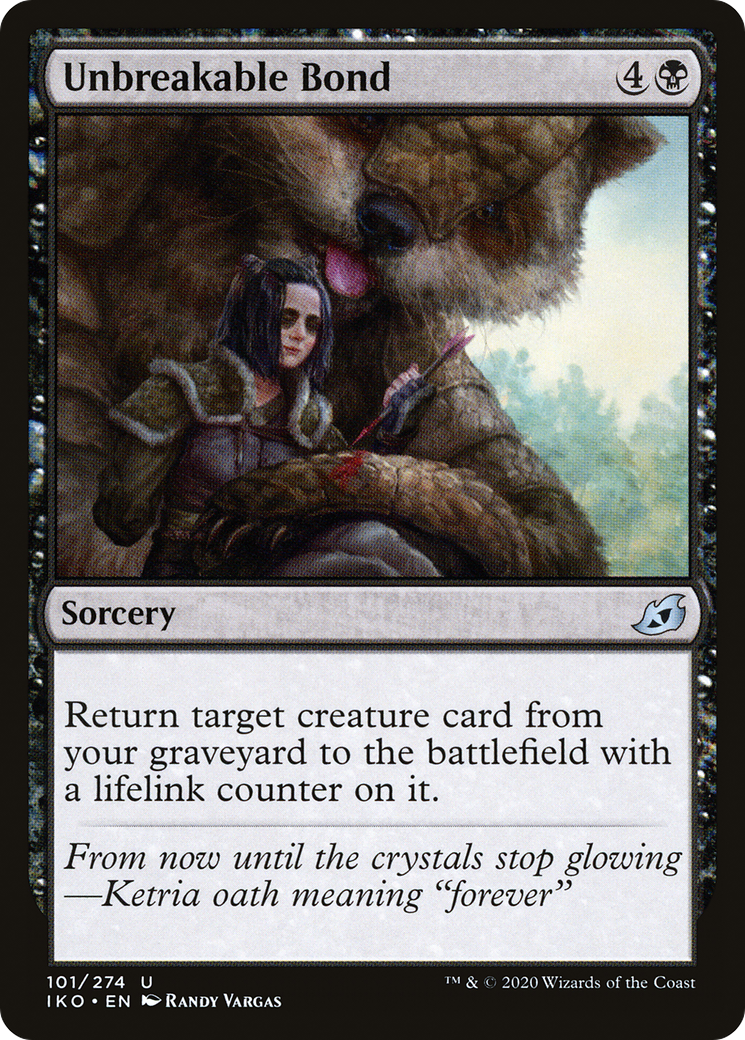
Unbreakable Bond
Unbreakable Bond
Sorcery
Return target creature card from your graveyard to the battlefield with a lifelink counter on it.
-
1
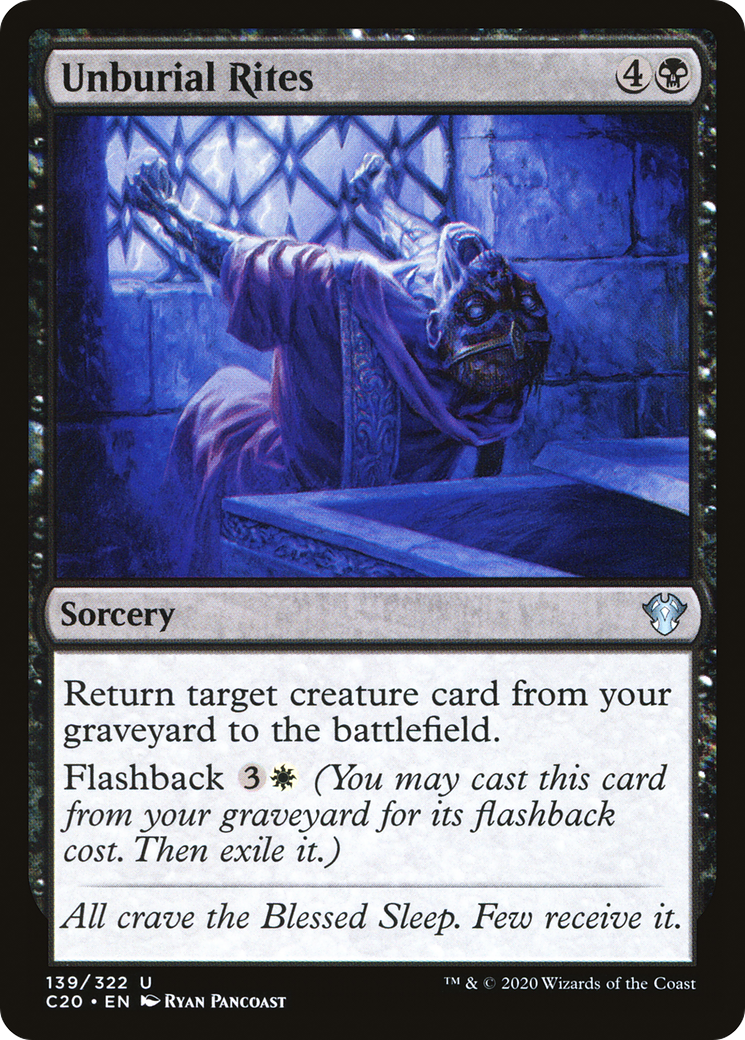
Unburial Rites
Unburial Rites
Sorcery
Return target creature card from your graveyard to the battlefield.
Flashback (You may cast this card from your graveyard for its flashback cost. Then exile it.)
- "Flashback [cost]" means "You may cast this card from your graveyard by paying [cost] rather than paying its mana cost" and "If the flashback cost was paid, exile this card instead of putting it anywhere else any time it would leave the stack."
- You must still follow any timing restrictions and permissions, including those based on the card's type. For instance, you can cast a sorcery using flashback only when you could normally cast a sorcery.
- To determine the total cost of a spell, start with the mana cost or alternative cost (such as a flashback cost) you're paying, add any cost increases, then apply any cost reductions. The mana value of the spell is determined only by its mana cost, no matter what the total cost to cast the spell was.
- A spell cast using flashback will always be exiled afterward, whether it resolves, is countered, or leaves the stack in some other way.
- You can cast a spell using flashback even if it was somehow put into your graveyard without having been cast.
- If a card with flashback is put into your graveyard during your turn, you can cast it if it's legal to do so before any other player can take any actions.
Artifacts 7
-
1
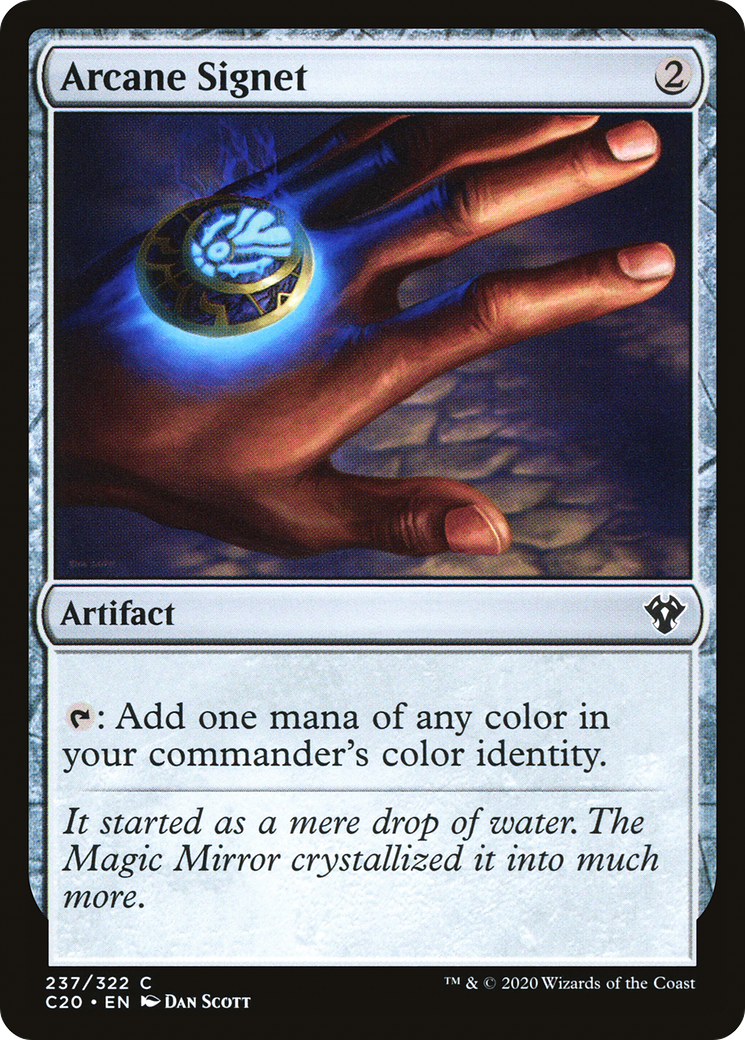
Arcane Signet
Arcane Signet
Artifact
: Add one mana of any color in your commander's color identity.
- If your commander is a card that has no colors in its color identity, Arcane Signet's ability produces no mana. It doesn't produce .
- If you have two commanders, the ability adds one mana of any color in their combined color identities.
- If you don't have a commander, Arcane Signet's ability produces no mana.
-
1
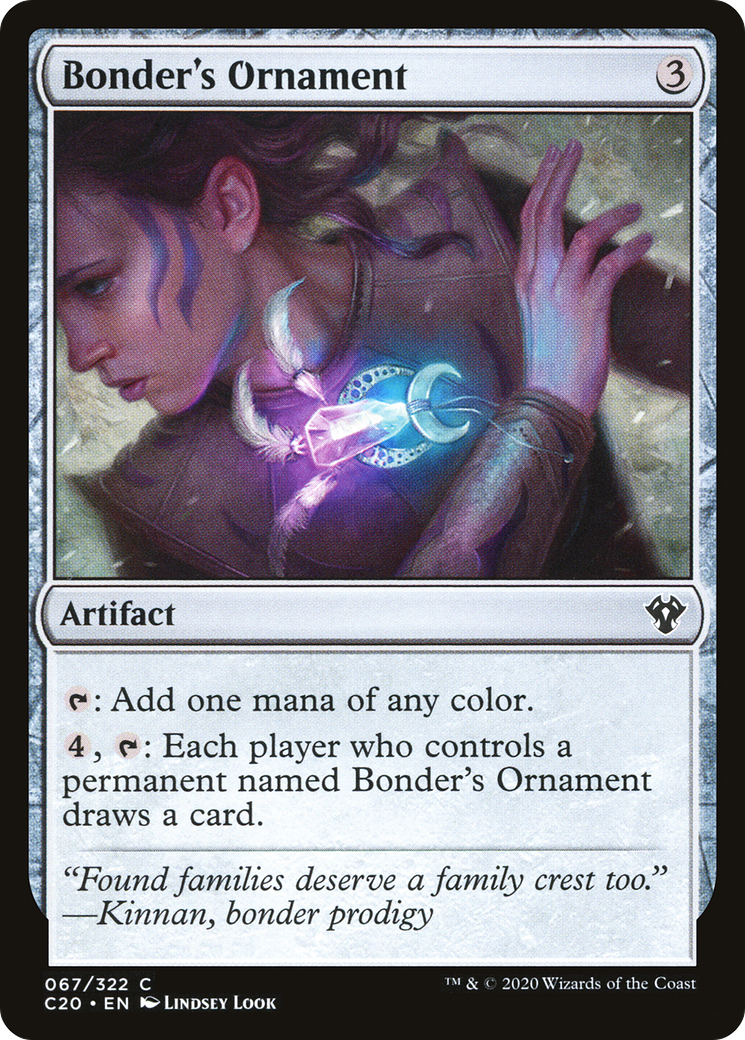
Bonder's Ornament
Bonder's Ornament
Artifact
: Add one mana of any color.
, : Each player who controls a permanent named Bonder's Ornament draws a card.
- If one player controls more than one Bonder’s Ornament, that player draws just one card while resolving its second ability.
-
1
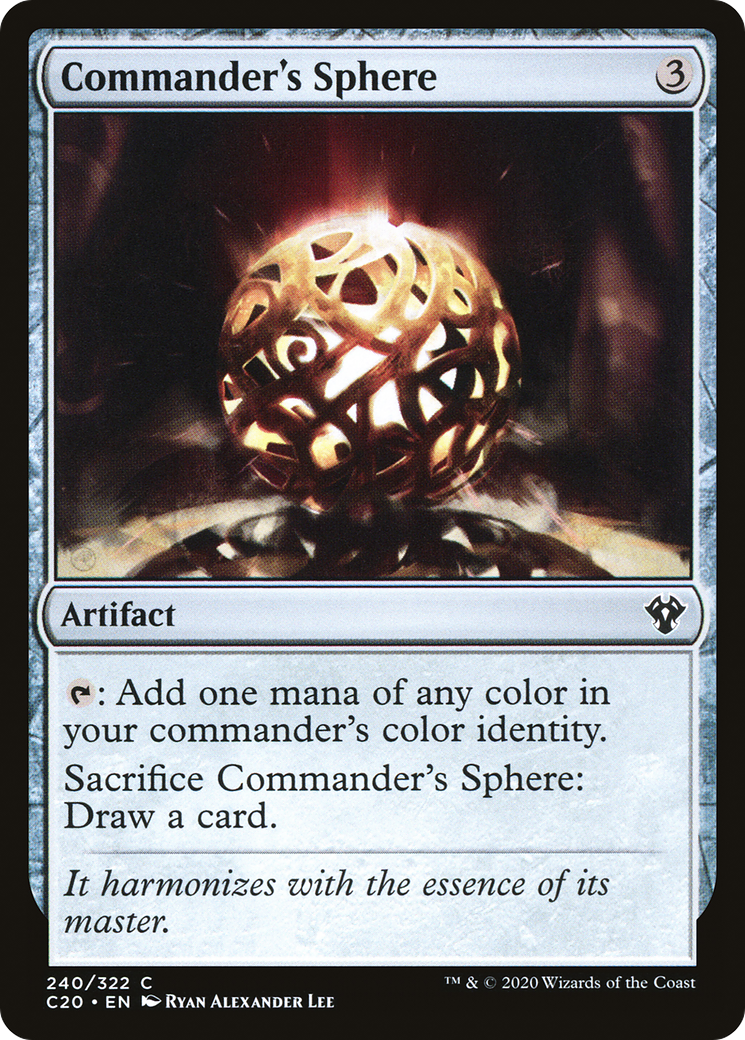
Commander's Sphere
Commander's Sphere
Artifact
: Add one mana of any color in your commander's color identity.
Sacrifice this artifact: Draw a card.
- If your commander is a card that has no colors in its color identity, Commander's Sphere's first ability produces no mana. It doesn't produce .
- If you don't have a commander, Commander's Sphere's first ability produces no mana.
- If you have two commanders, the ability adds one mana of any color in their combined color identities.
-
1
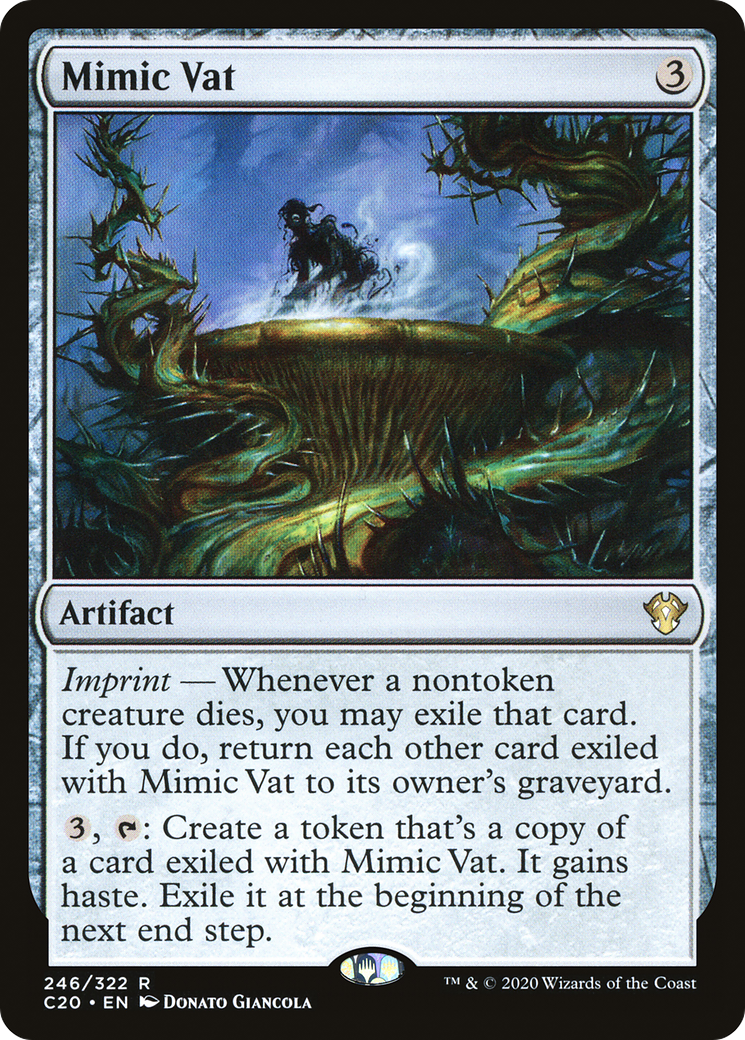
Mimic Vat
Mimic Vat
Artifact
Imprint — Whenever a nontoken creature dies, you may exile that card. If you do, return each other card exiled with this artifact to its owner's graveyard.
, : Create a token that's a copy of a card exiled with this artifact. It gains haste. Exile it at the beginning of the next end step.
- If the creature that dies is an instant or sorcery card that's been manifested, Mimic Vat may have a nonpermanent card exiled. You can't create a token that's a copy of a nonpermanent card. No token is created in this case.
- If a melded permanent dies and triggers Mimic Vat's triggered ability, both of its component cards are exiled. As Mimic Vat's second ability resolves, its controller chooses one of those cards to make a token copy of.
- If multiple nontoken creatures are put into their owners' graveyards from the battlefield at the same time, the imprint ability will trigger that many times. You put the triggered abilities on the stack in any order, so you'll determine in which order they resolve. However, since exiling those cards is optional, and choosing to exile a card this way causes the previously exiled cards to return to their owners' graveyards, the order generally doesn't matter: You'll wind up with at most one of those cards exiled, and the rest will be in the appropriate graveyards.
- You may exile a noncreature card with Mimic Vat's first ability. For example, if a nontoken artifact that's become a creature is put into a graveyard from the battlefield, Mimic Vat's first ability triggers and you may exile that card.
- The token created by the second ability will be a copy of whatever card is exiled with Mimic Vat at the time the ability resolves. This might not be the same card that was exiled with Mimic Vat at the time the ability was activated. It also might not be a creature card.
- If the token is a copy of a noncreature card, it will still have haste, though that won't matter unless that token somehow becomes a creature.
- You may activate the second ability even if no card has been exiled with Mimic Vat. If no card has been exiled with Mimic Vat by the time the ability resolves, no token will be created.
- The imprint ability will trigger whenever a nontoken creature is put into any graveyard from the battlefield, not just your graveyard.
- Any "enters" abilities of the exiled card will trigger when the token is put onto the battlefield. Any "as [this permanent] enters" or "[this permanent] enters with" abilities of the exiled card will also work.
- The token is exiled at the beginning of the next end step regardless of who controls it at that time, whether the exiled card is still exiled at that time, or whether Mimic Vat is still on the battlefield at that time.
- If Mimic Vat's second ability is activated during a turn's end step, the token will be exiled at the beginning of the following turn's end step.
- If the token isn't exiled when the delayed triggered ability resolves (due to Stifle, perhaps), it remains on the battlefield indefinitely. It continues to have haste.
- If the exiled card has in its mana cost (such as Protean Hydra), X is considered to be 0.
- Exiling the card as the first ability resolves is optional. If you choose not to exile it, or you can't exile it because the card has somehow left the graveyard before the ability resolves, the ability simply doesn't do anything as it resolves. Any card currently exiled by Mimic Vat remains exiled.
-
1
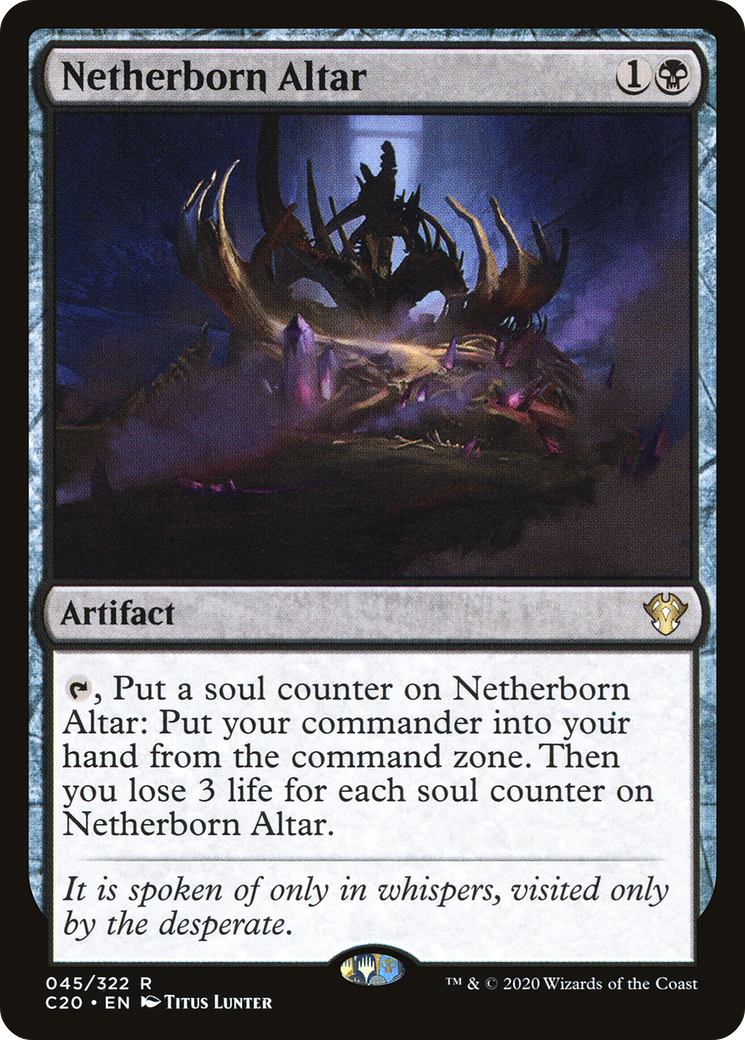
Netherborn Altar
Netherborn Altar
Artifact
, Put a soul counter on this artifact: Put your commander into your hand from the command zone. Then you lose 3 life for each soul counter on this artifact.
- Putting a soul counter onto Netherborn Altar is part of the cost to activate its ability, and counting the number of soul counters is done as the ability resolves. Players may take actions between those times to change the number of soul counters, perhaps by removing them all so that you lose no life.
- If Netherborn Altar leaves the battlefield while its ability is on the stack, the amount of life you lose is determined by the number of soul counters it had on it immediately before it left the battlefield.
- The “commander tax” increases based on how many times a commander was cast from the command zone. Casting a commander from your hand doesn’t require that additional cost, and it doesn’t increase what the cost will be the next time you cast that commander from the command zone.
- If your commander isn’t in the command zone (or if you’re not playing the Commander variant), Netherborn Altar only makes you lose life.
- If you have two commanders in the command zone, Netherborn Altar’s ability puts one of your choice into your hand, not both.
-
1
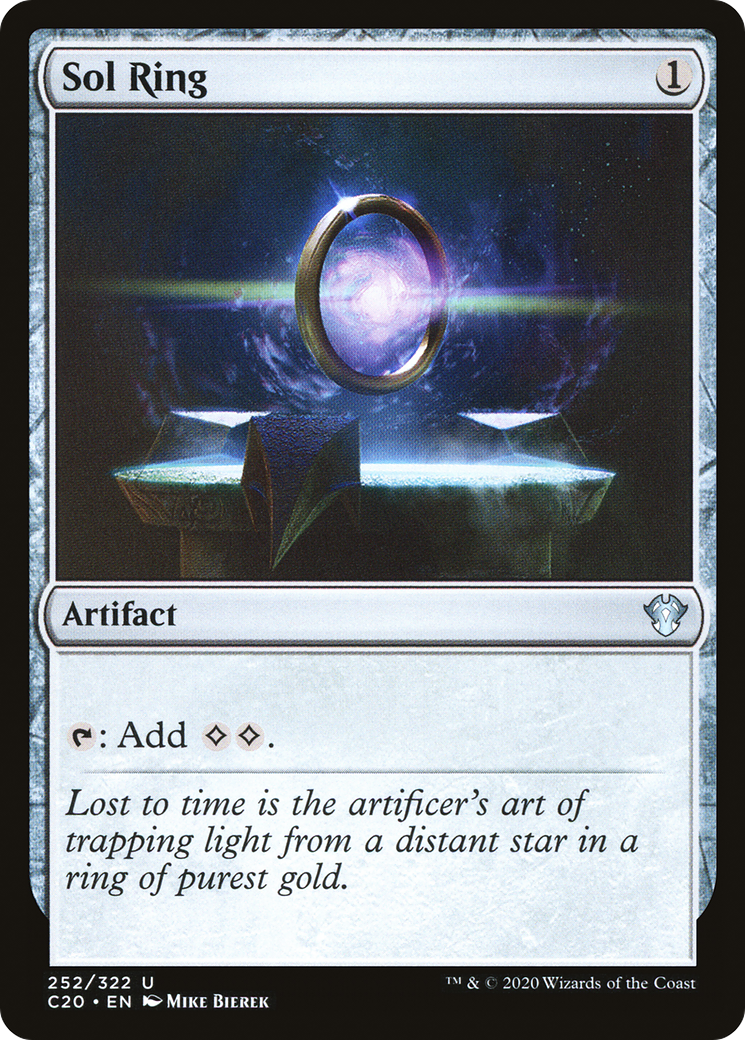
Sol Ring
Sol Ring
Artifact
: Add .
-
1
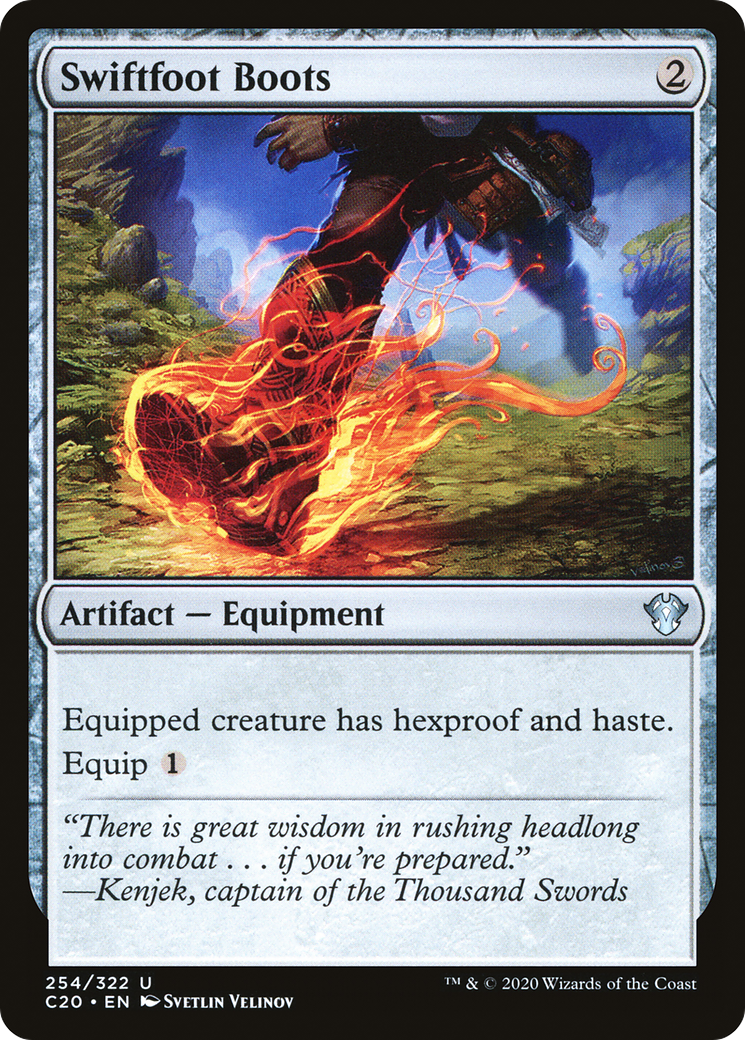
Swiftfoot Boots
Swiftfoot Boots
Artifact — Equipment
Equipped creature has hexproof and haste. (It can't be the target of spells or abilities your opponents control. It can attack and no matter when it came under your control.)
Equip ( : Attach to target creature you control. Equip only as a sorcery.)
- If a creature enters the battlefield under your control and gains haste, but then loses it before attacking, it won't be able to attack that turn. This means that you can't use one Swiftfoot Boots to allow two new creatures to attack in the same turn.
Enchantments 6
-
1
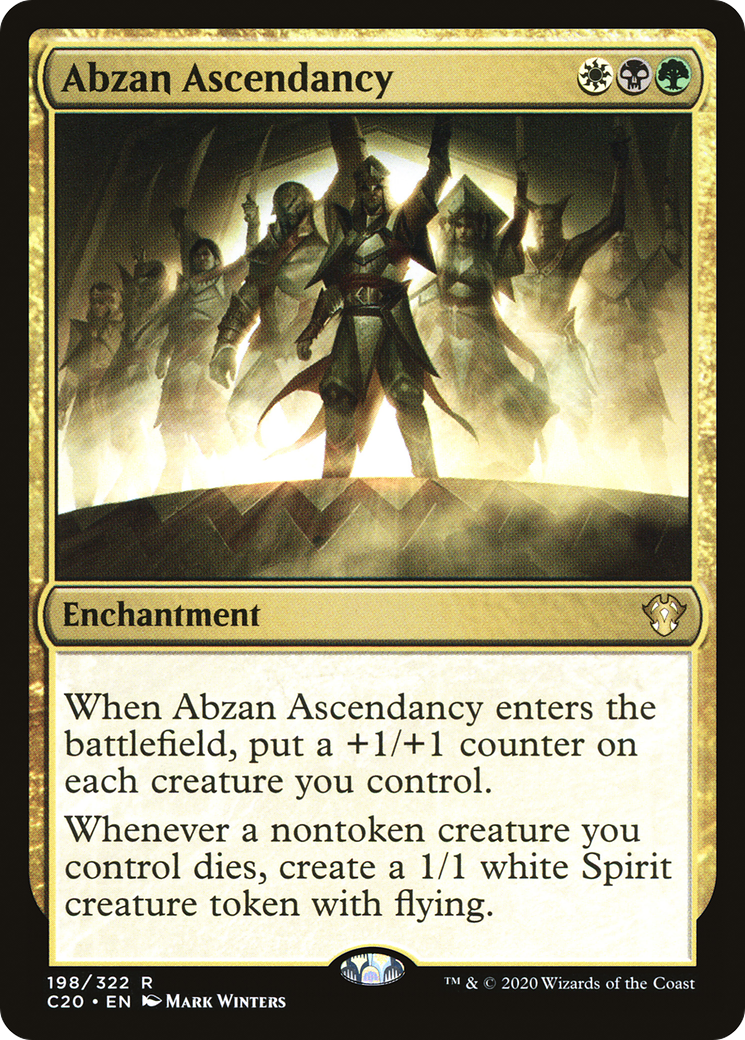
Abzan Ascendancy
Abzan Ascendancy
Enchantment
When this enchantment enters, put a +1/+1 counter on each creature you control.
Whenever a nontoken creature you control dies, create a 1/1 white Spirit creature token with flying.
-
1
Deadbridge Chant
Deadbridge Chant
Enchantment
When this enchantment enters, mill ten cards.
At the beginning of your upkeep, choose a card at random in your graveyard. If it's a creature card, put it onto the battlefield. Otherwise, put it into your hand.
- The card is chosen at random as the ability resolves. If any player responds to the ability, that player won't yet know what card will be chosen.
- Because the last ability doesn't target any card in your graveyard, any card put into your graveyard in response to the ability may be chosen.
- Each card in your graveyard must have an equal chance of being chosen. Assigning them each a number and rolling a die is an easy way to do this. In formats that allow you to rearrange your graveyard—including Standard, Modern, and Return to Ravnica block Limited formats, you may also shuffle your graveyard face down and choose a card at random.
-
1
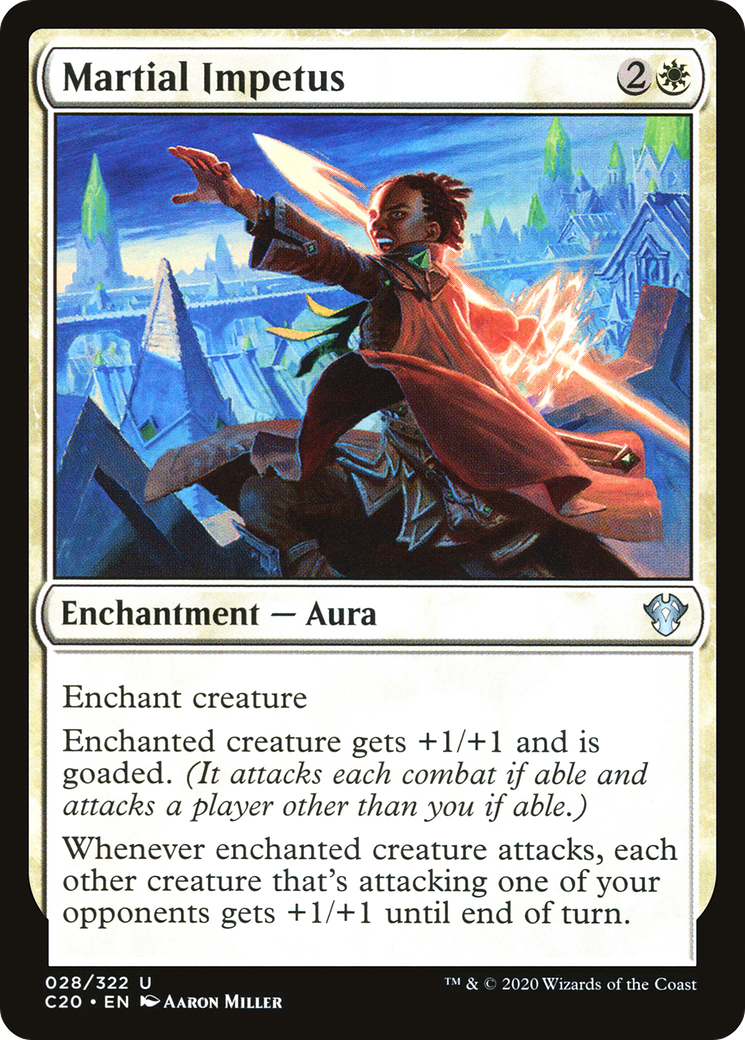
Martial Impetus
Martial Impetus
Enchantment — Aura
Enchant creature
Enchanted creature gets +1/+1 and is goaded. (It attacks each combat if able and attacks a player other than you if able.)
Whenever enchanted creature attacks, each other creature that's attacking one of your opponents gets +1/+1 until end of turn.
- If the creature doesn't meet any of the above exceptions and can attack, it must attack a player other than the controller of the spell or ability that goaded it if able. If the creature can't attack any of those players but could otherwise attack, it must attack a planeswalker an opponent controls, a battle an opponent controls, or a player who goaded it.
- If, during a player's declare attackers step, a creature that player controls that's been goaded is tapped, is affected by a spell or ability that says it can't attack, or hasn't been under that player's control continuously since the turn began (and doesn't have haste), then it doesn't attack. If there's a cost associated with having a creature attack a player, its controller isn't forced to pay that cost, so it doesn't have to attack that player.
- Attacking with a goaded creature doesn't cause it to stop being goaded. If there is an additional combat phase that turn, or if another player gains control of it before it stops being goaded, it must attack again if able.
- If a creature you control has been goaded by multiple opponents, it must attack one of your opponents that hasn't goaded it, as that fulfills the maximum number of goad requirements. If a creature you control has been goaded by each of your opponents, the creature must attack an opponent (rather than a planeswalker or battle), but you choose which opponent it attacks.
- Being goaded isn't an ability the creature has. Once it's been goaded, it must attack as detailed above even if it loses all abilities.
-
1
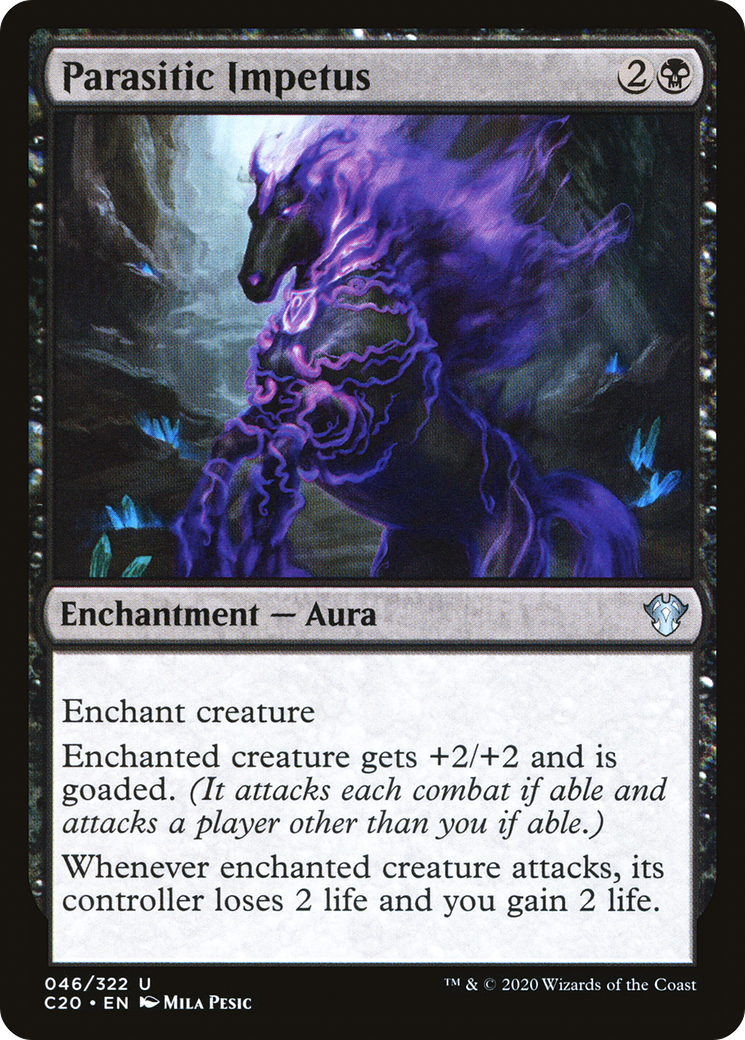
Parasitic Impetus
Parasitic Impetus
Enchantment — Aura
Enchant creature
Enchanted creature gets +2/+2 and is goaded. (It attacks each combat if able and attacks a player other than you if able.)
Whenever enchanted creature attacks, its controller loses 2 life and you gain 2 life.
- Being goaded isn't an ability the creature has. Once it's been goaded, it must attack as detailed above even if it loses all abilities.
- If, during a player's declare attackers step, a creature that player controls that's been goaded is tapped, is affected by a spell or ability that says it can't attack, or hasn't been under that player's control continuously since the turn began (and doesn't have haste), then it doesn't attack. If there's a cost associated with having a creature attack a player, its controller isn't forced to pay that cost, so it doesn't have to attack that player.
- If a creature you control has been goaded by multiple opponents, it must attack one of your opponents that hasn't goaded it, as that fulfills the maximum number of goad requirements. If a creature you control has been goaded by each of your opponents, the creature must attack an opponent (rather than a planeswalker or battle), but you choose which opponent it attacks.
- Attacking with a goaded creature doesn't cause it to stop being goaded. If there is an additional combat phase that turn, or if another player gains control of it before it stops being goaded, it must attack again if able.
- If the creature doesn't meet any of the above exceptions and can attack, it must attack a player other than the controller of the spell or ability that goaded it if able. If the creature can't attack any of those players but could otherwise attack, it must attack a planeswalker an opponent controls, a battle an opponent controls, or a player who goaded it.
- If you are the attacking creature's controller, you lose 2 life and gain 2 life. You won't lose the game if your life total is 0 in between these two events.
- Parasitic Impetus causes you to gain life, not the attacking creature's controller.
-
1
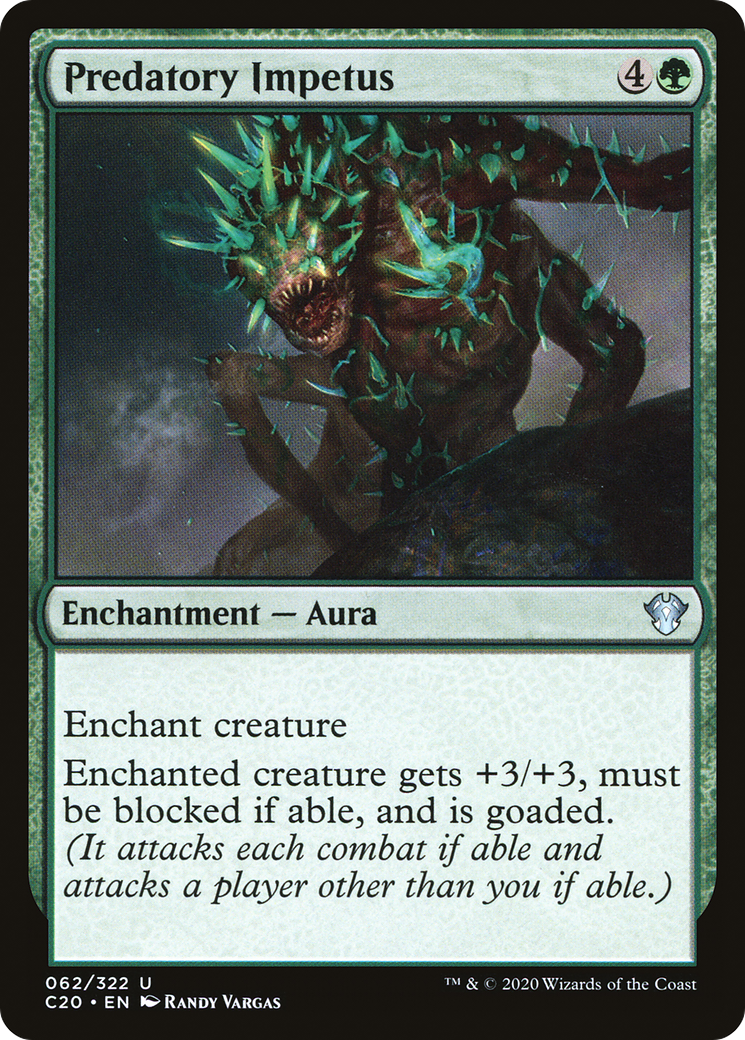
Predatory Impetus
Predatory Impetus
Enchantment — Aura
Enchant creature
Enchanted creature gets +3/+3, must be blocked if able, and is goaded. (It attacks each combat if able and attacks a player other than you if able.)
- If the creature doesn't meet any of the above exceptions and can attack, it must attack a player other than the controller of the spell or ability that goaded it if able. If the creature can't attack any of those players but could otherwise attack, it must attack a planeswalker an opponent controls, a battle an opponent controls, or a player who goaded it.
- Attacking with a goaded creature doesn't cause it to stop being goaded. If there is an additional combat phase that turn, or if another player gains control of it before it stops being goaded, it must attack again if able.
- If a creature you control has been goaded by multiple opponents, it must attack one of your opponents that hasn't goaded it, as that fulfills the maximum number of goad requirements. If a creature you control has been goaded by each of your opponents, the creature must attack an opponent (rather than a planeswalker or battle), but you choose which opponent it attacks.
- If, during a player's declare attackers step, a creature that player controls that's been goaded is tapped, is affected by a spell or ability that says it can't attack, or hasn't been under that player's control continuously since the turn began (and doesn't have haste), then it doesn't attack. If there's a cost associated with having a creature attack a player, its controller isn't forced to pay that cost, so it doesn't have to attack that player.
- Being goaded isn't an ability the creature has. Once it's been goaded, it must attack as detailed above even if it loses all abilities.
- If each creature the defending player controls can't block for any reason (such as being tapped), then the enchanted creature isn't blocked. If there's a cost associated with blocking the enchanted creature, the defending player isn't forced to pay that cost, so it doesn't have to be blocked in that case either.
- Only one creature is required to block the enchanted creature. Other creatures may also block it and are free to block other creatures or not block at all.
-
1
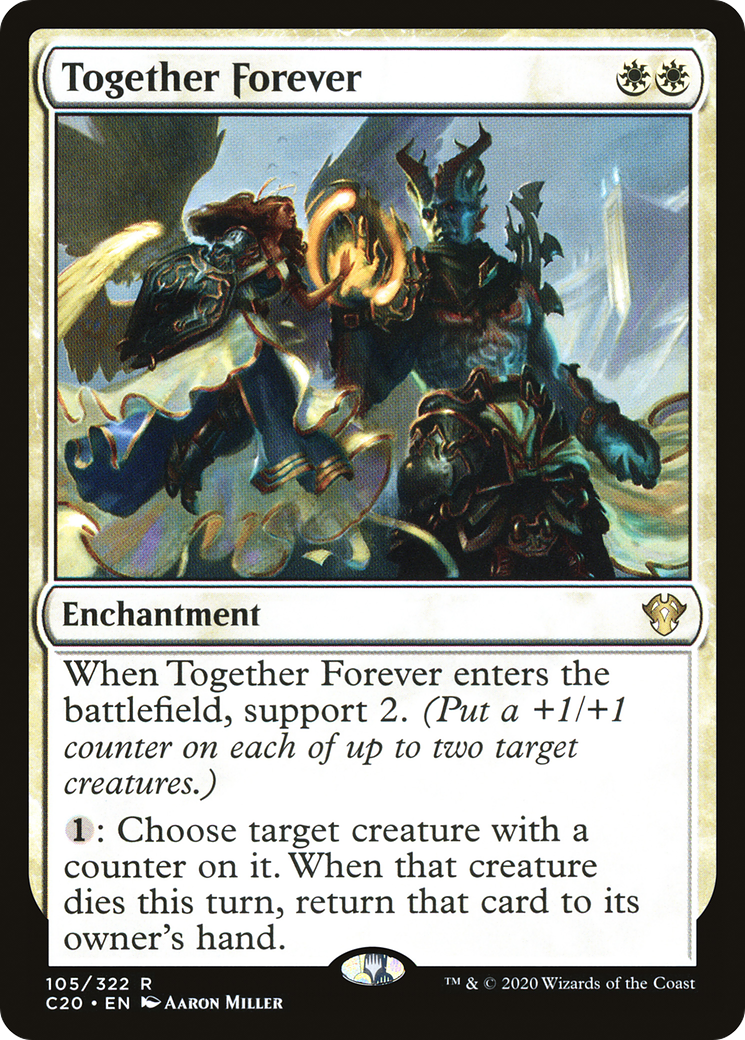
Together Forever
Together Forever
Enchantment
When this enchantment enters, support 2. (Put a +1/+1 counter on each of up to two target creatures.)
: Choose target creature with a counter on it. When that creature dies this turn, return that card to its owner's hand.
- If a creature without counters receives enough -1/-1 counters to reduce its toughness to 0 or less, Together Forever's ability can't be activated before state-based actions put that creature into its owner's graveyard.
- Together Forever's activated ability checks whether the target creature has a counter on it as the ability is activated and as the ability resolves. If the creature loses its counters later in the turn, the delayed triggered ability will still return it to its owner's hand when it dies.
- If some, but not all, targets for a spell become illegal, the remaining targets are affected as appropriate. If all of a spell's targets become illegal, that spell doesn't resolve.
- If a spell with support has other abilities that target creatures, those abilities and the support ability can target the same creature.
- You can't put more than one +1/+1 counter on any one target using the support action.
- Support can target a creature another player controls.
Lands 38
-
1
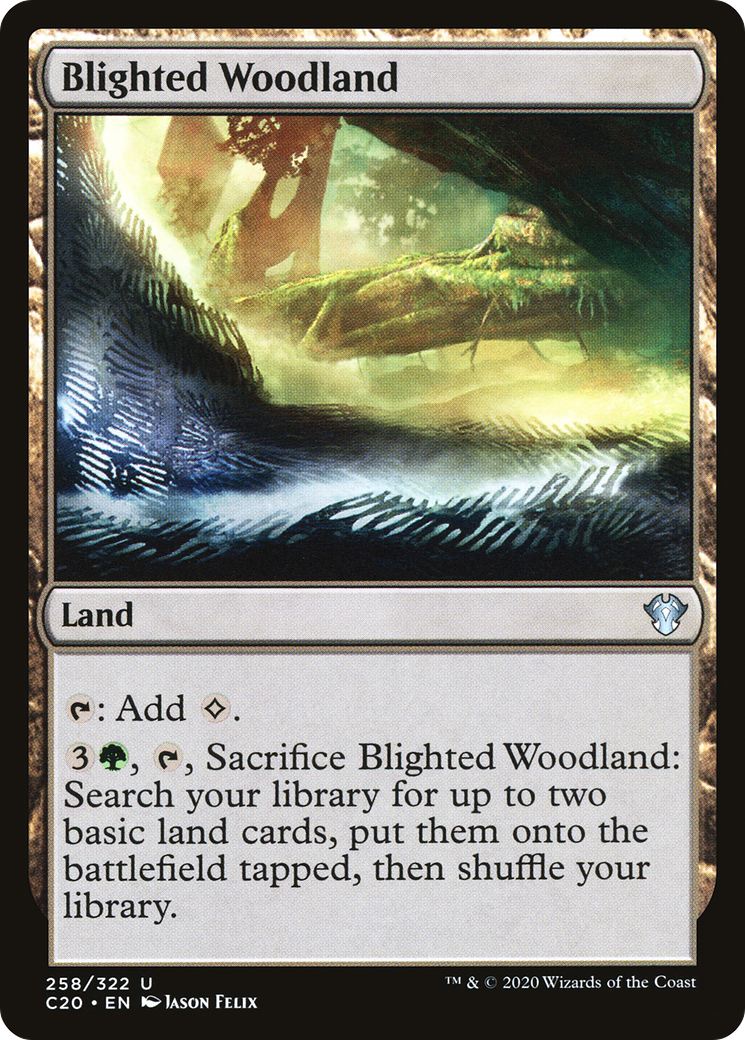
Blighted Woodland
Blighted Woodland
Land
: Add .
, , Sacrifice this land: Search your library for up to two basic land cards, put them onto the battlefield tapped, then shuffle.
-
1
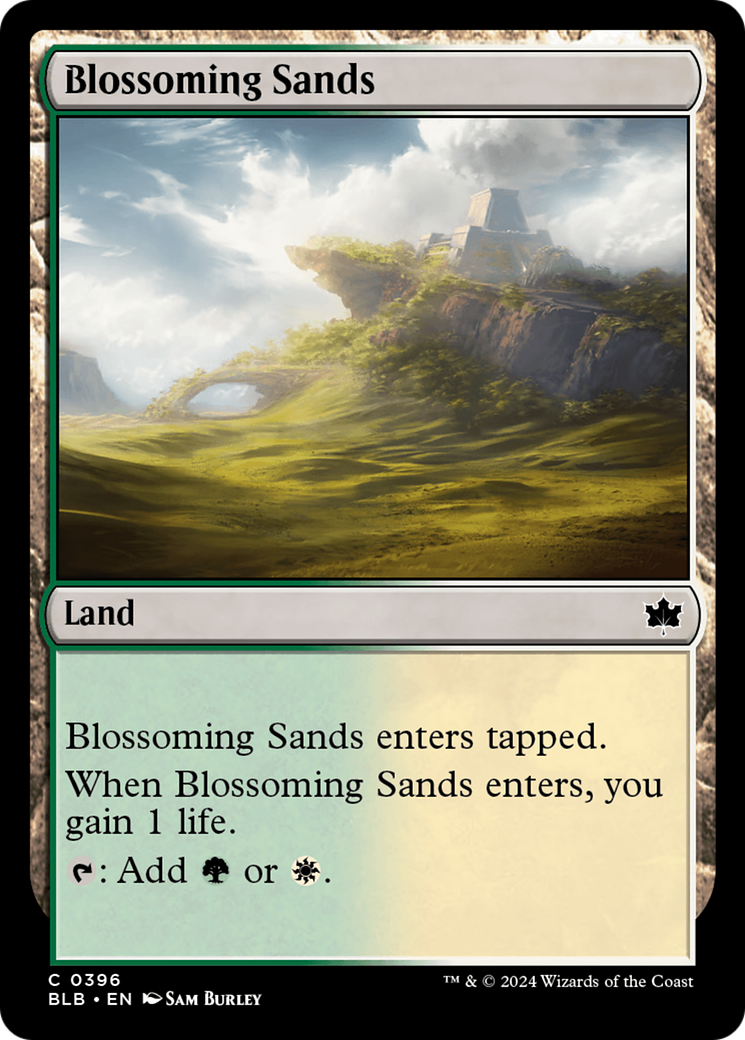
Blossoming Sands
Blossoming Sands
Land
This land enters tapped.
When this land enters, you gain 1 life.
: Add or .
-
1
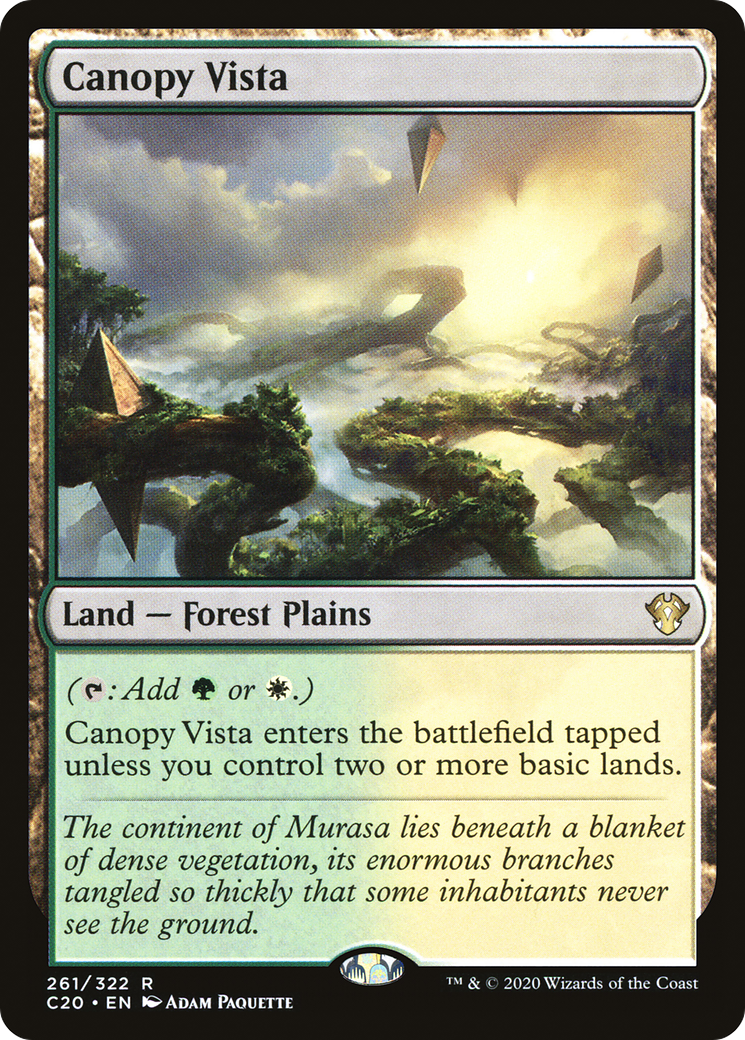
Canopy Vista
Canopy Vista
Land — Forest Plains
( : Add or .)
This land enters tapped unless you control two or more basic lands.
- Even though these lands have basic land types, they are not basic lands because "basic" doesn't appear on their type line. Notably, controlling two or more of them won't allow others to enter the battlefield untapped.
- If one of these lands enters the battlefield at the same time as any number of basic lands, those other lands are not counted when determining if this land enters the battlefield tapped or untapped.
- However, because these cards have basic land types, effects that specify a basic land type without also specifying that the land be basic can affect them. For example, a spell or ability that reads "Destroy target Forest" can target Canopy Vista, while one that reads "Destroy target basic Forest" cannot.
-
1
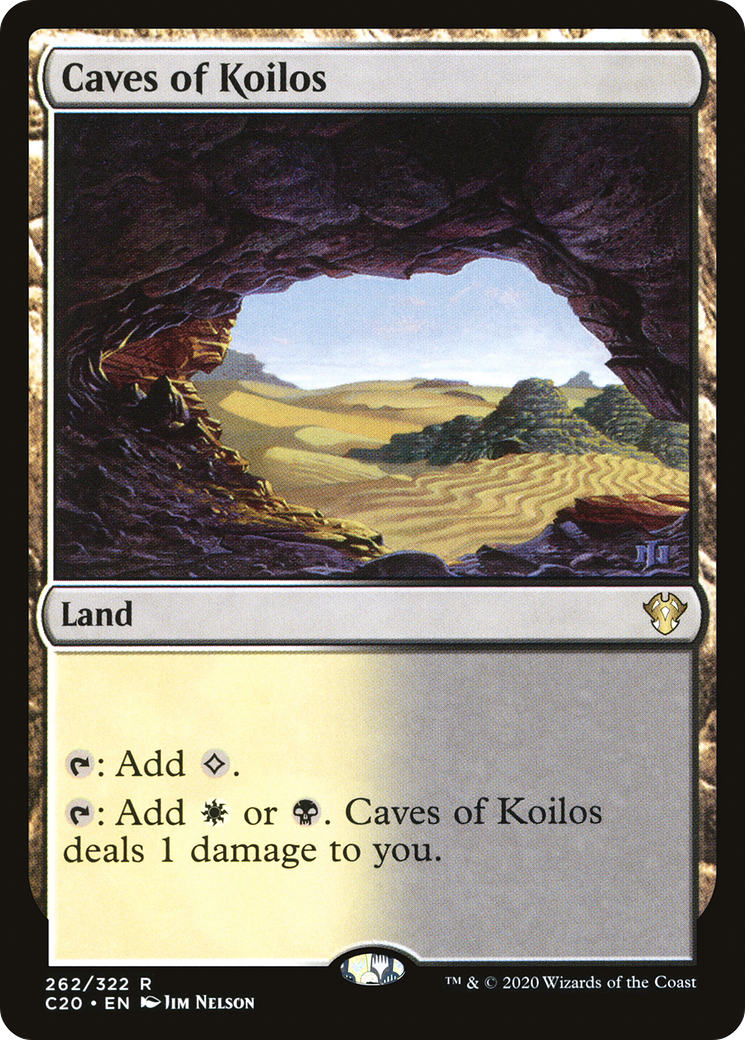
Caves of Koilos
Caves of Koilos
Land
: Add .
: Add or . This land deals 1 damage to you.
- The damage dealt to you is part of the second mana ability. It doesn't use the stack and can't be responded to.
- Like most lands, each land in this cycle is colorless. The damage dealt to you is dealt by a colorless source.
-
1
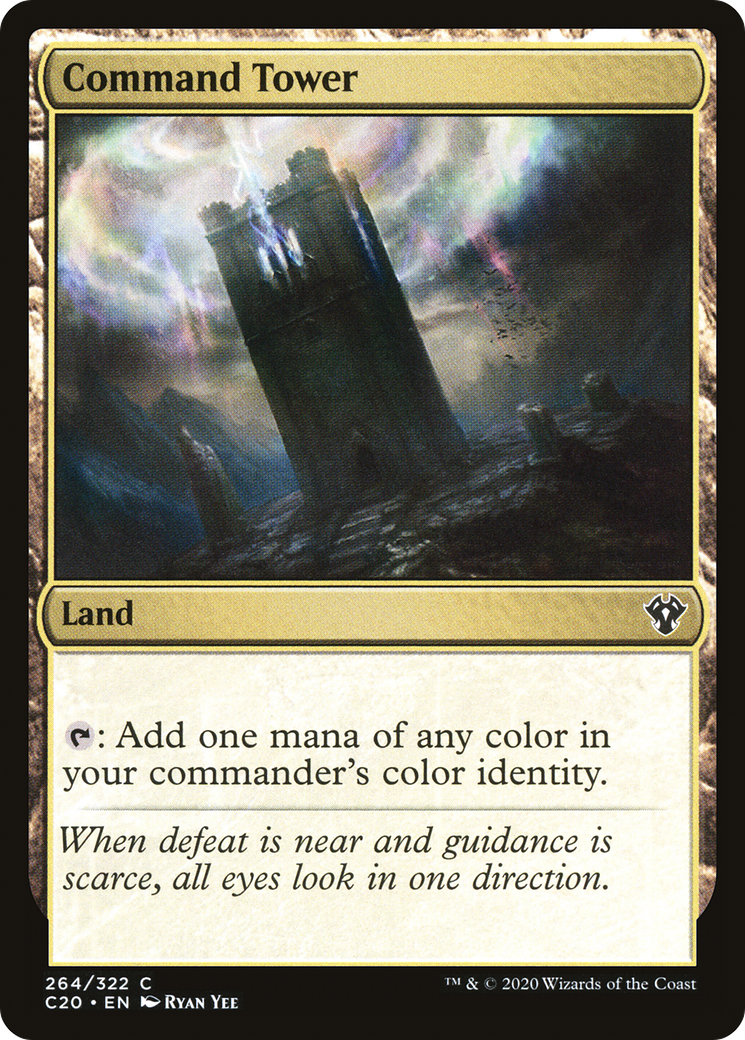
Command Tower
Command Tower
Land
: Add one mana of any color in your commander's color identity.
- If you don't have a commander, Command Tower's ability produces no mana.
- If your commander is a card that has no colors in its color identity, Command Tower's ability produces no mana. It doesn't produce .
- If you have two commanders, the ability adds one mana of any color in their combined color identities.
-
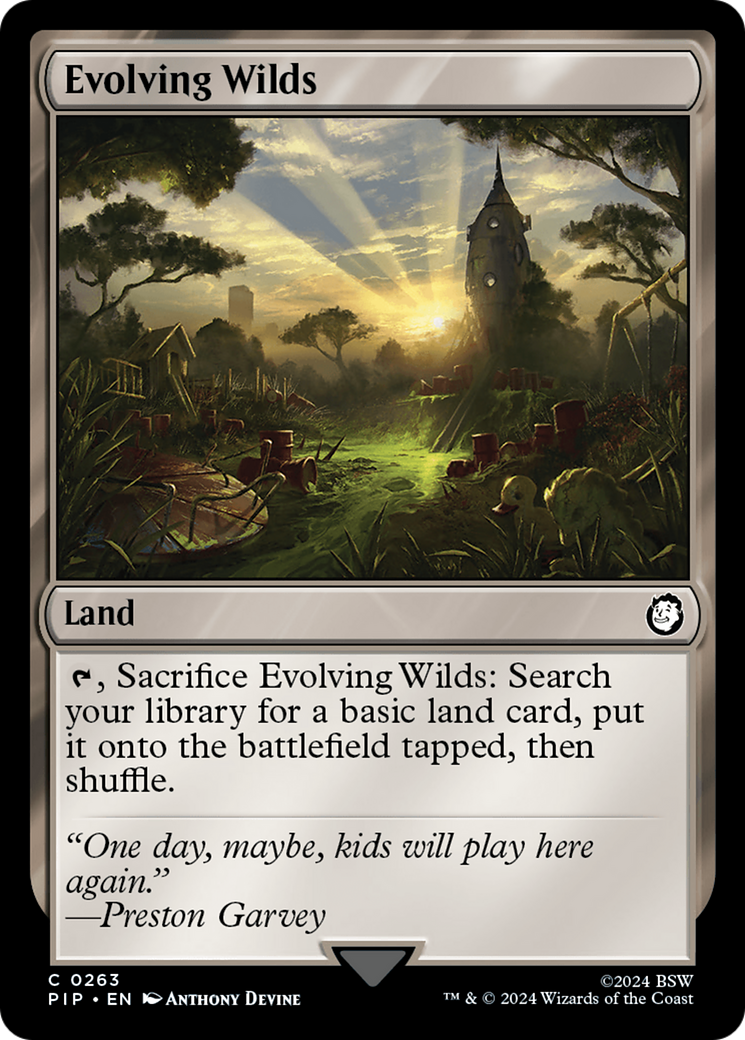
1
Evolving Wilds
Evolving Wilds
Land
, Sacrifice this land: Search your library for a basic land card, put it onto the battlefield tapped, then shuffle.
-
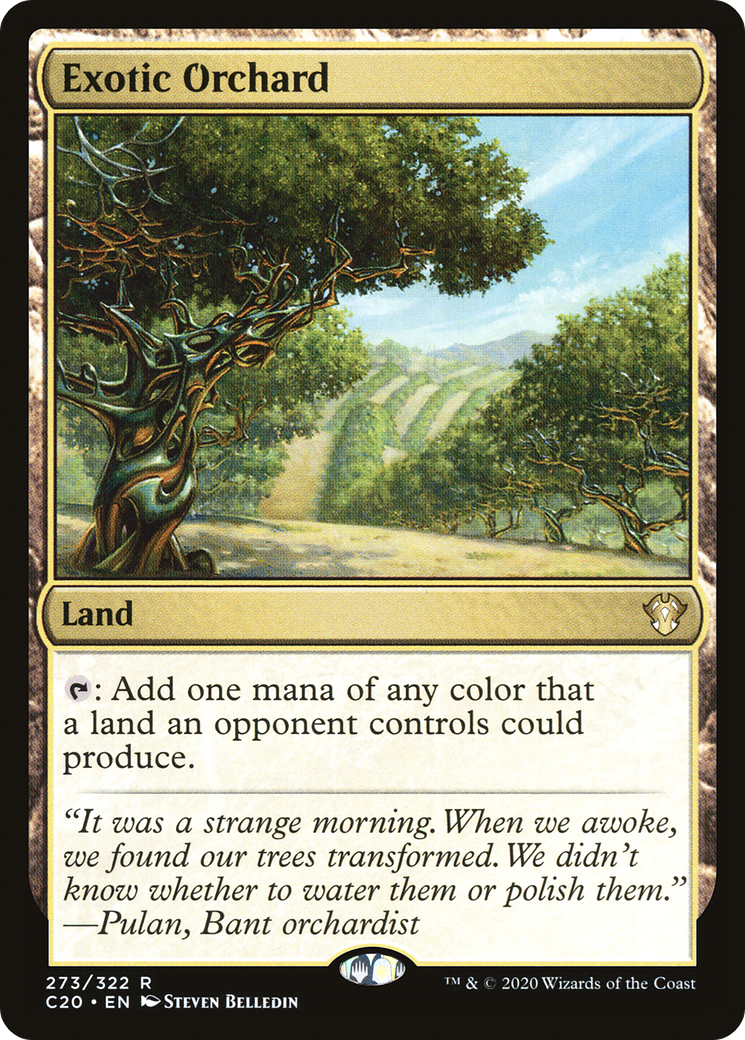
1
Exotic Orchard
Exotic Orchard
Land
: Add one mana of any color that a land an opponent controls could produce.
- Lands that produce mana based only on what other lands "could produce" won't help each other unless some other land allows one of them to actually produce some type of mana. For example, if you control an Exotic Orchard and your opponent controls an Exotic Orchard and a Reflecting Pool, none of those lands would produce mana if their mana abilities were activated. On the other hand, if you control a Forest and an Exotic Orchard, and your opponent controls an Exotic Orchard and a Reflecting Pool, then each of those lands can be tapped to produce . Your opponent's Exotic Orchard can produce because you control a Forest. Your Exotic Orchard and your opponent's Reflecting Pool can each produce because your opponent's Exotic Orchard can produce .
- When determining what colors of mana your opponents' lands could produce, Exotic Orchard takes into account any applicable replacement effects that would apply to those lands' mana abilities (such as Contamination's effect, for example). If there are more than one, consider them in any possible order.
- The colors of mana are white, blue, black, red, and green. Exotic Orchard can't be tapped for colorless mana, even if a land an opponent controls could produce colorless mana.
- Exotic Orchard doesn't care about any restrictions or riders your opponents' lands (such as Ancient Ziggurat or Hall of the Bandit Lord) put on the mana they produce. It just cares about colors of mana.
- Exotic Orchard checks the effects of all mana-producing abilities of lands your opponents control, but it doesn't check their costs. For example, Vivid Crag has the ability " , Remove a charge counter from Vivid Crag: Add one mana of any color." If an opponent controls Vivid Crag and you control Exotic Orchard, you can tap Exotic Orchard for any color of mana. It doesn't matter whether Vivid Crag has a charge counter on it, and it doesn't matter whether it's untapped.
-
4
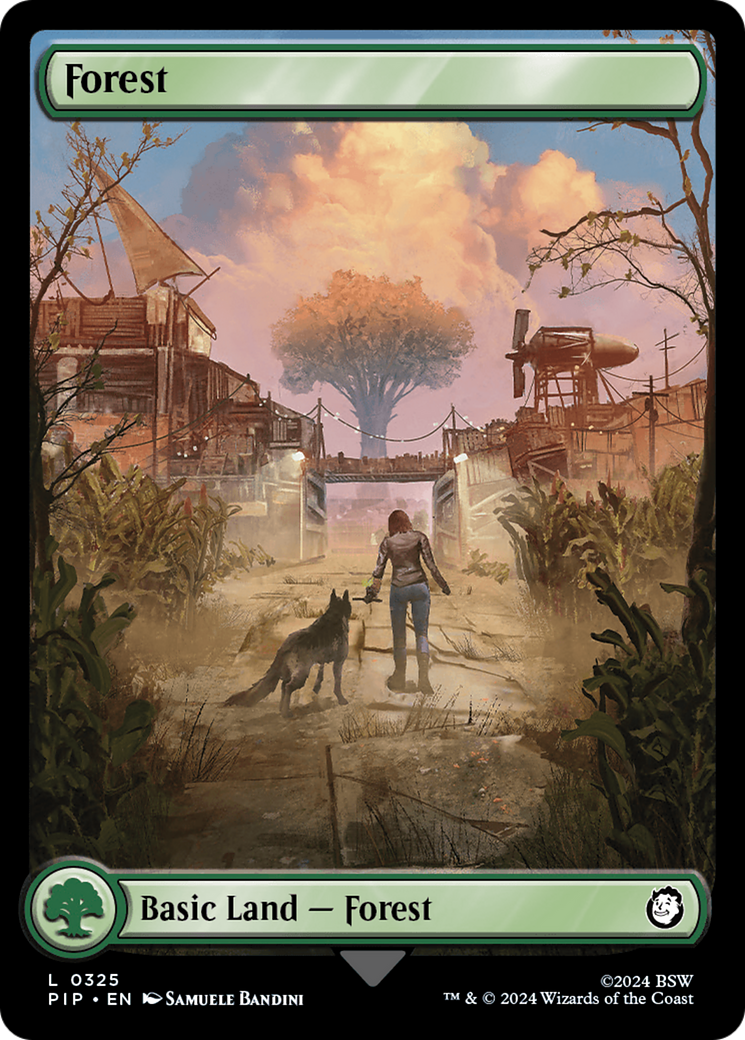
Forest
Forest
Basic Land — Forest
( : Add .)
-
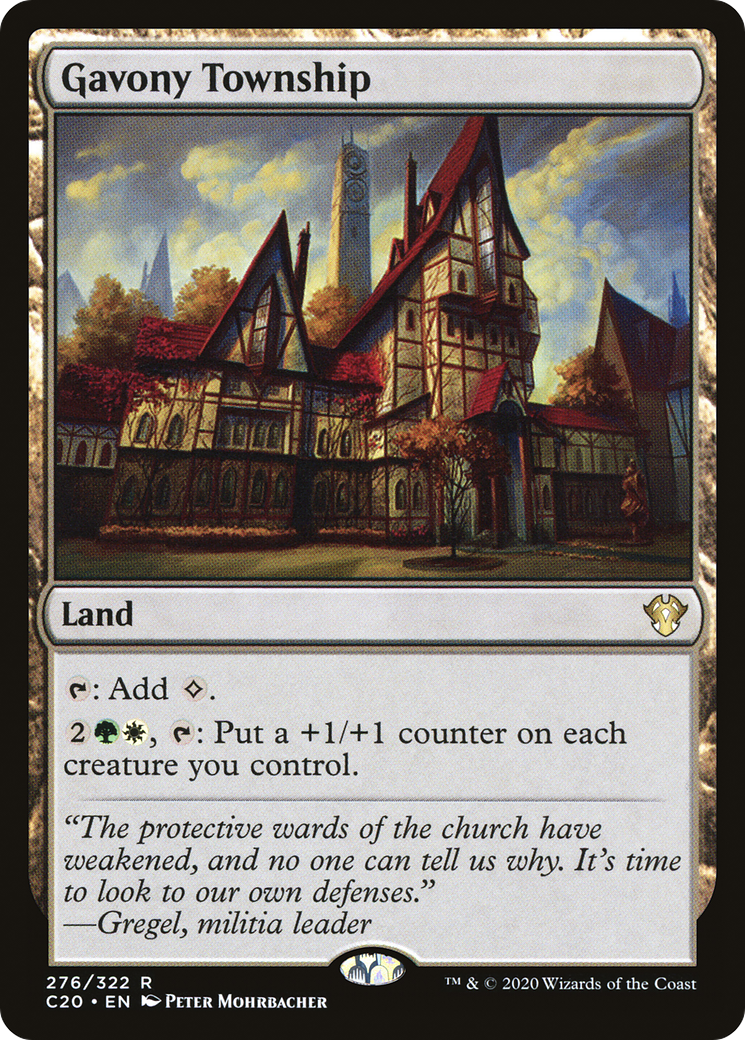
1
Gavony Township
Gavony Township
Land
: Add .
, : Put a +1/+1 counter on each creature you control.
-
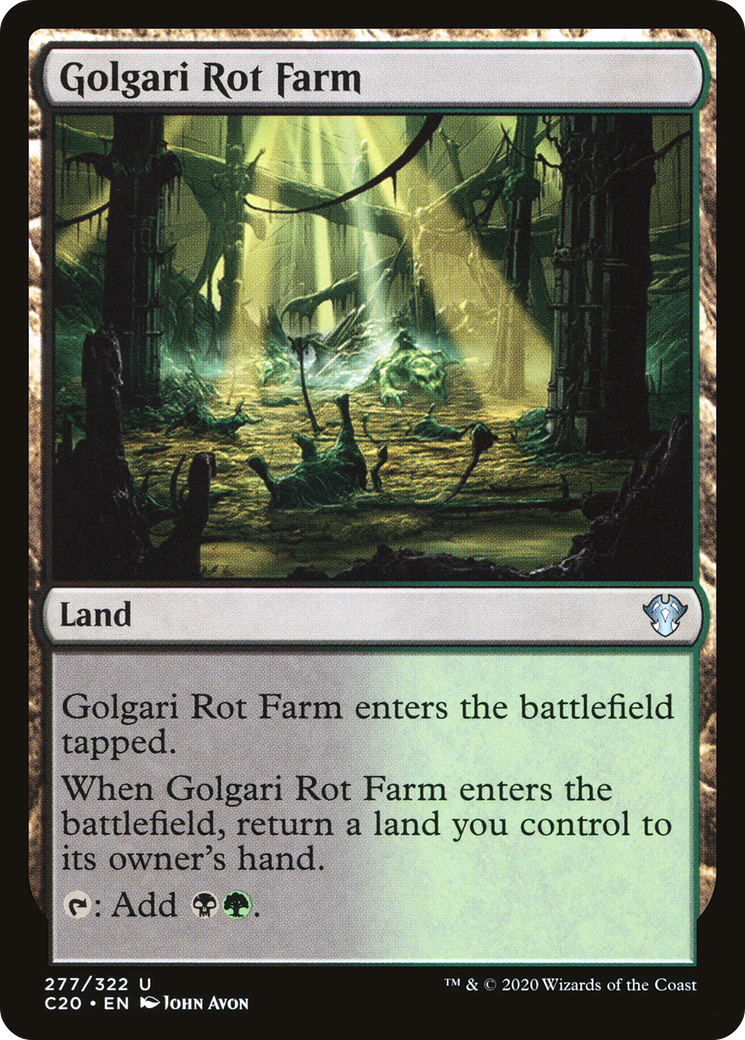
1
Golgari Rot Farm
Golgari Rot Farm
Land
This land enters tapped.
When this land enters, return a land you control to its owner's hand.
: Add .
- If this land enters the battlefield and you control no other lands, its ability will force you to return it to your hand.
-
1
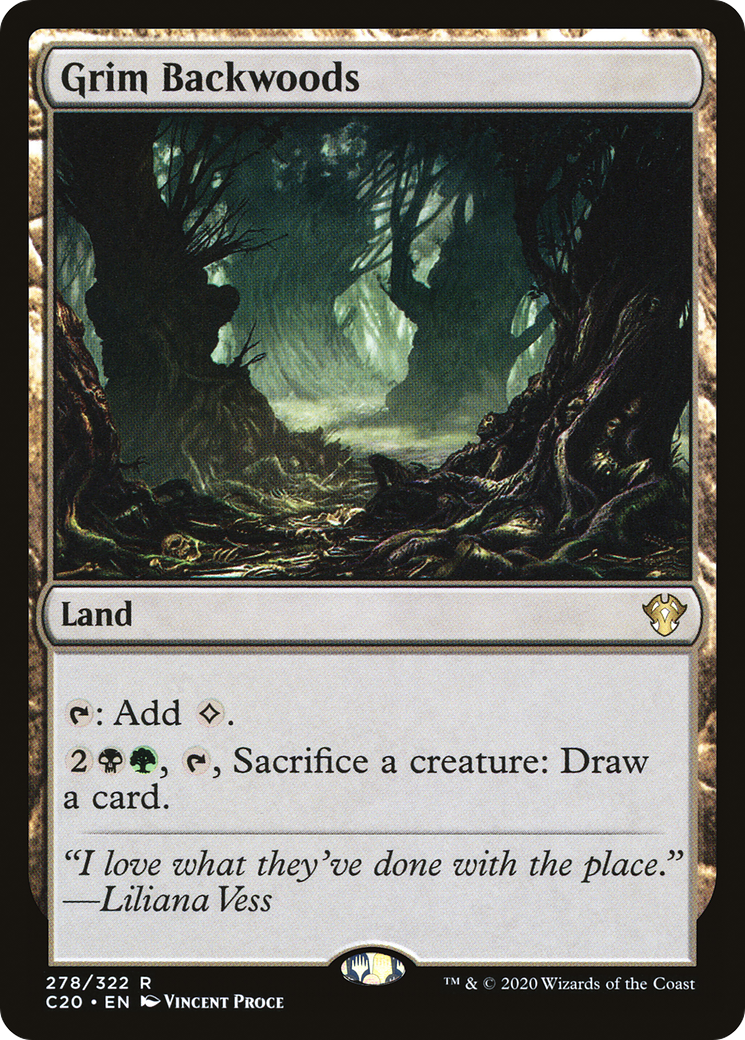
Grim Backwoods
Grim Backwoods
Land
: Add .
, , Sacrifice a creature: Draw a card.
-
1
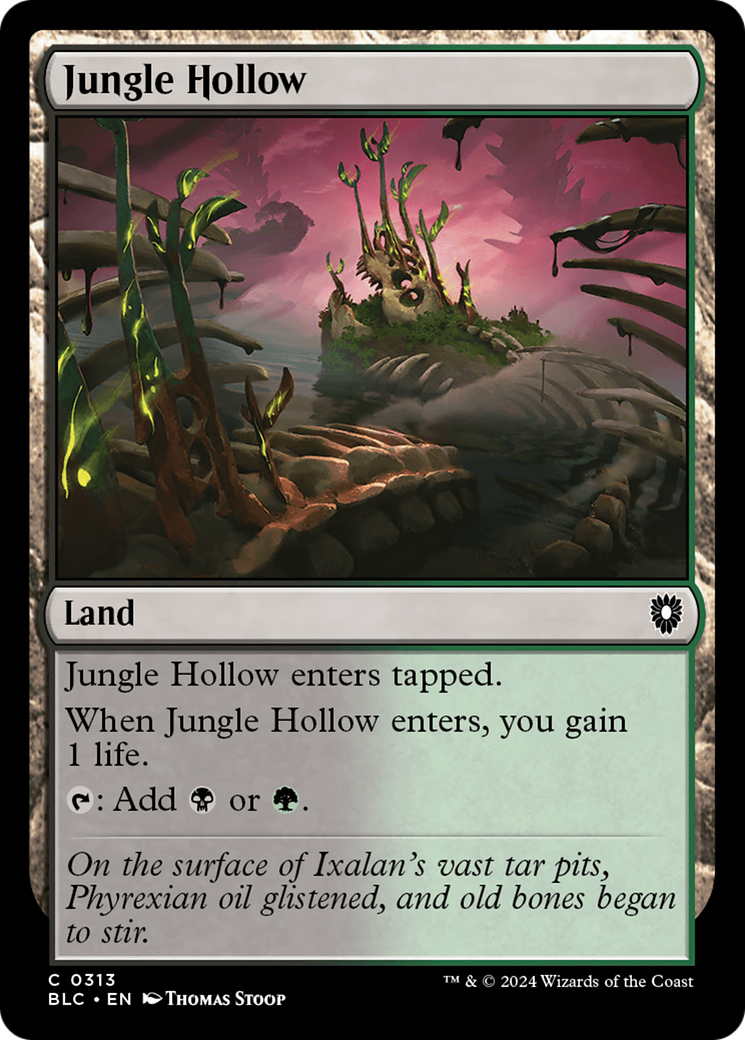
Jungle Hollow
Jungle Hollow
Land
This land enters tapped.
When this land enters, you gain 1 life.
: Add or .
-
1
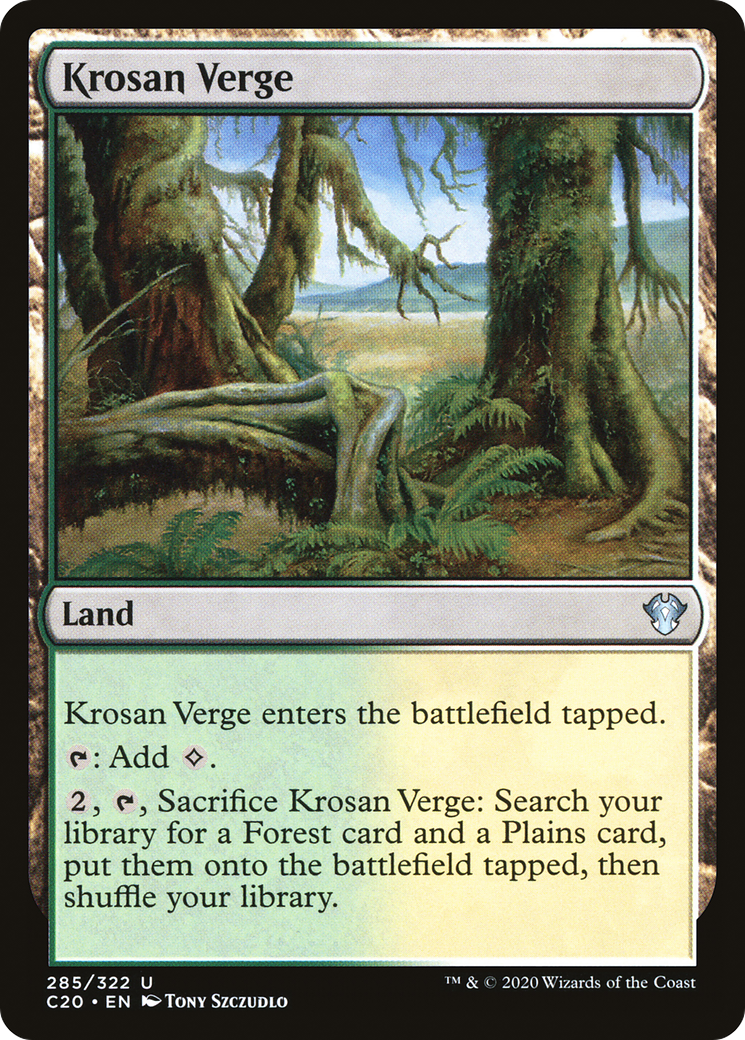
Krosan Verge
Krosan Verge
Land
This land enters tapped.
: Add .
, , Sacrifice this land: Search your library for a Forest card and a Plains card, put them onto the battlefield tapped, then shuffle.
-
1
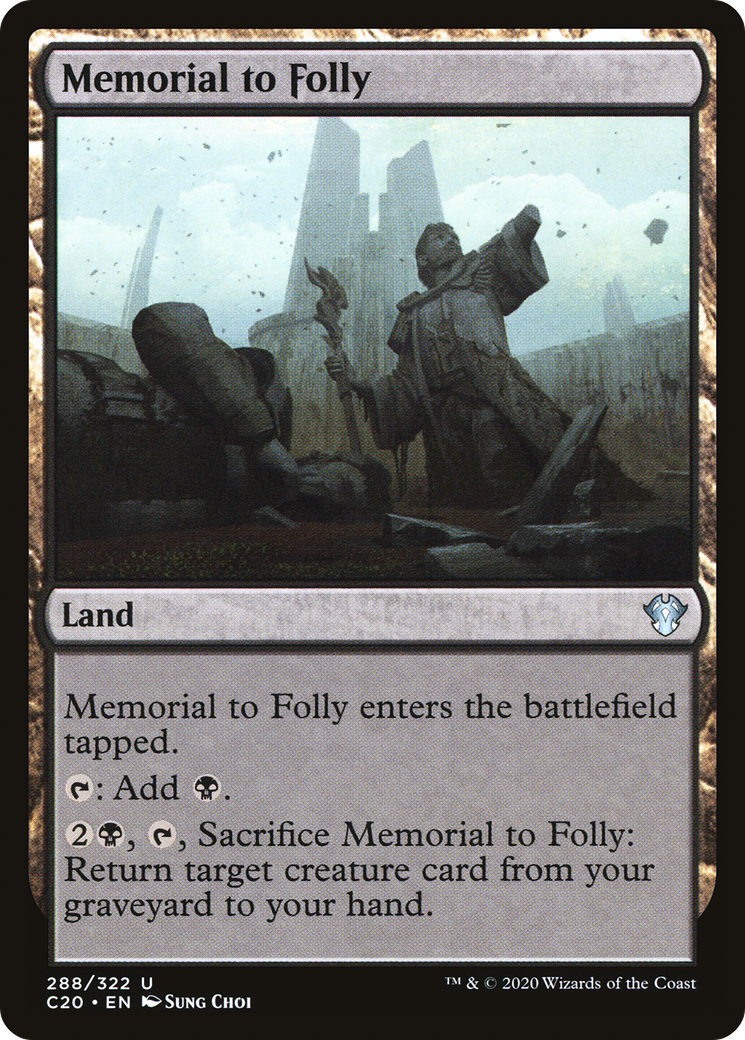
Memorial to Folly
Memorial to Folly
Land
This land enters tapped.
: Add .
, , Sacrifice this land: Return target creature card from your graveyard to your hand.
-
1
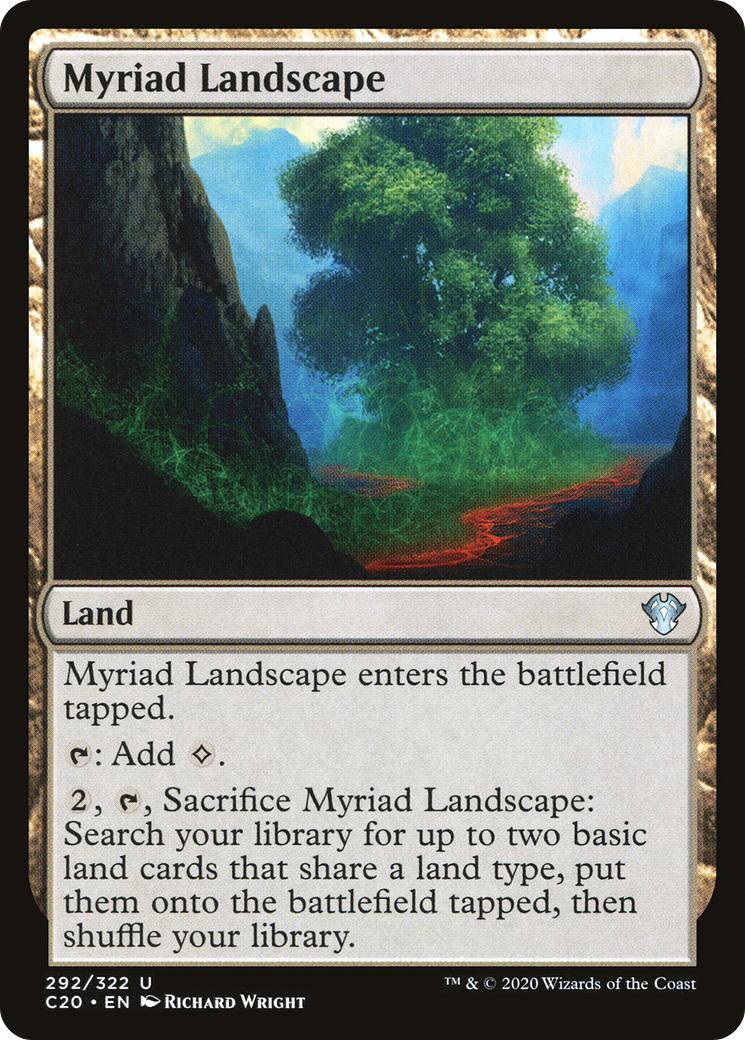
Myriad Landscape
Myriad Landscape
Land
This land enters tapped.
: Add .
, , Sacrifice this land: Search your library for up to two basic land cards that share a land type, put them onto the battlefield tapped, then shuffle.
- You can choose to find one basic land card with Myriad Landscape's last ability.
-
1
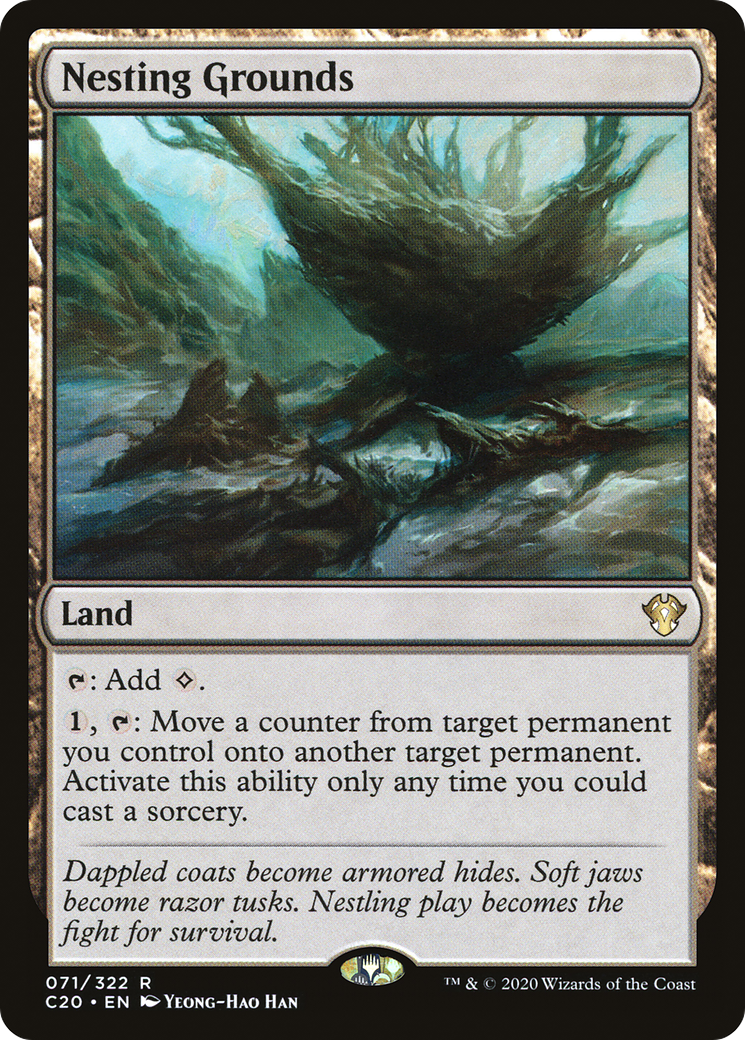
Nesting Grounds
Nesting Grounds
Land
: Add .
, : Move a counter from target permanent you control onto another target permanent. Activate only as a sorcery.
- You choose the two target permanents as Nesting Grounds's second ability is put onto the stack. You choose which kind of counter to move as that ability resolves.
- If either permanent becomes an illegal target, no counter is removed or put.
- To move a counter from one creature to another, the counter is removed from the first permanent and put on the second. Any abilities that care about a counter being removed from or put onto a permanent will apply.
- The two target permanents don't have to share a type, which can result in some counters on permanents that would not occur normally, such as loyalty counters on creatures or +1/+1 counters on lands. Keyword counters will grant the permanent that keyword even if it's meaningless (such as trample on an enchantment); +1/+1 counters won't affect the permanent unless it's a creature; and many named counters (such as soul counters) won't have an effect unless the recipient permanent refers to them in some way.
-
1
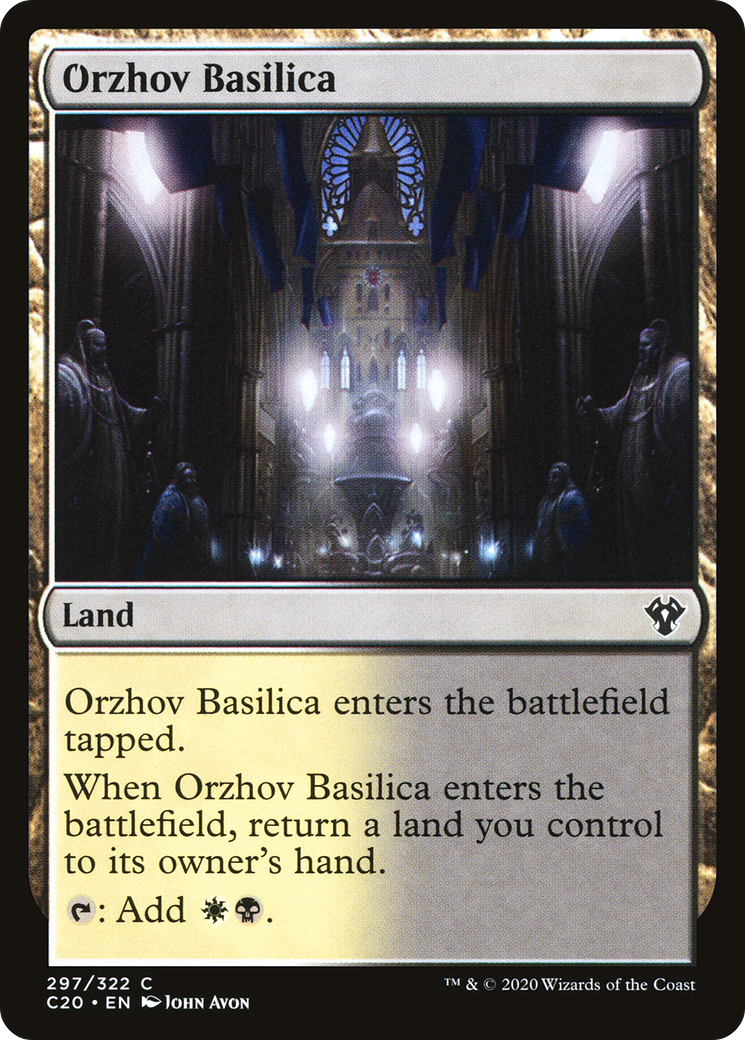
Orzhov Basilica
Orzhov Basilica
Land
This land enters tapped.
When this land enters, return a land you control to its owner's hand.
: Add .
- If this land enters the battlefield and you control no other lands, its ability will force you to return it to your hand.
-
7
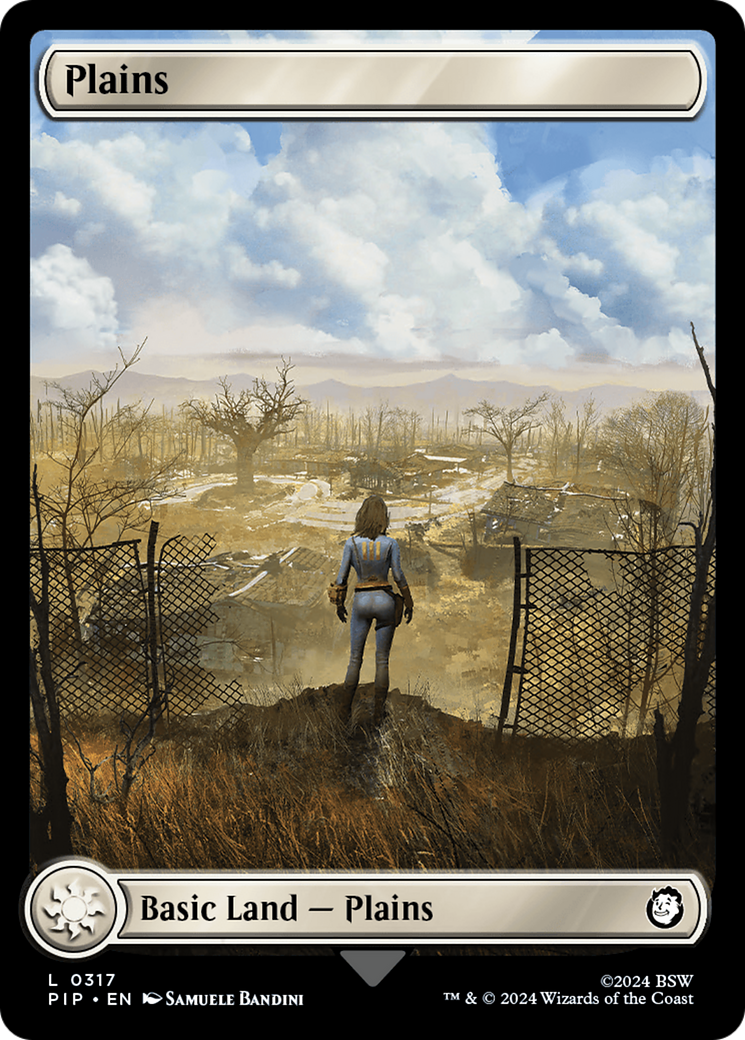
Plains
Plains
Basic Land — Plains
( : Add .)
-
1
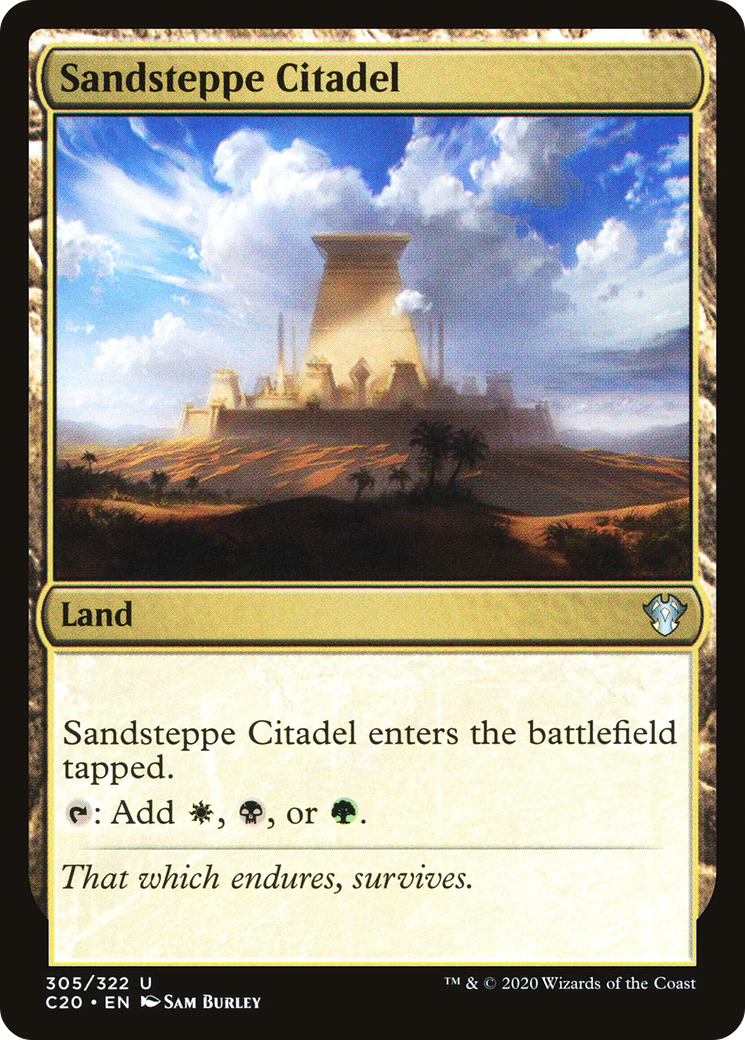
Sandsteppe Citadel
Sandsteppe Citadel
Land
This land enters tapped.
: Add , , or .
-
1
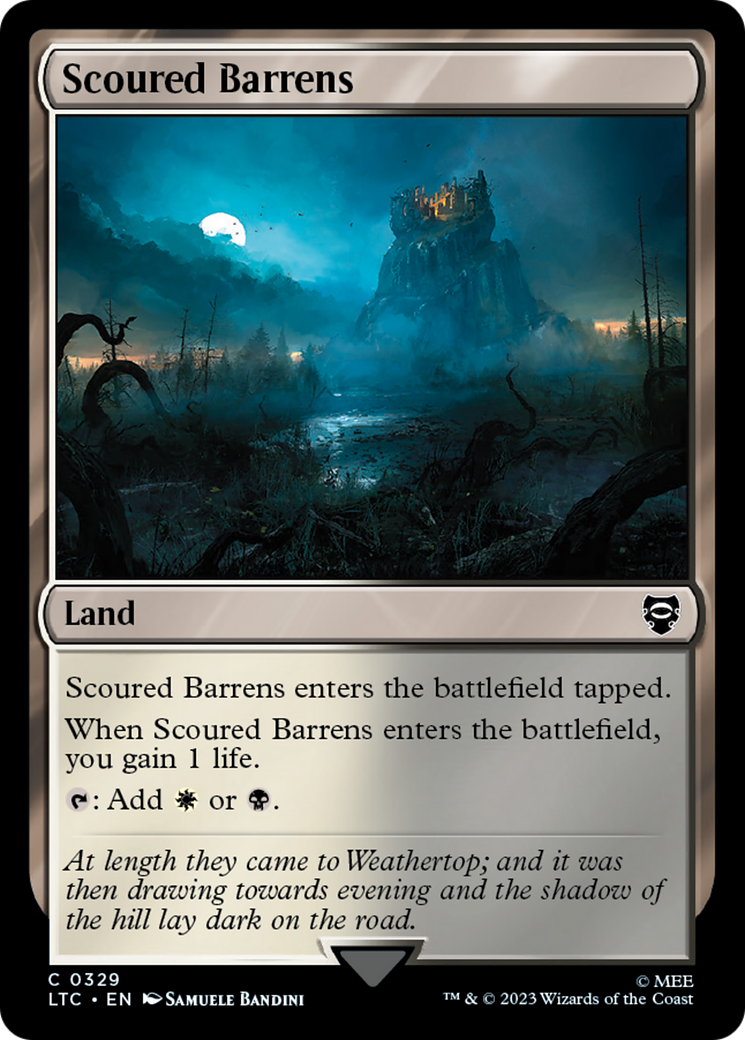
Scoured Barrens
Scoured Barrens
Land
This land enters tapped.
When this land enters, you gain 1 life.
: Add or .
-
1
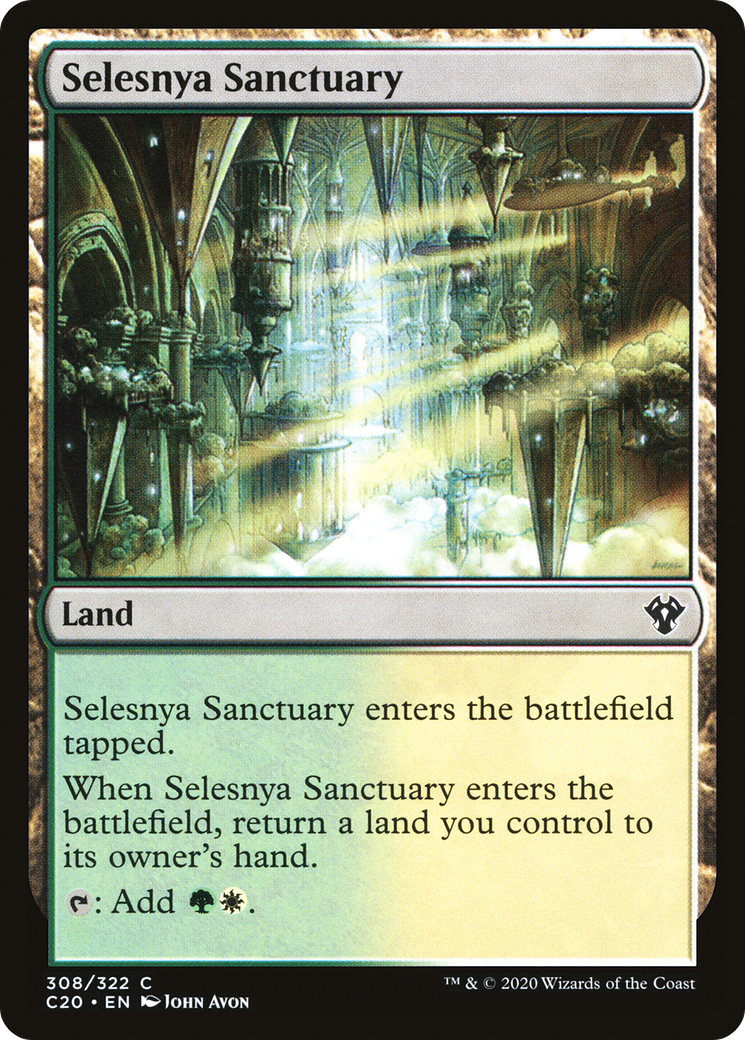
Selesnya Sanctuary
Selesnya Sanctuary
Land
This land enters tapped.
When this land enters, return a land you control to its owner's hand.
: Add .
- If this land enters the battlefield and you control no other lands, its ability will force you to return it to your hand.
-
1
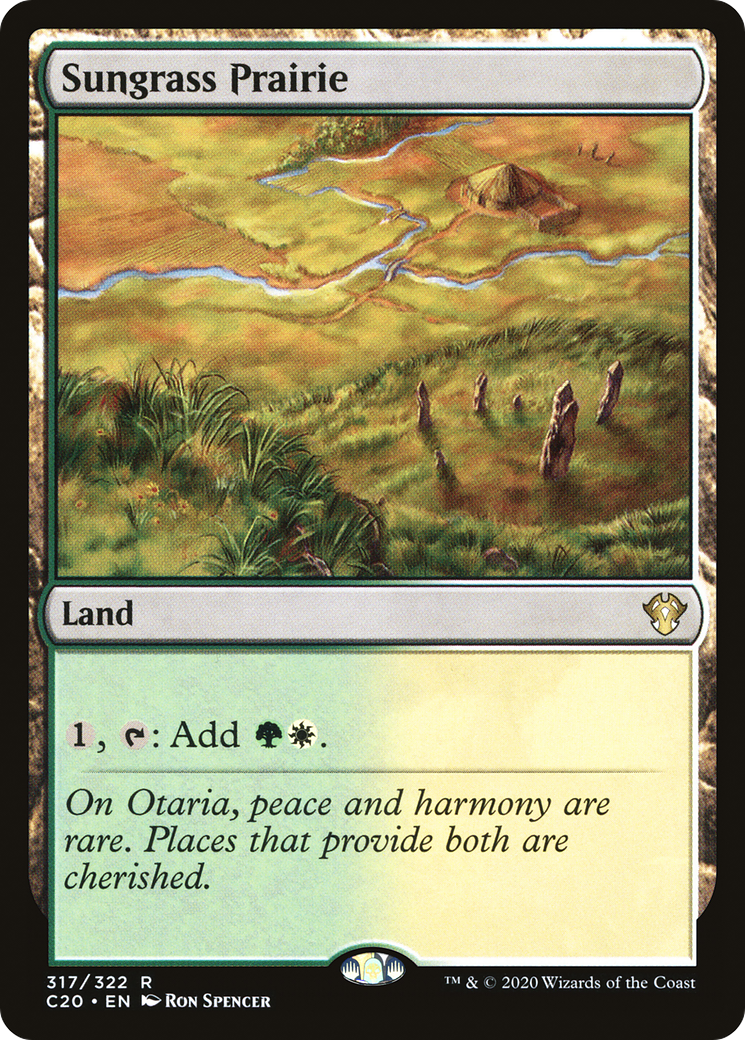
Sungrass Prairie
Sungrass Prairie
Land
, : Add .
-
7
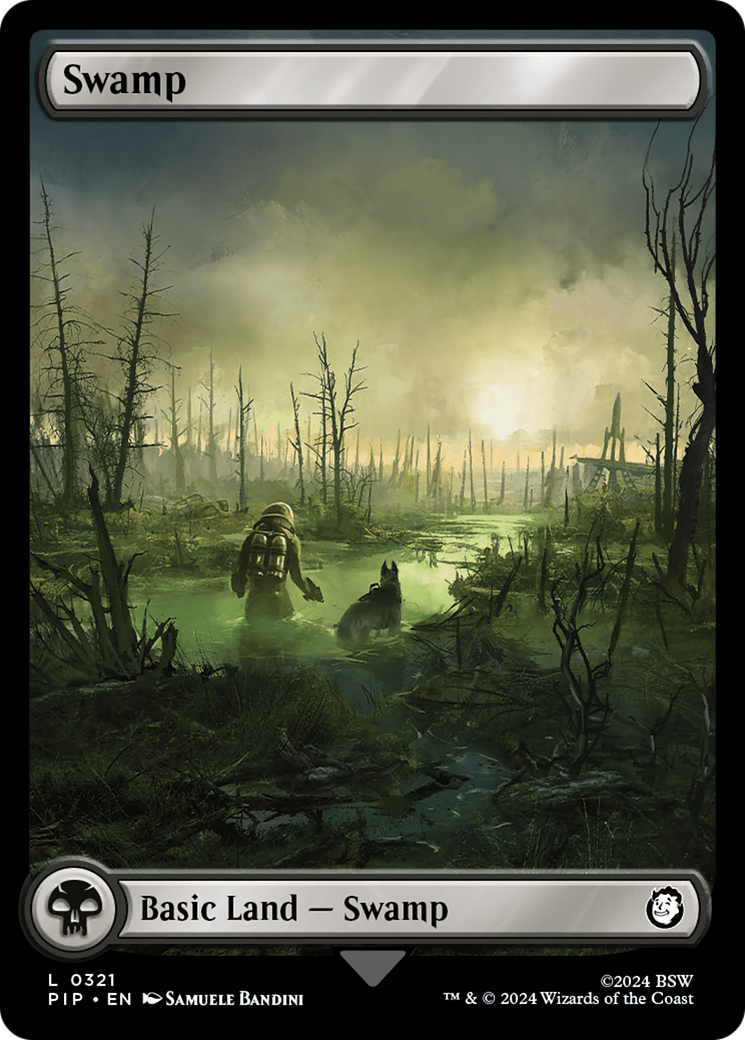
Swamp
Swamp
Basic Land — Swamp
( : Add .)
White 15
-
1
Aerial Responder
Aerial Responder
Creature — Dwarf Soldier
2/3
Flying, vigilance, lifelink
-
1
Akroma, Angel of Wrath
Akroma, Angel of Wrath
Legendary Creature — Angel
6/6
Flying, first strike, vigilance, trample, haste, protection from black and from red
-
1
Angel of Finality
Angel of Finality
Creature — Angel
3/4
Flying
When this creature enters, exile target player's graveyard.
-
1
Avenging Huntbonder
Avenging Huntbonder
Creature — Human Warrior
3/3
Double strike
Whenever this creature attacks, put a double strike counter on another target attacking creature.
-
1
Cartographer's Hawk
Cartographer's Hawk
Creature — Bird
2/1
Flying
When this creature deals combat damage to a player who controls more lands than you, return it to its owner's hand. If you do, you may search your library for a Plains card, put it onto the battlefield tapped, then shuffle.
- If Cartographer’s Hawk leaves the battlefield before its triggered ability resolves, you can’t return it to its owner’s hand from its new zone.
-
1
Cataclysmic Gearhulk
Cataclysmic Gearhulk
Artifact Creature — Construct
4/5
Vigilance
When this creature enters, each player chooses an artifact, a creature, an enchantment, and a planeswalker from among the nonland permanents they control, then sacrifices the rest.
- First the player whose turn it is chooses permanents they control, then each other player in turn order does the same. Each player will know the choices made by players who chose before them. All of the unchosen nonland permanents are then sacrificed simultaneously.
- A permanent with more than one type may be chosen as either of the types or both. For example, an artifact creature may be chosen as the artifact, the creature, or both. Choosing the same permanent twice this way has the same result as choosing it once.
- Cataclysmic Gearhulk will be sacrificed to its own ability if you don't choose it as your artifact or your creature.
- Lands can't be chosen and won't be sacrificed, even if they have other types (such as an artifact land).
- If you don't control any permanents of one of the types, you'll still choose the permanents of the types you do control.
-
1
Kalemne's Captain
Kalemne's Captain
Creature — Giant Soldier
5/5
Vigilance
: Monstrosity 3. (If this creature isn't monstrous, put three +1/+1 counters on it and it becomes monstrous.)
When this creature becomes monstrous, exile all artifacts and enchantments.
- Once a creature becomes monstrous, it can’t become monstrous again. If Kalemne’s Captain is already monstrous, the activated ability won’t do anything.
- Monstrous isn’t an ability that the creature has. It’s just something true about that creature. If the creature stops being a creature or loses its abilities, it continues to be monstrous.
- An ability that triggers when a creature becomes monstrous won’t trigger if that creature isn’t on the battlefield when its monstrosity ability resolves.
-
1
Martial Impetus
Martial Impetus
Enchantment — Aura
Enchant creature
Enchanted creature gets +1/+1 and is goaded. (It attacks each combat if able and attacks a player other than you if able.)
Whenever enchanted creature attacks, each other creature that's attacking one of your opponents gets +1/+1 until end of turn.
- If the creature doesn't meet any of the above exceptions and can attack, it must attack a player other than the controller of the spell or ability that goaded it if able. If the creature can't attack any of those players but could otherwise attack, it must attack a planeswalker an opponent controls, a battle an opponent controls, or a player who goaded it.
- If, during a player's declare attackers step, a creature that player controls that's been goaded is tapped, is affected by a spell or ability that says it can't attack, or hasn't been under that player's control continuously since the turn began (and doesn't have haste), then it doesn't attack. If there's a cost associated with having a creature attack a player, its controller isn't forced to pay that cost, so it doesn't have to attack that player.
- Attacking with a goaded creature doesn't cause it to stop being goaded. If there is an additional combat phase that turn, or if another player gains control of it before it stops being goaded, it must attack again if able.
- If a creature you control has been goaded by multiple opponents, it must attack one of your opponents that hasn't goaded it, as that fulfills the maximum number of goad requirements. If a creature you control has been goaded by each of your opponents, the creature must attack an opponent (rather than a planeswalker or battle), but you choose which opponent it attacks.
- Being goaded isn't an ability the creature has. Once it's been goaded, it must attack as detailed above even if it loses all abilities.
-
1
Odric, Lunarch Marshal
Odric, Lunarch Marshal
Legendary Creature — Human Soldier
3/3
At the beginning of each combat, creatures you control gain first strike until end of turn if a creature you control has first strike. The same is true for flying, deathtouch, double strike, haste, hexproof, indestructible, lifelink, menace, reach, skulk, trample, and vigilance.
- If one of those creatures has one or more variants of the listed keywords (for example, hexproof from white), creatures you control gain those specific variants.
- Odric's ability triggers at the beginning of each combat, not just combat on your turn, whether or not any creatures you control have any of the listed abilities. If a creature gains one of the listed abilities before Odric's triggered ability resolves, perhaps due to another ability that triggered at the beginning of combat, then creatures you control will gain that ability.
- The set of creatures affected by Odric's ability and how they are affected is determined as the ability resolves. Creatures you begin to control later in the turn won't gain any abilities or cause creatures to gain new abilities, and the abilities gained won't change even if every creature that normally had the abilities leaves the battlefield.
- Multiple instances of any of the abilities Odric can grant your creatures are redundant.
-
1
Reveillark
Reveillark
Creature — Elemental
4/3
Flying
When this creature leaves the battlefield, return up to two target creature cards with power 2 or less from your graveyard to the battlefield.
Evoke (You may cast this spell for its evoke cost. If you do, it's sacrificed when it enters.)
- Reveillark's ability may target zero, one, or two creature cards in your graveyard. Each target must have power 2 or less.
- If a creature spell cast with evoke changes controllers before it enters, it will still be sacrificed when it enters. Similarly, if a creature cast with evoke changes controllers after it enters but before its sacrifice ability resolves, it will still be sacrificed. In both cases, the controller of the creature at the time it left the battlefield will control its leaves-the-battlefield ability.
- When you cast a spell by paying its evoke cost, its mana cost doesn't change. You just pay the evoke cost instead.
- Evoke doesn't change the timing of when you can cast the creature that has it. If you could cast that creature spell only when you could cast a sorcery, the same is true for cast it with evoke.
- Whether evoke's sacrifice ability triggers when the creature enters depends on whether the spell's controller chose to pay the evoke cost, not whether they actually paid it (if it was reduced or otherwise altered by another ability, for example).
- If you're casting a spell "without paying its mana cost," you can't use its evoke ability.
- Effects that cause you to pay more or less to cast a spell will cause you to pay that much more or less while casting it for its evoke cost, too. That's because they affect the total cost of the spell, not its mana cost.
-
1
Solemn Recruit
Solemn Recruit
Creature — Dwarf Warrior
2/2
Double strike
Revolt — At the beginning of your end step, if a permanent left the battlefield under your control this turn, put a +1/+1 counter on this creature.
- Revolt abilities check only whether a permanent you controlled left the battlefield this turn or not. They don't apply multiple times if more than one permanent you controlled left the battlefield. They don't check whether the permanent that left the battlefield is still in the zone it moved to.
- Revolt abilities don't care why the permanent left the battlefield, who caused it to move, or where it moved to. They're equally satisfied by an artifact you sacrificed to pay a cost, a creature you controlled that was destroyed by Murder, or an enchantment you returned to your hand with Leave in the Dust.
- Tokens that leave the battlefield will satisfy a revolt ability.
- Energy counters aren't permanents. Paying won't satisfy a revolt ability.
- All cards in the Aether Revolt set with triggered revolt abilities use an intervening "if" clause. A permanent you controlled must have left the battlefield earlier in the turn in order for these abilities to trigger; otherwise they do nothing. In other words, there's no way to have the ability trigger if no permanent you controlled has left the battlefield that turn, even if you intend to have one do so in response to the triggered ability.
-
1
Sunblast Angel
Sunblast Angel
Creature — Angel
4/5
Flying
When this creature enters, destroy all tapped creatures.
- The second ability destroys each creature that's tapped at the time it resolves, including creatures you control. If Sunblast Angel has become tapped by the time its ability resolves, it will be destroyed too.
-
1
Together Forever
Together Forever
Enchantment
When this enchantment enters, support 2. (Put a +1/+1 counter on each of up to two target creatures.)
: Choose target creature with a counter on it. When that creature dies this turn, return that card to its owner's hand.
- If a creature without counters receives enough -1/-1 counters to reduce its toughness to 0 or less, Together Forever's ability can't be activated before state-based actions put that creature into its owner's graveyard.
- Together Forever's activated ability checks whether the target creature has a counter on it as the ability is activated and as the ability resolves. If the creature loses its counters later in the turn, the delayed triggered ability will still return it to its owner's hand when it dies.
- If some, but not all, targets for a spell become illegal, the remaining targets are affected as appropriate. If all of a spell's targets become illegal, that spell doesn't resolve.
- If a spell with support has other abilities that target creatures, those abilities and the support ability can target the same creature.
- You can't put more than one +1/+1 counter on any one target using the support action.
- Support can target a creature another player controls.
-
1
Vitality Hunter
Vitality Hunter
Creature — Nightmare
3/4
Lifelink
: Monstrosity X. (If this creature isn't monstrous, put X +1/+1 counters on it and it becomes monstrous.)
When this creature becomes monstrous, put a lifelink counter on each of up to X target creatures.
- Once a creature becomes monstrous, it can’t become monstrous again. If the creature is already monstrous when the monstrosity ability resolves, nothing happens.
- Monstrous isn’t an ability that a creature has. It’s just something true about that creature. If the creature stops being a creature, loses its abilities, or loses its +1/+1 counters, it will continue to be monstrous.
-
1
Zetalpa, Primal Dawn
Zetalpa, Primal Dawn
Legendary Creature — Elder Dinosaur
4/8
Flying, double strike, vigilance, trample, indestructible
- If an attacking creature with double strike and trample destroys all of its blocking creatures with first-strike combat damage, all of its normal combat damage is assigned to the player, planeswalker, or battle that creature's attacking.
Black 13
-
1
Blood Curdle
Blood Curdle
Instant
Destroy target creature. Put a menace counter on a creature you control. (It can't be blocked except by two or more creatures.)
-
1
Cairn Wanderer
Cairn Wanderer
Creature — Shapeshifter
4/4
Changeling (This card is every creature type.)
As long as a creature card with flying is in a graveyard, this creature has flying. The same is true for fear, first strike, double strike, deathtouch, haste, landwalk, lifelink, protection, reach, trample, shroud, and vigilance.
- Cairn Wanderer’s ability looks at all cards in all graveyards. It gains any landwalk abilities and any protection abilities.
-
1
Daring Fiendbonder
Daring Fiendbonder
Creature — Human Warlock
5/1
Haste
This creature attacks each combat if able.
, Exile this card from your graveyard: Put an indestructible counter on target creature. Activate only as a sorcery.
- If Daring Fiendbonder can't attack for any reason (such as being tapped), then it doesn't attack. If there's a cost associated with having it attack, the player isn't forced to pay that cost, so it doesn't have to attack in that case either.
-
1
Ever After
Ever After
Sorcery
Return up to two target creature cards from your graveyard to the battlefield. Each of those creatures is a black Zombie in addition to its other colors and types. Put Ever After on the bottom of its owner's library.
- If a targeted creature card is normally colorless, it will simply become black. It won’t be both black and colorless.
-
1
Netherborn Altar
Netherborn Altar
Artifact
, Put a soul counter on this artifact: Put your commander into your hand from the command zone. Then you lose 3 life for each soul counter on this artifact.
- Putting a soul counter onto Netherborn Altar is part of the cost to activate its ability, and counting the number of soul counters is done as the ability resolves. Players may take actions between those times to change the number of soul counters, perhaps by removing them all so that you lose no life.
- If Netherborn Altar leaves the battlefield while its ability is on the stack, the amount of life you lose is determined by the number of soul counters it had on it immediately before it left the battlefield.
- The “commander tax” increases based on how many times a commander was cast from the command zone. Casting a commander from your hand doesn’t require that additional cost, and it doesn’t increase what the cost will be the next time you cast that commander from the command zone.
- If your commander isn’t in the command zone (or if you’re not playing the Commander variant), Netherborn Altar only makes you lose life.
- If you have two commanders in the command zone, Netherborn Altar’s ability puts one of your choice into your hand, not both.
-
1
Nikara, Lair Scavenger
Nikara, Lair Scavenger
Legendary Creature — Human Cleric
2/2
Partner with Yannik, Scavenging Sentinel (When this creature enters, target player may put Yannik into their hand from their library, then shuffle.)
Menace
Whenever another creature you control leaves the battlefield, if it had one or more counters on it, you draw a card and you lose 1 life.
- Nikara's last ability causes you to draw only one card and lose only 1 life, no matter how many counters or kinds of counters that creature had on it.
- If a creature with +1/+1 counters on it receives an equal number of -1/-1 counters and this causes it to be destroyed by lethal damage or put into its owner's graveyard for having 0 or less toughness, Nikara's last ability triggers. That's because the ability checks the creature as it last existed on the battlefield, and it still had those counters on it at that point.
- If a creature with counters on it leaves the battlefield at the same time as Nikara, Nikara's ability triggers for that creature.
- "Partner with [name]" represents two abilities. The first is a triggered ability: "When this permanent enters the battlefield, target player may search their library for a card named [name], reveal it, put it into their hand, then shuffle their library."
- Note that the target player searches their library (which may be affected by effects such as that of Stranglehold) and that the card they find is revealed, even though these words aren't included in the ability's reminder text.
- The second ability represented by the "partner with [name]" keyword modifies the rules for deck construction in the Commander variant and has no function outside of that variant. If a legendary creature card with "partner with [name]" is designated as your commander, the named legendary creature card can also be designated as your commander.
- If your Commander deck has two commanders, you can only include cards whose own color identities are also found in your commanders' combined color identities. If Haldan and Pako are your commanders, your deck may contain cards with blue, red, and/or green in their color identity, but not cards with white or black.
- Both commanders start in the command zone, and the remaining 98 cards of your deck are shuffled to become your library.
- A creature with a "partner with" ability can't partner with any creature other than its designated partner. Losing a partner ability during the game doesn't cause either to cease to be your commander.
- Once the game begins, your two commanders are tracked separately. If you cast one, you won't have to pay an additional the first time you cast the other. A player loses the game after having been dealt 21 damage from one of them, not from both of them combined. Command Beacon's effect puts one into your hand from the command zone, not both.
- The triggered ability of the "partner with" keyword still triggers in a Commander game. If your other commander has somehow ended up in your library, you can find it. You can also target another player who might have that card in their library.
-
1
Parasitic Impetus
Parasitic Impetus
Enchantment — Aura
Enchant creature
Enchanted creature gets +2/+2 and is goaded. (It attacks each combat if able and attacks a player other than you if able.)
Whenever enchanted creature attacks, its controller loses 2 life and you gain 2 life.
- Being goaded isn't an ability the creature has. Once it's been goaded, it must attack as detailed above even if it loses all abilities.
- If, during a player's declare attackers step, a creature that player controls that's been goaded is tapped, is affected by a spell or ability that says it can't attack, or hasn't been under that player's control continuously since the turn began (and doesn't have haste), then it doesn't attack. If there's a cost associated with having a creature attack a player, its controller isn't forced to pay that cost, so it doesn't have to attack that player.
- If a creature you control has been goaded by multiple opponents, it must attack one of your opponents that hasn't goaded it, as that fulfills the maximum number of goad requirements. If a creature you control has been goaded by each of your opponents, the creature must attack an opponent (rather than a planeswalker or battle), but you choose which opponent it attacks.
- Attacking with a goaded creature doesn't cause it to stop being goaded. If there is an additional combat phase that turn, or if another player gains control of it before it stops being goaded, it must attack again if able.
- If the creature doesn't meet any of the above exceptions and can attack, it must attack a player other than the controller of the spell or ability that goaded it if able. If the creature can't attack any of those players but could otherwise attack, it must attack a planeswalker an opponent controls, a battle an opponent controls, or a player who goaded it.
- If you are the attacking creature's controller, you lose 2 life and gain 2 life. You won't lose the game if your life total is 0 in between these two events.
- Parasitic Impetus causes you to gain life, not the attacking creature's controller.
-
1
Soul of Innistrad
Soul of Innistrad
Creature — Avatar
6/6
Deathtouch
: Return up to three target creature cards from your graveyard to your hand.
, Exile this card from your graveyard: Return up to three target creature cards from your graveyard to your hand.
- You can activate the last ability only if the Soul is in your graveyard.
- Exiling the Soul from your graveyard is part of the last ability's activation cost. A player can't remove the Soul in response to prevent you from activating the ability.
-
1
Soulflayer
Soulflayer
Creature — Demon
4/4
Delve (Each card you exile from your graveyard while casting this spell pays for .)
If a creature card with flying was exiled with this creature's delve ability, this creature has flying. The same is true for first strike, double strike, deathtouch, haste, hexproof, indestructible, lifelink, reach, trample, and vigilance.
- Delve doesn’t change a spell’s mana cost or mana value. For example, Treasure Cruise’s mana value is 8 even if you exiled three cards to cast it.
- You can exile cards to pay only for generic mana, and you can’t exile more cards than the generic mana requirement of a spell with delve. For example, you can’t exile more than seven cards from your graveyard to cast Treasure Cruise unless an effect has increased its cost.
- Because delve isn’t an alternative cost, it can be used in conjunction with alternative costs, such as flashback. It can also be used to pay for additional costs that include generic mana.
- If one of those creature cards has one or more variants of the listed keywords (for example, hexproof from white), this creature gains those specific variants.
- Creature cards that have abilities that grant the listed keyword abilities to themselves won’t count. For example, exiling a Battle Brawler (a creature with “As long as you control a red or white permanent, Battle Brawler gets +1/+0 and has first strike”) with Soulflayer’s delve ability won’t cause Soulflayer to have first strike, even if you control a red or white permanent.
- You can’t exile more cards from your graveyard than you’d need to pay Soulflayer’s generic mana requirement. In most situations, this means you can’t exile more than four cards, even if you want to exile more to give it extra abilities.
-
1
Unbreakable Bond
Unbreakable Bond
Sorcery
Return target creature card from your graveyard to the battlefield with a lifelink counter on it.
-
1
Unburial Rites
Unburial Rites
Sorcery
Return target creature card from your graveyard to the battlefield.
Flashback (You may cast this card from your graveyard for its flashback cost. Then exile it.)
- "Flashback [cost]" means "You may cast this card from your graveyard by paying [cost] rather than paying its mana cost" and "If the flashback cost was paid, exile this card instead of putting it anywhere else any time it would leave the stack."
- You must still follow any timing restrictions and permissions, including those based on the card's type. For instance, you can cast a sorcery using flashback only when you could normally cast a sorcery.
- To determine the total cost of a spell, start with the mana cost or alternative cost (such as a flashback cost) you're paying, add any cost increases, then apply any cost reductions. The mana value of the spell is determined only by its mana cost, no matter what the total cost to cast the spell was.
- A spell cast using flashback will always be exiled afterward, whether it resolves, is countered, or leaves the stack in some other way.
- You can cast a spell using flashback even if it was somehow put into your graveyard without having been cast.
- If a card with flashback is put into your graveyard during your turn, you can cast it if it's legal to do so before any other player can take any actions.
-
1
Vampire Nighthawk
Vampire Nighthawk
Creature — Vampire Shaman
2/3
Flying
Deathtouch (Any amount of damage this deals to a creature is enough to destroy it.)
Lifelink (Damage dealt by this creature also causes you to gain that much life.)
-
1
Void Beckoner
Void Beckoner
Creature — Nightmare Horror
8/8
Deathtouch
Cycling ( , Discard this card: Draw a card.)
When you cycle this card, put a deathtouch counter on target creature you control.
Green 14
-
1
Acidic Slime
Acidic Slime
Creature — Ooze
2/2
Deathtouch (Any amount of damage this deals to a creature is enough to destroy it.)
When this creature enters, destroy target artifact, enchantment, or land.
-
1
Cultivate
Cultivate
Sorcery
Search your library for up to two basic land cards, reveal those cards, put one onto the battlefield tapped and the other into your hand, then shuffle.
- If you choose to find only one basic land card, you put it onto the battlefield tapped.
-
1
Harmonize
Harmonize
Sorcery
Draw three cards.
-
1
Hornet Queen
Hornet Queen
Creature — Insect
2/2
Flying, deathtouch
When this creature enters, create four 1/1 green Insect creature tokens with flying and deathtouch.
-
1
Majestic Myriarch
Majestic Myriarch
Creature — Chimera
*/*
Majestic Myriarch's power and toughness are each equal to twice the number of creatures you control.
At the beginning of each combat, this creature gains flying until end of turn if you control a creature with flying. The same is true for first strike, double strike, deathtouch, haste, hexproof, indestructible, lifelink, menace, reach, trample, and vigilance.
- If one of those creatures has one or more variants of the listed keywords (for example, hexproof from white), this creature gains those specific variants.
- Majestic Myriarch's first ability applies in all zones. While it's on the battlefield, it counts itself, so it'll be at least 2/2.
- Majestic Myriarch's second ability triggers at the beginning of each combat, not just combat on your turn, whether or not any creatures you control have any of the listed abilities.
- Which abilities Majestic Myriarch gains is determined as the ability resolves. They won't change even if every other creature that has the abilities leaves the battlefield or if creatures enter the battlefield or gain abilities.
- If a creature gains one of the listed abilities before Majestic Mryiarch's triggered ability resolves, perhaps due to another ability that triggered at the beginning of combat, Majestic Myriarch will gain that ability.
- Multiple instances of any of the abilities Majestic Myriarch can gain are redundant.
-
1
Obscuring Haze
Obscuring Haze
Instant
If you control a commander, you may cast this spell without paying its mana cost.
Prevent all damage that would be dealt this turn by creatures your opponents control.
- Once you begin casting this spell, players can’t take any other actions until you’re done casting it. Notably, they can’t try to remove the commander you control to make you pay its cost.
- It doesn’t matter whose commander you control. Any one will do. If you have two commanders, you just need to control one of them.
-
1
Predatory Impetus
Predatory Impetus
Enchantment — Aura
Enchant creature
Enchanted creature gets +3/+3, must be blocked if able, and is goaded. (It attacks each combat if able and attacks a player other than you if able.)
- If the creature doesn't meet any of the above exceptions and can attack, it must attack a player other than the controller of the spell or ability that goaded it if able. If the creature can't attack any of those players but could otherwise attack, it must attack a planeswalker an opponent controls, a battle an opponent controls, or a player who goaded it.
- Attacking with a goaded creature doesn't cause it to stop being goaded. If there is an additional combat phase that turn, or if another player gains control of it before it stops being goaded, it must attack again if able.
- If a creature you control has been goaded by multiple opponents, it must attack one of your opponents that hasn't goaded it, as that fulfills the maximum number of goad requirements. If a creature you control has been goaded by each of your opponents, the creature must attack an opponent (rather than a planeswalker or battle), but you choose which opponent it attacks.
- If, during a player's declare attackers step, a creature that player controls that's been goaded is tapped, is affected by a spell or ability that says it can't attack, or hasn't been under that player's control continuously since the turn began (and doesn't have haste), then it doesn't attack. If there's a cost associated with having a creature attack a player, its controller isn't forced to pay that cost, so it doesn't have to attack that player.
- Being goaded isn't an ability the creature has. Once it's been goaded, it must attack as detailed above even if it loses all abilities.
- If each creature the defending player controls can't block for any reason (such as being tapped), then the enchanted creature isn't blocked. If there's a cost associated with blocking the enchanted creature, the defending player isn't forced to pay that cost, so it doesn't have to be blocked in that case either.
- Only one creature is required to block the enchanted creature. Other creatures may also block it and are free to block other creatures or not block at all.
-
1
Sakura-Tribe Elder
Sakura-Tribe Elder
Creature — Snake Shaman
1/1
Sacrifice this creature: Search your library for a basic land card, put that card onto the battlefield tapped, then shuffle.
-
1
Satyr Wayfinder
Satyr Wayfinder
Creature — Satyr
1/1
When this creature enters, reveal the top four cards of your library. You may put a land card from among them into your hand. Put the rest into your graveyard.
-
1
Selective Adaptation
Selective Adaptation
Sorcery
Reveal the top seven cards of your library. Choose from among them a card with flying, a card with first strike, and so on for double strike, deathtouch, haste, hexproof, indestructible, lifelink, menace, reach, trample, and vigilance. Put one of the chosen cards onto the battlefield, the other chosen cards into your hand, and the rest into your graveyard.
- If a card has more than one of the listed keywords, you pick which keyword you’re choosing it for. For example, if you choose a card with flying and first strike, you may choose it as the card with flying and choose another card with first strike, or you may choose it as the card with first strike and choose another card with flying.
-
1
Skullwinder
Skullwinder
Creature — Snake
1/3
Deathtouch
When this creature enters, return target card from your graveyard to your hand, then choose an opponent. That player returns a card from their graveyard to their hand.
- Skullwinder's enters-the-battlefield ability targets only the card in your graveyard. If that card is an illegal target as the ability tries to resolve, the ability won't resolve and none of its effects will happen. No cards will be returned to any player's hand.
- You choose the target card as you put Skullwinder's triggered ability on the stack, but you don't choose an opponent until after you have returned the card to your hand.
- The chosen opponent gets to choose which card to return from their graveyard to their hand.
- You may choose an opponent with no cards in their graveyard. In that case, they will not get to return anything.
- Skullwinder's enters-the-battlefield ability targets only the card in your graveyard. If that card is an illegal target as the ability tries to resolve, the ability won't resolve and none of its effects will happen. No cards will be returned to any player's hand.
- You choose the opponent as the ability is resolving. You may choose an opponent with no cards in their graveyard.
-
1
Slippery Bogbonder
Slippery Bogbonder
Creature — Human Druid
3/3
Flash
Hexproof
When this creature enters, put a hexproof counter on target creature. Then move any number of counters from among creatures you control onto that creature.
- You may move counters from any number of other creatures you control, not just from one.
- You choose which counters to move as Slippery Bogbonder's triggered ability resolves.
- You may choose to move zero counters.
- If Slippery Bogbonder's triggered ability puts a hexproof counter on a creature an opponent controls, you can still move counters onto that creature.
- You can't move counters from the target creature to itself.
-
1
Splinterfright
Splinterfright
Creature — Elemental
*/*
Trample
Splinterfright's power and toughness are each equal to the number of creature cards in your graveyard.
At the beginning of your upkeep, mill two cards. (Put the top two cards of your library into your graveyard.)
- The ability that defines Splinterfright’s power and toughness works in all zones, not just the battlefield. If Splinterfright is in your graveyard, it will count itself.
- If Splinterfright’s controller has only one card in their library when its triggered ability resolves, they put that card into their graveyard.
- The ability that defines Splinterfright’s power and toughness works in all zones, not just the battlefield. If Splinterfright is in your graveyard, it will count itself.
- If Splinterfright’s controller has only one card in their library when its triggered ability resolves, they put that card into their graveyard.
-
1
Titanoth Rex
Titanoth Rex
Creature — Dinosaur Beast
11/11
Trample
Cycling ( , Discard this card: Draw a card.)
When you cycle this card, put a trample counter on target creature you control.
Multicolor 14
-
1
Abzan Ascendancy
Abzan Ascendancy
Enchantment
When this enchantment enters, put a +1/+1 counter on each creature you control.
Whenever a nontoken creature you control dies, create a 1/1 white Spirit creature token with flying.
-
1
Abzan Charm
Abzan Charm
Instant
Choose one —
- Exile target creature with power 3 or greater.
- You draw two cards and you lose 2 life.
- Distribute two +1/+1 counters among one or two target creatures.
- If you choose the third mode, you choose how the counters will be distributed as you cast the spell. Notably, if you choose to put one +1/+1 counter on each of two target creatures, and one of those creatures becomes an illegal target in response, the +1/+1 counter that would have been put on that creature is lost. It can't be put on the remaining legal target.
-
1
Ajani Unyielding
Ajani Unyielding
Legendary Planeswalker — Ajani
+2: Reveal the top three cards of your library. Put all nonland permanent cards revealed this way into your hand and the rest on the bottom of your library in any order.
−2: Exile target creature. Its controller gains life equal to its power.
−9: Put five +1/+1 counters on each creature you control and five loyalty counters on each other planeswalker you control.
- A nonland permanent card is an artifact, creature, enchantment, or planeswalker card.
- The amount of life gained from Ajani's second ability is equal to power of the creature as it last existed on the battlefield.
-
1
Archon of Valor's Reach
Archon of Valor's Reach
Creature — Archon
5/6
Flying, vigilance, trample
As this creature enters, choose artifact, enchantment, instant, sorcery, or planeswalker.
Players can't cast spells of the chosen type.
- The enters-the-battlefield effect of Archon of Valor’s Reach is a replacement effect that doesn’t use the stack. No player can cast spells or activate abilities after it has entered the battlefield but before you choose a card type.
- Whether it’s legal to cast a spell is determined before its costs are paid. This means that if Archon of Valor’s Reach has sorcery as the chosen type, you can’t cast Morbid Curiosity, even if you wish to sacrifice Archon of Valor’s Reach to do so.
-
1
Deadbridge Chant
Deadbridge Chant
Enchantment
When this enchantment enters, mill ten cards.
At the beginning of your upkeep, choose a card at random in your graveyard. If it's a creature card, put it onto the battlefield. Otherwise, put it into your hand.
- The card is chosen at random as the ability resolves. If any player responds to the ability, that player won't yet know what card will be chosen.
- Because the last ability doesn't target any card in your graveyard, any card put into your graveyard in response to the ability may be chosen.
- Each card in your graveyard must have an equal chance of being chosen. Assigning them each a number and rolling a die is an easy way to do this. In formats that allow you to rearrange your graveyard—including Standard, Modern, and Return to Ravnica block Limited formats, you may also shuffle your graveyard face down and choose a card at random.
-
1
Deathsprout
Deathsprout
Instant
Destroy target creature. Search your library for a basic land card, put it onto the battlefield tapped, then shuffle.
- If the target creature is an illegal target by the time Deathsprout tries to resolve, the spell doesn’t resolve. You don’t search for a land card. If the target is legal but not destroyed (most likely because it has indestructible), you do search.
-
1
Despark
Despark
Instant
Exile target permanent with mana value 4 or greater.
- If a permanent has in its mana cost, X is considered to be 0.
-
1
Duneblast
Duneblast
Sorcery
Choose up to one creature. Destroy the rest.
- You decide which creature to spare as Duneblast resolves. This choice doesn't target the creature. If you don't choose a creature, then all creatures will be destroyed.
-
1
Grisly Salvage
Grisly Salvage
Instant
Reveal the top five cards of your library. You may put a creature or land card from among them into your hand. Put the rest into your graveyard.
-
1
Karametra, God of Harvests
Karametra, God of Harvests
Legendary Enchantment Creature — God
6/7
Indestructible
As long as your devotion to green and white is less than seven, Karametra isn't a creature.
Whenever you cast a creature spell, you may search your library for a Forest or Plains card, put it onto the battlefield tapped, then shuffle.
- If Karametra stops being a creature, it loses the type creature and the creature type God. It continues to be a legendary enchantment.
- If an effect causes Karametra to lose all abilities, its ability that causes it to stop being a creature still applies if appropriate.
- When Karametra enters the battlefield, your devotion to green and white will determine if a creature entered the battlefield or not for abilities that trigger whenever a creature enters the battlefield. The mana symbols in Karametra's own mana cost are counted when determining this.
- Counters put on Karametra remain on it while it's not a creature, even if they have no effect.
- If Karametra is attacking or blocking and it stops being a creature, it will be removed from combat. It won't rejoin combat if it resumes being a creature later during that combat.
- An ability that triggers when a player casts a spell resolves before the spell that caused it to trigger. It resolves even if that spell is countered.
- Your devotion to two colors is the number of mana symbols among mana costs of permanents you control that are the first color, the second, or both. If an effect counts your devotion to two colors, a hybrid symbol that is both of those colors is counted just once.
- The type-changing ability that can make Karametra not be a creature functions only on the battlefield. It's always a creature card in other zones, regardless of your devotion to its color. It's always a creature spell while it's on the stack.
- As Karametra enters the battlefield, your devotion to green and white will determine whether any replacement effects that affect creatures entering the battlefield apply. Because replacement effects are considered before Karametra is on the battlefield, the mana symbols in its mana cost won't be counted when determining this.
- Karametra's abilities function as long as it's on the battlefield, regardless of whether it's a creature.
- If a God is attacking or blocking and it stops being a creature, it will be removed from combat. It won't rejoin combat if it resumes being a creature later during that combat.
- Your devotion to two colors is the number of mana symbols among mana costs of permanents you control that are the first color, the second, or both. If an effect counts your devotion to two colors, a hybrid symbol that is both of those colors is counted just once.
- The type-changing ability that can make a God not be a creature functions only on the battlefield. It's always a creature card in other zones, regardless of your devotion to its color. It's always a creature spell while it's on the stack.
- As a God enters the battlefield, your devotion to its color will determine whether any replacement effects that affect creatures entering the battlefield apply to that God. Because replacement effects are considered before the God is on the battlefield, the mana symbols in its mana cost won't be counted when determining this.
- When a God enters the battlefield, your devotion to its color (including the mana symbols in the mana cost of the God itself) will determine if a creature entered the battlefield or not for abilities that trigger whenever a creature enters the battlefield.
- If a God stops being a creature, it loses the type creature and the creature type God. It continues to be a legendary enchantment.
- The abilities of Gods function as long as they're on the battlefield, regardless of whether they're creatures.
- Counters put on a God remain on it while it's not a creature, even if they have no effect.
- If an effect causes a God to lose all abilities, its ability that causes it to stop being a creature still applies if appropriate.
- You can use the last ability to put any land card with the subtype Forest or Plains onto the battlefield, not just ones named Forest or Plains.
- If you cast a creature card with bestow for its bestow cost, it becomes an Aura spell and not a creature spell. Karametra's last ability won't trigger.
- Numeric mana symbols ( , , and so on) in mana costs of permanents you control don't count toward your devotion to any color.
- If an activated ability or triggered ability has an effect that depends on your devotion to a color, you count the number of mana symbols of that color among the mana costs of permanents you control as the ability resolves. The permanent with that ability will be counted if it's still on the battlefield at that time.
- Hybrid mana symbols, monocolored hybrid mana symbols, and Phyrexian mana symbols do count toward your devotion to their color(s).
- Mana symbols in the text boxes of permanents you control don't count toward your devotion to any color.
-
1
Kathril, Aspect Warper
Kathril, Aspect Warper
Legendary Creature — Nightmare Insect
3/3
When Kathril enters, put a flying counter on any creature you control if a creature card in your graveyard has flying. Repeat this process for first strike, double strike, deathtouch, hexproof, indestructible, lifelink, menace, reach, trample, and vigilance. Then put a +1/+1 counter on Kathril for each counter put on a creature this way.
- If cards in your graveyard have multiple hexproof abilities (such as hexproof, hexproof from white, and hexproof from black), a counter of each variant kind will be put onto a creature.
- For each applicable keyword, the appropriate counter may be put on any creature you control, including Kathril. The counters don't need to all be put on the same creature.
- You check once for each keyword. If you have two creature cards with flying in your graveyard, you put just one flying counter on a creature you control, not two.
- Once Kathril's ability begins resolving, no player may take other actions until it's done and you've put +1/+1 counters on Kathril.
-
1
Nyx Weaver
Nyx Weaver
Enchantment Creature — Spider
2/3
Reach
At the beginning of your upkeep, mill two cards. (Put the top two cards of your library into your graveyard.)
, Exile this creature: Return target card from your graveyard to your hand.
-
1
Tayam, Luminous Enigma
Tayam, Luminous Enigma
Legendary Creature — Nightmare Beast
3/3
Each other creature you control enters with an additional vigilance counter on it.
, Remove three counters from among creatures you control: Mill three cards, then return a permanent card with mana value 3 or less from your graveyard to the battlefield.
- You can remove any three counters to activate Tayam’s last ability, not just vigilance counters.
- Because the activated ability doesn’t target the permanent card in your graveyard, you may choose one of the three cards you put there from your library.
- If a card in your graveyard has in its mana cost, X is considered to be 0.
-
1
Yannik, Scavenging Sentinel
Yannik, Scavenging Sentinel
Legendary Creature — Hyena Beast
3/3
Partner with Nikara, Lair Scavenger
Vigilance
When Yannik enters, exile another creature you control until Yannik leaves the battlefield. When you do, distribute X +1/+1 counters among any number of target creatures, where X is the exiled creature's power.
- You choose how the counters will be distributed as you put the reflexive triggered ability onto the stack. Each target creature must be assigned at least one counter.
- You may choose zero target creatures for Yannik's reflexive triggered ability. If you do, no creature receives +1/+1 counters.
- If Yannik leaves the battlefield before its triggered ability resolves, you won't exile any creature you control. Yannik's reflexive triggered ability won't trigger.
- Auras attached to the exiled creature will be put into their owners' graveyards. Any Equipment will become unattached and remain on the battlefield. Any counters on the exiled creature will cease to exist. When the card returns to the battlefield, it will be a new object with no connection to the card that was exiled.
- If a token is exiled this way, it will cease to exist and won't return to the battlefield. It will still let the ability distribute counters.
- Yannik's triggered ability doesn't target the creature you control. That creature is chosen as the triggered ability resolves. After it's exiled, the reflexive triggered ability triggers and targets are chosen to receive the counters.
- Use the power of the creature as it last existed on the battlefield to determine how many +1/+1 counters to distribute.
- If one of the target creatures becomes an illegal target in response to the reflexive triggered ability, the +1/+1 counters that would have been put on that creature are lost. They can't be put on another legal target.
- Yannik can be the target of its own reflexive triggered ability.
Colorless 6
-
1
Arcane Signet
Arcane Signet
Artifact
: Add one mana of any color in your commander's color identity.
- If your commander is a card that has no colors in its color identity, Arcane Signet's ability produces no mana. It doesn't produce .
- If you have two commanders, the ability adds one mana of any color in their combined color identities.
- If you don't have a commander, Arcane Signet's ability produces no mana.
-
1
Bonder's Ornament
Bonder's Ornament
Artifact
: Add one mana of any color.
, : Each player who controls a permanent named Bonder's Ornament draws a card.
- If one player controls more than one Bonder’s Ornament, that player draws just one card while resolving its second ability.
-
1
Commander's Sphere
Commander's Sphere
Artifact
: Add one mana of any color in your commander's color identity.
Sacrifice this artifact: Draw a card.
- If your commander is a card that has no colors in its color identity, Commander's Sphere's first ability produces no mana. It doesn't produce .
- If you don't have a commander, Commander's Sphere's first ability produces no mana.
- If you have two commanders, the ability adds one mana of any color in their combined color identities.
-
1
Mimic Vat
Mimic Vat
Artifact
Imprint — Whenever a nontoken creature dies, you may exile that card. If you do, return each other card exiled with this artifact to its owner's graveyard.
, : Create a token that's a copy of a card exiled with this artifact. It gains haste. Exile it at the beginning of the next end step.
- If the creature that dies is an instant or sorcery card that's been manifested, Mimic Vat may have a nonpermanent card exiled. You can't create a token that's a copy of a nonpermanent card. No token is created in this case.
- If a melded permanent dies and triggers Mimic Vat's triggered ability, both of its component cards are exiled. As Mimic Vat's second ability resolves, its controller chooses one of those cards to make a token copy of.
- If multiple nontoken creatures are put into their owners' graveyards from the battlefield at the same time, the imprint ability will trigger that many times. You put the triggered abilities on the stack in any order, so you'll determine in which order they resolve. However, since exiling those cards is optional, and choosing to exile a card this way causes the previously exiled cards to return to their owners' graveyards, the order generally doesn't matter: You'll wind up with at most one of those cards exiled, and the rest will be in the appropriate graveyards.
- You may exile a noncreature card with Mimic Vat's first ability. For example, if a nontoken artifact that's become a creature is put into a graveyard from the battlefield, Mimic Vat's first ability triggers and you may exile that card.
- The token created by the second ability will be a copy of whatever card is exiled with Mimic Vat at the time the ability resolves. This might not be the same card that was exiled with Mimic Vat at the time the ability was activated. It also might not be a creature card.
- If the token is a copy of a noncreature card, it will still have haste, though that won't matter unless that token somehow becomes a creature.
- You may activate the second ability even if no card has been exiled with Mimic Vat. If no card has been exiled with Mimic Vat by the time the ability resolves, no token will be created.
- The imprint ability will trigger whenever a nontoken creature is put into any graveyard from the battlefield, not just your graveyard.
- Any "enters" abilities of the exiled card will trigger when the token is put onto the battlefield. Any "as [this permanent] enters" or "[this permanent] enters with" abilities of the exiled card will also work.
- The token is exiled at the beginning of the next end step regardless of who controls it at that time, whether the exiled card is still exiled at that time, or whether Mimic Vat is still on the battlefield at that time.
- If Mimic Vat's second ability is activated during a turn's end step, the token will be exiled at the beginning of the following turn's end step.
- If the token isn't exiled when the delayed triggered ability resolves (due to Stifle, perhaps), it remains on the battlefield indefinitely. It continues to have haste.
- If the exiled card has in its mana cost (such as Protean Hydra), X is considered to be 0.
- Exiling the card as the first ability resolves is optional. If you choose not to exile it, or you can't exile it because the card has somehow left the graveyard before the ability resolves, the ability simply doesn't do anything as it resolves. Any card currently exiled by Mimic Vat remains exiled.
-
1
Sol Ring
Sol Ring
Artifact
: Add .
-
1
Swiftfoot Boots
Swiftfoot Boots
Artifact — Equipment
Equipped creature has hexproof and haste. (It can't be the target of spells or abilities your opponents control. It can attack and no matter when it came under your control.)
Equip ( : Attach to target creature you control. Equip only as a sorcery.)
- If a creature enters the battlefield under your control and gains haste, but then loses it before attacking, it won't be able to attack that turn. This means that you can't use one Swiftfoot Boots to allow two new creatures to attack in the same turn.
Lands 38
-
1
Blighted Woodland
Blighted Woodland
Land
: Add .
, , Sacrifice this land: Search your library for up to two basic land cards, put them onto the battlefield tapped, then shuffle.
-
1
Blossoming Sands
Blossoming Sands
Land
This land enters tapped.
When this land enters, you gain 1 life.
: Add or .
-
1
Canopy Vista
Canopy Vista
Land — Forest Plains
( : Add or .)
This land enters tapped unless you control two or more basic lands.
- Even though these lands have basic land types, they are not basic lands because "basic" doesn't appear on their type line. Notably, controlling two or more of them won't allow others to enter the battlefield untapped.
- If one of these lands enters the battlefield at the same time as any number of basic lands, those other lands are not counted when determining if this land enters the battlefield tapped or untapped.
- However, because these cards have basic land types, effects that specify a basic land type without also specifying that the land be basic can affect them. For example, a spell or ability that reads "Destroy target Forest" can target Canopy Vista, while one that reads "Destroy target basic Forest" cannot.
-
1
Caves of Koilos
Caves of Koilos
Land
: Add .
: Add or . This land deals 1 damage to you.
- The damage dealt to you is part of the second mana ability. It doesn't use the stack and can't be responded to.
- Like most lands, each land in this cycle is colorless. The damage dealt to you is dealt by a colorless source.
-
1
Command Tower
Command Tower
Land
: Add one mana of any color in your commander's color identity.
- If you don't have a commander, Command Tower's ability produces no mana.
- If your commander is a card that has no colors in its color identity, Command Tower's ability produces no mana. It doesn't produce .
- If you have two commanders, the ability adds one mana of any color in their combined color identities.
-
1
Evolving Wilds
Evolving Wilds
Land
, Sacrifice this land: Search your library for a basic land card, put it onto the battlefield tapped, then shuffle.
-
1
Exotic Orchard
Exotic Orchard
Land
: Add one mana of any color that a land an opponent controls could produce.
- Lands that produce mana based only on what other lands "could produce" won't help each other unless some other land allows one of them to actually produce some type of mana. For example, if you control an Exotic Orchard and your opponent controls an Exotic Orchard and a Reflecting Pool, none of those lands would produce mana if their mana abilities were activated. On the other hand, if you control a Forest and an Exotic Orchard, and your opponent controls an Exotic Orchard and a Reflecting Pool, then each of those lands can be tapped to produce . Your opponent's Exotic Orchard can produce because you control a Forest. Your Exotic Orchard and your opponent's Reflecting Pool can each produce because your opponent's Exotic Orchard can produce .
- When determining what colors of mana your opponents' lands could produce, Exotic Orchard takes into account any applicable replacement effects that would apply to those lands' mana abilities (such as Contamination's effect, for example). If there are more than one, consider them in any possible order.
- The colors of mana are white, blue, black, red, and green. Exotic Orchard can't be tapped for colorless mana, even if a land an opponent controls could produce colorless mana.
- Exotic Orchard doesn't care about any restrictions or riders your opponents' lands (such as Ancient Ziggurat or Hall of the Bandit Lord) put on the mana they produce. It just cares about colors of mana.
- Exotic Orchard checks the effects of all mana-producing abilities of lands your opponents control, but it doesn't check their costs. For example, Vivid Crag has the ability " , Remove a charge counter from Vivid Crag: Add one mana of any color." If an opponent controls Vivid Crag and you control Exotic Orchard, you can tap Exotic Orchard for any color of mana. It doesn't matter whether Vivid Crag has a charge counter on it, and it doesn't matter whether it's untapped.
-
4
Forest
Forest
Basic Land — Forest
( : Add .)
-
1
Gavony Township
Gavony Township
Land
: Add .
, : Put a +1/+1 counter on each creature you control.
-
1
Golgari Rot Farm
Golgari Rot Farm
Land
This land enters tapped.
When this land enters, return a land you control to its owner's hand.
: Add .
- If this land enters the battlefield and you control no other lands, its ability will force you to return it to your hand.
-
1
Grim Backwoods
Grim Backwoods
Land
: Add .
, , Sacrifice a creature: Draw a card.
-
1
Jungle Hollow
Jungle Hollow
Land
This land enters tapped.
When this land enters, you gain 1 life.
: Add or .
-
1
Krosan Verge
Krosan Verge
Land
This land enters tapped.
: Add .
, , Sacrifice this land: Search your library for a Forest card and a Plains card, put them onto the battlefield tapped, then shuffle.
-
1
Memorial to Folly
Memorial to Folly
Land
This land enters tapped.
: Add .
, , Sacrifice this land: Return target creature card from your graveyard to your hand.
-
1
Myriad Landscape
Myriad Landscape
Land
This land enters tapped.
: Add .
, , Sacrifice this land: Search your library for up to two basic land cards that share a land type, put them onto the battlefield tapped, then shuffle.
- You can choose to find one basic land card with Myriad Landscape's last ability.
-
1
Nesting Grounds
Nesting Grounds
Land
: Add .
, : Move a counter from target permanent you control onto another target permanent. Activate only as a sorcery.
- You choose the two target permanents as Nesting Grounds's second ability is put onto the stack. You choose which kind of counter to move as that ability resolves.
- If either permanent becomes an illegal target, no counter is removed or put.
- To move a counter from one creature to another, the counter is removed from the first permanent and put on the second. Any abilities that care about a counter being removed from or put onto a permanent will apply.
- The two target permanents don't have to share a type, which can result in some counters on permanents that would not occur normally, such as loyalty counters on creatures or +1/+1 counters on lands. Keyword counters will grant the permanent that keyword even if it's meaningless (such as trample on an enchantment); +1/+1 counters won't affect the permanent unless it's a creature; and many named counters (such as soul counters) won't have an effect unless the recipient permanent refers to them in some way.
-
1
Orzhov Basilica
Orzhov Basilica
Land
This land enters tapped.
When this land enters, return a land you control to its owner's hand.
: Add .
- If this land enters the battlefield and you control no other lands, its ability will force you to return it to your hand.
-
7
Plains
Plains
Basic Land — Plains
( : Add .)
-
1
Sandsteppe Citadel
Sandsteppe Citadel
Land
This land enters tapped.
: Add , , or .
-
1
Scoured Barrens
Scoured Barrens
Land
This land enters tapped.
When this land enters, you gain 1 life.
: Add or .
-
1
Selesnya Sanctuary
Selesnya Sanctuary
Land
This land enters tapped.
When this land enters, return a land you control to its owner's hand.
: Add .
- If this land enters the battlefield and you control no other lands, its ability will force you to return it to your hand.
-
1
Sungrass Prairie
Sungrass Prairie
Land
, : Add .
-
7
Swamp
Swamp
Basic Land — Swamp
( : Add .)
2 9
-
1
Arcane Signet
Arcane Signet
Artifact
: Add one mana of any color in your commander's color identity.
- If your commander is a card that has no colors in its color identity, Arcane Signet's ability produces no mana. It doesn't produce .
- If you have two commanders, the ability adds one mana of any color in their combined color identities.
- If you don't have a commander, Arcane Signet's ability produces no mana.
-
1
Cartographer's Hawk
Cartographer's Hawk
Creature — Bird
2/1
Flying
When this creature deals combat damage to a player who controls more lands than you, return it to its owner's hand. If you do, you may search your library for a Plains card, put it onto the battlefield tapped, then shuffle.
- If Cartographer’s Hawk leaves the battlefield before its triggered ability resolves, you can’t return it to its owner’s hand from its new zone.
-
1
Despark
Despark
Instant
Exile target permanent with mana value 4 or greater.
- If a permanent has in its mana cost, X is considered to be 0.
-
1
Grisly Salvage
Grisly Salvage
Instant
Reveal the top five cards of your library. You may put a creature or land card from among them into your hand. Put the rest into your graveyard.
-
1
Netherborn Altar
Netherborn Altar
Artifact
, Put a soul counter on this artifact: Put your commander into your hand from the command zone. Then you lose 3 life for each soul counter on this artifact.
- Putting a soul counter onto Netherborn Altar is part of the cost to activate its ability, and counting the number of soul counters is done as the ability resolves. Players may take actions between those times to change the number of soul counters, perhaps by removing them all so that you lose no life.
- If Netherborn Altar leaves the battlefield while its ability is on the stack, the amount of life you lose is determined by the number of soul counters it had on it immediately before it left the battlefield.
- The “commander tax” increases based on how many times a commander was cast from the command zone. Casting a commander from your hand doesn’t require that additional cost, and it doesn’t increase what the cost will be the next time you cast that commander from the command zone.
- If your commander isn’t in the command zone (or if you’re not playing the Commander variant), Netherborn Altar only makes you lose life.
- If you have two commanders in the command zone, Netherborn Altar’s ability puts one of your choice into your hand, not both.
-
1
Sakura-Tribe Elder
Sakura-Tribe Elder
Creature — Snake Shaman
1/1
Sacrifice this creature: Search your library for a basic land card, put that card onto the battlefield tapped, then shuffle.
-
1
Satyr Wayfinder
Satyr Wayfinder
Creature — Satyr
1/1
When this creature enters, reveal the top four cards of your library. You may put a land card from among them into your hand. Put the rest into your graveyard.
-
1
Swiftfoot Boots
Swiftfoot Boots
Artifact — Equipment
Equipped creature has hexproof and haste. (It can't be the target of spells or abilities your opponents control. It can attack and no matter when it came under your control.)
Equip ( : Attach to target creature you control. Equip only as a sorcery.)
- If a creature enters the battlefield under your control and gains haste, but then loses it before attacking, it won't be able to attack that turn. This means that you can't use one Swiftfoot Boots to allow two new creatures to attack in the same turn.
-
1
Together Forever
Together Forever
Enchantment
When this enchantment enters, support 2. (Put a +1/+1 counter on each of up to two target creatures.)
: Choose target creature with a counter on it. When that creature dies this turn, return that card to its owner's hand.
- If a creature without counters receives enough -1/-1 counters to reduce its toughness to 0 or less, Together Forever's ability can't be activated before state-based actions put that creature into its owner's graveyard.
- Together Forever's activated ability checks whether the target creature has a counter on it as the ability is activated and as the ability resolves. If the creature loses its counters later in the turn, the delayed triggered ability will still return it to its owner's hand when it dies.
- If some, but not all, targets for a spell become illegal, the remaining targets are affected as appropriate. If all of a spell's targets become illegal, that spell doesn't resolve.
- If a spell with support has other abilities that target creatures, those abilities and the support ability can target the same creature.
- You can't put more than one +1/+1 counter on any one target using the support action.
- Support can target a creature another player controls.
3 16
-
1
Abzan Ascendancy
Abzan Ascendancy
Enchantment
When this enchantment enters, put a +1/+1 counter on each creature you control.
Whenever a nontoken creature you control dies, create a 1/1 white Spirit creature token with flying.
-
1
Abzan Charm
Abzan Charm
Instant
Choose one —
- Exile target creature with power 3 or greater.
- You draw two cards and you lose 2 life.
- Distribute two +1/+1 counters among one or two target creatures.
- If you choose the third mode, you choose how the counters will be distributed as you cast the spell. Notably, if you choose to put one +1/+1 counter on each of two target creatures, and one of those creatures becomes an illegal target in response, the +1/+1 counter that would have been put on that creature is lost. It can't be put on the remaining legal target.
-
1
Aerial Responder
Aerial Responder
Creature — Dwarf Soldier
2/3
Flying, vigilance, lifelink
-
1
Bonder's Ornament
Bonder's Ornament
Artifact
: Add one mana of any color.
, : Each player who controls a permanent named Bonder's Ornament draws a card.
- If one player controls more than one Bonder’s Ornament, that player draws just one card while resolving its second ability.
-
1
Commander's Sphere
Commander's Sphere
Artifact
: Add one mana of any color in your commander's color identity.
Sacrifice this artifact: Draw a card.
- If your commander is a card that has no colors in its color identity, Commander's Sphere's first ability produces no mana. It doesn't produce .
- If you don't have a commander, Commander's Sphere's first ability produces no mana.
- If you have two commanders, the ability adds one mana of any color in their combined color identities.
-
1
Cultivate
Cultivate
Sorcery
Search your library for up to two basic land cards, reveal those cards, put one onto the battlefield tapped and the other into your hand, then shuffle.
- If you choose to find only one basic land card, you put it onto the battlefield tapped.
-
1
Martial Impetus
Martial Impetus
Enchantment — Aura
Enchant creature
Enchanted creature gets +1/+1 and is goaded. (It attacks each combat if able and attacks a player other than you if able.)
Whenever enchanted creature attacks, each other creature that's attacking one of your opponents gets +1/+1 until end of turn.
- If the creature doesn't meet any of the above exceptions and can attack, it must attack a player other than the controller of the spell or ability that goaded it if able. If the creature can't attack any of those players but could otherwise attack, it must attack a planeswalker an opponent controls, a battle an opponent controls, or a player who goaded it.
- If, during a player's declare attackers step, a creature that player controls that's been goaded is tapped, is affected by a spell or ability that says it can't attack, or hasn't been under that player's control continuously since the turn began (and doesn't have haste), then it doesn't attack. If there's a cost associated with having a creature attack a player, its controller isn't forced to pay that cost, so it doesn't have to attack that player.
- Attacking with a goaded creature doesn't cause it to stop being goaded. If there is an additional combat phase that turn, or if another player gains control of it before it stops being goaded, it must attack again if able.
- If a creature you control has been goaded by multiple opponents, it must attack one of your opponents that hasn't goaded it, as that fulfills the maximum number of goad requirements. If a creature you control has been goaded by each of your opponents, the creature must attack an opponent (rather than a planeswalker or battle), but you choose which opponent it attacks.
- Being goaded isn't an ability the creature has. Once it's been goaded, it must attack as detailed above even if it loses all abilities.
-
1
Mimic Vat
Mimic Vat
Artifact
Imprint — Whenever a nontoken creature dies, you may exile that card. If you do, return each other card exiled with this artifact to its owner's graveyard.
, : Create a token that's a copy of a card exiled with this artifact. It gains haste. Exile it at the beginning of the next end step.
- If the creature that dies is an instant or sorcery card that's been manifested, Mimic Vat may have a nonpermanent card exiled. You can't create a token that's a copy of a nonpermanent card. No token is created in this case.
- If a melded permanent dies and triggers Mimic Vat's triggered ability, both of its component cards are exiled. As Mimic Vat's second ability resolves, its controller chooses one of those cards to make a token copy of.
- If multiple nontoken creatures are put into their owners' graveyards from the battlefield at the same time, the imprint ability will trigger that many times. You put the triggered abilities on the stack in any order, so you'll determine in which order they resolve. However, since exiling those cards is optional, and choosing to exile a card this way causes the previously exiled cards to return to their owners' graveyards, the order generally doesn't matter: You'll wind up with at most one of those cards exiled, and the rest will be in the appropriate graveyards.
- You may exile a noncreature card with Mimic Vat's first ability. For example, if a nontoken artifact that's become a creature is put into a graveyard from the battlefield, Mimic Vat's first ability triggers and you may exile that card.
- The token created by the second ability will be a copy of whatever card is exiled with Mimic Vat at the time the ability resolves. This might not be the same card that was exiled with Mimic Vat at the time the ability was activated. It also might not be a creature card.
- If the token is a copy of a noncreature card, it will still have haste, though that won't matter unless that token somehow becomes a creature.
- You may activate the second ability even if no card has been exiled with Mimic Vat. If no card has been exiled with Mimic Vat by the time the ability resolves, no token will be created.
- The imprint ability will trigger whenever a nontoken creature is put into any graveyard from the battlefield, not just your graveyard.
- Any "enters" abilities of the exiled card will trigger when the token is put onto the battlefield. Any "as [this permanent] enters" or "[this permanent] enters with" abilities of the exiled card will also work.
- The token is exiled at the beginning of the next end step regardless of who controls it at that time, whether the exiled card is still exiled at that time, or whether Mimic Vat is still on the battlefield at that time.
- If Mimic Vat's second ability is activated during a turn's end step, the token will be exiled at the beginning of the following turn's end step.
- If the token isn't exiled when the delayed triggered ability resolves (due to Stifle, perhaps), it remains on the battlefield indefinitely. It continues to have haste.
- If the exiled card has in its mana cost (such as Protean Hydra), X is considered to be 0.
- Exiling the card as the first ability resolves is optional. If you choose not to exile it, or you can't exile it because the card has somehow left the graveyard before the ability resolves, the ability simply doesn't do anything as it resolves. Any card currently exiled by Mimic Vat remains exiled.
-
1
Nikara, Lair Scavenger
Nikara, Lair Scavenger
Legendary Creature — Human Cleric
2/2
Partner with Yannik, Scavenging Sentinel (When this creature enters, target player may put Yannik into their hand from their library, then shuffle.)
Menace
Whenever another creature you control leaves the battlefield, if it had one or more counters on it, you draw a card and you lose 1 life.
- Nikara's last ability causes you to draw only one card and lose only 1 life, no matter how many counters or kinds of counters that creature had on it.
- If a creature with +1/+1 counters on it receives an equal number of -1/-1 counters and this causes it to be destroyed by lethal damage or put into its owner's graveyard for having 0 or less toughness, Nikara's last ability triggers. That's because the ability checks the creature as it last existed on the battlefield, and it still had those counters on it at that point.
- If a creature with counters on it leaves the battlefield at the same time as Nikara, Nikara's ability triggers for that creature.
- "Partner with [name]" represents two abilities. The first is a triggered ability: "When this permanent enters the battlefield, target player may search their library for a card named [name], reveal it, put it into their hand, then shuffle their library."
- Note that the target player searches their library (which may be affected by effects such as that of Stranglehold) and that the card they find is revealed, even though these words aren't included in the ability's reminder text.
- The second ability represented by the "partner with [name]" keyword modifies the rules for deck construction in the Commander variant and has no function outside of that variant. If a legendary creature card with "partner with [name]" is designated as your commander, the named legendary creature card can also be designated as your commander.
- If your Commander deck has two commanders, you can only include cards whose own color identities are also found in your commanders' combined color identities. If Haldan and Pako are your commanders, your deck may contain cards with blue, red, and/or green in their color identity, but not cards with white or black.
- Both commanders start in the command zone, and the remaining 98 cards of your deck are shuffled to become your library.
- A creature with a "partner with" ability can't partner with any creature other than its designated partner. Losing a partner ability during the game doesn't cause either to cease to be your commander.
- Once the game begins, your two commanders are tracked separately. If you cast one, you won't have to pay an additional the first time you cast the other. A player loses the game after having been dealt 21 damage from one of them, not from both of them combined. Command Beacon's effect puts one into your hand from the command zone, not both.
- The triggered ability of the "partner with" keyword still triggers in a Commander game. If your other commander has somehow ended up in your library, you can find it. You can also target another player who might have that card in their library.
-
1
Nyx Weaver
Nyx Weaver
Enchantment Creature — Spider
2/3
Reach
At the beginning of your upkeep, mill two cards. (Put the top two cards of your library into your graveyard.)
, Exile this creature: Return target card from your graveyard to your hand.
-
1
Obscuring Haze
Obscuring Haze
Instant
If you control a commander, you may cast this spell without paying its mana cost.
Prevent all damage that would be dealt this turn by creatures your opponents control.
- Once you begin casting this spell, players can’t take any other actions until you’re done casting it. Notably, they can’t try to remove the commander you control to make you pay its cost.
- It doesn’t matter whose commander you control. Any one will do. If you have two commanders, you just need to control one of them.
-
1
Parasitic Impetus
Parasitic Impetus
Enchantment — Aura
Enchant creature
Enchanted creature gets +2/+2 and is goaded. (It attacks each combat if able and attacks a player other than you if able.)
Whenever enchanted creature attacks, its controller loses 2 life and you gain 2 life.
- Being goaded isn't an ability the creature has. Once it's been goaded, it must attack as detailed above even if it loses all abilities.
- If, during a player's declare attackers step, a creature that player controls that's been goaded is tapped, is affected by a spell or ability that says it can't attack, or hasn't been under that player's control continuously since the turn began (and doesn't have haste), then it doesn't attack. If there's a cost associated with having a creature attack a player, its controller isn't forced to pay that cost, so it doesn't have to attack that player.
- If a creature you control has been goaded by multiple opponents, it must attack one of your opponents that hasn't goaded it, as that fulfills the maximum number of goad requirements. If a creature you control has been goaded by each of your opponents, the creature must attack an opponent (rather than a planeswalker or battle), but you choose which opponent it attacks.
- Attacking with a goaded creature doesn't cause it to stop being goaded. If there is an additional combat phase that turn, or if another player gains control of it before it stops being goaded, it must attack again if able.
- If the creature doesn't meet any of the above exceptions and can attack, it must attack a player other than the controller of the spell or ability that goaded it if able. If the creature can't attack any of those players but could otherwise attack, it must attack a planeswalker an opponent controls, a battle an opponent controls, or a player who goaded it.
- If you are the attacking creature's controller, you lose 2 life and gain 2 life. You won't lose the game if your life total is 0 in between these two events.
- Parasitic Impetus causes you to gain life, not the attacking creature's controller.
-
1
Skullwinder
Skullwinder
Creature — Snake
1/3
Deathtouch
When this creature enters, return target card from your graveyard to your hand, then choose an opponent. That player returns a card from their graveyard to their hand.
- Skullwinder's enters-the-battlefield ability targets only the card in your graveyard. If that card is an illegal target as the ability tries to resolve, the ability won't resolve and none of its effects will happen. No cards will be returned to any player's hand.
- You choose the target card as you put Skullwinder's triggered ability on the stack, but you don't choose an opponent until after you have returned the card to your hand.
- The chosen opponent gets to choose which card to return from their graveyard to their hand.
- You may choose an opponent with no cards in their graveyard. In that case, they will not get to return anything.
- Skullwinder's enters-the-battlefield ability targets only the card in your graveyard. If that card is an illegal target as the ability tries to resolve, the ability won't resolve and none of its effects will happen. No cards will be returned to any player's hand.
- You choose the opponent as the ability is resolving. You may choose an opponent with no cards in their graveyard.
-
1
Solemn Recruit
Solemn Recruit
Creature — Dwarf Warrior
2/2
Double strike
Revolt — At the beginning of your end step, if a permanent left the battlefield under your control this turn, put a +1/+1 counter on this creature.
- Revolt abilities check only whether a permanent you controlled left the battlefield this turn or not. They don't apply multiple times if more than one permanent you controlled left the battlefield. They don't check whether the permanent that left the battlefield is still in the zone it moved to.
- Revolt abilities don't care why the permanent left the battlefield, who caused it to move, or where it moved to. They're equally satisfied by an artifact you sacrificed to pay a cost, a creature you controlled that was destroyed by Murder, or an enchantment you returned to your hand with Leave in the Dust.
- Tokens that leave the battlefield will satisfy a revolt ability.
- Energy counters aren't permanents. Paying won't satisfy a revolt ability.
- All cards in the Aether Revolt set with triggered revolt abilities use an intervening "if" clause. A permanent you controlled must have left the battlefield earlier in the turn in order for these abilities to trigger; otherwise they do nothing. In other words, there's no way to have the ability trigger if no permanent you controlled has left the battlefield that turn, even if you intend to have one do so in response to the triggered ability.
-
1
Splinterfright
Splinterfright
Creature — Elemental
*/*
Trample
Splinterfright's power and toughness are each equal to the number of creature cards in your graveyard.
At the beginning of your upkeep, mill two cards. (Put the top two cards of your library into your graveyard.)
- The ability that defines Splinterfright’s power and toughness works in all zones, not just the battlefield. If Splinterfright is in your graveyard, it will count itself.
- If Splinterfright’s controller has only one card in their library when its triggered ability resolves, they put that card into their graveyard.
- The ability that defines Splinterfright’s power and toughness works in all zones, not just the battlefield. If Splinterfright is in your graveyard, it will count itself.
- If Splinterfright’s controller has only one card in their library when its triggered ability resolves, they put that card into their graveyard.
-
1
Vampire Nighthawk
Vampire Nighthawk
Creature — Vampire Shaman
2/3
Flying
Deathtouch (Any amount of damage this deals to a creature is enough to destroy it.)
Lifelink (Damage dealt by this creature also causes you to gain that much life.)
4 10
-
1
Angel of Finality
Angel of Finality
Creature — Angel
3/4
Flying
When this creature enters, exile target player's graveyard.
-
1
Blood Curdle
Blood Curdle
Instant
Destroy target creature. Put a menace counter on a creature you control. (It can't be blocked except by two or more creatures.)
-
1
Daring Fiendbonder
Daring Fiendbonder
Creature — Human Warlock
5/1
Haste
This creature attacks each combat if able.
, Exile this card from your graveyard: Put an indestructible counter on target creature. Activate only as a sorcery.
- If Daring Fiendbonder can't attack for any reason (such as being tapped), then it doesn't attack. If there's a cost associated with having it attack, the player isn't forced to pay that cost, so it doesn't have to attack in that case either.
-
1
Deathsprout
Deathsprout
Instant
Destroy target creature. Search your library for a basic land card, put it onto the battlefield tapped, then shuffle.
- If the target creature is an illegal target by the time Deathsprout tries to resolve, the spell doesn’t resolve. You don’t search for a land card. If the target is legal but not destroyed (most likely because it has indestructible), you do search.
-
1
Harmonize
Harmonize
Sorcery
Draw three cards.
-
1
Odric, Lunarch Marshal
Odric, Lunarch Marshal
Legendary Creature — Human Soldier
3/3
At the beginning of each combat, creatures you control gain first strike until end of turn if a creature you control has first strike. The same is true for flying, deathtouch, double strike, haste, hexproof, indestructible, lifelink, menace, reach, skulk, trample, and vigilance.
- If one of those creatures has one or more variants of the listed keywords (for example, hexproof from white), creatures you control gain those specific variants.
- Odric's ability triggers at the beginning of each combat, not just combat on your turn, whether or not any creatures you control have any of the listed abilities. If a creature gains one of the listed abilities before Odric's triggered ability resolves, perhaps due to another ability that triggered at the beginning of combat, then creatures you control will gain that ability.
- The set of creatures affected by Odric's ability and how they are affected is determined as the ability resolves. Creatures you begin to control later in the turn won't gain any abilities or cause creatures to gain new abilities, and the abilities gained won't change even if every creature that normally had the abilities leaves the battlefield.
- Multiple instances of any of the abilities Odric can grant your creatures are redundant.
-
1
Slippery Bogbonder
Slippery Bogbonder
Creature — Human Druid
3/3
Flash
Hexproof
When this creature enters, put a hexproof counter on target creature. Then move any number of counters from among creatures you control onto that creature.
- You may move counters from any number of other creatures you control, not just from one.
- You choose which counters to move as Slippery Bogbonder's triggered ability resolves.
- You may choose to move zero counters.
- If Slippery Bogbonder's triggered ability puts a hexproof counter on a creature an opponent controls, you can still move counters onto that creature.
- You can't move counters from the target creature to itself.
-
1
Tayam, Luminous Enigma
Tayam, Luminous Enigma
Legendary Creature — Nightmare Beast
3/3
Each other creature you control enters with an additional vigilance counter on it.
, Remove three counters from among creatures you control: Mill three cards, then return a permanent card with mana value 3 or less from your graveyard to the battlefield.
- You can remove any three counters to activate Tayam’s last ability, not just vigilance counters.
- Because the activated ability doesn’t target the permanent card in your graveyard, you may choose one of the three cards you put there from your library.
- If a card in your graveyard has in its mana cost, X is considered to be 0.
-
1
Vitality Hunter
Vitality Hunter
Creature — Nightmare
3/4
Lifelink
: Monstrosity X. (If this creature isn't monstrous, put X +1/+1 counters on it and it becomes monstrous.)
When this creature becomes monstrous, put a lifelink counter on each of up to X target creatures.
- Once a creature becomes monstrous, it can’t become monstrous again. If the creature is already monstrous when the monstrosity ability resolves, nothing happens.
- Monstrous isn’t an ability that a creature has. It’s just something true about that creature. If the creature stops being a creature, loses its abilities, or loses its +1/+1 counters, it will continue to be monstrous.
-
1
Yannik, Scavenging Sentinel
Yannik, Scavenging Sentinel
Legendary Creature — Hyena Beast
3/3
Partner with Nikara, Lair Scavenger
Vigilance
When Yannik enters, exile another creature you control until Yannik leaves the battlefield. When you do, distribute X +1/+1 counters among any number of target creatures, where X is the exiled creature's power.
- You choose how the counters will be distributed as you put the reflexive triggered ability onto the stack. Each target creature must be assigned at least one counter.
- You may choose zero target creatures for Yannik's reflexive triggered ability. If you do, no creature receives +1/+1 counters.
- If Yannik leaves the battlefield before its triggered ability resolves, you won't exile any creature you control. Yannik's reflexive triggered ability won't trigger.
- Auras attached to the exiled creature will be put into their owners' graveyards. Any Equipment will become unattached and remain on the battlefield. Any counters on the exiled creature will cease to exist. When the card returns to the battlefield, it will be a new object with no connection to the card that was exiled.
- If a token is exiled this way, it will cease to exist and won't return to the battlefield. It will still let the ability distribute counters.
- Yannik's triggered ability doesn't target the creature you control. That creature is chosen as the triggered ability resolves. After it's exiled, the reflexive triggered ability triggers and targets are chosen to receive the counters.
- Use the power of the creature as it last existed on the battlefield to determine how many +1/+1 counters to distribute.
- If one of the target creatures becomes an illegal target in response to the reflexive triggered ability, the +1/+1 counters that would have been put on that creature are lost. They can't be put on another legal target.
- Yannik can be the target of its own reflexive triggered ability.
5 12
-
1
Acidic Slime
Acidic Slime
Creature — Ooze
2/2
Deathtouch (Any amount of damage this deals to a creature is enough to destroy it.)
When this creature enters, destroy target artifact, enchantment, or land.
-
1
Avenging Huntbonder
Avenging Huntbonder
Creature — Human Warrior
3/3
Double strike
Whenever this creature attacks, put a double strike counter on another target attacking creature.
-
1
Cairn Wanderer
Cairn Wanderer
Creature — Shapeshifter
4/4
Changeling (This card is every creature type.)
As long as a creature card with flying is in a graveyard, this creature has flying. The same is true for fear, first strike, double strike, deathtouch, haste, landwalk, lifelink, protection, reach, trample, shroud, and vigilance.
- Cairn Wanderer’s ability looks at all cards in all graveyards. It gains any landwalk abilities and any protection abilities.
-
1
Cataclysmic Gearhulk
Cataclysmic Gearhulk
Artifact Creature — Construct
4/5
Vigilance
When this creature enters, each player chooses an artifact, a creature, an enchantment, and a planeswalker from among the nonland permanents they control, then sacrifices the rest.
- First the player whose turn it is chooses permanents they control, then each other player in turn order does the same. Each player will know the choices made by players who chose before them. All of the unchosen nonland permanents are then sacrificed simultaneously.
- A permanent with more than one type may be chosen as either of the types or both. For example, an artifact creature may be chosen as the artifact, the creature, or both. Choosing the same permanent twice this way has the same result as choosing it once.
- Cataclysmic Gearhulk will be sacrificed to its own ability if you don't choose it as your artifact or your creature.
- Lands can't be chosen and won't be sacrificed, even if they have other types (such as an artifact land).
- If you don't control any permanents of one of the types, you'll still choose the permanents of the types you do control.
-
1
Kalemne's Captain
Kalemne's Captain
Creature — Giant Soldier
5/5
Vigilance
: Monstrosity 3. (If this creature isn't monstrous, put three +1/+1 counters on it and it becomes monstrous.)
When this creature becomes monstrous, exile all artifacts and enchantments.
- Once a creature becomes monstrous, it can’t become monstrous again. If Kalemne’s Captain is already monstrous, the activated ability won’t do anything.
- Monstrous isn’t an ability that the creature has. It’s just something true about that creature. If the creature stops being a creature or loses its abilities, it continues to be monstrous.
- An ability that triggers when a creature becomes monstrous won’t trigger if that creature isn’t on the battlefield when its monstrosity ability resolves.
-
1
Karametra, God of Harvests
Karametra, God of Harvests
Legendary Enchantment Creature — God
6/7
Indestructible
As long as your devotion to green and white is less than seven, Karametra isn't a creature.
Whenever you cast a creature spell, you may search your library for a Forest or Plains card, put it onto the battlefield tapped, then shuffle.
- If Karametra stops being a creature, it loses the type creature and the creature type God. It continues to be a legendary enchantment.
- If an effect causes Karametra to lose all abilities, its ability that causes it to stop being a creature still applies if appropriate.
- When Karametra enters the battlefield, your devotion to green and white will determine if a creature entered the battlefield or not for abilities that trigger whenever a creature enters the battlefield. The mana symbols in Karametra's own mana cost are counted when determining this.
- Counters put on Karametra remain on it while it's not a creature, even if they have no effect.
- If Karametra is attacking or blocking and it stops being a creature, it will be removed from combat. It won't rejoin combat if it resumes being a creature later during that combat.
- An ability that triggers when a player casts a spell resolves before the spell that caused it to trigger. It resolves even if that spell is countered.
- Your devotion to two colors is the number of mana symbols among mana costs of permanents you control that are the first color, the second, or both. If an effect counts your devotion to two colors, a hybrid symbol that is both of those colors is counted just once.
- The type-changing ability that can make Karametra not be a creature functions only on the battlefield. It's always a creature card in other zones, regardless of your devotion to its color. It's always a creature spell while it's on the stack.
- As Karametra enters the battlefield, your devotion to green and white will determine whether any replacement effects that affect creatures entering the battlefield apply. Because replacement effects are considered before Karametra is on the battlefield, the mana symbols in its mana cost won't be counted when determining this.
- Karametra's abilities function as long as it's on the battlefield, regardless of whether it's a creature.
- If a God is attacking or blocking and it stops being a creature, it will be removed from combat. It won't rejoin combat if it resumes being a creature later during that combat.
- Your devotion to two colors is the number of mana symbols among mana costs of permanents you control that are the first color, the second, or both. If an effect counts your devotion to two colors, a hybrid symbol that is both of those colors is counted just once.
- The type-changing ability that can make a God not be a creature functions only on the battlefield. It's always a creature card in other zones, regardless of your devotion to its color. It's always a creature spell while it's on the stack.
- As a God enters the battlefield, your devotion to its color will determine whether any replacement effects that affect creatures entering the battlefield apply to that God. Because replacement effects are considered before the God is on the battlefield, the mana symbols in its mana cost won't be counted when determining this.
- When a God enters the battlefield, your devotion to its color (including the mana symbols in the mana cost of the God itself) will determine if a creature entered the battlefield or not for abilities that trigger whenever a creature enters the battlefield.
- If a God stops being a creature, it loses the type creature and the creature type God. It continues to be a legendary enchantment.
- The abilities of Gods function as long as they're on the battlefield, regardless of whether they're creatures.
- Counters put on a God remain on it while it's not a creature, even if they have no effect.
- If an effect causes a God to lose all abilities, its ability that causes it to stop being a creature still applies if appropriate.
- You can use the last ability to put any land card with the subtype Forest or Plains onto the battlefield, not just ones named Forest or Plains.
- If you cast a creature card with bestow for its bestow cost, it becomes an Aura spell and not a creature spell. Karametra's last ability won't trigger.
- Numeric mana symbols ( , , and so on) in mana costs of permanents you control don't count toward your devotion to any color.
- If an activated ability or triggered ability has an effect that depends on your devotion to a color, you count the number of mana symbols of that color among the mana costs of permanents you control as the ability resolves. The permanent with that ability will be counted if it's still on the battlefield at that time.
- Hybrid mana symbols, monocolored hybrid mana symbols, and Phyrexian mana symbols do count toward your devotion to their color(s).
- Mana symbols in the text boxes of permanents you control don't count toward your devotion to any color.
-
1
Kathril, Aspect Warper
Kathril, Aspect Warper
Legendary Creature — Nightmare Insect
3/3
When Kathril enters, put a flying counter on any creature you control if a creature card in your graveyard has flying. Repeat this process for first strike, double strike, deathtouch, hexproof, indestructible, lifelink, menace, reach, trample, and vigilance. Then put a +1/+1 counter on Kathril for each counter put on a creature this way.
- If cards in your graveyard have multiple hexproof abilities (such as hexproof, hexproof from white, and hexproof from black), a counter of each variant kind will be put onto a creature.
- For each applicable keyword, the appropriate counter may be put on any creature you control, including Kathril. The counters don't need to all be put on the same creature.
- You check once for each keyword. If you have two creature cards with flying in your graveyard, you put just one flying counter on a creature you control, not two.
- Once Kathril's ability begins resolving, no player may take other actions until it's done and you've put +1/+1 counters on Kathril.
-
1
Majestic Myriarch
Majestic Myriarch
Creature — Chimera
*/*
Majestic Myriarch's power and toughness are each equal to twice the number of creatures you control.
At the beginning of each combat, this creature gains flying until end of turn if you control a creature with flying. The same is true for first strike, double strike, deathtouch, haste, hexproof, indestructible, lifelink, menace, reach, trample, and vigilance.
- If one of those creatures has one or more variants of the listed keywords (for example, hexproof from white), this creature gains those specific variants.
- Majestic Myriarch's first ability applies in all zones. While it's on the battlefield, it counts itself, so it'll be at least 2/2.
- Majestic Myriarch's second ability triggers at the beginning of each combat, not just combat on your turn, whether or not any creatures you control have any of the listed abilities.
- Which abilities Majestic Myriarch gains is determined as the ability resolves. They won't change even if every other creature that has the abilities leaves the battlefield or if creatures enter the battlefield or gain abilities.
- If a creature gains one of the listed abilities before Majestic Mryiarch's triggered ability resolves, perhaps due to another ability that triggered at the beginning of combat, Majestic Myriarch will gain that ability.
- Multiple instances of any of the abilities Majestic Myriarch can gain are redundant.
-
1
Predatory Impetus
Predatory Impetus
Enchantment — Aura
Enchant creature
Enchanted creature gets +3/+3, must be blocked if able, and is goaded. (It attacks each combat if able and attacks a player other than you if able.)
- If the creature doesn't meet any of the above exceptions and can attack, it must attack a player other than the controller of the spell or ability that goaded it if able. If the creature can't attack any of those players but could otherwise attack, it must attack a planeswalker an opponent controls, a battle an opponent controls, or a player who goaded it.
- Attacking with a goaded creature doesn't cause it to stop being goaded. If there is an additional combat phase that turn, or if another player gains control of it before it stops being goaded, it must attack again if able.
- If a creature you control has been goaded by multiple opponents, it must attack one of your opponents that hasn't goaded it, as that fulfills the maximum number of goad requirements. If a creature you control has been goaded by each of your opponents, the creature must attack an opponent (rather than a planeswalker or battle), but you choose which opponent it attacks.
- If, during a player's declare attackers step, a creature that player controls that's been goaded is tapped, is affected by a spell or ability that says it can't attack, or hasn't been under that player's control continuously since the turn began (and doesn't have haste), then it doesn't attack. If there's a cost associated with having a creature attack a player, its controller isn't forced to pay that cost, so it doesn't have to attack that player.
- Being goaded isn't an ability the creature has. Once it's been goaded, it must attack as detailed above even if it loses all abilities.
- If each creature the defending player controls can't block for any reason (such as being tapped), then the enchanted creature isn't blocked. If there's a cost associated with blocking the enchanted creature, the defending player isn't forced to pay that cost, so it doesn't have to be blocked in that case either.
- Only one creature is required to block the enchanted creature. Other creatures may also block it and are free to block other creatures or not block at all.
-
1
Reveillark
Reveillark
Creature — Elemental
4/3
Flying
When this creature leaves the battlefield, return up to two target creature cards with power 2 or less from your graveyard to the battlefield.
Evoke (You may cast this spell for its evoke cost. If you do, it's sacrificed when it enters.)
- Reveillark's ability may target zero, one, or two creature cards in your graveyard. Each target must have power 2 or less.
- If a creature spell cast with evoke changes controllers before it enters, it will still be sacrificed when it enters. Similarly, if a creature cast with evoke changes controllers after it enters but before its sacrifice ability resolves, it will still be sacrificed. In both cases, the controller of the creature at the time it left the battlefield will control its leaves-the-battlefield ability.
- When you cast a spell by paying its evoke cost, its mana cost doesn't change. You just pay the evoke cost instead.
- Evoke doesn't change the timing of when you can cast the creature that has it. If you could cast that creature spell only when you could cast a sorcery, the same is true for cast it with evoke.
- Whether evoke's sacrifice ability triggers when the creature enters depends on whether the spell's controller chose to pay the evoke cost, not whether they actually paid it (if it was reduced or otherwise altered by another ability, for example).
- If you're casting a spell "without paying its mana cost," you can't use its evoke ability.
- Effects that cause you to pay more or less to cast a spell will cause you to pay that much more or less while casting it for its evoke cost, too. That's because they affect the total cost of the spell, not its mana cost.
-
1
Unbreakable Bond
Unbreakable Bond
Sorcery
Return target creature card from your graveyard to the battlefield with a lifelink counter on it.
-
1
Unburial Rites
Unburial Rites
Sorcery
Return target creature card from your graveyard to the battlefield.
Flashback (You may cast this card from your graveyard for its flashback cost. Then exile it.)
- "Flashback [cost]" means "You may cast this card from your graveyard by paying [cost] rather than paying its mana cost" and "If the flashback cost was paid, exile this card instead of putting it anywhere else any time it would leave the stack."
- You must still follow any timing restrictions and permissions, including those based on the card's type. For instance, you can cast a sorcery using flashback only when you could normally cast a sorcery.
- To determine the total cost of a spell, start with the mana cost or alternative cost (such as a flashback cost) you're paying, add any cost increases, then apply any cost reductions. The mana value of the spell is determined only by its mana cost, no matter what the total cost to cast the spell was.
- A spell cast using flashback will always be exiled afterward, whether it resolves, is countered, or leaves the stack in some other way.
- You can cast a spell using flashback even if it was somehow put into your graveyard without having been cast.
- If a card with flashback is put into your graveyard during your turn, you can cast it if it's legal to do so before any other player can take any actions.
6 8
-
1
Ajani Unyielding
Ajani Unyielding
Legendary Planeswalker — Ajani
+2: Reveal the top three cards of your library. Put all nonland permanent cards revealed this way into your hand and the rest on the bottom of your library in any order.
−2: Exile target creature. Its controller gains life equal to its power.
−9: Put five +1/+1 counters on each creature you control and five loyalty counters on each other planeswalker you control.
- A nonland permanent card is an artifact, creature, enchantment, or planeswalker card.
- The amount of life gained from Ajani's second ability is equal to power of the creature as it last existed on the battlefield.
-
1
Archon of Valor's Reach
Archon of Valor's Reach
Creature — Archon
5/6
Flying, vigilance, trample
As this creature enters, choose artifact, enchantment, instant, sorcery, or planeswalker.
Players can't cast spells of the chosen type.
- The enters-the-battlefield effect of Archon of Valor’s Reach is a replacement effect that doesn’t use the stack. No player can cast spells or activate abilities after it has entered the battlefield but before you choose a card type.
- Whether it’s legal to cast a spell is determined before its costs are paid. This means that if Archon of Valor’s Reach has sorcery as the chosen type, you can’t cast Morbid Curiosity, even if you wish to sacrifice Archon of Valor’s Reach to do so.
-
1
Deadbridge Chant
Deadbridge Chant
Enchantment
When this enchantment enters, mill ten cards.
At the beginning of your upkeep, choose a card at random in your graveyard. If it's a creature card, put it onto the battlefield. Otherwise, put it into your hand.
- The card is chosen at random as the ability resolves. If any player responds to the ability, that player won't yet know what card will be chosen.
- Because the last ability doesn't target any card in your graveyard, any card put into your graveyard in response to the ability may be chosen.
- Each card in your graveyard must have an equal chance of being chosen. Assigning them each a number and rolling a die is an easy way to do this. In formats that allow you to rearrange your graveyard—including Standard, Modern, and Return to Ravnica block Limited formats, you may also shuffle your graveyard face down and choose a card at random.
-
1
Ever After
Ever After
Sorcery
Return up to two target creature cards from your graveyard to the battlefield. Each of those creatures is a black Zombie in addition to its other colors and types. Put Ever After on the bottom of its owner's library.
- If a targeted creature card is normally colorless, it will simply become black. It won’t be both black and colorless.
-
1
Selective Adaptation
Selective Adaptation
Sorcery
Reveal the top seven cards of your library. Choose from among them a card with flying, a card with first strike, and so on for double strike, deathtouch, haste, hexproof, indestructible, lifelink, menace, reach, trample, and vigilance. Put one of the chosen cards onto the battlefield, the other chosen cards into your hand, and the rest into your graveyard.
- If a card has more than one of the listed keywords, you pick which keyword you’re choosing it for. For example, if you choose a card with flying and first strike, you may choose it as the card with flying and choose another card with first strike, or you may choose it as the card with first strike and choose another card with flying.
-
1
Soul of Innistrad
Soul of Innistrad
Creature — Avatar
6/6
Deathtouch
: Return up to three target creature cards from your graveyard to your hand.
, Exile this card from your graveyard: Return up to three target creature cards from your graveyard to your hand.
- You can activate the last ability only if the Soul is in your graveyard.
- Exiling the Soul from your graveyard is part of the last ability's activation cost. A player can't remove the Soul in response to prevent you from activating the ability.
-
1
Soulflayer
Soulflayer
Creature — Demon
4/4
Delve (Each card you exile from your graveyard while casting this spell pays for .)
If a creature card with flying was exiled with this creature's delve ability, this creature has flying. The same is true for first strike, double strike, deathtouch, haste, hexproof, indestructible, lifelink, reach, trample, and vigilance.
- Delve doesn’t change a spell’s mana cost or mana value. For example, Treasure Cruise’s mana value is 8 even if you exiled three cards to cast it.
- You can exile cards to pay only for generic mana, and you can’t exile more cards than the generic mana requirement of a spell with delve. For example, you can’t exile more than seven cards from your graveyard to cast Treasure Cruise unless an effect has increased its cost.
- Because delve isn’t an alternative cost, it can be used in conjunction with alternative costs, such as flashback. It can also be used to pay for additional costs that include generic mana.
- If one of those creature cards has one or more variants of the listed keywords (for example, hexproof from white), this creature gains those specific variants.
- Creature cards that have abilities that grant the listed keyword abilities to themselves won’t count. For example, exiling a Battle Brawler (a creature with “As long as you control a red or white permanent, Battle Brawler gets +1/+0 and has first strike”) with Soulflayer’s delve ability won’t cause Soulflayer to have first strike, even if you control a red or white permanent.
- You can’t exile more cards from your graveyard than you’d need to pay Soulflayer’s generic mana requirement. In most situations, this means you can’t exile more than four cards, even if you want to exile more to give it extra abilities.
-
1
Sunblast Angel
Sunblast Angel
Creature — Angel
4/5
Flying
When this creature enters, destroy all tapped creatures.
- The second ability destroys each creature that's tapped at the time it resolves, including creatures you control. If Sunblast Angel has become tapped by the time its ability resolves, it will be destroyed too.
7+ 6
-
1
Akroma, Angel of Wrath
Akroma, Angel of Wrath
Legendary Creature — Angel
6/6
Flying, first strike, vigilance, trample, haste, protection from black and from red
-
1
Duneblast
Duneblast
Sorcery
Choose up to one creature. Destroy the rest.
- You decide which creature to spare as Duneblast resolves. This choice doesn't target the creature. If you don't choose a creature, then all creatures will be destroyed.
-
1
Hornet Queen
Hornet Queen
Creature — Insect
2/2
Flying, deathtouch
When this creature enters, create four 1/1 green Insect creature tokens with flying and deathtouch.
-
1
Titanoth Rex
Titanoth Rex
Creature — Dinosaur Beast
11/11
Trample
Cycling ( , Discard this card: Draw a card.)
When you cycle this card, put a trample counter on target creature you control.
-
1
Void Beckoner
Void Beckoner
Creature — Nightmare Horror
8/8
Deathtouch
Cycling ( , Discard this card: Draw a card.)
When you cycle this card, put a deathtouch counter on target creature you control.
-
1
Zetalpa, Primal Dawn
Zetalpa, Primal Dawn
Legendary Creature — Elder Dinosaur
4/8
Flying, double strike, vigilance, trample, indestructible
- If an attacking creature with double strike and trample destroys all of its blocking creatures with first-strike combat damage, all of its normal combat damage is assigned to the player, planeswalker, or battle that creature's attacking.
Lands 38
-
1
Blighted Woodland
Blighted Woodland
Land
: Add .
, , Sacrifice this land: Search your library for up to two basic land cards, put them onto the battlefield tapped, then shuffle.
-
1
Blossoming Sands
Blossoming Sands
Land
This land enters tapped.
When this land enters, you gain 1 life.
: Add or .
-
1
Canopy Vista
Canopy Vista
Land — Forest Plains
( : Add or .)
This land enters tapped unless you control two or more basic lands.
- Even though these lands have basic land types, they are not basic lands because "basic" doesn't appear on their type line. Notably, controlling two or more of them won't allow others to enter the battlefield untapped.
- If one of these lands enters the battlefield at the same time as any number of basic lands, those other lands are not counted when determining if this land enters the battlefield tapped or untapped.
- However, because these cards have basic land types, effects that specify a basic land type without also specifying that the land be basic can affect them. For example, a spell or ability that reads "Destroy target Forest" can target Canopy Vista, while one that reads "Destroy target basic Forest" cannot.
-
1
Caves of Koilos
Caves of Koilos
Land
: Add .
: Add or . This land deals 1 damage to you.
- The damage dealt to you is part of the second mana ability. It doesn't use the stack and can't be responded to.
- Like most lands, each land in this cycle is colorless. The damage dealt to you is dealt by a colorless source.
-
1
Command Tower
Command Tower
Land
: Add one mana of any color in your commander's color identity.
- If you don't have a commander, Command Tower's ability produces no mana.
- If your commander is a card that has no colors in its color identity, Command Tower's ability produces no mana. It doesn't produce .
- If you have two commanders, the ability adds one mana of any color in their combined color identities.
-
1
Evolving Wilds
Evolving Wilds
Land
, Sacrifice this land: Search your library for a basic land card, put it onto the battlefield tapped, then shuffle.
-
1
Exotic Orchard
Exotic Orchard
Land
: Add one mana of any color that a land an opponent controls could produce.
- Lands that produce mana based only on what other lands "could produce" won't help each other unless some other land allows one of them to actually produce some type of mana. For example, if you control an Exotic Orchard and your opponent controls an Exotic Orchard and a Reflecting Pool, none of those lands would produce mana if their mana abilities were activated. On the other hand, if you control a Forest and an Exotic Orchard, and your opponent controls an Exotic Orchard and a Reflecting Pool, then each of those lands can be tapped to produce . Your opponent's Exotic Orchard can produce because you control a Forest. Your Exotic Orchard and your opponent's Reflecting Pool can each produce because your opponent's Exotic Orchard can produce .
- When determining what colors of mana your opponents' lands could produce, Exotic Orchard takes into account any applicable replacement effects that would apply to those lands' mana abilities (such as Contamination's effect, for example). If there are more than one, consider them in any possible order.
- The colors of mana are white, blue, black, red, and green. Exotic Orchard can't be tapped for colorless mana, even if a land an opponent controls could produce colorless mana.
- Exotic Orchard doesn't care about any restrictions or riders your opponents' lands (such as Ancient Ziggurat or Hall of the Bandit Lord) put on the mana they produce. It just cares about colors of mana.
- Exotic Orchard checks the effects of all mana-producing abilities of lands your opponents control, but it doesn't check their costs. For example, Vivid Crag has the ability " , Remove a charge counter from Vivid Crag: Add one mana of any color." If an opponent controls Vivid Crag and you control Exotic Orchard, you can tap Exotic Orchard for any color of mana. It doesn't matter whether Vivid Crag has a charge counter on it, and it doesn't matter whether it's untapped.
-
4
Forest
Forest
Basic Land — Forest
( : Add .)
-
1
Gavony Township
Gavony Township
Land
: Add .
, : Put a +1/+1 counter on each creature you control.
-
1
Golgari Rot Farm
Golgari Rot Farm
Land
This land enters tapped.
When this land enters, return a land you control to its owner's hand.
: Add .
- If this land enters the battlefield and you control no other lands, its ability will force you to return it to your hand.
-
1
Grim Backwoods
Grim Backwoods
Land
: Add .
, , Sacrifice a creature: Draw a card.
-
1
Jungle Hollow
Jungle Hollow
Land
This land enters tapped.
When this land enters, you gain 1 life.
: Add or .
-
1
Krosan Verge
Krosan Verge
Land
This land enters tapped.
: Add .
, , Sacrifice this land: Search your library for a Forest card and a Plains card, put them onto the battlefield tapped, then shuffle.
-
1
Memorial to Folly
Memorial to Folly
Land
This land enters tapped.
: Add .
, , Sacrifice this land: Return target creature card from your graveyard to your hand.
-
1
Myriad Landscape
Myriad Landscape
Land
This land enters tapped.
: Add .
, , Sacrifice this land: Search your library for up to two basic land cards that share a land type, put them onto the battlefield tapped, then shuffle.
- You can choose to find one basic land card with Myriad Landscape's last ability.
-
1
Nesting Grounds
Nesting Grounds
Land
: Add .
, : Move a counter from target permanent you control onto another target permanent. Activate only as a sorcery.
- You choose the two target permanents as Nesting Grounds's second ability is put onto the stack. You choose which kind of counter to move as that ability resolves.
- If either permanent becomes an illegal target, no counter is removed or put.
- To move a counter from one creature to another, the counter is removed from the first permanent and put on the second. Any abilities that care about a counter being removed from or put onto a permanent will apply.
- The two target permanents don't have to share a type, which can result in some counters on permanents that would not occur normally, such as loyalty counters on creatures or +1/+1 counters on lands. Keyword counters will grant the permanent that keyword even if it's meaningless (such as trample on an enchantment); +1/+1 counters won't affect the permanent unless it's a creature; and many named counters (such as soul counters) won't have an effect unless the recipient permanent refers to them in some way.
-
1
Orzhov Basilica
Orzhov Basilica
Land
This land enters tapped.
When this land enters, return a land you control to its owner's hand.
: Add .
- If this land enters the battlefield and you control no other lands, its ability will force you to return it to your hand.
-
7
Plains
Plains
Basic Land — Plains
( : Add .)
-
1
Sandsteppe Citadel
Sandsteppe Citadel
Land
This land enters tapped.
: Add , , or .
-
1
Scoured Barrens
Scoured Barrens
Land
This land enters tapped.
When this land enters, you gain 1 life.
: Add or .
-
1
Selesnya Sanctuary
Selesnya Sanctuary
Land
This land enters tapped.
When this land enters, return a land you control to its owner's hand.
: Add .
- If this land enters the battlefield and you control no other lands, its ability will force you to return it to your hand.
-
1
Sungrass Prairie
Sungrass Prairie
Land
, : Add .
-
7
Swamp
Swamp
Basic Land — Swamp
( : Add .)