Creatures 22
-
1
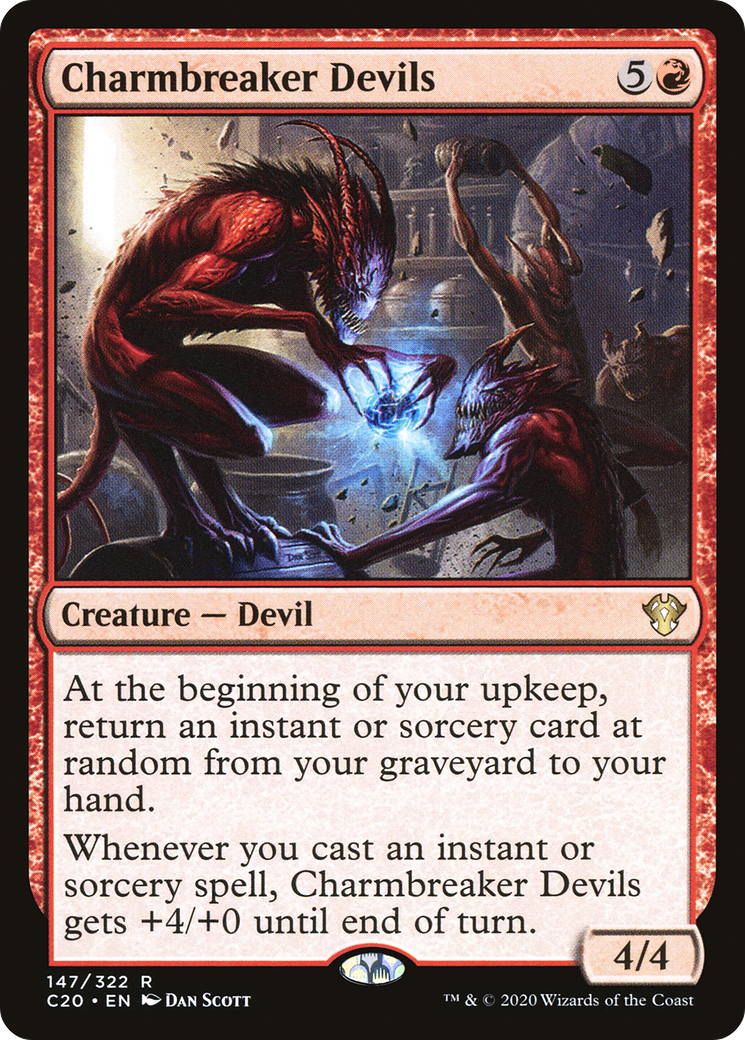
Charmbreaker Devils
Charmbreaker Devils
Creature — Devil
4/4
At the beginning of your upkeep, return an instant or sorcery card at random from your graveyard to your hand.
Whenever you cast an instant or sorcery spell, this creature gets +4/+0 until end of turn.
- The instant or sorcery card returned to your hand is chosen at random as Charmbreaker Devils's first ability resolves. If any player responds to the ability, that player won't yet know what card will be returned.
- Because the first ability doesn't target the instant or sorcery card, any instants or sorceries put into your graveyard in response to that ability may be returned to your hand.
- All players get to see which card you chose at random as it's returned to your hand.
-
1
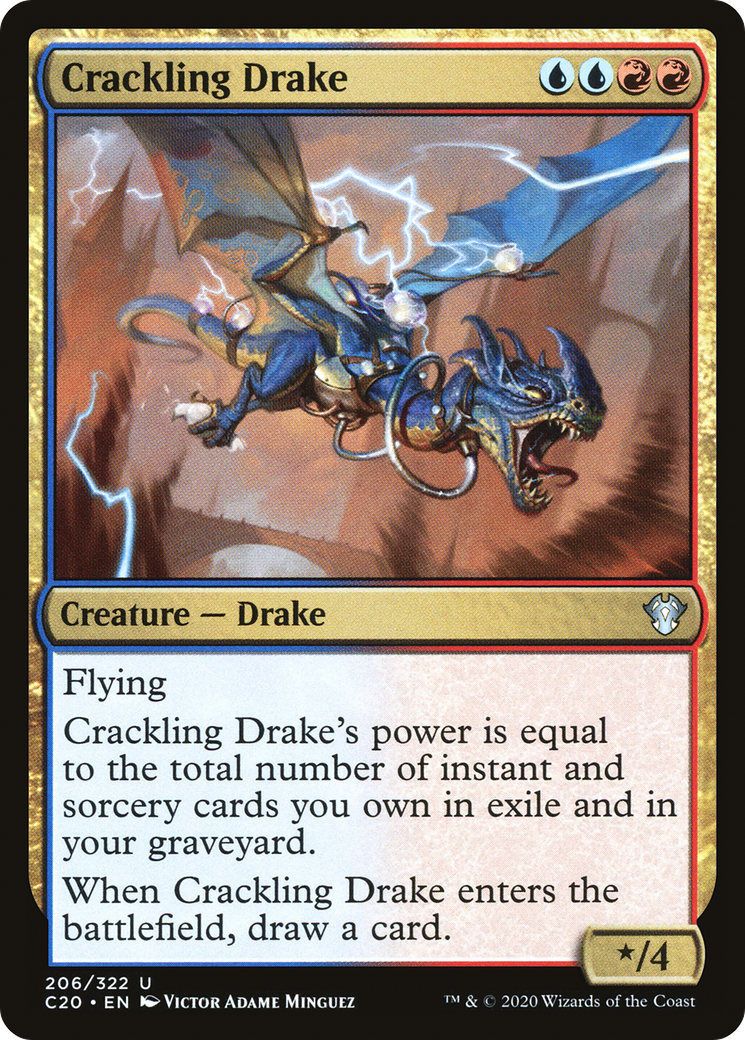
Crackling Drake
Crackling Drake
Creature — Drake
*/4
Flying
Crackling Drake's power is equal to the total number of instant and sorcery cards you own in exile and in your graveyard.
When this creature enters, draw a card.
- If any exiled cards you own are face down, they have no characteristics. If they're normally instants or sorceries, they won't be counted.
- The ability that defines Crackling Drake's power works in all zones.
-
1
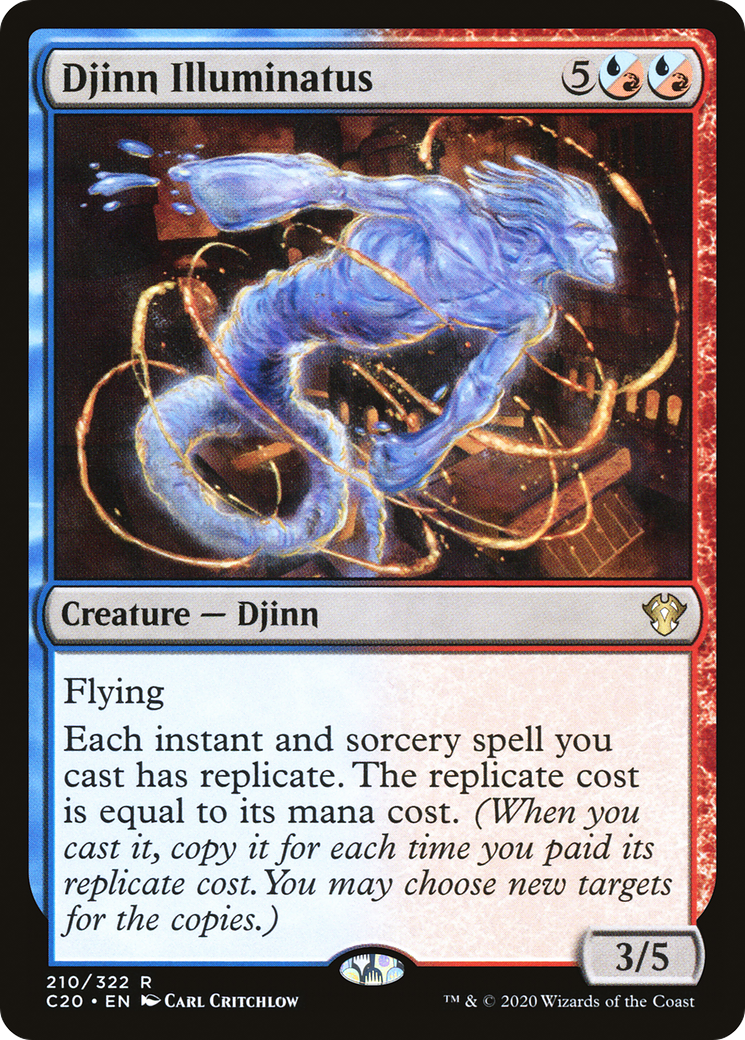
Djinn Illuminatus
Djinn Illuminatus
Creature — Djinn
3/5
( can be paid with either or .)
Flying
Each instant and sorcery spell you cast has replicate. The replicate cost is equal to its mana cost. (When you cast it, copy it for each time you paid its replicate cost. You may choose new targets for the copies.)
- If you cast a spell that already has replicate while you have this creature on the battlefield, the spell will have two replicate abilities: one with a replicate cost as printed on it, and one with a replicate cost equal to its mana cost. (In this set, both costs are always the same.) You may use either ability, or both abilities, to replicate the spell.
- If you cast an instant or sorcery spell that has in its mana cost, the value of X in the spell's replicate cost will be the same as the value of X you chose for its mana cost.
-
1
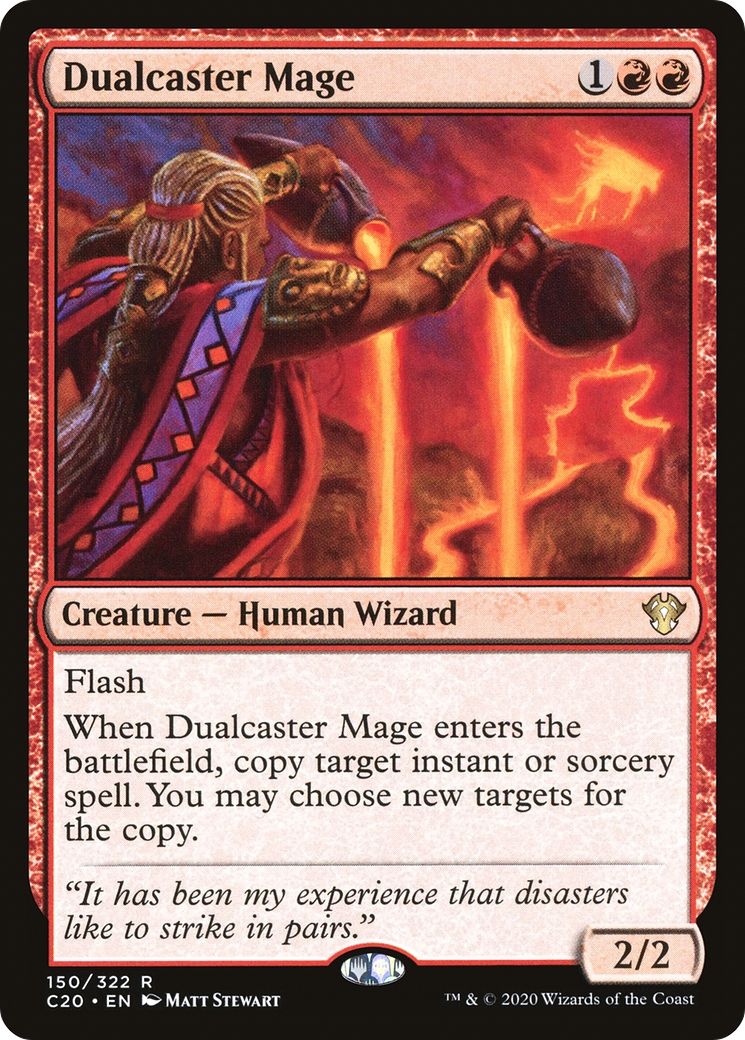
Dualcaster Mage
Dualcaster Mage
Creature — Human Wizard
2/2
Flash
When this creature enters, copy target instant or sorcery spell. You may choose new targets for the copy.
- Dualcaster Mage's triggered ability can target (and copy) any instant or sorcery spell, not just one with targets. It doesn't matter who controls it.
- As Dualcaster Mage's triggered ability resolves, it creates a copy of a spell on the stack. The copy isn't cast, so abilities that trigger when a player casts a spell won't trigger.
- The copy will have the same targets as the spell it's copying unless you choose new ones. You may change any number of the targets, including all of them or none of them. If, for one of the targets, you can't choose a new legal target, then it remains unchanged (even if the current target is illegal).
- You can't choose to pay any additional costs for the copy. However, effects based on any additional or alternative costs paid for the targeted spell are copied as though those same costs were paid for the copy.
- If the spell is modal (that is, it says "Choose one —" or the like), the copy will have the same mode. You can't choose a different one.
- If the spell has an X whose value was determined as it was cast (like Earthquake does), the copy has the same value of X.
- If the copy says that it affects "you," it affects the controller of the copy, not the controller of the original spell. Similarly, if the copy says that it affects an "opponent," it affects an opponent of the copy's controller, not an opponent of the original spell's controller.
-
1
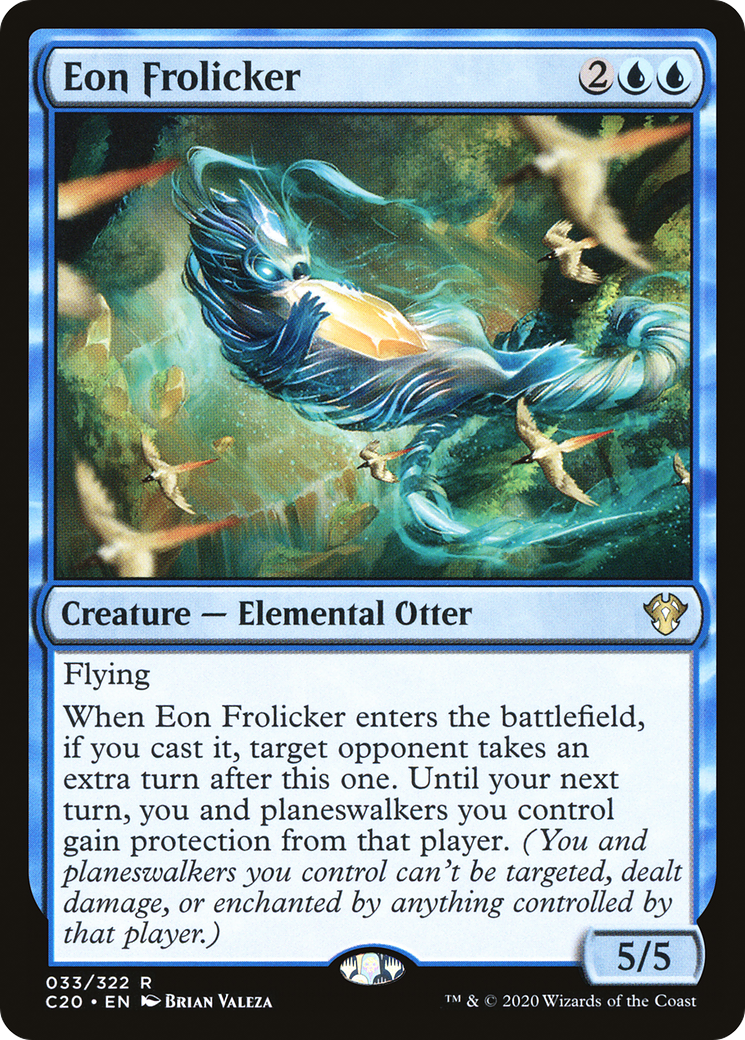
Eon Frolicker
Eon Frolicker
Creature — Elemental Otter
5/5
Flying
When this creature enters, if you cast it, target opponent takes an extra turn after this one. Until your next turn, you and planeswalkers you control gain protection from that player. (You and planeswalkers you control can't be targeted, dealt damage, or enchanted by anything controlled by that player.)
- Protection from a player means that you and each planeswalker you control have protection from each object controlled by that player. If an object has no controller (such as a card in a graveyard), its owner is considered its controller for this purpose.
- Creatures that player controls can still attack you or planeswalkers you control, but the damage they would deal will be prevented.
-
1
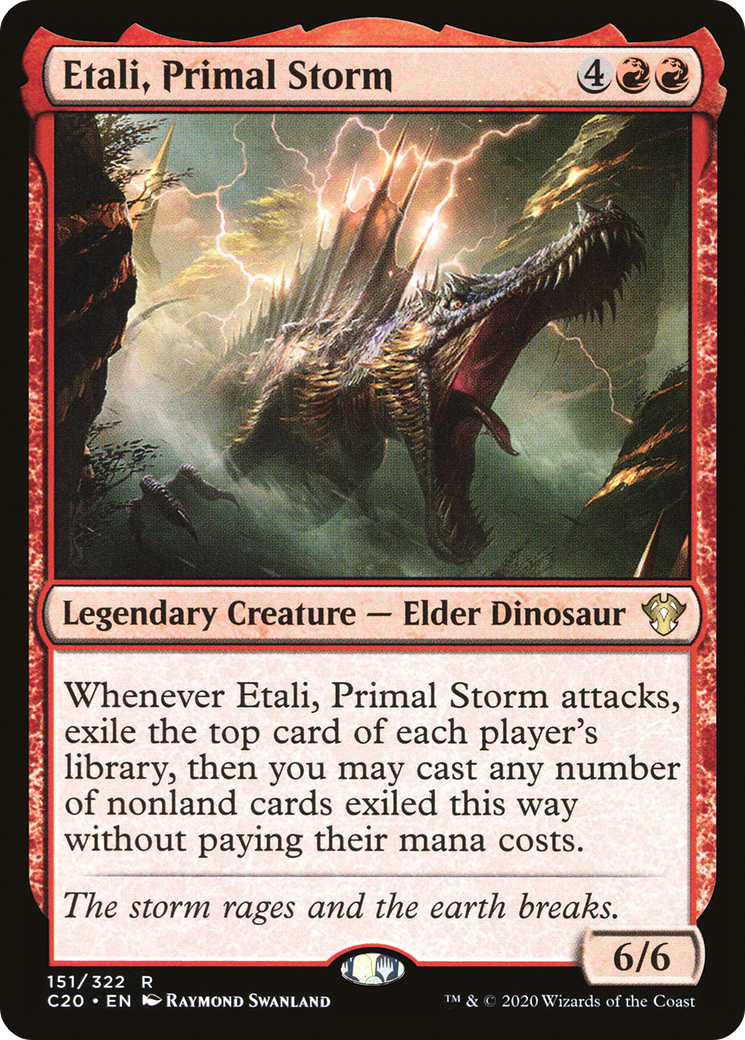
Etali, Primal Storm
Etali, Primal Storm
Legendary Creature — Elder Dinosaur
6/6
Whenever Etali attacks, exile the top card of each player's library, then you may cast any number of spells from among those cards without paying their mana costs.
- If an exiled card has in its mana cost, you must choose 0 as the value of X when casting it without paying its mana cost.
- If you cast any of the exiled cards, you do so as part of the resolution of the triggered ability. You can't wait to cast them later in the turn. Timing permissions based on a card's type are ignored, and the spells resolve before blockers are declared.
- If you cast a card "without paying its mana cost," you can't pay any alternative costs. You can, however, pay additional costs. If the card has any mandatory additional costs, those must be paid to cast the card.
- If you cast more than one of the exiled cards, you choose the order in which to cast them. A spell you cast this way can be the target of a later spell you cast this way. However, permanent spells cast this way won't resolve until you're done casting spells, so the permanents they become can't be the target of spells cast this way. For example, if you exile Twincast and Lightning Strike, you can cast Lightning Strike and then cast Twincast targeting it; but if you exile a creature card and an Aura card, you can't cast that Aura targeting that creature.
- Any cards not cast, including land cards, remain in exile. They can't be cast on later turns, even if Etali attacks again.
- Because all attacking creatures are chosen at once, a creature cast this way can't attack during the same combat as Etali, even if it has haste.
- In a multiplayer game, if a player leaves the game, all cards that player owns leave as well. If you leave the game, any spells or permanents you control from Etali's ability are exiled.
-
1
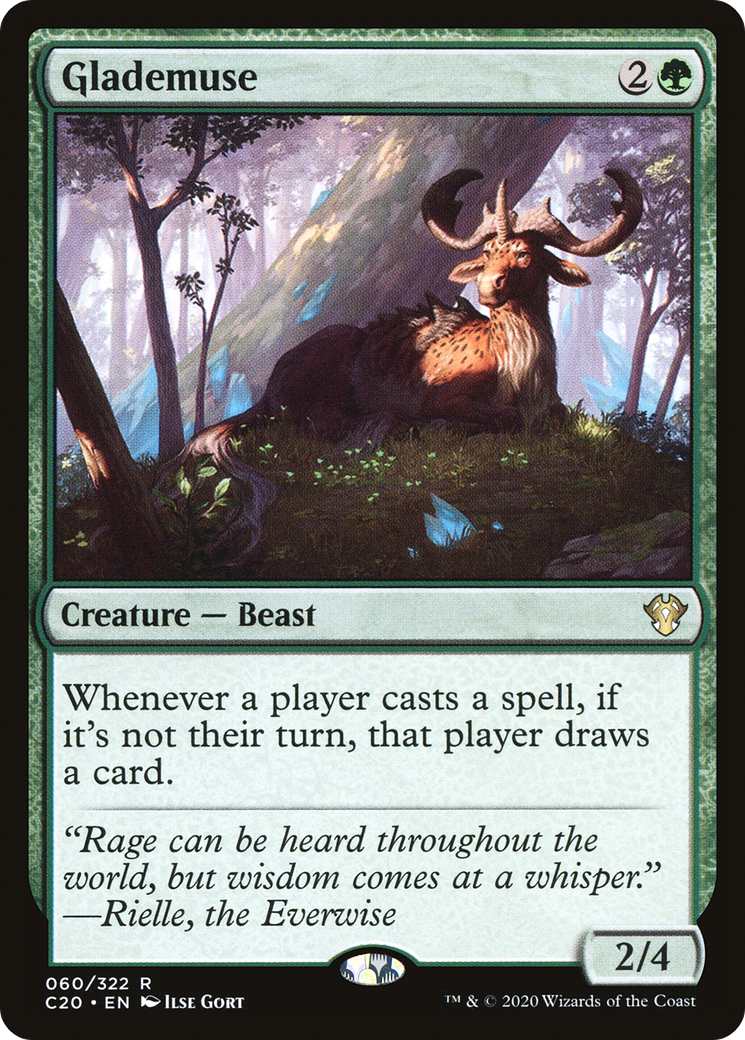
Glademuse
Glademuse
Creature — Beast
2/4
Whenever a player casts a spell, if it's not their turn, that player draws a card.
- An ability that triggers when a player casts a spell resolves before the spell that caused it to trigger. It resolves even if that spell is countered.
- Players can cast spells and activate abilities after the triggered ability resolves but before the spell that caused it to trigger does.
-
1
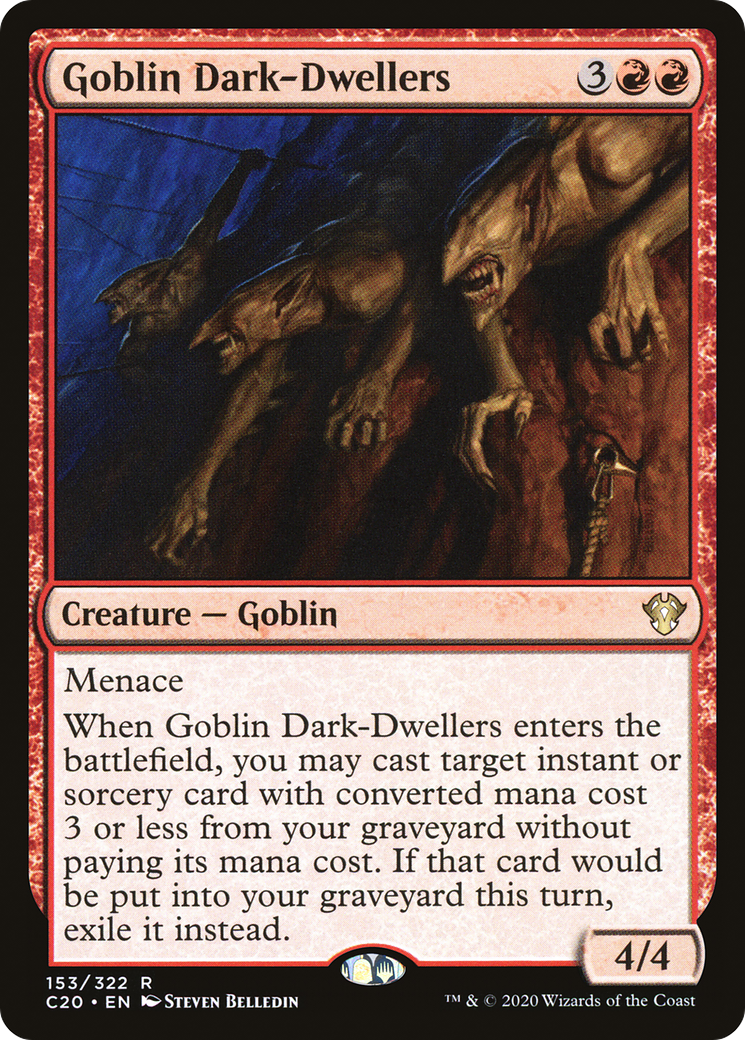
Goblin Dark-Dwellers
Goblin Dark-Dwellers
Creature — Goblin
4/4
Menace (This creature can't be blocked except by two or more creatures.)
When this creature enters, you may cast target instant or sorcery card with mana value 3 or less from your graveyard without paying its mana cost. If that spell would be put into your graveyard, exile it instead.
- You cast the card during the resolution of the enters-the-battlefield ability, not later in the turn. If it's a sorcery card, ignore the timing restrictions based on it being a sorcery card. Other timing restrictions, such as "Cast [this card] only during combat," must be followed.
- If you can't cast the target instant or sorcery card, perhaps because there are no legal targets available, or if you choose not to cast it, it will remain in your graveyard.
- If you cast a card "without paying its mana cost," you can't pay alternative costs such as surge costs. You can pay additional costs. If the card has mandatory additional costs, you must pay those.
- If the instant or sorcery card has in its mana cost, you must choose 0 as its value.
- If an instant or sorcery card you cast this way is countered, it will be exiled.
- If an instant or sorcery card you cast this way goes to a zone other than exile or a graveyard, perhaps because one of its abilities says to put it into its owner's hand, it won't be exiled. This is true even if the card would be put into a graveyard later that turn.
-
1
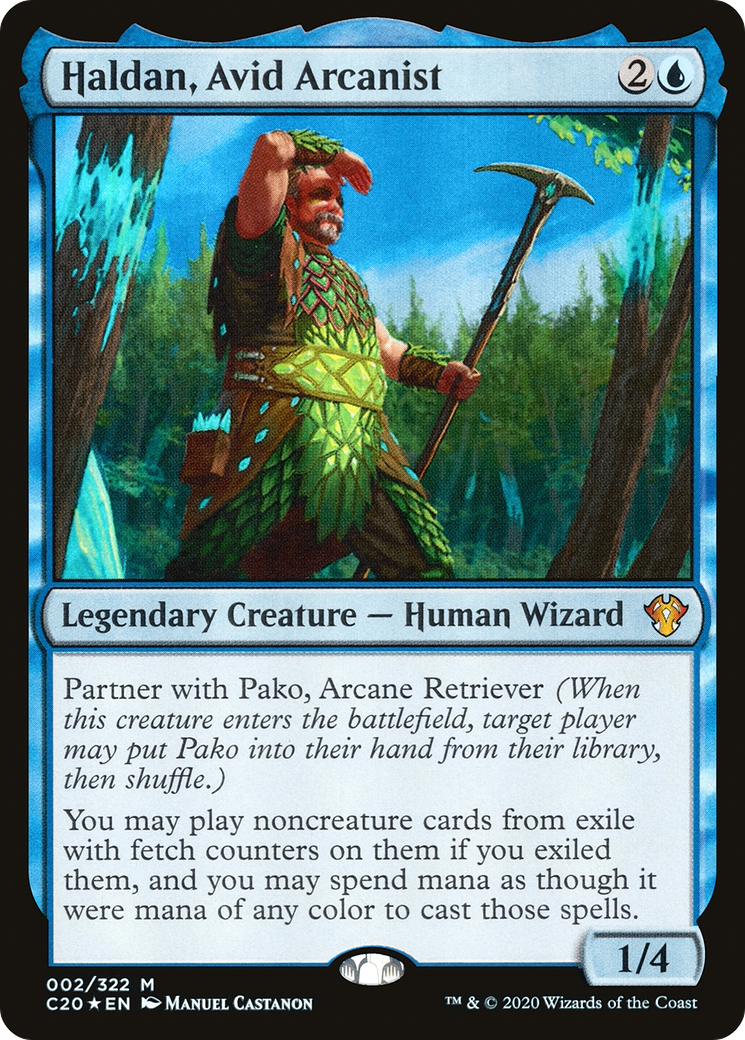
Haldan, Avid Arcanist
Haldan, Avid Arcanist
Legendary Creature — Human Wizard
1/4
Partner with Pako, Arcane Retriever (When this creature enters, target player may put Pako into their hand from their library, then shuffle.)
You may play lands and cast noncreature spells from among cards you exiled that have fetch counters on them, and you may spend mana as though it were mana of any color to cast those spells.
- Haldan's ability applies only while it's on the battlefield. You'll be able to play cards you exiled with fetch counters before Haldan entered the battlefield, and if Haldan leaves, you won't be able to play cards that were exiled with fetch counters until Haldan returns.
- Haldan doesn't change when you can play the exiled cards. For example, if you exile a sorcery card, you can cast it only during your main phase when the stack is empty. If you exile a land card, you can play it only during your main phase and only if you have an available land play remaining.
- A creature card that you exiled with a fetch counter on it may be cast as a noncreature spell if a rule or effect (such as that of adventurer cards) allows you to do so.
- In a multiplayer game, if a player leaves the game, all cards that player owns leave as well. If you leave the game, any spells or permanents you control that Pako fetched are exiled.
- "Partner with [name]" represents two abilities. The first is a triggered ability: "When this permanent enters the battlefield, target player may search their library for a card named [name], reveal it, put it into their hand, then shuffle their library."
- Note that the target player searches their library (which may be affected by effects such as that of Stranglehold) and that the card they find is revealed, even though these words aren't included in the ability's reminder text.
- The second ability represented by the "partner with [name]" keyword modifies the rules for deck construction in the Commander variant and has no function outside of that variant. If a legendary creature card with "partner with [name]" is designated as your commander, the named legendary creature card can also be designated as your commander.
- If your Commander deck has two commanders, you can only include cards whose own color identities are also found in your commanders' combined color identities. If Haldan and Pako are your commanders, your deck may contain cards with blue, red, and/or green in their color identity, but not cards with white or black.
- Both commanders start in the command zone, and the remaining 98 cards of your deck are shuffled to become your library.
- A creature with a "partner with" ability can't partner with any creature other than its designated partner. Losing a partner ability during the game doesn't cause either to cease to be your commander.
- Once the game begins, your two commanders are tracked separately. If you cast one, you won't have to pay an additional the first time you cast the other. A player loses the game after having been dealt 21 damage from one of them, not from both of them combined. Command Beacon's effect puts one into your hand from the command zone, not both.
- The triggered ability of the "partner with" keyword still triggers in a Commander game. If your other commander has somehow ended up in your library, you can find it. You can also target another player who might have that card in their library.
-
1
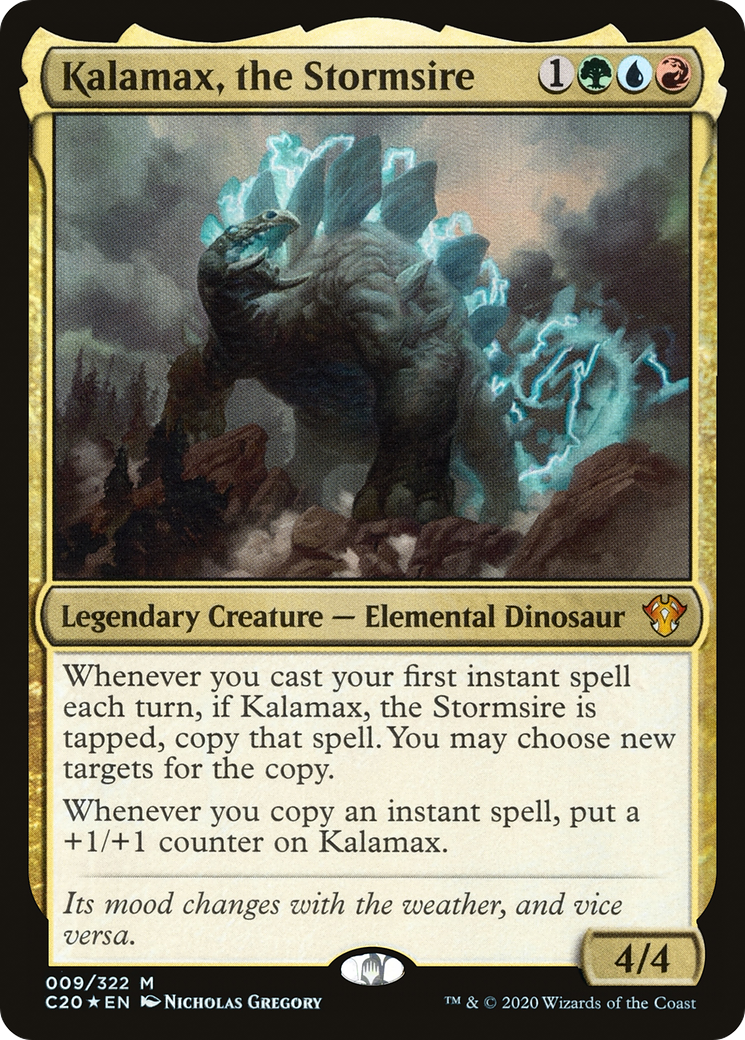
Kalamax, the Stormsire
Kalamax, the Stormsire
Legendary Creature — Elemental Dinosaur
4/4
Whenever you cast your first instant spell each turn, if Kalamax is tapped, copy that spell. You may choose new targets for the copy.
Whenever you copy an instant spell, put a +1/+1 counter on Kalamax.
- If Kalamax becomes tapped as a cost to cast your first instant spell in a turn, its first ability triggers.
- Kalamax's first ability considers the entire turn. If you cast an instant spell before Kalamax becomes tapped, its first ability won't trigger when you cast your second.
- A copy is created even if the spell that caused Kalamax's ability to trigger has been countered by the time that ability resolves. The copy resolves before the original spell.
- If the spell that's copied is modal (that is, it says "Choose one —" or the like), the copy created by Kalamax's first ability will have the same mode or modes. You can't choose different ones.
- If the spell that's copied has damage divided as it was cast, the division can't be changed, although the targets receiving that damage still can. The same is true of spells that distribute counters.
- You can't choose to pay any additional costs for the copy created by Kalamax's first ability. However, effects based on any additional costs that were paid for the original spell are copied as though those same costs were paid for the copy too.
- The copies that Kalamax's first ability creates are created on the stack, so they're not "cast." Abilities that trigger when a player casts a spell won't trigger.
- An ability that triggers when a player copies a spell resolves before the copy. It resolves even if that spell is countered.
- If an effect copies an instant spell multiple times, Kalamax's last ability triggers that many times.
- If an effect copies a card rather than a spell (such as that of God-Eternal Kefnet), this doesn't cause Kalamax's last ability to trigger.
-
1
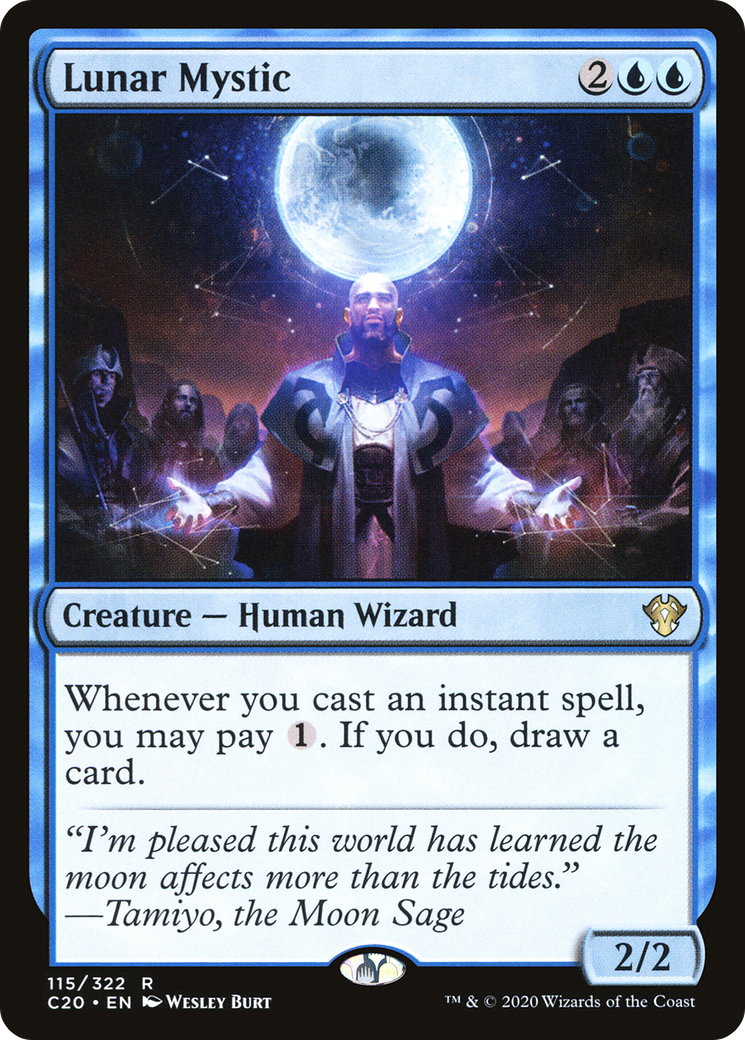
Lunar Mystic
Lunar Mystic
Creature — Human Wizard
2/2
Whenever you cast an instant spell, you may pay . If you do, draw a card.
- The triggered ability will go on the stack on top of the instant spell and resolve before it.
- The decision to pay is made when the triggered ability resolves. It’s not an additional cost of the instant spell.
-
1
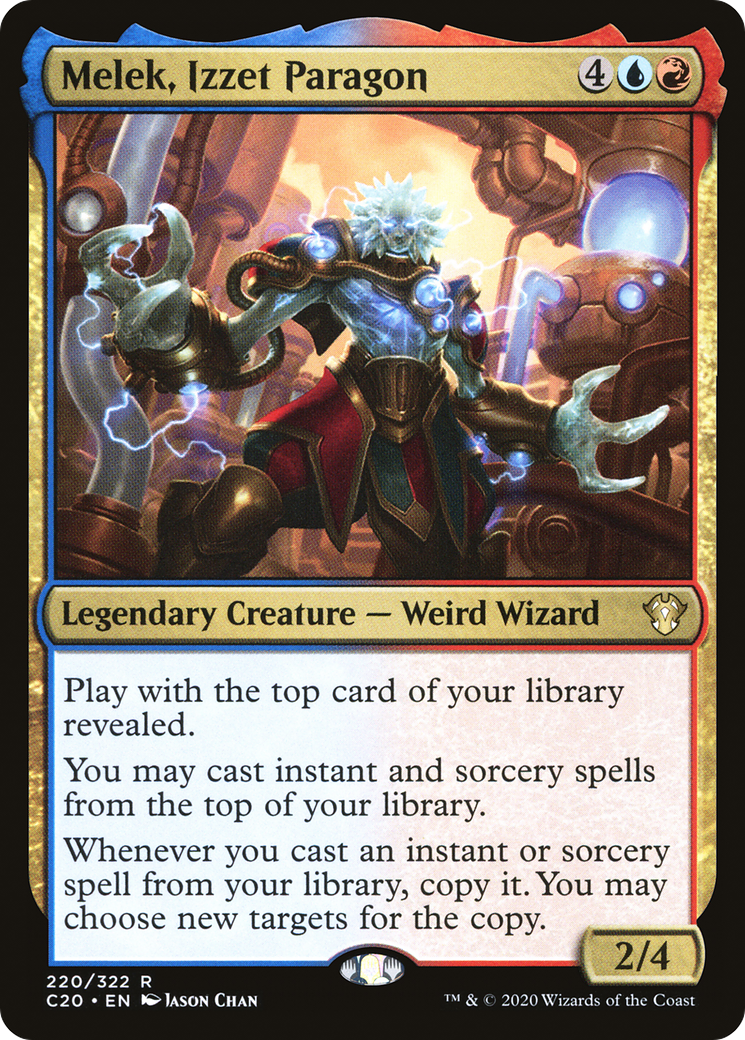
Melek, Izzet Paragon
Melek, Izzet Paragon
Legendary Creature — Weird Wizard
2/4
Play with the top card of your library revealed.
You may cast instant and sorcery spells from the top of your library.
Whenever you cast an instant or sorcery spell from your library, copy it. You may choose new targets for the copy.
- Melek doesn’t affect the timing rules associated with when you can cast the card. If it’s a sorcery card, you can cast it only during your main phase when the stack is empty.
- You still pay all costs for that spell, including additional costs. You may also pay alternative costs, such as overload costs. Although you can’t pay additional costs for the copy that’s created, effects based on any additional costs that were paid for the original spell are copied as though those same costs were paid for the copy too. For example, if a player sacrifices a 3/3 creature to cast Fling, and you copy it, the copy of Fling will also deal 3 damage to its target.
- Melek’s last ability will copy any instant or sorcery spell you cast from your library, not just one with targets.
- When the last ability resolves, it creates a copy of the spell. You control the copy. That copy is created on the stack, so it’s not “cast.” Abilities that trigger when a player casts a spell won’t trigger. The copy will then resolve like a normal spell, after players get a chance to cast spells and activate abilities.
- The copy will have the same targets as the spell it’s copying unless you choose new ones. You may change any number of the targets, including all of them or none of them. If, for one of the targets, you can’t choose a new legal target, then it remains unchanged (even if the current target is illegal).
- If the spell being copied is modal (that is, it says “Choose one —” or the like), the copy will have the same mode. You can’t choose a different one.
- If the spell being copied has an X whose value was determined as it was cast (like Debt to the Deathless has), the copy has the same value of X.
- Instant and sorcery cards with miracle allow a player to cast a card immediately upon drawing it. If you cast a spell this way, you’re casting it from your hand, not your library. Melek’s ability won’t trigger.
- The top card of your library isn’t in your hand, so you can’t suspend it, cycle it, discard it, or activate any of its activated abilities.
- If the top card of your library changes while you’re casting a spell, playing a land, or activating an ability, the new top card won’t be revealed until you finish doing so.
- When playing with the top card of your library revealed, if an effect tells you to draw several cards, reveal each one before you draw it.
-
1
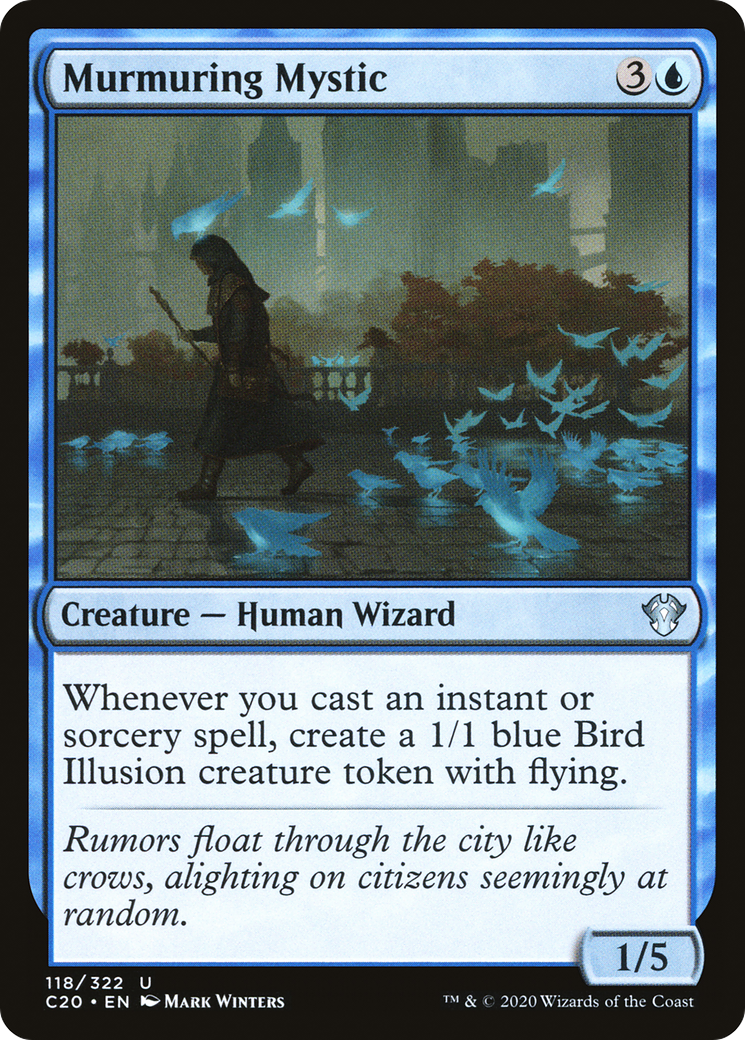
Murmuring Mystic
Murmuring Mystic
Creature — Human Wizard
1/5
Whenever you cast an instant or sorcery spell, create a 1/1 blue Bird Illusion creature token with flying.
- Murmuring Mystic's triggered ability resolves before the spell that caused it to trigger. It resolves even if that spell is countered.
-
1
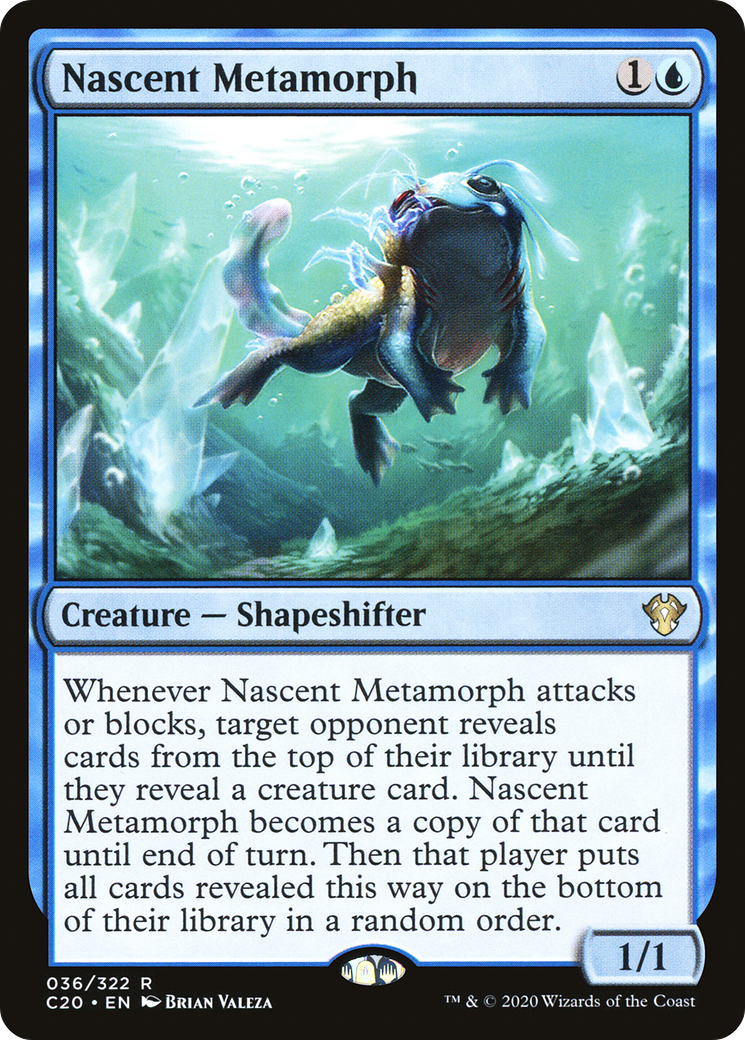
Nascent Metamorph
Nascent Metamorph
Creature — Shapeshifter
1/1
Whenever this creature attacks or blocks, target opponent reveals cards from the top of their library until they reveal a creature card. This creature becomes a copy of that card until end of turn. Then that player puts all cards revealed this way on the bottom of their library in a random order.
- The creature card that Nascent Metamorph becomes a copy of is put onto the bottom of the library along with any other cards.
- If the target opponent has no creature cards in their library, Nascent Metamorph doesn't become a copy of anything. The cards are returned to that library in a random order.
- If another permanent becomes a copy of Nascent Metamorph, it will become whatever Nascent Metamorph is copying. It remains a copy when Nascent Metamorph's effect ends.
- If an effect begins to apply to Nascent Metamorph before it becomes a copy, that effect will continue to apply.
- If Nascent Metamorph becomes a copy of a legendary card with the same name as a legendary permanent you control, you'll put one of them into its owner's graveyard.
- If Nascent Metamorph becomes a copy of an object with a set of linked abilities (for example, one ability that exiles a card and another that refers to the card "exiled with" the object), that link only lasts as long as Nascent Metamorph is copying that object. If it stops being a copy of that object and then becomes a copy again later, the link is lost.
-
1
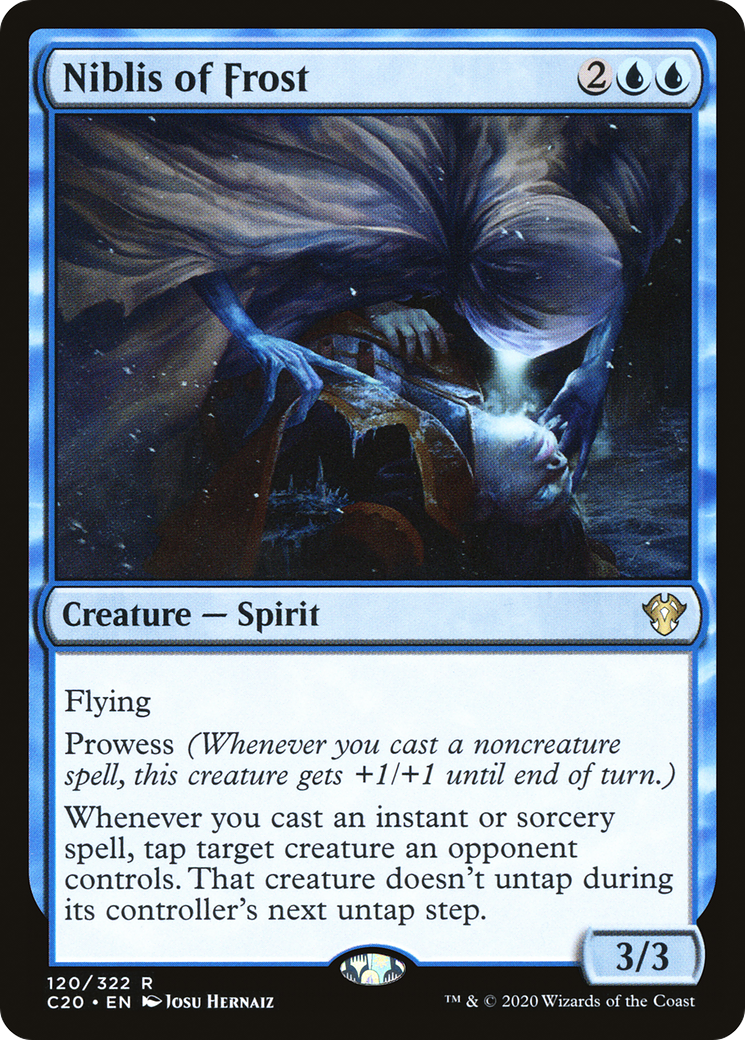
Niblis of Frost
Niblis of Frost
Creature — Spirit
3/3
Flying
Prowess (Whenever you cast a noncreature spell, this creature gets +1/+1 until end of turn.)
Whenever you cast an instant or sorcery spell, tap target creature an opponent controls. That creature doesn't untap during its controller's next untap step.
- If multiple effects say that a creature doesn’t untap during its controller’s next untap step, those effects all apply during one untap step. For example, if you cast two instants in one turn and target the same creature twice with Niblis of Frost’s ability, that creature will only spend one untap step without untapping.
-
1
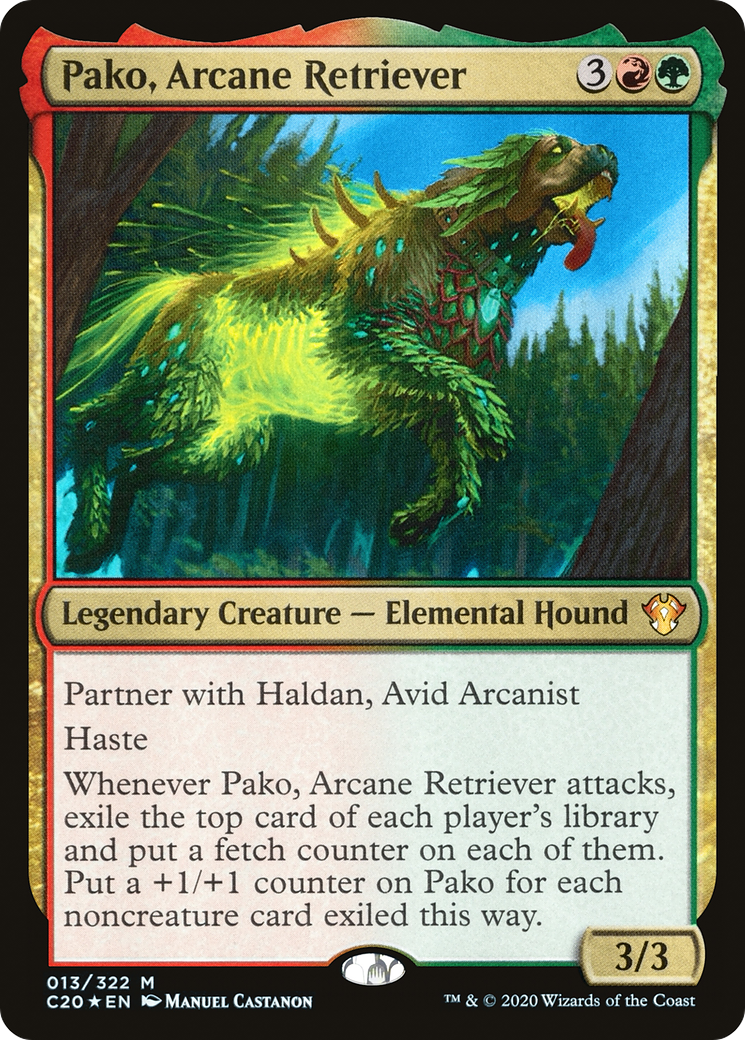
Pako, Arcane Retriever
Pako, Arcane Retriever
Legendary Creature — Elemental Dog
3/3
Partner with Haldan, Avid Arcanist
Haste
Whenever Pako attacks, exile the top card of each player's library and put a fetch counter on each of them. Put a +1/+1 counter on Pako for each noncreature card exiled this way.
- You exile cards and put +1/+1 counters on Pako all while Pako's last ability is resolving. Nothing can happen between the two, and no player may choose to take actions.
-
1
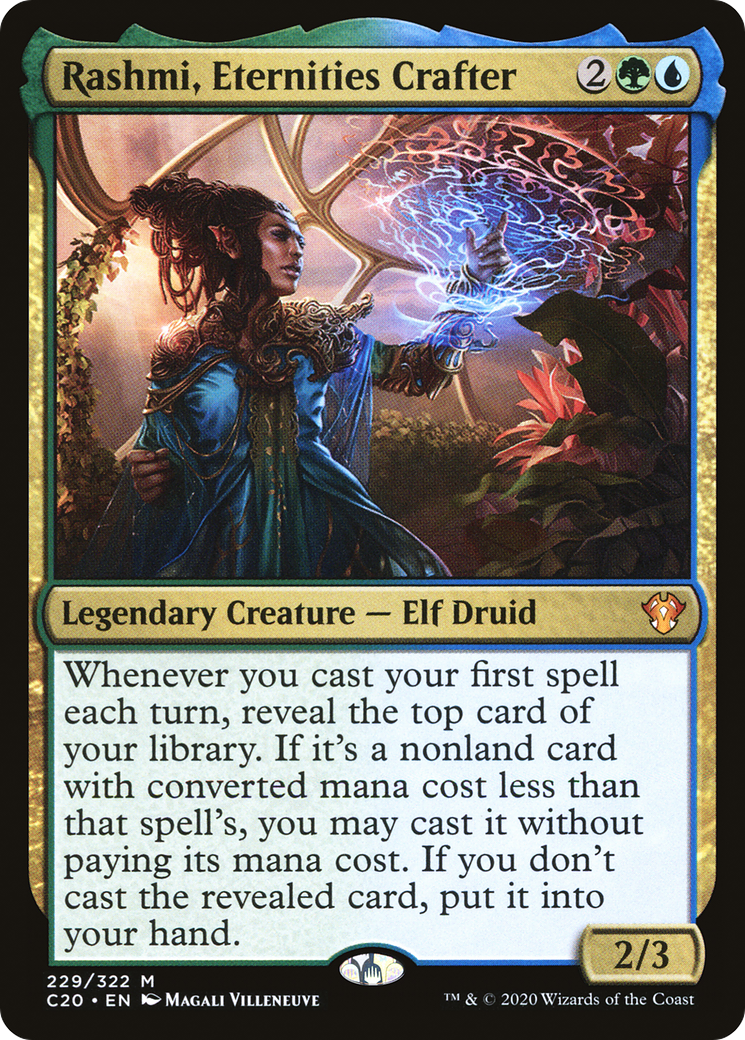
Rashmi, Eternities Crafter
Rashmi, Eternities Crafter
Legendary Creature — Elf Druid
2/3
Whenever you cast your first spell each turn, reveal the top card of your library. You may cast it without paying its mana cost if it's a spell with lesser mana value. If you don't cast it, put it into your hand.
- If the revealed card is a land card, you put it into your hand.
- Rashmi's ability triggers when you cast your first spell each turn, not just on your turn.
- Rashmi has to be on the battlefield at the moment you cast your first spell. If that spell is Rashmi itself, Rashmi's ability can't trigger. If that spell causes Rashmi to leave the battlefield as an additional cost to cast it, Rashmi's ability can't trigger.
- Rashmi's ability resolves before the spell that caused it to trigger. If you cast a spell using the ability, it will also resolve before the initial spell.
- For spells with in their mana costs, use the value chosen for X to determine the spell's mana value. For cards in your library with in their mana costs, X is considered to be 0.
- If Rashmi's ability resolves and the spell that caused it to trigger has been countered, use that spell's mana value as it last existed on the stack to determine whether or not you may cast the top card of your library.
- If you cast the top card of your library, you do so as part of the resolution of Rashmi's ability. You can't wait to cast it later in the turn. Timing permissions based on the card's type are ignored, but other restrictions (such as "Cast [this card] only during combat") are not.
- If you cast a card "without paying its mana cost," you can't choose to cast it for any alternative costs, such as emerge costs. You can, however, pay additional costs. If the card has any mandatory additional costs, such as that of Cathartic Reunion, those must be paid to cast the card.
- If the card has in its mana cost, you must choose 0 as the value of X when casting it without paying its mana cost.
-
1
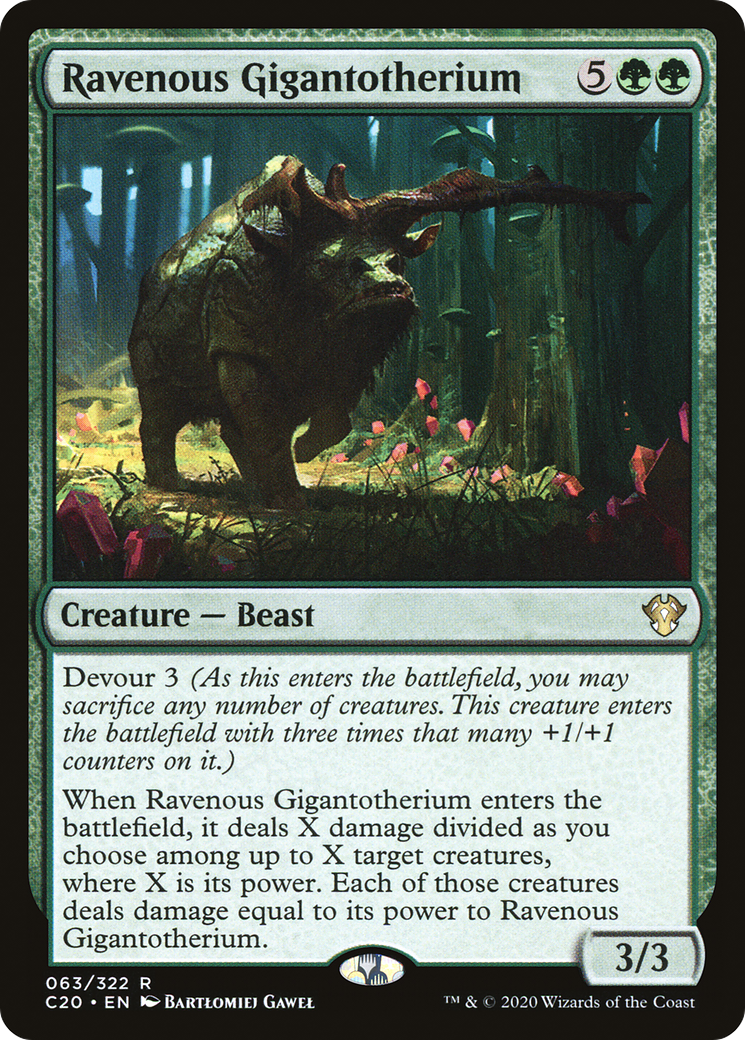
Ravenous Gigantotherium
Ravenous Gigantotherium
Creature — Beast
3/3
Devour 3 (As this creature enters, you may sacrifice any number of creatures. It enters with three times that many +1/+1 counters on it.)
When this creature enters, it deals X damage divided as you choose among up to X target creatures, where X is its power. Each of those creatures deals damage equal to its power to this creature.
- Ravenous Gigantotherium can't devour creatures entering the battlefield at the same time as it.
- You divide the damage as Ravenous Gigantotherium's triggered ability is put onto the stack, not as it resolves. Each target must be assigned at least 1 damage. You can't choose more than X targets and assign 0 damage to a target.
- You may choose zero targets. If you do, Ravenous Gigantotherium deals no damage and is dealt no damage.
- If some of the targets become illegal for Ravenous Gigantotherium's ability, the original division of damage still applies, but the damage that would have been dealt to illegal targets isn't dealt at all.
- The value of X is locked in as you divide the damage while putting Ravenous Gigantotherium's ability onto the stack. Changing Ravenous Gigantotherium's power after that time won't change how much damage is dealt.
- Static abilities, such as that of Glorious Anthem, modify Ravenous Gigantotherium's power before its triggered ability is put onto the stack. Spells, activated abilities, and triggered abilities can't raise its power in time to change the value of X.
- The creatures targeted by Ravenous Gigantotherium's ability deal damage back to Ravenous Gigantotherium before dying if they're dealt lethal damage.
-
1
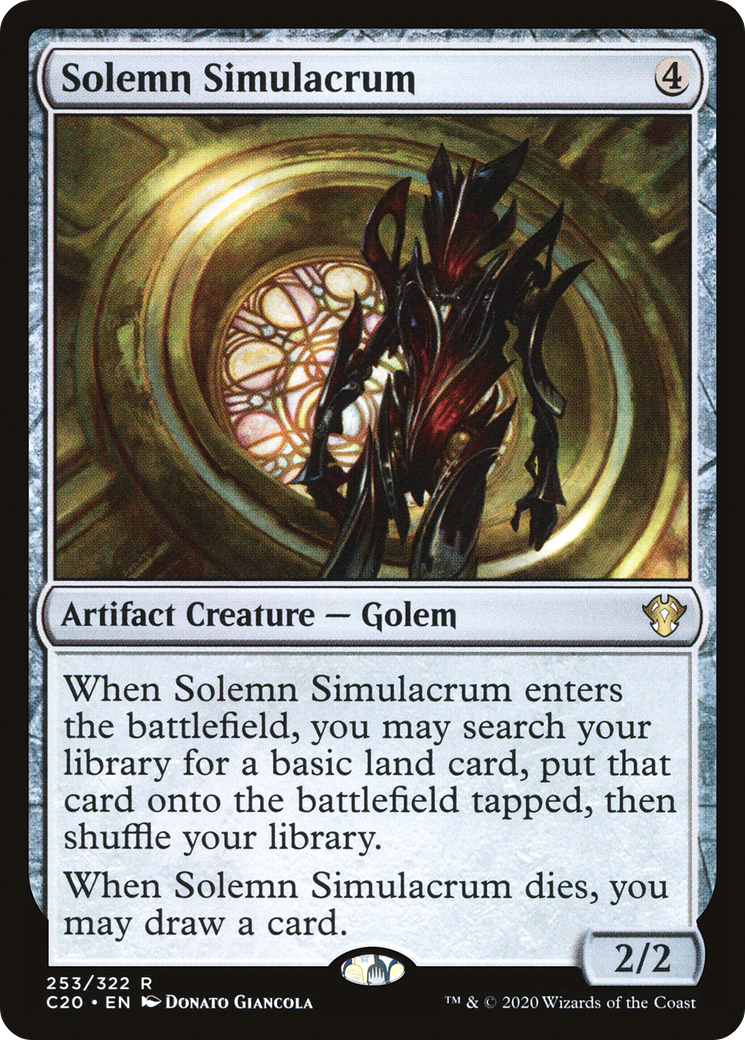
Solemn Simulacrum
Solemn Simulacrum
Artifact Creature — Golem
2/2
When this creature enters, you may search your library for a basic land card, put that card onto the battlefield tapped, then shuffle.
When this creature dies, you may draw a card.
-
1
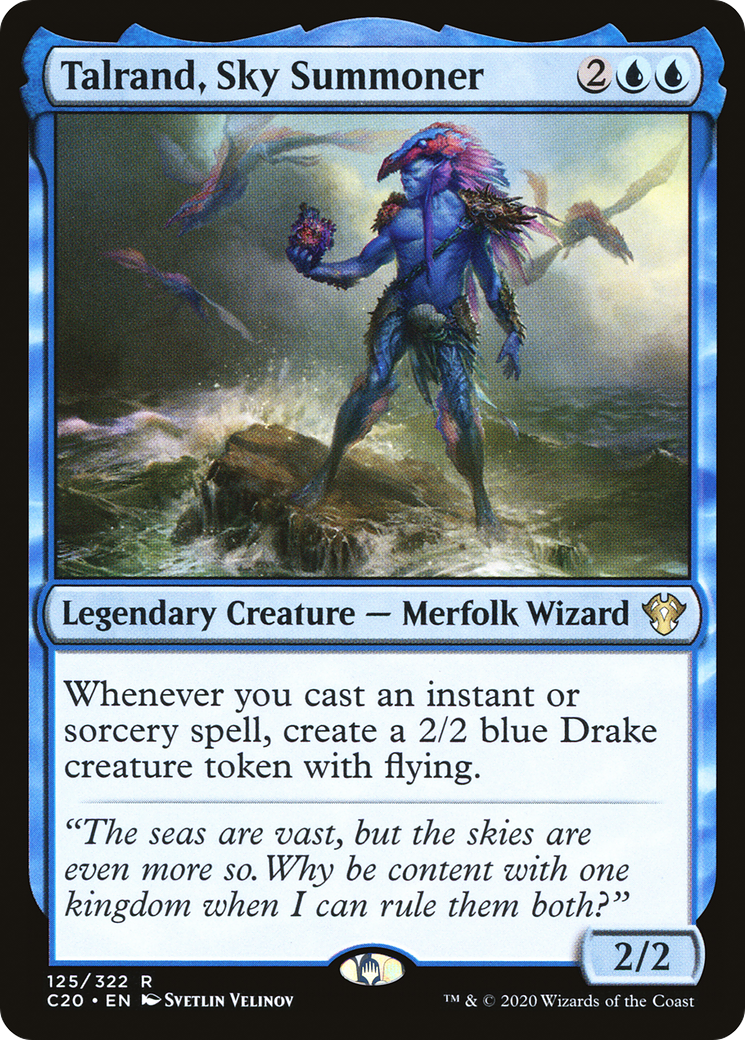
Talrand, Sky Summoner
Talrand, Sky Summoner
Legendary Creature — Merfolk Wizard
2/2
Whenever you cast an instant or sorcery spell, create a 2/2 blue Drake creature token with flying.
- An ability that triggers when a player casts a spell resolves before the spell that caused it to trigger, but after targets have been chosen for that spell. It resolves even if that spell is countered.
-
1
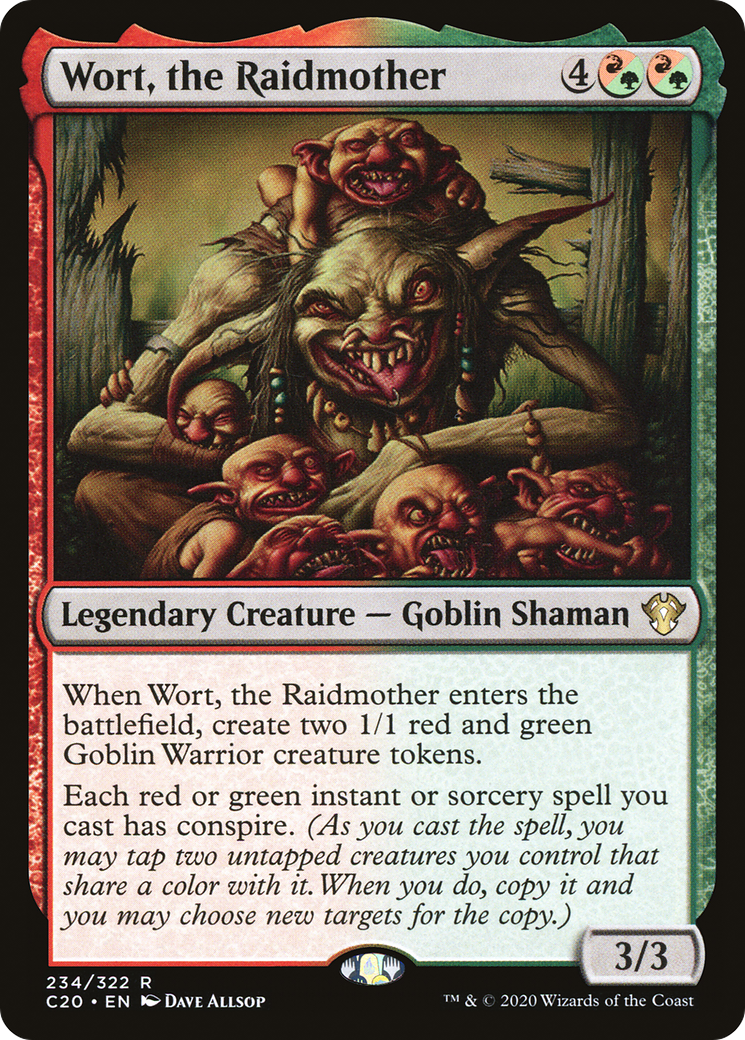
Wort, the Raidmother
Wort, the Raidmother
Legendary Creature — Goblin Shaman
3/3
When Wort enters, create two 1/1 red and green Goblin Warrior creature tokens.
Each red or green instant or sorcery spell you cast has conspire. (As you cast the spell, you may tap two untapped creatures you control that share a color with it. When you do, copy it and you may choose new targets for the copy.)
- If a spell gains a second instance of conspire from Wort's ability, you may choose to pay for one, both, or none of those abilities. Each conspire ability triggers only if you tap two creatures specifically for that ability.
- If the spell that's copied is modal (that is, it says "Choose one —" or the like), the copy will have the same mode. A different mode can't be chosen.
- If the spell that's copied has an X whose value was determined as it was cast (like Bonfire of the Damned does), the copy will have the same value of X.
- If the spell has damage divided as it was cast (like Fiery Justice does), the division can't be changed (although the targets receiving that damage still can).
- Some spells instruct you to sacrifice a creature as an additional cost to cast that spell. If you sacrifice Wort to pay that cost, that spell won't have conspire at the moment it becomes cast, so conspire won't trigger, even if you tapped two creatures.
- If you're casting a spell for its flashback cost, you can't pay another alternative cost (such as an overload cost or a Trap's alternative cost) instead. You may pay additional costs, such as conspire.
-
1
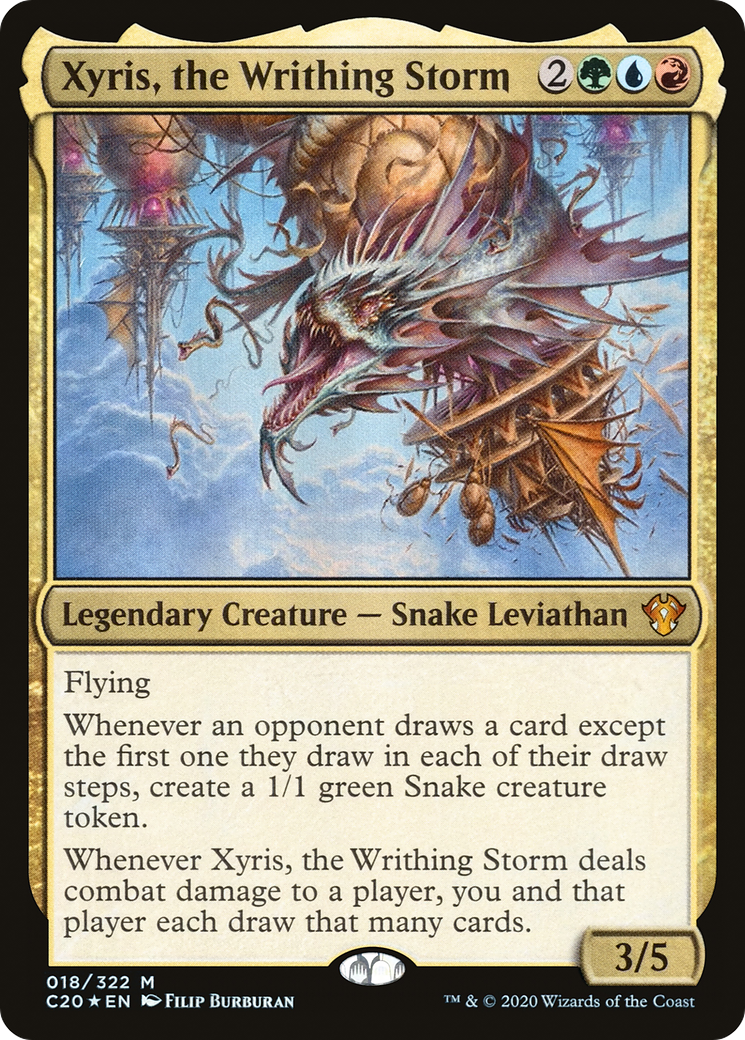
Xyris, the Writhing Storm
Xyris, the Writhing Storm
Legendary Creature — Snake Leviathan
3/5
Flying
Whenever an opponent draws a card except the first one they draw in each of their draw steps, create a 1/1 green Snake creature token.
Whenever Xyris deals combat damage to a player, you and that player each draw that many cards.
- If a spell or ability causes an opponent to put cards into their hand without specifically using the word "draw," it's not a card drawn.
- If the amount of damage Xyris deals is greater than the number of cards in your library but causes the defending player's life total to become 0 or less, that player loses the game before Xyris's ability causes you to draw cards. If there are no other players left in the game, you win the game.
- If the amount of damage Xyris deals is greater than the number of cards in your library and the number of cards in that player's library, you both lose the game at the same time. It doesn't matter if one of you had more cards in library than the other. If there are no other players left in the game, the game is a draw.
Instants 25
-
1
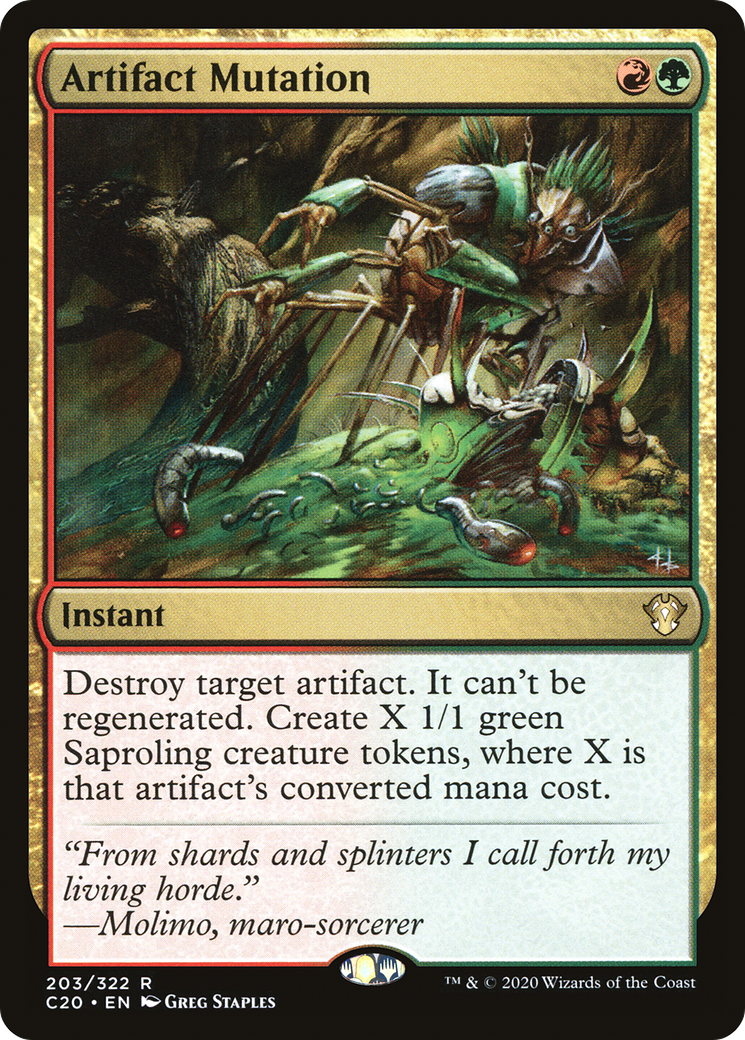
Artifact Mutation
Artifact Mutation
Instant
Destroy target artifact. It can't be regenerated. Create X 1/1 green Saproling creature tokens, where X is that artifact's mana value.
- This spell is countered and you get no Saprolings if the artifact is an illegal target on resolution.
-
1
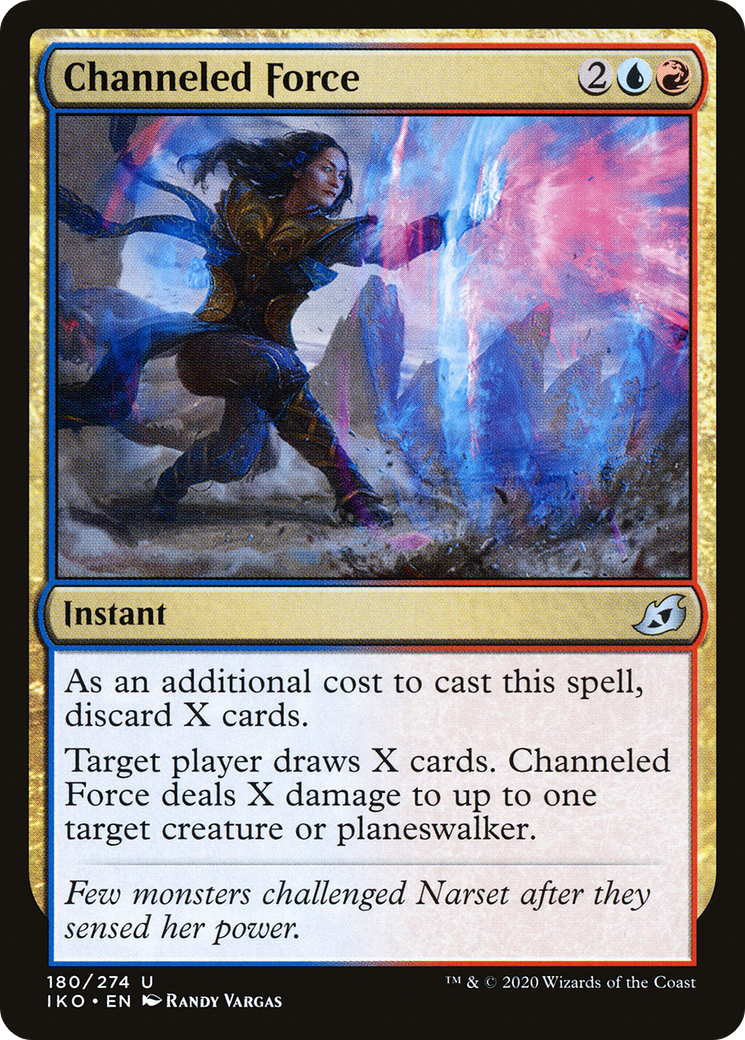
Channeled Force
Channeled Force
Instant
As an additional cost to cast this spell, discard X cards.
Target player draws X cards. Channeled Force deals X damage to up to one target creature or planeswalker.
-
1
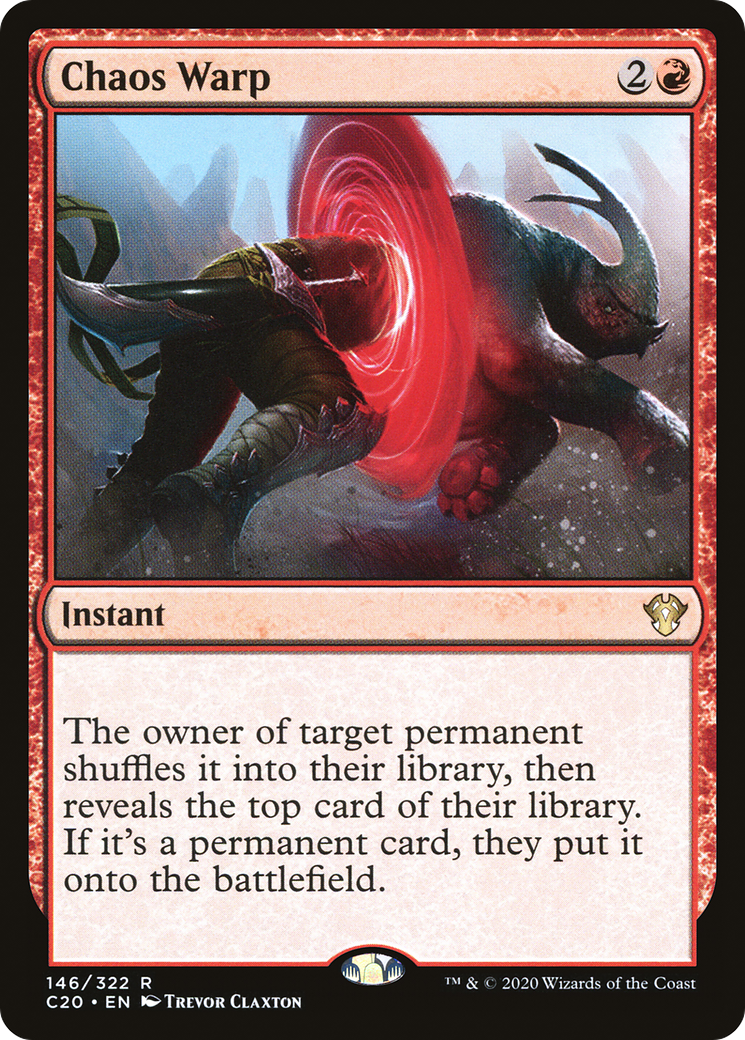
Chaos Warp
Chaos Warp
Instant
The owner of target permanent shuffles it into their library, then reveals the top card of their library. If it's a permanent card, they put it onto the battlefield.
- A permanent card is a card with one or more of the following card types: artifact, creature, enchantment, land, or planeswalker.
- The owner of a token is the player under whose control the token was put onto the battlefield. If a token is shuffled into a player's library this way, that player shuffles before revealing the top card of that library.
- If the revealed card is not a permanent card, it remains on top of that library.
- If the permanent is an illegal target by the time Chaos Warp tries to resolve, it won't resolve and none of its effects will occur. No library will be shuffled and no card will be revealed.
- If the revealed card is a permanent card but can't enter (perhaps because it's an Aura with nothing to enchant), it remains on top of that library.
-
1
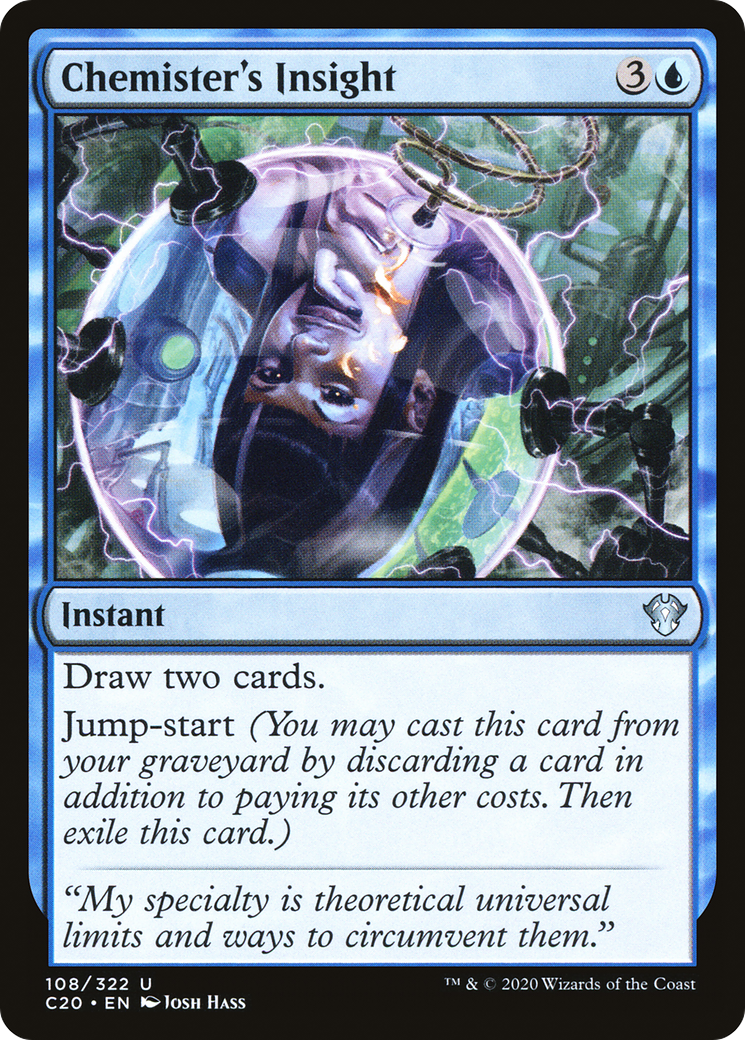
Chemister's Insight
Chemister's Insight
Instant
Draw two cards.
Jump-start (You may cast this card from your graveyard by discarding a card in addition to paying its other costs. Then exile this card.)
- If a card with jump-start is put into your graveyard during your turn, you'll be able to cast it right away if it's legal to do so, before an opponent can take any actions.
- You must still follow any timing restrictions and permissions when casting a spell with jump-start, including those based on the card's type. For instance, you can cast a sorcery using jump-start only when you could normally cast a sorcery.
- A spell cast using jump-start will always be exiled afterward, whether it resolves, it's countered, or it leaves the stack in some other way.
- If an effect allows you to pay an alternative cost rather than a spell's mana cost, you may pay that alternative cost when you jump-start a spell. You'll still discard a card as an additional cost to cast it.
-
1
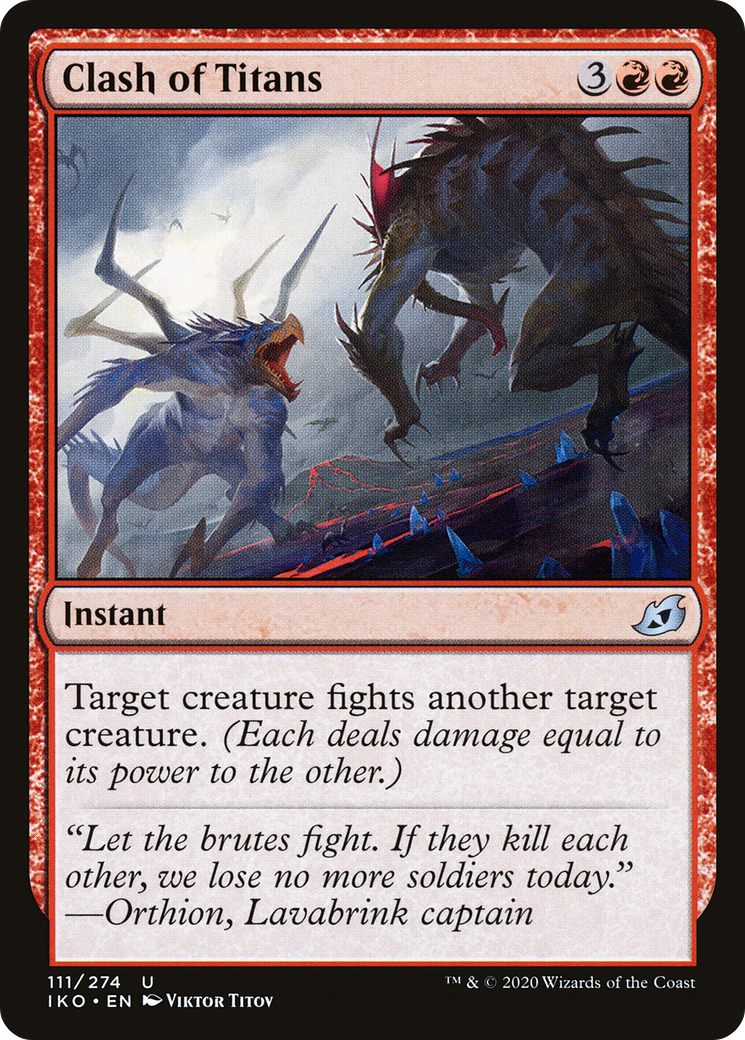
Clash of Titans
Clash of Titans
Instant
Target creature fights another target creature. (Each deals damage equal to its power to the other.)
-
1
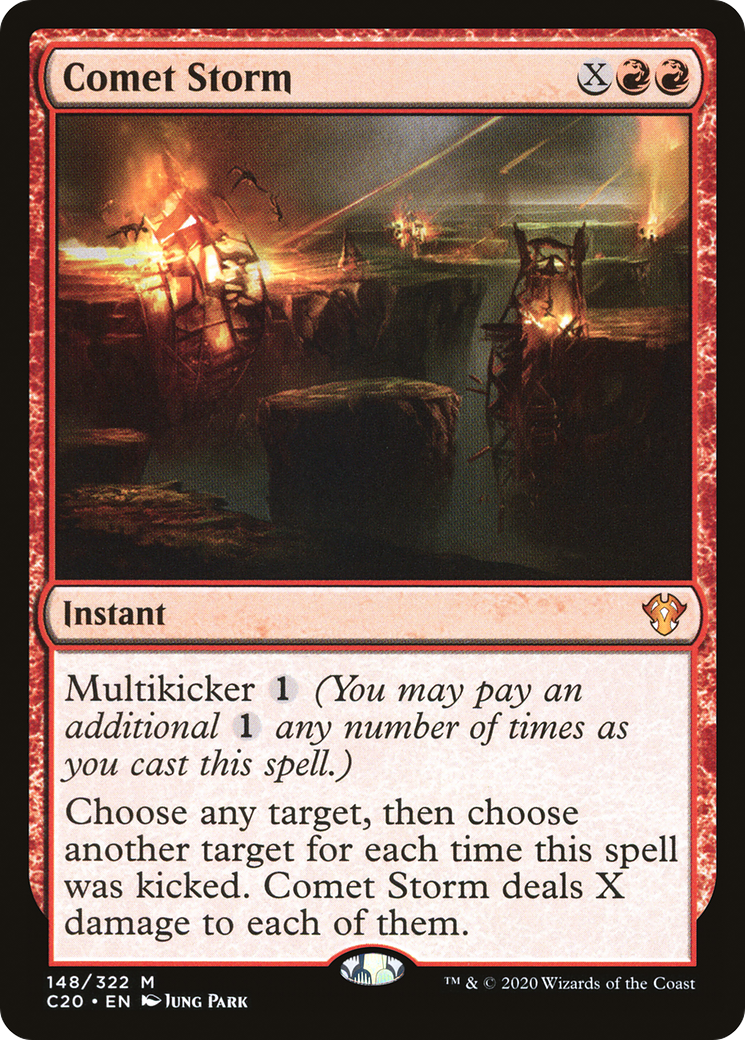
Comet Storm
Comet Storm
Instant
Multikicker (You may pay an additional any number of times as you cast this spell.)
Choose any target, then choose another target for each time this spell was kicked. Comet Storm deals X damage to each of them.
- To determine a spell's total cost, start with the mana cost (or an alternative cost if another card's effect allows you to pay one instead), add any cost increases (such as kicker), then apply any cost reductions. The spell's mana value remains unchanged, no matter what the total cost to cast it was.
- The kicker ability doesn't let you pay a kicker cost more than once.
- If you put a permanent with a kicker ability onto the battlefield without casting it, you can't kick it.
- If you copy a kicked spell on the stack, the copy is also kicked. If the copied spell is a permanent spell, the token the copy of that spell becomes when it enters is also kicked.
- If a card or token enters as a copy of a permanent, the new permanent isn't kicked, even if the original was.
- If a spell's kicker cost was paid, the spell is "kicked."
- Each target you choose must be different.
- For example, if you want Comet Storm to deal 4 damage to each of three different targets, that means X is 4 and you're kicking the spell twice. You'll pay a mana cost of , plus a kicker cost of , plus another kicker cost of , for a total of .
- As long as any of its targets are legal at the time Comet Storm resolves, Comet Storm will deal X damage to each of those legal targets.
- The number of targets you choose for Comet Storm is one more than the number of times it's kicked. First you declare how many times you're going to kick the spell (at the same time you declare the value of X), then you choose the targets accordingly, then you pay the costs. No player can respond between the time you declare how many times you'll kick the spell and the time you choose the targets.
-
1
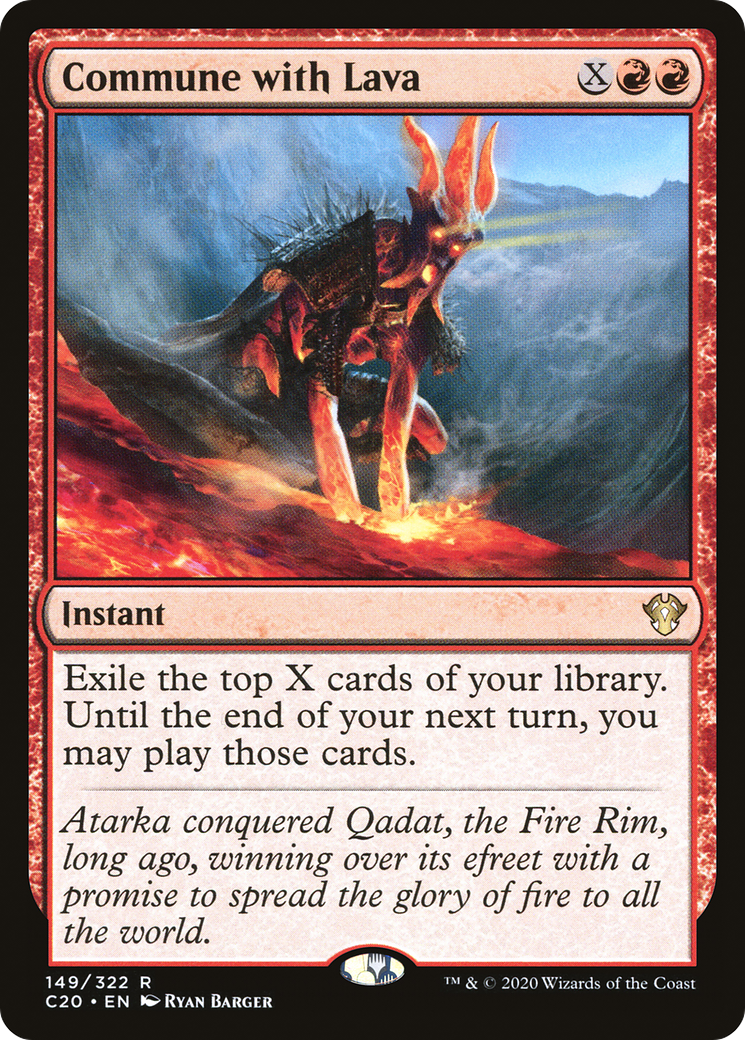
Commune with Lava
Commune with Lava
Instant
Exile the top X cards of your library. Until the end of your next turn, you may play those cards.
- The cards are exiled face up.
- Playing a card this way follows the normal rules for playing the card. You must pay its costs, and you must follow all applicable timing rules. For example, if one of the cards is a creature card, you can cast that card only during your main phase while the stack is empty.
- Under normal circumstances, you can play a land card exiled with Commune with Lava only if you haven't played a land yet that turn.
- Any cards you don't play will remain exiled.
-
1
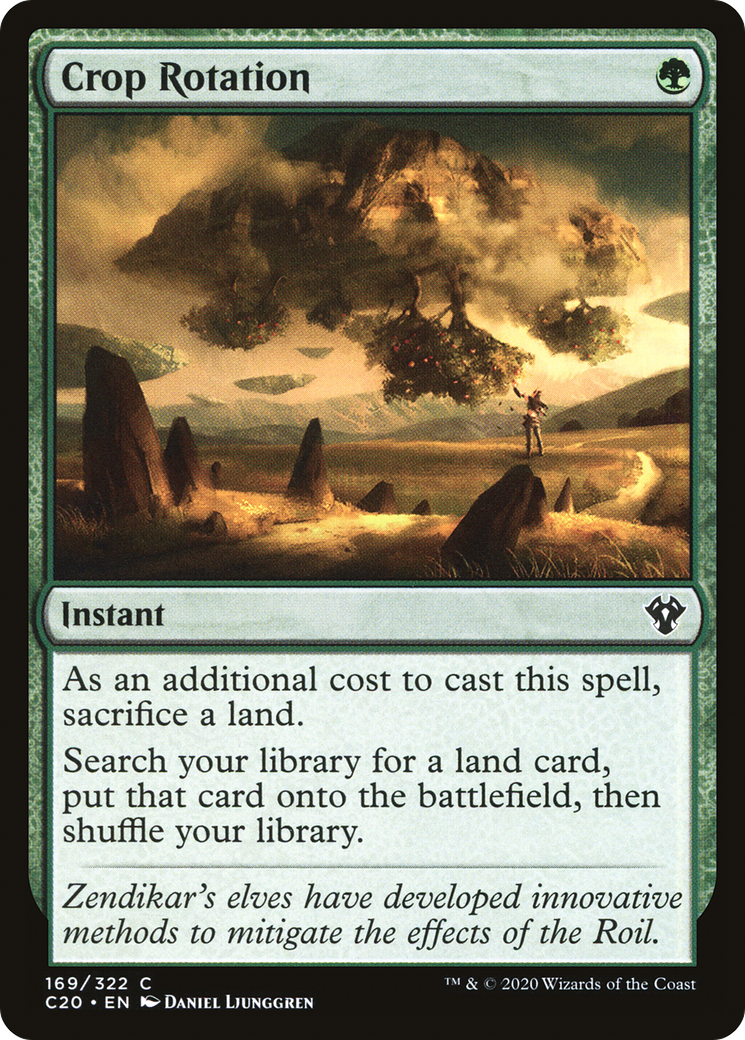
Crop Rotation
Crop Rotation
Instant
As an additional cost to cast this spell, sacrifice a land.
Search your library for a land card, put that card onto the battlefield, then shuffle.
- You can’t cast Crop Rotation without sacrificing a land, and you can’t sacrifice additional lands.
-
1
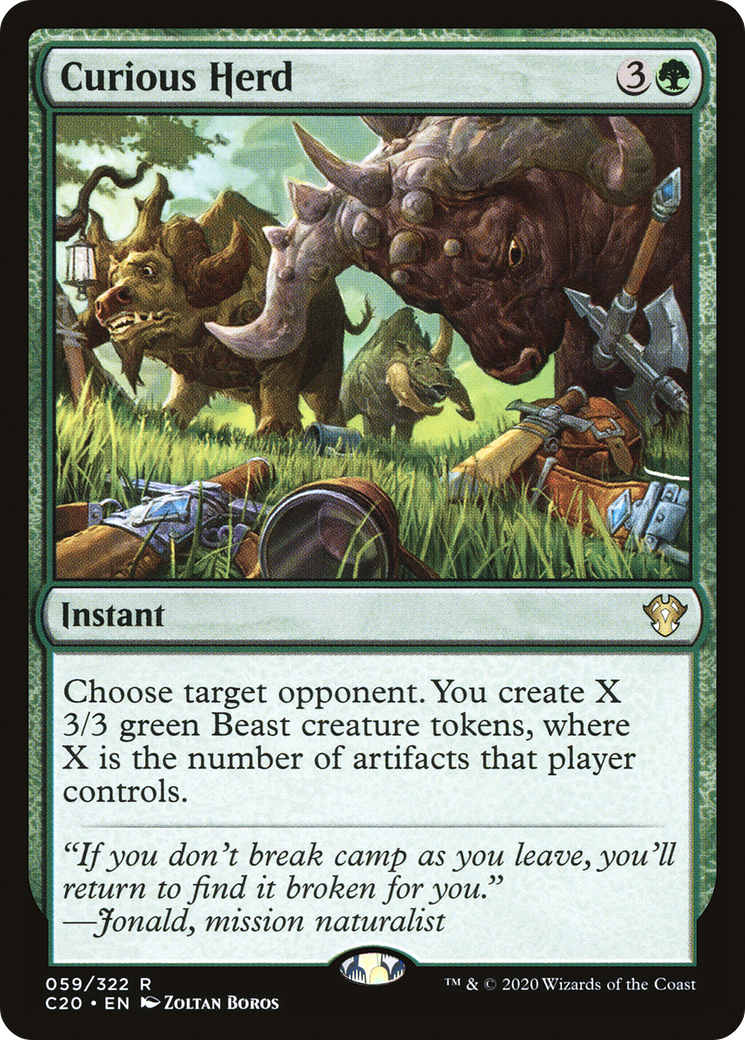
Curious Herd
Curious Herd
Instant
Choose target opponent. You create X 3/3 green Beast creature tokens, where X is the number of artifacts that player controls.
-
1
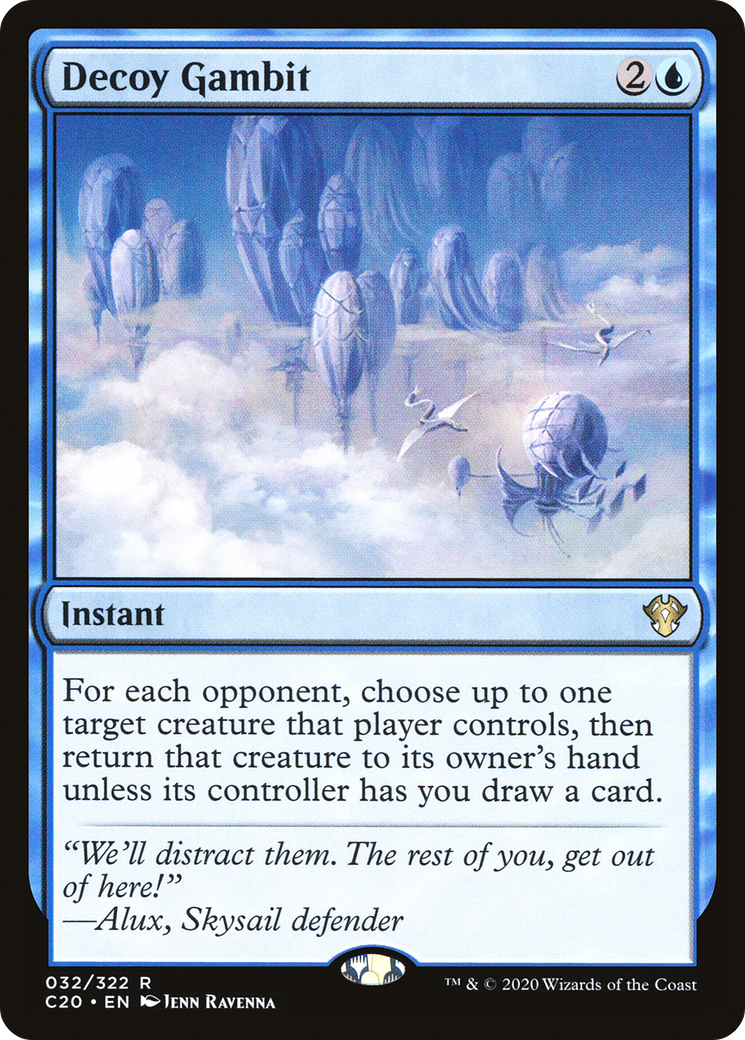
Decoy Gambit
Decoy Gambit
Instant
For each opponent, choose up to one target creature that player controls, then return that creature to its owner's hand unless its controller has you draw a card.
- As the Decoy Gambit resolves, first the next opponent in turn order (or, if it’s an opponent’s turn, the opponent whose turn it is) chooses whether you’ll draw a card or return their creature that was targeted to its owner’s hand, then each other opponent in turn order does so knowing the choices made before them. After all choices are made, you draw the appropriate number of cards. After you’ve drawn, the appropriate creatures are all simultaneously returned to their owners’ hands.
- For each opponent, if you didn’t choose a target creature they control or if that creature has become an illegal target, that player can’t choose for you to draw a card.
- If a creature targeted by Decoy Gambit changes controller, it’s no longer a legal target.
-
1
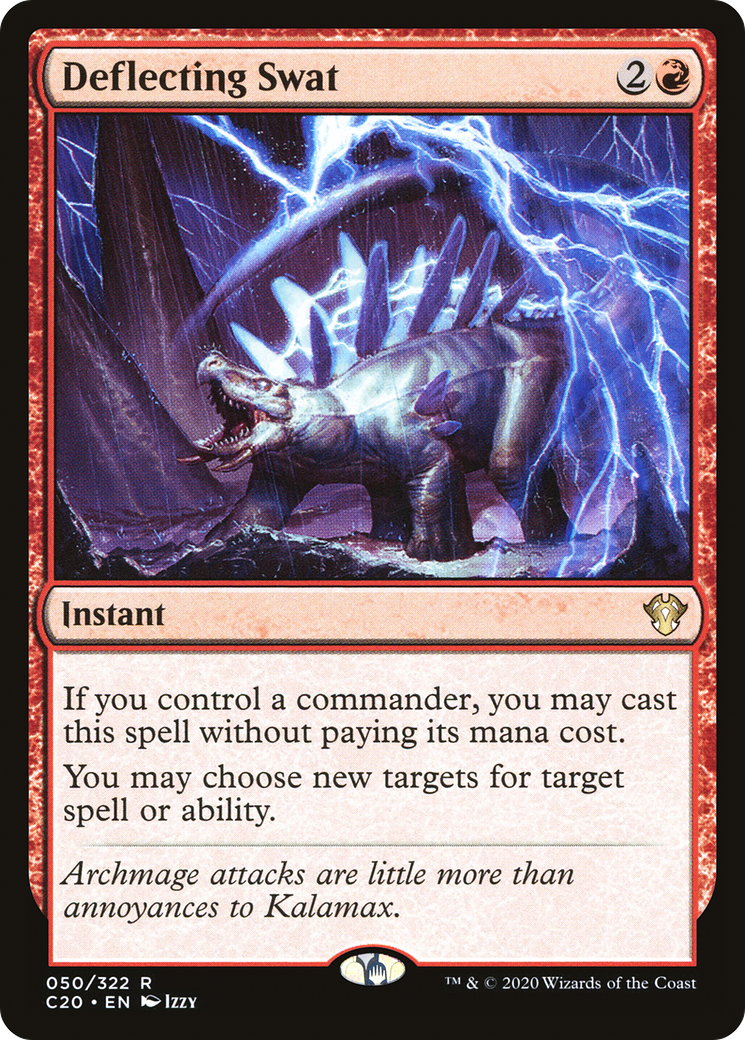
Deflecting Swat
Deflecting Swat
Instant
If you control a commander, you may cast this spell without paying its mana cost.
You may choose new targets for target spell or ability.
- If the target spell has damage divided as it was cast (like Mythos of Vadrok), the division can't be changed although the targets receiving that damage still can. The same is true of spells that distribute counters.
- If you choose new targets for the target spell, the new targets must be legal.
- If the target spell has a variable number of targets, you can't change how many targets it has.
-
1
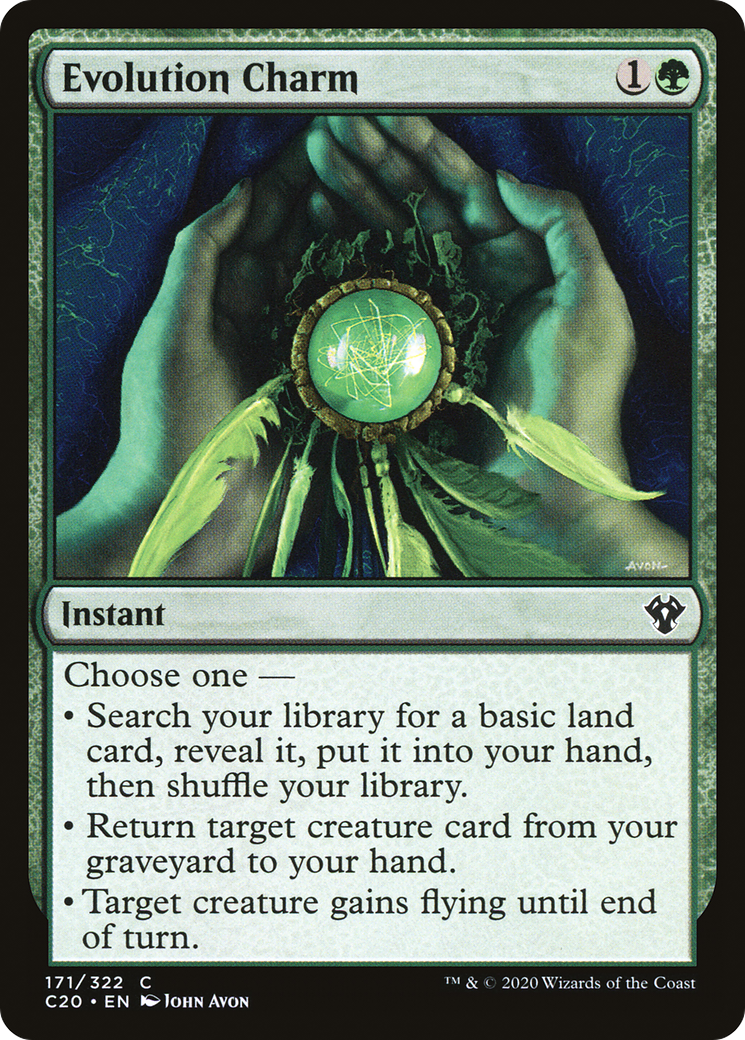
Evolution Charm
Evolution Charm
Instant
Choose one —
- Search your library for a basic land card, reveal it, put it into your hand, then shuffle.
- Return target creature card from your graveyard to your hand.
- Target creature gains flying until end of turn.
-
1
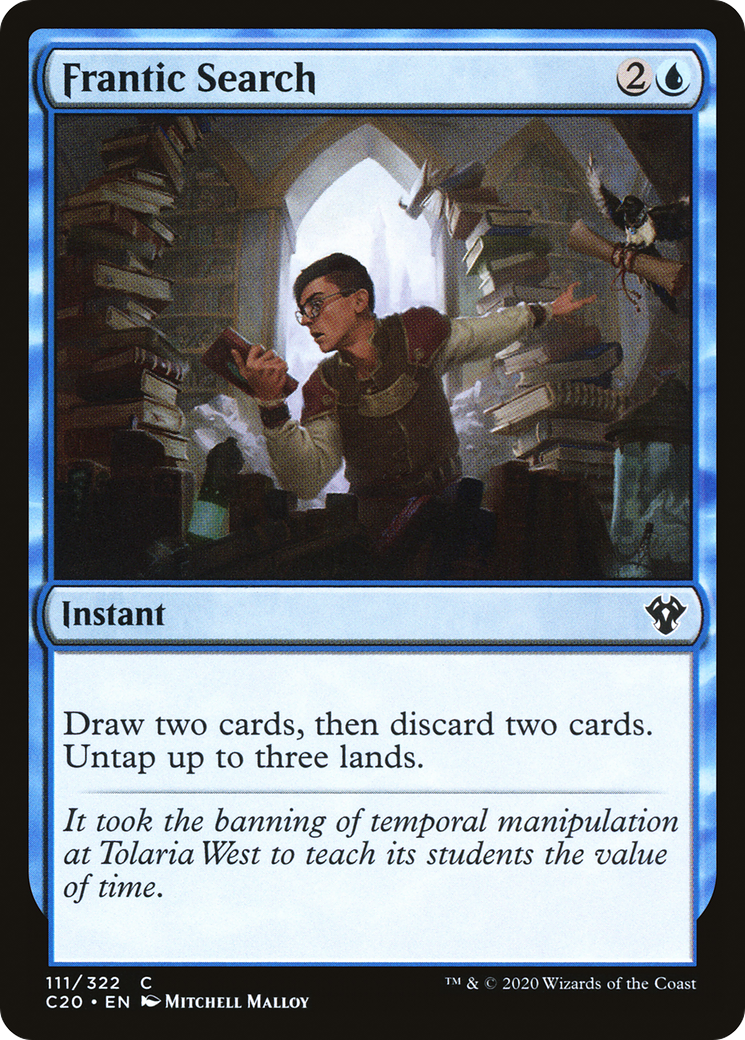
Frantic Search
Frantic Search
Instant
Draw two cards, then discard two cards. Untap up to three lands.
- You choose which lands to untap as the spell resolves. They aren't targeted, and they don't have to be lands that you control.
- You draw two cards and discard two cards all while Frantic Search is resolving. Nothing can happen between the two, and no player may choose to take actions.
-
1
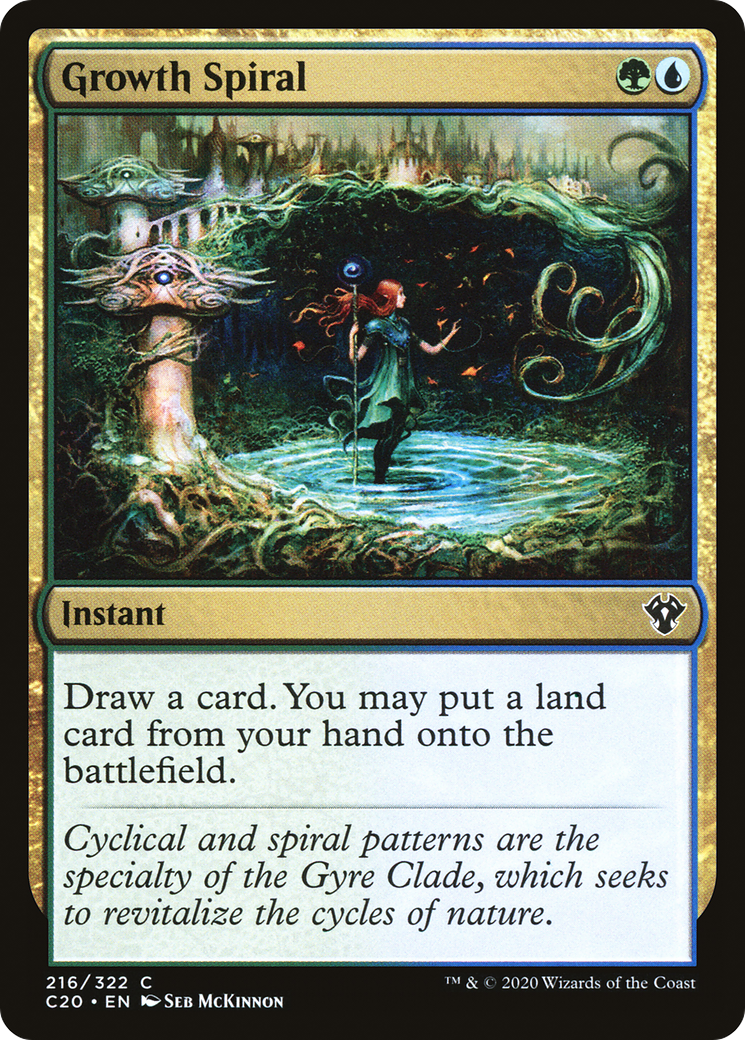
Growth Spiral
Growth Spiral
Instant
Draw a card. You may put a land card from your hand onto the battlefield.
- Growth Spiral's effect doesn't count as playing a land. It can put a land card onto the battlefield even if it's not your turn or if you've already played your land for the turn.
-
1
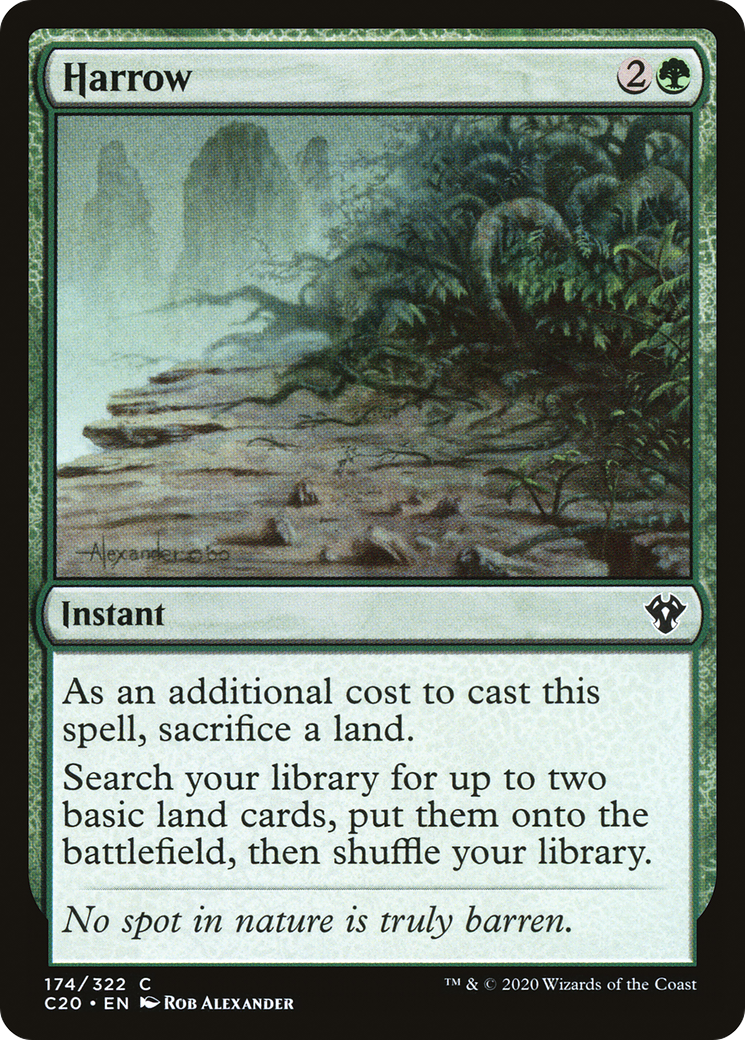
Harrow
Harrow
Instant
As an additional cost to cast this spell, sacrifice a land.
Search your library for up to two basic land cards, put them onto the battlefield, then shuffle.
- The two lands do not count toward your normal one land you can play each turn.
- The sacrifice of a land is part of the cost of casting Harrow. You can't pay this cost more than once to get a multiple effect.
-
1
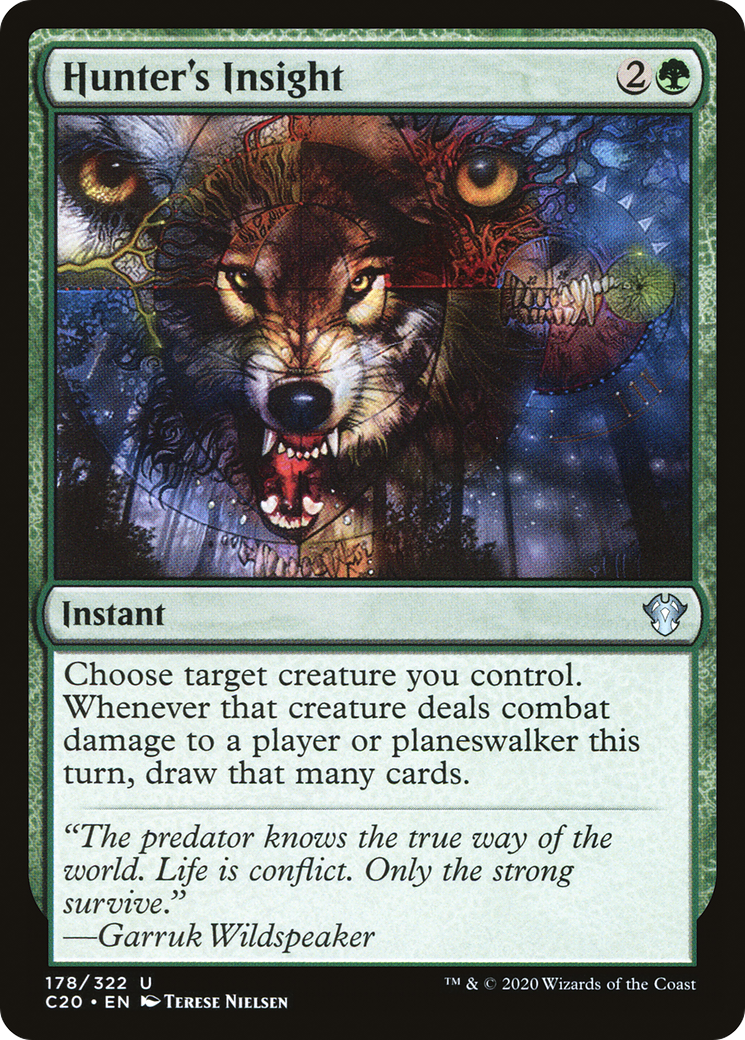
Hunter's Insight
Hunter's Insight
Instant
Choose target creature you control. Whenever that creature deals combat damage to a player or planeswalker this turn, draw that many cards.
-
1
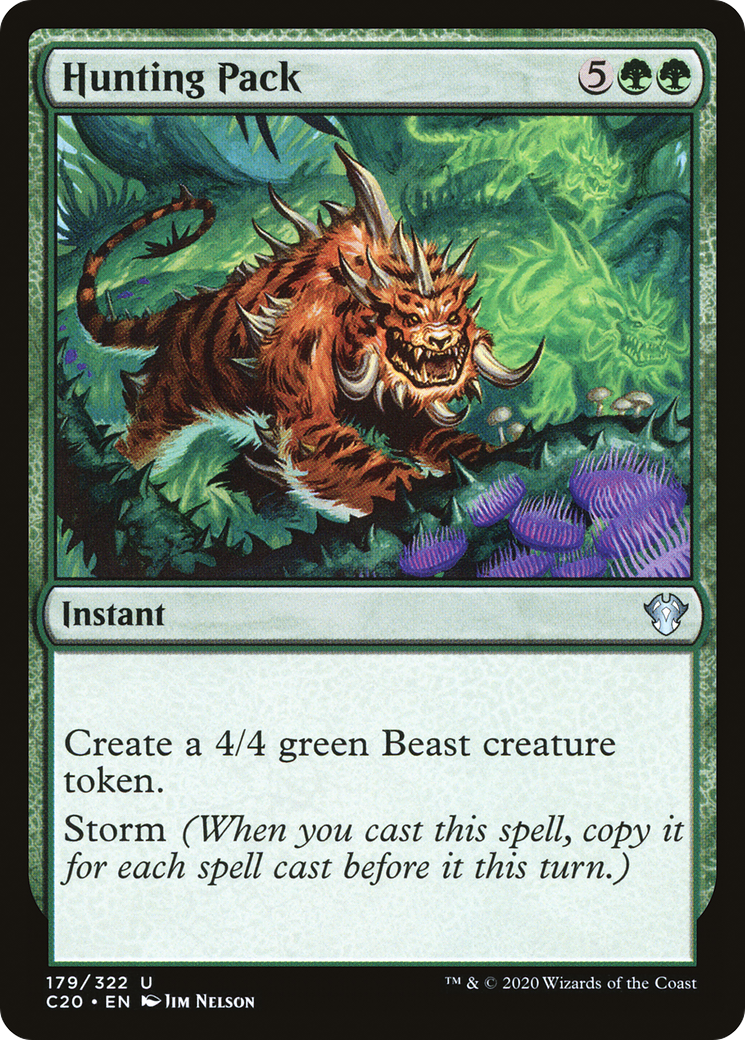
Hunting Pack
Hunting Pack
Instant
Create a 4/4 green Beast creature token.
Storm (When you cast this spell, copy it for each spell cast before it this turn.)
- The copies are put directly onto the stack. They aren't cast and won't be counted by other spells with storm cast later in the turn.
- Spells cast from zones other than a player's hand and spells that were countered are counted by the storm ability.
- A copy of a spell can be countered like any other spell, but it must be countered individually. Countering a spell with storm won't affect the copies.
- The triggered ability that creates the copies can itself be countered by anything that can counter a triggered ability. If it is countered, no copies will be put onto the stack.
-
1
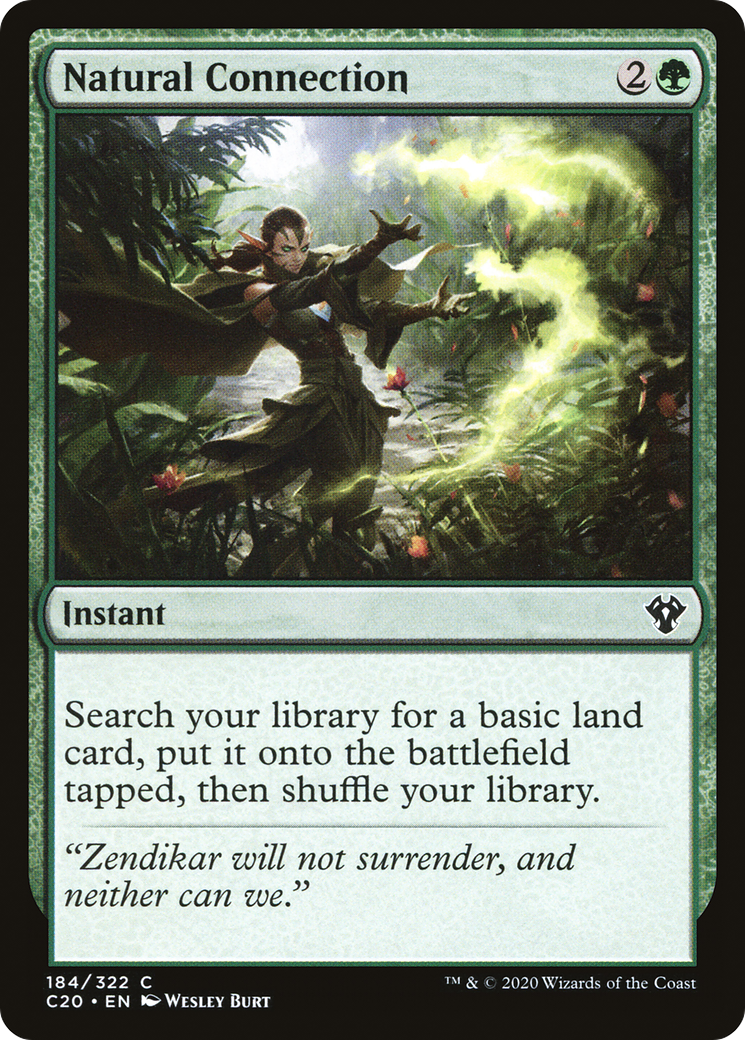
Natural Connection
Natural Connection
Instant
Search your library for a basic land card, put it onto the battlefield tapped, then shuffle.
-
1
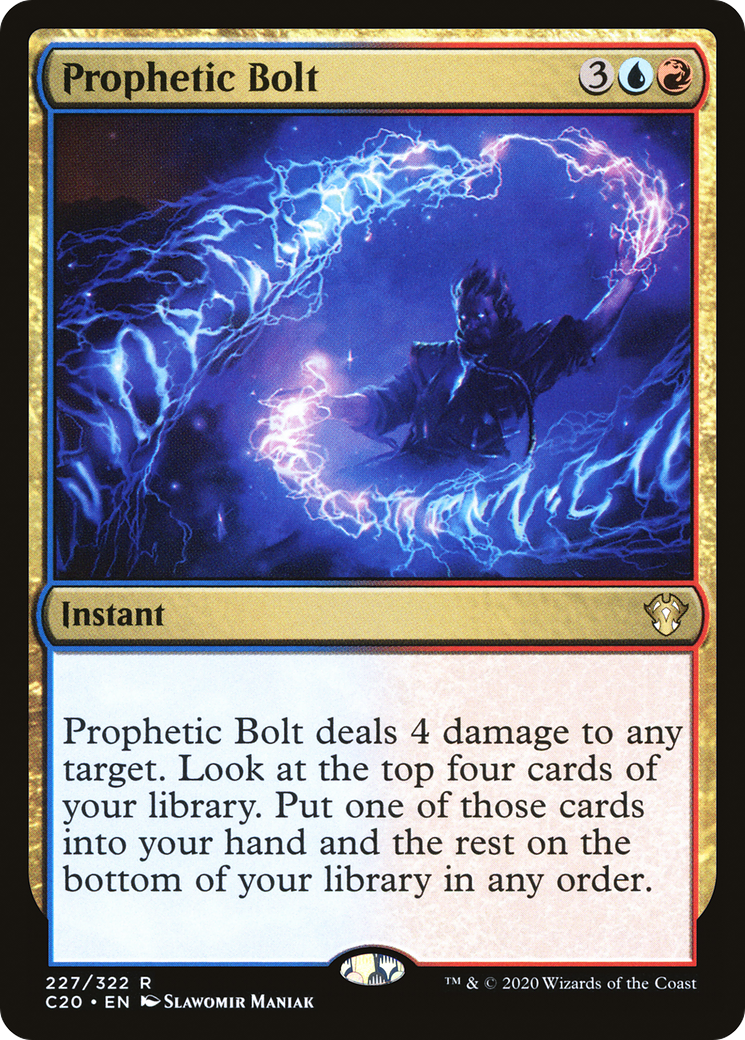
Prophetic Bolt
Prophetic Bolt
Instant
Prophetic Bolt deals 4 damage to any target. Look at the top four cards of your library. Put one of those cards into your hand and the rest on the bottom of your library in any order.
-
1
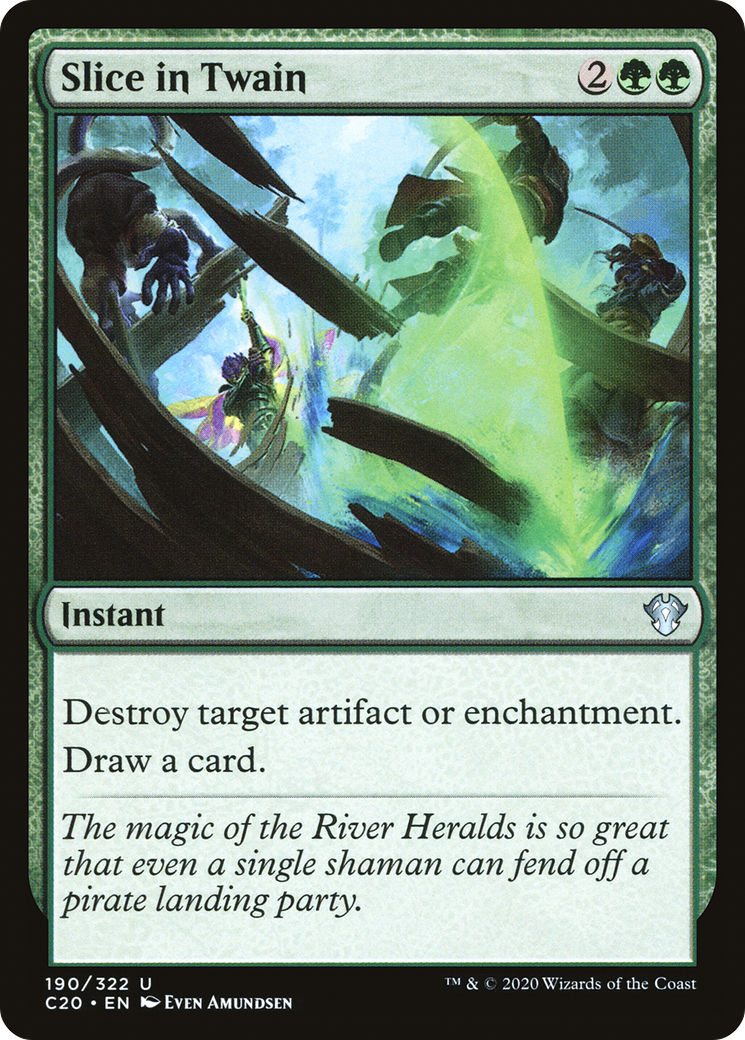
Slice in Twain
Slice in Twain
Instant
Destroy target artifact or enchantment.
Draw a card.
- If the target artifact or enchantment is an illegal target by the time Slice in Twain resolves, the entire spell doesn’t resolve. You won’t draw a card. If, on the other hand, the target is a legal target but isn’t destroyed (most likely because it has indestructible), you’ll draw a card.
-
1
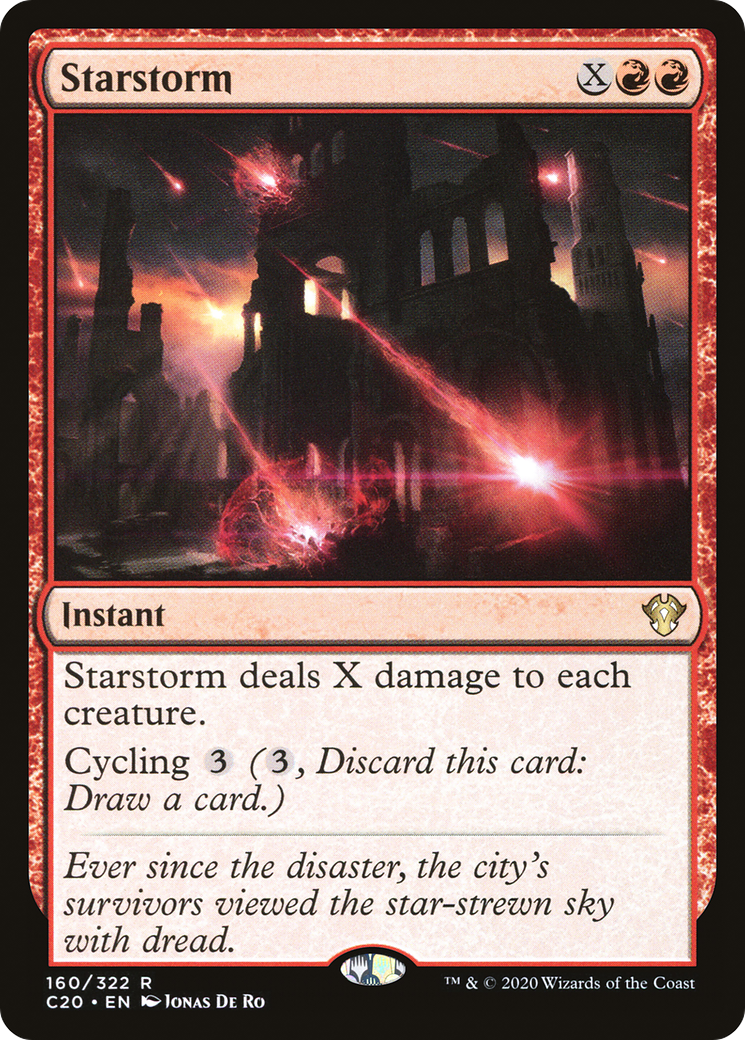
Starstorm
Starstorm
Instant
Starstorm deals X damage to each creature.
Cycling ( , Discard this card: Draw a card.)
- Cycling is an activated ability. Effects that interact with activated abilities (such as Stifle or Rings of Brighthearth) will interact with cycling. Effects that interact with spells (such as Remove Soul or Faerie Tauntings) will not.
-
1
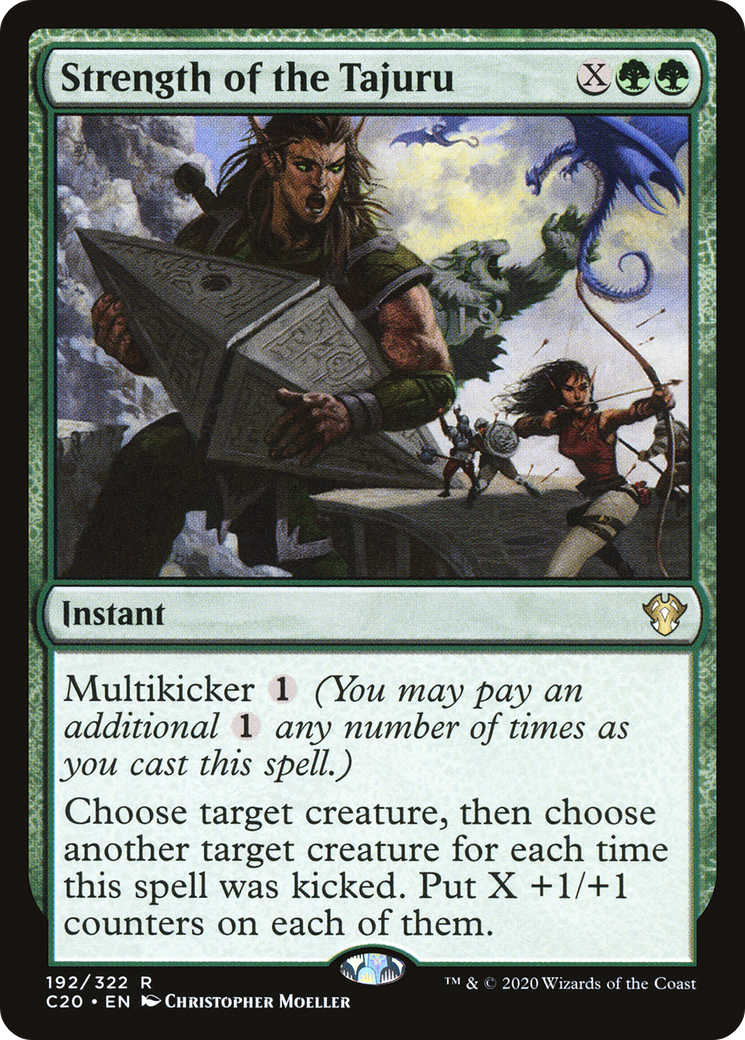
Strength of the Tajuru
Strength of the Tajuru
Instant
Multikicker (You may pay an additional any number of times as you cast this spell.)
Choose target creature, then choose another target creature for each time this spell was kicked. Put X +1/+1 counters on each of them.
- To determine a spell's total cost, start with the mana cost (or an alternative cost if another card's effect allows you to pay one instead), add any cost increases (such as kicker), then apply any cost reductions. The spell's mana value remains unchanged, no matter what the total cost to cast it was.
- The kicker ability doesn't let you pay a kicker cost more than once.
- If you put a permanent with a kicker ability onto the battlefield without casting it, you can't kick it.
- If you copy a kicked spell on the stack, the copy is also kicked. If the copied spell is a permanent spell, the token the copy of that spell becomes when it enters is also kicked.
- If a card or token enters as a copy of a permanent, the new permanent isn't kicked, even if the original was.
- If a spell's kicker cost was paid, the spell is "kicked."
- Each target you choose must be different.
- For example, if you want to put four +1/+1 counters on each of three different targets, that means X is 4 and you're kicking the spell twice. You'll pay a mana cost of , plus a kicker cost of , plus another kicker cost of , for a total of .
- As long as any of its targets are legal at the time Strength of the Tajuru resolves, you'll put X +1/+1 counters on each of those legal targets.
- The number of targets you choose for Strength of the Tajuru is one more than the number of times it's kicked. First you declare how many times you're going to kick the spell (at the same time you declare the value of X), then you choose the targets accordingly, then you pay the costs. No player can respond between the time you declare how many times you'll kick the spell and the time you choose the targets.
-
1
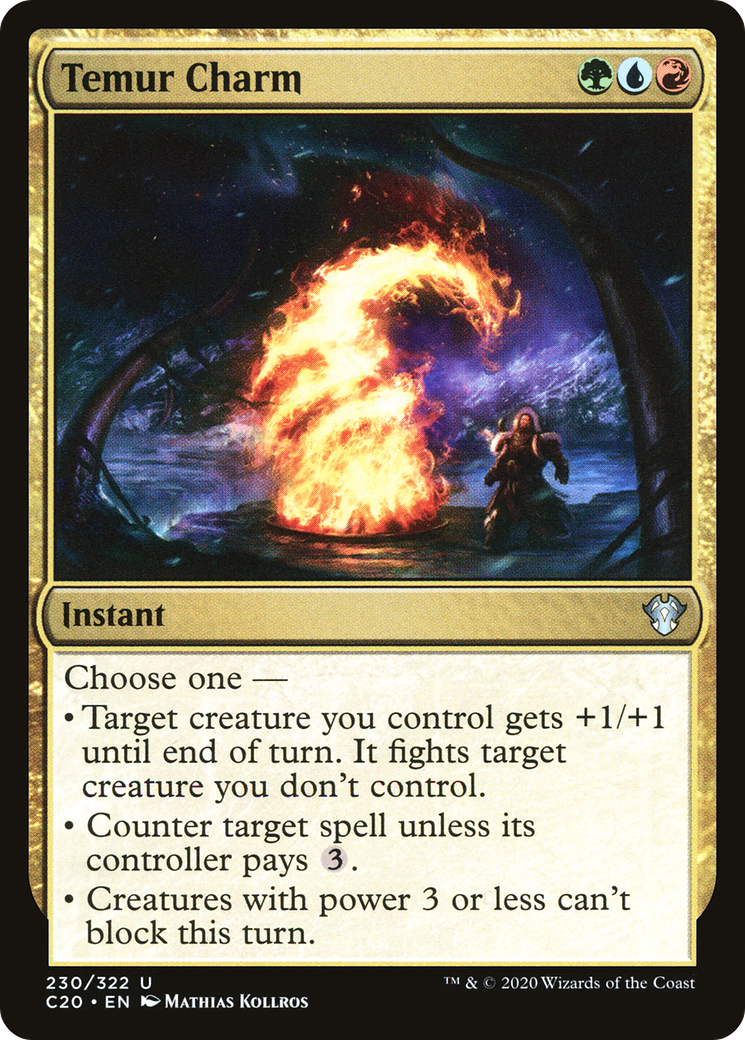
Temur Charm
Temur Charm
Instant
Choose one —
- Target creature you control gets +1/+1 until end of turn. It fights target creature you don't control.
- Counter target spell unless its controller pays .
- Creatures with power 3 or less can't block this turn.
- You can’t cast Temur Charm choosing the first mode unless you target both a creature you control and a creature you don’t control.
- If the first mode was chosen and either target is an illegal target when Temur Charm tries to resolve, neither creature will deal or be dealt damage.
- If the first mode was chosen and just the creature you control is an illegal target when Temur Charm tries to resolve, it won’t get +1/+1 until end of turn. If the creature you control is a legal target but the creature you don’t control isn’t, the creature you control will get +1/+1 until end of turn.
- If the third mode was chosen, creatures with power 3 or less that enter the battlefield after Temur Charm resolves also can’t block. A creature whose power was 4 or greater when Temur Charm resolved but is 3 or less as the declare blockers step begins also can’t block.
-
1
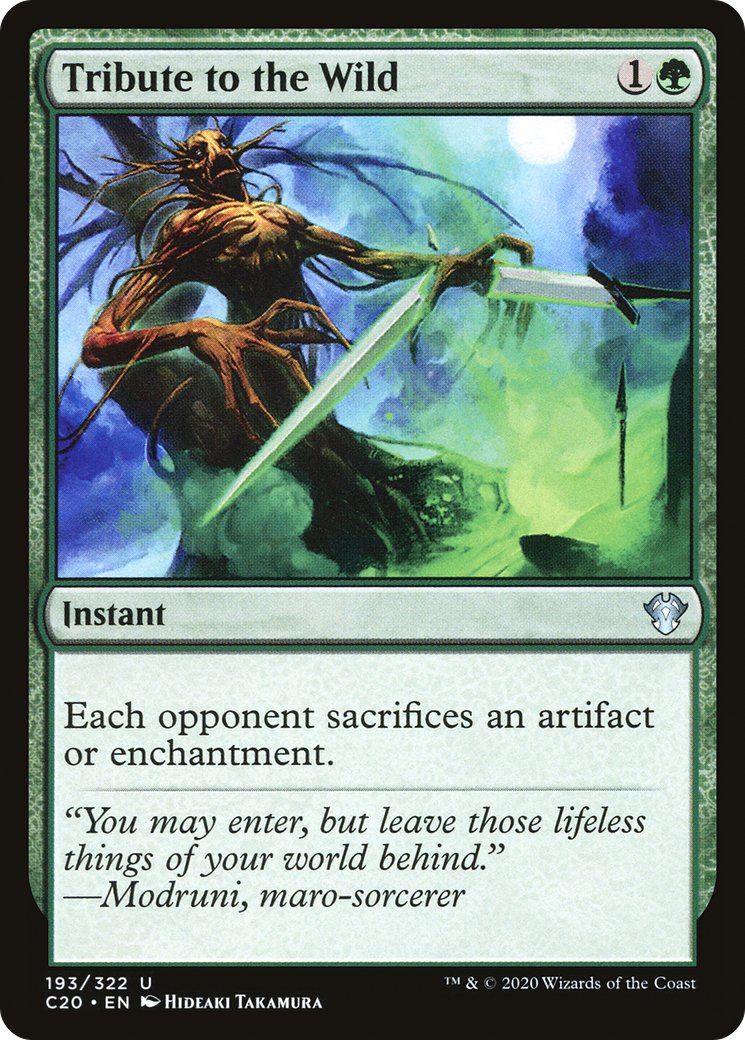
Tribute to the Wild
Tribute to the Wild
Instant
Each opponent sacrifices an artifact or enchantment of their choice.
-
1
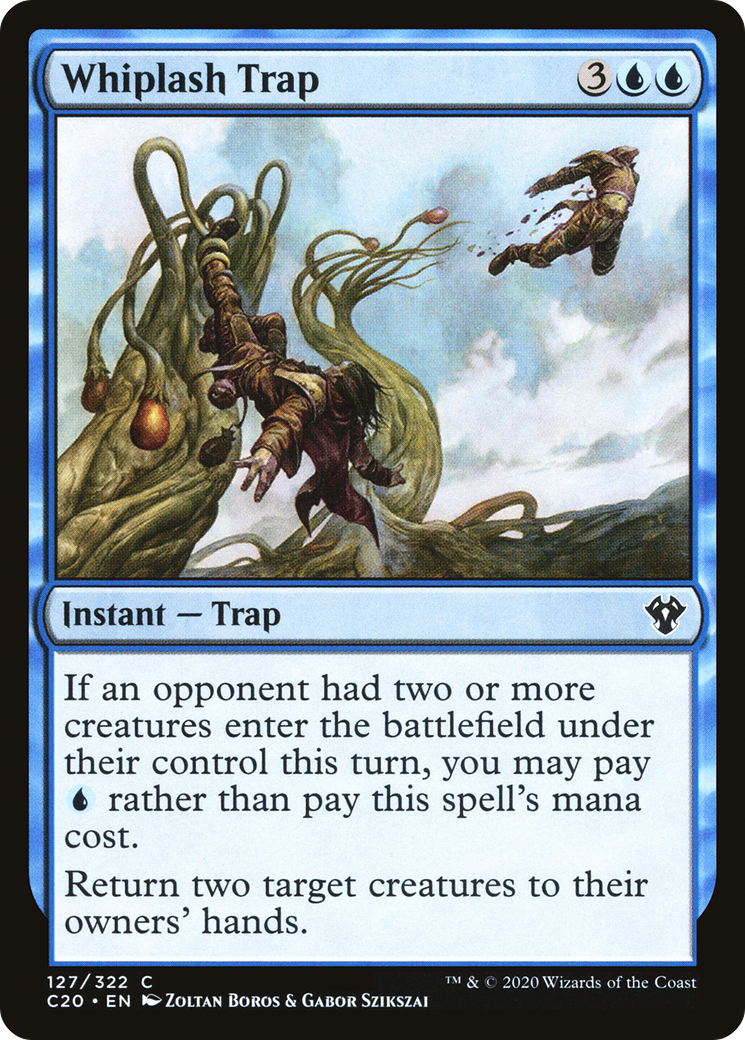
Whiplash Trap
Whiplash Trap
Instant — Trap
If an opponent had two or more creatures enter the battlefield under their control this turn, you may pay rather than pay this spell's mana cost.
Return two target creatures to their owners' hands.
- You may ignore a Trap's alternative cost condition and simply cast it for its normal mana cost. This is true even if its alternative cost condition has been met.
- Casting a Trap by paying its alternative cost doesn't change its mana cost or mana value. The only difference is the cost you actually pay.
- Effects that increase or reduce the cost to cast a Trap will apply to whichever cost you chose to pay.
- You must target two creatures as you cast Whiplash Trap. If you can't (because just one creature is on the battlefield, perhaps), you can't cast the spell.
- You can target any two creatures, not just ones that entered this turn.
Artifacts 7
-
1
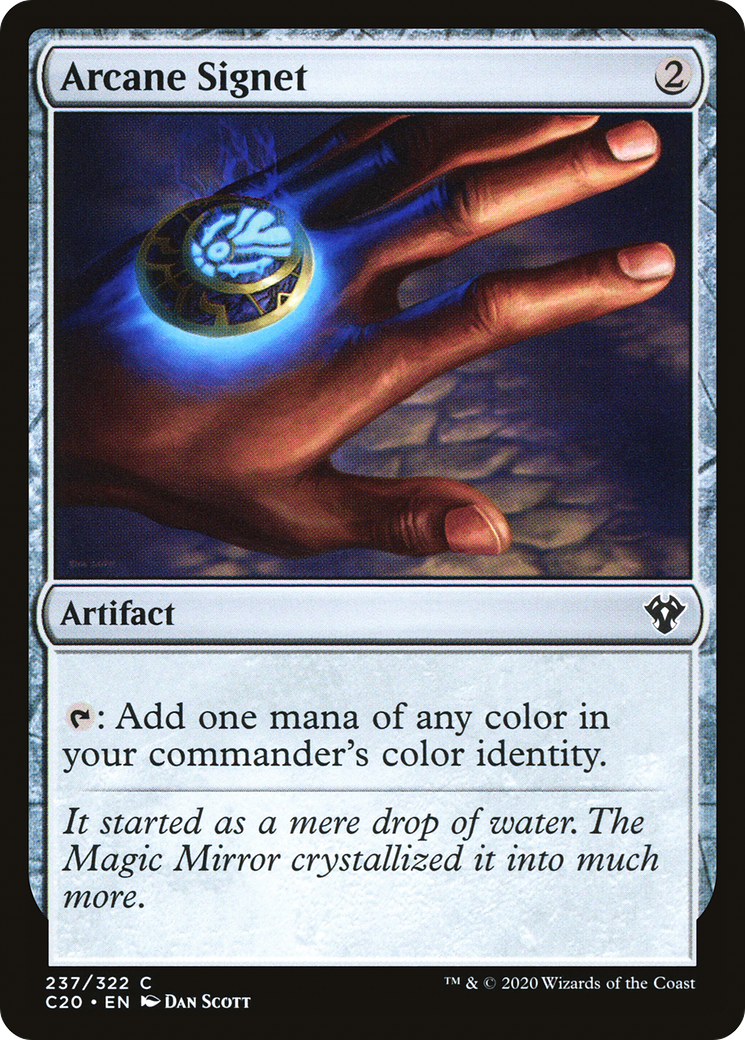
Arcane Signet
Arcane Signet
Artifact
: Add one mana of any color in your commander's color identity.
- If your commander is a card that has no colors in its color identity, Arcane Signet's ability produces no mana. It doesn't produce .
- If you have two commanders, the ability adds one mana of any color in their combined color identities.
- If you don't have a commander, Arcane Signet's ability produces no mana.
-
1
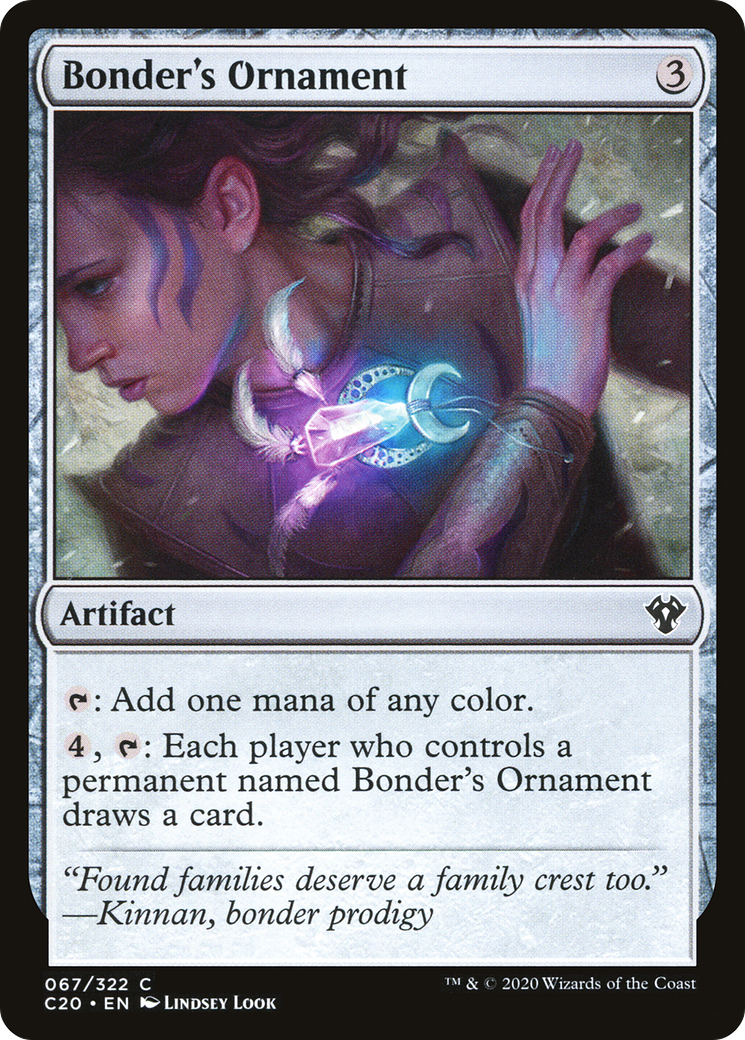
Bonder's Ornament
Bonder's Ornament
Artifact
: Add one mana of any color.
, : Each player who controls a permanent named Bonder's Ornament draws a card.
- If one player controls more than one Bonder’s Ornament, that player draws just one card while resolving its second ability.
-
1
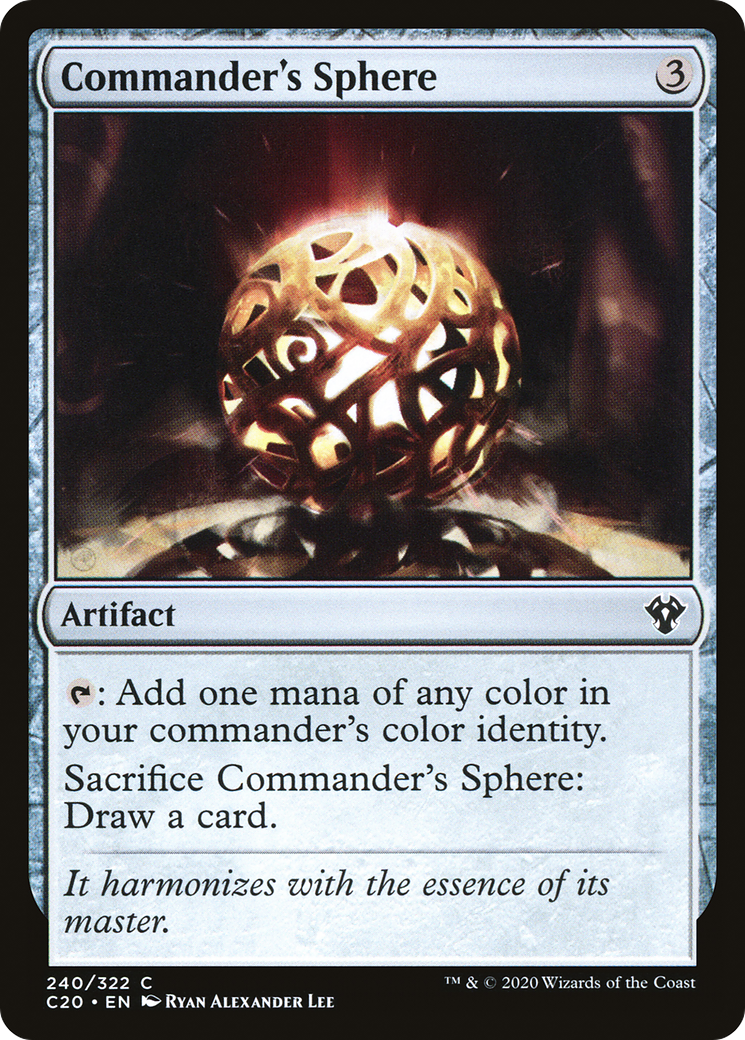
Commander's Sphere
Commander's Sphere
Artifact
: Add one mana of any color in your commander's color identity.
Sacrifice this artifact: Draw a card.
- If your commander is a card that has no colors in its color identity, Commander's Sphere's first ability produces no mana. It doesn't produce .
- If you don't have a commander, Commander's Sphere's first ability produces no mana.
- If you have two commanders, the ability adds one mana of any color in their combined color identities.
-
1
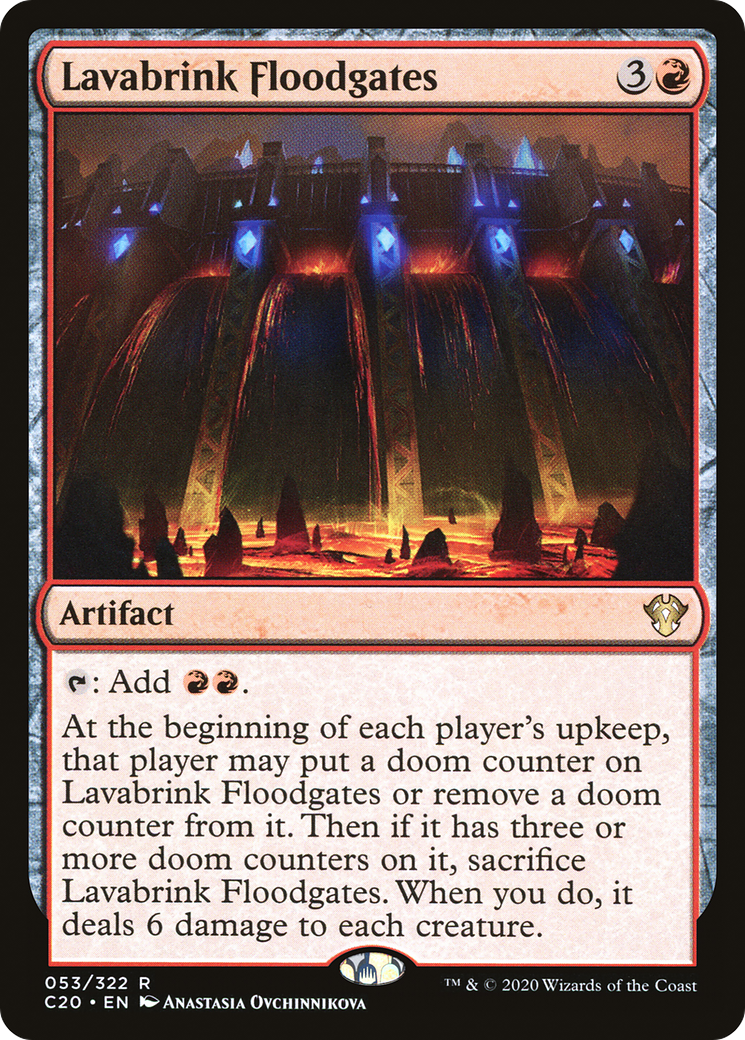
Lavabrink Floodgates
Lavabrink Floodgates
Artifact
: Add .
At the beginning of each player's upkeep, that player may put a doom counter on this artifact or remove a doom counter from it. Then if it has three or more doom counters on it, sacrifice this artifact. When you do, it deals 6 damage to each creature.
- Lavabrink Floodgates’s reflexive triggered ability triggers and deals damage only if you sacrifice it while resolving its triggered ability. It won’t trigger if you sacrifice it for any other reason.
- The player whose upkeep it is may put a doom counter on Lavabrink Floodgates, remove one from it, or do nothing.
- Lavabrink Floodgates is sacrificed for having three or more doom counters on it only while its ability is resolving. If you put a third counter on it some other way, it won’t be immediately sacrificed.
-
1
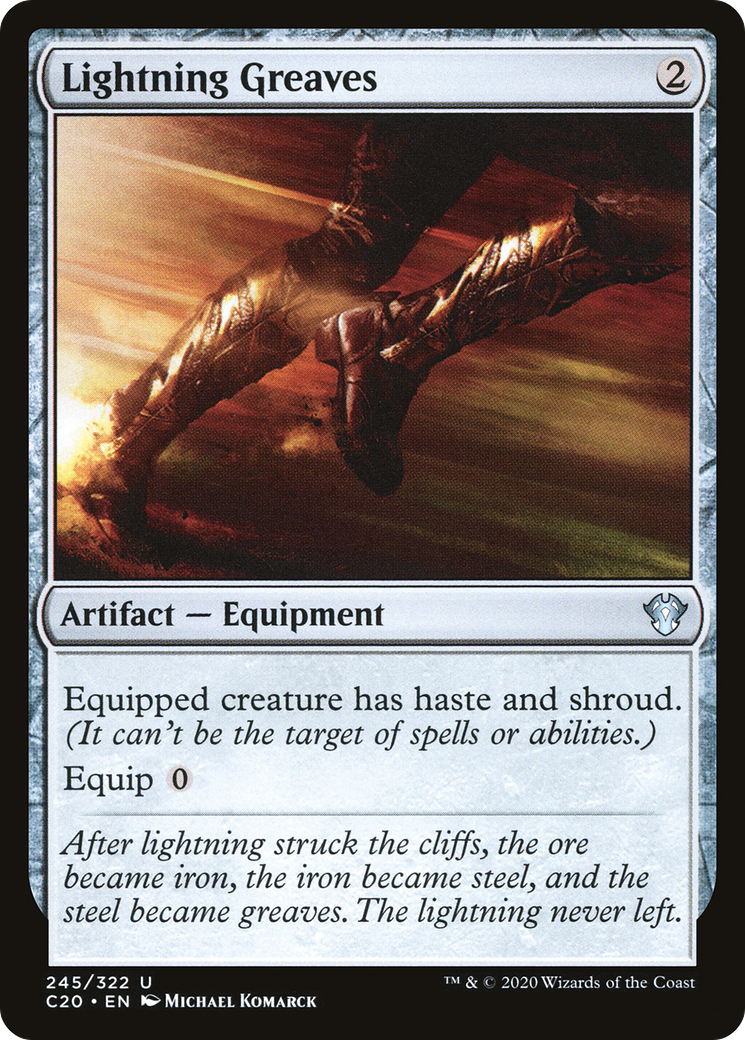
Lightning Greaves
Lightning Greaves
Artifact — Equipment
Equipped creature has haste and shroud. (It can't be the target of spells or abilities.)
Equip
- You can't simply unequip Equipment from a creature. If Lightning Greaves is attached to the only creature you control, you won't be able to attach other equipment to it (or target it with anything else) until you have another creature to which you can attach Lightning Greaves.
- If a creature enters the battlefield under your control and gains haste, but then loses it before attacking, it won't be able to attack that turn. This means that you can't use one Lightning Greaves to allow two new creatures to attack in the same turn.
-
1
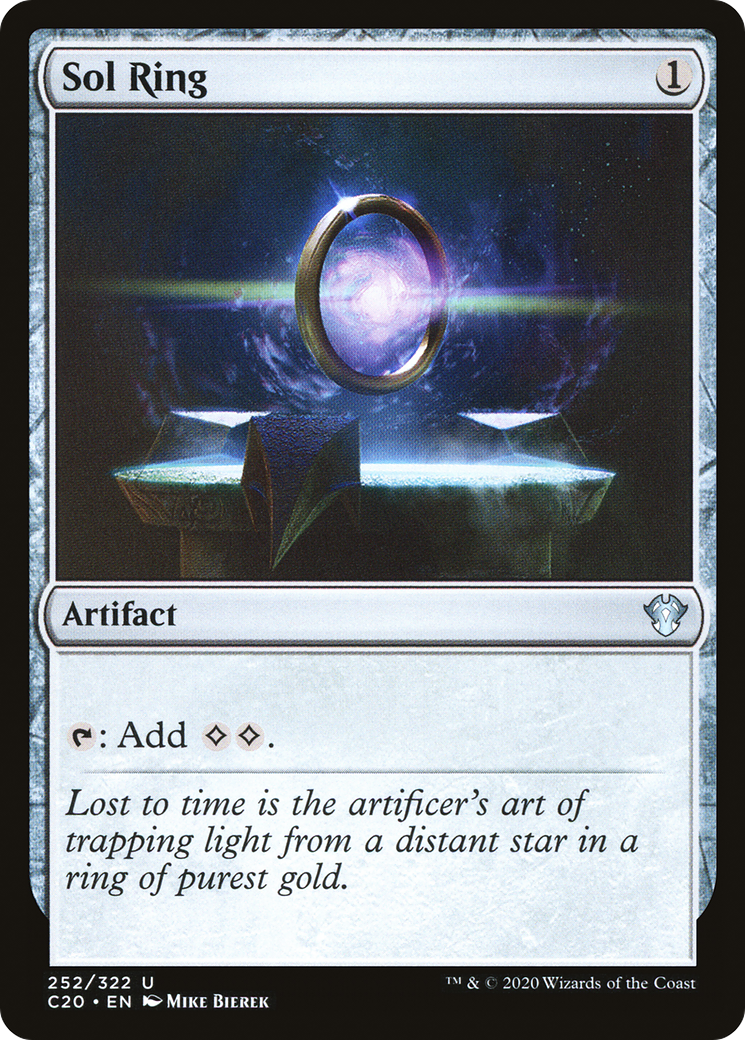
Sol Ring
Sol Ring
Artifact
: Add .
-
1
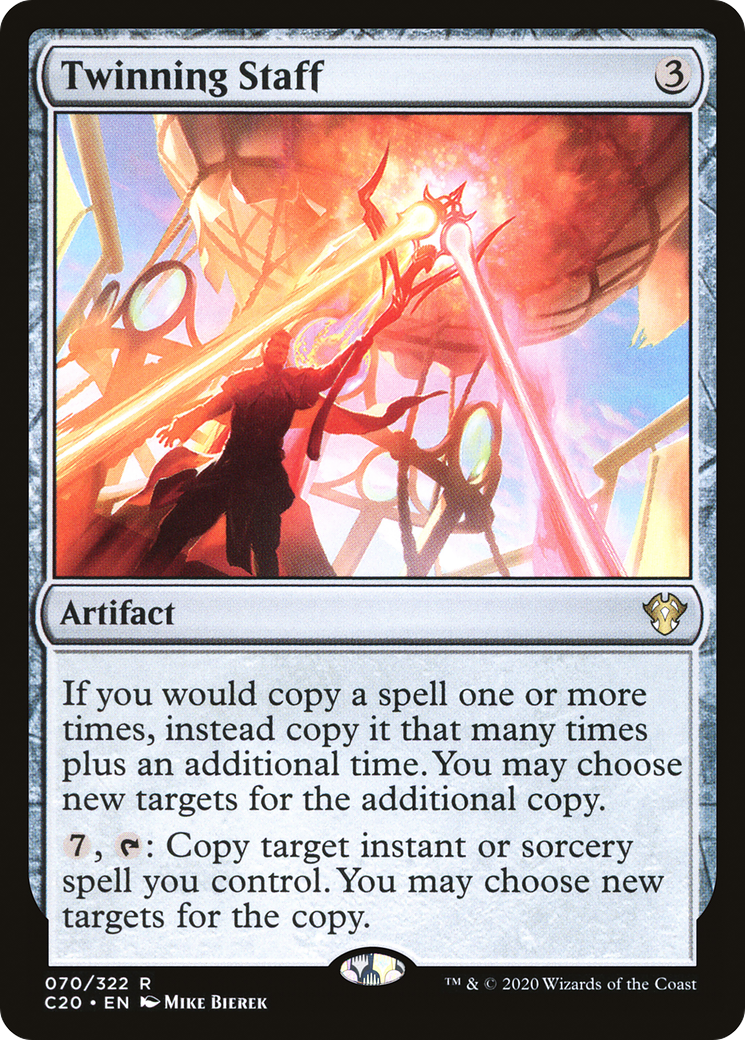
Twinning Staff
Twinning Staff
Artifact
If you would copy a spell one or more times, instead copy it that many times plus an additional time. You may choose new targets for the additional copy.
, : Copy target instant or sorcery spell you control. You may choose new targets for the copy.
- If the spell that's copied has an X whose value was determined as it was cast, the copy will have the same value of X.
- If the spell has damage divided as it was cast (like Mythos of Vadrok), the division can't be changed, although the targets receiving that damage still can. The same is true of spells that distribute counters.
- You choose whether the additional copy is put onto the stack before or after the original copy. If a spell is being copied more than once, you can even have the additional copy put onto the stack in between the original copies.
- If you have a second Twinning Staff, copying a spell results in two additional copies. If you have a third, you get three additional copies, and so on.
- If an effect copies a card rather than a spell (such as that of God-Eternal Kefnet), this doesn't cause an additional copy to be created.
- Twinning Staff's last ability can copy any instant or sorcery spell you control, not just one with targets.
- The copy is created on the stack, so it's not “cast.” Abilities that trigger when a player casts a spell won't trigger. It will resolve before the original spell does.
- The copy will have the same targets as the spell it's copying unless you choose new ones. You may change any number of the targets, including all of them or none of them. If, for one of the targets, you can't choose a new legal target, then it remains unchanged (even if the current target is illegal).
- If the spell that's copied is modal (that is, it says “Choose one —” or the like), the copy will have the same mode. A different mode can't be chosen.
- You may choose new targets for the additional copy, even if you can't choose new targets for the original copy or copies.
- The controller of a copy can't choose to pay any alternative or additional costs for the copy. However, effects based on any alternative or additional costs that were paid for the original spell are copied as though those same costs were paid for the copy.
Enchantments 6
-
1
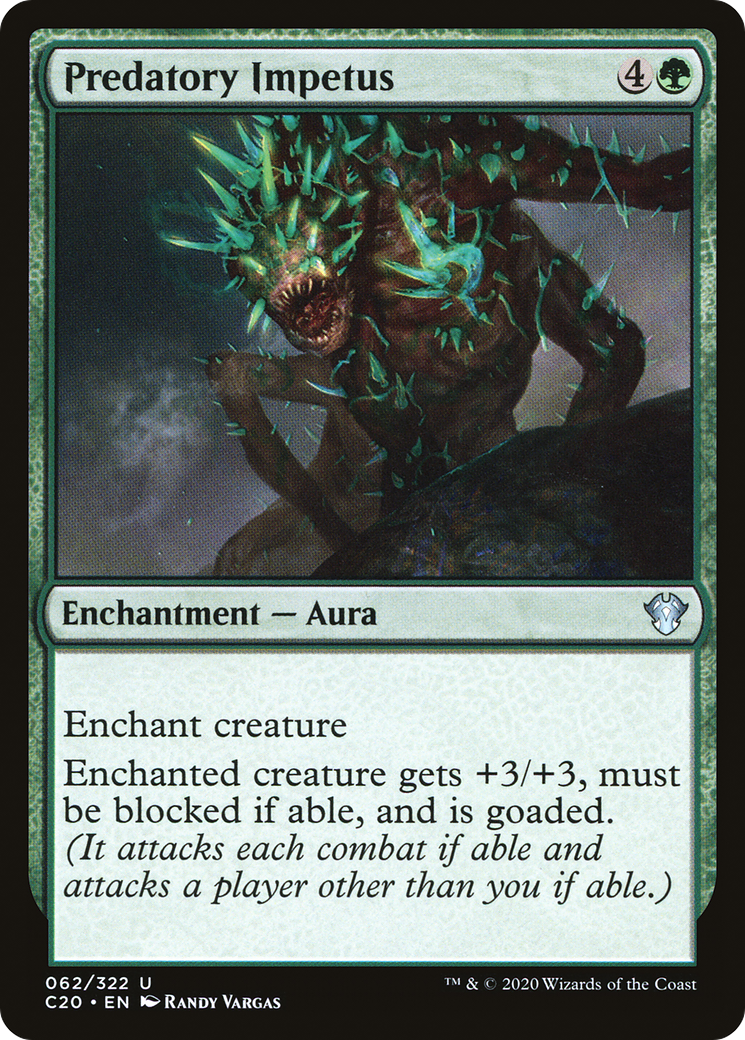
Predatory Impetus
Predatory Impetus
Enchantment — Aura
Enchant creature
Enchanted creature gets +3/+3, must be blocked if able, and is goaded. (It attacks each combat if able and attacks a player other than you if able.)
- If the creature doesn't meet any of the above exceptions and can attack, it must attack a player other than the controller of the spell or ability that goaded it if able. If the creature can't attack any of those players but could otherwise attack, it must attack a planeswalker an opponent controls, a battle an opponent controls, or a player who goaded it.
- Attacking with a goaded creature doesn't cause it to stop being goaded. If there is an additional combat phase that turn, or if another player gains control of it before it stops being goaded, it must attack again if able.
- If a creature you control has been goaded by multiple opponents, it must attack one of your opponents that hasn't goaded it, as that fulfills the maximum number of goad requirements. If a creature you control has been goaded by each of your opponents, the creature must attack an opponent (rather than a planeswalker or battle), but you choose which opponent it attacks.
- If, during a player's declare attackers step, a creature that player controls that's been goaded is tapped, is affected by a spell or ability that says it can't attack, or hasn't been under that player's control continuously since the turn began (and doesn't have haste), then it doesn't attack. If there's a cost associated with having a creature attack a player, its controller isn't forced to pay that cost, so it doesn't have to attack that player.
- Being goaded isn't an ability the creature has. Once it's been goaded, it must attack as detailed above even if it loses all abilities.
- If each creature the defending player controls can't block for any reason (such as being tapped), then the enchanted creature isn't blocked. If there's a cost associated with blocking the enchanted creature, the defending player isn't forced to pay that cost, so it doesn't have to be blocked in that case either.
- Only one creature is required to block the enchanted creature. Other creatures may also block it and are free to block other creatures or not block at all.
-
1
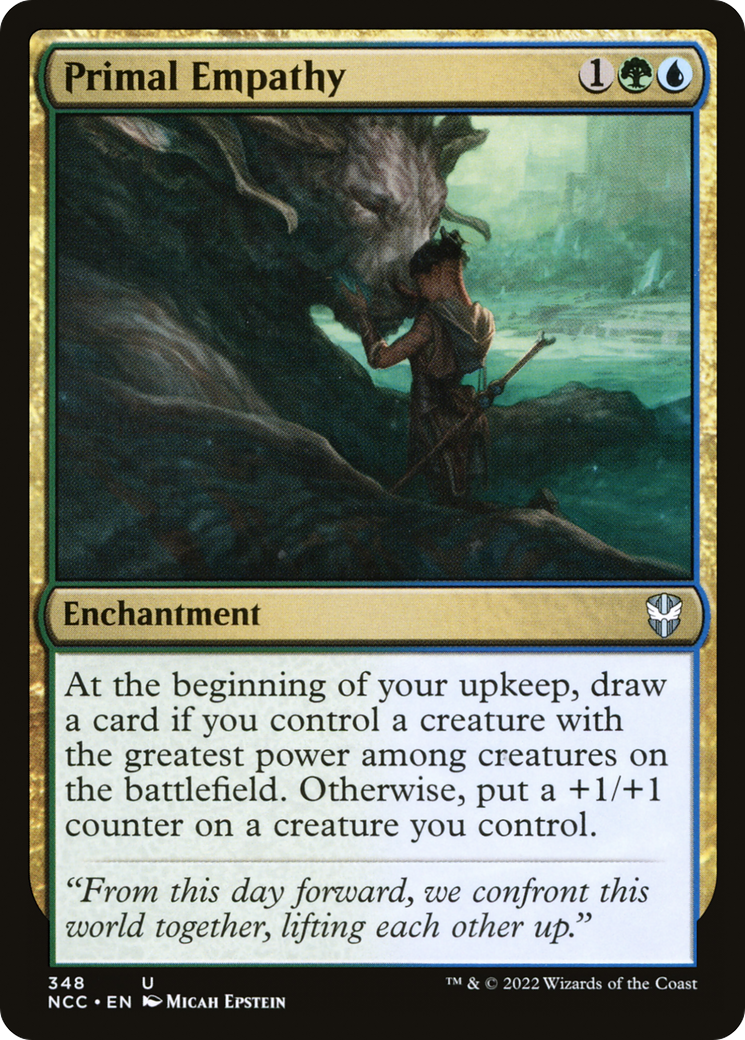
Primal Empathy
Primal Empathy
Enchantment
At the beginning of your upkeep, draw a card if you control a creature with the greatest power among creatures on the battlefield. Otherwise, put a +1/+1 counter on a creature you control.
- You determine whether you draw a card or put a +1/+1 counter only as Primal Empathy's triggered ability begins resolving. Players may respond to the ability to try to change which happens.
- If the greatest power among creatures on the battlefield is shared by a creature you control and a creature you don't control, you draw a card.
- If you don't control a creature with the greatest power, you choose which creature gets a +1/+1 counter while the ability is resolving. Players can't take actions in between the time you make this choice and the time that creature has a +1/+1 counter.
- If you control no creatures, you do nothing as Primal Empathy's ability resolves. If there are no creatures on the battlefield at all, you don't draw a card.
-
1
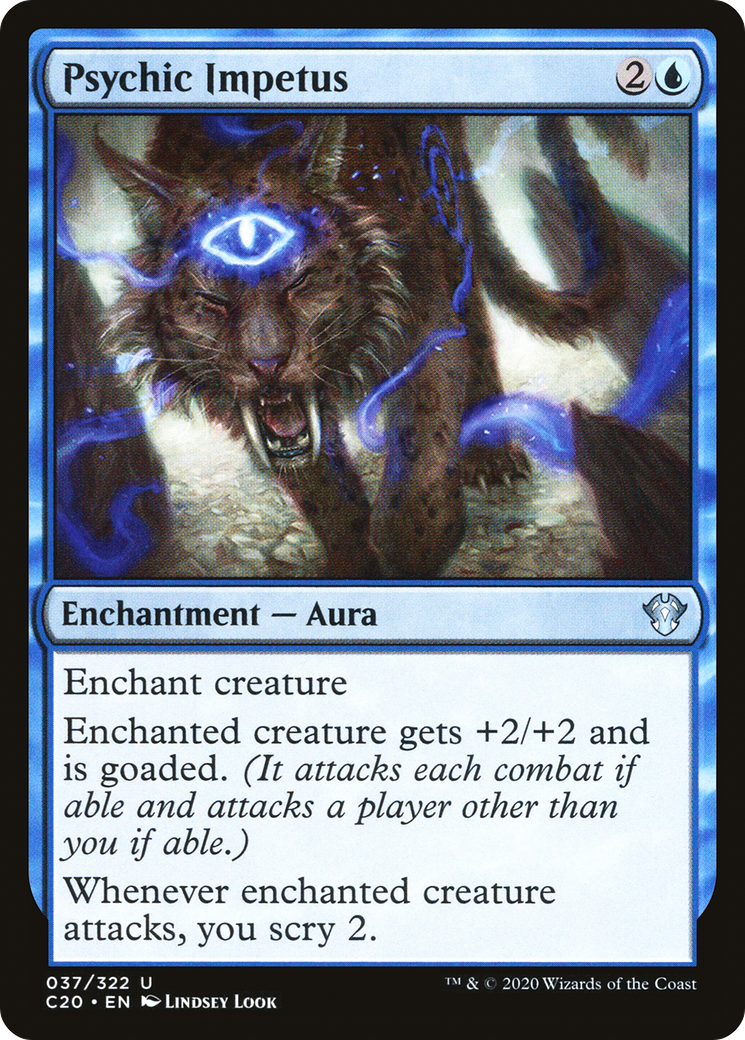
Psychic Impetus
Psychic Impetus
Enchantment — Aura
Enchant creature
Enchanted creature gets +2/+2 and is goaded. (It attacks each combat if able and attacks a player other than you if able.)
Whenever enchanted creature attacks, you scry 2.
- If, during a player's declare attackers step, a creature that player controls that's been goaded is tapped, is affected by a spell or ability that says it can't attack, or hasn't been under that player's control continuously since the turn began (and doesn't have haste), then it doesn't attack. If there's a cost associated with having a creature attack a player, its controller isn't forced to pay that cost, so it doesn't have to attack that player.
- If the creature doesn't meet any of the above exceptions and can attack, it must attack a player other than the controller of the spell or ability that goaded it if able. If the creature can't attack any of those players but could otherwise attack, it must attack a planeswalker an opponent controls, a battle an opponent controls, or a player who goaded it.
- Being goaded isn't an ability the creature has. Once it's been goaded, it must attack as detailed above even if it loses all abilities.
- Attacking with a goaded creature doesn't cause it to stop being goaded. If there is an additional combat phase that turn, or if another player gains control of it before it stops being goaded, it must attack again if able.
- If a creature you control has been goaded by multiple opponents, it must attack one of your opponents that hasn't goaded it, as that fulfills the maximum number of goad requirements. If a creature you control has been goaded by each of your opponents, the creature must attack an opponent (rather than a planeswalker or battle), but you choose which opponent it attacks.
- Psychic Impetus causes you to scry 2, not the attacking creature's controller.
-
1
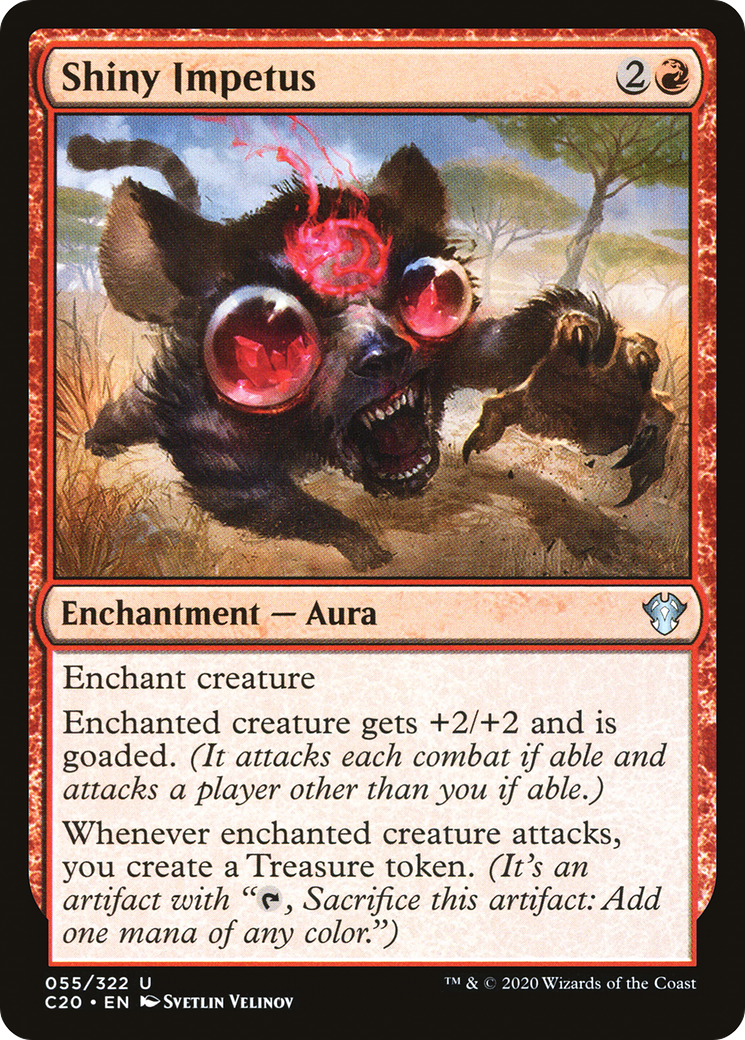
Shiny Impetus
Shiny Impetus
Enchantment — Aura
Enchant creature
Enchanted creature gets +2/+2 and is goaded. (It attacks each combat if able and attacks a player other than you if able.)
Whenever enchanted creature attacks, you create a Treasure token. (It's an artifact with " , Sacrifice this token: Add one mana of any color.")
- If, during a player's declare attackers step, a creature that player controls that's been goaded is tapped, is affected by a spell or ability that says it can't attack, or hasn't been under that player's control continuously since the turn began (and doesn't have haste), then it doesn't attack. If there's a cost associated with having a creature attack a player, its controller isn't forced to pay that cost, so it doesn't have to attack that player.
- If the creature doesn't meet any of the above exceptions and can attack, it must attack a player other than the controller of the spell or ability that goaded it if able. If the creature can't attack any of those players but could otherwise attack, it must attack a planeswalker an opponent controls, a battle an opponent controls, or a player who goaded it.
- Being goaded isn't an ability the creature has. Once it's been goaded, it must attack as detailed above even if it loses all abilities.
- Attacking with a goaded creature doesn't cause it to stop being goaded. If there is an additional combat phase that turn, or if another player gains control of it before it stops being goaded, it must attack again if able.
- If a creature you control has been goaded by multiple opponents, it must attack one of your opponents that hasn't goaded it, as that fulfills the maximum number of goad requirements. If a creature you control has been goaded by each of your opponents, the creature must attack an opponent (rather than a planeswalker or battle), but you choose which opponent it attacks.
- Shiny Impetus causes you to create a Treasure token, not the attacking creature's controller.
-
1
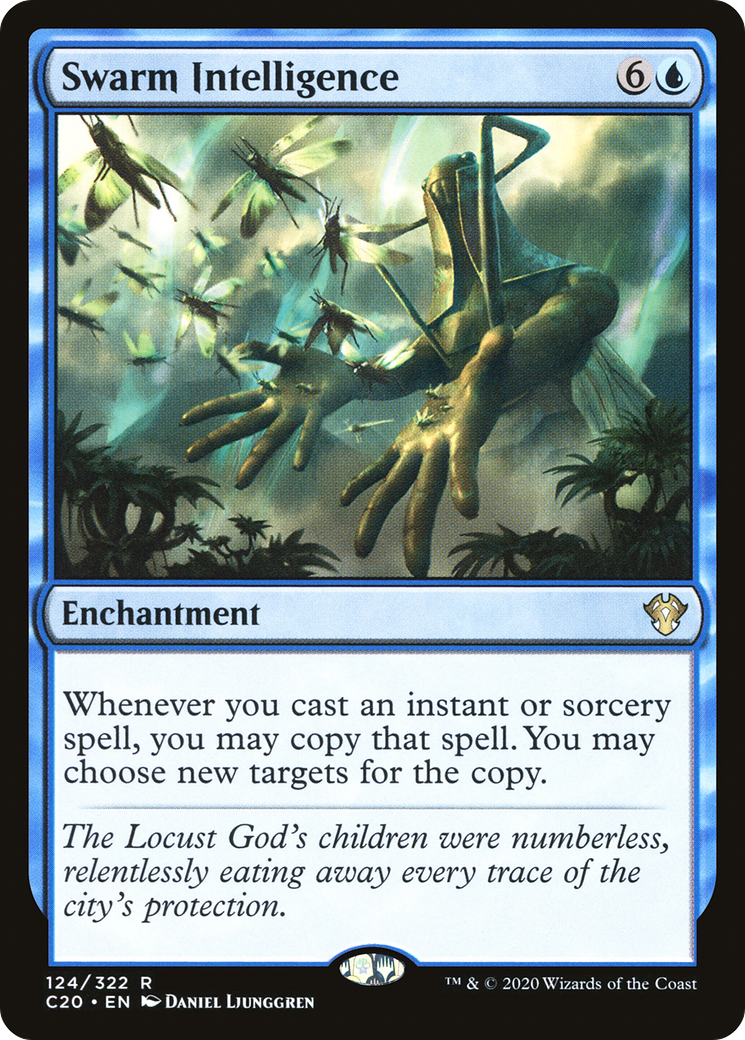
Swarm Intelligence
Swarm Intelligence
Enchantment
Whenever you cast an instant or sorcery spell, you may copy that spell. You may choose new targets for the copy.
- Swarm Intelligence can copy any instant or sorcery spell, not just one with targets.
- Swarm Intelligence can copy the spell even if it’s countered before Swarm Intelligence’s triggered ability resolves.
- The copy is created on the stack, so it’s not “cast.” Abilities that trigger when a player casts a spell (such as Swarm Intelligence’s own ability) won’t trigger.
- The copy will have the same targets as the spell it’s copying unless you choose new ones. You may change any number of the targets, including all of them or none of them. If, for one of the targets, you can’t choose a new legal target, then it remains unchanged (even if the current target is illegal).
- If the spell that’s copied is modal (that is, it says “Choose one —” or the like), the copy will have the same mode. A different mode can’t be chosen.
- If the spell that’s copied has an X whose value was determined as it was cast (like Torment of Hailfire does), the copy will have the same value of X.
- If the spell has damage divided as it was cast (like Chandra’s Pyrohelix), the division can’t be changed (although the targets receiving that damage still can).
- The controller of a copy can’t choose to pay any alternative or additional costs for the copy. However, effects based on any alternative or additional costs that were paid for the original spell are copied as though those same costs were paid for the copy.
-
1
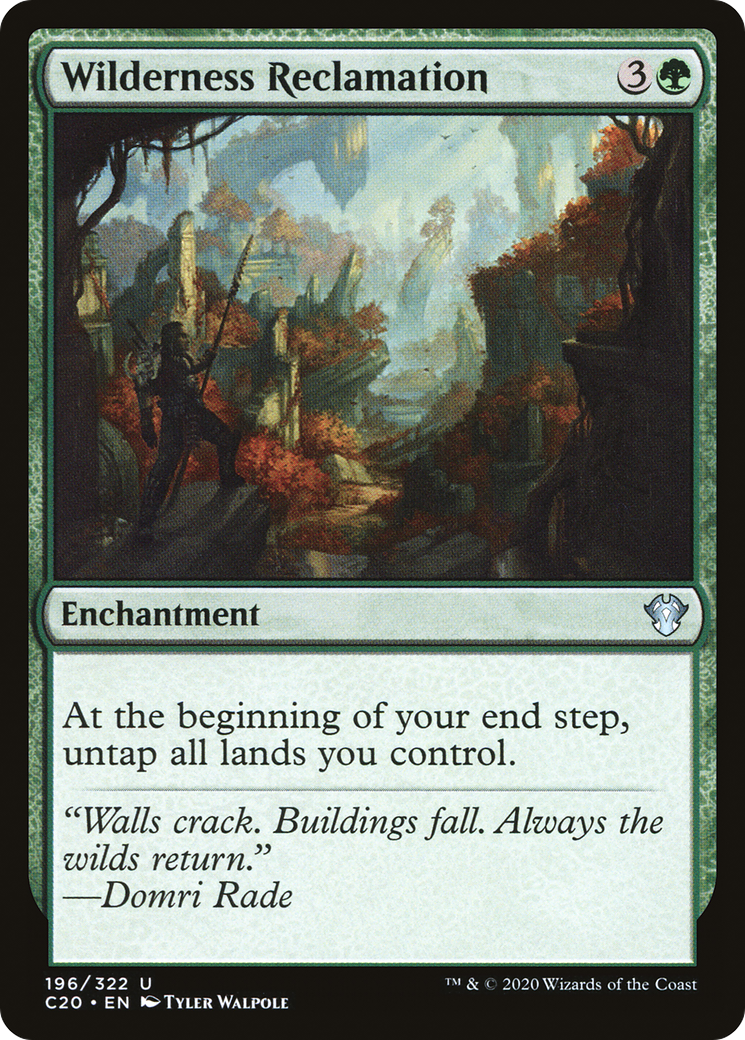
Wilderness Reclamation
Wilderness Reclamation
Enchantment
At the beginning of your end step, untap all lands you control.
Lands 38
-
1
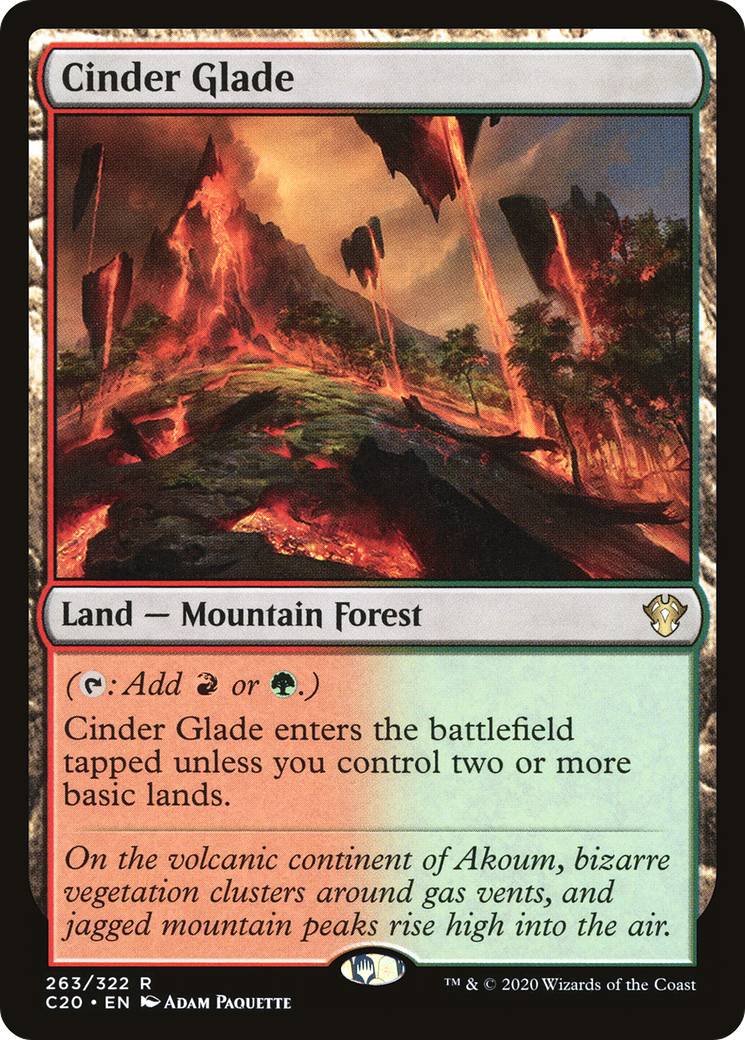
Cinder Glade
Cinder Glade
Land — Mountain Forest
( : Add or .)
This land enters tapped unless you control two or more basic lands.
- If one of these lands enters the battlefield at the same time as any number of basic lands, those other lands are not counted when determining if this land enters the battlefield tapped or untapped.
- However, because these cards have basic land types, effects that specify a basic land type without also specifying that the land be basic can affect them. For example, a spell or ability that reads "Destroy target Forest" can target Canopy Vista, while one that reads "Destroy target basic Forest" cannot.
- Even though these lands have basic land types, they are not basic lands because "basic" doesn't appear on their type line. Notably, controlling two or more of them won't allow others to enter the battlefield untapped.
-
1
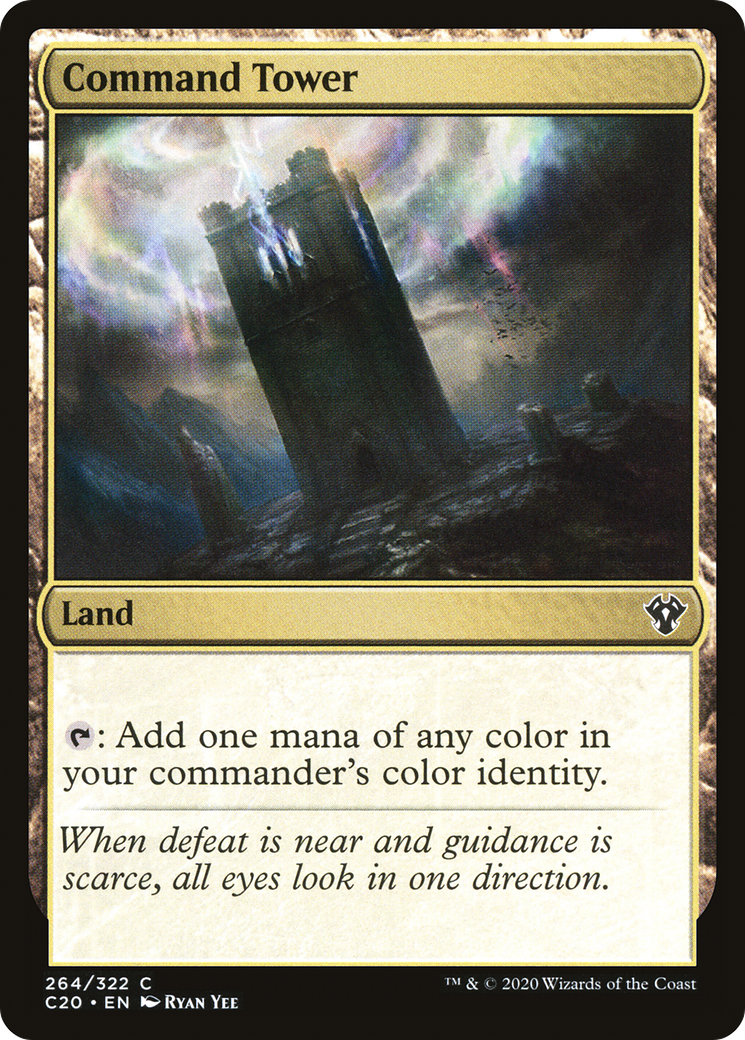
Command Tower
Command Tower
Land
: Add one mana of any color in your commander's color identity.
- If you don't have a commander, Command Tower's ability produces no mana.
- If your commander is a card that has no colors in its color identity, Command Tower's ability produces no mana. It doesn't produce .
- If you have two commanders, the ability adds one mana of any color in their combined color identities.
-
1
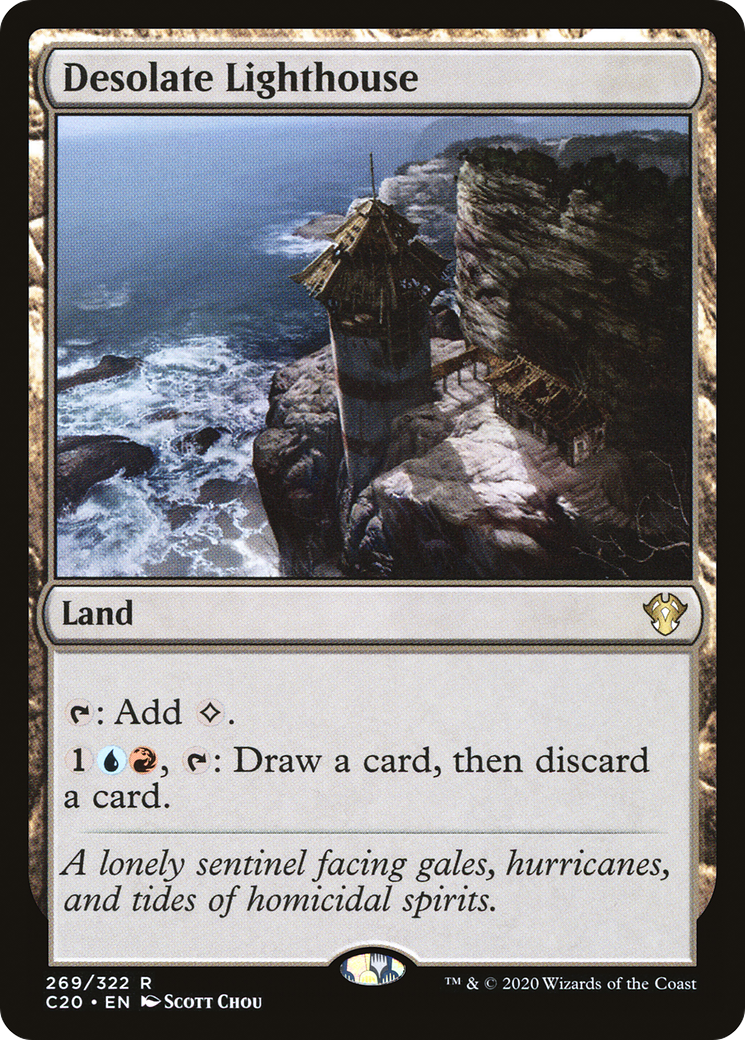
Desolate Lighthouse
Desolate Lighthouse
Land
: Add .
, : Draw a card, then discard a card.
-
1
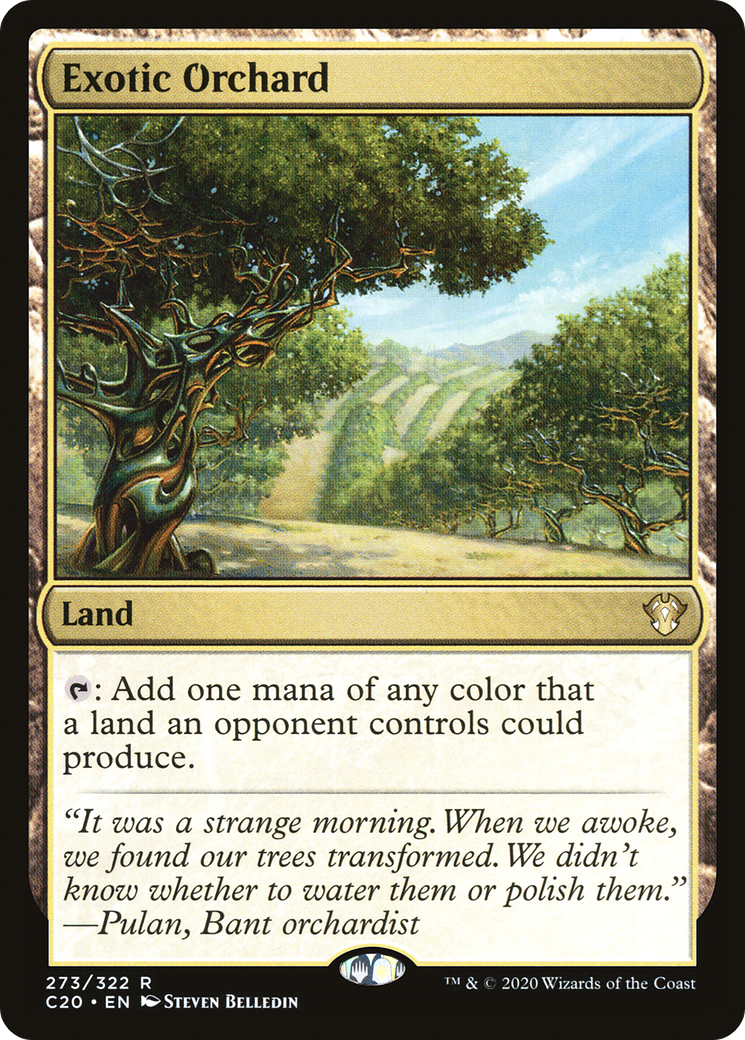
Exotic Orchard
Exotic Orchard
Land
: Add one mana of any color that a land an opponent controls could produce.
- Lands that produce mana based only on what other lands "could produce" won't help each other unless some other land allows one of them to actually produce some type of mana. For example, if you control an Exotic Orchard and your opponent controls an Exotic Orchard and a Reflecting Pool, none of those lands would produce mana if their mana abilities were activated. On the other hand, if you control a Forest and an Exotic Orchard, and your opponent controls an Exotic Orchard and a Reflecting Pool, then each of those lands can be tapped to produce . Your opponent's Exotic Orchard can produce because you control a Forest. Your Exotic Orchard and your opponent's Reflecting Pool can each produce because your opponent's Exotic Orchard can produce .
- When determining what colors of mana your opponents' lands could produce, Exotic Orchard takes into account any applicable replacement effects that would apply to those lands' mana abilities (such as Contamination's effect, for example). If there are more than one, consider them in any possible order.
- The colors of mana are white, blue, black, red, and green. Exotic Orchard can't be tapped for colorless mana, even if a land an opponent controls could produce colorless mana.
- Exotic Orchard doesn't care about any restrictions or riders your opponents' lands (such as Ancient Ziggurat or Hall of the Bandit Lord) put on the mana they produce. It just cares about colors of mana.
- Exotic Orchard checks the effects of all mana-producing abilities of lands your opponents control, but it doesn't check their costs. For example, Vivid Crag has the ability " , Remove a charge counter from Vivid Crag: Add one mana of any color." If an opponent controls Vivid Crag and you control Exotic Orchard, you can tap Exotic Orchard for any color of mana. It doesn't matter whether Vivid Crag has a charge counter on it, and it doesn't matter whether it's untapped.
-
8
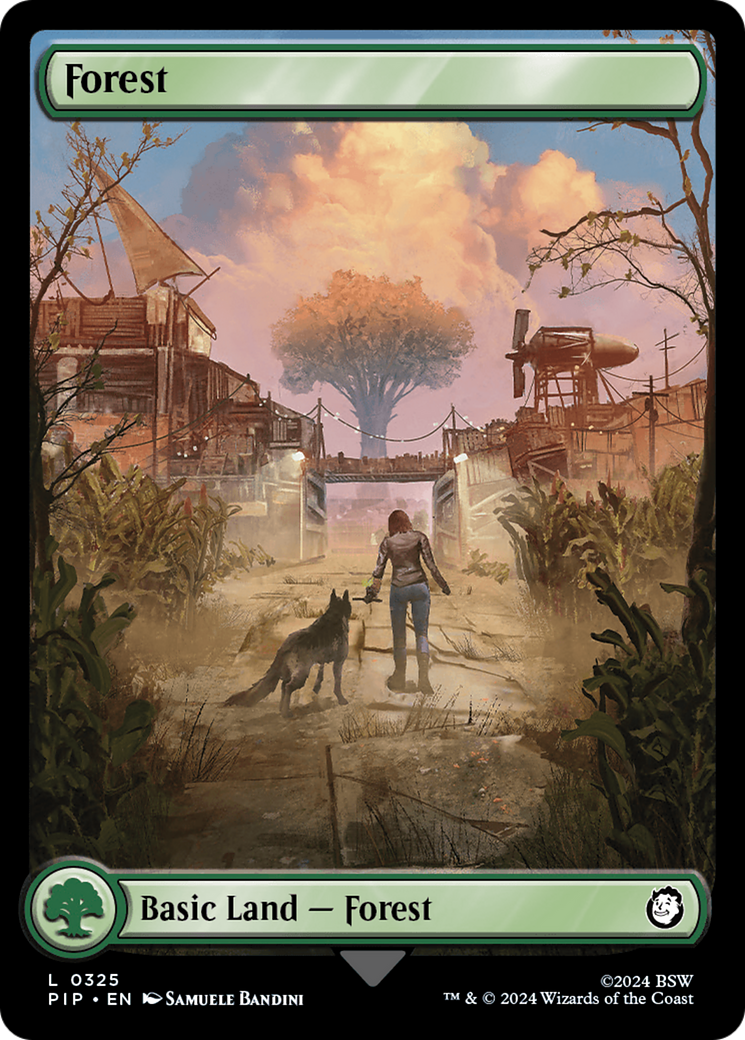
Forest
Forest
Basic Land — Forest
( : Add .)
-
1
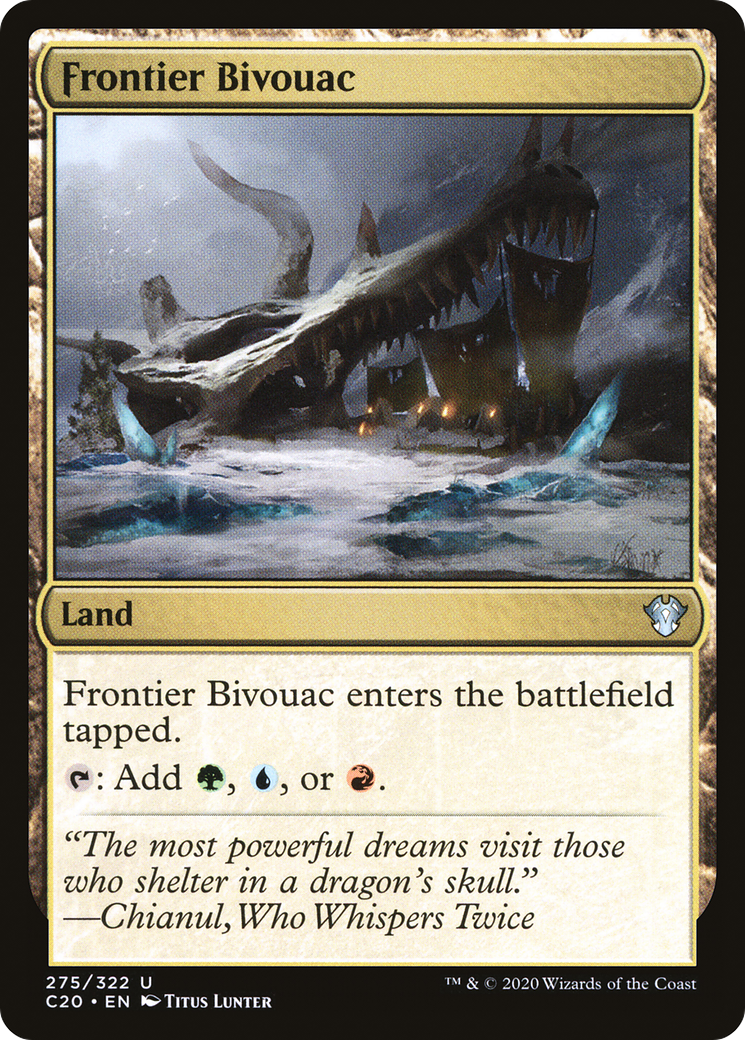
Frontier Bivouac
Frontier Bivouac
Land
This land enters tapped.
: Add , , or .
-
1
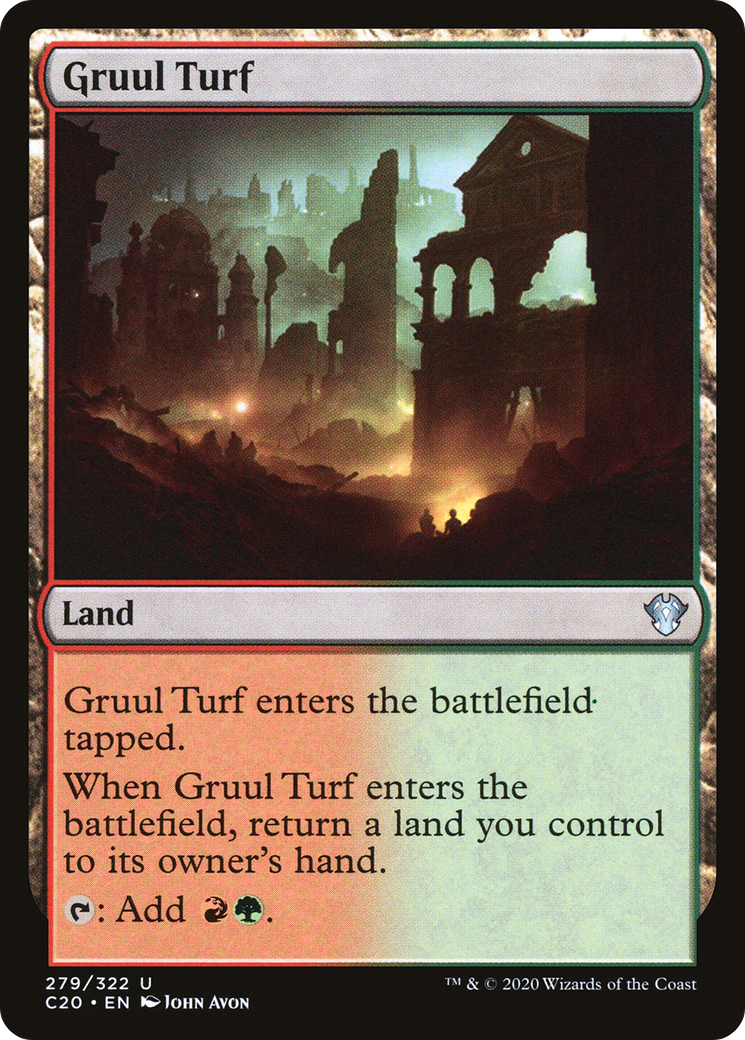
Gruul Turf
Gruul Turf
Land
This land enters tapped.
When this land enters, return a land you control to its owner's hand.
: Add .
- If this land enters the battlefield and you control no other lands, its ability will force you to return it to your hand.
-
1
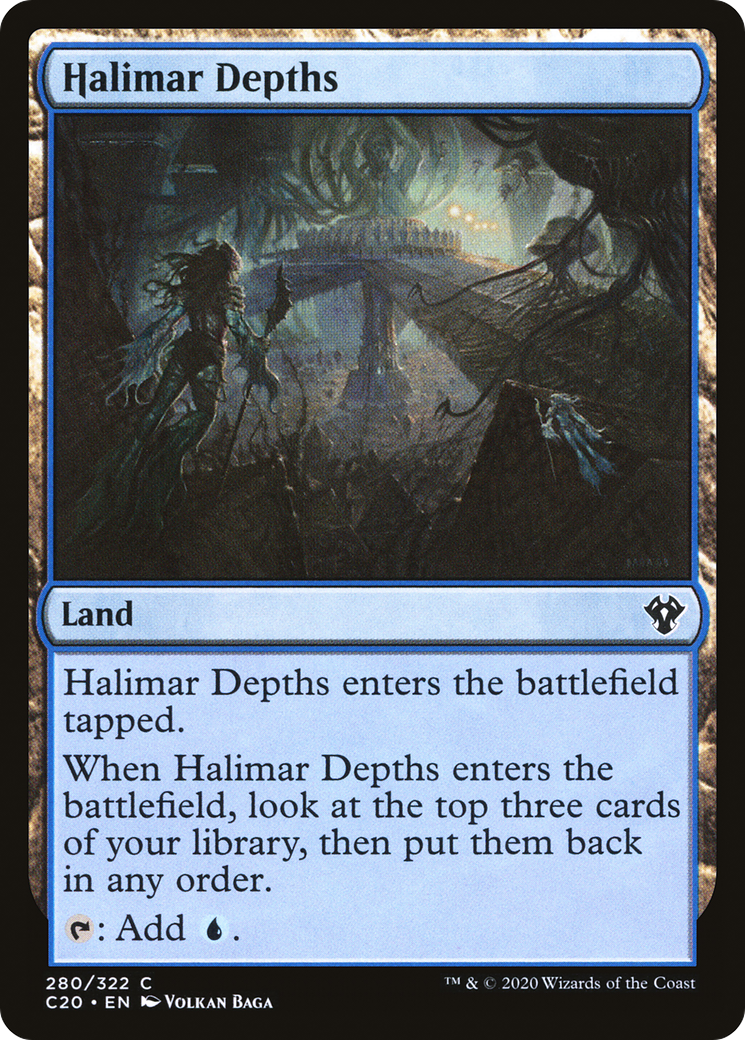
Halimar Depths
Halimar Depths
Land
This land enters tapped.
When this land enters, look at the top three cards of your library, then put them back in any order.
: Add .
-
5
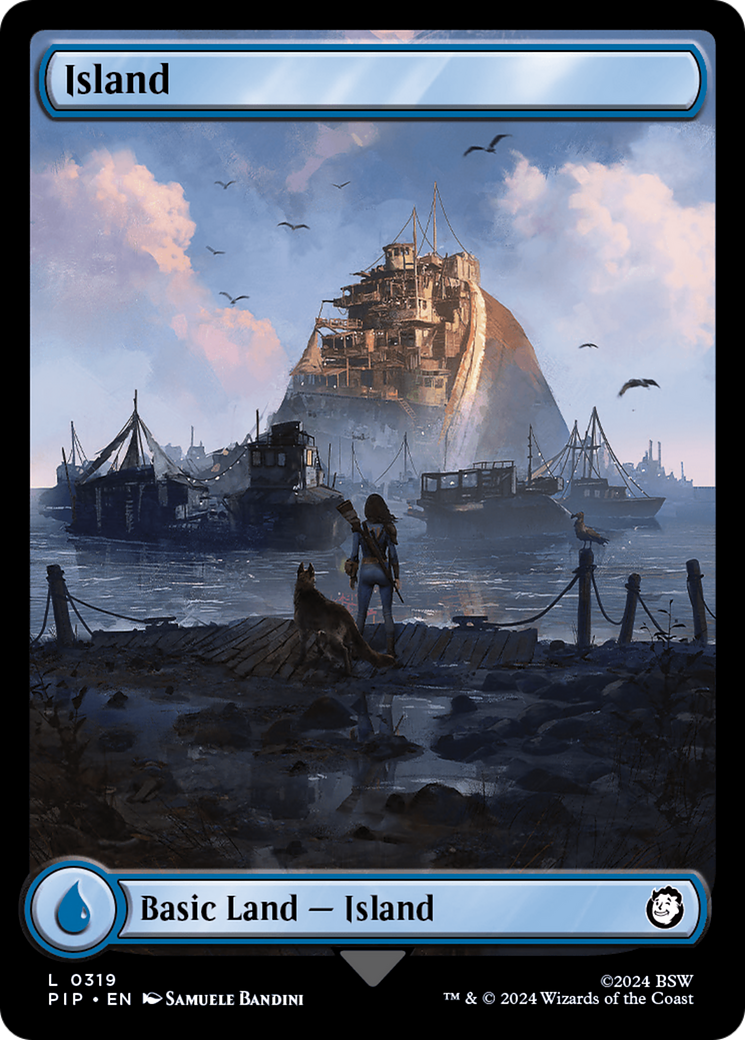
Island
Island
Basic Land — Island
( : Add .)
-
1
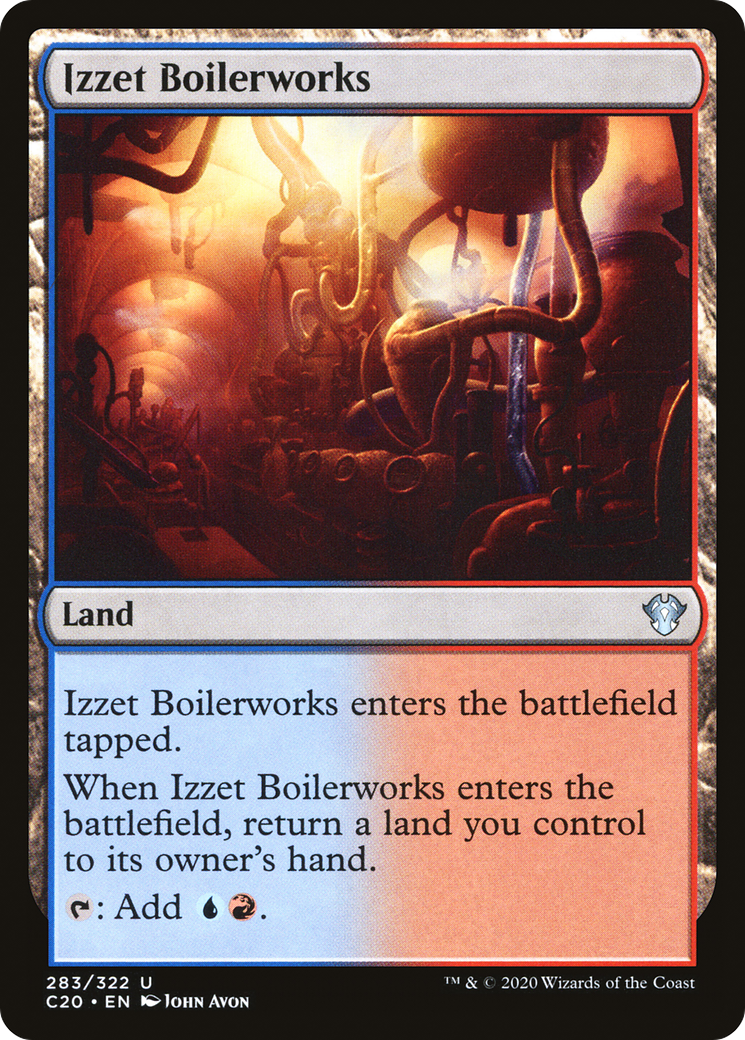
Izzet Boilerworks
Izzet Boilerworks
Land
This land enters tapped.
When this land enters, return a land you control to its owner's hand.
: Add .
- If this land enters the battlefield and you control no other lands, its ability will force you to return it to your hand.
-
1
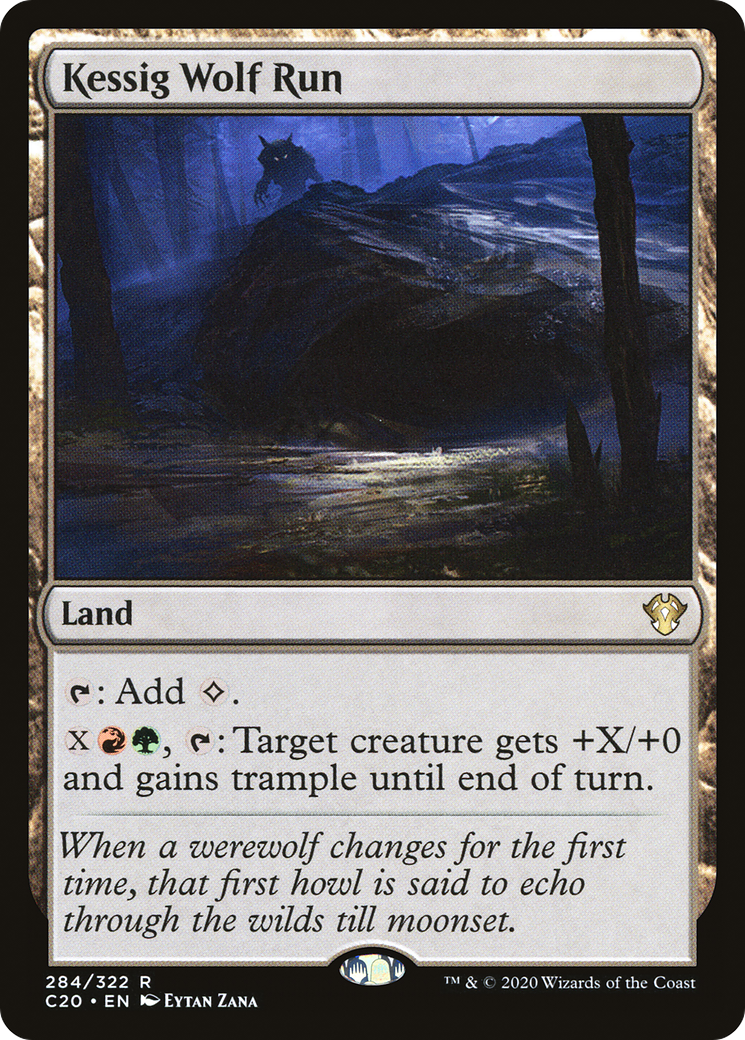
Kessig Wolf Run
Kessig Wolf Run
Land
: Add .
, : Target creature gets +X/+0 and gains trample until end of turn.
-
1
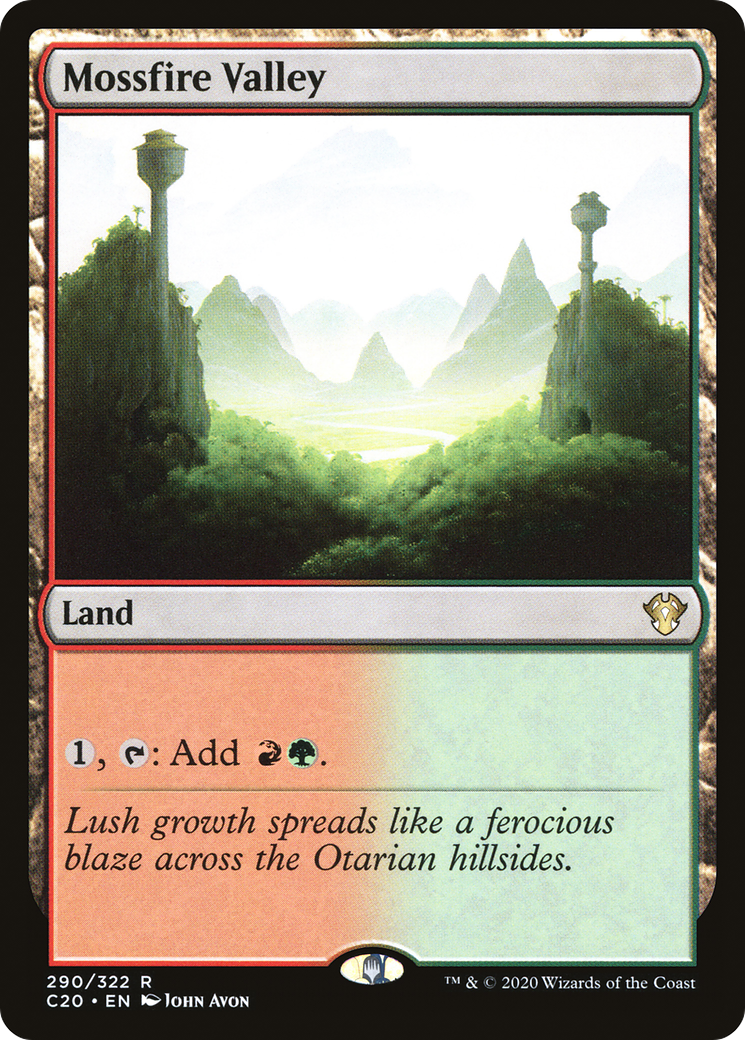
Mossfire Valley
Mossfire Valley
Land
, : Add .
-
1
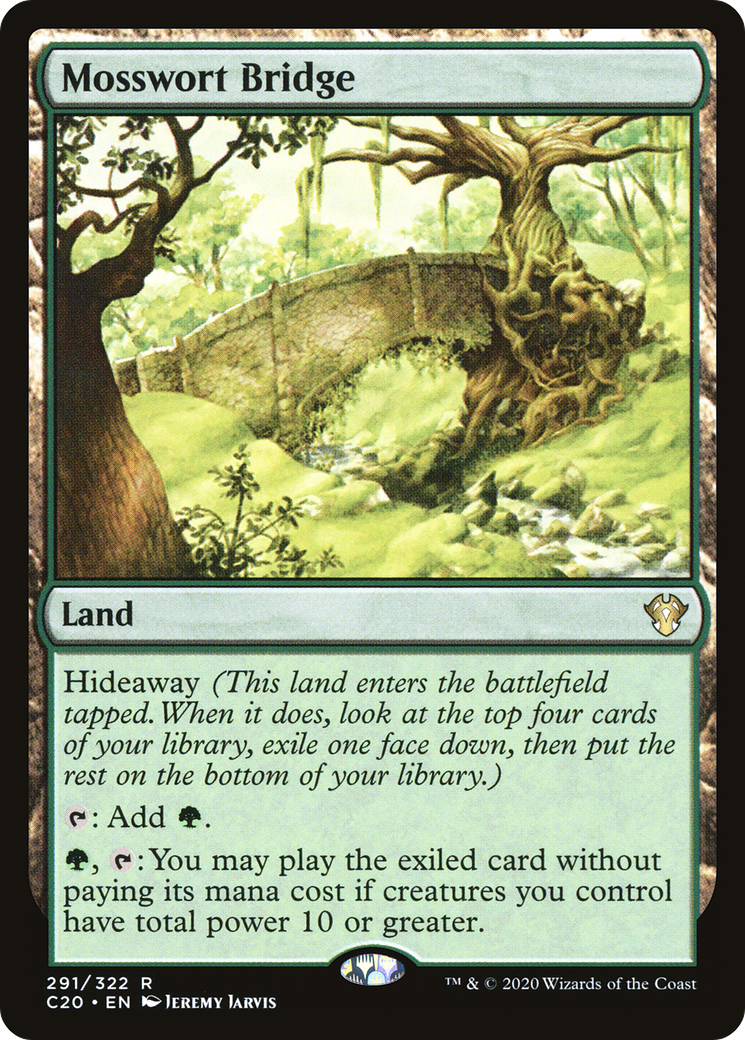
Mosswort Bridge
Mosswort Bridge
Land
Hideaway 4 (When this land enters, look at the top four cards of your library, exile one face down, then put the rest on the bottom in a random order.)
This land enters tapped.
: Add .
, : You may play the exiled card without paying its mana cost if creatures you control have total power 10 or greater.
- "Hideaway N" means "When this permanent enters the battlefield, look at the top N cards of your library. Exile one of them face down and put the rest on the bottom of your library in a random order. The exiled card gains 'The player who controls the permanent that exiled this card may look at this card in the exile zone.'"
- Any player who has controlled a permanent with a hideaway ability since a card was exiled with it may look at that card.
- Previously, permanents with hideaway entered the battlefield tapped. This ability has been removed from the definition of hideaway. Older cards have received errata to have an additional paragraph that reads "[This permanent] enters the battlefield tapped," and they now have hideaway 4.
- Hideaway now causes you to put the rest of the cards on the bottom of your library in a random order instead of any order.
-
5
Mountain
Mountain
Basic Land — Mountain
( : Add .)
-
1
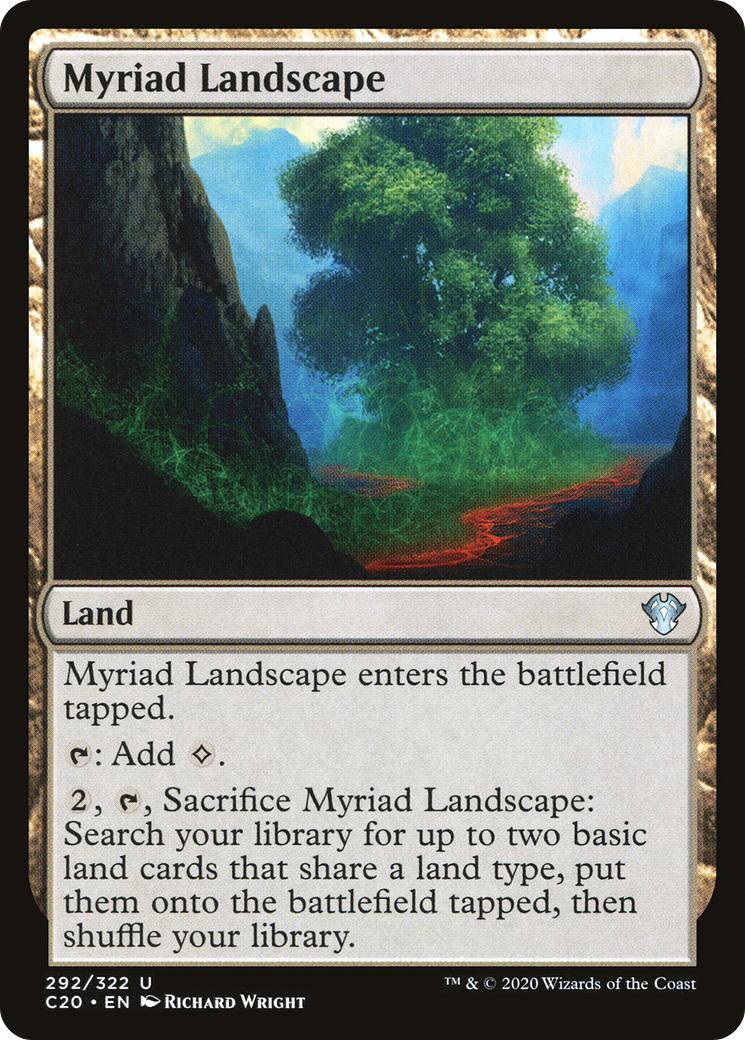
Myriad Landscape
Myriad Landscape
Land
This land enters tapped.
: Add .
, , Sacrifice this land: Search your library for up to two basic land cards that share a land type, put them onto the battlefield tapped, then shuffle.
- You can choose to find one basic land card with Myriad Landscape's last ability.
-
1
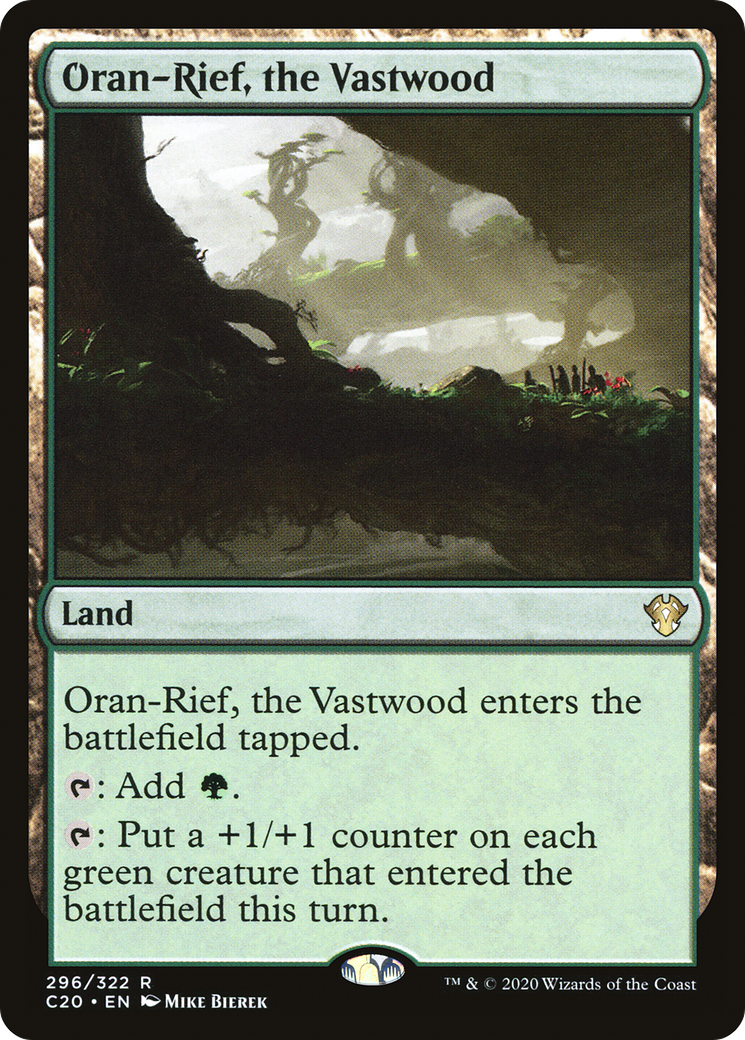
Oran-Rief, the Vastwood
Oran-Rief, the Vastwood
Land
This land enters tapped.
: Add .
: Put a +1/+1 counter on each green creature that entered this turn.
- Oran-Rief's last ability affects all permanents that are green creatures that entered this turn, not just the ones you control.
- Oran-Rief's last ability cares about permanents' characteristics at the time the ability resolves, not their characteristics at the time they entered. For example, if a blue creature enters, then is turned green by a spell or ability, then Oran-Rief's second ability resolves, you'll put a +1/+1 counter on that creature.
-
1
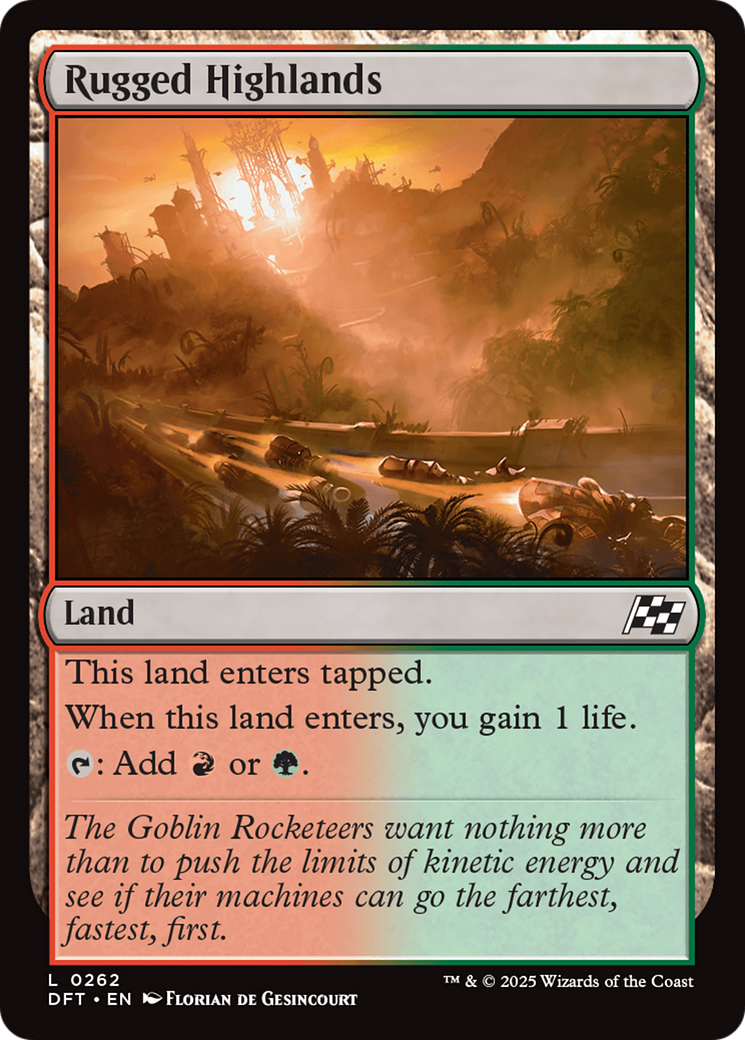
Rugged Highlands
Rugged Highlands
Land
This land enters tapped.
When this land enters, you gain 1 life.
: Add or .
-
1
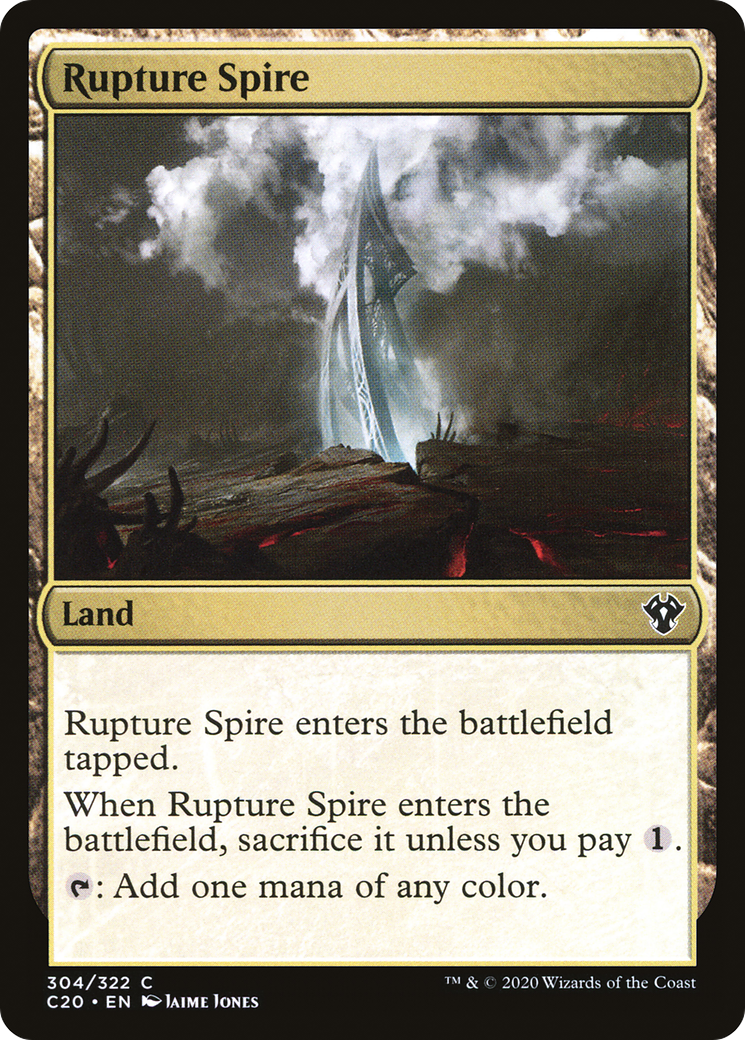
Rupture Spire
Rupture Spire
Land
This land enters tapped.
When this land enters, sacrifice it unless you pay .
: Add one mana of any color.
-
1
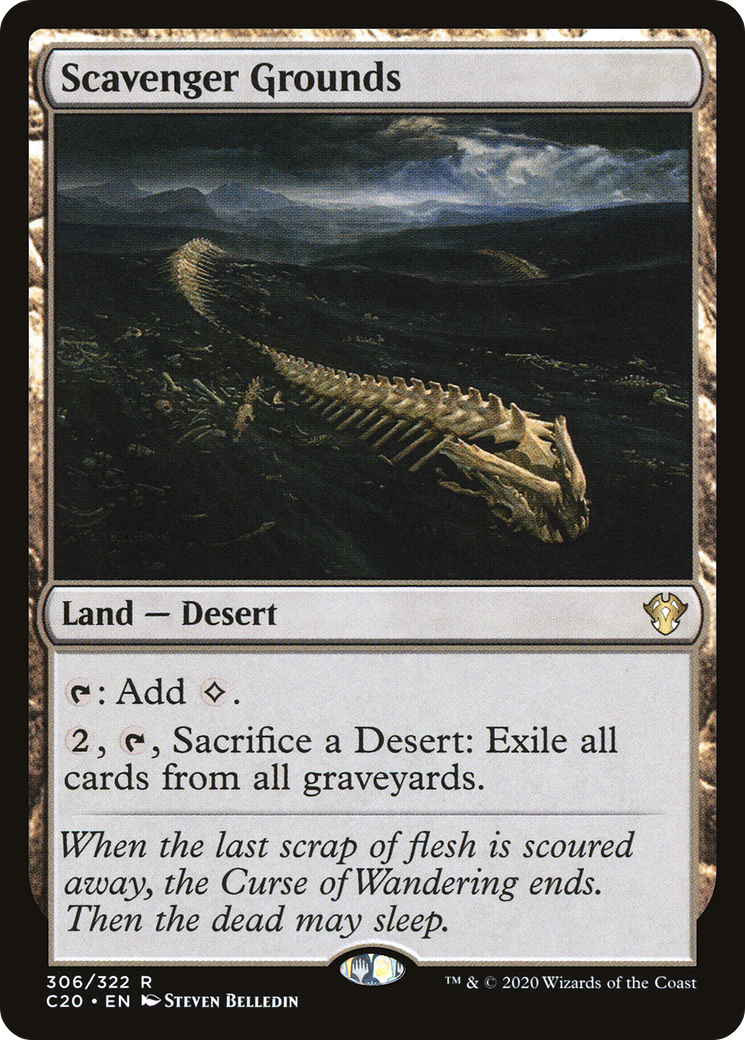
Scavenger Grounds
Scavenger Grounds
Land — Desert
: Add .
, , Sacrifice a Desert: Exile all graveyards.
- The sacrificed Desert will be in your graveyard to be exiled by the last ability of Scavenger Grounds.
-
1
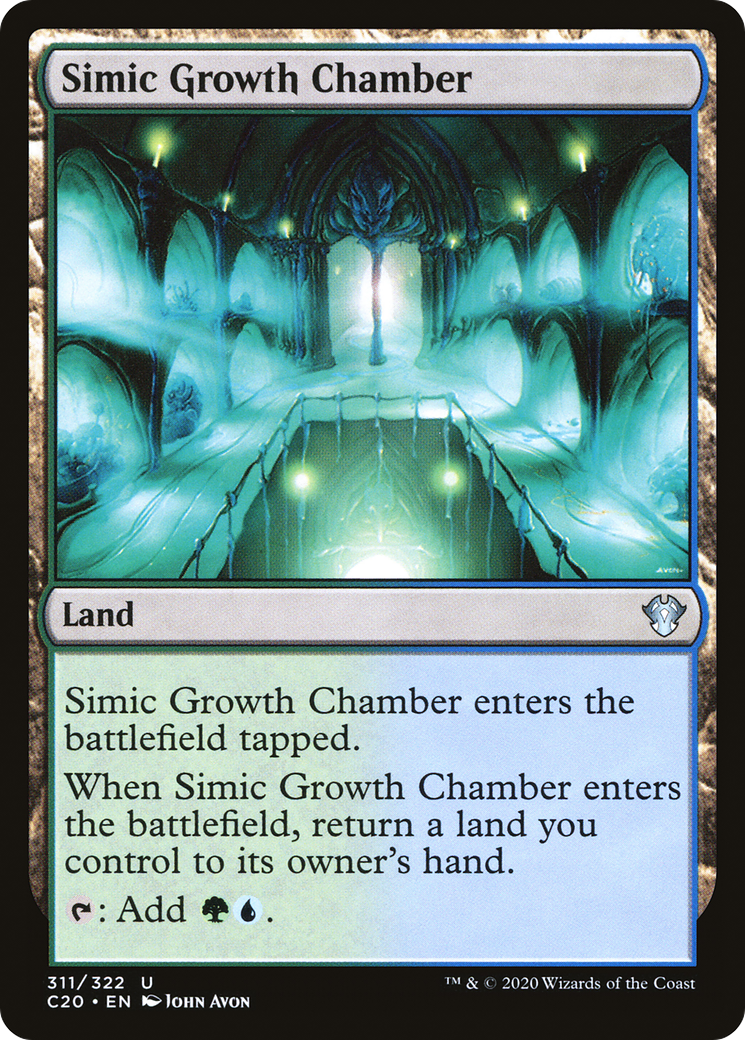
Simic Growth Chamber
Simic Growth Chamber
Land
This land enters tapped.
When this land enters, return a land you control to its owner's hand.
: Add .
- If this land enters the battlefield and you control no other lands, its ability will force you to return it to your hand.
-
1
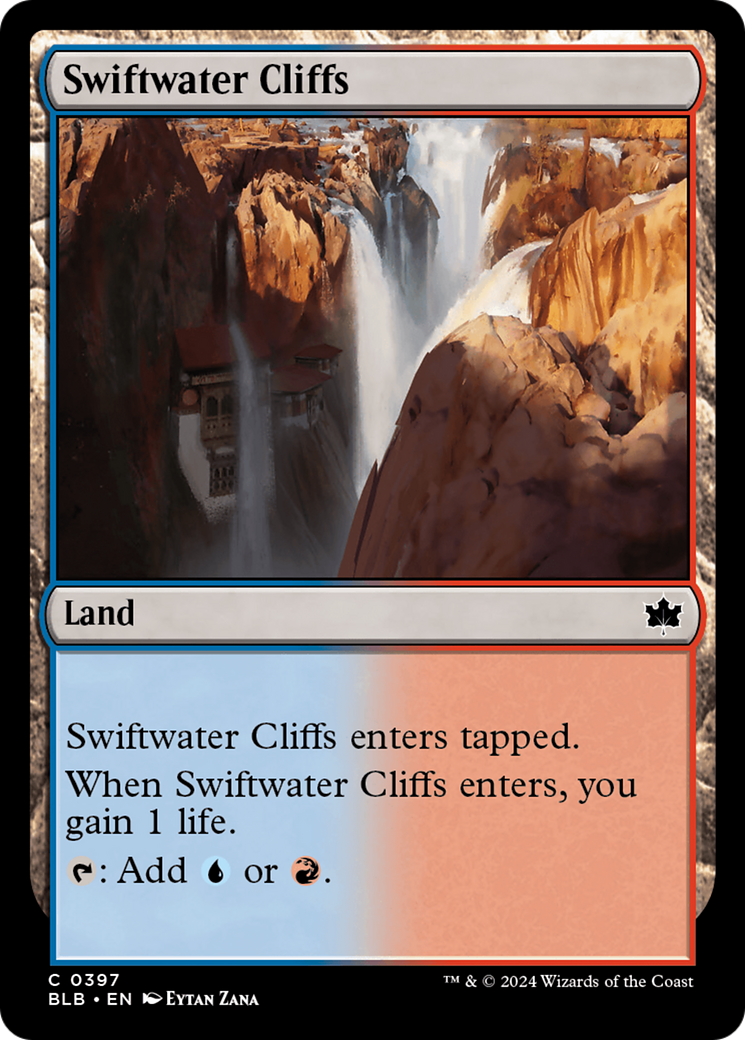
Swiftwater Cliffs
Swiftwater Cliffs
Land
This land enters tapped.
When this land enters, you gain 1 life.
: Add or .
-
1
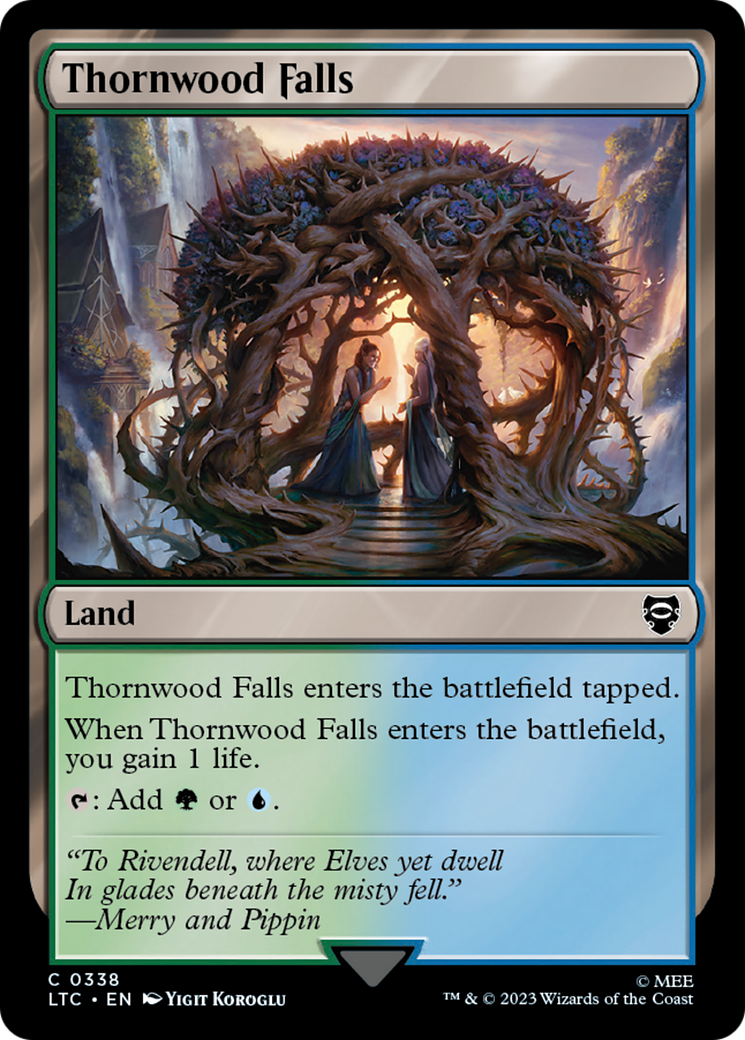
Thornwood Falls
Thornwood Falls
Land
This land enters tapped.
When this land enters, you gain 1 life.
: Add or .
-
1
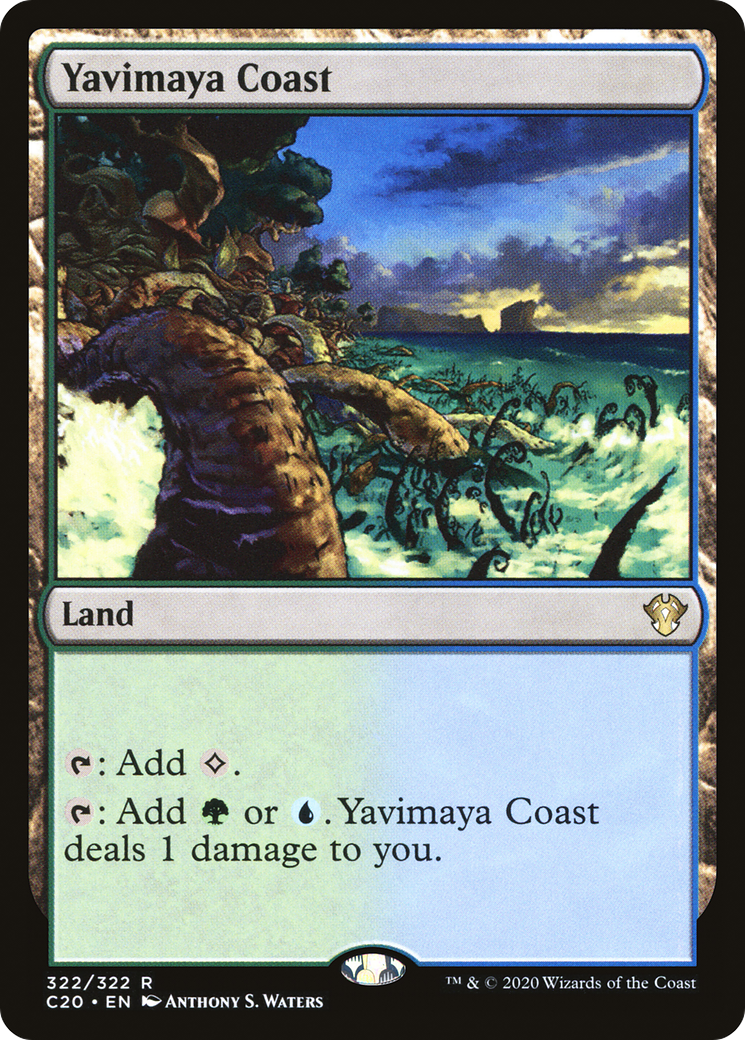
Yavimaya Coast
Yavimaya Coast
Land
: Add .
: Add or . This land deals 1 damage to you.
- Like most lands, each land in this cycle is colorless. The damage dealt to you is dealt by a colorless source.
- The damage dealt to you is part of the second mana ability. It doesn't use the stack and can't be responded to.
Blue 14
-
1
Chemister's Insight
Chemister's Insight
Instant
Draw two cards.
Jump-start (You may cast this card from your graveyard by discarding a card in addition to paying its other costs. Then exile this card.)
- If a card with jump-start is put into your graveyard during your turn, you'll be able to cast it right away if it's legal to do so, before an opponent can take any actions.
- You must still follow any timing restrictions and permissions when casting a spell with jump-start, including those based on the card's type. For instance, you can cast a sorcery using jump-start only when you could normally cast a sorcery.
- A spell cast using jump-start will always be exiled afterward, whether it resolves, it's countered, or it leaves the stack in some other way.
- If an effect allows you to pay an alternative cost rather than a spell's mana cost, you may pay that alternative cost when you jump-start a spell. You'll still discard a card as an additional cost to cast it.
-
1
Decoy Gambit
Decoy Gambit
Instant
For each opponent, choose up to one target creature that player controls, then return that creature to its owner's hand unless its controller has you draw a card.
- As the Decoy Gambit resolves, first the next opponent in turn order (or, if it’s an opponent’s turn, the opponent whose turn it is) chooses whether you’ll draw a card or return their creature that was targeted to its owner’s hand, then each other opponent in turn order does so knowing the choices made before them. After all choices are made, you draw the appropriate number of cards. After you’ve drawn, the appropriate creatures are all simultaneously returned to their owners’ hands.
- For each opponent, if you didn’t choose a target creature they control or if that creature has become an illegal target, that player can’t choose for you to draw a card.
- If a creature targeted by Decoy Gambit changes controller, it’s no longer a legal target.
-
1
Eon Frolicker
Eon Frolicker
Creature — Elemental Otter
5/5
Flying
When this creature enters, if you cast it, target opponent takes an extra turn after this one. Until your next turn, you and planeswalkers you control gain protection from that player. (You and planeswalkers you control can't be targeted, dealt damage, or enchanted by anything controlled by that player.)
- Protection from a player means that you and each planeswalker you control have protection from each object controlled by that player. If an object has no controller (such as a card in a graveyard), its owner is considered its controller for this purpose.
- Creatures that player controls can still attack you or planeswalkers you control, but the damage they would deal will be prevented.
-
1
Frantic Search
Frantic Search
Instant
Draw two cards, then discard two cards. Untap up to three lands.
- You choose which lands to untap as the spell resolves. They aren't targeted, and they don't have to be lands that you control.
- You draw two cards and discard two cards all while Frantic Search is resolving. Nothing can happen between the two, and no player may choose to take actions.
-
1
Haldan, Avid Arcanist
Haldan, Avid Arcanist
Legendary Creature — Human Wizard
1/4
Partner with Pako, Arcane Retriever (When this creature enters, target player may put Pako into their hand from their library, then shuffle.)
You may play lands and cast noncreature spells from among cards you exiled that have fetch counters on them, and you may spend mana as though it were mana of any color to cast those spells.
- Haldan's ability applies only while it's on the battlefield. You'll be able to play cards you exiled with fetch counters before Haldan entered the battlefield, and if Haldan leaves, you won't be able to play cards that were exiled with fetch counters until Haldan returns.
- Haldan doesn't change when you can play the exiled cards. For example, if you exile a sorcery card, you can cast it only during your main phase when the stack is empty. If you exile a land card, you can play it only during your main phase and only if you have an available land play remaining.
- A creature card that you exiled with a fetch counter on it may be cast as a noncreature spell if a rule or effect (such as that of adventurer cards) allows you to do so.
- In a multiplayer game, if a player leaves the game, all cards that player owns leave as well. If you leave the game, any spells or permanents you control that Pako fetched are exiled.
- "Partner with [name]" represents two abilities. The first is a triggered ability: "When this permanent enters the battlefield, target player may search their library for a card named [name], reveal it, put it into their hand, then shuffle their library."
- Note that the target player searches their library (which may be affected by effects such as that of Stranglehold) and that the card they find is revealed, even though these words aren't included in the ability's reminder text.
- The second ability represented by the "partner with [name]" keyword modifies the rules for deck construction in the Commander variant and has no function outside of that variant. If a legendary creature card with "partner with [name]" is designated as your commander, the named legendary creature card can also be designated as your commander.
- If your Commander deck has two commanders, you can only include cards whose own color identities are also found in your commanders' combined color identities. If Haldan and Pako are your commanders, your deck may contain cards with blue, red, and/or green in their color identity, but not cards with white or black.
- Both commanders start in the command zone, and the remaining 98 cards of your deck are shuffled to become your library.
- A creature with a "partner with" ability can't partner with any creature other than its designated partner. Losing a partner ability during the game doesn't cause either to cease to be your commander.
- Once the game begins, your two commanders are tracked separately. If you cast one, you won't have to pay an additional the first time you cast the other. A player loses the game after having been dealt 21 damage from one of them, not from both of them combined. Command Beacon's effect puts one into your hand from the command zone, not both.
- The triggered ability of the "partner with" keyword still triggers in a Commander game. If your other commander has somehow ended up in your library, you can find it. You can also target another player who might have that card in their library.
-
1
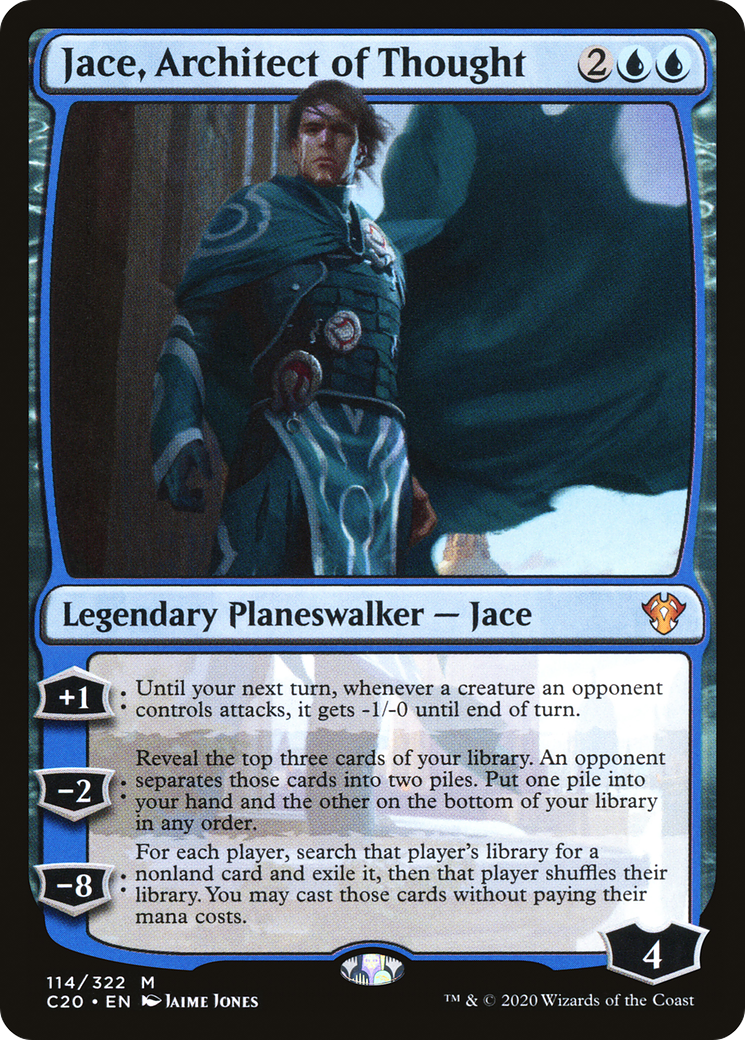
Jace, Architect of Thought
Jace, Architect of Thought
Legendary Planeswalker — Jace
+1: Until your next turn, whenever a creature an opponent controls attacks, it gets -1/-0 until end of turn.
−2: Reveal the top three cards of your library. An opponent separates those cards into two piles. Put one pile into your hand and the other on the bottom of your library in any order.
−8: For each player, search that player's library for a nonland card and exile it, then that player shuffles. You may cast those cards without paying their mana costs.
- Jace's first ability creates a delayed triggered ability that triggers whenever a creature an opponent controls attacks. It doesn't matter which player or planeswalker that creature is attacking.
- You pick one of your opponents when Jace's second ability resolves. The ability doesn't target that opponent. All players may see the revealed cards and offer opinions. You (not your opponent) choose which pile is put into your hand and which pile is put on the bottom of your library.
- Piles can be empty. If one of the piles is empty, you choose to put all the revealed cards in your hand or on the bottom of your library.
- When resolving Jace's third ability, you search each player's library (including yours) and exile the nonland cards before casting any of them.
- For each library, the search is complete only when you explicitly say it is. For example, you can look through one player's library, set that library down, look at another player's library, choose a nonland card in the first library, then choose a nonland card in the second library. Don't reveal any cards from those libraries to any other player until you exile them.
- You cast the cards by putting them on the stack one at a time, choosing modes, targets, and so on. The last card you cast will be the first one to resolve.
- When casting a card this way, ignore timing restrictions based on the card's type. Other timing restrictions, such as “Cast [this card] only during combat,” must be followed.
- If you can't cast a card, perhaps because there are no legal targets available, or if you choose not to cast one, it will remain exiled. Jace's ability won't allow you to cast it later.
- If you cast a card “without paying its mana cost,” you can't pay alternative costs such as overload costs. You can pay additional costs such as kicker costs. If the card has mandatory additional costs, you must pay those.
- If a card has in its mana cost, you must choose 0 as its value.
-
1
Lunar Mystic
Lunar Mystic
Creature — Human Wizard
2/2
Whenever you cast an instant spell, you may pay . If you do, draw a card.
- The triggered ability will go on the stack on top of the instant spell and resolve before it.
- The decision to pay is made when the triggered ability resolves. It’s not an additional cost of the instant spell.
-
1
Murmuring Mystic
Murmuring Mystic
Creature — Human Wizard
1/5
Whenever you cast an instant or sorcery spell, create a 1/1 blue Bird Illusion creature token with flying.
- Murmuring Mystic's triggered ability resolves before the spell that caused it to trigger. It resolves even if that spell is countered.
-
1
Nascent Metamorph
Nascent Metamorph
Creature — Shapeshifter
1/1
Whenever this creature attacks or blocks, target opponent reveals cards from the top of their library until they reveal a creature card. This creature becomes a copy of that card until end of turn. Then that player puts all cards revealed this way on the bottom of their library in a random order.
- The creature card that Nascent Metamorph becomes a copy of is put onto the bottom of the library along with any other cards.
- If the target opponent has no creature cards in their library, Nascent Metamorph doesn't become a copy of anything. The cards are returned to that library in a random order.
- If another permanent becomes a copy of Nascent Metamorph, it will become whatever Nascent Metamorph is copying. It remains a copy when Nascent Metamorph's effect ends.
- If an effect begins to apply to Nascent Metamorph before it becomes a copy, that effect will continue to apply.
- If Nascent Metamorph becomes a copy of a legendary card with the same name as a legendary permanent you control, you'll put one of them into its owner's graveyard.
- If Nascent Metamorph becomes a copy of an object with a set of linked abilities (for example, one ability that exiles a card and another that refers to the card "exiled with" the object), that link only lasts as long as Nascent Metamorph is copying that object. If it stops being a copy of that object and then becomes a copy again later, the link is lost.
-
1
Niblis of Frost
Niblis of Frost
Creature — Spirit
3/3
Flying
Prowess (Whenever you cast a noncreature spell, this creature gets +1/+1 until end of turn.)
Whenever you cast an instant or sorcery spell, tap target creature an opponent controls. That creature doesn't untap during its controller's next untap step.
- If multiple effects say that a creature doesn’t untap during its controller’s next untap step, those effects all apply during one untap step. For example, if you cast two instants in one turn and target the same creature twice with Niblis of Frost’s ability, that creature will only spend one untap step without untapping.
-
1
Psychic Impetus
Psychic Impetus
Enchantment — Aura
Enchant creature
Enchanted creature gets +2/+2 and is goaded. (It attacks each combat if able and attacks a player other than you if able.)
Whenever enchanted creature attacks, you scry 2.
- If, during a player's declare attackers step, a creature that player controls that's been goaded is tapped, is affected by a spell or ability that says it can't attack, or hasn't been under that player's control continuously since the turn began (and doesn't have haste), then it doesn't attack. If there's a cost associated with having a creature attack a player, its controller isn't forced to pay that cost, so it doesn't have to attack that player.
- If the creature doesn't meet any of the above exceptions and can attack, it must attack a player other than the controller of the spell or ability that goaded it if able. If the creature can't attack any of those players but could otherwise attack, it must attack a planeswalker an opponent controls, a battle an opponent controls, or a player who goaded it.
- Being goaded isn't an ability the creature has. Once it's been goaded, it must attack as detailed above even if it loses all abilities.
- Attacking with a goaded creature doesn't cause it to stop being goaded. If there is an additional combat phase that turn, or if another player gains control of it before it stops being goaded, it must attack again if able.
- If a creature you control has been goaded by multiple opponents, it must attack one of your opponents that hasn't goaded it, as that fulfills the maximum number of goad requirements. If a creature you control has been goaded by each of your opponents, the creature must attack an opponent (rather than a planeswalker or battle), but you choose which opponent it attacks.
- Psychic Impetus causes you to scry 2, not the attacking creature's controller.
-
1
Swarm Intelligence
Swarm Intelligence
Enchantment
Whenever you cast an instant or sorcery spell, you may copy that spell. You may choose new targets for the copy.
- Swarm Intelligence can copy any instant or sorcery spell, not just one with targets.
- Swarm Intelligence can copy the spell even if it’s countered before Swarm Intelligence’s triggered ability resolves.
- The copy is created on the stack, so it’s not “cast.” Abilities that trigger when a player casts a spell (such as Swarm Intelligence’s own ability) won’t trigger.
- The copy will have the same targets as the spell it’s copying unless you choose new ones. You may change any number of the targets, including all of them or none of them. If, for one of the targets, you can’t choose a new legal target, then it remains unchanged (even if the current target is illegal).
- If the spell that’s copied is modal (that is, it says “Choose one —” or the like), the copy will have the same mode. A different mode can’t be chosen.
- If the spell that’s copied has an X whose value was determined as it was cast (like Torment of Hailfire does), the copy will have the same value of X.
- If the spell has damage divided as it was cast (like Chandra’s Pyrohelix), the division can’t be changed (although the targets receiving that damage still can).
- The controller of a copy can’t choose to pay any alternative or additional costs for the copy. However, effects based on any alternative or additional costs that were paid for the original spell are copied as though those same costs were paid for the copy.
-
1
Talrand, Sky Summoner
Talrand, Sky Summoner
Legendary Creature — Merfolk Wizard
2/2
Whenever you cast an instant or sorcery spell, create a 2/2 blue Drake creature token with flying.
- An ability that triggers when a player casts a spell resolves before the spell that caused it to trigger, but after targets have been chosen for that spell. It resolves even if that spell is countered.
-
1
Whiplash Trap
Whiplash Trap
Instant — Trap
If an opponent had two or more creatures enter the battlefield under their control this turn, you may pay rather than pay this spell's mana cost.
Return two target creatures to their owners' hands.
- You may ignore a Trap's alternative cost condition and simply cast it for its normal mana cost. This is true even if its alternative cost condition has been met.
- Casting a Trap by paying its alternative cost doesn't change its mana cost or mana value. The only difference is the cost you actually pay.
- Effects that increase or reduce the cost to cast a Trap will apply to whichever cost you chose to pay.
- You must target two creatures as you cast Whiplash Trap. If you can't (because just one creature is on the battlefield, perhaps), you can't cast the spell.
- You can target any two creatures, not just ones that entered this turn.
Red 13
-
1
Chaos Warp
Chaos Warp
Instant
The owner of target permanent shuffles it into their library, then reveals the top card of their library. If it's a permanent card, they put it onto the battlefield.
- A permanent card is a card with one or more of the following card types: artifact, creature, enchantment, land, or planeswalker.
- The owner of a token is the player under whose control the token was put onto the battlefield. If a token is shuffled into a player's library this way, that player shuffles before revealing the top card of that library.
- If the revealed card is not a permanent card, it remains on top of that library.
- If the permanent is an illegal target by the time Chaos Warp tries to resolve, it won't resolve and none of its effects will occur. No library will be shuffled and no card will be revealed.
- If the revealed card is a permanent card but can't enter (perhaps because it's an Aura with nothing to enchant), it remains on top of that library.
-
1
Charmbreaker Devils
Charmbreaker Devils
Creature — Devil
4/4
At the beginning of your upkeep, return an instant or sorcery card at random from your graveyard to your hand.
Whenever you cast an instant or sorcery spell, this creature gets +4/+0 until end of turn.
- The instant or sorcery card returned to your hand is chosen at random as Charmbreaker Devils's first ability resolves. If any player responds to the ability, that player won't yet know what card will be returned.
- Because the first ability doesn't target the instant or sorcery card, any instants or sorceries put into your graveyard in response to that ability may be returned to your hand.
- All players get to see which card you chose at random as it's returned to your hand.
-
1
Clash of Titans
Clash of Titans
Instant
Target creature fights another target creature. (Each deals damage equal to its power to the other.)
-
1
Comet Storm
Comet Storm
Instant
Multikicker (You may pay an additional any number of times as you cast this spell.)
Choose any target, then choose another target for each time this spell was kicked. Comet Storm deals X damage to each of them.
- To determine a spell's total cost, start with the mana cost (or an alternative cost if another card's effect allows you to pay one instead), add any cost increases (such as kicker), then apply any cost reductions. The spell's mana value remains unchanged, no matter what the total cost to cast it was.
- The kicker ability doesn't let you pay a kicker cost more than once.
- If you put a permanent with a kicker ability onto the battlefield without casting it, you can't kick it.
- If you copy a kicked spell on the stack, the copy is also kicked. If the copied spell is a permanent spell, the token the copy of that spell becomes when it enters is also kicked.
- If a card or token enters as a copy of a permanent, the new permanent isn't kicked, even if the original was.
- If a spell's kicker cost was paid, the spell is "kicked."
- Each target you choose must be different.
- For example, if you want Comet Storm to deal 4 damage to each of three different targets, that means X is 4 and you're kicking the spell twice. You'll pay a mana cost of , plus a kicker cost of , plus another kicker cost of , for a total of .
- As long as any of its targets are legal at the time Comet Storm resolves, Comet Storm will deal X damage to each of those legal targets.
- The number of targets you choose for Comet Storm is one more than the number of times it's kicked. First you declare how many times you're going to kick the spell (at the same time you declare the value of X), then you choose the targets accordingly, then you pay the costs. No player can respond between the time you declare how many times you'll kick the spell and the time you choose the targets.
-
1
Commune with Lava
Commune with Lava
Instant
Exile the top X cards of your library. Until the end of your next turn, you may play those cards.
- The cards are exiled face up.
- Playing a card this way follows the normal rules for playing the card. You must pay its costs, and you must follow all applicable timing rules. For example, if one of the cards is a creature card, you can cast that card only during your main phase while the stack is empty.
- Under normal circumstances, you can play a land card exiled with Commune with Lava only if you haven't played a land yet that turn.
- Any cards you don't play will remain exiled.
-
1
Deflecting Swat
Deflecting Swat
Instant
If you control a commander, you may cast this spell without paying its mana cost.
You may choose new targets for target spell or ability.
- If the target spell has damage divided as it was cast (like Mythos of Vadrok), the division can't be changed although the targets receiving that damage still can. The same is true of spells that distribute counters.
- If you choose new targets for the target spell, the new targets must be legal.
- If the target spell has a variable number of targets, you can't change how many targets it has.
-
1
Dualcaster Mage
Dualcaster Mage
Creature — Human Wizard
2/2
Flash
When this creature enters, copy target instant or sorcery spell. You may choose new targets for the copy.
- Dualcaster Mage's triggered ability can target (and copy) any instant or sorcery spell, not just one with targets. It doesn't matter who controls it.
- As Dualcaster Mage's triggered ability resolves, it creates a copy of a spell on the stack. The copy isn't cast, so abilities that trigger when a player casts a spell won't trigger.
- The copy will have the same targets as the spell it's copying unless you choose new ones. You may change any number of the targets, including all of them or none of them. If, for one of the targets, you can't choose a new legal target, then it remains unchanged (even if the current target is illegal).
- You can't choose to pay any additional costs for the copy. However, effects based on any additional or alternative costs paid for the targeted spell are copied as though those same costs were paid for the copy.
- If the spell is modal (that is, it says "Choose one —" or the like), the copy will have the same mode. You can't choose a different one.
- If the spell has an X whose value was determined as it was cast (like Earthquake does), the copy has the same value of X.
- If the copy says that it affects "you," it affects the controller of the copy, not the controller of the original spell. Similarly, if the copy says that it affects an "opponent," it affects an opponent of the copy's controller, not an opponent of the original spell's controller.
-
1
Etali, Primal Storm
Etali, Primal Storm
Legendary Creature — Elder Dinosaur
6/6
Whenever Etali attacks, exile the top card of each player's library, then you may cast any number of spells from among those cards without paying their mana costs.
- If an exiled card has in its mana cost, you must choose 0 as the value of X when casting it without paying its mana cost.
- If you cast any of the exiled cards, you do so as part of the resolution of the triggered ability. You can't wait to cast them later in the turn. Timing permissions based on a card's type are ignored, and the spells resolve before blockers are declared.
- If you cast a card "without paying its mana cost," you can't pay any alternative costs. You can, however, pay additional costs. If the card has any mandatory additional costs, those must be paid to cast the card.
- If you cast more than one of the exiled cards, you choose the order in which to cast them. A spell you cast this way can be the target of a later spell you cast this way. However, permanent spells cast this way won't resolve until you're done casting spells, so the permanents they become can't be the target of spells cast this way. For example, if you exile Twincast and Lightning Strike, you can cast Lightning Strike and then cast Twincast targeting it; but if you exile a creature card and an Aura card, you can't cast that Aura targeting that creature.
- Any cards not cast, including land cards, remain in exile. They can't be cast on later turns, even if Etali attacks again.
- Because all attacking creatures are chosen at once, a creature cast this way can't attack during the same combat as Etali, even if it has haste.
- In a multiplayer game, if a player leaves the game, all cards that player owns leave as well. If you leave the game, any spells or permanents you control from Etali's ability are exiled.
-
1
Goblin Dark-Dwellers
Goblin Dark-Dwellers
Creature — Goblin
4/4
Menace (This creature can't be blocked except by two or more creatures.)
When this creature enters, you may cast target instant or sorcery card with mana value 3 or less from your graveyard without paying its mana cost. If that spell would be put into your graveyard, exile it instead.
- You cast the card during the resolution of the enters-the-battlefield ability, not later in the turn. If it's a sorcery card, ignore the timing restrictions based on it being a sorcery card. Other timing restrictions, such as "Cast [this card] only during combat," must be followed.
- If you can't cast the target instant or sorcery card, perhaps because there are no legal targets available, or if you choose not to cast it, it will remain in your graveyard.
- If you cast a card "without paying its mana cost," you can't pay alternative costs such as surge costs. You can pay additional costs. If the card has mandatory additional costs, you must pay those.
- If the instant or sorcery card has in its mana cost, you must choose 0 as its value.
- If an instant or sorcery card you cast this way is countered, it will be exiled.
- If an instant or sorcery card you cast this way goes to a zone other than exile or a graveyard, perhaps because one of its abilities says to put it into its owner's hand, it won't be exiled. This is true even if the card would be put into a graveyard later that turn.
-
1
Lavabrink Floodgates
Lavabrink Floodgates
Artifact
: Add .
At the beginning of each player's upkeep, that player may put a doom counter on this artifact or remove a doom counter from it. Then if it has three or more doom counters on it, sacrifice this artifact. When you do, it deals 6 damage to each creature.
- Lavabrink Floodgates’s reflexive triggered ability triggers and deals damage only if you sacrifice it while resolving its triggered ability. It won’t trigger if you sacrifice it for any other reason.
- The player whose upkeep it is may put a doom counter on Lavabrink Floodgates, remove one from it, or do nothing.
- Lavabrink Floodgates is sacrificed for having three or more doom counters on it only while its ability is resolving. If you put a third counter on it some other way, it won’t be immediately sacrificed.
-
1
Shiny Impetus
Shiny Impetus
Enchantment — Aura
Enchant creature
Enchanted creature gets +2/+2 and is goaded. (It attacks each combat if able and attacks a player other than you if able.)
Whenever enchanted creature attacks, you create a Treasure token. (It's an artifact with " , Sacrifice this token: Add one mana of any color.")
- If, during a player's declare attackers step, a creature that player controls that's been goaded is tapped, is affected by a spell or ability that says it can't attack, or hasn't been under that player's control continuously since the turn began (and doesn't have haste), then it doesn't attack. If there's a cost associated with having a creature attack a player, its controller isn't forced to pay that cost, so it doesn't have to attack that player.
- If the creature doesn't meet any of the above exceptions and can attack, it must attack a player other than the controller of the spell or ability that goaded it if able. If the creature can't attack any of those players but could otherwise attack, it must attack a planeswalker an opponent controls, a battle an opponent controls, or a player who goaded it.
- Being goaded isn't an ability the creature has. Once it's been goaded, it must attack as detailed above even if it loses all abilities.
- Attacking with a goaded creature doesn't cause it to stop being goaded. If there is an additional combat phase that turn, or if another player gains control of it before it stops being goaded, it must attack again if able.
- If a creature you control has been goaded by multiple opponents, it must attack one of your opponents that hasn't goaded it, as that fulfills the maximum number of goad requirements. If a creature you control has been goaded by each of your opponents, the creature must attack an opponent (rather than a planeswalker or battle), but you choose which opponent it attacks.
- Shiny Impetus causes you to create a Treasure token, not the attacking creature's controller.
-
1
Starstorm
Starstorm
Instant
Starstorm deals X damage to each creature.
Cycling ( , Discard this card: Draw a card.)
- Cycling is an activated ability. Effects that interact with activated abilities (such as Stifle or Rings of Brighthearth) will interact with cycling. Effects that interact with spells (such as Remove Soul or Faerie Tauntings) will not.
-
1
Surreal Memoir
Surreal Memoir
Sorcery
Return an instant card at random from your graveyard to your hand.
Rebound (If you cast this spell from your hand, exile it as it resolves. At the beginning of your next upkeep, you may cast this card from exile without paying its mana cost.)
- If a spell with rebound that you cast from your hand doesn't resolve for any reason (due being countered by a spell like Cancel, or because all of its targets are illegal), rebound has no effect. The spell is simply put into your graveyard. You won't get to cast it again next turn.
- If you cast a spell with rebound from anywhere other than your hand (such as from your graveyard due to Sins of the Past, from your library due to cascade, or from your opponent's hand due to Sen Triplets), rebound won't have any effect. If you do cast it from your hand, rebound will work regardless of whether you paid its mana cost (for example, if you cast it from your hand due to Maelstrom Archangel).
- If a replacement effect would cause a spell with rebound that you cast from your hand to be put somewhere else instead of your graveyard (such as Leyline of the Void might), you choose whether to apply the rebound effect or the other effect as the spell resolves.
- Rebound will have no effect on copies of spells because you don't cast them from your hand.
- If you cast a spell with rebound from your hand and it resolves, it isn't put into your graveyard. Rather, it's exiled directly from the stack. Effects that care about cards being put into your graveyard won't do anything.
- At the beginning of your upkeep, all delayed triggered abilities created by rebound effects trigger. You may handle them in any order. If you want to cast a card this way, you do so as part of the resolution of its delayed triggered ability. Timing restrictions based on the card's type (if it's a sorcery) are ignored. Other restrictions are not (such as the one from Rule of Law).
- If you are unable to cast a card from exile this way, or you choose not to, nothing happens when the delayed triggered ability resolves. The card remains exiled for the rest of the game, and you won't get another chance to cast the card. The same is true if the ability is countered (due to Stifle, perhaps).
- If you cast a card from exile this way, it will go to your graveyard when it resolves, fails to resolve, or is countered. It won't go back to exile.
- Surreal Memoir isn't targeted. You don't choose an instant card at random from your graveyard until it resolves. Once you randomly select a card, it's too late for players to respond.
- If you have only one instant card in your graveyard as Surreal Memoir resolves, that's the one you'll return to your hand.
- If you're playing a format involving only cards from the _Urza's Saga_(TM) set and later, you may change the order of your graveyard at any time. That means the easiest way to choose an instant card at random from your graveyard is to take all the instant cards in your graveyard, turn them face down, shuffle them, and pick a card. Then you just put the rest back.
- If you're playing a format involving cards printed earlier than the _Urza's Saga_ set, you may not reorder your graveyard. In this case, you need to be more careful when selecting an instant card at random, perhaps by using dice, writing the names of the instant cards on slips of paper and choosing one of them randomly, or carefully noting the existing graveyard order so you can reestablish it after performing the method suggested above, for example.
- If you have multiple instant cards in your graveyard with the same name, and one of them is being targeted by another spell on the stack or is enchanted (with Spellweaver Volute, for example), you must differentiate them so you know which one (if any) is chosen at random. In that case, it may be better to use dice or another method that allows you to differentiate between the instant cards to choose one at random.
- All players get to see which card you chose at random.
Green 14
-
1
Crop Rotation
Crop Rotation
Instant
As an additional cost to cast this spell, sacrifice a land.
Search your library for a land card, put that card onto the battlefield, then shuffle.
- You can’t cast Crop Rotation without sacrificing a land, and you can’t sacrifice additional lands.
-
1
Curious Herd
Curious Herd
Instant
Choose target opponent. You create X 3/3 green Beast creature tokens, where X is the number of artifacts that player controls.
-
1
Evolution Charm
Evolution Charm
Instant
Choose one —
- Search your library for a basic land card, reveal it, put it into your hand, then shuffle.
- Return target creature card from your graveyard to your hand.
- Target creature gains flying until end of turn.
-
1
Glademuse
Glademuse
Creature — Beast
2/4
Whenever a player casts a spell, if it's not their turn, that player draws a card.
- An ability that triggers when a player casts a spell resolves before the spell that caused it to trigger. It resolves even if that spell is countered.
- Players can cast spells and activate abilities after the triggered ability resolves but before the spell that caused it to trigger does.
-
1
Harrow
Harrow
Instant
As an additional cost to cast this spell, sacrifice a land.
Search your library for up to two basic land cards, put them onto the battlefield, then shuffle.
- The two lands do not count toward your normal one land you can play each turn.
- The sacrifice of a land is part of the cost of casting Harrow. You can't pay this cost more than once to get a multiple effect.
-
1
Hunter's Insight
Hunter's Insight
Instant
Choose target creature you control. Whenever that creature deals combat damage to a player or planeswalker this turn, draw that many cards.
-
1
Hunting Pack
Hunting Pack
Instant
Create a 4/4 green Beast creature token.
Storm (When you cast this spell, copy it for each spell cast before it this turn.)
- The copies are put directly onto the stack. They aren't cast and won't be counted by other spells with storm cast later in the turn.
- Spells cast from zones other than a player's hand and spells that were countered are counted by the storm ability.
- A copy of a spell can be countered like any other spell, but it must be countered individually. Countering a spell with storm won't affect the copies.
- The triggered ability that creates the copies can itself be countered by anything that can counter a triggered ability. If it is countered, no copies will be put onto the stack.
-
1
Natural Connection
Natural Connection
Instant
Search your library for a basic land card, put it onto the battlefield tapped, then shuffle.
-
1
Predatory Impetus
Predatory Impetus
Enchantment — Aura
Enchant creature
Enchanted creature gets +3/+3, must be blocked if able, and is goaded. (It attacks each combat if able and attacks a player other than you if able.)
- If the creature doesn't meet any of the above exceptions and can attack, it must attack a player other than the controller of the spell or ability that goaded it if able. If the creature can't attack any of those players but could otherwise attack, it must attack a planeswalker an opponent controls, a battle an opponent controls, or a player who goaded it.
- Attacking with a goaded creature doesn't cause it to stop being goaded. If there is an additional combat phase that turn, or if another player gains control of it before it stops being goaded, it must attack again if able.
- If a creature you control has been goaded by multiple opponents, it must attack one of your opponents that hasn't goaded it, as that fulfills the maximum number of goad requirements. If a creature you control has been goaded by each of your opponents, the creature must attack an opponent (rather than a planeswalker or battle), but you choose which opponent it attacks.
- If, during a player's declare attackers step, a creature that player controls that's been goaded is tapped, is affected by a spell or ability that says it can't attack, or hasn't been under that player's control continuously since the turn began (and doesn't have haste), then it doesn't attack. If there's a cost associated with having a creature attack a player, its controller isn't forced to pay that cost, so it doesn't have to attack that player.
- Being goaded isn't an ability the creature has. Once it's been goaded, it must attack as detailed above even if it loses all abilities.
- If each creature the defending player controls can't block for any reason (such as being tapped), then the enchanted creature isn't blocked. If there's a cost associated with blocking the enchanted creature, the defending player isn't forced to pay that cost, so it doesn't have to be blocked in that case either.
- Only one creature is required to block the enchanted creature. Other creatures may also block it and are free to block other creatures or not block at all.
-
1
Ravenous Gigantotherium
Ravenous Gigantotherium
Creature — Beast
3/3
Devour 3 (As this creature enters, you may sacrifice any number of creatures. It enters with three times that many +1/+1 counters on it.)
When this creature enters, it deals X damage divided as you choose among up to X target creatures, where X is its power. Each of those creatures deals damage equal to its power to this creature.
- Ravenous Gigantotherium can't devour creatures entering the battlefield at the same time as it.
- You divide the damage as Ravenous Gigantotherium's triggered ability is put onto the stack, not as it resolves. Each target must be assigned at least 1 damage. You can't choose more than X targets and assign 0 damage to a target.
- You may choose zero targets. If you do, Ravenous Gigantotherium deals no damage and is dealt no damage.
- If some of the targets become illegal for Ravenous Gigantotherium's ability, the original division of damage still applies, but the damage that would have been dealt to illegal targets isn't dealt at all.
- The value of X is locked in as you divide the damage while putting Ravenous Gigantotherium's ability onto the stack. Changing Ravenous Gigantotherium's power after that time won't change how much damage is dealt.
- Static abilities, such as that of Glorious Anthem, modify Ravenous Gigantotherium's power before its triggered ability is put onto the stack. Spells, activated abilities, and triggered abilities can't raise its power in time to change the value of X.
- The creatures targeted by Ravenous Gigantotherium's ability deal damage back to Ravenous Gigantotherium before dying if they're dealt lethal damage.
-
1
Slice in Twain
Slice in Twain
Instant
Destroy target artifact or enchantment.
Draw a card.
- If the target artifact or enchantment is an illegal target by the time Slice in Twain resolves, the entire spell doesn’t resolve. You won’t draw a card. If, on the other hand, the target is a legal target but isn’t destroyed (most likely because it has indestructible), you’ll draw a card.
-
1
Strength of the Tajuru
Strength of the Tajuru
Instant
Multikicker (You may pay an additional any number of times as you cast this spell.)
Choose target creature, then choose another target creature for each time this spell was kicked. Put X +1/+1 counters on each of them.
- To determine a spell's total cost, start with the mana cost (or an alternative cost if another card's effect allows you to pay one instead), add any cost increases (such as kicker), then apply any cost reductions. The spell's mana value remains unchanged, no matter what the total cost to cast it was.
- The kicker ability doesn't let you pay a kicker cost more than once.
- If you put a permanent with a kicker ability onto the battlefield without casting it, you can't kick it.
- If you copy a kicked spell on the stack, the copy is also kicked. If the copied spell is a permanent spell, the token the copy of that spell becomes when it enters is also kicked.
- If a card or token enters as a copy of a permanent, the new permanent isn't kicked, even if the original was.
- If a spell's kicker cost was paid, the spell is "kicked."
- Each target you choose must be different.
- For example, if you want to put four +1/+1 counters on each of three different targets, that means X is 4 and you're kicking the spell twice. You'll pay a mana cost of , plus a kicker cost of , plus another kicker cost of , for a total of .
- As long as any of its targets are legal at the time Strength of the Tajuru resolves, you'll put X +1/+1 counters on each of those legal targets.
- The number of targets you choose for Strength of the Tajuru is one more than the number of times it's kicked. First you declare how many times you're going to kick the spell (at the same time you declare the value of X), then you choose the targets accordingly, then you pay the costs. No player can respond between the time you declare how many times you'll kick the spell and the time you choose the targets.
-
1
Tribute to the Wild
Tribute to the Wild
Instant
Each opponent sacrifices an artifact or enchantment of their choice.
-
1
Wilderness Reclamation
Wilderness Reclamation
Enchantment
At the beginning of your end step, untap all lands you control.
Multicolor 12
-
1
Artifact Mutation
Artifact Mutation
Instant
Destroy target artifact. It can't be regenerated. Create X 1/1 green Saproling creature tokens, where X is that artifact's mana value.
- This spell is countered and you get no Saprolings if the artifact is an illegal target on resolution.
-
1
Channeled Force
Channeled Force
Instant
As an additional cost to cast this spell, discard X cards.
Target player draws X cards. Channeled Force deals X damage to up to one target creature or planeswalker.
-
1
Crackling Drake
Crackling Drake
Creature — Drake
*/4
Flying
Crackling Drake's power is equal to the total number of instant and sorcery cards you own in exile and in your graveyard.
When this creature enters, draw a card.
- If any exiled cards you own are face down, they have no characteristics. If they're normally instants or sorceries, they won't be counted.
- The ability that defines Crackling Drake's power works in all zones.
-
1
Growth Spiral
Growth Spiral
Instant
Draw a card. You may put a land card from your hand onto the battlefield.
- Growth Spiral's effect doesn't count as playing a land. It can put a land card onto the battlefield even if it's not your turn or if you've already played your land for the turn.
-
1
Kalamax, the Stormsire
Kalamax, the Stormsire
Legendary Creature — Elemental Dinosaur
4/4
Whenever you cast your first instant spell each turn, if Kalamax is tapped, copy that spell. You may choose new targets for the copy.
Whenever you copy an instant spell, put a +1/+1 counter on Kalamax.
- If Kalamax becomes tapped as a cost to cast your first instant spell in a turn, its first ability triggers.
- Kalamax's first ability considers the entire turn. If you cast an instant spell before Kalamax becomes tapped, its first ability won't trigger when you cast your second.
- A copy is created even if the spell that caused Kalamax's ability to trigger has been countered by the time that ability resolves. The copy resolves before the original spell.
- If the spell that's copied is modal (that is, it says "Choose one —" or the like), the copy created by Kalamax's first ability will have the same mode or modes. You can't choose different ones.
- If the spell that's copied has damage divided as it was cast, the division can't be changed, although the targets receiving that damage still can. The same is true of spells that distribute counters.
- You can't choose to pay any additional costs for the copy created by Kalamax's first ability. However, effects based on any additional costs that were paid for the original spell are copied as though those same costs were paid for the copy too.
- The copies that Kalamax's first ability creates are created on the stack, so they're not "cast." Abilities that trigger when a player casts a spell won't trigger.
- An ability that triggers when a player copies a spell resolves before the copy. It resolves even if that spell is countered.
- If an effect copies an instant spell multiple times, Kalamax's last ability triggers that many times.
- If an effect copies a card rather than a spell (such as that of God-Eternal Kefnet), this doesn't cause Kalamax's last ability to trigger.
-
1
Melek, Izzet Paragon
Melek, Izzet Paragon
Legendary Creature — Weird Wizard
2/4
Play with the top card of your library revealed.
You may cast instant and sorcery spells from the top of your library.
Whenever you cast an instant or sorcery spell from your library, copy it. You may choose new targets for the copy.
- Melek doesn’t affect the timing rules associated with when you can cast the card. If it’s a sorcery card, you can cast it only during your main phase when the stack is empty.
- You still pay all costs for that spell, including additional costs. You may also pay alternative costs, such as overload costs. Although you can’t pay additional costs for the copy that’s created, effects based on any additional costs that were paid for the original spell are copied as though those same costs were paid for the copy too. For example, if a player sacrifices a 3/3 creature to cast Fling, and you copy it, the copy of Fling will also deal 3 damage to its target.
- Melek’s last ability will copy any instant or sorcery spell you cast from your library, not just one with targets.
- When the last ability resolves, it creates a copy of the spell. You control the copy. That copy is created on the stack, so it’s not “cast.” Abilities that trigger when a player casts a spell won’t trigger. The copy will then resolve like a normal spell, after players get a chance to cast spells and activate abilities.
- The copy will have the same targets as the spell it’s copying unless you choose new ones. You may change any number of the targets, including all of them or none of them. If, for one of the targets, you can’t choose a new legal target, then it remains unchanged (even if the current target is illegal).
- If the spell being copied is modal (that is, it says “Choose one —” or the like), the copy will have the same mode. You can’t choose a different one.
- If the spell being copied has an X whose value was determined as it was cast (like Debt to the Deathless has), the copy has the same value of X.
- Instant and sorcery cards with miracle allow a player to cast a card immediately upon drawing it. If you cast a spell this way, you’re casting it from your hand, not your library. Melek’s ability won’t trigger.
- The top card of your library isn’t in your hand, so you can’t suspend it, cycle it, discard it, or activate any of its activated abilities.
- If the top card of your library changes while you’re casting a spell, playing a land, or activating an ability, the new top card won’t be revealed until you finish doing so.
- When playing with the top card of your library revealed, if an effect tells you to draw several cards, reveal each one before you draw it.
-
1
Pako, Arcane Retriever
Pako, Arcane Retriever
Legendary Creature — Elemental Dog
3/3
Partner with Haldan, Avid Arcanist
Haste
Whenever Pako attacks, exile the top card of each player's library and put a fetch counter on each of them. Put a +1/+1 counter on Pako for each noncreature card exiled this way.
- You exile cards and put +1/+1 counters on Pako all while Pako's last ability is resolving. Nothing can happen between the two, and no player may choose to take actions.
-
1
Primal Empathy
Primal Empathy
Enchantment
At the beginning of your upkeep, draw a card if you control a creature with the greatest power among creatures on the battlefield. Otherwise, put a +1/+1 counter on a creature you control.
- You determine whether you draw a card or put a +1/+1 counter only as Primal Empathy's triggered ability begins resolving. Players may respond to the ability to try to change which happens.
- If the greatest power among creatures on the battlefield is shared by a creature you control and a creature you don't control, you draw a card.
- If you don't control a creature with the greatest power, you choose which creature gets a +1/+1 counter while the ability is resolving. Players can't take actions in between the time you make this choice and the time that creature has a +1/+1 counter.
- If you control no creatures, you do nothing as Primal Empathy's ability resolves. If there are no creatures on the battlefield at all, you don't draw a card.
-
1
Prophetic Bolt
Prophetic Bolt
Instant
Prophetic Bolt deals 4 damage to any target. Look at the top four cards of your library. Put one of those cards into your hand and the rest on the bottom of your library in any order.
-
1
Rashmi, Eternities Crafter
Rashmi, Eternities Crafter
Legendary Creature — Elf Druid
2/3
Whenever you cast your first spell each turn, reveal the top card of your library. You may cast it without paying its mana cost if it's a spell with lesser mana value. If you don't cast it, put it into your hand.
- If the revealed card is a land card, you put it into your hand.
- Rashmi's ability triggers when you cast your first spell each turn, not just on your turn.
- Rashmi has to be on the battlefield at the moment you cast your first spell. If that spell is Rashmi itself, Rashmi's ability can't trigger. If that spell causes Rashmi to leave the battlefield as an additional cost to cast it, Rashmi's ability can't trigger.
- Rashmi's ability resolves before the spell that caused it to trigger. If you cast a spell using the ability, it will also resolve before the initial spell.
- For spells with in their mana costs, use the value chosen for X to determine the spell's mana value. For cards in your library with in their mana costs, X is considered to be 0.
- If Rashmi's ability resolves and the spell that caused it to trigger has been countered, use that spell's mana value as it last existed on the stack to determine whether or not you may cast the top card of your library.
- If you cast the top card of your library, you do so as part of the resolution of Rashmi's ability. You can't wait to cast it later in the turn. Timing permissions based on the card's type are ignored, but other restrictions (such as "Cast [this card] only during combat") are not.
- If you cast a card "without paying its mana cost," you can't choose to cast it for any alternative costs, such as emerge costs. You can, however, pay additional costs. If the card has any mandatory additional costs, such as that of Cathartic Reunion, those must be paid to cast the card.
- If the card has in its mana cost, you must choose 0 as the value of X when casting it without paying its mana cost.
-
1
Temur Charm
Temur Charm
Instant
Choose one —
- Target creature you control gets +1/+1 until end of turn. It fights target creature you don't control.
- Counter target spell unless its controller pays .
- Creatures with power 3 or less can't block this turn.
- You can’t cast Temur Charm choosing the first mode unless you target both a creature you control and a creature you don’t control.
- If the first mode was chosen and either target is an illegal target when Temur Charm tries to resolve, neither creature will deal or be dealt damage.
- If the first mode was chosen and just the creature you control is an illegal target when Temur Charm tries to resolve, it won’t get +1/+1 until end of turn. If the creature you control is a legal target but the creature you don’t control isn’t, the creature you control will get +1/+1 until end of turn.
- If the third mode was chosen, creatures with power 3 or less that enter the battlefield after Temur Charm resolves also can’t block. A creature whose power was 4 or greater when Temur Charm resolved but is 3 or less as the declare blockers step begins also can’t block.
-
1
Xyris, the Writhing Storm
Xyris, the Writhing Storm
Legendary Creature — Snake Leviathan
3/5
Flying
Whenever an opponent draws a card except the first one they draw in each of their draw steps, create a 1/1 green Snake creature token.
Whenever Xyris deals combat damage to a player, you and that player each draw that many cards.
- If a spell or ability causes an opponent to put cards into their hand without specifically using the word "draw," it's not a card drawn.
- If the amount of damage Xyris deals is greater than the number of cards in your library but causes the defending player's life total to become 0 or less, that player loses the game before Xyris's ability causes you to draw cards. If there are no other players left in the game, you win the game.
- If the amount of damage Xyris deals is greater than the number of cards in your library and the number of cards in that player's library, you both lose the game at the same time. It doesn't matter if one of you had more cards in library than the other. If there are no other players left in the game, the game is a draw.
Colorless 9
-
1
Arcane Signet
Arcane Signet
Artifact
: Add one mana of any color in your commander's color identity.
- If your commander is a card that has no colors in its color identity, Arcane Signet's ability produces no mana. It doesn't produce .
- If you have two commanders, the ability adds one mana of any color in their combined color identities.
- If you don't have a commander, Arcane Signet's ability produces no mana.
-
1
Bonder's Ornament
Bonder's Ornament
Artifact
: Add one mana of any color.
, : Each player who controls a permanent named Bonder's Ornament draws a card.
- If one player controls more than one Bonder’s Ornament, that player draws just one card while resolving its second ability.
-
1
Commander's Sphere
Commander's Sphere
Artifact
: Add one mana of any color in your commander's color identity.
Sacrifice this artifact: Draw a card.
- If your commander is a card that has no colors in its color identity, Commander's Sphere's first ability produces no mana. It doesn't produce .
- If you don't have a commander, Commander's Sphere's first ability produces no mana.
- If you have two commanders, the ability adds one mana of any color in their combined color identities.
-
1
Djinn Illuminatus
Djinn Illuminatus
Creature — Djinn
3/5
( can be paid with either or .)
Flying
Each instant and sorcery spell you cast has replicate. The replicate cost is equal to its mana cost. (When you cast it, copy it for each time you paid its replicate cost. You may choose new targets for the copies.)
- If you cast a spell that already has replicate while you have this creature on the battlefield, the spell will have two replicate abilities: one with a replicate cost as printed on it, and one with a replicate cost equal to its mana cost. (In this set, both costs are always the same.) You may use either ability, or both abilities, to replicate the spell.
- If you cast an instant or sorcery spell that has in its mana cost, the value of X in the spell's replicate cost will be the same as the value of X you chose for its mana cost.
-
1
Lightning Greaves
Lightning Greaves
Artifact — Equipment
Equipped creature has haste and shroud. (It can't be the target of spells or abilities.)
Equip
- You can't simply unequip Equipment from a creature. If Lightning Greaves is attached to the only creature you control, you won't be able to attach other equipment to it (or target it with anything else) until you have another creature to which you can attach Lightning Greaves.
- If a creature enters the battlefield under your control and gains haste, but then loses it before attacking, it won't be able to attack that turn. This means that you can't use one Lightning Greaves to allow two new creatures to attack in the same turn.
-
1
Sol Ring
Sol Ring
Artifact
: Add .
-
1
Solemn Simulacrum
Solemn Simulacrum
Artifact Creature — Golem
2/2
When this creature enters, you may search your library for a basic land card, put that card onto the battlefield tapped, then shuffle.
When this creature dies, you may draw a card.
-
1
Twinning Staff
Twinning Staff
Artifact
If you would copy a spell one or more times, instead copy it that many times plus an additional time. You may choose new targets for the additional copy.
, : Copy target instant or sorcery spell you control. You may choose new targets for the copy.
- If the spell that's copied has an X whose value was determined as it was cast, the copy will have the same value of X.
- If the spell has damage divided as it was cast (like Mythos of Vadrok), the division can't be changed, although the targets receiving that damage still can. The same is true of spells that distribute counters.
- You choose whether the additional copy is put onto the stack before or after the original copy. If a spell is being copied more than once, you can even have the additional copy put onto the stack in between the original copies.
- If you have a second Twinning Staff, copying a spell results in two additional copies. If you have a third, you get three additional copies, and so on.
- If an effect copies a card rather than a spell (such as that of God-Eternal Kefnet), this doesn't cause an additional copy to be created.
- Twinning Staff's last ability can copy any instant or sorcery spell you control, not just one with targets.
- The copy is created on the stack, so it's not “cast.” Abilities that trigger when a player casts a spell won't trigger. It will resolve before the original spell does.
- The copy will have the same targets as the spell it's copying unless you choose new ones. You may change any number of the targets, including all of them or none of them. If, for one of the targets, you can't choose a new legal target, then it remains unchanged (even if the current target is illegal).
- If the spell that's copied is modal (that is, it says “Choose one —” or the like), the copy will have the same mode. A different mode can't be chosen.
- You may choose new targets for the additional copy, even if you can't choose new targets for the original copy or copies.
- The controller of a copy can't choose to pay any alternative or additional costs for the copy. However, effects based on any alternative or additional costs that were paid for the original spell are copied as though those same costs were paid for the copy.
-
1
Wort, the Raidmother
Wort, the Raidmother
Legendary Creature — Goblin Shaman
3/3
When Wort enters, create two 1/1 red and green Goblin Warrior creature tokens.
Each red or green instant or sorcery spell you cast has conspire. (As you cast the spell, you may tap two untapped creatures you control that share a color with it. When you do, copy it and you may choose new targets for the copy.)
- If a spell gains a second instance of conspire from Wort's ability, you may choose to pay for one, both, or none of those abilities. Each conspire ability triggers only if you tap two creatures specifically for that ability.
- If the spell that's copied is modal (that is, it says "Choose one —" or the like), the copy will have the same mode. A different mode can't be chosen.
- If the spell that's copied has an X whose value was determined as it was cast (like Bonfire of the Damned does), the copy will have the same value of X.
- If the spell has damage divided as it was cast (like Fiery Justice does), the division can't be changed (although the targets receiving that damage still can).
- Some spells instruct you to sacrifice a creature as an additional cost to cast that spell. If you sacrifice Wort to pay that cost, that spell won't have conspire at the moment it becomes cast, so conspire won't trigger, even if you tapped two creatures.
- If you're casting a spell for its flashback cost, you can't pay another alternative cost (such as an overload cost or a Trap's alternative cost) instead. You may pay additional costs, such as conspire.
Lands 38
-
1
Cinder Glade
Cinder Glade
Land — Mountain Forest
( : Add or .)
This land enters tapped unless you control two or more basic lands.
- If one of these lands enters the battlefield at the same time as any number of basic lands, those other lands are not counted when determining if this land enters the battlefield tapped or untapped.
- However, because these cards have basic land types, effects that specify a basic land type without also specifying that the land be basic can affect them. For example, a spell or ability that reads "Destroy target Forest" can target Canopy Vista, while one that reads "Destroy target basic Forest" cannot.
- Even though these lands have basic land types, they are not basic lands because "basic" doesn't appear on their type line. Notably, controlling two or more of them won't allow others to enter the battlefield untapped.
-
1
Command Tower
Command Tower
Land
: Add one mana of any color in your commander's color identity.
- If you don't have a commander, Command Tower's ability produces no mana.
- If your commander is a card that has no colors in its color identity, Command Tower's ability produces no mana. It doesn't produce .
- If you have two commanders, the ability adds one mana of any color in their combined color identities.
-
1
Desolate Lighthouse
Desolate Lighthouse
Land
: Add .
, : Draw a card, then discard a card.
-
1
Exotic Orchard
Exotic Orchard
Land
: Add one mana of any color that a land an opponent controls could produce.
- Lands that produce mana based only on what other lands "could produce" won't help each other unless some other land allows one of them to actually produce some type of mana. For example, if you control an Exotic Orchard and your opponent controls an Exotic Orchard and a Reflecting Pool, none of those lands would produce mana if their mana abilities were activated. On the other hand, if you control a Forest and an Exotic Orchard, and your opponent controls an Exotic Orchard and a Reflecting Pool, then each of those lands can be tapped to produce . Your opponent's Exotic Orchard can produce because you control a Forest. Your Exotic Orchard and your opponent's Reflecting Pool can each produce because your opponent's Exotic Orchard can produce .
- When determining what colors of mana your opponents' lands could produce, Exotic Orchard takes into account any applicable replacement effects that would apply to those lands' mana abilities (such as Contamination's effect, for example). If there are more than one, consider them in any possible order.
- The colors of mana are white, blue, black, red, and green. Exotic Orchard can't be tapped for colorless mana, even if a land an opponent controls could produce colorless mana.
- Exotic Orchard doesn't care about any restrictions or riders your opponents' lands (such as Ancient Ziggurat or Hall of the Bandit Lord) put on the mana they produce. It just cares about colors of mana.
- Exotic Orchard checks the effects of all mana-producing abilities of lands your opponents control, but it doesn't check their costs. For example, Vivid Crag has the ability " , Remove a charge counter from Vivid Crag: Add one mana of any color." If an opponent controls Vivid Crag and you control Exotic Orchard, you can tap Exotic Orchard for any color of mana. It doesn't matter whether Vivid Crag has a charge counter on it, and it doesn't matter whether it's untapped.
-
8
Forest
Forest
Basic Land — Forest
( : Add .)
-
1
Frontier Bivouac
Frontier Bivouac
Land
This land enters tapped.
: Add , , or .
-
1
Gruul Turf
Gruul Turf
Land
This land enters tapped.
When this land enters, return a land you control to its owner's hand.
: Add .
- If this land enters the battlefield and you control no other lands, its ability will force you to return it to your hand.
-
1
Halimar Depths
Halimar Depths
Land
This land enters tapped.
When this land enters, look at the top three cards of your library, then put them back in any order.
: Add .
-
5
Island
Island
Basic Land — Island
( : Add .)
-
1
Izzet Boilerworks
Izzet Boilerworks
Land
This land enters tapped.
When this land enters, return a land you control to its owner's hand.
: Add .
- If this land enters the battlefield and you control no other lands, its ability will force you to return it to your hand.
-
1
Kessig Wolf Run
Kessig Wolf Run
Land
: Add .
, : Target creature gets +X/+0 and gains trample until end of turn.
-
1
Mossfire Valley
Mossfire Valley
Land
, : Add .
-
1
Mosswort Bridge
Mosswort Bridge
Land
Hideaway 4 (When this land enters, look at the top four cards of your library, exile one face down, then put the rest on the bottom in a random order.)
This land enters tapped.
: Add .
, : You may play the exiled card without paying its mana cost if creatures you control have total power 10 or greater.
- "Hideaway N" means "When this permanent enters the battlefield, look at the top N cards of your library. Exile one of them face down and put the rest on the bottom of your library in a random order. The exiled card gains 'The player who controls the permanent that exiled this card may look at this card in the exile zone.'"
- Any player who has controlled a permanent with a hideaway ability since a card was exiled with it may look at that card.
- Previously, permanents with hideaway entered the battlefield tapped. This ability has been removed from the definition of hideaway. Older cards have received errata to have an additional paragraph that reads "[This permanent] enters the battlefield tapped," and they now have hideaway 4.
- Hideaway now causes you to put the rest of the cards on the bottom of your library in a random order instead of any order.
-
5
Mountain
Mountain
Basic Land — Mountain
( : Add .)
-
1
Myriad Landscape
Myriad Landscape
Land
This land enters tapped.
: Add .
, , Sacrifice this land: Search your library for up to two basic land cards that share a land type, put them onto the battlefield tapped, then shuffle.
- You can choose to find one basic land card with Myriad Landscape's last ability.
-
1
Oran-Rief, the Vastwood
Oran-Rief, the Vastwood
Land
This land enters tapped.
: Add .
: Put a +1/+1 counter on each green creature that entered this turn.
- Oran-Rief's last ability affects all permanents that are green creatures that entered this turn, not just the ones you control.
- Oran-Rief's last ability cares about permanents' characteristics at the time the ability resolves, not their characteristics at the time they entered. For example, if a blue creature enters, then is turned green by a spell or ability, then Oran-Rief's second ability resolves, you'll put a +1/+1 counter on that creature.
-
1
Rugged Highlands
Rugged Highlands
Land
This land enters tapped.
When this land enters, you gain 1 life.
: Add or .
-
1
Rupture Spire
Rupture Spire
Land
This land enters tapped.
When this land enters, sacrifice it unless you pay .
: Add one mana of any color.
-
1
Scavenger Grounds
Scavenger Grounds
Land — Desert
: Add .
, , Sacrifice a Desert: Exile all graveyards.
- The sacrificed Desert will be in your graveyard to be exiled by the last ability of Scavenger Grounds.
-
1
Simic Growth Chamber
Simic Growth Chamber
Land
This land enters tapped.
When this land enters, return a land you control to its owner's hand.
: Add .
- If this land enters the battlefield and you control no other lands, its ability will force you to return it to your hand.
-
1
Swiftwater Cliffs
Swiftwater Cliffs
Land
This land enters tapped.
When this land enters, you gain 1 life.
: Add or .
-
1
Thornwood Falls
Thornwood Falls
Land
This land enters tapped.
When this land enters, you gain 1 life.
: Add or .
-
1
Yavimaya Coast
Yavimaya Coast
Land
: Add .
: Add or . This land deals 1 damage to you.
- Like most lands, each land in this cycle is colorless. The damage dealt to you is dealt by a colorless source.
- The damage dealt to you is part of the second mana ability. It doesn't use the stack and can't be responded to.
1 2
-
1
Crop Rotation
Crop Rotation
Instant
As an additional cost to cast this spell, sacrifice a land.
Search your library for a land card, put that card onto the battlefield, then shuffle.
- You can’t cast Crop Rotation without sacrificing a land, and you can’t sacrifice additional lands.
-
1
Sol Ring
Sol Ring
Artifact
: Add .
2 11
-
1
Arcane Signet
Arcane Signet
Artifact
: Add one mana of any color in your commander's color identity.
- If your commander is a card that has no colors in its color identity, Arcane Signet's ability produces no mana. It doesn't produce .
- If you have two commanders, the ability adds one mana of any color in their combined color identities.
- If you don't have a commander, Arcane Signet's ability produces no mana.
-
1
Artifact Mutation
Artifact Mutation
Instant
Destroy target artifact. It can't be regenerated. Create X 1/1 green Saproling creature tokens, where X is that artifact's mana value.
- This spell is countered and you get no Saprolings if the artifact is an illegal target on resolution.
-
1
Comet Storm
Comet Storm
Instant
Multikicker (You may pay an additional any number of times as you cast this spell.)
Choose any target, then choose another target for each time this spell was kicked. Comet Storm deals X damage to each of them.
- To determine a spell's total cost, start with the mana cost (or an alternative cost if another card's effect allows you to pay one instead), add any cost increases (such as kicker), then apply any cost reductions. The spell's mana value remains unchanged, no matter what the total cost to cast it was.
- The kicker ability doesn't let you pay a kicker cost more than once.
- If you put a permanent with a kicker ability onto the battlefield without casting it, you can't kick it.
- If you copy a kicked spell on the stack, the copy is also kicked. If the copied spell is a permanent spell, the token the copy of that spell becomes when it enters is also kicked.
- If a card or token enters as a copy of a permanent, the new permanent isn't kicked, even if the original was.
- If a spell's kicker cost was paid, the spell is "kicked."
- Each target you choose must be different.
- For example, if you want Comet Storm to deal 4 damage to each of three different targets, that means X is 4 and you're kicking the spell twice. You'll pay a mana cost of , plus a kicker cost of , plus another kicker cost of , for a total of .
- As long as any of its targets are legal at the time Comet Storm resolves, Comet Storm will deal X damage to each of those legal targets.
- The number of targets you choose for Comet Storm is one more than the number of times it's kicked. First you declare how many times you're going to kick the spell (at the same time you declare the value of X), then you choose the targets accordingly, then you pay the costs. No player can respond between the time you declare how many times you'll kick the spell and the time you choose the targets.
-
1
Commune with Lava
Commune with Lava
Instant
Exile the top X cards of your library. Until the end of your next turn, you may play those cards.
- The cards are exiled face up.
- Playing a card this way follows the normal rules for playing the card. You must pay its costs, and you must follow all applicable timing rules. For example, if one of the cards is a creature card, you can cast that card only during your main phase while the stack is empty.
- Under normal circumstances, you can play a land card exiled with Commune with Lava only if you haven't played a land yet that turn.
- Any cards you don't play will remain exiled.
-
1
Evolution Charm
Evolution Charm
Instant
Choose one —
- Search your library for a basic land card, reveal it, put it into your hand, then shuffle.
- Return target creature card from your graveyard to your hand.
- Target creature gains flying until end of turn.
-
1
Growth Spiral
Growth Spiral
Instant
Draw a card. You may put a land card from your hand onto the battlefield.
- Growth Spiral's effect doesn't count as playing a land. It can put a land card onto the battlefield even if it's not your turn or if you've already played your land for the turn.
-
1
Lightning Greaves
Lightning Greaves
Artifact — Equipment
Equipped creature has haste and shroud. (It can't be the target of spells or abilities.)
Equip
- You can't simply unequip Equipment from a creature. If Lightning Greaves is attached to the only creature you control, you won't be able to attach other equipment to it (or target it with anything else) until you have another creature to which you can attach Lightning Greaves.
- If a creature enters the battlefield under your control and gains haste, but then loses it before attacking, it won't be able to attack that turn. This means that you can't use one Lightning Greaves to allow two new creatures to attack in the same turn.
-
1
Nascent Metamorph
Nascent Metamorph
Creature — Shapeshifter
1/1
Whenever this creature attacks or blocks, target opponent reveals cards from the top of their library until they reveal a creature card. This creature becomes a copy of that card until end of turn. Then that player puts all cards revealed this way on the bottom of their library in a random order.
- The creature card that Nascent Metamorph becomes a copy of is put onto the bottom of the library along with any other cards.
- If the target opponent has no creature cards in their library, Nascent Metamorph doesn't become a copy of anything. The cards are returned to that library in a random order.
- If another permanent becomes a copy of Nascent Metamorph, it will become whatever Nascent Metamorph is copying. It remains a copy when Nascent Metamorph's effect ends.
- If an effect begins to apply to Nascent Metamorph before it becomes a copy, that effect will continue to apply.
- If Nascent Metamorph becomes a copy of a legendary card with the same name as a legendary permanent you control, you'll put one of them into its owner's graveyard.
- If Nascent Metamorph becomes a copy of an object with a set of linked abilities (for example, one ability that exiles a card and another that refers to the card "exiled with" the object), that link only lasts as long as Nascent Metamorph is copying that object. If it stops being a copy of that object and then becomes a copy again later, the link is lost.
-
1
Starstorm
Starstorm
Instant
Starstorm deals X damage to each creature.
Cycling ( , Discard this card: Draw a card.)
- Cycling is an activated ability. Effects that interact with activated abilities (such as Stifle or Rings of Brighthearth) will interact with cycling. Effects that interact with spells (such as Remove Soul or Faerie Tauntings) will not.
-
1
Strength of the Tajuru
Strength of the Tajuru
Instant
Multikicker (You may pay an additional any number of times as you cast this spell.)
Choose target creature, then choose another target creature for each time this spell was kicked. Put X +1/+1 counters on each of them.
- To determine a spell's total cost, start with the mana cost (or an alternative cost if another card's effect allows you to pay one instead), add any cost increases (such as kicker), then apply any cost reductions. The spell's mana value remains unchanged, no matter what the total cost to cast it was.
- The kicker ability doesn't let you pay a kicker cost more than once.
- If you put a permanent with a kicker ability onto the battlefield without casting it, you can't kick it.
- If you copy a kicked spell on the stack, the copy is also kicked. If the copied spell is a permanent spell, the token the copy of that spell becomes when it enters is also kicked.
- If a card or token enters as a copy of a permanent, the new permanent isn't kicked, even if the original was.
- If a spell's kicker cost was paid, the spell is "kicked."
- Each target you choose must be different.
- For example, if you want to put four +1/+1 counters on each of three different targets, that means X is 4 and you're kicking the spell twice. You'll pay a mana cost of , plus a kicker cost of , plus another kicker cost of , for a total of .
- As long as any of its targets are legal at the time Strength of the Tajuru resolves, you'll put X +1/+1 counters on each of those legal targets.
- The number of targets you choose for Strength of the Tajuru is one more than the number of times it's kicked. First you declare how many times you're going to kick the spell (at the same time you declare the value of X), then you choose the targets accordingly, then you pay the costs. No player can respond between the time you declare how many times you'll kick the spell and the time you choose the targets.
-
1
Tribute to the Wild
Tribute to the Wild
Instant
Each opponent sacrifices an artifact or enchantment of their choice.
3 17
-
1
Bonder's Ornament
Bonder's Ornament
Artifact
: Add one mana of any color.
, : Each player who controls a permanent named Bonder's Ornament draws a card.
- If one player controls more than one Bonder’s Ornament, that player draws just one card while resolving its second ability.
-
1
Chaos Warp
Chaos Warp
Instant
The owner of target permanent shuffles it into their library, then reveals the top card of their library. If it's a permanent card, they put it onto the battlefield.
- A permanent card is a card with one or more of the following card types: artifact, creature, enchantment, land, or planeswalker.
- The owner of a token is the player under whose control the token was put onto the battlefield. If a token is shuffled into a player's library this way, that player shuffles before revealing the top card of that library.
- If the revealed card is not a permanent card, it remains on top of that library.
- If the permanent is an illegal target by the time Chaos Warp tries to resolve, it won't resolve and none of its effects will occur. No library will be shuffled and no card will be revealed.
- If the revealed card is a permanent card but can't enter (perhaps because it's an Aura with nothing to enchant), it remains on top of that library.
-
1
Commander's Sphere
Commander's Sphere
Artifact
: Add one mana of any color in your commander's color identity.
Sacrifice this artifact: Draw a card.
- If your commander is a card that has no colors in its color identity, Commander's Sphere's first ability produces no mana. It doesn't produce .
- If you don't have a commander, Commander's Sphere's first ability produces no mana.
- If you have two commanders, the ability adds one mana of any color in their combined color identities.
-
1
Decoy Gambit
Decoy Gambit
Instant
For each opponent, choose up to one target creature that player controls, then return that creature to its owner's hand unless its controller has you draw a card.
- As the Decoy Gambit resolves, first the next opponent in turn order (or, if it’s an opponent’s turn, the opponent whose turn it is) chooses whether you’ll draw a card or return their creature that was targeted to its owner’s hand, then each other opponent in turn order does so knowing the choices made before them. After all choices are made, you draw the appropriate number of cards. After you’ve drawn, the appropriate creatures are all simultaneously returned to their owners’ hands.
- For each opponent, if you didn’t choose a target creature they control or if that creature has become an illegal target, that player can’t choose for you to draw a card.
- If a creature targeted by Decoy Gambit changes controller, it’s no longer a legal target.
-
1
Deflecting Swat
Deflecting Swat
Instant
If you control a commander, you may cast this spell without paying its mana cost.
You may choose new targets for target spell or ability.
- If the target spell has damage divided as it was cast (like Mythos of Vadrok), the division can't be changed although the targets receiving that damage still can. The same is true of spells that distribute counters.
- If you choose new targets for the target spell, the new targets must be legal.
- If the target spell has a variable number of targets, you can't change how many targets it has.
-
1
Dualcaster Mage
Dualcaster Mage
Creature — Human Wizard
2/2
Flash
When this creature enters, copy target instant or sorcery spell. You may choose new targets for the copy.
- Dualcaster Mage's triggered ability can target (and copy) any instant or sorcery spell, not just one with targets. It doesn't matter who controls it.
- As Dualcaster Mage's triggered ability resolves, it creates a copy of a spell on the stack. The copy isn't cast, so abilities that trigger when a player casts a spell won't trigger.
- The copy will have the same targets as the spell it's copying unless you choose new ones. You may change any number of the targets, including all of them or none of them. If, for one of the targets, you can't choose a new legal target, then it remains unchanged (even if the current target is illegal).
- You can't choose to pay any additional costs for the copy. However, effects based on any additional or alternative costs paid for the targeted spell are copied as though those same costs were paid for the copy.
- If the spell is modal (that is, it says "Choose one —" or the like), the copy will have the same mode. You can't choose a different one.
- If the spell has an X whose value was determined as it was cast (like Earthquake does), the copy has the same value of X.
- If the copy says that it affects "you," it affects the controller of the copy, not the controller of the original spell. Similarly, if the copy says that it affects an "opponent," it affects an opponent of the copy's controller, not an opponent of the original spell's controller.
-
1
Frantic Search
Frantic Search
Instant
Draw two cards, then discard two cards. Untap up to three lands.
- You choose which lands to untap as the spell resolves. They aren't targeted, and they don't have to be lands that you control.
- You draw two cards and discard two cards all while Frantic Search is resolving. Nothing can happen between the two, and no player may choose to take actions.
-
1
Glademuse
Glademuse
Creature — Beast
2/4
Whenever a player casts a spell, if it's not their turn, that player draws a card.
- An ability that triggers when a player casts a spell resolves before the spell that caused it to trigger. It resolves even if that spell is countered.
- Players can cast spells and activate abilities after the triggered ability resolves but before the spell that caused it to trigger does.
-
1
Haldan, Avid Arcanist
Haldan, Avid Arcanist
Legendary Creature — Human Wizard
1/4
Partner with Pako, Arcane Retriever (When this creature enters, target player may put Pako into their hand from their library, then shuffle.)
You may play lands and cast noncreature spells from among cards you exiled that have fetch counters on them, and you may spend mana as though it were mana of any color to cast those spells.
- Haldan's ability applies only while it's on the battlefield. You'll be able to play cards you exiled with fetch counters before Haldan entered the battlefield, and if Haldan leaves, you won't be able to play cards that were exiled with fetch counters until Haldan returns.
- Haldan doesn't change when you can play the exiled cards. For example, if you exile a sorcery card, you can cast it only during your main phase when the stack is empty. If you exile a land card, you can play it only during your main phase and only if you have an available land play remaining.
- A creature card that you exiled with a fetch counter on it may be cast as a noncreature spell if a rule or effect (such as that of adventurer cards) allows you to do so.
- In a multiplayer game, if a player leaves the game, all cards that player owns leave as well. If you leave the game, any spells or permanents you control that Pako fetched are exiled.
- "Partner with [name]" represents two abilities. The first is a triggered ability: "When this permanent enters the battlefield, target player may search their library for a card named [name], reveal it, put it into their hand, then shuffle their library."
- Note that the target player searches their library (which may be affected by effects such as that of Stranglehold) and that the card they find is revealed, even though these words aren't included in the ability's reminder text.
- The second ability represented by the "partner with [name]" keyword modifies the rules for deck construction in the Commander variant and has no function outside of that variant. If a legendary creature card with "partner with [name]" is designated as your commander, the named legendary creature card can also be designated as your commander.
- If your Commander deck has two commanders, you can only include cards whose own color identities are also found in your commanders' combined color identities. If Haldan and Pako are your commanders, your deck may contain cards with blue, red, and/or green in their color identity, but not cards with white or black.
- Both commanders start in the command zone, and the remaining 98 cards of your deck are shuffled to become your library.
- A creature with a "partner with" ability can't partner with any creature other than its designated partner. Losing a partner ability during the game doesn't cause either to cease to be your commander.
- Once the game begins, your two commanders are tracked separately. If you cast one, you won't have to pay an additional the first time you cast the other. A player loses the game after having been dealt 21 damage from one of them, not from both of them combined. Command Beacon's effect puts one into your hand from the command zone, not both.
- The triggered ability of the "partner with" keyword still triggers in a Commander game. If your other commander has somehow ended up in your library, you can find it. You can also target another player who might have that card in their library.
-
1
Harrow
Harrow
Instant
As an additional cost to cast this spell, sacrifice a land.
Search your library for up to two basic land cards, put them onto the battlefield, then shuffle.
- The two lands do not count toward your normal one land you can play each turn.
- The sacrifice of a land is part of the cost of casting Harrow. You can't pay this cost more than once to get a multiple effect.
-
1
Hunter's Insight
Hunter's Insight
Instant
Choose target creature you control. Whenever that creature deals combat damage to a player or planeswalker this turn, draw that many cards.
-
1
Natural Connection
Natural Connection
Instant
Search your library for a basic land card, put it onto the battlefield tapped, then shuffle.
-
1
Primal Empathy
Primal Empathy
Enchantment
At the beginning of your upkeep, draw a card if you control a creature with the greatest power among creatures on the battlefield. Otherwise, put a +1/+1 counter on a creature you control.
- You determine whether you draw a card or put a +1/+1 counter only as Primal Empathy's triggered ability begins resolving. Players may respond to the ability to try to change which happens.
- If the greatest power among creatures on the battlefield is shared by a creature you control and a creature you don't control, you draw a card.
- If you don't control a creature with the greatest power, you choose which creature gets a +1/+1 counter while the ability is resolving. Players can't take actions in between the time you make this choice and the time that creature has a +1/+1 counter.
- If you control no creatures, you do nothing as Primal Empathy's ability resolves. If there are no creatures on the battlefield at all, you don't draw a card.
-
1
Psychic Impetus
Psychic Impetus
Enchantment — Aura
Enchant creature
Enchanted creature gets +2/+2 and is goaded. (It attacks each combat if able and attacks a player other than you if able.)
Whenever enchanted creature attacks, you scry 2.
- If, during a player's declare attackers step, a creature that player controls that's been goaded is tapped, is affected by a spell or ability that says it can't attack, or hasn't been under that player's control continuously since the turn began (and doesn't have haste), then it doesn't attack. If there's a cost associated with having a creature attack a player, its controller isn't forced to pay that cost, so it doesn't have to attack that player.
- If the creature doesn't meet any of the above exceptions and can attack, it must attack a player other than the controller of the spell or ability that goaded it if able. If the creature can't attack any of those players but could otherwise attack, it must attack a planeswalker an opponent controls, a battle an opponent controls, or a player who goaded it.
- Being goaded isn't an ability the creature has. Once it's been goaded, it must attack as detailed above even if it loses all abilities.
- Attacking with a goaded creature doesn't cause it to stop being goaded. If there is an additional combat phase that turn, or if another player gains control of it before it stops being goaded, it must attack again if able.
- If a creature you control has been goaded by multiple opponents, it must attack one of your opponents that hasn't goaded it, as that fulfills the maximum number of goad requirements. If a creature you control has been goaded by each of your opponents, the creature must attack an opponent (rather than a planeswalker or battle), but you choose which opponent it attacks.
- Psychic Impetus causes you to scry 2, not the attacking creature's controller.
-
1
Shiny Impetus
Shiny Impetus
Enchantment — Aura
Enchant creature
Enchanted creature gets +2/+2 and is goaded. (It attacks each combat if able and attacks a player other than you if able.)
Whenever enchanted creature attacks, you create a Treasure token. (It's an artifact with " , Sacrifice this token: Add one mana of any color.")
- If, during a player's declare attackers step, a creature that player controls that's been goaded is tapped, is affected by a spell or ability that says it can't attack, or hasn't been under that player's control continuously since the turn began (and doesn't have haste), then it doesn't attack. If there's a cost associated with having a creature attack a player, its controller isn't forced to pay that cost, so it doesn't have to attack that player.
- If the creature doesn't meet any of the above exceptions and can attack, it must attack a player other than the controller of the spell or ability that goaded it if able. If the creature can't attack any of those players but could otherwise attack, it must attack a planeswalker an opponent controls, a battle an opponent controls, or a player who goaded it.
- Being goaded isn't an ability the creature has. Once it's been goaded, it must attack as detailed above even if it loses all abilities.
- Attacking with a goaded creature doesn't cause it to stop being goaded. If there is an additional combat phase that turn, or if another player gains control of it before it stops being goaded, it must attack again if able.
- If a creature you control has been goaded by multiple opponents, it must attack one of your opponents that hasn't goaded it, as that fulfills the maximum number of goad requirements. If a creature you control has been goaded by each of your opponents, the creature must attack an opponent (rather than a planeswalker or battle), but you choose which opponent it attacks.
- Shiny Impetus causes you to create a Treasure token, not the attacking creature's controller.
-
1
Temur Charm
Temur Charm
Instant
Choose one —
- Target creature you control gets +1/+1 until end of turn. It fights target creature you don't control.
- Counter target spell unless its controller pays .
- Creatures with power 3 or less can't block this turn.
- You can’t cast Temur Charm choosing the first mode unless you target both a creature you control and a creature you don’t control.
- If the first mode was chosen and either target is an illegal target when Temur Charm tries to resolve, neither creature will deal or be dealt damage.
- If the first mode was chosen and just the creature you control is an illegal target when Temur Charm tries to resolve, it won’t get +1/+1 until end of turn. If the creature you control is a legal target but the creature you don’t control isn’t, the creature you control will get +1/+1 until end of turn.
- If the third mode was chosen, creatures with power 3 or less that enter the battlefield after Temur Charm resolves also can’t block. A creature whose power was 4 or greater when Temur Charm resolved but is 3 or less as the declare blockers step begins also can’t block.
-
1
Twinning Staff
Twinning Staff
Artifact
If you would copy a spell one or more times, instead copy it that many times plus an additional time. You may choose new targets for the additional copy.
, : Copy target instant or sorcery spell you control. You may choose new targets for the copy.
- If the spell that's copied has an X whose value was determined as it was cast, the copy will have the same value of X.
- If the spell has damage divided as it was cast (like Mythos of Vadrok), the division can't be changed, although the targets receiving that damage still can. The same is true of spells that distribute counters.
- You choose whether the additional copy is put onto the stack before or after the original copy. If a spell is being copied more than once, you can even have the additional copy put onto the stack in between the original copies.
- If you have a second Twinning Staff, copying a spell results in two additional copies. If you have a third, you get three additional copies, and so on.
- If an effect copies a card rather than a spell (such as that of God-Eternal Kefnet), this doesn't cause an additional copy to be created.
- Twinning Staff's last ability can copy any instant or sorcery spell you control, not just one with targets.
- The copy is created on the stack, so it's not “cast.” Abilities that trigger when a player casts a spell won't trigger. It will resolve before the original spell does.
- The copy will have the same targets as the spell it's copying unless you choose new ones. You may change any number of the targets, including all of them or none of them. If, for one of the targets, you can't choose a new legal target, then it remains unchanged (even if the current target is illegal).
- If the spell that's copied is modal (that is, it says “Choose one —” or the like), the copy will have the same mode. A different mode can't be chosen.
- You may choose new targets for the additional copy, even if you can't choose new targets for the original copy or copies.
- The controller of a copy can't choose to pay any alternative or additional costs for the copy. However, effects based on any alternative or additional costs that were paid for the original spell are copied as though those same costs were paid for the copy.
4 17
-
1
Channeled Force
Channeled Force
Instant
As an additional cost to cast this spell, discard X cards.
Target player draws X cards. Channeled Force deals X damage to up to one target creature or planeswalker.
-
1
Chemister's Insight
Chemister's Insight
Instant
Draw two cards.
Jump-start (You may cast this card from your graveyard by discarding a card in addition to paying its other costs. Then exile this card.)
- If a card with jump-start is put into your graveyard during your turn, you'll be able to cast it right away if it's legal to do so, before an opponent can take any actions.
- You must still follow any timing restrictions and permissions when casting a spell with jump-start, including those based on the card's type. For instance, you can cast a sorcery using jump-start only when you could normally cast a sorcery.
- A spell cast using jump-start will always be exiled afterward, whether it resolves, it's countered, or it leaves the stack in some other way.
- If an effect allows you to pay an alternative cost rather than a spell's mana cost, you may pay that alternative cost when you jump-start a spell. You'll still discard a card as an additional cost to cast it.
-
1
Crackling Drake
Crackling Drake
Creature — Drake
*/4
Flying
Crackling Drake's power is equal to the total number of instant and sorcery cards you own in exile and in your graveyard.
When this creature enters, draw a card.
- If any exiled cards you own are face down, they have no characteristics. If they're normally instants or sorceries, they won't be counted.
- The ability that defines Crackling Drake's power works in all zones.
-
1
Curious Herd
Curious Herd
Instant
Choose target opponent. You create X 3/3 green Beast creature tokens, where X is the number of artifacts that player controls.
-
1
Eon Frolicker
Eon Frolicker
Creature — Elemental Otter
5/5
Flying
When this creature enters, if you cast it, target opponent takes an extra turn after this one. Until your next turn, you and planeswalkers you control gain protection from that player. (You and planeswalkers you control can't be targeted, dealt damage, or enchanted by anything controlled by that player.)
- Protection from a player means that you and each planeswalker you control have protection from each object controlled by that player. If an object has no controller (such as a card in a graveyard), its owner is considered its controller for this purpose.
- Creatures that player controls can still attack you or planeswalkers you control, but the damage they would deal will be prevented.
-
1
Jace, Architect of Thought
Jace, Architect of Thought
Legendary Planeswalker — Jace
+1: Until your next turn, whenever a creature an opponent controls attacks, it gets -1/-0 until end of turn.
−2: Reveal the top three cards of your library. An opponent separates those cards into two piles. Put one pile into your hand and the other on the bottom of your library in any order.
−8: For each player, search that player's library for a nonland card and exile it, then that player shuffles. You may cast those cards without paying their mana costs.
- Jace's first ability creates a delayed triggered ability that triggers whenever a creature an opponent controls attacks. It doesn't matter which player or planeswalker that creature is attacking.
- You pick one of your opponents when Jace's second ability resolves. The ability doesn't target that opponent. All players may see the revealed cards and offer opinions. You (not your opponent) choose which pile is put into your hand and which pile is put on the bottom of your library.
- Piles can be empty. If one of the piles is empty, you choose to put all the revealed cards in your hand or on the bottom of your library.
- When resolving Jace's third ability, you search each player's library (including yours) and exile the nonland cards before casting any of them.
- For each library, the search is complete only when you explicitly say it is. For example, you can look through one player's library, set that library down, look at another player's library, choose a nonland card in the first library, then choose a nonland card in the second library. Don't reveal any cards from those libraries to any other player until you exile them.
- You cast the cards by putting them on the stack one at a time, choosing modes, targets, and so on. The last card you cast will be the first one to resolve.
- When casting a card this way, ignore timing restrictions based on the card's type. Other timing restrictions, such as “Cast [this card] only during combat,” must be followed.
- If you can't cast a card, perhaps because there are no legal targets available, or if you choose not to cast one, it will remain exiled. Jace's ability won't allow you to cast it later.
- If you cast a card “without paying its mana cost,” you can't pay alternative costs such as overload costs. You can pay additional costs such as kicker costs. If the card has mandatory additional costs, you must pay those.
- If a card has in its mana cost, you must choose 0 as its value.
-
1
Kalamax, the Stormsire
Kalamax, the Stormsire
Legendary Creature — Elemental Dinosaur
4/4
Whenever you cast your first instant spell each turn, if Kalamax is tapped, copy that spell. You may choose new targets for the copy.
Whenever you copy an instant spell, put a +1/+1 counter on Kalamax.
- If Kalamax becomes tapped as a cost to cast your first instant spell in a turn, its first ability triggers.
- Kalamax's first ability considers the entire turn. If you cast an instant spell before Kalamax becomes tapped, its first ability won't trigger when you cast your second.
- A copy is created even if the spell that caused Kalamax's ability to trigger has been countered by the time that ability resolves. The copy resolves before the original spell.
- If the spell that's copied is modal (that is, it says "Choose one —" or the like), the copy created by Kalamax's first ability will have the same mode or modes. You can't choose different ones.
- If the spell that's copied has damage divided as it was cast, the division can't be changed, although the targets receiving that damage still can. The same is true of spells that distribute counters.
- You can't choose to pay any additional costs for the copy created by Kalamax's first ability. However, effects based on any additional costs that were paid for the original spell are copied as though those same costs were paid for the copy too.
- The copies that Kalamax's first ability creates are created on the stack, so they're not "cast." Abilities that trigger when a player casts a spell won't trigger.
- An ability that triggers when a player copies a spell resolves before the copy. It resolves even if that spell is countered.
- If an effect copies an instant spell multiple times, Kalamax's last ability triggers that many times.
- If an effect copies a card rather than a spell (such as that of God-Eternal Kefnet), this doesn't cause Kalamax's last ability to trigger.
-
1
Lavabrink Floodgates
Lavabrink Floodgates
Artifact
: Add .
At the beginning of each player's upkeep, that player may put a doom counter on this artifact or remove a doom counter from it. Then if it has three or more doom counters on it, sacrifice this artifact. When you do, it deals 6 damage to each creature.
- Lavabrink Floodgates’s reflexive triggered ability triggers and deals damage only if you sacrifice it while resolving its triggered ability. It won’t trigger if you sacrifice it for any other reason.
- The player whose upkeep it is may put a doom counter on Lavabrink Floodgates, remove one from it, or do nothing.
- Lavabrink Floodgates is sacrificed for having three or more doom counters on it only while its ability is resolving. If you put a third counter on it some other way, it won’t be immediately sacrificed.
-
1
Lunar Mystic
Lunar Mystic
Creature — Human Wizard
2/2
Whenever you cast an instant spell, you may pay . If you do, draw a card.
- The triggered ability will go on the stack on top of the instant spell and resolve before it.
- The decision to pay is made when the triggered ability resolves. It’s not an additional cost of the instant spell.
-
1
Murmuring Mystic
Murmuring Mystic
Creature — Human Wizard
1/5
Whenever you cast an instant or sorcery spell, create a 1/1 blue Bird Illusion creature token with flying.
- Murmuring Mystic's triggered ability resolves before the spell that caused it to trigger. It resolves even if that spell is countered.
-
1
Niblis of Frost
Niblis of Frost
Creature — Spirit
3/3
Flying
Prowess (Whenever you cast a noncreature spell, this creature gets +1/+1 until end of turn.)
Whenever you cast an instant or sorcery spell, tap target creature an opponent controls. That creature doesn't untap during its controller's next untap step.
- If multiple effects say that a creature doesn’t untap during its controller’s next untap step, those effects all apply during one untap step. For example, if you cast two instants in one turn and target the same creature twice with Niblis of Frost’s ability, that creature will only spend one untap step without untapping.
-
1
Rashmi, Eternities Crafter
Rashmi, Eternities Crafter
Legendary Creature — Elf Druid
2/3
Whenever you cast your first spell each turn, reveal the top card of your library. You may cast it without paying its mana cost if it's a spell with lesser mana value. If you don't cast it, put it into your hand.
- If the revealed card is a land card, you put it into your hand.
- Rashmi's ability triggers when you cast your first spell each turn, not just on your turn.
- Rashmi has to be on the battlefield at the moment you cast your first spell. If that spell is Rashmi itself, Rashmi's ability can't trigger. If that spell causes Rashmi to leave the battlefield as an additional cost to cast it, Rashmi's ability can't trigger.
- Rashmi's ability resolves before the spell that caused it to trigger. If you cast a spell using the ability, it will also resolve before the initial spell.
- For spells with in their mana costs, use the value chosen for X to determine the spell's mana value. For cards in your library with in their mana costs, X is considered to be 0.
- If Rashmi's ability resolves and the spell that caused it to trigger has been countered, use that spell's mana value as it last existed on the stack to determine whether or not you may cast the top card of your library.
- If you cast the top card of your library, you do so as part of the resolution of Rashmi's ability. You can't wait to cast it later in the turn. Timing permissions based on the card's type are ignored, but other restrictions (such as "Cast [this card] only during combat") are not.
- If you cast a card "without paying its mana cost," you can't choose to cast it for any alternative costs, such as emerge costs. You can, however, pay additional costs. If the card has any mandatory additional costs, such as that of Cathartic Reunion, those must be paid to cast the card.
- If the card has in its mana cost, you must choose 0 as the value of X when casting it without paying its mana cost.
-
1
Slice in Twain
Slice in Twain
Instant
Destroy target artifact or enchantment.
Draw a card.
- If the target artifact or enchantment is an illegal target by the time Slice in Twain resolves, the entire spell doesn’t resolve. You won’t draw a card. If, on the other hand, the target is a legal target but isn’t destroyed (most likely because it has indestructible), you’ll draw a card.
-
1
Solemn Simulacrum
Solemn Simulacrum
Artifact Creature — Golem
2/2
When this creature enters, you may search your library for a basic land card, put that card onto the battlefield tapped, then shuffle.
When this creature dies, you may draw a card.
-
1
Surreal Memoir
Surreal Memoir
Sorcery
Return an instant card at random from your graveyard to your hand.
Rebound (If you cast this spell from your hand, exile it as it resolves. At the beginning of your next upkeep, you may cast this card from exile without paying its mana cost.)
- If a spell with rebound that you cast from your hand doesn't resolve for any reason (due being countered by a spell like Cancel, or because all of its targets are illegal), rebound has no effect. The spell is simply put into your graveyard. You won't get to cast it again next turn.
- If you cast a spell with rebound from anywhere other than your hand (such as from your graveyard due to Sins of the Past, from your library due to cascade, or from your opponent's hand due to Sen Triplets), rebound won't have any effect. If you do cast it from your hand, rebound will work regardless of whether you paid its mana cost (for example, if you cast it from your hand due to Maelstrom Archangel).
- If a replacement effect would cause a spell with rebound that you cast from your hand to be put somewhere else instead of your graveyard (such as Leyline of the Void might), you choose whether to apply the rebound effect or the other effect as the spell resolves.
- Rebound will have no effect on copies of spells because you don't cast them from your hand.
- If you cast a spell with rebound from your hand and it resolves, it isn't put into your graveyard. Rather, it's exiled directly from the stack. Effects that care about cards being put into your graveyard won't do anything.
- At the beginning of your upkeep, all delayed triggered abilities created by rebound effects trigger. You may handle them in any order. If you want to cast a card this way, you do so as part of the resolution of its delayed triggered ability. Timing restrictions based on the card's type (if it's a sorcery) are ignored. Other restrictions are not (such as the one from Rule of Law).
- If you are unable to cast a card from exile this way, or you choose not to, nothing happens when the delayed triggered ability resolves. The card remains exiled for the rest of the game, and you won't get another chance to cast the card. The same is true if the ability is countered (due to Stifle, perhaps).
- If you cast a card from exile this way, it will go to your graveyard when it resolves, fails to resolve, or is countered. It won't go back to exile.
- Surreal Memoir isn't targeted. You don't choose an instant card at random from your graveyard until it resolves. Once you randomly select a card, it's too late for players to respond.
- If you have only one instant card in your graveyard as Surreal Memoir resolves, that's the one you'll return to your hand.
- If you're playing a format involving only cards from the _Urza's Saga_(TM) set and later, you may change the order of your graveyard at any time. That means the easiest way to choose an instant card at random from your graveyard is to take all the instant cards in your graveyard, turn them face down, shuffle them, and pick a card. Then you just put the rest back.
- If you're playing a format involving cards printed earlier than the _Urza's Saga_ set, you may not reorder your graveyard. In this case, you need to be more careful when selecting an instant card at random, perhaps by using dice, writing the names of the instant cards on slips of paper and choosing one of them randomly, or carefully noting the existing graveyard order so you can reestablish it after performing the method suggested above, for example.
- If you have multiple instant cards in your graveyard with the same name, and one of them is being targeted by another spell on the stack or is enchanted (with Spellweaver Volute, for example), you must differentiate them so you know which one (if any) is chosen at random. In that case, it may be better to use dice or another method that allows you to differentiate between the instant cards to choose one at random.
- All players get to see which card you chose at random.
-
1
Talrand, Sky Summoner
Talrand, Sky Summoner
Legendary Creature — Merfolk Wizard
2/2
Whenever you cast an instant or sorcery spell, create a 2/2 blue Drake creature token with flying.
- An ability that triggers when a player casts a spell resolves before the spell that caused it to trigger, but after targets have been chosen for that spell. It resolves even if that spell is countered.
-
1
Wilderness Reclamation
Wilderness Reclamation
Enchantment
At the beginning of your end step, untap all lands you control.
5 7
-
1
Clash of Titans
Clash of Titans
Instant
Target creature fights another target creature. (Each deals damage equal to its power to the other.)
-
1
Goblin Dark-Dwellers
Goblin Dark-Dwellers
Creature — Goblin
4/4
Menace (This creature can't be blocked except by two or more creatures.)
When this creature enters, you may cast target instant or sorcery card with mana value 3 or less from your graveyard without paying its mana cost. If that spell would be put into your graveyard, exile it instead.
- You cast the card during the resolution of the enters-the-battlefield ability, not later in the turn. If it's a sorcery card, ignore the timing restrictions based on it being a sorcery card. Other timing restrictions, such as "Cast [this card] only during combat," must be followed.
- If you can't cast the target instant or sorcery card, perhaps because there are no legal targets available, or if you choose not to cast it, it will remain in your graveyard.
- If you cast a card "without paying its mana cost," you can't pay alternative costs such as surge costs. You can pay additional costs. If the card has mandatory additional costs, you must pay those.
- If the instant or sorcery card has in its mana cost, you must choose 0 as its value.
- If an instant or sorcery card you cast this way is countered, it will be exiled.
- If an instant or sorcery card you cast this way goes to a zone other than exile or a graveyard, perhaps because one of its abilities says to put it into its owner's hand, it won't be exiled. This is true even if the card would be put into a graveyard later that turn.
-
1
Pako, Arcane Retriever
Pako, Arcane Retriever
Legendary Creature — Elemental Dog
3/3
Partner with Haldan, Avid Arcanist
Haste
Whenever Pako attacks, exile the top card of each player's library and put a fetch counter on each of them. Put a +1/+1 counter on Pako for each noncreature card exiled this way.
- You exile cards and put +1/+1 counters on Pako all while Pako's last ability is resolving. Nothing can happen between the two, and no player may choose to take actions.
-
1
Predatory Impetus
Predatory Impetus
Enchantment — Aura
Enchant creature
Enchanted creature gets +3/+3, must be blocked if able, and is goaded. (It attacks each combat if able and attacks a player other than you if able.)
- If the creature doesn't meet any of the above exceptions and can attack, it must attack a player other than the controller of the spell or ability that goaded it if able. If the creature can't attack any of those players but could otherwise attack, it must attack a planeswalker an opponent controls, a battle an opponent controls, or a player who goaded it.
- Attacking with a goaded creature doesn't cause it to stop being goaded. If there is an additional combat phase that turn, or if another player gains control of it before it stops being goaded, it must attack again if able.
- If a creature you control has been goaded by multiple opponents, it must attack one of your opponents that hasn't goaded it, as that fulfills the maximum number of goad requirements. If a creature you control has been goaded by each of your opponents, the creature must attack an opponent (rather than a planeswalker or battle), but you choose which opponent it attacks.
- If, during a player's declare attackers step, a creature that player controls that's been goaded is tapped, is affected by a spell or ability that says it can't attack, or hasn't been under that player's control continuously since the turn began (and doesn't have haste), then it doesn't attack. If there's a cost associated with having a creature attack a player, its controller isn't forced to pay that cost, so it doesn't have to attack that player.
- Being goaded isn't an ability the creature has. Once it's been goaded, it must attack as detailed above even if it loses all abilities.
- If each creature the defending player controls can't block for any reason (such as being tapped), then the enchanted creature isn't blocked. If there's a cost associated with blocking the enchanted creature, the defending player isn't forced to pay that cost, so it doesn't have to be blocked in that case either.
- Only one creature is required to block the enchanted creature. Other creatures may also block it and are free to block other creatures or not block at all.
-
1
Prophetic Bolt
Prophetic Bolt
Instant
Prophetic Bolt deals 4 damage to any target. Look at the top four cards of your library. Put one of those cards into your hand and the rest on the bottom of your library in any order.
-
1
Whiplash Trap
Whiplash Trap
Instant — Trap
If an opponent had two or more creatures enter the battlefield under their control this turn, you may pay rather than pay this spell's mana cost.
Return two target creatures to their owners' hands.
- You may ignore a Trap's alternative cost condition and simply cast it for its normal mana cost. This is true even if its alternative cost condition has been met.
- Casting a Trap by paying its alternative cost doesn't change its mana cost or mana value. The only difference is the cost you actually pay.
- Effects that increase or reduce the cost to cast a Trap will apply to whichever cost you chose to pay.
- You must target two creatures as you cast Whiplash Trap. If you can't (because just one creature is on the battlefield, perhaps), you can't cast the spell.
- You can target any two creatures, not just ones that entered this turn.
-
1
Xyris, the Writhing Storm
Xyris, the Writhing Storm
Legendary Creature — Snake Leviathan
3/5
Flying
Whenever an opponent draws a card except the first one they draw in each of their draw steps, create a 1/1 green Snake creature token.
Whenever Xyris deals combat damage to a player, you and that player each draw that many cards.
- If a spell or ability causes an opponent to put cards into their hand without specifically using the word "draw," it's not a card drawn.
- If the amount of damage Xyris deals is greater than the number of cards in your library but causes the defending player's life total to become 0 or less, that player loses the game before Xyris's ability causes you to draw cards. If there are no other players left in the game, you win the game.
- If the amount of damage Xyris deals is greater than the number of cards in your library and the number of cards in that player's library, you both lose the game at the same time. It doesn't matter if one of you had more cards in library than the other. If there are no other players left in the game, the game is a draw.
6 4
-
1
Charmbreaker Devils
Charmbreaker Devils
Creature — Devil
4/4
At the beginning of your upkeep, return an instant or sorcery card at random from your graveyard to your hand.
Whenever you cast an instant or sorcery spell, this creature gets +4/+0 until end of turn.
- The instant or sorcery card returned to your hand is chosen at random as Charmbreaker Devils's first ability resolves. If any player responds to the ability, that player won't yet know what card will be returned.
- Because the first ability doesn't target the instant or sorcery card, any instants or sorceries put into your graveyard in response to that ability may be returned to your hand.
- All players get to see which card you chose at random as it's returned to your hand.
-
1
Etali, Primal Storm
Etali, Primal Storm
Legendary Creature — Elder Dinosaur
6/6
Whenever Etali attacks, exile the top card of each player's library, then you may cast any number of spells from among those cards without paying their mana costs.
- If an exiled card has in its mana cost, you must choose 0 as the value of X when casting it without paying its mana cost.
- If you cast any of the exiled cards, you do so as part of the resolution of the triggered ability. You can't wait to cast them later in the turn. Timing permissions based on a card's type are ignored, and the spells resolve before blockers are declared.
- If you cast a card "without paying its mana cost," you can't pay any alternative costs. You can, however, pay additional costs. If the card has any mandatory additional costs, those must be paid to cast the card.
- If you cast more than one of the exiled cards, you choose the order in which to cast them. A spell you cast this way can be the target of a later spell you cast this way. However, permanent spells cast this way won't resolve until you're done casting spells, so the permanents they become can't be the target of spells cast this way. For example, if you exile Twincast and Lightning Strike, you can cast Lightning Strike and then cast Twincast targeting it; but if you exile a creature card and an Aura card, you can't cast that Aura targeting that creature.
- Any cards not cast, including land cards, remain in exile. They can't be cast on later turns, even if Etali attacks again.
- Because all attacking creatures are chosen at once, a creature cast this way can't attack during the same combat as Etali, even if it has haste.
- In a multiplayer game, if a player leaves the game, all cards that player owns leave as well. If you leave the game, any spells or permanents you control from Etali's ability are exiled.
-
1
Melek, Izzet Paragon
Melek, Izzet Paragon
Legendary Creature — Weird Wizard
2/4
Play with the top card of your library revealed.
You may cast instant and sorcery spells from the top of your library.
Whenever you cast an instant or sorcery spell from your library, copy it. You may choose new targets for the copy.
- Melek doesn’t affect the timing rules associated with when you can cast the card. If it’s a sorcery card, you can cast it only during your main phase when the stack is empty.
- You still pay all costs for that spell, including additional costs. You may also pay alternative costs, such as overload costs. Although you can’t pay additional costs for the copy that’s created, effects based on any additional costs that were paid for the original spell are copied as though those same costs were paid for the copy too. For example, if a player sacrifices a 3/3 creature to cast Fling, and you copy it, the copy of Fling will also deal 3 damage to its target.
- Melek’s last ability will copy any instant or sorcery spell you cast from your library, not just one with targets.
- When the last ability resolves, it creates a copy of the spell. You control the copy. That copy is created on the stack, so it’s not “cast.” Abilities that trigger when a player casts a spell won’t trigger. The copy will then resolve like a normal spell, after players get a chance to cast spells and activate abilities.
- The copy will have the same targets as the spell it’s copying unless you choose new ones. You may change any number of the targets, including all of them or none of them. If, for one of the targets, you can’t choose a new legal target, then it remains unchanged (even if the current target is illegal).
- If the spell being copied is modal (that is, it says “Choose one —” or the like), the copy will have the same mode. You can’t choose a different one.
- If the spell being copied has an X whose value was determined as it was cast (like Debt to the Deathless has), the copy has the same value of X.
- Instant and sorcery cards with miracle allow a player to cast a card immediately upon drawing it. If you cast a spell this way, you’re casting it from your hand, not your library. Melek’s ability won’t trigger.
- The top card of your library isn’t in your hand, so you can’t suspend it, cycle it, discard it, or activate any of its activated abilities.
- If the top card of your library changes while you’re casting a spell, playing a land, or activating an ability, the new top card won’t be revealed until you finish doing so.
- When playing with the top card of your library revealed, if an effect tells you to draw several cards, reveal each one before you draw it.
-
1
Wort, the Raidmother
Wort, the Raidmother
Legendary Creature — Goblin Shaman
3/3
When Wort enters, create two 1/1 red and green Goblin Warrior creature tokens.
Each red or green instant or sorcery spell you cast has conspire. (As you cast the spell, you may tap two untapped creatures you control that share a color with it. When you do, copy it and you may choose new targets for the copy.)
- If a spell gains a second instance of conspire from Wort's ability, you may choose to pay for one, both, or none of those abilities. Each conspire ability triggers only if you tap two creatures specifically for that ability.
- If the spell that's copied is modal (that is, it says "Choose one —" or the like), the copy will have the same mode. A different mode can't be chosen.
- If the spell that's copied has an X whose value was determined as it was cast (like Bonfire of the Damned does), the copy will have the same value of X.
- If the spell has damage divided as it was cast (like Fiery Justice does), the division can't be changed (although the targets receiving that damage still can).
- Some spells instruct you to sacrifice a creature as an additional cost to cast that spell. If you sacrifice Wort to pay that cost, that spell won't have conspire at the moment it becomes cast, so conspire won't trigger, even if you tapped two creatures.
- If you're casting a spell for its flashback cost, you can't pay another alternative cost (such as an overload cost or a Trap's alternative cost) instead. You may pay additional costs, such as conspire.
7+ 4
-
1
Djinn Illuminatus
Djinn Illuminatus
Creature — Djinn
3/5
( can be paid with either or .)
Flying
Each instant and sorcery spell you cast has replicate. The replicate cost is equal to its mana cost. (When you cast it, copy it for each time you paid its replicate cost. You may choose new targets for the copies.)
- If you cast a spell that already has replicate while you have this creature on the battlefield, the spell will have two replicate abilities: one with a replicate cost as printed on it, and one with a replicate cost equal to its mana cost. (In this set, both costs are always the same.) You may use either ability, or both abilities, to replicate the spell.
- If you cast an instant or sorcery spell that has in its mana cost, the value of X in the spell's replicate cost will be the same as the value of X you chose for its mana cost.
-
1
Hunting Pack
Hunting Pack
Instant
Create a 4/4 green Beast creature token.
Storm (When you cast this spell, copy it for each spell cast before it this turn.)
- The copies are put directly onto the stack. They aren't cast and won't be counted by other spells with storm cast later in the turn.
- Spells cast from zones other than a player's hand and spells that were countered are counted by the storm ability.
- A copy of a spell can be countered like any other spell, but it must be countered individually. Countering a spell with storm won't affect the copies.
- The triggered ability that creates the copies can itself be countered by anything that can counter a triggered ability. If it is countered, no copies will be put onto the stack.
-
1
Ravenous Gigantotherium
Ravenous Gigantotherium
Creature — Beast
3/3
Devour 3 (As this creature enters, you may sacrifice any number of creatures. It enters with three times that many +1/+1 counters on it.)
When this creature enters, it deals X damage divided as you choose among up to X target creatures, where X is its power. Each of those creatures deals damage equal to its power to this creature.
- Ravenous Gigantotherium can't devour creatures entering the battlefield at the same time as it.
- You divide the damage as Ravenous Gigantotherium's triggered ability is put onto the stack, not as it resolves. Each target must be assigned at least 1 damage. You can't choose more than X targets and assign 0 damage to a target.
- You may choose zero targets. If you do, Ravenous Gigantotherium deals no damage and is dealt no damage.
- If some of the targets become illegal for Ravenous Gigantotherium's ability, the original division of damage still applies, but the damage that would have been dealt to illegal targets isn't dealt at all.
- The value of X is locked in as you divide the damage while putting Ravenous Gigantotherium's ability onto the stack. Changing Ravenous Gigantotherium's power after that time won't change how much damage is dealt.
- Static abilities, such as that of Glorious Anthem, modify Ravenous Gigantotherium's power before its triggered ability is put onto the stack. Spells, activated abilities, and triggered abilities can't raise its power in time to change the value of X.
- The creatures targeted by Ravenous Gigantotherium's ability deal damage back to Ravenous Gigantotherium before dying if they're dealt lethal damage.
-
1
Swarm Intelligence
Swarm Intelligence
Enchantment
Whenever you cast an instant or sorcery spell, you may copy that spell. You may choose new targets for the copy.
- Swarm Intelligence can copy any instant or sorcery spell, not just one with targets.
- Swarm Intelligence can copy the spell even if it’s countered before Swarm Intelligence’s triggered ability resolves.
- The copy is created on the stack, so it’s not “cast.” Abilities that trigger when a player casts a spell (such as Swarm Intelligence’s own ability) won’t trigger.
- The copy will have the same targets as the spell it’s copying unless you choose new ones. You may change any number of the targets, including all of them or none of them. If, for one of the targets, you can’t choose a new legal target, then it remains unchanged (even if the current target is illegal).
- If the spell that’s copied is modal (that is, it says “Choose one —” or the like), the copy will have the same mode. A different mode can’t be chosen.
- If the spell that’s copied has an X whose value was determined as it was cast (like Torment of Hailfire does), the copy will have the same value of X.
- If the spell has damage divided as it was cast (like Chandra’s Pyrohelix), the division can’t be changed (although the targets receiving that damage still can).
- The controller of a copy can’t choose to pay any alternative or additional costs for the copy. However, effects based on any alternative or additional costs that were paid for the original spell are copied as though those same costs were paid for the copy.
Lands 38
-
1
Cinder Glade
Cinder Glade
Land — Mountain Forest
( : Add or .)
This land enters tapped unless you control two or more basic lands.
- If one of these lands enters the battlefield at the same time as any number of basic lands, those other lands are not counted when determining if this land enters the battlefield tapped or untapped.
- However, because these cards have basic land types, effects that specify a basic land type without also specifying that the land be basic can affect them. For example, a spell or ability that reads "Destroy target Forest" can target Canopy Vista, while one that reads "Destroy target basic Forest" cannot.
- Even though these lands have basic land types, they are not basic lands because "basic" doesn't appear on their type line. Notably, controlling two or more of them won't allow others to enter the battlefield untapped.
-
1
Command Tower
Command Tower
Land
: Add one mana of any color in your commander's color identity.
- If you don't have a commander, Command Tower's ability produces no mana.
- If your commander is a card that has no colors in its color identity, Command Tower's ability produces no mana. It doesn't produce .
- If you have two commanders, the ability adds one mana of any color in their combined color identities.
-
1
Desolate Lighthouse
Desolate Lighthouse
Land
: Add .
, : Draw a card, then discard a card.
-
1
Exotic Orchard
Exotic Orchard
Land
: Add one mana of any color that a land an opponent controls could produce.
- Lands that produce mana based only on what other lands "could produce" won't help each other unless some other land allows one of them to actually produce some type of mana. For example, if you control an Exotic Orchard and your opponent controls an Exotic Orchard and a Reflecting Pool, none of those lands would produce mana if their mana abilities were activated. On the other hand, if you control a Forest and an Exotic Orchard, and your opponent controls an Exotic Orchard and a Reflecting Pool, then each of those lands can be tapped to produce . Your opponent's Exotic Orchard can produce because you control a Forest. Your Exotic Orchard and your opponent's Reflecting Pool can each produce because your opponent's Exotic Orchard can produce .
- When determining what colors of mana your opponents' lands could produce, Exotic Orchard takes into account any applicable replacement effects that would apply to those lands' mana abilities (such as Contamination's effect, for example). If there are more than one, consider them in any possible order.
- The colors of mana are white, blue, black, red, and green. Exotic Orchard can't be tapped for colorless mana, even if a land an opponent controls could produce colorless mana.
- Exotic Orchard doesn't care about any restrictions or riders your opponents' lands (such as Ancient Ziggurat or Hall of the Bandit Lord) put on the mana they produce. It just cares about colors of mana.
- Exotic Orchard checks the effects of all mana-producing abilities of lands your opponents control, but it doesn't check their costs. For example, Vivid Crag has the ability " , Remove a charge counter from Vivid Crag: Add one mana of any color." If an opponent controls Vivid Crag and you control Exotic Orchard, you can tap Exotic Orchard for any color of mana. It doesn't matter whether Vivid Crag has a charge counter on it, and it doesn't matter whether it's untapped.
-
8
Forest
Forest
Basic Land — Forest
( : Add .)
-
1
Frontier Bivouac
Frontier Bivouac
Land
This land enters tapped.
: Add , , or .
-
1
Gruul Turf
Gruul Turf
Land
This land enters tapped.
When this land enters, return a land you control to its owner's hand.
: Add .
- If this land enters the battlefield and you control no other lands, its ability will force you to return it to your hand.
-
1
Halimar Depths
Halimar Depths
Land
This land enters tapped.
When this land enters, look at the top three cards of your library, then put them back in any order.
: Add .
-
5
Island
Island
Basic Land — Island
( : Add .)
-
1
Izzet Boilerworks
Izzet Boilerworks
Land
This land enters tapped.
When this land enters, return a land you control to its owner's hand.
: Add .
- If this land enters the battlefield and you control no other lands, its ability will force you to return it to your hand.
-
1
Kessig Wolf Run
Kessig Wolf Run
Land
: Add .
, : Target creature gets +X/+0 and gains trample until end of turn.
-
1
Mossfire Valley
Mossfire Valley
Land
, : Add .
-
1
Mosswort Bridge
Mosswort Bridge
Land
Hideaway 4 (When this land enters, look at the top four cards of your library, exile one face down, then put the rest on the bottom in a random order.)
This land enters tapped.
: Add .
, : You may play the exiled card without paying its mana cost if creatures you control have total power 10 or greater.
- "Hideaway N" means "When this permanent enters the battlefield, look at the top N cards of your library. Exile one of them face down and put the rest on the bottom of your library in a random order. The exiled card gains 'The player who controls the permanent that exiled this card may look at this card in the exile zone.'"
- Any player who has controlled a permanent with a hideaway ability since a card was exiled with it may look at that card.
- Previously, permanents with hideaway entered the battlefield tapped. This ability has been removed from the definition of hideaway. Older cards have received errata to have an additional paragraph that reads "[This permanent] enters the battlefield tapped," and they now have hideaway 4.
- Hideaway now causes you to put the rest of the cards on the bottom of your library in a random order instead of any order.
-
5
Mountain
Mountain
Basic Land — Mountain
( : Add .)
-
1
Myriad Landscape
Myriad Landscape
Land
This land enters tapped.
: Add .
, , Sacrifice this land: Search your library for up to two basic land cards that share a land type, put them onto the battlefield tapped, then shuffle.
- You can choose to find one basic land card with Myriad Landscape's last ability.
-
1
Oran-Rief, the Vastwood
Oran-Rief, the Vastwood
Land
This land enters tapped.
: Add .
: Put a +1/+1 counter on each green creature that entered this turn.
- Oran-Rief's last ability affects all permanents that are green creatures that entered this turn, not just the ones you control.
- Oran-Rief's last ability cares about permanents' characteristics at the time the ability resolves, not their characteristics at the time they entered. For example, if a blue creature enters, then is turned green by a spell or ability, then Oran-Rief's second ability resolves, you'll put a +1/+1 counter on that creature.
-
1
Rugged Highlands
Rugged Highlands
Land
This land enters tapped.
When this land enters, you gain 1 life.
: Add or .
-
1
Rupture Spire
Rupture Spire
Land
This land enters tapped.
When this land enters, sacrifice it unless you pay .
: Add one mana of any color.
-
1
Scavenger Grounds
Scavenger Grounds
Land — Desert
: Add .
, , Sacrifice a Desert: Exile all graveyards.
- The sacrificed Desert will be in your graveyard to be exiled by the last ability of Scavenger Grounds.
-
1
Simic Growth Chamber
Simic Growth Chamber
Land
This land enters tapped.
When this land enters, return a land you control to its owner's hand.
: Add .
- If this land enters the battlefield and you control no other lands, its ability will force you to return it to your hand.
-
1
Swiftwater Cliffs
Swiftwater Cliffs
Land
This land enters tapped.
When this land enters, you gain 1 life.
: Add or .
-
1
Thornwood Falls
Thornwood Falls
Land
This land enters tapped.
When this land enters, you gain 1 life.
: Add or .
-
1
Yavimaya Coast
Yavimaya Coast
Land
: Add .
: Add or . This land deals 1 damage to you.
- Like most lands, each land in this cycle is colorless. The damage dealt to you is dealt by a colorless source.
- The damage dealt to you is part of the second mana ability. It doesn't use the stack and can't be responded to.