Creatures 33
-
1
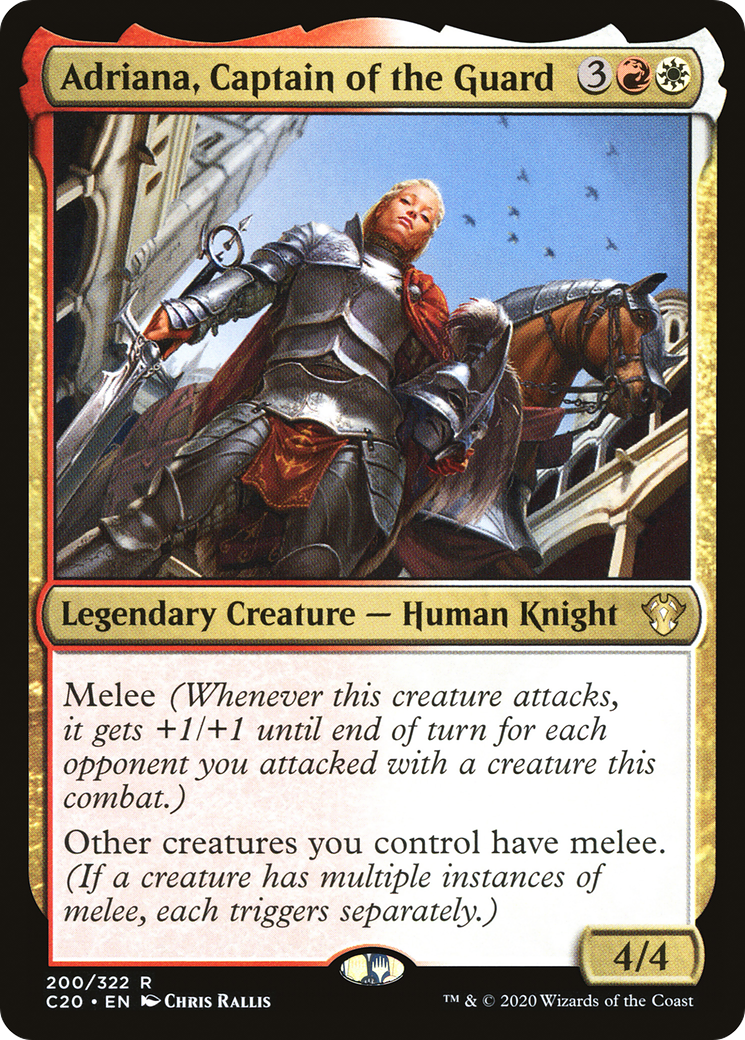
Adriana, Captain of the Guard
Adriana, Captain of the Guard
Legendary Creature — Human Knight
4/4
Melee (Whenever this creature attacks, it gets +1/+1 until end of turn for each opponent you attacked this combat.)
Other creatures you control have melee. (If a creature has multiple instances of melee, each triggers separately.)
- You determine the size of the bonus as the melee ability resolves. Count each opponent that you attacked with one or more creatures. It doesn't matter if the attacking creatures are still attacking or even if they are still on the battlefield. It also doesn't matter if the opponent you attacked is still in the game.
- It doesn't matter how many creatures you attacked a player with, only that you attacked a player with at least one creature. For example, if you attack one player with Wings of the Guard and another player with five creatures, Wings of the Guard will get +2/+2 until end of turn.
- Melee will trigger if the creature with melee attacks a planeswalker. However, the effect counts only opponents (and not planeswalkers) that you attacked with a creature when determining the bonus.
- Creatures that enter the battlefield attacking were never declared as attackers, so they won't count toward melee's effect. Similarly, if a creature with melee enters the battlefield attacking, melee won't trigger.
-
1
Alesha, Who Smiles at Death
Alesha, Who Smiles at Death
Legendary Creature — Human Warrior
3/2
First strike
Whenever Alesha attacks, you may pay . If you do, return target creature card with power 2 or less from your graveyard to the battlefield tapped and attacking.
- While resolving Alesha's triggered ability, you can't pay the cost multiple times to return more than one creature card.
- Alesha's triggered ability checks the card's power only in your graveyard. The creature will still be tapped and attacking if its power is greater than 2 after it's on the battlefield.
- You choose which player or planeswalker the returned creature is attacking. It doesn't have to be attacking the same player or planeswalker Alesha is attacking.
- Although the returned creature is an attacking creature, it was never declared as an attacking creature. This means that abilities that trigger whenever a creature attacks won't trigger when it enters the battlefield attacking.
- Any effects that say that the returned creature can't attack (such as that of Propaganda, or if the creature has defender) affect only the declaration of attackers. They won't stop the returned creature from entering the battlefield attacking.
-
1
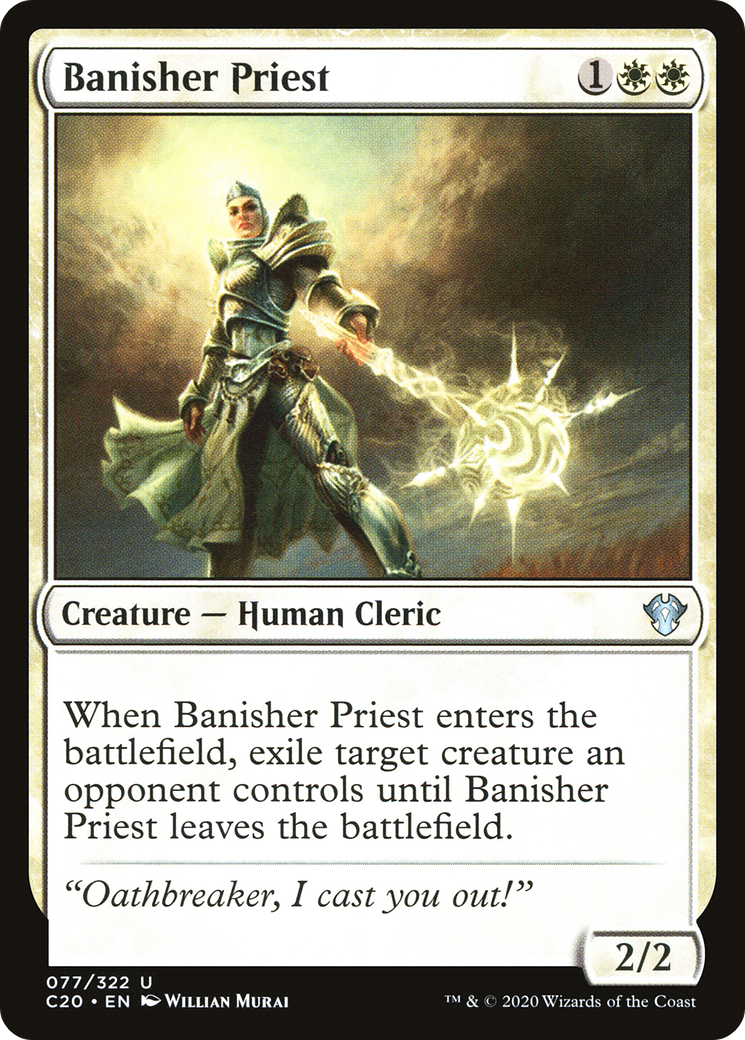
Banisher Priest
Banisher Priest
Creature — Human Cleric
2/2
When this creature enters, exile target creature an opponent controls until this creature leaves the battlefield.
- If Banisher Priest leaves the battlefield before its triggered ability resolves, the target permanent won't be exiled.
- Auras attached to the exiled permanent will be put into their owners' graveyards. Any Equipment will become unattached and remain on the battlefield. Any counters on the exiled permanent will cease to exist. When the card returns to the battlefield, it will be a new object with no connection to the card that was exiled.
- If a token is exiled this way, it will cease to exist and won't return to the battlefield.
- If an Aura is exiled this way, its owner chooses what it will enchant as it returns to the battlefield. An Aura put onto the battlefield this way doesn't target anything (so it could be attached to a permanent with shroud, for example), but the Aura's enchant ability restricts what it can be attached to. If the Aura can't legally be attached to anything, it remains in exile for the rest of the game.
-
1
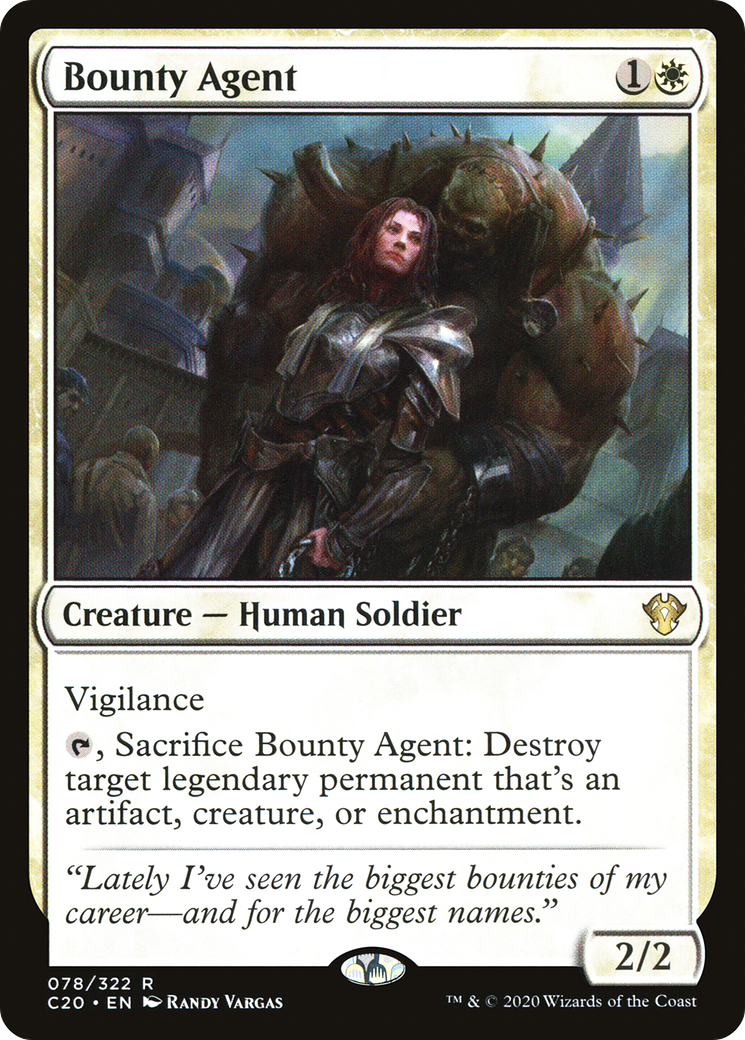
Bounty Agent
Bounty Agent
Creature — Human Soldier
2/2
Vigilance
, Sacrifice this creature: Destroy target legendary permanent that's an artifact, creature, or enchantment.
-
1
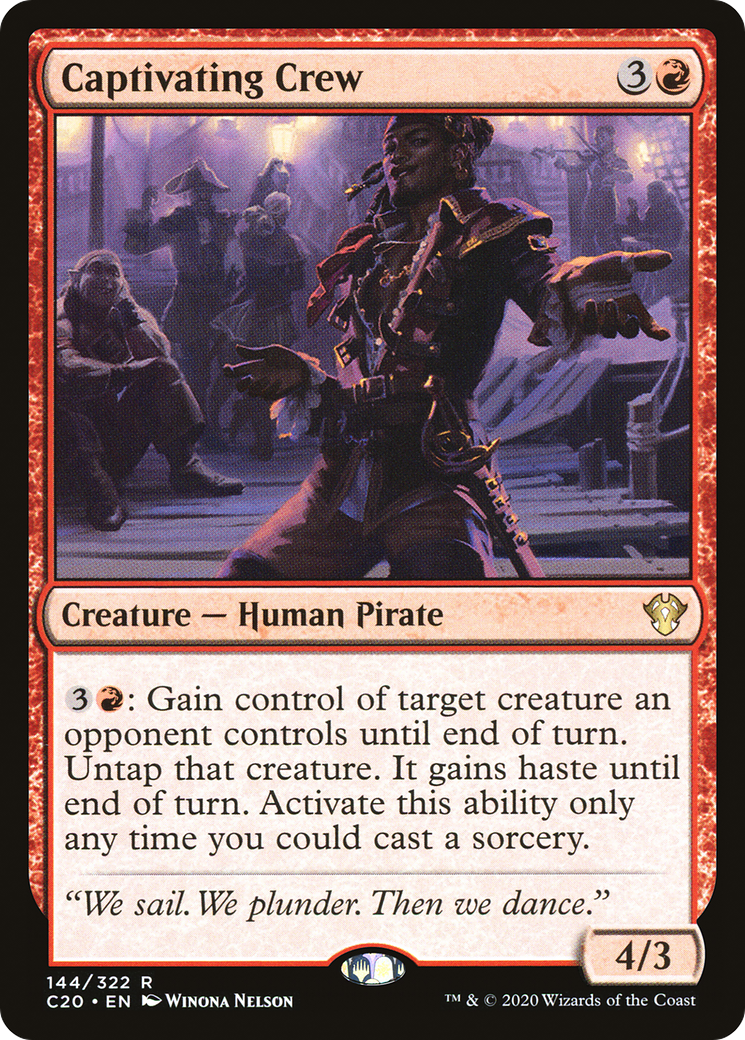
Captivating Crew
Captivating Crew
Creature — Human Pirate
4/3
: Gain control of target creature an opponent controls until end of turn. Untap that creature. It gains haste until end of turn. Activate only as a sorcery.
- You can target and gain control of an untapped creature this way.
-
1
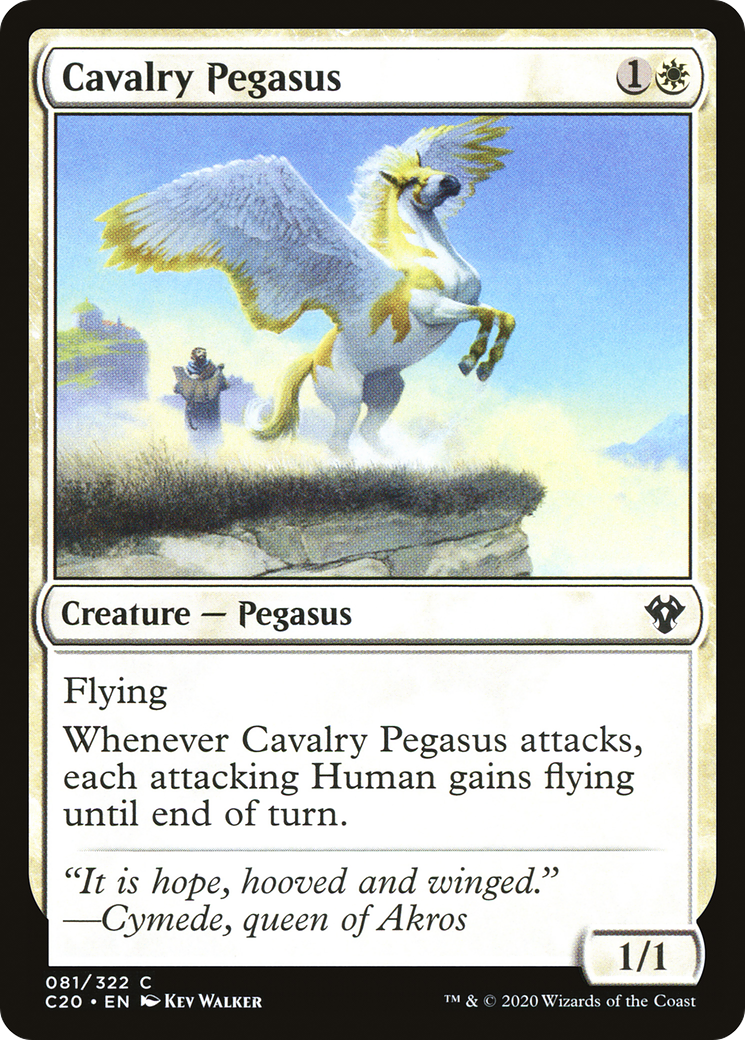
Cavalry Pegasus
Cavalry Pegasus
Creature — Pegasus
1/1
Flying
Whenever this creature attacks, each attacking Human gains flying until end of turn.
- Once the triggered ability resolves, the attacking Humans will continue to have flying even if Cavalry Pegasus leaves the battlefield.
- The attacking Humans gain flying before blockers are declared.
-
1
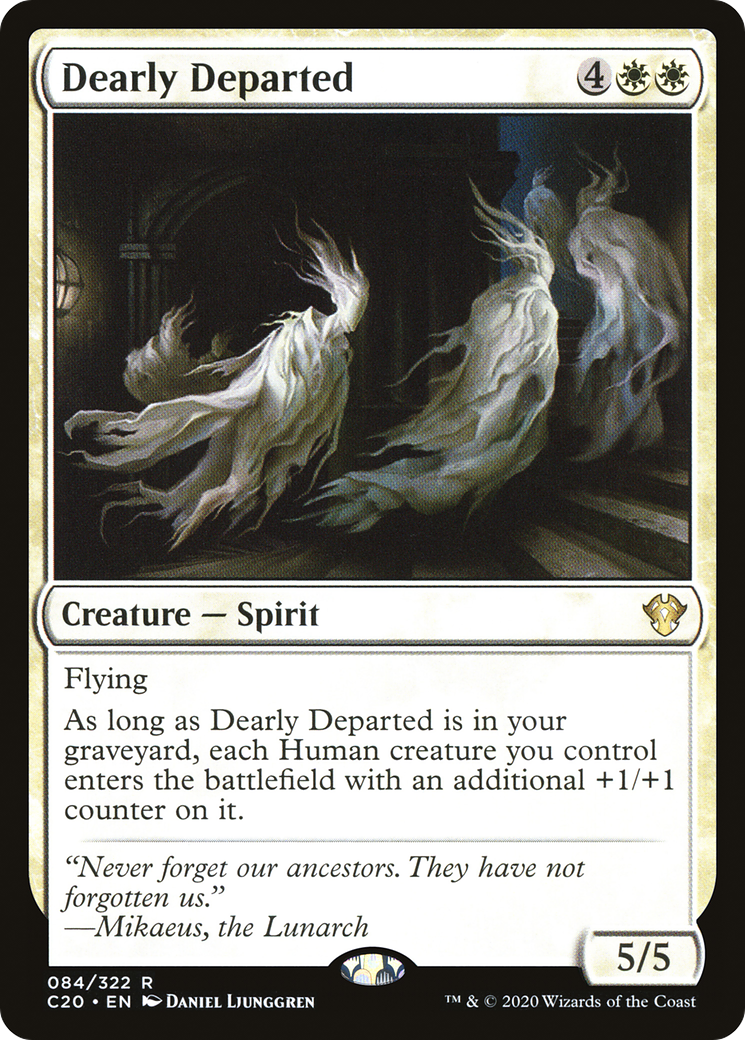
Dearly Departed
Dearly Departed
Creature — Spirit
5/5
Flying
As long as this creature is in your graveyard, each Human creature you control enters with an additional +1/+1 counter on it.
- The effect is cumulative. Human creatures you control will enter with a +1/+1 counter for each Dearly Departed in your graveyard.
- In most cases, when determining whether a creature entering under your control should get a +1/+1 counter, you'll simply look at what the creature will looklike on the battlefield. You'll consider any effects affecting a creature entering under your control.
-
1
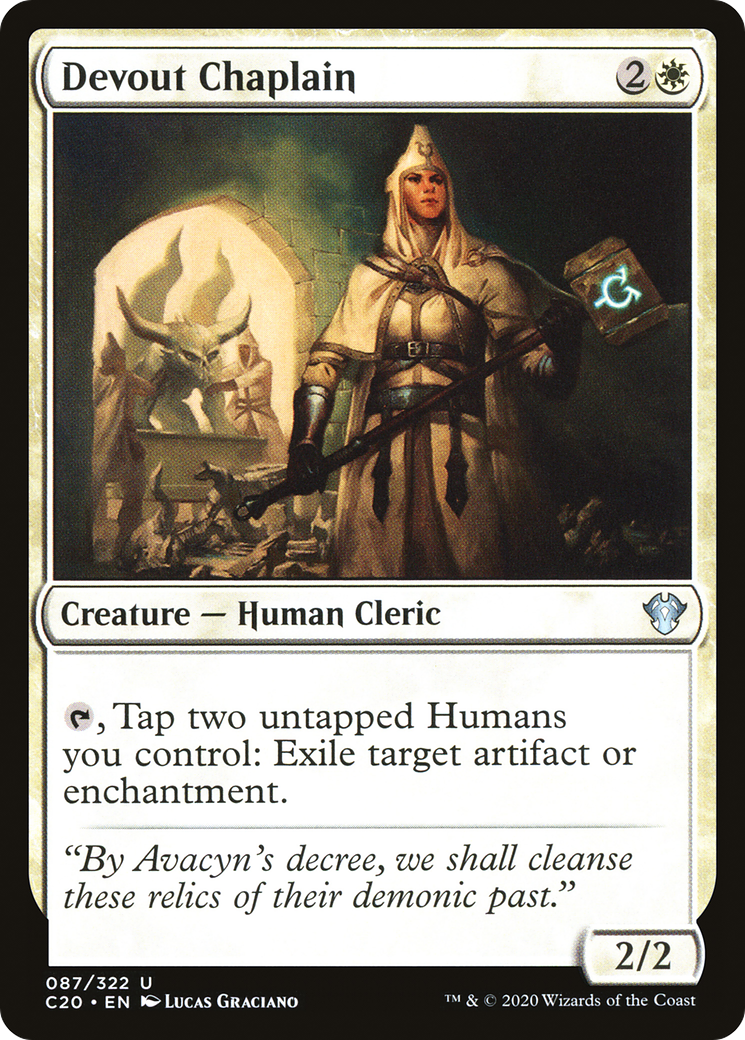
Devout Chaplain
Devout Chaplain
Creature — Human Cleric
2/2
, Tap two untapped Humans you control: Exile target artifact or enchantment.
- You can tap any two untapped Humans you control, including ones you haven’t controlled continuously since the beginning of your most recent turn, to pay the cost of Devout Chaplain’s activated ability. You must have controlled Devout Chaplain continuously since the beginning of your most recent turn, however.
-
1
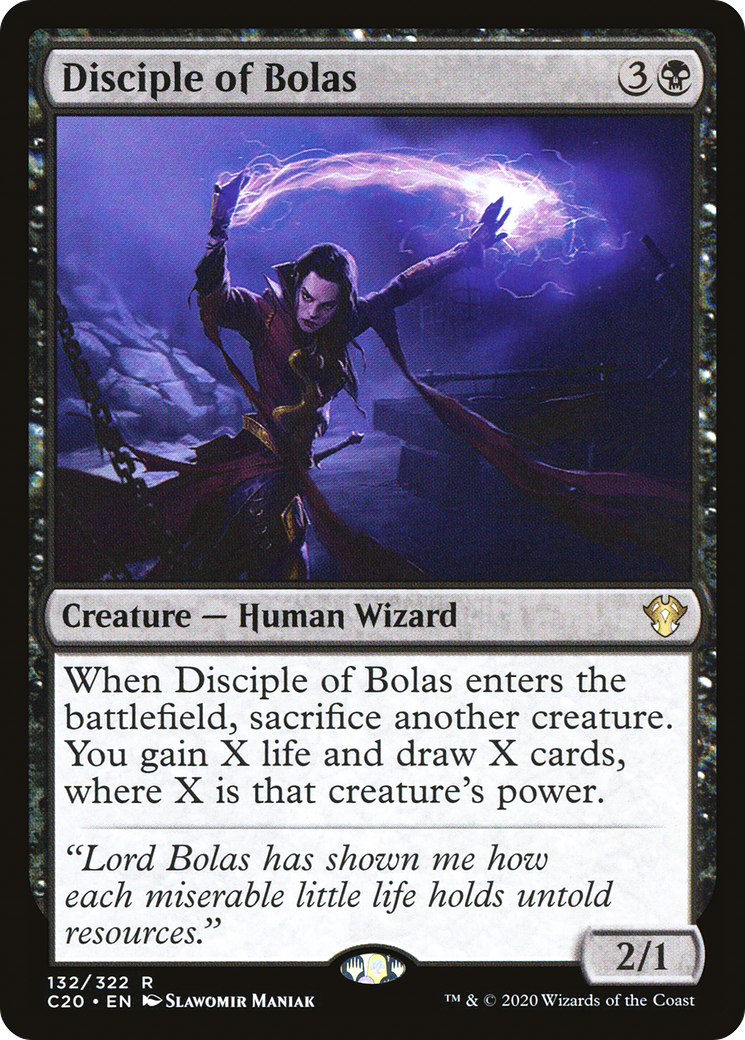
Disciple of Bolas
Disciple of Bolas
Creature — Human Wizard
2/1
When this creature enters, sacrifice another creature. You gain X life and draw X cards, where X is that creature's power.
- If you control at least one other creature when the ability resolves, you must sacrifice one. If you don't control any other creatures at that time, the ability won't do anything.
- The creature's power as it last existed on the battlefield is the amount of life you gain and the number of cards you draw.
-
1
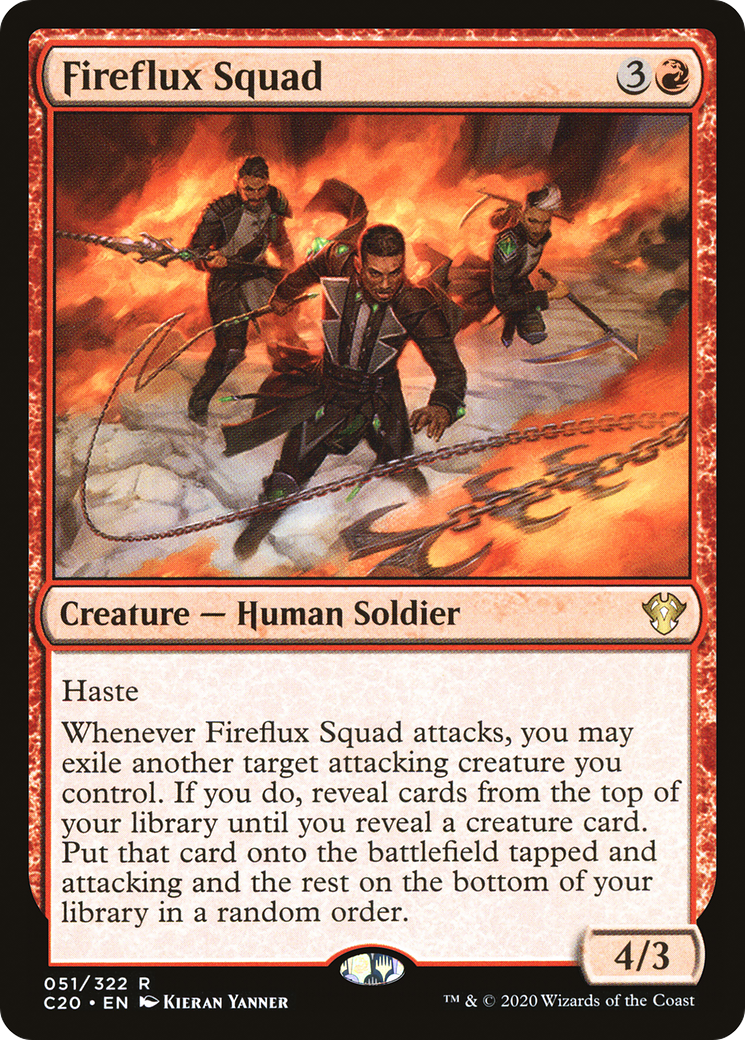
Fireflux Squad
Fireflux Squad
Creature — Human Soldier
4/3
Haste
Whenever this creature attacks, you may exile another target attacking creature you control. If you do, reveal cards from the top of your library until you reveal a creature card. Put that card onto the battlefield tapped and attacking and the rest on the bottom of your library in a random order.
- You choose which player or planeswalker the new creature is attacking. It doesn’t have to be attacking the same player or planeswalker that Fireflux Squad or the exiled creature was attacking.
- Although the new creature is an attacking creature, it was never declared as an attacking creature. This means that abilities that trigger whenever a creature attacks won’t trigger when it enters the battlefield attacking.
- Any effects that say that the new creature can’t attack (such as that of Propaganda, or if you get a creature with defender) affect only the declaration of attackers. They won’t stop the creature you find from entering the battlefield attacking.
- If you exile your entire library without exiling a creature card, you put the library back in a random order and continue. You won’t return the exiled attacking creature. Oops.
-
1
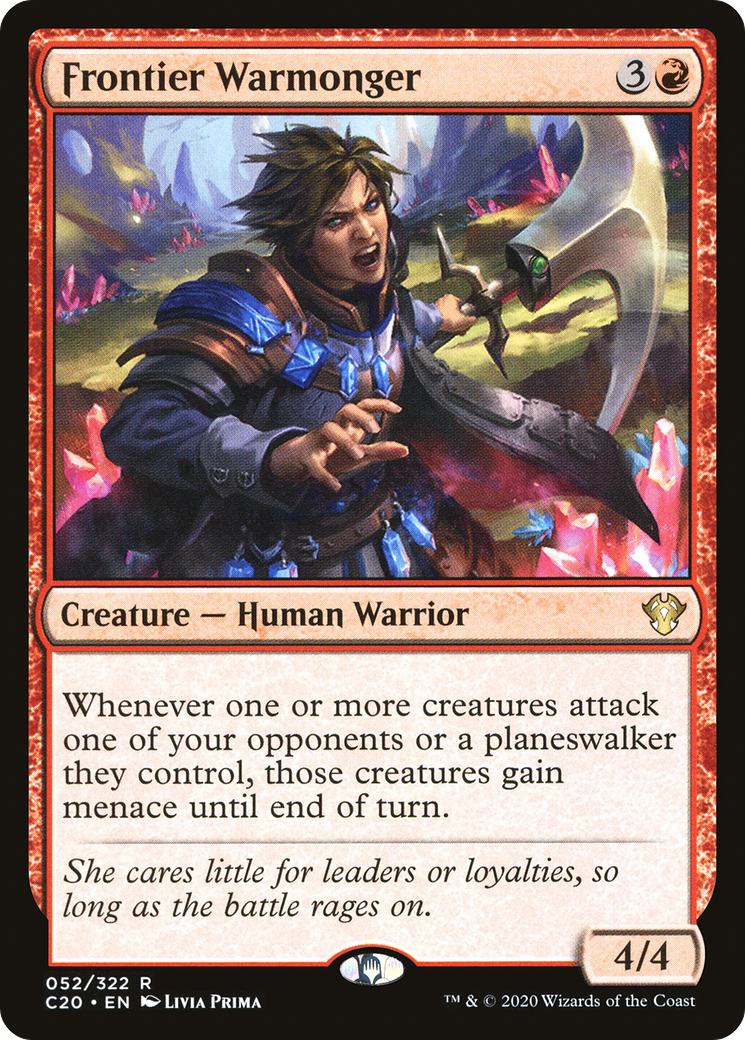
Frontier Warmonger
Frontier Warmonger
Creature — Human Warrior
4/4
Whenever one or more creatures attack one of your opponents or a planeswalker they control, those creatures gain menace until end of turn.
- Creatures your opponents control attacking one of your opponents will cause Frontier Warmonger's ability to trigger.
-
1
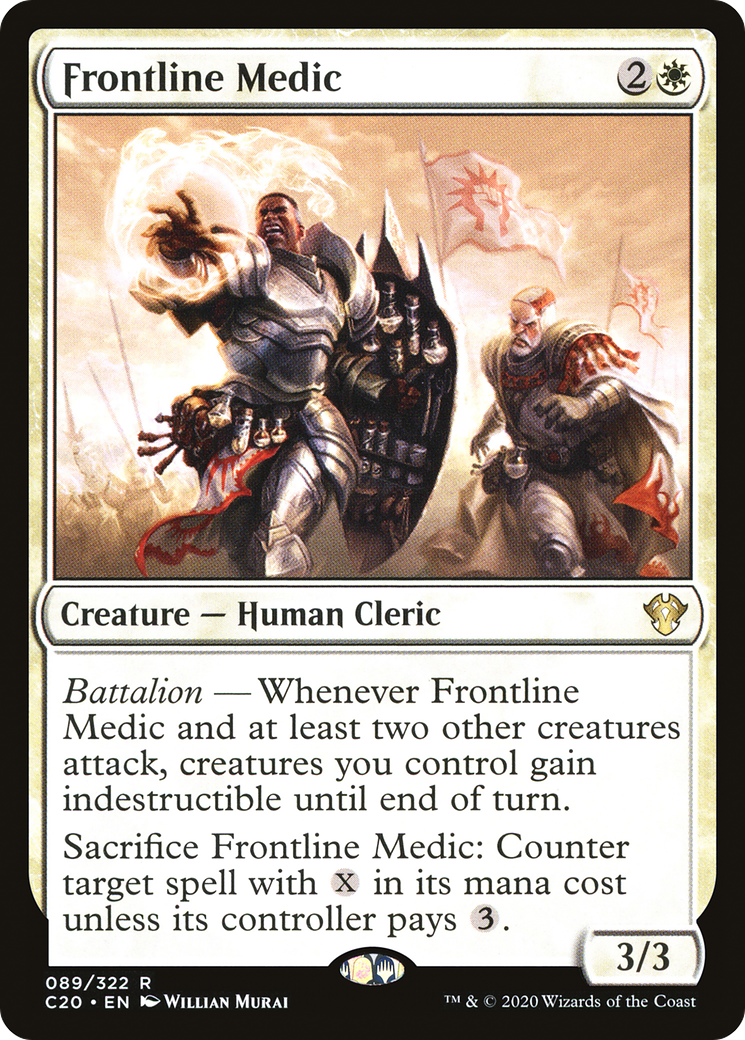
Frontline Medic
Frontline Medic
Creature — Human Cleric
3/3
Battalion — Whenever this creature and at least two other creatures attack, creatures you control gain indestructible until end of turn.
Sacrifice this creature: Counter target spell with in its mana cost unless its controller pays .
- The three attacking creatures don't have to be attacking the same player, planeswalker, or battle.
- Creatures that come under your control after Frontline Medic's battalion ability resolves will not be granted indestructible by this effect.
- Once a battalion ability has triggered, it doesn't matter how many creatures are still attacking when that ability resolves.
- The effects of battalion abilities vary from card to card. Read each card carefully.
-
1
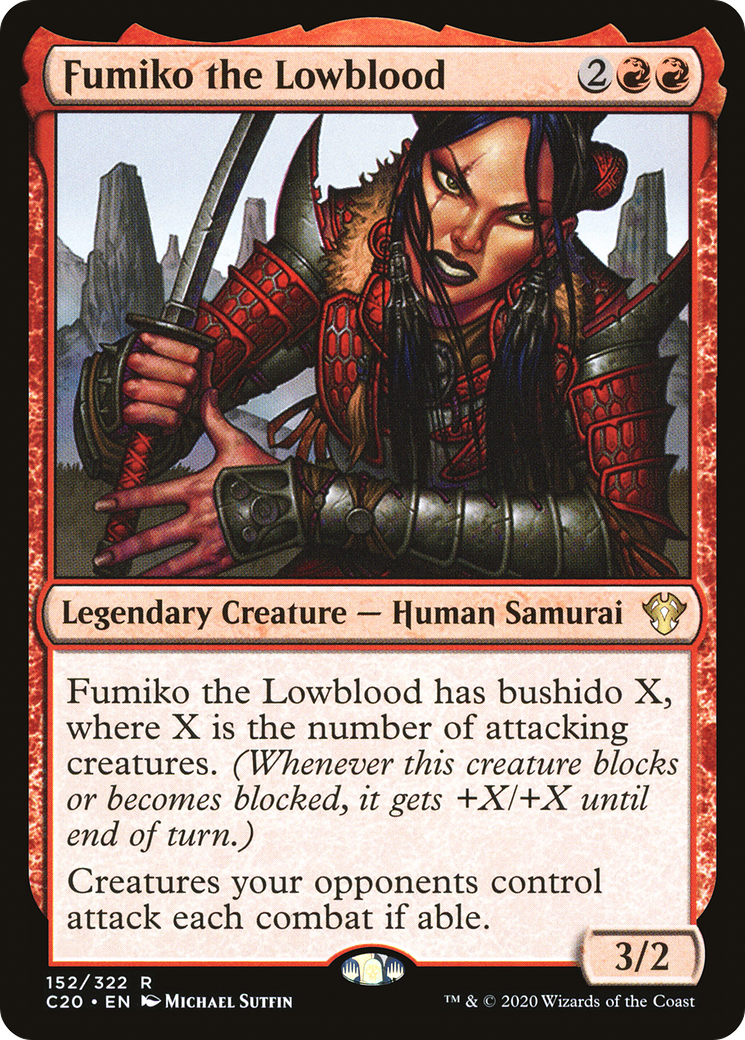
Fumiko the Lowblood
Fumiko the Lowblood
Legendary Creature — Human Samurai
3/2
Fumiko has bushido X, where X is the number of attacking creatures. (Whenever this creature blocks or becomes blocked, it gets +X/+X until end of turn.)
Creatures your opponents control attack each combat if able.
- X is variable. The bushido bonus is calculated each time Fumiko's bushido trigger resolves, based on the number of attackers at that time.
- Fumiko's ability doesn't force an opponent to pay for effects in order to be able to attack with their creatures (such as Ghostly Prison, for example).
- Fumiko's ability doesn't force tapped creatures or creatures with summoning sickness to attack.
-
1
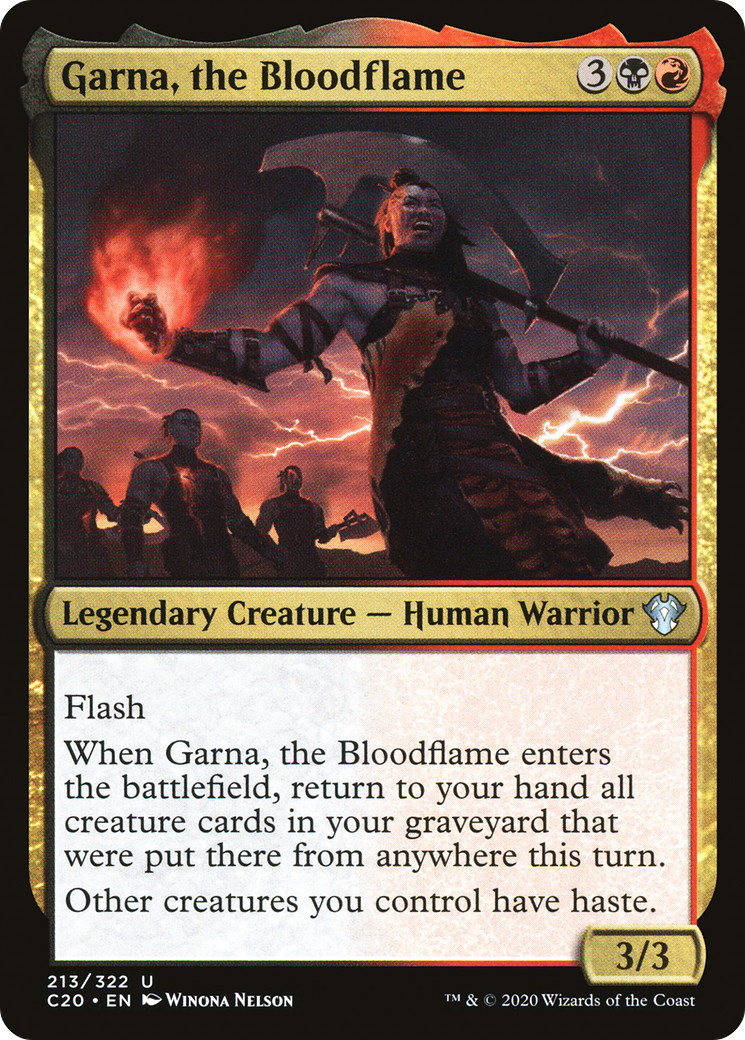
Garna, the Bloodflame
Garna, the Bloodflame
Legendary Creature — Human Warrior
3/3
Flash
When Garna enters, return to your hand all creature cards in your graveyard that were put there from anywhere this turn.
Other creatures you control have haste.
- Which creature cards to return to your hand is determined as Garna's triggered ability resolves. If Garna somehow finds its way into your graveyard before that, perhaps due to the "legend rule," it will be returned to your hand.
-
1
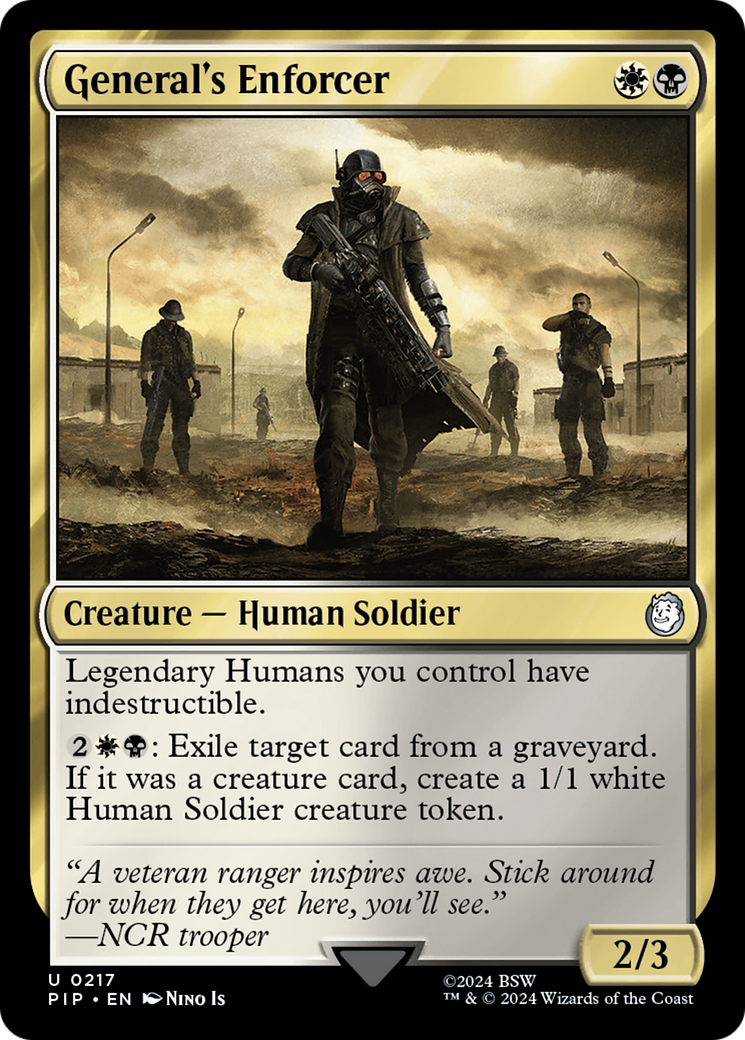
General's Enforcer
General's Enforcer
Creature — Human Soldier
2/3
Legendary Humans you control have indestructible.
: Exile target card from a graveyard. If it was a creature card, create a 1/1 white Human Soldier creature token.
- Because damage remains marked on a creature until the damage is removed as the turn ends, nonlethal damage dealt to a legendary Human you control may become lethal if General's Enforcer leaves the battlefield during that turn.
- Only creatures are Humans. Planeswalkers such as Lukka and Narset who represent human characters aren't affected by General's Enforcer.
-
1
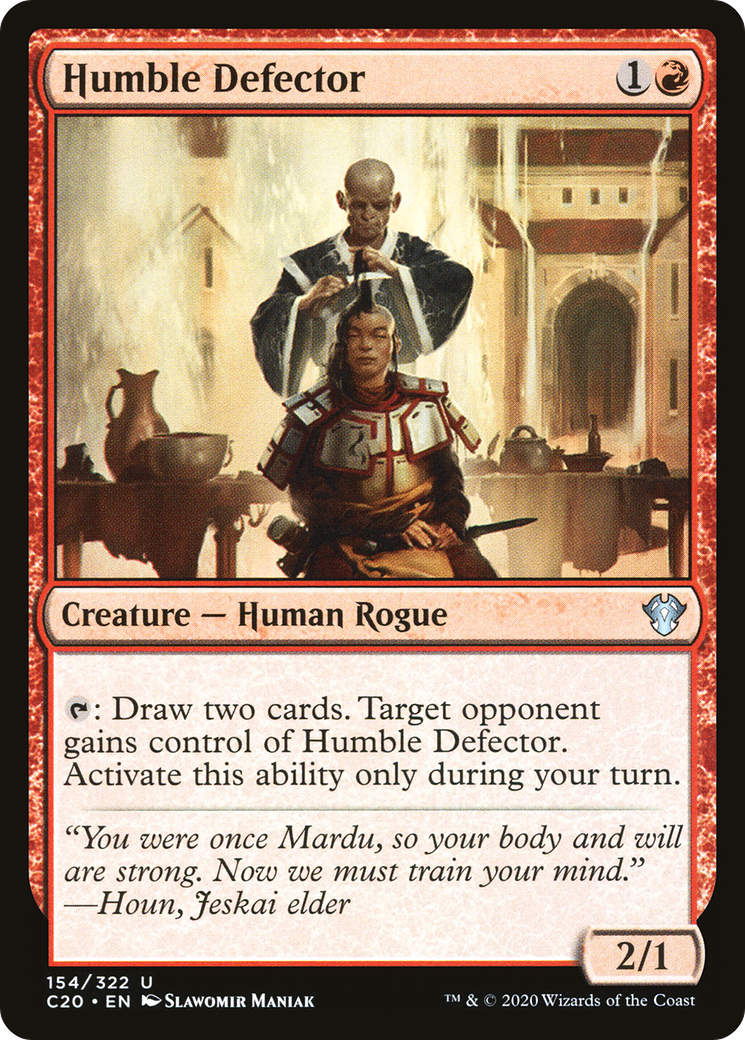
Humble Defector
Humble Defector
Creature — Human Rogue
2/1
: Draw two cards. Target opponent gains control of this creature. Activate only during your turn.
- If Humble Defector isn't on the battlefield as its ability resolves, but the target player is still a legal target, the ability will resolve. You'll draw two cards, even though the player doesn't gain control of Humble Defector.
- If Humble Defector's owner leaves the game, Humble Defector humbly leaves the game along with that player.
- Humble Defector's ability can be activated any time during your turn, including in response to a spell or ability.
- If Humble Defector is controlled by a player other than its owner, and its controller leaves the game, the effect giving that player control of Humble Defector ends. Humble Defector will return to the control of the player still in the game who most recently controlled it.
-
1
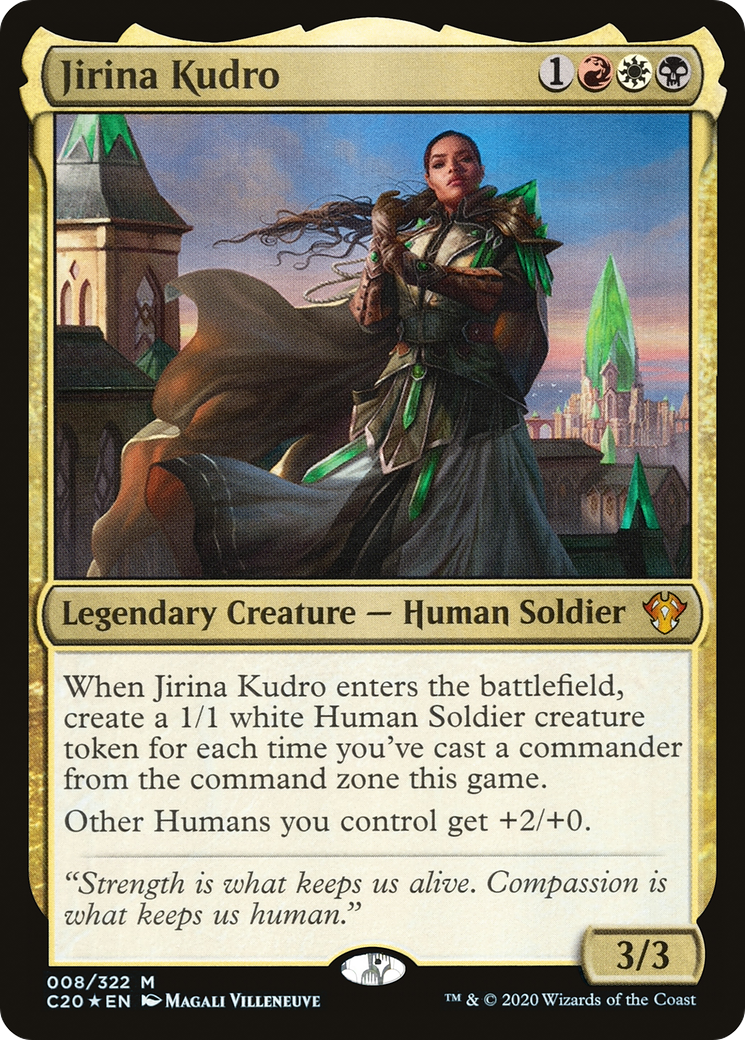
Jirina Kudro
Jirina Kudro
Legendary Creature — Human Soldier
3/3
When Jirina Kudro enters, create a 1/1 white Human Soldier creature token for each time you've cast a commander from the command zone this game.
Other Humans you control get +2/+0.
- If Jirina is your commander, the number of times you cast it includes the time you cast Jirina just before it entered the battlefield.
- Jirina’s last ability gives +2/+0 to all Humans you control other than Jirina, including the Human tokens created by its triggered ability.
-
1
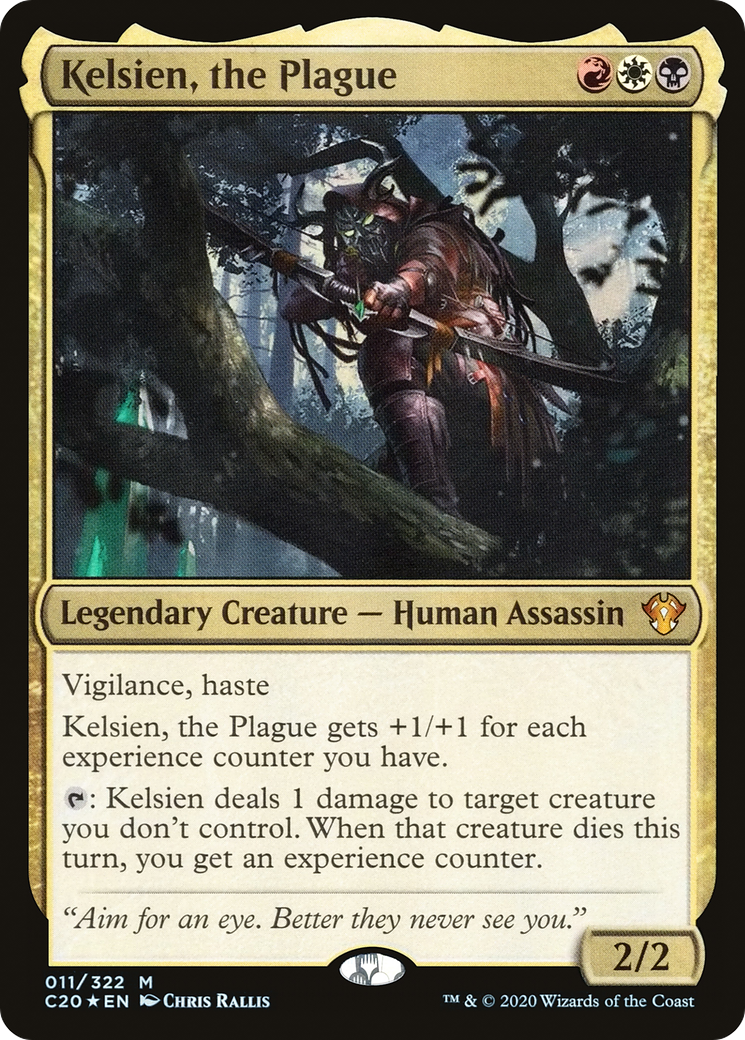
Kelsien, the Plague
Kelsien, the Plague
Legendary Creature — Human Assassin
2/2
Vigilance, haste
Kelsien gets +1/+1 for each experience counter you have.
: Kelsien deals 1 damage to target creature you don't control. When that creature dies this turn, you get an experience counter.
- Each time Kelsien's last ability resolves, it creates a separate delayed triggered ability. If you untap Kelsien and activate its last ability multiple times in one turn, they'll each trigger when the appropriate creature or creatures die.
- If the target of Kelsien's last ability dies before the ability resolves, you won't get an experience counter.
- If Kelsien leaves the battlefield, you keep any experience counters you've received.
-
1
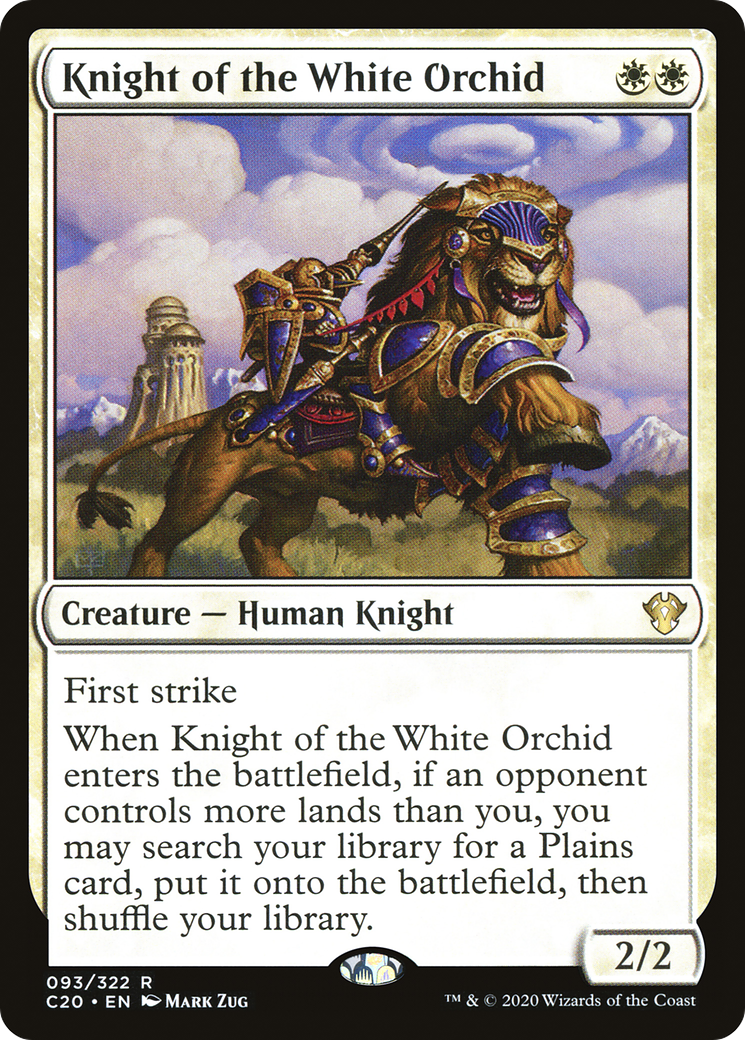
Knight of the White Orchid
Knight of the White Orchid
Creature — Human Knight
2/2
First strike
When this creature enters, if an opponent controls more lands than you, you may search your library for a Plains card, put it onto the battlefield, then shuffle.
- The Plains you search for doesn't have to be basic. For example, you could put a Sacred Foundry onto the battlefield.
- Knight of the White Orchid's triggered ability has an “intervening ‘if' clause.” That means (1) the ability won't trigger at all unless any one of your opponents controls more lands than you, and (2) the ability will do nothing if you control at least as many lands as each of your opponents by the time it resolves.
-
1
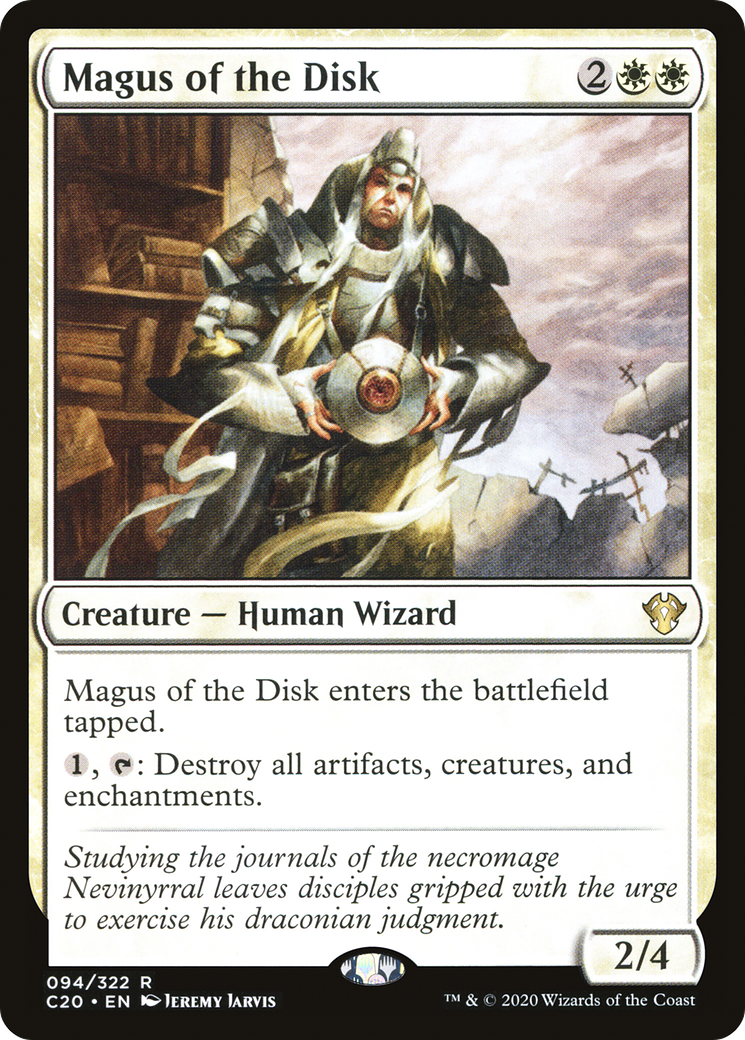
Magus of the Disk
Magus of the Disk
Creature — Human Wizard
2/4
This creature enters tapped.
, : Destroy all artifacts, creatures, and enchantments.
- If an effect gives Magus of the Disk indestructible or regenerates it, it won’t be destroyed by its ability.
-
1
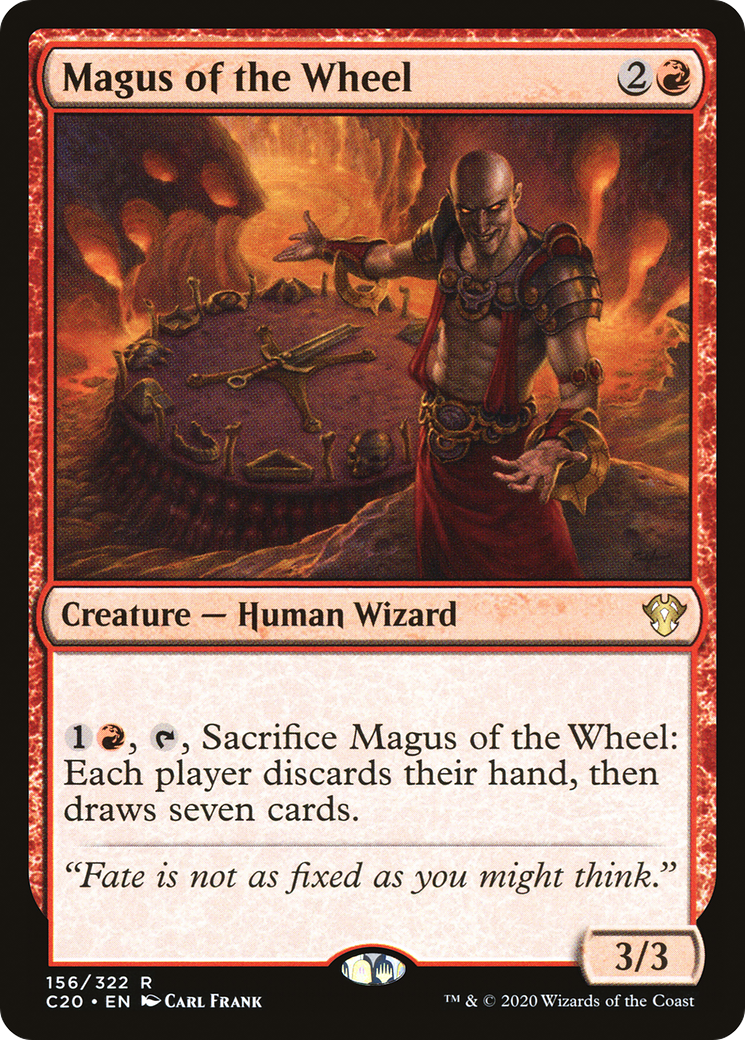
Magus of the Wheel
Magus of the Wheel
Creature — Human Wizard
3/3
, , Sacrifice this creature: Each player discards their hand, then draws seven cards.
- If each player has fewer than seven cards in their library as Magus of the Wheel's ability resolves, the game ends in a draw.
-
1
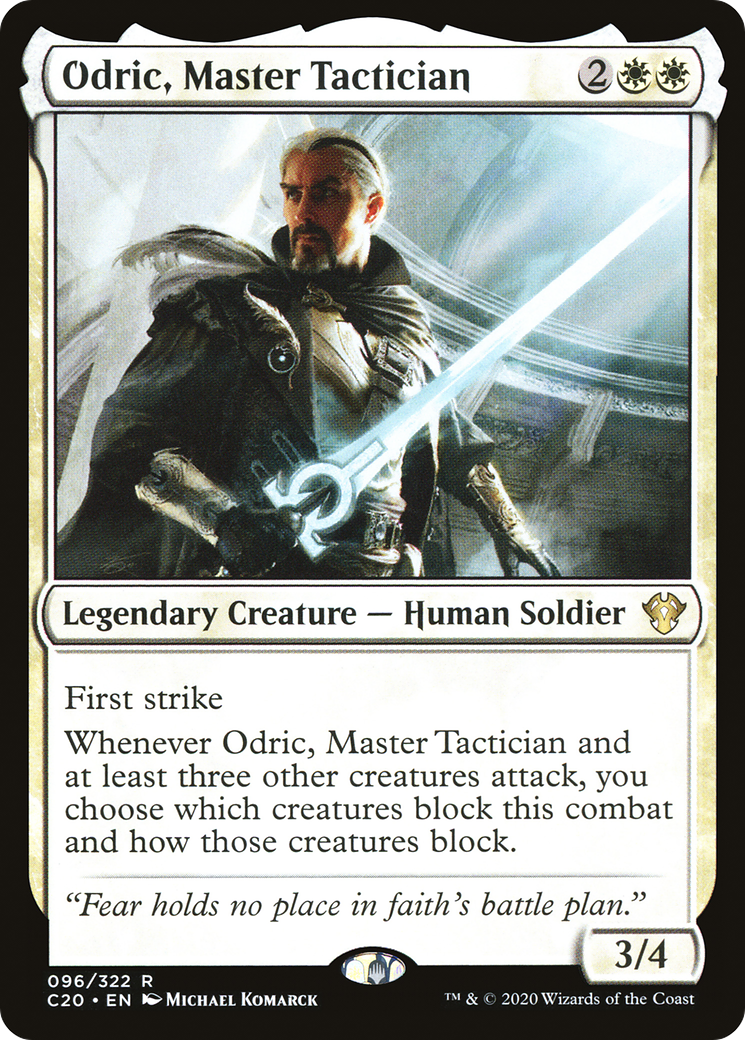
Odric, Master Tactician
Odric, Master Tactician
Legendary Creature — Human Soldier
3/4
First strike (This creature deals combat damage before creatures without first strike.)
Whenever Odric and at least three other creatures attack, you choose which creatures block this combat and how those creatures block.
- You can decide that a creature won't block.
- All blocking declarations must still be legal.
- If there's a cost associated with having a creature block and you choose for that creature to block, its controller can choose to pay that cost or not. If that player decides to not pay that cost, you must propose a new set of blocking creatures.
-
1
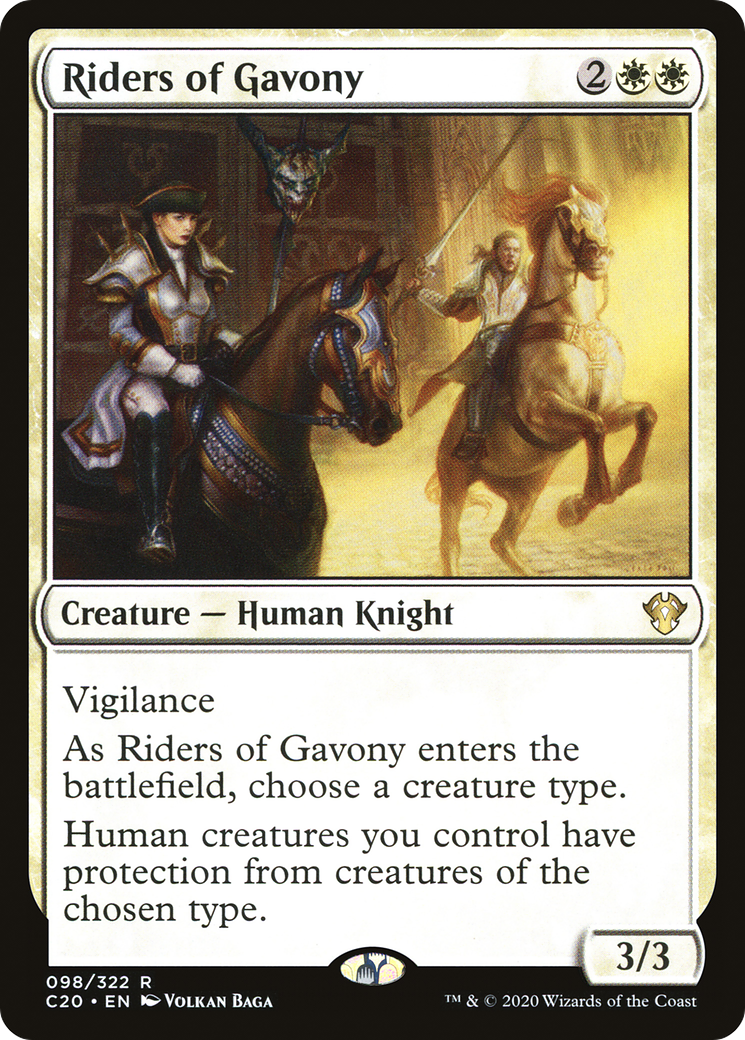
Riders of Gavony
Riders of Gavony
Creature — Human Knight
3/3
Vigilance
As this creature enters, choose a creature type.
Human creatures you control have protection from creatures of the chosen type.
- You must choose an existing _Magic_ creature type, such as Zombie or Warrior. Card types such as artifact can't be chosen.
-
1
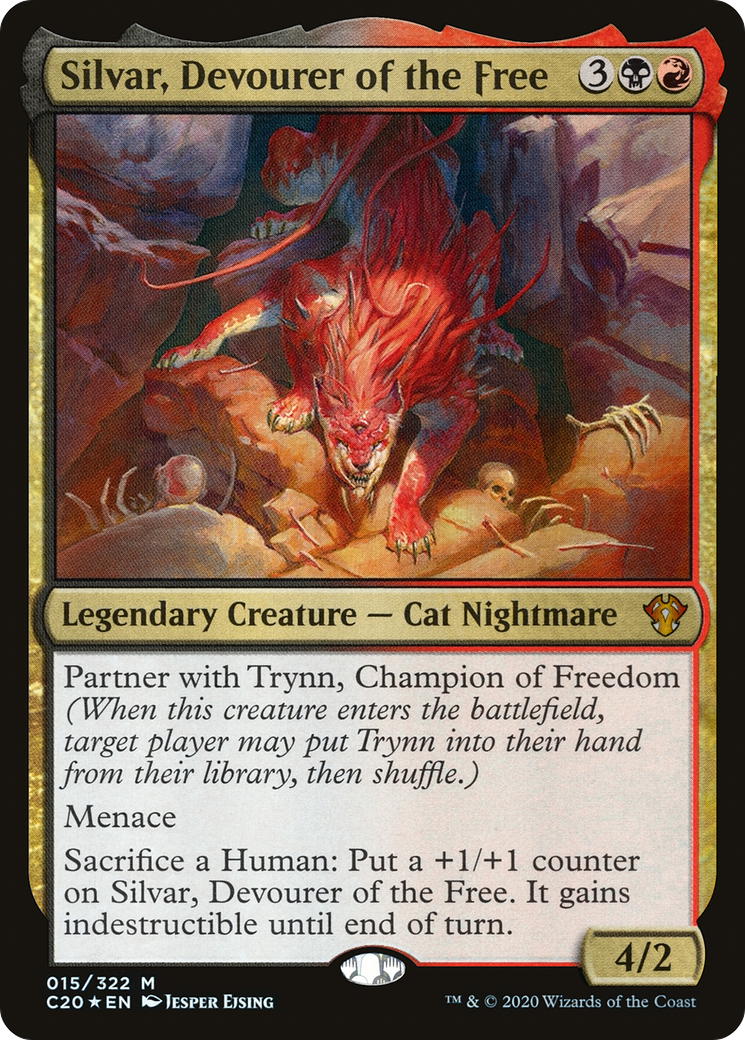
Silvar, Devourer of the Free
Silvar, Devourer of the Free
Legendary Creature — Cat Nightmare
4/2
Partner with Trynn, Champion of Freedom (When this creature enters, target player may put Trynn into their hand from their library, then shuffle.)
Menace
Sacrifice a Human: Put a +1/+1 counter on Silvar. It gains indestructible until end of turn.
- You can activate Silvar's last ability even if it already has indestructible. It'll still get a +1/+1 counter.
-
1
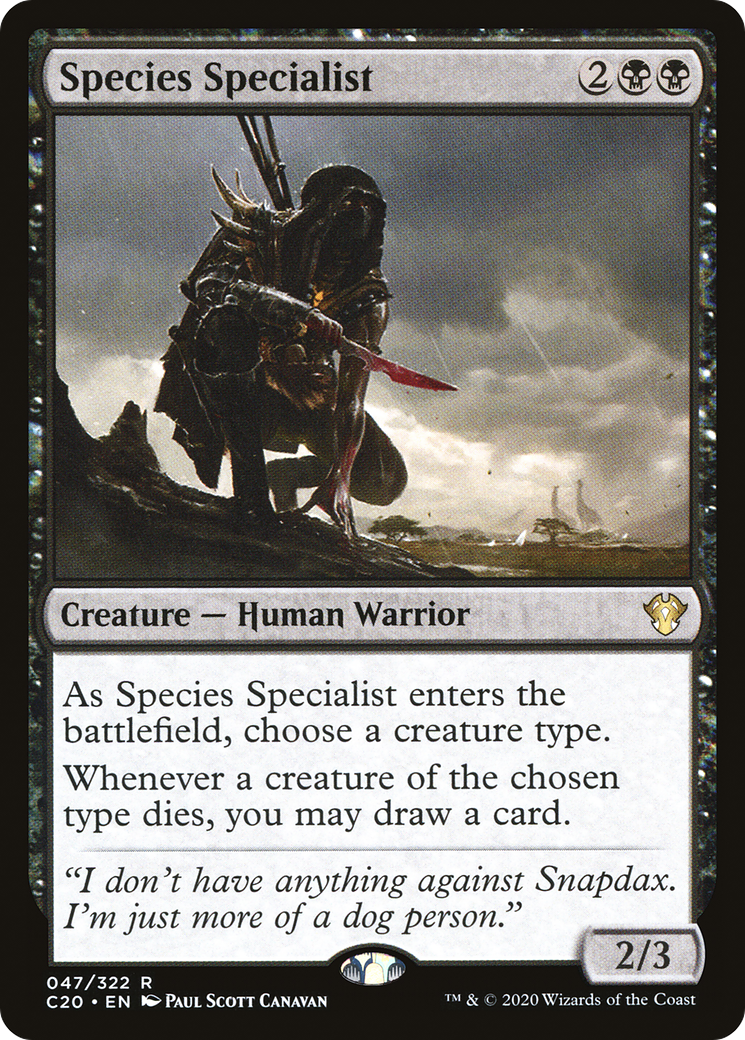
Species Specialist
Species Specialist
Creature — Human Warrior
2/3
As this creature enters, choose a creature type.
Whenever a creature of the chosen type dies, you may draw a card.
- You must choose an existing creature type, such as Human or Warrior. Card types such as artifact and supertypes such as legendary can’t be chosen.
- If a creature of the chosen type dies at the same time as Species Specialist, its ability triggers for that creature.
- If Species Specialist happens to have the chosen creature type, its ability triggers when it dies.
-
1
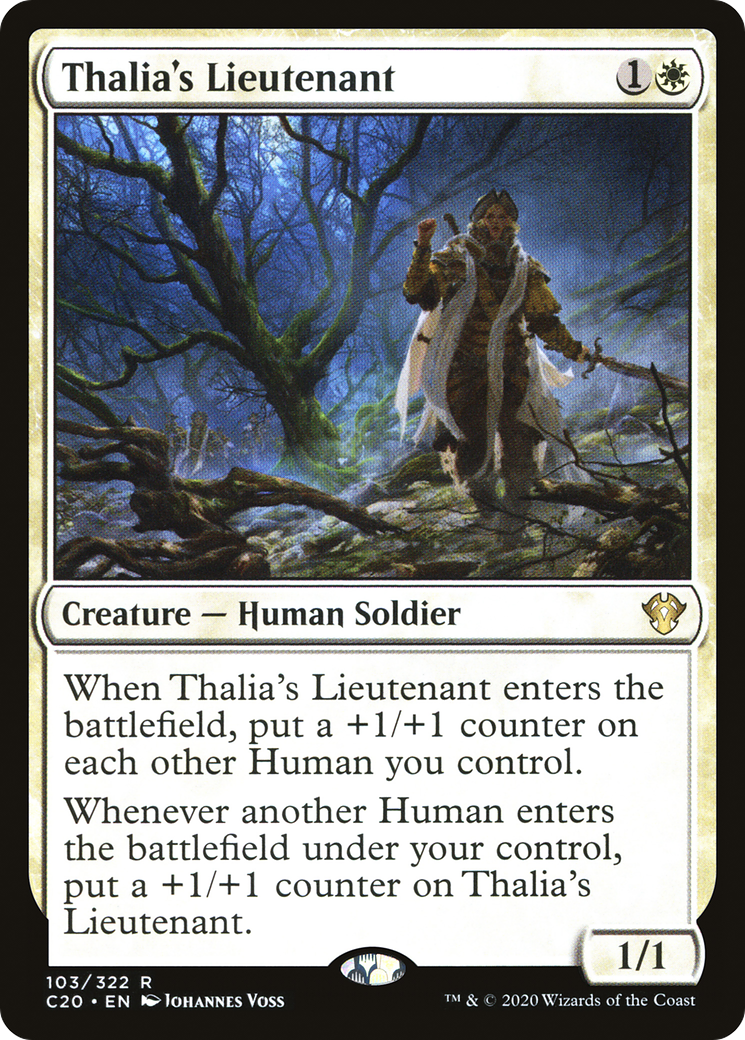
Thalia's Lieutenant
Thalia's Lieutenant
Creature — Human Soldier
1/1
When this creature enters, put a +1/+1 counter on each other Human you control.
Whenever another Human you control enters, put a +1/+1 counter on this creature.
- If Thalia’s Lieutenant enters the battlefield at the same time as another Human, each of Thalia’s Lieutenant’s abilities will trigger. You’ll put a +1/+1 counter on both cards.
-
1
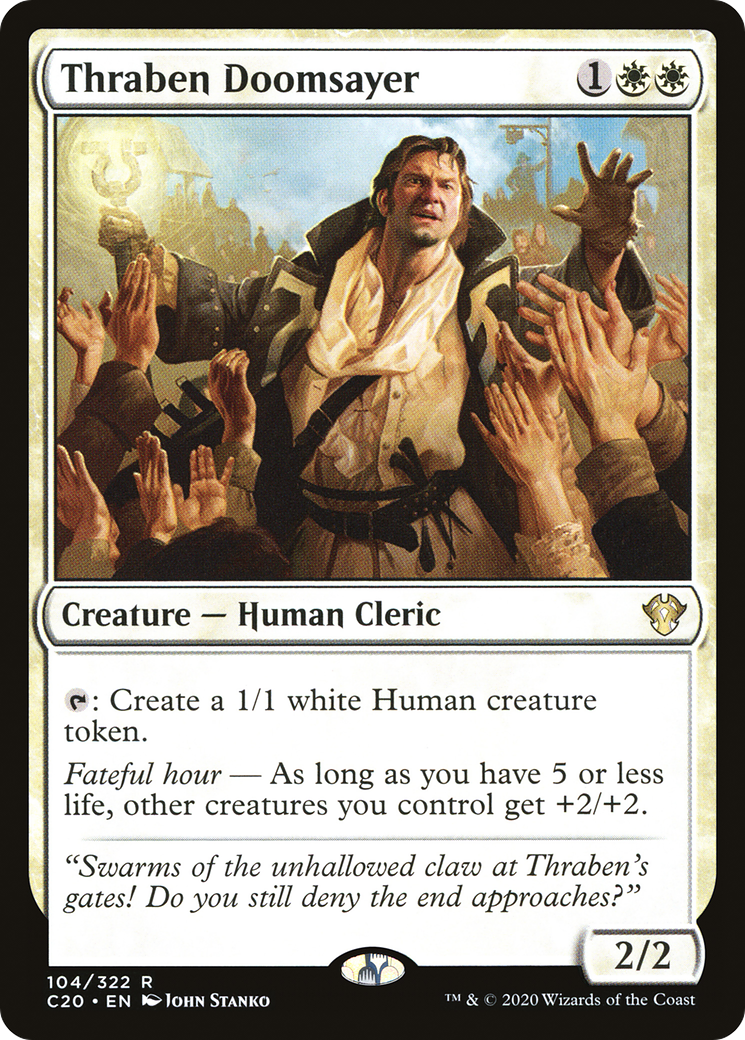
Thraben Doomsayer
Thraben Doomsayer
Creature — Human Cleric
2/2
: Create a 1/1 white Human creature token.
Fateful hour — As long as you have 5 or less life, other creatures you control get +2/+2.
- A creature whose toughness is being increased by Thraben Doomsayer's fateful hour ability loses that bonus as soon as its controller has 6 or more life (or as soon as Thraben Doomsayer leaves the battlefield). If damage marked on that creature is greater than or equal to its toughness after the fateful hour ability stops applying, the creature is destroyed and put into its owner's graveyard.
- If Thraben Doomsayer's activated ability resolves while you have 5 or less life, the creature token will be 3/3 as it enters.
-
1
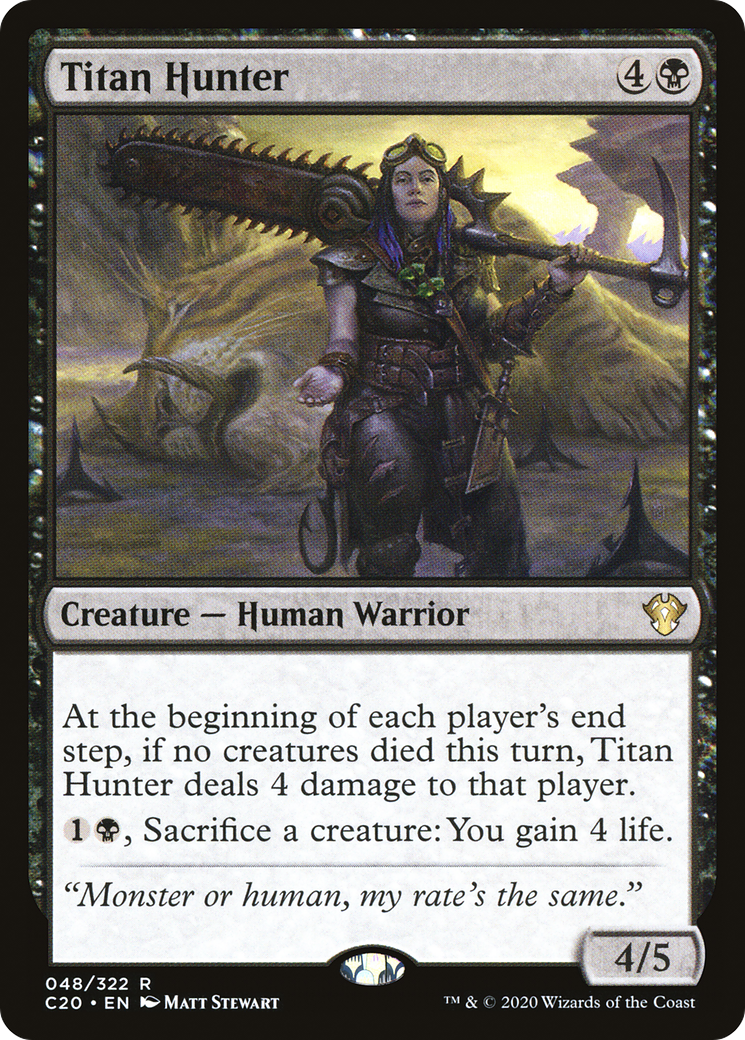
Titan Hunter
Titan Hunter
Creature — Human Warrior
4/5
At the beginning of each player's end step, if no creatures died this turn, this creature deals 4 damage to that player.
, Sacrifice a creature: You gain 4 life.
- Titan Hunter’s triggered ability triggers at the beginning of each player’s end step, including yours, if no creatures died during that turn.
- If a creature dies while Titan Hunter’s triggered ability is on the stack, Titan Hunter won’t deal damage to that player.
- You can sacrifice Titan Hunter to pay the cost of its activated ability.
-
1
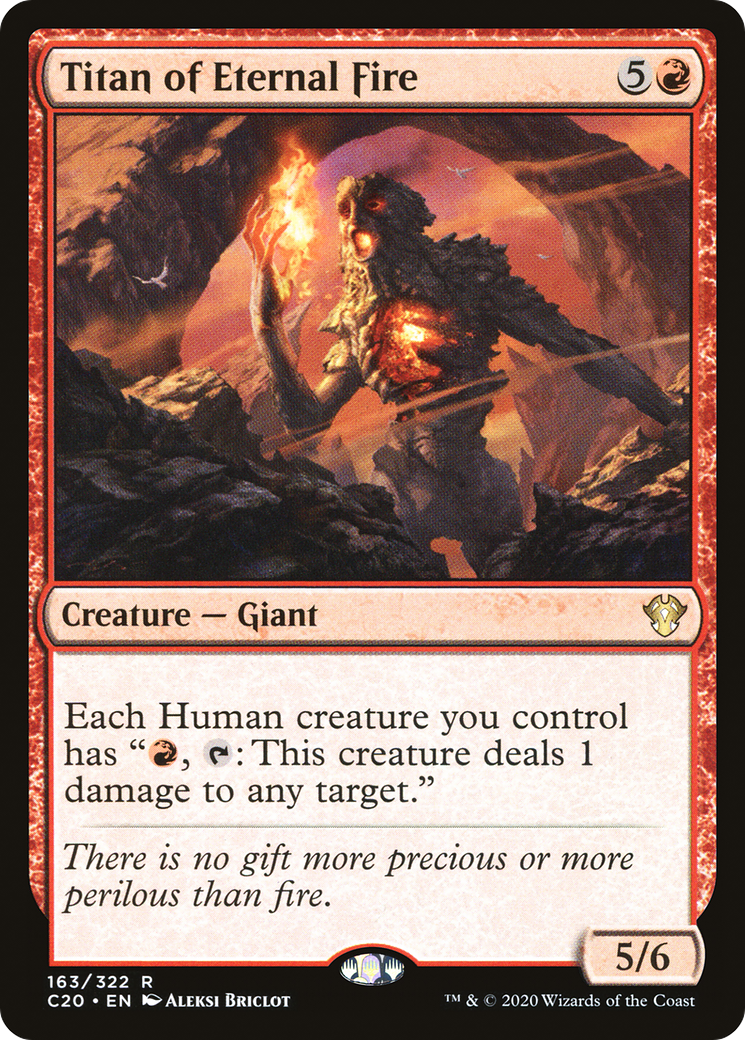
Titan of Eternal Fire
Titan of Eternal Fire
Creature — Giant
5/6
Each Human creature you control has " , : This creature deals 1 damage to any target."
-
1
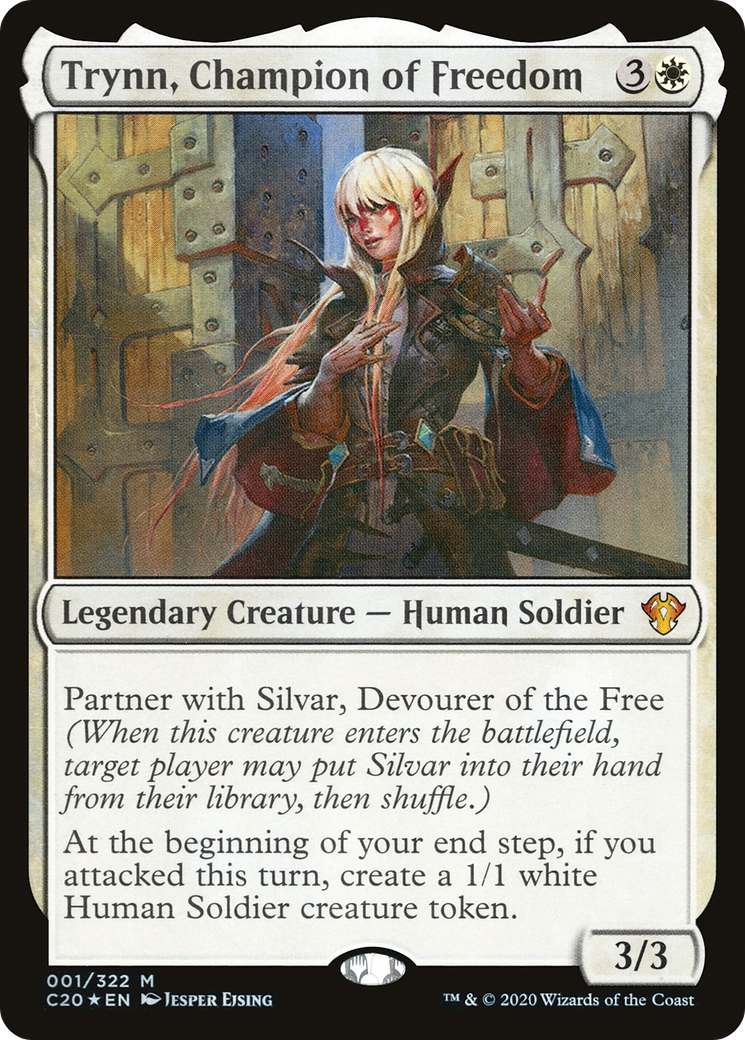
Trynn, Champion of Freedom
Trynn, Champion of Freedom
Legendary Creature — Human Soldier
3/3
Partner with Silvar, Devourer of the Free (When this creature enters, target player may put Silvar into their hand from their library, then shuffle.)
At the beginning of your end step, if you attacked this turn, create a 1/1 white Human Soldier creature token.
- Trynn's ability checks only whether you declared an attacking creature during the turn. It doesn't trigger once for each such creature, and it doesn't check whether any attacking creatures dealt damage.
- "Partner with [name]" represents two abilities. The first is a triggered ability: "When this permanent enters the battlefield, target player may search their library for a card named [name], reveal it, put it into their hand, then shuffle their library."
- Note that the target player searches their library (which may be affected by effects such as that of Stranglehold) and that the card they find is revealed, even though these words aren't included in the ability's reminder text.
- The second ability represented by the "partner with [name]" keyword modifies the rules for deck construction in the Commander variant and has no function outside of that variant. If a legendary creature card with "partner with [name]" is designated as your commander, the named legendary creature card can also be designated as your commander.
- If your Commander deck has two commanders, you can only include cards whose own color identities are also found in your commanders' combined color identities. If Haldan and Pako are your commanders, your deck may contain cards with blue, red, and/or green in their color identity, but not cards with white or black.
- Both commanders start in the command zone, and the remaining 98 cards of your deck are shuffled to become your library.
- A creature with a "partner with" ability can't partner with any creature other than its designated partner. Losing a partner ability during the game doesn't cause either to cease to be your commander.
- Once the game begins, your two commanders are tracked separately. If you cast one, you won't have to pay an additional the first time you cast the other. A player loses the game after having been dealt 21 damage from one of them, not from both of them combined. Command Beacon's effect puts one into your hand from the command zone, not both.
- The triggered ability of the "partner with" keyword still triggers in a Commander game. If your other commander has somehow ended up in your library, you can find it. You can also target another player who might have that card in their library.
-
1
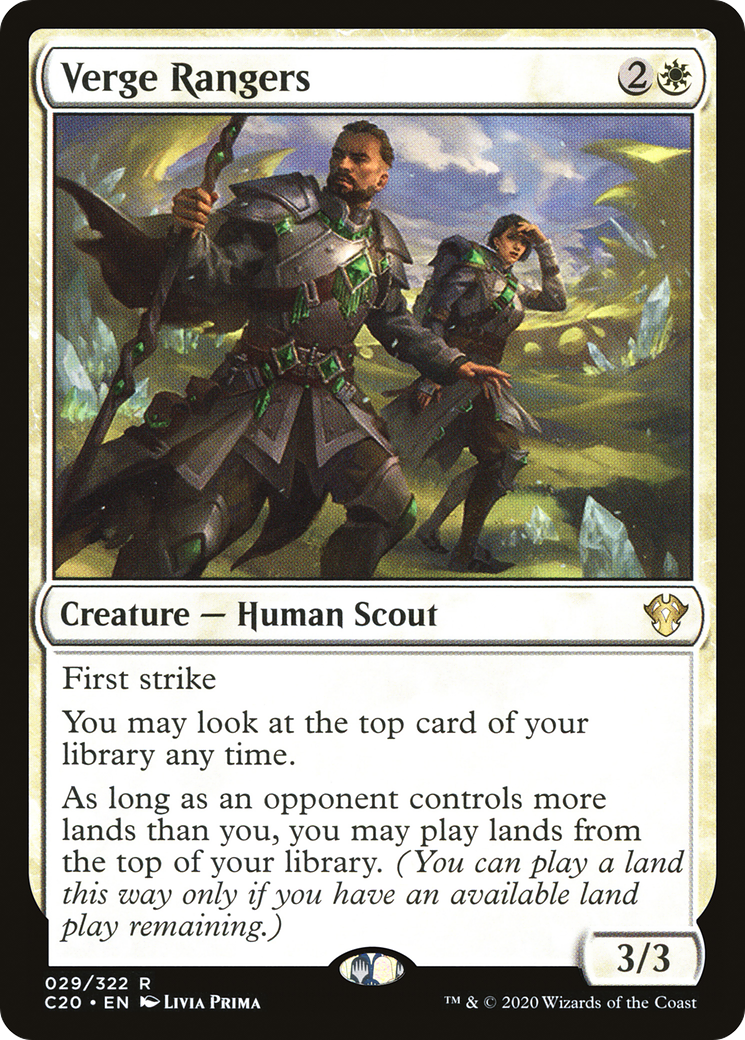
Verge Rangers
Verge Rangers
Creature — Human Scout Ranger
3/3
First strike
You may look at the top card of your library any time.
As long as an opponent controls more lands than you, you may play lands from the top of your library. (You can play a land this way only if you have an available land play remaining.)
- Verge Rangers doesn't allow you to play additional lands.
- Verge Rangers lets you look at the top card of your library whenever you want (with one restriction; see below), even if you don't have priority. This action doesn't use the stack. Knowing what that card is becomes part of the information you have access to, just like you can look at the cards in your hand.
- If the top card of your library changes while you're casting a spell, playing a land, or activating an ability, you can't look at the new top card until you finish doing so. This means that if you play a land from the top of your library and it has a replacement effect that requires you to make a decision (such as that of Temple Garden), you must make that decision without knowing the next card of your library.
-
1
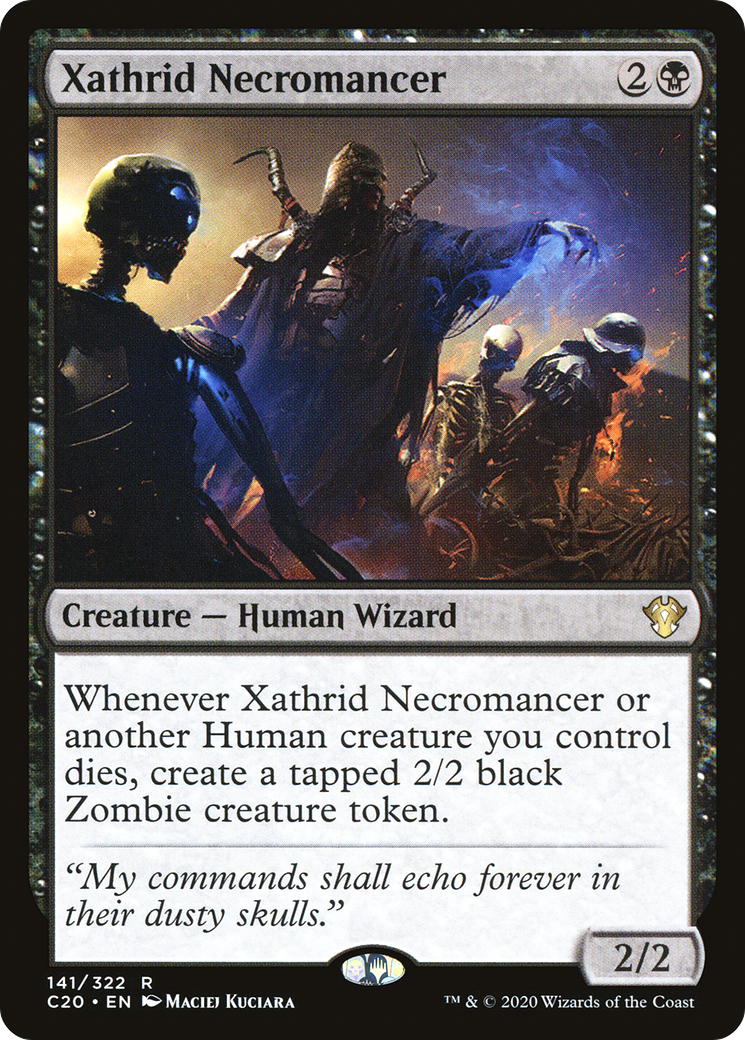
Xathrid Necromancer
Xathrid Necromancer
Creature — Human Wizard
2/2
Whenever this creature or another Human creature you control dies, create a tapped 2/2 black Zombie creature token.
- If Xathrid Necromancer dies at the same time as another Human creature you control, its ability will trigger twice.
-
1
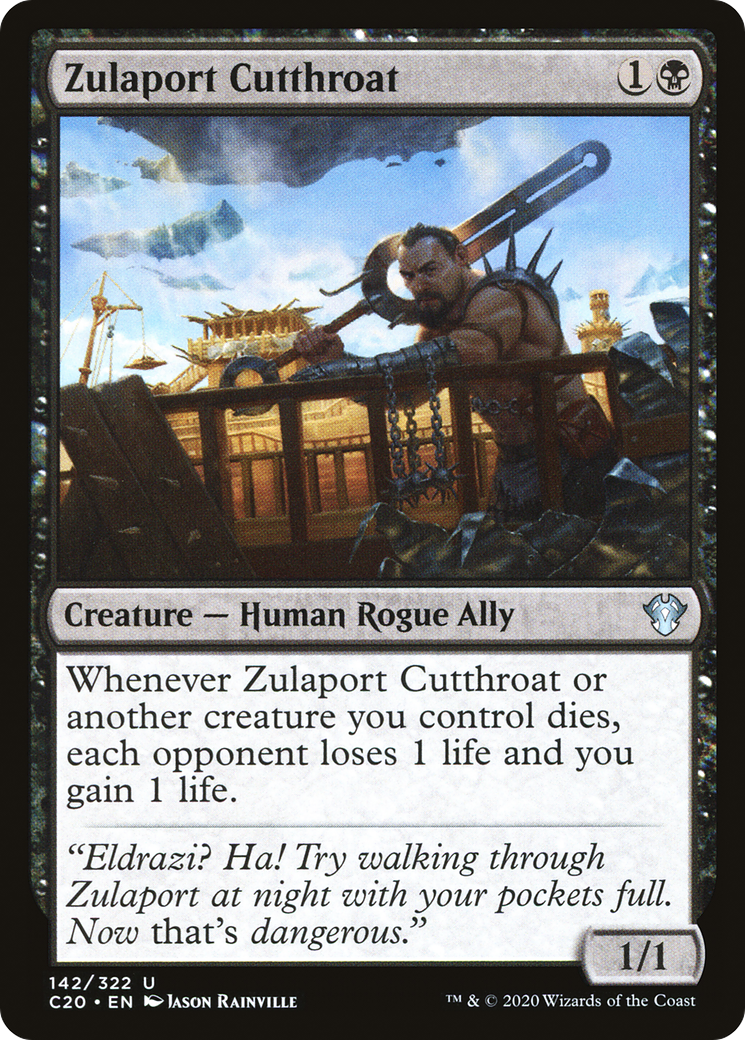
Zulaport Cutthroat
Zulaport Cutthroat
Creature — Human Rogue Ally
1/1
Whenever this creature or another creature you control dies, each opponent loses 1 life and you gain 1 life.
- If another creature you control dies at the same time as Zulaport Cutthroat, its ability triggers for that creature.
Instants 6
-
1
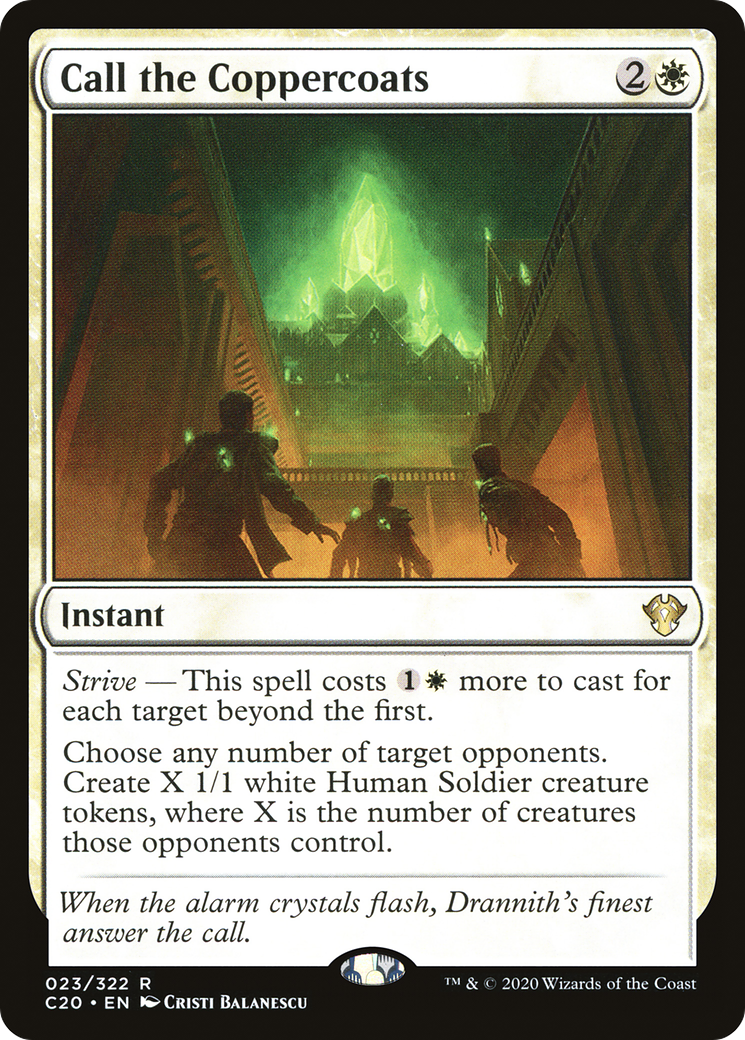
Call the Coppercoats
Call the Coppercoats
Instant
Strive — This spell costs more to cast for each target beyond the first.
Choose any number of target opponents. Create X 1/1 white Human Soldier creature tokens, where X is the number of creatures those opponents control.
- Any target opponents that are no longer legal targets by the time Call the Coppercoats resolves won't have their creatures counted when determining how many tokens you create.
- You choose how many targets each spell with a strive ability has and what those targets are as you cast it. It's legal to cast such a spell with no targets, although this is rarely a good idea. You can't choose the same target more than once for a single strive spell.
- The mana value of a strive spell doesn't change no matter how many targets it has.
- If this spell is copied and the effect that copies the spell allows a player to choose new targets for the copy, the number of targets can't be changed. The player may change any number of the targets, including all of them or none of them. If, for one of the targets, the player can't choose a new legal target, then it remains unchanged (even if the current target is illegal).
- If a spell or ability allows you to cast a strive spell without paying its mana cost, you must pay the additional cost for any targets beyond the first.
-
1
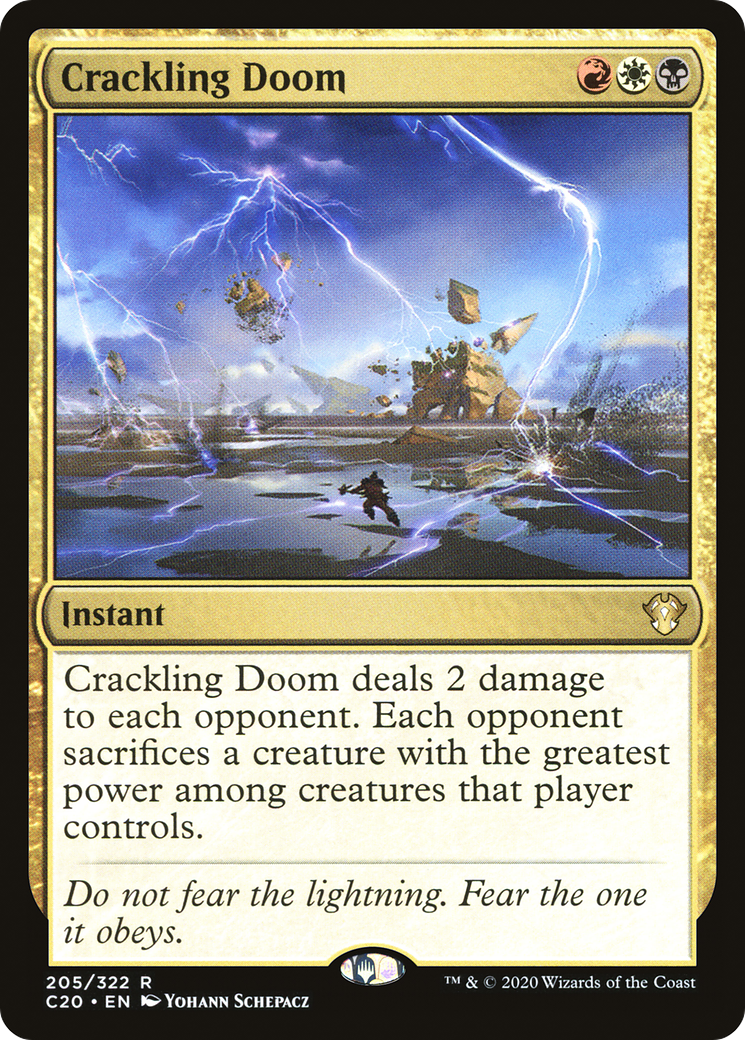
Crackling Doom
Crackling Doom
Instant
Crackling Doom deals 2 damage to each opponent. Each opponent sacrifices a creature with the greatest power among creatures that player controls.
- Crackling Doom doesn't target any player or creature. For example, a creature with protection from black could be sacrificed.
- If a player controls two or more creatures tied for the greatest power among creatures they control, that player chooses one of them to sacrifice.
- The sacrifice is not dependent on the damage being dealt. It doesn't matter if that damage is prevented or redirected.
- In a multiplayer game, each opponent, starting with the active player and proceeding in turn order, chooses which creature they will sacrifice and then all creatures are sacrificed at the same time. Each successive player will know what the players before them chose to sacrifice.
-
1
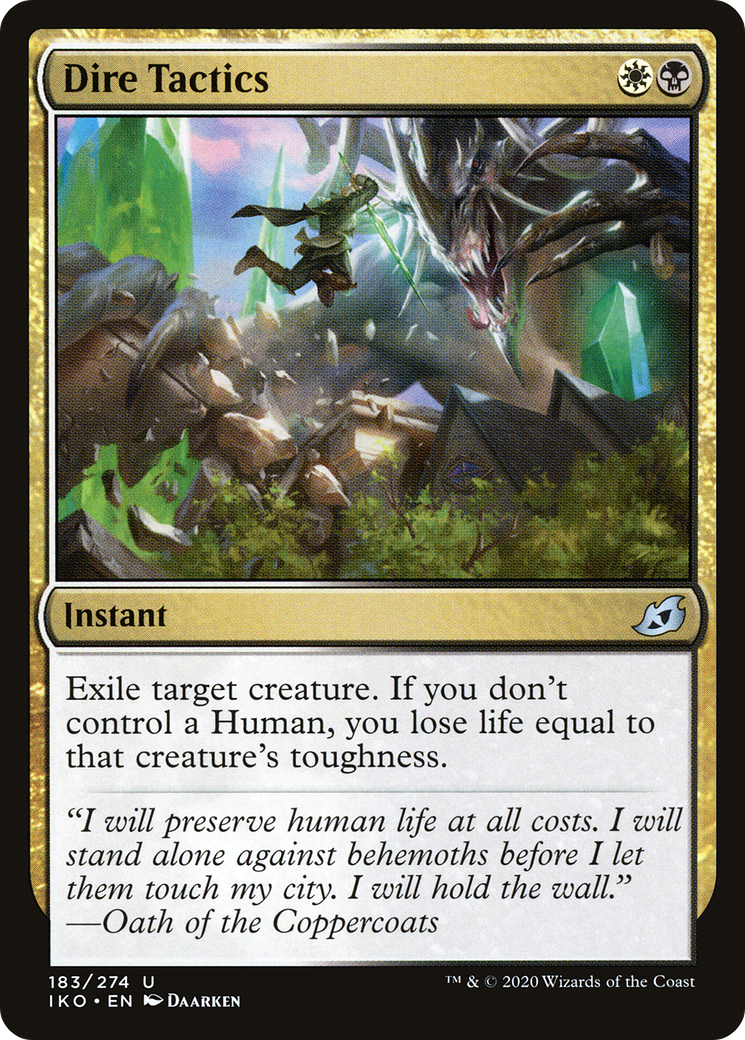
Dire Tactics
Dire Tactics
Instant
Exile target creature. If you don't control a Human, you lose life equal to that creature's toughness.
-
1
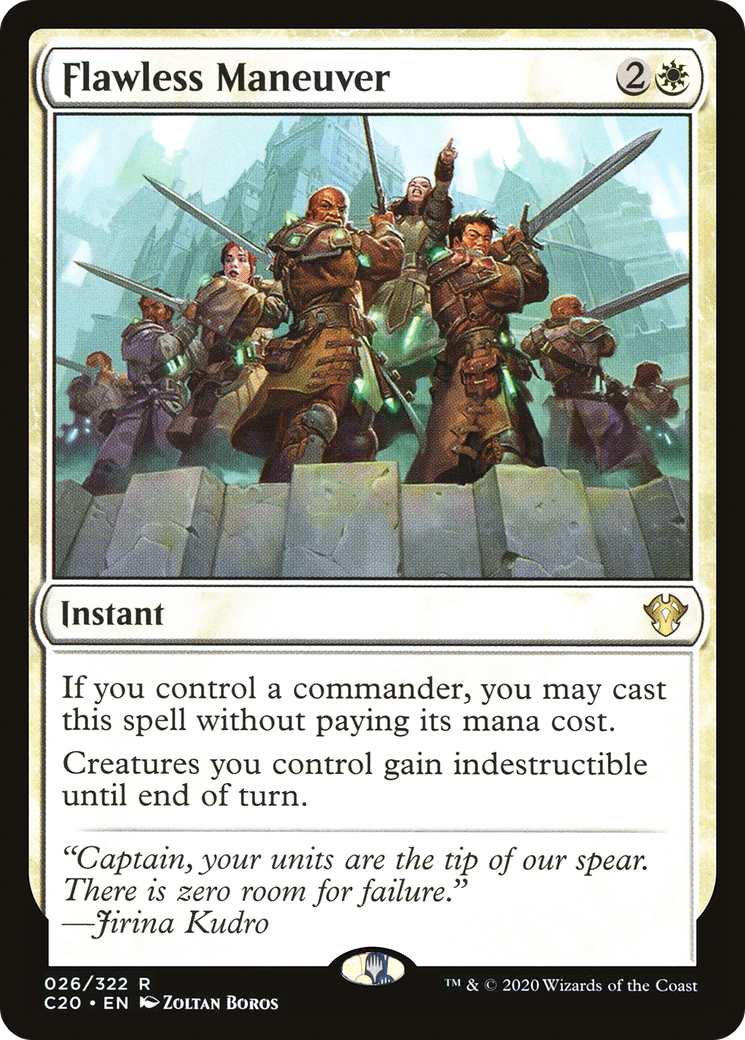
Flawless Maneuver
Flawless Maneuver
Instant
If you control a commander, you may cast this spell without paying its mana cost.
Creatures you control gain indestructible until end of turn.
- It doesn't matter whose commander you control. Any one will do. If you have two commanders, you just need to control one of them.
- Once you begin casting this spell, players can't take any other actions until you're done casting it. Notably, they can't try to remove the commander you control to make you pay its cost.
-
1
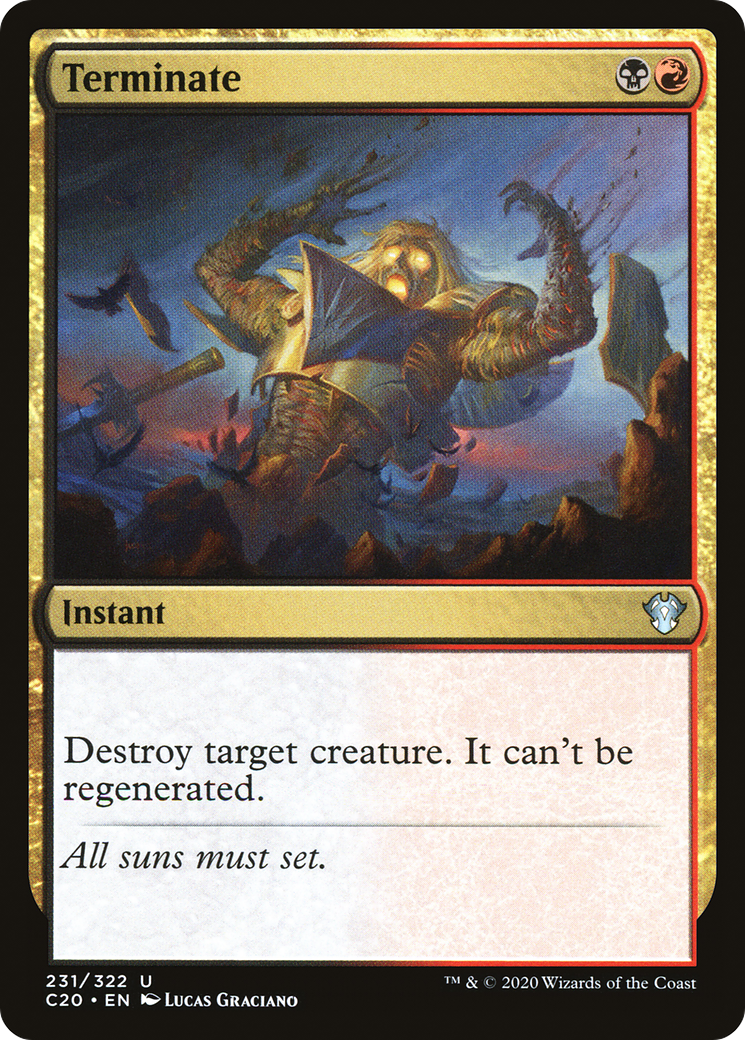
Terminate
Terminate
Instant
Destroy target creature. It can't be regenerated.
-
1
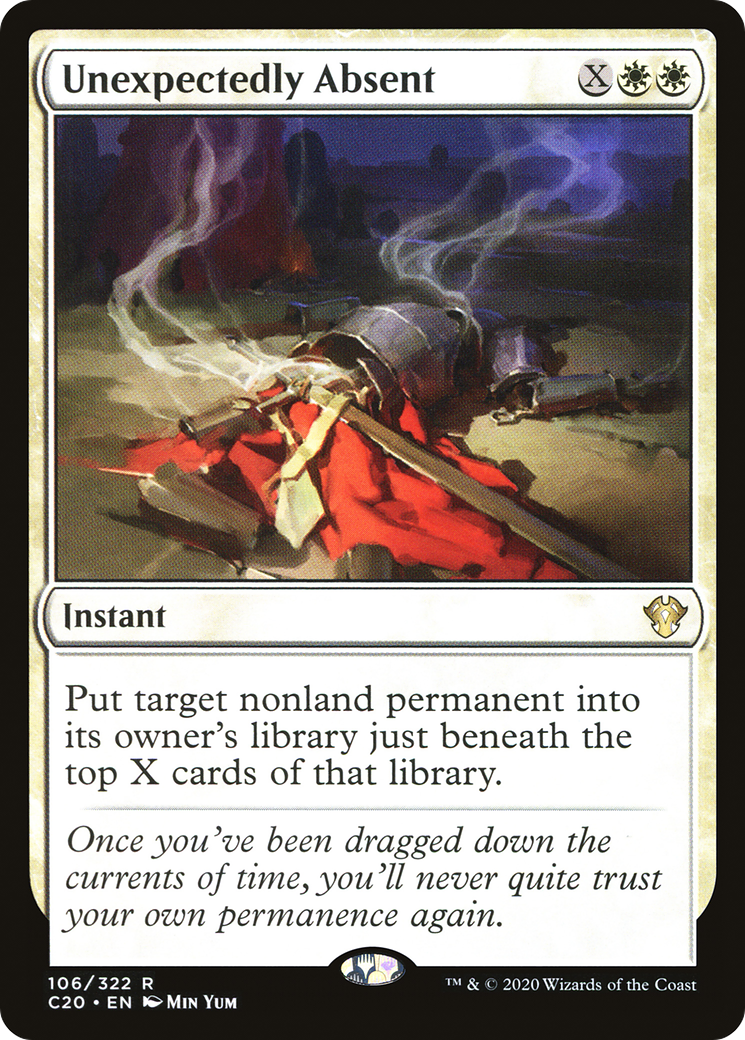
Unexpectedly Absent
Unexpectedly Absent
Instant
Put target nonland permanent into its owner's library just beneath the top X cards of that library.
- If there are fewer than X cards in that player’s library, put that permanent on the bottom of that library.
- If you choose 0 as the value for X, put that permanent on top of its owner’s library.
Sorceries 5
-
1
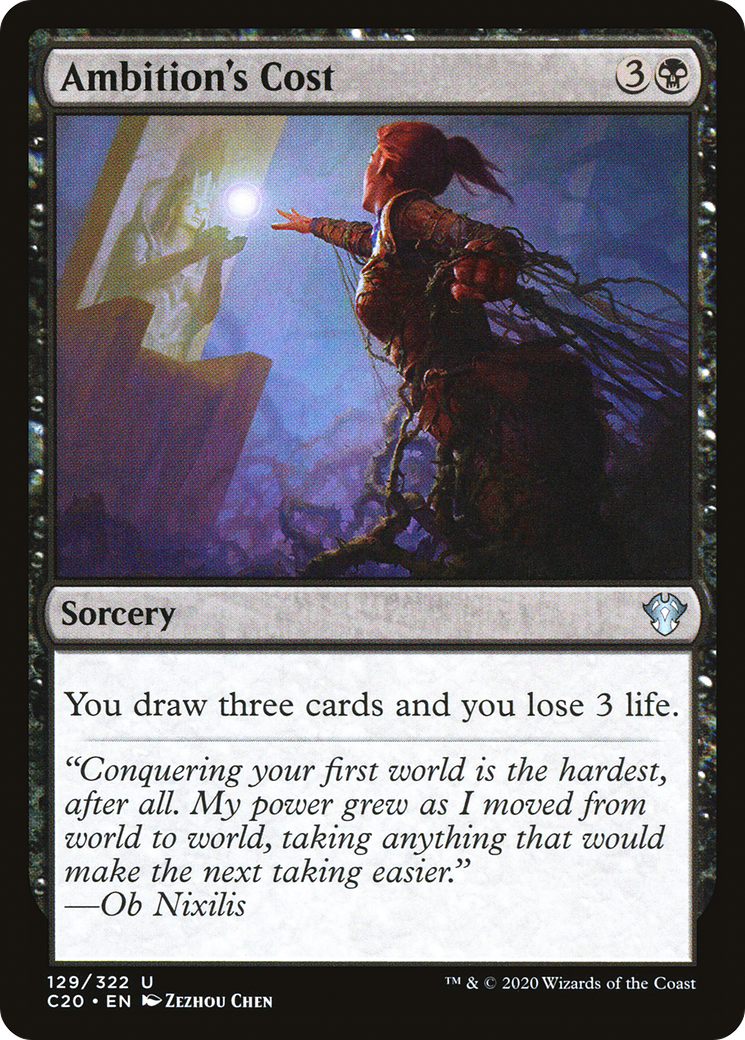
Ambition's Cost
Ambition's Cost
Sorcery
You draw three cards and you lose 3 life.
-
1
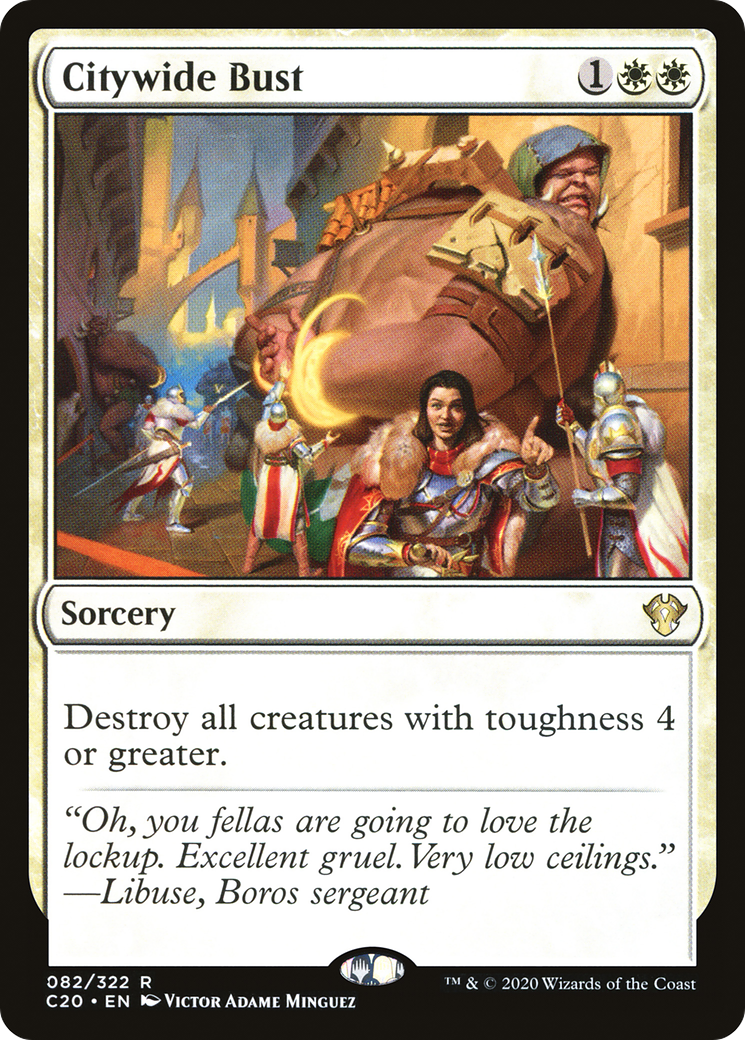
Citywide Bust
Citywide Bust
Sorcery
Destroy all creatures with toughness 4 or greater.
-
1
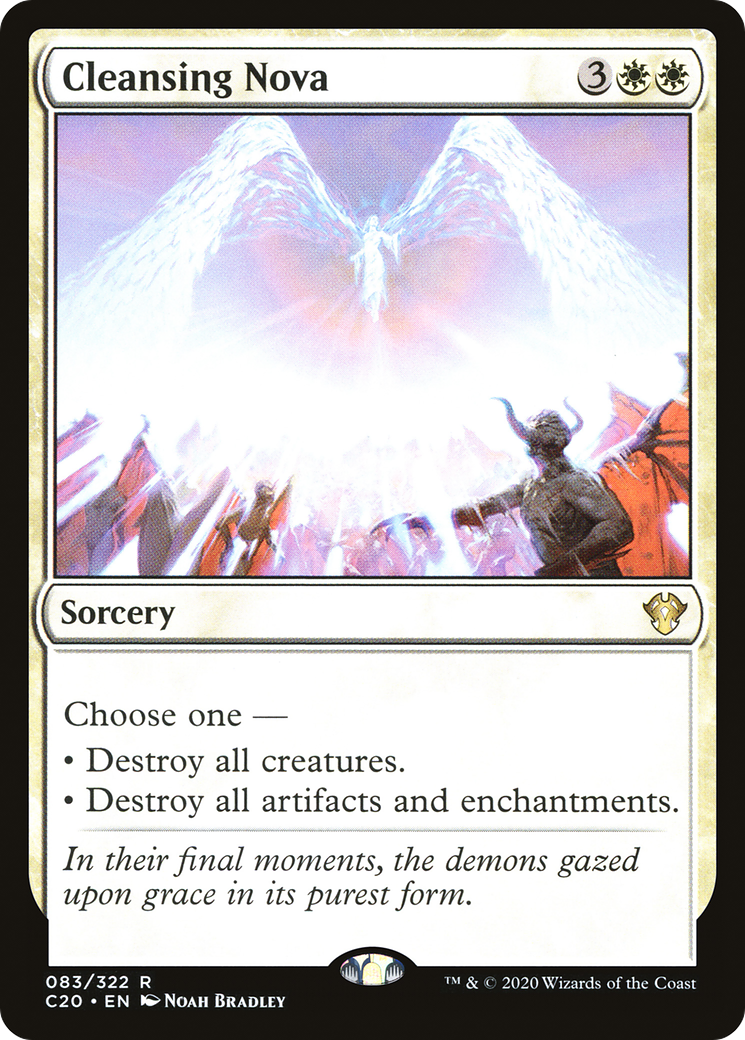
Cleansing Nova
Cleansing Nova
Sorcery
Choose one —
- Destroy all creatures.
- Destroy all artifacts and enchantments.
-
1
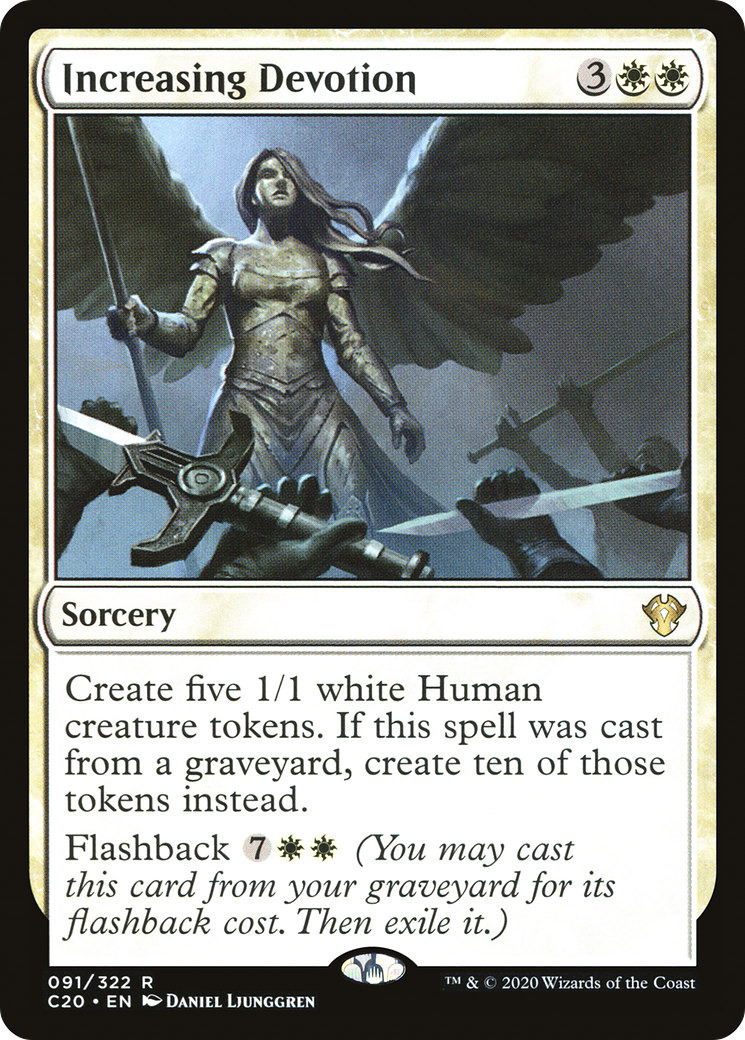
Increasing Devotion
Increasing Devotion
Sorcery
Create five 1/1 white Human creature tokens. If this spell was cast from a graveyard, create ten of those tokens instead.
Flashback (You may cast this card from your graveyard for its flashback cost. Then exile it.)
- "Flashback [cost]" means "You may cast this card from your graveyard by paying [cost] rather than paying its mana cost" and "If the flashback cost was paid, exile this card instead of putting it anywhere else any time it would leave the stack."
- You must still follow any timing restrictions and permissions, including those based on the card's type. For instance, you can cast a sorcery using flashback only when you could normally cast a sorcery.
- To determine the total cost of a spell, start with the mana cost or alternative cost (such as a flashback cost) you're paying, add any cost increases, then apply any cost reductions. The mana value of the spell is determined only by its mana cost, no matter what the total cost to cast the spell was.
- A spell cast using flashback will always be exiled afterward, whether it resolves, is countered, or leaves the stack in some other way.
- You can cast a spell using flashback even if it was somehow put into your graveyard without having been cast.
- If a card with flashback is put into your graveyard during your turn, you can cast it if it's legal to do so before any other player can take any actions.
-
1
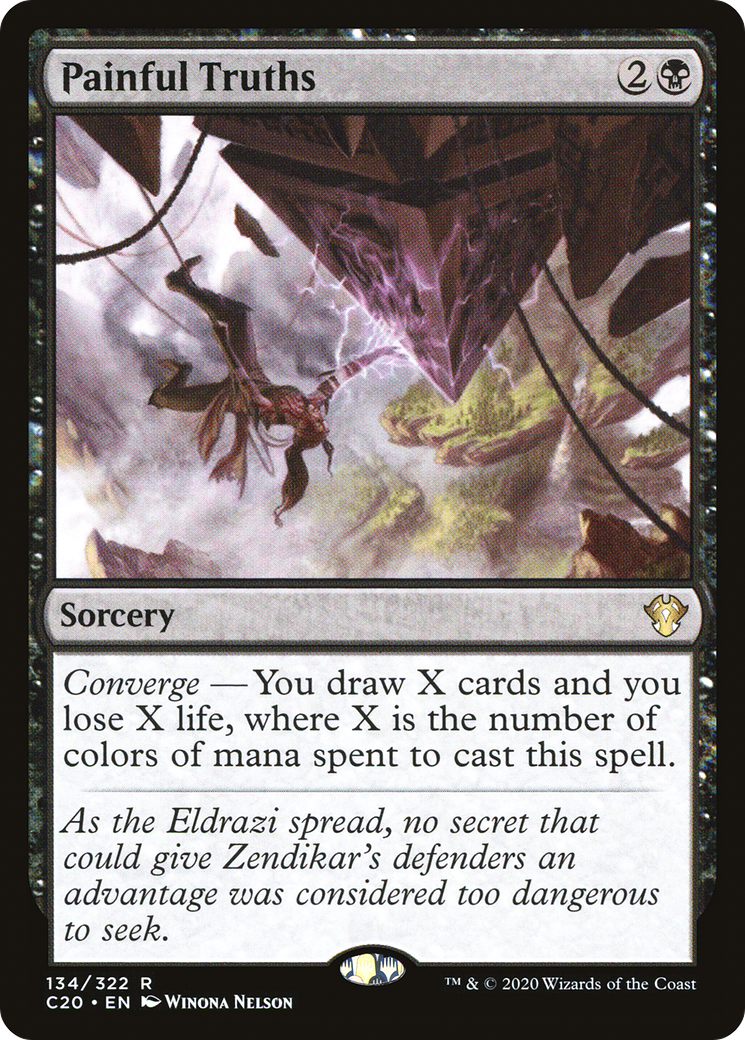
Painful Truths
Painful Truths
Sorcery
Converge — You draw X cards and you lose X life, where X is the number of colors of mana spent to cast this spell.
- The maximum number of colors of mana you can spend to cast a spell is five. Colorless is not a color. Note that the cost of a spell with converge may limit how many colors of mana you can spend.
- Unless a spell or ability allows you to, you can't choose to pay more mana for a spell with a converge ability just to spend more colors of mana. Likewise, if a spell or ability reduces the amount of mana it costs you to cast a spell with converge, you can't ignore that cost reduction in order to spend more colors of mana.
- If there are any alternative or additional costs to cast a spell with a converge ability, the mana spent to pay those costs will count. For example, if an effect makes sorcery spells cost more to cast, you could pay to cast Radiant Flames and deal 4 damage to each creature.
- If you cast a spell with converge without spending any mana to cast it (perhaps because an effect allowed you to cast it without paying its mana cost), then the number of colors spent to cast it will be zero.
- If a spell with a converge ability is copied, no mana was spent to cast the copy, so the number of colors of mana spent to cast the spell will be zero. The number of colors spent to cast the original spell is not copied.
Artifacts 10
-
1
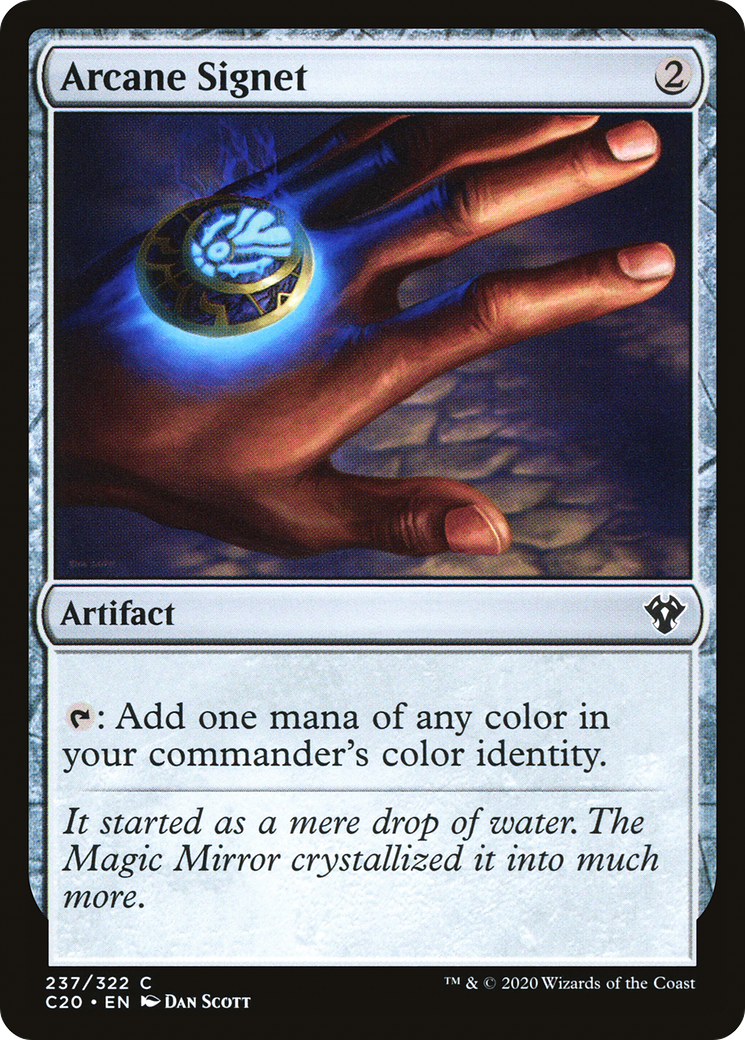
Arcane Signet
Arcane Signet
Artifact
: Add one mana of any color in your commander's color identity.
- If your commander is a card that has no colors in its color identity, Arcane Signet's ability produces no mana. It doesn't produce .
- If you have two commanders, the ability adds one mana of any color in their combined color identities.
- If you don't have a commander, Arcane Signet's ability produces no mana.
-
1
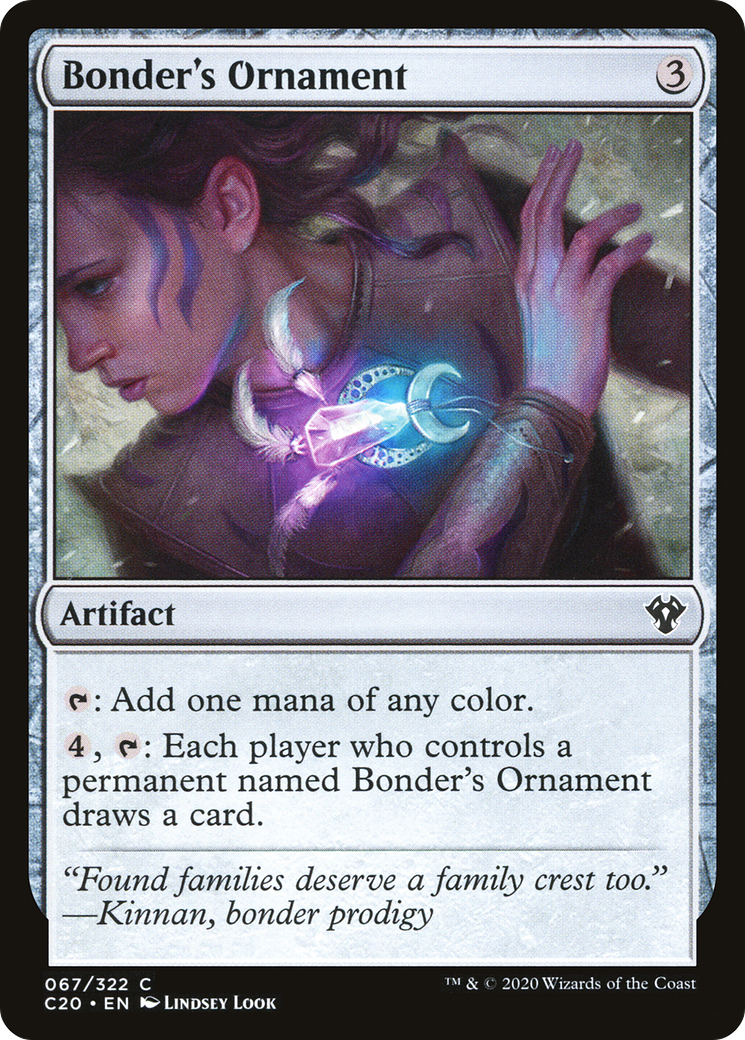
Bonder's Ornament
Bonder's Ornament
Artifact
: Add one mana of any color.
, : Each player who controls a permanent named Bonder's Ornament draws a card.
- If one player controls more than one Bonder’s Ornament, that player draws just one card while resolving its second ability.
-
1
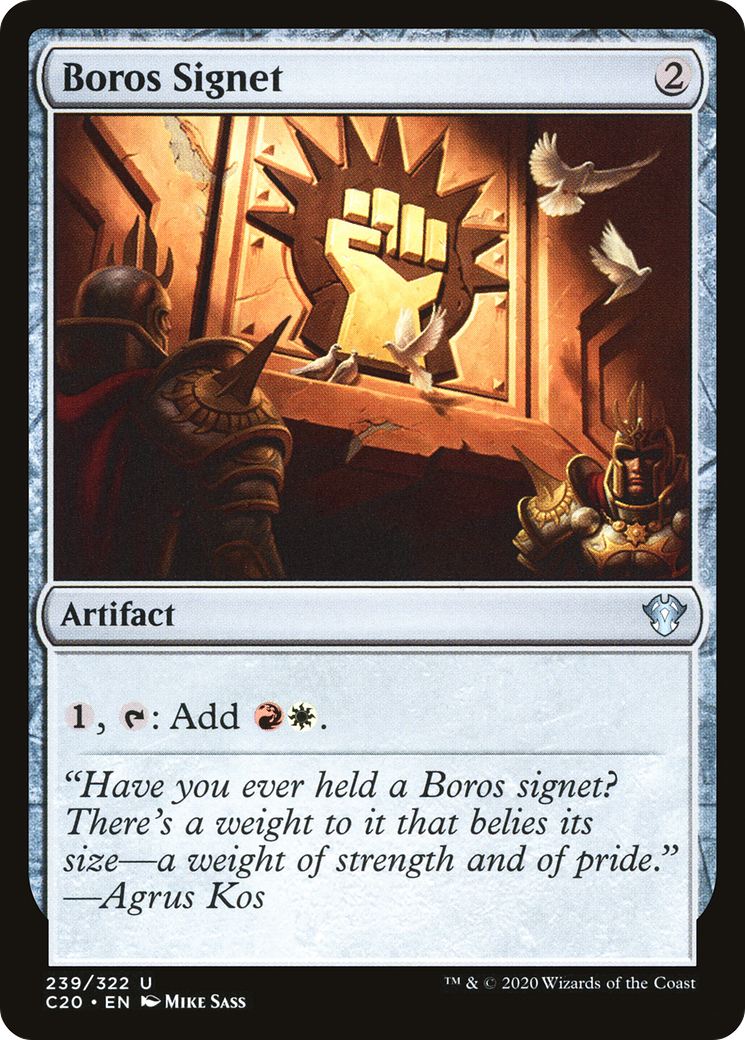
Boros Signet
Boros Signet
Artifact
, : Add .
-
1
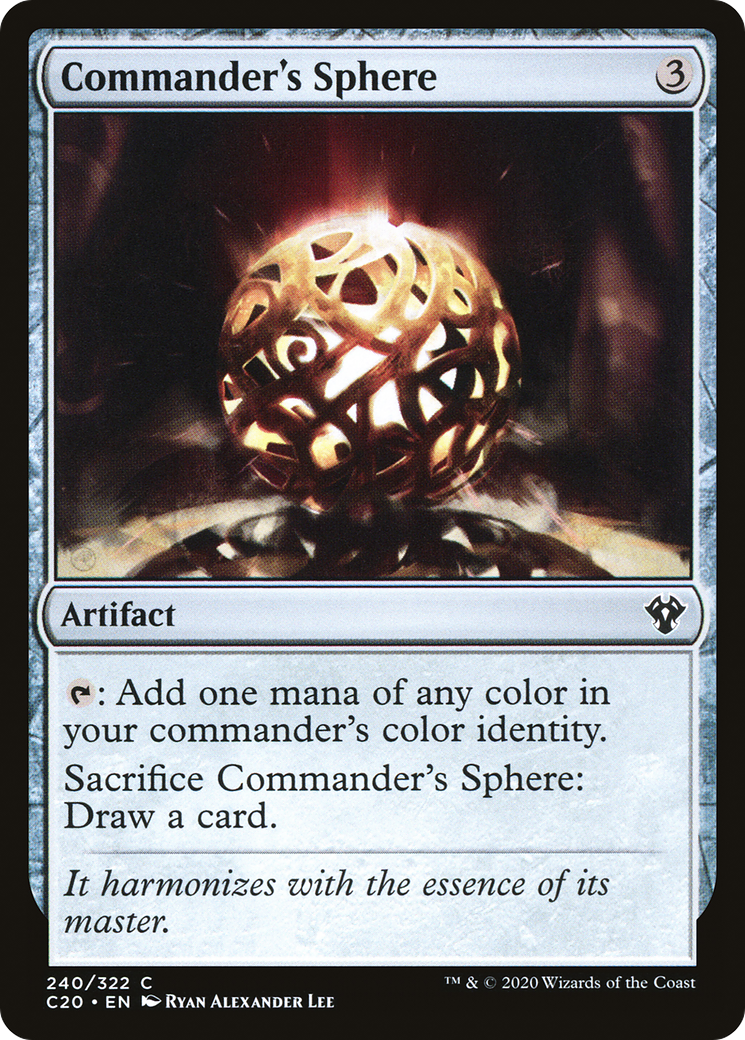
Commander's Sphere
Commander's Sphere
Artifact
: Add one mana of any color in your commander's color identity.
Sacrifice this artifact: Draw a card.
- If your commander is a card that has no colors in its color identity, Commander's Sphere's first ability produces no mana. It doesn't produce .
- If you don't have a commander, Commander's Sphere's first ability produces no mana.
- If you have two commanders, the ability adds one mana of any color in their combined color identities.
-
1
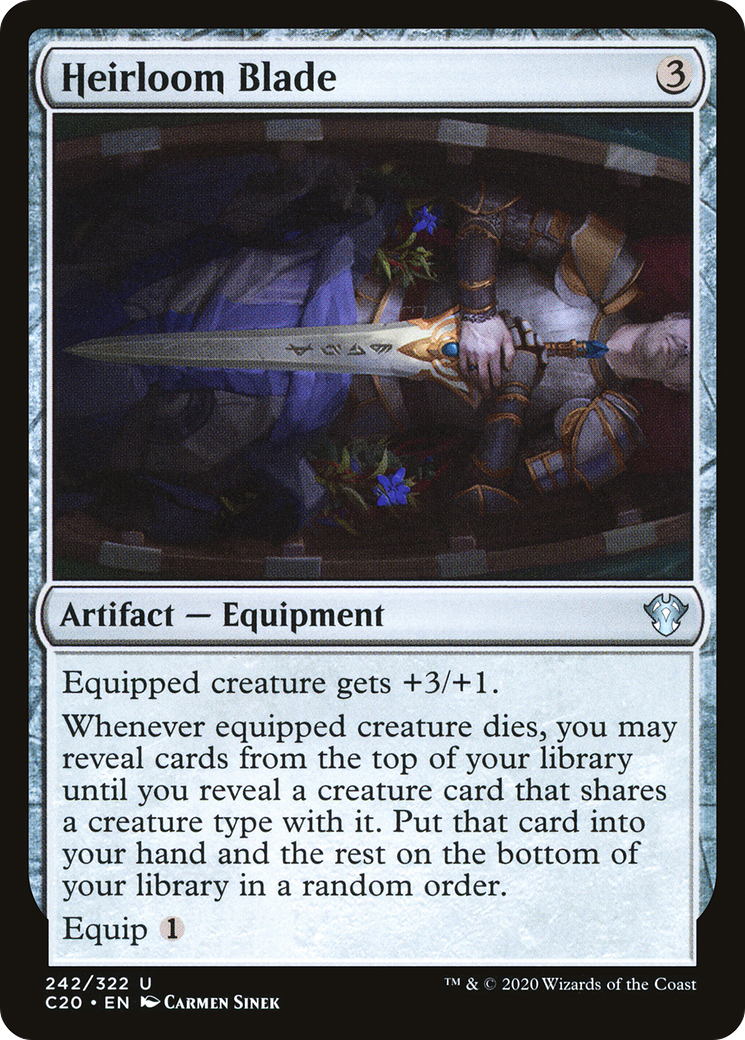
Heirloom Blade
Heirloom Blade
Artifact — Equipment
Equipped creature gets +3/+1.
Whenever equipped creature dies, you may reveal cards from the top of your library until you reveal a creature card that shares a creature type with it. Put that card into your hand and the rest on the bottom of your library in a random order.
Equip
- If you don't reveal a creature card that shares a type with the creature that died, you'll just reveal and randomize your library.
- If the equipped creature has no creature type, no card can share a creature type with it.
- You'll reveal cards until you find one that shares at least one creature type with the creature that died. For example, if a Cat Wizard dies, you'll stop if you reveal a Human Wizard or Cat Soldier.
- Compare the revealed cards to the creature as it last existed before it died, not to the creature card as it exists in its owner's graveyard, to determine which one you put into your hand.
- "Artifact" isn't a creature type.
- If Heirloom Blade leaves the battlefield at the same time that the equipped creature dies, its triggered ability triggers.
-
1
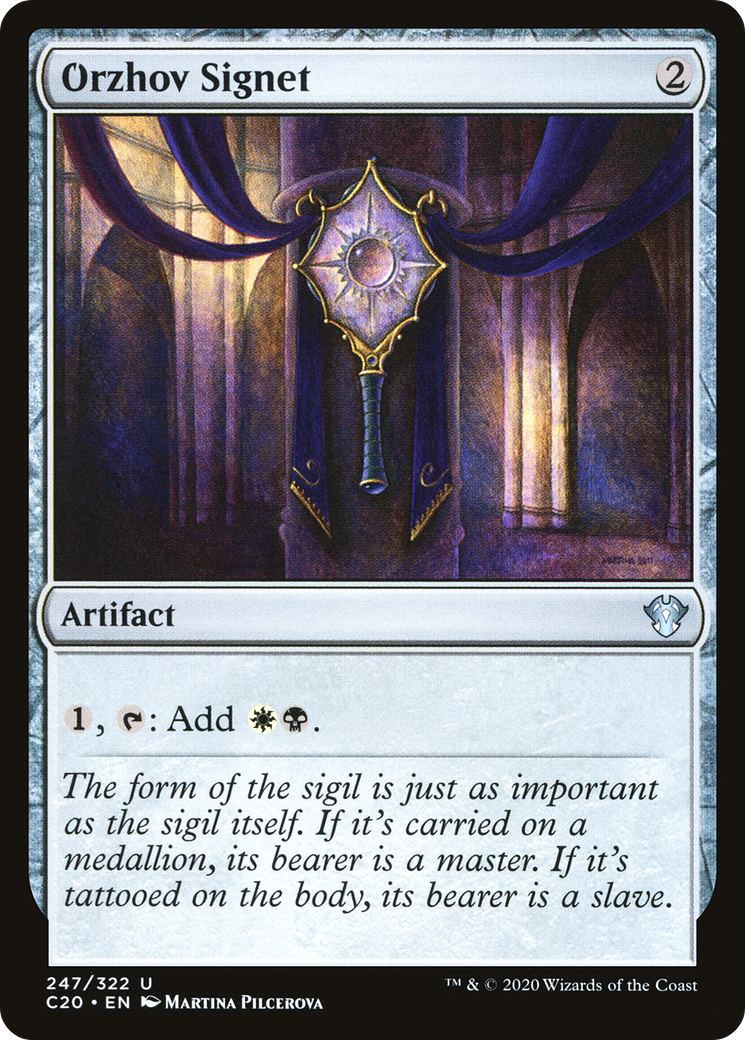
Orzhov Signet
Orzhov Signet
Artifact
, : Add .
-
1
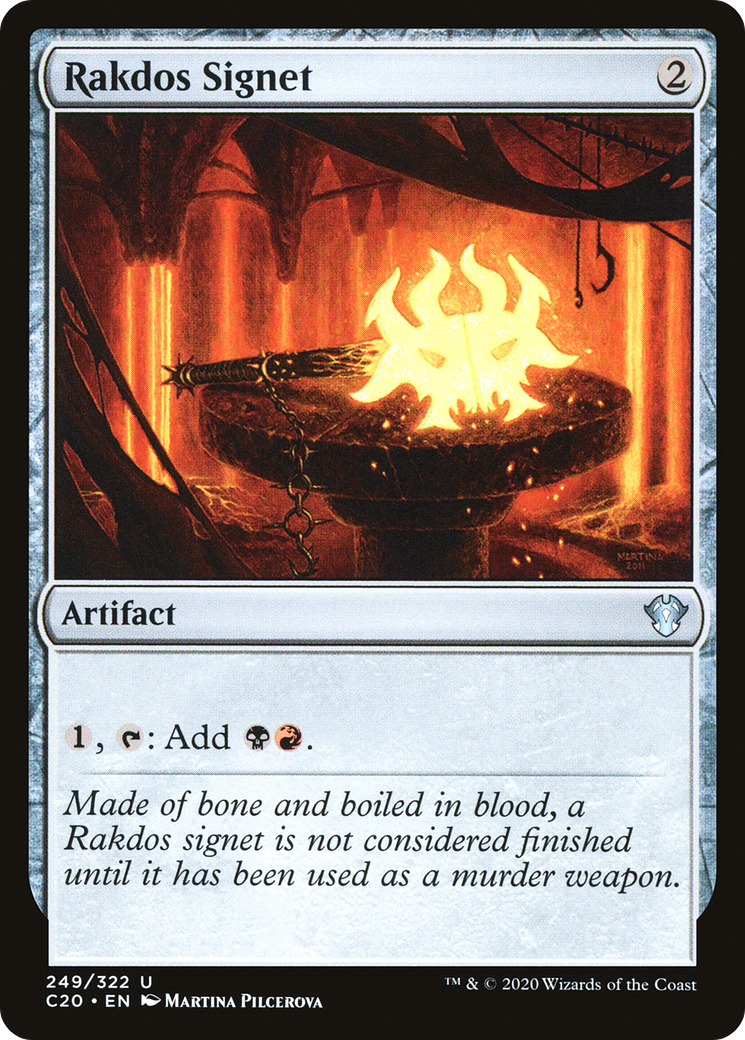
Rakdos Signet
Rakdos Signet
Artifact
, : Add .
-
1
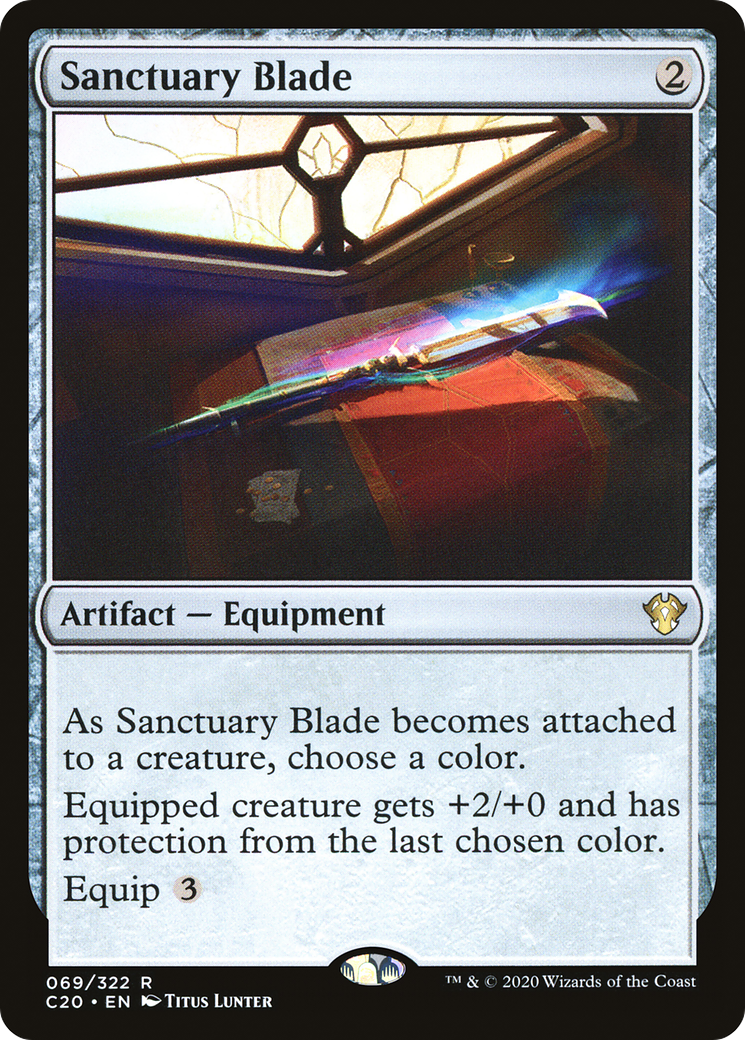
Sanctuary Blade
Sanctuary Blade
Artifact — Equipment
As this Equipment becomes attached to a creature, choose a color.
Equipped creature gets +2/+0 and has protection from the last chosen color.
Equip
- Activating Sanctuary Blade's equip ability targeting the creature it's already attached to won't let you choose a new color.
- If Sanctuary Blade is somehow attached to a creature without a color having been chosen for it, it doesn't grant a protection ability to the creature. The creature doesn't gain protection from colorless.
-
1
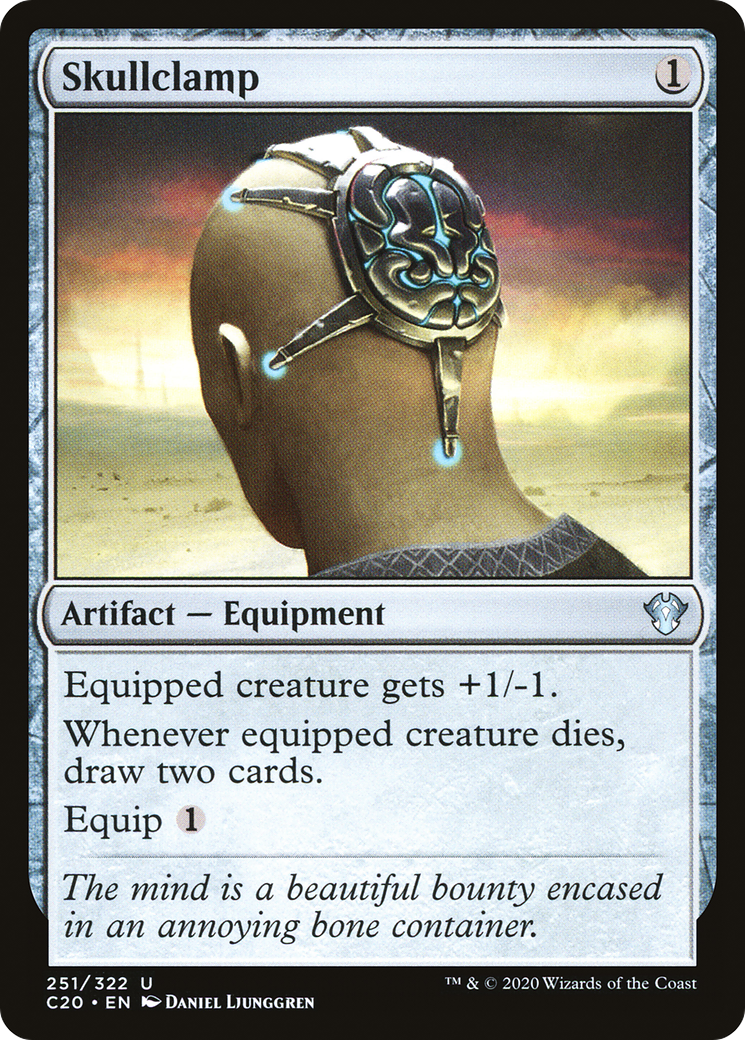
Skullclamp
Skullclamp
Artifact — Equipment
Equipped creature gets +1/-1.
Whenever equipped creature dies, draw two cards.
Equip
-
1
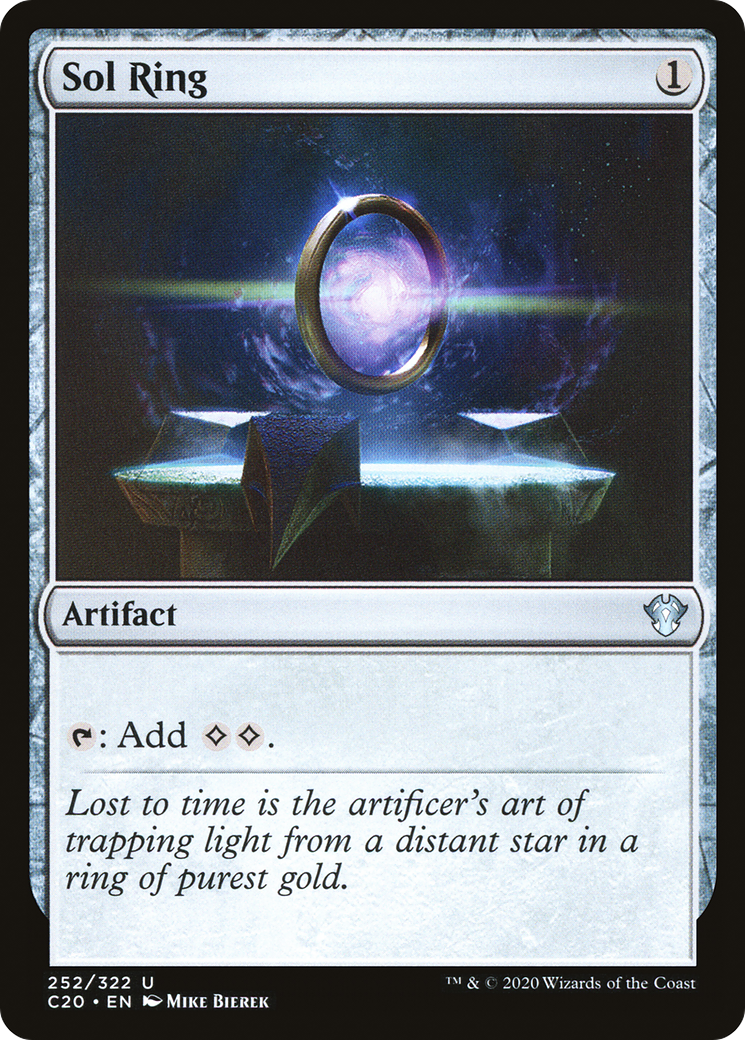
Sol Ring
Sol Ring
Artifact
: Add .
Enchantments 9
-
1
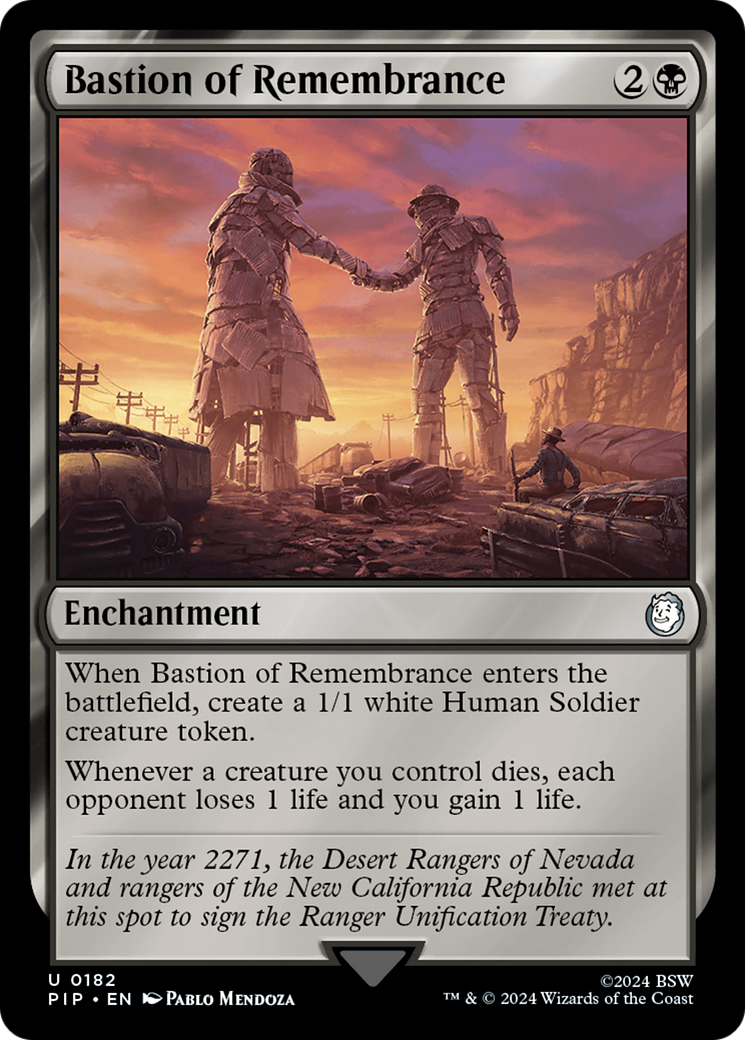
Bastion of Remembrance
Bastion of Remembrance
Enchantment
When this enchantment enters, create a 1/1 white Human Soldier creature token.
Whenever a creature you control dies, each opponent loses 1 life and you gain 1 life.
- If your life total is brought to 0 or less at the same time that creatures you control are dealt lethal damage, you lose the game before the last ability goes on the stack.
- In a Two-Headed Giant game, Bastion of Remembrance's last ability causes the opposing team to lose 2 life and you to gain 1 life.
- If one or more creatures you control die at the same time that Bastion of Remembrance leaves the battlefield, its last ability triggers for each of those creatures.
-
1
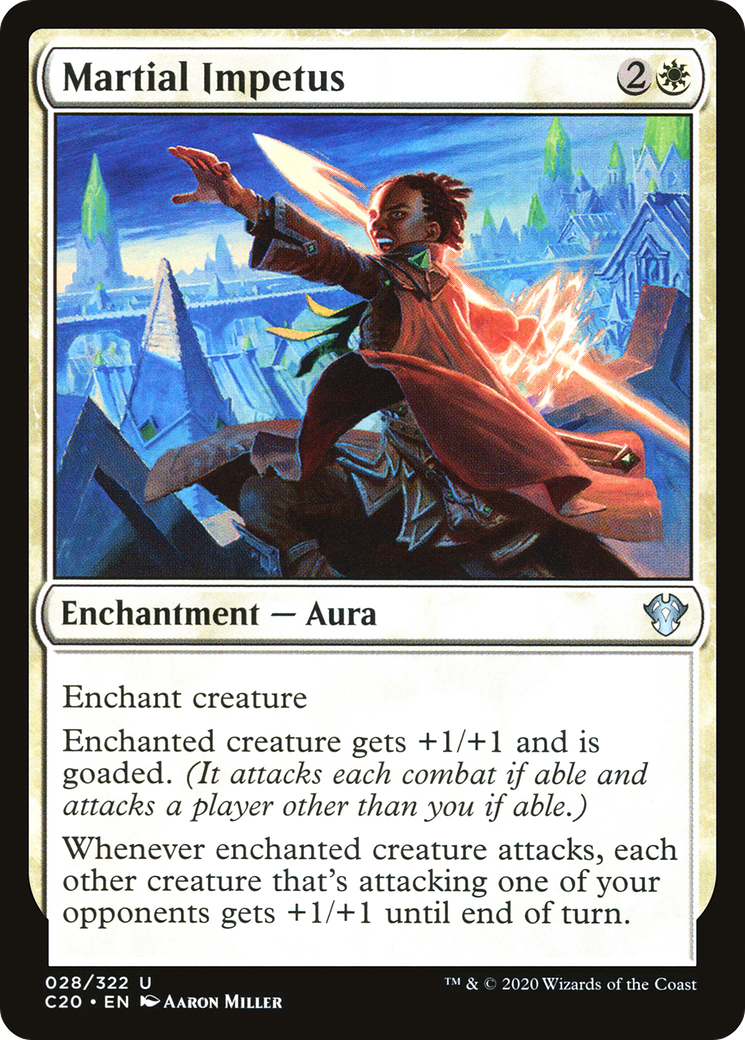
Martial Impetus
Martial Impetus
Enchantment — Aura
Enchant creature
Enchanted creature gets +1/+1 and is goaded. (It attacks each combat if able and attacks a player other than you if able.)
Whenever enchanted creature attacks, each other creature that's attacking one of your opponents gets +1/+1 until end of turn.
- If the creature doesn't meet any of the above exceptions and can attack, it must attack a player other than the controller of the spell or ability that goaded it if able. If the creature can't attack any of those players but could otherwise attack, it must attack a planeswalker an opponent controls, a battle an opponent controls, or a player who goaded it.
- If, during a player's declare attackers step, a creature that player controls that's been goaded is tapped, is affected by a spell or ability that says it can't attack, or hasn't been under that player's control continuously since the turn began (and doesn't have haste), then it doesn't attack. If there's a cost associated with having a creature attack a player, its controller isn't forced to pay that cost, so it doesn't have to attack that player.
- Attacking with a goaded creature doesn't cause it to stop being goaded. If there is an additional combat phase that turn, or if another player gains control of it before it stops being goaded, it must attack again if able.
- If a creature you control has been goaded by multiple opponents, it must attack one of your opponents that hasn't goaded it, as that fulfills the maximum number of goad requirements. If a creature you control has been goaded by each of your opponents, the creature must attack an opponent (rather than a planeswalker or battle), but you choose which opponent it attacks.
- Being goaded isn't an ability the creature has. Once it's been goaded, it must attack as detailed above even if it loses all abilities.
-
1
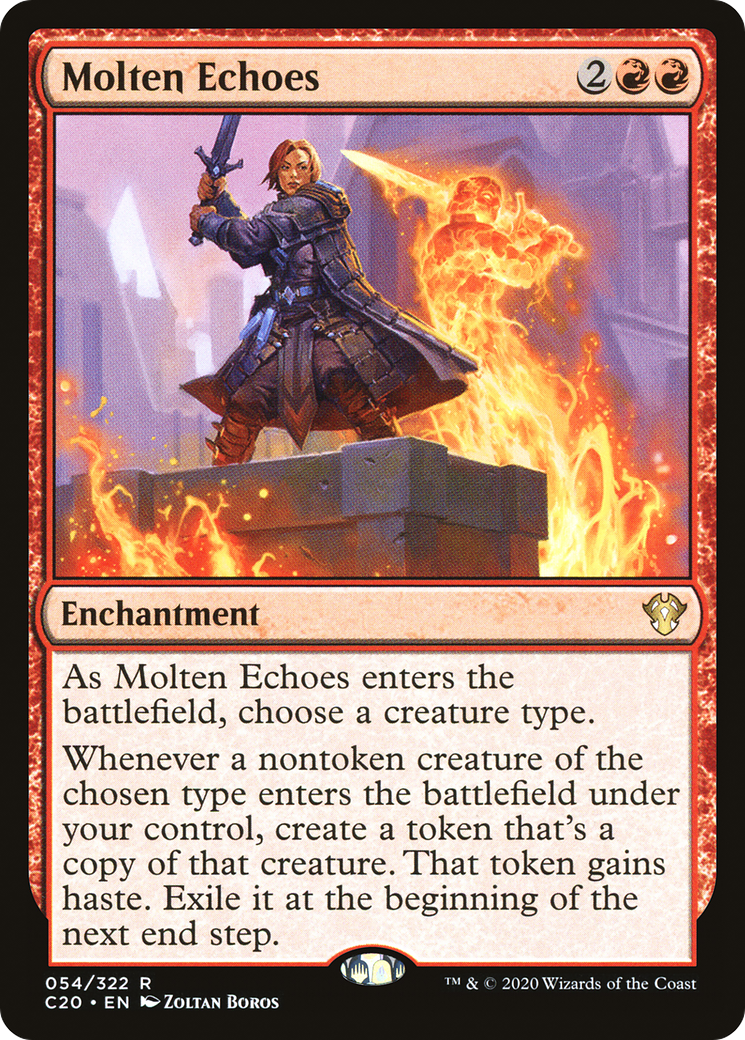
Molten Echoes
Molten Echoes
Enchantment
As this enchantment enters, choose a creature type.
Whenever a nontoken creature you control of the chosen type enters, create a token that's a copy of that creature. That token gains haste. Exile it at the beginning of the next end step.
- You must choose an existing creature type, such as Human or Warrior. Card types such as artifact and supertypes such as legendary can't be chosen.
- If the nontoken creature leaves the battlefield before Molten Echoes's triggered ability resolves, the token that's created uses the creature's last known information from before it left.
- The token copies exactly what is printed on the creature and nothing else (unless that creature is copying something else; see below). It doesn't copy whether that creature is tapped or untapped, whether it has any counters on it or Auras and/or Equipment attached to it, or any non-copy effects that changed its power, toughness, types, color, and so on.
- If the copied creature is copying something else, the token enters the battlefield as whatever that creature is copying.
- If the copied creature has in its mana cost, X is 0.
- Any enters-the-battlefield abilities of the copied creature will trigger when the token enters the battlefield. Any “As [this creature] enters the battlefield” or “[This creature] enters the battlefield with” abilities of the copied creature will also work.
-
1
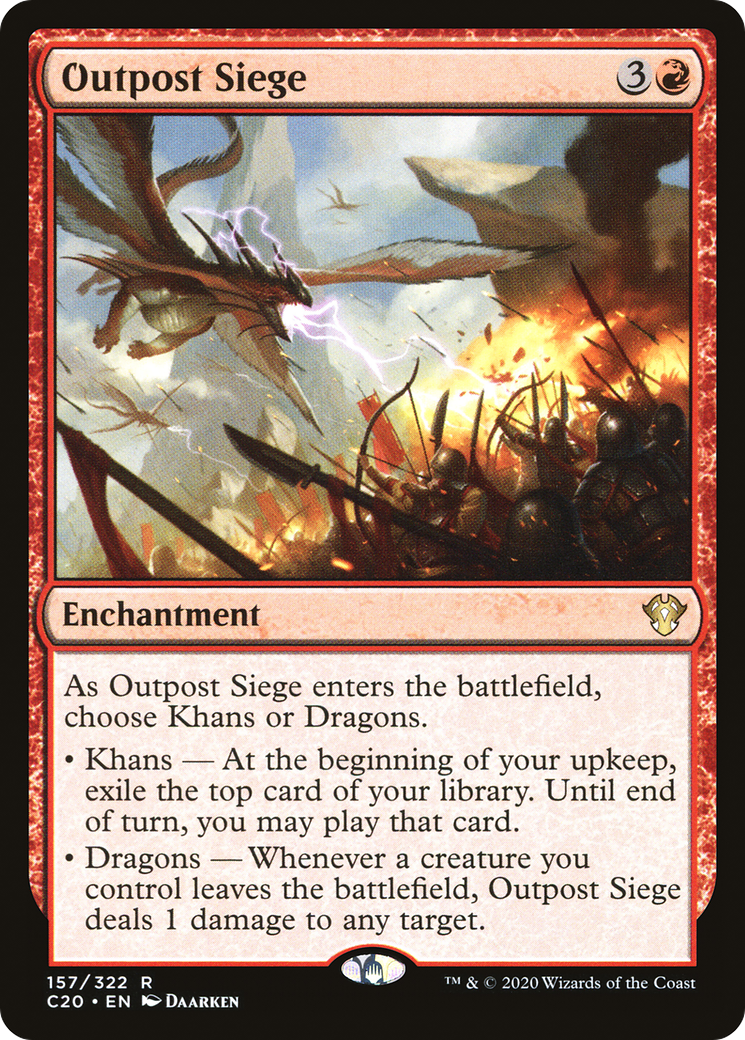
Outpost Siege
Outpost Siege
Enchantment
As this enchantment enters, choose Khans or Dragons.
- Khans — At the beginning of your upkeep, exile the top card of your library. Until end of turn, you may play that card.
- Dragons — Whenever a creature you control leaves the battlefield, this enchantment deals 1 damage to any target.
- The card exiled by the "Khans" ability is exiled face up. Playing a card exiled with the "Khans" ability follows the normal rules for playing the card. You must pay its costs, and you must follow all applicable timing rules. For example, if it's a creature card, you can cast it only during your main phase while the stack is empty.
- If you exile a land card using the "Khans" ability, you may play that land only if you have any available land plays. Normally, this means you can play the land only if you haven't played a land yet that turn.
- If a noncreature card is manifested and then leaves the battlefield while face down, the "Dragons" ability will trigger.
- Each Siege will have one of the two listed abilities, depending on your choice as it enters the battlefield.
- The words "Khans" and "Dragons" are anchor words, connecting your choice to the appropriate ability. Anchor words are a new rules concept. "[Anchor word] — [Ability]" means "As long as you chose [anchor word] as this permanent entered the battlefield, this permanent has [ability]." Notably, the anchor word "Dragons" has no connection to the creature type Dragon.
- Each of the last two abilities is linked to the first ability. They each refer only to the choice made as a result of the first ability. If a permanent enters the battlefield as a copy of one of the Sieges, its controller will make a new choice for that Siege. Which ability the copy has won't depend on the choice made for the original permanent.
-
1
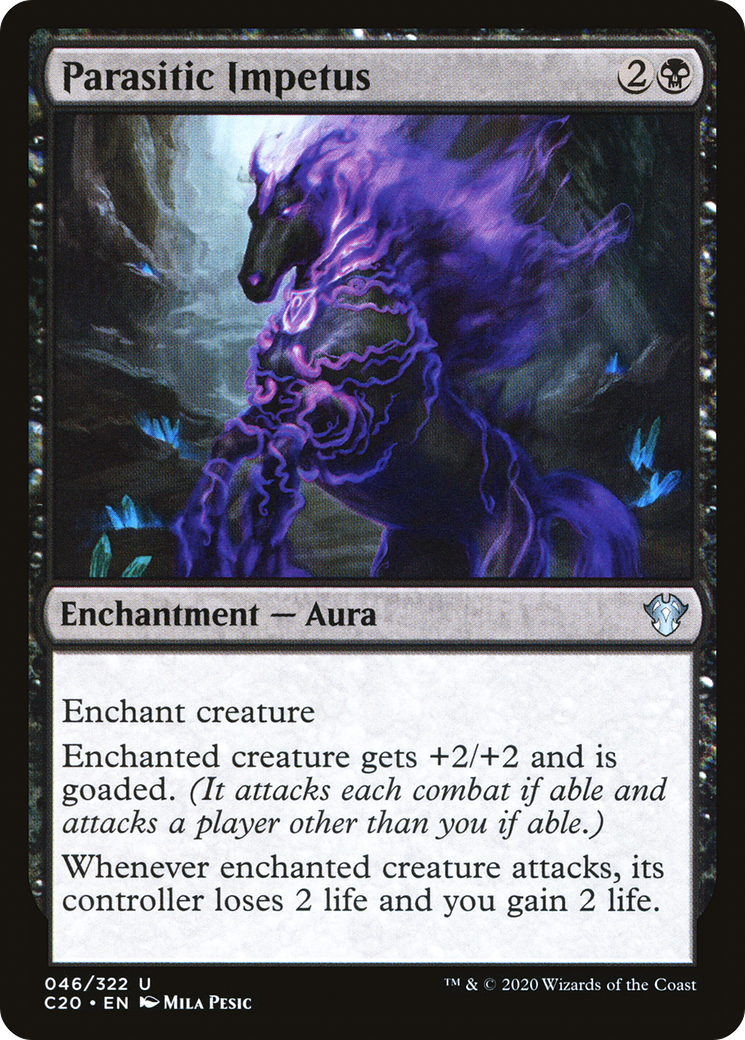
Parasitic Impetus
Parasitic Impetus
Enchantment — Aura
Enchant creature
Enchanted creature gets +2/+2 and is goaded. (It attacks each combat if able and attacks a player other than you if able.)
Whenever enchanted creature attacks, its controller loses 2 life and you gain 2 life.
- Being goaded isn't an ability the creature has. Once it's been goaded, it must attack as detailed above even if it loses all abilities.
- If, during a player's declare attackers step, a creature that player controls that's been goaded is tapped, is affected by a spell or ability that says it can't attack, or hasn't been under that player's control continuously since the turn began (and doesn't have haste), then it doesn't attack. If there's a cost associated with having a creature attack a player, its controller isn't forced to pay that cost, so it doesn't have to attack that player.
- If a creature you control has been goaded by multiple opponents, it must attack one of your opponents that hasn't goaded it, as that fulfills the maximum number of goad requirements. If a creature you control has been goaded by each of your opponents, the creature must attack an opponent (rather than a planeswalker or battle), but you choose which opponent it attacks.
- Attacking with a goaded creature doesn't cause it to stop being goaded. If there is an additional combat phase that turn, or if another player gains control of it before it stops being goaded, it must attack again if able.
- If the creature doesn't meet any of the above exceptions and can attack, it must attack a player other than the controller of the spell or ability that goaded it if able. If the creature can't attack any of those players but could otherwise attack, it must attack a planeswalker an opponent controls, a battle an opponent controls, or a player who goaded it.
- If you are the attacking creature's controller, you lose 2 life and gain 2 life. You won't lose the game if your life total is 0 in between these two events.
- Parasitic Impetus causes you to gain life, not the attacking creature's controller.
-
1
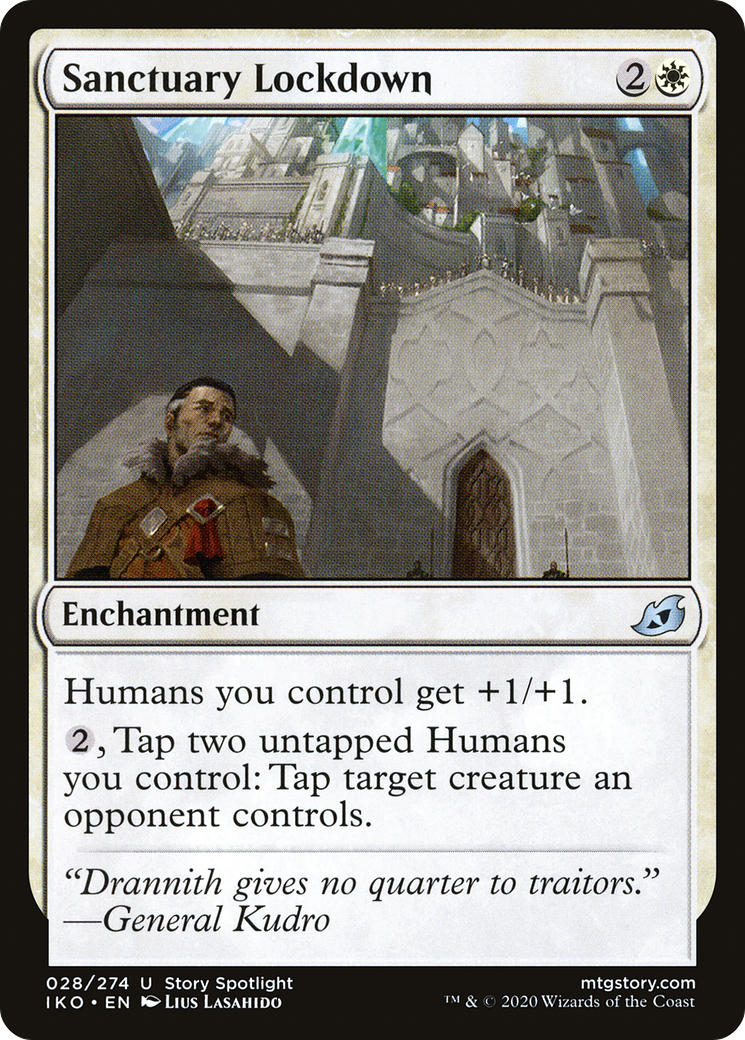
Sanctuary Lockdown
Sanctuary Lockdown
Enchantment
Humans you control get +1/+1.
, Tap two untapped Humans you control: Tap target creature an opponent controls.
-
1
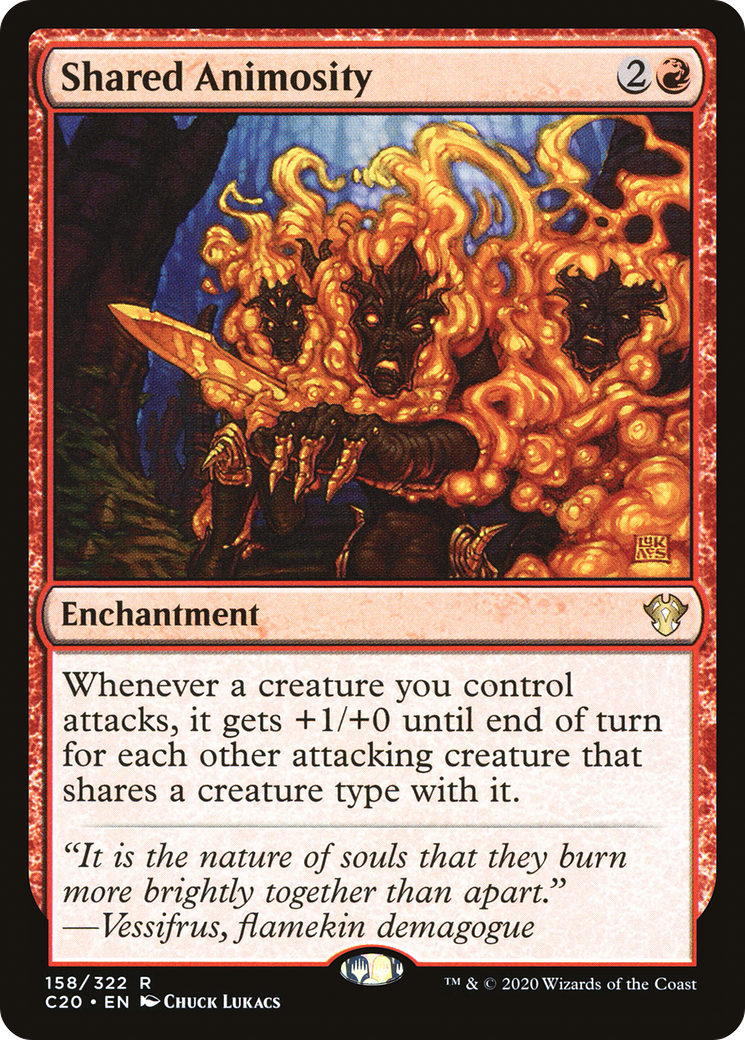
Shared Animosity
Shared Animosity
Enchantment
Whenever a creature you control attacks, it gets +1/+0 until end of turn for each other attacking creature that shares a creature type with it.
- This ability counts creatures, not creature types. For example, if you attack with five creatures — an Elf Shaman, an Elf Warrior, a Goblin Shaman, an Elemental, and a creature with all creature types — the ability will trigger five times. Those creatures will get +3/+0, +2/+0, +2/+0, +1/+0, and +4/+0, respectively.
- In a Two-Headed Giant game, only creatures you control trigger the ability and get the bonus, but your teammate's attacking creatures are included in the calculation of those bonuses.
-
1
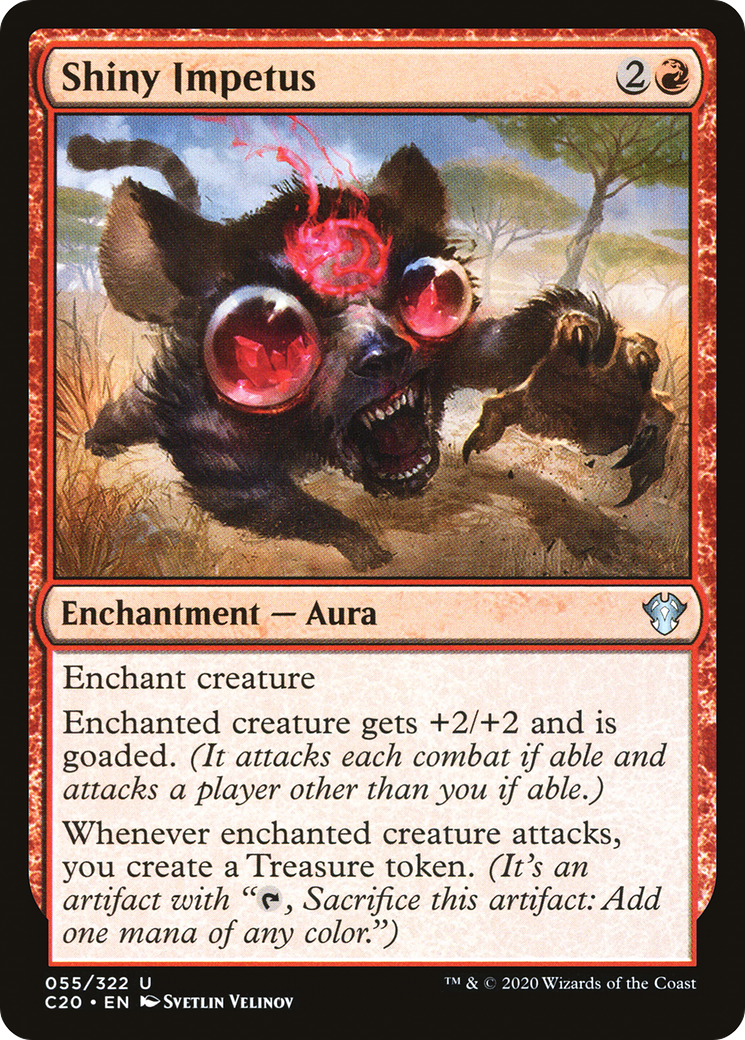
Shiny Impetus
Shiny Impetus
Enchantment — Aura
Enchant creature
Enchanted creature gets +2/+2 and is goaded. (It attacks each combat if able and attacks a player other than you if able.)
Whenever enchanted creature attacks, you create a Treasure token. (It's an artifact with " , Sacrifice this token: Add one mana of any color.")
- If, during a player's declare attackers step, a creature that player controls that's been goaded is tapped, is affected by a spell or ability that says it can't attack, or hasn't been under that player's control continuously since the turn began (and doesn't have haste), then it doesn't attack. If there's a cost associated with having a creature attack a player, its controller isn't forced to pay that cost, so it doesn't have to attack that player.
- If the creature doesn't meet any of the above exceptions and can attack, it must attack a player other than the controller of the spell or ability that goaded it if able. If the creature can't attack any of those players but could otherwise attack, it must attack a planeswalker an opponent controls, a battle an opponent controls, or a player who goaded it.
- Being goaded isn't an ability the creature has. Once it's been goaded, it must attack as detailed above even if it loses all abilities.
- Attacking with a goaded creature doesn't cause it to stop being goaded. If there is an additional combat phase that turn, or if another player gains control of it before it stops being goaded, it must attack again if able.
- If a creature you control has been goaded by multiple opponents, it must attack one of your opponents that hasn't goaded it, as that fulfills the maximum number of goad requirements. If a creature you control has been goaded by each of your opponents, the creature must attack an opponent (rather than a planeswalker or battle), but you choose which opponent it attacks.
- Shiny Impetus causes you to create a Treasure token, not the attacking creature's controller.
-
1
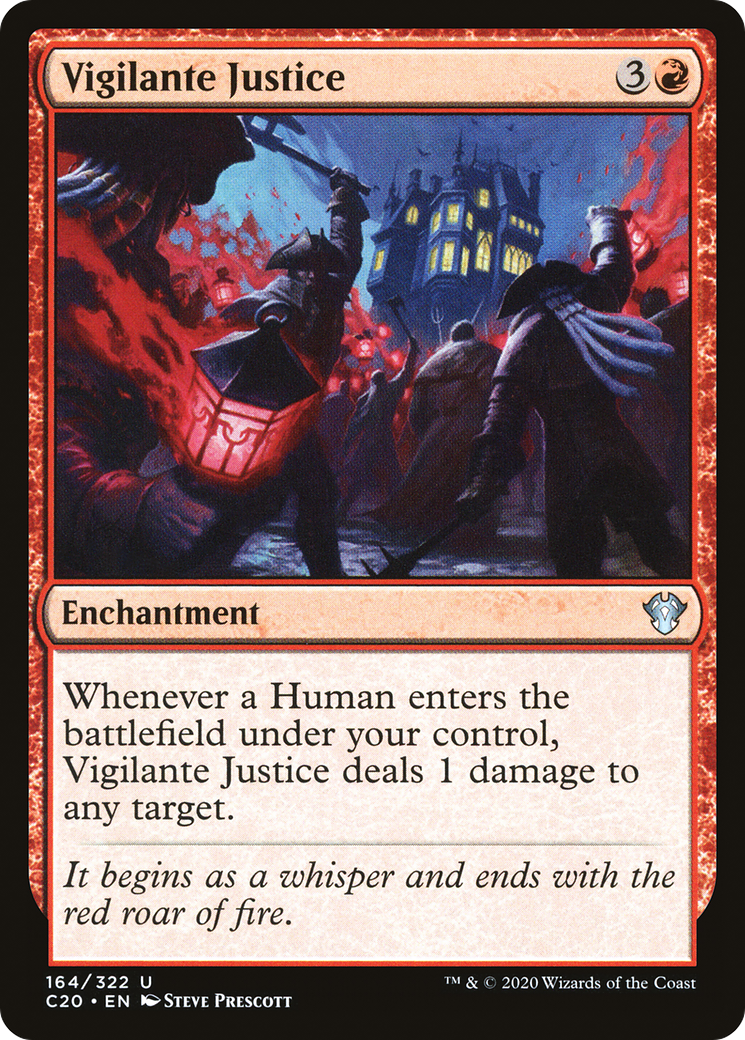
Vigilante Justice
Vigilante Justice
Enchantment
Whenever a Human you control enters, this enchantment deals 1 damage to any target.
Lands 36
-
1
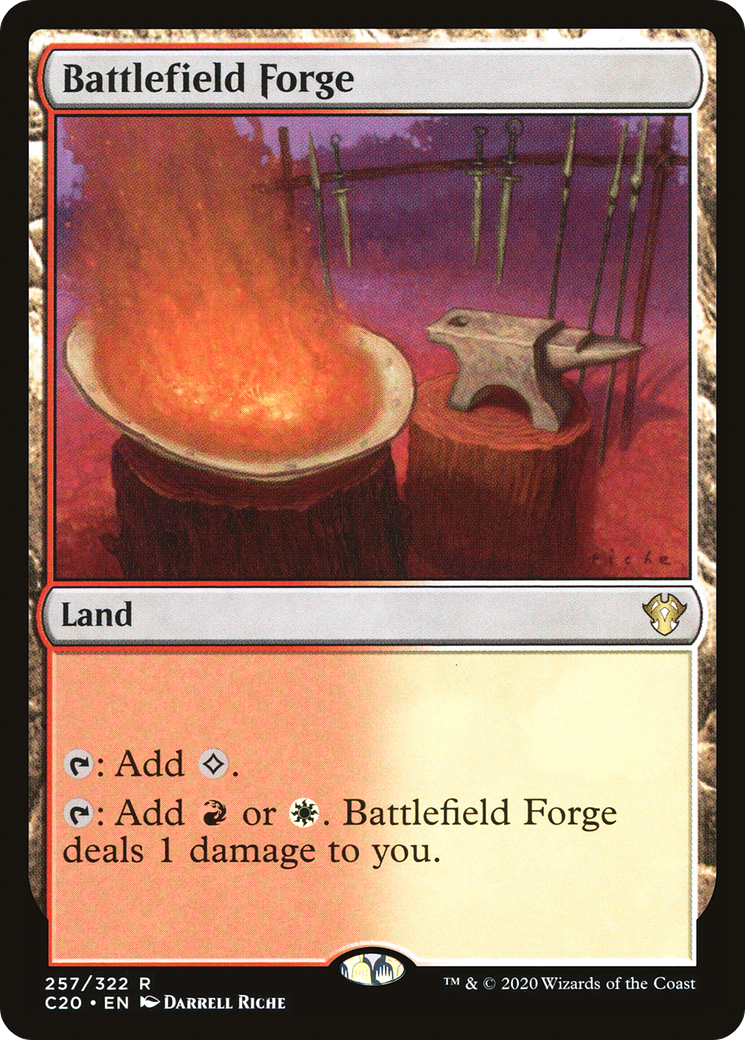
Battlefield Forge
Battlefield Forge
Land
: Add .
: Add or . This land deals 1 damage to you.
- Like most lands, each land in this cycle is colorless. The damage dealt to you is dealt by a colorless source.
- The damage dealt to you is part of the second mana ability. It doesn't use the stack and can't be responded to.
-
1
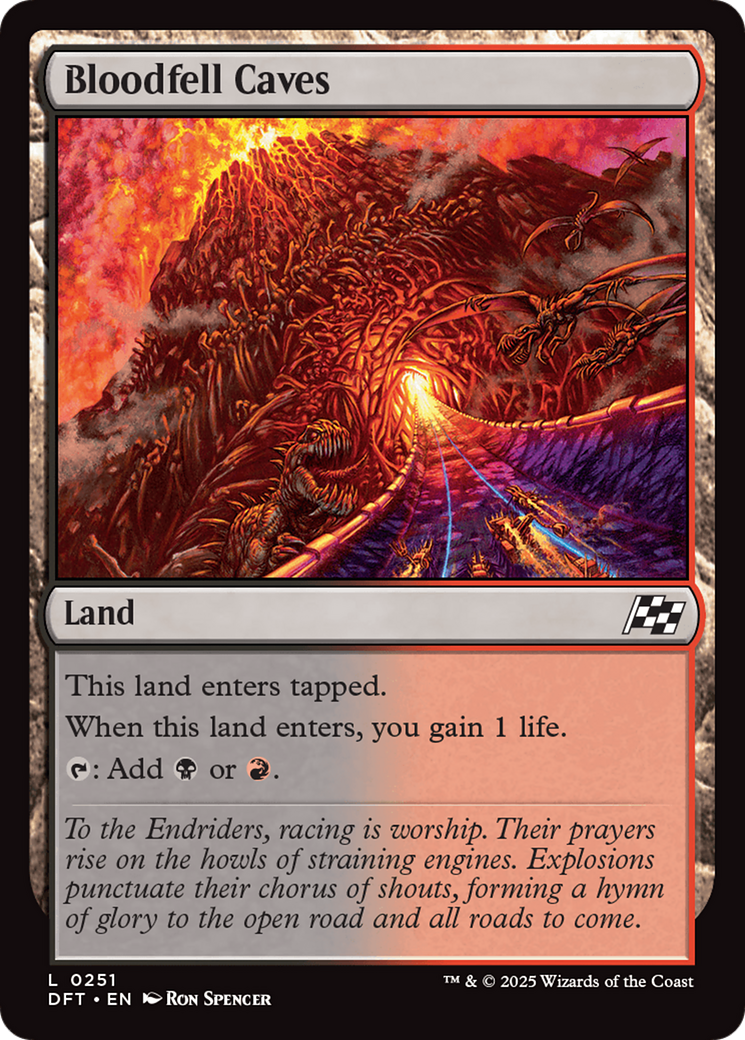
Bloodfell Caves
Bloodfell Caves
Land
This land enters tapped.
When this land enters, you gain 1 life.
: Add or .
-
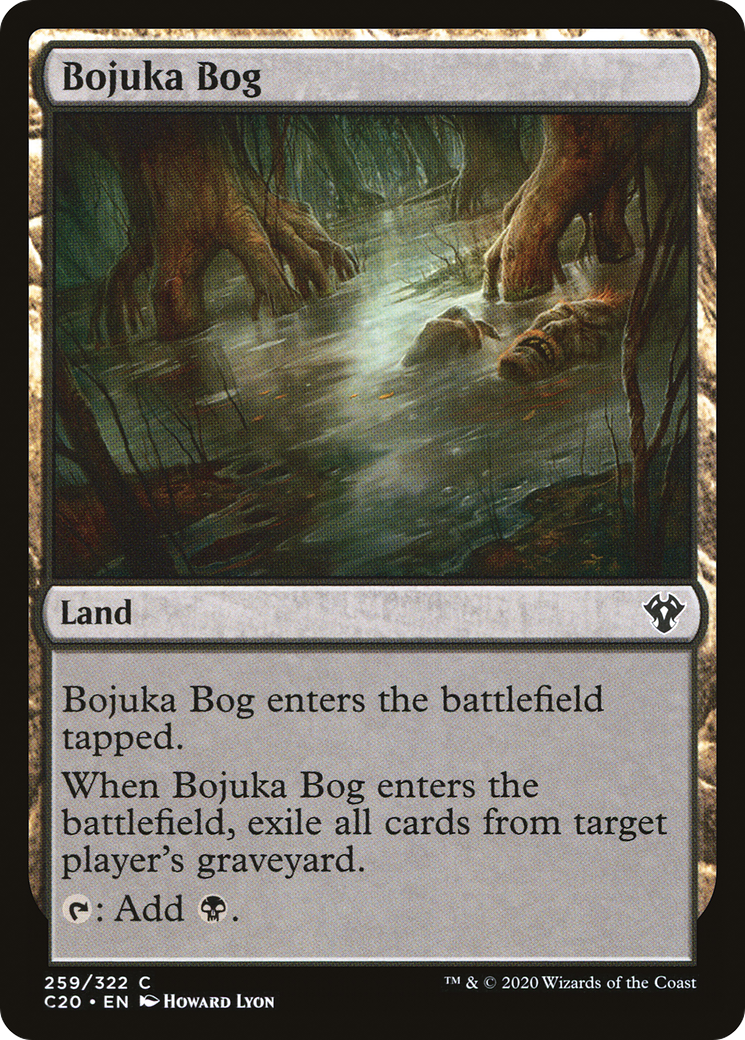
1
Bojuka Bog
Bojuka Bog
Land
This land enters tapped.
When this land enters, exile target player's graveyard.
: Add .
-
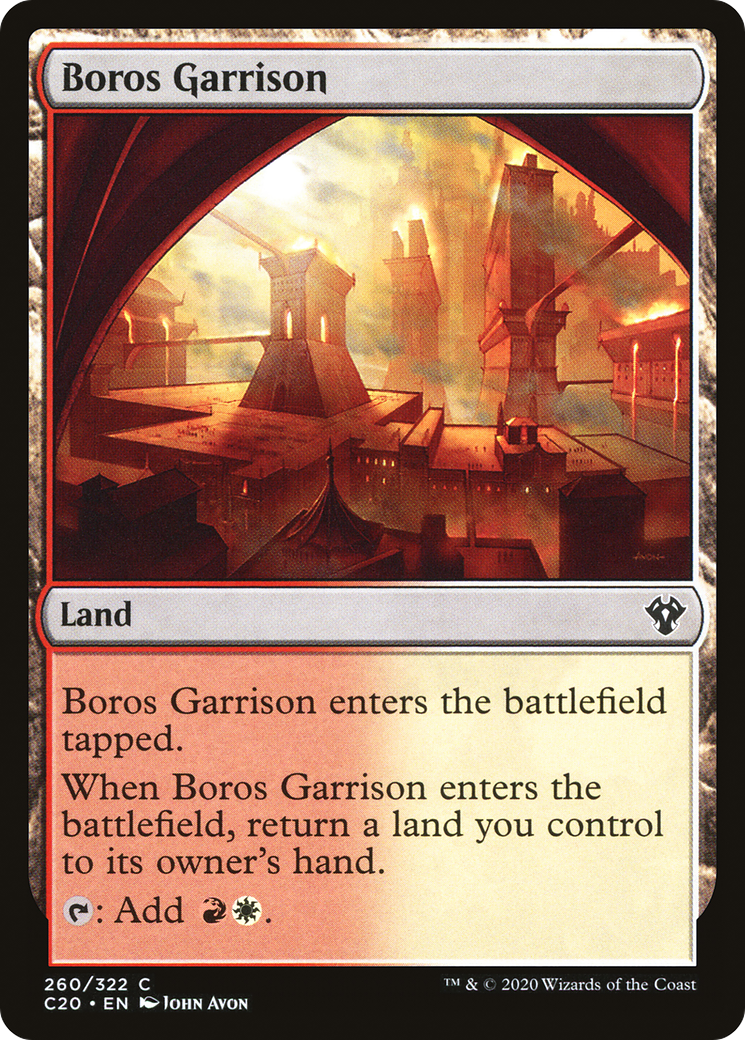
1
Boros Garrison
Boros Garrison
Land
This land enters tapped.
When this land enters, return a land you control to its owner's hand.
: Add .
- If this land enters the battlefield and you control no other lands, its ability will force you to return it to your hand.
-
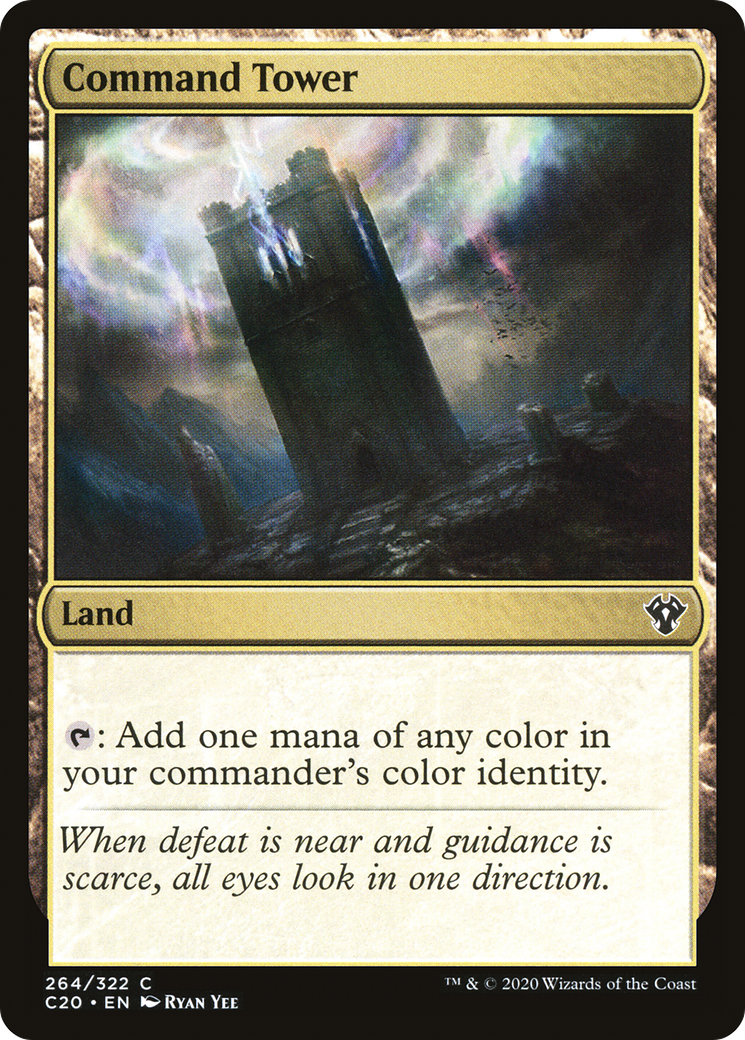
1
Command Tower
Command Tower
Land
: Add one mana of any color in your commander's color identity.
- If you don't have a commander, Command Tower's ability produces no mana.
- If your commander is a card that has no colors in its color identity, Command Tower's ability produces no mana. It doesn't produce .
- If you have two commanders, the ability adds one mana of any color in their combined color identities.
-
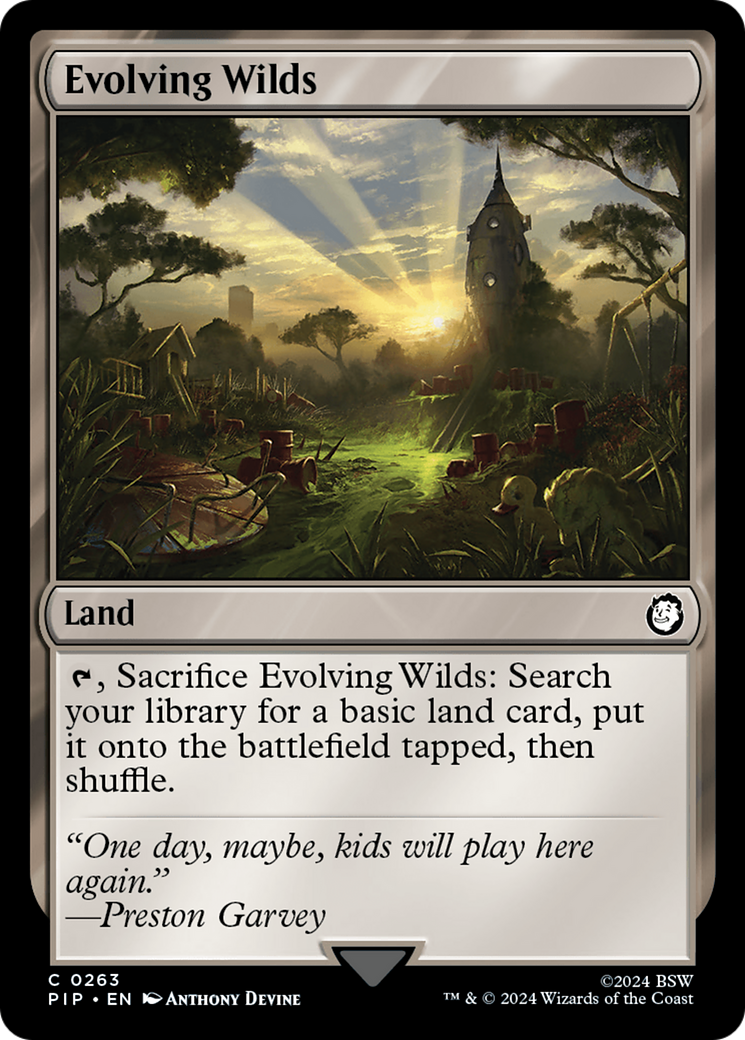
1
Evolving Wilds
Evolving Wilds
Land
, Sacrifice this land: Search your library for a basic land card, put it onto the battlefield tapped, then shuffle.
-
1
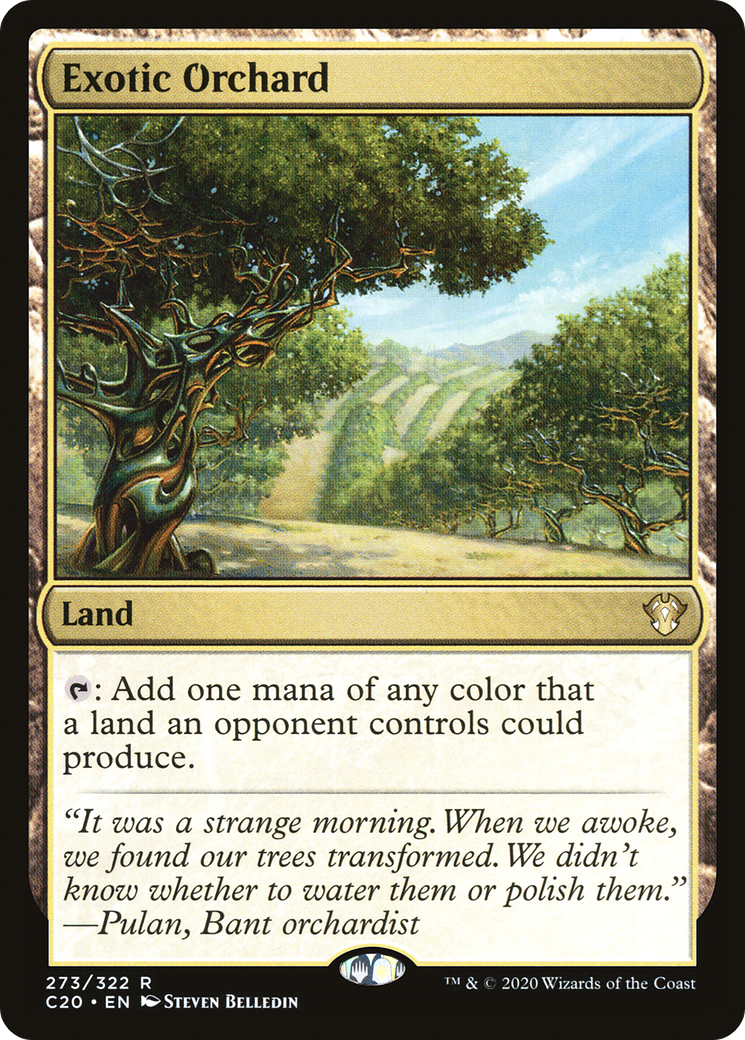
Exotic Orchard
Exotic Orchard
Land
: Add one mana of any color that a land an opponent controls could produce.
- Lands that produce mana based only on what other lands "could produce" won't help each other unless some other land allows one of them to actually produce some type of mana. For example, if you control an Exotic Orchard and your opponent controls an Exotic Orchard and a Reflecting Pool, none of those lands would produce mana if their mana abilities were activated. On the other hand, if you control a Forest and an Exotic Orchard, and your opponent controls an Exotic Orchard and a Reflecting Pool, then each of those lands can be tapped to produce . Your opponent's Exotic Orchard can produce because you control a Forest. Your Exotic Orchard and your opponent's Reflecting Pool can each produce because your opponent's Exotic Orchard can produce .
- When determining what colors of mana your opponents' lands could produce, Exotic Orchard takes into account any applicable replacement effects that would apply to those lands' mana abilities (such as Contamination's effect, for example). If there are more than one, consider them in any possible order.
- The colors of mana are white, blue, black, red, and green. Exotic Orchard can't be tapped for colorless mana, even if a land an opponent controls could produce colorless mana.
- Exotic Orchard doesn't care about any restrictions or riders your opponents' lands (such as Ancient Ziggurat or Hall of the Bandit Lord) put on the mana they produce. It just cares about colors of mana.
- Exotic Orchard checks the effects of all mana-producing abilities of lands your opponents control, but it doesn't check their costs. For example, Vivid Crag has the ability " , Remove a charge counter from Vivid Crag: Add one mana of any color." If an opponent controls Vivid Crag and you control Exotic Orchard, you can tap Exotic Orchard for any color of mana. It doesn't matter whether Vivid Crag has a charge counter on it, and it doesn't matter whether it's untapped.
-
4
Mountain
Mountain
Basic Land — Mountain
( : Add .)
-
1
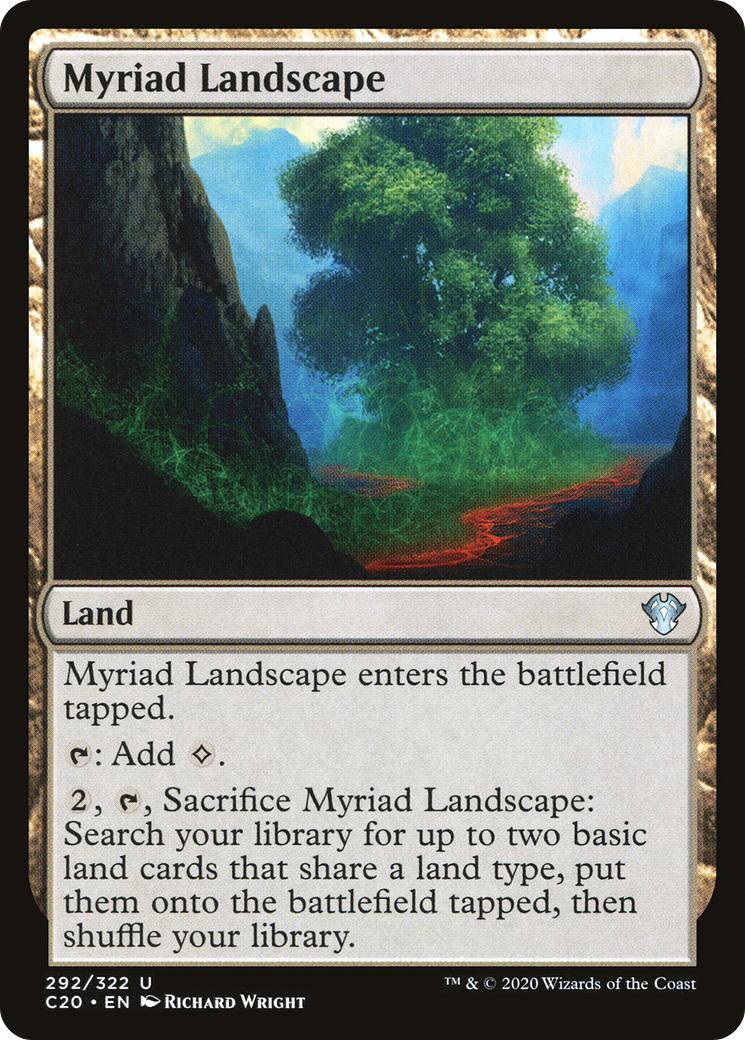
Myriad Landscape
Myriad Landscape
Land
This land enters tapped.
: Add .
, , Sacrifice this land: Search your library for up to two basic land cards that share a land type, put them onto the battlefield tapped, then shuffle.
- You can choose to find one basic land card with Myriad Landscape's last ability.
-
1
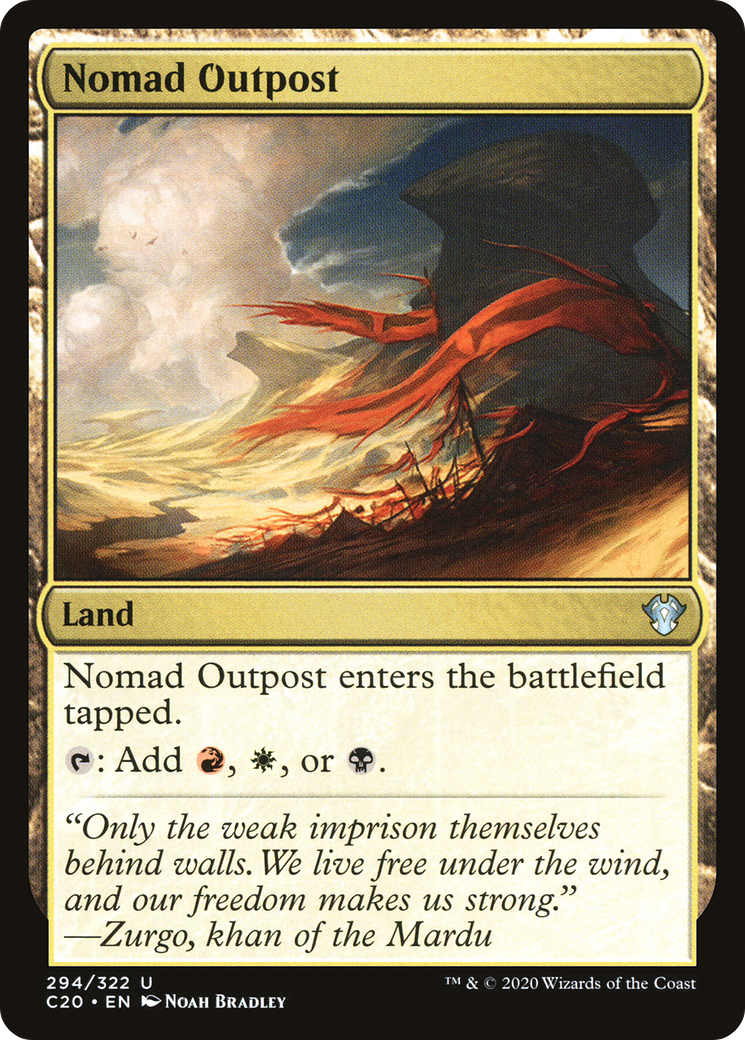
Nomad Outpost
Nomad Outpost
Land
This land enters tapped.
: Add , , or .
-
1
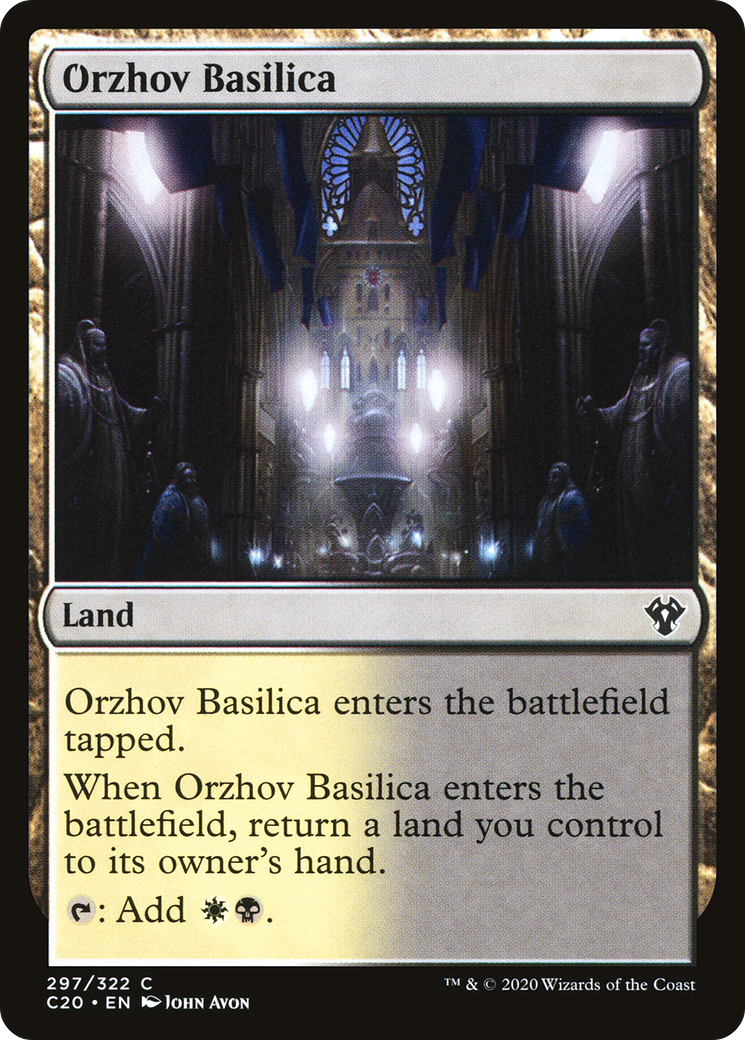
Orzhov Basilica
Orzhov Basilica
Land
This land enters tapped.
When this land enters, return a land you control to its owner's hand.
: Add .
- If this land enters the battlefield and you control no other lands, its ability will force you to return it to your hand.
-
1
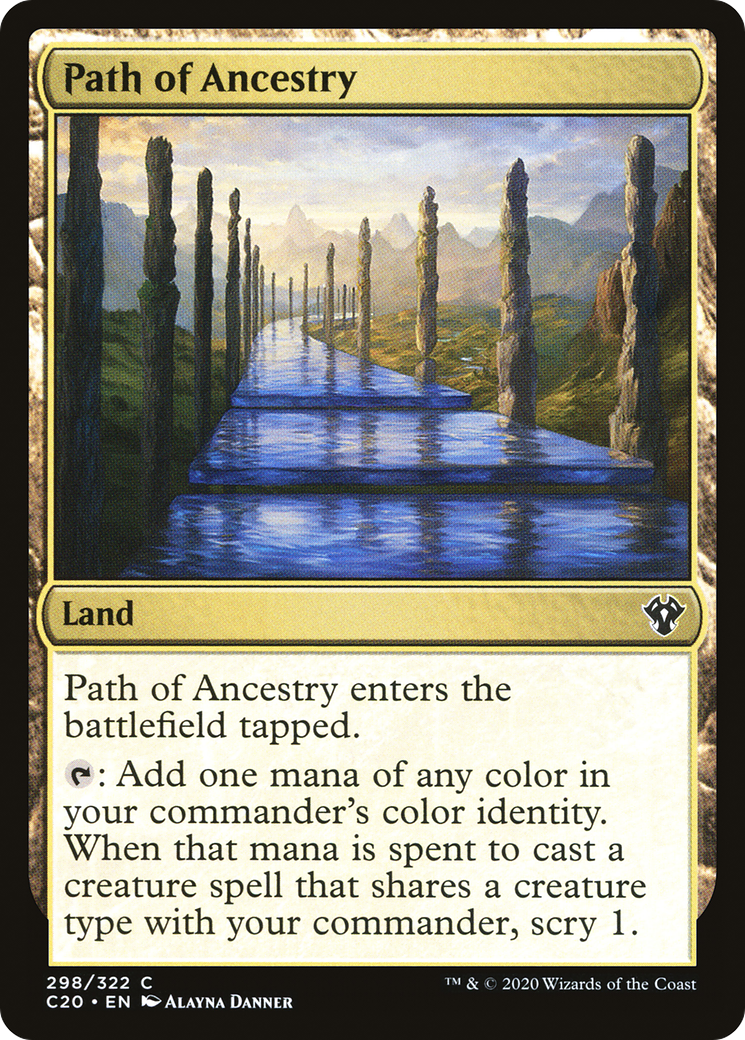
Path of Ancestry
Path of Ancestry
Land
This land enters tapped.
: Add one mana of any color in your commander's color identity. When that mana is spent to cast a creature spell that shares a creature type with your commander, scry 1. (Look at the top card of your library. You may put that card on the bottom.)
- Your commander's creature types are checked immediately after you cast a creature spell spending mana from Path of Ancestry's last ability. They aren't set before the game begins, and they may not be the same types your commander had when you activated that ability.
- If you have two commanders, the last ability adds one mana of any color in their combined color identities. When you spend that mana on a creature spell that shares a creature type with either of your commanders, you'll scry 1.
- If Path of Ancestry's last ability produces two mana (most likely due to Mana Reflection), spending those two mana to cast creature spells that share a creature type with your commander will cause two abilities to trigger. Each of those abilities will cause you to scry 1. You won't scry 2. This is true whether you spend the mana on one creature spell or two.
- If your commander has no creature types, it can't share a creature type with any spell that you cast.
- If you cast your commander with mana from Path of Ancestry, and your commander hasn't somehow lost all of its creature types while on the stack, you'll scry 1.
- If you don't have a commander, Path of Ancestry's ability produces no mana.
- If your commander is a card that has no colors in its color identity, Path of Ancestry's ability produces no mana. It doesn't produce .
-
8
Plains
Plains
Basic Land — Plains
( : Add .)
-
1
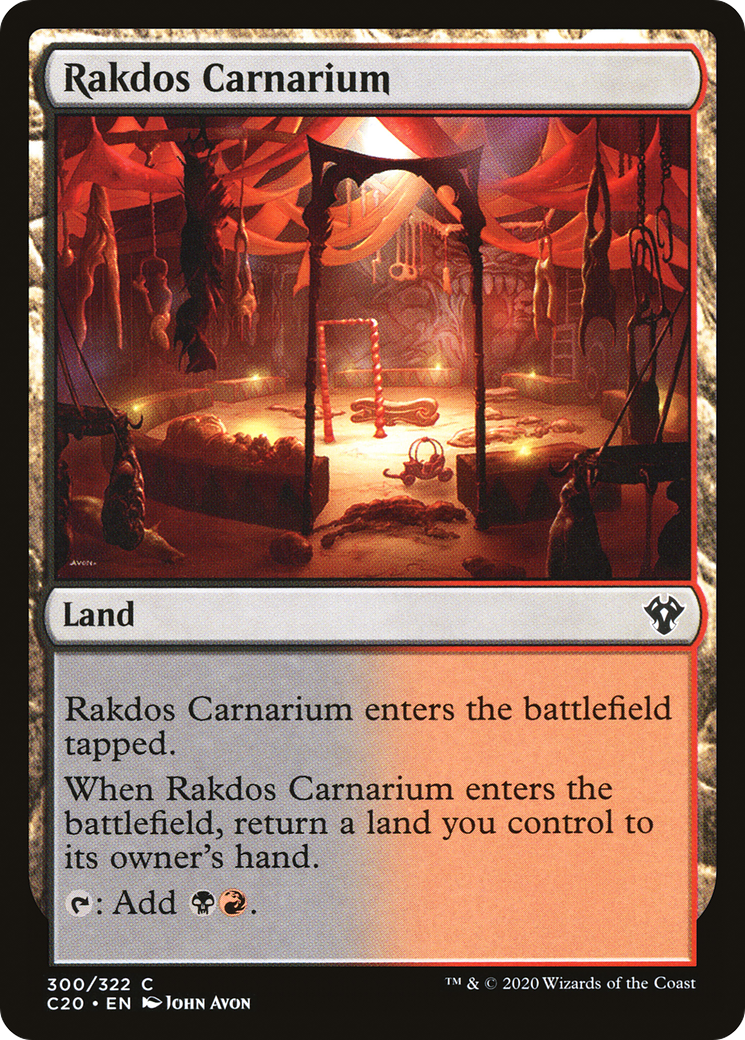
Rakdos Carnarium
Rakdos Carnarium
Land
This land enters tapped.
When this land enters, return a land you control to its owner's hand.
: Add .
- If this land enters the battlefield and you control no other lands, its ability will force you to return it to your hand.
-
1
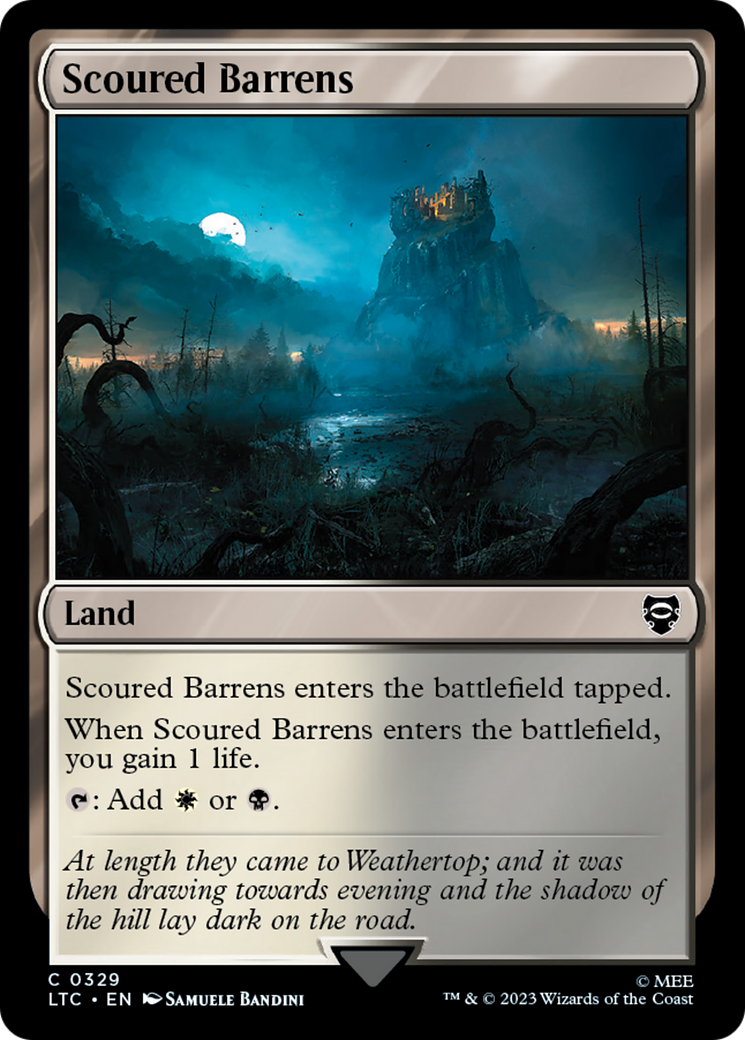
Scoured Barrens
Scoured Barrens
Land
This land enters tapped.
When this land enters, you gain 1 life.
: Add or .
-
1
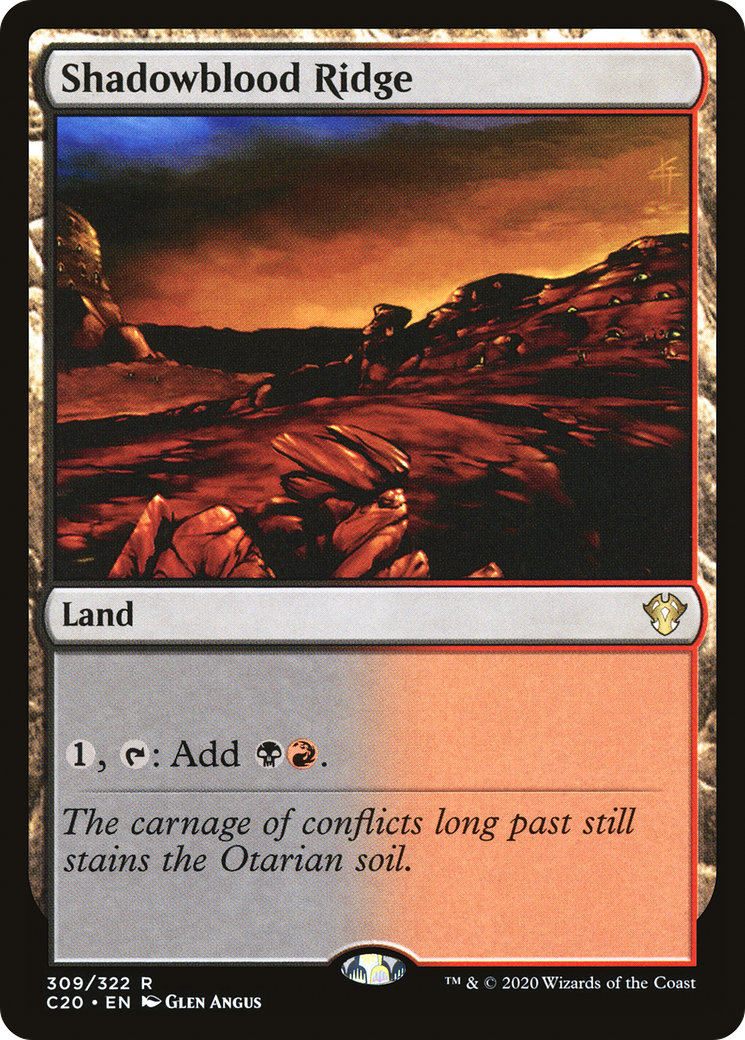
Shadowblood Ridge
Shadowblood Ridge
Land
, : Add .
-
1
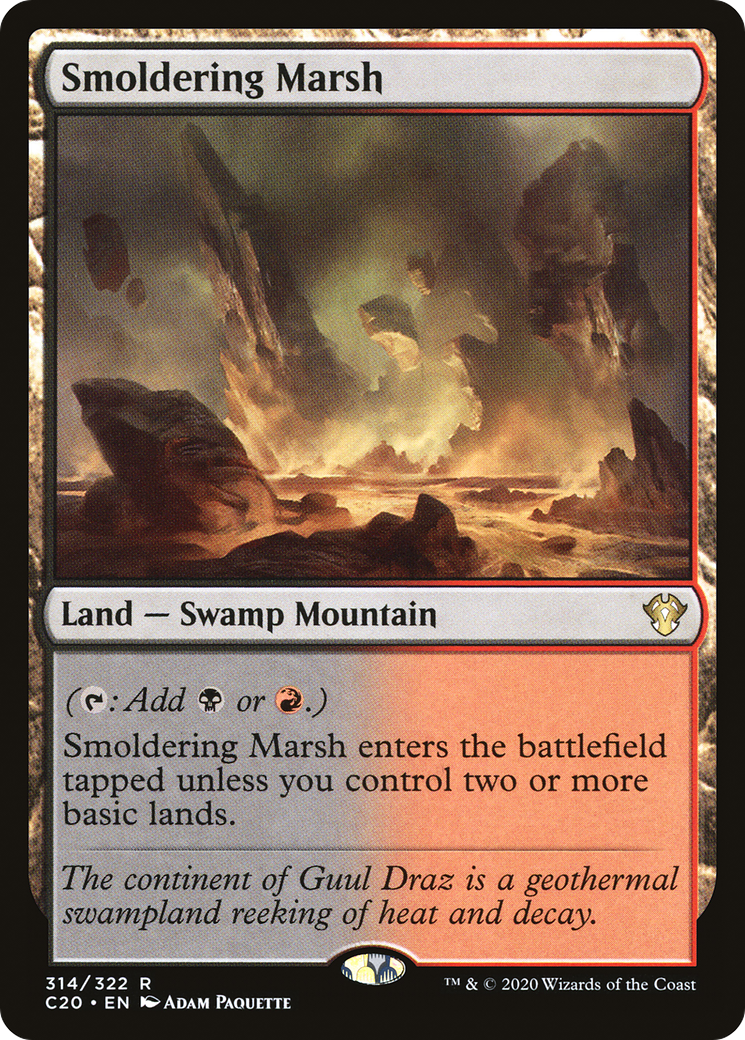
Smoldering Marsh
Smoldering Marsh
Land — Swamp Mountain
( : Add or .)
This land enters tapped unless you control two or more basic lands.
- However, because these cards have basic land types, effects that specify a basic land type without also specifying that the land be basic can affect them. For example, a spell or ability that reads "Destroy target Forest" can target Canopy Vista, while one that reads "Destroy target basic Forest" cannot.
- Even though these lands have basic land types, they are not basic lands because "basic" doesn't appear on their type line. Notably, controlling two or more of them won't allow others to enter the battlefield untapped.
- If one of these lands enters the battlefield at the same time as any number of basic lands, those other lands are not counted when determining if this land enters the battlefield tapped or untapped.
-
1
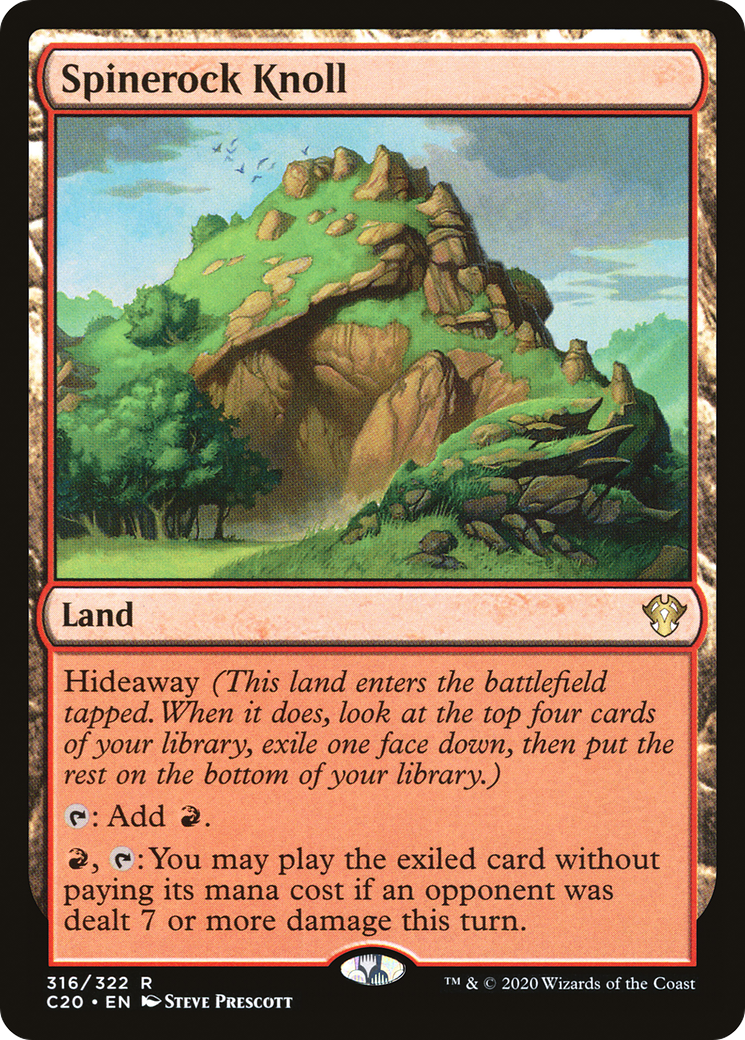
Spinerock Knoll
Spinerock Knoll
Land
Hideaway 4 (When this land enters, look at the top four cards of your library, exile one face down, then put the rest on the bottom in a random order.)
This land enters tapped.
: Add .
, : You may play the exiled card without paying its mana cost if an opponent was dealt 7 or more damage this turn.
- "Hideaway N" means "When this permanent enters the battlefield, look at the top N cards of your library. Exile one of them face down and put the rest on the bottom of your library in a random order. The exiled card gains 'The player who controls the permanent that exiled this card may look at this card in the exile zone.'"
- Any player who has controlled a permanent with a hideaway ability since a card was exiled with it may look at that card.
- Previously, permanents with hideaway entered the battlefield tapped. This ability has been removed from the definition of hideaway. Older cards have received errata to have an additional paragraph that reads "[This permanent] enters the battlefield tapped," and they now have hideaway 4.
- Hideaway now causes you to put the rest of the cards on the bottom of your library in a random order instead of any order.
- It doesn't matter how the opponent was dealt damage or by whom, as long as the total damage is 7 or more. You don't specify an opponent when you activate the ability.
- You'll get to play the card even if Spinerock Knoll wasn't on the battlefield at the time some or all of the 7 damage was dealt.
- At the time the last ability resolves, you'll get to play the card if a player who is currently your opponent, or a player who was your opponent at the time they left the game, has been dealt 7 damage over the course of the turn.
-
4
Swamp
Swamp
Basic Land — Swamp
( : Add .)
-
1
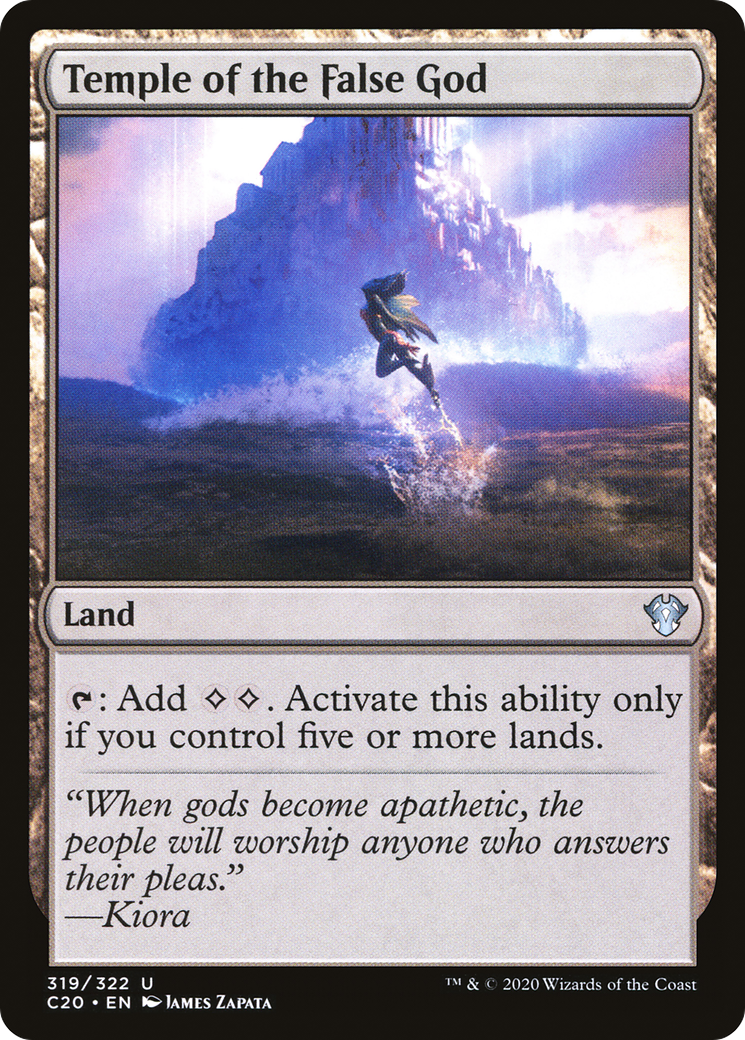
Temple of the False God
Temple of the False God
Land
: Add . Activate only if you control five or more lands.
-
1
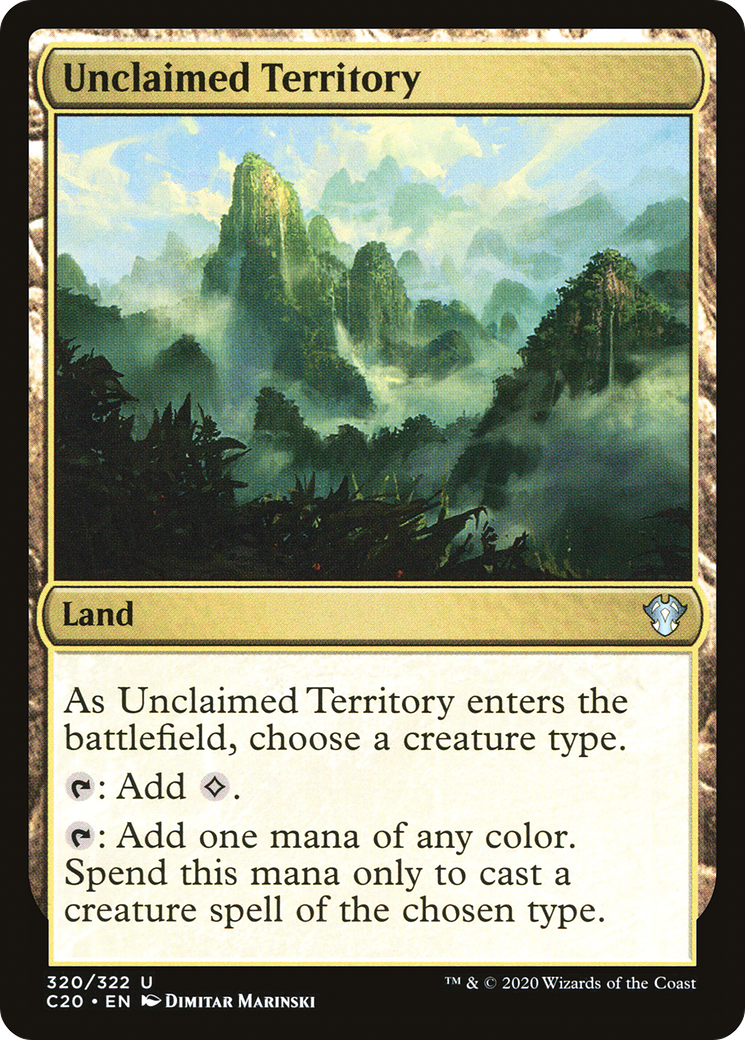
Unclaimed Territory
Unclaimed Territory
Land
As this land enters, choose a creature type.
: Add .
: Add one mana of any color. Spend this mana only to cast a creature spell of the chosen type.
- To choose a creature type, you must choose an existing creature type, such as Vampire or Knight. You can't choose multiple creature types, such as "Vampire Knight." Card types such as artifact can't be chosen, nor can subtypes that aren't creature types, such as Jace, Vehicle, or Treasure.
-
1
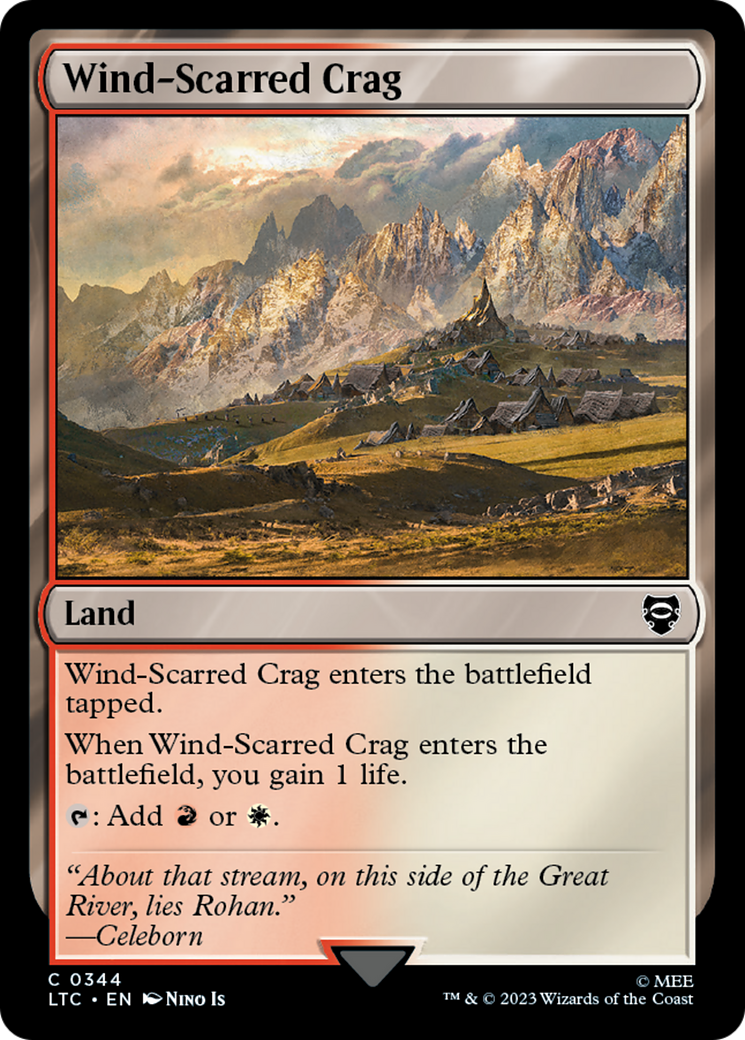
Wind-Scarred Crag
Wind-Scarred Crag
Land
This land enters tapped.
When this land enters, you gain 1 life.
: Add or .
-
1
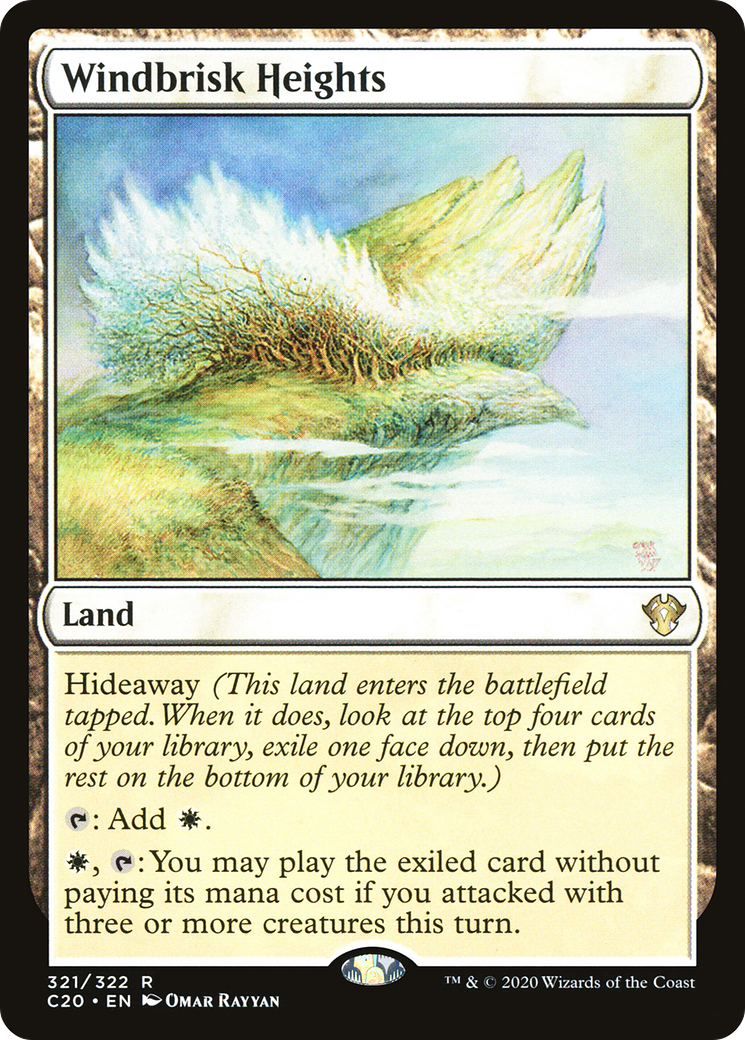
Windbrisk Heights
Windbrisk Heights
Land
Hideaway 4 (When this land enters, look at the top four cards of your library, exile one face down, then put the rest on the bottom in a random order.)
This land enters tapped.
: Add .
, : You may play the exiled card without paying its mana cost if you attacked with three or more creatures this turn.
- "Hideaway N" means "When this permanent enters the battlefield, look at the top N cards of your library. Exile one of them face down and put the rest on the bottom of your library in a random order. The exiled card gains 'The player who controls the permanent that exiled this card may look at this card in the exile zone.'"
- Any player who has controlled a permanent with a hideaway ability since a card was exiled with it may look at that card.
- Previously, permanents with hideaway entered the battlefield tapped. This ability has been removed from the definition of hideaway. Older cards have received errata to have an additional paragraph that reads "[This permanent] enters the battlefield tapped," and they now have hideaway 4.
- Hideaway now causes you to put the rest of the cards on the bottom of your library in a random order instead of any order.
- At the time the ability resolves, you'll get to play the card if you declared three different creatures as attackers at any point in the turn. A creature declared as an attacker in two different attack phases counts only once. A creature that entered attacking (such as a token created by Militia's Pride) doesn't count because you never attacked with it.
White 22
-
1
Banisher Priest
Banisher Priest
Creature — Human Cleric
2/2
When this creature enters, exile target creature an opponent controls until this creature leaves the battlefield.
- If Banisher Priest leaves the battlefield before its triggered ability resolves, the target permanent won't be exiled.
- Auras attached to the exiled permanent will be put into their owners' graveyards. Any Equipment will become unattached and remain on the battlefield. Any counters on the exiled permanent will cease to exist. When the card returns to the battlefield, it will be a new object with no connection to the card that was exiled.
- If a token is exiled this way, it will cease to exist and won't return to the battlefield.
- If an Aura is exiled this way, its owner chooses what it will enchant as it returns to the battlefield. An Aura put onto the battlefield this way doesn't target anything (so it could be attached to a permanent with shroud, for example), but the Aura's enchant ability restricts what it can be attached to. If the Aura can't legally be attached to anything, it remains in exile for the rest of the game.
-
1
Bounty Agent
Bounty Agent
Creature — Human Soldier
2/2
Vigilance
, Sacrifice this creature: Destroy target legendary permanent that's an artifact, creature, or enchantment.
-
1
Call the Coppercoats
Call the Coppercoats
Instant
Strive — This spell costs more to cast for each target beyond the first.
Choose any number of target opponents. Create X 1/1 white Human Soldier creature tokens, where X is the number of creatures those opponents control.
- Any target opponents that are no longer legal targets by the time Call the Coppercoats resolves won't have their creatures counted when determining how many tokens you create.
- You choose how many targets each spell with a strive ability has and what those targets are as you cast it. It's legal to cast such a spell with no targets, although this is rarely a good idea. You can't choose the same target more than once for a single strive spell.
- The mana value of a strive spell doesn't change no matter how many targets it has.
- If this spell is copied and the effect that copies the spell allows a player to choose new targets for the copy, the number of targets can't be changed. The player may change any number of the targets, including all of them or none of them. If, for one of the targets, the player can't choose a new legal target, then it remains unchanged (even if the current target is illegal).
- If a spell or ability allows you to cast a strive spell without paying its mana cost, you must pay the additional cost for any targets beyond the first.
-
1
Cavalry Pegasus
Cavalry Pegasus
Creature — Pegasus
1/1
Flying
Whenever this creature attacks, each attacking Human gains flying until end of turn.
- Once the triggered ability resolves, the attacking Humans will continue to have flying even if Cavalry Pegasus leaves the battlefield.
- The attacking Humans gain flying before blockers are declared.
-
1
Citywide Bust
Citywide Bust
Sorcery
Destroy all creatures with toughness 4 or greater.
-
1
Cleansing Nova
Cleansing Nova
Sorcery
Choose one —
- Destroy all creatures.
- Destroy all artifacts and enchantments.
-
1
Dearly Departed
Dearly Departed
Creature — Spirit
5/5
Flying
As long as this creature is in your graveyard, each Human creature you control enters with an additional +1/+1 counter on it.
- The effect is cumulative. Human creatures you control will enter with a +1/+1 counter for each Dearly Departed in your graveyard.
- In most cases, when determining whether a creature entering under your control should get a +1/+1 counter, you'll simply look at what the creature will looklike on the battlefield. You'll consider any effects affecting a creature entering under your control.
-
1
Devout Chaplain
Devout Chaplain
Creature — Human Cleric
2/2
, Tap two untapped Humans you control: Exile target artifact or enchantment.
- You can tap any two untapped Humans you control, including ones you haven’t controlled continuously since the beginning of your most recent turn, to pay the cost of Devout Chaplain’s activated ability. You must have controlled Devout Chaplain continuously since the beginning of your most recent turn, however.
-
1
Flawless Maneuver
Flawless Maneuver
Instant
If you control a commander, you may cast this spell without paying its mana cost.
Creatures you control gain indestructible until end of turn.
- It doesn't matter whose commander you control. Any one will do. If you have two commanders, you just need to control one of them.
- Once you begin casting this spell, players can't take any other actions until you're done casting it. Notably, they can't try to remove the commander you control to make you pay its cost.
-
1
Frontline Medic
Frontline Medic
Creature — Human Cleric
3/3
Battalion — Whenever this creature and at least two other creatures attack, creatures you control gain indestructible until end of turn.
Sacrifice this creature: Counter target spell with in its mana cost unless its controller pays .
- The three attacking creatures don't have to be attacking the same player, planeswalker, or battle.
- Creatures that come under your control after Frontline Medic's battalion ability resolves will not be granted indestructible by this effect.
- Once a battalion ability has triggered, it doesn't matter how many creatures are still attacking when that ability resolves.
- The effects of battalion abilities vary from card to card. Read each card carefully.
-
1
Increasing Devotion
Increasing Devotion
Sorcery
Create five 1/1 white Human creature tokens. If this spell was cast from a graveyard, create ten of those tokens instead.
Flashback (You may cast this card from your graveyard for its flashback cost. Then exile it.)
- "Flashback [cost]" means "You may cast this card from your graveyard by paying [cost] rather than paying its mana cost" and "If the flashback cost was paid, exile this card instead of putting it anywhere else any time it would leave the stack."
- You must still follow any timing restrictions and permissions, including those based on the card's type. For instance, you can cast a sorcery using flashback only when you could normally cast a sorcery.
- To determine the total cost of a spell, start with the mana cost or alternative cost (such as a flashback cost) you're paying, add any cost increases, then apply any cost reductions. The mana value of the spell is determined only by its mana cost, no matter what the total cost to cast the spell was.
- A spell cast using flashback will always be exiled afterward, whether it resolves, is countered, or leaves the stack in some other way.
- You can cast a spell using flashback even if it was somehow put into your graveyard without having been cast.
- If a card with flashback is put into your graveyard during your turn, you can cast it if it's legal to do so before any other player can take any actions.
-
1
Knight of the White Orchid
Knight of the White Orchid
Creature — Human Knight
2/2
First strike
When this creature enters, if an opponent controls more lands than you, you may search your library for a Plains card, put it onto the battlefield, then shuffle.
- The Plains you search for doesn't have to be basic. For example, you could put a Sacred Foundry onto the battlefield.
- Knight of the White Orchid's triggered ability has an “intervening ‘if' clause.” That means (1) the ability won't trigger at all unless any one of your opponents controls more lands than you, and (2) the ability will do nothing if you control at least as many lands as each of your opponents by the time it resolves.
-
1
Magus of the Disk
Magus of the Disk
Creature — Human Wizard
2/4
This creature enters tapped.
, : Destroy all artifacts, creatures, and enchantments.
- If an effect gives Magus of the Disk indestructible or regenerates it, it won’t be destroyed by its ability.
-
1
Martial Impetus
Martial Impetus
Enchantment — Aura
Enchant creature
Enchanted creature gets +1/+1 and is goaded. (It attacks each combat if able and attacks a player other than you if able.)
Whenever enchanted creature attacks, each other creature that's attacking one of your opponents gets +1/+1 until end of turn.
- If the creature doesn't meet any of the above exceptions and can attack, it must attack a player other than the controller of the spell or ability that goaded it if able. If the creature can't attack any of those players but could otherwise attack, it must attack a planeswalker an opponent controls, a battle an opponent controls, or a player who goaded it.
- If, during a player's declare attackers step, a creature that player controls that's been goaded is tapped, is affected by a spell or ability that says it can't attack, or hasn't been under that player's control continuously since the turn began (and doesn't have haste), then it doesn't attack. If there's a cost associated with having a creature attack a player, its controller isn't forced to pay that cost, so it doesn't have to attack that player.
- Attacking with a goaded creature doesn't cause it to stop being goaded. If there is an additional combat phase that turn, or if another player gains control of it before it stops being goaded, it must attack again if able.
- If a creature you control has been goaded by multiple opponents, it must attack one of your opponents that hasn't goaded it, as that fulfills the maximum number of goad requirements. If a creature you control has been goaded by each of your opponents, the creature must attack an opponent (rather than a planeswalker or battle), but you choose which opponent it attacks.
- Being goaded isn't an ability the creature has. Once it's been goaded, it must attack as detailed above even if it loses all abilities.
-
1
Odric, Master Tactician
Odric, Master Tactician
Legendary Creature — Human Soldier
3/4
First strike (This creature deals combat damage before creatures without first strike.)
Whenever Odric and at least three other creatures attack, you choose which creatures block this combat and how those creatures block.
- You can decide that a creature won't block.
- All blocking declarations must still be legal.
- If there's a cost associated with having a creature block and you choose for that creature to block, its controller can choose to pay that cost or not. If that player decides to not pay that cost, you must propose a new set of blocking creatures.
-
1
Riders of Gavony
Riders of Gavony
Creature — Human Knight
3/3
Vigilance
As this creature enters, choose a creature type.
Human creatures you control have protection from creatures of the chosen type.
- You must choose an existing _Magic_ creature type, such as Zombie or Warrior. Card types such as artifact can't be chosen.
-
1
Sanctuary Lockdown
Sanctuary Lockdown
Enchantment
Humans you control get +1/+1.
, Tap two untapped Humans you control: Tap target creature an opponent controls.
-
1
Thalia's Lieutenant
Thalia's Lieutenant
Creature — Human Soldier
1/1
When this creature enters, put a +1/+1 counter on each other Human you control.
Whenever another Human you control enters, put a +1/+1 counter on this creature.
- If Thalia’s Lieutenant enters the battlefield at the same time as another Human, each of Thalia’s Lieutenant’s abilities will trigger. You’ll put a +1/+1 counter on both cards.
-
1
Thraben Doomsayer
Thraben Doomsayer
Creature — Human Cleric
2/2
: Create a 1/1 white Human creature token.
Fateful hour — As long as you have 5 or less life, other creatures you control get +2/+2.
- A creature whose toughness is being increased by Thraben Doomsayer's fateful hour ability loses that bonus as soon as its controller has 6 or more life (or as soon as Thraben Doomsayer leaves the battlefield). If damage marked on that creature is greater than or equal to its toughness after the fateful hour ability stops applying, the creature is destroyed and put into its owner's graveyard.
- If Thraben Doomsayer's activated ability resolves while you have 5 or less life, the creature token will be 3/3 as it enters.
-
1
Trynn, Champion of Freedom
Trynn, Champion of Freedom
Legendary Creature — Human Soldier
3/3
Partner with Silvar, Devourer of the Free (When this creature enters, target player may put Silvar into their hand from their library, then shuffle.)
At the beginning of your end step, if you attacked this turn, create a 1/1 white Human Soldier creature token.
- Trynn's ability checks only whether you declared an attacking creature during the turn. It doesn't trigger once for each such creature, and it doesn't check whether any attacking creatures dealt damage.
- "Partner with [name]" represents two abilities. The first is a triggered ability: "When this permanent enters the battlefield, target player may search their library for a card named [name], reveal it, put it into their hand, then shuffle their library."
- Note that the target player searches their library (which may be affected by effects such as that of Stranglehold) and that the card they find is revealed, even though these words aren't included in the ability's reminder text.
- The second ability represented by the "partner with [name]" keyword modifies the rules for deck construction in the Commander variant and has no function outside of that variant. If a legendary creature card with "partner with [name]" is designated as your commander, the named legendary creature card can also be designated as your commander.
- If your Commander deck has two commanders, you can only include cards whose own color identities are also found in your commanders' combined color identities. If Haldan and Pako are your commanders, your deck may contain cards with blue, red, and/or green in their color identity, but not cards with white or black.
- Both commanders start in the command zone, and the remaining 98 cards of your deck are shuffled to become your library.
- A creature with a "partner with" ability can't partner with any creature other than its designated partner. Losing a partner ability during the game doesn't cause either to cease to be your commander.
- Once the game begins, your two commanders are tracked separately. If you cast one, you won't have to pay an additional the first time you cast the other. A player loses the game after having been dealt 21 damage from one of them, not from both of them combined. Command Beacon's effect puts one into your hand from the command zone, not both.
- The triggered ability of the "partner with" keyword still triggers in a Commander game. If your other commander has somehow ended up in your library, you can find it. You can also target another player who might have that card in their library.
-
1
Unexpectedly Absent
Unexpectedly Absent
Instant
Put target nonland permanent into its owner's library just beneath the top X cards of that library.
- If there are fewer than X cards in that player’s library, put that permanent on the bottom of that library.
- If you choose 0 as the value for X, put that permanent on top of its owner’s library.
-
1
Verge Rangers
Verge Rangers
Creature — Human Scout Ranger
3/3
First strike
You may look at the top card of your library any time.
As long as an opponent controls more lands than you, you may play lands from the top of your library. (You can play a land this way only if you have an available land play remaining.)
- Verge Rangers doesn't allow you to play additional lands.
- Verge Rangers lets you look at the top card of your library whenever you want (with one restriction; see below), even if you don't have priority. This action doesn't use the stack. Knowing what that card is becomes part of the information you have access to, just like you can look at the cards in your hand.
- If the top card of your library changes while you're casting a spell, playing a land, or activating an ability, you can't look at the new top card until you finish doing so. This means that if you play a land from the top of your library and it has a replacement effect that requires you to make a decision (such as that of Temple Garden), you must make that decision without knowing the next card of your library.
Black 9
-
1
Ambition's Cost
Ambition's Cost
Sorcery
You draw three cards and you lose 3 life.
-
1
Bastion of Remembrance
Bastion of Remembrance
Enchantment
When this enchantment enters, create a 1/1 white Human Soldier creature token.
Whenever a creature you control dies, each opponent loses 1 life and you gain 1 life.
- If your life total is brought to 0 or less at the same time that creatures you control are dealt lethal damage, you lose the game before the last ability goes on the stack.
- In a Two-Headed Giant game, Bastion of Remembrance's last ability causes the opposing team to lose 2 life and you to gain 1 life.
- If one or more creatures you control die at the same time that Bastion of Remembrance leaves the battlefield, its last ability triggers for each of those creatures.
-
1
Disciple of Bolas
Disciple of Bolas
Creature — Human Wizard
2/1
When this creature enters, sacrifice another creature. You gain X life and draw X cards, where X is that creature's power.
- If you control at least one other creature when the ability resolves, you must sacrifice one. If you don't control any other creatures at that time, the ability won't do anything.
- The creature's power as it last existed on the battlefield is the amount of life you gain and the number of cards you draw.
-
1
Painful Truths
Painful Truths
Sorcery
Converge — You draw X cards and you lose X life, where X is the number of colors of mana spent to cast this spell.
- The maximum number of colors of mana you can spend to cast a spell is five. Colorless is not a color. Note that the cost of a spell with converge may limit how many colors of mana you can spend.
- Unless a spell or ability allows you to, you can't choose to pay more mana for a spell with a converge ability just to spend more colors of mana. Likewise, if a spell or ability reduces the amount of mana it costs you to cast a spell with converge, you can't ignore that cost reduction in order to spend more colors of mana.
- If there are any alternative or additional costs to cast a spell with a converge ability, the mana spent to pay those costs will count. For example, if an effect makes sorcery spells cost more to cast, you could pay to cast Radiant Flames and deal 4 damage to each creature.
- If you cast a spell with converge without spending any mana to cast it (perhaps because an effect allowed you to cast it without paying its mana cost), then the number of colors spent to cast it will be zero.
- If a spell with a converge ability is copied, no mana was spent to cast the copy, so the number of colors of mana spent to cast the spell will be zero. The number of colors spent to cast the original spell is not copied.
-
1
Parasitic Impetus
Parasitic Impetus
Enchantment — Aura
Enchant creature
Enchanted creature gets +2/+2 and is goaded. (It attacks each combat if able and attacks a player other than you if able.)
Whenever enchanted creature attacks, its controller loses 2 life and you gain 2 life.
- Being goaded isn't an ability the creature has. Once it's been goaded, it must attack as detailed above even if it loses all abilities.
- If, during a player's declare attackers step, a creature that player controls that's been goaded is tapped, is affected by a spell or ability that says it can't attack, or hasn't been under that player's control continuously since the turn began (and doesn't have haste), then it doesn't attack. If there's a cost associated with having a creature attack a player, its controller isn't forced to pay that cost, so it doesn't have to attack that player.
- If a creature you control has been goaded by multiple opponents, it must attack one of your opponents that hasn't goaded it, as that fulfills the maximum number of goad requirements. If a creature you control has been goaded by each of your opponents, the creature must attack an opponent (rather than a planeswalker or battle), but you choose which opponent it attacks.
- Attacking with a goaded creature doesn't cause it to stop being goaded. If there is an additional combat phase that turn, or if another player gains control of it before it stops being goaded, it must attack again if able.
- If the creature doesn't meet any of the above exceptions and can attack, it must attack a player other than the controller of the spell or ability that goaded it if able. If the creature can't attack any of those players but could otherwise attack, it must attack a planeswalker an opponent controls, a battle an opponent controls, or a player who goaded it.
- If you are the attacking creature's controller, you lose 2 life and gain 2 life. You won't lose the game if your life total is 0 in between these two events.
- Parasitic Impetus causes you to gain life, not the attacking creature's controller.
-
1
Species Specialist
Species Specialist
Creature — Human Warrior
2/3
As this creature enters, choose a creature type.
Whenever a creature of the chosen type dies, you may draw a card.
- You must choose an existing creature type, such as Human or Warrior. Card types such as artifact and supertypes such as legendary can’t be chosen.
- If a creature of the chosen type dies at the same time as Species Specialist, its ability triggers for that creature.
- If Species Specialist happens to have the chosen creature type, its ability triggers when it dies.
-
1
Titan Hunter
Titan Hunter
Creature — Human Warrior
4/5
At the beginning of each player's end step, if no creatures died this turn, this creature deals 4 damage to that player.
, Sacrifice a creature: You gain 4 life.
- Titan Hunter’s triggered ability triggers at the beginning of each player’s end step, including yours, if no creatures died during that turn.
- If a creature dies while Titan Hunter’s triggered ability is on the stack, Titan Hunter won’t deal damage to that player.
- You can sacrifice Titan Hunter to pay the cost of its activated ability.
-
1
Xathrid Necromancer
Xathrid Necromancer
Creature — Human Wizard
2/2
Whenever this creature or another Human creature you control dies, create a tapped 2/2 black Zombie creature token.
- If Xathrid Necromancer dies at the same time as another Human creature you control, its ability will trigger twice.
-
1
Zulaport Cutthroat
Zulaport Cutthroat
Creature — Human Rogue Ally
1/1
Whenever this creature or another creature you control dies, each opponent loses 1 life and you gain 1 life.
- If another creature you control dies at the same time as Zulaport Cutthroat, its ability triggers for that creature.
Red 13
-
1
Alesha, Who Smiles at Death
Alesha, Who Smiles at Death
Legendary Creature — Human Warrior
3/2
First strike
Whenever Alesha attacks, you may pay . If you do, return target creature card with power 2 or less from your graveyard to the battlefield tapped and attacking.
- While resolving Alesha's triggered ability, you can't pay the cost multiple times to return more than one creature card.
- Alesha's triggered ability checks the card's power only in your graveyard. The creature will still be tapped and attacking if its power is greater than 2 after it's on the battlefield.
- You choose which player or planeswalker the returned creature is attacking. It doesn't have to be attacking the same player or planeswalker Alesha is attacking.
- Although the returned creature is an attacking creature, it was never declared as an attacking creature. This means that abilities that trigger whenever a creature attacks won't trigger when it enters the battlefield attacking.
- Any effects that say that the returned creature can't attack (such as that of Propaganda, or if the creature has defender) affect only the declaration of attackers. They won't stop the returned creature from entering the battlefield attacking.
-
1
Captivating Crew
Captivating Crew
Creature — Human Pirate
4/3
: Gain control of target creature an opponent controls until end of turn. Untap that creature. It gains haste until end of turn. Activate only as a sorcery.
- You can target and gain control of an untapped creature this way.
-
1
Fireflux Squad
Fireflux Squad
Creature — Human Soldier
4/3
Haste
Whenever this creature attacks, you may exile another target attacking creature you control. If you do, reveal cards from the top of your library until you reveal a creature card. Put that card onto the battlefield tapped and attacking and the rest on the bottom of your library in a random order.
- You choose which player or planeswalker the new creature is attacking. It doesn’t have to be attacking the same player or planeswalker that Fireflux Squad or the exiled creature was attacking.
- Although the new creature is an attacking creature, it was never declared as an attacking creature. This means that abilities that trigger whenever a creature attacks won’t trigger when it enters the battlefield attacking.
- Any effects that say that the new creature can’t attack (such as that of Propaganda, or if you get a creature with defender) affect only the declaration of attackers. They won’t stop the creature you find from entering the battlefield attacking.
- If you exile your entire library without exiling a creature card, you put the library back in a random order and continue. You won’t return the exiled attacking creature. Oops.
-
1
Frontier Warmonger
Frontier Warmonger
Creature — Human Warrior
4/4
Whenever one or more creatures attack one of your opponents or a planeswalker they control, those creatures gain menace until end of turn.
- Creatures your opponents control attacking one of your opponents will cause Frontier Warmonger's ability to trigger.
-
1
Fumiko the Lowblood
Fumiko the Lowblood
Legendary Creature — Human Samurai
3/2
Fumiko has bushido X, where X is the number of attacking creatures. (Whenever this creature blocks or becomes blocked, it gets +X/+X until end of turn.)
Creatures your opponents control attack each combat if able.
- X is variable. The bushido bonus is calculated each time Fumiko's bushido trigger resolves, based on the number of attackers at that time.
- Fumiko's ability doesn't force an opponent to pay for effects in order to be able to attack with their creatures (such as Ghostly Prison, for example).
- Fumiko's ability doesn't force tapped creatures or creatures with summoning sickness to attack.
-
1
Humble Defector
Humble Defector
Creature — Human Rogue
2/1
: Draw two cards. Target opponent gains control of this creature. Activate only during your turn.
- If Humble Defector isn't on the battlefield as its ability resolves, but the target player is still a legal target, the ability will resolve. You'll draw two cards, even though the player doesn't gain control of Humble Defector.
- If Humble Defector's owner leaves the game, Humble Defector humbly leaves the game along with that player.
- Humble Defector's ability can be activated any time during your turn, including in response to a spell or ability.
- If Humble Defector is controlled by a player other than its owner, and its controller leaves the game, the effect giving that player control of Humble Defector ends. Humble Defector will return to the control of the player still in the game who most recently controlled it.
-
1
Magus of the Wheel
Magus of the Wheel
Creature — Human Wizard
3/3
, , Sacrifice this creature: Each player discards their hand, then draws seven cards.
- If each player has fewer than seven cards in their library as Magus of the Wheel's ability resolves, the game ends in a draw.
-
1
Molten Echoes
Molten Echoes
Enchantment
As this enchantment enters, choose a creature type.
Whenever a nontoken creature you control of the chosen type enters, create a token that's a copy of that creature. That token gains haste. Exile it at the beginning of the next end step.
- You must choose an existing creature type, such as Human or Warrior. Card types such as artifact and supertypes such as legendary can't be chosen.
- If the nontoken creature leaves the battlefield before Molten Echoes's triggered ability resolves, the token that's created uses the creature's last known information from before it left.
- The token copies exactly what is printed on the creature and nothing else (unless that creature is copying something else; see below). It doesn't copy whether that creature is tapped or untapped, whether it has any counters on it or Auras and/or Equipment attached to it, or any non-copy effects that changed its power, toughness, types, color, and so on.
- If the copied creature is copying something else, the token enters the battlefield as whatever that creature is copying.
- If the copied creature has in its mana cost, X is 0.
- Any enters-the-battlefield abilities of the copied creature will trigger when the token enters the battlefield. Any “As [this creature] enters the battlefield” or “[This creature] enters the battlefield with” abilities of the copied creature will also work.
-
1
Outpost Siege
Outpost Siege
Enchantment
As this enchantment enters, choose Khans or Dragons.
- Khans — At the beginning of your upkeep, exile the top card of your library. Until end of turn, you may play that card.
- Dragons — Whenever a creature you control leaves the battlefield, this enchantment deals 1 damage to any target.
- The card exiled by the "Khans" ability is exiled face up. Playing a card exiled with the "Khans" ability follows the normal rules for playing the card. You must pay its costs, and you must follow all applicable timing rules. For example, if it's a creature card, you can cast it only during your main phase while the stack is empty.
- If you exile a land card using the "Khans" ability, you may play that land only if you have any available land plays. Normally, this means you can play the land only if you haven't played a land yet that turn.
- If a noncreature card is manifested and then leaves the battlefield while face down, the "Dragons" ability will trigger.
- Each Siege will have one of the two listed abilities, depending on your choice as it enters the battlefield.
- The words "Khans" and "Dragons" are anchor words, connecting your choice to the appropriate ability. Anchor words are a new rules concept. "[Anchor word] — [Ability]" means "As long as you chose [anchor word] as this permanent entered the battlefield, this permanent has [ability]." Notably, the anchor word "Dragons" has no connection to the creature type Dragon.
- Each of the last two abilities is linked to the first ability. They each refer only to the choice made as a result of the first ability. If a permanent enters the battlefield as a copy of one of the Sieges, its controller will make a new choice for that Siege. Which ability the copy has won't depend on the choice made for the original permanent.
-
1
Shared Animosity
Shared Animosity
Enchantment
Whenever a creature you control attacks, it gets +1/+0 until end of turn for each other attacking creature that shares a creature type with it.
- This ability counts creatures, not creature types. For example, if you attack with five creatures — an Elf Shaman, an Elf Warrior, a Goblin Shaman, an Elemental, and a creature with all creature types — the ability will trigger five times. Those creatures will get +3/+0, +2/+0, +2/+0, +1/+0, and +4/+0, respectively.
- In a Two-Headed Giant game, only creatures you control trigger the ability and get the bonus, but your teammate's attacking creatures are included in the calculation of those bonuses.
-
1
Shiny Impetus
Shiny Impetus
Enchantment — Aura
Enchant creature
Enchanted creature gets +2/+2 and is goaded. (It attacks each combat if able and attacks a player other than you if able.)
Whenever enchanted creature attacks, you create a Treasure token. (It's an artifact with " , Sacrifice this token: Add one mana of any color.")
- If, during a player's declare attackers step, a creature that player controls that's been goaded is tapped, is affected by a spell or ability that says it can't attack, or hasn't been under that player's control continuously since the turn began (and doesn't have haste), then it doesn't attack. If there's a cost associated with having a creature attack a player, its controller isn't forced to pay that cost, so it doesn't have to attack that player.
- If the creature doesn't meet any of the above exceptions and can attack, it must attack a player other than the controller of the spell or ability that goaded it if able. If the creature can't attack any of those players but could otherwise attack, it must attack a planeswalker an opponent controls, a battle an opponent controls, or a player who goaded it.
- Being goaded isn't an ability the creature has. Once it's been goaded, it must attack as detailed above even if it loses all abilities.
- Attacking with a goaded creature doesn't cause it to stop being goaded. If there is an additional combat phase that turn, or if another player gains control of it before it stops being goaded, it must attack again if able.
- If a creature you control has been goaded by multiple opponents, it must attack one of your opponents that hasn't goaded it, as that fulfills the maximum number of goad requirements. If a creature you control has been goaded by each of your opponents, the creature must attack an opponent (rather than a planeswalker or battle), but you choose which opponent it attacks.
- Shiny Impetus causes you to create a Treasure token, not the attacking creature's controller.
-
1
Titan of Eternal Fire
Titan of Eternal Fire
Creature — Giant
5/6
Each Human creature you control has " , : This creature deals 1 damage to any target."
-
1
Vigilante Justice
Vigilante Justice
Enchantment
Whenever a Human you control enters, this enchantment deals 1 damage to any target.
Multicolor 10
-
1
Adriana, Captain of the Guard
Adriana, Captain of the Guard
Legendary Creature — Human Knight
4/4
Melee (Whenever this creature attacks, it gets +1/+1 until end of turn for each opponent you attacked this combat.)
Other creatures you control have melee. (If a creature has multiple instances of melee, each triggers separately.)
- You determine the size of the bonus as the melee ability resolves. Count each opponent that you attacked with one or more creatures. It doesn't matter if the attacking creatures are still attacking or even if they are still on the battlefield. It also doesn't matter if the opponent you attacked is still in the game.
- It doesn't matter how many creatures you attacked a player with, only that you attacked a player with at least one creature. For example, if you attack one player with Wings of the Guard and another player with five creatures, Wings of the Guard will get +2/+2 until end of turn.
- Melee will trigger if the creature with melee attacks a planeswalker. However, the effect counts only opponents (and not planeswalkers) that you attacked with a creature when determining the bonus.
- Creatures that enter the battlefield attacking were never declared as attackers, so they won't count toward melee's effect. Similarly, if a creature with melee enters the battlefield attacking, melee won't trigger.
-
1
Crackling Doom
Crackling Doom
Instant
Crackling Doom deals 2 damage to each opponent. Each opponent sacrifices a creature with the greatest power among creatures that player controls.
- Crackling Doom doesn't target any player or creature. For example, a creature with protection from black could be sacrificed.
- If a player controls two or more creatures tied for the greatest power among creatures they control, that player chooses one of them to sacrifice.
- The sacrifice is not dependent on the damage being dealt. It doesn't matter if that damage is prevented or redirected.
- In a multiplayer game, each opponent, starting with the active player and proceeding in turn order, chooses which creature they will sacrifice and then all creatures are sacrificed at the same time. Each successive player will know what the players before them chose to sacrifice.
-
1
Dire Tactics
Dire Tactics
Instant
Exile target creature. If you don't control a Human, you lose life equal to that creature's toughness.
-
1
Garna, the Bloodflame
Garna, the Bloodflame
Legendary Creature — Human Warrior
3/3
Flash
When Garna enters, return to your hand all creature cards in your graveyard that were put there from anywhere this turn.
Other creatures you control have haste.
- Which creature cards to return to your hand is determined as Garna's triggered ability resolves. If Garna somehow finds its way into your graveyard before that, perhaps due to the "legend rule," it will be returned to your hand.
-
1
General's Enforcer
General's Enforcer
Creature — Human Soldier
2/3
Legendary Humans you control have indestructible.
: Exile target card from a graveyard. If it was a creature card, create a 1/1 white Human Soldier creature token.
- Because damage remains marked on a creature until the damage is removed as the turn ends, nonlethal damage dealt to a legendary Human you control may become lethal if General's Enforcer leaves the battlefield during that turn.
- Only creatures are Humans. Planeswalkers such as Lukka and Narset who represent human characters aren't affected by General's Enforcer.
-
1
Jirina Kudro
Jirina Kudro
Legendary Creature — Human Soldier
3/3
When Jirina Kudro enters, create a 1/1 white Human Soldier creature token for each time you've cast a commander from the command zone this game.
Other Humans you control get +2/+0.
- If Jirina is your commander, the number of times you cast it includes the time you cast Jirina just before it entered the battlefield.
- Jirina’s last ability gives +2/+0 to all Humans you control other than Jirina, including the Human tokens created by its triggered ability.
-
1
Kelsien, the Plague
Kelsien, the Plague
Legendary Creature — Human Assassin
2/2
Vigilance, haste
Kelsien gets +1/+1 for each experience counter you have.
: Kelsien deals 1 damage to target creature you don't control. When that creature dies this turn, you get an experience counter.
- Each time Kelsien's last ability resolves, it creates a separate delayed triggered ability. If you untap Kelsien and activate its last ability multiple times in one turn, they'll each trigger when the appropriate creature or creatures die.
- If the target of Kelsien's last ability dies before the ability resolves, you won't get an experience counter.
- If Kelsien leaves the battlefield, you keep any experience counters you've received.
-
1
Nahiri, the Harbinger
Nahiri, the Harbinger
Legendary Planeswalker — Nahiri
+2: You may discard a card. If you do, draw a card.
−2: Exile target enchantment, tapped artifact, or tapped creature.
−8: Search your library for an artifact or creature card, put it onto the battlefield, then shuffle. It gains haste. Return it to your hand at the beginning of the next end step.
- You can activate Nahiri’s first ability with no intention of discarding a card just to add loyalty to Nahiri.
- If you find a noncreature artifact with Nahiri’s third ability, it will still gain haste, even though it won’t be meaningful unless that artifact becomes a creature.
- If the artifact or creature put onto the battlefield with Nahiri’s third ability leaves the battlefield before the next end step, it won’t be returned to your hand from its new zone.
-
1
Silvar, Devourer of the Free
Silvar, Devourer of the Free
Legendary Creature — Cat Nightmare
4/2
Partner with Trynn, Champion of Freedom (When this creature enters, target player may put Trynn into their hand from their library, then shuffle.)
Menace
Sacrifice a Human: Put a +1/+1 counter on Silvar. It gains indestructible until end of turn.
- You can activate Silvar's last ability even if it already has indestructible. It'll still get a +1/+1 counter.
-
1
Terminate
Terminate
Instant
Destroy target creature. It can't be regenerated.
Colorless 10
-
1
Arcane Signet
Arcane Signet
Artifact
: Add one mana of any color in your commander's color identity.
- If your commander is a card that has no colors in its color identity, Arcane Signet's ability produces no mana. It doesn't produce .
- If you have two commanders, the ability adds one mana of any color in their combined color identities.
- If you don't have a commander, Arcane Signet's ability produces no mana.
-
1
Bonder's Ornament
Bonder's Ornament
Artifact
: Add one mana of any color.
, : Each player who controls a permanent named Bonder's Ornament draws a card.
- If one player controls more than one Bonder’s Ornament, that player draws just one card while resolving its second ability.
-
1
Boros Signet
Boros Signet
Artifact
, : Add .
-
1
Commander's Sphere
Commander's Sphere
Artifact
: Add one mana of any color in your commander's color identity.
Sacrifice this artifact: Draw a card.
- If your commander is a card that has no colors in its color identity, Commander's Sphere's first ability produces no mana. It doesn't produce .
- If you don't have a commander, Commander's Sphere's first ability produces no mana.
- If you have two commanders, the ability adds one mana of any color in their combined color identities.
-
1
Heirloom Blade
Heirloom Blade
Artifact — Equipment
Equipped creature gets +3/+1.
Whenever equipped creature dies, you may reveal cards from the top of your library until you reveal a creature card that shares a creature type with it. Put that card into your hand and the rest on the bottom of your library in a random order.
Equip
- If you don't reveal a creature card that shares a type with the creature that died, you'll just reveal and randomize your library.
- If the equipped creature has no creature type, no card can share a creature type with it.
- You'll reveal cards until you find one that shares at least one creature type with the creature that died. For example, if a Cat Wizard dies, you'll stop if you reveal a Human Wizard or Cat Soldier.
- Compare the revealed cards to the creature as it last existed before it died, not to the creature card as it exists in its owner's graveyard, to determine which one you put into your hand.
- "Artifact" isn't a creature type.
- If Heirloom Blade leaves the battlefield at the same time that the equipped creature dies, its triggered ability triggers.
-
1
Orzhov Signet
Orzhov Signet
Artifact
, : Add .
-
1
Rakdos Signet
Rakdos Signet
Artifact
, : Add .
-
1
Sanctuary Blade
Sanctuary Blade
Artifact — Equipment
As this Equipment becomes attached to a creature, choose a color.
Equipped creature gets +2/+0 and has protection from the last chosen color.
Equip
- Activating Sanctuary Blade's equip ability targeting the creature it's already attached to won't let you choose a new color.
- If Sanctuary Blade is somehow attached to a creature without a color having been chosen for it, it doesn't grant a protection ability to the creature. The creature doesn't gain protection from colorless.
-
1
Skullclamp
Skullclamp
Artifact — Equipment
Equipped creature gets +1/-1.
Whenever equipped creature dies, draw two cards.
Equip
-
1
Sol Ring
Sol Ring
Artifact
: Add .
Lands 36
-
1
Battlefield Forge
Battlefield Forge
Land
: Add .
: Add or . This land deals 1 damage to you.
- Like most lands, each land in this cycle is colorless. The damage dealt to you is dealt by a colorless source.
- The damage dealt to you is part of the second mana ability. It doesn't use the stack and can't be responded to.
-
1
Bloodfell Caves
Bloodfell Caves
Land
This land enters tapped.
When this land enters, you gain 1 life.
: Add or .
-
1
Bojuka Bog
Bojuka Bog
Land
This land enters tapped.
When this land enters, exile target player's graveyard.
: Add .
-
1
Boros Garrison
Boros Garrison
Land
This land enters tapped.
When this land enters, return a land you control to its owner's hand.
: Add .
- If this land enters the battlefield and you control no other lands, its ability will force you to return it to your hand.
-
1
Command Tower
Command Tower
Land
: Add one mana of any color in your commander's color identity.
- If you don't have a commander, Command Tower's ability produces no mana.
- If your commander is a card that has no colors in its color identity, Command Tower's ability produces no mana. It doesn't produce .
- If you have two commanders, the ability adds one mana of any color in their combined color identities.
-
1
Evolving Wilds
Evolving Wilds
Land
, Sacrifice this land: Search your library for a basic land card, put it onto the battlefield tapped, then shuffle.
-
1
Exotic Orchard
Exotic Orchard
Land
: Add one mana of any color that a land an opponent controls could produce.
- Lands that produce mana based only on what other lands "could produce" won't help each other unless some other land allows one of them to actually produce some type of mana. For example, if you control an Exotic Orchard and your opponent controls an Exotic Orchard and a Reflecting Pool, none of those lands would produce mana if their mana abilities were activated. On the other hand, if you control a Forest and an Exotic Orchard, and your opponent controls an Exotic Orchard and a Reflecting Pool, then each of those lands can be tapped to produce . Your opponent's Exotic Orchard can produce because you control a Forest. Your Exotic Orchard and your opponent's Reflecting Pool can each produce because your opponent's Exotic Orchard can produce .
- When determining what colors of mana your opponents' lands could produce, Exotic Orchard takes into account any applicable replacement effects that would apply to those lands' mana abilities (such as Contamination's effect, for example). If there are more than one, consider them in any possible order.
- The colors of mana are white, blue, black, red, and green. Exotic Orchard can't be tapped for colorless mana, even if a land an opponent controls could produce colorless mana.
- Exotic Orchard doesn't care about any restrictions or riders your opponents' lands (such as Ancient Ziggurat or Hall of the Bandit Lord) put on the mana they produce. It just cares about colors of mana.
- Exotic Orchard checks the effects of all mana-producing abilities of lands your opponents control, but it doesn't check their costs. For example, Vivid Crag has the ability " , Remove a charge counter from Vivid Crag: Add one mana of any color." If an opponent controls Vivid Crag and you control Exotic Orchard, you can tap Exotic Orchard for any color of mana. It doesn't matter whether Vivid Crag has a charge counter on it, and it doesn't matter whether it's untapped.
-
4
Mountain
Mountain
Basic Land — Mountain
( : Add .)
-
1
Myriad Landscape
Myriad Landscape
Land
This land enters tapped.
: Add .
, , Sacrifice this land: Search your library for up to two basic land cards that share a land type, put them onto the battlefield tapped, then shuffle.
- You can choose to find one basic land card with Myriad Landscape's last ability.
-
1
Nomad Outpost
Nomad Outpost
Land
This land enters tapped.
: Add , , or .
-
1
Orzhov Basilica
Orzhov Basilica
Land
This land enters tapped.
When this land enters, return a land you control to its owner's hand.
: Add .
- If this land enters the battlefield and you control no other lands, its ability will force you to return it to your hand.
-
1
Path of Ancestry
Path of Ancestry
Land
This land enters tapped.
: Add one mana of any color in your commander's color identity. When that mana is spent to cast a creature spell that shares a creature type with your commander, scry 1. (Look at the top card of your library. You may put that card on the bottom.)
- Your commander's creature types are checked immediately after you cast a creature spell spending mana from Path of Ancestry's last ability. They aren't set before the game begins, and they may not be the same types your commander had when you activated that ability.
- If you have two commanders, the last ability adds one mana of any color in their combined color identities. When you spend that mana on a creature spell that shares a creature type with either of your commanders, you'll scry 1.
- If Path of Ancestry's last ability produces two mana (most likely due to Mana Reflection), spending those two mana to cast creature spells that share a creature type with your commander will cause two abilities to trigger. Each of those abilities will cause you to scry 1. You won't scry 2. This is true whether you spend the mana on one creature spell or two.
- If your commander has no creature types, it can't share a creature type with any spell that you cast.
- If you cast your commander with mana from Path of Ancestry, and your commander hasn't somehow lost all of its creature types while on the stack, you'll scry 1.
- If you don't have a commander, Path of Ancestry's ability produces no mana.
- If your commander is a card that has no colors in its color identity, Path of Ancestry's ability produces no mana. It doesn't produce .
-
8
Plains
Plains
Basic Land — Plains
( : Add .)
-
1
Rakdos Carnarium
Rakdos Carnarium
Land
This land enters tapped.
When this land enters, return a land you control to its owner's hand.
: Add .
- If this land enters the battlefield and you control no other lands, its ability will force you to return it to your hand.
-
1
Scoured Barrens
Scoured Barrens
Land
This land enters tapped.
When this land enters, you gain 1 life.
: Add or .
-
1
Shadowblood Ridge
Shadowblood Ridge
Land
, : Add .
-
1
Smoldering Marsh
Smoldering Marsh
Land — Swamp Mountain
( : Add or .)
This land enters tapped unless you control two or more basic lands.
- However, because these cards have basic land types, effects that specify a basic land type without also specifying that the land be basic can affect them. For example, a spell or ability that reads "Destroy target Forest" can target Canopy Vista, while one that reads "Destroy target basic Forest" cannot.
- Even though these lands have basic land types, they are not basic lands because "basic" doesn't appear on their type line. Notably, controlling two or more of them won't allow others to enter the battlefield untapped.
- If one of these lands enters the battlefield at the same time as any number of basic lands, those other lands are not counted when determining if this land enters the battlefield tapped or untapped.
-
1
Spinerock Knoll
Spinerock Knoll
Land
Hideaway 4 (When this land enters, look at the top four cards of your library, exile one face down, then put the rest on the bottom in a random order.)
This land enters tapped.
: Add .
, : You may play the exiled card without paying its mana cost if an opponent was dealt 7 or more damage this turn.
- "Hideaway N" means "When this permanent enters the battlefield, look at the top N cards of your library. Exile one of them face down and put the rest on the bottom of your library in a random order. The exiled card gains 'The player who controls the permanent that exiled this card may look at this card in the exile zone.'"
- Any player who has controlled a permanent with a hideaway ability since a card was exiled with it may look at that card.
- Previously, permanents with hideaway entered the battlefield tapped. This ability has been removed from the definition of hideaway. Older cards have received errata to have an additional paragraph that reads "[This permanent] enters the battlefield tapped," and they now have hideaway 4.
- Hideaway now causes you to put the rest of the cards on the bottom of your library in a random order instead of any order.
- It doesn't matter how the opponent was dealt damage or by whom, as long as the total damage is 7 or more. You don't specify an opponent when you activate the ability.
- You'll get to play the card even if Spinerock Knoll wasn't on the battlefield at the time some or all of the 7 damage was dealt.
- At the time the last ability resolves, you'll get to play the card if a player who is currently your opponent, or a player who was your opponent at the time they left the game, has been dealt 7 damage over the course of the turn.
-
4
Swamp
Swamp
Basic Land — Swamp
( : Add .)
-
1
Temple of the False God
Temple of the False God
Land
: Add . Activate only if you control five or more lands.
-
1
Unclaimed Territory
Unclaimed Territory
Land
As this land enters, choose a creature type.
: Add .
: Add one mana of any color. Spend this mana only to cast a creature spell of the chosen type.
- To choose a creature type, you must choose an existing creature type, such as Vampire or Knight. You can't choose multiple creature types, such as "Vampire Knight." Card types such as artifact can't be chosen, nor can subtypes that aren't creature types, such as Jace, Vehicle, or Treasure.
-
1
Wind-Scarred Crag
Wind-Scarred Crag
Land
This land enters tapped.
When this land enters, you gain 1 life.
: Add or .
-
1
Windbrisk Heights
Windbrisk Heights
Land
Hideaway 4 (When this land enters, look at the top four cards of your library, exile one face down, then put the rest on the bottom in a random order.)
This land enters tapped.
: Add .
, : You may play the exiled card without paying its mana cost if you attacked with three or more creatures this turn.
- "Hideaway N" means "When this permanent enters the battlefield, look at the top N cards of your library. Exile one of them face down and put the rest on the bottom of your library in a random order. The exiled card gains 'The player who controls the permanent that exiled this card may look at this card in the exile zone.'"
- Any player who has controlled a permanent with a hideaway ability since a card was exiled with it may look at that card.
- Previously, permanents with hideaway entered the battlefield tapped. This ability has been removed from the definition of hideaway. Older cards have received errata to have an additional paragraph that reads "[This permanent] enters the battlefield tapped," and they now have hideaway 4.
- Hideaway now causes you to put the rest of the cards on the bottom of your library in a random order instead of any order.
- At the time the ability resolves, you'll get to play the card if you declared three different creatures as attackers at any point in the turn. A creature declared as an attacker in two different attack phases counts only once. A creature that entered attacking (such as a token created by Militia's Pride) doesn't count because you never attacked with it.
1 2
2 15
-
1
Arcane Signet
Arcane Signet
Artifact
: Add one mana of any color in your commander's color identity.
- If your commander is a card that has no colors in its color identity, Arcane Signet's ability produces no mana. It doesn't produce .
- If you have two commanders, the ability adds one mana of any color in their combined color identities.
- If you don't have a commander, Arcane Signet's ability produces no mana.
-
1
Boros Signet
Boros Signet
Artifact
, : Add .
-
1
Bounty Agent
Bounty Agent
Creature — Human Soldier
2/2
Vigilance
, Sacrifice this creature: Destroy target legendary permanent that's an artifact, creature, or enchantment.
-
1
Cavalry Pegasus
Cavalry Pegasus
Creature — Pegasus
1/1
Flying
Whenever this creature attacks, each attacking Human gains flying until end of turn.
- Once the triggered ability resolves, the attacking Humans will continue to have flying even if Cavalry Pegasus leaves the battlefield.
- The attacking Humans gain flying before blockers are declared.
-
1
Dire Tactics
Dire Tactics
Instant
Exile target creature. If you don't control a Human, you lose life equal to that creature's toughness.
-
1
General's Enforcer
General's Enforcer
Creature — Human Soldier
2/3
Legendary Humans you control have indestructible.
: Exile target card from a graveyard. If it was a creature card, create a 1/1 white Human Soldier creature token.
- Because damage remains marked on a creature until the damage is removed as the turn ends, nonlethal damage dealt to a legendary Human you control may become lethal if General's Enforcer leaves the battlefield during that turn.
- Only creatures are Humans. Planeswalkers such as Lukka and Narset who represent human characters aren't affected by General's Enforcer.
-
1
Humble Defector
Humble Defector
Creature — Human Rogue
2/1
: Draw two cards. Target opponent gains control of this creature. Activate only during your turn.
- If Humble Defector isn't on the battlefield as its ability resolves, but the target player is still a legal target, the ability will resolve. You'll draw two cards, even though the player doesn't gain control of Humble Defector.
- If Humble Defector's owner leaves the game, Humble Defector humbly leaves the game along with that player.
- Humble Defector's ability can be activated any time during your turn, including in response to a spell or ability.
- If Humble Defector is controlled by a player other than its owner, and its controller leaves the game, the effect giving that player control of Humble Defector ends. Humble Defector will return to the control of the player still in the game who most recently controlled it.
-
1
Knight of the White Orchid
Knight of the White Orchid
Creature — Human Knight
2/2
First strike
When this creature enters, if an opponent controls more lands than you, you may search your library for a Plains card, put it onto the battlefield, then shuffle.
- The Plains you search for doesn't have to be basic. For example, you could put a Sacred Foundry onto the battlefield.
- Knight of the White Orchid's triggered ability has an “intervening ‘if' clause.” That means (1) the ability won't trigger at all unless any one of your opponents controls more lands than you, and (2) the ability will do nothing if you control at least as many lands as each of your opponents by the time it resolves.
-
1
Orzhov Signet
Orzhov Signet
Artifact
, : Add .
-
1
Rakdos Signet
Rakdos Signet
Artifact
, : Add .
-
1
Sanctuary Blade
Sanctuary Blade
Artifact — Equipment
As this Equipment becomes attached to a creature, choose a color.
Equipped creature gets +2/+0 and has protection from the last chosen color.
Equip
- Activating Sanctuary Blade's equip ability targeting the creature it's already attached to won't let you choose a new color.
- If Sanctuary Blade is somehow attached to a creature without a color having been chosen for it, it doesn't grant a protection ability to the creature. The creature doesn't gain protection from colorless.
-
1
Terminate
Terminate
Instant
Destroy target creature. It can't be regenerated.
-
1
Thalia's Lieutenant
Thalia's Lieutenant
Creature — Human Soldier
1/1
When this creature enters, put a +1/+1 counter on each other Human you control.
Whenever another Human you control enters, put a +1/+1 counter on this creature.
- If Thalia’s Lieutenant enters the battlefield at the same time as another Human, each of Thalia’s Lieutenant’s abilities will trigger. You’ll put a +1/+1 counter on both cards.
-
1
Unexpectedly Absent
Unexpectedly Absent
Instant
Put target nonland permanent into its owner's library just beneath the top X cards of that library.
- If there are fewer than X cards in that player’s library, put that permanent on the bottom of that library.
- If you choose 0 as the value for X, put that permanent on top of its owner’s library.
-
1
Zulaport Cutthroat
Zulaport Cutthroat
Creature — Human Rogue Ally
1/1
Whenever this creature or another creature you control dies, each opponent loses 1 life and you gain 1 life.
- If another creature you control dies at the same time as Zulaport Cutthroat, its ability triggers for that creature.
3 23
-
1
Alesha, Who Smiles at Death
Alesha, Who Smiles at Death
Legendary Creature — Human Warrior
3/2
First strike
Whenever Alesha attacks, you may pay . If you do, return target creature card with power 2 or less from your graveyard to the battlefield tapped and attacking.
- While resolving Alesha's triggered ability, you can't pay the cost multiple times to return more than one creature card.
- Alesha's triggered ability checks the card's power only in your graveyard. The creature will still be tapped and attacking if its power is greater than 2 after it's on the battlefield.
- You choose which player or planeswalker the returned creature is attacking. It doesn't have to be attacking the same player or planeswalker Alesha is attacking.
- Although the returned creature is an attacking creature, it was never declared as an attacking creature. This means that abilities that trigger whenever a creature attacks won't trigger when it enters the battlefield attacking.
- Any effects that say that the returned creature can't attack (such as that of Propaganda, or if the creature has defender) affect only the declaration of attackers. They won't stop the returned creature from entering the battlefield attacking.
-
1
Banisher Priest
Banisher Priest
Creature — Human Cleric
2/2
When this creature enters, exile target creature an opponent controls until this creature leaves the battlefield.
- If Banisher Priest leaves the battlefield before its triggered ability resolves, the target permanent won't be exiled.
- Auras attached to the exiled permanent will be put into their owners' graveyards. Any Equipment will become unattached and remain on the battlefield. Any counters on the exiled permanent will cease to exist. When the card returns to the battlefield, it will be a new object with no connection to the card that was exiled.
- If a token is exiled this way, it will cease to exist and won't return to the battlefield.
- If an Aura is exiled this way, its owner chooses what it will enchant as it returns to the battlefield. An Aura put onto the battlefield this way doesn't target anything (so it could be attached to a permanent with shroud, for example), but the Aura's enchant ability restricts what it can be attached to. If the Aura can't legally be attached to anything, it remains in exile for the rest of the game.
-
1
Bastion of Remembrance
Bastion of Remembrance
Enchantment
When this enchantment enters, create a 1/1 white Human Soldier creature token.
Whenever a creature you control dies, each opponent loses 1 life and you gain 1 life.
- If your life total is brought to 0 or less at the same time that creatures you control are dealt lethal damage, you lose the game before the last ability goes on the stack.
- In a Two-Headed Giant game, Bastion of Remembrance's last ability causes the opposing team to lose 2 life and you to gain 1 life.
- If one or more creatures you control die at the same time that Bastion of Remembrance leaves the battlefield, its last ability triggers for each of those creatures.
-
1
Bonder's Ornament
Bonder's Ornament
Artifact
: Add one mana of any color.
, : Each player who controls a permanent named Bonder's Ornament draws a card.
- If one player controls more than one Bonder’s Ornament, that player draws just one card while resolving its second ability.
-
1
Call the Coppercoats
Call the Coppercoats
Instant
Strive — This spell costs more to cast for each target beyond the first.
Choose any number of target opponents. Create X 1/1 white Human Soldier creature tokens, where X is the number of creatures those opponents control.
- Any target opponents that are no longer legal targets by the time Call the Coppercoats resolves won't have their creatures counted when determining how many tokens you create.
- You choose how many targets each spell with a strive ability has and what those targets are as you cast it. It's legal to cast such a spell with no targets, although this is rarely a good idea. You can't choose the same target more than once for a single strive spell.
- The mana value of a strive spell doesn't change no matter how many targets it has.
- If this spell is copied and the effect that copies the spell allows a player to choose new targets for the copy, the number of targets can't be changed. The player may change any number of the targets, including all of them or none of them. If, for one of the targets, the player can't choose a new legal target, then it remains unchanged (even if the current target is illegal).
- If a spell or ability allows you to cast a strive spell without paying its mana cost, you must pay the additional cost for any targets beyond the first.
-
1
Citywide Bust
Citywide Bust
Sorcery
Destroy all creatures with toughness 4 or greater.
-
1
Commander's Sphere
Commander's Sphere
Artifact
: Add one mana of any color in your commander's color identity.
Sacrifice this artifact: Draw a card.
- If your commander is a card that has no colors in its color identity, Commander's Sphere's first ability produces no mana. It doesn't produce .
- If you don't have a commander, Commander's Sphere's first ability produces no mana.
- If you have two commanders, the ability adds one mana of any color in their combined color identities.
-
1
Crackling Doom
Crackling Doom
Instant
Crackling Doom deals 2 damage to each opponent. Each opponent sacrifices a creature with the greatest power among creatures that player controls.
- Crackling Doom doesn't target any player or creature. For example, a creature with protection from black could be sacrificed.
- If a player controls two or more creatures tied for the greatest power among creatures they control, that player chooses one of them to sacrifice.
- The sacrifice is not dependent on the damage being dealt. It doesn't matter if that damage is prevented or redirected.
- In a multiplayer game, each opponent, starting with the active player and proceeding in turn order, chooses which creature they will sacrifice and then all creatures are sacrificed at the same time. Each successive player will know what the players before them chose to sacrifice.
-
1
Devout Chaplain
Devout Chaplain
Creature — Human Cleric
2/2
, Tap two untapped Humans you control: Exile target artifact or enchantment.
- You can tap any two untapped Humans you control, including ones you haven’t controlled continuously since the beginning of your most recent turn, to pay the cost of Devout Chaplain’s activated ability. You must have controlled Devout Chaplain continuously since the beginning of your most recent turn, however.
-
1
Flawless Maneuver
Flawless Maneuver
Instant
If you control a commander, you may cast this spell without paying its mana cost.
Creatures you control gain indestructible until end of turn.
- It doesn't matter whose commander you control. Any one will do. If you have two commanders, you just need to control one of them.
- Once you begin casting this spell, players can't take any other actions until you're done casting it. Notably, they can't try to remove the commander you control to make you pay its cost.
-
1
Frontline Medic
Frontline Medic
Creature — Human Cleric
3/3
Battalion — Whenever this creature and at least two other creatures attack, creatures you control gain indestructible until end of turn.
Sacrifice this creature: Counter target spell with in its mana cost unless its controller pays .
- The three attacking creatures don't have to be attacking the same player, planeswalker, or battle.
- Creatures that come under your control after Frontline Medic's battalion ability resolves will not be granted indestructible by this effect.
- Once a battalion ability has triggered, it doesn't matter how many creatures are still attacking when that ability resolves.
- The effects of battalion abilities vary from card to card. Read each card carefully.
-
1
Heirloom Blade
Heirloom Blade
Artifact — Equipment
Equipped creature gets +3/+1.
Whenever equipped creature dies, you may reveal cards from the top of your library until you reveal a creature card that shares a creature type with it. Put that card into your hand and the rest on the bottom of your library in a random order.
Equip
- If you don't reveal a creature card that shares a type with the creature that died, you'll just reveal and randomize your library.
- If the equipped creature has no creature type, no card can share a creature type with it.
- You'll reveal cards until you find one that shares at least one creature type with the creature that died. For example, if a Cat Wizard dies, you'll stop if you reveal a Human Wizard or Cat Soldier.
- Compare the revealed cards to the creature as it last existed before it died, not to the creature card as it exists in its owner's graveyard, to determine which one you put into your hand.
- "Artifact" isn't a creature type.
- If Heirloom Blade leaves the battlefield at the same time that the equipped creature dies, its triggered ability triggers.
-
1
Kelsien, the Plague
Kelsien, the Plague
Legendary Creature — Human Assassin
2/2
Vigilance, haste
Kelsien gets +1/+1 for each experience counter you have.
: Kelsien deals 1 damage to target creature you don't control. When that creature dies this turn, you get an experience counter.
- Each time Kelsien's last ability resolves, it creates a separate delayed triggered ability. If you untap Kelsien and activate its last ability multiple times in one turn, they'll each trigger when the appropriate creature or creatures die.
- If the target of Kelsien's last ability dies before the ability resolves, you won't get an experience counter.
- If Kelsien leaves the battlefield, you keep any experience counters you've received.
-
1
Magus of the Wheel
Magus of the Wheel
Creature — Human Wizard
3/3
, , Sacrifice this creature: Each player discards their hand, then draws seven cards.
- If each player has fewer than seven cards in their library as Magus of the Wheel's ability resolves, the game ends in a draw.
-
1
Martial Impetus
Martial Impetus
Enchantment — Aura
Enchant creature
Enchanted creature gets +1/+1 and is goaded. (It attacks each combat if able and attacks a player other than you if able.)
Whenever enchanted creature attacks, each other creature that's attacking one of your opponents gets +1/+1 until end of turn.
- If the creature doesn't meet any of the above exceptions and can attack, it must attack a player other than the controller of the spell or ability that goaded it if able. If the creature can't attack any of those players but could otherwise attack, it must attack a planeswalker an opponent controls, a battle an opponent controls, or a player who goaded it.
- If, during a player's declare attackers step, a creature that player controls that's been goaded is tapped, is affected by a spell or ability that says it can't attack, or hasn't been under that player's control continuously since the turn began (and doesn't have haste), then it doesn't attack. If there's a cost associated with having a creature attack a player, its controller isn't forced to pay that cost, so it doesn't have to attack that player.
- Attacking with a goaded creature doesn't cause it to stop being goaded. If there is an additional combat phase that turn, or if another player gains control of it before it stops being goaded, it must attack again if able.
- If a creature you control has been goaded by multiple opponents, it must attack one of your opponents that hasn't goaded it, as that fulfills the maximum number of goad requirements. If a creature you control has been goaded by each of your opponents, the creature must attack an opponent (rather than a planeswalker or battle), but you choose which opponent it attacks.
- Being goaded isn't an ability the creature has. Once it's been goaded, it must attack as detailed above even if it loses all abilities.
-
1
Painful Truths
Painful Truths
Sorcery
Converge — You draw X cards and you lose X life, where X is the number of colors of mana spent to cast this spell.
- The maximum number of colors of mana you can spend to cast a spell is five. Colorless is not a color. Note that the cost of a spell with converge may limit how many colors of mana you can spend.
- Unless a spell or ability allows you to, you can't choose to pay more mana for a spell with a converge ability just to spend more colors of mana. Likewise, if a spell or ability reduces the amount of mana it costs you to cast a spell with converge, you can't ignore that cost reduction in order to spend more colors of mana.
- If there are any alternative or additional costs to cast a spell with a converge ability, the mana spent to pay those costs will count. For example, if an effect makes sorcery spells cost more to cast, you could pay to cast Radiant Flames and deal 4 damage to each creature.
- If you cast a spell with converge without spending any mana to cast it (perhaps because an effect allowed you to cast it without paying its mana cost), then the number of colors spent to cast it will be zero.
- If a spell with a converge ability is copied, no mana was spent to cast the copy, so the number of colors of mana spent to cast the spell will be zero. The number of colors spent to cast the original spell is not copied.
-
1
Parasitic Impetus
Parasitic Impetus
Enchantment — Aura
Enchant creature
Enchanted creature gets +2/+2 and is goaded. (It attacks each combat if able and attacks a player other than you if able.)
Whenever enchanted creature attacks, its controller loses 2 life and you gain 2 life.
- Being goaded isn't an ability the creature has. Once it's been goaded, it must attack as detailed above even if it loses all abilities.
- If, during a player's declare attackers step, a creature that player controls that's been goaded is tapped, is affected by a spell or ability that says it can't attack, or hasn't been under that player's control continuously since the turn began (and doesn't have haste), then it doesn't attack. If there's a cost associated with having a creature attack a player, its controller isn't forced to pay that cost, so it doesn't have to attack that player.
- If a creature you control has been goaded by multiple opponents, it must attack one of your opponents that hasn't goaded it, as that fulfills the maximum number of goad requirements. If a creature you control has been goaded by each of your opponents, the creature must attack an opponent (rather than a planeswalker or battle), but you choose which opponent it attacks.
- Attacking with a goaded creature doesn't cause it to stop being goaded. If there is an additional combat phase that turn, or if another player gains control of it before it stops being goaded, it must attack again if able.
- If the creature doesn't meet any of the above exceptions and can attack, it must attack a player other than the controller of the spell or ability that goaded it if able. If the creature can't attack any of those players but could otherwise attack, it must attack a planeswalker an opponent controls, a battle an opponent controls, or a player who goaded it.
- If you are the attacking creature's controller, you lose 2 life and gain 2 life. You won't lose the game if your life total is 0 in between these two events.
- Parasitic Impetus causes you to gain life, not the attacking creature's controller.
-
1
Sanctuary Lockdown
Sanctuary Lockdown
Enchantment
Humans you control get +1/+1.
, Tap two untapped Humans you control: Tap target creature an opponent controls.
-
1
Shared Animosity
Shared Animosity
Enchantment
Whenever a creature you control attacks, it gets +1/+0 until end of turn for each other attacking creature that shares a creature type with it.
- This ability counts creatures, not creature types. For example, if you attack with five creatures — an Elf Shaman, an Elf Warrior, a Goblin Shaman, an Elemental, and a creature with all creature types — the ability will trigger five times. Those creatures will get +3/+0, +2/+0, +2/+0, +1/+0, and +4/+0, respectively.
- In a Two-Headed Giant game, only creatures you control trigger the ability and get the bonus, but your teammate's attacking creatures are included in the calculation of those bonuses.
-
1
Shiny Impetus
Shiny Impetus
Enchantment — Aura
Enchant creature
Enchanted creature gets +2/+2 and is goaded. (It attacks each combat if able and attacks a player other than you if able.)
Whenever enchanted creature attacks, you create a Treasure token. (It's an artifact with " , Sacrifice this token: Add one mana of any color.")
- If, during a player's declare attackers step, a creature that player controls that's been goaded is tapped, is affected by a spell or ability that says it can't attack, or hasn't been under that player's control continuously since the turn began (and doesn't have haste), then it doesn't attack. If there's a cost associated with having a creature attack a player, its controller isn't forced to pay that cost, so it doesn't have to attack that player.
- If the creature doesn't meet any of the above exceptions and can attack, it must attack a player other than the controller of the spell or ability that goaded it if able. If the creature can't attack any of those players but could otherwise attack, it must attack a planeswalker an opponent controls, a battle an opponent controls, or a player who goaded it.
- Being goaded isn't an ability the creature has. Once it's been goaded, it must attack as detailed above even if it loses all abilities.
- Attacking with a goaded creature doesn't cause it to stop being goaded. If there is an additional combat phase that turn, or if another player gains control of it before it stops being goaded, it must attack again if able.
- If a creature you control has been goaded by multiple opponents, it must attack one of your opponents that hasn't goaded it, as that fulfills the maximum number of goad requirements. If a creature you control has been goaded by each of your opponents, the creature must attack an opponent (rather than a planeswalker or battle), but you choose which opponent it attacks.
- Shiny Impetus causes you to create a Treasure token, not the attacking creature's controller.
-
1
Thraben Doomsayer
Thraben Doomsayer
Creature — Human Cleric
2/2
: Create a 1/1 white Human creature token.
Fateful hour — As long as you have 5 or less life, other creatures you control get +2/+2.
- A creature whose toughness is being increased by Thraben Doomsayer's fateful hour ability loses that bonus as soon as its controller has 6 or more life (or as soon as Thraben Doomsayer leaves the battlefield). If damage marked on that creature is greater than or equal to its toughness after the fateful hour ability stops applying, the creature is destroyed and put into its owner's graveyard.
- If Thraben Doomsayer's activated ability resolves while you have 5 or less life, the creature token will be 3/3 as it enters.
-
1
Verge Rangers
Verge Rangers
Creature — Human Scout Ranger
3/3
First strike
You may look at the top card of your library any time.
As long as an opponent controls more lands than you, you may play lands from the top of your library. (You can play a land this way only if you have an available land play remaining.)
- Verge Rangers doesn't allow you to play additional lands.
- Verge Rangers lets you look at the top card of your library whenever you want (with one restriction; see below), even if you don't have priority. This action doesn't use the stack. Knowing what that card is becomes part of the information you have access to, just like you can look at the cards in your hand.
- If the top card of your library changes while you're casting a spell, playing a land, or activating an ability, you can't look at the new top card until you finish doing so. This means that if you play a land from the top of your library and it has a replacement effect that requires you to make a decision (such as that of Temple Garden), you must make that decision without knowing the next card of your library.
-
1
Xathrid Necromancer
Xathrid Necromancer
Creature — Human Wizard
2/2
Whenever this creature or another Human creature you control dies, create a tapped 2/2 black Zombie creature token.
- If Xathrid Necromancer dies at the same time as another Human creature you control, its ability will trigger twice.
4 16
-
1
Ambition's Cost
Ambition's Cost
Sorcery
You draw three cards and you lose 3 life.
-
1
Captivating Crew
Captivating Crew
Creature — Human Pirate
4/3
: Gain control of target creature an opponent controls until end of turn. Untap that creature. It gains haste until end of turn. Activate only as a sorcery.
- You can target and gain control of an untapped creature this way.
-
1
Disciple of Bolas
Disciple of Bolas
Creature — Human Wizard
2/1
When this creature enters, sacrifice another creature. You gain X life and draw X cards, where X is that creature's power.
- If you control at least one other creature when the ability resolves, you must sacrifice one. If you don't control any other creatures at that time, the ability won't do anything.
- The creature's power as it last existed on the battlefield is the amount of life you gain and the number of cards you draw.
-
1
Fireflux Squad
Fireflux Squad
Creature — Human Soldier
4/3
Haste
Whenever this creature attacks, you may exile another target attacking creature you control. If you do, reveal cards from the top of your library until you reveal a creature card. Put that card onto the battlefield tapped and attacking and the rest on the bottom of your library in a random order.
- You choose which player or planeswalker the new creature is attacking. It doesn’t have to be attacking the same player or planeswalker that Fireflux Squad or the exiled creature was attacking.
- Although the new creature is an attacking creature, it was never declared as an attacking creature. This means that abilities that trigger whenever a creature attacks won’t trigger when it enters the battlefield attacking.
- Any effects that say that the new creature can’t attack (such as that of Propaganda, or if you get a creature with defender) affect only the declaration of attackers. They won’t stop the creature you find from entering the battlefield attacking.
- If you exile your entire library without exiling a creature card, you put the library back in a random order and continue. You won’t return the exiled attacking creature. Oops.
-
1
Frontier Warmonger
Frontier Warmonger
Creature — Human Warrior
4/4
Whenever one or more creatures attack one of your opponents or a planeswalker they control, those creatures gain menace until end of turn.
- Creatures your opponents control attacking one of your opponents will cause Frontier Warmonger's ability to trigger.
-
1
Fumiko the Lowblood
Fumiko the Lowblood
Legendary Creature — Human Samurai
3/2
Fumiko has bushido X, where X is the number of attacking creatures. (Whenever this creature blocks or becomes blocked, it gets +X/+X until end of turn.)
Creatures your opponents control attack each combat if able.
- X is variable. The bushido bonus is calculated each time Fumiko's bushido trigger resolves, based on the number of attackers at that time.
- Fumiko's ability doesn't force an opponent to pay for effects in order to be able to attack with their creatures (such as Ghostly Prison, for example).
- Fumiko's ability doesn't force tapped creatures or creatures with summoning sickness to attack.
-
1
Jirina Kudro
Jirina Kudro
Legendary Creature — Human Soldier
3/3
When Jirina Kudro enters, create a 1/1 white Human Soldier creature token for each time you've cast a commander from the command zone this game.
Other Humans you control get +2/+0.
- If Jirina is your commander, the number of times you cast it includes the time you cast Jirina just before it entered the battlefield.
- Jirina’s last ability gives +2/+0 to all Humans you control other than Jirina, including the Human tokens created by its triggered ability.
-
1
Magus of the Disk
Magus of the Disk
Creature — Human Wizard
2/4
This creature enters tapped.
, : Destroy all artifacts, creatures, and enchantments.
- If an effect gives Magus of the Disk indestructible or regenerates it, it won’t be destroyed by its ability.
-
1
Molten Echoes
Molten Echoes
Enchantment
As this enchantment enters, choose a creature type.
Whenever a nontoken creature you control of the chosen type enters, create a token that's a copy of that creature. That token gains haste. Exile it at the beginning of the next end step.
- You must choose an existing creature type, such as Human or Warrior. Card types such as artifact and supertypes such as legendary can't be chosen.
- If the nontoken creature leaves the battlefield before Molten Echoes's triggered ability resolves, the token that's created uses the creature's last known information from before it left.
- The token copies exactly what is printed on the creature and nothing else (unless that creature is copying something else; see below). It doesn't copy whether that creature is tapped or untapped, whether it has any counters on it or Auras and/or Equipment attached to it, or any non-copy effects that changed its power, toughness, types, color, and so on.
- If the copied creature is copying something else, the token enters the battlefield as whatever that creature is copying.
- If the copied creature has in its mana cost, X is 0.
- Any enters-the-battlefield abilities of the copied creature will trigger when the token enters the battlefield. Any “As [this creature] enters the battlefield” or “[This creature] enters the battlefield with” abilities of the copied creature will also work.
-
1
Nahiri, the Harbinger
Nahiri, the Harbinger
Legendary Planeswalker — Nahiri
+2: You may discard a card. If you do, draw a card.
−2: Exile target enchantment, tapped artifact, or tapped creature.
−8: Search your library for an artifact or creature card, put it onto the battlefield, then shuffle. It gains haste. Return it to your hand at the beginning of the next end step.
- You can activate Nahiri’s first ability with no intention of discarding a card just to add loyalty to Nahiri.
- If you find a noncreature artifact with Nahiri’s third ability, it will still gain haste, even though it won’t be meaningful unless that artifact becomes a creature.
- If the artifact or creature put onto the battlefield with Nahiri’s third ability leaves the battlefield before the next end step, it won’t be returned to your hand from its new zone.
-
1
Odric, Master Tactician
Odric, Master Tactician
Legendary Creature — Human Soldier
3/4
First strike (This creature deals combat damage before creatures without first strike.)
Whenever Odric and at least three other creatures attack, you choose which creatures block this combat and how those creatures block.
- You can decide that a creature won't block.
- All blocking declarations must still be legal.
- If there's a cost associated with having a creature block and you choose for that creature to block, its controller can choose to pay that cost or not. If that player decides to not pay that cost, you must propose a new set of blocking creatures.
-
1
Outpost Siege
Outpost Siege
Enchantment
As this enchantment enters, choose Khans or Dragons.
- Khans — At the beginning of your upkeep, exile the top card of your library. Until end of turn, you may play that card.
- Dragons — Whenever a creature you control leaves the battlefield, this enchantment deals 1 damage to any target.
- The card exiled by the "Khans" ability is exiled face up. Playing a card exiled with the "Khans" ability follows the normal rules for playing the card. You must pay its costs, and you must follow all applicable timing rules. For example, if it's a creature card, you can cast it only during your main phase while the stack is empty.
- If you exile a land card using the "Khans" ability, you may play that land only if you have any available land plays. Normally, this means you can play the land only if you haven't played a land yet that turn.
- If a noncreature card is manifested and then leaves the battlefield while face down, the "Dragons" ability will trigger.
- Each Siege will have one of the two listed abilities, depending on your choice as it enters the battlefield.
- The words "Khans" and "Dragons" are anchor words, connecting your choice to the appropriate ability. Anchor words are a new rules concept. "[Anchor word] — [Ability]" means "As long as you chose [anchor word] as this permanent entered the battlefield, this permanent has [ability]." Notably, the anchor word "Dragons" has no connection to the creature type Dragon.
- Each of the last two abilities is linked to the first ability. They each refer only to the choice made as a result of the first ability. If a permanent enters the battlefield as a copy of one of the Sieges, its controller will make a new choice for that Siege. Which ability the copy has won't depend on the choice made for the original permanent.
-
1
Riders of Gavony
Riders of Gavony
Creature — Human Knight
3/3
Vigilance
As this creature enters, choose a creature type.
Human creatures you control have protection from creatures of the chosen type.
- You must choose an existing _Magic_ creature type, such as Zombie or Warrior. Card types such as artifact can't be chosen.
-
1
Species Specialist
Species Specialist
Creature — Human Warrior
2/3
As this creature enters, choose a creature type.
Whenever a creature of the chosen type dies, you may draw a card.
- You must choose an existing creature type, such as Human or Warrior. Card types such as artifact and supertypes such as legendary can’t be chosen.
- If a creature of the chosen type dies at the same time as Species Specialist, its ability triggers for that creature.
- If Species Specialist happens to have the chosen creature type, its ability triggers when it dies.
-
1
Trynn, Champion of Freedom
Trynn, Champion of Freedom
Legendary Creature — Human Soldier
3/3
Partner with Silvar, Devourer of the Free (When this creature enters, target player may put Silvar into their hand from their library, then shuffle.)
At the beginning of your end step, if you attacked this turn, create a 1/1 white Human Soldier creature token.
- Trynn's ability checks only whether you declared an attacking creature during the turn. It doesn't trigger once for each such creature, and it doesn't check whether any attacking creatures dealt damage.
- "Partner with [name]" represents two abilities. The first is a triggered ability: "When this permanent enters the battlefield, target player may search their library for a card named [name], reveal it, put it into their hand, then shuffle their library."
- Note that the target player searches their library (which may be affected by effects such as that of Stranglehold) and that the card they find is revealed, even though these words aren't included in the ability's reminder text.
- The second ability represented by the "partner with [name]" keyword modifies the rules for deck construction in the Commander variant and has no function outside of that variant. If a legendary creature card with "partner with [name]" is designated as your commander, the named legendary creature card can also be designated as your commander.
- If your Commander deck has two commanders, you can only include cards whose own color identities are also found in your commanders' combined color identities. If Haldan and Pako are your commanders, your deck may contain cards with blue, red, and/or green in their color identity, but not cards with white or black.
- Both commanders start in the command zone, and the remaining 98 cards of your deck are shuffled to become your library.
- A creature with a "partner with" ability can't partner with any creature other than its designated partner. Losing a partner ability during the game doesn't cause either to cease to be your commander.
- Once the game begins, your two commanders are tracked separately. If you cast one, you won't have to pay an additional the first time you cast the other. A player loses the game after having been dealt 21 damage from one of them, not from both of them combined. Command Beacon's effect puts one into your hand from the command zone, not both.
- The triggered ability of the "partner with" keyword still triggers in a Commander game. If your other commander has somehow ended up in your library, you can find it. You can also target another player who might have that card in their library.
-
1
Vigilante Justice
Vigilante Justice
Enchantment
Whenever a Human you control enters, this enchantment deals 1 damage to any target.
5 6
-
1
Adriana, Captain of the Guard
Adriana, Captain of the Guard
Legendary Creature — Human Knight
4/4
Melee (Whenever this creature attacks, it gets +1/+1 until end of turn for each opponent you attacked this combat.)
Other creatures you control have melee. (If a creature has multiple instances of melee, each triggers separately.)
- You determine the size of the bonus as the melee ability resolves. Count each opponent that you attacked with one or more creatures. It doesn't matter if the attacking creatures are still attacking or even if they are still on the battlefield. It also doesn't matter if the opponent you attacked is still in the game.
- It doesn't matter how many creatures you attacked a player with, only that you attacked a player with at least one creature. For example, if you attack one player with Wings of the Guard and another player with five creatures, Wings of the Guard will get +2/+2 until end of turn.
- Melee will trigger if the creature with melee attacks a planeswalker. However, the effect counts only opponents (and not planeswalkers) that you attacked with a creature when determining the bonus.
- Creatures that enter the battlefield attacking were never declared as attackers, so they won't count toward melee's effect. Similarly, if a creature with melee enters the battlefield attacking, melee won't trigger.
-
1
Cleansing Nova
Cleansing Nova
Sorcery
Choose one —
- Destroy all creatures.
- Destroy all artifacts and enchantments.
-
1
Garna, the Bloodflame
Garna, the Bloodflame
Legendary Creature — Human Warrior
3/3
Flash
When Garna enters, return to your hand all creature cards in your graveyard that were put there from anywhere this turn.
Other creatures you control have haste.
- Which creature cards to return to your hand is determined as Garna's triggered ability resolves. If Garna somehow finds its way into your graveyard before that, perhaps due to the "legend rule," it will be returned to your hand.
-
1
Increasing Devotion
Increasing Devotion
Sorcery
Create five 1/1 white Human creature tokens. If this spell was cast from a graveyard, create ten of those tokens instead.
Flashback (You may cast this card from your graveyard for its flashback cost. Then exile it.)
- "Flashback [cost]" means "You may cast this card from your graveyard by paying [cost] rather than paying its mana cost" and "If the flashback cost was paid, exile this card instead of putting it anywhere else any time it would leave the stack."
- You must still follow any timing restrictions and permissions, including those based on the card's type. For instance, you can cast a sorcery using flashback only when you could normally cast a sorcery.
- To determine the total cost of a spell, start with the mana cost or alternative cost (such as a flashback cost) you're paying, add any cost increases, then apply any cost reductions. The mana value of the spell is determined only by its mana cost, no matter what the total cost to cast the spell was.
- A spell cast using flashback will always be exiled afterward, whether it resolves, is countered, or leaves the stack in some other way.
- You can cast a spell using flashback even if it was somehow put into your graveyard without having been cast.
- If a card with flashback is put into your graveyard during your turn, you can cast it if it's legal to do so before any other player can take any actions.
-
1
Silvar, Devourer of the Free
Silvar, Devourer of the Free
Legendary Creature — Cat Nightmare
4/2
Partner with Trynn, Champion of Freedom (When this creature enters, target player may put Trynn into their hand from their library, then shuffle.)
Menace
Sacrifice a Human: Put a +1/+1 counter on Silvar. It gains indestructible until end of turn.
- You can activate Silvar's last ability even if it already has indestructible. It'll still get a +1/+1 counter.
-
1
Titan Hunter
Titan Hunter
Creature — Human Warrior
4/5
At the beginning of each player's end step, if no creatures died this turn, this creature deals 4 damage to that player.
, Sacrifice a creature: You gain 4 life.
- Titan Hunter’s triggered ability triggers at the beginning of each player’s end step, including yours, if no creatures died during that turn.
- If a creature dies while Titan Hunter’s triggered ability is on the stack, Titan Hunter won’t deal damage to that player.
- You can sacrifice Titan Hunter to pay the cost of its activated ability.
6 2
-
1
Dearly Departed
Dearly Departed
Creature — Spirit
5/5
Flying
As long as this creature is in your graveyard, each Human creature you control enters with an additional +1/+1 counter on it.
- The effect is cumulative. Human creatures you control will enter with a +1/+1 counter for each Dearly Departed in your graveyard.
- In most cases, when determining whether a creature entering under your control should get a +1/+1 counter, you'll simply look at what the creature will looklike on the battlefield. You'll consider any effects affecting a creature entering under your control.
-
1
Titan of Eternal Fire
Titan of Eternal Fire
Creature — Giant
5/6
Each Human creature you control has " , : This creature deals 1 damage to any target."
Lands 36
-
1
Battlefield Forge
Battlefield Forge
Land
: Add .
: Add or . This land deals 1 damage to you.
- Like most lands, each land in this cycle is colorless. The damage dealt to you is dealt by a colorless source.
- The damage dealt to you is part of the second mana ability. It doesn't use the stack and can't be responded to.
-
1
Bloodfell Caves
Bloodfell Caves
Land
This land enters tapped.
When this land enters, you gain 1 life.
: Add or .
-
1
Bojuka Bog
Bojuka Bog
Land
This land enters tapped.
When this land enters, exile target player's graveyard.
: Add .
-
1
Boros Garrison
Boros Garrison
Land
This land enters tapped.
When this land enters, return a land you control to its owner's hand.
: Add .
- If this land enters the battlefield and you control no other lands, its ability will force you to return it to your hand.
-
1
Command Tower
Command Tower
Land
: Add one mana of any color in your commander's color identity.
- If you don't have a commander, Command Tower's ability produces no mana.
- If your commander is a card that has no colors in its color identity, Command Tower's ability produces no mana. It doesn't produce .
- If you have two commanders, the ability adds one mana of any color in their combined color identities.
-
1
Evolving Wilds
Evolving Wilds
Land
, Sacrifice this land: Search your library for a basic land card, put it onto the battlefield tapped, then shuffle.
-
1
Exotic Orchard
Exotic Orchard
Land
: Add one mana of any color that a land an opponent controls could produce.
- Lands that produce mana based only on what other lands "could produce" won't help each other unless some other land allows one of them to actually produce some type of mana. For example, if you control an Exotic Orchard and your opponent controls an Exotic Orchard and a Reflecting Pool, none of those lands would produce mana if their mana abilities were activated. On the other hand, if you control a Forest and an Exotic Orchard, and your opponent controls an Exotic Orchard and a Reflecting Pool, then each of those lands can be tapped to produce . Your opponent's Exotic Orchard can produce because you control a Forest. Your Exotic Orchard and your opponent's Reflecting Pool can each produce because your opponent's Exotic Orchard can produce .
- When determining what colors of mana your opponents' lands could produce, Exotic Orchard takes into account any applicable replacement effects that would apply to those lands' mana abilities (such as Contamination's effect, for example). If there are more than one, consider them in any possible order.
- The colors of mana are white, blue, black, red, and green. Exotic Orchard can't be tapped for colorless mana, even if a land an opponent controls could produce colorless mana.
- Exotic Orchard doesn't care about any restrictions or riders your opponents' lands (such as Ancient Ziggurat or Hall of the Bandit Lord) put on the mana they produce. It just cares about colors of mana.
- Exotic Orchard checks the effects of all mana-producing abilities of lands your opponents control, but it doesn't check their costs. For example, Vivid Crag has the ability " , Remove a charge counter from Vivid Crag: Add one mana of any color." If an opponent controls Vivid Crag and you control Exotic Orchard, you can tap Exotic Orchard for any color of mana. It doesn't matter whether Vivid Crag has a charge counter on it, and it doesn't matter whether it's untapped.
-
4
Mountain
Mountain
Basic Land — Mountain
( : Add .)
-
1
Myriad Landscape
Myriad Landscape
Land
This land enters tapped.
: Add .
, , Sacrifice this land: Search your library for up to two basic land cards that share a land type, put them onto the battlefield tapped, then shuffle.
- You can choose to find one basic land card with Myriad Landscape's last ability.
-
1
Nomad Outpost
Nomad Outpost
Land
This land enters tapped.
: Add , , or .
-
1
Orzhov Basilica
Orzhov Basilica
Land
This land enters tapped.
When this land enters, return a land you control to its owner's hand.
: Add .
- If this land enters the battlefield and you control no other lands, its ability will force you to return it to your hand.
-
1
Path of Ancestry
Path of Ancestry
Land
This land enters tapped.
: Add one mana of any color in your commander's color identity. When that mana is spent to cast a creature spell that shares a creature type with your commander, scry 1. (Look at the top card of your library. You may put that card on the bottom.)
- Your commander's creature types are checked immediately after you cast a creature spell spending mana from Path of Ancestry's last ability. They aren't set before the game begins, and they may not be the same types your commander had when you activated that ability.
- If you have two commanders, the last ability adds one mana of any color in their combined color identities. When you spend that mana on a creature spell that shares a creature type with either of your commanders, you'll scry 1.
- If Path of Ancestry's last ability produces two mana (most likely due to Mana Reflection), spending those two mana to cast creature spells that share a creature type with your commander will cause two abilities to trigger. Each of those abilities will cause you to scry 1. You won't scry 2. This is true whether you spend the mana on one creature spell or two.
- If your commander has no creature types, it can't share a creature type with any spell that you cast.
- If you cast your commander with mana from Path of Ancestry, and your commander hasn't somehow lost all of its creature types while on the stack, you'll scry 1.
- If you don't have a commander, Path of Ancestry's ability produces no mana.
- If your commander is a card that has no colors in its color identity, Path of Ancestry's ability produces no mana. It doesn't produce .
-
8
Plains
Plains
Basic Land — Plains
( : Add .)
-
1
Rakdos Carnarium
Rakdos Carnarium
Land
This land enters tapped.
When this land enters, return a land you control to its owner's hand.
: Add .
- If this land enters the battlefield and you control no other lands, its ability will force you to return it to your hand.
-
1
Scoured Barrens
Scoured Barrens
Land
This land enters tapped.
When this land enters, you gain 1 life.
: Add or .
-
1
Shadowblood Ridge
Shadowblood Ridge
Land
, : Add .
-
1
Smoldering Marsh
Smoldering Marsh
Land — Swamp Mountain
( : Add or .)
This land enters tapped unless you control two or more basic lands.
- However, because these cards have basic land types, effects that specify a basic land type without also specifying that the land be basic can affect them. For example, a spell or ability that reads "Destroy target Forest" can target Canopy Vista, while one that reads "Destroy target basic Forest" cannot.
- Even though these lands have basic land types, they are not basic lands because "basic" doesn't appear on their type line. Notably, controlling two or more of them won't allow others to enter the battlefield untapped.
- If one of these lands enters the battlefield at the same time as any number of basic lands, those other lands are not counted when determining if this land enters the battlefield tapped or untapped.
-
1
Spinerock Knoll
Spinerock Knoll
Land
Hideaway 4 (When this land enters, look at the top four cards of your library, exile one face down, then put the rest on the bottom in a random order.)
This land enters tapped.
: Add .
, : You may play the exiled card without paying its mana cost if an opponent was dealt 7 or more damage this turn.
- "Hideaway N" means "When this permanent enters the battlefield, look at the top N cards of your library. Exile one of them face down and put the rest on the bottom of your library in a random order. The exiled card gains 'The player who controls the permanent that exiled this card may look at this card in the exile zone.'"
- Any player who has controlled a permanent with a hideaway ability since a card was exiled with it may look at that card.
- Previously, permanents with hideaway entered the battlefield tapped. This ability has been removed from the definition of hideaway. Older cards have received errata to have an additional paragraph that reads "[This permanent] enters the battlefield tapped," and they now have hideaway 4.
- Hideaway now causes you to put the rest of the cards on the bottom of your library in a random order instead of any order.
- It doesn't matter how the opponent was dealt damage or by whom, as long as the total damage is 7 or more. You don't specify an opponent when you activate the ability.
- You'll get to play the card even if Spinerock Knoll wasn't on the battlefield at the time some or all of the 7 damage was dealt.
- At the time the last ability resolves, you'll get to play the card if a player who is currently your opponent, or a player who was your opponent at the time they left the game, has been dealt 7 damage over the course of the turn.
-
4
Swamp
Swamp
Basic Land — Swamp
( : Add .)
-
1
Temple of the False God
Temple of the False God
Land
: Add . Activate only if you control five or more lands.
-
1
Unclaimed Territory
Unclaimed Territory
Land
As this land enters, choose a creature type.
: Add .
: Add one mana of any color. Spend this mana only to cast a creature spell of the chosen type.
- To choose a creature type, you must choose an existing creature type, such as Vampire or Knight. You can't choose multiple creature types, such as "Vampire Knight." Card types such as artifact can't be chosen, nor can subtypes that aren't creature types, such as Jace, Vehicle, or Treasure.
-
1
Wind-Scarred Crag
Wind-Scarred Crag
Land
This land enters tapped.
When this land enters, you gain 1 life.
: Add or .
-
1
Windbrisk Heights
Windbrisk Heights
Land
Hideaway 4 (When this land enters, look at the top four cards of your library, exile one face down, then put the rest on the bottom in a random order.)
This land enters tapped.
: Add .
, : You may play the exiled card without paying its mana cost if you attacked with three or more creatures this turn.
- "Hideaway N" means "When this permanent enters the battlefield, look at the top N cards of your library. Exile one of them face down and put the rest on the bottom of your library in a random order. The exiled card gains 'The player who controls the permanent that exiled this card may look at this card in the exile zone.'"
- Any player who has controlled a permanent with a hideaway ability since a card was exiled with it may look at that card.
- Previously, permanents with hideaway entered the battlefield tapped. This ability has been removed from the definition of hideaway. Older cards have received errata to have an additional paragraph that reads "[This permanent] enters the battlefield tapped," and they now have hideaway 4.
- Hideaway now causes you to put the rest of the cards on the bottom of your library in a random order instead of any order.
- At the time the ability resolves, you'll get to play the card if you declared three different creatures as attackers at any point in the turn. A creature declared as an attacker in two different attack phases counts only once. A creature that entered attacking (such as a token created by Militia's Pride) doesn't count because you never attacked with it.