Creatures 29
-
1
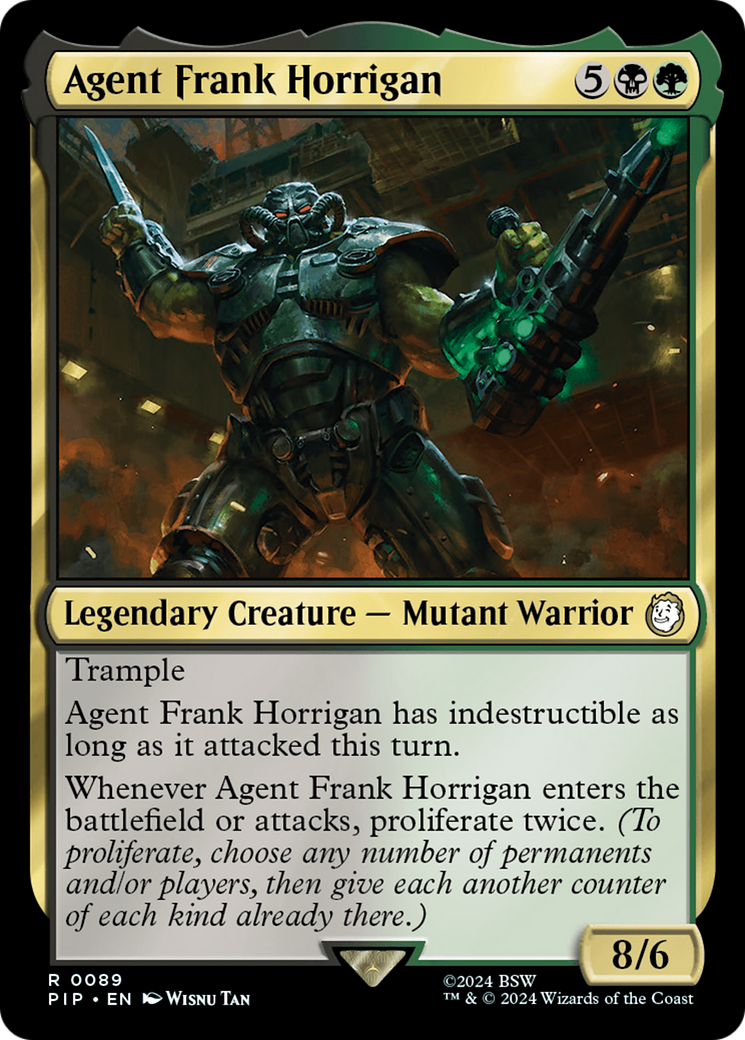
Agent Frank Horrigan
Agent Frank Horrigan
Legendary Creature — Mutant Warrior
8/6
Trample
Agent Frank Horrigan has indestructible as long as it attacked this turn.
Whenever Agent Frank Horrigan enters or attacks, proliferate twice. (To proliferate, choose any number of permanents and/or players, then give each another counter of each kind already there.)
- The ability that causes Agent Frank Horrigan to have indestructible starts to apply as soon as it’s declared as an attacker. It applies for the remainder of the turn. It doesn’t matter what happens to the player or permanent it attacked after that point.
- If Agent Frank Horrigan enters the battlefield attacking, it doesn’t have indestructible since it was never declared as an attacker.
- While proliferating twice, players can’t respond between proliferating the first time and proliferating the second time.
- If you proliferate twice, you don’t have to choose the same set of players and/or permanents to get additional counters each time.
- You can choose any permanent that has a counter, including ones controlled by opponents. You can choose any player who has a counter, including opponents. You can’t choose cards in any zone other than the battlefield, even if they have counters on them.
- You don’t have to choose every permanent or player that has a counter—only the ones you want to add counters to. Since “any number” includes zero, you don’t have to choose any permanents at all, and you don’t have to choose any players at all.
- If a player or permanent has more than one kind of counter on it, and you choose for it to get additional counters, it must get one of each kind of counter it already has. You can’t have it get just one kind of counter it already has and not the others.
- Players can respond to a spell or ability whose effect includes proliferating. Once that spell or ability starts to resolve, however, and its controller chooses which permanents and players will get new counters, it’s too late for anyone to respond.
- Some spells and abilities that cause you to proliferate may require targets. If each target chosen is an illegal target as that spell or ability tries to resolve, it won’t resolve. You won’t proliferate.
-
1
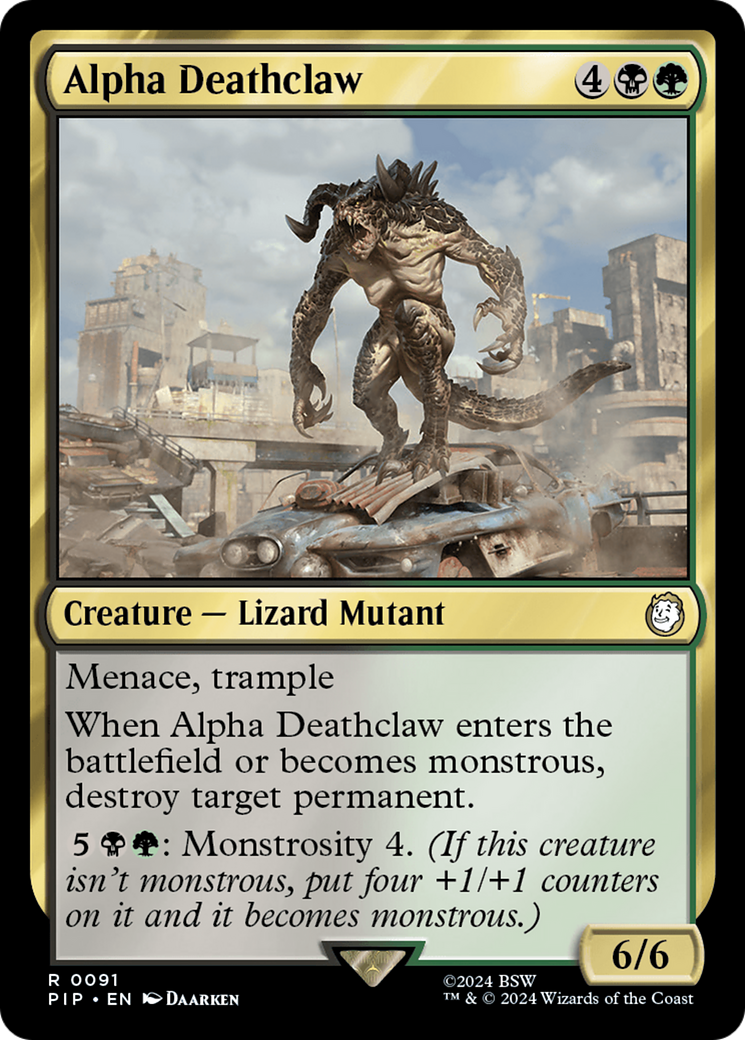
Alpha Deathclaw
Alpha Deathclaw
Creature — Lizard Mutant
6/6
Menace, trample
When this creature enters or becomes monstrous, destroy target permanent.
: Monstrosity 4. (If this creature isn't monstrous, put four +1/+1 counters on it and it becomes monstrous.)
- Once a creature becomes monstrous, it can’t become monstrous again. If the creature is already monstrous when the monstrosity ability resolves, nothing happens.
- Monstrous isn’t an ability that a creature has. It’s just something true about that creature. If the creature stops being a creature or loses its abilities, it will continue to be monstrous.
- An ability that triggers when a creature becomes monstrous won’t trigger if that creature isn’t on the battlefield when its monstrosity ability resolves.
-
1
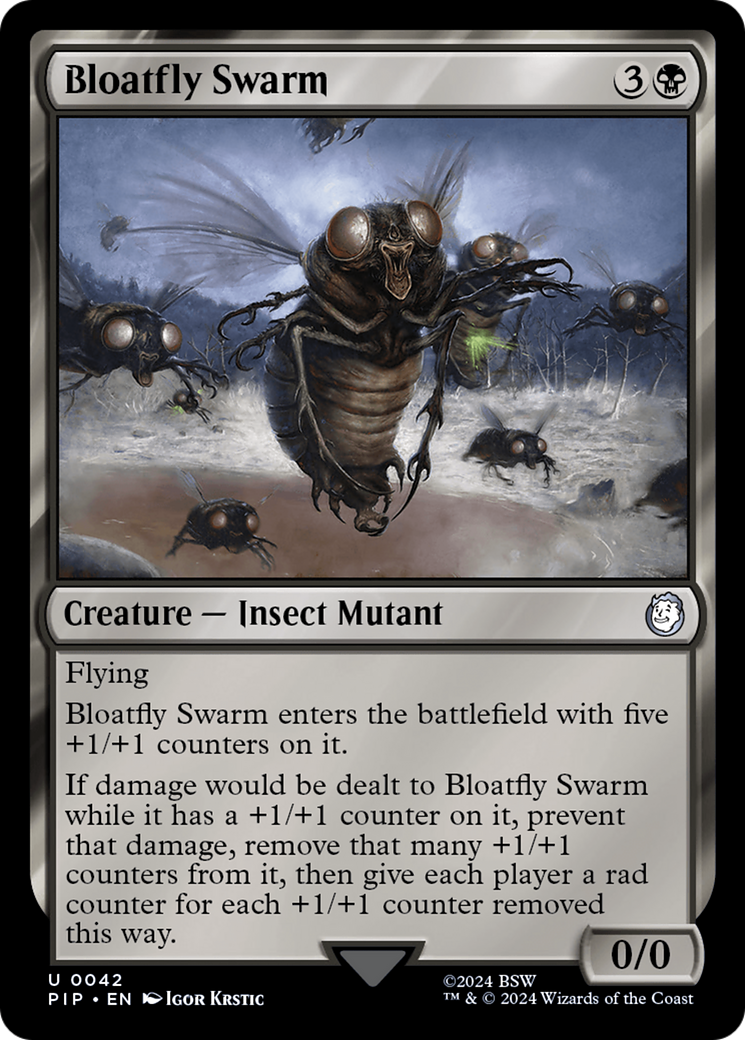
Bloatfly Swarm
Bloatfly Swarm
Creature — Insect Mutant
0/0
Flying
This creature enters with five +1/+1 counters on it.
If damage would be dealt to this creature while it has a +1/+1 counter on it, prevent that damage, remove that many +1/+1 counters from it, then give each player a rad counter for each +1/+1 counter removed this way.
- If damage that can't be prevented is dealt to Bloatfly Swarm, you still remove that many +1/+1 counters from it, and you still give each player a rad counter for each +1/+1 counter removed this way.
- Rad counters are a kind of counter that a player may have. They're not associated with any specific permanents.
- Keep track of how many rad counters each player has. Potential ways to track this include writing them down on paper or using dice, but any method that is clear and mutually agreeable is fine.
- Rad counters don't go away as steps, phases, or turns end. They only go away when an effect instructs a player to remove rad counters from themselves.
- There is an inherent triggered ability associated with having rad counters. This triggered ability has no source and is controlled by the active player. The full text of this ability is "At the beginning of the precombat main phase of a player with rad counters, that player mills cards equal to the number of rad counters they have. For each nonland card milled this way, that player loses 1 life and removes one rad counter from themselves."
- In a game using the shared team turns option, such as an Archenemy or Two-Headed Giant game, the inherent triggered ability associated with rad counters triggers once for each player on the active team that has rad counters. Each instance of that ability is controlled by one of those players.
- Any effects (such as proliferate) that interact with counters a player gets, has, or loses can interact with rad counters.
- The cards are milled all at once, which means abilities that trigger "whenever one or more nonland cards are milled" will trigger exactly once as long as at least one nonland card was milled.
- If a player has fewer cards remaining in their library than the number of rad counters they have when the triggered ability resolves, they'll mill as many cards as they can.
-
1
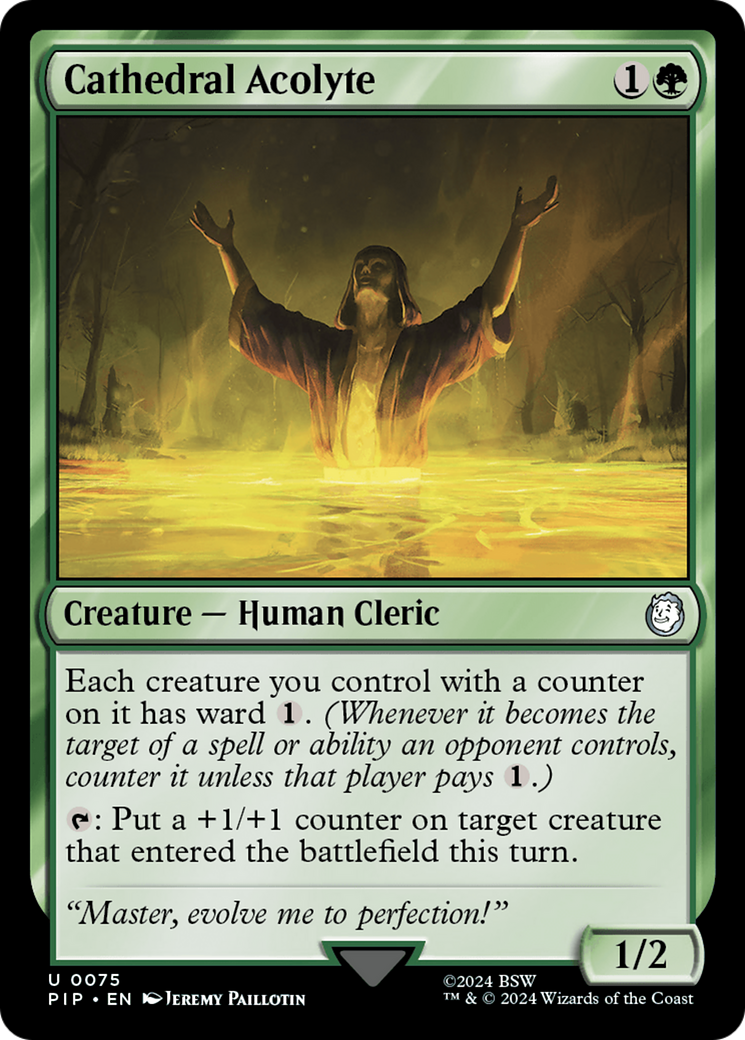
Cathedral Acolyte
Cathedral Acolyte
Creature — Human Cleric
1/2
Each creature you control with a counter on it has ward . (Whenever it becomes the target of a spell or ability an opponent controls, counter it unless that player pays .)
: Put a +1/+1 counter on target creature that entered this turn.
- The effect of Cathedral Acolyte’s first ability applies to any creature you control with a counter on it, not just ones with +1/+1 counters.
- Once a creature’s ward ability has triggered, causing that creature to lose ward by removing Cathedral Acolyte won’t affect the ability. The appropriate player will still have to pay or see their spell or ability countered.
-
1
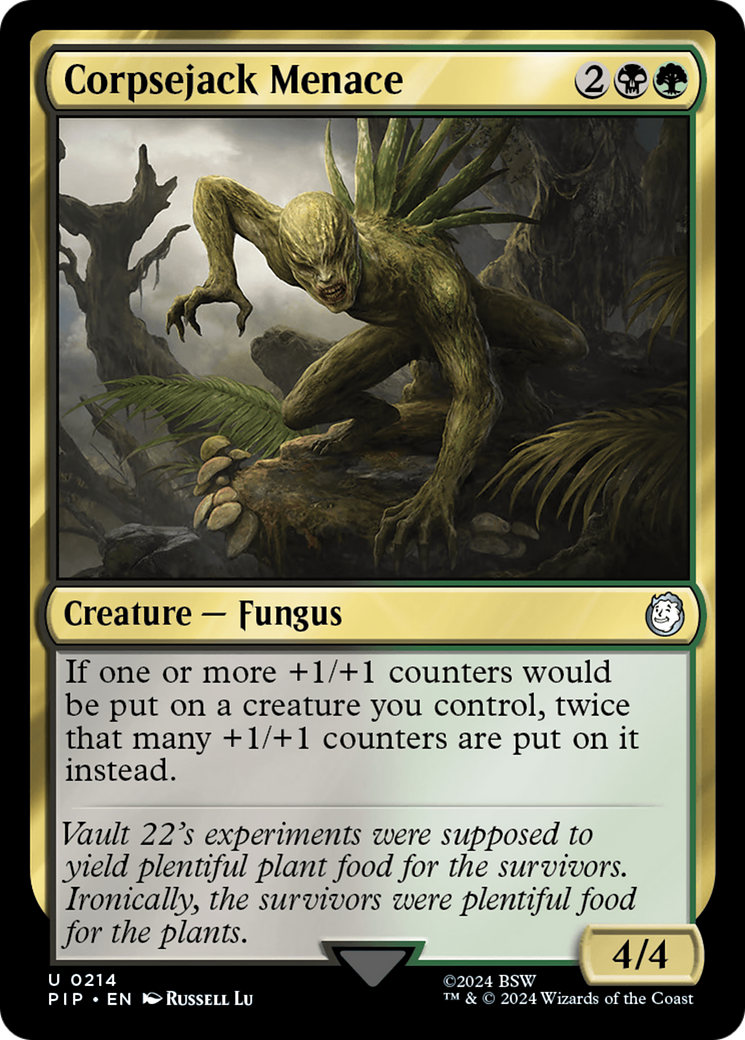
Corpsejack Menace
Corpsejack Menace
Creature — Fungus
4/4
If one or more +1/+1 counters would be put on a creature you control, twice that many +1/+1 counters are put on it instead.
- If a creature you control would enter the battlefield with a number of +1/+1 counters on it, it enters with twice that many instead.
- If you control two Corpsejack Menaces, the number of +1/+1 counters put on a creature is four times the original number. Three Corpsejack Menaces multiplies the original number by eight, and so on.
-
1
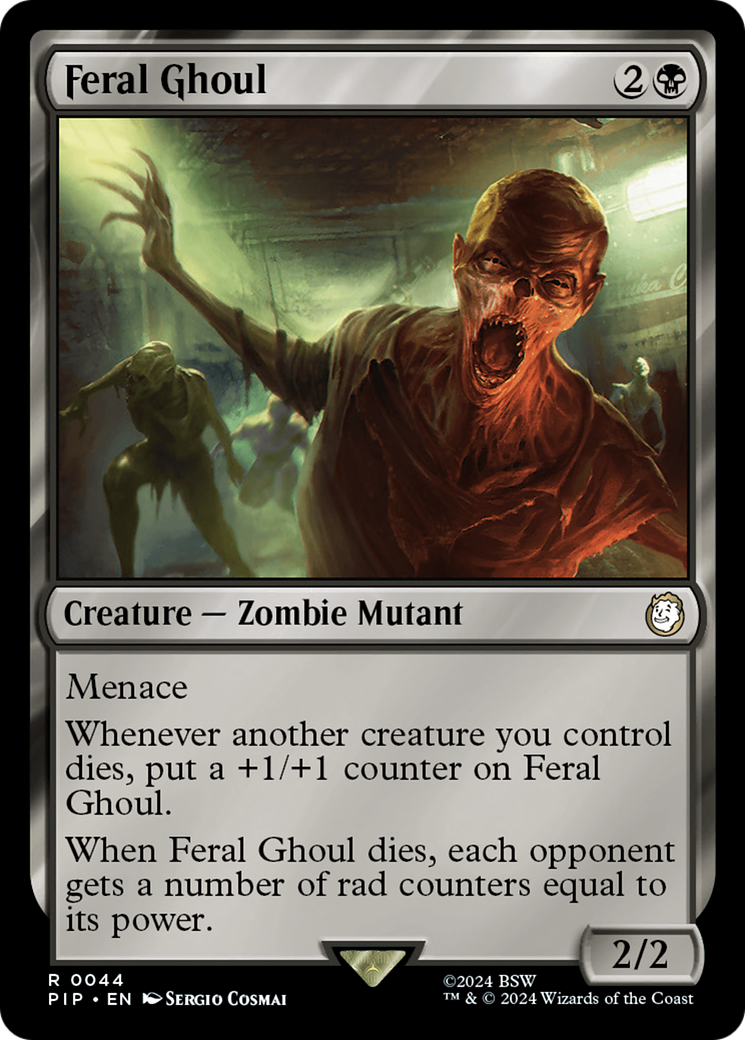
Feral Ghoul
Feral Ghoul
Creature — Zombie Mutant
2/2
Menace
Whenever another creature you control dies, put a +1/+1 counter on this creature.
When this creature dies, each opponent gets a number of rad counters equal to its power.
- Use Feral Ghoul’s power as it last existed on the battlefield to determine how many rad counters each opponent gets.
- Rad counters are a kind of counter that a player may have. They’re not associated with any specific permanents.
- Keep track of how many rad counters each player has. Potential ways to track this include writing them down on paper or using dice, but any method that is clear and mutually agreeable is fine.
- Rad counters don’t go away as steps, phases, or turns end. They only go away when an effect instructs a player to remove rad counters from themselves.
- There is an inherent triggered ability associated with having rad counters. This triggered ability has no source and is controlled by the active player. The full text of this ability is “At the beginning of the precombat main phase of a player with rad counters, that player mills cards equal to the number of rad counters they have. For each nonland card milled this way, that player loses 1 life and removes one rad counter from themselves.”
- In a game using the shared team turns option, such as an Archenemy or Two-Headed Giant game, the inherent triggered ability associated with rad counters triggers once for each player on the active team that has rad counters. Each instance of that ability is controlled by one of those players.
- Any effects (such as proliferate) that interact with counters a player gets, has, or loses can interact with rad counters.
- The cards are milled all at once, which means abilities that trigger “whenever one or more nonland cards are milled” will trigger exactly once as long as at least one nonland card was milled.
- If a player has fewer cards remaining in their library than the number of rad counters they have when the triggered ability resolves, they’ll mill as many cards as they can.
-
1
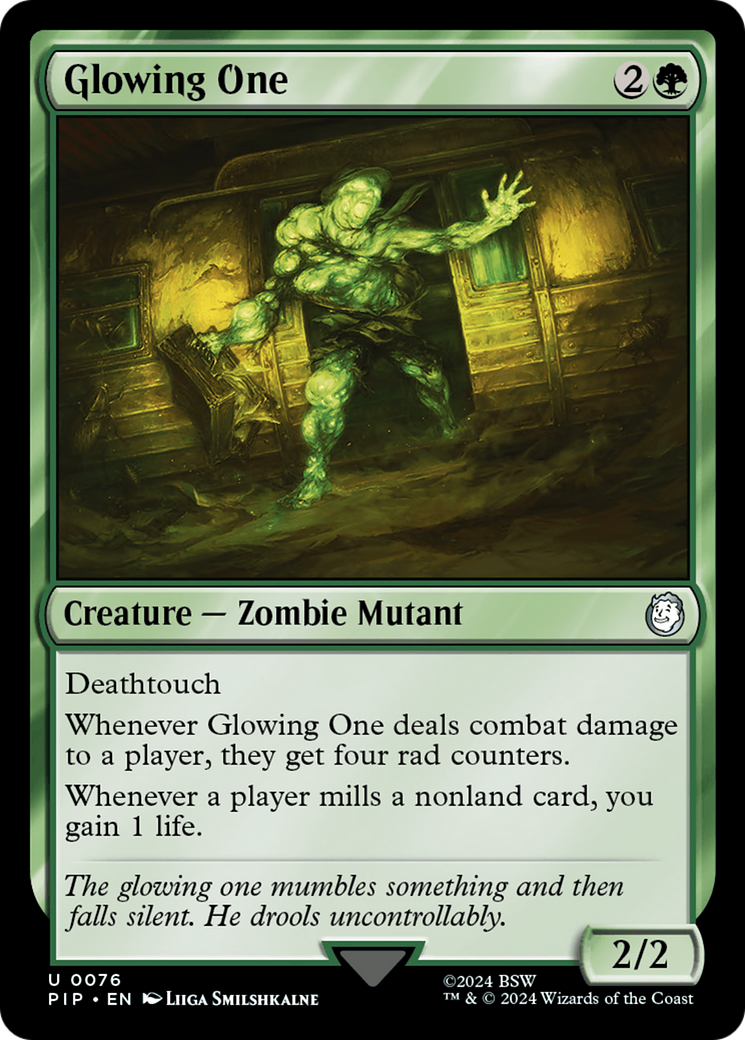
Glowing One
Glowing One
Creature — Zombie Mutant
2/2
Deathtouch
Whenever this creature deals combat damage to a player, they get four rad counters.
Whenever a player mills a nonland card, you gain 1 life.
- If a player is instructed to mill more than one card, Glowing One’s last ability will trigger once for each nonland card they mill during that instruction. For example, a player with four rad counters will mill four cards at the beginning of their precombat main phase. If all four of those cards are nonland cards, Glowing One’s ability triggers four times.
- Rad counters are a kind of counter that a player may have. They’re not associated with any specific permanents.
- Keep track of how many rad counters each player has. Potential ways to track this include writing them down on paper or using dice, but any method that is clear and mutually agreeable is fine.
- Rad counters don’t go away as steps, phases, or turns end. They only go away when an effect instructs a player to remove rad counters from themselves.
- There is an inherent triggered ability associated with having rad counters. This triggered ability has no source and is controlled by the active player. The full text of this ability is “At the beginning of the precombat main phase of a player with rad counters, that player mills cards equal to the number of rad counters they have. For each nonland card milled this way, that player loses 1 life and removes one rad counter from themselves.”
- In a game using the shared team turns option, such as an Archenemy or Two-Headed Giant game, the inherent triggered ability associated with rad counters triggers once for each player on the active team that has rad counters. Each instance of that ability is controlled by one of those players.
- Any effects (such as proliferate) that interact with counters a player gets, has, or loses can interact with rad counters.
- The cards are milled all at once, which means abilities that trigger “whenever one or more nonland cards are milled” will trigger exactly once as long as at least one nonland card was milled.
- If a player has fewer cards remaining in their library than the number of rad counters they have when the triggered ability resolves, they’ll mill as many cards as they can.
-
1
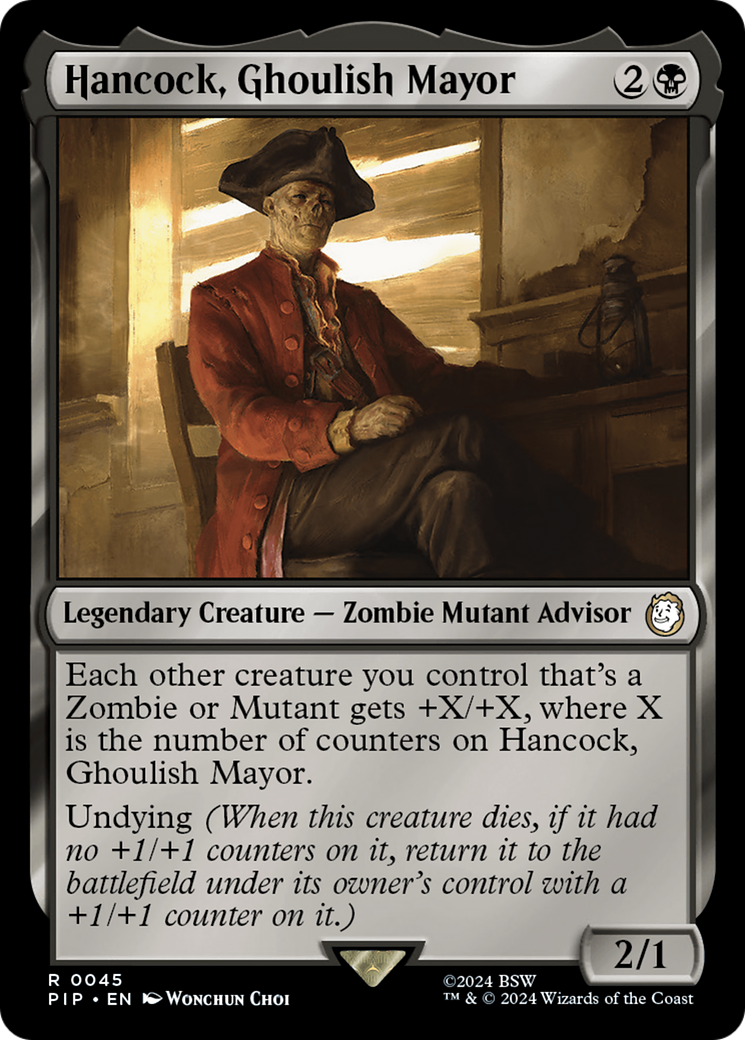
Hancock, Ghoulish Mayor
Hancock, Ghoulish Mayor
Legendary Creature — Zombie Mutant Advisor
2/1
Each other creature you control that's a Zombie or Mutant gets +X/+X, where X is the number of counters on Hancock.
Undying (When this creature dies, if it had no +1/+1 counters on it, return it to the battlefield under its owner's control with a +1/+1 counter on it.)
- A creature that's both a Zombie and a Mutant will get +X/+X only once from Hancock's first ability.
-
1
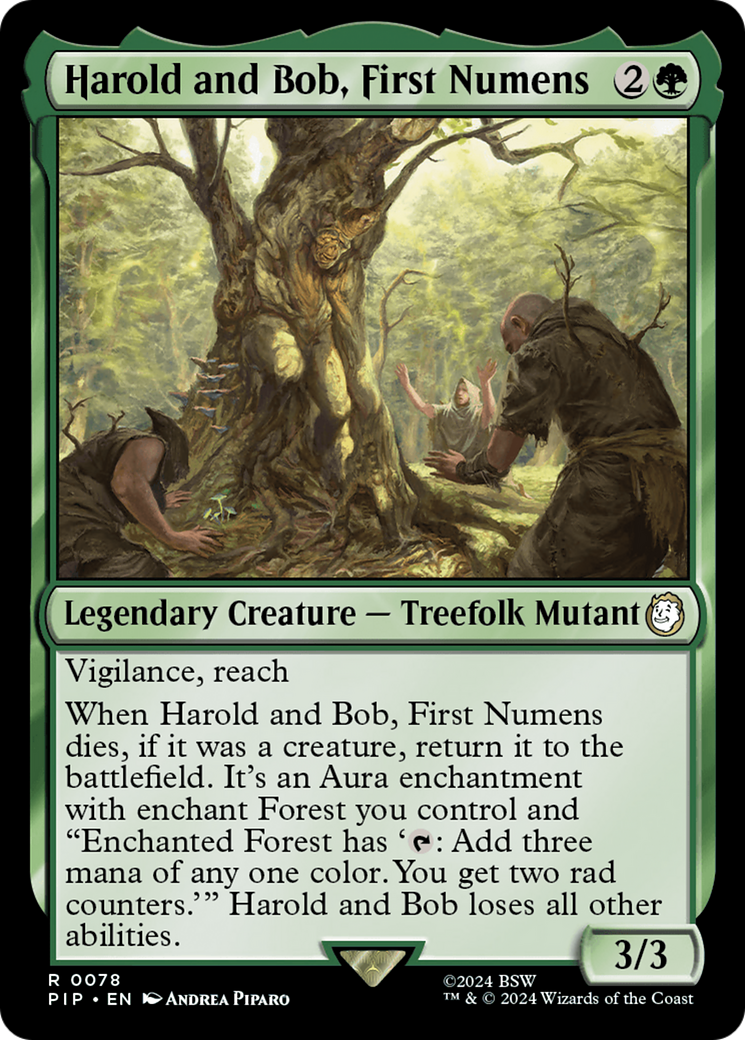
Harold and Bob, First Numens
Harold and Bob, First Numens
Legendary Creature — Treefolk Mutant
3/3
Vigilance, reach
When Harold and Bob dies, if it was a creature, return it to the battlefield. It's an Aura enchantment with enchant Forest you control and "Enchanted Forest has ' : Add three mana of any one color. You get two rad counters.'" Harold and Bob loses all other abilities.
- If you control Harold and Bob, you'll return it to the battlefield when it dies while it's a creature. It doesn't matter who owns the card. You'll choose which Forest you control it will enchant as it returns to the battlefield.
- If there's nothing for Harold and Bob to legally enchant, it remains in its owner's graveyard instead of returning to the battlefield.
- A token that's a copy of Harold and Bob won't return to the battlefield from its owner's graveyard.
- If a nontoken permanent that's a copy of Harold and Bob dies while it's a creature, it will return to the battlefield as an Aura with only the abilities granted by the effect that returned it to the battlefield. It will also retain its name, colors, and supertypes, but it will be an Aura enchantment with no other types or subtypes.
- Rad counters are a kind of counter that a player may have. They're not associated with any specific permanents.
- Keep track of how many rad counters each player has. Potential ways to track this include writing them down on paper or using dice, but any method that is clear and mutually agreeable is fine.
- Rad counters don't go away as steps, phases, or turns end. They only go away when an effect instructs a player to remove rad counters from themselves.
- There is an inherent triggered ability associated with having rad counters. This triggered ability has no source and is controlled by the active player. The full text of this ability is "At the beginning of the precombat main phase of a player with rad counters, that player mills cards equal to the number of rad counters they have. For each nonland card milled this way, that player loses 1 life and removes one rad counter from themselves."
- In a game using the shared team turns option, such as an Archenemy or Two-Headed Giant game, the inherent triggered ability associated with rad counters triggers once for each player on the active team that has rad counters. Each instance of that ability is controlled by one of those players.
- Any effects (such as proliferate) that interact with counters a player gets, has, or loses can interact with rad counters.
- The cards are milled all at once, which means abilities that trigger "whenever one or more nonland cards are milled" will trigger exactly once as long as at least one nonland card was milled.
- If a player has fewer cards remaining in their library than the number of rad counters they have when the triggered ability resolves, they'll mill as many cards as they can.
-
1
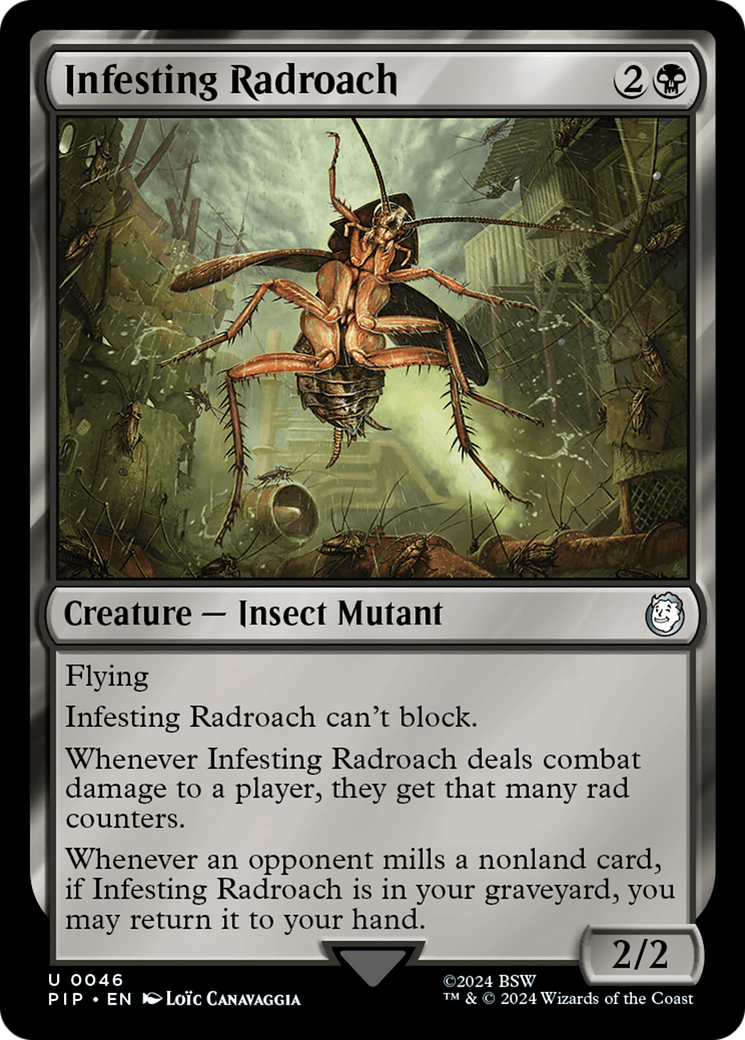
Infesting Radroach
Infesting Radroach
Creature — Insect Mutant
2/2
Flying
This creature can't block.
Whenever this creature deals combat damage to a player, they get that many rad counters.
Whenever an opponent mills a nonland card, if this creature is in your graveyard, you may return it to your hand.
- If Infesting Radroach is milled at the same time an opponent mills a nonland card (for example, because of the activated ability of Raul, Trouble Shooter), Infesting Radroach's ability will trigger.
- Rad counters are a kind of counter that a player may have. They're not associated with any specific permanents.
- Keep track of how many rad counters each player has. Potential ways to track this include writing them down on paper or using dice, but any method that is clear and mutually agreeable is fine.
- Rad counters don't go away as steps, phases, or turns end. They only go away when an effect instructs a player to remove rad counters from themselves.
- There is an inherent triggered ability associated with having rad counters. This triggered ability has no source and is controlled by the active player. The full text of this ability is "At the beginning of the precombat main phase of a player with rad counters, that player mills cards equal to the number of rad counters they have. For each nonland card milled this way, that player loses 1 life and removes one rad counter from themselves."
- In a game using the shared team turns option, such as an Archenemy or Two-Headed Giant game, the inherent triggered ability associated with rad counters triggers once for each player on the active team that has rad counters. Each instance of that ability is controlled by one of those players.
- Any effects (such as proliferate) that interact with counters a player gets, has, or loses can interact with rad counters.
- The cards are milled all at once, which means abilities that trigger "whenever one or more nonland cards are milled" will trigger exactly once as long as at least one nonland card was milled.
- If a player has fewer cards remaining in their library than the number of rad counters they have when the triggered ability resolves, they'll mill as many cards as they can.
-
1
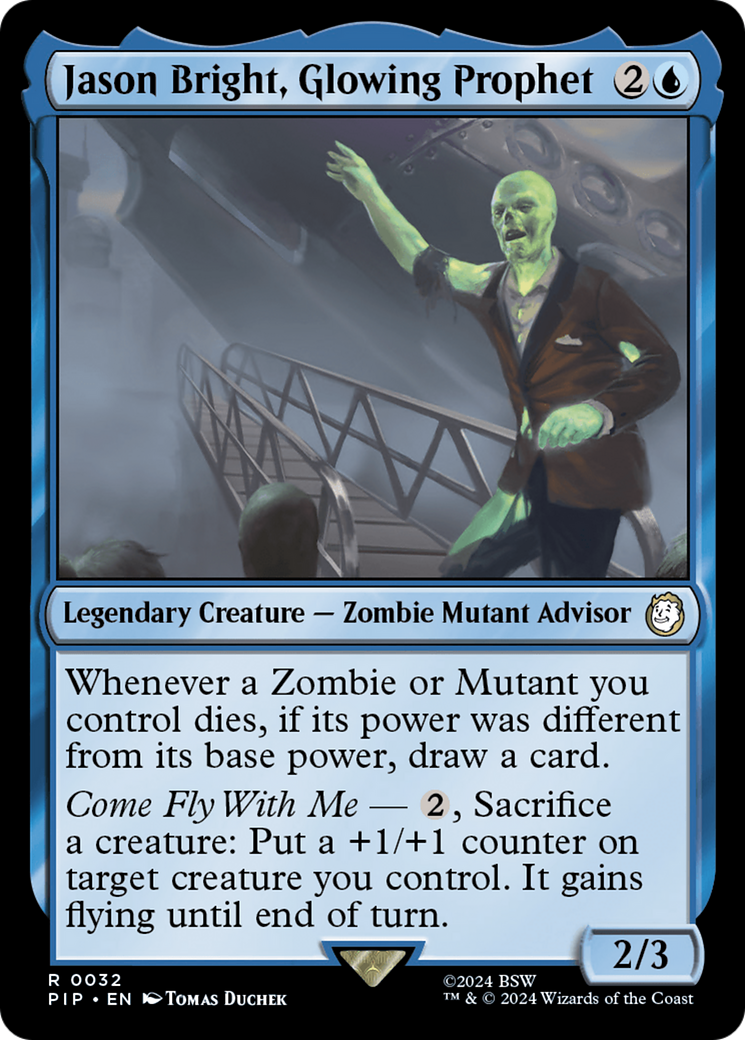
Jason Bright, Glowing Prophet
Jason Bright, Glowing Prophet
Legendary Creature — Zombie Mutant Advisor
2/3
Whenever a Zombie or Mutant you control dies, if its power was different from its base power, draw a card.
Come Fly With Me — , Sacrifice a creature: Put a +1/+1 counter on target creature you control. It gains flying until end of turn.
- Normally, a creature’s base power is the power printed on the card, or, for a token, the power set by the effect that created it. If another effect sets a creature’s power to a specific number or value, that becomes its base power. If an effect modifies a creature’s power without setting it, that is not included when determining its base power.
- If a creature has a characteristic-defining ability that sets its power, indicated with a * or similar in the power and toughness box, that ability is taken into account when determining its base power.
- Some creatures have base power 0 and an ability that gives them a bonus based on some criteria. Those are not characteristic-defining abilities, and that ability doesn’t change its base power. Such a creature will have power different from its base power if that ability causes its power to be anything other than 0.
-
1
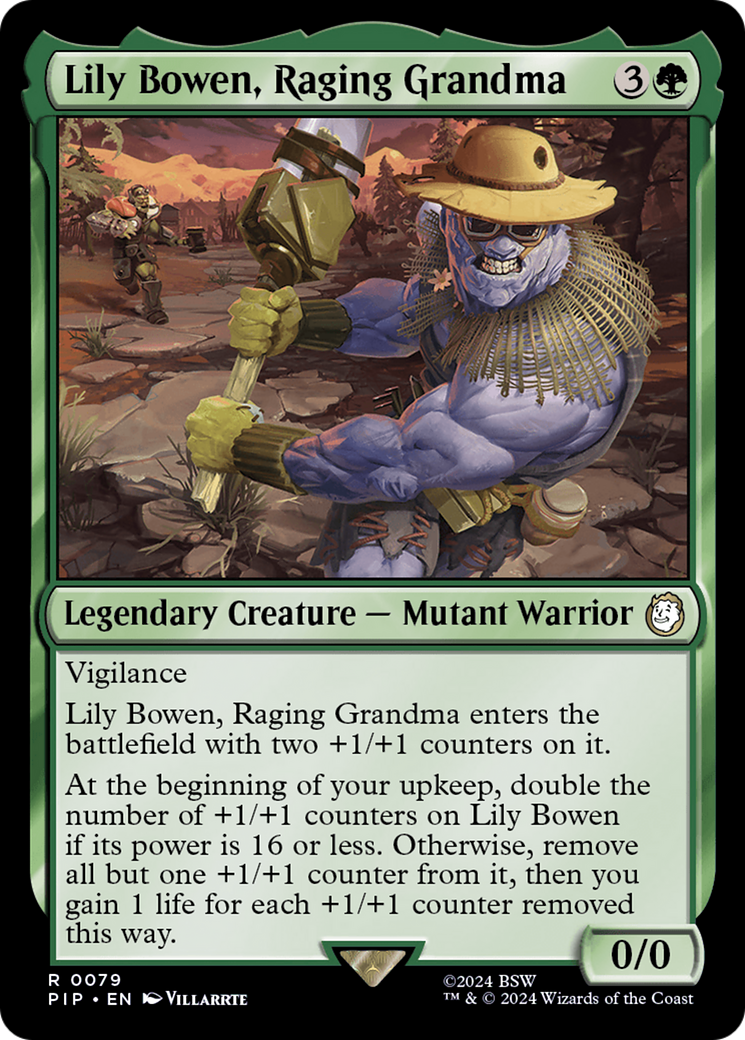
Lily Bowen, Raging Grandma
Lily Bowen, Raging Grandma
Legendary Creature — Mutant Warrior
0/0
Vigilance
Lily Bowen enters with two +1/+1 counters on it.
At the beginning of your upkeep, double the number of +1/+1 counters on Lily Bowen if its power is 16 or less. Otherwise, remove all but one +1/+1 counter from it, then you gain 1 life for each +1/+1 counter removed this way.
- To double the number of +1/+1 counters on Lily Bowen, put a number of +1/+1 counters on it equal to the number it already has. Replacement effects that modify the number of counters being placed on creatures you control, such as the effect of Branching Evolution, apply to this ability as normal.
-
1
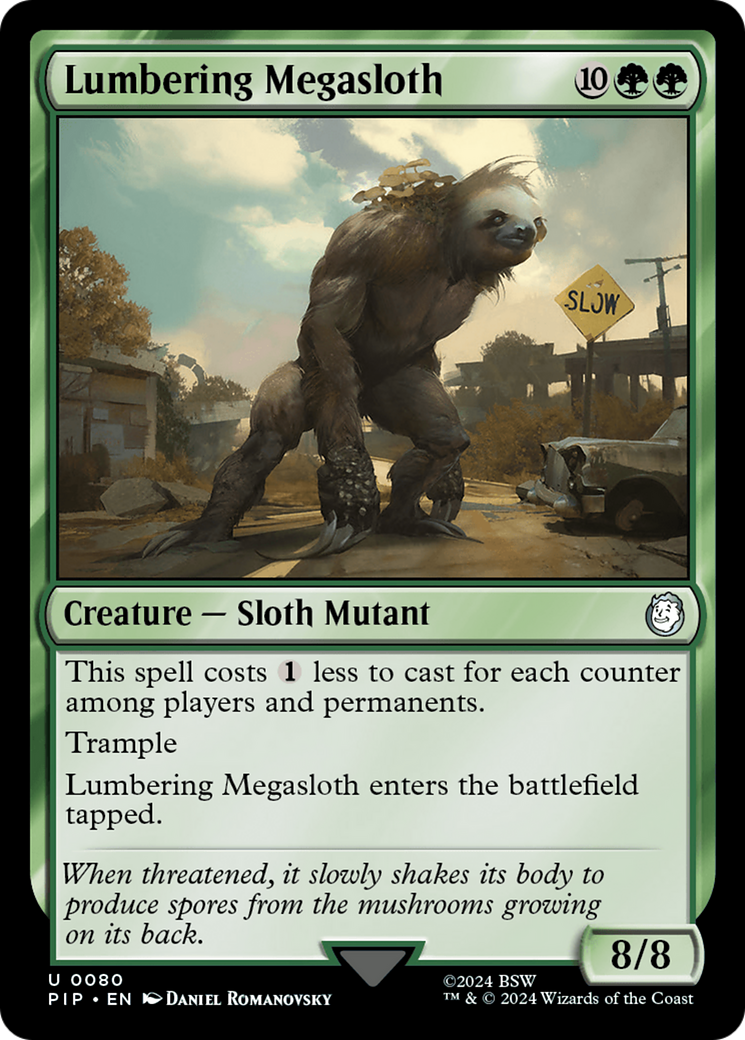
Lumbering Megasloth
Lumbering Megasloth
Creature — Sloth Mutant
8/8
This spell costs less to cast for each counter among players and permanents.
Trample
This creature enters tapped.
- The cost-reduction ability of Lumbering Megasloth doesn't change its mana cost or mana value, only the total cost you pay. Specifically, the mana value of Lumbering Megasloth is always 12.
- Once you announce that you're casting Lumbering Megasloth, no player may take actions until you're done casting it. Notably, opponents can't remove counters from players or permanents to try to change Lumbering Megasloth's total cost.
-
1
Marcus, Mutant Mayor
Marcus, Mutant Mayor
Legendary Creature — Mutant Advisor
4/4
Vigilance, trample
Whenever a creature you control deals combat damage to a player, draw a card if that creature has a +1/+1 counter on it. If it doesn't, put a +1/+1 counter on it.
-
1
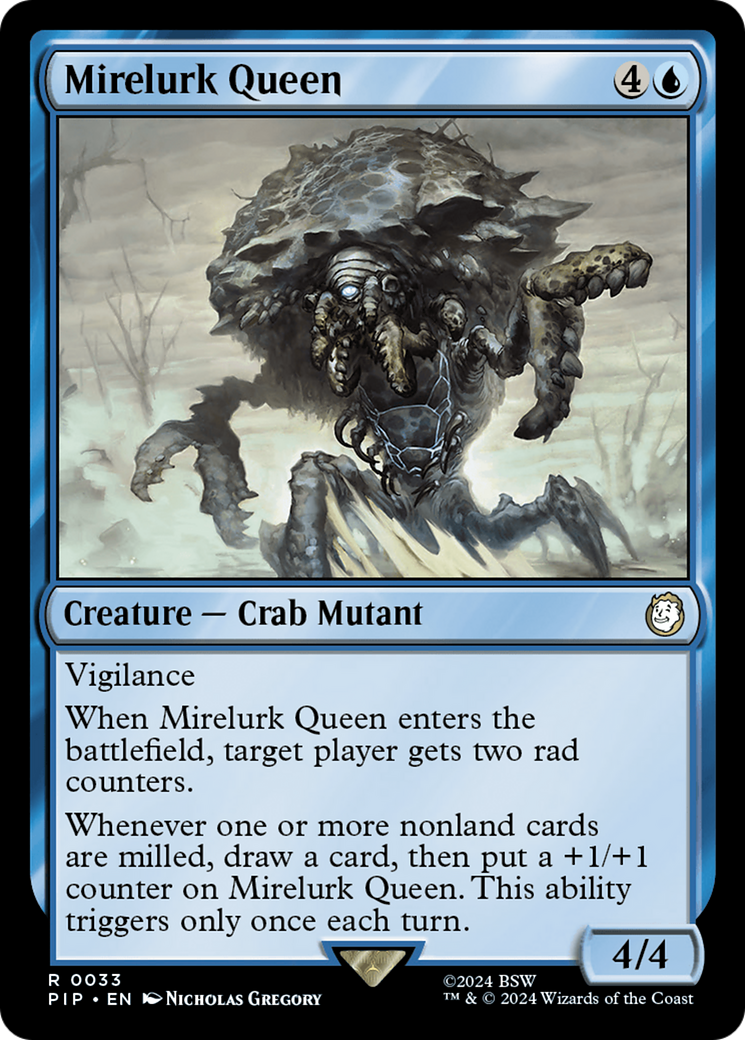
Mirelurk Queen
Mirelurk Queen
Creature — Crab Mutant
4/4
Vigilance
When this creature enters, target player gets two rad counters.
Whenever one or more nonland cards are milled, draw a card, then put a +1/+1 counter on this creature. This ability triggers only once each turn.
- Rad counters are a kind of counter that a player may have. They’re not associated with any specific permanents.
- Keep track of how many rad counters each player has. Potential ways to track this include writing them down on paper or using dice, but any method that is clear and mutually agreeable is fine.
- Rad counters don’t go away as steps, phases, or turns end. They only go away when an effect instructs a player to remove rad counters from themselves.
- There is an inherent triggered ability associated with having rad counters. This triggered ability has no source and is controlled by the active player. The full text of this ability is “At the beginning of the precombat main phase of a player with rad counters, that player mills cards equal to the number of rad counters they have. For each nonland card milled this way, that player loses 1 life and removes one rad counter from themselves.”
- In a game using the shared team turns option, such as an Archenemy or Two-Headed Giant game, the inherent triggered ability associated with rad counters triggers once for each player on the active team that has rad counters. Each instance of that ability is controlled by one of those players.
- Any effects (such as proliferate) that interact with counters a player gets, has, or loses can interact with rad counters.
- The cards are milled all at once, which means abilities that trigger “whenever one or more nonland cards are milled” will trigger exactly once as long as at least one nonland card was milled.
- If a player has fewer cards remaining in their library than the number of rad counters they have when the triggered ability resolves, they’ll mill as many cards as they can.
-
1
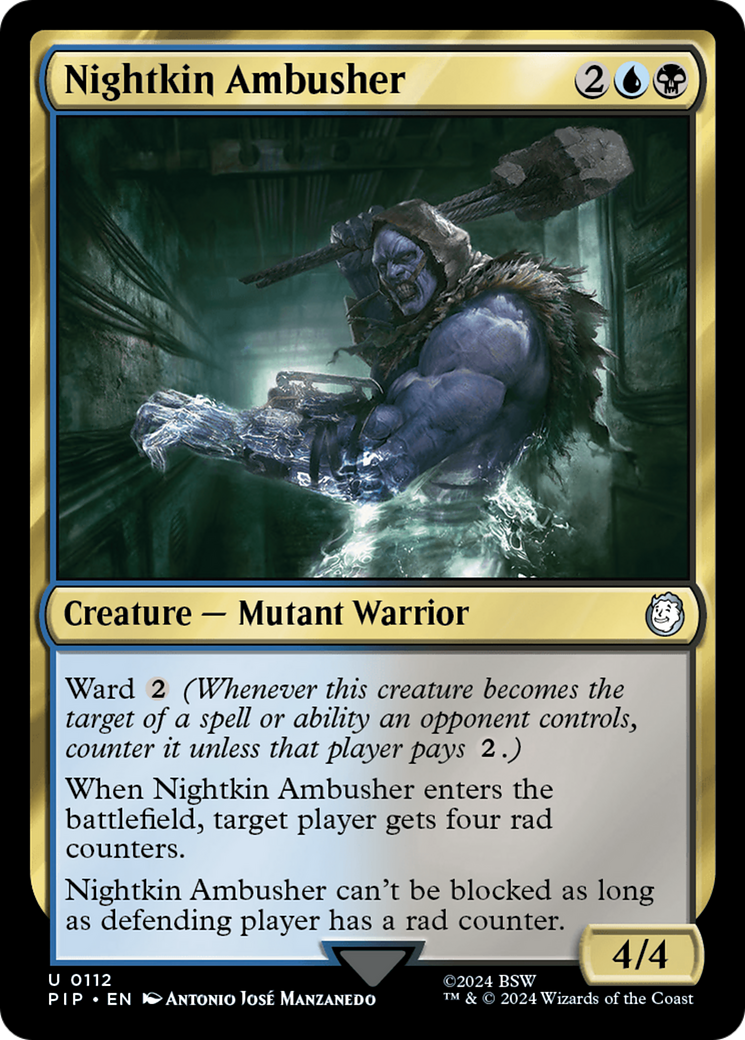
Nightkin Ambusher
Nightkin Ambusher
Creature — Mutant Warrior
4/4
Ward (Whenever this creature becomes the target of a spell or ability an opponent controls, counter it unless that player pays .)
When this creature enters, target player gets four rad counters.
This creature can't be blocked as long as defending player has a rad counter.
- Once Nightkin Ambusher has been blocked, giving the defending player a rad counter won't cause Nightkin Ambusher to become unblocked.
- Rad counters are a kind of counter that a player may have. They're not associated with any specific permanents.
- Keep track of how many rad counters each player has. Potential ways to track this include writing them down on paper or using dice, but any method that is clear and mutually agreeable is fine.
- Rad counters don't go away as steps, phases, or turns end. They only go away when an effect instructs a player to remove rad counters from themselves.
- There is an inherent triggered ability associated with having rad counters. This triggered ability has no source and is controlled by the active player. The full text of this ability is "At the beginning of the precombat main phase of a player with rad counters, that player mills cards equal to the number of rad counters they have. For each nonland card milled this way, that player loses 1 life and removes one rad counter from themselves."
- In a game using the shared team turns option, such as an Archenemy or Two-Headed Giant game, the inherent triggered ability associated with rad counters triggers once for each player on the active team that has rad counters. Each instance of that ability is controlled by one of those players.
- Any effects (such as proliferate) that interact with counters a player gets, has, or loses can interact with rad counters.
- The cards are milled all at once, which means abilities that trigger "whenever one or more nonland cards are milled" will trigger exactly once as long as at least one nonland card was milled.
- If a player has fewer cards remaining in their library than the number of rad counters they have when the triggered ability resolves, they'll mill as many cards as they can.
-
1
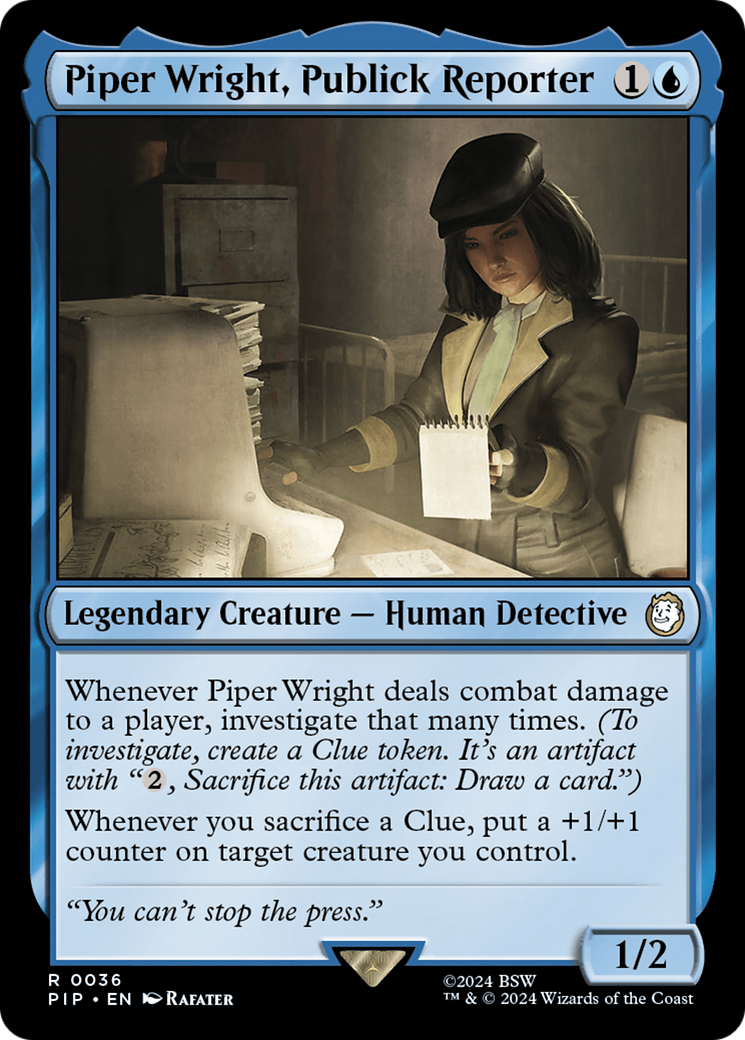
Piper Wright, Publick Reporter
Piper Wright, Publick Reporter
Legendary Creature — Human Detective
1/2
Whenever Piper Wright deals combat damage to a player, investigate that many times. (To investigate, create a Clue token. It's an artifact with " , Sacrifice this token: Draw a card.")
Whenever you sacrifice a Clue, put a +1/+1 counter on target creature you control.
- If an effect refers to a Clue, it means any Clue artifact, not just a Clue artifact token. For example, if you sacrifice a nontoken Clue artifact, such as Candy Trail from the Wilds of Eldraine set, Piper Wright's last ability will trigger.
- Piper Wright's last ability triggers whenever you sacrifice a Clue for any reason, not just to activate a Clue's activated ability.
-
1
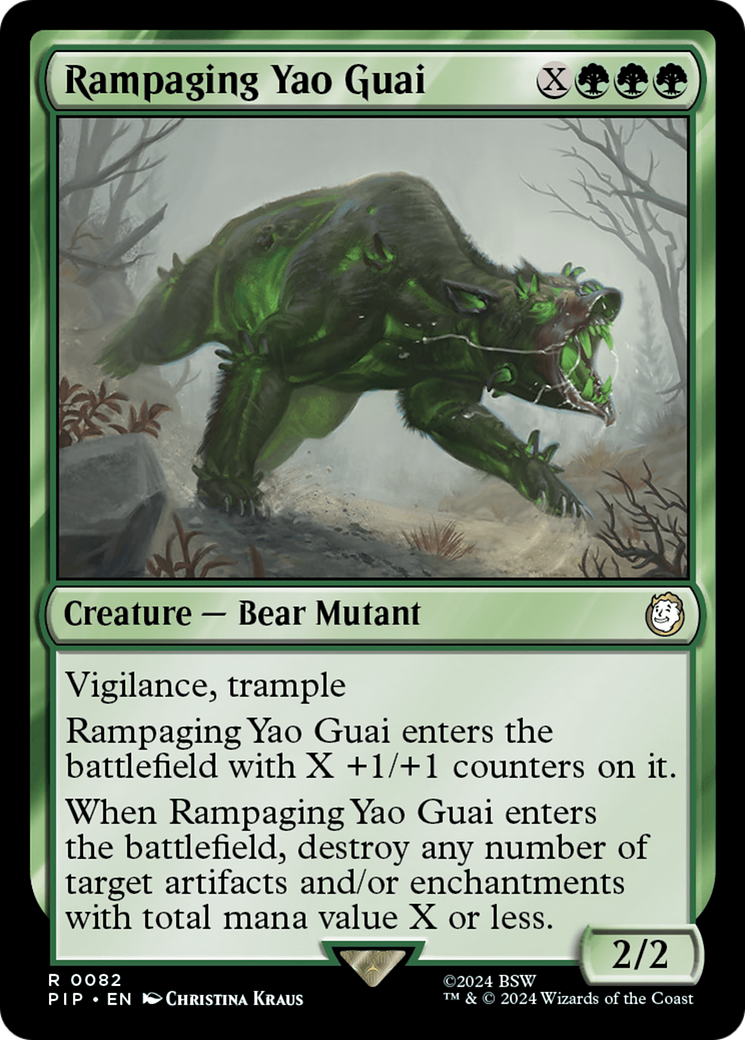
Rampaging Yao Guai
Rampaging Yao Guai
Creature — Bear Mutant
2/2
Vigilance, trample
This creature enters with X +1/+1 counters on it.
When this creature enters, destroy any number of target artifacts and/or enchantments with total mana value X or less.
- If a permanent has in its mana cost, X is 0 when determining its mana value.
- A token that's not a copy of something else normally won't have a mana cost. Anything without a mana cost normally has a mana value of 0.
-
1
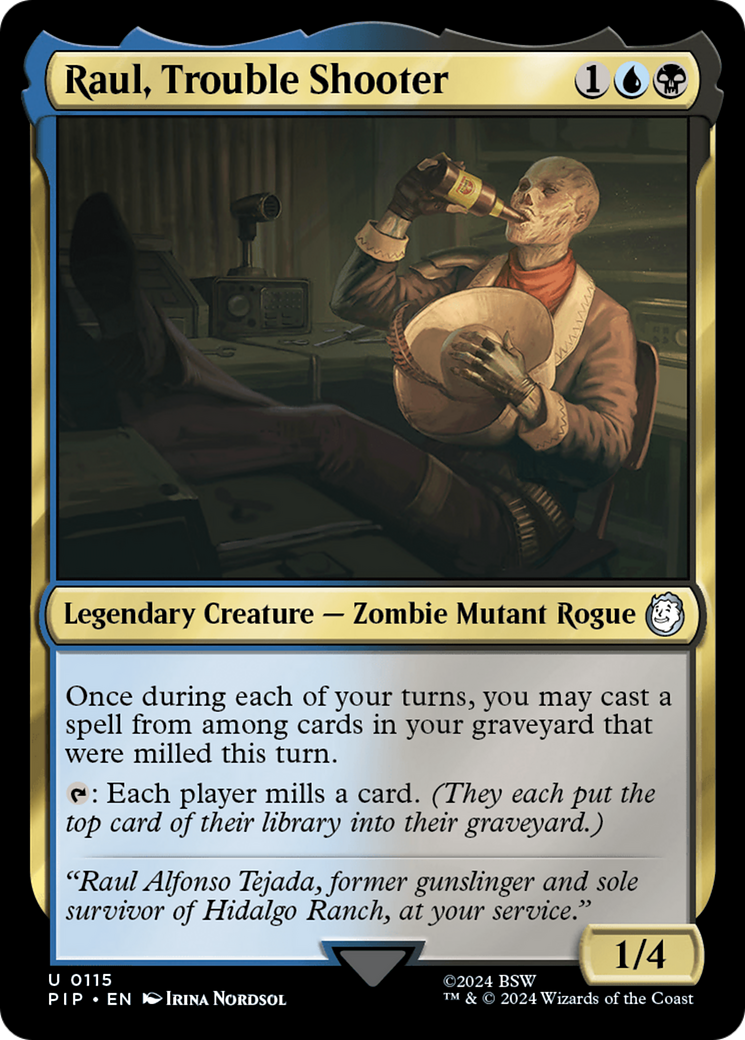
Raul, Trouble Shooter
Raul, Trouble Shooter
Legendary Creature — Zombie Mutant Rogue
1/4
Once during each of your turns, you may cast a spell from among cards in your graveyard that were milled this turn.
: Each player mills a card. (They each put the top card of their library into their graveyard.)
- If you are instructed to put a card into your graveyard from your library without using the word “mill,” (by the effect of Rowan’s Grim Search from Wilds of Eldraine, for example), Raul’s first ability won’t allow you to cast it.
- You must follow the normal timing permissions and restrictions of the spell you cast from your graveyard.
- You must pay the costs to cast that spell. If it has an alternative cost, you may cast it for that cost instead.
- Once you begin to cast the spell, losing control of Raul won’t affect the spell.
- If you cast a spell from among cards in your graveyard that were milled this turn using another permission, Raul’s effect doesn’t apply. You can cast another spell among cards in your graveyard that were milled this turn using the permission granted by Raul’s first ability.
- If you cast a spell from among cards in your graveyard that were milled this turn using the permission granted by Raul’s first ability and then have a new Raul, Trouble Shooter come under your control in the same turn, you may cast another spell from among cards in your graveyard that were milled this turn.
-
1
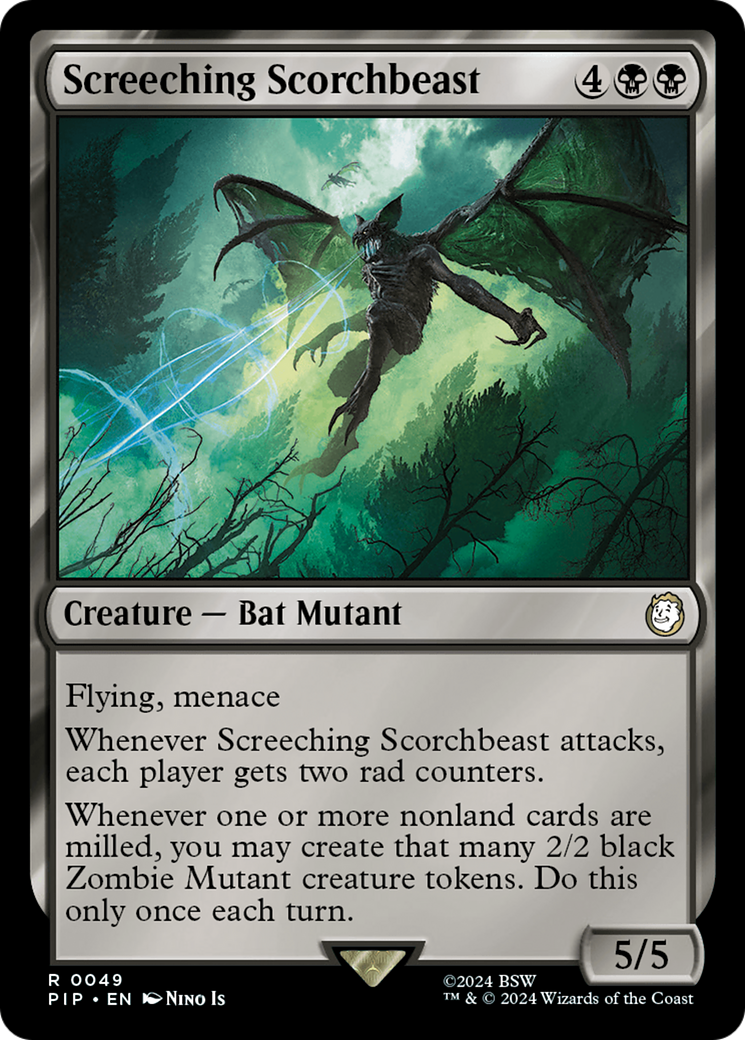
Screeching Scorchbeast
Screeching Scorchbeast
Creature — Bat Mutant
5/5
Flying, menace
Whenever this creature attacks, each player gets two rad counters.
Whenever one or more nonland cards are milled, you may create that many 2/2 black Zombie Mutant creature tokens. Do this only once each turn.
- Any effects (such as proliferate) that interact with counters a player gets, has, or loses can interact with rad counters.
- The cards are milled all at once, which means abilities that trigger “whenever one or more nonland cards are milled” will trigger exactly once as long as at least one nonland card was milled.
- If a player has fewer cards remaining in their library than the number of rad counters they have when the triggered ability resolves, they’ll mill as many cards as they can.
- If more than one player is instructed to mill at the same time (by the activated ability of Raul, Trouble Shooter, for example), as long as at least one nonland card is milled, Screeching Scorchbeast’s last ability will trigger just once.
- “Do this only once each turn” lets you choose whether or not to create the appropriate number of 2/2 black Zombie Mutant creature tokens as the triggered ability resolves. If you choose not to create tokens, the ability will trigger again the next time the condition is met. Once you choose to do so, the ability will no longer trigger for the rest of the turn.
- Rad counters are a kind of counter that a player may have. They’re not associated with any specific permanents.
- Keep track of how many rad counters each player has. Potential ways to track this include writing them down on paper or using dice, but any method that is clear and mutually agreeable is fine.
- Rad counters don’t go away as steps, phases, or turns end. They only go away when an effect instructs a player to remove rad counters from themselves.
- There is an inherent triggered ability associated with having rad counters. This triggered ability has no source and is controlled by the active player. The full text of this ability is “At the beginning of the precombat main phase of a player with rad counters, that player mills cards equal to the number of rad counters they have. For each nonland card milled this way, that player loses 1 life and removes one rad counter from themselves.”
- In a game using the shared team turns option, such as an Archenemy or Two-Headed Giant game, the inherent triggered ability associated with rad counters triggers once for each player on the active team that has rad counters. Each instance of that ability is controlled by one of those players.
-
1
Strong, the Brutish Thespian
Strong, the Brutish Thespian
Legendary Creature — Mutant Berserker
7/7
Ward
Enrage — Whenever Strong is dealt damage, you get three rad counters and put three +1/+1 counters on Strong.
You gain life rather than lose life from radiation.
- If multiple sources deal damage to Strong at the same time, most likely because multiple creatures blocked it, its enrage ability will trigger only once.
- If lethal damage is dealt to Strong, its enrage ability triggers. Strong leaves the battlefield before that ability resolves, so you won’t put three +1/+1 counters on it. In this or any other case where Strong is no longer on the battlefield when its enrage ability resolves, you’ll still get three rad counters.
- Strong’s last ability changes what happens when the inherent triggered ability associated with having rad counters resolves. You’ll still mill cards equal to the number of rad counters you have, and you’ll still remove a rad counter from yourself for each nonland card you milled, but instead of losing life, you’ll gain 1 life for each nonland card you milled.
- Rad counters are a kind of counter that a player may have. They’re not associated with any specific permanents.
- Keep track of how many rad counters each player has. Potential ways to track this include writing them down on paper or using dice, but any method that is clear and mutually agreeable is fine.
- Rad counters don’t go away as steps, phases, or turns end. They only go away when an effect instructs a player to remove rad counters from themselves.
- There is an inherent triggered ability associated with having rad counters. This triggered ability has no source and is controlled by the active player. The full text of this ability is “At the beginning of the precombat main phase of a player with rad counters, that player mills cards equal to the number of rad counters they have. For each nonland card milled this way, that player loses 1 life and removes one rad counter from themselves.”
- In a game using the shared team turns option, such as an Archenemy or Two-Headed Giant game, the inherent triggered ability associated with rad counters triggers once for each player on the active team that has rad counters. Each instance of that ability is controlled by one of those players.
- Any effects (such as proliferate) that interact with counters a player gets, has, or loses can interact with rad counters.
- The cards are milled all at once, which means abilities that trigger “whenever one or more nonland cards are milled” will trigger exactly once as long as at least one nonland card was milled.
- If a player has fewer cards remaining in their library than the number of rad counters they have when the triggered ability resolves, they’ll mill as many cards as they can.
-
1
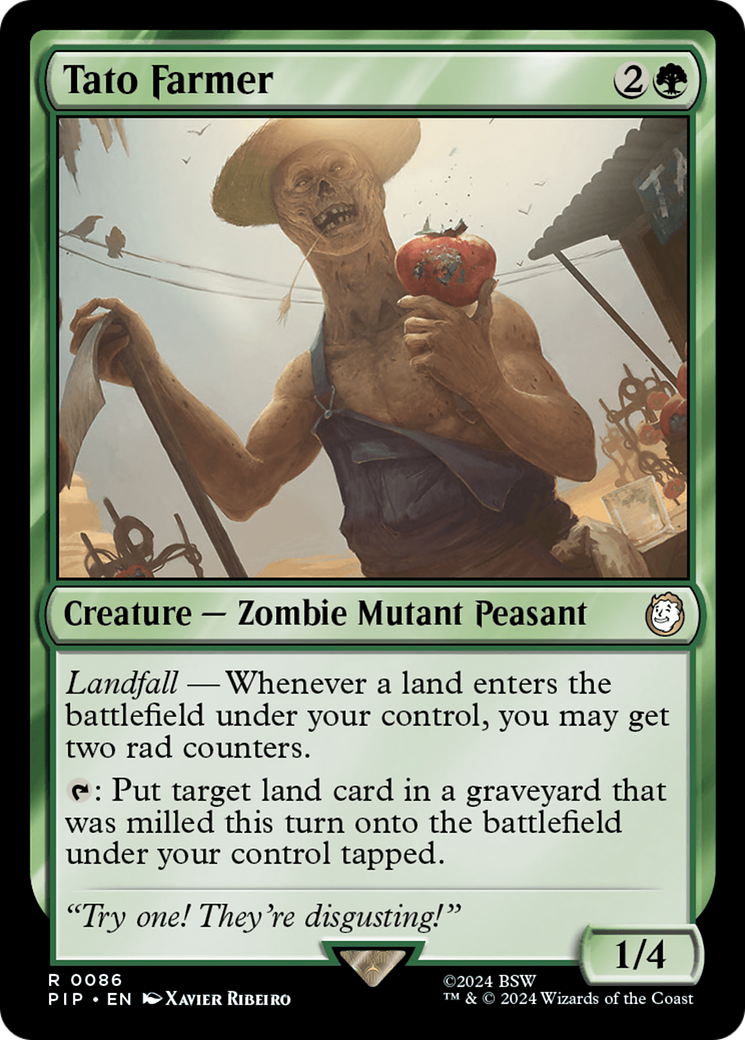
Tato Farmer
Tato Farmer
Creature — Zombie Mutant Peasant
1/4
Landfall — Whenever a land you control enters, you may get two rad counters.
: Put target land card in a graveyard that was milled this turn onto the battlefield under your control tapped.
- A landfall ability triggers whenever a land you control enters for any reason. It triggers whenever you play a land, as well as whenever a spell or ability puts a land onto the battlefield under your control.
- A landfall ability doesn't trigger if a permanent already on the battlefield becomes a land.
- Whenever a land you control enters, each landfall ability of the permanents you control will trigger. You can put them on the stack in any order. The last ability you put on the stack will be the first one to resolve (As a result, you can have those abilities resolve in the order of your choosing.).
- Rad counters don't go away as steps, phases, or turns end. They only go away when an effect instructs a player to remove rad counters from themselves.
- There is an inherent triggered ability associated with having rad counters. This triggered ability has no source and is controlled by the active player. The full text of this ability is "At the beginning of the precombat main phase of a player with rad counters, that player mills cards equal to the number of rad counters they have. For each nonland card milled this way, that player loses 1 life and removes one rad counter from themselves."
- In a game using the shared team turns option, such as an Archenemy or Two-Headed Giant game, the inherent triggered ability associated with rad counters triggers once for each player on the active team that has rad counters. Each instance of that ability is controlled by one of those players.
- If a player is instructed to put a card into their graveyard from their library without using the word "mill," (by the effect of Rowan's Grim Search from Wilds of Eldraine, for example), that card isn't a legal target for Tato Farmer's last ability.
- The cards are milled all at once, which means abilities that trigger "whenever one or more nonland cards are milled" will trigger exactly once as long as at least one nonland card was milled.
- If a player has fewer cards remaining in their library than the number of rad counters they have when the triggered ability resolves, they'll mill as many cards as they can.
- Any effects (such as proliferate) that interact with counters a player gets, has, or loses can interact with rad counters.
- Rad counters are a kind of counter that a player may have. They're not associated with any specific permanents.
- Keep track of how many rad counters each player has. Potential ways to track this include writing them down on paper or using dice, but any method that is clear and mutually agreeable is fine.
-
1
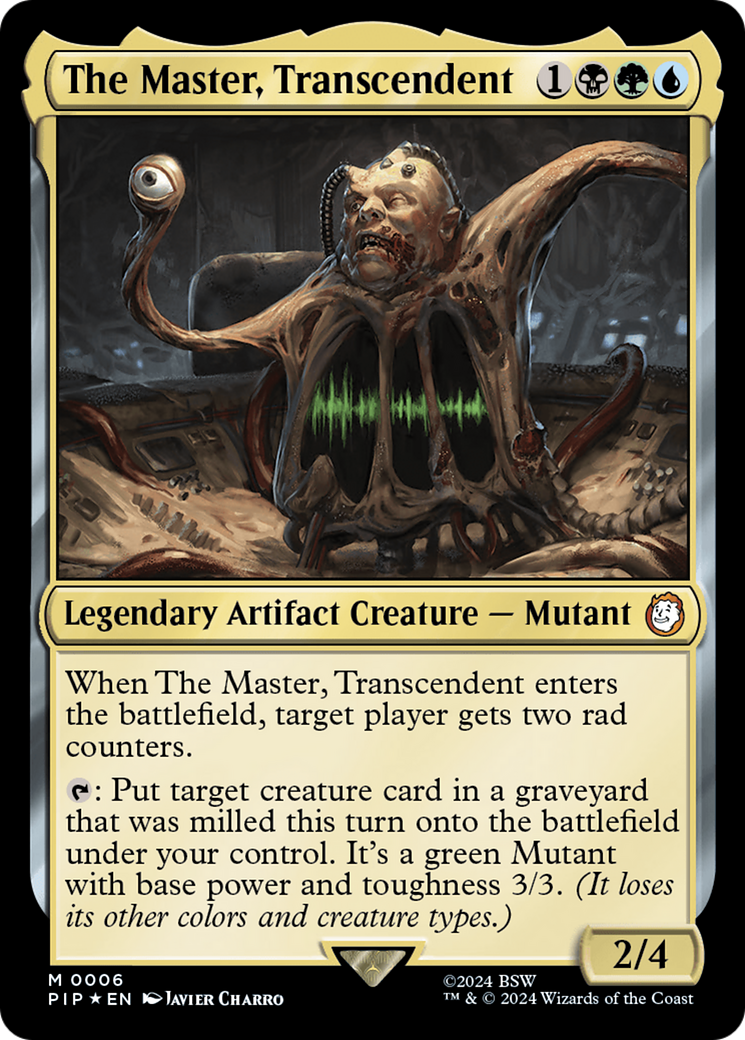
The Master, Transcendent
The Master, Transcendent
Legendary Artifact Creature — Mutant
2/4
When The Master enters, target player gets two rad counters.
: Put target creature card in a graveyard that was milled this turn onto the battlefield under your control. It's a green Mutant with base power and toughness 3/3. (It loses its other colors and creature types.)
- If a player is instructed to put a card into their graveyard from their library without using the word "mill," (by the effect of Rowan's Grim Search from Wilds of Eldraine®, for example), that card isn't a legal target for The Master's last ability.
- The Master's last ability will override any characteristic-defining abilities the creature has that set its power and/or toughness. For example, if you put a Robobrain War Mind onto the battlefield with The Master's last ability, its base power and toughness will be 3/3, and the number of cards in your hand won't affect its power at all.
- Effects that modify a creature's power and/or toughness will still apply to the creature as normal. The same is true for any counters that change its power and/or toughness.
- Rad counters are a kind of counter that a player may have. They're not associated with any specific permanents.
- Keep track of how many rad counters each player has. Potential ways to track this include writing them down on paper or using dice, but any method that is clear and mutually agreeable is fine.
- Rad counters don't go away as steps, phases, or turns end. They only go away when an effect instructs a player to remove rad counters from themselves.
- There is an inherent triggered ability associated with having rad counters. This triggered ability has no source and is controlled by the active player. The full text of this ability is "At the beginning of the precombat main phase of a player with rad counters, that player mills cards equal to the number of rad counters they have. For each nonland card milled this way, that player loses 1 life and removes one rad counter from themselves."
- In a game using the shared team turns option, such as an Archenemy or Two-Headed Giant game, the inherent triggered ability associated with rad counters triggers once for each player on the active team that has rad counters. Each instance of that ability is controlled by one of those players.
- Any effects (such as proliferate) that interact with counters a player gets, has, or loses can interact with rad counters.
- The cards are milled all at once, which means abilities that trigger "whenever one or more nonland cards are milled" will trigger exactly once as long as at least one nonland card was milled.
- If a player has fewer cards remaining in their library than the number of rad counters they have when the triggered ability resolves, they'll mill as many cards as they can.
-
1
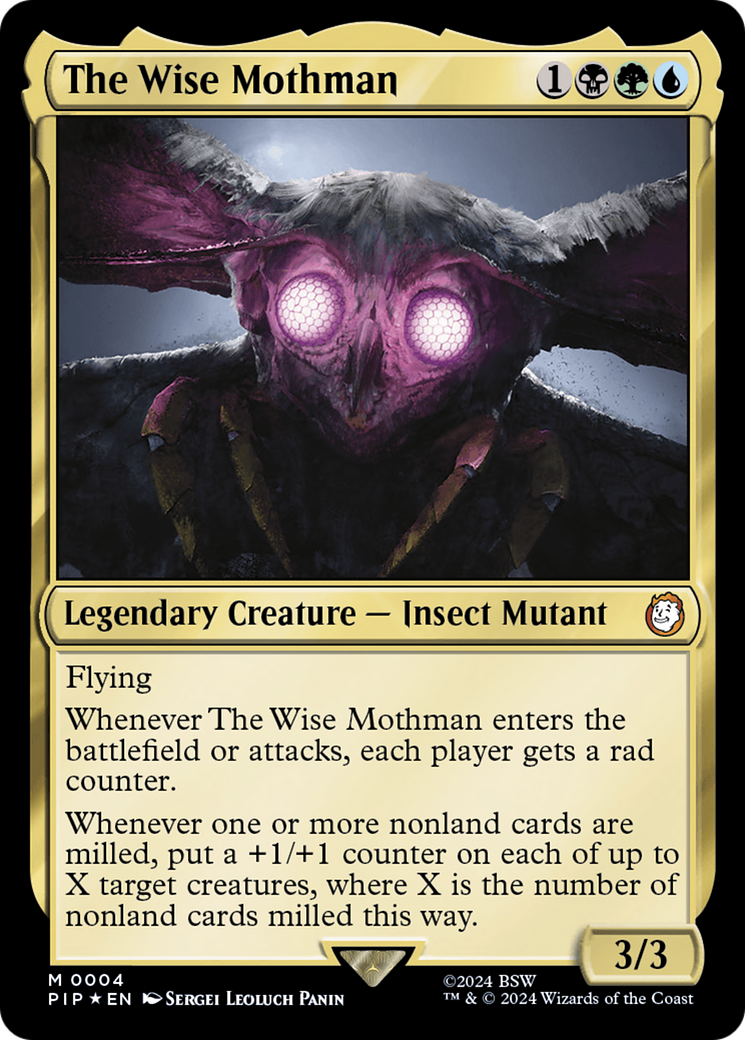
The Wise Mothman
The Wise Mothman
Legendary Creature — Insect Mutant
3/3
Flying
Whenever The Wise Mothman enters or attacks, each player gets a rad counter.
Whenever one or more nonland cards are milled, put a +1/+1 counter on each of up to X target creatures, where X is the number of nonland cards milled this way.
- If more than one player is instructed to mill at the same time (by the activated ability of Raul, Trouble Shooter, for example), as long as at least one nonland card is milled, The Wise Mothman’s last ability will trigger just once.
- Rad counters are a kind of counter that a player may have. They’re not associated with any specific permanents.
- Keep track of how many rad counters each player has. Potential ways to track this include writing them down on paper or using dice, but any method that is clear and mutually agreeable is fine.
- Rad counters don’t go away as steps, phases, or turns end. They only go away when an effect instructs a player to remove rad counters from themselves.
- There is an inherent triggered ability associated with having rad counters. This triggered ability has no source and is controlled by the active player. The full text of this ability is “At the beginning of the precombat main phase of a player with rad counters, that player mills cards equal to the number of rad counters they have. For each nonland card milled this way, that player loses 1 life and removes one rad counter from themselves.”
- In a game using the shared team turns option, such as an Archenemy or Two-Headed Giant game, the inherent triggered ability associated with rad counters triggers once for each player on the active team that has rad counters. Each instance of that ability is controlled by one of those players.
- Any effects (such as proliferate) that interact with counters a player gets, has, or loses can interact with rad counters.
- The cards are milled all at once, which means abilities that trigger “whenever one or more nonland cards are milled” will trigger exactly once as long as at least one nonland card was milled.
- If a player has fewer cards remaining in their library than the number of rad counters they have when the triggered ability resolves, they’ll mill as many cards as they can.
-
1
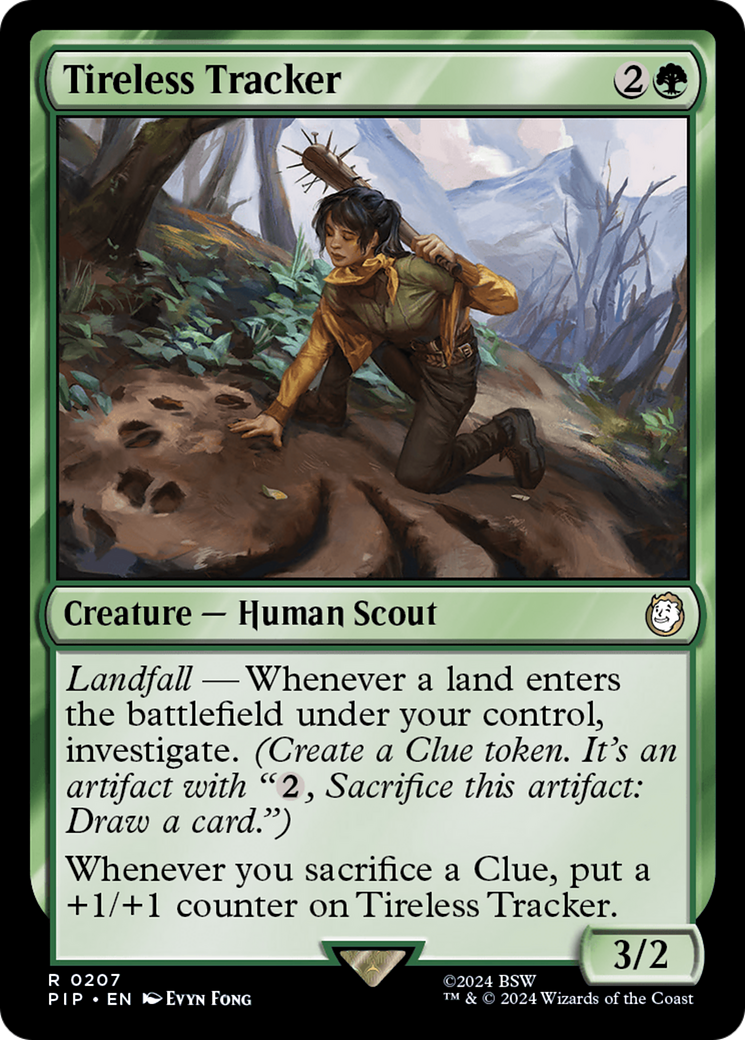
Tireless Tracker
Tireless Tracker
Creature — Human Scout
3/2
Landfall — Whenever a land you control enters, investigate. (Create a Clue token. It's an artifact with " , Sacrifice this token: Draw a card.")
Whenever you sacrifice a Clue, put a +1/+1 counter on this creature.
- A landfall ability triggers whenever a land you control enters for any reason. It triggers whenever you play a land, as well as whenever a spell or ability puts a land onto the battlefield under your control.
- Whenever a land you control enters, each landfall ability of the permanents you control will trigger. You can put them on the stack in any order. The last ability you put on the stack will be the first one to resolve (As a result, you can have those abilities resolve in the order of your choosing.).
- A landfall ability doesn't trigger if a permanent already on the battlefield becomes a land.
- Some spells and abilities that investigate may require targets. If each target chosen is an illegal target as that spell or ability tries to resolve, it won't resolve. You won't create any Clue tokens.
- Some abilities trigger "whenever you sacrifice a Clue". Those abilities trigger whenever you sacrifice a Clue for any reason, not just to activate a Clue's activated ability.
- You can't sacrifice a Clue to pay multiple costs. For example, you can't sacrifice a Clue token to activate its own ability and also to activate Alquist Proft, Master Sleuth's ability.
- Clue is an artifact type. Even though it appears on some cards with other permanent types, it's never a creature type, a land type, or anything but an artifact type.
- If an effect refers to a Clue, it means any Clue artifact, not just a Clue artifact token. For example, you can sacrifice Wrench to pay for Alquist Proft, Master Sleuth's activated ability.
- Clue is an artifact type. Even though it appears on some cards with other permanent types, it's never a creature type, a land type, or anything but an artifact type.
- You can't sacrifice a Clue to pay multiple costs. For example, you can't sacrifice a Clue token to activate its own ability and also to activate Alquist Proft, Master Sleuth's ability.
- If an effect refers to a Clue, it means any Clue artifact, not just a Clue artifact token. For example, you can sacrifice Wrench to pay for Alquist Proft, Master Sleuth's activated ability.
-
1
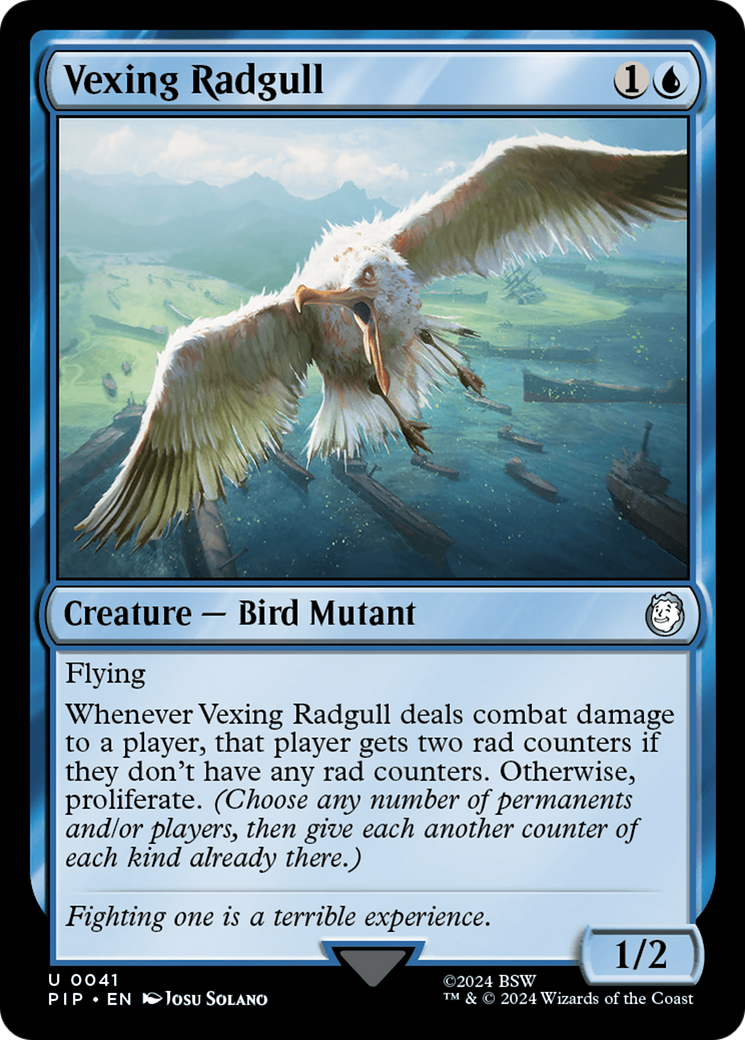
Vexing Radgull
Vexing Radgull
Creature — Bird Mutant
1/2
Flying
Whenever this creature deals combat damage to a player, that player gets two rad counters if they don't have any rad counters. Otherwise, proliferate. (Choose any number of permanents and/or players, then give each another counter of each kind already there.)
- Rad counters are a kind of counter that a player may have. They’re not associated with any specific permanents.
- Keep track of how many rad counters each player has. Potential ways to track this include writing them down on paper or using dice, but any method that is clear and mutually agreeable is fine.
- Rad counters don’t go away as steps, phases, or turns end. They only go away when an effect instructs a player to remove rad counters from themselves.
- There is an inherent triggered ability associated with having rad counters. This triggered ability has no source and is controlled by the active player. The full text of this ability is “At the beginning of the precombat main phase of a player with rad counters, that player mills cards equal to the number of rad counters they have. For each nonland card milled this way, that player loses 1 life and removes one rad counter from themselves.”
- In a game using the shared team turns option, such as an Archenemy or Two-Headed Giant game, the inherent triggered ability associated with rad counters triggers once for each player on the active team that has rad counters. Each instance of that ability is controlled by one of those players.
- Any effects (such as proliferate) that interact with counters a player gets, has, or loses can interact with rad counters.
- The cards are milled all at once, which means abilities that trigger “whenever one or more nonland cards are milled” will trigger exactly once as long as at least one nonland card was milled.
- If a player has fewer cards remaining in their library than the number of rad counters they have when the triggered ability resolves, they’ll mill as many cards as they can.
- You can choose any permanent that has a counter, including ones controlled by opponents. You can choose any player who has a counter, including opponents. You can’t choose cards in any zone other than the battlefield, even if they have counters on them.
- You don’t have to choose every permanent or player that has a counter—only the ones you want to add counters to. Since “any number” includes zero, you don’t have to choose any permanents at all, and you don’t have to choose any players at all.
- If a player or permanent has more than one kind of counter on it, and you choose for it to get additional counters, it must get one of each kind of counter it already has. You can’t have it get just one kind of counter it already has and not the others.
- Players can respond to a spell or ability whose effect includes proliferating. Once that spell or ability starts to resolve, however, and its controller chooses which permanents and players will get new counters, it’s too late for anyone to respond.
- Some spells and abilities that cause you to proliferate may require targets. If each target chosen is an illegal target as that spell or ability tries to resolve, it won’t resolve. You won’t proliferate.
-
1
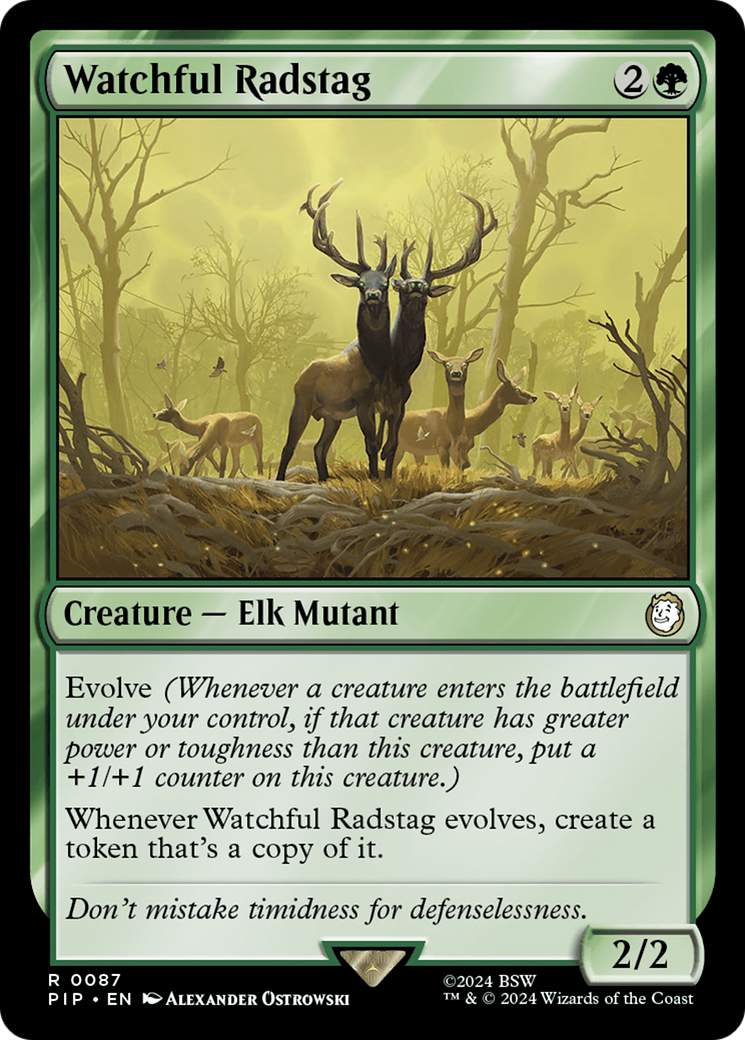
Watchful Radstag
Watchful Radstag
Creature — Elk Mutant
2/2
Evolve (Whenever a creature you control enters, if that creature has greater power or toughness than this creature, put a +1/+1 counter on this creature.)
Whenever this creature evolves, create a token that's a copy of it.
- When comparing the stats of the two creatures for evolve, you always compare power to power and toughness to toughness.
- Whenever a creature enters the battlefield under your control, check its power and toughness against the power and toughness of the creature with evolve. If neither stat of the new creature is greater, evolve won’t trigger at all.
- If evolve triggers, the stat comparison will happen again when the ability tries to resolve. If neither stat of the new creature is greater, the ability will do nothing. If the creature that entered the battlefield leaves the battlefield before evolve tries to resolve, use its last known power and toughness to compare the stats.
- If a creature enters the battlefield with +1/+1 counters on it, consider those counters when determining if evolve will trigger. For example, a 1/1 creature that enters the battlefield with two +1/+1 counters on it will cause the evolve ability of a 2/2 creature to trigger.
- If multiple creatures enter the battlefield at the same time, evolve may trigger multiple times, although the stat comparison will take place each time one of those abilities tries to resolve. For example, if you control a 2/2 creature with evolve and two 3/3 creatures enter the battlefield, evolve will trigger twice. The first ability will resolve and put a +1/+1 counter on the creature with evolve. When the second ability tries to resolve, neither the power nor the toughness of the new creature is greater than that of the creature with evolve, so that ability does nothing.
- When comparing the stats as the evolve ability resolves, it’s possible that the stat that’s greater changes from power to toughness or vice versa. If this happens, the ability will still resolve and you’ll put a +1/+1 counter on the creature with evolve. For example, if you control a 2/2 creature with evolve and a 1/3 creature enters the battlefield under your control, its toughness is greater, so evolve will trigger. In response, the 1/3 creature gets +2/-2. When the evolve trigger tries to resolve, its power is greater. You’ll put a +1/+1 counter on the creature with evolve.
- Watchful Radstag “evolves” when its evolve ability resolves and a +1/+1 counter is put on it. If a replacement effect causes the evolve ability to put more than one +1/+1 counter on Watchful Radstag, its last ability triggers only once. If no +1/+1 counter is put on it (perhaps because it left the battlefield while its evolve ability was still on the stack), then its last ability doesn’t trigger.
- Watchful Radstag’s last ability won’t trigger if a +1/+1 counter is put on it for any reason other than its evolve ability resolving.
- The token copy will have Watchful Radstag’s abilities. It will also be able to create copies of itself.
- The token copy won’t copy counters or damage marked on Watchful Radstag, nor will it copy other effects that have changed Watchful Radstag’s power, toughness, types, color, and so on. Normally, this means the token will simply be a Watchful Radstag, but if any copy effects have affected the original Watchful Radstag, the token will take those into account.
- If Watchful Radstag leaves the battlefield before its last ability resolves, the token will still enter the battlefield as a copy of Watchful Radstag, using Watchful Radstag’s copiable values from when it was last on the battlefield.
- Rad counters are a kind of counter that a player may have. They’re not associated with any specific permanents.
- Keep track of how many rad counters each player has. Potential ways to track this include writing them down on paper or using dice, but any method that is clear and mutually agreeable is fine.
- Rad counters don’t go away as steps, phases, or turns end. They only go away when an effect instructs a player to remove rad counters from themselves.
- There is an inherent triggered ability associated with having rad counters. This triggered ability has no source and is controlled by the active player. The full text of this ability is “At the beginning of the precombat main phase of a player with rad counters, that player mills cards equal to the number of rad counters they have. For each nonland card milled this way, that player loses 1 life and removes one rad counter from themselves.”
- In a game using the shared team turns option, such as an Archenemy or Two-Headed Giant game, the inherent triggered ability associated with rad counters triggers once for each player on the active team that has rad counters. Each instance of that ability is controlled by one of those players.
- Any effects (such as proliferate) that interact with counters a player gets, has, or loses can interact with rad counters.
- The cards are milled all at once, which means abilities that trigger “whenever one or more nonland cards are milled” will trigger exactly once as long as at least one nonland card was milled.
- If a player has fewer cards remaining in their library than the number of rad counters they have when the triggered ability resolves, they’ll mill as many cards as they can.
-
1
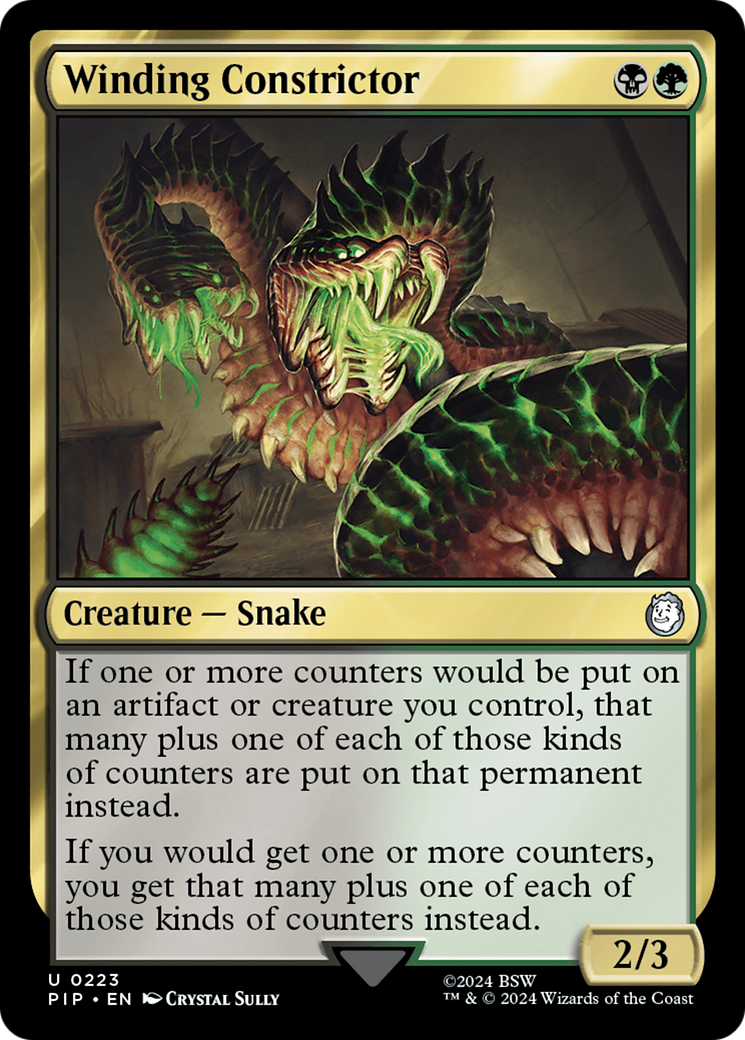
Winding Constrictor
Winding Constrictor
Creature — Snake
2/3
If one or more counters would be put on an artifact or creature you control, that many plus one of each of those kinds of counters are put on that permanent instead.
If you would get one or more counters, you get that many plus one of each of those kinds of counters instead.
- If a nonartifact, noncreature permanent (such as a planeswalker) would enter the battlefield with counters on it and become an artifact or a creature on the battlefield due to another card's effect (such as that of Mycosynth Lattice), Winding Constrictor's effect will give that permanent another of those counters.
- If an artifact or creature you control would enter the battlefield with a number of any kind of counters on it, it enters with that many plus one instead.
- If an effect includes multiple instructions to put one or more counters on an artifact or creature, such as Lifecrafter's Gift does, Winding Constrictor's effect applies to each of those instructions.
- If you control two Winding Constrictors, the number of counters placed on the artifact or creature is the original number plus two. Three Winding Constrictors adds three to the original number, and so on.
- If you would get counters of multiple kinds at the same time, Winding Constrictor increases the number of each of those kinds of counters by one. The same is true if counters of multiple kinds would be placed on an artifact or creature you control.
- Winding Constrictor's effect can't apply to itself as it's entering the battlefield or to any other permanent entering the battlefield at the same time as it.
-
1
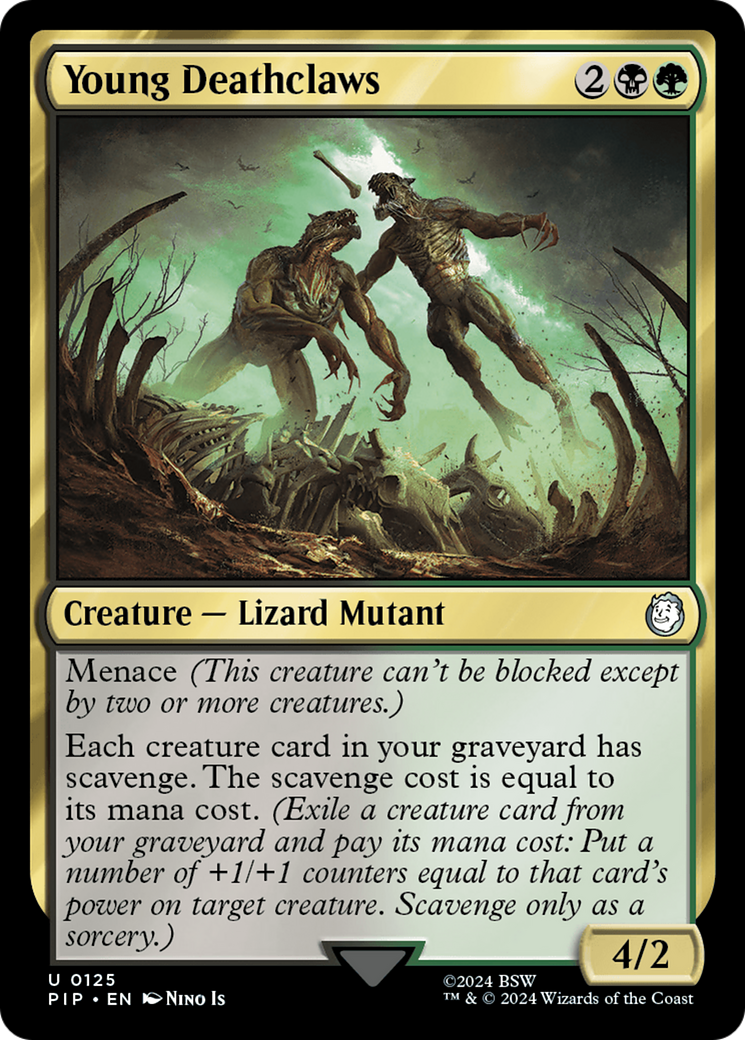
Young Deathclaws
Young Deathclaws
Creature — Lizard Mutant
4/2
Menace (This creature can't be blocked except by two or more creatures.)
Each creature card in your graveyard has scavenge. The scavenge cost is equal to its mana cost. (Exile a creature card from your graveyard and pay its mana cost: Put a number of +1/+1 counters equal to that card's power on target creature. Scavenge only as a sorcery.)
- Exiling the creature card with scavenge is part of the cost of activating the scavenge ability. Once the ability is activated and the cost is paid, it’s too late to stop the ability from being activated by trying to remove the creature card from the graveyard.
- While Young Deathclaws is on the battlefield, the scavenge cost of a creature card in your graveyard is equal to its mana cost, including any colored mana requirements.
- The number of counters that a card’s scavenge ability puts on a creature is based on the card’s power as it last existed in the graveyard.
- If the creature card you scavenge has in its mana cost, X is 0.
- If a creature card has multiple instances of scavenge, you can activate either ability (but not both, as the card will be exiled when you activate one of them). Young Deathclaws’s ability doesn’t affect the scavenge cost of a creature’s other scavenge ability.
Instants 7
-
1
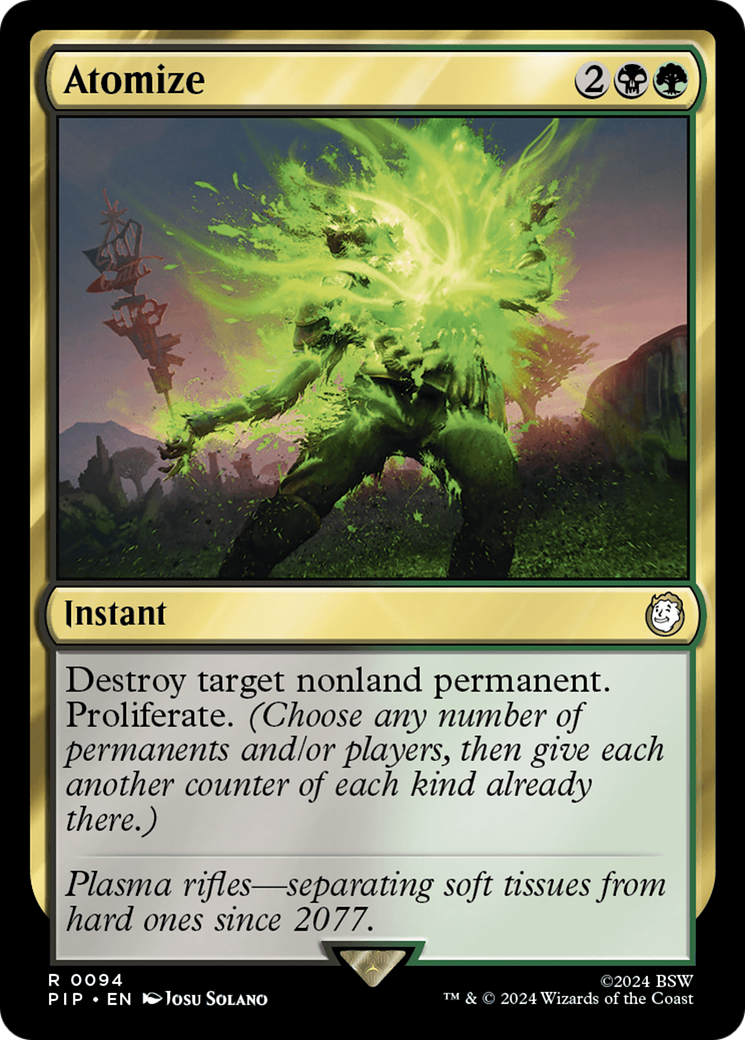
Atomize
Atomize
Instant
Destroy target nonland permanent. Proliferate. (Choose any number of permanents and/or players, then give each another counter of each kind already there.)
- You can choose any permanent that has a counter, including ones controlled by opponents. You can choose any player who has a counter, including opponents. You can’t choose cards in any zone other than the battlefield, even if they have counters on them.
- You don’t have to choose every permanent or player that has a counter—only the ones you want to add counters to. Since “any number” includes zero, you don’t have to choose any permanents at all, and you don’t have to choose any players at all.
- If a player or permanent has more than one kind of counter on it, and you choose for it to get additional counters, it must get one of each kind of counter it already has. You can’t have it get just one kind of counter it already has and not the others.
- Players can respond to a spell or ability whose effect includes proliferating. Once that spell or ability starts to resolve, however, and its controller chooses which permanents and players will get new counters, it’s too late for anyone to respond.
- Some spells and abilities that cause you to proliferate may require targets. If each target chosen is an illegal target as that spell or ability tries to resolve, it won’t resolve. You won’t proliferate.
-
1
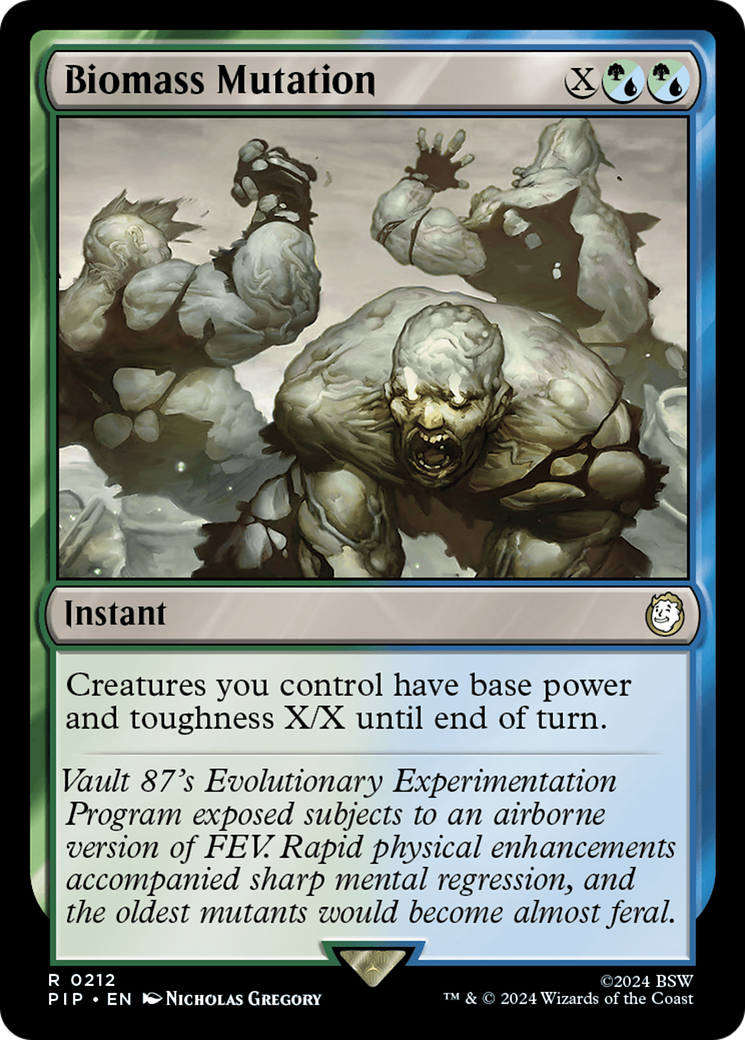
Biomass Mutation
Biomass Mutation
Instant
Creatures you control have base power and toughness X/X until end of turn.
- Choosing 0 as the value for X will likely cause creatures you control to become 0/0 and be put into the graveyard.
- Biomass Mutation overwrites any effects that set the power and/or toughness of a creature you control to a specific value. Effects that modify power and/or toughness but don't set them to a specific value (like the one created by Giant Growth), power/toughness changes from counters, and effects that switch a creature's power and toughness will continue to apply. For example, say you control a 1/1 creature that's getting +4/+2 from an Aura, has a +1/+1 counter on it, and is affected by an effect that switches its power and toughness. This creature is 4/6. If you cast Biomass Mutation with X equal to 4, the creature would become 7/9 (4/4, +4/+2 from the Aura, +1/+1 from the counter, then switch power and toughness).
-
1
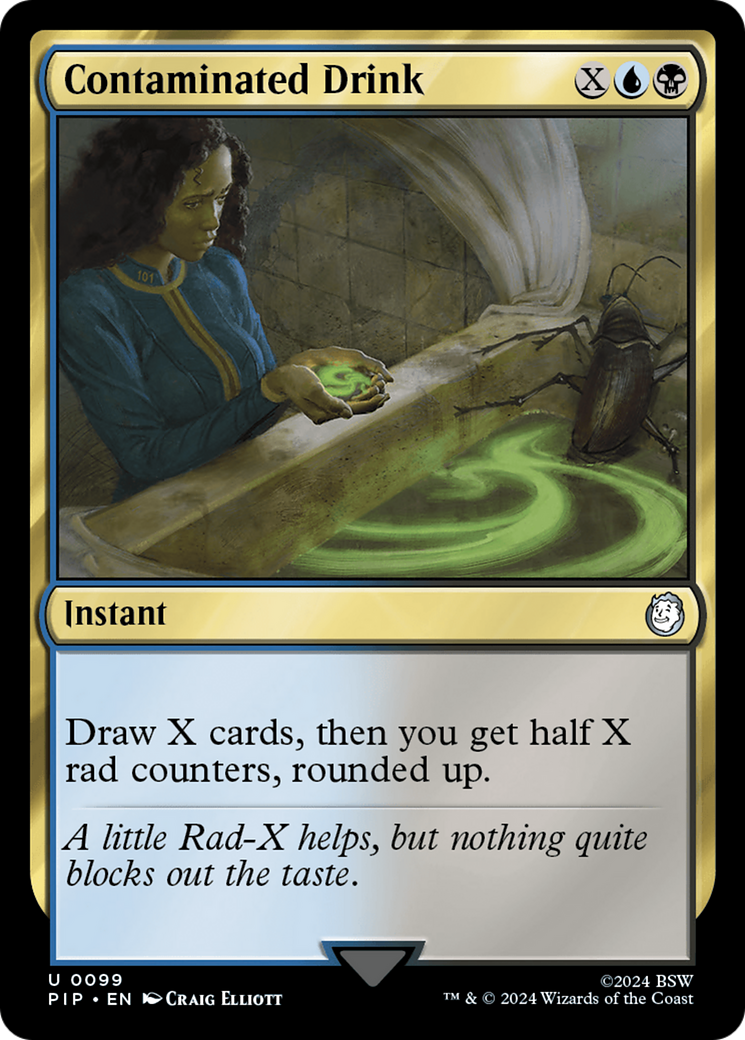
Contaminated Drink
Contaminated Drink
Instant
Draw X cards, then you get half X rad counters, rounded up.
- Rad counters are a kind of counter that a player may have. They’re not associated with any specific permanents.
- Keep track of how many rad counters each player has. Potential ways to track this include writing them down on paper or using dice, but any method that is clear and mutually agreeable is fine.
- Rad counters don’t go away as steps, phases, or turns end. They only go away when an effect instructs a player to remove rad counters from themselves.
- There is an inherent triggered ability associated with having rad counters. This triggered ability has no source and is controlled by the active player. The full text of this ability is “At the beginning of the precombat main phase of a player with rad counters, that player mills cards equal to the number of rad counters they have. For each nonland card milled this way, that player loses 1 life and removes one rad counter from themselves.”
- In a game using the shared team turns option, such as an Archenemy or Two-Headed Giant game, the inherent triggered ability associated with rad counters triggers once for each player on the active team that has rad counters. Each instance of that ability is controlled by one of those players.
- Any effects (such as proliferate) that interact with counters a player gets, has, or loses can interact with rad counters.
- The cards are milled all at once, which means abilities that trigger “whenever one or more nonland cards are milled” will trigger exactly once as long as at least one nonland card was milled.
- If a player has fewer cards remaining in their library than the number of rad counters they have when the triggered ability resolves, they’ll mill as many cards as they can.
-
1
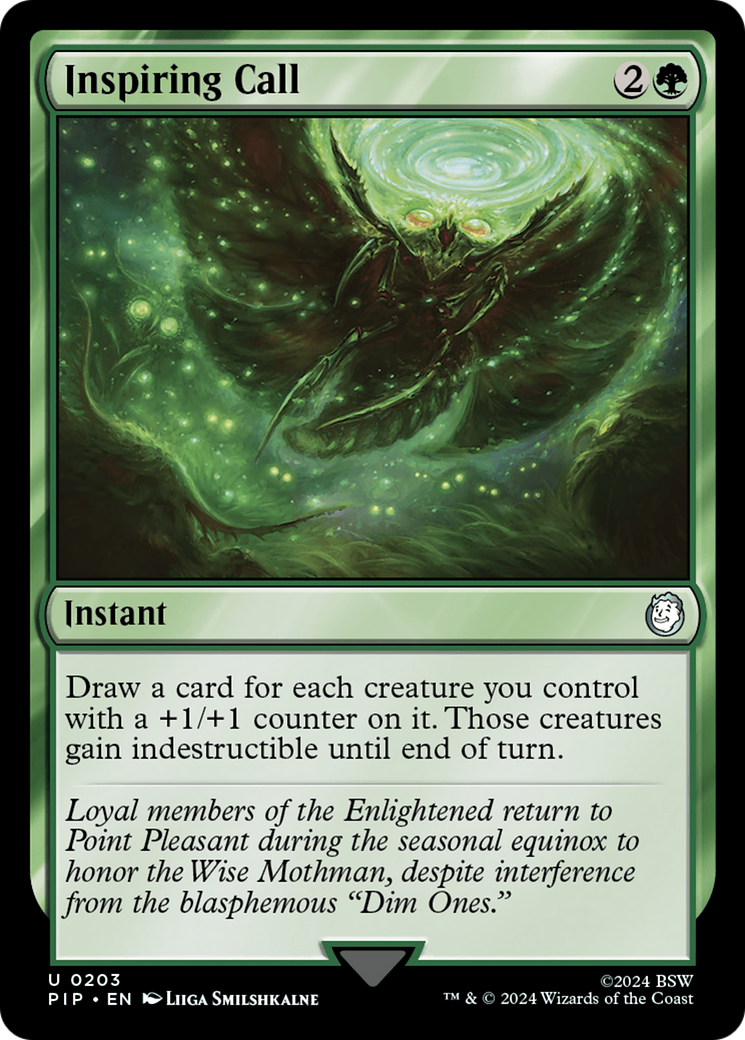
Inspiring Call
Inspiring Call
Instant
Draw a card for each creature you control with a +1/+1 counter on it. Those creatures gain indestructible until end of turn. (Damage and effects that say "destroy" don't destroy them.)
- Creatures you control that have +1/+1 counters put on them after Inspiring Call resolves won't gain indestructible.
- Once a creature gains indestructible, it will have it for the turn, even if it loses all its +1/+1 counters.
-
1
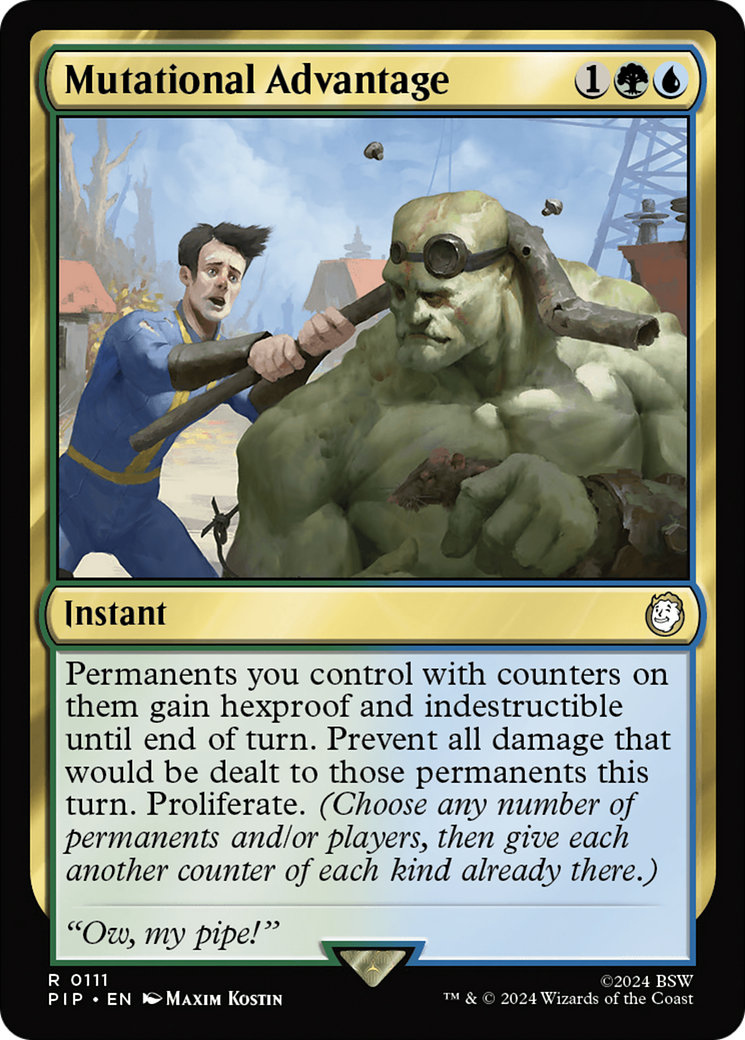
Mutational Advantage
Mutational Advantage
Instant
Permanents you control with counters on them gain hexproof and indestructible until end of turn. Prevent all damage that would be dealt to those permanents this turn. Proliferate. (Choose any number of permanents and/or players, then give each another counter of each kind already there.)
- The set of permanents affected by Mutational Advantage is determined at the time Mutational Advantage resolves. Permanents that gain counters later in the turn won’t become affected by this effect, and permanents that lose all of their counters later in the turn won’t stop being affected.
- You can choose any permanent that has a counter, including ones controlled by opponents. You can choose any player who has a counter, including opponents. You can’t choose cards in any zone other than the battlefield, even if they have counters on them.
- You don’t have to choose every permanent or player that has a counter—only the ones you want to add counters to. Since “any number” includes zero, you don’t have to choose any permanents at all, and you don’t have to choose any players at all.
- If a player or permanent has more than one kind of counter on it, and you choose for it to get additional counters, it must get one of each kind of counter it already has. You can’t have it get just one kind of counter it already has and not the others.
- Players can respond to a spell or ability whose effect includes proliferating. Once that spell or ability starts to resolve, however, and its controller chooses which permanents and players will get new counters, it’s too late for anyone to respond.
- Some spells and abilities that cause you to proliferate may require targets. If each target chosen is an illegal target as that spell or ability tries to resolve, it won’t resolve. You won’t proliferate.
-
1
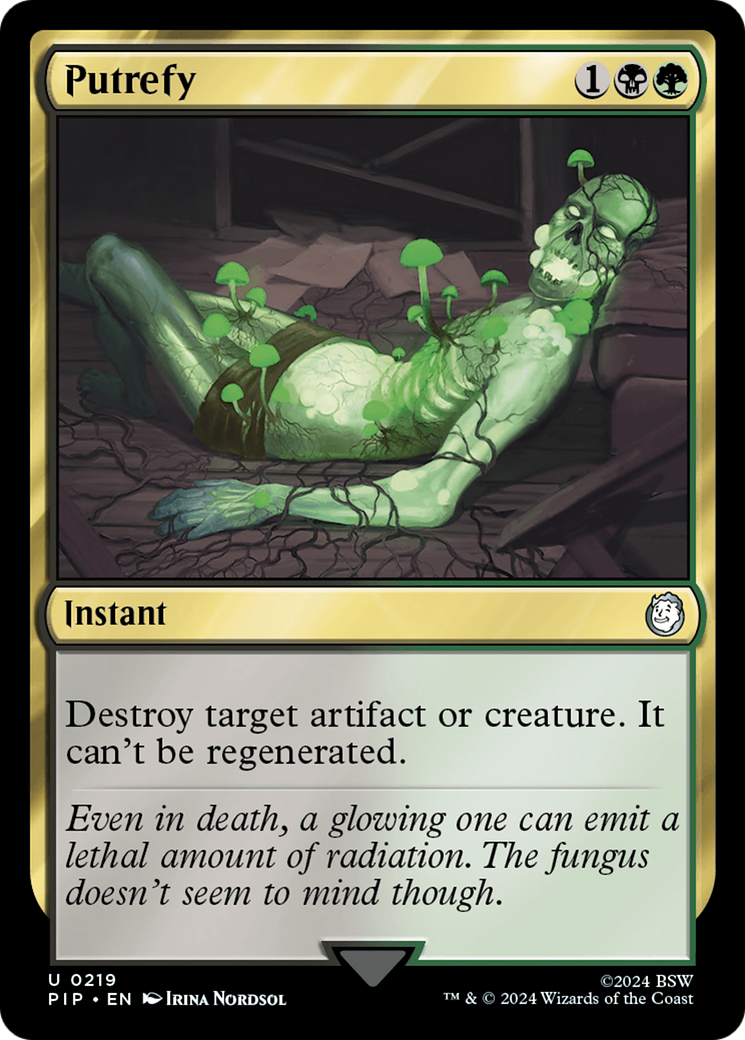
Putrefy
Putrefy
Instant
Destroy target artifact or creature. It can't be regenerated.
- This spell isn't modal. When it resolves, it will destroy the target if it's a creature or an artifact, even if it changed from one to the other between targeting and resolution.
-
1
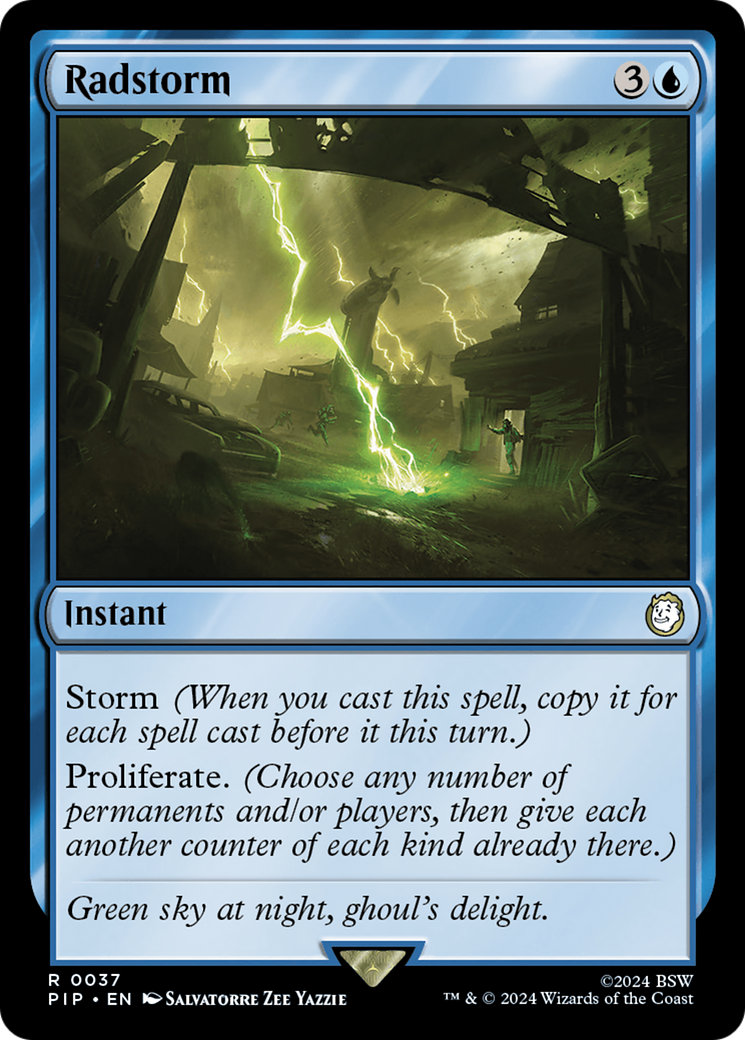
Radstorm
Radstorm
Instant
Storm (When you cast this spell, copy it for each spell cast before it this turn.)
Proliferate. (Choose any number of permanents and/or players, then give each another counter of each kind already there.)
- The copies of Radstorm created by its storm ability are put directly onto the stack. They aren’t cast and won’t be counted by other spells with storm cast later in the turn.
- Spells cast from zones other than a player’s hand and spells that were countered or otherwise failed to resolve are counted by the storm ability.
- A copy of a spell can be countered like any other spell, but it must be countered individually. Countering a spell with storm won’t affect the copies.
- You can choose any permanent that has a counter, including ones controlled by opponents. You can choose any player who has a counter, including opponents. You can’t choose cards in any zone other than the battlefield, even if they have counters on them.
- You don’t have to choose every permanent or player that has a counter—only the ones you want to add counters to. Since “any number” includes zero, you don’t have to choose any permanents at all, and you don’t have to choose any players at all.
- If a player or permanent has more than one kind of counter on it, and you choose for it to get additional counters, it must get one of each kind of counter it already has. You can’t have it get just one kind of counter it already has and not the others.
- Players can respond to a spell or ability whose effect includes proliferating. Once that spell or ability starts to resolve, however, and its controller chooses which permanents and players will get new counters, it’s too late for anyone to respond.
- Some spells and abilities that cause you to proliferate may require targets. If each target chosen is an illegal target as that spell or ability tries to resolve, it won’t resolve. You won’t proliferate.
Sorceries 7
-
1
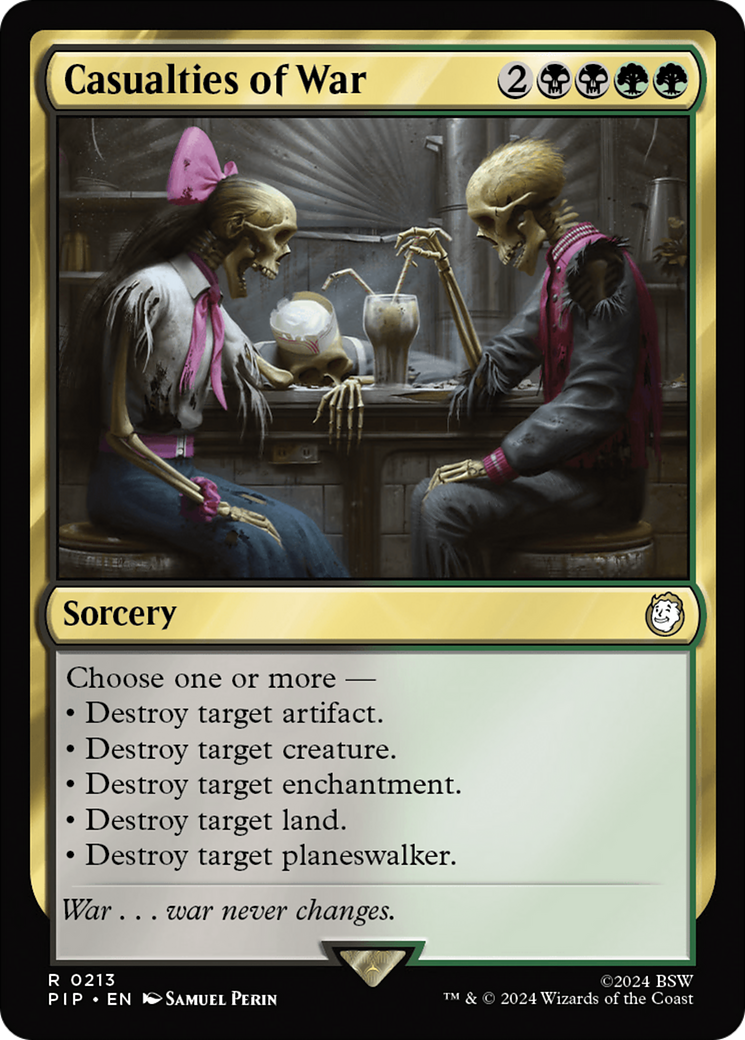
Casualties of War
Casualties of War
Sorcery
Choose one or more —
- Destroy target artifact.
- Destroy target creature.
- Destroy target enchantment.
- Destroy target land.
- Destroy target planeswalker.
- Each target permanent is destroyed in the order specified. Abilities that trigger when one is destroyed won't be put onto the stack until Casualties of War has finished resolving.
- You can choose any number of the modes for Casualties of War, but you can't choose a mode more than once.
-
1
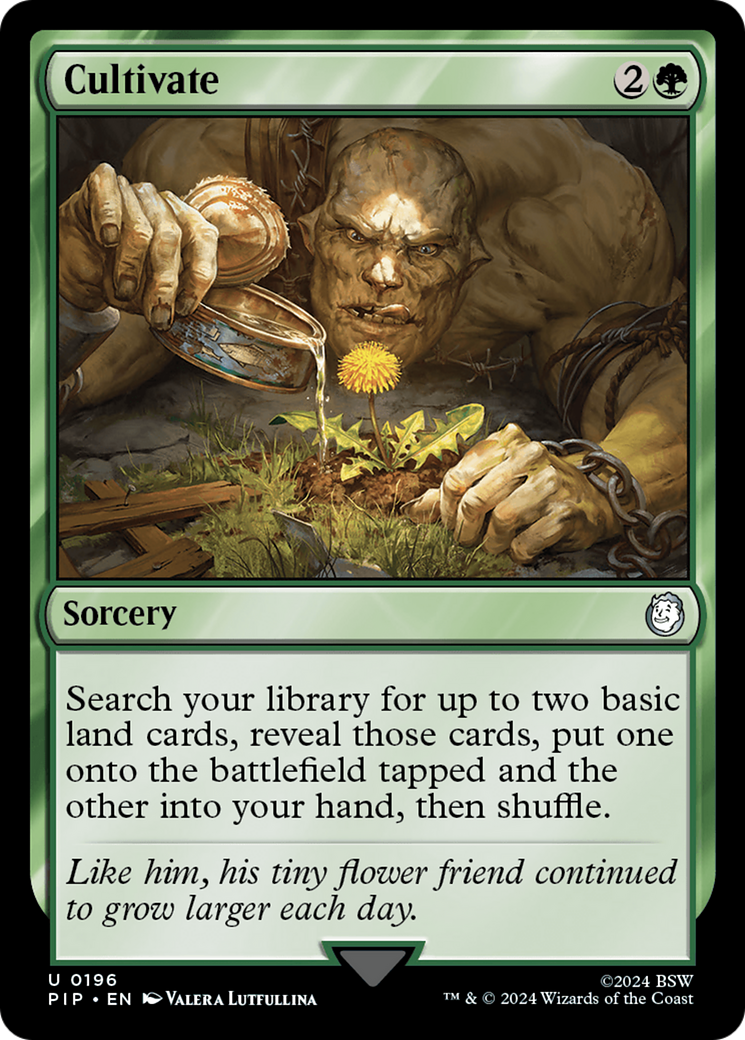
Cultivate
Cultivate
Sorcery
Search your library for up to two basic land cards, reveal those cards, put one onto the battlefield tapped and the other into your hand, then shuffle.
- If you choose to find only one basic land card, you put it onto the battlefield tapped.
-
1
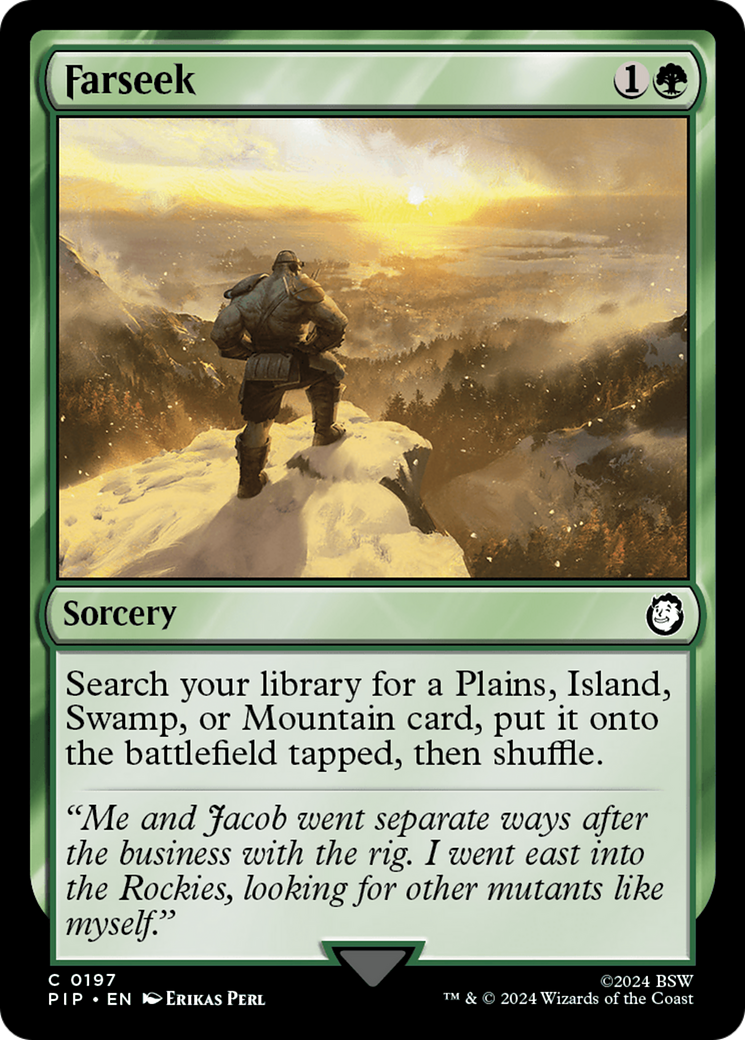
Farseek
Farseek
Sorcery
Search your library for a Plains, Island, Swamp, or Mountain card, put it onto the battlefield tapped, then shuffle.
- Farseek can find any land with any of the listed land types, including nonbasic ones, even if that land is a Forest in addition to one or more of those types.
-
1
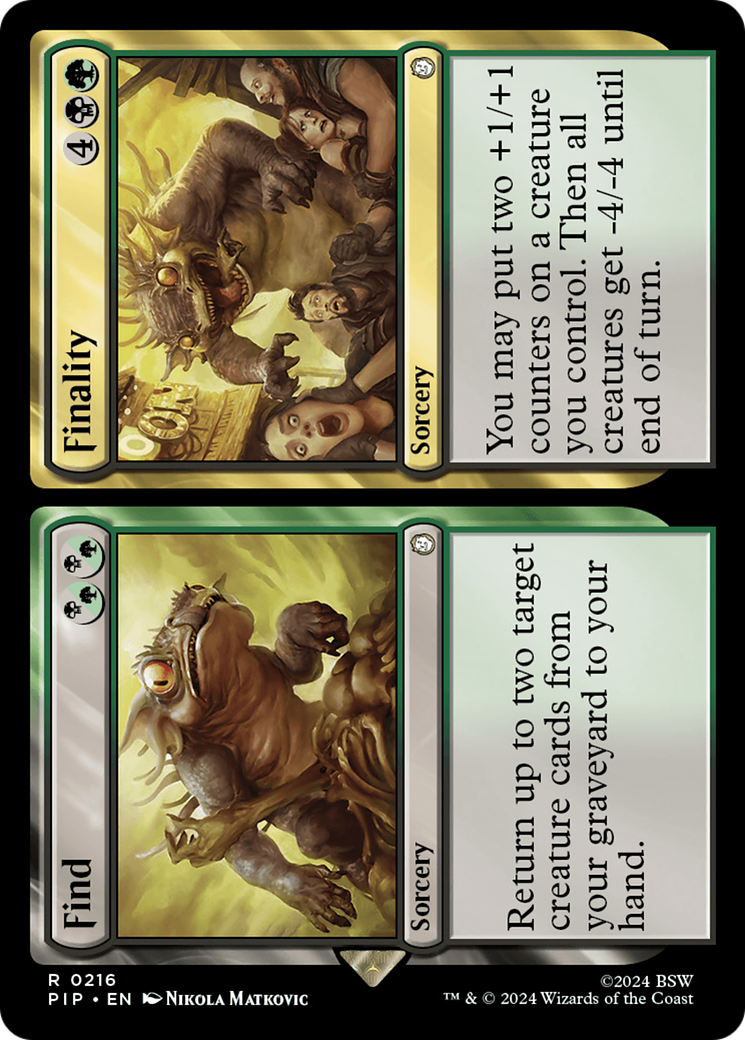
Find // Finality
//
Find
Sorcery
- To cast a split card, choose one of its halves to cast. There's no way to cast both halves of this split card.
- Split cards have two card faces on a single card. The characteristics of the half you didn't cast are ignored while the spell is on the stack.
- Each split card is a single card. For example, if you discard a split card, you've discarded one card, not two. If an effect counts the number of sorcery cards in your graveyard, Assault // Battery counts once, not twice.
- Each split card has two names. If an effect instructs you to choose a card name, you may choose one of those names, but not both.
- A split card's characteristics are a combination of its two halves while it is not on the stack. For example, Assault // Battery has a mana value of 5 while it is in your library. If an effect allows you to search your library for a card with mana value 4 or less, you can't find Assault // Battery.
- If an effect allows you to cast a spell with certain characteristics, consider only the characteristics of the half you're casting. For example, if an effect allows you to cast a sorcery spell with mana value 2 or less from among cards in your graveyard, you could cast Assault this way, but not Battery.
- If you copy a spell that's half of a split card, the copy copies that same half. For example, if you copy Assault, the copy is also Assault, not Battery.
- Finality doesn't target the creature to receive +1/+1 counters. You can cast it even if you control no creatures.
- Finality affects only creatures on the battlefield at the time it resolves. Creatures that enter the battlefield later in the turn won't get -4/-4.
-
1
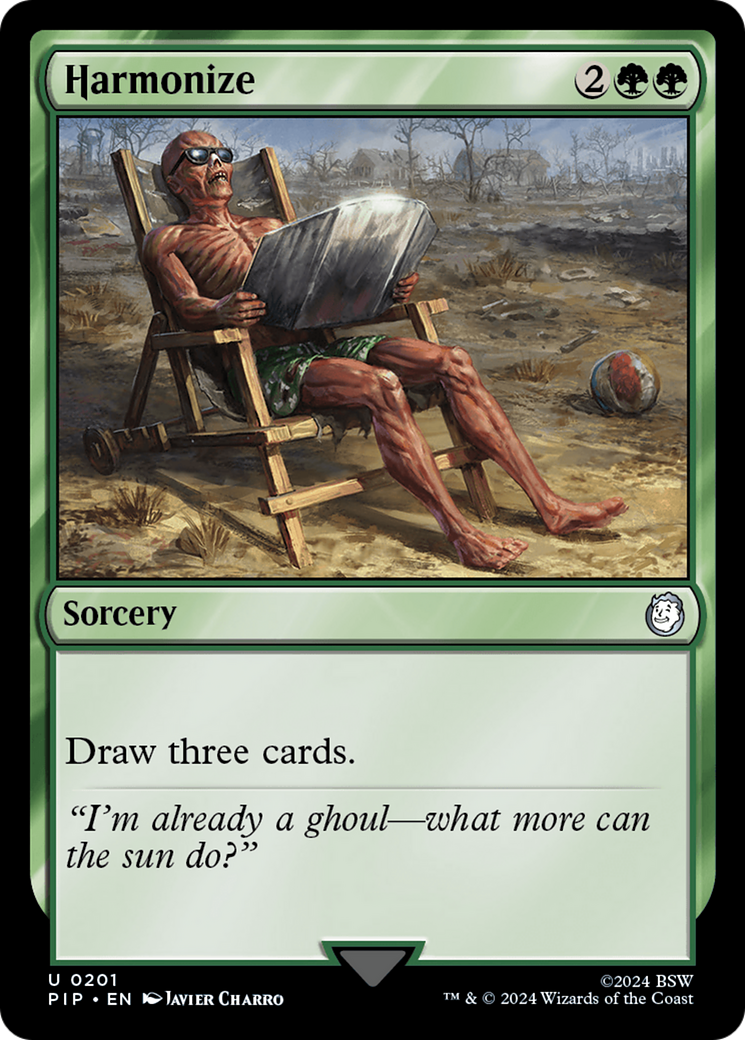
Harmonize
Harmonize
Sorcery
Draw three cards.
-
1
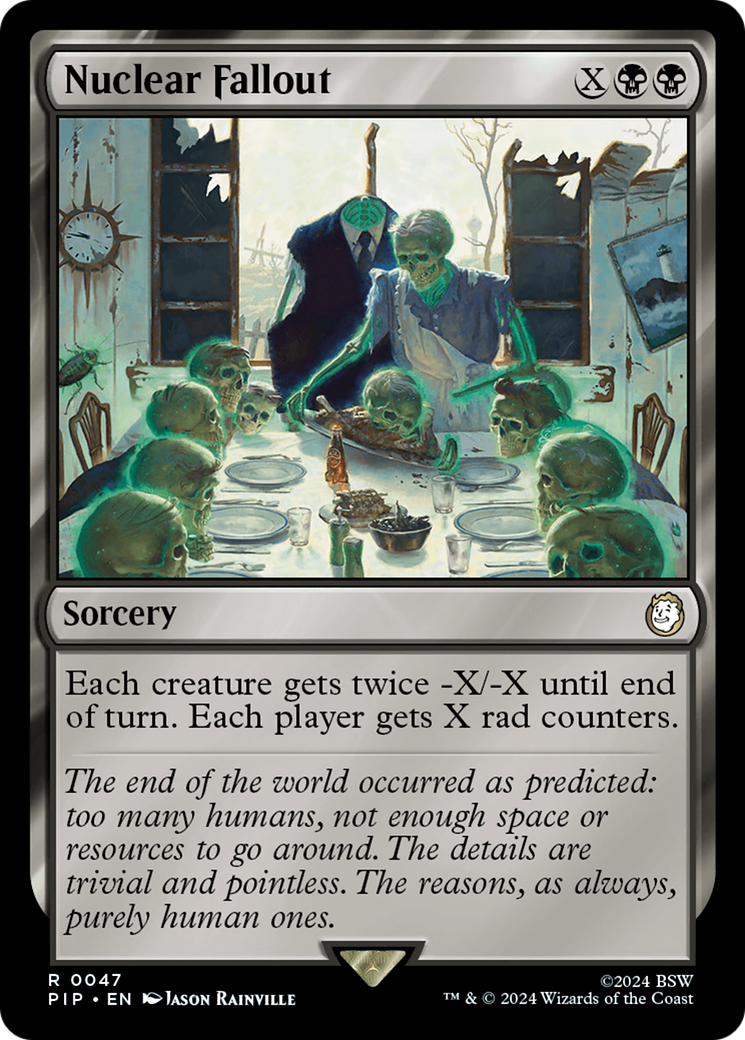
Nuclear Fallout
Nuclear Fallout
Sorcery
Each creature gets twice -X/-X until end of turn. Each player gets X rad counters.
- Rad counters are a kind of counter that a player may have. They’re not associated with any specific permanents.
- Keep track of how many rad counters each player has. Potential ways to track this include writing them down on paper or using dice, but any method that is clear and mutually agreeable is fine.
- Rad counters don’t go away as steps, phases, or turns end. They only go away when an effect instructs a player to remove rad counters from themselves.
- There is an inherent triggered ability associated with having rad counters. This triggered ability has no source and is controlled by the active player. The full text of this ability is “At the beginning of the precombat main phase of a player with rad counters, that player mills cards equal to the number of rad counters they have. For each nonland card milled this way, that player loses 1 life and removes one rad counter from themselves.”
- In a game using the shared team turns option, such as an Archenemy or Two-Headed Giant game, the inherent triggered ability associated with rad counters triggers once for each player on the active team that has rad counters. Each instance of that ability is controlled by one of those players.
- Any effects (such as proliferate) that interact with counters a player gets, has, or loses can interact with rad counters.
- The cards are milled all at once, which means abilities that trigger “whenever one or more nonland cards are milled” will trigger exactly once as long as at least one nonland card was milled.
- If a player has fewer cards remaining in their library than the number of rad counters they have when the triggered ability resolves, they’ll mill as many cards as they can.
-
1
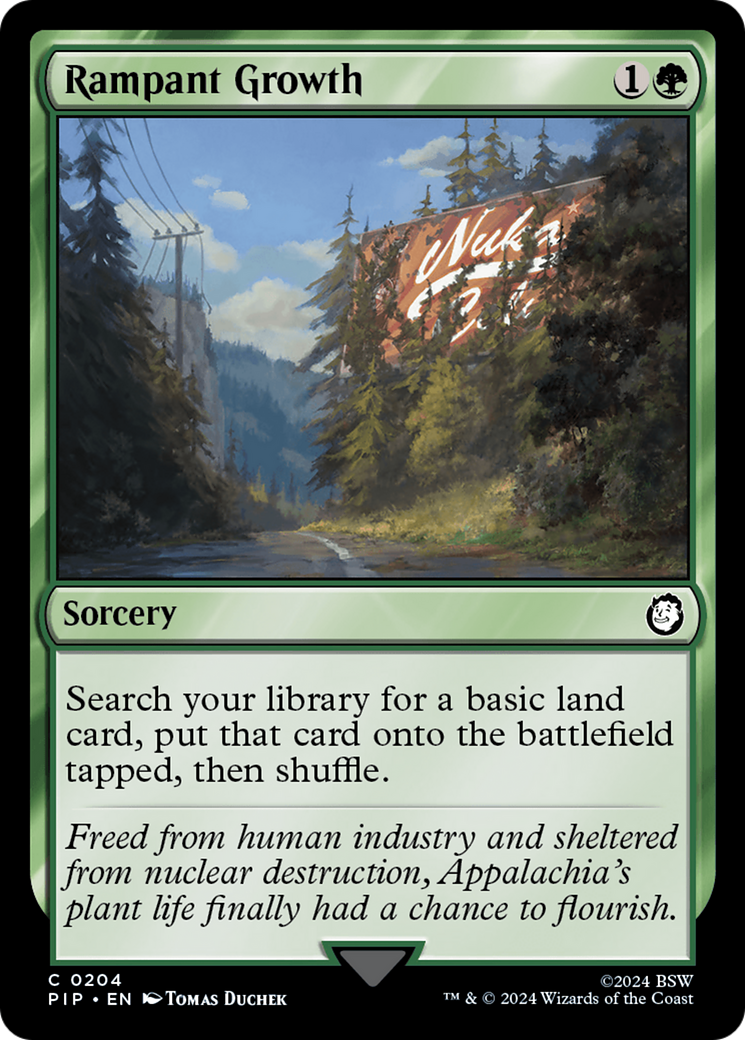
Rampant Growth
Rampant Growth
Sorcery
Search your library for a basic land card, put that card onto the battlefield tapped, then shuffle.
- The land does not count toward your one per turn limit because it was put onto the battlefield by an effect.
Artifacts 10
-
1
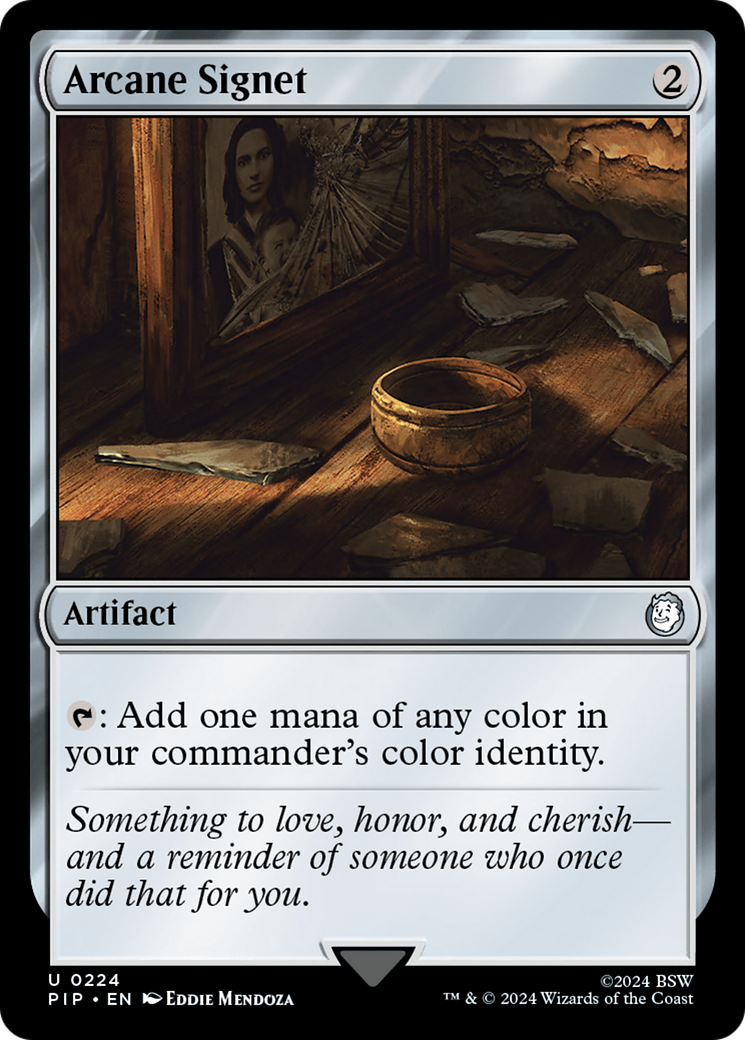
Arcane Signet
Arcane Signet
Artifact
: Add one mana of any color in your commander's color identity.
- If your commander is a card that has no colors in its color identity, Arcane Signet's ability produces no mana. It doesn't produce .
- If you have two commanders, the ability adds one mana of any color in their combined color identities.
- If you don't have a commander, Arcane Signet's ability produces no mana.
-
1
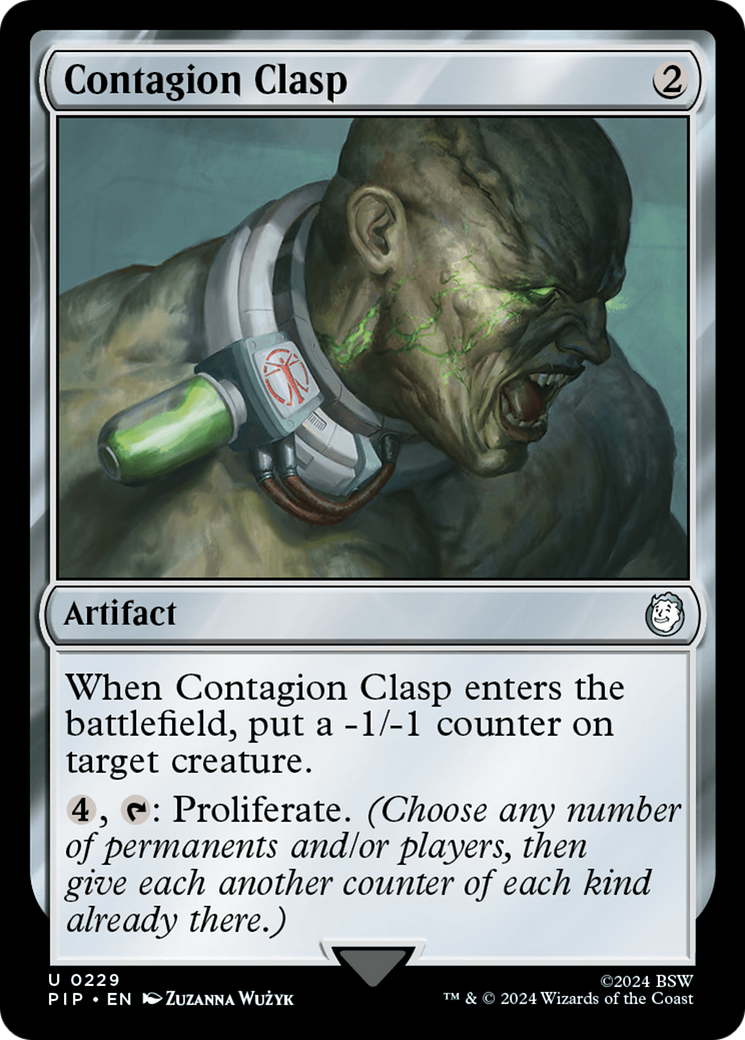
Contagion Clasp
Contagion Clasp
Artifact
When Contagion Clasp enters, put a -1/-1 counter on target creature.
, : Proliferate. (Choose any number of permanents and/or players, then give each another counter of each kind already there.)
- An ability that triggers "Whenever you proliferate" triggers even if you chose no permanents or players while doing so.
- To proliferate, you can choose any permanent that has a counter, including ones controlled by opponents. You can choose any player who has a counter, including opponents. You can't choose cards in any zone other than the battlefield, even if they have counters on them.
- Players can respond to a spell or ability whose effect includes proliferating. Once that spell or ability starts to resolve, however, and its controller chooses which permanents and players will get new counters, it's too late for anyone to respond.
- If a permanent ever has both +1/+1 counters and -1/-1 counters on it at the same time, they're removed in pairs as a state-based action so that the permanent has only one of those kinds of counters on it.
- You don't have to choose every permanent or player that has a counter, only the ones you want to add another counter to. Since "any number" includes zero, you don't have to choose any permanents at all, and you don't have to choose any players at all.
- If a player or permanent has more than one kind of counter on it, and you choose for it to get additional counters, it must get one of each kind of counter it already has. You can't have it get just one kind of counter it already has and not the others.
- Contagion Clasp's first ability is mandatory. If you're the only player who controls a creature, you must target one of them.
-
1
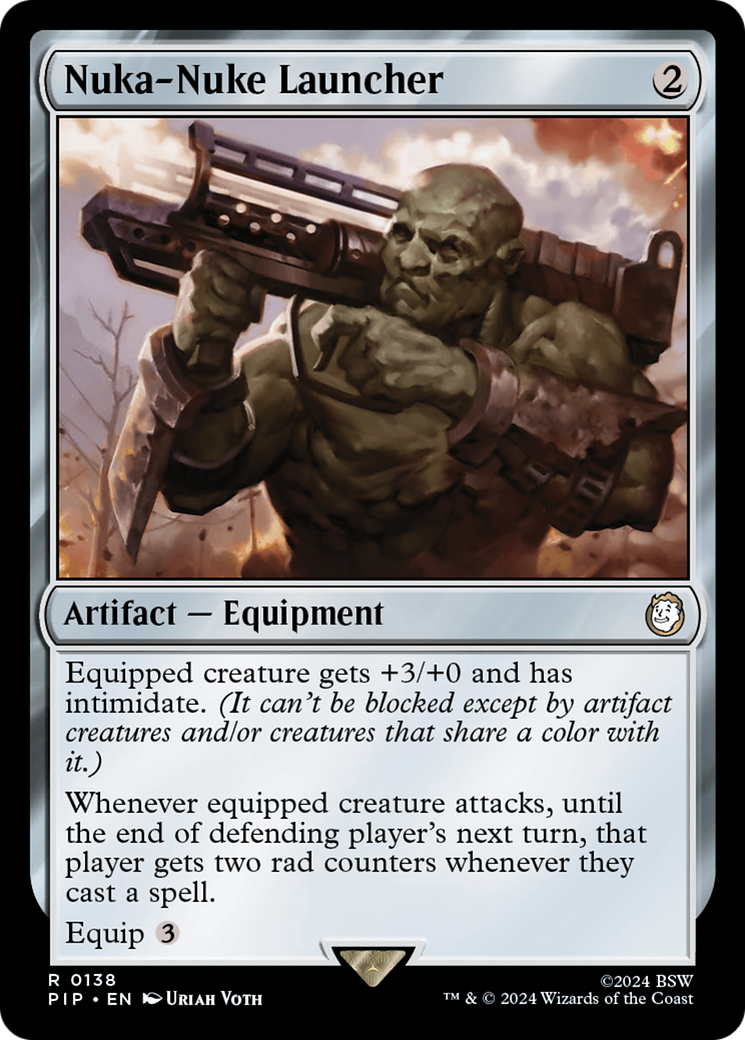
Nuka-Nuke Launcher
Nuka-Nuke Launcher
Artifact — Equipment
Equipped creature gets +3/+0 and has intimidate. (It can't be blocked except by artifact creatures and/or creatures that share a color with it.)
Whenever equipped creature attacks, until the end of defending player's next turn, that player gets two rad counters whenever they cast a spell.
Equip
- Once the equipped creature has been blocked, changing its color or the blocking creature’s color or stopping the blocking creature from being an artifact won’t cause the equipped creature to become unblocked.
- Rad counters are a kind of counter that a player may have. They’re not associated with any specific permanents.
- Keep track of how many rad counters each player has. Potential ways to track this include writing them down on paper or using dice, but any method that is clear and mutually agreeable is fine.
- Rad counters don’t go away as steps, phases, or turns end. They only go away when an effect instructs a player to remove rad counters from themselves.
- There is an inherent triggered ability associated with having rad counters. This triggered ability has no source and is controlled by the active player. The full text of this ability is “At the beginning of the precombat main phase of a player with rad counters, that player mills cards equal to the number of rad counters they have. For each nonland card milled this way, that player loses 1 life and removes one rad counter from themselves.”
- In a game using the shared team turns option, such as an Archenemy or Two-Headed Giant game, the inherent triggered ability associated with rad counters triggers once for each player on the active team that has rad counters. Each instance of that ability is controlled by one of those players.
- Any effects (such as proliferate) that interact with counters a player gets, has, or loses can interact with rad counters.
- The cards are milled all at once, which means abilities that trigger “whenever one or more nonland cards are milled” will trigger exactly once as long as at least one nonland card was milled.
- If a player has fewer cards remaining in their library than the number of rad counters they have when the triggered ability resolves, they’ll mill as many cards as they can.
-
1
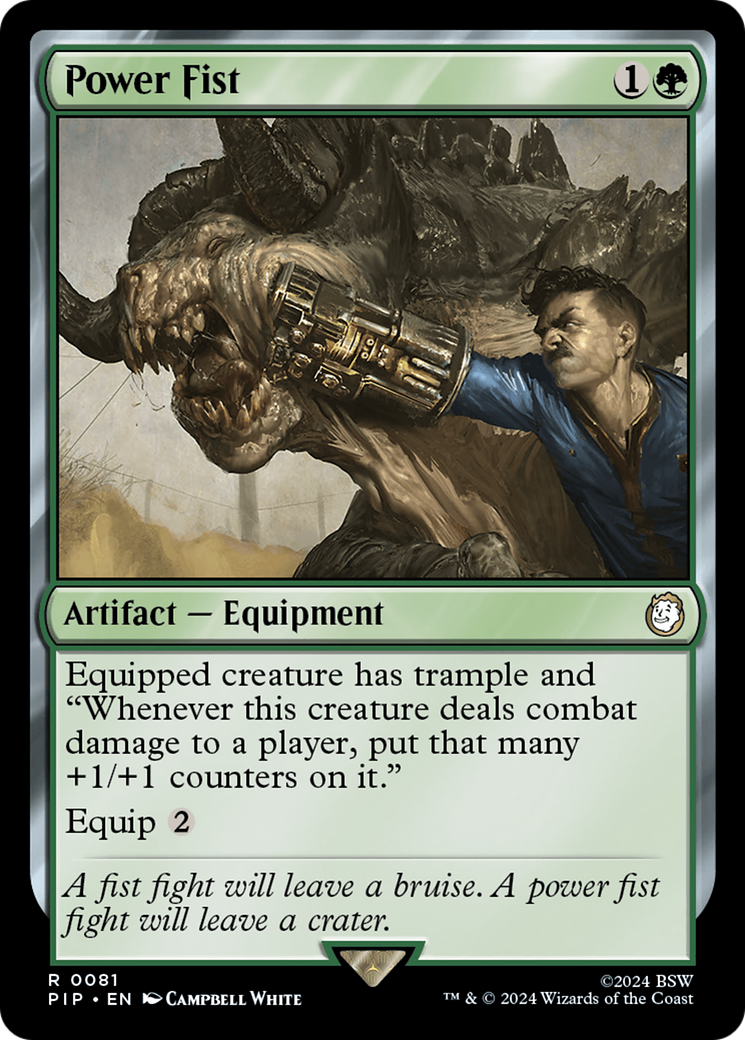
Power Fist
Power Fist
Artifact — Equipment
Equipped creature has trample and "Whenever this creature deals combat damage to a player, put that many +1/+1 counters on it."
Equip
-
1
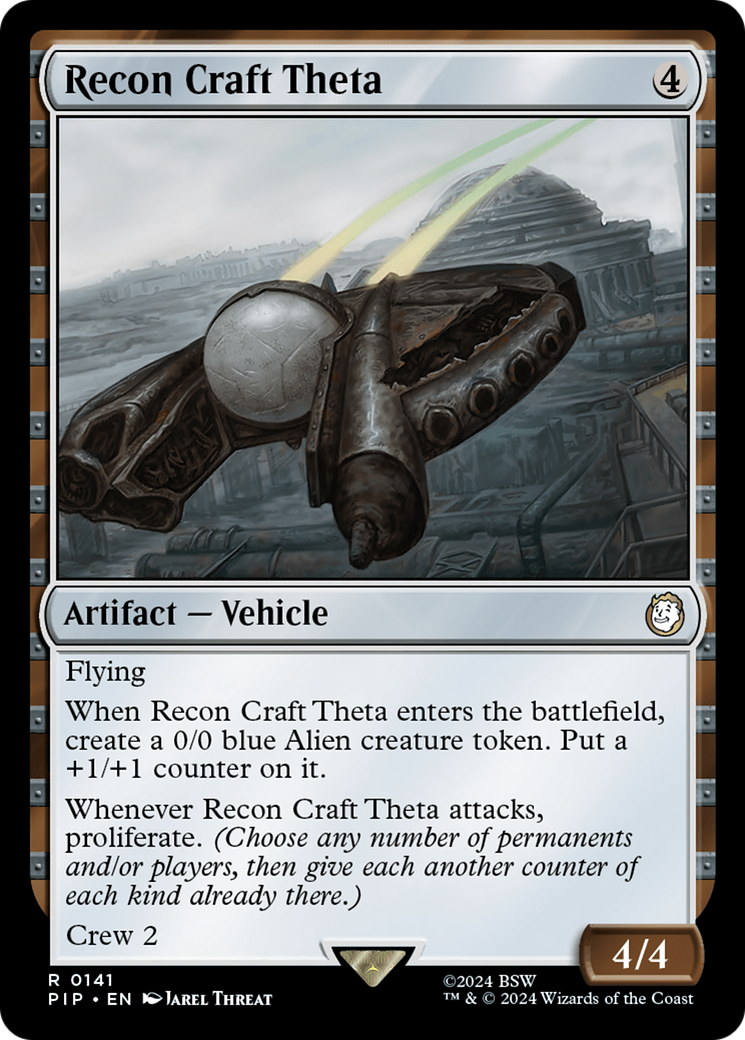
Recon Craft Theta
Recon Craft Theta
Artifact — Vehicle
4/4
Flying
When this Vehicle enters, create a 0/0 blue Alien creature token. Put a +1/+1 counter on it.
Whenever this Vehicle attacks, proliferate. (Choose any number of permanents and/or players, then give each another counter of each kind already there.)
Crew 2
- You can choose any permanent that has a counter, including ones controlled by opponents. You can choose any player who has a counter, including opponents. You can't choose cards in any zone other than the battlefield, even if they have counters on them.
- You don't have to choose every permanent or player that has a counter—only the ones you want to add counters to. Since "any number" includes zero, you don't have to choose any permanents at all, and you don't have to choose any players at all.
- If a player or permanent has more than one kind of counter on it, and you choose for it to get additional counters, it must get one of each kind of counter it already has. You can't have it get just one kind of counter it already has and not the others.
- Players can respond to a spell or ability whose effect includes proliferating. Once that spell or ability starts to resolve, however, and its controller chooses which permanents and players will get new counters, it's too late for anyone to respond.
- Some spells and abilities that cause you to proliferate may require targets. If each target chosen is an illegal target as that spell or ability tries to resolve, it won't resolve. You won't proliferate.
-
1
Sol Ring
Sol Ring
Artifact
: Add .
-
1
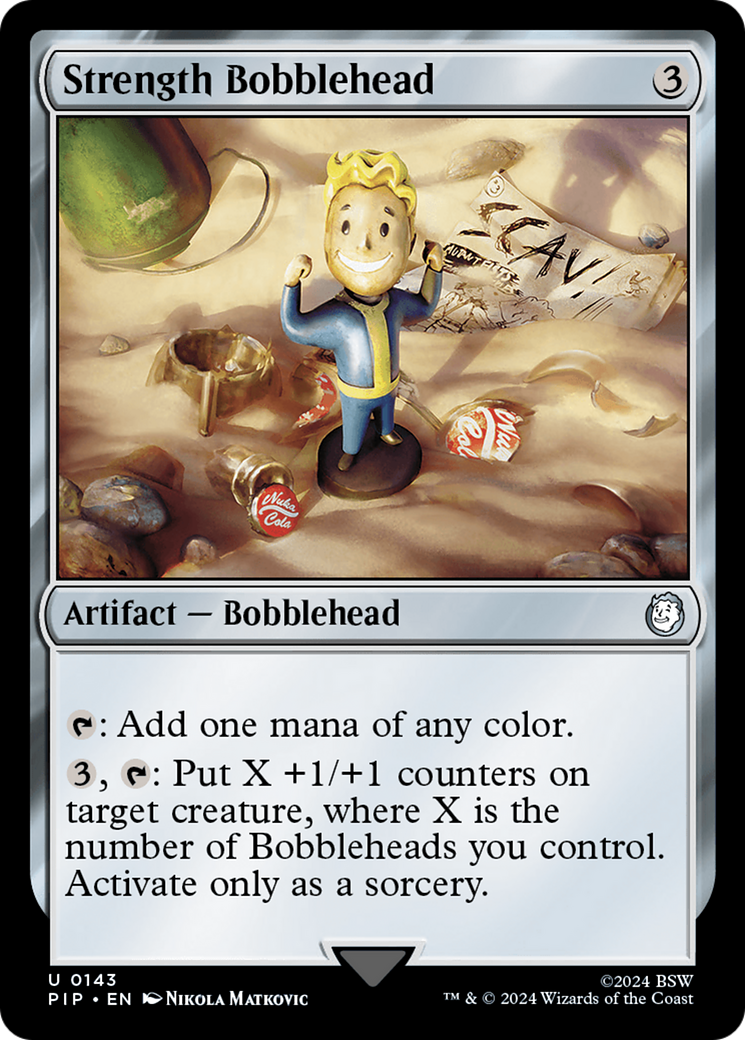
Strength Bobblehead
Strength Bobblehead
Artifact — Bobblehead
: Add one mana of any color.
, : Put X +1/+1 counters on target creature, where X is the number of Bobbleheads you control. Activate only as a sorcery.
- The value of X is determined only once, as Strength Bobblehead’s last ability resolves.
-
1
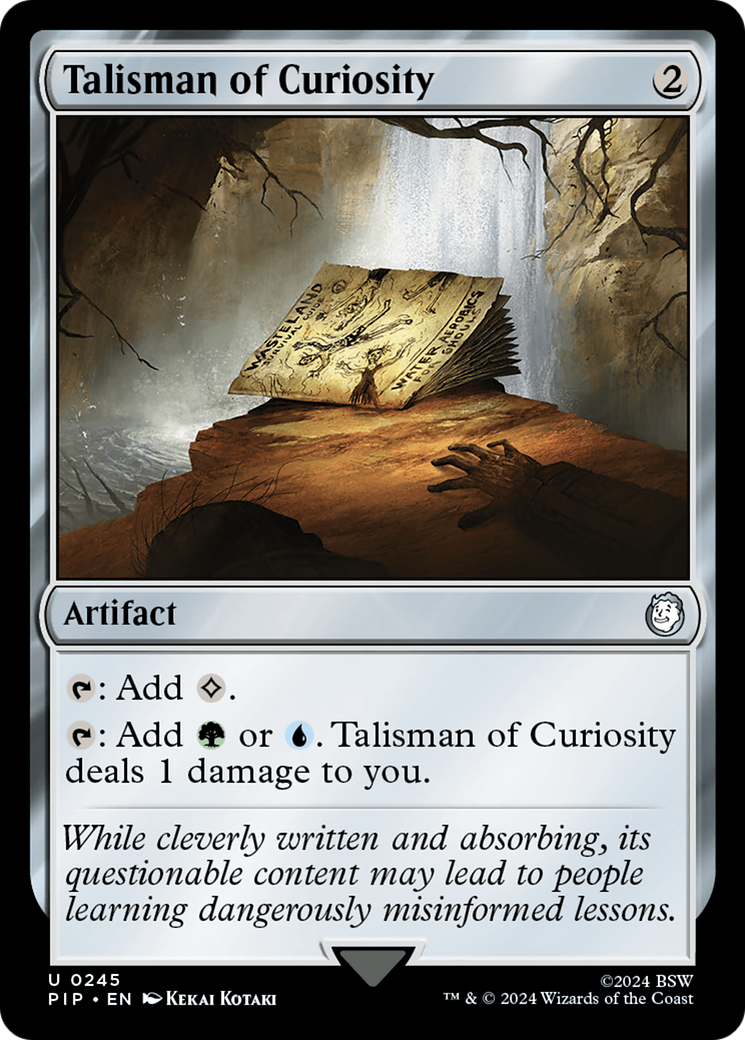
Talisman of Curiosity
Talisman of Curiosity
Artifact
: Add .
: Add or . This artifact deals 1 damage to you.
-
1
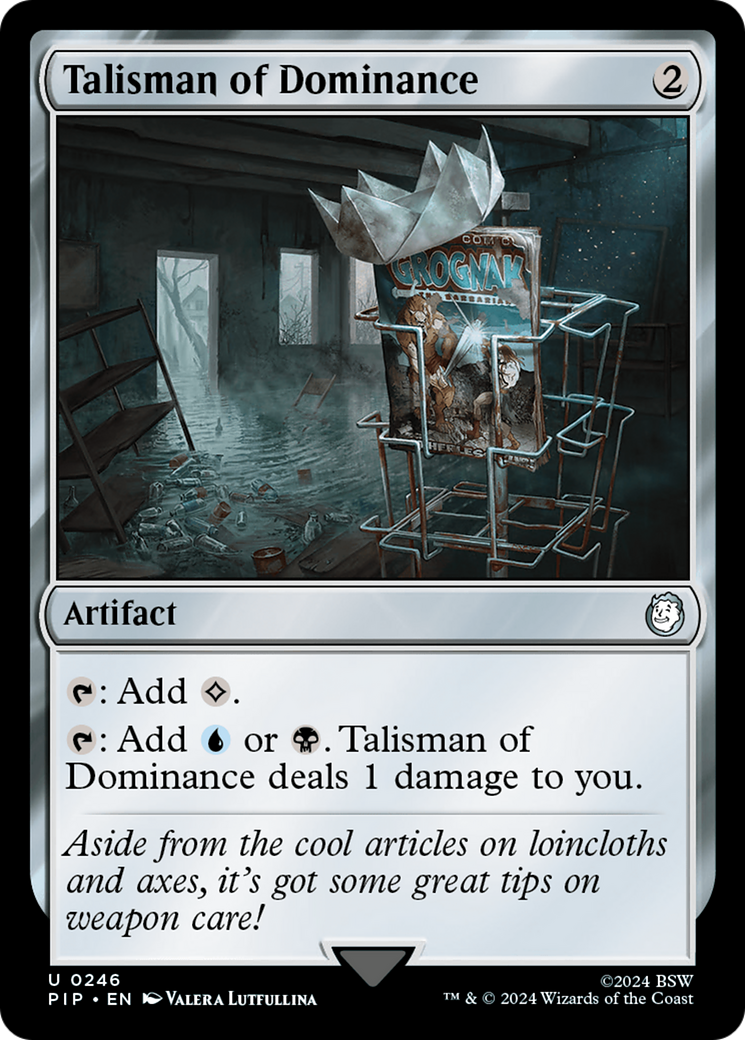
Talisman of Dominance
Talisman of Dominance
Artifact
: Add .
: Add or . This artifact deals 1 damage to you.
-
1
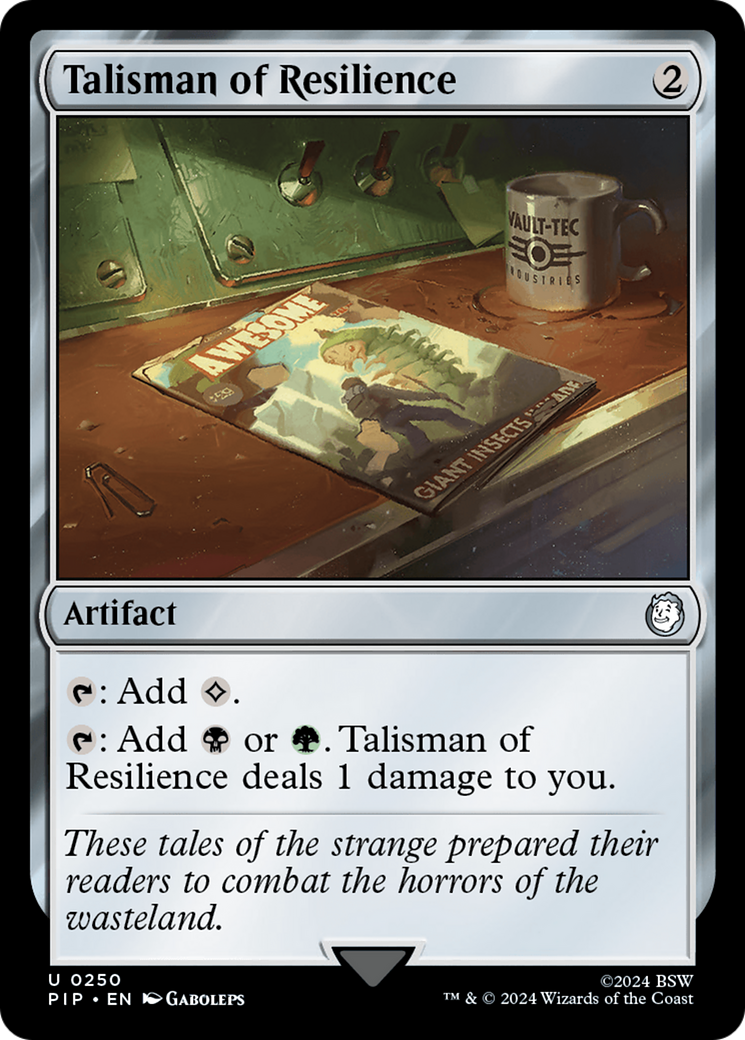
Talisman of Resilience
Talisman of Resilience
Artifact
: Add .
: Add or . This artifact deals 1 damage to you.
Enchantments 8
-
1
Branching Evolution
Branching Evolution
Enchantment
If one or more +1/+1 counters would be put on a creature you control, twice that many +1/+1 counters are put on that creature instead.
- If a creature you control would enter the battlefield with a number of +1/+1 counters on it, it enters with twice that many instead.
- If you control two Branching Evolutions, the number of +1/+1 counters put on a creature is four times the original number. Three Branching Evolutions multiplies the original number by eight, and so on.
- If two or more effects attempt to modify how many counters would be put onto a creature you control, you choose the order to apply those effects, no matter who controls the sources of those effects.
-
1
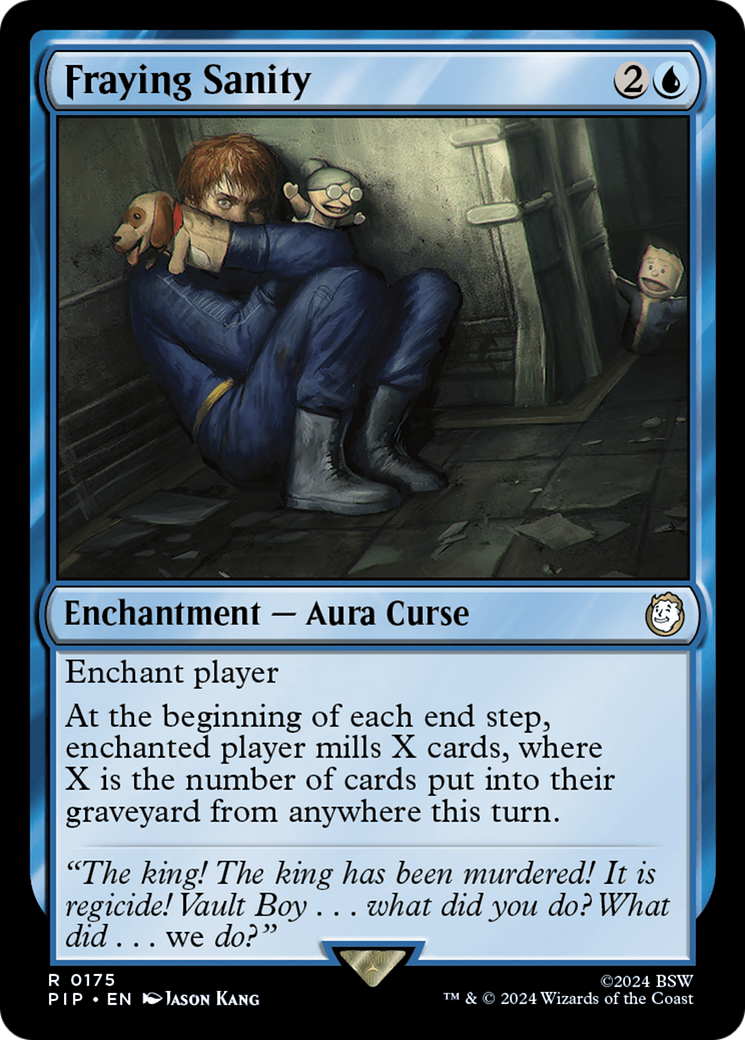
Fraying Sanity
Fraying Sanity
Enchantment — Aura Curse
Enchant player
At the beginning of each end step, enchanted player mills X cards, where X is the number of cards put into their graveyard from anywhere this turn.
- Fraying Sanity's triggered ability counts the number of cards that were put into the enchanted player's graveyard during the turn, even if Fraying Sanity wasn't on the battlefield at the time those cards were put there, and even if those cards have left that graveyard.
- The value of X is determined only as Fraying Sanity's triggered ability resolves. For example, if three Fraying Sanity Auras are attached to one player who had four cards put into their graveyard this turn, X will be four for the first ability to resolve, eight for the second, and sixteen for the third.
-
1
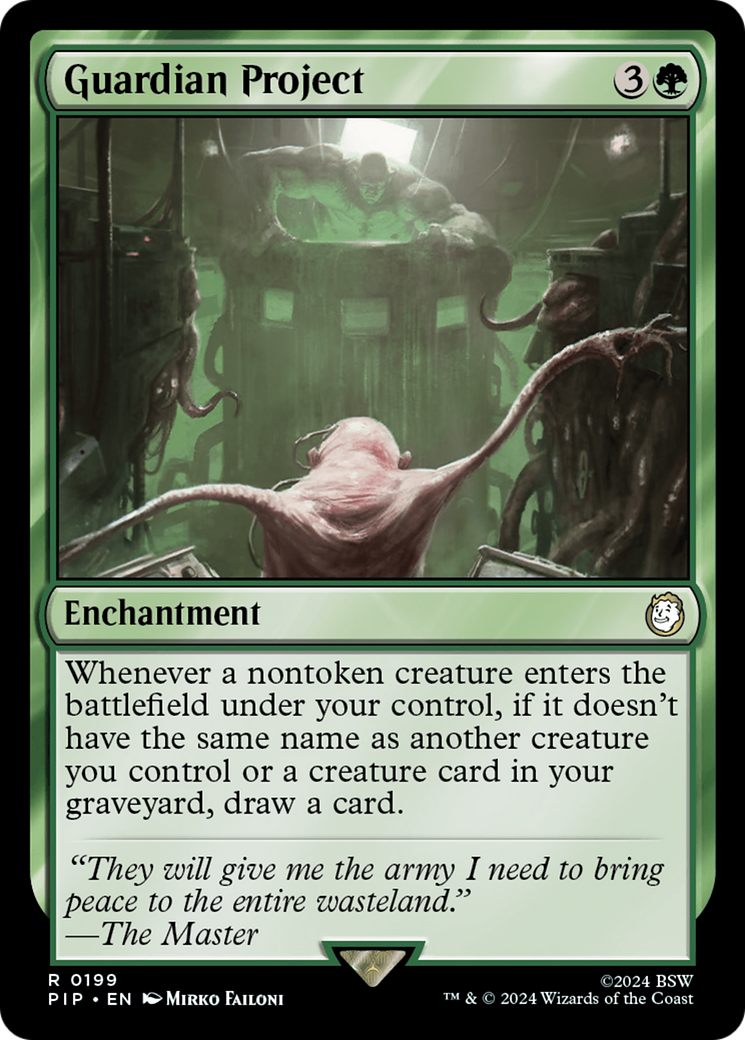
Guardian Project
Guardian Project
Enchantment
Whenever a nontoken creature you control enters, if it doesn't have the same name as another creature you control or a creature card in your graveyard, draw a card.
- Whether the entering creature shares a name with a creature you control or a creature card in your graveyard is checked both as that creature enters and as Guardian Project's ability resolves. If the entering creature isn't the first of its name as it enters, the ability doesn't trigger at all; if its name is shared as the ability resolves, you don't draw a card.
- If the entering creature is put into your graveyard while Guardian Project's ability is on the stack, that same card will be a creature card in your graveyard that shares a name with the creature that was on the battlefield, so you won't draw a card.
- If the entering creature leaves the battlefield and returns while Guardian Project's ability is on the stack, that same card will be a new creature you control that shares a name with the creature that was on the battlefield, so you won't draw a card. However, Guardian Project's ability may trigger for the new creature and you may draw a card as that ability resolves.
- A face-down creature has no name, so it can't share a name with anything. This includes other creatures with no name.
-
1
Hardened Scales
Hardened Scales
Enchantment
If one or more +1/+1 counters would be put on a creature you control, that many plus one +1/+1 counters are put on it instead.
- If a creature you control would enter the battlefield with a number of +1/+1 counters on it, it enters with that many plus one instead.
- If two or more effects attempt to modify how many counters would be put on a creature you control, you choose the order to apply those effects, no matter who controls the sources of those effects.
- Each additional Hardened Scales you control will increase the number of +1/+1 counters placed on a creature you control by one.
-
1
Inexorable Tide
Inexorable Tide
Enchantment
Whenever you cast a spell, proliferate. (Choose any number of permanents and/or players, then give each another counter of each kind already there.)
- Whenever you cast a spell, Inexorable Tide's ability triggers and goes on the stack on top of it. It will resolve (and you'll proliferate) before the spell resolves.
-
1
Struggle for Project Purity
Struggle for Project Purity
Enchantment
As this enchantment enters, choose Brotherhood or Enclave.
- Brotherhood — At the beginning of your upkeep, each opponent draws a card. You draw a card for each card drawn this way.
- Enclave — Whenever a player attacks you with one or more creatures, that player gets twice that many rad counters.
- The number of rad counters the attacking player gets when the “Enclave” triggered ability resolves is based on the number of creatures they declared as attackers. Removing creatures from combat won’t reduce the number of rad counters they get. Similarly, creatures that enter the battlefield attacking but weren’t declared as attackers won’t increase the number of rad counters they get.
- If you somehow control Struggle for Project Purity and no choice was made for it (perhaps because another permanent on the battlefield became a copy of it), it has neither of the two triggered abilities.
- Rad counters are a kind of counter that a player may have. They’re not associated with any specific permanents.
- Keep track of how many rad counters each player has. Potential ways to track this include writing them down on paper or using dice, but any method that is clear and mutually agreeable is fine.
- Rad counters don’t go away as steps, phases, or turns end. They only go away when an effect instructs a player to remove rad counters from themselves.
- There is an inherent triggered ability associated with having rad counters. This triggered ability has no source and is controlled by the active player. The full text of this ability is “At the beginning of the precombat main phase of a player with rad counters, that player mills cards equal to the number of rad counters they have. For each nonland card milled this way, that player loses 1 life and removes one rad counter from themselves.”
- In a game using the shared team turns option, such as an Archenemy or Two-Headed Giant game, the inherent triggered ability associated with rad counters triggers once for each player on the active team that has rad counters. Each instance of that ability is controlled by one of those players.
- Any effects (such as proliferate) that interact with counters a player gets, has, or loses can interact with rad counters.
- The cards are milled all at once, which means abilities that trigger “whenever one or more nonland cards are milled” will trigger exactly once as long as at least one nonland card was milled.
- If a player has fewer cards remaining in their library than the number of rad counters they have when the triggered ability resolves, they’ll mill as many cards as they can.
-
1
Vault 12: The Necropolis
Vault 12: The Necropolis
Enchantment — Saga
(As this Saga enters and after your draw step, add a lore counter. Sacrifice after III.)
I — Each player gets three rad counters.
II — Create X 2/2 black Zombie Mutant creature tokens, where X is the total number of rad counters among players.
III — Put two +1/+1 counters on each creature you control that's a Zombie or Mutant.
- Use the number of rad counters among all players still in the game when Vault 12’s second chapter ability resolves to determine the value of X.
- A creature you control that’s both a Zombie and a Mutant will get only two +1/+1 counters from Vault 12’s last ability.
- Rad counters are a kind of counter that a player may have. They’re not associated with any specific permanents.
- Keep track of how many rad counters each player has. Potential ways to track this include writing them down on paper or using dice, but any method that is clear and mutually agreeable is fine.
- Rad counters don’t go away as steps, phases, or turns end. They only go away when an effect instructs a player to remove rad counters from themselves.
- There is an inherent triggered ability associated with having rad counters. This triggered ability has no source and is controlled by the active player. The full text of this ability is “At the beginning of the precombat main phase of a player with rad counters, that player mills cards equal to the number of rad counters they have. For each nonland card milled this way, that player loses 1 life and removes one rad counter from themselves.”
- In a game using the shared team turns option, such as an Archenemy or Two-Headed Giant game, the inherent triggered ability associated with rad counters triggers once for each player on the active team that has rad counters. Each instance of that ability is controlled by one of those players.
- Any effects (such as proliferate) that interact with counters a player gets, has, or loses can interact with rad counters.
- The cards are milled all at once, which means abilities that trigger “whenever one or more nonland cards are milled” will trigger exactly once as long as at least one nonland card was milled.
- If a player has fewer cards remaining in their library than the number of rad counters they have when the triggered ability resolves, they’ll mill as many cards as they can.
-
1
Vault 87: Forced Evolution
Vault 87: Forced Evolution
Enchantment — Saga
(As this Saga enters and after your draw step, add a lore counter. Sacrifice after III.)
I — Gain control of target non-Mutant creature for as long as you control this Saga.
II — Put a +1/+1 counter on target creature you control. It becomes a Mutant in addition to its other types.
III — Draw cards equal to the greatest power among Mutants you control.
- If Vault 87 leaves the battlefield before its first chapter ability resolves, you won't gain control of the target creature at all.
- The target of Vault 87's first chapter ability only needs to be a non-Mutant when that ability is put onto the stack and when that ability resolves. The control effect won't end if it later becomes a Mutant (perhaps because of the effect of the second chapter ability).
- Use the greatest power among Mutants you control as Vault 87's last ability resolves to determine how many cards to draw.
Lands 39
-
1
Ash Barrens
Ash Barrens
Land
: Add .
Basic landcycling ( , Discard this card: Search your library for a basic land card, reveal it, put it into your hand, then shuffle.)
-
1
Command Tower
Command Tower
Land
: Add one mana of any color in your commander's color identity.
- If you don't have a commander, Command Tower's ability produces no mana.
- If your commander is a card that has no colors in its color identity, Command Tower's ability produces no mana. It doesn't produce .
- If you have two commanders, the ability adds one mana of any color in their combined color identities.
-
1
Darkwater Catacombs
Darkwater Catacombs
Land
, : Add .
-
1
Drowned Catacomb
Drowned Catacomb
Land
This land enters tapped unless you control an Island or a Swamp.
: Add or .
- As this is entering, it checks for lands that are already on the battlefield. It won't see lands that are entering at the same time (due to Warp World, for example).
- This checks for lands you control with the land type Island or Swamp, not for lands named Island or Swamp. The lands it checks for don't have to be basic lands. For example, if you control Blood Crypt (a nonbasic land with the land types Swamp and Mountain), Drowned Catacomb will enter untapped.
-
1
Evolving Wilds
Evolving Wilds
Land
, Sacrifice this land: Search your library for a basic land card, put it onto the battlefield tapped, then shuffle.
-
1
Exotic Orchard
Exotic Orchard
Land
: Add one mana of any color that a land an opponent controls could produce.
- Lands that produce mana based only on what other lands "could produce" won't help each other unless some other land allows one of them to actually produce some type of mana. For example, if you control an Exotic Orchard and your opponent controls an Exotic Orchard and a Reflecting Pool, none of those lands would produce mana if their mana abilities were activated. On the other hand, if you control a Forest and an Exotic Orchard, and your opponent controls an Exotic Orchard and a Reflecting Pool, then each of those lands can be tapped to produce . Your opponent's Exotic Orchard can produce because you control a Forest. Your Exotic Orchard and your opponent's Reflecting Pool can each produce because your opponent's Exotic Orchard can produce .
- When determining what colors of mana your opponents' lands could produce, Exotic Orchard takes into account any applicable replacement effects that would apply to those lands' mana abilities (such as Contamination's effect, for example). If there are more than one, consider them in any possible order.
- The colors of mana are white, blue, black, red, and green. Exotic Orchard can't be tapped for colorless mana, even if a land an opponent controls could produce colorless mana.
- Exotic Orchard doesn't care about any restrictions or riders your opponents' lands (such as Ancient Ziggurat or Hall of the Bandit Lord) put on the mana they produce. It just cares about colors of mana.
- Exotic Orchard checks the effects of all mana-producing abilities of lands your opponents control, but it doesn't check their costs. For example, Vivid Crag has the ability " , Remove a charge counter from Vivid Crag: Add one mana of any color." If an opponent controls Vivid Crag and you control Exotic Orchard, you can tap Exotic Orchard for any color of mana. It doesn't matter whether Vivid Crag has a charge counter on it, and it doesn't matter whether it's untapped.
-
1
Fetid Pools
Fetid Pools
Land — Island Swamp
( : Add or .)
This land enters tapped.
Cycling ( , Discard this card: Draw a card.)
-
5
Forest
Forest
Basic Land — Forest
( : Add .)
-
1
Hinterland Harbor
Hinterland Harbor
Land
This land enters tapped unless you control a Forest or an Island.
: Add or .
-
5
Island
Island
Basic Land — Island
( : Add .)
-
1
Mariposa Military Base
Mariposa Military Base
Land
You may have this land enter tapped. If you do, you get two rad counters.
: Add .
, : Draw a card. This ability costs less to activate for each rad counter you have.
- If a player has fewer cards remaining in their library than the number of rad counters they have when the triggered ability resolves, they’ll mill as many cards as they can.
- Rad counters are a kind of counter that a player may have. They’re not associated with any specific permanents.
- Keep track of how many rad counters each player has. Potential ways to track this include writing them down on paper or using dice, but any method that is clear and mutually agreeable is fine.
- Rad counters don’t go away as steps, phases, or turns end. They only go away when an effect instructs a player to remove rad counters from themselves.
- There is an inherent triggered ability associated with having rad counters. This triggered ability has no source and is controlled by the active player. The full text of this ability is “At the beginning of the precombat main phase of a player with rad counters, that player mills cards equal to the number of rad counters they have. For each nonland card milled this way, that player loses 1 life and removes one rad counter from themselves.”
- In a game using the shared team turns option, such as an Archenemy or Two-Headed Giant game, the inherent triggered ability associated with rad counters triggers once for each player on the active team that has rad counters. Each instance of that ability is controlled by one of those players.
- Any effects (such as proliferate) that interact with counters a player gets, has, or loses can interact with rad counters.
- The cards are milled all at once, which means abilities that trigger “whenever one or more nonland cards are milled” will trigger exactly once as long as at least one nonland card was milled.
-
1
Mortuary Mire
Mortuary Mire
Land
This land enters tapped.
When this land enters, you may put target creature card from your graveyard on top of your library.
: Add .
-
1
Nesting Grounds
Nesting Grounds
Land
: Add .
, : Move a counter from target permanent you control onto another target permanent. Activate only as a sorcery.
- You choose the two target permanents as Nesting Grounds's second ability is put onto the stack. You choose which kind of counter to move as that ability resolves.
- If either permanent becomes an illegal target, no counter is removed or put.
- To move a counter from one creature to another, the counter is removed from the first permanent and put on the second. Any abilities that care about a counter being removed from or put onto a permanent will apply.
- The two target permanents don't have to share a type, which can result in some counters on permanents that would not occur normally, such as loyalty counters on creatures or +1/+1 counters on lands. Keyword counters will grant the permanent that keyword even if it's meaningless (such as trample on an enchantment); +1/+1 counters won't affect the permanent unless it's a creature; and many named counters (such as soul counters) won't have an effect unless the recipient permanent refers to them in some way.
-
1
Opulent Palace
Opulent Palace
Land
This land enters tapped.
: Add , , or .
-
1
Overflowing Basin
Overflowing Basin
Land
, : Add .
-
1
Path of Ancestry
Path of Ancestry
Land
This land enters tapped.
: Add one mana of any color in your commander's color identity. When that mana is spent to cast a creature spell that shares a creature type with your commander, scry 1. (Look at the top card of your library. You may put that card on the bottom.)
- Your commander's creature types are checked immediately after you cast a creature spell spending mana from Path of Ancestry's last ability. They aren't set before the game begins, and they may not be the same types your commander had when you activated that ability.
- If you have two commanders, the last ability adds one mana of any color in their combined color identities. When you spend that mana on a creature spell that shares a creature type with either of your commanders, you'll scry 1.
- If Path of Ancestry's last ability produces two mana (most likely due to Mana Reflection), spending those two mana to cast creature spells that share a creature type with your commander will cause two abilities to trigger. Each of those abilities will cause you to scry 1. You won't scry 2. This is true whether you spend the mana on one creature spell or two.
- If your commander has no creature types, it can't share a creature type with any spell that you cast.
- If you cast your commander with mana from Path of Ancestry, and your commander hasn't somehow lost all of its creature types while on the stack, you'll scry 1.
- If you don't have a commander, Path of Ancestry's ability produces no mana.
- If your commander is a card that has no colors in its color identity, Path of Ancestry's ability produces no mana. It doesn't produce .
-
1
Sunken Hollow
Sunken Hollow
Land — Island Swamp
( : Add or .)
This land enters tapped unless you control two or more basic lands.
- Even though these lands have basic land types, they are not basic lands because "basic" doesn't appear on their type line. Notably, controlling two or more of them won't allow others to enter the battlefield untapped.
- However, because these cards have basic land types, effects that specify a basic land type without also specifying that the land be basic can affect them. For example, a spell or ability that reads "Destroy target Forest" can target Canopy Vista, while one that reads "Destroy target basic Forest" cannot.
- If one of these lands enters the battlefield at the same time as any number of basic lands, those other lands are not counted when determining if this land enters the battlefield tapped or untapped.
-
5
Swamp
Swamp
Basic Land — Swamp
( : Add .)
-
1
Tainted Isle
Tainted Isle
Land
: Add .
: Add or . Activate only if you control a Swamp.
-
1
Tainted Wood
Tainted Wood
Land
: Add .
: Add or . Activate only if you control a Swamp.
-
1
Temple of Deceit
Temple of Deceit
Land
This land enters tapped.
When this land enters, scry 1. (Look at the top card of your library. You may put that card on the bottom.)
: Add or .
- When you scry, you may put all the cards you look at back on top of your library, you may put all of those cards on the bottom of your library, or you may put some of those cards on top and the rest of them on the bottom.
- You choose how to order cards returned to your library after scrying no matter where you put them.
- You perform the actions stated on a card in sequence. For some spells and abilities, that means you'll scry last. For others, that means you'll scry and then perform other actions.
- Scry appears on some spells and abilities with one or more targets. If all of the spell or ability's targets are illegal when it tries to resolve, it won't resolve and none of its effects will happen. You won't scry.
-
1
Temple of Malady
Temple of Malady
Land
This land enters tapped.
When this land enters, scry 1. (Look at the top card of your library. You may put that card on the bottom.)
: Add or .
-
1
Temple of Mystery
Temple of Mystery
Land
This land enters tapped.
When this land enters, scry 1. (Look at the top card of your library. You may put that card on the bottom.)
: Add or .
- When you scry, you may put all the cards you look at back on top of your library, you may put all of those cards on the bottom of your library, or you may put some of those cards on top and the rest of them on the bottom.
- You choose how to order cards returned to your library after scrying no matter where you put them.
- You perform the actions stated on a card in sequence. For some spells and abilities, that means you'll scry last. For others, that means you'll scry and then perform other actions.
- Scry appears on some spells and abilities with one or more targets. If all of the spell or ability's targets are illegal when it tries to resolve, it won't resolve and none of its effects will happen. You won't scry.
-
1
Temple of the False God
Temple of the False God
Land
: Add . Activate only if you control five or more lands.
-
1
Terramorphic Expanse
Terramorphic Expanse
Land
, Sacrifice this land: Search your library for a basic land card, put it onto the battlefield tapped, then shuffle.
-
1
Viridescent Bog
Viridescent Bog
Land
, : Add .
-
1
Woodland Cemetery
Woodland Cemetery
Land
This land enters tapped unless you control a Swamp or a Forest.
: Add or .
Blue 8
-
1
Fraying Sanity
Fraying Sanity
Enchantment — Aura Curse
Enchant player
At the beginning of each end step, enchanted player mills X cards, where X is the number of cards put into their graveyard from anywhere this turn.
- Fraying Sanity's triggered ability counts the number of cards that were put into the enchanted player's graveyard during the turn, even if Fraying Sanity wasn't on the battlefield at the time those cards were put there, and even if those cards have left that graveyard.
- The value of X is determined only as Fraying Sanity's triggered ability resolves. For example, if three Fraying Sanity Auras are attached to one player who had four cards put into their graveyard this turn, X will be four for the first ability to resolve, eight for the second, and sixteen for the third.
-
1
Inexorable Tide
Inexorable Tide
Enchantment
Whenever you cast a spell, proliferate. (Choose any number of permanents and/or players, then give each another counter of each kind already there.)
- Whenever you cast a spell, Inexorable Tide's ability triggers and goes on the stack on top of it. It will resolve (and you'll proliferate) before the spell resolves.
-
1
Jason Bright, Glowing Prophet
Jason Bright, Glowing Prophet
Legendary Creature — Zombie Mutant Advisor
2/3
Whenever a Zombie or Mutant you control dies, if its power was different from its base power, draw a card.
Come Fly With Me — , Sacrifice a creature: Put a +1/+1 counter on target creature you control. It gains flying until end of turn.
- Normally, a creature’s base power is the power printed on the card, or, for a token, the power set by the effect that created it. If another effect sets a creature’s power to a specific number or value, that becomes its base power. If an effect modifies a creature’s power without setting it, that is not included when determining its base power.
- If a creature has a characteristic-defining ability that sets its power, indicated with a * or similar in the power and toughness box, that ability is taken into account when determining its base power.
- Some creatures have base power 0 and an ability that gives them a bonus based on some criteria. Those are not characteristic-defining abilities, and that ability doesn’t change its base power. Such a creature will have power different from its base power if that ability causes its power to be anything other than 0.
-
1
Mirelurk Queen
Mirelurk Queen
Creature — Crab Mutant
4/4
Vigilance
When this creature enters, target player gets two rad counters.
Whenever one or more nonland cards are milled, draw a card, then put a +1/+1 counter on this creature. This ability triggers only once each turn.
- Rad counters are a kind of counter that a player may have. They’re not associated with any specific permanents.
- Keep track of how many rad counters each player has. Potential ways to track this include writing them down on paper or using dice, but any method that is clear and mutually agreeable is fine.
- Rad counters don’t go away as steps, phases, or turns end. They only go away when an effect instructs a player to remove rad counters from themselves.
- There is an inherent triggered ability associated with having rad counters. This triggered ability has no source and is controlled by the active player. The full text of this ability is “At the beginning of the precombat main phase of a player with rad counters, that player mills cards equal to the number of rad counters they have. For each nonland card milled this way, that player loses 1 life and removes one rad counter from themselves.”
- In a game using the shared team turns option, such as an Archenemy or Two-Headed Giant game, the inherent triggered ability associated with rad counters triggers once for each player on the active team that has rad counters. Each instance of that ability is controlled by one of those players.
- Any effects (such as proliferate) that interact with counters a player gets, has, or loses can interact with rad counters.
- The cards are milled all at once, which means abilities that trigger “whenever one or more nonland cards are milled” will trigger exactly once as long as at least one nonland card was milled.
- If a player has fewer cards remaining in their library than the number of rad counters they have when the triggered ability resolves, they’ll mill as many cards as they can.
-
1
Piper Wright, Publick Reporter
Piper Wright, Publick Reporter
Legendary Creature — Human Detective
1/2
Whenever Piper Wright deals combat damage to a player, investigate that many times. (To investigate, create a Clue token. It's an artifact with " , Sacrifice this token: Draw a card.")
Whenever you sacrifice a Clue, put a +1/+1 counter on target creature you control.
- If an effect refers to a Clue, it means any Clue artifact, not just a Clue artifact token. For example, if you sacrifice a nontoken Clue artifact, such as Candy Trail from the Wilds of Eldraine set, Piper Wright's last ability will trigger.
- Piper Wright's last ability triggers whenever you sacrifice a Clue for any reason, not just to activate a Clue's activated ability.
-
1
Radstorm
Radstorm
Instant
Storm (When you cast this spell, copy it for each spell cast before it this turn.)
Proliferate. (Choose any number of permanents and/or players, then give each another counter of each kind already there.)
- The copies of Radstorm created by its storm ability are put directly onto the stack. They aren’t cast and won’t be counted by other spells with storm cast later in the turn.
- Spells cast from zones other than a player’s hand and spells that were countered or otherwise failed to resolve are counted by the storm ability.
- A copy of a spell can be countered like any other spell, but it must be countered individually. Countering a spell with storm won’t affect the copies.
- You can choose any permanent that has a counter, including ones controlled by opponents. You can choose any player who has a counter, including opponents. You can’t choose cards in any zone other than the battlefield, even if they have counters on them.
- You don’t have to choose every permanent or player that has a counter—only the ones you want to add counters to. Since “any number” includes zero, you don’t have to choose any permanents at all, and you don’t have to choose any players at all.
- If a player or permanent has more than one kind of counter on it, and you choose for it to get additional counters, it must get one of each kind of counter it already has. You can’t have it get just one kind of counter it already has and not the others.
- Players can respond to a spell or ability whose effect includes proliferating. Once that spell or ability starts to resolve, however, and its controller chooses which permanents and players will get new counters, it’s too late for anyone to respond.
- Some spells and abilities that cause you to proliferate may require targets. If each target chosen is an illegal target as that spell or ability tries to resolve, it won’t resolve. You won’t proliferate.
-
1
Struggle for Project Purity
Struggle for Project Purity
Enchantment
As this enchantment enters, choose Brotherhood or Enclave.
- Brotherhood — At the beginning of your upkeep, each opponent draws a card. You draw a card for each card drawn this way.
- Enclave — Whenever a player attacks you with one or more creatures, that player gets twice that many rad counters.
- The number of rad counters the attacking player gets when the “Enclave” triggered ability resolves is based on the number of creatures they declared as attackers. Removing creatures from combat won’t reduce the number of rad counters they get. Similarly, creatures that enter the battlefield attacking but weren’t declared as attackers won’t increase the number of rad counters they get.
- If you somehow control Struggle for Project Purity and no choice was made for it (perhaps because another permanent on the battlefield became a copy of it), it has neither of the two triggered abilities.
- Rad counters are a kind of counter that a player may have. They’re not associated with any specific permanents.
- Keep track of how many rad counters each player has. Potential ways to track this include writing them down on paper or using dice, but any method that is clear and mutually agreeable is fine.
- Rad counters don’t go away as steps, phases, or turns end. They only go away when an effect instructs a player to remove rad counters from themselves.
- There is an inherent triggered ability associated with having rad counters. This triggered ability has no source and is controlled by the active player. The full text of this ability is “At the beginning of the precombat main phase of a player with rad counters, that player mills cards equal to the number of rad counters they have. For each nonland card milled this way, that player loses 1 life and removes one rad counter from themselves.”
- In a game using the shared team turns option, such as an Archenemy or Two-Headed Giant game, the inherent triggered ability associated with rad counters triggers once for each player on the active team that has rad counters. Each instance of that ability is controlled by one of those players.
- Any effects (such as proliferate) that interact with counters a player gets, has, or loses can interact with rad counters.
- The cards are milled all at once, which means abilities that trigger “whenever one or more nonland cards are milled” will trigger exactly once as long as at least one nonland card was milled.
- If a player has fewer cards remaining in their library than the number of rad counters they have when the triggered ability resolves, they’ll mill as many cards as they can.
-
1
Vexing Radgull
Vexing Radgull
Creature — Bird Mutant
1/2
Flying
Whenever this creature deals combat damage to a player, that player gets two rad counters if they don't have any rad counters. Otherwise, proliferate. (Choose any number of permanents and/or players, then give each another counter of each kind already there.)
- Rad counters are a kind of counter that a player may have. They’re not associated with any specific permanents.
- Keep track of how many rad counters each player has. Potential ways to track this include writing them down on paper or using dice, but any method that is clear and mutually agreeable is fine.
- Rad counters don’t go away as steps, phases, or turns end. They only go away when an effect instructs a player to remove rad counters from themselves.
- There is an inherent triggered ability associated with having rad counters. This triggered ability has no source and is controlled by the active player. The full text of this ability is “At the beginning of the precombat main phase of a player with rad counters, that player mills cards equal to the number of rad counters they have. For each nonland card milled this way, that player loses 1 life and removes one rad counter from themselves.”
- In a game using the shared team turns option, such as an Archenemy or Two-Headed Giant game, the inherent triggered ability associated with rad counters triggers once for each player on the active team that has rad counters. Each instance of that ability is controlled by one of those players.
- Any effects (such as proliferate) that interact with counters a player gets, has, or loses can interact with rad counters.
- The cards are milled all at once, which means abilities that trigger “whenever one or more nonland cards are milled” will trigger exactly once as long as at least one nonland card was milled.
- If a player has fewer cards remaining in their library than the number of rad counters they have when the triggered ability resolves, they’ll mill as many cards as they can.
- You can choose any permanent that has a counter, including ones controlled by opponents. You can choose any player who has a counter, including opponents. You can’t choose cards in any zone other than the battlefield, even if they have counters on them.
- You don’t have to choose every permanent or player that has a counter—only the ones you want to add counters to. Since “any number” includes zero, you don’t have to choose any permanents at all, and you don’t have to choose any players at all.
- If a player or permanent has more than one kind of counter on it, and you choose for it to get additional counters, it must get one of each kind of counter it already has. You can’t have it get just one kind of counter it already has and not the others.
- Players can respond to a spell or ability whose effect includes proliferating. Once that spell or ability starts to resolve, however, and its controller chooses which permanents and players will get new counters, it’s too late for anyone to respond.
- Some spells and abilities that cause you to proliferate may require targets. If each target chosen is an illegal target as that spell or ability tries to resolve, it won’t resolve. You won’t proliferate.
Black 7
-
1
Bloatfly Swarm
Bloatfly Swarm
Creature — Insect Mutant
0/0
Flying
This creature enters with five +1/+1 counters on it.
If damage would be dealt to this creature while it has a +1/+1 counter on it, prevent that damage, remove that many +1/+1 counters from it, then give each player a rad counter for each +1/+1 counter removed this way.
- If damage that can't be prevented is dealt to Bloatfly Swarm, you still remove that many +1/+1 counters from it, and you still give each player a rad counter for each +1/+1 counter removed this way.
- Rad counters are a kind of counter that a player may have. They're not associated with any specific permanents.
- Keep track of how many rad counters each player has. Potential ways to track this include writing them down on paper or using dice, but any method that is clear and mutually agreeable is fine.
- Rad counters don't go away as steps, phases, or turns end. They only go away when an effect instructs a player to remove rad counters from themselves.
- There is an inherent triggered ability associated with having rad counters. This triggered ability has no source and is controlled by the active player. The full text of this ability is "At the beginning of the precombat main phase of a player with rad counters, that player mills cards equal to the number of rad counters they have. For each nonland card milled this way, that player loses 1 life and removes one rad counter from themselves."
- In a game using the shared team turns option, such as an Archenemy or Two-Headed Giant game, the inherent triggered ability associated with rad counters triggers once for each player on the active team that has rad counters. Each instance of that ability is controlled by one of those players.
- Any effects (such as proliferate) that interact with counters a player gets, has, or loses can interact with rad counters.
- The cards are milled all at once, which means abilities that trigger "whenever one or more nonland cards are milled" will trigger exactly once as long as at least one nonland card was milled.
- If a player has fewer cards remaining in their library than the number of rad counters they have when the triggered ability resolves, they'll mill as many cards as they can.
-
1
Feral Ghoul
Feral Ghoul
Creature — Zombie Mutant
2/2
Menace
Whenever another creature you control dies, put a +1/+1 counter on this creature.
When this creature dies, each opponent gets a number of rad counters equal to its power.
- Use Feral Ghoul’s power as it last existed on the battlefield to determine how many rad counters each opponent gets.
- Rad counters are a kind of counter that a player may have. They’re not associated with any specific permanents.
- Keep track of how many rad counters each player has. Potential ways to track this include writing them down on paper or using dice, but any method that is clear and mutually agreeable is fine.
- Rad counters don’t go away as steps, phases, or turns end. They only go away when an effect instructs a player to remove rad counters from themselves.
- There is an inherent triggered ability associated with having rad counters. This triggered ability has no source and is controlled by the active player. The full text of this ability is “At the beginning of the precombat main phase of a player with rad counters, that player mills cards equal to the number of rad counters they have. For each nonland card milled this way, that player loses 1 life and removes one rad counter from themselves.”
- In a game using the shared team turns option, such as an Archenemy or Two-Headed Giant game, the inherent triggered ability associated with rad counters triggers once for each player on the active team that has rad counters. Each instance of that ability is controlled by one of those players.
- Any effects (such as proliferate) that interact with counters a player gets, has, or loses can interact with rad counters.
- The cards are milled all at once, which means abilities that trigger “whenever one or more nonland cards are milled” will trigger exactly once as long as at least one nonland card was milled.
- If a player has fewer cards remaining in their library than the number of rad counters they have when the triggered ability resolves, they’ll mill as many cards as they can.
-
1
Hancock, Ghoulish Mayor
Hancock, Ghoulish Mayor
Legendary Creature — Zombie Mutant Advisor
2/1
Each other creature you control that's a Zombie or Mutant gets +X/+X, where X is the number of counters on Hancock.
Undying (When this creature dies, if it had no +1/+1 counters on it, return it to the battlefield under its owner's control with a +1/+1 counter on it.)
- A creature that's both a Zombie and a Mutant will get +X/+X only once from Hancock's first ability.
-
1
Infesting Radroach
Infesting Radroach
Creature — Insect Mutant
2/2
Flying
This creature can't block.
Whenever this creature deals combat damage to a player, they get that many rad counters.
Whenever an opponent mills a nonland card, if this creature is in your graveyard, you may return it to your hand.
- If Infesting Radroach is milled at the same time an opponent mills a nonland card (for example, because of the activated ability of Raul, Trouble Shooter), Infesting Radroach's ability will trigger.
- Rad counters are a kind of counter that a player may have. They're not associated with any specific permanents.
- Keep track of how many rad counters each player has. Potential ways to track this include writing them down on paper or using dice, but any method that is clear and mutually agreeable is fine.
- Rad counters don't go away as steps, phases, or turns end. They only go away when an effect instructs a player to remove rad counters from themselves.
- There is an inherent triggered ability associated with having rad counters. This triggered ability has no source and is controlled by the active player. The full text of this ability is "At the beginning of the precombat main phase of a player with rad counters, that player mills cards equal to the number of rad counters they have. For each nonland card milled this way, that player loses 1 life and removes one rad counter from themselves."
- In a game using the shared team turns option, such as an Archenemy or Two-Headed Giant game, the inherent triggered ability associated with rad counters triggers once for each player on the active team that has rad counters. Each instance of that ability is controlled by one of those players.
- Any effects (such as proliferate) that interact with counters a player gets, has, or loses can interact with rad counters.
- The cards are milled all at once, which means abilities that trigger "whenever one or more nonland cards are milled" will trigger exactly once as long as at least one nonland card was milled.
- If a player has fewer cards remaining in their library than the number of rad counters they have when the triggered ability resolves, they'll mill as many cards as they can.
-
1
Nuclear Fallout
Nuclear Fallout
Sorcery
Each creature gets twice -X/-X until end of turn. Each player gets X rad counters.
- Rad counters are a kind of counter that a player may have. They’re not associated with any specific permanents.
- Keep track of how many rad counters each player has. Potential ways to track this include writing them down on paper or using dice, but any method that is clear and mutually agreeable is fine.
- Rad counters don’t go away as steps, phases, or turns end. They only go away when an effect instructs a player to remove rad counters from themselves.
- There is an inherent triggered ability associated with having rad counters. This triggered ability has no source and is controlled by the active player. The full text of this ability is “At the beginning of the precombat main phase of a player with rad counters, that player mills cards equal to the number of rad counters they have. For each nonland card milled this way, that player loses 1 life and removes one rad counter from themselves.”
- In a game using the shared team turns option, such as an Archenemy or Two-Headed Giant game, the inherent triggered ability associated with rad counters triggers once for each player on the active team that has rad counters. Each instance of that ability is controlled by one of those players.
- Any effects (such as proliferate) that interact with counters a player gets, has, or loses can interact with rad counters.
- The cards are milled all at once, which means abilities that trigger “whenever one or more nonland cards are milled” will trigger exactly once as long as at least one nonland card was milled.
- If a player has fewer cards remaining in their library than the number of rad counters they have when the triggered ability resolves, they’ll mill as many cards as they can.
-
1
Screeching Scorchbeast
Screeching Scorchbeast
Creature — Bat Mutant
5/5
Flying, menace
Whenever this creature attacks, each player gets two rad counters.
Whenever one or more nonland cards are milled, you may create that many 2/2 black Zombie Mutant creature tokens. Do this only once each turn.
- Any effects (such as proliferate) that interact with counters a player gets, has, or loses can interact with rad counters.
- The cards are milled all at once, which means abilities that trigger “whenever one or more nonland cards are milled” will trigger exactly once as long as at least one nonland card was milled.
- If a player has fewer cards remaining in their library than the number of rad counters they have when the triggered ability resolves, they’ll mill as many cards as they can.
- If more than one player is instructed to mill at the same time (by the activated ability of Raul, Trouble Shooter, for example), as long as at least one nonland card is milled, Screeching Scorchbeast’s last ability will trigger just once.
- “Do this only once each turn” lets you choose whether or not to create the appropriate number of 2/2 black Zombie Mutant creature tokens as the triggered ability resolves. If you choose not to create tokens, the ability will trigger again the next time the condition is met. Once you choose to do so, the ability will no longer trigger for the rest of the turn.
- Rad counters are a kind of counter that a player may have. They’re not associated with any specific permanents.
- Keep track of how many rad counters each player has. Potential ways to track this include writing them down on paper or using dice, but any method that is clear and mutually agreeable is fine.
- Rad counters don’t go away as steps, phases, or turns end. They only go away when an effect instructs a player to remove rad counters from themselves.
- There is an inherent triggered ability associated with having rad counters. This triggered ability has no source and is controlled by the active player. The full text of this ability is “At the beginning of the precombat main phase of a player with rad counters, that player mills cards equal to the number of rad counters they have. For each nonland card milled this way, that player loses 1 life and removes one rad counter from themselves.”
- In a game using the shared team turns option, such as an Archenemy or Two-Headed Giant game, the inherent triggered ability associated with rad counters triggers once for each player on the active team that has rad counters. Each instance of that ability is controlled by one of those players.
-
1
Vault 12: The Necropolis
Vault 12: The Necropolis
Enchantment — Saga
(As this Saga enters and after your draw step, add a lore counter. Sacrifice after III.)
I — Each player gets three rad counters.
II — Create X 2/2 black Zombie Mutant creature tokens, where X is the total number of rad counters among players.
III — Put two +1/+1 counters on each creature you control that's a Zombie or Mutant.
- Use the number of rad counters among all players still in the game when Vault 12’s second chapter ability resolves to determine the value of X.
- A creature you control that’s both a Zombie and a Mutant will get only two +1/+1 counters from Vault 12’s last ability.
- Rad counters are a kind of counter that a player may have. They’re not associated with any specific permanents.
- Keep track of how many rad counters each player has. Potential ways to track this include writing them down on paper or using dice, but any method that is clear and mutually agreeable is fine.
- Rad counters don’t go away as steps, phases, or turns end. They only go away when an effect instructs a player to remove rad counters from themselves.
- There is an inherent triggered ability associated with having rad counters. This triggered ability has no source and is controlled by the active player. The full text of this ability is “At the beginning of the precombat main phase of a player with rad counters, that player mills cards equal to the number of rad counters they have. For each nonland card milled this way, that player loses 1 life and removes one rad counter from themselves.”
- In a game using the shared team turns option, such as an Archenemy or Two-Headed Giant game, the inherent triggered ability associated with rad counters triggers once for each player on the active team that has rad counters. Each instance of that ability is controlled by one of those players.
- Any effects (such as proliferate) that interact with counters a player gets, has, or loses can interact with rad counters.
- The cards are milled all at once, which means abilities that trigger “whenever one or more nonland cards are milled” will trigger exactly once as long as at least one nonland card was milled.
- If a player has fewer cards remaining in their library than the number of rad counters they have when the triggered ability resolves, they’ll mill as many cards as they can.
Green 19
-
1
Branching Evolution
Branching Evolution
Enchantment
If one or more +1/+1 counters would be put on a creature you control, twice that many +1/+1 counters are put on that creature instead.
- If a creature you control would enter the battlefield with a number of +1/+1 counters on it, it enters with twice that many instead.
- If you control two Branching Evolutions, the number of +1/+1 counters put on a creature is four times the original number. Three Branching Evolutions multiplies the original number by eight, and so on.
- If two or more effects attempt to modify how many counters would be put onto a creature you control, you choose the order to apply those effects, no matter who controls the sources of those effects.
-
1
Cathedral Acolyte
Cathedral Acolyte
Creature — Human Cleric
1/2
Each creature you control with a counter on it has ward . (Whenever it becomes the target of a spell or ability an opponent controls, counter it unless that player pays .)
: Put a +1/+1 counter on target creature that entered this turn.
- The effect of Cathedral Acolyte’s first ability applies to any creature you control with a counter on it, not just ones with +1/+1 counters.
- Once a creature’s ward ability has triggered, causing that creature to lose ward by removing Cathedral Acolyte won’t affect the ability. The appropriate player will still have to pay or see their spell or ability countered.
-
1
Cultivate
Cultivate
Sorcery
Search your library for up to two basic land cards, reveal those cards, put one onto the battlefield tapped and the other into your hand, then shuffle.
- If you choose to find only one basic land card, you put it onto the battlefield tapped.
-
1
Farseek
Farseek
Sorcery
Search your library for a Plains, Island, Swamp, or Mountain card, put it onto the battlefield tapped, then shuffle.
- Farseek can find any land with any of the listed land types, including nonbasic ones, even if that land is a Forest in addition to one or more of those types.
-
1
Glowing One
Glowing One
Creature — Zombie Mutant
2/2
Deathtouch
Whenever this creature deals combat damage to a player, they get four rad counters.
Whenever a player mills a nonland card, you gain 1 life.
- If a player is instructed to mill more than one card, Glowing One’s last ability will trigger once for each nonland card they mill during that instruction. For example, a player with four rad counters will mill four cards at the beginning of their precombat main phase. If all four of those cards are nonland cards, Glowing One’s ability triggers four times.
- Rad counters are a kind of counter that a player may have. They’re not associated with any specific permanents.
- Keep track of how many rad counters each player has. Potential ways to track this include writing them down on paper or using dice, but any method that is clear and mutually agreeable is fine.
- Rad counters don’t go away as steps, phases, or turns end. They only go away when an effect instructs a player to remove rad counters from themselves.
- There is an inherent triggered ability associated with having rad counters. This triggered ability has no source and is controlled by the active player. The full text of this ability is “At the beginning of the precombat main phase of a player with rad counters, that player mills cards equal to the number of rad counters they have. For each nonland card milled this way, that player loses 1 life and removes one rad counter from themselves.”
- In a game using the shared team turns option, such as an Archenemy or Two-Headed Giant game, the inherent triggered ability associated with rad counters triggers once for each player on the active team that has rad counters. Each instance of that ability is controlled by one of those players.
- Any effects (such as proliferate) that interact with counters a player gets, has, or loses can interact with rad counters.
- The cards are milled all at once, which means abilities that trigger “whenever one or more nonland cards are milled” will trigger exactly once as long as at least one nonland card was milled.
- If a player has fewer cards remaining in their library than the number of rad counters they have when the triggered ability resolves, they’ll mill as many cards as they can.
-
1
Guardian Project
Guardian Project
Enchantment
Whenever a nontoken creature you control enters, if it doesn't have the same name as another creature you control or a creature card in your graveyard, draw a card.
- Whether the entering creature shares a name with a creature you control or a creature card in your graveyard is checked both as that creature enters and as Guardian Project's ability resolves. If the entering creature isn't the first of its name as it enters, the ability doesn't trigger at all; if its name is shared as the ability resolves, you don't draw a card.
- If the entering creature is put into your graveyard while Guardian Project's ability is on the stack, that same card will be a creature card in your graveyard that shares a name with the creature that was on the battlefield, so you won't draw a card.
- If the entering creature leaves the battlefield and returns while Guardian Project's ability is on the stack, that same card will be a new creature you control that shares a name with the creature that was on the battlefield, so you won't draw a card. However, Guardian Project's ability may trigger for the new creature and you may draw a card as that ability resolves.
- A face-down creature has no name, so it can't share a name with anything. This includes other creatures with no name.
-
1
Hardened Scales
Hardened Scales
Enchantment
If one or more +1/+1 counters would be put on a creature you control, that many plus one +1/+1 counters are put on it instead.
- If a creature you control would enter the battlefield with a number of +1/+1 counters on it, it enters with that many plus one instead.
- If two or more effects attempt to modify how many counters would be put on a creature you control, you choose the order to apply those effects, no matter who controls the sources of those effects.
- Each additional Hardened Scales you control will increase the number of +1/+1 counters placed on a creature you control by one.
-
1
Harmonize
Harmonize
Sorcery
Draw three cards.
-
1
Harold and Bob, First Numens
Harold and Bob, First Numens
Legendary Creature — Treefolk Mutant
3/3
Vigilance, reach
When Harold and Bob dies, if it was a creature, return it to the battlefield. It's an Aura enchantment with enchant Forest you control and "Enchanted Forest has ' : Add three mana of any one color. You get two rad counters.'" Harold and Bob loses all other abilities.
- If you control Harold and Bob, you'll return it to the battlefield when it dies while it's a creature. It doesn't matter who owns the card. You'll choose which Forest you control it will enchant as it returns to the battlefield.
- If there's nothing for Harold and Bob to legally enchant, it remains in its owner's graveyard instead of returning to the battlefield.
- A token that's a copy of Harold and Bob won't return to the battlefield from its owner's graveyard.
- If a nontoken permanent that's a copy of Harold and Bob dies while it's a creature, it will return to the battlefield as an Aura with only the abilities granted by the effect that returned it to the battlefield. It will also retain its name, colors, and supertypes, but it will be an Aura enchantment with no other types or subtypes.
- Rad counters are a kind of counter that a player may have. They're not associated with any specific permanents.
- Keep track of how many rad counters each player has. Potential ways to track this include writing them down on paper or using dice, but any method that is clear and mutually agreeable is fine.
- Rad counters don't go away as steps, phases, or turns end. They only go away when an effect instructs a player to remove rad counters from themselves.
- There is an inherent triggered ability associated with having rad counters. This triggered ability has no source and is controlled by the active player. The full text of this ability is "At the beginning of the precombat main phase of a player with rad counters, that player mills cards equal to the number of rad counters they have. For each nonland card milled this way, that player loses 1 life and removes one rad counter from themselves."
- In a game using the shared team turns option, such as an Archenemy or Two-Headed Giant game, the inherent triggered ability associated with rad counters triggers once for each player on the active team that has rad counters. Each instance of that ability is controlled by one of those players.
- Any effects (such as proliferate) that interact with counters a player gets, has, or loses can interact with rad counters.
- The cards are milled all at once, which means abilities that trigger "whenever one or more nonland cards are milled" will trigger exactly once as long as at least one nonland card was milled.
- If a player has fewer cards remaining in their library than the number of rad counters they have when the triggered ability resolves, they'll mill as many cards as they can.
-
1
Inspiring Call
Inspiring Call
Instant
Draw a card for each creature you control with a +1/+1 counter on it. Those creatures gain indestructible until end of turn. (Damage and effects that say "destroy" don't destroy them.)
- Creatures you control that have +1/+1 counters put on them after Inspiring Call resolves won't gain indestructible.
- Once a creature gains indestructible, it will have it for the turn, even if it loses all its +1/+1 counters.
-
1
Lily Bowen, Raging Grandma
Lily Bowen, Raging Grandma
Legendary Creature — Mutant Warrior
0/0
Vigilance
Lily Bowen enters with two +1/+1 counters on it.
At the beginning of your upkeep, double the number of +1/+1 counters on Lily Bowen if its power is 16 or less. Otherwise, remove all but one +1/+1 counter from it, then you gain 1 life for each +1/+1 counter removed this way.
- To double the number of +1/+1 counters on Lily Bowen, put a number of +1/+1 counters on it equal to the number it already has. Replacement effects that modify the number of counters being placed on creatures you control, such as the effect of Branching Evolution, apply to this ability as normal.
-
1
Lumbering Megasloth
Lumbering Megasloth
Creature — Sloth Mutant
8/8
This spell costs less to cast for each counter among players and permanents.
Trample
This creature enters tapped.
- The cost-reduction ability of Lumbering Megasloth doesn't change its mana cost or mana value, only the total cost you pay. Specifically, the mana value of Lumbering Megasloth is always 12.
- Once you announce that you're casting Lumbering Megasloth, no player may take actions until you're done casting it. Notably, opponents can't remove counters from players or permanents to try to change Lumbering Megasloth's total cost.
-
1
Power Fist
Power Fist
Artifact — Equipment
Equipped creature has trample and "Whenever this creature deals combat damage to a player, put that many +1/+1 counters on it."
Equip
-
1
Rampaging Yao Guai
Rampaging Yao Guai
Creature — Bear Mutant
2/2
Vigilance, trample
This creature enters with X +1/+1 counters on it.
When this creature enters, destroy any number of target artifacts and/or enchantments with total mana value X or less.
- If a permanent has in its mana cost, X is 0 when determining its mana value.
- A token that's not a copy of something else normally won't have a mana cost. Anything without a mana cost normally has a mana value of 0.
-
1
Rampant Growth
Rampant Growth
Sorcery
Search your library for a basic land card, put that card onto the battlefield tapped, then shuffle.
- The land does not count toward your one per turn limit because it was put onto the battlefield by an effect.
-
1
Strong, the Brutish Thespian
Strong, the Brutish Thespian
Legendary Creature — Mutant Berserker
7/7
Ward
Enrage — Whenever Strong is dealt damage, you get three rad counters and put three +1/+1 counters on Strong.
You gain life rather than lose life from radiation.
- If multiple sources deal damage to Strong at the same time, most likely because multiple creatures blocked it, its enrage ability will trigger only once.
- If lethal damage is dealt to Strong, its enrage ability triggers. Strong leaves the battlefield before that ability resolves, so you won’t put three +1/+1 counters on it. In this or any other case where Strong is no longer on the battlefield when its enrage ability resolves, you’ll still get three rad counters.
- Strong’s last ability changes what happens when the inherent triggered ability associated with having rad counters resolves. You’ll still mill cards equal to the number of rad counters you have, and you’ll still remove a rad counter from yourself for each nonland card you milled, but instead of losing life, you’ll gain 1 life for each nonland card you milled.
- Rad counters are a kind of counter that a player may have. They’re not associated with any specific permanents.
- Keep track of how many rad counters each player has. Potential ways to track this include writing them down on paper or using dice, but any method that is clear and mutually agreeable is fine.
- Rad counters don’t go away as steps, phases, or turns end. They only go away when an effect instructs a player to remove rad counters from themselves.
- There is an inherent triggered ability associated with having rad counters. This triggered ability has no source and is controlled by the active player. The full text of this ability is “At the beginning of the precombat main phase of a player with rad counters, that player mills cards equal to the number of rad counters they have. For each nonland card milled this way, that player loses 1 life and removes one rad counter from themselves.”
- In a game using the shared team turns option, such as an Archenemy or Two-Headed Giant game, the inherent triggered ability associated with rad counters triggers once for each player on the active team that has rad counters. Each instance of that ability is controlled by one of those players.
- Any effects (such as proliferate) that interact with counters a player gets, has, or loses can interact with rad counters.
- The cards are milled all at once, which means abilities that trigger “whenever one or more nonland cards are milled” will trigger exactly once as long as at least one nonland card was milled.
- If a player has fewer cards remaining in their library than the number of rad counters they have when the triggered ability resolves, they’ll mill as many cards as they can.
-
1
Tato Farmer
Tato Farmer
Creature — Zombie Mutant Peasant
1/4
Landfall — Whenever a land you control enters, you may get two rad counters.
: Put target land card in a graveyard that was milled this turn onto the battlefield under your control tapped.
- A landfall ability triggers whenever a land you control enters for any reason. It triggers whenever you play a land, as well as whenever a spell or ability puts a land onto the battlefield under your control.
- A landfall ability doesn't trigger if a permanent already on the battlefield becomes a land.
- Whenever a land you control enters, each landfall ability of the permanents you control will trigger. You can put them on the stack in any order. The last ability you put on the stack will be the first one to resolve (As a result, you can have those abilities resolve in the order of your choosing.).
- Rad counters don't go away as steps, phases, or turns end. They only go away when an effect instructs a player to remove rad counters from themselves.
- There is an inherent triggered ability associated with having rad counters. This triggered ability has no source and is controlled by the active player. The full text of this ability is "At the beginning of the precombat main phase of a player with rad counters, that player mills cards equal to the number of rad counters they have. For each nonland card milled this way, that player loses 1 life and removes one rad counter from themselves."
- In a game using the shared team turns option, such as an Archenemy or Two-Headed Giant game, the inherent triggered ability associated with rad counters triggers once for each player on the active team that has rad counters. Each instance of that ability is controlled by one of those players.
- If a player is instructed to put a card into their graveyard from their library without using the word "mill," (by the effect of Rowan's Grim Search from Wilds of Eldraine, for example), that card isn't a legal target for Tato Farmer's last ability.
- The cards are milled all at once, which means abilities that trigger "whenever one or more nonland cards are milled" will trigger exactly once as long as at least one nonland card was milled.
- If a player has fewer cards remaining in their library than the number of rad counters they have when the triggered ability resolves, they'll mill as many cards as they can.
- Any effects (such as proliferate) that interact with counters a player gets, has, or loses can interact with rad counters.
- Rad counters are a kind of counter that a player may have. They're not associated with any specific permanents.
- Keep track of how many rad counters each player has. Potential ways to track this include writing them down on paper or using dice, but any method that is clear and mutually agreeable is fine.
-
1
Tireless Tracker
Tireless Tracker
Creature — Human Scout
3/2
Landfall — Whenever a land you control enters, investigate. (Create a Clue token. It's an artifact with " , Sacrifice this token: Draw a card.")
Whenever you sacrifice a Clue, put a +1/+1 counter on this creature.
- A landfall ability triggers whenever a land you control enters for any reason. It triggers whenever you play a land, as well as whenever a spell or ability puts a land onto the battlefield under your control.
- Whenever a land you control enters, each landfall ability of the permanents you control will trigger. You can put them on the stack in any order. The last ability you put on the stack will be the first one to resolve (As a result, you can have those abilities resolve in the order of your choosing.).
- A landfall ability doesn't trigger if a permanent already on the battlefield becomes a land.
- Some spells and abilities that investigate may require targets. If each target chosen is an illegal target as that spell or ability tries to resolve, it won't resolve. You won't create any Clue tokens.
- Some abilities trigger "whenever you sacrifice a Clue". Those abilities trigger whenever you sacrifice a Clue for any reason, not just to activate a Clue's activated ability.
- You can't sacrifice a Clue to pay multiple costs. For example, you can't sacrifice a Clue token to activate its own ability and also to activate Alquist Proft, Master Sleuth's ability.
- Clue is an artifact type. Even though it appears on some cards with other permanent types, it's never a creature type, a land type, or anything but an artifact type.
- If an effect refers to a Clue, it means any Clue artifact, not just a Clue artifact token. For example, you can sacrifice Wrench to pay for Alquist Proft, Master Sleuth's activated ability.
- Clue is an artifact type. Even though it appears on some cards with other permanent types, it's never a creature type, a land type, or anything but an artifact type.
- You can't sacrifice a Clue to pay multiple costs. For example, you can't sacrifice a Clue token to activate its own ability and also to activate Alquist Proft, Master Sleuth's ability.
- If an effect refers to a Clue, it means any Clue artifact, not just a Clue artifact token. For example, you can sacrifice Wrench to pay for Alquist Proft, Master Sleuth's activated ability.
-
1
Watchful Radstag
Watchful Radstag
Creature — Elk Mutant
2/2
Evolve (Whenever a creature you control enters, if that creature has greater power or toughness than this creature, put a +1/+1 counter on this creature.)
Whenever this creature evolves, create a token that's a copy of it.
- When comparing the stats of the two creatures for evolve, you always compare power to power and toughness to toughness.
- Whenever a creature enters the battlefield under your control, check its power and toughness against the power and toughness of the creature with evolve. If neither stat of the new creature is greater, evolve won’t trigger at all.
- If evolve triggers, the stat comparison will happen again when the ability tries to resolve. If neither stat of the new creature is greater, the ability will do nothing. If the creature that entered the battlefield leaves the battlefield before evolve tries to resolve, use its last known power and toughness to compare the stats.
- If a creature enters the battlefield with +1/+1 counters on it, consider those counters when determining if evolve will trigger. For example, a 1/1 creature that enters the battlefield with two +1/+1 counters on it will cause the evolve ability of a 2/2 creature to trigger.
- If multiple creatures enter the battlefield at the same time, evolve may trigger multiple times, although the stat comparison will take place each time one of those abilities tries to resolve. For example, if you control a 2/2 creature with evolve and two 3/3 creatures enter the battlefield, evolve will trigger twice. The first ability will resolve and put a +1/+1 counter on the creature with evolve. When the second ability tries to resolve, neither the power nor the toughness of the new creature is greater than that of the creature with evolve, so that ability does nothing.
- When comparing the stats as the evolve ability resolves, it’s possible that the stat that’s greater changes from power to toughness or vice versa. If this happens, the ability will still resolve and you’ll put a +1/+1 counter on the creature with evolve. For example, if you control a 2/2 creature with evolve and a 1/3 creature enters the battlefield under your control, its toughness is greater, so evolve will trigger. In response, the 1/3 creature gets +2/-2. When the evolve trigger tries to resolve, its power is greater. You’ll put a +1/+1 counter on the creature with evolve.
- Watchful Radstag “evolves” when its evolve ability resolves and a +1/+1 counter is put on it. If a replacement effect causes the evolve ability to put more than one +1/+1 counter on Watchful Radstag, its last ability triggers only once. If no +1/+1 counter is put on it (perhaps because it left the battlefield while its evolve ability was still on the stack), then its last ability doesn’t trigger.
- Watchful Radstag’s last ability won’t trigger if a +1/+1 counter is put on it for any reason other than its evolve ability resolving.
- The token copy will have Watchful Radstag’s abilities. It will also be able to create copies of itself.
- The token copy won’t copy counters or damage marked on Watchful Radstag, nor will it copy other effects that have changed Watchful Radstag’s power, toughness, types, color, and so on. Normally, this means the token will simply be a Watchful Radstag, but if any copy effects have affected the original Watchful Radstag, the token will take those into account.
- If Watchful Radstag leaves the battlefield before its last ability resolves, the token will still enter the battlefield as a copy of Watchful Radstag, using Watchful Radstag’s copiable values from when it was last on the battlefield.
- Rad counters are a kind of counter that a player may have. They’re not associated with any specific permanents.
- Keep track of how many rad counters each player has. Potential ways to track this include writing them down on paper or using dice, but any method that is clear and mutually agreeable is fine.
- Rad counters don’t go away as steps, phases, or turns end. They only go away when an effect instructs a player to remove rad counters from themselves.
- There is an inherent triggered ability associated with having rad counters. This triggered ability has no source and is controlled by the active player. The full text of this ability is “At the beginning of the precombat main phase of a player with rad counters, that player mills cards equal to the number of rad counters they have. For each nonland card milled this way, that player loses 1 life and removes one rad counter from themselves.”
- In a game using the shared team turns option, such as an Archenemy or Two-Headed Giant game, the inherent triggered ability associated with rad counters triggers once for each player on the active team that has rad counters. Each instance of that ability is controlled by one of those players.
- Any effects (such as proliferate) that interact with counters a player gets, has, or loses can interact with rad counters.
- The cards are milled all at once, which means abilities that trigger “whenever one or more nonland cards are milled” will trigger exactly once as long as at least one nonland card was milled.
- If a player has fewer cards remaining in their library than the number of rad counters they have when the triggered ability resolves, they’ll mill as many cards as they can.
Multicolor 17
-
1
Agent Frank Horrigan
Agent Frank Horrigan
Legendary Creature — Mutant Warrior
8/6
Trample
Agent Frank Horrigan has indestructible as long as it attacked this turn.
Whenever Agent Frank Horrigan enters or attacks, proliferate twice. (To proliferate, choose any number of permanents and/or players, then give each another counter of each kind already there.)
- The ability that causes Agent Frank Horrigan to have indestructible starts to apply as soon as it’s declared as an attacker. It applies for the remainder of the turn. It doesn’t matter what happens to the player or permanent it attacked after that point.
- If Agent Frank Horrigan enters the battlefield attacking, it doesn’t have indestructible since it was never declared as an attacker.
- While proliferating twice, players can’t respond between proliferating the first time and proliferating the second time.
- If you proliferate twice, you don’t have to choose the same set of players and/or permanents to get additional counters each time.
- You can choose any permanent that has a counter, including ones controlled by opponents. You can choose any player who has a counter, including opponents. You can’t choose cards in any zone other than the battlefield, even if they have counters on them.
- You don’t have to choose every permanent or player that has a counter—only the ones you want to add counters to. Since “any number” includes zero, you don’t have to choose any permanents at all, and you don’t have to choose any players at all.
- If a player or permanent has more than one kind of counter on it, and you choose for it to get additional counters, it must get one of each kind of counter it already has. You can’t have it get just one kind of counter it already has and not the others.
- Players can respond to a spell or ability whose effect includes proliferating. Once that spell or ability starts to resolve, however, and its controller chooses which permanents and players will get new counters, it’s too late for anyone to respond.
- Some spells and abilities that cause you to proliferate may require targets. If each target chosen is an illegal target as that spell or ability tries to resolve, it won’t resolve. You won’t proliferate.
-
1
Alpha Deathclaw
Alpha Deathclaw
Creature — Lizard Mutant
6/6
Menace, trample
When this creature enters or becomes monstrous, destroy target permanent.
: Monstrosity 4. (If this creature isn't monstrous, put four +1/+1 counters on it and it becomes monstrous.)
- Once a creature becomes monstrous, it can’t become monstrous again. If the creature is already monstrous when the monstrosity ability resolves, nothing happens.
- Monstrous isn’t an ability that a creature has. It’s just something true about that creature. If the creature stops being a creature or loses its abilities, it will continue to be monstrous.
- An ability that triggers when a creature becomes monstrous won’t trigger if that creature isn’t on the battlefield when its monstrosity ability resolves.
-
1
Atomize
Atomize
Instant
Destroy target nonland permanent. Proliferate. (Choose any number of permanents and/or players, then give each another counter of each kind already there.)
- You can choose any permanent that has a counter, including ones controlled by opponents. You can choose any player who has a counter, including opponents. You can’t choose cards in any zone other than the battlefield, even if they have counters on them.
- You don’t have to choose every permanent or player that has a counter—only the ones you want to add counters to. Since “any number” includes zero, you don’t have to choose any permanents at all, and you don’t have to choose any players at all.
- If a player or permanent has more than one kind of counter on it, and you choose for it to get additional counters, it must get one of each kind of counter it already has. You can’t have it get just one kind of counter it already has and not the others.
- Players can respond to a spell or ability whose effect includes proliferating. Once that spell or ability starts to resolve, however, and its controller chooses which permanents and players will get new counters, it’s too late for anyone to respond.
- Some spells and abilities that cause you to proliferate may require targets. If each target chosen is an illegal target as that spell or ability tries to resolve, it won’t resolve. You won’t proliferate.
-
1
Casualties of War
Casualties of War
Sorcery
Choose one or more —
- Destroy target artifact.
- Destroy target creature.
- Destroy target enchantment.
- Destroy target land.
- Destroy target planeswalker.
- Each target permanent is destroyed in the order specified. Abilities that trigger when one is destroyed won't be put onto the stack until Casualties of War has finished resolving.
- You can choose any number of the modes for Casualties of War, but you can't choose a mode more than once.
-
1
Contaminated Drink
Contaminated Drink
Instant
Draw X cards, then you get half X rad counters, rounded up.
- Rad counters are a kind of counter that a player may have. They’re not associated with any specific permanents.
- Keep track of how many rad counters each player has. Potential ways to track this include writing them down on paper or using dice, but any method that is clear and mutually agreeable is fine.
- Rad counters don’t go away as steps, phases, or turns end. They only go away when an effect instructs a player to remove rad counters from themselves.
- There is an inherent triggered ability associated with having rad counters. This triggered ability has no source and is controlled by the active player. The full text of this ability is “At the beginning of the precombat main phase of a player with rad counters, that player mills cards equal to the number of rad counters they have. For each nonland card milled this way, that player loses 1 life and removes one rad counter from themselves.”
- In a game using the shared team turns option, such as an Archenemy or Two-Headed Giant game, the inherent triggered ability associated with rad counters triggers once for each player on the active team that has rad counters. Each instance of that ability is controlled by one of those players.
- Any effects (such as proliferate) that interact with counters a player gets, has, or loses can interact with rad counters.
- The cards are milled all at once, which means abilities that trigger “whenever one or more nonland cards are milled” will trigger exactly once as long as at least one nonland card was milled.
- If a player has fewer cards remaining in their library than the number of rad counters they have when the triggered ability resolves, they’ll mill as many cards as they can.
-
1
Corpsejack Menace
Corpsejack Menace
Creature — Fungus
4/4
If one or more +1/+1 counters would be put on a creature you control, twice that many +1/+1 counters are put on it instead.
- If a creature you control would enter the battlefield with a number of +1/+1 counters on it, it enters with twice that many instead.
- If you control two Corpsejack Menaces, the number of +1/+1 counters put on a creature is four times the original number. Three Corpsejack Menaces multiplies the original number by eight, and so on.
-
1
Find // Finality
//
Find
Sorcery
- To cast a split card, choose one of its halves to cast. There's no way to cast both halves of this split card.
- Split cards have two card faces on a single card. The characteristics of the half you didn't cast are ignored while the spell is on the stack.
- Each split card is a single card. For example, if you discard a split card, you've discarded one card, not two. If an effect counts the number of sorcery cards in your graveyard, Assault // Battery counts once, not twice.
- Each split card has two names. If an effect instructs you to choose a card name, you may choose one of those names, but not both.
- A split card's characteristics are a combination of its two halves while it is not on the stack. For example, Assault // Battery has a mana value of 5 while it is in your library. If an effect allows you to search your library for a card with mana value 4 or less, you can't find Assault // Battery.
- If an effect allows you to cast a spell with certain characteristics, consider only the characteristics of the half you're casting. For example, if an effect allows you to cast a sorcery spell with mana value 2 or less from among cards in your graveyard, you could cast Assault this way, but not Battery.
- If you copy a spell that's half of a split card, the copy copies that same half. For example, if you copy Assault, the copy is also Assault, not Battery.
- Finality doesn't target the creature to receive +1/+1 counters. You can cast it even if you control no creatures.
- Finality affects only creatures on the battlefield at the time it resolves. Creatures that enter the battlefield later in the turn won't get -4/-4.
-
1
Marcus, Mutant Mayor
Marcus, Mutant Mayor
Legendary Creature — Mutant Advisor
4/4
Vigilance, trample
Whenever a creature you control deals combat damage to a player, draw a card if that creature has a +1/+1 counter on it. If it doesn't, put a +1/+1 counter on it.
-
1
Mutational Advantage
Mutational Advantage
Instant
Permanents you control with counters on them gain hexproof and indestructible until end of turn. Prevent all damage that would be dealt to those permanents this turn. Proliferate. (Choose any number of permanents and/or players, then give each another counter of each kind already there.)
- The set of permanents affected by Mutational Advantage is determined at the time Mutational Advantage resolves. Permanents that gain counters later in the turn won’t become affected by this effect, and permanents that lose all of their counters later in the turn won’t stop being affected.
- You can choose any permanent that has a counter, including ones controlled by opponents. You can choose any player who has a counter, including opponents. You can’t choose cards in any zone other than the battlefield, even if they have counters on them.
- You don’t have to choose every permanent or player that has a counter—only the ones you want to add counters to. Since “any number” includes zero, you don’t have to choose any permanents at all, and you don’t have to choose any players at all.
- If a player or permanent has more than one kind of counter on it, and you choose for it to get additional counters, it must get one of each kind of counter it already has. You can’t have it get just one kind of counter it already has and not the others.
- Players can respond to a spell or ability whose effect includes proliferating. Once that spell or ability starts to resolve, however, and its controller chooses which permanents and players will get new counters, it’s too late for anyone to respond.
- Some spells and abilities that cause you to proliferate may require targets. If each target chosen is an illegal target as that spell or ability tries to resolve, it won’t resolve. You won’t proliferate.
-
1
Nightkin Ambusher
Nightkin Ambusher
Creature — Mutant Warrior
4/4
Ward (Whenever this creature becomes the target of a spell or ability an opponent controls, counter it unless that player pays .)
When this creature enters, target player gets four rad counters.
This creature can't be blocked as long as defending player has a rad counter.
- Once Nightkin Ambusher has been blocked, giving the defending player a rad counter won't cause Nightkin Ambusher to become unblocked.
- Rad counters are a kind of counter that a player may have. They're not associated with any specific permanents.
- Keep track of how many rad counters each player has. Potential ways to track this include writing them down on paper or using dice, but any method that is clear and mutually agreeable is fine.
- Rad counters don't go away as steps, phases, or turns end. They only go away when an effect instructs a player to remove rad counters from themselves.
- There is an inherent triggered ability associated with having rad counters. This triggered ability has no source and is controlled by the active player. The full text of this ability is "At the beginning of the precombat main phase of a player with rad counters, that player mills cards equal to the number of rad counters they have. For each nonland card milled this way, that player loses 1 life and removes one rad counter from themselves."
- In a game using the shared team turns option, such as an Archenemy or Two-Headed Giant game, the inherent triggered ability associated with rad counters triggers once for each player on the active team that has rad counters. Each instance of that ability is controlled by one of those players.
- Any effects (such as proliferate) that interact with counters a player gets, has, or loses can interact with rad counters.
- The cards are milled all at once, which means abilities that trigger "whenever one or more nonland cards are milled" will trigger exactly once as long as at least one nonland card was milled.
- If a player has fewer cards remaining in their library than the number of rad counters they have when the triggered ability resolves, they'll mill as many cards as they can.
-
1
Putrefy
Putrefy
Instant
Destroy target artifact or creature. It can't be regenerated.
- This spell isn't modal. When it resolves, it will destroy the target if it's a creature or an artifact, even if it changed from one to the other between targeting and resolution.
-
1
Raul, Trouble Shooter
Raul, Trouble Shooter
Legendary Creature — Zombie Mutant Rogue
1/4
Once during each of your turns, you may cast a spell from among cards in your graveyard that were milled this turn.
: Each player mills a card. (They each put the top card of their library into their graveyard.)
- If you are instructed to put a card into your graveyard from your library without using the word “mill,” (by the effect of Rowan’s Grim Search from Wilds of Eldraine, for example), Raul’s first ability won’t allow you to cast it.
- You must follow the normal timing permissions and restrictions of the spell you cast from your graveyard.
- You must pay the costs to cast that spell. If it has an alternative cost, you may cast it for that cost instead.
- Once you begin to cast the spell, losing control of Raul won’t affect the spell.
- If you cast a spell from among cards in your graveyard that were milled this turn using another permission, Raul’s effect doesn’t apply. You can cast another spell among cards in your graveyard that were milled this turn using the permission granted by Raul’s first ability.
- If you cast a spell from among cards in your graveyard that were milled this turn using the permission granted by Raul’s first ability and then have a new Raul, Trouble Shooter come under your control in the same turn, you may cast another spell from among cards in your graveyard that were milled this turn.
-
1
The Master, Transcendent
The Master, Transcendent
Legendary Artifact Creature — Mutant
2/4
When The Master enters, target player gets two rad counters.
: Put target creature card in a graveyard that was milled this turn onto the battlefield under your control. It's a green Mutant with base power and toughness 3/3. (It loses its other colors and creature types.)
- If a player is instructed to put a card into their graveyard from their library without using the word "mill," (by the effect of Rowan's Grim Search from Wilds of Eldraine®, for example), that card isn't a legal target for The Master's last ability.
- The Master's last ability will override any characteristic-defining abilities the creature has that set its power and/or toughness. For example, if you put a Robobrain War Mind onto the battlefield with The Master's last ability, its base power and toughness will be 3/3, and the number of cards in your hand won't affect its power at all.
- Effects that modify a creature's power and/or toughness will still apply to the creature as normal. The same is true for any counters that change its power and/or toughness.
- Rad counters are a kind of counter that a player may have. They're not associated with any specific permanents.
- Keep track of how many rad counters each player has. Potential ways to track this include writing them down on paper or using dice, but any method that is clear and mutually agreeable is fine.
- Rad counters don't go away as steps, phases, or turns end. They only go away when an effect instructs a player to remove rad counters from themselves.
- There is an inherent triggered ability associated with having rad counters. This triggered ability has no source and is controlled by the active player. The full text of this ability is "At the beginning of the precombat main phase of a player with rad counters, that player mills cards equal to the number of rad counters they have. For each nonland card milled this way, that player loses 1 life and removes one rad counter from themselves."
- In a game using the shared team turns option, such as an Archenemy or Two-Headed Giant game, the inherent triggered ability associated with rad counters triggers once for each player on the active team that has rad counters. Each instance of that ability is controlled by one of those players.
- Any effects (such as proliferate) that interact with counters a player gets, has, or loses can interact with rad counters.
- The cards are milled all at once, which means abilities that trigger "whenever one or more nonland cards are milled" will trigger exactly once as long as at least one nonland card was milled.
- If a player has fewer cards remaining in their library than the number of rad counters they have when the triggered ability resolves, they'll mill as many cards as they can.
-
1
The Wise Mothman
The Wise Mothman
Legendary Creature — Insect Mutant
3/3
Flying
Whenever The Wise Mothman enters or attacks, each player gets a rad counter.
Whenever one or more nonland cards are milled, put a +1/+1 counter on each of up to X target creatures, where X is the number of nonland cards milled this way.
- If more than one player is instructed to mill at the same time (by the activated ability of Raul, Trouble Shooter, for example), as long as at least one nonland card is milled, The Wise Mothman’s last ability will trigger just once.
- Rad counters are a kind of counter that a player may have. They’re not associated with any specific permanents.
- Keep track of how many rad counters each player has. Potential ways to track this include writing them down on paper or using dice, but any method that is clear and mutually agreeable is fine.
- Rad counters don’t go away as steps, phases, or turns end. They only go away when an effect instructs a player to remove rad counters from themselves.
- There is an inherent triggered ability associated with having rad counters. This triggered ability has no source and is controlled by the active player. The full text of this ability is “At the beginning of the precombat main phase of a player with rad counters, that player mills cards equal to the number of rad counters they have. For each nonland card milled this way, that player loses 1 life and removes one rad counter from themselves.”
- In a game using the shared team turns option, such as an Archenemy or Two-Headed Giant game, the inherent triggered ability associated with rad counters triggers once for each player on the active team that has rad counters. Each instance of that ability is controlled by one of those players.
- Any effects (such as proliferate) that interact with counters a player gets, has, or loses can interact with rad counters.
- The cards are milled all at once, which means abilities that trigger “whenever one or more nonland cards are milled” will trigger exactly once as long as at least one nonland card was milled.
- If a player has fewer cards remaining in their library than the number of rad counters they have when the triggered ability resolves, they’ll mill as many cards as they can.
-
1
Vault 87: Forced Evolution
Vault 87: Forced Evolution
Enchantment — Saga
(As this Saga enters and after your draw step, add a lore counter. Sacrifice after III.)
I — Gain control of target non-Mutant creature for as long as you control this Saga.
II — Put a +1/+1 counter on target creature you control. It becomes a Mutant in addition to its other types.
III — Draw cards equal to the greatest power among Mutants you control.
- If Vault 87 leaves the battlefield before its first chapter ability resolves, you won't gain control of the target creature at all.
- The target of Vault 87's first chapter ability only needs to be a non-Mutant when that ability is put onto the stack and when that ability resolves. The control effect won't end if it later becomes a Mutant (perhaps because of the effect of the second chapter ability).
- Use the greatest power among Mutants you control as Vault 87's last ability resolves to determine how many cards to draw.
-
1
Winding Constrictor
Winding Constrictor
Creature — Snake
2/3
If one or more counters would be put on an artifact or creature you control, that many plus one of each of those kinds of counters are put on that permanent instead.
If you would get one or more counters, you get that many plus one of each of those kinds of counters instead.
- If a nonartifact, noncreature permanent (such as a planeswalker) would enter the battlefield with counters on it and become an artifact or a creature on the battlefield due to another card's effect (such as that of Mycosynth Lattice), Winding Constrictor's effect will give that permanent another of those counters.
- If an artifact or creature you control would enter the battlefield with a number of any kind of counters on it, it enters with that many plus one instead.
- If an effect includes multiple instructions to put one or more counters on an artifact or creature, such as Lifecrafter's Gift does, Winding Constrictor's effect applies to each of those instructions.
- If you control two Winding Constrictors, the number of counters placed on the artifact or creature is the original number plus two. Three Winding Constrictors adds three to the original number, and so on.
- If you would get counters of multiple kinds at the same time, Winding Constrictor increases the number of each of those kinds of counters by one. The same is true if counters of multiple kinds would be placed on an artifact or creature you control.
- Winding Constrictor's effect can't apply to itself as it's entering the battlefield or to any other permanent entering the battlefield at the same time as it.
-
1
Young Deathclaws
Young Deathclaws
Creature — Lizard Mutant
4/2
Menace (This creature can't be blocked except by two or more creatures.)
Each creature card in your graveyard has scavenge. The scavenge cost is equal to its mana cost. (Exile a creature card from your graveyard and pay its mana cost: Put a number of +1/+1 counters equal to that card's power on target creature. Scavenge only as a sorcery.)
- Exiling the creature card with scavenge is part of the cost of activating the scavenge ability. Once the ability is activated and the cost is paid, it’s too late to stop the ability from being activated by trying to remove the creature card from the graveyard.
- While Young Deathclaws is on the battlefield, the scavenge cost of a creature card in your graveyard is equal to its mana cost, including any colored mana requirements.
- The number of counters that a card’s scavenge ability puts on a creature is based on the card’s power as it last existed in the graveyard.
- If the creature card you scavenge has in its mana cost, X is 0.
- If a creature card has multiple instances of scavenge, you can activate either ability (but not both, as the card will be exiled when you activate one of them). Young Deathclaws’s ability doesn’t affect the scavenge cost of a creature’s other scavenge ability.
Colorless 10
-
1
Arcane Signet
Arcane Signet
Artifact
: Add one mana of any color in your commander's color identity.
- If your commander is a card that has no colors in its color identity, Arcane Signet's ability produces no mana. It doesn't produce .
- If you have two commanders, the ability adds one mana of any color in their combined color identities.
- If you don't have a commander, Arcane Signet's ability produces no mana.
-
1
Biomass Mutation
Biomass Mutation
Instant
Creatures you control have base power and toughness X/X until end of turn.
- Choosing 0 as the value for X will likely cause creatures you control to become 0/0 and be put into the graveyard.
- Biomass Mutation overwrites any effects that set the power and/or toughness of a creature you control to a specific value. Effects that modify power and/or toughness but don't set them to a specific value (like the one created by Giant Growth), power/toughness changes from counters, and effects that switch a creature's power and toughness will continue to apply. For example, say you control a 1/1 creature that's getting +4/+2 from an Aura, has a +1/+1 counter on it, and is affected by an effect that switches its power and toughness. This creature is 4/6. If you cast Biomass Mutation with X equal to 4, the creature would become 7/9 (4/4, +4/+2 from the Aura, +1/+1 from the counter, then switch power and toughness).
-
1
Contagion Clasp
Contagion Clasp
Artifact
When Contagion Clasp enters, put a -1/-1 counter on target creature.
, : Proliferate. (Choose any number of permanents and/or players, then give each another counter of each kind already there.)
- An ability that triggers "Whenever you proliferate" triggers even if you chose no permanents or players while doing so.
- To proliferate, you can choose any permanent that has a counter, including ones controlled by opponents. You can choose any player who has a counter, including opponents. You can't choose cards in any zone other than the battlefield, even if they have counters on them.
- Players can respond to a spell or ability whose effect includes proliferating. Once that spell or ability starts to resolve, however, and its controller chooses which permanents and players will get new counters, it's too late for anyone to respond.
- If a permanent ever has both +1/+1 counters and -1/-1 counters on it at the same time, they're removed in pairs as a state-based action so that the permanent has only one of those kinds of counters on it.
- You don't have to choose every permanent or player that has a counter, only the ones you want to add another counter to. Since "any number" includes zero, you don't have to choose any permanents at all, and you don't have to choose any players at all.
- If a player or permanent has more than one kind of counter on it, and you choose for it to get additional counters, it must get one of each kind of counter it already has. You can't have it get just one kind of counter it already has and not the others.
- Contagion Clasp's first ability is mandatory. If you're the only player who controls a creature, you must target one of them.
-
1
Nuka-Nuke Launcher
Nuka-Nuke Launcher
Artifact — Equipment
Equipped creature gets +3/+0 and has intimidate. (It can't be blocked except by artifact creatures and/or creatures that share a color with it.)
Whenever equipped creature attacks, until the end of defending player's next turn, that player gets two rad counters whenever they cast a spell.
Equip
- Once the equipped creature has been blocked, changing its color or the blocking creature’s color or stopping the blocking creature from being an artifact won’t cause the equipped creature to become unblocked.
- Rad counters are a kind of counter that a player may have. They’re not associated with any specific permanents.
- Keep track of how many rad counters each player has. Potential ways to track this include writing them down on paper or using dice, but any method that is clear and mutually agreeable is fine.
- Rad counters don’t go away as steps, phases, or turns end. They only go away when an effect instructs a player to remove rad counters from themselves.
- There is an inherent triggered ability associated with having rad counters. This triggered ability has no source and is controlled by the active player. The full text of this ability is “At the beginning of the precombat main phase of a player with rad counters, that player mills cards equal to the number of rad counters they have. For each nonland card milled this way, that player loses 1 life and removes one rad counter from themselves.”
- In a game using the shared team turns option, such as an Archenemy or Two-Headed Giant game, the inherent triggered ability associated with rad counters triggers once for each player on the active team that has rad counters. Each instance of that ability is controlled by one of those players.
- Any effects (such as proliferate) that interact with counters a player gets, has, or loses can interact with rad counters.
- The cards are milled all at once, which means abilities that trigger “whenever one or more nonland cards are milled” will trigger exactly once as long as at least one nonland card was milled.
- If a player has fewer cards remaining in their library than the number of rad counters they have when the triggered ability resolves, they’ll mill as many cards as they can.
-
1
Recon Craft Theta
Recon Craft Theta
Artifact — Vehicle
4/4
Flying
When this Vehicle enters, create a 0/0 blue Alien creature token. Put a +1/+1 counter on it.
Whenever this Vehicle attacks, proliferate. (Choose any number of permanents and/or players, then give each another counter of each kind already there.)
Crew 2
- You can choose any permanent that has a counter, including ones controlled by opponents. You can choose any player who has a counter, including opponents. You can't choose cards in any zone other than the battlefield, even if they have counters on them.
- You don't have to choose every permanent or player that has a counter—only the ones you want to add counters to. Since "any number" includes zero, you don't have to choose any permanents at all, and you don't have to choose any players at all.
- If a player or permanent has more than one kind of counter on it, and you choose for it to get additional counters, it must get one of each kind of counter it already has. You can't have it get just one kind of counter it already has and not the others.
- Players can respond to a spell or ability whose effect includes proliferating. Once that spell or ability starts to resolve, however, and its controller chooses which permanents and players will get new counters, it's too late for anyone to respond.
- Some spells and abilities that cause you to proliferate may require targets. If each target chosen is an illegal target as that spell or ability tries to resolve, it won't resolve. You won't proliferate.
-
1
Sol Ring
Sol Ring
Artifact
: Add .
-
1
Strength Bobblehead
Strength Bobblehead
Artifact — Bobblehead
: Add one mana of any color.
, : Put X +1/+1 counters on target creature, where X is the number of Bobbleheads you control. Activate only as a sorcery.
- The value of X is determined only once, as Strength Bobblehead’s last ability resolves.
-
1
Talisman of Curiosity
Talisman of Curiosity
Artifact
: Add .
: Add or . This artifact deals 1 damage to you.
-
1
Talisman of Dominance
Talisman of Dominance
Artifact
: Add .
: Add or . This artifact deals 1 damage to you.
-
1
Talisman of Resilience
Talisman of Resilience
Artifact
: Add .
: Add or . This artifact deals 1 damage to you.
Lands 39
-
1
Ash Barrens
Ash Barrens
Land
: Add .
Basic landcycling ( , Discard this card: Search your library for a basic land card, reveal it, put it into your hand, then shuffle.)
-
1
Command Tower
Command Tower
Land
: Add one mana of any color in your commander's color identity.
- If you don't have a commander, Command Tower's ability produces no mana.
- If your commander is a card that has no colors in its color identity, Command Tower's ability produces no mana. It doesn't produce .
- If you have two commanders, the ability adds one mana of any color in their combined color identities.
-
1
Darkwater Catacombs
Darkwater Catacombs
Land
, : Add .
-
1
Drowned Catacomb
Drowned Catacomb
Land
This land enters tapped unless you control an Island or a Swamp.
: Add or .
- As this is entering, it checks for lands that are already on the battlefield. It won't see lands that are entering at the same time (due to Warp World, for example).
- This checks for lands you control with the land type Island or Swamp, not for lands named Island or Swamp. The lands it checks for don't have to be basic lands. For example, if you control Blood Crypt (a nonbasic land with the land types Swamp and Mountain), Drowned Catacomb will enter untapped.
-
1
Evolving Wilds
Evolving Wilds
Land
, Sacrifice this land: Search your library for a basic land card, put it onto the battlefield tapped, then shuffle.
-
1
Exotic Orchard
Exotic Orchard
Land
: Add one mana of any color that a land an opponent controls could produce.
- Lands that produce mana based only on what other lands "could produce" won't help each other unless some other land allows one of them to actually produce some type of mana. For example, if you control an Exotic Orchard and your opponent controls an Exotic Orchard and a Reflecting Pool, none of those lands would produce mana if their mana abilities were activated. On the other hand, if you control a Forest and an Exotic Orchard, and your opponent controls an Exotic Orchard and a Reflecting Pool, then each of those lands can be tapped to produce . Your opponent's Exotic Orchard can produce because you control a Forest. Your Exotic Orchard and your opponent's Reflecting Pool can each produce because your opponent's Exotic Orchard can produce .
- When determining what colors of mana your opponents' lands could produce, Exotic Orchard takes into account any applicable replacement effects that would apply to those lands' mana abilities (such as Contamination's effect, for example). If there are more than one, consider them in any possible order.
- The colors of mana are white, blue, black, red, and green. Exotic Orchard can't be tapped for colorless mana, even if a land an opponent controls could produce colorless mana.
- Exotic Orchard doesn't care about any restrictions or riders your opponents' lands (such as Ancient Ziggurat or Hall of the Bandit Lord) put on the mana they produce. It just cares about colors of mana.
- Exotic Orchard checks the effects of all mana-producing abilities of lands your opponents control, but it doesn't check their costs. For example, Vivid Crag has the ability " , Remove a charge counter from Vivid Crag: Add one mana of any color." If an opponent controls Vivid Crag and you control Exotic Orchard, you can tap Exotic Orchard for any color of mana. It doesn't matter whether Vivid Crag has a charge counter on it, and it doesn't matter whether it's untapped.
-
1
Fetid Pools
Fetid Pools
Land — Island Swamp
( : Add or .)
This land enters tapped.
Cycling ( , Discard this card: Draw a card.)
-
5
Forest
Forest
Basic Land — Forest
( : Add .)
-
1
Hinterland Harbor
Hinterland Harbor
Land
This land enters tapped unless you control a Forest or an Island.
: Add or .
-
5
Island
Island
Basic Land — Island
( : Add .)
-
1
Mariposa Military Base
Mariposa Military Base
Land
You may have this land enter tapped. If you do, you get two rad counters.
: Add .
, : Draw a card. This ability costs less to activate for each rad counter you have.
- If a player has fewer cards remaining in their library than the number of rad counters they have when the triggered ability resolves, they’ll mill as many cards as they can.
- Rad counters are a kind of counter that a player may have. They’re not associated with any specific permanents.
- Keep track of how many rad counters each player has. Potential ways to track this include writing them down on paper or using dice, but any method that is clear and mutually agreeable is fine.
- Rad counters don’t go away as steps, phases, or turns end. They only go away when an effect instructs a player to remove rad counters from themselves.
- There is an inherent triggered ability associated with having rad counters. This triggered ability has no source and is controlled by the active player. The full text of this ability is “At the beginning of the precombat main phase of a player with rad counters, that player mills cards equal to the number of rad counters they have. For each nonland card milled this way, that player loses 1 life and removes one rad counter from themselves.”
- In a game using the shared team turns option, such as an Archenemy or Two-Headed Giant game, the inherent triggered ability associated with rad counters triggers once for each player on the active team that has rad counters. Each instance of that ability is controlled by one of those players.
- Any effects (such as proliferate) that interact with counters a player gets, has, or loses can interact with rad counters.
- The cards are milled all at once, which means abilities that trigger “whenever one or more nonland cards are milled” will trigger exactly once as long as at least one nonland card was milled.
-
1
Mortuary Mire
Mortuary Mire
Land
This land enters tapped.
When this land enters, you may put target creature card from your graveyard on top of your library.
: Add .
-
1
Nesting Grounds
Nesting Grounds
Land
: Add .
, : Move a counter from target permanent you control onto another target permanent. Activate only as a sorcery.
- You choose the two target permanents as Nesting Grounds's second ability is put onto the stack. You choose which kind of counter to move as that ability resolves.
- If either permanent becomes an illegal target, no counter is removed or put.
- To move a counter from one creature to another, the counter is removed from the first permanent and put on the second. Any abilities that care about a counter being removed from or put onto a permanent will apply.
- The two target permanents don't have to share a type, which can result in some counters on permanents that would not occur normally, such as loyalty counters on creatures or +1/+1 counters on lands. Keyword counters will grant the permanent that keyword even if it's meaningless (such as trample on an enchantment); +1/+1 counters won't affect the permanent unless it's a creature; and many named counters (such as soul counters) won't have an effect unless the recipient permanent refers to them in some way.
-
1
Opulent Palace
Opulent Palace
Land
This land enters tapped.
: Add , , or .
-
1
Overflowing Basin
Overflowing Basin
Land
, : Add .
-
1
Path of Ancestry
Path of Ancestry
Land
This land enters tapped.
: Add one mana of any color in your commander's color identity. When that mana is spent to cast a creature spell that shares a creature type with your commander, scry 1. (Look at the top card of your library. You may put that card on the bottom.)
- Your commander's creature types are checked immediately after you cast a creature spell spending mana from Path of Ancestry's last ability. They aren't set before the game begins, and they may not be the same types your commander had when you activated that ability.
- If you have two commanders, the last ability adds one mana of any color in their combined color identities. When you spend that mana on a creature spell that shares a creature type with either of your commanders, you'll scry 1.
- If Path of Ancestry's last ability produces two mana (most likely due to Mana Reflection), spending those two mana to cast creature spells that share a creature type with your commander will cause two abilities to trigger. Each of those abilities will cause you to scry 1. You won't scry 2. This is true whether you spend the mana on one creature spell or two.
- If your commander has no creature types, it can't share a creature type with any spell that you cast.
- If you cast your commander with mana from Path of Ancestry, and your commander hasn't somehow lost all of its creature types while on the stack, you'll scry 1.
- If you don't have a commander, Path of Ancestry's ability produces no mana.
- If your commander is a card that has no colors in its color identity, Path of Ancestry's ability produces no mana. It doesn't produce .
-
1
Sunken Hollow
Sunken Hollow
Land — Island Swamp
( : Add or .)
This land enters tapped unless you control two or more basic lands.
- Even though these lands have basic land types, they are not basic lands because "basic" doesn't appear on their type line. Notably, controlling two or more of them won't allow others to enter the battlefield untapped.
- However, because these cards have basic land types, effects that specify a basic land type without also specifying that the land be basic can affect them. For example, a spell or ability that reads "Destroy target Forest" can target Canopy Vista, while one that reads "Destroy target basic Forest" cannot.
- If one of these lands enters the battlefield at the same time as any number of basic lands, those other lands are not counted when determining if this land enters the battlefield tapped or untapped.
-
5
Swamp
Swamp
Basic Land — Swamp
( : Add .)
-
1
Tainted Isle
Tainted Isle
Land
: Add .
: Add or . Activate only if you control a Swamp.
-
1
Tainted Wood
Tainted Wood
Land
: Add .
: Add or . Activate only if you control a Swamp.
-
1
Temple of Deceit
Temple of Deceit
Land
This land enters tapped.
When this land enters, scry 1. (Look at the top card of your library. You may put that card on the bottom.)
: Add or .
- When you scry, you may put all the cards you look at back on top of your library, you may put all of those cards on the bottom of your library, or you may put some of those cards on top and the rest of them on the bottom.
- You choose how to order cards returned to your library after scrying no matter where you put them.
- You perform the actions stated on a card in sequence. For some spells and abilities, that means you'll scry last. For others, that means you'll scry and then perform other actions.
- Scry appears on some spells and abilities with one or more targets. If all of the spell or ability's targets are illegal when it tries to resolve, it won't resolve and none of its effects will happen. You won't scry.
-
1
Temple of Malady
Temple of Malady
Land
This land enters tapped.
When this land enters, scry 1. (Look at the top card of your library. You may put that card on the bottom.)
: Add or .
-
1
Temple of Mystery
Temple of Mystery
Land
This land enters tapped.
When this land enters, scry 1. (Look at the top card of your library. You may put that card on the bottom.)
: Add or .
- When you scry, you may put all the cards you look at back on top of your library, you may put all of those cards on the bottom of your library, or you may put some of those cards on top and the rest of them on the bottom.
- You choose how to order cards returned to your library after scrying no matter where you put them.
- You perform the actions stated on a card in sequence. For some spells and abilities, that means you'll scry last. For others, that means you'll scry and then perform other actions.
- Scry appears on some spells and abilities with one or more targets. If all of the spell or ability's targets are illegal when it tries to resolve, it won't resolve and none of its effects will happen. You won't scry.
-
1
Temple of the False God
Temple of the False God
Land
: Add . Activate only if you control five or more lands.
-
1
Terramorphic Expanse
Terramorphic Expanse
Land
, Sacrifice this land: Search your library for a basic land card, put it onto the battlefield tapped, then shuffle.
-
1
Viridescent Bog
Viridescent Bog
Land
, : Add .
-
1
Woodland Cemetery
Woodland Cemetery
Land
This land enters tapped unless you control a Swamp or a Forest.
: Add or .
1 2
-
1
Hardened Scales
Hardened Scales
Enchantment
If one or more +1/+1 counters would be put on a creature you control, that many plus one +1/+1 counters are put on it instead.
- If a creature you control would enter the battlefield with a number of +1/+1 counters on it, it enters with that many plus one instead.
- If two or more effects attempt to modify how many counters would be put on a creature you control, you choose the order to apply those effects, no matter who controls the sources of those effects.
- Each additional Hardened Scales you control will increase the number of +1/+1 counters placed on a creature you control by one.
-
1
Sol Ring
Sol Ring
Artifact
: Add .
2 16
-
1
Arcane Signet
Arcane Signet
Artifact
: Add one mana of any color in your commander's color identity.
- If your commander is a card that has no colors in its color identity, Arcane Signet's ability produces no mana. It doesn't produce .
- If you have two commanders, the ability adds one mana of any color in their combined color identities.
- If you don't have a commander, Arcane Signet's ability produces no mana.
-
1
Biomass Mutation
Biomass Mutation
Instant
Creatures you control have base power and toughness X/X until end of turn.
- Choosing 0 as the value for X will likely cause creatures you control to become 0/0 and be put into the graveyard.
- Biomass Mutation overwrites any effects that set the power and/or toughness of a creature you control to a specific value. Effects that modify power and/or toughness but don't set them to a specific value (like the one created by Giant Growth), power/toughness changes from counters, and effects that switch a creature's power and toughness will continue to apply. For example, say you control a 1/1 creature that's getting +4/+2 from an Aura, has a +1/+1 counter on it, and is affected by an effect that switches its power and toughness. This creature is 4/6. If you cast Biomass Mutation with X equal to 4, the creature would become 7/9 (4/4, +4/+2 from the Aura, +1/+1 from the counter, then switch power and toughness).
-
1
Cathedral Acolyte
Cathedral Acolyte
Creature — Human Cleric
1/2
Each creature you control with a counter on it has ward . (Whenever it becomes the target of a spell or ability an opponent controls, counter it unless that player pays .)
: Put a +1/+1 counter on target creature that entered this turn.
- The effect of Cathedral Acolyte’s first ability applies to any creature you control with a counter on it, not just ones with +1/+1 counters.
- Once a creature’s ward ability has triggered, causing that creature to lose ward by removing Cathedral Acolyte won’t affect the ability. The appropriate player will still have to pay or see their spell or ability countered.
-
1
Contagion Clasp
Contagion Clasp
Artifact
When Contagion Clasp enters, put a -1/-1 counter on target creature.
, : Proliferate. (Choose any number of permanents and/or players, then give each another counter of each kind already there.)
- An ability that triggers "Whenever you proliferate" triggers even if you chose no permanents or players while doing so.
- To proliferate, you can choose any permanent that has a counter, including ones controlled by opponents. You can choose any player who has a counter, including opponents. You can't choose cards in any zone other than the battlefield, even if they have counters on them.
- Players can respond to a spell or ability whose effect includes proliferating. Once that spell or ability starts to resolve, however, and its controller chooses which permanents and players will get new counters, it's too late for anyone to respond.
- If a permanent ever has both +1/+1 counters and -1/-1 counters on it at the same time, they're removed in pairs as a state-based action so that the permanent has only one of those kinds of counters on it.
- You don't have to choose every permanent or player that has a counter, only the ones you want to add another counter to. Since "any number" includes zero, you don't have to choose any permanents at all, and you don't have to choose any players at all.
- If a player or permanent has more than one kind of counter on it, and you choose for it to get additional counters, it must get one of each kind of counter it already has. You can't have it get just one kind of counter it already has and not the others.
- Contagion Clasp's first ability is mandatory. If you're the only player who controls a creature, you must target one of them.
-
1
Contaminated Drink
Contaminated Drink
Instant
Draw X cards, then you get half X rad counters, rounded up.
- Rad counters are a kind of counter that a player may have. They’re not associated with any specific permanents.
- Keep track of how many rad counters each player has. Potential ways to track this include writing them down on paper or using dice, but any method that is clear and mutually agreeable is fine.
- Rad counters don’t go away as steps, phases, or turns end. They only go away when an effect instructs a player to remove rad counters from themselves.
- There is an inherent triggered ability associated with having rad counters. This triggered ability has no source and is controlled by the active player. The full text of this ability is “At the beginning of the precombat main phase of a player with rad counters, that player mills cards equal to the number of rad counters they have. For each nonland card milled this way, that player loses 1 life and removes one rad counter from themselves.”
- In a game using the shared team turns option, such as an Archenemy or Two-Headed Giant game, the inherent triggered ability associated with rad counters triggers once for each player on the active team that has rad counters. Each instance of that ability is controlled by one of those players.
- Any effects (such as proliferate) that interact with counters a player gets, has, or loses can interact with rad counters.
- The cards are milled all at once, which means abilities that trigger “whenever one or more nonland cards are milled” will trigger exactly once as long as at least one nonland card was milled.
- If a player has fewer cards remaining in their library than the number of rad counters they have when the triggered ability resolves, they’ll mill as many cards as they can.
-
1
Farseek
Farseek
Sorcery
Search your library for a Plains, Island, Swamp, or Mountain card, put it onto the battlefield tapped, then shuffle.
- Farseek can find any land with any of the listed land types, including nonbasic ones, even if that land is a Forest in addition to one or more of those types.
-
1
Nuclear Fallout
Nuclear Fallout
Sorcery
Each creature gets twice -X/-X until end of turn. Each player gets X rad counters.
- Rad counters are a kind of counter that a player may have. They’re not associated with any specific permanents.
- Keep track of how many rad counters each player has. Potential ways to track this include writing them down on paper or using dice, but any method that is clear and mutually agreeable is fine.
- Rad counters don’t go away as steps, phases, or turns end. They only go away when an effect instructs a player to remove rad counters from themselves.
- There is an inherent triggered ability associated with having rad counters. This triggered ability has no source and is controlled by the active player. The full text of this ability is “At the beginning of the precombat main phase of a player with rad counters, that player mills cards equal to the number of rad counters they have. For each nonland card milled this way, that player loses 1 life and removes one rad counter from themselves.”
- In a game using the shared team turns option, such as an Archenemy or Two-Headed Giant game, the inherent triggered ability associated with rad counters triggers once for each player on the active team that has rad counters. Each instance of that ability is controlled by one of those players.
- Any effects (such as proliferate) that interact with counters a player gets, has, or loses can interact with rad counters.
- The cards are milled all at once, which means abilities that trigger “whenever one or more nonland cards are milled” will trigger exactly once as long as at least one nonland card was milled.
- If a player has fewer cards remaining in their library than the number of rad counters they have when the triggered ability resolves, they’ll mill as many cards as they can.
-
1
Nuka-Nuke Launcher
Nuka-Nuke Launcher
Artifact — Equipment
Equipped creature gets +3/+0 and has intimidate. (It can't be blocked except by artifact creatures and/or creatures that share a color with it.)
Whenever equipped creature attacks, until the end of defending player's next turn, that player gets two rad counters whenever they cast a spell.
Equip
- Once the equipped creature has been blocked, changing its color or the blocking creature’s color or stopping the blocking creature from being an artifact won’t cause the equipped creature to become unblocked.
- Rad counters are a kind of counter that a player may have. They’re not associated with any specific permanents.
- Keep track of how many rad counters each player has. Potential ways to track this include writing them down on paper or using dice, but any method that is clear and mutually agreeable is fine.
- Rad counters don’t go away as steps, phases, or turns end. They only go away when an effect instructs a player to remove rad counters from themselves.
- There is an inherent triggered ability associated with having rad counters. This triggered ability has no source and is controlled by the active player. The full text of this ability is “At the beginning of the precombat main phase of a player with rad counters, that player mills cards equal to the number of rad counters they have. For each nonland card milled this way, that player loses 1 life and removes one rad counter from themselves.”
- In a game using the shared team turns option, such as an Archenemy or Two-Headed Giant game, the inherent triggered ability associated with rad counters triggers once for each player on the active team that has rad counters. Each instance of that ability is controlled by one of those players.
- Any effects (such as proliferate) that interact with counters a player gets, has, or loses can interact with rad counters.
- The cards are milled all at once, which means abilities that trigger “whenever one or more nonland cards are milled” will trigger exactly once as long as at least one nonland card was milled.
- If a player has fewer cards remaining in their library than the number of rad counters they have when the triggered ability resolves, they’ll mill as many cards as they can.
-
1
Piper Wright, Publick Reporter
Piper Wright, Publick Reporter
Legendary Creature — Human Detective
1/2
Whenever Piper Wright deals combat damage to a player, investigate that many times. (To investigate, create a Clue token. It's an artifact with " , Sacrifice this token: Draw a card.")
Whenever you sacrifice a Clue, put a +1/+1 counter on target creature you control.
- If an effect refers to a Clue, it means any Clue artifact, not just a Clue artifact token. For example, if you sacrifice a nontoken Clue artifact, such as Candy Trail from the Wilds of Eldraine set, Piper Wright's last ability will trigger.
- Piper Wright's last ability triggers whenever you sacrifice a Clue for any reason, not just to activate a Clue's activated ability.
-
1
Power Fist
Power Fist
Artifact — Equipment
Equipped creature has trample and "Whenever this creature deals combat damage to a player, put that many +1/+1 counters on it."
Equip
-
1
Rampant Growth
Rampant Growth
Sorcery
Search your library for a basic land card, put that card onto the battlefield tapped, then shuffle.
- The land does not count toward your one per turn limit because it was put onto the battlefield by an effect.
-
1
Talisman of Curiosity
Talisman of Curiosity
Artifact
: Add .
: Add or . This artifact deals 1 damage to you.
-
1
Talisman of Dominance
Talisman of Dominance
Artifact
: Add .
: Add or . This artifact deals 1 damage to you.
-
1
Talisman of Resilience
Talisman of Resilience
Artifact
: Add .
: Add or . This artifact deals 1 damage to you.
-
1
Vexing Radgull
Vexing Radgull
Creature — Bird Mutant
1/2
Flying
Whenever this creature deals combat damage to a player, that player gets two rad counters if they don't have any rad counters. Otherwise, proliferate. (Choose any number of permanents and/or players, then give each another counter of each kind already there.)
- Rad counters are a kind of counter that a player may have. They’re not associated with any specific permanents.
- Keep track of how many rad counters each player has. Potential ways to track this include writing them down on paper or using dice, but any method that is clear and mutually agreeable is fine.
- Rad counters don’t go away as steps, phases, or turns end. They only go away when an effect instructs a player to remove rad counters from themselves.
- There is an inherent triggered ability associated with having rad counters. This triggered ability has no source and is controlled by the active player. The full text of this ability is “At the beginning of the precombat main phase of a player with rad counters, that player mills cards equal to the number of rad counters they have. For each nonland card milled this way, that player loses 1 life and removes one rad counter from themselves.”
- In a game using the shared team turns option, such as an Archenemy or Two-Headed Giant game, the inherent triggered ability associated with rad counters triggers once for each player on the active team that has rad counters. Each instance of that ability is controlled by one of those players.
- Any effects (such as proliferate) that interact with counters a player gets, has, or loses can interact with rad counters.
- The cards are milled all at once, which means abilities that trigger “whenever one or more nonland cards are milled” will trigger exactly once as long as at least one nonland card was milled.
- If a player has fewer cards remaining in their library than the number of rad counters they have when the triggered ability resolves, they’ll mill as many cards as they can.
- You can choose any permanent that has a counter, including ones controlled by opponents. You can choose any player who has a counter, including opponents. You can’t choose cards in any zone other than the battlefield, even if they have counters on them.
- You don’t have to choose every permanent or player that has a counter—only the ones you want to add counters to. Since “any number” includes zero, you don’t have to choose any permanents at all, and you don’t have to choose any players at all.
- If a player or permanent has more than one kind of counter on it, and you choose for it to get additional counters, it must get one of each kind of counter it already has. You can’t have it get just one kind of counter it already has and not the others.
- Players can respond to a spell or ability whose effect includes proliferating. Once that spell or ability starts to resolve, however, and its controller chooses which permanents and players will get new counters, it’s too late for anyone to respond.
- Some spells and abilities that cause you to proliferate may require targets. If each target chosen is an illegal target as that spell or ability tries to resolve, it won’t resolve. You won’t proliferate.
-
1
Winding Constrictor
Winding Constrictor
Creature — Snake
2/3
If one or more counters would be put on an artifact or creature you control, that many plus one of each of those kinds of counters are put on that permanent instead.
If you would get one or more counters, you get that many plus one of each of those kinds of counters instead.
- If a nonartifact, noncreature permanent (such as a planeswalker) would enter the battlefield with counters on it and become an artifact or a creature on the battlefield due to another card's effect (such as that of Mycosynth Lattice), Winding Constrictor's effect will give that permanent another of those counters.
- If an artifact or creature you control would enter the battlefield with a number of any kind of counters on it, it enters with that many plus one instead.
- If an effect includes multiple instructions to put one or more counters on an artifact or creature, such as Lifecrafter's Gift does, Winding Constrictor's effect applies to each of those instructions.
- If you control two Winding Constrictors, the number of counters placed on the artifact or creature is the original number plus two. Three Winding Constrictors adds three to the original number, and so on.
- If you would get counters of multiple kinds at the same time, Winding Constrictor increases the number of each of those kinds of counters by one. The same is true if counters of multiple kinds would be placed on an artifact or creature you control.
- Winding Constrictor's effect can't apply to itself as it's entering the battlefield or to any other permanent entering the battlefield at the same time as it.
3 18
-
1
Branching Evolution
Branching Evolution
Enchantment
If one or more +1/+1 counters would be put on a creature you control, twice that many +1/+1 counters are put on that creature instead.
- If a creature you control would enter the battlefield with a number of +1/+1 counters on it, it enters with twice that many instead.
- If you control two Branching Evolutions, the number of +1/+1 counters put on a creature is four times the original number. Three Branching Evolutions multiplies the original number by eight, and so on.
- If two or more effects attempt to modify how many counters would be put onto a creature you control, you choose the order to apply those effects, no matter who controls the sources of those effects.
-
1
Cultivate
Cultivate
Sorcery
Search your library for up to two basic land cards, reveal those cards, put one onto the battlefield tapped and the other into your hand, then shuffle.
- If you choose to find only one basic land card, you put it onto the battlefield tapped.
-
1
Feral Ghoul
Feral Ghoul
Creature — Zombie Mutant
2/2
Menace
Whenever another creature you control dies, put a +1/+1 counter on this creature.
When this creature dies, each opponent gets a number of rad counters equal to its power.
- Use Feral Ghoul’s power as it last existed on the battlefield to determine how many rad counters each opponent gets.
- Rad counters are a kind of counter that a player may have. They’re not associated with any specific permanents.
- Keep track of how many rad counters each player has. Potential ways to track this include writing them down on paper or using dice, but any method that is clear and mutually agreeable is fine.
- Rad counters don’t go away as steps, phases, or turns end. They only go away when an effect instructs a player to remove rad counters from themselves.
- There is an inherent triggered ability associated with having rad counters. This triggered ability has no source and is controlled by the active player. The full text of this ability is “At the beginning of the precombat main phase of a player with rad counters, that player mills cards equal to the number of rad counters they have. For each nonland card milled this way, that player loses 1 life and removes one rad counter from themselves.”
- In a game using the shared team turns option, such as an Archenemy or Two-Headed Giant game, the inherent triggered ability associated with rad counters triggers once for each player on the active team that has rad counters. Each instance of that ability is controlled by one of those players.
- Any effects (such as proliferate) that interact with counters a player gets, has, or loses can interact with rad counters.
- The cards are milled all at once, which means abilities that trigger “whenever one or more nonland cards are milled” will trigger exactly once as long as at least one nonland card was milled.
- If a player has fewer cards remaining in their library than the number of rad counters they have when the triggered ability resolves, they’ll mill as many cards as they can.
-
1
Fraying Sanity
Fraying Sanity
Enchantment — Aura Curse
Enchant player
At the beginning of each end step, enchanted player mills X cards, where X is the number of cards put into their graveyard from anywhere this turn.
- Fraying Sanity's triggered ability counts the number of cards that were put into the enchanted player's graveyard during the turn, even if Fraying Sanity wasn't on the battlefield at the time those cards were put there, and even if those cards have left that graveyard.
- The value of X is determined only as Fraying Sanity's triggered ability resolves. For example, if three Fraying Sanity Auras are attached to one player who had four cards put into their graveyard this turn, X will be four for the first ability to resolve, eight for the second, and sixteen for the third.
-
1
Glowing One
Glowing One
Creature — Zombie Mutant
2/2
Deathtouch
Whenever this creature deals combat damage to a player, they get four rad counters.
Whenever a player mills a nonland card, you gain 1 life.
- If a player is instructed to mill more than one card, Glowing One’s last ability will trigger once for each nonland card they mill during that instruction. For example, a player with four rad counters will mill four cards at the beginning of their precombat main phase. If all four of those cards are nonland cards, Glowing One’s ability triggers four times.
- Rad counters are a kind of counter that a player may have. They’re not associated with any specific permanents.
- Keep track of how many rad counters each player has. Potential ways to track this include writing them down on paper or using dice, but any method that is clear and mutually agreeable is fine.
- Rad counters don’t go away as steps, phases, or turns end. They only go away when an effect instructs a player to remove rad counters from themselves.
- There is an inherent triggered ability associated with having rad counters. This triggered ability has no source and is controlled by the active player. The full text of this ability is “At the beginning of the precombat main phase of a player with rad counters, that player mills cards equal to the number of rad counters they have. For each nonland card milled this way, that player loses 1 life and removes one rad counter from themselves.”
- In a game using the shared team turns option, such as an Archenemy or Two-Headed Giant game, the inherent triggered ability associated with rad counters triggers once for each player on the active team that has rad counters. Each instance of that ability is controlled by one of those players.
- Any effects (such as proliferate) that interact with counters a player gets, has, or loses can interact with rad counters.
- The cards are milled all at once, which means abilities that trigger “whenever one or more nonland cards are milled” will trigger exactly once as long as at least one nonland card was milled.
- If a player has fewer cards remaining in their library than the number of rad counters they have when the triggered ability resolves, they’ll mill as many cards as they can.
-
1
Hancock, Ghoulish Mayor
Hancock, Ghoulish Mayor
Legendary Creature — Zombie Mutant Advisor
2/1
Each other creature you control that's a Zombie or Mutant gets +X/+X, where X is the number of counters on Hancock.
Undying (When this creature dies, if it had no +1/+1 counters on it, return it to the battlefield under its owner's control with a +1/+1 counter on it.)
- A creature that's both a Zombie and a Mutant will get +X/+X only once from Hancock's first ability.
-
1
Harold and Bob, First Numens
Harold and Bob, First Numens
Legendary Creature — Treefolk Mutant
3/3
Vigilance, reach
When Harold and Bob dies, if it was a creature, return it to the battlefield. It's an Aura enchantment with enchant Forest you control and "Enchanted Forest has ' : Add three mana of any one color. You get two rad counters.'" Harold and Bob loses all other abilities.
- If you control Harold and Bob, you'll return it to the battlefield when it dies while it's a creature. It doesn't matter who owns the card. You'll choose which Forest you control it will enchant as it returns to the battlefield.
- If there's nothing for Harold and Bob to legally enchant, it remains in its owner's graveyard instead of returning to the battlefield.
- A token that's a copy of Harold and Bob won't return to the battlefield from its owner's graveyard.
- If a nontoken permanent that's a copy of Harold and Bob dies while it's a creature, it will return to the battlefield as an Aura with only the abilities granted by the effect that returned it to the battlefield. It will also retain its name, colors, and supertypes, but it will be an Aura enchantment with no other types or subtypes.
- Rad counters are a kind of counter that a player may have. They're not associated with any specific permanents.
- Keep track of how many rad counters each player has. Potential ways to track this include writing them down on paper or using dice, but any method that is clear and mutually agreeable is fine.
- Rad counters don't go away as steps, phases, or turns end. They only go away when an effect instructs a player to remove rad counters from themselves.
- There is an inherent triggered ability associated with having rad counters. This triggered ability has no source and is controlled by the active player. The full text of this ability is "At the beginning of the precombat main phase of a player with rad counters, that player mills cards equal to the number of rad counters they have. For each nonland card milled this way, that player loses 1 life and removes one rad counter from themselves."
- In a game using the shared team turns option, such as an Archenemy or Two-Headed Giant game, the inherent triggered ability associated with rad counters triggers once for each player on the active team that has rad counters. Each instance of that ability is controlled by one of those players.
- Any effects (such as proliferate) that interact with counters a player gets, has, or loses can interact with rad counters.
- The cards are milled all at once, which means abilities that trigger "whenever one or more nonland cards are milled" will trigger exactly once as long as at least one nonland card was milled.
- If a player has fewer cards remaining in their library than the number of rad counters they have when the triggered ability resolves, they'll mill as many cards as they can.
-
1
Infesting Radroach
Infesting Radroach
Creature — Insect Mutant
2/2
Flying
This creature can't block.
Whenever this creature deals combat damage to a player, they get that many rad counters.
Whenever an opponent mills a nonland card, if this creature is in your graveyard, you may return it to your hand.
- If Infesting Radroach is milled at the same time an opponent mills a nonland card (for example, because of the activated ability of Raul, Trouble Shooter), Infesting Radroach's ability will trigger.
- Rad counters are a kind of counter that a player may have. They're not associated with any specific permanents.
- Keep track of how many rad counters each player has. Potential ways to track this include writing them down on paper or using dice, but any method that is clear and mutually agreeable is fine.
- Rad counters don't go away as steps, phases, or turns end. They only go away when an effect instructs a player to remove rad counters from themselves.
- There is an inherent triggered ability associated with having rad counters. This triggered ability has no source and is controlled by the active player. The full text of this ability is "At the beginning of the precombat main phase of a player with rad counters, that player mills cards equal to the number of rad counters they have. For each nonland card milled this way, that player loses 1 life and removes one rad counter from themselves."
- In a game using the shared team turns option, such as an Archenemy or Two-Headed Giant game, the inherent triggered ability associated with rad counters triggers once for each player on the active team that has rad counters. Each instance of that ability is controlled by one of those players.
- Any effects (such as proliferate) that interact with counters a player gets, has, or loses can interact with rad counters.
- The cards are milled all at once, which means abilities that trigger "whenever one or more nonland cards are milled" will trigger exactly once as long as at least one nonland card was milled.
- If a player has fewer cards remaining in their library than the number of rad counters they have when the triggered ability resolves, they'll mill as many cards as they can.
-
1
Inspiring Call
Inspiring Call
Instant
Draw a card for each creature you control with a +1/+1 counter on it. Those creatures gain indestructible until end of turn. (Damage and effects that say "destroy" don't destroy them.)
- Creatures you control that have +1/+1 counters put on them after Inspiring Call resolves won't gain indestructible.
- Once a creature gains indestructible, it will have it for the turn, even if it loses all its +1/+1 counters.
-
1
Jason Bright, Glowing Prophet
Jason Bright, Glowing Prophet
Legendary Creature — Zombie Mutant Advisor
2/3
Whenever a Zombie or Mutant you control dies, if its power was different from its base power, draw a card.
Come Fly With Me — , Sacrifice a creature: Put a +1/+1 counter on target creature you control. It gains flying until end of turn.
- Normally, a creature’s base power is the power printed on the card, or, for a token, the power set by the effect that created it. If another effect sets a creature’s power to a specific number or value, that becomes its base power. If an effect modifies a creature’s power without setting it, that is not included when determining its base power.
- If a creature has a characteristic-defining ability that sets its power, indicated with a * or similar in the power and toughness box, that ability is taken into account when determining its base power.
- Some creatures have base power 0 and an ability that gives them a bonus based on some criteria. Those are not characteristic-defining abilities, and that ability doesn’t change its base power. Such a creature will have power different from its base power if that ability causes its power to be anything other than 0.
-
1
Mutational Advantage
Mutational Advantage
Instant
Permanents you control with counters on them gain hexproof and indestructible until end of turn. Prevent all damage that would be dealt to those permanents this turn. Proliferate. (Choose any number of permanents and/or players, then give each another counter of each kind already there.)
- The set of permanents affected by Mutational Advantage is determined at the time Mutational Advantage resolves. Permanents that gain counters later in the turn won’t become affected by this effect, and permanents that lose all of their counters later in the turn won’t stop being affected.
- You can choose any permanent that has a counter, including ones controlled by opponents. You can choose any player who has a counter, including opponents. You can’t choose cards in any zone other than the battlefield, even if they have counters on them.
- You don’t have to choose every permanent or player that has a counter—only the ones you want to add counters to. Since “any number” includes zero, you don’t have to choose any permanents at all, and you don’t have to choose any players at all.
- If a player or permanent has more than one kind of counter on it, and you choose for it to get additional counters, it must get one of each kind of counter it already has. You can’t have it get just one kind of counter it already has and not the others.
- Players can respond to a spell or ability whose effect includes proliferating. Once that spell or ability starts to resolve, however, and its controller chooses which permanents and players will get new counters, it’s too late for anyone to respond.
- Some spells and abilities that cause you to proliferate may require targets. If each target chosen is an illegal target as that spell or ability tries to resolve, it won’t resolve. You won’t proliferate.
-
1
Putrefy
Putrefy
Instant
Destroy target artifact or creature. It can't be regenerated.
- This spell isn't modal. When it resolves, it will destroy the target if it's a creature or an artifact, even if it changed from one to the other between targeting and resolution.
-
1
Rampaging Yao Guai
Rampaging Yao Guai
Creature — Bear Mutant
2/2
Vigilance, trample
This creature enters with X +1/+1 counters on it.
When this creature enters, destroy any number of target artifacts and/or enchantments with total mana value X or less.
- If a permanent has in its mana cost, X is 0 when determining its mana value.
- A token that's not a copy of something else normally won't have a mana cost. Anything without a mana cost normally has a mana value of 0.
-
1
Raul, Trouble Shooter
Raul, Trouble Shooter
Legendary Creature — Zombie Mutant Rogue
1/4
Once during each of your turns, you may cast a spell from among cards in your graveyard that were milled this turn.
: Each player mills a card. (They each put the top card of their library into their graveyard.)
- If you are instructed to put a card into your graveyard from your library without using the word “mill,” (by the effect of Rowan’s Grim Search from Wilds of Eldraine, for example), Raul’s first ability won’t allow you to cast it.
- You must follow the normal timing permissions and restrictions of the spell you cast from your graveyard.
- You must pay the costs to cast that spell. If it has an alternative cost, you may cast it for that cost instead.
- Once you begin to cast the spell, losing control of Raul won’t affect the spell.
- If you cast a spell from among cards in your graveyard that were milled this turn using another permission, Raul’s effect doesn’t apply. You can cast another spell among cards in your graveyard that were milled this turn using the permission granted by Raul’s first ability.
- If you cast a spell from among cards in your graveyard that were milled this turn using the permission granted by Raul’s first ability and then have a new Raul, Trouble Shooter come under your control in the same turn, you may cast another spell from among cards in your graveyard that were milled this turn.
-
1
Strength Bobblehead
Strength Bobblehead
Artifact — Bobblehead
: Add one mana of any color.
, : Put X +1/+1 counters on target creature, where X is the number of Bobbleheads you control. Activate only as a sorcery.
- The value of X is determined only once, as Strength Bobblehead’s last ability resolves.
-
1
Tato Farmer
Tato Farmer
Creature — Zombie Mutant Peasant
1/4
Landfall — Whenever a land you control enters, you may get two rad counters.
: Put target land card in a graveyard that was milled this turn onto the battlefield under your control tapped.
- A landfall ability triggers whenever a land you control enters for any reason. It triggers whenever you play a land, as well as whenever a spell or ability puts a land onto the battlefield under your control.
- A landfall ability doesn't trigger if a permanent already on the battlefield becomes a land.
- Whenever a land you control enters, each landfall ability of the permanents you control will trigger. You can put them on the stack in any order. The last ability you put on the stack will be the first one to resolve (As a result, you can have those abilities resolve in the order of your choosing.).
- Rad counters don't go away as steps, phases, or turns end. They only go away when an effect instructs a player to remove rad counters from themselves.
- There is an inherent triggered ability associated with having rad counters. This triggered ability has no source and is controlled by the active player. The full text of this ability is "At the beginning of the precombat main phase of a player with rad counters, that player mills cards equal to the number of rad counters they have. For each nonland card milled this way, that player loses 1 life and removes one rad counter from themselves."
- In a game using the shared team turns option, such as an Archenemy or Two-Headed Giant game, the inherent triggered ability associated with rad counters triggers once for each player on the active team that has rad counters. Each instance of that ability is controlled by one of those players.
- If a player is instructed to put a card into their graveyard from their library without using the word "mill," (by the effect of Rowan's Grim Search from Wilds of Eldraine, for example), that card isn't a legal target for Tato Farmer's last ability.
- The cards are milled all at once, which means abilities that trigger "whenever one or more nonland cards are milled" will trigger exactly once as long as at least one nonland card was milled.
- If a player has fewer cards remaining in their library than the number of rad counters they have when the triggered ability resolves, they'll mill as many cards as they can.
- Any effects (such as proliferate) that interact with counters a player gets, has, or loses can interact with rad counters.
- Rad counters are a kind of counter that a player may have. They're not associated with any specific permanents.
- Keep track of how many rad counters each player has. Potential ways to track this include writing them down on paper or using dice, but any method that is clear and mutually agreeable is fine.
-
1
Tireless Tracker
Tireless Tracker
Creature — Human Scout
3/2
Landfall — Whenever a land you control enters, investigate. (Create a Clue token. It's an artifact with " , Sacrifice this token: Draw a card.")
Whenever you sacrifice a Clue, put a +1/+1 counter on this creature.
- A landfall ability triggers whenever a land you control enters for any reason. It triggers whenever you play a land, as well as whenever a spell or ability puts a land onto the battlefield under your control.
- Whenever a land you control enters, each landfall ability of the permanents you control will trigger. You can put them on the stack in any order. The last ability you put on the stack will be the first one to resolve (As a result, you can have those abilities resolve in the order of your choosing.).
- A landfall ability doesn't trigger if a permanent already on the battlefield becomes a land.
- Some spells and abilities that investigate may require targets. If each target chosen is an illegal target as that spell or ability tries to resolve, it won't resolve. You won't create any Clue tokens.
- Some abilities trigger "whenever you sacrifice a Clue". Those abilities trigger whenever you sacrifice a Clue for any reason, not just to activate a Clue's activated ability.
- You can't sacrifice a Clue to pay multiple costs. For example, you can't sacrifice a Clue token to activate its own ability and also to activate Alquist Proft, Master Sleuth's ability.
- Clue is an artifact type. Even though it appears on some cards with other permanent types, it's never a creature type, a land type, or anything but an artifact type.
- If an effect refers to a Clue, it means any Clue artifact, not just a Clue artifact token. For example, you can sacrifice Wrench to pay for Alquist Proft, Master Sleuth's activated ability.
- Clue is an artifact type. Even though it appears on some cards with other permanent types, it's never a creature type, a land type, or anything but an artifact type.
- You can't sacrifice a Clue to pay multiple costs. For example, you can't sacrifice a Clue token to activate its own ability and also to activate Alquist Proft, Master Sleuth's ability.
- If an effect refers to a Clue, it means any Clue artifact, not just a Clue artifact token. For example, you can sacrifice Wrench to pay for Alquist Proft, Master Sleuth's activated ability.
-
1
Watchful Radstag
Watchful Radstag
Creature — Elk Mutant
2/2
Evolve (Whenever a creature you control enters, if that creature has greater power or toughness than this creature, put a +1/+1 counter on this creature.)
Whenever this creature evolves, create a token that's a copy of it.
- When comparing the stats of the two creatures for evolve, you always compare power to power and toughness to toughness.
- Whenever a creature enters the battlefield under your control, check its power and toughness against the power and toughness of the creature with evolve. If neither stat of the new creature is greater, evolve won’t trigger at all.
- If evolve triggers, the stat comparison will happen again when the ability tries to resolve. If neither stat of the new creature is greater, the ability will do nothing. If the creature that entered the battlefield leaves the battlefield before evolve tries to resolve, use its last known power and toughness to compare the stats.
- If a creature enters the battlefield with +1/+1 counters on it, consider those counters when determining if evolve will trigger. For example, a 1/1 creature that enters the battlefield with two +1/+1 counters on it will cause the evolve ability of a 2/2 creature to trigger.
- If multiple creatures enter the battlefield at the same time, evolve may trigger multiple times, although the stat comparison will take place each time one of those abilities tries to resolve. For example, if you control a 2/2 creature with evolve and two 3/3 creatures enter the battlefield, evolve will trigger twice. The first ability will resolve and put a +1/+1 counter on the creature with evolve. When the second ability tries to resolve, neither the power nor the toughness of the new creature is greater than that of the creature with evolve, so that ability does nothing.
- When comparing the stats as the evolve ability resolves, it’s possible that the stat that’s greater changes from power to toughness or vice versa. If this happens, the ability will still resolve and you’ll put a +1/+1 counter on the creature with evolve. For example, if you control a 2/2 creature with evolve and a 1/3 creature enters the battlefield under your control, its toughness is greater, so evolve will trigger. In response, the 1/3 creature gets +2/-2. When the evolve trigger tries to resolve, its power is greater. You’ll put a +1/+1 counter on the creature with evolve.
- Watchful Radstag “evolves” when its evolve ability resolves and a +1/+1 counter is put on it. If a replacement effect causes the evolve ability to put more than one +1/+1 counter on Watchful Radstag, its last ability triggers only once. If no +1/+1 counter is put on it (perhaps because it left the battlefield while its evolve ability was still on the stack), then its last ability doesn’t trigger.
- Watchful Radstag’s last ability won’t trigger if a +1/+1 counter is put on it for any reason other than its evolve ability resolving.
- The token copy will have Watchful Radstag’s abilities. It will also be able to create copies of itself.
- The token copy won’t copy counters or damage marked on Watchful Radstag, nor will it copy other effects that have changed Watchful Radstag’s power, toughness, types, color, and so on. Normally, this means the token will simply be a Watchful Radstag, but if any copy effects have affected the original Watchful Radstag, the token will take those into account.
- If Watchful Radstag leaves the battlefield before its last ability resolves, the token will still enter the battlefield as a copy of Watchful Radstag, using Watchful Radstag’s copiable values from when it was last on the battlefield.
- Rad counters are a kind of counter that a player may have. They’re not associated with any specific permanents.
- Keep track of how many rad counters each player has. Potential ways to track this include writing them down on paper or using dice, but any method that is clear and mutually agreeable is fine.
- Rad counters don’t go away as steps, phases, or turns end. They only go away when an effect instructs a player to remove rad counters from themselves.
- There is an inherent triggered ability associated with having rad counters. This triggered ability has no source and is controlled by the active player. The full text of this ability is “At the beginning of the precombat main phase of a player with rad counters, that player mills cards equal to the number of rad counters they have. For each nonland card milled this way, that player loses 1 life and removes one rad counter from themselves.”
- In a game using the shared team turns option, such as an Archenemy or Two-Headed Giant game, the inherent triggered ability associated with rad counters triggers once for each player on the active team that has rad counters. Each instance of that ability is controlled by one of those players.
- Any effects (such as proliferate) that interact with counters a player gets, has, or loses can interact with rad counters.
- The cards are milled all at once, which means abilities that trigger “whenever one or more nonland cards are milled” will trigger exactly once as long as at least one nonland card was milled.
- If a player has fewer cards remaining in their library than the number of rad counters they have when the triggered ability resolves, they’ll mill as many cards as they can.
4 13
-
1
Atomize
Atomize
Instant
Destroy target nonland permanent. Proliferate. (Choose any number of permanents and/or players, then give each another counter of each kind already there.)
- You can choose any permanent that has a counter, including ones controlled by opponents. You can choose any player who has a counter, including opponents. You can’t choose cards in any zone other than the battlefield, even if they have counters on them.
- You don’t have to choose every permanent or player that has a counter—only the ones you want to add counters to. Since “any number” includes zero, you don’t have to choose any permanents at all, and you don’t have to choose any players at all.
- If a player or permanent has more than one kind of counter on it, and you choose for it to get additional counters, it must get one of each kind of counter it already has. You can’t have it get just one kind of counter it already has and not the others.
- Players can respond to a spell or ability whose effect includes proliferating. Once that spell or ability starts to resolve, however, and its controller chooses which permanents and players will get new counters, it’s too late for anyone to respond.
- Some spells and abilities that cause you to proliferate may require targets. If each target chosen is an illegal target as that spell or ability tries to resolve, it won’t resolve. You won’t proliferate.
-
1
Bloatfly Swarm
Bloatfly Swarm
Creature — Insect Mutant
0/0
Flying
This creature enters with five +1/+1 counters on it.
If damage would be dealt to this creature while it has a +1/+1 counter on it, prevent that damage, remove that many +1/+1 counters from it, then give each player a rad counter for each +1/+1 counter removed this way.
- If damage that can't be prevented is dealt to Bloatfly Swarm, you still remove that many +1/+1 counters from it, and you still give each player a rad counter for each +1/+1 counter removed this way.
- Rad counters are a kind of counter that a player may have. They're not associated with any specific permanents.
- Keep track of how many rad counters each player has. Potential ways to track this include writing them down on paper or using dice, but any method that is clear and mutually agreeable is fine.
- Rad counters don't go away as steps, phases, or turns end. They only go away when an effect instructs a player to remove rad counters from themselves.
- There is an inherent triggered ability associated with having rad counters. This triggered ability has no source and is controlled by the active player. The full text of this ability is "At the beginning of the precombat main phase of a player with rad counters, that player mills cards equal to the number of rad counters they have. For each nonland card milled this way, that player loses 1 life and removes one rad counter from themselves."
- In a game using the shared team turns option, such as an Archenemy or Two-Headed Giant game, the inherent triggered ability associated with rad counters triggers once for each player on the active team that has rad counters. Each instance of that ability is controlled by one of those players.
- Any effects (such as proliferate) that interact with counters a player gets, has, or loses can interact with rad counters.
- The cards are milled all at once, which means abilities that trigger "whenever one or more nonland cards are milled" will trigger exactly once as long as at least one nonland card was milled.
- If a player has fewer cards remaining in their library than the number of rad counters they have when the triggered ability resolves, they'll mill as many cards as they can.
-
1
Corpsejack Menace
Corpsejack Menace
Creature — Fungus
4/4
If one or more +1/+1 counters would be put on a creature you control, twice that many +1/+1 counters are put on it instead.
- If a creature you control would enter the battlefield with a number of +1/+1 counters on it, it enters with twice that many instead.
- If you control two Corpsejack Menaces, the number of +1/+1 counters put on a creature is four times the original number. Three Corpsejack Menaces multiplies the original number by eight, and so on.
-
1
Guardian Project
Guardian Project
Enchantment
Whenever a nontoken creature you control enters, if it doesn't have the same name as another creature you control or a creature card in your graveyard, draw a card.
- Whether the entering creature shares a name with a creature you control or a creature card in your graveyard is checked both as that creature enters and as Guardian Project's ability resolves. If the entering creature isn't the first of its name as it enters, the ability doesn't trigger at all; if its name is shared as the ability resolves, you don't draw a card.
- If the entering creature is put into your graveyard while Guardian Project's ability is on the stack, that same card will be a creature card in your graveyard that shares a name with the creature that was on the battlefield, so you won't draw a card.
- If the entering creature leaves the battlefield and returns while Guardian Project's ability is on the stack, that same card will be a new creature you control that shares a name with the creature that was on the battlefield, so you won't draw a card. However, Guardian Project's ability may trigger for the new creature and you may draw a card as that ability resolves.
- A face-down creature has no name, so it can't share a name with anything. This includes other creatures with no name.
-
1
Harmonize
Harmonize
Sorcery
Draw three cards.
-
1
Lily Bowen, Raging Grandma
Lily Bowen, Raging Grandma
Legendary Creature — Mutant Warrior
0/0
Vigilance
Lily Bowen enters with two +1/+1 counters on it.
At the beginning of your upkeep, double the number of +1/+1 counters on Lily Bowen if its power is 16 or less. Otherwise, remove all but one +1/+1 counter from it, then you gain 1 life for each +1/+1 counter removed this way.
- To double the number of +1/+1 counters on Lily Bowen, put a number of +1/+1 counters on it equal to the number it already has. Replacement effects that modify the number of counters being placed on creatures you control, such as the effect of Branching Evolution, apply to this ability as normal.
-
1
Nightkin Ambusher
Nightkin Ambusher
Creature — Mutant Warrior
4/4
Ward (Whenever this creature becomes the target of a spell or ability an opponent controls, counter it unless that player pays .)
When this creature enters, target player gets four rad counters.
This creature can't be blocked as long as defending player has a rad counter.
- Once Nightkin Ambusher has been blocked, giving the defending player a rad counter won't cause Nightkin Ambusher to become unblocked.
- Rad counters are a kind of counter that a player may have. They're not associated with any specific permanents.
- Keep track of how many rad counters each player has. Potential ways to track this include writing them down on paper or using dice, but any method that is clear and mutually agreeable is fine.
- Rad counters don't go away as steps, phases, or turns end. They only go away when an effect instructs a player to remove rad counters from themselves.
- There is an inherent triggered ability associated with having rad counters. This triggered ability has no source and is controlled by the active player. The full text of this ability is "At the beginning of the precombat main phase of a player with rad counters, that player mills cards equal to the number of rad counters they have. For each nonland card milled this way, that player loses 1 life and removes one rad counter from themselves."
- In a game using the shared team turns option, such as an Archenemy or Two-Headed Giant game, the inherent triggered ability associated with rad counters triggers once for each player on the active team that has rad counters. Each instance of that ability is controlled by one of those players.
- Any effects (such as proliferate) that interact with counters a player gets, has, or loses can interact with rad counters.
- The cards are milled all at once, which means abilities that trigger "whenever one or more nonland cards are milled" will trigger exactly once as long as at least one nonland card was milled.
- If a player has fewer cards remaining in their library than the number of rad counters they have when the triggered ability resolves, they'll mill as many cards as they can.
-
1
Radstorm
Radstorm
Instant
Storm (When you cast this spell, copy it for each spell cast before it this turn.)
Proliferate. (Choose any number of permanents and/or players, then give each another counter of each kind already there.)
- The copies of Radstorm created by its storm ability are put directly onto the stack. They aren’t cast and won’t be counted by other spells with storm cast later in the turn.
- Spells cast from zones other than a player’s hand and spells that were countered or otherwise failed to resolve are counted by the storm ability.
- A copy of a spell can be countered like any other spell, but it must be countered individually. Countering a spell with storm won’t affect the copies.
- You can choose any permanent that has a counter, including ones controlled by opponents. You can choose any player who has a counter, including opponents. You can’t choose cards in any zone other than the battlefield, even if they have counters on them.
- You don’t have to choose every permanent or player that has a counter—only the ones you want to add counters to. Since “any number” includes zero, you don’t have to choose any permanents at all, and you don’t have to choose any players at all.
- If a player or permanent has more than one kind of counter on it, and you choose for it to get additional counters, it must get one of each kind of counter it already has. You can’t have it get just one kind of counter it already has and not the others.
- Players can respond to a spell or ability whose effect includes proliferating. Once that spell or ability starts to resolve, however, and its controller chooses which permanents and players will get new counters, it’s too late for anyone to respond.
- Some spells and abilities that cause you to proliferate may require targets. If each target chosen is an illegal target as that spell or ability tries to resolve, it won’t resolve. You won’t proliferate.
-
1
Recon Craft Theta
Recon Craft Theta
Artifact — Vehicle
4/4
Flying
When this Vehicle enters, create a 0/0 blue Alien creature token. Put a +1/+1 counter on it.
Whenever this Vehicle attacks, proliferate. (Choose any number of permanents and/or players, then give each another counter of each kind already there.)
Crew 2
- You can choose any permanent that has a counter, including ones controlled by opponents. You can choose any player who has a counter, including opponents. You can't choose cards in any zone other than the battlefield, even if they have counters on them.
- You don't have to choose every permanent or player that has a counter—only the ones you want to add counters to. Since "any number" includes zero, you don't have to choose any permanents at all, and you don't have to choose any players at all.
- If a player or permanent has more than one kind of counter on it, and you choose for it to get additional counters, it must get one of each kind of counter it already has. You can't have it get just one kind of counter it already has and not the others.
- Players can respond to a spell or ability whose effect includes proliferating. Once that spell or ability starts to resolve, however, and its controller chooses which permanents and players will get new counters, it's too late for anyone to respond.
- Some spells and abilities that cause you to proliferate may require targets. If each target chosen is an illegal target as that spell or ability tries to resolve, it won't resolve. You won't proliferate.
-
1
Struggle for Project Purity
Struggle for Project Purity
Enchantment
As this enchantment enters, choose Brotherhood or Enclave.
- Brotherhood — At the beginning of your upkeep, each opponent draws a card. You draw a card for each card drawn this way.
- Enclave — Whenever a player attacks you with one or more creatures, that player gets twice that many rad counters.
- The number of rad counters the attacking player gets when the “Enclave” triggered ability resolves is based on the number of creatures they declared as attackers. Removing creatures from combat won’t reduce the number of rad counters they get. Similarly, creatures that enter the battlefield attacking but weren’t declared as attackers won’t increase the number of rad counters they get.
- If you somehow control Struggle for Project Purity and no choice was made for it (perhaps because another permanent on the battlefield became a copy of it), it has neither of the two triggered abilities.
- Rad counters are a kind of counter that a player may have. They’re not associated with any specific permanents.
- Keep track of how many rad counters each player has. Potential ways to track this include writing them down on paper or using dice, but any method that is clear and mutually agreeable is fine.
- Rad counters don’t go away as steps, phases, or turns end. They only go away when an effect instructs a player to remove rad counters from themselves.
- There is an inherent triggered ability associated with having rad counters. This triggered ability has no source and is controlled by the active player. The full text of this ability is “At the beginning of the precombat main phase of a player with rad counters, that player mills cards equal to the number of rad counters they have. For each nonland card milled this way, that player loses 1 life and removes one rad counter from themselves.”
- In a game using the shared team turns option, such as an Archenemy or Two-Headed Giant game, the inherent triggered ability associated with rad counters triggers once for each player on the active team that has rad counters. Each instance of that ability is controlled by one of those players.
- Any effects (such as proliferate) that interact with counters a player gets, has, or loses can interact with rad counters.
- The cards are milled all at once, which means abilities that trigger “whenever one or more nonland cards are milled” will trigger exactly once as long as at least one nonland card was milled.
- If a player has fewer cards remaining in their library than the number of rad counters they have when the triggered ability resolves, they’ll mill as many cards as they can.
-
1
The Master, Transcendent
The Master, Transcendent
Legendary Artifact Creature — Mutant
2/4
When The Master enters, target player gets two rad counters.
: Put target creature card in a graveyard that was milled this turn onto the battlefield under your control. It's a green Mutant with base power and toughness 3/3. (It loses its other colors and creature types.)
- If a player is instructed to put a card into their graveyard from their library without using the word "mill," (by the effect of Rowan's Grim Search from Wilds of Eldraine®, for example), that card isn't a legal target for The Master's last ability.
- The Master's last ability will override any characteristic-defining abilities the creature has that set its power and/or toughness. For example, if you put a Robobrain War Mind onto the battlefield with The Master's last ability, its base power and toughness will be 3/3, and the number of cards in your hand won't affect its power at all.
- Effects that modify a creature's power and/or toughness will still apply to the creature as normal. The same is true for any counters that change its power and/or toughness.
- Rad counters are a kind of counter that a player may have. They're not associated with any specific permanents.
- Keep track of how many rad counters each player has. Potential ways to track this include writing them down on paper or using dice, but any method that is clear and mutually agreeable is fine.
- Rad counters don't go away as steps, phases, or turns end. They only go away when an effect instructs a player to remove rad counters from themselves.
- There is an inherent triggered ability associated with having rad counters. This triggered ability has no source and is controlled by the active player. The full text of this ability is "At the beginning of the precombat main phase of a player with rad counters, that player mills cards equal to the number of rad counters they have. For each nonland card milled this way, that player loses 1 life and removes one rad counter from themselves."
- In a game using the shared team turns option, such as an Archenemy or Two-Headed Giant game, the inherent triggered ability associated with rad counters triggers once for each player on the active team that has rad counters. Each instance of that ability is controlled by one of those players.
- Any effects (such as proliferate) that interact with counters a player gets, has, or loses can interact with rad counters.
- The cards are milled all at once, which means abilities that trigger "whenever one or more nonland cards are milled" will trigger exactly once as long as at least one nonland card was milled.
- If a player has fewer cards remaining in their library than the number of rad counters they have when the triggered ability resolves, they'll mill as many cards as they can.
-
1
The Wise Mothman
The Wise Mothman
Legendary Creature — Insect Mutant
3/3
Flying
Whenever The Wise Mothman enters or attacks, each player gets a rad counter.
Whenever one or more nonland cards are milled, put a +1/+1 counter on each of up to X target creatures, where X is the number of nonland cards milled this way.
- If more than one player is instructed to mill at the same time (by the activated ability of Raul, Trouble Shooter, for example), as long as at least one nonland card is milled, The Wise Mothman’s last ability will trigger just once.
- Rad counters are a kind of counter that a player may have. They’re not associated with any specific permanents.
- Keep track of how many rad counters each player has. Potential ways to track this include writing them down on paper or using dice, but any method that is clear and mutually agreeable is fine.
- Rad counters don’t go away as steps, phases, or turns end. They only go away when an effect instructs a player to remove rad counters from themselves.
- There is an inherent triggered ability associated with having rad counters. This triggered ability has no source and is controlled by the active player. The full text of this ability is “At the beginning of the precombat main phase of a player with rad counters, that player mills cards equal to the number of rad counters they have. For each nonland card milled this way, that player loses 1 life and removes one rad counter from themselves.”
- In a game using the shared team turns option, such as an Archenemy or Two-Headed Giant game, the inherent triggered ability associated with rad counters triggers once for each player on the active team that has rad counters. Each instance of that ability is controlled by one of those players.
- Any effects (such as proliferate) that interact with counters a player gets, has, or loses can interact with rad counters.
- The cards are milled all at once, which means abilities that trigger “whenever one or more nonland cards are milled” will trigger exactly once as long as at least one nonland card was milled.
- If a player has fewer cards remaining in their library than the number of rad counters they have when the triggered ability resolves, they’ll mill as many cards as they can.
-
1
Young Deathclaws
Young Deathclaws
Creature — Lizard Mutant
4/2
Menace (This creature can't be blocked except by two or more creatures.)
Each creature card in your graveyard has scavenge. The scavenge cost is equal to its mana cost. (Exile a creature card from your graveyard and pay its mana cost: Put a number of +1/+1 counters equal to that card's power on target creature. Scavenge only as a sorcery.)
- Exiling the creature card with scavenge is part of the cost of activating the scavenge ability. Once the ability is activated and the cost is paid, it’s too late to stop the ability from being activated by trying to remove the creature card from the graveyard.
- While Young Deathclaws is on the battlefield, the scavenge cost of a creature card in your graveyard is equal to its mana cost, including any colored mana requirements.
- The number of counters that a card’s scavenge ability puts on a creature is based on the card’s power as it last existed in the graveyard.
- If the creature card you scavenge has in its mana cost, X is 0.
- If a creature card has multiple instances of scavenge, you can activate either ability (but not both, as the card will be exiled when you activate one of them). Young Deathclaws’s ability doesn’t affect the scavenge cost of a creature’s other scavenge ability.
5 4
-
1
Inexorable Tide
Inexorable Tide
Enchantment
Whenever you cast a spell, proliferate. (Choose any number of permanents and/or players, then give each another counter of each kind already there.)
- Whenever you cast a spell, Inexorable Tide's ability triggers and goes on the stack on top of it. It will resolve (and you'll proliferate) before the spell resolves.
-
1
Marcus, Mutant Mayor
Marcus, Mutant Mayor
Legendary Creature — Mutant Advisor
4/4
Vigilance, trample
Whenever a creature you control deals combat damage to a player, draw a card if that creature has a +1/+1 counter on it. If it doesn't, put a +1/+1 counter on it.
-
1
Mirelurk Queen
Mirelurk Queen
Creature — Crab Mutant
4/4
Vigilance
When this creature enters, target player gets two rad counters.
Whenever one or more nonland cards are milled, draw a card, then put a +1/+1 counter on this creature. This ability triggers only once each turn.
- Rad counters are a kind of counter that a player may have. They’re not associated with any specific permanents.
- Keep track of how many rad counters each player has. Potential ways to track this include writing them down on paper or using dice, but any method that is clear and mutually agreeable is fine.
- Rad counters don’t go away as steps, phases, or turns end. They only go away when an effect instructs a player to remove rad counters from themselves.
- There is an inherent triggered ability associated with having rad counters. This triggered ability has no source and is controlled by the active player. The full text of this ability is “At the beginning of the precombat main phase of a player with rad counters, that player mills cards equal to the number of rad counters they have. For each nonland card milled this way, that player loses 1 life and removes one rad counter from themselves.”
- In a game using the shared team turns option, such as an Archenemy or Two-Headed Giant game, the inherent triggered ability associated with rad counters triggers once for each player on the active team that has rad counters. Each instance of that ability is controlled by one of those players.
- Any effects (such as proliferate) that interact with counters a player gets, has, or loses can interact with rad counters.
- The cards are milled all at once, which means abilities that trigger “whenever one or more nonland cards are milled” will trigger exactly once as long as at least one nonland card was milled.
- If a player has fewer cards remaining in their library than the number of rad counters they have when the triggered ability resolves, they’ll mill as many cards as they can.
-
1
Vault 87: Forced Evolution
Vault 87: Forced Evolution
Enchantment — Saga
(As this Saga enters and after your draw step, add a lore counter. Sacrifice after III.)
I — Gain control of target non-Mutant creature for as long as you control this Saga.
II — Put a +1/+1 counter on target creature you control. It becomes a Mutant in addition to its other types.
III — Draw cards equal to the greatest power among Mutants you control.
- If Vault 87 leaves the battlefield before its first chapter ability resolves, you won't gain control of the target creature at all.
- The target of Vault 87's first chapter ability only needs to be a non-Mutant when that ability is put onto the stack and when that ability resolves. The control effect won't end if it later becomes a Mutant (perhaps because of the effect of the second chapter ability).
- Use the greatest power among Mutants you control as Vault 87's last ability resolves to determine how many cards to draw.
6 5
-
1
Alpha Deathclaw
Alpha Deathclaw
Creature — Lizard Mutant
6/6
Menace, trample
When this creature enters or becomes monstrous, destroy target permanent.
: Monstrosity 4. (If this creature isn't monstrous, put four +1/+1 counters on it and it becomes monstrous.)
- Once a creature becomes monstrous, it can’t become monstrous again. If the creature is already monstrous when the monstrosity ability resolves, nothing happens.
- Monstrous isn’t an ability that a creature has. It’s just something true about that creature. If the creature stops being a creature or loses its abilities, it will continue to be monstrous.
- An ability that triggers when a creature becomes monstrous won’t trigger if that creature isn’t on the battlefield when its monstrosity ability resolves.
-
1
Casualties of War
Casualties of War
Sorcery
Choose one or more —
- Destroy target artifact.
- Destroy target creature.
- Destroy target enchantment.
- Destroy target land.
- Destroy target planeswalker.
- Each target permanent is destroyed in the order specified. Abilities that trigger when one is destroyed won't be put onto the stack until Casualties of War has finished resolving.
- You can choose any number of the modes for Casualties of War, but you can't choose a mode more than once.
-
1
Screeching Scorchbeast
Screeching Scorchbeast
Creature — Bat Mutant
5/5
Flying, menace
Whenever this creature attacks, each player gets two rad counters.
Whenever one or more nonland cards are milled, you may create that many 2/2 black Zombie Mutant creature tokens. Do this only once each turn.
- Any effects (such as proliferate) that interact with counters a player gets, has, or loses can interact with rad counters.
- The cards are milled all at once, which means abilities that trigger “whenever one or more nonland cards are milled” will trigger exactly once as long as at least one nonland card was milled.
- If a player has fewer cards remaining in their library than the number of rad counters they have when the triggered ability resolves, they’ll mill as many cards as they can.
- If more than one player is instructed to mill at the same time (by the activated ability of Raul, Trouble Shooter, for example), as long as at least one nonland card is milled, Screeching Scorchbeast’s last ability will trigger just once.
- “Do this only once each turn” lets you choose whether or not to create the appropriate number of 2/2 black Zombie Mutant creature tokens as the triggered ability resolves. If you choose not to create tokens, the ability will trigger again the next time the condition is met. Once you choose to do so, the ability will no longer trigger for the rest of the turn.
- Rad counters are a kind of counter that a player may have. They’re not associated with any specific permanents.
- Keep track of how many rad counters each player has. Potential ways to track this include writing them down on paper or using dice, but any method that is clear and mutually agreeable is fine.
- Rad counters don’t go away as steps, phases, or turns end. They only go away when an effect instructs a player to remove rad counters from themselves.
- There is an inherent triggered ability associated with having rad counters. This triggered ability has no source and is controlled by the active player. The full text of this ability is “At the beginning of the precombat main phase of a player with rad counters, that player mills cards equal to the number of rad counters they have. For each nonland card milled this way, that player loses 1 life and removes one rad counter from themselves.”
- In a game using the shared team turns option, such as an Archenemy or Two-Headed Giant game, the inherent triggered ability associated with rad counters triggers once for each player on the active team that has rad counters. Each instance of that ability is controlled by one of those players.
-
1
Strong, the Brutish Thespian
Strong, the Brutish Thespian
Legendary Creature — Mutant Berserker
7/7
Ward
Enrage — Whenever Strong is dealt damage, you get three rad counters and put three +1/+1 counters on Strong.
You gain life rather than lose life from radiation.
- If multiple sources deal damage to Strong at the same time, most likely because multiple creatures blocked it, its enrage ability will trigger only once.
- If lethal damage is dealt to Strong, its enrage ability triggers. Strong leaves the battlefield before that ability resolves, so you won’t put three +1/+1 counters on it. In this or any other case where Strong is no longer on the battlefield when its enrage ability resolves, you’ll still get three rad counters.
- Strong’s last ability changes what happens when the inherent triggered ability associated with having rad counters resolves. You’ll still mill cards equal to the number of rad counters you have, and you’ll still remove a rad counter from yourself for each nonland card you milled, but instead of losing life, you’ll gain 1 life for each nonland card you milled.
- Rad counters are a kind of counter that a player may have. They’re not associated with any specific permanents.
- Keep track of how many rad counters each player has. Potential ways to track this include writing them down on paper or using dice, but any method that is clear and mutually agreeable is fine.
- Rad counters don’t go away as steps, phases, or turns end. They only go away when an effect instructs a player to remove rad counters from themselves.
- There is an inherent triggered ability associated with having rad counters. This triggered ability has no source and is controlled by the active player. The full text of this ability is “At the beginning of the precombat main phase of a player with rad counters, that player mills cards equal to the number of rad counters they have. For each nonland card milled this way, that player loses 1 life and removes one rad counter from themselves.”
- In a game using the shared team turns option, such as an Archenemy or Two-Headed Giant game, the inherent triggered ability associated with rad counters triggers once for each player on the active team that has rad counters. Each instance of that ability is controlled by one of those players.
- Any effects (such as proliferate) that interact with counters a player gets, has, or loses can interact with rad counters.
- The cards are milled all at once, which means abilities that trigger “whenever one or more nonland cards are milled” will trigger exactly once as long as at least one nonland card was milled.
- If a player has fewer cards remaining in their library than the number of rad counters they have when the triggered ability resolves, they’ll mill as many cards as they can.
-
1
Vault 12: The Necropolis
Vault 12: The Necropolis
Enchantment — Saga
(As this Saga enters and after your draw step, add a lore counter. Sacrifice after III.)
I — Each player gets three rad counters.
II — Create X 2/2 black Zombie Mutant creature tokens, where X is the total number of rad counters among players.
III — Put two +1/+1 counters on each creature you control that's a Zombie or Mutant.
- Use the number of rad counters among all players still in the game when Vault 12’s second chapter ability resolves to determine the value of X.
- A creature you control that’s both a Zombie and a Mutant will get only two +1/+1 counters from Vault 12’s last ability.
- Rad counters are a kind of counter that a player may have. They’re not associated with any specific permanents.
- Keep track of how many rad counters each player has. Potential ways to track this include writing them down on paper or using dice, but any method that is clear and mutually agreeable is fine.
- Rad counters don’t go away as steps, phases, or turns end. They only go away when an effect instructs a player to remove rad counters from themselves.
- There is an inherent triggered ability associated with having rad counters. This triggered ability has no source and is controlled by the active player. The full text of this ability is “At the beginning of the precombat main phase of a player with rad counters, that player mills cards equal to the number of rad counters they have. For each nonland card milled this way, that player loses 1 life and removes one rad counter from themselves.”
- In a game using the shared team turns option, such as an Archenemy or Two-Headed Giant game, the inherent triggered ability associated with rad counters triggers once for each player on the active team that has rad counters. Each instance of that ability is controlled by one of those players.
- Any effects (such as proliferate) that interact with counters a player gets, has, or loses can interact with rad counters.
- The cards are milled all at once, which means abilities that trigger “whenever one or more nonland cards are milled” will trigger exactly once as long as at least one nonland card was milled.
- If a player has fewer cards remaining in their library than the number of rad counters they have when the triggered ability resolves, they’ll mill as many cards as they can.
7+ 3
-
1
Agent Frank Horrigan
Agent Frank Horrigan
Legendary Creature — Mutant Warrior
8/6
Trample
Agent Frank Horrigan has indestructible as long as it attacked this turn.
Whenever Agent Frank Horrigan enters or attacks, proliferate twice. (To proliferate, choose any number of permanents and/or players, then give each another counter of each kind already there.)
- The ability that causes Agent Frank Horrigan to have indestructible starts to apply as soon as it’s declared as an attacker. It applies for the remainder of the turn. It doesn’t matter what happens to the player or permanent it attacked after that point.
- If Agent Frank Horrigan enters the battlefield attacking, it doesn’t have indestructible since it was never declared as an attacker.
- While proliferating twice, players can’t respond between proliferating the first time and proliferating the second time.
- If you proliferate twice, you don’t have to choose the same set of players and/or permanents to get additional counters each time.
- You can choose any permanent that has a counter, including ones controlled by opponents. You can choose any player who has a counter, including opponents. You can’t choose cards in any zone other than the battlefield, even if they have counters on them.
- You don’t have to choose every permanent or player that has a counter—only the ones you want to add counters to. Since “any number” includes zero, you don’t have to choose any permanents at all, and you don’t have to choose any players at all.
- If a player or permanent has more than one kind of counter on it, and you choose for it to get additional counters, it must get one of each kind of counter it already has. You can’t have it get just one kind of counter it already has and not the others.
- Players can respond to a spell or ability whose effect includes proliferating. Once that spell or ability starts to resolve, however, and its controller chooses which permanents and players will get new counters, it’s too late for anyone to respond.
- Some spells and abilities that cause you to proliferate may require targets. If each target chosen is an illegal target as that spell or ability tries to resolve, it won’t resolve. You won’t proliferate.
-
1
Find // Finality
//
Find
Sorcery
- To cast a split card, choose one of its halves to cast. There's no way to cast both halves of this split card.
- Split cards have two card faces on a single card. The characteristics of the half you didn't cast are ignored while the spell is on the stack.
- Each split card is a single card. For example, if you discard a split card, you've discarded one card, not two. If an effect counts the number of sorcery cards in your graveyard, Assault // Battery counts once, not twice.
- Each split card has two names. If an effect instructs you to choose a card name, you may choose one of those names, but not both.
- A split card's characteristics are a combination of its two halves while it is not on the stack. For example, Assault // Battery has a mana value of 5 while it is in your library. If an effect allows you to search your library for a card with mana value 4 or less, you can't find Assault // Battery.
- If an effect allows you to cast a spell with certain characteristics, consider only the characteristics of the half you're casting. For example, if an effect allows you to cast a sorcery spell with mana value 2 or less from among cards in your graveyard, you could cast Assault this way, but not Battery.
- If you copy a spell that's half of a split card, the copy copies that same half. For example, if you copy Assault, the copy is also Assault, not Battery.
- Finality doesn't target the creature to receive +1/+1 counters. You can cast it even if you control no creatures.
- Finality affects only creatures on the battlefield at the time it resolves. Creatures that enter the battlefield later in the turn won't get -4/-4.
-
1
Lumbering Megasloth
Lumbering Megasloth
Creature — Sloth Mutant
8/8
This spell costs less to cast for each counter among players and permanents.
Trample
This creature enters tapped.
- The cost-reduction ability of Lumbering Megasloth doesn't change its mana cost or mana value, only the total cost you pay. Specifically, the mana value of Lumbering Megasloth is always 12.
- Once you announce that you're casting Lumbering Megasloth, no player may take actions until you're done casting it. Notably, opponents can't remove counters from players or permanents to try to change Lumbering Megasloth's total cost.
Lands 39
-
1
Ash Barrens
Ash Barrens
Land
: Add .
Basic landcycling ( , Discard this card: Search your library for a basic land card, reveal it, put it into your hand, then shuffle.)
-
1
Command Tower
Command Tower
Land
: Add one mana of any color in your commander's color identity.
- If you don't have a commander, Command Tower's ability produces no mana.
- If your commander is a card that has no colors in its color identity, Command Tower's ability produces no mana. It doesn't produce .
- If you have two commanders, the ability adds one mana of any color in their combined color identities.
-
1
Darkwater Catacombs
Darkwater Catacombs
Land
, : Add .
-
1
Drowned Catacomb
Drowned Catacomb
Land
This land enters tapped unless you control an Island or a Swamp.
: Add or .
- As this is entering, it checks for lands that are already on the battlefield. It won't see lands that are entering at the same time (due to Warp World, for example).
- This checks for lands you control with the land type Island or Swamp, not for lands named Island or Swamp. The lands it checks for don't have to be basic lands. For example, if you control Blood Crypt (a nonbasic land with the land types Swamp and Mountain), Drowned Catacomb will enter untapped.
-
1
Evolving Wilds
Evolving Wilds
Land
, Sacrifice this land: Search your library for a basic land card, put it onto the battlefield tapped, then shuffle.
-
1
Exotic Orchard
Exotic Orchard
Land
: Add one mana of any color that a land an opponent controls could produce.
- Lands that produce mana based only on what other lands "could produce" won't help each other unless some other land allows one of them to actually produce some type of mana. For example, if you control an Exotic Orchard and your opponent controls an Exotic Orchard and a Reflecting Pool, none of those lands would produce mana if their mana abilities were activated. On the other hand, if you control a Forest and an Exotic Orchard, and your opponent controls an Exotic Orchard and a Reflecting Pool, then each of those lands can be tapped to produce . Your opponent's Exotic Orchard can produce because you control a Forest. Your Exotic Orchard and your opponent's Reflecting Pool can each produce because your opponent's Exotic Orchard can produce .
- When determining what colors of mana your opponents' lands could produce, Exotic Orchard takes into account any applicable replacement effects that would apply to those lands' mana abilities (such as Contamination's effect, for example). If there are more than one, consider them in any possible order.
- The colors of mana are white, blue, black, red, and green. Exotic Orchard can't be tapped for colorless mana, even if a land an opponent controls could produce colorless mana.
- Exotic Orchard doesn't care about any restrictions or riders your opponents' lands (such as Ancient Ziggurat or Hall of the Bandit Lord) put on the mana they produce. It just cares about colors of mana.
- Exotic Orchard checks the effects of all mana-producing abilities of lands your opponents control, but it doesn't check their costs. For example, Vivid Crag has the ability " , Remove a charge counter from Vivid Crag: Add one mana of any color." If an opponent controls Vivid Crag and you control Exotic Orchard, you can tap Exotic Orchard for any color of mana. It doesn't matter whether Vivid Crag has a charge counter on it, and it doesn't matter whether it's untapped.
-
1
Fetid Pools
Fetid Pools
Land — Island Swamp
( : Add or .)
This land enters tapped.
Cycling ( , Discard this card: Draw a card.)
-
5
Forest
Forest
Basic Land — Forest
( : Add .)
-
1
Hinterland Harbor
Hinterland Harbor
Land
This land enters tapped unless you control a Forest or an Island.
: Add or .
-
5
Island
Island
Basic Land — Island
( : Add .)
-
1
Mariposa Military Base
Mariposa Military Base
Land
You may have this land enter tapped. If you do, you get two rad counters.
: Add .
, : Draw a card. This ability costs less to activate for each rad counter you have.
- If a player has fewer cards remaining in their library than the number of rad counters they have when the triggered ability resolves, they’ll mill as many cards as they can.
- Rad counters are a kind of counter that a player may have. They’re not associated with any specific permanents.
- Keep track of how many rad counters each player has. Potential ways to track this include writing them down on paper or using dice, but any method that is clear and mutually agreeable is fine.
- Rad counters don’t go away as steps, phases, or turns end. They only go away when an effect instructs a player to remove rad counters from themselves.
- There is an inherent triggered ability associated with having rad counters. This triggered ability has no source and is controlled by the active player. The full text of this ability is “At the beginning of the precombat main phase of a player with rad counters, that player mills cards equal to the number of rad counters they have. For each nonland card milled this way, that player loses 1 life and removes one rad counter from themselves.”
- In a game using the shared team turns option, such as an Archenemy or Two-Headed Giant game, the inherent triggered ability associated with rad counters triggers once for each player on the active team that has rad counters. Each instance of that ability is controlled by one of those players.
- Any effects (such as proliferate) that interact with counters a player gets, has, or loses can interact with rad counters.
- The cards are milled all at once, which means abilities that trigger “whenever one or more nonland cards are milled” will trigger exactly once as long as at least one nonland card was milled.
-
1
Mortuary Mire
Mortuary Mire
Land
This land enters tapped.
When this land enters, you may put target creature card from your graveyard on top of your library.
: Add .
-
1
Nesting Grounds
Nesting Grounds
Land
: Add .
, : Move a counter from target permanent you control onto another target permanent. Activate only as a sorcery.
- You choose the two target permanents as Nesting Grounds's second ability is put onto the stack. You choose which kind of counter to move as that ability resolves.
- If either permanent becomes an illegal target, no counter is removed or put.
- To move a counter from one creature to another, the counter is removed from the first permanent and put on the second. Any abilities that care about a counter being removed from or put onto a permanent will apply.
- The two target permanents don't have to share a type, which can result in some counters on permanents that would not occur normally, such as loyalty counters on creatures or +1/+1 counters on lands. Keyword counters will grant the permanent that keyword even if it's meaningless (such as trample on an enchantment); +1/+1 counters won't affect the permanent unless it's a creature; and many named counters (such as soul counters) won't have an effect unless the recipient permanent refers to them in some way.
-
1
Opulent Palace
Opulent Palace
Land
This land enters tapped.
: Add , , or .
-
1
Overflowing Basin
Overflowing Basin
Land
, : Add .
-
1
Path of Ancestry
Path of Ancestry
Land
This land enters tapped.
: Add one mana of any color in your commander's color identity. When that mana is spent to cast a creature spell that shares a creature type with your commander, scry 1. (Look at the top card of your library. You may put that card on the bottom.)
- Your commander's creature types are checked immediately after you cast a creature spell spending mana from Path of Ancestry's last ability. They aren't set before the game begins, and they may not be the same types your commander had when you activated that ability.
- If you have two commanders, the last ability adds one mana of any color in their combined color identities. When you spend that mana on a creature spell that shares a creature type with either of your commanders, you'll scry 1.
- If Path of Ancestry's last ability produces two mana (most likely due to Mana Reflection), spending those two mana to cast creature spells that share a creature type with your commander will cause two abilities to trigger. Each of those abilities will cause you to scry 1. You won't scry 2. This is true whether you spend the mana on one creature spell or two.
- If your commander has no creature types, it can't share a creature type with any spell that you cast.
- If you cast your commander with mana from Path of Ancestry, and your commander hasn't somehow lost all of its creature types while on the stack, you'll scry 1.
- If you don't have a commander, Path of Ancestry's ability produces no mana.
- If your commander is a card that has no colors in its color identity, Path of Ancestry's ability produces no mana. It doesn't produce .
-
1
Sunken Hollow
Sunken Hollow
Land — Island Swamp
( : Add or .)
This land enters tapped unless you control two or more basic lands.
- Even though these lands have basic land types, they are not basic lands because "basic" doesn't appear on their type line. Notably, controlling two or more of them won't allow others to enter the battlefield untapped.
- However, because these cards have basic land types, effects that specify a basic land type without also specifying that the land be basic can affect them. For example, a spell or ability that reads "Destroy target Forest" can target Canopy Vista, while one that reads "Destroy target basic Forest" cannot.
- If one of these lands enters the battlefield at the same time as any number of basic lands, those other lands are not counted when determining if this land enters the battlefield tapped or untapped.
-
5
Swamp
Swamp
Basic Land — Swamp
( : Add .)
-
1
Tainted Isle
Tainted Isle
Land
: Add .
: Add or . Activate only if you control a Swamp.
-
1
Tainted Wood
Tainted Wood
Land
: Add .
: Add or . Activate only if you control a Swamp.
-
1
Temple of Deceit
Temple of Deceit
Land
This land enters tapped.
When this land enters, scry 1. (Look at the top card of your library. You may put that card on the bottom.)
: Add or .
- When you scry, you may put all the cards you look at back on top of your library, you may put all of those cards on the bottom of your library, or you may put some of those cards on top and the rest of them on the bottom.
- You choose how to order cards returned to your library after scrying no matter where you put them.
- You perform the actions stated on a card in sequence. For some spells and abilities, that means you'll scry last. For others, that means you'll scry and then perform other actions.
- Scry appears on some spells and abilities with one or more targets. If all of the spell or ability's targets are illegal when it tries to resolve, it won't resolve and none of its effects will happen. You won't scry.
-
1
Temple of Malady
Temple of Malady
Land
This land enters tapped.
When this land enters, scry 1. (Look at the top card of your library. You may put that card on the bottom.)
: Add or .
-
1
Temple of Mystery
Temple of Mystery
Land
This land enters tapped.
When this land enters, scry 1. (Look at the top card of your library. You may put that card on the bottom.)
: Add or .
- When you scry, you may put all the cards you look at back on top of your library, you may put all of those cards on the bottom of your library, or you may put some of those cards on top and the rest of them on the bottom.
- You choose how to order cards returned to your library after scrying no matter where you put them.
- You perform the actions stated on a card in sequence. For some spells and abilities, that means you'll scry last. For others, that means you'll scry and then perform other actions.
- Scry appears on some spells and abilities with one or more targets. If all of the spell or ability's targets are illegal when it tries to resolve, it won't resolve and none of its effects will happen. You won't scry.
-
1
Temple of the False God
Temple of the False God
Land
: Add . Activate only if you control five or more lands.
-
1
Terramorphic Expanse
Terramorphic Expanse
Land
, Sacrifice this land: Search your library for a basic land card, put it onto the battlefield tapped, then shuffle.
-
1
Viridescent Bog
Viridescent Bog
Land
, : Add .
-
1
Woodland Cemetery
Woodland Cemetery
Land
This land enters tapped unless you control a Swamp or a Forest.
: Add or .