Creatures 27
-
1
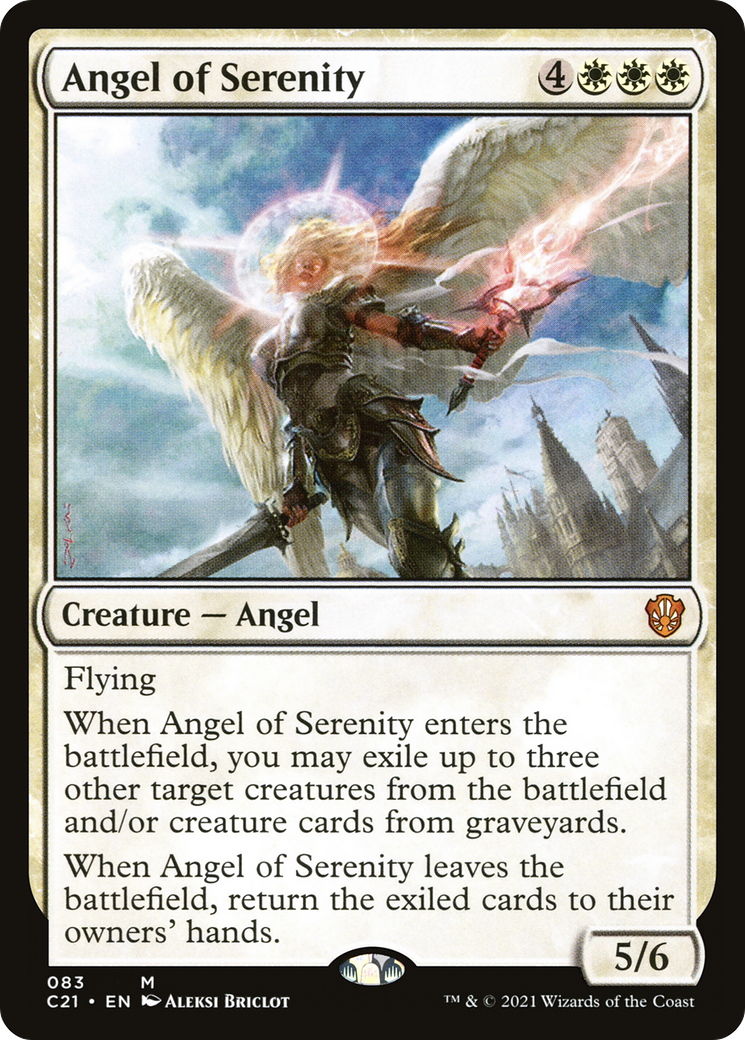
Angel of Serenity
Angel of Serenity
Creature — Angel
5/6
Flying
When this creature enters, you may exile up to three other target creatures from the battlefield and/or creature cards from graveyards.
When this creature leaves the battlefield, return the exiled cards to their owners' hands.
- You choose up to three total targets from among other creatures on the battlefield and creature cards in graveyards. You may choose zero targets.
- You choose the targets as part of putting the "enters" trigger on the stack. Because that ability includes "you may," you choose whether to exile the targets when the ability resolves.
- If a creature targeted by the "enters" ability dies before that ability resolves, it will become an illegal target even though it may be a creature card in a graveyard when the ability resolves. It won't be exiled.
- If Angel of Serenity leaves the battlefield before its "enters" ability has resolved, its leaves-the-battlefield ability will trigger and do nothing. Then the "enters" ability will resolve and exile the targeted creatures and/or creature cards indefinitely.
-
1
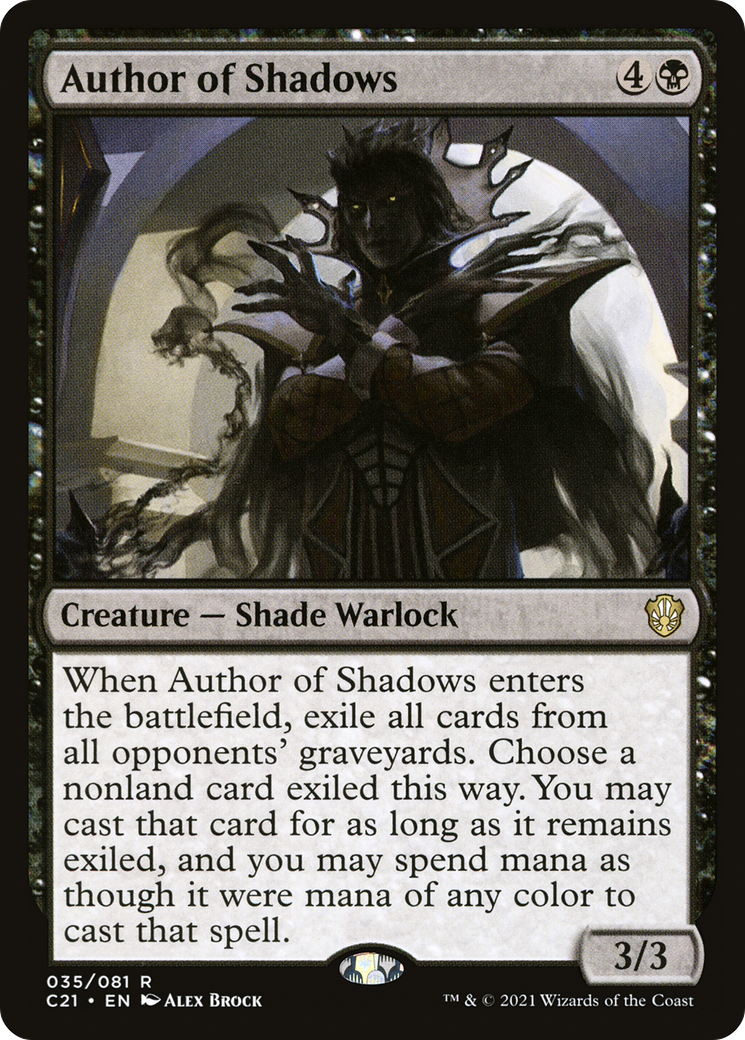
Author of Shadows
Author of Shadows
Creature — Shade Warlock
3/3
When this creature enters, exile all opponents' graveyards. Choose a nonland card exiled this way. You may cast that card for as long as it remains exiled, and you may spend mana as though it were mana of any color to cast that spell.
-
1
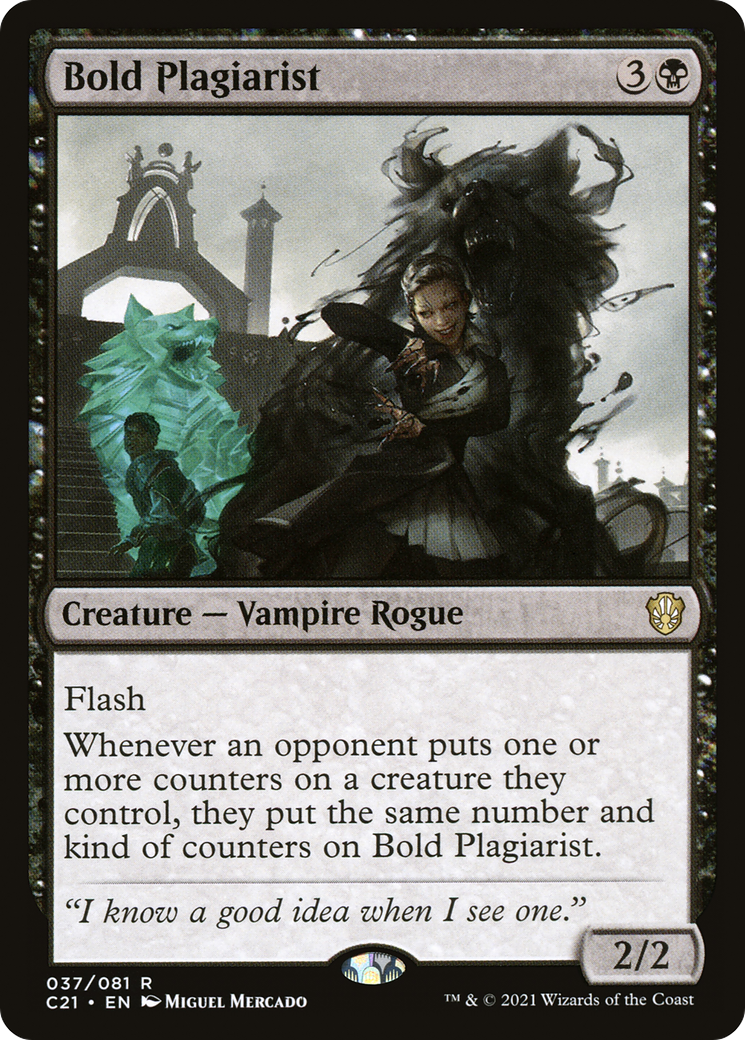
Bold Plagiarist
Bold Plagiarist
Creature — Vampire Rogue
2/2
Flash
Whenever an opponent puts one or more counters on a creature they control, they put the same number and kind of counters on this creature.
- Your opponent places the counters on both permanents. Therefore, if they also control a Bold Plagiarist, its ability will not trigger.
-
1
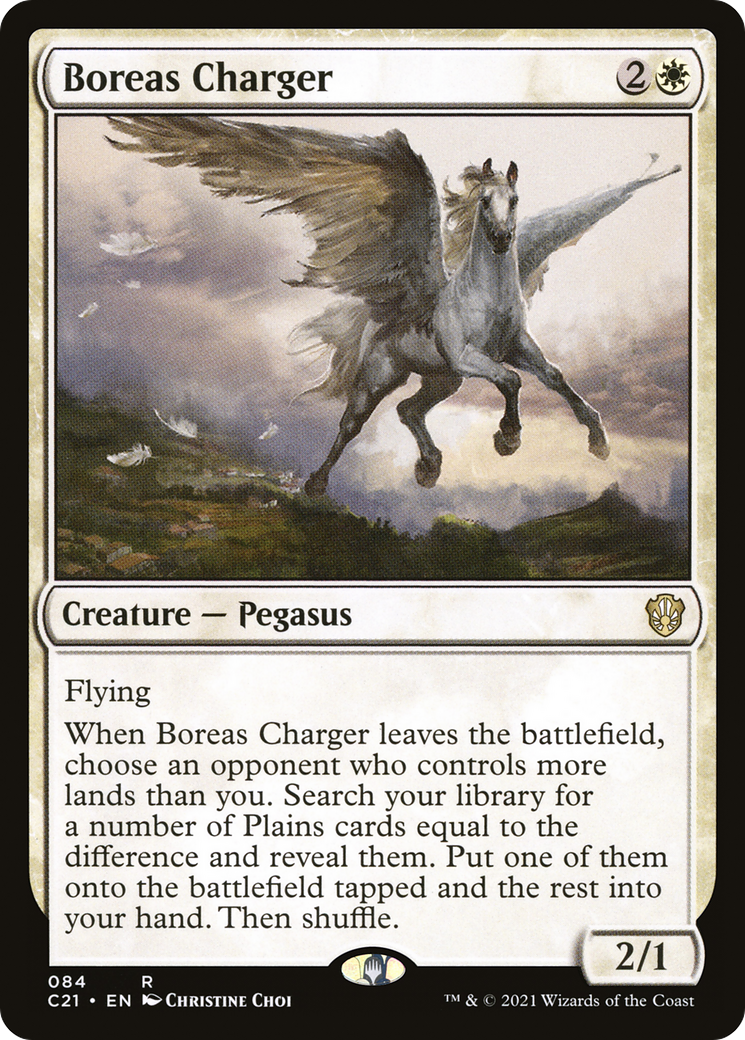
Boreas Charger
Boreas Charger
Creature — Pegasus
2/1
Flying
When this creature leaves the battlefield, choose an opponent who controls more lands than you. Search your library for a number of Plains cards equal to the difference, reveal those cards, put one of them onto the battlefield tapped and the rest into your hand, then shuffle.
- You can find fewer Plains cards than the difference, perhaps because you don't have that many Plains cards left in your library.
- If no opponent controls more lands than you, you'll search your library and shuffle it, but you won't be able to find any Plains cards.
-
1
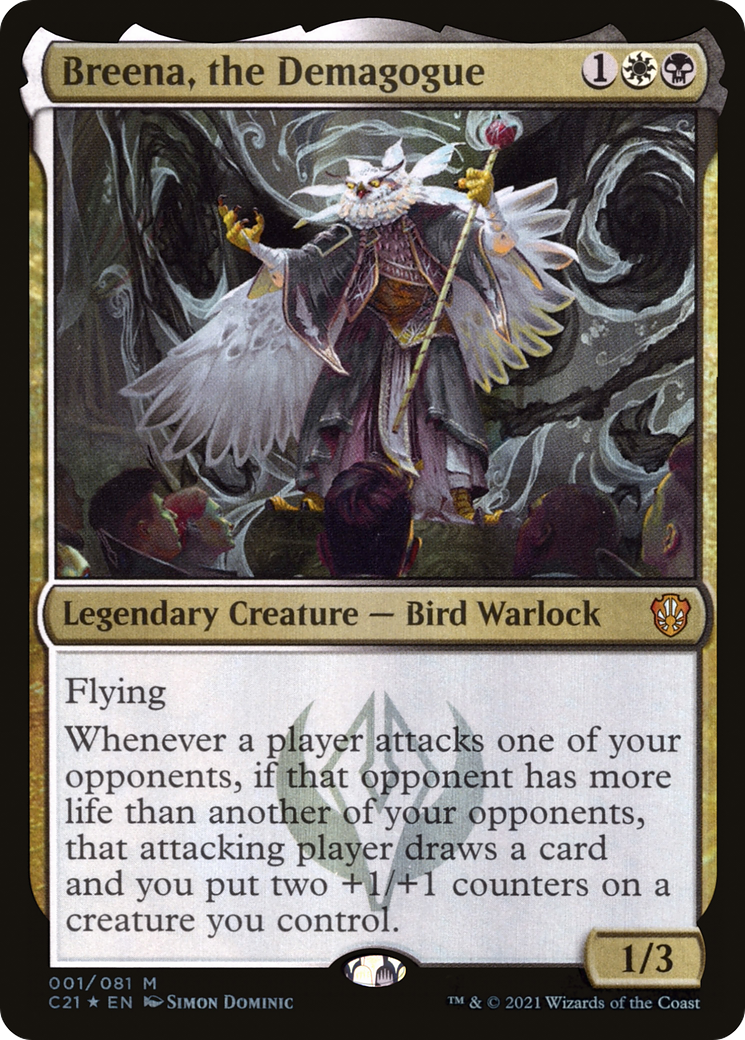
Breena, the Demagogue
Breena, the Demagogue
Legendary Creature — Bird Warlock
1/3
Flying
Whenever a player attacks one of your opponents, if that opponent has more life than another of your opponents, that attacking player draws a card and you put two +1/+1 counters on a creature you control.
- Breena's triggered ability will trigger even if you control no creatures.
- If the attacking player is one of your opponents and has less life than the player being attacked, then the condition is satisfied.
- You choose which creature to put +1/+1 counters on as the ability is resolving. Once you make the choice, no player may take actions until the counters are placed.
-
1
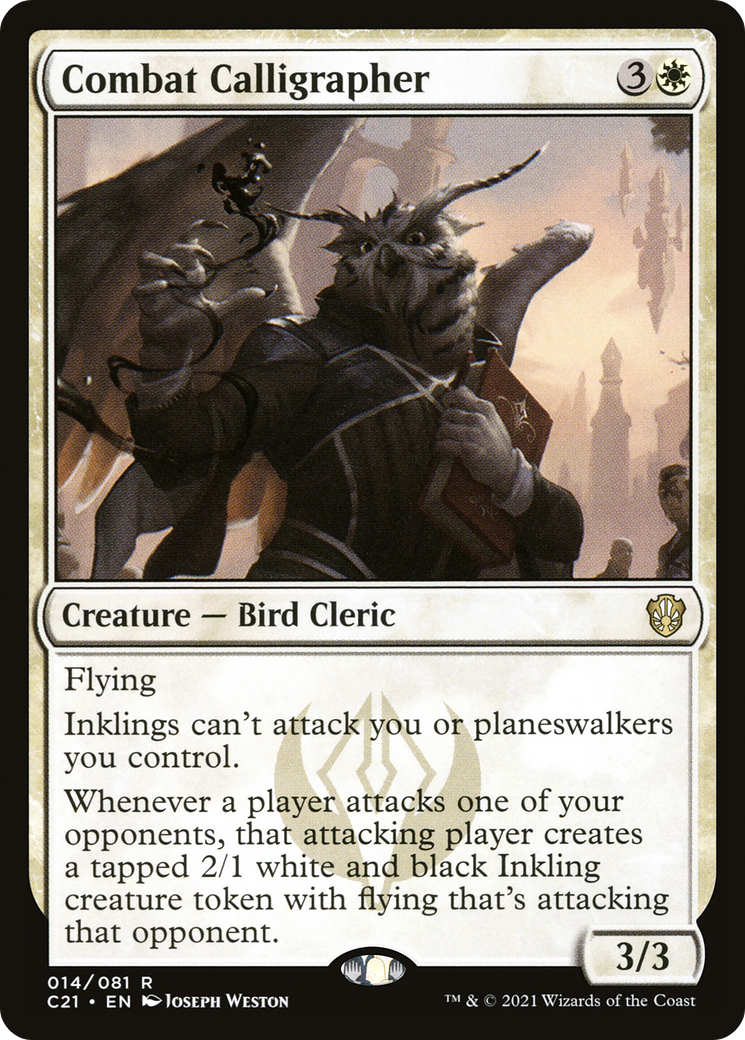
Combat Calligrapher
Combat Calligrapher
Creature — Bird Cleric
3/3
Flying
Inklings can't attack you or planeswalkers you control.
Whenever a player attacks one of your opponents, that attacking player creates a tapped 2/1 white and black Inkling creature token with flying that's attacking that opponent.
-
1
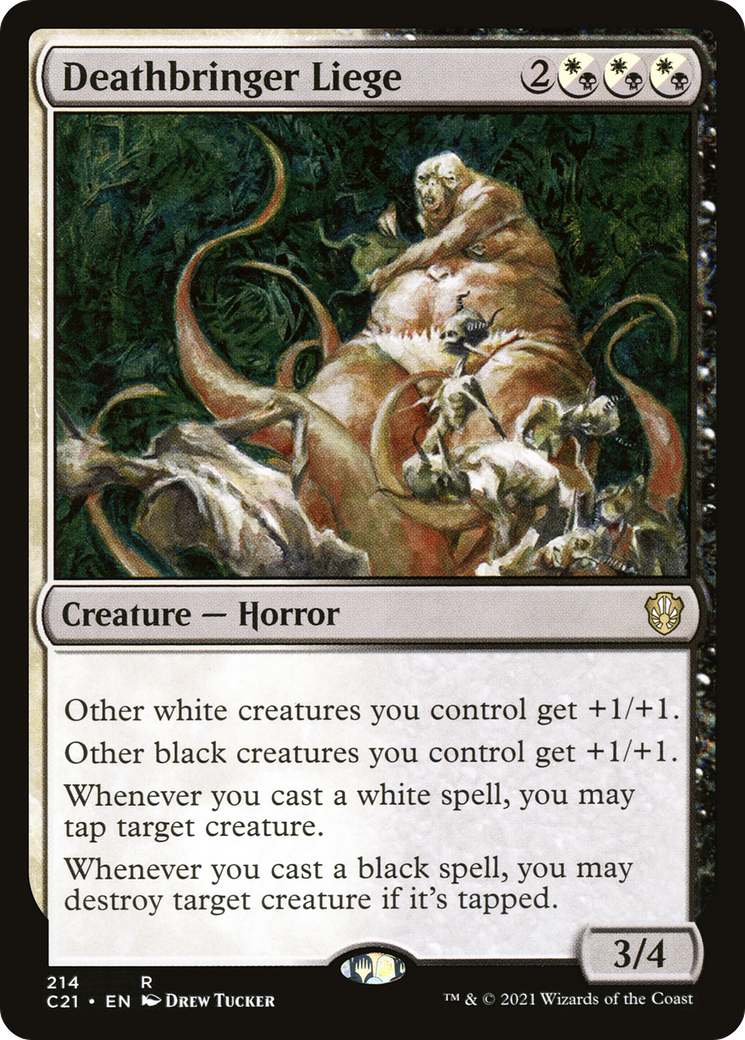
Deathbringer Liege
Deathbringer Liege
Creature — Horror
3/4
Other white creatures you control get +1/+1.
Other black creatures you control get +1/+1.
Whenever you cast a white spell, you may tap target creature.
Whenever you cast a black spell, you may destroy target creature if it's tapped.
- The last ability can target any creature, not just a tapped creature (it doesn't say "target tapped creature"). When the ability resolves, check whether the creature is tapped or not. If it's tapped, you may destroy it. If it's not tapped, the ability does nothing.
- The abilities are separate and cumulative. If another creature you control is both of the listed colors, it will get a total of +2/+2.
- If you cast a spell that's both white and black, the last two abilities will both trigger. You may use them together to destroy any creature. To do so, put the "destroy" ability on the stack first, then put the "tap" ability on the stack, with each one targeting the same creature. When the abilities resolve, they'll tap the creature, then destroy it.
-
1
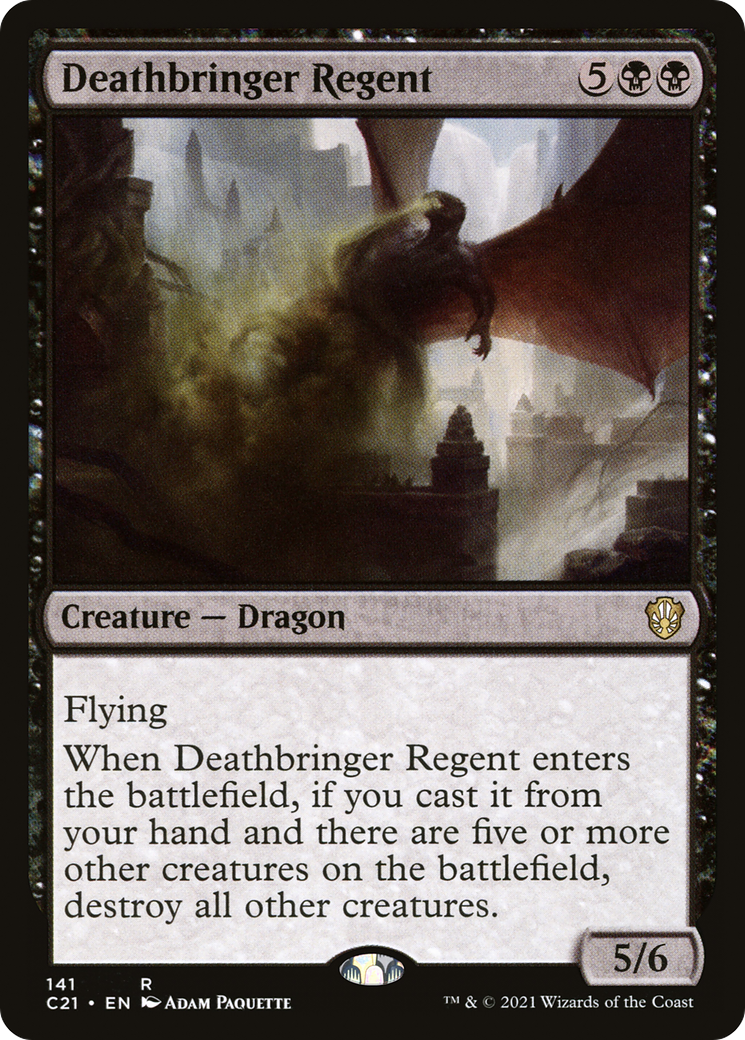
Deathbringer Regent
Deathbringer Regent
Creature — Dragon
5/6
Flying
When this creature enters, if you cast it from your hand and there are five or more other creatures on the battlefield, destroy all other creatures.
- If you cast a creature spell that enters the battlefield as a copy of Deathbringer Regent, the enters-the-battlefield ability will trigger (assuming the “five or more other creatures” requirement is also met).
- Deathbringer Regent's last ability destroys all creatures except Deathbringer Regent, including the five other creatures required for the ability to have an effect.
-
1
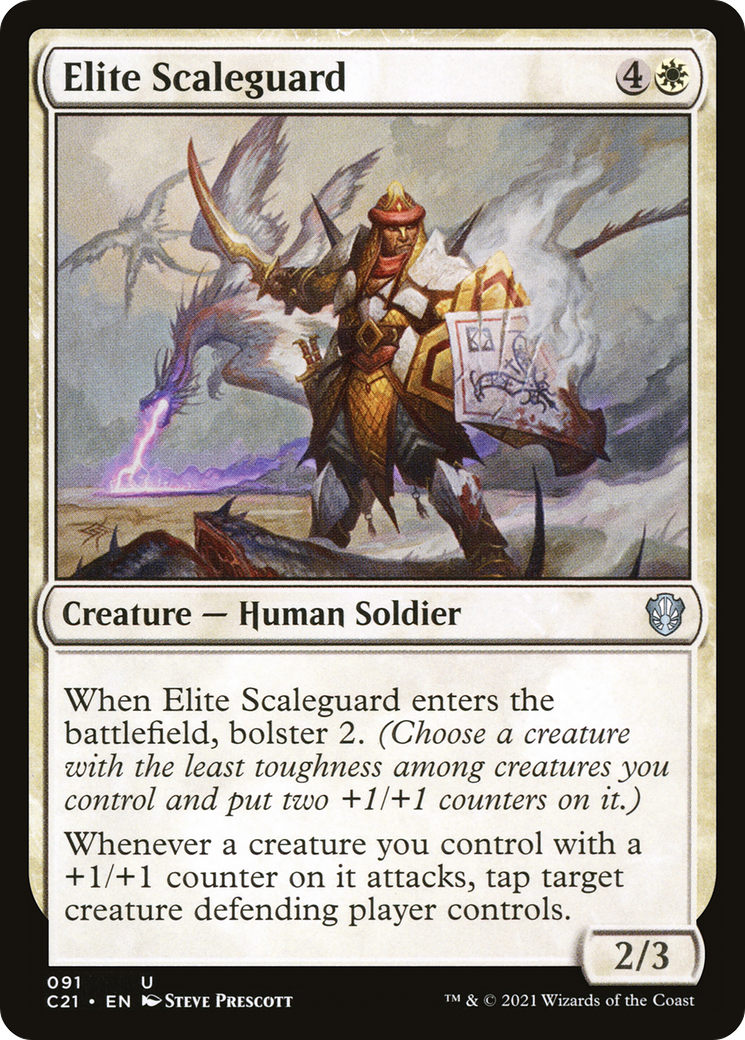
Elite Scaleguard
Elite Scaleguard
Creature — Human Soldier
2/3
When this creature enters, bolster 2. (Choose a creature with the least toughness among creatures you control and put two +1/+1 counters on it.)
Whenever a creature you control with a +1/+1 counter on it attacks, tap target creature defending player controls.
- Bolster itself doesn't target any creature, though some spells and abilities that bolster may have other effects that target creatures. For example, you could put counters on a creature with protection from white with Abzan Skycaptain's bolster ability.
- You determine which creature to put counters on as the spell or ability that instructs you to bolster resolves.
-
1
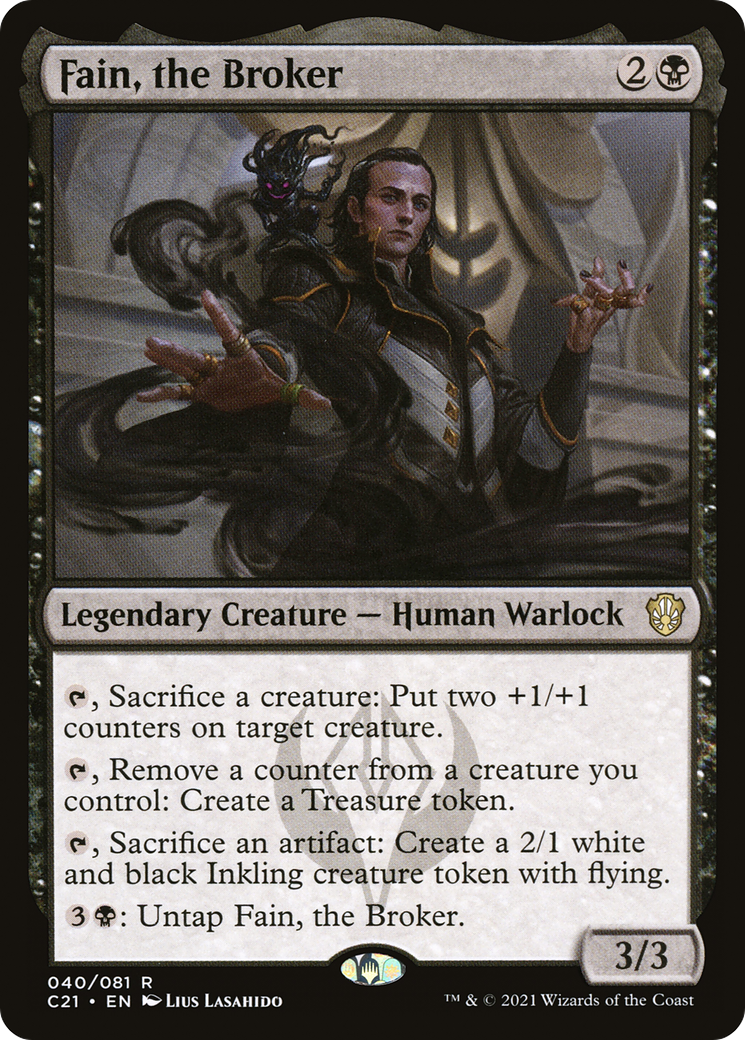
Fain, the Broker
Fain, the Broker
Legendary Creature — Human Warlock
3/3
, Sacrifice a creature: Put two +1/+1 counters on target creature.
, Remove a counter from a creature you control: Create a Treasure token.
, Sacrifice an artifact: Create a 2/1 white and black Inkling creature token with flying.
: Untap Fain.
-
1
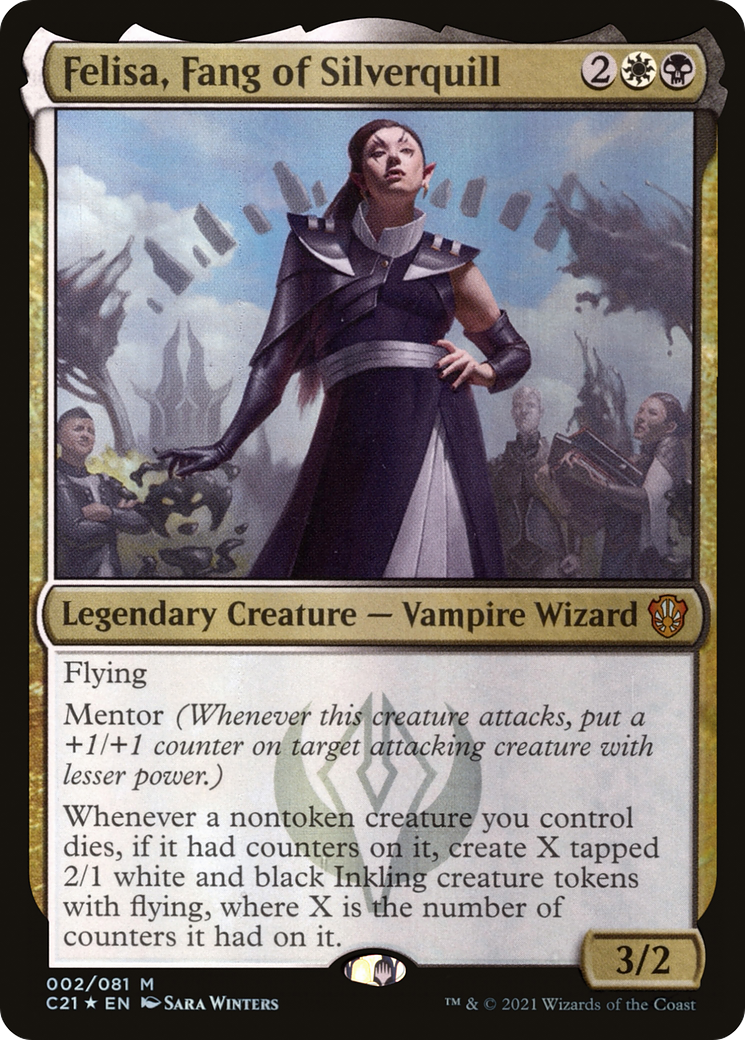
Felisa, Fang of Silverquill
Felisa, Fang of Silverquill
Legendary Creature — Vampire Wizard
3/2
Flying
Mentor (Whenever this creature attacks, put a +1/+1 counter on target attacking creature with lesser power.)
Whenever a nontoken creature you control dies, if it had counters on it, create X tapped 2/1 white and black Inkling creature tokens with flying, where X is the number of counters it had on it.
- The last ability counts the number of all kinds of counters, not just +1/+1 counters.
- Mentor compares the power of the creature with mentor with that of the target creature at two different times: once as the triggered ability is put onto the stack, and once as the triggered ability resolves. If you wish to raise a creature's power so its mentor ability can target a bigger creature, the last chance you have to do so is during the beginning of combat step.
- If the target creature's power is no longer less than the attacking creature's power as the ability resolves, mentor doesn't add a +1/+1 counter. For example, if two 3/3 creatures with mentor attack and both mentor triggers target the same 2/2 creature, the first to resolve puts a +1/+1 counter on it and the second does nothing.
- If the creature with mentor leaves the battlefield with mentor on the stack, use its power as that creature last existed on the battlefield to determine whether the target creature has less power.
-
1
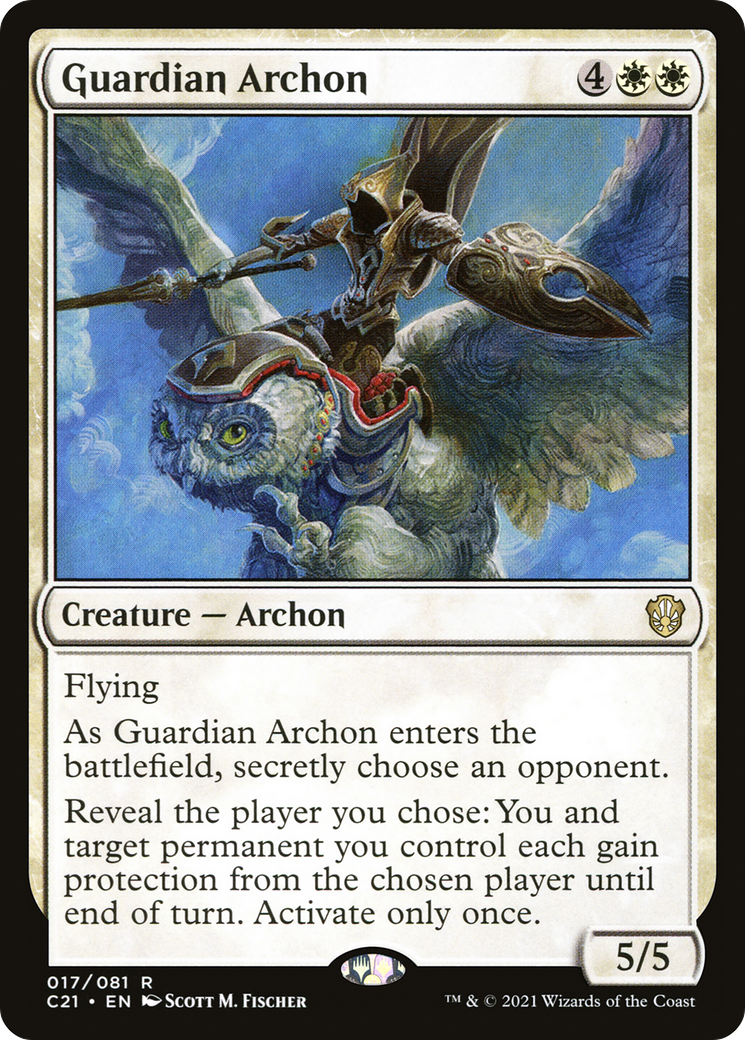
Guardian Archon
Guardian Archon
Creature — Archon
5/5
Flying
As this creature enters, secretly choose an opponent.
Reveal the player you chose: You and target permanent you control each gain protection from the chosen player until end of turn. Activate only once.
- In a two-player game, the chosen player won’t be much of a secret.
- There are several ways to secretly choose an opponent. Perhaps the most popular way is to write the chosen player’s name on a piece of paper that is kept with Guardian Archon.
- If you control more than one Guardian Archon, you may choose a different opponent for each one. Be careful to keep track of which opponent is chosen for each Guardian Archon.
- If Guardian Archon leaves the battlefield and returns, it’s considered a new object. You may choose a new opponent and you may activate its last ability again.
- If you didn’t choose an opponent as Guardian Archon entered the battlefield, you can’t pay the cost to activate the last ability. This will usually happen because you gained control of another player’s Guardian Archon or because a creature already on the battlefield became a copy of Guardian Archon.
- Protection from a player means all of the following: (1) Neither you nor the target permanent can be the target of spells or abilities controlled by the chosen player. (2) Neither you nor the target permanent can be enchanted or equipped by any Auras or Equipment controlled by the chosen players. (Okay, Fortifications too, if the target permanent is a land.) (3) If the target permanent is a creature, it can’t be blocked by creatures controlled by the chosen player. (4) All damage that would be dealt to you or the target permanent by sources controlled by the chosen player is prevented. The same is true for sources owned by the chosen player that don’t have controllers.
-
1
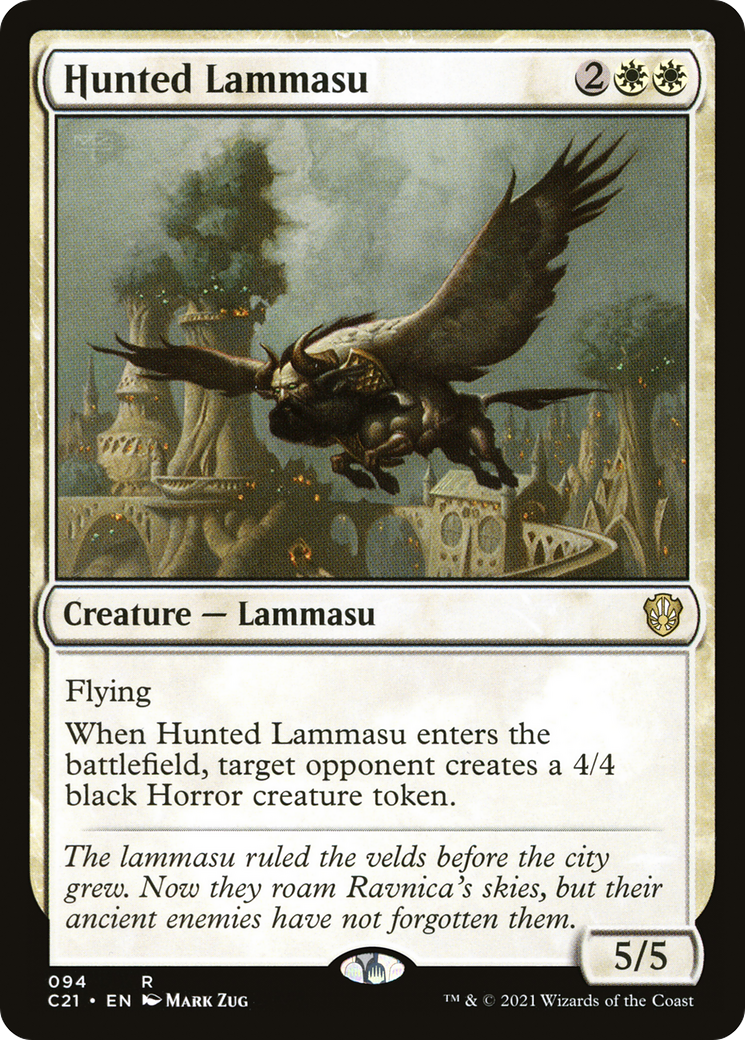
Hunted Lammasu
Hunted Lammasu
Creature — Lammasu
5/5
Flying
When this creature enters, target opponent creates a 4/4 black Horror creature token.
-
1
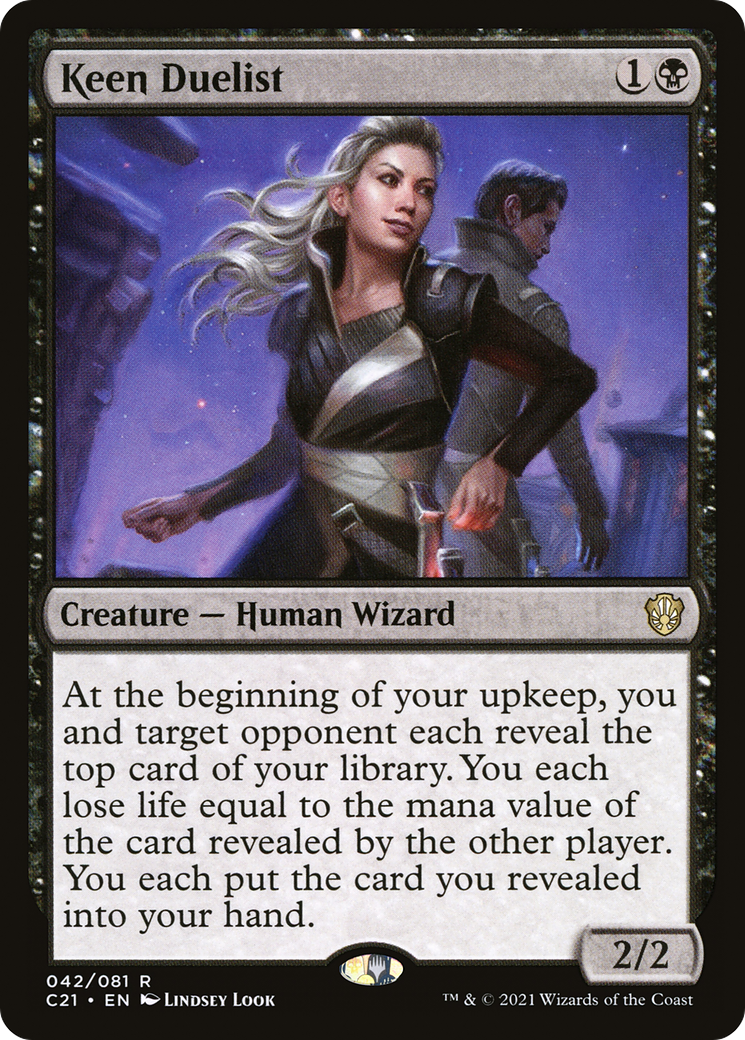
Keen Duelist
Keen Duelist
Creature — Human Wizard
2/2
At the beginning of your upkeep, you and target opponent each reveal the top card of your library. You each lose life equal to the mana value of the card revealed by the other player. You each put the card you revealed into your hand.
-
1
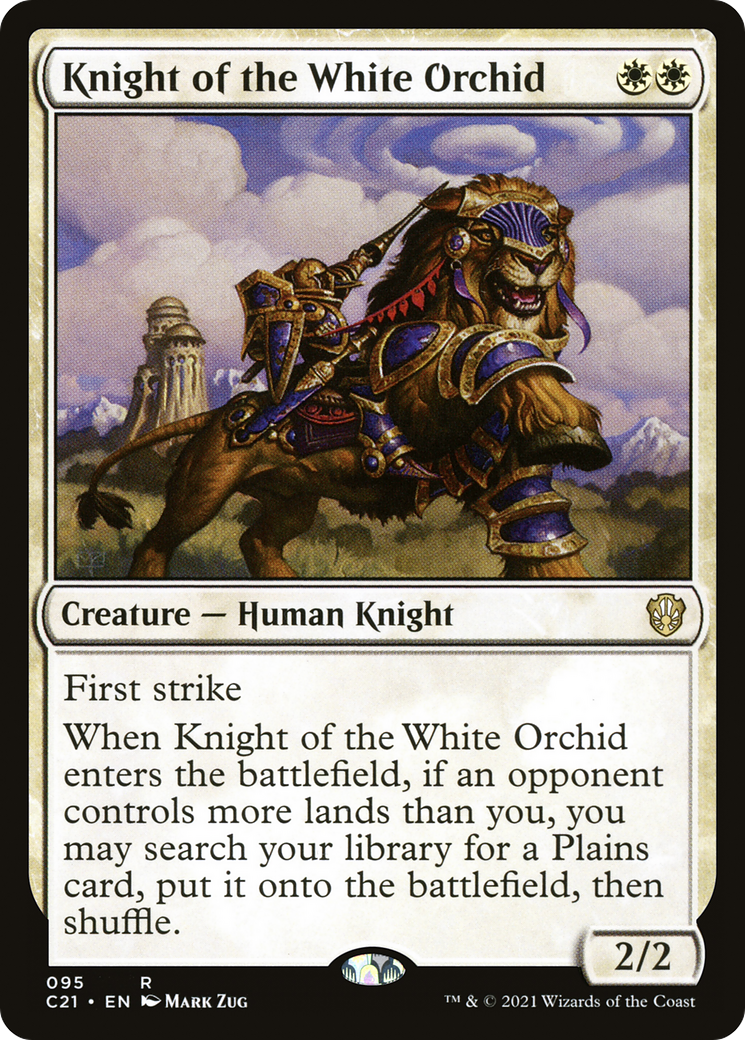
Knight of the White Orchid
Knight of the White Orchid
Creature — Human Knight
2/2
First strike
When this creature enters, if an opponent controls more lands than you, you may search your library for a Plains card, put it onto the battlefield, then shuffle.
- The Plains you search for doesn't have to be basic. For example, you could put a Sacred Foundry onto the battlefield.
- Knight of the White Orchid's triggered ability has an “intervening ‘if' clause.” That means (1) the ability won't trigger at all unless any one of your opponents controls more lands than you, and (2) the ability will do nothing if you control at least as many lands as each of your opponents by the time it resolves.
-
1
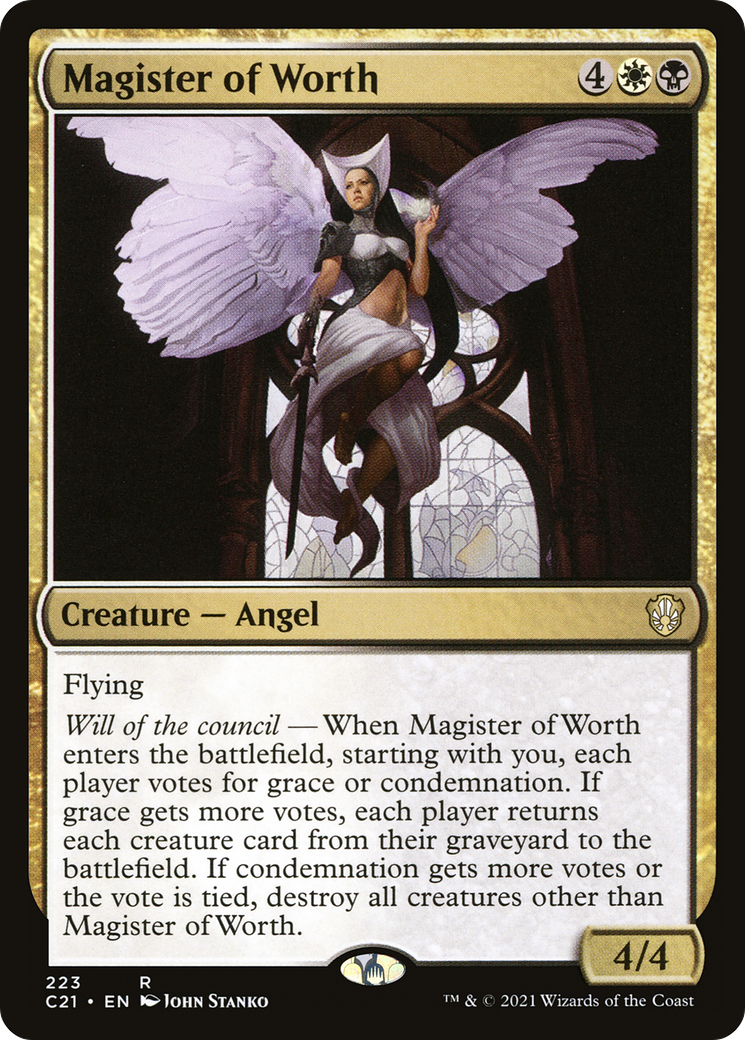
Magister of Worth
Magister of Worth
Creature — Angel
4/4
Flying
Will of the council — When this creature enters, starting with you, each player votes for grace or condemnation. If grace gets more votes, each player returns each creature card from their graveyard to the battlefield. If condemnation gets more votes or the vote is tied, destroy all creatures other than this creature.
- Because the votes are cast in turn order, each player will know the votes of players who voted beforehand.
- You must vote for one of the available options. You can't abstain.
- No player votes until the spell or ability resolves. Any responses to that spell or ability must be made without knowing the outcome of the vote.
- Players can't do anything after they finish voting but before the spell or ability that included the vote finishes resolving.
- The phrase "the vote is tied" refers only to when there is more than one choice that received the most votes. For example, if a 5-player vote from among three different choices ends 3 votes to 1 vote to 1 vote, the vote isn't tied.
-
1
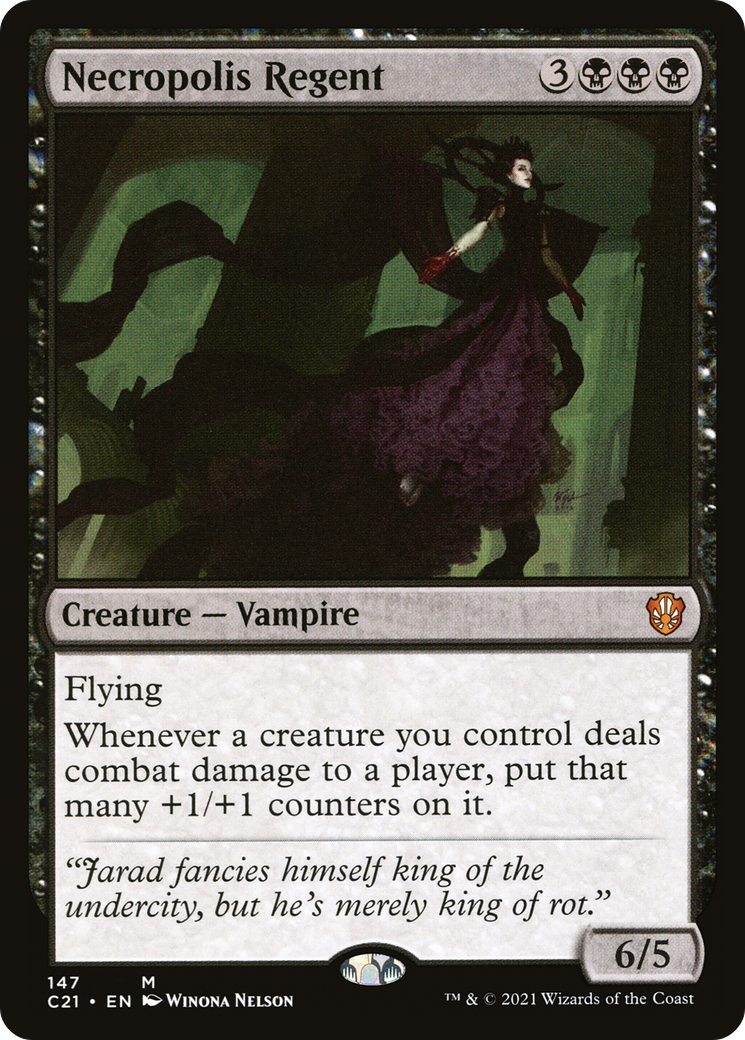
Necropolis Regent
Necropolis Regent
Creature — Vampire
6/5
Flying
Whenever a creature you control deals combat damage to a player, put that many +1/+1 counters on it.
- If that creature deals combat damage to a player at the same time it's dealt lethal damage (perhaps because it has trample and was blocked), it will die before the triggered ability resolves and puts +1/+1 counters on it.
-
1
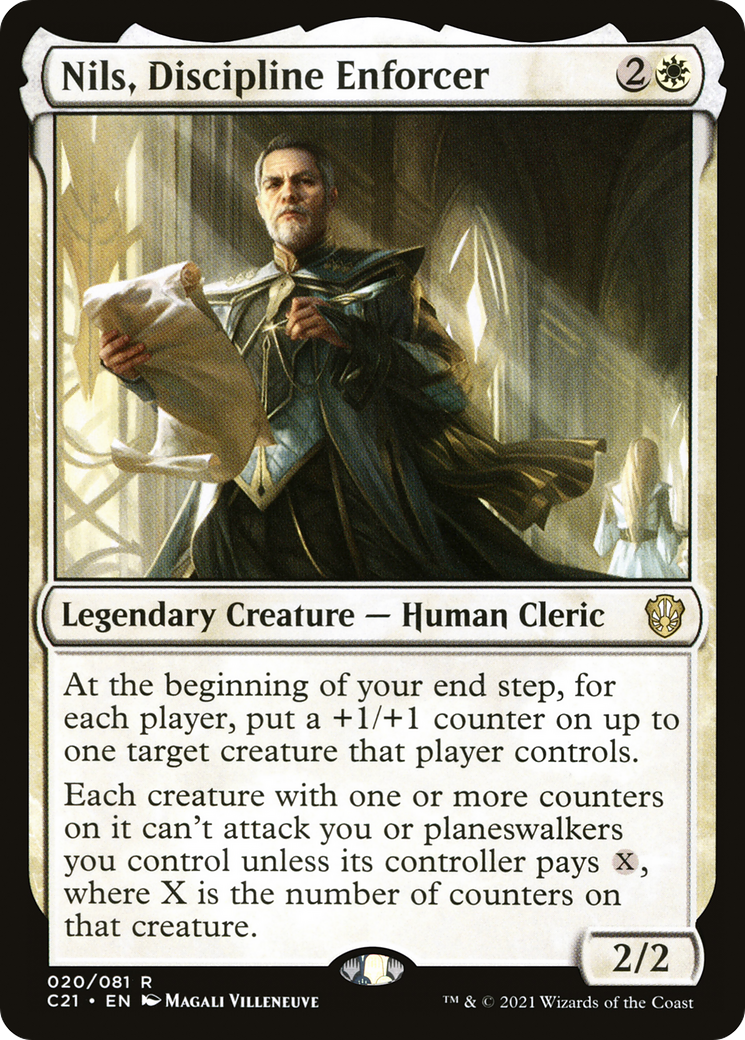
Nils, Discipline Enforcer
Nils, Discipline Enforcer
Legendary Creature — Human Cleric
2/2
At the beginning of your end step, for each player, put a +1/+1 counter on up to one target creature that player controls.
Each creature with one or more counters on it can't attack you or planeswalkers you control unless its controller pays , where X is the number of counters on that creature.
- All counters on a creature are considered when determining the value of X, not only +1/+1 counters.
- For each player, choosing a target creature that player controls is optional.
- Your opponents can choose not to pay to attack with a creature with one or more counters on it that attacks "if able." If there's no other player or planeswalker to attack, the creature simply doesn't attack.
-
1
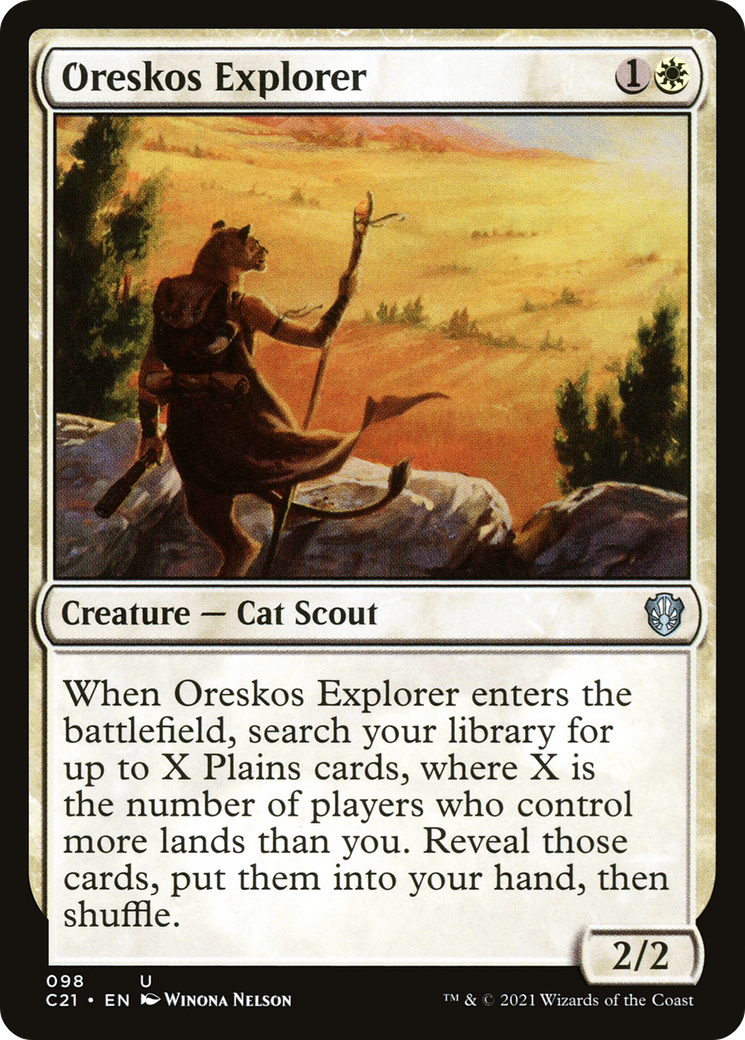
Oreskos Explorer
Oreskos Explorer
Creature — Cat Scout
2/2
When this creature enters, search your library for up to X Plains cards, where X is the number of players who control more lands than you. Reveal those cards, put them into your hand, then shuffle.
- The value of X is determined as Oreskos Explorer's triggered ability resolves.
- If no player controls more lands than you do, you'll still search and shuffle your library, although you can't find any cards.
-
1
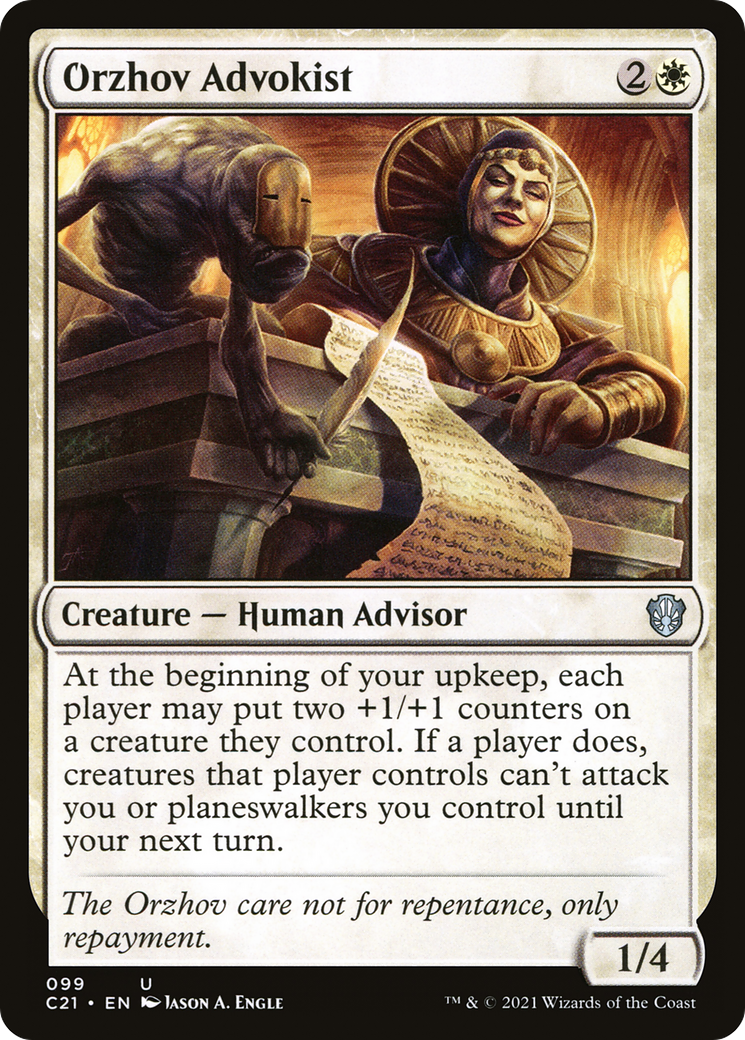
Orzhov Advokist
Orzhov Advokist
Creature — Human Advisor
1/4
At the beginning of your upkeep, each player may put two +1/+1 counters on a creature they control. If a player does, creatures that player controls can't attack you or planeswalkers you control until your next turn.
- While resolving Orzhov Advokist's ability, you choose a creature you control or choose not to put any counters on a creature, then each other player in turn order does the same. Each player will know the choices made by players who chose before them. Then simultaneously each player who chose a creature puts two +1/+1 counters on the creature they chose.
- Orzhov Advokist's ability doesn't target the creatures that receive +1/+1 counters. Their controllers choose them as the ability resolves. Players can't take actions between making their choices and the +1/+1 counters being placed.
- If a player chooses to accept Orzhov Advokist's gift, that player can't attack you or a planeswalker you control with any creatures during their next turn, even creatures that weren't on the battlefield as Orzhov Advokist's ability resolved.
- Orzhov Advokist's effect keeps creatures from attacking you even if Orzhov Advokist leaves the battlefield, if the creature that received counters is no longer on the battlefield, or if an effect has moved those counters off of the creature that received them and put them onto another creature.
-
1
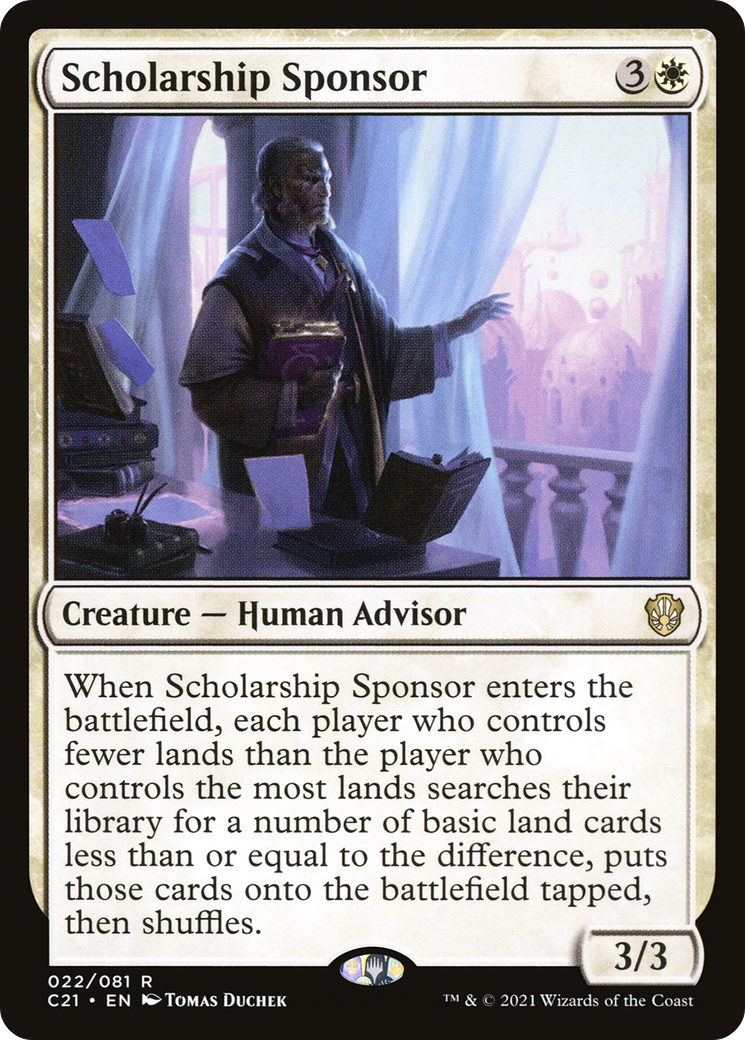
Scholarship Sponsor
Scholarship Sponsor
Creature — Human Advisor
3/3
When this creature enters, each player who controls fewer lands than the player who controls the most lands searches their library for a number of basic land cards less than or equal to the difference, puts those cards onto the battlefield tapped, then shuffles.
- For example, if you control four lands, one opponent controls six lands, and another opponent controls seven lands, you will search your library for up to three basic land cards and the first opponent will search their library for one basic land card. The second opponent won’t search their library at all.
-
1
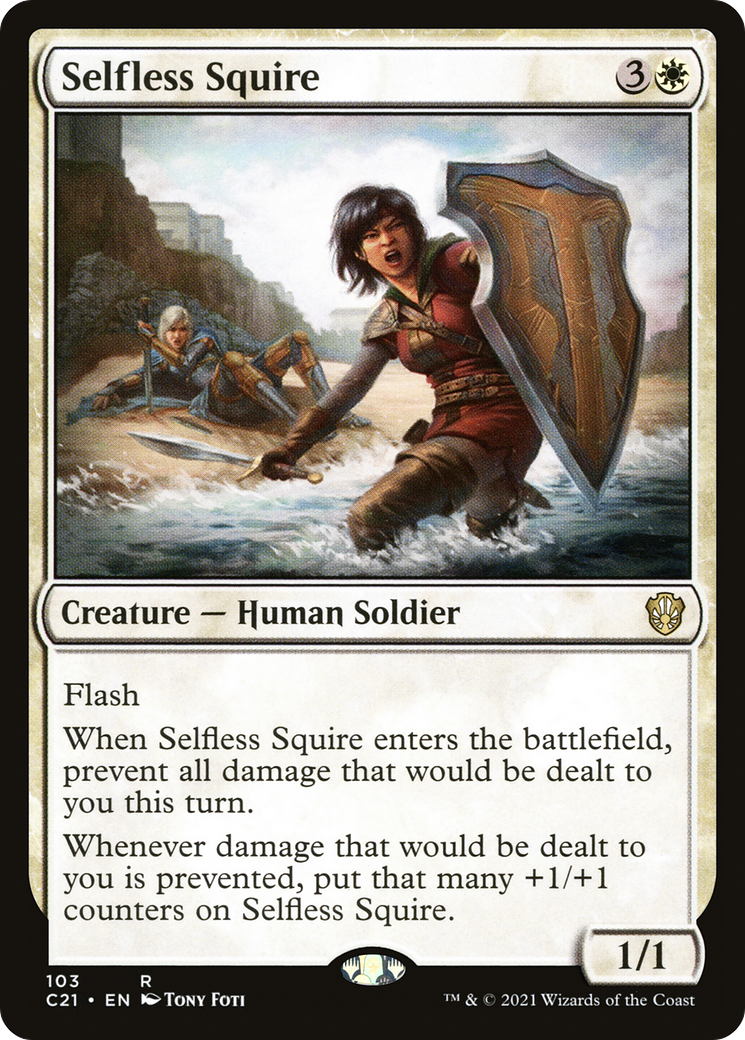
Selfless Squire
Selfless Squire
Creature — Human Soldier
1/1
Flash
When this creature enters, prevent all damage that would be dealt to you this turn.
Whenever damage that would be dealt to you is prevented, put that many +1/+1 counters on this creature.
- Selfless Squire's first triggered ability prevents all damage that would be dealt to you this turn after the triggered ability resolves, even if Selfless Squire leaves the battlefield.
- Selfless Squire's second triggered ability doesn't trigger only when damage is prevented by its first triggered ability's effect. Any effect that uses the word "prevent" will cause it to trigger.
-
1
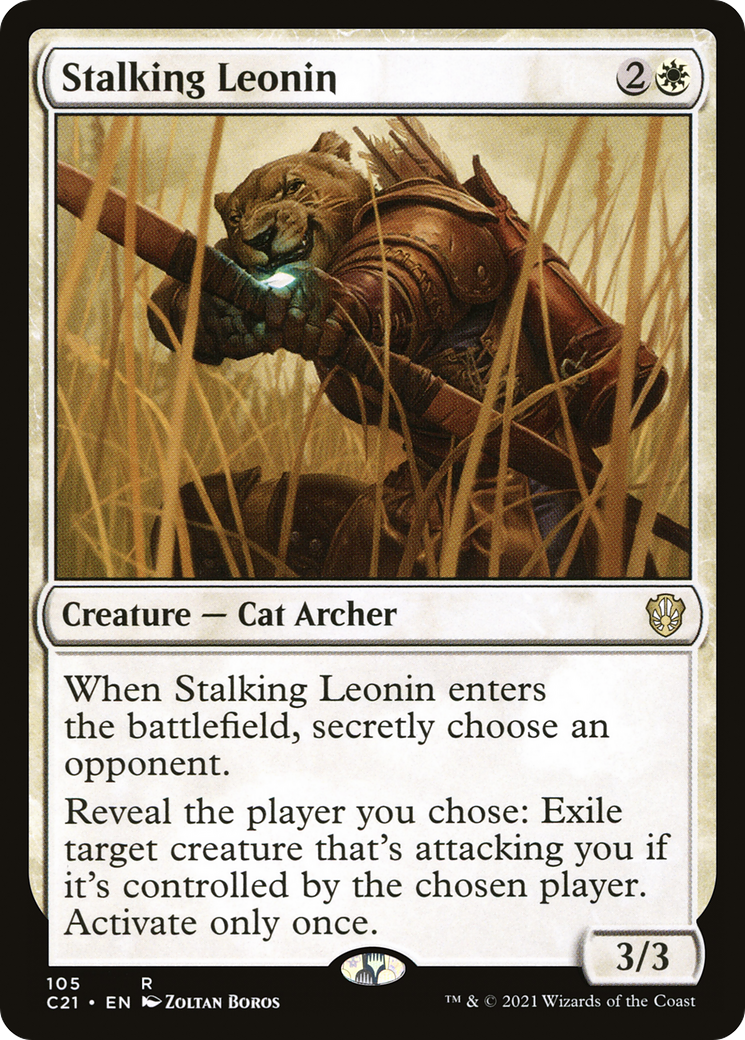
Stalking Leonin
Stalking Leonin
Creature — Cat Archer
3/3
When this creature enters, secretly choose an opponent.
Reveal the player you chose: Exile target creature that's attacking you if it's controlled by the chosen player. Activate only once.
- There are several ways to secretly choose an opponent, including writing that player's name on a piece of paper that's kept with Stalking Leonin.
- If you have multiple Stalking Leonins, you may choose a different opponent for each one. Be careful to keep track of which opponent is chosen for each Stalking Leonin.
- If Stalking Leonin leaves the battlefield and returns, it's considered a new object. You may choose a new opponent and you may activate its last ability again.
- If you didn't choose an opponent when Stalking Leonin entered the battlefield, you can't pay the cost to activate its last ability. This will usually happen because you gained control of another player's Stalking Leonin or because a creature already on the battlefield became a copy of Stalking Leonin.
- If a creature is attacking a planeswalker you control, it's not attacking you. Stalking Leonin's last ability can't target it.
-
1
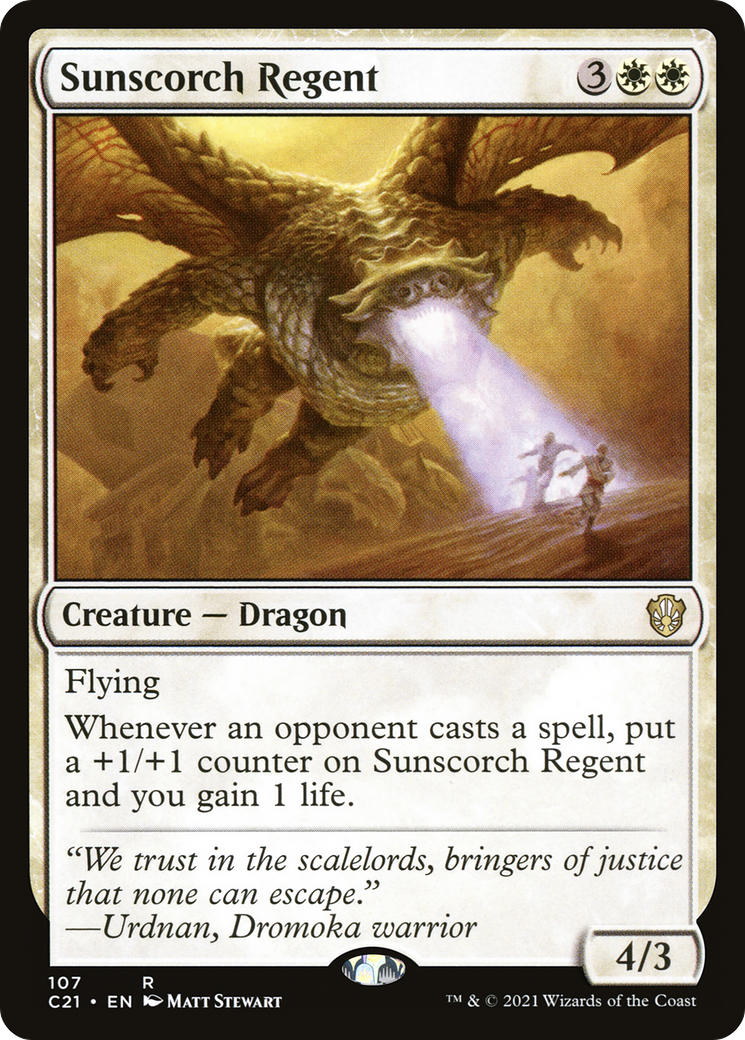
Sunscorch Regent
Sunscorch Regent
Creature — Dragon
4/3
Flying
Whenever an opponent casts a spell, put a +1/+1 counter on this creature and you gain 1 life.
-
1
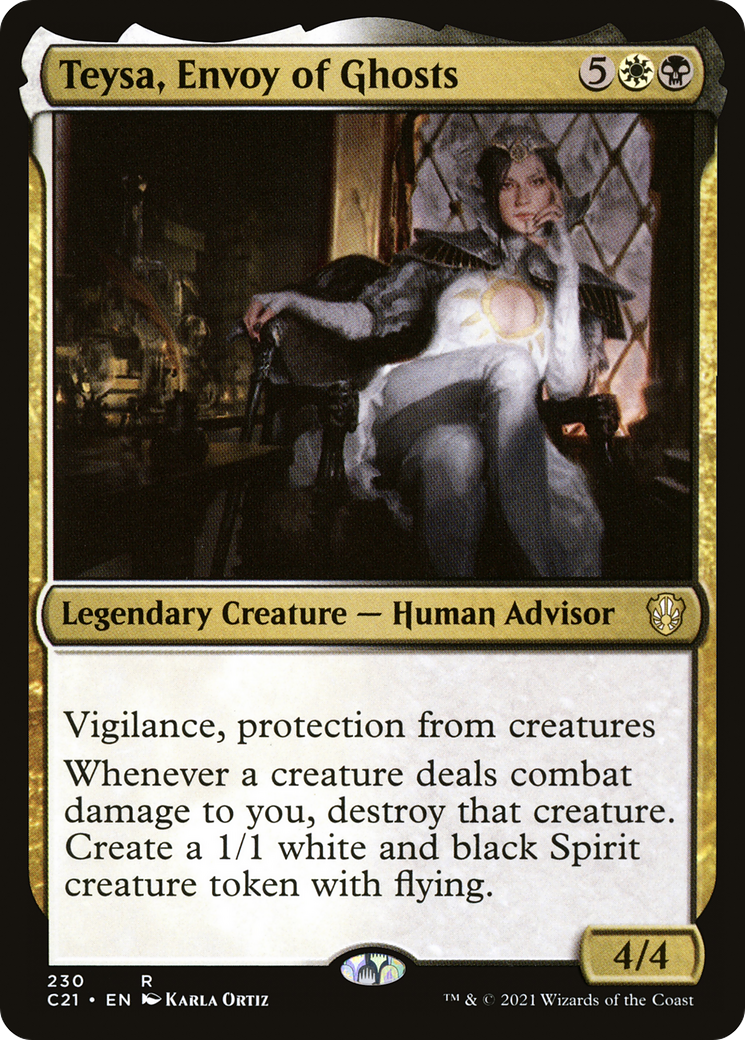
Teysa, Envoy of Ghosts
Teysa, Envoy of Ghosts
Legendary Creature — Human Advisor
4/4
Vigilance, protection from creatures
Whenever a creature deals combat damage to you, destroy that creature. Create a 1/1 white and black Spirit creature token with flying.
- You get a Spirit creature token even if Teysa’s triggered ability doesn’t destroy the creature (perhaps because it regenerated or has indestructible).
- Protection from creatures means that Teysa, Envoy of Ghosts can’t be the target of abilities of creatures or abilities of creature cards in other zones, such as bloodrush abilities. Teysa also can’t be blocked by creatures, and all damage that would be dealt to Teysa by creatures is prevented.
- Teysa’s last ability doesn’t target the creature. It will destroy a creature with hexproof or protection from white, for example.
- Teysa’s controller gets the Spirit creature token, not the controller of the creature that dealt combat damage.
-
1
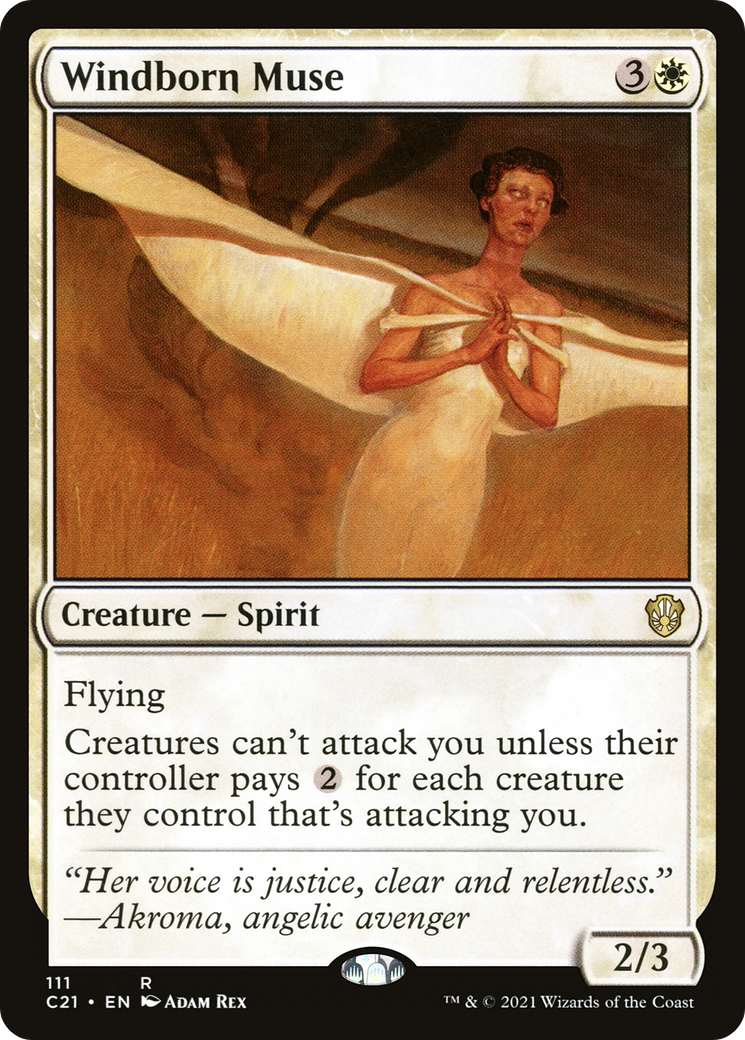
Windborn Muse
Windborn Muse
Creature — Spirit
2/3
Flying
Creatures can't attack you unless their controller pays for each creature they control that's attacking you.
- Creatures may still attack planeswalkers you control without their controller paying a cost.
-
1
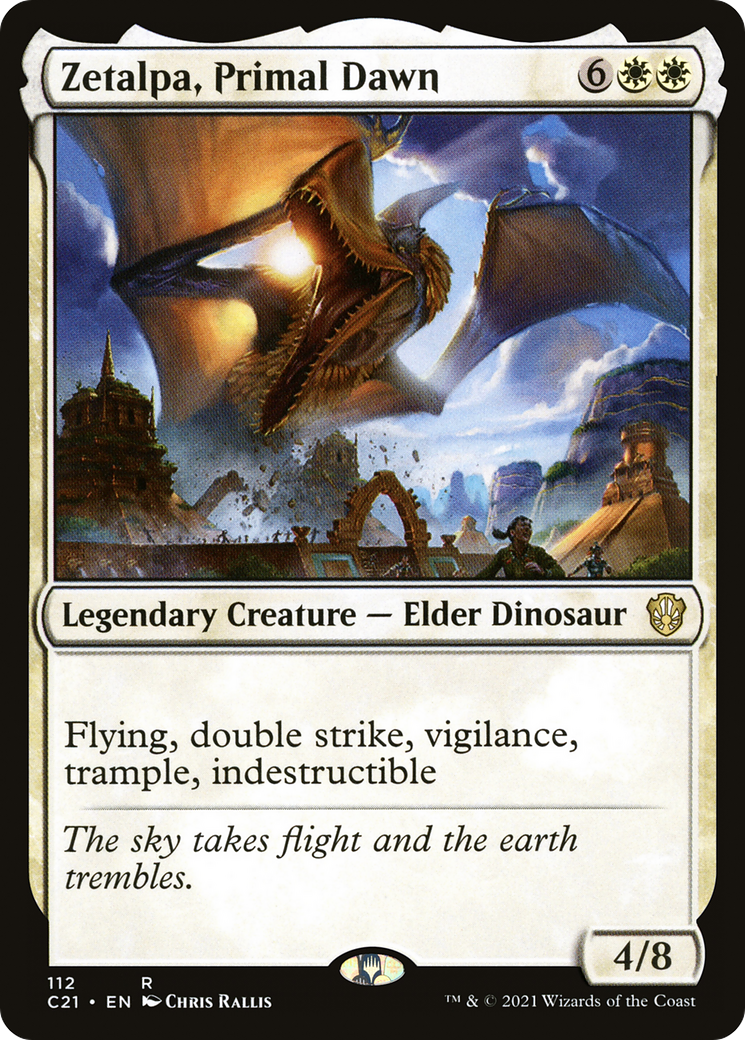
Zetalpa, Primal Dawn
Zetalpa, Primal Dawn
Legendary Creature — Elder Dinosaur
4/8
Flying, double strike, vigilance, trample, indestructible
- If an attacking creature with double strike and trample destroys all of its blocking creatures with first-strike combat damage, all of its normal combat damage is assigned to the player, planeswalker, or battle that creature's attacking.
Instants 5
-
1
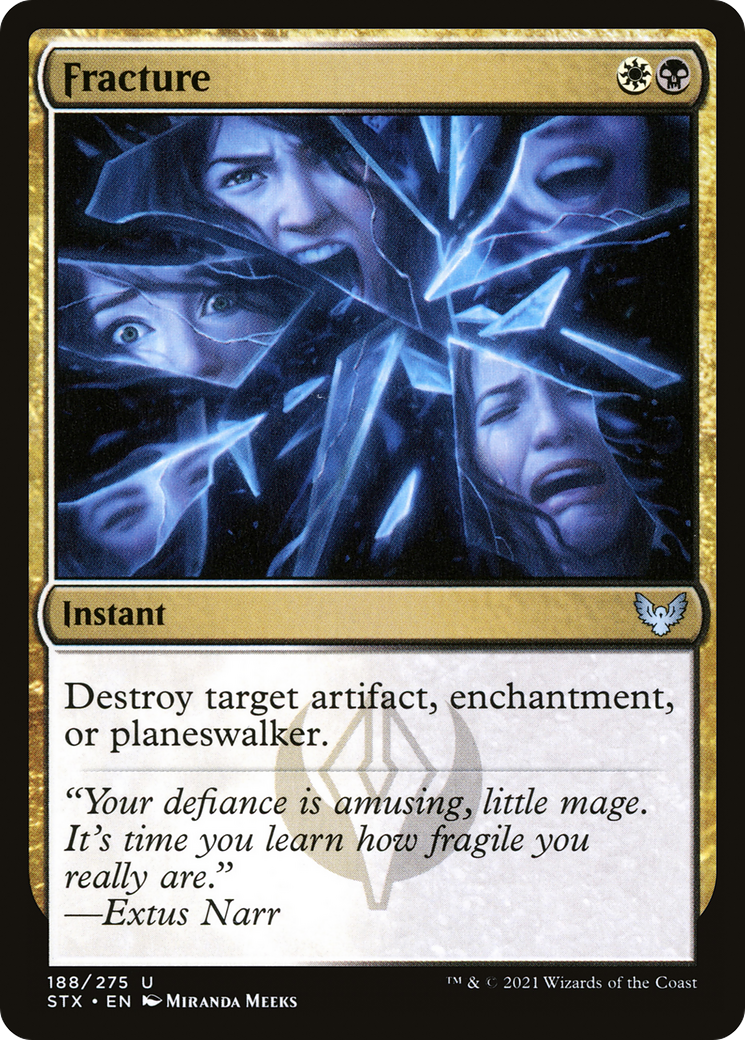
Fracture
Fracture
Instant
Destroy target artifact, enchantment, or planeswalker.
-
1
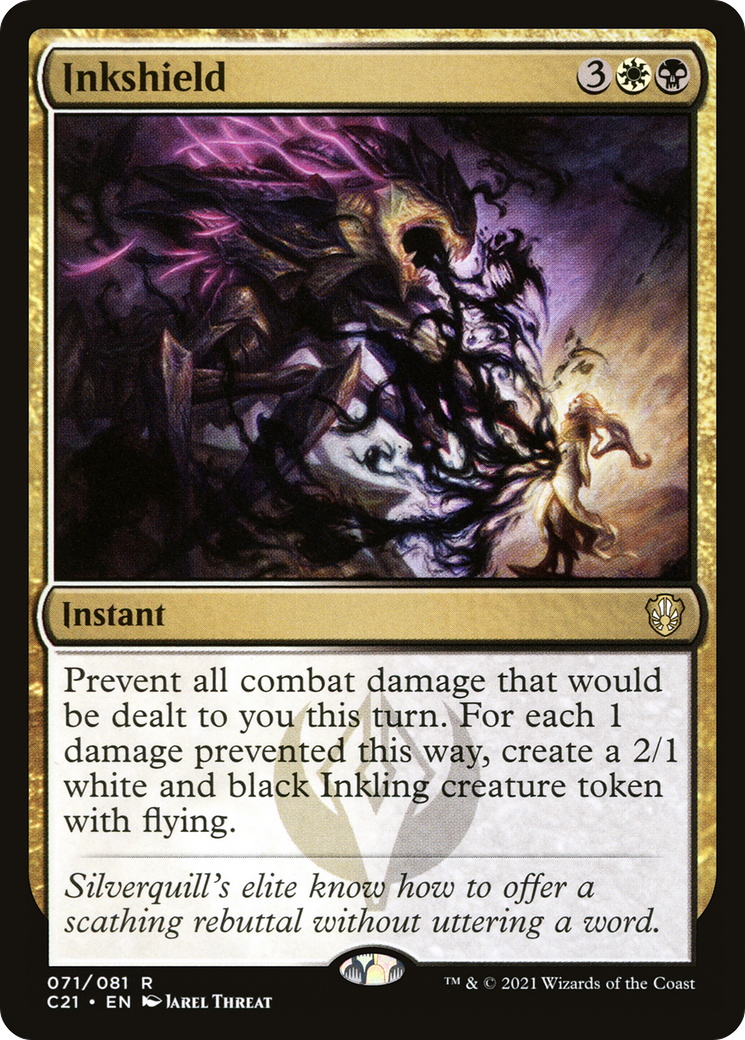
Inkshield
Inkshield
Instant
Prevent all combat damage that would be dealt to you this turn. For each 1 damage prevented this way, create a 2/1 white and black Inkling creature token with flying.
- If multiple damage prevention effects would apply to combat damage that would be dealt to you, you get to choose the order the prevention effects are applied in.
-
1
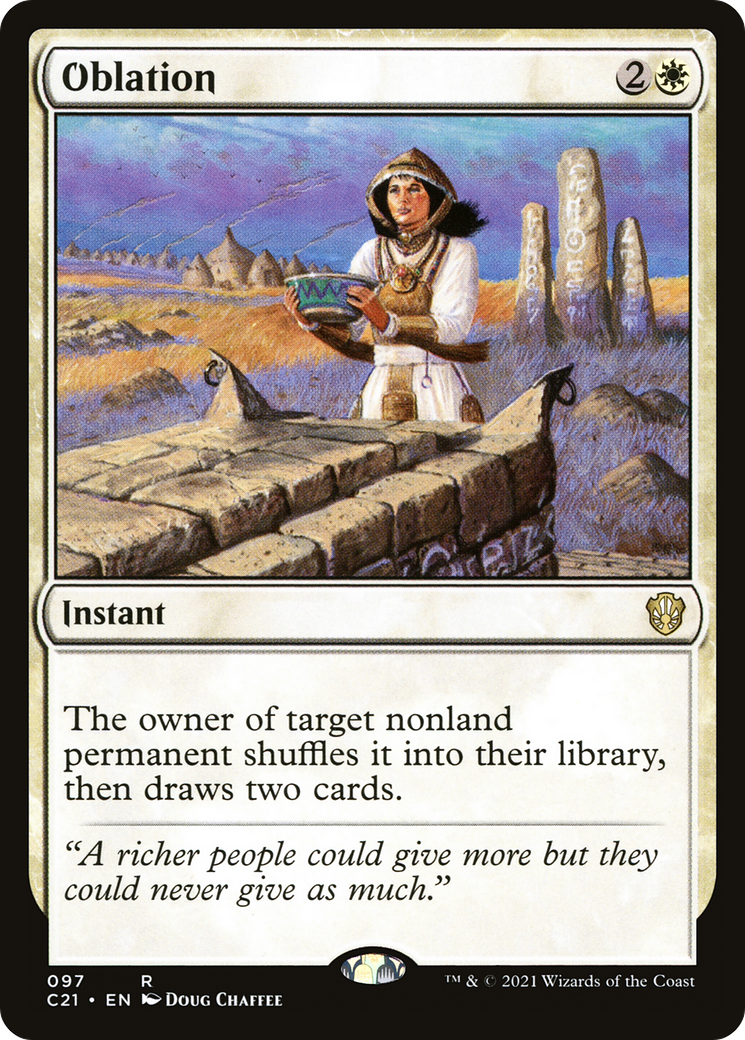
Oblation
Oblation
Instant
The owner of target nonland permanent shuffles it into their library, then draws two cards.
-
1
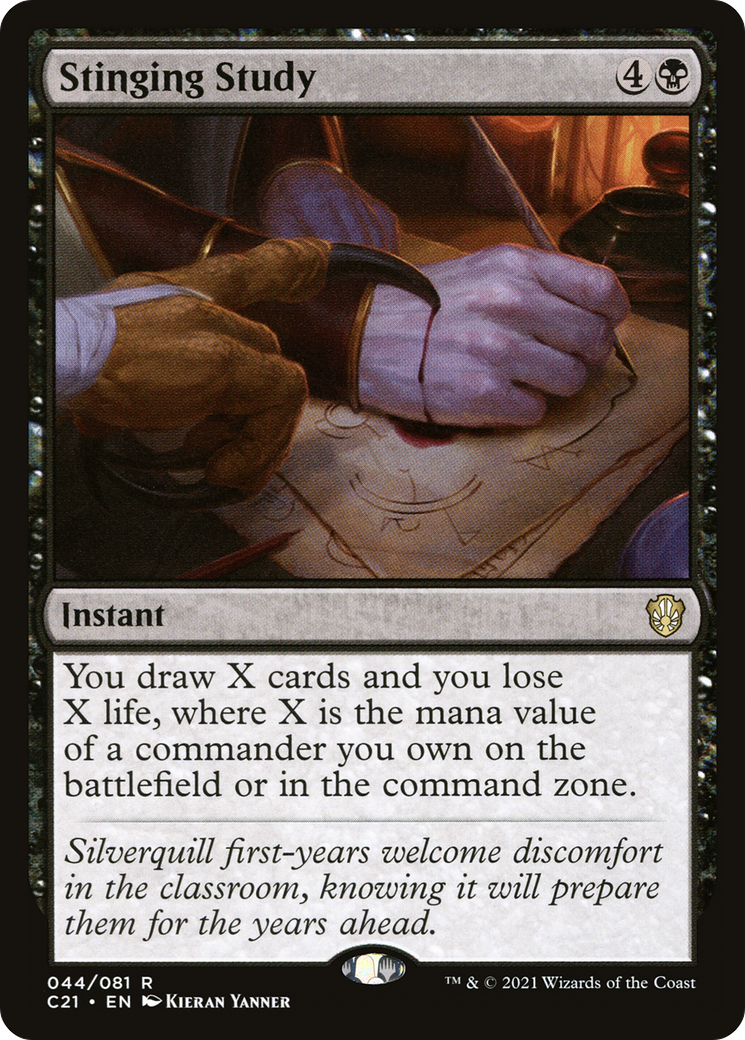
Stinging Study
Stinging Study
Instant
You draw X cards and you lose X life, where X is the mana value of a commander you own on the battlefield or in the command zone.
- If your commander is under the control of another player as Stinging Study resolves, it is still on the battlefield and will still be used to determine the value of X.
- If you own multiple commanders on the battlefield and/or in the command zone, you choose one of them as Stinging Study resolves to determine the value of X.
-
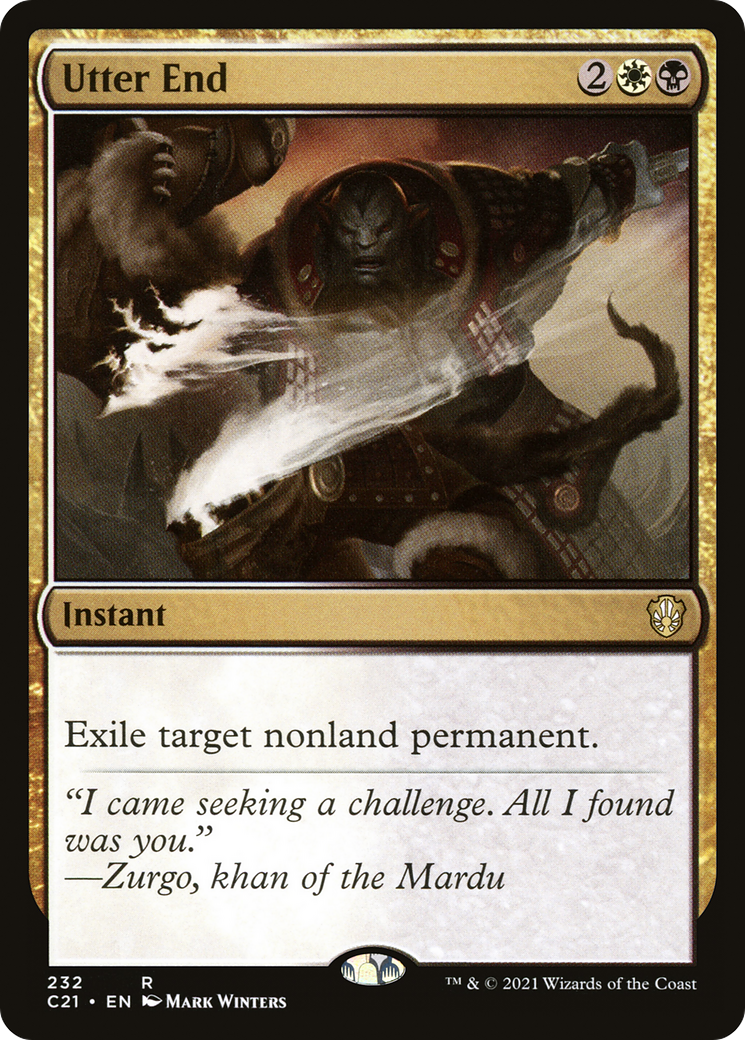
1
Utter End
Utter End
Instant
Exile target nonland permanent.
Sorceries 6
-
1
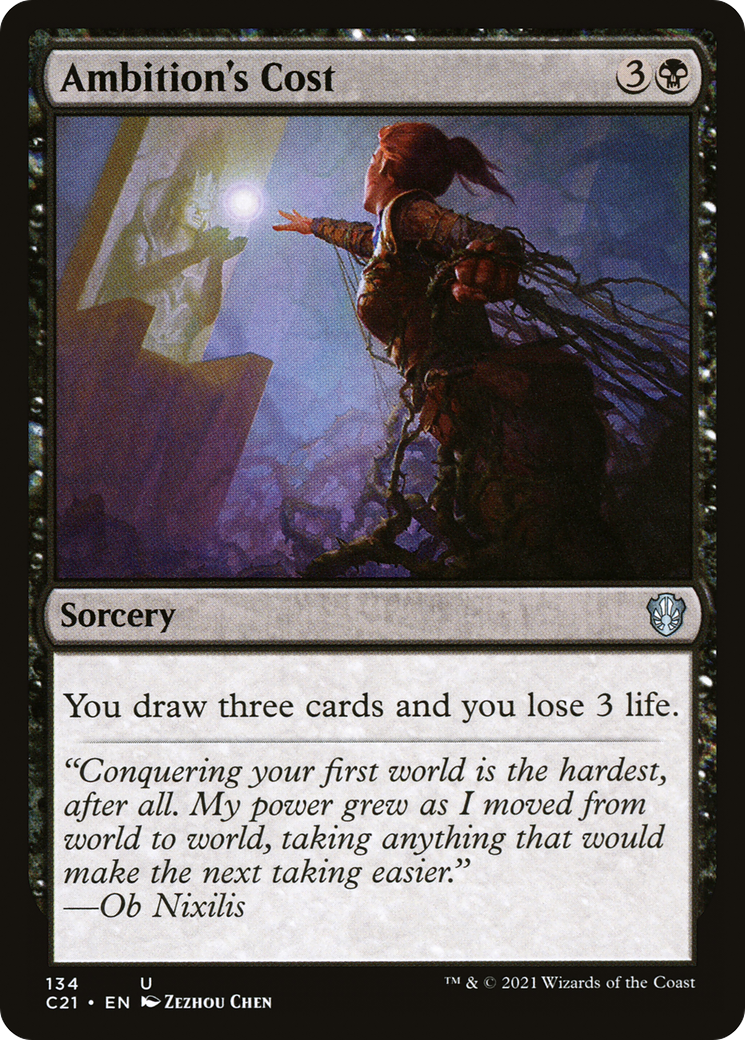
Ambition's Cost
Ambition's Cost
Sorcery
You draw three cards and you lose 3 life.
-
1
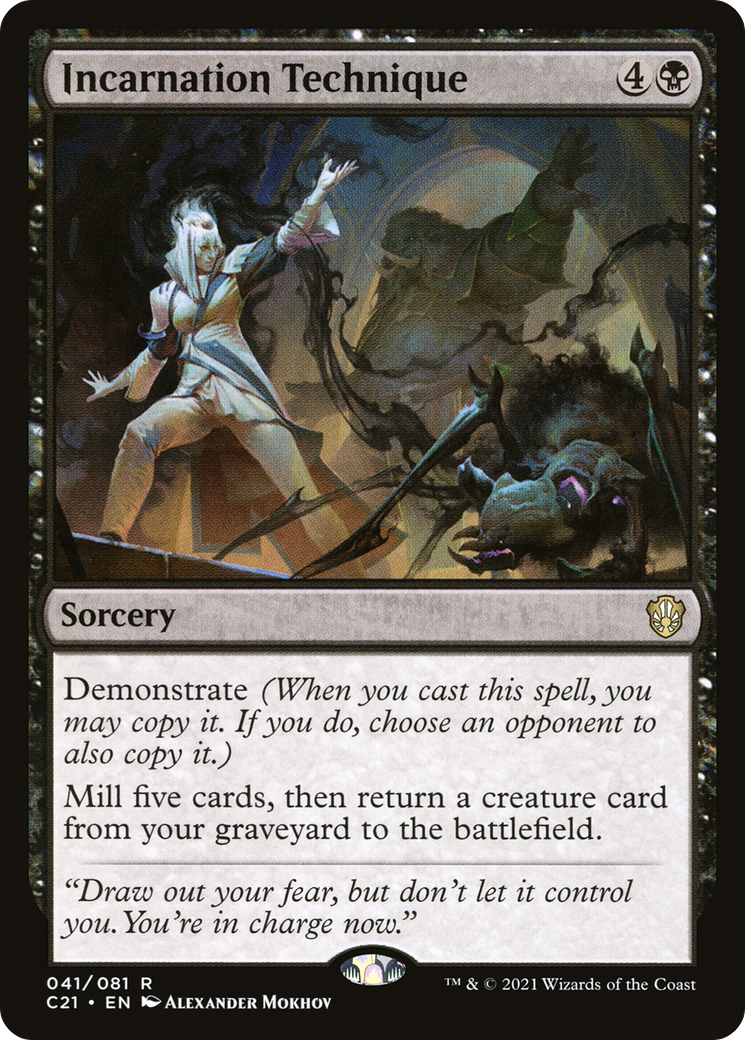
Incarnation Technique
Incarnation Technique
Sorcery
Demonstrate (When you cast this spell, you may copy it. If you do, choose an opponent to also copy it.)
Mill five cards, then return a creature card from your graveyard to the battlefield.
- You choose which creature to bring back after you mill five cards.
- You may choose any creature card in your graveyard, not just one that you milled this way.
- You choose whether to make a copy as the demonstrate ability resolves. This happens before the original spell resolves. Your copy goes on the stack above the original spell.
- If you copy a spell with demonstrate, you then immediately choose an opponent. If they copy the spell, it goes on top of the stack.
- If the spell requires targets, you choose the target of the original spell as you cast it. If you create a copy of the spell, you may choose new targets for the copy as you create that copy. Similarly, the opponent you chose to create a copy may choose new targets for that copy as it’s created. In other words, your opponent will know the targets of your original spell and your copy when choosing the new targets, if any, for their copy.
- This means that if you cast a spell with demonstrate and both you and an opponent copy it, the opponent’s copy will resolve first, then your copy will resolve, and finally the original spell will resolve.
- If you cast the spell and choose not to copy it, no opponent will get to copy it either.
-
1
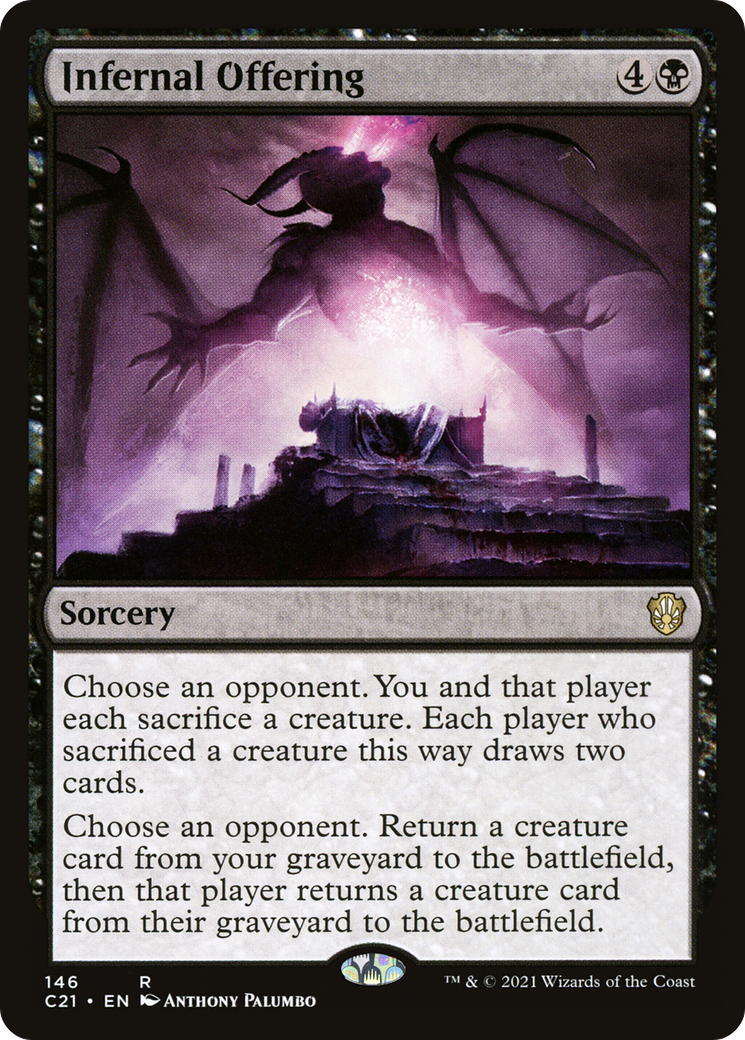
Infernal Offering
Infernal Offering
Sorcery
Choose an opponent. You and that player each sacrifice a creature. Each player who sacrificed a creature this way draws two cards.
Choose an opponent. Return a creature card from your graveyard to the battlefield, then that player returns a creature card from their graveyard to the battlefield.
- The sacrifice isn’t optional. If you control at least one creature, you must sacrifice one. If you control no creatures, you won’t sacrifice one and you won’t draw two cards. The same is true for the chosen opponent.
- You choose which creature card you’re returning to the battlefield, then the chosen opponent chooses which creature card they are returning. These choices aren’t made until Infernal Offering resolves. Neither card is a target of Infernal Offering.
- You may choose the same opponent for each of the effects, or you may choose different opponents. None of the affected players are targets of the spell.
- You choose the opponents for each effect as the spell resolves.
-
1
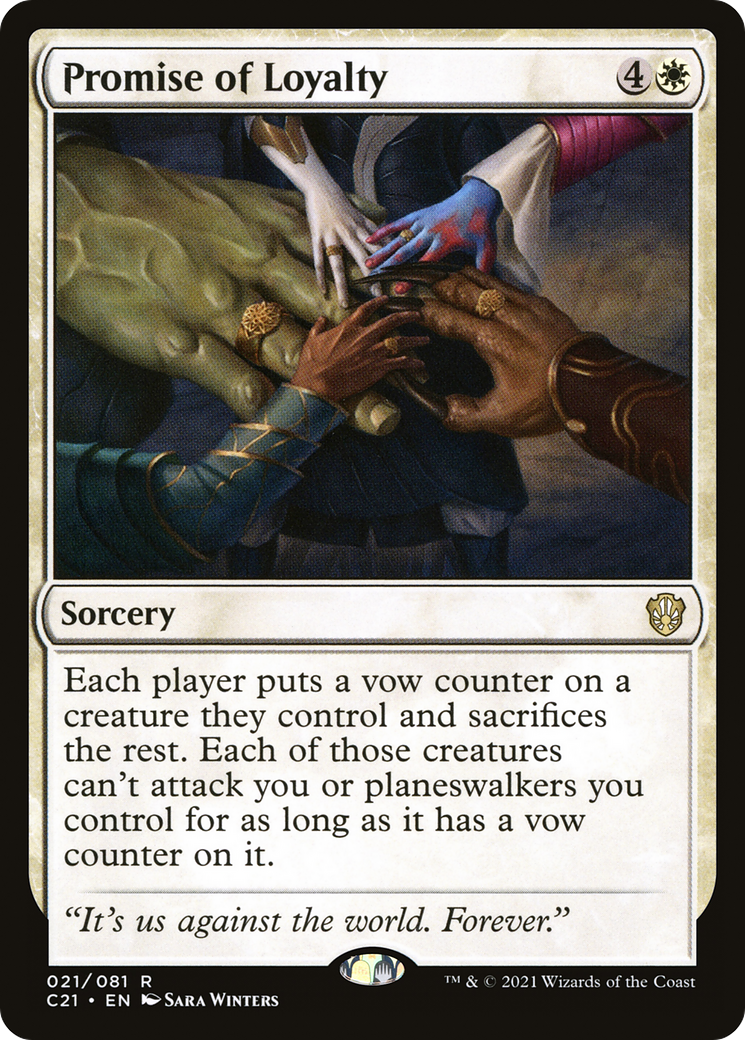
Promise of Loyalty
Promise of Loyalty
Sorcery
Each player puts a vow counter on a creature they control and sacrifices the rest. Each of those creatures can't attack you or planeswalkers you control for as long as it has a vow counter on it.
- If the vow counter is removed from the creature, it can attack as normal.
- Each player, including you, must put a vow counter on a creature they control if able. They can't choose to opt out and sacrifice all of their creatures. The creature you put a vow counter on will remember its promise if another player gains control of it.
- If the vow counter is moved to another creature, it won't prevent the second creature from attacking normally.
-
1
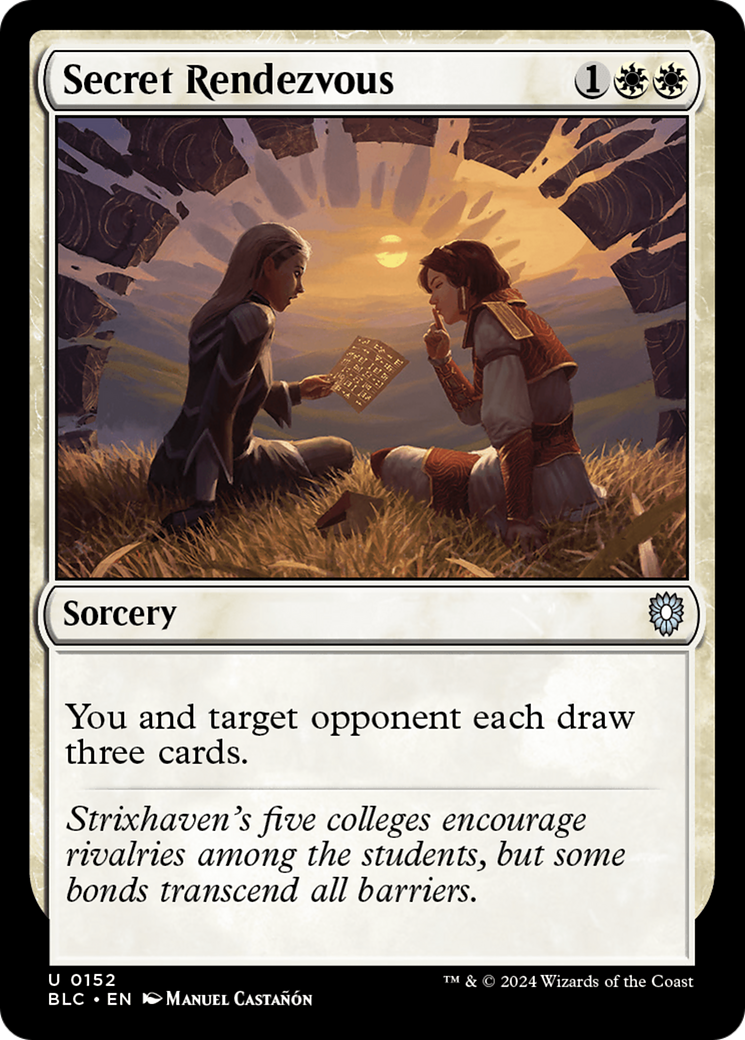
Secret Rendezvous
Secret Rendezvous
Sorcery
You and target opponent each draw three cards.
- If the opponent is an illegal target as Secret Rendezvous tries to resolve, neither player will draw cards.
-
1
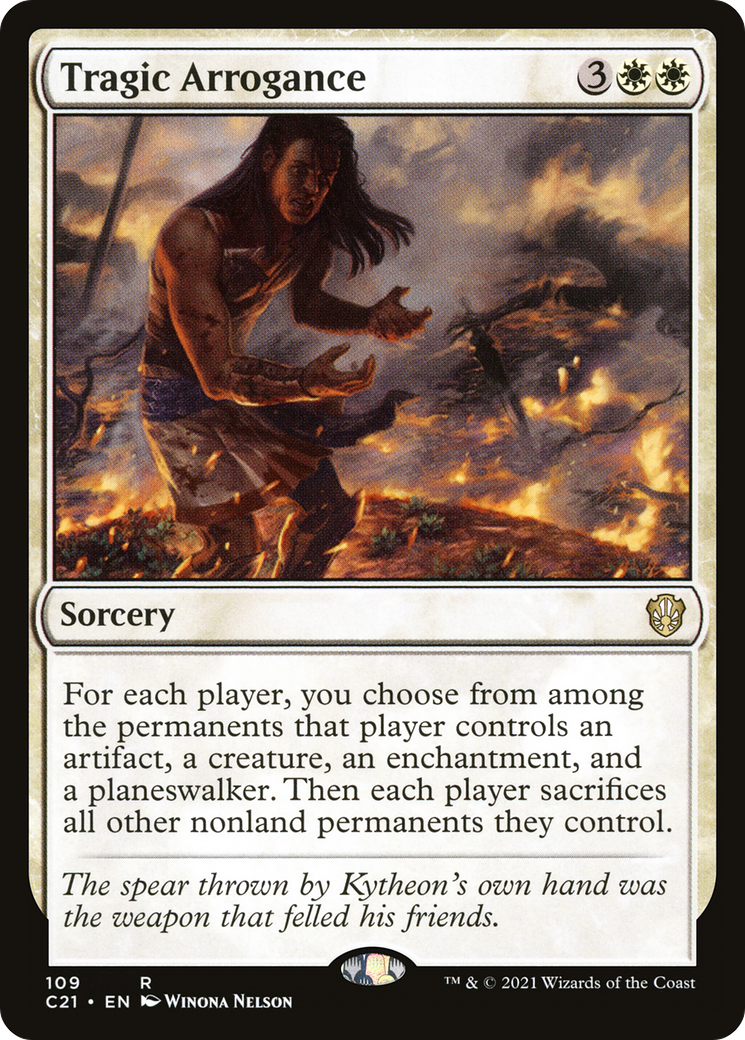
Tragic Arrogance
Tragic Arrogance
Sorcery
For each player, you choose from among the permanents that player controls an artifact, a creature, an enchantment, and a planeswalker. Then each player sacrifices all other nonland permanents they control.
- None of the chosen permanents are targets of Tragic Arrogance.
- If a permanent has more than one of the affected types, it can count for any of them. For example, you could choose an artifact creature as the artifact you're sparing, another creature as the creature, and an enchantment creature as the enchantment. Similarly, you could choose an enchantment creature as both the creature and the enchantment that you're sparing, even if the player controls another creature and/or another enchantment.
Artifacts 10
-
1
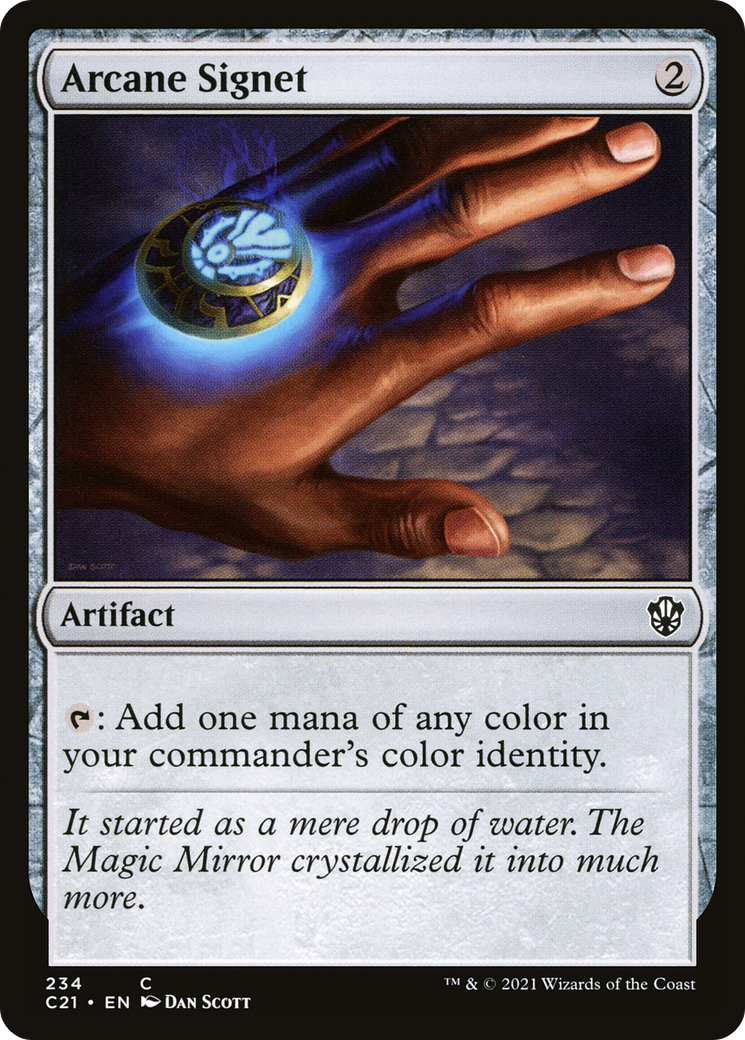
Arcane Signet
Arcane Signet
Artifact
: Add one mana of any color in your commander's color identity.
- If your commander is a card that has no colors in its color identity, Arcane Signet's ability produces no mana. It doesn't produce .
- If you have two commanders, the ability adds one mana of any color in their combined color identities.
- If you don't have a commander, Arcane Signet's ability produces no mana.
-
1
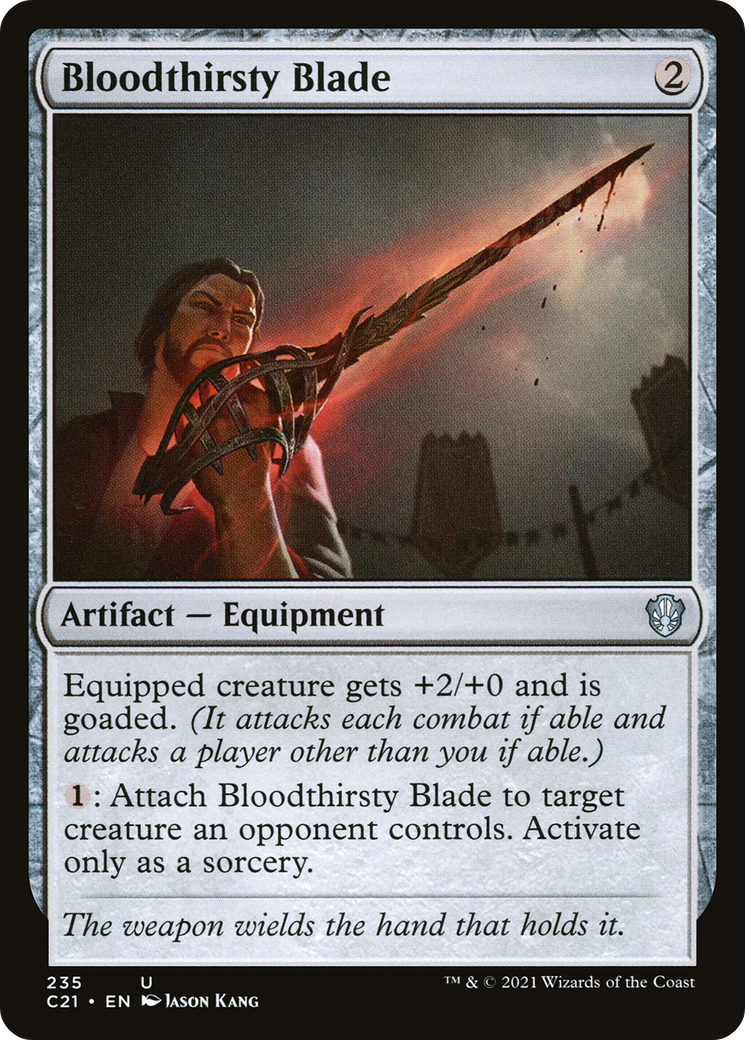
Bloodthirsty Blade
Bloodthirsty Blade
Artifact — Equipment
Equipped creature gets +2/+0 and is goaded. (It attacks each combat if able and attacks a player other than you if able.)
: Attach this Equipment to target creature an opponent controls. Activate only as a sorcery.
- If the creature doesn't meet any of the above exceptions and can attack, it must attack a player other than the controller of the spell or ability that goaded it if able. If the creature can't attack any of those players but could otherwise attack, it must attack a planeswalker an opponent controls, a battle an opponent controls, or a player who goaded it.
- Attacking with a goaded creature doesn't cause it to stop being goaded. If there is an additional combat phase that turn, or if another player gains control of it before it stops being goaded, it must attack again if able.
- If a creature you control has been goaded by multiple opponents, it must attack one of your opponents that hasn't goaded it, as that fulfills the maximum number of goad requirements. If a creature you control has been goaded by each of your opponents, the creature must attack an opponent (rather than a planeswalker or battle), but you choose which opponent it attacks.
- If, during a player's declare attackers step, a creature that player controls that's been goaded is tapped, is affected by a spell or ability that says it can't attack, or hasn't been under that player's control continuously since the turn began (and doesn't have haste), then it doesn't attack. If there's a cost associated with having a creature attack a player, its controller isn't forced to pay that cost, so it doesn't have to attack that player.
- Being goaded isn't an ability the creature has. Once it's been goaded, it must attack as detailed above even if it loses all abilities.
- You still control Bloodthirsty Blade while it's equipped to an opponent's creature. You can move it any time you could cast a sorcery; the equipped creature's controller can't.
- Bloodthirsty Blade has no equip ability. There's normally no way to have it attached to your own creature, although certain combinations of other cards make this possible.
-
1
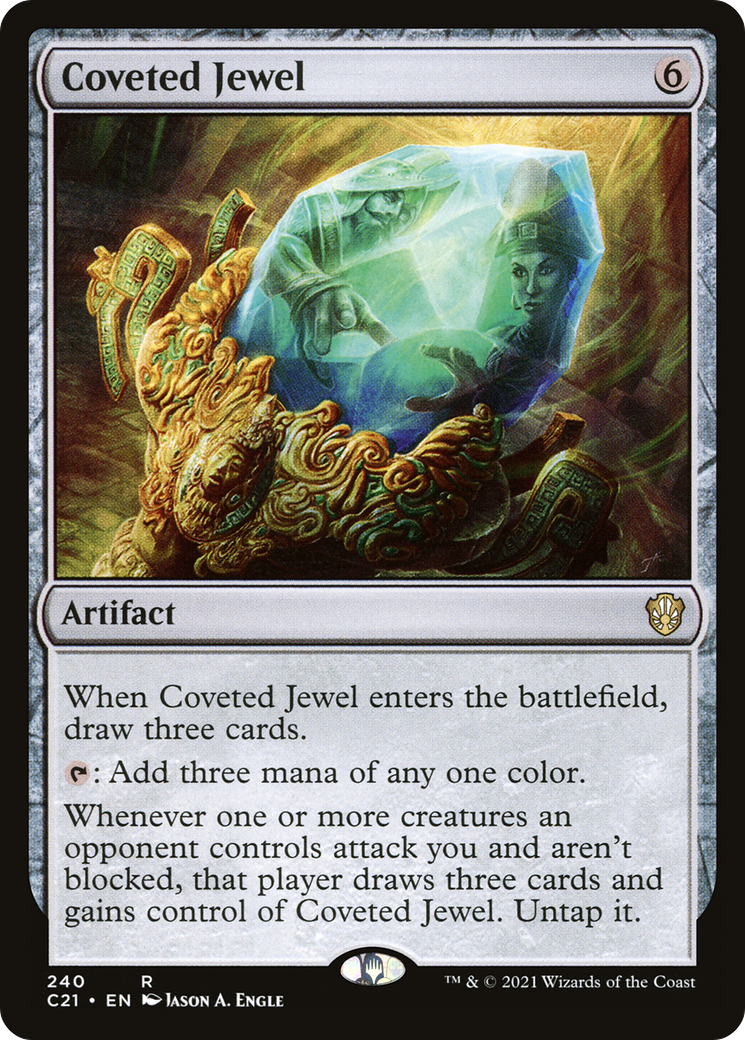
Coveted Jewel
Coveted Jewel
Artifact
When this artifact enters, draw three cards.
: Add three mana of any one color.
Whenever one or more creatures an opponent controls attack you and aren't blocked, that player draws three cards and gains control of this artifact. Untap it.
- Coveted Jewel's last ability triggers after you declare blockers (or declare no blockers at all) if any attacking creatures are unblocked. It doesn't matter if some attacking creatures were blocked.
- If more than one opponent attacks you at the same time, Coveted Jewel's last ability triggers for each of them. You choose which player ends up with Coveted Jewel, but each of them draws three cards and has a chance to activate its mana ability.
- A creature attacking a planeswalker you control won't cause Coveted Jewel's last ability to trigger.
- Coveted Jewel's last ability resolves after blockers are chosen but before combat damage is dealt.
-
1
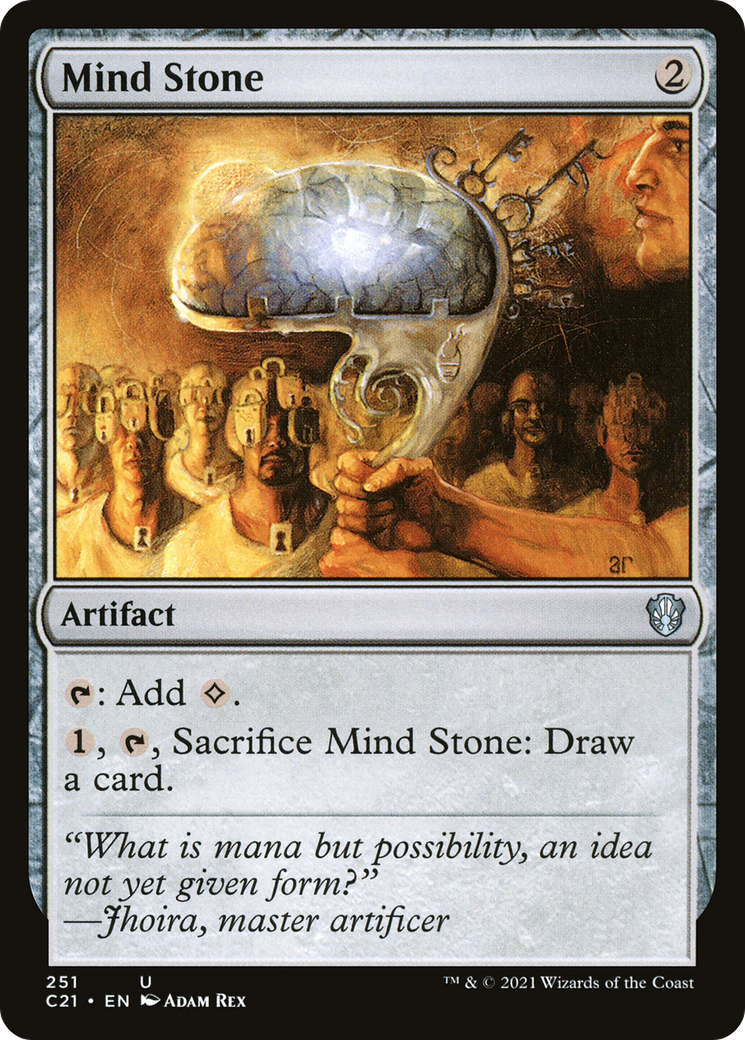
Mind Stone
Mind Stone
Artifact
: Add .
, , Sacrifice this artifact: Draw a card.
-
1
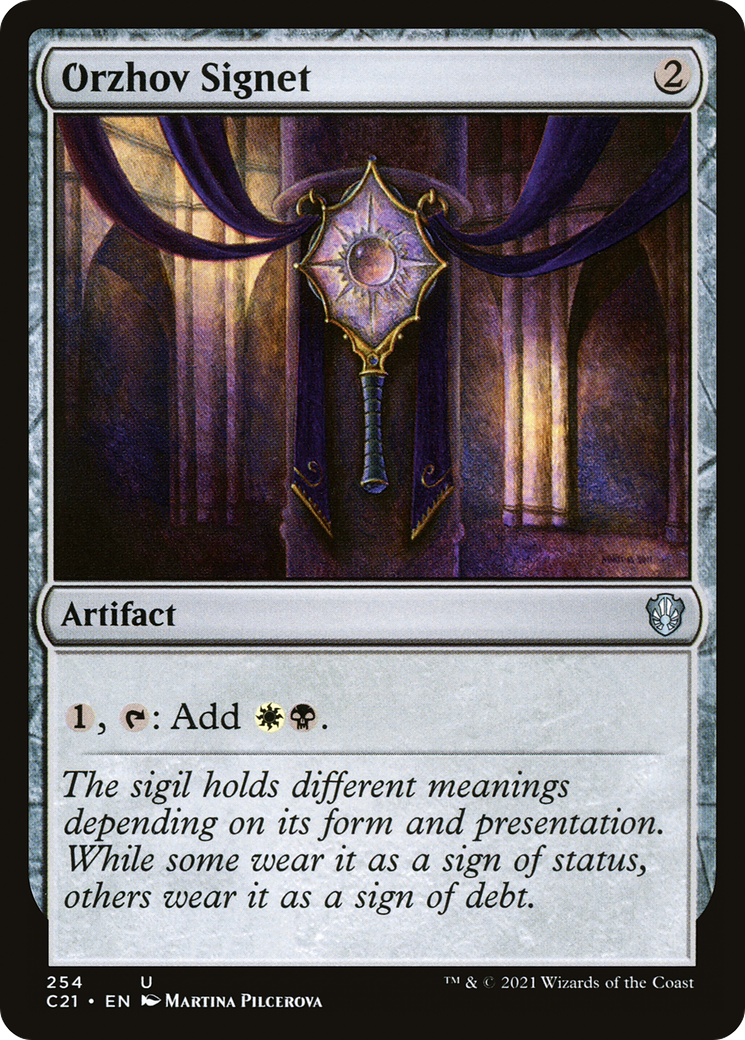
Orzhov Signet
Orzhov Signet
Artifact
, : Add .
-
1
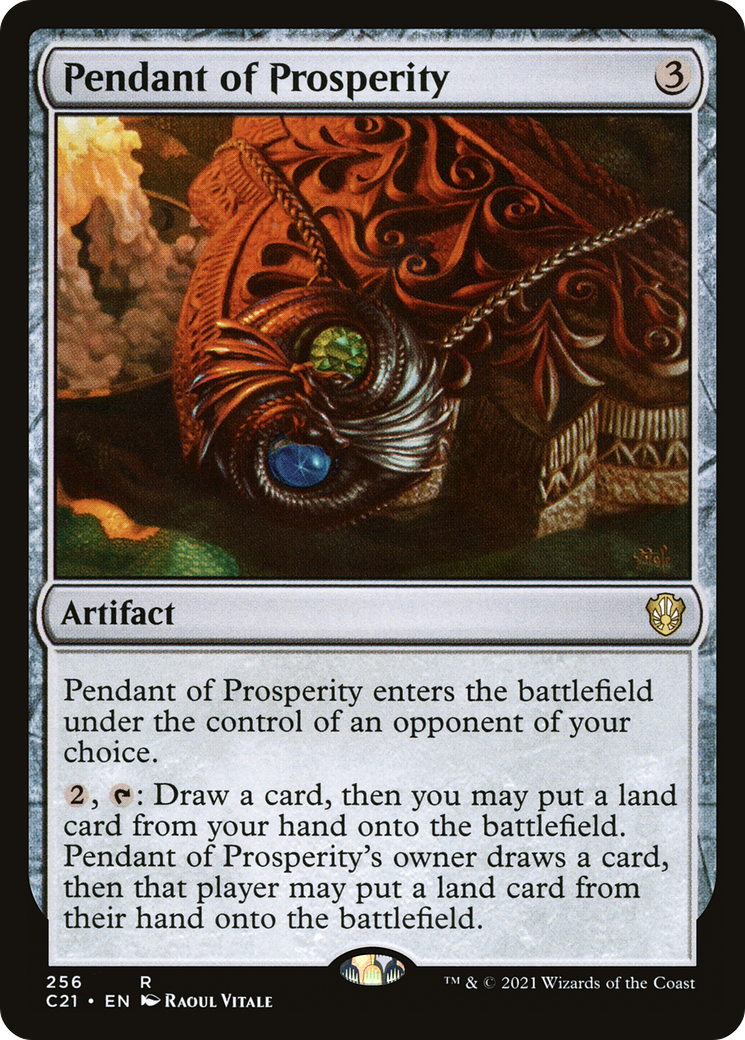
Pendant of Prosperity
Pendant of Prosperity
Artifact
This artifact enters under the control of an opponent of your choice.
, : Draw a card, then you may put a land card from your hand onto the battlefield. This artifact's owner draws a card, then that player may put a land card from their hand onto the battlefield.
- Pendant of Prosperity's effect doesn't count as playing a land. It can put a land card onto the battlefield even if you've already played your land for the turn, and even if it's not your turn.
- If you control your own Pendant of Prosperity and activate its last ability, you'll draw a card, then you may put a land card onto the battlefield, then you'll draw a second card, then you may once again put a land card onto the battlefield.
- In a multiplayer game, if Pendant of Prosperity's owner leaves the game, Pendant of Prosperity leaves the game with them. If Pendant of Prosperity's controller leaves the game, Pendant of Prosperity is exiled (assuming that player wasn't also Pendant of Prosperity's owner).
-
1
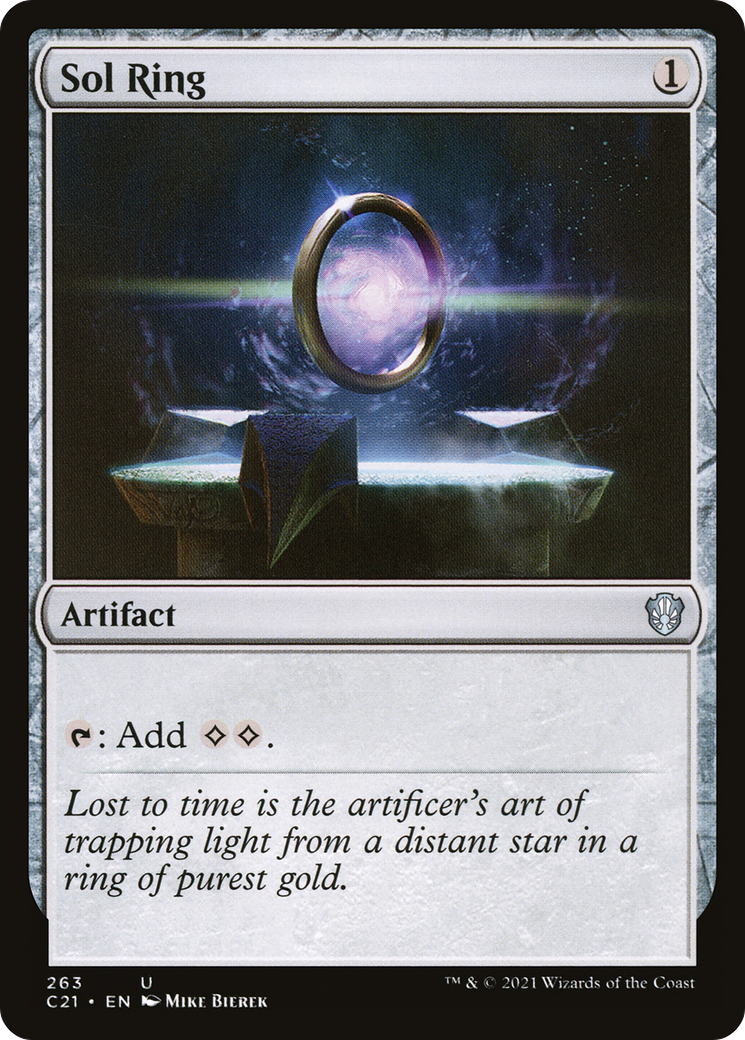
Sol Ring
Sol Ring
Artifact
: Add .
-
1
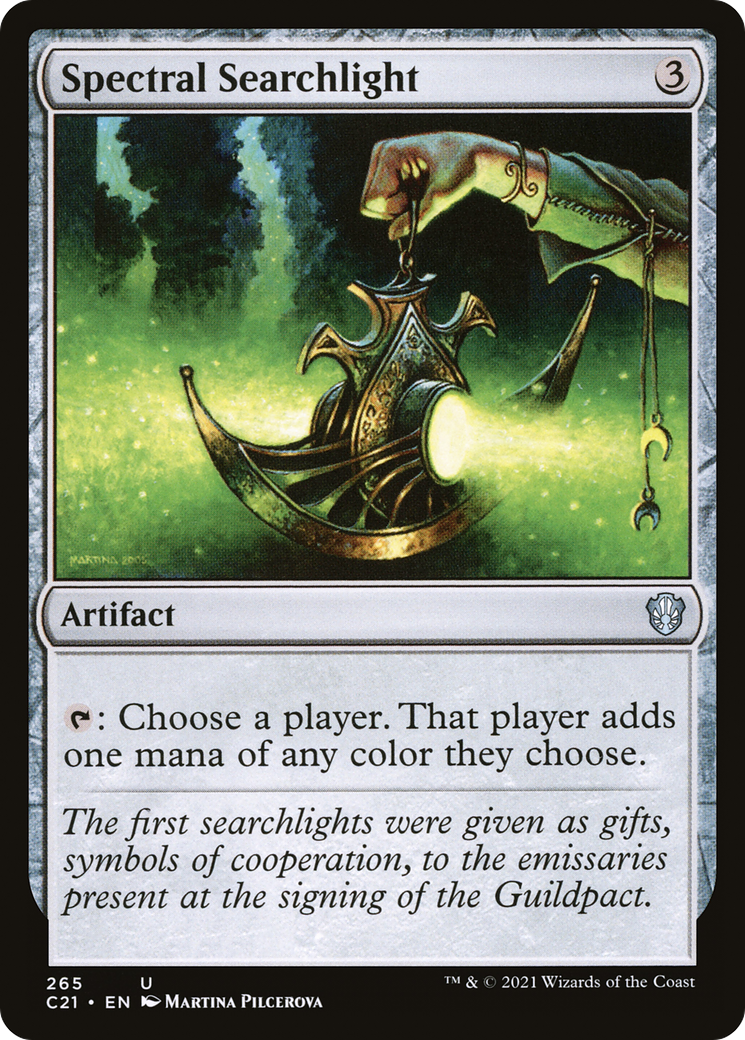
Spectral Searchlight
Spectral Searchlight
Artifact
: Choose a player. That player adds one mana of any color they choose.
- You may choose yourself.
-
1
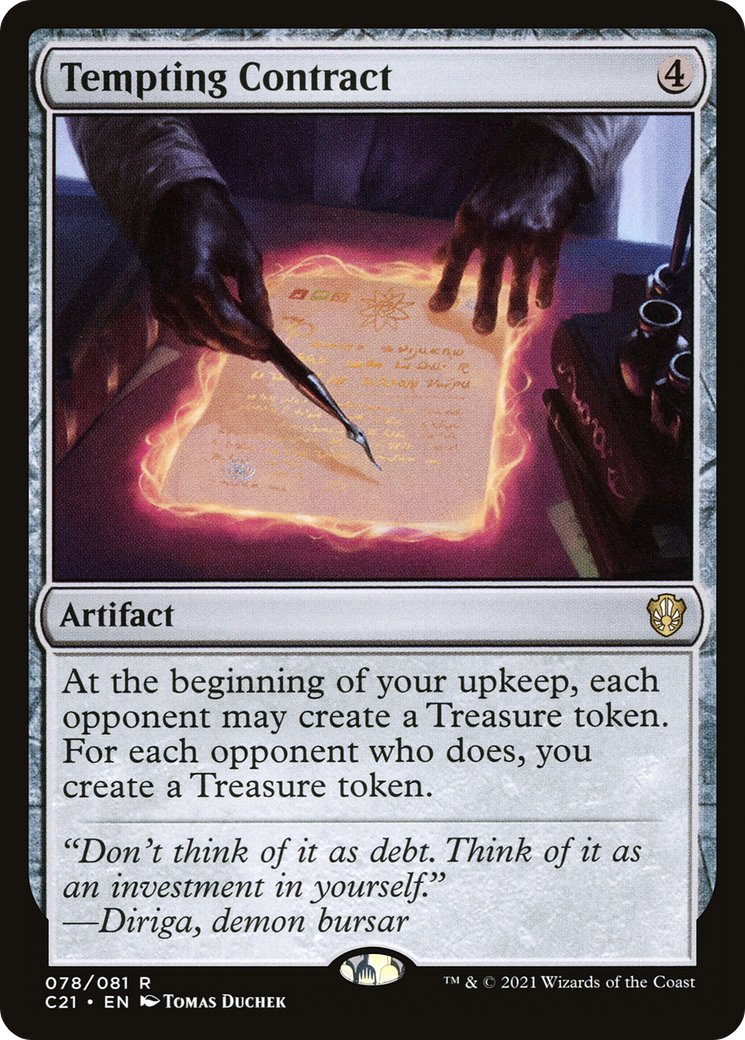
Tempting Contract
Tempting Contract
Artifact
At the beginning of your upkeep, each opponent may create a Treasure token. For each opponent who does, you create a Treasure token.
- Each opponent in turn order decides whether or not to create a Treasure token. They will each know the decisions of players before them. Those Treasure tokens are all created at the same time. Then you create your Treasure tokens all at the same time.
-
1
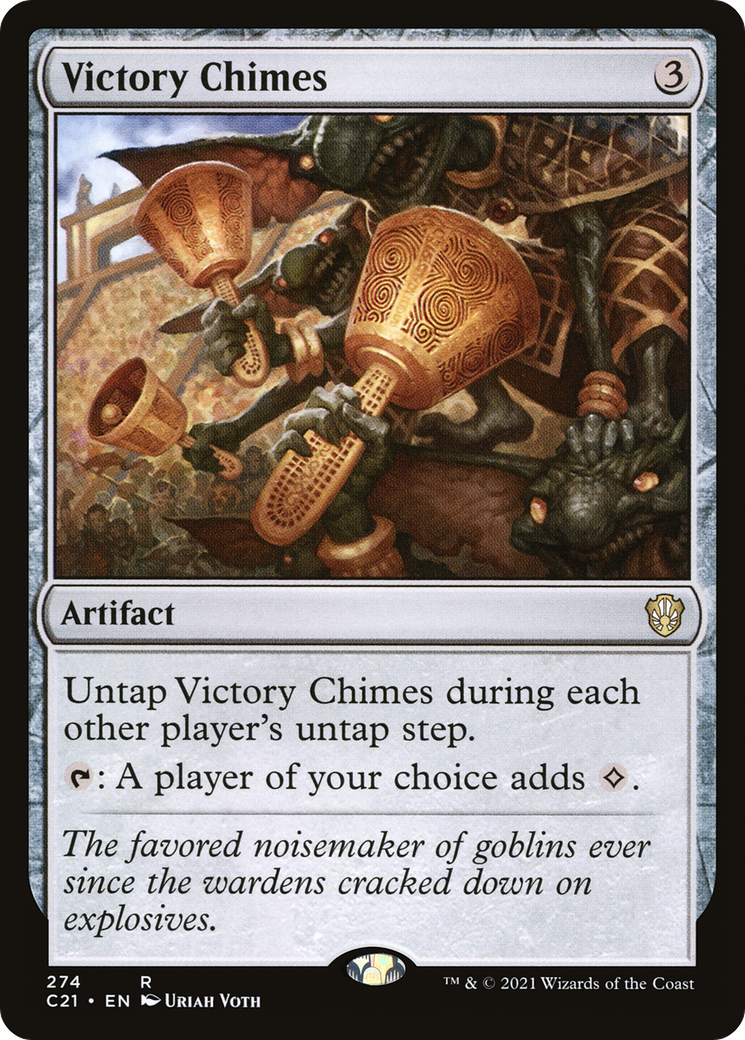
Victory Chimes
Victory Chimes
Artifact
Untap this artifact during each other player's untap step.
: A player of your choice adds .
- Victory Chimes also untaps as normal during your untap step.
- The activated ability of Victory Chimes is a mana ability and doesn’t use the stack. However, you can’t normally activate mana abilities when another player is asked to pay mana. If you’d like to give someone else mana, you must give them mana before they need it.
Enchantments 11
-
1
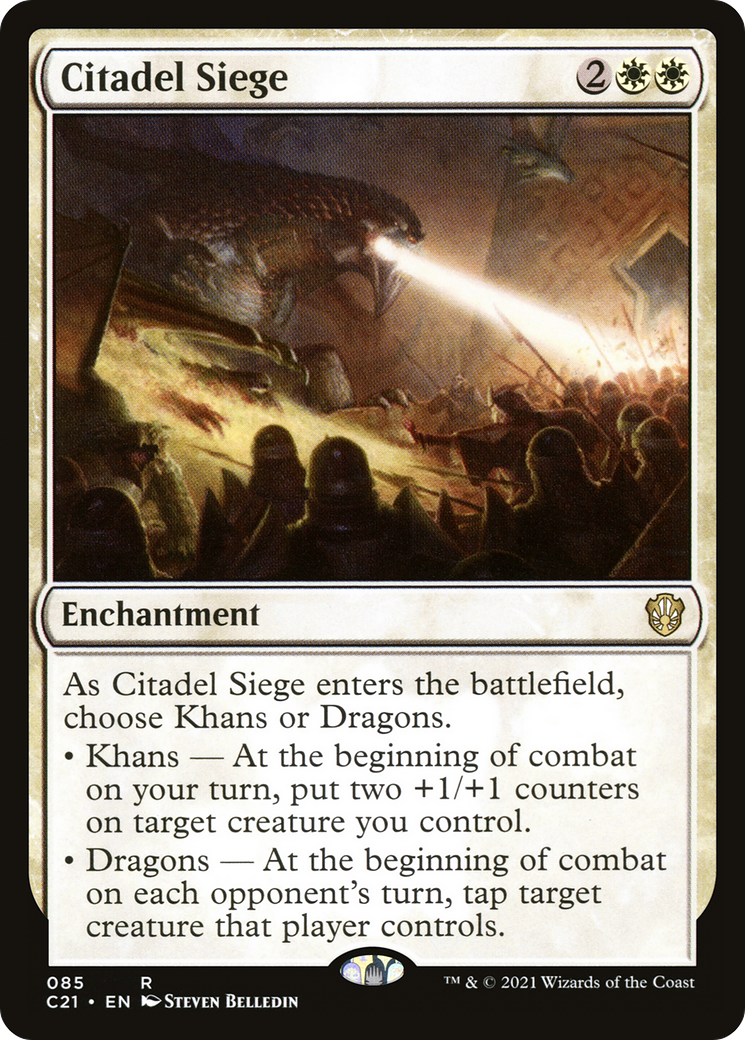
Citadel Siege
Citadel Siege
Enchantment
As this enchantment enters, choose Khans or Dragons.
- Khans — At the beginning of combat on your turn, put two +1/+1 counters on target creature you control.
- Dragons — At the beginning of combat on each opponent's turn, tap target creature that player controls.
- Each Siege will have one of the two listed abilities, depending on your choice as it enters the battlefield.
- The words “Khans” and “Dragons” are anchor words, connecting your choice to the appropriate ability. Anchor words are a new rules concept. “[Anchor word] — [Ability]” means “As long as you chose [anchor word] as this permanent entered the battlefield, this permanent has [ability].” Notably, the anchor word “Dragons” has no connection to the creature type Dragon.
- Each of the last two abilities is linked to the first ability. They each refer only to the choice made as a result of the first ability. If a permanent enters the battlefield as a copy of one of the Sieges, its controller will make a new choice for that Siege. Which ability the copy has won't depend on the choice made for the original permanent.
-
1
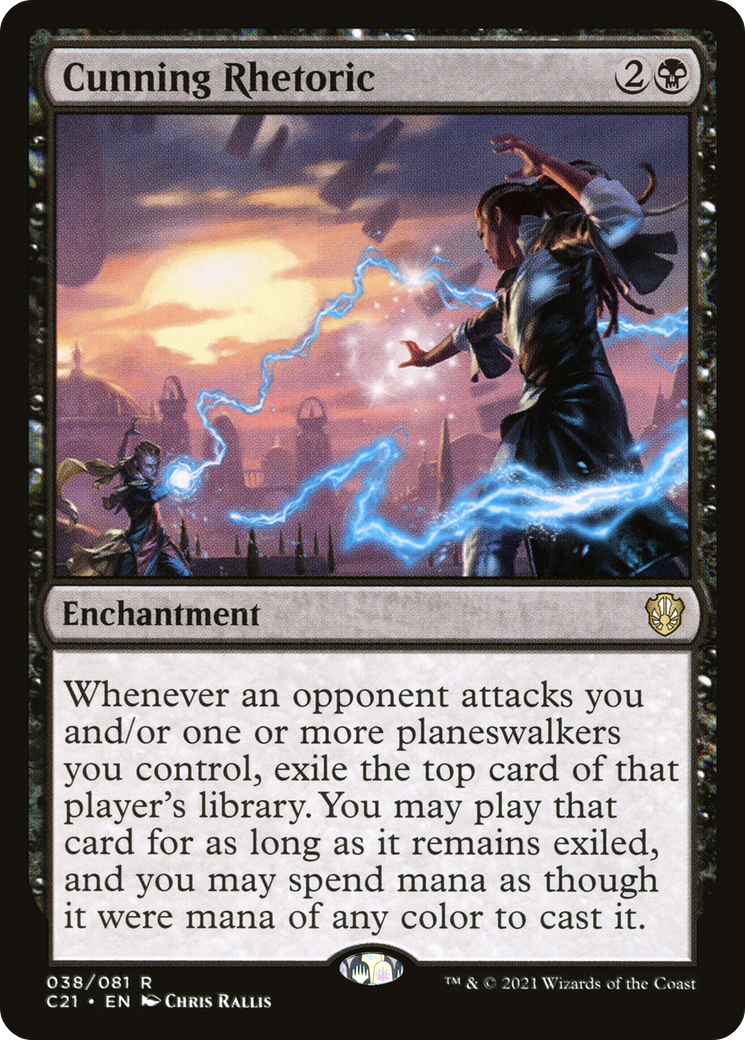
Cunning Rhetoric
Cunning Rhetoric
Enchantment
Whenever an opponent attacks you and/or one or more planeswalkers you control, exile the top card of that player's library. You may play that card for as long as it remains exiled, and you may spend mana as though it were mana of any color to cast it.
- You must follow the normal timing permissions and restrictions for the exiled card. If it's a land, you can't play it unless you have land plays available.
- You'll still pay all costs for a spell cast this way, including additional costs. You may also pay alternative costs if any are available.
- If you play a card this way, it leaves exile and becomes a new object. If it returns to exile later in the turn, you can't play it again.
-
1
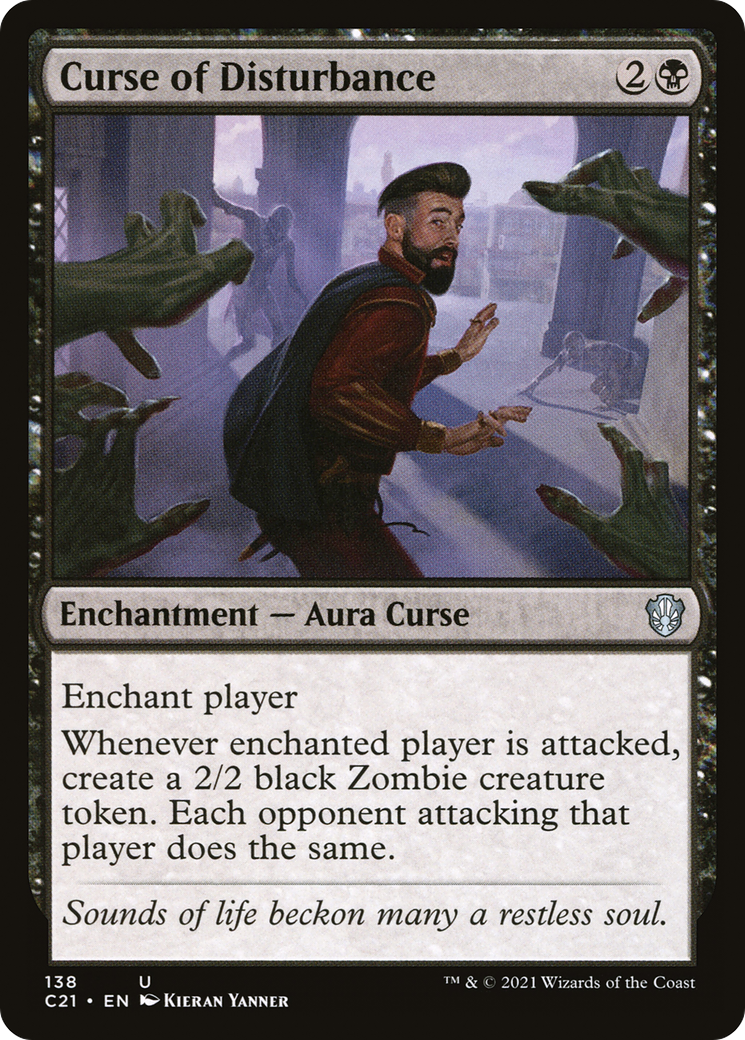
Curse of Disturbance
Curse of Disturbance
Enchantment — Aura Curse
Enchant player
Whenever enchanted player is attacked, create a 2/2 black Zombie creature token. Each opponent attacking that player does the same.
- Each Curse’s ability triggers only once, no matter how many creatures are attacking the enchanted player.
- A player is attacking another player if they control a creature that’s attacking that player. If no creatures are attacking the enchanted player as a Curse’s ability resolves (most likely because they’ve left the battlefield), only the Curse’s controller performs its actions.
- The triggered ability of these Curses won’t trigger if only a planeswalker controlled by the enchanted player is attacked.
- If you enchant yourself with one of these Curses, you’ll get its effects whenever another player attacks you.
-
1
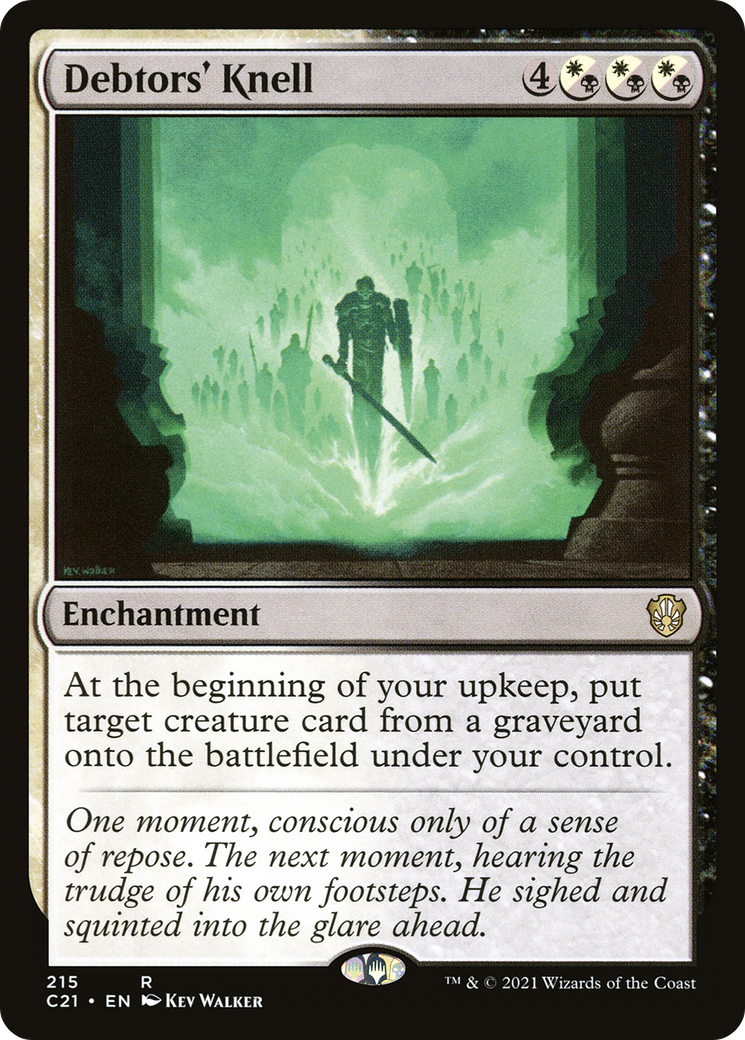
Debtors' Knell
Debtors' Knell
Enchantment
( can be paid with either or .)
At the beginning of your upkeep, put target creature card from a graveyard onto the battlefield under your control.
-
1
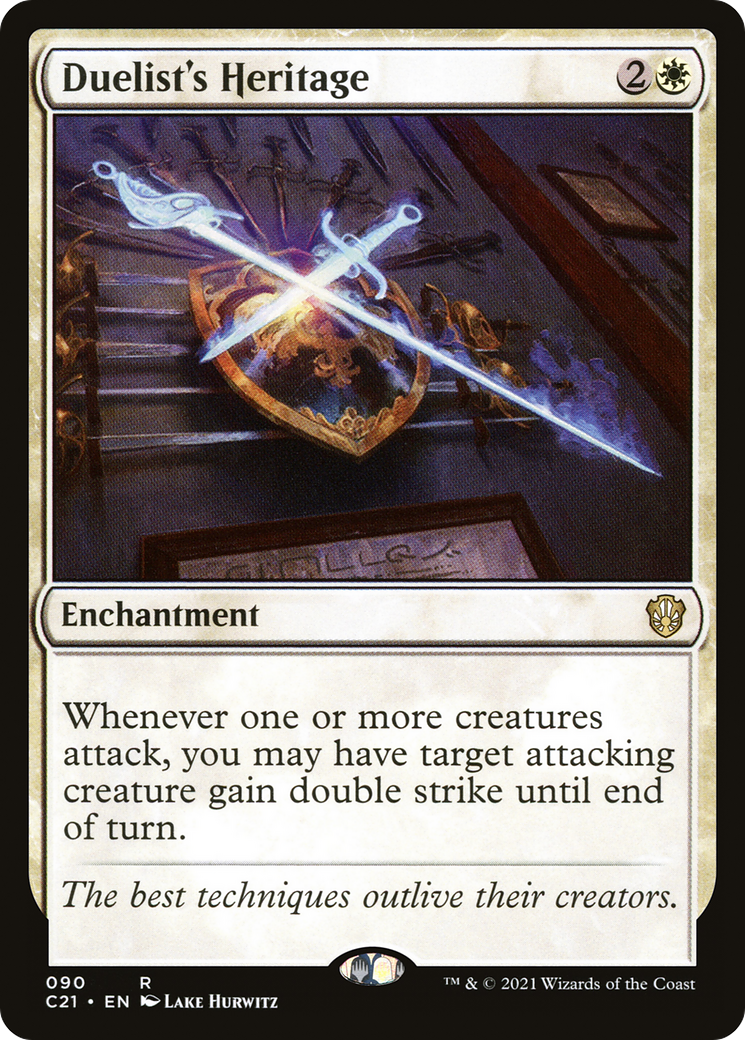
Duelist's Heritage
Duelist's Heritage
Enchantment
Whenever one or more creatures attack, you may have target attacking creature gain double strike until end of turn.
- The ability of Duelist's Heritage triggers whenever any player attacks with one or more creatures, not just when you do. You know which players and planeswalkers the creatures are attacking before you choose the target creature.
-
1
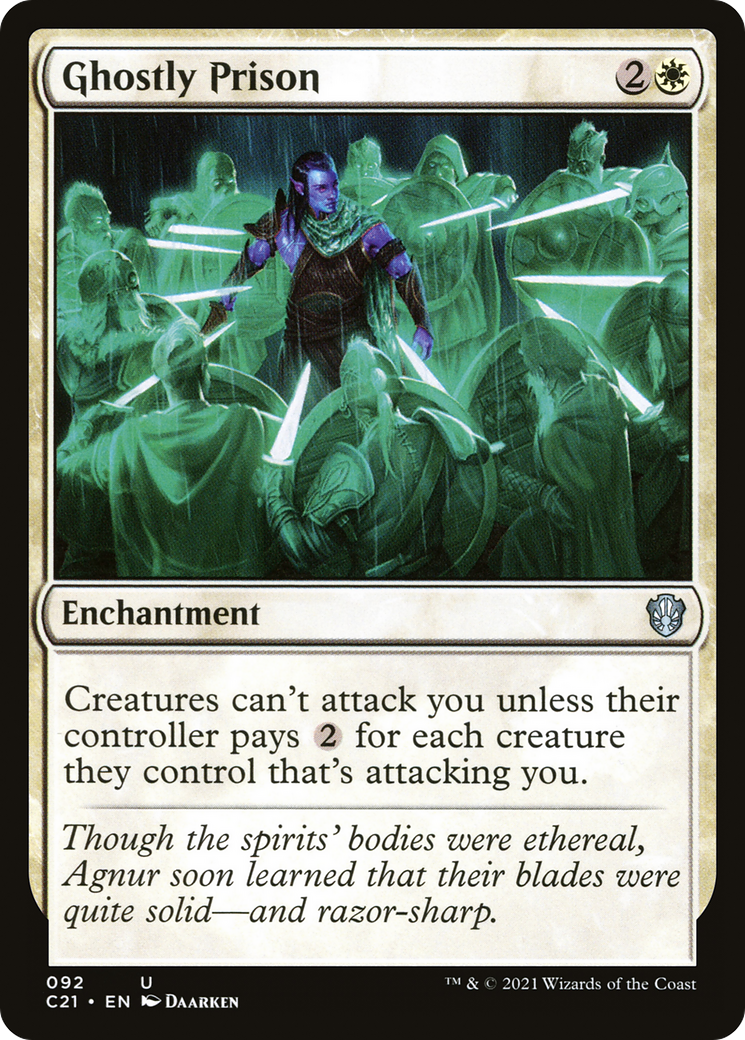
Ghostly Prison
Ghostly Prison
Enchantment
Creatures can't attack you unless their controller pays for each creature they control that's attacking you.
- Unless some effect explicitly says otherwise, a creature that can't attack you can still attack a planeswalker you control.
- In the Two-Headed Giant format, you still only have to pay once per creature.
-
1
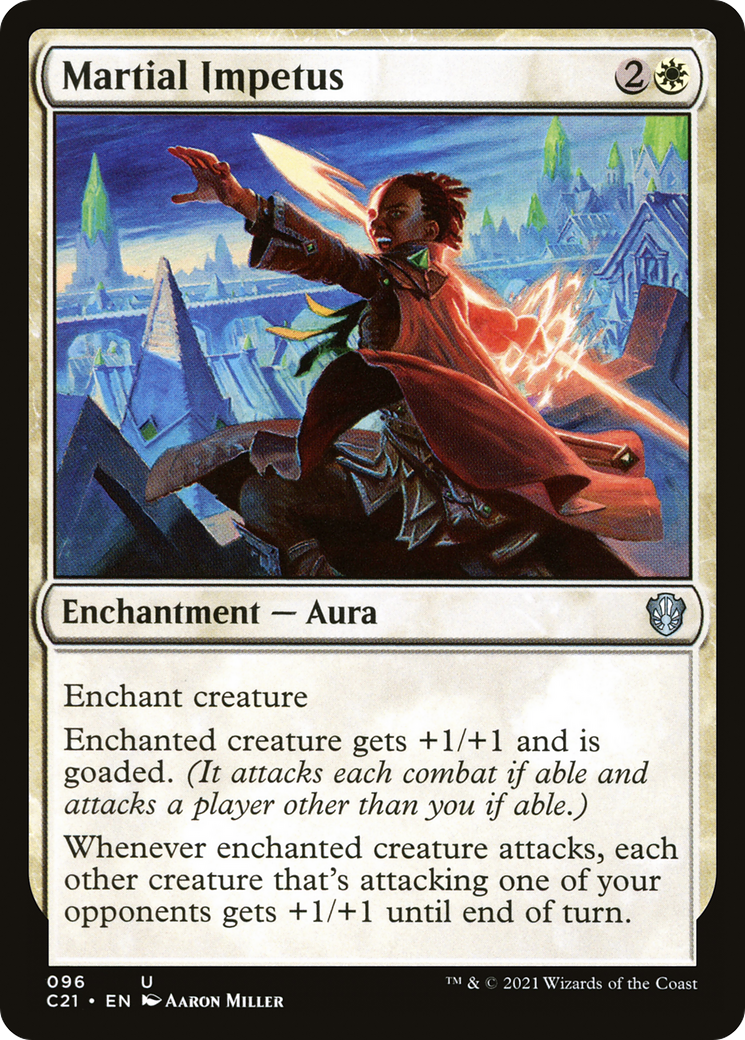
Martial Impetus
Martial Impetus
Enchantment — Aura
Enchant creature
Enchanted creature gets +1/+1 and is goaded. (It attacks each combat if able and attacks a player other than you if able.)
Whenever enchanted creature attacks, each other creature that's attacking one of your opponents gets +1/+1 until end of turn.
- If the creature doesn't meet any of the above exceptions and can attack, it must attack a player other than the controller of the spell or ability that goaded it if able. If the creature can't attack any of those players but could otherwise attack, it must attack a planeswalker an opponent controls, a battle an opponent controls, or a player who goaded it.
- If, during a player's declare attackers step, a creature that player controls that's been goaded is tapped, is affected by a spell or ability that says it can't attack, or hasn't been under that player's control continuously since the turn began (and doesn't have haste), then it doesn't attack. If there's a cost associated with having a creature attack a player, its controller isn't forced to pay that cost, so it doesn't have to attack that player.
- Attacking with a goaded creature doesn't cause it to stop being goaded. If there is an additional combat phase that turn, or if another player gains control of it before it stops being goaded, it must attack again if able.
- If a creature you control has been goaded by multiple opponents, it must attack one of your opponents that hasn't goaded it, as that fulfills the maximum number of goad requirements. If a creature you control has been goaded by each of your opponents, the creature must attack an opponent (rather than a planeswalker or battle), but you choose which opponent it attacks.
- Being goaded isn't an ability the creature has. Once it's been goaded, it must attack as detailed above even if it loses all abilities.
-
1
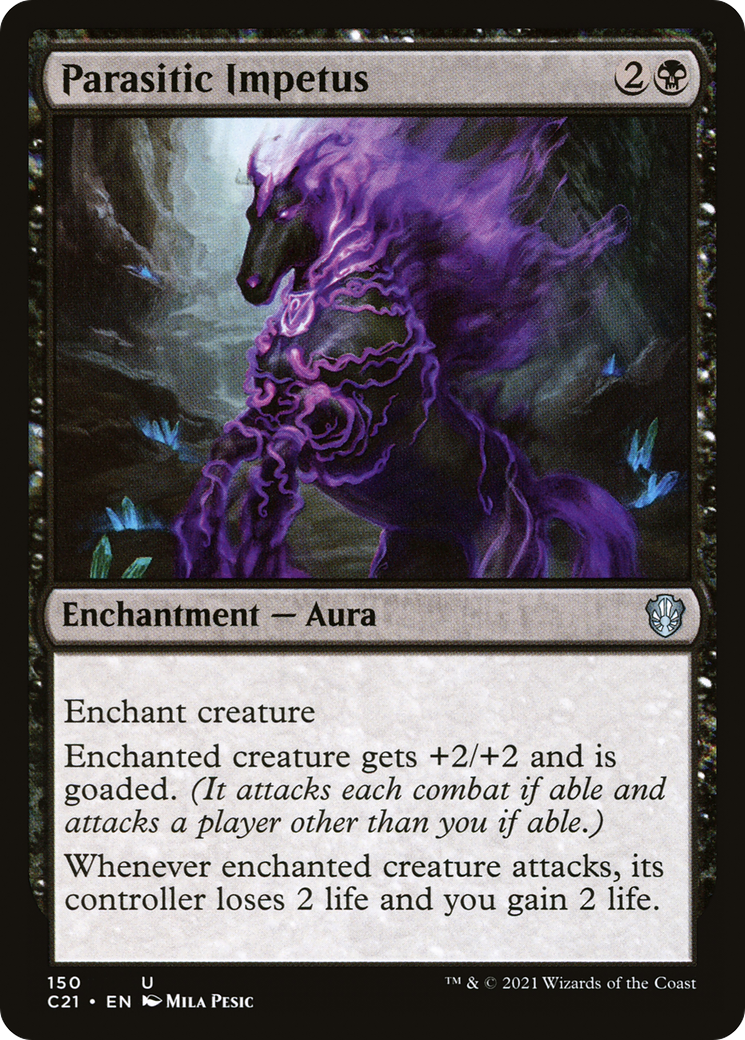
Parasitic Impetus
Parasitic Impetus
Enchantment — Aura
Enchant creature
Enchanted creature gets +2/+2 and is goaded. (It attacks each combat if able and attacks a player other than you if able.)
Whenever enchanted creature attacks, its controller loses 2 life and you gain 2 life.
- Being goaded isn't an ability the creature has. Once it's been goaded, it must attack as detailed above even if it loses all abilities.
- If, during a player's declare attackers step, a creature that player controls that's been goaded is tapped, is affected by a spell or ability that says it can't attack, or hasn't been under that player's control continuously since the turn began (and doesn't have haste), then it doesn't attack. If there's a cost associated with having a creature attack a player, its controller isn't forced to pay that cost, so it doesn't have to attack that player.
- If a creature you control has been goaded by multiple opponents, it must attack one of your opponents that hasn't goaded it, as that fulfills the maximum number of goad requirements. If a creature you control has been goaded by each of your opponents, the creature must attack an opponent (rather than a planeswalker or battle), but you choose which opponent it attacks.
- Attacking with a goaded creature doesn't cause it to stop being goaded. If there is an additional combat phase that turn, or if another player gains control of it before it stops being goaded, it must attack again if able.
- If the creature doesn't meet any of the above exceptions and can attack, it must attack a player other than the controller of the spell or ability that goaded it if able. If the creature can't attack any of those players but could otherwise attack, it must attack a planeswalker an opponent controls, a battle an opponent controls, or a player who goaded it.
- If you are the attacking creature's controller, you lose 2 life and gain 2 life. You won't lose the game if your life total is 0 in between these two events.
- Parasitic Impetus causes you to gain life, not the attacking creature's controller.
-
1
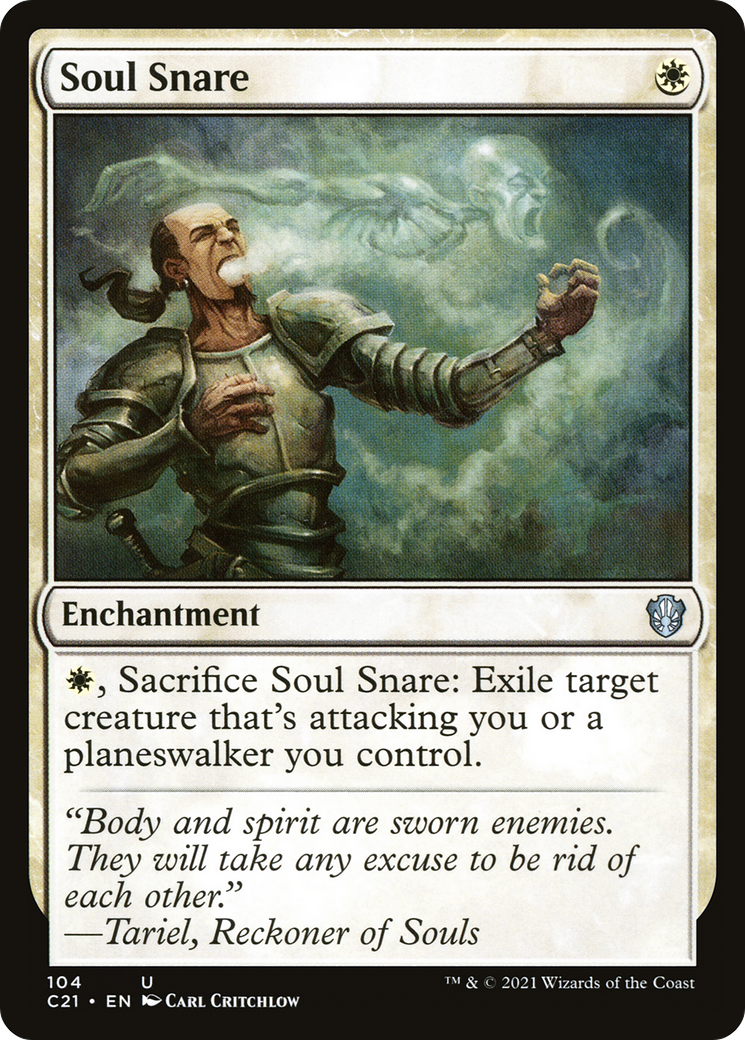
Soul Snare
Soul Snare
Enchantment
, Sacrifice this enchantment: Exile target creature that's attacking you or a planeswalker you control.
- Sacrificing Soul Snare is part of the cost to activate the ability. Once you activate the ability, no player can do anything to Soul Snare to stop you from activating it.
- If Soul Snare's ability targets a creature that's attacking a planeswalker you control, but that planeswalker is no longer on the battlefield as the ability tries to resolve, the attacking creature will be an illegal target and Soul Snare's ability won't exile that creature.
-
1
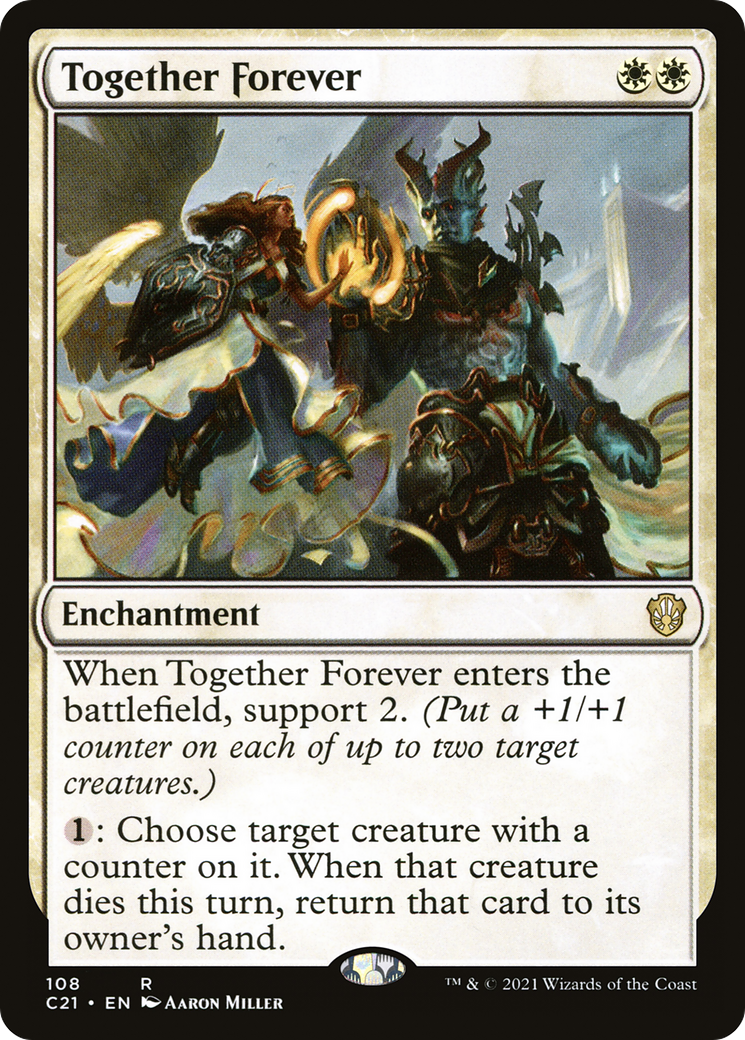
Together Forever
Together Forever
Enchantment
When this enchantment enters, support 2. (Put a +1/+1 counter on each of up to two target creatures.)
: Choose target creature with a counter on it. When that creature dies this turn, return that card to its owner's hand.
- If a creature without counters receives enough -1/-1 counters to reduce its toughness to 0 or less, Together Forever's ability can't be activated before state-based actions put that creature into its owner's graveyard.
- Together Forever's activated ability checks whether the target creature has a counter on it as the ability is activated and as the ability resolves. If the creature loses its counters later in the turn, the delayed triggered ability will still return it to its owner's hand when it dies.
- If some, but not all, targets for a spell become illegal, the remaining targets are affected as appropriate. If all of a spell's targets become illegal, that spell doesn't resolve.
- If a spell with support has other abilities that target creatures, those abilities and the support ability can target the same creature.
- You can't put more than one +1/+1 counter on any one target using the support action.
- Support can target a creature another player controls.
-
1
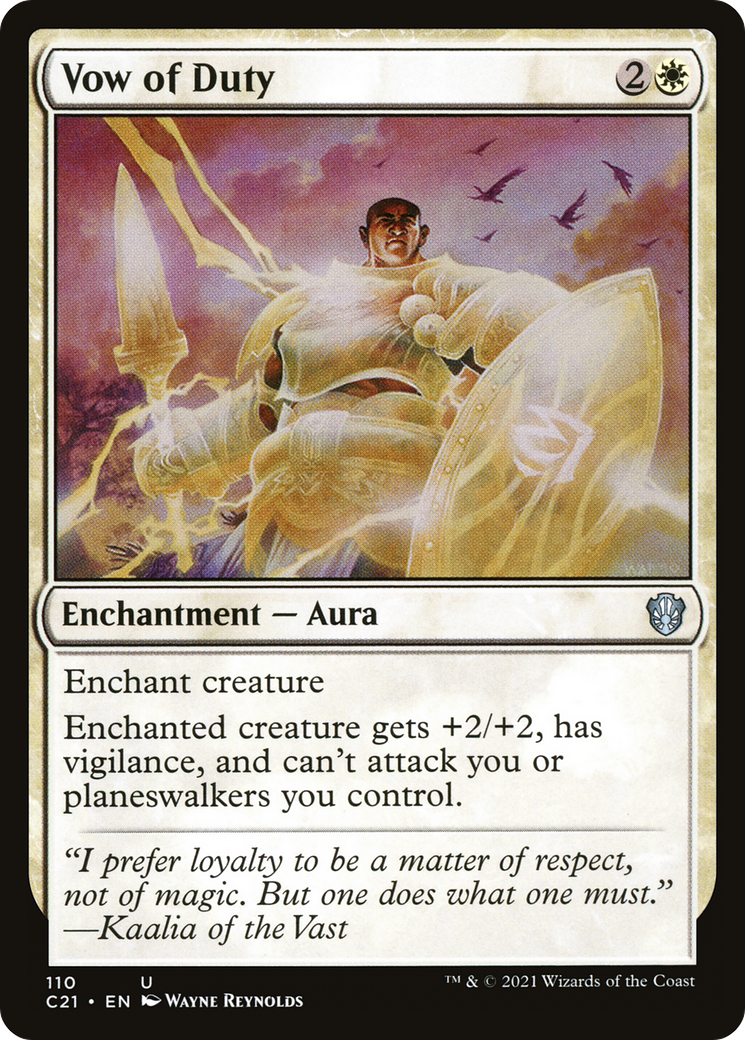
Vow of Duty
Vow of Duty
Enchantment — Aura
Enchant creature
Enchanted creature gets +2/+2, has vigilance, and can't attack you or planeswalkers you control.
Lands 40
-
1
Barren Moor
Barren Moor
Land
This land enters tapped.
: Add .
Cycling ( , Discard this card: Draw a card.)
- Cycling is an activated ability. Effects that interact with activated abilities (such as Stifle or Rings of Brighthearth) will interact with cycling. Effects that interact with spells (such as Remove Soul or Faerie Tauntings) will not.
-
1
Bojuka Bog
Bojuka Bog
Land
This land enters tapped.
When this land enters, exile target player's graveyard.
: Add .
-
1
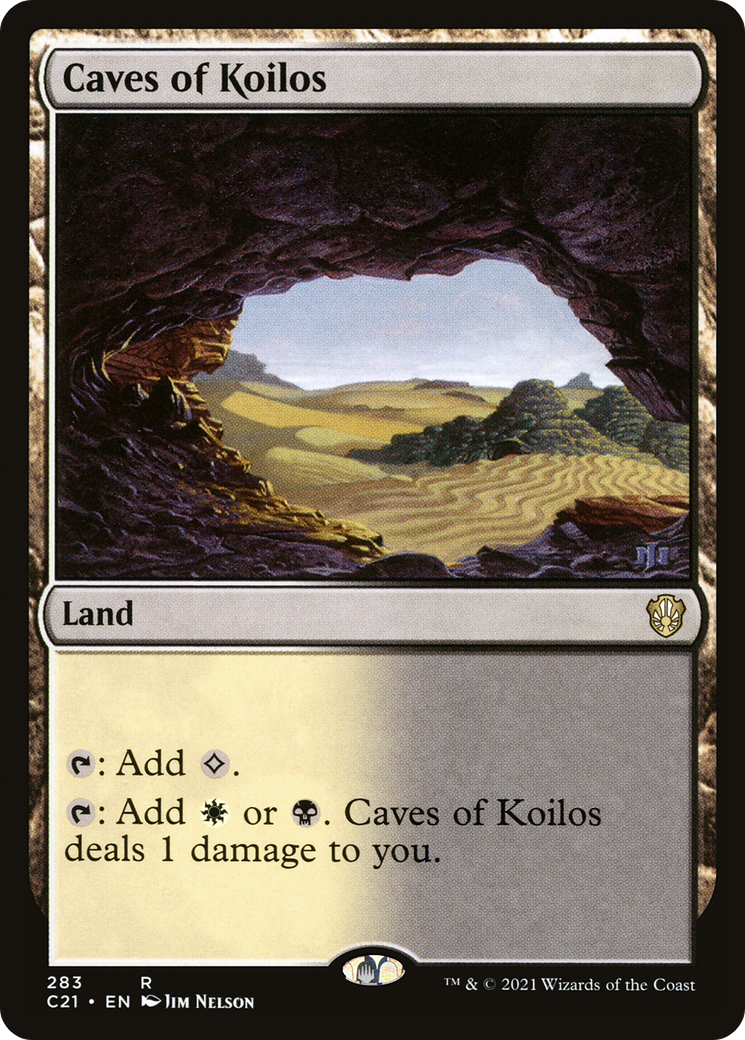
Caves of Koilos
Caves of Koilos
Land
: Add .
: Add or . This land deals 1 damage to you.
- The damage dealt to you is part of the second mana ability. It doesn't use the stack and can't be responded to.
- Like most lands, each land in this cycle is colorless. The damage dealt to you is dealt by a colorless source.
-
1
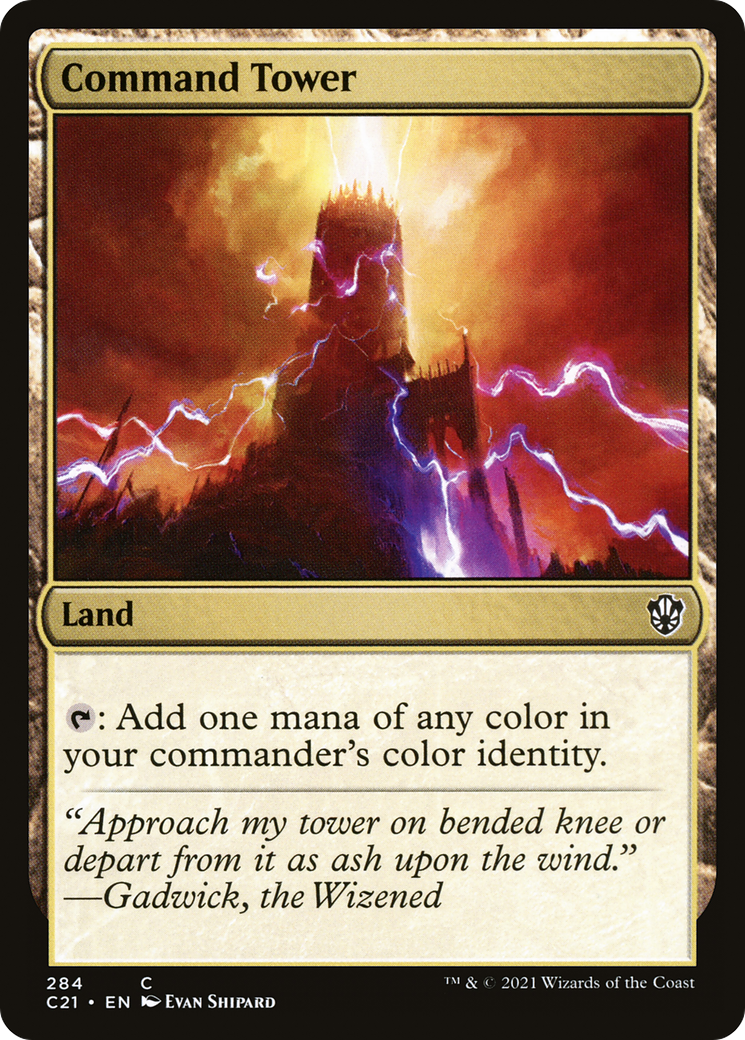
Command Tower
Command Tower
Land
: Add one mana of any color in your commander's color identity.
- If you don't have a commander, Command Tower's ability produces no mana.
- If your commander is a card that has no colors in its color identity, Command Tower's ability produces no mana. It doesn't produce .
- If you have two commanders, the ability adds one mana of any color in their combined color identities.
-
1
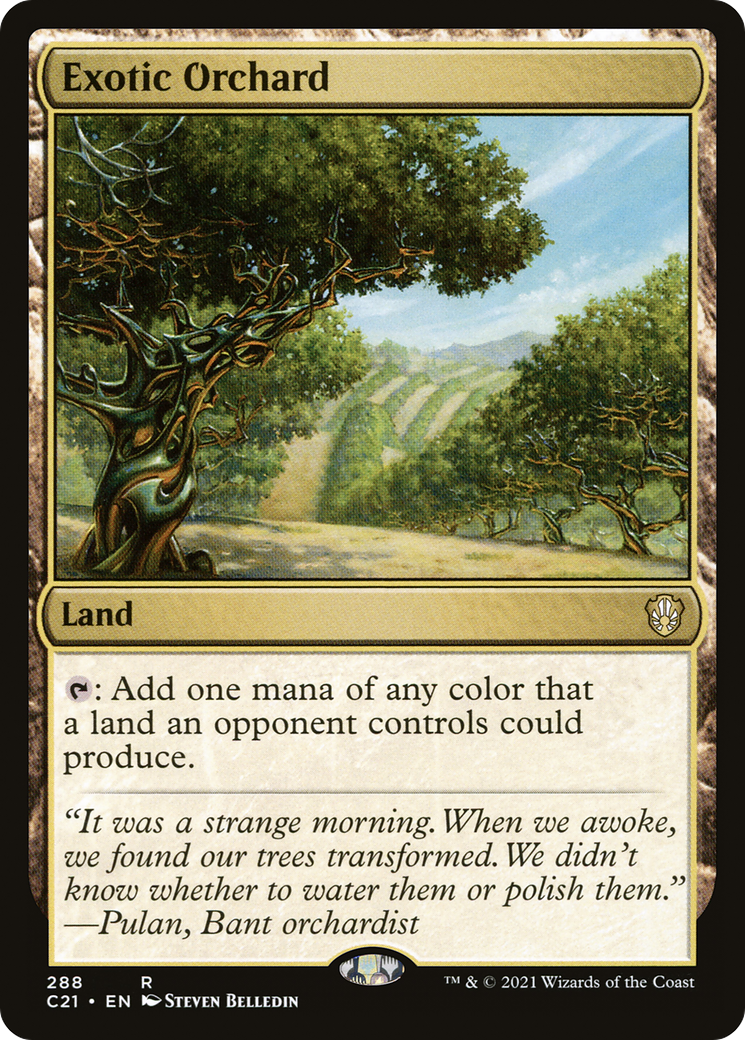
Exotic Orchard
Exotic Orchard
Land
: Add one mana of any color that a land an opponent controls could produce.
- Lands that produce mana based only on what other lands "could produce" won't help each other unless some other land allows one of them to actually produce some type of mana. For example, if you control an Exotic Orchard and your opponent controls an Exotic Orchard and a Reflecting Pool, none of those lands would produce mana if their mana abilities were activated. On the other hand, if you control a Forest and an Exotic Orchard, and your opponent controls an Exotic Orchard and a Reflecting Pool, then each of those lands can be tapped to produce . Your opponent's Exotic Orchard can produce because you control a Forest. Your Exotic Orchard and your opponent's Reflecting Pool can each produce because your opponent's Exotic Orchard can produce .
- When determining what colors of mana your opponents' lands could produce, Exotic Orchard takes into account any applicable replacement effects that would apply to those lands' mana abilities (such as Contamination's effect, for example). If there are more than one, consider them in any possible order.
- The colors of mana are white, blue, black, red, and green. Exotic Orchard can't be tapped for colorless mana, even if a land an opponent controls could produce colorless mana.
- Exotic Orchard doesn't care about any restrictions or riders your opponents' lands (such as Ancient Ziggurat or Hall of the Bandit Lord) put on the mana they produce. It just cares about colors of mana.
- Exotic Orchard checks the effects of all mana-producing abilities of lands your opponents control, but it doesn't check their costs. For example, Vivid Crag has the ability " , Remove a charge counter from Vivid Crag: Add one mana of any color." If an opponent controls Vivid Crag and you control Exotic Orchard, you can tap Exotic Orchard for any color of mana. It doesn't matter whether Vivid Crag has a charge counter on it, and it doesn't matter whether it's untapped.
-
1
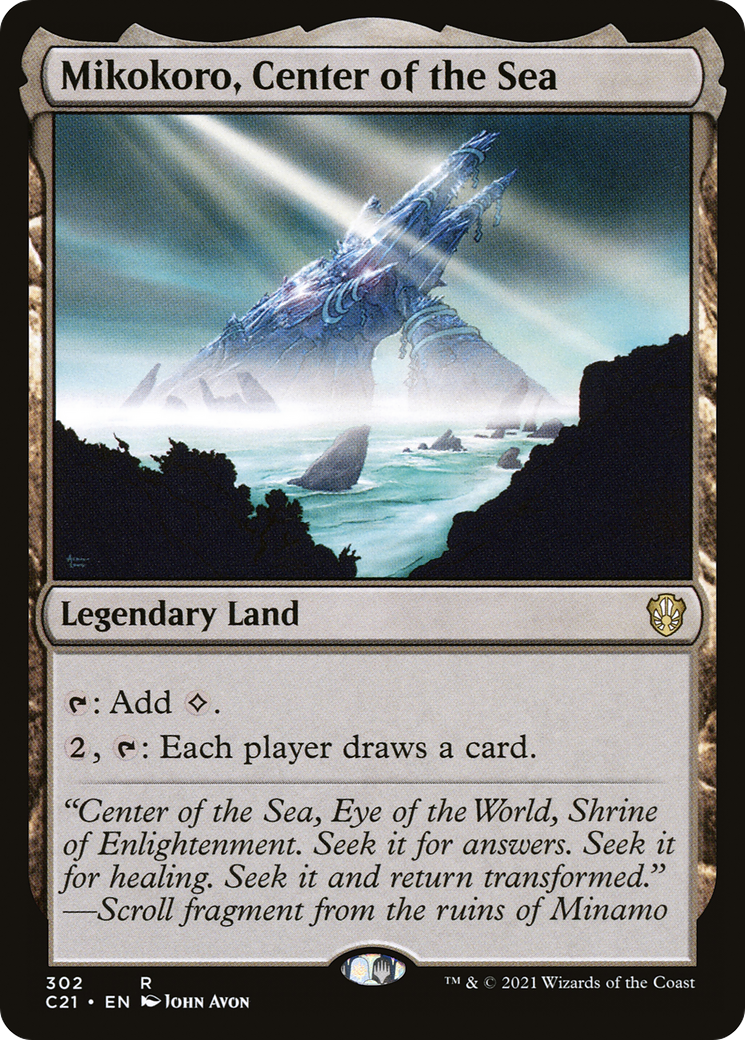
Mikokoro, Center of the Sea
Mikokoro, Center of the Sea
Legendary Land
: Add .
, : Each player draws a card.
-
1
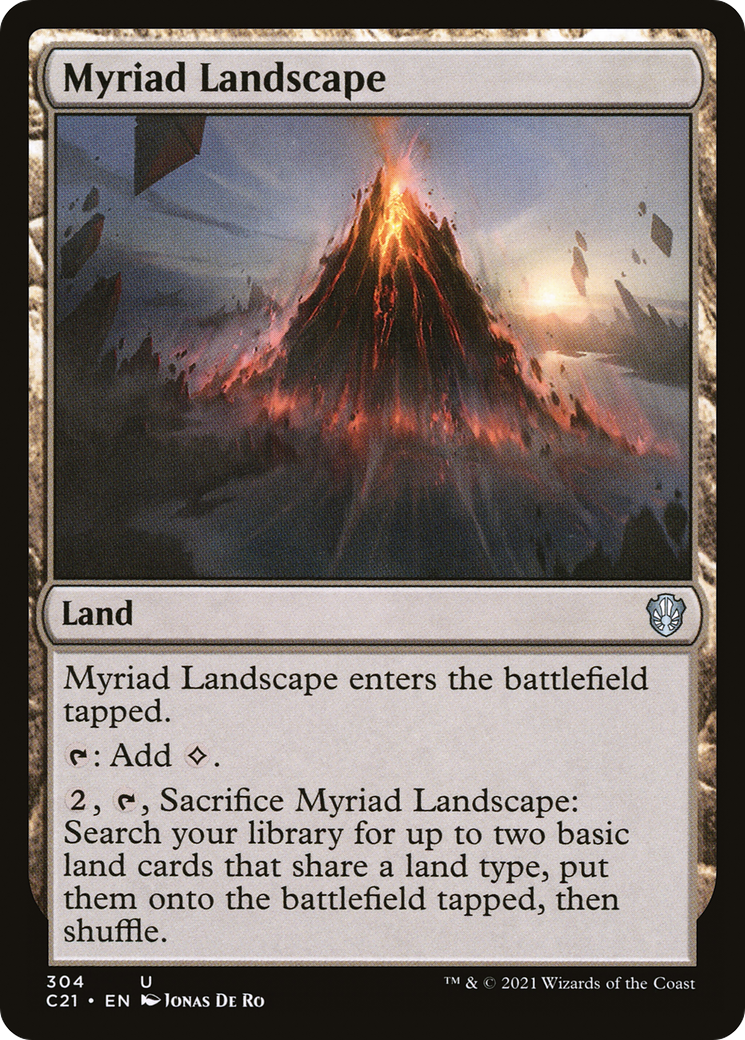
Myriad Landscape
Myriad Landscape
Land
This land enters tapped.
: Add .
, , Sacrifice this land: Search your library for up to two basic land cards that share a land type, put them onto the battlefield tapped, then shuffle.
- You can choose to find one basic land card with Myriad Landscape's last ability.
-
1
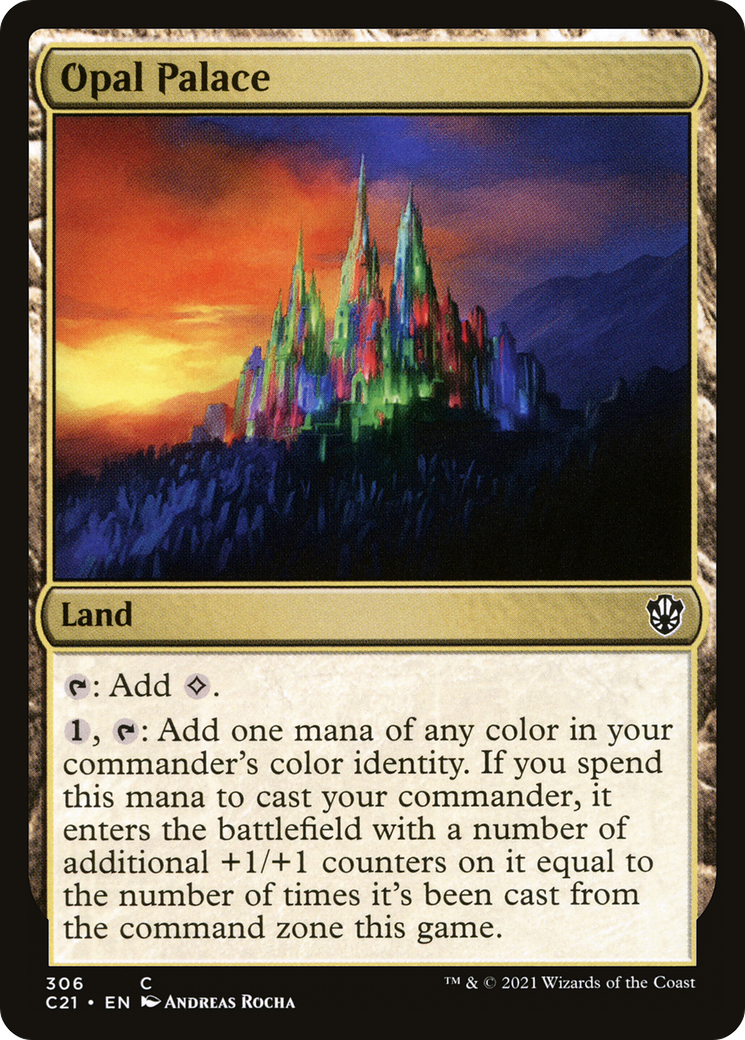
Opal Palace
Opal Palace
Land
: Add .
, : Add one mana of any color in your commander's color identity. If you spend this mana to cast your commander, it enters with a number of additional +1/+1 counters on it equal to the number of times it's been cast from the command zone this game.
- The "number of times it's been cast from the command zone" includes the most recent time. For example, the first time you cast your commander from the command zone in a game, if you spent mana from Opal Palace's last ability to do so, it will enter the battlefield with a +1/+1 counter.
- If you have two commanders, the last ability adds one mana of any color in their combined color identities.
- If Opal Palace's last ability produces two mana (most likely due to Mana Reflection) and you spend them to cast a commander, that commander enters with two counters for each time it's been cast from the command zone this game.
- If you don't have a commander, Opal Palace's last ability produces no mana.
- If your commander is a card that has no colors in its color identity, Opal Palace's last ability produces no mana. It doesn't produce .
-
1
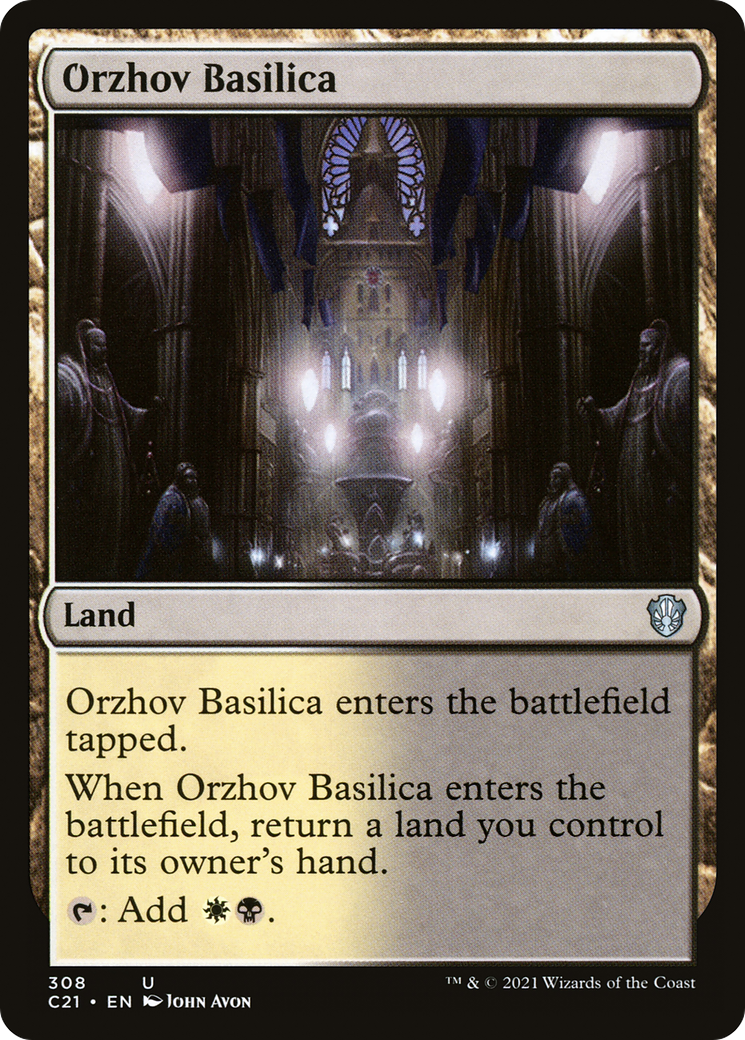
Orzhov Basilica
Orzhov Basilica
Land
This land enters tapped.
When this land enters, return a land you control to its owner's hand.
: Add .
- If this land enters the battlefield and you control no other lands, its ability will force you to return it to your hand.
-
14
Plains
Plains
Basic Land — Plains
( : Add .)
-
1
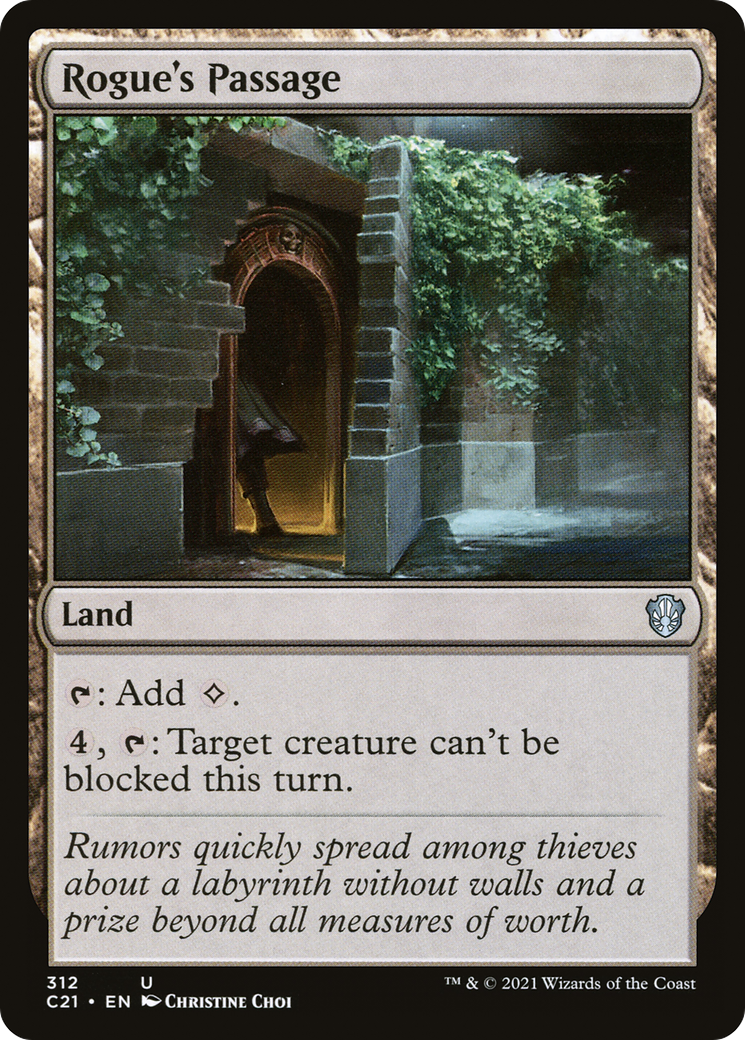
Rogue's Passage
Rogue's Passage
Land
: Add .
, : Target creature can't be blocked this turn.
- Activating the second ability of Rogue's Passage after a creature has become blocked won't cause that creature to become unblocked.
-
1
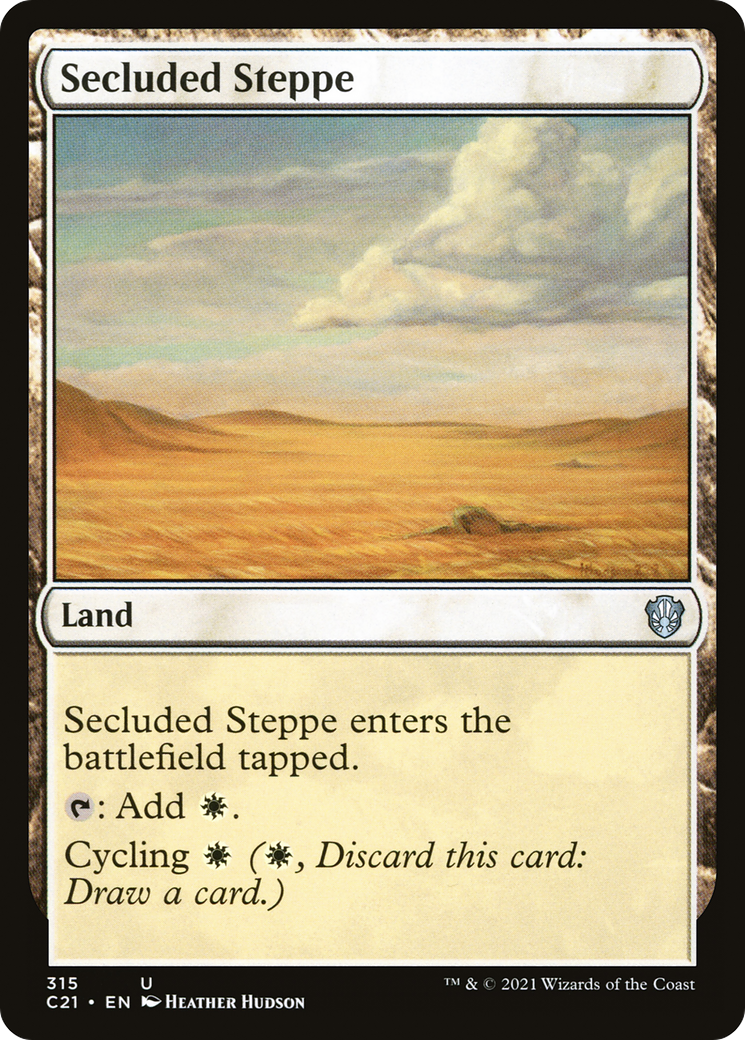
Secluded Steppe
Secluded Steppe
Land
This land enters tapped.
: Add .
Cycling ( , Discard this card: Draw a card.)
-
1
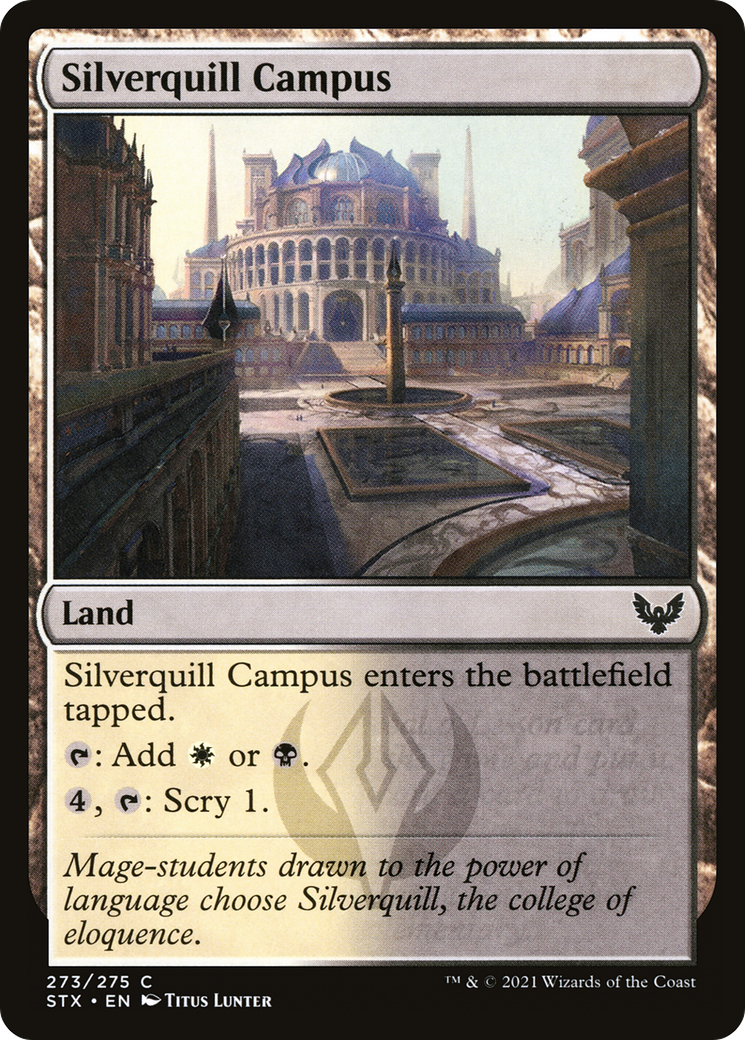
Silverquill Campus
Silverquill Campus
Land
This land enters tapped.
: Add or .
, : Scry 1.
-
1
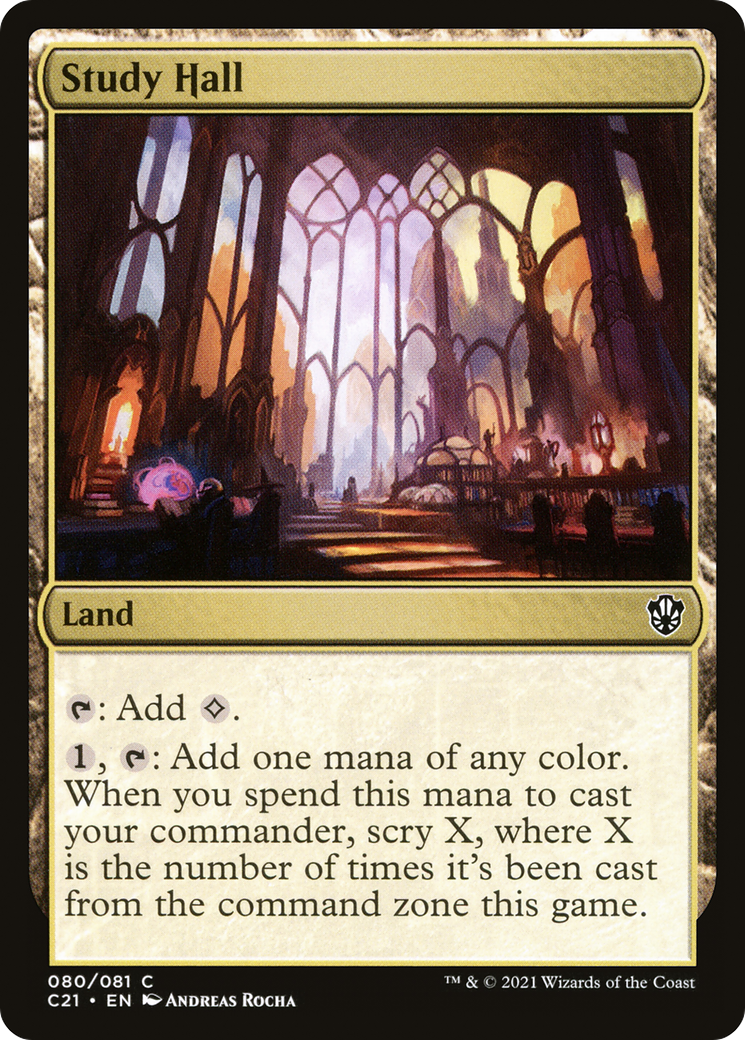
Study Hall
Study Hall
Land
: Add .
, : Add one mana of any color. When you spend this mana to cast your commander, scry X, where X is the number of times it's been cast from the command zone this game.
-
10
Swamp
Swamp
Basic Land — Swamp
( : Add .)
-
1
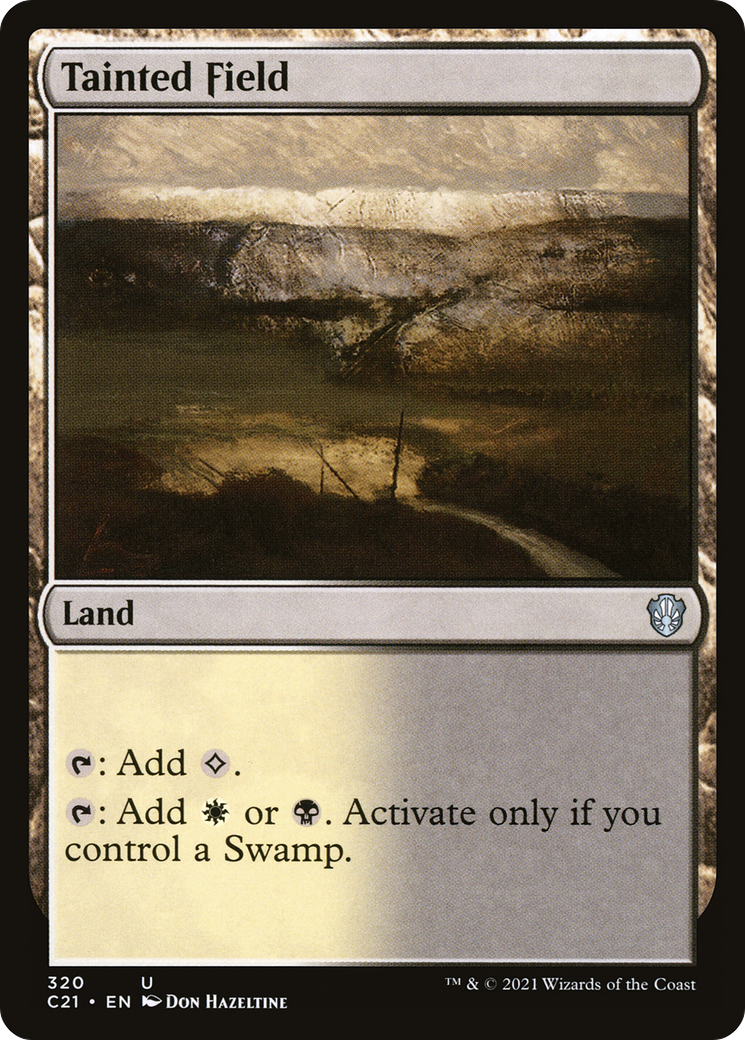
Tainted Field
Tainted Field
Land
: Add .
: Add or . Activate only if you control a Swamp.
-
1
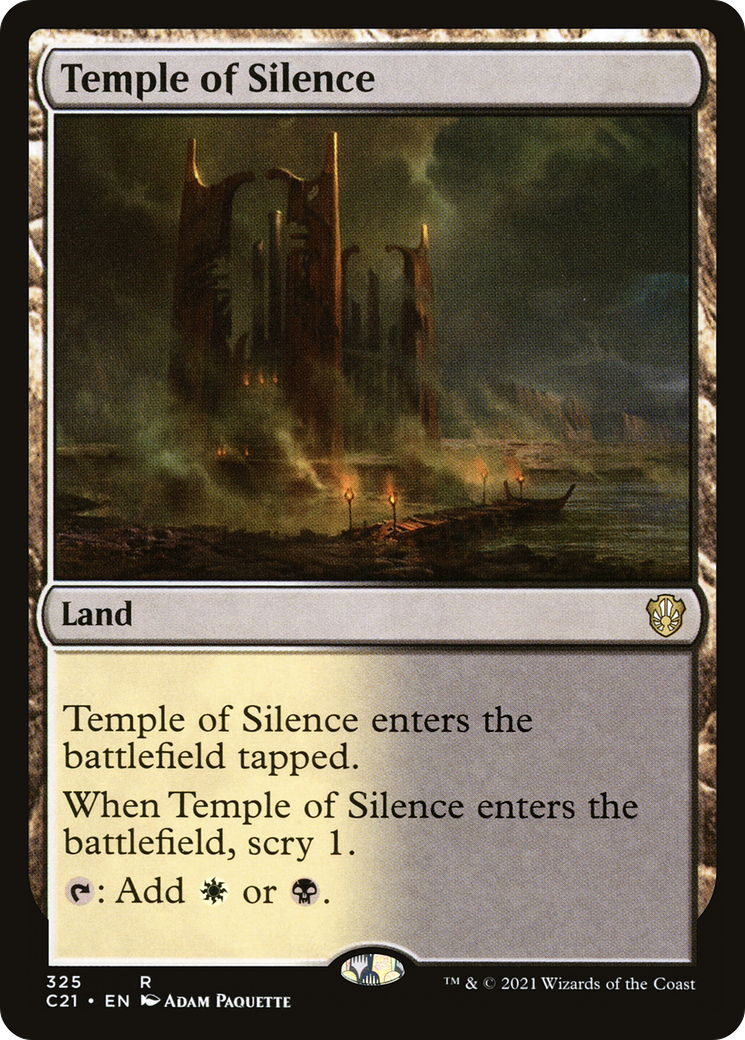
Temple of Silence
Temple of Silence
Land
This land enters tapped.
When this land enters, scry 1. (Look at the top card of your library. You may put that card on the bottom.)
: Add or .
- When you scry, you may put all the cards you look at back on top of your library, you may put all of those cards on the bottom of your library, or you may put some of those cards on top and the rest of them on the bottom.
- You choose how to order cards returned to your library after scrying no matter where you put them.
- You perform the actions stated on a card in sequence. For some spells and abilities, that means you'll scry last. For others, that means you'll scry and then perform other actions.
- Scry appears on some spells and abilities with one or more targets. If all of the spell or ability's targets are illegal when it tries to resolve, it won't resolve and none of its effects will happen. You won't scry.
-
1
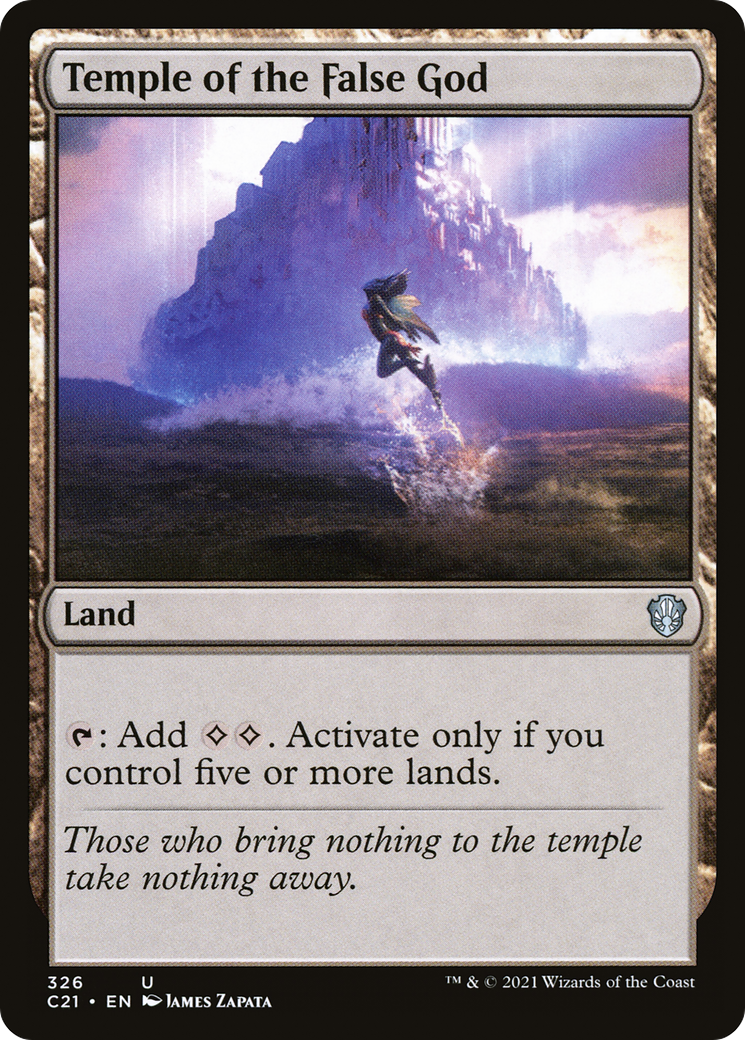
Temple of the False God
Temple of the False God
Land
: Add . Activate only if you control five or more lands.
White 28
-
1
Angel of Serenity
Angel of Serenity
Creature — Angel
5/6
Flying
When this creature enters, you may exile up to three other target creatures from the battlefield and/or creature cards from graveyards.
When this creature leaves the battlefield, return the exiled cards to their owners' hands.
- You choose up to three total targets from among other creatures on the battlefield and creature cards in graveyards. You may choose zero targets.
- You choose the targets as part of putting the "enters" trigger on the stack. Because that ability includes "you may," you choose whether to exile the targets when the ability resolves.
- If a creature targeted by the "enters" ability dies before that ability resolves, it will become an illegal target even though it may be a creature card in a graveyard when the ability resolves. It won't be exiled.
- If Angel of Serenity leaves the battlefield before its "enters" ability has resolved, its leaves-the-battlefield ability will trigger and do nothing. Then the "enters" ability will resolve and exile the targeted creatures and/or creature cards indefinitely.
-
1
Boreas Charger
Boreas Charger
Creature — Pegasus
2/1
Flying
When this creature leaves the battlefield, choose an opponent who controls more lands than you. Search your library for a number of Plains cards equal to the difference, reveal those cards, put one of them onto the battlefield tapped and the rest into your hand, then shuffle.
- You can find fewer Plains cards than the difference, perhaps because you don't have that many Plains cards left in your library.
- If no opponent controls more lands than you, you'll search your library and shuffle it, but you won't be able to find any Plains cards.
-
1
Citadel Siege
Citadel Siege
Enchantment
As this enchantment enters, choose Khans or Dragons.
- Khans — At the beginning of combat on your turn, put two +1/+1 counters on target creature you control.
- Dragons — At the beginning of combat on each opponent's turn, tap target creature that player controls.
- Each Siege will have one of the two listed abilities, depending on your choice as it enters the battlefield.
- The words “Khans” and “Dragons” are anchor words, connecting your choice to the appropriate ability. Anchor words are a new rules concept. “[Anchor word] — [Ability]” means “As long as you chose [anchor word] as this permanent entered the battlefield, this permanent has [ability].” Notably, the anchor word “Dragons” has no connection to the creature type Dragon.
- Each of the last two abilities is linked to the first ability. They each refer only to the choice made as a result of the first ability. If a permanent enters the battlefield as a copy of one of the Sieges, its controller will make a new choice for that Siege. Which ability the copy has won't depend on the choice made for the original permanent.
-
1
Combat Calligrapher
Combat Calligrapher
Creature — Bird Cleric
3/3
Flying
Inklings can't attack you or planeswalkers you control.
Whenever a player attacks one of your opponents, that attacking player creates a tapped 2/1 white and black Inkling creature token with flying that's attacking that opponent.
-
1
Duelist's Heritage
Duelist's Heritage
Enchantment
Whenever one or more creatures attack, you may have target attacking creature gain double strike until end of turn.
- The ability of Duelist's Heritage triggers whenever any player attacks with one or more creatures, not just when you do. You know which players and planeswalkers the creatures are attacking before you choose the target creature.
-
1
Elite Scaleguard
Elite Scaleguard
Creature — Human Soldier
2/3
When this creature enters, bolster 2. (Choose a creature with the least toughness among creatures you control and put two +1/+1 counters on it.)
Whenever a creature you control with a +1/+1 counter on it attacks, tap target creature defending player controls.
- Bolster itself doesn't target any creature, though some spells and abilities that bolster may have other effects that target creatures. For example, you could put counters on a creature with protection from white with Abzan Skycaptain's bolster ability.
- You determine which creature to put counters on as the spell or ability that instructs you to bolster resolves.
-
1
Ghostly Prison
Ghostly Prison
Enchantment
Creatures can't attack you unless their controller pays for each creature they control that's attacking you.
- Unless some effect explicitly says otherwise, a creature that can't attack you can still attack a planeswalker you control.
- In the Two-Headed Giant format, you still only have to pay once per creature.
-
1
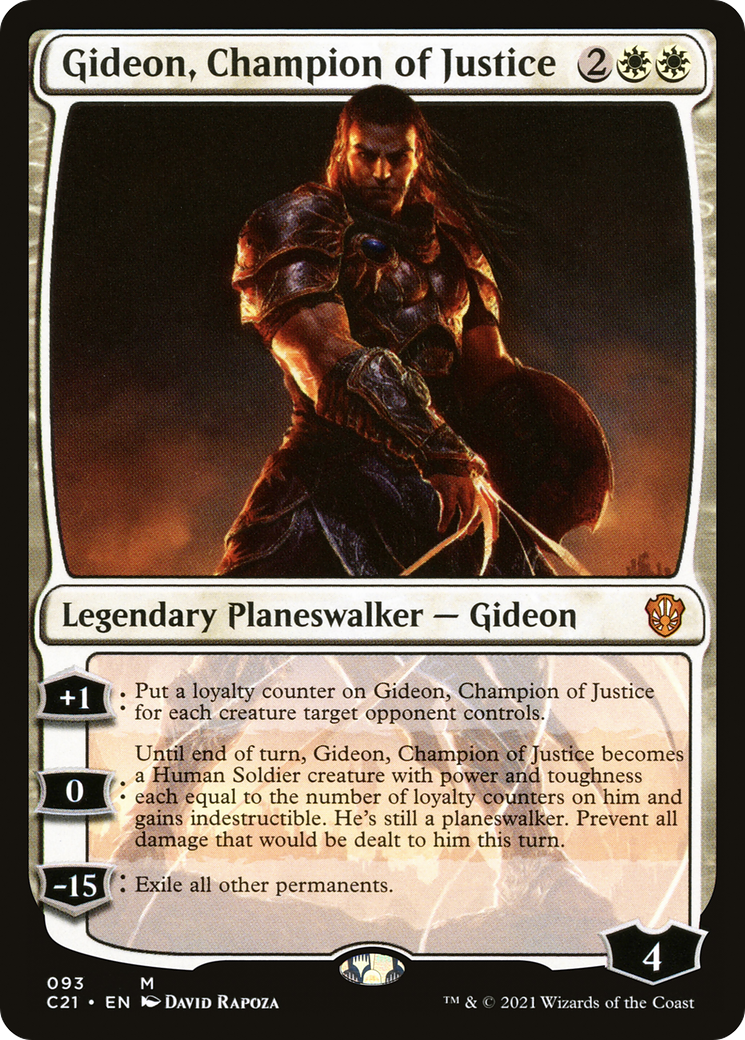
Gideon, Champion of Justice
Gideon, Champion of Justice
Legendary Planeswalker — Gideon
+1: Put a loyalty counter on Gideon for each creature target opponent controls.
0: Until end of turn, Gideon becomes a Human Soldier creature with power and toughness each equal to the number of loyalty counters on him and gains indestructible. He's still a planeswalker. Prevent all damage that would be dealt to him this turn.
−15: Exile all other permanents.
- If damage that can't be prevented is dealt to Gideon, Champion of Justice after his second ability has resolved, that damage will have all applicable results: specifically, the damage is marked on Gideon (since he's a creature) and that damage causes that many loyalty counters to be removed from him (since he's a planeswalker). Even though he has indestructible, if Gideon, Champion of Justice has no loyalty counters on him, he's put into his owner's graveyard as a state-based action.
- If the first ability doesn't resolve (perhaps because the target opponent is an illegal target when the ability tries to resolve), you won't put any additional loyalty counters on Gideon, although the loyalty counter you put on him to activate the ability will remain.
- If Gideon, Champion of Justice becomes a creature due to his second ability, that doesn't count as having a creature enter. Gideon was already on the battlefield; he only changed his types. Abilities that trigger whenever a creature enters won't trigger.
- Gideon, Champion of Justice's power and toughness are set to the number of loyalty counters on him when his second ability resolves. They won't change later in the turn if the number of loyalty counters on him changes.
- You put a loyalty counter on Gideon, Champion of Justice as part of the cost of activating the first ability. When that ability resolves, you count the number of creatures controlled by the target opponent and put that many additional loyalty counters on Gideon.
- Gideon, Champion of Justice's second ability causes him to become a creature with the creature types Human and Soldier. He remains a planeswalker with the planeswalker type Gideon. (He also retains any other card types or subtypes he may have had.) Each subtype is correlated to the proper card type: Gideon is just a planeswalker type (not a creature type), and Human and Soldier are just creature types (not planeswalker types).
- Say you activate Gideon, Champion of Justice's second ability, and then an opponent gains control of him before combat. You may have any of your creatures attack Gideon, Champion of Justice (since he's still a planeswalker). Then Gideon, Champion of Justice may block (since he's a creature). He may block any eligible attacking creature, including one that's attacking him! During combat, he behaves as an attacked planeswalker and/or a blocking creature, as appropriate. For example, he deals combat damage to any creatures he's blocking, but he doesn't deal combat damage to any unblocked creatures that are attacking him.
- If Gideon, Champion of Justice becomes a creature the same turn he enters, you can't attack with him or use any of his abilities (if he gains any).
-
1
Guardian Archon
Guardian Archon
Creature — Archon
5/5
Flying
As this creature enters, secretly choose an opponent.
Reveal the player you chose: You and target permanent you control each gain protection from the chosen player until end of turn. Activate only once.
- In a two-player game, the chosen player won’t be much of a secret.
- There are several ways to secretly choose an opponent. Perhaps the most popular way is to write the chosen player’s name on a piece of paper that is kept with Guardian Archon.
- If you control more than one Guardian Archon, you may choose a different opponent for each one. Be careful to keep track of which opponent is chosen for each Guardian Archon.
- If Guardian Archon leaves the battlefield and returns, it’s considered a new object. You may choose a new opponent and you may activate its last ability again.
- If you didn’t choose an opponent as Guardian Archon entered the battlefield, you can’t pay the cost to activate the last ability. This will usually happen because you gained control of another player’s Guardian Archon or because a creature already on the battlefield became a copy of Guardian Archon.
- Protection from a player means all of the following: (1) Neither you nor the target permanent can be the target of spells or abilities controlled by the chosen player. (2) Neither you nor the target permanent can be enchanted or equipped by any Auras or Equipment controlled by the chosen players. (Okay, Fortifications too, if the target permanent is a land.) (3) If the target permanent is a creature, it can’t be blocked by creatures controlled by the chosen player. (4) All damage that would be dealt to you or the target permanent by sources controlled by the chosen player is prevented. The same is true for sources owned by the chosen player that don’t have controllers.
-
1
Hunted Lammasu
Hunted Lammasu
Creature — Lammasu
5/5
Flying
When this creature enters, target opponent creates a 4/4 black Horror creature token.
-
1
Knight of the White Orchid
Knight of the White Orchid
Creature — Human Knight
2/2
First strike
When this creature enters, if an opponent controls more lands than you, you may search your library for a Plains card, put it onto the battlefield, then shuffle.
- The Plains you search for doesn't have to be basic. For example, you could put a Sacred Foundry onto the battlefield.
- Knight of the White Orchid's triggered ability has an “intervening ‘if' clause.” That means (1) the ability won't trigger at all unless any one of your opponents controls more lands than you, and (2) the ability will do nothing if you control at least as many lands as each of your opponents by the time it resolves.
-
1
Martial Impetus
Martial Impetus
Enchantment — Aura
Enchant creature
Enchanted creature gets +1/+1 and is goaded. (It attacks each combat if able and attacks a player other than you if able.)
Whenever enchanted creature attacks, each other creature that's attacking one of your opponents gets +1/+1 until end of turn.
- If the creature doesn't meet any of the above exceptions and can attack, it must attack a player other than the controller of the spell or ability that goaded it if able. If the creature can't attack any of those players but could otherwise attack, it must attack a planeswalker an opponent controls, a battle an opponent controls, or a player who goaded it.
- If, during a player's declare attackers step, a creature that player controls that's been goaded is tapped, is affected by a spell or ability that says it can't attack, or hasn't been under that player's control continuously since the turn began (and doesn't have haste), then it doesn't attack. If there's a cost associated with having a creature attack a player, its controller isn't forced to pay that cost, so it doesn't have to attack that player.
- Attacking with a goaded creature doesn't cause it to stop being goaded. If there is an additional combat phase that turn, or if another player gains control of it before it stops being goaded, it must attack again if able.
- If a creature you control has been goaded by multiple opponents, it must attack one of your opponents that hasn't goaded it, as that fulfills the maximum number of goad requirements. If a creature you control has been goaded by each of your opponents, the creature must attack an opponent (rather than a planeswalker or battle), but you choose which opponent it attacks.
- Being goaded isn't an ability the creature has. Once it's been goaded, it must attack as detailed above even if it loses all abilities.
-
1
Nils, Discipline Enforcer
Nils, Discipline Enforcer
Legendary Creature — Human Cleric
2/2
At the beginning of your end step, for each player, put a +1/+1 counter on up to one target creature that player controls.
Each creature with one or more counters on it can't attack you or planeswalkers you control unless its controller pays , where X is the number of counters on that creature.
- All counters on a creature are considered when determining the value of X, not only +1/+1 counters.
- For each player, choosing a target creature that player controls is optional.
- Your opponents can choose not to pay to attack with a creature with one or more counters on it that attacks "if able." If there's no other player or planeswalker to attack, the creature simply doesn't attack.
-
1
Oblation
Oblation
Instant
The owner of target nonland permanent shuffles it into their library, then draws two cards.
-
1
Oreskos Explorer
Oreskos Explorer
Creature — Cat Scout
2/2
When this creature enters, search your library for up to X Plains cards, where X is the number of players who control more lands than you. Reveal those cards, put them into your hand, then shuffle.
- The value of X is determined as Oreskos Explorer's triggered ability resolves.
- If no player controls more lands than you do, you'll still search and shuffle your library, although you can't find any cards.
-
1
Orzhov Advokist
Orzhov Advokist
Creature — Human Advisor
1/4
At the beginning of your upkeep, each player may put two +1/+1 counters on a creature they control. If a player does, creatures that player controls can't attack you or planeswalkers you control until your next turn.
- While resolving Orzhov Advokist's ability, you choose a creature you control or choose not to put any counters on a creature, then each other player in turn order does the same. Each player will know the choices made by players who chose before them. Then simultaneously each player who chose a creature puts two +1/+1 counters on the creature they chose.
- Orzhov Advokist's ability doesn't target the creatures that receive +1/+1 counters. Their controllers choose them as the ability resolves. Players can't take actions between making their choices and the +1/+1 counters being placed.
- If a player chooses to accept Orzhov Advokist's gift, that player can't attack you or a planeswalker you control with any creatures during their next turn, even creatures that weren't on the battlefield as Orzhov Advokist's ability resolved.
- Orzhov Advokist's effect keeps creatures from attacking you even if Orzhov Advokist leaves the battlefield, if the creature that received counters is no longer on the battlefield, or if an effect has moved those counters off of the creature that received them and put them onto another creature.
-
1
Promise of Loyalty
Promise of Loyalty
Sorcery
Each player puts a vow counter on a creature they control and sacrifices the rest. Each of those creatures can't attack you or planeswalkers you control for as long as it has a vow counter on it.
- If the vow counter is removed from the creature, it can attack as normal.
- Each player, including you, must put a vow counter on a creature they control if able. They can't choose to opt out and sacrifice all of their creatures. The creature you put a vow counter on will remember its promise if another player gains control of it.
- If the vow counter is moved to another creature, it won't prevent the second creature from attacking normally.
-
1
Scholarship Sponsor
Scholarship Sponsor
Creature — Human Advisor
3/3
When this creature enters, each player who controls fewer lands than the player who controls the most lands searches their library for a number of basic land cards less than or equal to the difference, puts those cards onto the battlefield tapped, then shuffles.
- For example, if you control four lands, one opponent controls six lands, and another opponent controls seven lands, you will search your library for up to three basic land cards and the first opponent will search their library for one basic land card. The second opponent won’t search their library at all.
-
1
Secret Rendezvous
Secret Rendezvous
Sorcery
You and target opponent each draw three cards.
- If the opponent is an illegal target as Secret Rendezvous tries to resolve, neither player will draw cards.
-
1
Selfless Squire
Selfless Squire
Creature — Human Soldier
1/1
Flash
When this creature enters, prevent all damage that would be dealt to you this turn.
Whenever damage that would be dealt to you is prevented, put that many +1/+1 counters on this creature.
- Selfless Squire's first triggered ability prevents all damage that would be dealt to you this turn after the triggered ability resolves, even if Selfless Squire leaves the battlefield.
- Selfless Squire's second triggered ability doesn't trigger only when damage is prevented by its first triggered ability's effect. Any effect that uses the word "prevent" will cause it to trigger.
-
1
Soul Snare
Soul Snare
Enchantment
, Sacrifice this enchantment: Exile target creature that's attacking you or a planeswalker you control.
- Sacrificing Soul Snare is part of the cost to activate the ability. Once you activate the ability, no player can do anything to Soul Snare to stop you from activating it.
- If Soul Snare's ability targets a creature that's attacking a planeswalker you control, but that planeswalker is no longer on the battlefield as the ability tries to resolve, the attacking creature will be an illegal target and Soul Snare's ability won't exile that creature.
-
1
Stalking Leonin
Stalking Leonin
Creature — Cat Archer
3/3
When this creature enters, secretly choose an opponent.
Reveal the player you chose: Exile target creature that's attacking you if it's controlled by the chosen player. Activate only once.
- There are several ways to secretly choose an opponent, including writing that player's name on a piece of paper that's kept with Stalking Leonin.
- If you have multiple Stalking Leonins, you may choose a different opponent for each one. Be careful to keep track of which opponent is chosen for each Stalking Leonin.
- If Stalking Leonin leaves the battlefield and returns, it's considered a new object. You may choose a new opponent and you may activate its last ability again.
- If you didn't choose an opponent when Stalking Leonin entered the battlefield, you can't pay the cost to activate its last ability. This will usually happen because you gained control of another player's Stalking Leonin or because a creature already on the battlefield became a copy of Stalking Leonin.
- If a creature is attacking a planeswalker you control, it's not attacking you. Stalking Leonin's last ability can't target it.
-
1
Sunscorch Regent
Sunscorch Regent
Creature — Dragon
4/3
Flying
Whenever an opponent casts a spell, put a +1/+1 counter on this creature and you gain 1 life.
-
1
Together Forever
Together Forever
Enchantment
When this enchantment enters, support 2. (Put a +1/+1 counter on each of up to two target creatures.)
: Choose target creature with a counter on it. When that creature dies this turn, return that card to its owner's hand.
- If a creature without counters receives enough -1/-1 counters to reduce its toughness to 0 or less, Together Forever's ability can't be activated before state-based actions put that creature into its owner's graveyard.
- Together Forever's activated ability checks whether the target creature has a counter on it as the ability is activated and as the ability resolves. If the creature loses its counters later in the turn, the delayed triggered ability will still return it to its owner's hand when it dies.
- If some, but not all, targets for a spell become illegal, the remaining targets are affected as appropriate. If all of a spell's targets become illegal, that spell doesn't resolve.
- If a spell with support has other abilities that target creatures, those abilities and the support ability can target the same creature.
- You can't put more than one +1/+1 counter on any one target using the support action.
- Support can target a creature another player controls.
-
1
Tragic Arrogance
Tragic Arrogance
Sorcery
For each player, you choose from among the permanents that player controls an artifact, a creature, an enchantment, and a planeswalker. Then each player sacrifices all other nonland permanents they control.
- None of the chosen permanents are targets of Tragic Arrogance.
- If a permanent has more than one of the affected types, it can count for any of them. For example, you could choose an artifact creature as the artifact you're sparing, another creature as the creature, and an enchantment creature as the enchantment. Similarly, you could choose an enchantment creature as both the creature and the enchantment that you're sparing, even if the player controls another creature and/or another enchantment.
-
1
Vow of Duty
Vow of Duty
Enchantment — Aura
Enchant creature
Enchanted creature gets +2/+2, has vigilance, and can't attack you or planeswalkers you control.
-
1
Windborn Muse
Windborn Muse
Creature — Spirit
2/3
Flying
Creatures can't attack you unless their controller pays for each creature they control that's attacking you.
- Creatures may still attack planeswalkers you control without their controller paying a cost.
-
1
Zetalpa, Primal Dawn
Zetalpa, Primal Dawn
Legendary Creature — Elder Dinosaur
4/8
Flying, double strike, vigilance, trample, indestructible
- If an attacking creature with double strike and trample destroys all of its blocking creatures with first-strike combat damage, all of its normal combat damage is assigned to the player, planeswalker, or battle that creature's attacking.
Black 13
-
1
Ambition's Cost
Ambition's Cost
Sorcery
You draw three cards and you lose 3 life.
-
1
Author of Shadows
Author of Shadows
Creature — Shade Warlock
3/3
When this creature enters, exile all opponents' graveyards. Choose a nonland card exiled this way. You may cast that card for as long as it remains exiled, and you may spend mana as though it were mana of any color to cast that spell.
-
1
Bold Plagiarist
Bold Plagiarist
Creature — Vampire Rogue
2/2
Flash
Whenever an opponent puts one or more counters on a creature they control, they put the same number and kind of counters on this creature.
- Your opponent places the counters on both permanents. Therefore, if they also control a Bold Plagiarist, its ability will not trigger.
-
1
Cunning Rhetoric
Cunning Rhetoric
Enchantment
Whenever an opponent attacks you and/or one or more planeswalkers you control, exile the top card of that player's library. You may play that card for as long as it remains exiled, and you may spend mana as though it were mana of any color to cast it.
- You must follow the normal timing permissions and restrictions for the exiled card. If it's a land, you can't play it unless you have land plays available.
- You'll still pay all costs for a spell cast this way, including additional costs. You may also pay alternative costs if any are available.
- If you play a card this way, it leaves exile and becomes a new object. If it returns to exile later in the turn, you can't play it again.
-
1
Curse of Disturbance
Curse of Disturbance
Enchantment — Aura Curse
Enchant player
Whenever enchanted player is attacked, create a 2/2 black Zombie creature token. Each opponent attacking that player does the same.
- Each Curse’s ability triggers only once, no matter how many creatures are attacking the enchanted player.
- A player is attacking another player if they control a creature that’s attacking that player. If no creatures are attacking the enchanted player as a Curse’s ability resolves (most likely because they’ve left the battlefield), only the Curse’s controller performs its actions.
- The triggered ability of these Curses won’t trigger if only a planeswalker controlled by the enchanted player is attacked.
- If you enchant yourself with one of these Curses, you’ll get its effects whenever another player attacks you.
-
1
Deathbringer Regent
Deathbringer Regent
Creature — Dragon
5/6
Flying
When this creature enters, if you cast it from your hand and there are five or more other creatures on the battlefield, destroy all other creatures.
- If you cast a creature spell that enters the battlefield as a copy of Deathbringer Regent, the enters-the-battlefield ability will trigger (assuming the “five or more other creatures” requirement is also met).
- Deathbringer Regent's last ability destroys all creatures except Deathbringer Regent, including the five other creatures required for the ability to have an effect.
-
1
Fain, the Broker
Fain, the Broker
Legendary Creature — Human Warlock
3/3
, Sacrifice a creature: Put two +1/+1 counters on target creature.
, Remove a counter from a creature you control: Create a Treasure token.
, Sacrifice an artifact: Create a 2/1 white and black Inkling creature token with flying.
: Untap Fain.
-
1
Incarnation Technique
Incarnation Technique
Sorcery
Demonstrate (When you cast this spell, you may copy it. If you do, choose an opponent to also copy it.)
Mill five cards, then return a creature card from your graveyard to the battlefield.
- You choose which creature to bring back after you mill five cards.
- You may choose any creature card in your graveyard, not just one that you milled this way.
- You choose whether to make a copy as the demonstrate ability resolves. This happens before the original spell resolves. Your copy goes on the stack above the original spell.
- If you copy a spell with demonstrate, you then immediately choose an opponent. If they copy the spell, it goes on top of the stack.
- If the spell requires targets, you choose the target of the original spell as you cast it. If you create a copy of the spell, you may choose new targets for the copy as you create that copy. Similarly, the opponent you chose to create a copy may choose new targets for that copy as it’s created. In other words, your opponent will know the targets of your original spell and your copy when choosing the new targets, if any, for their copy.
- This means that if you cast a spell with demonstrate and both you and an opponent copy it, the opponent’s copy will resolve first, then your copy will resolve, and finally the original spell will resolve.
- If you cast the spell and choose not to copy it, no opponent will get to copy it either.
-
1
Infernal Offering
Infernal Offering
Sorcery
Choose an opponent. You and that player each sacrifice a creature. Each player who sacrificed a creature this way draws two cards.
Choose an opponent. Return a creature card from your graveyard to the battlefield, then that player returns a creature card from their graveyard to the battlefield.
- The sacrifice isn’t optional. If you control at least one creature, you must sacrifice one. If you control no creatures, you won’t sacrifice one and you won’t draw two cards. The same is true for the chosen opponent.
- You choose which creature card you’re returning to the battlefield, then the chosen opponent chooses which creature card they are returning. These choices aren’t made until Infernal Offering resolves. Neither card is a target of Infernal Offering.
- You may choose the same opponent for each of the effects, or you may choose different opponents. None of the affected players are targets of the spell.
- You choose the opponents for each effect as the spell resolves.
-
1
Keen Duelist
Keen Duelist
Creature — Human Wizard
2/2
At the beginning of your upkeep, you and target opponent each reveal the top card of your library. You each lose life equal to the mana value of the card revealed by the other player. You each put the card you revealed into your hand.
-
1
Necropolis Regent
Necropolis Regent
Creature — Vampire
6/5
Flying
Whenever a creature you control deals combat damage to a player, put that many +1/+1 counters on it.
- If that creature deals combat damage to a player at the same time it's dealt lethal damage (perhaps because it has trample and was blocked), it will die before the triggered ability resolves and puts +1/+1 counters on it.
-
1
Parasitic Impetus
Parasitic Impetus
Enchantment — Aura
Enchant creature
Enchanted creature gets +2/+2 and is goaded. (It attacks each combat if able and attacks a player other than you if able.)
Whenever enchanted creature attacks, its controller loses 2 life and you gain 2 life.
- Being goaded isn't an ability the creature has. Once it's been goaded, it must attack as detailed above even if it loses all abilities.
- If, during a player's declare attackers step, a creature that player controls that's been goaded is tapped, is affected by a spell or ability that says it can't attack, or hasn't been under that player's control continuously since the turn began (and doesn't have haste), then it doesn't attack. If there's a cost associated with having a creature attack a player, its controller isn't forced to pay that cost, so it doesn't have to attack that player.
- If a creature you control has been goaded by multiple opponents, it must attack one of your opponents that hasn't goaded it, as that fulfills the maximum number of goad requirements. If a creature you control has been goaded by each of your opponents, the creature must attack an opponent (rather than a planeswalker or battle), but you choose which opponent it attacks.
- Attacking with a goaded creature doesn't cause it to stop being goaded. If there is an additional combat phase that turn, or if another player gains control of it before it stops being goaded, it must attack again if able.
- If the creature doesn't meet any of the above exceptions and can attack, it must attack a player other than the controller of the spell or ability that goaded it if able. If the creature can't attack any of those players but could otherwise attack, it must attack a planeswalker an opponent controls, a battle an opponent controls, or a player who goaded it.
- If you are the attacking creature's controller, you lose 2 life and gain 2 life. You won't lose the game if your life total is 0 in between these two events.
- Parasitic Impetus causes you to gain life, not the attacking creature's controller.
-
1
Stinging Study
Stinging Study
Instant
You draw X cards and you lose X life, where X is the mana value of a commander you own on the battlefield or in the command zone.
- If your commander is under the control of another player as Stinging Study resolves, it is still on the battlefield and will still be used to determine the value of X.
- If you own multiple commanders on the battlefield and/or in the command zone, you choose one of them as Stinging Study resolves to determine the value of X.
Multicolor 7
-
1
Breena, the Demagogue
Breena, the Demagogue
Legendary Creature — Bird Warlock
1/3
Flying
Whenever a player attacks one of your opponents, if that opponent has more life than another of your opponents, that attacking player draws a card and you put two +1/+1 counters on a creature you control.
- Breena's triggered ability will trigger even if you control no creatures.
- If the attacking player is one of your opponents and has less life than the player being attacked, then the condition is satisfied.
- You choose which creature to put +1/+1 counters on as the ability is resolving. Once you make the choice, no player may take actions until the counters are placed.
-
1
Felisa, Fang of Silverquill
Felisa, Fang of Silverquill
Legendary Creature — Vampire Wizard
3/2
Flying
Mentor (Whenever this creature attacks, put a +1/+1 counter on target attacking creature with lesser power.)
Whenever a nontoken creature you control dies, if it had counters on it, create X tapped 2/1 white and black Inkling creature tokens with flying, where X is the number of counters it had on it.
- The last ability counts the number of all kinds of counters, not just +1/+1 counters.
- Mentor compares the power of the creature with mentor with that of the target creature at two different times: once as the triggered ability is put onto the stack, and once as the triggered ability resolves. If you wish to raise a creature's power so its mentor ability can target a bigger creature, the last chance you have to do so is during the beginning of combat step.
- If the target creature's power is no longer less than the attacking creature's power as the ability resolves, mentor doesn't add a +1/+1 counter. For example, if two 3/3 creatures with mentor attack and both mentor triggers target the same 2/2 creature, the first to resolve puts a +1/+1 counter on it and the second does nothing.
- If the creature with mentor leaves the battlefield with mentor on the stack, use its power as that creature last existed on the battlefield to determine whether the target creature has less power.
-
1
Fracture
Fracture
Instant
Destroy target artifact, enchantment, or planeswalker.
-
1
Inkshield
Inkshield
Instant
Prevent all combat damage that would be dealt to you this turn. For each 1 damage prevented this way, create a 2/1 white and black Inkling creature token with flying.
- If multiple damage prevention effects would apply to combat damage that would be dealt to you, you get to choose the order the prevention effects are applied in.
-
1
Magister of Worth
Magister of Worth
Creature — Angel
4/4
Flying
Will of the council — When this creature enters, starting with you, each player votes for grace or condemnation. If grace gets more votes, each player returns each creature card from their graveyard to the battlefield. If condemnation gets more votes or the vote is tied, destroy all creatures other than this creature.
- Because the votes are cast in turn order, each player will know the votes of players who voted beforehand.
- You must vote for one of the available options. You can't abstain.
- No player votes until the spell or ability resolves. Any responses to that spell or ability must be made without knowing the outcome of the vote.
- Players can't do anything after they finish voting but before the spell or ability that included the vote finishes resolving.
- The phrase "the vote is tied" refers only to when there is more than one choice that received the most votes. For example, if a 5-player vote from among three different choices ends 3 votes to 1 vote to 1 vote, the vote isn't tied.
-
1
Teysa, Envoy of Ghosts
Teysa, Envoy of Ghosts
Legendary Creature — Human Advisor
4/4
Vigilance, protection from creatures
Whenever a creature deals combat damage to you, destroy that creature. Create a 1/1 white and black Spirit creature token with flying.
- You get a Spirit creature token even if Teysa’s triggered ability doesn’t destroy the creature (perhaps because it regenerated or has indestructible).
- Protection from creatures means that Teysa, Envoy of Ghosts can’t be the target of abilities of creatures or abilities of creature cards in other zones, such as bloodrush abilities. Teysa also can’t be blocked by creatures, and all damage that would be dealt to Teysa by creatures is prevented.
- Teysa’s last ability doesn’t target the creature. It will destroy a creature with hexproof or protection from white, for example.
- Teysa’s controller gets the Spirit creature token, not the controller of the creature that dealt combat damage.
-
1
Utter End
Utter End
Instant
Exile target nonland permanent.
Colorless 12
-
1
Arcane Signet
Arcane Signet
Artifact
: Add one mana of any color in your commander's color identity.
- If your commander is a card that has no colors in its color identity, Arcane Signet's ability produces no mana. It doesn't produce .
- If you have two commanders, the ability adds one mana of any color in their combined color identities.
- If you don't have a commander, Arcane Signet's ability produces no mana.
-
1
Bloodthirsty Blade
Bloodthirsty Blade
Artifact — Equipment
Equipped creature gets +2/+0 and is goaded. (It attacks each combat if able and attacks a player other than you if able.)
: Attach this Equipment to target creature an opponent controls. Activate only as a sorcery.
- If the creature doesn't meet any of the above exceptions and can attack, it must attack a player other than the controller of the spell or ability that goaded it if able. If the creature can't attack any of those players but could otherwise attack, it must attack a planeswalker an opponent controls, a battle an opponent controls, or a player who goaded it.
- Attacking with a goaded creature doesn't cause it to stop being goaded. If there is an additional combat phase that turn, or if another player gains control of it before it stops being goaded, it must attack again if able.
- If a creature you control has been goaded by multiple opponents, it must attack one of your opponents that hasn't goaded it, as that fulfills the maximum number of goad requirements. If a creature you control has been goaded by each of your opponents, the creature must attack an opponent (rather than a planeswalker or battle), but you choose which opponent it attacks.
- If, during a player's declare attackers step, a creature that player controls that's been goaded is tapped, is affected by a spell or ability that says it can't attack, or hasn't been under that player's control continuously since the turn began (and doesn't have haste), then it doesn't attack. If there's a cost associated with having a creature attack a player, its controller isn't forced to pay that cost, so it doesn't have to attack that player.
- Being goaded isn't an ability the creature has. Once it's been goaded, it must attack as detailed above even if it loses all abilities.
- You still control Bloodthirsty Blade while it's equipped to an opponent's creature. You can move it any time you could cast a sorcery; the equipped creature's controller can't.
- Bloodthirsty Blade has no equip ability. There's normally no way to have it attached to your own creature, although certain combinations of other cards make this possible.
-
1
Coveted Jewel
Coveted Jewel
Artifact
When this artifact enters, draw three cards.
: Add three mana of any one color.
Whenever one or more creatures an opponent controls attack you and aren't blocked, that player draws three cards and gains control of this artifact. Untap it.
- Coveted Jewel's last ability triggers after you declare blockers (or declare no blockers at all) if any attacking creatures are unblocked. It doesn't matter if some attacking creatures were blocked.
- If more than one opponent attacks you at the same time, Coveted Jewel's last ability triggers for each of them. You choose which player ends up with Coveted Jewel, but each of them draws three cards and has a chance to activate its mana ability.
- A creature attacking a planeswalker you control won't cause Coveted Jewel's last ability to trigger.
- Coveted Jewel's last ability resolves after blockers are chosen but before combat damage is dealt.
-
1
Deathbringer Liege
Deathbringer Liege
Creature — Horror
3/4
Other white creatures you control get +1/+1.
Other black creatures you control get +1/+1.
Whenever you cast a white spell, you may tap target creature.
Whenever you cast a black spell, you may destroy target creature if it's tapped.
- The last ability can target any creature, not just a tapped creature (it doesn't say "target tapped creature"). When the ability resolves, check whether the creature is tapped or not. If it's tapped, you may destroy it. If it's not tapped, the ability does nothing.
- The abilities are separate and cumulative. If another creature you control is both of the listed colors, it will get a total of +2/+2.
- If you cast a spell that's both white and black, the last two abilities will both trigger. You may use them together to destroy any creature. To do so, put the "destroy" ability on the stack first, then put the "tap" ability on the stack, with each one targeting the same creature. When the abilities resolve, they'll tap the creature, then destroy it.
-
1
Debtors' Knell
Debtors' Knell
Enchantment
( can be paid with either or .)
At the beginning of your upkeep, put target creature card from a graveyard onto the battlefield under your control.
-
1
Mind Stone
Mind Stone
Artifact
: Add .
, , Sacrifice this artifact: Draw a card.
-
1
Orzhov Signet
Orzhov Signet
Artifact
, : Add .
-
1
Pendant of Prosperity
Pendant of Prosperity
Artifact
This artifact enters under the control of an opponent of your choice.
, : Draw a card, then you may put a land card from your hand onto the battlefield. This artifact's owner draws a card, then that player may put a land card from their hand onto the battlefield.
- Pendant of Prosperity's effect doesn't count as playing a land. It can put a land card onto the battlefield even if you've already played your land for the turn, and even if it's not your turn.
- If you control your own Pendant of Prosperity and activate its last ability, you'll draw a card, then you may put a land card onto the battlefield, then you'll draw a second card, then you may once again put a land card onto the battlefield.
- In a multiplayer game, if Pendant of Prosperity's owner leaves the game, Pendant of Prosperity leaves the game with them. If Pendant of Prosperity's controller leaves the game, Pendant of Prosperity is exiled (assuming that player wasn't also Pendant of Prosperity's owner).
-
1
Sol Ring
Sol Ring
Artifact
: Add .
-
1
Spectral Searchlight
Spectral Searchlight
Artifact
: Choose a player. That player adds one mana of any color they choose.
- You may choose yourself.
-
1
Tempting Contract
Tempting Contract
Artifact
At the beginning of your upkeep, each opponent may create a Treasure token. For each opponent who does, you create a Treasure token.
- Each opponent in turn order decides whether or not to create a Treasure token. They will each know the decisions of players before them. Those Treasure tokens are all created at the same time. Then you create your Treasure tokens all at the same time.
-
1
Victory Chimes
Victory Chimes
Artifact
Untap this artifact during each other player's untap step.
: A player of your choice adds .
- Victory Chimes also untaps as normal during your untap step.
- The activated ability of Victory Chimes is a mana ability and doesn’t use the stack. However, you can’t normally activate mana abilities when another player is asked to pay mana. If you’d like to give someone else mana, you must give them mana before they need it.
Lands 40
-
1
Barren Moor
Barren Moor
Land
This land enters tapped.
: Add .
Cycling ( , Discard this card: Draw a card.)
- Cycling is an activated ability. Effects that interact with activated abilities (such as Stifle or Rings of Brighthearth) will interact with cycling. Effects that interact with spells (such as Remove Soul or Faerie Tauntings) will not.
-
1
Bojuka Bog
Bojuka Bog
Land
This land enters tapped.
When this land enters, exile target player's graveyard.
: Add .
-
1
Caves of Koilos
Caves of Koilos
Land
: Add .
: Add or . This land deals 1 damage to you.
- The damage dealt to you is part of the second mana ability. It doesn't use the stack and can't be responded to.
- Like most lands, each land in this cycle is colorless. The damage dealt to you is dealt by a colorless source.
-
1
Command Tower
Command Tower
Land
: Add one mana of any color in your commander's color identity.
- If you don't have a commander, Command Tower's ability produces no mana.
- If your commander is a card that has no colors in its color identity, Command Tower's ability produces no mana. It doesn't produce .
- If you have two commanders, the ability adds one mana of any color in their combined color identities.
-
1
Exotic Orchard
Exotic Orchard
Land
: Add one mana of any color that a land an opponent controls could produce.
- Lands that produce mana based only on what other lands "could produce" won't help each other unless some other land allows one of them to actually produce some type of mana. For example, if you control an Exotic Orchard and your opponent controls an Exotic Orchard and a Reflecting Pool, none of those lands would produce mana if their mana abilities were activated. On the other hand, if you control a Forest and an Exotic Orchard, and your opponent controls an Exotic Orchard and a Reflecting Pool, then each of those lands can be tapped to produce . Your opponent's Exotic Orchard can produce because you control a Forest. Your Exotic Orchard and your opponent's Reflecting Pool can each produce because your opponent's Exotic Orchard can produce .
- When determining what colors of mana your opponents' lands could produce, Exotic Orchard takes into account any applicable replacement effects that would apply to those lands' mana abilities (such as Contamination's effect, for example). If there are more than one, consider them in any possible order.
- The colors of mana are white, blue, black, red, and green. Exotic Orchard can't be tapped for colorless mana, even if a land an opponent controls could produce colorless mana.
- Exotic Orchard doesn't care about any restrictions or riders your opponents' lands (such as Ancient Ziggurat or Hall of the Bandit Lord) put on the mana they produce. It just cares about colors of mana.
- Exotic Orchard checks the effects of all mana-producing abilities of lands your opponents control, but it doesn't check their costs. For example, Vivid Crag has the ability " , Remove a charge counter from Vivid Crag: Add one mana of any color." If an opponent controls Vivid Crag and you control Exotic Orchard, you can tap Exotic Orchard for any color of mana. It doesn't matter whether Vivid Crag has a charge counter on it, and it doesn't matter whether it's untapped.
-
1
Mikokoro, Center of the Sea
Mikokoro, Center of the Sea
Legendary Land
: Add .
, : Each player draws a card.
-
1
Myriad Landscape
Myriad Landscape
Land
This land enters tapped.
: Add .
, , Sacrifice this land: Search your library for up to two basic land cards that share a land type, put them onto the battlefield tapped, then shuffle.
- You can choose to find one basic land card with Myriad Landscape's last ability.
-
1
Opal Palace
Opal Palace
Land
: Add .
, : Add one mana of any color in your commander's color identity. If you spend this mana to cast your commander, it enters with a number of additional +1/+1 counters on it equal to the number of times it's been cast from the command zone this game.
- The "number of times it's been cast from the command zone" includes the most recent time. For example, the first time you cast your commander from the command zone in a game, if you spent mana from Opal Palace's last ability to do so, it will enter the battlefield with a +1/+1 counter.
- If you have two commanders, the last ability adds one mana of any color in their combined color identities.
- If Opal Palace's last ability produces two mana (most likely due to Mana Reflection) and you spend them to cast a commander, that commander enters with two counters for each time it's been cast from the command zone this game.
- If you don't have a commander, Opal Palace's last ability produces no mana.
- If your commander is a card that has no colors in its color identity, Opal Palace's last ability produces no mana. It doesn't produce .
-
1
Orzhov Basilica
Orzhov Basilica
Land
This land enters tapped.
When this land enters, return a land you control to its owner's hand.
: Add .
- If this land enters the battlefield and you control no other lands, its ability will force you to return it to your hand.
-
14
Plains
Plains
Basic Land — Plains
( : Add .)
-
1
Rogue's Passage
Rogue's Passage
Land
: Add .
, : Target creature can't be blocked this turn.
- Activating the second ability of Rogue's Passage after a creature has become blocked won't cause that creature to become unblocked.
-
1
Secluded Steppe
Secluded Steppe
Land
This land enters tapped.
: Add .
Cycling ( , Discard this card: Draw a card.)
-
1
Silverquill Campus
Silverquill Campus
Land
This land enters tapped.
: Add or .
, : Scry 1.
-
1
Study Hall
Study Hall
Land
: Add .
, : Add one mana of any color. When you spend this mana to cast your commander, scry X, where X is the number of times it's been cast from the command zone this game.
-
10
Swamp
Swamp
Basic Land — Swamp
( : Add .)
-
1
Tainted Field
Tainted Field
Land
: Add .
: Add or . Activate only if you control a Swamp.
-
1
Temple of Silence
Temple of Silence
Land
This land enters tapped.
When this land enters, scry 1. (Look at the top card of your library. You may put that card on the bottom.)
: Add or .
- When you scry, you may put all the cards you look at back on top of your library, you may put all of those cards on the bottom of your library, or you may put some of those cards on top and the rest of them on the bottom.
- You choose how to order cards returned to your library after scrying no matter where you put them.
- You perform the actions stated on a card in sequence. For some spells and abilities, that means you'll scry last. For others, that means you'll scry and then perform other actions.
- Scry appears on some spells and abilities with one or more targets. If all of the spell or ability's targets are illegal when it tries to resolve, it won't resolve and none of its effects will happen. You won't scry.
-
1
Temple of the False God
Temple of the False God
Land
: Add . Activate only if you control five or more lands.
1 2
-
1
Sol Ring
Sol Ring
Artifact
: Add .
-
1
Soul Snare
Soul Snare
Enchantment
, Sacrifice this enchantment: Exile target creature that's attacking you or a planeswalker you control.
- Sacrificing Soul Snare is part of the cost to activate the ability. Once you activate the ability, no player can do anything to Soul Snare to stop you from activating it.
- If Soul Snare's ability targets a creature that's attacking a planeswalker you control, but that planeswalker is no longer on the battlefield as the ability tries to resolve, the attacking creature will be an illegal target and Soul Snare's ability won't exile that creature.
2 9
-
1
Arcane Signet
Arcane Signet
Artifact
: Add one mana of any color in your commander's color identity.
- If your commander is a card that has no colors in its color identity, Arcane Signet's ability produces no mana. It doesn't produce .
- If you have two commanders, the ability adds one mana of any color in their combined color identities.
- If you don't have a commander, Arcane Signet's ability produces no mana.
-
1
Bloodthirsty Blade
Bloodthirsty Blade
Artifact — Equipment
Equipped creature gets +2/+0 and is goaded. (It attacks each combat if able and attacks a player other than you if able.)
: Attach this Equipment to target creature an opponent controls. Activate only as a sorcery.
- If the creature doesn't meet any of the above exceptions and can attack, it must attack a player other than the controller of the spell or ability that goaded it if able. If the creature can't attack any of those players but could otherwise attack, it must attack a planeswalker an opponent controls, a battle an opponent controls, or a player who goaded it.
- Attacking with a goaded creature doesn't cause it to stop being goaded. If there is an additional combat phase that turn, or if another player gains control of it before it stops being goaded, it must attack again if able.
- If a creature you control has been goaded by multiple opponents, it must attack one of your opponents that hasn't goaded it, as that fulfills the maximum number of goad requirements. If a creature you control has been goaded by each of your opponents, the creature must attack an opponent (rather than a planeswalker or battle), but you choose which opponent it attacks.
- If, during a player's declare attackers step, a creature that player controls that's been goaded is tapped, is affected by a spell or ability that says it can't attack, or hasn't been under that player's control continuously since the turn began (and doesn't have haste), then it doesn't attack. If there's a cost associated with having a creature attack a player, its controller isn't forced to pay that cost, so it doesn't have to attack that player.
- Being goaded isn't an ability the creature has. Once it's been goaded, it must attack as detailed above even if it loses all abilities.
- You still control Bloodthirsty Blade while it's equipped to an opponent's creature. You can move it any time you could cast a sorcery; the equipped creature's controller can't.
- Bloodthirsty Blade has no equip ability. There's normally no way to have it attached to your own creature, although certain combinations of other cards make this possible.
-
1
Fracture
Fracture
Instant
Destroy target artifact, enchantment, or planeswalker.
-
1
Keen Duelist
Keen Duelist
Creature — Human Wizard
2/2
At the beginning of your upkeep, you and target opponent each reveal the top card of your library. You each lose life equal to the mana value of the card revealed by the other player. You each put the card you revealed into your hand.
-
1
Knight of the White Orchid
Knight of the White Orchid
Creature — Human Knight
2/2
First strike
When this creature enters, if an opponent controls more lands than you, you may search your library for a Plains card, put it onto the battlefield, then shuffle.
- The Plains you search for doesn't have to be basic. For example, you could put a Sacred Foundry onto the battlefield.
- Knight of the White Orchid's triggered ability has an “intervening ‘if' clause.” That means (1) the ability won't trigger at all unless any one of your opponents controls more lands than you, and (2) the ability will do nothing if you control at least as many lands as each of your opponents by the time it resolves.
-
1
Mind Stone
Mind Stone
Artifact
: Add .
, , Sacrifice this artifact: Draw a card.
-
1
Oreskos Explorer
Oreskos Explorer
Creature — Cat Scout
2/2
When this creature enters, search your library for up to X Plains cards, where X is the number of players who control more lands than you. Reveal those cards, put them into your hand, then shuffle.
- The value of X is determined as Oreskos Explorer's triggered ability resolves.
- If no player controls more lands than you do, you'll still search and shuffle your library, although you can't find any cards.
-
1
Orzhov Signet
Orzhov Signet
Artifact
, : Add .
-
1
Together Forever
Together Forever
Enchantment
When this enchantment enters, support 2. (Put a +1/+1 counter on each of up to two target creatures.)
: Choose target creature with a counter on it. When that creature dies this turn, return that card to its owner's hand.
- If a creature without counters receives enough -1/-1 counters to reduce its toughness to 0 or less, Together Forever's ability can't be activated before state-based actions put that creature into its owner's graveyard.
- Together Forever's activated ability checks whether the target creature has a counter on it as the ability is activated and as the ability resolves. If the creature loses its counters later in the turn, the delayed triggered ability will still return it to its owner's hand when it dies.
- If some, but not all, targets for a spell become illegal, the remaining targets are affected as appropriate. If all of a spell's targets become illegal, that spell doesn't resolve.
- If a spell with support has other abilities that target creatures, those abilities and the support ability can target the same creature.
- You can't put more than one +1/+1 counter on any one target using the support action.
- Support can target a creature another player controls.
3 18
-
1
Boreas Charger
Boreas Charger
Creature — Pegasus
2/1
Flying
When this creature leaves the battlefield, choose an opponent who controls more lands than you. Search your library for a number of Plains cards equal to the difference, reveal those cards, put one of them onto the battlefield tapped and the rest into your hand, then shuffle.
- You can find fewer Plains cards than the difference, perhaps because you don't have that many Plains cards left in your library.
- If no opponent controls more lands than you, you'll search your library and shuffle it, but you won't be able to find any Plains cards.
-
1
Breena, the Demagogue
Breena, the Demagogue
Legendary Creature — Bird Warlock
1/3
Flying
Whenever a player attacks one of your opponents, if that opponent has more life than another of your opponents, that attacking player draws a card and you put two +1/+1 counters on a creature you control.
- Breena's triggered ability will trigger even if you control no creatures.
- If the attacking player is one of your opponents and has less life than the player being attacked, then the condition is satisfied.
- You choose which creature to put +1/+1 counters on as the ability is resolving. Once you make the choice, no player may take actions until the counters are placed.
-
1
Cunning Rhetoric
Cunning Rhetoric
Enchantment
Whenever an opponent attacks you and/or one or more planeswalkers you control, exile the top card of that player's library. You may play that card for as long as it remains exiled, and you may spend mana as though it were mana of any color to cast it.
- You must follow the normal timing permissions and restrictions for the exiled card. If it's a land, you can't play it unless you have land plays available.
- You'll still pay all costs for a spell cast this way, including additional costs. You may also pay alternative costs if any are available.
- If you play a card this way, it leaves exile and becomes a new object. If it returns to exile later in the turn, you can't play it again.
-
1
Curse of Disturbance
Curse of Disturbance
Enchantment — Aura Curse
Enchant player
Whenever enchanted player is attacked, create a 2/2 black Zombie creature token. Each opponent attacking that player does the same.
- Each Curse’s ability triggers only once, no matter how many creatures are attacking the enchanted player.
- A player is attacking another player if they control a creature that’s attacking that player. If no creatures are attacking the enchanted player as a Curse’s ability resolves (most likely because they’ve left the battlefield), only the Curse’s controller performs its actions.
- The triggered ability of these Curses won’t trigger if only a planeswalker controlled by the enchanted player is attacked.
- If you enchant yourself with one of these Curses, you’ll get its effects whenever another player attacks you.
-
1
Duelist's Heritage
Duelist's Heritage
Enchantment
Whenever one or more creatures attack, you may have target attacking creature gain double strike until end of turn.
- The ability of Duelist's Heritage triggers whenever any player attacks with one or more creatures, not just when you do. You know which players and planeswalkers the creatures are attacking before you choose the target creature.
-
1
Fain, the Broker
Fain, the Broker
Legendary Creature — Human Warlock
3/3
, Sacrifice a creature: Put two +1/+1 counters on target creature.
, Remove a counter from a creature you control: Create a Treasure token.
, Sacrifice an artifact: Create a 2/1 white and black Inkling creature token with flying.
: Untap Fain.
-
1
Ghostly Prison
Ghostly Prison
Enchantment
Creatures can't attack you unless their controller pays for each creature they control that's attacking you.
- Unless some effect explicitly says otherwise, a creature that can't attack you can still attack a planeswalker you control.
- In the Two-Headed Giant format, you still only have to pay once per creature.
-
1
Martial Impetus
Martial Impetus
Enchantment — Aura
Enchant creature
Enchanted creature gets +1/+1 and is goaded. (It attacks each combat if able and attacks a player other than you if able.)
Whenever enchanted creature attacks, each other creature that's attacking one of your opponents gets +1/+1 until end of turn.
- If the creature doesn't meet any of the above exceptions and can attack, it must attack a player other than the controller of the spell or ability that goaded it if able. If the creature can't attack any of those players but could otherwise attack, it must attack a planeswalker an opponent controls, a battle an opponent controls, or a player who goaded it.
- If, during a player's declare attackers step, a creature that player controls that's been goaded is tapped, is affected by a spell or ability that says it can't attack, or hasn't been under that player's control continuously since the turn began (and doesn't have haste), then it doesn't attack. If there's a cost associated with having a creature attack a player, its controller isn't forced to pay that cost, so it doesn't have to attack that player.
- Attacking with a goaded creature doesn't cause it to stop being goaded. If there is an additional combat phase that turn, or if another player gains control of it before it stops being goaded, it must attack again if able.
- If a creature you control has been goaded by multiple opponents, it must attack one of your opponents that hasn't goaded it, as that fulfills the maximum number of goad requirements. If a creature you control has been goaded by each of your opponents, the creature must attack an opponent (rather than a planeswalker or battle), but you choose which opponent it attacks.
- Being goaded isn't an ability the creature has. Once it's been goaded, it must attack as detailed above even if it loses all abilities.
-
1
Nils, Discipline Enforcer
Nils, Discipline Enforcer
Legendary Creature — Human Cleric
2/2
At the beginning of your end step, for each player, put a +1/+1 counter on up to one target creature that player controls.
Each creature with one or more counters on it can't attack you or planeswalkers you control unless its controller pays , where X is the number of counters on that creature.
- All counters on a creature are considered when determining the value of X, not only +1/+1 counters.
- For each player, choosing a target creature that player controls is optional.
- Your opponents can choose not to pay to attack with a creature with one or more counters on it that attacks "if able." If there's no other player or planeswalker to attack, the creature simply doesn't attack.
-
1
Oblation
Oblation
Instant
The owner of target nonland permanent shuffles it into their library, then draws two cards.
-
1
Orzhov Advokist
Orzhov Advokist
Creature — Human Advisor
1/4
At the beginning of your upkeep, each player may put two +1/+1 counters on a creature they control. If a player does, creatures that player controls can't attack you or planeswalkers you control until your next turn.
- While resolving Orzhov Advokist's ability, you choose a creature you control or choose not to put any counters on a creature, then each other player in turn order does the same. Each player will know the choices made by players who chose before them. Then simultaneously each player who chose a creature puts two +1/+1 counters on the creature they chose.
- Orzhov Advokist's ability doesn't target the creatures that receive +1/+1 counters. Their controllers choose them as the ability resolves. Players can't take actions between making their choices and the +1/+1 counters being placed.
- If a player chooses to accept Orzhov Advokist's gift, that player can't attack you or a planeswalker you control with any creatures during their next turn, even creatures that weren't on the battlefield as Orzhov Advokist's ability resolved.
- Orzhov Advokist's effect keeps creatures from attacking you even if Orzhov Advokist leaves the battlefield, if the creature that received counters is no longer on the battlefield, or if an effect has moved those counters off of the creature that received them and put them onto another creature.
-
1
Parasitic Impetus
Parasitic Impetus
Enchantment — Aura
Enchant creature
Enchanted creature gets +2/+2 and is goaded. (It attacks each combat if able and attacks a player other than you if able.)
Whenever enchanted creature attacks, its controller loses 2 life and you gain 2 life.
- Being goaded isn't an ability the creature has. Once it's been goaded, it must attack as detailed above even if it loses all abilities.
- If, during a player's declare attackers step, a creature that player controls that's been goaded is tapped, is affected by a spell or ability that says it can't attack, or hasn't been under that player's control continuously since the turn began (and doesn't have haste), then it doesn't attack. If there's a cost associated with having a creature attack a player, its controller isn't forced to pay that cost, so it doesn't have to attack that player.
- If a creature you control has been goaded by multiple opponents, it must attack one of your opponents that hasn't goaded it, as that fulfills the maximum number of goad requirements. If a creature you control has been goaded by each of your opponents, the creature must attack an opponent (rather than a planeswalker or battle), but you choose which opponent it attacks.
- Attacking with a goaded creature doesn't cause it to stop being goaded. If there is an additional combat phase that turn, or if another player gains control of it before it stops being goaded, it must attack again if able.
- If the creature doesn't meet any of the above exceptions and can attack, it must attack a player other than the controller of the spell or ability that goaded it if able. If the creature can't attack any of those players but could otherwise attack, it must attack a planeswalker an opponent controls, a battle an opponent controls, or a player who goaded it.
- If you are the attacking creature's controller, you lose 2 life and gain 2 life. You won't lose the game if your life total is 0 in between these two events.
- Parasitic Impetus causes you to gain life, not the attacking creature's controller.
-
1
Pendant of Prosperity
Pendant of Prosperity
Artifact
This artifact enters under the control of an opponent of your choice.
, : Draw a card, then you may put a land card from your hand onto the battlefield. This artifact's owner draws a card, then that player may put a land card from their hand onto the battlefield.
- Pendant of Prosperity's effect doesn't count as playing a land. It can put a land card onto the battlefield even if you've already played your land for the turn, and even if it's not your turn.
- If you control your own Pendant of Prosperity and activate its last ability, you'll draw a card, then you may put a land card onto the battlefield, then you'll draw a second card, then you may once again put a land card onto the battlefield.
- In a multiplayer game, if Pendant of Prosperity's owner leaves the game, Pendant of Prosperity leaves the game with them. If Pendant of Prosperity's controller leaves the game, Pendant of Prosperity is exiled (assuming that player wasn't also Pendant of Prosperity's owner).
-
1
Secret Rendezvous
Secret Rendezvous
Sorcery
You and target opponent each draw three cards.
- If the opponent is an illegal target as Secret Rendezvous tries to resolve, neither player will draw cards.
-
1
Spectral Searchlight
Spectral Searchlight
Artifact
: Choose a player. That player adds one mana of any color they choose.
- You may choose yourself.
-
1
Stalking Leonin
Stalking Leonin
Creature — Cat Archer
3/3
When this creature enters, secretly choose an opponent.
Reveal the player you chose: Exile target creature that's attacking you if it's controlled by the chosen player. Activate only once.
- There are several ways to secretly choose an opponent, including writing that player's name on a piece of paper that's kept with Stalking Leonin.
- If you have multiple Stalking Leonins, you may choose a different opponent for each one. Be careful to keep track of which opponent is chosen for each Stalking Leonin.
- If Stalking Leonin leaves the battlefield and returns, it's considered a new object. You may choose a new opponent and you may activate its last ability again.
- If you didn't choose an opponent when Stalking Leonin entered the battlefield, you can't pay the cost to activate its last ability. This will usually happen because you gained control of another player's Stalking Leonin or because a creature already on the battlefield became a copy of Stalking Leonin.
- If a creature is attacking a planeswalker you control, it's not attacking you. Stalking Leonin's last ability can't target it.
-
1
Victory Chimes
Victory Chimes
Artifact
Untap this artifact during each other player's untap step.
: A player of your choice adds .
- Victory Chimes also untaps as normal during your untap step.
- The activated ability of Victory Chimes is a mana ability and doesn’t use the stack. However, you can’t normally activate mana abilities when another player is asked to pay mana. If you’d like to give someone else mana, you must give them mana before they need it.
-
1
Vow of Duty
Vow of Duty
Enchantment — Aura
Enchant creature
Enchanted creature gets +2/+2, has vigilance, and can't attack you or planeswalkers you control.
4 12
-
1
Ambition's Cost
Ambition's Cost
Sorcery
You draw three cards and you lose 3 life.
-
1
Bold Plagiarist
Bold Plagiarist
Creature — Vampire Rogue
2/2
Flash
Whenever an opponent puts one or more counters on a creature they control, they put the same number and kind of counters on this creature.
- Your opponent places the counters on both permanents. Therefore, if they also control a Bold Plagiarist, its ability will not trigger.
-
1
Citadel Siege
Citadel Siege
Enchantment
As this enchantment enters, choose Khans or Dragons.
- Khans — At the beginning of combat on your turn, put two +1/+1 counters on target creature you control.
- Dragons — At the beginning of combat on each opponent's turn, tap target creature that player controls.
- Each Siege will have one of the two listed abilities, depending on your choice as it enters the battlefield.
- The words “Khans” and “Dragons” are anchor words, connecting your choice to the appropriate ability. Anchor words are a new rules concept. “[Anchor word] — [Ability]” means “As long as you chose [anchor word] as this permanent entered the battlefield, this permanent has [ability].” Notably, the anchor word “Dragons” has no connection to the creature type Dragon.
- Each of the last two abilities is linked to the first ability. They each refer only to the choice made as a result of the first ability. If a permanent enters the battlefield as a copy of one of the Sieges, its controller will make a new choice for that Siege. Which ability the copy has won't depend on the choice made for the original permanent.
-
1
Combat Calligrapher
Combat Calligrapher
Creature — Bird Cleric
3/3
Flying
Inklings can't attack you or planeswalkers you control.
Whenever a player attacks one of your opponents, that attacking player creates a tapped 2/1 white and black Inkling creature token with flying that's attacking that opponent.
-
1
Felisa, Fang of Silverquill
Felisa, Fang of Silverquill
Legendary Creature — Vampire Wizard
3/2
Flying
Mentor (Whenever this creature attacks, put a +1/+1 counter on target attacking creature with lesser power.)
Whenever a nontoken creature you control dies, if it had counters on it, create X tapped 2/1 white and black Inkling creature tokens with flying, where X is the number of counters it had on it.
- The last ability counts the number of all kinds of counters, not just +1/+1 counters.
- Mentor compares the power of the creature with mentor with that of the target creature at two different times: once as the triggered ability is put onto the stack, and once as the triggered ability resolves. If you wish to raise a creature's power so its mentor ability can target a bigger creature, the last chance you have to do so is during the beginning of combat step.
- If the target creature's power is no longer less than the attacking creature's power as the ability resolves, mentor doesn't add a +1/+1 counter. For example, if two 3/3 creatures with mentor attack and both mentor triggers target the same 2/2 creature, the first to resolve puts a +1/+1 counter on it and the second does nothing.
- If the creature with mentor leaves the battlefield with mentor on the stack, use its power as that creature last existed on the battlefield to determine whether the target creature has less power.
-
1
Gideon, Champion of Justice
Gideon, Champion of Justice
Legendary Planeswalker — Gideon
+1: Put a loyalty counter on Gideon for each creature target opponent controls.
0: Until end of turn, Gideon becomes a Human Soldier creature with power and toughness each equal to the number of loyalty counters on him and gains indestructible. He's still a planeswalker. Prevent all damage that would be dealt to him this turn.
−15: Exile all other permanents.
- If damage that can't be prevented is dealt to Gideon, Champion of Justice after his second ability has resolved, that damage will have all applicable results: specifically, the damage is marked on Gideon (since he's a creature) and that damage causes that many loyalty counters to be removed from him (since he's a planeswalker). Even though he has indestructible, if Gideon, Champion of Justice has no loyalty counters on him, he's put into his owner's graveyard as a state-based action.
- If the first ability doesn't resolve (perhaps because the target opponent is an illegal target when the ability tries to resolve), you won't put any additional loyalty counters on Gideon, although the loyalty counter you put on him to activate the ability will remain.
- If Gideon, Champion of Justice becomes a creature due to his second ability, that doesn't count as having a creature enter. Gideon was already on the battlefield; he only changed his types. Abilities that trigger whenever a creature enters won't trigger.
- Gideon, Champion of Justice's power and toughness are set to the number of loyalty counters on him when his second ability resolves. They won't change later in the turn if the number of loyalty counters on him changes.
- You put a loyalty counter on Gideon, Champion of Justice as part of the cost of activating the first ability. When that ability resolves, you count the number of creatures controlled by the target opponent and put that many additional loyalty counters on Gideon.
- Gideon, Champion of Justice's second ability causes him to become a creature with the creature types Human and Soldier. He remains a planeswalker with the planeswalker type Gideon. (He also retains any other card types or subtypes he may have had.) Each subtype is correlated to the proper card type: Gideon is just a planeswalker type (not a creature type), and Human and Soldier are just creature types (not planeswalker types).
- Say you activate Gideon, Champion of Justice's second ability, and then an opponent gains control of him before combat. You may have any of your creatures attack Gideon, Champion of Justice (since he's still a planeswalker). Then Gideon, Champion of Justice may block (since he's a creature). He may block any eligible attacking creature, including one that's attacking him! During combat, he behaves as an attacked planeswalker and/or a blocking creature, as appropriate. For example, he deals combat damage to any creatures he's blocking, but he doesn't deal combat damage to any unblocked creatures that are attacking him.
- If Gideon, Champion of Justice becomes a creature the same turn he enters, you can't attack with him or use any of his abilities (if he gains any).
-
1
Hunted Lammasu
Hunted Lammasu
Creature — Lammasu
5/5
Flying
When this creature enters, target opponent creates a 4/4 black Horror creature token.
-
1
Scholarship Sponsor
Scholarship Sponsor
Creature — Human Advisor
3/3
When this creature enters, each player who controls fewer lands than the player who controls the most lands searches their library for a number of basic land cards less than or equal to the difference, puts those cards onto the battlefield tapped, then shuffles.
- For example, if you control four lands, one opponent controls six lands, and another opponent controls seven lands, you will search your library for up to three basic land cards and the first opponent will search their library for one basic land card. The second opponent won’t search their library at all.
-
1
Selfless Squire
Selfless Squire
Creature — Human Soldier
1/1
Flash
When this creature enters, prevent all damage that would be dealt to you this turn.
Whenever damage that would be dealt to you is prevented, put that many +1/+1 counters on this creature.
- Selfless Squire's first triggered ability prevents all damage that would be dealt to you this turn after the triggered ability resolves, even if Selfless Squire leaves the battlefield.
- Selfless Squire's second triggered ability doesn't trigger only when damage is prevented by its first triggered ability's effect. Any effect that uses the word "prevent" will cause it to trigger.
-
1
Tempting Contract
Tempting Contract
Artifact
At the beginning of your upkeep, each opponent may create a Treasure token. For each opponent who does, you create a Treasure token.
- Each opponent in turn order decides whether or not to create a Treasure token. They will each know the decisions of players before them. Those Treasure tokens are all created at the same time. Then you create your Treasure tokens all at the same time.
-
1
Utter End
Utter End
Instant
Exile target nonland permanent.
-
1
Windborn Muse
Windborn Muse
Creature — Spirit
2/3
Flying
Creatures can't attack you unless their controller pays for each creature they control that's attacking you.
- Creatures may still attack planeswalkers you control without their controller paying a cost.
5 10
-
1
Author of Shadows
Author of Shadows
Creature — Shade Warlock
3/3
When this creature enters, exile all opponents' graveyards. Choose a nonland card exiled this way. You may cast that card for as long as it remains exiled, and you may spend mana as though it were mana of any color to cast that spell.
-
1
Deathbringer Liege
Deathbringer Liege
Creature — Horror
3/4
Other white creatures you control get +1/+1.
Other black creatures you control get +1/+1.
Whenever you cast a white spell, you may tap target creature.
Whenever you cast a black spell, you may destroy target creature if it's tapped.
- The last ability can target any creature, not just a tapped creature (it doesn't say "target tapped creature"). When the ability resolves, check whether the creature is tapped or not. If it's tapped, you may destroy it. If it's not tapped, the ability does nothing.
- The abilities are separate and cumulative. If another creature you control is both of the listed colors, it will get a total of +2/+2.
- If you cast a spell that's both white and black, the last two abilities will both trigger. You may use them together to destroy any creature. To do so, put the "destroy" ability on the stack first, then put the "tap" ability on the stack, with each one targeting the same creature. When the abilities resolve, they'll tap the creature, then destroy it.
-
1
Elite Scaleguard
Elite Scaleguard
Creature — Human Soldier
2/3
When this creature enters, bolster 2. (Choose a creature with the least toughness among creatures you control and put two +1/+1 counters on it.)
Whenever a creature you control with a +1/+1 counter on it attacks, tap target creature defending player controls.
- Bolster itself doesn't target any creature, though some spells and abilities that bolster may have other effects that target creatures. For example, you could put counters on a creature with protection from white with Abzan Skycaptain's bolster ability.
- You determine which creature to put counters on as the spell or ability that instructs you to bolster resolves.
-
1
Incarnation Technique
Incarnation Technique
Sorcery
Demonstrate (When you cast this spell, you may copy it. If you do, choose an opponent to also copy it.)
Mill five cards, then return a creature card from your graveyard to the battlefield.
- You choose which creature to bring back after you mill five cards.
- You may choose any creature card in your graveyard, not just one that you milled this way.
- You choose whether to make a copy as the demonstrate ability resolves. This happens before the original spell resolves. Your copy goes on the stack above the original spell.
- If you copy a spell with demonstrate, you then immediately choose an opponent. If they copy the spell, it goes on top of the stack.
- If the spell requires targets, you choose the target of the original spell as you cast it. If you create a copy of the spell, you may choose new targets for the copy as you create that copy. Similarly, the opponent you chose to create a copy may choose new targets for that copy as it’s created. In other words, your opponent will know the targets of your original spell and your copy when choosing the new targets, if any, for their copy.
- This means that if you cast a spell with demonstrate and both you and an opponent copy it, the opponent’s copy will resolve first, then your copy will resolve, and finally the original spell will resolve.
- If you cast the spell and choose not to copy it, no opponent will get to copy it either.
-
1
Infernal Offering
Infernal Offering
Sorcery
Choose an opponent. You and that player each sacrifice a creature. Each player who sacrificed a creature this way draws two cards.
Choose an opponent. Return a creature card from your graveyard to the battlefield, then that player returns a creature card from their graveyard to the battlefield.
- The sacrifice isn’t optional. If you control at least one creature, you must sacrifice one. If you control no creatures, you won’t sacrifice one and you won’t draw two cards. The same is true for the chosen opponent.
- You choose which creature card you’re returning to the battlefield, then the chosen opponent chooses which creature card they are returning. These choices aren’t made until Infernal Offering resolves. Neither card is a target of Infernal Offering.
- You may choose the same opponent for each of the effects, or you may choose different opponents. None of the affected players are targets of the spell.
- You choose the opponents for each effect as the spell resolves.
-
1
Inkshield
Inkshield
Instant
Prevent all combat damage that would be dealt to you this turn. For each 1 damage prevented this way, create a 2/1 white and black Inkling creature token with flying.
- If multiple damage prevention effects would apply to combat damage that would be dealt to you, you get to choose the order the prevention effects are applied in.
-
1
Promise of Loyalty
Promise of Loyalty
Sorcery
Each player puts a vow counter on a creature they control and sacrifices the rest. Each of those creatures can't attack you or planeswalkers you control for as long as it has a vow counter on it.
- If the vow counter is removed from the creature, it can attack as normal.
- Each player, including you, must put a vow counter on a creature they control if able. They can't choose to opt out and sacrifice all of their creatures. The creature you put a vow counter on will remember its promise if another player gains control of it.
- If the vow counter is moved to another creature, it won't prevent the second creature from attacking normally.
-
1
Stinging Study
Stinging Study
Instant
You draw X cards and you lose X life, where X is the mana value of a commander you own on the battlefield or in the command zone.
- If your commander is under the control of another player as Stinging Study resolves, it is still on the battlefield and will still be used to determine the value of X.
- If you own multiple commanders on the battlefield and/or in the command zone, you choose one of them as Stinging Study resolves to determine the value of X.
-
1
Sunscorch Regent
Sunscorch Regent
Creature — Dragon
4/3
Flying
Whenever an opponent casts a spell, put a +1/+1 counter on this creature and you gain 1 life.
-
1
Tragic Arrogance
Tragic Arrogance
Sorcery
For each player, you choose from among the permanents that player controls an artifact, a creature, an enchantment, and a planeswalker. Then each player sacrifices all other nonland permanents they control.
- None of the chosen permanents are targets of Tragic Arrogance.
- If a permanent has more than one of the affected types, it can count for any of them. For example, you could choose an artifact creature as the artifact you're sparing, another creature as the creature, and an enchantment creature as the enchantment. Similarly, you could choose an enchantment creature as both the creature and the enchantment that you're sparing, even if the player controls another creature and/or another enchantment.
6 4
-
1
Coveted Jewel
Coveted Jewel
Artifact
When this artifact enters, draw three cards.
: Add three mana of any one color.
Whenever one or more creatures an opponent controls attack you and aren't blocked, that player draws three cards and gains control of this artifact. Untap it.
- Coveted Jewel's last ability triggers after you declare blockers (or declare no blockers at all) if any attacking creatures are unblocked. It doesn't matter if some attacking creatures were blocked.
- If more than one opponent attacks you at the same time, Coveted Jewel's last ability triggers for each of them. You choose which player ends up with Coveted Jewel, but each of them draws three cards and has a chance to activate its mana ability.
- A creature attacking a planeswalker you control won't cause Coveted Jewel's last ability to trigger.
- Coveted Jewel's last ability resolves after blockers are chosen but before combat damage is dealt.
-
1
Guardian Archon
Guardian Archon
Creature — Archon
5/5
Flying
As this creature enters, secretly choose an opponent.
Reveal the player you chose: You and target permanent you control each gain protection from the chosen player until end of turn. Activate only once.
- In a two-player game, the chosen player won’t be much of a secret.
- There are several ways to secretly choose an opponent. Perhaps the most popular way is to write the chosen player’s name on a piece of paper that is kept with Guardian Archon.
- If you control more than one Guardian Archon, you may choose a different opponent for each one. Be careful to keep track of which opponent is chosen for each Guardian Archon.
- If Guardian Archon leaves the battlefield and returns, it’s considered a new object. You may choose a new opponent and you may activate its last ability again.
- If you didn’t choose an opponent as Guardian Archon entered the battlefield, you can’t pay the cost to activate the last ability. This will usually happen because you gained control of another player’s Guardian Archon or because a creature already on the battlefield became a copy of Guardian Archon.
- Protection from a player means all of the following: (1) Neither you nor the target permanent can be the target of spells or abilities controlled by the chosen player. (2) Neither you nor the target permanent can be enchanted or equipped by any Auras or Equipment controlled by the chosen players. (Okay, Fortifications too, if the target permanent is a land.) (3) If the target permanent is a creature, it can’t be blocked by creatures controlled by the chosen player. (4) All damage that would be dealt to you or the target permanent by sources controlled by the chosen player is prevented. The same is true for sources owned by the chosen player that don’t have controllers.
-
1
Magister of Worth
Magister of Worth
Creature — Angel
4/4
Flying
Will of the council — When this creature enters, starting with you, each player votes for grace or condemnation. If grace gets more votes, each player returns each creature card from their graveyard to the battlefield. If condemnation gets more votes or the vote is tied, destroy all creatures other than this creature.
- Because the votes are cast in turn order, each player will know the votes of players who voted beforehand.
- You must vote for one of the available options. You can't abstain.
- No player votes until the spell or ability resolves. Any responses to that spell or ability must be made without knowing the outcome of the vote.
- Players can't do anything after they finish voting but before the spell or ability that included the vote finishes resolving.
- The phrase "the vote is tied" refers only to when there is more than one choice that received the most votes. For example, if a 5-player vote from among three different choices ends 3 votes to 1 vote to 1 vote, the vote isn't tied.
-
1
Necropolis Regent
Necropolis Regent
Creature — Vampire
6/5
Flying
Whenever a creature you control deals combat damage to a player, put that many +1/+1 counters on it.
- If that creature deals combat damage to a player at the same time it's dealt lethal damage (perhaps because it has trample and was blocked), it will die before the triggered ability resolves and puts +1/+1 counters on it.
7+ 5
-
1
Angel of Serenity
Angel of Serenity
Creature — Angel
5/6
Flying
When this creature enters, you may exile up to three other target creatures from the battlefield and/or creature cards from graveyards.
When this creature leaves the battlefield, return the exiled cards to their owners' hands.
- You choose up to three total targets from among other creatures on the battlefield and creature cards in graveyards. You may choose zero targets.
- You choose the targets as part of putting the "enters" trigger on the stack. Because that ability includes "you may," you choose whether to exile the targets when the ability resolves.
- If a creature targeted by the "enters" ability dies before that ability resolves, it will become an illegal target even though it may be a creature card in a graveyard when the ability resolves. It won't be exiled.
- If Angel of Serenity leaves the battlefield before its "enters" ability has resolved, its leaves-the-battlefield ability will trigger and do nothing. Then the "enters" ability will resolve and exile the targeted creatures and/or creature cards indefinitely.
-
1
Deathbringer Regent
Deathbringer Regent
Creature — Dragon
5/6
Flying
When this creature enters, if you cast it from your hand and there are five or more other creatures on the battlefield, destroy all other creatures.
- If you cast a creature spell that enters the battlefield as a copy of Deathbringer Regent, the enters-the-battlefield ability will trigger (assuming the “five or more other creatures” requirement is also met).
- Deathbringer Regent's last ability destroys all creatures except Deathbringer Regent, including the five other creatures required for the ability to have an effect.
-
1
Debtors' Knell
Debtors' Knell
Enchantment
( can be paid with either or .)
At the beginning of your upkeep, put target creature card from a graveyard onto the battlefield under your control.
-
1
Teysa, Envoy of Ghosts
Teysa, Envoy of Ghosts
Legendary Creature — Human Advisor
4/4
Vigilance, protection from creatures
Whenever a creature deals combat damage to you, destroy that creature. Create a 1/1 white and black Spirit creature token with flying.
- You get a Spirit creature token even if Teysa’s triggered ability doesn’t destroy the creature (perhaps because it regenerated or has indestructible).
- Protection from creatures means that Teysa, Envoy of Ghosts can’t be the target of abilities of creatures or abilities of creature cards in other zones, such as bloodrush abilities. Teysa also can’t be blocked by creatures, and all damage that would be dealt to Teysa by creatures is prevented.
- Teysa’s last ability doesn’t target the creature. It will destroy a creature with hexproof or protection from white, for example.
- Teysa’s controller gets the Spirit creature token, not the controller of the creature that dealt combat damage.
-
1
Zetalpa, Primal Dawn
Zetalpa, Primal Dawn
Legendary Creature — Elder Dinosaur
4/8
Flying, double strike, vigilance, trample, indestructible
- If an attacking creature with double strike and trample destroys all of its blocking creatures with first-strike combat damage, all of its normal combat damage is assigned to the player, planeswalker, or battle that creature's attacking.
Lands 40
-
1
Barren Moor
Barren Moor
Land
This land enters tapped.
: Add .
Cycling ( , Discard this card: Draw a card.)
- Cycling is an activated ability. Effects that interact with activated abilities (such as Stifle or Rings of Brighthearth) will interact with cycling. Effects that interact with spells (such as Remove Soul or Faerie Tauntings) will not.
-
1
Bojuka Bog
Bojuka Bog
Land
This land enters tapped.
When this land enters, exile target player's graveyard.
: Add .
-
1
Caves of Koilos
Caves of Koilos
Land
: Add .
: Add or . This land deals 1 damage to you.
- The damage dealt to you is part of the second mana ability. It doesn't use the stack and can't be responded to.
- Like most lands, each land in this cycle is colorless. The damage dealt to you is dealt by a colorless source.
-
1
Command Tower
Command Tower
Land
: Add one mana of any color in your commander's color identity.
- If you don't have a commander, Command Tower's ability produces no mana.
- If your commander is a card that has no colors in its color identity, Command Tower's ability produces no mana. It doesn't produce .
- If you have two commanders, the ability adds one mana of any color in their combined color identities.
-
1
Exotic Orchard
Exotic Orchard
Land
: Add one mana of any color that a land an opponent controls could produce.
- Lands that produce mana based only on what other lands "could produce" won't help each other unless some other land allows one of them to actually produce some type of mana. For example, if you control an Exotic Orchard and your opponent controls an Exotic Orchard and a Reflecting Pool, none of those lands would produce mana if their mana abilities were activated. On the other hand, if you control a Forest and an Exotic Orchard, and your opponent controls an Exotic Orchard and a Reflecting Pool, then each of those lands can be tapped to produce . Your opponent's Exotic Orchard can produce because you control a Forest. Your Exotic Orchard and your opponent's Reflecting Pool can each produce because your opponent's Exotic Orchard can produce .
- When determining what colors of mana your opponents' lands could produce, Exotic Orchard takes into account any applicable replacement effects that would apply to those lands' mana abilities (such as Contamination's effect, for example). If there are more than one, consider them in any possible order.
- The colors of mana are white, blue, black, red, and green. Exotic Orchard can't be tapped for colorless mana, even if a land an opponent controls could produce colorless mana.
- Exotic Orchard doesn't care about any restrictions or riders your opponents' lands (such as Ancient Ziggurat or Hall of the Bandit Lord) put on the mana they produce. It just cares about colors of mana.
- Exotic Orchard checks the effects of all mana-producing abilities of lands your opponents control, but it doesn't check their costs. For example, Vivid Crag has the ability " , Remove a charge counter from Vivid Crag: Add one mana of any color." If an opponent controls Vivid Crag and you control Exotic Orchard, you can tap Exotic Orchard for any color of mana. It doesn't matter whether Vivid Crag has a charge counter on it, and it doesn't matter whether it's untapped.
-
1
Mikokoro, Center of the Sea
Mikokoro, Center of the Sea
Legendary Land
: Add .
, : Each player draws a card.
-
1
Myriad Landscape
Myriad Landscape
Land
This land enters tapped.
: Add .
, , Sacrifice this land: Search your library for up to two basic land cards that share a land type, put them onto the battlefield tapped, then shuffle.
- You can choose to find one basic land card with Myriad Landscape's last ability.
-
1
Opal Palace
Opal Palace
Land
: Add .
, : Add one mana of any color in your commander's color identity. If you spend this mana to cast your commander, it enters with a number of additional +1/+1 counters on it equal to the number of times it's been cast from the command zone this game.
- The "number of times it's been cast from the command zone" includes the most recent time. For example, the first time you cast your commander from the command zone in a game, if you spent mana from Opal Palace's last ability to do so, it will enter the battlefield with a +1/+1 counter.
- If you have two commanders, the last ability adds one mana of any color in their combined color identities.
- If Opal Palace's last ability produces two mana (most likely due to Mana Reflection) and you spend them to cast a commander, that commander enters with two counters for each time it's been cast from the command zone this game.
- If you don't have a commander, Opal Palace's last ability produces no mana.
- If your commander is a card that has no colors in its color identity, Opal Palace's last ability produces no mana. It doesn't produce .
-
1
Orzhov Basilica
Orzhov Basilica
Land
This land enters tapped.
When this land enters, return a land you control to its owner's hand.
: Add .
- If this land enters the battlefield and you control no other lands, its ability will force you to return it to your hand.
-
14
Plains
Plains
Basic Land — Plains
( : Add .)
-
1
Rogue's Passage
Rogue's Passage
Land
: Add .
, : Target creature can't be blocked this turn.
- Activating the second ability of Rogue's Passage after a creature has become blocked won't cause that creature to become unblocked.
-
1
Secluded Steppe
Secluded Steppe
Land
This land enters tapped.
: Add .
Cycling ( , Discard this card: Draw a card.)
-
1
Silverquill Campus
Silverquill Campus
Land
This land enters tapped.
: Add or .
, : Scry 1.
-
1
Study Hall
Study Hall
Land
: Add .
, : Add one mana of any color. When you spend this mana to cast your commander, scry X, where X is the number of times it's been cast from the command zone this game.
-
10
Swamp
Swamp
Basic Land — Swamp
( : Add .)
-
1
Tainted Field
Tainted Field
Land
: Add .
: Add or . Activate only if you control a Swamp.
-
1
Temple of Silence
Temple of Silence
Land
This land enters tapped.
When this land enters, scry 1. (Look at the top card of your library. You may put that card on the bottom.)
: Add or .
- When you scry, you may put all the cards you look at back on top of your library, you may put all of those cards on the bottom of your library, or you may put some of those cards on top and the rest of them on the bottom.
- You choose how to order cards returned to your library after scrying no matter where you put them.
- You perform the actions stated on a card in sequence. For some spells and abilities, that means you'll scry last. For others, that means you'll scry and then perform other actions.
- Scry appears on some spells and abilities with one or more targets. If all of the spell or ability's targets are illegal when it tries to resolve, it won't resolve and none of its effects will happen. You won't scry.
-
1
Temple of the False God
Temple of the False God
Land
: Add . Activate only if you control five or more lands.