Creatures 21
-
1
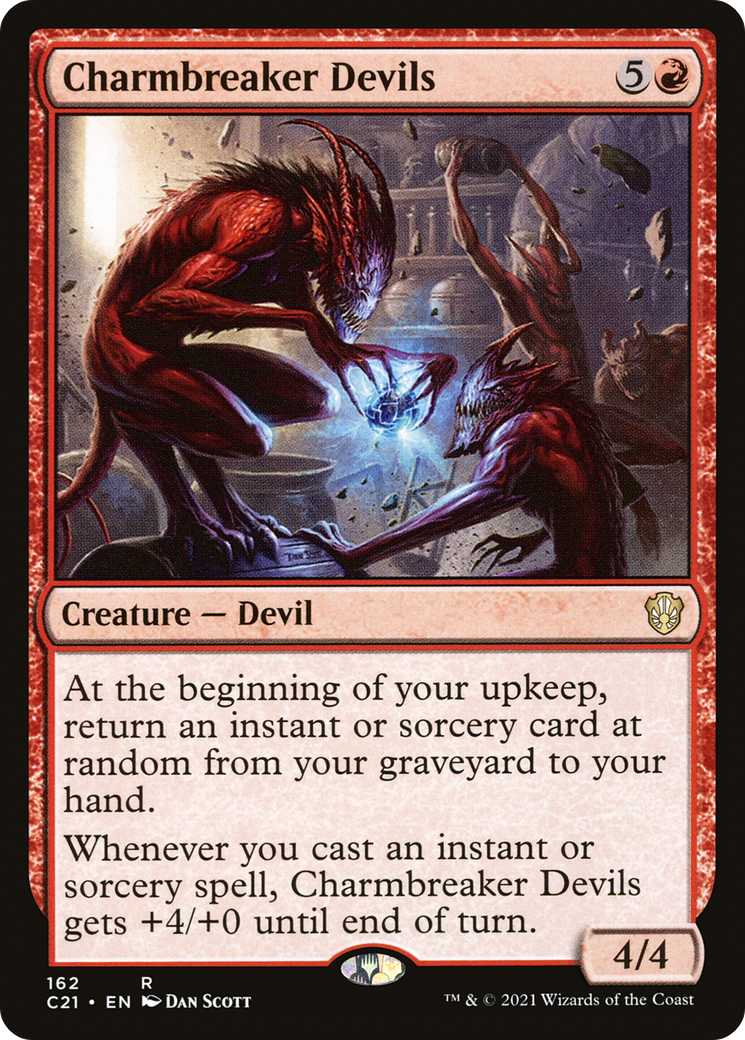
Charmbreaker Devils
Charmbreaker Devils
Creature — Devil
4/4
At the beginning of your upkeep, return an instant or sorcery card at random from your graveyard to your hand.
Whenever you cast an instant or sorcery spell, this creature gets +4/+0 until end of turn.
- The instant or sorcery card returned to your hand is chosen at random as Charmbreaker Devils's first ability resolves. If any player responds to the ability, that player won't yet know what card will be returned.
- Because the first ability doesn't target the instant or sorcery card, any instants or sorceries put into your graveyard in response to that ability may be returned to your hand.
- All players get to see which card you chose at random as it's returned to your hand.
-
1
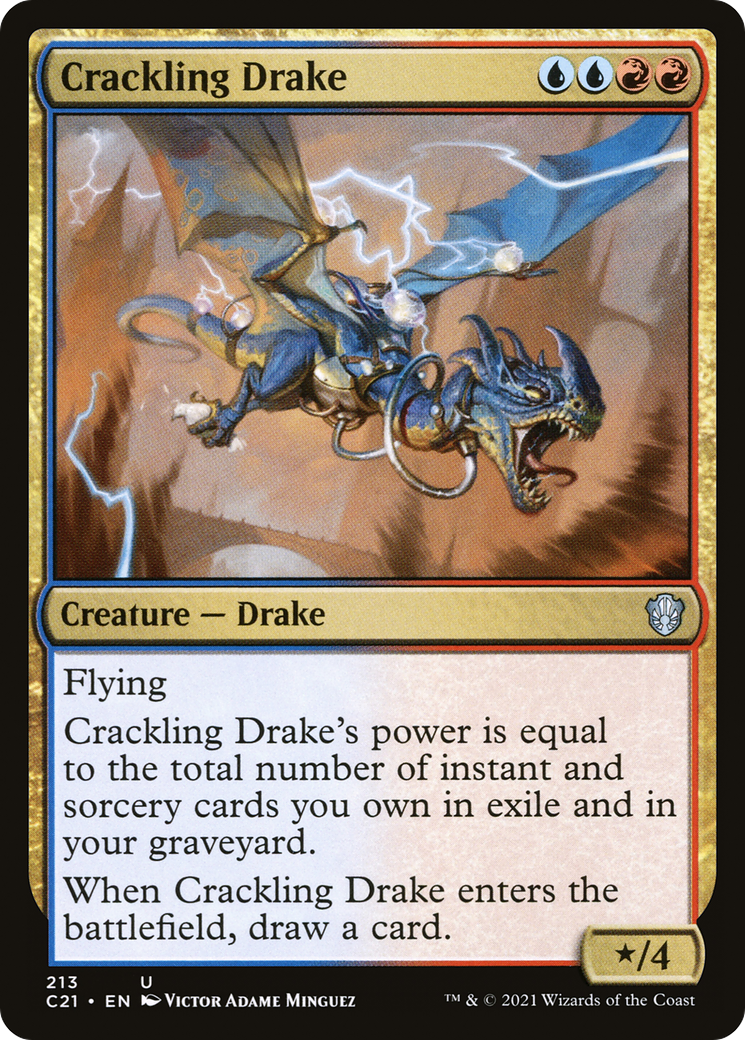
Crackling Drake
Crackling Drake
Creature — Drake
*/4
Flying
Crackling Drake's power is equal to the total number of instant and sorcery cards you own in exile and in your graveyard.
When this creature enters, draw a card.
- If any exiled cards you own are face down, they have no characteristics. If they're normally instants or sorceries, they won't be counted.
- The ability that defines Crackling Drake's power works in all zones.
-
1
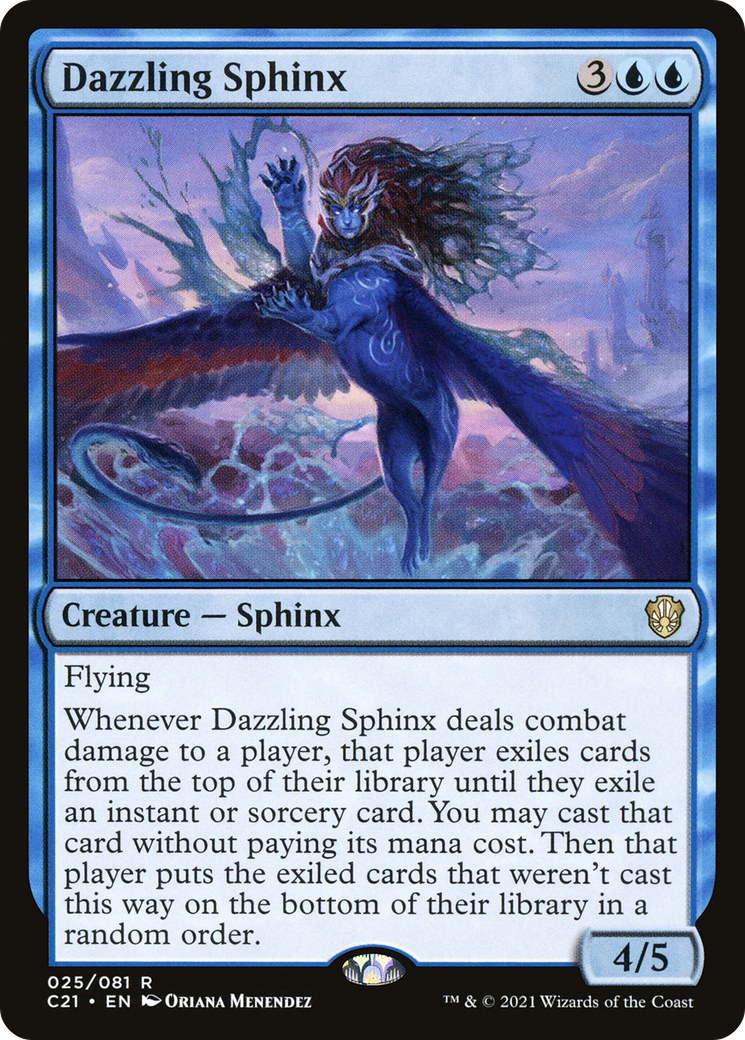
Dazzling Sphinx
Dazzling Sphinx
Creature — Sphinx
4/5
Flying
Whenever this creature deals combat damage to a player, that player exiles cards from the top of their library until they exile an instant or sorcery card. You may cast that card without paying its mana cost. Then that player puts the exiled cards that weren't cast this way on the bottom of their library in a random order.
- Dazzling Sphinx's triggered ability lets you cast the exiled card during the resolution of the ability. It doesn't allow you to wait and cast the card later.
- You may choose not to cast the instant or sorcery card that you exiled. In that case, it will be put on the bottom of the library with the rest of the exiled cards.
- If the exiled instant or sorcery card has an in its mana cost, you must choose 0 as the value of .
-
1
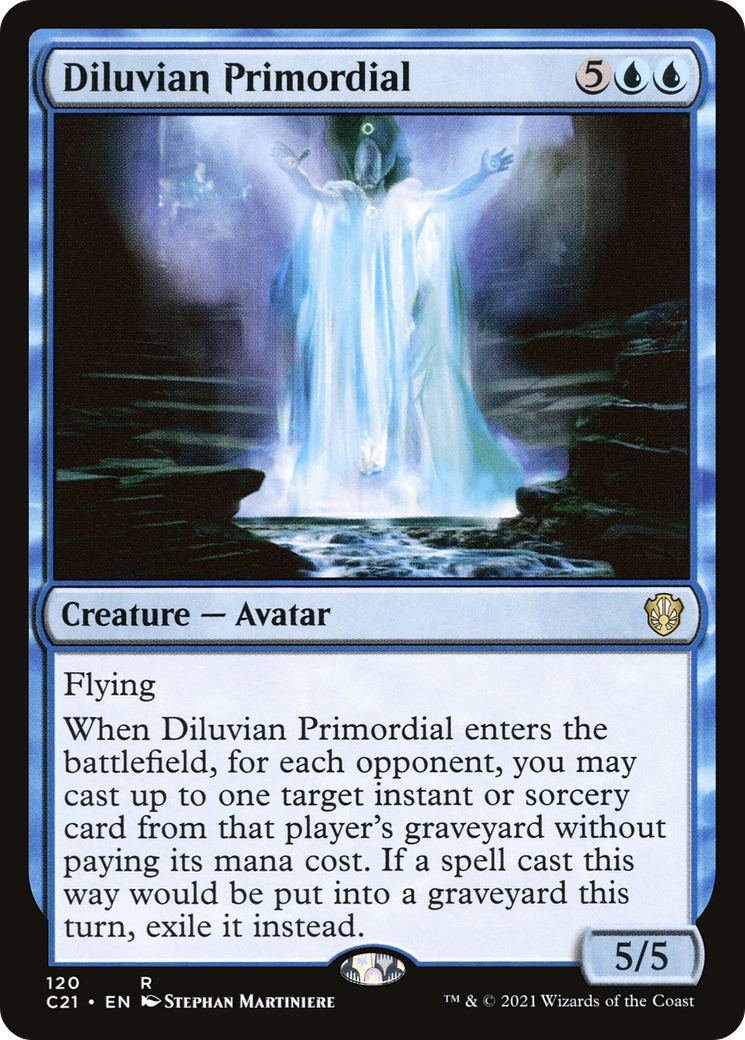
Diluvian Primordial
Diluvian Primordial
Creature — Avatar
5/5
Flying
When this creature enters, for each opponent, you may cast up to one target instant or sorcery card from that player's graveyard without paying its mana cost. If a spell cast this way would be put into a graveyard, exile it instead.
- You can choose a number of targets up to the number of opponents you have, one target per opponent.
- You cast the cards one at a time, choosing modes, targets and so on. The last card you cast will be the first one to resolve.
- When casting an instant or sorcery card this way, ignore timing restrictions based on the card's type. Other timing restrictions, such as "Cast [this card] only during combat," must be followed.
- If you can't cast one of the target instant or sorcery cards, perhaps because there are no legal targets available, or if you choose not to cast one, it will remain in its owner's graveyard.
- If you cast a card "without paying its mana cost," you can't pay alternative costs such as overload costs. You can pay additional costs such as kicker costs. If the card has mandatory additional costs, you must pay those.
- If a card has in its mana cost, you must choose 0 as its value.
- If an instant or sorcery card you cast this way is countered, it will still be exiled.
- If you cast an instant or sorcery spell with cipher this way, you may exile the card encoded on a creature you control. If you can't, or if you choose not to, the card will end up exiled but not encoded on a creature.
- If an instant or sorcery card you cast this way goes to a zone other than exile or a graveyard, perhaps because one of its abilities says to put it into its owner's hand, it won't be exiled. This is true even if the card would be put into a graveyard later that turn.
-
1
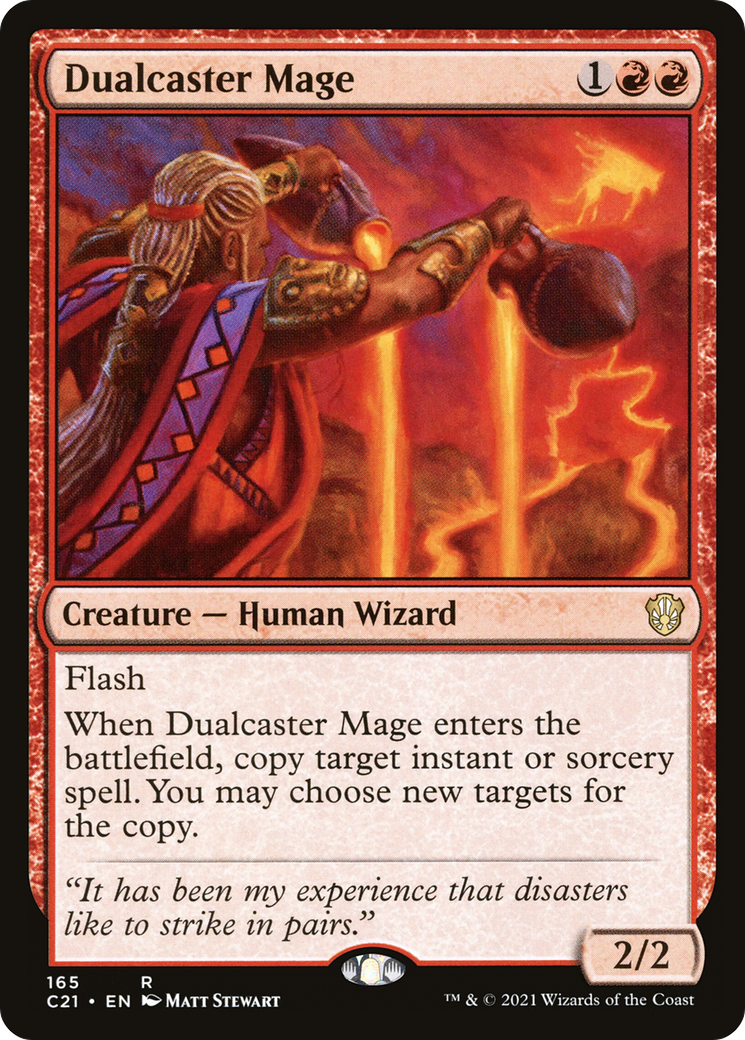
Dualcaster Mage
Dualcaster Mage
Creature — Human Wizard
2/2
Flash
When this creature enters, copy target instant or sorcery spell. You may choose new targets for the copy.
- Dualcaster Mage's triggered ability can target (and copy) any instant or sorcery spell, not just one with targets. It doesn't matter who controls it.
- As Dualcaster Mage's triggered ability resolves, it creates a copy of a spell on the stack. The copy isn't cast, so abilities that trigger when a player casts a spell won't trigger.
- The copy will have the same targets as the spell it's copying unless you choose new ones. You may change any number of the targets, including all of them or none of them. If, for one of the targets, you can't choose a new legal target, then it remains unchanged (even if the current target is illegal).
- You can't choose to pay any additional costs for the copy. However, effects based on any additional or alternative costs paid for the targeted spell are copied as though those same costs were paid for the copy.
- If the spell is modal (that is, it says "Choose one —" or the like), the copy will have the same mode. You can't choose a different one.
- If the spell has an X whose value was determined as it was cast (like Earthquake does), the copy has the same value of X.
- If the copy says that it affects "you," it affects the controller of the copy, not the controller of the original spell. Similarly, if the copy says that it affects an "opponent," it affects an opponent of the copy's controller, not an opponent of the original spell's controller.
-
1
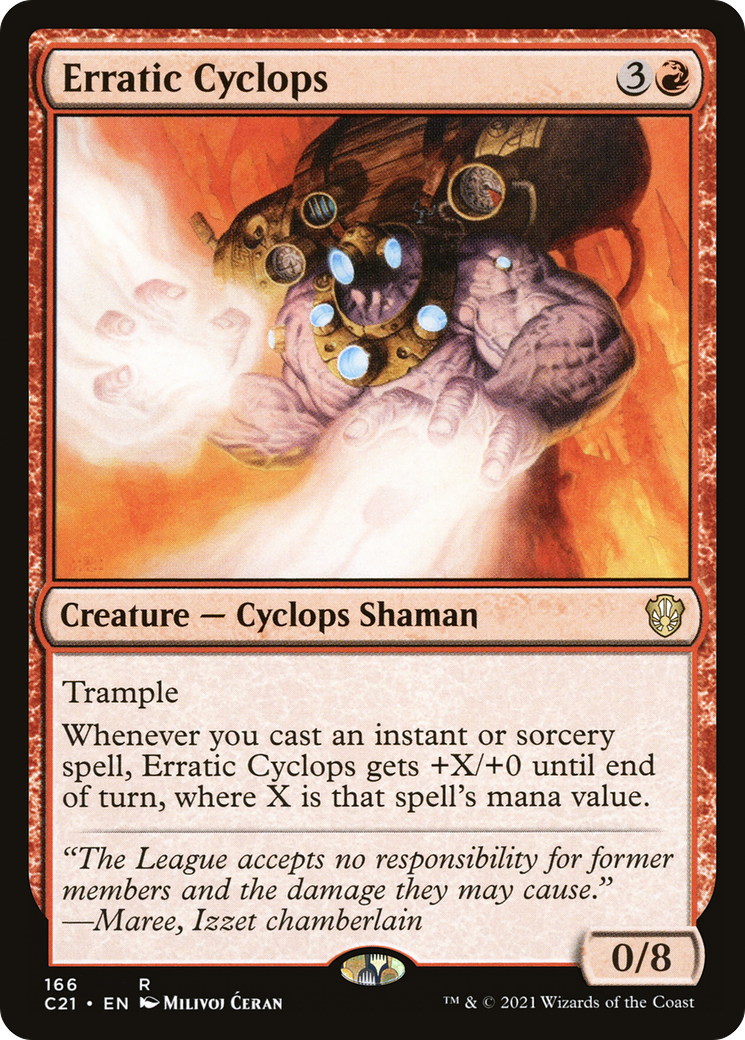
Erratic Cyclops
Erratic Cyclops
Creature — Cyclops Shaman
0/8
Trample
Whenever you cast an instant or sorcery spell, this creature gets +X/+0 until end of turn, where X is that spell's mana value.
- If a spell has in its mana cost, include the value chosen for that X when determining the mana value of that spell.
- Erratic Cyclops’s triggered ability resolves before the spell that caused it to trigger. It resolves even if that spell is countered.
-
1
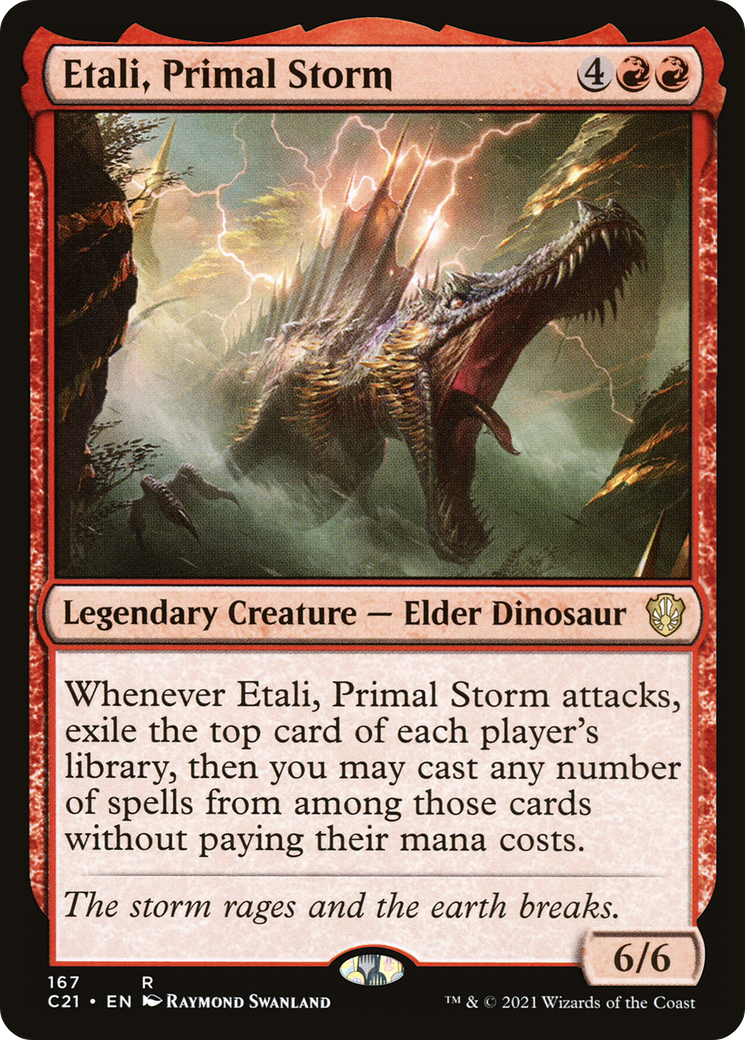
Etali, Primal Storm
Etali, Primal Storm
Legendary Creature — Elder Dinosaur
6/6
Whenever Etali attacks, exile the top card of each player's library, then you may cast any number of spells from among those cards without paying their mana costs.
- If an exiled card has in its mana cost, you must choose 0 as the value of X when casting it without paying its mana cost.
- If you cast any of the exiled cards, you do so as part of the resolution of the triggered ability. You can't wait to cast them later in the turn. Timing permissions based on a card's type are ignored, and the spells resolve before blockers are declared.
- If you cast a card "without paying its mana cost," you can't pay any alternative costs. You can, however, pay additional costs. If the card has any mandatory additional costs, those must be paid to cast the card.
- If you cast more than one of the exiled cards, you choose the order in which to cast them. A spell you cast this way can be the target of a later spell you cast this way. However, permanent spells cast this way won't resolve until you're done casting spells, so the permanents they become can't be the target of spells cast this way. For example, if you exile Twincast and Lightning Strike, you can cast Lightning Strike and then cast Twincast targeting it; but if you exile a creature card and an Aura card, you can't cast that Aura targeting that creature.
- Any cards not cast, including land cards, remain in exile. They can't be cast on later turns, even if Etali attacks again.
- Because all attacking creatures are chosen at once, a creature cast this way can't attack during the same combat as Etali, even if it has haste.
- In a multiplayer game, if a player leaves the game, all cards that player owns leave as well. If you leave the game, any spells or permanents you control from Etali's ability are exiled.
-
1
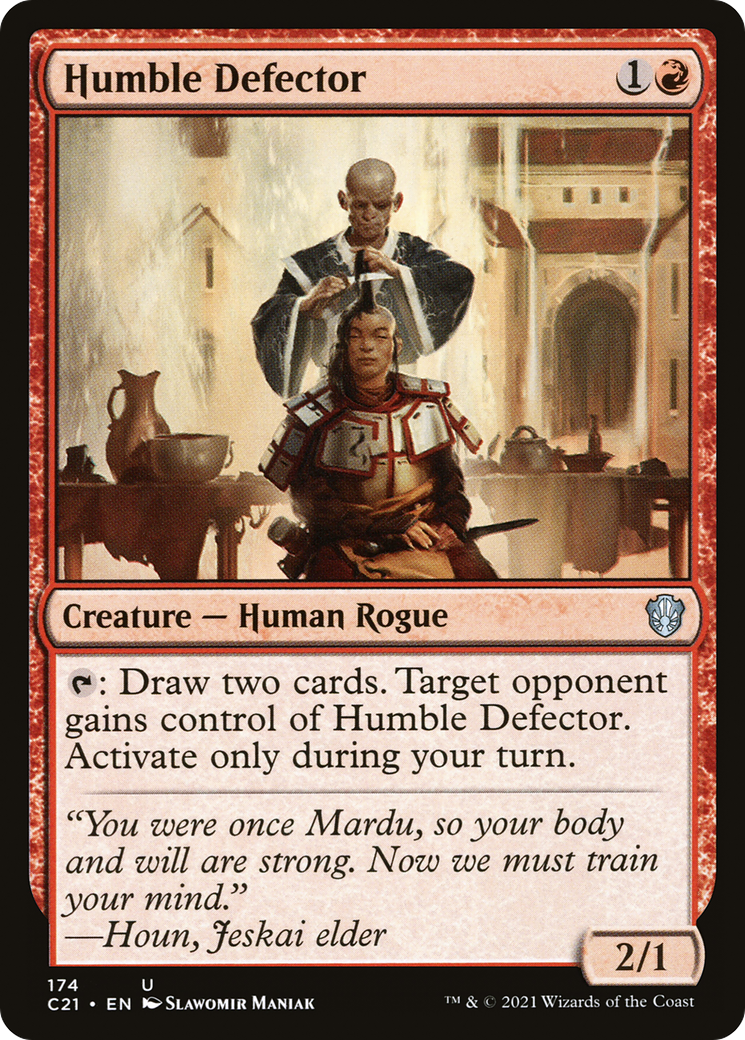
Humble Defector
Humble Defector
Creature — Human Rogue
2/1
: Draw two cards. Target opponent gains control of this creature. Activate only during your turn.
- If Humble Defector isn't on the battlefield as its ability resolves, but the target player is still a legal target, the ability will resolve. You'll draw two cards, even though the player doesn't gain control of Humble Defector.
- If Humble Defector's owner leaves the game, Humble Defector humbly leaves the game along with that player.
- Humble Defector's ability can be activated any time during your turn, including in response to a spell or ability.
- If Humble Defector is controlled by a player other than its owner, and its controller leaves the game, the effect giving that player control of Humble Defector ends. Humble Defector will return to the control of the player still in the game who most recently controlled it.
-
1
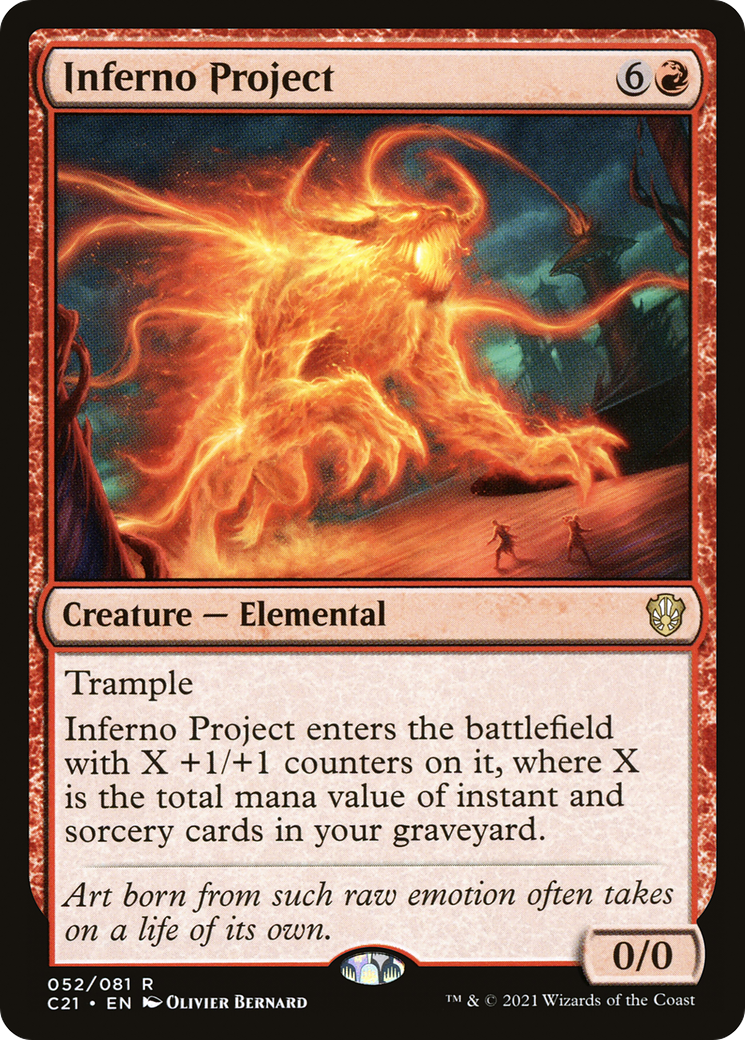
Inferno Project
Inferno Project
Creature — Elemental
0/0
Trample
This creature enters with X +1/+1 counters on it, where X is the total mana value of instant and sorcery cards in your graveyard.
-
1
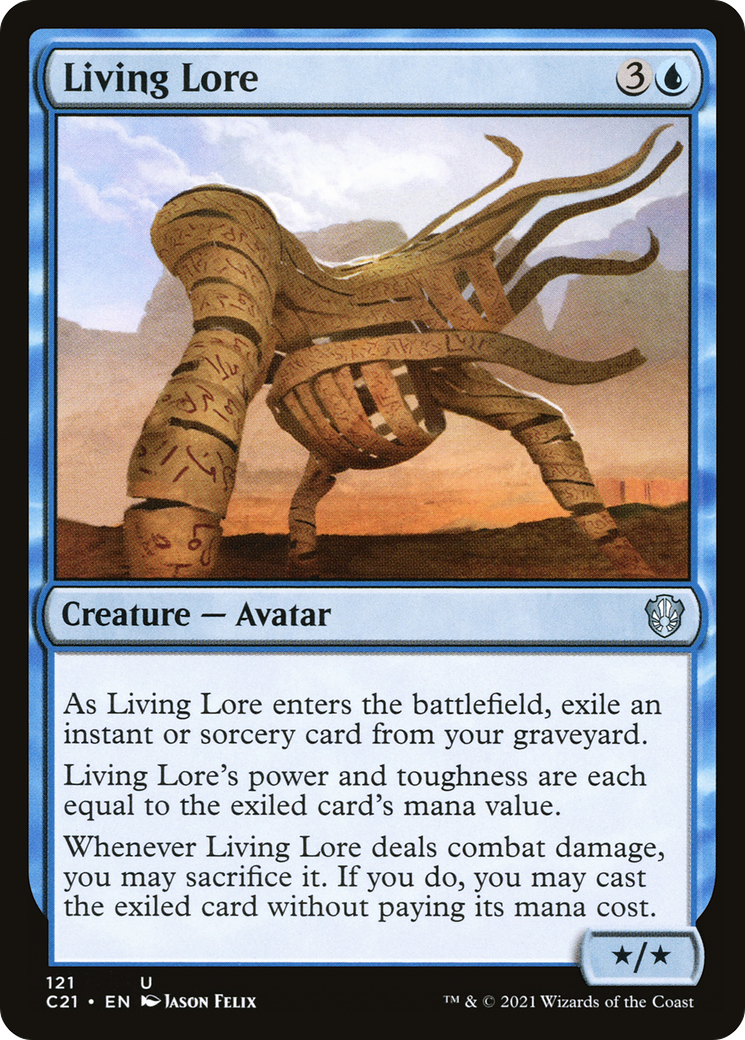
Living Lore
Living Lore
Creature — Avatar
*/*
As this creature enters, exile an instant or sorcery card from your graveyard.
Living Lore's power and toughness are each equal to the exiled card's mana value.
Whenever this creature deals combat damage, you may sacrifice it. If you do, you may cast the exiled card without paying its mana cost.
- If there are no instant or sorcery cards in your graveyard as Living Lore enters the battlefield, it will enter the battlefield as a 0/0 creature and be put into its owner's graveyard due to having 0 toughness.
- If an instant or sorcery spell puts Living Lore onto the battlefield, that spell is still on the stack while you choose a card to exile. You can't exile it with Living Lore.
- If Living Lore leaves the battlefield, the ability that defines its power and toughness will lose track of the exiled card. Its power and toughness are 0 in other zones.
- Similarly, if the exiled card somehow leaves exile while Living Lore is on the battlefield, it will become a 0/0 creature.
- Living Lore's last ability will trigger whenever it deals combat damage, no matter if that damage is dealt to an opponent, an opposing planeswalker, or a creature it's blocking or being blocked by. You choose whether to sacrifice Living Lore as that ability resolves. If Living Lore has already left the battlefield, perhaps because it was dealt lethal damage at the same time it dealt damage, you can't sacrifice it.
- You may cast a sorcery this way even if it's not your turn.
- If you cast a spell "without paying its mana cost," you can't choose to cast it for any alternative costs. You can, however, pay additional costs, such as kicker costs. If the card has any mandatory additional costs, such as that of Tormenting Voice, those must be paid to cast the card.
- If a spell has in its mana cost, you must choose 0 as the value of X when casting it without paying its mana cost.
-
1
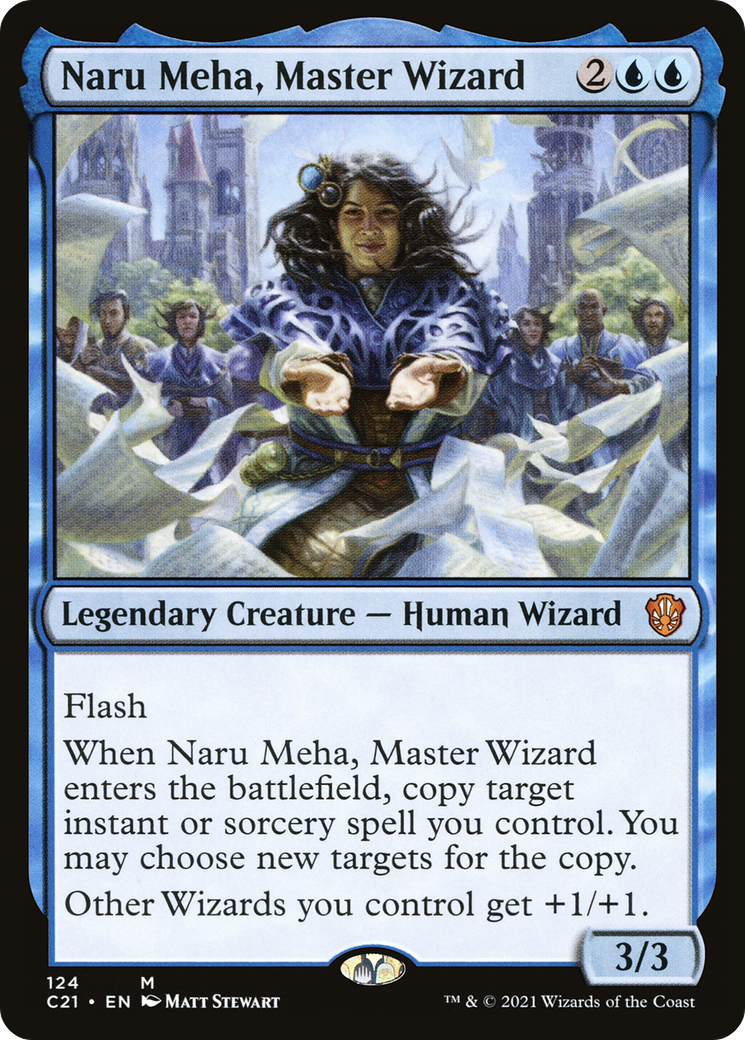
Naru Meha, Master Wizard
Naru Meha, Master Wizard
Legendary Creature — Human Wizard
3/3
Flash
When Naru Meha enters, copy target instant or sorcery spell you control. You may choose new targets for the copy.
Other Wizards you control get +1/+1.
- Because damage remains marked on a creature until it's removed as the turn ends, nonlethal damage dealt to a Wizard you control may become lethal if Naru leaves the battlefield during that turn.
- Naru's triggered ability can copy any instant or sorcery spell, not just one with targets.
- The copy is created on the stack, so it's not "cast." Abilities that trigger when a player casts a spell won't trigger.
- The copy will have the same targets as the spell it's copying unless you choose new ones. You may change any number of the targets, including all of them or none of them. If, for one of the targets, you can't choose a new legal target, then it remains unchanged (even if the current target is illegal).
- If the spell that's copied is modal (that is, it says "Choose one —" or the like), the copy will have the same mode. A different mode can't be chosen.
- If the spell that's copied has an X whose value was determined as it was cast (like Jaya's Immolating Inferno does), the copy will have the same value of X.
- If the spell has damage divided as it was cast (like Fight with Fire does when kicked), the division can't be changed (although the targets receiving that damage still can).
- The controller of a copy can't choose to pay any alternative or additional costs for the copy. However, effects based on any alternative or additional costs that were paid for the original spell are copied as though those same costs were paid for the copy.
-
1
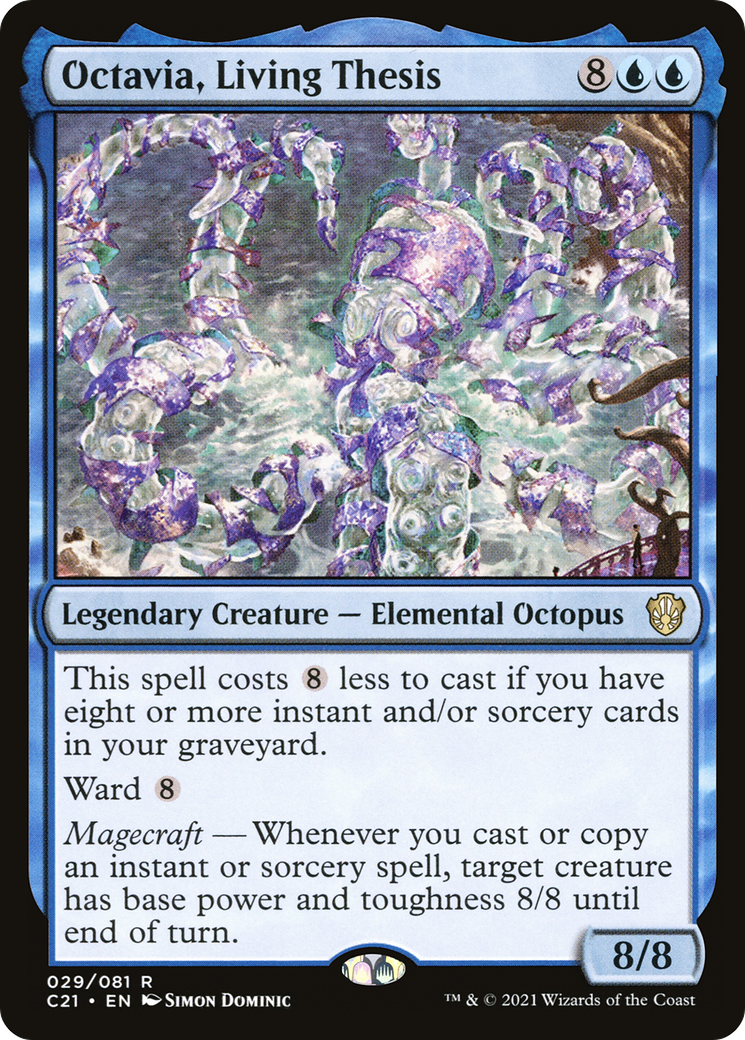
Octavia, Living Thesis
Octavia, Living Thesis
Legendary Creature — Elemental Octopus
8/8
This spell costs less to cast if you have eight or more instant and/or sorcery cards in your graveyard.
Ward
Magecraft — Whenever you cast or copy an instant or sorcery spell, target creature has base power and toughness 8/8 until end of turn.
- Each magecraft ability has a different effect, although they all have the same trigger condition, whenever you cast or copy an instant or sorcery spell.
- For example, if you control Archmage Emeritus and cast an instant or sorcery spell, Archmage Emeritus's magecraft ability will trigger and you will draw a card.
- If an effect creates a copy of an instant or sorcery spell, this will also cause the magecraft ability to trigger.
- If an effect creates multiple copies of an instant or sorcery spell, magecraft abilities trigger once for each copy created by the effect.
- Some effects instruct you to copy an instant or sorcery card in a zone other than the stack. These copies do not cause magecraft abilities to trigger. However, most effects that do this also allow you to cast the copy, and casting the copy will cause magecraft abilities to trigger.
- If a player casts a spell that targets multiple permanents their opponent controls with ward, each of those ward abilities will trigger. If that player doesn't pay for all of them, the spell will be countered.
-
1
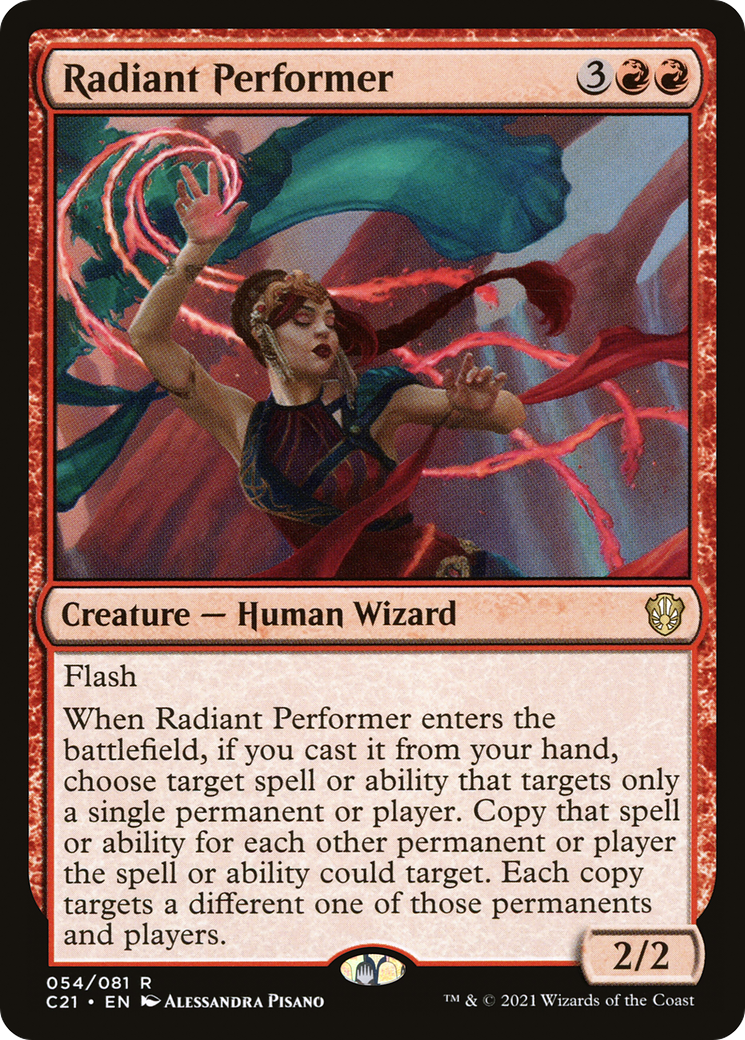
Radiant Performer
Radiant Performer
Creature — Human Wizard
2/2
Flash
When this creature enters, if you cast it from your hand, choose target spell or ability that targets only a single permanent or player. Copy that spell or ability for each other permanent or player the spell or ability could target. Each copy targets a different one of those permanents and players.
- You copy the spell or ability for every permanent or player it could target. That is, you don't choose either permanents or players and then make copies based on that.
- You can choose a spell or ability with multiple targets as long as all of those targets are the same permanent or player.
- You control all the copies, and you'll choose which copy targets which permanent or player. For example, if the original spell says, "Destroy target creature," you'll ultimately choose the order in which each creature targeted by a copy is destroyed. Remember that the original spell or ability will resolve after all of the copies.
- Each copy you create will cause your magecraft abilities to trigger.
-
1
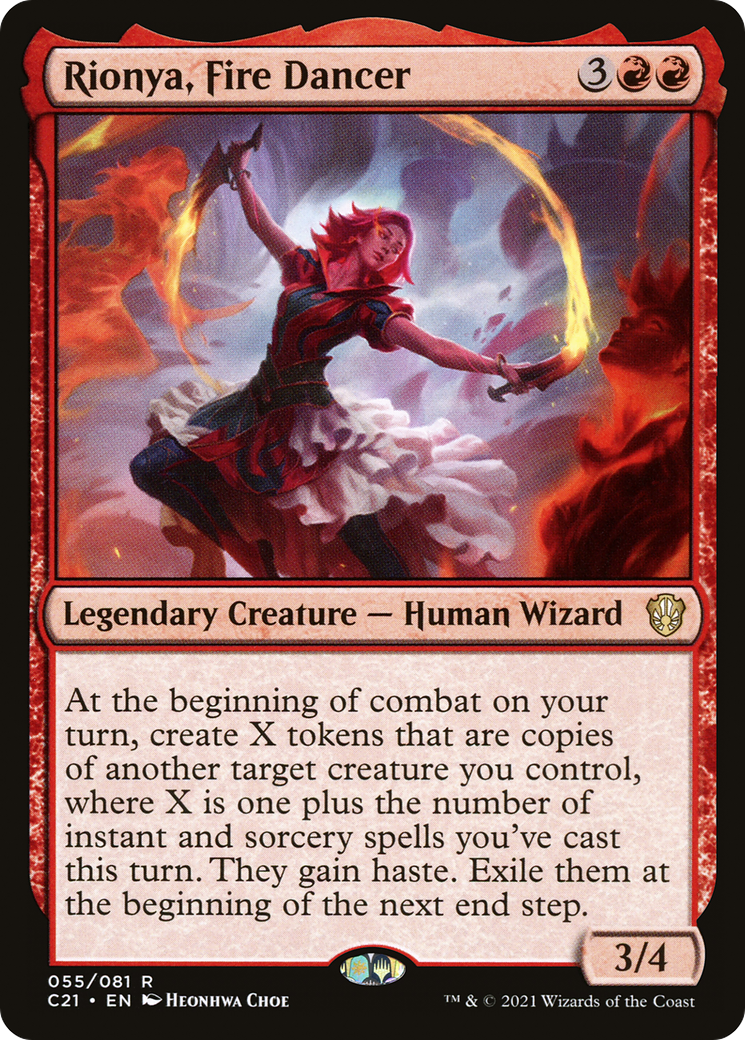
Rionya, Fire Dancer
Rionya, Fire Dancer
Legendary Creature — Human Wizard
3/4
At the beginning of combat on your turn, create X tokens that are copies of another target creature you control, where X is one plus the number of instant and sorcery spells you've cast this turn. They gain haste. Exile them at the beginning of the next end step.
- If the copied creature is itself a token, the tokens created by Rionya copy the original characteristics of that token as stated by the effect that created it.
- If the copied creature has in its mana cost, X is 0.
- Any enters-the-battlefield abilities of the copied creature will trigger when the tokens enter the battlefield. Any "As [this creature] enters the battlefield" or "[This creature] enters the battlefield with" abilities of the copied creature will also work.
- The tokens copy exactly what is printed on the creature and nothing else (unless that creature is a token or is copying something else; see below). They don't copy whether that creature is tapped or untapped, whether it has any counters on it or Auras and/or Equipment attached to it, or any non-copy effects that changed its power, toughness, types, color, and so on.
- The triggered ability counts all instants and sorceries that were cast before it resolves. If you cast instant spells in response to the ability, those spells will count.
- If the copied creature is copying something else, the tokens enter the battlefield as whatever that creature is copying.
-
1
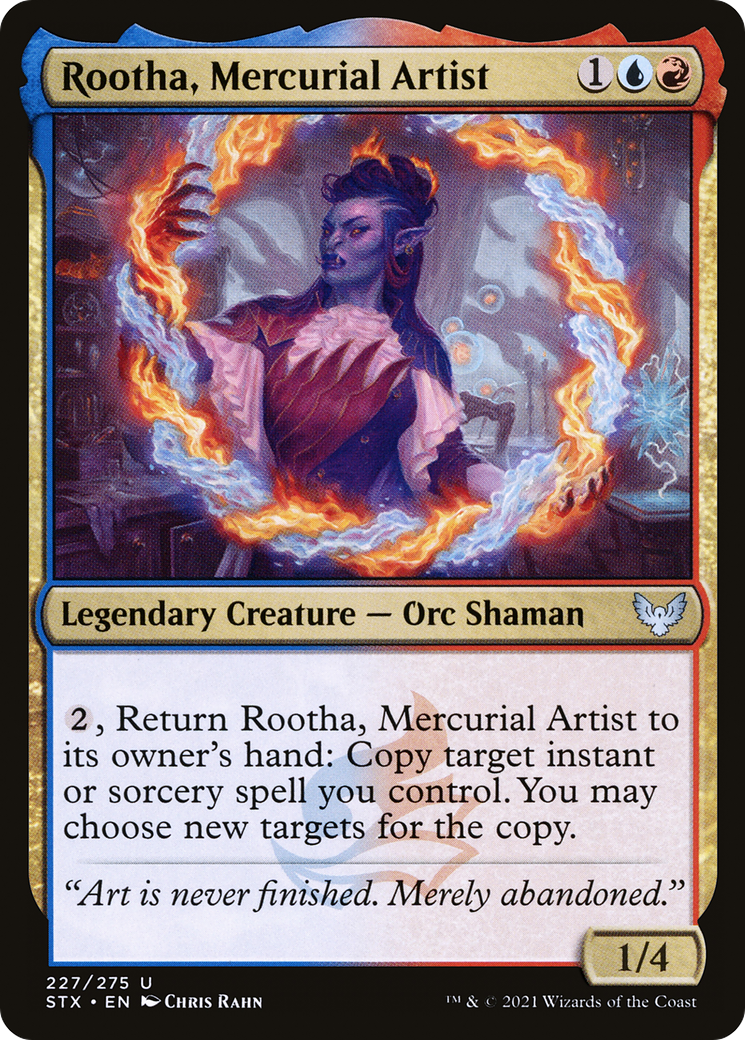
Rootha, Mercurial Artist
Rootha, Mercurial Artist
Legendary Creature — Orc Shaman
1/4
, Return Rootha to its owner's hand: Copy target instant or sorcery spell you control. You may choose new targets for the copy.
-
1
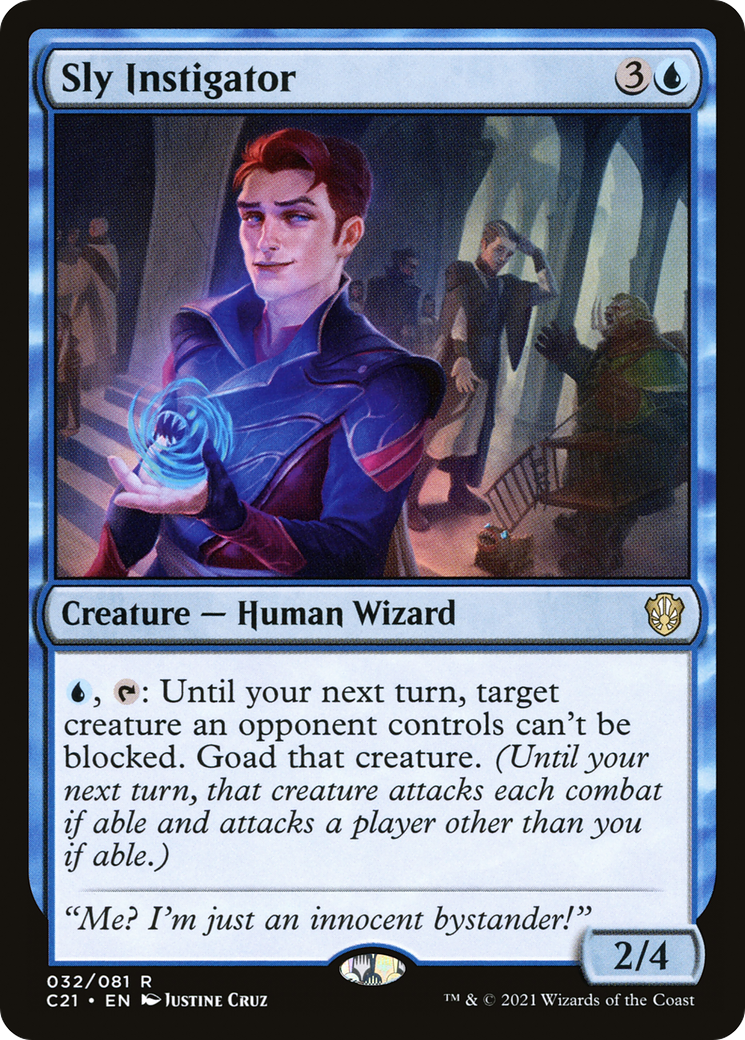
Sly Instigator
Sly Instigator
Creature — Human Wizard
2/4
, : Until your next turn, target creature an opponent controls can't be blocked. Goad that creature. (Until your next turn, that creature attacks each combat if able and attacks a player other than you if able.)
- If the creature doesn't meet any of the above exceptions and can attack, it must attack a player other than the controller of the spell or ability that goaded it if able. If the creature can't attack any of those players but could otherwise attack, it must attack a planeswalker an opponent controls, a battle an opponent controls, or a player who goaded it.
- Attacking with a goaded creature doesn't cause it to stop being goaded. If there is an additional combat phase that turn, or if another player gains control of it before it stops being goaded, it must attack again if able.
- If a creature you control has been goaded by multiple opponents, it must attack one of your opponents that hasn't goaded it, as that fulfills the maximum number of goad requirements. If a creature you control has been goaded by each of your opponents, the creature must attack an opponent (rather than a planeswalker or battle), but you choose which opponent it attacks.
- If, during a player's declare attackers step, a creature that player controls that's been goaded is tapped, is affected by a spell or ability that says it can't attack, or hasn't been under that player's control continuously since the turn began (and doesn't have haste), then it doesn't attack. If there's a cost associated with having a creature attack a player, its controller isn't forced to pay that cost, so it doesn't have to attack that player.
- Being goaded isn't an ability the creature has. Once it's been goaded, it must attack as detailed above even if it loses all abilities.
- If you leave the game, any creatures you've goaded remain goaded until your next turn would have begun. They don't immediately stop being goaded and don't remain goaded indefinitely.
- Once a creature an opponent controls has been legally blocked, activating Sly Instigator's ability won't change or undo that block.
-
1
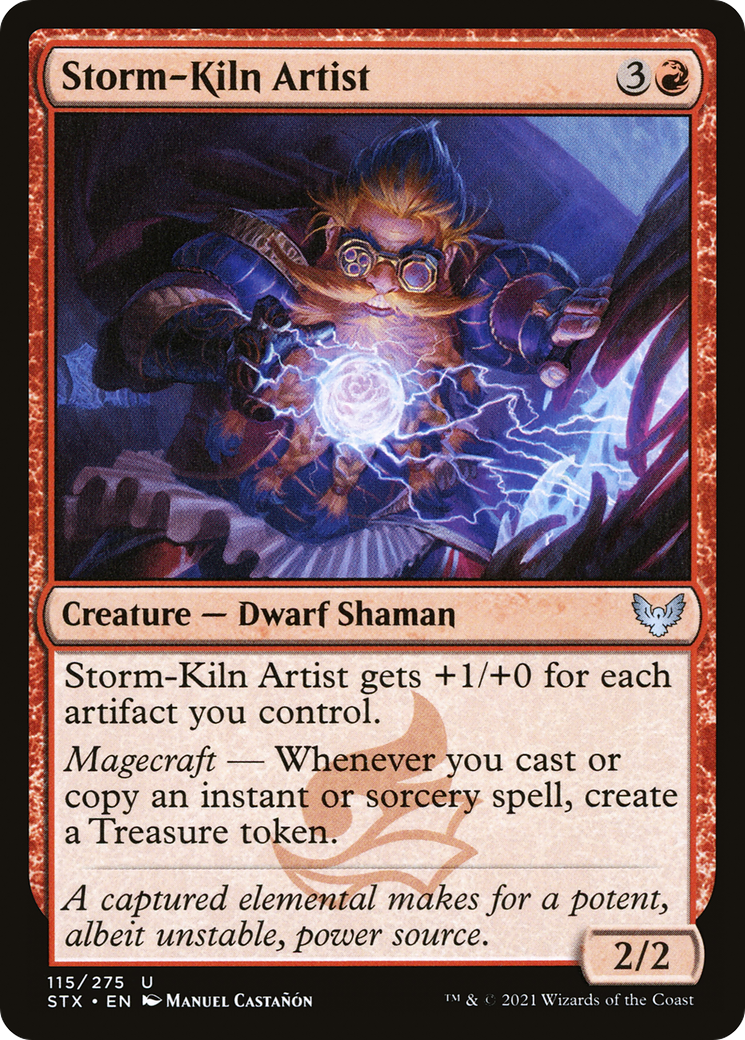
Storm-Kiln Artist
Storm-Kiln Artist
Creature — Dwarf Shaman
2/2
This creature gets +1/+0 for each artifact you control.
Magecraft — Whenever you cast or copy an instant or sorcery spell, create a Treasure token.
-
1
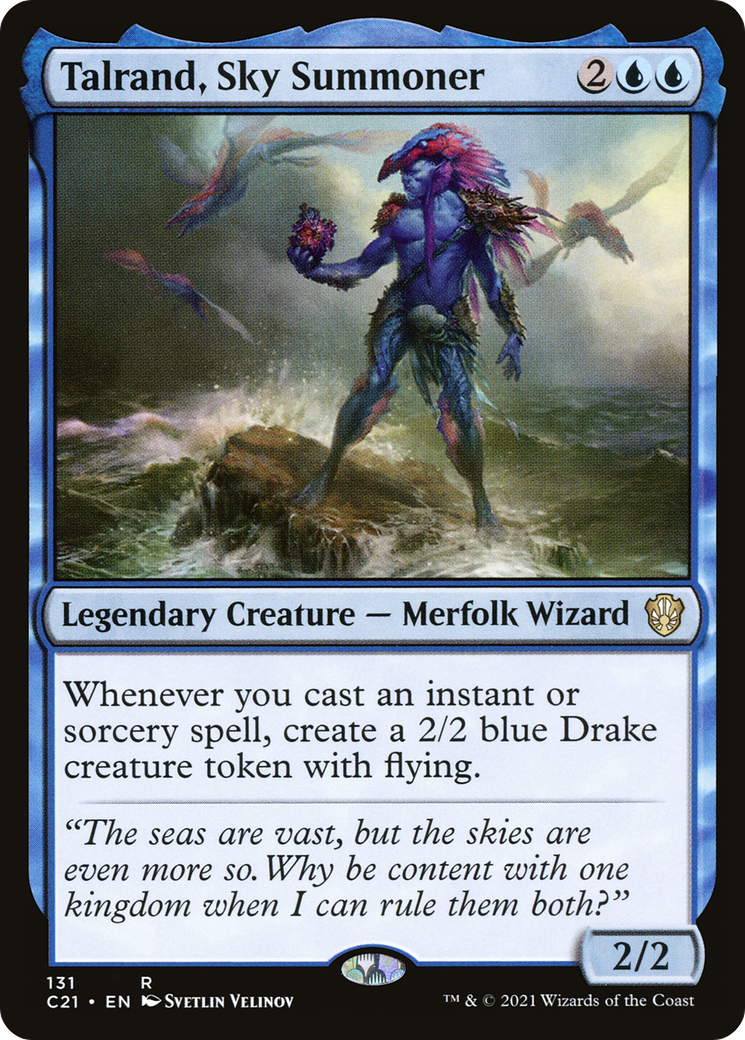
Talrand, Sky Summoner
Talrand, Sky Summoner
Legendary Creature — Merfolk Wizard
2/2
Whenever you cast an instant or sorcery spell, create a 2/2 blue Drake creature token with flying.
- An ability that triggers when a player casts a spell resolves before the spell that caused it to trigger, but after targets have been chosen for that spell. It resolves even if that spell is countered.
-
1
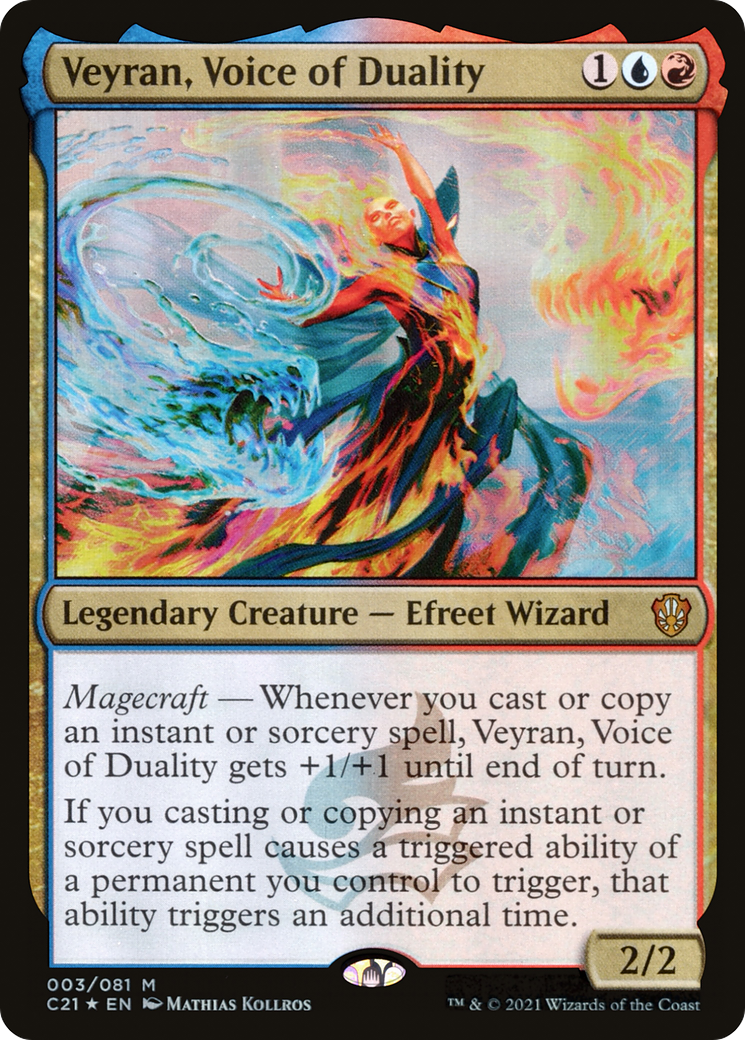
Veyran, Voice of Duality
Veyran, Voice of Duality
Legendary Creature — Efreet Wizard
2/2
Magecraft — Whenever you cast or copy an instant or sorcery spell, Veyran gets +1/+1 until end of turn.
If you casting or copying an instant or sorcery spell causes a triggered ability of a permanent you control to trigger, that ability triggers an additional time.
- Veyran, Voice of Duality's last ability causes each of your magecraft abilities, including Veyran's own, to trigger an additional time.
- If an effect creates a copy of an instant or sorcery spell, this will also cause the magecraft ability to trigger.
- Some effects instruct you to copy an instant or sorcery card in a zone other than the stack. These copies do not cause magecraft abilities to trigger. However, most effects that do this also allow you to cast the copy, and casting the copy will cause magecraft abilities to trigger.
- Each magecraft ability has a different effect, although they all have the same trigger condition, whenever you cast or copy an instant or sorcery spell.
- Veyran's effect doesn't copy the triggered ability; it just causes the ability to trigger again. Any choices you make as you put the ability on the stack, such as modes and targets, are made separately for each instance of the ability. Any choices made on resolution are also made individually.
- If an effect creates multiple copies of an instant or sorcery spell, magecraft abilities trigger once for each copy created by the effect.
- If you somehow control two Veyrans (which would be poetic), you casting an instant or sorcery spell causes abilities to trigger three times. A third Veyran (less poetic) causes abilities to trigger four times, and so on.
-
1
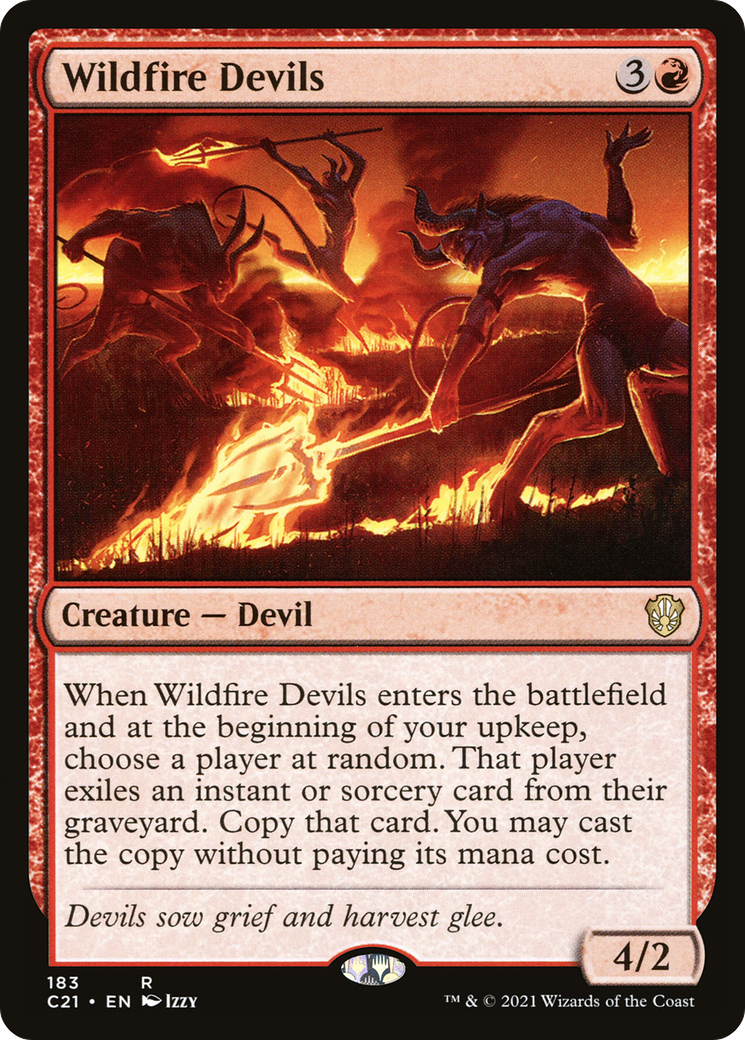
Wildfire Devils
Wildfire Devils
Creature — Devil
4/2
When this creature enters and at the beginning of your upkeep, choose a player at random. That player exiles an instant or sorcery card from their graveyard. Copy that card. You may cast the copy without paying its mana cost.
- You choose a player at random and they exile a card all while the triggered ability is resolving. No player may take any actions between the two or between exiling the card and you copying and casting it.
- The chosen player chooses which card to exile from their graveyard.
- If the chosen player has no instant or sorcery cards in their graveyard, Wildfire Devils’s ability does nothing. You don’t pick a different player.
- The copy of the card is created in exile and cast from exile, not from a graveyard.
- You can cast the copy only as the triggered ability resolves. If you don’t want to cast it at that time (or you can’t cast it, perhaps because there are no legal targets available), the copy ceases to exist. You can’t cast it later.
- You can cast the copy during the resolution of the triggered ability if it’s a sorcery, no matter whose turn it is or which phase it is.
- If a spell has in its mana cost, you must choose 0 as the value of X when casting it without paying its mana cost.
- If you cast a card “without paying its mana cost,” you can’t choose to cast it for any alternative costs. You can, however, pay additional costs. If the card has any mandatory additional costs, such as that of Momentous Fall, you must pay those to cast the card.
-
1
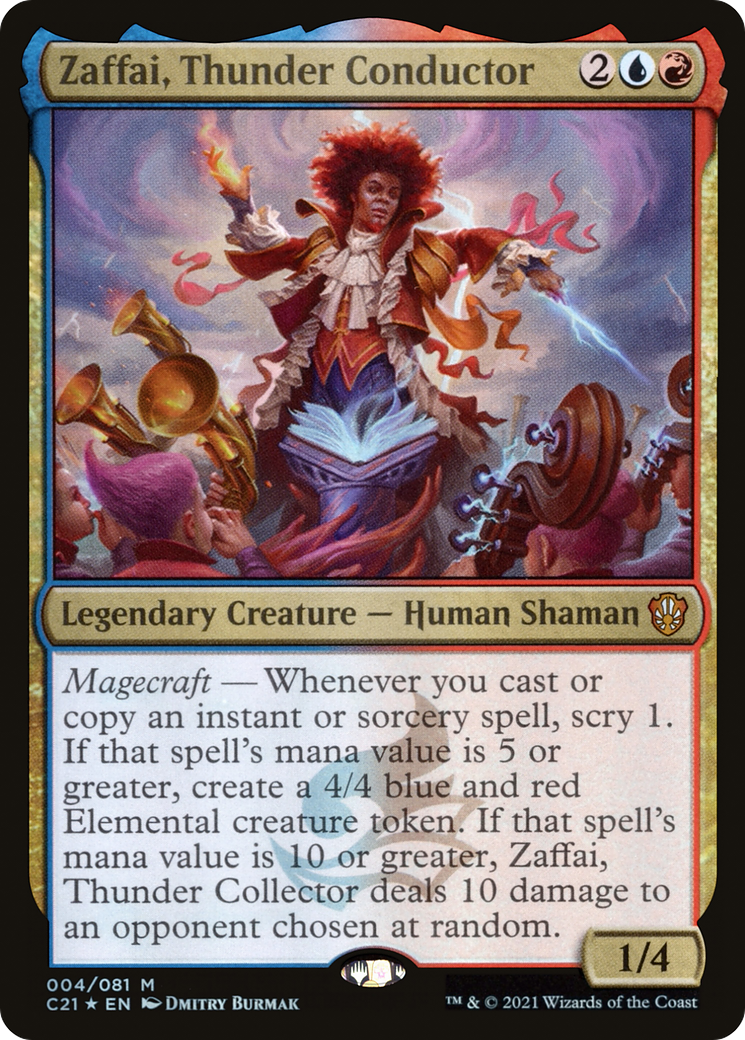
Zaffai, Thunder Conductor
Zaffai, Thunder Conductor
Legendary Creature — Human Shaman
1/4
Magecraft — Whenever you cast or copy an instant or sorcery spell, scry 1. If that spell's mana value is 5 or greater, create a 4/4 blue and red Elemental creature token. If that spell's mana value is 10 or greater, Zaffai deals 10 damage to an opponent chosen at random.
- "That spell's mana value" refers to the spell that caused the ability to trigger, not the card you look at when you scry.
- If the instant or sorcery spell has in its mana cost, X is the value chosen for X as the spell was cast.
- The wrong card name was inadvertently included in Zaffai's printed rules text. The text above is correct and the full name of the card is Zaffai, Thunder Conductor.
- Each magecraft ability has a different effect, although they all have the same trigger condition, whenever you cast or copy an instant or sorcery spell.
- For example, if you control Archmage Emeritus and cast an instant or sorcery spell, Archmage Emeritus's magecraft ability will trigger and you will draw a card.
- If an effect creates a copy of an instant or sorcery spell, this will also cause the magecraft ability to trigger.
- If an effect creates multiple copies of an instant or sorcery spell, magecraft abilities trigger once for each copy created by the effect.
- Some effects instruct you to copy an instant or sorcery card in a zone other than the stack. These copies do not cause magecraft abilities to trigger. However, most effects that do this also allow you to cast the copy, and casting the copy will cause magecraft abilities to trigger.
Instants 8
-
1
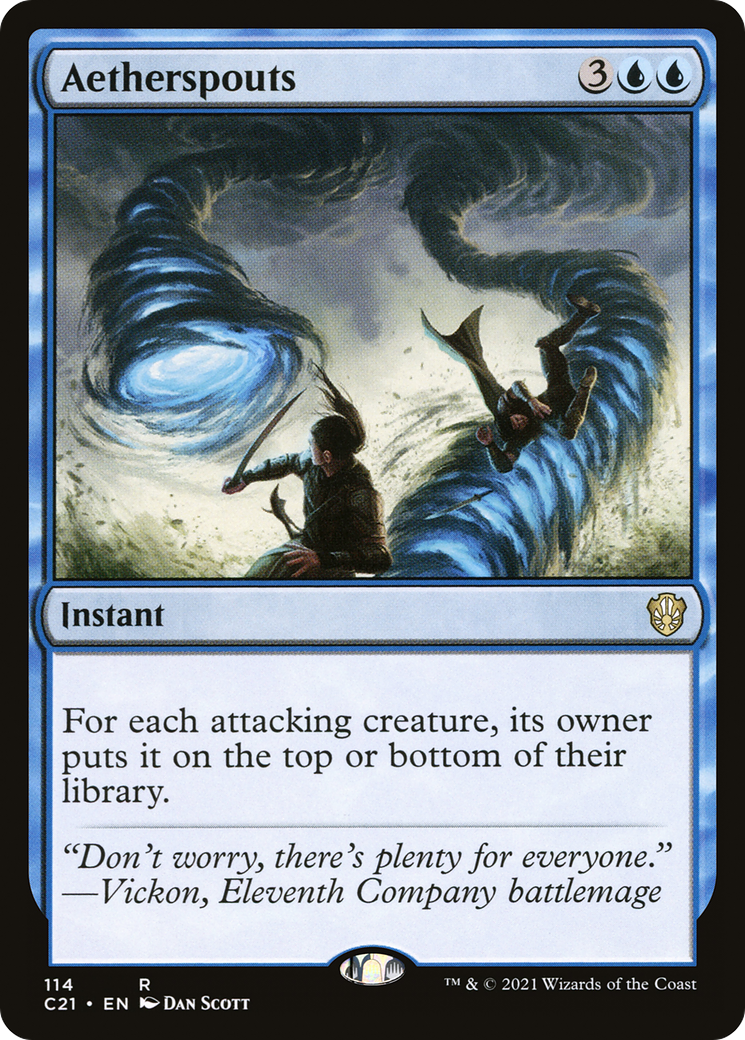
Aetherspouts
Aetherspouts
Instant
For each attacking creature, its owner puts it on their choice of the top or bottom of their library.
- The owner of each attacking creature chooses whether to put it on the top or bottom of their library. The active player (the player whose turn it is) makes all of their choices first, followed by each other player in turn order.
- If an effect puts two or more cards on the top or bottom of a library at the same time, the owner of those cards may arrange them in any order. That library's owner doesn't reveal the order in which the cards go into their library.
-
1
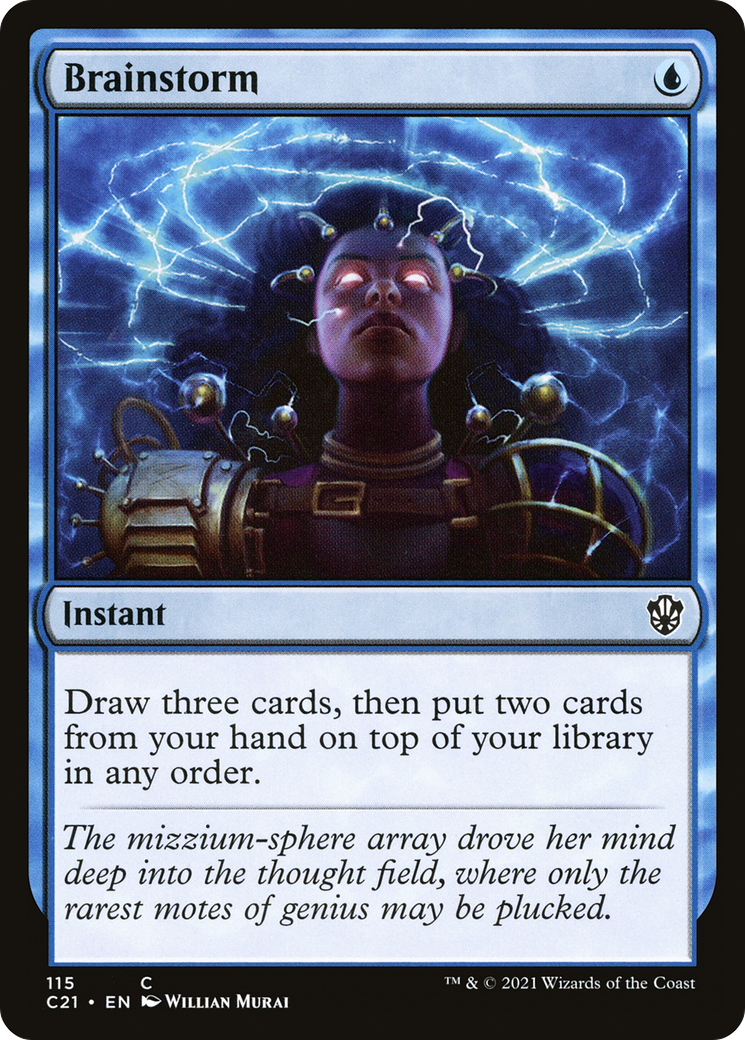
Brainstorm
Brainstorm
Instant
Draw three cards, then put two cards from your hand on top of your library in any order.
- You draw three cards and put two cards back all while Brainstorm is resolving. Nothing can happen between the two, and no player may choose to take actions.
-
1
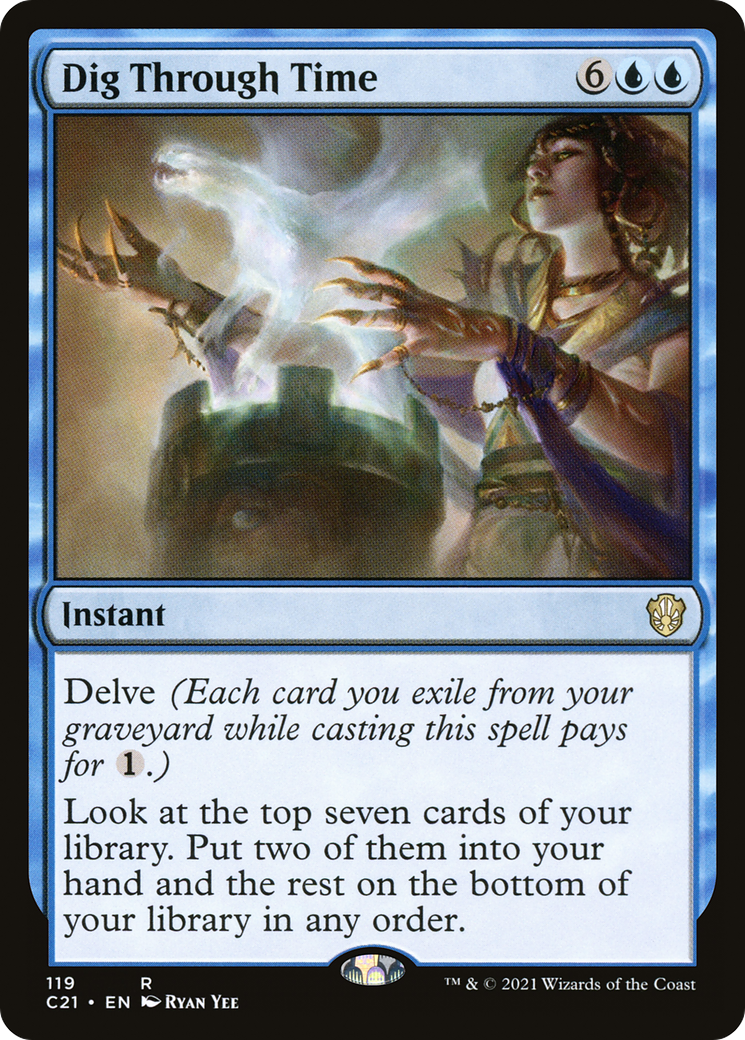
Dig Through Time
Dig Through Time
Instant
Delve (Each card you exile from your graveyard while casting this spell pays for .)
Look at the top seven cards of your library. Put two of them into your hand and the rest on the bottom of your library in any order.
- Because delve isn't an alternative cost, it can be used in conjunction with alternative costs, such as flashback. It can also be used to pay for additional costs that include generic mana.
- Delve doesn't change a spell's mana cost or mana value. For example, Treasure Cruise's mana value is 8 even if you exiled three cards to cast it.
- You can exile cards to pay only for generic mana, and you can't exile more cards than the generic mana requirement of a spell with delve. For example, you can't exile more than seven cards from your graveyard to cast Treasure Cruise unless an effect has increased its cost.
-
1
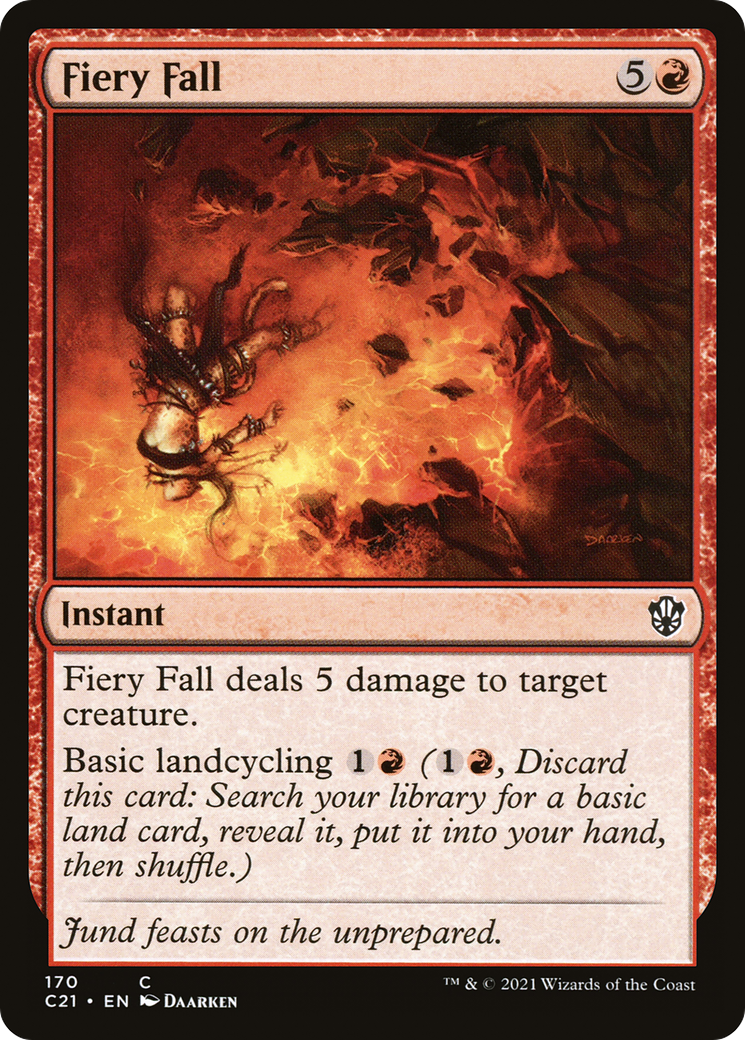
Fiery Fall
Fiery Fall
Instant
Fiery Fall deals 5 damage to target creature.
Basic landcycling ( , Discard this card: Search your library for a basic land card, reveal it, put it into your hand, then shuffle.)
- Unlike the normal cycling ability, basic landcycling doesn't allow you to draw a card. Instead, it lets you search your library for a basic land card. You don't choose the type of basic land card you'll find until you're performing the search. After you choose a basic land card in your library, you reveal it, put it into your hand, then shuffle your library.
- Basic landcycling is a form of cycling. Any ability that triggers on a card being cycled also triggers on a card being basic landcycled. Any ability that stops a cycling ability from being activated also stops a basic landcycling ability from being activated.
- Basic landcycling is an activated ability. Effects that interact with activated abilities (such as Stifle or Rings of Brighthearth) will interact with basic landcycling. Effects that interact with spells (such as Remove Soul or Faerie Tauntings) will not.
- You can choose not to find a basic land card, even if there is one in your library.
-
1
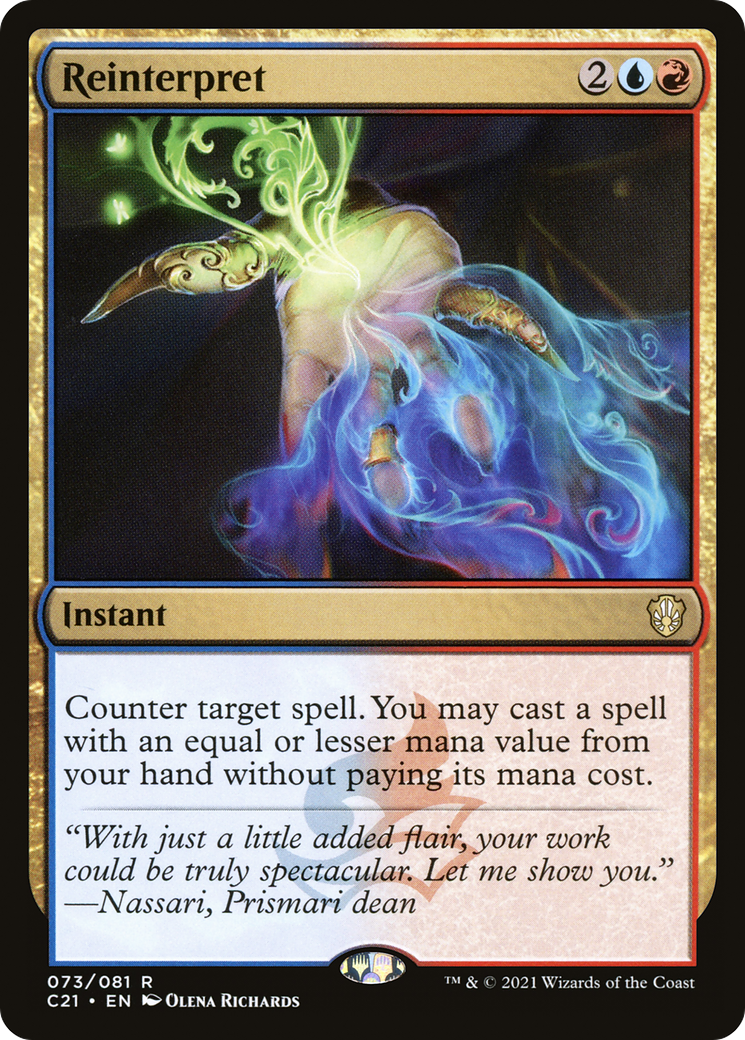
Reinterpret
Reinterpret
Instant
Counter target spell. You may cast a spell with equal or lesser mana value from your hand without paying its mana cost.
- If a spell with in its mana cost is countered this way, is the value chosen as the spell was cast.
- This can be used to cast either face of a modal double-faced card, but only if the face you are casting has an equal or lesser mana value than the target spell.
- If you target a spell that can’t be countered, like Heated Debate, you won’t counter the spell, but you will get to cast a spell with an equal or lesser mana value.
- If you cast a spell “without paying its mana cost,” you can’t pay any alternative costs. You can, however, pay additional costs, such as kicker costs. If the card has any mandatory additional costs, you must pay those.
- If the spell you cast has in its mana cost, you must choose 0 as the value of X.
-
1
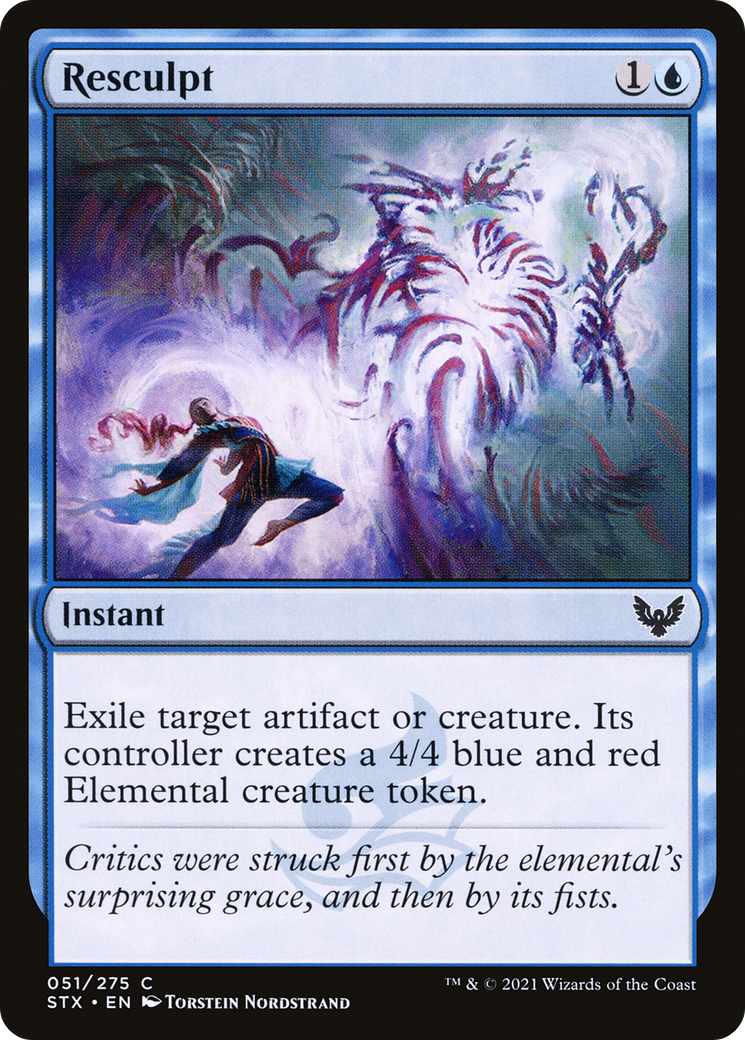
Resculpt
Resculpt
Instant
Exile target artifact or creature. Its controller creates a 4/4 blue and red Elemental creature token.
-
1
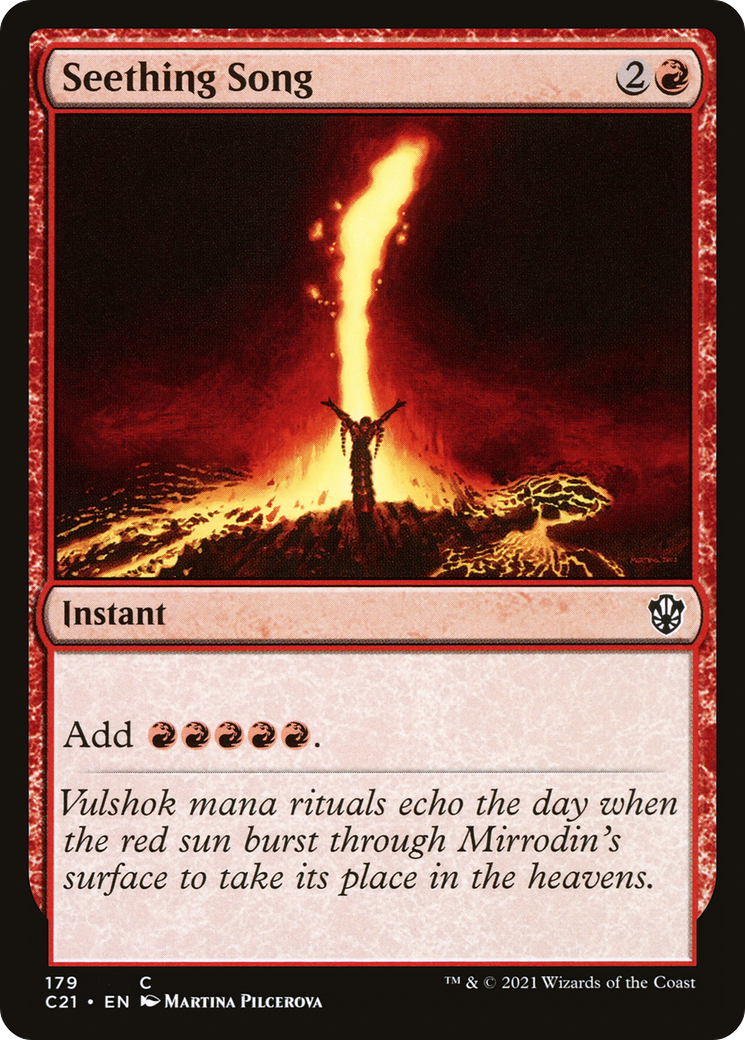
Seething Song
Seething Song
Instant
Add .
-
1
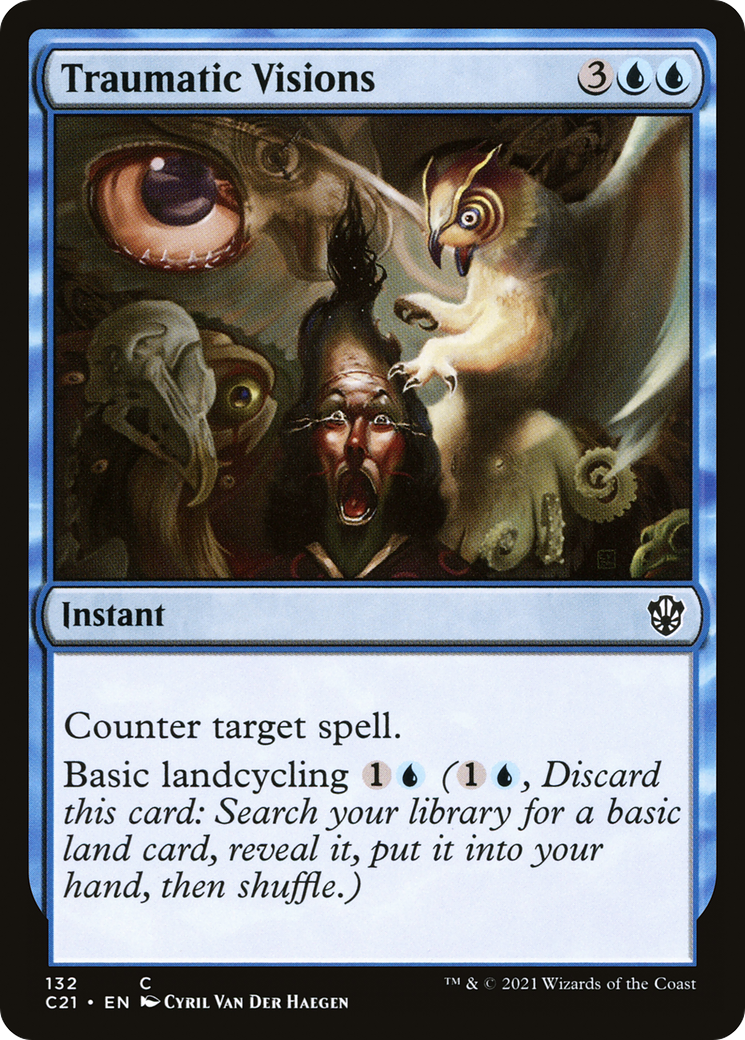
Traumatic Visions
Traumatic Visions
Instant
Counter target spell.
Basic landcycling ( , Discard this card: Search your library for a basic land card, reveal it, put it into your hand, then shuffle.)
- Unlike the normal cycling ability, basic landcycling doesn’t allow you to draw a card. Instead, it lets you search your library for a basic land card. You don’t choose the type of basic land card you’ll find until you’re performing the search. After you choose a basic land card in your library, you reveal it, put it into your hand, then shuffle your library.
- Basic landcycling is a form of cycling. Any ability that triggers on a card being cycled also triggers on a card being basic landcycled. Any ability that stops a cycling ability from being activated also stops a basic landcycling ability from being activated.
- Basic landcycling is an activated ability. Effects that interact with activated abilities (such as Stifle or Rings of Brighthearth) will interact with basic landcycling. Effects that interact with spells (such as Remove Soul or Faerie Tauntings) will not.
- You can choose not to find a basic land card, even if there is one in your library.
Sorceries 21
-
1
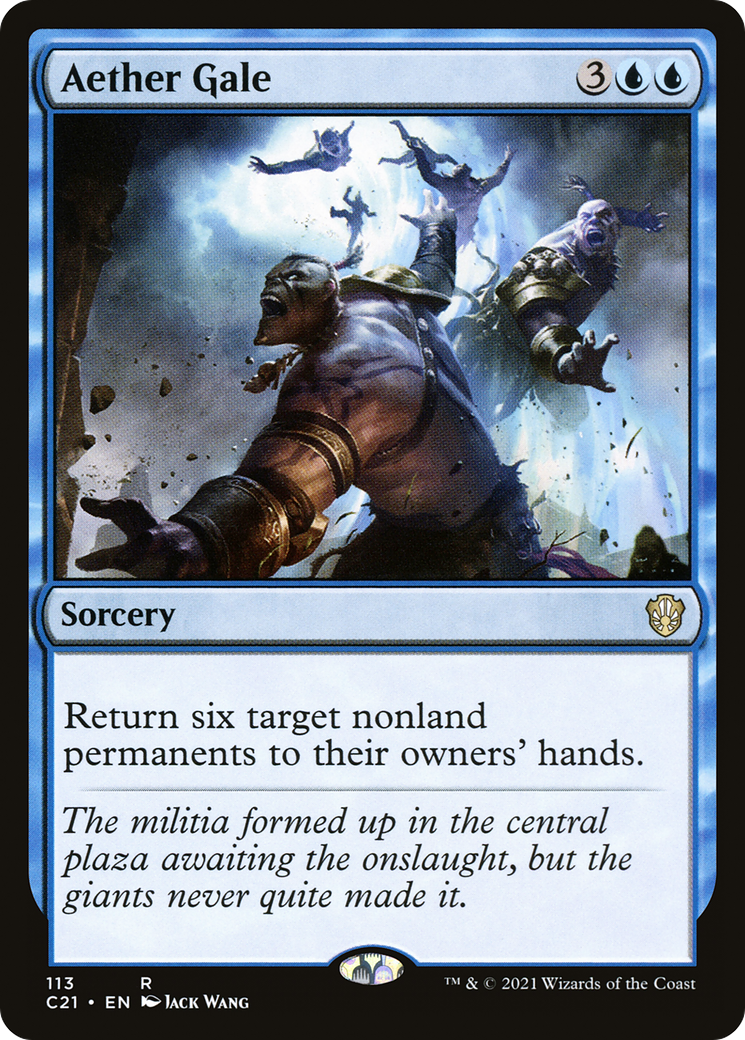
Aether Gale
Aether Gale
Sorcery
Return six target nonland permanents to their owners' hands.
- You must choose six different legal targets in order to cast Aether Gale. If some, but not all, of those targets become illegal before Aether Gale resolves, the remaining legal targets will be put into their owners' hands.
-
1
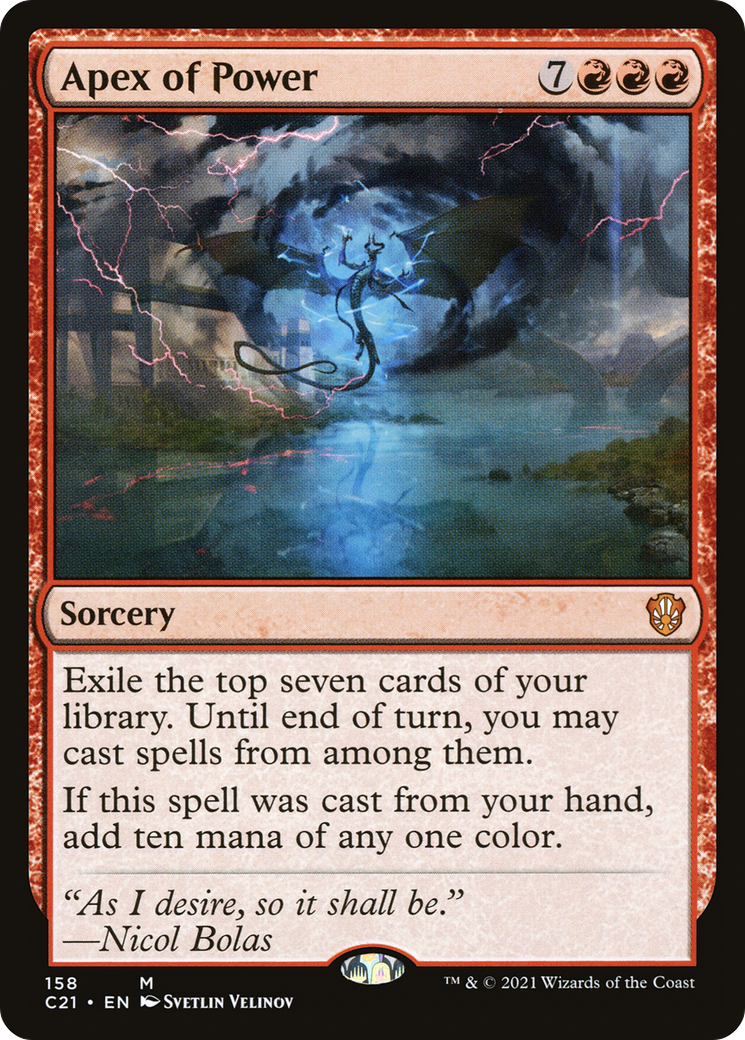
Apex of Power
Apex of Power
Sorcery
Exile the top seven cards of your library. Until end of turn, you may cast spells from among them.
If this spell was cast from your hand, add ten mana of any one color.
- Apex of Power doesn't change when you can cast the exiled cards. For example, if you exile a sorcery card, you can cast it only during your main phase when the stack is empty.
- Casting an exiled card causes it to leave exile. You can't cast it multiple times.
- Any cards not cast, including land cards, remain in exile.
- If an effect copies Apex of Power, the copy wasn't cast at all, so you won't add ten mana.
-
1
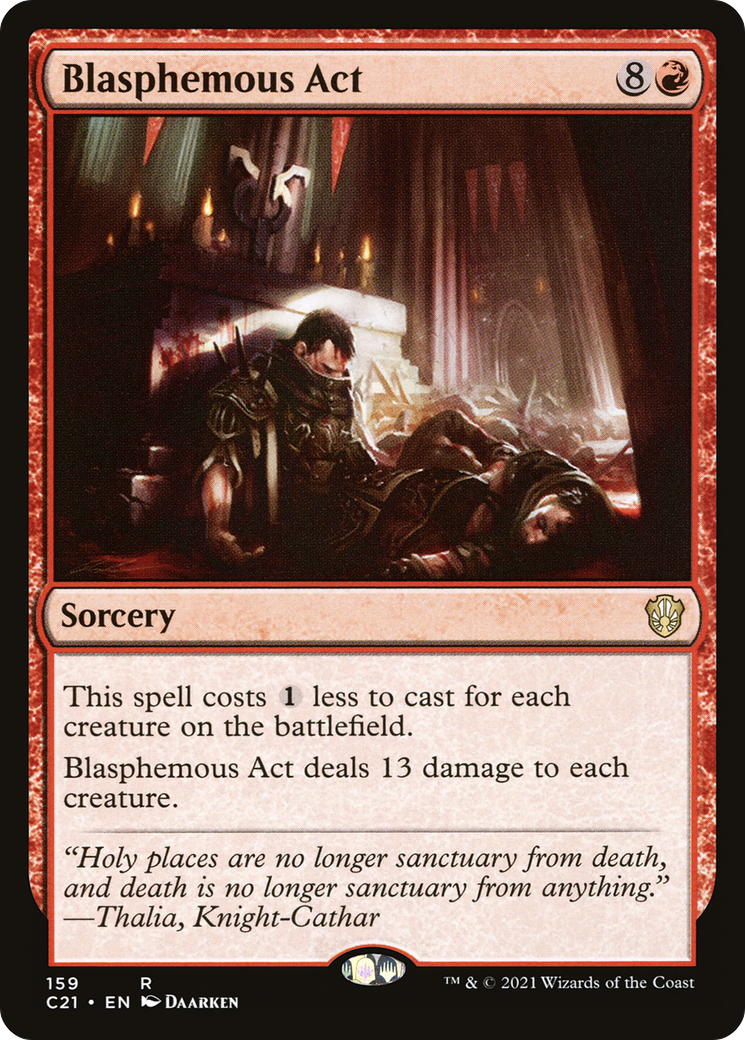
Blasphemous Act
Blasphemous Act
Sorcery
This spell costs less to cast for each creature on the battlefield.
Blasphemous Act deals 13 damage to each creature.
- Although players may respond to Blasphemous Act once it's been cast, once it's announced, they can't respond before the cost is calculated and paid.
- Blasphemous Act's ability can't reduce the total cost to cast the spell below .
- The total cost to cast Blasphemous Act is locked in before you pay that cost. For example, if there are three creatures on the battlefield, including one you can sacrifice to add , the total cost of Blasphemous Act is . Then you can sacrifice the creature when you activate mana abilities just before paying the cost.
- To determine the total cost of a spell, start with the mana cost or alternative cost you're paying, add any cost increases, then apply any cost reductions (such as that of Blasphemous Act). The mana value of the spell is determined only by its mana cost, no matter what the total cost to cast the spell was.
-
1
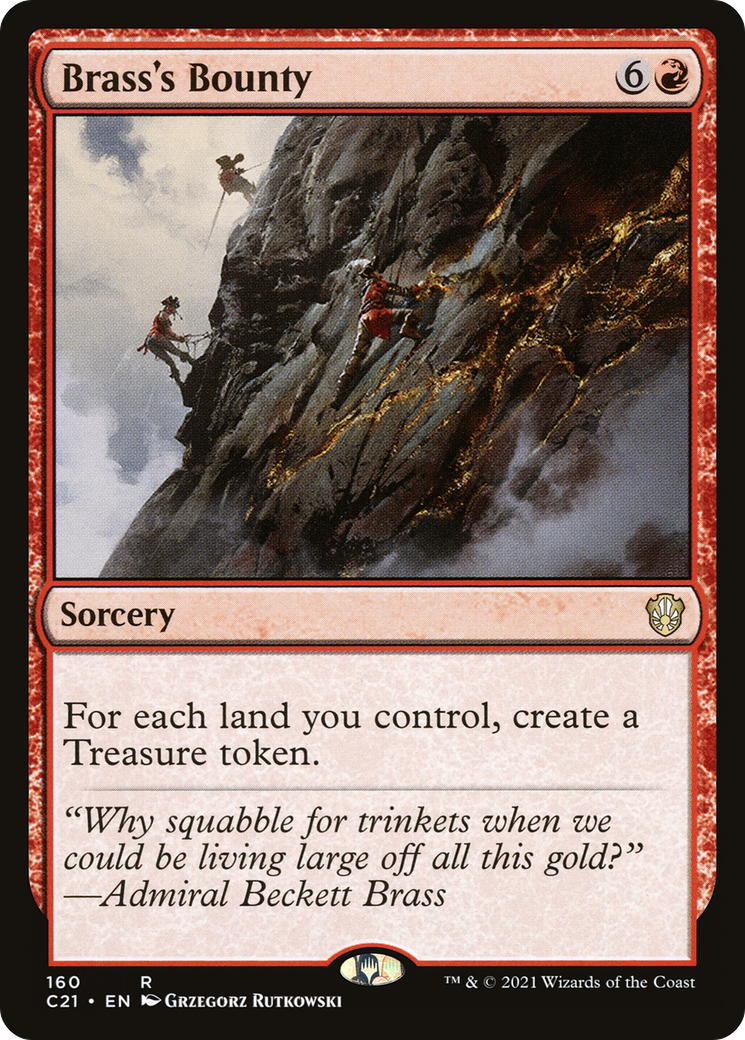
Brass's Bounty
Brass's Bounty
Sorcery
For each land you control, create a Treasure token. (It's an artifact with " , Sacrifice this token: Add one mana of any color.")
-
1
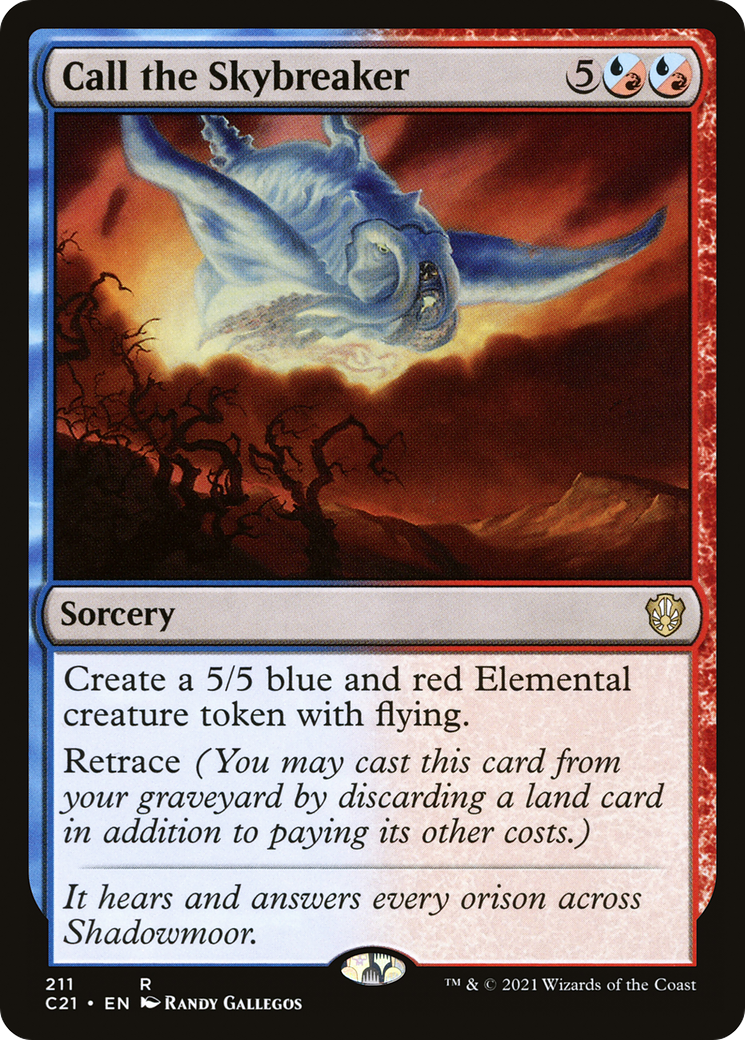
Call the Skybreaker
Call the Skybreaker
Sorcery
Create a 5/5 blue and red Elemental creature token with flying.
Retrace (You may cast this card from your graveyard by discarding a land card in addition to paying its other costs.)
- Casting a card by using its retrace ability works just like casting any other spell, with two exceptions: You're casting it from your graveyard rather than your hand, and you must discard a land card in addition to any other costs.
- A retrace card cast from your graveyard follows the normal timing rules for its card type.
- When a retrace card you cast from your graveyard resolves, fails to resolve, or is countered, it's put back into your graveyard. You may use the retrace ability to cast it again.
- If the active player casts a spell that has retrace, that player may cast that card again after it resolves, before another player can remove the card from the graveyard. The active player has priority after the spell resolves, so they can immediately cast a new spell. Since casting a card with retrace from the graveyard moves that card onto the stack, no one else would have the chance to affect it while it's still in the graveyard.
-
1
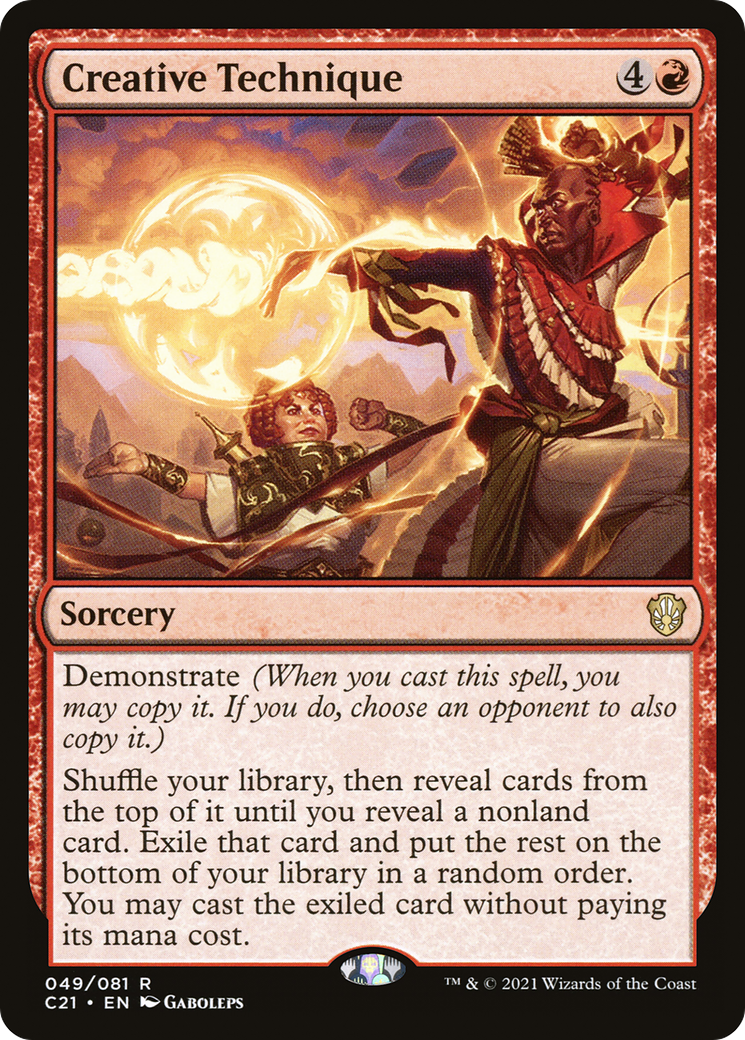
Creative Technique
Creative Technique
Sorcery
Demonstrate (When you cast this spell, you may copy it. If you do, choose an opponent to also copy it.)
Shuffle your library, then reveal cards from the top of it until you reveal a nonland card. Exile that card and put the rest on the bottom of your library in a random order. You may cast the exiled card without paying its mana cost.
- If you cast the spell and choose not to copy it, no opponent will get to copy it either.
- This means that if you cast a spell with demonstrate and both you and an opponent copy it, the opponent's copy will resolve first, then your copy will resolve, and finally the original spell will resolve.
- You choose whether to make a copy as the demonstrate ability resolves. This happens before the original spell resolves. Your copy goes on the stack above the original spell.
- If you copy a spell with demonstrate, you then immediately choose an opponent. If they copy the spell, it goes on top of the stack.
- If the spell requires targets, you choose the target of the original spell as you cast it. If you create a copy of the spell, you may choose new targets for the copy as you create that copy. Similarly, the opponent you chose to create a copy may choose new targets for that copy as it's created. In other words, your opponent will know the targets of your original spell and your copy when choosing the new targets, if any, for their copy.
-
1
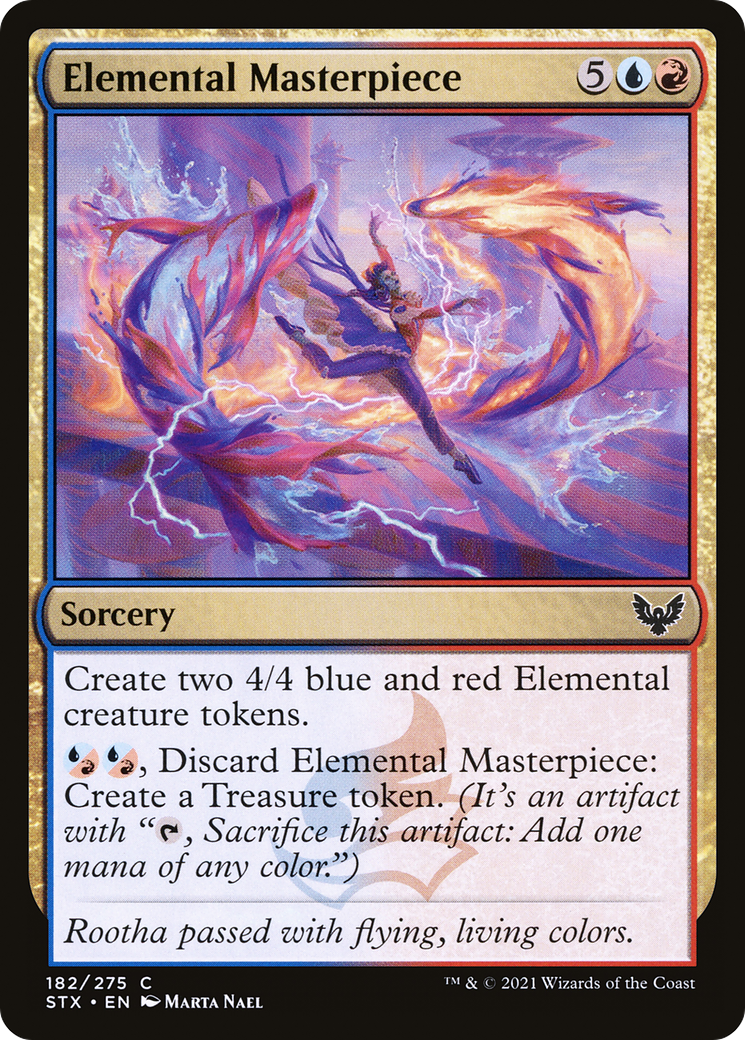
Elemental Masterpiece
Elemental Masterpiece
Sorcery
Create two 4/4 blue and red Elemental creature tokens.
, Discard this card: Create a Treasure token. (It's an artifact with " , Sacrifice this token: Add one mana of any color.")
-
1
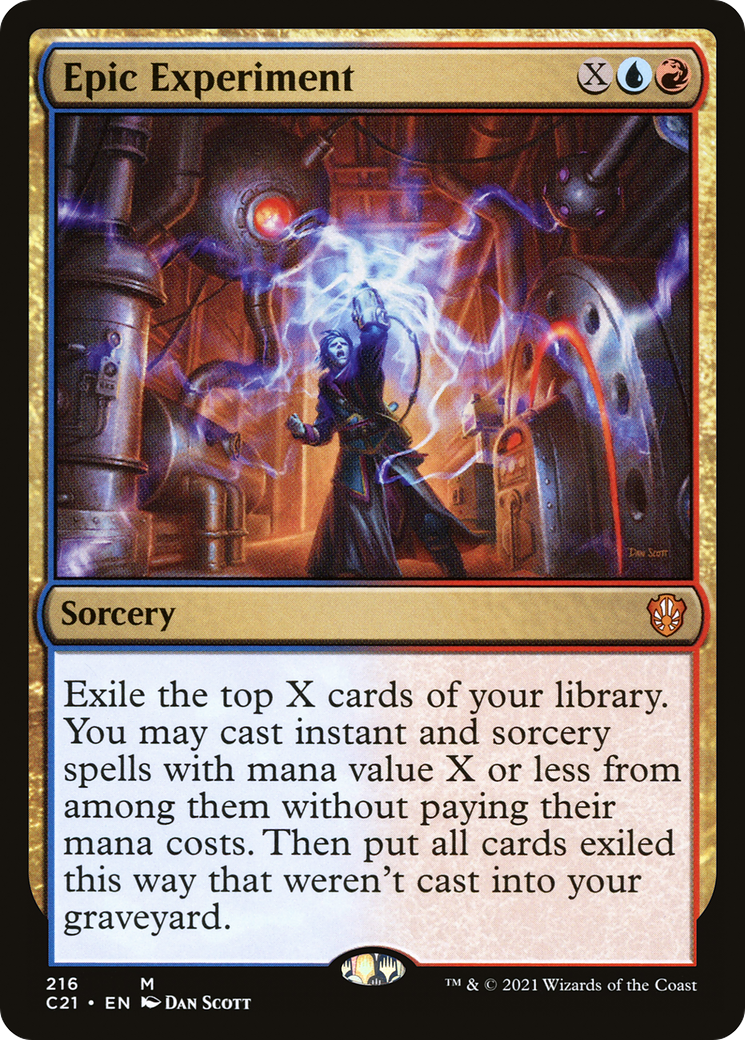
Epic Experiment
Epic Experiment
Sorcery
Exile the top X cards of your library. You may cast instant and sorcery spells with mana value X or less from among them without paying their mana costs. Then put all cards exiled this way that weren't cast into your graveyard.
- If you cast a card "without paying its mana cost," you can't choose to cast it for any alternative costs. You can, however, pay additional costs. If the card has any mandatory additional costs, you must pay those to cast the card.
- If the card has in its mana cost, you must choose 0 as the value of X when casting it without paying its mana cost.
- You cast the cards one at a time, choosing modes, targets, and so on. The last card you cast will be the first one to resolve.
- When casting an instant or sorcery card this way, ignore timing restrictions based on the card's type. Other timing restrictions, such as "Cast [this card] only during combat," must be followed.
- If you can't cast a card, perhaps because there are no legal targets available, or if you choose not to cast it, it will be put into your graveyard.
-
1
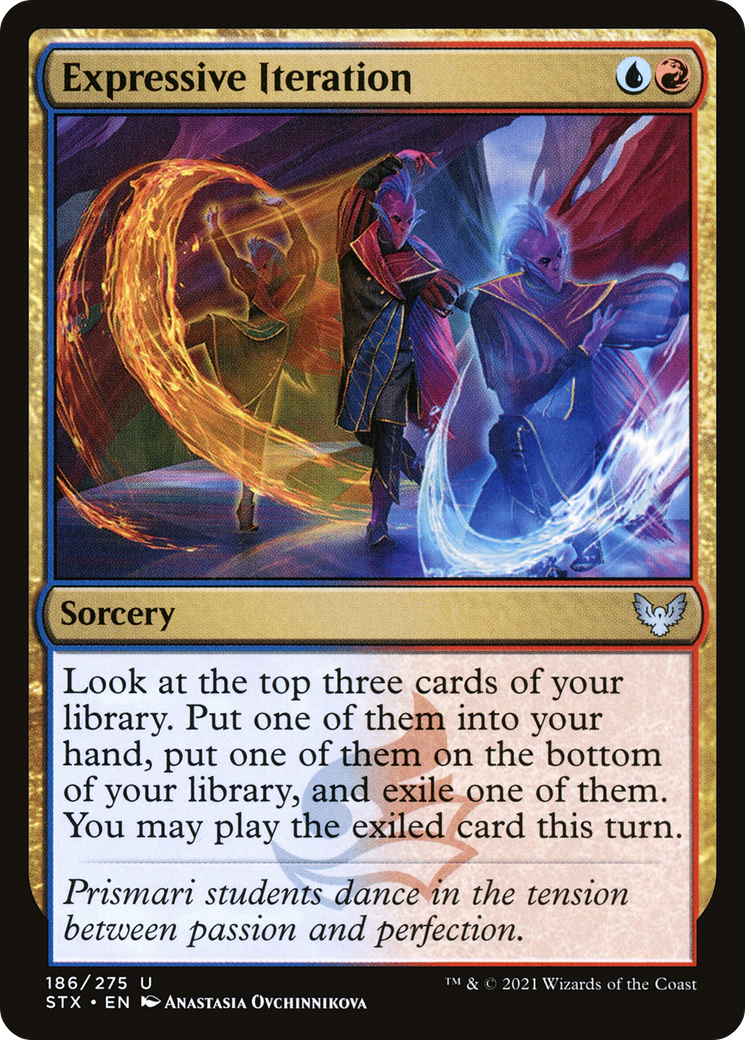
Expressive Iteration
Expressive Iteration
Sorcery
Look at the top three cards of your library. Put one of them into your hand, put one of them on the bottom of your library, and exile one of them. You may play the exiled card this turn.
-
1
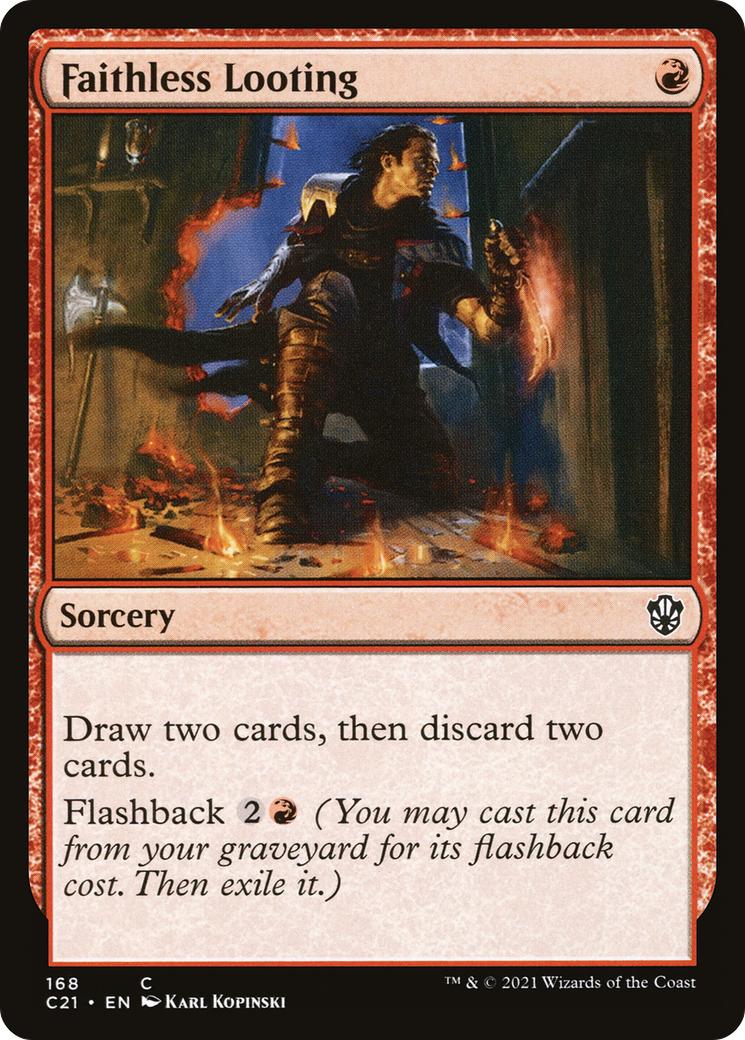
Faithless Looting
Faithless Looting
Sorcery
Draw two cards, then discard two cards.
Flashback (You may cast this card from your graveyard for its flashback cost. Then exile it.)
- To determine the total cost of a spell, start with the mana cost or alternative cost (such as a flashback cost) you're paying, add any cost increases, then apply any cost reductions. The mana value of the spell is determined only by its mana cost, no matter what the total cost to cast the spell was.
- A spell cast using flashback will always be exiled afterward, whether it resolves, is countered, or leaves the stack in some other way.
- "Flashback [cost]" means "You may cast this card from your graveyard if the resulting spell is an instant or sorcery spell by paying [cost] rather than paying its mana cost" and "If the flashback cost was paid, exile this card instead of putting it anywhere else any time it would leave the stack."
- If a card with flashback is put into your graveyard during your turn, you can cast it if it's legal to do so before any other player can take any actions.
- You can cast a spell using flashback even if it was somehow put into your graveyard without having been cast.
- You must still follow any timing restrictions and permissions, including those based on the card's type. For instance, you can cast a sorcery using flashback only when you could normally cast a sorcery.
- You draw two cards and discard two cards all while Faithless Looting is resolving. Nothing can happen between the two, and no player may choose to take actions.
-
1
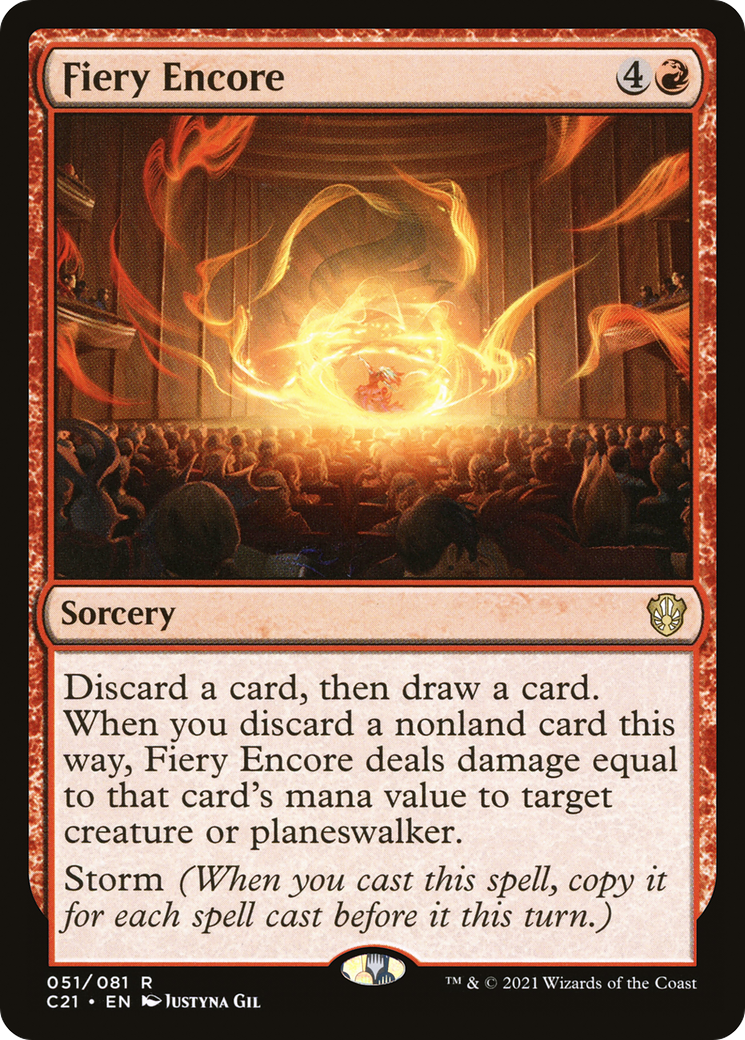
Fiery Encore
Fiery Encore
Sorcery
Discard a card, then draw a card. When you discard a nonland card this way, Fiery Encore deals damage equal to that card's mana value to target creature or planeswalker.
Storm (When you cast this spell, copy it for each spell cast before it this turn.)
- Each copy you create because of storm will cause your magecraft abilities to trigger.
- Each copy will resolve one at a time. As each copy resolves, if you discarded a nonland card, the reflexive triggered ability triggers and you pick a target to be dealt damage. That ability will resolve before you deal with the next copy of Fiery Encore.
- If you have no cards in hand as Fiery Encore resolves, you won’t be able to discard a card, but you will draw a card. No damage will be dealt.
-
1
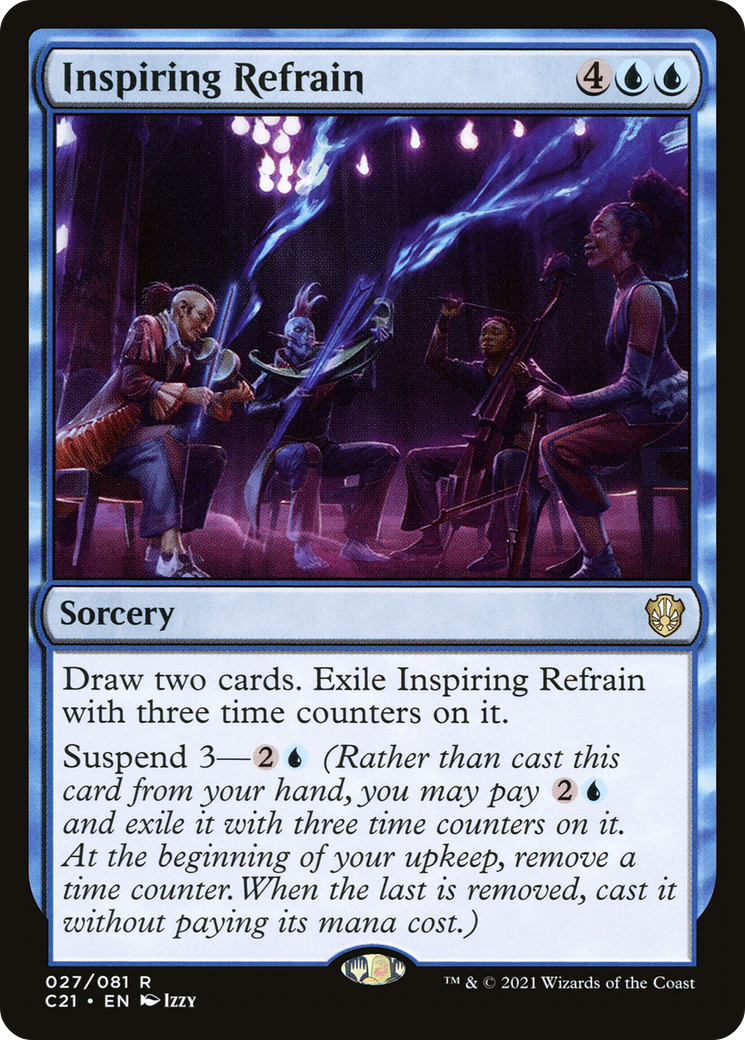
Inspiring Refrain
Inspiring Refrain
Sorcery
Draw two cards. Exile Inspiring Refrain with three time counters on it.
Suspend 3— (Rather than cast this card from your hand, you may pay and exile it with three time counters on it. At the beginning of your upkeep, remove a time counter. When the last is removed, you may cast it without paying its mana cost.)
- Suspend is a keyword that represents three abilities. The first is a static ability that allows you to exile the card from your hand with the specified number of time counters (the number before the dash) on it by paying its suspend cost (listed after the dash). The second is a triggered ability that removes a time counter from the suspended card at the beginning of each of your upkeeps. The third is a triggered ability that gives you the option to cast the card when the last time counter is removed.
- You can exile a card in your hand using suspend any time you could cast that card. Consider its card type, any effects that modify when you could cast it (such as flash) and any other effects that stop you from casting it (such as from Meddling Mage's ability) to determine if and when you can do this. Whether you could actually complete all steps in casting the card is irrelevant. For example, you can exile a card with suspend that has no mana cost or that requires a target even if no legal targets are available at that time.
- Cards exiled with suspend are exiled face up.
- Exiling a card with suspend isn't casting that card. This action doesn't use the stack and can't be responded to.
- If the spell requires any targets, those targets are chosen when the spell is finally cast, not when it's exiled.
- If an effect refers to a "suspended card," that means a card that (1) has suspend, (2) is in exile, and (3) has one or more time counters on it.
- If the first triggered ability of suspend (the one that removes time counters) is countered, no time counter is removed. The ability will trigger again at the beginning of the card's owner's next upkeep.
- When the last time counter is removed, the second triggered ability of suspend (the one that lets you cast the card) triggers. It doesn't matter why the last time counter was removed or what effect removed it.
- If the second triggered ability is countered, the card can't be cast. It remains exiled with no time counters on it, and it's no longer suspended.
- Due to a recent rules change to suspend, you are no longer required to cast the suspended card as the second triggered ability of suspend resolves. Instead, as the second triggered ability resolves, you may cast the card. Timing permissions based on the card's type are ignored. If you don't cast the card, it remains exiled with no time counters on it, and it's no longer suspended.
- If you cast a card "without paying its mana cost," such as with suspend, you can't choose to cast it for any alternative costs. You can, however, pay additional costs. If the card has any mandatory additional costs, you must pay those if you want to cast the card.
- If the card has in its mana cost, you must choose 0 as the value of X when casting it without paying its mana cost.
- The mana value of a spell cast without paying its mana cost is determined by its mana cost, even though that cost wasn't paid.
-
1
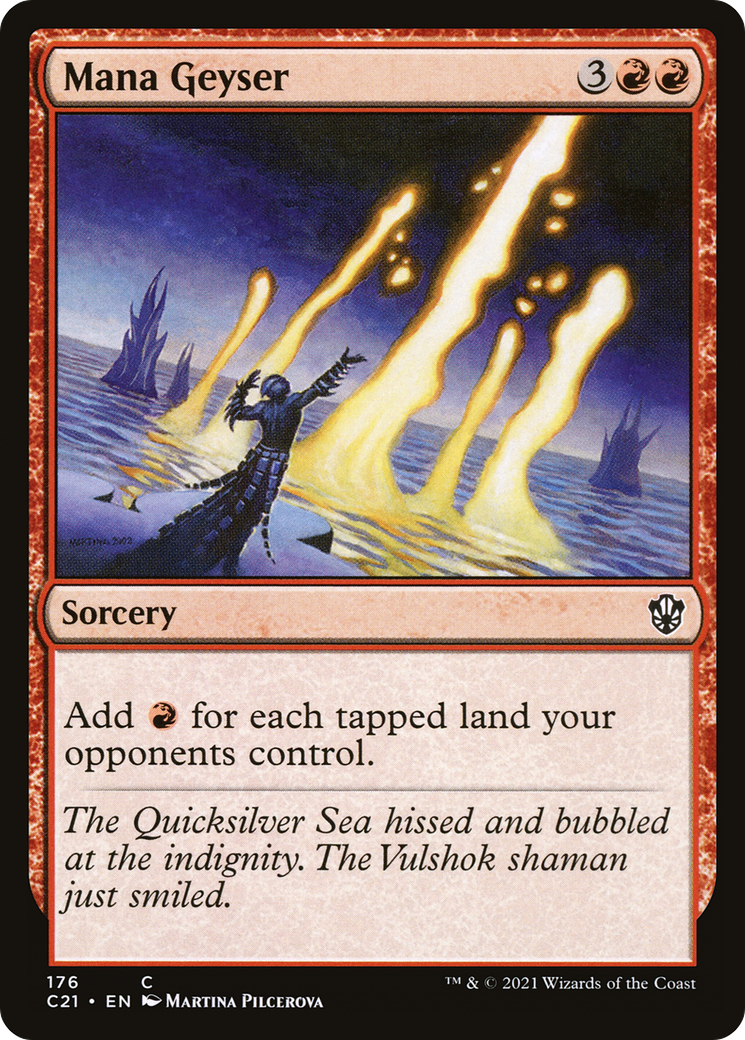
Mana Geyser
Mana Geyser
Sorcery
Add for each tapped land your opponents control.
-
1
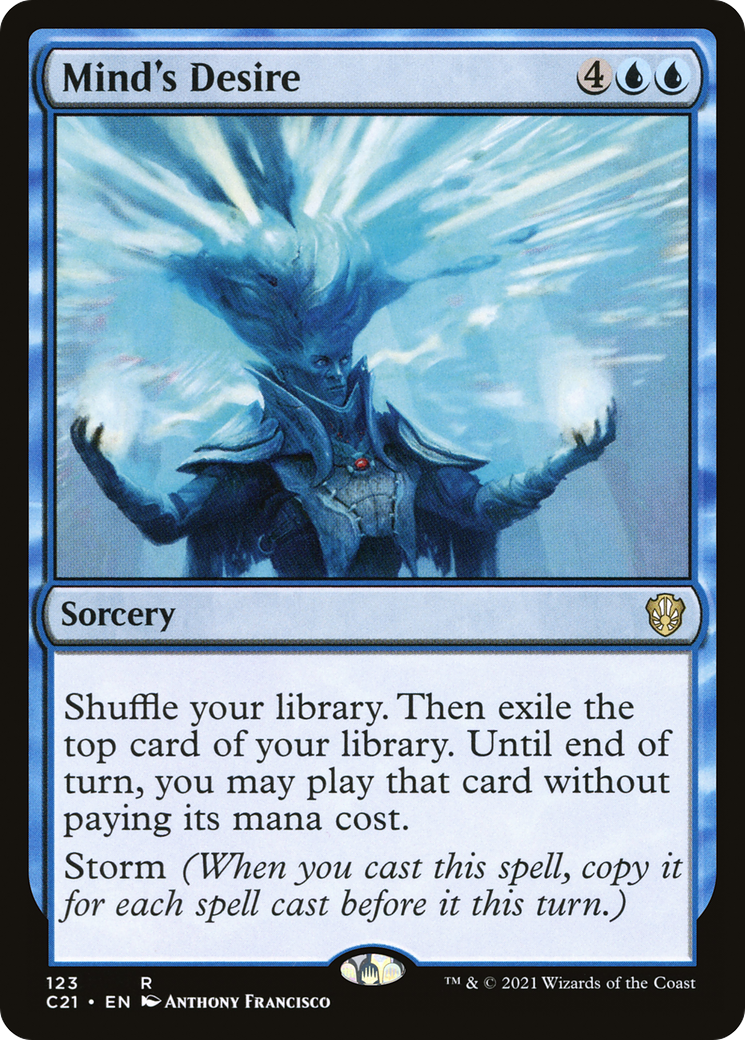
Mind's Desire
Mind's Desire
Sorcery
Shuffle your library. Then exile the top card of your library. Until end of turn, you may play that card without paying its mana cost.
Storm (When you cast this spell, copy it for each spell cast before it this turn.)
- The copies are put directly onto the stack. They aren't cast and won't be counted by other spells with storm cast later in the turn.
- Spells cast from zones other than a player's hand and spells that were countered are counted by the storm ability.
- A copy of a spell can be countered like any other spell, but it must be countered individually. Countering a spell with storm won't affect the copies.
- The triggered ability that creates the copies can itself be countered by anything that can counter a triggered ability. If it is countered, no copies will be put onto the stack.
- If the card is not played by end of turn, it remains exiled until end of game.
- The card is face-up when exiled.
-
1
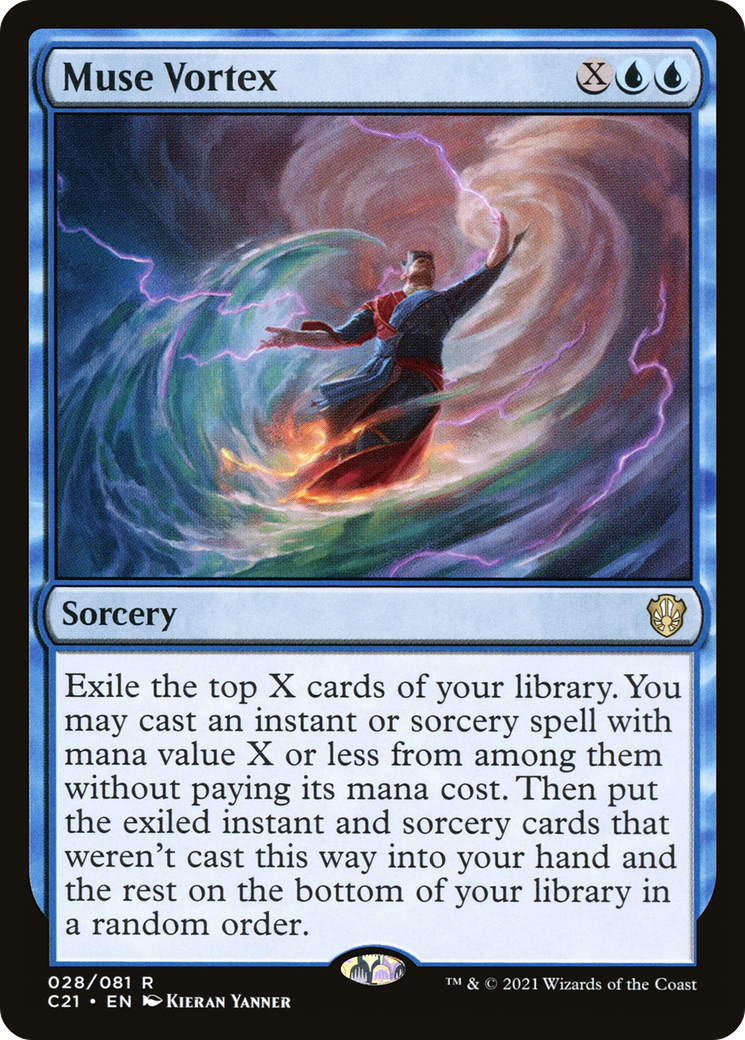
Muse Vortex
Muse Vortex
Sorcery
Exile the top X cards of your library. You may cast an instant or sorcery spell with mana value X or less from among them without paying its mana cost. Then put the exiled instant and sorcery cards that weren't cast this way into your hand and the rest on the bottom of your library in a random order.
- If you cast a spell with in its cost without paying its mana cost, you must choose 0 as the value of X.
- You don’t have to cast an instant or sorcery spell this way. If you don’t, all exiled instant or sorcery cards will be put into your hand.
-
1
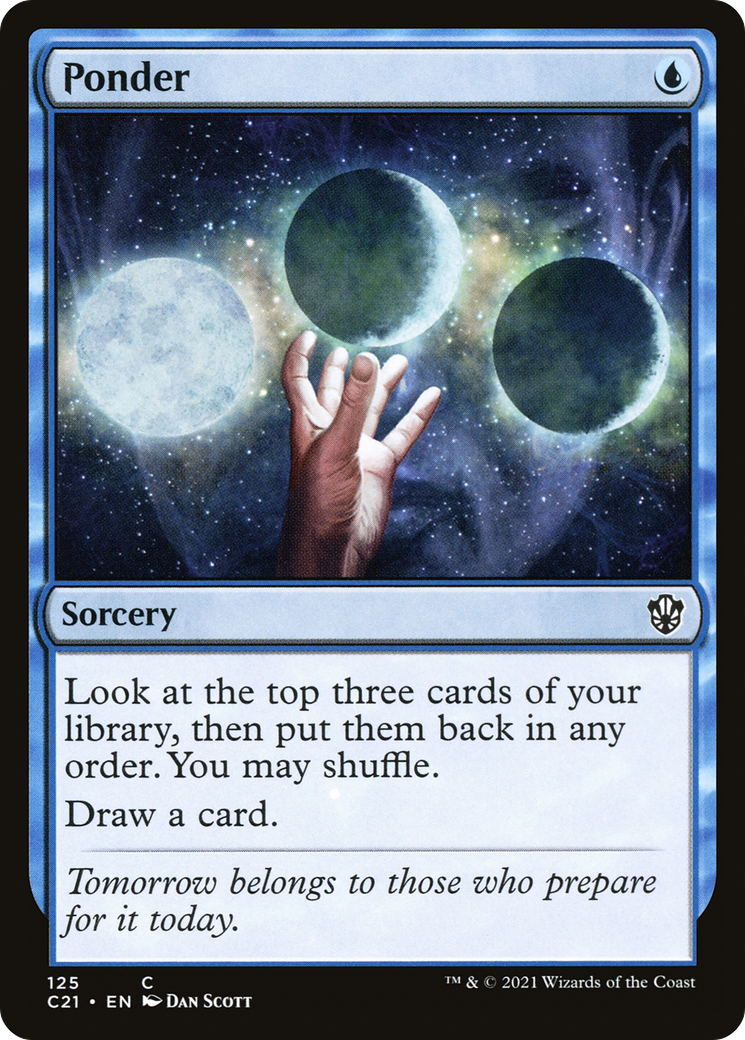
Ponder
Ponder
Sorcery
Look at the top three cards of your library, then put them back in any order. You may shuffle.
Draw a card.
- If you choose to shuffle your library, that includes the three cards you just looked at and put back on top of it.
-
1
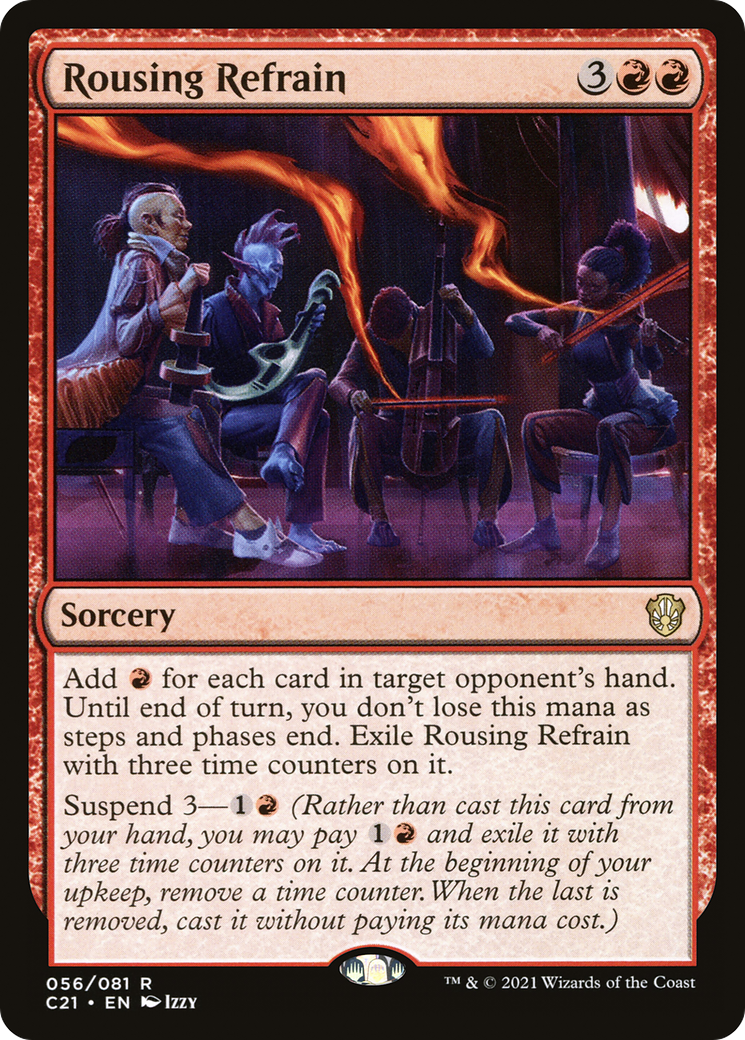
Rousing Refrain
Rousing Refrain
Sorcery
Add for each card in target opponent's hand. Until end of turn, you don't lose this mana as steps and phases end. Exile Rousing Refrain with three time counters on it.
Suspend 3— (Rather than cast this card from your hand, you may pay and exile it with three time counters on it. At the beginning of your upkeep, remove a time counter. When the last is removed, you may cast it without paying its mana cost.)
- Suspend is a keyword that represents three abilities. The first is a static ability that allows you to exile the card from your hand with the specified number of time counters (the number before the dash) on it by paying its suspend cost (listed after the dash). The second is a triggered ability that removes a time counter from the suspended card at the beginning of each of your upkeeps. The third is a triggered ability that gives you the option to cast the card when the last time counter is removed.
- Exiling a card with suspend isn't casting that card. This action doesn't use the stack and can't be responded to.
- Due to a recent rules change to suspend, you are no longer required to cast the suspended card as the second triggered ability of suspend resolves. Instead, as the second triggered ability resolves, you may cast the card. Timing permissions based on the card's type are ignored. If you don't cast the card, it remains exiled with no time counters on it, and it's no longer suspended.
- Cards exiled with suspend are exiled face up.
- If the card has in its mana cost, you must choose 0 as the value of X when casting it without paying its mana cost.
- You can exile a card in your hand using suspend any time you could cast that card. Consider its card type, any effects that modify when you could cast it (such as flash) and any other effects that stop you from casting it (such as from Meddling Mage's ability) to determine if and when you can do this. Whether you could actually complete all steps in casting the card is irrelevant. For example, you can exile a card with suspend that has no mana cost or that requires a target even if no legal targets are available at that time.
- If the spell requires any targets, those targets are chosen when the spell is finally cast, not when it's exiled.
- If the first triggered ability of suspend (the one that removes time counters) is countered, no time counter is removed. The ability will trigger again at the beginning of the card's owner's next upkeep.
- If the second triggered ability is countered, the card can't be cast. It remains exiled with no time counters on it, and it's no longer suspended.
- If an effect refers to a "suspended card," that means a card that (1) has suspend, (2) is in exile, and (3) has one or more time counters on it.
- If you cast a card "without paying its mana cost," such as with suspend, you can't choose to cast it for any alternative costs. You can, however, pay additional costs. If the card has any mandatory additional costs, you must pay those if you want to cast the card.
- When the last time counter is removed, the second triggered ability of suspend (the one that lets you cast the card) triggers. It doesn't matter why the last time counter was removed or what effect removed it.
- The mana value of a spell cast without paying its mana cost is determined by its mana cost, even though that cost wasn't paid.
-
1
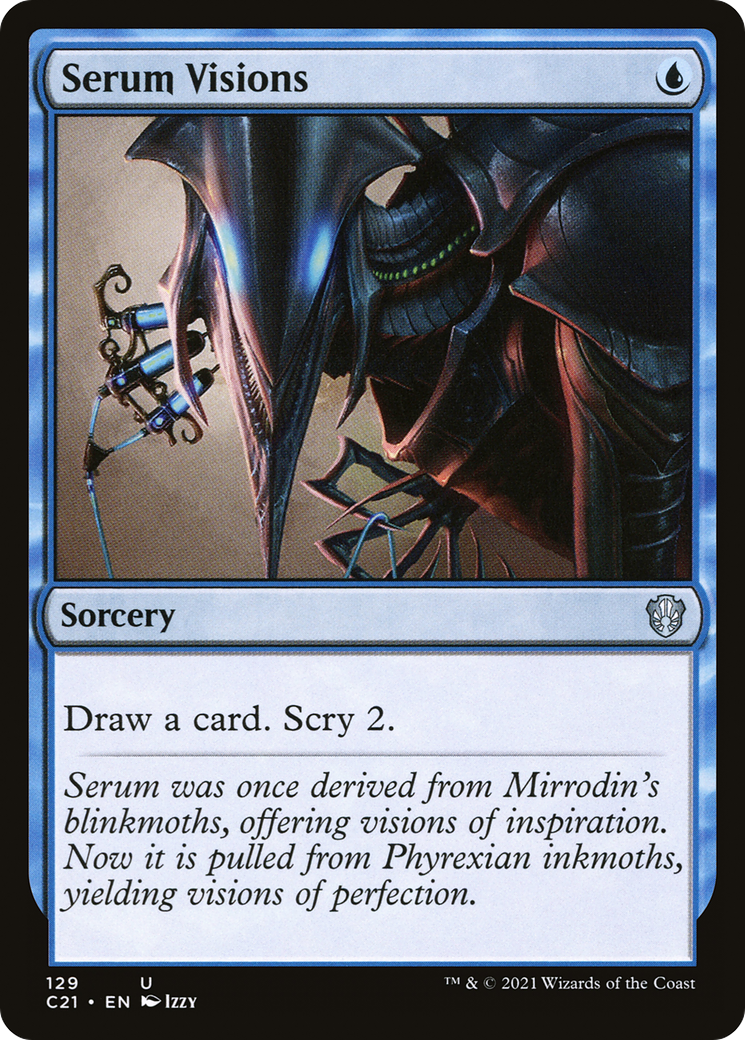
Serum Visions
Serum Visions
Sorcery
Draw a card. Scry 2.
-
1
Surge to Victory
Surge to Victory
Sorcery
Exile target instant or sorcery card from your graveyard. Creatures you control get +X/+0 until end of turn, where X is that card's mana value. Whenever a creature you control deals combat damage to a player this turn, copy the exiled card. You may cast the copy without paying its mana cost.
- Copying the card doesn't cause magecraft abilities to trigger, although casting the copies does.
- You cast the copies while the delayed triggered ability of Surge to Victory is resolving. Ignore any timing restrictions based on the copies' card types.
- If you cast a spell "without paying its mana cost," you can't pay any alternative costs. You can, however, pay additional costs, such as kicker costs. If the card has any mandatory additional costs, you must pay those.
- If the spell you cast has in its mana cost, you must choose 0 as the value of X.
-
1
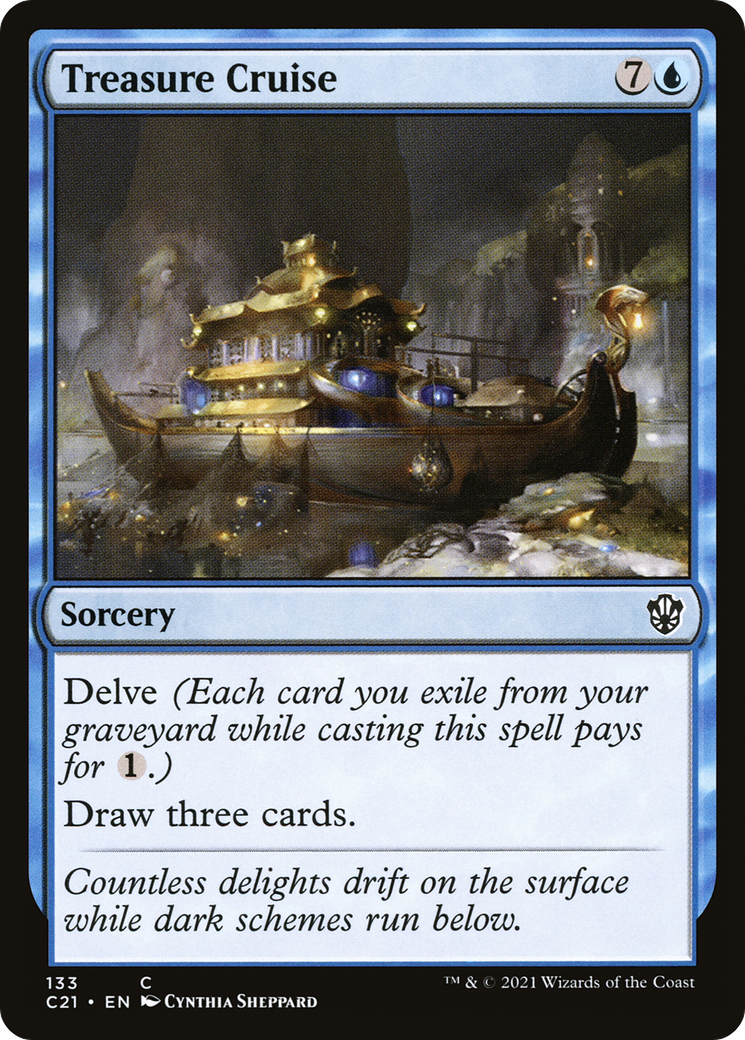
Treasure Cruise
Treasure Cruise
Sorcery
Delve (Each card you exile from your graveyard while casting this spell pays for .)
Draw three cards.
- Delve doesn't change a spell's mana cost or mana value. For example, Treasure Cruise's mana value is 8 even if you exiled three cards to cast it.
- You can exile cards to pay only for generic mana, and you can't exile more cards than the generic mana requirement of a spell with delve. For example, you can't exile more than seven cards from your graveyard to cast Treasure Cruise unless an effect has increased its cost.
- Because delve isn't an alternative cost, it can be used in conjunction with alternative costs, such as flashback. It can also be used to pay for additional costs that include generic mana.
-
1
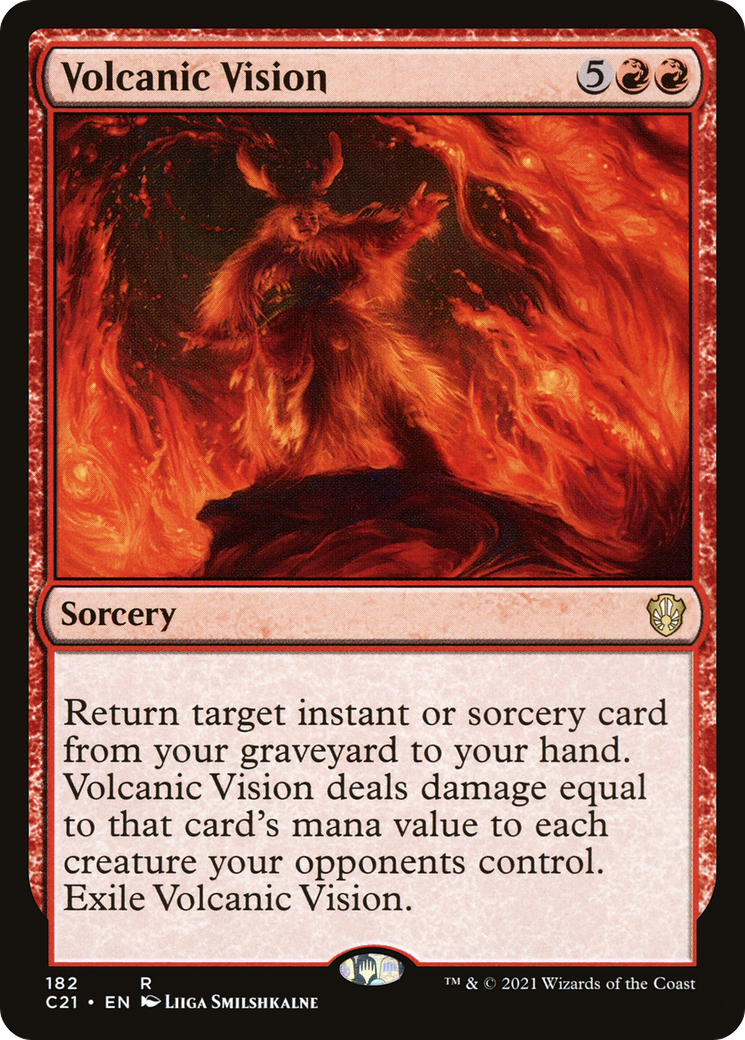
Volcanic Vision
Volcanic Vision
Sorcery
Return target instant or sorcery card from your graveyard to your hand. Volcanic Vision deals damage equal to that card's mana value to each creature your opponents control. Exile Volcanic Vision.
- If the target instant or sorcery card becomes an illegal target before Volcanic Vision resolves, the spell won’t resolve and none of its effects will happen. No damage will be dealt and Volcanic Vision won’t be exiled.
- If the target has in its mana cost, X is 0.
Artifacts 9
-
1
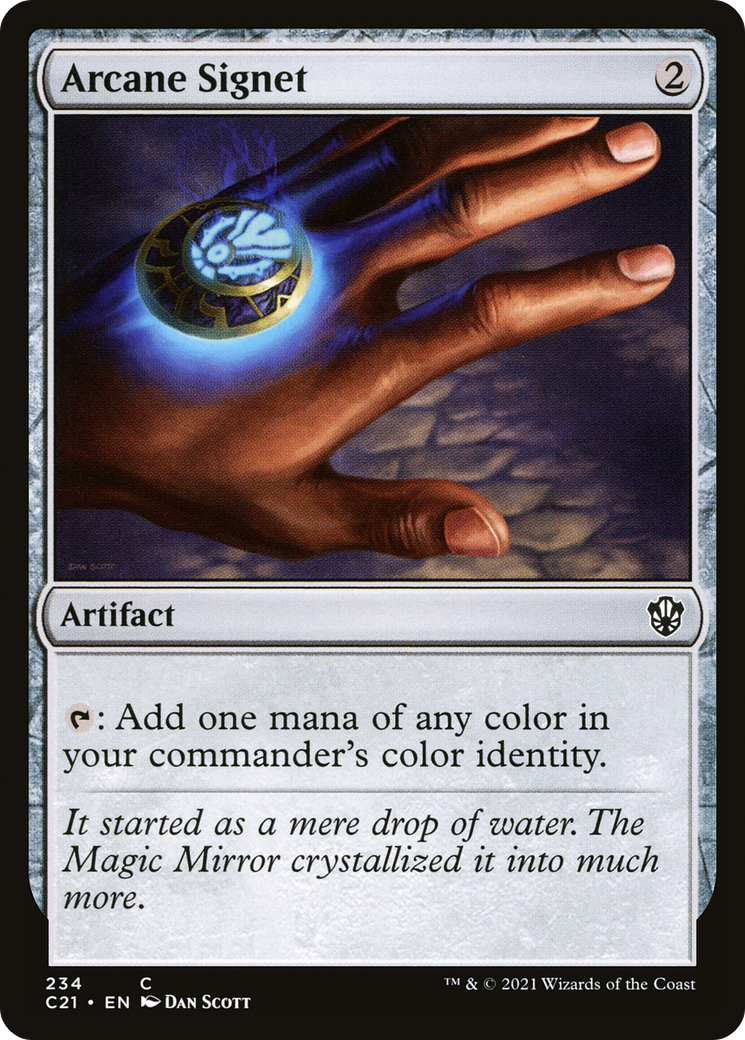
Arcane Signet
Arcane Signet
Artifact
: Add one mana of any color in your commander's color identity.
- If your commander is a card that has no colors in its color identity, Arcane Signet's ability produces no mana. It doesn't produce .
- If you have two commanders, the ability adds one mana of any color in their combined color identities.
- If you don't have a commander, Arcane Signet's ability produces no mana.
-
1
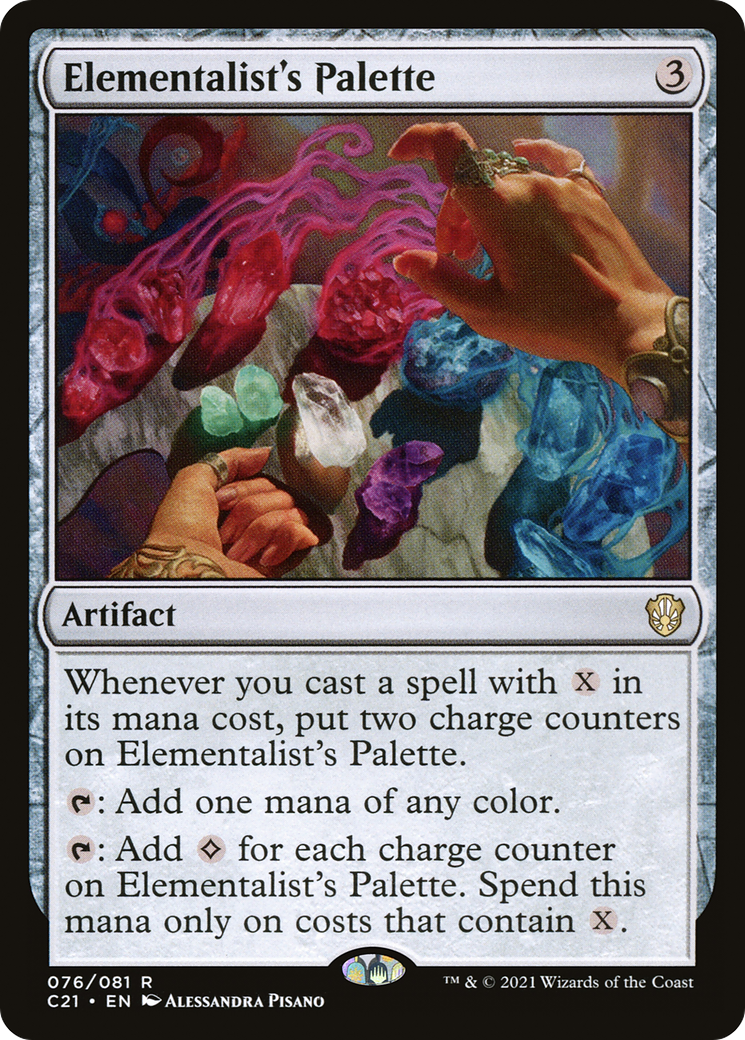
Elementalist's Palette
Elementalist's Palette
Artifact
Whenever you cast a spell with in its mana cost, put two charge counters on this artifact.
: Add one mana of any color.
: Add for each charge counter on this artifact. Spend this mana only on costs that contain .
- The mana added by the last ability can be used only to pay costs with at least one , but it can be used to pay for any part of that cost, not just the . That could be in a spell's total cost, an ability's activation cost, or a cost you're asked to pay as a spell or ability resolves.
- The mana added by the last ability doesn't all have to spent on the same cost.
- If you cast a spell with multiple mana symbols in its cost, the first ability triggers only once.
-
1
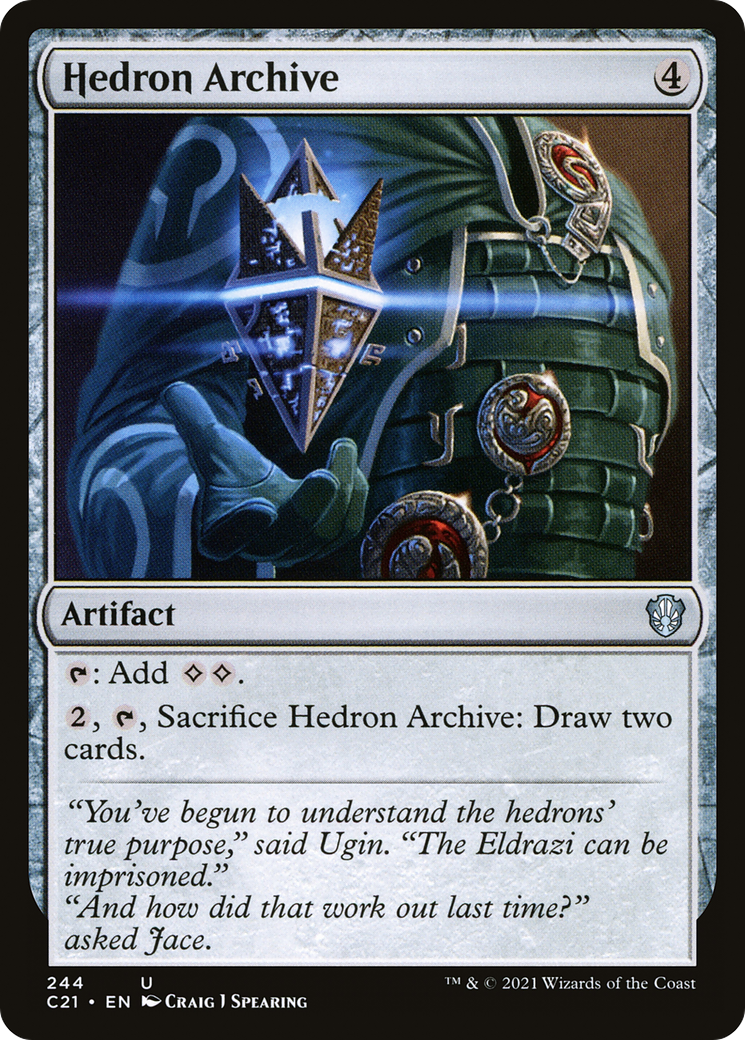
Hedron Archive
Hedron Archive
Artifact
: Add .
, , Sacrifice this artifact: Draw two cards.
-
1
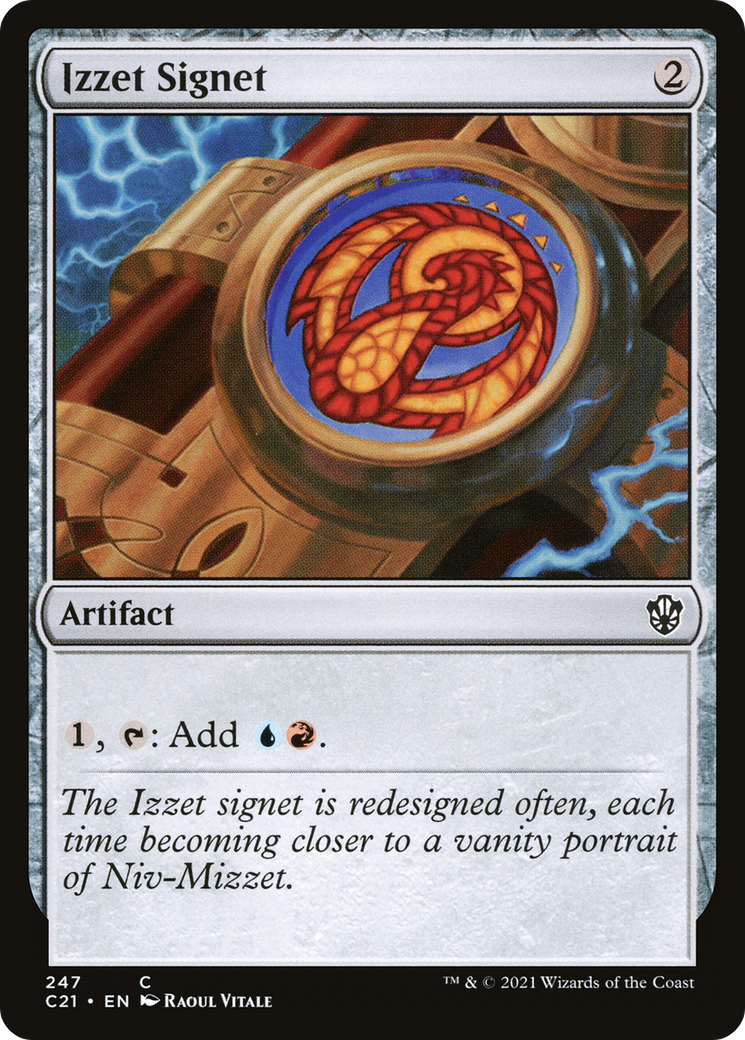
Izzet Signet
Izzet Signet
Artifact
, : Add .
-
1
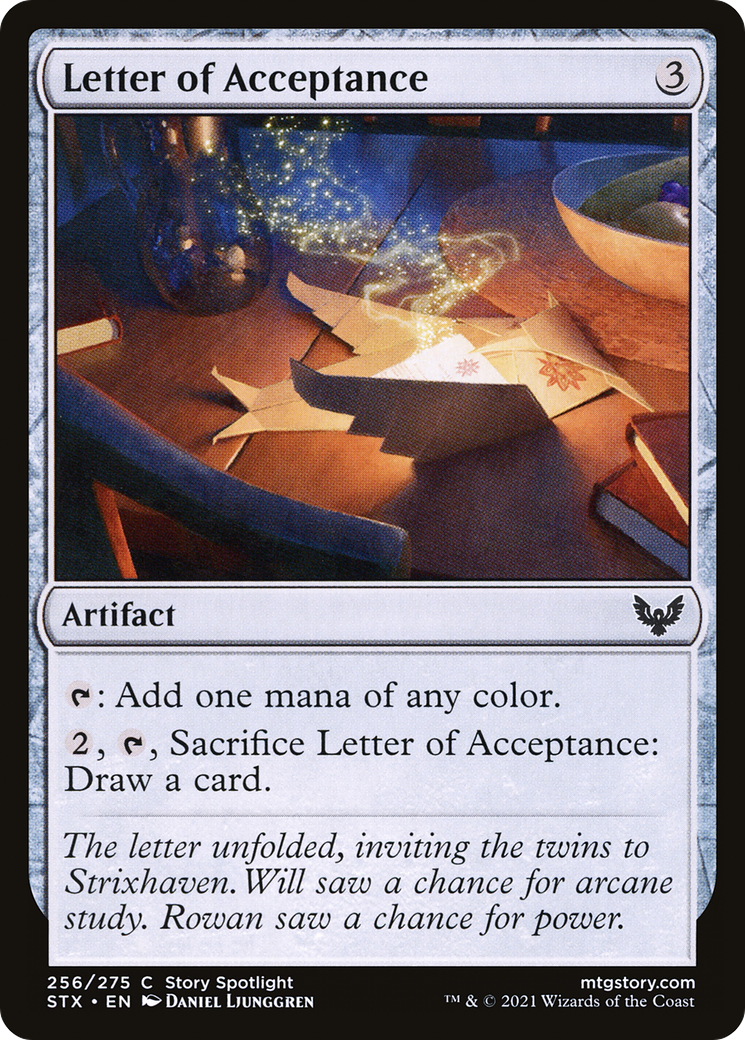
Letter of Acceptance
Letter of Acceptance
Artifact
: Add one mana of any color.
, , Sacrifice this artifact: Draw a card.
-
1
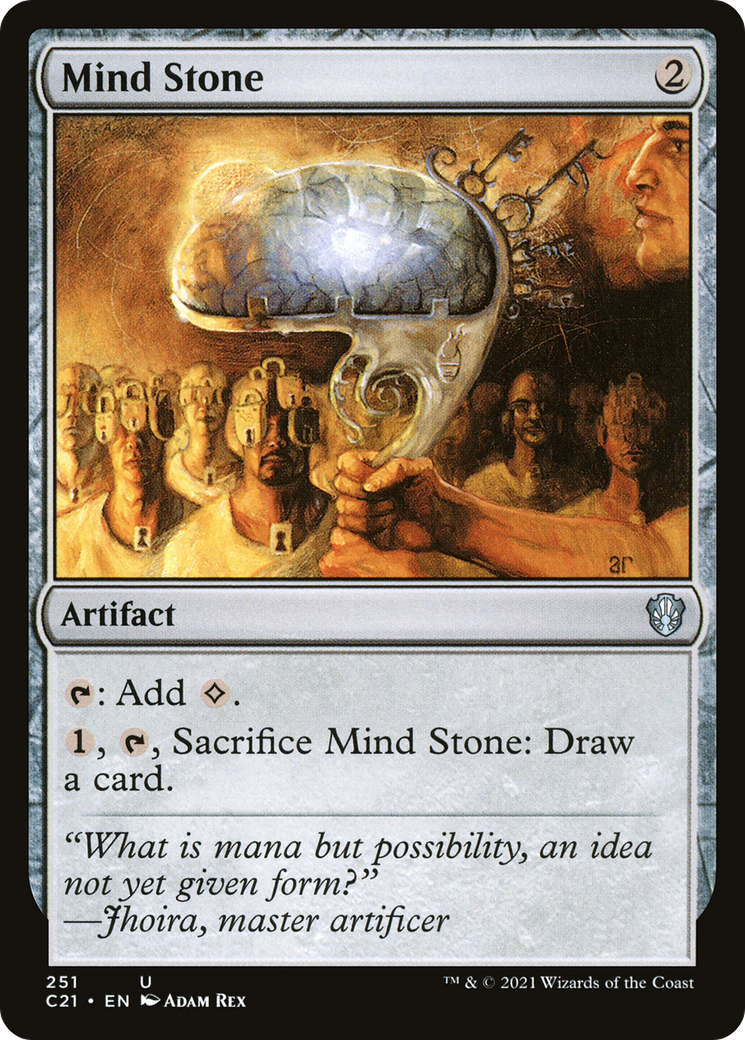
Mind Stone
Mind Stone
Artifact
: Add .
, , Sacrifice this artifact: Draw a card.
-
1
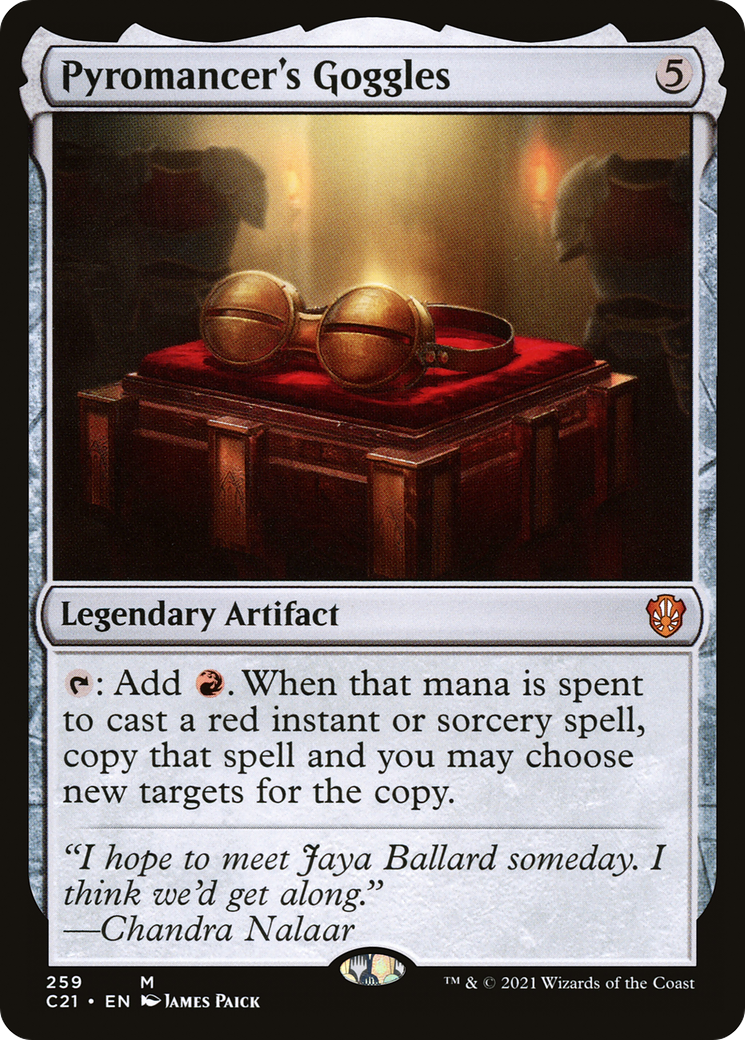
Pyromancer's Goggles
Pyromancer's Goggles
Legendary Artifact
: Add . When that mana is spent to cast a red instant or sorcery spell, copy that spell and you may choose new targets for the copy.
- The mana produced by Pyromancer's Goggles can be spent on anything, not just a red instant or sorcery spell.
- Any red instant or sorcery spell you spend the mana on will be copied, not just one that requires targets.
- The delayed triggered ability will trigger whether Pyromancer's Goggles is still on the battlefield or not.
- If more than one red mana produced by a Pyromancer's Goggles is spent to cast a single red instant or sorcery spell, the delayed triggered ability associated with each mana spent will trigger. That many copies will be created. It doesn't matter if this red mana was produced by one Pyromancer's Goggles or by multiple Pyromancer's Goggles.
- A copy is created even if the spell cast with the red mana produced by Pyromancer's Goggles has been countered or otherwise left the stack without resolving by the time that ability resolves. The copy resolves before the original spell.
- The copy is created on the stack, so it's not "cast." Abilities that trigger when a player casts a spell won't trigger.
- The copy will have the same targets as the spell it's copying unless you choose new ones. You may change any number of the targets, including all of them or none of them. The new targets must be legal.
- If the copied spell is modal (that is, it says "Choose one –" or the like), the copy will have the same mode or modes. You can't choose a different one.
- If the copied spell has an X whose value was determined as it was cast, the copy has the same value of X.
- You can't choose to pay any additional costs for the copy. However, effects based on any additional costs that were paid for the original spell are copied as though those same costs were paid for the copy too.
-
1
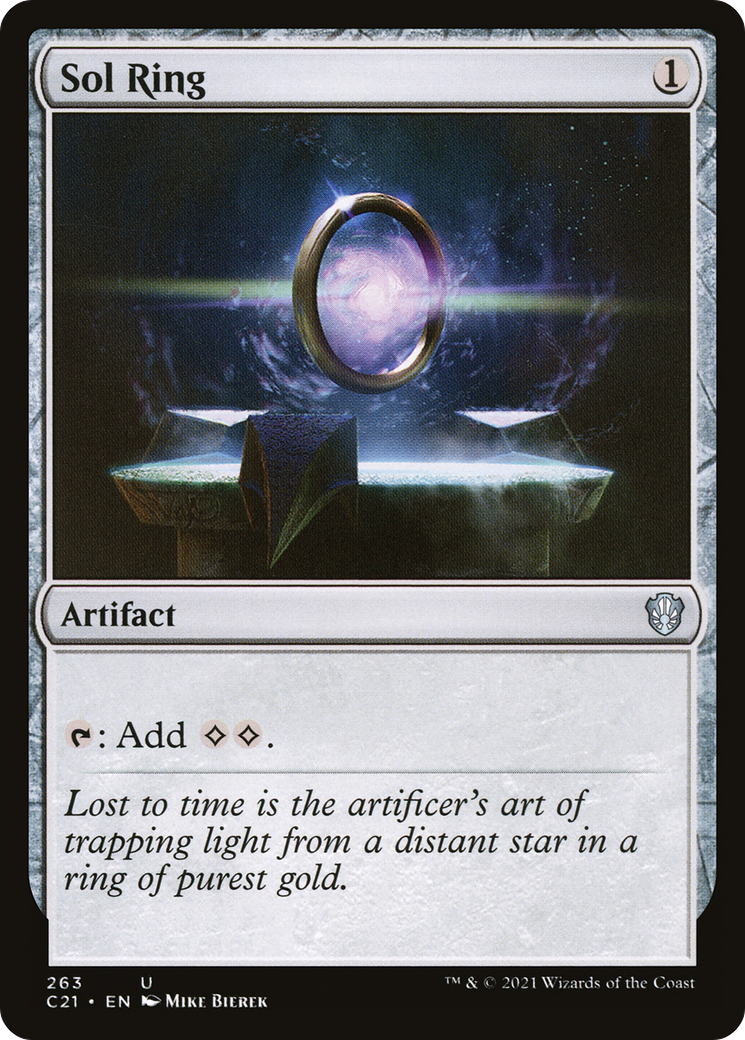
Sol Ring
Sol Ring
Artifact
: Add .
-
1
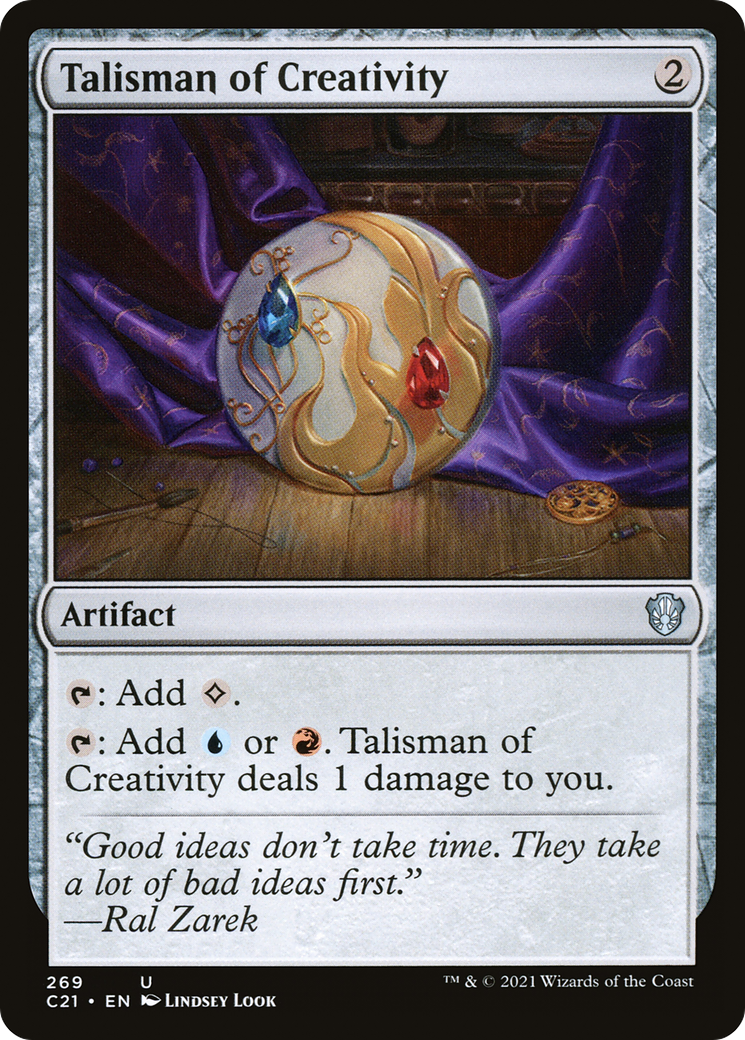
Talisman of Creativity
Talisman of Creativity
Artifact
: Add .
: Add or . This artifact deals 1 damage to you.
Enchantments 3
-
1
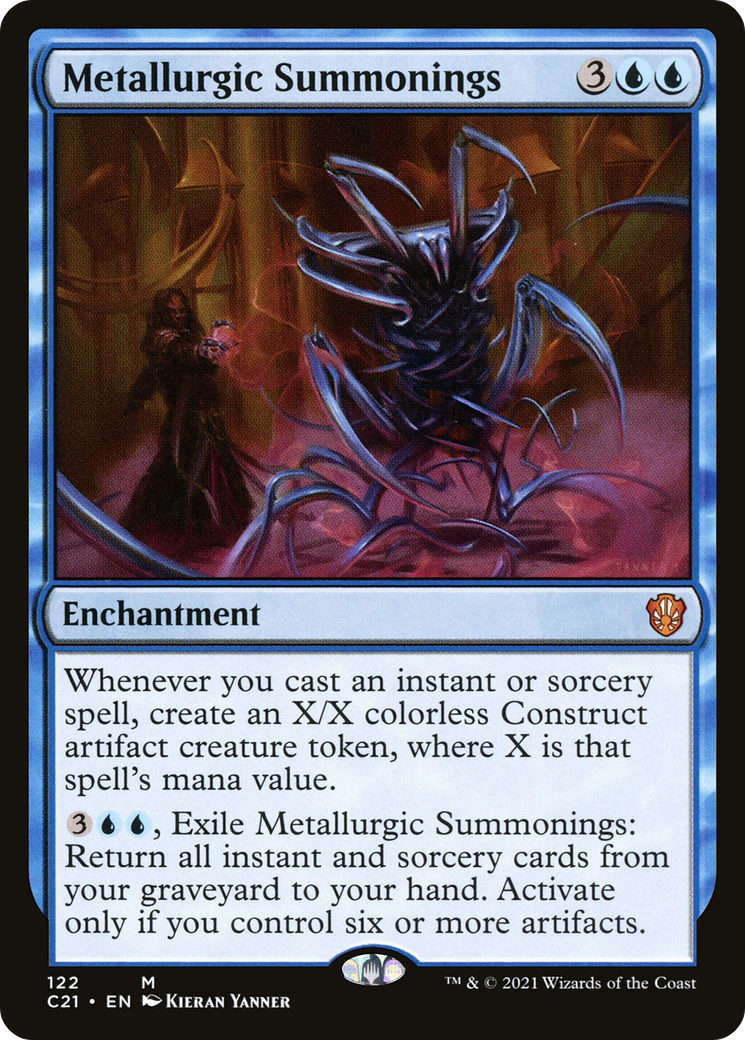
Metallurgic Summonings
Metallurgic Summonings
Enchantment
Whenever you cast an instant or sorcery spell, create an X/X colorless Construct artifact creature token, where X is that spell's mana value.
, Exile this enchantment: Return all instant and sorcery cards from your graveyard to your hand. Activate only if you control six or more artifacts.
- For a spell with in its mana cost, use the value chosen for X to determine its mana value. For example, Clash of Wills is an instant spell with mana cost . If you chose 2 as the value of X, then Clash of Wills has mana value 3, and Metallurgic Summonings's ability will create a 3/3 token.
- Metallurgic Summonings's first ability resolves before the spell that caused it to trigger.
- If Metallurgic Summonings's first ability resolves and the spell that caused it to trigger has been countered, use that spell's mana value as it last existed on the stack to determine the value of X.
- The number of artifacts you control is checked only as you activate Metallurgic Summonings's last ability. It's not checked again as it resolves.
-
1
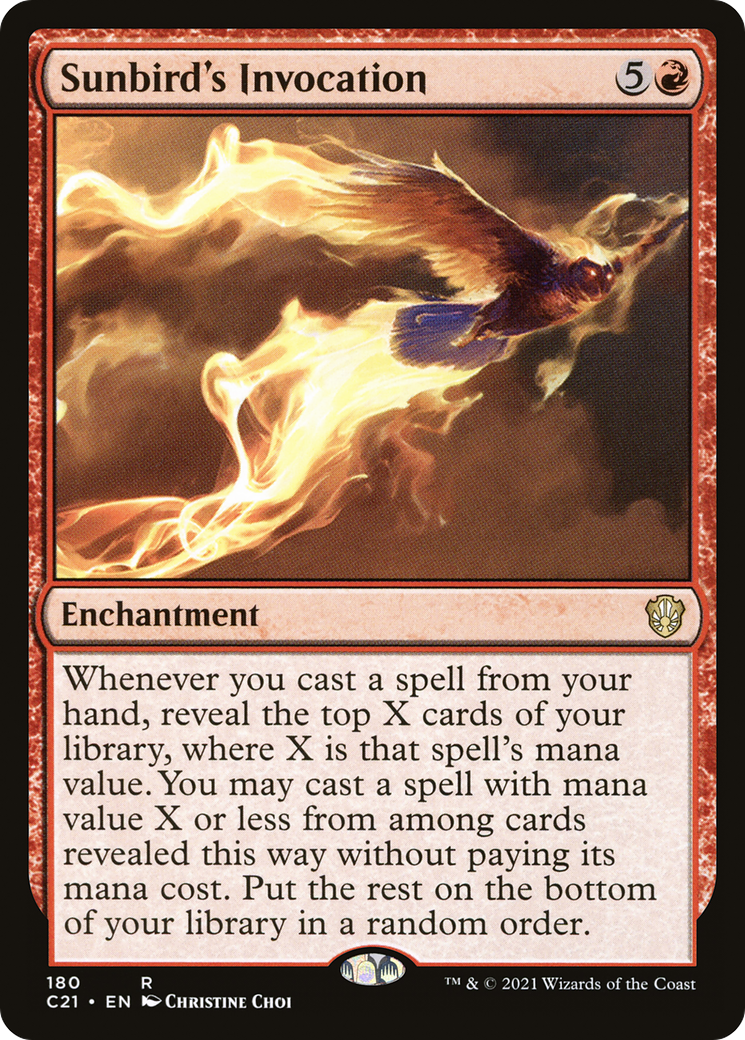
Sunbird's Invocation
Sunbird's Invocation
Enchantment
Whenever you cast a spell from your hand, reveal the top X cards of your library, where X is that spell's mana value. You may cast a spell with mana value X or less from among cards revealed this way without paying its mana cost. Put the rest on the bottom of your library in a random order.
- If a revealed card in your library has in its mana cost, you must choose 0 as the value of X when casting it without paying its mana cost.
- For spells with in their mana costs, use the value chosen for X to determine the spell's mana value.
- If the spell's mana value is 0, you do nothing as the ability of Sunbird's Invocation resolves.
- Casting Sunbird's Invocation won't cause its own ability to trigger.
- The ability of Sunbird's Invocation resolves before the spell that caused it to trigger. It will resolve even if that spell is countered. If you cast a spell as part of the resolution of the ability, that spell resolves before the spell that caused the ability to trigger.
- If you cast one of the revealed cards, you do so as part of the resolution of the triggered ability. You can't wait to cast it later in the turn. Timing permissions based on the card's type are ignored, but other restrictions (such as "Cast [this card] only during combat") are not.
- If you cast a card "without paying its mana cost," you can't pay any alternative costs. You can, however, pay additional costs. If the card has any mandatory additional costs, such as that of Costly Plunder, those must be paid to cast the card.
- The mana value of a split card, such as cards with aftermath from the Amonkhet block, is based on the combined mana cost of its two halves. The mana value of the resulting spell is based only on the half you cast.
-
1
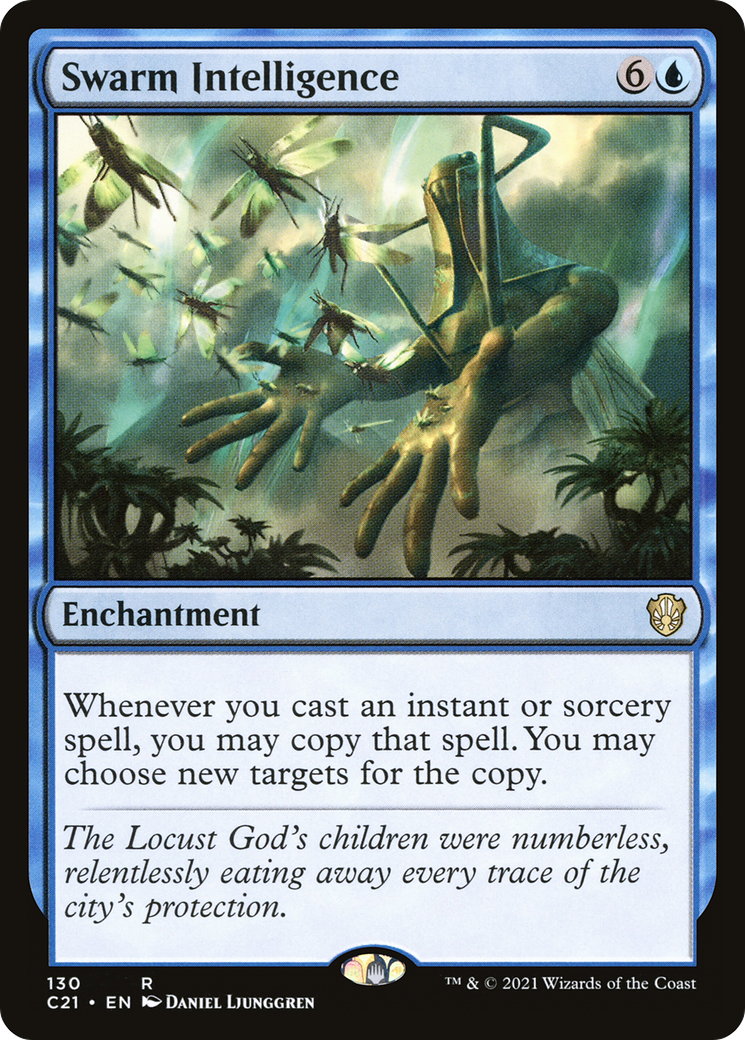
Swarm Intelligence
Swarm Intelligence
Enchantment
Whenever you cast an instant or sorcery spell, you may copy that spell. You may choose new targets for the copy.
- Swarm Intelligence can copy any instant or sorcery spell, not just one with targets.
- Swarm Intelligence can copy the spell even if it’s countered before Swarm Intelligence’s triggered ability resolves.
- The copy is created on the stack, so it’s not “cast.” Abilities that trigger when a player casts a spell (such as Swarm Intelligence’s own ability) won’t trigger.
- The copy will have the same targets as the spell it’s copying unless you choose new ones. You may change any number of the targets, including all of them or none of them. If, for one of the targets, you can’t choose a new legal target, then it remains unchanged (even if the current target is illegal).
- If the spell that’s copied is modal (that is, it says “Choose one —” or the like), the copy will have the same mode. A different mode can’t be chosen.
- If the spell that’s copied has an X whose value was determined as it was cast (like Torment of Hailfire does), the copy will have the same value of X.
- If the spell has damage divided as it was cast (like Chandra’s Pyrohelix), the division can’t be changed (although the targets receiving that damage still can).
- The controller of a copy can’t choose to pay any alternative or additional costs for the copy. However, effects based on any alternative or additional costs that were paid for the original spell are copied as though those same costs were paid for the copy.
Lands 37
-
1
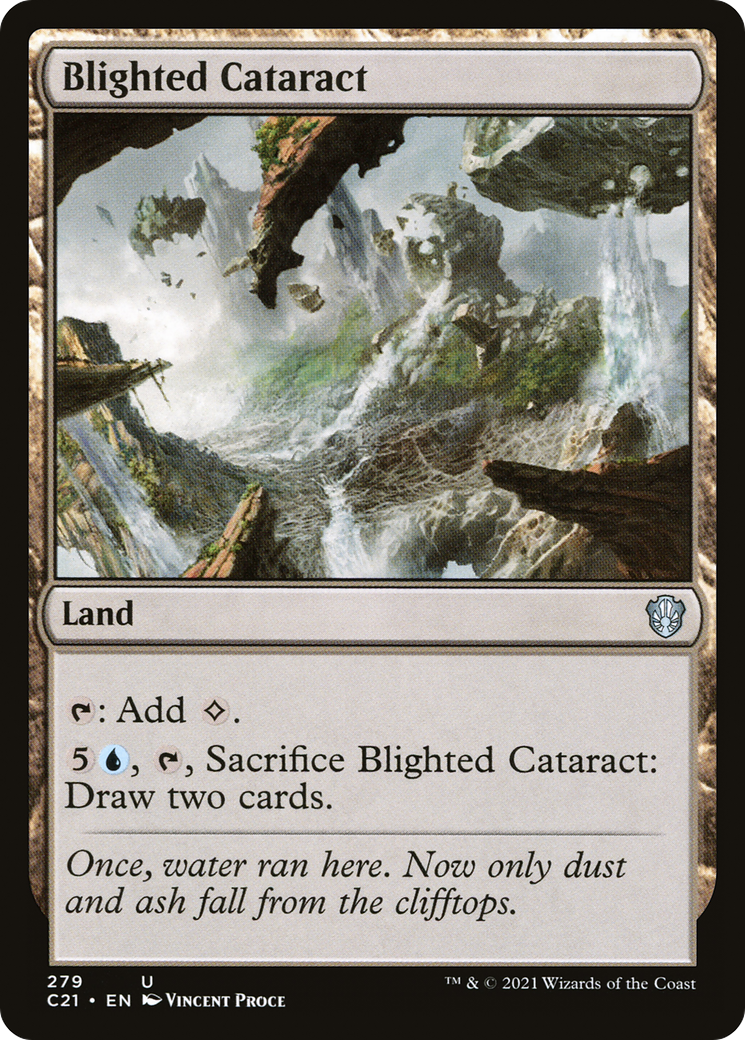
Blighted Cataract
Blighted Cataract
Land
: Add .
, , Sacrifice this land: Draw two cards.
-
1
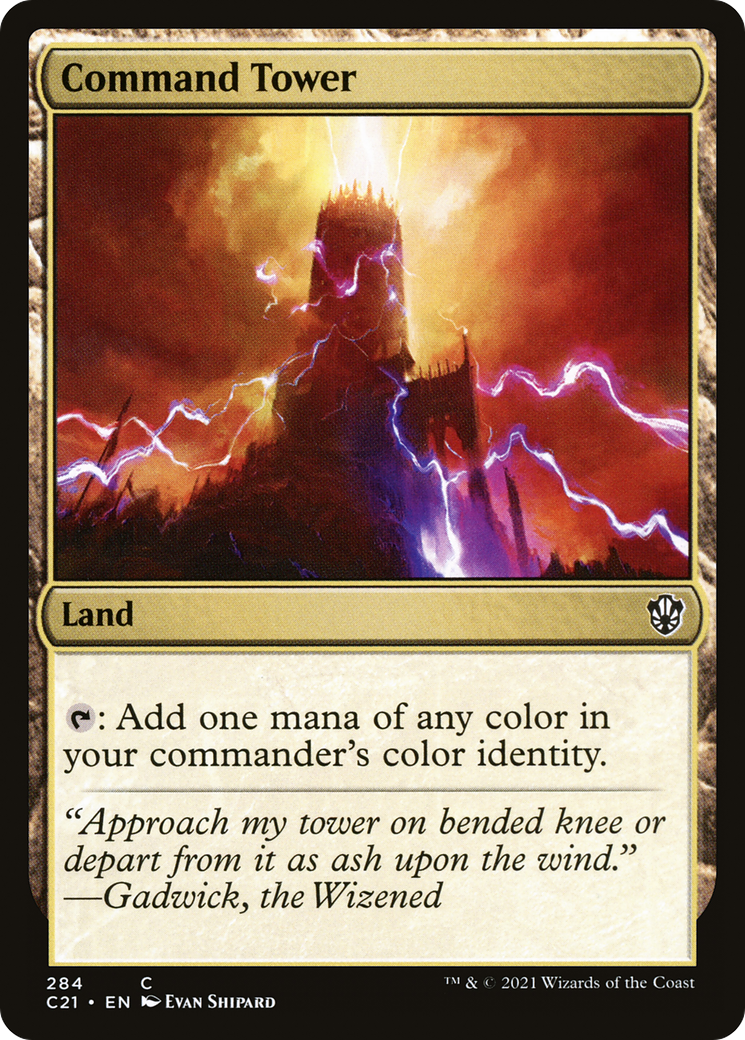
Command Tower
Command Tower
Land
: Add one mana of any color in your commander's color identity.
- If you don't have a commander, Command Tower's ability produces no mana.
- If your commander is a card that has no colors in its color identity, Command Tower's ability produces no mana. It doesn't produce .
- If you have two commanders, the ability adds one mana of any color in their combined color identities.
-
1
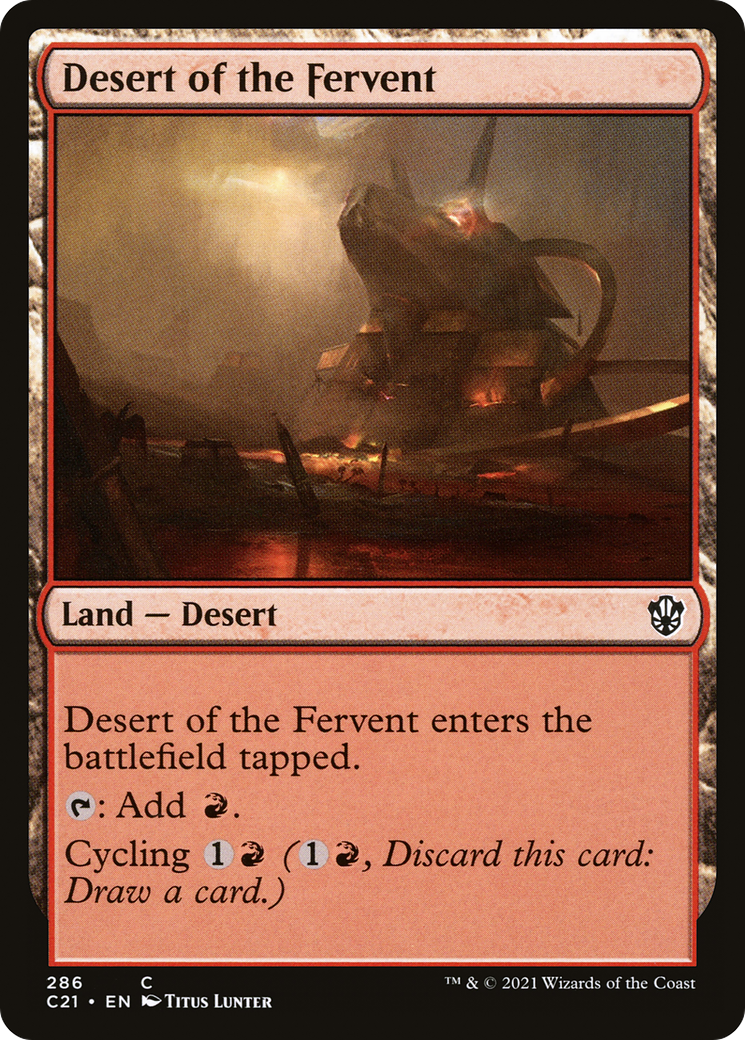
Desert of the Fervent
Desert of the Fervent
Land — Desert
This land enters tapped.
: Add .
Cycling ( , Discard this card: Draw a card.)
- Desert is a land subtype with no special meaning. It doesn't grant the land an intrinsic mana ability. Other cards may care about which lands are Deserts.
-
1
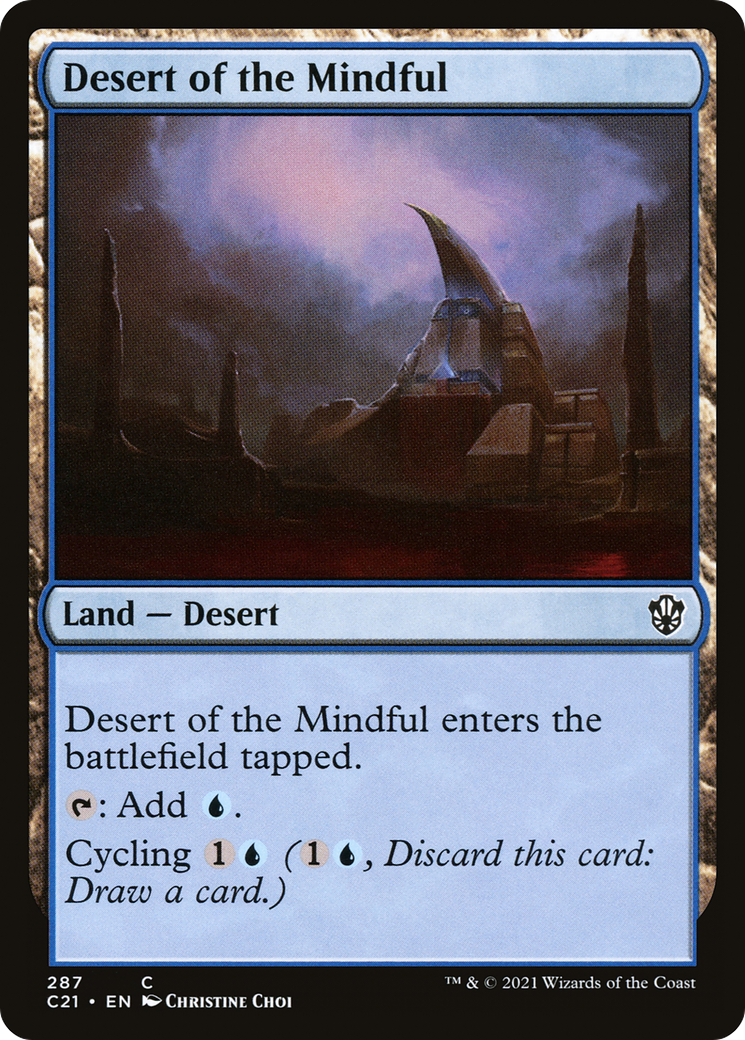
Desert of the Mindful
Desert of the Mindful
Land — Desert
This land enters tapped.
: Add .
Cycling ( , Discard this card: Draw a card.)
- Desert is a land subtype with no special meaning. It doesn’t grant the land an intrinsic mana ability. Other cards may care about which lands are Deserts.
-
1
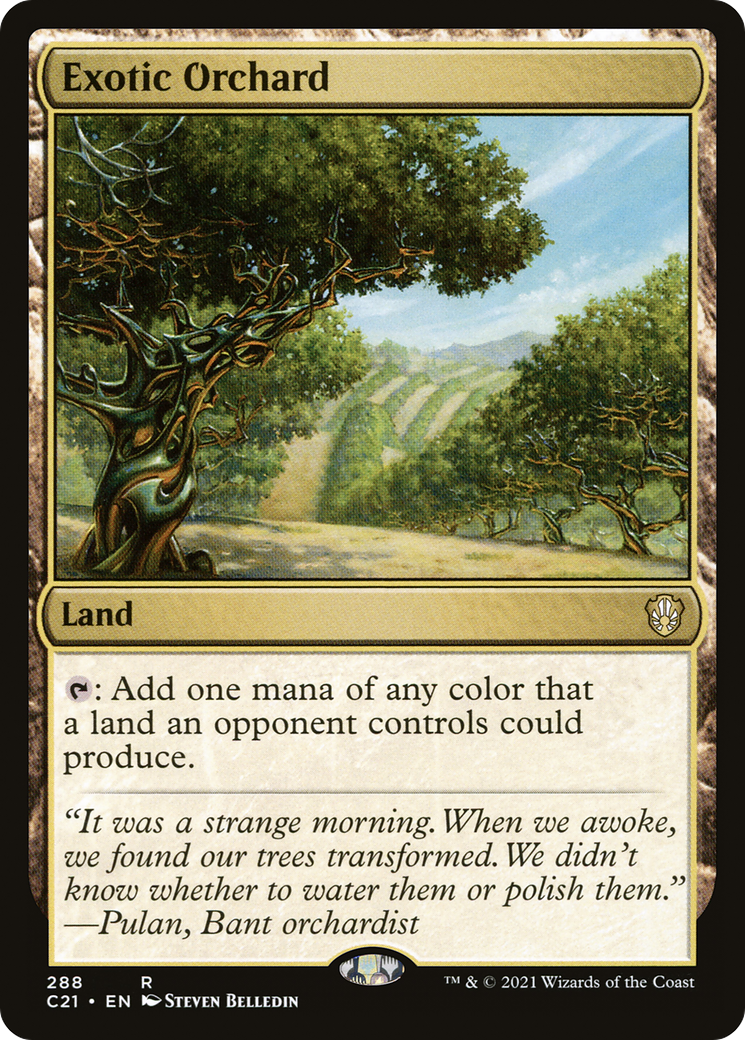
Exotic Orchard
Exotic Orchard
Land
: Add one mana of any color that a land an opponent controls could produce.
- Lands that produce mana based only on what other lands "could produce" won't help each other unless some other land allows one of them to actually produce some type of mana. For example, if you control an Exotic Orchard and your opponent controls an Exotic Orchard and a Reflecting Pool, none of those lands would produce mana if their mana abilities were activated. On the other hand, if you control a Forest and an Exotic Orchard, and your opponent controls an Exotic Orchard and a Reflecting Pool, then each of those lands can be tapped to produce . Your opponent's Exotic Orchard can produce because you control a Forest. Your Exotic Orchard and your opponent's Reflecting Pool can each produce because your opponent's Exotic Orchard can produce .
- When determining what colors of mana your opponents' lands could produce, Exotic Orchard takes into account any applicable replacement effects that would apply to those lands' mana abilities (such as Contamination's effect, for example). If there are more than one, consider them in any possible order.
- The colors of mana are white, blue, black, red, and green. Exotic Orchard can't be tapped for colorless mana, even if a land an opponent controls could produce colorless mana.
- Exotic Orchard doesn't care about any restrictions or riders your opponents' lands (such as Ancient Ziggurat or Hall of the Bandit Lord) put on the mana they produce. It just cares about colors of mana.
- Exotic Orchard checks the effects of all mana-producing abilities of lands your opponents control, but it doesn't check their costs. For example, Vivid Crag has the ability " , Remove a charge counter from Vivid Crag: Add one mana of any color." If an opponent controls Vivid Crag and you control Exotic Orchard, you can tap Exotic Orchard for any color of mana. It doesn't matter whether Vivid Crag has a charge counter on it, and it doesn't matter whether it's untapped.
-
1
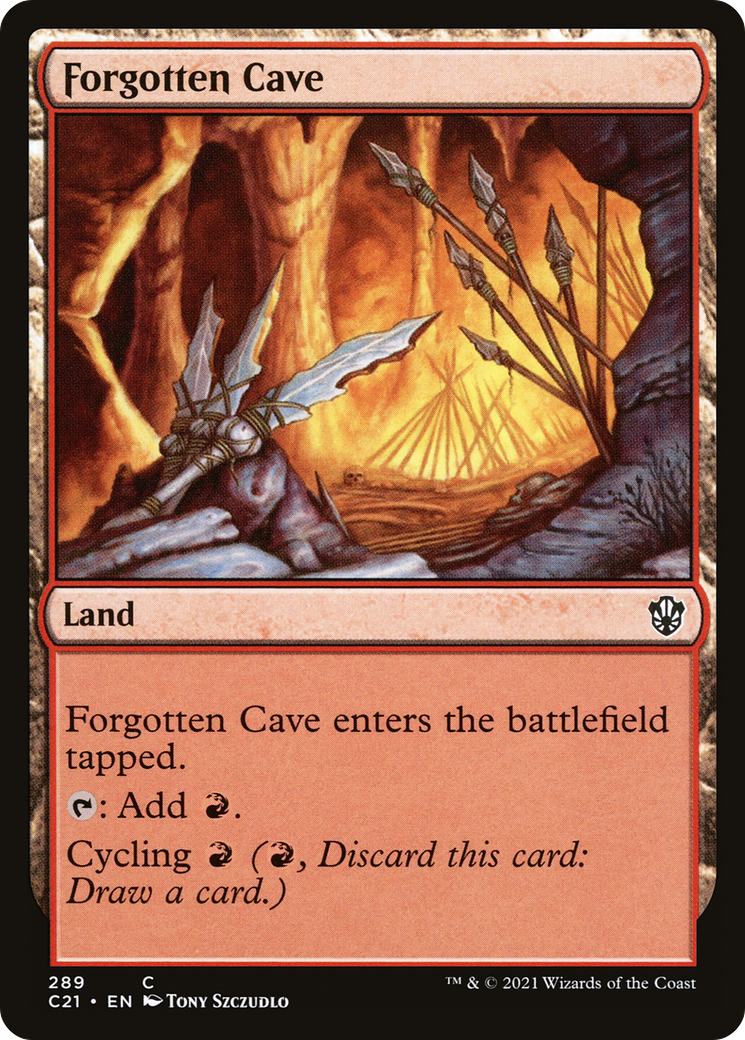
Forgotten Cave
Forgotten Cave
Land
This land enters tapped.
: Add .
Cycling ( , Discard this card: Draw a card.)
-
10
Island
Island
Basic Land — Island
( : Add .)
-
1
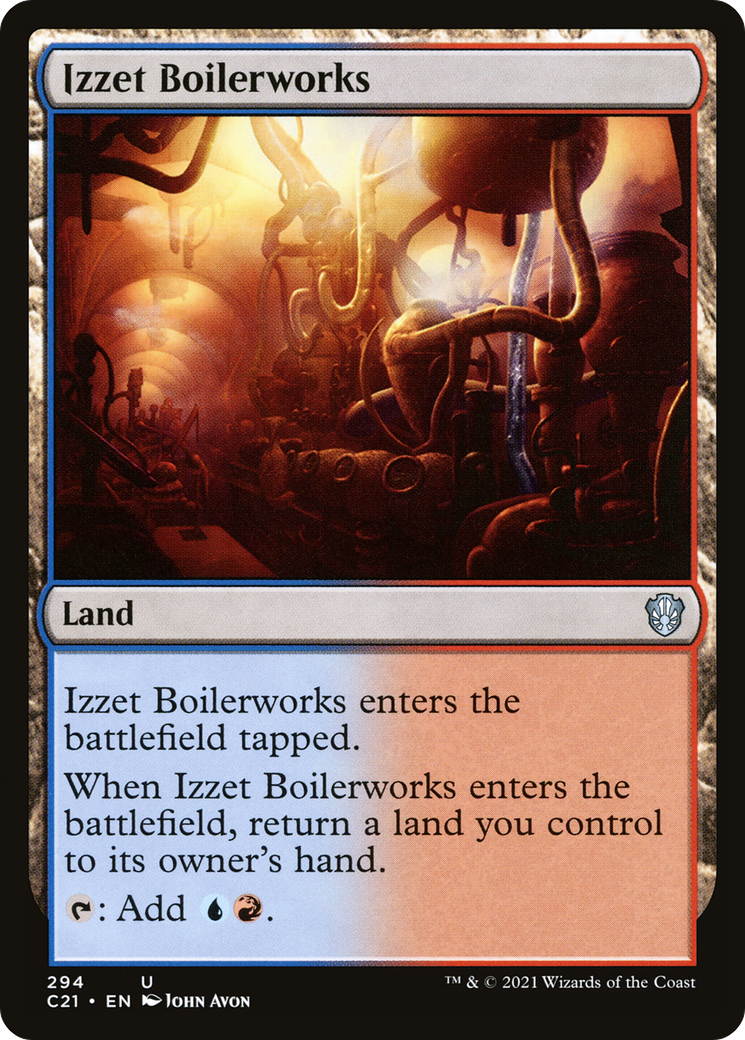
Izzet Boilerworks
Izzet Boilerworks
Land
This land enters tapped.
When this land enters, return a land you control to its owner's hand.
: Add .
- If this land enters the battlefield and you control no other lands, its ability will force you to return it to your hand.
-
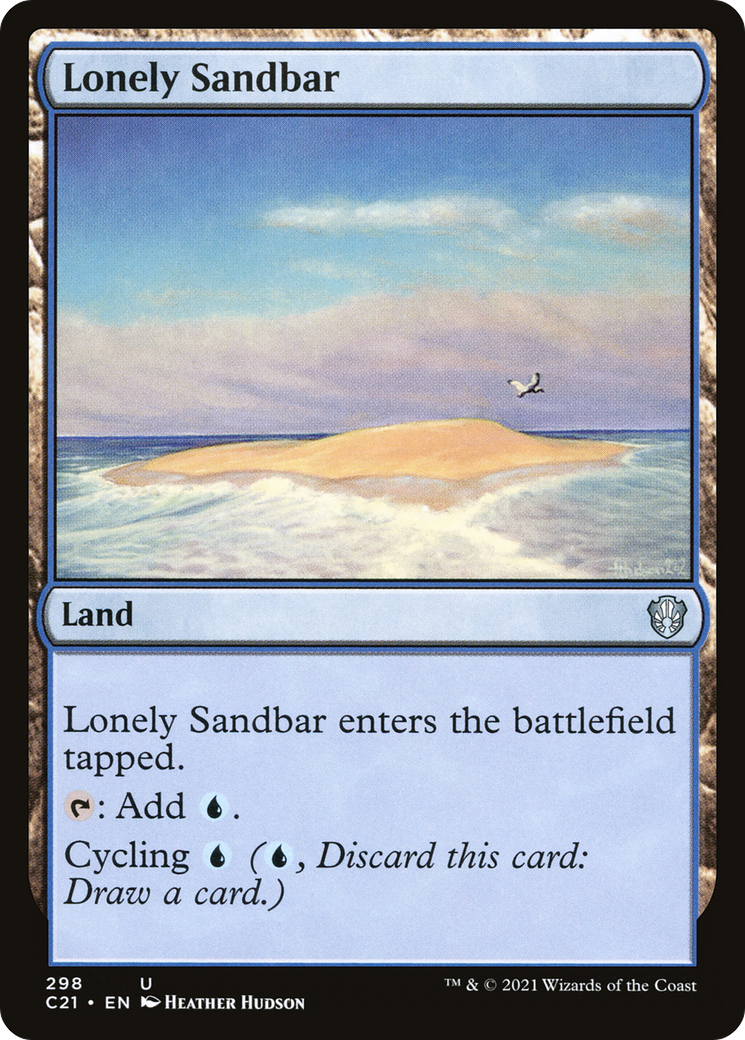
1
Lonely Sandbar
Lonely Sandbar
Land
This land enters tapped.
: Add .
Cycling ( , Discard this card: Draw a card.)
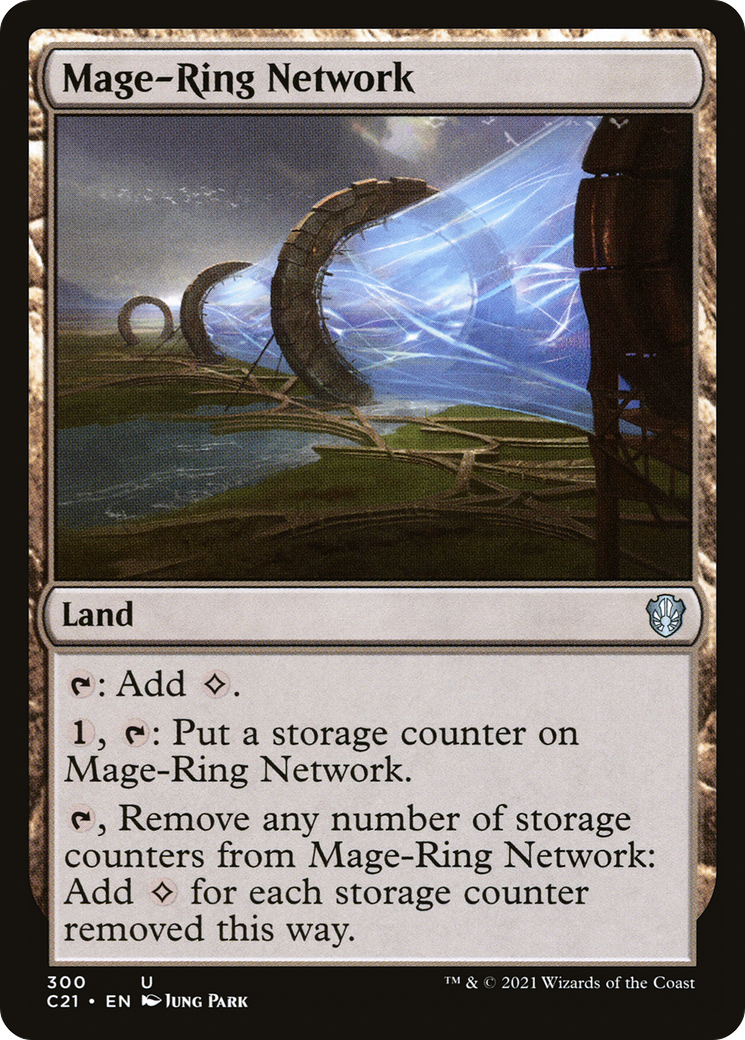
-
1
Mage-Ring Network
Mage-Ring Network
Land
: Add .
, : Put a storage counter on this land.
, Remove any number of storage counters from this land: Add for each storage counter removed this way.
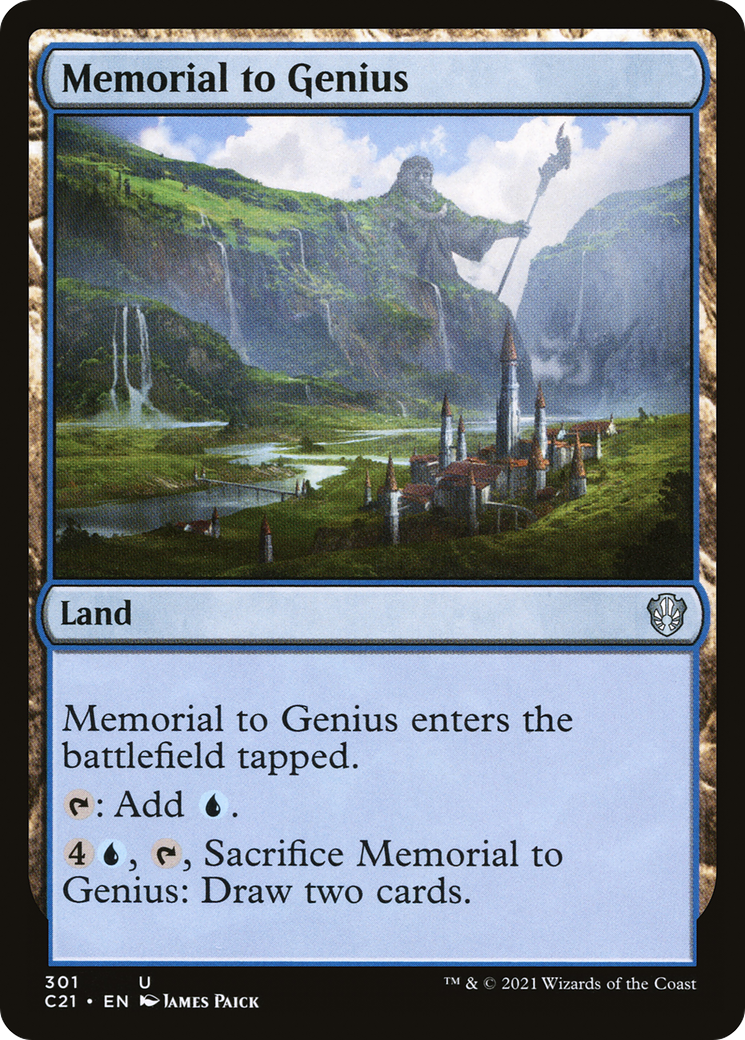
-
1
Memorial to Genius
Memorial to Genius
Land
This land enters tapped.
: Add .
, , Sacrifice this land: Draw two cards.
-
9
Mountain
Mountain
Basic Land — Mountain
( : Add .)
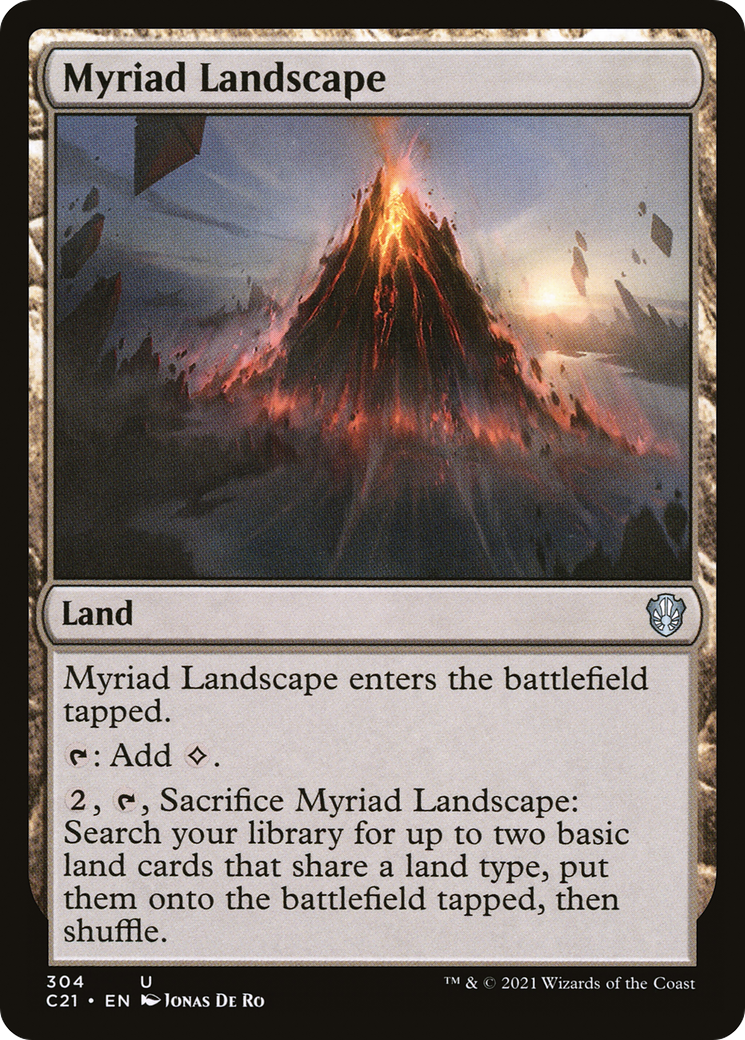
-
1
Myriad Landscape
Myriad Landscape
Land
This land enters tapped.
: Add .
, , Sacrifice this land: Search your library for up to two basic land cards that share a land type, put them onto the battlefield tapped, then shuffle.
- You can choose to find one basic land card with Myriad Landscape's last ability.
-
1
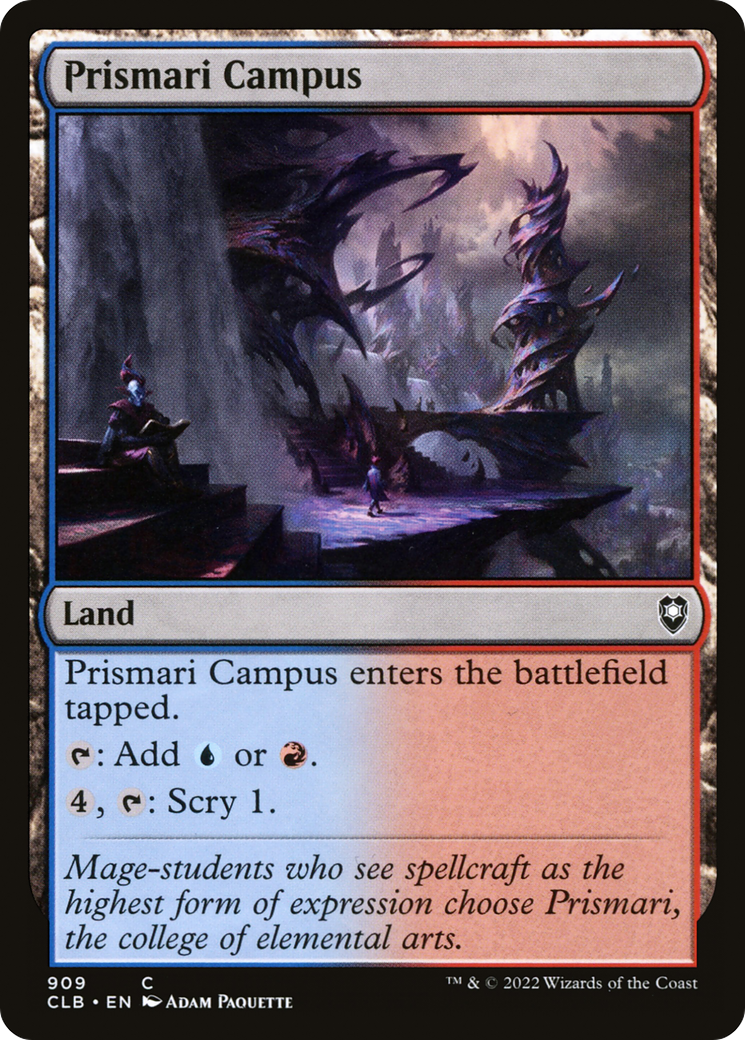
Prismari Campus
Prismari Campus
Land
This land enters tapped.
: Add or .
, : Scry 1.
-
1
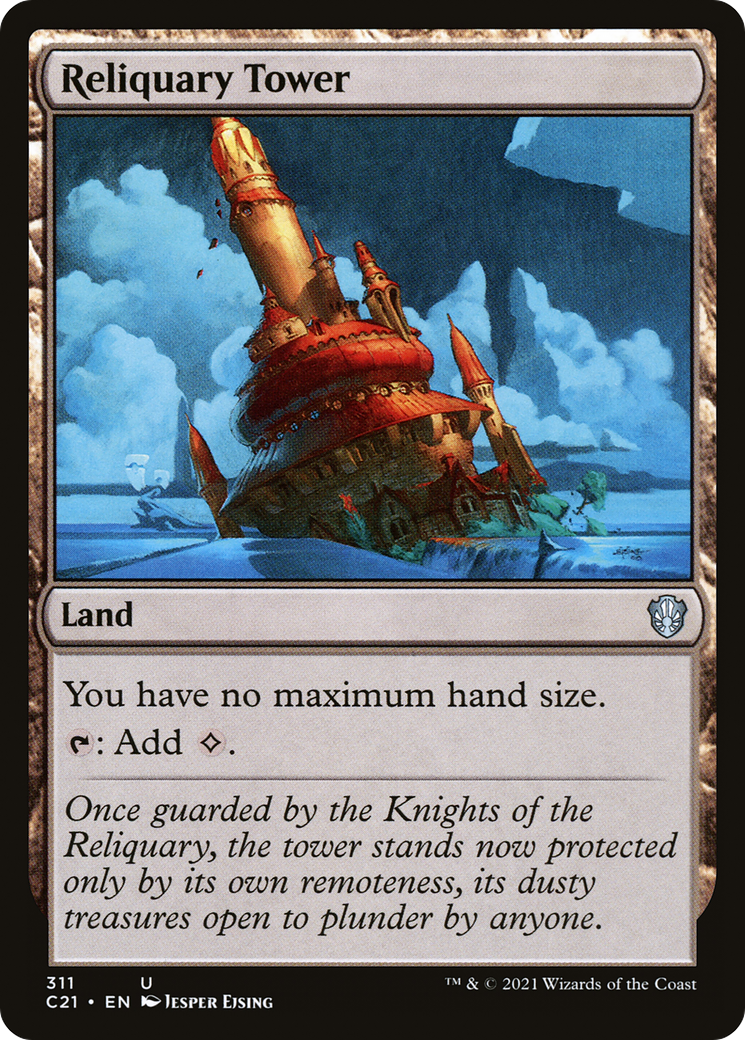
Reliquary Tower
Reliquary Tower
Land
You have no maximum hand size.
: Add .
- If multiple effects modify your hand size, apply them in timestamp order. For example, if you put Null Profusion (an enchantment that says your maximum hand size is two) onto the battlefield and then put Reliquary Tower onto the battlefield, you'll have no maximum hand size. However, if those permanents enter in the opposite order, your maximum hand size would be two.
-
1
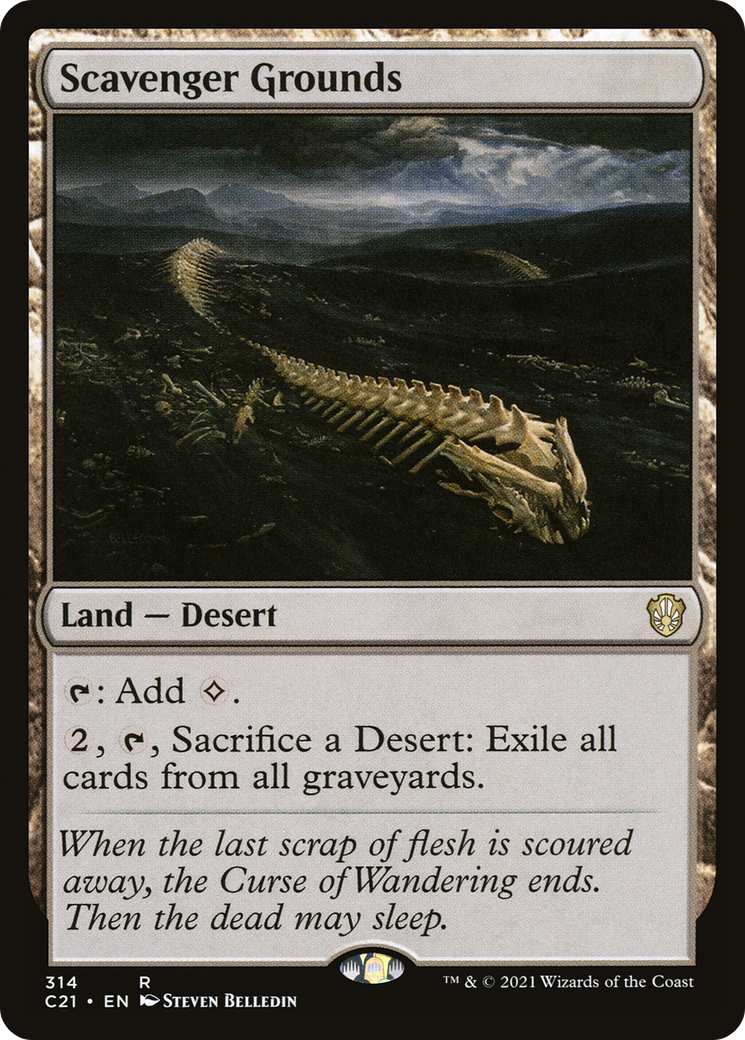
Scavenger Grounds
Scavenger Grounds
Land — Desert
: Add .
, , Sacrifice a Desert: Exile all graveyards.
- The sacrificed Desert will be in your graveyard to be exiled by the last ability of Scavenger Grounds.
-
1
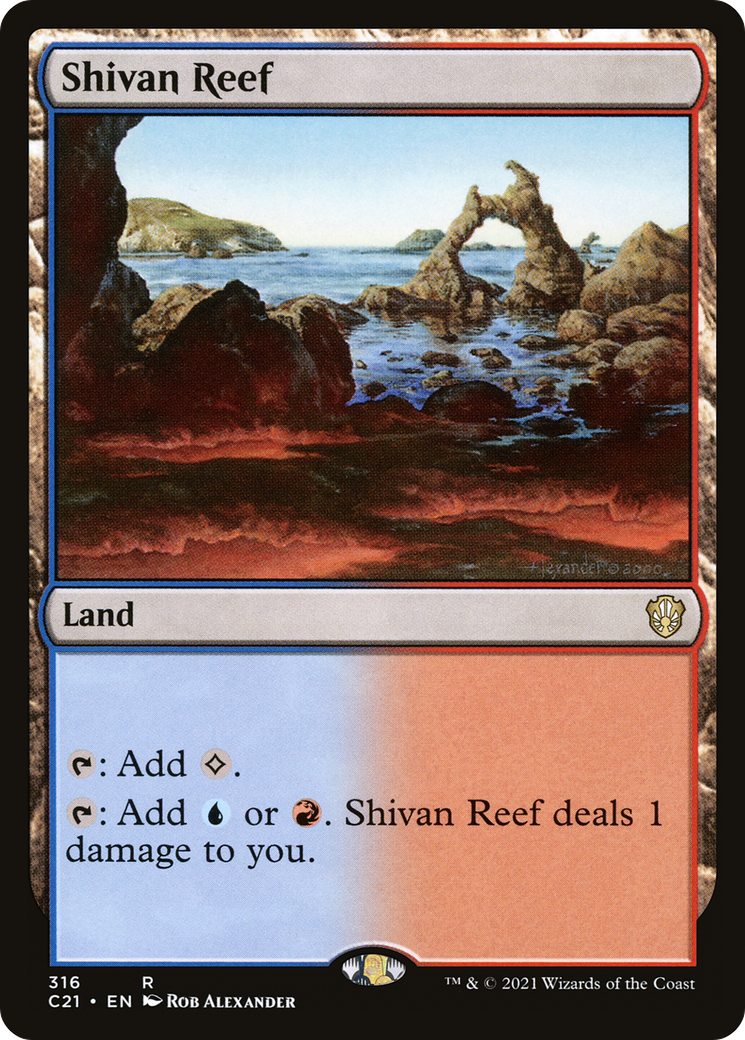
Shivan Reef
Shivan Reef
Land
: Add .
: Add or . This land deals 1 damage to you.
- The damage dealt to you is part of the second mana ability. It doesn't use the stack and can't be responded to.
- Like most lands, each land in this cycle is colorless. The damage dealt to you is dealt by a colorless source.
-
1
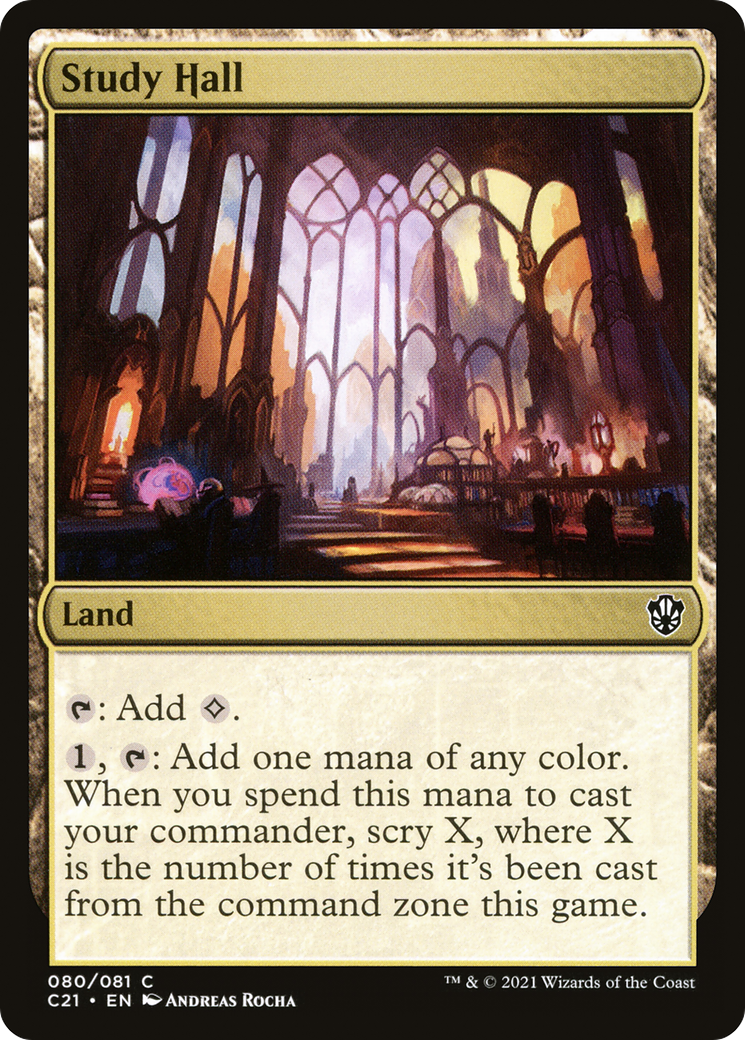
Study Hall
Study Hall
Land
: Add .
, : Add one mana of any color. When you spend this mana to cast your commander, scry X, where X is the number of times it's been cast from the command zone this game.
-
1
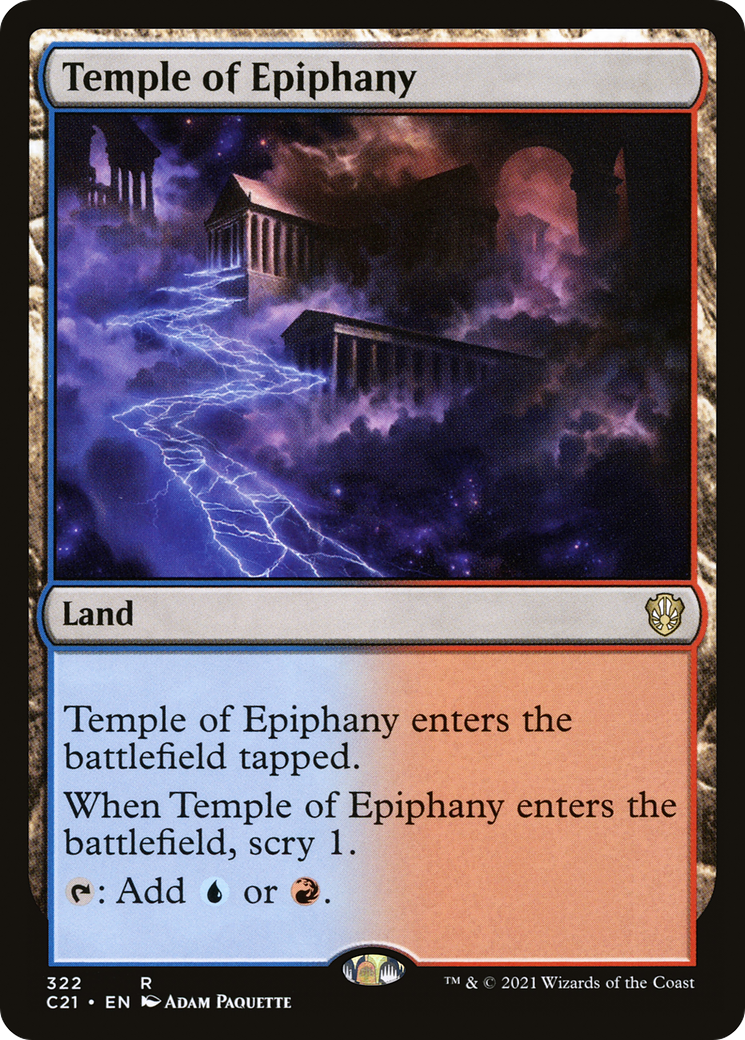
Temple of Epiphany
Temple of Epiphany
Land
This land enters tapped.
When this land enters, scry 1. (Look at the top card of your library. You may put that card on the bottom.)
: Add or .
-
1
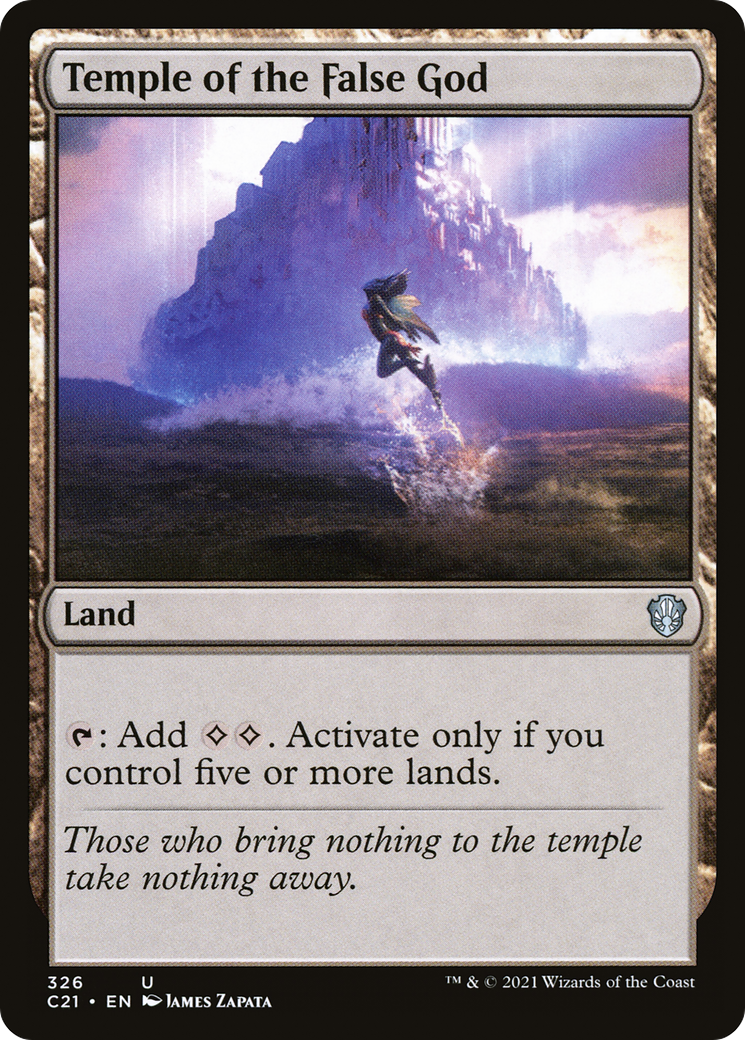
Temple of the False God
Temple of the False God
Land
: Add . Activate only if you control five or more lands.
Blue 21
-
1
Aether Gale
Aether Gale
Sorcery
Return six target nonland permanents to their owners' hands.
- You must choose six different legal targets in order to cast Aether Gale. If some, but not all, of those targets become illegal before Aether Gale resolves, the remaining legal targets will be put into their owners' hands.
-
1
Aetherspouts
Aetherspouts
Instant
For each attacking creature, its owner puts it on their choice of the top or bottom of their library.
- The owner of each attacking creature chooses whether to put it on the top or bottom of their library. The active player (the player whose turn it is) makes all of their choices first, followed by each other player in turn order.
- If an effect puts two or more cards on the top or bottom of a library at the same time, the owner of those cards may arrange them in any order. That library's owner doesn't reveal the order in which the cards go into their library.
-
1
Brainstorm
Brainstorm
Instant
Draw three cards, then put two cards from your hand on top of your library in any order.
- You draw three cards and put two cards back all while Brainstorm is resolving. Nothing can happen between the two, and no player may choose to take actions.
-
1
Dazzling Sphinx
Dazzling Sphinx
Creature — Sphinx
4/5
Flying
Whenever this creature deals combat damage to a player, that player exiles cards from the top of their library until they exile an instant or sorcery card. You may cast that card without paying its mana cost. Then that player puts the exiled cards that weren't cast this way on the bottom of their library in a random order.
- Dazzling Sphinx's triggered ability lets you cast the exiled card during the resolution of the ability. It doesn't allow you to wait and cast the card later.
- You may choose not to cast the instant or sorcery card that you exiled. In that case, it will be put on the bottom of the library with the rest of the exiled cards.
- If the exiled instant or sorcery card has an in its mana cost, you must choose 0 as the value of .
-
1
Dig Through Time
Dig Through Time
Instant
Delve (Each card you exile from your graveyard while casting this spell pays for .)
Look at the top seven cards of your library. Put two of them into your hand and the rest on the bottom of your library in any order.
- Because delve isn't an alternative cost, it can be used in conjunction with alternative costs, such as flashback. It can also be used to pay for additional costs that include generic mana.
- Delve doesn't change a spell's mana cost or mana value. For example, Treasure Cruise's mana value is 8 even if you exiled three cards to cast it.
- You can exile cards to pay only for generic mana, and you can't exile more cards than the generic mana requirement of a spell with delve. For example, you can't exile more than seven cards from your graveyard to cast Treasure Cruise unless an effect has increased its cost.
-
1
Diluvian Primordial
Diluvian Primordial
Creature — Avatar
5/5
Flying
When this creature enters, for each opponent, you may cast up to one target instant or sorcery card from that player's graveyard without paying its mana cost. If a spell cast this way would be put into a graveyard, exile it instead.
- You can choose a number of targets up to the number of opponents you have, one target per opponent.
- You cast the cards one at a time, choosing modes, targets and so on. The last card you cast will be the first one to resolve.
- When casting an instant or sorcery card this way, ignore timing restrictions based on the card's type. Other timing restrictions, such as "Cast [this card] only during combat," must be followed.
- If you can't cast one of the target instant or sorcery cards, perhaps because there are no legal targets available, or if you choose not to cast one, it will remain in its owner's graveyard.
- If you cast a card "without paying its mana cost," you can't pay alternative costs such as overload costs. You can pay additional costs such as kicker costs. If the card has mandatory additional costs, you must pay those.
- If a card has in its mana cost, you must choose 0 as its value.
- If an instant or sorcery card you cast this way is countered, it will still be exiled.
- If you cast an instant or sorcery spell with cipher this way, you may exile the card encoded on a creature you control. If you can't, or if you choose not to, the card will end up exiled but not encoded on a creature.
- If an instant or sorcery card you cast this way goes to a zone other than exile or a graveyard, perhaps because one of its abilities says to put it into its owner's hand, it won't be exiled. This is true even if the card would be put into a graveyard later that turn.
-
1
Inspiring Refrain
Inspiring Refrain
Sorcery
Draw two cards. Exile Inspiring Refrain with three time counters on it.
Suspend 3— (Rather than cast this card from your hand, you may pay and exile it with three time counters on it. At the beginning of your upkeep, remove a time counter. When the last is removed, you may cast it without paying its mana cost.)
- Suspend is a keyword that represents three abilities. The first is a static ability that allows you to exile the card from your hand with the specified number of time counters (the number before the dash) on it by paying its suspend cost (listed after the dash). The second is a triggered ability that removes a time counter from the suspended card at the beginning of each of your upkeeps. The third is a triggered ability that gives you the option to cast the card when the last time counter is removed.
- You can exile a card in your hand using suspend any time you could cast that card. Consider its card type, any effects that modify when you could cast it (such as flash) and any other effects that stop you from casting it (such as from Meddling Mage's ability) to determine if and when you can do this. Whether you could actually complete all steps in casting the card is irrelevant. For example, you can exile a card with suspend that has no mana cost or that requires a target even if no legal targets are available at that time.
- Cards exiled with suspend are exiled face up.
- Exiling a card with suspend isn't casting that card. This action doesn't use the stack and can't be responded to.
- If the spell requires any targets, those targets are chosen when the spell is finally cast, not when it's exiled.
- If an effect refers to a "suspended card," that means a card that (1) has suspend, (2) is in exile, and (3) has one or more time counters on it.
- If the first triggered ability of suspend (the one that removes time counters) is countered, no time counter is removed. The ability will trigger again at the beginning of the card's owner's next upkeep.
- When the last time counter is removed, the second triggered ability of suspend (the one that lets you cast the card) triggers. It doesn't matter why the last time counter was removed or what effect removed it.
- If the second triggered ability is countered, the card can't be cast. It remains exiled with no time counters on it, and it's no longer suspended.
- Due to a recent rules change to suspend, you are no longer required to cast the suspended card as the second triggered ability of suspend resolves. Instead, as the second triggered ability resolves, you may cast the card. Timing permissions based on the card's type are ignored. If you don't cast the card, it remains exiled with no time counters on it, and it's no longer suspended.
- If you cast a card "without paying its mana cost," such as with suspend, you can't choose to cast it for any alternative costs. You can, however, pay additional costs. If the card has any mandatory additional costs, you must pay those if you want to cast the card.
- If the card has in its mana cost, you must choose 0 as the value of X when casting it without paying its mana cost.
- The mana value of a spell cast without paying its mana cost is determined by its mana cost, even though that cost wasn't paid.
-
1
Living Lore
Living Lore
Creature — Avatar
*/*
As this creature enters, exile an instant or sorcery card from your graveyard.
Living Lore's power and toughness are each equal to the exiled card's mana value.
Whenever this creature deals combat damage, you may sacrifice it. If you do, you may cast the exiled card without paying its mana cost.
- If there are no instant or sorcery cards in your graveyard as Living Lore enters the battlefield, it will enter the battlefield as a 0/0 creature and be put into its owner's graveyard due to having 0 toughness.
- If an instant or sorcery spell puts Living Lore onto the battlefield, that spell is still on the stack while you choose a card to exile. You can't exile it with Living Lore.
- If Living Lore leaves the battlefield, the ability that defines its power and toughness will lose track of the exiled card. Its power and toughness are 0 in other zones.
- Similarly, if the exiled card somehow leaves exile while Living Lore is on the battlefield, it will become a 0/0 creature.
- Living Lore's last ability will trigger whenever it deals combat damage, no matter if that damage is dealt to an opponent, an opposing planeswalker, or a creature it's blocking or being blocked by. You choose whether to sacrifice Living Lore as that ability resolves. If Living Lore has already left the battlefield, perhaps because it was dealt lethal damage at the same time it dealt damage, you can't sacrifice it.
- You may cast a sorcery this way even if it's not your turn.
- If you cast a spell "without paying its mana cost," you can't choose to cast it for any alternative costs. You can, however, pay additional costs, such as kicker costs. If the card has any mandatory additional costs, such as that of Tormenting Voice, those must be paid to cast the card.
- If a spell has in its mana cost, you must choose 0 as the value of X when casting it without paying its mana cost.
-
1
Metallurgic Summonings
Metallurgic Summonings
Enchantment
Whenever you cast an instant or sorcery spell, create an X/X colorless Construct artifact creature token, where X is that spell's mana value.
, Exile this enchantment: Return all instant and sorcery cards from your graveyard to your hand. Activate only if you control six or more artifacts.
- For a spell with in its mana cost, use the value chosen for X to determine its mana value. For example, Clash of Wills is an instant spell with mana cost . If you chose 2 as the value of X, then Clash of Wills has mana value 3, and Metallurgic Summonings's ability will create a 3/3 token.
- Metallurgic Summonings's first ability resolves before the spell that caused it to trigger.
- If Metallurgic Summonings's first ability resolves and the spell that caused it to trigger has been countered, use that spell's mana value as it last existed on the stack to determine the value of X.
- The number of artifacts you control is checked only as you activate Metallurgic Summonings's last ability. It's not checked again as it resolves.
-
1
Mind's Desire
Mind's Desire
Sorcery
Shuffle your library. Then exile the top card of your library. Until end of turn, you may play that card without paying its mana cost.
Storm (When you cast this spell, copy it for each spell cast before it this turn.)
- The copies are put directly onto the stack. They aren't cast and won't be counted by other spells with storm cast later in the turn.
- Spells cast from zones other than a player's hand and spells that were countered are counted by the storm ability.
- A copy of a spell can be countered like any other spell, but it must be countered individually. Countering a spell with storm won't affect the copies.
- The triggered ability that creates the copies can itself be countered by anything that can counter a triggered ability. If it is countered, no copies will be put onto the stack.
- If the card is not played by end of turn, it remains exiled until end of game.
- The card is face-up when exiled.
-
1
Muse Vortex
Muse Vortex
Sorcery
Exile the top X cards of your library. You may cast an instant or sorcery spell with mana value X or less from among them without paying its mana cost. Then put the exiled instant and sorcery cards that weren't cast this way into your hand and the rest on the bottom of your library in a random order.
- If you cast a spell with in its cost without paying its mana cost, you must choose 0 as the value of X.
- You don’t have to cast an instant or sorcery spell this way. If you don’t, all exiled instant or sorcery cards will be put into your hand.
-
1
Naru Meha, Master Wizard
Naru Meha, Master Wizard
Legendary Creature — Human Wizard
3/3
Flash
When Naru Meha enters, copy target instant or sorcery spell you control. You may choose new targets for the copy.
Other Wizards you control get +1/+1.
- Because damage remains marked on a creature until it's removed as the turn ends, nonlethal damage dealt to a Wizard you control may become lethal if Naru leaves the battlefield during that turn.
- Naru's triggered ability can copy any instant or sorcery spell, not just one with targets.
- The copy is created on the stack, so it's not "cast." Abilities that trigger when a player casts a spell won't trigger.
- The copy will have the same targets as the spell it's copying unless you choose new ones. You may change any number of the targets, including all of them or none of them. If, for one of the targets, you can't choose a new legal target, then it remains unchanged (even if the current target is illegal).
- If the spell that's copied is modal (that is, it says "Choose one —" or the like), the copy will have the same mode. A different mode can't be chosen.
- If the spell that's copied has an X whose value was determined as it was cast (like Jaya's Immolating Inferno does), the copy will have the same value of X.
- If the spell has damage divided as it was cast (like Fight with Fire does when kicked), the division can't be changed (although the targets receiving that damage still can).
- The controller of a copy can't choose to pay any alternative or additional costs for the copy. However, effects based on any alternative or additional costs that were paid for the original spell are copied as though those same costs were paid for the copy.
-
1
Octavia, Living Thesis
Octavia, Living Thesis
Legendary Creature — Elemental Octopus
8/8
This spell costs less to cast if you have eight or more instant and/or sorcery cards in your graveyard.
Ward
Magecraft — Whenever you cast or copy an instant or sorcery spell, target creature has base power and toughness 8/8 until end of turn.
- Each magecraft ability has a different effect, although they all have the same trigger condition, whenever you cast or copy an instant or sorcery spell.
- For example, if you control Archmage Emeritus and cast an instant or sorcery spell, Archmage Emeritus's magecraft ability will trigger and you will draw a card.
- If an effect creates a copy of an instant or sorcery spell, this will also cause the magecraft ability to trigger.
- If an effect creates multiple copies of an instant or sorcery spell, magecraft abilities trigger once for each copy created by the effect.
- Some effects instruct you to copy an instant or sorcery card in a zone other than the stack. These copies do not cause magecraft abilities to trigger. However, most effects that do this also allow you to cast the copy, and casting the copy will cause magecraft abilities to trigger.
- If a player casts a spell that targets multiple permanents their opponent controls with ward, each of those ward abilities will trigger. If that player doesn't pay for all of them, the spell will be countered.
-
1
Ponder
Ponder
Sorcery
Look at the top three cards of your library, then put them back in any order. You may shuffle.
Draw a card.
- If you choose to shuffle your library, that includes the three cards you just looked at and put back on top of it.
-
1
Resculpt
Resculpt
Instant
Exile target artifact or creature. Its controller creates a 4/4 blue and red Elemental creature token.
-
1
Serum Visions
Serum Visions
Sorcery
Draw a card. Scry 2.
-
1
Sly Instigator
Sly Instigator
Creature — Human Wizard
2/4
, : Until your next turn, target creature an opponent controls can't be blocked. Goad that creature. (Until your next turn, that creature attacks each combat if able and attacks a player other than you if able.)
- If the creature doesn't meet any of the above exceptions and can attack, it must attack a player other than the controller of the spell or ability that goaded it if able. If the creature can't attack any of those players but could otherwise attack, it must attack a planeswalker an opponent controls, a battle an opponent controls, or a player who goaded it.
- Attacking with a goaded creature doesn't cause it to stop being goaded. If there is an additional combat phase that turn, or if another player gains control of it before it stops being goaded, it must attack again if able.
- If a creature you control has been goaded by multiple opponents, it must attack one of your opponents that hasn't goaded it, as that fulfills the maximum number of goad requirements. If a creature you control has been goaded by each of your opponents, the creature must attack an opponent (rather than a planeswalker or battle), but you choose which opponent it attacks.
- If, during a player's declare attackers step, a creature that player controls that's been goaded is tapped, is affected by a spell or ability that says it can't attack, or hasn't been under that player's control continuously since the turn began (and doesn't have haste), then it doesn't attack. If there's a cost associated with having a creature attack a player, its controller isn't forced to pay that cost, so it doesn't have to attack that player.
- Being goaded isn't an ability the creature has. Once it's been goaded, it must attack as detailed above even if it loses all abilities.
- If you leave the game, any creatures you've goaded remain goaded until your next turn would have begun. They don't immediately stop being goaded and don't remain goaded indefinitely.
- Once a creature an opponent controls has been legally blocked, activating Sly Instigator's ability won't change or undo that block.
-
1
Swarm Intelligence
Swarm Intelligence
Enchantment
Whenever you cast an instant or sorcery spell, you may copy that spell. You may choose new targets for the copy.
- Swarm Intelligence can copy any instant or sorcery spell, not just one with targets.
- Swarm Intelligence can copy the spell even if it’s countered before Swarm Intelligence’s triggered ability resolves.
- The copy is created on the stack, so it’s not “cast.” Abilities that trigger when a player casts a spell (such as Swarm Intelligence’s own ability) won’t trigger.
- The copy will have the same targets as the spell it’s copying unless you choose new ones. You may change any number of the targets, including all of them or none of them. If, for one of the targets, you can’t choose a new legal target, then it remains unchanged (even if the current target is illegal).
- If the spell that’s copied is modal (that is, it says “Choose one —” or the like), the copy will have the same mode. A different mode can’t be chosen.
- If the spell that’s copied has an X whose value was determined as it was cast (like Torment of Hailfire does), the copy will have the same value of X.
- If the spell has damage divided as it was cast (like Chandra’s Pyrohelix), the division can’t be changed (although the targets receiving that damage still can).
- The controller of a copy can’t choose to pay any alternative or additional costs for the copy. However, effects based on any alternative or additional costs that were paid for the original spell are copied as though those same costs were paid for the copy.
-
1
Talrand, Sky Summoner
Talrand, Sky Summoner
Legendary Creature — Merfolk Wizard
2/2
Whenever you cast an instant or sorcery spell, create a 2/2 blue Drake creature token with flying.
- An ability that triggers when a player casts a spell resolves before the spell that caused it to trigger, but after targets have been chosen for that spell. It resolves even if that spell is countered.
-
1
Traumatic Visions
Traumatic Visions
Instant
Counter target spell.
Basic landcycling ( , Discard this card: Search your library for a basic land card, reveal it, put it into your hand, then shuffle.)
- Unlike the normal cycling ability, basic landcycling doesn’t allow you to draw a card. Instead, it lets you search your library for a basic land card. You don’t choose the type of basic land card you’ll find until you’re performing the search. After you choose a basic land card in your library, you reveal it, put it into your hand, then shuffle your library.
- Basic landcycling is a form of cycling. Any ability that triggers on a card being cycled also triggers on a card being basic landcycled. Any ability that stops a cycling ability from being activated also stops a basic landcycling ability from being activated.
- Basic landcycling is an activated ability. Effects that interact with activated abilities (such as Stifle or Rings of Brighthearth) will interact with basic landcycling. Effects that interact with spells (such as Remove Soul or Faerie Tauntings) will not.
- You can choose not to find a basic land card, even if there is one in your library.
-
1
Treasure Cruise
Treasure Cruise
Sorcery
Delve (Each card you exile from your graveyard while casting this spell pays for .)
Draw three cards.
- Delve doesn't change a spell's mana cost or mana value. For example, Treasure Cruise's mana value is 8 even if you exiled three cards to cast it.
- You can exile cards to pay only for generic mana, and you can't exile more cards than the generic mana requirement of a spell with delve. For example, you can't exile more than seven cards from your graveyard to cast Treasure Cruise unless an effect has increased its cost.
- Because delve isn't an alternative cost, it can be used in conjunction with alternative costs, such as flashback. It can also be used to pay for additional costs that include generic mana.
Red 24
-
1
Apex of Power
Apex of Power
Sorcery
Exile the top seven cards of your library. Until end of turn, you may cast spells from among them.
If this spell was cast from your hand, add ten mana of any one color.
- Apex of Power doesn't change when you can cast the exiled cards. For example, if you exile a sorcery card, you can cast it only during your main phase when the stack is empty.
- Casting an exiled card causes it to leave exile. You can't cast it multiple times.
- Any cards not cast, including land cards, remain in exile.
- If an effect copies Apex of Power, the copy wasn't cast at all, so you won't add ten mana.
-
1
Blasphemous Act
Blasphemous Act
Sorcery
This spell costs less to cast for each creature on the battlefield.
Blasphemous Act deals 13 damage to each creature.
- Although players may respond to Blasphemous Act once it's been cast, once it's announced, they can't respond before the cost is calculated and paid.
- Blasphemous Act's ability can't reduce the total cost to cast the spell below .
- The total cost to cast Blasphemous Act is locked in before you pay that cost. For example, if there are three creatures on the battlefield, including one you can sacrifice to add , the total cost of Blasphemous Act is . Then you can sacrifice the creature when you activate mana abilities just before paying the cost.
- To determine the total cost of a spell, start with the mana cost or alternative cost you're paying, add any cost increases, then apply any cost reductions (such as that of Blasphemous Act). The mana value of the spell is determined only by its mana cost, no matter what the total cost to cast the spell was.
-
1
Brass's Bounty
Brass's Bounty
Sorcery
For each land you control, create a Treasure token. (It's an artifact with " , Sacrifice this token: Add one mana of any color.")
-
1
Charmbreaker Devils
Charmbreaker Devils
Creature — Devil
4/4
At the beginning of your upkeep, return an instant or sorcery card at random from your graveyard to your hand.
Whenever you cast an instant or sorcery spell, this creature gets +4/+0 until end of turn.
- The instant or sorcery card returned to your hand is chosen at random as Charmbreaker Devils's first ability resolves. If any player responds to the ability, that player won't yet know what card will be returned.
- Because the first ability doesn't target the instant or sorcery card, any instants or sorceries put into your graveyard in response to that ability may be returned to your hand.
- All players get to see which card you chose at random as it's returned to your hand.
-
1
Creative Technique
Creative Technique
Sorcery
Demonstrate (When you cast this spell, you may copy it. If you do, choose an opponent to also copy it.)
Shuffle your library, then reveal cards from the top of it until you reveal a nonland card. Exile that card and put the rest on the bottom of your library in a random order. You may cast the exiled card without paying its mana cost.
- If you cast the spell and choose not to copy it, no opponent will get to copy it either.
- This means that if you cast a spell with demonstrate and both you and an opponent copy it, the opponent's copy will resolve first, then your copy will resolve, and finally the original spell will resolve.
- You choose whether to make a copy as the demonstrate ability resolves. This happens before the original spell resolves. Your copy goes on the stack above the original spell.
- If you copy a spell with demonstrate, you then immediately choose an opponent. If they copy the spell, it goes on top of the stack.
- If the spell requires targets, you choose the target of the original spell as you cast it. If you create a copy of the spell, you may choose new targets for the copy as you create that copy. Similarly, the opponent you chose to create a copy may choose new targets for that copy as it's created. In other words, your opponent will know the targets of your original spell and your copy when choosing the new targets, if any, for their copy.
-
1
Dualcaster Mage
Dualcaster Mage
Creature — Human Wizard
2/2
Flash
When this creature enters, copy target instant or sorcery spell. You may choose new targets for the copy.
- Dualcaster Mage's triggered ability can target (and copy) any instant or sorcery spell, not just one with targets. It doesn't matter who controls it.
- As Dualcaster Mage's triggered ability resolves, it creates a copy of a spell on the stack. The copy isn't cast, so abilities that trigger when a player casts a spell won't trigger.
- The copy will have the same targets as the spell it's copying unless you choose new ones. You may change any number of the targets, including all of them or none of them. If, for one of the targets, you can't choose a new legal target, then it remains unchanged (even if the current target is illegal).
- You can't choose to pay any additional costs for the copy. However, effects based on any additional or alternative costs paid for the targeted spell are copied as though those same costs were paid for the copy.
- If the spell is modal (that is, it says "Choose one —" or the like), the copy will have the same mode. You can't choose a different one.
- If the spell has an X whose value was determined as it was cast (like Earthquake does), the copy has the same value of X.
- If the copy says that it affects "you," it affects the controller of the copy, not the controller of the original spell. Similarly, if the copy says that it affects an "opponent," it affects an opponent of the copy's controller, not an opponent of the original spell's controller.
-
1
Erratic Cyclops
Erratic Cyclops
Creature — Cyclops Shaman
0/8
Trample
Whenever you cast an instant or sorcery spell, this creature gets +X/+0 until end of turn, where X is that spell's mana value.
- If a spell has in its mana cost, include the value chosen for that X when determining the mana value of that spell.
- Erratic Cyclops’s triggered ability resolves before the spell that caused it to trigger. It resolves even if that spell is countered.
-
1
Etali, Primal Storm
Etali, Primal Storm
Legendary Creature — Elder Dinosaur
6/6
Whenever Etali attacks, exile the top card of each player's library, then you may cast any number of spells from among those cards without paying their mana costs.
- If an exiled card has in its mana cost, you must choose 0 as the value of X when casting it without paying its mana cost.
- If you cast any of the exiled cards, you do so as part of the resolution of the triggered ability. You can't wait to cast them later in the turn. Timing permissions based on a card's type are ignored, and the spells resolve before blockers are declared.
- If you cast a card "without paying its mana cost," you can't pay any alternative costs. You can, however, pay additional costs. If the card has any mandatory additional costs, those must be paid to cast the card.
- If you cast more than one of the exiled cards, you choose the order in which to cast them. A spell you cast this way can be the target of a later spell you cast this way. However, permanent spells cast this way won't resolve until you're done casting spells, so the permanents they become can't be the target of spells cast this way. For example, if you exile Twincast and Lightning Strike, you can cast Lightning Strike and then cast Twincast targeting it; but if you exile a creature card and an Aura card, you can't cast that Aura targeting that creature.
- Any cards not cast, including land cards, remain in exile. They can't be cast on later turns, even if Etali attacks again.
- Because all attacking creatures are chosen at once, a creature cast this way can't attack during the same combat as Etali, even if it has haste.
- In a multiplayer game, if a player leaves the game, all cards that player owns leave as well. If you leave the game, any spells or permanents you control from Etali's ability are exiled.
-
1
Faithless Looting
Faithless Looting
Sorcery
Draw two cards, then discard two cards.
Flashback (You may cast this card from your graveyard for its flashback cost. Then exile it.)
- To determine the total cost of a spell, start with the mana cost or alternative cost (such as a flashback cost) you're paying, add any cost increases, then apply any cost reductions. The mana value of the spell is determined only by its mana cost, no matter what the total cost to cast the spell was.
- A spell cast using flashback will always be exiled afterward, whether it resolves, is countered, or leaves the stack in some other way.
- "Flashback [cost]" means "You may cast this card from your graveyard if the resulting spell is an instant or sorcery spell by paying [cost] rather than paying its mana cost" and "If the flashback cost was paid, exile this card instead of putting it anywhere else any time it would leave the stack."
- If a card with flashback is put into your graveyard during your turn, you can cast it if it's legal to do so before any other player can take any actions.
- You can cast a spell using flashback even if it was somehow put into your graveyard without having been cast.
- You must still follow any timing restrictions and permissions, including those based on the card's type. For instance, you can cast a sorcery using flashback only when you could normally cast a sorcery.
- You draw two cards and discard two cards all while Faithless Looting is resolving. Nothing can happen between the two, and no player may choose to take actions.
-
1
Fiery Encore
Fiery Encore
Sorcery
Discard a card, then draw a card. When you discard a nonland card this way, Fiery Encore deals damage equal to that card's mana value to target creature or planeswalker.
Storm (When you cast this spell, copy it for each spell cast before it this turn.)
- Each copy you create because of storm will cause your magecraft abilities to trigger.
- Each copy will resolve one at a time. As each copy resolves, if you discarded a nonland card, the reflexive triggered ability triggers and you pick a target to be dealt damage. That ability will resolve before you deal with the next copy of Fiery Encore.
- If you have no cards in hand as Fiery Encore resolves, you won’t be able to discard a card, but you will draw a card. No damage will be dealt.
-
1
Fiery Fall
Fiery Fall
Instant
Fiery Fall deals 5 damage to target creature.
Basic landcycling ( , Discard this card: Search your library for a basic land card, reveal it, put it into your hand, then shuffle.)
- Unlike the normal cycling ability, basic landcycling doesn't allow you to draw a card. Instead, it lets you search your library for a basic land card. You don't choose the type of basic land card you'll find until you're performing the search. After you choose a basic land card in your library, you reveal it, put it into your hand, then shuffle your library.
- Basic landcycling is a form of cycling. Any ability that triggers on a card being cycled also triggers on a card being basic landcycled. Any ability that stops a cycling ability from being activated also stops a basic landcycling ability from being activated.
- Basic landcycling is an activated ability. Effects that interact with activated abilities (such as Stifle or Rings of Brighthearth) will interact with basic landcycling. Effects that interact with spells (such as Remove Soul or Faerie Tauntings) will not.
- You can choose not to find a basic land card, even if there is one in your library.
-
1
Humble Defector
Humble Defector
Creature — Human Rogue
2/1
: Draw two cards. Target opponent gains control of this creature. Activate only during your turn.
- If Humble Defector isn't on the battlefield as its ability resolves, but the target player is still a legal target, the ability will resolve. You'll draw two cards, even though the player doesn't gain control of Humble Defector.
- If Humble Defector's owner leaves the game, Humble Defector humbly leaves the game along with that player.
- Humble Defector's ability can be activated any time during your turn, including in response to a spell or ability.
- If Humble Defector is controlled by a player other than its owner, and its controller leaves the game, the effect giving that player control of Humble Defector ends. Humble Defector will return to the control of the player still in the game who most recently controlled it.
-
1
Inferno Project
Inferno Project
Creature — Elemental
0/0
Trample
This creature enters with X +1/+1 counters on it, where X is the total mana value of instant and sorcery cards in your graveyard.
-
1
Jaya Ballard
Jaya Ballard
Legendary Planeswalker — Jaya
+1: Add . Spend this mana only to cast instant or sorcery spells.
+1: Discard up to three cards, then draw that many cards.
−8: You get an emblem with "You may cast instant and sorcery spells from your graveyard. If a spell cast this way would be put into your graveyard, exile it instead."
- Because it’s a loyalty ability, Jaya’s first ability isn’t a mana ability. It can be activated only any time you could cast a sorcery. It uses the stack and can be responded to.
- Mana produced by Jaya’s first ability can be spent among any number of instant and/or sorcery spells.
- You choose how many cards to discard while Jaya’s second ability is resolving. You can choose to discard zero cards this way (and then draw zero cards) if you wish.
- Jaya’s emblem doesn’t grant you permission to do anything with instant and sorcery cards in your graveyard except cast them. For example, you can’t cycle instant or sorcery cards with cycling from your graveyard.
-
1
Mana Geyser
Mana Geyser
Sorcery
Add for each tapped land your opponents control.
-
1
Radiant Performer
Radiant Performer
Creature — Human Wizard
2/2
Flash
When this creature enters, if you cast it from your hand, choose target spell or ability that targets only a single permanent or player. Copy that spell or ability for each other permanent or player the spell or ability could target. Each copy targets a different one of those permanents and players.
- You copy the spell or ability for every permanent or player it could target. That is, you don't choose either permanents or players and then make copies based on that.
- You can choose a spell or ability with multiple targets as long as all of those targets are the same permanent or player.
- You control all the copies, and you'll choose which copy targets which permanent or player. For example, if the original spell says, "Destroy target creature," you'll ultimately choose the order in which each creature targeted by a copy is destroyed. Remember that the original spell or ability will resolve after all of the copies.
- Each copy you create will cause your magecraft abilities to trigger.
-
1
Rionya, Fire Dancer
Rionya, Fire Dancer
Legendary Creature — Human Wizard
3/4
At the beginning of combat on your turn, create X tokens that are copies of another target creature you control, where X is one plus the number of instant and sorcery spells you've cast this turn. They gain haste. Exile them at the beginning of the next end step.
- If the copied creature is itself a token, the tokens created by Rionya copy the original characteristics of that token as stated by the effect that created it.
- If the copied creature has in its mana cost, X is 0.
- Any enters-the-battlefield abilities of the copied creature will trigger when the tokens enter the battlefield. Any "As [this creature] enters the battlefield" or "[This creature] enters the battlefield with" abilities of the copied creature will also work.
- The tokens copy exactly what is printed on the creature and nothing else (unless that creature is a token or is copying something else; see below). They don't copy whether that creature is tapped or untapped, whether it has any counters on it or Auras and/or Equipment attached to it, or any non-copy effects that changed its power, toughness, types, color, and so on.
- The triggered ability counts all instants and sorceries that were cast before it resolves. If you cast instant spells in response to the ability, those spells will count.
- If the copied creature is copying something else, the tokens enter the battlefield as whatever that creature is copying.
-
1
Rousing Refrain
Rousing Refrain
Sorcery
Add for each card in target opponent's hand. Until end of turn, you don't lose this mana as steps and phases end. Exile Rousing Refrain with three time counters on it.
Suspend 3— (Rather than cast this card from your hand, you may pay and exile it with three time counters on it. At the beginning of your upkeep, remove a time counter. When the last is removed, you may cast it without paying its mana cost.)
- Suspend is a keyword that represents three abilities. The first is a static ability that allows you to exile the card from your hand with the specified number of time counters (the number before the dash) on it by paying its suspend cost (listed after the dash). The second is a triggered ability that removes a time counter from the suspended card at the beginning of each of your upkeeps. The third is a triggered ability that gives you the option to cast the card when the last time counter is removed.
- Exiling a card with suspend isn't casting that card. This action doesn't use the stack and can't be responded to.
- Due to a recent rules change to suspend, you are no longer required to cast the suspended card as the second triggered ability of suspend resolves. Instead, as the second triggered ability resolves, you may cast the card. Timing permissions based on the card's type are ignored. If you don't cast the card, it remains exiled with no time counters on it, and it's no longer suspended.
- Cards exiled with suspend are exiled face up.
- If the card has in its mana cost, you must choose 0 as the value of X when casting it without paying its mana cost.
- You can exile a card in your hand using suspend any time you could cast that card. Consider its card type, any effects that modify when you could cast it (such as flash) and any other effects that stop you from casting it (such as from Meddling Mage's ability) to determine if and when you can do this. Whether you could actually complete all steps in casting the card is irrelevant. For example, you can exile a card with suspend that has no mana cost or that requires a target even if no legal targets are available at that time.
- If the spell requires any targets, those targets are chosen when the spell is finally cast, not when it's exiled.
- If the first triggered ability of suspend (the one that removes time counters) is countered, no time counter is removed. The ability will trigger again at the beginning of the card's owner's next upkeep.
- If the second triggered ability is countered, the card can't be cast. It remains exiled with no time counters on it, and it's no longer suspended.
- If an effect refers to a "suspended card," that means a card that (1) has suspend, (2) is in exile, and (3) has one or more time counters on it.
- If you cast a card "without paying its mana cost," such as with suspend, you can't choose to cast it for any alternative costs. You can, however, pay additional costs. If the card has any mandatory additional costs, you must pay those if you want to cast the card.
- When the last time counter is removed, the second triggered ability of suspend (the one that lets you cast the card) triggers. It doesn't matter why the last time counter was removed or what effect removed it.
- The mana value of a spell cast without paying its mana cost is determined by its mana cost, even though that cost wasn't paid.
-
1
Seething Song
Seething Song
Instant
Add .
-
1
Storm-Kiln Artist
Storm-Kiln Artist
Creature — Dwarf Shaman
2/2
This creature gets +1/+0 for each artifact you control.
Magecraft — Whenever you cast or copy an instant or sorcery spell, create a Treasure token.
-
1
Sunbird's Invocation
Sunbird's Invocation
Enchantment
Whenever you cast a spell from your hand, reveal the top X cards of your library, where X is that spell's mana value. You may cast a spell with mana value X or less from among cards revealed this way without paying its mana cost. Put the rest on the bottom of your library in a random order.
- If a revealed card in your library has in its mana cost, you must choose 0 as the value of X when casting it without paying its mana cost.
- For spells with in their mana costs, use the value chosen for X to determine the spell's mana value.
- If the spell's mana value is 0, you do nothing as the ability of Sunbird's Invocation resolves.
- Casting Sunbird's Invocation won't cause its own ability to trigger.
- The ability of Sunbird's Invocation resolves before the spell that caused it to trigger. It will resolve even if that spell is countered. If you cast a spell as part of the resolution of the ability, that spell resolves before the spell that caused the ability to trigger.
- If you cast one of the revealed cards, you do so as part of the resolution of the triggered ability. You can't wait to cast it later in the turn. Timing permissions based on the card's type are ignored, but other restrictions (such as "Cast [this card] only during combat") are not.
- If you cast a card "without paying its mana cost," you can't pay any alternative costs. You can, however, pay additional costs. If the card has any mandatory additional costs, such as that of Costly Plunder, those must be paid to cast the card.
- The mana value of a split card, such as cards with aftermath from the Amonkhet block, is based on the combined mana cost of its two halves. The mana value of the resulting spell is based only on the half you cast.
-
1
Surge to Victory
Surge to Victory
Sorcery
Exile target instant or sorcery card from your graveyard. Creatures you control get +X/+0 until end of turn, where X is that card's mana value. Whenever a creature you control deals combat damage to a player this turn, copy the exiled card. You may cast the copy without paying its mana cost.
- Copying the card doesn't cause magecraft abilities to trigger, although casting the copies does.
- You cast the copies while the delayed triggered ability of Surge to Victory is resolving. Ignore any timing restrictions based on the copies' card types.
- If you cast a spell "without paying its mana cost," you can't pay any alternative costs. You can, however, pay additional costs, such as kicker costs. If the card has any mandatory additional costs, you must pay those.
- If the spell you cast has in its mana cost, you must choose 0 as the value of X.
-
1
Volcanic Vision
Volcanic Vision
Sorcery
Return target instant or sorcery card from your graveyard to your hand. Volcanic Vision deals damage equal to that card's mana value to each creature your opponents control. Exile Volcanic Vision.
- If the target instant or sorcery card becomes an illegal target before Volcanic Vision resolves, the spell won’t resolve and none of its effects will happen. No damage will be dealt and Volcanic Vision won’t be exiled.
- If the target has in its mana cost, X is 0.
-
1
Wildfire Devils
Wildfire Devils
Creature — Devil
4/2
When this creature enters and at the beginning of your upkeep, choose a player at random. That player exiles an instant or sorcery card from their graveyard. Copy that card. You may cast the copy without paying its mana cost.
- You choose a player at random and they exile a card all while the triggered ability is resolving. No player may take any actions between the two or between exiling the card and you copying and casting it.
- The chosen player chooses which card to exile from their graveyard.
- If the chosen player has no instant or sorcery cards in their graveyard, Wildfire Devils’s ability does nothing. You don’t pick a different player.
- The copy of the card is created in exile and cast from exile, not from a graveyard.
- You can cast the copy only as the triggered ability resolves. If you don’t want to cast it at that time (or you can’t cast it, perhaps because there are no legal targets available), the copy ceases to exist. You can’t cast it later.
- You can cast the copy during the resolution of the triggered ability if it’s a sorcery, no matter whose turn it is or which phase it is.
- If a spell has in its mana cost, you must choose 0 as the value of X when casting it without paying its mana cost.
- If you cast a card “without paying its mana cost,” you can’t choose to cast it for any alternative costs. You can, however, pay additional costs. If the card has any mandatory additional costs, such as that of Momentous Fall, you must pay those to cast the card.
Multicolor 8
-
1
Crackling Drake
Crackling Drake
Creature — Drake
*/4
Flying
Crackling Drake's power is equal to the total number of instant and sorcery cards you own in exile and in your graveyard.
When this creature enters, draw a card.
- If any exiled cards you own are face down, they have no characteristics. If they're normally instants or sorceries, they won't be counted.
- The ability that defines Crackling Drake's power works in all zones.
-
1
Elemental Masterpiece
Elemental Masterpiece
Sorcery
Create two 4/4 blue and red Elemental creature tokens.
, Discard this card: Create a Treasure token. (It's an artifact with " , Sacrifice this token: Add one mana of any color.")
-
1
Epic Experiment
Epic Experiment
Sorcery
Exile the top X cards of your library. You may cast instant and sorcery spells with mana value X or less from among them without paying their mana costs. Then put all cards exiled this way that weren't cast into your graveyard.
- If you cast a card "without paying its mana cost," you can't choose to cast it for any alternative costs. You can, however, pay additional costs. If the card has any mandatory additional costs, you must pay those to cast the card.
- If the card has in its mana cost, you must choose 0 as the value of X when casting it without paying its mana cost.
- You cast the cards one at a time, choosing modes, targets, and so on. The last card you cast will be the first one to resolve.
- When casting an instant or sorcery card this way, ignore timing restrictions based on the card's type. Other timing restrictions, such as "Cast [this card] only during combat," must be followed.
- If you can't cast a card, perhaps because there are no legal targets available, or if you choose not to cast it, it will be put into your graveyard.
-
1
Expressive Iteration
Expressive Iteration
Sorcery
Look at the top three cards of your library. Put one of them into your hand, put one of them on the bottom of your library, and exile one of them. You may play the exiled card this turn.
-
1
Reinterpret
Reinterpret
Instant
Counter target spell. You may cast a spell with equal or lesser mana value from your hand without paying its mana cost.
- If a spell with in its mana cost is countered this way, is the value chosen as the spell was cast.
- This can be used to cast either face of a modal double-faced card, but only if the face you are casting has an equal or lesser mana value than the target spell.
- If you target a spell that can’t be countered, like Heated Debate, you won’t counter the spell, but you will get to cast a spell with an equal or lesser mana value.
- If you cast a spell “without paying its mana cost,” you can’t pay any alternative costs. You can, however, pay additional costs, such as kicker costs. If the card has any mandatory additional costs, you must pay those.
- If the spell you cast has in its mana cost, you must choose 0 as the value of X.
-
1
Rootha, Mercurial Artist
Rootha, Mercurial Artist
Legendary Creature — Orc Shaman
1/4
, Return Rootha to its owner's hand: Copy target instant or sorcery spell you control. You may choose new targets for the copy.
-
1
Veyran, Voice of Duality
Veyran, Voice of Duality
Legendary Creature — Efreet Wizard
2/2
Magecraft — Whenever you cast or copy an instant or sorcery spell, Veyran gets +1/+1 until end of turn.
If you casting or copying an instant or sorcery spell causes a triggered ability of a permanent you control to trigger, that ability triggers an additional time.
- Veyran, Voice of Duality's last ability causes each of your magecraft abilities, including Veyran's own, to trigger an additional time.
- If an effect creates a copy of an instant or sorcery spell, this will also cause the magecraft ability to trigger.
- Some effects instruct you to copy an instant or sorcery card in a zone other than the stack. These copies do not cause magecraft abilities to trigger. However, most effects that do this also allow you to cast the copy, and casting the copy will cause magecraft abilities to trigger.
- Each magecraft ability has a different effect, although they all have the same trigger condition, whenever you cast or copy an instant or sorcery spell.
- Veyran's effect doesn't copy the triggered ability; it just causes the ability to trigger again. Any choices you make as you put the ability on the stack, such as modes and targets, are made separately for each instance of the ability. Any choices made on resolution are also made individually.
- If an effect creates multiple copies of an instant or sorcery spell, magecraft abilities trigger once for each copy created by the effect.
- If you somehow control two Veyrans (which would be poetic), you casting an instant or sorcery spell causes abilities to trigger three times. A third Veyran (less poetic) causes abilities to trigger four times, and so on.
-
1
Zaffai, Thunder Conductor
Zaffai, Thunder Conductor
Legendary Creature — Human Shaman
1/4
Magecraft — Whenever you cast or copy an instant or sorcery spell, scry 1. If that spell's mana value is 5 or greater, create a 4/4 blue and red Elemental creature token. If that spell's mana value is 10 or greater, Zaffai deals 10 damage to an opponent chosen at random.
- "That spell's mana value" refers to the spell that caused the ability to trigger, not the card you look at when you scry.
- If the instant or sorcery spell has in its mana cost, X is the value chosen for X as the spell was cast.
- The wrong card name was inadvertently included in Zaffai's printed rules text. The text above is correct and the full name of the card is Zaffai, Thunder Conductor.
- Each magecraft ability has a different effect, although they all have the same trigger condition, whenever you cast or copy an instant or sorcery spell.
- For example, if you control Archmage Emeritus and cast an instant or sorcery spell, Archmage Emeritus's magecraft ability will trigger and you will draw a card.
- If an effect creates a copy of an instant or sorcery spell, this will also cause the magecraft ability to trigger.
- If an effect creates multiple copies of an instant or sorcery spell, magecraft abilities trigger once for each copy created by the effect.
- Some effects instruct you to copy an instant or sorcery card in a zone other than the stack. These copies do not cause magecraft abilities to trigger. However, most effects that do this also allow you to cast the copy, and casting the copy will cause magecraft abilities to trigger.
Colorless 10
-
1
Arcane Signet
Arcane Signet
Artifact
: Add one mana of any color in your commander's color identity.
- If your commander is a card that has no colors in its color identity, Arcane Signet's ability produces no mana. It doesn't produce .
- If you have two commanders, the ability adds one mana of any color in their combined color identities.
- If you don't have a commander, Arcane Signet's ability produces no mana.
-
1
Call the Skybreaker
Call the Skybreaker
Sorcery
Create a 5/5 blue and red Elemental creature token with flying.
Retrace (You may cast this card from your graveyard by discarding a land card in addition to paying its other costs.)
- Casting a card by using its retrace ability works just like casting any other spell, with two exceptions: You're casting it from your graveyard rather than your hand, and you must discard a land card in addition to any other costs.
- A retrace card cast from your graveyard follows the normal timing rules for its card type.
- When a retrace card you cast from your graveyard resolves, fails to resolve, or is countered, it's put back into your graveyard. You may use the retrace ability to cast it again.
- If the active player casts a spell that has retrace, that player may cast that card again after it resolves, before another player can remove the card from the graveyard. The active player has priority after the spell resolves, so they can immediately cast a new spell. Since casting a card with retrace from the graveyard moves that card onto the stack, no one else would have the chance to affect it while it's still in the graveyard.
-
1
Elementalist's Palette
Elementalist's Palette
Artifact
Whenever you cast a spell with in its mana cost, put two charge counters on this artifact.
: Add one mana of any color.
: Add for each charge counter on this artifact. Spend this mana only on costs that contain .
- The mana added by the last ability can be used only to pay costs with at least one , but it can be used to pay for any part of that cost, not just the . That could be in a spell's total cost, an ability's activation cost, or a cost you're asked to pay as a spell or ability resolves.
- The mana added by the last ability doesn't all have to spent on the same cost.
- If you cast a spell with multiple mana symbols in its cost, the first ability triggers only once.
-
1
Hedron Archive
Hedron Archive
Artifact
: Add .
, , Sacrifice this artifact: Draw two cards.
-
1
Izzet Signet
Izzet Signet
Artifact
, : Add .
-
1
Letter of Acceptance
Letter of Acceptance
Artifact
: Add one mana of any color.
, , Sacrifice this artifact: Draw a card.
-
1
Mind Stone
Mind Stone
Artifact
: Add .
, , Sacrifice this artifact: Draw a card.
-
1
Pyromancer's Goggles
Pyromancer's Goggles
Legendary Artifact
: Add . When that mana is spent to cast a red instant or sorcery spell, copy that spell and you may choose new targets for the copy.
- The mana produced by Pyromancer's Goggles can be spent on anything, not just a red instant or sorcery spell.
- Any red instant or sorcery spell you spend the mana on will be copied, not just one that requires targets.
- The delayed triggered ability will trigger whether Pyromancer's Goggles is still on the battlefield or not.
- If more than one red mana produced by a Pyromancer's Goggles is spent to cast a single red instant or sorcery spell, the delayed triggered ability associated with each mana spent will trigger. That many copies will be created. It doesn't matter if this red mana was produced by one Pyromancer's Goggles or by multiple Pyromancer's Goggles.
- A copy is created even if the spell cast with the red mana produced by Pyromancer's Goggles has been countered or otherwise left the stack without resolving by the time that ability resolves. The copy resolves before the original spell.
- The copy is created on the stack, so it's not "cast." Abilities that trigger when a player casts a spell won't trigger.
- The copy will have the same targets as the spell it's copying unless you choose new ones. You may change any number of the targets, including all of them or none of them. The new targets must be legal.
- If the copied spell is modal (that is, it says "Choose one –" or the like), the copy will have the same mode or modes. You can't choose a different one.
- If the copied spell has an X whose value was determined as it was cast, the copy has the same value of X.
- You can't choose to pay any additional costs for the copy. However, effects based on any additional costs that were paid for the original spell are copied as though those same costs were paid for the copy too.
-
1
Sol Ring
Sol Ring
Artifact
: Add .
-
1
Talisman of Creativity
Talisman of Creativity
Artifact
: Add .
: Add or . This artifact deals 1 damage to you.
Lands 37
-
1
Blighted Cataract
Blighted Cataract
Land
: Add .
, , Sacrifice this land: Draw two cards.
-
1
Command Tower
Command Tower
Land
: Add one mana of any color in your commander's color identity.
- If you don't have a commander, Command Tower's ability produces no mana.
- If your commander is a card that has no colors in its color identity, Command Tower's ability produces no mana. It doesn't produce .
- If you have two commanders, the ability adds one mana of any color in their combined color identities.
-
1
Desert of the Fervent
Desert of the Fervent
Land — Desert
This land enters tapped.
: Add .
Cycling ( , Discard this card: Draw a card.)
- Desert is a land subtype with no special meaning. It doesn't grant the land an intrinsic mana ability. Other cards may care about which lands are Deserts.
-
1
Desert of the Mindful
Desert of the Mindful
Land — Desert
This land enters tapped.
: Add .
Cycling ( , Discard this card: Draw a card.)
- Desert is a land subtype with no special meaning. It doesn’t grant the land an intrinsic mana ability. Other cards may care about which lands are Deserts.
-
1
Exotic Orchard
Exotic Orchard
Land
: Add one mana of any color that a land an opponent controls could produce.
- Lands that produce mana based only on what other lands "could produce" won't help each other unless some other land allows one of them to actually produce some type of mana. For example, if you control an Exotic Orchard and your opponent controls an Exotic Orchard and a Reflecting Pool, none of those lands would produce mana if their mana abilities were activated. On the other hand, if you control a Forest and an Exotic Orchard, and your opponent controls an Exotic Orchard and a Reflecting Pool, then each of those lands can be tapped to produce . Your opponent's Exotic Orchard can produce because you control a Forest. Your Exotic Orchard and your opponent's Reflecting Pool can each produce because your opponent's Exotic Orchard can produce .
- When determining what colors of mana your opponents' lands could produce, Exotic Orchard takes into account any applicable replacement effects that would apply to those lands' mana abilities (such as Contamination's effect, for example). If there are more than one, consider them in any possible order.
- The colors of mana are white, blue, black, red, and green. Exotic Orchard can't be tapped for colorless mana, even if a land an opponent controls could produce colorless mana.
- Exotic Orchard doesn't care about any restrictions or riders your opponents' lands (such as Ancient Ziggurat or Hall of the Bandit Lord) put on the mana they produce. It just cares about colors of mana.
- Exotic Orchard checks the effects of all mana-producing abilities of lands your opponents control, but it doesn't check their costs. For example, Vivid Crag has the ability " , Remove a charge counter from Vivid Crag: Add one mana of any color." If an opponent controls Vivid Crag and you control Exotic Orchard, you can tap Exotic Orchard for any color of mana. It doesn't matter whether Vivid Crag has a charge counter on it, and it doesn't matter whether it's untapped.
-
1
Forgotten Cave
Forgotten Cave
Land
This land enters tapped.
: Add .
Cycling ( , Discard this card: Draw a card.)
-
10
Island
Island
Basic Land — Island
( : Add .)
-
1
Izzet Boilerworks
Izzet Boilerworks
Land
This land enters tapped.
When this land enters, return a land you control to its owner's hand.
: Add .
- If this land enters the battlefield and you control no other lands, its ability will force you to return it to your hand.
-
1
Lonely Sandbar
Lonely Sandbar
Land
This land enters tapped.
: Add .
Cycling ( , Discard this card: Draw a card.)
-
1
Mage-Ring Network
Mage-Ring Network
Land
: Add .
, : Put a storage counter on this land.
, Remove any number of storage counters from this land: Add for each storage counter removed this way.
-
1
Memorial to Genius
Memorial to Genius
Land
This land enters tapped.
: Add .
, , Sacrifice this land: Draw two cards.
-
9
Mountain
Mountain
Basic Land — Mountain
( : Add .)
-
1
Myriad Landscape
Myriad Landscape
Land
This land enters tapped.
: Add .
, , Sacrifice this land: Search your library for up to two basic land cards that share a land type, put them onto the battlefield tapped, then shuffle.
- You can choose to find one basic land card with Myriad Landscape's last ability.
-
1
Prismari Campus
Prismari Campus
Land
This land enters tapped.
: Add or .
, : Scry 1.
-
1
Reliquary Tower
Reliquary Tower
Land
You have no maximum hand size.
: Add .
- If multiple effects modify your hand size, apply them in timestamp order. For example, if you put Null Profusion (an enchantment that says your maximum hand size is two) onto the battlefield and then put Reliquary Tower onto the battlefield, you'll have no maximum hand size. However, if those permanents enter in the opposite order, your maximum hand size would be two.
-
1
Scavenger Grounds
Scavenger Grounds
Land — Desert
: Add .
, , Sacrifice a Desert: Exile all graveyards.
- The sacrificed Desert will be in your graveyard to be exiled by the last ability of Scavenger Grounds.
-
1
Shivan Reef
Shivan Reef
Land
: Add .
: Add or . This land deals 1 damage to you.
- The damage dealt to you is part of the second mana ability. It doesn't use the stack and can't be responded to.
- Like most lands, each land in this cycle is colorless. The damage dealt to you is dealt by a colorless source.
-
1
Study Hall
Study Hall
Land
: Add .
, : Add one mana of any color. When you spend this mana to cast your commander, scry X, where X is the number of times it's been cast from the command zone this game.
-
1
Temple of Epiphany
Temple of Epiphany
Land
This land enters tapped.
When this land enters, scry 1. (Look at the top card of your library. You may put that card on the bottom.)
: Add or .
-
1
Temple of the False God
Temple of the False God
Land
: Add . Activate only if you control five or more lands.
1 5
-
1
Brainstorm
Brainstorm
Instant
Draw three cards, then put two cards from your hand on top of your library in any order.
- You draw three cards and put two cards back all while Brainstorm is resolving. Nothing can happen between the two, and no player may choose to take actions.
-
1
Faithless Looting
Faithless Looting
Sorcery
Draw two cards, then discard two cards.
Flashback (You may cast this card from your graveyard for its flashback cost. Then exile it.)
- To determine the total cost of a spell, start with the mana cost or alternative cost (such as a flashback cost) you're paying, add any cost increases, then apply any cost reductions. The mana value of the spell is determined only by its mana cost, no matter what the total cost to cast the spell was.
- A spell cast using flashback will always be exiled afterward, whether it resolves, is countered, or leaves the stack in some other way.
- "Flashback [cost]" means "You may cast this card from your graveyard if the resulting spell is an instant or sorcery spell by paying [cost] rather than paying its mana cost" and "If the flashback cost was paid, exile this card instead of putting it anywhere else any time it would leave the stack."
- If a card with flashback is put into your graveyard during your turn, you can cast it if it's legal to do so before any other player can take any actions.
- You can cast a spell using flashback even if it was somehow put into your graveyard without having been cast.
- You must still follow any timing restrictions and permissions, including those based on the card's type. For instance, you can cast a sorcery using flashback only when you could normally cast a sorcery.
- You draw two cards and discard two cards all while Faithless Looting is resolving. Nothing can happen between the two, and no player may choose to take actions.
-
1
Ponder
Ponder
Sorcery
Look at the top three cards of your library, then put them back in any order. You may shuffle.
Draw a card.
- If you choose to shuffle your library, that includes the three cards you just looked at and put back on top of it.
-
1
Serum Visions
Serum Visions
Sorcery
Draw a card. Scry 2.
-
1
Sol Ring
Sol Ring
Artifact
: Add .
2 9
-
1
Arcane Signet
Arcane Signet
Artifact
: Add one mana of any color in your commander's color identity.
- If your commander is a card that has no colors in its color identity, Arcane Signet's ability produces no mana. It doesn't produce .
- If you have two commanders, the ability adds one mana of any color in their combined color identities.
- If you don't have a commander, Arcane Signet's ability produces no mana.
-
1
Epic Experiment
Epic Experiment
Sorcery
Exile the top X cards of your library. You may cast instant and sorcery spells with mana value X or less from among them without paying their mana costs. Then put all cards exiled this way that weren't cast into your graveyard.
- If you cast a card "without paying its mana cost," you can't choose to cast it for any alternative costs. You can, however, pay additional costs. If the card has any mandatory additional costs, you must pay those to cast the card.
- If the card has in its mana cost, you must choose 0 as the value of X when casting it without paying its mana cost.
- You cast the cards one at a time, choosing modes, targets, and so on. The last card you cast will be the first one to resolve.
- When casting an instant or sorcery card this way, ignore timing restrictions based on the card's type. Other timing restrictions, such as "Cast [this card] only during combat," must be followed.
- If you can't cast a card, perhaps because there are no legal targets available, or if you choose not to cast it, it will be put into your graveyard.
-
1
Expressive Iteration
Expressive Iteration
Sorcery
Look at the top three cards of your library. Put one of them into your hand, put one of them on the bottom of your library, and exile one of them. You may play the exiled card this turn.
-
1
Humble Defector
Humble Defector
Creature — Human Rogue
2/1
: Draw two cards. Target opponent gains control of this creature. Activate only during your turn.
- If Humble Defector isn't on the battlefield as its ability resolves, but the target player is still a legal target, the ability will resolve. You'll draw two cards, even though the player doesn't gain control of Humble Defector.
- If Humble Defector's owner leaves the game, Humble Defector humbly leaves the game along with that player.
- Humble Defector's ability can be activated any time during your turn, including in response to a spell or ability.
- If Humble Defector is controlled by a player other than its owner, and its controller leaves the game, the effect giving that player control of Humble Defector ends. Humble Defector will return to the control of the player still in the game who most recently controlled it.
-
1
Izzet Signet
Izzet Signet
Artifact
, : Add .
-
1
Mind Stone
Mind Stone
Artifact
: Add .
, , Sacrifice this artifact: Draw a card.
-
1
Muse Vortex
Muse Vortex
Sorcery
Exile the top X cards of your library. You may cast an instant or sorcery spell with mana value X or less from among them without paying its mana cost. Then put the exiled instant and sorcery cards that weren't cast this way into your hand and the rest on the bottom of your library in a random order.
- If you cast a spell with in its cost without paying its mana cost, you must choose 0 as the value of X.
- You don’t have to cast an instant or sorcery spell this way. If you don’t, all exiled instant or sorcery cards will be put into your hand.
-
1
Resculpt
Resculpt
Instant
Exile target artifact or creature. Its controller creates a 4/4 blue and red Elemental creature token.
-
1
Talisman of Creativity
Talisman of Creativity
Artifact
: Add .
: Add or . This artifact deals 1 damage to you.
3 6
-
1
Dualcaster Mage
Dualcaster Mage
Creature — Human Wizard
2/2
Flash
When this creature enters, copy target instant or sorcery spell. You may choose new targets for the copy.
- Dualcaster Mage's triggered ability can target (and copy) any instant or sorcery spell, not just one with targets. It doesn't matter who controls it.
- As Dualcaster Mage's triggered ability resolves, it creates a copy of a spell on the stack. The copy isn't cast, so abilities that trigger when a player casts a spell won't trigger.
- The copy will have the same targets as the spell it's copying unless you choose new ones. You may change any number of the targets, including all of them or none of them. If, for one of the targets, you can't choose a new legal target, then it remains unchanged (even if the current target is illegal).
- You can't choose to pay any additional costs for the copy. However, effects based on any additional or alternative costs paid for the targeted spell are copied as though those same costs were paid for the copy.
- If the spell is modal (that is, it says "Choose one —" or the like), the copy will have the same mode. You can't choose a different one.
- If the spell has an X whose value was determined as it was cast (like Earthquake does), the copy has the same value of X.
- If the copy says that it affects "you," it affects the controller of the copy, not the controller of the original spell. Similarly, if the copy says that it affects an "opponent," it affects an opponent of the copy's controller, not an opponent of the original spell's controller.
-
1
Elementalist's Palette
Elementalist's Palette
Artifact
Whenever you cast a spell with in its mana cost, put two charge counters on this artifact.
: Add one mana of any color.
: Add for each charge counter on this artifact. Spend this mana only on costs that contain .
- The mana added by the last ability can be used only to pay costs with at least one , but it can be used to pay for any part of that cost, not just the . That could be in a spell's total cost, an ability's activation cost, or a cost you're asked to pay as a spell or ability resolves.
- The mana added by the last ability doesn't all have to spent on the same cost.
- If you cast a spell with multiple mana symbols in its cost, the first ability triggers only once.
-
1
Letter of Acceptance
Letter of Acceptance
Artifact
: Add one mana of any color.
, , Sacrifice this artifact: Draw a card.
-
1
Rootha, Mercurial Artist
Rootha, Mercurial Artist
Legendary Creature — Orc Shaman
1/4
, Return Rootha to its owner's hand: Copy target instant or sorcery spell you control. You may choose new targets for the copy.
-
1
Seething Song
Seething Song
Instant
Add .
-
1
Veyran, Voice of Duality
Veyran, Voice of Duality
Legendary Creature — Efreet Wizard
2/2
Magecraft — Whenever you cast or copy an instant or sorcery spell, Veyran gets +1/+1 until end of turn.
If you casting or copying an instant or sorcery spell causes a triggered ability of a permanent you control to trigger, that ability triggers an additional time.
- Veyran, Voice of Duality's last ability causes each of your magecraft abilities, including Veyran's own, to trigger an additional time.
- If an effect creates a copy of an instant or sorcery spell, this will also cause the magecraft ability to trigger.
- Some effects instruct you to copy an instant or sorcery card in a zone other than the stack. These copies do not cause magecraft abilities to trigger. However, most effects that do this also allow you to cast the copy, and casting the copy will cause magecraft abilities to trigger.
- Each magecraft ability has a different effect, although they all have the same trigger condition, whenever you cast or copy an instant or sorcery spell.
- Veyran's effect doesn't copy the triggered ability; it just causes the ability to trigger again. Any choices you make as you put the ability on the stack, such as modes and targets, are made separately for each instance of the ability. Any choices made on resolution are also made individually.
- If an effect creates multiple copies of an instant or sorcery spell, magecraft abilities trigger once for each copy created by the effect.
- If you somehow control two Veyrans (which would be poetic), you casting an instant or sorcery spell causes abilities to trigger three times. A third Veyran (less poetic) causes abilities to trigger four times, and so on.
4 11
-
1
Crackling Drake
Crackling Drake
Creature — Drake
*/4
Flying
Crackling Drake's power is equal to the total number of instant and sorcery cards you own in exile and in your graveyard.
When this creature enters, draw a card.
- If any exiled cards you own are face down, they have no characteristics. If they're normally instants or sorceries, they won't be counted.
- The ability that defines Crackling Drake's power works in all zones.
-
1
Erratic Cyclops
Erratic Cyclops
Creature — Cyclops Shaman
0/8
Trample
Whenever you cast an instant or sorcery spell, this creature gets +X/+0 until end of turn, where X is that spell's mana value.
- If a spell has in its mana cost, include the value chosen for that X when determining the mana value of that spell.
- Erratic Cyclops’s triggered ability resolves before the spell that caused it to trigger. It resolves even if that spell is countered.
-
1
Hedron Archive
Hedron Archive
Artifact
: Add .
, , Sacrifice this artifact: Draw two cards.
-
1
Living Lore
Living Lore
Creature — Avatar
*/*
As this creature enters, exile an instant or sorcery card from your graveyard.
Living Lore's power and toughness are each equal to the exiled card's mana value.
Whenever this creature deals combat damage, you may sacrifice it. If you do, you may cast the exiled card without paying its mana cost.
- If there are no instant or sorcery cards in your graveyard as Living Lore enters the battlefield, it will enter the battlefield as a 0/0 creature and be put into its owner's graveyard due to having 0 toughness.
- If an instant or sorcery spell puts Living Lore onto the battlefield, that spell is still on the stack while you choose a card to exile. You can't exile it with Living Lore.
- If Living Lore leaves the battlefield, the ability that defines its power and toughness will lose track of the exiled card. Its power and toughness are 0 in other zones.
- Similarly, if the exiled card somehow leaves exile while Living Lore is on the battlefield, it will become a 0/0 creature.
- Living Lore's last ability will trigger whenever it deals combat damage, no matter if that damage is dealt to an opponent, an opposing planeswalker, or a creature it's blocking or being blocked by. You choose whether to sacrifice Living Lore as that ability resolves. If Living Lore has already left the battlefield, perhaps because it was dealt lethal damage at the same time it dealt damage, you can't sacrifice it.
- You may cast a sorcery this way even if it's not your turn.
- If you cast a spell "without paying its mana cost," you can't choose to cast it for any alternative costs. You can, however, pay additional costs, such as kicker costs. If the card has any mandatory additional costs, such as that of Tormenting Voice, those must be paid to cast the card.
- If a spell has in its mana cost, you must choose 0 as the value of X when casting it without paying its mana cost.
-
1
Naru Meha, Master Wizard
Naru Meha, Master Wizard
Legendary Creature — Human Wizard
3/3
Flash
When Naru Meha enters, copy target instant or sorcery spell you control. You may choose new targets for the copy.
Other Wizards you control get +1/+1.
- Because damage remains marked on a creature until it's removed as the turn ends, nonlethal damage dealt to a Wizard you control may become lethal if Naru leaves the battlefield during that turn.
- Naru's triggered ability can copy any instant or sorcery spell, not just one with targets.
- The copy is created on the stack, so it's not "cast." Abilities that trigger when a player casts a spell won't trigger.
- The copy will have the same targets as the spell it's copying unless you choose new ones. You may change any number of the targets, including all of them or none of them. If, for one of the targets, you can't choose a new legal target, then it remains unchanged (even if the current target is illegal).
- If the spell that's copied is modal (that is, it says "Choose one —" or the like), the copy will have the same mode. A different mode can't be chosen.
- If the spell that's copied has an X whose value was determined as it was cast (like Jaya's Immolating Inferno does), the copy will have the same value of X.
- If the spell has damage divided as it was cast (like Fight with Fire does when kicked), the division can't be changed (although the targets receiving that damage still can).
- The controller of a copy can't choose to pay any alternative or additional costs for the copy. However, effects based on any alternative or additional costs that were paid for the original spell are copied as though those same costs were paid for the copy.
-
1
Reinterpret
Reinterpret
Instant
Counter target spell. You may cast a spell with equal or lesser mana value from your hand without paying its mana cost.
- If a spell with in its mana cost is countered this way, is the value chosen as the spell was cast.
- This can be used to cast either face of a modal double-faced card, but only if the face you are casting has an equal or lesser mana value than the target spell.
- If you target a spell that can’t be countered, like Heated Debate, you won’t counter the spell, but you will get to cast a spell with an equal or lesser mana value.
- If you cast a spell “without paying its mana cost,” you can’t pay any alternative costs. You can, however, pay additional costs, such as kicker costs. If the card has any mandatory additional costs, you must pay those.
- If the spell you cast has in its mana cost, you must choose 0 as the value of X.
-
1
Sly Instigator
Sly Instigator
Creature — Human Wizard
2/4
, : Until your next turn, target creature an opponent controls can't be blocked. Goad that creature. (Until your next turn, that creature attacks each combat if able and attacks a player other than you if able.)
- If the creature doesn't meet any of the above exceptions and can attack, it must attack a player other than the controller of the spell or ability that goaded it if able. If the creature can't attack any of those players but could otherwise attack, it must attack a planeswalker an opponent controls, a battle an opponent controls, or a player who goaded it.
- Attacking with a goaded creature doesn't cause it to stop being goaded. If there is an additional combat phase that turn, or if another player gains control of it before it stops being goaded, it must attack again if able.
- If a creature you control has been goaded by multiple opponents, it must attack one of your opponents that hasn't goaded it, as that fulfills the maximum number of goad requirements. If a creature you control has been goaded by each of your opponents, the creature must attack an opponent (rather than a planeswalker or battle), but you choose which opponent it attacks.
- If, during a player's declare attackers step, a creature that player controls that's been goaded is tapped, is affected by a spell or ability that says it can't attack, or hasn't been under that player's control continuously since the turn began (and doesn't have haste), then it doesn't attack. If there's a cost associated with having a creature attack a player, its controller isn't forced to pay that cost, so it doesn't have to attack that player.
- Being goaded isn't an ability the creature has. Once it's been goaded, it must attack as detailed above even if it loses all abilities.
- If you leave the game, any creatures you've goaded remain goaded until your next turn would have begun. They don't immediately stop being goaded and don't remain goaded indefinitely.
- Once a creature an opponent controls has been legally blocked, activating Sly Instigator's ability won't change or undo that block.
-
1
Storm-Kiln Artist
Storm-Kiln Artist
Creature — Dwarf Shaman
2/2
This creature gets +1/+0 for each artifact you control.
Magecraft — Whenever you cast or copy an instant or sorcery spell, create a Treasure token.
-
1
Talrand, Sky Summoner
Talrand, Sky Summoner
Legendary Creature — Merfolk Wizard
2/2
Whenever you cast an instant or sorcery spell, create a 2/2 blue Drake creature token with flying.
- An ability that triggers when a player casts a spell resolves before the spell that caused it to trigger, but after targets have been chosen for that spell. It resolves even if that spell is countered.
-
1
Wildfire Devils
Wildfire Devils
Creature — Devil
4/2
When this creature enters and at the beginning of your upkeep, choose a player at random. That player exiles an instant or sorcery card from their graveyard. Copy that card. You may cast the copy without paying its mana cost.
- You choose a player at random and they exile a card all while the triggered ability is resolving. No player may take any actions between the two or between exiling the card and you copying and casting it.
- The chosen player chooses which card to exile from their graveyard.
- If the chosen player has no instant or sorcery cards in their graveyard, Wildfire Devils’s ability does nothing. You don’t pick a different player.
- The copy of the card is created in exile and cast from exile, not from a graveyard.
- You can cast the copy only as the triggered ability resolves. If you don’t want to cast it at that time (or you can’t cast it, perhaps because there are no legal targets available), the copy ceases to exist. You can’t cast it later.
- You can cast the copy during the resolution of the triggered ability if it’s a sorcery, no matter whose turn it is or which phase it is.
- If a spell has in its mana cost, you must choose 0 as the value of X when casting it without paying its mana cost.
- If you cast a card “without paying its mana cost,” you can’t choose to cast it for any alternative costs. You can, however, pay additional costs. If the card has any mandatory additional costs, such as that of Momentous Fall, you must pay those to cast the card.
-
1
Zaffai, Thunder Conductor
Zaffai, Thunder Conductor
Legendary Creature — Human Shaman
1/4
Magecraft — Whenever you cast or copy an instant or sorcery spell, scry 1. If that spell's mana value is 5 or greater, create a 4/4 blue and red Elemental creature token. If that spell's mana value is 10 or greater, Zaffai deals 10 damage to an opponent chosen at random.
- "That spell's mana value" refers to the spell that caused the ability to trigger, not the card you look at when you scry.
- If the instant or sorcery spell has in its mana cost, X is the value chosen for X as the spell was cast.
- The wrong card name was inadvertently included in Zaffai's printed rules text. The text above is correct and the full name of the card is Zaffai, Thunder Conductor.
- Each magecraft ability has a different effect, although they all have the same trigger condition, whenever you cast or copy an instant or sorcery spell.
- For example, if you control Archmage Emeritus and cast an instant or sorcery spell, Archmage Emeritus's magecraft ability will trigger and you will draw a card.
- If an effect creates a copy of an instant or sorcery spell, this will also cause the magecraft ability to trigger.
- If an effect creates multiple copies of an instant or sorcery spell, magecraft abilities trigger once for each copy created by the effect.
- Some effects instruct you to copy an instant or sorcery card in a zone other than the stack. These copies do not cause magecraft abilities to trigger. However, most effects that do this also allow you to cast the copy, and casting the copy will cause magecraft abilities to trigger.
5 13
-
1
Aether Gale
Aether Gale
Sorcery
Return six target nonland permanents to their owners' hands.
- You must choose six different legal targets in order to cast Aether Gale. If some, but not all, of those targets become illegal before Aether Gale resolves, the remaining legal targets will be put into their owners' hands.
-
1
Aetherspouts
Aetherspouts
Instant
For each attacking creature, its owner puts it on their choice of the top or bottom of their library.
- The owner of each attacking creature chooses whether to put it on the top or bottom of their library. The active player (the player whose turn it is) makes all of their choices first, followed by each other player in turn order.
- If an effect puts two or more cards on the top or bottom of a library at the same time, the owner of those cards may arrange them in any order. That library's owner doesn't reveal the order in which the cards go into their library.
-
1
Creative Technique
Creative Technique
Sorcery
Demonstrate (When you cast this spell, you may copy it. If you do, choose an opponent to also copy it.)
Shuffle your library, then reveal cards from the top of it until you reveal a nonland card. Exile that card and put the rest on the bottom of your library in a random order. You may cast the exiled card without paying its mana cost.
- If you cast the spell and choose not to copy it, no opponent will get to copy it either.
- This means that if you cast a spell with demonstrate and both you and an opponent copy it, the opponent's copy will resolve first, then your copy will resolve, and finally the original spell will resolve.
- You choose whether to make a copy as the demonstrate ability resolves. This happens before the original spell resolves. Your copy goes on the stack above the original spell.
- If you copy a spell with demonstrate, you then immediately choose an opponent. If they copy the spell, it goes on top of the stack.
- If the spell requires targets, you choose the target of the original spell as you cast it. If you create a copy of the spell, you may choose new targets for the copy as you create that copy. Similarly, the opponent you chose to create a copy may choose new targets for that copy as it's created. In other words, your opponent will know the targets of your original spell and your copy when choosing the new targets, if any, for their copy.
-
1
Dazzling Sphinx
Dazzling Sphinx
Creature — Sphinx
4/5
Flying
Whenever this creature deals combat damage to a player, that player exiles cards from the top of their library until they exile an instant or sorcery card. You may cast that card without paying its mana cost. Then that player puts the exiled cards that weren't cast this way on the bottom of their library in a random order.
- Dazzling Sphinx's triggered ability lets you cast the exiled card during the resolution of the ability. It doesn't allow you to wait and cast the card later.
- You may choose not to cast the instant or sorcery card that you exiled. In that case, it will be put on the bottom of the library with the rest of the exiled cards.
- If the exiled instant or sorcery card has an in its mana cost, you must choose 0 as the value of .
-
1
Fiery Encore
Fiery Encore
Sorcery
Discard a card, then draw a card. When you discard a nonland card this way, Fiery Encore deals damage equal to that card's mana value to target creature or planeswalker.
Storm (When you cast this spell, copy it for each spell cast before it this turn.)
- Each copy you create because of storm will cause your magecraft abilities to trigger.
- Each copy will resolve one at a time. As each copy resolves, if you discarded a nonland card, the reflexive triggered ability triggers and you pick a target to be dealt damage. That ability will resolve before you deal with the next copy of Fiery Encore.
- If you have no cards in hand as Fiery Encore resolves, you won’t be able to discard a card, but you will draw a card. No damage will be dealt.
-
1
Jaya Ballard
Jaya Ballard
Legendary Planeswalker — Jaya
+1: Add . Spend this mana only to cast instant or sorcery spells.
+1: Discard up to three cards, then draw that many cards.
−8: You get an emblem with "You may cast instant and sorcery spells from your graveyard. If a spell cast this way would be put into your graveyard, exile it instead."
- Because it’s a loyalty ability, Jaya’s first ability isn’t a mana ability. It can be activated only any time you could cast a sorcery. It uses the stack and can be responded to.
- Mana produced by Jaya’s first ability can be spent among any number of instant and/or sorcery spells.
- You choose how many cards to discard while Jaya’s second ability is resolving. You can choose to discard zero cards this way (and then draw zero cards) if you wish.
- Jaya’s emblem doesn’t grant you permission to do anything with instant and sorcery cards in your graveyard except cast them. For example, you can’t cycle instant or sorcery cards with cycling from your graveyard.
-
1
Mana Geyser
Mana Geyser
Sorcery
Add for each tapped land your opponents control.
-
1
Metallurgic Summonings
Metallurgic Summonings
Enchantment
Whenever you cast an instant or sorcery spell, create an X/X colorless Construct artifact creature token, where X is that spell's mana value.
, Exile this enchantment: Return all instant and sorcery cards from your graveyard to your hand. Activate only if you control six or more artifacts.
- For a spell with in its mana cost, use the value chosen for X to determine its mana value. For example, Clash of Wills is an instant spell with mana cost . If you chose 2 as the value of X, then Clash of Wills has mana value 3, and Metallurgic Summonings's ability will create a 3/3 token.
- Metallurgic Summonings's first ability resolves before the spell that caused it to trigger.
- If Metallurgic Summonings's first ability resolves and the spell that caused it to trigger has been countered, use that spell's mana value as it last existed on the stack to determine the value of X.
- The number of artifacts you control is checked only as you activate Metallurgic Summonings's last ability. It's not checked again as it resolves.
-
1
Pyromancer's Goggles
Pyromancer's Goggles
Legendary Artifact
: Add . When that mana is spent to cast a red instant or sorcery spell, copy that spell and you may choose new targets for the copy.
- The mana produced by Pyromancer's Goggles can be spent on anything, not just a red instant or sorcery spell.
- Any red instant or sorcery spell you spend the mana on will be copied, not just one that requires targets.
- The delayed triggered ability will trigger whether Pyromancer's Goggles is still on the battlefield or not.
- If more than one red mana produced by a Pyromancer's Goggles is spent to cast a single red instant or sorcery spell, the delayed triggered ability associated with each mana spent will trigger. That many copies will be created. It doesn't matter if this red mana was produced by one Pyromancer's Goggles or by multiple Pyromancer's Goggles.
- A copy is created even if the spell cast with the red mana produced by Pyromancer's Goggles has been countered or otherwise left the stack without resolving by the time that ability resolves. The copy resolves before the original spell.
- The copy is created on the stack, so it's not "cast." Abilities that trigger when a player casts a spell won't trigger.
- The copy will have the same targets as the spell it's copying unless you choose new ones. You may change any number of the targets, including all of them or none of them. The new targets must be legal.
- If the copied spell is modal (that is, it says "Choose one –" or the like), the copy will have the same mode or modes. You can't choose a different one.
- If the copied spell has an X whose value was determined as it was cast, the copy has the same value of X.
- You can't choose to pay any additional costs for the copy. However, effects based on any additional costs that were paid for the original spell are copied as though those same costs were paid for the copy too.
-
1
Radiant Performer
Radiant Performer
Creature — Human Wizard
2/2
Flash
When this creature enters, if you cast it from your hand, choose target spell or ability that targets only a single permanent or player. Copy that spell or ability for each other permanent or player the spell or ability could target. Each copy targets a different one of those permanents and players.
- You copy the spell or ability for every permanent or player it could target. That is, you don't choose either permanents or players and then make copies based on that.
- You can choose a spell or ability with multiple targets as long as all of those targets are the same permanent or player.
- You control all the copies, and you'll choose which copy targets which permanent or player. For example, if the original spell says, "Destroy target creature," you'll ultimately choose the order in which each creature targeted by a copy is destroyed. Remember that the original spell or ability will resolve after all of the copies.
- Each copy you create will cause your magecraft abilities to trigger.
-
1
Rionya, Fire Dancer
Rionya, Fire Dancer
Legendary Creature — Human Wizard
3/4
At the beginning of combat on your turn, create X tokens that are copies of another target creature you control, where X is one plus the number of instant and sorcery spells you've cast this turn. They gain haste. Exile them at the beginning of the next end step.
- If the copied creature is itself a token, the tokens created by Rionya copy the original characteristics of that token as stated by the effect that created it.
- If the copied creature has in its mana cost, X is 0.
- Any enters-the-battlefield abilities of the copied creature will trigger when the tokens enter the battlefield. Any "As [this creature] enters the battlefield" or "[This creature] enters the battlefield with" abilities of the copied creature will also work.
- The tokens copy exactly what is printed on the creature and nothing else (unless that creature is a token or is copying something else; see below). They don't copy whether that creature is tapped or untapped, whether it has any counters on it or Auras and/or Equipment attached to it, or any non-copy effects that changed its power, toughness, types, color, and so on.
- The triggered ability counts all instants and sorceries that were cast before it resolves. If you cast instant spells in response to the ability, those spells will count.
- If the copied creature is copying something else, the tokens enter the battlefield as whatever that creature is copying.
-
1
Rousing Refrain
Rousing Refrain
Sorcery
Add for each card in target opponent's hand. Until end of turn, you don't lose this mana as steps and phases end. Exile Rousing Refrain with three time counters on it.
Suspend 3— (Rather than cast this card from your hand, you may pay and exile it with three time counters on it. At the beginning of your upkeep, remove a time counter. When the last is removed, you may cast it without paying its mana cost.)
- Suspend is a keyword that represents three abilities. The first is a static ability that allows you to exile the card from your hand with the specified number of time counters (the number before the dash) on it by paying its suspend cost (listed after the dash). The second is a triggered ability that removes a time counter from the suspended card at the beginning of each of your upkeeps. The third is a triggered ability that gives you the option to cast the card when the last time counter is removed.
- Exiling a card with suspend isn't casting that card. This action doesn't use the stack and can't be responded to.
- Due to a recent rules change to suspend, you are no longer required to cast the suspended card as the second triggered ability of suspend resolves. Instead, as the second triggered ability resolves, you may cast the card. Timing permissions based on the card's type are ignored. If you don't cast the card, it remains exiled with no time counters on it, and it's no longer suspended.
- Cards exiled with suspend are exiled face up.
- If the card has in its mana cost, you must choose 0 as the value of X when casting it without paying its mana cost.
- You can exile a card in your hand using suspend any time you could cast that card. Consider its card type, any effects that modify when you could cast it (such as flash) and any other effects that stop you from casting it (such as from Meddling Mage's ability) to determine if and when you can do this. Whether you could actually complete all steps in casting the card is irrelevant. For example, you can exile a card with suspend that has no mana cost or that requires a target even if no legal targets are available at that time.
- If the spell requires any targets, those targets are chosen when the spell is finally cast, not when it's exiled.
- If the first triggered ability of suspend (the one that removes time counters) is countered, no time counter is removed. The ability will trigger again at the beginning of the card's owner's next upkeep.
- If the second triggered ability is countered, the card can't be cast. It remains exiled with no time counters on it, and it's no longer suspended.
- If an effect refers to a "suspended card," that means a card that (1) has suspend, (2) is in exile, and (3) has one or more time counters on it.
- If you cast a card "without paying its mana cost," such as with suspend, you can't choose to cast it for any alternative costs. You can, however, pay additional costs. If the card has any mandatory additional costs, you must pay those if you want to cast the card.
- When the last time counter is removed, the second triggered ability of suspend (the one that lets you cast the card) triggers. It doesn't matter why the last time counter was removed or what effect removed it.
- The mana value of a spell cast without paying its mana cost is determined by its mana cost, even though that cost wasn't paid.
-
1
Traumatic Visions
Traumatic Visions
Instant
Counter target spell.
Basic landcycling ( , Discard this card: Search your library for a basic land card, reveal it, put it into your hand, then shuffle.)
- Unlike the normal cycling ability, basic landcycling doesn’t allow you to draw a card. Instead, it lets you search your library for a basic land card. You don’t choose the type of basic land card you’ll find until you’re performing the search. After you choose a basic land card in your library, you reveal it, put it into your hand, then shuffle your library.
- Basic landcycling is a form of cycling. Any ability that triggers on a card being cycled also triggers on a card being basic landcycled. Any ability that stops a cycling ability from being activated also stops a basic landcycling ability from being activated.
- Basic landcycling is an activated ability. Effects that interact with activated abilities (such as Stifle or Rings of Brighthearth) will interact with basic landcycling. Effects that interact with spells (such as Remove Soul or Faerie Tauntings) will not.
- You can choose not to find a basic land card, even if there is one in your library.
6 7
-
1
Charmbreaker Devils
Charmbreaker Devils
Creature — Devil
4/4
At the beginning of your upkeep, return an instant or sorcery card at random from your graveyard to your hand.
Whenever you cast an instant or sorcery spell, this creature gets +4/+0 until end of turn.
- The instant or sorcery card returned to your hand is chosen at random as Charmbreaker Devils's first ability resolves. If any player responds to the ability, that player won't yet know what card will be returned.
- Because the first ability doesn't target the instant or sorcery card, any instants or sorceries put into your graveyard in response to that ability may be returned to your hand.
- All players get to see which card you chose at random as it's returned to your hand.
-
1
Etali, Primal Storm
Etali, Primal Storm
Legendary Creature — Elder Dinosaur
6/6
Whenever Etali attacks, exile the top card of each player's library, then you may cast any number of spells from among those cards without paying their mana costs.
- If an exiled card has in its mana cost, you must choose 0 as the value of X when casting it without paying its mana cost.
- If you cast any of the exiled cards, you do so as part of the resolution of the triggered ability. You can't wait to cast them later in the turn. Timing permissions based on a card's type are ignored, and the spells resolve before blockers are declared.
- If you cast a card "without paying its mana cost," you can't pay any alternative costs. You can, however, pay additional costs. If the card has any mandatory additional costs, those must be paid to cast the card.
- If you cast more than one of the exiled cards, you choose the order in which to cast them. A spell you cast this way can be the target of a later spell you cast this way. However, permanent spells cast this way won't resolve until you're done casting spells, so the permanents they become can't be the target of spells cast this way. For example, if you exile Twincast and Lightning Strike, you can cast Lightning Strike and then cast Twincast targeting it; but if you exile a creature card and an Aura card, you can't cast that Aura targeting that creature.
- Any cards not cast, including land cards, remain in exile. They can't be cast on later turns, even if Etali attacks again.
- Because all attacking creatures are chosen at once, a creature cast this way can't attack during the same combat as Etali, even if it has haste.
- In a multiplayer game, if a player leaves the game, all cards that player owns leave as well. If you leave the game, any spells or permanents you control from Etali's ability are exiled.
-
1
Fiery Fall
Fiery Fall
Instant
Fiery Fall deals 5 damage to target creature.
Basic landcycling ( , Discard this card: Search your library for a basic land card, reveal it, put it into your hand, then shuffle.)
- Unlike the normal cycling ability, basic landcycling doesn't allow you to draw a card. Instead, it lets you search your library for a basic land card. You don't choose the type of basic land card you'll find until you're performing the search. After you choose a basic land card in your library, you reveal it, put it into your hand, then shuffle your library.
- Basic landcycling is a form of cycling. Any ability that triggers on a card being cycled also triggers on a card being basic landcycled. Any ability that stops a cycling ability from being activated also stops a basic landcycling ability from being activated.
- Basic landcycling is an activated ability. Effects that interact with activated abilities (such as Stifle or Rings of Brighthearth) will interact with basic landcycling. Effects that interact with spells (such as Remove Soul or Faerie Tauntings) will not.
- You can choose not to find a basic land card, even if there is one in your library.
-
1
Inspiring Refrain
Inspiring Refrain
Sorcery
Draw two cards. Exile Inspiring Refrain with three time counters on it.
Suspend 3— (Rather than cast this card from your hand, you may pay and exile it with three time counters on it. At the beginning of your upkeep, remove a time counter. When the last is removed, you may cast it without paying its mana cost.)
- Suspend is a keyword that represents three abilities. The first is a static ability that allows you to exile the card from your hand with the specified number of time counters (the number before the dash) on it by paying its suspend cost (listed after the dash). The second is a triggered ability that removes a time counter from the suspended card at the beginning of each of your upkeeps. The third is a triggered ability that gives you the option to cast the card when the last time counter is removed.
- You can exile a card in your hand using suspend any time you could cast that card. Consider its card type, any effects that modify when you could cast it (such as flash) and any other effects that stop you from casting it (such as from Meddling Mage's ability) to determine if and when you can do this. Whether you could actually complete all steps in casting the card is irrelevant. For example, you can exile a card with suspend that has no mana cost or that requires a target even if no legal targets are available at that time.
- Cards exiled with suspend are exiled face up.
- Exiling a card with suspend isn't casting that card. This action doesn't use the stack and can't be responded to.
- If the spell requires any targets, those targets are chosen when the spell is finally cast, not when it's exiled.
- If an effect refers to a "suspended card," that means a card that (1) has suspend, (2) is in exile, and (3) has one or more time counters on it.
- If the first triggered ability of suspend (the one that removes time counters) is countered, no time counter is removed. The ability will trigger again at the beginning of the card's owner's next upkeep.
- When the last time counter is removed, the second triggered ability of suspend (the one that lets you cast the card) triggers. It doesn't matter why the last time counter was removed or what effect removed it.
- If the second triggered ability is countered, the card can't be cast. It remains exiled with no time counters on it, and it's no longer suspended.
- Due to a recent rules change to suspend, you are no longer required to cast the suspended card as the second triggered ability of suspend resolves. Instead, as the second triggered ability resolves, you may cast the card. Timing permissions based on the card's type are ignored. If you don't cast the card, it remains exiled with no time counters on it, and it's no longer suspended.
- If you cast a card "without paying its mana cost," such as with suspend, you can't choose to cast it for any alternative costs. You can, however, pay additional costs. If the card has any mandatory additional costs, you must pay those if you want to cast the card.
- If the card has in its mana cost, you must choose 0 as the value of X when casting it without paying its mana cost.
- The mana value of a spell cast without paying its mana cost is determined by its mana cost, even though that cost wasn't paid.
-
1
Mind's Desire
Mind's Desire
Sorcery
Shuffle your library. Then exile the top card of your library. Until end of turn, you may play that card without paying its mana cost.
Storm (When you cast this spell, copy it for each spell cast before it this turn.)
- The copies are put directly onto the stack. They aren't cast and won't be counted by other spells with storm cast later in the turn.
- Spells cast from zones other than a player's hand and spells that were countered are counted by the storm ability.
- A copy of a spell can be countered like any other spell, but it must be countered individually. Countering a spell with storm won't affect the copies.
- The triggered ability that creates the copies can itself be countered by anything that can counter a triggered ability. If it is countered, no copies will be put onto the stack.
- If the card is not played by end of turn, it remains exiled until end of game.
- The card is face-up when exiled.
-
1
Sunbird's Invocation
Sunbird's Invocation
Enchantment
Whenever you cast a spell from your hand, reveal the top X cards of your library, where X is that spell's mana value. You may cast a spell with mana value X or less from among cards revealed this way without paying its mana cost. Put the rest on the bottom of your library in a random order.
- If a revealed card in your library has in its mana cost, you must choose 0 as the value of X when casting it without paying its mana cost.
- For spells with in their mana costs, use the value chosen for X to determine the spell's mana value.
- If the spell's mana value is 0, you do nothing as the ability of Sunbird's Invocation resolves.
- Casting Sunbird's Invocation won't cause its own ability to trigger.
- The ability of Sunbird's Invocation resolves before the spell that caused it to trigger. It will resolve even if that spell is countered. If you cast a spell as part of the resolution of the ability, that spell resolves before the spell that caused the ability to trigger.
- If you cast one of the revealed cards, you do so as part of the resolution of the triggered ability. You can't wait to cast it later in the turn. Timing permissions based on the card's type are ignored, but other restrictions (such as "Cast [this card] only during combat") are not.
- If you cast a card "without paying its mana cost," you can't pay any alternative costs. You can, however, pay additional costs. If the card has any mandatory additional costs, such as that of Costly Plunder, those must be paid to cast the card.
- The mana value of a split card, such as cards with aftermath from the Amonkhet block, is based on the combined mana cost of its two halves. The mana value of the resulting spell is based only on the half you cast.
-
1
Surge to Victory
Surge to Victory
Sorcery
Exile target instant or sorcery card from your graveyard. Creatures you control get +X/+0 until end of turn, where X is that card's mana value. Whenever a creature you control deals combat damage to a player this turn, copy the exiled card. You may cast the copy without paying its mana cost.
- Copying the card doesn't cause magecraft abilities to trigger, although casting the copies does.
- You cast the copies while the delayed triggered ability of Surge to Victory is resolving. Ignore any timing restrictions based on the copies' card types.
- If you cast a spell "without paying its mana cost," you can't pay any alternative costs. You can, however, pay additional costs, such as kicker costs. If the card has any mandatory additional costs, you must pay those.
- If the spell you cast has in its mana cost, you must choose 0 as the value of X.
7+ 12
-
1
Apex of Power
Apex of Power
Sorcery
Exile the top seven cards of your library. Until end of turn, you may cast spells from among them.
If this spell was cast from your hand, add ten mana of any one color.
- Apex of Power doesn't change when you can cast the exiled cards. For example, if you exile a sorcery card, you can cast it only during your main phase when the stack is empty.
- Casting an exiled card causes it to leave exile. You can't cast it multiple times.
- Any cards not cast, including land cards, remain in exile.
- If an effect copies Apex of Power, the copy wasn't cast at all, so you won't add ten mana.
-
1
Blasphemous Act
Blasphemous Act
Sorcery
This spell costs less to cast for each creature on the battlefield.
Blasphemous Act deals 13 damage to each creature.
- Although players may respond to Blasphemous Act once it's been cast, once it's announced, they can't respond before the cost is calculated and paid.
- Blasphemous Act's ability can't reduce the total cost to cast the spell below .
- The total cost to cast Blasphemous Act is locked in before you pay that cost. For example, if there are three creatures on the battlefield, including one you can sacrifice to add , the total cost of Blasphemous Act is . Then you can sacrifice the creature when you activate mana abilities just before paying the cost.
- To determine the total cost of a spell, start with the mana cost or alternative cost you're paying, add any cost increases, then apply any cost reductions (such as that of Blasphemous Act). The mana value of the spell is determined only by its mana cost, no matter what the total cost to cast the spell was.
-
1
Brass's Bounty
Brass's Bounty
Sorcery
For each land you control, create a Treasure token. (It's an artifact with " , Sacrifice this token: Add one mana of any color.")
-
1
Call the Skybreaker
Call the Skybreaker
Sorcery
Create a 5/5 blue and red Elemental creature token with flying.
Retrace (You may cast this card from your graveyard by discarding a land card in addition to paying its other costs.)
- Casting a card by using its retrace ability works just like casting any other spell, with two exceptions: You're casting it from your graveyard rather than your hand, and you must discard a land card in addition to any other costs.
- A retrace card cast from your graveyard follows the normal timing rules for its card type.
- When a retrace card you cast from your graveyard resolves, fails to resolve, or is countered, it's put back into your graveyard. You may use the retrace ability to cast it again.
- If the active player casts a spell that has retrace, that player may cast that card again after it resolves, before another player can remove the card from the graveyard. The active player has priority after the spell resolves, so they can immediately cast a new spell. Since casting a card with retrace from the graveyard moves that card onto the stack, no one else would have the chance to affect it while it's still in the graveyard.
-
1
Dig Through Time
Dig Through Time
Instant
Delve (Each card you exile from your graveyard while casting this spell pays for .)
Look at the top seven cards of your library. Put two of them into your hand and the rest on the bottom of your library in any order.
- Because delve isn't an alternative cost, it can be used in conjunction with alternative costs, such as flashback. It can also be used to pay for additional costs that include generic mana.
- Delve doesn't change a spell's mana cost or mana value. For example, Treasure Cruise's mana value is 8 even if you exiled three cards to cast it.
- You can exile cards to pay only for generic mana, and you can't exile more cards than the generic mana requirement of a spell with delve. For example, you can't exile more than seven cards from your graveyard to cast Treasure Cruise unless an effect has increased its cost.
-
1
Diluvian Primordial
Diluvian Primordial
Creature — Avatar
5/5
Flying
When this creature enters, for each opponent, you may cast up to one target instant or sorcery card from that player's graveyard without paying its mana cost. If a spell cast this way would be put into a graveyard, exile it instead.
- You can choose a number of targets up to the number of opponents you have, one target per opponent.
- You cast the cards one at a time, choosing modes, targets and so on. The last card you cast will be the first one to resolve.
- When casting an instant or sorcery card this way, ignore timing restrictions based on the card's type. Other timing restrictions, such as "Cast [this card] only during combat," must be followed.
- If you can't cast one of the target instant or sorcery cards, perhaps because there are no legal targets available, or if you choose not to cast one, it will remain in its owner's graveyard.
- If you cast a card "without paying its mana cost," you can't pay alternative costs such as overload costs. You can pay additional costs such as kicker costs. If the card has mandatory additional costs, you must pay those.
- If a card has in its mana cost, you must choose 0 as its value.
- If an instant or sorcery card you cast this way is countered, it will still be exiled.
- If you cast an instant or sorcery spell with cipher this way, you may exile the card encoded on a creature you control. If you can't, or if you choose not to, the card will end up exiled but not encoded on a creature.
- If an instant or sorcery card you cast this way goes to a zone other than exile or a graveyard, perhaps because one of its abilities says to put it into its owner's hand, it won't be exiled. This is true even if the card would be put into a graveyard later that turn.
-
1
Elemental Masterpiece
Elemental Masterpiece
Sorcery
Create two 4/4 blue and red Elemental creature tokens.
, Discard this card: Create a Treasure token. (It's an artifact with " , Sacrifice this token: Add one mana of any color.")
-
1
Inferno Project
Inferno Project
Creature — Elemental
0/0
Trample
This creature enters with X +1/+1 counters on it, where X is the total mana value of instant and sorcery cards in your graveyard.
-
1
Octavia, Living Thesis
Octavia, Living Thesis
Legendary Creature — Elemental Octopus
8/8
This spell costs less to cast if you have eight or more instant and/or sorcery cards in your graveyard.
Ward
Magecraft — Whenever you cast or copy an instant or sorcery spell, target creature has base power and toughness 8/8 until end of turn.
- Each magecraft ability has a different effect, although they all have the same trigger condition, whenever you cast or copy an instant or sorcery spell.
- For example, if you control Archmage Emeritus and cast an instant or sorcery spell, Archmage Emeritus's magecraft ability will trigger and you will draw a card.
- If an effect creates a copy of an instant or sorcery spell, this will also cause the magecraft ability to trigger.
- If an effect creates multiple copies of an instant or sorcery spell, magecraft abilities trigger once for each copy created by the effect.
- Some effects instruct you to copy an instant or sorcery card in a zone other than the stack. These copies do not cause magecraft abilities to trigger. However, most effects that do this also allow you to cast the copy, and casting the copy will cause magecraft abilities to trigger.
- If a player casts a spell that targets multiple permanents their opponent controls with ward, each of those ward abilities will trigger. If that player doesn't pay for all of them, the spell will be countered.
-
1
Swarm Intelligence
Swarm Intelligence
Enchantment
Whenever you cast an instant or sorcery spell, you may copy that spell. You may choose new targets for the copy.
- Swarm Intelligence can copy any instant or sorcery spell, not just one with targets.
- Swarm Intelligence can copy the spell even if it’s countered before Swarm Intelligence’s triggered ability resolves.
- The copy is created on the stack, so it’s not “cast.” Abilities that trigger when a player casts a spell (such as Swarm Intelligence’s own ability) won’t trigger.
- The copy will have the same targets as the spell it’s copying unless you choose new ones. You may change any number of the targets, including all of them or none of them. If, for one of the targets, you can’t choose a new legal target, then it remains unchanged (even if the current target is illegal).
- If the spell that’s copied is modal (that is, it says “Choose one —” or the like), the copy will have the same mode. A different mode can’t be chosen.
- If the spell that’s copied has an X whose value was determined as it was cast (like Torment of Hailfire does), the copy will have the same value of X.
- If the spell has damage divided as it was cast (like Chandra’s Pyrohelix), the division can’t be changed (although the targets receiving that damage still can).
- The controller of a copy can’t choose to pay any alternative or additional costs for the copy. However, effects based on any alternative or additional costs that were paid for the original spell are copied as though those same costs were paid for the copy.
-
1
Treasure Cruise
Treasure Cruise
Sorcery
Delve (Each card you exile from your graveyard while casting this spell pays for .)
Draw three cards.
- Delve doesn't change a spell's mana cost or mana value. For example, Treasure Cruise's mana value is 8 even if you exiled three cards to cast it.
- You can exile cards to pay only for generic mana, and you can't exile more cards than the generic mana requirement of a spell with delve. For example, you can't exile more than seven cards from your graveyard to cast Treasure Cruise unless an effect has increased its cost.
- Because delve isn't an alternative cost, it can be used in conjunction with alternative costs, such as flashback. It can also be used to pay for additional costs that include generic mana.
-
1
Volcanic Vision
Volcanic Vision
Sorcery
Return target instant or sorcery card from your graveyard to your hand. Volcanic Vision deals damage equal to that card's mana value to each creature your opponents control. Exile Volcanic Vision.
- If the target instant or sorcery card becomes an illegal target before Volcanic Vision resolves, the spell won’t resolve and none of its effects will happen. No damage will be dealt and Volcanic Vision won’t be exiled.
- If the target has in its mana cost, X is 0.
Lands 37
-
1
Blighted Cataract
Blighted Cataract
Land
: Add .
, , Sacrifice this land: Draw two cards.
-
1
Command Tower
Command Tower
Land
: Add one mana of any color in your commander's color identity.
- If you don't have a commander, Command Tower's ability produces no mana.
- If your commander is a card that has no colors in its color identity, Command Tower's ability produces no mana. It doesn't produce .
- If you have two commanders, the ability adds one mana of any color in their combined color identities.
-
1
Desert of the Fervent
Desert of the Fervent
Land — Desert
This land enters tapped.
: Add .
Cycling ( , Discard this card: Draw a card.)
- Desert is a land subtype with no special meaning. It doesn't grant the land an intrinsic mana ability. Other cards may care about which lands are Deserts.
-
1
Desert of the Mindful
Desert of the Mindful
Land — Desert
This land enters tapped.
: Add .
Cycling ( , Discard this card: Draw a card.)
- Desert is a land subtype with no special meaning. It doesn’t grant the land an intrinsic mana ability. Other cards may care about which lands are Deserts.
-
1
Exotic Orchard
Exotic Orchard
Land
: Add one mana of any color that a land an opponent controls could produce.
- Lands that produce mana based only on what other lands "could produce" won't help each other unless some other land allows one of them to actually produce some type of mana. For example, if you control an Exotic Orchard and your opponent controls an Exotic Orchard and a Reflecting Pool, none of those lands would produce mana if their mana abilities were activated. On the other hand, if you control a Forest and an Exotic Orchard, and your opponent controls an Exotic Orchard and a Reflecting Pool, then each of those lands can be tapped to produce . Your opponent's Exotic Orchard can produce because you control a Forest. Your Exotic Orchard and your opponent's Reflecting Pool can each produce because your opponent's Exotic Orchard can produce .
- When determining what colors of mana your opponents' lands could produce, Exotic Orchard takes into account any applicable replacement effects that would apply to those lands' mana abilities (such as Contamination's effect, for example). If there are more than one, consider them in any possible order.
- The colors of mana are white, blue, black, red, and green. Exotic Orchard can't be tapped for colorless mana, even if a land an opponent controls could produce colorless mana.
- Exotic Orchard doesn't care about any restrictions or riders your opponents' lands (such as Ancient Ziggurat or Hall of the Bandit Lord) put on the mana they produce. It just cares about colors of mana.
- Exotic Orchard checks the effects of all mana-producing abilities of lands your opponents control, but it doesn't check their costs. For example, Vivid Crag has the ability " , Remove a charge counter from Vivid Crag: Add one mana of any color." If an opponent controls Vivid Crag and you control Exotic Orchard, you can tap Exotic Orchard for any color of mana. It doesn't matter whether Vivid Crag has a charge counter on it, and it doesn't matter whether it's untapped.
-
1
Forgotten Cave
Forgotten Cave
Land
This land enters tapped.
: Add .
Cycling ( , Discard this card: Draw a card.)
-
10
Island
Island
Basic Land — Island
( : Add .)
-
1
Izzet Boilerworks
Izzet Boilerworks
Land
This land enters tapped.
When this land enters, return a land you control to its owner's hand.
: Add .
- If this land enters the battlefield and you control no other lands, its ability will force you to return it to your hand.
-
1
Lonely Sandbar
Lonely Sandbar
Land
This land enters tapped.
: Add .
Cycling ( , Discard this card: Draw a card.)
-
1
Mage-Ring Network
Mage-Ring Network
Land
: Add .
, : Put a storage counter on this land.
, Remove any number of storage counters from this land: Add for each storage counter removed this way.
-
1
Memorial to Genius
Memorial to Genius
Land
This land enters tapped.
: Add .
, , Sacrifice this land: Draw two cards.
-
9
Mountain
Mountain
Basic Land — Mountain
( : Add .)
-
1
Myriad Landscape
Myriad Landscape
Land
This land enters tapped.
: Add .
, , Sacrifice this land: Search your library for up to two basic land cards that share a land type, put them onto the battlefield tapped, then shuffle.
- You can choose to find one basic land card with Myriad Landscape's last ability.
-
1
Prismari Campus
Prismari Campus
Land
This land enters tapped.
: Add or .
, : Scry 1.
-
1
Reliquary Tower
Reliquary Tower
Land
You have no maximum hand size.
: Add .
- If multiple effects modify your hand size, apply them in timestamp order. For example, if you put Null Profusion (an enchantment that says your maximum hand size is two) onto the battlefield and then put Reliquary Tower onto the battlefield, you'll have no maximum hand size. However, if those permanents enter in the opposite order, your maximum hand size would be two.
-
1
Scavenger Grounds
Scavenger Grounds
Land — Desert
: Add .
, , Sacrifice a Desert: Exile all graveyards.
- The sacrificed Desert will be in your graveyard to be exiled by the last ability of Scavenger Grounds.
-
1
Shivan Reef
Shivan Reef
Land
: Add .
: Add or . This land deals 1 damage to you.
- The damage dealt to you is part of the second mana ability. It doesn't use the stack and can't be responded to.
- Like most lands, each land in this cycle is colorless. The damage dealt to you is dealt by a colorless source.
-
1
Study Hall
Study Hall
Land
: Add .
, : Add one mana of any color. When you spend this mana to cast your commander, scry X, where X is the number of times it's been cast from the command zone this game.
-
1
Temple of Epiphany
Temple of Epiphany
Land
This land enters tapped.
When this land enters, scry 1. (Look at the top card of your library. You may put that card on the bottom.)
: Add or .
-
1
Temple of the False God
Temple of the False God
Land
: Add . Activate only if you control five or more lands.