Creatures 30
-
1
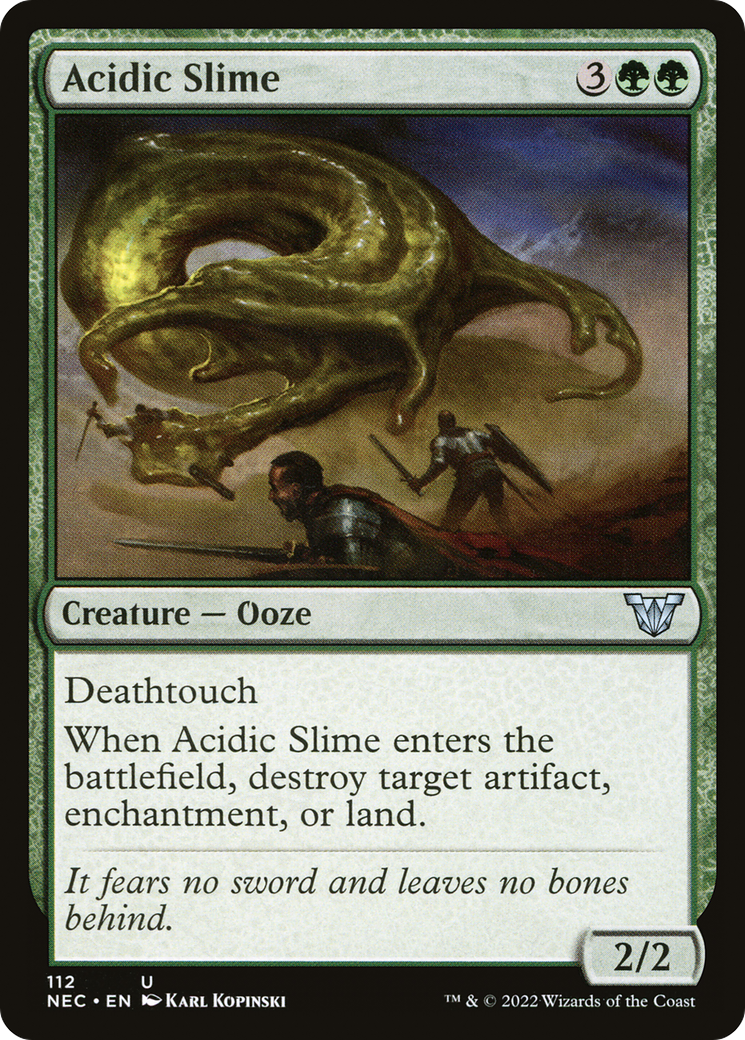
Acidic Slime
Acidic Slime
Creature — Ooze
2/2
Deathtouch (Any amount of damage this deals to a creature is enough to destroy it.)
When this creature enters, destroy target artifact, enchantment, or land.
-
1
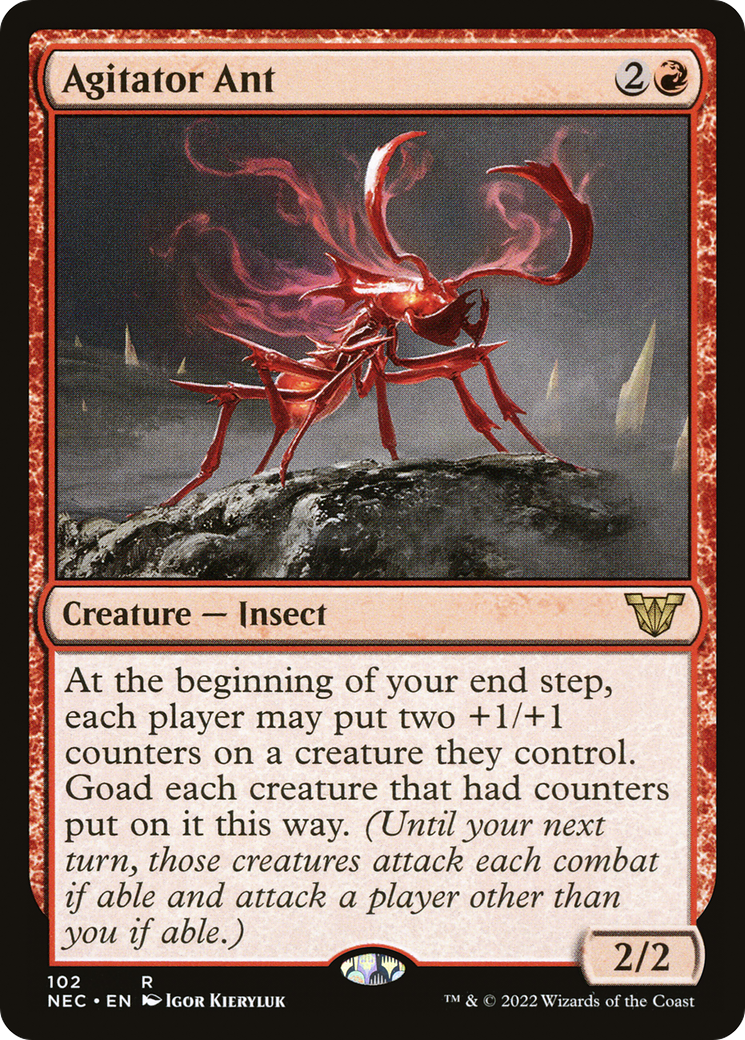
Agitator Ant
Agitator Ant
Creature — Insect
2/2
At the beginning of your end step, each player may put two +1/+1 counters on a creature they control. Goad each creature that had counters put on it this way. (Until your next turn, those creatures attack each combat if able and attack a player other than you if able.)
- If the creature doesn't meet any of the above exceptions and can attack, it must attack a player other than the controller of the spell or ability that goaded it if able. If the creature can't attack any of those players but could otherwise attack, it must attack a planeswalker an opponent controls, a battle an opponent controls, or a player who goaded it.
- Attacking with a goaded creature doesn't cause it to stop being goaded. If there is an additional combat phase that turn, or if another player gains control of it before it stops being goaded, it must attack again if able.
- If a creature you control has been goaded by multiple opponents, it must attack one of your opponents that hasn't goaded it, as that fulfills the maximum number of goad requirements. If a creature you control has been goaded by each of your opponents, the creature must attack an opponent (rather than a planeswalker or battle), but you choose which opponent it attacks.
- If, during a player's declare attackers step, a creature that player controls that's been goaded is tapped, is affected by a spell or ability that says it can't attack, or hasn't been under that player's control continuously since the turn began (and doesn't have haste), then it doesn't attack. If there's a cost associated with having a creature attack a player, its controller isn't forced to pay that cost, so it doesn't have to attack that player.
- Being goaded isn't an ability the creature has. Once it's been goaded, it must attack as detailed above even if it loses all abilities.
- If a creature can't have +1/+1 counters put on it, its controller can't choose it just to have it become goaded. If it can have counters put on it but replacement effects cause it not to receive +1/+1 counters, it doesn't become goaded.
- As Agitator Ant's ability resolves, first you choose which creature you control, if any, to put two +1/+1 counters on, then each other player in turn order does the same, knowing the choices made before them. Then each chosen creature receives its +1/+1 counters and becomes goaded.
-
1
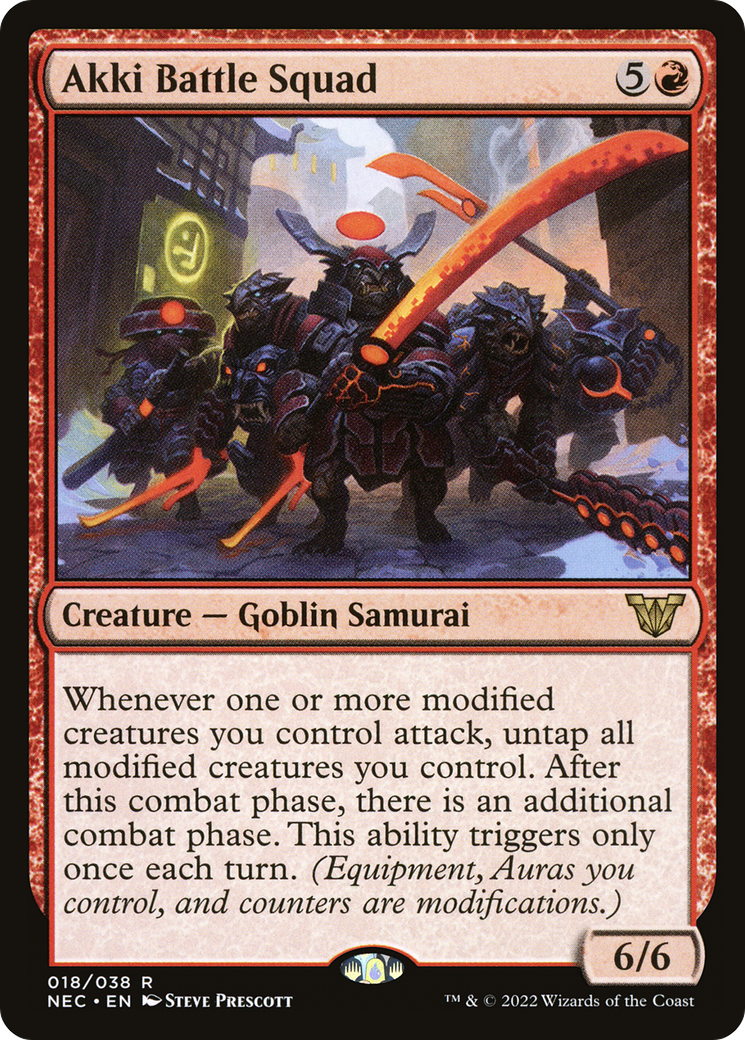
Akki Battle Squad
Akki Battle Squad
Creature — Goblin Samurai
6/6
Whenever one or more modified creatures you control attack, untap all modified creatures you control. After this phase, there is an additional combat phase. This ability triggers only once each turn. (Equipment, Auras you control, and counters are modifications.)
- Notably, the triggered ability of Akki Battle Squad doesn't give you any additional main phases. This means that you will move directly from the end of combat step of one combat phase to the beginning of combat step of the next one.
- An Aura controlled by an opponent does not cause a creature you control to be modified.
- A creature with a counter on it is considered modified no matter what kind of counter it is or which player put it on that creature.
- A creature that is equipped is considered modified no matter who controls the Equipment that's attached to it.
-
1
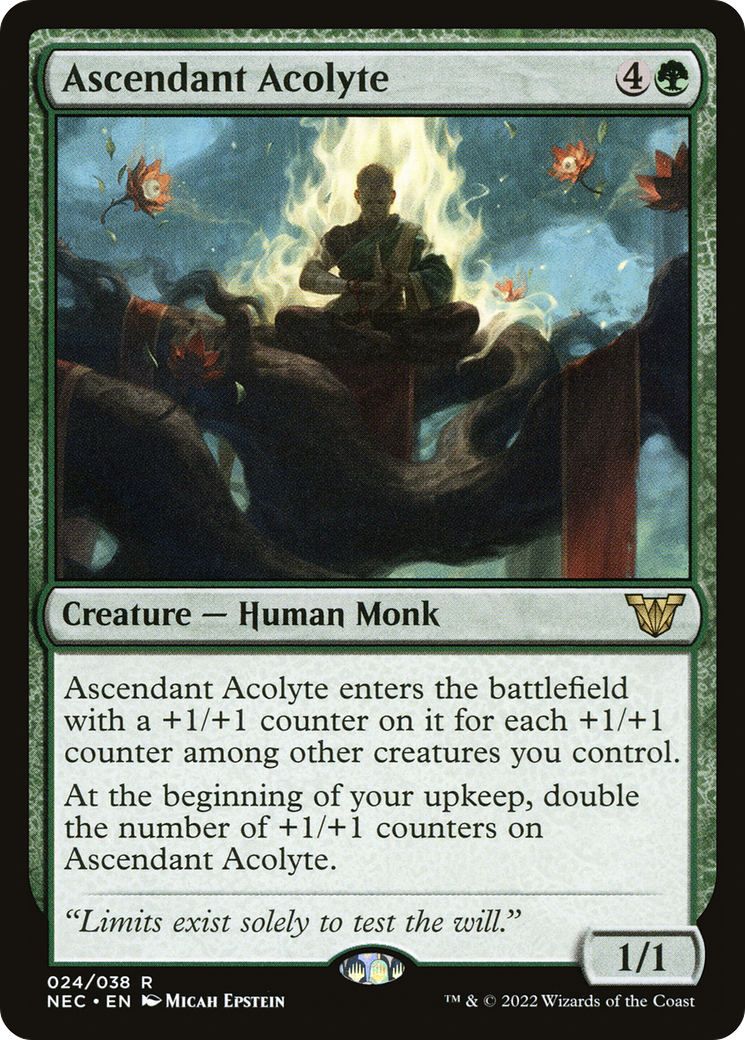
Ascendant Acolyte
Ascendant Acolyte
Creature — Human Monk
1/1
This creature enters with a +1/+1 counter on it for each +1/+1 counter among other creatures you control.
At the beginning of your upkeep, double the number of +1/+1 counters on this creature.
- If Ascendant Acolyte is entering the battlefield at the same time as other creatures, it doesn't count any counters those other creatures would enter the battlefield with.
-
1
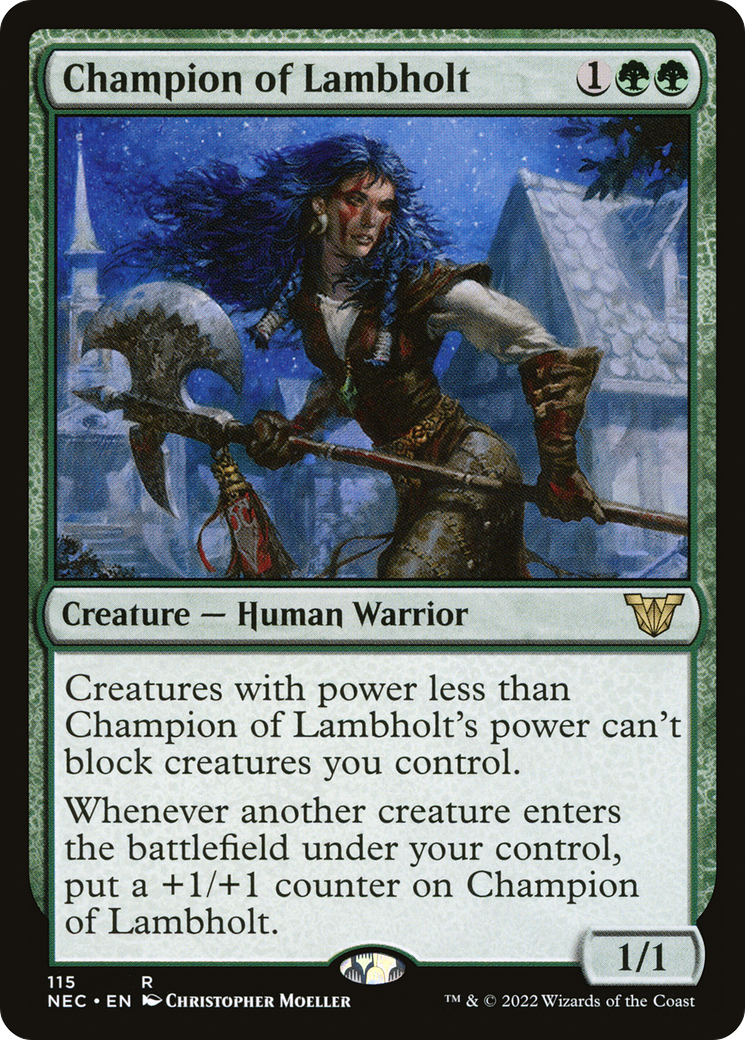
Champion of Lambholt
Champion of Lambholt
Creature — Human Warrior
1/1
Creatures with power less than this creature's power can't block creatures you control.
Whenever another creature you control enters, put a +1/+1 counter on this creature.
- Champion of Lambholt's first ability applies even if it isn't attacking.
- The comparison of power is done only when blockers are declared. Decreasing the power of a blocking creature (or increasing the power of Champion of Lambholt) after this point won't cause any creature to stop blocking or become unblocked.
-
1
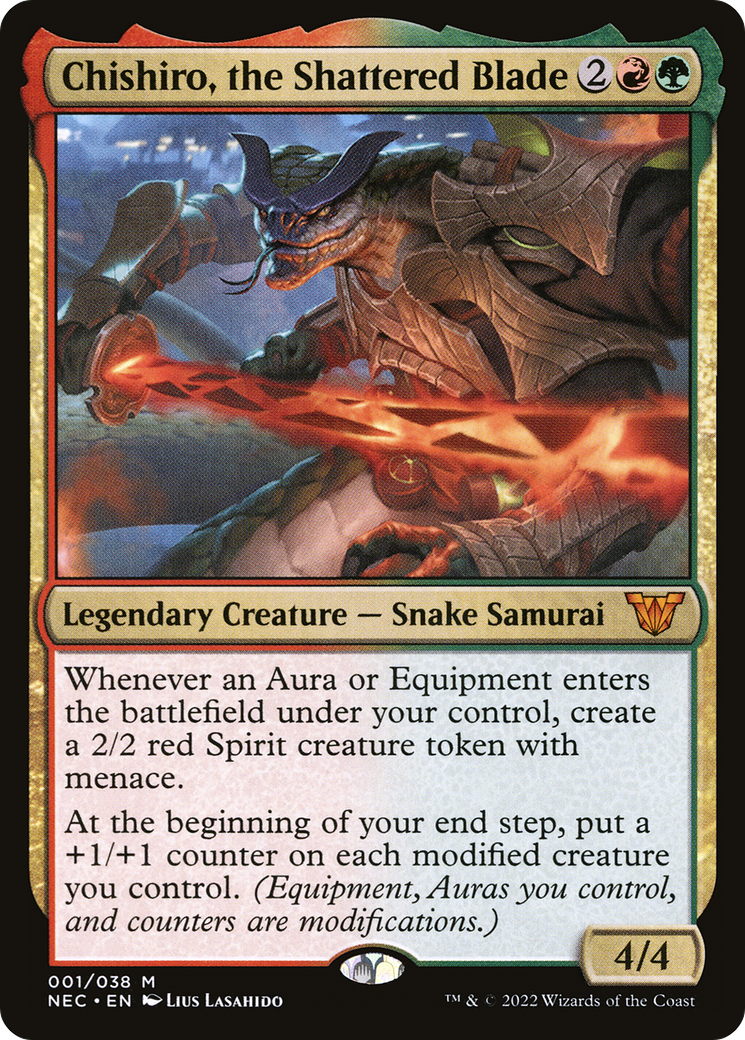
Chishiro, the Shattered Blade
Chishiro, the Shattered Blade
Legendary Creature — Snake Samurai
4/4
Whenever an Aura or Equipment you control enters, create a 2/2 red Spirit creature token with menace.
At the beginning of your end step, put a +1/+1 counter on each modified creature you control. (Equipment, Auras you control, and counters are modifications.)
- An Aura controlled by an opponent does not cause a creature you control to be modified.
- A creature with a counter on it is considered modified no matter what kind of counter it is or which player put it on that creature.
- A creature that is equipped is considered modified no matter who controls the Equipment that's attached to it.
-
1
Fertilid
Fertilid
Creature — Elemental
0/0
This creature enters with two +1/+1 counters on it.
, Remove a +1/+1 counter from this creature: Target player searches their library for a basic land card, puts it onto the battlefield tapped, then shuffles.
- Although the targeted player doesn't need to find a basic land card if they don't want to, that player must shuffle their library.
-
1
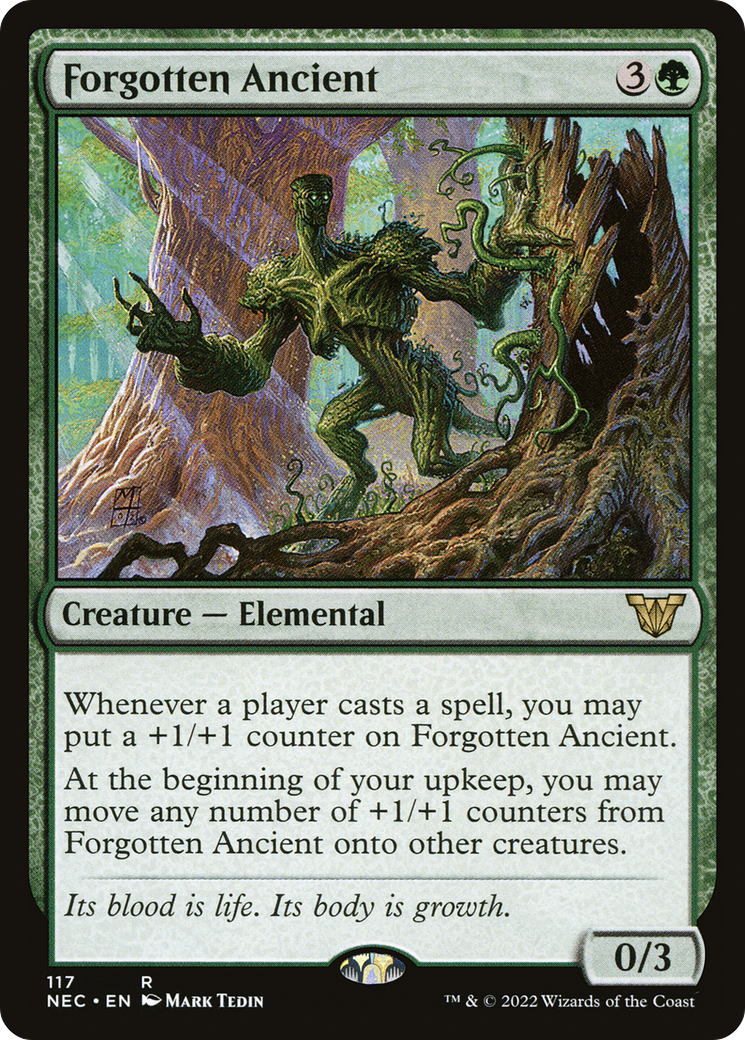
Forgotten Ancient
Forgotten Ancient
Creature — Elemental
0/3
Whenever a player casts a spell, you may put a +1/+1 counter on this creature.
At the beginning of your upkeep, you may move any number of +1/+1 counters from this creature onto other creatures.
- Forgotten Ancient's last ability doesn't target any creatures. You choose how many +1/+1 counters will be moved (and onto which creatures) as the ability resolves. Notably, once the ability starts resolving and you make these choices, no player may take actions until the ability has finished resolving.
- Forgotten Ancient's first ability will resolve before the spell that caused it to trigger. Putting a +1/+1 counter on Forgotten Ancient is optional.
-
1
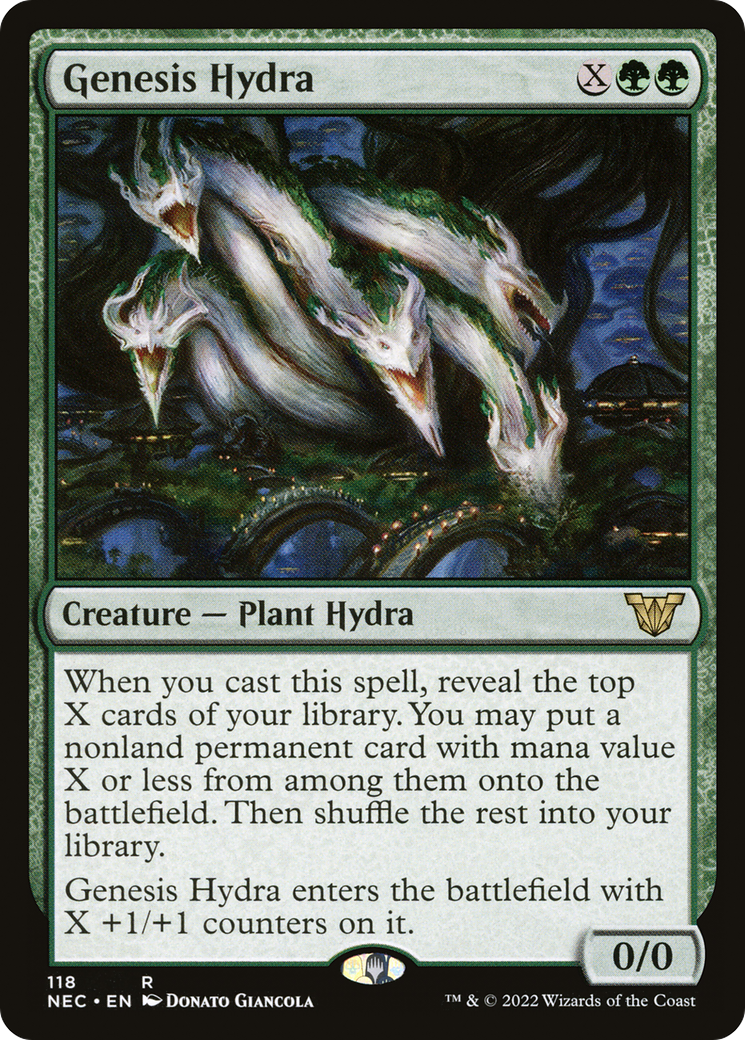
Genesis Hydra
Genesis Hydra
Creature — Plant Hydra
0/0
When you cast this spell, reveal the top X cards of your library. You may put a nonland permanent card with mana value X or less from among them onto the battlefield. Then shuffle the rest into your library.
This creature enters with X +1/+1 counters on it.
- Genesis Hydra's first ability will resolve before Genesis Hydra does. Notably, if you put an Aura card onto the battlefield this way, it can't enchant Genesis Hydra.
- If you have fewer than X cards in your library, you reveal all of them.
- If a card in a player's library has in its mana cost, X is considered to be 0.
- A nonland permanent card is an artifact, creature, enchantment, or planeswalker card.
- If you put an Aura onto the battlefield this way, you choose what it enchants as it enters the battlefield. This doesn't target any permanent or player, but it must be able to enchant that permanent or player. For example, you could put a green Aura onto the battlefield enchanting a creature with hexproof controlled by an opponent, but not one with protection from green.
- If "the rest" is zero cards, either because X was 0 or because X was 1 and that card was put onto the battlefield, the library is still shuffled.
-
1
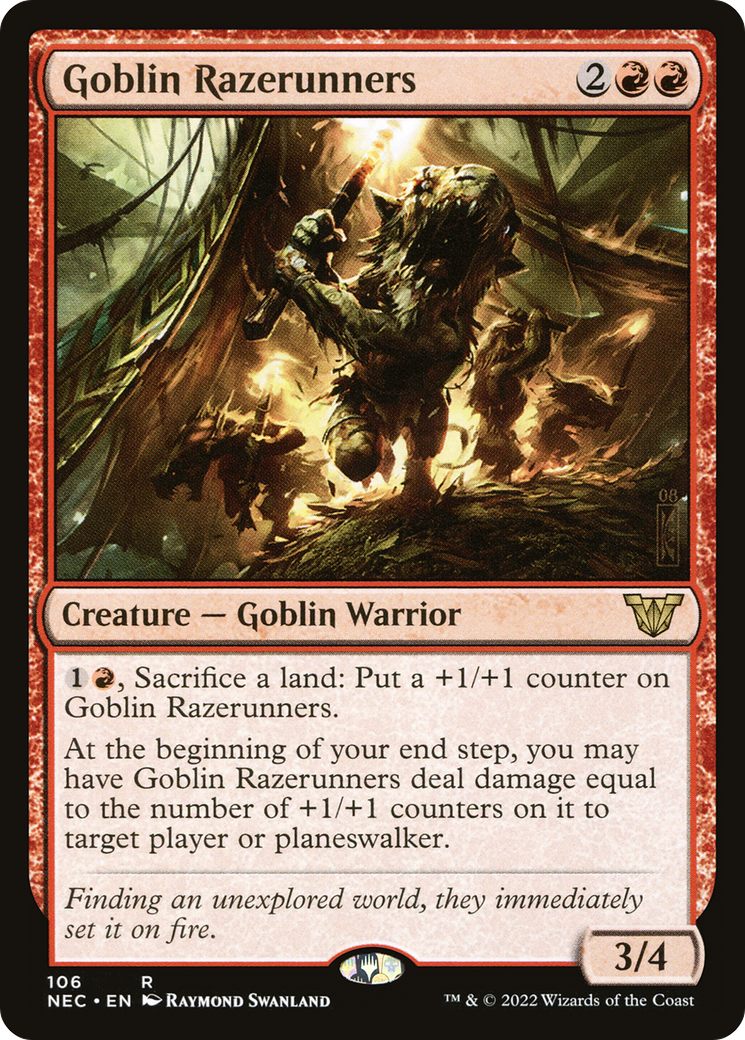
Goblin Razerunners
Goblin Razerunners
Creature — Goblin Warrior
3/4
, Sacrifice a land: Put a +1/+1 counter on this creature.
At the beginning of your end step, you may have this creature deal damage equal to the number of +1/+1 counters on it to target player or planeswalker.
- You don't count how many +1/+1 counters are on Goblin Razerunners until its triggered ability resolves.
- If Goblin Razerunners leaves the battlefield after its ability triggers but before it resolves, the amount of damage it deals is equal to the number of +1/+1 counters that were on it as it last existed on the battlefield.
-
1
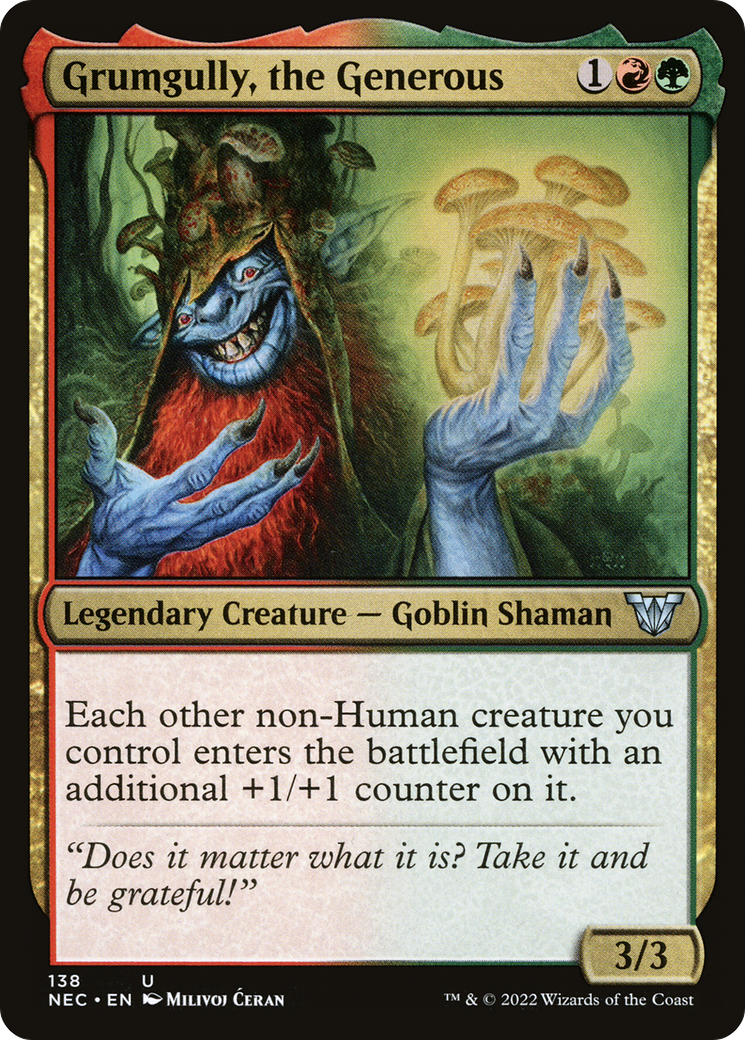
Grumgully, the Generous
Grumgully, the Generous
Legendary Creature — Goblin Shaman
3/3
Each other non-Human creature you control enters with an additional +1/+1 counter on it.
- A non-Human creature you control that would enter the battlefield with no +1/+1 counters on it enters with one +1/+1 counter on it.
- Any other non-Human creatures that enter the battlefield at the same time as Grumgully won't get a +1/+1 counter.
- If a non-Human creature enters the battlefield as a copy of a Human creature, it won't get a +1/+1 counter. Similarly, if a Human enters as a non-Human creature, it will get a +1/+1 counter.
-
1
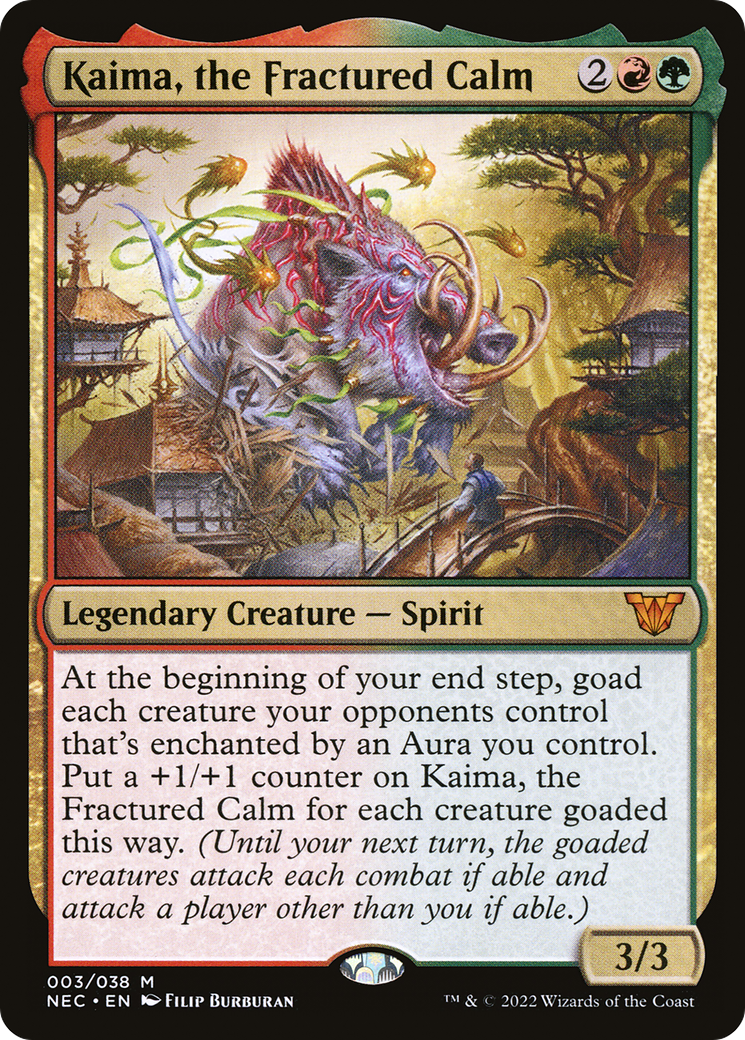
Kaima, the Fractured Calm
Kaima, the Fractured Calm
Legendary Creature — Spirit
3/3
At the beginning of your end step, goad each creature your opponents control that's enchanted by an Aura you control. Put a +1/+1 counter on Kaima for each creature goaded this way. (Until your next turn, the goaded creatures attack each combat if able and attack a player other than you if able.)
- The set of creatures that are goaded by this ability are locked in when it resolves. A creature becoming enchanted later or an Aura being removed from a creature later won't change whether it is goaded.
-
1
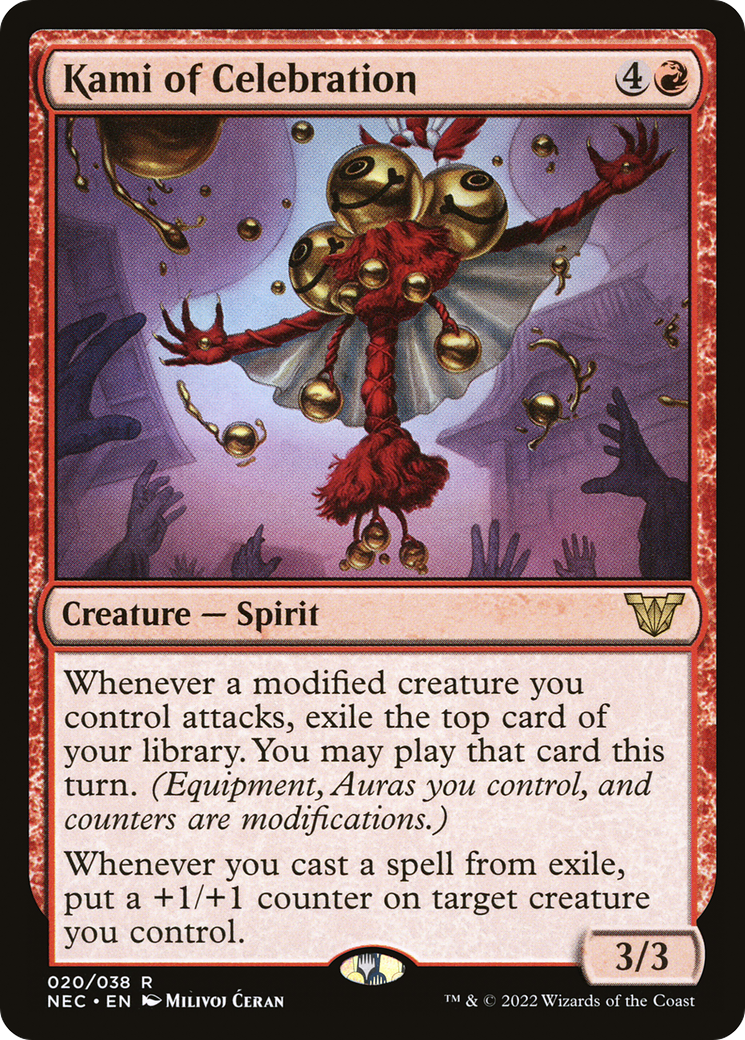
Kami of Celebration
Kami of Celebration
Creature — Spirit
3/3
Whenever a modified creature you control attacks, exile the top card of your library. You may play that card this turn. (Equipment, Auras you control, and counters are modifications.)
Whenever you cast a spell from exile, put a +1/+1 counter on target creature you control.
- You must still pay all costs and follow all normal timing rules to play a card this way. For example, you may play a land this way only during your own main phase while the stack is empty, and only if you have not yet played a land this turn.
- An Aura controlled by an opponent does not cause a creature you control to be modified.
- A creature with a counter on it is considered modified no matter what kind of counter it is or which player put it on that creature.
- A creature that is equipped is considered modified no matter who controls the Equipment that's attached to it.
-
1
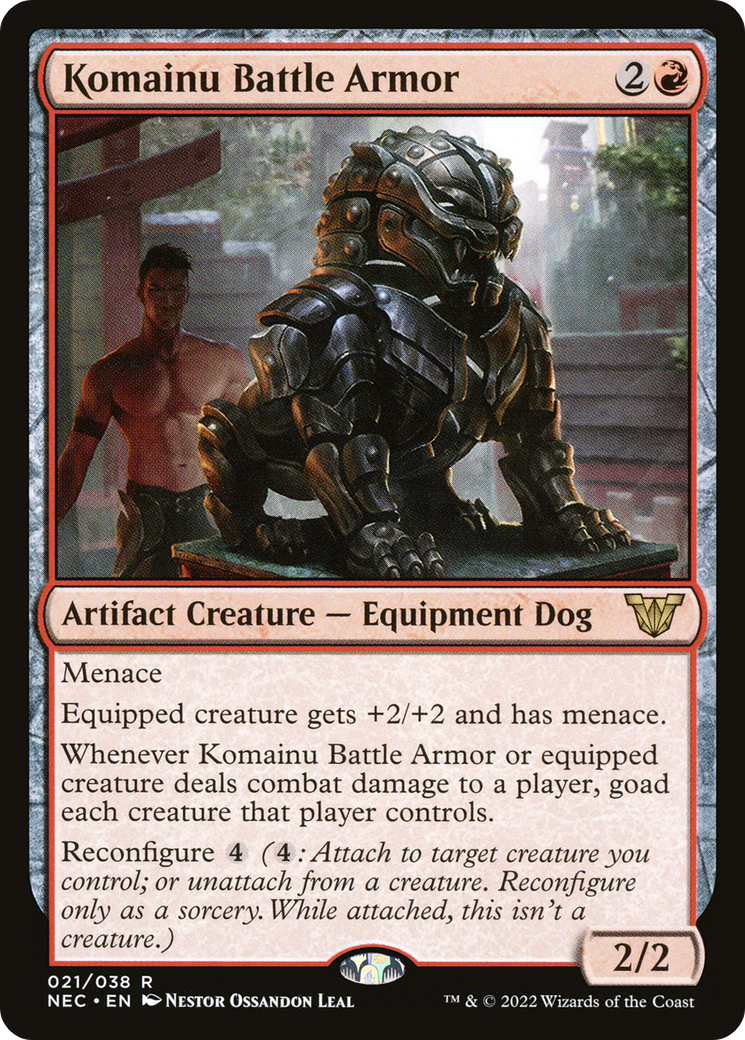
Komainu Battle Armor
Komainu Battle Armor
Artifact Creature — Equipment Dog
2/2
Menace
Equipped creature gets +2/+2 and has menace.
Whenever this creature or equipped creature deals combat damage to a player, goad each creature that player controls.
Reconfigure ( : Attach to target creature you control; or unattach from a creature. Reconfigure only as a sorcery. While attached, this isn't a creature.)
- Reconfigure represents two activated abilities. Reconfigure [cost] means “[Cost]: Attach this permanent to another target creature you control. Activate only as a sorcery,” and “[Cost]: Unattach this permanent. Activate only if this permanent is attached to a creature and only as a sorcery.”
- Attaching an Equipment with reconfigure to a creature causes that Equipment to stop being a creature until it becomes unattached. It also loses any creature subtypes it had.
- An Equipment doesn't become tapped when the permanent it's attached to becomes tapped. For example, if you attack with a creature that is equipped with Acquisition Octopus, then use reconfigure to unattach Acquisition Octopus after combat, the Octopus will be untapped and could be used to block during your opponent's turn.
- Similarly, if an Equipment is tapped, its reconfigure abilities may still be activated and it may still become attached to creatures. Becoming attached doesn't untap it. In most cases, an attached Equipment being tapped won't affect gameplay, but it will be relevant if it becomes unattached again before it untaps.
- If an Equipment with reconfigure somehow loses its abilities while it is attached, the effect causing it to not be a creature continues to apply until it becomes unattached.
- As soon as an Equipment creature with reconfigure stops being a creature, any Equipment and Auras with enchant creature abilities become unattached. Auras that can enchant an Equipment that isn't a creature remain attached to it.
- An Equipment creature with reconfigure can be attached to creatures by effects other than its reconfigure ability, such as the activated ability of Brass Squire.
- Although it causes an Equipment to become attached to a creature, reconfigure is not an “equip ability” for the purpose of cards like Fighter Class and Leonin Shikari.
- An Equipment creature can never become attached to itself. If an effect tries to do this, nothing happens.
- If a permanent with reconfigure is somehow still a creature after it becomes attached (perhaps due to an effect like that of March of the Machines), it immediately becomes unattached from the equipped creature.
-
1
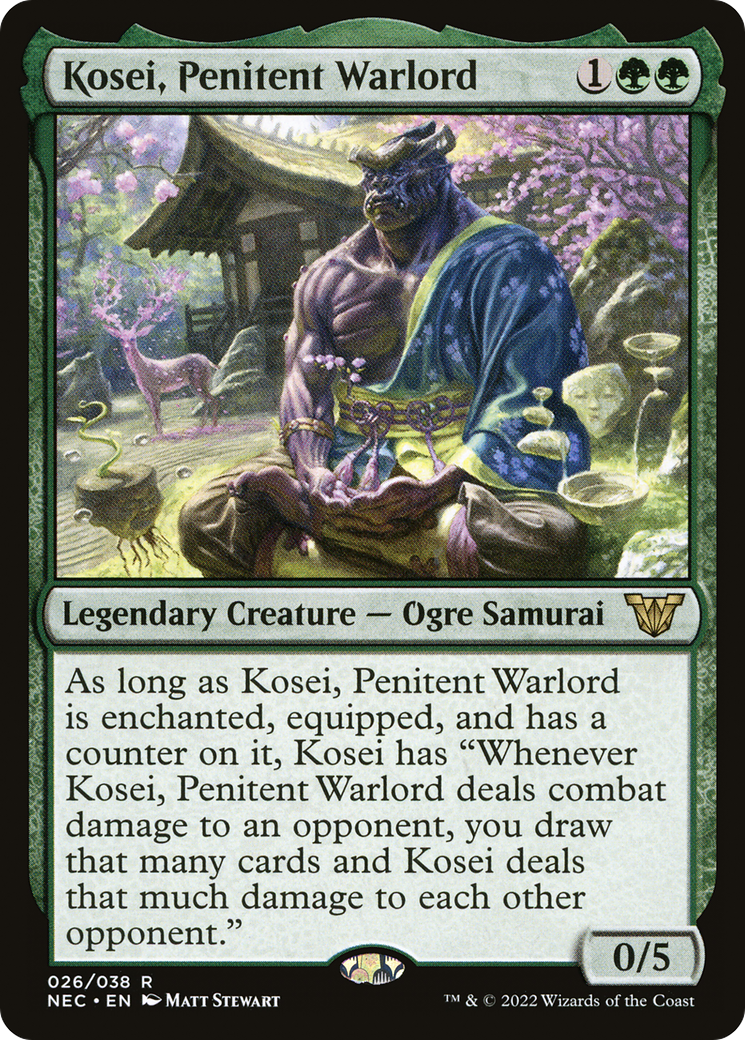
Kosei, Penitent Warlord
Kosei, Penitent Warlord
Legendary Creature — Ogre Samurai
0/5
As long as Kosei is enchanted, equipped, and has a counter on it, Kosei has "Whenever Kosei deals combat damage to an opponent, you draw that many cards and Kosei deals that much damage to each other opponent."
-
1
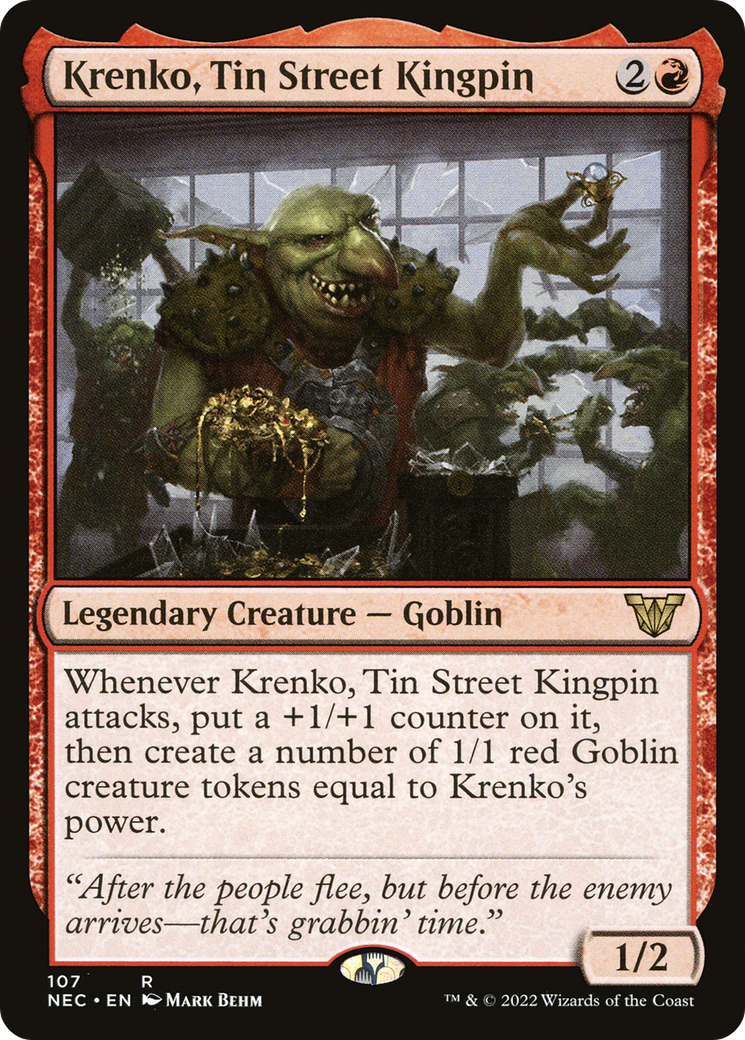
Krenko, Tin Street Kingpin
Krenko, Tin Street Kingpin
Legendary Creature — Goblin
1/2
Whenever Krenko attacks, put a +1/+1 counter on it, then create a number of 1/1 red Goblin creature tokens equal to Krenko's power.
- If Krenko leaves the battlefield after its ability has triggered but before it resolves, you don't put a +1/+1 counter on it, but you do use its power as it last existed before it left the battlefield to determine how many Goblin tokens to create.
- The tokens created by Krenko's triggered ability aren't attacking. Because all attackers are chosen at once, a token created this way can't attack, even if it gains haste.
-
1
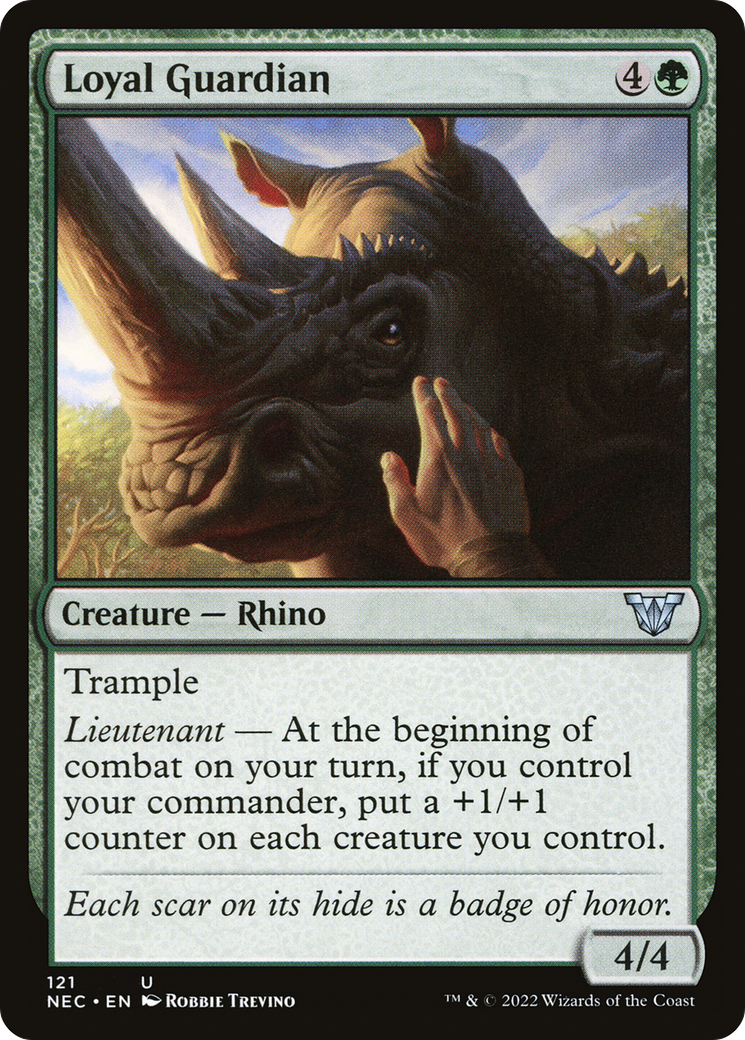
Loyal Guardian
Loyal Guardian
Creature — Rhino
4/4
Trample
Lieutenant — At the beginning of combat on your turn, if you control your commander, put a +1/+1 counter on each creature you control.
- If you don't control your commander as the lieutenant ability resolves, you won't get its effect.
- The lieutenant effect happens only once each combat, even if you somehow control multiple commanders (perhaps because you have two commanders with a partner ability from the Battlebond™ set).
- If you have multiple commanders, you need to control only one for the lieutenant effect to happen.
-
1
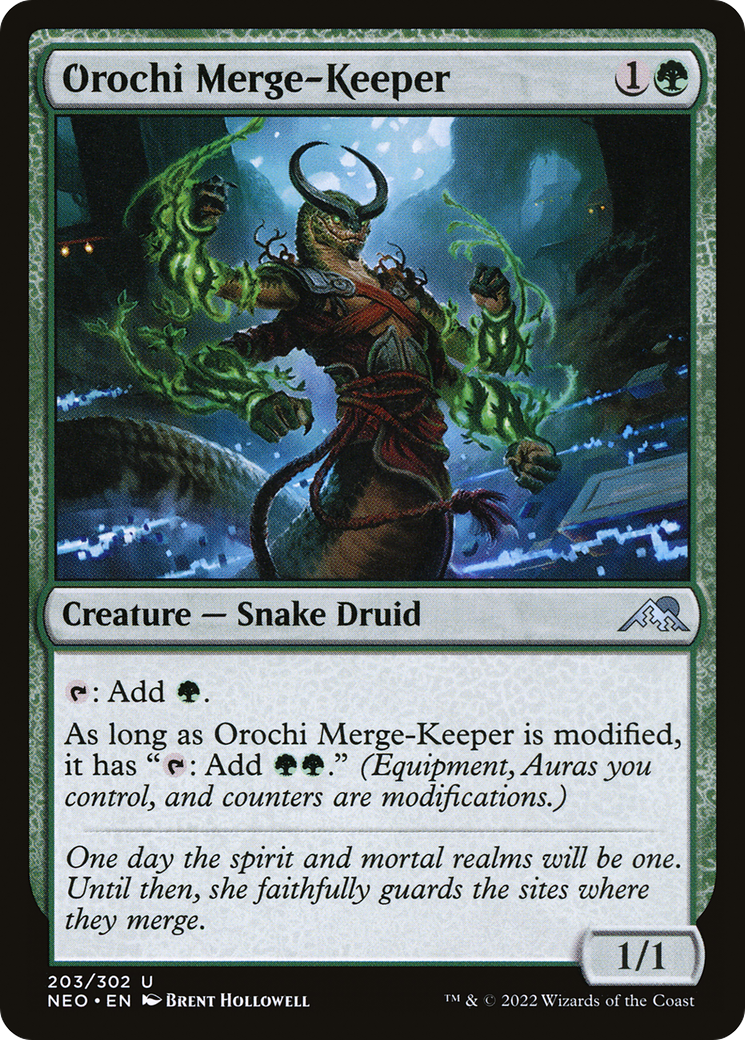
Orochi Merge-Keeper
Orochi Merge-Keeper
Creature — Snake Druid
1/1
: Add .
As long as this creature is modified, it has " : Add ." (Equipment, Auras you control, and counters are modifications.)
-
1
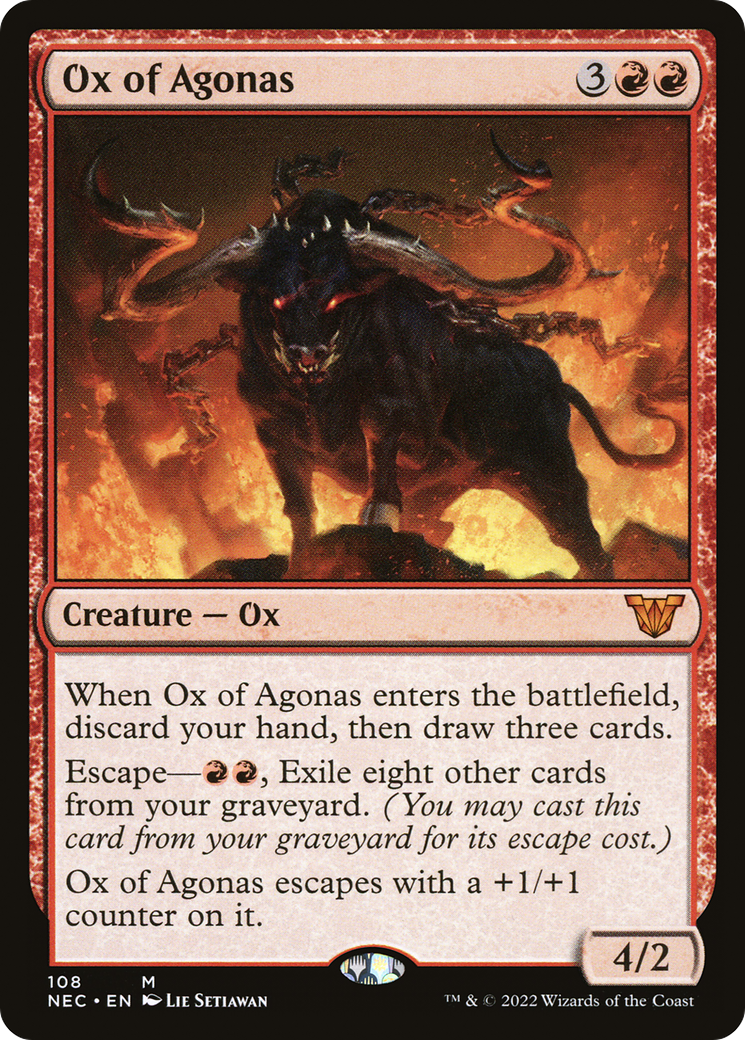
Ox of Agonas
Ox of Agonas
Creature — Ox
4/2
When this creature enters, discard your hand, then draw three cards.
Escape— , Exile eight other cards from your graveyard. (You may cast this card from your graveyard for its escape cost.)
This creature escapes with a +1/+1 counter on it.
- You draw three cards, even if you discard no cards.
- Escape's permission doesn't change when you may cast the spell from your graveyard.
- To determine the total cost of a spell, start with the mana cost or alternative cost you're paying (such as an escape cost), add any cost increases, then apply any cost reductions. The mana value of the spell remains unchanged, no matter what the total cost to cast it was and no matter whether an alternative cost was paid.
- After an escaped spell resolves, it returns to its owner's graveyard if it's not a permanent spell. If it is a permanent spell, it enters the battlefield and will return to its owner's graveyard if it dies later. Perhaps it will escape again—good underworld security is so hard to come by these days.
- If a card has multiple abilities giving you permission to cast it, such as two escape abilities or an escape ability and a flashback ability, you choose which one to apply. The others have no effect.
- If you cast a spell with its escape permission, you can't choose to apply any other alternative costs or to cast it without paying its mana cost. If it has any additional costs, you must pay those.
- If a card with escape is put into your graveyard during your turn, you'll be able to cast it right away if it's legal to do so, before an opponent can take any actions.
- Once you begin casting a spell with escape, it immediately moves to the stack. Players can't take any other actions until you're done casting the spell.
-
1
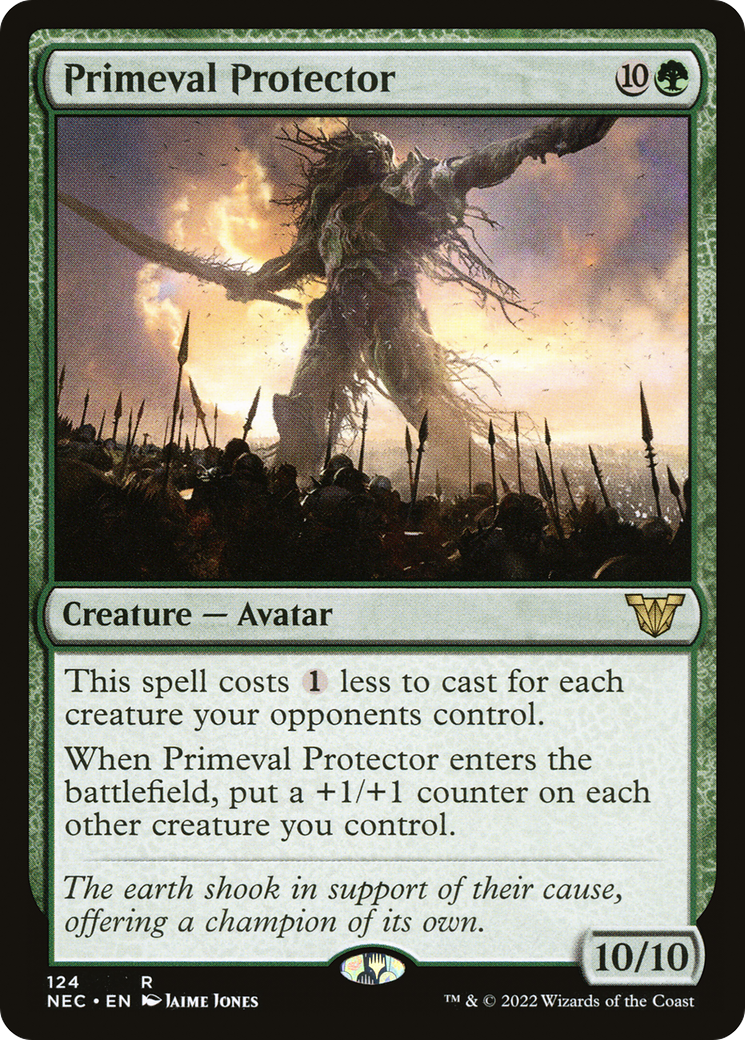
Primeval Protector
Primeval Protector
Creature — Avatar
10/10
This spell costs less to cast for each creature your opponents control.
When this creature enters, put a +1/+1 counter on each other creature you control.
- Once a player has announced that they are casting Primeval Protector, no player may take actions to try to change the number of creatures your opponents control in order to increase its cost.
- Primeval Protector's ability can't reduce its cost below .
-
1
Rampant Rejuvenator
Rampant Rejuvenator
Creature — Plant Hydra
0/0
This creature enters with two +1/+1 counters on it.
When this creature dies, search your library for up to X basic land cards, where X is this creature's power, put them onto the battlefield, then shuffle.
- Use Rampant Rejuvenator's power as it last existed on the battlefield to determine the value of X for its last ability.
-
1
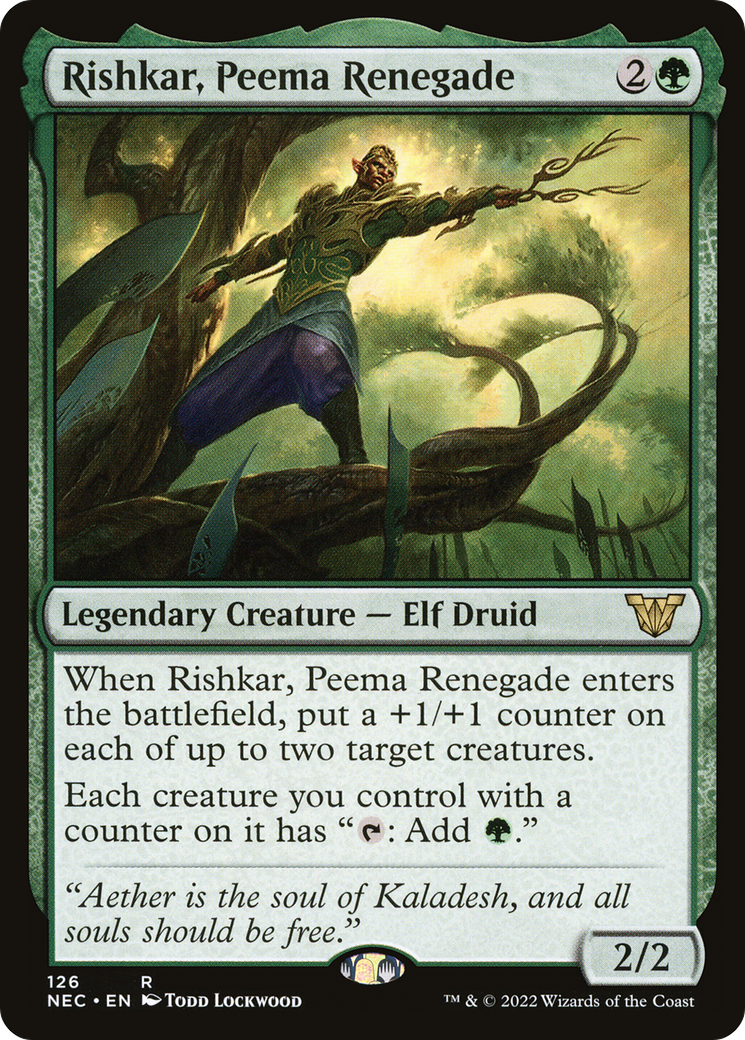
Rishkar, Peema Renegade
Rishkar, Peema Renegade
Legendary Creature — Elf Druid
2/2
When Rishkar enters, put a +1/+1 counter on each of up to two target creatures.
Each creature you control with a counter on it has " : Add ."
- Rishkar can be a target of its own triggered ability.
- You can't target the same creature twice to have one recipient get two +1/+1 counters.
- Each creature you control has Rishkar's mana ability as long as that creature has any kind of counter on it. The effect isn't limited to those with +1/+1 counters.
-
1
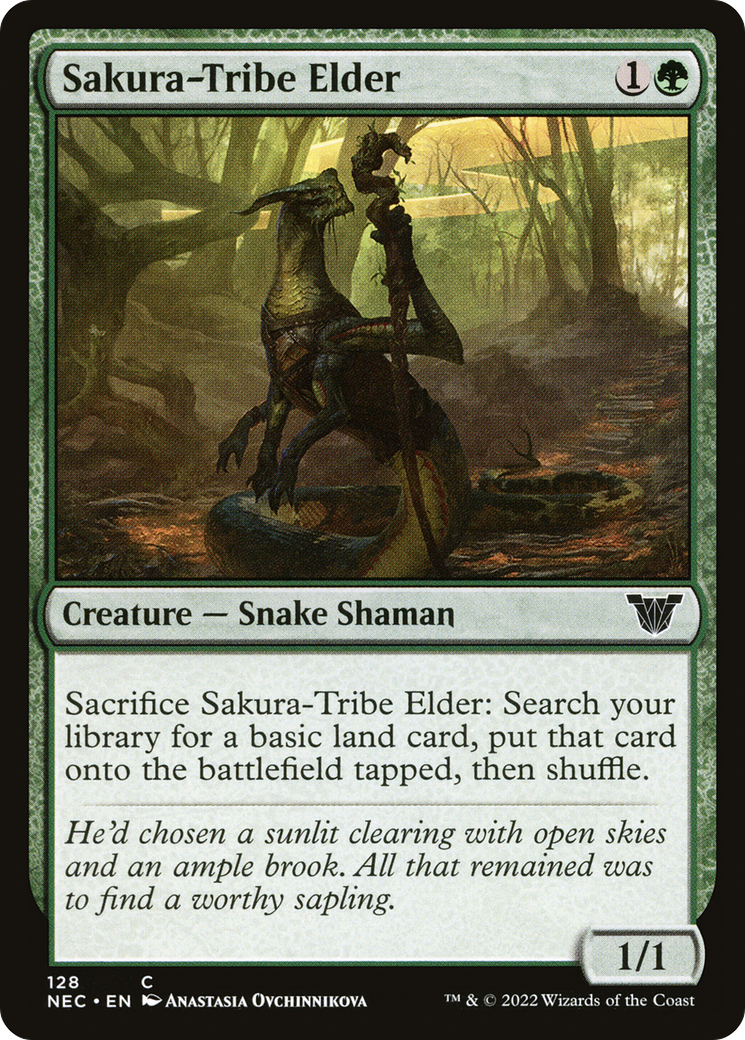
Sakura-Tribe Elder
Sakura-Tribe Elder
Creature — Snake Shaman
1/1
Sacrifice this creature: Search your library for a basic land card, put that card onto the battlefield tapped, then shuffle.
-
1
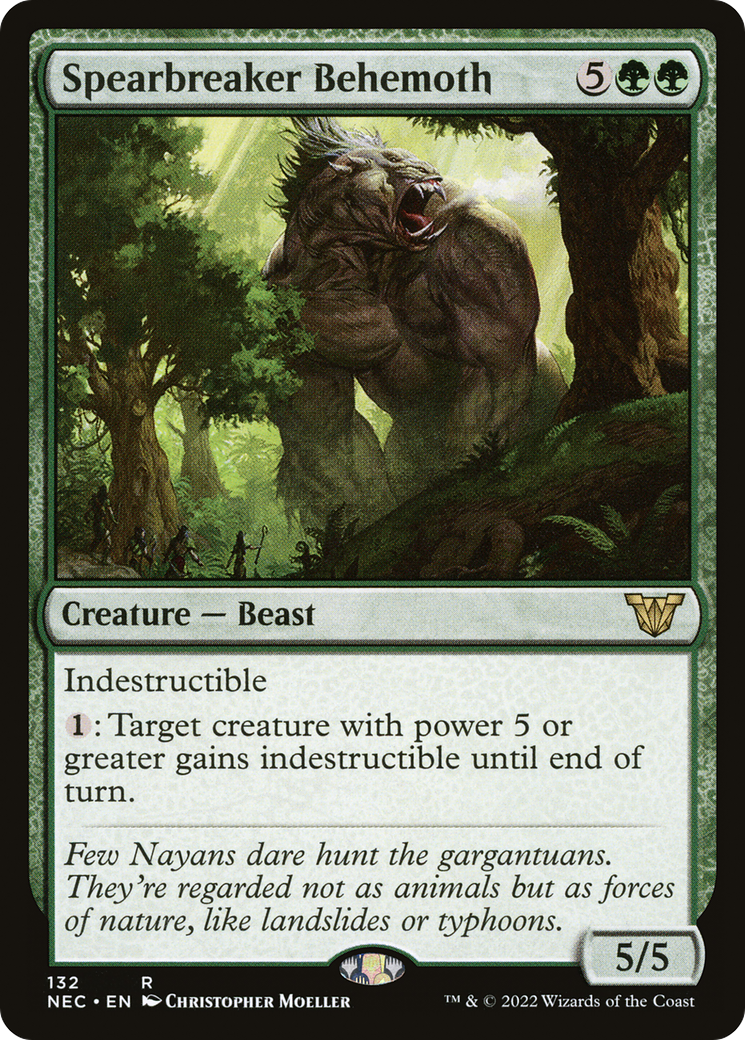
Spearbreaker Behemoth
Spearbreaker Behemoth
Creature — Beast
5/5
Indestructible
: Target creature with power 5 or greater gains indestructible until end of turn.
- Lethal damage and effects that say “destroy” won't cause a creature with indestructible to be put into the graveyard. However, a creature with indestructible can be put into the graveyard for a number of reasons. The most likely reasons are if it's sacrificed, if it's legendary and another legendary creature with the same name is controlled by the same player, or if its toughness is 0 or less.
- The ability checks the targeted creature's power twice: when the creature becomes the target, and when the ability resolves. Once the ability resolves, it will continue to apply to the affected creature no matter what its power may become later in the turn.
-
1
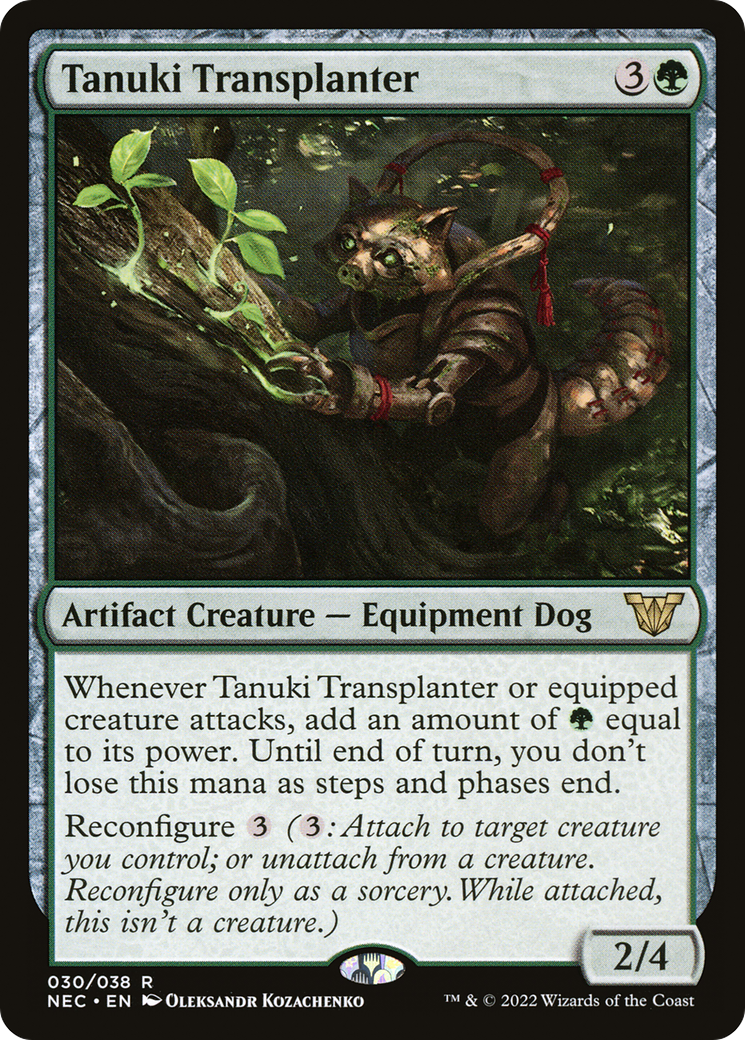
Tanuki Transplanter
Tanuki Transplanter
Artifact Creature — Equipment Dog
2/4
Whenever this creature or equipped creature attacks, add an amount of equal to its power. Until end of turn, you don't lose this mana as steps and phases end.
Reconfigure ( : Attach to target creature you control; or unattach from a creature. Reconfigure only as a sorcery. While attached, this isn't a creature.)
- If Tanuki Transplanter attacks, use its power to determine how much to add. If equipped creature attacks, use its power. In either case, use the power as the triggered ability resolves. Also in either case, if the creature isn't on the battlefield at that time, use its power as it last existed on the battlefield to determine how much to add.
- Reconfigure represents two activated abilities. Reconfigure [cost] means “[Cost]: Attach this permanent to another target creature you control. Activate only as a sorcery,” and “[Cost]: Unattach this permanent. Activate only if this permanent is attached to a creature and only as a sorcery.”
- Attaching an Equipment with reconfigure to a creature causes that Equipment to stop being a creature until it becomes unattached. It also loses any creature subtypes it had.
- An Equipment doesn't become tapped when the permanent it's attached to becomes tapped. For example, if you attack with a creature that is equipped with Acquisition Octopus, then use reconfigure to unattach Acquisition Octopus after combat, the Octopus will be untapped and could be used to block during your opponent's turn.
- Similarly, if an Equipment is tapped, its reconfigure abilities may still be activated and it may still become attached to creatures. Becoming attached doesn't untap it. In most cases, an attached Equipment being tapped won't affect gameplay, but it will be relevant if it becomes unattached again before it untaps.
- If an Equipment with reconfigure somehow loses its abilities while it is attached, the effect causing it to not be a creature continues to apply until it becomes unattached.
- As soon as an Equipment creature with reconfigure stops being a creature, any Equipment and Auras with enchant creature abilities become unattached. Auras that can enchant an Equipment that isn't a creature remain attached to it.
- An Equipment creature with reconfigure can be attached to creatures by effects other than its reconfigure ability, such as the activated ability of Brass Squire.
- Although it causes an Equipment to become attached to a creature, reconfigure is not an “equip ability” for the purpose of cards like Fighter Class and Leonin Shikari.
- An Equipment creature can never become attached to itself. If an effect tries to do this, nothing happens.
- If a permanent with reconfigure is somehow still a creature after it becomes attached (perhaps due to an effect like that of March of the Machines), it immediately becomes unattached from the equipped creature.
-
1
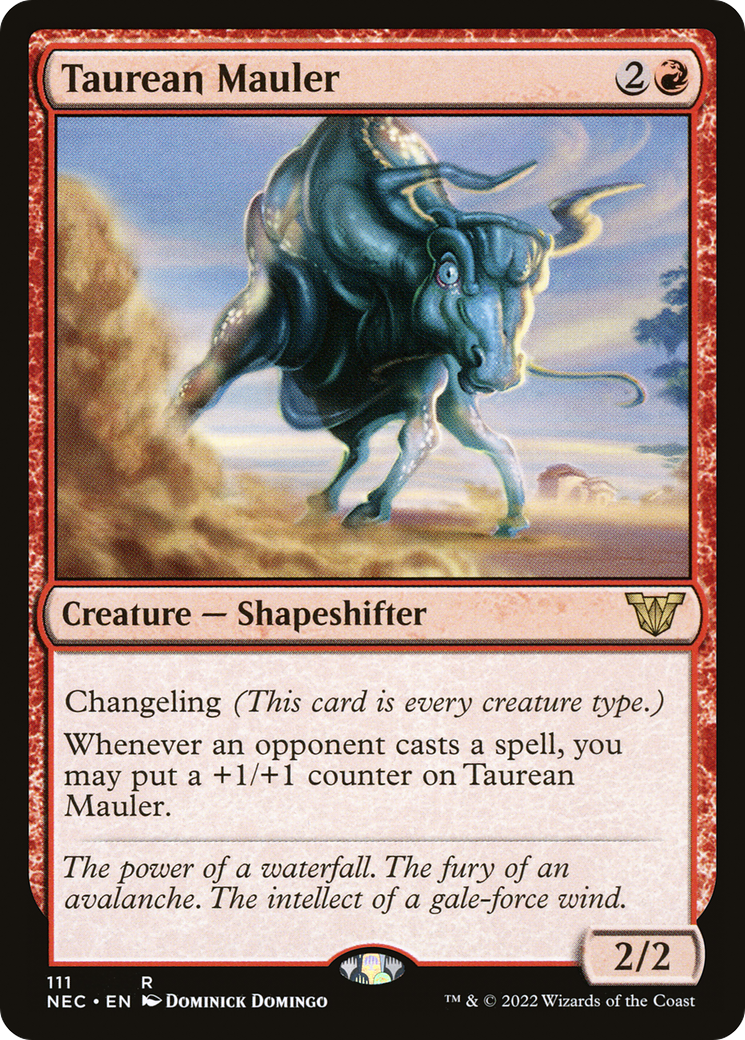
Taurean Mauler
Taurean Mauler
Creature — Shapeshifter
2/2
Changeling (This card is every creature type.)
Whenever an opponent casts a spell, you may put a +1/+1 counter on this creature.
- Taurean Mauler's last ability resolves before the spell that caused it to trigger. It resolves even if that spell is countered or otherwise leaves the stack without resolving.
-
1
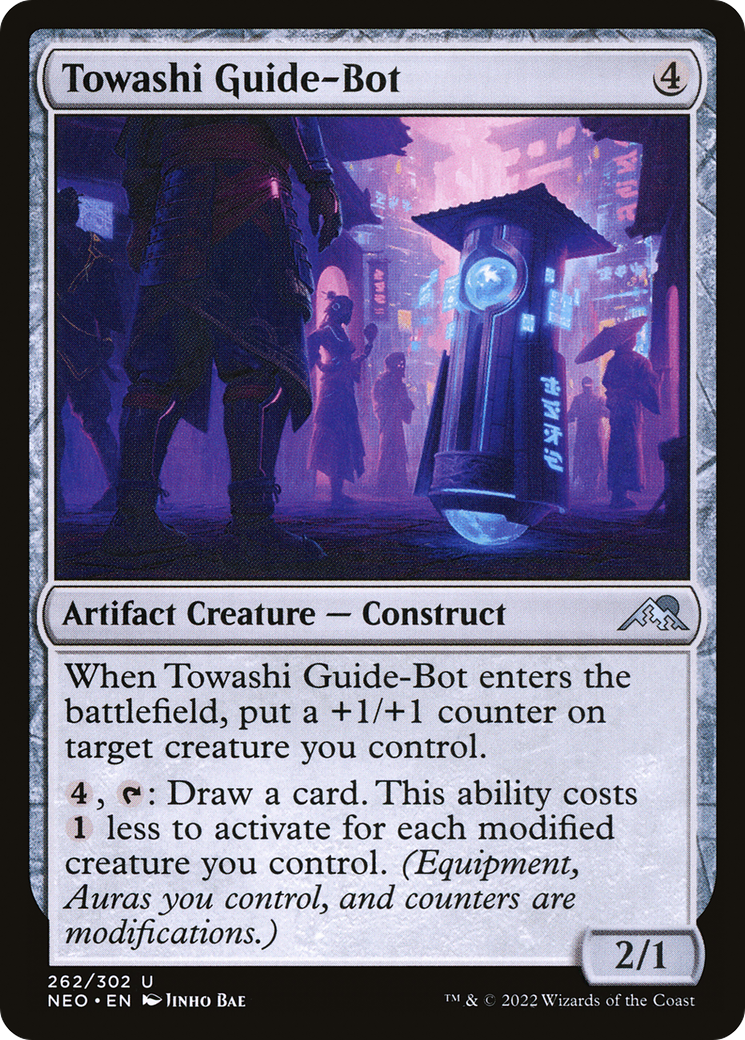
Towashi Guide-Bot
Towashi Guide-Bot
Artifact Creature — Construct
2/1
When this creature enters, put a +1/+1 counter on target creature you control.
, : Draw a card. This ability costs less to activate for each modified creature you control. (Equipment, Auras you control, and counters are modifications.)
-
1
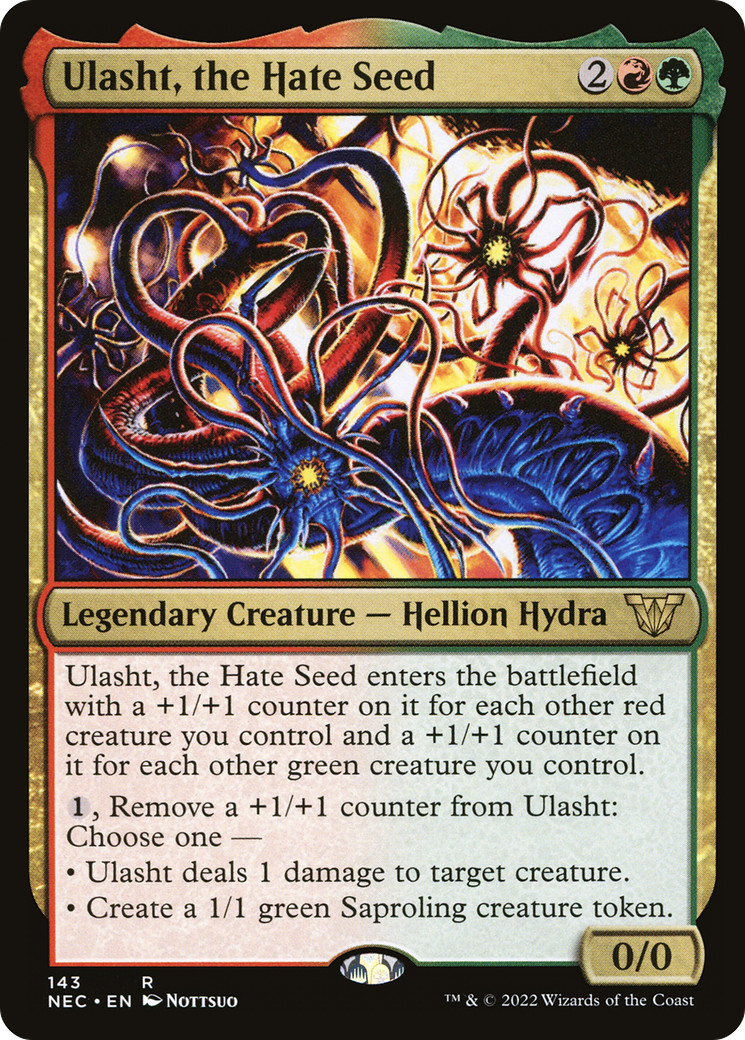
Ulasht, the Hate Seed
Ulasht, the Hate Seed
Legendary Creature — Hellion Hydra
0/0
Ulasht enters with a +1/+1 counter on it for each other red creature you control and a +1/+1 counter on it for each other green creature you control.
, Remove a +1/+1 counter from Ulasht: Choose one —
- Ulasht deals 1 damage to target creature.
- Create a 1/1 green Saproling creature token.
- Creatures that are both red and green provide two +1/+1 counters.
-
1
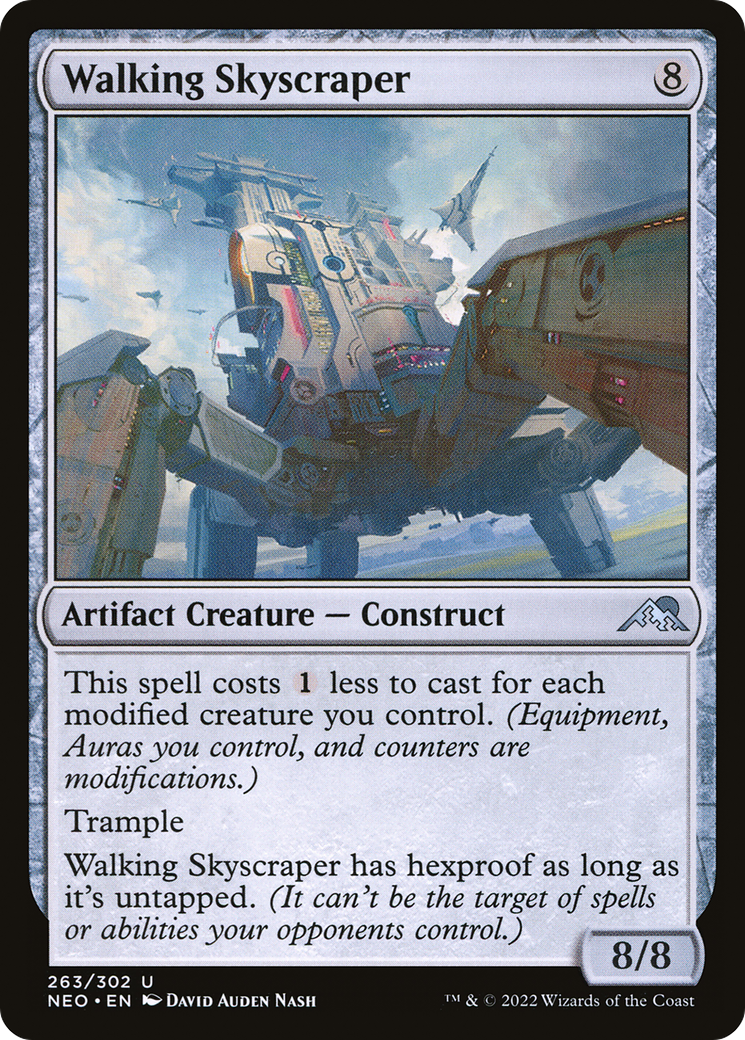
Walking Skyscraper
Walking Skyscraper
Artifact Creature — Construct
8/8
This spell costs less to cast for each modified creature you control. (Equipment, Auras you control, and counters are modifications.)
Trample
This creature has hexproof as long as it's untapped. (It can't be the target of spells or abilities your opponents control.)
-
1
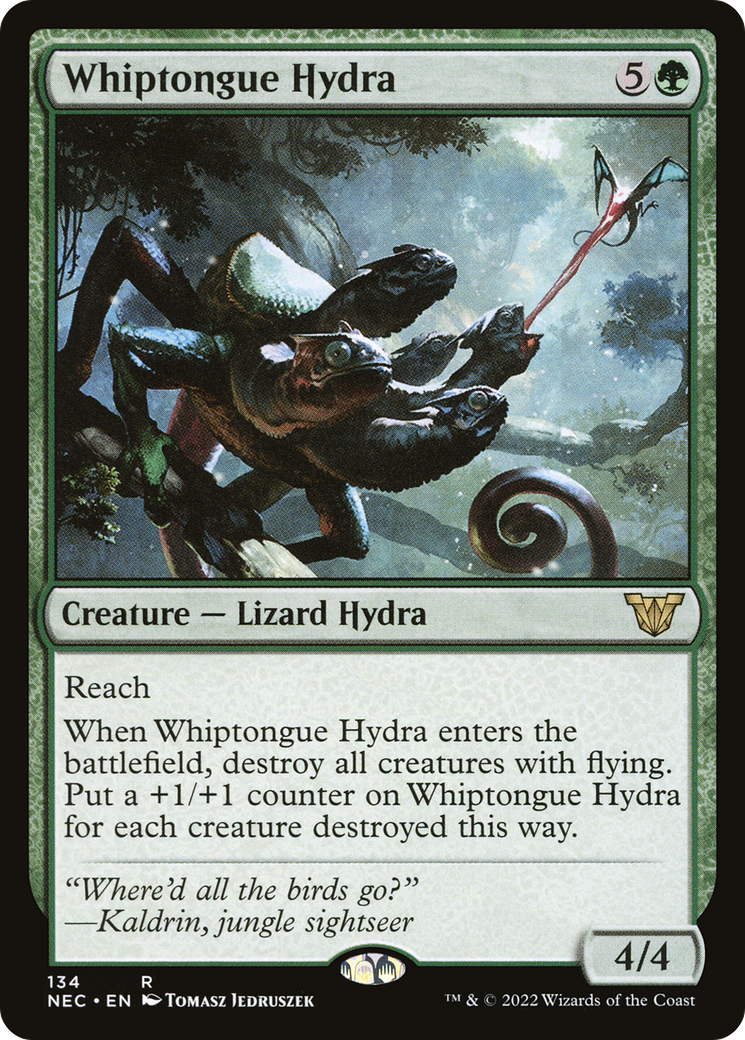
Whiptongue Hydra
Whiptongue Hydra
Creature — Lizard Hydra
4/4
Reach
When this creature enters, destroy all creatures with flying. Put a +1/+1 counter on this creature for each creature destroyed this way.
- A creature with indestructible or a creature that regenerates won't count as having been "destroyed this way."
- If a creature with flying would be destroyed, but an Aura with the umbra armor ability is destroyed instead, Whiptongue Hydra won't count that creature or that Aura as a "creature destroyed this way."
Instants 5
-
1
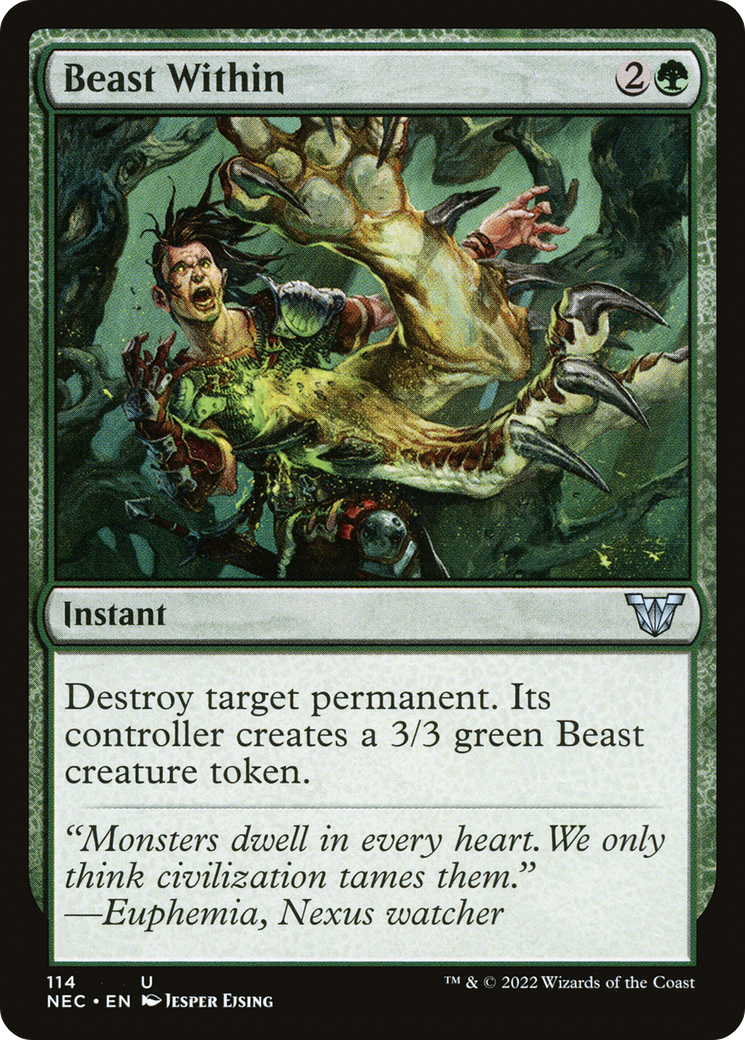
Beast Within
Beast Within
Instant
Destroy target permanent. Its controller creates a 3/3 green Beast creature token.
- If the target permanent is an illegal target by the time Beast Within tries to resolve, the spell won't resolve. No player creates a Beast token. If the target is legal but not destroyed (most likely because it has indestructible), its controller does create a Beast token.
-
1
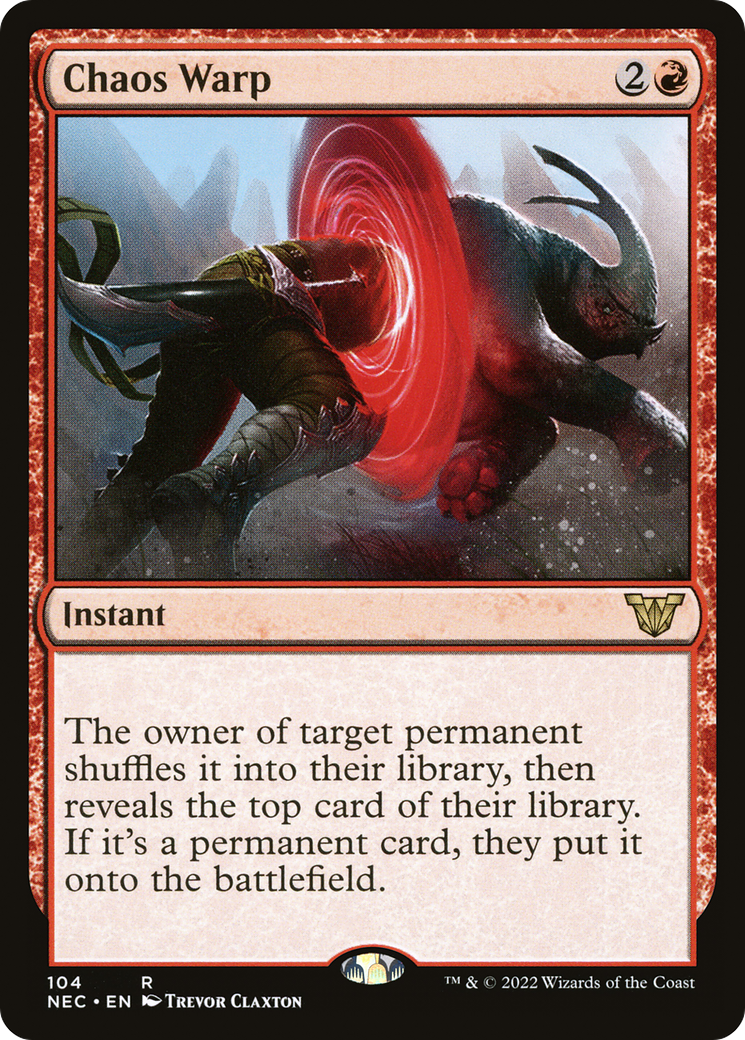
Chaos Warp
Chaos Warp
Instant
The owner of target permanent shuffles it into their library, then reveals the top card of their library. If it's a permanent card, they put it onto the battlefield.
- A permanent card is a card with one or more of the following card types: artifact, creature, enchantment, land, or planeswalker.
- The owner of a token is the player under whose control the token was put onto the battlefield. If a token is shuffled into a player's library this way, that player shuffles before revealing the top card of that library.
- If the revealed card is not a permanent card, it remains on top of that library.
- If the permanent is an illegal target by the time Chaos Warp tries to resolve, it won't resolve and none of its effects will occur. No library will be shuffled and no card will be revealed.
- If the revealed card is a permanent card but can't enter (perhaps because it's an Aura with nothing to enchant), it remains on top of that library.
-
1
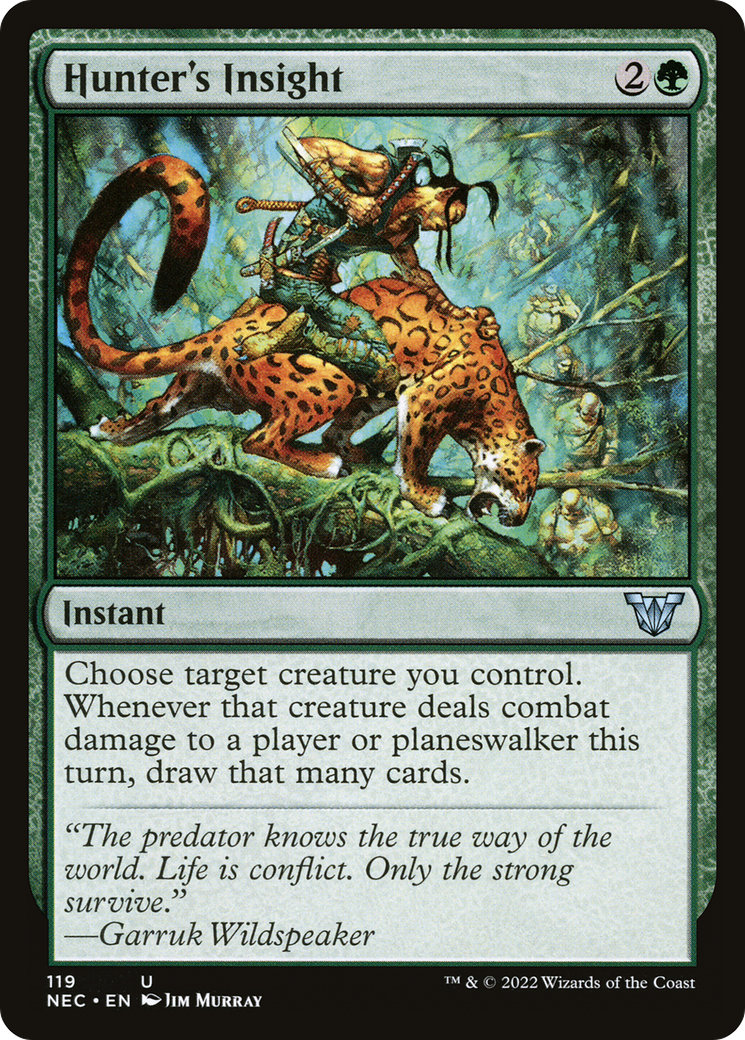
Hunter's Insight
Hunter's Insight
Instant
Choose target creature you control. Whenever that creature deals combat damage to a player or planeswalker this turn, draw that many cards.
-
1
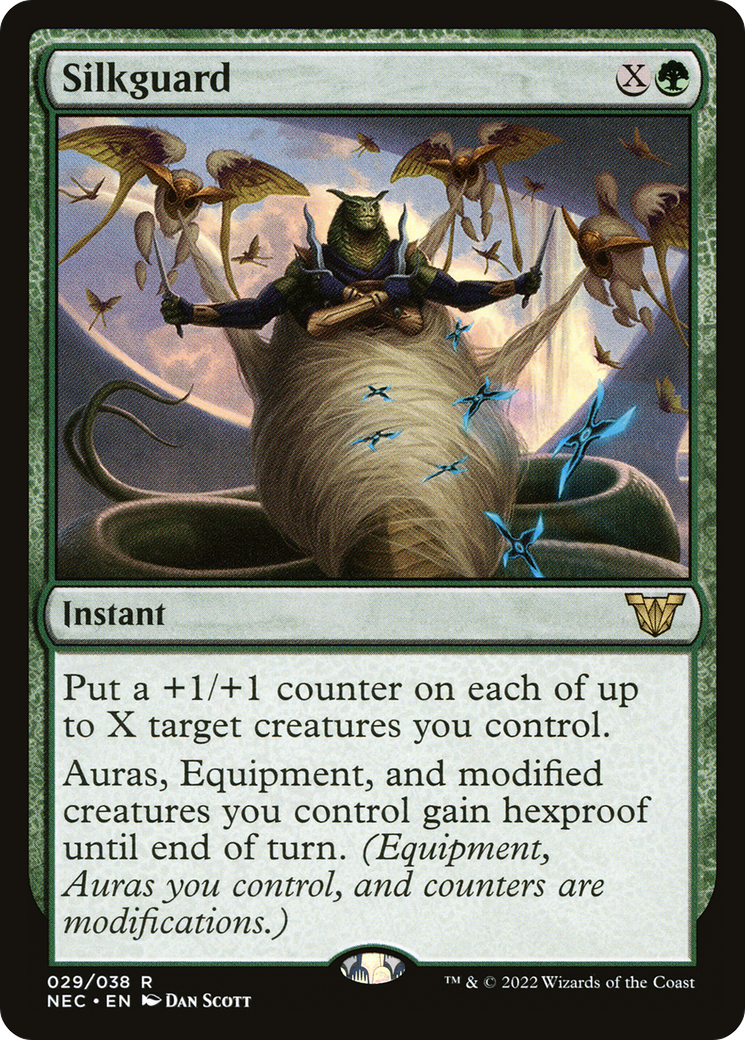
Silkguard
Silkguard
Instant
Put a +1/+1 counter on each of up to X target creatures you control.
Auras, Equipment, and modified creatures you control gain hexproof until end of turn. (Equipment, Auras you control, and counters are modifications.)
- An Aura controlled by an opponent does not cause a creature you control to be modified.
- A creature with a counter on it is considered modified no matter what kind of counter it is or which player put it on that creature.
- A creature that is equipped is considered modified no matter who controls the Equipment that's attached to it.
-
1
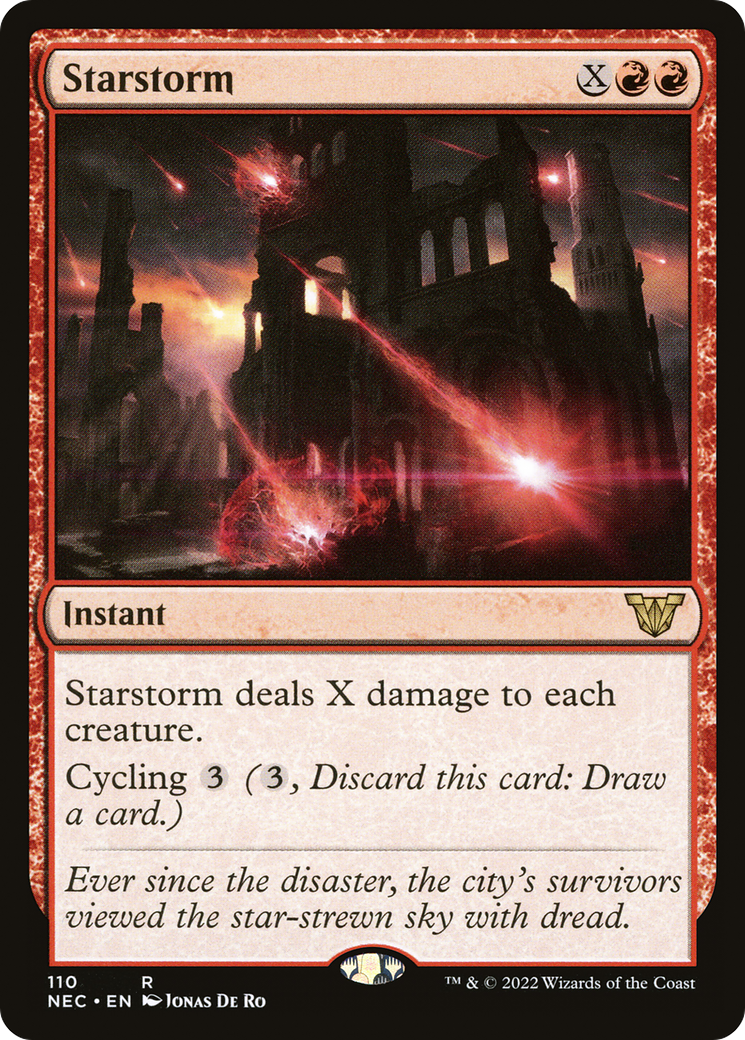
Starstorm
Starstorm
Instant
Starstorm deals X damage to each creature.
Cycling ( , Discard this card: Draw a card.)
- Cycling is an activated ability. Effects that interact with activated abilities (such as Stifle or Rings of Brighthearth) will interact with cycling. Effects that interact with spells (such as Remove Soul or Faerie Tauntings) will not.
Sorceries 10
-
1
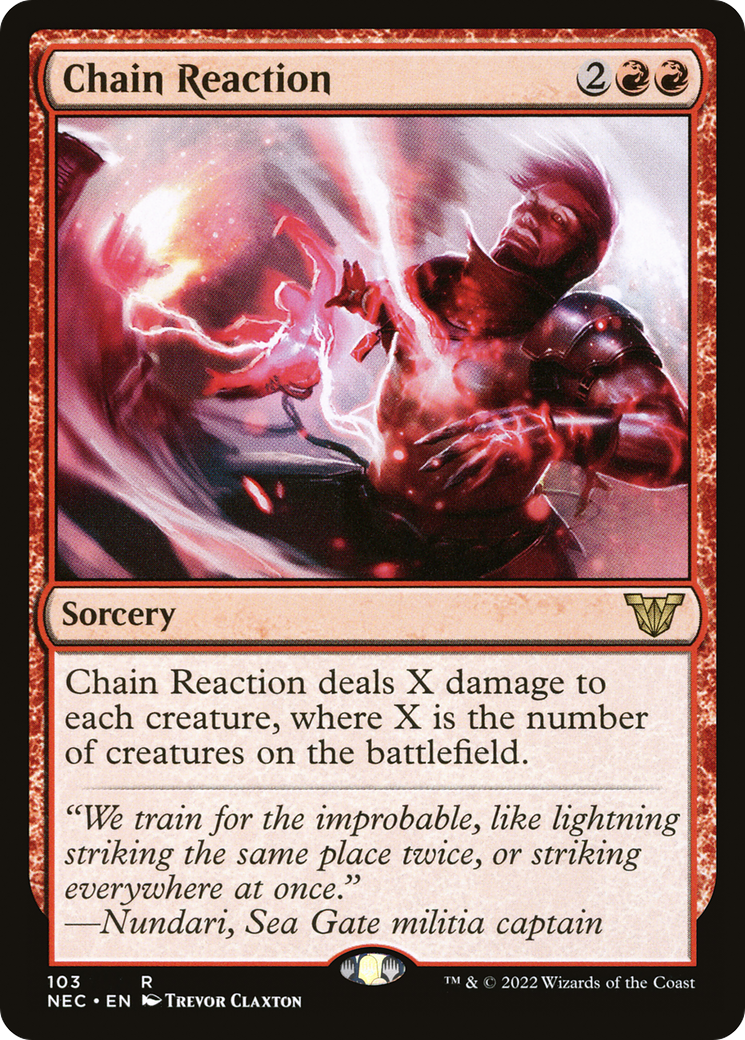
Chain Reaction
Chain Reaction
Sorcery
Chain Reaction deals X damage to each creature, where X is the number of creatures on the battlefield.
- The value of X is determined as Chain Reaction resolves.
-
1
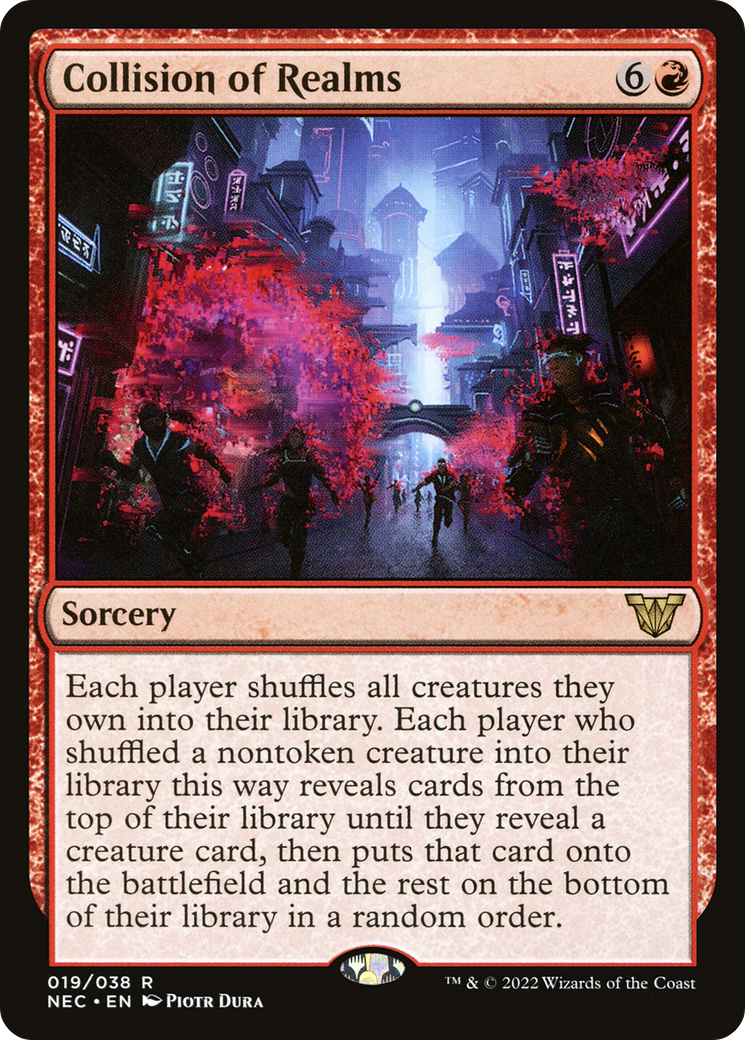
Collision of Realms
Collision of Realms
Sorcery
Each player shuffles all creatures they own into their library. Each player who shuffled a nontoken creature into their library this way reveals cards from the top of their library until they reveal a creature card, then puts that card onto the battlefield and the rest on the bottom of their library in a random order.
- All creatures are shuffled into their owners' libraries at the same time. Then all players who shuffled nontoken creatures into their library this way reveal cards. Then all creature cards revealed this way enter the battlefield at the same time. Then all other cards are put on the bottom of their owners' libraries. Any abilities that triggered during this process are then put on the stack, starting by those controlled by the active player in an order of that player's choice, then continuing with each other player's abilities in turn order. The last player to put their abilities on the stack will be the first player to have their abilities resolve. A player who controls no creatures or who controls only creature tokens will still shuffle their library.
- Each player reveals and puts onto the battlefield one creature card or fewer. They don't reveal a card for each nontoken creature they shuffle into their library; it's just one creature card at most.
-
1
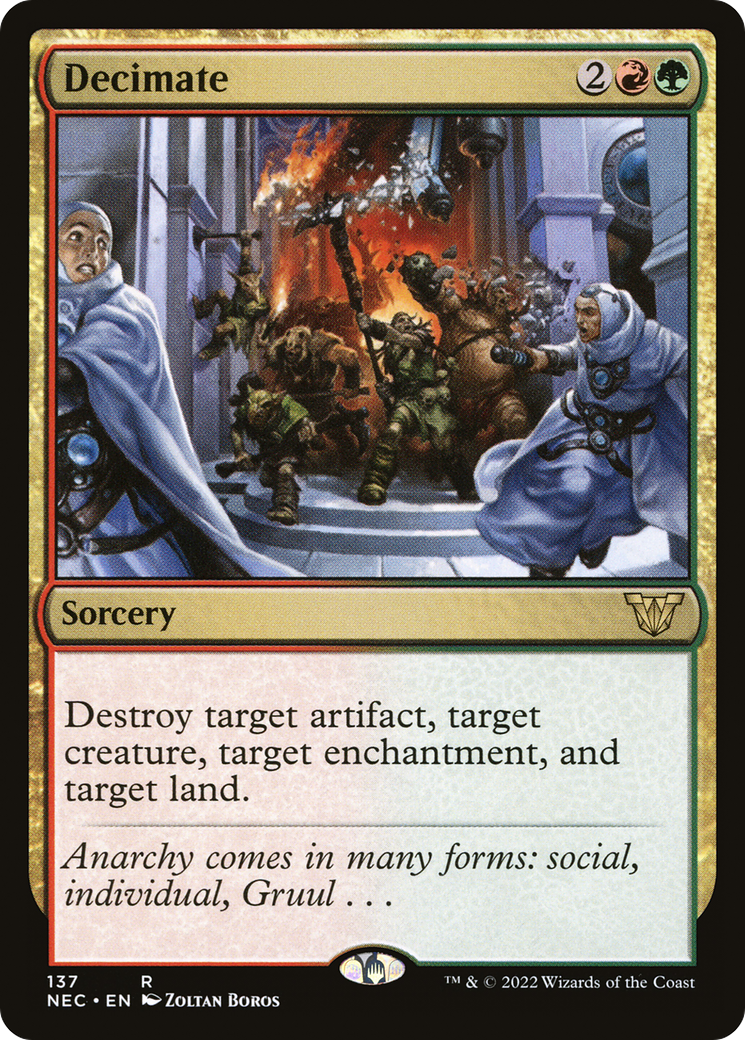
Decimate
Decimate
Sorcery
Destroy target artifact, target creature, target enchantment, and target land. (You can't cast this spell unless you have legal choices for all its targets.)
- You must choose a legal target for each target required by Decimate. However, if a permanent has multiple card types, it may be chosen as the target for more than one instance of the word "target." For example, you could cast Decimate targeting an artifact creature, an enchantment, and a land.
-
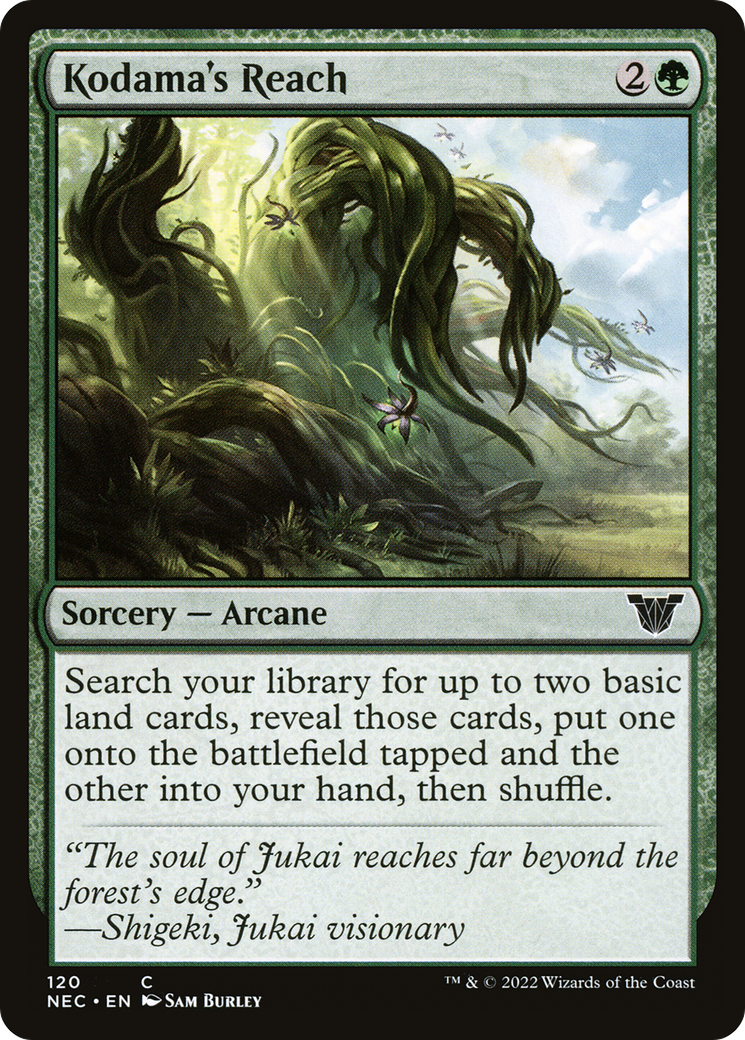
1
Kodama's Reach
Kodama's Reach
Sorcery — Arcane
Search your library for up to two basic land cards, reveal those cards, put one onto the battlefield tapped and the other into your hand, then shuffle.
- You can get just one basic land card if you wish (or even none at all). If you get only one land card, you put it onto the battlefield tapped.
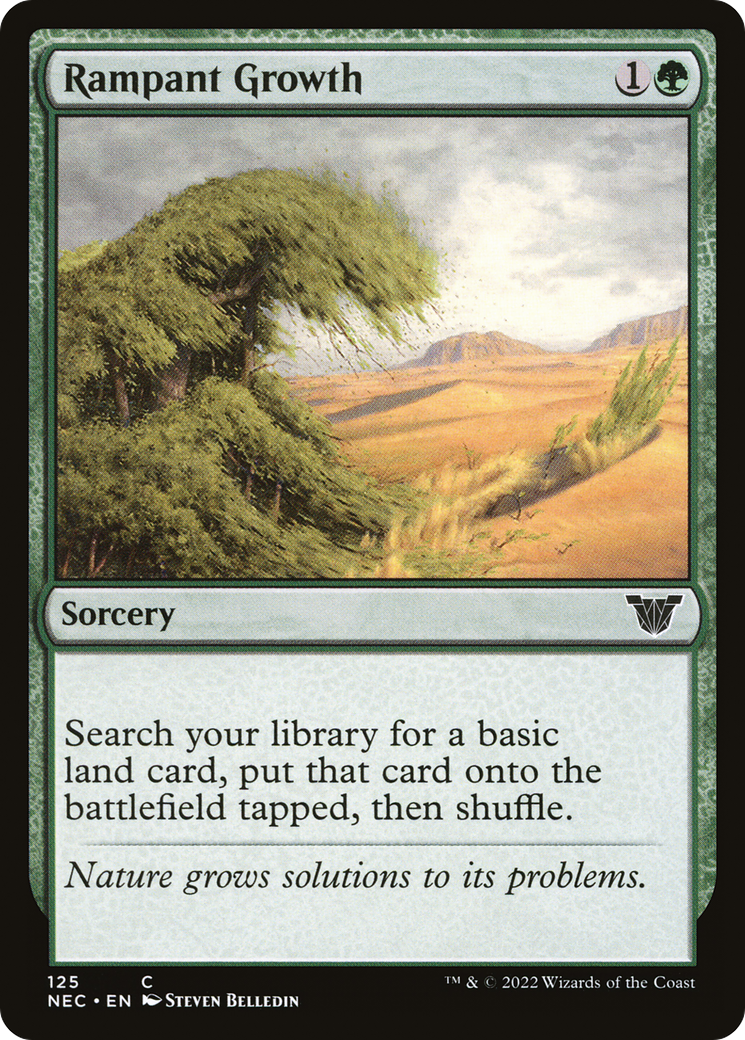
-
1
Rampant Growth
Rampant Growth
Sorcery
Search your library for a basic land card, put that card onto the battlefield tapped, then shuffle.
- The land does not count toward your one per turn limit because it was put onto the battlefield by an effect.
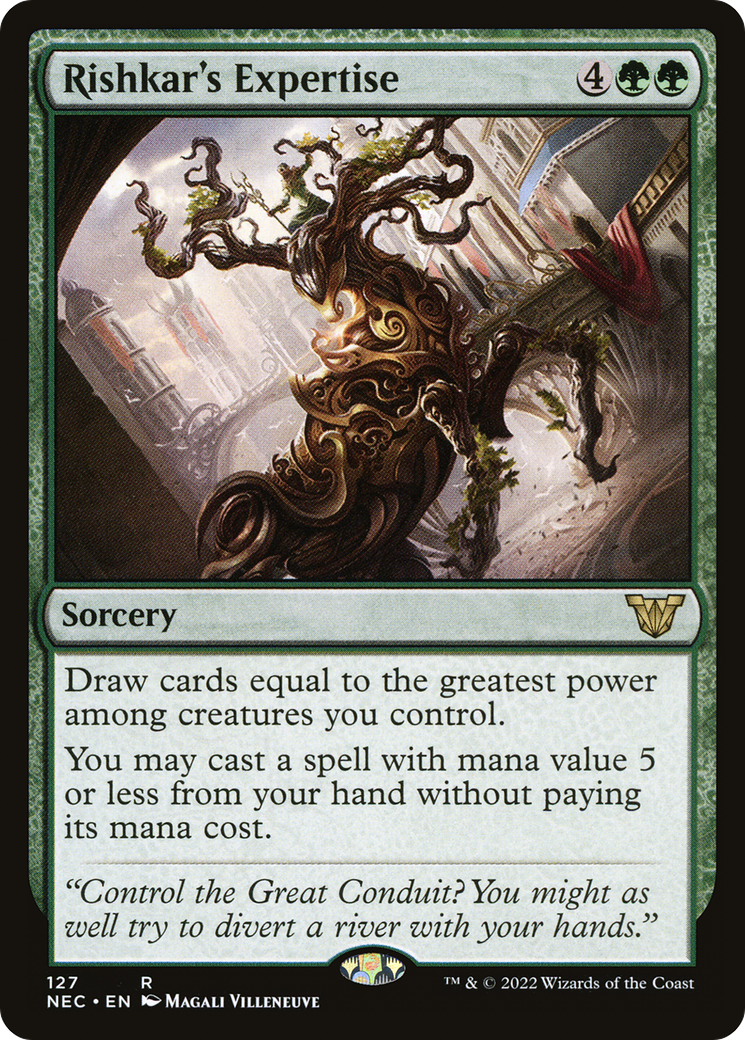
-
1
Rishkar's Expertise
Rishkar's Expertise
Sorcery
Draw cards equal to the greatest power among creatures you control.
You may cast a spell with mana value 5 or less from your hand without paying its mana cost.
- The mana value of a split card is determined by the combined mana cost of its two halves. If an expertise spell allows you to cast a split card, you may cast either half or, if that split card has fuse, both halves.
- If you control no creatures with power greater than 0 as Rishkar's Expertise resolves, you draw no cards, but you may cast a card with mana value 5 or less from your hand without paying its mana cost.
- You may cast one of the cards drawn by Rishkar's Expertise's first effect while performing its second effect.
- A card's mana value is determined solely by the mana symbols printed in its upper right corner. The mana value is the total amount of mana in that cost, regardless of color. For example, a card with mana cost has mana value 3. Ignore any alternative costs, additional costs, cost increases, or cost reductions that could apply to it. A card with no mana cost has a mana value of 0.
- If the card has in its mana cost, you must choose 0 as the value of X when casting it without paying its mana cost.
- The greatest power among creatures you control is determined as Rishkar's Expertise resolves.
- If you cast a card "without paying its mana cost," you can't choose to cast it for any alternative costs, such as emerge costs. You can, however, pay additional costs. If the card has any mandatory additional costs, such as that of Cathartic Reunion, you must pay those to cast the card.
- While you're casting your free spell, the Expertise spell is still on the stack. It will be put into its owner's graveyard after the free spell is cast. The free spell can't target the Expertise card in your graveyard. It can target the Expertise spell on the stack, but the Expertise spell will become an illegal target before the free spell resolves.
- Any triggered abilities that trigger while performing the Expertise spell's first effect won't be put onto the stack until after you're done casting your free spell. They're put onto the stack at the same time as any abilities that triggered while casting that spell regardless of the order in which those abilities triggered.
- Effects that allow you to "cast" a card don't allow you to play a land card.
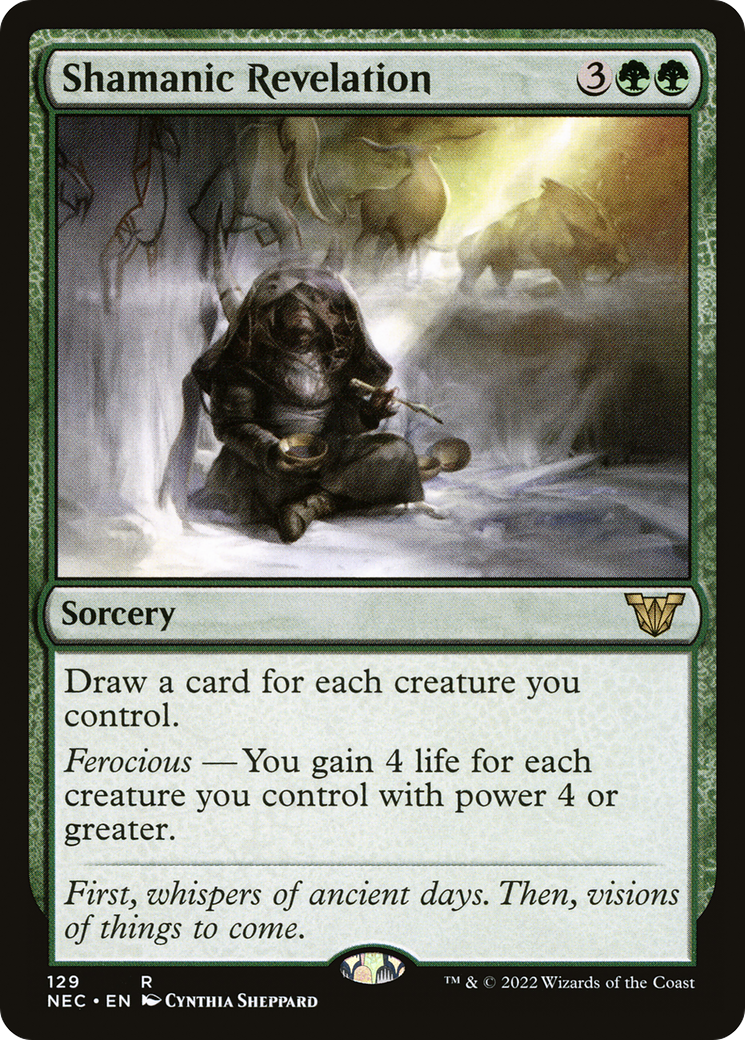
-
1
Shamanic Revelation
Shamanic Revelation
Sorcery
Draw a card for each creature you control.
Ferocious — You gain 4 life for each creature you control with power 4 or greater.
- After you draw cards while Shamanic Revelation is resolving, nothing else can happen before you gain the appropriate amount of life. Notably, abilities that trigger when you draw cards won't be put onto the stack until after you've gained life.
-
1
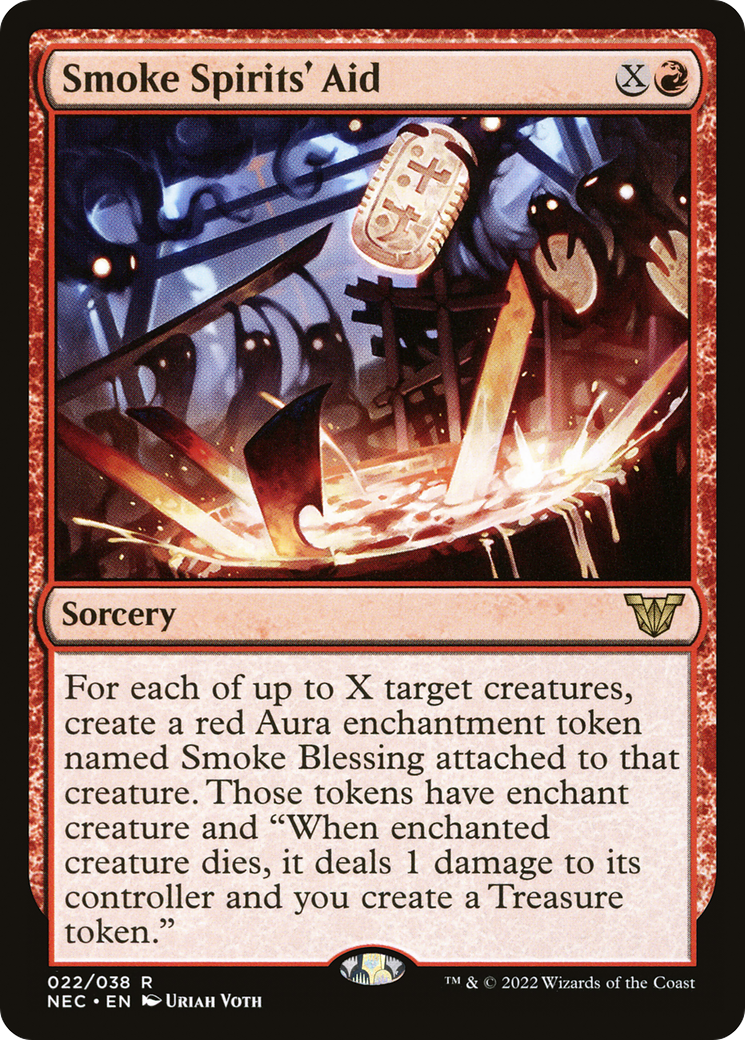
Smoke Spirits' Aid
Smoke Spirits' Aid
Sorcery
For each of up to X target creatures, create a red Aura enchantment token named Smoke Blessing attached to that creature. Those tokens have enchant creature and "When enchanted creature dies, it deals 1 damage to its controller and you create a Treasure token."
- If a Smoke Blessing that would be created by Smoke Spirits' Aid can't be attached to that creature for any reason, the token isn't created.
-
1
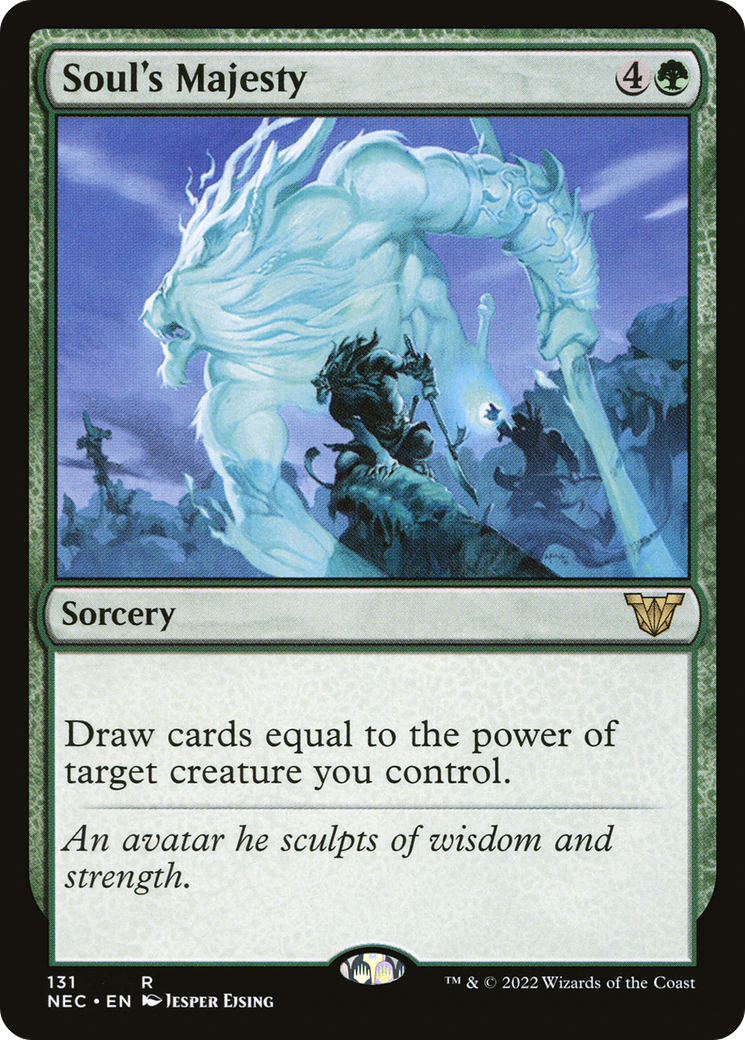
Soul's Majesty
Soul's Majesty
Sorcery
Draw cards equal to the power of target creature you control.
- Soul's Majesty's only target is the creature. If that creature becomes an illegal target by the time Soul's Majesty would resolve, the entire spell doesn't resolve. You won't draw any cards.
-
1
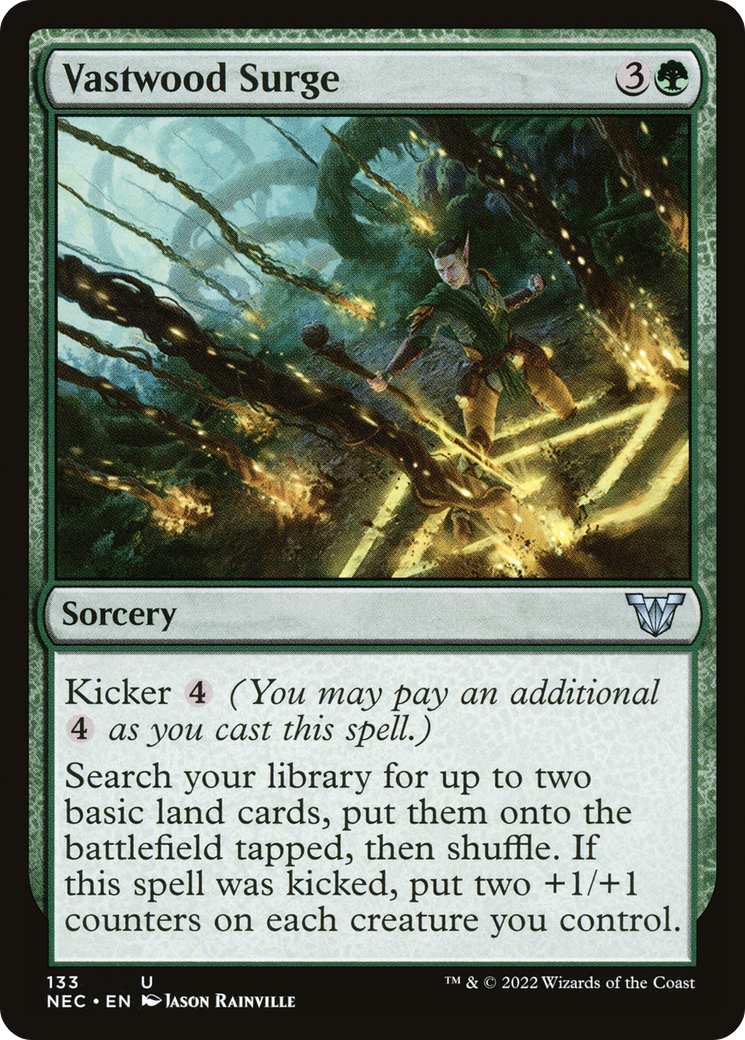
Vastwood Surge
Vastwood Surge
Sorcery
Kicker (You may pay an additional as you cast this spell.)
Search your library for up to two basic land cards, put them onto the battlefield tapped, then shuffle. If this spell was kicked, put two +1/+1 counters on each creature you control.
- If you put a permanent with a kicker ability onto the battlefield without casting it, you can't kick it.
- If a spell's kicker cost was paid, the spell is "kicked."
- The kicker ability doesn't let you pay a kicker cost more than once.
- To determine a spell's total cost, start with the mana cost (or an alternative cost if another card's effect allows you to pay one instead), add any cost increases (such as kicker), then apply any cost reductions. The spell's mana value remains unchanged, no matter what the total cost to cast it was.
- If you copy a kicked spell on the stack, the copy is also kicked. If the copied spell is a permanent spell, the token the copy of that spell becomes when it enters is also kicked.
- If a card or token enters as a copy of a permanent, the new permanent isn't kicked, even if the original was.
- If any abilities trigger when the lands are put onto the battlefield and Vastwood Surge was kicked, those abilities won't resolve until after you've put two +1/+1 counters on creatures you control.
Artifacts 8
-
1
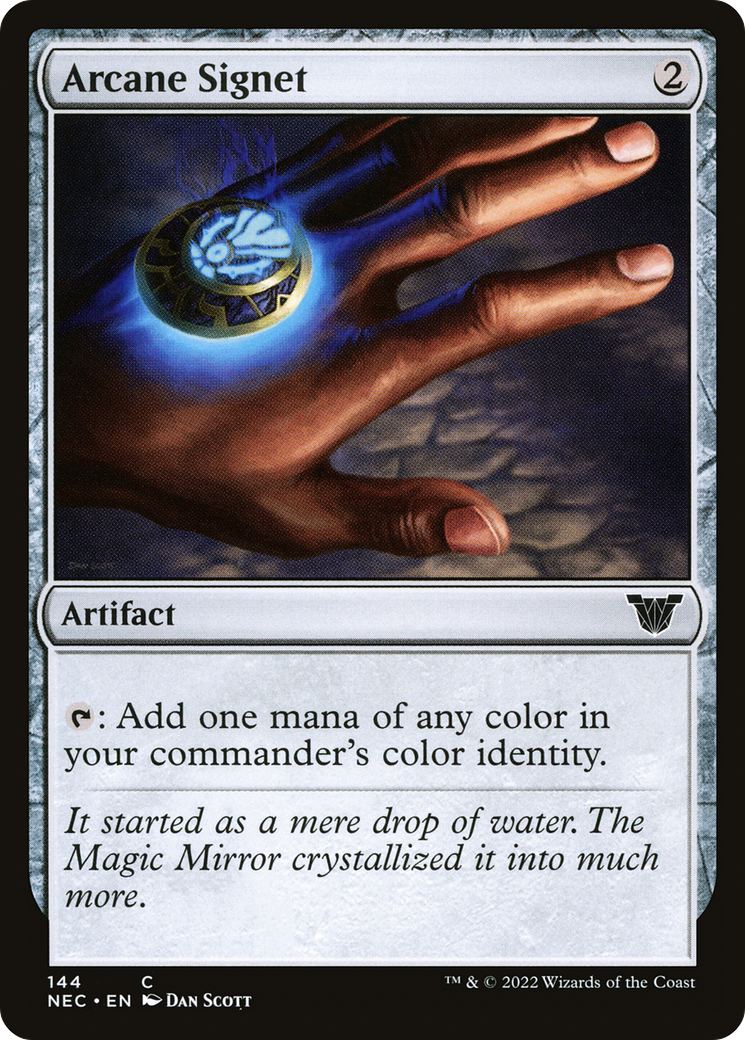
Arcane Signet
Arcane Signet
Artifact
: Add one mana of any color in your commander's color identity.
- If your commander is a card that has no colors in its color identity, Arcane Signet's ability produces no mana. It doesn't produce .
- If you have two commanders, the ability adds one mana of any color in their combined color identities.
- If you don't have a commander, Arcane Signet's ability produces no mana.
-
1
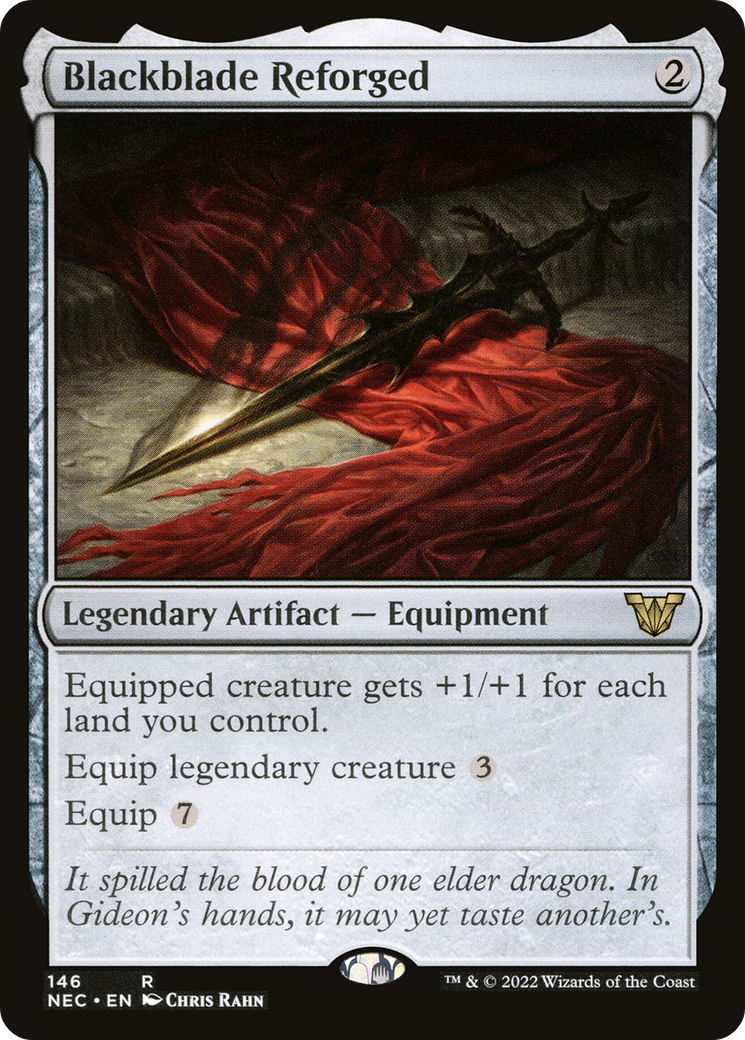
Blackblade Reforged
Blackblade Reforged
Legendary Artifact — Equipment
Equipped creature gets +1/+1 for each land you control.
Equip legendary creature
Equip
- "Equip [quality] creature" is a variant of the equip keyword. "Equip [quality] creature [cost]" means "[Cost]: Attach this Equipment to target [quality] creature you control. Activate only as a sorcery."
- Whether the target creature is legendary is checked only as Blackblade Reforged's first equip ability is activated and as that ability resolves. If the creature somehow becomes nonlegendary later, Blackblade Reforged remains attached to it.
-
1
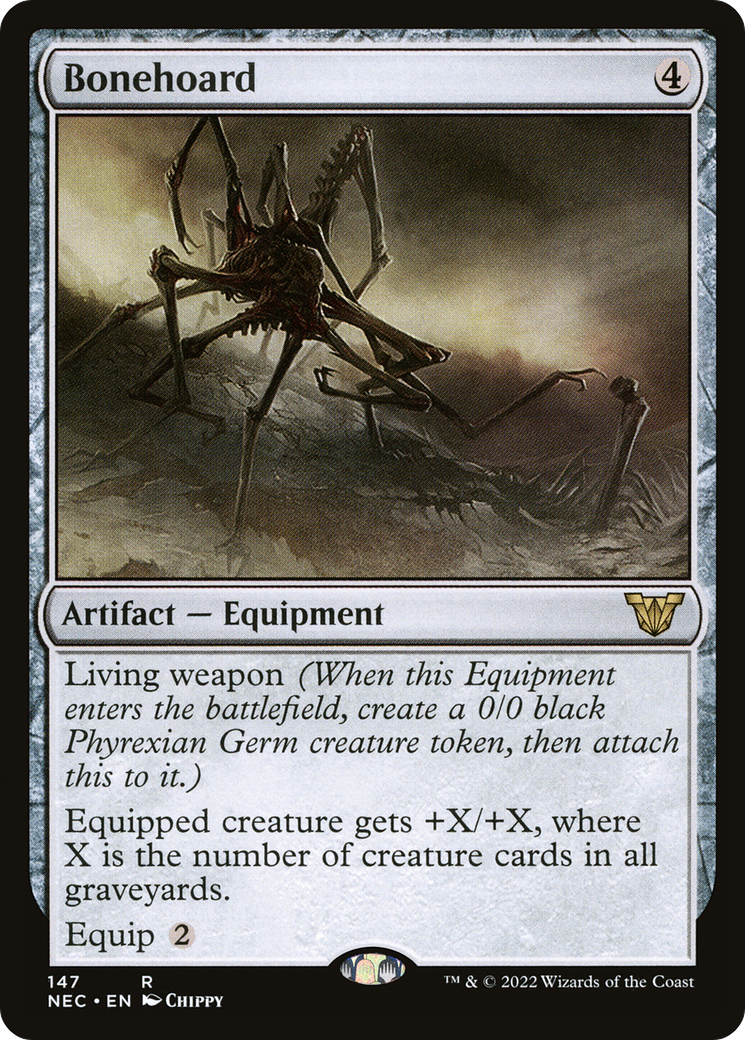
Bonehoard
Bonehoard
Artifact — Equipment
Living weapon (When this Equipment enters, create a 0/0 black Phyrexian Germ creature token, then attach this to it.)
Equipped creature gets +X/+X, where X is the number of creature cards in all graveyards.
Equip
- If the living weapon trigger causes two Germs to be created (due to an effect such as that of Doubling Season), the Equipment becomes attached to one of them. The other will be put into your graveyard and subsequently cease to exist, unless another effect raises its toughness above 0.
- The Germ token enters the battlefield as a 0/0 creature and the Equipment becomes attached to it before state-based actions would cause the token to die. Abilities that trigger as the token enters the battlefield see that a 0/0 creature entered the battlefield.
- Like other Equipment, each Equipment with living weapon has an equip cost. You can pay this cost to attach an Equipment to another creature you control. Once the Germ token is no longer equipped, it will be put into your graveyard and subsequently cease to exist, unless another effect raises its toughness above 0.
- If the Germ token is destroyed, the Equipment remains on the battlefield as with any other Equipment.
- The value of X is calculated continuously as the number of creature cards in graveyards changes.
- If there are no creature cards in any graveyard when Bonehoard's living weapon ability resolves, the Germ will be 0/0 and put into its owner's graveyard.
- Although creature tokens go to the graveyard before ceasing to exist, they never count as creature cards and won't increase the bonus granted by Bonehoard, however briefly.
- If lethal damage is dealt simultaneously to the equipped creature and another creature, both creatures are put into the graveyard at the same time. The equipped creature won't get an additional bonus from the other creature.
-
1
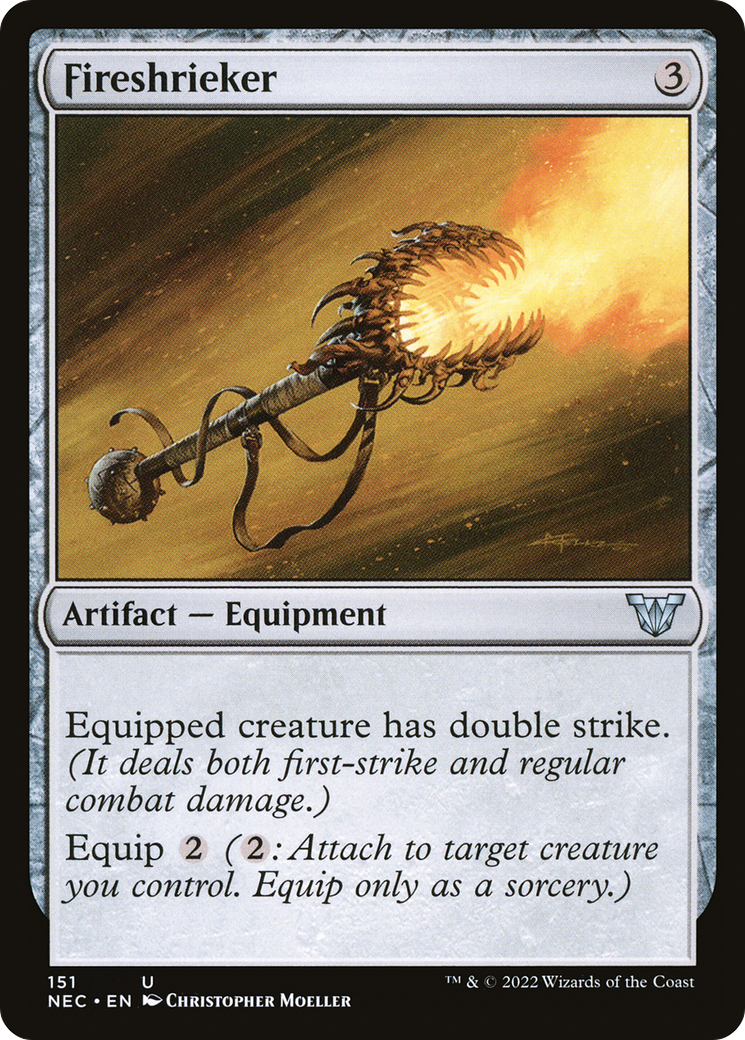
Fireshrieker
Fireshrieker
Artifact — Equipment
Equipped creature has double strike. (It deals both first-strike and regular combat damage.)
Equip ( : Attach to target creature you control. Equip only as a sorcery.)
-
1
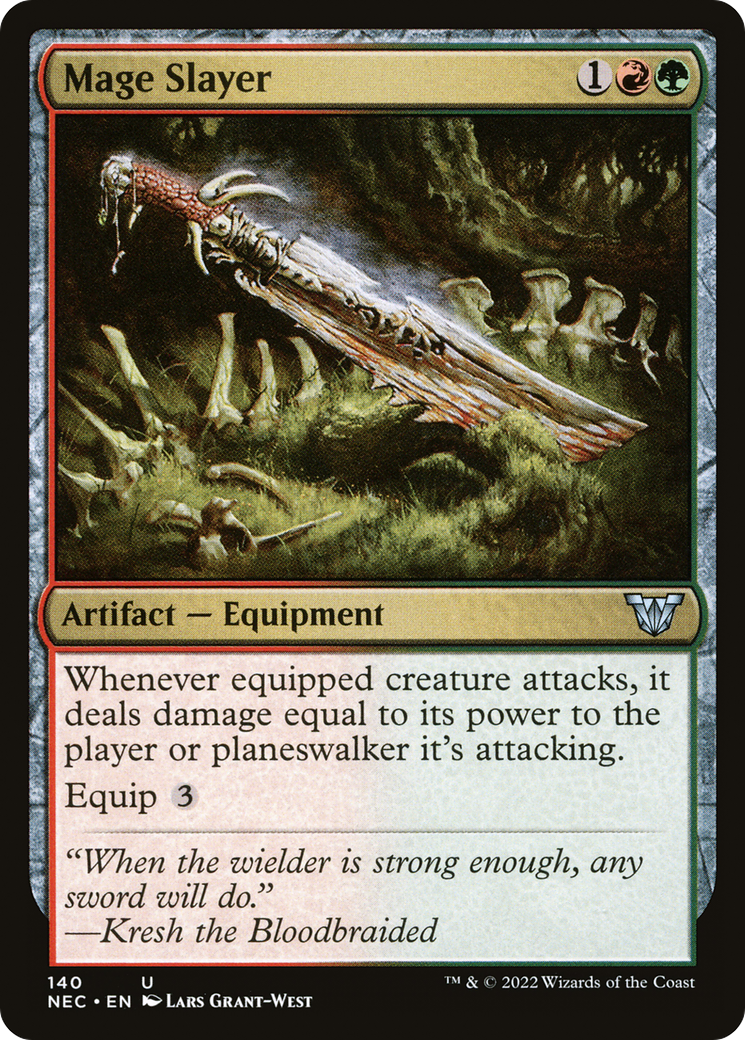
Mage Slayer
Mage Slayer
Artifact — Equipment
Whenever equipped creature attacks, it deals damage equal to its power to the player or planeswalker it's attacking.
Equip
- This ability triggers and resolves in the declare attackers step. The creature will still deal its combat damage as normal later on during the combat phase.
- When the equipped creature attacks, the first ability will trigger. When that ability resolves, that creature will deal damage equal to its power to player or planeswalker it's attacking, even if Mage Slayer has left the battlefield or is equipping a different creature by that time.
-
1
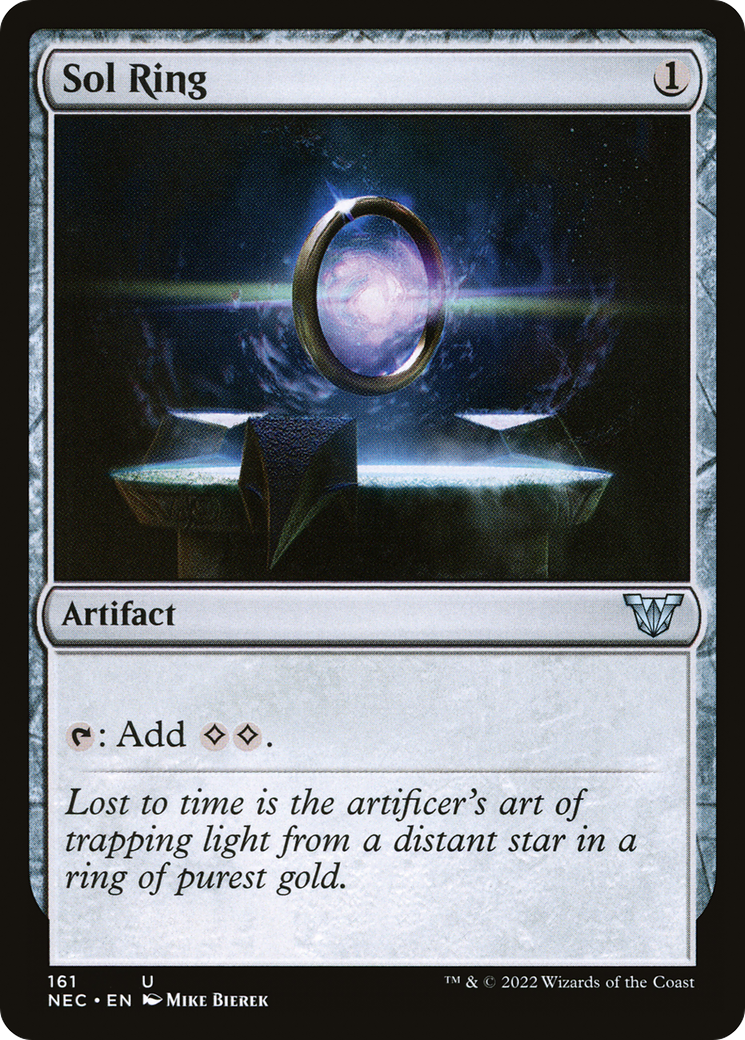
Sol Ring
Sol Ring
Artifact
: Add .
-
1
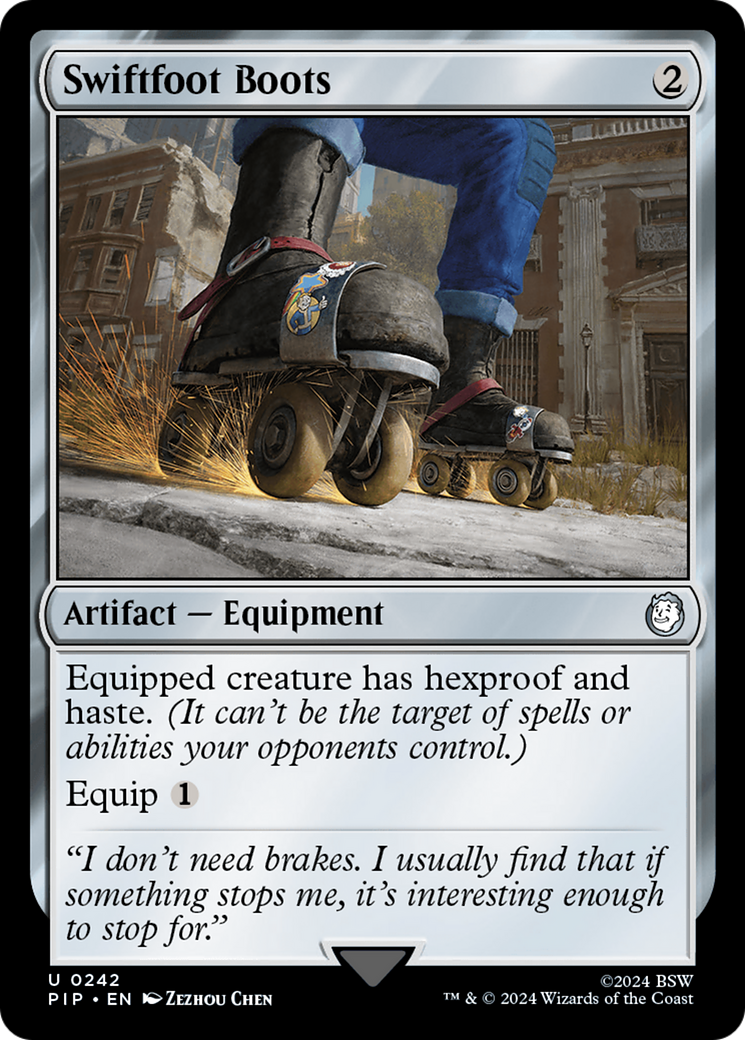
Swiftfoot Boots
Swiftfoot Boots
Artifact — Equipment
Equipped creature has hexproof and haste. (It can't be the target of spells or abilities your opponents control. It can attack and no matter when it came under your control.)
Equip ( : Attach to target creature you control. Equip only as a sorcery.)
- If a creature enters the battlefield under your control and gains haste, but then loses it before attacking, it won't be able to attack that turn. This means that you can't use one Swiftfoot Boots to allow two new creatures to attack in the same turn.
-
1
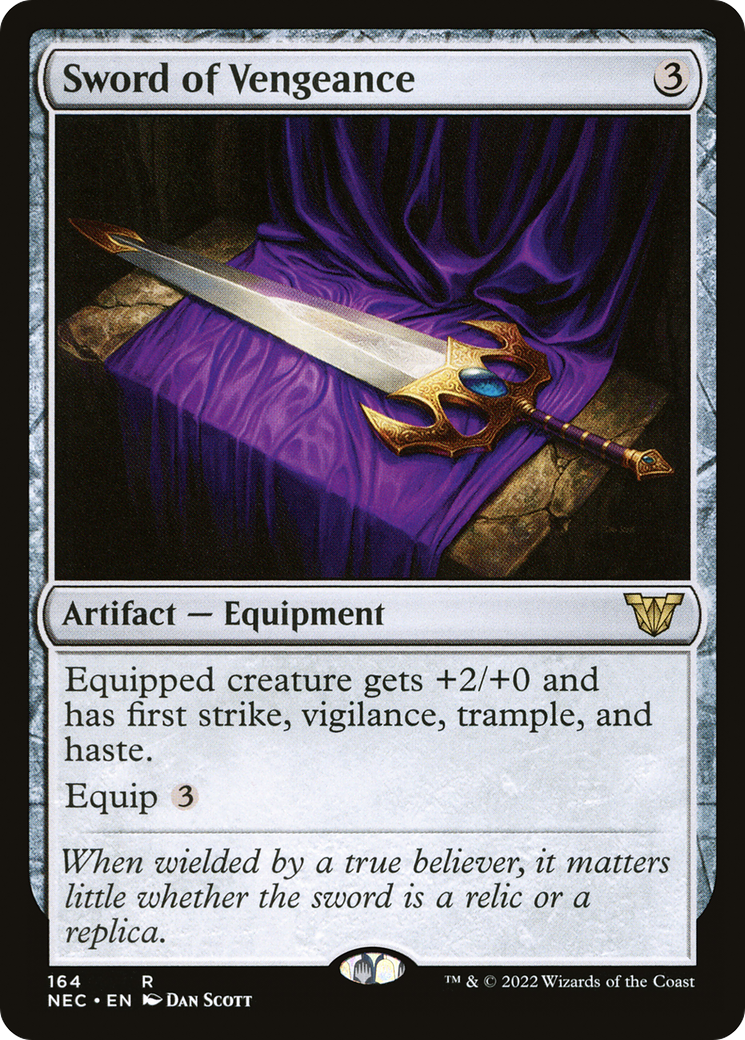
Sword of Vengeance
Sword of Vengeance
Artifact — Equipment
Equipped creature gets +2/+0 and has first strike, vigilance, trample, and haste.
Equip
Enchantments 10
-
1
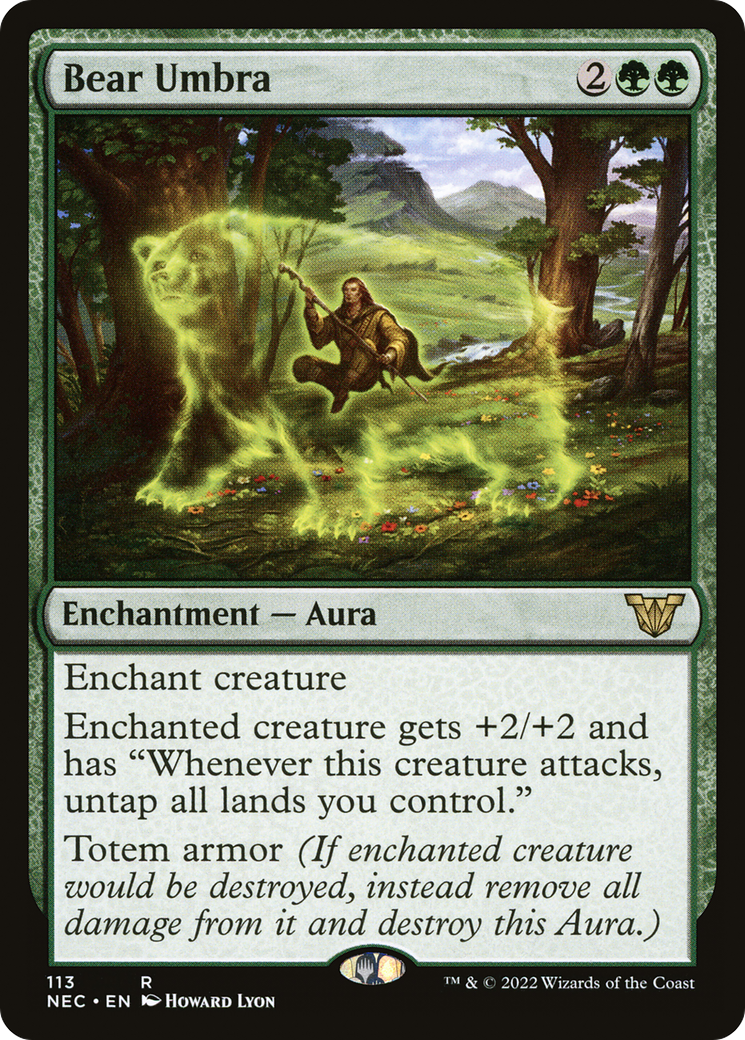
Bear Umbra
Bear Umbra
Enchantment — Aura
Enchant creature
Enchanted creature gets +2/+2 and has "Whenever this creature attacks, untap all lands you control."
Umbra armor (If enchanted creature would be destroyed, instead remove all damage from it and destroy this Aura.)
- Some printings of this card refer to the ability "totem armor". This ability's name has been replaced with "umbra armor". This change does not affect the gameplay function of this card.
- Umbra armor's effect is mandatory. If the enchanted creature would be destroyed, you must remove all damage from it (if it has any) and destroy the Aura that has umbra armor instead.
- Umbra armor's effect is applied no matter why the enchanted creature would be destroyed: because it's been dealt lethal damage, or because it's being affected by an effect that says to "destroy" it (such as Breathe Your Last). In either case, all damage is removed from the creature and the Aura is destroyed instead.
- If a creature you control is enchanted with multiple Auras that have umbra armor, and the enchanted creature would be destroyed, one of those Auras is destroyed instead—but only one of them. You choose which one because you control the enchanted creature.
- If a creature enchanted with an Aura that has umbra armor would be destroyed by multiple state-based actions at the same time (most likely because a creature with deathtouch has dealt damage to that creature greater than or equal to its toughness), umbra armor's effect will replace all of them and save the creature.
- If a spell or ability would destroy both an Aura with umbra armor and the creature it's enchanting at the same time, umbra armor's effect will save the enchanted creature from being destroyed. Instead, the spell or ability will destroy the Aura in two different ways at the same time, but the result is the same as destroying it once.
- Umbra armor's effect is not regeneration. Specifically, if umbra armor's effect is applied, the enchanted creature does not become tapped and is not removed from combat as a result. Effects that say the enchanted creature can't be regenerated won't prevent umbra armor's effect from being applied.
- If a spell or ability says that it would "destroy" a creature enchanted with an Aura that has umbra armor, that spell or ability is what causes the Aura to be destroyed instead. Umbra armor doesn't destroy the Aura; rather, it changes the effects of the spell or ability. On the other hand, if a spell or ability deals lethal damage to a creature enchanted with an Aura that has umbra armor, the game rules regarding lethal damage cause the Aura to be destroyed, not that spell or ability.
- Umbra armor has no effect if the enchanted creature is put into a graveyard for any other reason, such as if it's sacrificed, if the "legend rule" applies to it, or if its toughness is 0 or less.
- If a creature enchanted with an Aura that has umbra armor has indestructible, lethal damage and effects that try to destroy it simply have no effect. Umbra armor won't do anything because it won't have to.
- When the enchanted creature attacks, all lands controlled by that creature's controller (who is not necessarily the Aura's controller) untap.
-
1
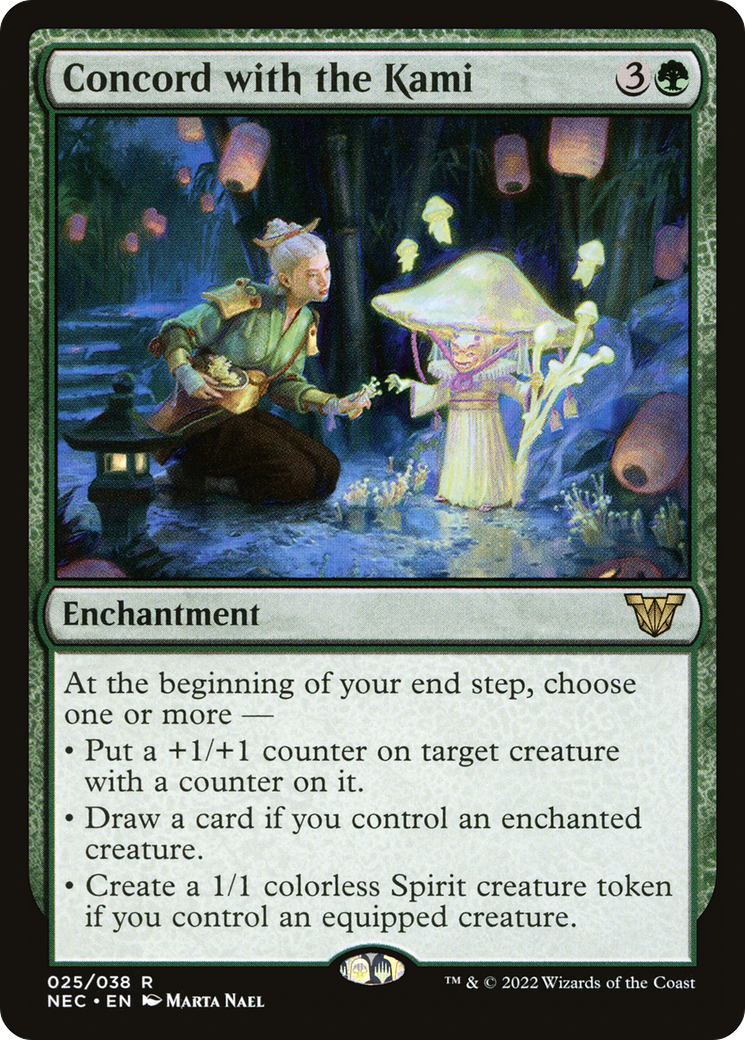
Concord with the Kami
Concord with the Kami
Enchantment
At the beginning of your end step, choose one or more —
- Put a +1/+1 counter on target creature with a counter on it.
- Draw a card if you control an enchanted creature.
- Create a 1/1 colorless Spirit creature token if you control an equipped creature.
- You cannot choose the first mode unless you have a legal target for it. You may choose the second and third mode even if you don't have an enchanted or equipped creature at the time this ability triggers.
- If you choose the first mode, and the target creature becomes an illegal target by the time the ability tries to resolve, the ability won't resolve and none of its effects will happen, even if you chose other modes.
-
1
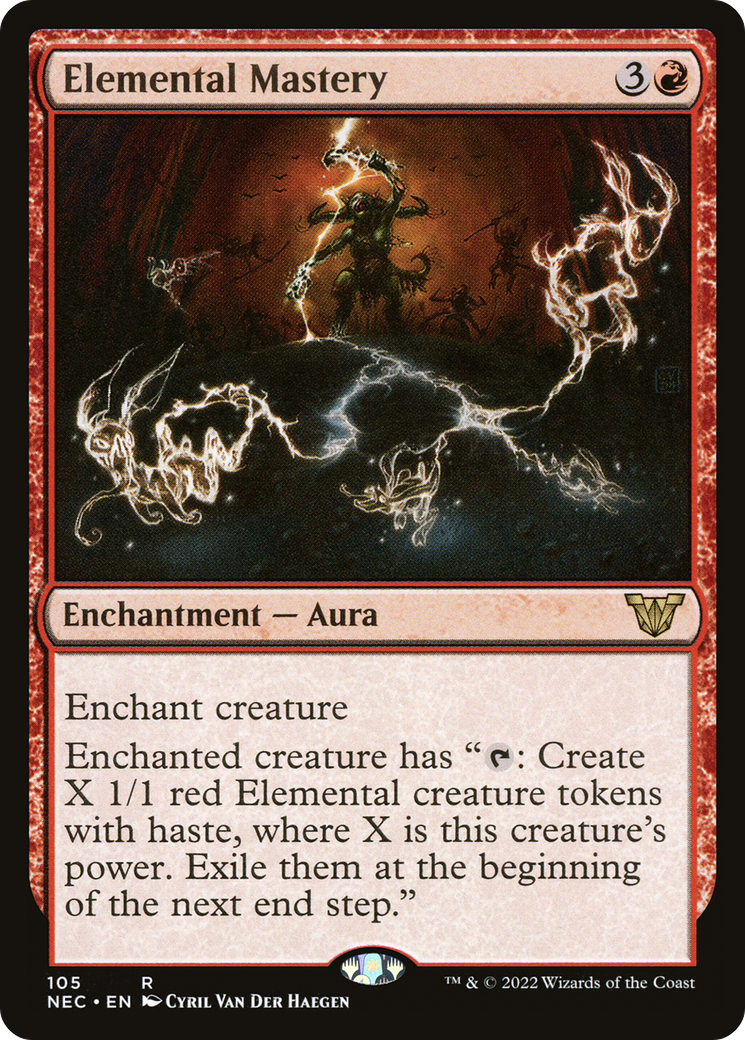
Elemental Mastery
Elemental Mastery
Enchantment — Aura
Enchant creature
Enchanted creature has " : Create X 1/1 red Elemental creature tokens with haste, where X is this creature's power. Exile them at the beginning of the next end step."
- The enchanted creature's power is checked at the time the ability resolves. If the enchanted creature has left the battlefield by then, its last known information is used.
- The tokens will be exiled in the End step even if Elemental Mastery or the enchanted creature has left the battlefield by then.
- If the ability is activated after the current turn's End step has begun, the tokens won't be exiled until the next turn's End step.
-
1
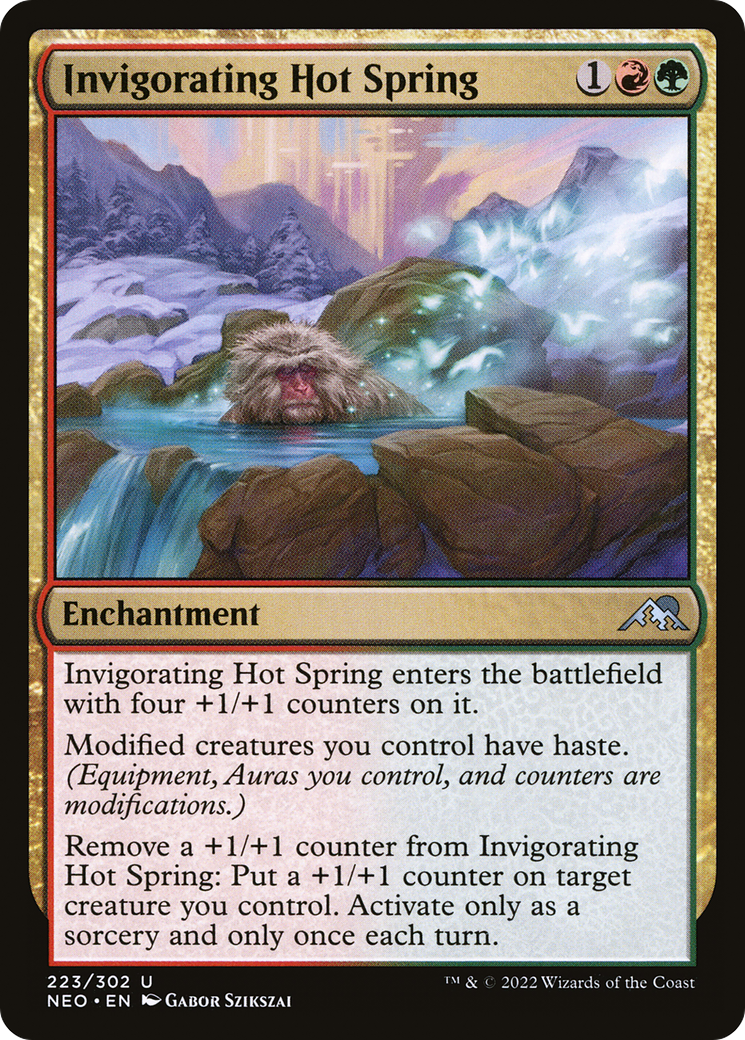
Invigorating Hot Spring
Invigorating Hot Spring
Enchantment
This enchantment enters with four +1/+1 counters on it.
Modified creatures you control have haste. (Equipment, Auras you control, and counters are modifications.)
Remove a +1/+1 counter from this enchantment: Put a +1/+1 counter on target creature you control. Activate only as a sorcery and only once each turn.
-
1
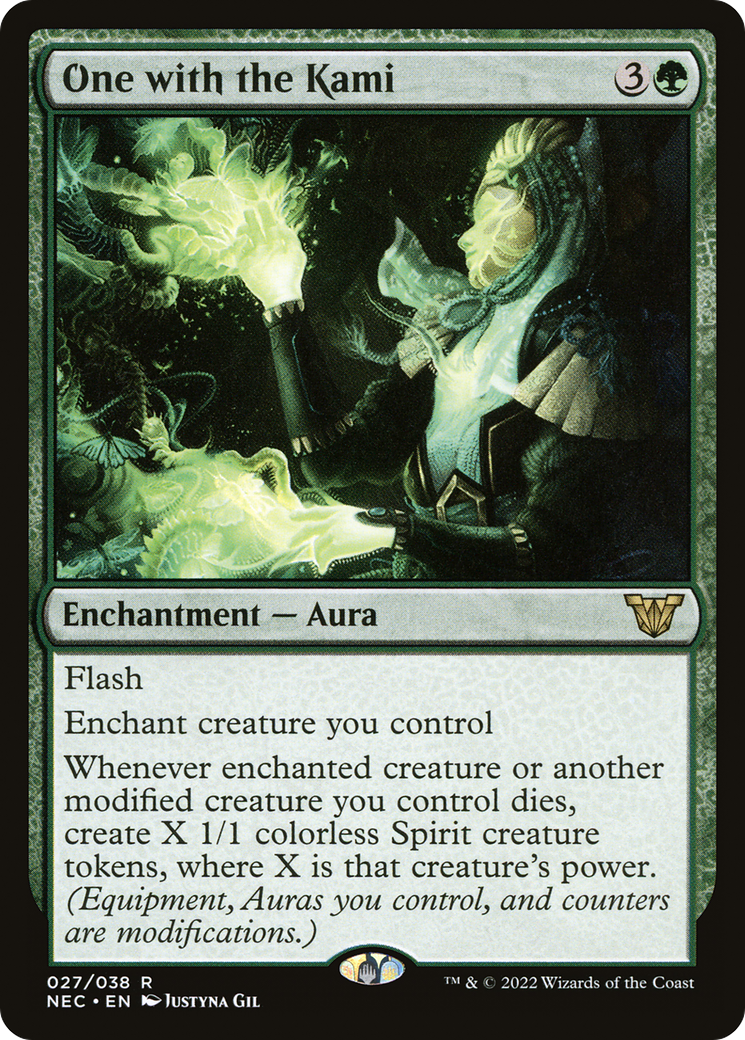
One with the Kami
One with the Kami
Enchantment — Aura
Flash
Enchant creature you control
Whenever enchanted creature or another modified creature you control dies, create X 1/1 colorless Spirit creature tokens, where X is that creature's power. (Equipment, Auras you control, and counters are modifications.)
- An Aura controlled by an opponent does not cause a creature you control to be modified.
- A creature with a counter on it is considered modified no matter what kind of counter it is or which player put it on that creature.
- A creature that is equipped is considered modified no matter who controls the Equipment that's attached to it.
-
1
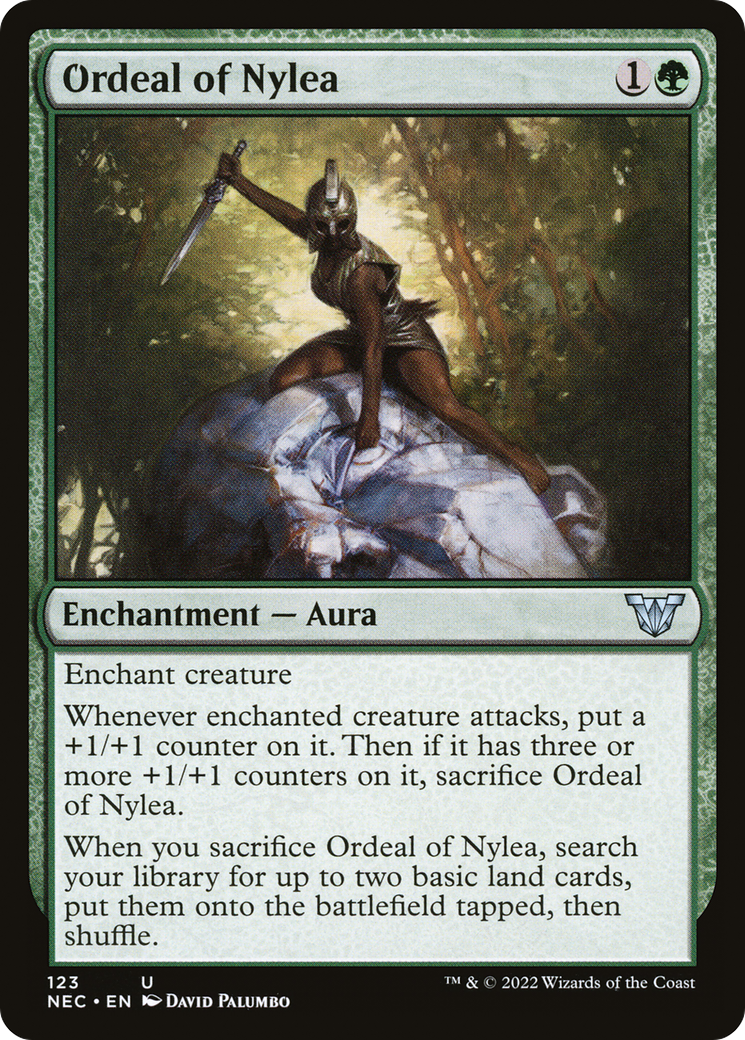
Ordeal of Nylea
Ordeal of Nylea
Enchantment — Aura
Enchant creature
Whenever enchanted creature attacks, put a +1/+1 counter on it. Then if it has three or more +1/+1 counters on it, sacrifice this Aura.
When you sacrifice this Aura, search your library for up to two basic land cards, put them onto the battlefield tapped, then shuffle.
- The check of whether the enchanted creature has three or more +1/+1 counters on it happens as part of the resolution of the attack triggered ability. If the third +1/+1 counter is put on the enchanted creature any other way, you won't sacrifice Ordeal of Nylea until the next time the creature attacks.
- Ordeal of Nylea's last ability will trigger when you sacrifice it for any reason, not just when you sacrifice it because of the effect of its second ability.
-
1
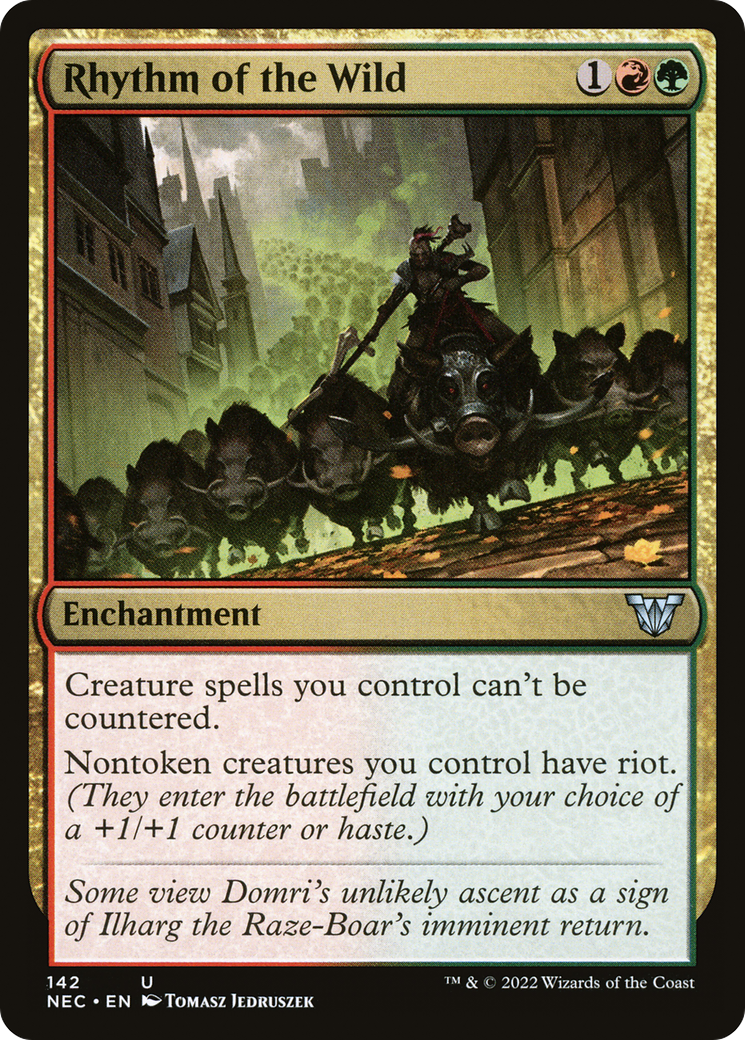
Rhythm of the Wild
Rhythm of the Wild
Enchantment
Creature spells you control can't be countered.
Nontoken creatures you control have riot. (They enter with your choice of a +1/+1 counter or haste.)
- If Rhythm of the Wild leaves the battlefield at the same time that a nontoken creature enters the battlefield (most likely because that creature has a replacement effect, such as that of Rescuer Sphinx), that creature still gets a +1/+1 counter or haste.
- A spell or ability that counters spells can still target a creature spell you control. When that spell or ability resolves, the creature spell won't be countered, but any additional effects of that spell or ability will still happen.
- If you choose for the creature to gain haste, it gains haste indefinitely. It won't lose it as the turn ends or as another player gains control of it.
- A noncreature card that happens to be entering the battlefield as a creature will have riot (for example, Rusted Relic while you control three other artifacts). Similarly, a creature card entering the battlefield as a noncreature permanent won't have riot (for example, Thassa, God of the Sea while your other permanents contribute only four to your devotion to blue).
- If a creature enters the battlefield with two instances of riot, you may choose to have it get two +1/+1 counters, one +1/+1 counter and haste, or two instances of haste. Multiple instances of haste on the same creature are redundant, but we're not going to tell the Gruul how to live their lives.
- Riot is a replacement effect. Players can't respond to your choice of +1/+1 counter or haste, and they can't take actions while the creature is on the battlefield without one or the other.
- If a nontoken, noncreature permanent becomes a creature after it's already on the battlefield, it will have riot but it will be too late for the replacement effect to have any effect.
- If a creature entering the battlefield has riot but can't have a +1/+1 counter put onto it, it gains haste.
- Once a creature with riot has entered the battlefield, it keeps its +1/+1 counter or haste even if it loses riot.
-
1
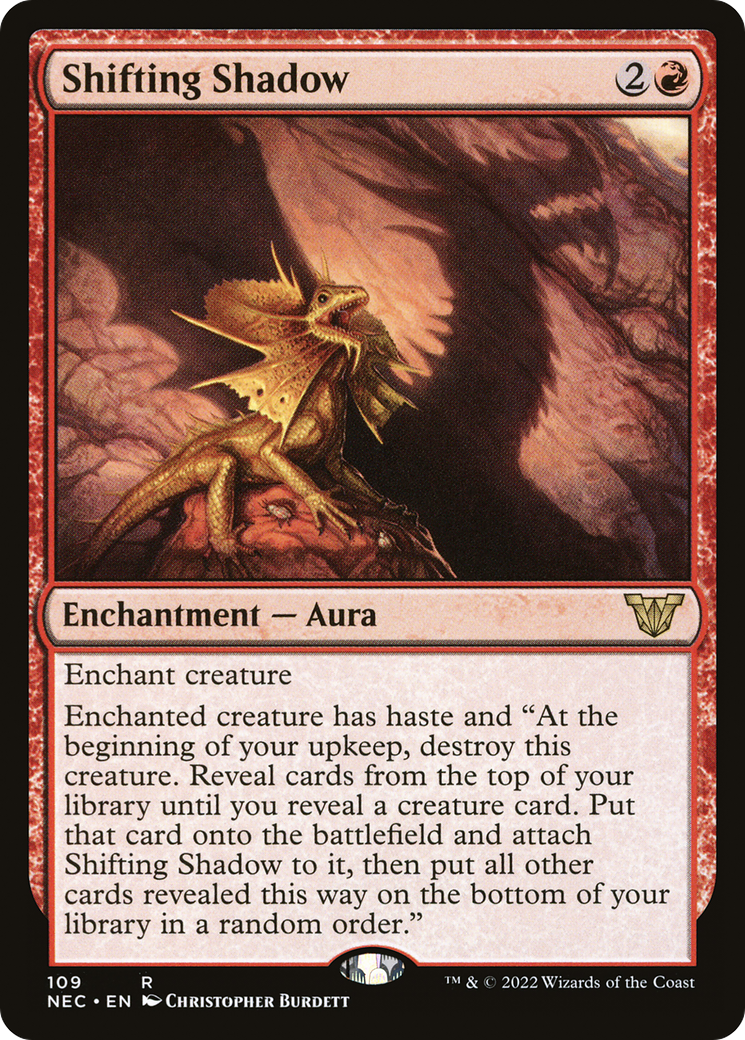
Shifting Shadow
Shifting Shadow
Enchantment — Aura
Enchant creature
Enchanted creature has haste and "At the beginning of your upkeep, destroy this creature. Reveal cards from the top of your library until you reveal a creature card. Put that card onto the battlefield and attach Shifting Shadow to it, then put all other cards revealed this way on the bottom of your library in a random order."
- If you don't reveal a creature card this way, you'll just reveal and randomize your library and Shifting Shadow becomes attached to nothing. It will be put into its owner's graveyard as a state-based action.
- If Shifting Shadow can't become attached to the creature you put onto the battlefield, most likely because that creature has protection from red, it becomes attached to nothing. It will be put into its owner's graveyard as a state-based action.
- If the Shifting Shadow leaves the battlefield after the triggered ability it grants has triggered but before it resolves, you'll destroy the creature it enchanted before it left the battlefield, then reveal cards and put a creature card onto the battlefield. Shifting Shadow won't become attached to it. The same is true if the enchanted creature leaves the battlefield rather than just Shifting Shadow, except that you won't destroy the creature it enchanted in that case.
- If the enchanted creature can't be destroyed, most likely because that creature has indestructible, you'll still get a new creature and attach Shifting Shadow to the new creature.
-
1
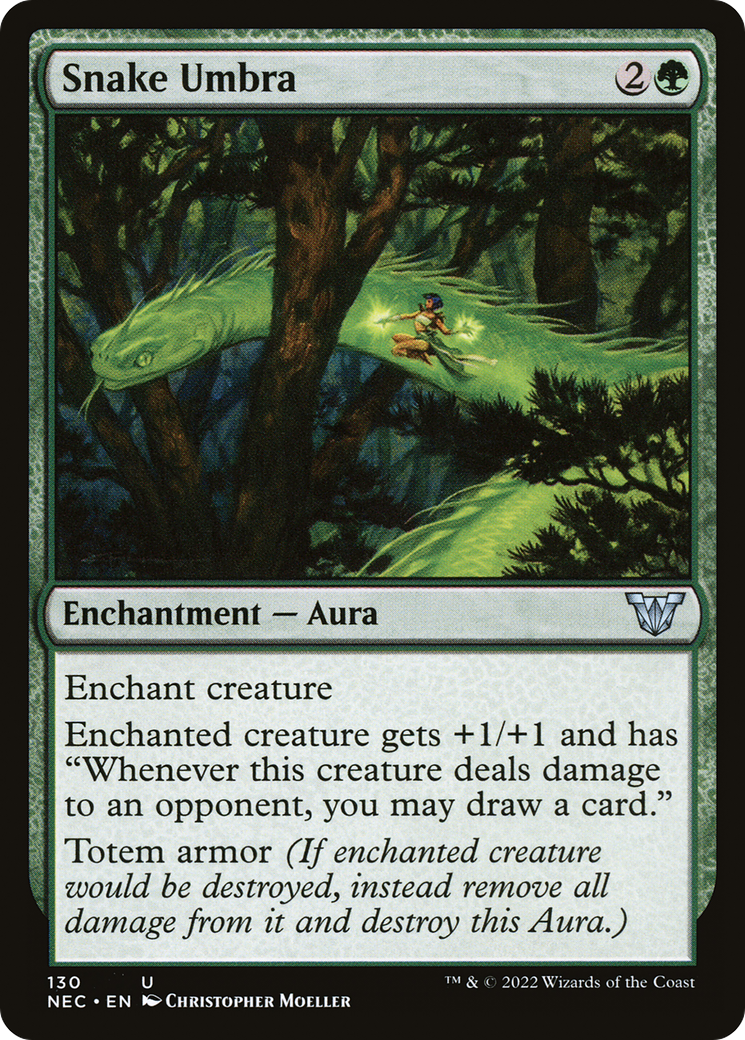
Snake Umbra
Snake Umbra
Enchantment — Aura
Enchant creature
Enchanted creature gets +1/+1 and has "Whenever this creature deals damage to an opponent, you may draw a card."
Umbra armor (If enchanted creature would be destroyed, instead remove all damage from it and destroy this Aura.)
- Some printings of this card refer to the ability "totem armor". This ability's name has been replaced with "umbra armor". This change does not affect the gameplay function of this card.
- Umbra armor has no effect if the enchanted creature is put into a graveyard for any other reason, such as if it's sacrificed, if the "legend rule" applies to it, or if its toughness is 0 or less.
- If a creature enchanted with an Aura that has umbra armor has indestructible, lethal damage and effects that try to destroy it simply have no effect. Umbra armor won't do anything because it won't have to.
- Umbra armor's effect is mandatory. If the enchanted creature would be destroyed, you must remove all damage from it (if it has any) and destroy the Aura that has umbra armor instead.
- Umbra armor's effect is applied no matter why the enchanted creature would be destroyed: because it's been dealt lethal damage, or because it's being affected by an effect that says to "destroy" it (such as Breathe Your Last). In either case, all damage is removed from the creature and the Aura is destroyed instead.
- If a creature you control is enchanted with multiple Auras that have umbra armor, and the enchanted creature would be destroyed, one of those Auras is destroyed instead—but only one of them. You choose which one because you control the enchanted creature.
- If a creature enchanted with an Aura that has umbra armor would be destroyed by multiple state-based actions at the same time (most likely because a creature with deathtouch has dealt damage to that creature greater than or equal to its toughness), umbra armor's effect will replace all of them and save the creature.
- If a spell or ability would destroy both an Aura with umbra armor and the creature it's enchanting at the same time, umbra armor's effect will save the enchanted creature from being destroyed. Instead, the spell or ability will destroy the Aura in two different ways at the same time, but the result is the same as destroying it once.
- Umbra armor's effect is not regeneration. Specifically, if umbra armor's effect is applied, the enchanted creature does not become tapped and is not removed from combat as a result. Effects that say the enchanted creature can't be regenerated won't prevent umbra armor's effect from being applied.
- If a spell or ability says that it would "destroy" a creature enchanted with an Aura that has umbra armor, that spell or ability is what causes the Aura to be destroyed instead. Umbra armor doesn't destroy the Aura; rather, it changes the effects of the spell or ability. On the other hand, if a spell or ability deals lethal damage to a creature enchanted with an Aura that has umbra armor, the game rules regarding lethal damage cause the Aura to be destroyed, not that spell or ability.
- The ability triggers when the enchanted creature deals any damage, not just combat damage.
- Snake Umbra grants the triggered ability to the creature. It triggers whenever the enchanted creature deals damage to an opponent of its controller (who is not necessarily an opponent of the Aura's controller). In other words, if your Snake Umbra winds up enchanting your opponent's creature, that opponent will draw a card whenever that creature damages you.
-
1
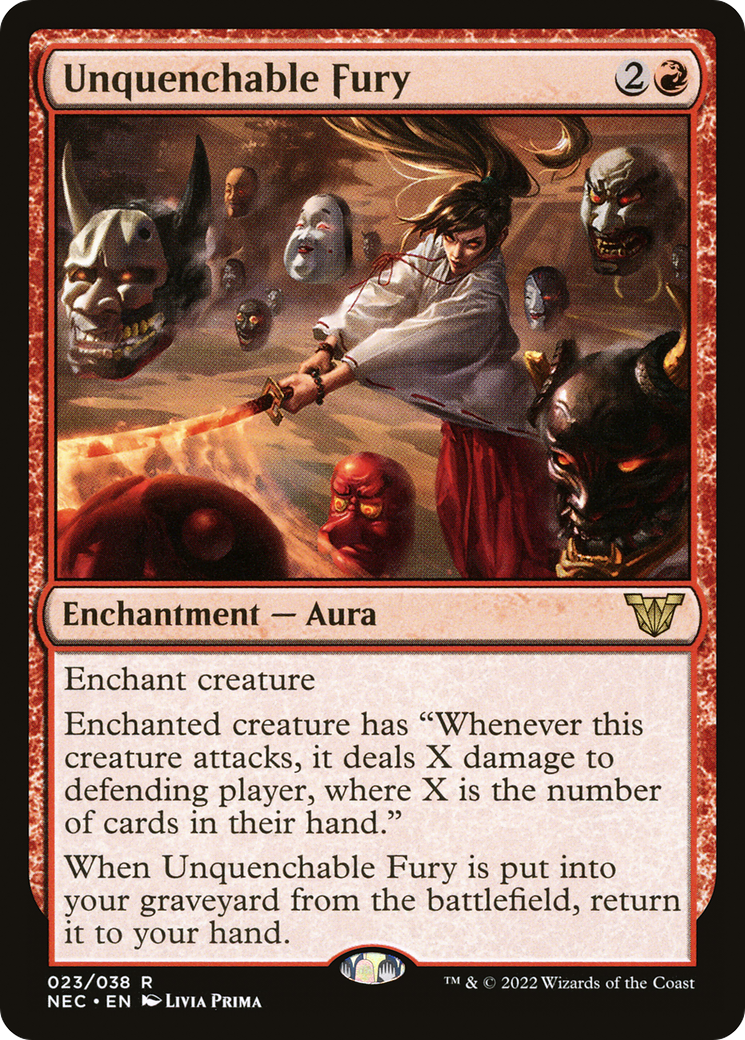
Unquenchable Fury
Unquenchable Fury
Enchantment — Aura
Enchant creature
Enchanted creature has "Whenever this creature attacks, it deals X damage to defending player, where X is the number of cards in their hand."
When this Aura is put into your graveyard from the battlefield, return it to your hand.
Lands 37
-
1
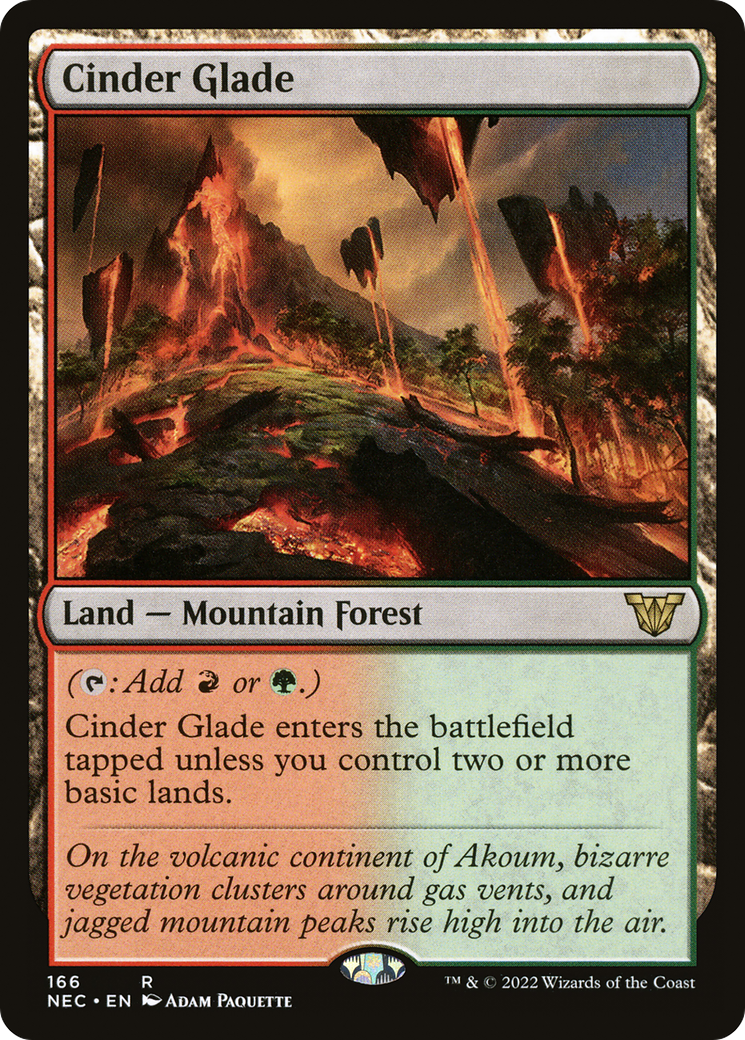
Cinder Glade
Cinder Glade
Land — Mountain Forest
( : Add or .)
This land enters tapped unless you control two or more basic lands.
- If one of these lands enters the battlefield at the same time as any number of basic lands, those other lands are not counted when determining if this land enters the battlefield tapped or untapped.
- However, because these cards have basic land types, effects that specify a basic land type without also specifying that the land be basic can affect them. For example, a spell or ability that reads "Destroy target Forest" can target Canopy Vista, while one that reads "Destroy target basic Forest" cannot.
- Even though these lands have basic land types, they are not basic lands because "basic" doesn't appear on their type line. Notably, controlling two or more of them won't allow others to enter the battlefield untapped.
-
1
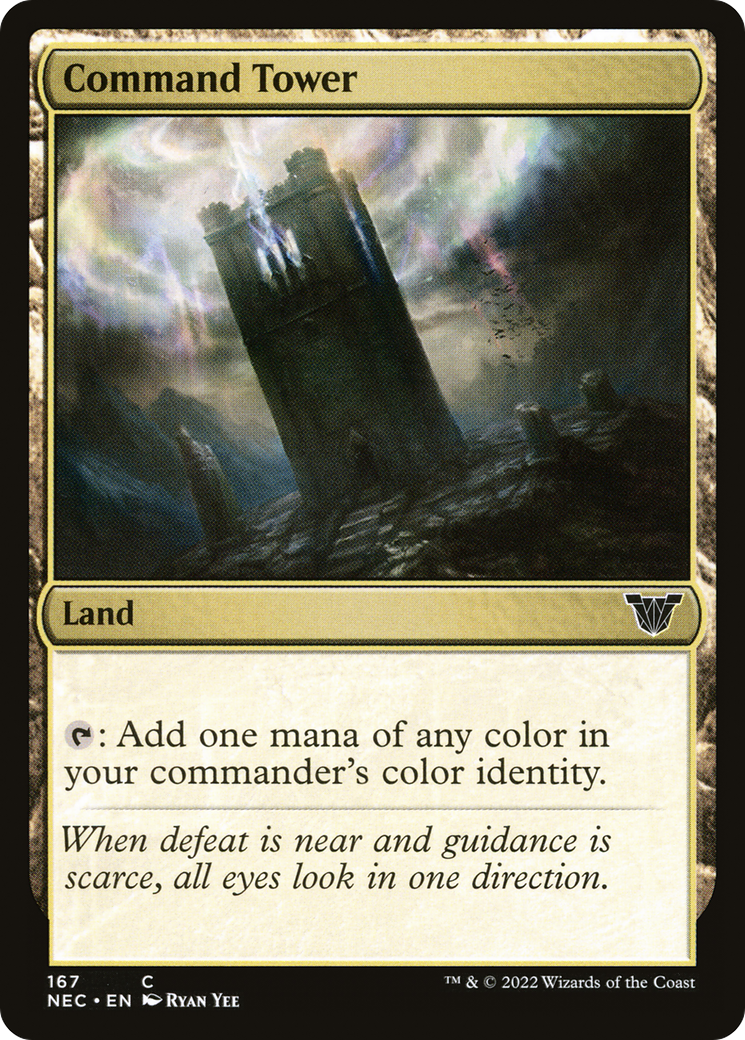
Command Tower
Command Tower
Land
: Add one mana of any color in your commander's color identity.
- If you don't have a commander, Command Tower's ability produces no mana.
- If your commander is a card that has no colors in its color identity, Command Tower's ability produces no mana. It doesn't produce .
- If you have two commanders, the ability adds one mana of any color in their combined color identities.
-
1
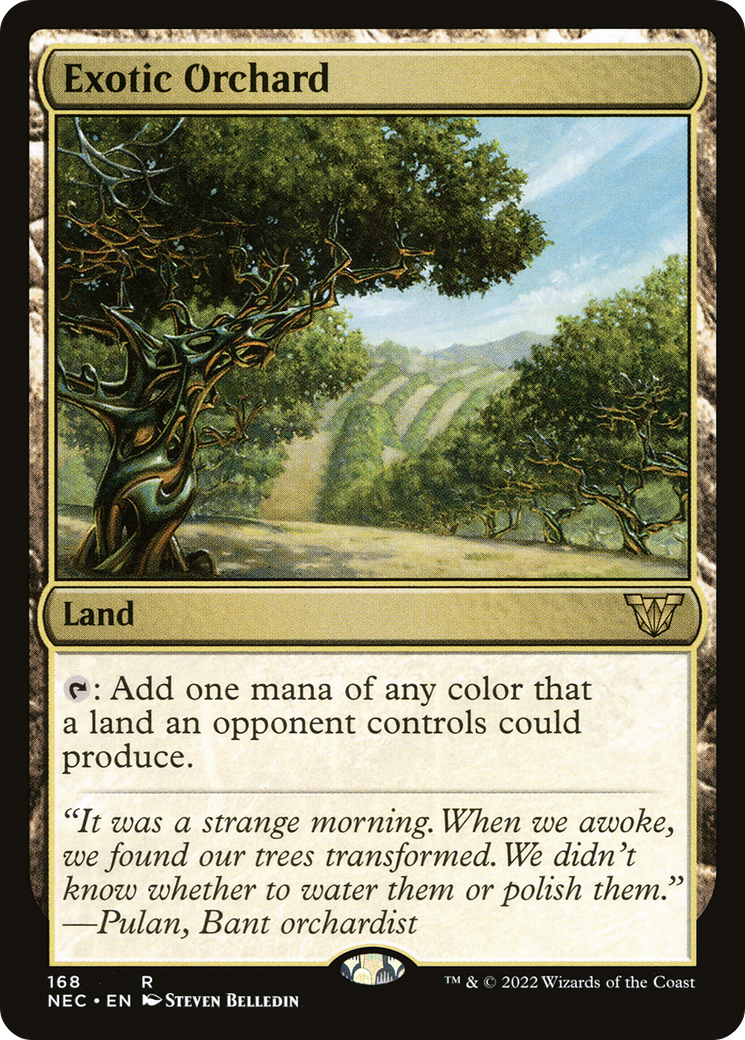
Exotic Orchard
Exotic Orchard
Land
: Add one mana of any color that a land an opponent controls could produce.
- Lands that produce mana based only on what other lands "could produce" won't help each other unless some other land allows one of them to actually produce some type of mana. For example, if you control an Exotic Orchard and your opponent controls an Exotic Orchard and a Reflecting Pool, none of those lands would produce mana if their mana abilities were activated. On the other hand, if you control a Forest and an Exotic Orchard, and your opponent controls an Exotic Orchard and a Reflecting Pool, then each of those lands can be tapped to produce . Your opponent's Exotic Orchard can produce because you control a Forest. Your Exotic Orchard and your opponent's Reflecting Pool can each produce because your opponent's Exotic Orchard can produce .
- When determining what colors of mana your opponents' lands could produce, Exotic Orchard takes into account any applicable replacement effects that would apply to those lands' mana abilities (such as Contamination's effect, for example). If there are more than one, consider them in any possible order.
- The colors of mana are white, blue, black, red, and green. Exotic Orchard can't be tapped for colorless mana, even if a land an opponent controls could produce colorless mana.
- Exotic Orchard doesn't care about any restrictions or riders your opponents' lands (such as Ancient Ziggurat or Hall of the Bandit Lord) put on the mana they produce. It just cares about colors of mana.
- Exotic Orchard checks the effects of all mana-producing abilities of lands your opponents control, but it doesn't check their costs. For example, Vivid Crag has the ability " , Remove a charge counter from Vivid Crag: Add one mana of any color." If an opponent controls Vivid Crag and you control Exotic Orchard, you can tap Exotic Orchard for any color of mana. It doesn't matter whether Vivid Crag has a charge counter on it, and it doesn't matter whether it's untapped.
-
14
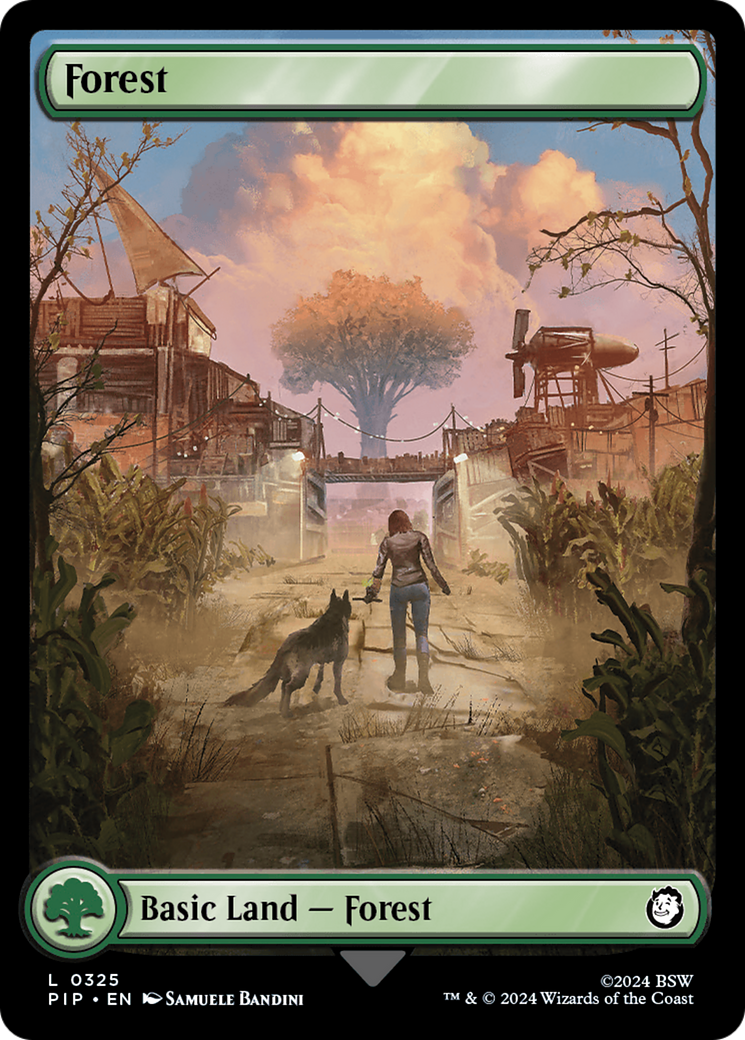
Forest
Forest
Basic Land — Forest
( : Add .)
-
1
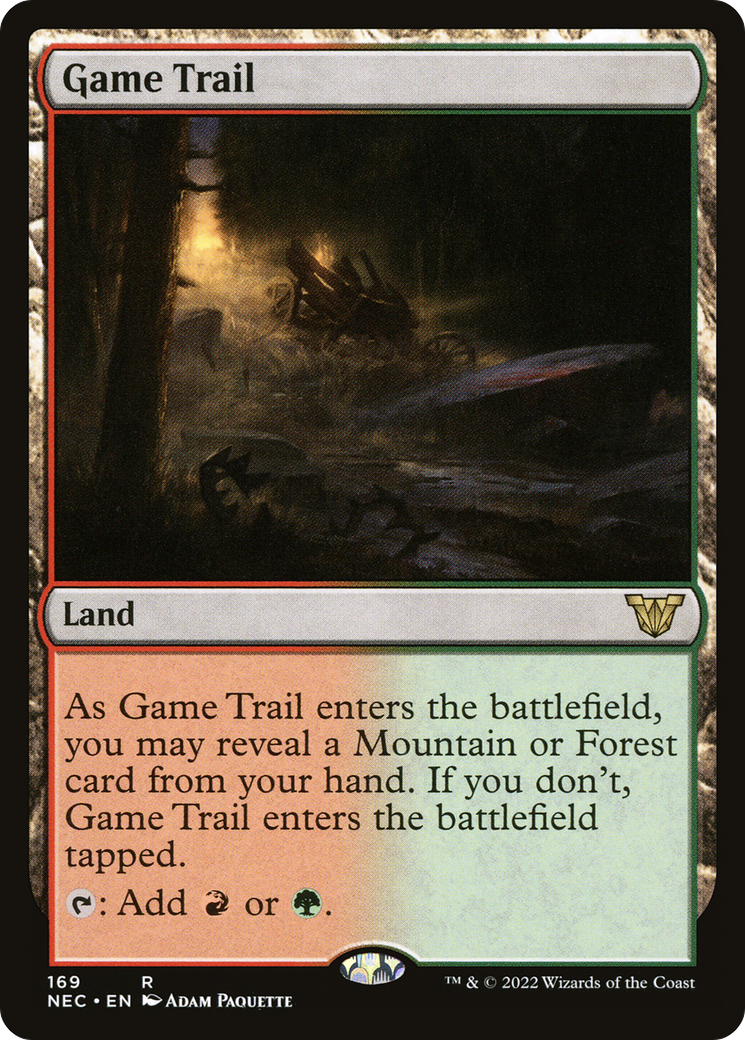
Game Trail
Game Trail
Land
As this land enters, you may reveal a Mountain or Forest card from your hand. If you don't, this land enters tapped.
: Add or .
- Lands don't have a subtype just because they can produce mana of the corresponding color. Game Trail itself is neither a Mountain nor a Forest, even though it produces red and green mana, so you can't reveal one to satisfy the ability of another.
- If an effect instructs you to put Game Trail onto the battlefield tapped, it will still enter the battlefield tapped even if you reveal a land card from your hand.
- You may reveal any land card with either or both of the appropriate subtypes. It doesn't have to be a basic land. For example, you could reveal Canopy Vista from the Battle for Zendikar set to satisfy the ability of Game Trail.
- If a Mountain or Forest is entering the battlefield from your hand at the same time as Game Trail, you may reveal the other land to have Game Trail enter untapped.
-
1
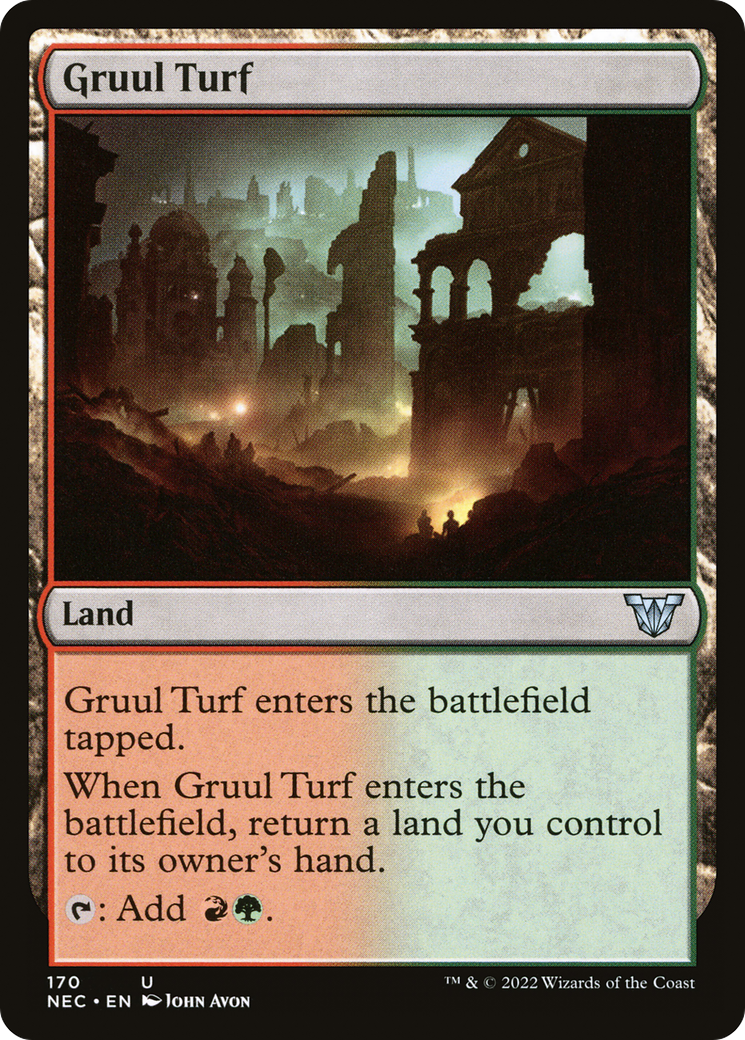
Gruul Turf
Gruul Turf
Land
This land enters tapped.
When this land enters, return a land you control to its owner's hand.
: Add .
- If this land enters the battlefield and you control no other lands, its ability will force you to return it to your hand.
-
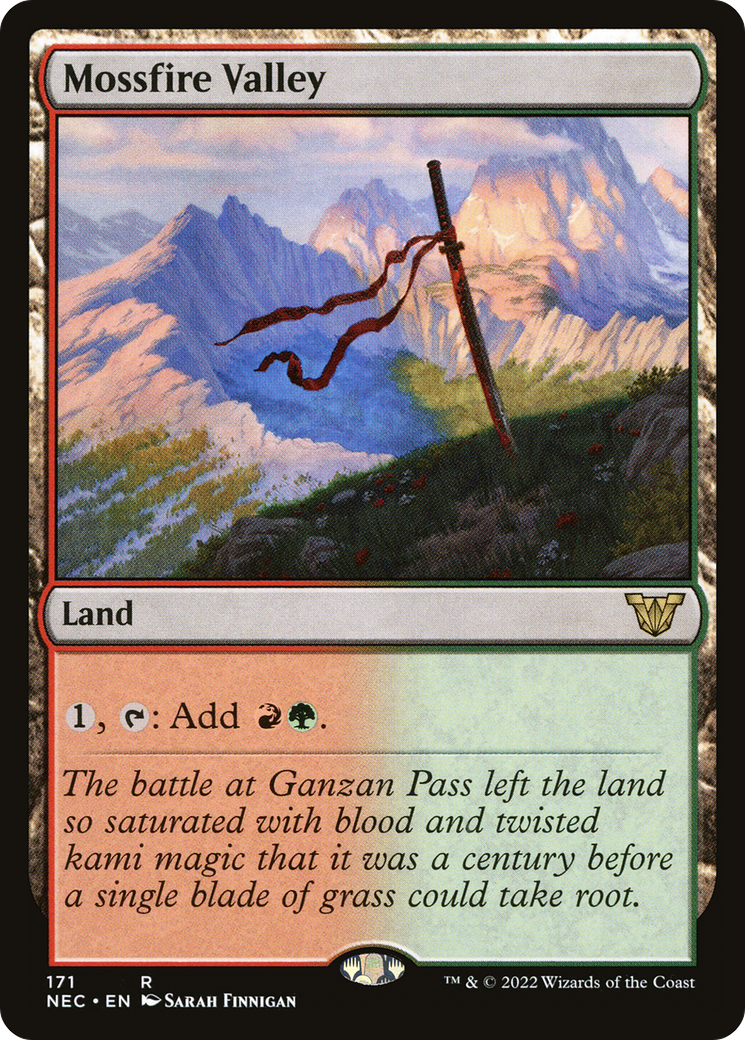
2
Mossfire Valley
Mossfire Valley
Land
, : Add .
-
12
Mountain
Mountain
Basic Land — Mountain
( : Add .)
-
1
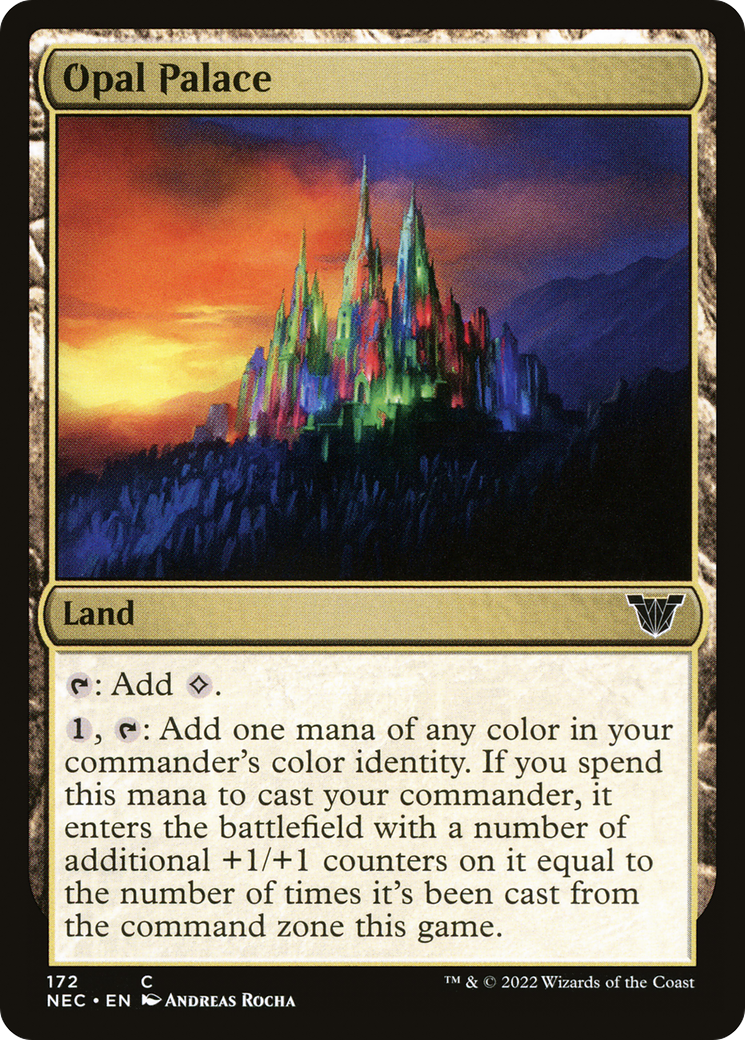
Opal Palace
Opal Palace
Land
: Add .
, : Add one mana of any color in your commander's color identity. If you spend this mana to cast your commander, it enters with a number of additional +1/+1 counters on it equal to the number of times it's been cast from the command zone this game.
- The "number of times it's been cast from the command zone" includes the most recent time. For example, the first time you cast your commander from the command zone in a game, if you spent mana from Opal Palace's last ability to do so, it will enter the battlefield with a +1/+1 counter.
- If you have two commanders, the last ability adds one mana of any color in their combined color identities.
- If Opal Palace's last ability produces two mana (most likely due to Mana Reflection) and you spend them to cast a commander, that commander enters with two counters for each time it's been cast from the command zone this game.
- If you don't have a commander, Opal Palace's last ability produces no mana.
- If your commander is a card that has no colors in its color identity, Opal Palace's last ability produces no mana. It doesn't produce .
-
1
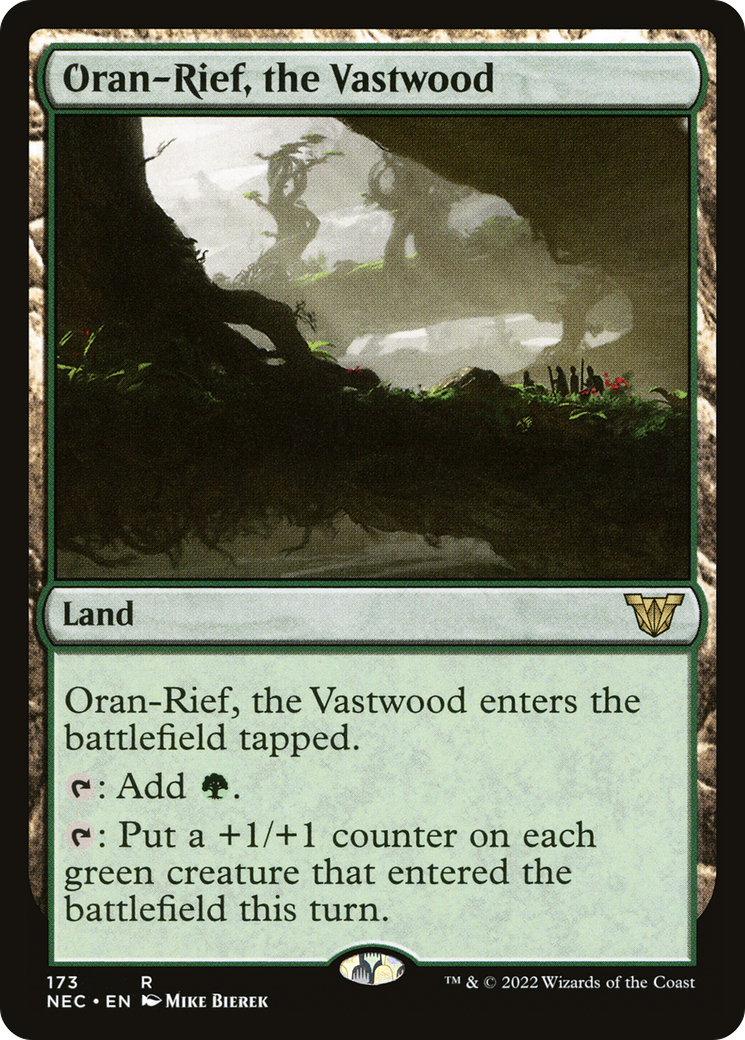
Oran-Rief, the Vastwood
Oran-Rief, the Vastwood
Land
This land enters tapped.
: Add .
: Put a +1/+1 counter on each green creature that entered this turn.
- Oran-Rief's last ability affects all permanents that are green creatures that entered this turn, not just the ones you control.
- Oran-Rief's last ability cares about permanents' characteristics at the time the ability resolves, not their characteristics at the time they entered. For example, if a blue creature enters, then is turned green by a spell or ability, then Oran-Rief's second ability resolves, you'll put a +1/+1 counter on that creature.
-
1
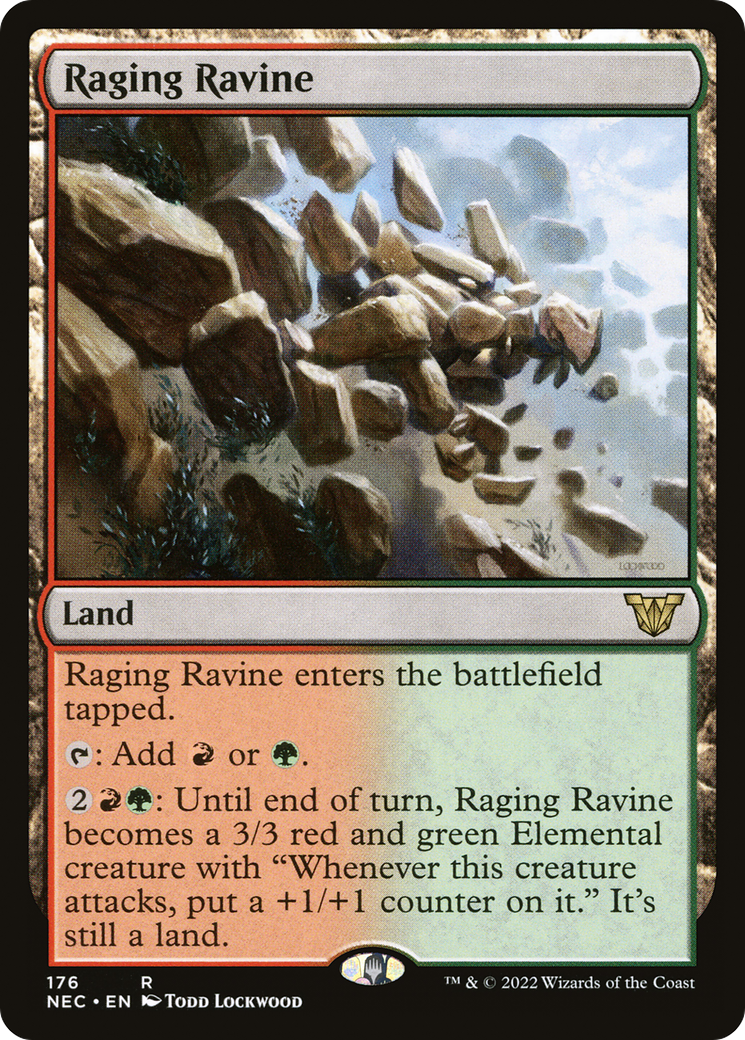
Raging Ravine
Raging Ravine
Land
This land enters tapped.
: Add or .
: Until end of turn, this land becomes a 3/3 red and green Elemental creature with "Whenever this creature attacks, put a +1/+1 counter on it." It's still a land.
- If this land becomes a creature but you haven’t controlled it continuously since your most recent turn began, you won’t be able to activate its mana ability or attack with it that turn.
- Any +1/+1 counters put on Raging Ravine remain on it even after it stops being a creature. They’ll have no effect until it becomes a creature again. (In other words, the land continues to rage, but to no effect.)
- If Raging Ravine’s last ability is activated multiple times in a turn, it will get that many instances of the granted triggered ability. For example, if you activate Raging Ravine’s last ability twice and then attack with it, you’ll put a +1/+1 counter on it twice.
-
1
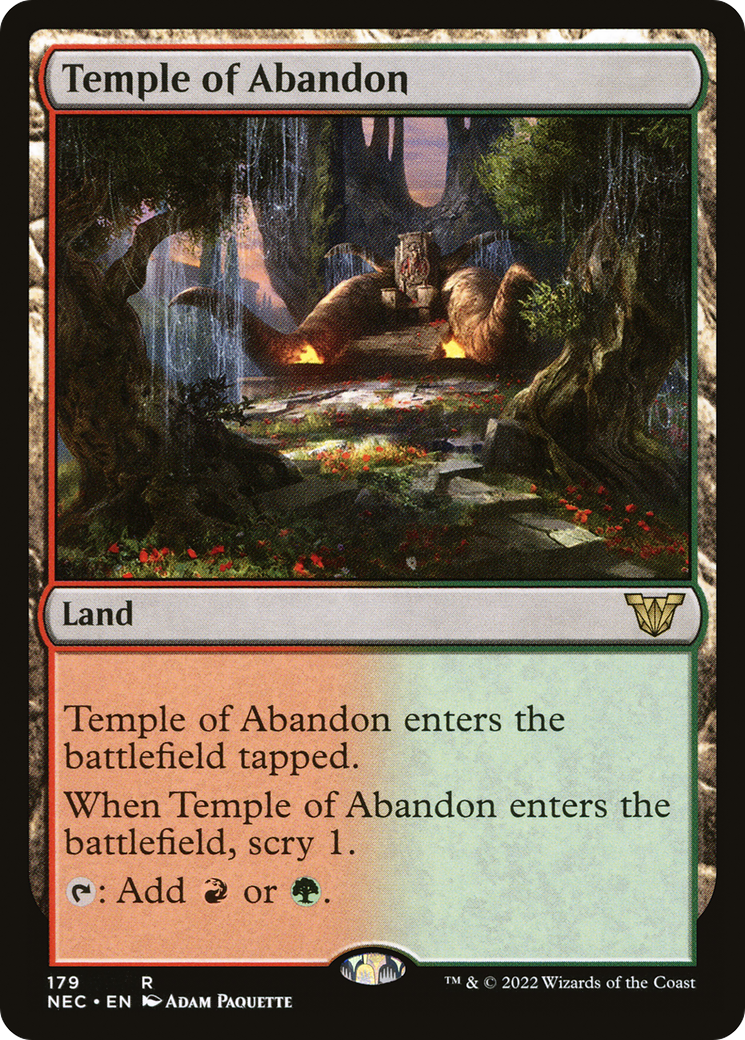
Temple of Abandon
Temple of Abandon
Land
This land enters tapped.
When this land enters, scry 1. (Look at the top card of your library. You may put that card on the bottom.)
: Add or .
- You perform the actions stated on a card in sequence. For some spells and abilities, that means you'll scry last. For others, that means you'll scry and then perform other actions.
- When you scry, you may put all the cards you look at back on top of your library, you may put all of those cards on the bottom of your library, or you may put some of those cards on top and the rest of them on the bottom.
- You choose how to order cards returned to your library after scrying no matter where you put them.
- Scry appears on some spells and abilities with one or more targets. If all of the spell or ability's targets are illegal when it tries to resolve, it won't resolve and none of its effects will happen. You won't scry.
Red 16
-
1
Agitator Ant
Agitator Ant
Creature — Insect
2/2
At the beginning of your end step, each player may put two +1/+1 counters on a creature they control. Goad each creature that had counters put on it this way. (Until your next turn, those creatures attack each combat if able and attack a player other than you if able.)
- If the creature doesn't meet any of the above exceptions and can attack, it must attack a player other than the controller of the spell or ability that goaded it if able. If the creature can't attack any of those players but could otherwise attack, it must attack a planeswalker an opponent controls, a battle an opponent controls, or a player who goaded it.
- Attacking with a goaded creature doesn't cause it to stop being goaded. If there is an additional combat phase that turn, or if another player gains control of it before it stops being goaded, it must attack again if able.
- If a creature you control has been goaded by multiple opponents, it must attack one of your opponents that hasn't goaded it, as that fulfills the maximum number of goad requirements. If a creature you control has been goaded by each of your opponents, the creature must attack an opponent (rather than a planeswalker or battle), but you choose which opponent it attacks.
- If, during a player's declare attackers step, a creature that player controls that's been goaded is tapped, is affected by a spell or ability that says it can't attack, or hasn't been under that player's control continuously since the turn began (and doesn't have haste), then it doesn't attack. If there's a cost associated with having a creature attack a player, its controller isn't forced to pay that cost, so it doesn't have to attack that player.
- Being goaded isn't an ability the creature has. Once it's been goaded, it must attack as detailed above even if it loses all abilities.
- If a creature can't have +1/+1 counters put on it, its controller can't choose it just to have it become goaded. If it can have counters put on it but replacement effects cause it not to receive +1/+1 counters, it doesn't become goaded.
- As Agitator Ant's ability resolves, first you choose which creature you control, if any, to put two +1/+1 counters on, then each other player in turn order does the same, knowing the choices made before them. Then each chosen creature receives its +1/+1 counters and becomes goaded.
-
1
Akki Battle Squad
Akki Battle Squad
Creature — Goblin Samurai
6/6
Whenever one or more modified creatures you control attack, untap all modified creatures you control. After this phase, there is an additional combat phase. This ability triggers only once each turn. (Equipment, Auras you control, and counters are modifications.)
- Notably, the triggered ability of Akki Battle Squad doesn't give you any additional main phases. This means that you will move directly from the end of combat step of one combat phase to the beginning of combat step of the next one.
- An Aura controlled by an opponent does not cause a creature you control to be modified.
- A creature with a counter on it is considered modified no matter what kind of counter it is or which player put it on that creature.
- A creature that is equipped is considered modified no matter who controls the Equipment that's attached to it.
-
1
Chain Reaction
Chain Reaction
Sorcery
Chain Reaction deals X damage to each creature, where X is the number of creatures on the battlefield.
- The value of X is determined as Chain Reaction resolves.
-
1
Chaos Warp
Chaos Warp
Instant
The owner of target permanent shuffles it into their library, then reveals the top card of their library. If it's a permanent card, they put it onto the battlefield.
- A permanent card is a card with one or more of the following card types: artifact, creature, enchantment, land, or planeswalker.
- The owner of a token is the player under whose control the token was put onto the battlefield. If a token is shuffled into a player's library this way, that player shuffles before revealing the top card of that library.
- If the revealed card is not a permanent card, it remains on top of that library.
- If the permanent is an illegal target by the time Chaos Warp tries to resolve, it won't resolve and none of its effects will occur. No library will be shuffled and no card will be revealed.
- If the revealed card is a permanent card but can't enter (perhaps because it's an Aura with nothing to enchant), it remains on top of that library.
-
1
Collision of Realms
Collision of Realms
Sorcery
Each player shuffles all creatures they own into their library. Each player who shuffled a nontoken creature into their library this way reveals cards from the top of their library until they reveal a creature card, then puts that card onto the battlefield and the rest on the bottom of their library in a random order.
- All creatures are shuffled into their owners' libraries at the same time. Then all players who shuffled nontoken creatures into their library this way reveal cards. Then all creature cards revealed this way enter the battlefield at the same time. Then all other cards are put on the bottom of their owners' libraries. Any abilities that triggered during this process are then put on the stack, starting by those controlled by the active player in an order of that player's choice, then continuing with each other player's abilities in turn order. The last player to put their abilities on the stack will be the first player to have their abilities resolve. A player who controls no creatures or who controls only creature tokens will still shuffle their library.
- Each player reveals and puts onto the battlefield one creature card or fewer. They don't reveal a card for each nontoken creature they shuffle into their library; it's just one creature card at most.
-
1
Elemental Mastery
Elemental Mastery
Enchantment — Aura
Enchant creature
Enchanted creature has " : Create X 1/1 red Elemental creature tokens with haste, where X is this creature's power. Exile them at the beginning of the next end step."
- The enchanted creature's power is checked at the time the ability resolves. If the enchanted creature has left the battlefield by then, its last known information is used.
- The tokens will be exiled in the End step even if Elemental Mastery or the enchanted creature has left the battlefield by then.
- If the ability is activated after the current turn's End step has begun, the tokens won't be exiled until the next turn's End step.
-
1
Goblin Razerunners
Goblin Razerunners
Creature — Goblin Warrior
3/4
, Sacrifice a land: Put a +1/+1 counter on this creature.
At the beginning of your end step, you may have this creature deal damage equal to the number of +1/+1 counters on it to target player or planeswalker.
- You don't count how many +1/+1 counters are on Goblin Razerunners until its triggered ability resolves.
- If Goblin Razerunners leaves the battlefield after its ability triggers but before it resolves, the amount of damage it deals is equal to the number of +1/+1 counters that were on it as it last existed on the battlefield.
-
1
Kami of Celebration
Kami of Celebration
Creature — Spirit
3/3
Whenever a modified creature you control attacks, exile the top card of your library. You may play that card this turn. (Equipment, Auras you control, and counters are modifications.)
Whenever you cast a spell from exile, put a +1/+1 counter on target creature you control.
- You must still pay all costs and follow all normal timing rules to play a card this way. For example, you may play a land this way only during your own main phase while the stack is empty, and only if you have not yet played a land this turn.
- An Aura controlled by an opponent does not cause a creature you control to be modified.
- A creature with a counter on it is considered modified no matter what kind of counter it is or which player put it on that creature.
- A creature that is equipped is considered modified no matter who controls the Equipment that's attached to it.
-
1
Komainu Battle Armor
Komainu Battle Armor
Artifact Creature — Equipment Dog
2/2
Menace
Equipped creature gets +2/+2 and has menace.
Whenever this creature or equipped creature deals combat damage to a player, goad each creature that player controls.
Reconfigure ( : Attach to target creature you control; or unattach from a creature. Reconfigure only as a sorcery. While attached, this isn't a creature.)
- Reconfigure represents two activated abilities. Reconfigure [cost] means “[Cost]: Attach this permanent to another target creature you control. Activate only as a sorcery,” and “[Cost]: Unattach this permanent. Activate only if this permanent is attached to a creature and only as a sorcery.”
- Attaching an Equipment with reconfigure to a creature causes that Equipment to stop being a creature until it becomes unattached. It also loses any creature subtypes it had.
- An Equipment doesn't become tapped when the permanent it's attached to becomes tapped. For example, if you attack with a creature that is equipped with Acquisition Octopus, then use reconfigure to unattach Acquisition Octopus after combat, the Octopus will be untapped and could be used to block during your opponent's turn.
- Similarly, if an Equipment is tapped, its reconfigure abilities may still be activated and it may still become attached to creatures. Becoming attached doesn't untap it. In most cases, an attached Equipment being tapped won't affect gameplay, but it will be relevant if it becomes unattached again before it untaps.
- If an Equipment with reconfigure somehow loses its abilities while it is attached, the effect causing it to not be a creature continues to apply until it becomes unattached.
- As soon as an Equipment creature with reconfigure stops being a creature, any Equipment and Auras with enchant creature abilities become unattached. Auras that can enchant an Equipment that isn't a creature remain attached to it.
- An Equipment creature with reconfigure can be attached to creatures by effects other than its reconfigure ability, such as the activated ability of Brass Squire.
- Although it causes an Equipment to become attached to a creature, reconfigure is not an “equip ability” for the purpose of cards like Fighter Class and Leonin Shikari.
- An Equipment creature can never become attached to itself. If an effect tries to do this, nothing happens.
- If a permanent with reconfigure is somehow still a creature after it becomes attached (perhaps due to an effect like that of March of the Machines), it immediately becomes unattached from the equipped creature.
-
1
Krenko, Tin Street Kingpin
Krenko, Tin Street Kingpin
Legendary Creature — Goblin
1/2
Whenever Krenko attacks, put a +1/+1 counter on it, then create a number of 1/1 red Goblin creature tokens equal to Krenko's power.
- If Krenko leaves the battlefield after its ability has triggered but before it resolves, you don't put a +1/+1 counter on it, but you do use its power as it last existed before it left the battlefield to determine how many Goblin tokens to create.
- The tokens created by Krenko's triggered ability aren't attacking. Because all attackers are chosen at once, a token created this way can't attack, even if it gains haste.
-
1
Ox of Agonas
Ox of Agonas
Creature — Ox
4/2
When this creature enters, discard your hand, then draw three cards.
Escape— , Exile eight other cards from your graveyard. (You may cast this card from your graveyard for its escape cost.)
This creature escapes with a +1/+1 counter on it.
- You draw three cards, even if you discard no cards.
- Escape's permission doesn't change when you may cast the spell from your graveyard.
- To determine the total cost of a spell, start with the mana cost or alternative cost you're paying (such as an escape cost), add any cost increases, then apply any cost reductions. The mana value of the spell remains unchanged, no matter what the total cost to cast it was and no matter whether an alternative cost was paid.
- After an escaped spell resolves, it returns to its owner's graveyard if it's not a permanent spell. If it is a permanent spell, it enters the battlefield and will return to its owner's graveyard if it dies later. Perhaps it will escape again—good underworld security is so hard to come by these days.
- If a card has multiple abilities giving you permission to cast it, such as two escape abilities or an escape ability and a flashback ability, you choose which one to apply. The others have no effect.
- If you cast a spell with its escape permission, you can't choose to apply any other alternative costs or to cast it without paying its mana cost. If it has any additional costs, you must pay those.
- If a card with escape is put into your graveyard during your turn, you'll be able to cast it right away if it's legal to do so, before an opponent can take any actions.
- Once you begin casting a spell with escape, it immediately moves to the stack. Players can't take any other actions until you're done casting the spell.
-
1
Shifting Shadow
Shifting Shadow
Enchantment — Aura
Enchant creature
Enchanted creature has haste and "At the beginning of your upkeep, destroy this creature. Reveal cards from the top of your library until you reveal a creature card. Put that card onto the battlefield and attach Shifting Shadow to it, then put all other cards revealed this way on the bottom of your library in a random order."
- If you don't reveal a creature card this way, you'll just reveal and randomize your library and Shifting Shadow becomes attached to nothing. It will be put into its owner's graveyard as a state-based action.
- If Shifting Shadow can't become attached to the creature you put onto the battlefield, most likely because that creature has protection from red, it becomes attached to nothing. It will be put into its owner's graveyard as a state-based action.
- If the Shifting Shadow leaves the battlefield after the triggered ability it grants has triggered but before it resolves, you'll destroy the creature it enchanted before it left the battlefield, then reveal cards and put a creature card onto the battlefield. Shifting Shadow won't become attached to it. The same is true if the enchanted creature leaves the battlefield rather than just Shifting Shadow, except that you won't destroy the creature it enchanted in that case.
- If the enchanted creature can't be destroyed, most likely because that creature has indestructible, you'll still get a new creature and attach Shifting Shadow to the new creature.
-
1
Smoke Spirits' Aid
Smoke Spirits' Aid
Sorcery
For each of up to X target creatures, create a red Aura enchantment token named Smoke Blessing attached to that creature. Those tokens have enchant creature and "When enchanted creature dies, it deals 1 damage to its controller and you create a Treasure token."
- If a Smoke Blessing that would be created by Smoke Spirits' Aid can't be attached to that creature for any reason, the token isn't created.
-
1
Starstorm
Starstorm
Instant
Starstorm deals X damage to each creature.
Cycling ( , Discard this card: Draw a card.)
- Cycling is an activated ability. Effects that interact with activated abilities (such as Stifle or Rings of Brighthearth) will interact with cycling. Effects that interact with spells (such as Remove Soul or Faerie Tauntings) will not.
-
1
Taurean Mauler
Taurean Mauler
Creature — Shapeshifter
2/2
Changeling (This card is every creature type.)
Whenever an opponent casts a spell, you may put a +1/+1 counter on this creature.
- Taurean Mauler's last ability resolves before the spell that caused it to trigger. It resolves even if that spell is countered or otherwise leaves the stack without resolving.
-
1
Unquenchable Fury
Unquenchable Fury
Enchantment — Aura
Enchant creature
Enchanted creature has "Whenever this creature attacks, it deals X damage to defending player, where X is the number of cards in their hand."
When this Aura is put into your graveyard from the battlefield, return it to your hand.
Green 30
-
1
Acidic Slime
Acidic Slime
Creature — Ooze
2/2
Deathtouch (Any amount of damage this deals to a creature is enough to destroy it.)
When this creature enters, destroy target artifact, enchantment, or land.
-
1
Ascendant Acolyte
Ascendant Acolyte
Creature — Human Monk
1/1
This creature enters with a +1/+1 counter on it for each +1/+1 counter among other creatures you control.
At the beginning of your upkeep, double the number of +1/+1 counters on this creature.
- If Ascendant Acolyte is entering the battlefield at the same time as other creatures, it doesn't count any counters those other creatures would enter the battlefield with.
-
1
Bear Umbra
Bear Umbra
Enchantment — Aura
Enchant creature
Enchanted creature gets +2/+2 and has "Whenever this creature attacks, untap all lands you control."
Umbra armor (If enchanted creature would be destroyed, instead remove all damage from it and destroy this Aura.)
- Some printings of this card refer to the ability "totem armor". This ability's name has been replaced with "umbra armor". This change does not affect the gameplay function of this card.
- Umbra armor's effect is mandatory. If the enchanted creature would be destroyed, you must remove all damage from it (if it has any) and destroy the Aura that has umbra armor instead.
- Umbra armor's effect is applied no matter why the enchanted creature would be destroyed: because it's been dealt lethal damage, or because it's being affected by an effect that says to "destroy" it (such as Breathe Your Last). In either case, all damage is removed from the creature and the Aura is destroyed instead.
- If a creature you control is enchanted with multiple Auras that have umbra armor, and the enchanted creature would be destroyed, one of those Auras is destroyed instead—but only one of them. You choose which one because you control the enchanted creature.
- If a creature enchanted with an Aura that has umbra armor would be destroyed by multiple state-based actions at the same time (most likely because a creature with deathtouch has dealt damage to that creature greater than or equal to its toughness), umbra armor's effect will replace all of them and save the creature.
- If a spell or ability would destroy both an Aura with umbra armor and the creature it's enchanting at the same time, umbra armor's effect will save the enchanted creature from being destroyed. Instead, the spell or ability will destroy the Aura in two different ways at the same time, but the result is the same as destroying it once.
- Umbra armor's effect is not regeneration. Specifically, if umbra armor's effect is applied, the enchanted creature does not become tapped and is not removed from combat as a result. Effects that say the enchanted creature can't be regenerated won't prevent umbra armor's effect from being applied.
- If a spell or ability says that it would "destroy" a creature enchanted with an Aura that has umbra armor, that spell or ability is what causes the Aura to be destroyed instead. Umbra armor doesn't destroy the Aura; rather, it changes the effects of the spell or ability. On the other hand, if a spell or ability deals lethal damage to a creature enchanted with an Aura that has umbra armor, the game rules regarding lethal damage cause the Aura to be destroyed, not that spell or ability.
- Umbra armor has no effect if the enchanted creature is put into a graveyard for any other reason, such as if it's sacrificed, if the "legend rule" applies to it, or if its toughness is 0 or less.
- If a creature enchanted with an Aura that has umbra armor has indestructible, lethal damage and effects that try to destroy it simply have no effect. Umbra armor won't do anything because it won't have to.
- When the enchanted creature attacks, all lands controlled by that creature's controller (who is not necessarily the Aura's controller) untap.
-
1
Beast Within
Beast Within
Instant
Destroy target permanent. Its controller creates a 3/3 green Beast creature token.
- If the target permanent is an illegal target by the time Beast Within tries to resolve, the spell won't resolve. No player creates a Beast token. If the target is legal but not destroyed (most likely because it has indestructible), its controller does create a Beast token.
-
1
Champion of Lambholt
Champion of Lambholt
Creature — Human Warrior
1/1
Creatures with power less than this creature's power can't block creatures you control.
Whenever another creature you control enters, put a +1/+1 counter on this creature.
- Champion of Lambholt's first ability applies even if it isn't attacking.
- The comparison of power is done only when blockers are declared. Decreasing the power of a blocking creature (or increasing the power of Champion of Lambholt) after this point won't cause any creature to stop blocking or become unblocked.
-
1
Concord with the Kami
Concord with the Kami
Enchantment
At the beginning of your end step, choose one or more —
- Put a +1/+1 counter on target creature with a counter on it.
- Draw a card if you control an enchanted creature.
- Create a 1/1 colorless Spirit creature token if you control an equipped creature.
- You cannot choose the first mode unless you have a legal target for it. You may choose the second and third mode even if you don't have an enchanted or equipped creature at the time this ability triggers.
- If you choose the first mode, and the target creature becomes an illegal target by the time the ability tries to resolve, the ability won't resolve and none of its effects will happen, even if you chose other modes.
-
1
Fertilid
Fertilid
Creature — Elemental
0/0
This creature enters with two +1/+1 counters on it.
, Remove a +1/+1 counter from this creature: Target player searches their library for a basic land card, puts it onto the battlefield tapped, then shuffles.
- Although the targeted player doesn't need to find a basic land card if they don't want to, that player must shuffle their library.
-
1
Forgotten Ancient
Forgotten Ancient
Creature — Elemental
0/3
Whenever a player casts a spell, you may put a +1/+1 counter on this creature.
At the beginning of your upkeep, you may move any number of +1/+1 counters from this creature onto other creatures.
- Forgotten Ancient's last ability doesn't target any creatures. You choose how many +1/+1 counters will be moved (and onto which creatures) as the ability resolves. Notably, once the ability starts resolving and you make these choices, no player may take actions until the ability has finished resolving.
- Forgotten Ancient's first ability will resolve before the spell that caused it to trigger. Putting a +1/+1 counter on Forgotten Ancient is optional.
-
1
Genesis Hydra
Genesis Hydra
Creature — Plant Hydra
0/0
When you cast this spell, reveal the top X cards of your library. You may put a nonland permanent card with mana value X or less from among them onto the battlefield. Then shuffle the rest into your library.
This creature enters with X +1/+1 counters on it.
- Genesis Hydra's first ability will resolve before Genesis Hydra does. Notably, if you put an Aura card onto the battlefield this way, it can't enchant Genesis Hydra.
- If you have fewer than X cards in your library, you reveal all of them.
- If a card in a player's library has in its mana cost, X is considered to be 0.
- A nonland permanent card is an artifact, creature, enchantment, or planeswalker card.
- If you put an Aura onto the battlefield this way, you choose what it enchants as it enters the battlefield. This doesn't target any permanent or player, but it must be able to enchant that permanent or player. For example, you could put a green Aura onto the battlefield enchanting a creature with hexproof controlled by an opponent, but not one with protection from green.
- If "the rest" is zero cards, either because X was 0 or because X was 1 and that card was put onto the battlefield, the library is still shuffled.
-
1
Hunter's Insight
Hunter's Insight
Instant
Choose target creature you control. Whenever that creature deals combat damage to a player or planeswalker this turn, draw that many cards.
-
1
Kodama's Reach
Kodama's Reach
Sorcery — Arcane
Search your library for up to two basic land cards, reveal those cards, put one onto the battlefield tapped and the other into your hand, then shuffle.
- You can get just one basic land card if you wish (or even none at all). If you get only one land card, you put it onto the battlefield tapped.
-
1
Kosei, Penitent Warlord
Kosei, Penitent Warlord
Legendary Creature — Ogre Samurai
0/5
As long as Kosei is enchanted, equipped, and has a counter on it, Kosei has "Whenever Kosei deals combat damage to an opponent, you draw that many cards and Kosei deals that much damage to each other opponent."
-
1
Loyal Guardian
Loyal Guardian
Creature — Rhino
4/4
Trample
Lieutenant — At the beginning of combat on your turn, if you control your commander, put a +1/+1 counter on each creature you control.
- If you don't control your commander as the lieutenant ability resolves, you won't get its effect.
- The lieutenant effect happens only once each combat, even if you somehow control multiple commanders (perhaps because you have two commanders with a partner ability from the Battlebond™ set).
- If you have multiple commanders, you need to control only one for the lieutenant effect to happen.
-
1
One with the Kami
One with the Kami
Enchantment — Aura
Flash
Enchant creature you control
Whenever enchanted creature or another modified creature you control dies, create X 1/1 colorless Spirit creature tokens, where X is that creature's power. (Equipment, Auras you control, and counters are modifications.)
- An Aura controlled by an opponent does not cause a creature you control to be modified.
- A creature with a counter on it is considered modified no matter what kind of counter it is or which player put it on that creature.
- A creature that is equipped is considered modified no matter who controls the Equipment that's attached to it.
-
1
Ordeal of Nylea
Ordeal of Nylea
Enchantment — Aura
Enchant creature
Whenever enchanted creature attacks, put a +1/+1 counter on it. Then if it has three or more +1/+1 counters on it, sacrifice this Aura.
When you sacrifice this Aura, search your library for up to two basic land cards, put them onto the battlefield tapped, then shuffle.
- The check of whether the enchanted creature has three or more +1/+1 counters on it happens as part of the resolution of the attack triggered ability. If the third +1/+1 counter is put on the enchanted creature any other way, you won't sacrifice Ordeal of Nylea until the next time the creature attacks.
- Ordeal of Nylea's last ability will trigger when you sacrifice it for any reason, not just when you sacrifice it because of the effect of its second ability.
-
1
Orochi Merge-Keeper
Orochi Merge-Keeper
Creature — Snake Druid
1/1
: Add .
As long as this creature is modified, it has " : Add ." (Equipment, Auras you control, and counters are modifications.)
-
1
Primeval Protector
Primeval Protector
Creature — Avatar
10/10
This spell costs less to cast for each creature your opponents control.
When this creature enters, put a +1/+1 counter on each other creature you control.
- Once a player has announced that they are casting Primeval Protector, no player may take actions to try to change the number of creatures your opponents control in order to increase its cost.
- Primeval Protector's ability can't reduce its cost below .
-
1
Rampant Growth
Rampant Growth
Sorcery
Search your library for a basic land card, put that card onto the battlefield tapped, then shuffle.
- The land does not count toward your one per turn limit because it was put onto the battlefield by an effect.
-
1
Rampant Rejuvenator
Rampant Rejuvenator
Creature — Plant Hydra
0/0
This creature enters with two +1/+1 counters on it.
When this creature dies, search your library for up to X basic land cards, where X is this creature's power, put them onto the battlefield, then shuffle.
- Use Rampant Rejuvenator's power as it last existed on the battlefield to determine the value of X for its last ability.
-
1
Rishkar's Expertise
Rishkar's Expertise
Sorcery
Draw cards equal to the greatest power among creatures you control.
You may cast a spell with mana value 5 or less from your hand without paying its mana cost.
- The mana value of a split card is determined by the combined mana cost of its two halves. If an expertise spell allows you to cast a split card, you may cast either half or, if that split card has fuse, both halves.
- If you control no creatures with power greater than 0 as Rishkar's Expertise resolves, you draw no cards, but you may cast a card with mana value 5 or less from your hand without paying its mana cost.
- You may cast one of the cards drawn by Rishkar's Expertise's first effect while performing its second effect.
- A card's mana value is determined solely by the mana symbols printed in its upper right corner. The mana value is the total amount of mana in that cost, regardless of color. For example, a card with mana cost has mana value 3. Ignore any alternative costs, additional costs, cost increases, or cost reductions that could apply to it. A card with no mana cost has a mana value of 0.
- If the card has in its mana cost, you must choose 0 as the value of X when casting it without paying its mana cost.
- The greatest power among creatures you control is determined as Rishkar's Expertise resolves.
- If you cast a card "without paying its mana cost," you can't choose to cast it for any alternative costs, such as emerge costs. You can, however, pay additional costs. If the card has any mandatory additional costs, such as that of Cathartic Reunion, you must pay those to cast the card.
- While you're casting your free spell, the Expertise spell is still on the stack. It will be put into its owner's graveyard after the free spell is cast. The free spell can't target the Expertise card in your graveyard. It can target the Expertise spell on the stack, but the Expertise spell will become an illegal target before the free spell resolves.
- Any triggered abilities that trigger while performing the Expertise spell's first effect won't be put onto the stack until after you're done casting your free spell. They're put onto the stack at the same time as any abilities that triggered while casting that spell regardless of the order in which those abilities triggered.
- Effects that allow you to "cast" a card don't allow you to play a land card.
-
1
Rishkar, Peema Renegade
Rishkar, Peema Renegade
Legendary Creature — Elf Druid
2/2
When Rishkar enters, put a +1/+1 counter on each of up to two target creatures.
Each creature you control with a counter on it has " : Add ."
- Rishkar can be a target of its own triggered ability.
- You can't target the same creature twice to have one recipient get two +1/+1 counters.
- Each creature you control has Rishkar's mana ability as long as that creature has any kind of counter on it. The effect isn't limited to those with +1/+1 counters.
-
1
Sakura-Tribe Elder
Sakura-Tribe Elder
Creature — Snake Shaman
1/1
Sacrifice this creature: Search your library for a basic land card, put that card onto the battlefield tapped, then shuffle.
-
1
Shamanic Revelation
Shamanic Revelation
Sorcery
Draw a card for each creature you control.
Ferocious — You gain 4 life for each creature you control with power 4 or greater.
- After you draw cards while Shamanic Revelation is resolving, nothing else can happen before you gain the appropriate amount of life. Notably, abilities that trigger when you draw cards won't be put onto the stack until after you've gained life.
-
1
Silkguard
Silkguard
Instant
Put a +1/+1 counter on each of up to X target creatures you control.
Auras, Equipment, and modified creatures you control gain hexproof until end of turn. (Equipment, Auras you control, and counters are modifications.)
- An Aura controlled by an opponent does not cause a creature you control to be modified.
- A creature with a counter on it is considered modified no matter what kind of counter it is or which player put it on that creature.
- A creature that is equipped is considered modified no matter who controls the Equipment that's attached to it.
-
1
Snake Umbra
Snake Umbra
Enchantment — Aura
Enchant creature
Enchanted creature gets +1/+1 and has "Whenever this creature deals damage to an opponent, you may draw a card."
Umbra armor (If enchanted creature would be destroyed, instead remove all damage from it and destroy this Aura.)
- Some printings of this card refer to the ability "totem armor". This ability's name has been replaced with "umbra armor". This change does not affect the gameplay function of this card.
- Umbra armor has no effect if the enchanted creature is put into a graveyard for any other reason, such as if it's sacrificed, if the "legend rule" applies to it, or if its toughness is 0 or less.
- If a creature enchanted with an Aura that has umbra armor has indestructible, lethal damage and effects that try to destroy it simply have no effect. Umbra armor won't do anything because it won't have to.
- Umbra armor's effect is mandatory. If the enchanted creature would be destroyed, you must remove all damage from it (if it has any) and destroy the Aura that has umbra armor instead.
- Umbra armor's effect is applied no matter why the enchanted creature would be destroyed: because it's been dealt lethal damage, or because it's being affected by an effect that says to "destroy" it (such as Breathe Your Last). In either case, all damage is removed from the creature and the Aura is destroyed instead.
- If a creature you control is enchanted with multiple Auras that have umbra armor, and the enchanted creature would be destroyed, one of those Auras is destroyed instead—but only one of them. You choose which one because you control the enchanted creature.
- If a creature enchanted with an Aura that has umbra armor would be destroyed by multiple state-based actions at the same time (most likely because a creature with deathtouch has dealt damage to that creature greater than or equal to its toughness), umbra armor's effect will replace all of them and save the creature.
- If a spell or ability would destroy both an Aura with umbra armor and the creature it's enchanting at the same time, umbra armor's effect will save the enchanted creature from being destroyed. Instead, the spell or ability will destroy the Aura in two different ways at the same time, but the result is the same as destroying it once.
- Umbra armor's effect is not regeneration. Specifically, if umbra armor's effect is applied, the enchanted creature does not become tapped and is not removed from combat as a result. Effects that say the enchanted creature can't be regenerated won't prevent umbra armor's effect from being applied.
- If a spell or ability says that it would "destroy" a creature enchanted with an Aura that has umbra armor, that spell or ability is what causes the Aura to be destroyed instead. Umbra armor doesn't destroy the Aura; rather, it changes the effects of the spell or ability. On the other hand, if a spell or ability deals lethal damage to a creature enchanted with an Aura that has umbra armor, the game rules regarding lethal damage cause the Aura to be destroyed, not that spell or ability.
- The ability triggers when the enchanted creature deals any damage, not just combat damage.
- Snake Umbra grants the triggered ability to the creature. It triggers whenever the enchanted creature deals damage to an opponent of its controller (who is not necessarily an opponent of the Aura's controller). In other words, if your Snake Umbra winds up enchanting your opponent's creature, that opponent will draw a card whenever that creature damages you.
-
1
Soul's Majesty
Soul's Majesty
Sorcery
Draw cards equal to the power of target creature you control.
- Soul's Majesty's only target is the creature. If that creature becomes an illegal target by the time Soul's Majesty would resolve, the entire spell doesn't resolve. You won't draw any cards.
-
1
Spearbreaker Behemoth
Spearbreaker Behemoth
Creature — Beast
5/5
Indestructible
: Target creature with power 5 or greater gains indestructible until end of turn.
- Lethal damage and effects that say “destroy” won't cause a creature with indestructible to be put into the graveyard. However, a creature with indestructible can be put into the graveyard for a number of reasons. The most likely reasons are if it's sacrificed, if it's legendary and another legendary creature with the same name is controlled by the same player, or if its toughness is 0 or less.
- The ability checks the targeted creature's power twice: when the creature becomes the target, and when the ability resolves. Once the ability resolves, it will continue to apply to the affected creature no matter what its power may become later in the turn.
-
1
Tanuki Transplanter
Tanuki Transplanter
Artifact Creature — Equipment Dog
2/4
Whenever this creature or equipped creature attacks, add an amount of equal to its power. Until end of turn, you don't lose this mana as steps and phases end.
Reconfigure ( : Attach to target creature you control; or unattach from a creature. Reconfigure only as a sorcery. While attached, this isn't a creature.)
- If Tanuki Transplanter attacks, use its power to determine how much to add. If equipped creature attacks, use its power. In either case, use the power as the triggered ability resolves. Also in either case, if the creature isn't on the battlefield at that time, use its power as it last existed on the battlefield to determine how much to add.
- Reconfigure represents two activated abilities. Reconfigure [cost] means “[Cost]: Attach this permanent to another target creature you control. Activate only as a sorcery,” and “[Cost]: Unattach this permanent. Activate only if this permanent is attached to a creature and only as a sorcery.”
- Attaching an Equipment with reconfigure to a creature causes that Equipment to stop being a creature until it becomes unattached. It also loses any creature subtypes it had.
- An Equipment doesn't become tapped when the permanent it's attached to becomes tapped. For example, if you attack with a creature that is equipped with Acquisition Octopus, then use reconfigure to unattach Acquisition Octopus after combat, the Octopus will be untapped and could be used to block during your opponent's turn.
- Similarly, if an Equipment is tapped, its reconfigure abilities may still be activated and it may still become attached to creatures. Becoming attached doesn't untap it. In most cases, an attached Equipment being tapped won't affect gameplay, but it will be relevant if it becomes unattached again before it untaps.
- If an Equipment with reconfigure somehow loses its abilities while it is attached, the effect causing it to not be a creature continues to apply until it becomes unattached.
- As soon as an Equipment creature with reconfigure stops being a creature, any Equipment and Auras with enchant creature abilities become unattached. Auras that can enchant an Equipment that isn't a creature remain attached to it.
- An Equipment creature with reconfigure can be attached to creatures by effects other than its reconfigure ability, such as the activated ability of Brass Squire.
- Although it causes an Equipment to become attached to a creature, reconfigure is not an “equip ability” for the purpose of cards like Fighter Class and Leonin Shikari.
- An Equipment creature can never become attached to itself. If an effect tries to do this, nothing happens.
- If a permanent with reconfigure is somehow still a creature after it becomes attached (perhaps due to an effect like that of March of the Machines), it immediately becomes unattached from the equipped creature.
-
1
Vastwood Surge
Vastwood Surge
Sorcery
Kicker (You may pay an additional as you cast this spell.)
Search your library for up to two basic land cards, put them onto the battlefield tapped, then shuffle. If this spell was kicked, put two +1/+1 counters on each creature you control.
- If you put a permanent with a kicker ability onto the battlefield without casting it, you can't kick it.
- If a spell's kicker cost was paid, the spell is "kicked."
- The kicker ability doesn't let you pay a kicker cost more than once.
- To determine a spell's total cost, start with the mana cost (or an alternative cost if another card's effect allows you to pay one instead), add any cost increases (such as kicker), then apply any cost reductions. The spell's mana value remains unchanged, no matter what the total cost to cast it was.
- If you copy a kicked spell on the stack, the copy is also kicked. If the copied spell is a permanent spell, the token the copy of that spell becomes when it enters is also kicked.
- If a card or token enters as a copy of a permanent, the new permanent isn't kicked, even if the original was.
- If any abilities trigger when the lands are put onto the battlefield and Vastwood Surge was kicked, those abilities won't resolve until after you've put two +1/+1 counters on creatures you control.
-
1
Whiptongue Hydra
Whiptongue Hydra
Creature — Lizard Hydra
4/4
Reach
When this creature enters, destroy all creatures with flying. Put a +1/+1 counter on this creature for each creature destroyed this way.
- A creature with indestructible or a creature that regenerates won't count as having been "destroyed this way."
- If a creature with flying would be destroyed, but an Aura with the umbra armor ability is destroyed instead, Whiptongue Hydra won't count that creature or that Aura as a "creature destroyed this way."
Multicolor 8
-
1
Chishiro, the Shattered Blade
Chishiro, the Shattered Blade
Legendary Creature — Snake Samurai
4/4
Whenever an Aura or Equipment you control enters, create a 2/2 red Spirit creature token with menace.
At the beginning of your end step, put a +1/+1 counter on each modified creature you control. (Equipment, Auras you control, and counters are modifications.)
- An Aura controlled by an opponent does not cause a creature you control to be modified.
- A creature with a counter on it is considered modified no matter what kind of counter it is or which player put it on that creature.
- A creature that is equipped is considered modified no matter who controls the Equipment that's attached to it.
-
1
Decimate
Decimate
Sorcery
Destroy target artifact, target creature, target enchantment, and target land. (You can't cast this spell unless you have legal choices for all its targets.)
- You must choose a legal target for each target required by Decimate. However, if a permanent has multiple card types, it may be chosen as the target for more than one instance of the word "target." For example, you could cast Decimate targeting an artifact creature, an enchantment, and a land.
-
1
Grumgully, the Generous
Grumgully, the Generous
Legendary Creature — Goblin Shaman
3/3
Each other non-Human creature you control enters with an additional +1/+1 counter on it.
- A non-Human creature you control that would enter the battlefield with no +1/+1 counters on it enters with one +1/+1 counter on it.
- Any other non-Human creatures that enter the battlefield at the same time as Grumgully won't get a +1/+1 counter.
- If a non-Human creature enters the battlefield as a copy of a Human creature, it won't get a +1/+1 counter. Similarly, if a Human enters as a non-Human creature, it will get a +1/+1 counter.
-
1
Invigorating Hot Spring
Invigorating Hot Spring
Enchantment
This enchantment enters with four +1/+1 counters on it.
Modified creatures you control have haste. (Equipment, Auras you control, and counters are modifications.)
Remove a +1/+1 counter from this enchantment: Put a +1/+1 counter on target creature you control. Activate only as a sorcery and only once each turn.
-
1
Kaima, the Fractured Calm
Kaima, the Fractured Calm
Legendary Creature — Spirit
3/3
At the beginning of your end step, goad each creature your opponents control that's enchanted by an Aura you control. Put a +1/+1 counter on Kaima for each creature goaded this way. (Until your next turn, the goaded creatures attack each combat if able and attack a player other than you if able.)
- The set of creatures that are goaded by this ability are locked in when it resolves. A creature becoming enchanted later or an Aura being removed from a creature later won't change whether it is goaded.
-
1
Mage Slayer
Mage Slayer
Artifact — Equipment
Whenever equipped creature attacks, it deals damage equal to its power to the player or planeswalker it's attacking.
Equip
- This ability triggers and resolves in the declare attackers step. The creature will still deal its combat damage as normal later on during the combat phase.
- When the equipped creature attacks, the first ability will trigger. When that ability resolves, that creature will deal damage equal to its power to player or planeswalker it's attacking, even if Mage Slayer has left the battlefield or is equipping a different creature by that time.
-
1
Rhythm of the Wild
Rhythm of the Wild
Enchantment
Creature spells you control can't be countered.
Nontoken creatures you control have riot. (They enter with your choice of a +1/+1 counter or haste.)
- If Rhythm of the Wild leaves the battlefield at the same time that a nontoken creature enters the battlefield (most likely because that creature has a replacement effect, such as that of Rescuer Sphinx), that creature still gets a +1/+1 counter or haste.
- A spell or ability that counters spells can still target a creature spell you control. When that spell or ability resolves, the creature spell won't be countered, but any additional effects of that spell or ability will still happen.
- If you choose for the creature to gain haste, it gains haste indefinitely. It won't lose it as the turn ends or as another player gains control of it.
- A noncreature card that happens to be entering the battlefield as a creature will have riot (for example, Rusted Relic while you control three other artifacts). Similarly, a creature card entering the battlefield as a noncreature permanent won't have riot (for example, Thassa, God of the Sea while your other permanents contribute only four to your devotion to blue).
- If a creature enters the battlefield with two instances of riot, you may choose to have it get two +1/+1 counters, one +1/+1 counter and haste, or two instances of haste. Multiple instances of haste on the same creature are redundant, but we're not going to tell the Gruul how to live their lives.
- Riot is a replacement effect. Players can't respond to your choice of +1/+1 counter or haste, and they can't take actions while the creature is on the battlefield without one or the other.
- If a nontoken, noncreature permanent becomes a creature after it's already on the battlefield, it will have riot but it will be too late for the replacement effect to have any effect.
- If a creature entering the battlefield has riot but can't have a +1/+1 counter put onto it, it gains haste.
- Once a creature with riot has entered the battlefield, it keeps its +1/+1 counter or haste even if it loses riot.
-
1
Ulasht, the Hate Seed
Ulasht, the Hate Seed
Legendary Creature — Hellion Hydra
0/0
Ulasht enters with a +1/+1 counter on it for each other red creature you control and a +1/+1 counter on it for each other green creature you control.
, Remove a +1/+1 counter from Ulasht: Choose one —
- Ulasht deals 1 damage to target creature.
- Create a 1/1 green Saproling creature token.
- Creatures that are both red and green provide two +1/+1 counters.
Colorless 9
-
1
Arcane Signet
Arcane Signet
Artifact
: Add one mana of any color in your commander's color identity.
- If your commander is a card that has no colors in its color identity, Arcane Signet's ability produces no mana. It doesn't produce .
- If you have two commanders, the ability adds one mana of any color in their combined color identities.
- If you don't have a commander, Arcane Signet's ability produces no mana.
-
1
Blackblade Reforged
Blackblade Reforged
Legendary Artifact — Equipment
Equipped creature gets +1/+1 for each land you control.
Equip legendary creature
Equip
- "Equip [quality] creature" is a variant of the equip keyword. "Equip [quality] creature [cost]" means "[Cost]: Attach this Equipment to target [quality] creature you control. Activate only as a sorcery."
- Whether the target creature is legendary is checked only as Blackblade Reforged's first equip ability is activated and as that ability resolves. If the creature somehow becomes nonlegendary later, Blackblade Reforged remains attached to it.
-
1
Bonehoard
Bonehoard
Artifact — Equipment
Living weapon (When this Equipment enters, create a 0/0 black Phyrexian Germ creature token, then attach this to it.)
Equipped creature gets +X/+X, where X is the number of creature cards in all graveyards.
Equip
- If the living weapon trigger causes two Germs to be created (due to an effect such as that of Doubling Season), the Equipment becomes attached to one of them. The other will be put into your graveyard and subsequently cease to exist, unless another effect raises its toughness above 0.
- The Germ token enters the battlefield as a 0/0 creature and the Equipment becomes attached to it before state-based actions would cause the token to die. Abilities that trigger as the token enters the battlefield see that a 0/0 creature entered the battlefield.
- Like other Equipment, each Equipment with living weapon has an equip cost. You can pay this cost to attach an Equipment to another creature you control. Once the Germ token is no longer equipped, it will be put into your graveyard and subsequently cease to exist, unless another effect raises its toughness above 0.
- If the Germ token is destroyed, the Equipment remains on the battlefield as with any other Equipment.
- The value of X is calculated continuously as the number of creature cards in graveyards changes.
- If there are no creature cards in any graveyard when Bonehoard's living weapon ability resolves, the Germ will be 0/0 and put into its owner's graveyard.
- Although creature tokens go to the graveyard before ceasing to exist, they never count as creature cards and won't increase the bonus granted by Bonehoard, however briefly.
- If lethal damage is dealt simultaneously to the equipped creature and another creature, both creatures are put into the graveyard at the same time. The equipped creature won't get an additional bonus from the other creature.
-
1
Fireshrieker
Fireshrieker
Artifact — Equipment
Equipped creature has double strike. (It deals both first-strike and regular combat damage.)
Equip ( : Attach to target creature you control. Equip only as a sorcery.)
-
1
Sol Ring
Sol Ring
Artifact
: Add .
-
1
Swiftfoot Boots
Swiftfoot Boots
Artifact — Equipment
Equipped creature has hexproof and haste. (It can't be the target of spells or abilities your opponents control. It can attack and no matter when it came under your control.)
Equip ( : Attach to target creature you control. Equip only as a sorcery.)
- If a creature enters the battlefield under your control and gains haste, but then loses it before attacking, it won't be able to attack that turn. This means that you can't use one Swiftfoot Boots to allow two new creatures to attack in the same turn.
-
1
Sword of Vengeance
Sword of Vengeance
Artifact — Equipment
Equipped creature gets +2/+0 and has first strike, vigilance, trample, and haste.
Equip
-
1
Towashi Guide-Bot
Towashi Guide-Bot
Artifact Creature — Construct
2/1
When this creature enters, put a +1/+1 counter on target creature you control.
, : Draw a card. This ability costs less to activate for each modified creature you control. (Equipment, Auras you control, and counters are modifications.)
-
1
Walking Skyscraper
Walking Skyscraper
Artifact Creature — Construct
8/8
This spell costs less to cast for each modified creature you control. (Equipment, Auras you control, and counters are modifications.)
Trample
This creature has hexproof as long as it's untapped. (It can't be the target of spells or abilities your opponents control.)
Lands 37
-
1
Cinder Glade
Cinder Glade
Land — Mountain Forest
( : Add or .)
This land enters tapped unless you control two or more basic lands.
- If one of these lands enters the battlefield at the same time as any number of basic lands, those other lands are not counted when determining if this land enters the battlefield tapped or untapped.
- However, because these cards have basic land types, effects that specify a basic land type without also specifying that the land be basic can affect them. For example, a spell or ability that reads "Destroy target Forest" can target Canopy Vista, while one that reads "Destroy target basic Forest" cannot.
- Even though these lands have basic land types, they are not basic lands because "basic" doesn't appear on their type line. Notably, controlling two or more of them won't allow others to enter the battlefield untapped.
-
1
Command Tower
Command Tower
Land
: Add one mana of any color in your commander's color identity.
- If you don't have a commander, Command Tower's ability produces no mana.
- If your commander is a card that has no colors in its color identity, Command Tower's ability produces no mana. It doesn't produce .
- If you have two commanders, the ability adds one mana of any color in their combined color identities.
-
1
Exotic Orchard
Exotic Orchard
Land
: Add one mana of any color that a land an opponent controls could produce.
- Lands that produce mana based only on what other lands "could produce" won't help each other unless some other land allows one of them to actually produce some type of mana. For example, if you control an Exotic Orchard and your opponent controls an Exotic Orchard and a Reflecting Pool, none of those lands would produce mana if their mana abilities were activated. On the other hand, if you control a Forest and an Exotic Orchard, and your opponent controls an Exotic Orchard and a Reflecting Pool, then each of those lands can be tapped to produce . Your opponent's Exotic Orchard can produce because you control a Forest. Your Exotic Orchard and your opponent's Reflecting Pool can each produce because your opponent's Exotic Orchard can produce .
- When determining what colors of mana your opponents' lands could produce, Exotic Orchard takes into account any applicable replacement effects that would apply to those lands' mana abilities (such as Contamination's effect, for example). If there are more than one, consider them in any possible order.
- The colors of mana are white, blue, black, red, and green. Exotic Orchard can't be tapped for colorless mana, even if a land an opponent controls could produce colorless mana.
- Exotic Orchard doesn't care about any restrictions or riders your opponents' lands (such as Ancient Ziggurat or Hall of the Bandit Lord) put on the mana they produce. It just cares about colors of mana.
- Exotic Orchard checks the effects of all mana-producing abilities of lands your opponents control, but it doesn't check their costs. For example, Vivid Crag has the ability " , Remove a charge counter from Vivid Crag: Add one mana of any color." If an opponent controls Vivid Crag and you control Exotic Orchard, you can tap Exotic Orchard for any color of mana. It doesn't matter whether Vivid Crag has a charge counter on it, and it doesn't matter whether it's untapped.
-
14
Forest
Forest
Basic Land — Forest
( : Add .)
-
1
Game Trail
Game Trail
Land
As this land enters, you may reveal a Mountain or Forest card from your hand. If you don't, this land enters tapped.
: Add or .
- Lands don't have a subtype just because they can produce mana of the corresponding color. Game Trail itself is neither a Mountain nor a Forest, even though it produces red and green mana, so you can't reveal one to satisfy the ability of another.
- If an effect instructs you to put Game Trail onto the battlefield tapped, it will still enter the battlefield tapped even if you reveal a land card from your hand.
- You may reveal any land card with either or both of the appropriate subtypes. It doesn't have to be a basic land. For example, you could reveal Canopy Vista from the Battle for Zendikar set to satisfy the ability of Game Trail.
- If a Mountain or Forest is entering the battlefield from your hand at the same time as Game Trail, you may reveal the other land to have Game Trail enter untapped.
-
1
Gruul Turf
Gruul Turf
Land
This land enters tapped.
When this land enters, return a land you control to its owner's hand.
: Add .
- If this land enters the battlefield and you control no other lands, its ability will force you to return it to your hand.
-
2
Mossfire Valley
Mossfire Valley
Land
, : Add .
-
12
Mountain
Mountain
Basic Land — Mountain
( : Add .)
-
1
Opal Palace
Opal Palace
Land
: Add .
, : Add one mana of any color in your commander's color identity. If you spend this mana to cast your commander, it enters with a number of additional +1/+1 counters on it equal to the number of times it's been cast from the command zone this game.
- The "number of times it's been cast from the command zone" includes the most recent time. For example, the first time you cast your commander from the command zone in a game, if you spent mana from Opal Palace's last ability to do so, it will enter the battlefield with a +1/+1 counter.
- If you have two commanders, the last ability adds one mana of any color in their combined color identities.
- If Opal Palace's last ability produces two mana (most likely due to Mana Reflection) and you spend them to cast a commander, that commander enters with two counters for each time it's been cast from the command zone this game.
- If you don't have a commander, Opal Palace's last ability produces no mana.
- If your commander is a card that has no colors in its color identity, Opal Palace's last ability produces no mana. It doesn't produce .
-
1
Oran-Rief, the Vastwood
Oran-Rief, the Vastwood
Land
This land enters tapped.
: Add .
: Put a +1/+1 counter on each green creature that entered this turn.
- Oran-Rief's last ability affects all permanents that are green creatures that entered this turn, not just the ones you control.
- Oran-Rief's last ability cares about permanents' characteristics at the time the ability resolves, not their characteristics at the time they entered. For example, if a blue creature enters, then is turned green by a spell or ability, then Oran-Rief's second ability resolves, you'll put a +1/+1 counter on that creature.
-
1
Raging Ravine
Raging Ravine
Land
This land enters tapped.
: Add or .
: Until end of turn, this land becomes a 3/3 red and green Elemental creature with "Whenever this creature attacks, put a +1/+1 counter on it." It's still a land.
- If this land becomes a creature but you haven’t controlled it continuously since your most recent turn began, you won’t be able to activate its mana ability or attack with it that turn.
- Any +1/+1 counters put on Raging Ravine remain on it even after it stops being a creature. They’ll have no effect until it becomes a creature again. (In other words, the land continues to rage, but to no effect.)
- If Raging Ravine’s last ability is activated multiple times in a turn, it will get that many instances of the granted triggered ability. For example, if you activate Raging Ravine’s last ability twice and then attack with it, you’ll put a +1/+1 counter on it twice.
-
1
Temple of Abandon
Temple of Abandon
Land
This land enters tapped.
When this land enters, scry 1. (Look at the top card of your library. You may put that card on the bottom.)
: Add or .
- You perform the actions stated on a card in sequence. For some spells and abilities, that means you'll scry last. For others, that means you'll scry and then perform other actions.
- When you scry, you may put all the cards you look at back on top of your library, you may put all of those cards on the bottom of your library, or you may put some of those cards on top and the rest of them on the bottom.
- You choose how to order cards returned to your library after scrying no matter where you put them.
- Scry appears on some spells and abilities with one or more targets. If all of the spell or ability's targets are illegal when it tries to resolve, it won't resolve and none of its effects will happen. You won't scry.
1 3
-
1
Silkguard
Silkguard
Instant
Put a +1/+1 counter on each of up to X target creatures you control.
Auras, Equipment, and modified creatures you control gain hexproof until end of turn. (Equipment, Auras you control, and counters are modifications.)
- An Aura controlled by an opponent does not cause a creature you control to be modified.
- A creature with a counter on it is considered modified no matter what kind of counter it is or which player put it on that creature.
- A creature that is equipped is considered modified no matter who controls the Equipment that's attached to it.
-
1
Smoke Spirits' Aid
Smoke Spirits' Aid
Sorcery
For each of up to X target creatures, create a red Aura enchantment token named Smoke Blessing attached to that creature. Those tokens have enchant creature and "When enchanted creature dies, it deals 1 damage to its controller and you create a Treasure token."
- If a Smoke Blessing that would be created by Smoke Spirits' Aid can't be attached to that creature for any reason, the token isn't created.
-
1
Sol Ring
Sol Ring
Artifact
: Add .
2 9
-
1
Arcane Signet
Arcane Signet
Artifact
: Add one mana of any color in your commander's color identity.
- If your commander is a card that has no colors in its color identity, Arcane Signet's ability produces no mana. It doesn't produce .
- If you have two commanders, the ability adds one mana of any color in their combined color identities.
- If you don't have a commander, Arcane Signet's ability produces no mana.
-
1
Blackblade Reforged
Blackblade Reforged
Legendary Artifact — Equipment
Equipped creature gets +1/+1 for each land you control.
Equip legendary creature
Equip
- "Equip [quality] creature" is a variant of the equip keyword. "Equip [quality] creature [cost]" means "[Cost]: Attach this Equipment to target [quality] creature you control. Activate only as a sorcery."
- Whether the target creature is legendary is checked only as Blackblade Reforged's first equip ability is activated and as that ability resolves. If the creature somehow becomes nonlegendary later, Blackblade Reforged remains attached to it.
-
1
Genesis Hydra
Genesis Hydra
Creature — Plant Hydra
0/0
When you cast this spell, reveal the top X cards of your library. You may put a nonland permanent card with mana value X or less from among them onto the battlefield. Then shuffle the rest into your library.
This creature enters with X +1/+1 counters on it.
- Genesis Hydra's first ability will resolve before Genesis Hydra does. Notably, if you put an Aura card onto the battlefield this way, it can't enchant Genesis Hydra.
- If you have fewer than X cards in your library, you reveal all of them.
- If a card in a player's library has in its mana cost, X is considered to be 0.
- A nonland permanent card is an artifact, creature, enchantment, or planeswalker card.
- If you put an Aura onto the battlefield this way, you choose what it enchants as it enters the battlefield. This doesn't target any permanent or player, but it must be able to enchant that permanent or player. For example, you could put a green Aura onto the battlefield enchanting a creature with hexproof controlled by an opponent, but not one with protection from green.
- If "the rest" is zero cards, either because X was 0 or because X was 1 and that card was put onto the battlefield, the library is still shuffled.
-
1
Ordeal of Nylea
Ordeal of Nylea
Enchantment — Aura
Enchant creature
Whenever enchanted creature attacks, put a +1/+1 counter on it. Then if it has three or more +1/+1 counters on it, sacrifice this Aura.
When you sacrifice this Aura, search your library for up to two basic land cards, put them onto the battlefield tapped, then shuffle.
- The check of whether the enchanted creature has three or more +1/+1 counters on it happens as part of the resolution of the attack triggered ability. If the third +1/+1 counter is put on the enchanted creature any other way, you won't sacrifice Ordeal of Nylea until the next time the creature attacks.
- Ordeal of Nylea's last ability will trigger when you sacrifice it for any reason, not just when you sacrifice it because of the effect of its second ability.
-
1
Orochi Merge-Keeper
Orochi Merge-Keeper
Creature — Snake Druid
1/1
: Add .
As long as this creature is modified, it has " : Add ." (Equipment, Auras you control, and counters are modifications.)
-
1
Rampant Growth
Rampant Growth
Sorcery
Search your library for a basic land card, put that card onto the battlefield tapped, then shuffle.
- The land does not count toward your one per turn limit because it was put onto the battlefield by an effect.
-
1
Sakura-Tribe Elder
Sakura-Tribe Elder
Creature — Snake Shaman
1/1
Sacrifice this creature: Search your library for a basic land card, put that card onto the battlefield tapped, then shuffle.
-
1
Starstorm
Starstorm
Instant
Starstorm deals X damage to each creature.
Cycling ( , Discard this card: Draw a card.)
- Cycling is an activated ability. Effects that interact with activated abilities (such as Stifle or Rings of Brighthearth) will interact with cycling. Effects that interact with spells (such as Remove Soul or Faerie Tauntings) will not.
-
1
Swiftfoot Boots
Swiftfoot Boots
Artifact — Equipment
Equipped creature has hexproof and haste. (It can't be the target of spells or abilities your opponents control. It can attack and no matter when it came under your control.)
Equip ( : Attach to target creature you control. Equip only as a sorcery.)
- If a creature enters the battlefield under your control and gains haste, but then loses it before attacking, it won't be able to attack that turn. This means that you can't use one Swiftfoot Boots to allow two new creatures to attack in the same turn.
3 21
-
1
Agitator Ant
Agitator Ant
Creature — Insect
2/2
At the beginning of your end step, each player may put two +1/+1 counters on a creature they control. Goad each creature that had counters put on it this way. (Until your next turn, those creatures attack each combat if able and attack a player other than you if able.)
- If the creature doesn't meet any of the above exceptions and can attack, it must attack a player other than the controller of the spell or ability that goaded it if able. If the creature can't attack any of those players but could otherwise attack, it must attack a planeswalker an opponent controls, a battle an opponent controls, or a player who goaded it.
- Attacking with a goaded creature doesn't cause it to stop being goaded. If there is an additional combat phase that turn, or if another player gains control of it before it stops being goaded, it must attack again if able.
- If a creature you control has been goaded by multiple opponents, it must attack one of your opponents that hasn't goaded it, as that fulfills the maximum number of goad requirements. If a creature you control has been goaded by each of your opponents, the creature must attack an opponent (rather than a planeswalker or battle), but you choose which opponent it attacks.
- If, during a player's declare attackers step, a creature that player controls that's been goaded is tapped, is affected by a spell or ability that says it can't attack, or hasn't been under that player's control continuously since the turn began (and doesn't have haste), then it doesn't attack. If there's a cost associated with having a creature attack a player, its controller isn't forced to pay that cost, so it doesn't have to attack that player.
- Being goaded isn't an ability the creature has. Once it's been goaded, it must attack as detailed above even if it loses all abilities.
- If a creature can't have +1/+1 counters put on it, its controller can't choose it just to have it become goaded. If it can have counters put on it but replacement effects cause it not to receive +1/+1 counters, it doesn't become goaded.
- As Agitator Ant's ability resolves, first you choose which creature you control, if any, to put two +1/+1 counters on, then each other player in turn order does the same, knowing the choices made before them. Then each chosen creature receives its +1/+1 counters and becomes goaded.
-
1
Beast Within
Beast Within
Instant
Destroy target permanent. Its controller creates a 3/3 green Beast creature token.
- If the target permanent is an illegal target by the time Beast Within tries to resolve, the spell won't resolve. No player creates a Beast token. If the target is legal but not destroyed (most likely because it has indestructible), its controller does create a Beast token.
-
1
Champion of Lambholt
Champion of Lambholt
Creature — Human Warrior
1/1
Creatures with power less than this creature's power can't block creatures you control.
Whenever another creature you control enters, put a +1/+1 counter on this creature.
- Champion of Lambholt's first ability applies even if it isn't attacking.
- The comparison of power is done only when blockers are declared. Decreasing the power of a blocking creature (or increasing the power of Champion of Lambholt) after this point won't cause any creature to stop blocking or become unblocked.
-
1
Chaos Warp
Chaos Warp
Instant
The owner of target permanent shuffles it into their library, then reveals the top card of their library. If it's a permanent card, they put it onto the battlefield.
- A permanent card is a card with one or more of the following card types: artifact, creature, enchantment, land, or planeswalker.
- The owner of a token is the player under whose control the token was put onto the battlefield. If a token is shuffled into a player's library this way, that player shuffles before revealing the top card of that library.
- If the revealed card is not a permanent card, it remains on top of that library.
- If the permanent is an illegal target by the time Chaos Warp tries to resolve, it won't resolve and none of its effects will occur. No library will be shuffled and no card will be revealed.
- If the revealed card is a permanent card but can't enter (perhaps because it's an Aura with nothing to enchant), it remains on top of that library.
-
1
Fertilid
Fertilid
Creature — Elemental
0/0
This creature enters with two +1/+1 counters on it.
, Remove a +1/+1 counter from this creature: Target player searches their library for a basic land card, puts it onto the battlefield tapped, then shuffles.
- Although the targeted player doesn't need to find a basic land card if they don't want to, that player must shuffle their library.
-
1
Fireshrieker
Fireshrieker
Artifact — Equipment
Equipped creature has double strike. (It deals both first-strike and regular combat damage.)
Equip ( : Attach to target creature you control. Equip only as a sorcery.)
-
1
Grumgully, the Generous
Grumgully, the Generous
Legendary Creature — Goblin Shaman
3/3
Each other non-Human creature you control enters with an additional +1/+1 counter on it.
- A non-Human creature you control that would enter the battlefield with no +1/+1 counters on it enters with one +1/+1 counter on it.
- Any other non-Human creatures that enter the battlefield at the same time as Grumgully won't get a +1/+1 counter.
- If a non-Human creature enters the battlefield as a copy of a Human creature, it won't get a +1/+1 counter. Similarly, if a Human enters as a non-Human creature, it will get a +1/+1 counter.
-
1
Hunter's Insight
Hunter's Insight
Instant
Choose target creature you control. Whenever that creature deals combat damage to a player or planeswalker this turn, draw that many cards.
-
1
Invigorating Hot Spring
Invigorating Hot Spring
Enchantment
This enchantment enters with four +1/+1 counters on it.
Modified creatures you control have haste. (Equipment, Auras you control, and counters are modifications.)
Remove a +1/+1 counter from this enchantment: Put a +1/+1 counter on target creature you control. Activate only as a sorcery and only once each turn.
-
1
Kodama's Reach
Kodama's Reach
Sorcery — Arcane
Search your library for up to two basic land cards, reveal those cards, put one onto the battlefield tapped and the other into your hand, then shuffle.
- You can get just one basic land card if you wish (or even none at all). If you get only one land card, you put it onto the battlefield tapped.
-
1
Komainu Battle Armor
Komainu Battle Armor
Artifact Creature — Equipment Dog
2/2
Menace
Equipped creature gets +2/+2 and has menace.
Whenever this creature or equipped creature deals combat damage to a player, goad each creature that player controls.
Reconfigure ( : Attach to target creature you control; or unattach from a creature. Reconfigure only as a sorcery. While attached, this isn't a creature.)
- Reconfigure represents two activated abilities. Reconfigure [cost] means “[Cost]: Attach this permanent to another target creature you control. Activate only as a sorcery,” and “[Cost]: Unattach this permanent. Activate only if this permanent is attached to a creature and only as a sorcery.”
- Attaching an Equipment with reconfigure to a creature causes that Equipment to stop being a creature until it becomes unattached. It also loses any creature subtypes it had.
- An Equipment doesn't become tapped when the permanent it's attached to becomes tapped. For example, if you attack with a creature that is equipped with Acquisition Octopus, then use reconfigure to unattach Acquisition Octopus after combat, the Octopus will be untapped and could be used to block during your opponent's turn.
- Similarly, if an Equipment is tapped, its reconfigure abilities may still be activated and it may still become attached to creatures. Becoming attached doesn't untap it. In most cases, an attached Equipment being tapped won't affect gameplay, but it will be relevant if it becomes unattached again before it untaps.
- If an Equipment with reconfigure somehow loses its abilities while it is attached, the effect causing it to not be a creature continues to apply until it becomes unattached.
- As soon as an Equipment creature with reconfigure stops being a creature, any Equipment and Auras with enchant creature abilities become unattached. Auras that can enchant an Equipment that isn't a creature remain attached to it.
- An Equipment creature with reconfigure can be attached to creatures by effects other than its reconfigure ability, such as the activated ability of Brass Squire.
- Although it causes an Equipment to become attached to a creature, reconfigure is not an “equip ability” for the purpose of cards like Fighter Class and Leonin Shikari.
- An Equipment creature can never become attached to itself. If an effect tries to do this, nothing happens.
- If a permanent with reconfigure is somehow still a creature after it becomes attached (perhaps due to an effect like that of March of the Machines), it immediately becomes unattached from the equipped creature.
-
1
Kosei, Penitent Warlord
Kosei, Penitent Warlord
Legendary Creature — Ogre Samurai
0/5
As long as Kosei is enchanted, equipped, and has a counter on it, Kosei has "Whenever Kosei deals combat damage to an opponent, you draw that many cards and Kosei deals that much damage to each other opponent."
-
1
Krenko, Tin Street Kingpin
Krenko, Tin Street Kingpin
Legendary Creature — Goblin
1/2
Whenever Krenko attacks, put a +1/+1 counter on it, then create a number of 1/1 red Goblin creature tokens equal to Krenko's power.
- If Krenko leaves the battlefield after its ability has triggered but before it resolves, you don't put a +1/+1 counter on it, but you do use its power as it last existed before it left the battlefield to determine how many Goblin tokens to create.
- The tokens created by Krenko's triggered ability aren't attacking. Because all attackers are chosen at once, a token created this way can't attack, even if it gains haste.
-
1
Mage Slayer
Mage Slayer
Artifact — Equipment
Whenever equipped creature attacks, it deals damage equal to its power to the player or planeswalker it's attacking.
Equip
- This ability triggers and resolves in the declare attackers step. The creature will still deal its combat damage as normal later on during the combat phase.
- When the equipped creature attacks, the first ability will trigger. When that ability resolves, that creature will deal damage equal to its power to player or planeswalker it's attacking, even if Mage Slayer has left the battlefield or is equipping a different creature by that time.
-
1
Rhythm of the Wild
Rhythm of the Wild
Enchantment
Creature spells you control can't be countered.
Nontoken creatures you control have riot. (They enter with your choice of a +1/+1 counter or haste.)
- If Rhythm of the Wild leaves the battlefield at the same time that a nontoken creature enters the battlefield (most likely because that creature has a replacement effect, such as that of Rescuer Sphinx), that creature still gets a +1/+1 counter or haste.
- A spell or ability that counters spells can still target a creature spell you control. When that spell or ability resolves, the creature spell won't be countered, but any additional effects of that spell or ability will still happen.
- If you choose for the creature to gain haste, it gains haste indefinitely. It won't lose it as the turn ends or as another player gains control of it.
- A noncreature card that happens to be entering the battlefield as a creature will have riot (for example, Rusted Relic while you control three other artifacts). Similarly, a creature card entering the battlefield as a noncreature permanent won't have riot (for example, Thassa, God of the Sea while your other permanents contribute only four to your devotion to blue).
- If a creature enters the battlefield with two instances of riot, you may choose to have it get two +1/+1 counters, one +1/+1 counter and haste, or two instances of haste. Multiple instances of haste on the same creature are redundant, but we're not going to tell the Gruul how to live their lives.
- Riot is a replacement effect. Players can't respond to your choice of +1/+1 counter or haste, and they can't take actions while the creature is on the battlefield without one or the other.
- If a nontoken, noncreature permanent becomes a creature after it's already on the battlefield, it will have riot but it will be too late for the replacement effect to have any effect.
- If a creature entering the battlefield has riot but can't have a +1/+1 counter put onto it, it gains haste.
- Once a creature with riot has entered the battlefield, it keeps its +1/+1 counter or haste even if it loses riot.
-
1
Rishkar, Peema Renegade
Rishkar, Peema Renegade
Legendary Creature — Elf Druid
2/2
When Rishkar enters, put a +1/+1 counter on each of up to two target creatures.
Each creature you control with a counter on it has " : Add ."
- Rishkar can be a target of its own triggered ability.
- You can't target the same creature twice to have one recipient get two +1/+1 counters.
- Each creature you control has Rishkar's mana ability as long as that creature has any kind of counter on it. The effect isn't limited to those with +1/+1 counters.
-
1
Shifting Shadow
Shifting Shadow
Enchantment — Aura
Enchant creature
Enchanted creature has haste and "At the beginning of your upkeep, destroy this creature. Reveal cards from the top of your library until you reveal a creature card. Put that card onto the battlefield and attach Shifting Shadow to it, then put all other cards revealed this way on the bottom of your library in a random order."
- If you don't reveal a creature card this way, you'll just reveal and randomize your library and Shifting Shadow becomes attached to nothing. It will be put into its owner's graveyard as a state-based action.
- If Shifting Shadow can't become attached to the creature you put onto the battlefield, most likely because that creature has protection from red, it becomes attached to nothing. It will be put into its owner's graveyard as a state-based action.
- If the Shifting Shadow leaves the battlefield after the triggered ability it grants has triggered but before it resolves, you'll destroy the creature it enchanted before it left the battlefield, then reveal cards and put a creature card onto the battlefield. Shifting Shadow won't become attached to it. The same is true if the enchanted creature leaves the battlefield rather than just Shifting Shadow, except that you won't destroy the creature it enchanted in that case.
- If the enchanted creature can't be destroyed, most likely because that creature has indestructible, you'll still get a new creature and attach Shifting Shadow to the new creature.
-
1
Snake Umbra
Snake Umbra
Enchantment — Aura
Enchant creature
Enchanted creature gets +1/+1 and has "Whenever this creature deals damage to an opponent, you may draw a card."
Umbra armor (If enchanted creature would be destroyed, instead remove all damage from it and destroy this Aura.)
- Some printings of this card refer to the ability "totem armor". This ability's name has been replaced with "umbra armor". This change does not affect the gameplay function of this card.
- Umbra armor has no effect if the enchanted creature is put into a graveyard for any other reason, such as if it's sacrificed, if the "legend rule" applies to it, or if its toughness is 0 or less.
- If a creature enchanted with an Aura that has umbra armor has indestructible, lethal damage and effects that try to destroy it simply have no effect. Umbra armor won't do anything because it won't have to.
- Umbra armor's effect is mandatory. If the enchanted creature would be destroyed, you must remove all damage from it (if it has any) and destroy the Aura that has umbra armor instead.
- Umbra armor's effect is applied no matter why the enchanted creature would be destroyed: because it's been dealt lethal damage, or because it's being affected by an effect that says to "destroy" it (such as Breathe Your Last). In either case, all damage is removed from the creature and the Aura is destroyed instead.
- If a creature you control is enchanted with multiple Auras that have umbra armor, and the enchanted creature would be destroyed, one of those Auras is destroyed instead—but only one of them. You choose which one because you control the enchanted creature.
- If a creature enchanted with an Aura that has umbra armor would be destroyed by multiple state-based actions at the same time (most likely because a creature with deathtouch has dealt damage to that creature greater than or equal to its toughness), umbra armor's effect will replace all of them and save the creature.
- If a spell or ability would destroy both an Aura with umbra armor and the creature it's enchanting at the same time, umbra armor's effect will save the enchanted creature from being destroyed. Instead, the spell or ability will destroy the Aura in two different ways at the same time, but the result is the same as destroying it once.
- Umbra armor's effect is not regeneration. Specifically, if umbra armor's effect is applied, the enchanted creature does not become tapped and is not removed from combat as a result. Effects that say the enchanted creature can't be regenerated won't prevent umbra armor's effect from being applied.
- If a spell or ability says that it would "destroy" a creature enchanted with an Aura that has umbra armor, that spell or ability is what causes the Aura to be destroyed instead. Umbra armor doesn't destroy the Aura; rather, it changes the effects of the spell or ability. On the other hand, if a spell or ability deals lethal damage to a creature enchanted with an Aura that has umbra armor, the game rules regarding lethal damage cause the Aura to be destroyed, not that spell or ability.
- The ability triggers when the enchanted creature deals any damage, not just combat damage.
- Snake Umbra grants the triggered ability to the creature. It triggers whenever the enchanted creature deals damage to an opponent of its controller (who is not necessarily an opponent of the Aura's controller). In other words, if your Snake Umbra winds up enchanting your opponent's creature, that opponent will draw a card whenever that creature damages you.
-
1
Sword of Vengeance
Sword of Vengeance
Artifact — Equipment
Equipped creature gets +2/+0 and has first strike, vigilance, trample, and haste.
Equip
-
1
Taurean Mauler
Taurean Mauler
Creature — Shapeshifter
2/2
Changeling (This card is every creature type.)
Whenever an opponent casts a spell, you may put a +1/+1 counter on this creature.
- Taurean Mauler's last ability resolves before the spell that caused it to trigger. It resolves even if that spell is countered or otherwise leaves the stack without resolving.
-
1
Unquenchable Fury
Unquenchable Fury
Enchantment — Aura
Enchant creature
Enchanted creature has "Whenever this creature attacks, it deals X damage to defending player, where X is the number of cards in their hand."
When this Aura is put into your graveyard from the battlefield, return it to your hand.
4 16
-
1
Bear Umbra
Bear Umbra
Enchantment — Aura
Enchant creature
Enchanted creature gets +2/+2 and has "Whenever this creature attacks, untap all lands you control."
Umbra armor (If enchanted creature would be destroyed, instead remove all damage from it and destroy this Aura.)
- Some printings of this card refer to the ability "totem armor". This ability's name has been replaced with "umbra armor". This change does not affect the gameplay function of this card.
- Umbra armor's effect is mandatory. If the enchanted creature would be destroyed, you must remove all damage from it (if it has any) and destroy the Aura that has umbra armor instead.
- Umbra armor's effect is applied no matter why the enchanted creature would be destroyed: because it's been dealt lethal damage, or because it's being affected by an effect that says to "destroy" it (such as Breathe Your Last). In either case, all damage is removed from the creature and the Aura is destroyed instead.
- If a creature you control is enchanted with multiple Auras that have umbra armor, and the enchanted creature would be destroyed, one of those Auras is destroyed instead—but only one of them. You choose which one because you control the enchanted creature.
- If a creature enchanted with an Aura that has umbra armor would be destroyed by multiple state-based actions at the same time (most likely because a creature with deathtouch has dealt damage to that creature greater than or equal to its toughness), umbra armor's effect will replace all of them and save the creature.
- If a spell or ability would destroy both an Aura with umbra armor and the creature it's enchanting at the same time, umbra armor's effect will save the enchanted creature from being destroyed. Instead, the spell or ability will destroy the Aura in two different ways at the same time, but the result is the same as destroying it once.
- Umbra armor's effect is not regeneration. Specifically, if umbra armor's effect is applied, the enchanted creature does not become tapped and is not removed from combat as a result. Effects that say the enchanted creature can't be regenerated won't prevent umbra armor's effect from being applied.
- If a spell or ability says that it would "destroy" a creature enchanted with an Aura that has umbra armor, that spell or ability is what causes the Aura to be destroyed instead. Umbra armor doesn't destroy the Aura; rather, it changes the effects of the spell or ability. On the other hand, if a spell or ability deals lethal damage to a creature enchanted with an Aura that has umbra armor, the game rules regarding lethal damage cause the Aura to be destroyed, not that spell or ability.
- Umbra armor has no effect if the enchanted creature is put into a graveyard for any other reason, such as if it's sacrificed, if the "legend rule" applies to it, or if its toughness is 0 or less.
- If a creature enchanted with an Aura that has umbra armor has indestructible, lethal damage and effects that try to destroy it simply have no effect. Umbra armor won't do anything because it won't have to.
- When the enchanted creature attacks, all lands controlled by that creature's controller (who is not necessarily the Aura's controller) untap.
-
1
Bonehoard
Bonehoard
Artifact — Equipment
Living weapon (When this Equipment enters, create a 0/0 black Phyrexian Germ creature token, then attach this to it.)
Equipped creature gets +X/+X, where X is the number of creature cards in all graveyards.
Equip
- If the living weapon trigger causes two Germs to be created (due to an effect such as that of Doubling Season), the Equipment becomes attached to one of them. The other will be put into your graveyard and subsequently cease to exist, unless another effect raises its toughness above 0.
- The Germ token enters the battlefield as a 0/0 creature and the Equipment becomes attached to it before state-based actions would cause the token to die. Abilities that trigger as the token enters the battlefield see that a 0/0 creature entered the battlefield.
- Like other Equipment, each Equipment with living weapon has an equip cost. You can pay this cost to attach an Equipment to another creature you control. Once the Germ token is no longer equipped, it will be put into your graveyard and subsequently cease to exist, unless another effect raises its toughness above 0.
- If the Germ token is destroyed, the Equipment remains on the battlefield as with any other Equipment.
- The value of X is calculated continuously as the number of creature cards in graveyards changes.
- If there are no creature cards in any graveyard when Bonehoard's living weapon ability resolves, the Germ will be 0/0 and put into its owner's graveyard.
- Although creature tokens go to the graveyard before ceasing to exist, they never count as creature cards and won't increase the bonus granted by Bonehoard, however briefly.
- If lethal damage is dealt simultaneously to the equipped creature and another creature, both creatures are put into the graveyard at the same time. The equipped creature won't get an additional bonus from the other creature.
-
1
Chain Reaction
Chain Reaction
Sorcery
Chain Reaction deals X damage to each creature, where X is the number of creatures on the battlefield.
- The value of X is determined as Chain Reaction resolves.
-
1
Chishiro, the Shattered Blade
Chishiro, the Shattered Blade
Legendary Creature — Snake Samurai
4/4
Whenever an Aura or Equipment you control enters, create a 2/2 red Spirit creature token with menace.
At the beginning of your end step, put a +1/+1 counter on each modified creature you control. (Equipment, Auras you control, and counters are modifications.)
- An Aura controlled by an opponent does not cause a creature you control to be modified.
- A creature with a counter on it is considered modified no matter what kind of counter it is or which player put it on that creature.
- A creature that is equipped is considered modified no matter who controls the Equipment that's attached to it.
-
1
Concord with the Kami
Concord with the Kami
Enchantment
At the beginning of your end step, choose one or more —
- Put a +1/+1 counter on target creature with a counter on it.
- Draw a card if you control an enchanted creature.
- Create a 1/1 colorless Spirit creature token if you control an equipped creature.
- You cannot choose the first mode unless you have a legal target for it. You may choose the second and third mode even if you don't have an enchanted or equipped creature at the time this ability triggers.
- If you choose the first mode, and the target creature becomes an illegal target by the time the ability tries to resolve, the ability won't resolve and none of its effects will happen, even if you chose other modes.
-
1
Decimate
Decimate
Sorcery
Destroy target artifact, target creature, target enchantment, and target land. (You can't cast this spell unless you have legal choices for all its targets.)
- You must choose a legal target for each target required by Decimate. However, if a permanent has multiple card types, it may be chosen as the target for more than one instance of the word "target." For example, you could cast Decimate targeting an artifact creature, an enchantment, and a land.
-
1
Elemental Mastery
Elemental Mastery
Enchantment — Aura
Enchant creature
Enchanted creature has " : Create X 1/1 red Elemental creature tokens with haste, where X is this creature's power. Exile them at the beginning of the next end step."
- The enchanted creature's power is checked at the time the ability resolves. If the enchanted creature has left the battlefield by then, its last known information is used.
- The tokens will be exiled in the End step even if Elemental Mastery or the enchanted creature has left the battlefield by then.
- If the ability is activated after the current turn's End step has begun, the tokens won't be exiled until the next turn's End step.
-
1
Forgotten Ancient
Forgotten Ancient
Creature — Elemental
0/3
Whenever a player casts a spell, you may put a +1/+1 counter on this creature.
At the beginning of your upkeep, you may move any number of +1/+1 counters from this creature onto other creatures.
- Forgotten Ancient's last ability doesn't target any creatures. You choose how many +1/+1 counters will be moved (and onto which creatures) as the ability resolves. Notably, once the ability starts resolving and you make these choices, no player may take actions until the ability has finished resolving.
- Forgotten Ancient's first ability will resolve before the spell that caused it to trigger. Putting a +1/+1 counter on Forgotten Ancient is optional.
-
1
Goblin Razerunners
Goblin Razerunners
Creature — Goblin Warrior
3/4
, Sacrifice a land: Put a +1/+1 counter on this creature.
At the beginning of your end step, you may have this creature deal damage equal to the number of +1/+1 counters on it to target player or planeswalker.
- You don't count how many +1/+1 counters are on Goblin Razerunners until its triggered ability resolves.
- If Goblin Razerunners leaves the battlefield after its ability triggers but before it resolves, the amount of damage it deals is equal to the number of +1/+1 counters that were on it as it last existed on the battlefield.
-
1
Kaima, the Fractured Calm
Kaima, the Fractured Calm
Legendary Creature — Spirit
3/3
At the beginning of your end step, goad each creature your opponents control that's enchanted by an Aura you control. Put a +1/+1 counter on Kaima for each creature goaded this way. (Until your next turn, the goaded creatures attack each combat if able and attack a player other than you if able.)
- The set of creatures that are goaded by this ability are locked in when it resolves. A creature becoming enchanted later or an Aura being removed from a creature later won't change whether it is goaded.
-
1
One with the Kami
One with the Kami
Enchantment — Aura
Flash
Enchant creature you control
Whenever enchanted creature or another modified creature you control dies, create X 1/1 colorless Spirit creature tokens, where X is that creature's power. (Equipment, Auras you control, and counters are modifications.)
- An Aura controlled by an opponent does not cause a creature you control to be modified.
- A creature with a counter on it is considered modified no matter what kind of counter it is or which player put it on that creature.
- A creature that is equipped is considered modified no matter who controls the Equipment that's attached to it.
-
1
Rampant Rejuvenator
Rampant Rejuvenator
Creature — Plant Hydra
0/0
This creature enters with two +1/+1 counters on it.
When this creature dies, search your library for up to X basic land cards, where X is this creature's power, put them onto the battlefield, then shuffle.
- Use Rampant Rejuvenator's power as it last existed on the battlefield to determine the value of X for its last ability.
-
1
Tanuki Transplanter
Tanuki Transplanter
Artifact Creature — Equipment Dog
2/4
Whenever this creature or equipped creature attacks, add an amount of equal to its power. Until end of turn, you don't lose this mana as steps and phases end.
Reconfigure ( : Attach to target creature you control; or unattach from a creature. Reconfigure only as a sorcery. While attached, this isn't a creature.)
- If Tanuki Transplanter attacks, use its power to determine how much to add. If equipped creature attacks, use its power. In either case, use the power as the triggered ability resolves. Also in either case, if the creature isn't on the battlefield at that time, use its power as it last existed on the battlefield to determine how much to add.
- Reconfigure represents two activated abilities. Reconfigure [cost] means “[Cost]: Attach this permanent to another target creature you control. Activate only as a sorcery,” and “[Cost]: Unattach this permanent. Activate only if this permanent is attached to a creature and only as a sorcery.”
- Attaching an Equipment with reconfigure to a creature causes that Equipment to stop being a creature until it becomes unattached. It also loses any creature subtypes it had.
- An Equipment doesn't become tapped when the permanent it's attached to becomes tapped. For example, if you attack with a creature that is equipped with Acquisition Octopus, then use reconfigure to unattach Acquisition Octopus after combat, the Octopus will be untapped and could be used to block during your opponent's turn.
- Similarly, if an Equipment is tapped, its reconfigure abilities may still be activated and it may still become attached to creatures. Becoming attached doesn't untap it. In most cases, an attached Equipment being tapped won't affect gameplay, but it will be relevant if it becomes unattached again before it untaps.
- If an Equipment with reconfigure somehow loses its abilities while it is attached, the effect causing it to not be a creature continues to apply until it becomes unattached.
- As soon as an Equipment creature with reconfigure stops being a creature, any Equipment and Auras with enchant creature abilities become unattached. Auras that can enchant an Equipment that isn't a creature remain attached to it.
- An Equipment creature with reconfigure can be attached to creatures by effects other than its reconfigure ability, such as the activated ability of Brass Squire.
- Although it causes an Equipment to become attached to a creature, reconfigure is not an “equip ability” for the purpose of cards like Fighter Class and Leonin Shikari.
- An Equipment creature can never become attached to itself. If an effect tries to do this, nothing happens.
- If a permanent with reconfigure is somehow still a creature after it becomes attached (perhaps due to an effect like that of March of the Machines), it immediately becomes unattached from the equipped creature.
-
1
Towashi Guide-Bot
Towashi Guide-Bot
Artifact Creature — Construct
2/1
When this creature enters, put a +1/+1 counter on target creature you control.
, : Draw a card. This ability costs less to activate for each modified creature you control. (Equipment, Auras you control, and counters are modifications.)
-
1
Ulasht, the Hate Seed
Ulasht, the Hate Seed
Legendary Creature — Hellion Hydra
0/0
Ulasht enters with a +1/+1 counter on it for each other red creature you control and a +1/+1 counter on it for each other green creature you control.
, Remove a +1/+1 counter from Ulasht: Choose one —
- Ulasht deals 1 damage to target creature.
- Create a 1/1 green Saproling creature token.
- Creatures that are both red and green provide two +1/+1 counters.
-
1
Vastwood Surge
Vastwood Surge
Sorcery
Kicker (You may pay an additional as you cast this spell.)
Search your library for up to two basic land cards, put them onto the battlefield tapped, then shuffle. If this spell was kicked, put two +1/+1 counters on each creature you control.
- If you put a permanent with a kicker ability onto the battlefield without casting it, you can't kick it.
- If a spell's kicker cost was paid, the spell is "kicked."
- The kicker ability doesn't let you pay a kicker cost more than once.
- To determine a spell's total cost, start with the mana cost (or an alternative cost if another card's effect allows you to pay one instead), add any cost increases (such as kicker), then apply any cost reductions. The spell's mana value remains unchanged, no matter what the total cost to cast it was.
- If you copy a kicked spell on the stack, the copy is also kicked. If the copied spell is a permanent spell, the token the copy of that spell becomes when it enters is also kicked.
- If a card or token enters as a copy of a permanent, the new permanent isn't kicked, even if the original was.
- If any abilities trigger when the lands are put onto the battlefield and Vastwood Surge was kicked, those abilities won't resolve until after you've put two +1/+1 counters on creatures you control.
5 7
-
1
Acidic Slime
Acidic Slime
Creature — Ooze
2/2
Deathtouch (Any amount of damage this deals to a creature is enough to destroy it.)
When this creature enters, destroy target artifact, enchantment, or land.
-
1
Ascendant Acolyte
Ascendant Acolyte
Creature — Human Monk
1/1
This creature enters with a +1/+1 counter on it for each +1/+1 counter among other creatures you control.
At the beginning of your upkeep, double the number of +1/+1 counters on this creature.
- If Ascendant Acolyte is entering the battlefield at the same time as other creatures, it doesn't count any counters those other creatures would enter the battlefield with.
-
1
Kami of Celebration
Kami of Celebration
Creature — Spirit
3/3
Whenever a modified creature you control attacks, exile the top card of your library. You may play that card this turn. (Equipment, Auras you control, and counters are modifications.)
Whenever you cast a spell from exile, put a +1/+1 counter on target creature you control.
- You must still pay all costs and follow all normal timing rules to play a card this way. For example, you may play a land this way only during your own main phase while the stack is empty, and only if you have not yet played a land this turn.
- An Aura controlled by an opponent does not cause a creature you control to be modified.
- A creature with a counter on it is considered modified no matter what kind of counter it is or which player put it on that creature.
- A creature that is equipped is considered modified no matter who controls the Equipment that's attached to it.
-
1
Loyal Guardian
Loyal Guardian
Creature — Rhino
4/4
Trample
Lieutenant — At the beginning of combat on your turn, if you control your commander, put a +1/+1 counter on each creature you control.
- If you don't control your commander as the lieutenant ability resolves, you won't get its effect.
- The lieutenant effect happens only once each combat, even if you somehow control multiple commanders (perhaps because you have two commanders with a partner ability from the Battlebond™ set).
- If you have multiple commanders, you need to control only one for the lieutenant effect to happen.
-
1
Ox of Agonas
Ox of Agonas
Creature — Ox
4/2
When this creature enters, discard your hand, then draw three cards.
Escape— , Exile eight other cards from your graveyard. (You may cast this card from your graveyard for its escape cost.)
This creature escapes with a +1/+1 counter on it.
- You draw three cards, even if you discard no cards.
- Escape's permission doesn't change when you may cast the spell from your graveyard.
- To determine the total cost of a spell, start with the mana cost or alternative cost you're paying (such as an escape cost), add any cost increases, then apply any cost reductions. The mana value of the spell remains unchanged, no matter what the total cost to cast it was and no matter whether an alternative cost was paid.
- After an escaped spell resolves, it returns to its owner's graveyard if it's not a permanent spell. If it is a permanent spell, it enters the battlefield and will return to its owner's graveyard if it dies later. Perhaps it will escape again—good underworld security is so hard to come by these days.
- If a card has multiple abilities giving you permission to cast it, such as two escape abilities or an escape ability and a flashback ability, you choose which one to apply. The others have no effect.
- If you cast a spell with its escape permission, you can't choose to apply any other alternative costs or to cast it without paying its mana cost. If it has any additional costs, you must pay those.
- If a card with escape is put into your graveyard during your turn, you'll be able to cast it right away if it's legal to do so, before an opponent can take any actions.
- Once you begin casting a spell with escape, it immediately moves to the stack. Players can't take any other actions until you're done casting the spell.
-
1
Shamanic Revelation
Shamanic Revelation
Sorcery
Draw a card for each creature you control.
Ferocious — You gain 4 life for each creature you control with power 4 or greater.
- After you draw cards while Shamanic Revelation is resolving, nothing else can happen before you gain the appropriate amount of life. Notably, abilities that trigger when you draw cards won't be put onto the stack until after you've gained life.
-
1
Soul's Majesty
Soul's Majesty
Sorcery
Draw cards equal to the power of target creature you control.
- Soul's Majesty's only target is the creature. If that creature becomes an illegal target by the time Soul's Majesty would resolve, the entire spell doesn't resolve. You won't draw any cards.
6 3
-
1
Akki Battle Squad
Akki Battle Squad
Creature — Goblin Samurai
6/6
Whenever one or more modified creatures you control attack, untap all modified creatures you control. After this phase, there is an additional combat phase. This ability triggers only once each turn. (Equipment, Auras you control, and counters are modifications.)
- Notably, the triggered ability of Akki Battle Squad doesn't give you any additional main phases. This means that you will move directly from the end of combat step of one combat phase to the beginning of combat step of the next one.
- An Aura controlled by an opponent does not cause a creature you control to be modified.
- A creature with a counter on it is considered modified no matter what kind of counter it is or which player put it on that creature.
- A creature that is equipped is considered modified no matter who controls the Equipment that's attached to it.
-
1
Rishkar's Expertise
Rishkar's Expertise
Sorcery
Draw cards equal to the greatest power among creatures you control.
You may cast a spell with mana value 5 or less from your hand without paying its mana cost.
- The mana value of a split card is determined by the combined mana cost of its two halves. If an expertise spell allows you to cast a split card, you may cast either half or, if that split card has fuse, both halves.
- If you control no creatures with power greater than 0 as Rishkar's Expertise resolves, you draw no cards, but you may cast a card with mana value 5 or less from your hand without paying its mana cost.
- You may cast one of the cards drawn by Rishkar's Expertise's first effect while performing its second effect.
- A card's mana value is determined solely by the mana symbols printed in its upper right corner. The mana value is the total amount of mana in that cost, regardless of color. For example, a card with mana cost has mana value 3. Ignore any alternative costs, additional costs, cost increases, or cost reductions that could apply to it. A card with no mana cost has a mana value of 0.
- If the card has in its mana cost, you must choose 0 as the value of X when casting it without paying its mana cost.
- The greatest power among creatures you control is determined as Rishkar's Expertise resolves.
- If you cast a card "without paying its mana cost," you can't choose to cast it for any alternative costs, such as emerge costs. You can, however, pay additional costs. If the card has any mandatory additional costs, such as that of Cathartic Reunion, you must pay those to cast the card.
- While you're casting your free spell, the Expertise spell is still on the stack. It will be put into its owner's graveyard after the free spell is cast. The free spell can't target the Expertise card in your graveyard. It can target the Expertise spell on the stack, but the Expertise spell will become an illegal target before the free spell resolves.
- Any triggered abilities that trigger while performing the Expertise spell's first effect won't be put onto the stack until after you're done casting your free spell. They're put onto the stack at the same time as any abilities that triggered while casting that spell regardless of the order in which those abilities triggered.
- Effects that allow you to "cast" a card don't allow you to play a land card.
-
1
Whiptongue Hydra
Whiptongue Hydra
Creature — Lizard Hydra
4/4
Reach
When this creature enters, destroy all creatures with flying. Put a +1/+1 counter on this creature for each creature destroyed this way.
- A creature with indestructible or a creature that regenerates won't count as having been "destroyed this way."
- If a creature with flying would be destroyed, but an Aura with the umbra armor ability is destroyed instead, Whiptongue Hydra won't count that creature or that Aura as a "creature destroyed this way."
7+ 4
-
1
Collision of Realms
Collision of Realms
Sorcery
Each player shuffles all creatures they own into their library. Each player who shuffled a nontoken creature into their library this way reveals cards from the top of their library until they reveal a creature card, then puts that card onto the battlefield and the rest on the bottom of their library in a random order.
- All creatures are shuffled into their owners' libraries at the same time. Then all players who shuffled nontoken creatures into their library this way reveal cards. Then all creature cards revealed this way enter the battlefield at the same time. Then all other cards are put on the bottom of their owners' libraries. Any abilities that triggered during this process are then put on the stack, starting by those controlled by the active player in an order of that player's choice, then continuing with each other player's abilities in turn order. The last player to put their abilities on the stack will be the first player to have their abilities resolve. A player who controls no creatures or who controls only creature tokens will still shuffle their library.
- Each player reveals and puts onto the battlefield one creature card or fewer. They don't reveal a card for each nontoken creature they shuffle into their library; it's just one creature card at most.
-
1
Primeval Protector
Primeval Protector
Creature — Avatar
10/10
This spell costs less to cast for each creature your opponents control.
When this creature enters, put a +1/+1 counter on each other creature you control.
- Once a player has announced that they are casting Primeval Protector, no player may take actions to try to change the number of creatures your opponents control in order to increase its cost.
- Primeval Protector's ability can't reduce its cost below .
-
1
Spearbreaker Behemoth
Spearbreaker Behemoth
Creature — Beast
5/5
Indestructible
: Target creature with power 5 or greater gains indestructible until end of turn.
- Lethal damage and effects that say “destroy” won't cause a creature with indestructible to be put into the graveyard. However, a creature with indestructible can be put into the graveyard for a number of reasons. The most likely reasons are if it's sacrificed, if it's legendary and another legendary creature with the same name is controlled by the same player, or if its toughness is 0 or less.
- The ability checks the targeted creature's power twice: when the creature becomes the target, and when the ability resolves. Once the ability resolves, it will continue to apply to the affected creature no matter what its power may become later in the turn.
-
1
Walking Skyscraper
Walking Skyscraper
Artifact Creature — Construct
8/8
This spell costs less to cast for each modified creature you control. (Equipment, Auras you control, and counters are modifications.)
Trample
This creature has hexproof as long as it's untapped. (It can't be the target of spells or abilities your opponents control.)
Lands 37
-
1
Cinder Glade
Cinder Glade
Land — Mountain Forest
( : Add or .)
This land enters tapped unless you control two or more basic lands.
- If one of these lands enters the battlefield at the same time as any number of basic lands, those other lands are not counted when determining if this land enters the battlefield tapped or untapped.
- However, because these cards have basic land types, effects that specify a basic land type without also specifying that the land be basic can affect them. For example, a spell or ability that reads "Destroy target Forest" can target Canopy Vista, while one that reads "Destroy target basic Forest" cannot.
- Even though these lands have basic land types, they are not basic lands because "basic" doesn't appear on their type line. Notably, controlling two or more of them won't allow others to enter the battlefield untapped.
-
1
Command Tower
Command Tower
Land
: Add one mana of any color in your commander's color identity.
- If you don't have a commander, Command Tower's ability produces no mana.
- If your commander is a card that has no colors in its color identity, Command Tower's ability produces no mana. It doesn't produce .
- If you have two commanders, the ability adds one mana of any color in their combined color identities.
-
1
Exotic Orchard
Exotic Orchard
Land
: Add one mana of any color that a land an opponent controls could produce.
- Lands that produce mana based only on what other lands "could produce" won't help each other unless some other land allows one of them to actually produce some type of mana. For example, if you control an Exotic Orchard and your opponent controls an Exotic Orchard and a Reflecting Pool, none of those lands would produce mana if their mana abilities were activated. On the other hand, if you control a Forest and an Exotic Orchard, and your opponent controls an Exotic Orchard and a Reflecting Pool, then each of those lands can be tapped to produce . Your opponent's Exotic Orchard can produce because you control a Forest. Your Exotic Orchard and your opponent's Reflecting Pool can each produce because your opponent's Exotic Orchard can produce .
- When determining what colors of mana your opponents' lands could produce, Exotic Orchard takes into account any applicable replacement effects that would apply to those lands' mana abilities (such as Contamination's effect, for example). If there are more than one, consider them in any possible order.
- The colors of mana are white, blue, black, red, and green. Exotic Orchard can't be tapped for colorless mana, even if a land an opponent controls could produce colorless mana.
- Exotic Orchard doesn't care about any restrictions or riders your opponents' lands (such as Ancient Ziggurat or Hall of the Bandit Lord) put on the mana they produce. It just cares about colors of mana.
- Exotic Orchard checks the effects of all mana-producing abilities of lands your opponents control, but it doesn't check their costs. For example, Vivid Crag has the ability " , Remove a charge counter from Vivid Crag: Add one mana of any color." If an opponent controls Vivid Crag and you control Exotic Orchard, you can tap Exotic Orchard for any color of mana. It doesn't matter whether Vivid Crag has a charge counter on it, and it doesn't matter whether it's untapped.
-
14
Forest
Forest
Basic Land — Forest
( : Add .)
-
1
Game Trail
Game Trail
Land
As this land enters, you may reveal a Mountain or Forest card from your hand. If you don't, this land enters tapped.
: Add or .
- Lands don't have a subtype just because they can produce mana of the corresponding color. Game Trail itself is neither a Mountain nor a Forest, even though it produces red and green mana, so you can't reveal one to satisfy the ability of another.
- If an effect instructs you to put Game Trail onto the battlefield tapped, it will still enter the battlefield tapped even if you reveal a land card from your hand.
- You may reveal any land card with either or both of the appropriate subtypes. It doesn't have to be a basic land. For example, you could reveal Canopy Vista from the Battle for Zendikar set to satisfy the ability of Game Trail.
- If a Mountain or Forest is entering the battlefield from your hand at the same time as Game Trail, you may reveal the other land to have Game Trail enter untapped.
-
1
Gruul Turf
Gruul Turf
Land
This land enters tapped.
When this land enters, return a land you control to its owner's hand.
: Add .
- If this land enters the battlefield and you control no other lands, its ability will force you to return it to your hand.
-
2
Mossfire Valley
Mossfire Valley
Land
, : Add .
-
12
Mountain
Mountain
Basic Land — Mountain
( : Add .)
-
1
Opal Palace
Opal Palace
Land
: Add .
, : Add one mana of any color in your commander's color identity. If you spend this mana to cast your commander, it enters with a number of additional +1/+1 counters on it equal to the number of times it's been cast from the command zone this game.
- The "number of times it's been cast from the command zone" includes the most recent time. For example, the first time you cast your commander from the command zone in a game, if you spent mana from Opal Palace's last ability to do so, it will enter the battlefield with a +1/+1 counter.
- If you have two commanders, the last ability adds one mana of any color in their combined color identities.
- If Opal Palace's last ability produces two mana (most likely due to Mana Reflection) and you spend them to cast a commander, that commander enters with two counters for each time it's been cast from the command zone this game.
- If you don't have a commander, Opal Palace's last ability produces no mana.
- If your commander is a card that has no colors in its color identity, Opal Palace's last ability produces no mana. It doesn't produce .
-
1
Oran-Rief, the Vastwood
Oran-Rief, the Vastwood
Land
This land enters tapped.
: Add .
: Put a +1/+1 counter on each green creature that entered this turn.
- Oran-Rief's last ability affects all permanents that are green creatures that entered this turn, not just the ones you control.
- Oran-Rief's last ability cares about permanents' characteristics at the time the ability resolves, not their characteristics at the time they entered. For example, if a blue creature enters, then is turned green by a spell or ability, then Oran-Rief's second ability resolves, you'll put a +1/+1 counter on that creature.
-
1
Raging Ravine
Raging Ravine
Land
This land enters tapped.
: Add or .
: Until end of turn, this land becomes a 3/3 red and green Elemental creature with "Whenever this creature attacks, put a +1/+1 counter on it." It's still a land.
- If this land becomes a creature but you haven’t controlled it continuously since your most recent turn began, you won’t be able to activate its mana ability or attack with it that turn.
- Any +1/+1 counters put on Raging Ravine remain on it even after it stops being a creature. They’ll have no effect until it becomes a creature again. (In other words, the land continues to rage, but to no effect.)
- If Raging Ravine’s last ability is activated multiple times in a turn, it will get that many instances of the granted triggered ability. For example, if you activate Raging Ravine’s last ability twice and then attack with it, you’ll put a +1/+1 counter on it twice.
-
1
Temple of Abandon
Temple of Abandon
Land
This land enters tapped.
When this land enters, scry 1. (Look at the top card of your library. You may put that card on the bottom.)
: Add or .
- You perform the actions stated on a card in sequence. For some spells and abilities, that means you'll scry last. For others, that means you'll scry and then perform other actions.
- When you scry, you may put all the cards you look at back on top of your library, you may put all of those cards on the bottom of your library, or you may put some of those cards on top and the rest of them on the bottom.
- You choose how to order cards returned to your library after scrying no matter where you put them.
- Scry appears on some spells and abilities with one or more targets. If all of the spell or ability's targets are illegal when it tries to resolve, it won't resolve and none of its effects will happen. You won't scry.