Creatures 24
-
1
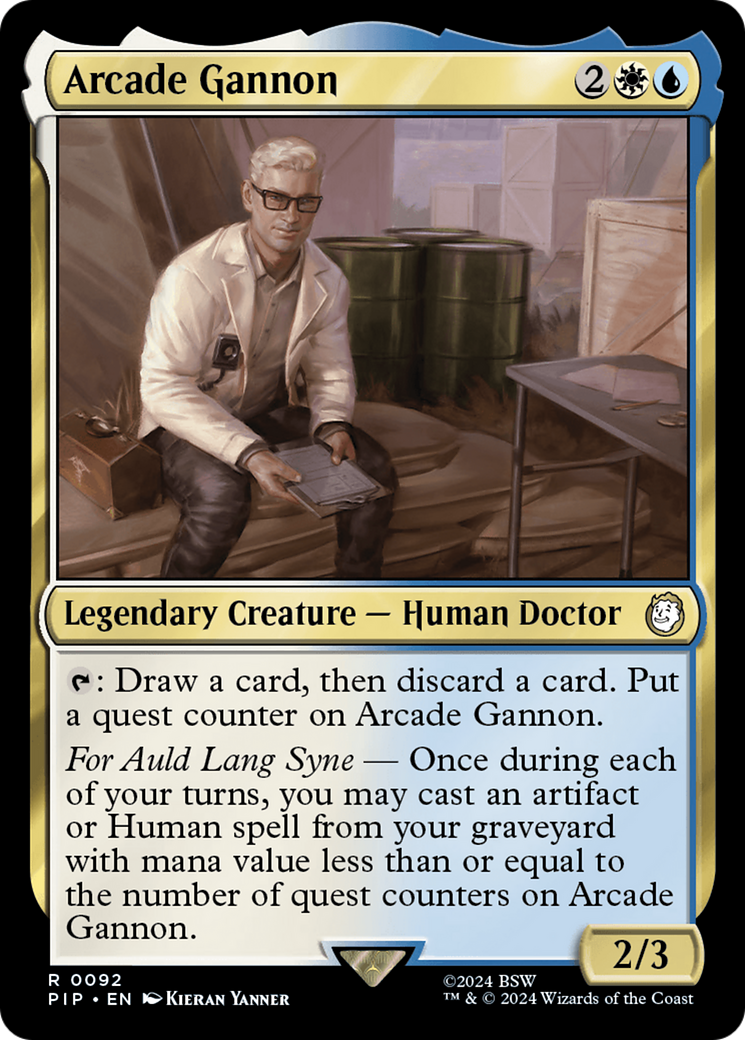
Arcade Gannon
Arcade Gannon
Legendary Creature — Human Doctor
2/3
: Draw a card, then discard a card. Put a quest counter on Arcade Gannon.
For Auld Lang Syne — Once during each of your turns, you may cast an artifact or Human spell from your graveyard with mana value less than or equal to the number of quest counters on Arcade Gannon.
- You must follow the normal timing permissions and restrictions of the spell you cast from your graveyard.
- You must pay the costs to cast that spell. If it has an alternative cost, you may cast it for that cost instead.
- Once you begin to cast the spell, losing control of Arcade Gannon won’t affect the spell.
- If you cast an artifact or Human spell from your graveyard using another permission, Arcade Gannon’s effect doesn’t apply. You can cast another artifact or Human spell from your graveyard.
- If you cast one artifact or Human spell from your graveyard and then have a new Arcade Gannon come under your control in the same turn, you may cast another artifact or Human spell from your graveyard that turn as long as that spell has mana value less than or equal to the number of quest counters on the new Arcade Gannon.
- If an artifact or Human card is put into your graveyard during your main phase and the stack is empty, you have a chance to cast it before any player may attempt to remove that card from your graveyard.
-
1
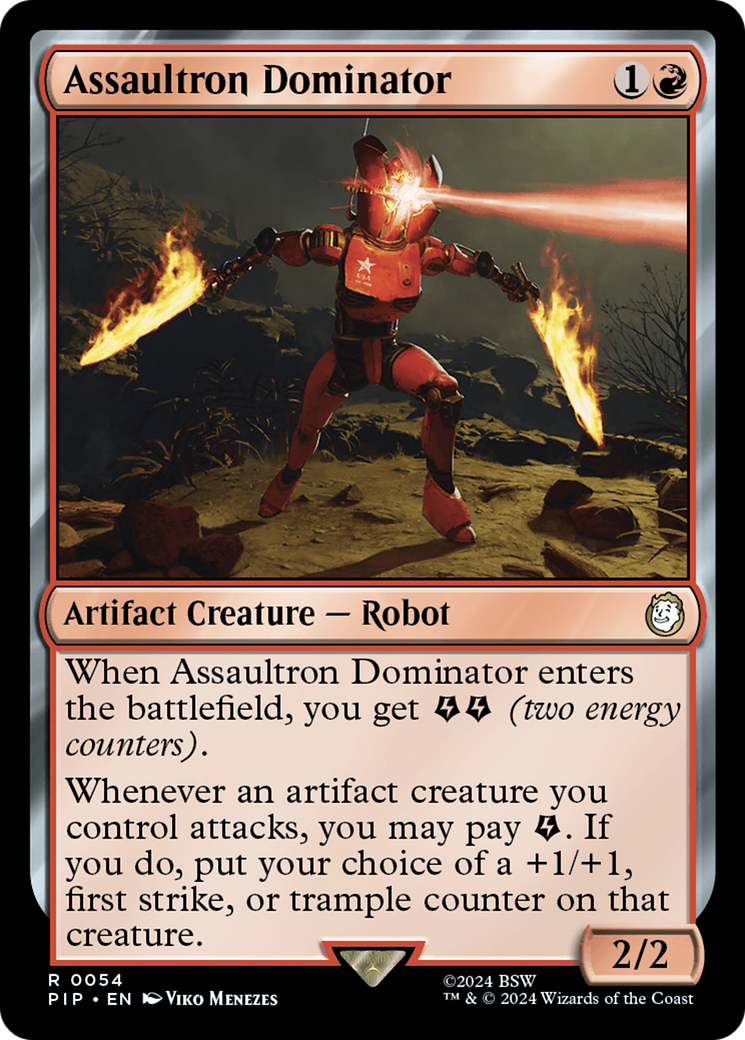
Assaultron Dominator
Assaultron Dominator
Artifact Creature — Robot
2/2
When this creature enters, you get (two energy counters).
Whenever an artifact creature you control attacks, you may pay . If you do, put your choice of a +1/+1, first strike, or trample counter on that creature.
- If multiple artifact creatures you control attack, Assaultron Dominator’s last ability triggers for each of them.
- is the energy symbol. It represents one energy counter.
- Energy counters are a kind of counter that a player may have. They’re not associated with any specific permanents.
- Keep track of how many energy counters each player has. Potential ways to track this include writing them down on paper or using dice, but any method that is clear and mutually agreeable is fine. (At higher levels of tournament play, dice may not be allowed for tracking counters that players have.)
- If an effect says you get one or more , you get that many energy counters. To pay one or more , you lose that many energy counters. You can’t pay more energy counters than you have. Any effects that interact with counters a player gets, has, or loses can interact with energy counters.
- Energy counters aren’t mana. They don’t go away as steps, phases, and turns end, and effects that add mana “of any type” can’t give you energy counters.
- Some triggered abilities state that you “may pay” a certain amount of . You can’t pay that amount multiple times to multiply the effect. You simply choose whether or not to pay that amount of as the ability resolves.
- Some triggered abilities that state that you “may pay” a certain amount of describe an effect that happens “If you do.” In that case, no player may take actions to try to stop the ability’s effect after you make your choice. If the payment is followed by the phrase “When you do,” then you’ll choose any targets for that reflexive triggered ability and put it on the stack before players can take actions.
- If a spell or ability with one or more targets states that you “may pay” some amount of , and each permanent that it targets has become an illegal target, the spell or ability won’t resolve. You can’t pay any even if you want to.
- Some spells and abilities that give you may require targets. If each target chosen is an illegal target as that spell or ability tries to resolve, it won’t resolve. You won’t get any .
-
1
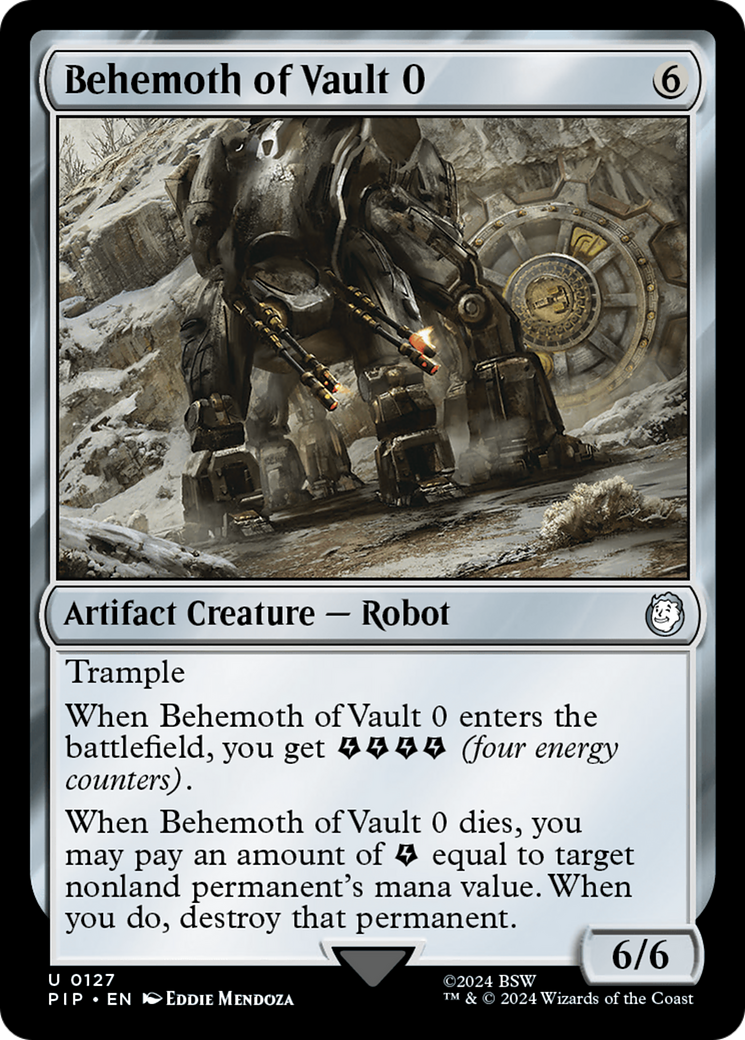
Behemoth of Vault 0
Behemoth of Vault 0
Artifact Creature — Robot
6/6
Trample
When this creature enters, you get (four energy counters).
When this creature dies, you may pay an amount of equal to target nonland permanent's mana value. When you do, destroy that permanent.
- Energy counters are a kind of counter that a player may have. They’re not associated with any specific permanents.
- You choose the target of Behemoth of Vault 0’s last ability when it triggers, but you don’t have to decide whether or not to pay until the ability resolves.
- When you pay equal to the target nonland permanent’s mana value during the resolution of Behemoth of Vault 0’s last ability, a second “reflexive” ability triggers and is put onto the stack. This ability does not have a target. Each player may respond to this triggered ability as normal.
- is the energy symbol. It represents one energy counter.
- Keep track of how many energy counters each player has. Potential ways to track this include writing them down on paper or using dice, but any method that is clear and mutually agreeable is fine. (At higher levels of tournament play, dice may not be allowed for tracking counters that players have.)
- If an effect says you get one or more , you get that many energy counters. To pay one or more , you lose that many energy counters. You can’t pay more energy counters than you have. Any effects that interact with counters a player gets, has, or loses can interact with energy counters.
- Energy counters aren’t mana. They don’t go away as steps, phases, and turns end, and effects that add mana “of any type” can’t give you energy counters.
- Some triggered abilities state that you “may pay” a certain amount of . You can’t pay that amount multiple times to multiply the effect. You simply choose whether or not to pay that amount of as the ability resolves.
- Some triggered abilities that state that you “may pay” a certain amount of describe an effect that happens “If you do.” In that case, no player may take actions to try to stop the ability’s effect after you make your choice. If the payment is followed by the phrase “When you do,” then you’ll choose any targets for that reflexive triggered ability and put it on the stack before players can take actions.
- If a spell or ability with one or more targets states that you “may pay” some amount of , and each permanent that it targets has become an illegal target, the spell or ability won’t resolve. You can’t pay any even if you want to.
- Some spells and abilities that give you may require targets. If each target chosen is an illegal target as that spell or ability tries to resolve, it won’t resolve. You won’t get any .
-
1
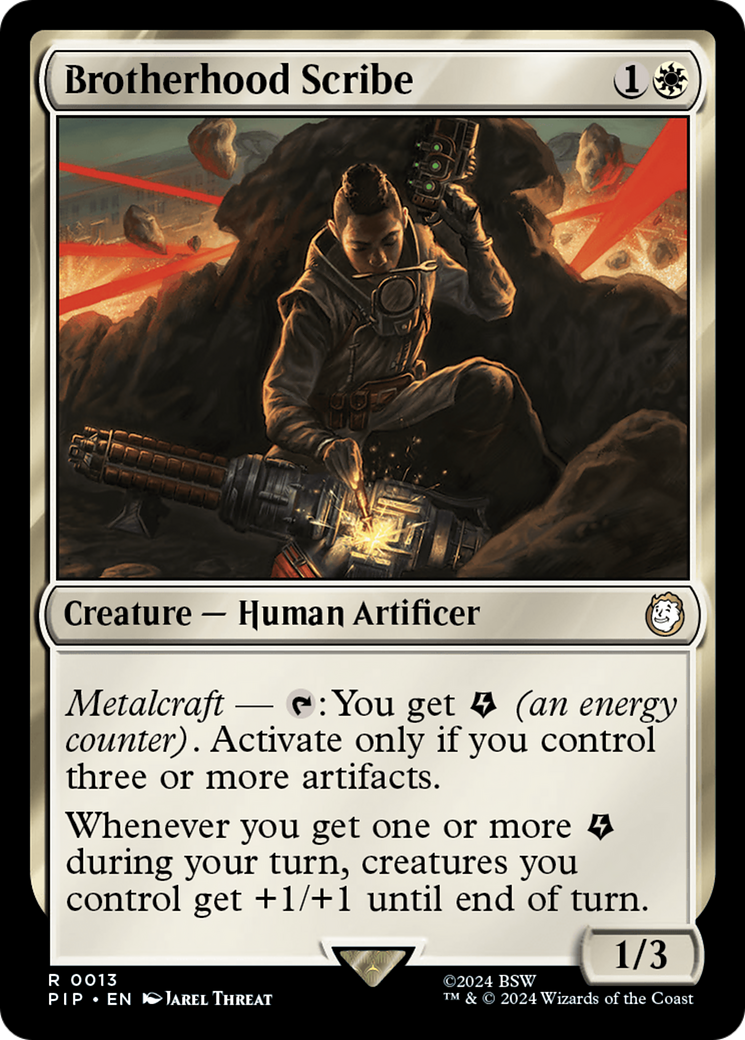
Brotherhood Scribe
Brotherhood Scribe
Creature — Human Artificer
1/3
Metalcraft — : You get (an energy counter). Activate only if you control three or more artifacts.
Whenever you get one or more during your turn, creatures you control get +1/+1 until end of turn.
- is the energy symbol. It represents one energy counter.
- Energy counters are a kind of counter that a player may have. They’re not associated with any specific permanents.
- Keep track of how many energy counters each player has. Potential ways to track this include writing them down on paper or using dice, but any method that is clear and mutually agreeable is fine. (At higher levels of tournament play, dice may not be allowed for tracking counters that players have.)
- If an effect says you get one or more , you get that many energy counters. To pay one or more , you lose that many energy counters. You can’t pay more energy counters than you have. Any effects that interact with counters a player gets, has, or loses can interact with energy counters.
- Energy counters aren’t mana. They don’t go away as steps, phases, and turns end, and effects that add mana “of any type” can’t give you energy counters.
- Some triggered abilities state that you “may pay” a certain amount of . You can’t pay that amount multiple times to multiply the effect. You simply choose whether or not to pay that amount of as the ability resolves.
- Some triggered abilities that state that you “may pay” a certain amount of describe an effect that happens “If you do.” In that case, no player may take actions to try to stop the ability’s effect after you make your choice. If the payment is followed by the phrase “When you do,” then you’ll choose any targets for that reflexive triggered ability and put it on the stack before players can take actions.
- If a spell or ability with one or more targets states that you “may pay” some amount of , and each permanent that it targets has become an illegal target, the spell or ability won’t resolve. You can’t pay any even if you want to.
- Some spells and abilities that give you may require targets. If each target chosen is an illegal target as that spell or ability tries to resolve, it won’t resolve. You won’t get any .
-
1
Curie, Emergent Intelligence
Curie, Emergent Intelligence
Legendary Artifact Creature — Robot
1/3
Whenever Curie deals combat damage to a player, draw cards equal to its base power.
, Exile another nontoken artifact creature you control: Curie becomes a copy of the exiled creature, except it has "Whenever this creature deals combat damage to a player, draw cards equal to its base power."
- Normally, a creature's base power is the power printed on the card, or, for a token, the power set by the effect that created it. If another effect sets a creature's power to a specific number or value, that becomes its base power. If an effect modifies a creature's power without setting it, that is not included when determining its base power.
- If a creature has a characteristic-defining ability that sets its power, indicated with a * or similar in the power and toughness box, that ability is taken into account when determining its base power.
- If Curie is no longer on the battlefield when its first ability resolves, use its base power as it last existed on the battlefield to determine how many cards to draw.
- Curie's last ability refers to the exiled creature, not the exiled card. In most cases, this means Curie copies exactly what was printed on the original creature and nothing else, plus the additional ability. However, if the exiled creature was copying something else when it was last on the battlefield, Curie copies whatever that creature was copying, plus the additional ability.
- Curie's last ability won't copy whether the exiled creature was tapped or untapped, whether it had any counters on it or Auras attached to it, or any non-copy effects that changed its power, toughness, types, color, and so on.
- If the copied creature has in its mana cost, X is 0.
-
1
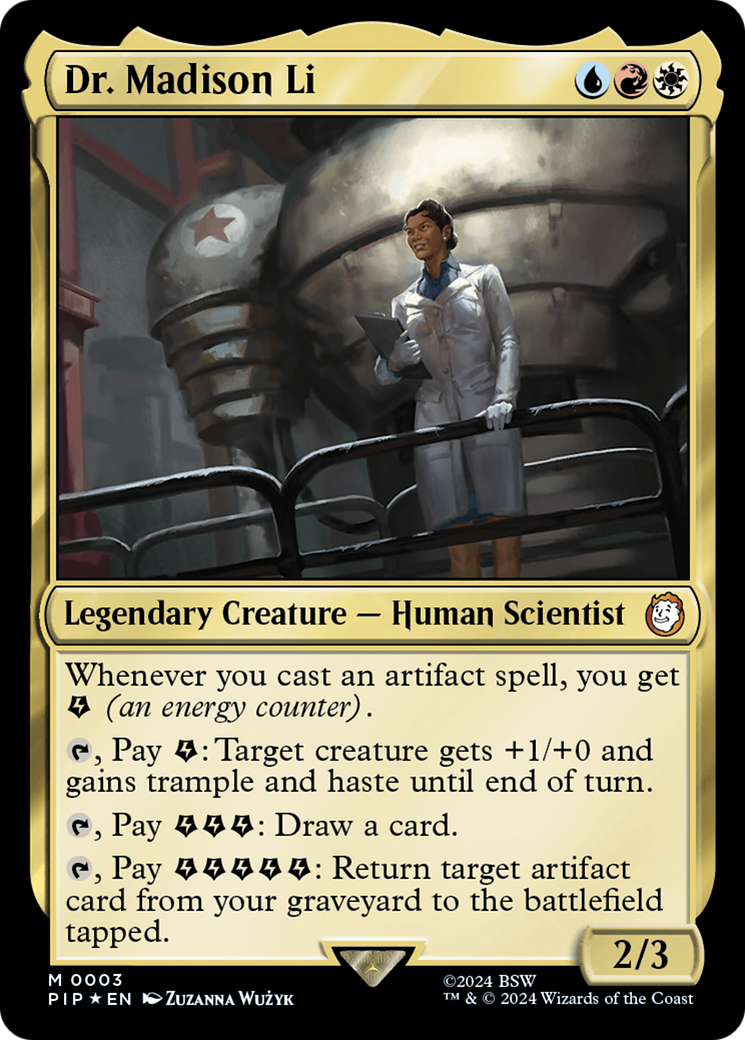
Dr. Madison Li
Dr. Madison Li
Legendary Creature — Human Scientist
2/3
Whenever you cast an artifact spell, you get (an energy counter).
, Pay : Target creature gets +1/+0 and gains trample and haste until end of turn.
, Pay : Draw a card.
, Pay : Return target artifact card from your graveyard to the battlefield tapped.
- Dr. Madison Li’s first ability resolves before the spell that caused it to trigger.
- is the energy symbol. It represents one energy counter.
- Energy counters are a kind of counter that a player may have. They’re not associated with any specific permanents.
- Keep track of how many energy counters each player has. Potential ways to track this include writing them down on paper or using dice, but any method that is clear and mutually agreeable is fine. (At higher levels of tournament play, dice may not be allowed for tracking counters that players have.)
- If an effect says you get one or more , you get that many energy counters. To pay one or more , you lose that many energy counters. You can’t pay more energy counters than you have. Any effects that interact with counters a player gets, has, or loses can interact with energy counters.
- Energy counters aren’t mana. They don’t go away as steps, phases, and turns end, and effects that add mana “of any type” can’t give you energy counters.
- Some triggered abilities state that you “may pay” a certain amount of . You can’t pay that amount multiple times to multiply the effect. You simply choose whether or not to pay that amount of as the ability resolves.
- Some triggered abilities that state that you “may pay” a certain amount of describe an effect that happens “If you do.” In that case, no player may take actions to try to stop the ability’s effect after you make your choice. If the payment is followed by the phrase “When you do,” then you’ll choose any targets for that reflexive triggered ability and put it on the stack before players can take actions.
- If a spell or ability with one or more targets states that you “may pay” some amount of , and each permanent that it targets has become an illegal target, the spell or ability won’t resolve. You can’t pay any even if you want to.
- Some spells and abilities that give you may require targets. If each target chosen is an illegal target as that spell or ability tries to resolve, it won’t resolve. You won’t get any .
-
1
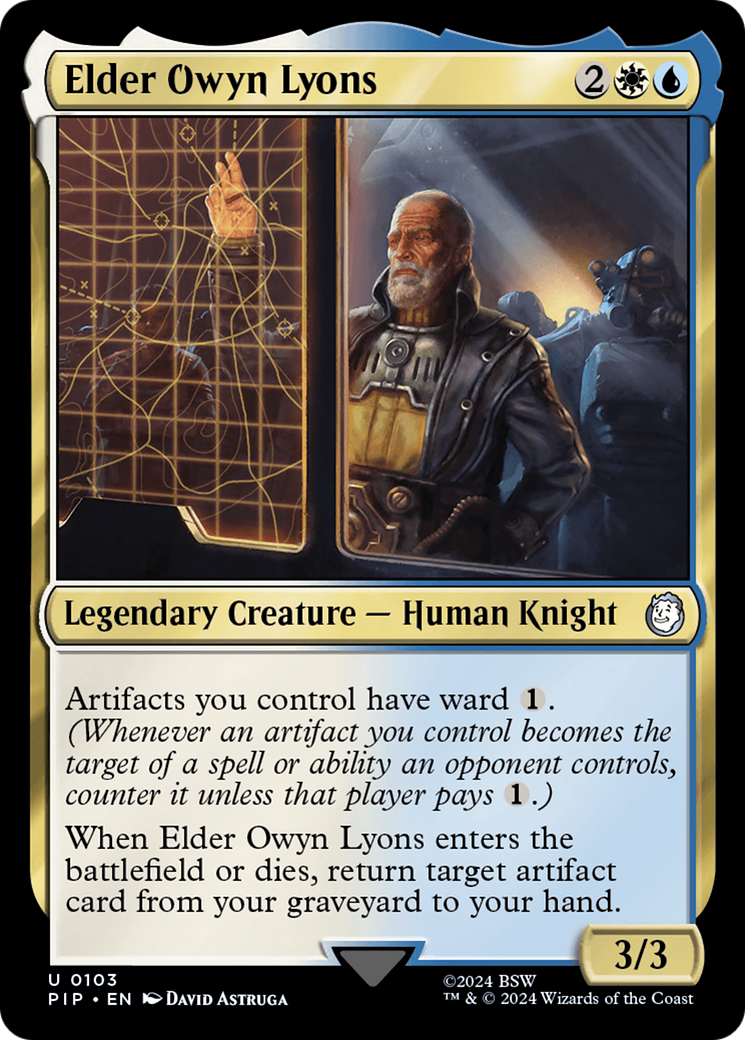
Elder Owyn Lyons
Elder Owyn Lyons
Legendary Creature — Human Knight
3/3
Artifacts you control have ward . (Whenever an artifact you control becomes the target of a spell or ability an opponent controls, counter it unless that player pays .)
When Elder Owyn Lyons enters or dies, return target artifact card from your graveyard to your hand.
-
1
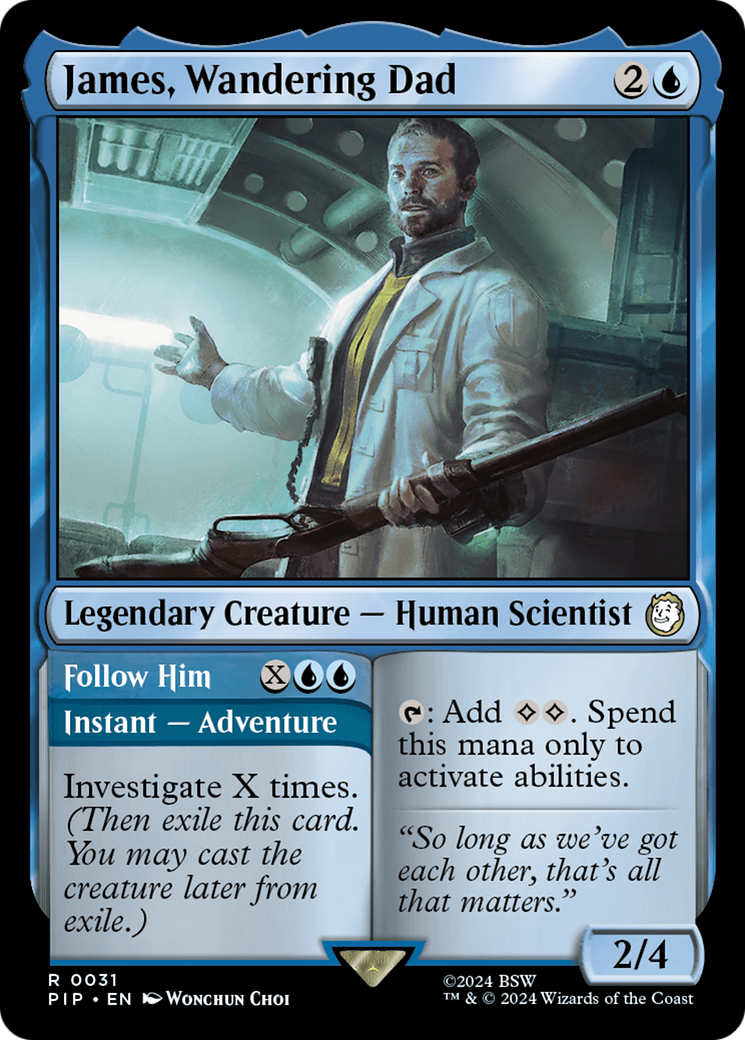
James, Wandering Dad // Follow Him
//
James, Wandering Dad
Legendary Creature — Human Scientist
2/4
- Activated abilities contain a colon. They're generally written "[Cost]: [Effect]." Some keywords are activated abilities and may have colons in their reminder text.
-
1
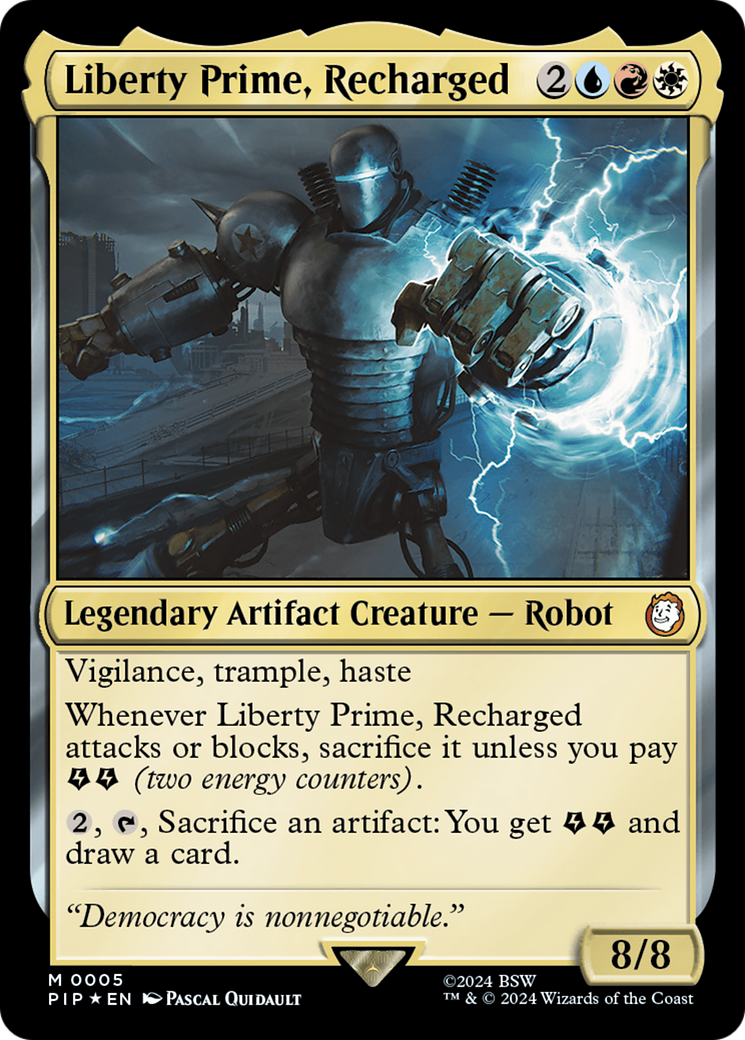
Liberty Prime, Recharged
Liberty Prime, Recharged
Legendary Artifact Creature — Robot
8/8
Vigilance, trample, haste
Whenever Liberty Prime attacks or blocks, sacrifice it unless you pay (two energy counters).
, , Sacrifice an artifact: You get and draw a card.
-
1
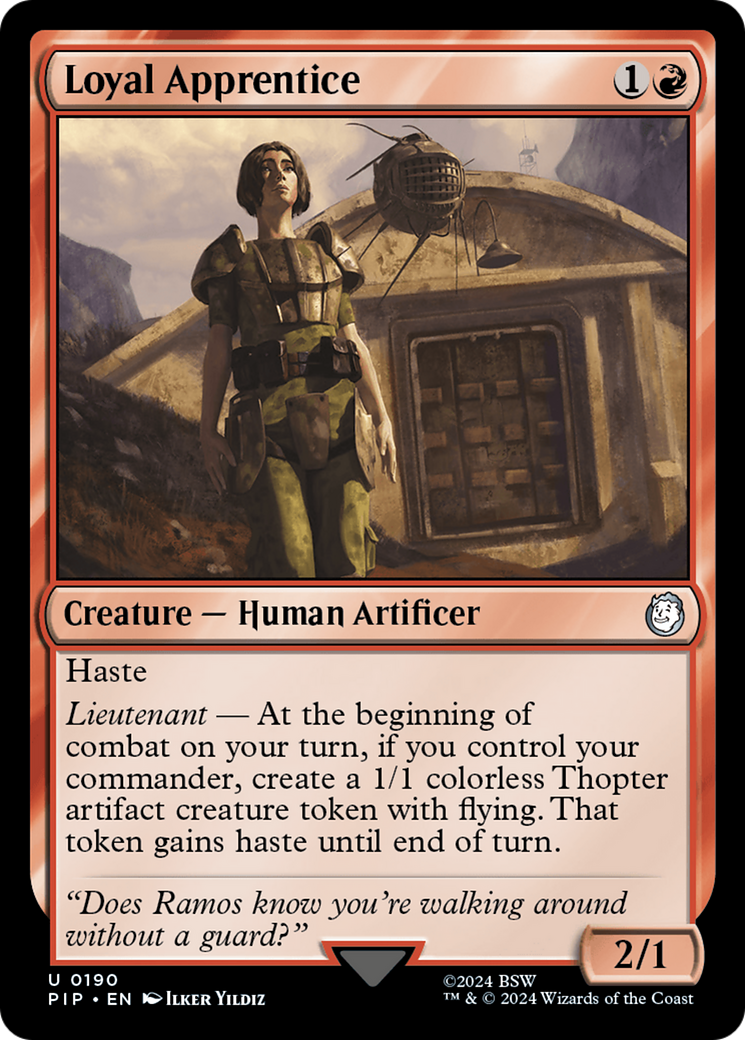
Loyal Apprentice
Loyal Apprentice
Creature — Human Artificer
2/1
Haste
Lieutenant — At the beginning of combat on your turn, if you control your commander, create a 1/1 colorless Thopter artifact creature token with flying. That token gains haste until end of turn.
- If you don't control your commander as the lieutenant ability resolves, you won't get its effect.
- The lieutenant effect happens only once each combat, even if you somehow control multiple commanders (perhaps because you have two commanders with a partner ability from the Battlebond™ set).
- If you have multiple commanders, you need to control only one for the lieutenant effect to happen.
-
1
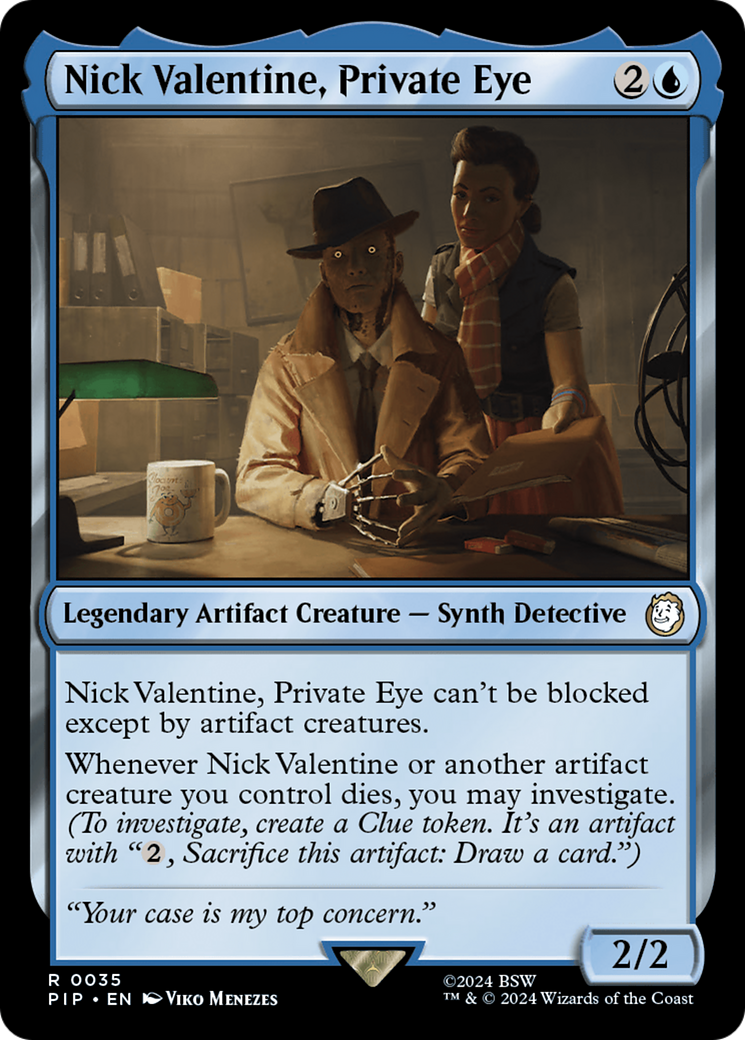
Nick Valentine, Private Eye
Nick Valentine, Private Eye
Legendary Artifact Creature — Synth Detective
2/2
Nick Valentine can't be blocked except by artifact creatures.
Whenever Nick Valentine or another artifact creature you control dies, you may investigate. (To investigate, create a Clue token. It's an artifact with " , Sacrifice this token: Draw a card.")
- Once Nick Valentine has been blocked, making the blocking creature stop being an artifact won't cause Nick Valentine to become unblocked.
-
1
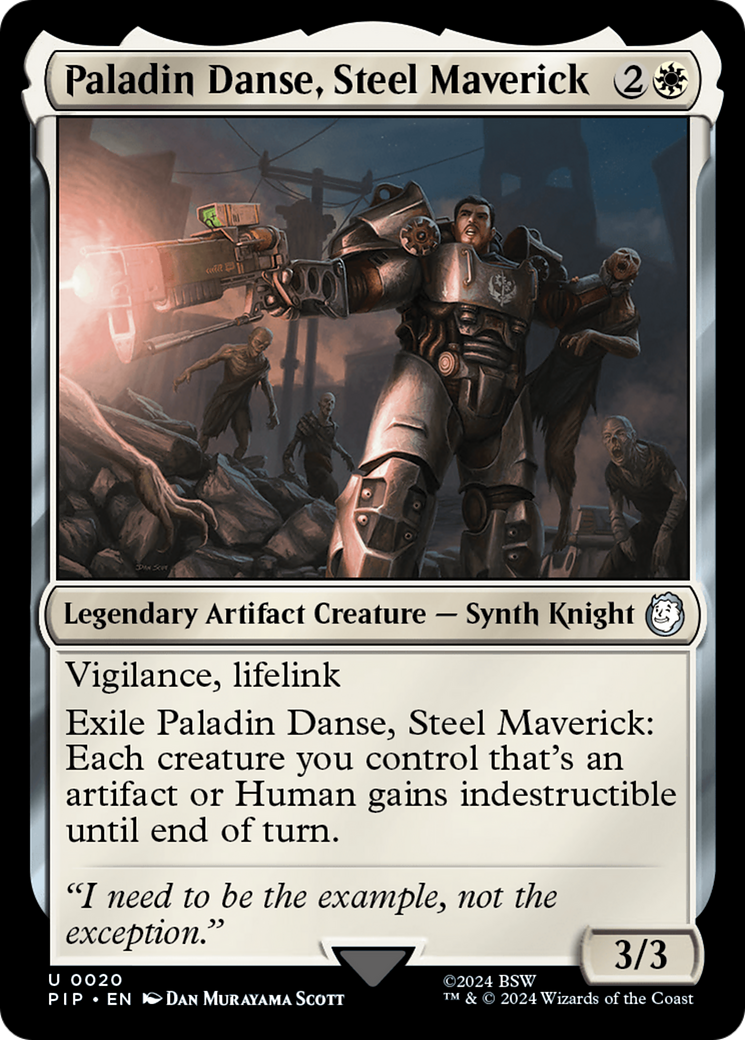
Paladin Danse, Steel Maverick
Paladin Danse, Steel Maverick
Legendary Artifact Creature — Synth Knight
3/3
Vigilance, lifelink
Exile Paladin Danse: Each creature you control that's an artifact or Human gains indestructible until end of turn.
- The set of creatures affected by Paladin Danse's last ability is determined as the ability resolves. Artifact creatures and Human creatures you begin to control later in the turn and permanents you control that become artifact creatures or Human creatures later in the turn won't gain indestructible.
-
1
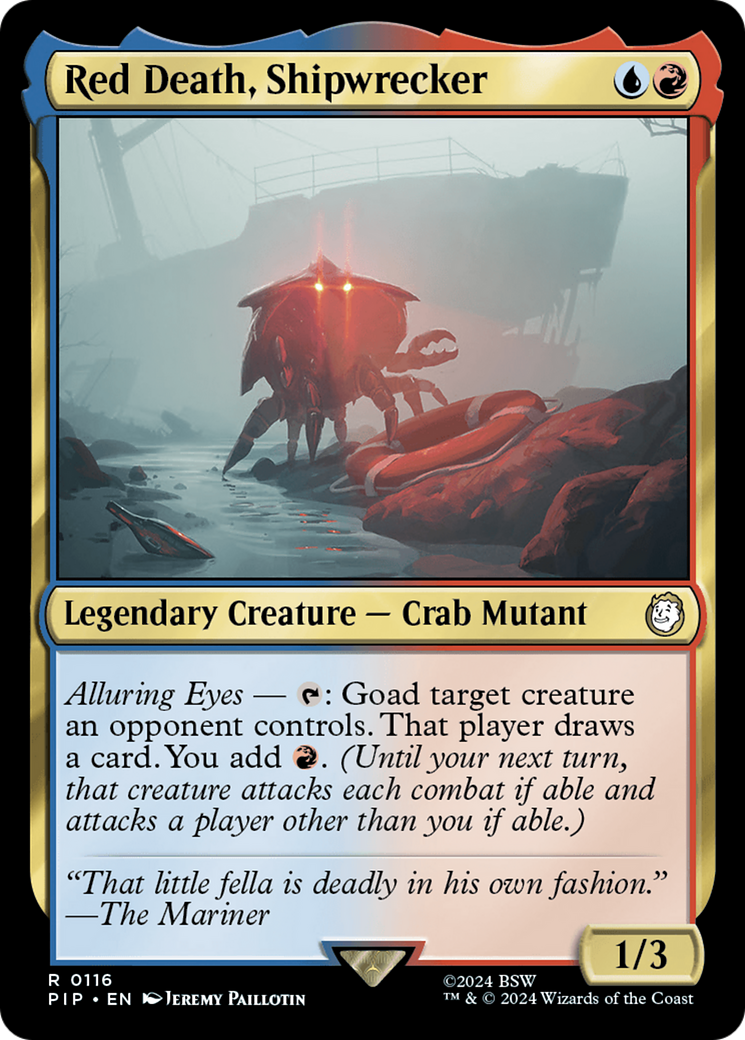
Red Death, Shipwrecker
Red Death, Shipwrecker
Legendary Creature — Crab Mutant
1/3
Alluring Eyes — : Goad target creature an opponent controls. That player draws a card. You add . (Until your next turn, that creature attacks each combat if able and attacks a player other than you if able.)
- If the target creature is an illegal target as Red Death’s ability tries to resolve, it won’t resolve and none of its effects happen. You won’t add any mana, and the creature’s controller won’t draw a card.
- Red Death’s ability isn’t a mana ability even though it causes you to add mana. It uses the stack and can be responded to.
- If, during a player’s declare attackers step, a creature that player controls that’s been goaded is tapped, is affected by a spell or ability that says it can’t attack, or hasn’t been under that player’s control continuously since the turn began (and doesn’t have haste), then it doesn’t attack. If there’s a cost associated with having a creature attack a player, its controller isn’t forced to pay that cost, so it doesn’t have to attack that player.
- If the creature doesn’t meet any of the above exceptions and can attack, it must attack a player other than the controller of the spell or ability that goaded it if able. If the creature can’t attack any of those players but could otherwise attack, it must attack a planeswalker an opponent controls, a battle an opponent protects, or the player that goaded it.
- Being goaded isn’t an ability the creature has. Once it’s been goaded, it must attack as detailed above even if it loses all abilities.
- Attacking with a goaded creature doesn’t cause it to stop being goaded. If there is an additional combat phase that turn, or if another player gains control of it before it stops being goaded, it must attack again if able.
-
1
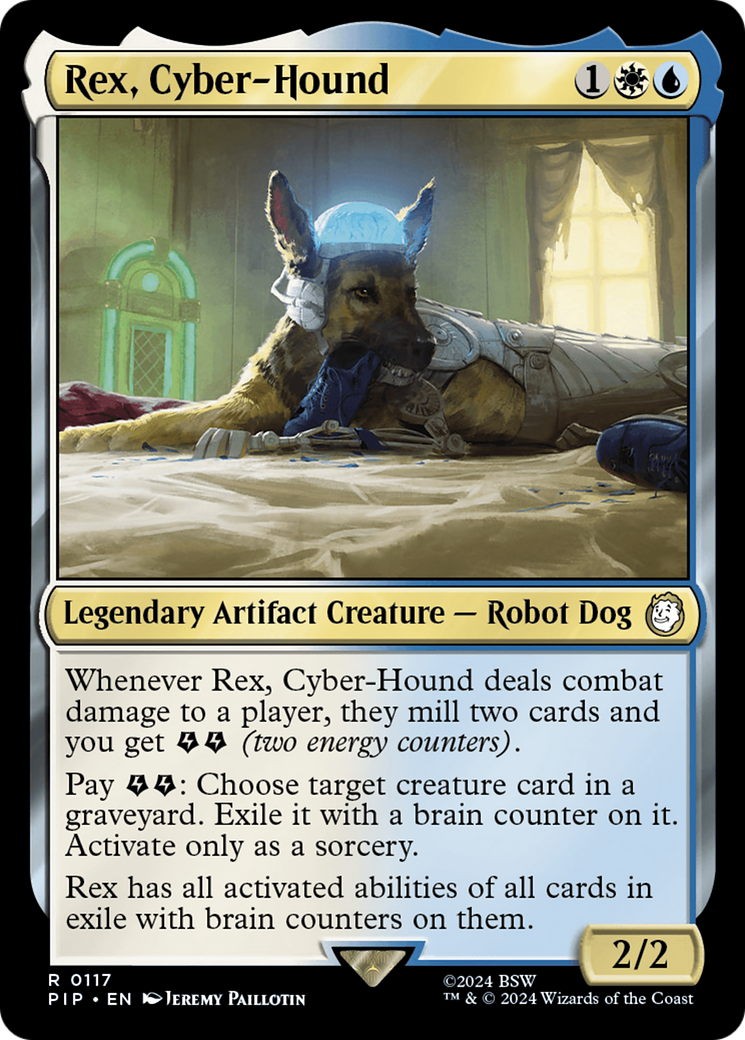
Rex, Cyber-Hound
Rex, Cyber-Hound
Legendary Artifact Creature — Robot Dog
2/2
Whenever Rex deals combat damage to a player, they mill two cards and you get (two energy counters).
Pay : Choose target creature card in a graveyard. Exile it with a brain counter on it. Activate only as a sorcery.
Rex has all activated abilities of all cards in exile with brain counters on them.
- Rex gains only activated abilities. It doesn't gain triggered abilities or static abilities. Activated abilities contain a colon. They're generally written "[Cost]: [Effect]." Some keywords are activated abilities and may have colons in their reminder text.
- If an activated ability of a card in exile with a brain counter on it references the card it's printed on by name, treat Rex's version of that ability as though it referenced Rex, Cyber-Hound instead. For example, say Arcade Gannon (which has the ability " : Draw a card, then discard a card. Put a quest counter on Arcade Gannon.") is in exile with a brain counter on it. You would treat Rex's version of the ability as though it said " : Draw a card, then discard a card. Put a quest counter on Rex, Cyber-Hound."
-
1
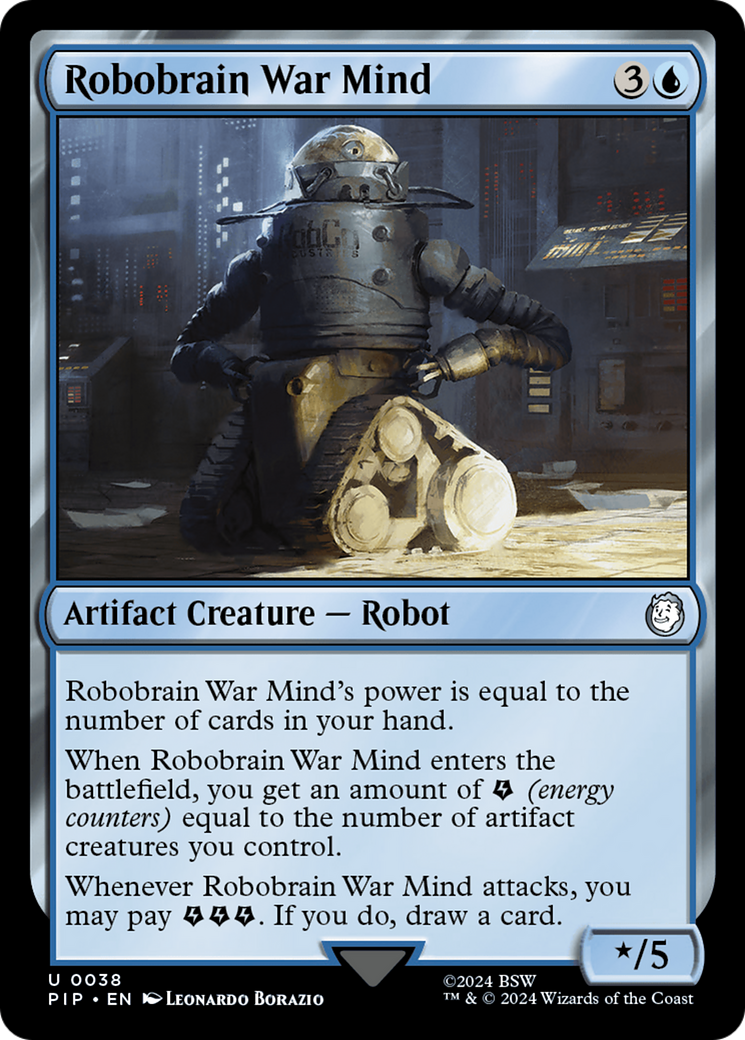
Robobrain War Mind
Robobrain War Mind
Artifact Creature — Robot
*/5
Robobrain War Mind's power is equal to the number of cards in your hand.
When this creature enters, you get an amount of (energy counters) equal to the number of artifact creatures you control.
Whenever this creature attacks, you may pay . If you do, draw a card.
- The ability that defines Robobrain War Mind's power functions in all zones, not just the battlefield.
- Use the number of artifact creatures you control when Robobrain War Mind's second ability resolves, including Robobrain War Mind itself if it's still on the battlefield, to determine the number of energy counters you get.
- is the energy symbol. It represents one energy counter.
- Energy counters are a kind of counter that a player may have. They're not associated with any specific permanents.
- Keep track of how many energy counters each player has. Potential ways to track this include writing them down on paper or using dice, but any method that is clear and mutually agreeable is fine. (At higher levels of tournament play, dice may not be allowed for tracking counters that players have.)
- If an effect says you get one or more , you get that many energy counters. To pay one or more , you lose that many energy counters. You can't pay more energy counters than you have. Any effects that interact with counters a player gets, has, or loses can interact with energy counters.
- Energy counters aren't mana. They don't go away as steps, phases, and turns end, and effects that add mana "of any type" can't give you energy counters.
- Some triggered abilities state that you "may pay" a certain amount of . You can't pay that amount multiple times to multiply the effect. You simply choose whether or not to pay that amount of as the ability resolves.
- Some triggered abilities that state that you "may pay" a certain amount of describe an effect that happens "If you do." In that case, no player may take actions to try to stop the ability's effect after you make your choice. If the payment is followed by the phrase "When you do," then you'll choose any targets for that reflexive triggered ability and put it on the stack before players can take actions.
- If a spell or ability with one or more targets states that you "may pay" some amount of , and each permanent that it targets has become an illegal target, the spell or ability won't resolve. You can't pay any even if you want to.
- Some spells and abilities that give you may require targets. If each target chosen is an illegal target as that spell or ability tries to resolve, it won't resolve. You won't get any .
-
1
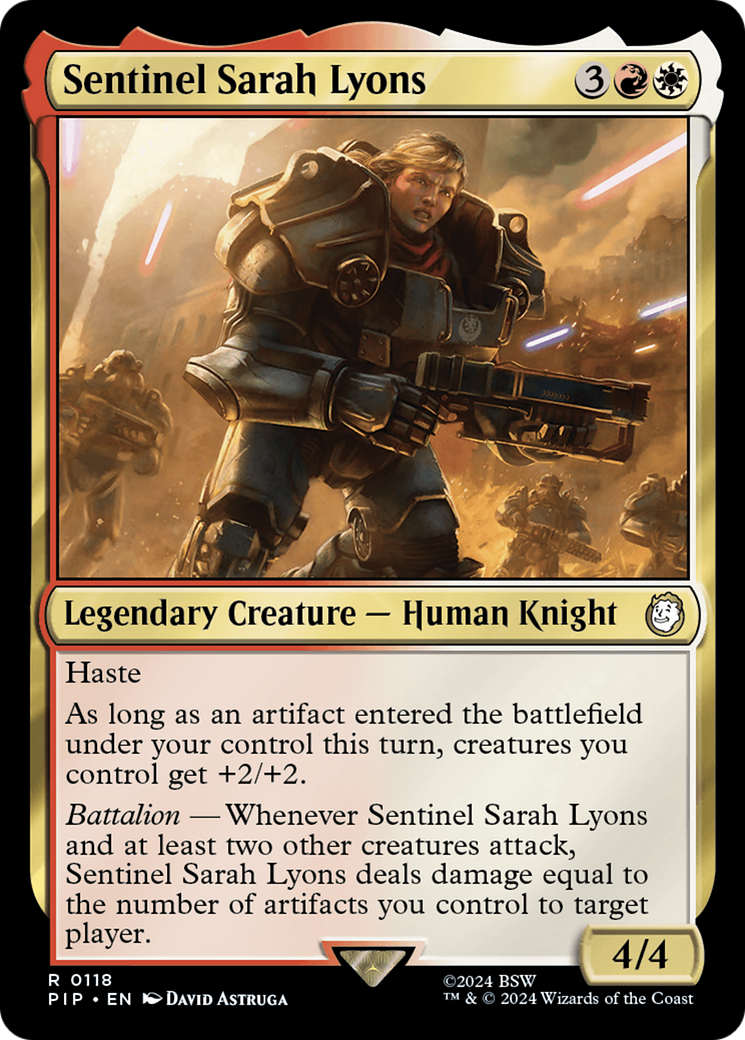
Sentinel Sarah Lyons
Sentinel Sarah Lyons
Legendary Creature — Human Knight
4/4
Haste
As long as an artifact entered the battlefield under your control this turn, creatures you control get +2/+2.
Battalion — Whenever Sentinel Sarah Lyons and at least two other creatures attack, Sentinel Sarah Lyons deals damage equal to the number of artifacts you control to target player.
- Sentinel Sarah Lyons’s second ability only cares if one or more artifacts entered the battlefield under your control this turn. Your creatures won’t get more powerful if more than one artifact entered the battlefield under your control this turn.
- Once an artifact enters the battlefield under your control in a given turn, it doesn’t matter what happens to it later. Creatures you control will still get +2/+2 that turn as long as Sentinel Sarah Lyons is on the battlefield under your control.
- Sentinel Sarah Lyons doesn’t have to have been on the battlefield at the point in the turn where an artifact entered the battlefield under your control. If an artifact enters the battlefield under your control and then Sentinel Sarah Lyons enters the battlefield under your control later in that turn, creatures you control will still get +2/+2 that turn as long as Sentinel Sarah Lyons remains on the battlefield and under your control.
- The three attacking creatures don’t have to be attacking the same player, planeswalker, or battle.
- Once Sentinel Sarah Lyons’s battalion ability has triggered, it doesn’t matter how many creatures are still attacking when that ability resolves. It also doesn’t matter whether or not Sentinel Sarah Lyons is still attacking or on the battlefield.
- Use the number of artifacts you control at the time Sentinel Sarah Lyons’s battalion ability resolves to determine how much damage to deal.
-
1
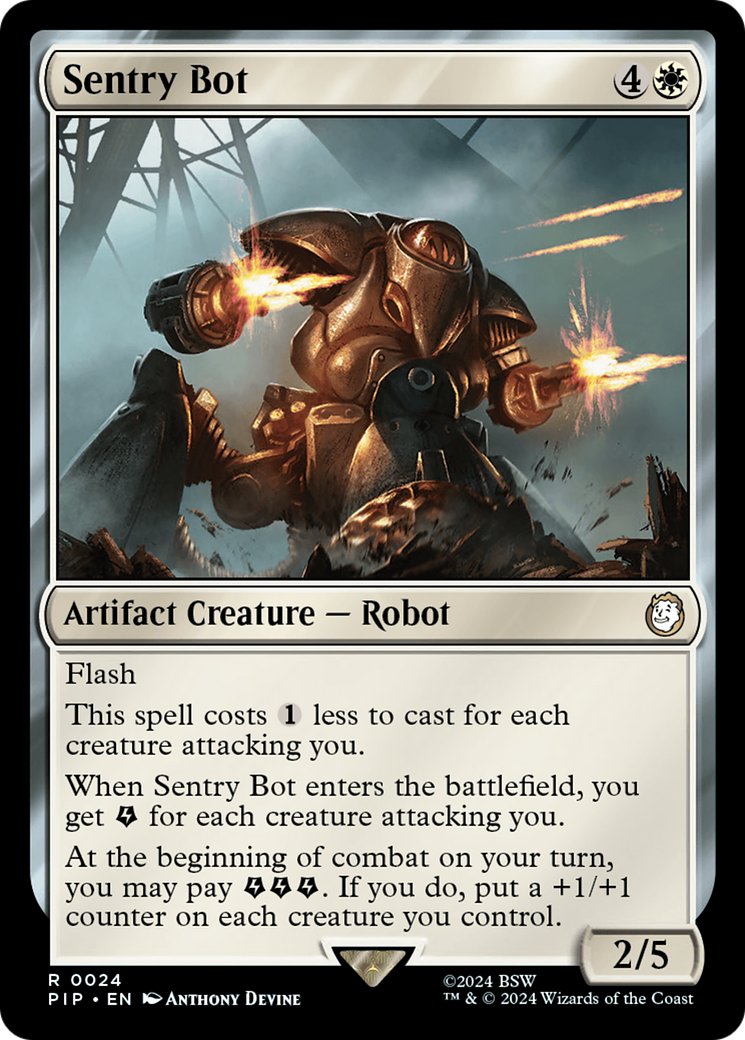
Sentry Bot
Sentry Bot
Artifact Creature — Robot
2/5
Flash
This spell costs less to cast for each creature attacking you.
When this creature enters, you get for each creature attacking you.
At the beginning of combat on your turn, you may pay . If you do, put a +1/+1 counter on each creature you control.
- The cost-reduction ability of Sentry Bot doesn’t change its mana cost or mana value, only the total cost you pay. Specifically, the mana value of Sentry Bot is always 5.
- Once you announce that you’re casting Sentry Bot, no player may take actions until you’re done casting it. Notably, opponents can’t remove creatures from combat to try to change Sentry Bot’s total cost.
- Use the number of creatures attacking you as Sentry Bot’s third ability resolves to determine the number of energy counters you get.
- is the energy symbol. It represents one energy counter.
- Energy counters are a kind of counter that a player may have. They’re not associated with any specific permanents.
- Keep track of how many energy counters each player has. Potential ways to track this include writing them down on paper or using dice, but any method that is clear and mutually agreeable is fine. (At higher levels of tournament play, dice may not be allowed for tracking counters that players have.)
- If an effect says you get one or more , you get that many energy counters. To pay one or more , you lose that many energy counters. You can’t pay more energy counters than you have. Any effects that interact with counters a player gets, has, or loses can interact with energy counters.
- Energy counters aren’t mana. They don’t go away as steps, phases, and turns end, and effects that add mana “of any type” can’t give you energy counters.
- Some triggered abilities state that you “may pay” a certain amount of . You can’t pay that amount multiple times to multiply the effect. You simply choose whether or not to pay that amount of as the ability resolves.
- Some triggered abilities that state that you “may pay” a certain amount of describe an effect that happens “If you do.” In that case, no player may take actions to try to stop the ability’s effect after you make your choice. If the payment is followed by the phrase “When you do,” then you’ll choose any targets for that reflexive triggered ability and put it on the stack before players can take actions.
- If a spell or ability with one or more targets states that you “may pay” some amount of , and each permanent that it targets has become an illegal target, the spell or ability won’t resolve. You can’t pay any even if you want to.
- Some spells and abilities that give you may require targets. If each target chosen is an illegal target as that spell or ability tries to resolve, it won’t resolve. You won’t get any .
-
1
Shaun, Father of Synths
Shaun, Father of Synths
Legendary Creature — Human Scientist
3/4
Whenever you attack, you may create a tapped and attacking token that's a copy of target attacking legendary creature you control other than Shaun, except it's not legendary and it's a Synth artifact creature in addition to its other types.
When Shaun leaves the battlefield, exile all Synth tokens you control.
- Except for the noted exceptions, the token copies exactly what was printed on the original creature and nothing else (unless that creature is copying something else or is a token; see below). It doesn’t copy whether that creature is tapped or untapped, whether it has any counters on it or Auras and Equipment attached to it, or any non-copy effects that have changed its power, toughness, types, color, and so on.
- If the copied creature has in its mana cost, X is 0.
- If the copied creature is a token, the token that’s created copies the original characteristics of that token as stated by the effect that created that token, with the noted exceptions.
- If the copied creature is copying something else, then the token enters the battlefield as whatever that creature copied, with the noted exceptions.
- Any enters-the-battlefield abilities of the copied creature will trigger when the token enters the battlefield. Any “as [this creature] enters the battlefield” or “[this creature] enters the battlefield with” abilities of the copied creature will also work.
- Although the token is attacking, it was never declared as an attacking creature. This means that abilities that trigger whenever a creature attacks won’t trigger when it enters the battlefield attacking.
- You declare which player, planeswalker, or battle the token is attacking as you put it onto the battlefield. It doesn’t have to be attacking the same player, planeswalker, or battle that Shaun is attacking.
- Shaun’s last ability will exile all Synth tokens you control, not just Synth tokens created by its first ability.
-
1
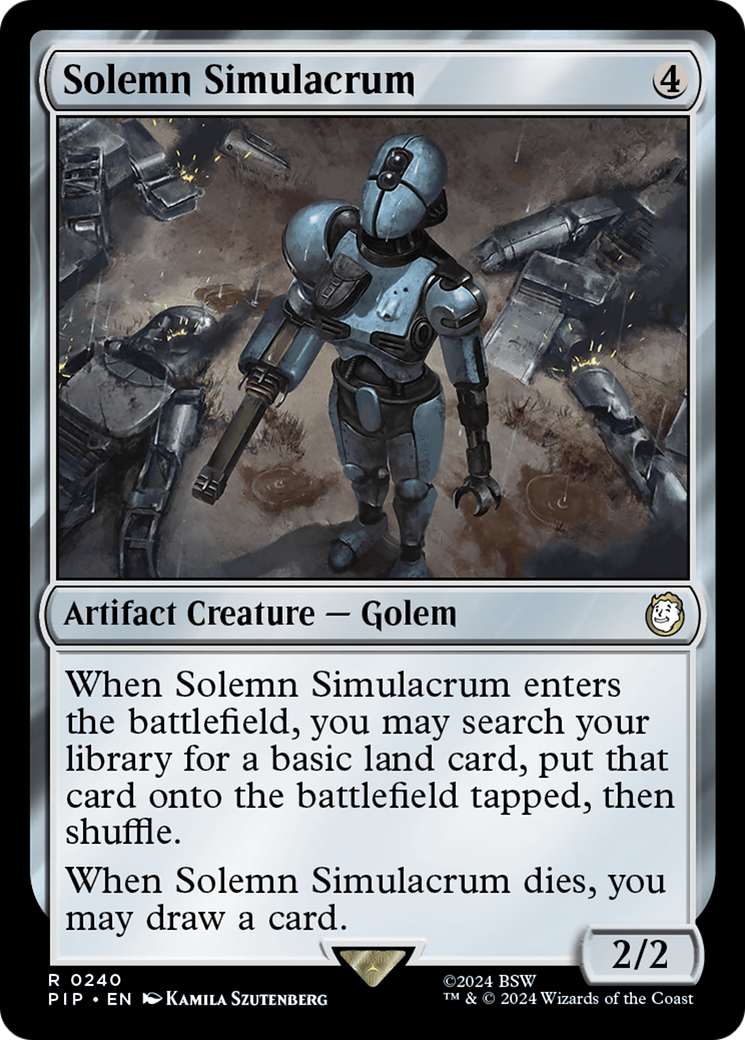
Solemn Simulacrum
Solemn Simulacrum
Artifact Creature — Golem
2/2
When this creature enters, you may search your library for a basic land card, put that card onto the battlefield tapped, then shuffle.
When this creature dies, you may draw a card.
-
1
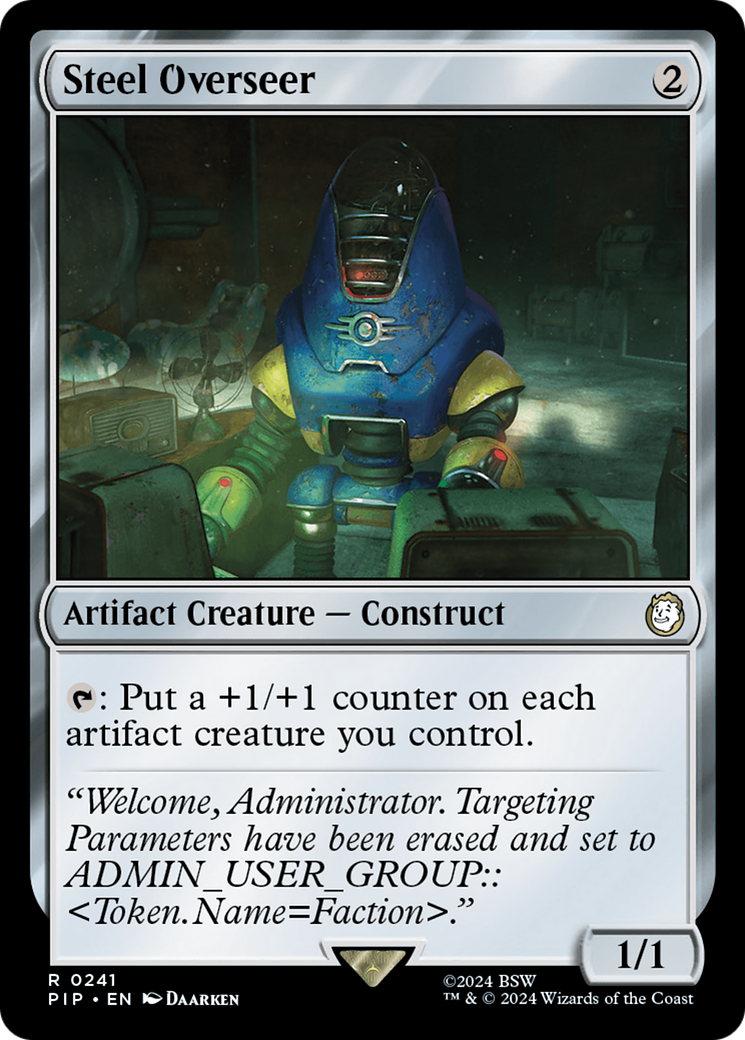
Steel Overseer
Steel Overseer
Artifact Creature — Construct
1/1
: Put a +1/+1 counter on each artifact creature you control.
- Steel Overseer's ability puts a +1/+1 counter on each artifact creature you control, including Steel Overseer.
-
1
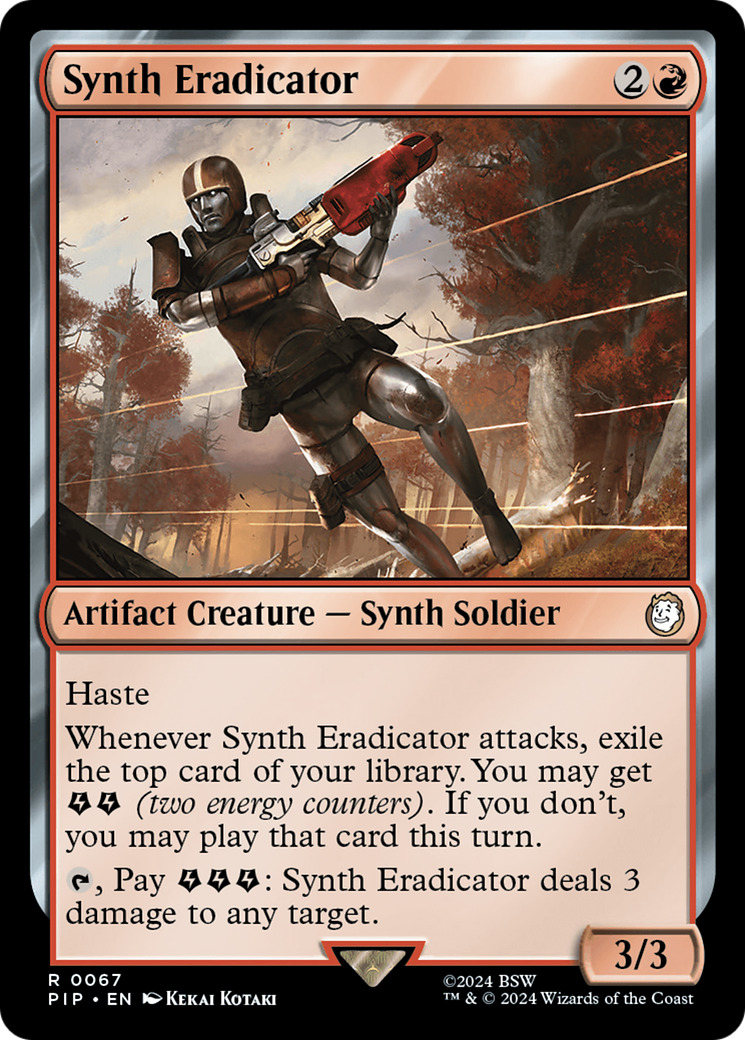
Synth Eradicator
Synth Eradicator
Artifact Creature — Synth Soldier
3/3
Haste
Whenever this creature attacks, exile the top card of your library. You may get (two energy counters). If you don't, you may play that card this turn.
, Pay : This creature deals 3 damage to any target.
- You pay all costs and follow all normal timing rules for the card played from exile with Synth Eradicator's second ability. For example, if the exiled card is a land card, you may play it only during your main phase while the stack is empty.
-
1
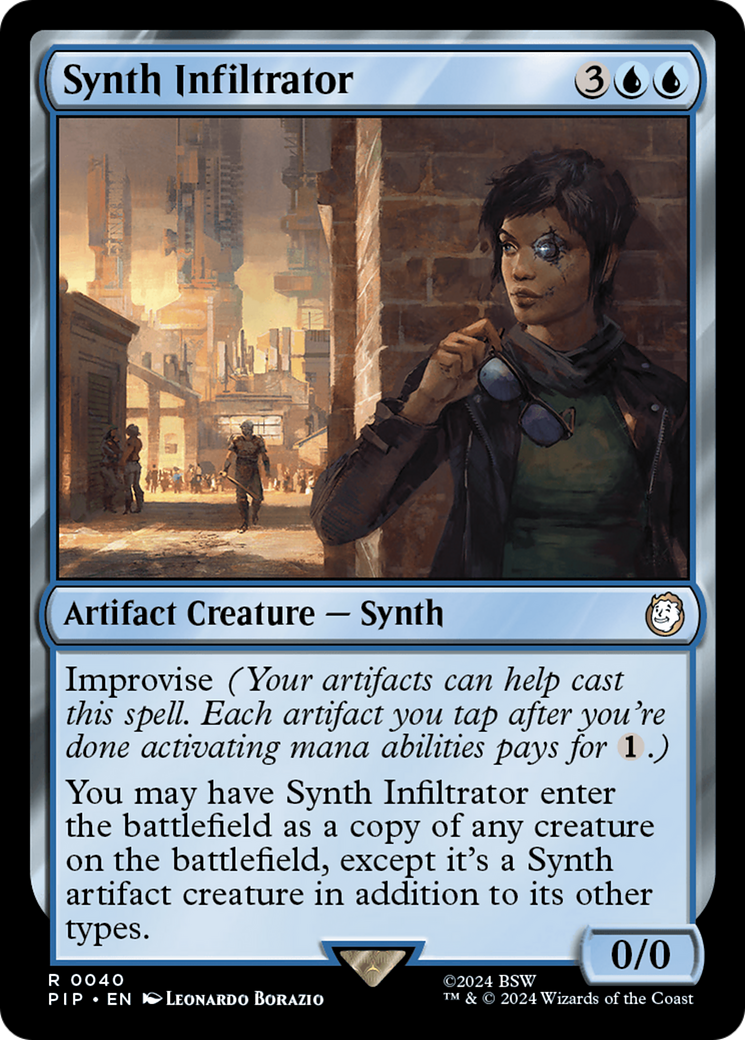
Synth Infiltrator
Synth Infiltrator
Artifact Creature — Synth
0/0
Improvise (Your artifacts can help cast this spell. Each artifact you tap after you're done activating mana abilities pays for .)
You may have this creature enter as a copy of any creature on the battlefield, except it's a Synth artifact creature in addition to its other types.
- Improvise doesn’t change Synth Infiltrator’s mana cost or mana value, and it can’t reduce Synth Infiltrator’s cost below .
- Except for being a Synth artifact creature in addition to its other types, Synth Infiltrator copies exactly what was printed on the original creature and nothing else (unless that creature is copying something else or is a token; see below). It doesn’t copy whether that creature is tapped or untapped, whether it has any counters on it or Auras and Equipment attached to it, or any non-copy effects that have changed its power, toughness, types, color, and so on.
- If the copied creature has in its mana cost, X is 0.
- If the copied creature is a token, Synth Infiltrator copies the original characteristics of that token as stated by the effect that created that token, with the noted exceptions.
- If the copied creature is copying something else, then Synth Infiltrator enters the battlefield as whatever that creature copied, with the noted exceptions.
- Any enters-the-battlefield abilities of the copied creature will trigger when Synth Infiltrator enters the battlefield. Any “as [this creature] enters the battlefield” or “[this creature] enters the battlefield with” abilities of the copied creature will also work.
- You can choose not to have Synth Infiltrator enter the battlefield as a copy of another creature. If you do, it will probably die due to having 0 toughness. (This is probably not the kind of innovation the Institute would approve of.)
-
1
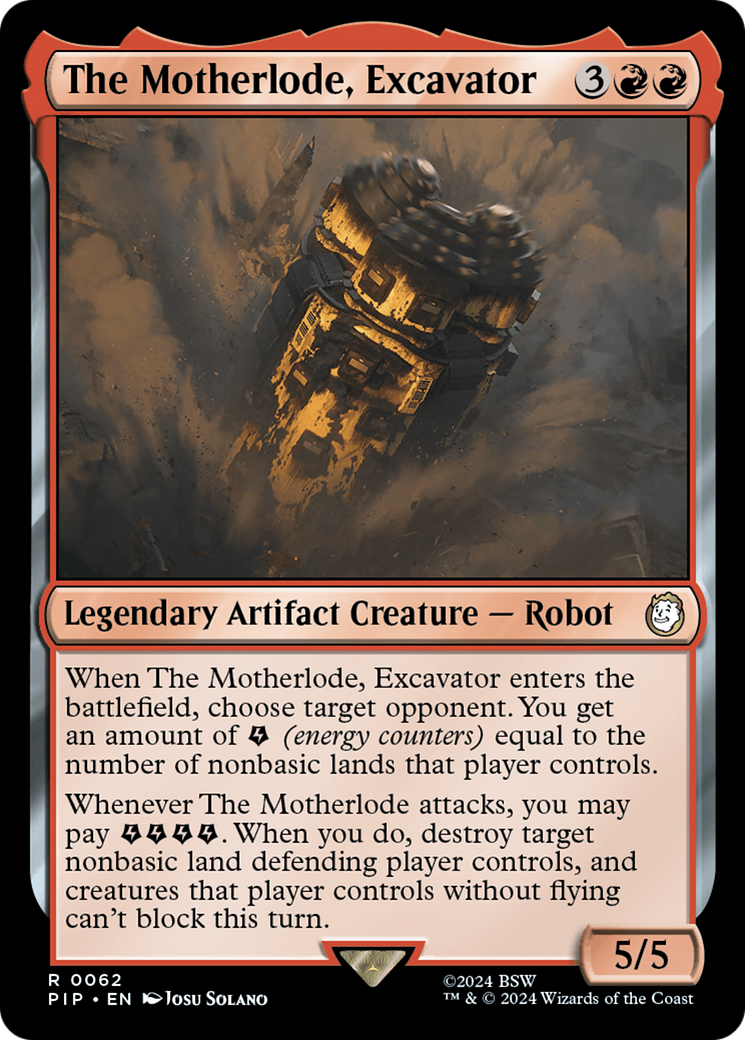
The Motherlode, Excavator
The Motherlode, Excavator
Legendary Artifact Creature — Robot
5/5
When The Motherlode enters, choose target opponent. You get an amount of (energy counters) equal to the number of nonbasic lands that player controls.
Whenever The Motherlode attacks, you may pay . When you do, destroy target nonbasic land defending player controls, and creatures that player controls without flying can't block this turn.
- Use the number of nonbasic lands the target opponent controls when The Motherlode's first ability resolves to determine the number of energy counters you get.
- You don't choose a target nonbasic land at the time The Motherlode's last ability triggers. Rather, a second "reflexive" ability triggers when you pay this way. You choose a target for that ability as it goes on the stack. Each player may respond to this triggered ability as normal.
- The Motherlode's reflexive triggered ability prevents all creatures without flying that player controls from blocking that turn, including creatures that lose flying after the ability resolves as well as creatures without flying that enter the battlefield or come under that player's control later in the turn.
- If the target nonbasic land is an illegal target as The Motherlode's reflexive triggered ability tries to resolve, it won't resolve and none of its effects happen. Creatures defending player controls without flying will still be able to block this turn.
- is the energy symbol. It represents one energy counter.
- Energy counters are a kind of counter that a player may have. They're not associated with any specific permanents.
- Keep track of how many energy counters each player has. Potential ways to track this include writing them down on paper or using dice, but any method that is clear and mutually agreeable is fine. (At higher levels of tournament play, dice may not be allowed for tracking counters that players have.)
- If an effect says you get one or more , you get that many energy counters. To pay one or more , you lose that many energy counters. You can't pay more energy counters than you have. Any effects that interact with counters a player gets, has, or loses can interact with energy counters.
- Energy counters aren't mana. They don't go away as steps, phases, and turns end, and effects that add mana "of any type" can't give you energy counters.
- Some triggered abilities state that you "may pay" a certain amount of . You can't pay that amount multiple times to multiply the effect. You simply choose whether or not to pay that amount of as the ability resolves.
- Some triggered abilities that state that you "may pay" a certain amount of describe an effect that happens "If you do." In that case, no player may take actions to try to stop the ability's effect after you make your choice. If the payment is followed by the phrase "When you do," then you'll choose any targets for that reflexive triggered ability and put it on the stack before players can take actions.
- If a spell or ability with one or more targets states that you "may pay" some amount of , and each permanent that it targets has become an illegal target, the spell or ability won't resolve. You can't pay any even if you want to.
- Some spells and abilities that give you may require targets. If each target chosen is an illegal target as that spell or ability tries to resolve, it won't resolve. You won't get any .
-
1
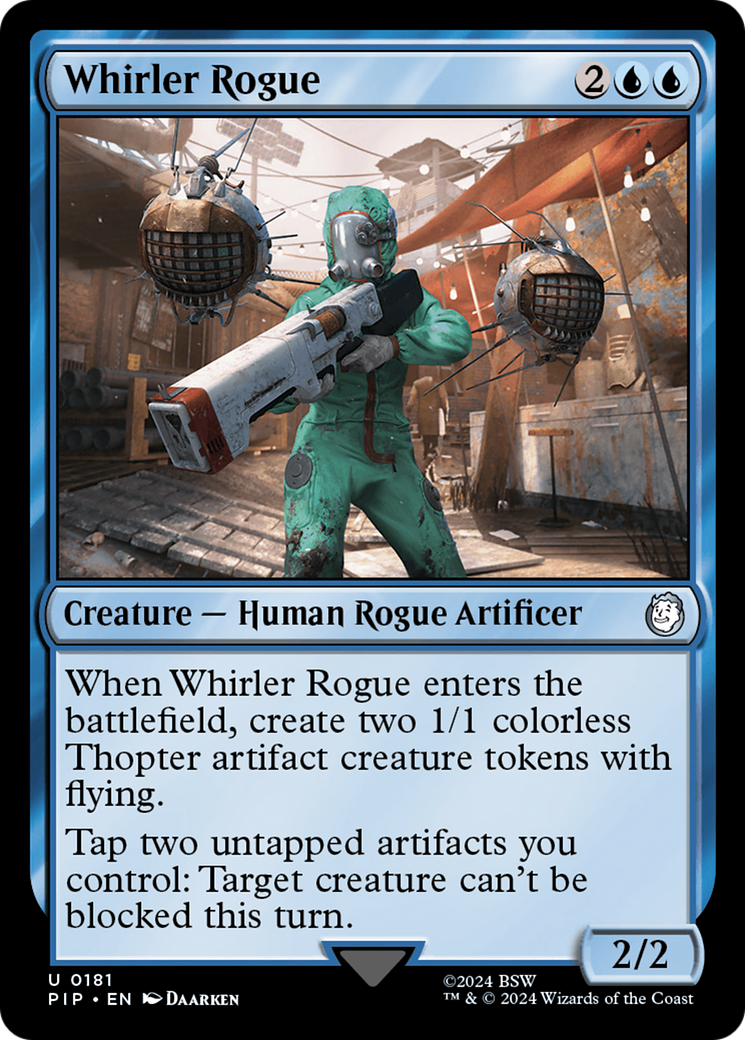
Whirler Rogue
Whirler Rogue
Creature — Human Rogue Artificer
2/2
When this creature enters, create two 1/1 colorless Thopter artifact creature tokens with flying.
Tap two untapped artifacts you control: Target creature can't be blocked this turn.
- You may tap any two untapped artifacts you control, including artifact creatures that haven't been under your control continuously since the beginning of your most recent turn.
- Activating the second ability of Whirler Rogue after a creature has become blocked won't cause it to become unblocked.
Instants 8
-
1
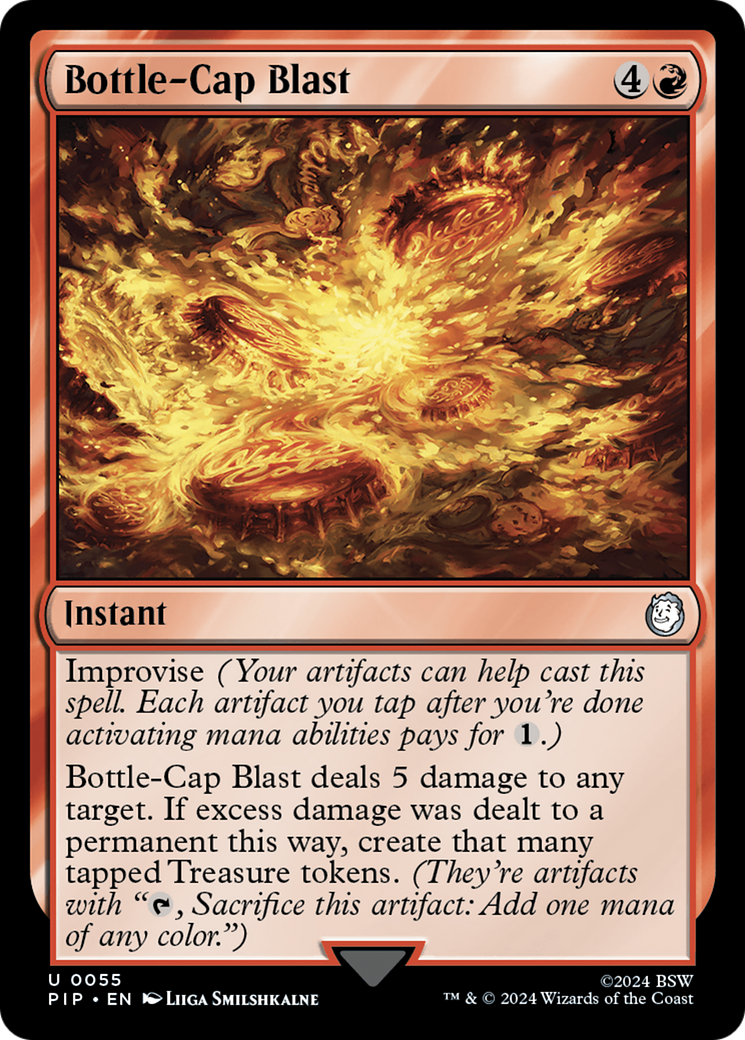
Bottle-Cap Blast
Bottle-Cap Blast
Instant
Improvise (Your artifacts can help cast this spell. Each artifact you tap after you're done activating mana abilities pays for .)
Bottle-Cap Blast deals 5 damage to any target. If excess damage was dealt to a permanent this way, create that many tapped Treasure tokens. (They're artifacts with " , Sacrifice this token: Add one mana of any color.")
- Improvise doesn't change Bottle-Cap Blast's mana cost or mana value, and it can't reduce Bottle-Cap Blast's cost below .
- Excess damage has been dealt to a creature if the damage dealt to it is greater than lethal damage. Usually, this means damage greater than its toughness, although damage already marked on the creature is taken into account.
- For a planeswalker, excess damage means damage in excess of the planeswalker's loyalty (the number of loyalty counters it has on it). For a battle, excess damage means damage in excess of the battle's defense (the number of defense counters it has on it).
-
1
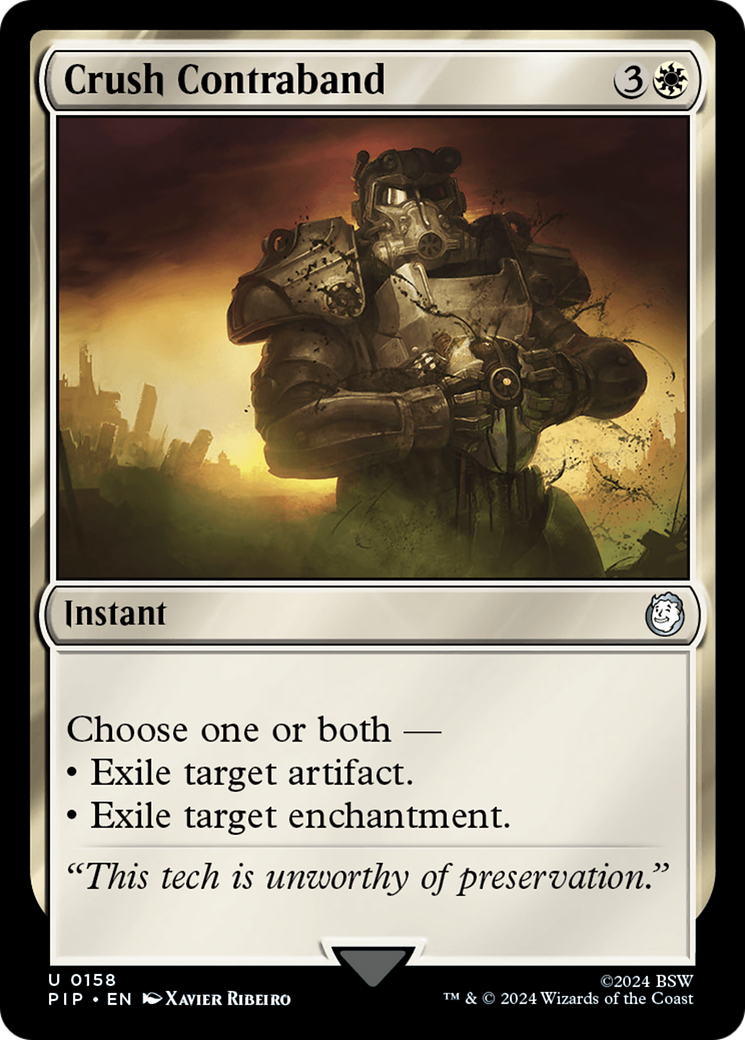
Crush Contraband
Crush Contraband
Instant
Choose one or both —
- Exile target artifact.
- Exile target enchantment.
- If you've chosen both modes and one of Crush Contraband's targets becomes an illegal target, the other is still exiled.
-
1
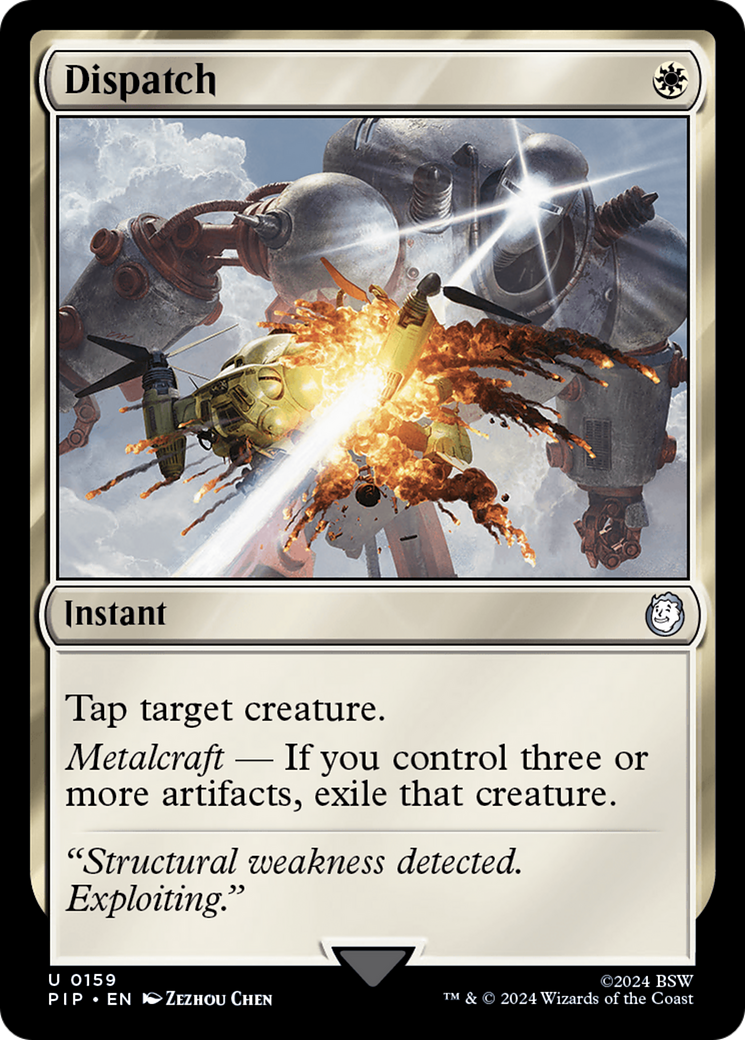
Dispatch
Dispatch
Instant
Tap target creature.
Metalcraft — If you control three or more artifacts, exile that creature.
- If you control three or more artifacts when Dispatch resolves, you'll tap the creature, then exile it.
-
1
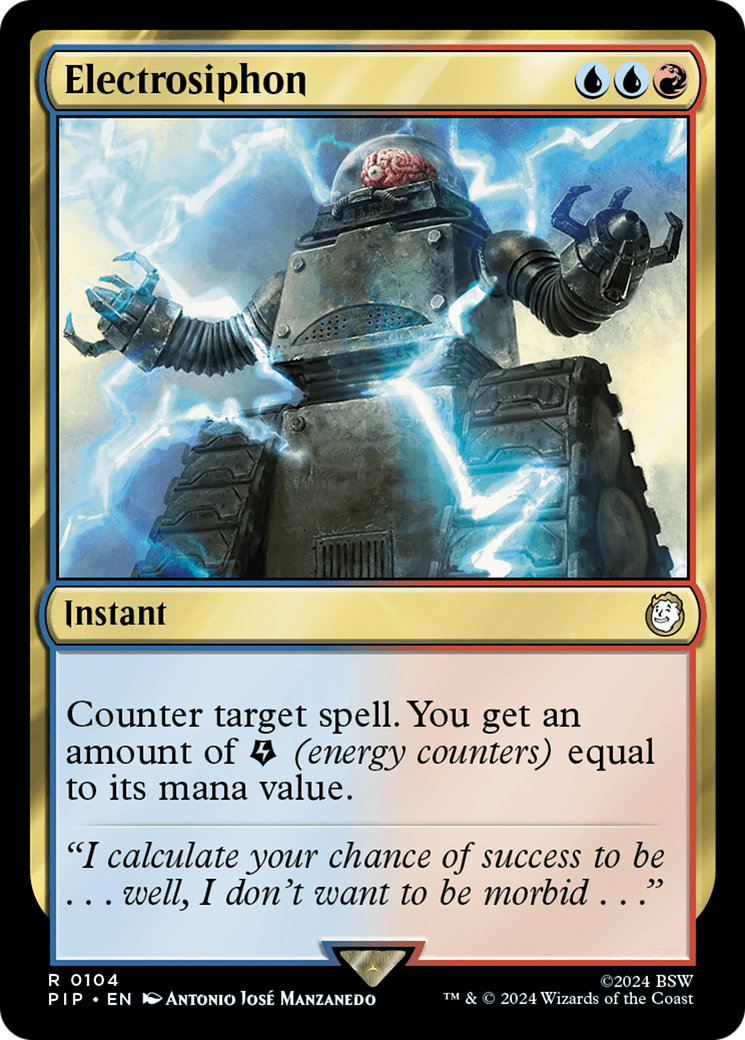
Electrosiphon
Electrosiphon
Instant
Counter target spell. You get an amount of (energy counters) equal to its mana value.
- is the energy symbol. It represents one energy counter.
- Energy counters are a kind of counter that a player may have. They’re not associated with any specific permanents.
- For spells with in their mana costs, use the value chosen for X to determine the spell’s mana value.
- Keep track of how many energy counters each player has. Potential ways to track this include writing them down on paper or using dice, but any method that is clear and mutually agreeable is fine. (At higher levels of tournament play, dice may not be allowed for tracking counters that players have.)
- If an effect says you get one or more , you get that many energy counters. To pay one or more , you lose that many energy counters. You can’t pay more energy counters than you have. Any effects that interact with counters a player gets, has, or loses can interact with energy counters.
- Energy counters aren’t mana. They don’t go away as steps, phases, and turns end, and effects that add mana “of any type” can’t give you energy counters.
- Some triggered abilities state that you “may pay” a certain amount of . You can’t pay that amount multiple times to multiply the effect. You simply choose whether or not to pay that amount of as the ability resolves.
- Some triggered abilities that state that you “may pay” a certain amount of describe an effect that happens “If you do.” In that case, no player may take actions to try to stop the ability’s effect after you make your choice. If the payment is followed by the phrase “When you do,” then you’ll choose any targets for that reflexive triggered ability and put it on the stack before players can take actions.
- If a spell or ability with one or more targets states that you “may pay” some amount of , and each permanent that it targets has become an illegal target, the spell or ability won’t resolve. You can’t pay any even if you want to.
- Some spells and abilities that give you may require targets. If each target chosen is an illegal target as that spell or ability tries to resolve, it won’t resolve. You won’t get any .
-
1
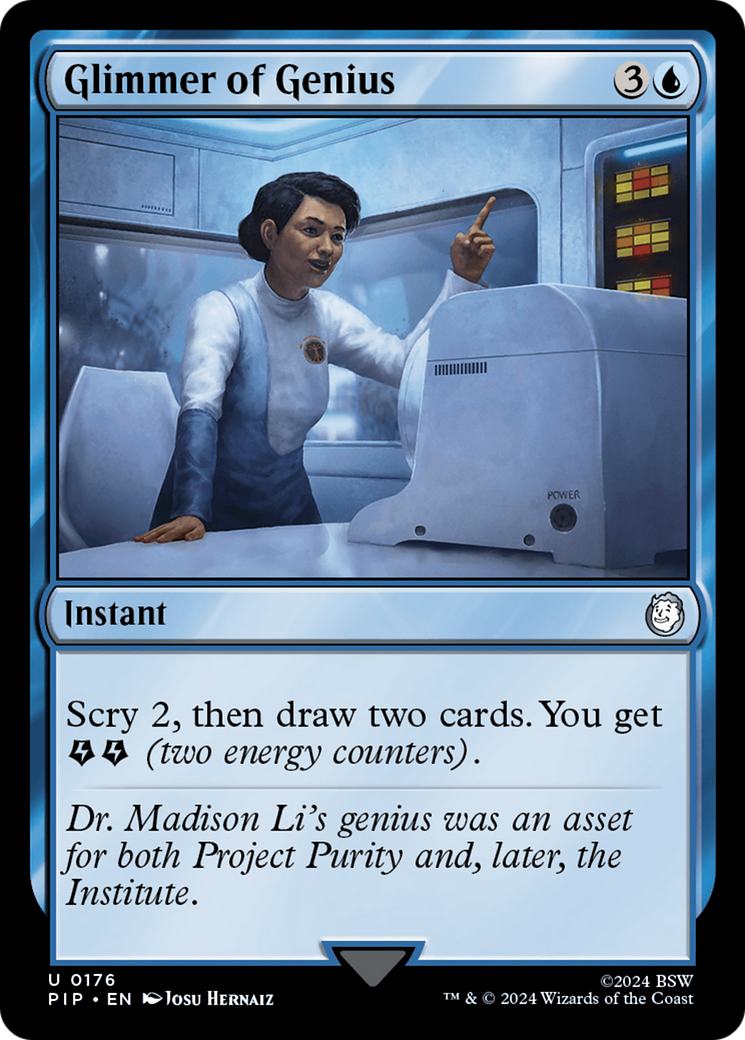
Glimmer of Genius
Glimmer of Genius
Instant
Scry 2, then draw two cards. You get (two energy counters).
- is the energy symbol. It represents one energy counter.
- Energy counters are a kind of counter that a player may have. They're not associated with any specific permanents.
- Keep track of how many energy counters each player has. Potential ways to track this include writing theme down on paper or using dice, but any method that is clear and mutually agreeable is fine. (At higher levels of tournament play, dice may not be allowed for tracking counters that players have.)
- If an effect says you get one or more , you get that many energy counters. To pay one or more , you lose that many energy counters. You can't pay more energy counters than you have. Any effects that interact with counters a player gets, has, or loses can interact with energy counters.
- Energy counters aren't mana. They don't go away as steps, phases, and turns end, and effects that add mana "of any type" can't give you energy counters.
- Some triggered abilities state that you "may pay" a certain amount of . You can't pay that amount multiple times to multiply the effect. You simply choose whether or not to pay that amount of as the ability resolves.
- Some triggered abilities that state that you "may pay" a certain amount of describe an effect that happens "If you do." In that case, no player may take actions to try to stop the ability's effect after you make your choice. If the payment is followed by the phrase "When you do," then you'll choose any targets for that reflexive triggered ability and put it on the stack before players can take actions.
- If a spell or ability with one or more targets states that you "may pay" some amount of , and each permanent that it targets has become an illegal target, the spell or ability won't resolve. You can't pay any even if you want to.
- Some spells and abilities that give you may require targets. If each target chosen is an illegal target as that spell or ability tries to resolve, it won't resolve. You won't get any .
-
1
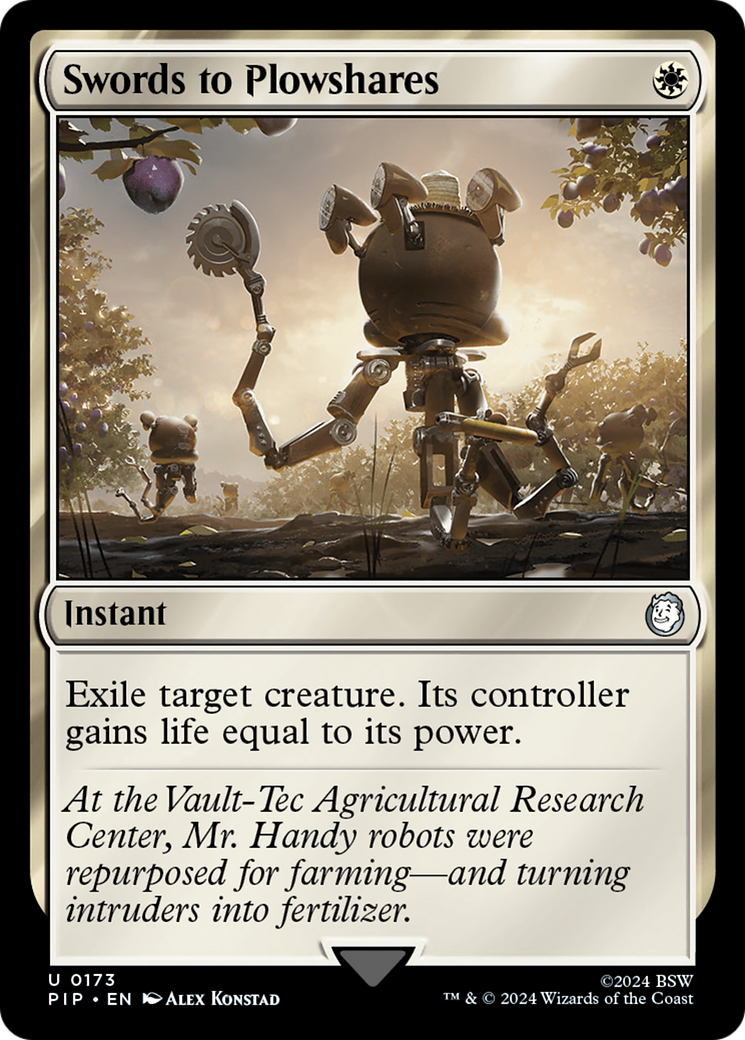
Swords to Plowshares
Swords to Plowshares
Instant
Exile target creature. Its controller gains life equal to its power.
- Use the power of the creature from when it was last on the battlefield to determine how much life is gained.
-
1
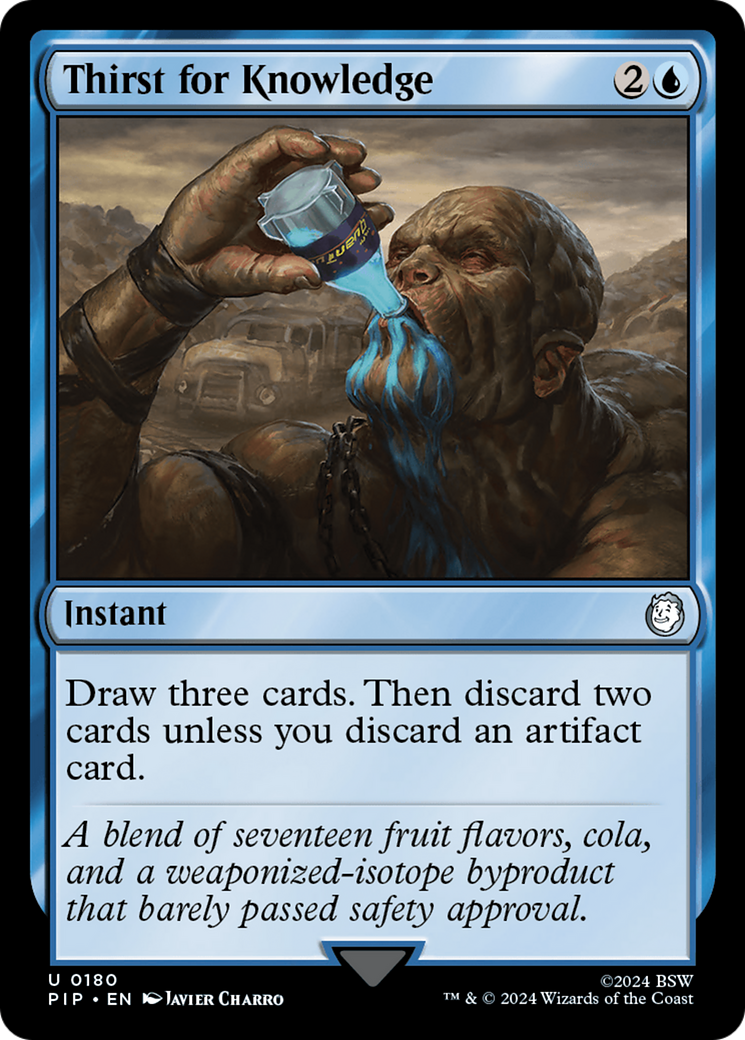
Thirst for Knowledge
Thirst for Knowledge
Instant
Draw three cards. Then discard two cards unless you discard an artifact card.
- You can discard either one artifact card or two cards which may or may not be artifacts. If you really want to, you can discard two artifact cards.
-
1
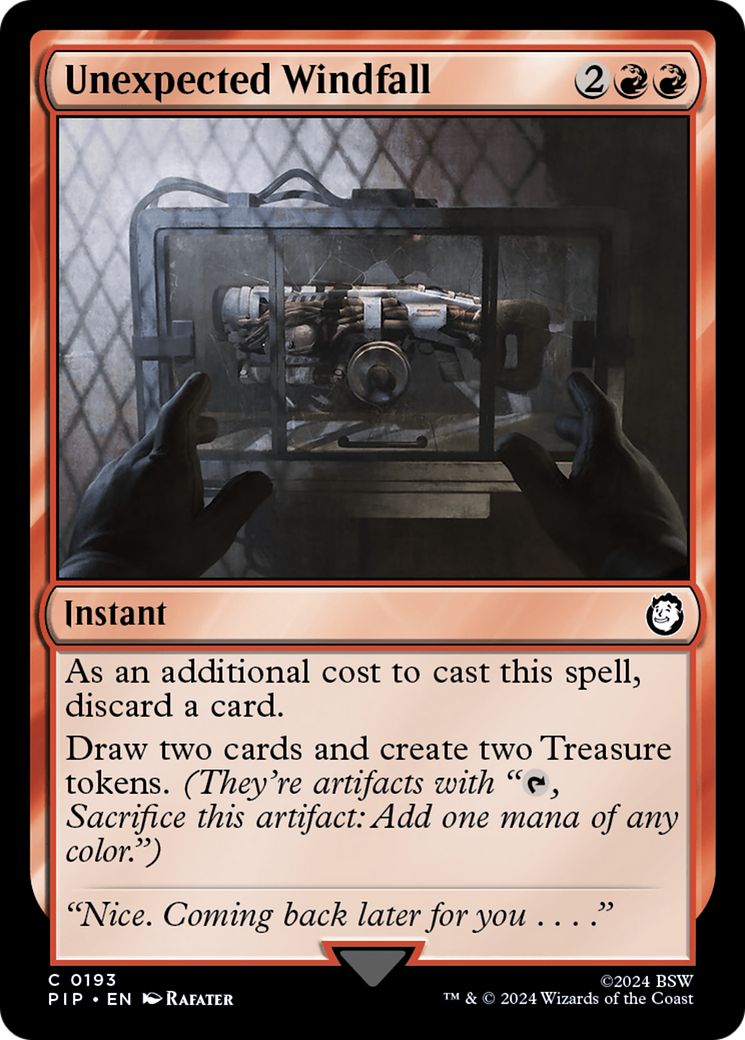
Unexpected Windfall
Unexpected Windfall
Instant
As an additional cost to cast this spell, discard a card.
Draw two cards and create two Treasure tokens. (They're artifacts with " , Sacrifice this token: Add one mana of any color.")
Sorceries 4
-
1
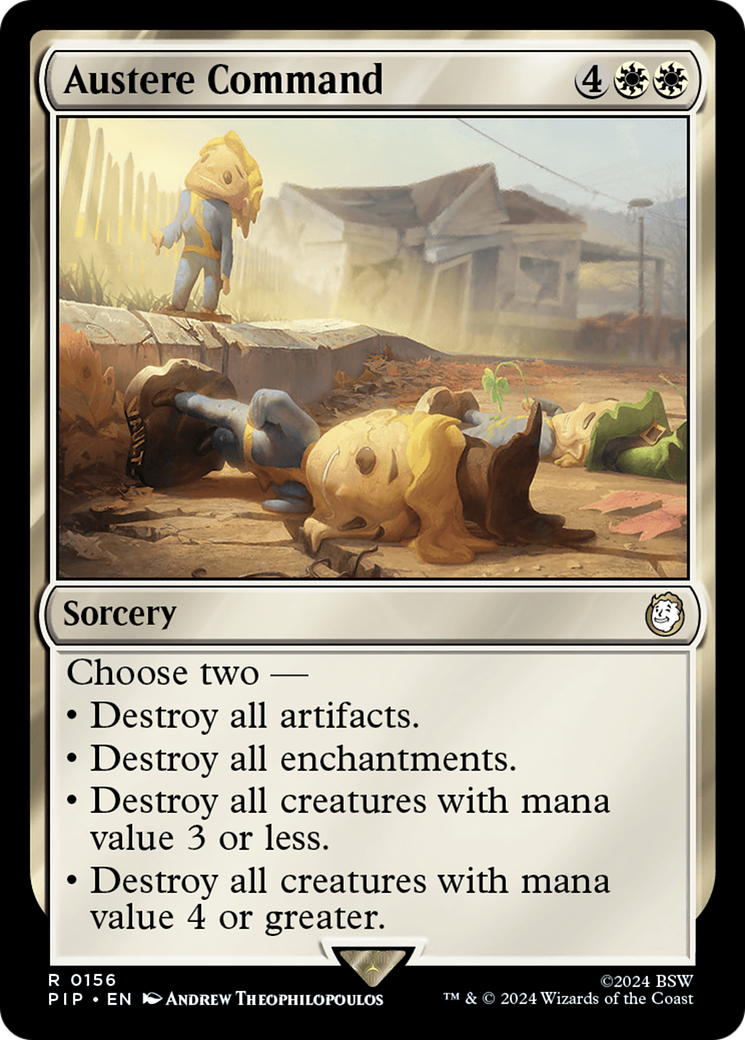
Austere Command
Austere Command
Sorcery
Choose two —
- Destroy all artifacts.
- Destroy all enchantments.
- Destroy all creatures with mana value 3 or less.
- Destroy all creatures with mana value 4 or greater.
- Each of the chosen modes happens sequentially. If a permanent has an ability that triggers whenever it or another permanent is destroyed, it will see permanents destroyed at the same time as it or before it, but not permanents destroyed by later modes.
- If a card is exiled "until" another permanent leaves the battlefield, the exiled card returns to the battlefield immediately after that permanent leaves the battlefield during Austere Command's resolution, and it may be destroyed by a later mode.
- If the first and last modes are chosen, an artifact creature with mana value 4 or greater will have to be regenerated twice to survive. This is because the modes happen sequentially, and the regeneration "shield" is used up by the first one. The same is true with any other combination of modes that covers one permanent twice.
-
1
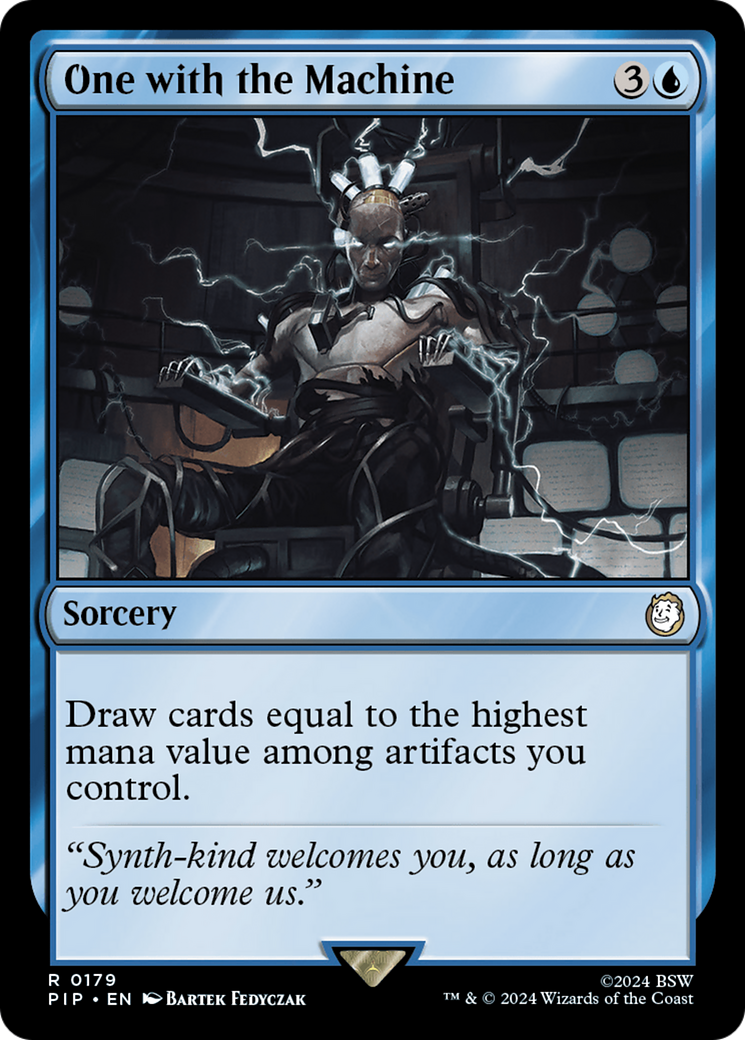
One with the Machine
One with the Machine
Sorcery
Draw cards equal to the highest mana value among artifacts you control.
- If a permanent has in its mana cost, X is considered to be 0.
-
1
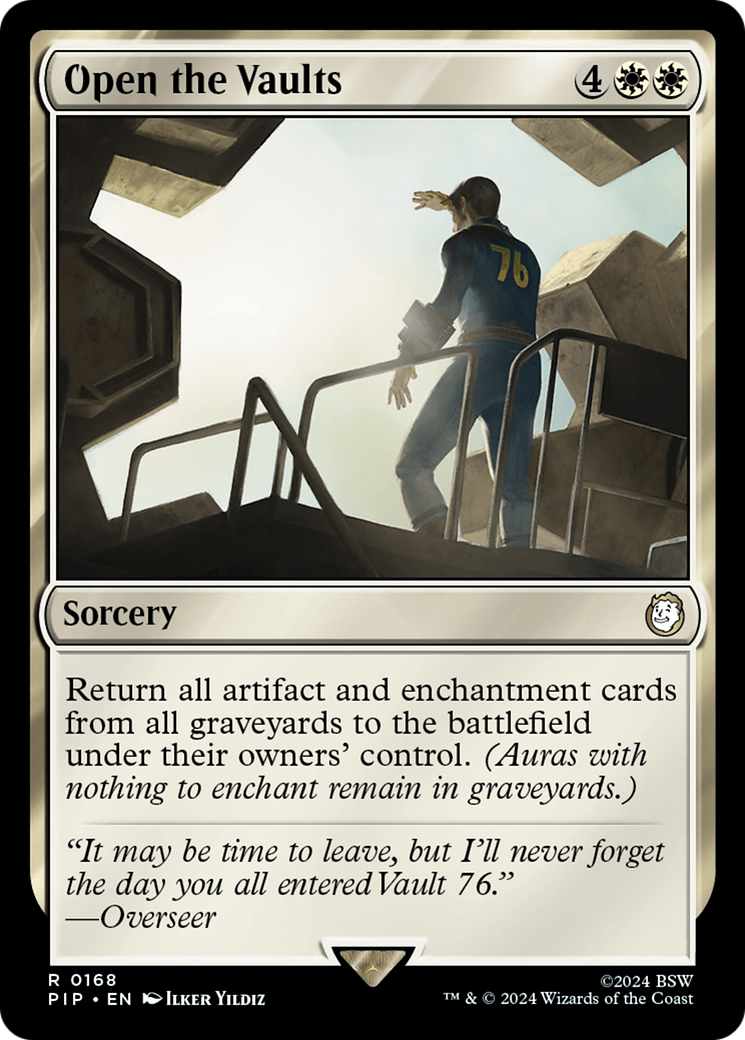
Open the Vaults
Open the Vaults
Sorcery
Return all artifact and enchantment cards from all graveyards to the battlefield under their owners' control. (Auras with nothing to enchant remain in graveyards.)
- If an Aura is put onto the battlefield without being cast, the Aura's controller-to-be chooses what it will enchant as it enters the battlefield. An Aura put onto the battlefield this way doesn't target anything (so it could be attached to an opponent's permanent with hexproof, for example), but the Aura's enchant ability restricts what it can be attached to. If the Aura can't legally be attached to anything, it remains in its current zone.
- If an Aura can be returned to the battlefield with Open the Vaults, it must be, even if its owner doesn't like what it would enchant.
- If multiple players have Auras in their graveyards, the player whose turn it is announces what their Auras will enchant, then each other player in turn order does the same, then all artifacts and enchantments (including both Auras and non-Auras) enter the battlefield at the same time.
- An Aura put onto the battlefield this way can't enchant an artifact or enchantment that's also being put onto the battlefield with Open the Vaults.
-
1
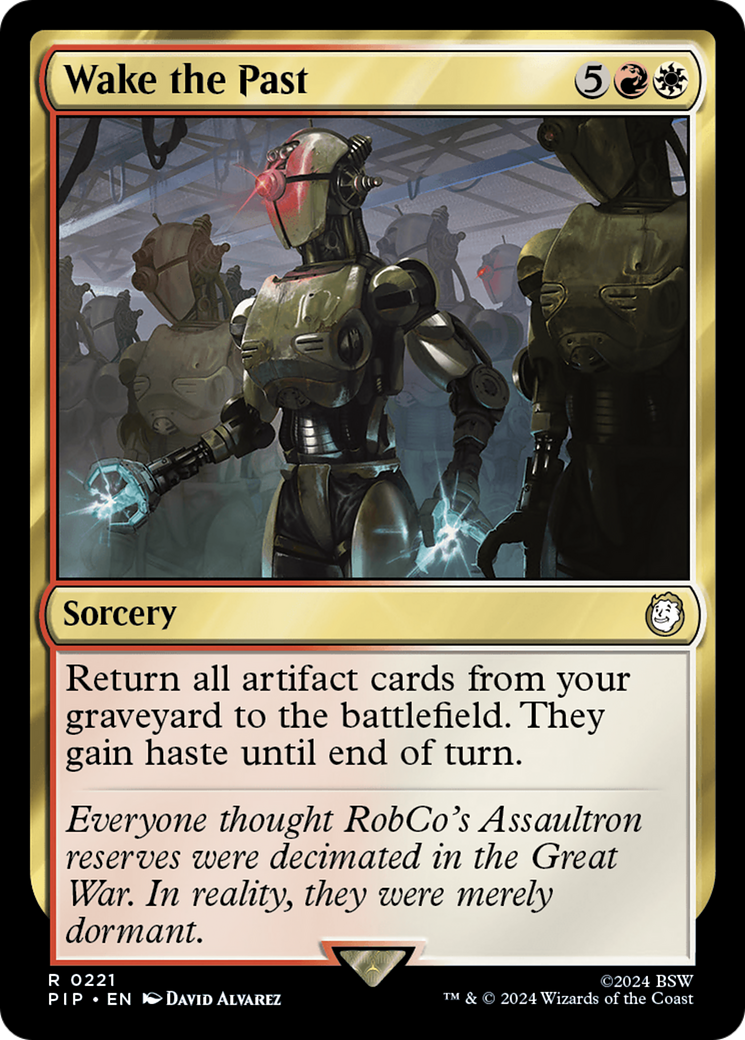
Wake the Past
Wake the Past
Sorcery
Return all artifact cards from your graveyard to the battlefield. They gain haste until end of turn.
Artifacts 22
-
1
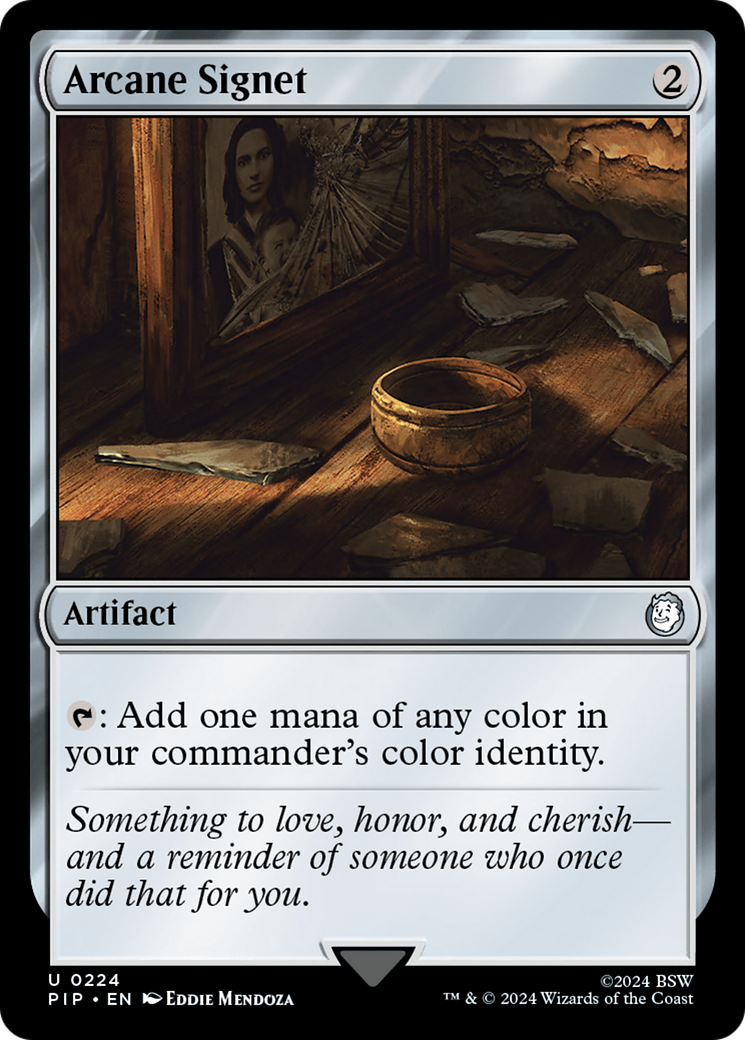
Arcane Signet
Arcane Signet
Artifact
: Add one mana of any color in your commander's color identity.
- If your commander is a card that has no colors in its color identity, Arcane Signet's ability produces no mana. It doesn't produce .
- If you have two commanders, the ability adds one mana of any color in their combined color identities.
- If you don't have a commander, Arcane Signet's ability produces no mana.
-
1
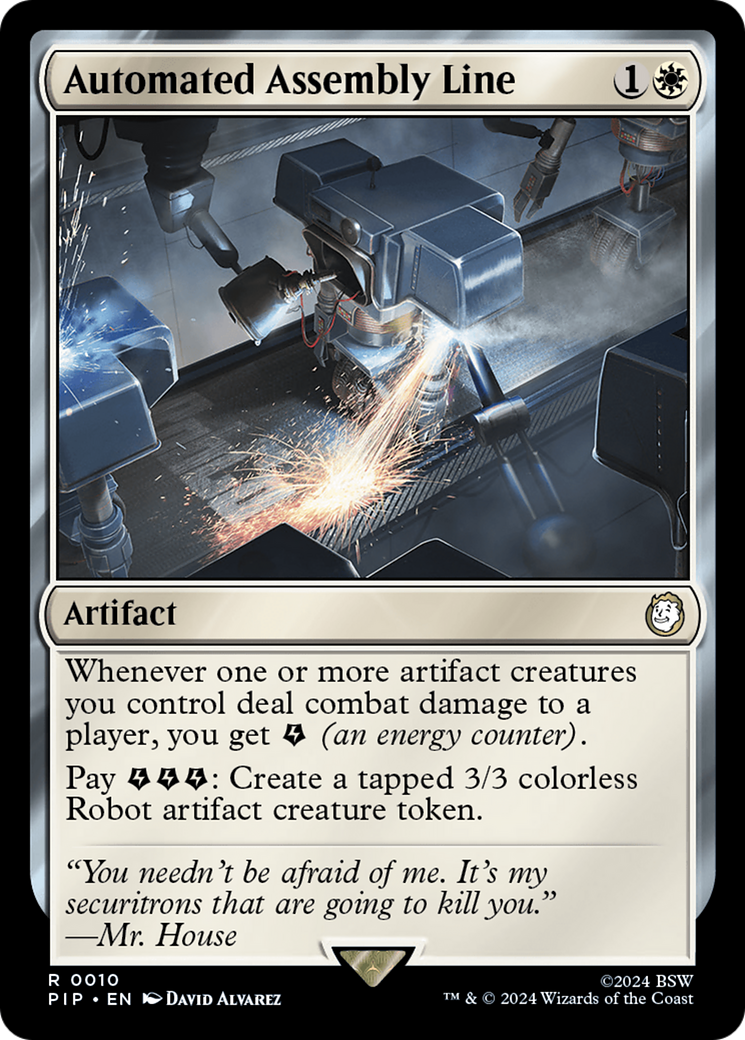
Automated Assembly Line
Automated Assembly Line
Artifact
Whenever one or more artifact creatures you control deal combat damage to a player, you get (an energy counter).
Pay : Create a tapped 3/3 colorless Robot artifact creature token.
- is the energy symbol. It represents one energy counter.
- Energy counters are a kind of counter that a player may have. They’re not associated with any specific permanents.
- Keep track of how many energy counters each player has. Potential ways to track this include writing them down on paper or using dice, but any method that is clear and mutually agreeable is fine. (At higher levels of tournament play, dice may not be allowed for tracking counters that players have.)
- If an effect says you get one or more , you get that many energy counters. To pay one or more , you lose that many energy counters. You can’t pay more energy counters than you have. Any effects that interact with counters a player gets, has, or loses can interact with energy counters.
- Energy counters aren’t mana. They don’t go away as steps, phases, and turns end, and effects that add mana “of any type” can’t give you energy counters.
- Some triggered abilities state that you “may pay” a certain amount of . You can’t pay that amount multiple times to multiply the effect. You simply choose whether or not to pay that amount of as the ability resolves.
- Some triggered abilities that state that you “may pay” a certain amount of describe an effect that happens “If you do.” In that case, no player may take actions to try to stop the ability’s effect after you make your choice. If the payment is followed by the phrase “When you do,” then you’ll choose any targets for that reflexive triggered ability and put it on the stack before players can take actions.
- If a spell or ability with one or more targets states that you “may pay” some amount of , and each permanent that it targets has become an illegal target, the spell or ability won’t resolve. You can’t pay any even if you want to.
- Some spells and abilities that give you may require targets. If each target chosen is an illegal target as that spell or ability tries to resolve, it won’t resolve. You won’t get any .
-
1
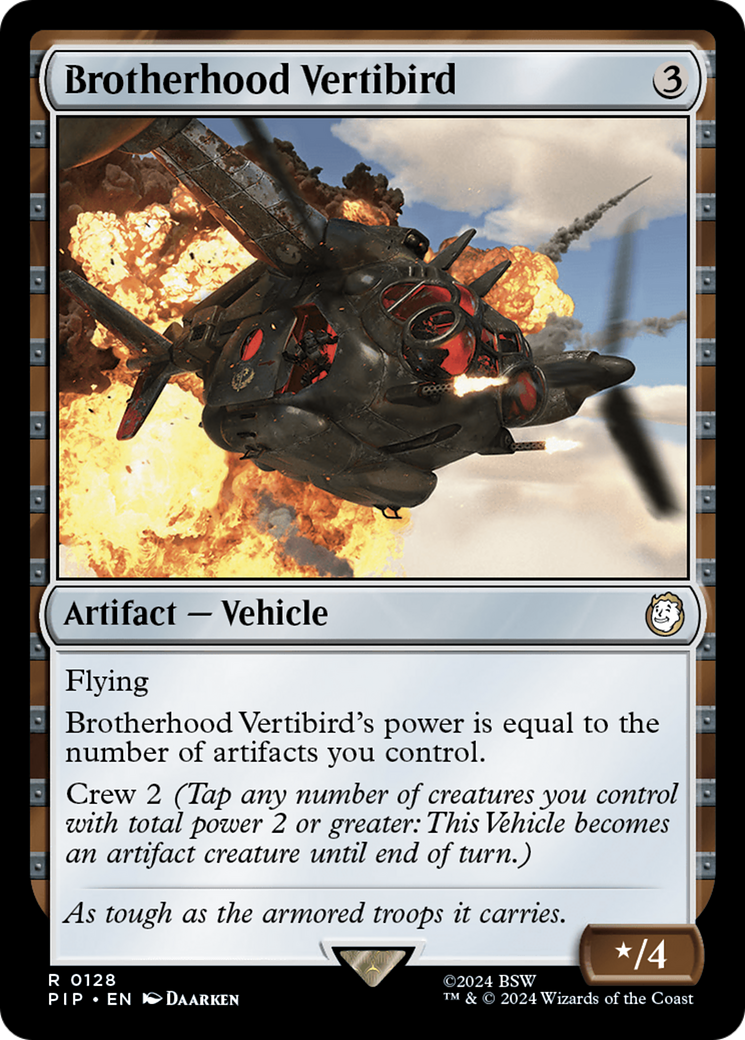
Brotherhood Vertibird
Brotherhood Vertibird
Artifact — Vehicle
*/4
Flying
Brotherhood Vertibird's power is equal to the number of artifacts you control.
Crew 2 (Tap any number of creatures you control with total power 2 or greater: This Vehicle becomes an artifact creature until end of turn.)
- The ability that defines Brotherhood Vertibird’s power works in all zones, not just the battlefield. As long as Brotherhood Vertibird is on the battlefield (and still an artifact), that ability will count Brotherhood Vertibird itself.
-
1
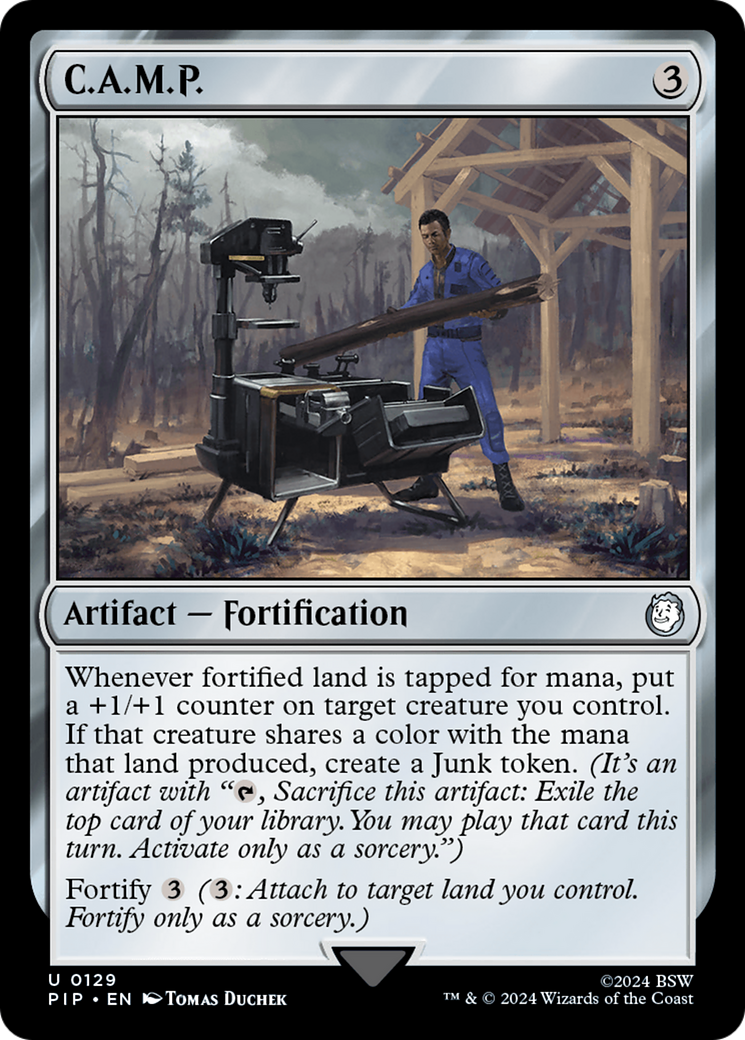
C.A.M.P.
C.A.M.P.
Artifact — Fortification
Whenever fortified land is tapped for mana, put a +1/+1 counter on target creature you control. If that creature shares a color with the mana that land produced, create a Junk token. (It's an artifact with " , Sacrifice this token: Exile the top card of your library. You may play that card this turn. Activate only as a sorcery.")
Fortify ( : Attach to target land you control. Fortify only as a sorcery.)
- Fortification is to lands what Equipment is to creatures. Except for the difference regarding what type of permanent they can be attached to, Fortifications and Equipment follow the same rules.
- If the fortified land produced more than one color of mana, you'll create a Junk token as long as the target creature is at least one of those colors.
- You can't sacrifice a Junk token to pay multiple costs. For example, you can't sacrifice a Junk token to activate its own ability and also to activate the second ability of Junk Jet.
- You pay all costs and follow all normal timing rules for the card played from exile with a Junk token's ability. For example, if the exiled card is a land card, you may play it only during your main phase while the stack is empty.
- Some spells and abilities that create Junk tokens may require targets. If each target chosen is illegal as that spell or ability tries to resolve, it won't resolve and none of its effects happen. You won't create any Junk tokens.
-
1
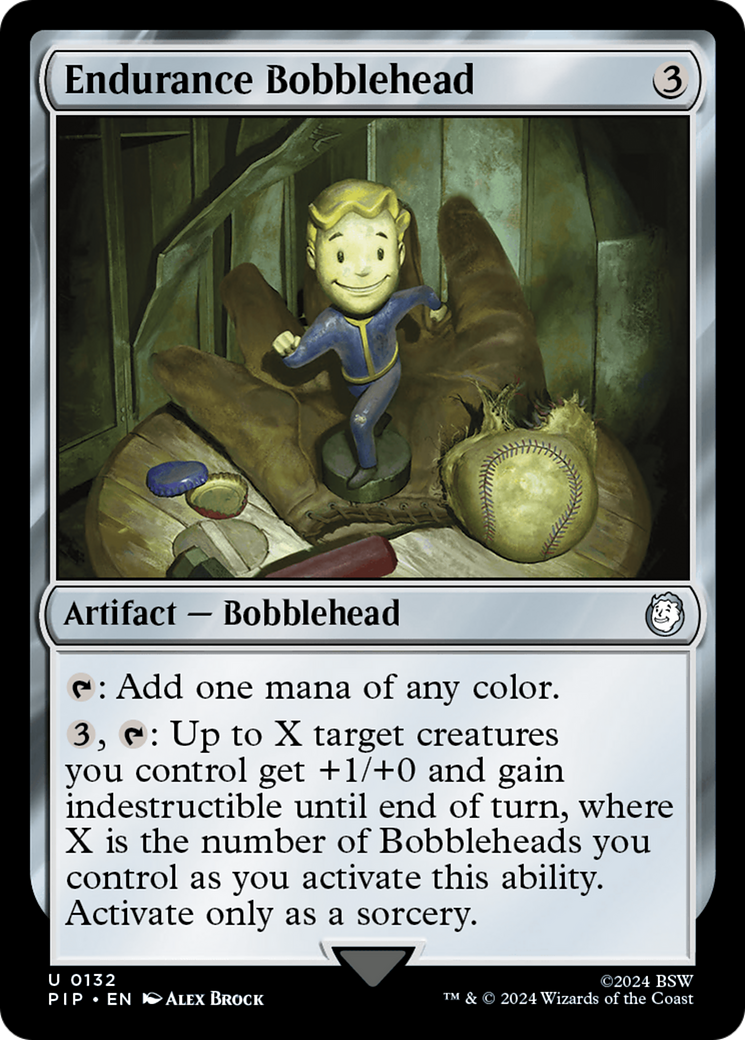
Endurance Bobblehead
Endurance Bobblehead
Artifact — Bobblehead
: Add one mana of any color.
, : Up to X target creatures you control get +1/+0 and gain indestructible until end of turn, where X is the number of Bobbleheads you control as you activate this ability. Activate only as a sorcery.
- You choose how many targets Endurance Bobblehead’s last ability has as you activate the ability. Once you do, it doesn’t matter what happens to any Bobbleheads you control.
-
1
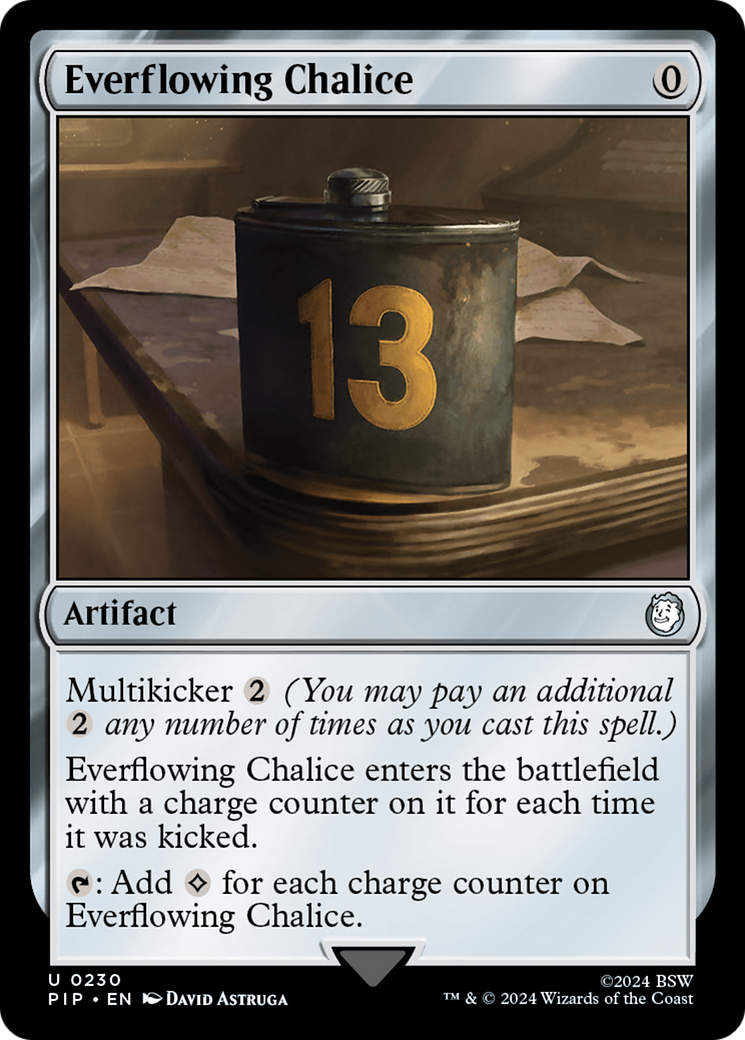
Everflowing Chalice
Everflowing Chalice
Artifact
Multikicker (You may pay an additional any number of times as you cast this spell.)
This artifact enters with a charge counter on it for each time it was kicked.
: Add for each charge counter on this artifact.
- You can cast Everflowing Chalice without kicking it at all if you wish. However, if Everflowing Chalice has no charge counters on it, activating its last ability won't produce any mana.
-
1
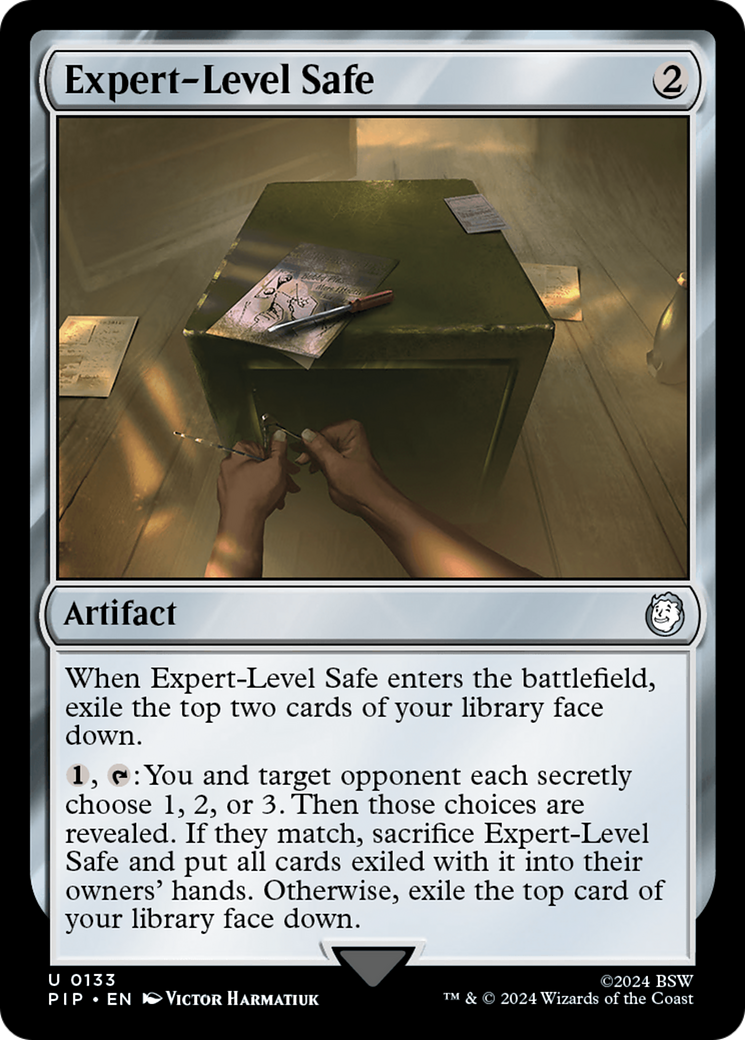
Expert-Level Safe
Expert-Level Safe
Artifact
When this artifact enters, exile the top two cards of your library face down.
, : You and target opponent each secretly choose 1, 2, or 3. Then those choices are revealed. If they match, sacrifice this artifact and put all cards exiled with it into their owners' hands. Otherwise, exile the top card of your library face down.
- You don’t get to look at the cards exiled by Expert-Level Safe’s abilities.
- To secretly choose the numbers, you and the target opponent should each write down your choice of 1, 2, or 3 without showing them to anyone else. Keep those choices secret until they’re simultaneously revealed.
-
1
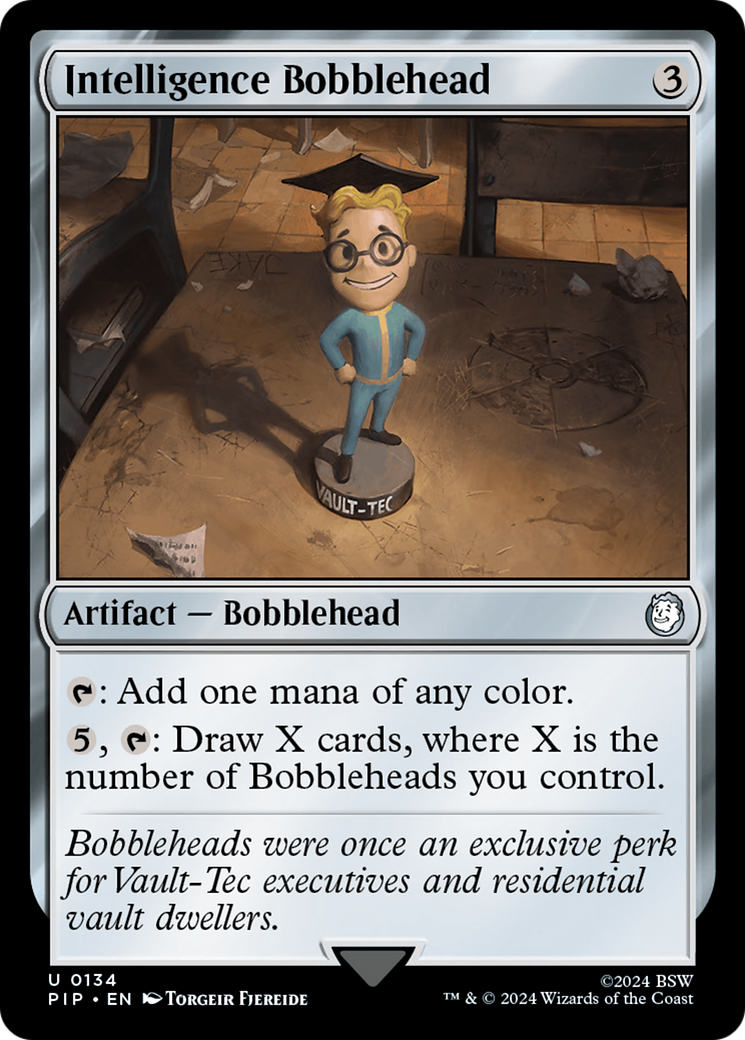
Intelligence Bobblehead
Intelligence Bobblehead
Artifact — Bobblehead
: Add one mana of any color.
, : Draw X cards, where X is the number of Bobbleheads you control.
- The value of X is determined only once, as Intelligence Bobblehead’s last ability resolves.
-
1
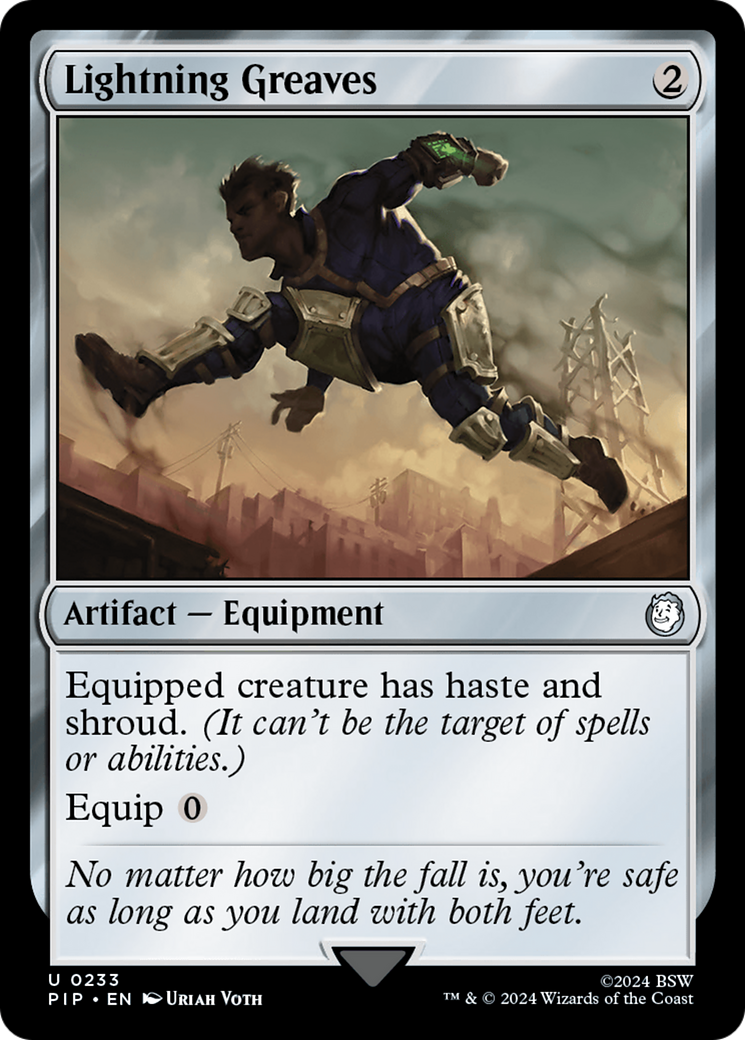
Lightning Greaves
Lightning Greaves
Artifact — Equipment
Equipped creature has haste and shroud. (It can't be the target of spells or abilities.)
Equip
- You can't simply unequip Equipment from a creature. If Lightning Greaves is attached to the only creature you control, you won't be able to attach other equipment to it (or target it with anything else) until you have another creature to which you can attach Lightning Greaves.
- If a creature enters the battlefield under your control and gains haste, but then loses it before attacking, it won't be able to attack that turn. This means that you can't use one Lightning Greaves to allow two new creatures to attack in the same turn.
-
1
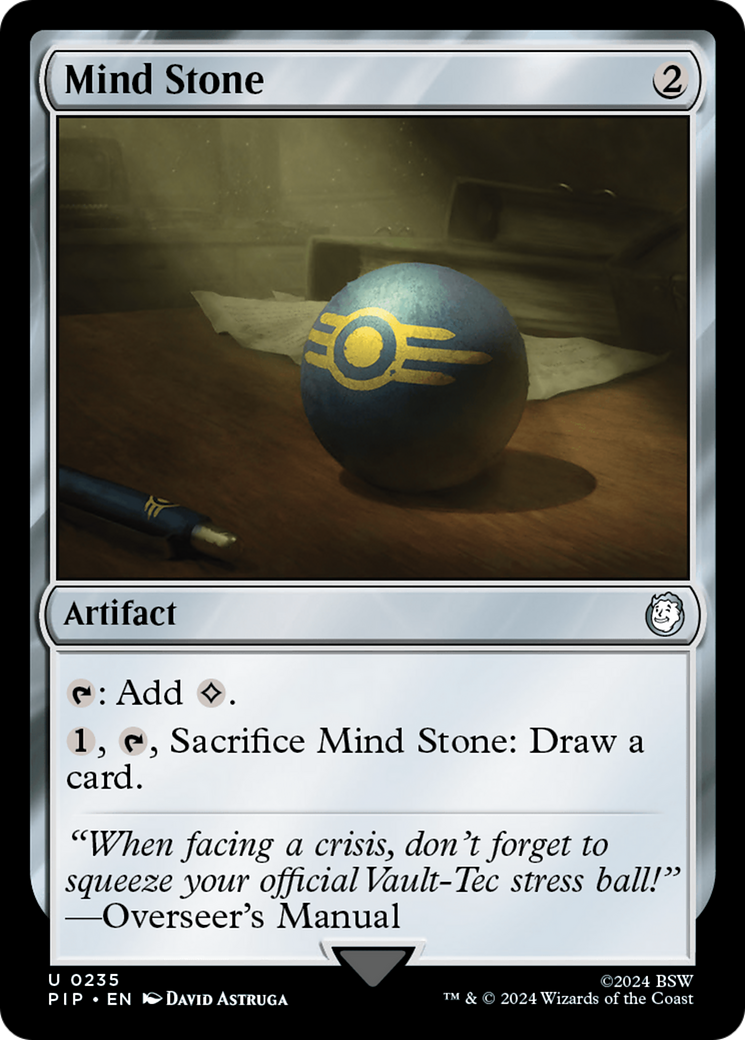
Mind Stone
Mind Stone
Artifact
: Add .
, , Sacrifice this artifact: Draw a card.
-
1
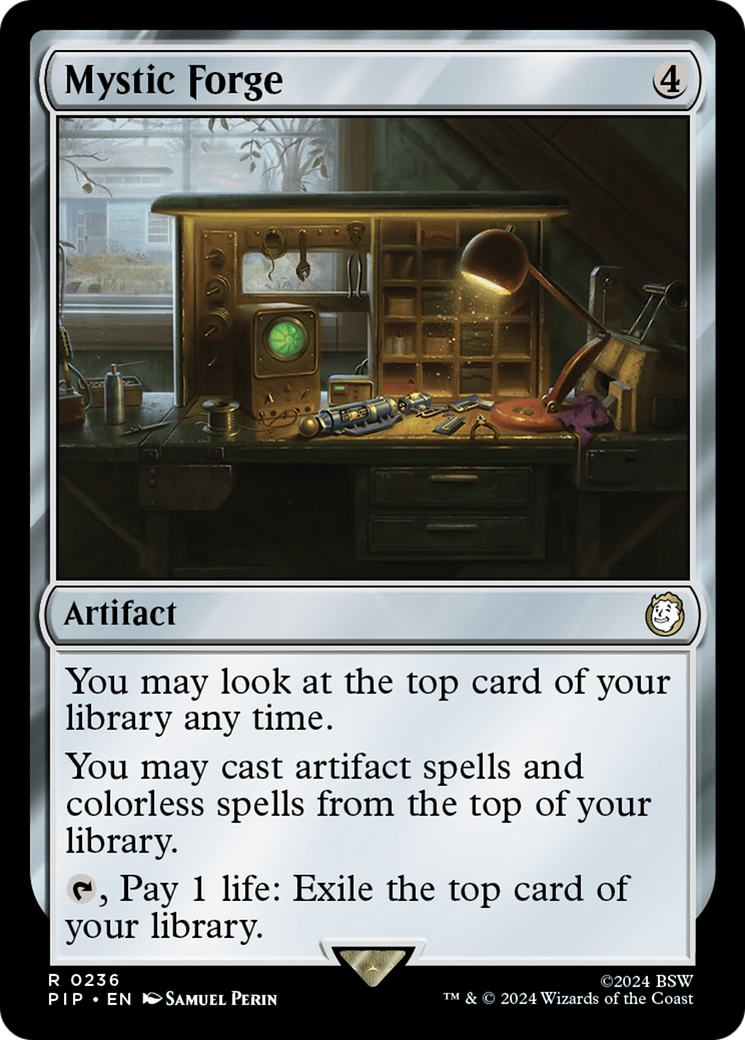
Mystic Forge
Mystic Forge
Artifact
You may look at the top card of your library any time.
You may cast artifact spells and colorless spells from the top of your library.
, Pay 1 life: Exile the top card of your library.
- Because you never "cast" a land card, Mystic Forge doesn't allow you to play an artifact land from the top of your library.
- You must follow the normal timing permissions and restrictions of the spells you cast from your library.
- You still pay all costs for a spell you cast from your library, including additional costs. You may also pay alternative costs.
- Mystic Forge lets you look at the top card of your library whenever you want (with one restriction—see below), even if you don't have priority. This action doesn't use the stack. Knowing what that card is becomes part of the information you have access to, just like you can look at the cards in your hand.
- If the top card of your library changes while you're casting a spell, playing a land, or activating an ability, you can't look at the new top card until you finish doing so. This means that if you cast the top card of your library, you can't look at the next one until you're done paying for that spell.
- If the top card of your library has a morph ability, you can cast it face down from the top of your library, even if it's normally not a colorless card.
-
1
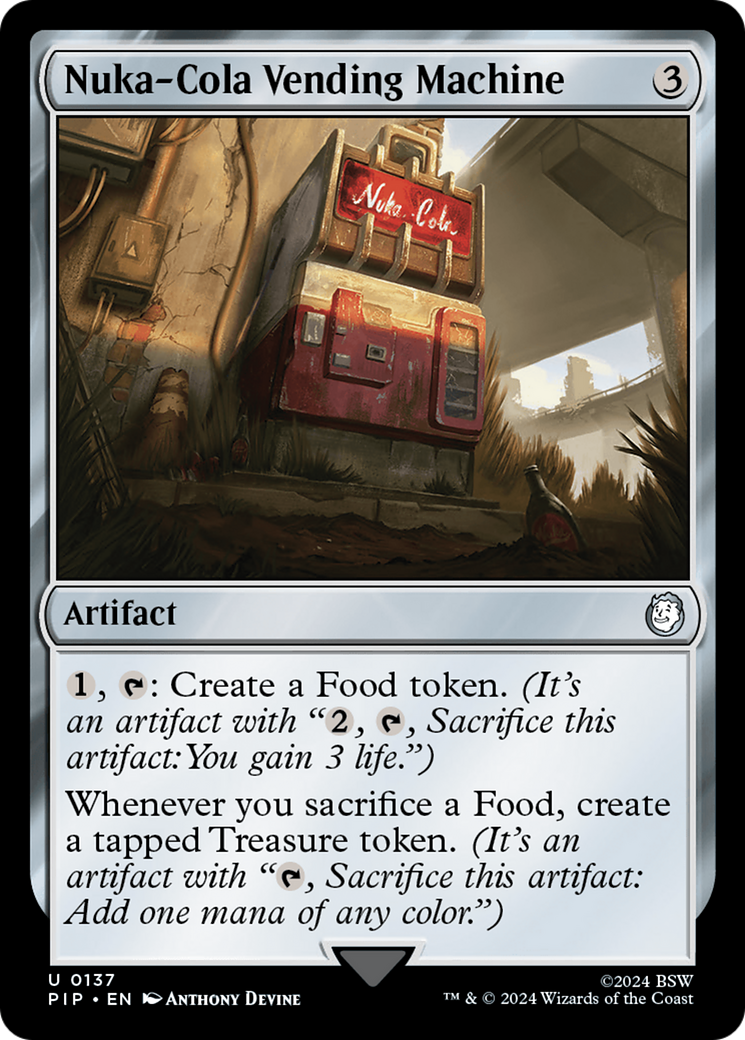
Nuka-Cola Vending Machine
Nuka-Cola Vending Machine
Artifact
, : Create a Food token. (It's an artifact with " , , Sacrifice this token: You gain 3 life.")
Whenever you sacrifice a Food, create a tapped Treasure token. (It's an artifact with " , Sacrifice this token: Add one mana of any color.")
- Food is an artifact type. Even though it appears on some creatures, it's never a creature type.
- You can't sacrifice a Food to pay multiple costs. For example, you can't sacrifice a Food token to activate its own ability and also to activate Maraleaf Rider's ability.
- Whatever you do, don't eat the delicious cards.
- If an effect refers to a Food, it means any Food artifact, not just a Food artifact token. For example, if you sacrifice a nontoken Food artifact, such as Candy Trail from the Wilds of Eldraine set, Nuka-Cola Vending Machine's last ability will trigger.
- Nuka-Cola Vending Machine's last ability triggers whenever you sacrifice a Food for any reason, not just to activate a Food's activated ability.
-
1
Panharmonicon
Panharmonicon
Artifact
If an artifact or creature entering causes a triggered ability of a permanent you control to trigger, that ability triggers an additional time.
- Panharmonicon affects a permanent's own enters-the-battlefield triggered abilities as well as other triggered abilities that trigger when that permanent enters the battlefield. Such triggered abilities start with "when" or "whenever."
- Replacement effects are unaffected by Panharmonicon's ability. For example, a creature that enters the battlefield with one +1/+1 counter on it won't receive an additional +1/+1 counter.
- Abilities that apply "as [this artifact or creature] enters the battlefield," such as choosing a color with Gauntlet of Power, are also unaffected.
- You don't need to control the permanent entering the battlefield, only the permanent that has the triggered ability.
- Panharmonicon's effect doesn't copy the triggered ability; it just causes the ability to trigger twice. Any choices made as you put the ability onto the stack, such as modes and targets, are made separately for each instance of the ability. Any choices made on resolution, such as whether to put counters on a permanent, are also made individually.
- If you control two Panharmonicons, an artifact or creature entering the battlefield causes abilities to trigger three times, not four. A third Panharmonicon causes abilities to trigger four times, a fourth causes abilities to trigger five times, and so on.
- If an artifact or creature entering the battlefield at the same time as Panharmonicon (including Panharmonicon itself) causes a triggered ability of a permanent you control to trigger, that ability triggers an additional time.
- If a triggered ability is linked to a second ability, additional instances of that triggered ability are also linked to that second ability. If the second ability refers to "the exiled card," it refers to all cards exiled by instances of the triggered ability.
- In some cases involving linked abilities, an ability requires information about "the exiled card." When this happens, the ability gets multiple answers. If these answers are being used to determine the value of a variable, the sum is used. For example, if Elite Arcanist's enters-the-battlefield ability triggers twice, two cards are exiled. The value of X in the activation cost of Elite Arcanist's other ability is the sum of the two cards' mana values. As the ability resolves, you create copies of both cards and can cast none, one, or both of the copies in any order.
-
1
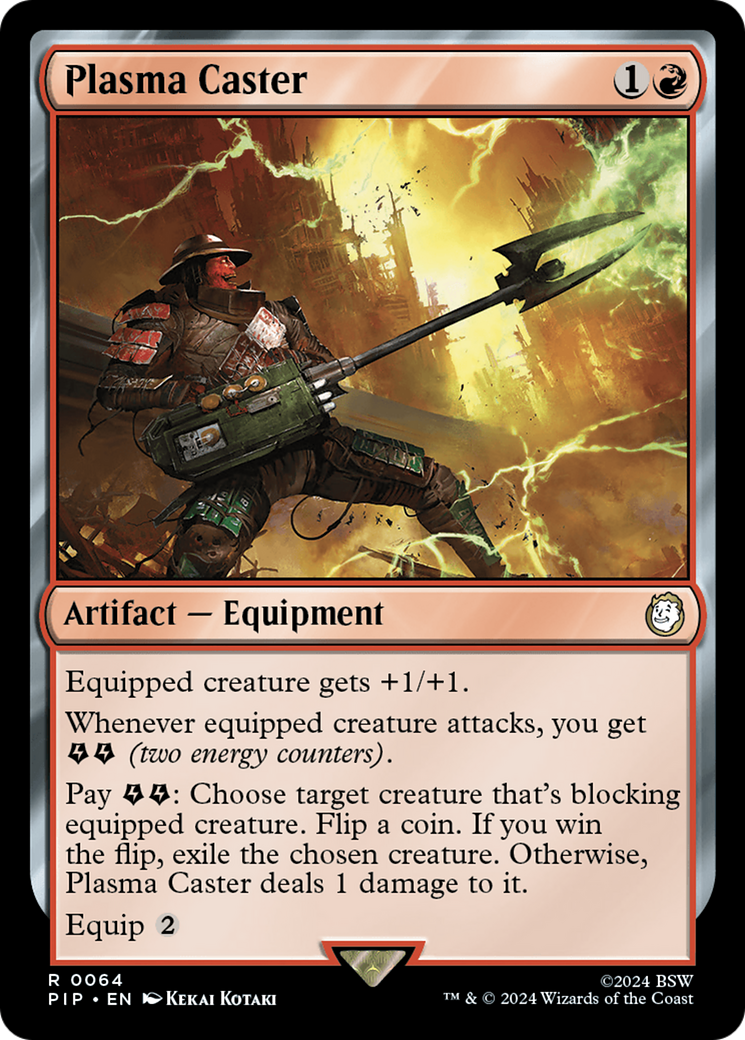
Plasma Caster
Plasma Caster
Artifact — Equipment
Equipped creature gets +1/+1.
Whenever equipped creature attacks, you get (two energy counters).
Pay : Choose target creature that's blocking equipped creature. Flip a coin. If you win the flip, exile the chosen creature. Otherwise, this Equipment deals 1 damage to it.
Equip
- If the target creature is no longer on the battlefield or no longer blocking the equipped creature when Plasma Caster's third ability tries to resolve, it won't resolve and none of its effects happen. You won't flip a coin.
- If Plasma Caster is no longer on the battlefield or no longer attached to the same creature when its third ability resolves, the ability will still resolve as normal.
-
1
Sol Ring
Sol Ring
Artifact
: Add .
-
1
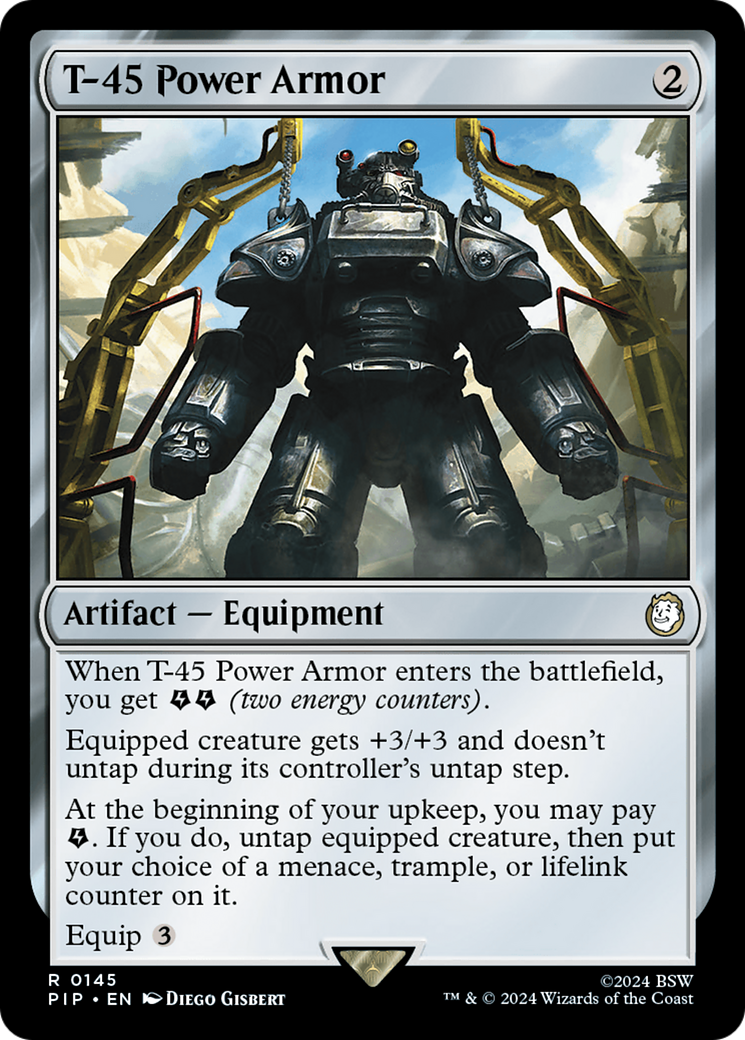
T-45 Power Armor
T-45 Power Armor
Artifact — Equipment
When this Equipment enters, you get (two energy counters).
Equipped creature gets +3/+3 and doesn't untap during its controller's untap step.
At the beginning of your upkeep, you may pay . If you do, untap equipped creature, then put your choice of a menace, trample, or lifelink counter on it.
Equip
- Multiple instances of menace are redundant. The same is true for trample and lifelink.
- is the energy symbol. It represents one energy counter.
- Energy counters are a kind of counter that a player may have. They're not associated with any specific permanents.
- Keep track of how many energy counters each player has. Potential ways to track this include writing them down on paper or using dice, but any method that is clear and mutually agreeable is fine. (At higher levels of tournament play, dice may not be allowed for tracking counters that players have.)
- If an effect says you get one or more , you get that many energy counters. To pay one or more , you lose that many energy counters. You can't pay more energy counters than you have. Any effects that interact with counters a player gets, has, or loses can interact with energy counters.
- Energy counters aren't mana. They don't go away as steps, phases, and turns end, and effects that add mana "of any type" can't give you energy counters.
- Some triggered abilities state that you "may pay" a certain amount of . You can't pay that amount multiple times to multiply the effect. You simply choose whether or not to pay that amount of as the ability resolves.
- Some triggered abilities that state that you "may pay" a certain amount of describe an effect that happens "If you do." In that case, no player may take actions to try to stop the ability's effect after you make your choice. If the payment is followed by the phrase "When you do," then you'll choose any targets for that reflexive triggered ability and put it on the stack before players can take actions.
- If a spell or ability with one or more targets states that you "may pay" some amount of , and each permanent that it targets has become an illegal target, the spell or ability won't resolve. You can't pay any even if you want to.
- Some spells and abilities that give you may require targets. If each target chosen is an illegal target as that spell or ability tries to resolve, it won't resolve. You won't get any .
-
1
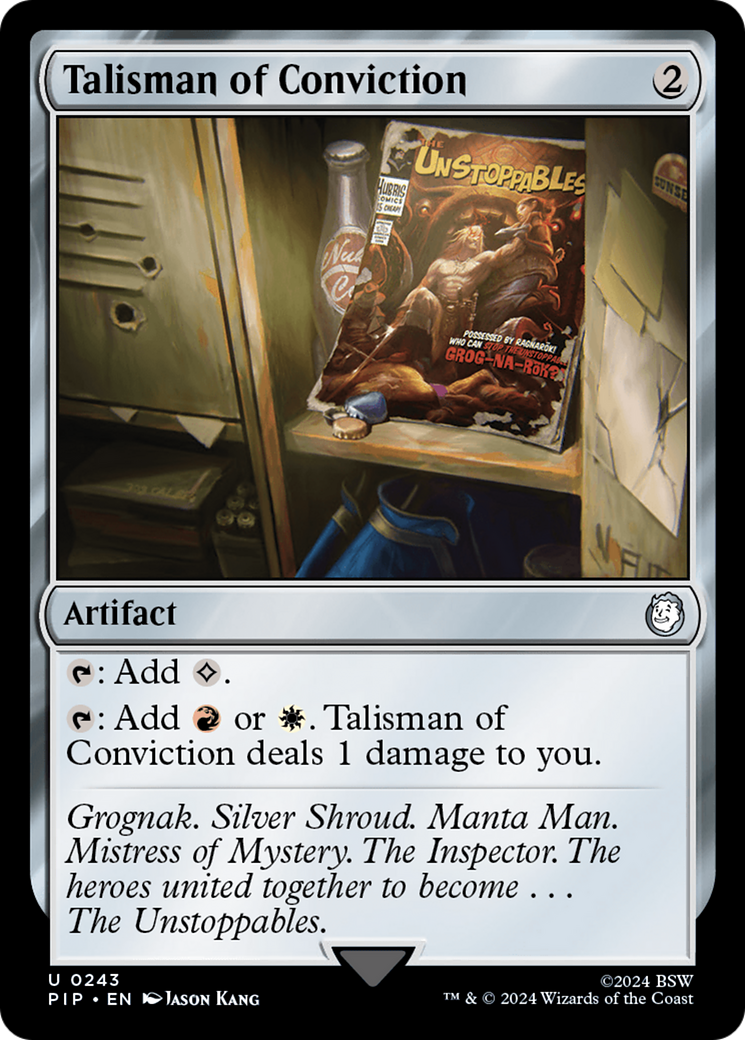
Talisman of Conviction
Talisman of Conviction
Artifact
: Add .
: Add or . This artifact deals 1 damage to you.
-
1
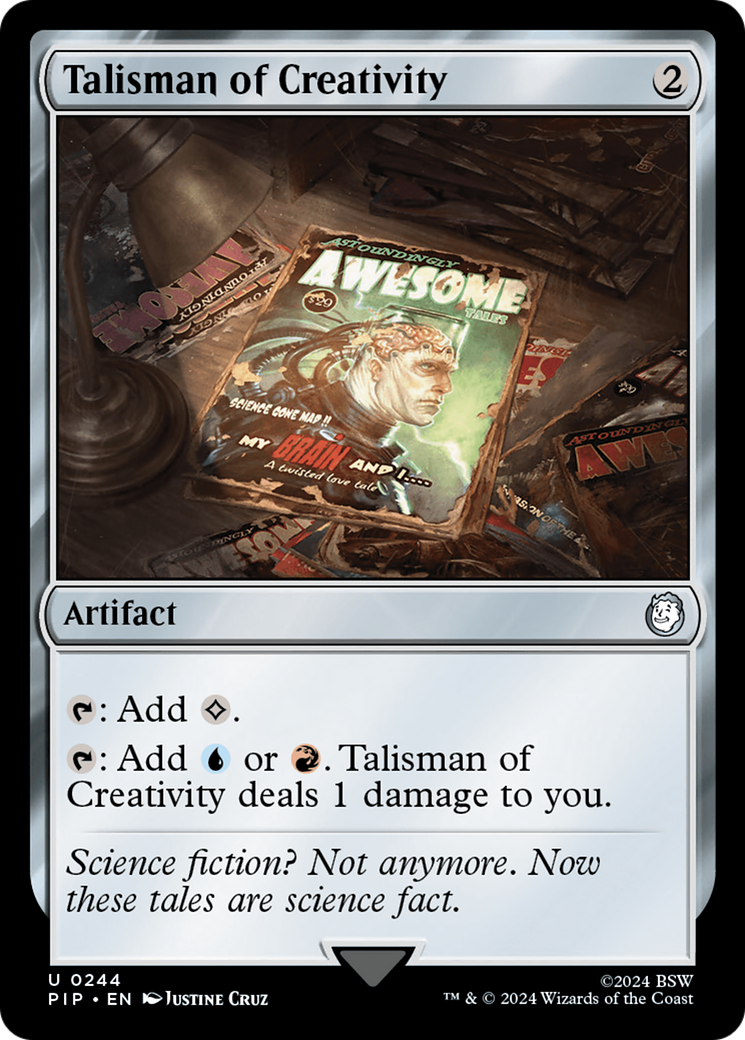
Talisman of Creativity
Talisman of Creativity
Artifact
: Add .
: Add or . This artifact deals 1 damage to you.
-
1
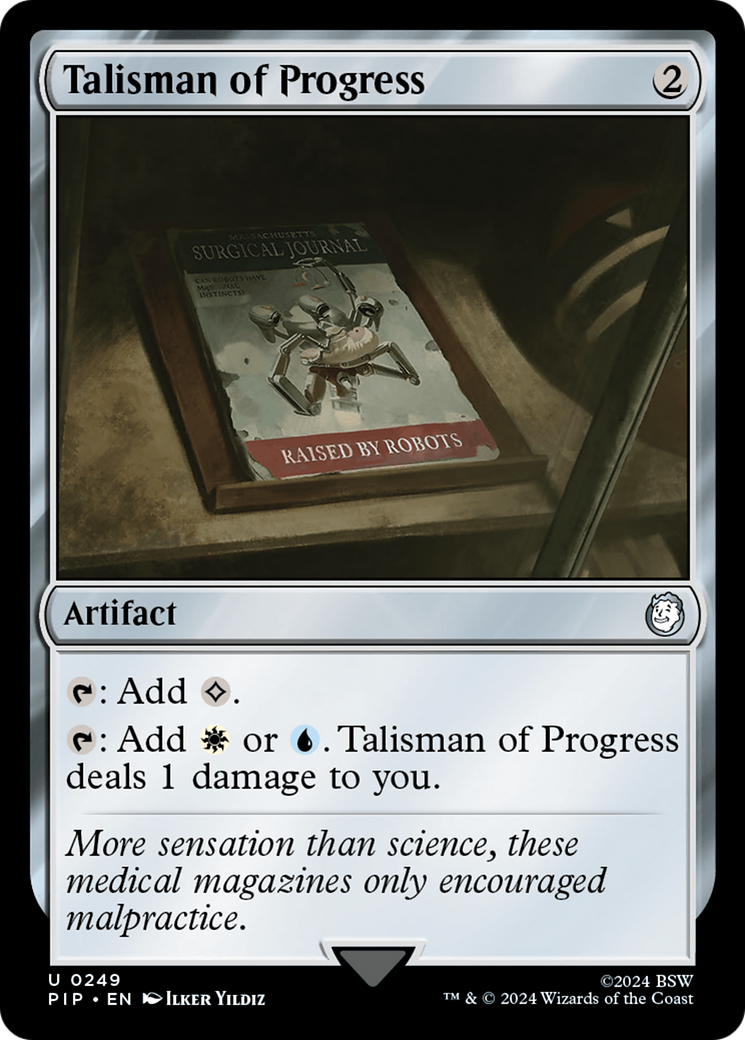
Talisman of Progress
Talisman of Progress
Artifact
: Add .
: Add or . This artifact deals 1 damage to you.
-
1
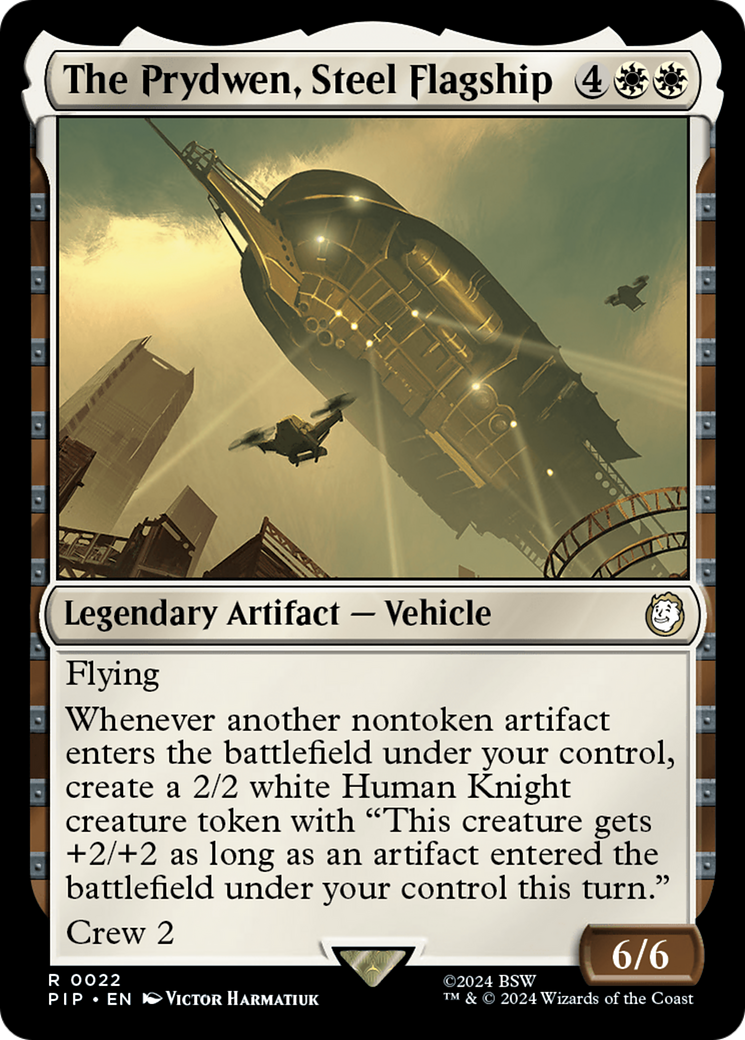
The Prydwen, Steel Flagship
The Prydwen, Steel Flagship
Legendary Artifact — Vehicle
6/6
Flying
Whenever another nontoken artifact you control enters, create a 2/2 white Human Knight creature token with "This token gets +2/+2 as long as an artifact entered the battlefield under your control this turn."
Crew 2
- Once an artifact enters the battlefield under your control in a given turn, it doesn't matter what happens to it later. A Knight token created by The Prydwen, Steel Flagship's second ability will still get +2/+2 for the rest of that turn.
-
1
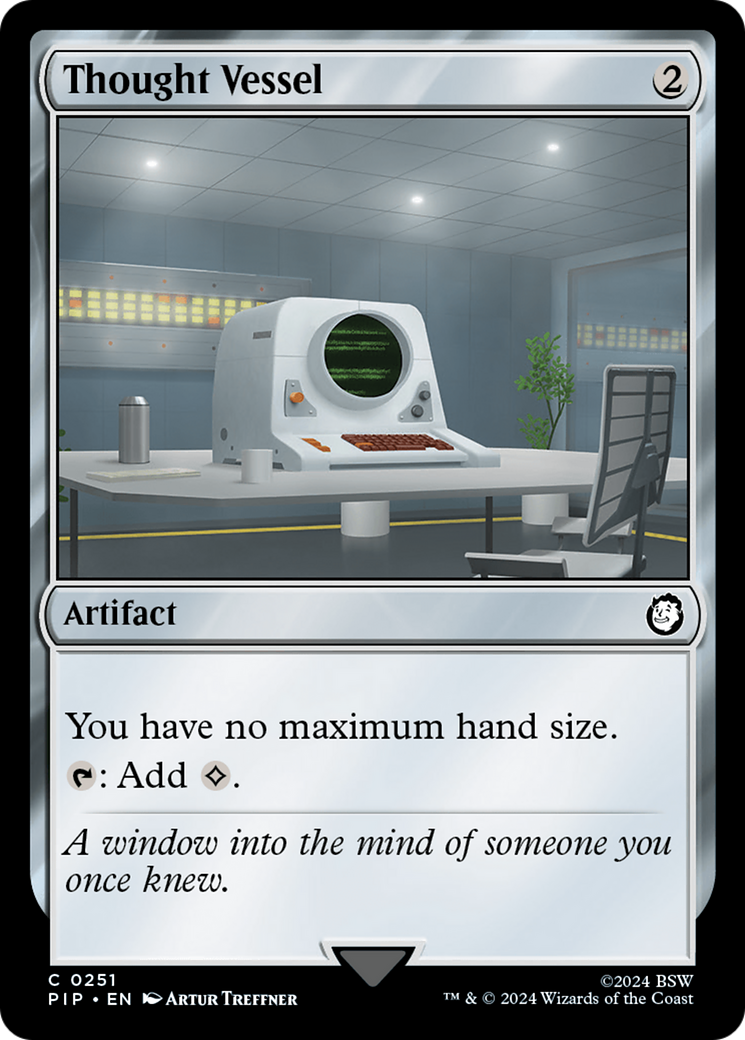
Thought Vessel
Thought Vessel
Artifact
You have no maximum hand size.
: Add .
-
1
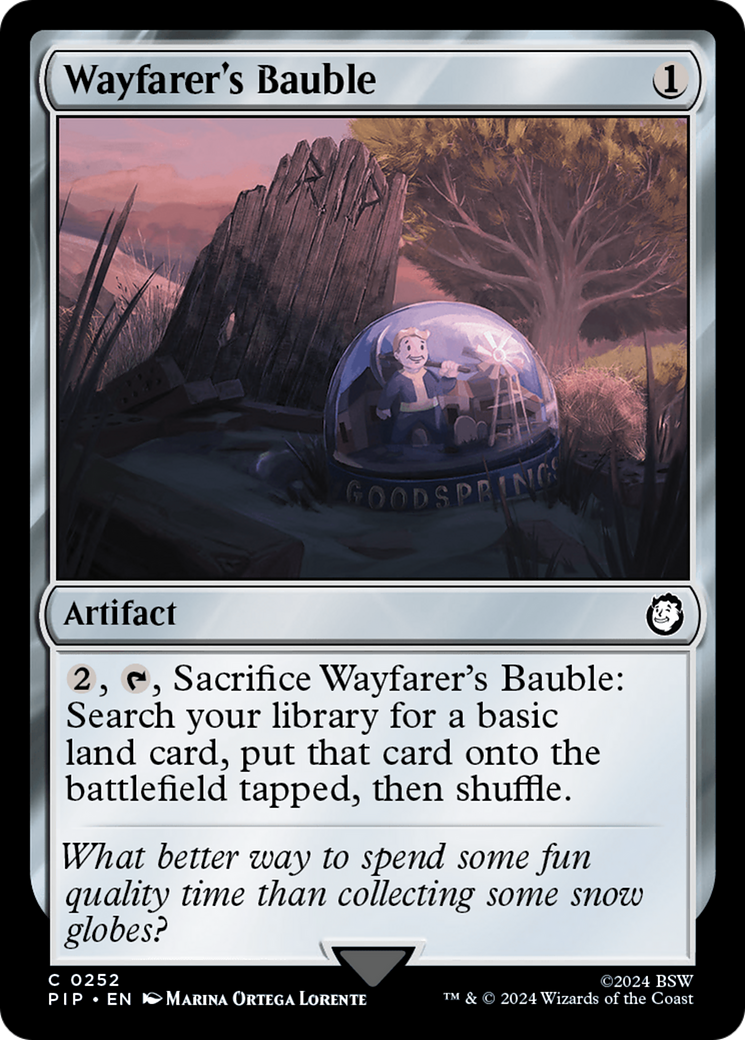
Wayfarer's Bauble
Wayfarer's Bauble
Artifact
, , Sacrifice this artifact: Search your library for a basic land card, put that card onto the battlefield tapped, then shuffle.
Enchantments 4
-
1
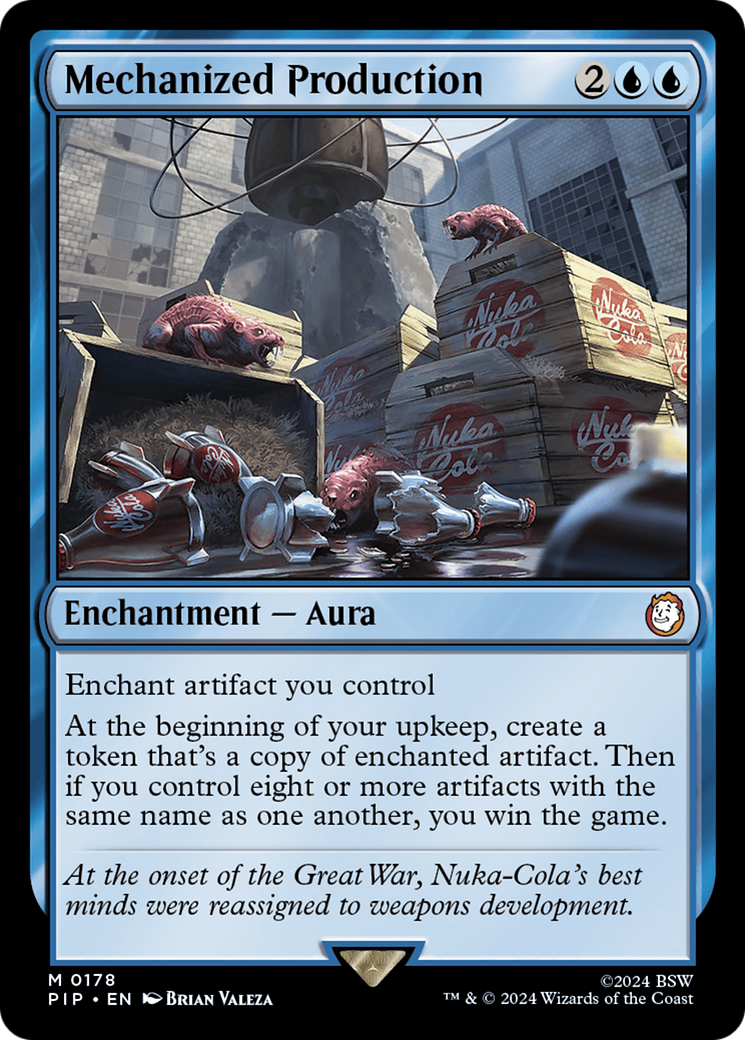
Mechanized Production
Mechanized Production
Enchantment — Aura
Enchant artifact you control
At the beginning of your upkeep, create a token that's a copy of enchanted artifact. Then if you control eight or more artifacts with the same name as one another, you win the game.
- Any abilities that trigger on the token being created won't resolve until after Mechanized Production's triggered ability has finished resolving entirely and performed its check for eight artifacts with the same name.
- The eight artifacts with the same name don't have to have the same name as the enchanted artifact. For example, you win the game if you control eight Thopter artifact creature tokens as Mechanized Production's ability resolves, even if Mechanized Production isn't attached to a Thopter.
- All eight of the permanents sharing a name must be artifacts. If you control only seven artifacts with the same name and a nonartifact permanent with that same name, you won't win the game.
- If you control eight or more artifacts that share a name while you control Mechanized Production, you won't win the game yet. You'll win the game while resolving its triggered ability during your upkeep.
- The token copies exactly what was printed on the original artifact and nothing else (unless that artifact is copying something else or is a token; see below). It doesn't copy whether that artifact is tapped or untapped, whether it has any counters on it or Auras attached to it, or any non-copy effects that have changed its types, color, or so on.
- If the copied artifact has in its mana cost, X is considered to be zero.
- If the copied artifact is copying something else (for example, if the copied artifact is a Sculpting Steel), then the token enters the battlefield as whatever that artifact copied.
- If the copied artifact is a token, the token that's created copies the original characteristics of that token as stated by the effect that created it.
- Any enters-the-battlefield abilities of the copied artifact trigger when the artifact token enters the battlefield. The artifact token also has any "this enters the battlefield with" or "as this enters the battlefield" abilities that the copied artifact has.
- If Mechanized Production and the enchanted artifact leave the battlefield simultaneously in response to the triggered ability, then the effect creates a token that's a copy of the artifact as it last existed on the battlefield.
- If the enchanted artifact leaves the battlefield in response to Mechanized Production's triggered ability but Mechanized Production does not, Mechanized Production is put into its owner's graveyard as a state-based action with no enchanted artifact. The triggered ability creates no token, but you can still win the game if you control enough artifacts with the same name.
-
1
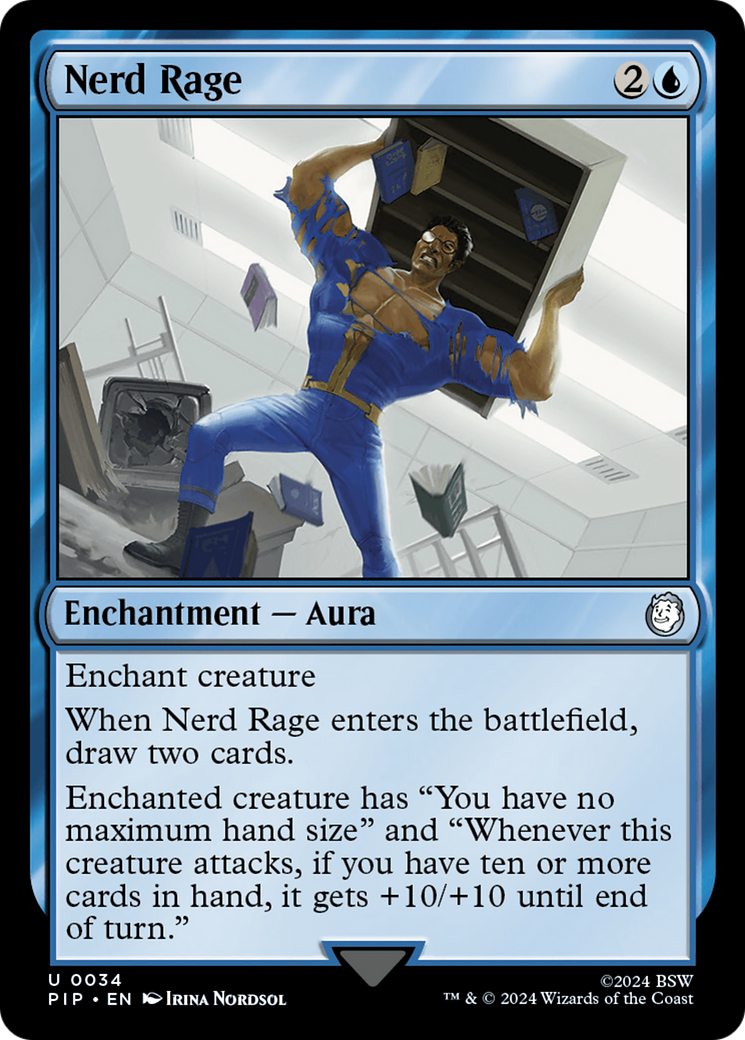
Nerd Rage
Nerd Rage
Enchantment — Aura
Enchant creature
When this Aura enters, draw two cards.
Enchanted creature has "You have no maximum hand size" and "Whenever this creature attacks, if you have ten or more cards in hand, it gets +10/+10 until end of turn."
-
1
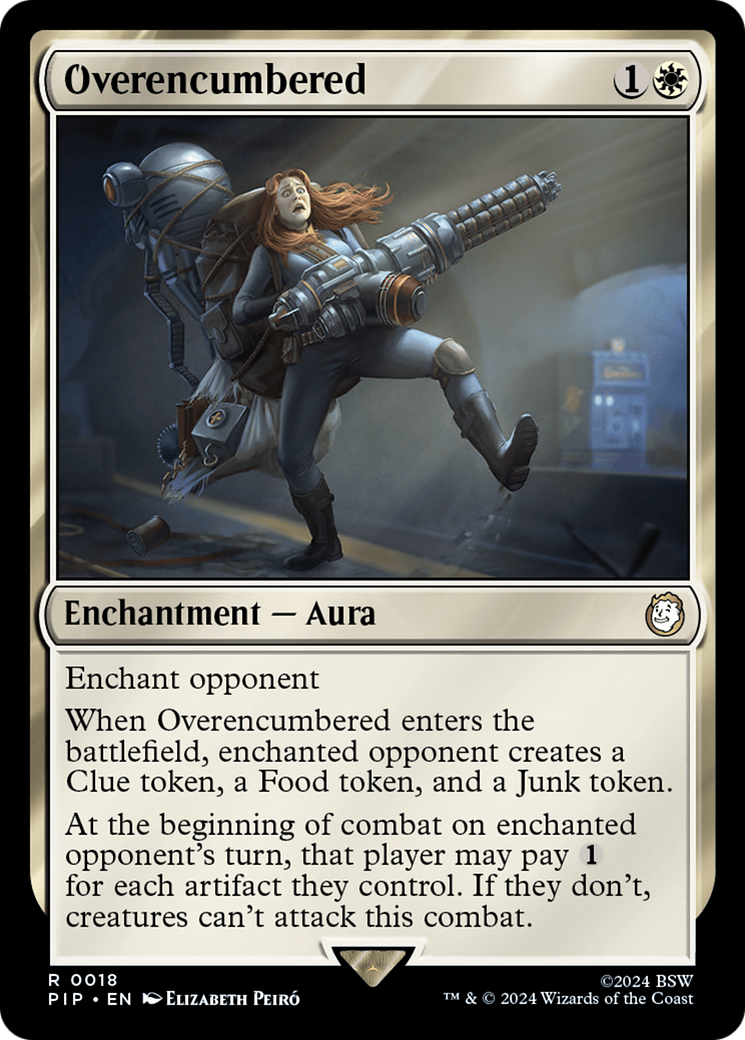
Overencumbered
Overencumbered
Enchantment — Aura
Enchant opponent
When this Aura enters, enchanted opponent creates a Clue token, a Food token, and a Junk token.
At the beginning of combat on enchanted opponent's turn, that player may pay for each artifact they control. If they don't, creatures can't attack this combat.
- Food is an artifact type. Even though it appears on some creatures, it's never a creature type.
- You can't sacrifice a Food to pay multiple costs. For example, you can't sacrifice a Food token to activate its own ability and also to activate Maraleaf Rider's ability.
- Whatever you do, don't eat the delicious cards.
- You can't sacrifice a Junk token to pay multiple costs. For example, you can't sacrifice a Junk token to activate its own ability and also to activate the second ability of Junk Jet.
- You pay all costs and follow all normal timing rules for the card played from exile with a Junk token's ability. For example, if the exiled card is a land card, you may play it only during your main phase while the stack is empty.
- Some spells and abilities that create Junk tokens may require targets. If each target chosen is illegal as that spell or ability tries to resolve, it won't resolve and none of its effects happen. You won't create any Junk tokens.
-
1
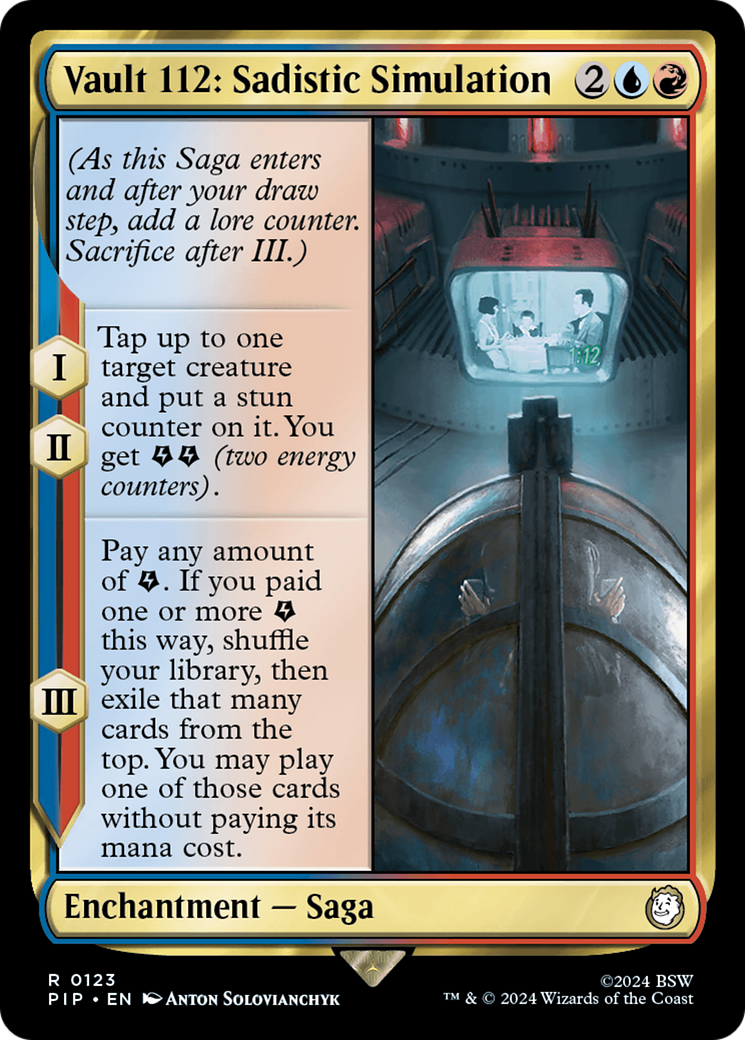
Vault 112: Sadistic Simulation
Vault 112: Sadistic Simulation
Enchantment — Saga
(As this Saga enters and after your draw step, add a lore counter. Sacrifice after III.)
I, II — Tap up to one target creature and put a stun counter on it. You get (two energy counters).
III — Pay any amount of . If you paid one or more this way, shuffle your library, then exile that many cards from the top. You may play one of those cards without paying its mana cost.
- is the energy symbol. It represents one energy counter.
- Energy counters are a kind of counter that a player may have. They’re not associated with any specific permanents.
- Keep track of how many energy counters each player has. Potential ways to track this include writing them down on paper or using dice, but any method that is clear and mutually agreeable is fine. (At higher levels of tournament play, dice may not be allowed for tracking counters that players have.)
- If an effect says you get one or more , you get that many energy counters. To pay one or more , you lose that many energy counters. You can’t pay more energy counters than you have. Any effects that interact with counters a player gets, has, or loses can interact with energy counters.
- Energy counters aren’t mana. They don’t go away as steps, phases, and turns end, and effects that add mana “of any type” can’t give you energy counters.
- Some triggered abilities state that you “may pay” a certain amount of . You can’t pay that amount multiple times to multiply the effect. You simply choose whether or not to pay that amount of as the ability resolves.
- Some triggered abilities that state that you “may pay” a certain amount of describe an effect that happens “If you do.” In that case, no player may take actions to try to stop the ability’s effect after you make your choice. If the payment is followed by the phrase “When you do,” then you’ll choose any targets for that reflexive triggered ability and put it on the stack before players can take actions.
- If a spell or ability with one or more targets states that you “may pay” some amount of , and each permanent that it targets has become an illegal target, the spell or ability won’t resolve. You can’t pay any even if you want to.
- Some spells and abilities that give you may require targets. If each target chosen is an illegal target as that spell or ability tries to resolve, it won’t resolve. You won’t get any .
Lands 37
-
1
Ash Barrens
Ash Barrens
Land
: Add .
Basic landcycling ( , Discard this card: Search your library for a basic land card, reveal it, put it into your hand, then shuffle.)
-
1
Buried Ruin
Buried Ruin
Land
: Add .
, , Sacrifice this land: Return target artifact card from your graveyard to your hand.
-
1
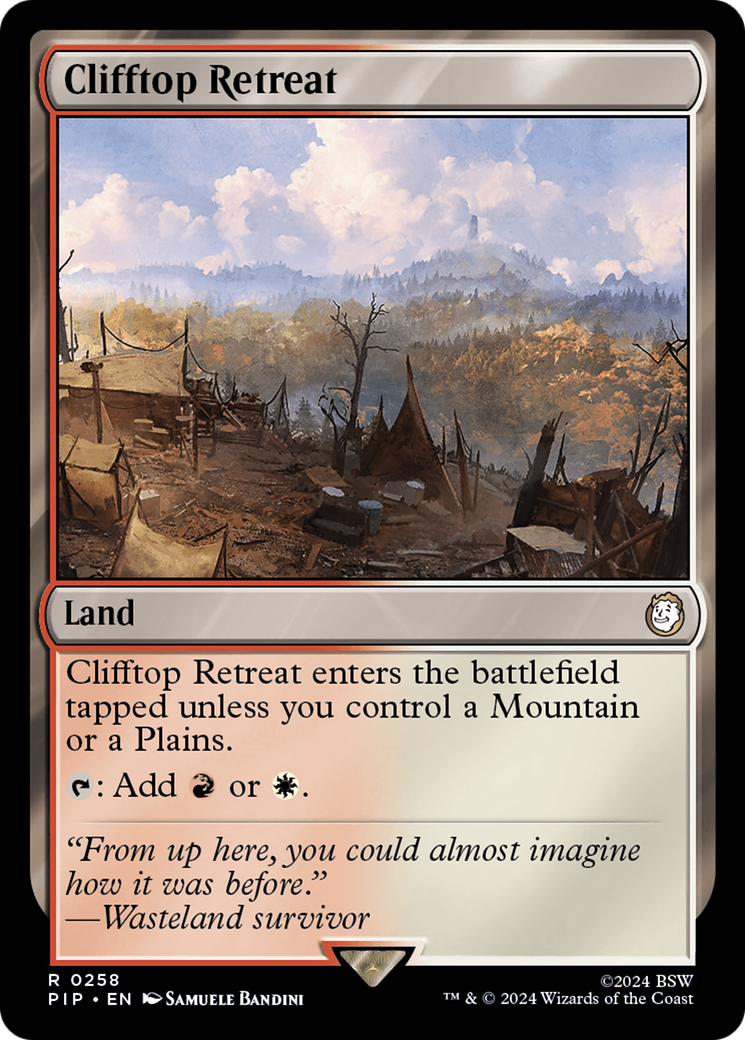
Clifftop Retreat
Clifftop Retreat
Land
This land enters tapped unless you control a Mountain or a Plains.
: Add or .
-
1
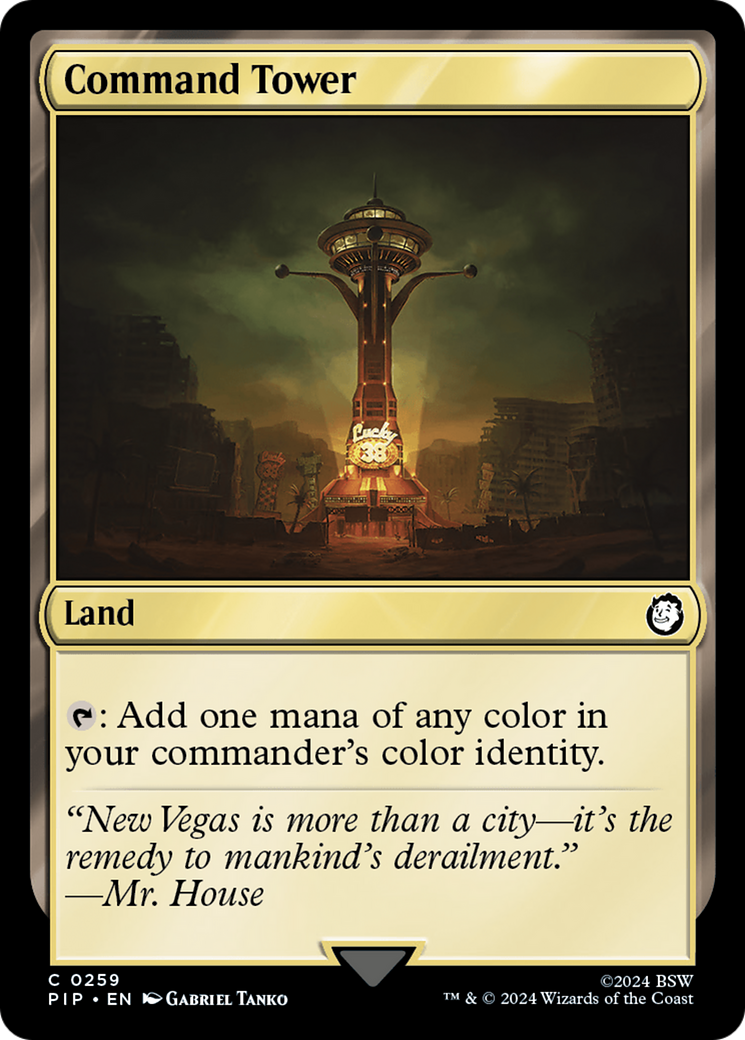
Command Tower
Command Tower
Land
: Add one mana of any color in your commander's color identity.
- If you don't have a commander, Command Tower's ability produces no mana.
- If your commander is a card that has no colors in its color identity, Command Tower's ability produces no mana. It doesn't produce .
- If you have two commanders, the ability adds one mana of any color in their combined color identities.
-
1
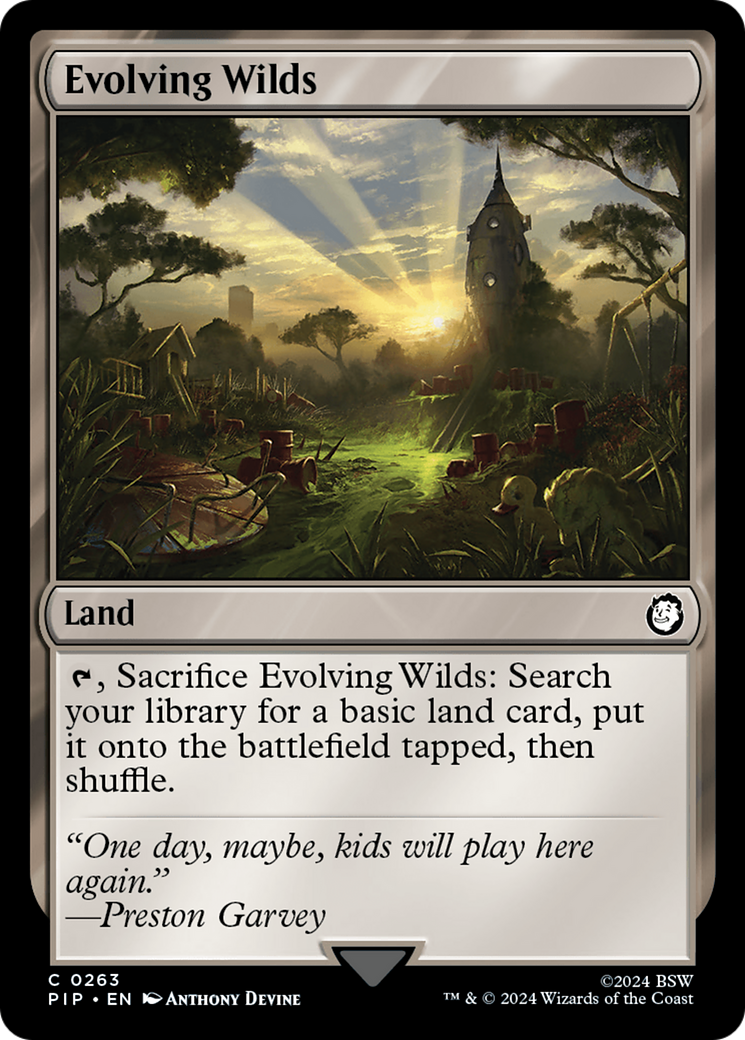
Evolving Wilds
Evolving Wilds
Land
, Sacrifice this land: Search your library for a basic land card, put it onto the battlefield tapped, then shuffle.
-
1
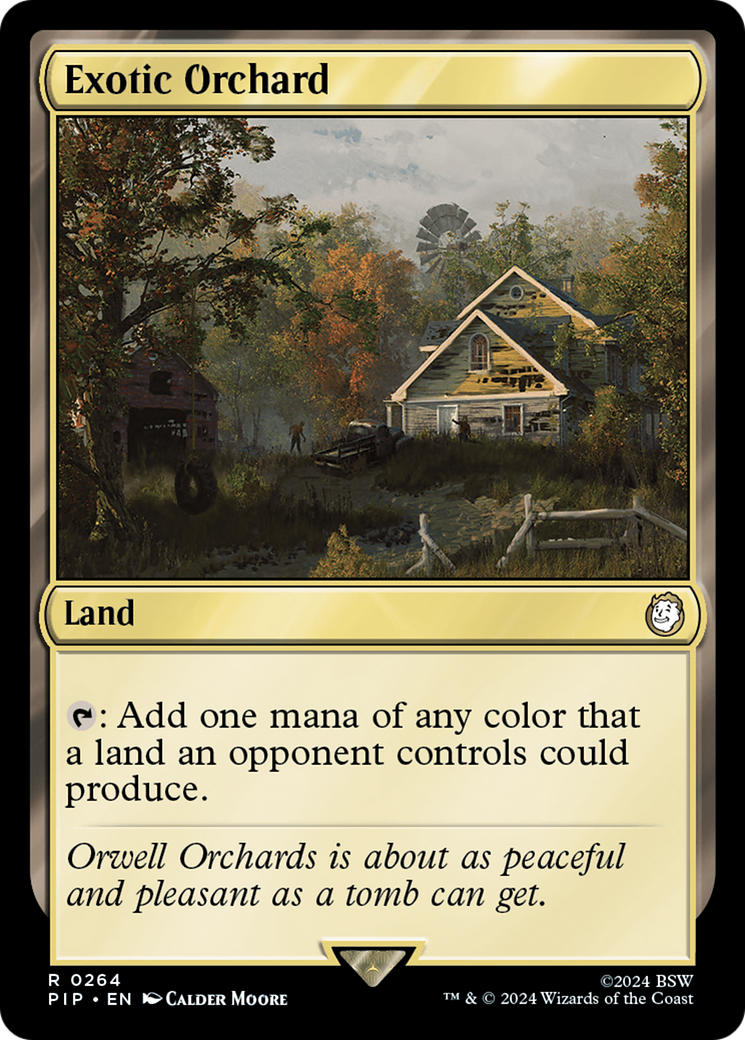
Exotic Orchard
Exotic Orchard
Land
: Add one mana of any color that a land an opponent controls could produce.
- Lands that produce mana based only on what other lands "could produce" won't help each other unless some other land allows one of them to actually produce some type of mana. For example, if you control an Exotic Orchard and your opponent controls an Exotic Orchard and a Reflecting Pool, none of those lands would produce mana if their mana abilities were activated. On the other hand, if you control a Forest and an Exotic Orchard, and your opponent controls an Exotic Orchard and a Reflecting Pool, then each of those lands can be tapped to produce . Your opponent's Exotic Orchard can produce because you control a Forest. Your Exotic Orchard and your opponent's Reflecting Pool can each produce because your opponent's Exotic Orchard can produce .
- When determining what colors of mana your opponents' lands could produce, Exotic Orchard takes into account any applicable replacement effects that would apply to those lands' mana abilities (such as Contamination's effect, for example). If there are more than one, consider them in any possible order.
- The colors of mana are white, blue, black, red, and green. Exotic Orchard can't be tapped for colorless mana, even if a land an opponent controls could produce colorless mana.
- Exotic Orchard doesn't care about any restrictions or riders your opponents' lands (such as Ancient Ziggurat or Hall of the Bandit Lord) put on the mana they produce. It just cares about colors of mana.
- Exotic Orchard checks the effects of all mana-producing abilities of lands your opponents control, but it doesn't check their costs. For example, Vivid Crag has the ability " , Remove a charge counter from Vivid Crag: Add one mana of any color." If an opponent controls Vivid Crag and you control Exotic Orchard, you can tap Exotic Orchard for any color of mana. It doesn't matter whether Vivid Crag has a charge counter on it, and it doesn't matter whether it's untapped.
-
1
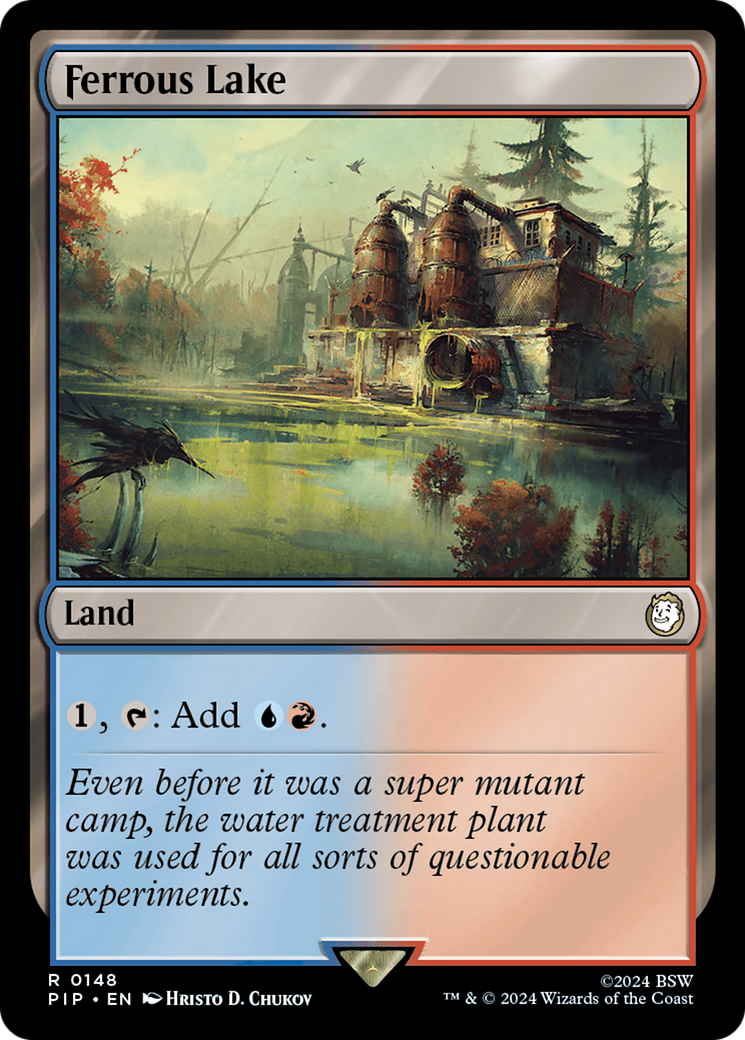
Ferrous Lake
Ferrous Lake
Land
, : Add .
-
1
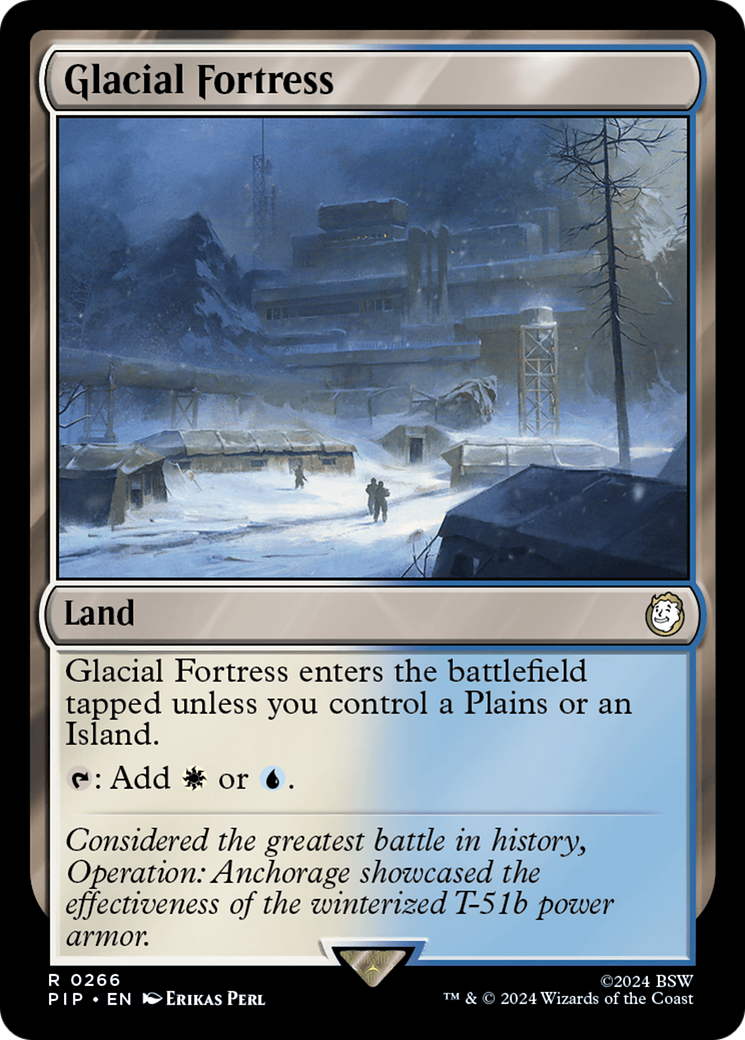
Glacial Fortress
Glacial Fortress
Land
This land enters tapped unless you control a Plains or an Island.
: Add or .
- This checks for lands you control with the land type Plains or Island, not for lands named Plains or Island. The lands it checks for don't have to be basic lands. For example, if you control Watery Grave (a nonbasic land with the land types Island and Swamp), Glacial Fortress will enter untapped.
- As this is entering, it checks for lands that are already on the battlefield. It won't see lands that are entering at the same time (due to Warp World, for example).
-
1
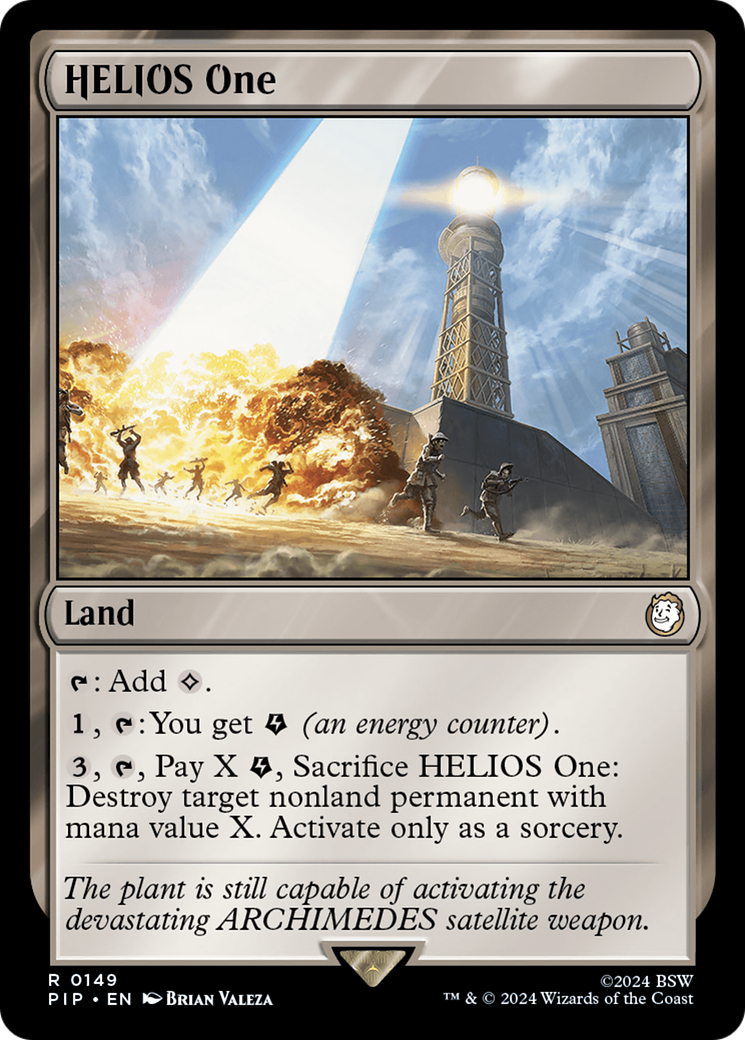
HELIOS One
HELIOS One
Land
: Add .
, : You get (an energy counter).
, , Pay X , Sacrifice this land: Destroy target nonland permanent with mana value X. Activate only as a sorcery.
- If a permanent has in its mana cost, X is 0 when determining its mana value.
- A token that’s not a copy of something else normally won’t have a mana cost. Anything without a mana cost normally has a mana value of 0.
- is the energy symbol. It represents one energy counter.
- Energy counters are a kind of counter that a player may have. They’re not associated with any specific permanents.
- Keep track of how many energy counters each player has. Potential ways to track this include writing them down on paper or using dice, but any method that is clear and mutually agreeable is fine. (At higher levels of tournament play, dice may not be allowed for tracking counters that players have.)
- If an effect says you get one or more , you get that many energy counters. To pay one or more , you lose that many energy counters. You can’t pay more energy counters than you have. Any effects that interact with counters a player gets, has, or loses can interact with energy counters.
- Energy counters aren’t mana. They don’t go away as steps, phases, and turns end, and effects that add mana “of any type” can’t give you energy counters.
- Some triggered abilities state that you “may pay” a certain amount of . You can’t pay that amount multiple times to multiply the effect. You simply choose whether or not to pay that amount of as the ability resolves.
- Some triggered abilities that state that you “may pay” a certain amount of describe an effect that happens “If you do.” In that case, no player may take actions to try to stop the ability’s effect after you make your choice. If the payment is followed by the phrase “When you do,” then you’ll choose any targets for that reflexive triggered ability and put it on the stack before players can take actions.
- If a spell or ability with one or more targets states that you “may pay” some amount of , and each permanent that it targets has become an illegal target, the spell or ability won’t resolve. You can’t pay any even if you want to.
- Some spells and abilities that give you may require targets. If each target chosen is an illegal target as that spell or ability tries to resolve, it won’t resolve. You won’t get any .
-
1
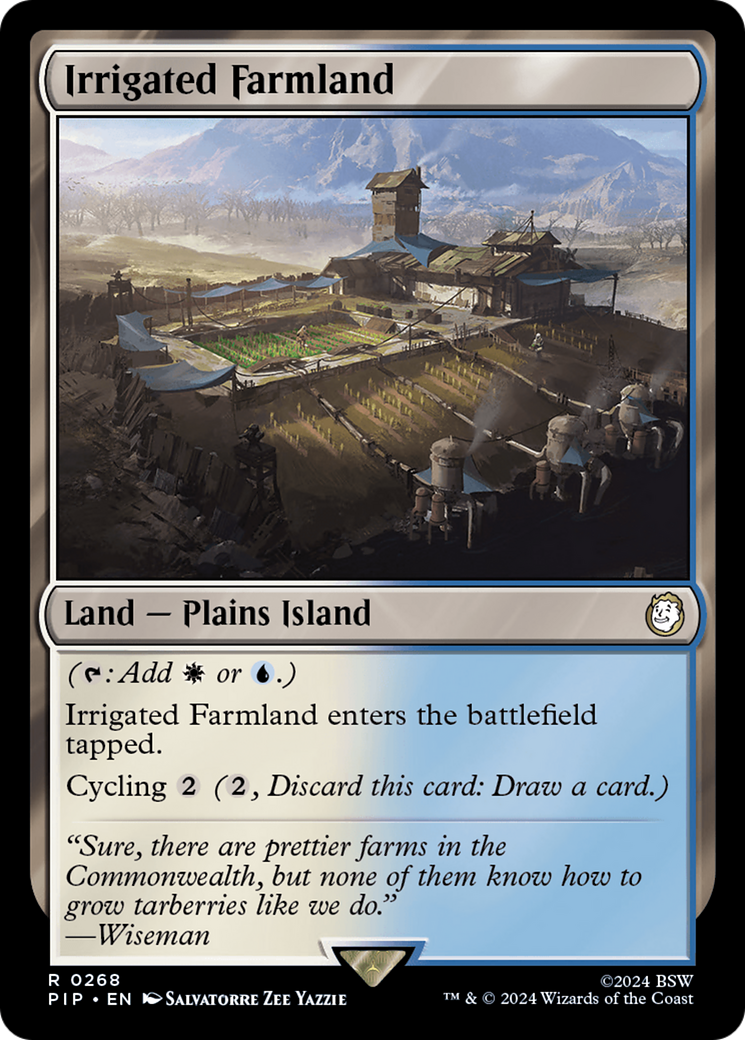
Irrigated Farmland
Irrigated Farmland
Land — Plains Island
( : Add or .)
This land enters tapped.
Cycling ( , Discard this card: Draw a card.)
-
5
Island
Island
Basic Land — Island
( : Add .)
-
4
Mountain
Mountain
Basic Land — Mountain
( : Add .)
-
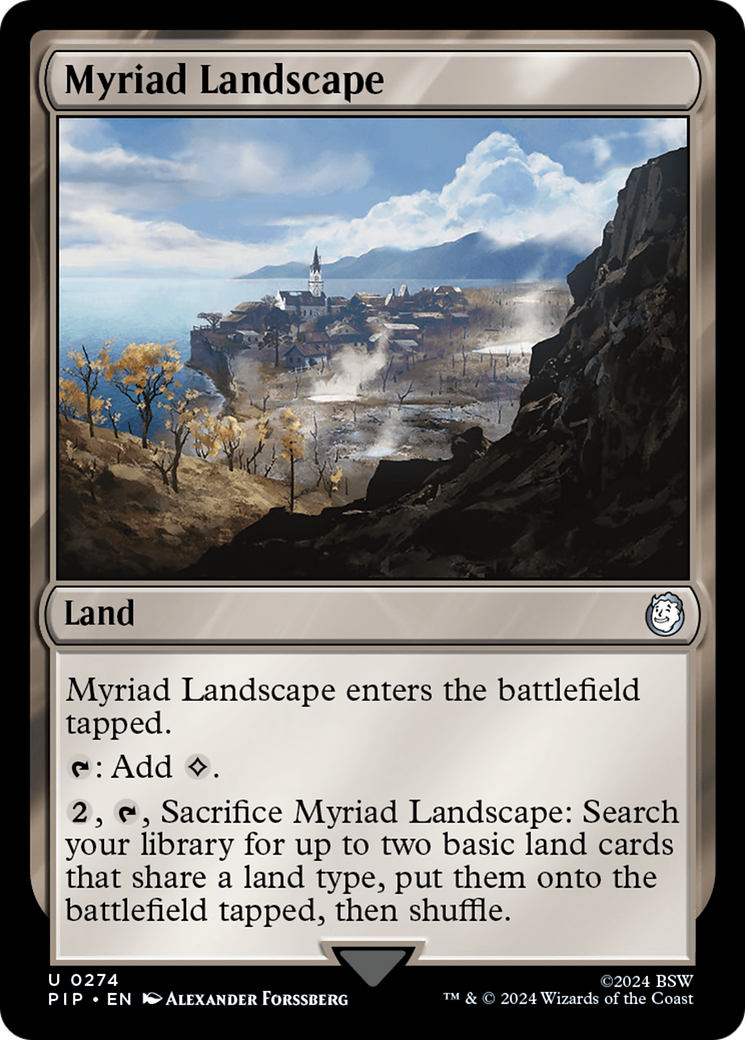
1
Myriad Landscape
Myriad Landscape
Land
This land enters tapped.
: Add .
, , Sacrifice this land: Search your library for up to two basic land cards that share a land type, put them onto the battlefield tapped, then shuffle.
- You can choose to find one basic land card with Myriad Landscape's last ability.
-
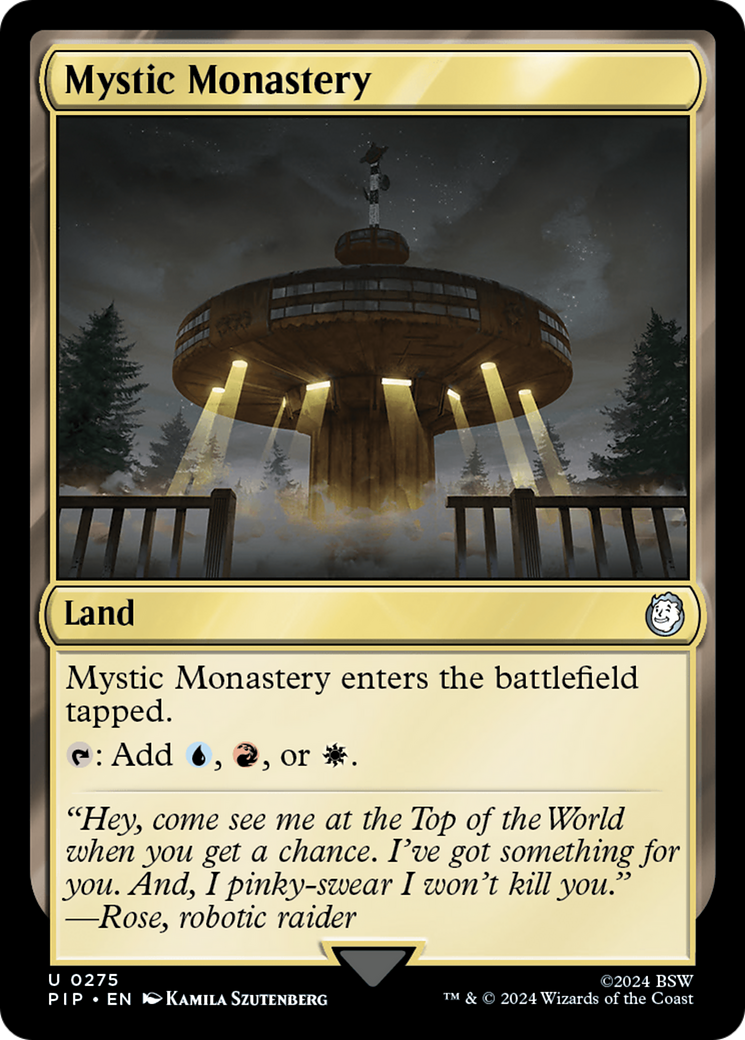
1
Mystic Monastery
Mystic Monastery
Land
This land enters tapped.
: Add , , or .
-
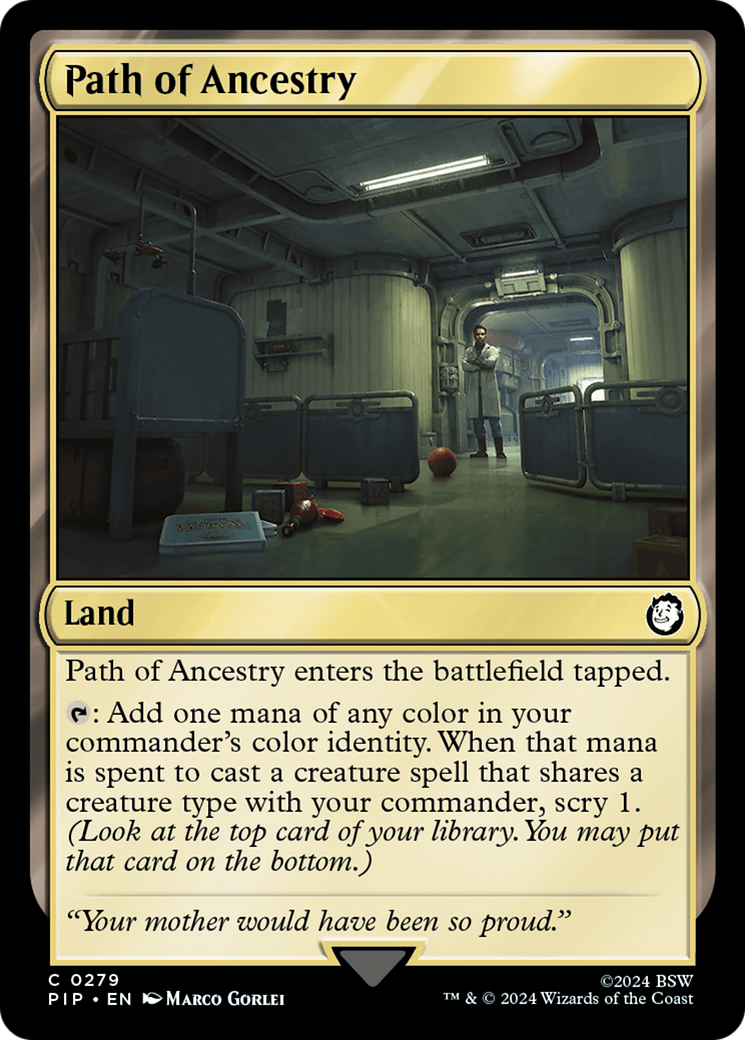
1
Path of Ancestry
Path of Ancestry
Land
This land enters tapped.
: Add one mana of any color in your commander's color identity. When that mana is spent to cast a creature spell that shares a creature type with your commander, scry 1. (Look at the top card of your library. You may put that card on the bottom.)
- Your commander's creature types are checked immediately after you cast a creature spell spending mana from Path of Ancestry's last ability. They aren't set before the game begins, and they may not be the same types your commander had when you activated that ability.
- If you have two commanders, the last ability adds one mana of any color in their combined color identities. When you spend that mana on a creature spell that shares a creature type with either of your commanders, you'll scry 1.
- If Path of Ancestry's last ability produces two mana (most likely due to Mana Reflection), spending those two mana to cast creature spells that share a creature type with your commander will cause two abilities to trigger. Each of those abilities will cause you to scry 1. You won't scry 2. This is true whether you spend the mana on one creature spell or two.
- If your commander has no creature types, it can't share a creature type with any spell that you cast.
- If you cast your commander with mana from Path of Ancestry, and your commander hasn't somehow lost all of its creature types while on the stack, you'll scry 1.
- If you don't have a commander, Path of Ancestry's ability produces no mana.
- If your commander is a card that has no colors in its color identity, Path of Ancestry's ability produces no mana. It doesn't produce .
-
4
Plains
Plains
Basic Land — Plains
( : Add .)
-
1
Prairie Stream
Prairie Stream
Land — Plains Island
( : Add or .)
This land enters tapped unless you control two or more basic lands.
- Even though these lands have basic land types, they are not basic lands because "basic" doesn't appear on their type line. Notably, controlling two or more of them won't allow others to enter the battlefield untapped.
- However, because these cards have basic land types, effects that specify a basic land type without also specifying that the land be basic can affect them. For example, a spell or ability that reads "Destroy target Forest" can target Canopy Vista, while one that reads "Destroy target basic Forest" cannot.
- If one of these lands enters the battlefield at the same time as any number of basic lands, those other lands are not counted when determining if this land enters the battlefield tapped or untapped.
-
1
Razortide Bridge
Razortide Bridge
Artifact Land
This land enters tapped.
Indestructible
: Add or .
-
1
Rustvale Bridge
Rustvale Bridge
Artifact Land
This land enters tapped.
Indestructible
: Add or .
-
1
Silverbluff Bridge
Silverbluff Bridge
Artifact Land
This land enters tapped.
Indestructible
: Add or .
-
1
Skycloud Expanse
Skycloud Expanse
Land
, : Add .
-
1
Spire of Industry
Spire of Industry
Land
: Add .
, Pay 1 life: Add one mana of any color. Activate only if you control an artifact.
-
1
Sulfur Falls
Sulfur Falls
Land
This land enters tapped unless you control an Island or a Mountain.
: Add or .
-
1
Temple of Enlightenment
Temple of Enlightenment
Land
This land enters tapped.
When this land enters, scry 1. (Look at the top card of your library. You may put that card on the bottom.)
: Add or .
- When you scry, you may put all the cards you look at back on top of your library, you may put all of those cards on the bottom of your library, or you may put some of those cards on top and the rest of them on the bottom.
- You choose how to order cards returned to your library after scrying no matter where you put them.
- You perform the actions stated on a card in sequence. For some spells and abilities, that means you'll scry last. For others, that means you'll scry and then perform other actions.
- Scry appears on some spells and abilities with one or more targets. If all of the spell or ability's targets are illegal when it tries to resolve, it won't resolve and none of its effects will happen. You won't scry.
-
1
Temple of Epiphany
Temple of Epiphany
Land
This land enters tapped.
When this land enters, scry 1. (Look at the top card of your library. You may put that card on the bottom.)
: Add or .
-
1
Terramorphic Expanse
Terramorphic Expanse
Land
, Sacrifice this land: Search your library for a basic land card, put it onto the battlefield tapped, then shuffle.
-
1
Treasure Vault
Treasure Vault
Artifact Land
: Add .
, , Sacrifice this land: Create X Treasure tokens.
Other 1
- 1 Dweller's Journey
White 11
-
1
Austere Command
Austere Command
Sorcery
Choose two —
- Destroy all artifacts.
- Destroy all enchantments.
- Destroy all creatures with mana value 3 or less.
- Destroy all creatures with mana value 4 or greater.
- Each of the chosen modes happens sequentially. If a permanent has an ability that triggers whenever it or another permanent is destroyed, it will see permanents destroyed at the same time as it or before it, but not permanents destroyed by later modes.
- If a card is exiled "until" another permanent leaves the battlefield, the exiled card returns to the battlefield immediately after that permanent leaves the battlefield during Austere Command's resolution, and it may be destroyed by a later mode.
- If the first and last modes are chosen, an artifact creature with mana value 4 or greater will have to be regenerated twice to survive. This is because the modes happen sequentially, and the regeneration "shield" is used up by the first one. The same is true with any other combination of modes that covers one permanent twice.
-
1
Automated Assembly Line
Automated Assembly Line
Artifact
Whenever one or more artifact creatures you control deal combat damage to a player, you get (an energy counter).
Pay : Create a tapped 3/3 colorless Robot artifact creature token.
- is the energy symbol. It represents one energy counter.
- Energy counters are a kind of counter that a player may have. They’re not associated with any specific permanents.
- Keep track of how many energy counters each player has. Potential ways to track this include writing them down on paper or using dice, but any method that is clear and mutually agreeable is fine. (At higher levels of tournament play, dice may not be allowed for tracking counters that players have.)
- If an effect says you get one or more , you get that many energy counters. To pay one or more , you lose that many energy counters. You can’t pay more energy counters than you have. Any effects that interact with counters a player gets, has, or loses can interact with energy counters.
- Energy counters aren’t mana. They don’t go away as steps, phases, and turns end, and effects that add mana “of any type” can’t give you energy counters.
- Some triggered abilities state that you “may pay” a certain amount of . You can’t pay that amount multiple times to multiply the effect. You simply choose whether or not to pay that amount of as the ability resolves.
- Some triggered abilities that state that you “may pay” a certain amount of describe an effect that happens “If you do.” In that case, no player may take actions to try to stop the ability’s effect after you make your choice. If the payment is followed by the phrase “When you do,” then you’ll choose any targets for that reflexive triggered ability and put it on the stack before players can take actions.
- If a spell or ability with one or more targets states that you “may pay” some amount of , and each permanent that it targets has become an illegal target, the spell or ability won’t resolve. You can’t pay any even if you want to.
- Some spells and abilities that give you may require targets. If each target chosen is an illegal target as that spell or ability tries to resolve, it won’t resolve. You won’t get any .
-
1
Brotherhood Scribe
Brotherhood Scribe
Creature — Human Artificer
1/3
Metalcraft — : You get (an energy counter). Activate only if you control three or more artifacts.
Whenever you get one or more during your turn, creatures you control get +1/+1 until end of turn.
- is the energy symbol. It represents one energy counter.
- Energy counters are a kind of counter that a player may have. They’re not associated with any specific permanents.
- Keep track of how many energy counters each player has. Potential ways to track this include writing them down on paper or using dice, but any method that is clear and mutually agreeable is fine. (At higher levels of tournament play, dice may not be allowed for tracking counters that players have.)
- If an effect says you get one or more , you get that many energy counters. To pay one or more , you lose that many energy counters. You can’t pay more energy counters than you have. Any effects that interact with counters a player gets, has, or loses can interact with energy counters.
- Energy counters aren’t mana. They don’t go away as steps, phases, and turns end, and effects that add mana “of any type” can’t give you energy counters.
- Some triggered abilities state that you “may pay” a certain amount of . You can’t pay that amount multiple times to multiply the effect. You simply choose whether or not to pay that amount of as the ability resolves.
- Some triggered abilities that state that you “may pay” a certain amount of describe an effect that happens “If you do.” In that case, no player may take actions to try to stop the ability’s effect after you make your choice. If the payment is followed by the phrase “When you do,” then you’ll choose any targets for that reflexive triggered ability and put it on the stack before players can take actions.
- If a spell or ability with one or more targets states that you “may pay” some amount of , and each permanent that it targets has become an illegal target, the spell or ability won’t resolve. You can’t pay any even if you want to.
- Some spells and abilities that give you may require targets. If each target chosen is an illegal target as that spell or ability tries to resolve, it won’t resolve. You won’t get any .
-
1
Crush Contraband
Crush Contraband
Instant
Choose one or both —
- Exile target artifact.
- Exile target enchantment.
- If you've chosen both modes and one of Crush Contraband's targets becomes an illegal target, the other is still exiled.
-
1
Dispatch
Dispatch
Instant
Tap target creature.
Metalcraft — If you control three or more artifacts, exile that creature.
- If you control three or more artifacts when Dispatch resolves, you'll tap the creature, then exile it.
-
1
Open the Vaults
Open the Vaults
Sorcery
Return all artifact and enchantment cards from all graveyards to the battlefield under their owners' control. (Auras with nothing to enchant remain in graveyards.)
- If an Aura is put onto the battlefield without being cast, the Aura's controller-to-be chooses what it will enchant as it enters the battlefield. An Aura put onto the battlefield this way doesn't target anything (so it could be attached to an opponent's permanent with hexproof, for example), but the Aura's enchant ability restricts what it can be attached to. If the Aura can't legally be attached to anything, it remains in its current zone.
- If an Aura can be returned to the battlefield with Open the Vaults, it must be, even if its owner doesn't like what it would enchant.
- If multiple players have Auras in their graveyards, the player whose turn it is announces what their Auras will enchant, then each other player in turn order does the same, then all artifacts and enchantments (including both Auras and non-Auras) enter the battlefield at the same time.
- An Aura put onto the battlefield this way can't enchant an artifact or enchantment that's also being put onto the battlefield with Open the Vaults.
-
1
Overencumbered
Overencumbered
Enchantment — Aura
Enchant opponent
When this Aura enters, enchanted opponent creates a Clue token, a Food token, and a Junk token.
At the beginning of combat on enchanted opponent's turn, that player may pay for each artifact they control. If they don't, creatures can't attack this combat.
- Food is an artifact type. Even though it appears on some creatures, it's never a creature type.
- You can't sacrifice a Food to pay multiple costs. For example, you can't sacrifice a Food token to activate its own ability and also to activate Maraleaf Rider's ability.
- Whatever you do, don't eat the delicious cards.
- You can't sacrifice a Junk token to pay multiple costs. For example, you can't sacrifice a Junk token to activate its own ability and also to activate the second ability of Junk Jet.
- You pay all costs and follow all normal timing rules for the card played from exile with a Junk token's ability. For example, if the exiled card is a land card, you may play it only during your main phase while the stack is empty.
- Some spells and abilities that create Junk tokens may require targets. If each target chosen is illegal as that spell or ability tries to resolve, it won't resolve and none of its effects happen. You won't create any Junk tokens.
-
1
Paladin Danse, Steel Maverick
Paladin Danse, Steel Maverick
Legendary Artifact Creature — Synth Knight
3/3
Vigilance, lifelink
Exile Paladin Danse: Each creature you control that's an artifact or Human gains indestructible until end of turn.
- The set of creatures affected by Paladin Danse's last ability is determined as the ability resolves. Artifact creatures and Human creatures you begin to control later in the turn and permanents you control that become artifact creatures or Human creatures later in the turn won't gain indestructible.
-
1
Sentry Bot
Sentry Bot
Artifact Creature — Robot
2/5
Flash
This spell costs less to cast for each creature attacking you.
When this creature enters, you get for each creature attacking you.
At the beginning of combat on your turn, you may pay . If you do, put a +1/+1 counter on each creature you control.
- The cost-reduction ability of Sentry Bot doesn’t change its mana cost or mana value, only the total cost you pay. Specifically, the mana value of Sentry Bot is always 5.
- Once you announce that you’re casting Sentry Bot, no player may take actions until you’re done casting it. Notably, opponents can’t remove creatures from combat to try to change Sentry Bot’s total cost.
- Use the number of creatures attacking you as Sentry Bot’s third ability resolves to determine the number of energy counters you get.
- is the energy symbol. It represents one energy counter.
- Energy counters are a kind of counter that a player may have. They’re not associated with any specific permanents.
- Keep track of how many energy counters each player has. Potential ways to track this include writing them down on paper or using dice, but any method that is clear and mutually agreeable is fine. (At higher levels of tournament play, dice may not be allowed for tracking counters that players have.)
- If an effect says you get one or more , you get that many energy counters. To pay one or more , you lose that many energy counters. You can’t pay more energy counters than you have. Any effects that interact with counters a player gets, has, or loses can interact with energy counters.
- Energy counters aren’t mana. They don’t go away as steps, phases, and turns end, and effects that add mana “of any type” can’t give you energy counters.
- Some triggered abilities state that you “may pay” a certain amount of . You can’t pay that amount multiple times to multiply the effect. You simply choose whether or not to pay that amount of as the ability resolves.
- Some triggered abilities that state that you “may pay” a certain amount of describe an effect that happens “If you do.” In that case, no player may take actions to try to stop the ability’s effect after you make your choice. If the payment is followed by the phrase “When you do,” then you’ll choose any targets for that reflexive triggered ability and put it on the stack before players can take actions.
- If a spell or ability with one or more targets states that you “may pay” some amount of , and each permanent that it targets has become an illegal target, the spell or ability won’t resolve. You can’t pay any even if you want to.
- Some spells and abilities that give you may require targets. If each target chosen is an illegal target as that spell or ability tries to resolve, it won’t resolve. You won’t get any .
-
1
Swords to Plowshares
Swords to Plowshares
Instant
Exile target creature. Its controller gains life equal to its power.
- Use the power of the creature from when it was last on the battlefield to determine how much life is gained.
-
1
The Prydwen, Steel Flagship
The Prydwen, Steel Flagship
Legendary Artifact — Vehicle
6/6
Flying
Whenever another nontoken artifact you control enters, create a 2/2 white Human Knight creature token with "This token gets +2/+2 as long as an artifact entered the battlefield under your control this turn."
Crew 2
- Once an artifact enters the battlefield under your control in a given turn, it doesn't matter what happens to it later. A Knight token created by The Prydwen, Steel Flagship's second ability will still get +2/+2 for the rest of that turn.
Blue 11
-
1
Curie, Emergent Intelligence
Curie, Emergent Intelligence
Legendary Artifact Creature — Robot
1/3
Whenever Curie deals combat damage to a player, draw cards equal to its base power.
, Exile another nontoken artifact creature you control: Curie becomes a copy of the exiled creature, except it has "Whenever this creature deals combat damage to a player, draw cards equal to its base power."
- Normally, a creature's base power is the power printed on the card, or, for a token, the power set by the effect that created it. If another effect sets a creature's power to a specific number or value, that becomes its base power. If an effect modifies a creature's power without setting it, that is not included when determining its base power.
- If a creature has a characteristic-defining ability that sets its power, indicated with a * or similar in the power and toughness box, that ability is taken into account when determining its base power.
- If Curie is no longer on the battlefield when its first ability resolves, use its base power as it last existed on the battlefield to determine how many cards to draw.
- Curie's last ability refers to the exiled creature, not the exiled card. In most cases, this means Curie copies exactly what was printed on the original creature and nothing else, plus the additional ability. However, if the exiled creature was copying something else when it was last on the battlefield, Curie copies whatever that creature was copying, plus the additional ability.
- Curie's last ability won't copy whether the exiled creature was tapped or untapped, whether it had any counters on it or Auras attached to it, or any non-copy effects that changed its power, toughness, types, color, and so on.
- If the copied creature has in its mana cost, X is 0.
-
1
Glimmer of Genius
Glimmer of Genius
Instant
Scry 2, then draw two cards. You get (two energy counters).
- is the energy symbol. It represents one energy counter.
- Energy counters are a kind of counter that a player may have. They're not associated with any specific permanents.
- Keep track of how many energy counters each player has. Potential ways to track this include writing theme down on paper or using dice, but any method that is clear and mutually agreeable is fine. (At higher levels of tournament play, dice may not be allowed for tracking counters that players have.)
- If an effect says you get one or more , you get that many energy counters. To pay one or more , you lose that many energy counters. You can't pay more energy counters than you have. Any effects that interact with counters a player gets, has, or loses can interact with energy counters.
- Energy counters aren't mana. They don't go away as steps, phases, and turns end, and effects that add mana "of any type" can't give you energy counters.
- Some triggered abilities state that you "may pay" a certain amount of . You can't pay that amount multiple times to multiply the effect. You simply choose whether or not to pay that amount of as the ability resolves.
- Some triggered abilities that state that you "may pay" a certain amount of describe an effect that happens "If you do." In that case, no player may take actions to try to stop the ability's effect after you make your choice. If the payment is followed by the phrase "When you do," then you'll choose any targets for that reflexive triggered ability and put it on the stack before players can take actions.
- If a spell or ability with one or more targets states that you "may pay" some amount of , and each permanent that it targets has become an illegal target, the spell or ability won't resolve. You can't pay any even if you want to.
- Some spells and abilities that give you may require targets. If each target chosen is an illegal target as that spell or ability tries to resolve, it won't resolve. You won't get any .
-
1
James, Wandering Dad // Follow Him
//
James, Wandering Dad
Legendary Creature — Human Scientist
2/4
- Activated abilities contain a colon. They're generally written "[Cost]: [Effect]." Some keywords are activated abilities and may have colons in their reminder text.
-
1
Mechanized Production
Mechanized Production
Enchantment — Aura
Enchant artifact you control
At the beginning of your upkeep, create a token that's a copy of enchanted artifact. Then if you control eight or more artifacts with the same name as one another, you win the game.
- Any abilities that trigger on the token being created won't resolve until after Mechanized Production's triggered ability has finished resolving entirely and performed its check for eight artifacts with the same name.
- The eight artifacts with the same name don't have to have the same name as the enchanted artifact. For example, you win the game if you control eight Thopter artifact creature tokens as Mechanized Production's ability resolves, even if Mechanized Production isn't attached to a Thopter.
- All eight of the permanents sharing a name must be artifacts. If you control only seven artifacts with the same name and a nonartifact permanent with that same name, you won't win the game.
- If you control eight or more artifacts that share a name while you control Mechanized Production, you won't win the game yet. You'll win the game while resolving its triggered ability during your upkeep.
- The token copies exactly what was printed on the original artifact and nothing else (unless that artifact is copying something else or is a token; see below). It doesn't copy whether that artifact is tapped or untapped, whether it has any counters on it or Auras attached to it, or any non-copy effects that have changed its types, color, or so on.
- If the copied artifact has in its mana cost, X is considered to be zero.
- If the copied artifact is copying something else (for example, if the copied artifact is a Sculpting Steel), then the token enters the battlefield as whatever that artifact copied.
- If the copied artifact is a token, the token that's created copies the original characteristics of that token as stated by the effect that created it.
- Any enters-the-battlefield abilities of the copied artifact trigger when the artifact token enters the battlefield. The artifact token also has any "this enters the battlefield with" or "as this enters the battlefield" abilities that the copied artifact has.
- If Mechanized Production and the enchanted artifact leave the battlefield simultaneously in response to the triggered ability, then the effect creates a token that's a copy of the artifact as it last existed on the battlefield.
- If the enchanted artifact leaves the battlefield in response to Mechanized Production's triggered ability but Mechanized Production does not, Mechanized Production is put into its owner's graveyard as a state-based action with no enchanted artifact. The triggered ability creates no token, but you can still win the game if you control enough artifacts with the same name.
-
1
Nerd Rage
Nerd Rage
Enchantment — Aura
Enchant creature
When this Aura enters, draw two cards.
Enchanted creature has "You have no maximum hand size" and "Whenever this creature attacks, if you have ten or more cards in hand, it gets +10/+10 until end of turn."
-
1
Nick Valentine, Private Eye
Nick Valentine, Private Eye
Legendary Artifact Creature — Synth Detective
2/2
Nick Valentine can't be blocked except by artifact creatures.
Whenever Nick Valentine or another artifact creature you control dies, you may investigate. (To investigate, create a Clue token. It's an artifact with " , Sacrifice this token: Draw a card.")
- Once Nick Valentine has been blocked, making the blocking creature stop being an artifact won't cause Nick Valentine to become unblocked.
-
1
One with the Machine
One with the Machine
Sorcery
Draw cards equal to the highest mana value among artifacts you control.
- If a permanent has in its mana cost, X is considered to be 0.
-
1
Robobrain War Mind
Robobrain War Mind
Artifact Creature — Robot
*/5
Robobrain War Mind's power is equal to the number of cards in your hand.
When this creature enters, you get an amount of (energy counters) equal to the number of artifact creatures you control.
Whenever this creature attacks, you may pay . If you do, draw a card.
- The ability that defines Robobrain War Mind's power functions in all zones, not just the battlefield.
- Use the number of artifact creatures you control when Robobrain War Mind's second ability resolves, including Robobrain War Mind itself if it's still on the battlefield, to determine the number of energy counters you get.
- is the energy symbol. It represents one energy counter.
- Energy counters are a kind of counter that a player may have. They're not associated with any specific permanents.
- Keep track of how many energy counters each player has. Potential ways to track this include writing them down on paper or using dice, but any method that is clear and mutually agreeable is fine. (At higher levels of tournament play, dice may not be allowed for tracking counters that players have.)
- If an effect says you get one or more , you get that many energy counters. To pay one or more , you lose that many energy counters. You can't pay more energy counters than you have. Any effects that interact with counters a player gets, has, or loses can interact with energy counters.
- Energy counters aren't mana. They don't go away as steps, phases, and turns end, and effects that add mana "of any type" can't give you energy counters.
- Some triggered abilities state that you "may pay" a certain amount of . You can't pay that amount multiple times to multiply the effect. You simply choose whether or not to pay that amount of as the ability resolves.
- Some triggered abilities that state that you "may pay" a certain amount of describe an effect that happens "If you do." In that case, no player may take actions to try to stop the ability's effect after you make your choice. If the payment is followed by the phrase "When you do," then you'll choose any targets for that reflexive triggered ability and put it on the stack before players can take actions.
- If a spell or ability with one or more targets states that you "may pay" some amount of , and each permanent that it targets has become an illegal target, the spell or ability won't resolve. You can't pay any even if you want to.
- Some spells and abilities that give you may require targets. If each target chosen is an illegal target as that spell or ability tries to resolve, it won't resolve. You won't get any .
-
1
Synth Infiltrator
Synth Infiltrator
Artifact Creature — Synth
0/0
Improvise (Your artifacts can help cast this spell. Each artifact you tap after you're done activating mana abilities pays for .)
You may have this creature enter as a copy of any creature on the battlefield, except it's a Synth artifact creature in addition to its other types.
- Improvise doesn’t change Synth Infiltrator’s mana cost or mana value, and it can’t reduce Synth Infiltrator’s cost below .
- Except for being a Synth artifact creature in addition to its other types, Synth Infiltrator copies exactly what was printed on the original creature and nothing else (unless that creature is copying something else or is a token; see below). It doesn’t copy whether that creature is tapped or untapped, whether it has any counters on it or Auras and Equipment attached to it, or any non-copy effects that have changed its power, toughness, types, color, and so on.
- If the copied creature has in its mana cost, X is 0.
- If the copied creature is a token, Synth Infiltrator copies the original characteristics of that token as stated by the effect that created that token, with the noted exceptions.
- If the copied creature is copying something else, then Synth Infiltrator enters the battlefield as whatever that creature copied, with the noted exceptions.
- Any enters-the-battlefield abilities of the copied creature will trigger when Synth Infiltrator enters the battlefield. Any “as [this creature] enters the battlefield” or “[this creature] enters the battlefield with” abilities of the copied creature will also work.
- You can choose not to have Synth Infiltrator enter the battlefield as a copy of another creature. If you do, it will probably die due to having 0 toughness. (This is probably not the kind of innovation the Institute would approve of.)
-
1
Thirst for Knowledge
Thirst for Knowledge
Instant
Draw three cards. Then discard two cards unless you discard an artifact card.
- You can discard either one artifact card or two cards which may or may not be artifacts. If you really want to, you can discard two artifact cards.
-
1
Whirler Rogue
Whirler Rogue
Creature — Human Rogue Artificer
2/2
When this creature enters, create two 1/1 colorless Thopter artifact creature tokens with flying.
Tap two untapped artifacts you control: Target creature can't be blocked this turn.
- You may tap any two untapped artifacts you control, including artifact creatures that haven't been under your control continuously since the beginning of your most recent turn.
- Activating the second ability of Whirler Rogue after a creature has become blocked won't cause it to become unblocked.
Red 7
-
1
Assaultron Dominator
Assaultron Dominator
Artifact Creature — Robot
2/2
When this creature enters, you get (two energy counters).
Whenever an artifact creature you control attacks, you may pay . If you do, put your choice of a +1/+1, first strike, or trample counter on that creature.
- If multiple artifact creatures you control attack, Assaultron Dominator’s last ability triggers for each of them.
- is the energy symbol. It represents one energy counter.
- Energy counters are a kind of counter that a player may have. They’re not associated with any specific permanents.
- Keep track of how many energy counters each player has. Potential ways to track this include writing them down on paper or using dice, but any method that is clear and mutually agreeable is fine. (At higher levels of tournament play, dice may not be allowed for tracking counters that players have.)
- If an effect says you get one or more , you get that many energy counters. To pay one or more , you lose that many energy counters. You can’t pay more energy counters than you have. Any effects that interact with counters a player gets, has, or loses can interact with energy counters.
- Energy counters aren’t mana. They don’t go away as steps, phases, and turns end, and effects that add mana “of any type” can’t give you energy counters.
- Some triggered abilities state that you “may pay” a certain amount of . You can’t pay that amount multiple times to multiply the effect. You simply choose whether or not to pay that amount of as the ability resolves.
- Some triggered abilities that state that you “may pay” a certain amount of describe an effect that happens “If you do.” In that case, no player may take actions to try to stop the ability’s effect after you make your choice. If the payment is followed by the phrase “When you do,” then you’ll choose any targets for that reflexive triggered ability and put it on the stack before players can take actions.
- If a spell or ability with one or more targets states that you “may pay” some amount of , and each permanent that it targets has become an illegal target, the spell or ability won’t resolve. You can’t pay any even if you want to.
- Some spells and abilities that give you may require targets. If each target chosen is an illegal target as that spell or ability tries to resolve, it won’t resolve. You won’t get any .
-
1
Bottle-Cap Blast
Bottle-Cap Blast
Instant
Improvise (Your artifacts can help cast this spell. Each artifact you tap after you're done activating mana abilities pays for .)
Bottle-Cap Blast deals 5 damage to any target. If excess damage was dealt to a permanent this way, create that many tapped Treasure tokens. (They're artifacts with " , Sacrifice this token: Add one mana of any color.")
- Improvise doesn't change Bottle-Cap Blast's mana cost or mana value, and it can't reduce Bottle-Cap Blast's cost below .
- Excess damage has been dealt to a creature if the damage dealt to it is greater than lethal damage. Usually, this means damage greater than its toughness, although damage already marked on the creature is taken into account.
- For a planeswalker, excess damage means damage in excess of the planeswalker's loyalty (the number of loyalty counters it has on it). For a battle, excess damage means damage in excess of the battle's defense (the number of defense counters it has on it).
-
1
Loyal Apprentice
Loyal Apprentice
Creature — Human Artificer
2/1
Haste
Lieutenant — At the beginning of combat on your turn, if you control your commander, create a 1/1 colorless Thopter artifact creature token with flying. That token gains haste until end of turn.
- If you don't control your commander as the lieutenant ability resolves, you won't get its effect.
- The lieutenant effect happens only once each combat, even if you somehow control multiple commanders (perhaps because you have two commanders with a partner ability from the Battlebond™ set).
- If you have multiple commanders, you need to control only one for the lieutenant effect to happen.
-
1
Plasma Caster
Plasma Caster
Artifact — Equipment
Equipped creature gets +1/+1.
Whenever equipped creature attacks, you get (two energy counters).
Pay : Choose target creature that's blocking equipped creature. Flip a coin. If you win the flip, exile the chosen creature. Otherwise, this Equipment deals 1 damage to it.
Equip
- If the target creature is no longer on the battlefield or no longer blocking the equipped creature when Plasma Caster's third ability tries to resolve, it won't resolve and none of its effects happen. You won't flip a coin.
- If Plasma Caster is no longer on the battlefield or no longer attached to the same creature when its third ability resolves, the ability will still resolve as normal.
-
1
Synth Eradicator
Synth Eradicator
Artifact Creature — Synth Soldier
3/3
Haste
Whenever this creature attacks, exile the top card of your library. You may get (two energy counters). If you don't, you may play that card this turn.
, Pay : This creature deals 3 damage to any target.
- You pay all costs and follow all normal timing rules for the card played from exile with Synth Eradicator's second ability. For example, if the exiled card is a land card, you may play it only during your main phase while the stack is empty.
-
1
The Motherlode, Excavator
The Motherlode, Excavator
Legendary Artifact Creature — Robot
5/5
When The Motherlode enters, choose target opponent. You get an amount of (energy counters) equal to the number of nonbasic lands that player controls.
Whenever The Motherlode attacks, you may pay . When you do, destroy target nonbasic land defending player controls, and creatures that player controls without flying can't block this turn.
- Use the number of nonbasic lands the target opponent controls when The Motherlode's first ability resolves to determine the number of energy counters you get.
- You don't choose a target nonbasic land at the time The Motherlode's last ability triggers. Rather, a second "reflexive" ability triggers when you pay this way. You choose a target for that ability as it goes on the stack. Each player may respond to this triggered ability as normal.
- The Motherlode's reflexive triggered ability prevents all creatures without flying that player controls from blocking that turn, including creatures that lose flying after the ability resolves as well as creatures without flying that enter the battlefield or come under that player's control later in the turn.
- If the target nonbasic land is an illegal target as The Motherlode's reflexive triggered ability tries to resolve, it won't resolve and none of its effects happen. Creatures defending player controls without flying will still be able to block this turn.
- is the energy symbol. It represents one energy counter.
- Energy counters are a kind of counter that a player may have. They're not associated with any specific permanents.
- Keep track of how many energy counters each player has. Potential ways to track this include writing them down on paper or using dice, but any method that is clear and mutually agreeable is fine. (At higher levels of tournament play, dice may not be allowed for tracking counters that players have.)
- If an effect says you get one or more , you get that many energy counters. To pay one or more , you lose that many energy counters. You can't pay more energy counters than you have. Any effects that interact with counters a player gets, has, or loses can interact with energy counters.
- Energy counters aren't mana. They don't go away as steps, phases, and turns end, and effects that add mana "of any type" can't give you energy counters.
- Some triggered abilities state that you "may pay" a certain amount of . You can't pay that amount multiple times to multiply the effect. You simply choose whether or not to pay that amount of as the ability resolves.
- Some triggered abilities that state that you "may pay" a certain amount of describe an effect that happens "If you do." In that case, no player may take actions to try to stop the ability's effect after you make your choice. If the payment is followed by the phrase "When you do," then you'll choose any targets for that reflexive triggered ability and put it on the stack before players can take actions.
- If a spell or ability with one or more targets states that you "may pay" some amount of , and each permanent that it targets has become an illegal target, the spell or ability won't resolve. You can't pay any even if you want to.
- Some spells and abilities that give you may require targets. If each target chosen is an illegal target as that spell or ability tries to resolve, it won't resolve. You won't get any .
-
1
Unexpected Windfall
Unexpected Windfall
Instant
As an additional cost to cast this spell, discard a card.
Draw two cards and create two Treasure tokens. (They're artifacts with " , Sacrifice this token: Add one mana of any color.")
Multicolor 11
-
1
Arcade Gannon
Arcade Gannon
Legendary Creature — Human Doctor
2/3
: Draw a card, then discard a card. Put a quest counter on Arcade Gannon.
For Auld Lang Syne — Once during each of your turns, you may cast an artifact or Human spell from your graveyard with mana value less than or equal to the number of quest counters on Arcade Gannon.
- You must follow the normal timing permissions and restrictions of the spell you cast from your graveyard.
- You must pay the costs to cast that spell. If it has an alternative cost, you may cast it for that cost instead.
- Once you begin to cast the spell, losing control of Arcade Gannon won’t affect the spell.
- If you cast an artifact or Human spell from your graveyard using another permission, Arcade Gannon’s effect doesn’t apply. You can cast another artifact or Human spell from your graveyard.
- If you cast one artifact or Human spell from your graveyard and then have a new Arcade Gannon come under your control in the same turn, you may cast another artifact or Human spell from your graveyard that turn as long as that spell has mana value less than or equal to the number of quest counters on the new Arcade Gannon.
- If an artifact or Human card is put into your graveyard during your main phase and the stack is empty, you have a chance to cast it before any player may attempt to remove that card from your graveyard.
-
1
Dr. Madison Li
Dr. Madison Li
Legendary Creature — Human Scientist
2/3
Whenever you cast an artifact spell, you get (an energy counter).
, Pay : Target creature gets +1/+0 and gains trample and haste until end of turn.
, Pay : Draw a card.
, Pay : Return target artifact card from your graveyard to the battlefield tapped.
- Dr. Madison Li’s first ability resolves before the spell that caused it to trigger.
- is the energy symbol. It represents one energy counter.
- Energy counters are a kind of counter that a player may have. They’re not associated with any specific permanents.
- Keep track of how many energy counters each player has. Potential ways to track this include writing them down on paper or using dice, but any method that is clear and mutually agreeable is fine. (At higher levels of tournament play, dice may not be allowed for tracking counters that players have.)
- If an effect says you get one or more , you get that many energy counters. To pay one or more , you lose that many energy counters. You can’t pay more energy counters than you have. Any effects that interact with counters a player gets, has, or loses can interact with energy counters.
- Energy counters aren’t mana. They don’t go away as steps, phases, and turns end, and effects that add mana “of any type” can’t give you energy counters.
- Some triggered abilities state that you “may pay” a certain amount of . You can’t pay that amount multiple times to multiply the effect. You simply choose whether or not to pay that amount of as the ability resolves.
- Some triggered abilities that state that you “may pay” a certain amount of describe an effect that happens “If you do.” In that case, no player may take actions to try to stop the ability’s effect after you make your choice. If the payment is followed by the phrase “When you do,” then you’ll choose any targets for that reflexive triggered ability and put it on the stack before players can take actions.
- If a spell or ability with one or more targets states that you “may pay” some amount of , and each permanent that it targets has become an illegal target, the spell or ability won’t resolve. You can’t pay any even if you want to.
- Some spells and abilities that give you may require targets. If each target chosen is an illegal target as that spell or ability tries to resolve, it won’t resolve. You won’t get any .
-
1
Elder Owyn Lyons
Elder Owyn Lyons
Legendary Creature — Human Knight
3/3
Artifacts you control have ward . (Whenever an artifact you control becomes the target of a spell or ability an opponent controls, counter it unless that player pays .)
When Elder Owyn Lyons enters or dies, return target artifact card from your graveyard to your hand.
-
1
Electrosiphon
Electrosiphon
Instant
Counter target spell. You get an amount of (energy counters) equal to its mana value.
- is the energy symbol. It represents one energy counter.
- Energy counters are a kind of counter that a player may have. They’re not associated with any specific permanents.
- For spells with in their mana costs, use the value chosen for X to determine the spell’s mana value.
- Keep track of how many energy counters each player has. Potential ways to track this include writing them down on paper or using dice, but any method that is clear and mutually agreeable is fine. (At higher levels of tournament play, dice may not be allowed for tracking counters that players have.)
- If an effect says you get one or more , you get that many energy counters. To pay one or more , you lose that many energy counters. You can’t pay more energy counters than you have. Any effects that interact with counters a player gets, has, or loses can interact with energy counters.
- Energy counters aren’t mana. They don’t go away as steps, phases, and turns end, and effects that add mana “of any type” can’t give you energy counters.
- Some triggered abilities state that you “may pay” a certain amount of . You can’t pay that amount multiple times to multiply the effect. You simply choose whether or not to pay that amount of as the ability resolves.
- Some triggered abilities that state that you “may pay” a certain amount of describe an effect that happens “If you do.” In that case, no player may take actions to try to stop the ability’s effect after you make your choice. If the payment is followed by the phrase “When you do,” then you’ll choose any targets for that reflexive triggered ability and put it on the stack before players can take actions.
- If a spell or ability with one or more targets states that you “may pay” some amount of , and each permanent that it targets has become an illegal target, the spell or ability won’t resolve. You can’t pay any even if you want to.
- Some spells and abilities that give you may require targets. If each target chosen is an illegal target as that spell or ability tries to resolve, it won’t resolve. You won’t get any .
-
1
Liberty Prime, Recharged
Liberty Prime, Recharged
Legendary Artifact Creature — Robot
8/8
Vigilance, trample, haste
Whenever Liberty Prime attacks or blocks, sacrifice it unless you pay (two energy counters).
, , Sacrifice an artifact: You get and draw a card.
-
1
Red Death, Shipwrecker
Red Death, Shipwrecker
Legendary Creature — Crab Mutant
1/3
Alluring Eyes — : Goad target creature an opponent controls. That player draws a card. You add . (Until your next turn, that creature attacks each combat if able and attacks a player other than you if able.)
- If the target creature is an illegal target as Red Death’s ability tries to resolve, it won’t resolve and none of its effects happen. You won’t add any mana, and the creature’s controller won’t draw a card.
- Red Death’s ability isn’t a mana ability even though it causes you to add mana. It uses the stack and can be responded to.
- If, during a player’s declare attackers step, a creature that player controls that’s been goaded is tapped, is affected by a spell or ability that says it can’t attack, or hasn’t been under that player’s control continuously since the turn began (and doesn’t have haste), then it doesn’t attack. If there’s a cost associated with having a creature attack a player, its controller isn’t forced to pay that cost, so it doesn’t have to attack that player.
- If the creature doesn’t meet any of the above exceptions and can attack, it must attack a player other than the controller of the spell or ability that goaded it if able. If the creature can’t attack any of those players but could otherwise attack, it must attack a planeswalker an opponent controls, a battle an opponent protects, or the player that goaded it.
- Being goaded isn’t an ability the creature has. Once it’s been goaded, it must attack as detailed above even if it loses all abilities.
- Attacking with a goaded creature doesn’t cause it to stop being goaded. If there is an additional combat phase that turn, or if another player gains control of it before it stops being goaded, it must attack again if able.
-
1
Rex, Cyber-Hound
Rex, Cyber-Hound
Legendary Artifact Creature — Robot Dog
2/2
Whenever Rex deals combat damage to a player, they mill two cards and you get (two energy counters).
Pay : Choose target creature card in a graveyard. Exile it with a brain counter on it. Activate only as a sorcery.
Rex has all activated abilities of all cards in exile with brain counters on them.
- Rex gains only activated abilities. It doesn't gain triggered abilities or static abilities. Activated abilities contain a colon. They're generally written "[Cost]: [Effect]." Some keywords are activated abilities and may have colons in their reminder text.
- If an activated ability of a card in exile with a brain counter on it references the card it's printed on by name, treat Rex's version of that ability as though it referenced Rex, Cyber-Hound instead. For example, say Arcade Gannon (which has the ability " : Draw a card, then discard a card. Put a quest counter on Arcade Gannon.") is in exile with a brain counter on it. You would treat Rex's version of the ability as though it said " : Draw a card, then discard a card. Put a quest counter on Rex, Cyber-Hound."
-
1
Sentinel Sarah Lyons
Sentinel Sarah Lyons
Legendary Creature — Human Knight
4/4
Haste
As long as an artifact entered the battlefield under your control this turn, creatures you control get +2/+2.
Battalion — Whenever Sentinel Sarah Lyons and at least two other creatures attack, Sentinel Sarah Lyons deals damage equal to the number of artifacts you control to target player.
- Sentinel Sarah Lyons’s second ability only cares if one or more artifacts entered the battlefield under your control this turn. Your creatures won’t get more powerful if more than one artifact entered the battlefield under your control this turn.
- Once an artifact enters the battlefield under your control in a given turn, it doesn’t matter what happens to it later. Creatures you control will still get +2/+2 that turn as long as Sentinel Sarah Lyons is on the battlefield under your control.
- Sentinel Sarah Lyons doesn’t have to have been on the battlefield at the point in the turn where an artifact entered the battlefield under your control. If an artifact enters the battlefield under your control and then Sentinel Sarah Lyons enters the battlefield under your control later in that turn, creatures you control will still get +2/+2 that turn as long as Sentinel Sarah Lyons remains on the battlefield and under your control.
- The three attacking creatures don’t have to be attacking the same player, planeswalker, or battle.
- Once Sentinel Sarah Lyons’s battalion ability has triggered, it doesn’t matter how many creatures are still attacking when that ability resolves. It also doesn’t matter whether or not Sentinel Sarah Lyons is still attacking or on the battlefield.
- Use the number of artifacts you control at the time Sentinel Sarah Lyons’s battalion ability resolves to determine how much damage to deal.
-
1
Shaun, Father of Synths
Shaun, Father of Synths
Legendary Creature — Human Scientist
3/4
Whenever you attack, you may create a tapped and attacking token that's a copy of target attacking legendary creature you control other than Shaun, except it's not legendary and it's a Synth artifact creature in addition to its other types.
When Shaun leaves the battlefield, exile all Synth tokens you control.
- Except for the noted exceptions, the token copies exactly what was printed on the original creature and nothing else (unless that creature is copying something else or is a token; see below). It doesn’t copy whether that creature is tapped or untapped, whether it has any counters on it or Auras and Equipment attached to it, or any non-copy effects that have changed its power, toughness, types, color, and so on.
- If the copied creature has in its mana cost, X is 0.
- If the copied creature is a token, the token that’s created copies the original characteristics of that token as stated by the effect that created that token, with the noted exceptions.
- If the copied creature is copying something else, then the token enters the battlefield as whatever that creature copied, with the noted exceptions.
- Any enters-the-battlefield abilities of the copied creature will trigger when the token enters the battlefield. Any “as [this creature] enters the battlefield” or “[this creature] enters the battlefield with” abilities of the copied creature will also work.
- Although the token is attacking, it was never declared as an attacking creature. This means that abilities that trigger whenever a creature attacks won’t trigger when it enters the battlefield attacking.
- You declare which player, planeswalker, or battle the token is attacking as you put it onto the battlefield. It doesn’t have to be attacking the same player, planeswalker, or battle that Shaun is attacking.
- Shaun’s last ability will exile all Synth tokens you control, not just Synth tokens created by its first ability.
-
1
Vault 112: Sadistic Simulation
Vault 112: Sadistic Simulation
Enchantment — Saga
(As this Saga enters and after your draw step, add a lore counter. Sacrifice after III.)
I, II — Tap up to one target creature and put a stun counter on it. You get (two energy counters).
III — Pay any amount of . If you paid one or more this way, shuffle your library, then exile that many cards from the top. You may play one of those cards without paying its mana cost.
- is the energy symbol. It represents one energy counter.
- Energy counters are a kind of counter that a player may have. They’re not associated with any specific permanents.
- Keep track of how many energy counters each player has. Potential ways to track this include writing them down on paper or using dice, but any method that is clear and mutually agreeable is fine. (At higher levels of tournament play, dice may not be allowed for tracking counters that players have.)
- If an effect says you get one or more , you get that many energy counters. To pay one or more , you lose that many energy counters. You can’t pay more energy counters than you have. Any effects that interact with counters a player gets, has, or loses can interact with energy counters.
- Energy counters aren’t mana. They don’t go away as steps, phases, and turns end, and effects that add mana “of any type” can’t give you energy counters.
- Some triggered abilities state that you “may pay” a certain amount of . You can’t pay that amount multiple times to multiply the effect. You simply choose whether or not to pay that amount of as the ability resolves.
- Some triggered abilities that state that you “may pay” a certain amount of describe an effect that happens “If you do.” In that case, no player may take actions to try to stop the ability’s effect after you make your choice. If the payment is followed by the phrase “When you do,” then you’ll choose any targets for that reflexive triggered ability and put it on the stack before players can take actions.
- If a spell or ability with one or more targets states that you “may pay” some amount of , and each permanent that it targets has become an illegal target, the spell or ability won’t resolve. You can’t pay any even if you want to.
- Some spells and abilities that give you may require targets. If each target chosen is an illegal target as that spell or ability tries to resolve, it won’t resolve. You won’t get any .
-
1
Wake the Past
Wake the Past
Sorcery
Return all artifact cards from your graveyard to the battlefield. They gain haste until end of turn.
Colorless 22
-
1
Arcane Signet
Arcane Signet
Artifact
: Add one mana of any color in your commander's color identity.
- If your commander is a card that has no colors in its color identity, Arcane Signet's ability produces no mana. It doesn't produce .
- If you have two commanders, the ability adds one mana of any color in their combined color identities.
- If you don't have a commander, Arcane Signet's ability produces no mana.
-
1
Behemoth of Vault 0
Behemoth of Vault 0
Artifact Creature — Robot
6/6
Trample
When this creature enters, you get (four energy counters).
When this creature dies, you may pay an amount of equal to target nonland permanent's mana value. When you do, destroy that permanent.
- Energy counters are a kind of counter that a player may have. They’re not associated with any specific permanents.
- You choose the target of Behemoth of Vault 0’s last ability when it triggers, but you don’t have to decide whether or not to pay until the ability resolves.
- When you pay equal to the target nonland permanent’s mana value during the resolution of Behemoth of Vault 0’s last ability, a second “reflexive” ability triggers and is put onto the stack. This ability does not have a target. Each player may respond to this triggered ability as normal.
- is the energy symbol. It represents one energy counter.
- Keep track of how many energy counters each player has. Potential ways to track this include writing them down on paper or using dice, but any method that is clear and mutually agreeable is fine. (At higher levels of tournament play, dice may not be allowed for tracking counters that players have.)
- If an effect says you get one or more , you get that many energy counters. To pay one or more , you lose that many energy counters. You can’t pay more energy counters than you have. Any effects that interact with counters a player gets, has, or loses can interact with energy counters.
- Energy counters aren’t mana. They don’t go away as steps, phases, and turns end, and effects that add mana “of any type” can’t give you energy counters.
- Some triggered abilities state that you “may pay” a certain amount of . You can’t pay that amount multiple times to multiply the effect. You simply choose whether or not to pay that amount of as the ability resolves.
- Some triggered abilities that state that you “may pay” a certain amount of describe an effect that happens “If you do.” In that case, no player may take actions to try to stop the ability’s effect after you make your choice. If the payment is followed by the phrase “When you do,” then you’ll choose any targets for that reflexive triggered ability and put it on the stack before players can take actions.
- If a spell or ability with one or more targets states that you “may pay” some amount of , and each permanent that it targets has become an illegal target, the spell or ability won’t resolve. You can’t pay any even if you want to.
- Some spells and abilities that give you may require targets. If each target chosen is an illegal target as that spell or ability tries to resolve, it won’t resolve. You won’t get any .
-
1
Brotherhood Vertibird
Brotherhood Vertibird
Artifact — Vehicle
*/4
Flying
Brotherhood Vertibird's power is equal to the number of artifacts you control.
Crew 2 (Tap any number of creatures you control with total power 2 or greater: This Vehicle becomes an artifact creature until end of turn.)
- The ability that defines Brotherhood Vertibird’s power works in all zones, not just the battlefield. As long as Brotherhood Vertibird is on the battlefield (and still an artifact), that ability will count Brotherhood Vertibird itself.
-
1
C.A.M.P.
C.A.M.P.
Artifact — Fortification
Whenever fortified land is tapped for mana, put a +1/+1 counter on target creature you control. If that creature shares a color with the mana that land produced, create a Junk token. (It's an artifact with " , Sacrifice this token: Exile the top card of your library. You may play that card this turn. Activate only as a sorcery.")
Fortify ( : Attach to target land you control. Fortify only as a sorcery.)
- Fortification is to lands what Equipment is to creatures. Except for the difference regarding what type of permanent they can be attached to, Fortifications and Equipment follow the same rules.
- If the fortified land produced more than one color of mana, you'll create a Junk token as long as the target creature is at least one of those colors.
- You can't sacrifice a Junk token to pay multiple costs. For example, you can't sacrifice a Junk token to activate its own ability and also to activate the second ability of Junk Jet.
- You pay all costs and follow all normal timing rules for the card played from exile with a Junk token's ability. For example, if the exiled card is a land card, you may play it only during your main phase while the stack is empty.
- Some spells and abilities that create Junk tokens may require targets. If each target chosen is illegal as that spell or ability tries to resolve, it won't resolve and none of its effects happen. You won't create any Junk tokens.
-
1
Endurance Bobblehead
Endurance Bobblehead
Artifact — Bobblehead
: Add one mana of any color.
, : Up to X target creatures you control get +1/+0 and gain indestructible until end of turn, where X is the number of Bobbleheads you control as you activate this ability. Activate only as a sorcery.
- You choose how many targets Endurance Bobblehead’s last ability has as you activate the ability. Once you do, it doesn’t matter what happens to any Bobbleheads you control.
-
1
Everflowing Chalice
Everflowing Chalice
Artifact
Multikicker (You may pay an additional any number of times as you cast this spell.)
This artifact enters with a charge counter on it for each time it was kicked.
: Add for each charge counter on this artifact.
- You can cast Everflowing Chalice without kicking it at all if you wish. However, if Everflowing Chalice has no charge counters on it, activating its last ability won't produce any mana.
-
1
Expert-Level Safe
Expert-Level Safe
Artifact
When this artifact enters, exile the top two cards of your library face down.
, : You and target opponent each secretly choose 1, 2, or 3. Then those choices are revealed. If they match, sacrifice this artifact and put all cards exiled with it into their owners' hands. Otherwise, exile the top card of your library face down.
- You don’t get to look at the cards exiled by Expert-Level Safe’s abilities.
- To secretly choose the numbers, you and the target opponent should each write down your choice of 1, 2, or 3 without showing them to anyone else. Keep those choices secret until they’re simultaneously revealed.
-
1
Intelligence Bobblehead
Intelligence Bobblehead
Artifact — Bobblehead
: Add one mana of any color.
, : Draw X cards, where X is the number of Bobbleheads you control.
- The value of X is determined only once, as Intelligence Bobblehead’s last ability resolves.
-
1
Lightning Greaves
Lightning Greaves
Artifact — Equipment
Equipped creature has haste and shroud. (It can't be the target of spells or abilities.)
Equip
- You can't simply unequip Equipment from a creature. If Lightning Greaves is attached to the only creature you control, you won't be able to attach other equipment to it (or target it with anything else) until you have another creature to which you can attach Lightning Greaves.
- If a creature enters the battlefield under your control and gains haste, but then loses it before attacking, it won't be able to attack that turn. This means that you can't use one Lightning Greaves to allow two new creatures to attack in the same turn.
-
1
Mind Stone
Mind Stone
Artifact
: Add .
, , Sacrifice this artifact: Draw a card.
-
1
Mystic Forge
Mystic Forge
Artifact
You may look at the top card of your library any time.
You may cast artifact spells and colorless spells from the top of your library.
, Pay 1 life: Exile the top card of your library.
- Because you never "cast" a land card, Mystic Forge doesn't allow you to play an artifact land from the top of your library.
- You must follow the normal timing permissions and restrictions of the spells you cast from your library.
- You still pay all costs for a spell you cast from your library, including additional costs. You may also pay alternative costs.
- Mystic Forge lets you look at the top card of your library whenever you want (with one restriction—see below), even if you don't have priority. This action doesn't use the stack. Knowing what that card is becomes part of the information you have access to, just like you can look at the cards in your hand.
- If the top card of your library changes while you're casting a spell, playing a land, or activating an ability, you can't look at the new top card until you finish doing so. This means that if you cast the top card of your library, you can't look at the next one until you're done paying for that spell.
- If the top card of your library has a morph ability, you can cast it face down from the top of your library, even if it's normally not a colorless card.
-
1
Nuka-Cola Vending Machine
Nuka-Cola Vending Machine
Artifact
, : Create a Food token. (It's an artifact with " , , Sacrifice this token: You gain 3 life.")
Whenever you sacrifice a Food, create a tapped Treasure token. (It's an artifact with " , Sacrifice this token: Add one mana of any color.")
- Food is an artifact type. Even though it appears on some creatures, it's never a creature type.
- You can't sacrifice a Food to pay multiple costs. For example, you can't sacrifice a Food token to activate its own ability and also to activate Maraleaf Rider's ability.
- Whatever you do, don't eat the delicious cards.
- If an effect refers to a Food, it means any Food artifact, not just a Food artifact token. For example, if you sacrifice a nontoken Food artifact, such as Candy Trail from the Wilds of Eldraine set, Nuka-Cola Vending Machine's last ability will trigger.
- Nuka-Cola Vending Machine's last ability triggers whenever you sacrifice a Food for any reason, not just to activate a Food's activated ability.
-
1
Panharmonicon
Panharmonicon
Artifact
If an artifact or creature entering causes a triggered ability of a permanent you control to trigger, that ability triggers an additional time.
- Panharmonicon affects a permanent's own enters-the-battlefield triggered abilities as well as other triggered abilities that trigger when that permanent enters the battlefield. Such triggered abilities start with "when" or "whenever."
- Replacement effects are unaffected by Panharmonicon's ability. For example, a creature that enters the battlefield with one +1/+1 counter on it won't receive an additional +1/+1 counter.
- Abilities that apply "as [this artifact or creature] enters the battlefield," such as choosing a color with Gauntlet of Power, are also unaffected.
- You don't need to control the permanent entering the battlefield, only the permanent that has the triggered ability.
- Panharmonicon's effect doesn't copy the triggered ability; it just causes the ability to trigger twice. Any choices made as you put the ability onto the stack, such as modes and targets, are made separately for each instance of the ability. Any choices made on resolution, such as whether to put counters on a permanent, are also made individually.
- If you control two Panharmonicons, an artifact or creature entering the battlefield causes abilities to trigger three times, not four. A third Panharmonicon causes abilities to trigger four times, a fourth causes abilities to trigger five times, and so on.
- If an artifact or creature entering the battlefield at the same time as Panharmonicon (including Panharmonicon itself) causes a triggered ability of a permanent you control to trigger, that ability triggers an additional time.
- If a triggered ability is linked to a second ability, additional instances of that triggered ability are also linked to that second ability. If the second ability refers to "the exiled card," it refers to all cards exiled by instances of the triggered ability.
- In some cases involving linked abilities, an ability requires information about "the exiled card." When this happens, the ability gets multiple answers. If these answers are being used to determine the value of a variable, the sum is used. For example, if Elite Arcanist's enters-the-battlefield ability triggers twice, two cards are exiled. The value of X in the activation cost of Elite Arcanist's other ability is the sum of the two cards' mana values. As the ability resolves, you create copies of both cards and can cast none, one, or both of the copies in any order.
-
1
Sol Ring
Sol Ring
Artifact
: Add .
-
1
Solemn Simulacrum
Solemn Simulacrum
Artifact Creature — Golem
2/2
When this creature enters, you may search your library for a basic land card, put that card onto the battlefield tapped, then shuffle.
When this creature dies, you may draw a card.
-
1
Steel Overseer
Steel Overseer
Artifact Creature — Construct
1/1
: Put a +1/+1 counter on each artifact creature you control.
- Steel Overseer's ability puts a +1/+1 counter on each artifact creature you control, including Steel Overseer.
-
1
T-45 Power Armor
T-45 Power Armor
Artifact — Equipment
When this Equipment enters, you get (two energy counters).
Equipped creature gets +3/+3 and doesn't untap during its controller's untap step.
At the beginning of your upkeep, you may pay . If you do, untap equipped creature, then put your choice of a menace, trample, or lifelink counter on it.
Equip
- Multiple instances of menace are redundant. The same is true for trample and lifelink.
- is the energy symbol. It represents one energy counter.
- Energy counters are a kind of counter that a player may have. They're not associated with any specific permanents.
- Keep track of how many energy counters each player has. Potential ways to track this include writing them down on paper or using dice, but any method that is clear and mutually agreeable is fine. (At higher levels of tournament play, dice may not be allowed for tracking counters that players have.)
- If an effect says you get one or more , you get that many energy counters. To pay one or more , you lose that many energy counters. You can't pay more energy counters than you have. Any effects that interact with counters a player gets, has, or loses can interact with energy counters.
- Energy counters aren't mana. They don't go away as steps, phases, and turns end, and effects that add mana "of any type" can't give you energy counters.
- Some triggered abilities state that you "may pay" a certain amount of . You can't pay that amount multiple times to multiply the effect. You simply choose whether or not to pay that amount of as the ability resolves.
- Some triggered abilities that state that you "may pay" a certain amount of describe an effect that happens "If you do." In that case, no player may take actions to try to stop the ability's effect after you make your choice. If the payment is followed by the phrase "When you do," then you'll choose any targets for that reflexive triggered ability and put it on the stack before players can take actions.
- If a spell or ability with one or more targets states that you "may pay" some amount of , and each permanent that it targets has become an illegal target, the spell or ability won't resolve. You can't pay any even if you want to.
- Some spells and abilities that give you may require targets. If each target chosen is an illegal target as that spell or ability tries to resolve, it won't resolve. You won't get any .
-
1
Talisman of Conviction
Talisman of Conviction
Artifact
: Add .
: Add or . This artifact deals 1 damage to you.
-
1
Talisman of Creativity
Talisman of Creativity
Artifact
: Add .
: Add or . This artifact deals 1 damage to you.
-
1
Talisman of Progress
Talisman of Progress
Artifact
: Add .
: Add or . This artifact deals 1 damage to you.
-
1
Thought Vessel
Thought Vessel
Artifact
You have no maximum hand size.
: Add .
-
1
Wayfarer's Bauble
Wayfarer's Bauble
Artifact
, , Sacrifice this artifact: Search your library for a basic land card, put that card onto the battlefield tapped, then shuffle.
Lands 37
-
1
Ash Barrens
Ash Barrens
Land
: Add .
Basic landcycling ( , Discard this card: Search your library for a basic land card, reveal it, put it into your hand, then shuffle.)
-
1
Buried Ruin
Buried Ruin
Land
: Add .
, , Sacrifice this land: Return target artifact card from your graveyard to your hand.
-
1
Clifftop Retreat
Clifftop Retreat
Land
This land enters tapped unless you control a Mountain or a Plains.
: Add or .
-
1
Command Tower
Command Tower
Land
: Add one mana of any color in your commander's color identity.
- If you don't have a commander, Command Tower's ability produces no mana.
- If your commander is a card that has no colors in its color identity, Command Tower's ability produces no mana. It doesn't produce .
- If you have two commanders, the ability adds one mana of any color in their combined color identities.
-
1
Evolving Wilds
Evolving Wilds
Land
, Sacrifice this land: Search your library for a basic land card, put it onto the battlefield tapped, then shuffle.
-
1
Exotic Orchard
Exotic Orchard
Land
: Add one mana of any color that a land an opponent controls could produce.
- Lands that produce mana based only on what other lands "could produce" won't help each other unless some other land allows one of them to actually produce some type of mana. For example, if you control an Exotic Orchard and your opponent controls an Exotic Orchard and a Reflecting Pool, none of those lands would produce mana if their mana abilities were activated. On the other hand, if you control a Forest and an Exotic Orchard, and your opponent controls an Exotic Orchard and a Reflecting Pool, then each of those lands can be tapped to produce . Your opponent's Exotic Orchard can produce because you control a Forest. Your Exotic Orchard and your opponent's Reflecting Pool can each produce because your opponent's Exotic Orchard can produce .
- When determining what colors of mana your opponents' lands could produce, Exotic Orchard takes into account any applicable replacement effects that would apply to those lands' mana abilities (such as Contamination's effect, for example). If there are more than one, consider them in any possible order.
- The colors of mana are white, blue, black, red, and green. Exotic Orchard can't be tapped for colorless mana, even if a land an opponent controls could produce colorless mana.
- Exotic Orchard doesn't care about any restrictions or riders your opponents' lands (such as Ancient Ziggurat or Hall of the Bandit Lord) put on the mana they produce. It just cares about colors of mana.
- Exotic Orchard checks the effects of all mana-producing abilities of lands your opponents control, but it doesn't check their costs. For example, Vivid Crag has the ability " , Remove a charge counter from Vivid Crag: Add one mana of any color." If an opponent controls Vivid Crag and you control Exotic Orchard, you can tap Exotic Orchard for any color of mana. It doesn't matter whether Vivid Crag has a charge counter on it, and it doesn't matter whether it's untapped.
-
1
Ferrous Lake
Ferrous Lake
Land
, : Add .
-
1
Glacial Fortress
Glacial Fortress
Land
This land enters tapped unless you control a Plains or an Island.
: Add or .
- This checks for lands you control with the land type Plains or Island, not for lands named Plains or Island. The lands it checks for don't have to be basic lands. For example, if you control Watery Grave (a nonbasic land with the land types Island and Swamp), Glacial Fortress will enter untapped.
- As this is entering, it checks for lands that are already on the battlefield. It won't see lands that are entering at the same time (due to Warp World, for example).
-
1
HELIOS One
HELIOS One
Land
: Add .
, : You get (an energy counter).
, , Pay X , Sacrifice this land: Destroy target nonland permanent with mana value X. Activate only as a sorcery.
- If a permanent has in its mana cost, X is 0 when determining its mana value.
- A token that’s not a copy of something else normally won’t have a mana cost. Anything without a mana cost normally has a mana value of 0.
- is the energy symbol. It represents one energy counter.
- Energy counters are a kind of counter that a player may have. They’re not associated with any specific permanents.
- Keep track of how many energy counters each player has. Potential ways to track this include writing them down on paper or using dice, but any method that is clear and mutually agreeable is fine. (At higher levels of tournament play, dice may not be allowed for tracking counters that players have.)
- If an effect says you get one or more , you get that many energy counters. To pay one or more , you lose that many energy counters. You can’t pay more energy counters than you have. Any effects that interact with counters a player gets, has, or loses can interact with energy counters.
- Energy counters aren’t mana. They don’t go away as steps, phases, and turns end, and effects that add mana “of any type” can’t give you energy counters.
- Some triggered abilities state that you “may pay” a certain amount of . You can’t pay that amount multiple times to multiply the effect. You simply choose whether or not to pay that amount of as the ability resolves.
- Some triggered abilities that state that you “may pay” a certain amount of describe an effect that happens “If you do.” In that case, no player may take actions to try to stop the ability’s effect after you make your choice. If the payment is followed by the phrase “When you do,” then you’ll choose any targets for that reflexive triggered ability and put it on the stack before players can take actions.
- If a spell or ability with one or more targets states that you “may pay” some amount of , and each permanent that it targets has become an illegal target, the spell or ability won’t resolve. You can’t pay any even if you want to.
- Some spells and abilities that give you may require targets. If each target chosen is an illegal target as that spell or ability tries to resolve, it won’t resolve. You won’t get any .
-
1
Irrigated Farmland
Irrigated Farmland
Land — Plains Island
( : Add or .)
This land enters tapped.
Cycling ( , Discard this card: Draw a card.)
-
5
Island
Island
Basic Land — Island
( : Add .)
-
4
Mountain
Mountain
Basic Land — Mountain
( : Add .)
-
1
Myriad Landscape
Myriad Landscape
Land
This land enters tapped.
: Add .
, , Sacrifice this land: Search your library for up to two basic land cards that share a land type, put them onto the battlefield tapped, then shuffle.
- You can choose to find one basic land card with Myriad Landscape's last ability.
-
1
Mystic Monastery
Mystic Monastery
Land
This land enters tapped.
: Add , , or .
-
1
Path of Ancestry
Path of Ancestry
Land
This land enters tapped.
: Add one mana of any color in your commander's color identity. When that mana is spent to cast a creature spell that shares a creature type with your commander, scry 1. (Look at the top card of your library. You may put that card on the bottom.)
- Your commander's creature types are checked immediately after you cast a creature spell spending mana from Path of Ancestry's last ability. They aren't set before the game begins, and they may not be the same types your commander had when you activated that ability.
- If you have two commanders, the last ability adds one mana of any color in their combined color identities. When you spend that mana on a creature spell that shares a creature type with either of your commanders, you'll scry 1.
- If Path of Ancestry's last ability produces two mana (most likely due to Mana Reflection), spending those two mana to cast creature spells that share a creature type with your commander will cause two abilities to trigger. Each of those abilities will cause you to scry 1. You won't scry 2. This is true whether you spend the mana on one creature spell or two.
- If your commander has no creature types, it can't share a creature type with any spell that you cast.
- If you cast your commander with mana from Path of Ancestry, and your commander hasn't somehow lost all of its creature types while on the stack, you'll scry 1.
- If you don't have a commander, Path of Ancestry's ability produces no mana.
- If your commander is a card that has no colors in its color identity, Path of Ancestry's ability produces no mana. It doesn't produce .
-
4
Plains
Plains
Basic Land — Plains
( : Add .)
-
1
Prairie Stream
Prairie Stream
Land — Plains Island
( : Add or .)
This land enters tapped unless you control two or more basic lands.
- Even though these lands have basic land types, they are not basic lands because "basic" doesn't appear on their type line. Notably, controlling two or more of them won't allow others to enter the battlefield untapped.
- However, because these cards have basic land types, effects that specify a basic land type without also specifying that the land be basic can affect them. For example, a spell or ability that reads "Destroy target Forest" can target Canopy Vista, while one that reads "Destroy target basic Forest" cannot.
- If one of these lands enters the battlefield at the same time as any number of basic lands, those other lands are not counted when determining if this land enters the battlefield tapped or untapped.
-
1
Razortide Bridge
Razortide Bridge
Artifact Land
This land enters tapped.
Indestructible
: Add or .
-
1
Rustvale Bridge
Rustvale Bridge
Artifact Land
This land enters tapped.
Indestructible
: Add or .
-
1
Silverbluff Bridge
Silverbluff Bridge
Artifact Land
This land enters tapped.
Indestructible
: Add or .
-
1
Skycloud Expanse
Skycloud Expanse
Land
, : Add .
-
1
Spire of Industry
Spire of Industry
Land
: Add .
, Pay 1 life: Add one mana of any color. Activate only if you control an artifact.
-
1
Sulfur Falls
Sulfur Falls
Land
This land enters tapped unless you control an Island or a Mountain.
: Add or .
-
1
Temple of Enlightenment
Temple of Enlightenment
Land
This land enters tapped.
When this land enters, scry 1. (Look at the top card of your library. You may put that card on the bottom.)
: Add or .
- When you scry, you may put all the cards you look at back on top of your library, you may put all of those cards on the bottom of your library, or you may put some of those cards on top and the rest of them on the bottom.
- You choose how to order cards returned to your library after scrying no matter where you put them.
- You perform the actions stated on a card in sequence. For some spells and abilities, that means you'll scry last. For others, that means you'll scry and then perform other actions.
- Scry appears on some spells and abilities with one or more targets. If all of the spell or ability's targets are illegal when it tries to resolve, it won't resolve and none of its effects will happen. You won't scry.
-
1
Temple of Epiphany
Temple of Epiphany
Land
This land enters tapped.
When this land enters, scry 1. (Look at the top card of your library. You may put that card on the bottom.)
: Add or .
-
1
Terramorphic Expanse
Terramorphic Expanse
Land
, Sacrifice this land: Search your library for a basic land card, put it onto the battlefield tapped, then shuffle.
-
1
Treasure Vault
Treasure Vault
Artifact Land
: Add .
, , Sacrifice this land: Create X Treasure tokens.
Other 1
- 1 Dweller's Journey
1 4
-
1
Dispatch
Dispatch
Instant
Tap target creature.
Metalcraft — If you control three or more artifacts, exile that creature.
- If you control three or more artifacts when Dispatch resolves, you'll tap the creature, then exile it.
-
1
Sol Ring
Sol Ring
Artifact
: Add .
-
1
Swords to Plowshares
Swords to Plowshares
Instant
Exile target creature. Its controller gains life equal to its power.
- Use the power of the creature from when it was last on the battlefield to determine how much life is gained.
-
1
Wayfarer's Bauble
Wayfarer's Bauble
Artifact
, , Sacrifice this artifact: Search your library for a basic land card, put that card onto the battlefield tapped, then shuffle.
2 18
-
1
Arcane Signet
Arcane Signet
Artifact
: Add one mana of any color in your commander's color identity.
- If your commander is a card that has no colors in its color identity, Arcane Signet's ability produces no mana. It doesn't produce .
- If you have two commanders, the ability adds one mana of any color in their combined color identities.
- If you don't have a commander, Arcane Signet's ability produces no mana.
-
1
Assaultron Dominator
Assaultron Dominator
Artifact Creature — Robot
2/2
When this creature enters, you get (two energy counters).
Whenever an artifact creature you control attacks, you may pay . If you do, put your choice of a +1/+1, first strike, or trample counter on that creature.
- If multiple artifact creatures you control attack, Assaultron Dominator’s last ability triggers for each of them.
- is the energy symbol. It represents one energy counter.
- Energy counters are a kind of counter that a player may have. They’re not associated with any specific permanents.
- Keep track of how many energy counters each player has. Potential ways to track this include writing them down on paper or using dice, but any method that is clear and mutually agreeable is fine. (At higher levels of tournament play, dice may not be allowed for tracking counters that players have.)
- If an effect says you get one or more , you get that many energy counters. To pay one or more , you lose that many energy counters. You can’t pay more energy counters than you have. Any effects that interact with counters a player gets, has, or loses can interact with energy counters.
- Energy counters aren’t mana. They don’t go away as steps, phases, and turns end, and effects that add mana “of any type” can’t give you energy counters.
- Some triggered abilities state that you “may pay” a certain amount of . You can’t pay that amount multiple times to multiply the effect. You simply choose whether or not to pay that amount of as the ability resolves.
- Some triggered abilities that state that you “may pay” a certain amount of describe an effect that happens “If you do.” In that case, no player may take actions to try to stop the ability’s effect after you make your choice. If the payment is followed by the phrase “When you do,” then you’ll choose any targets for that reflexive triggered ability and put it on the stack before players can take actions.
- If a spell or ability with one or more targets states that you “may pay” some amount of , and each permanent that it targets has become an illegal target, the spell or ability won’t resolve. You can’t pay any even if you want to.
- Some spells and abilities that give you may require targets. If each target chosen is an illegal target as that spell or ability tries to resolve, it won’t resolve. You won’t get any .
-
1
Automated Assembly Line
Automated Assembly Line
Artifact
Whenever one or more artifact creatures you control deal combat damage to a player, you get (an energy counter).
Pay : Create a tapped 3/3 colorless Robot artifact creature token.
- is the energy symbol. It represents one energy counter.
- Energy counters are a kind of counter that a player may have. They’re not associated with any specific permanents.
- Keep track of how many energy counters each player has. Potential ways to track this include writing them down on paper or using dice, but any method that is clear and mutually agreeable is fine. (At higher levels of tournament play, dice may not be allowed for tracking counters that players have.)
- If an effect says you get one or more , you get that many energy counters. To pay one or more , you lose that many energy counters. You can’t pay more energy counters than you have. Any effects that interact with counters a player gets, has, or loses can interact with energy counters.
- Energy counters aren’t mana. They don’t go away as steps, phases, and turns end, and effects that add mana “of any type” can’t give you energy counters.
- Some triggered abilities state that you “may pay” a certain amount of . You can’t pay that amount multiple times to multiply the effect. You simply choose whether or not to pay that amount of as the ability resolves.
- Some triggered abilities that state that you “may pay” a certain amount of describe an effect that happens “If you do.” In that case, no player may take actions to try to stop the ability’s effect after you make your choice. If the payment is followed by the phrase “When you do,” then you’ll choose any targets for that reflexive triggered ability and put it on the stack before players can take actions.
- If a spell or ability with one or more targets states that you “may pay” some amount of , and each permanent that it targets has become an illegal target, the spell or ability won’t resolve. You can’t pay any even if you want to.
- Some spells and abilities that give you may require targets. If each target chosen is an illegal target as that spell or ability tries to resolve, it won’t resolve. You won’t get any .
-
1
Brotherhood Scribe
Brotherhood Scribe
Creature — Human Artificer
1/3
Metalcraft — : You get (an energy counter). Activate only if you control three or more artifacts.
Whenever you get one or more during your turn, creatures you control get +1/+1 until end of turn.
- is the energy symbol. It represents one energy counter.
- Energy counters are a kind of counter that a player may have. They’re not associated with any specific permanents.
- Keep track of how many energy counters each player has. Potential ways to track this include writing them down on paper or using dice, but any method that is clear and mutually agreeable is fine. (At higher levels of tournament play, dice may not be allowed for tracking counters that players have.)
- If an effect says you get one or more , you get that many energy counters. To pay one or more , you lose that many energy counters. You can’t pay more energy counters than you have. Any effects that interact with counters a player gets, has, or loses can interact with energy counters.
- Energy counters aren’t mana. They don’t go away as steps, phases, and turns end, and effects that add mana “of any type” can’t give you energy counters.
- Some triggered abilities state that you “may pay” a certain amount of . You can’t pay that amount multiple times to multiply the effect. You simply choose whether or not to pay that amount of as the ability resolves.
- Some triggered abilities that state that you “may pay” a certain amount of describe an effect that happens “If you do.” In that case, no player may take actions to try to stop the ability’s effect after you make your choice. If the payment is followed by the phrase “When you do,” then you’ll choose any targets for that reflexive triggered ability and put it on the stack before players can take actions.
- If a spell or ability with one or more targets states that you “may pay” some amount of , and each permanent that it targets has become an illegal target, the spell or ability won’t resolve. You can’t pay any even if you want to.
- Some spells and abilities that give you may require targets. If each target chosen is an illegal target as that spell or ability tries to resolve, it won’t resolve. You won’t get any .
-
1
Curie, Emergent Intelligence
Curie, Emergent Intelligence
Legendary Artifact Creature — Robot
1/3
Whenever Curie deals combat damage to a player, draw cards equal to its base power.
, Exile another nontoken artifact creature you control: Curie becomes a copy of the exiled creature, except it has "Whenever this creature deals combat damage to a player, draw cards equal to its base power."
- Normally, a creature's base power is the power printed on the card, or, for a token, the power set by the effect that created it. If another effect sets a creature's power to a specific number or value, that becomes its base power. If an effect modifies a creature's power without setting it, that is not included when determining its base power.
- If a creature has a characteristic-defining ability that sets its power, indicated with a * or similar in the power and toughness box, that ability is taken into account when determining its base power.
- If Curie is no longer on the battlefield when its first ability resolves, use its base power as it last existed on the battlefield to determine how many cards to draw.
- Curie's last ability refers to the exiled creature, not the exiled card. In most cases, this means Curie copies exactly what was printed on the original creature and nothing else, plus the additional ability. However, if the exiled creature was copying something else when it was last on the battlefield, Curie copies whatever that creature was copying, plus the additional ability.
- Curie's last ability won't copy whether the exiled creature was tapped or untapped, whether it had any counters on it or Auras attached to it, or any non-copy effects that changed its power, toughness, types, color, and so on.
- If the copied creature has in its mana cost, X is 0.
-
1
Expert-Level Safe
Expert-Level Safe
Artifact
When this artifact enters, exile the top two cards of your library face down.
, : You and target opponent each secretly choose 1, 2, or 3. Then those choices are revealed. If they match, sacrifice this artifact and put all cards exiled with it into their owners' hands. Otherwise, exile the top card of your library face down.
- You don’t get to look at the cards exiled by Expert-Level Safe’s abilities.
- To secretly choose the numbers, you and the target opponent should each write down your choice of 1, 2, or 3 without showing them to anyone else. Keep those choices secret until they’re simultaneously revealed.
-
1
Lightning Greaves
Lightning Greaves
Artifact — Equipment
Equipped creature has haste and shroud. (It can't be the target of spells or abilities.)
Equip
- You can't simply unequip Equipment from a creature. If Lightning Greaves is attached to the only creature you control, you won't be able to attach other equipment to it (or target it with anything else) until you have another creature to which you can attach Lightning Greaves.
- If a creature enters the battlefield under your control and gains haste, but then loses it before attacking, it won't be able to attack that turn. This means that you can't use one Lightning Greaves to allow two new creatures to attack in the same turn.
-
1
Loyal Apprentice
Loyal Apprentice
Creature — Human Artificer
2/1
Haste
Lieutenant — At the beginning of combat on your turn, if you control your commander, create a 1/1 colorless Thopter artifact creature token with flying. That token gains haste until end of turn.
- If you don't control your commander as the lieutenant ability resolves, you won't get its effect.
- The lieutenant effect happens only once each combat, even if you somehow control multiple commanders (perhaps because you have two commanders with a partner ability from the Battlebond™ set).
- If you have multiple commanders, you need to control only one for the lieutenant effect to happen.
-
1
Mind Stone
Mind Stone
Artifact
: Add .
, , Sacrifice this artifact: Draw a card.
-
1
Overencumbered
Overencumbered
Enchantment — Aura
Enchant opponent
When this Aura enters, enchanted opponent creates a Clue token, a Food token, and a Junk token.
At the beginning of combat on enchanted opponent's turn, that player may pay for each artifact they control. If they don't, creatures can't attack this combat.
- Food is an artifact type. Even though it appears on some creatures, it's never a creature type.
- You can't sacrifice a Food to pay multiple costs. For example, you can't sacrifice a Food token to activate its own ability and also to activate Maraleaf Rider's ability.
- Whatever you do, don't eat the delicious cards.
- You can't sacrifice a Junk token to pay multiple costs. For example, you can't sacrifice a Junk token to activate its own ability and also to activate the second ability of Junk Jet.
- You pay all costs and follow all normal timing rules for the card played from exile with a Junk token's ability. For example, if the exiled card is a land card, you may play it only during your main phase while the stack is empty.
- Some spells and abilities that create Junk tokens may require targets. If each target chosen is illegal as that spell or ability tries to resolve, it won't resolve and none of its effects happen. You won't create any Junk tokens.
-
1
Plasma Caster
Plasma Caster
Artifact — Equipment
Equipped creature gets +1/+1.
Whenever equipped creature attacks, you get (two energy counters).
Pay : Choose target creature that's blocking equipped creature. Flip a coin. If you win the flip, exile the chosen creature. Otherwise, this Equipment deals 1 damage to it.
Equip
- If the target creature is no longer on the battlefield or no longer blocking the equipped creature when Plasma Caster's third ability tries to resolve, it won't resolve and none of its effects happen. You won't flip a coin.
- If Plasma Caster is no longer on the battlefield or no longer attached to the same creature when its third ability resolves, the ability will still resolve as normal.
-
1
Red Death, Shipwrecker
Red Death, Shipwrecker
Legendary Creature — Crab Mutant
1/3
Alluring Eyes — : Goad target creature an opponent controls. That player draws a card. You add . (Until your next turn, that creature attacks each combat if able and attacks a player other than you if able.)
- If the target creature is an illegal target as Red Death’s ability tries to resolve, it won’t resolve and none of its effects happen. You won’t add any mana, and the creature’s controller won’t draw a card.
- Red Death’s ability isn’t a mana ability even though it causes you to add mana. It uses the stack and can be responded to.
- If, during a player’s declare attackers step, a creature that player controls that’s been goaded is tapped, is affected by a spell or ability that says it can’t attack, or hasn’t been under that player’s control continuously since the turn began (and doesn’t have haste), then it doesn’t attack. If there’s a cost associated with having a creature attack a player, its controller isn’t forced to pay that cost, so it doesn’t have to attack that player.
- If the creature doesn’t meet any of the above exceptions and can attack, it must attack a player other than the controller of the spell or ability that goaded it if able. If the creature can’t attack any of those players but could otherwise attack, it must attack a planeswalker an opponent controls, a battle an opponent protects, or the player that goaded it.
- Being goaded isn’t an ability the creature has. Once it’s been goaded, it must attack as detailed above even if it loses all abilities.
- Attacking with a goaded creature doesn’t cause it to stop being goaded. If there is an additional combat phase that turn, or if another player gains control of it before it stops being goaded, it must attack again if able.
-
1
Steel Overseer
Steel Overseer
Artifact Creature — Construct
1/1
: Put a +1/+1 counter on each artifact creature you control.
- Steel Overseer's ability puts a +1/+1 counter on each artifact creature you control, including Steel Overseer.
-
1
T-45 Power Armor
T-45 Power Armor
Artifact — Equipment
When this Equipment enters, you get (two energy counters).
Equipped creature gets +3/+3 and doesn't untap during its controller's untap step.
At the beginning of your upkeep, you may pay . If you do, untap equipped creature, then put your choice of a menace, trample, or lifelink counter on it.
Equip
- Multiple instances of menace are redundant. The same is true for trample and lifelink.
- is the energy symbol. It represents one energy counter.
- Energy counters are a kind of counter that a player may have. They're not associated with any specific permanents.
- Keep track of how many energy counters each player has. Potential ways to track this include writing them down on paper or using dice, but any method that is clear and mutually agreeable is fine. (At higher levels of tournament play, dice may not be allowed for tracking counters that players have.)
- If an effect says you get one or more , you get that many energy counters. To pay one or more , you lose that many energy counters. You can't pay more energy counters than you have. Any effects that interact with counters a player gets, has, or loses can interact with energy counters.
- Energy counters aren't mana. They don't go away as steps, phases, and turns end, and effects that add mana "of any type" can't give you energy counters.
- Some triggered abilities state that you "may pay" a certain amount of . You can't pay that amount multiple times to multiply the effect. You simply choose whether or not to pay that amount of as the ability resolves.
- Some triggered abilities that state that you "may pay" a certain amount of describe an effect that happens "If you do." In that case, no player may take actions to try to stop the ability's effect after you make your choice. If the payment is followed by the phrase "When you do," then you'll choose any targets for that reflexive triggered ability and put it on the stack before players can take actions.
- If a spell or ability with one or more targets states that you "may pay" some amount of , and each permanent that it targets has become an illegal target, the spell or ability won't resolve. You can't pay any even if you want to.
- Some spells and abilities that give you may require targets. If each target chosen is an illegal target as that spell or ability tries to resolve, it won't resolve. You won't get any .
-
1
Talisman of Conviction
Talisman of Conviction
Artifact
: Add .
: Add or . This artifact deals 1 damage to you.
-
1
Talisman of Creativity
Talisman of Creativity
Artifact
: Add .
: Add or . This artifact deals 1 damage to you.
-
1
Talisman of Progress
Talisman of Progress
Artifact
: Add .
: Add or . This artifact deals 1 damage to you.
-
1
Thought Vessel
Thought Vessel
Artifact
You have no maximum hand size.
: Add .
3 14
-
1
Brotherhood Vertibird
Brotherhood Vertibird
Artifact — Vehicle
*/4
Flying
Brotherhood Vertibird's power is equal to the number of artifacts you control.
Crew 2 (Tap any number of creatures you control with total power 2 or greater: This Vehicle becomes an artifact creature until end of turn.)
- The ability that defines Brotherhood Vertibird’s power works in all zones, not just the battlefield. As long as Brotherhood Vertibird is on the battlefield (and still an artifact), that ability will count Brotherhood Vertibird itself.
-
1
C.A.M.P.
C.A.M.P.
Artifact — Fortification
Whenever fortified land is tapped for mana, put a +1/+1 counter on target creature you control. If that creature shares a color with the mana that land produced, create a Junk token. (It's an artifact with " , Sacrifice this token: Exile the top card of your library. You may play that card this turn. Activate only as a sorcery.")
Fortify ( : Attach to target land you control. Fortify only as a sorcery.)
- Fortification is to lands what Equipment is to creatures. Except for the difference regarding what type of permanent they can be attached to, Fortifications and Equipment follow the same rules.
- If the fortified land produced more than one color of mana, you'll create a Junk token as long as the target creature is at least one of those colors.
- You can't sacrifice a Junk token to pay multiple costs. For example, you can't sacrifice a Junk token to activate its own ability and also to activate the second ability of Junk Jet.
- You pay all costs and follow all normal timing rules for the card played from exile with a Junk token's ability. For example, if the exiled card is a land card, you may play it only during your main phase while the stack is empty.
- Some spells and abilities that create Junk tokens may require targets. If each target chosen is illegal as that spell or ability tries to resolve, it won't resolve and none of its effects happen. You won't create any Junk tokens.
-
1
Dr. Madison Li
Dr. Madison Li
Legendary Creature — Human Scientist
2/3
Whenever you cast an artifact spell, you get (an energy counter).
, Pay : Target creature gets +1/+0 and gains trample and haste until end of turn.
, Pay : Draw a card.
, Pay : Return target artifact card from your graveyard to the battlefield tapped.
- Dr. Madison Li’s first ability resolves before the spell that caused it to trigger.
- is the energy symbol. It represents one energy counter.
- Energy counters are a kind of counter that a player may have. They’re not associated with any specific permanents.
- Keep track of how many energy counters each player has. Potential ways to track this include writing them down on paper or using dice, but any method that is clear and mutually agreeable is fine. (At higher levels of tournament play, dice may not be allowed for tracking counters that players have.)
- If an effect says you get one or more , you get that many energy counters. To pay one or more , you lose that many energy counters. You can’t pay more energy counters than you have. Any effects that interact with counters a player gets, has, or loses can interact with energy counters.
- Energy counters aren’t mana. They don’t go away as steps, phases, and turns end, and effects that add mana “of any type” can’t give you energy counters.
- Some triggered abilities state that you “may pay” a certain amount of . You can’t pay that amount multiple times to multiply the effect. You simply choose whether or not to pay that amount of as the ability resolves.
- Some triggered abilities that state that you “may pay” a certain amount of describe an effect that happens “If you do.” In that case, no player may take actions to try to stop the ability’s effect after you make your choice. If the payment is followed by the phrase “When you do,” then you’ll choose any targets for that reflexive triggered ability and put it on the stack before players can take actions.
- If a spell or ability with one or more targets states that you “may pay” some amount of , and each permanent that it targets has become an illegal target, the spell or ability won’t resolve. You can’t pay any even if you want to.
- Some spells and abilities that give you may require targets. If each target chosen is an illegal target as that spell or ability tries to resolve, it won’t resolve. You won’t get any .
-
1
Electrosiphon
Electrosiphon
Instant
Counter target spell. You get an amount of (energy counters) equal to its mana value.
- is the energy symbol. It represents one energy counter.
- Energy counters are a kind of counter that a player may have. They’re not associated with any specific permanents.
- For spells with in their mana costs, use the value chosen for X to determine the spell’s mana value.
- Keep track of how many energy counters each player has. Potential ways to track this include writing them down on paper or using dice, but any method that is clear and mutually agreeable is fine. (At higher levels of tournament play, dice may not be allowed for tracking counters that players have.)
- If an effect says you get one or more , you get that many energy counters. To pay one or more , you lose that many energy counters. You can’t pay more energy counters than you have. Any effects that interact with counters a player gets, has, or loses can interact with energy counters.
- Energy counters aren’t mana. They don’t go away as steps, phases, and turns end, and effects that add mana “of any type” can’t give you energy counters.
- Some triggered abilities state that you “may pay” a certain amount of . You can’t pay that amount multiple times to multiply the effect. You simply choose whether or not to pay that amount of as the ability resolves.
- Some triggered abilities that state that you “may pay” a certain amount of describe an effect that happens “If you do.” In that case, no player may take actions to try to stop the ability’s effect after you make your choice. If the payment is followed by the phrase “When you do,” then you’ll choose any targets for that reflexive triggered ability and put it on the stack before players can take actions.
- If a spell or ability with one or more targets states that you “may pay” some amount of , and each permanent that it targets has become an illegal target, the spell or ability won’t resolve. You can’t pay any even if you want to.
- Some spells and abilities that give you may require targets. If each target chosen is an illegal target as that spell or ability tries to resolve, it won’t resolve. You won’t get any .
-
1
Endurance Bobblehead
Endurance Bobblehead
Artifact — Bobblehead
: Add one mana of any color.
, : Up to X target creatures you control get +1/+0 and gain indestructible until end of turn, where X is the number of Bobbleheads you control as you activate this ability. Activate only as a sorcery.
- You choose how many targets Endurance Bobblehead’s last ability has as you activate the ability. Once you do, it doesn’t matter what happens to any Bobbleheads you control.
-
1
Intelligence Bobblehead
Intelligence Bobblehead
Artifact — Bobblehead
: Add one mana of any color.
, : Draw X cards, where X is the number of Bobbleheads you control.
- The value of X is determined only once, as Intelligence Bobblehead’s last ability resolves.
-
1
James, Wandering Dad // Follow Him
//
James, Wandering Dad
Legendary Creature — Human Scientist
2/4
- Activated abilities contain a colon. They're generally written "[Cost]: [Effect]." Some keywords are activated abilities and may have colons in their reminder text.
-
1
Nerd Rage
Nerd Rage
Enchantment — Aura
Enchant creature
When this Aura enters, draw two cards.
Enchanted creature has "You have no maximum hand size" and "Whenever this creature attacks, if you have ten or more cards in hand, it gets +10/+10 until end of turn."
-
1
Nick Valentine, Private Eye
Nick Valentine, Private Eye
Legendary Artifact Creature — Synth Detective
2/2
Nick Valentine can't be blocked except by artifact creatures.
Whenever Nick Valentine or another artifact creature you control dies, you may investigate. (To investigate, create a Clue token. It's an artifact with " , Sacrifice this token: Draw a card.")
- Once Nick Valentine has been blocked, making the blocking creature stop being an artifact won't cause Nick Valentine to become unblocked.
-
1
Nuka-Cola Vending Machine
Nuka-Cola Vending Machine
Artifact
, : Create a Food token. (It's an artifact with " , , Sacrifice this token: You gain 3 life.")
Whenever you sacrifice a Food, create a tapped Treasure token. (It's an artifact with " , Sacrifice this token: Add one mana of any color.")
- Food is an artifact type. Even though it appears on some creatures, it's never a creature type.
- You can't sacrifice a Food to pay multiple costs. For example, you can't sacrifice a Food token to activate its own ability and also to activate Maraleaf Rider's ability.
- Whatever you do, don't eat the delicious cards.
- If an effect refers to a Food, it means any Food artifact, not just a Food artifact token. For example, if you sacrifice a nontoken Food artifact, such as Candy Trail from the Wilds of Eldraine set, Nuka-Cola Vending Machine's last ability will trigger.
- Nuka-Cola Vending Machine's last ability triggers whenever you sacrifice a Food for any reason, not just to activate a Food's activated ability.
-
1
Paladin Danse, Steel Maverick
Paladin Danse, Steel Maverick
Legendary Artifact Creature — Synth Knight
3/3
Vigilance, lifelink
Exile Paladin Danse: Each creature you control that's an artifact or Human gains indestructible until end of turn.
- The set of creatures affected by Paladin Danse's last ability is determined as the ability resolves. Artifact creatures and Human creatures you begin to control later in the turn and permanents you control that become artifact creatures or Human creatures later in the turn won't gain indestructible.
-
1
Rex, Cyber-Hound
Rex, Cyber-Hound
Legendary Artifact Creature — Robot Dog
2/2
Whenever Rex deals combat damage to a player, they mill two cards and you get (two energy counters).
Pay : Choose target creature card in a graveyard. Exile it with a brain counter on it. Activate only as a sorcery.
Rex has all activated abilities of all cards in exile with brain counters on them.
- Rex gains only activated abilities. It doesn't gain triggered abilities or static abilities. Activated abilities contain a colon. They're generally written "[Cost]: [Effect]." Some keywords are activated abilities and may have colons in their reminder text.
- If an activated ability of a card in exile with a brain counter on it references the card it's printed on by name, treat Rex's version of that ability as though it referenced Rex, Cyber-Hound instead. For example, say Arcade Gannon (which has the ability " : Draw a card, then discard a card. Put a quest counter on Arcade Gannon.") is in exile with a brain counter on it. You would treat Rex's version of the ability as though it said " : Draw a card, then discard a card. Put a quest counter on Rex, Cyber-Hound."
-
1
Synth Eradicator
Synth Eradicator
Artifact Creature — Synth Soldier
3/3
Haste
Whenever this creature attacks, exile the top card of your library. You may get (two energy counters). If you don't, you may play that card this turn.
, Pay : This creature deals 3 damage to any target.
- You pay all costs and follow all normal timing rules for the card played from exile with Synth Eradicator's second ability. For example, if the exiled card is a land card, you may play it only during your main phase while the stack is empty.
-
1
Thirst for Knowledge
Thirst for Knowledge
Instant
Draw three cards. Then discard two cards unless you discard an artifact card.
- You can discard either one artifact card or two cards which may or may not be artifacts. If you really want to, you can discard two artifact cards.
4 13
-
1
Arcade Gannon
Arcade Gannon
Legendary Creature — Human Doctor
2/3
: Draw a card, then discard a card. Put a quest counter on Arcade Gannon.
For Auld Lang Syne — Once during each of your turns, you may cast an artifact or Human spell from your graveyard with mana value less than or equal to the number of quest counters on Arcade Gannon.
- You must follow the normal timing permissions and restrictions of the spell you cast from your graveyard.
- You must pay the costs to cast that spell. If it has an alternative cost, you may cast it for that cost instead.
- Once you begin to cast the spell, losing control of Arcade Gannon won’t affect the spell.
- If you cast an artifact or Human spell from your graveyard using another permission, Arcade Gannon’s effect doesn’t apply. You can cast another artifact or Human spell from your graveyard.
- If you cast one artifact or Human spell from your graveyard and then have a new Arcade Gannon come under your control in the same turn, you may cast another artifact or Human spell from your graveyard that turn as long as that spell has mana value less than or equal to the number of quest counters on the new Arcade Gannon.
- If an artifact or Human card is put into your graveyard during your main phase and the stack is empty, you have a chance to cast it before any player may attempt to remove that card from your graveyard.
-
1
Crush Contraband
Crush Contraband
Instant
Choose one or both —
- Exile target artifact.
- Exile target enchantment.
- If you've chosen both modes and one of Crush Contraband's targets becomes an illegal target, the other is still exiled.
-
1
Elder Owyn Lyons
Elder Owyn Lyons
Legendary Creature — Human Knight
3/3
Artifacts you control have ward . (Whenever an artifact you control becomes the target of a spell or ability an opponent controls, counter it unless that player pays .)
When Elder Owyn Lyons enters or dies, return target artifact card from your graveyard to your hand.
-
1
Glimmer of Genius
Glimmer of Genius
Instant
Scry 2, then draw two cards. You get (two energy counters).
- is the energy symbol. It represents one energy counter.
- Energy counters are a kind of counter that a player may have. They're not associated with any specific permanents.
- Keep track of how many energy counters each player has. Potential ways to track this include writing theme down on paper or using dice, but any method that is clear and mutually agreeable is fine. (At higher levels of tournament play, dice may not be allowed for tracking counters that players have.)
- If an effect says you get one or more , you get that many energy counters. To pay one or more , you lose that many energy counters. You can't pay more energy counters than you have. Any effects that interact with counters a player gets, has, or loses can interact with energy counters.
- Energy counters aren't mana. They don't go away as steps, phases, and turns end, and effects that add mana "of any type" can't give you energy counters.
- Some triggered abilities state that you "may pay" a certain amount of . You can't pay that amount multiple times to multiply the effect. You simply choose whether or not to pay that amount of as the ability resolves.
- Some triggered abilities that state that you "may pay" a certain amount of describe an effect that happens "If you do." In that case, no player may take actions to try to stop the ability's effect after you make your choice. If the payment is followed by the phrase "When you do," then you'll choose any targets for that reflexive triggered ability and put it on the stack before players can take actions.
- If a spell or ability with one or more targets states that you "may pay" some amount of , and each permanent that it targets has become an illegal target, the spell or ability won't resolve. You can't pay any even if you want to.
- Some spells and abilities that give you may require targets. If each target chosen is an illegal target as that spell or ability tries to resolve, it won't resolve. You won't get any .
-
1
Mechanized Production
Mechanized Production
Enchantment — Aura
Enchant artifact you control
At the beginning of your upkeep, create a token that's a copy of enchanted artifact. Then if you control eight or more artifacts with the same name as one another, you win the game.
- Any abilities that trigger on the token being created won't resolve until after Mechanized Production's triggered ability has finished resolving entirely and performed its check for eight artifacts with the same name.
- The eight artifacts with the same name don't have to have the same name as the enchanted artifact. For example, you win the game if you control eight Thopter artifact creature tokens as Mechanized Production's ability resolves, even if Mechanized Production isn't attached to a Thopter.
- All eight of the permanents sharing a name must be artifacts. If you control only seven artifacts with the same name and a nonartifact permanent with that same name, you won't win the game.
- If you control eight or more artifacts that share a name while you control Mechanized Production, you won't win the game yet. You'll win the game while resolving its triggered ability during your upkeep.
- The token copies exactly what was printed on the original artifact and nothing else (unless that artifact is copying something else or is a token; see below). It doesn't copy whether that artifact is tapped or untapped, whether it has any counters on it or Auras attached to it, or any non-copy effects that have changed its types, color, or so on.
- If the copied artifact has in its mana cost, X is considered to be zero.
- If the copied artifact is copying something else (for example, if the copied artifact is a Sculpting Steel), then the token enters the battlefield as whatever that artifact copied.
- If the copied artifact is a token, the token that's created copies the original characteristics of that token as stated by the effect that created it.
- Any enters-the-battlefield abilities of the copied artifact trigger when the artifact token enters the battlefield. The artifact token also has any "this enters the battlefield with" or "as this enters the battlefield" abilities that the copied artifact has.
- If Mechanized Production and the enchanted artifact leave the battlefield simultaneously in response to the triggered ability, then the effect creates a token that's a copy of the artifact as it last existed on the battlefield.
- If the enchanted artifact leaves the battlefield in response to Mechanized Production's triggered ability but Mechanized Production does not, Mechanized Production is put into its owner's graveyard as a state-based action with no enchanted artifact. The triggered ability creates no token, but you can still win the game if you control enough artifacts with the same name.
-
1
Mystic Forge
Mystic Forge
Artifact
You may look at the top card of your library any time.
You may cast artifact spells and colorless spells from the top of your library.
, Pay 1 life: Exile the top card of your library.
- Because you never "cast" a land card, Mystic Forge doesn't allow you to play an artifact land from the top of your library.
- You must follow the normal timing permissions and restrictions of the spells you cast from your library.
- You still pay all costs for a spell you cast from your library, including additional costs. You may also pay alternative costs.
- Mystic Forge lets you look at the top card of your library whenever you want (with one restriction—see below), even if you don't have priority. This action doesn't use the stack. Knowing what that card is becomes part of the information you have access to, just like you can look at the cards in your hand.
- If the top card of your library changes while you're casting a spell, playing a land, or activating an ability, you can't look at the new top card until you finish doing so. This means that if you cast the top card of your library, you can't look at the next one until you're done paying for that spell.
- If the top card of your library has a morph ability, you can cast it face down from the top of your library, even if it's normally not a colorless card.
-
1
One with the Machine
One with the Machine
Sorcery
Draw cards equal to the highest mana value among artifacts you control.
- If a permanent has in its mana cost, X is considered to be 0.
-
1
Panharmonicon
Panharmonicon
Artifact
If an artifact or creature entering causes a triggered ability of a permanent you control to trigger, that ability triggers an additional time.
- Panharmonicon affects a permanent's own enters-the-battlefield triggered abilities as well as other triggered abilities that trigger when that permanent enters the battlefield. Such triggered abilities start with "when" or "whenever."
- Replacement effects are unaffected by Panharmonicon's ability. For example, a creature that enters the battlefield with one +1/+1 counter on it won't receive an additional +1/+1 counter.
- Abilities that apply "as [this artifact or creature] enters the battlefield," such as choosing a color with Gauntlet of Power, are also unaffected.
- You don't need to control the permanent entering the battlefield, only the permanent that has the triggered ability.
- Panharmonicon's effect doesn't copy the triggered ability; it just causes the ability to trigger twice. Any choices made as you put the ability onto the stack, such as modes and targets, are made separately for each instance of the ability. Any choices made on resolution, such as whether to put counters on a permanent, are also made individually.
- If you control two Panharmonicons, an artifact or creature entering the battlefield causes abilities to trigger three times, not four. A third Panharmonicon causes abilities to trigger four times, a fourth causes abilities to trigger five times, and so on.
- If an artifact or creature entering the battlefield at the same time as Panharmonicon (including Panharmonicon itself) causes a triggered ability of a permanent you control to trigger, that ability triggers an additional time.
- If a triggered ability is linked to a second ability, additional instances of that triggered ability are also linked to that second ability. If the second ability refers to "the exiled card," it refers to all cards exiled by instances of the triggered ability.
- In some cases involving linked abilities, an ability requires information about "the exiled card." When this happens, the ability gets multiple answers. If these answers are being used to determine the value of a variable, the sum is used. For example, if Elite Arcanist's enters-the-battlefield ability triggers twice, two cards are exiled. The value of X in the activation cost of Elite Arcanist's other ability is the sum of the two cards' mana values. As the ability resolves, you create copies of both cards and can cast none, one, or both of the copies in any order.
-
1
Robobrain War Mind
Robobrain War Mind
Artifact Creature — Robot
*/5
Robobrain War Mind's power is equal to the number of cards in your hand.
When this creature enters, you get an amount of (energy counters) equal to the number of artifact creatures you control.
Whenever this creature attacks, you may pay . If you do, draw a card.
- The ability that defines Robobrain War Mind's power functions in all zones, not just the battlefield.
- Use the number of artifact creatures you control when Robobrain War Mind's second ability resolves, including Robobrain War Mind itself if it's still on the battlefield, to determine the number of energy counters you get.
- is the energy symbol. It represents one energy counter.
- Energy counters are a kind of counter that a player may have. They're not associated with any specific permanents.
- Keep track of how many energy counters each player has. Potential ways to track this include writing them down on paper or using dice, but any method that is clear and mutually agreeable is fine. (At higher levels of tournament play, dice may not be allowed for tracking counters that players have.)
- If an effect says you get one or more , you get that many energy counters. To pay one or more , you lose that many energy counters. You can't pay more energy counters than you have. Any effects that interact with counters a player gets, has, or loses can interact with energy counters.
- Energy counters aren't mana. They don't go away as steps, phases, and turns end, and effects that add mana "of any type" can't give you energy counters.
- Some triggered abilities state that you "may pay" a certain amount of . You can't pay that amount multiple times to multiply the effect. You simply choose whether or not to pay that amount of as the ability resolves.
- Some triggered abilities that state that you "may pay" a certain amount of describe an effect that happens "If you do." In that case, no player may take actions to try to stop the ability's effect after you make your choice. If the payment is followed by the phrase "When you do," then you'll choose any targets for that reflexive triggered ability and put it on the stack before players can take actions.
- If a spell or ability with one or more targets states that you "may pay" some amount of , and each permanent that it targets has become an illegal target, the spell or ability won't resolve. You can't pay any even if you want to.
- Some spells and abilities that give you may require targets. If each target chosen is an illegal target as that spell or ability tries to resolve, it won't resolve. You won't get any .
-
1
Solemn Simulacrum
Solemn Simulacrum
Artifact Creature — Golem
2/2
When this creature enters, you may search your library for a basic land card, put that card onto the battlefield tapped, then shuffle.
When this creature dies, you may draw a card.
-
1
Unexpected Windfall
Unexpected Windfall
Instant
As an additional cost to cast this spell, discard a card.
Draw two cards and create two Treasure tokens. (They're artifacts with " , Sacrifice this token: Add one mana of any color.")
-
1
Vault 112: Sadistic Simulation
Vault 112: Sadistic Simulation
Enchantment — Saga
(As this Saga enters and after your draw step, add a lore counter. Sacrifice after III.)
I, II — Tap up to one target creature and put a stun counter on it. You get (two energy counters).
III — Pay any amount of . If you paid one or more this way, shuffle your library, then exile that many cards from the top. You may play one of those cards without paying its mana cost.
- is the energy symbol. It represents one energy counter.
- Energy counters are a kind of counter that a player may have. They’re not associated with any specific permanents.
- Keep track of how many energy counters each player has. Potential ways to track this include writing them down on paper or using dice, but any method that is clear and mutually agreeable is fine. (At higher levels of tournament play, dice may not be allowed for tracking counters that players have.)
- If an effect says you get one or more , you get that many energy counters. To pay one or more , you lose that many energy counters. You can’t pay more energy counters than you have. Any effects that interact with counters a player gets, has, or loses can interact with energy counters.
- Energy counters aren’t mana. They don’t go away as steps, phases, and turns end, and effects that add mana “of any type” can’t give you energy counters.
- Some triggered abilities state that you “may pay” a certain amount of . You can’t pay that amount multiple times to multiply the effect. You simply choose whether or not to pay that amount of as the ability resolves.
- Some triggered abilities that state that you “may pay” a certain amount of describe an effect that happens “If you do.” In that case, no player may take actions to try to stop the ability’s effect after you make your choice. If the payment is followed by the phrase “When you do,” then you’ll choose any targets for that reflexive triggered ability and put it on the stack before players can take actions.
- If a spell or ability with one or more targets states that you “may pay” some amount of , and each permanent that it targets has become an illegal target, the spell or ability won’t resolve. You can’t pay any even if you want to.
- Some spells and abilities that give you may require targets. If each target chosen is an illegal target as that spell or ability tries to resolve, it won’t resolve. You won’t get any .
-
1
Whirler Rogue
Whirler Rogue
Creature — Human Rogue Artificer
2/2
When this creature enters, create two 1/1 colorless Thopter artifact creature tokens with flying.
Tap two untapped artifacts you control: Target creature can't be blocked this turn.
- You may tap any two untapped artifacts you control, including artifact creatures that haven't been under your control continuously since the beginning of your most recent turn.
- Activating the second ability of Whirler Rogue after a creature has become blocked won't cause it to become unblocked.
5 7
-
1
Bottle-Cap Blast
Bottle-Cap Blast
Instant
Improvise (Your artifacts can help cast this spell. Each artifact you tap after you're done activating mana abilities pays for .)
Bottle-Cap Blast deals 5 damage to any target. If excess damage was dealt to a permanent this way, create that many tapped Treasure tokens. (They're artifacts with " , Sacrifice this token: Add one mana of any color.")
- Improvise doesn't change Bottle-Cap Blast's mana cost or mana value, and it can't reduce Bottle-Cap Blast's cost below .
- Excess damage has been dealt to a creature if the damage dealt to it is greater than lethal damage. Usually, this means damage greater than its toughness, although damage already marked on the creature is taken into account.
- For a planeswalker, excess damage means damage in excess of the planeswalker's loyalty (the number of loyalty counters it has on it). For a battle, excess damage means damage in excess of the battle's defense (the number of defense counters it has on it).
-
1
Liberty Prime, Recharged
Liberty Prime, Recharged
Legendary Artifact Creature — Robot
8/8
Vigilance, trample, haste
Whenever Liberty Prime attacks or blocks, sacrifice it unless you pay (two energy counters).
, , Sacrifice an artifact: You get and draw a card.
-
1
Sentinel Sarah Lyons
Sentinel Sarah Lyons
Legendary Creature — Human Knight
4/4
Haste
As long as an artifact entered the battlefield under your control this turn, creatures you control get +2/+2.
Battalion — Whenever Sentinel Sarah Lyons and at least two other creatures attack, Sentinel Sarah Lyons deals damage equal to the number of artifacts you control to target player.
- Sentinel Sarah Lyons’s second ability only cares if one or more artifacts entered the battlefield under your control this turn. Your creatures won’t get more powerful if more than one artifact entered the battlefield under your control this turn.
- Once an artifact enters the battlefield under your control in a given turn, it doesn’t matter what happens to it later. Creatures you control will still get +2/+2 that turn as long as Sentinel Sarah Lyons is on the battlefield under your control.
- Sentinel Sarah Lyons doesn’t have to have been on the battlefield at the point in the turn where an artifact entered the battlefield under your control. If an artifact enters the battlefield under your control and then Sentinel Sarah Lyons enters the battlefield under your control later in that turn, creatures you control will still get +2/+2 that turn as long as Sentinel Sarah Lyons remains on the battlefield and under your control.
- The three attacking creatures don’t have to be attacking the same player, planeswalker, or battle.
- Once Sentinel Sarah Lyons’s battalion ability has triggered, it doesn’t matter how many creatures are still attacking when that ability resolves. It also doesn’t matter whether or not Sentinel Sarah Lyons is still attacking or on the battlefield.
- Use the number of artifacts you control at the time Sentinel Sarah Lyons’s battalion ability resolves to determine how much damage to deal.
-
1
Sentry Bot
Sentry Bot
Artifact Creature — Robot
2/5
Flash
This spell costs less to cast for each creature attacking you.
When this creature enters, you get for each creature attacking you.
At the beginning of combat on your turn, you may pay . If you do, put a +1/+1 counter on each creature you control.
- The cost-reduction ability of Sentry Bot doesn’t change its mana cost or mana value, only the total cost you pay. Specifically, the mana value of Sentry Bot is always 5.
- Once you announce that you’re casting Sentry Bot, no player may take actions until you’re done casting it. Notably, opponents can’t remove creatures from combat to try to change Sentry Bot’s total cost.
- Use the number of creatures attacking you as Sentry Bot’s third ability resolves to determine the number of energy counters you get.
- is the energy symbol. It represents one energy counter.
- Energy counters are a kind of counter that a player may have. They’re not associated with any specific permanents.
- Keep track of how many energy counters each player has. Potential ways to track this include writing them down on paper or using dice, but any method that is clear and mutually agreeable is fine. (At higher levels of tournament play, dice may not be allowed for tracking counters that players have.)
- If an effect says you get one or more , you get that many energy counters. To pay one or more , you lose that many energy counters. You can’t pay more energy counters than you have. Any effects that interact with counters a player gets, has, or loses can interact with energy counters.
- Energy counters aren’t mana. They don’t go away as steps, phases, and turns end, and effects that add mana “of any type” can’t give you energy counters.
- Some triggered abilities state that you “may pay” a certain amount of . You can’t pay that amount multiple times to multiply the effect. You simply choose whether or not to pay that amount of as the ability resolves.
- Some triggered abilities that state that you “may pay” a certain amount of describe an effect that happens “If you do.” In that case, no player may take actions to try to stop the ability’s effect after you make your choice. If the payment is followed by the phrase “When you do,” then you’ll choose any targets for that reflexive triggered ability and put it on the stack before players can take actions.
- If a spell or ability with one or more targets states that you “may pay” some amount of , and each permanent that it targets has become an illegal target, the spell or ability won’t resolve. You can’t pay any even if you want to.
- Some spells and abilities that give you may require targets. If each target chosen is an illegal target as that spell or ability tries to resolve, it won’t resolve. You won’t get any .
-
1
Shaun, Father of Synths
Shaun, Father of Synths
Legendary Creature — Human Scientist
3/4
Whenever you attack, you may create a tapped and attacking token that's a copy of target attacking legendary creature you control other than Shaun, except it's not legendary and it's a Synth artifact creature in addition to its other types.
When Shaun leaves the battlefield, exile all Synth tokens you control.
- Except for the noted exceptions, the token copies exactly what was printed on the original creature and nothing else (unless that creature is copying something else or is a token; see below). It doesn’t copy whether that creature is tapped or untapped, whether it has any counters on it or Auras and Equipment attached to it, or any non-copy effects that have changed its power, toughness, types, color, and so on.
- If the copied creature has in its mana cost, X is 0.
- If the copied creature is a token, the token that’s created copies the original characteristics of that token as stated by the effect that created that token, with the noted exceptions.
- If the copied creature is copying something else, then the token enters the battlefield as whatever that creature copied, with the noted exceptions.
- Any enters-the-battlefield abilities of the copied creature will trigger when the token enters the battlefield. Any “as [this creature] enters the battlefield” or “[this creature] enters the battlefield with” abilities of the copied creature will also work.
- Although the token is attacking, it was never declared as an attacking creature. This means that abilities that trigger whenever a creature attacks won’t trigger when it enters the battlefield attacking.
- You declare which player, planeswalker, or battle the token is attacking as you put it onto the battlefield. It doesn’t have to be attacking the same player, planeswalker, or battle that Shaun is attacking.
- Shaun’s last ability will exile all Synth tokens you control, not just Synth tokens created by its first ability.
-
1
Synth Infiltrator
Synth Infiltrator
Artifact Creature — Synth
0/0
Improvise (Your artifacts can help cast this spell. Each artifact you tap after you're done activating mana abilities pays for .)
You may have this creature enter as a copy of any creature on the battlefield, except it's a Synth artifact creature in addition to its other types.
- Improvise doesn’t change Synth Infiltrator’s mana cost or mana value, and it can’t reduce Synth Infiltrator’s cost below .
- Except for being a Synth artifact creature in addition to its other types, Synth Infiltrator copies exactly what was printed on the original creature and nothing else (unless that creature is copying something else or is a token; see below). It doesn’t copy whether that creature is tapped or untapped, whether it has any counters on it or Auras and Equipment attached to it, or any non-copy effects that have changed its power, toughness, types, color, and so on.
- If the copied creature has in its mana cost, X is 0.
- If the copied creature is a token, Synth Infiltrator copies the original characteristics of that token as stated by the effect that created that token, with the noted exceptions.
- If the copied creature is copying something else, then Synth Infiltrator enters the battlefield as whatever that creature copied, with the noted exceptions.
- Any enters-the-battlefield abilities of the copied creature will trigger when Synth Infiltrator enters the battlefield. Any “as [this creature] enters the battlefield” or “[this creature] enters the battlefield with” abilities of the copied creature will also work.
- You can choose not to have Synth Infiltrator enter the battlefield as a copy of another creature. If you do, it will probably die due to having 0 toughness. (This is probably not the kind of innovation the Institute would approve of.)
-
1
The Motherlode, Excavator
The Motherlode, Excavator
Legendary Artifact Creature — Robot
5/5
When The Motherlode enters, choose target opponent. You get an amount of (energy counters) equal to the number of nonbasic lands that player controls.
Whenever The Motherlode attacks, you may pay . When you do, destroy target nonbasic land defending player controls, and creatures that player controls without flying can't block this turn.
- Use the number of nonbasic lands the target opponent controls when The Motherlode's first ability resolves to determine the number of energy counters you get.
- You don't choose a target nonbasic land at the time The Motherlode's last ability triggers. Rather, a second "reflexive" ability triggers when you pay this way. You choose a target for that ability as it goes on the stack. Each player may respond to this triggered ability as normal.
- The Motherlode's reflexive triggered ability prevents all creatures without flying that player controls from blocking that turn, including creatures that lose flying after the ability resolves as well as creatures without flying that enter the battlefield or come under that player's control later in the turn.
- If the target nonbasic land is an illegal target as The Motherlode's reflexive triggered ability tries to resolve, it won't resolve and none of its effects happen. Creatures defending player controls without flying will still be able to block this turn.
- is the energy symbol. It represents one energy counter.
- Energy counters are a kind of counter that a player may have. They're not associated with any specific permanents.
- Keep track of how many energy counters each player has. Potential ways to track this include writing them down on paper or using dice, but any method that is clear and mutually agreeable is fine. (At higher levels of tournament play, dice may not be allowed for tracking counters that players have.)
- If an effect says you get one or more , you get that many energy counters. To pay one or more , you lose that many energy counters. You can't pay more energy counters than you have. Any effects that interact with counters a player gets, has, or loses can interact with energy counters.
- Energy counters aren't mana. They don't go away as steps, phases, and turns end, and effects that add mana "of any type" can't give you energy counters.
- Some triggered abilities state that you "may pay" a certain amount of . You can't pay that amount multiple times to multiply the effect. You simply choose whether or not to pay that amount of as the ability resolves.
- Some triggered abilities that state that you "may pay" a certain amount of describe an effect that happens "If you do." In that case, no player may take actions to try to stop the ability's effect after you make your choice. If the payment is followed by the phrase "When you do," then you'll choose any targets for that reflexive triggered ability and put it on the stack before players can take actions.
- If a spell or ability with one or more targets states that you "may pay" some amount of , and each permanent that it targets has become an illegal target, the spell or ability won't resolve. You can't pay any even if you want to.
- Some spells and abilities that give you may require targets. If each target chosen is an illegal target as that spell or ability tries to resolve, it won't resolve. You won't get any .
6 4
-
1
Austere Command
Austere Command
Sorcery
Choose two —
- Destroy all artifacts.
- Destroy all enchantments.
- Destroy all creatures with mana value 3 or less.
- Destroy all creatures with mana value 4 or greater.
- Each of the chosen modes happens sequentially. If a permanent has an ability that triggers whenever it or another permanent is destroyed, it will see permanents destroyed at the same time as it or before it, but not permanents destroyed by later modes.
- If a card is exiled "until" another permanent leaves the battlefield, the exiled card returns to the battlefield immediately after that permanent leaves the battlefield during Austere Command's resolution, and it may be destroyed by a later mode.
- If the first and last modes are chosen, an artifact creature with mana value 4 or greater will have to be regenerated twice to survive. This is because the modes happen sequentially, and the regeneration "shield" is used up by the first one. The same is true with any other combination of modes that covers one permanent twice.
-
1
Behemoth of Vault 0
Behemoth of Vault 0
Artifact Creature — Robot
6/6
Trample
When this creature enters, you get (four energy counters).
When this creature dies, you may pay an amount of equal to target nonland permanent's mana value. When you do, destroy that permanent.
- Energy counters are a kind of counter that a player may have. They’re not associated with any specific permanents.
- You choose the target of Behemoth of Vault 0’s last ability when it triggers, but you don’t have to decide whether or not to pay until the ability resolves.
- When you pay equal to the target nonland permanent’s mana value during the resolution of Behemoth of Vault 0’s last ability, a second “reflexive” ability triggers and is put onto the stack. This ability does not have a target. Each player may respond to this triggered ability as normal.
- is the energy symbol. It represents one energy counter.
- Keep track of how many energy counters each player has. Potential ways to track this include writing them down on paper or using dice, but any method that is clear and mutually agreeable is fine. (At higher levels of tournament play, dice may not be allowed for tracking counters that players have.)
- If an effect says you get one or more , you get that many energy counters. To pay one or more , you lose that many energy counters. You can’t pay more energy counters than you have. Any effects that interact with counters a player gets, has, or loses can interact with energy counters.
- Energy counters aren’t mana. They don’t go away as steps, phases, and turns end, and effects that add mana “of any type” can’t give you energy counters.
- Some triggered abilities state that you “may pay” a certain amount of . You can’t pay that amount multiple times to multiply the effect. You simply choose whether or not to pay that amount of as the ability resolves.
- Some triggered abilities that state that you “may pay” a certain amount of describe an effect that happens “If you do.” In that case, no player may take actions to try to stop the ability’s effect after you make your choice. If the payment is followed by the phrase “When you do,” then you’ll choose any targets for that reflexive triggered ability and put it on the stack before players can take actions.
- If a spell or ability with one or more targets states that you “may pay” some amount of , and each permanent that it targets has become an illegal target, the spell or ability won’t resolve. You can’t pay any even if you want to.
- Some spells and abilities that give you may require targets. If each target chosen is an illegal target as that spell or ability tries to resolve, it won’t resolve. You won’t get any .
-
1
Open the Vaults
Open the Vaults
Sorcery
Return all artifact and enchantment cards from all graveyards to the battlefield under their owners' control. (Auras with nothing to enchant remain in graveyards.)
- If an Aura is put onto the battlefield without being cast, the Aura's controller-to-be chooses what it will enchant as it enters the battlefield. An Aura put onto the battlefield this way doesn't target anything (so it could be attached to an opponent's permanent with hexproof, for example), but the Aura's enchant ability restricts what it can be attached to. If the Aura can't legally be attached to anything, it remains in its current zone.
- If an Aura can be returned to the battlefield with Open the Vaults, it must be, even if its owner doesn't like what it would enchant.
- If multiple players have Auras in their graveyards, the player whose turn it is announces what their Auras will enchant, then each other player in turn order does the same, then all artifacts and enchantments (including both Auras and non-Auras) enter the battlefield at the same time.
- An Aura put onto the battlefield this way can't enchant an artifact or enchantment that's also being put onto the battlefield with Open the Vaults.
-
1
The Prydwen, Steel Flagship
The Prydwen, Steel Flagship
Legendary Artifact — Vehicle
6/6
Flying
Whenever another nontoken artifact you control enters, create a 2/2 white Human Knight creature token with "This token gets +2/+2 as long as an artifact entered the battlefield under your control this turn."
Crew 2
- Once an artifact enters the battlefield under your control in a given turn, it doesn't matter what happens to it later. A Knight token created by The Prydwen, Steel Flagship's second ability will still get +2/+2 for the rest of that turn.
Lands 37
-
1
Ash Barrens
Ash Barrens
Land
: Add .
Basic landcycling ( , Discard this card: Search your library for a basic land card, reveal it, put it into your hand, then shuffle.)
-
1
Buried Ruin
Buried Ruin
Land
: Add .
, , Sacrifice this land: Return target artifact card from your graveyard to your hand.
-
1
Clifftop Retreat
Clifftop Retreat
Land
This land enters tapped unless you control a Mountain or a Plains.
: Add or .
-
1
Command Tower
Command Tower
Land
: Add one mana of any color in your commander's color identity.
- If you don't have a commander, Command Tower's ability produces no mana.
- If your commander is a card that has no colors in its color identity, Command Tower's ability produces no mana. It doesn't produce .
- If you have two commanders, the ability adds one mana of any color in their combined color identities.
-
1
Evolving Wilds
Evolving Wilds
Land
, Sacrifice this land: Search your library for a basic land card, put it onto the battlefield tapped, then shuffle.
-
1
Exotic Orchard
Exotic Orchard
Land
: Add one mana of any color that a land an opponent controls could produce.
- Lands that produce mana based only on what other lands "could produce" won't help each other unless some other land allows one of them to actually produce some type of mana. For example, if you control an Exotic Orchard and your opponent controls an Exotic Orchard and a Reflecting Pool, none of those lands would produce mana if their mana abilities were activated. On the other hand, if you control a Forest and an Exotic Orchard, and your opponent controls an Exotic Orchard and a Reflecting Pool, then each of those lands can be tapped to produce . Your opponent's Exotic Orchard can produce because you control a Forest. Your Exotic Orchard and your opponent's Reflecting Pool can each produce because your opponent's Exotic Orchard can produce .
- When determining what colors of mana your opponents' lands could produce, Exotic Orchard takes into account any applicable replacement effects that would apply to those lands' mana abilities (such as Contamination's effect, for example). If there are more than one, consider them in any possible order.
- The colors of mana are white, blue, black, red, and green. Exotic Orchard can't be tapped for colorless mana, even if a land an opponent controls could produce colorless mana.
- Exotic Orchard doesn't care about any restrictions or riders your opponents' lands (such as Ancient Ziggurat or Hall of the Bandit Lord) put on the mana they produce. It just cares about colors of mana.
- Exotic Orchard checks the effects of all mana-producing abilities of lands your opponents control, but it doesn't check their costs. For example, Vivid Crag has the ability " , Remove a charge counter from Vivid Crag: Add one mana of any color." If an opponent controls Vivid Crag and you control Exotic Orchard, you can tap Exotic Orchard for any color of mana. It doesn't matter whether Vivid Crag has a charge counter on it, and it doesn't matter whether it's untapped.
-
1
Ferrous Lake
Ferrous Lake
Land
, : Add .
-
1
Glacial Fortress
Glacial Fortress
Land
This land enters tapped unless you control a Plains or an Island.
: Add or .
- This checks for lands you control with the land type Plains or Island, not for lands named Plains or Island. The lands it checks for don't have to be basic lands. For example, if you control Watery Grave (a nonbasic land with the land types Island and Swamp), Glacial Fortress will enter untapped.
- As this is entering, it checks for lands that are already on the battlefield. It won't see lands that are entering at the same time (due to Warp World, for example).
-
1
HELIOS One
HELIOS One
Land
: Add .
, : You get (an energy counter).
, , Pay X , Sacrifice this land: Destroy target nonland permanent with mana value X. Activate only as a sorcery.
- If a permanent has in its mana cost, X is 0 when determining its mana value.
- A token that’s not a copy of something else normally won’t have a mana cost. Anything without a mana cost normally has a mana value of 0.
- is the energy symbol. It represents one energy counter.
- Energy counters are a kind of counter that a player may have. They’re not associated with any specific permanents.
- Keep track of how many energy counters each player has. Potential ways to track this include writing them down on paper or using dice, but any method that is clear and mutually agreeable is fine. (At higher levels of tournament play, dice may not be allowed for tracking counters that players have.)
- If an effect says you get one or more , you get that many energy counters. To pay one or more , you lose that many energy counters. You can’t pay more energy counters than you have. Any effects that interact with counters a player gets, has, or loses can interact with energy counters.
- Energy counters aren’t mana. They don’t go away as steps, phases, and turns end, and effects that add mana “of any type” can’t give you energy counters.
- Some triggered abilities state that you “may pay” a certain amount of . You can’t pay that amount multiple times to multiply the effect. You simply choose whether or not to pay that amount of as the ability resolves.
- Some triggered abilities that state that you “may pay” a certain amount of describe an effect that happens “If you do.” In that case, no player may take actions to try to stop the ability’s effect after you make your choice. If the payment is followed by the phrase “When you do,” then you’ll choose any targets for that reflexive triggered ability and put it on the stack before players can take actions.
- If a spell or ability with one or more targets states that you “may pay” some amount of , and each permanent that it targets has become an illegal target, the spell or ability won’t resolve. You can’t pay any even if you want to.
- Some spells and abilities that give you may require targets. If each target chosen is an illegal target as that spell or ability tries to resolve, it won’t resolve. You won’t get any .
-
1
Irrigated Farmland
Irrigated Farmland
Land — Plains Island
( : Add or .)
This land enters tapped.
Cycling ( , Discard this card: Draw a card.)
-
5
Island
Island
Basic Land — Island
( : Add .)
-
4
Mountain
Mountain
Basic Land — Mountain
( : Add .)
-
1
Myriad Landscape
Myriad Landscape
Land
This land enters tapped.
: Add .
, , Sacrifice this land: Search your library for up to two basic land cards that share a land type, put them onto the battlefield tapped, then shuffle.
- You can choose to find one basic land card with Myriad Landscape's last ability.
-
1
Mystic Monastery
Mystic Monastery
Land
This land enters tapped.
: Add , , or .
-
1
Path of Ancestry
Path of Ancestry
Land
This land enters tapped.
: Add one mana of any color in your commander's color identity. When that mana is spent to cast a creature spell that shares a creature type with your commander, scry 1. (Look at the top card of your library. You may put that card on the bottom.)
- Your commander's creature types are checked immediately after you cast a creature spell spending mana from Path of Ancestry's last ability. They aren't set before the game begins, and they may not be the same types your commander had when you activated that ability.
- If you have two commanders, the last ability adds one mana of any color in their combined color identities. When you spend that mana on a creature spell that shares a creature type with either of your commanders, you'll scry 1.
- If Path of Ancestry's last ability produces two mana (most likely due to Mana Reflection), spending those two mana to cast creature spells that share a creature type with your commander will cause two abilities to trigger. Each of those abilities will cause you to scry 1. You won't scry 2. This is true whether you spend the mana on one creature spell or two.
- If your commander has no creature types, it can't share a creature type with any spell that you cast.
- If you cast your commander with mana from Path of Ancestry, and your commander hasn't somehow lost all of its creature types while on the stack, you'll scry 1.
- If you don't have a commander, Path of Ancestry's ability produces no mana.
- If your commander is a card that has no colors in its color identity, Path of Ancestry's ability produces no mana. It doesn't produce .
-
4
Plains
Plains
Basic Land — Plains
( : Add .)
-
1
Prairie Stream
Prairie Stream
Land — Plains Island
( : Add or .)
This land enters tapped unless you control two or more basic lands.
- Even though these lands have basic land types, they are not basic lands because "basic" doesn't appear on their type line. Notably, controlling two or more of them won't allow others to enter the battlefield untapped.
- However, because these cards have basic land types, effects that specify a basic land type without also specifying that the land be basic can affect them. For example, a spell or ability that reads "Destroy target Forest" can target Canopy Vista, while one that reads "Destroy target basic Forest" cannot.
- If one of these lands enters the battlefield at the same time as any number of basic lands, those other lands are not counted when determining if this land enters the battlefield tapped or untapped.
-
1
Razortide Bridge
Razortide Bridge
Artifact Land
This land enters tapped.
Indestructible
: Add or .
-
1
Rustvale Bridge
Rustvale Bridge
Artifact Land
This land enters tapped.
Indestructible
: Add or .
-
1
Silverbluff Bridge
Silverbluff Bridge
Artifact Land
This land enters tapped.
Indestructible
: Add or .
-
1
Skycloud Expanse
Skycloud Expanse
Land
, : Add .
-
1
Spire of Industry
Spire of Industry
Land
: Add .
, Pay 1 life: Add one mana of any color. Activate only if you control an artifact.
-
1
Sulfur Falls
Sulfur Falls
Land
This land enters tapped unless you control an Island or a Mountain.
: Add or .
-
1
Temple of Enlightenment
Temple of Enlightenment
Land
This land enters tapped.
When this land enters, scry 1. (Look at the top card of your library. You may put that card on the bottom.)
: Add or .
- When you scry, you may put all the cards you look at back on top of your library, you may put all of those cards on the bottom of your library, or you may put some of those cards on top and the rest of them on the bottom.
- You choose how to order cards returned to your library after scrying no matter where you put them.
- You perform the actions stated on a card in sequence. For some spells and abilities, that means you'll scry last. For others, that means you'll scry and then perform other actions.
- Scry appears on some spells and abilities with one or more targets. If all of the spell or ability's targets are illegal when it tries to resolve, it won't resolve and none of its effects will happen. You won't scry.
-
1
Temple of Epiphany
Temple of Epiphany
Land
This land enters tapped.
When this land enters, scry 1. (Look at the top card of your library. You may put that card on the bottom.)
: Add or .
-
1
Terramorphic Expanse
Terramorphic Expanse
Land
, Sacrifice this land: Search your library for a basic land card, put it onto the battlefield tapped, then shuffle.
-
1
Treasure Vault
Treasure Vault
Artifact Land
: Add .
, , Sacrifice this land: Create X Treasure tokens.
Other 1
- 1 Dweller's Journey
Common 99
-
1
Arcade Gannon
Arcade Gannon
Legendary Creature — Human Doctor
2/3
: Draw a card, then discard a card. Put a quest counter on Arcade Gannon.
For Auld Lang Syne — Once during each of your turns, you may cast an artifact or Human spell from your graveyard with mana value less than or equal to the number of quest counters on Arcade Gannon.
- You must follow the normal timing permissions and restrictions of the spell you cast from your graveyard.
- You must pay the costs to cast that spell. If it has an alternative cost, you may cast it for that cost instead.
- Once you begin to cast the spell, losing control of Arcade Gannon won’t affect the spell.
- If you cast an artifact or Human spell from your graveyard using another permission, Arcade Gannon’s effect doesn’t apply. You can cast another artifact or Human spell from your graveyard.
- If you cast one artifact or Human spell from your graveyard and then have a new Arcade Gannon come under your control in the same turn, you may cast another artifact or Human spell from your graveyard that turn as long as that spell has mana value less than or equal to the number of quest counters on the new Arcade Gannon.
- If an artifact or Human card is put into your graveyard during your main phase and the stack is empty, you have a chance to cast it before any player may attempt to remove that card from your graveyard.
-
1
Arcane Signet
Arcane Signet
Artifact
: Add one mana of any color in your commander's color identity.
- If your commander is a card that has no colors in its color identity, Arcane Signet's ability produces no mana. It doesn't produce .
- If you have two commanders, the ability adds one mana of any color in their combined color identities.
- If you don't have a commander, Arcane Signet's ability produces no mana.
-
1
Ash Barrens
Ash Barrens
Land
: Add .
Basic landcycling ( , Discard this card: Search your library for a basic land card, reveal it, put it into your hand, then shuffle.)
-
1
Assaultron Dominator
Assaultron Dominator
Artifact Creature — Robot
2/2
When this creature enters, you get (two energy counters).
Whenever an artifact creature you control attacks, you may pay . If you do, put your choice of a +1/+1, first strike, or trample counter on that creature.
- If multiple artifact creatures you control attack, Assaultron Dominator’s last ability triggers for each of them.
- is the energy symbol. It represents one energy counter.
- Energy counters are a kind of counter that a player may have. They’re not associated with any specific permanents.
- Keep track of how many energy counters each player has. Potential ways to track this include writing them down on paper or using dice, but any method that is clear and mutually agreeable is fine. (At higher levels of tournament play, dice may not be allowed for tracking counters that players have.)
- If an effect says you get one or more , you get that many energy counters. To pay one or more , you lose that many energy counters. You can’t pay more energy counters than you have. Any effects that interact with counters a player gets, has, or loses can interact with energy counters.
- Energy counters aren’t mana. They don’t go away as steps, phases, and turns end, and effects that add mana “of any type” can’t give you energy counters.
- Some triggered abilities state that you “may pay” a certain amount of . You can’t pay that amount multiple times to multiply the effect. You simply choose whether or not to pay that amount of as the ability resolves.
- Some triggered abilities that state that you “may pay” a certain amount of describe an effect that happens “If you do.” In that case, no player may take actions to try to stop the ability’s effect after you make your choice. If the payment is followed by the phrase “When you do,” then you’ll choose any targets for that reflexive triggered ability and put it on the stack before players can take actions.
- If a spell or ability with one or more targets states that you “may pay” some amount of , and each permanent that it targets has become an illegal target, the spell or ability won’t resolve. You can’t pay any even if you want to.
- Some spells and abilities that give you may require targets. If each target chosen is an illegal target as that spell or ability tries to resolve, it won’t resolve. You won’t get any .
-
1
Austere Command
Austere Command
Sorcery
Choose two —
- Destroy all artifacts.
- Destroy all enchantments.
- Destroy all creatures with mana value 3 or less.
- Destroy all creatures with mana value 4 or greater.
- Each of the chosen modes happens sequentially. If a permanent has an ability that triggers whenever it or another permanent is destroyed, it will see permanents destroyed at the same time as it or before it, but not permanents destroyed by later modes.
- If a card is exiled "until" another permanent leaves the battlefield, the exiled card returns to the battlefield immediately after that permanent leaves the battlefield during Austere Command's resolution, and it may be destroyed by a later mode.
- If the first and last modes are chosen, an artifact creature with mana value 4 or greater will have to be regenerated twice to survive. This is because the modes happen sequentially, and the regeneration "shield" is used up by the first one. The same is true with any other combination of modes that covers one permanent twice.
-
1
Automated Assembly Line
Automated Assembly Line
Artifact
Whenever one or more artifact creatures you control deal combat damage to a player, you get (an energy counter).
Pay : Create a tapped 3/3 colorless Robot artifact creature token.
- is the energy symbol. It represents one energy counter.
- Energy counters are a kind of counter that a player may have. They’re not associated with any specific permanents.
- Keep track of how many energy counters each player has. Potential ways to track this include writing them down on paper or using dice, but any method that is clear and mutually agreeable is fine. (At higher levels of tournament play, dice may not be allowed for tracking counters that players have.)
- If an effect says you get one or more , you get that many energy counters. To pay one or more , you lose that many energy counters. You can’t pay more energy counters than you have. Any effects that interact with counters a player gets, has, or loses can interact with energy counters.
- Energy counters aren’t mana. They don’t go away as steps, phases, and turns end, and effects that add mana “of any type” can’t give you energy counters.
- Some triggered abilities state that you “may pay” a certain amount of . You can’t pay that amount multiple times to multiply the effect. You simply choose whether or not to pay that amount of as the ability resolves.
- Some triggered abilities that state that you “may pay” a certain amount of describe an effect that happens “If you do.” In that case, no player may take actions to try to stop the ability’s effect after you make your choice. If the payment is followed by the phrase “When you do,” then you’ll choose any targets for that reflexive triggered ability and put it on the stack before players can take actions.
- If a spell or ability with one or more targets states that you “may pay” some amount of , and each permanent that it targets has become an illegal target, the spell or ability won’t resolve. You can’t pay any even if you want to.
- Some spells and abilities that give you may require targets. If each target chosen is an illegal target as that spell or ability tries to resolve, it won’t resolve. You won’t get any .
-
1
Behemoth of Vault 0
Behemoth of Vault 0
Artifact Creature — Robot
6/6
Trample
When this creature enters, you get (four energy counters).
When this creature dies, you may pay an amount of equal to target nonland permanent's mana value. When you do, destroy that permanent.
- Energy counters are a kind of counter that a player may have. They’re not associated with any specific permanents.
- You choose the target of Behemoth of Vault 0’s last ability when it triggers, but you don’t have to decide whether or not to pay until the ability resolves.
- When you pay equal to the target nonland permanent’s mana value during the resolution of Behemoth of Vault 0’s last ability, a second “reflexive” ability triggers and is put onto the stack. This ability does not have a target. Each player may respond to this triggered ability as normal.
- is the energy symbol. It represents one energy counter.
- Keep track of how many energy counters each player has. Potential ways to track this include writing them down on paper or using dice, but any method that is clear and mutually agreeable is fine. (At higher levels of tournament play, dice may not be allowed for tracking counters that players have.)
- If an effect says you get one or more , you get that many energy counters. To pay one or more , you lose that many energy counters. You can’t pay more energy counters than you have. Any effects that interact with counters a player gets, has, or loses can interact with energy counters.
- Energy counters aren’t mana. They don’t go away as steps, phases, and turns end, and effects that add mana “of any type” can’t give you energy counters.
- Some triggered abilities state that you “may pay” a certain amount of . You can’t pay that amount multiple times to multiply the effect. You simply choose whether or not to pay that amount of as the ability resolves.
- Some triggered abilities that state that you “may pay” a certain amount of describe an effect that happens “If you do.” In that case, no player may take actions to try to stop the ability’s effect after you make your choice. If the payment is followed by the phrase “When you do,” then you’ll choose any targets for that reflexive triggered ability and put it on the stack before players can take actions.
- If a spell or ability with one or more targets states that you “may pay” some amount of , and each permanent that it targets has become an illegal target, the spell or ability won’t resolve. You can’t pay any even if you want to.
- Some spells and abilities that give you may require targets. If each target chosen is an illegal target as that spell or ability tries to resolve, it won’t resolve. You won’t get any .
-
1
Bottle-Cap Blast
Bottle-Cap Blast
Instant
Improvise (Your artifacts can help cast this spell. Each artifact you tap after you're done activating mana abilities pays for .)
Bottle-Cap Blast deals 5 damage to any target. If excess damage was dealt to a permanent this way, create that many tapped Treasure tokens. (They're artifacts with " , Sacrifice this token: Add one mana of any color.")
- Improvise doesn't change Bottle-Cap Blast's mana cost or mana value, and it can't reduce Bottle-Cap Blast's cost below .
- Excess damage has been dealt to a creature if the damage dealt to it is greater than lethal damage. Usually, this means damage greater than its toughness, although damage already marked on the creature is taken into account.
- For a planeswalker, excess damage means damage in excess of the planeswalker's loyalty (the number of loyalty counters it has on it). For a battle, excess damage means damage in excess of the battle's defense (the number of defense counters it has on it).
-
1
Brotherhood Scribe
Brotherhood Scribe
Creature — Human Artificer
1/3
Metalcraft — : You get (an energy counter). Activate only if you control three or more artifacts.
Whenever you get one or more during your turn, creatures you control get +1/+1 until end of turn.
- is the energy symbol. It represents one energy counter.
- Energy counters are a kind of counter that a player may have. They’re not associated with any specific permanents.
- Keep track of how many energy counters each player has. Potential ways to track this include writing them down on paper or using dice, but any method that is clear and mutually agreeable is fine. (At higher levels of tournament play, dice may not be allowed for tracking counters that players have.)
- If an effect says you get one or more , you get that many energy counters. To pay one or more , you lose that many energy counters. You can’t pay more energy counters than you have. Any effects that interact with counters a player gets, has, or loses can interact with energy counters.
- Energy counters aren’t mana. They don’t go away as steps, phases, and turns end, and effects that add mana “of any type” can’t give you energy counters.
- Some triggered abilities state that you “may pay” a certain amount of . You can’t pay that amount multiple times to multiply the effect. You simply choose whether or not to pay that amount of as the ability resolves.
- Some triggered abilities that state that you “may pay” a certain amount of describe an effect that happens “If you do.” In that case, no player may take actions to try to stop the ability’s effect after you make your choice. If the payment is followed by the phrase “When you do,” then you’ll choose any targets for that reflexive triggered ability and put it on the stack before players can take actions.
- If a spell or ability with one or more targets states that you “may pay” some amount of , and each permanent that it targets has become an illegal target, the spell or ability won’t resolve. You can’t pay any even if you want to.
- Some spells and abilities that give you may require targets. If each target chosen is an illegal target as that spell or ability tries to resolve, it won’t resolve. You won’t get any .
-
1
Brotherhood Vertibird
Brotherhood Vertibird
Artifact — Vehicle
*/4
Flying
Brotherhood Vertibird's power is equal to the number of artifacts you control.
Crew 2 (Tap any number of creatures you control with total power 2 or greater: This Vehicle becomes an artifact creature until end of turn.)
- The ability that defines Brotherhood Vertibird’s power works in all zones, not just the battlefield. As long as Brotherhood Vertibird is on the battlefield (and still an artifact), that ability will count Brotherhood Vertibird itself.
-
1
Buried Ruin
Buried Ruin
Land
: Add .
, , Sacrifice this land: Return target artifact card from your graveyard to your hand.
-
1
C.A.M.P.
C.A.M.P.
Artifact — Fortification
Whenever fortified land is tapped for mana, put a +1/+1 counter on target creature you control. If that creature shares a color with the mana that land produced, create a Junk token. (It's an artifact with " , Sacrifice this token: Exile the top card of your library. You may play that card this turn. Activate only as a sorcery.")
Fortify ( : Attach to target land you control. Fortify only as a sorcery.)
- Fortification is to lands what Equipment is to creatures. Except for the difference regarding what type of permanent they can be attached to, Fortifications and Equipment follow the same rules.
- If the fortified land produced more than one color of mana, you'll create a Junk token as long as the target creature is at least one of those colors.
- You can't sacrifice a Junk token to pay multiple costs. For example, you can't sacrifice a Junk token to activate its own ability and also to activate the second ability of Junk Jet.
- You pay all costs and follow all normal timing rules for the card played from exile with a Junk token's ability. For example, if the exiled card is a land card, you may play it only during your main phase while the stack is empty.
- Some spells and abilities that create Junk tokens may require targets. If each target chosen is illegal as that spell or ability tries to resolve, it won't resolve and none of its effects happen. You won't create any Junk tokens.
-
1
Clifftop Retreat
Clifftop Retreat
Land
This land enters tapped unless you control a Mountain or a Plains.
: Add or .
-
1
Command Tower
Command Tower
Land
: Add one mana of any color in your commander's color identity.
- If you don't have a commander, Command Tower's ability produces no mana.
- If your commander is a card that has no colors in its color identity, Command Tower's ability produces no mana. It doesn't produce .
- If you have two commanders, the ability adds one mana of any color in their combined color identities.
-
1
Crush Contraband
Crush Contraband
Instant
Choose one or both —
- Exile target artifact.
- Exile target enchantment.
- If you've chosen both modes and one of Crush Contraband's targets becomes an illegal target, the other is still exiled.
-
1
Curie, Emergent Intelligence
Curie, Emergent Intelligence
Legendary Artifact Creature — Robot
1/3
Whenever Curie deals combat damage to a player, draw cards equal to its base power.
, Exile another nontoken artifact creature you control: Curie becomes a copy of the exiled creature, except it has "Whenever this creature deals combat damage to a player, draw cards equal to its base power."
- Normally, a creature's base power is the power printed on the card, or, for a token, the power set by the effect that created it. If another effect sets a creature's power to a specific number or value, that becomes its base power. If an effect modifies a creature's power without setting it, that is not included when determining its base power.
- If a creature has a characteristic-defining ability that sets its power, indicated with a * or similar in the power and toughness box, that ability is taken into account when determining its base power.
- If Curie is no longer on the battlefield when its first ability resolves, use its base power as it last existed on the battlefield to determine how many cards to draw.
- Curie's last ability refers to the exiled creature, not the exiled card. In most cases, this means Curie copies exactly what was printed on the original creature and nothing else, plus the additional ability. However, if the exiled creature was copying something else when it was last on the battlefield, Curie copies whatever that creature was copying, plus the additional ability.
- Curie's last ability won't copy whether the exiled creature was tapped or untapped, whether it had any counters on it or Auras attached to it, or any non-copy effects that changed its power, toughness, types, color, and so on.
- If the copied creature has in its mana cost, X is 0.
-
1
Dispatch
Dispatch
Instant
Tap target creature.
Metalcraft — If you control three or more artifacts, exile that creature.
- If you control three or more artifacts when Dispatch resolves, you'll tap the creature, then exile it.
-
1
Dr. Madison Li
Dr. Madison Li
Legendary Creature — Human Scientist
2/3
Whenever you cast an artifact spell, you get (an energy counter).
, Pay : Target creature gets +1/+0 and gains trample and haste until end of turn.
, Pay : Draw a card.
, Pay : Return target artifact card from your graveyard to the battlefield tapped.
- Dr. Madison Li’s first ability resolves before the spell that caused it to trigger.
- is the energy symbol. It represents one energy counter.
- Energy counters are a kind of counter that a player may have. They’re not associated with any specific permanents.
- Keep track of how many energy counters each player has. Potential ways to track this include writing them down on paper or using dice, but any method that is clear and mutually agreeable is fine. (At higher levels of tournament play, dice may not be allowed for tracking counters that players have.)
- If an effect says you get one or more , you get that many energy counters. To pay one or more , you lose that many energy counters. You can’t pay more energy counters than you have. Any effects that interact with counters a player gets, has, or loses can interact with energy counters.
- Energy counters aren’t mana. They don’t go away as steps, phases, and turns end, and effects that add mana “of any type” can’t give you energy counters.
- Some triggered abilities state that you “may pay” a certain amount of . You can’t pay that amount multiple times to multiply the effect. You simply choose whether or not to pay that amount of as the ability resolves.
- Some triggered abilities that state that you “may pay” a certain amount of describe an effect that happens “If you do.” In that case, no player may take actions to try to stop the ability’s effect after you make your choice. If the payment is followed by the phrase “When you do,” then you’ll choose any targets for that reflexive triggered ability and put it on the stack before players can take actions.
- If a spell or ability with one or more targets states that you “may pay” some amount of , and each permanent that it targets has become an illegal target, the spell or ability won’t resolve. You can’t pay any even if you want to.
- Some spells and abilities that give you may require targets. If each target chosen is an illegal target as that spell or ability tries to resolve, it won’t resolve. You won’t get any .
-
1
Elder Owyn Lyons
Elder Owyn Lyons
Legendary Creature — Human Knight
3/3
Artifacts you control have ward . (Whenever an artifact you control becomes the target of a spell or ability an opponent controls, counter it unless that player pays .)
When Elder Owyn Lyons enters or dies, return target artifact card from your graveyard to your hand.
-
1
Electrosiphon
Electrosiphon
Instant
Counter target spell. You get an amount of (energy counters) equal to its mana value.
- is the energy symbol. It represents one energy counter.
- Energy counters are a kind of counter that a player may have. They’re not associated with any specific permanents.
- For spells with in their mana costs, use the value chosen for X to determine the spell’s mana value.
- Keep track of how many energy counters each player has. Potential ways to track this include writing them down on paper or using dice, but any method that is clear and mutually agreeable is fine. (At higher levels of tournament play, dice may not be allowed for tracking counters that players have.)
- If an effect says you get one or more , you get that many energy counters. To pay one or more , you lose that many energy counters. You can’t pay more energy counters than you have. Any effects that interact with counters a player gets, has, or loses can interact with energy counters.
- Energy counters aren’t mana. They don’t go away as steps, phases, and turns end, and effects that add mana “of any type” can’t give you energy counters.
- Some triggered abilities state that you “may pay” a certain amount of . You can’t pay that amount multiple times to multiply the effect. You simply choose whether or not to pay that amount of as the ability resolves.
- Some triggered abilities that state that you “may pay” a certain amount of describe an effect that happens “If you do.” In that case, no player may take actions to try to stop the ability’s effect after you make your choice. If the payment is followed by the phrase “When you do,” then you’ll choose any targets for that reflexive triggered ability and put it on the stack before players can take actions.
- If a spell or ability with one or more targets states that you “may pay” some amount of , and each permanent that it targets has become an illegal target, the spell or ability won’t resolve. You can’t pay any even if you want to.
- Some spells and abilities that give you may require targets. If each target chosen is an illegal target as that spell or ability tries to resolve, it won’t resolve. You won’t get any .
-
1
Endurance Bobblehead
Endurance Bobblehead
Artifact — Bobblehead
: Add one mana of any color.
, : Up to X target creatures you control get +1/+0 and gain indestructible until end of turn, where X is the number of Bobbleheads you control as you activate this ability. Activate only as a sorcery.
- You choose how many targets Endurance Bobblehead’s last ability has as you activate the ability. Once you do, it doesn’t matter what happens to any Bobbleheads you control.
-
1
Everflowing Chalice
Everflowing Chalice
Artifact
Multikicker (You may pay an additional any number of times as you cast this spell.)
This artifact enters with a charge counter on it for each time it was kicked.
: Add for each charge counter on this artifact.
- You can cast Everflowing Chalice without kicking it at all if you wish. However, if Everflowing Chalice has no charge counters on it, activating its last ability won't produce any mana.
-
1
Evolving Wilds
Evolving Wilds
Land
, Sacrifice this land: Search your library for a basic land card, put it onto the battlefield tapped, then shuffle.
-
1
Exotic Orchard
Exotic Orchard
Land
: Add one mana of any color that a land an opponent controls could produce.
- Lands that produce mana based only on what other lands "could produce" won't help each other unless some other land allows one of them to actually produce some type of mana. For example, if you control an Exotic Orchard and your opponent controls an Exotic Orchard and a Reflecting Pool, none of those lands would produce mana if their mana abilities were activated. On the other hand, if you control a Forest and an Exotic Orchard, and your opponent controls an Exotic Orchard and a Reflecting Pool, then each of those lands can be tapped to produce . Your opponent's Exotic Orchard can produce because you control a Forest. Your Exotic Orchard and your opponent's Reflecting Pool can each produce because your opponent's Exotic Orchard can produce .
- When determining what colors of mana your opponents' lands could produce, Exotic Orchard takes into account any applicable replacement effects that would apply to those lands' mana abilities (such as Contamination's effect, for example). If there are more than one, consider them in any possible order.
- The colors of mana are white, blue, black, red, and green. Exotic Orchard can't be tapped for colorless mana, even if a land an opponent controls could produce colorless mana.
- Exotic Orchard doesn't care about any restrictions or riders your opponents' lands (such as Ancient Ziggurat or Hall of the Bandit Lord) put on the mana they produce. It just cares about colors of mana.
- Exotic Orchard checks the effects of all mana-producing abilities of lands your opponents control, but it doesn't check their costs. For example, Vivid Crag has the ability " , Remove a charge counter from Vivid Crag: Add one mana of any color." If an opponent controls Vivid Crag and you control Exotic Orchard, you can tap Exotic Orchard for any color of mana. It doesn't matter whether Vivid Crag has a charge counter on it, and it doesn't matter whether it's untapped.
-
1
Expert-Level Safe
Expert-Level Safe
Artifact
When this artifact enters, exile the top two cards of your library face down.
, : You and target opponent each secretly choose 1, 2, or 3. Then those choices are revealed. If they match, sacrifice this artifact and put all cards exiled with it into their owners' hands. Otherwise, exile the top card of your library face down.
- You don’t get to look at the cards exiled by Expert-Level Safe’s abilities.
- To secretly choose the numbers, you and the target opponent should each write down your choice of 1, 2, or 3 without showing them to anyone else. Keep those choices secret until they’re simultaneously revealed.
-
1
Ferrous Lake
Ferrous Lake
Land
, : Add .
-
1
Glacial Fortress
Glacial Fortress
Land
This land enters tapped unless you control a Plains or an Island.
: Add or .
- This checks for lands you control with the land type Plains or Island, not for lands named Plains or Island. The lands it checks for don't have to be basic lands. For example, if you control Watery Grave (a nonbasic land with the land types Island and Swamp), Glacial Fortress will enter untapped.
- As this is entering, it checks for lands that are already on the battlefield. It won't see lands that are entering at the same time (due to Warp World, for example).
-
1
Glimmer of Genius
Glimmer of Genius
Instant
Scry 2, then draw two cards. You get (two energy counters).
- is the energy symbol. It represents one energy counter.
- Energy counters are a kind of counter that a player may have. They're not associated with any specific permanents.
- Keep track of how many energy counters each player has. Potential ways to track this include writing theme down on paper or using dice, but any method that is clear and mutually agreeable is fine. (At higher levels of tournament play, dice may not be allowed for tracking counters that players have.)
- If an effect says you get one or more , you get that many energy counters. To pay one or more , you lose that many energy counters. You can't pay more energy counters than you have. Any effects that interact with counters a player gets, has, or loses can interact with energy counters.
- Energy counters aren't mana. They don't go away as steps, phases, and turns end, and effects that add mana "of any type" can't give you energy counters.
- Some triggered abilities state that you "may pay" a certain amount of . You can't pay that amount multiple times to multiply the effect. You simply choose whether or not to pay that amount of as the ability resolves.
- Some triggered abilities that state that you "may pay" a certain amount of describe an effect that happens "If you do." In that case, no player may take actions to try to stop the ability's effect after you make your choice. If the payment is followed by the phrase "When you do," then you'll choose any targets for that reflexive triggered ability and put it on the stack before players can take actions.
- If a spell or ability with one or more targets states that you "may pay" some amount of , and each permanent that it targets has become an illegal target, the spell or ability won't resolve. You can't pay any even if you want to.
- Some spells and abilities that give you may require targets. If each target chosen is an illegal target as that spell or ability tries to resolve, it won't resolve. You won't get any .
-
1
HELIOS One
HELIOS One
Land
: Add .
, : You get (an energy counter).
, , Pay X , Sacrifice this land: Destroy target nonland permanent with mana value X. Activate only as a sorcery.
- If a permanent has in its mana cost, X is 0 when determining its mana value.
- A token that’s not a copy of something else normally won’t have a mana cost. Anything without a mana cost normally has a mana value of 0.
- is the energy symbol. It represents one energy counter.
- Energy counters are a kind of counter that a player may have. They’re not associated with any specific permanents.
- Keep track of how many energy counters each player has. Potential ways to track this include writing them down on paper or using dice, but any method that is clear and mutually agreeable is fine. (At higher levels of tournament play, dice may not be allowed for tracking counters that players have.)
- If an effect says you get one or more , you get that many energy counters. To pay one or more , you lose that many energy counters. You can’t pay more energy counters than you have. Any effects that interact with counters a player gets, has, or loses can interact with energy counters.
- Energy counters aren’t mana. They don’t go away as steps, phases, and turns end, and effects that add mana “of any type” can’t give you energy counters.
- Some triggered abilities state that you “may pay” a certain amount of . You can’t pay that amount multiple times to multiply the effect. You simply choose whether or not to pay that amount of as the ability resolves.
- Some triggered abilities that state that you “may pay” a certain amount of describe an effect that happens “If you do.” In that case, no player may take actions to try to stop the ability’s effect after you make your choice. If the payment is followed by the phrase “When you do,” then you’ll choose any targets for that reflexive triggered ability and put it on the stack before players can take actions.
- If a spell or ability with one or more targets states that you “may pay” some amount of , and each permanent that it targets has become an illegal target, the spell or ability won’t resolve. You can’t pay any even if you want to.
- Some spells and abilities that give you may require targets. If each target chosen is an illegal target as that spell or ability tries to resolve, it won’t resolve. You won’t get any .
-
1
Intelligence Bobblehead
Intelligence Bobblehead
Artifact — Bobblehead
: Add one mana of any color.
, : Draw X cards, where X is the number of Bobbleheads you control.
- The value of X is determined only once, as Intelligence Bobblehead’s last ability resolves.
-
1
Irrigated Farmland
Irrigated Farmland
Land — Plains Island
( : Add or .)
This land enters tapped.
Cycling ( , Discard this card: Draw a card.)
-
5
Island
Island
Basic Land — Island
( : Add .)
-
1
James, Wandering Dad // Follow Him
//
James, Wandering Dad
Legendary Creature — Human Scientist
2/4
- Activated abilities contain a colon. They're generally written "[Cost]: [Effect]." Some keywords are activated abilities and may have colons in their reminder text.
-
1
Liberty Prime, Recharged
Liberty Prime, Recharged
Legendary Artifact Creature — Robot
8/8
Vigilance, trample, haste
Whenever Liberty Prime attacks or blocks, sacrifice it unless you pay (two energy counters).
, , Sacrifice an artifact: You get and draw a card.
-
1
Lightning Greaves
Lightning Greaves
Artifact — Equipment
Equipped creature has haste and shroud. (It can't be the target of spells or abilities.)
Equip
- You can't simply unequip Equipment from a creature. If Lightning Greaves is attached to the only creature you control, you won't be able to attach other equipment to it (or target it with anything else) until you have another creature to which you can attach Lightning Greaves.
- If a creature enters the battlefield under your control and gains haste, but then loses it before attacking, it won't be able to attack that turn. This means that you can't use one Lightning Greaves to allow two new creatures to attack in the same turn.
-
1
Loyal Apprentice
Loyal Apprentice
Creature — Human Artificer
2/1
Haste
Lieutenant — At the beginning of combat on your turn, if you control your commander, create a 1/1 colorless Thopter artifact creature token with flying. That token gains haste until end of turn.
- If you don't control your commander as the lieutenant ability resolves, you won't get its effect.
- The lieutenant effect happens only once each combat, even if you somehow control multiple commanders (perhaps because you have two commanders with a partner ability from the Battlebond™ set).
- If you have multiple commanders, you need to control only one for the lieutenant effect to happen.
-
1
Mechanized Production
Mechanized Production
Enchantment — Aura
Enchant artifact you control
At the beginning of your upkeep, create a token that's a copy of enchanted artifact. Then if you control eight or more artifacts with the same name as one another, you win the game.
- Any abilities that trigger on the token being created won't resolve until after Mechanized Production's triggered ability has finished resolving entirely and performed its check for eight artifacts with the same name.
- The eight artifacts with the same name don't have to have the same name as the enchanted artifact. For example, you win the game if you control eight Thopter artifact creature tokens as Mechanized Production's ability resolves, even if Mechanized Production isn't attached to a Thopter.
- All eight of the permanents sharing a name must be artifacts. If you control only seven artifacts with the same name and a nonartifact permanent with that same name, you won't win the game.
- If you control eight or more artifacts that share a name while you control Mechanized Production, you won't win the game yet. You'll win the game while resolving its triggered ability during your upkeep.
- The token copies exactly what was printed on the original artifact and nothing else (unless that artifact is copying something else or is a token; see below). It doesn't copy whether that artifact is tapped or untapped, whether it has any counters on it or Auras attached to it, or any non-copy effects that have changed its types, color, or so on.
- If the copied artifact has in its mana cost, X is considered to be zero.
- If the copied artifact is copying something else (for example, if the copied artifact is a Sculpting Steel), then the token enters the battlefield as whatever that artifact copied.
- If the copied artifact is a token, the token that's created copies the original characteristics of that token as stated by the effect that created it.
- Any enters-the-battlefield abilities of the copied artifact trigger when the artifact token enters the battlefield. The artifact token also has any "this enters the battlefield with" or "as this enters the battlefield" abilities that the copied artifact has.
- If Mechanized Production and the enchanted artifact leave the battlefield simultaneously in response to the triggered ability, then the effect creates a token that's a copy of the artifact as it last existed on the battlefield.
- If the enchanted artifact leaves the battlefield in response to Mechanized Production's triggered ability but Mechanized Production does not, Mechanized Production is put into its owner's graveyard as a state-based action with no enchanted artifact. The triggered ability creates no token, but you can still win the game if you control enough artifacts with the same name.
-
1
Mind Stone
Mind Stone
Artifact
: Add .
, , Sacrifice this artifact: Draw a card.
-
4
Mountain
Mountain
Basic Land — Mountain
( : Add .)
-
1
Myriad Landscape
Myriad Landscape
Land
This land enters tapped.
: Add .
, , Sacrifice this land: Search your library for up to two basic land cards that share a land type, put them onto the battlefield tapped, then shuffle.
- You can choose to find one basic land card with Myriad Landscape's last ability.
-
1
Mystic Forge
Mystic Forge
Artifact
You may look at the top card of your library any time.
You may cast artifact spells and colorless spells from the top of your library.
, Pay 1 life: Exile the top card of your library.
- Because you never "cast" a land card, Mystic Forge doesn't allow you to play an artifact land from the top of your library.
- You must follow the normal timing permissions and restrictions of the spells you cast from your library.
- You still pay all costs for a spell you cast from your library, including additional costs. You may also pay alternative costs.
- Mystic Forge lets you look at the top card of your library whenever you want (with one restriction—see below), even if you don't have priority. This action doesn't use the stack. Knowing what that card is becomes part of the information you have access to, just like you can look at the cards in your hand.
- If the top card of your library changes while you're casting a spell, playing a land, or activating an ability, you can't look at the new top card until you finish doing so. This means that if you cast the top card of your library, you can't look at the next one until you're done paying for that spell.
- If the top card of your library has a morph ability, you can cast it face down from the top of your library, even if it's normally not a colorless card.
-
1
Mystic Monastery
Mystic Monastery
Land
This land enters tapped.
: Add , , or .
-
1
Nerd Rage
Nerd Rage
Enchantment — Aura
Enchant creature
When this Aura enters, draw two cards.
Enchanted creature has "You have no maximum hand size" and "Whenever this creature attacks, if you have ten or more cards in hand, it gets +10/+10 until end of turn."
-
1
Nick Valentine, Private Eye
Nick Valentine, Private Eye
Legendary Artifact Creature — Synth Detective
2/2
Nick Valentine can't be blocked except by artifact creatures.
Whenever Nick Valentine or another artifact creature you control dies, you may investigate. (To investigate, create a Clue token. It's an artifact with " , Sacrifice this token: Draw a card.")
- Once Nick Valentine has been blocked, making the blocking creature stop being an artifact won't cause Nick Valentine to become unblocked.
-
1
Nuka-Cola Vending Machine
Nuka-Cola Vending Machine
Artifact
, : Create a Food token. (It's an artifact with " , , Sacrifice this token: You gain 3 life.")
Whenever you sacrifice a Food, create a tapped Treasure token. (It's an artifact with " , Sacrifice this token: Add one mana of any color.")
- Food is an artifact type. Even though it appears on some creatures, it's never a creature type.
- You can't sacrifice a Food to pay multiple costs. For example, you can't sacrifice a Food token to activate its own ability and also to activate Maraleaf Rider's ability.
- Whatever you do, don't eat the delicious cards.
- If an effect refers to a Food, it means any Food artifact, not just a Food artifact token. For example, if you sacrifice a nontoken Food artifact, such as Candy Trail from the Wilds of Eldraine set, Nuka-Cola Vending Machine's last ability will trigger.
- Nuka-Cola Vending Machine's last ability triggers whenever you sacrifice a Food for any reason, not just to activate a Food's activated ability.
-
1
One with the Machine
One with the Machine
Sorcery
Draw cards equal to the highest mana value among artifacts you control.
- If a permanent has in its mana cost, X is considered to be 0.
-
1
Open the Vaults
Open the Vaults
Sorcery
Return all artifact and enchantment cards from all graveyards to the battlefield under their owners' control. (Auras with nothing to enchant remain in graveyards.)
- If an Aura is put onto the battlefield without being cast, the Aura's controller-to-be chooses what it will enchant as it enters the battlefield. An Aura put onto the battlefield this way doesn't target anything (so it could be attached to an opponent's permanent with hexproof, for example), but the Aura's enchant ability restricts what it can be attached to. If the Aura can't legally be attached to anything, it remains in its current zone.
- If an Aura can be returned to the battlefield with Open the Vaults, it must be, even if its owner doesn't like what it would enchant.
- If multiple players have Auras in their graveyards, the player whose turn it is announces what their Auras will enchant, then each other player in turn order does the same, then all artifacts and enchantments (including both Auras and non-Auras) enter the battlefield at the same time.
- An Aura put onto the battlefield this way can't enchant an artifact or enchantment that's also being put onto the battlefield with Open the Vaults.
-
1
Overencumbered
Overencumbered
Enchantment — Aura
Enchant opponent
When this Aura enters, enchanted opponent creates a Clue token, a Food token, and a Junk token.
At the beginning of combat on enchanted opponent's turn, that player may pay for each artifact they control. If they don't, creatures can't attack this combat.
- Food is an artifact type. Even though it appears on some creatures, it's never a creature type.
- You can't sacrifice a Food to pay multiple costs. For example, you can't sacrifice a Food token to activate its own ability and also to activate Maraleaf Rider's ability.
- Whatever you do, don't eat the delicious cards.
- You can't sacrifice a Junk token to pay multiple costs. For example, you can't sacrifice a Junk token to activate its own ability and also to activate the second ability of Junk Jet.
- You pay all costs and follow all normal timing rules for the card played from exile with a Junk token's ability. For example, if the exiled card is a land card, you may play it only during your main phase while the stack is empty.
- Some spells and abilities that create Junk tokens may require targets. If each target chosen is illegal as that spell or ability tries to resolve, it won't resolve and none of its effects happen. You won't create any Junk tokens.
-
1
Paladin Danse, Steel Maverick
Paladin Danse, Steel Maverick
Legendary Artifact Creature — Synth Knight
3/3
Vigilance, lifelink
Exile Paladin Danse: Each creature you control that's an artifact or Human gains indestructible until end of turn.
- The set of creatures affected by Paladin Danse's last ability is determined as the ability resolves. Artifact creatures and Human creatures you begin to control later in the turn and permanents you control that become artifact creatures or Human creatures later in the turn won't gain indestructible.
-
1
Panharmonicon
Panharmonicon
Artifact
If an artifact or creature entering causes a triggered ability of a permanent you control to trigger, that ability triggers an additional time.
- Panharmonicon affects a permanent's own enters-the-battlefield triggered abilities as well as other triggered abilities that trigger when that permanent enters the battlefield. Such triggered abilities start with "when" or "whenever."
- Replacement effects are unaffected by Panharmonicon's ability. For example, a creature that enters the battlefield with one +1/+1 counter on it won't receive an additional +1/+1 counter.
- Abilities that apply "as [this artifact or creature] enters the battlefield," such as choosing a color with Gauntlet of Power, are also unaffected.
- You don't need to control the permanent entering the battlefield, only the permanent that has the triggered ability.
- Panharmonicon's effect doesn't copy the triggered ability; it just causes the ability to trigger twice. Any choices made as you put the ability onto the stack, such as modes and targets, are made separately for each instance of the ability. Any choices made on resolution, such as whether to put counters on a permanent, are also made individually.
- If you control two Panharmonicons, an artifact or creature entering the battlefield causes abilities to trigger three times, not four. A third Panharmonicon causes abilities to trigger four times, a fourth causes abilities to trigger five times, and so on.
- If an artifact or creature entering the battlefield at the same time as Panharmonicon (including Panharmonicon itself) causes a triggered ability of a permanent you control to trigger, that ability triggers an additional time.
- If a triggered ability is linked to a second ability, additional instances of that triggered ability are also linked to that second ability. If the second ability refers to "the exiled card," it refers to all cards exiled by instances of the triggered ability.
- In some cases involving linked abilities, an ability requires information about "the exiled card." When this happens, the ability gets multiple answers. If these answers are being used to determine the value of a variable, the sum is used. For example, if Elite Arcanist's enters-the-battlefield ability triggers twice, two cards are exiled. The value of X in the activation cost of Elite Arcanist's other ability is the sum of the two cards' mana values. As the ability resolves, you create copies of both cards and can cast none, one, or both of the copies in any order.
-
1
Path of Ancestry
Path of Ancestry
Land
This land enters tapped.
: Add one mana of any color in your commander's color identity. When that mana is spent to cast a creature spell that shares a creature type with your commander, scry 1. (Look at the top card of your library. You may put that card on the bottom.)
- Your commander's creature types are checked immediately after you cast a creature spell spending mana from Path of Ancestry's last ability. They aren't set before the game begins, and they may not be the same types your commander had when you activated that ability.
- If you have two commanders, the last ability adds one mana of any color in their combined color identities. When you spend that mana on a creature spell that shares a creature type with either of your commanders, you'll scry 1.
- If Path of Ancestry's last ability produces two mana (most likely due to Mana Reflection), spending those two mana to cast creature spells that share a creature type with your commander will cause two abilities to trigger. Each of those abilities will cause you to scry 1. You won't scry 2. This is true whether you spend the mana on one creature spell or two.
- If your commander has no creature types, it can't share a creature type with any spell that you cast.
- If you cast your commander with mana from Path of Ancestry, and your commander hasn't somehow lost all of its creature types while on the stack, you'll scry 1.
- If you don't have a commander, Path of Ancestry's ability produces no mana.
- If your commander is a card that has no colors in its color identity, Path of Ancestry's ability produces no mana. It doesn't produce .
-
4
Plains
Plains
Basic Land — Plains
( : Add .)
-
1
Plasma Caster
Plasma Caster
Artifact — Equipment
Equipped creature gets +1/+1.
Whenever equipped creature attacks, you get (two energy counters).
Pay : Choose target creature that's blocking equipped creature. Flip a coin. If you win the flip, exile the chosen creature. Otherwise, this Equipment deals 1 damage to it.
Equip
- If the target creature is no longer on the battlefield or no longer blocking the equipped creature when Plasma Caster's third ability tries to resolve, it won't resolve and none of its effects happen. You won't flip a coin.
- If Plasma Caster is no longer on the battlefield or no longer attached to the same creature when its third ability resolves, the ability will still resolve as normal.
-
1
Prairie Stream
Prairie Stream
Land — Plains Island
( : Add or .)
This land enters tapped unless you control two or more basic lands.
- Even though these lands have basic land types, they are not basic lands because "basic" doesn't appear on their type line. Notably, controlling two or more of them won't allow others to enter the battlefield untapped.
- However, because these cards have basic land types, effects that specify a basic land type without also specifying that the land be basic can affect them. For example, a spell or ability that reads "Destroy target Forest" can target Canopy Vista, while one that reads "Destroy target basic Forest" cannot.
- If one of these lands enters the battlefield at the same time as any number of basic lands, those other lands are not counted when determining if this land enters the battlefield tapped or untapped.
-
1
Razortide Bridge
Razortide Bridge
Artifact Land
This land enters tapped.
Indestructible
: Add or .
-
1
Red Death, Shipwrecker
Red Death, Shipwrecker
Legendary Creature — Crab Mutant
1/3
Alluring Eyes — : Goad target creature an opponent controls. That player draws a card. You add . (Until your next turn, that creature attacks each combat if able and attacks a player other than you if able.)
- If the target creature is an illegal target as Red Death’s ability tries to resolve, it won’t resolve and none of its effects happen. You won’t add any mana, and the creature’s controller won’t draw a card.
- Red Death’s ability isn’t a mana ability even though it causes you to add mana. It uses the stack and can be responded to.
- If, during a player’s declare attackers step, a creature that player controls that’s been goaded is tapped, is affected by a spell or ability that says it can’t attack, or hasn’t been under that player’s control continuously since the turn began (and doesn’t have haste), then it doesn’t attack. If there’s a cost associated with having a creature attack a player, its controller isn’t forced to pay that cost, so it doesn’t have to attack that player.
- If the creature doesn’t meet any of the above exceptions and can attack, it must attack a player other than the controller of the spell or ability that goaded it if able. If the creature can’t attack any of those players but could otherwise attack, it must attack a planeswalker an opponent controls, a battle an opponent protects, or the player that goaded it.
- Being goaded isn’t an ability the creature has. Once it’s been goaded, it must attack as detailed above even if it loses all abilities.
- Attacking with a goaded creature doesn’t cause it to stop being goaded. If there is an additional combat phase that turn, or if another player gains control of it before it stops being goaded, it must attack again if able.
-
1
Rex, Cyber-Hound
Rex, Cyber-Hound
Legendary Artifact Creature — Robot Dog
2/2
Whenever Rex deals combat damage to a player, they mill two cards and you get (two energy counters).
Pay : Choose target creature card in a graveyard. Exile it with a brain counter on it. Activate only as a sorcery.
Rex has all activated abilities of all cards in exile with brain counters on them.
- Rex gains only activated abilities. It doesn't gain triggered abilities or static abilities. Activated abilities contain a colon. They're generally written "[Cost]: [Effect]." Some keywords are activated abilities and may have colons in their reminder text.
- If an activated ability of a card in exile with a brain counter on it references the card it's printed on by name, treat Rex's version of that ability as though it referenced Rex, Cyber-Hound instead. For example, say Arcade Gannon (which has the ability " : Draw a card, then discard a card. Put a quest counter on Arcade Gannon.") is in exile with a brain counter on it. You would treat Rex's version of the ability as though it said " : Draw a card, then discard a card. Put a quest counter on Rex, Cyber-Hound."
-
1
Robobrain War Mind
Robobrain War Mind
Artifact Creature — Robot
*/5
Robobrain War Mind's power is equal to the number of cards in your hand.
When this creature enters, you get an amount of (energy counters) equal to the number of artifact creatures you control.
Whenever this creature attacks, you may pay . If you do, draw a card.
- The ability that defines Robobrain War Mind's power functions in all zones, not just the battlefield.
- Use the number of artifact creatures you control when Robobrain War Mind's second ability resolves, including Robobrain War Mind itself if it's still on the battlefield, to determine the number of energy counters you get.
- is the energy symbol. It represents one energy counter.
- Energy counters are a kind of counter that a player may have. They're not associated with any specific permanents.
- Keep track of how many energy counters each player has. Potential ways to track this include writing them down on paper or using dice, but any method that is clear and mutually agreeable is fine. (At higher levels of tournament play, dice may not be allowed for tracking counters that players have.)
- If an effect says you get one or more , you get that many energy counters. To pay one or more , you lose that many energy counters. You can't pay more energy counters than you have. Any effects that interact with counters a player gets, has, or loses can interact with energy counters.
- Energy counters aren't mana. They don't go away as steps, phases, and turns end, and effects that add mana "of any type" can't give you energy counters.
- Some triggered abilities state that you "may pay" a certain amount of . You can't pay that amount multiple times to multiply the effect. You simply choose whether or not to pay that amount of as the ability resolves.
- Some triggered abilities that state that you "may pay" a certain amount of describe an effect that happens "If you do." In that case, no player may take actions to try to stop the ability's effect after you make your choice. If the payment is followed by the phrase "When you do," then you'll choose any targets for that reflexive triggered ability and put it on the stack before players can take actions.
- If a spell or ability with one or more targets states that you "may pay" some amount of , and each permanent that it targets has become an illegal target, the spell or ability won't resolve. You can't pay any even if you want to.
- Some spells and abilities that give you may require targets. If each target chosen is an illegal target as that spell or ability tries to resolve, it won't resolve. You won't get any .
-
1
Rustvale Bridge
Rustvale Bridge
Artifact Land
This land enters tapped.
Indestructible
: Add or .
-
1
Sentinel Sarah Lyons
Sentinel Sarah Lyons
Legendary Creature — Human Knight
4/4
Haste
As long as an artifact entered the battlefield under your control this turn, creatures you control get +2/+2.
Battalion — Whenever Sentinel Sarah Lyons and at least two other creatures attack, Sentinel Sarah Lyons deals damage equal to the number of artifacts you control to target player.
- Sentinel Sarah Lyons’s second ability only cares if one or more artifacts entered the battlefield under your control this turn. Your creatures won’t get more powerful if more than one artifact entered the battlefield under your control this turn.
- Once an artifact enters the battlefield under your control in a given turn, it doesn’t matter what happens to it later. Creatures you control will still get +2/+2 that turn as long as Sentinel Sarah Lyons is on the battlefield under your control.
- Sentinel Sarah Lyons doesn’t have to have been on the battlefield at the point in the turn where an artifact entered the battlefield under your control. If an artifact enters the battlefield under your control and then Sentinel Sarah Lyons enters the battlefield under your control later in that turn, creatures you control will still get +2/+2 that turn as long as Sentinel Sarah Lyons remains on the battlefield and under your control.
- The three attacking creatures don’t have to be attacking the same player, planeswalker, or battle.
- Once Sentinel Sarah Lyons’s battalion ability has triggered, it doesn’t matter how many creatures are still attacking when that ability resolves. It also doesn’t matter whether or not Sentinel Sarah Lyons is still attacking or on the battlefield.
- Use the number of artifacts you control at the time Sentinel Sarah Lyons’s battalion ability resolves to determine how much damage to deal.
-
1
Sentry Bot
Sentry Bot
Artifact Creature — Robot
2/5
Flash
This spell costs less to cast for each creature attacking you.
When this creature enters, you get for each creature attacking you.
At the beginning of combat on your turn, you may pay . If you do, put a +1/+1 counter on each creature you control.
- The cost-reduction ability of Sentry Bot doesn’t change its mana cost or mana value, only the total cost you pay. Specifically, the mana value of Sentry Bot is always 5.
- Once you announce that you’re casting Sentry Bot, no player may take actions until you’re done casting it. Notably, opponents can’t remove creatures from combat to try to change Sentry Bot’s total cost.
- Use the number of creatures attacking you as Sentry Bot’s third ability resolves to determine the number of energy counters you get.
- is the energy symbol. It represents one energy counter.
- Energy counters are a kind of counter that a player may have. They’re not associated with any specific permanents.
- Keep track of how many energy counters each player has. Potential ways to track this include writing them down on paper or using dice, but any method that is clear and mutually agreeable is fine. (At higher levels of tournament play, dice may not be allowed for tracking counters that players have.)
- If an effect says you get one or more , you get that many energy counters. To pay one or more , you lose that many energy counters. You can’t pay more energy counters than you have. Any effects that interact with counters a player gets, has, or loses can interact with energy counters.
- Energy counters aren’t mana. They don’t go away as steps, phases, and turns end, and effects that add mana “of any type” can’t give you energy counters.
- Some triggered abilities state that you “may pay” a certain amount of . You can’t pay that amount multiple times to multiply the effect. You simply choose whether or not to pay that amount of as the ability resolves.
- Some triggered abilities that state that you “may pay” a certain amount of describe an effect that happens “If you do.” In that case, no player may take actions to try to stop the ability’s effect after you make your choice. If the payment is followed by the phrase “When you do,” then you’ll choose any targets for that reflexive triggered ability and put it on the stack before players can take actions.
- If a spell or ability with one or more targets states that you “may pay” some amount of , and each permanent that it targets has become an illegal target, the spell or ability won’t resolve. You can’t pay any even if you want to.
- Some spells and abilities that give you may require targets. If each target chosen is an illegal target as that spell or ability tries to resolve, it won’t resolve. You won’t get any .
-
1
Shaun, Father of Synths
Shaun, Father of Synths
Legendary Creature — Human Scientist
3/4
Whenever you attack, you may create a tapped and attacking token that's a copy of target attacking legendary creature you control other than Shaun, except it's not legendary and it's a Synth artifact creature in addition to its other types.
When Shaun leaves the battlefield, exile all Synth tokens you control.
- Except for the noted exceptions, the token copies exactly what was printed on the original creature and nothing else (unless that creature is copying something else or is a token; see below). It doesn’t copy whether that creature is tapped or untapped, whether it has any counters on it or Auras and Equipment attached to it, or any non-copy effects that have changed its power, toughness, types, color, and so on.
- If the copied creature has in its mana cost, X is 0.
- If the copied creature is a token, the token that’s created copies the original characteristics of that token as stated by the effect that created that token, with the noted exceptions.
- If the copied creature is copying something else, then the token enters the battlefield as whatever that creature copied, with the noted exceptions.
- Any enters-the-battlefield abilities of the copied creature will trigger when the token enters the battlefield. Any “as [this creature] enters the battlefield” or “[this creature] enters the battlefield with” abilities of the copied creature will also work.
- Although the token is attacking, it was never declared as an attacking creature. This means that abilities that trigger whenever a creature attacks won’t trigger when it enters the battlefield attacking.
- You declare which player, planeswalker, or battle the token is attacking as you put it onto the battlefield. It doesn’t have to be attacking the same player, planeswalker, or battle that Shaun is attacking.
- Shaun’s last ability will exile all Synth tokens you control, not just Synth tokens created by its first ability.
-
1
Silverbluff Bridge
Silverbluff Bridge
Artifact Land
This land enters tapped.
Indestructible
: Add or .
-
1
Skycloud Expanse
Skycloud Expanse
Land
, : Add .
-
1
Sol Ring
Sol Ring
Artifact
: Add .
-
1
Solemn Simulacrum
Solemn Simulacrum
Artifact Creature — Golem
2/2
When this creature enters, you may search your library for a basic land card, put that card onto the battlefield tapped, then shuffle.
When this creature dies, you may draw a card.
-
1
Spire of Industry
Spire of Industry
Land
: Add .
, Pay 1 life: Add one mana of any color. Activate only if you control an artifact.
-
1
Steel Overseer
Steel Overseer
Artifact Creature — Construct
1/1
: Put a +1/+1 counter on each artifact creature you control.
- Steel Overseer's ability puts a +1/+1 counter on each artifact creature you control, including Steel Overseer.
-
1
Sulfur Falls
Sulfur Falls
Land
This land enters tapped unless you control an Island or a Mountain.
: Add or .
-
1
Swords to Plowshares
Swords to Plowshares
Instant
Exile target creature. Its controller gains life equal to its power.
- Use the power of the creature from when it was last on the battlefield to determine how much life is gained.
-
1
Synth Eradicator
Synth Eradicator
Artifact Creature — Synth Soldier
3/3
Haste
Whenever this creature attacks, exile the top card of your library. You may get (two energy counters). If you don't, you may play that card this turn.
, Pay : This creature deals 3 damage to any target.
- You pay all costs and follow all normal timing rules for the card played from exile with Synth Eradicator's second ability. For example, if the exiled card is a land card, you may play it only during your main phase while the stack is empty.
-
1
Synth Infiltrator
Synth Infiltrator
Artifact Creature — Synth
0/0
Improvise (Your artifacts can help cast this spell. Each artifact you tap after you're done activating mana abilities pays for .)
You may have this creature enter as a copy of any creature on the battlefield, except it's a Synth artifact creature in addition to its other types.
- Improvise doesn’t change Synth Infiltrator’s mana cost or mana value, and it can’t reduce Synth Infiltrator’s cost below .
- Except for being a Synth artifact creature in addition to its other types, Synth Infiltrator copies exactly what was printed on the original creature and nothing else (unless that creature is copying something else or is a token; see below). It doesn’t copy whether that creature is tapped or untapped, whether it has any counters on it or Auras and Equipment attached to it, or any non-copy effects that have changed its power, toughness, types, color, and so on.
- If the copied creature has in its mana cost, X is 0.
- If the copied creature is a token, Synth Infiltrator copies the original characteristics of that token as stated by the effect that created that token, with the noted exceptions.
- If the copied creature is copying something else, then Synth Infiltrator enters the battlefield as whatever that creature copied, with the noted exceptions.
- Any enters-the-battlefield abilities of the copied creature will trigger when Synth Infiltrator enters the battlefield. Any “as [this creature] enters the battlefield” or “[this creature] enters the battlefield with” abilities of the copied creature will also work.
- You can choose not to have Synth Infiltrator enter the battlefield as a copy of another creature. If you do, it will probably die due to having 0 toughness. (This is probably not the kind of innovation the Institute would approve of.)
-
1
T-45 Power Armor
T-45 Power Armor
Artifact — Equipment
When this Equipment enters, you get (two energy counters).
Equipped creature gets +3/+3 and doesn't untap during its controller's untap step.
At the beginning of your upkeep, you may pay . If you do, untap equipped creature, then put your choice of a menace, trample, or lifelink counter on it.
Equip
- Multiple instances of menace are redundant. The same is true for trample and lifelink.
- is the energy symbol. It represents one energy counter.
- Energy counters are a kind of counter that a player may have. They're not associated with any specific permanents.
- Keep track of how many energy counters each player has. Potential ways to track this include writing them down on paper or using dice, but any method that is clear and mutually agreeable is fine. (At higher levels of tournament play, dice may not be allowed for tracking counters that players have.)
- If an effect says you get one or more , you get that many energy counters. To pay one or more , you lose that many energy counters. You can't pay more energy counters than you have. Any effects that interact with counters a player gets, has, or loses can interact with energy counters.
- Energy counters aren't mana. They don't go away as steps, phases, and turns end, and effects that add mana "of any type" can't give you energy counters.
- Some triggered abilities state that you "may pay" a certain amount of . You can't pay that amount multiple times to multiply the effect. You simply choose whether or not to pay that amount of as the ability resolves.
- Some triggered abilities that state that you "may pay" a certain amount of describe an effect that happens "If you do." In that case, no player may take actions to try to stop the ability's effect after you make your choice. If the payment is followed by the phrase "When you do," then you'll choose any targets for that reflexive triggered ability and put it on the stack before players can take actions.
- If a spell or ability with one or more targets states that you "may pay" some amount of , and each permanent that it targets has become an illegal target, the spell or ability won't resolve. You can't pay any even if you want to.
- Some spells and abilities that give you may require targets. If each target chosen is an illegal target as that spell or ability tries to resolve, it won't resolve. You won't get any .
-
1
Talisman of Conviction
Talisman of Conviction
Artifact
: Add .
: Add or . This artifact deals 1 damage to you.
-
1
Talisman of Creativity
Talisman of Creativity
Artifact
: Add .
: Add or . This artifact deals 1 damage to you.
-
1
Talisman of Progress
Talisman of Progress
Artifact
: Add .
: Add or . This artifact deals 1 damage to you.
-
1
Temple of Enlightenment
Temple of Enlightenment
Land
This land enters tapped.
When this land enters, scry 1. (Look at the top card of your library. You may put that card on the bottom.)
: Add or .
- When you scry, you may put all the cards you look at back on top of your library, you may put all of those cards on the bottom of your library, or you may put some of those cards on top and the rest of them on the bottom.
- You choose how to order cards returned to your library after scrying no matter where you put them.
- You perform the actions stated on a card in sequence. For some spells and abilities, that means you'll scry last. For others, that means you'll scry and then perform other actions.
- Scry appears on some spells and abilities with one or more targets. If all of the spell or ability's targets are illegal when it tries to resolve, it won't resolve and none of its effects will happen. You won't scry.
-
1
Temple of Epiphany
Temple of Epiphany
Land
This land enters tapped.
When this land enters, scry 1. (Look at the top card of your library. You may put that card on the bottom.)
: Add or .
-
1
Terramorphic Expanse
Terramorphic Expanse
Land
, Sacrifice this land: Search your library for a basic land card, put it onto the battlefield tapped, then shuffle.
-
1
The Motherlode, Excavator
The Motherlode, Excavator
Legendary Artifact Creature — Robot
5/5
When The Motherlode enters, choose target opponent. You get an amount of (energy counters) equal to the number of nonbasic lands that player controls.
Whenever The Motherlode attacks, you may pay . When you do, destroy target nonbasic land defending player controls, and creatures that player controls without flying can't block this turn.
- Use the number of nonbasic lands the target opponent controls when The Motherlode's first ability resolves to determine the number of energy counters you get.
- You don't choose a target nonbasic land at the time The Motherlode's last ability triggers. Rather, a second "reflexive" ability triggers when you pay this way. You choose a target for that ability as it goes on the stack. Each player may respond to this triggered ability as normal.
- The Motherlode's reflexive triggered ability prevents all creatures without flying that player controls from blocking that turn, including creatures that lose flying after the ability resolves as well as creatures without flying that enter the battlefield or come under that player's control later in the turn.
- If the target nonbasic land is an illegal target as The Motherlode's reflexive triggered ability tries to resolve, it won't resolve and none of its effects happen. Creatures defending player controls without flying will still be able to block this turn.
- is the energy symbol. It represents one energy counter.
- Energy counters are a kind of counter that a player may have. They're not associated with any specific permanents.
- Keep track of how many energy counters each player has. Potential ways to track this include writing them down on paper or using dice, but any method that is clear and mutually agreeable is fine. (At higher levels of tournament play, dice may not be allowed for tracking counters that players have.)
- If an effect says you get one or more , you get that many energy counters. To pay one or more , you lose that many energy counters. You can't pay more energy counters than you have. Any effects that interact with counters a player gets, has, or loses can interact with energy counters.
- Energy counters aren't mana. They don't go away as steps, phases, and turns end, and effects that add mana "of any type" can't give you energy counters.
- Some triggered abilities state that you "may pay" a certain amount of . You can't pay that amount multiple times to multiply the effect. You simply choose whether or not to pay that amount of as the ability resolves.
- Some triggered abilities that state that you "may pay" a certain amount of describe an effect that happens "If you do." In that case, no player may take actions to try to stop the ability's effect after you make your choice. If the payment is followed by the phrase "When you do," then you'll choose any targets for that reflexive triggered ability and put it on the stack before players can take actions.
- If a spell or ability with one or more targets states that you "may pay" some amount of , and each permanent that it targets has become an illegal target, the spell or ability won't resolve. You can't pay any even if you want to.
- Some spells and abilities that give you may require targets. If each target chosen is an illegal target as that spell or ability tries to resolve, it won't resolve. You won't get any .
-
1
The Prydwen, Steel Flagship
The Prydwen, Steel Flagship
Legendary Artifact — Vehicle
6/6
Flying
Whenever another nontoken artifact you control enters, create a 2/2 white Human Knight creature token with "This token gets +2/+2 as long as an artifact entered the battlefield under your control this turn."
Crew 2
- Once an artifact enters the battlefield under your control in a given turn, it doesn't matter what happens to it later. A Knight token created by The Prydwen, Steel Flagship's second ability will still get +2/+2 for the rest of that turn.
-
1
Thirst for Knowledge
Thirst for Knowledge
Instant
Draw three cards. Then discard two cards unless you discard an artifact card.
- You can discard either one artifact card or two cards which may or may not be artifacts. If you really want to, you can discard two artifact cards.
-
1
Thought Vessel
Thought Vessel
Artifact
You have no maximum hand size.
: Add .
-
1
Treasure Vault
Treasure Vault
Artifact Land
: Add .
, , Sacrifice this land: Create X Treasure tokens.
-
1
Unexpected Windfall
Unexpected Windfall
Instant
As an additional cost to cast this spell, discard a card.
Draw two cards and create two Treasure tokens. (They're artifacts with " , Sacrifice this token: Add one mana of any color.")
-
1
Vault 112: Sadistic Simulation
Vault 112: Sadistic Simulation
Enchantment — Saga
(As this Saga enters and after your draw step, add a lore counter. Sacrifice after III.)
I, II — Tap up to one target creature and put a stun counter on it. You get (two energy counters).
III — Pay any amount of . If you paid one or more this way, shuffle your library, then exile that many cards from the top. You may play one of those cards without paying its mana cost.
- is the energy symbol. It represents one energy counter.
- Energy counters are a kind of counter that a player may have. They’re not associated with any specific permanents.
- Keep track of how many energy counters each player has. Potential ways to track this include writing them down on paper or using dice, but any method that is clear and mutually agreeable is fine. (At higher levels of tournament play, dice may not be allowed for tracking counters that players have.)
- If an effect says you get one or more , you get that many energy counters. To pay one or more , you lose that many energy counters. You can’t pay more energy counters than you have. Any effects that interact with counters a player gets, has, or loses can interact with energy counters.
- Energy counters aren’t mana. They don’t go away as steps, phases, and turns end, and effects that add mana “of any type” can’t give you energy counters.
- Some triggered abilities state that you “may pay” a certain amount of . You can’t pay that amount multiple times to multiply the effect. You simply choose whether or not to pay that amount of as the ability resolves.
- Some triggered abilities that state that you “may pay” a certain amount of describe an effect that happens “If you do.” In that case, no player may take actions to try to stop the ability’s effect after you make your choice. If the payment is followed by the phrase “When you do,” then you’ll choose any targets for that reflexive triggered ability and put it on the stack before players can take actions.
- If a spell or ability with one or more targets states that you “may pay” some amount of , and each permanent that it targets has become an illegal target, the spell or ability won’t resolve. You can’t pay any even if you want to.
- Some spells and abilities that give you may require targets. If each target chosen is an illegal target as that spell or ability tries to resolve, it won’t resolve. You won’t get any .
-
1
Wake the Past
Wake the Past
Sorcery
Return all artifact cards from your graveyard to the battlefield. They gain haste until end of turn.
-
1
Wayfarer's Bauble
Wayfarer's Bauble
Artifact
, , Sacrifice this artifact: Search your library for a basic land card, put that card onto the battlefield tapped, then shuffle.
-
1
Whirler Rogue
Whirler Rogue
Creature — Human Rogue Artificer
2/2
When this creature enters, create two 1/1 colorless Thopter artifact creature tokens with flying.
Tap two untapped artifacts you control: Target creature can't be blocked this turn.
- You may tap any two untapped artifacts you control, including artifact creatures that haven't been under your control continuously since the beginning of your most recent turn.
- Activating the second ability of Whirler Rogue after a creature has become blocked won't cause it to become unblocked.
Other 1
- 1 Dweller's Journey