Creatures 27
-
1
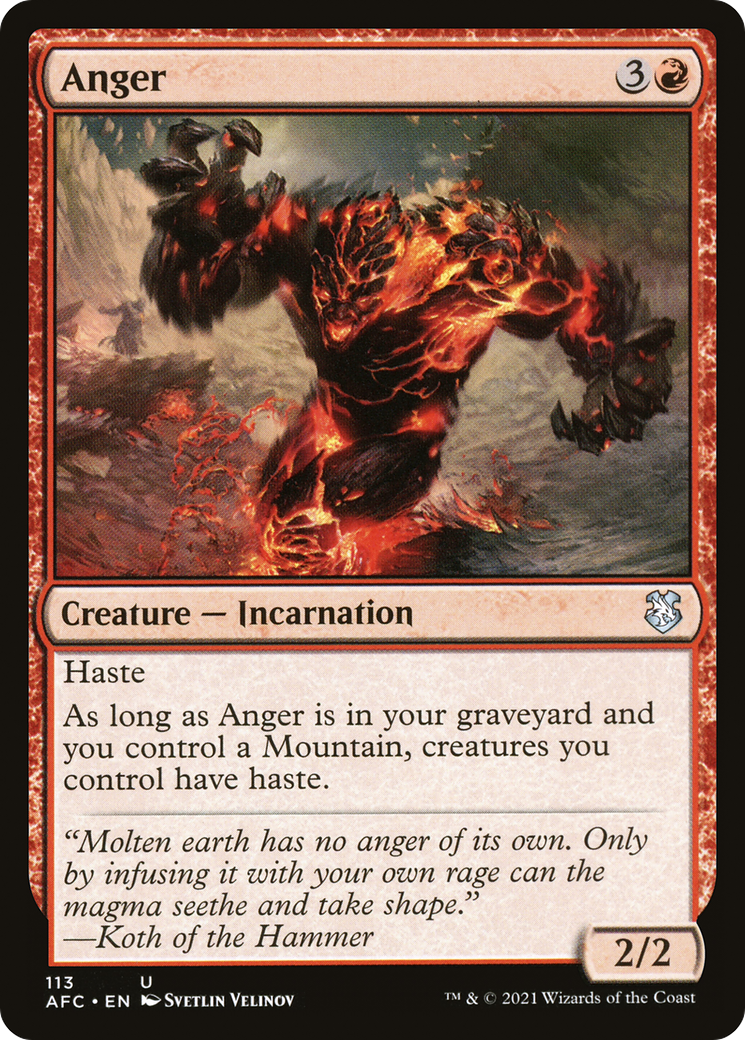
Anger
Anger
Creature — Incarnation
2/2
Haste
As long as this card is in your graveyard and you control a Mountain, creatures you control have haste.
- The timestamp for the "in your graveyard" ability is set at the time that this card goes to your graveyard, regardless of whether you control a Mountain at that time.
-
1
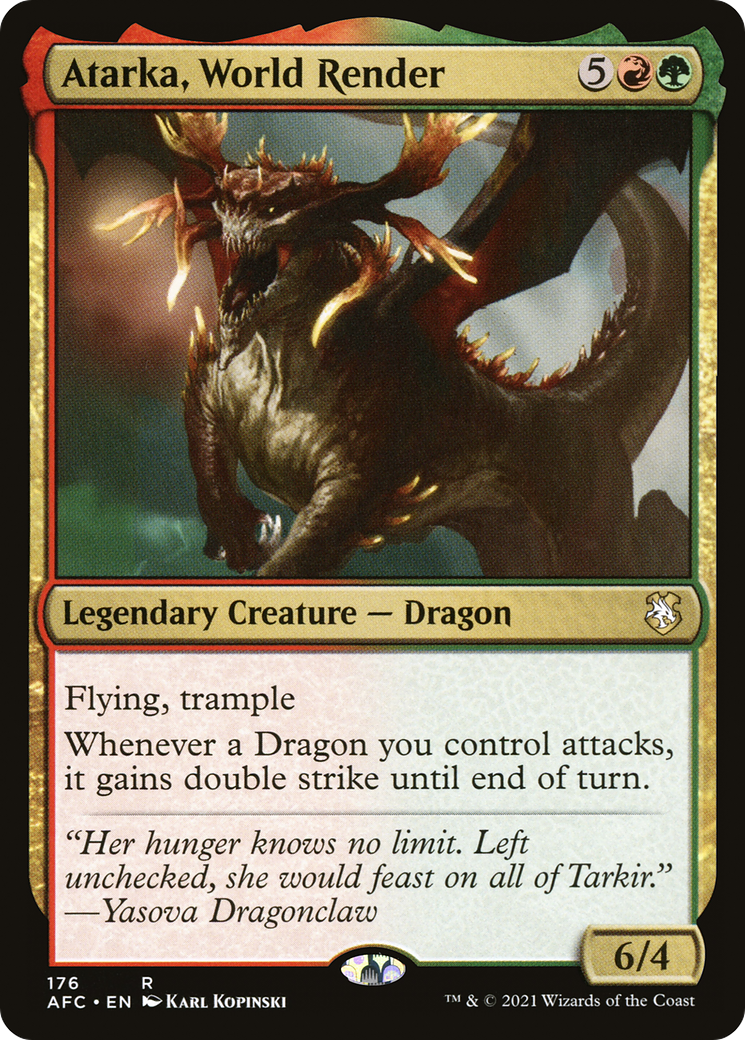
Atarka, World Render
Atarka, World Render
Legendary Creature — Dragon
6/4
Flying, trample
Whenever a Dragon you control attacks, it gains double strike until end of turn.
-
1
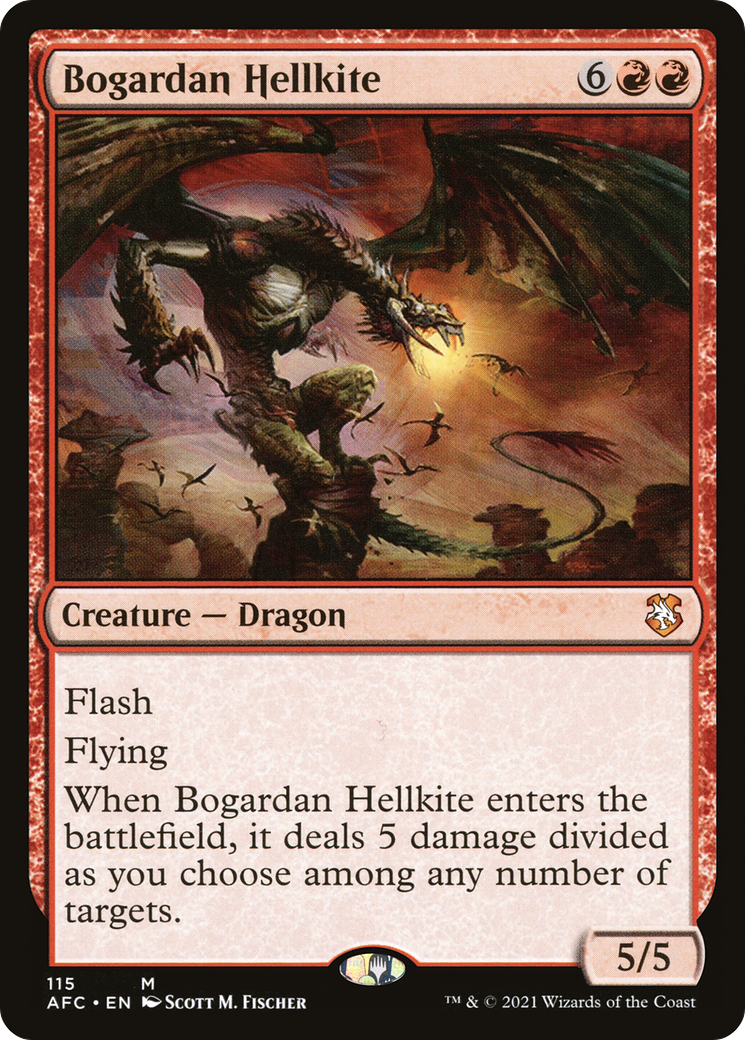
Bogardan Hellkite
Bogardan Hellkite
Creature — Dragon
5/5
Flash
Flying
When this creature enters, it deals 5 damage divided as you choose among any number of targets.
- You choose how many targets Bogardan Hellkite's triggered ability has and how the damage is divided as you put the ability onto the stack. Each target must receive at least 1 damage.
- If some of the creatures or players are illegal targets as Bogardan Hellkite's triggered ability tries to resolve, the original division of damage still applies and the damage that would have been dealt to the illegal targets is lost. It won't be dealt instead to a legal target.
-
1
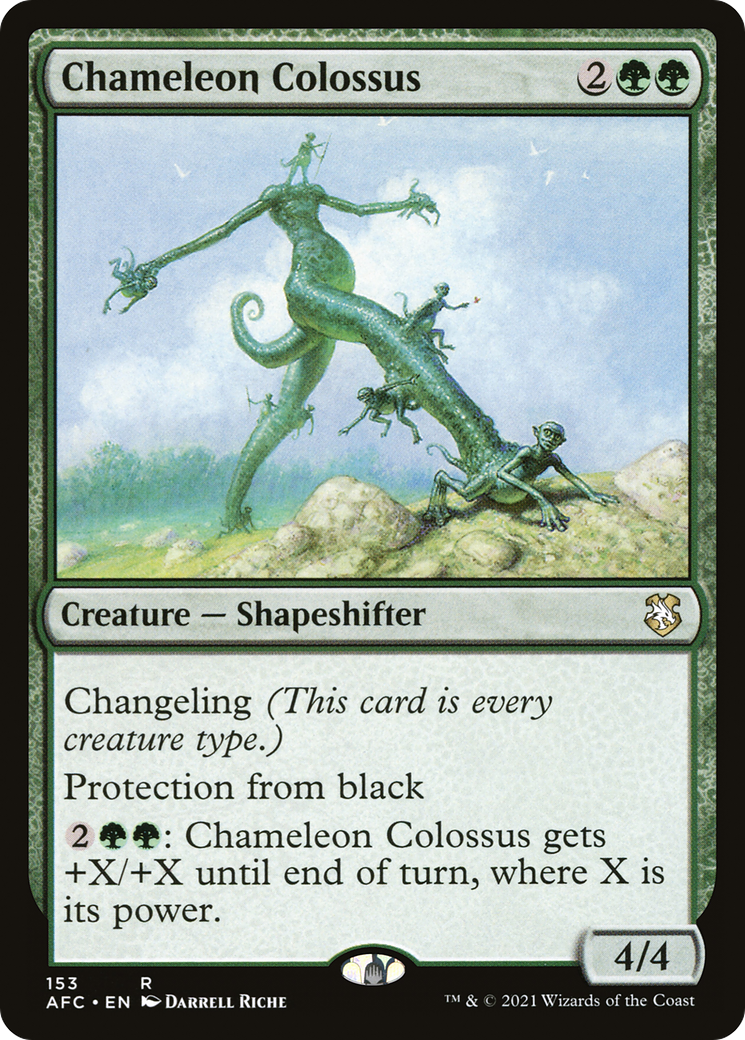
Chameleon Colossus
Chameleon Colossus
Creature — Shapeshifter
4/4
Changeling (This card is every creature type.)
Protection from black
: This creature gets +X/+X until end of turn, where X is its power.
-
1
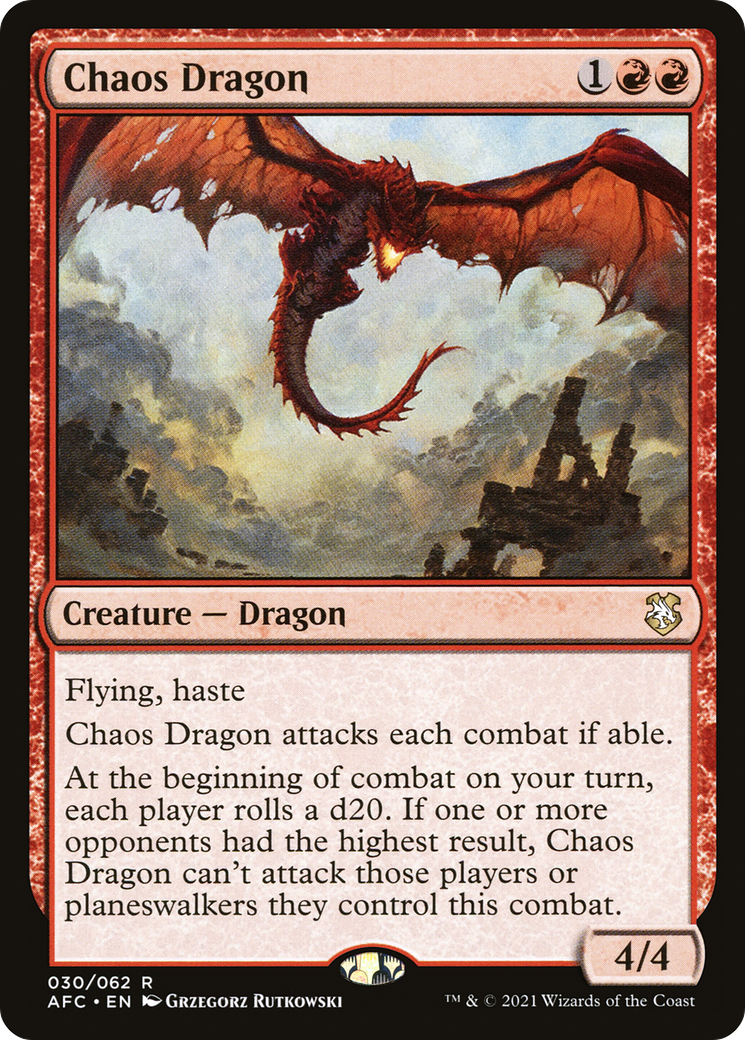
Chaos Dragon
Chaos Dragon
Creature — Dragon
4/4
Flying, haste
This creature attacks each combat if able.
At the beginning of combat on your turn, each player rolls a d20. If one or more opponents had the highest result, this creature can't attack those players or planeswalkers they control this combat.
- You roll a d20 as well as your opponents. If you had a higher result than all of your opponents, Chaos Dragon won't have any restrictions on who it may attack.
- Dice are identified by the number of faces each one has. For example, a d20 is a twenty-sided die.
- Dice used must have equally likely outcomes and the roll must be fair. Although physical dice are recommended, digital substitutes are allowed, provided they have the same number of equally likely outcomes as specified in the original roll instruction.
- An ability that tells you to roll a die will also specify what to do with the result of that roll. Most often, this is in the form of a "results table" in the card text.
- The instruction to roll a die and the effect that occurs because of the result are all part of the same ability. Players do not get the chance to respond to the ability after knowing the result of the roll.
- An effect that says "choose a target, then roll a d20" or similar still uses the normal process of putting an ability on the stack and resolving it. Choosing targets is part of putting the ability on the stack and rolling the d20 happens later, as the ability resolves.
- Some effects may modify the result of a die roll. This may be part of the instruction to roll a die or it may come from other cards. Anything that references the "result" of a die roll is looking for the result after these modifications. Anything that is looking for the "natural result" is looking for the number shown on the face of the die before these modifications.
- Some abilities, like that of Pixie Guide and Barbarian Class, replace rolling a die with rolling extra dice and ignoring the lowest roll. The ignored rolls are not considered for the effect that instructed you to roll a die, and do not cause abilities to trigger. For all intents and purposes, once you determine which dice count, any extra dice were never rolled.
- Some effects instruct you to roll again. This uses the same number and type of dice as the original roll, and that roll will use the same set of possible outcomes.
- While playing Planechase, rolling the planar die will cause any ability that triggers whenever a player rolls one or more dice to trigger. However, any effect that refers to a numerical result will ignore the rolling of the planar die.
- Tournament events have more specific rules regarding dice and die-rolling. For more information, please see the most recent version of the Magic Tournament Rules at https://wpn.wizards.com/en/document/magic-gathering-tournament-rules.
-
1
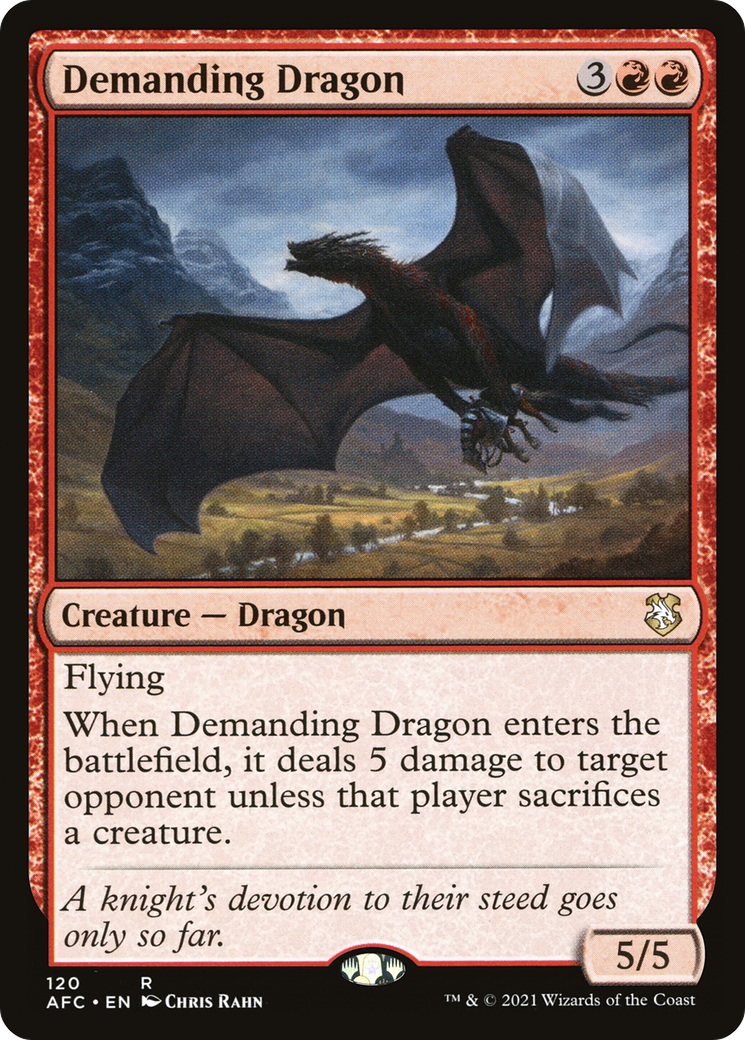
Demanding Dragon
Demanding Dragon
Creature — Dragon
5/5
Flying
When this creature enters, it deals 5 damage to target opponent unless that player sacrifices a creature of their choice.
-
1
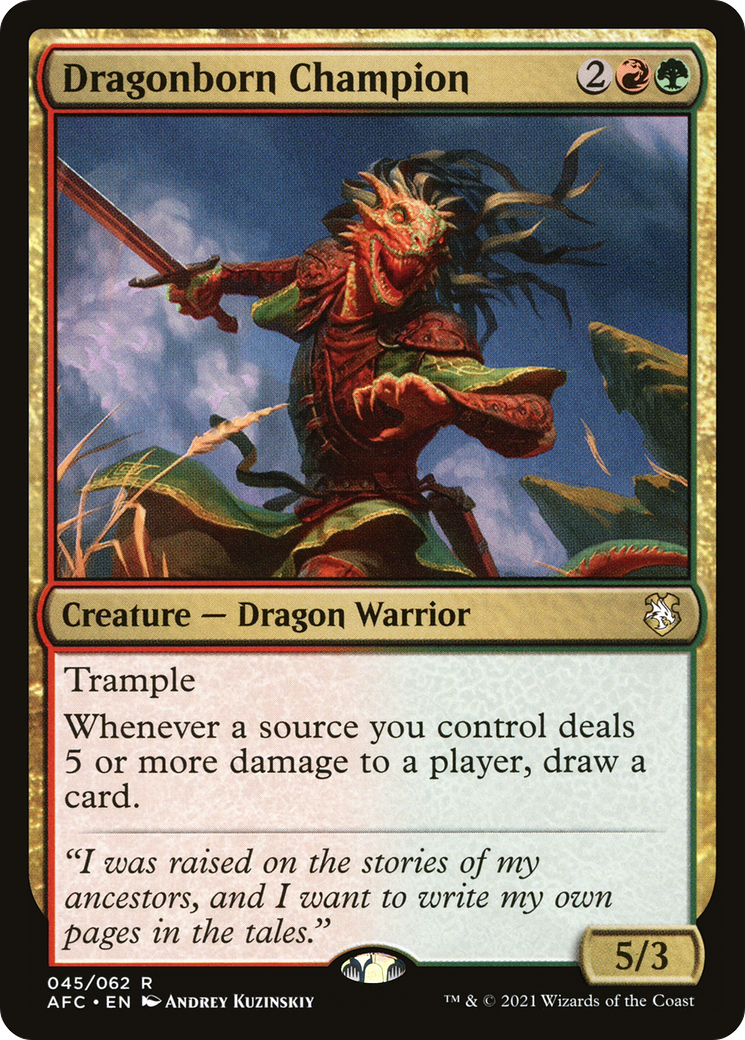
Dragonborn Champion
Dragonborn Champion
Creature — Dragon Warrior
5/3
Trample
Whenever a source you control deals 5 or more damage to a player, draw a card.
- Dragonborn Champion's last ability only triggers if 5 or more damage is dealt by the same source at the same time. If a source deals 3 damage to a player and then later deals 2 more damage to the same player, this will not cause the ability to trigger.
-
1
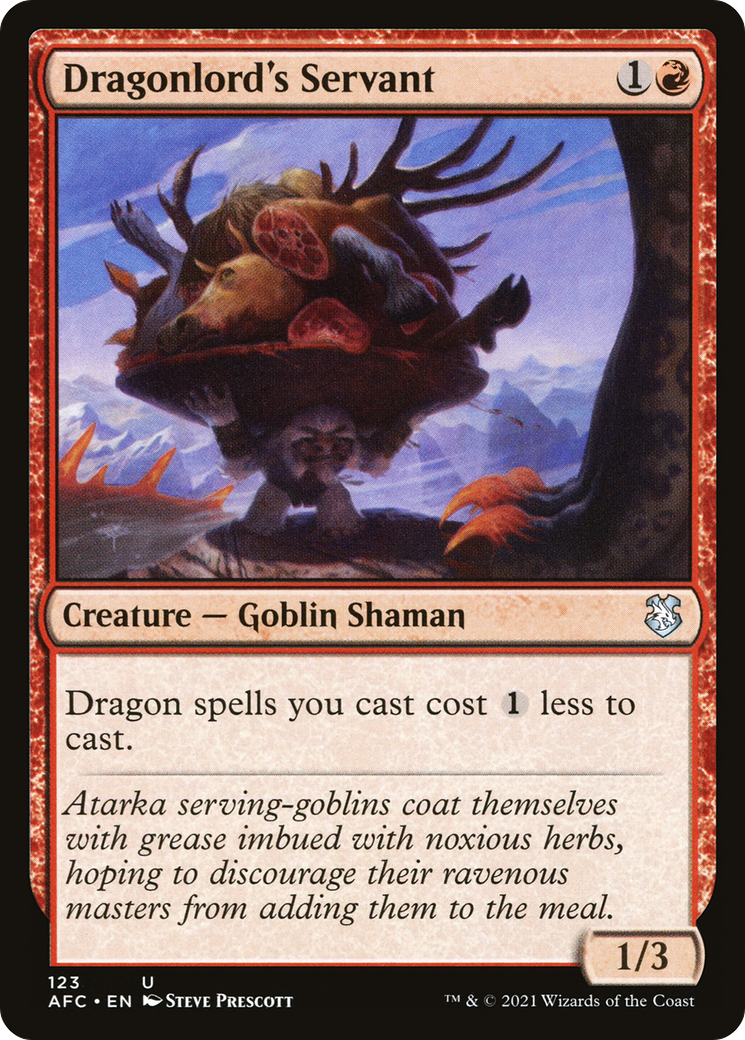
Dragonlord's Servant
Dragonlord's Servant
Creature — Goblin Shaman
1/3
Dragon spells you cast cost less to cast.
- Dragonlord's Servant's ability doesn't change the mana cost or mana value of any spell. It changes only the total cost you pay to cast Dragon spells.
- Dragonlord's Servant's ability can't reduce the amount of colored mana you pay for a spell. It reduces only the generic mana component of that spell.
- Dragonlord's Servant can't reduce the colored mana requirement of a Dragon spell you cast.
- If there are any additional costs to cast a Dragon spell, apply those before applying Dragonlord's Servant and any other cost reductions.
- The ability can apply to alternative costs to cast a Dragon spell.
- To determine the total cost of a spell, start with the mana cost or alternative cost (such as a flashback cost) you're paying, add any cost increases, then apply any cost reductions. The mana value of the spell is determined only by its mana cost, no matter what the total cost to cast the spell was.
-
1
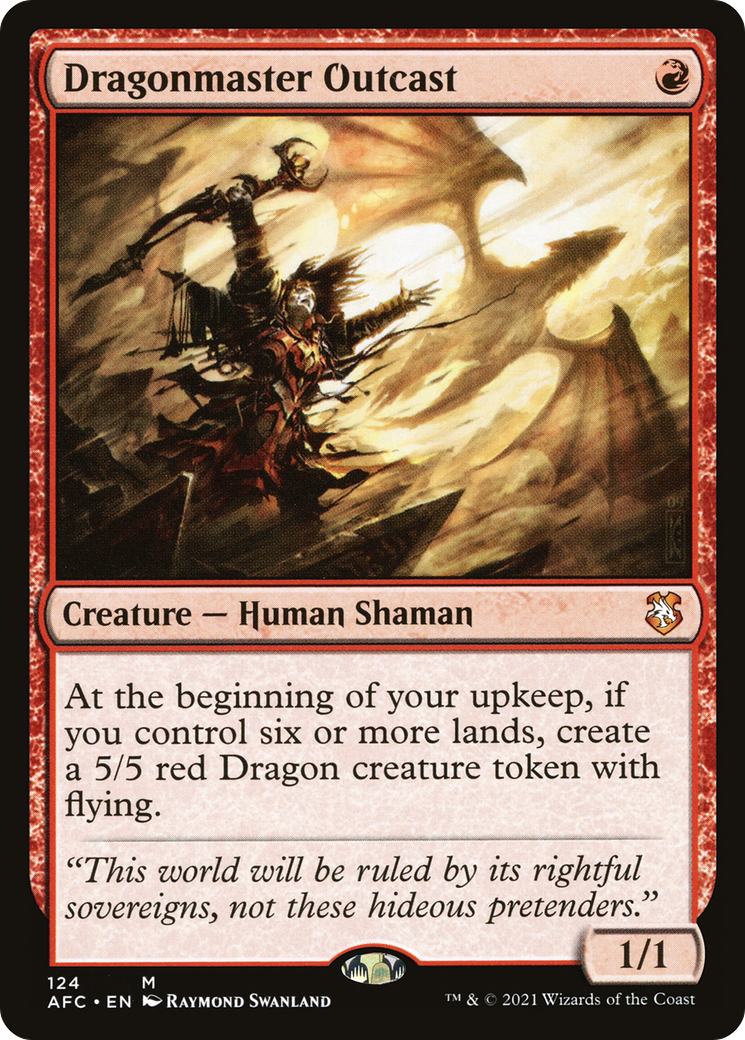
Dragonmaster Outcast
Dragonmaster Outcast
Creature — Human Shaman
1/1
At the beginning of your upkeep, if you control six or more lands, create a 5/5 red Dragon creature token with flying.
-
1
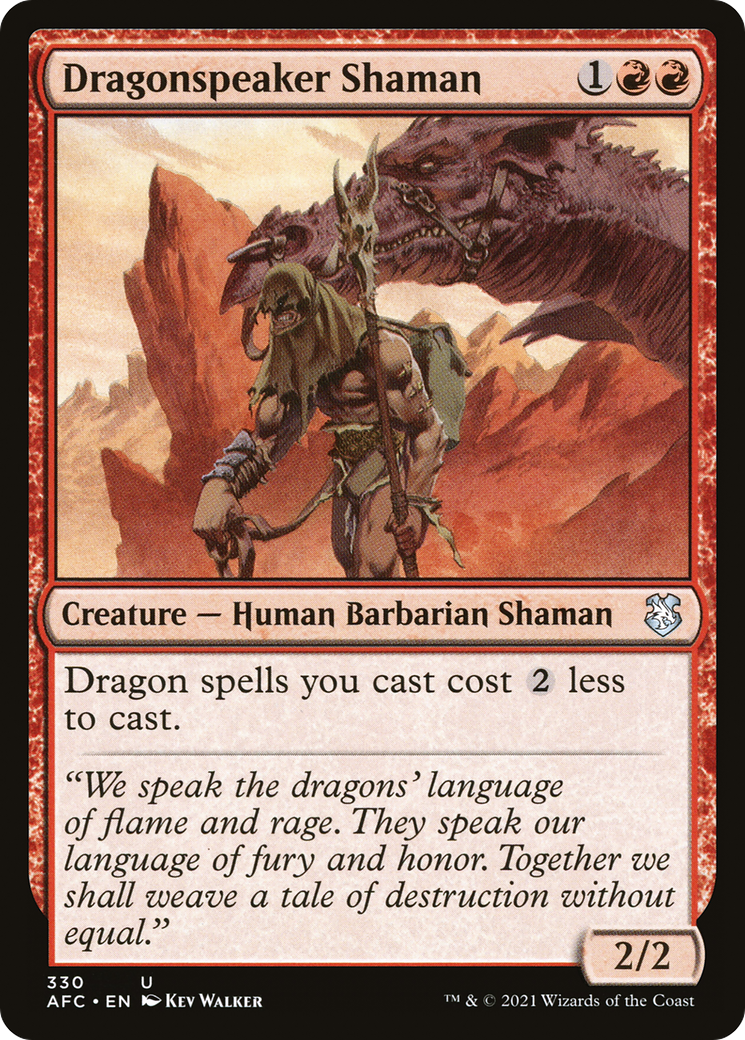
Dragonspeaker Shaman
Dragonspeaker Shaman
Creature — Human Barbarian Shaman
2/2
Dragon spells you cast cost less to cast.
-
1
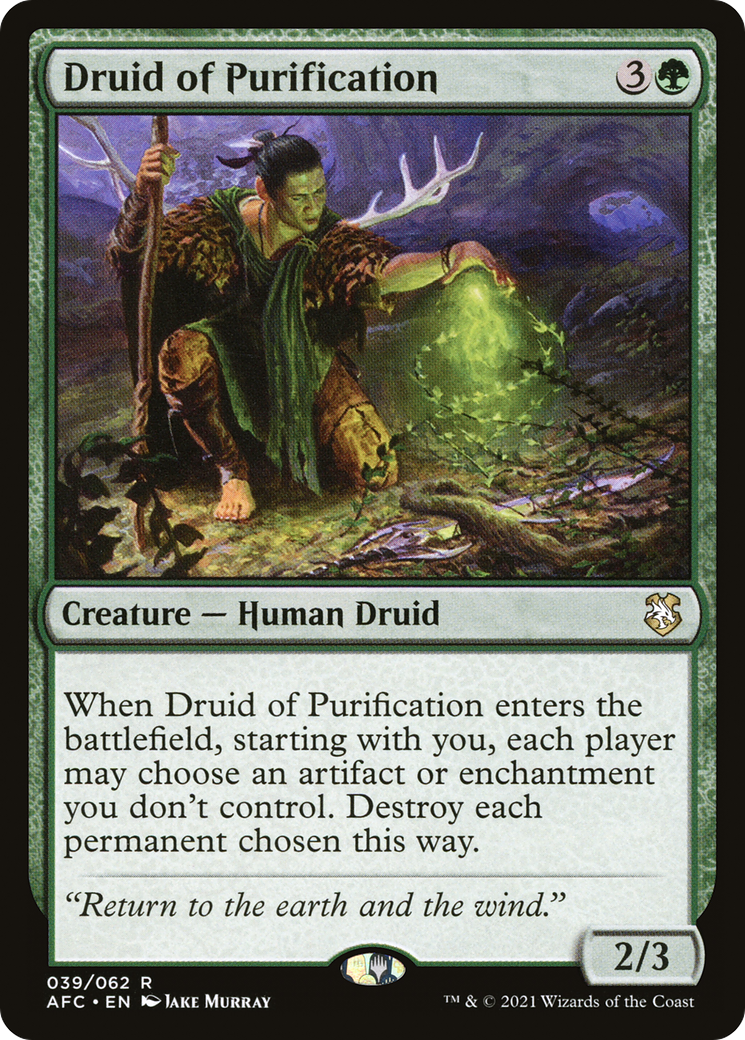
Druid of Purification
Druid of Purification
Creature — Human Druid
2/3
When this creature enters, starting with you, each player may choose an artifact or enchantment you don't control. Destroy each permanent chosen this way.
- Players make their choices in turn order and get to know what choices were made before theirs. They may choose an artifact or an enchantment that was already chosen by another player. Once all players have made their choices, the permanents are destroyed simultaneously.
-
1
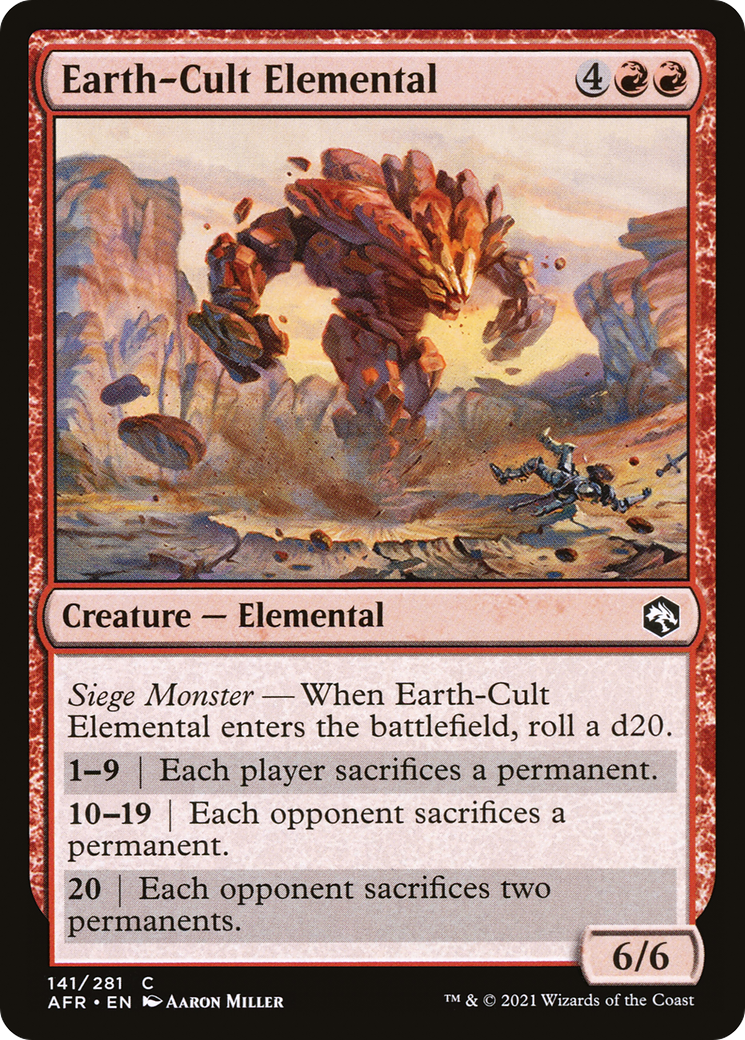
Earth-Cult Elemental
Earth-Cult Elemental
Creature — Elemental
6/6
Siege Monster — When this creature enters, roll a d20.
1—9 | Each player sacrifices a permanent of their choice.
10—19 | Each opponent sacrifices a permanent of their choice.
20 | Each opponent sacrifices two permanents of their choice.
-
1
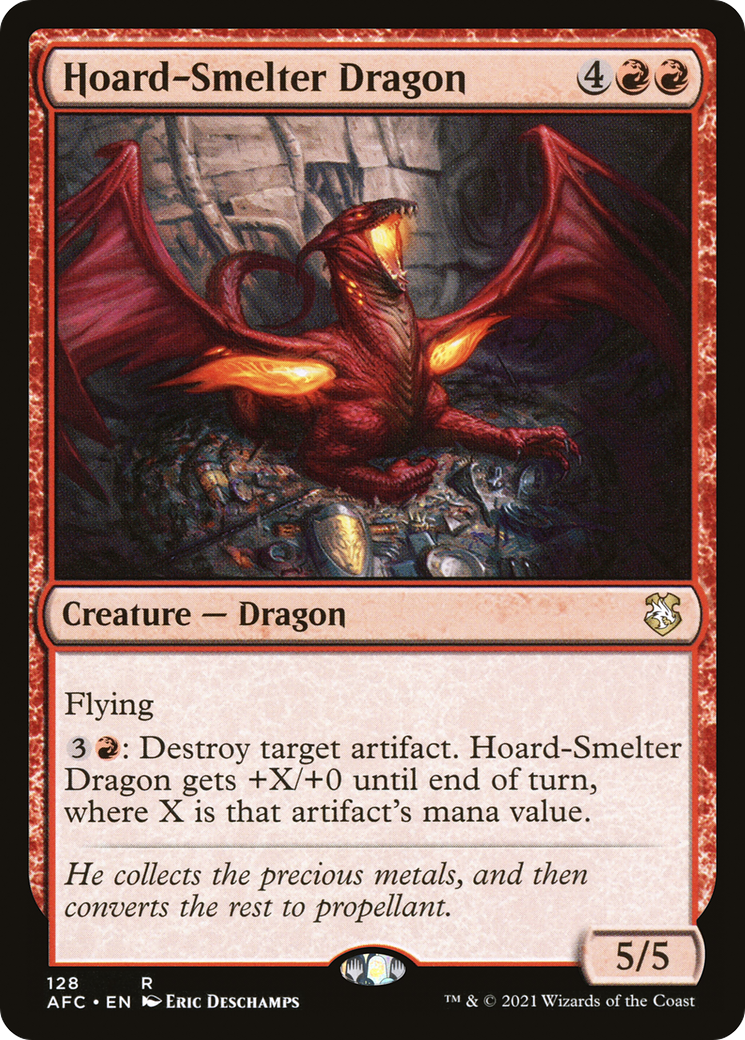
Hoard-Smelter Dragon
Hoard-Smelter Dragon
Creature — Dragon
5/5
Flying
: Destroy target artifact. This creature gets +X/+0 until end of turn, where X is that artifact's mana value.
- If the activated ability resolves but the targeted artifact isn't destroyed (perhaps because it has indestructible or it regenerates), Hoard-Smelter Dragon will still get the bonus.
- If the targeted artifact is an illegal target by the time the activated ability resolves, the ability doesn't resolve. Hoard-Smelter Dragon won't get the bonus.
- If the mana cost of a permanent includes , that X is considered to be 0.
-
1
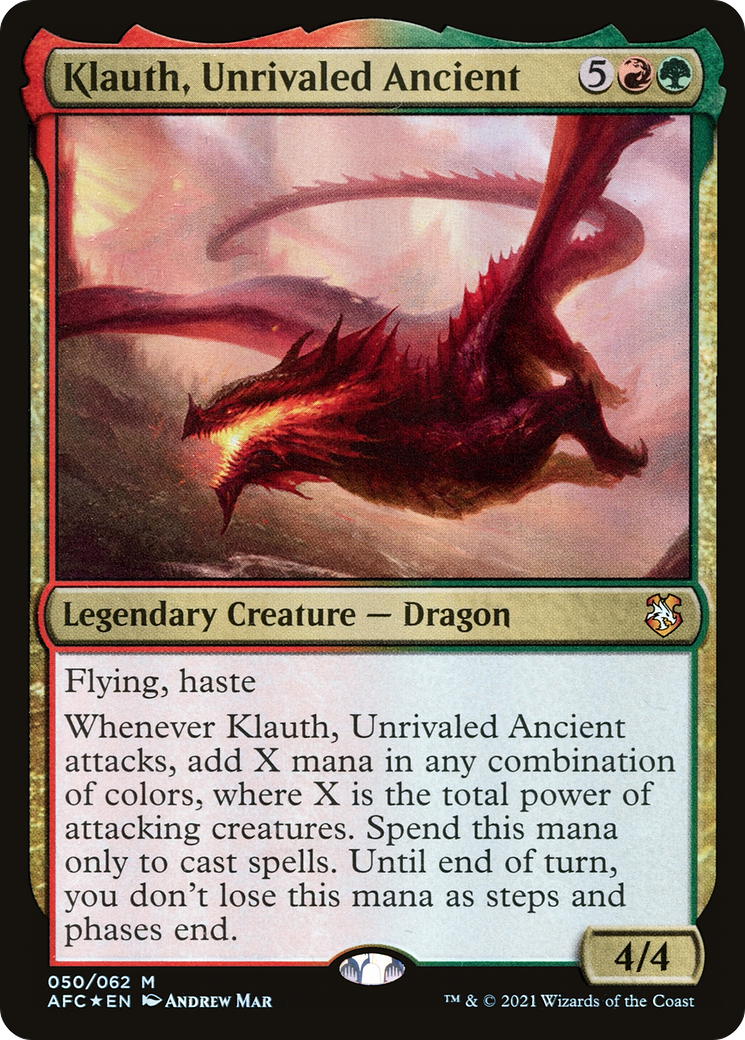
Klauth, Unrivaled Ancient
Klauth, Unrivaled Ancient
Legendary Creature — Dragon
4/4
Flying, haste
Whenever Klauth attacks, add X mana in any combination of colors, where X is the total power of attacking creatures. Spend this mana only to cast spells. Until end of turn, you don't lose this mana as steps and phases end.
- Despite that fact that it can produce mana as it resolves, Klauth's triggered ability is not a mana ability because its trigger condition wasn't the activation or resolution of an activated mana ability. This means that it uses the stack and can be responded to. Notably, players can respond by destroying attacking creatures to reduce the amount of mana produced.
-
1
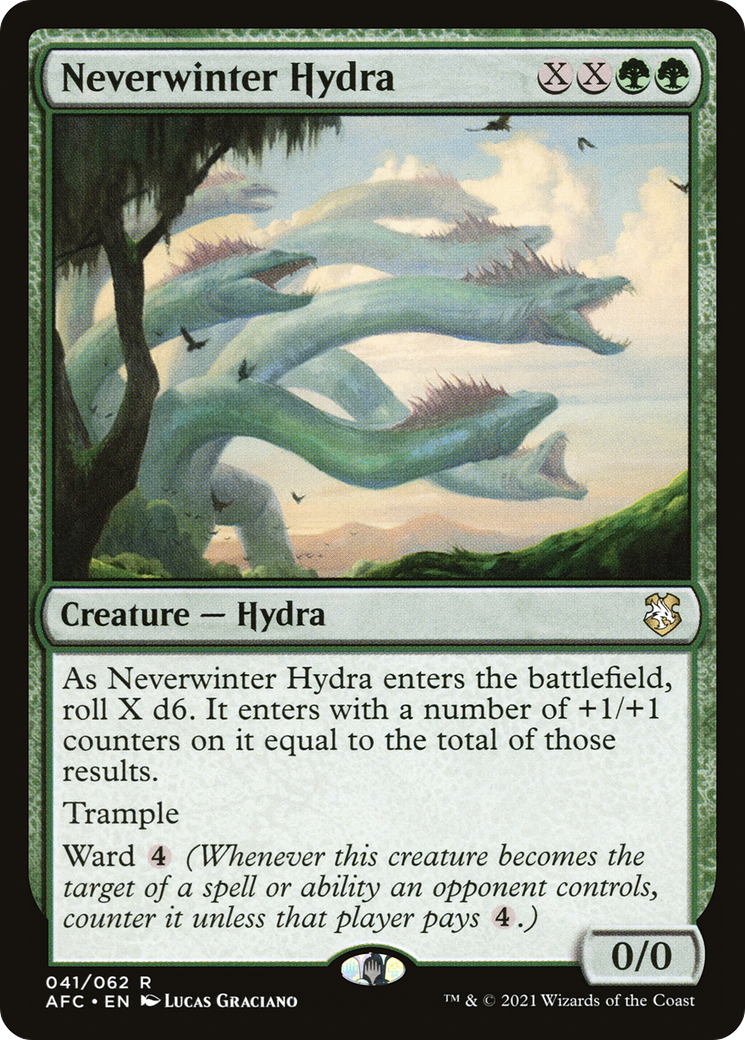
Neverwinter Hydra
Neverwinter Hydra
Creature — Hydra
0/0
As this creature enters, roll X d6. It enters with a number of +1/+1 counters on it equal to the total of those results.
Trample
Ward (Whenever this creature becomes the target of a spell or ability an opponent controls, counter it unless that player pays .)
- Dice are identified by the number of faces each one has. For example, a d20 is a twenty-sided die.
- Dice used must have equally likely outcomes and the roll must be fair. Although physical dice are recommended, digital substitutes are allowed, provided they have the same number of equally likely outcomes as specified in the original roll instruction.
- An ability that tells you to roll a die will also specify what to do with the result of that roll. Most often, this is in the form of a “results table” in the card text.
- The instruction to roll a die and the effect that occurs because of the result are all part of the same ability. Players do not get the chance to respond to the ability after knowing the result of the roll.
- An effect that says “choose a target, then roll a d20” or similar still uses the normal process of putting an ability on the stack and resolving it. Choosing targets is part of putting the ability on the stack and rolling the d20 happens later, as the ability resolves.
- Some effects may modify the result of a die roll. This may be part of the instruction to roll a die or it may come from other cards. Anything that references the “result” of a die roll is looking for the result after these modifications. Anything that is looking for the “natural result” is looking for the number shown on the face of the die before these modifications.
- Some abilities, like that of Pixie Guide and Barbarian Class, replace rolling a die with rolling extra dice and ignoring the lowest roll. The ignored rolls are not considered for the effect that instructed you to roll a die, and do not cause abilities to trigger. For all intents and purposes, once you determine which dice count, any extra dice were never rolled.
- Some effects instruct you to roll again. This uses the same number and type of dice as the original roll, and that roll will use the same set of possible outcomes.
- While playing Planechase, rolling the planar die will cause any ability that triggers whenever a player rolls one or more dice to trigger. However, any effect that refers to a numerical result will ignore the rolling of the planar die.
- Tournament events have more specific rules regarding dice and die-rolling. For more information, please see the most recent version of the Magic Tournament Rules at https://wpn.wizards.com/en/document/magic-gathering-tournament-rules.
- If a player casts a spell that targets multiple permanents their opponent controls with ward, each of those ward abilities will trigger. If that player doesn't pay for all of them, the spell will be countered.
-
1
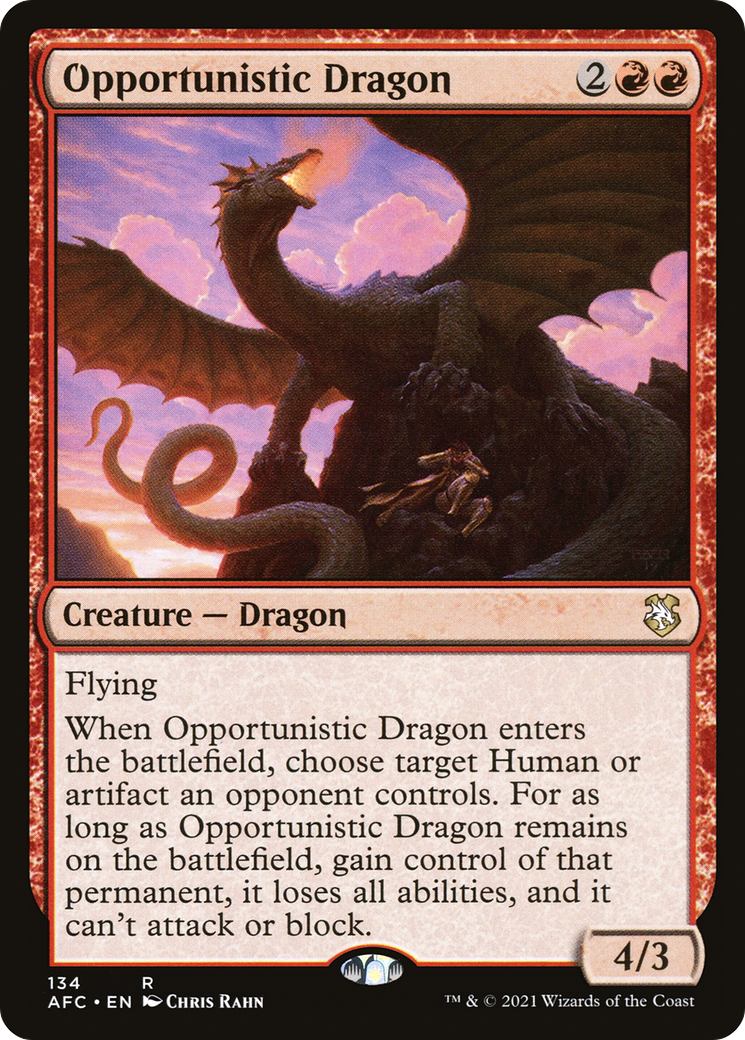
Opportunistic Dragon
Opportunistic Dragon
Creature — Dragon
4/3
Flying
When this creature enters, choose target Human or artifact an opponent controls. For as long as this creature remains on the battlefield, gain control of that permanent, it loses all abilities, and it can't attack or block.
- If Opportunistic Dragon leaves the battlefield before its triggered ability resolves, your opponent keeps control of their Human or artifact, it doesn't lose any abilities, and it can still attack or block as normal. You don't gain control of it at all.
- Opportunistic Dragon's effect doesn't expire if another player gains control of it or if it loses all abilities. The effect only expires once it's no longer on the battlefield.
- If another player gains control of the permanent Opportunistic Dragon has kidnapped, that permanent doesn't regain its abilities and still can't attack or block.
- If the stolen permanent normally has any abilities that would trigger when Opportunistic Dragon dies, those abilities won't trigger.
-
1
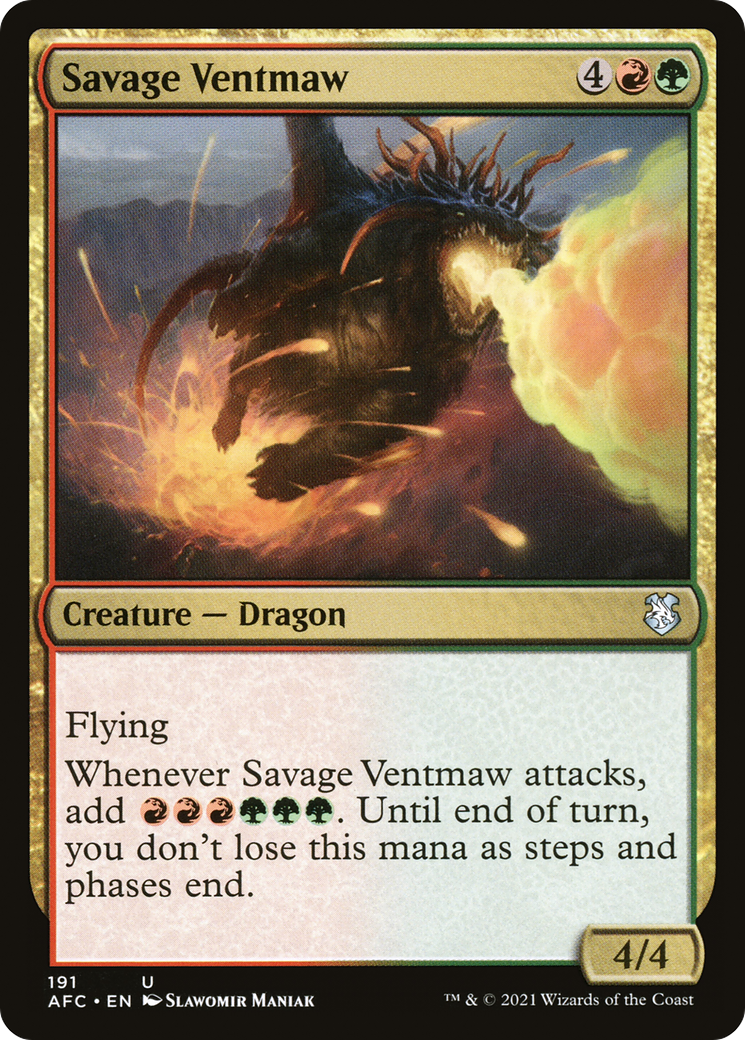
Savage Ventmaw
Savage Ventmaw
Creature — Dragon
4/4
Flying
Whenever this creature attacks, add . Until end of turn, you don't lose this mana as steps and phases end.
- This mana won't be lost as steps and phases end for the remainder of the turn even if Savage Ventmaw leaves the battlefield during the turn.
-
1
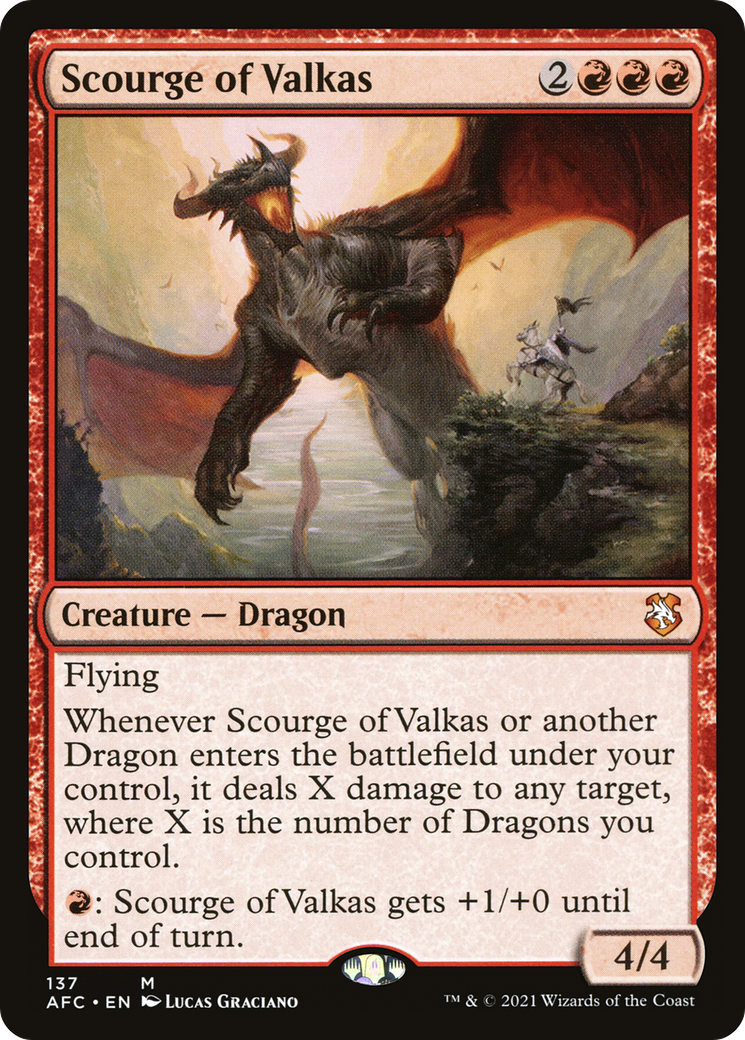
Scourge of Valkas
Scourge of Valkas
Creature — Dragon
4/4
Flying
Whenever this creature or another Dragon you control enters, it deals X damage to any target, where X is the number of Dragons you control.
: This creature gets +1/+0 until end of turn.
- The amount of damage dealt by the Dragon that entered the battlefield is based on the number of Dragons you control when the ability resolves.
- If a Dragon entering the battlefield causes Scourge of Valkas's ability to trigger but leaves the battlefield before that ability resolves, that Dragon still deals damage.
-
1
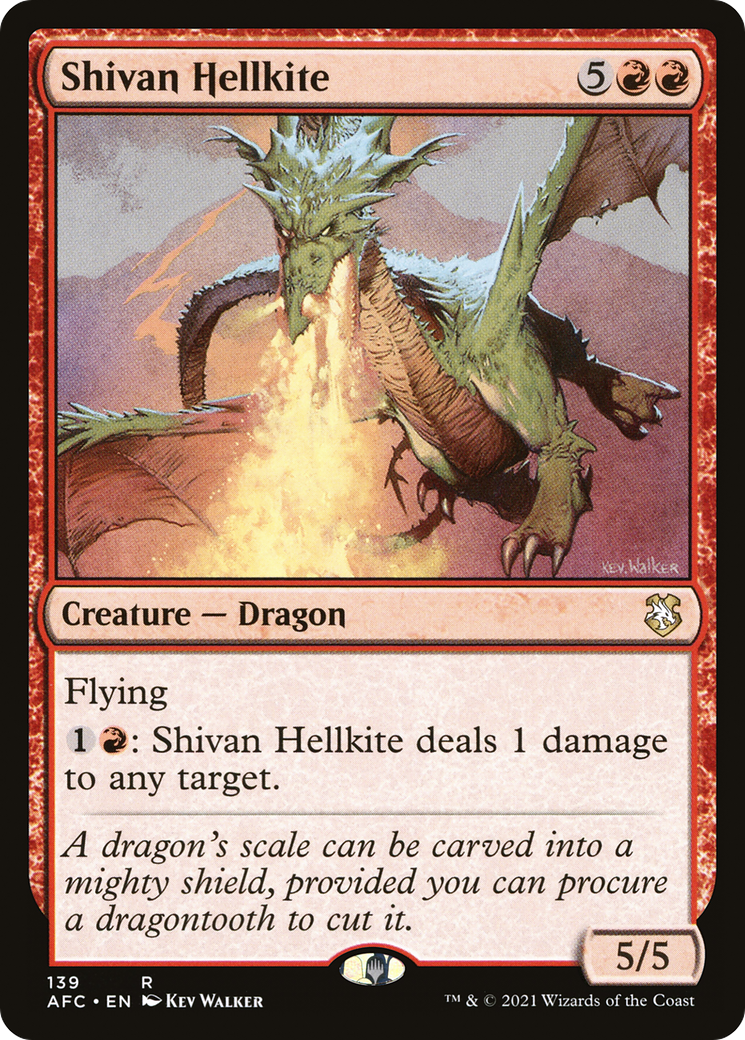
Shivan Hellkite
Shivan Hellkite
Creature — Dragon
5/5
Flying (This creature can't be blocked except by creatures with flying or reach.)
: This creature deals 1 damage to any target.
-
1
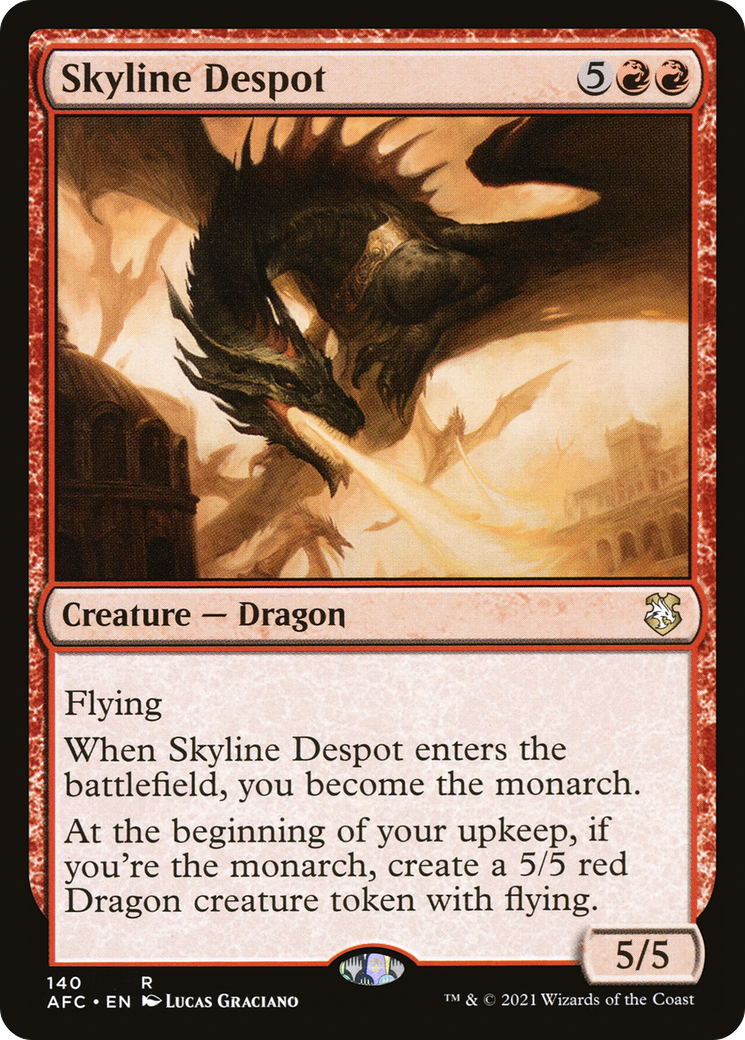
Skyline Despot
Skyline Despot
Creature — Dragon
5/5
Flying
When this creature enters, you become the monarch.
At the beginning of your upkeep, if you're the monarch, create a 5/5 red Dragon creature token with flying.
- The last ability of Skyline Despot checks to see if you're the monarch as your upkeep begins. If you're not, the ability won't trigger at all. You won't be able to do anything that would make you the monarch during your upkeep in time to have that ability trigger. The ability will also check to see if you're the monarch as it tries to resolve. If you're not the monarch at that time, the ability will have no effect.
- The game starts with no monarch. Once an effect makes one player the monarch, the game will have exactly one monarch from that point forward.
- Being the monarch carries two inherent triggered abilities. “At the beginning of the monarch's end step, that player draws a card” and “Whenever a creature deals combat damage to the monarch, its controller becomes the monarch.”
- Abilities that trigger whenever you “become the monarch” trigger only if you aren't already the monarch. For example, if you are already the monarch as Custodi Lich enters the battlefield, its last ability won't trigger.
- If the triggered ability that causes the monarch to draw a card goes on the stack, and a different player becomes the monarch before that ability resolves, the first player will still draw the card.
-
1
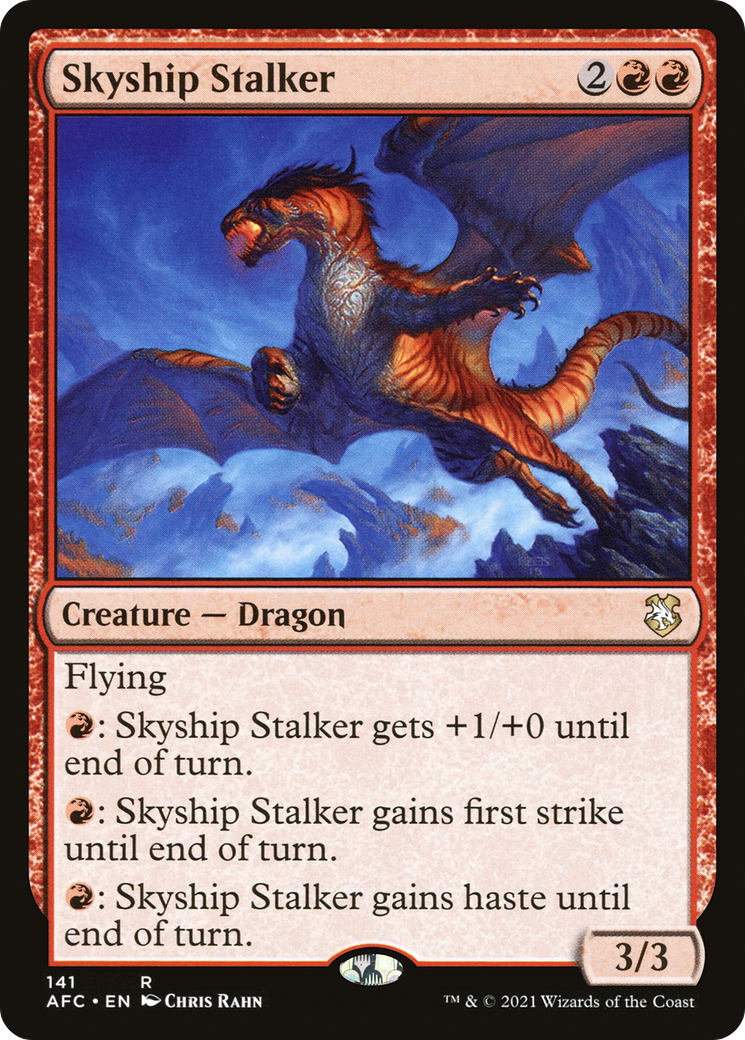
Skyship Stalker
Skyship Stalker
Creature — Cat Dragon
3/3
Flying
: This creature gets +1/+0 until end of turn.
: This creature gains first strike until end of turn.
: This creature gains haste until end of turn.
-
1
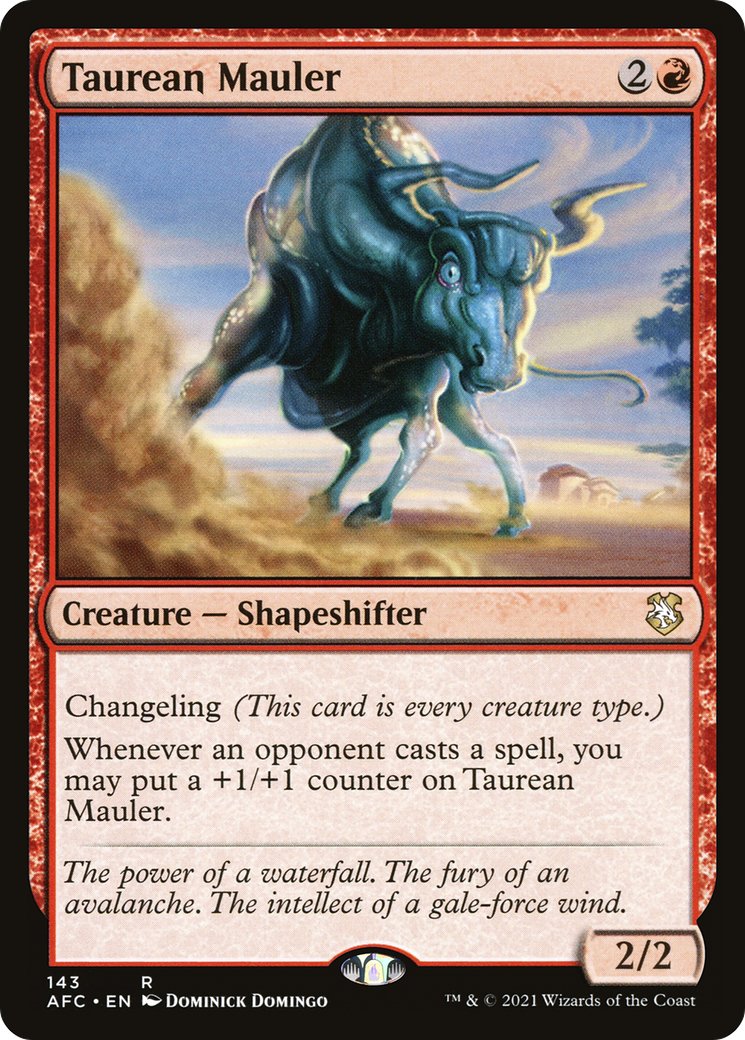
Taurean Mauler
Taurean Mauler
Creature — Shapeshifter
2/2
Changeling (This card is every creature type.)
Whenever an opponent casts a spell, you may put a +1/+1 counter on this creature.
- Taurean Mauler's last ability resolves before the spell that caused it to trigger. It resolves even if that spell is countered or otherwise leaves the stack without resolving.
-
1
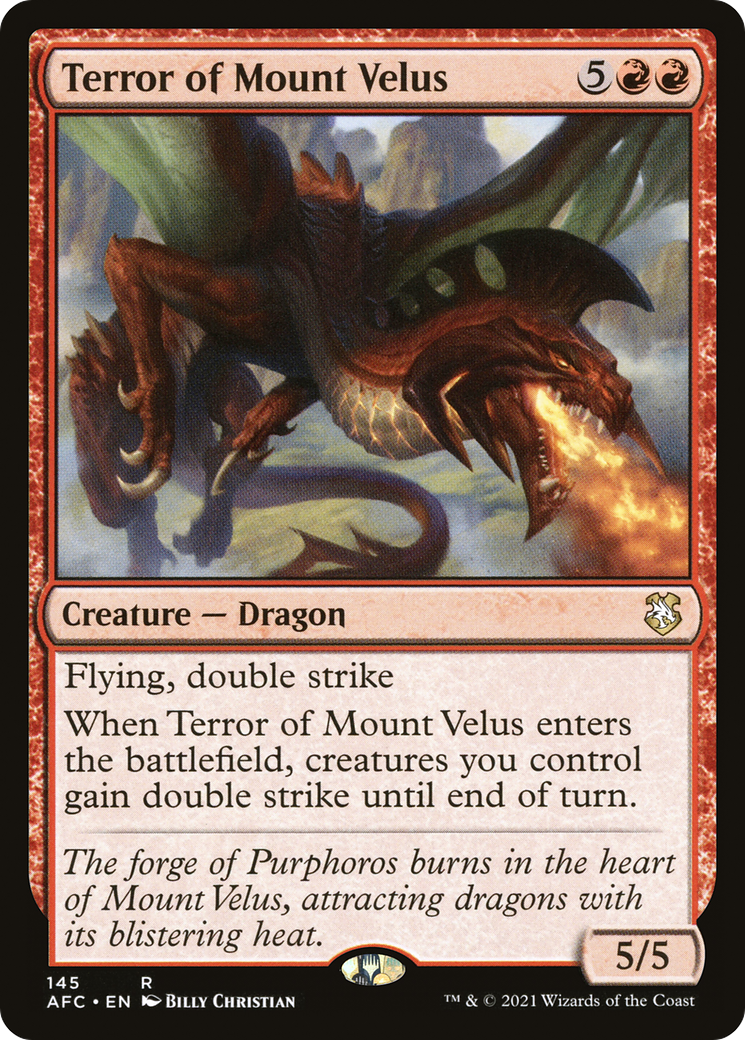
Terror of Mount Velus
Terror of Mount Velus
Creature — Dragon
5/5
Flying
Double strike (This creature deals both first-strike and regular combat damage.)
When this creature enters, creatures you control gain double strike until end of turn.
- Multiple instances of double strike on the same creature are redundant.
- The triggered ability affects only creatures you control at the time it resolves. Creatures you begin to control later in the turn won't gain double strike.
-
1
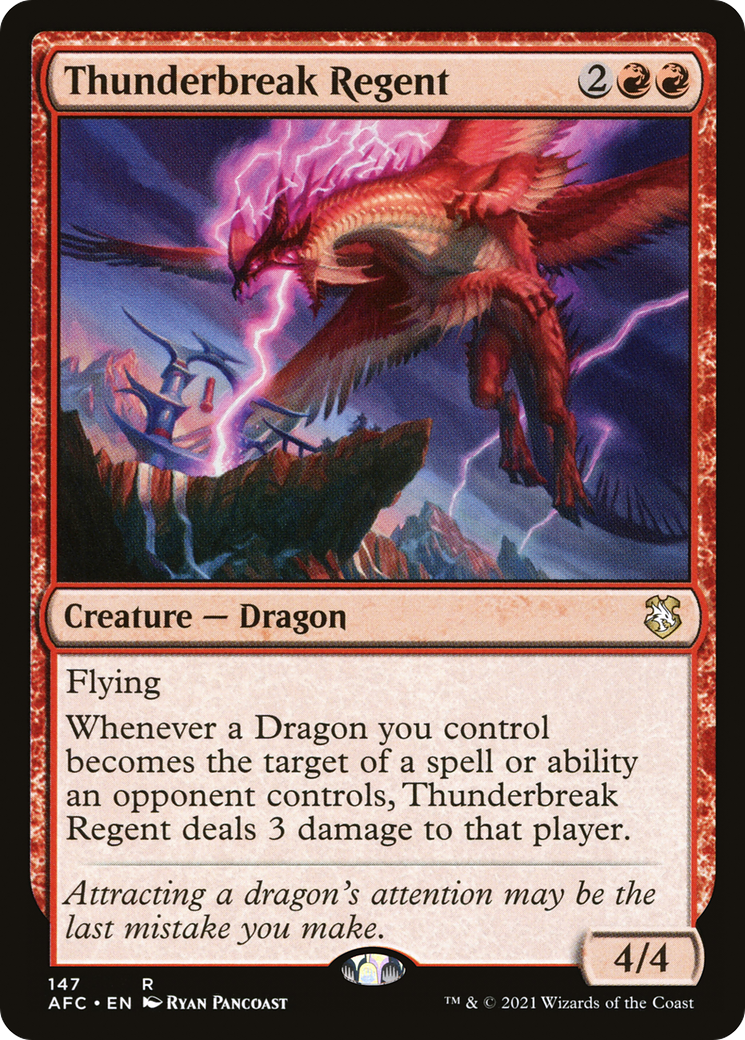
Thunderbreak Regent
Thunderbreak Regent
Creature — Dragon
4/4
Flying
Whenever a Dragon you control becomes the target of a spell or ability an opponent controls, this creature deals 3 damage to that player.
- Thunderbreak Regent's ability will resolve before the spell or ability that caused it to trigger.
-
1
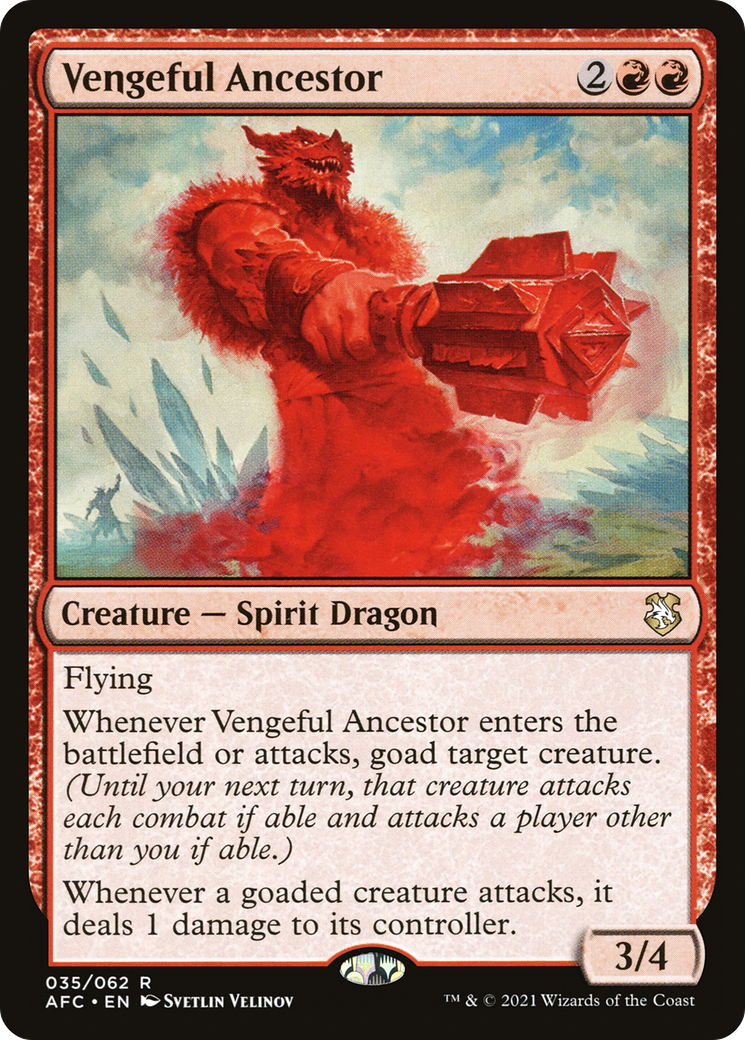
Vengeful Ancestor
Vengeful Ancestor
Creature — Spirit Dragon
3/4
Flying
Whenever this creature enters or attacks, goad target creature. (Until your next turn, that creature attacks each combat if able and attacks a player other than you if able.)
Whenever a goaded creature attacks, it deals 1 damage to its controller.
-
1
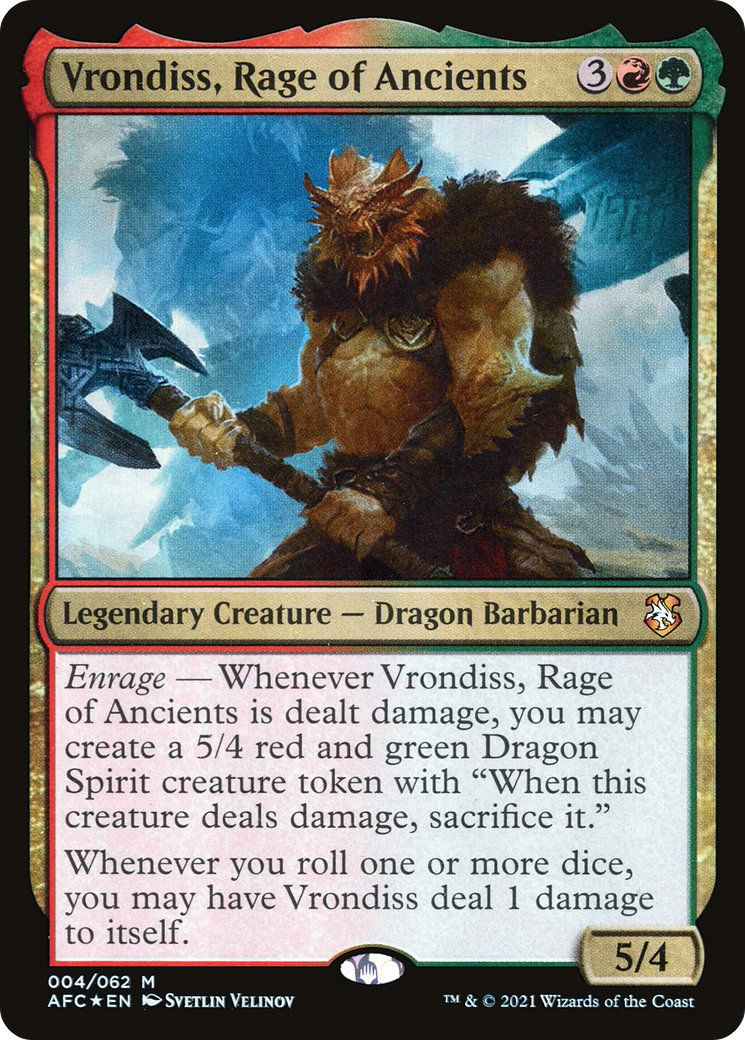
Vrondiss, Rage of Ancients
Vrondiss, Rage of Ancients
Legendary Creature — Dragon Barbarian
5/4
Enrage — Whenever Vrondiss is dealt damage, you may create a 5/4 red and green Dragon Spirit creature token with "When this token deals damage, sacrifice it."
Whenever you roll one or more dice, you may have Vrondiss deal 1 damage to itself.
-
1
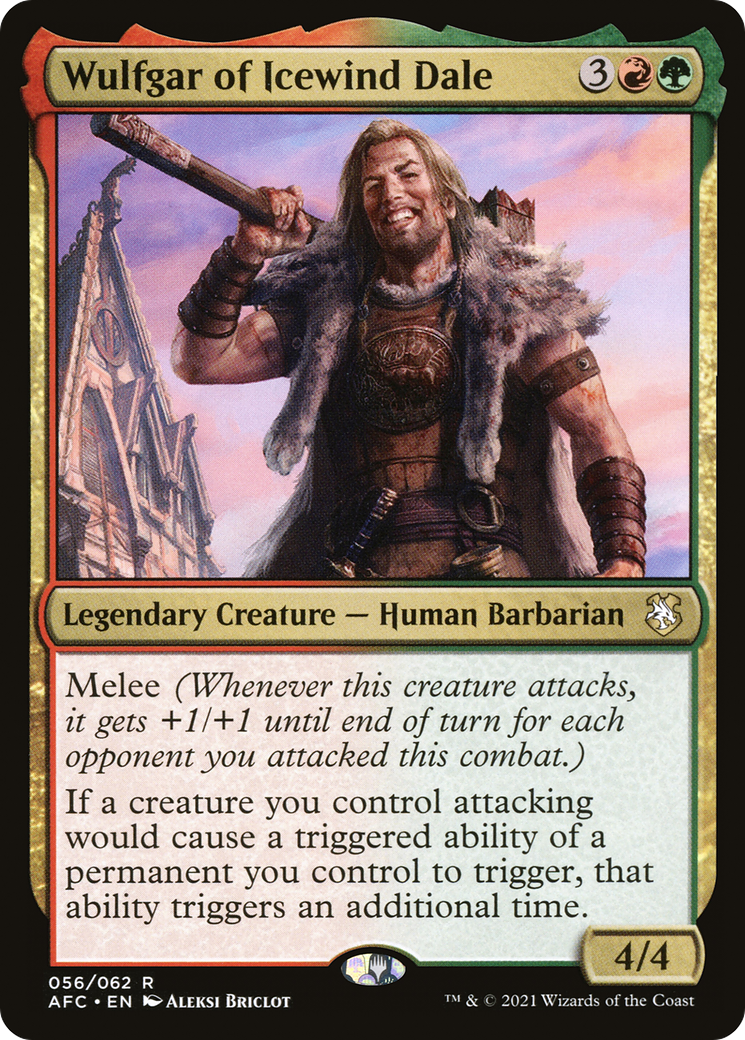
Wulfgar of Icewind Dale
Wulfgar of Icewind Dale
Legendary Creature — Human Barbarian
4/4
Melee (Whenever this creature attacks, it gets +1/+1 until end of turn for each opponent you attacked this combat.)
If a creature you control attacking causes a triggered ability of a permanent you control to trigger, that ability triggers an additional time.
- Wulfgar of Icewind Dale's last ability affects only triggered abilities with conditions that are directly related to attacking, such as “whenever this creature attacks” or “whenever you attack with one or more creatures.” It does not affect triggered abilities with other trigger conditions, such as “whenever this creature becomes tapped.”
- Wulfgar's last ability will cause its melee ability to trigger an additional time.
Instants 9
-
1
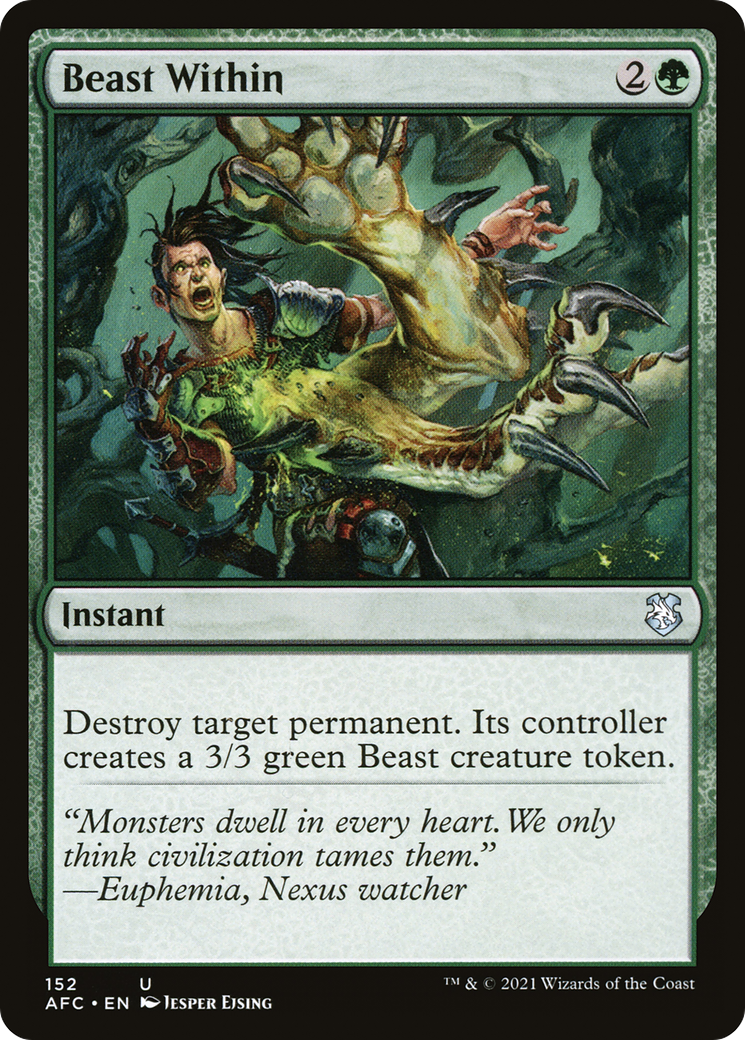
Beast Within
Beast Within
Instant
Destroy target permanent. Its controller creates a 3/3 green Beast creature token.
- If the target permanent is an illegal target by the time Beast Within tries to resolve, the spell won't resolve. No player creates a Beast token. If the target is legal but not destroyed (most likely because it has indestructible), its controller does create a Beast token.
-
1
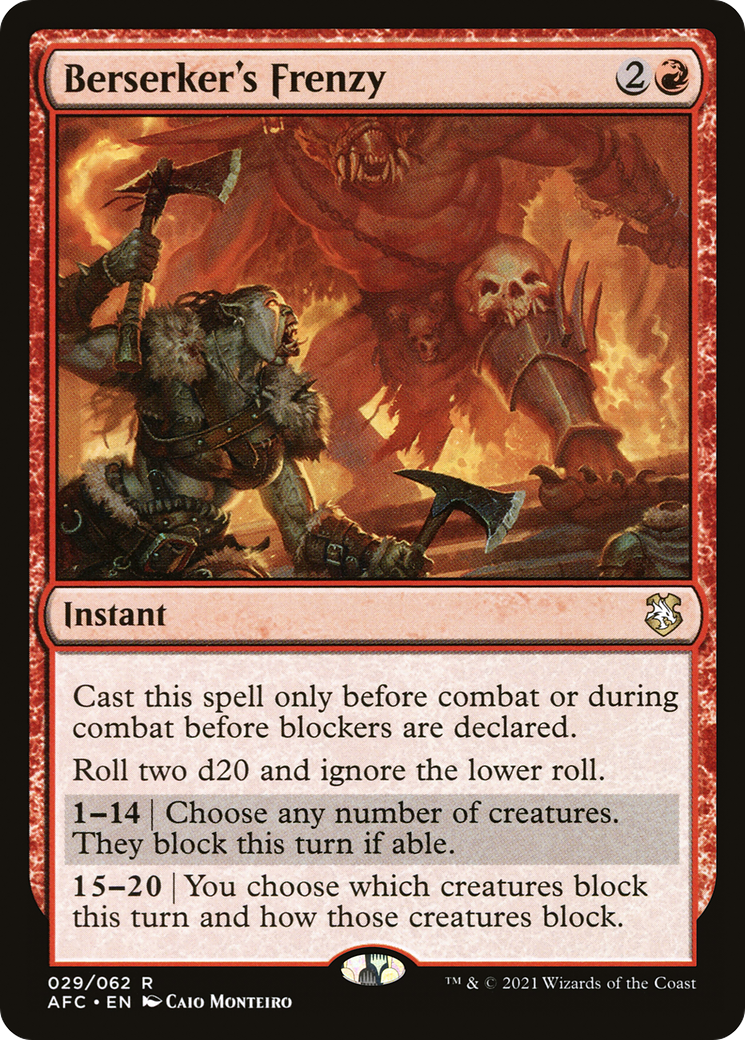
Berserker's Frenzy
Berserker's Frenzy
Instant
Cast this spell only before combat or during combat before blockers are declared.
Roll two d20 and ignore the lower roll.
1—14 | Choose any number of creatures. They block this turn if able.
15—20 | You choose which creatures block this turn and how those creatures block.
- If you roll doubles, ignore one of the rolls and use the result of the other.
- An ignored roll effectively never happens. No abilities will trigger because of an ignored roll.
- When choosing blocks for creatures you don't control, you must still make legal choices. For example, you can't choose to have a creature without flying or reach block a creature with flying.
- If there's a cost associated with having a creature block and you choose for that creature to block, its controller can choose to pay that cost or not. If that player doesn't pay that cost, you must propose a new set of blocking creatures.
- Dice are identified by the number of faces each one has. For example, a d20 is a twenty-sided die.
- Dice used must have equally likely outcomes and the roll must be fair. Although physical dice are recommended, digital substitutes are allowed, provided they have the same number of equally likely outcomes as specified in the original roll instruction.
- An ability that tells you to roll a die will also specify what to do with the result of that roll. Most often, this is in the form of a “results table” in the card text.
- The instruction to roll a die and the effect that occurs because of the result are all part of the same ability. Players do not get the chance to respond to the ability after knowing the result of the roll.
- An effect that says “choose a target, then roll a d20” or similar still uses the normal process of putting an ability on the stack and resolving it. Choosing targets is part of putting the ability on the stack and rolling the d20 happens later, as the ability resolves.
- Some effects may modify the result of a die roll. This may be part of the instruction to roll a die or it may come from other cards. Anything that references the “result” of a die roll is looking for the result after these modifications. Anything that is looking for the “natural result” is looking for the number shown on the face of the die before these modifications.
- Some abilities, like that of Pixie Guide and Barbarian Class, replace rolling a die with rolling extra dice and ignoring the lowest roll. The ignored rolls are not considered for the effect that instructed you to roll a die, and do not cause abilities to trigger. For all intents and purposes, once you determine which dice count, any extra dice were never rolled.
- Some effects instruct you to roll again. This uses the same number and type of dice as the original roll, and that roll will use the same set of possible outcomes.
- While playing Planechase, rolling the planar die will cause any ability that triggers whenever a player rolls one or more dice to trigger. However, any effect that refers to a numerical result will ignore the rolling of the planar die.
- Tournament events have more specific rules regarding dice and die-rolling. For more information, please see the most recent version of the Magic Tournament Rules at https://wpn.wizards.com/en/document/magic-gathering-tournament-rules.
-
1
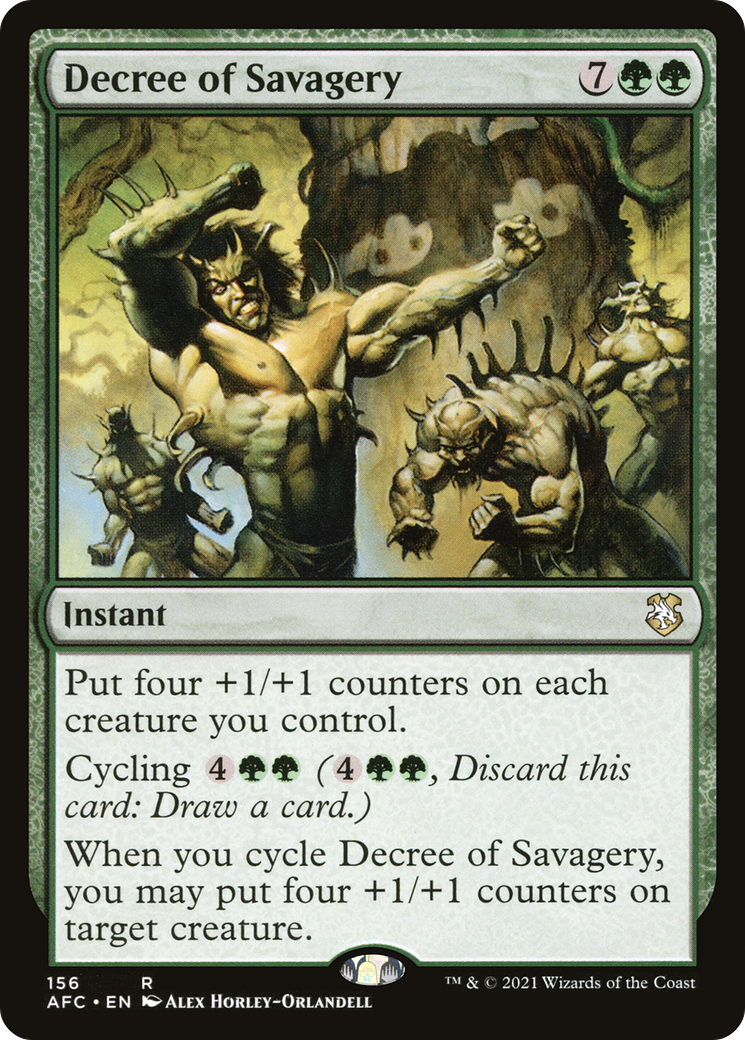
Decree of Savagery
Decree of Savagery
Instant
Put four +1/+1 counters on each creature you control.
Cycling ( , Discard this card: Draw a card.)
When you cycle this card, you may put four +1/+1 counters on target creature.
- When you cycle this card, first the cycling ability goes on the stack, then the triggered ability goes on the stack on top of it. The triggered ability will resolve before you draw a card from the cycling ability.
- The cycling ability and the triggered ability are separate. If the triggered ability doesn't resolve (because, for example, it has been countered, or all of its targets have become illegal), the cycling ability will still resolve, and you'll draw a card.
- You can cycle this card even if there are no legal targets for the triggered ability.
-
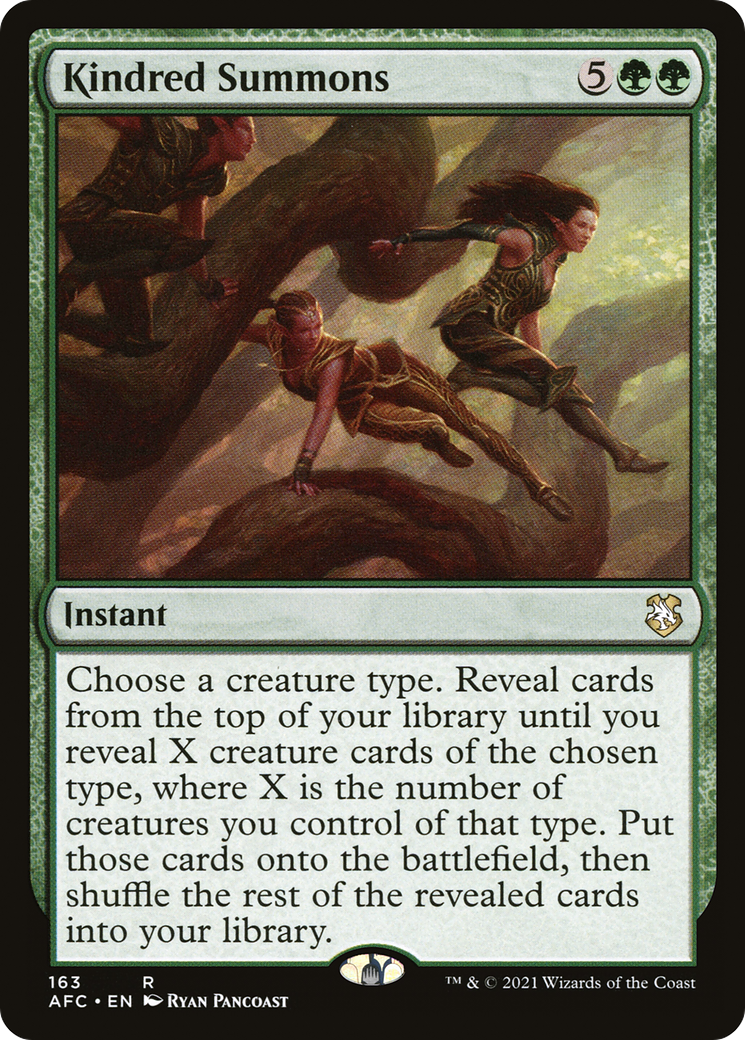
1
Kindred Summons
Kindred Summons
Instant
Choose a creature type. Reveal cards from the top of your library until you reveal X creature cards of the chosen type, where X is the number of creatures you control of that type. Put those cards onto the battlefield, then shuffle the rest of the revealed cards into your library.
- If you reveal your entire library and reveal fewer than X creature cards of the chosen type, you'll put the cards of the chosen type that you did reveal onto the battlefield and shuffle your library.
-
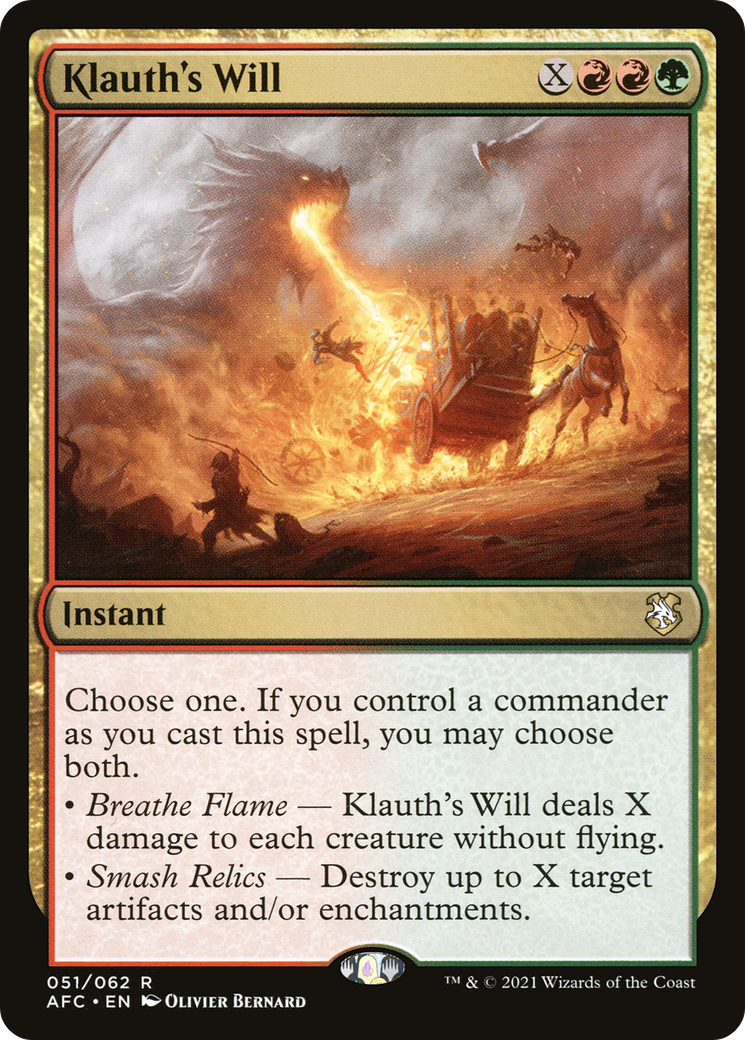
1
Klauth's Will
Klauth's Will
Instant
Choose one. If you control a commander as you cast this spell, you may choose both instead.
- Breathe Flame — Klauth's Will deals X damage to each creature without flying.
- Smash Relics — Destroy up to X target artifacts and/or enchantments.
- The commander you control doesn't have to be your commander.
- Once you've announced that you're casting Klauth's Will, players can't take any actions until you've finished doing so. Notably, opponents can't try to remove your commander to change how many modes you may choose.
- Whether or not you control a commander is determined only once, as you choose the modes for this spell. If you somehow lose control of that commander before you finish casting the spell (perhaps because you sacrifice it to activate a mana ability), it won't change the number of modes chosen.
-
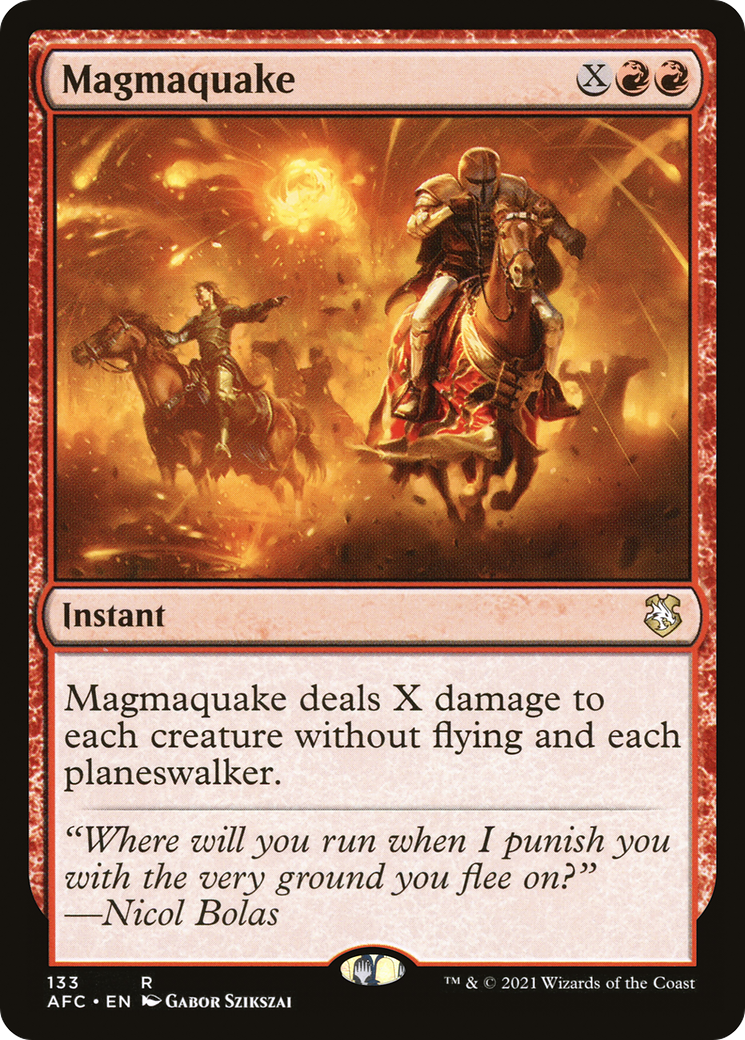
1
Magmaquake
Magmaquake
Instant
Magmaquake deals X damage to each creature without flying and each planeswalker.
- Magmaquake doesn't target any creature or planeswalker. For example, it will deal damage to a creature without flying that has hexproof.
-
1
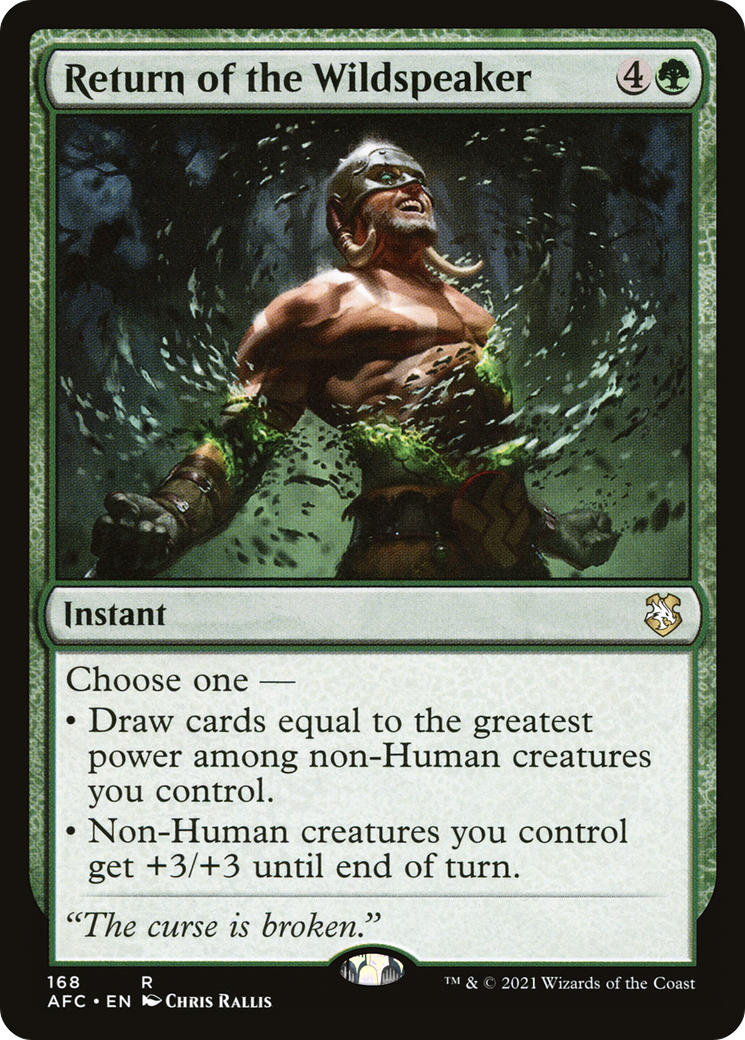
Return of the Wildspeaker
Return of the Wildspeaker
Instant
Choose one —
- Draw cards equal to the greatest power among non-Human creatures you control.
- Non-Human creatures you control get +3/+3 until end of turn.
-
1
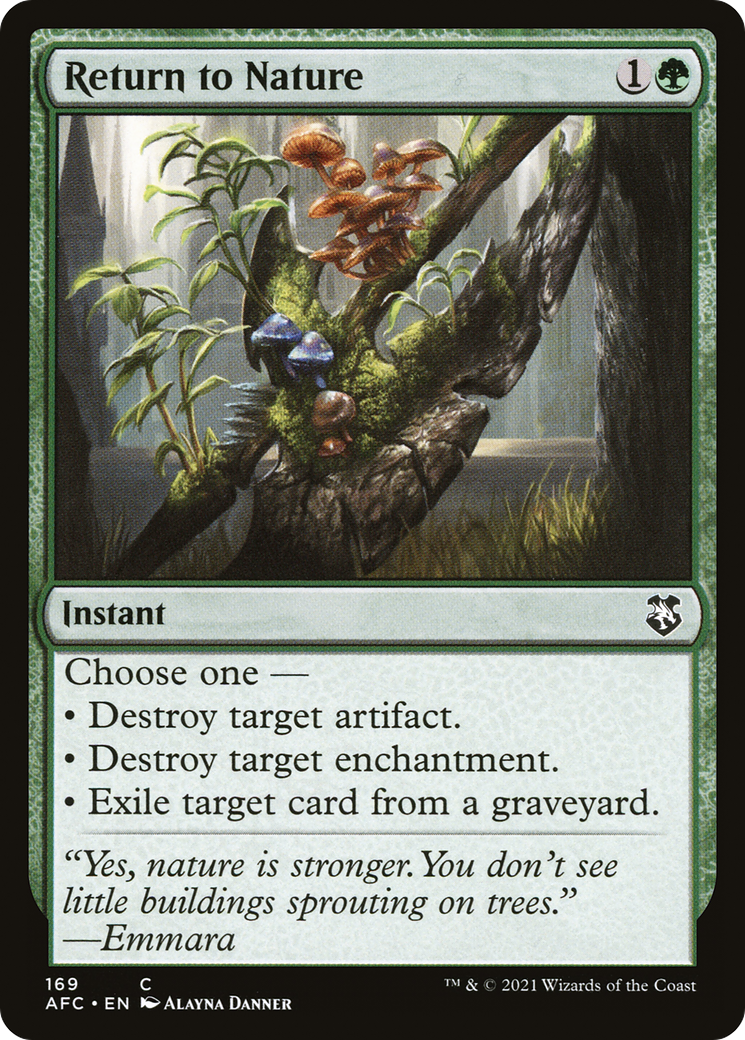
Return to Nature
Return to Nature
Instant
Choose one —
- Destroy target artifact.
- Destroy target enchantment.
- Exile target card from a graveyard.
-
1
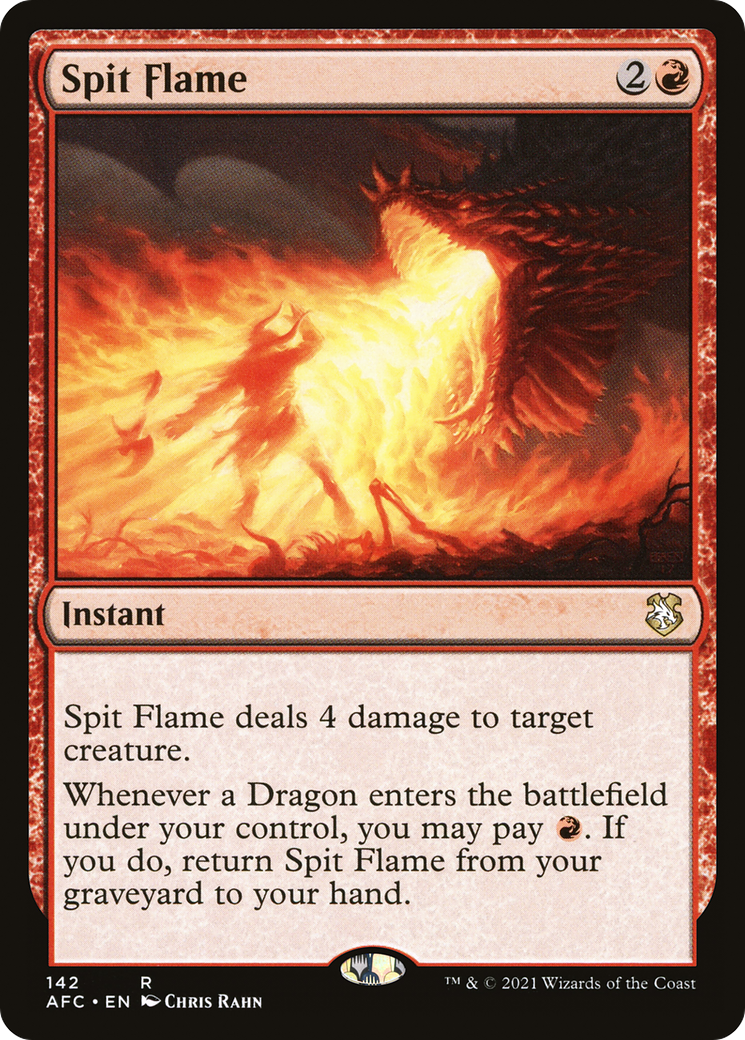
Spit Flame
Spit Flame
Instant
Spit Flame deals 4 damage to target creature.
Whenever a Dragon you control enters, you may pay . If you do, return this card from your graveyard to your hand.
Sorceries 8
-
1
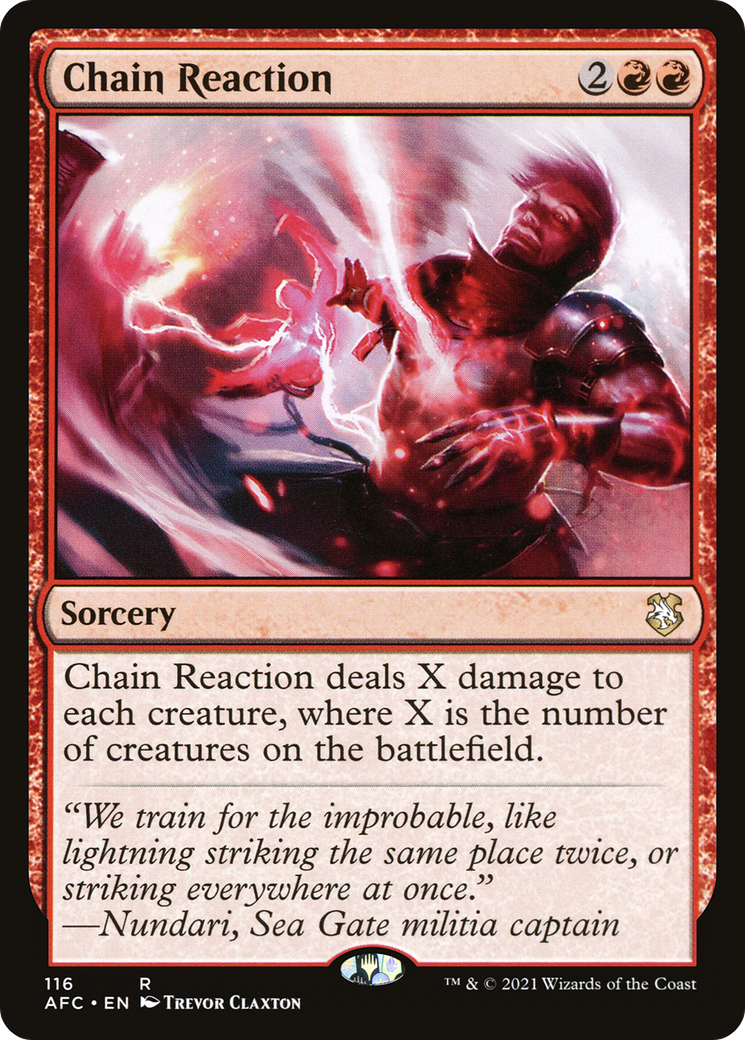
Chain Reaction
Chain Reaction
Sorcery
Chain Reaction deals X damage to each creature, where X is the number of creatures on the battlefield.
- The value of X is determined as Chain Reaction resolves.
-
1
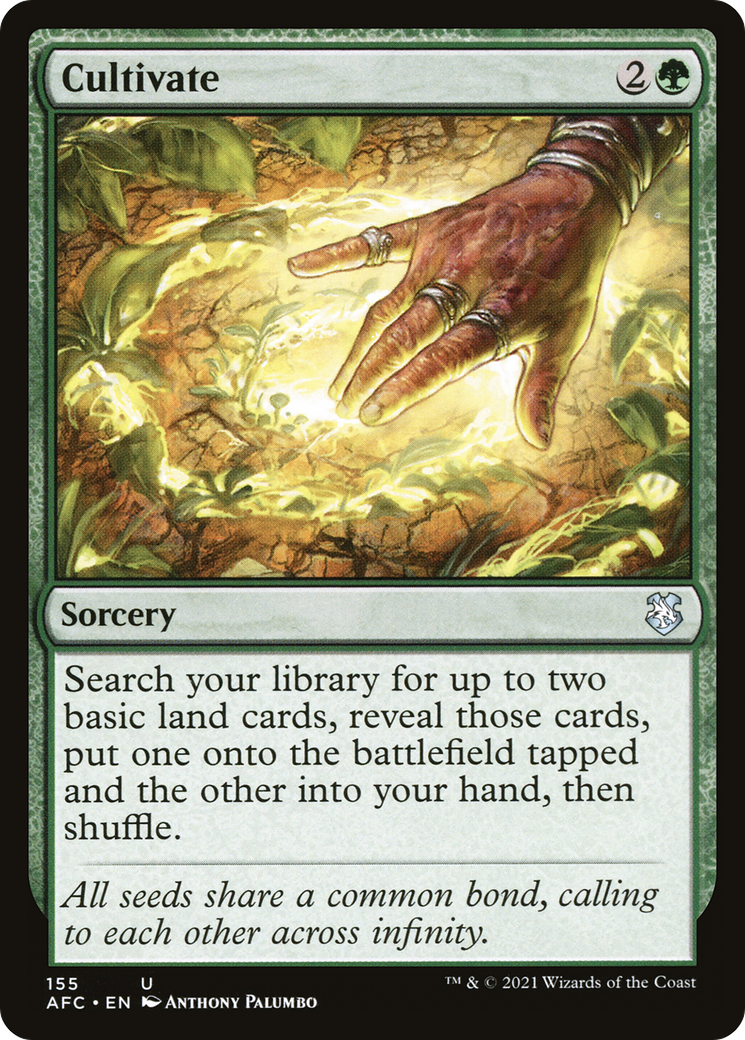
Cultivate
Cultivate
Sorcery
Search your library for up to two basic land cards, reveal those cards, put one onto the battlefield tapped and the other into your hand, then shuffle.
- If you choose to find only one basic land card, you put it onto the battlefield tapped.
-
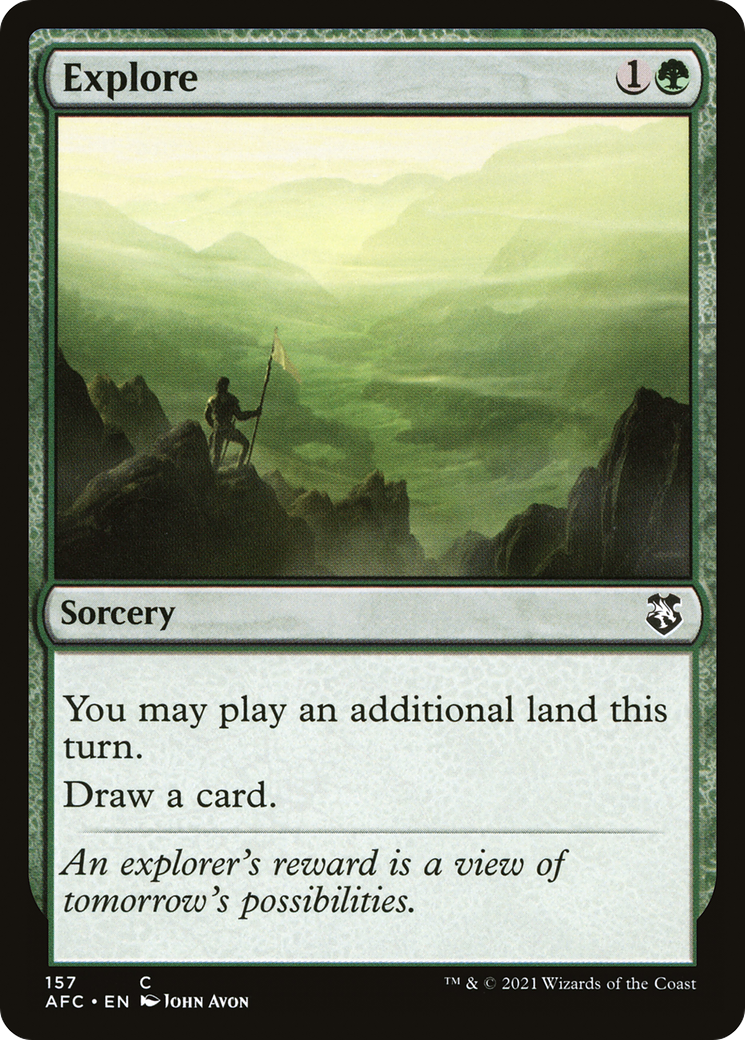
1
Explore
Explore
Sorcery
You may play an additional land this turn.
Draw a card.
- The effects of multiple Explores in the same turn are cumulative. They're also cumulative with other effects that let you play additional lands, such as the one from Urban Evolution.
- Explore's effect allows you to play an additional land during your main phase. Doing so follows the normal timing rules for playing lands. In particular, you don't get to play a land as Explore resolves; Explore fully resolves first and you draw a card, perhaps a land you'll play later.
- If you somehow manage to cast Explore when it's not your turn, you'll draw a card when it resolves, but you won't be able to play a land that turn.
-
1
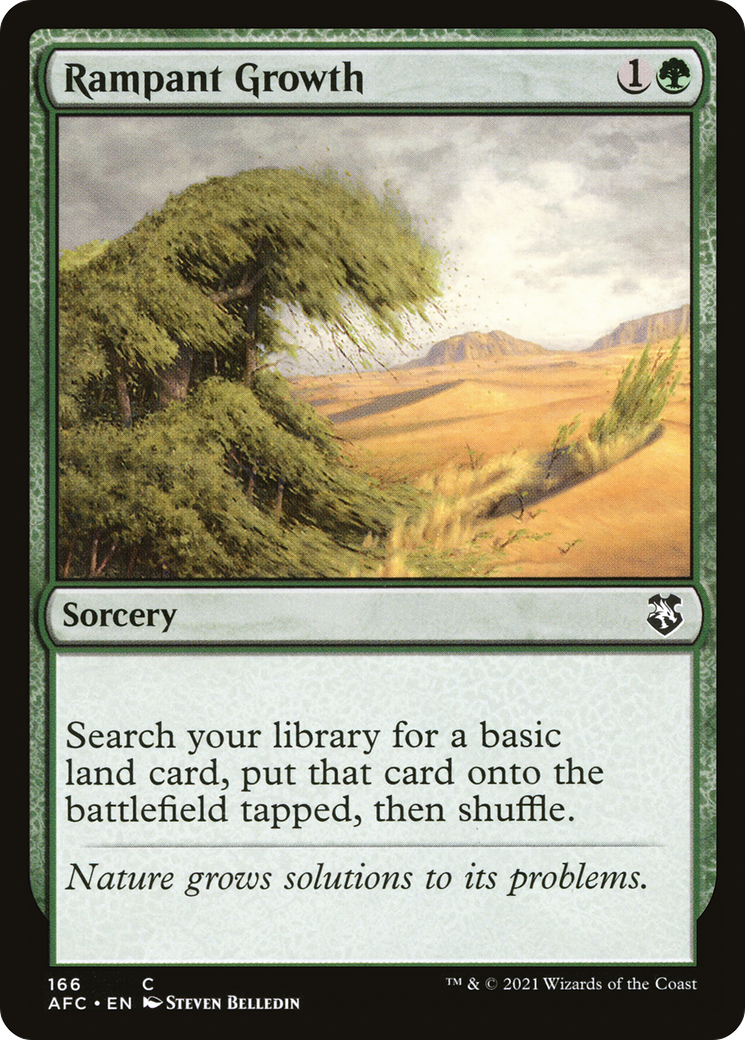
Rampant Growth
Rampant Growth
Sorcery
Search your library for a basic land card, put that card onto the battlefield tapped, then shuffle.
- The land does not count toward your one per turn limit because it was put onto the battlefield by an effect.
-
1
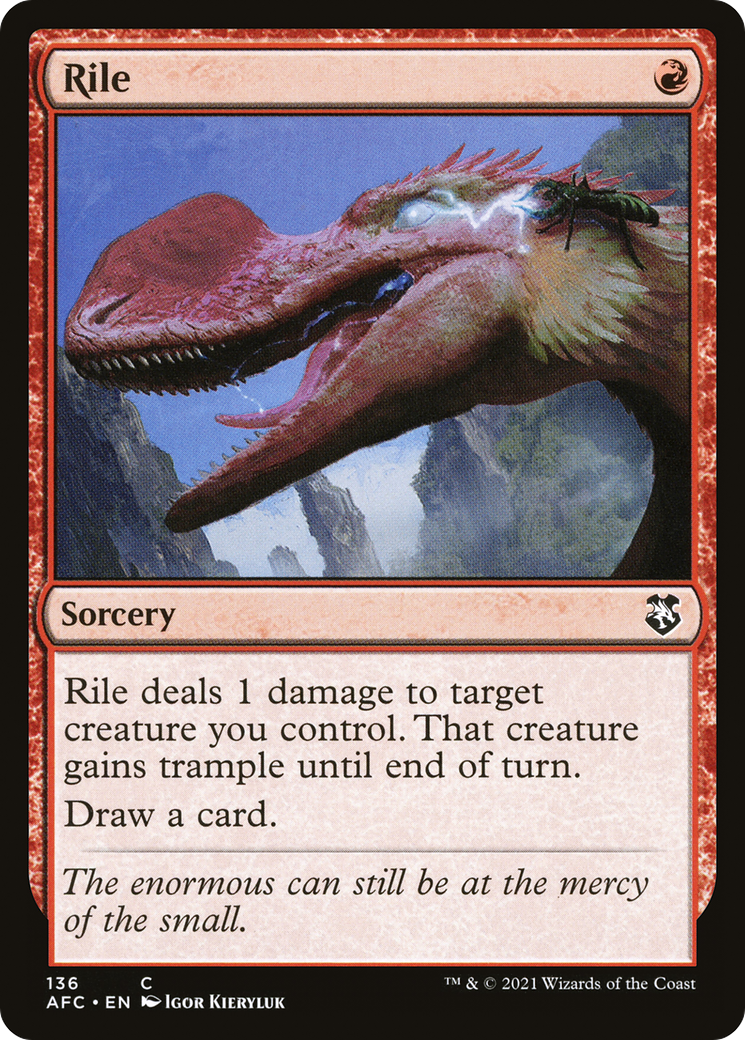
Rile
Rile
Sorcery
Rile deals 1 damage to target creature you control. That creature gains trample until end of turn.
Draw a card.
- If Rile targets a creature with 1 toughness, that creature won't be destroyed until after you've drawn a card. Its abilities may affect that draw or trigger on that draw if appropriate.
- If the damage that would be dealt by Rile is prevented, the creature still gains trample until end of turn.
- If the target creature is an illegal target by the time Rile resolves, the entire spell doesn't resolve. You won't draw a card.
-
1
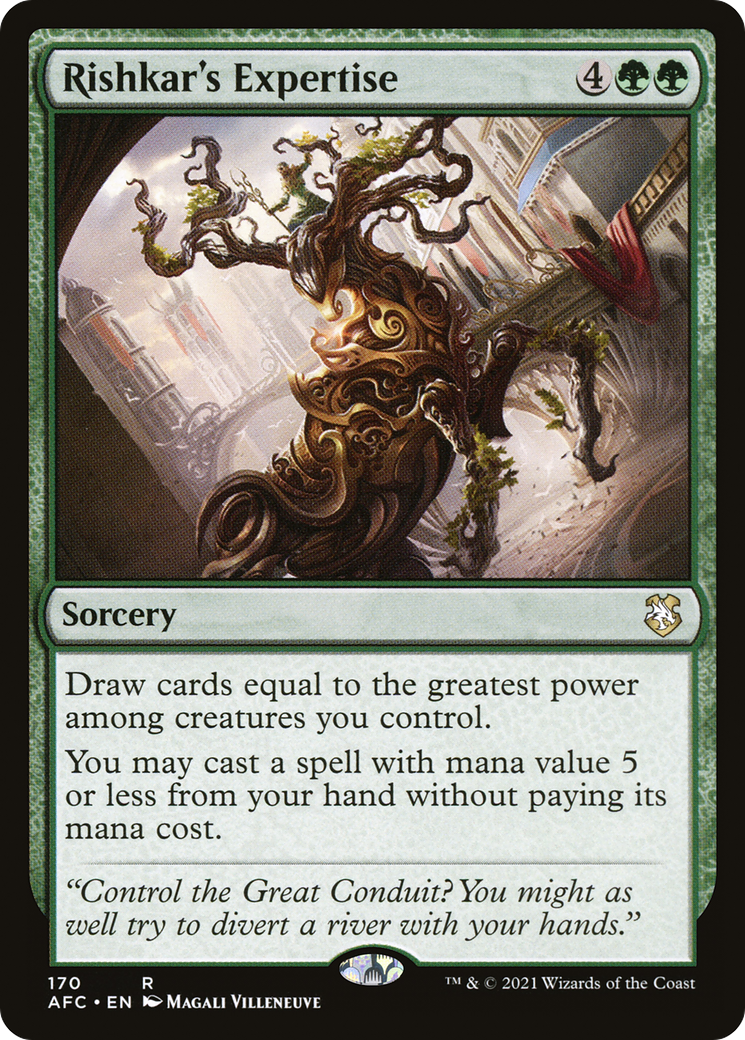
Rishkar's Expertise
Rishkar's Expertise
Sorcery
Draw cards equal to the greatest power among creatures you control.
You may cast a spell with mana value 5 or less from your hand without paying its mana cost.
- The mana value of a split card is determined by the combined mana cost of its two halves. If an expertise spell allows you to cast a split card, you may cast either half or, if that split card has fuse, both halves.
- If you control no creatures with power greater than 0 as Rishkar's Expertise resolves, you draw no cards, but you may cast a card with mana value 5 or less from your hand without paying its mana cost.
- You may cast one of the cards drawn by Rishkar's Expertise's first effect while performing its second effect.
- A card's mana value is determined solely by the mana symbols printed in its upper right corner. The mana value is the total amount of mana in that cost, regardless of color. For example, a card with mana cost has mana value 3. Ignore any alternative costs, additional costs, cost increases, or cost reductions that could apply to it. A card with no mana cost has a mana value of 0.
- If the card has in its mana cost, you must choose 0 as the value of X when casting it without paying its mana cost.
- The greatest power among creatures you control is determined as Rishkar's Expertise resolves.
- If you cast a card "without paying its mana cost," you can't choose to cast it for any alternative costs, such as emerge costs. You can, however, pay additional costs. If the card has any mandatory additional costs, such as that of Cathartic Reunion, you must pay those to cast the card.
- While you're casting your free spell, the Expertise spell is still on the stack. It will be put into its owner's graveyard after the free spell is cast. The free spell can't target the Expertise card in your graveyard. It can target the Expertise spell on the stack, but the Expertise spell will become an illegal target before the free spell resolves.
- Any triggered abilities that trigger while performing the Expertise spell's first effect won't be put onto the stack until after you're done casting your free spell. They're put onto the stack at the same time as any abilities that triggered while casting that spell regardless of the order in which those abilities triggered.
- Effects that allow you to "cast" a card don't allow you to play a land card.
-
1
Shamanic Revelation
Shamanic Revelation
Sorcery
Draw a card for each creature you control.
Ferocious — You gain 4 life for each creature you control with power 4 or greater.
- After you draw cards while Shamanic Revelation is resolving, nothing else can happen before you gain the appropriate amount of life. Notably, abilities that trigger when you draw cards won't be put onto the stack until after you've gained life.
-
1
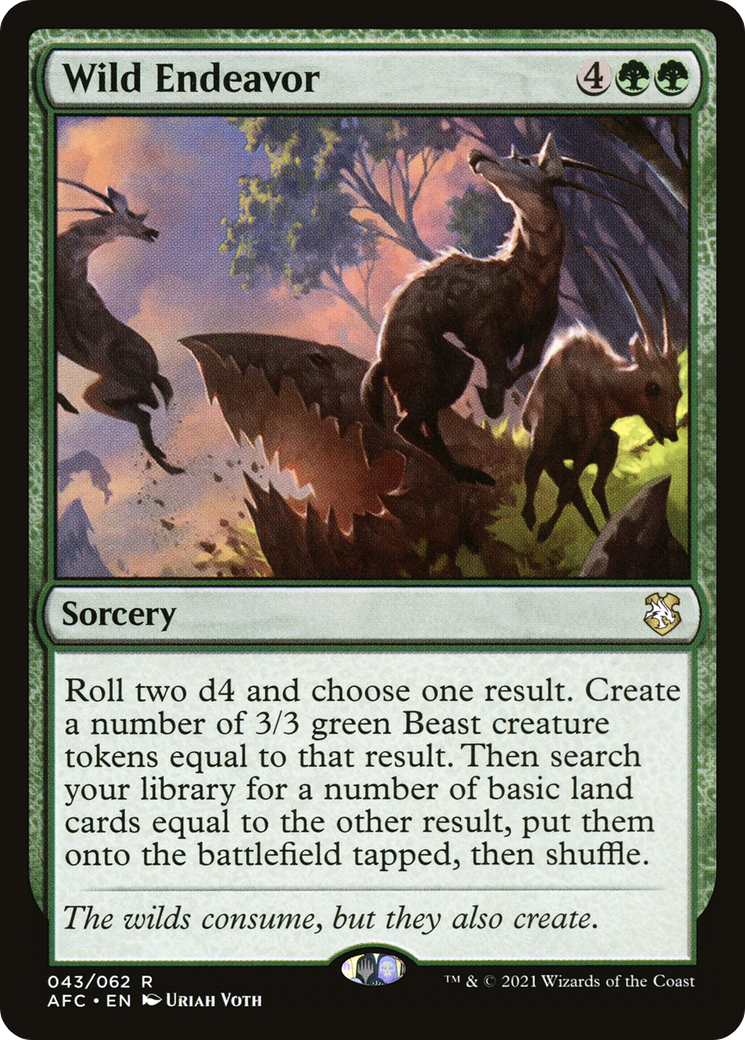
Wild Endeavor
Wild Endeavor
Sorcery
Roll two d4 and choose one result. Create a number of 3/3 green Beast creature tokens equal to that result. Then search your library for a number of basic land cards equal to the other result, put them onto the battlefield tapped, then shuffle.
- Dice are identified by the number of faces each one has. For example, a d20 is a twenty-sided die.
- Dice used must have equally likely outcomes and the roll must be fair. Although physical dice are recommended, digital substitutes are allowed, provided they have the same number of equally likely outcomes as specified in the original roll instruction.
- An ability that tells you to roll a die will also specify what to do with the result of that roll. Most often, this is in the form of a “results table” in the card text.
- The instruction to roll a die and the effect that occurs because of the result are all part of the same ability. Players do not get the chance to respond to the ability after knowing the result of the roll.
- An effect that says “choose a target, then roll a d20” or similar still uses the normal process of putting an ability on the stack and resolving it. Choosing targets is part of putting the ability on the stack and rolling the d20 happens later, as the ability resolves.
- Some effects may modify the result of a die roll. This may be part of the instruction to roll a die or it may come from other cards. Anything that references the “result” of a die roll is looking for the result after these modifications. Anything that is looking for the “natural result” is looking for the number shown on the face of the die before these modifications.
- Some abilities, like that of Pixie Guide and Barbarian Class, replace rolling a die with rolling extra dice and ignoring the lowest roll. The ignored rolls are not considered for the effect that instructed you to roll a die, and do not cause abilities to trigger. For all intents and purposes, once you determine which dice count, any extra dice were never rolled.
- Some effects instruct you to roll again. This uses the same number and type of dice as the original roll, and that roll will use the same set of possible outcomes.
- While playing Planechase, rolling the planar die will cause any ability that triggers whenever a player rolls one or more dice to trigger. However, any effect that refers to a numerical result will ignore the rolling of the planar die.
- Tournament events have more specific rules regarding dice and die-rolling. For more information, please see the most recent version of the Magic Tournament Rules at https://wpn.wizards.com/en/document/magic-gathering-tournament-rules.
Artifacts 9
-
1
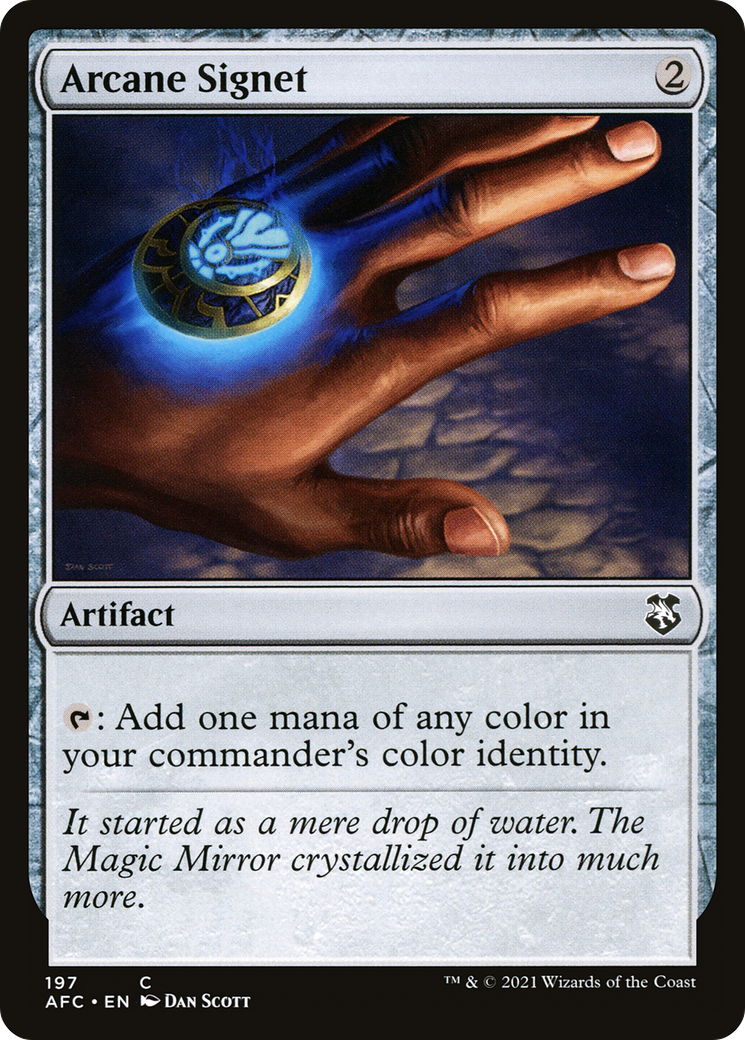
Arcane Signet
Arcane Signet
Artifact
: Add one mana of any color in your commander's color identity.
- If your commander is a card that has no colors in its color identity, Arcane Signet's ability produces no mana. It doesn't produce .
- If you have two commanders, the ability adds one mana of any color in their combined color identities.
- If you don't have a commander, Arcane Signet's ability produces no mana.
-
1
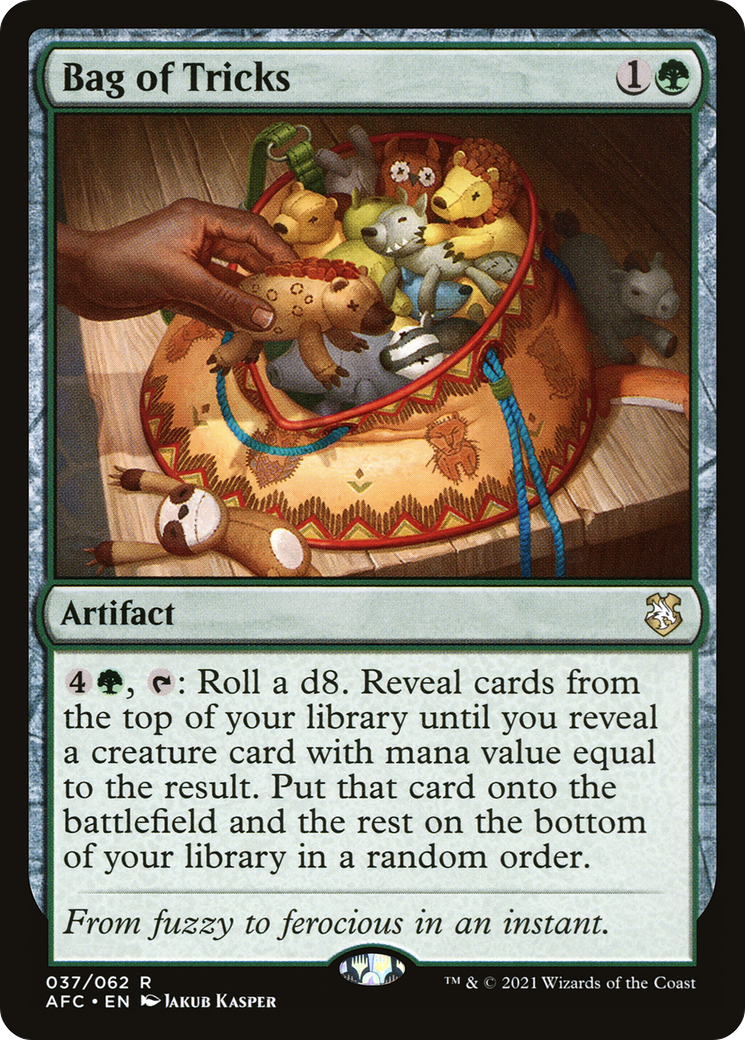
Bag of Tricks
Bag of Tricks
Artifact
, : Roll a d8. Reveal cards from the top of your library until you reveal a creature card with mana value equal to the result. Put that card onto the battlefield and the rest on the bottom of your library in a random order.
- If you do not have a creature card in your library with mana value equal to the result, you will reveal your entire library and then put the entire library back in a random order.
- Even if you reveal the entire library this way, putting it on the bottom in a random order doesn't count as “shuffling” the library.
- Dice are identified by the number of faces each one has. For example, a d20 is a twenty-sided die.
- Dice used must have equally likely outcomes and the roll must be fair. Although physical dice are recommended, digital substitutes are allowed, provided they have the same number of equally likely outcomes as specified in the original roll instruction.
- An ability that tells you to roll a die will also specify what to do with the result of that roll. Most often, this is in the form of a “results table” in the card text.
- The instruction to roll a die and the effect that occurs because of the result are all part of the same ability. Players do not get the chance to respond to the ability after knowing the result of the roll.
- An effect that says “choose a target, then roll a d20” or similar still uses the normal process of putting an ability on the stack and resolving it. Choosing targets is part of putting the ability on the stack and rolling the d20 happens later, as the ability resolves.
- Some effects may modify the result of a die roll. This may be part of the instruction to roll a die or it may come from other cards. Anything that references the “result” of a die roll is looking for the result after these modifications. Anything that is looking for the “natural result” is looking for the number shown on the face of the die before these modifications.
- Some abilities, like that of Pixie Guide and Barbarian Class, replace rolling a die with rolling extra dice and ignoring the lowest roll. The ignored rolls are not considered for the effect that instructed you to roll a die, and do not cause abilities to trigger. For all intents and purposes, once you determine which dice count, any extra dice were never rolled.
- Some effects instruct you to roll again. This uses the same number and type of dice as the original roll, and that roll will use the same set of possible outcomes.
- While playing Planechase, rolling the planar die will cause any ability that triggers whenever a player rolls one or more dice to trigger. However, any effect that refers to a numerical result will ignore the rolling of the planar die.
- Tournament events have more specific rules regarding dice and die-rolling. For more information, please see the most recent version of the Magic Tournament Rules at https://wpn.wizards.com/en/document/magic-gathering-tournament-rules.
-
1
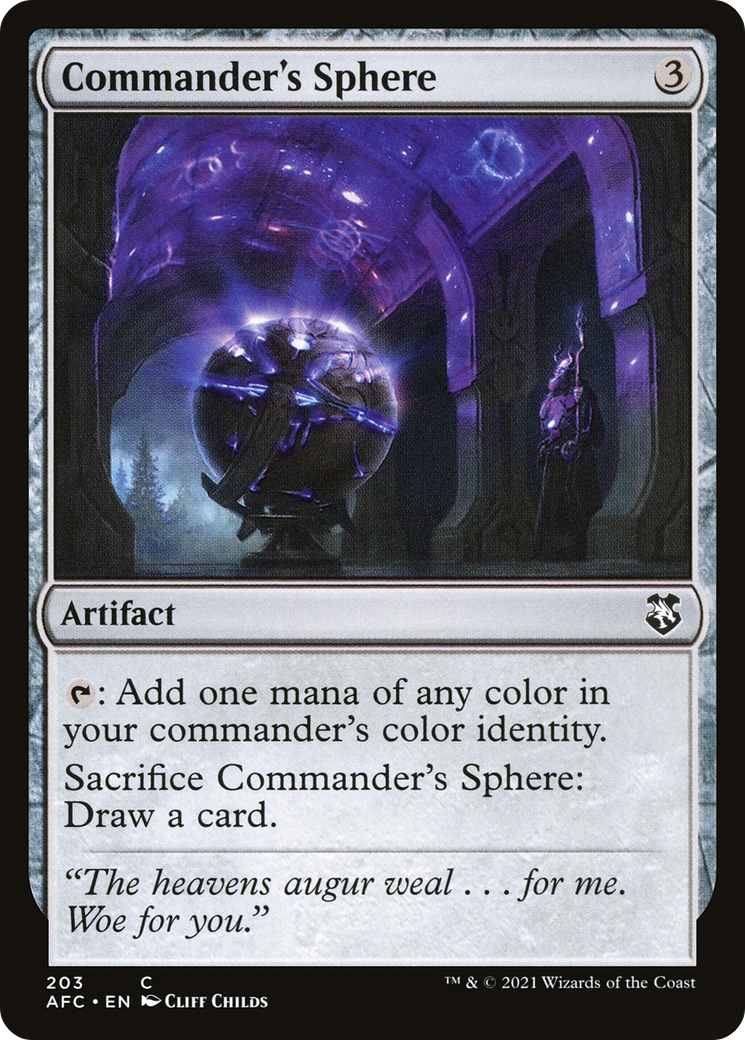
Commander's Sphere
Commander's Sphere
Artifact
: Add one mana of any color in your commander's color identity.
Sacrifice this artifact: Draw a card.
- If your commander is a card that has no colors in its color identity, Commander's Sphere's first ability produces no mana. It doesn't produce .
- If you don't have a commander, Commander's Sphere's first ability produces no mana.
- If you have two commanders, the ability adds one mana of any color in their combined color identities.
-
1
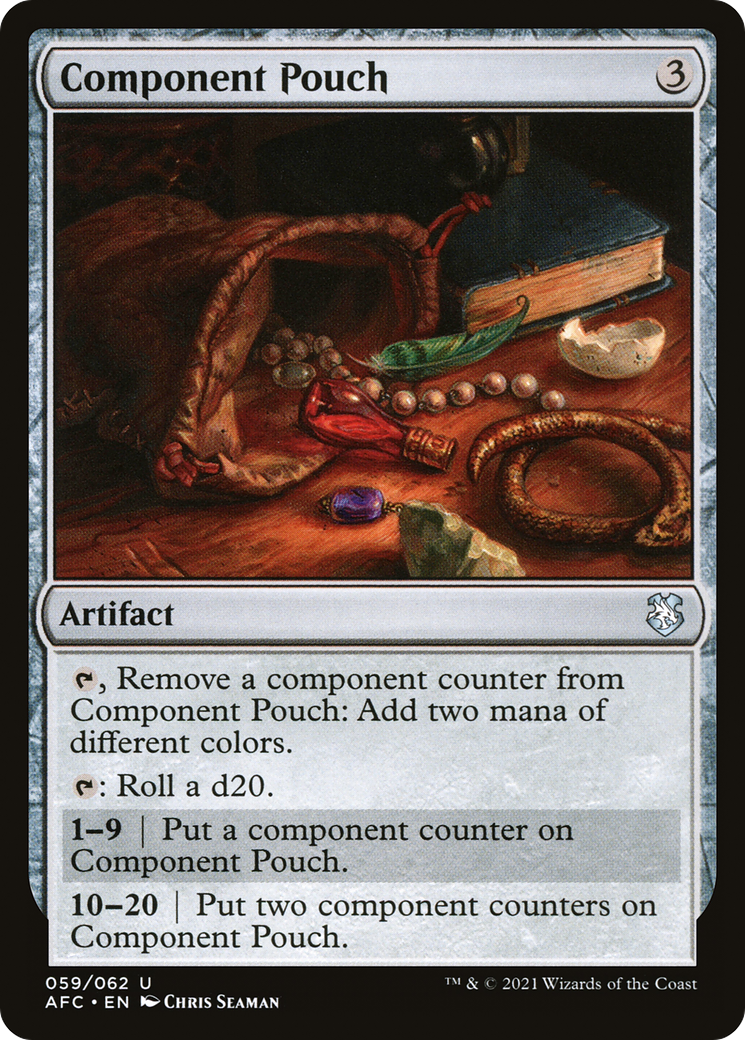
Component Pouch
Component Pouch
Artifact
, Remove a component counter from this artifact: Add two mana of different colors.
: Roll a d20.
1—9 | Put a component counter on this artifact.
10—20 | Put two component counters on this artifact.
- Dice are identified by the number of faces each one has. For example, a d20 is a twenty-sided die.
- Dice used must have equally likely outcomes and the roll must be fair. Although physical dice are recommended, digital substitutes are allowed, provided they have the same number of equally likely outcomes as specified in the original roll instruction.
- An ability that tells you to roll a die will also specify what to do with the result of that roll. Most often, this is in the form of a “results table” in the card text.
- The instruction to roll a die and the effect that occurs because of the result are all part of the same ability. Players do not get the chance to respond to the ability after knowing the result of the roll.
- An effect that says “choose a target, then roll a d20” or similar still uses the normal process of putting an ability on the stack and resolving it. Choosing targets is part of putting the ability on the stack and rolling the d20 happens later, as the ability resolves.
- Some effects may modify the result of a die roll. This may be part of the instruction to roll a die or it may come from other cards. Anything that references the “result” of a die roll is looking for the result after these modifications. Anything that is looking for the “natural result” is looking for the number shown on the face of the die before these modifications.
- Some abilities, like that of Pixie Guide and Barbarian Class, replace rolling a die with rolling extra dice and ignoring the lowest roll. The ignored rolls are not considered for the effect that instructed you to roll a die, and do not cause abilities to trigger. For all intents and purposes, once you determine which dice count, any extra dice were never rolled.
- Some effects instruct you to roll again. This uses the same number and type of dice as the original roll, and that roll will use the same set of possible outcomes.
- While playing Planechase, rolling the planar die will cause any ability that triggers whenever a player rolls one or more dice to trigger. However, any effect that refers to a numerical result will ignore the rolling of the planar die.
- Tournament events have more specific rules regarding dice and die-rolling. For more information, please see the most recent version of the Magic Tournament Rules at https://wpn.wizards.com/en/document/magic-gathering-tournament-rules.
-
1
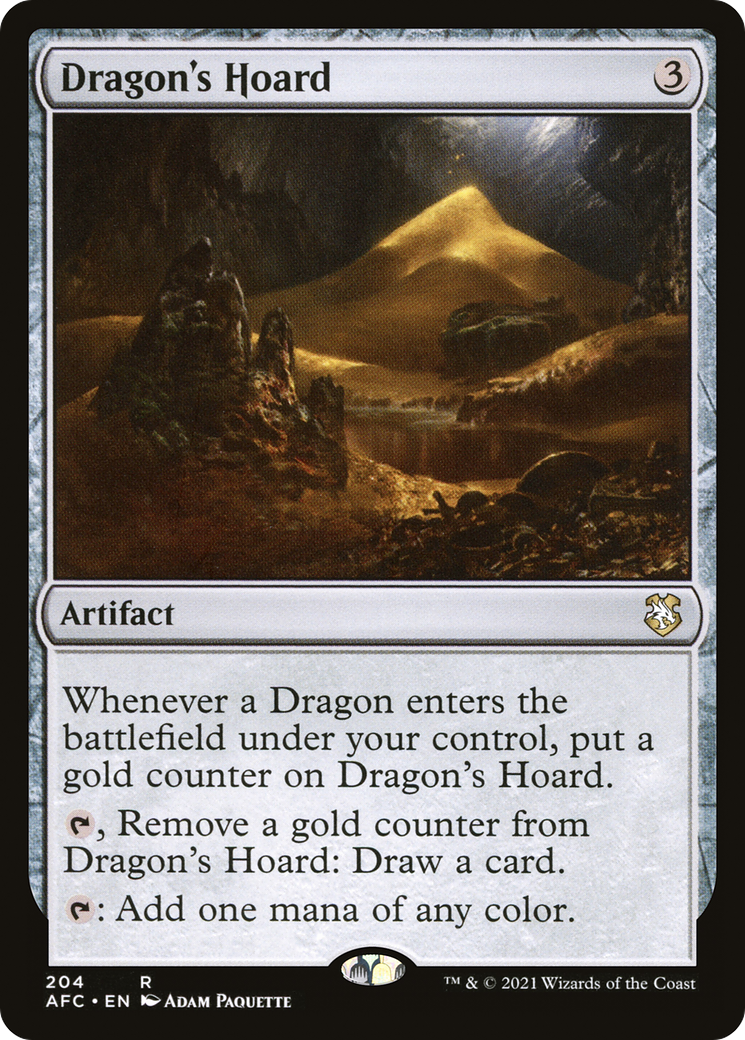
Dragon's Hoard
Dragon's Hoard
Artifact
Whenever a Dragon you control enters, put a gold counter on this artifact.
, Remove a gold counter from this artifact: Draw a card.
: Add one mana of any color.
-
1
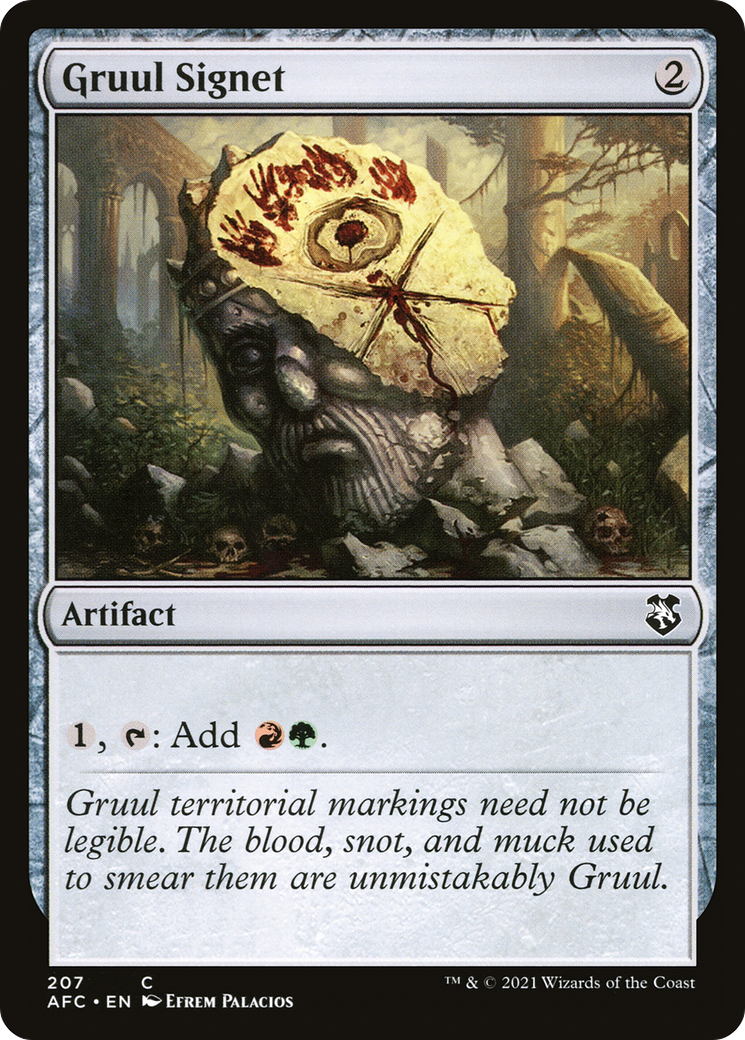
Gruul Signet
Gruul Signet
Artifact
, : Add .
-
1
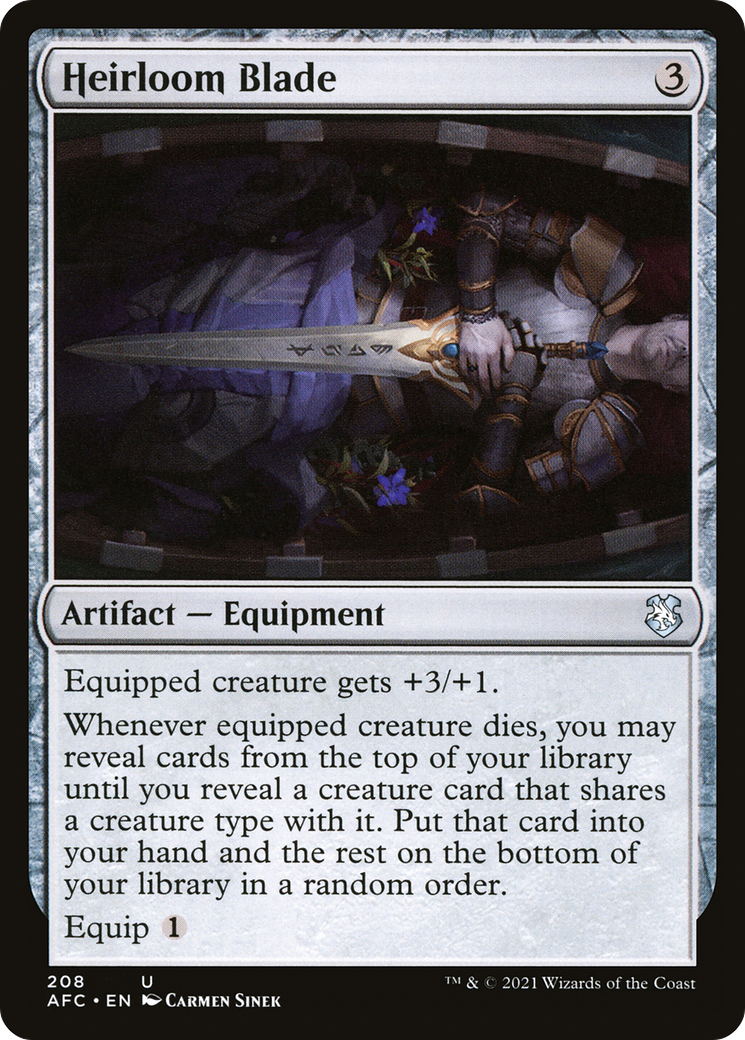
Heirloom Blade
Heirloom Blade
Artifact — Equipment
Equipped creature gets +3/+1.
Whenever equipped creature dies, you may reveal cards from the top of your library until you reveal a creature card that shares a creature type with it. Put that card into your hand and the rest on the bottom of your library in a random order.
Equip
- If you don't reveal a creature card that shares a type with the creature that died, you'll just reveal and randomize your library.
- If the equipped creature has no creature type, no card can share a creature type with it.
- You'll reveal cards until you find one that shares at least one creature type with the creature that died. For example, if a Cat Wizard dies, you'll stop if you reveal a Human Wizard or Cat Soldier.
- Compare the revealed cards to the creature as it last existed before it died, not to the creature card as it exists in its owner's graveyard, to determine which one you put into your hand.
- "Artifact" isn't a creature type.
- If Heirloom Blade leaves the battlefield at the same time that the equipped creature dies, its triggered ability triggers.
-
1
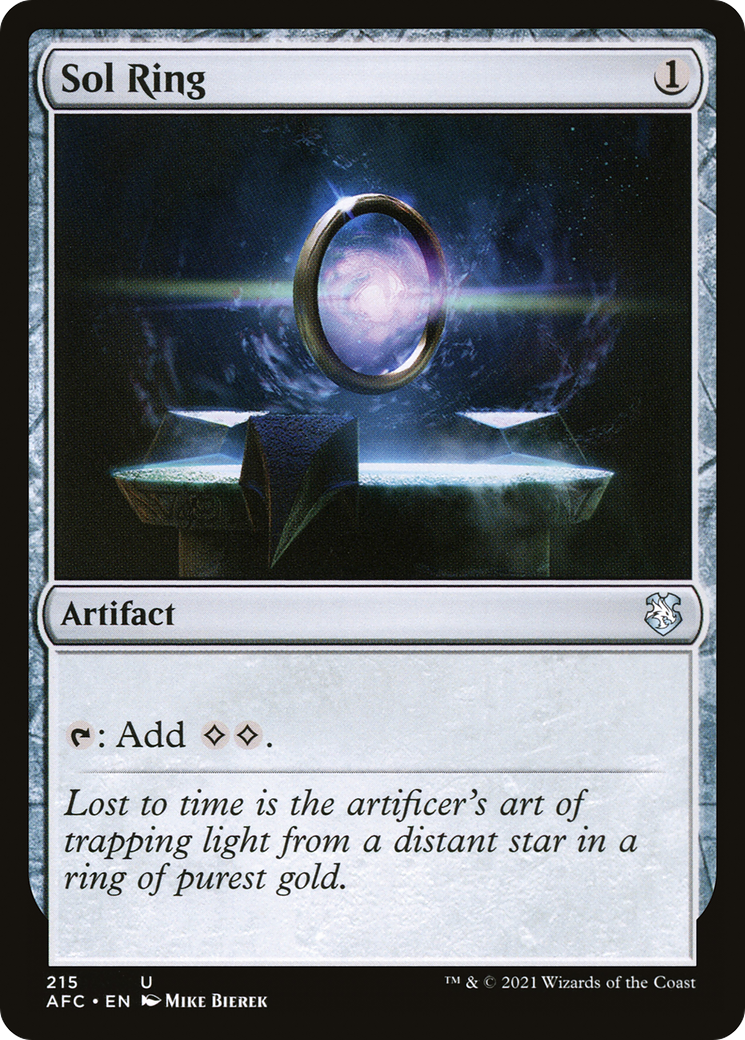
Sol Ring
Sol Ring
Artifact
: Add .
-
1
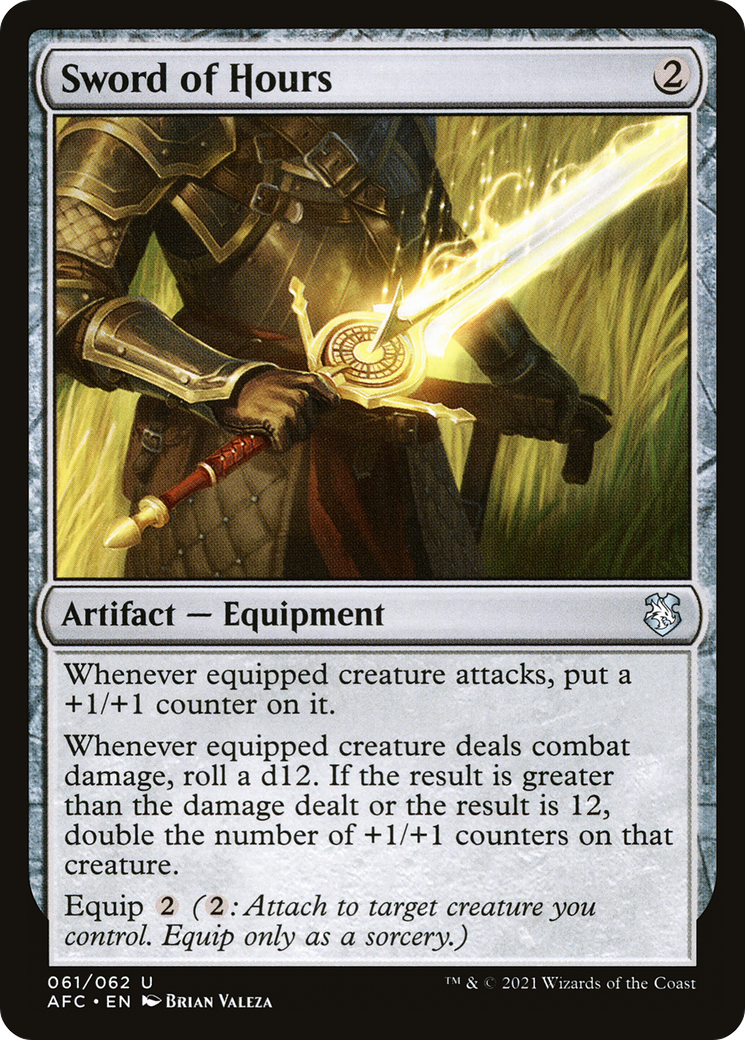
Sword of Hours
Sword of Hours
Artifact — Equipment
Whenever equipped creature attacks, put a +1/+1 counter on it.
Whenever equipped creature deals combat damage, roll a d12. If the result is greater than the damage dealt or the result is 12, double the number of +1/+1 counters on that creature.
Equip ( : Attach to target creature you control. Equip only as a sorcery.)
- To double the number of +1/+1 counters on a permanent, count the number of +1/+1 counters that are currently on that permanent and put that many more on it. Any replacement effects that change this number will apply accordingly.
- If the equipped creature takes lethal damage at the same time that it deals combat damage, it will die before the counters on it can be doubled. However, you will still roll a d12, which may cause abilities of other permanents to trigger.
- Dice are identified by the number of faces each one has. For example, a d20 is a twenty-sided die.
- Dice used must have equally likely outcomes and the roll must be fair. Although physical dice are recommended, digital substitutes are allowed, provided they have the same number of equally likely outcomes as specified in the original roll instruction.
- An ability that tells you to roll a die will also specify what to do with the result of that roll. Most often, this is in the form of a “results table” in the card text.
- The instruction to roll a die and the effect that occurs because of the result are all part of the same ability. Players do not get the chance to respond to the ability after knowing the result of the roll.
- An effect that says “choose a target, then roll a d20” or similar still uses the normal process of putting an ability on the stack and resolving it. Choosing targets is part of putting the ability on the stack and rolling the d20 happens later, as the ability resolves.
- Some effects may modify the result of a die roll. This may be part of the instruction to roll a die or it may come from other cards. Anything that references the “result” of a die roll is looking for the result after these modifications. Anything that is looking for the “natural result” is looking for the number shown on the face of the die before these modifications.
- Some abilities, like that of Pixie Guide and Barbarian Class, replace rolling a die with rolling extra dice and ignoring the lowest roll. The ignored rolls are not considered for the effect that instructed you to roll a die, and do not cause abilities to trigger. For all intents and purposes, once you determine which dice count, any extra dice were never rolled.
- Some effects instruct you to roll again. This uses the same number and type of dice as the original roll, and that roll will use the same set of possible outcomes.
- While playing Planechase, rolling the planar die will cause any ability that triggers whenever a player rolls one or more dice to trigger. However, any effect that refers to a numerical result will ignore the rolling of the planar die.
- Tournament events have more specific rules regarding dice and die-rolling. For more information, please see the most recent version of the Magic Tournament Rules at https://wpn.wizards.com/en/document/magic-gathering-tournament-rules.
Enchantments 8
-
1
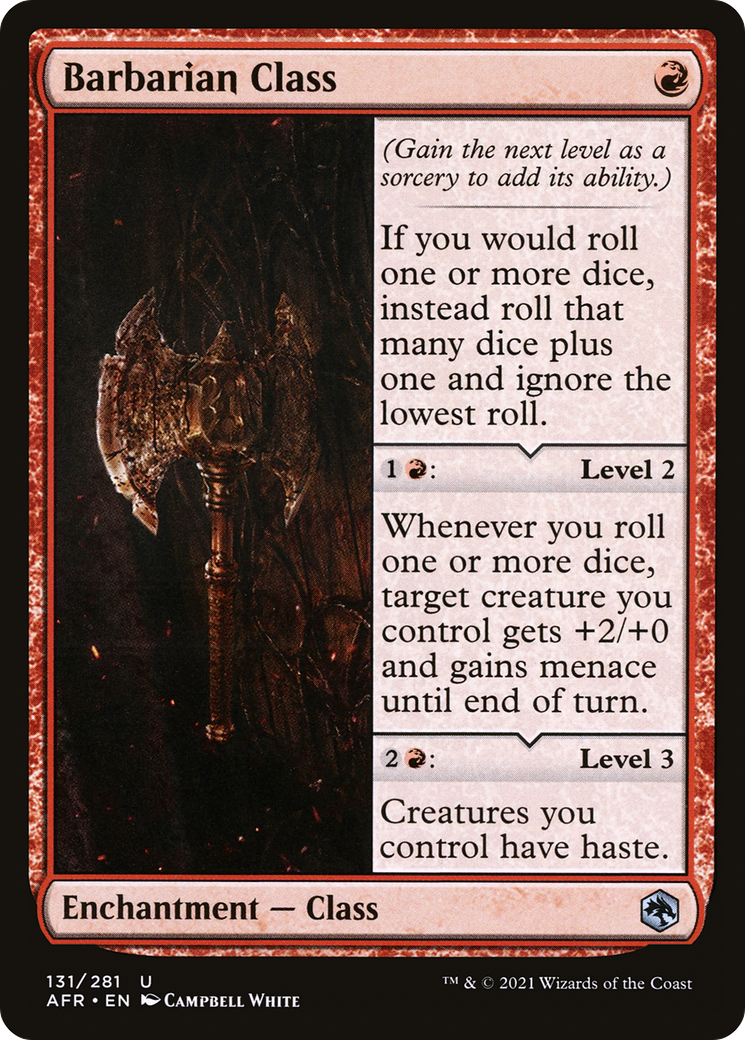
Barbarian Class
Barbarian Class
Enchantment — Class
(Gain the next level as a sorcery to add its ability.)
If you would roll one or more dice, instead roll that many dice plus one and ignore the lowest roll.
: Level 2
Whenever you roll one or more dice, target creature you control gets +2/+0 and gains menace until end of turn.
: Level 3
Creatures you control have haste.
-
1
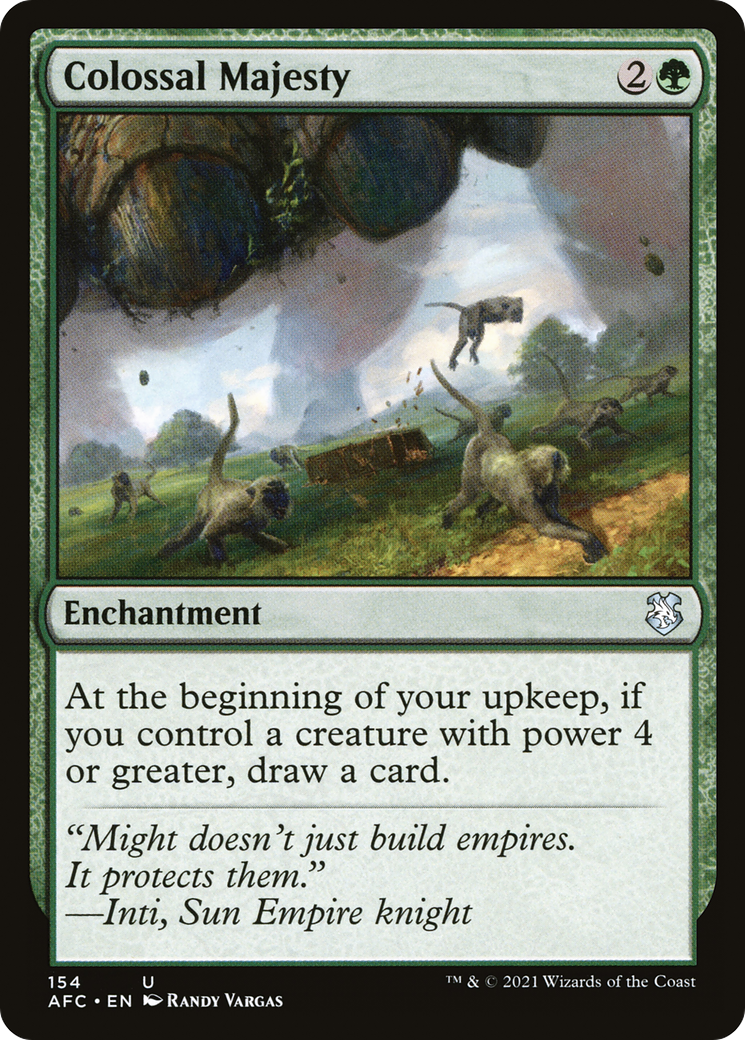
Colossal Majesty
Colossal Majesty
Enchantment
At the beginning of your upkeep, if you control a creature with power 4 or greater, draw a card.
- If you don't control a creature with power 4 or greater as your upkeep begins, Colossal Majesty's ability won't trigger. You can't take any actions during your turn before your upkeep begins.
- If you don't control a creature with power 4 or greater as Colossal Majesty's ability resolves, you won't draw a card.
- The creature with power 4 or greater that you control as Colossal Majesty's ability resolves doesn't have to be the same creature with power 4 or greater that was under your control as the ability triggered.
- You draw only one card, no matter how many creatures with power 4 or greater you control.
-
1
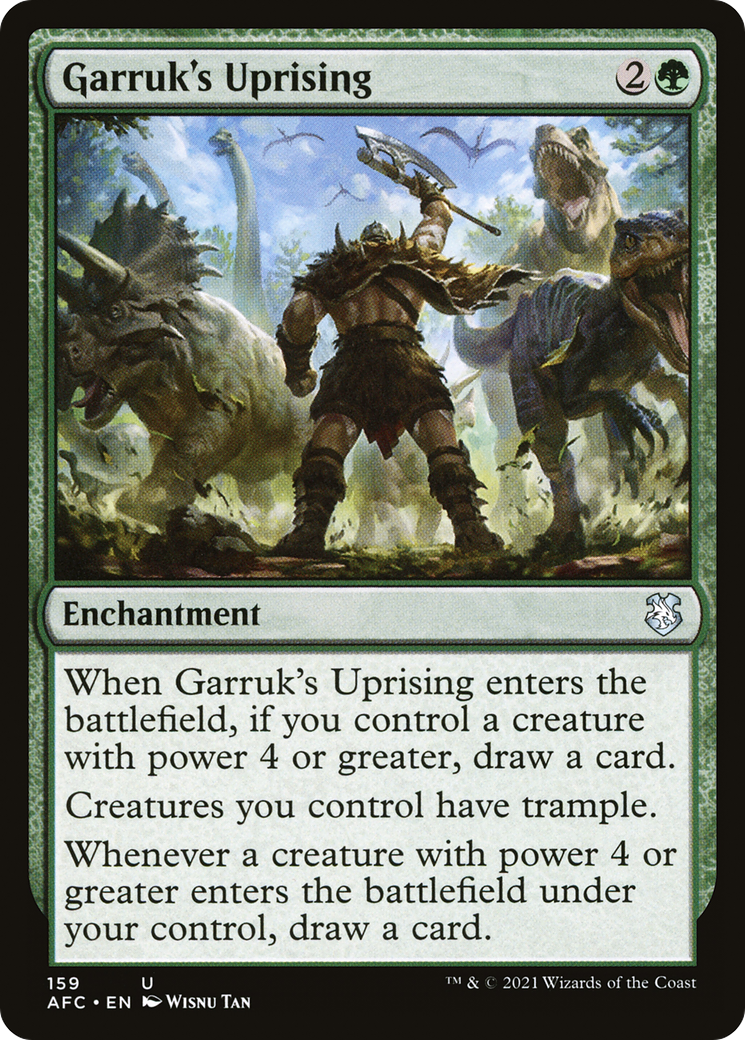
Garruk's Uprising
Garruk's Uprising
Enchantment
When this enchantment enters, if you control a creature with power 4 or greater, draw a card.
Creatures you control have trample. (Each of those creatures can deal excess combat damage to the player or planeswalker it's attacking.)
Whenever a creature you control with power 4 or greater enters, draw a card.
- The first ability of Garruk's Uprising has you draw just one card, no matter how many creatures you control with power 4 or greater.
- If one or more static abilities that apply to a creature entering change its power, those abilities are considered when determining whether Garruk's Uprising's last ability triggers. The same is true for replacement effects that apply to it, such as entering with one or more +1/+1 counters or entering as a copy of another creature.
- If you don't control a creature with power 4 or greater immediately after Garruk's Uprising enters, its first ability won't trigger. If you don't control one as the ability resolves, you don't draw a card. They don't have to be the same creature both times, however.
- Once the last ability of Garruk's Uprising has triggered, lowering the power of the creature or removing it from the battlefield won't stop you from drawing a card.
-
1
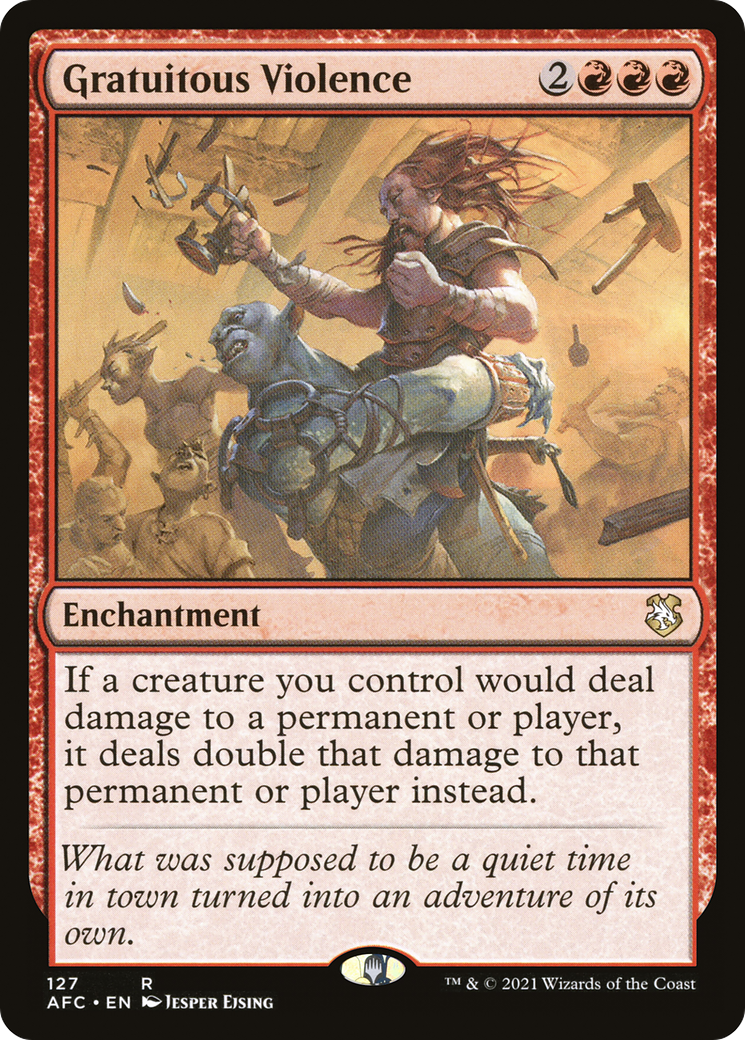
Gratuitous Violence
Gratuitous Violence
Enchantment
If a creature you control would deal damage to a permanent or player, it deals double that damage instead.
-
1
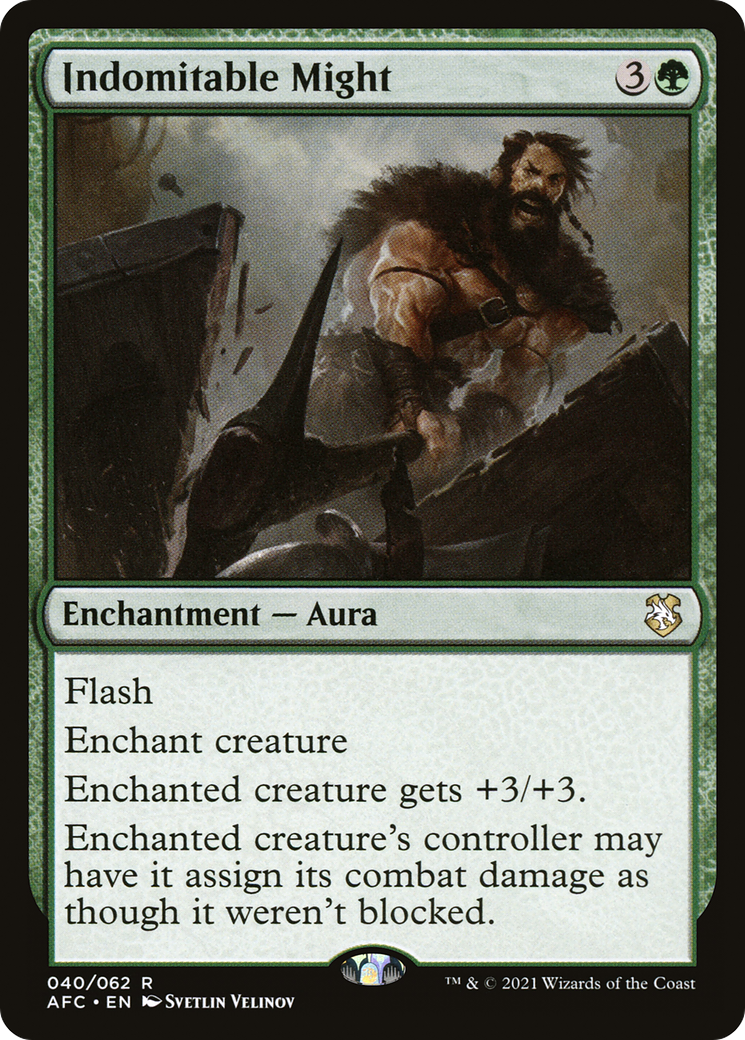
Indomitable Might
Indomitable Might
Enchantment — Aura
Flash
Enchant creature
Enchanted creature gets +3/+3.
Enchanted creature's controller may have it assign its combat damage as though it weren't blocked.
- Assigning the creature's damage as though it weren't blocked is all or nothing. You can't use this effect to assign some of the creature's damage to a blocking creature and the rest to the defending player or planeswalker.
- Even if it assigns damage as though it were not blocked, it will still receive damage from creatures that are blocking it.
-
1
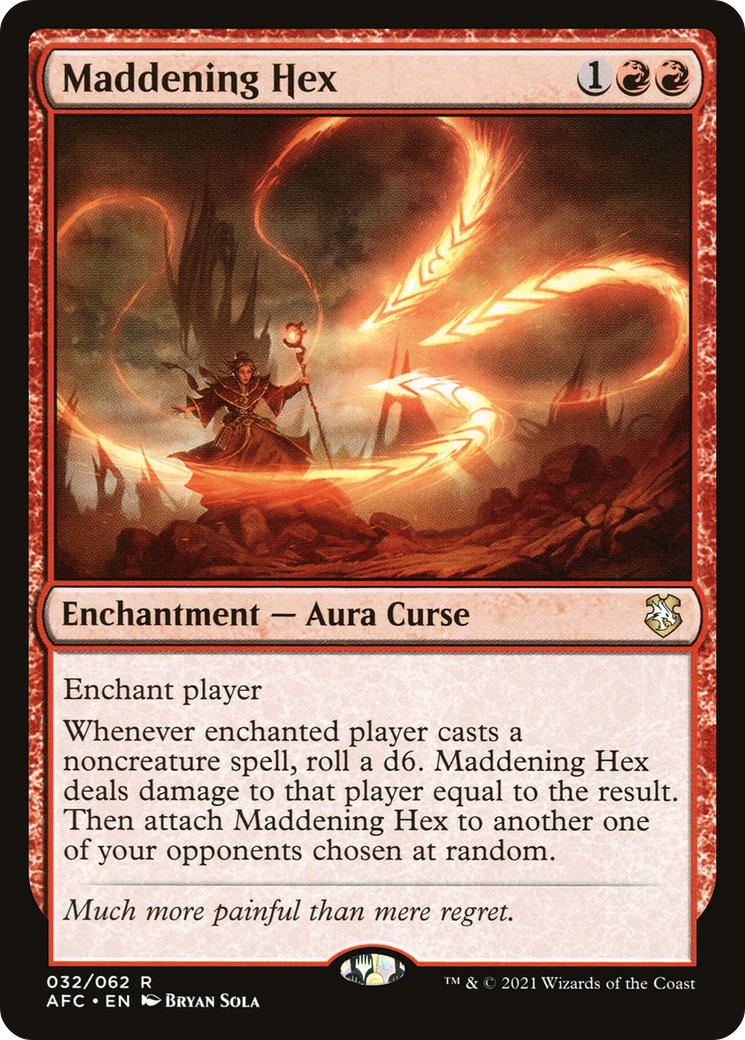
Maddening Hex
Maddening Hex
Enchantment — Aura Curse
Enchant player
Whenever enchanted player casts a noncreature spell, roll a d6. This Aura deals damage to that player equal to the result. Then attach this Aura to another one of your opponents chosen at random.
- If Maddening Hex is attached to your only opponent, it stays attached to that player as the ability resolves.
- Dice are identified by the number of faces each one has. For example, a d20 is a twenty-sided die.
- Dice used must have equally likely outcomes and the roll must be fair. Although physical dice are recommended, digital substitutes are allowed, provided they have the same number of equally likely outcomes as specified in the original roll instruction.
- An ability that tells you to roll a die will also specify what to do with the result of that roll. Most often, this is in the form of a "results table" in the card text.
- The instruction to roll a die and the effect that occurs because of the result are all part of the same ability. Players do not get the chance to respond to the ability after knowing the result of the roll.
- An effect that says "choose a target, then roll a d20" or similar still uses the normal process of putting an ability on the stack and resolving it. Choosing targets is part of putting the ability on the stack and rolling the d20 happens later, as the ability resolves.
- Some effects may modify the result of a die roll. This may be part of the instruction to roll a die or it may come from other cards. Anything that references the "result" of a die roll is looking for the result after these modifications. Anything that is looking for the "natural result" is looking for the number shown on the face of the die before these modifications.
- Some abilities, like that of Pixie Guide and Barbarian Class, replace rolling a die with rolling extra dice and ignoring the lowest roll. The ignored rolls are not considered for the effect that instructed you to roll a die, and do not cause abilities to trigger. For all intents and purposes, once you determine which dice count, any extra dice were never rolled.
- Some effects instruct you to roll again. This uses the same number and type of dice as the original roll, and that roll will use the same set of possible outcomes.
- While playing Planechase, rolling the planar die will cause any ability that triggers whenever a player rolls one or more dice to trigger. However, any effect that refers to a numerical result will ignore the rolling of the planar die.
- Tournament events have more specific rules regarding dice and die-rolling. For more information, please see the most recent version of the Magic Tournament Rules at https://wpn.wizards.com/en/document/magic-gathering-tournament-rules.
-
1
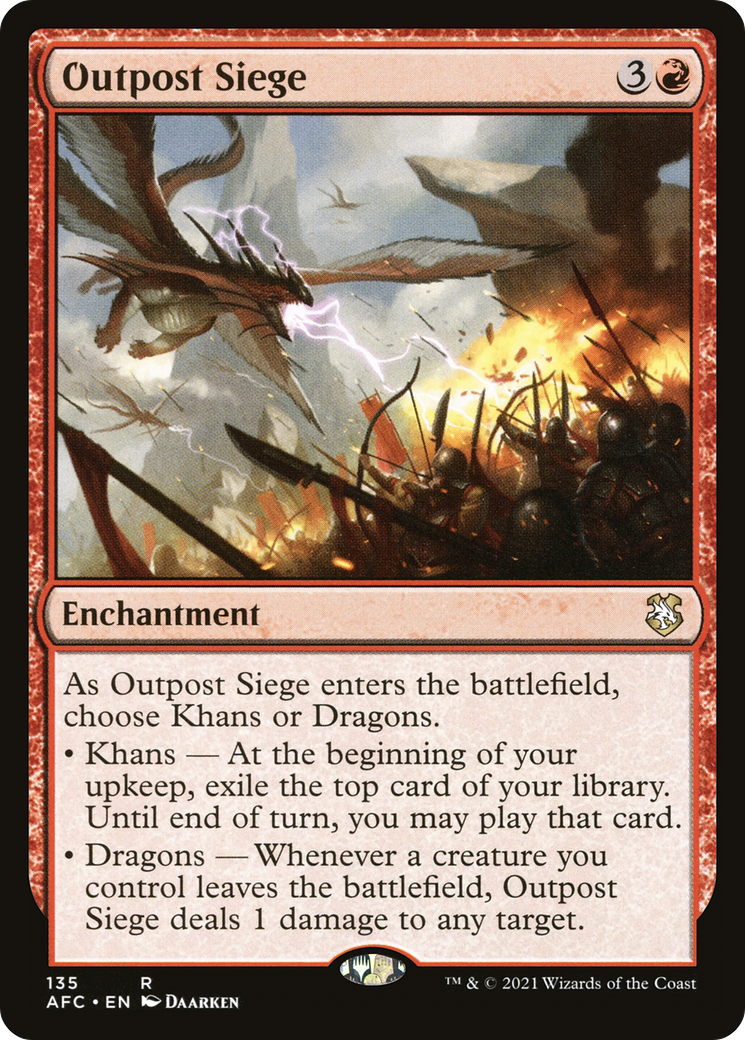
Outpost Siege
Outpost Siege
Enchantment
As this enchantment enters, choose Khans or Dragons.
- Khans — At the beginning of your upkeep, exile the top card of your library. Until end of turn, you may play that card.
- Dragons — Whenever a creature you control leaves the battlefield, this enchantment deals 1 damage to any target.
- The card exiled by the "Khans" ability is exiled face up. Playing a card exiled with the "Khans" ability follows the normal rules for playing the card. You must pay its costs, and you must follow all applicable timing rules. For example, if it's a creature card, you can cast it only during your main phase while the stack is empty.
- If you exile a land card using the "Khans" ability, you may play that land only if you have any available land plays. Normally, this means you can play the land only if you haven't played a land yet that turn.
- If a noncreature card is manifested and then leaves the battlefield while face down, the "Dragons" ability will trigger.
- Each Siege will have one of the two listed abilities, depending on your choice as it enters the battlefield.
- The words "Khans" and "Dragons" are anchor words, connecting your choice to the appropriate ability. Anchor words are a new rules concept. "[Anchor word] — [Ability]" means "As long as you chose [anchor word] as this permanent entered the battlefield, this permanent has [ability]." Notably, the anchor word "Dragons" has no connection to the creature type Dragon.
- Each of the last two abilities is linked to the first ability. They each refer only to the choice made as a result of the first ability. If a permanent enters the battlefield as a copy of one of the Sieges, its controller will make a new choice for that Siege. Which ability the copy has won't depend on the choice made for the original permanent.
-
1
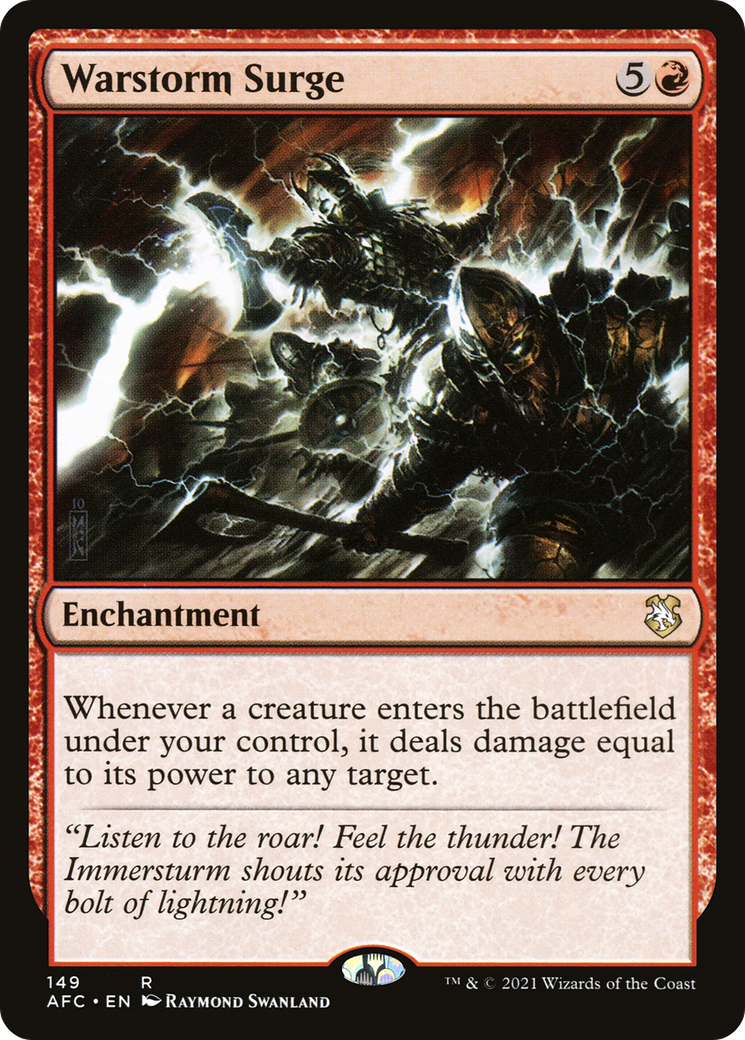
Warstorm Surge
Warstorm Surge
Enchantment
Whenever a creature you control enters, it deals damage equal to its power to any target.
- The creature that entered deals damage equal to its current power to the targeted permanent or player. If it's no longer on the battlefield, its last known existence on the battlefield is checked to determine its power.
- Warstorm Surge is the source of the ability, but the creature is the source of the damage. The ability couldn't target a creature with protection from red, for example. It could target a creature with protection from creatures, but all the damage would be prevented. Since damage is dealt by the creature, abilities like lifelink, deathtouch and infect are taken into account, even if the creature has left the battlefield by the time it deals damage.
Lands 39
-
1
Cinder Glade
Cinder Glade
Land — Mountain Forest
( : Add or .)
This land enters tapped unless you control two or more basic lands.
- If one of these lands enters the battlefield at the same time as any number of basic lands, those other lands are not counted when determining if this land enters the battlefield tapped or untapped.
- However, because these cards have basic land types, effects that specify a basic land type without also specifying that the land be basic can affect them. For example, a spell or ability that reads "Destroy target Forest" can target Canopy Vista, while one that reads "Destroy target basic Forest" cannot.
- Even though these lands have basic land types, they are not basic lands because "basic" doesn't appear on their type line. Notably, controlling two or more of them won't allow others to enter the battlefield untapped.
-
1
Command Tower
Command Tower
Land
: Add one mana of any color in your commander's color identity.
- If you don't have a commander, Command Tower's ability produces no mana.
- If your commander is a card that has no colors in its color identity, Command Tower's ability produces no mana. It doesn't produce .
- If you have two commanders, the ability adds one mana of any color in their combined color identities.
-
1
Crucible of the Spirit Dragon
Crucible of the Spirit Dragon
Land
: Add .
, : Put a storage counter on this land.
, Remove X storage counters from this land: Add X mana in any combination of colors. Spend this mana only to cast Dragon spells or activate abilities of Dragons.
- You can use mana generated by the last ability to pay an alternative cost (such as a dash cost) or an additional cost to cast a Dragon spell. It's not limited to paying just that spell's mana cost.
- An activated ability appears in the form “Cost: Effect.”
- Notably, turning a face-down creature face up isn't an activated ability. If you manifest a Dragon creature card or cast a Dragon creature card face down using the morph ability, you can't use mana generated by the last ability to turn that card face up.
- The mana generated by the last ability can't be spent to activate abilities of Dragon sources that aren't on the battlefield.
-
1
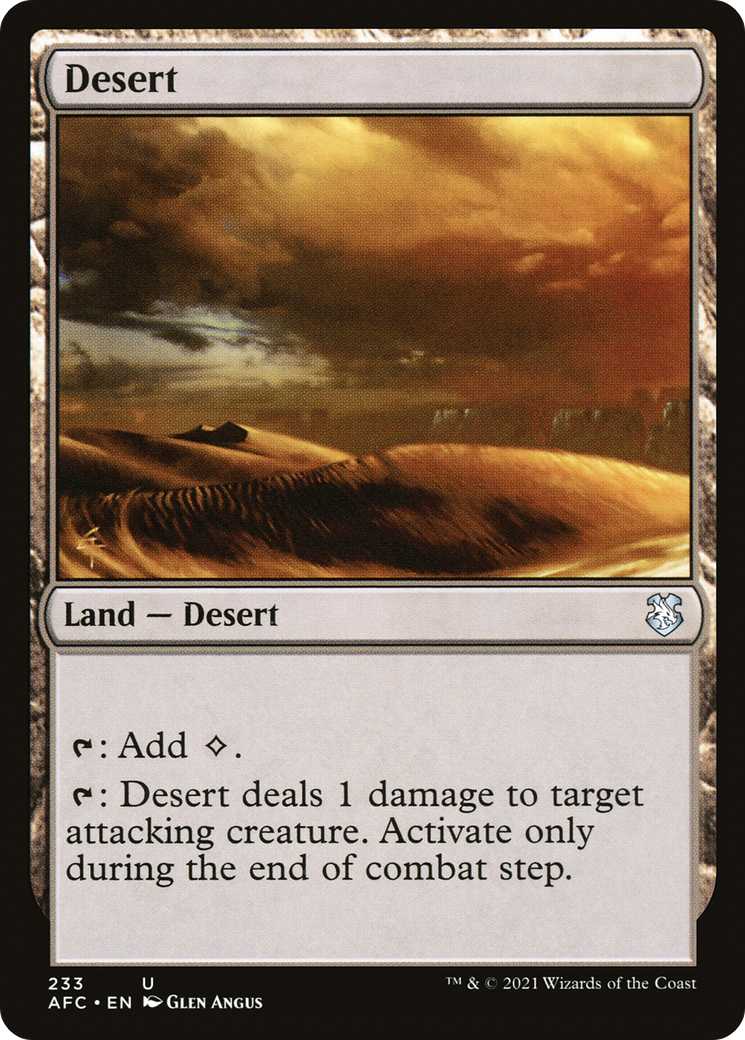
Desert
Desert
Land — Desert
: Add .
: This land deals 1 damage to target attacking creature. Activate only during the end of combat step.
- The end of combat step happens after combat damage is dealt. You can't use Desert to destroy an attacking creature before it has a chance to deal combat damage.
- Desert is a land subtype with no special meaning. It doesn't grant the land an intrinsic mana ability. Other cards may care about which lands are Deserts.
- The ability can be used on any player's attacking creatures. This includes your own and creatures in an attack you are not involved in (for multiplayer games).
-
1
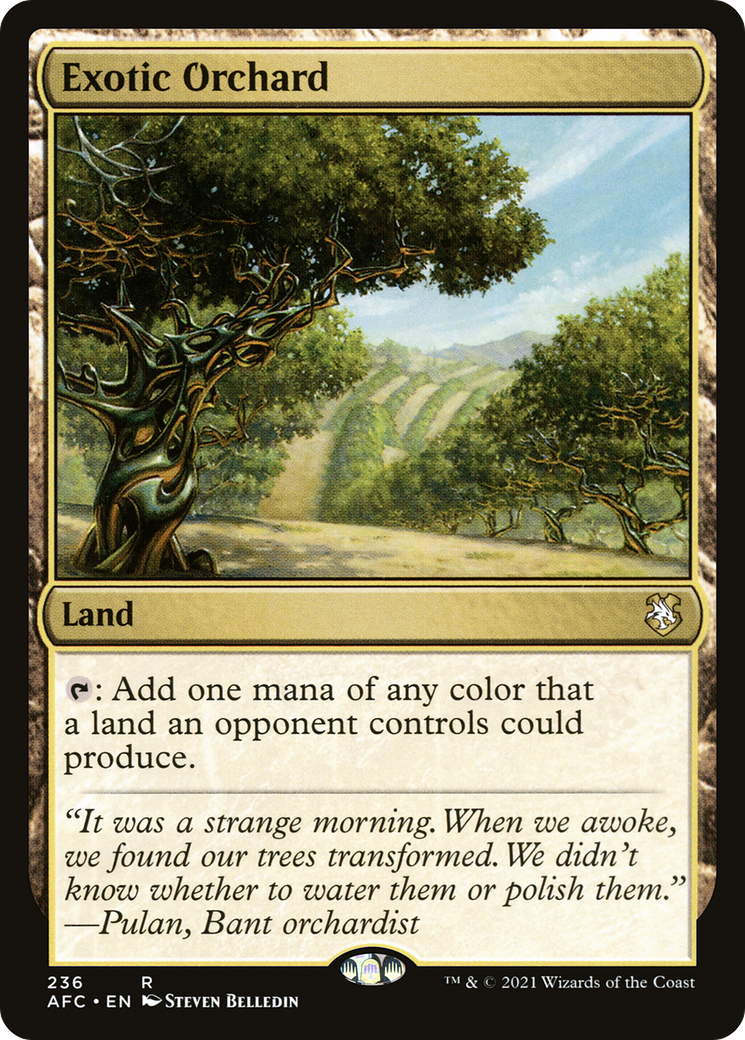
Exotic Orchard
Exotic Orchard
Land
: Add one mana of any color that a land an opponent controls could produce.
- Lands that produce mana based only on what other lands "could produce" won't help each other unless some other land allows one of them to actually produce some type of mana. For example, if you control an Exotic Orchard and your opponent controls an Exotic Orchard and a Reflecting Pool, none of those lands would produce mana if their mana abilities were activated. On the other hand, if you control a Forest and an Exotic Orchard, and your opponent controls an Exotic Orchard and a Reflecting Pool, then each of those lands can be tapped to produce . Your opponent's Exotic Orchard can produce because you control a Forest. Your Exotic Orchard and your opponent's Reflecting Pool can each produce because your opponent's Exotic Orchard can produce .
- When determining what colors of mana your opponents' lands could produce, Exotic Orchard takes into account any applicable replacement effects that would apply to those lands' mana abilities (such as Contamination's effect, for example). If there are more than one, consider them in any possible order.
- The colors of mana are white, blue, black, red, and green. Exotic Orchard can't be tapped for colorless mana, even if a land an opponent controls could produce colorless mana.
- Exotic Orchard doesn't care about any restrictions or riders your opponents' lands (such as Ancient Ziggurat or Hall of the Bandit Lord) put on the mana they produce. It just cares about colors of mana.
- Exotic Orchard checks the effects of all mana-producing abilities of lands your opponents control, but it doesn't check their costs. For example, Vivid Crag has the ability " , Remove a charge counter from Vivid Crag: Add one mana of any color." If an opponent controls Vivid Crag and you control Exotic Orchard, you can tap Exotic Orchard for any color of mana. It doesn't matter whether Vivid Crag has a charge counter on it, and it doesn't matter whether it's untapped.
-
15
Forest
Forest
Basic Land — Forest
( : Add .)
-
1
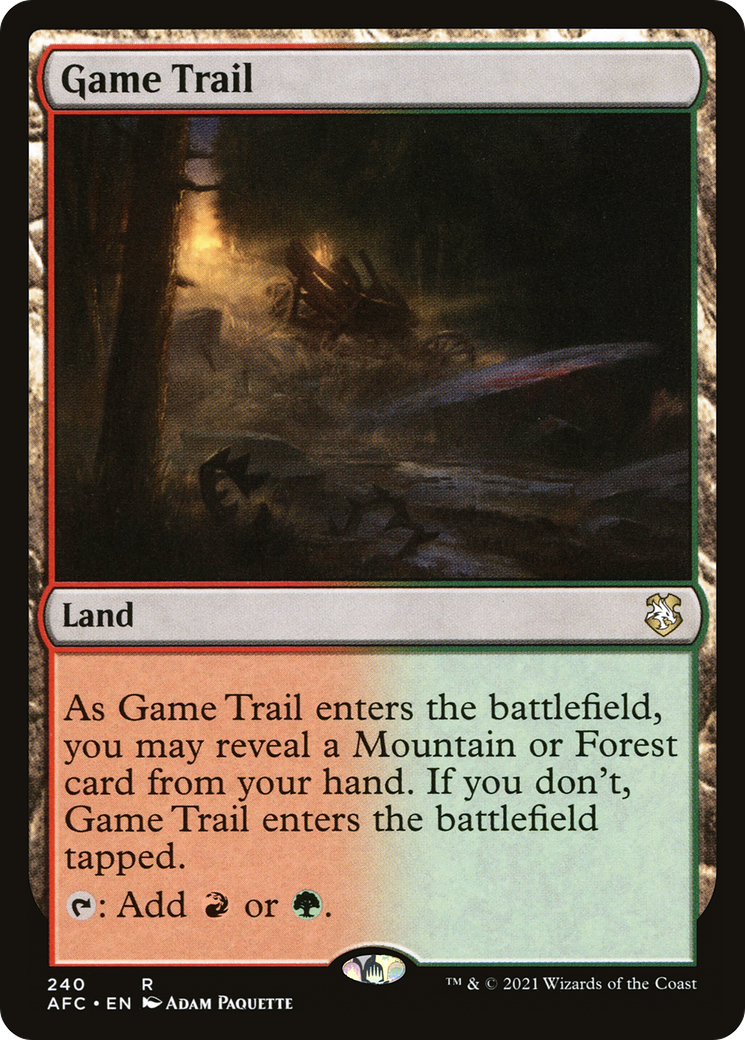
Game Trail
Game Trail
Land
As this land enters, you may reveal a Mountain or Forest card from your hand. If you don't, this land enters tapped.
: Add or .
- Lands don't have a subtype just because they can produce mana of the corresponding color. Game Trail itself is neither a Mountain nor a Forest, even though it produces red and green mana, so you can't reveal one to satisfy the ability of another.
- If an effect instructs you to put Game Trail onto the battlefield tapped, it will still enter the battlefield tapped even if you reveal a land card from your hand.
- You may reveal any land card with either or both of the appropriate subtypes. It doesn't have to be a basic land. For example, you could reveal Canopy Vista from the Battle for Zendikar set to satisfy the ability of Game Trail.
- If a Mountain or Forest is entering the battlefield from your hand at the same time as Game Trail, you may reveal the other land to have Game Trail enter untapped.
-
1
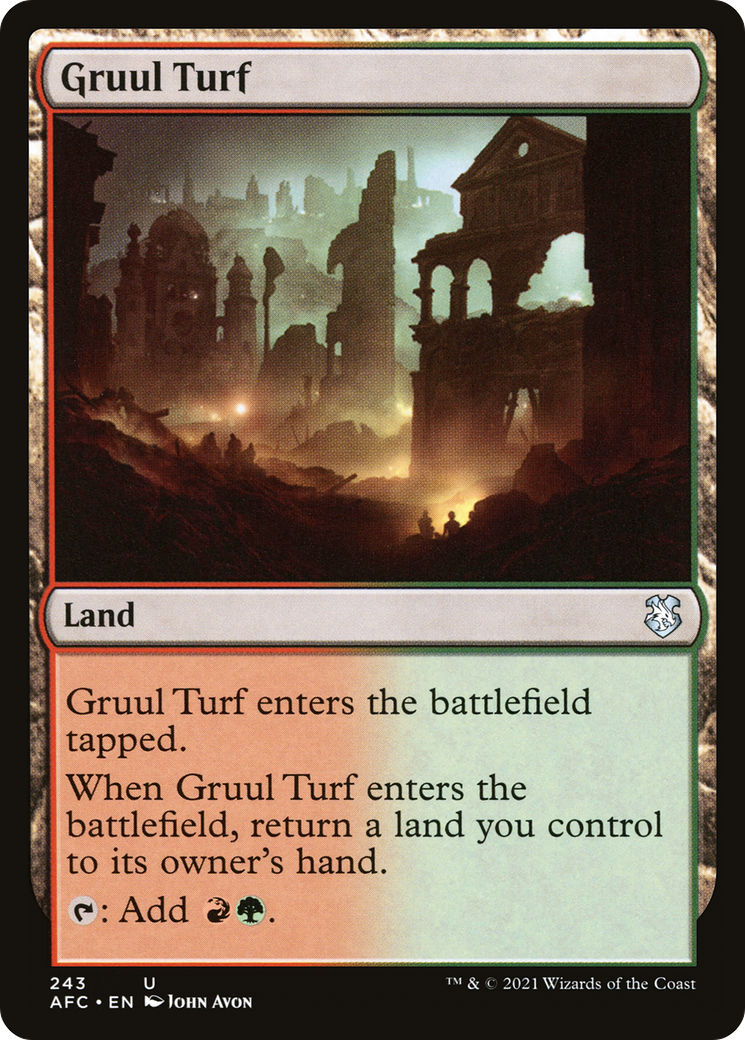
Gruul Turf
Gruul Turf
Land
This land enters tapped.
When this land enters, return a land you control to its owner's hand.
: Add .
- If this land enters the battlefield and you control no other lands, its ability will force you to return it to your hand.
-
1
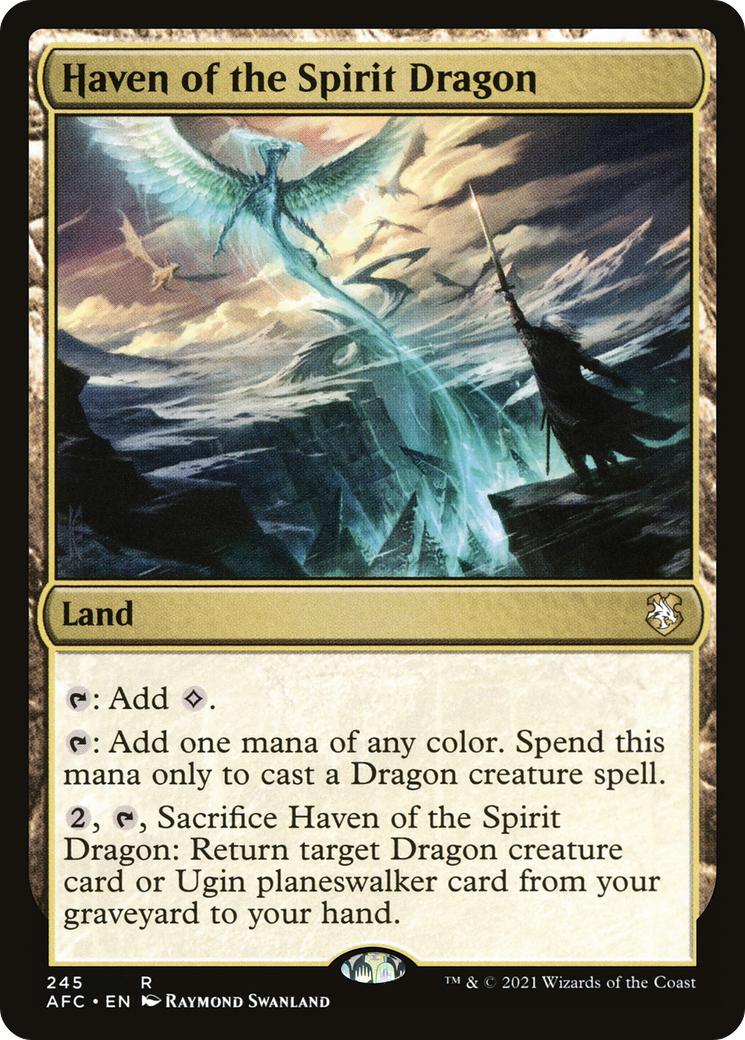
Haven of the Spirit Dragon
Haven of the Spirit Dragon
Land
: Add .
: Add one mana of any color. Spend this mana only to cast a Dragon creature spell.
, , Sacrifice this land: Return target Dragon creature card or Ugin planeswalker card from your graveyard to your hand.
- The mana produced by Haven of the Spirit Dragon's second ability can be used to pay for any additional or alternative costs (such as dash costs) involved in casting a Dragon creature spell.
-
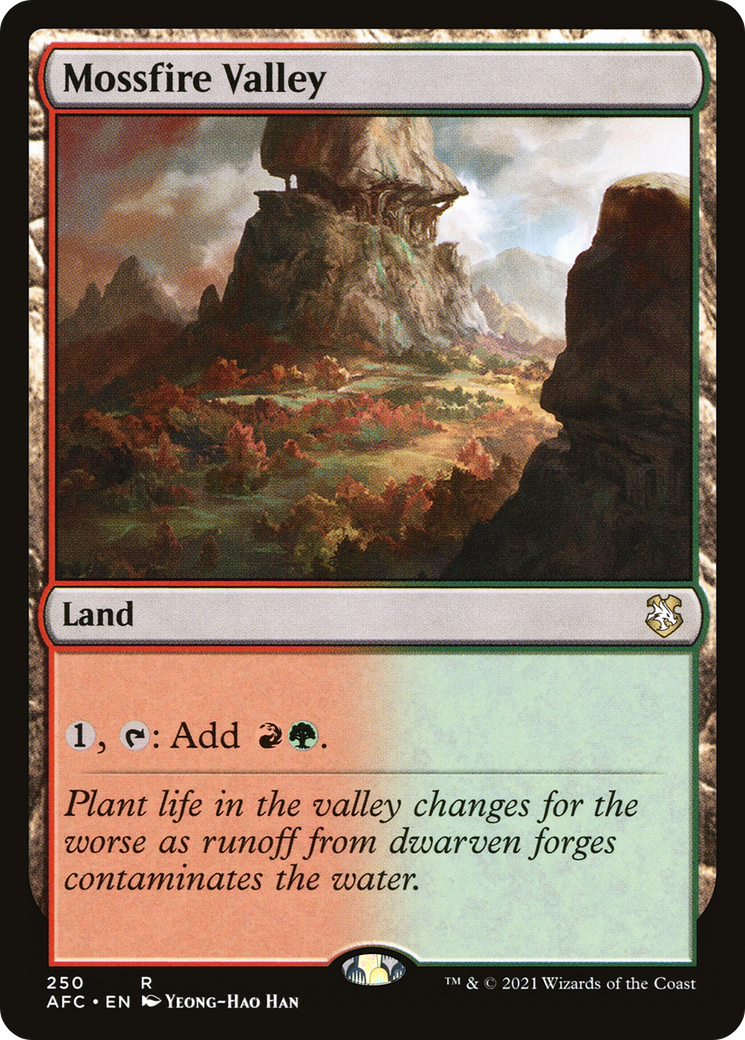
1
Mossfire Valley
Mossfire Valley
Land
, : Add .
-
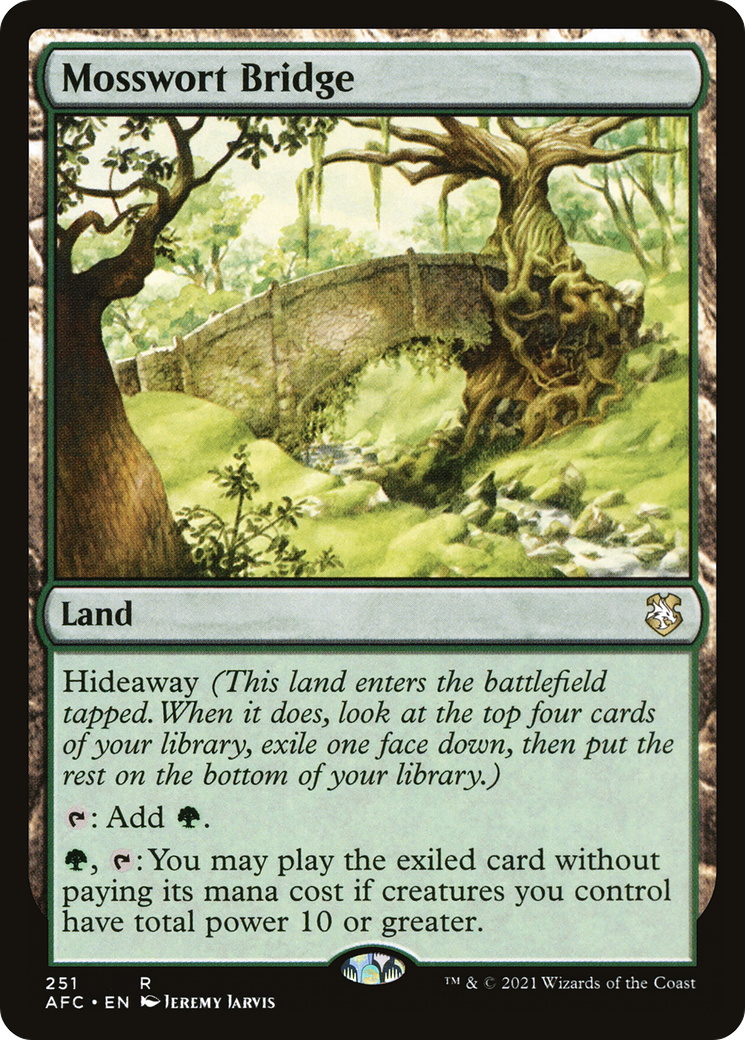
1
Mosswort Bridge
Mosswort Bridge
Land
Hideaway 4 (When this land enters, look at the top four cards of your library, exile one face down, then put the rest on the bottom in a random order.)
This land enters tapped.
: Add .
, : You may play the exiled card without paying its mana cost if creatures you control have total power 10 or greater.
- "Hideaway N" means "When this permanent enters the battlefield, look at the top N cards of your library. Exile one of them face down and put the rest on the bottom of your library in a random order. The exiled card gains 'The player who controls the permanent that exiled this card may look at this card in the exile zone.'"
- Any player who has controlled a permanent with a hideaway ability since a card was exiled with it may look at that card.
- Previously, permanents with hideaway entered the battlefield tapped. This ability has been removed from the definition of hideaway. Older cards have received errata to have an additional paragraph that reads "[This permanent] enters the battlefield tapped," and they now have hideaway 4.
- Hideaway now causes you to put the rest of the cards on the bottom of your library in a random order instead of any order.
-
12
Mountain
Mountain
Basic Land — Mountain
( : Add .)
-
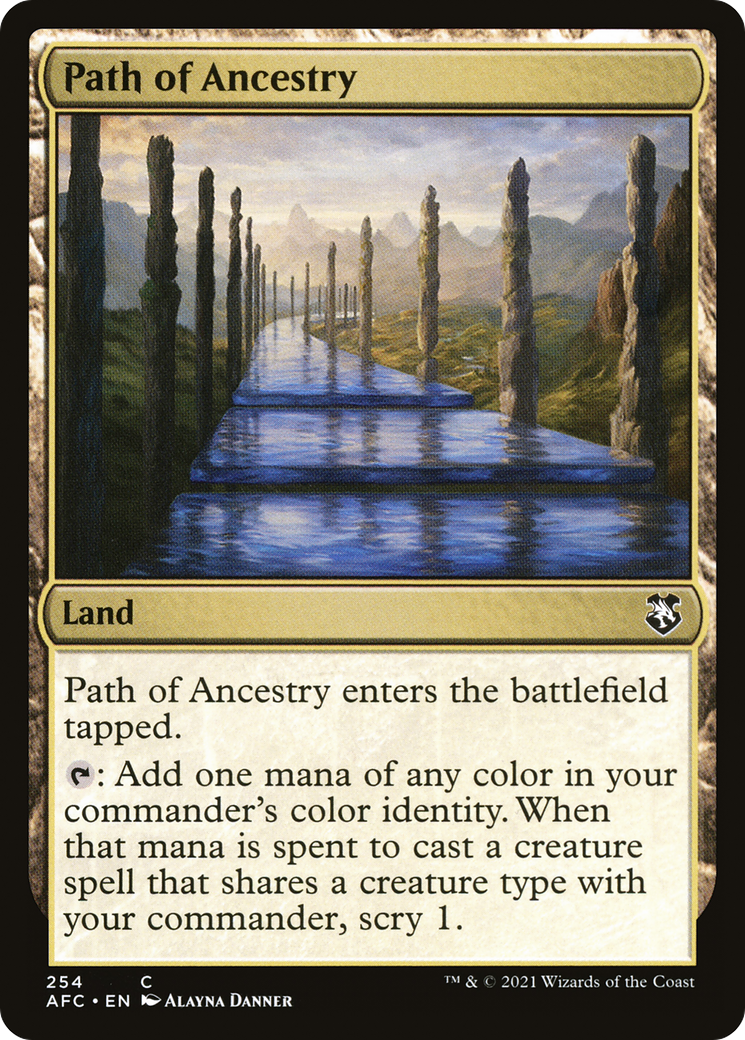
1
Path of Ancestry
Path of Ancestry
Land
This land enters tapped.
: Add one mana of any color in your commander's color identity. When that mana is spent to cast a creature spell that shares a creature type with your commander, scry 1. (Look at the top card of your library. You may put that card on the bottom.)
- Your commander's creature types are checked immediately after you cast a creature spell spending mana from Path of Ancestry's last ability. They aren't set before the game begins, and they may not be the same types your commander had when you activated that ability.
- If you have two commanders, the last ability adds one mana of any color in their combined color identities. When you spend that mana on a creature spell that shares a creature type with either of your commanders, you'll scry 1.
- If Path of Ancestry's last ability produces two mana (most likely due to Mana Reflection), spending those two mana to cast creature spells that share a creature type with your commander will cause two abilities to trigger. Each of those abilities will cause you to scry 1. You won't scry 2. This is true whether you spend the mana on one creature spell or two.
- If your commander has no creature types, it can't share a creature type with any spell that you cast.
- If you cast your commander with mana from Path of Ancestry, and your commander hasn't somehow lost all of its creature types while on the stack, you'll scry 1.
- If you don't have a commander, Path of Ancestry's ability produces no mana.
- If your commander is a card that has no colors in its color identity, Path of Ancestry's ability produces no mana. It doesn't produce .
-
1
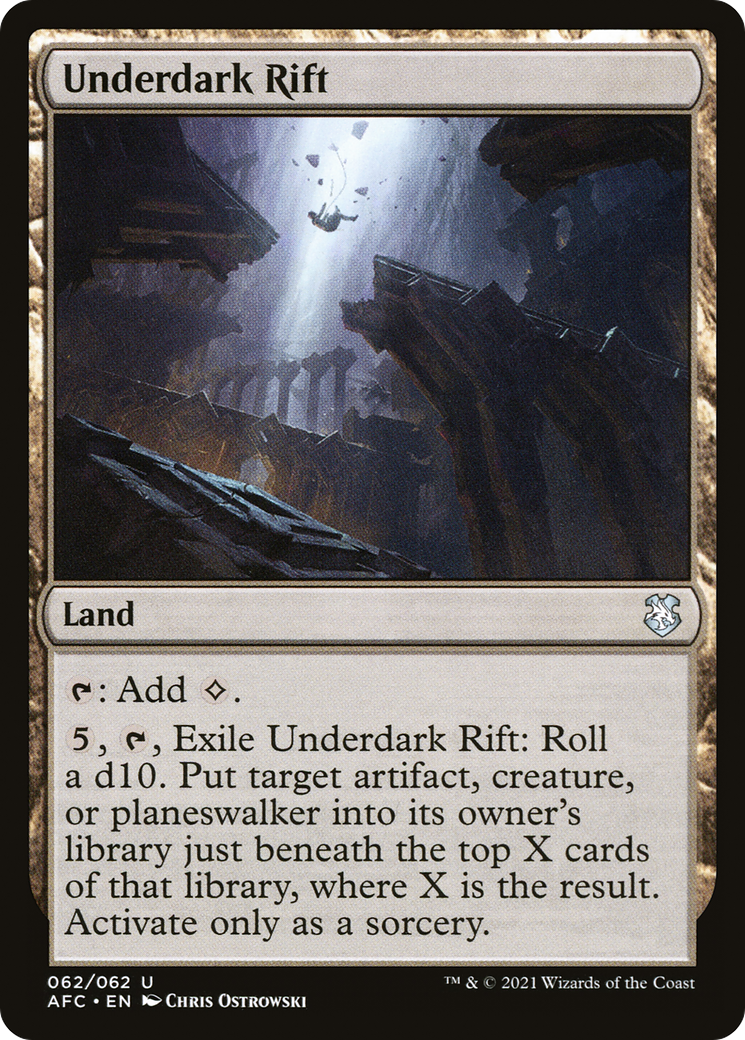
Underdark Rift
Underdark Rift
Land
: Add .
, , Exile this land: Roll a d10. Put target artifact, creature, or planeswalker into its owner's library just beneath the top X cards of that library, where X is the result. Activate only as a sorcery.
- If that permanent's owner has fewer than X cards in their library, put the permanent on the bottom of its owner's library.
- Dice are identified by the number of faces each one has. For example, a d20 is a twenty-sided die.
- Dice used must have equally likely outcomes and the roll must be fair. Although physical dice are recommended, digital substitutes are allowed, provided they have the same number of equally likely outcomes as specified in the original roll instruction.
- An ability that tells you to roll a die will also specify what to do with the result of that roll. Most often, this is in the form of a “results table” in the card text.
- The instruction to roll a die and the effect that occurs because of the result are all part of the same ability. Players do not get the chance to respond to the ability after knowing the result of the roll.
- An effect that says “choose a target, then roll a d20” or similar still uses the normal process of putting an ability on the stack and resolving it. Choosing targets is part of putting the ability on the stack and rolling the d20 happens later, as the ability resolves.
- Some effects may modify the result of a die roll. This may be part of the instruction to roll a die or it may come from other cards. Anything that references the “result” of a die roll is looking for the result after these modifications. Anything that is looking for the “natural result” is looking for the number shown on the face of the die before these modifications.
- Some abilities, like that of Pixie Guide and Barbarian Class, replace rolling a die with rolling extra dice and ignoring the lowest roll. The ignored rolls are not considered for the effect that instructed you to roll a die, and do not cause abilities to trigger. For all intents and purposes, once you determine which dice count, any extra dice were never rolled.
- Some effects instruct you to roll again. This uses the same number and type of dice as the original roll, and that roll will use the same set of possible outcomes.
- While playing Planechase, rolling the planar die will cause any ability that triggers whenever a player rolls one or more dice to trigger. However, any effect that refers to a numerical result will ignore the rolling of the planar die.
- Tournament events have more specific rules regarding dice and die-rolling. For more information, please see the most recent version of the Magic Tournament Rules at https://wpn.wizards.com/en/document/magic-gathering-tournament-rules.
Red 28
-
1
Anger
Anger
Creature — Incarnation
2/2
Haste
As long as this card is in your graveyard and you control a Mountain, creatures you control have haste.
- The timestamp for the "in your graveyard" ability is set at the time that this card goes to your graveyard, regardless of whether you control a Mountain at that time.
-
1
Barbarian Class
Barbarian Class
Enchantment — Class
(Gain the next level as a sorcery to add its ability.)
If you would roll one or more dice, instead roll that many dice plus one and ignore the lowest roll.
: Level 2
Whenever you roll one or more dice, target creature you control gets +2/+0 and gains menace until end of turn.
: Level 3
Creatures you control have haste.
-
1
Berserker's Frenzy
Berserker's Frenzy
Instant
Cast this spell only before combat or during combat before blockers are declared.
Roll two d20 and ignore the lower roll.
1—14 | Choose any number of creatures. They block this turn if able.
15—20 | You choose which creatures block this turn and how those creatures block.
- If you roll doubles, ignore one of the rolls and use the result of the other.
- An ignored roll effectively never happens. No abilities will trigger because of an ignored roll.
- When choosing blocks for creatures you don't control, you must still make legal choices. For example, you can't choose to have a creature without flying or reach block a creature with flying.
- If there's a cost associated with having a creature block and you choose for that creature to block, its controller can choose to pay that cost or not. If that player doesn't pay that cost, you must propose a new set of blocking creatures.
- Dice are identified by the number of faces each one has. For example, a d20 is a twenty-sided die.
- Dice used must have equally likely outcomes and the roll must be fair. Although physical dice are recommended, digital substitutes are allowed, provided they have the same number of equally likely outcomes as specified in the original roll instruction.
- An ability that tells you to roll a die will also specify what to do with the result of that roll. Most often, this is in the form of a “results table” in the card text.
- The instruction to roll a die and the effect that occurs because of the result are all part of the same ability. Players do not get the chance to respond to the ability after knowing the result of the roll.
- An effect that says “choose a target, then roll a d20” or similar still uses the normal process of putting an ability on the stack and resolving it. Choosing targets is part of putting the ability on the stack and rolling the d20 happens later, as the ability resolves.
- Some effects may modify the result of a die roll. This may be part of the instruction to roll a die or it may come from other cards. Anything that references the “result” of a die roll is looking for the result after these modifications. Anything that is looking for the “natural result” is looking for the number shown on the face of the die before these modifications.
- Some abilities, like that of Pixie Guide and Barbarian Class, replace rolling a die with rolling extra dice and ignoring the lowest roll. The ignored rolls are not considered for the effect that instructed you to roll a die, and do not cause abilities to trigger. For all intents and purposes, once you determine which dice count, any extra dice were never rolled.
- Some effects instruct you to roll again. This uses the same number and type of dice as the original roll, and that roll will use the same set of possible outcomes.
- While playing Planechase, rolling the planar die will cause any ability that triggers whenever a player rolls one or more dice to trigger. However, any effect that refers to a numerical result will ignore the rolling of the planar die.
- Tournament events have more specific rules regarding dice and die-rolling. For more information, please see the most recent version of the Magic Tournament Rules at https://wpn.wizards.com/en/document/magic-gathering-tournament-rules.
-
1
Bogardan Hellkite
Bogardan Hellkite
Creature — Dragon
5/5
Flash
Flying
When this creature enters, it deals 5 damage divided as you choose among any number of targets.
- You choose how many targets Bogardan Hellkite's triggered ability has and how the damage is divided as you put the ability onto the stack. Each target must receive at least 1 damage.
- If some of the creatures or players are illegal targets as Bogardan Hellkite's triggered ability tries to resolve, the original division of damage still applies and the damage that would have been dealt to the illegal targets is lost. It won't be dealt instead to a legal target.
-
1
Chain Reaction
Chain Reaction
Sorcery
Chain Reaction deals X damage to each creature, where X is the number of creatures on the battlefield.
- The value of X is determined as Chain Reaction resolves.
-
1
Chaos Dragon
Chaos Dragon
Creature — Dragon
4/4
Flying, haste
This creature attacks each combat if able.
At the beginning of combat on your turn, each player rolls a d20. If one or more opponents had the highest result, this creature can't attack those players or planeswalkers they control this combat.
- You roll a d20 as well as your opponents. If you had a higher result than all of your opponents, Chaos Dragon won't have any restrictions on who it may attack.
- Dice are identified by the number of faces each one has. For example, a d20 is a twenty-sided die.
- Dice used must have equally likely outcomes and the roll must be fair. Although physical dice are recommended, digital substitutes are allowed, provided they have the same number of equally likely outcomes as specified in the original roll instruction.
- An ability that tells you to roll a die will also specify what to do with the result of that roll. Most often, this is in the form of a "results table" in the card text.
- The instruction to roll a die and the effect that occurs because of the result are all part of the same ability. Players do not get the chance to respond to the ability after knowing the result of the roll.
- An effect that says "choose a target, then roll a d20" or similar still uses the normal process of putting an ability on the stack and resolving it. Choosing targets is part of putting the ability on the stack and rolling the d20 happens later, as the ability resolves.
- Some effects may modify the result of a die roll. This may be part of the instruction to roll a die or it may come from other cards. Anything that references the "result" of a die roll is looking for the result after these modifications. Anything that is looking for the "natural result" is looking for the number shown on the face of the die before these modifications.
- Some abilities, like that of Pixie Guide and Barbarian Class, replace rolling a die with rolling extra dice and ignoring the lowest roll. The ignored rolls are not considered for the effect that instructed you to roll a die, and do not cause abilities to trigger. For all intents and purposes, once you determine which dice count, any extra dice were never rolled.
- Some effects instruct you to roll again. This uses the same number and type of dice as the original roll, and that roll will use the same set of possible outcomes.
- While playing Planechase, rolling the planar die will cause any ability that triggers whenever a player rolls one or more dice to trigger. However, any effect that refers to a numerical result will ignore the rolling of the planar die.
- Tournament events have more specific rules regarding dice and die-rolling. For more information, please see the most recent version of the Magic Tournament Rules at https://wpn.wizards.com/en/document/magic-gathering-tournament-rules.
-
1
Demanding Dragon
Demanding Dragon
Creature — Dragon
5/5
Flying
When this creature enters, it deals 5 damage to target opponent unless that player sacrifices a creature of their choice.
-
1
Dragonlord's Servant
Dragonlord's Servant
Creature — Goblin Shaman
1/3
Dragon spells you cast cost less to cast.
- Dragonlord's Servant's ability doesn't change the mana cost or mana value of any spell. It changes only the total cost you pay to cast Dragon spells.
- Dragonlord's Servant's ability can't reduce the amount of colored mana you pay for a spell. It reduces only the generic mana component of that spell.
- Dragonlord's Servant can't reduce the colored mana requirement of a Dragon spell you cast.
- If there are any additional costs to cast a Dragon spell, apply those before applying Dragonlord's Servant and any other cost reductions.
- The ability can apply to alternative costs to cast a Dragon spell.
- To determine the total cost of a spell, start with the mana cost or alternative cost (such as a flashback cost) you're paying, add any cost increases, then apply any cost reductions. The mana value of the spell is determined only by its mana cost, no matter what the total cost to cast the spell was.
-
1
Dragonmaster Outcast
Dragonmaster Outcast
Creature — Human Shaman
1/1
At the beginning of your upkeep, if you control six or more lands, create a 5/5 red Dragon creature token with flying.
-
1
Dragonspeaker Shaman
Dragonspeaker Shaman
Creature — Human Barbarian Shaman
2/2
Dragon spells you cast cost less to cast.
-
1
Earth-Cult Elemental
Earth-Cult Elemental
Creature — Elemental
6/6
Siege Monster — When this creature enters, roll a d20.
1—9 | Each player sacrifices a permanent of their choice.
10—19 | Each opponent sacrifices a permanent of their choice.
20 | Each opponent sacrifices two permanents of their choice.
-
1
Gratuitous Violence
Gratuitous Violence
Enchantment
If a creature you control would deal damage to a permanent or player, it deals double that damage instead.
-
1
Hoard-Smelter Dragon
Hoard-Smelter Dragon
Creature — Dragon
5/5
Flying
: Destroy target artifact. This creature gets +X/+0 until end of turn, where X is that artifact's mana value.
- If the activated ability resolves but the targeted artifact isn't destroyed (perhaps because it has indestructible or it regenerates), Hoard-Smelter Dragon will still get the bonus.
- If the targeted artifact is an illegal target by the time the activated ability resolves, the ability doesn't resolve. Hoard-Smelter Dragon won't get the bonus.
- If the mana cost of a permanent includes , that X is considered to be 0.
-
1
Maddening Hex
Maddening Hex
Enchantment — Aura Curse
Enchant player
Whenever enchanted player casts a noncreature spell, roll a d6. This Aura deals damage to that player equal to the result. Then attach this Aura to another one of your opponents chosen at random.
- If Maddening Hex is attached to your only opponent, it stays attached to that player as the ability resolves.
- Dice are identified by the number of faces each one has. For example, a d20 is a twenty-sided die.
- Dice used must have equally likely outcomes and the roll must be fair. Although physical dice are recommended, digital substitutes are allowed, provided they have the same number of equally likely outcomes as specified in the original roll instruction.
- An ability that tells you to roll a die will also specify what to do with the result of that roll. Most often, this is in the form of a "results table" in the card text.
- The instruction to roll a die and the effect that occurs because of the result are all part of the same ability. Players do not get the chance to respond to the ability after knowing the result of the roll.
- An effect that says "choose a target, then roll a d20" or similar still uses the normal process of putting an ability on the stack and resolving it. Choosing targets is part of putting the ability on the stack and rolling the d20 happens later, as the ability resolves.
- Some effects may modify the result of a die roll. This may be part of the instruction to roll a die or it may come from other cards. Anything that references the "result" of a die roll is looking for the result after these modifications. Anything that is looking for the "natural result" is looking for the number shown on the face of the die before these modifications.
- Some abilities, like that of Pixie Guide and Barbarian Class, replace rolling a die with rolling extra dice and ignoring the lowest roll. The ignored rolls are not considered for the effect that instructed you to roll a die, and do not cause abilities to trigger. For all intents and purposes, once you determine which dice count, any extra dice were never rolled.
- Some effects instruct you to roll again. This uses the same number and type of dice as the original roll, and that roll will use the same set of possible outcomes.
- While playing Planechase, rolling the planar die will cause any ability that triggers whenever a player rolls one or more dice to trigger. However, any effect that refers to a numerical result will ignore the rolling of the planar die.
- Tournament events have more specific rules regarding dice and die-rolling. For more information, please see the most recent version of the Magic Tournament Rules at https://wpn.wizards.com/en/document/magic-gathering-tournament-rules.
-
1
Magmaquake
Magmaquake
Instant
Magmaquake deals X damage to each creature without flying and each planeswalker.
- Magmaquake doesn't target any creature or planeswalker. For example, it will deal damage to a creature without flying that has hexproof.
-
1
Opportunistic Dragon
Opportunistic Dragon
Creature — Dragon
4/3
Flying
When this creature enters, choose target Human or artifact an opponent controls. For as long as this creature remains on the battlefield, gain control of that permanent, it loses all abilities, and it can't attack or block.
- If Opportunistic Dragon leaves the battlefield before its triggered ability resolves, your opponent keeps control of their Human or artifact, it doesn't lose any abilities, and it can still attack or block as normal. You don't gain control of it at all.
- Opportunistic Dragon's effect doesn't expire if another player gains control of it or if it loses all abilities. The effect only expires once it's no longer on the battlefield.
- If another player gains control of the permanent Opportunistic Dragon has kidnapped, that permanent doesn't regain its abilities and still can't attack or block.
- If the stolen permanent normally has any abilities that would trigger when Opportunistic Dragon dies, those abilities won't trigger.
-
1
Outpost Siege
Outpost Siege
Enchantment
As this enchantment enters, choose Khans or Dragons.
- Khans — At the beginning of your upkeep, exile the top card of your library. Until end of turn, you may play that card.
- Dragons — Whenever a creature you control leaves the battlefield, this enchantment deals 1 damage to any target.
- The card exiled by the "Khans" ability is exiled face up. Playing a card exiled with the "Khans" ability follows the normal rules for playing the card. You must pay its costs, and you must follow all applicable timing rules. For example, if it's a creature card, you can cast it only during your main phase while the stack is empty.
- If you exile a land card using the "Khans" ability, you may play that land only if you have any available land plays. Normally, this means you can play the land only if you haven't played a land yet that turn.
- If a noncreature card is manifested and then leaves the battlefield while face down, the "Dragons" ability will trigger.
- Each Siege will have one of the two listed abilities, depending on your choice as it enters the battlefield.
- The words "Khans" and "Dragons" are anchor words, connecting your choice to the appropriate ability. Anchor words are a new rules concept. "[Anchor word] — [Ability]" means "As long as you chose [anchor word] as this permanent entered the battlefield, this permanent has [ability]." Notably, the anchor word "Dragons" has no connection to the creature type Dragon.
- Each of the last two abilities is linked to the first ability. They each refer only to the choice made as a result of the first ability. If a permanent enters the battlefield as a copy of one of the Sieges, its controller will make a new choice for that Siege. Which ability the copy has won't depend on the choice made for the original permanent.
-
1
Rile
Rile
Sorcery
Rile deals 1 damage to target creature you control. That creature gains trample until end of turn.
Draw a card.
- If Rile targets a creature with 1 toughness, that creature won't be destroyed until after you've drawn a card. Its abilities may affect that draw or trigger on that draw if appropriate.
- If the damage that would be dealt by Rile is prevented, the creature still gains trample until end of turn.
- If the target creature is an illegal target by the time Rile resolves, the entire spell doesn't resolve. You won't draw a card.
-
1
Scourge of Valkas
Scourge of Valkas
Creature — Dragon
4/4
Flying
Whenever this creature or another Dragon you control enters, it deals X damage to any target, where X is the number of Dragons you control.
: This creature gets +1/+0 until end of turn.
- The amount of damage dealt by the Dragon that entered the battlefield is based on the number of Dragons you control when the ability resolves.
- If a Dragon entering the battlefield causes Scourge of Valkas's ability to trigger but leaves the battlefield before that ability resolves, that Dragon still deals damage.
-
1
Shivan Hellkite
Shivan Hellkite
Creature — Dragon
5/5
Flying (This creature can't be blocked except by creatures with flying or reach.)
: This creature deals 1 damage to any target.
-
1
Skyline Despot
Skyline Despot
Creature — Dragon
5/5
Flying
When this creature enters, you become the monarch.
At the beginning of your upkeep, if you're the monarch, create a 5/5 red Dragon creature token with flying.
- The last ability of Skyline Despot checks to see if you're the monarch as your upkeep begins. If you're not, the ability won't trigger at all. You won't be able to do anything that would make you the monarch during your upkeep in time to have that ability trigger. The ability will also check to see if you're the monarch as it tries to resolve. If you're not the monarch at that time, the ability will have no effect.
- The game starts with no monarch. Once an effect makes one player the monarch, the game will have exactly one monarch from that point forward.
- Being the monarch carries two inherent triggered abilities. “At the beginning of the monarch's end step, that player draws a card” and “Whenever a creature deals combat damage to the monarch, its controller becomes the monarch.”
- Abilities that trigger whenever you “become the monarch” trigger only if you aren't already the monarch. For example, if you are already the monarch as Custodi Lich enters the battlefield, its last ability won't trigger.
- If the triggered ability that causes the monarch to draw a card goes on the stack, and a different player becomes the monarch before that ability resolves, the first player will still draw the card.
-
1
Skyship Stalker
Skyship Stalker
Creature — Cat Dragon
3/3
Flying
: This creature gets +1/+0 until end of turn.
: This creature gains first strike until end of turn.
: This creature gains haste until end of turn.
-
1
Spit Flame
Spit Flame
Instant
Spit Flame deals 4 damage to target creature.
Whenever a Dragon you control enters, you may pay . If you do, return this card from your graveyard to your hand.
-
1
Taurean Mauler
Taurean Mauler
Creature — Shapeshifter
2/2
Changeling (This card is every creature type.)
Whenever an opponent casts a spell, you may put a +1/+1 counter on this creature.
- Taurean Mauler's last ability resolves before the spell that caused it to trigger. It resolves even if that spell is countered or otherwise leaves the stack without resolving.
-
1
Terror of Mount Velus
Terror of Mount Velus
Creature — Dragon
5/5
Flying
Double strike (This creature deals both first-strike and regular combat damage.)
When this creature enters, creatures you control gain double strike until end of turn.
- Multiple instances of double strike on the same creature are redundant.
- The triggered ability affects only creatures you control at the time it resolves. Creatures you begin to control later in the turn won't gain double strike.
-
1
Thunderbreak Regent
Thunderbreak Regent
Creature — Dragon
4/4
Flying
Whenever a Dragon you control becomes the target of a spell or ability an opponent controls, this creature deals 3 damage to that player.
- Thunderbreak Regent's ability will resolve before the spell or ability that caused it to trigger.
-
1
Vengeful Ancestor
Vengeful Ancestor
Creature — Spirit Dragon
3/4
Flying
Whenever this creature enters or attacks, goad target creature. (Until your next turn, that creature attacks each combat if able and attacks a player other than you if able.)
Whenever a goaded creature attacks, it deals 1 damage to its controller.
-
1
Warstorm Surge
Warstorm Surge
Enchantment
Whenever a creature you control enters, it deals damage equal to its power to any target.
- The creature that entered deals damage equal to its current power to the targeted permanent or player. If it's no longer on the battlefield, its last known existence on the battlefield is checked to determine its power.
- Warstorm Surge is the source of the ability, but the creature is the source of the damage. The ability couldn't target a creature with protection from red, for example. It could target a creature with protection from creatures, but all the damage would be prevented. Since damage is dealt by the creature, abilities like lifelink, deathtouch and infect are taken into account, even if the creature has left the battlefield by the time it deals damage.
Green 18
-
1
Bag of Tricks
Bag of Tricks
Artifact
, : Roll a d8. Reveal cards from the top of your library until you reveal a creature card with mana value equal to the result. Put that card onto the battlefield and the rest on the bottom of your library in a random order.
- If you do not have a creature card in your library with mana value equal to the result, you will reveal your entire library and then put the entire library back in a random order.
- Even if you reveal the entire library this way, putting it on the bottom in a random order doesn't count as “shuffling” the library.
- Dice are identified by the number of faces each one has. For example, a d20 is a twenty-sided die.
- Dice used must have equally likely outcomes and the roll must be fair. Although physical dice are recommended, digital substitutes are allowed, provided they have the same number of equally likely outcomes as specified in the original roll instruction.
- An ability that tells you to roll a die will also specify what to do with the result of that roll. Most often, this is in the form of a “results table” in the card text.
- The instruction to roll a die and the effect that occurs because of the result are all part of the same ability. Players do not get the chance to respond to the ability after knowing the result of the roll.
- An effect that says “choose a target, then roll a d20” or similar still uses the normal process of putting an ability on the stack and resolving it. Choosing targets is part of putting the ability on the stack and rolling the d20 happens later, as the ability resolves.
- Some effects may modify the result of a die roll. This may be part of the instruction to roll a die or it may come from other cards. Anything that references the “result” of a die roll is looking for the result after these modifications. Anything that is looking for the “natural result” is looking for the number shown on the face of the die before these modifications.
- Some abilities, like that of Pixie Guide and Barbarian Class, replace rolling a die with rolling extra dice and ignoring the lowest roll. The ignored rolls are not considered for the effect that instructed you to roll a die, and do not cause abilities to trigger. For all intents and purposes, once you determine which dice count, any extra dice were never rolled.
- Some effects instruct you to roll again. This uses the same number and type of dice as the original roll, and that roll will use the same set of possible outcomes.
- While playing Planechase, rolling the planar die will cause any ability that triggers whenever a player rolls one or more dice to trigger. However, any effect that refers to a numerical result will ignore the rolling of the planar die.
- Tournament events have more specific rules regarding dice and die-rolling. For more information, please see the most recent version of the Magic Tournament Rules at https://wpn.wizards.com/en/document/magic-gathering-tournament-rules.
-
1
Beast Within
Beast Within
Instant
Destroy target permanent. Its controller creates a 3/3 green Beast creature token.
- If the target permanent is an illegal target by the time Beast Within tries to resolve, the spell won't resolve. No player creates a Beast token. If the target is legal but not destroyed (most likely because it has indestructible), its controller does create a Beast token.
-
1
Chameleon Colossus
Chameleon Colossus
Creature — Shapeshifter
4/4
Changeling (This card is every creature type.)
Protection from black
: This creature gets +X/+X until end of turn, where X is its power.
-
1
Colossal Majesty
Colossal Majesty
Enchantment
At the beginning of your upkeep, if you control a creature with power 4 or greater, draw a card.
- If you don't control a creature with power 4 or greater as your upkeep begins, Colossal Majesty's ability won't trigger. You can't take any actions during your turn before your upkeep begins.
- If you don't control a creature with power 4 or greater as Colossal Majesty's ability resolves, you won't draw a card.
- The creature with power 4 or greater that you control as Colossal Majesty's ability resolves doesn't have to be the same creature with power 4 or greater that was under your control as the ability triggered.
- You draw only one card, no matter how many creatures with power 4 or greater you control.
-
1
Cultivate
Cultivate
Sorcery
Search your library for up to two basic land cards, reveal those cards, put one onto the battlefield tapped and the other into your hand, then shuffle.
- If you choose to find only one basic land card, you put it onto the battlefield tapped.
-
1
Decree of Savagery
Decree of Savagery
Instant
Put four +1/+1 counters on each creature you control.
Cycling ( , Discard this card: Draw a card.)
When you cycle this card, you may put four +1/+1 counters on target creature.
- When you cycle this card, first the cycling ability goes on the stack, then the triggered ability goes on the stack on top of it. The triggered ability will resolve before you draw a card from the cycling ability.
- The cycling ability and the triggered ability are separate. If the triggered ability doesn't resolve (because, for example, it has been countered, or all of its targets have become illegal), the cycling ability will still resolve, and you'll draw a card.
- You can cycle this card even if there are no legal targets for the triggered ability.
-
1
Druid of Purification
Druid of Purification
Creature — Human Druid
2/3
When this creature enters, starting with you, each player may choose an artifact or enchantment you don't control. Destroy each permanent chosen this way.
- Players make their choices in turn order and get to know what choices were made before theirs. They may choose an artifact or an enchantment that was already chosen by another player. Once all players have made their choices, the permanents are destroyed simultaneously.
-
1
Explore
Explore
Sorcery
You may play an additional land this turn.
Draw a card.
- The effects of multiple Explores in the same turn are cumulative. They're also cumulative with other effects that let you play additional lands, such as the one from Urban Evolution.
- Explore's effect allows you to play an additional land during your main phase. Doing so follows the normal timing rules for playing lands. In particular, you don't get to play a land as Explore resolves; Explore fully resolves first and you draw a card, perhaps a land you'll play later.
- If you somehow manage to cast Explore when it's not your turn, you'll draw a card when it resolves, but you won't be able to play a land that turn.
-
1
Garruk's Uprising
Garruk's Uprising
Enchantment
When this enchantment enters, if you control a creature with power 4 or greater, draw a card.
Creatures you control have trample. (Each of those creatures can deal excess combat damage to the player or planeswalker it's attacking.)
Whenever a creature you control with power 4 or greater enters, draw a card.
- The first ability of Garruk's Uprising has you draw just one card, no matter how many creatures you control with power 4 or greater.
- If one or more static abilities that apply to a creature entering change its power, those abilities are considered when determining whether Garruk's Uprising's last ability triggers. The same is true for replacement effects that apply to it, such as entering with one or more +1/+1 counters or entering as a copy of another creature.
- If you don't control a creature with power 4 or greater immediately after Garruk's Uprising enters, its first ability won't trigger. If you don't control one as the ability resolves, you don't draw a card. They don't have to be the same creature both times, however.
- Once the last ability of Garruk's Uprising has triggered, lowering the power of the creature or removing it from the battlefield won't stop you from drawing a card.
-
1
Indomitable Might
Indomitable Might
Enchantment — Aura
Flash
Enchant creature
Enchanted creature gets +3/+3.
Enchanted creature's controller may have it assign its combat damage as though it weren't blocked.
- Assigning the creature's damage as though it weren't blocked is all or nothing. You can't use this effect to assign some of the creature's damage to a blocking creature and the rest to the defending player or planeswalker.
- Even if it assigns damage as though it were not blocked, it will still receive damage from creatures that are blocking it.
-
1
Kindred Summons
Kindred Summons
Instant
Choose a creature type. Reveal cards from the top of your library until you reveal X creature cards of the chosen type, where X is the number of creatures you control of that type. Put those cards onto the battlefield, then shuffle the rest of the revealed cards into your library.
- If you reveal your entire library and reveal fewer than X creature cards of the chosen type, you'll put the cards of the chosen type that you did reveal onto the battlefield and shuffle your library.
-
1
Neverwinter Hydra
Neverwinter Hydra
Creature — Hydra
0/0
As this creature enters, roll X d6. It enters with a number of +1/+1 counters on it equal to the total of those results.
Trample
Ward (Whenever this creature becomes the target of a spell or ability an opponent controls, counter it unless that player pays .)
- Dice are identified by the number of faces each one has. For example, a d20 is a twenty-sided die.
- Dice used must have equally likely outcomes and the roll must be fair. Although physical dice are recommended, digital substitutes are allowed, provided they have the same number of equally likely outcomes as specified in the original roll instruction.
- An ability that tells you to roll a die will also specify what to do with the result of that roll. Most often, this is in the form of a “results table” in the card text.
- The instruction to roll a die and the effect that occurs because of the result are all part of the same ability. Players do not get the chance to respond to the ability after knowing the result of the roll.
- An effect that says “choose a target, then roll a d20” or similar still uses the normal process of putting an ability on the stack and resolving it. Choosing targets is part of putting the ability on the stack and rolling the d20 happens later, as the ability resolves.
- Some effects may modify the result of a die roll. This may be part of the instruction to roll a die or it may come from other cards. Anything that references the “result” of a die roll is looking for the result after these modifications. Anything that is looking for the “natural result” is looking for the number shown on the face of the die before these modifications.
- Some abilities, like that of Pixie Guide and Barbarian Class, replace rolling a die with rolling extra dice and ignoring the lowest roll. The ignored rolls are not considered for the effect that instructed you to roll a die, and do not cause abilities to trigger. For all intents and purposes, once you determine which dice count, any extra dice were never rolled.
- Some effects instruct you to roll again. This uses the same number and type of dice as the original roll, and that roll will use the same set of possible outcomes.
- While playing Planechase, rolling the planar die will cause any ability that triggers whenever a player rolls one or more dice to trigger. However, any effect that refers to a numerical result will ignore the rolling of the planar die.
- Tournament events have more specific rules regarding dice and die-rolling. For more information, please see the most recent version of the Magic Tournament Rules at https://wpn.wizards.com/en/document/magic-gathering-tournament-rules.
- If a player casts a spell that targets multiple permanents their opponent controls with ward, each of those ward abilities will trigger. If that player doesn't pay for all of them, the spell will be countered.
-
1
Rampant Growth
Rampant Growth
Sorcery
Search your library for a basic land card, put that card onto the battlefield tapped, then shuffle.
- The land does not count toward your one per turn limit because it was put onto the battlefield by an effect.
-
1
Return of the Wildspeaker
Return of the Wildspeaker
Instant
Choose one —
- Draw cards equal to the greatest power among non-Human creatures you control.
- Non-Human creatures you control get +3/+3 until end of turn.
-
1
Return to Nature
Return to Nature
Instant
Choose one —
- Destroy target artifact.
- Destroy target enchantment.
- Exile target card from a graveyard.
-
1
Rishkar's Expertise
Rishkar's Expertise
Sorcery
Draw cards equal to the greatest power among creatures you control.
You may cast a spell with mana value 5 or less from your hand without paying its mana cost.
- The mana value of a split card is determined by the combined mana cost of its two halves. If an expertise spell allows you to cast a split card, you may cast either half or, if that split card has fuse, both halves.
- If you control no creatures with power greater than 0 as Rishkar's Expertise resolves, you draw no cards, but you may cast a card with mana value 5 or less from your hand without paying its mana cost.
- You may cast one of the cards drawn by Rishkar's Expertise's first effect while performing its second effect.
- A card's mana value is determined solely by the mana symbols printed in its upper right corner. The mana value is the total amount of mana in that cost, regardless of color. For example, a card with mana cost has mana value 3. Ignore any alternative costs, additional costs, cost increases, or cost reductions that could apply to it. A card with no mana cost has a mana value of 0.
- If the card has in its mana cost, you must choose 0 as the value of X when casting it without paying its mana cost.
- The greatest power among creatures you control is determined as Rishkar's Expertise resolves.
- If you cast a card "without paying its mana cost," you can't choose to cast it for any alternative costs, such as emerge costs. You can, however, pay additional costs. If the card has any mandatory additional costs, such as that of Cathartic Reunion, you must pay those to cast the card.
- While you're casting your free spell, the Expertise spell is still on the stack. It will be put into its owner's graveyard after the free spell is cast. The free spell can't target the Expertise card in your graveyard. It can target the Expertise spell on the stack, but the Expertise spell will become an illegal target before the free spell resolves.
- Any triggered abilities that trigger while performing the Expertise spell's first effect won't be put onto the stack until after you're done casting your free spell. They're put onto the stack at the same time as any abilities that triggered while casting that spell regardless of the order in which those abilities triggered.
- Effects that allow you to "cast" a card don't allow you to play a land card.
-
1
Shamanic Revelation
Shamanic Revelation
Sorcery
Draw a card for each creature you control.
Ferocious — You gain 4 life for each creature you control with power 4 or greater.
- After you draw cards while Shamanic Revelation is resolving, nothing else can happen before you gain the appropriate amount of life. Notably, abilities that trigger when you draw cards won't be put onto the stack until after you've gained life.
-
1
Wild Endeavor
Wild Endeavor
Sorcery
Roll two d4 and choose one result. Create a number of 3/3 green Beast creature tokens equal to that result. Then search your library for a number of basic land cards equal to the other result, put them onto the battlefield tapped, then shuffle.
- Dice are identified by the number of faces each one has. For example, a d20 is a twenty-sided die.
- Dice used must have equally likely outcomes and the roll must be fair. Although physical dice are recommended, digital substitutes are allowed, provided they have the same number of equally likely outcomes as specified in the original roll instruction.
- An ability that tells you to roll a die will also specify what to do with the result of that roll. Most often, this is in the form of a “results table” in the card text.
- The instruction to roll a die and the effect that occurs because of the result are all part of the same ability. Players do not get the chance to respond to the ability after knowing the result of the roll.
- An effect that says “choose a target, then roll a d20” or similar still uses the normal process of putting an ability on the stack and resolving it. Choosing targets is part of putting the ability on the stack and rolling the d20 happens later, as the ability resolves.
- Some effects may modify the result of a die roll. This may be part of the instruction to roll a die or it may come from other cards. Anything that references the “result” of a die roll is looking for the result after these modifications. Anything that is looking for the “natural result” is looking for the number shown on the face of the die before these modifications.
- Some abilities, like that of Pixie Guide and Barbarian Class, replace rolling a die with rolling extra dice and ignoring the lowest roll. The ignored rolls are not considered for the effect that instructed you to roll a die, and do not cause abilities to trigger. For all intents and purposes, once you determine which dice count, any extra dice were never rolled.
- Some effects instruct you to roll again. This uses the same number and type of dice as the original roll, and that roll will use the same set of possible outcomes.
- While playing Planechase, rolling the planar die will cause any ability that triggers whenever a player rolls one or more dice to trigger. However, any effect that refers to a numerical result will ignore the rolling of the planar die.
- Tournament events have more specific rules regarding dice and die-rolling. For more information, please see the most recent version of the Magic Tournament Rules at https://wpn.wizards.com/en/document/magic-gathering-tournament-rules.
Multicolor 7
-
1
Atarka, World Render
Atarka, World Render
Legendary Creature — Dragon
6/4
Flying, trample
Whenever a Dragon you control attacks, it gains double strike until end of turn.
-
1
Dragonborn Champion
Dragonborn Champion
Creature — Dragon Warrior
5/3
Trample
Whenever a source you control deals 5 or more damage to a player, draw a card.
- Dragonborn Champion's last ability only triggers if 5 or more damage is dealt by the same source at the same time. If a source deals 3 damage to a player and then later deals 2 more damage to the same player, this will not cause the ability to trigger.
-
1
Klauth's Will
Klauth's Will
Instant
Choose one. If you control a commander as you cast this spell, you may choose both instead.
- Breathe Flame — Klauth's Will deals X damage to each creature without flying.
- Smash Relics — Destroy up to X target artifacts and/or enchantments.
- The commander you control doesn't have to be your commander.
- Once you've announced that you're casting Klauth's Will, players can't take any actions until you've finished doing so. Notably, opponents can't try to remove your commander to change how many modes you may choose.
- Whether or not you control a commander is determined only once, as you choose the modes for this spell. If you somehow lose control of that commander before you finish casting the spell (perhaps because you sacrifice it to activate a mana ability), it won't change the number of modes chosen.
-
1
Klauth, Unrivaled Ancient
Klauth, Unrivaled Ancient
Legendary Creature — Dragon
4/4
Flying, haste
Whenever Klauth attacks, add X mana in any combination of colors, where X is the total power of attacking creatures. Spend this mana only to cast spells. Until end of turn, you don't lose this mana as steps and phases end.
- Despite that fact that it can produce mana as it resolves, Klauth's triggered ability is not a mana ability because its trigger condition wasn't the activation or resolution of an activated mana ability. This means that it uses the stack and can be responded to. Notably, players can respond by destroying attacking creatures to reduce the amount of mana produced.
-
1
Savage Ventmaw
Savage Ventmaw
Creature — Dragon
4/4
Flying
Whenever this creature attacks, add . Until end of turn, you don't lose this mana as steps and phases end.
- This mana won't be lost as steps and phases end for the remainder of the turn even if Savage Ventmaw leaves the battlefield during the turn.
-
1
Vrondiss, Rage of Ancients
Vrondiss, Rage of Ancients
Legendary Creature — Dragon Barbarian
5/4
Enrage — Whenever Vrondiss is dealt damage, you may create a 5/4 red and green Dragon Spirit creature token with "When this token deals damage, sacrifice it."
Whenever you roll one or more dice, you may have Vrondiss deal 1 damage to itself.
-
1
Wulfgar of Icewind Dale
Wulfgar of Icewind Dale
Legendary Creature — Human Barbarian
4/4
Melee (Whenever this creature attacks, it gets +1/+1 until end of turn for each opponent you attacked this combat.)
If a creature you control attacking causes a triggered ability of a permanent you control to trigger, that ability triggers an additional time.
- Wulfgar of Icewind Dale's last ability affects only triggered abilities with conditions that are directly related to attacking, such as “whenever this creature attacks” or “whenever you attack with one or more creatures.” It does not affect triggered abilities with other trigger conditions, such as “whenever this creature becomes tapped.”
- Wulfgar's last ability will cause its melee ability to trigger an additional time.
Colorless 8
-
1
Arcane Signet
Arcane Signet
Artifact
: Add one mana of any color in your commander's color identity.
- If your commander is a card that has no colors in its color identity, Arcane Signet's ability produces no mana. It doesn't produce .
- If you have two commanders, the ability adds one mana of any color in their combined color identities.
- If you don't have a commander, Arcane Signet's ability produces no mana.
-
1
Commander's Sphere
Commander's Sphere
Artifact
: Add one mana of any color in your commander's color identity.
Sacrifice this artifact: Draw a card.
- If your commander is a card that has no colors in its color identity, Commander's Sphere's first ability produces no mana. It doesn't produce .
- If you don't have a commander, Commander's Sphere's first ability produces no mana.
- If you have two commanders, the ability adds one mana of any color in their combined color identities.
-
1
Component Pouch
Component Pouch
Artifact
, Remove a component counter from this artifact: Add two mana of different colors.
: Roll a d20.
1—9 | Put a component counter on this artifact.
10—20 | Put two component counters on this artifact.
- Dice are identified by the number of faces each one has. For example, a d20 is a twenty-sided die.
- Dice used must have equally likely outcomes and the roll must be fair. Although physical dice are recommended, digital substitutes are allowed, provided they have the same number of equally likely outcomes as specified in the original roll instruction.
- An ability that tells you to roll a die will also specify what to do with the result of that roll. Most often, this is in the form of a “results table” in the card text.
- The instruction to roll a die and the effect that occurs because of the result are all part of the same ability. Players do not get the chance to respond to the ability after knowing the result of the roll.
- An effect that says “choose a target, then roll a d20” or similar still uses the normal process of putting an ability on the stack and resolving it. Choosing targets is part of putting the ability on the stack and rolling the d20 happens later, as the ability resolves.
- Some effects may modify the result of a die roll. This may be part of the instruction to roll a die or it may come from other cards. Anything that references the “result” of a die roll is looking for the result after these modifications. Anything that is looking for the “natural result” is looking for the number shown on the face of the die before these modifications.
- Some abilities, like that of Pixie Guide and Barbarian Class, replace rolling a die with rolling extra dice and ignoring the lowest roll. The ignored rolls are not considered for the effect that instructed you to roll a die, and do not cause abilities to trigger. For all intents and purposes, once you determine which dice count, any extra dice were never rolled.
- Some effects instruct you to roll again. This uses the same number and type of dice as the original roll, and that roll will use the same set of possible outcomes.
- While playing Planechase, rolling the planar die will cause any ability that triggers whenever a player rolls one or more dice to trigger. However, any effect that refers to a numerical result will ignore the rolling of the planar die.
- Tournament events have more specific rules regarding dice and die-rolling. For more information, please see the most recent version of the Magic Tournament Rules at https://wpn.wizards.com/en/document/magic-gathering-tournament-rules.
-
1
Dragon's Hoard
Dragon's Hoard
Artifact
Whenever a Dragon you control enters, put a gold counter on this artifact.
, Remove a gold counter from this artifact: Draw a card.
: Add one mana of any color.
-
1
Gruul Signet
Gruul Signet
Artifact
, : Add .
-
1
Heirloom Blade
Heirloom Blade
Artifact — Equipment
Equipped creature gets +3/+1.
Whenever equipped creature dies, you may reveal cards from the top of your library until you reveal a creature card that shares a creature type with it. Put that card into your hand and the rest on the bottom of your library in a random order.
Equip
- If you don't reveal a creature card that shares a type with the creature that died, you'll just reveal and randomize your library.
- If the equipped creature has no creature type, no card can share a creature type with it.
- You'll reveal cards until you find one that shares at least one creature type with the creature that died. For example, if a Cat Wizard dies, you'll stop if you reveal a Human Wizard or Cat Soldier.
- Compare the revealed cards to the creature as it last existed before it died, not to the creature card as it exists in its owner's graveyard, to determine which one you put into your hand.
- "Artifact" isn't a creature type.
- If Heirloom Blade leaves the battlefield at the same time that the equipped creature dies, its triggered ability triggers.
-
1
Sol Ring
Sol Ring
Artifact
: Add .
-
1
Sword of Hours
Sword of Hours
Artifact — Equipment
Whenever equipped creature attacks, put a +1/+1 counter on it.
Whenever equipped creature deals combat damage, roll a d12. If the result is greater than the damage dealt or the result is 12, double the number of +1/+1 counters on that creature.
Equip ( : Attach to target creature you control. Equip only as a sorcery.)
- To double the number of +1/+1 counters on a permanent, count the number of +1/+1 counters that are currently on that permanent and put that many more on it. Any replacement effects that change this number will apply accordingly.
- If the equipped creature takes lethal damage at the same time that it deals combat damage, it will die before the counters on it can be doubled. However, you will still roll a d12, which may cause abilities of other permanents to trigger.
- Dice are identified by the number of faces each one has. For example, a d20 is a twenty-sided die.
- Dice used must have equally likely outcomes and the roll must be fair. Although physical dice are recommended, digital substitutes are allowed, provided they have the same number of equally likely outcomes as specified in the original roll instruction.
- An ability that tells you to roll a die will also specify what to do with the result of that roll. Most often, this is in the form of a “results table” in the card text.
- The instruction to roll a die and the effect that occurs because of the result are all part of the same ability. Players do not get the chance to respond to the ability after knowing the result of the roll.
- An effect that says “choose a target, then roll a d20” or similar still uses the normal process of putting an ability on the stack and resolving it. Choosing targets is part of putting the ability on the stack and rolling the d20 happens later, as the ability resolves.
- Some effects may modify the result of a die roll. This may be part of the instruction to roll a die or it may come from other cards. Anything that references the “result” of a die roll is looking for the result after these modifications. Anything that is looking for the “natural result” is looking for the number shown on the face of the die before these modifications.
- Some abilities, like that of Pixie Guide and Barbarian Class, replace rolling a die with rolling extra dice and ignoring the lowest roll. The ignored rolls are not considered for the effect that instructed you to roll a die, and do not cause abilities to trigger. For all intents and purposes, once you determine which dice count, any extra dice were never rolled.
- Some effects instruct you to roll again. This uses the same number and type of dice as the original roll, and that roll will use the same set of possible outcomes.
- While playing Planechase, rolling the planar die will cause any ability that triggers whenever a player rolls one or more dice to trigger. However, any effect that refers to a numerical result will ignore the rolling of the planar die.
- Tournament events have more specific rules regarding dice and die-rolling. For more information, please see the most recent version of the Magic Tournament Rules at https://wpn.wizards.com/en/document/magic-gathering-tournament-rules.
Lands 39
-
1
Cinder Glade
Cinder Glade
Land — Mountain Forest
( : Add or .)
This land enters tapped unless you control two or more basic lands.
- If one of these lands enters the battlefield at the same time as any number of basic lands, those other lands are not counted when determining if this land enters the battlefield tapped or untapped.
- However, because these cards have basic land types, effects that specify a basic land type without also specifying that the land be basic can affect them. For example, a spell or ability that reads "Destroy target Forest" can target Canopy Vista, while one that reads "Destroy target basic Forest" cannot.
- Even though these lands have basic land types, they are not basic lands because "basic" doesn't appear on their type line. Notably, controlling two or more of them won't allow others to enter the battlefield untapped.
-
1
Command Tower
Command Tower
Land
: Add one mana of any color in your commander's color identity.
- If you don't have a commander, Command Tower's ability produces no mana.
- If your commander is a card that has no colors in its color identity, Command Tower's ability produces no mana. It doesn't produce .
- If you have two commanders, the ability adds one mana of any color in their combined color identities.
-
1
Crucible of the Spirit Dragon
Crucible of the Spirit Dragon
Land
: Add .
, : Put a storage counter on this land.
, Remove X storage counters from this land: Add X mana in any combination of colors. Spend this mana only to cast Dragon spells or activate abilities of Dragons.
- You can use mana generated by the last ability to pay an alternative cost (such as a dash cost) or an additional cost to cast a Dragon spell. It's not limited to paying just that spell's mana cost.
- An activated ability appears in the form “Cost: Effect.”
- Notably, turning a face-down creature face up isn't an activated ability. If you manifest a Dragon creature card or cast a Dragon creature card face down using the morph ability, you can't use mana generated by the last ability to turn that card face up.
- The mana generated by the last ability can't be spent to activate abilities of Dragon sources that aren't on the battlefield.
-
1
Desert
Desert
Land — Desert
: Add .
: This land deals 1 damage to target attacking creature. Activate only during the end of combat step.
- The end of combat step happens after combat damage is dealt. You can't use Desert to destroy an attacking creature before it has a chance to deal combat damage.
- Desert is a land subtype with no special meaning. It doesn't grant the land an intrinsic mana ability. Other cards may care about which lands are Deserts.
- The ability can be used on any player's attacking creatures. This includes your own and creatures in an attack you are not involved in (for multiplayer games).
-
1
Exotic Orchard
Exotic Orchard
Land
: Add one mana of any color that a land an opponent controls could produce.
- Lands that produce mana based only on what other lands "could produce" won't help each other unless some other land allows one of them to actually produce some type of mana. For example, if you control an Exotic Orchard and your opponent controls an Exotic Orchard and a Reflecting Pool, none of those lands would produce mana if their mana abilities were activated. On the other hand, if you control a Forest and an Exotic Orchard, and your opponent controls an Exotic Orchard and a Reflecting Pool, then each of those lands can be tapped to produce . Your opponent's Exotic Orchard can produce because you control a Forest. Your Exotic Orchard and your opponent's Reflecting Pool can each produce because your opponent's Exotic Orchard can produce .
- When determining what colors of mana your opponents' lands could produce, Exotic Orchard takes into account any applicable replacement effects that would apply to those lands' mana abilities (such as Contamination's effect, for example). If there are more than one, consider them in any possible order.
- The colors of mana are white, blue, black, red, and green. Exotic Orchard can't be tapped for colorless mana, even if a land an opponent controls could produce colorless mana.
- Exotic Orchard doesn't care about any restrictions or riders your opponents' lands (such as Ancient Ziggurat or Hall of the Bandit Lord) put on the mana they produce. It just cares about colors of mana.
- Exotic Orchard checks the effects of all mana-producing abilities of lands your opponents control, but it doesn't check their costs. For example, Vivid Crag has the ability " , Remove a charge counter from Vivid Crag: Add one mana of any color." If an opponent controls Vivid Crag and you control Exotic Orchard, you can tap Exotic Orchard for any color of mana. It doesn't matter whether Vivid Crag has a charge counter on it, and it doesn't matter whether it's untapped.
-
15
Forest
Forest
Basic Land — Forest
( : Add .)
-
1
Game Trail
Game Trail
Land
As this land enters, you may reveal a Mountain or Forest card from your hand. If you don't, this land enters tapped.
: Add or .
- Lands don't have a subtype just because they can produce mana of the corresponding color. Game Trail itself is neither a Mountain nor a Forest, even though it produces red and green mana, so you can't reveal one to satisfy the ability of another.
- If an effect instructs you to put Game Trail onto the battlefield tapped, it will still enter the battlefield tapped even if you reveal a land card from your hand.
- You may reveal any land card with either or both of the appropriate subtypes. It doesn't have to be a basic land. For example, you could reveal Canopy Vista from the Battle for Zendikar set to satisfy the ability of Game Trail.
- If a Mountain or Forest is entering the battlefield from your hand at the same time as Game Trail, you may reveal the other land to have Game Trail enter untapped.
-
1
Gruul Turf
Gruul Turf
Land
This land enters tapped.
When this land enters, return a land you control to its owner's hand.
: Add .
- If this land enters the battlefield and you control no other lands, its ability will force you to return it to your hand.
-
1
Haven of the Spirit Dragon
Haven of the Spirit Dragon
Land
: Add .
: Add one mana of any color. Spend this mana only to cast a Dragon creature spell.
, , Sacrifice this land: Return target Dragon creature card or Ugin planeswalker card from your graveyard to your hand.
- The mana produced by Haven of the Spirit Dragon's second ability can be used to pay for any additional or alternative costs (such as dash costs) involved in casting a Dragon creature spell.
-
1
Mossfire Valley
Mossfire Valley
Land
, : Add .
-
1
Mosswort Bridge
Mosswort Bridge
Land
Hideaway 4 (When this land enters, look at the top four cards of your library, exile one face down, then put the rest on the bottom in a random order.)
This land enters tapped.
: Add .
, : You may play the exiled card without paying its mana cost if creatures you control have total power 10 or greater.
- "Hideaway N" means "When this permanent enters the battlefield, look at the top N cards of your library. Exile one of them face down and put the rest on the bottom of your library in a random order. The exiled card gains 'The player who controls the permanent that exiled this card may look at this card in the exile zone.'"
- Any player who has controlled a permanent with a hideaway ability since a card was exiled with it may look at that card.
- Previously, permanents with hideaway entered the battlefield tapped. This ability has been removed from the definition of hideaway. Older cards have received errata to have an additional paragraph that reads "[This permanent] enters the battlefield tapped," and they now have hideaway 4.
- Hideaway now causes you to put the rest of the cards on the bottom of your library in a random order instead of any order.
-
12
Mountain
Mountain
Basic Land — Mountain
( : Add .)
-
1
Path of Ancestry
Path of Ancestry
Land
This land enters tapped.
: Add one mana of any color in your commander's color identity. When that mana is spent to cast a creature spell that shares a creature type with your commander, scry 1. (Look at the top card of your library. You may put that card on the bottom.)
- Your commander's creature types are checked immediately after you cast a creature spell spending mana from Path of Ancestry's last ability. They aren't set before the game begins, and they may not be the same types your commander had when you activated that ability.
- If you have two commanders, the last ability adds one mana of any color in their combined color identities. When you spend that mana on a creature spell that shares a creature type with either of your commanders, you'll scry 1.
- If Path of Ancestry's last ability produces two mana (most likely due to Mana Reflection), spending those two mana to cast creature spells that share a creature type with your commander will cause two abilities to trigger. Each of those abilities will cause you to scry 1. You won't scry 2. This is true whether you spend the mana on one creature spell or two.
- If your commander has no creature types, it can't share a creature type with any spell that you cast.
- If you cast your commander with mana from Path of Ancestry, and your commander hasn't somehow lost all of its creature types while on the stack, you'll scry 1.
- If you don't have a commander, Path of Ancestry's ability produces no mana.
- If your commander is a card that has no colors in its color identity, Path of Ancestry's ability produces no mana. It doesn't produce .
-
1
Underdark Rift
Underdark Rift
Land
: Add .
, , Exile this land: Roll a d10. Put target artifact, creature, or planeswalker into its owner's library just beneath the top X cards of that library, where X is the result. Activate only as a sorcery.
- If that permanent's owner has fewer than X cards in their library, put the permanent on the bottom of its owner's library.
- Dice are identified by the number of faces each one has. For example, a d20 is a twenty-sided die.
- Dice used must have equally likely outcomes and the roll must be fair. Although physical dice are recommended, digital substitutes are allowed, provided they have the same number of equally likely outcomes as specified in the original roll instruction.
- An ability that tells you to roll a die will also specify what to do with the result of that roll. Most often, this is in the form of a “results table” in the card text.
- The instruction to roll a die and the effect that occurs because of the result are all part of the same ability. Players do not get the chance to respond to the ability after knowing the result of the roll.
- An effect that says “choose a target, then roll a d20” or similar still uses the normal process of putting an ability on the stack and resolving it. Choosing targets is part of putting the ability on the stack and rolling the d20 happens later, as the ability resolves.
- Some effects may modify the result of a die roll. This may be part of the instruction to roll a die or it may come from other cards. Anything that references the “result” of a die roll is looking for the result after these modifications. Anything that is looking for the “natural result” is looking for the number shown on the face of the die before these modifications.
- Some abilities, like that of Pixie Guide and Barbarian Class, replace rolling a die with rolling extra dice and ignoring the lowest roll. The ignored rolls are not considered for the effect that instructed you to roll a die, and do not cause abilities to trigger. For all intents and purposes, once you determine which dice count, any extra dice were never rolled.
- Some effects instruct you to roll again. This uses the same number and type of dice as the original roll, and that roll will use the same set of possible outcomes.
- While playing Planechase, rolling the planar die will cause any ability that triggers whenever a player rolls one or more dice to trigger. However, any effect that refers to a numerical result will ignore the rolling of the planar die.
- Tournament events have more specific rules regarding dice and die-rolling. For more information, please see the most recent version of the Magic Tournament Rules at https://wpn.wizards.com/en/document/magic-gathering-tournament-rules.
1 4
-
1
Barbarian Class
Barbarian Class
Enchantment — Class
(Gain the next level as a sorcery to add its ability.)
If you would roll one or more dice, instead roll that many dice plus one and ignore the lowest roll.
: Level 2
Whenever you roll one or more dice, target creature you control gets +2/+0 and gains menace until end of turn.
: Level 3
Creatures you control have haste.
-
1
Dragonmaster Outcast
Dragonmaster Outcast
Creature — Human Shaman
1/1
At the beginning of your upkeep, if you control six or more lands, create a 5/5 red Dragon creature token with flying.
-
1
Rile
Rile
Sorcery
Rile deals 1 damage to target creature you control. That creature gains trample until end of turn.
Draw a card.
- If Rile targets a creature with 1 toughness, that creature won't be destroyed until after you've drawn a card. Its abilities may affect that draw or trigger on that draw if appropriate.
- If the damage that would be dealt by Rile is prevented, the creature still gains trample until end of turn.
- If the target creature is an illegal target by the time Rile resolves, the entire spell doesn't resolve. You won't draw a card.
-
1
Sol Ring
Sol Ring
Artifact
: Add .
2 10
-
1
Arcane Signet
Arcane Signet
Artifact
: Add one mana of any color in your commander's color identity.
- If your commander is a card that has no colors in its color identity, Arcane Signet's ability produces no mana. It doesn't produce .
- If you have two commanders, the ability adds one mana of any color in their combined color identities.
- If you don't have a commander, Arcane Signet's ability produces no mana.
-
1
Bag of Tricks
Bag of Tricks
Artifact
, : Roll a d8. Reveal cards from the top of your library until you reveal a creature card with mana value equal to the result. Put that card onto the battlefield and the rest on the bottom of your library in a random order.
- If you do not have a creature card in your library with mana value equal to the result, you will reveal your entire library and then put the entire library back in a random order.
- Even if you reveal the entire library this way, putting it on the bottom in a random order doesn't count as “shuffling” the library.
- Dice are identified by the number of faces each one has. For example, a d20 is a twenty-sided die.
- Dice used must have equally likely outcomes and the roll must be fair. Although physical dice are recommended, digital substitutes are allowed, provided they have the same number of equally likely outcomes as specified in the original roll instruction.
- An ability that tells you to roll a die will also specify what to do with the result of that roll. Most often, this is in the form of a “results table” in the card text.
- The instruction to roll a die and the effect that occurs because of the result are all part of the same ability. Players do not get the chance to respond to the ability after knowing the result of the roll.
- An effect that says “choose a target, then roll a d20” or similar still uses the normal process of putting an ability on the stack and resolving it. Choosing targets is part of putting the ability on the stack and rolling the d20 happens later, as the ability resolves.
- Some effects may modify the result of a die roll. This may be part of the instruction to roll a die or it may come from other cards. Anything that references the “result” of a die roll is looking for the result after these modifications. Anything that is looking for the “natural result” is looking for the number shown on the face of the die before these modifications.
- Some abilities, like that of Pixie Guide and Barbarian Class, replace rolling a die with rolling extra dice and ignoring the lowest roll. The ignored rolls are not considered for the effect that instructed you to roll a die, and do not cause abilities to trigger. For all intents and purposes, once you determine which dice count, any extra dice were never rolled.
- Some effects instruct you to roll again. This uses the same number and type of dice as the original roll, and that roll will use the same set of possible outcomes.
- While playing Planechase, rolling the planar die will cause any ability that triggers whenever a player rolls one or more dice to trigger. However, any effect that refers to a numerical result will ignore the rolling of the planar die.
- Tournament events have more specific rules regarding dice and die-rolling. For more information, please see the most recent version of the Magic Tournament Rules at https://wpn.wizards.com/en/document/magic-gathering-tournament-rules.
-
1
Dragonlord's Servant
Dragonlord's Servant
Creature — Goblin Shaman
1/3
Dragon spells you cast cost less to cast.
- Dragonlord's Servant's ability doesn't change the mana cost or mana value of any spell. It changes only the total cost you pay to cast Dragon spells.
- Dragonlord's Servant's ability can't reduce the amount of colored mana you pay for a spell. It reduces only the generic mana component of that spell.
- Dragonlord's Servant can't reduce the colored mana requirement of a Dragon spell you cast.
- If there are any additional costs to cast a Dragon spell, apply those before applying Dragonlord's Servant and any other cost reductions.
- The ability can apply to alternative costs to cast a Dragon spell.
- To determine the total cost of a spell, start with the mana cost or alternative cost (such as a flashback cost) you're paying, add any cost increases, then apply any cost reductions. The mana value of the spell is determined only by its mana cost, no matter what the total cost to cast the spell was.
-
1
Explore
Explore
Sorcery
You may play an additional land this turn.
Draw a card.
- The effects of multiple Explores in the same turn are cumulative. They're also cumulative with other effects that let you play additional lands, such as the one from Urban Evolution.
- Explore's effect allows you to play an additional land during your main phase. Doing so follows the normal timing rules for playing lands. In particular, you don't get to play a land as Explore resolves; Explore fully resolves first and you draw a card, perhaps a land you'll play later.
- If you somehow manage to cast Explore when it's not your turn, you'll draw a card when it resolves, but you won't be able to play a land that turn.
-
1
Gruul Signet
Gruul Signet
Artifact
, : Add .
-
1
Magmaquake
Magmaquake
Instant
Magmaquake deals X damage to each creature without flying and each planeswalker.
- Magmaquake doesn't target any creature or planeswalker. For example, it will deal damage to a creature without flying that has hexproof.
-
1
Neverwinter Hydra
Neverwinter Hydra
Creature — Hydra
0/0
As this creature enters, roll X d6. It enters with a number of +1/+1 counters on it equal to the total of those results.
Trample
Ward (Whenever this creature becomes the target of a spell or ability an opponent controls, counter it unless that player pays .)
- Dice are identified by the number of faces each one has. For example, a d20 is a twenty-sided die.
- Dice used must have equally likely outcomes and the roll must be fair. Although physical dice are recommended, digital substitutes are allowed, provided they have the same number of equally likely outcomes as specified in the original roll instruction.
- An ability that tells you to roll a die will also specify what to do with the result of that roll. Most often, this is in the form of a “results table” in the card text.
- The instruction to roll a die and the effect that occurs because of the result are all part of the same ability. Players do not get the chance to respond to the ability after knowing the result of the roll.
- An effect that says “choose a target, then roll a d20” or similar still uses the normal process of putting an ability on the stack and resolving it. Choosing targets is part of putting the ability on the stack and rolling the d20 happens later, as the ability resolves.
- Some effects may modify the result of a die roll. This may be part of the instruction to roll a die or it may come from other cards. Anything that references the “result” of a die roll is looking for the result after these modifications. Anything that is looking for the “natural result” is looking for the number shown on the face of the die before these modifications.
- Some abilities, like that of Pixie Guide and Barbarian Class, replace rolling a die with rolling extra dice and ignoring the lowest roll. The ignored rolls are not considered for the effect that instructed you to roll a die, and do not cause abilities to trigger. For all intents and purposes, once you determine which dice count, any extra dice were never rolled.
- Some effects instruct you to roll again. This uses the same number and type of dice as the original roll, and that roll will use the same set of possible outcomes.
- While playing Planechase, rolling the planar die will cause any ability that triggers whenever a player rolls one or more dice to trigger. However, any effect that refers to a numerical result will ignore the rolling of the planar die.
- Tournament events have more specific rules regarding dice and die-rolling. For more information, please see the most recent version of the Magic Tournament Rules at https://wpn.wizards.com/en/document/magic-gathering-tournament-rules.
- If a player casts a spell that targets multiple permanents their opponent controls with ward, each of those ward abilities will trigger. If that player doesn't pay for all of them, the spell will be countered.
-
1
Rampant Growth
Rampant Growth
Sorcery
Search your library for a basic land card, put that card onto the battlefield tapped, then shuffle.
- The land does not count toward your one per turn limit because it was put onto the battlefield by an effect.
-
1
Return to Nature
Return to Nature
Instant
Choose one —
- Destroy target artifact.
- Destroy target enchantment.
- Exile target card from a graveyard.
-
1
Sword of Hours
Sword of Hours
Artifact — Equipment
Whenever equipped creature attacks, put a +1/+1 counter on it.
Whenever equipped creature deals combat damage, roll a d12. If the result is greater than the damage dealt or the result is 12, double the number of +1/+1 counters on that creature.
Equip ( : Attach to target creature you control. Equip only as a sorcery.)
- To double the number of +1/+1 counters on a permanent, count the number of +1/+1 counters that are currently on that permanent and put that many more on it. Any replacement effects that change this number will apply accordingly.
- If the equipped creature takes lethal damage at the same time that it deals combat damage, it will die before the counters on it can be doubled. However, you will still roll a d12, which may cause abilities of other permanents to trigger.
- Dice are identified by the number of faces each one has. For example, a d20 is a twenty-sided die.
- Dice used must have equally likely outcomes and the roll must be fair. Although physical dice are recommended, digital substitutes are allowed, provided they have the same number of equally likely outcomes as specified in the original roll instruction.
- An ability that tells you to roll a die will also specify what to do with the result of that roll. Most often, this is in the form of a “results table” in the card text.
- The instruction to roll a die and the effect that occurs because of the result are all part of the same ability. Players do not get the chance to respond to the ability after knowing the result of the roll.
- An effect that says “choose a target, then roll a d20” or similar still uses the normal process of putting an ability on the stack and resolving it. Choosing targets is part of putting the ability on the stack and rolling the d20 happens later, as the ability resolves.
- Some effects may modify the result of a die roll. This may be part of the instruction to roll a die or it may come from other cards. Anything that references the “result” of a die roll is looking for the result after these modifications. Anything that is looking for the “natural result” is looking for the number shown on the face of the die before these modifications.
- Some abilities, like that of Pixie Guide and Barbarian Class, replace rolling a die with rolling extra dice and ignoring the lowest roll. The ignored rolls are not considered for the effect that instructed you to roll a die, and do not cause abilities to trigger. For all intents and purposes, once you determine which dice count, any extra dice were never rolled.
- Some effects instruct you to roll again. This uses the same number and type of dice as the original roll, and that roll will use the same set of possible outcomes.
- While playing Planechase, rolling the planar die will cause any ability that triggers whenever a player rolls one or more dice to trigger. However, any effect that refers to a numerical result will ignore the rolling of the planar die.
- Tournament events have more specific rules regarding dice and die-rolling. For more information, please see the most recent version of the Magic Tournament Rules at https://wpn.wizards.com/en/document/magic-gathering-tournament-rules.
3 15
-
1
Beast Within
Beast Within
Instant
Destroy target permanent. Its controller creates a 3/3 green Beast creature token.
- If the target permanent is an illegal target by the time Beast Within tries to resolve, the spell won't resolve. No player creates a Beast token. If the target is legal but not destroyed (most likely because it has indestructible), its controller does create a Beast token.
-
1
Berserker's Frenzy
Berserker's Frenzy
Instant
Cast this spell only before combat or during combat before blockers are declared.
Roll two d20 and ignore the lower roll.
1—14 | Choose any number of creatures. They block this turn if able.
15—20 | You choose which creatures block this turn and how those creatures block.
- If you roll doubles, ignore one of the rolls and use the result of the other.
- An ignored roll effectively never happens. No abilities will trigger because of an ignored roll.
- When choosing blocks for creatures you don't control, you must still make legal choices. For example, you can't choose to have a creature without flying or reach block a creature with flying.
- If there's a cost associated with having a creature block and you choose for that creature to block, its controller can choose to pay that cost or not. If that player doesn't pay that cost, you must propose a new set of blocking creatures.
- Dice are identified by the number of faces each one has. For example, a d20 is a twenty-sided die.
- Dice used must have equally likely outcomes and the roll must be fair. Although physical dice are recommended, digital substitutes are allowed, provided they have the same number of equally likely outcomes as specified in the original roll instruction.
- An ability that tells you to roll a die will also specify what to do with the result of that roll. Most often, this is in the form of a “results table” in the card text.
- The instruction to roll a die and the effect that occurs because of the result are all part of the same ability. Players do not get the chance to respond to the ability after knowing the result of the roll.
- An effect that says “choose a target, then roll a d20” or similar still uses the normal process of putting an ability on the stack and resolving it. Choosing targets is part of putting the ability on the stack and rolling the d20 happens later, as the ability resolves.
- Some effects may modify the result of a die roll. This may be part of the instruction to roll a die or it may come from other cards. Anything that references the “result” of a die roll is looking for the result after these modifications. Anything that is looking for the “natural result” is looking for the number shown on the face of the die before these modifications.
- Some abilities, like that of Pixie Guide and Barbarian Class, replace rolling a die with rolling extra dice and ignoring the lowest roll. The ignored rolls are not considered for the effect that instructed you to roll a die, and do not cause abilities to trigger. For all intents and purposes, once you determine which dice count, any extra dice were never rolled.
- Some effects instruct you to roll again. This uses the same number and type of dice as the original roll, and that roll will use the same set of possible outcomes.
- While playing Planechase, rolling the planar die will cause any ability that triggers whenever a player rolls one or more dice to trigger. However, any effect that refers to a numerical result will ignore the rolling of the planar die.
- Tournament events have more specific rules regarding dice and die-rolling. For more information, please see the most recent version of the Magic Tournament Rules at https://wpn.wizards.com/en/document/magic-gathering-tournament-rules.
-
1
Chaos Dragon
Chaos Dragon
Creature — Dragon
4/4
Flying, haste
This creature attacks each combat if able.
At the beginning of combat on your turn, each player rolls a d20. If one or more opponents had the highest result, this creature can't attack those players or planeswalkers they control this combat.
- You roll a d20 as well as your opponents. If you had a higher result than all of your opponents, Chaos Dragon won't have any restrictions on who it may attack.
- Dice are identified by the number of faces each one has. For example, a d20 is a twenty-sided die.
- Dice used must have equally likely outcomes and the roll must be fair. Although physical dice are recommended, digital substitutes are allowed, provided they have the same number of equally likely outcomes as specified in the original roll instruction.
- An ability that tells you to roll a die will also specify what to do with the result of that roll. Most often, this is in the form of a "results table" in the card text.
- The instruction to roll a die and the effect that occurs because of the result are all part of the same ability. Players do not get the chance to respond to the ability after knowing the result of the roll.
- An effect that says "choose a target, then roll a d20" or similar still uses the normal process of putting an ability on the stack and resolving it. Choosing targets is part of putting the ability on the stack and rolling the d20 happens later, as the ability resolves.
- Some effects may modify the result of a die roll. This may be part of the instruction to roll a die or it may come from other cards. Anything that references the "result" of a die roll is looking for the result after these modifications. Anything that is looking for the "natural result" is looking for the number shown on the face of the die before these modifications.
- Some abilities, like that of Pixie Guide and Barbarian Class, replace rolling a die with rolling extra dice and ignoring the lowest roll. The ignored rolls are not considered for the effect that instructed you to roll a die, and do not cause abilities to trigger. For all intents and purposes, once you determine which dice count, any extra dice were never rolled.
- Some effects instruct you to roll again. This uses the same number and type of dice as the original roll, and that roll will use the same set of possible outcomes.
- While playing Planechase, rolling the planar die will cause any ability that triggers whenever a player rolls one or more dice to trigger. However, any effect that refers to a numerical result will ignore the rolling of the planar die.
- Tournament events have more specific rules regarding dice and die-rolling. For more information, please see the most recent version of the Magic Tournament Rules at https://wpn.wizards.com/en/document/magic-gathering-tournament-rules.
-
1
Colossal Majesty
Colossal Majesty
Enchantment
At the beginning of your upkeep, if you control a creature with power 4 or greater, draw a card.
- If you don't control a creature with power 4 or greater as your upkeep begins, Colossal Majesty's ability won't trigger. You can't take any actions during your turn before your upkeep begins.
- If you don't control a creature with power 4 or greater as Colossal Majesty's ability resolves, you won't draw a card.
- The creature with power 4 or greater that you control as Colossal Majesty's ability resolves doesn't have to be the same creature with power 4 or greater that was under your control as the ability triggered.
- You draw only one card, no matter how many creatures with power 4 or greater you control.
-
1
Commander's Sphere
Commander's Sphere
Artifact
: Add one mana of any color in your commander's color identity.
Sacrifice this artifact: Draw a card.
- If your commander is a card that has no colors in its color identity, Commander's Sphere's first ability produces no mana. It doesn't produce .
- If you don't have a commander, Commander's Sphere's first ability produces no mana.
- If you have two commanders, the ability adds one mana of any color in their combined color identities.
-
1
Component Pouch
Component Pouch
Artifact
, Remove a component counter from this artifact: Add two mana of different colors.
: Roll a d20.
1—9 | Put a component counter on this artifact.
10—20 | Put two component counters on this artifact.
- Dice are identified by the number of faces each one has. For example, a d20 is a twenty-sided die.
- Dice used must have equally likely outcomes and the roll must be fair. Although physical dice are recommended, digital substitutes are allowed, provided they have the same number of equally likely outcomes as specified in the original roll instruction.
- An ability that tells you to roll a die will also specify what to do with the result of that roll. Most often, this is in the form of a “results table” in the card text.
- The instruction to roll a die and the effect that occurs because of the result are all part of the same ability. Players do not get the chance to respond to the ability after knowing the result of the roll.
- An effect that says “choose a target, then roll a d20” or similar still uses the normal process of putting an ability on the stack and resolving it. Choosing targets is part of putting the ability on the stack and rolling the d20 happens later, as the ability resolves.
- Some effects may modify the result of a die roll. This may be part of the instruction to roll a die or it may come from other cards. Anything that references the “result” of a die roll is looking for the result after these modifications. Anything that is looking for the “natural result” is looking for the number shown on the face of the die before these modifications.
- Some abilities, like that of Pixie Guide and Barbarian Class, replace rolling a die with rolling extra dice and ignoring the lowest roll. The ignored rolls are not considered for the effect that instructed you to roll a die, and do not cause abilities to trigger. For all intents and purposes, once you determine which dice count, any extra dice were never rolled.
- Some effects instruct you to roll again. This uses the same number and type of dice as the original roll, and that roll will use the same set of possible outcomes.
- While playing Planechase, rolling the planar die will cause any ability that triggers whenever a player rolls one or more dice to trigger. However, any effect that refers to a numerical result will ignore the rolling of the planar die.
- Tournament events have more specific rules regarding dice and die-rolling. For more information, please see the most recent version of the Magic Tournament Rules at https://wpn.wizards.com/en/document/magic-gathering-tournament-rules.
-
1
Cultivate
Cultivate
Sorcery
Search your library for up to two basic land cards, reveal those cards, put one onto the battlefield tapped and the other into your hand, then shuffle.
- If you choose to find only one basic land card, you put it onto the battlefield tapped.
-
1
Dragon's Hoard
Dragon's Hoard
Artifact
Whenever a Dragon you control enters, put a gold counter on this artifact.
, Remove a gold counter from this artifact: Draw a card.
: Add one mana of any color.
-
1
Dragonspeaker Shaman
Dragonspeaker Shaman
Creature — Human Barbarian Shaman
2/2
Dragon spells you cast cost less to cast.
-
1
Garruk's Uprising
Garruk's Uprising
Enchantment
When this enchantment enters, if you control a creature with power 4 or greater, draw a card.
Creatures you control have trample. (Each of those creatures can deal excess combat damage to the player or planeswalker it's attacking.)
Whenever a creature you control with power 4 or greater enters, draw a card.
- The first ability of Garruk's Uprising has you draw just one card, no matter how many creatures you control with power 4 or greater.
- If one or more static abilities that apply to a creature entering change its power, those abilities are considered when determining whether Garruk's Uprising's last ability triggers. The same is true for replacement effects that apply to it, such as entering with one or more +1/+1 counters or entering as a copy of another creature.
- If you don't control a creature with power 4 or greater immediately after Garruk's Uprising enters, its first ability won't trigger. If you don't control one as the ability resolves, you don't draw a card. They don't have to be the same creature both times, however.
- Once the last ability of Garruk's Uprising has triggered, lowering the power of the creature or removing it from the battlefield won't stop you from drawing a card.
-
1
Heirloom Blade
Heirloom Blade
Artifact — Equipment
Equipped creature gets +3/+1.
Whenever equipped creature dies, you may reveal cards from the top of your library until you reveal a creature card that shares a creature type with it. Put that card into your hand and the rest on the bottom of your library in a random order.
Equip
- If you don't reveal a creature card that shares a type with the creature that died, you'll just reveal and randomize your library.
- If the equipped creature has no creature type, no card can share a creature type with it.
- You'll reveal cards until you find one that shares at least one creature type with the creature that died. For example, if a Cat Wizard dies, you'll stop if you reveal a Human Wizard or Cat Soldier.
- Compare the revealed cards to the creature as it last existed before it died, not to the creature card as it exists in its owner's graveyard, to determine which one you put into your hand.
- "Artifact" isn't a creature type.
- If Heirloom Blade leaves the battlefield at the same time that the equipped creature dies, its triggered ability triggers.
-
1
Klauth's Will
Klauth's Will
Instant
Choose one. If you control a commander as you cast this spell, you may choose both instead.
- Breathe Flame — Klauth's Will deals X damage to each creature without flying.
- Smash Relics — Destroy up to X target artifacts and/or enchantments.
- The commander you control doesn't have to be your commander.
- Once you've announced that you're casting Klauth's Will, players can't take any actions until you've finished doing so. Notably, opponents can't try to remove your commander to change how many modes you may choose.
- Whether or not you control a commander is determined only once, as you choose the modes for this spell. If you somehow lose control of that commander before you finish casting the spell (perhaps because you sacrifice it to activate a mana ability), it won't change the number of modes chosen.
-
1
Maddening Hex
Maddening Hex
Enchantment — Aura Curse
Enchant player
Whenever enchanted player casts a noncreature spell, roll a d6. This Aura deals damage to that player equal to the result. Then attach this Aura to another one of your opponents chosen at random.
- If Maddening Hex is attached to your only opponent, it stays attached to that player as the ability resolves.
- Dice are identified by the number of faces each one has. For example, a d20 is a twenty-sided die.
- Dice used must have equally likely outcomes and the roll must be fair. Although physical dice are recommended, digital substitutes are allowed, provided they have the same number of equally likely outcomes as specified in the original roll instruction.
- An ability that tells you to roll a die will also specify what to do with the result of that roll. Most often, this is in the form of a "results table" in the card text.
- The instruction to roll a die and the effect that occurs because of the result are all part of the same ability. Players do not get the chance to respond to the ability after knowing the result of the roll.
- An effect that says "choose a target, then roll a d20" or similar still uses the normal process of putting an ability on the stack and resolving it. Choosing targets is part of putting the ability on the stack and rolling the d20 happens later, as the ability resolves.
- Some effects may modify the result of a die roll. This may be part of the instruction to roll a die or it may come from other cards. Anything that references the "result" of a die roll is looking for the result after these modifications. Anything that is looking for the "natural result" is looking for the number shown on the face of the die before these modifications.
- Some abilities, like that of Pixie Guide and Barbarian Class, replace rolling a die with rolling extra dice and ignoring the lowest roll. The ignored rolls are not considered for the effect that instructed you to roll a die, and do not cause abilities to trigger. For all intents and purposes, once you determine which dice count, any extra dice were never rolled.
- Some effects instruct you to roll again. This uses the same number and type of dice as the original roll, and that roll will use the same set of possible outcomes.
- While playing Planechase, rolling the planar die will cause any ability that triggers whenever a player rolls one or more dice to trigger. However, any effect that refers to a numerical result will ignore the rolling of the planar die.
- Tournament events have more specific rules regarding dice and die-rolling. For more information, please see the most recent version of the Magic Tournament Rules at https://wpn.wizards.com/en/document/magic-gathering-tournament-rules.
-
1
Spit Flame
Spit Flame
Instant
Spit Flame deals 4 damage to target creature.
Whenever a Dragon you control enters, you may pay . If you do, return this card from your graveyard to your hand.
-
1
Taurean Mauler
Taurean Mauler
Creature — Shapeshifter
2/2
Changeling (This card is every creature type.)
Whenever an opponent casts a spell, you may put a +1/+1 counter on this creature.
- Taurean Mauler's last ability resolves before the spell that caused it to trigger. It resolves even if that spell is countered or otherwise leaves the stack without resolving.
4 11
-
1
Anger
Anger
Creature — Incarnation
2/2
Haste
As long as this card is in your graveyard and you control a Mountain, creatures you control have haste.
- The timestamp for the "in your graveyard" ability is set at the time that this card goes to your graveyard, regardless of whether you control a Mountain at that time.
-
1
Chain Reaction
Chain Reaction
Sorcery
Chain Reaction deals X damage to each creature, where X is the number of creatures on the battlefield.
- The value of X is determined as Chain Reaction resolves.
-
1
Chameleon Colossus
Chameleon Colossus
Creature — Shapeshifter
4/4
Changeling (This card is every creature type.)
Protection from black
: This creature gets +X/+X until end of turn, where X is its power.
-
1
Dragonborn Champion
Dragonborn Champion
Creature — Dragon Warrior
5/3
Trample
Whenever a source you control deals 5 or more damage to a player, draw a card.
- Dragonborn Champion's last ability only triggers if 5 or more damage is dealt by the same source at the same time. If a source deals 3 damage to a player and then later deals 2 more damage to the same player, this will not cause the ability to trigger.
-
1
Druid of Purification
Druid of Purification
Creature — Human Druid
2/3
When this creature enters, starting with you, each player may choose an artifact or enchantment you don't control. Destroy each permanent chosen this way.
- Players make their choices in turn order and get to know what choices were made before theirs. They may choose an artifact or an enchantment that was already chosen by another player. Once all players have made their choices, the permanents are destroyed simultaneously.
-
1
Indomitable Might
Indomitable Might
Enchantment — Aura
Flash
Enchant creature
Enchanted creature gets +3/+3.
Enchanted creature's controller may have it assign its combat damage as though it weren't blocked.
- Assigning the creature's damage as though it weren't blocked is all or nothing. You can't use this effect to assign some of the creature's damage to a blocking creature and the rest to the defending player or planeswalker.
- Even if it assigns damage as though it were not blocked, it will still receive damage from creatures that are blocking it.
-
1
Opportunistic Dragon
Opportunistic Dragon
Creature — Dragon
4/3
Flying
When this creature enters, choose target Human or artifact an opponent controls. For as long as this creature remains on the battlefield, gain control of that permanent, it loses all abilities, and it can't attack or block.
- If Opportunistic Dragon leaves the battlefield before its triggered ability resolves, your opponent keeps control of their Human or artifact, it doesn't lose any abilities, and it can still attack or block as normal. You don't gain control of it at all.
- Opportunistic Dragon's effect doesn't expire if another player gains control of it or if it loses all abilities. The effect only expires once it's no longer on the battlefield.
- If another player gains control of the permanent Opportunistic Dragon has kidnapped, that permanent doesn't regain its abilities and still can't attack or block.
- If the stolen permanent normally has any abilities that would trigger when Opportunistic Dragon dies, those abilities won't trigger.
-
1
Outpost Siege
Outpost Siege
Enchantment
As this enchantment enters, choose Khans or Dragons.
- Khans — At the beginning of your upkeep, exile the top card of your library. Until end of turn, you may play that card.
- Dragons — Whenever a creature you control leaves the battlefield, this enchantment deals 1 damage to any target.
- The card exiled by the "Khans" ability is exiled face up. Playing a card exiled with the "Khans" ability follows the normal rules for playing the card. You must pay its costs, and you must follow all applicable timing rules. For example, if it's a creature card, you can cast it only during your main phase while the stack is empty.
- If you exile a land card using the "Khans" ability, you may play that land only if you have any available land plays. Normally, this means you can play the land only if you haven't played a land yet that turn.
- If a noncreature card is manifested and then leaves the battlefield while face down, the "Dragons" ability will trigger.
- Each Siege will have one of the two listed abilities, depending on your choice as it enters the battlefield.
- The words "Khans" and "Dragons" are anchor words, connecting your choice to the appropriate ability. Anchor words are a new rules concept. "[Anchor word] — [Ability]" means "As long as you chose [anchor word] as this permanent entered the battlefield, this permanent has [ability]." Notably, the anchor word "Dragons" has no connection to the creature type Dragon.
- Each of the last two abilities is linked to the first ability. They each refer only to the choice made as a result of the first ability. If a permanent enters the battlefield as a copy of one of the Sieges, its controller will make a new choice for that Siege. Which ability the copy has won't depend on the choice made for the original permanent.
-
1
Skyship Stalker
Skyship Stalker
Creature — Cat Dragon
3/3
Flying
: This creature gets +1/+0 until end of turn.
: This creature gains first strike until end of turn.
: This creature gains haste until end of turn.
-
1
Thunderbreak Regent
Thunderbreak Regent
Creature — Dragon
4/4
Flying
Whenever a Dragon you control becomes the target of a spell or ability an opponent controls, this creature deals 3 damage to that player.
- Thunderbreak Regent's ability will resolve before the spell or ability that caused it to trigger.
-
1
Vengeful Ancestor
Vengeful Ancestor
Creature — Spirit Dragon
3/4
Flying
Whenever this creature enters or attacks, goad target creature. (Until your next turn, that creature attacks each combat if able and attacks a player other than you if able.)
Whenever a goaded creature attacks, it deals 1 damage to its controller.
5 7
-
1
Demanding Dragon
Demanding Dragon
Creature — Dragon
5/5
Flying
When this creature enters, it deals 5 damage to target opponent unless that player sacrifices a creature of their choice.
-
1
Gratuitous Violence
Gratuitous Violence
Enchantment
If a creature you control would deal damage to a permanent or player, it deals double that damage instead.
-
1
Return of the Wildspeaker
Return of the Wildspeaker
Instant
Choose one —
- Draw cards equal to the greatest power among non-Human creatures you control.
- Non-Human creatures you control get +3/+3 until end of turn.
-
1
Scourge of Valkas
Scourge of Valkas
Creature — Dragon
4/4
Flying
Whenever this creature or another Dragon you control enters, it deals X damage to any target, where X is the number of Dragons you control.
: This creature gets +1/+0 until end of turn.
- The amount of damage dealt by the Dragon that entered the battlefield is based on the number of Dragons you control when the ability resolves.
- If a Dragon entering the battlefield causes Scourge of Valkas's ability to trigger but leaves the battlefield before that ability resolves, that Dragon still deals damage.
-
1
Shamanic Revelation
Shamanic Revelation
Sorcery
Draw a card for each creature you control.
Ferocious — You gain 4 life for each creature you control with power 4 or greater.
- After you draw cards while Shamanic Revelation is resolving, nothing else can happen before you gain the appropriate amount of life. Notably, abilities that trigger when you draw cards won't be put onto the stack until after you've gained life.
-
1
Vrondiss, Rage of Ancients
Vrondiss, Rage of Ancients
Legendary Creature — Dragon Barbarian
5/4
Enrage — Whenever Vrondiss is dealt damage, you may create a 5/4 red and green Dragon Spirit creature token with "When this token deals damage, sacrifice it."
Whenever you roll one or more dice, you may have Vrondiss deal 1 damage to itself.
-
1
Wulfgar of Icewind Dale
Wulfgar of Icewind Dale
Legendary Creature — Human Barbarian
4/4
Melee (Whenever this creature attacks, it gets +1/+1 until end of turn for each opponent you attacked this combat.)
If a creature you control attacking causes a triggered ability of a permanent you control to trigger, that ability triggers an additional time.
- Wulfgar of Icewind Dale's last ability affects only triggered abilities with conditions that are directly related to attacking, such as “whenever this creature attacks” or “whenever you attack with one or more creatures.” It does not affect triggered abilities with other trigger conditions, such as “whenever this creature becomes tapped.”
- Wulfgar's last ability will cause its melee ability to trigger an additional time.
6 6
-
1
Earth-Cult Elemental
Earth-Cult Elemental
Creature — Elemental
6/6
Siege Monster — When this creature enters, roll a d20.
1—9 | Each player sacrifices a permanent of their choice.
10—19 | Each opponent sacrifices a permanent of their choice.
20 | Each opponent sacrifices two permanents of their choice.
-
1
Hoard-Smelter Dragon
Hoard-Smelter Dragon
Creature — Dragon
5/5
Flying
: Destroy target artifact. This creature gets +X/+0 until end of turn, where X is that artifact's mana value.
- If the activated ability resolves but the targeted artifact isn't destroyed (perhaps because it has indestructible or it regenerates), Hoard-Smelter Dragon will still get the bonus.
- If the targeted artifact is an illegal target by the time the activated ability resolves, the ability doesn't resolve. Hoard-Smelter Dragon won't get the bonus.
- If the mana cost of a permanent includes , that X is considered to be 0.
-
1
Rishkar's Expertise
Rishkar's Expertise
Sorcery
Draw cards equal to the greatest power among creatures you control.
You may cast a spell with mana value 5 or less from your hand without paying its mana cost.
- The mana value of a split card is determined by the combined mana cost of its two halves. If an expertise spell allows you to cast a split card, you may cast either half or, if that split card has fuse, both halves.
- If you control no creatures with power greater than 0 as Rishkar's Expertise resolves, you draw no cards, but you may cast a card with mana value 5 or less from your hand without paying its mana cost.
- You may cast one of the cards drawn by Rishkar's Expertise's first effect while performing its second effect.
- A card's mana value is determined solely by the mana symbols printed in its upper right corner. The mana value is the total amount of mana in that cost, regardless of color. For example, a card with mana cost has mana value 3. Ignore any alternative costs, additional costs, cost increases, or cost reductions that could apply to it. A card with no mana cost has a mana value of 0.
- If the card has in its mana cost, you must choose 0 as the value of X when casting it without paying its mana cost.
- The greatest power among creatures you control is determined as Rishkar's Expertise resolves.
- If you cast a card "without paying its mana cost," you can't choose to cast it for any alternative costs, such as emerge costs. You can, however, pay additional costs. If the card has any mandatory additional costs, such as that of Cathartic Reunion, you must pay those to cast the card.
- While you're casting your free spell, the Expertise spell is still on the stack. It will be put into its owner's graveyard after the free spell is cast. The free spell can't target the Expertise card in your graveyard. It can target the Expertise spell on the stack, but the Expertise spell will become an illegal target before the free spell resolves.
- Any triggered abilities that trigger while performing the Expertise spell's first effect won't be put onto the stack until after you're done casting your free spell. They're put onto the stack at the same time as any abilities that triggered while casting that spell regardless of the order in which those abilities triggered.
- Effects that allow you to "cast" a card don't allow you to play a land card.
-
1
Savage Ventmaw
Savage Ventmaw
Creature — Dragon
4/4
Flying
Whenever this creature attacks, add . Until end of turn, you don't lose this mana as steps and phases end.
- This mana won't be lost as steps and phases end for the remainder of the turn even if Savage Ventmaw leaves the battlefield during the turn.
-
1
Warstorm Surge
Warstorm Surge
Enchantment
Whenever a creature you control enters, it deals damage equal to its power to any target.
- The creature that entered deals damage equal to its current power to the targeted permanent or player. If it's no longer on the battlefield, its last known existence on the battlefield is checked to determine its power.
- Warstorm Surge is the source of the ability, but the creature is the source of the damage. The ability couldn't target a creature with protection from red, for example. It could target a creature with protection from creatures, but all the damage would be prevented. Since damage is dealt by the creature, abilities like lifelink, deathtouch and infect are taken into account, even if the creature has left the battlefield by the time it deals damage.
-
1
Wild Endeavor
Wild Endeavor
Sorcery
Roll two d4 and choose one result. Create a number of 3/3 green Beast creature tokens equal to that result. Then search your library for a number of basic land cards equal to the other result, put them onto the battlefield tapped, then shuffle.
- Dice are identified by the number of faces each one has. For example, a d20 is a twenty-sided die.
- Dice used must have equally likely outcomes and the roll must be fair. Although physical dice are recommended, digital substitutes are allowed, provided they have the same number of equally likely outcomes as specified in the original roll instruction.
- An ability that tells you to roll a die will also specify what to do with the result of that roll. Most often, this is in the form of a “results table” in the card text.
- The instruction to roll a die and the effect that occurs because of the result are all part of the same ability. Players do not get the chance to respond to the ability after knowing the result of the roll.
- An effect that says “choose a target, then roll a d20” or similar still uses the normal process of putting an ability on the stack and resolving it. Choosing targets is part of putting the ability on the stack and rolling the d20 happens later, as the ability resolves.
- Some effects may modify the result of a die roll. This may be part of the instruction to roll a die or it may come from other cards. Anything that references the “result” of a die roll is looking for the result after these modifications. Anything that is looking for the “natural result” is looking for the number shown on the face of the die before these modifications.
- Some abilities, like that of Pixie Guide and Barbarian Class, replace rolling a die with rolling extra dice and ignoring the lowest roll. The ignored rolls are not considered for the effect that instructed you to roll a die, and do not cause abilities to trigger. For all intents and purposes, once you determine which dice count, any extra dice were never rolled.
- Some effects instruct you to roll again. This uses the same number and type of dice as the original roll, and that roll will use the same set of possible outcomes.
- While playing Planechase, rolling the planar die will cause any ability that triggers whenever a player rolls one or more dice to trigger. However, any effect that refers to a numerical result will ignore the rolling of the planar die.
- Tournament events have more specific rules regarding dice and die-rolling. For more information, please see the most recent version of the Magic Tournament Rules at https://wpn.wizards.com/en/document/magic-gathering-tournament-rules.
7+ 8
-
1
Atarka, World Render
Atarka, World Render
Legendary Creature — Dragon
6/4
Flying, trample
Whenever a Dragon you control attacks, it gains double strike until end of turn.
-
1
Bogardan Hellkite
Bogardan Hellkite
Creature — Dragon
5/5
Flash
Flying
When this creature enters, it deals 5 damage divided as you choose among any number of targets.
- You choose how many targets Bogardan Hellkite's triggered ability has and how the damage is divided as you put the ability onto the stack. Each target must receive at least 1 damage.
- If some of the creatures or players are illegal targets as Bogardan Hellkite's triggered ability tries to resolve, the original division of damage still applies and the damage that would have been dealt to the illegal targets is lost. It won't be dealt instead to a legal target.
-
1
Decree of Savagery
Decree of Savagery
Instant
Put four +1/+1 counters on each creature you control.
Cycling ( , Discard this card: Draw a card.)
When you cycle this card, you may put four +1/+1 counters on target creature.
- When you cycle this card, first the cycling ability goes on the stack, then the triggered ability goes on the stack on top of it. The triggered ability will resolve before you draw a card from the cycling ability.
- The cycling ability and the triggered ability are separate. If the triggered ability doesn't resolve (because, for example, it has been countered, or all of its targets have become illegal), the cycling ability will still resolve, and you'll draw a card.
- You can cycle this card even if there are no legal targets for the triggered ability.
-
1
Kindred Summons
Kindred Summons
Instant
Choose a creature type. Reveal cards from the top of your library until you reveal X creature cards of the chosen type, where X is the number of creatures you control of that type. Put those cards onto the battlefield, then shuffle the rest of the revealed cards into your library.
- If you reveal your entire library and reveal fewer than X creature cards of the chosen type, you'll put the cards of the chosen type that you did reveal onto the battlefield and shuffle your library.
-
1
Klauth, Unrivaled Ancient
Klauth, Unrivaled Ancient
Legendary Creature — Dragon
4/4
Flying, haste
Whenever Klauth attacks, add X mana in any combination of colors, where X is the total power of attacking creatures. Spend this mana only to cast spells. Until end of turn, you don't lose this mana as steps and phases end.
- Despite that fact that it can produce mana as it resolves, Klauth's triggered ability is not a mana ability because its trigger condition wasn't the activation or resolution of an activated mana ability. This means that it uses the stack and can be responded to. Notably, players can respond by destroying attacking creatures to reduce the amount of mana produced.
-
1
Shivan Hellkite
Shivan Hellkite
Creature — Dragon
5/5
Flying (This creature can't be blocked except by creatures with flying or reach.)
: This creature deals 1 damage to any target.
-
1
Skyline Despot
Skyline Despot
Creature — Dragon
5/5
Flying
When this creature enters, you become the monarch.
At the beginning of your upkeep, if you're the monarch, create a 5/5 red Dragon creature token with flying.
- The last ability of Skyline Despot checks to see if you're the monarch as your upkeep begins. If you're not, the ability won't trigger at all. You won't be able to do anything that would make you the monarch during your upkeep in time to have that ability trigger. The ability will also check to see if you're the monarch as it tries to resolve. If you're not the monarch at that time, the ability will have no effect.
- The game starts with no monarch. Once an effect makes one player the monarch, the game will have exactly one monarch from that point forward.
- Being the monarch carries two inherent triggered abilities. “At the beginning of the monarch's end step, that player draws a card” and “Whenever a creature deals combat damage to the monarch, its controller becomes the monarch.”
- Abilities that trigger whenever you “become the monarch” trigger only if you aren't already the monarch. For example, if you are already the monarch as Custodi Lich enters the battlefield, its last ability won't trigger.
- If the triggered ability that causes the monarch to draw a card goes on the stack, and a different player becomes the monarch before that ability resolves, the first player will still draw the card.
-
1
Terror of Mount Velus
Terror of Mount Velus
Creature — Dragon
5/5
Flying
Double strike (This creature deals both first-strike and regular combat damage.)
When this creature enters, creatures you control gain double strike until end of turn.
- Multiple instances of double strike on the same creature are redundant.
- The triggered ability affects only creatures you control at the time it resolves. Creatures you begin to control later in the turn won't gain double strike.
Lands 39
-
1
Cinder Glade
Cinder Glade
Land — Mountain Forest
( : Add or .)
This land enters tapped unless you control two or more basic lands.
- If one of these lands enters the battlefield at the same time as any number of basic lands, those other lands are not counted when determining if this land enters the battlefield tapped or untapped.
- However, because these cards have basic land types, effects that specify a basic land type without also specifying that the land be basic can affect them. For example, a spell or ability that reads "Destroy target Forest" can target Canopy Vista, while one that reads "Destroy target basic Forest" cannot.
- Even though these lands have basic land types, they are not basic lands because "basic" doesn't appear on their type line. Notably, controlling two or more of them won't allow others to enter the battlefield untapped.
-
1
Command Tower
Command Tower
Land
: Add one mana of any color in your commander's color identity.
- If you don't have a commander, Command Tower's ability produces no mana.
- If your commander is a card that has no colors in its color identity, Command Tower's ability produces no mana. It doesn't produce .
- If you have two commanders, the ability adds one mana of any color in their combined color identities.
-
1
Crucible of the Spirit Dragon
Crucible of the Spirit Dragon
Land
: Add .
, : Put a storage counter on this land.
, Remove X storage counters from this land: Add X mana in any combination of colors. Spend this mana only to cast Dragon spells or activate abilities of Dragons.
- You can use mana generated by the last ability to pay an alternative cost (such as a dash cost) or an additional cost to cast a Dragon spell. It's not limited to paying just that spell's mana cost.
- An activated ability appears in the form “Cost: Effect.”
- Notably, turning a face-down creature face up isn't an activated ability. If you manifest a Dragon creature card or cast a Dragon creature card face down using the morph ability, you can't use mana generated by the last ability to turn that card face up.
- The mana generated by the last ability can't be spent to activate abilities of Dragon sources that aren't on the battlefield.
-
1
Desert
Desert
Land — Desert
: Add .
: This land deals 1 damage to target attacking creature. Activate only during the end of combat step.
- The end of combat step happens after combat damage is dealt. You can't use Desert to destroy an attacking creature before it has a chance to deal combat damage.
- Desert is a land subtype with no special meaning. It doesn't grant the land an intrinsic mana ability. Other cards may care about which lands are Deserts.
- The ability can be used on any player's attacking creatures. This includes your own and creatures in an attack you are not involved in (for multiplayer games).
-
1
Exotic Orchard
Exotic Orchard
Land
: Add one mana of any color that a land an opponent controls could produce.
- Lands that produce mana based only on what other lands "could produce" won't help each other unless some other land allows one of them to actually produce some type of mana. For example, if you control an Exotic Orchard and your opponent controls an Exotic Orchard and a Reflecting Pool, none of those lands would produce mana if their mana abilities were activated. On the other hand, if you control a Forest and an Exotic Orchard, and your opponent controls an Exotic Orchard and a Reflecting Pool, then each of those lands can be tapped to produce . Your opponent's Exotic Orchard can produce because you control a Forest. Your Exotic Orchard and your opponent's Reflecting Pool can each produce because your opponent's Exotic Orchard can produce .
- When determining what colors of mana your opponents' lands could produce, Exotic Orchard takes into account any applicable replacement effects that would apply to those lands' mana abilities (such as Contamination's effect, for example). If there are more than one, consider them in any possible order.
- The colors of mana are white, blue, black, red, and green. Exotic Orchard can't be tapped for colorless mana, even if a land an opponent controls could produce colorless mana.
- Exotic Orchard doesn't care about any restrictions or riders your opponents' lands (such as Ancient Ziggurat or Hall of the Bandit Lord) put on the mana they produce. It just cares about colors of mana.
- Exotic Orchard checks the effects of all mana-producing abilities of lands your opponents control, but it doesn't check their costs. For example, Vivid Crag has the ability " , Remove a charge counter from Vivid Crag: Add one mana of any color." If an opponent controls Vivid Crag and you control Exotic Orchard, you can tap Exotic Orchard for any color of mana. It doesn't matter whether Vivid Crag has a charge counter on it, and it doesn't matter whether it's untapped.
-
15
Forest
Forest
Basic Land — Forest
( : Add .)
-
1
Game Trail
Game Trail
Land
As this land enters, you may reveal a Mountain or Forest card from your hand. If you don't, this land enters tapped.
: Add or .
- Lands don't have a subtype just because they can produce mana of the corresponding color. Game Trail itself is neither a Mountain nor a Forest, even though it produces red and green mana, so you can't reveal one to satisfy the ability of another.
- If an effect instructs you to put Game Trail onto the battlefield tapped, it will still enter the battlefield tapped even if you reveal a land card from your hand.
- You may reveal any land card with either or both of the appropriate subtypes. It doesn't have to be a basic land. For example, you could reveal Canopy Vista from the Battle for Zendikar set to satisfy the ability of Game Trail.
- If a Mountain or Forest is entering the battlefield from your hand at the same time as Game Trail, you may reveal the other land to have Game Trail enter untapped.
-
1
Gruul Turf
Gruul Turf
Land
This land enters tapped.
When this land enters, return a land you control to its owner's hand.
: Add .
- If this land enters the battlefield and you control no other lands, its ability will force you to return it to your hand.
-
1
Haven of the Spirit Dragon
Haven of the Spirit Dragon
Land
: Add .
: Add one mana of any color. Spend this mana only to cast a Dragon creature spell.
, , Sacrifice this land: Return target Dragon creature card or Ugin planeswalker card from your graveyard to your hand.
- The mana produced by Haven of the Spirit Dragon's second ability can be used to pay for any additional or alternative costs (such as dash costs) involved in casting a Dragon creature spell.
-
1
Mossfire Valley
Mossfire Valley
Land
, : Add .
-
1
Mosswort Bridge
Mosswort Bridge
Land
Hideaway 4 (When this land enters, look at the top four cards of your library, exile one face down, then put the rest on the bottom in a random order.)
This land enters tapped.
: Add .
, : You may play the exiled card without paying its mana cost if creatures you control have total power 10 or greater.
- "Hideaway N" means "When this permanent enters the battlefield, look at the top N cards of your library. Exile one of them face down and put the rest on the bottom of your library in a random order. The exiled card gains 'The player who controls the permanent that exiled this card may look at this card in the exile zone.'"
- Any player who has controlled a permanent with a hideaway ability since a card was exiled with it may look at that card.
- Previously, permanents with hideaway entered the battlefield tapped. This ability has been removed from the definition of hideaway. Older cards have received errata to have an additional paragraph that reads "[This permanent] enters the battlefield tapped," and they now have hideaway 4.
- Hideaway now causes you to put the rest of the cards on the bottom of your library in a random order instead of any order.
-
12
Mountain
Mountain
Basic Land — Mountain
( : Add .)
-
1
Path of Ancestry
Path of Ancestry
Land
This land enters tapped.
: Add one mana of any color in your commander's color identity. When that mana is spent to cast a creature spell that shares a creature type with your commander, scry 1. (Look at the top card of your library. You may put that card on the bottom.)
- Your commander's creature types are checked immediately after you cast a creature spell spending mana from Path of Ancestry's last ability. They aren't set before the game begins, and they may not be the same types your commander had when you activated that ability.
- If you have two commanders, the last ability adds one mana of any color in their combined color identities. When you spend that mana on a creature spell that shares a creature type with either of your commanders, you'll scry 1.
- If Path of Ancestry's last ability produces two mana (most likely due to Mana Reflection), spending those two mana to cast creature spells that share a creature type with your commander will cause two abilities to trigger. Each of those abilities will cause you to scry 1. You won't scry 2. This is true whether you spend the mana on one creature spell or two.
- If your commander has no creature types, it can't share a creature type with any spell that you cast.
- If you cast your commander with mana from Path of Ancestry, and your commander hasn't somehow lost all of its creature types while on the stack, you'll scry 1.
- If you don't have a commander, Path of Ancestry's ability produces no mana.
- If your commander is a card that has no colors in its color identity, Path of Ancestry's ability produces no mana. It doesn't produce .
-
1
Underdark Rift
Underdark Rift
Land
: Add .
, , Exile this land: Roll a d10. Put target artifact, creature, or planeswalker into its owner's library just beneath the top X cards of that library, where X is the result. Activate only as a sorcery.
- If that permanent's owner has fewer than X cards in their library, put the permanent on the bottom of its owner's library.
- Dice are identified by the number of faces each one has. For example, a d20 is a twenty-sided die.
- Dice used must have equally likely outcomes and the roll must be fair. Although physical dice are recommended, digital substitutes are allowed, provided they have the same number of equally likely outcomes as specified in the original roll instruction.
- An ability that tells you to roll a die will also specify what to do with the result of that roll. Most often, this is in the form of a “results table” in the card text.
- The instruction to roll a die and the effect that occurs because of the result are all part of the same ability. Players do not get the chance to respond to the ability after knowing the result of the roll.
- An effect that says “choose a target, then roll a d20” or similar still uses the normal process of putting an ability on the stack and resolving it. Choosing targets is part of putting the ability on the stack and rolling the d20 happens later, as the ability resolves.
- Some effects may modify the result of a die roll. This may be part of the instruction to roll a die or it may come from other cards. Anything that references the “result” of a die roll is looking for the result after these modifications. Anything that is looking for the “natural result” is looking for the number shown on the face of the die before these modifications.
- Some abilities, like that of Pixie Guide and Barbarian Class, replace rolling a die with rolling extra dice and ignoring the lowest roll. The ignored rolls are not considered for the effect that instructed you to roll a die, and do not cause abilities to trigger. For all intents and purposes, once you determine which dice count, any extra dice were never rolled.
- Some effects instruct you to roll again. This uses the same number and type of dice as the original roll, and that roll will use the same set of possible outcomes.
- While playing Planechase, rolling the planar die will cause any ability that triggers whenever a player rolls one or more dice to trigger. However, any effect that refers to a numerical result will ignore the rolling of the planar die.
- Tournament events have more specific rules regarding dice and die-rolling. For more information, please see the most recent version of the Magic Tournament Rules at https://wpn.wizards.com/en/document/magic-gathering-tournament-rules.